<?xml version="1.0" encoding="UTF-8"?>
<!DOCTYPE article PUBLIC "-//NLM//DTD Journal Publishing DTD v2.3 20070202//EN" "journalpublishing.dtd">
<article xmlns:xlink="http://www.w3.org/1999/xlink" xml:lang="en" article-type="review-article">
<front>
<journal-meta>
<journal-id journal-id-type="publisher-id">MD</journal-id>
<journal-title>Marine Drugs</journal-title>
<abbrev-journal-title>MD</abbrev-journal-title>
<issn pub-type="epub">1660-3397</issn>
<publisher>
<publisher-name>Molecular Diversity Preservation International</publisher-name></publisher></journal-meta>
<article-meta>
<article-id pub-id-type="doi">10.3390/md8072117</article-id>
<article-id pub-id-type="publisher-id">marinedrugs-08-02117</article-id>
<article-categories>
<subj-group>
<subject>Review</subject></subj-group></article-categories>
<title-group>
<article-title>Neuroprotective Properties of Chitosan and Its Derivatives</article-title></title-group>
<contrib-group>
<contrib contrib-type="author">
<name><surname>Pangestuti</surname><given-names>Ratih</given-names></name><xref ref-type="aff" rid="af1-marinedrugs-08-02117">1</xref></contrib>
<contrib contrib-type="author">
<name><surname>Kim</surname><given-names>Se-Kwon</given-names></name><xref ref-type="aff" rid="af1-marinedrugs-08-02117">1</xref><xref ref-type="aff" rid="af2-marinedrugs-08-02117">2</xref><xref ref-type="corresp" rid="c1-marinedrugs-08-02117">*</xref></contrib></contrib-group>
<aff id="af1-marinedrugs-08-02117">
<label>1</label> Marine Biochemistry Laboratory, Department of Chemistry, Pukyong National University, Busan 608-737, Korea; E-Mail: <email>ratihpangestuti@pknu.ac.kr</email> (R.P.)</aff>
<aff id="af2-marinedrugs-08-02117">
<label>2</label> Marine Bioprocess Research Center, Pukyong National University, Busan 608-737, Korea</aff>
<author-notes>
<corresp id="c1-marinedrugs-08-02117">*Author to whom correspondence should be addressed; E-Mail: <email>sknkim@pknu.ac.kr</email>; Tel.: +82 51 629 7094; Fax: +82 51 629 7099.</corresp></author-notes>
<pub-date pub-type="collection">
<year>2010</year></pub-date>
<pub-date pub-type="epub">
<day>9</day>
<month>7</month>
<year>2010</year></pub-date>
<volume>8</volume>
<issue>7</issue>
<fpage>2117</fpage>
<lpage>2128</lpage>
<history>
<date date-type="received">
<day>25</day>
<month>6</month>
<year>2010</year></date>
<date date-type="rev-recd">
<day>5</day>
<month>7</month>
<year>2010</year></date>
<date date-type="accepted">
<day>9</day>
<month>7</month>
<year>2010</year></date></history>
<permissions>
<copyright-statement>© 2010 by the authors; licensee Molecular Diversity Preservation International, Basel, Switzerland</copyright-statement>
<copyright-year>2010</copyright-year>
<license license-type="open-access" xlink:href="http://creativecommons.org/licenses/by/3.0">
<p>This article is an open-access article distributed under the terms and conditions of the Creative Commons Attribution license (http://creativecommons.org/licenses/by/3.0/).</p></license></permissions>
<abstract>
<p>Neuronal cells are extremely vulnerable and have a limited capacity for self-repair in response to injury. For those reasons, there is obvious interest in limiting neuronal damage. Mechanisms and strategies used in order to protect against neuronal injury, apoptosis, dysfunction, and degeneration in the central nervous system are recognized as neuroprotection. Neuroprotection could be achieved through several classes of natural and synthetic neuroprotective agents. However, considering the side effects of synthetic neuroprotective agents, the search for natural neuroprotective agents has received great attention. Recently, an increasing number of studies have identified neuroprotective properties of chitosan and its derivatives; however, there are some significant challenges that must be overcome for the success of this approach. Hence, the objective of this review is to discuss neuroprotective properties of chitosan and its derivatives.</p></abstract>
<kwd-group>
<kwd>neuronal cells</kwd>
<kwd>neuroprotection</kwd>
<kwd>neuroprotective agents</kwd>
<kwd>neuroprotective properties</kwd>
<kwd>chitosan and derivatives</kwd></kwd-group></article-meta></front>
<body>
<sec sec-type="intro">
<title>1. Introduction</title>
<p>The brain is an amazing and critical organ for our life [<xref ref-type="bibr" rid="b1-marinedrugs-08-02117">1</xref>]. It is surrounded by layers of tissue called meninges and encased by the skull. There are two broad classes of cells in the brain, which are neuron and glia [<xref ref-type="bibr" rid="b2-marinedrugs-08-02117">2</xref>–<xref ref-type="bibr" rid="b4-marinedrugs-08-02117">4</xref>]. Even though neuronal cells are among the longest-living cell types in mammals, unlike many other cells, they have a limited capacity for self-repair in response to injury [<xref ref-type="bibr" rid="b5-marinedrugs-08-02117">5</xref>,<xref ref-type="bibr" rid="b6-marinedrugs-08-02117">6</xref>]. This condition is compounded by the fact that neuronal cells are extremely vulnerable [<xref ref-type="bibr" rid="b7-marinedrugs-08-02117">7</xref>]. For this reason, there is an obvious interest in limiting the cell damage caused by various insults that trigger endogenous repair mechanisms. The mechanisms and strategies used in order to protect them against neuronal injury, apoptosis, dysfunction and or degeneration in the central nervous system (CNS) are called as neuroprotection [<xref ref-type="bibr" rid="b8-marinedrugs-08-02117">8</xref>]. The goal of neuroprotection is to limit neuronal dysfunction or death after CNS injury in an attempt to maintain the highest possible integrity of cellular interactions in the brain, thus minimizing disturbance to neural function [<xref ref-type="bibr" rid="b9-marinedrugs-08-02117">9</xref>]. According to its mechanism, neuroprotection can be categorized into several mechanisms such as: antioxidant (free radical trapper/scavenger) [<xref ref-type="bibr" rid="b10-marinedrugs-08-02117">10</xref>,<xref ref-type="bibr" rid="b11-marinedrugs-08-02117">11</xref>]; anti-inflammatory [<xref ref-type="bibr" rid="b12-marinedrugs-08-02117">12</xref>,<xref ref-type="bibr" rid="b13-marinedrugs-08-02117">13</xref>]; anti-exitotoxic [<xref ref-type="bibr" rid="b14-marinedrugs-08-02117">14</xref>]; apoptosis inhibitor [<xref ref-type="bibr" rid="b15-marinedrugs-08-02117">15</xref>]; gene expression modulator [<xref ref-type="bibr" rid="b16-marinedrugs-08-02117">16</xref>]; ion channel modulator [<xref ref-type="bibr" rid="b17-marinedrugs-08-02117">17</xref>,<xref ref-type="bibr" rid="b18-marinedrugs-08-02117">18</xref>]; metal ion chelator [<xref ref-type="bibr" rid="b19-marinedrugs-08-02117">19</xref>,<xref ref-type="bibr" rid="b20-marinedrugs-08-02117">20</xref>]; neurotrophic factor [<xref ref-type="bibr" rid="b21-marinedrugs-08-02117">21</xref>–<xref ref-type="bibr" rid="b23-marinedrugs-08-02117">23</xref>]; MMP inhibitor [<xref ref-type="bibr" rid="b24-marinedrugs-08-02117">24</xref>]; combined mechanism (combining two mechanisms or more) [<xref ref-type="bibr" rid="b25-marinedrugs-08-02117">25</xref>].</p>
<p>Many categories of natural and synthetic compounds have been reported to possess a neuroprotective activity. However, these synthetic neuroprotective agents are believed to have certain side effects such as dry mouth, tiredness, drowsiness, sleepiness, anxiety or nervousness, difficulty to balance, <italic>etc.</italic> [<xref ref-type="bibr" rid="b26-marinedrugs-08-02117">26</xref>]. Hence, nowadays researchers have a great interest to study natural bioactive compounds that can act as neuroprotective agents.</p>
<p>The marine environment is been known as a rich source of bioactive chemical structures with promising biological activities such as neuroprotection [<xref ref-type="bibr" rid="b27-marinedrugs-08-02117">27</xref>]. Based on several studies, it is reported that chitosan, one of the biologically active compounds derived from the sea, has potent neuroprotective properties.</p>
<p>Over the last three decades, there have been a growing number of publications on chitosan and its derivatives in the pharmaceutical industry. Chitosan is a linear polysaccharide that consists of β-(1→4)-2-acetamido-d-glucose and β-(1→4)-2-amino-d-glucose units derived from partial deacetylation of chitin [<xref ref-type="bibr" rid="b28-marinedrugs-08-02117">28</xref>,<xref ref-type="bibr" rid="b29-marinedrugs-08-02117">29</xref>]. However, this polysaccharide has poor solubility, making it difficult to be used in food and biomedical applications [<xref ref-type="bibr" rid="b30-marinedrugs-08-02117">30</xref>]. Considering this property limitation, some researchers are interested in converting chitosan into oligosaccharides [<xref ref-type="bibr" rid="b31-marinedrugs-08-02117">31</xref>]. Chitooligosaccharides (COS), oligosaccharides form of chitosan, are readily soluble in water due to their shorter chain lengths and free amino groups in <sc>d</sc>-glucosamine units [<xref ref-type="bibr" rid="b32-marinedrugs-08-02117">32</xref>]. Similar to chitosan, COS have positive charges resulting from removal of acetyl units from D-glucosamine residues. These properties enable COS to interact with negatively charged polymers, macromolecules and polyanions in an aqueous environment [<xref ref-type="bibr" rid="b33-marinedrugs-08-02117">33</xref>,<xref ref-type="bibr" rid="b34-marinedrugs-08-02117">34</xref>]. Both chitosan and COS are known to possess many biological activities such as antibacterial [<xref ref-type="bibr" rid="b31-marinedrugs-08-02117">31</xref>,<xref ref-type="bibr" rid="b35-marinedrugs-08-02117">35</xref>], immunoenhancing [<xref ref-type="bibr" rid="b36-marinedrugs-08-02117">36</xref>], antioxidant [<xref ref-type="bibr" rid="b37-marinedrugs-08-02117">37</xref>], matrix metalloproteinase (MMP) inhibition [<xref ref-type="bibr" rid="b38-marinedrugs-08-02117">38</xref>–<xref ref-type="bibr" rid="b40-marinedrugs-08-02117">40</xref>], anti-diabetic [<xref ref-type="bibr" rid="b41-marinedrugs-08-02117">41</xref>], anti-HIV [<xref ref-type="bibr" rid="b42-marinedrugs-08-02117">42</xref>], anti-inflammatory activities [<xref ref-type="bibr" rid="b43-marinedrugs-08-02117">43</xref>], and drug delivery [<xref ref-type="bibr" rid="b44-marinedrugs-08-02117">44</xref>], <italic>etc.</italic> Not only restricted to those activities, chemical modification will enhance and open various ways to utilize chitosan and COS [<xref ref-type="bibr" rid="b29-marinedrugs-08-02117">29</xref>]. The rationale for this is that a chemical modification will keep the original physiochemical and biochemical properties of chitosan and COS and bring the new properties of the group introduced to them at the same time [<xref ref-type="bibr" rid="b45-marinedrugs-08-02117">45</xref>].</p>
<p>Recent reviews have been published regarding the pharmaceutical effects of chitosan and its derivatives. This review, however, focuses specifically on neuroprotective properties of chitosan and its derivatives.</p></sec>
<sec>
<title>2. Suppressing Effect on β-Amyloid Formation</title>
<p>The most common neurodegenerative disorder, Alzheimer’s disease (AD), is an irreversible, progressive brain disease affecting cognition [<xref ref-type="bibr" rid="b46-marinedrugs-08-02117">46</xref>]. The pathological hallmark of AD is the deposition of senile plaques (SPs) and neurofibrillary tangles (NFTs) [<xref ref-type="bibr" rid="b47-marinedrugs-08-02117">47</xref>]. SPs are composed of the β-amyloid (Aβ) peptides, which are cleaved from amyloid precursor proteins (APPs) by proteolysis enzymes such as β- and γ-secretase [<xref ref-type="bibr" rid="b48-marinedrugs-08-02117">48</xref>–<xref ref-type="bibr" rid="b50-marinedrugs-08-02117">50</xref>]. In APP proteolysis, it seems that the key enzyme is β-secretase, which is also known as β-amyloid cleavage enzyme (BACE-1), since it initiates the formation of Aβ [<xref ref-type="bibr" rid="b51-marinedrugs-08-02117">51</xref>]. Hence, BACE-1 represents a candidate biomarker, as well as a drug target for AD [<xref ref-type="bibr" rid="b52-marinedrugs-08-02117">52</xref>].</p>
<p>There have been some studies on BACE-1 inhibition activities and Aβ formation inhibition activities of chitosan and its derivatives for a decade.</p>
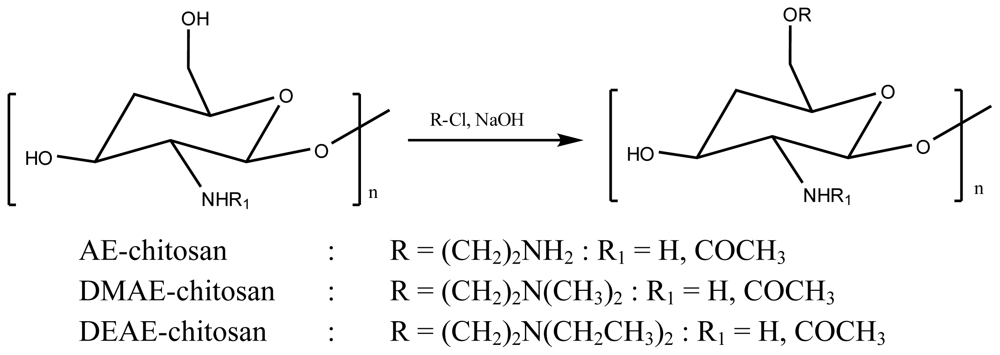
<p>BACE-1 inhibition activity of chitosan derivatives have been reported by Je <italic>et al.</italic> [<xref ref-type="bibr" rid="b28-marinedrugs-08-02117">28</xref>]. They prepared chitosan with two degrees of deacetylation (90% and 50%) and grafted amino functionality into chitosan to improve the solubility and bioactivity. The synthesized reaction of chitosan derivatives are presented in <xref ref-type="fig" rid="f1-marinedrugs-08-02117">Scheme 1</xref>. Chitosan derivatives were designated as aminoethyl (AE-chitosan) (90%), dimethylaminoethyl (DMAE-chitosan) (90%), and diethylaminoethyl (DEAE-chitosan) (90%) prepared from 90% deacetylated chitosan, and AE-chitosan (50%), DMAE-chitosan (50%), and DEAE-chitosan (50%) prepared from 50% deacetylated chitosan. The potencies of chitosan derivatives are expressed as an IC<sub>50</sub> value, which is the BACE-1 inhibitor concentration leading to 50% inhibition of BACE-1 activity. AE-chitosan (90%) shows strongest inhibitory activity compared to other derivatives. Moreover, the inhibition modes of BACE-1 catalyzed by chitosan and its derivatives have been determined by Dixon plots. Based on the Dixon plots, the inhibition constant (<italic>K</italic><italic><sub>i</sub></italic>) of AE-chitosan (90%) is 85 μg/mL. They suggested that the free amino groups at the C-2 and C-6 positions play an important role in BACE-1 inhibitory activity; however, the free amino group at C-2 is a minor factor according to the above results.</p>
<p>An investigation of BACE-1 inhibitory activity of COS was done by Byun <italic>et al.</italic> [<xref ref-type="bibr" rid="b53-marinedrugs-08-02117">53</xref>]. Nine kinds of hetero-COS with different degrees of deacetylation and molecular weight were prepared by using an ultrafiltration (UF) membrane reactor [<xref ref-type="bibr" rid="b35-marinedrugs-08-02117">35</xref>]. The deacetylated chitosan of 90, 75, and 50% were hydrolyzed and fractionated by passing them through three UF membranes of molecular weight cut-off (MWCO) 10, 5, and 1 kDa. The hetero-COSs were named 90-HMWCOSs, 75-HMWCOSs, 50-HMWCOSs, 90-MMWCOSs, 75-MMWCOSs, 50-MMWCOSs, 90-LMWCOSs, 75-LMWCOSs, 50-LMWCOSs respectively. 90-MMWCOSs which are 90% deacetylated COS with molecular weight 3–5 kDa, exhibited the highest BACE-1 inhibitory activity (25–42 mM) compared to the others. The inhibitor was found to have a noncompetitive by Dixon plot, and the <italic>Ki</italic> of 90-MMWCOSs was 3.87–6.47 mM. The study of Byun and his colleagues indicated that degree of deacetylation and sulfations at the C-2 position of COS has an effect on BACE-1 inhibitory activity. A further amine group at C-2 position was shown to be beneficial for BACE-1 inhibitory activity.</p>
<p>Based on the hypothesis that the increase of an important product of oxidation may induce Aβ formation, Khodagholi <italic>et al.</italic> [<xref ref-type="bibr" rid="b54-marinedrugs-08-02117">54</xref>] studied the effect of chitosan in NT2 neuron cells induced by H<sub>2</sub>O<sub>2</sub> and FeSO<sub>4</sub>. NT2 neuronal cells are a widely accepted experimental model to study the regulation of APP metabolism and the pathogenesis of AD [<xref ref-type="bibr" rid="b55-marinedrugs-08-02117">55</xref>]. In their study, they found that Aβ formation by NT2 neurons pretreated with chitosan was significantly lower than that of control cells exposed only to H<sub>2</sub>O<sub>2</sub>. The Aβ levels rose from 30.96 pg/mL in H<sub>2</sub>O<sub>2</sub>-treated cells to 22.2 and 18.35 pg/mL in the presence of 0.1 and 0.5% w/v chitosan, respectively. This study indicates that Aβ level can be controlled by treatment with this chitosan, suggesting a protective effect of chitosan in AD.</p>
<p>Almost all currently available medications for AD are cholinesterase inhibitors. Considering these reasons, the suppression of β-amyloid formation by chitosan and its derivatives will enhance the medications for AD. However, further studies are needed with clinical trials for the application of chitosan and its derivatives in AD medications.</p></sec>
<sec>
<title>3. Acetylcholinesterase Inhibitory Activity</title>
<p>The pathogenesis of AD has been linked to a deficiency in the brain neurotransmitter acetylcholine (ACh) [<xref ref-type="bibr" rid="b56-marinedrugs-08-02117">56</xref>]. This was stated in the cholinergic hypothesis which was raised three decades ago, that a serious loss of cholinergic function in the CNS contributes significantly to the cognitive symptoms associated with AD [<xref ref-type="bibr" rid="b57-marinedrugs-08-02117">57</xref>]. The inhibition of acetylcholinesterase (AChE) enzyme, which catalyzes the breakdown of ACh, may be one of the most realistic approaches to the symptomatic treatment of AD [<xref ref-type="bibr" rid="b56-marinedrugs-08-02117">56</xref>,<xref ref-type="bibr" rid="b58-marinedrugs-08-02117">58</xref>,<xref ref-type="bibr" rid="b59-marinedrugs-08-02117">59</xref>].</p>
<p>Recently, several studies on chitosan and its derivatives have identified their potential as acetylcholinesterase inhibitors (AChEIs). The AChEIs activity of COS and its derivatives is discussed below as well as summarized in <xref ref-type="table" rid="t1-marinedrugs-08-02117">Table 1</xref>.</p>
<p>Lee <italic>et al</italic>. [<xref ref-type="bibr" rid="b60-marinedrugs-08-02117">60</xref>] studied AChEIs activity of six kinds of COS with different molecular weight and degrees of deacetylation. In their study, 90-COS and 50-COS were prepared from 90% and 50% deacetylated chitosan and further fractionated into three kinds of COS, high molecular weight (HMW) (5,000–10,000 dalton), medium molecular weight (MMW) (1,000–5,000 dalton), and low molecular weight (LMW) (below 1,000 dalton) using an ultrafiltration membrane system as described by Kim <italic>et al.</italic> [<xref ref-type="bibr" rid="b35-marinedrugs-08-02117">35</xref>]. 90-COS has stronger AChEIs activity than 50-COS. Among 90-COS, 90-MMWCOS (90% deacetylated COS with molecular weight 1000–5000 Da) showed the strongest AChEIs with IC<sub>50</sub> value of 1.67 mg/mL (<xref ref-type="table" rid="t1-marinedrugs-08-02117">Table 1</xref>). Moreover, Lee <italic>et al</italic>. also investigated the level of AChE protein expression and AChEIs activity in PC12 cell lines using Ellman’s evaluation. The results showed that 90-MMWCOS suppressed the AChE protein expression and increased the AChEIs in a dose dependant manner. These findings suggest that degree of deacetylation of COS is the key factor for the AChEIs activity.</p>
<p>Furthermore, Yoon <italic>et al</italic>. [<xref ref-type="bibr" rid="b61-marinedrugs-08-02117">61</xref>] synthesized COS derivatives with different substitution groups. In their study, the synthesis of COS derivatives was accomplished by the displacement of the hydroxyl group at the C-6 of the pyranose ring and replaced with aminoethyl (AE), dimethylaminoethyl (DMAE) and diethylaminoethyl (DEAE) groups. The chemical structures were determined as AE-COS, DMAE-COS and DEAE-COS, in sequence. Eserine, a parasympathomimetic and a reversible cholinesterase inhibitor, was used as the positive control in their study. Among three COS derivatives, DEAE-COS has the strongest AChEIs activity with IC<sub>50</sub> values of 9.2 ± 0.33 μg/mL. DMAE- and DEAE-COS were identified as competitive AChEIs according to the Lineweaver–Burk plot. These findings suggest that the chemical modification will enhance the utilization of COS as AChEIs, and their inhibitory activity depends on the hydrophobic nature of the group that is introduced to them.</p>
<p>AChEIs, which provide modest symptomatic improvement and are able to delay the loss of functional abilities, is a promising medication for AD patients. The AChEIs activity of COS and its derivatives indicate that COS derivatives might be a beneficial material in the prevention or treatment of AD. Furthermore, mechanistic studies, particularly those that investigate how these compounds inhibit AChE activity in cellular systems, will be required in the future.</p></sec>
<sec>
<title>4. Anti-Neuroinflammatory</title>
<p>In principle, inflammation is the first response of a human body’s immune system to pathogens or irritation [<xref ref-type="bibr" rid="b62-marinedrugs-08-02117">62</xref>,<xref ref-type="bibr" rid="b63-marinedrugs-08-02117">63</xref>]. A growing number of studies are discovering intriguing links between chronic inflammation and a number of neurodegenerative disorders [<xref ref-type="bibr" rid="b62-marinedrugs-08-02117">62</xref>]. The neuroinflammation process plays a pivotal role in the initiation and progression of various neurodegenerative diseases. Recently, a number of studies have found anti-neuroinflammatory activity of chitosan and its derivatives.</p>
<p>Kim <italic>et al</italic>. [<xref ref-type="bibr" rid="b64-marinedrugs-08-02117">64</xref>] reported that high molecular weight water soluble chitosan (WSC) inhibits the production of pro-inflammatory cytokine in human astrocytoma cells activated by Aβ peptide 25–35 (Aβ<sub>25–35</sub>) and interleukin-1β (IL-1β). In their study, they used the human astrocytoma cell line (CCF-STTG1) as an <italic>in vitro</italic> AD model. The effects of WSC on pro-inflammatory cytokines such as tumor necrosis factor-α (TNF-α) and interleukin-6 (IL-6) were evaluated by enzyme-linked immunosorbent assay (ELISA) and western blotting. The secretion and expression of TNF-α and IL-6 were significantly inhibited by pretreatment with 1 and 10 μg/mL of WSC. Moreover, the expression of inducible nitric-oxide synthase (iNOS) induced by Aβ<sub>25–35</sub> and IL-1β was partially inhibited by treatment with WSC. However, those findings need further investigation to find whether WSC regulates the transcription factor and signaling molecules with concerns to the production of inflammatory cytokines and neurotoxic components.</p>
<p>Another study conducted by Khodagholi <italic>et al</italic>. focused on the anti-neuroinflammatory effect of chitosan and its derivatives on NT2 neuronal cells. Chitosan exerts anti-neuroinflammatory action by upregulation of heat shock protein 70 (Hsp-70) and inhibits the activation of NF-κB [<xref ref-type="bibr" rid="b54-marinedrugs-08-02117">54</xref>]. The anti-inflammatory mechanism of Hsp-70 is mediated by the binding of Hsp-70 to NF-κB and its subsequent inhibition [<xref ref-type="bibr" rid="b65-marinedrugs-08-02117">65</xref>]. A pre-treatment with 0.1 and 0.5% (w/v) chitosan prior to H<sub>2</sub>O<sub>2</sub> and FeSO<sub>4</sub> exposure has been proved to increase the level of heat shock protein (Hsp-70) to 1.4- and 1.6-times, respectively.</p>
<p>Several studies have shown anti-neuroinflammatory activity of chitosan and its derivatives; however, further studies about anti-neuroinflammatory activity of chitosan and its derivatives in other neuronal cells such as microglia are needed. Moreover, various intracellular signaling pathways also need to be investigated in order to obtain a better understanding of the underlying anti-neuroinflammatory mechanism of chitosan and its derivatives.</p></sec>
<sec>
<title>5. Apoptosis Inhibitors</title>
<p>The elimination of cells by apoptosis or programmed cell death is a fundamental event in development, whereby multi-cellular organisms regulate cell numbers or eliminate cells that are functionally redundant or potentially detrimental to the organism [<xref ref-type="bibr" rid="b66-marinedrugs-08-02117">66</xref>]. Many human diseases such as acquired immunodeficiency syndrome, neurodegenerative disorders, and cancer can be attributed directly or indirectly to a derangement of apoptosis resulting in either cell accumulation, in which cell eradication or cell turnover is impaired or cell loss, in which the apoptotic programs are inadvertently triggered [<xref ref-type="bibr" rid="b67-marinedrugs-08-02117">67</xref>]. In neurodegenerative disorders, apoptosis might be pathogenic, and targeting it might mitigate neurodegenerative disorders [<xref ref-type="bibr" rid="b68-marinedrugs-08-02117">68</xref>]. Some studies on chitosan have found biological activity of chitosan, COS and its derivatives in targeting apoptosis in brain cells.</p>
<p>A study carried out by Koo <italic>et al.</italic> successfully showed that high molecular weight water soluble chitosan (WSC) was able to protect against apoptosis in human astrocytoma cells (CCF-STTG1) induced by serum starvation [<xref ref-type="bibr" rid="b69-marinedrugs-08-02117">69</xref>]. In their study, they used WSC, which has a molecular weight of 300 kDa and degree of deacetylation over 90%, which was produced by using a multi-step membrane separation process. Based on the cytotoxicity test, WSC (10 μg/mL) was able to inhibit cell death significantly compared to the control group. Furthermore, in order to induce apoptosis by serum starvation, they incubated CCF-STTG1 cells for 48 h in medium supplemented with only 0.1% FBS. The serum starvation-induced apoptosis of CCF-STTG1 cells was determined by flow cytometry. Their results suggested that when the cells treated with WSC (10 μg/mL) were exposed to serum starved-medium, apoptosis of CCF-STTG1 cells was almost completely inhibited compared to the effect of serum starved-medium alone. Supporting the flow cytometry, they also showed that DNA fragmentation in a ladder pattern, which is characteristic of apoptosis, was not detected in CCF-STTG1 cells pre-treated with WSC (10 μg/mL). It is known that serum starvation induces apoptosis through the activation of p53, based on their Western blot data; WSC can prevent serum starvation-induced apoptosis via blocking p53 activation. Although their study did not directly demonstrate general cell death of CCF-STTG1 astrocytoma cells because only morphological changes have been observed, their finding might suggest that WSC can promote neuroprotective properties in the brain.</p>
<p>Recently, the protective effect of COS, with a molecular weight 800 Da, against glutamate-induced neurotoxicity in cultured hippocampal neurons has been reported [<xref ref-type="bibr" rid="b70-marinedrugs-08-02117">70</xref>]. In their study they used glutamate as a model, because glutamate accumulation in the CNS and excessive stimulation of glutamate receptors induces potent neurotoxic action, which is specifically referred to as excitotoxicity, and is involved in neuronal damage and degenerative disorders in the CNS. A glutamate concentration of 125 μM was chosen in their study. Hoechst staining and flow cytometry with annexin V/PI staining showed that in this concentration rat hippocampal neurons underwent extensive apoptotic-like cell death characterized by neuronal morphology. Based on the cell viability assessments, together with Hoechst 33342 staining and flow cytometry for cell apoptosis analysis, pre-treatment with COS was able to attenuate apoptosis in hippocampal neurons cells in a dose dependent manner. Moreover, they also measured the change in caspase-3 activity during cell treatment. A three- to four-fold increase in caspase-3 activity was found in cultured hippocampal neurons at 18 h after a 15-min exposure to glutamate, and pretreatment with 1.0 and 2.0 mg/mL of COS prevented cells from glutamate-induced increases in caspase-3 activity. The increase of [Ca<sup>2+</sup>] has been postulated to be associated with glutamate-induced cell death. In cultured hippocampal neurons exposed to 125 μM glutamate, [Ca<sup>2+</sup>] was promptly elevated, and then leveled off with significantly higher values compared to that for control group throughout a recording period of 15 min. In contrast, [Ca<sup>2+</sup>] in cultured hippocampal neurons pretreated with COS (1.0 mg/mL) showed significantly lower values than those for cultured hippocampal neurons without COS pretreatment over a recording period of 15 min, suggesting that COS pretreatment significantly inhibited the [Ca<sup>2+</sup>] increase. Since glutamate-evoked cell injury in hippocampal neurons is involved in many CNS disorders, their study may raise the possibility of developing COS as a potential agent for the prevention and treatment of some CNS diseases.</p>
<p>Apoptosis inhibition activity of chitosan and COS might be extended to the intervention of neurodegenerative disorders. However, further studies, such as <italic>in vivo</italic> tests, are needed to clarify the neuroprotective properties of chitosan and COS.</p></sec>
<sec>
<title>6. Other Activities</title>
<p>The possible role of chitosan in preventing oxidative stress-induced by amyloid β formation in NT2 neuron cells was investigated by Khodagholi <italic>et al</italic>. [<xref ref-type="bibr" rid="b54-marinedrugs-08-02117">54</xref>]. On the other hand, the evaluation utility of chitosan nanoparticles with an <italic>in-vitro</italic> model of acrolein-mediated cell injury using PC-12 cells was investigated by Cho <italic>et al</italic>. [<xref ref-type="bibr" rid="b71-marinedrugs-08-02117">71</xref>]. The particles effectively, and statistically, reduced damage to membrane integrity, secondary oxidative stress, and lipid peroxidation. Their study suggests that a chitosan nanoparticle-based therapy to interfere with “secondary” injury is possible.</p>
<p>Moreover, the development of an effective delivery system is needed to provide sufficient drug concentration into the brain to prevent cell death. Using avidin (SA)-biotin (BIO) technology, Aktas <italic>et al.</italic> [<xref ref-type="bibr" rid="b72-marinedrugs-08-02117">72</xref>] describe the design of chitosan (CS) nanospheres conjugated with poly(ethylene glycol) (PEG) bearing the OX26 monoclonal antibody whose affinity for the transferrin receptor (TfR) may trigger receptor mediated transport across blood-brain barrier. Their findings indicate that this novel targeted nanoparticulate drug delivery system was able to translocate into the brain tissue after intravenously administration. Consequently, chitosan is a promising carrier for the transport of the anticaspase peptide Z-DEVD-FMK into the brain.</p></sec>
<sec sec-type="conclusions">
<title>7. Conclusions</title>
<p>In recent years, the marine environment has shown to provide extremely rich biological active compounds. Chitosan, one of the bioactive compounds derived from the sea, has been shown to possess many biological activities. In fact, the interest in chitosan and its derivatives for the treatment of neurological disorders appear to be an emerging field. Some of the representative’s examples are presented in this review with a focus on neuroprotective properties of chitosan and its derivatives. According to presented data, it seems that chitosan and its derivatives are promising neuroprotective agents, as they showed neuroprotective properties such as: suppression of β-amyloid formation, AChEIs, anti-neuroinflammatory activity, apoptosis inhibitors, <italic>etc.</italic> Up until now, most neuroprotective activities of chitosan and its derivatives have been observed <italic>in vitro</italic>. Therefore, further studies are needed in order to investigate their activity in mouse model systems and/or human subjects. In conclusion, these results reveal the potential of chitosan and its derivatives as potential therapeutic candidates for neurodegenerative disorder and their involvement in the future pharmaceuticals are promising.</p></sec></body>
<back>
<ack>
<title>Acknowledgement</title>
<p>This study was supported by a grant from Marine Bioprocess Research Center of the Marine Bio 21 Project funded by the Ministry of Land, Transport and Maritime, Korea.</p></ack>
<fn-group><fn>
<p><italic>Samples Availability:</italic> Available from the authors.</p></fn></fn-group>
<ref-list>
<title>References</title>
<ref id="b1-marinedrugs-08-02117"><label>1</label><citation citation-type="journal"><person-group person-group-type="author"><name><surname>Mundkur</surname><given-names>N</given-names></name></person-group><article-title>Neuroplasticity in children</article-title><source>Indian J. Pediatr</source><year>2005</year><volume>72</volume><fpage>855</fpage><lpage>857</lpage><pub-id pub-id-type="doi">10.1007/BF02731115</pub-id><pub-id pub-id-type="pmid">16272658</pub-id></citation></ref>
<ref id="b2-marinedrugs-08-02117"><label>2</label><citation citation-type="book"><person-group person-group-type="author"><name><surname>Montgomery</surname><given-names>PC</given-names></name><name><surname>Connolly</surname><given-names>BH</given-names></name><name><surname>Bohmert</surname><given-names>JA</given-names></name></person-group><article-title>Impaired motor function and sensory integrity associated with nonprogressive disorders of the central nervous system–congenital origin or acquired in infancy or childhood (Pattern C)</article-title><source>Neuromuscular Essentials Applying the Preferred Physical Therapist Practice Patterns</source><publisher-name>SLACK Incorporated</publisher-name><publisher-loc>Thorofare, NJ, USA</publisher-loc><year>2008</year><fpage>43</fpage><lpage>70</lpage></citation></ref>
<ref id="b3-marinedrugs-08-02117"><label>3</label><citation citation-type="journal"><person-group person-group-type="author"><name><surname>Hosoi</surname><given-names>R</given-names></name><name><surname>Kashiwagi</surname><given-names>Y</given-names></name><name><surname>Hatazawa</surname><given-names>J</given-names></name><name><surname>Gee</surname><given-names>A</given-names></name><name><surname>Inoue</surname><given-names>O</given-names></name></person-group><article-title>Glial metabolic dysfunction caused neural damage by short-term ischemia in brain</article-title><source>Ann. Nucl. Med</source><year>2006</year><volume>20</volume><fpage>377</fpage><lpage>380</lpage><pub-id pub-id-type="doi">10.1007/BF02987251</pub-id><pub-id pub-id-type="pmid">16878712</pub-id></citation></ref>
<ref id="b4-marinedrugs-08-02117"><label>4</label><citation citation-type="journal"><person-group person-group-type="author"><name><surname>Allen</surname><given-names>NJ</given-names></name><name><surname>Barres</surname><given-names>BA</given-names></name></person-group><article-title>Neuroscience: Glia more than just brain glue</article-title><source>Nature</source><year>2009</year><volume>457</volume><fpage>675</fpage><lpage>677</lpage><pub-id pub-id-type="doi">10.1038/457675a</pub-id><pub-id pub-id-type="pmid">19194443</pub-id></citation></ref>
<ref id="b5-marinedrugs-08-02117"><label>5</label><citation citation-type="journal"><person-group person-group-type="author"><name><surname>Yuan</surname><given-names>J</given-names></name><name><surname>Yankner</surname><given-names>BA</given-names></name></person-group><article-title>Apoptosis in the nervous system</article-title><source>Nature</source><year>2000</year><volume>407</volume><fpage>802</fpage><lpage>809</lpage><pub-id pub-id-type="doi">10.1038/35037739</pub-id><pub-id pub-id-type="pmid">11048732</pub-id></citation></ref>
<ref id="b6-marinedrugs-08-02117"><label>6</label><citation citation-type="journal"><person-group person-group-type="author"><name><surname>Bjorklund</surname><given-names>A</given-names></name><name><surname>Lindvall</surname><given-names>O</given-names></name></person-group><article-title>Cell replacement therapies for central nervous system disorders</article-title><source>Nat. Neurosci</source><year>2000</year><volume>3</volume><fpage>537</fpage><lpage>544</lpage><pub-id pub-id-type="doi">10.1038/75705</pub-id><pub-id pub-id-type="pmid">10816308</pub-id></citation></ref>
<ref id="b7-marinedrugs-08-02117"><label>7</label><citation citation-type="journal"><person-group person-group-type="author"><name><surname>Nakatomi</surname><given-names>H</given-names></name><name><surname>Kuriu</surname><given-names>T</given-names></name><name><surname>Okabe</surname><given-names>S</given-names></name><name><surname>Yamamoto</surname><given-names>S</given-names></name><name><surname>Hatano</surname><given-names>O</given-names></name><name><surname>Kawahara</surname><given-names>N</given-names></name><name><surname>Tamura</surname><given-names>A</given-names></name><name><surname>Kirino</surname><given-names>T</given-names></name><name><surname>Nakafuku</surname><given-names>M</given-names></name></person-group><article-title>Regeneration of hippocampal pyramidal neurons after ischemic brain injury by recruitment of endogenous neural progenitors</article-title><source>Cell</source><year>2002</year><volume>110</volume><fpage>429</fpage><lpage>441</lpage><pub-id pub-id-type="doi">10.1016/S0092-8674(02)00862-0</pub-id><pub-id pub-id-type="pmid">12202033</pub-id></citation></ref>
<ref id="b8-marinedrugs-08-02117"><label>8</label><citation citation-type="journal"><person-group person-group-type="author"><name><surname>Zarros</surname><given-names>A</given-names></name></person-group><article-title>In which cases is neuroprotection useful?</article-title><source>Adv. Altern. Thinking Neurosci</source><year>2009</year><volume>1</volume><fpage>3</fpage><lpage>5</lpage></citation></ref>
<ref id="b9-marinedrugs-08-02117"><label>9</label><citation citation-type="journal"><person-group person-group-type="author"><name><surname>Tucci</surname><given-names>P</given-names></name><name><surname>Bagetta</surname><given-names>G</given-names></name></person-group><article-title>How to study neuroprotection?</article-title><source>Cell Death Differ</source><year>2008</year><volume>15</volume><fpage>1084</fpage><lpage>1085</lpage><pub-id pub-id-type="doi">10.1038/cdd.2008.32</pub-id></citation></ref>
<ref id="b10-marinedrugs-08-02117"><label>10</label><citation citation-type="journal"><person-group person-group-type="author"><name><surname>Pellicciari</surname><given-names>R</given-names></name><name><surname>Costantino</surname><given-names>G</given-names></name><name><surname>Marinozzi</surname><given-names>M</given-names></name><name><surname>Natalini</surname><given-names>B</given-names></name></person-group><article-title>Modulation of glutamate receptor pathways in the search for new neuroprotective agents</article-title><source>Il Farmaco</source><year>1998</year><volume>53</volume><fpage>255</fpage><lpage>261</lpage><pub-id pub-id-type="doi">10.1016/S0014-827X(98)00018-4</pub-id><pub-id pub-id-type="pmid">9658582</pub-id></citation></ref>
<ref id="b11-marinedrugs-08-02117"><label>11</label><citation citation-type="journal"><person-group person-group-type="author"><name><surname>Behl</surname><given-names>C</given-names></name><name><surname>Moosmann</surname><given-names>B</given-names></name></person-group><article-title>Antioxidant neuroprotection in Alzheimer’s disease as preventive and therapeutic approach</article-title><source>Free Radic. Biol. Med</source><year>2002</year><volume>33</volume><fpage>182</fpage><lpage>191</lpage><pub-id pub-id-type="doi">10.1016/S0891-5849(02)00883-3</pub-id><pub-id pub-id-type="pmid">12106814</pub-id></citation></ref>
<ref id="b12-marinedrugs-08-02117"><label>12</label><citation citation-type="journal"><person-group person-group-type="author"><name><surname>Agnello</surname><given-names>D</given-names></name><name><surname>Bigini</surname><given-names>P</given-names></name><name><surname>Villa</surname><given-names>P</given-names></name><name><surname>Mennini</surname><given-names>T</given-names></name><name><surname>Cerami</surname><given-names>A</given-names></name><name><surname>Brines</surname><given-names>ML</given-names></name><name><surname>Ghezzi</surname><given-names>P</given-names></name></person-group><article-title>Erythropoietin exerts an anti-inflammatory effect on the CNS in a model of experimental autoimmune encephalomyelitis</article-title><source>Brain Res</source><year>2002</year><volume>952</volume><fpage>128</fpage><lpage>134</lpage><pub-id pub-id-type="doi">10.1016/S0006-8993(02)03239-0</pub-id><pub-id pub-id-type="pmid">12363412</pub-id></citation></ref>
<ref id="b13-marinedrugs-08-02117"><label>13</label><citation citation-type="journal"><person-group person-group-type="author"><name><surname>Gao</surname><given-names>H-M</given-names></name><name><surname>Liu</surname><given-names>B</given-names></name><name><surname>Zhang</surname><given-names>W</given-names></name><name><surname>Hong</surname><given-names>J-S</given-names></name></person-group><article-title>Novel anti-inflammatory therapy for Parkinson’s disease</article-title><source>Trends Pharmacol. Sci</source><year>2003</year><volume>24</volume><fpage>395</fpage><lpage>401</lpage><pub-id pub-id-type="doi">10.1016/S0165-6147(03)00176-7</pub-id><pub-id pub-id-type="pmid">12915048</pub-id></citation></ref>
<ref id="b14-marinedrugs-08-02117"><label>14</label><citation citation-type="journal"><person-group person-group-type="author"><name><surname>Volbracht</surname><given-names>C</given-names></name><name><surname>van Beek</surname><given-names>J</given-names></name><name><surname>Zhu</surname><given-names>C</given-names></name><name><surname>Blomgren</surname><given-names>K</given-names></name><name><surname>Leist</surname><given-names>M</given-names></name></person-group><article-title>Neuroprotective properties of memantine in different in vitro and in vivo models of excitotoxicity</article-title><source>Eur. J. Neurosci</source><year>2006</year><volume>23</volume><fpage>2611</fpage><lpage>2622</lpage><pub-id pub-id-type="doi">10.1111/j.1460-9568.2006.04787.x</pub-id><pub-id pub-id-type="pmid">16817864</pub-id></citation></ref>
<ref id="b15-marinedrugs-08-02117"><label>15</label><citation citation-type="journal"><person-group person-group-type="author"><name><surname>Yu</surname><given-names>X</given-names></name><name><surname>An</surname><given-names>L</given-names></name><name><surname>Wang</surname><given-names>Y</given-names></name><name><surname>Zhao</surname><given-names>H</given-names></name><name><surname>Gao</surname><given-names>C</given-names></name></person-group><article-title>Neuroprotective effect of Alpinia oxyphylla Miq. fruits against glutamate-induced apoptosis in cortical neurons</article-title><source>Toxicol. Lett</source><year>2003</year><volume>144</volume><fpage>205</fpage><lpage>212</lpage><pub-id pub-id-type="doi">10.1016/S0378-4274(03)00219-4</pub-id><pub-id pub-id-type="pmid">12927364</pub-id></citation></ref>
<ref id="b16-marinedrugs-08-02117"><label>16</label><citation citation-type="journal"><person-group person-group-type="author"><name><surname>Kietzmann</surname><given-names>T</given-names></name><name><surname>Knabe</surname><given-names>W</given-names></name><name><surname>Schmidt-Kastner</surname><given-names>R</given-names></name></person-group><article-title>Hypoxia and hypoxia-inducible factor modulated gene expression in brain: involvement in neuroprotection and cell death</article-title><source>Eur. Arch. Psychiatry Clin. Neurosci</source><year>2001</year><volume>251</volume><fpage>170</fpage><lpage>178</lpage><pub-id pub-id-type="doi">10.1007/s004060170037</pub-id><pub-id pub-id-type="pmid">11697581</pub-id></citation></ref>
<ref id="b17-marinedrugs-08-02117"><label>17</label><citation citation-type="journal"><person-group person-group-type="author"><name><surname>Heurteaux</surname><given-names>C</given-names></name><name><surname>Guy</surname><given-names>N</given-names></name><name><surname>Laigle</surname><given-names>C</given-names></name><name><surname>Blondeau</surname><given-names>N</given-names></name><name><surname>Duprat</surname><given-names>F</given-names></name><name><surname>Mazzuca</surname><given-names>M</given-names></name><name><surname>Lang-Lazdunski</surname><given-names>L</given-names></name><name><surname>Widmann</surname><given-names>C</given-names></name><name><surname>Zanzouri</surname><given-names>M</given-names></name><name><surname>Romey</surname><given-names>G</given-names></name><name><surname>Lazdunski</surname><given-names>M</given-names></name></person-group><article-title>TREK-1, a K+ channel involved in neuroprotection and general anesthesia</article-title><source>EMBO J</source><year>2004</year><volume>23</volume><fpage>2684</fpage><lpage>2695</lpage><pub-id pub-id-type="doi">10.1038/sj.emboj.7600234</pub-id><pub-id pub-id-type="pmid">15175651</pub-id></citation></ref>
<ref id="b18-marinedrugs-08-02117"><label>18</label><citation citation-type="journal"><person-group person-group-type="author"><name><surname>Schwartz</surname><given-names>G</given-names></name><name><surname>Fehlings</surname><given-names>MG</given-names></name></person-group><article-title>Evaluation of the neuroprotective effects of sodium channel blockers after spinal cord injury: improved behavioral and neuroanatomical recovery with riluzole</article-title><source>J. Neurosurg.: Spine</source><year>2001</year><volume>94</volume><fpage>245</fpage><lpage>256</lpage><pub-id pub-id-type="doi">10.3171/spi.2001.94.2.0245</pub-id></citation></ref>
<ref id="b19-marinedrugs-08-02117"><label>19</label><citation citation-type="journal"><person-group person-group-type="author"><name><surname>Youdim</surname><given-names>MBH</given-names></name><name><surname>Fridkin</surname><given-names>M</given-names></name><name><surname>Zheng</surname><given-names>H</given-names></name></person-group><article-title>Novel bifunctional drugs targeting monoamine oxidase inhibition and iron chelation as an approach to neuroprotection in Parkinson’s disease and other neurodegenerative diseases</article-title><source>J. Neural Transm</source><year>2004</year><volume>111</volume><fpage>1455</fpage><lpage>1471</lpage><pub-id pub-id-type="doi">10.1007/s00702-004-0143-x</pub-id><pub-id pub-id-type="pmid">15480846</pub-id></citation></ref>
<ref id="b20-marinedrugs-08-02117"><label>20</label><citation citation-type="journal"><person-group person-group-type="author"><name><surname>Gaeta</surname><given-names>A</given-names></name><name><surname>Hider</surname><given-names>RC</given-names></name></person-group><article-title>The crucial role of metal ions in neurodegeneration: the basis for a promising therapeutic strategy</article-title><source>Br. J. Pharmacol</source><year>2005</year><volume>146</volume><fpage>1041</fpage><lpage>1059</lpage><pub-id pub-id-type="pmid">16205720</pub-id></citation></ref>
<ref id="b21-marinedrugs-08-02117"><label>21</label><citation citation-type="journal"><person-group person-group-type="author"><name><surname>Tremblay</surname><given-names>R</given-names></name><name><surname>Hewitt</surname><given-names>K</given-names></name><name><surname>Lesiuk</surname><given-names>H</given-names></name><name><surname>Mealing</surname><given-names>G</given-names></name><name><surname>Morley</surname><given-names>P</given-names></name><name><surname>Durkin</surname><given-names>JP</given-names></name></person-group><article-title>Evidence that Brain-Derived Neurotrophic Factor Neuroprotection Is Linked to Its Ability to Reverse the NMDA-Induced Inactivation of Protein Kinase C in Cortical Neurons</article-title><source>J. Neurochem</source><year>1999</year><volume>72</volume><fpage>102</fpage><lpage>111</lpage><pub-id pub-id-type="pmid">9886060</pub-id></citation></ref>
<ref id="b22-marinedrugs-08-02117"><label>22</label><citation citation-type="journal"><person-group person-group-type="author"><name><surname>Moalem</surname><given-names>G</given-names></name><name><surname>Gdalyahu</surname><given-names>A</given-names></name><name><surname>Shani</surname><given-names>Y</given-names></name><name><surname>Otten</surname><given-names>U</given-names></name><name><surname>Lazarovici</surname><given-names>P</given-names></name><name><surname>Cohen</surname><given-names>IR</given-names></name><name><surname>Schwartz</surname><given-names>M</given-names></name></person-group><article-title>Production of Neurotrophins by Activated T Cells: Implications for Neuroprotective Autoimmunity</article-title><source>J. Autoimmun</source><year>2000</year><volume>15</volume><fpage>331</fpage><lpage>345</lpage><pub-id pub-id-type="doi">10.1006/jaut.2000.0441</pub-id><pub-id pub-id-type="pmid">11040074</pub-id></citation></ref>
<ref id="b23-marinedrugs-08-02117"><label>23</label><citation citation-type="journal"><person-group person-group-type="author"><name><surname>Akerud</surname><given-names>P</given-names></name><name><surname>Canals</surname><given-names>JM</given-names></name><name><surname>Snyder</surname><given-names>EY</given-names></name><name><surname>Arenas</surname><given-names>E</given-names></name></person-group><article-title>Neuroprotection through delivery of glial cell line-derived neurotrophic factor by neural stem cells in a mouse model of Parkinson’s disease</article-title><source>J. Neurosci</source><year>2001</year><volume>21</volume><fpage>8108</fpage><lpage>8118</lpage><pub-id pub-id-type="pmid">11588183</pub-id></citation></ref>
<ref id="b24-marinedrugs-08-02117"><label>24</label><citation citation-type="journal"><person-group person-group-type="author"><name><surname>Woo</surname><given-names>M-S</given-names></name><name><surname>Park</surname><given-names>J-S</given-names></name><name><surname>Choi</surname><given-names>I-Y</given-names></name><name><surname>Kim</surname><given-names>W-K</given-names></name><name><surname>Kim</surname><given-names>H-S</given-names></name></person-group><article-title>Inhibition of MMP-3 or -9 suppresses lipopolysaccharide-induced expression of proinflammatory cytokines and iNOS in microglia</article-title><source>J. Neurochem</source><year>2008</year><volume>106</volume><fpage>770</fpage><lpage>780</lpage><pub-id pub-id-type="doi">10.1111/j.1471-4159.2008.05430.x</pub-id><pub-id pub-id-type="pmid">18419763</pub-id></citation></ref>
<ref id="b25-marinedrugs-08-02117"><label>25</label><citation citation-type="journal"><person-group person-group-type="author"><name><surname>Chandrasekaran</surname><given-names>K</given-names></name><name><surname>Mehrabian</surname><given-names>Z</given-names></name><name><surname>Spinnewyn</surname><given-names>B</given-names></name><name><surname>Chinopoulos</surname><given-names>C</given-names></name><name><surname>Drieu</surname><given-names>K</given-names></name><name><surname>Fiskum</surname><given-names>G</given-names></name></person-group><article-title>Neuroprotective Effects of Bilobalide, a Component of Ginkgo biloba Extract (EGb 761®) in Global Brain Ischemia and in Excitotoxicity-induced Neuronal Death</article-title><source>Pharmacopsychiatry</source><year>2003</year><volume>36</volume><fpage>89</fpage><lpage>94</lpage><pub-id pub-id-type="pmid">12806565</pub-id></citation></ref>
<ref id="b26-marinedrugs-08-02117"><label>26</label><citation citation-type="journal"><person-group person-group-type="author"><name><surname>Narang</surname><given-names>S</given-names></name><name><surname>Gibson</surname><given-names>D</given-names></name><name><surname>Wasan</surname><given-names>AD</given-names></name><name><surname>Ross</surname><given-names>EL</given-names></name><name><surname>Michna</surname><given-names>E</given-names></name><name><surname>Nedeljkovic</surname><given-names>SS</given-names></name><name><surname>Jamison</surname><given-names>RN</given-names></name></person-group><article-title>Efficacy of Dronabinol as an Adjuvant Treatment for Chronic Pain Patients on Opioid Therapy</article-title><source>J. Pain</source><year>2008</year><volume>9</volume><fpage>254</fpage><lpage>264</lpage><pub-id pub-id-type="doi">10.1016/j.jpain.2007.10.018</pub-id><pub-id pub-id-type="pmid">18088560</pub-id></citation></ref>
<ref id="b27-marinedrugs-08-02117"><label>27</label><citation citation-type="journal"><person-group person-group-type="author"><name><surname>Alonso</surname><given-names>D</given-names></name><name><surname>Castro</surname><given-names>A</given-names></name><name><surname>Martinez</surname><given-names>A</given-names></name></person-group><article-title>Marine compounds for the therapeutic treatment of neurological disorders</article-title><source>Expert Opin. Ther. Patents</source><year>2005</year><volume>15</volume><fpage>1377</fpage><lpage>1386</lpage><pub-id pub-id-type="doi">10.1517/13543776.15.10.1377</pub-id></citation></ref>
<ref id="b28-marinedrugs-08-02117"><label>28</label><citation citation-type="journal"><person-group person-group-type="author"><name><surname>Je</surname><given-names>J-Y</given-names></name><name><surname>Kim</surname><given-names>S-K</given-names></name></person-group><article-title>Water-soluble chitosan derivatives as a BACE1 inhibitor</article-title><source>Bioorg. Med. Chem</source><year>2005</year><volume>13</volume><fpage>6551</fpage><lpage>6555</lpage><pub-id pub-id-type="doi">10.1016/j.bmc.2005.07.004</pub-id><pub-id pub-id-type="pmid">16084727</pub-id></citation></ref>
<ref id="b29-marinedrugs-08-02117"><label>29</label><citation citation-type="journal"><person-group person-group-type="author"><name><surname>Kim</surname><given-names>S-K</given-names></name><name><surname>Rajapakse</surname><given-names>N</given-names></name></person-group><article-title>Enzymatic production and biological activities of chitosan oligosaccharides (COS): A review</article-title><source>Carbohydr. Polym</source><year>2005</year><volume>62</volume><fpage>357</fpage><lpage>368</lpage><pub-id pub-id-type="doi">10.1016/j.carbpol.2005.08.012</pub-id></citation></ref>
<ref id="b30-marinedrugs-08-02117"><label>30</label><citation citation-type="journal"><person-group person-group-type="author"><name><surname>Ravi Kumar</surname><given-names>MNV</given-names></name></person-group><article-title>A review of chitin and chitosan applications</article-title><source>React. Funct. Polym</source><year>2000</year><volume>46</volume><fpage>1</fpage><lpage>27</lpage><pub-id pub-id-type="doi">10.1016/S1381-5148(00)00038-9</pub-id></citation></ref>
<ref id="b31-marinedrugs-08-02117"><label>31</label><citation citation-type="journal"><person-group person-group-type="author"><name><surname>Jeon</surname><given-names>Y-J</given-names></name><name><surname>Park</surname><given-names>P-J</given-names></name><name><surname>Kim</surname><given-names>S-K</given-names></name></person-group><article-title>Antimicrobial effect of chitooligosaccharides produced by bioreactor</article-title><source>Carbohydr. Polym</source><year>2001</year><volume>44</volume><fpage>71</fpage><lpage>76</lpage><pub-id pub-id-type="doi">10.1016/S0144-8617(00)00200-9</pub-id></citation></ref>
<ref id="b32-marinedrugs-08-02117"><label>32</label><citation citation-type="journal"><person-group person-group-type="author"><name><surname>Jeon</surname><given-names>Y-J</given-names></name><name><surname>Shahidi</surname><given-names>F</given-names></name><name><surname>Kim</surname><given-names>S-K</given-names></name></person-group><article-title>Preparation of chitin and chitosan oligomers and their applications in physiological functional foods</article-title><source>Food Rev. Int</source><year>2000</year><volume>16</volume><fpage>159</fpage><lpage>176</lpage><pub-id pub-id-type="doi">10.1081/FRI-100100286</pub-id></citation></ref>
<ref id="b33-marinedrugs-08-02117"><label>33</label><citation citation-type="journal"><person-group person-group-type="author"><name><surname>Turan</surname><given-names>K</given-names></name><name><surname>Nagata</surname><given-names>K</given-names></name></person-group><article-title>Chitosan-DNA nanoparticles: the effect of cell type and hydrolysis of chitosan on in vitro DNA transfection</article-title><source>Pharm. Dev. Technol</source><year>2006</year><volume>11</volume><fpage>503</fpage><lpage>512</lpage><pub-id pub-id-type="doi">10.1080/10837450600940873</pub-id><pub-id pub-id-type="pmid">17101521</pub-id></citation></ref>
<ref id="b34-marinedrugs-08-02117"><label>34</label><citation citation-type="journal"><person-group person-group-type="author"><name><surname>Prabaharan</surname><given-names>M</given-names></name></person-group><article-title>Review paper: chitosan derivatives as promising materials for controlled drug delivery</article-title><source>J. Biomater. Appl</source><year>2008</year><volume>23</volume><fpage>5</fpage><lpage>36</lpage><pub-id pub-id-type="doi">10.1177/0885328208091562</pub-id><pub-id pub-id-type="pmid">18593819</pub-id></citation></ref>
<ref id="b35-marinedrugs-08-02117"><label>35</label><citation citation-type="journal"><person-group person-group-type="author"><name><surname>Jeon</surname><given-names>Y-J</given-names></name><name><surname>Kim</surname><given-names>S-K</given-names></name></person-group><article-title>Production of chitooligosaccharides using an ultrafiltration membrane reactor and their antibacterial activity</article-title><source>Carbohydr. Polym</source><year>2000</year><volume>41</volume><fpage>133</fpage><lpage>141</lpage><pub-id pub-id-type="doi">10.1016/S0144-8617(99)00084-3</pub-id></citation></ref>
<ref id="b36-marinedrugs-08-02117"><label>36</label><citation citation-type="journal"><person-group person-group-type="author"><name><surname>Suzuki</surname><given-names>K</given-names></name><name><surname>Mikami</surname><given-names>T</given-names></name><name><surname>Okawa</surname><given-names>Y</given-names></name><name><surname>Tokoro</surname><given-names>A</given-names></name><name><surname>Suzuki</surname><given-names>S</given-names></name><name><surname>Suzuki</surname><given-names>M</given-names></name></person-group><article-title>Antitumor effect of hexa-N-acetylchitohexaose and chitohexaose</article-title><source>Carbohydr. Res</source><year>1986</year><volume>151</volume><fpage>403</fpage><lpage>408</lpage><pub-id pub-id-type="doi">10.1016/S0008-6215(00)90359-8</pub-id><pub-id pub-id-type="pmid">3768901</pub-id></citation></ref>
<ref id="b37-marinedrugs-08-02117"><label>37</label><citation citation-type="journal"><person-group person-group-type="author"><name><surname>Je</surname><given-names>J-Y</given-names></name><name><surname>Park</surname><given-names>P-J</given-names></name><name><surname>Kim</surname><given-names>S-K</given-names></name></person-group><article-title>Free radical scavenging properties of hetero-chitooligosaccharides using an ESR spectroscopy</article-title><source>Food Chem. Toxicol</source><year>2004</year><volume>42</volume><fpage>381</fpage><lpage>387</lpage><pub-id pub-id-type="doi">10.1016/j.fct.2003.10.001</pub-id><pub-id pub-id-type="pmid">14871580</pub-id></citation></ref>
<ref id="b38-marinedrugs-08-02117"><label>38</label><citation citation-type="journal"><person-group person-group-type="author"><name><surname>Rajapakse</surname><given-names>N</given-names></name><name><surname>Kim</surname><given-names>M-M</given-names></name><name><surname>Mendis</surname><given-names>E</given-names></name><name><surname>Huang</surname><given-names>R</given-names></name><name><surname>Kim</surname><given-names>S-K</given-names></name></person-group><article-title>Carboxylated chitooligosaccharides (CCOS) inhibit MMP-9 expression in human fibrosarcoma cells via down-regulation of AP-1</article-title><source>Biochimica et Biophysica Acta (BBA)-General Subjects</source><year>2006</year><volume>1760</volume><fpage>1780</fpage><lpage>1788</lpage><pub-id pub-id-type="doi">10.1016/j.bbagen.2006.08.021</pub-id></citation></ref>
<ref id="b39-marinedrugs-08-02117"><label>39</label><citation citation-type="journal"><person-group person-group-type="author"><name><surname>Kim</surname><given-names>M-M</given-names></name><name><surname>Kim</surname><given-names>S-K</given-names></name></person-group><article-title>Chitooligosaccharides inhibit activation and expression of matrix metalloproteinase-2 in human dermal fibroblasts</article-title><source>FEBS Lett</source><year>2006</year><volume>580</volume><fpage>2661</fpage><lpage>2666</lpage><pub-id pub-id-type="doi">10.1016/j.febslet.2006.04.015</pub-id><pub-id pub-id-type="pmid">16647062</pub-id></citation></ref>
<ref id="b40-marinedrugs-08-02117"><label>40</label><citation citation-type="journal"><person-group person-group-type="author"><name><surname>Van Ta</surname><given-names>Q</given-names></name><name><surname>Kim</surname><given-names>M-M</given-names></name><name><surname>Kim</surname><given-names>S-K</given-names></name></person-group><article-title>Inhibitory Effect of Chitooligosaccharides on Matrix Metalloproteinase-9 in Human Fibrosarcoma Cells (HT1080)</article-title><source>Mar. Biotechnol</source><year>2006</year><volume>8</volume><fpage>593</fpage><lpage>599</lpage><pub-id pub-id-type="doi">10.1007/s10126-006-6031-7</pub-id><pub-id pub-id-type="pmid">17091328</pub-id></citation></ref>
<ref id="b41-marinedrugs-08-02117"><label>41</label><citation citation-type="journal"><person-group person-group-type="author"><name><surname>Liu</surname><given-names>B</given-names></name><name><surname>Liu</surname><given-names>W</given-names></name><name><surname>Han</surname><given-names>B</given-names></name><name><surname>Sun</surname><given-names>Y</given-names></name></person-group><article-title>Antidiabetic effects of chitooligosaccharides on pancreatic islet cells in streptozotocin-induced diabetic rats</article-title><source>World J. Gastroenterol</source><year>2007</year><volume>13</volume><fpage>725</fpage><pub-id pub-id-type="pmid">17278195</pub-id></citation></ref>
<ref id="b42-marinedrugs-08-02117"><label>42</label><citation citation-type="journal"><person-group person-group-type="author"><name><surname>Artan</surname><given-names>M</given-names></name><name><surname>Karadeniz</surname><given-names>F</given-names></name><name><surname>Karagozlu</surname><given-names>MZ</given-names></name><name><surname>Kim</surname><given-names>M-M</given-names></name><name><surname>Kim</surname><given-names>S-K</given-names></name></person-group><article-title>Anti-HIV-1 activity of low molecular weight sulfated chitooligosaccharides</article-title><source>Carbohydr. Res</source><year>2010</year><volume>345</volume><fpage>656</fpage><lpage>662</lpage><pub-id pub-id-type="doi">10.1016/j.carres.2009.12.017</pub-id><pub-id pub-id-type="pmid">20117763</pub-id></citation></ref>
<ref id="b43-marinedrugs-08-02117"><label>43</label><citation citation-type="journal"><person-group person-group-type="author"><name><surname>Yang</surname><given-names>E-J</given-names></name><name><surname>Kim</surname><given-names>J-G</given-names></name><name><surname>Kim</surname><given-names>J-Y</given-names></name><name><surname>Kim</surname><given-names>S</given-names></name><name><surname>Lee</surname><given-names>N</given-names></name><name><surname>Hyun</surname><given-names>C-G</given-names></name></person-group><article-title>Anti-inflammatory effect of chitosan oligosaccharides in RAW 264.7 cells</article-title><source>Cent. Eur. J. Biol</source><year>2010</year><volume>5</volume><fpage>95</fpage><lpage>102</lpage><pub-id pub-id-type="doi">10.2478/s11535-009-0066-5</pub-id></citation></ref>
<ref id="b44-marinedrugs-08-02117"><label>44</label><citation citation-type="journal"><person-group person-group-type="author"><name><surname>Liu</surname><given-names>D</given-names></name><name><surname>Hsieh</surname><given-names>J</given-names></name><name><surname>Fan</surname><given-names>X</given-names></name><name><surname>Yang</surname><given-names>J</given-names></name><name><surname>Chung</surname><given-names>T</given-names></name></person-group><article-title>Synthesis, characterization and drug delivery behaviors of new PCP polymeric micelles</article-title><source>Carbohydr. Polym</source><year>2007</year><volume>68</volume><fpage>544</fpage><lpage>554</lpage><pub-id pub-id-type="doi">10.1016/j.carbpol.2006.10.019</pub-id></citation></ref>
<ref id="b45-marinedrugs-08-02117"><label>45</label><citation citation-type="journal"><person-group person-group-type="author"><name><surname>Jayakumar</surname><given-names>R</given-names></name><name><surname>Nagahama</surname><given-names>H</given-names></name><name><surname>Furuike</surname><given-names>T</given-names></name><name><surname>Tamura</surname><given-names>H</given-names></name></person-group><article-title>Synthesis of phosphorylated chitosan by novel method and its characterization</article-title><source>Int. J. Biol. Macromol</source><year>2008</year><volume>42</volume><fpage>335</fpage><lpage>339</lpage><pub-id pub-id-type="doi">10.1016/j.ijbiomac.2007.12.011</pub-id><pub-id pub-id-type="pmid">18279950</pub-id></citation></ref>
<ref id="b46-marinedrugs-08-02117"><label>46</label><citation citation-type="journal"><person-group person-group-type="author"><name><surname>LaFerla</surname><given-names>FM</given-names></name><name><surname>Green</surname><given-names>KN</given-names></name><name><surname>Oddo</surname><given-names>S</given-names></name></person-group><article-title>Intracellular amyloid-[beta] in Alzheimer’s disease</article-title><source>Nat. Rev. Neurosci</source><year>2007</year><volume>8</volume><fpage>499</fpage><lpage>509</lpage><pub-id pub-id-type="doi">10.1038/nrn2168</pub-id><pub-id pub-id-type="pmid">17551515</pub-id></citation></ref>
<ref id="b47-marinedrugs-08-02117"><label>47</label><citation citation-type="journal"><person-group person-group-type="author"><name><surname>Agdeppa</surname><given-names>ED</given-names></name><name><surname>Kepe</surname><given-names>V</given-names></name><name><surname>Liu</surname><given-names>J</given-names></name><name><surname>Flores-Torres</surname><given-names>S</given-names></name><name><surname>Satyamurthy</surname><given-names>N</given-names></name><name><surname>Petric</surname><given-names>A</given-names></name><name><surname>Cole</surname><given-names>GM</given-names></name><name><surname>Small</surname><given-names>GW</given-names></name><name><surname>Huang</surname><given-names>SC</given-names></name><name><surname>Barrio</surname><given-names>JR</given-names></name></person-group><article-title>Binding characteristics of radiofluorinated 6-dialkylamino-2-naphthylethylidene derivatives as positron emission tomography imaging probes for beta-amyloid plaques in Alzheimer’s disease</article-title><source>J. Neurosci</source><year>2001</year><volume>21</volume><fpage>RC189</fpage><pub-id pub-id-type="pmid">11734604</pub-id></citation></ref>
<ref id="b48-marinedrugs-08-02117"><label>48</label><citation citation-type="journal"><person-group person-group-type="author"><name><surname>Lukiw</surname><given-names>WJ</given-names></name></person-group><article-title>Emerging amyloid beta (Ab) peptide modulators for the treatment of Alzheimer’s disease (AD)</article-title><source>Expert Opin. Emerging Drugs</source><year>2008</year><volume>13</volume><fpage>255</fpage><lpage>271</lpage><pub-id pub-id-type="doi">10.1517/14728214.13.2.255</pub-id></citation></ref>
<ref id="b49-marinedrugs-08-02117"><label>49</label><citation citation-type="journal"><person-group person-group-type="author"><name><surname>Okamura</surname><given-names>N</given-names></name><name><surname>Suemoto</surname><given-names>T</given-names></name><name><surname>Shiomitsu</surname><given-names>T</given-names></name><name><surname>Suzuki</surname><given-names>M</given-names></name><name><surname>Shimadzu</surname><given-names>H</given-names></name><name><surname>Akatsu</surname><given-names>H</given-names></name><name><surname>Yamamoto</surname><given-names>T</given-names></name><name><surname>Arai</surname><given-names>H</given-names></name><name><surname>Sasaki</surname><given-names>H</given-names></name><name><surname>Yanai</surname><given-names>K</given-names></name><name><surname>Staufenbiel</surname><given-names>M</given-names></name><name><surname>Kudo</surname><given-names>Y</given-names></name><name><surname>Sawada</surname><given-names>T</given-names></name></person-group><article-title>A novel imaging probe for in vivo detection of neuritic and diffuse amyloid plaques in the brain</article-title><source>J. Mol. Neurosci</source><year>2004</year><volume>24</volume><fpage>247</fpage><lpage>255</lpage><pub-id pub-id-type="doi">10.1385/JMN:24:2:247</pub-id><pub-id pub-id-type="pmid">15456938</pub-id></citation></ref>
<ref id="b50-marinedrugs-08-02117"><label>50</label><citation citation-type="journal"><person-group person-group-type="author"><name><surname>Vassar</surname><given-names>R</given-names></name></person-group><article-title>[beta]-Secretase (BACE) as a drug target for alzheimer’s disease</article-title><source>Adv. Drug Delivery Rev</source><year>2002</year><volume>54</volume><fpage>1589</fpage><lpage>1602</lpage><pub-id pub-id-type="doi">10.1016/S0169-409X(02)00157-6</pub-id></citation></ref>
<ref id="b51-marinedrugs-08-02117"><label>51</label><citation citation-type="journal"><person-group person-group-type="author"><name><surname>Hampel</surname><given-names>H</given-names></name><name><surname>Shen</surname><given-names>Y</given-names></name></person-group><article-title>Beta-site amyloid precursor protein cleaving enzyme 1 (BACE1) as a biological candidate marker of Alzheimer’s disease</article-title><source>Scand. J. Clin. Lab. Invest</source><year>2009</year><volume>69</volume><fpage>8</fpage><lpage>12</lpage><pub-id pub-id-type="doi">10.1080/00365510701864610</pub-id><pub-id pub-id-type="pmid">18609117</pub-id></citation></ref>
<ref id="b52-marinedrugs-08-02117"><label>52</label><citation citation-type="journal"><person-group person-group-type="author"><name><surname>Tang</surname><given-names>K</given-names></name><name><surname>Hynan</surname><given-names>LS</given-names></name><name><surname>Baskin</surname><given-names>F</given-names></name><name><surname>Rosenberg</surname><given-names>RN</given-names></name></person-group><article-title>Platelet amyloid precursor protein processing: A bio-marker for Alzheimer’s disease</article-title><source>J. Neurol. Sci</source><year>2006</year><volume>240</volume><fpage>53</fpage><lpage>58</lpage><pub-id pub-id-type="doi">10.1016/j.jns.2005.09.002</pub-id><pub-id pub-id-type="pmid">16256140</pub-id></citation></ref>
<ref id="b53-marinedrugs-08-02117"><label>53</label><citation citation-type="journal"><person-group person-group-type="author"><name><surname>Byun</surname><given-names>H-G</given-names></name><name><surname>Kim</surname><given-names>Y-T</given-names></name><name><surname>Park</surname><given-names>P-J</given-names></name><name><surname>Lin</surname><given-names>X</given-names></name><name><surname>Kim</surname><given-names>S-K</given-names></name></person-group><article-title>Chitooligosaccharides as a novel [beta]-secretase inhibitor</article-title><source>Carbohydr. Polym</source><year>2005</year><volume>61</volume><fpage>198</fpage><lpage>202</lpage><pub-id pub-id-type="doi">10.1016/j.carbpol.2005.05.003</pub-id></citation></ref>
<ref id="b54-marinedrugs-08-02117"><label>54</label><citation citation-type="journal"><person-group person-group-type="author"><name><surname>Khodagholi</surname><given-names>F</given-names></name><name><surname>Eftekharzadeh</surname><given-names>B</given-names></name><name><surname>Maghsoudi</surname><given-names>N</given-names></name><name><surname>Rezaei</surname><given-names>P</given-names></name></person-group><article-title>Chitosan prevents oxidative stress-induced amyloid β formation and cytotoxicity in NT2 neurons: involvement of transcription factors Nrf2 and NF-κB</article-title><source>Mol. Cell. Biochem</source><year>2010</year><volume>337</volume><fpage>39</fpage><lpage>51</lpage><pub-id pub-id-type="doi">10.1007/s11010-009-0284-1</pub-id><pub-id pub-id-type="pmid">19844776</pub-id></citation></ref>
<ref id="b55-marinedrugs-08-02117"><label>55</label><citation citation-type="journal"><person-group person-group-type="author"><name><surname>Tamagno</surname><given-names>E</given-names></name><name><surname>Bardini</surname><given-names>P</given-names></name><name><surname>Obbili</surname><given-names>A</given-names></name><name><surname>Vitali</surname><given-names>A</given-names></name><name><surname>Borghi</surname><given-names>R</given-names></name><name><surname>Zaccheo</surname><given-names>D</given-names></name><name><surname>Pronzato</surname><given-names>MA</given-names></name><name><surname>Danni</surname><given-names>O</given-names></name><name><surname>Smith</surname><given-names>MA</given-names></name><name><surname>Perry</surname><given-names>G</given-names></name><name><surname>Tabaton</surname><given-names>M</given-names></name></person-group><article-title>Oxidative Stress Increases Expression and Activity of BACE in NT2 Neurons</article-title><source>Neurobiol. Dis</source><year>2002</year><volume>10</volume><fpage>279</fpage><lpage>288</lpage><pub-id pub-id-type="doi">10.1006/nbdi.2002.0515</pub-id><pub-id pub-id-type="pmid">12270690</pub-id></citation></ref>
<ref id="b56-marinedrugs-08-02117"><label>56</label><citation citation-type="journal"><person-group person-group-type="author"><name><surname>Tabet</surname><given-names>N</given-names></name></person-group><article-title>Acetylcholinesterase inhibitors for Alzheimer’s disease: anti-inflammatories in acetylcholine clothing!</article-title><source>Age Ageing</source><year>2006</year><volume>35</volume><fpage>336</fpage><lpage>338</lpage><pub-id pub-id-type="doi">10.1093/ageing/afl027</pub-id><pub-id pub-id-type="pmid">16788077</pub-id></citation></ref>
<ref id="b57-marinedrugs-08-02117"><label>57</label><citation citation-type="journal"><person-group person-group-type="author"><name><surname>Terry</surname><given-names>AV</given-names><suffix>Jr</suffix></name><name><surname>Buccafusco</surname><given-names>JJ</given-names></name></person-group><article-title>The cholinergic hypothesis of age and Alzheimer’s disease-related cognitive deficits: recent challenges and their implications for novel drug development</article-title><source>J. Pharmacol. Exp. Ther</source><year>2003</year><volume>306</volume><fpage>821</fpage><lpage>827</lpage><pub-id pub-id-type="doi">10.1124/jpet.102.041616</pub-id><pub-id pub-id-type="pmid">12805474</pub-id></citation></ref>
<ref id="b58-marinedrugs-08-02117"><label>58</label><citation citation-type="journal"><person-group person-group-type="author"><name><surname>Martinez</surname><given-names>A</given-names></name><name><surname>Castro</surname><given-names>A</given-names></name></person-group><article-title>Novel cholinesterase inhibitors as future effective drugs for the treatment of Alzheimer’s disease</article-title><source>Expert Opin. Invest. Drugs</source><year>2005</year><volume>15</volume><fpage>1</fpage><lpage>12</lpage></citation></ref>
<ref id="b59-marinedrugs-08-02117"><label>59</label><citation citation-type="journal"><person-group person-group-type="author"><name><surname>Ibrahim</surname><given-names>F</given-names></name><name><surname>André</surname><given-names>C</given-names></name><name><surname>Thomassin</surname><given-names>M</given-names></name><name><surname>Guillaume</surname><given-names>Y-C</given-names></name></person-group><article-title>Association mechanism of four acetylcholinesterase inhibitors (AChEIs) with human serum albumin: A biochromatographic approach</article-title><source>J. Pharm. Biomed. Anal</source><year>2008</year><volume>48</volume><fpage>1345</fpage><lpage>1350</lpage><pub-id pub-id-type="doi">10.1016/j.jpba.2008.09.029</pub-id><pub-id pub-id-type="pmid">18996666</pub-id></citation></ref>
<ref id="b60-marinedrugs-08-02117"><label>60</label><citation citation-type="journal"><person-group person-group-type="author"><name><surname>Lee</surname><given-names>S-H</given-names></name><name><surname>Park</surname><given-names>J-S</given-names></name><name><surname>Kim</surname><given-names>S-K</given-names></name><name><surname>Ahn</surname><given-names>C-B</given-names></name><name><surname>Je</surname><given-names>J-Y</given-names></name></person-group><article-title>Chitooligosaccharides suppress the level of protein expression and acetylcholinesterase activity induced by A[beta]25–35 in PC12 cells</article-title><source>Bioorg. Med. Chem. Lett</source><year>2009</year><volume>19</volume><fpage>860</fpage><lpage>862</lpage><pub-id pub-id-type="doi">10.1016/j.bmcl.2008.12.019</pub-id><pub-id pub-id-type="pmid">19097785</pub-id></citation></ref>
<ref id="b61-marinedrugs-08-02117"><label>61</label><citation citation-type="journal"><person-group person-group-type="author"><name><surname>Yoon</surname><given-names>NY</given-names></name><name><surname>Ngo</surname><given-names>D-N</given-names></name><name><surname>Kim</surname><given-names>S-K</given-names></name></person-group><article-title>Acetylcholinesterase inhibitory activity of novel chitooligosaccharide derivatives</article-title><source>Carbohydr. Polym</source><year>2009</year><volume>78</volume><fpage>869</fpage><lpage>872</lpage><pub-id pub-id-type="doi">10.1016/j.carbpol.2009.07.004</pub-id></citation></ref>
<ref id="b62-marinedrugs-08-02117"><label>62</label><citation citation-type="journal"><person-group person-group-type="author"><name><surname>Kim</surname><given-names>YS</given-names></name><name><surname>Joh</surname><given-names>TH</given-names></name></person-group><article-title>Microglia, major player in the brain inflammation: their roles in the pathogenesis of Parkinson’s disease</article-title><source>Exp. Mol. Med</source><year>2006</year><volume>38</volume><fpage>333</fpage><lpage>347</lpage><pub-id pub-id-type="doi">10.1038/emm.2006.40</pub-id><pub-id pub-id-type="pmid">16953112</pub-id></citation></ref>
<ref id="b63-marinedrugs-08-02117"><label>63</label><citation citation-type="journal"><person-group person-group-type="author"><name><surname>Aktas</surname><given-names>O</given-names></name><name><surname>Ullrich</surname><given-names>O</given-names></name><name><surname>Infante-Duarte</surname><given-names>C</given-names></name><name><surname>Nitsch</surname><given-names>R</given-names></name><name><surname>Zipp</surname><given-names>F</given-names></name></person-group><article-title>Neuronal Damage in Brain Inflammation</article-title><source>Arch. Neurol</source><year>2007</year><volume>64</volume><fpage>185</fpage><lpage>189</lpage><pub-id pub-id-type="doi">10.1001/archneur.64.2.185</pub-id><pub-id pub-id-type="pmid">17296833</pub-id></citation></ref>
<ref id="b64-marinedrugs-08-02117"><label>64</label><citation citation-type="journal"><person-group person-group-type="author"><name><surname>Kim</surname><given-names>M-S</given-names></name><name><surname>Sung</surname><given-names>M-J</given-names></name><name><surname>Seo</surname><given-names>S-B</given-names></name><name><surname>Yoo</surname><given-names>S-J</given-names></name><name><surname>Lim</surname><given-names>W-K</given-names></name><name><surname>Kim</surname><given-names>H-M</given-names></name></person-group><article-title>Water-soluble chitosan inhibits the production of pro-inflammatory cytokine in human astrocytoma cells activated by amyloid [beta] peptide and interleukin-1[beta]</article-title><source>Neurosci. Lett</source><year>2002</year><volume>321</volume><fpage>105</fpage><lpage>109</lpage><pub-id pub-id-type="doi">10.1016/S0304-3940(02)00066-6</pub-id><pub-id pub-id-type="pmid">11872267</pub-id></citation></ref>
<ref id="b65-marinedrugs-08-02117"><label>65</label><citation citation-type="journal"><person-group person-group-type="author"><name><surname>Kalmar</surname><given-names>B</given-names></name><name><surname>Greensmith</surname><given-names>L</given-names></name></person-group><article-title>Induction of heat shock proteins for protection against oxidative stress</article-title><source>Adv. Drug Deliv. Rev</source><year>2009</year><volume>61</volume><fpage>310</fpage><lpage>318</lpage><pub-id pub-id-type="doi">10.1016/j.addr.2009.02.003</pub-id><pub-id pub-id-type="pmid">19248813</pub-id></citation></ref>
<ref id="b66-marinedrugs-08-02117"><label>66</label><citation citation-type="journal"><person-group person-group-type="author"><name><surname>Twomey</surname><given-names>C</given-names></name><name><surname>McCarthy</surname><given-names>J</given-names></name></person-group><article-title>Pathways of apoptosis and importance in development</article-title><source>J. Cell. Mol. Med</source><year>2005</year><volume>9</volume><fpage>345</fpage><pub-id pub-id-type="doi">10.1111/j.1582-4934.2005.tb00360.x</pub-id><pub-id pub-id-type="pmid">15963254</pub-id></citation></ref>
<ref id="b67-marinedrugs-08-02117"><label>67</label><citation citation-type="journal"><person-group person-group-type="author"><name><surname>Fadeel</surname><given-names>B</given-names></name><name><surname>Orrenius</surname><given-names>S</given-names></name></person-group><article-title>Apoptosis: a basic biological phenomenon with wide-ranging implications in human disease</article-title><source>Apoptosis</source><year>2005</year><volume>479</volume><fpage>517</fpage></citation></ref>
<ref id="b68-marinedrugs-08-02117"><label>68</label><citation citation-type="journal"><person-group person-group-type="author"><name><surname>Vila</surname><given-names>M</given-names></name><name><surname>Przedborski</surname><given-names>S</given-names></name></person-group><article-title>Targeting programmed cell death in neurodegenerative diseases</article-title><source>Nat. Rev. Neurosci</source><year>2003</year><volume>4</volume><fpage>365</fpage><lpage>375</lpage><pub-id pub-id-type="doi">10.1038/nrn1100</pub-id><pub-id pub-id-type="pmid">12728264</pub-id></citation></ref>
<ref id="b69-marinedrugs-08-02117"><label>69</label><citation citation-type="journal"><person-group person-group-type="author"><name><surname>Koo</surname><given-names>HN</given-names></name><name><surname>Jeong</surname><given-names>HJ</given-names></name><name><surname>Hong</surname><given-names>SH</given-names></name><name><surname>Choi</surname><given-names>JH</given-names></name><name><surname>An</surname><given-names>NH</given-names></name><name><surname>Kim</surname><given-names>HM</given-names></name></person-group><article-title>High molecular weight water-soluble chitosan protects against apoptosis induced by serum starvation in human astrocytes</article-title><source>J. Nutr. Biochem</source><year>2002</year><volume>13</volume><fpage>245</fpage><lpage>249</lpage><pub-id pub-id-type="doi">10.1016/S0955-2863(01)00218-2</pub-id><pub-id pub-id-type="pmid">11988407</pub-id></citation></ref>
<ref id="b70-marinedrugs-08-02117"><label>70</label><citation citation-type="journal"><person-group person-group-type="author"><name><surname>Zhou</surname><given-names>S</given-names></name><name><surname>Yang</surname><given-names>Y</given-names></name><name><surname>Gu</surname><given-names>X</given-names></name><name><surname>Ding</surname><given-names>F</given-names></name></person-group><article-title>Chitooligosaccharides protect cultured hippocampal neurons against glutamate-induced neurotoxicity</article-title><source>Neurosci. Lett</source><year>2008</year><volume>444</volume><fpage>270</fpage><lpage>274</lpage><pub-id pub-id-type="doi">10.1016/j.neulet.2008.08.040</pub-id><pub-id pub-id-type="pmid">18755243</pub-id></citation></ref>
<ref id="b71-marinedrugs-08-02117"><label>71</label><citation citation-type="journal"><person-group person-group-type="author"><name><surname>Cho</surname><given-names>Y</given-names></name><name><surname>Shi</surname><given-names>R</given-names></name><name><surname>Ben Borgens</surname><given-names>R</given-names></name></person-group><article-title>Chitosan nanoparticle-based neuronal membrane sealing and neuroprotection following acrolein-induced cell injury</article-title><source>J. Biol. Eng</source><year>2010</year><volume>4</volume><fpage>2</fpage><pub-id pub-id-type="doi">10.1186/1754-1611-4-2</pub-id><pub-id pub-id-type="pmid">20205817</pub-id></citation></ref>
<ref id="b72-marinedrugs-08-02117"><label>72</label><citation citation-type="journal"><person-group person-group-type="author"><name><surname>Aktas</surname><given-names>Y</given-names></name><name><surname>Yemisci</surname><given-names>M</given-names></name><name><surname>Andrieux</surname><given-names>K</given-names></name><name><surname>Gursoy</surname><given-names>RN</given-names></name><name><surname>Alonso</surname><given-names>MJ</given-names></name><name><surname>Fernandez-Megia</surname><given-names>E</given-names></name><name><surname>Novoa-Carballal</surname><given-names>R</given-names></name><name><surname>Quinoa</surname><given-names>E</given-names></name><name><surname>Riguera</surname><given-names>R</given-names></name><name><surname>Sargon</surname><given-names>MF</given-names></name><name><surname>Celik</surname><given-names>HH</given-names></name><name><surname>Demir</surname><given-names>AS</given-names></name><name><surname>Hincal</surname><given-names>AA</given-names></name><name><surname>Dalkara</surname><given-names>T</given-names></name><name><surname>Capan</surname><given-names>Y</given-names></name><name><surname>Couvreur</surname><given-names>P</given-names></name></person-group><article-title>Development and brain delivery of chitosan-PEG nanoparticles functionalized with the monoclonal antibody OX26</article-title><source>Bioconjug. Chem</source><year>2005</year><volume>16</volume><fpage>1503</fpage><lpage>1511</lpage><pub-id pub-id-type="doi">10.1021/bc050217o</pub-id><pub-id pub-id-type="pmid">16287248</pub-id></citation></ref></ref-list>
<sec sec-type="display-objects">
<title>Figure and Table</title>
<fig id="f1-marinedrugs-08-02117" position="float">
<label>Scheme 1</label>
<caption>
<p>Synthesis of chitosan derivatives.</p></caption><graphic xlink:href="marinedrugs-08-02117f1.gif"/></fig>
<table-wrap id="t1-marinedrugs-08-02117" position="float">
<label>Table 1</label>
<caption>
<p>Cholinesterase inhibitory activities of COS derivatives.</p></caption>
<table frame="hsides" rules="groups">
<thead>
<tr>
<th align="left" valign="bottom">COS</th>
<th align="left" valign="bottom">IC<sub>50</sub></th>
<th align="left" valign="bottom">Ref</th></tr></thead>
<tbody>
<tr>
<td align="left" valign="top">90-HMWCOS</td>
<td align="left" valign="top">2.59 mg/mL</td>
<td align="left" valign="top">[<xref ref-type="bibr" rid="b60-marinedrugs-08-02117">60</xref>]</td></tr>
<tr>
<td align="left" valign="top">90-MMWCOS</td>
<td align="left" valign="top">1.67 mg/mL</td>
<td align="left" valign="top">[<xref ref-type="bibr" rid="b60-marinedrugs-08-02117">60</xref>]</td></tr>
<tr>
<td align="left" valign="top">90-LMWCOS</td>
<td align="left" valign="top">3.52 mg/mL</td>
<td align="left" valign="top">[<xref ref-type="bibr" rid="b60-marinedrugs-08-02117">60</xref>]</td></tr>
<tr>
<td align="left" valign="top">50-HMWCOS</td>
<td align="left" valign="top">1.98 mg/mL</td>
<td align="left" valign="top">[<xref ref-type="bibr" rid="b60-marinedrugs-08-02117">60</xref>]</td></tr>
<tr>
<td align="left" valign="top">50-MMWCOS</td>
<td align="left" valign="top">2.93 mg/mL</td>
<td align="left" valign="top">[<xref ref-type="bibr" rid="b60-marinedrugs-08-02117">60</xref>]</td></tr>
<tr>
<td align="left" valign="top">50-LMWCOS</td>
<td align="left" valign="top">&gt;4.00 mg/mL</td>
<td align="left" valign="top">[<xref ref-type="bibr" rid="b60-marinedrugs-08-02117">60</xref>]</td></tr>
<tr>
<td align="left" valign="top">AE-COS</td>
<td align="left" valign="top">56.5 ± 0.26 μg/mL</td>
<td align="left" valign="top">[<xref ref-type="bibr" rid="b61-marinedrugs-08-02117">61</xref>]</td></tr>
<tr>
<td align="left" valign="top">DMAE-COS</td>
<td align="left" valign="top">24.1 ± 0.39 μg/mL</td>
<td align="left" valign="top">[<xref ref-type="bibr" rid="b61-marinedrugs-08-02117">61</xref>]</td></tr>
<tr>
<td align="left" valign="top">DEAE-COS</td>
<td align="left" valign="top">9.2 ± 0.33 μg/mL</td>
<td align="left" valign="top">[<xref ref-type="bibr" rid="b61-marinedrugs-08-02117">61</xref>]</td></tr>
<tr>
<td align="left" valign="top">Eserine<xref ref-type="table-fn" rid="tfn1-marinedrugs-08-02117">a</xref></td>
<td align="left" valign="top">0.0089 ± 0.00005 μg/mL</td>
<td align="left" valign="top">[<xref ref-type="bibr" rid="b61-marinedrugs-08-02117">61</xref>]</td></tr></tbody></table>
<table-wrap-foot><fn id="tfn1-marinedrugs-08-02117">
<label>a</label>
<p>positive control.</p></fn></table-wrap-foot></table-wrap></sec></back></article>