<?xml version="1.0" encoding="UTF-8"?>
<!DOCTYPE article PUBLIC "-//NLM//DTD Journal Publishing DTD v2.3 20070202//EN" "journalpublishing.dtd">
<article xmlns:xlink="http://www.w3.org/1999/xlink" xml:lang="en" article-type="research-article">
<front>
<journal-meta>
<journal-id journal-id-type="publisher-id">MD</journal-id>
<journal-title>Marine Drugs</journal-title>
<abbrev-journal-title>MD</abbrev-journal-title>
<issn pub-type="epub">1660-3397</issn>
<publisher>
<publisher-name>Molecular Diversity Preservation International</publisher-name></publisher></journal-meta>
<article-meta>
<article-id pub-id-type="doi">10.3390/md8112744</article-id>
<article-id pub-id-type="publisher-id">marinedrugs-08-02744</article-id>
<article-categories>
<subj-group>
<subject>Article</subject></subj-group></article-categories>
<title-group>
<article-title>Verrucisidinol and Verrucosidinol Acetate, Two Pyrone-Type Polyketides Isolated from a Marine Derived Fungus, <italic>Penicillium aurantiogriseum</italic></article-title></title-group>
<contrib-group>
<contrib contrib-type="author">
<name><surname>Yu</surname><given-names>Ke</given-names></name><xref ref-type="aff" rid="af1-marinedrugs-08-02744">1</xref><xref ref-type="aff" rid="af2-marinedrugs-08-02744">2</xref></contrib>
<contrib contrib-type="author">
<name><surname>Ren</surname><given-names>Biao</given-names></name><xref ref-type="aff" rid="af1-marinedrugs-08-02744">1</xref><xref ref-type="aff" rid="af2-marinedrugs-08-02744">2</xref></contrib>
<contrib contrib-type="author">
<name><surname>Wei</surname><given-names>Junli</given-names></name><xref ref-type="aff" rid="af3-marinedrugs-08-02744">3</xref></contrib>
<contrib contrib-type="author">
<name><surname>Chen</surname><given-names>Caixia</given-names></name><xref ref-type="aff" rid="af1-marinedrugs-08-02744">1</xref></contrib>
<contrib contrib-type="author">
<name><surname>Sun</surname><given-names>Jinsheng</given-names></name><xref ref-type="aff" rid="af3-marinedrugs-08-02744">3</xref></contrib>
<contrib contrib-type="author">
<name><surname>Song</surname><given-names>Fuhang</given-names></name><xref ref-type="aff" rid="af1-marinedrugs-08-02744">1</xref></contrib>
<contrib contrib-type="author">
<name><surname>Dai</surname><given-names>Huanqin</given-names></name><xref ref-type="aff" rid="af1-marinedrugs-08-02744">1</xref></contrib>
<contrib contrib-type="author">
<name><surname>Zhang</surname><given-names>Lixin</given-names></name><xref ref-type="aff" rid="af1-marinedrugs-08-02744">1</xref><xref ref-type="corresp" rid="c1-marinedrugs-08-02744">*</xref></contrib></contrib-group>
<aff id="af1-marinedrugs-08-02744">
<label>1</label> Chinese Academy of Sciences Key Laboratory of Pathogenic Microbiology and Immunology, Institute of Microbiology, Chinese Academy of Sciences, Beijing 100190, China</aff>
<aff id="af2-marinedrugs-08-02744">
<label>2</label> Graduate University of Chinese Academy of Sciences, Beijing 100190, China</aff>
<aff id="af3-marinedrugs-08-02744">
<label>3</label> Tianjin Normal University, Tianjin 300387, China</aff>
<author-notes>
<corresp id="c1-marinedrugs-08-02744">* Author to whom correspondence should be addressed; E-Mail: <email>zhanglixin@im.ac.cn</email>; Tel./Fax: 86-10-62566511.</corresp></author-notes>
<pub-date pub-type="collection">
<year>2010</year></pub-date>
<pub-date pub-type="epub">
<day>1</day>
<month>11</month>
<year>2010</year></pub-date>
<volume>8</volume>
<issue>11</issue>
<fpage>2744</fpage>
<lpage>2754</lpage>
<history>
<date date-type="received">
<day>1</day>
<month>10</month>
<year>2010</year></date>
<date date-type="rev-recd">
<day>22</day>
<month>10</month>
<year>2010</year></date>
<date date-type="accepted">
<day>26</day>
<month>10</month>
<year>2010</year></date></history>
<permissions>
<copyright-statement>© 2010 by the authors; licensee Molecular Diversity Preservation International, Basel, Switzerland</copyright-statement>
<copyright-year>2010</copyright-year>
<license license-type="open-access" xlink:href="http://creativecommons.org/licenses/by/3.0">
<p>This article is an open-access article distributed under the terms and conditions of the Creative Commons Attribution license (http://creativecommons.org/licenses/by/3.0/).</p></license></permissions>
<abstract>
<p>The new secondary metabolites verrucosidinol (<bold>1</bold>) and its derivative verrucosidinol acetate (<bold>2</bold>), together with a potent neurotoxin verrucosidin (<bold>3</bold>), a congener norverrucosidin (<bold>4</bold>) and a mixture of two known phytotoxic metabolites terrestric acids (<bold>5</bold> and <bold>6</bold>), were isolated from the marine derived fungus <italic>Penicillium aurantiogriseum</italic>. Verrucosidinol has a ring-opened ethylene oxide moiety in the polyene α-pyrone skeleton, and verrucosidinol acetate is its acetate derivative. The chemical structures were determined by comparing with literature data and a combination of spectroscopic techniques, including high resolution mass spectrum and two-dimentional nuclear magnetic resonance spectroscopic analysis.</p></abstract>
<kwd-group>
<kwd>marine fungus</kwd>
<kwd><italic>Penicillium aurantiogriseum</italic></kwd>
<kwd>verrucosidin</kwd></kwd-group></article-meta></front>
<body>
<sec sec-type="intro">
<title>1. Introduction</title>
<p>Compared with the terrestrial environment, the marine habitat has some unique characteristics, such as high-pressure, high-salt, oxygen deficiency, and low nutrition. To survive in this harsh environment, oceanic life forms have evolved specific physiological and biochemical pathways to produce secondary metabolites [<xref ref-type="bibr" rid="b1-marinedrugs-08-02744">1</xref>,<xref ref-type="bibr" rid="b2-marinedrugs-08-02744">2</xref>]. These chemicals may help them to guard against predators, prevent the adhesion of marine algae, and play an important part in the complicated signal transduction between different species. Among them, marine microorganisms in particular have the wide range of adaptability, leading to the distinctive ability to produce unprecedented compounds which have novel structures and significant bioactivity [<xref ref-type="bibr" rid="b3-marinedrugs-08-02744">3</xref>]. Natural products discovery from marine microbes has enjoyed a renaissance in recent years [<xref ref-type="bibr" rid="b4-marinedrugs-08-02744">4</xref>]. Many lead compounds have been obtained from marine microorganisms, such as salinosporamide A, azamerone, mechercharmycins A, and marinomycin A, thereby demonstrating that the marine environment, with its diverse microflora, is a very promising resource [<xref ref-type="bibr" rid="b4-marinedrugs-08-02744">4</xref>]. In our search for bioactive compounds from the marine environment, a marine microbial extract library was constructed and screened for various biological activities. The antifungal potentiator beauvericin has already been identified from this particular library, demonstrating that potentially more bioactive compounds could be found and some of the bioactive metabolites could be genetically engineered to further improve the yields [<xref ref-type="bibr" rid="b5-marinedrugs-08-02744">5</xref>–<xref ref-type="bibr" rid="b9-marinedrugs-08-02744">9</xref>].</p>
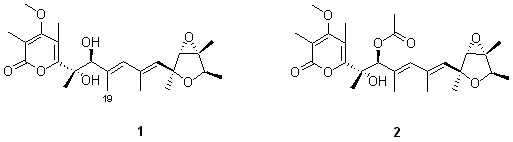
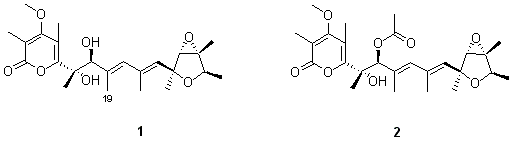
<p><italic>Penicillium</italic> is an important genus in toxigenic fungi. Chemical investigation of <italic>Penicillium verrucosum</italic> has afforded an immunotoxin ochratoxin A, which threatens human health through contaminated food in a wide region [<xref ref-type="bibr" rid="b10-marinedrugs-08-02744">10</xref>]. An outbreak of neurological disease in cattle has been reported in the USA [<xref ref-type="bibr" rid="b11-marinedrugs-08-02744">11</xref>]. The mycotoxin verrucosidin, from another variety <italic>Penicillium verrucosum</italic> var. <italic>cyclopium</italic>, was subsequently found to be responsible for the outbreak [<xref ref-type="bibr" rid="b12-marinedrugs-08-02744">12</xref>]. Verrucosidin is a down-regulator of UPR (unfolded protein response) induced genes, such as <italic>grp</italic>78, resulting in selective cell death under strict hypoglycemic conditions [<xref ref-type="bibr" rid="b13-marinedrugs-08-02744">13</xref>]. Furthermore, the nephrotoxic product from an adjacent species <italic>Penicillium aurantiogriseum</italic> is a possible factor in Balkan endemic nephropathy which has been confirmed in rats and hamsters [<xref ref-type="bibr" rid="b14-marinedrugs-08-02744">14</xref>,<xref ref-type="bibr" rid="b15-marinedrugs-08-02744">15</xref>]. During the chemical study of this genus, some cytotoxic quinazoline alkaloids, and an antitumor compound, anicequol, have been identified [<xref ref-type="bibr" rid="b16-marinedrugs-08-02744">16</xref>,<xref ref-type="bibr" rid="b17-marinedrugs-08-02744">17</xref>]. The chemical diversity of this genus and the peculiarity of the marine biotope prompted us to investigate the extract from a strain of <italic>Penicillium aurantiogriseum</italic>. With the aid of HPLC-diode array analysis, two new verrucosidin analogs, named verrucosidinol (<bold>1</bold>) and verrucosidinol acetate (<bold>2</bold>), together with norverrucosidin (<bold>3</bold>) and verrucosidin (<bold>4</bold>) were isolated from this marine-derived fungus (<xref ref-type="fig" rid="f1-marinedrugs-08-02744">Figure 1</xref>). During the extraction and isolation procedure, a mixture of the phytotoxic metabolites terrestric acids (<bold>5</bold> and <bold>6</bold>) was also obtained [<xref ref-type="bibr" rid="b18-marinedrugs-08-02744">18</xref>]. Herein, we report the isolation, structure elucidation, and bioactivities of these compounds.</p></sec>
<sec sec-type="results|discussion">
<title>2. Results and Discussion</title>
<p>Compound <bold>1</bold> was obtained as yellow oil. The HRESIMS, in combination with <sup>1</sup>H and <sup>13</sup>C NMR data, indicated a composition of C<sub>24</sub>H<sub>34</sub>O<sub>7</sub>, requiring 8 unsaturations. The NMR spectra of <bold>1</bold> were compared to that of verrucosidin and found to be almost the same except for H-6/C-6, H-7/C-7, C-8 and C-10 [<xref ref-type="bibr" rid="b19-marinedrugs-08-02744">19</xref>–<xref ref-type="bibr" rid="b22-marinedrugs-08-02744">22</xref>]. Taking into account the degree of unsaturation, the molecule should have a ring-opened structure. The <sup>1</sup>H and <sup>13</sup>C NMR spectra of compound <bold>1</bold> exhibited signals for 32 protons and 24 distinct carbons, respectively. A heteronuclear multiple-quantum coherency (HMQC) NMR experiment established all one-bond <sup>1</sup>H-<sup>13</sup>C connections as indicated in <xref ref-type="table" rid="t1-marinedrugs-08-02744">Table 1</xref>. The heteronuclear multiplebond correlation (HMBC) NMR spectrum displayed <sup>1</sup>H-<sup>13</sup>C couplings from the methyl protons 18-H (δ<sub>H</sub> 1.40) to C-5 (δ<sub>C</sub> 159.7), C-6 (δ<sub>C</sub> 78.8) and C-7 (δ<sub>C</sub> 79.8), from the methyl protons 19-H (δ<sub>H</sub> 1.82) to C-7 (δ<sub>C</sub> 79.8), C-8 (δ<sub>C</sub> 133.9) and C-9 (δ<sub>C</sub> 134.3), and from the methyl protons 20-H (δ<sub>H</sub> 1.89) to C-9 (δ<sub>C</sub> 134.3), C-10 (δ<sub>C</sub> 134.4), and C-11 (δ<sub>C</sub> 133.0), thereby establishing the existence of a heptadiene moiety. The <sup>1</sup>H-<sup>1</sup>H COSY NMR experiment revealed correlations from 9-H to 19-H, 9-H to 20-H and 20-H to 11-H supporting this conclusion. The <sup>13</sup>C NMR chemical shifts of five downfield signals corresponding to C-1 (δ<sub>C</sub> 165.0), C-2 (δ<sub>C</sub> 110.4), C-3 (δ<sub>C</sub> 169.2), C-4 (δ<sub>C</sub> 111.8) and C-5 (δ<sub>C</sub> 159.7), were in close agreement to those for an <italic>α</italic>-pyrone unit [<xref ref-type="bibr" rid="b19-marinedrugs-08-02744">19</xref>,<xref ref-type="bibr" rid="b22-marinedrugs-08-02744">22</xref>,<xref ref-type="bibr" rid="b23-marinedrugs-08-02744">23</xref>]. Two singlet olefinic methyl protons 16-H (δ<sub>H</sub> 2.01) and 17-H (δ<sub>H</sub> 2.21) exhibited HMBC correlations to their adjacent carbons in the <italic>α</italic>-pyrone moiety, C-1 (δ<sub>C</sub> 165.0), C-2 (δ<sub>C</sub> 110.4) and C-3 (δ<sub>C</sub> 169.2); C-3 (δ<sub>C</sub> 169.2), C-4 (δ<sub>C</sub> 111.8), and C-5 (δ<sub>C</sub> 159.7), respectively, as indicated in <xref ref-type="table" rid="t1-marinedrugs-08-02744">Table 1</xref>. Additionally, the methoxy protons 24-H (δ<sub>H</sub> 3.79) revealed <sup>1</sup>H-<sup>13</sup>C coupling to a quaternary carbon C-3 (δ<sub>C</sub> 169.2), indicating the connection of the methoxy moiety to the C-3 position in the <italic>α</italic>-pyrone substructure. The long range couplings from olefinic methyl protons 17-H (δ<sub>H</sub> 2.21) to C-5 (δ<sub>C</sub> 159.7), from the methyl protons 18-H (δ<sub>H</sub> 1.40) to C-5, and from the methine proton 7-H (δ<sub>H</sub> 4.61) to C-5, indicated a connection between the partial heptadiene structure and the <italic>α</italic>-pyrone moiety. The quartet methine protons 15-H (δ<sub>H</sub> 4.12), the doublet methyl protons 23-H(δ<sub>H</sub> 1.18), and the <sup>1</sup>H-<sup>1</sup>H COSY signal between them suggested the methyl group was located at C-15. The long range couplings from the methyl protons 22-H (δ<sub>H</sub> 1.47) to C-14 (δ<sub>C</sub> 67.4) and C-15 (δ<sub>C</sub> 76.7), and from the doublet methyl protons 23-H (δ<sub>H</sub> 1.18) to C-14 (δ<sub>C</sub> 67.4) and C-15 (δ<sub>C</sub> 76.7), linked the quaternary carbon C-14 to C-15. <sup>1</sup>H-<sup>13</sup>C long range couplings from the methyl protons 21-H (δ<sub>H</sub> 1.41) to C-11 (δ<sub>C</sub> 133.0), C-12 (δ<sub>C</sub> 80.1) and C-13 (δ<sub>C</sub> 67.5), from an oxygenated methine proton 13-H (δ<sub>H</sub> 3.43) to C-12 (δ<sub>C</sub> 80.1), and from an olefinic methine proton 11-H (δ<sub>H</sub> 5.53) to C-12 (δ<sub>C</sub> 80.1) connected the quaternary carbon C-12 to the heptadiene moiety. The two oxygenated carbons C-13 (δ<sub>C</sub> 67.5) and C-14 (δ<sub>C</sub> 67.4) were concluded to form an epoxide ring. In contrast, two further deshielded oxygenated carbons C-6 (δ<sub>C</sub> 78.8) and C-7 (δ<sub>C</sub> 79.8), which had the higher chemical shifts, were connected to hydroxy groups respectively. This speculation was confirmed by the HRESIMS data. The molecular formula of 1 was determined from HRESIMS as C<sub>24</sub>H<sub>34</sub>O<sub>7</sub>, corresponding to the difference of one water molecule in the molecular formula between <bold>1</bold> and <bold>4.</bold> Therefore, compound <bold>1</bold> was suggested to be a ring-opened derivative of <bold>4</bold>.</p>
<p>On the basis of identical chemical shift values and coupling constants for both compounds, the relative configuration of the tetrahydrofuran in <bold>1</bold> was proposed to be the same as that of verrucosidin, which was assigned by X-ray crystal diffraction [<xref ref-type="bibr" rid="b24-marinedrugs-08-02744">24</xref>]. Key NOESY enhancements between 11-H and 13-H, 13-H and 22-H, 23-H and 11-H, 22-H and 23-H, as well as a weak enhancement between 15-H and 21-H supported the orientations of these groups in tetrahydrofuran ring (<xref ref-type="fig" rid="f3-marinedrugs-08-02744">Figure 3</xref>). The geometry of C-8 was confirmed to be <italic>E</italic> by the NOE observation between 7-H and 9-H. And the NOESY enhancements between 7-H and 17-H, 18-H and 19-H, determined their steric configuration respectively.</p>
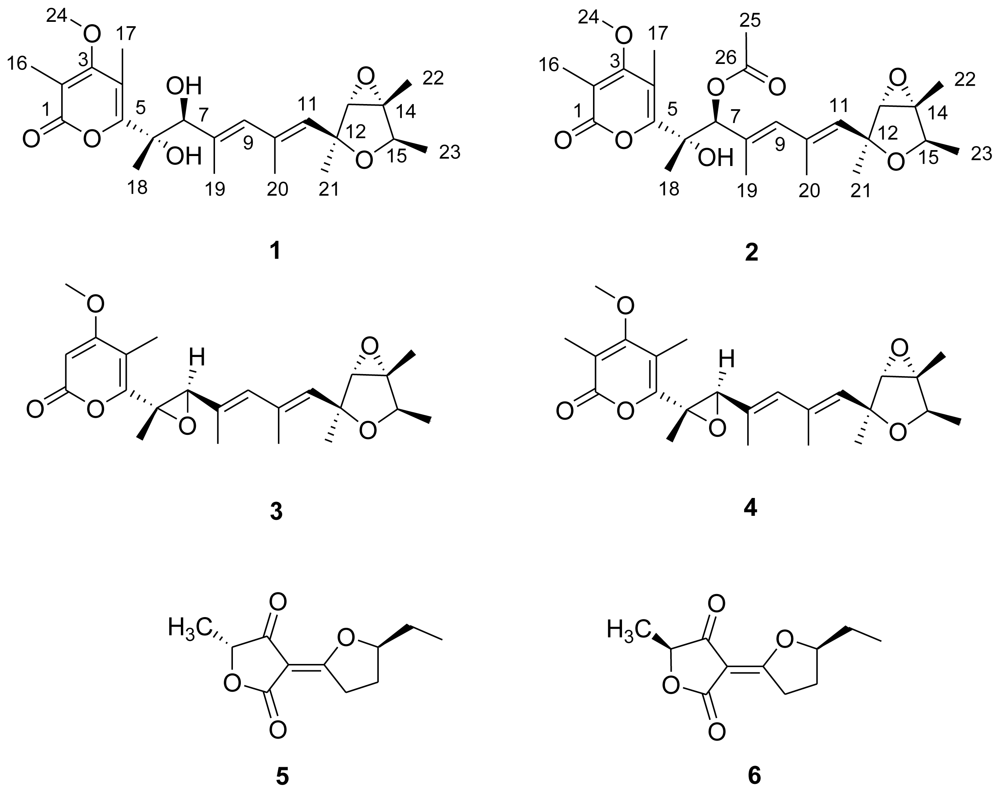
<p>Compound <bold>2</bold> possessed a molecular formula of C<sub>26</sub>H<sub>36</sub>O<sub>8</sub> as determined by HRESIMS and NMR data. An additional C<sub>2</sub>H<sub>2</sub>O was the only difference compared with <bold>1</bold>. Considering the similarity of the NMR data (<xref ref-type="table" rid="t1-marinedrugs-08-02744">Table 1</xref>), compound 2 was most probably an acetate derivative of 1. The characteristic NMR signals, quaternary carbon C-26 (δ<sub>C</sub> 169.4), primary carbon C-25 (δ<sub>C</sub> 21.0) and singlet methyl protons 25-H (δ<sub>H</sub> 2.06), confirmed this. The acetate group was unambiguously attached to C-7 (δ<sub>C</sub> 82.1), which was concluded from the correlation between H-7 (δ<sub>H</sub> 5.43) and C-26 in the HMBC, shown in <xref ref-type="fig" rid="f2-marinedrugs-08-02744">Figure 2</xref>. Further analysis of the HSQC, <sup>1</sup>H-<sup>1</sup>H COSY and HMBC NMR data of 2 enabled the establishment of its structure. The NOESY NMR data of 2 was well matched to that of 1, except for an additional enhancement between 17-H and 25-H, which determined the relative configuration of the acetate ester group in position 7 (<xref ref-type="fig" rid="f3-marinedrugs-08-02744">Figure 3</xref>).</p>
<p>Compound <bold>4</bold> was obtained as colorless plates and established as verrucosidin by comparison of the spectroscopic data reported in the literature [<xref ref-type="bibr" rid="b12-marinedrugs-08-02744">12</xref>,<xref ref-type="bibr" rid="b19-marinedrugs-08-02744">19</xref>,<xref ref-type="bibr" rid="b24-marinedrugs-08-02744">24</xref>]. Verrucosidin is a potent neurotoxin which can cause tremble and paralysis experimentally in mice [<xref ref-type="bibr" rid="b11-marinedrugs-08-02744">11</xref>,<xref ref-type="bibr" rid="b12-marinedrugs-08-02744">12</xref>]. It was first isolated from <italic>Penicillium verrucosum</italic> var. <italic>cyclopium</italic>, and then often found from the contaminated dry-cured ham [<xref ref-type="bibr" rid="b25-marinedrugs-08-02744">25</xref>]. Recently, the genotoxicity and chaperone down-regulate activity of verrucosidin has been reported [<xref ref-type="bibr" rid="b13-marinedrugs-08-02744">13</xref>].</p>
<p>Compound <bold>3</bold> was isolated as yellow oil. When its mass spectrum was compared with <bold>4</bold>, the lack of one methyl group was concluded. By comparison with the reported data for normethylverrucosidin, its structure was assigned [<xref ref-type="bibr" rid="b12-marinedrugs-08-02744">12</xref>]. Normethylverrucosidin, together with verrucosidin and terrestric acid, plays an important role in chemotaxonomy of terverticillate penicillia [<xref ref-type="bibr" rid="b26-marinedrugs-08-02744">26</xref>].</p>
<p>A mixture of compound <bold>5</bold> and <bold>6</bold> was obtained as colorless needles and determined as a mixture of terrestric acids. Since the corresponding peaks for both the <italic>cis</italic>- and <italic>trans</italic>-isomers were observed in the NMR data, it was established that this was a mixture of both <italic>cis</italic>- and <italic>trans</italic>-terrestric acids [<xref ref-type="bibr" rid="b18-marinedrugs-08-02744">18</xref>,<xref ref-type="bibr" rid="b27-marinedrugs-08-02744">27</xref>]. Terrestric acid was first isolated from <italic>Penicillium terrestre</italic> [<xref ref-type="bibr" rid="b28-marinedrugs-08-02744">28</xref>], and then from <italic>Pyricularia oryzae</italic> [<xref ref-type="bibr" rid="b18-marinedrugs-08-02744">18</xref>], and it has been reported to display phytotoxic activity.</p>
<p>Although acetic acid was used during the isolation, none of derivatives of normethylverrucosidin were detected, which suggested that compounds <bold>1</bold> and <bold>2</bold> should be generated by the fungus instead of being artificial ring-opened product of <bold>4</bold>. Considering the structural relationship between <bold>1</bold> and <bold>2</bold>, the possibility still existed that compound <bold>2</bold> is the acetate esterified product brought about as an artifact process of <bold>1</bold>.</p>
<p>The compounds were also tested for bioactivity against methicillin resistant <italic>Staphylococcus aureus</italic>, <italic>Pseudomonas aeruginosa</italic>, <italic>Candida albicans</italic> SC5314, and synergistic antifungal activity with ketoconazole. Since all minimum inhibitory concentrations (MICs) of tested compounds were ≥64 μg/mL, no significant activity against the above-mentioned microbes was concluded.</p></sec>
<sec>
<title>3. Experimental Section</title>
<sec sec-type="methods">
<title>3.1. General Experimental Procedures</title>
<p>Optical rotations were measured on a Perkin-Elmer 241 MC polarimeter. IR spectra were recorded on a Nicolet 5700 FT-IR microscope spectrophotometer (FT-IR Microscope Transmission). NMR spectra were recorded on a Varian Inova 500 MHz spectrophotometer at 500.103 MHz for <sup>1</sup>H and 125.762 MHz for <sup>13</sup>C in CDCl<sub>3</sub> using solvent signals (CHCl<sub>3</sub>; δ<sub>H</sub> 7.26/δ<sub>C</sub> 77.10) as references; the coupling constants are in Hz. ESIMS data were recorded on a Bruker Esquire 3000plus spectrophotometer, and HRESIMS data were obtained using Bruker APEX III 7.0T and APEXII FT-ICR spectrophotometers, respectively. Column chromatography was performed with silica gel (200–300 mesh, Qingdao Haiyang Chemical Factory) and Sephadex LH-20 (Pharmacia Co.) columns. TLC was carried out using silica gel GF254 (Qingdao Haiyang Chemical Factory) plates. HPLC was performed using an Agilent Chromatography C18 column (5 μm, 9.4 × 250 mm) with UV detection at 254 nm.</p></sec>
<sec>
<title>3.2. Fungal Material and Taxonomic Identification</title>
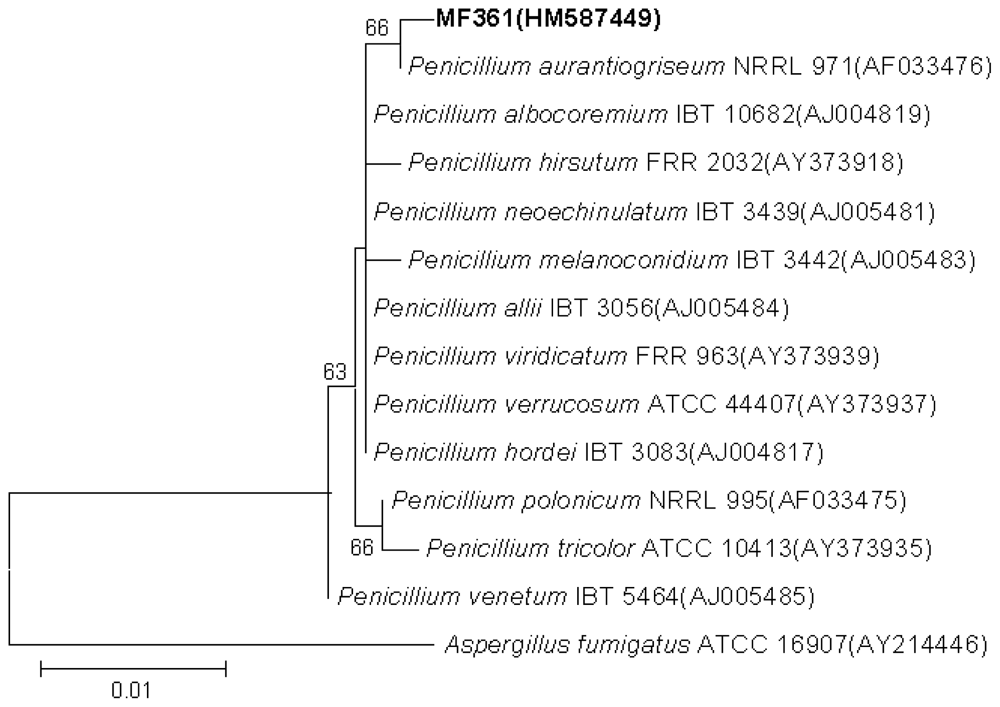
<p>The marine derived fungus <italic>Penicillium aurantiogriseum</italic> was isolated from marine mud obtained in the Bohai Sea, and identified by morphology and sequence analysis of its internal transcribed spacer (ITS) region and 5.8S rDNA (GenBank accession number HM587449) using conventional primer pair ITS1(5″-TCCGTAGGTGAACCTGCGG-3″) and ITS4(5″-TCCTCCGCTTATTGATA-TGC-3″). The total genomic DNA of marine-derived fungus MF361 was extracted using the EZNA kit (Omega). The polymerase chain reaction product is 534 bp. The purified PCR products were sequenced (HuaDa Bio., Beijing, China). Multiple alignments with sequences of most closely related fungi and calculations of levels of sequence similarity were carried out using CLUSTAL W [<xref ref-type="bibr" rid="b29-marinedrugs-08-02744">29</xref>]. The phylogenetic tree was constructed using the neighbour-joining method [<xref ref-type="bibr" rid="b30-marinedrugs-08-02744">30</xref>], in MEGA 4.0 [<xref ref-type="bibr" rid="b31-marinedrugs-08-02744">31</xref>], as shown in <xref ref-type="fig" rid="f4-marinedrugs-08-02744">Figure 4</xref>. The topology of the phylogenetic tree was evaluated by the bootstrap resampling method with 1000 replicates [<xref ref-type="bibr" rid="b32-marinedrugs-08-02744">32</xref>]. The fungus has been assigned the accession number MF361 in the culture collection at the Institute of Microbiology, Chinese Academy of Sciences, Beijing.</p></sec>
<sec>
<title>3.3. Large Scale Fermentation</title>
<p>The culture medium of the strain consisted of 30 g soybean powder and 120 g rice soaked in artificial seawater in a 500 mL erlenmeyer flask. Altogether, 14 flasks were cultured without shaking at 25 °C for 20 days before use.</p></sec>
<sec>
<title>3.4. Extraction and Isolation</title>
<p>The fermentation product was exhaustively extracted with EtOAc-MeOH-AcOH (80:15:5) to yield an extract. The crude extract was partitioned between EtOAc and H<sub>2</sub>O. The EtOAc layer (5.3 g) was applied to a column of silica gel using a stepped gradient solvent system of 0 to 100% MeOH/CH<sub>2</sub>Cl<sub>2</sub> to afford 13 fractions. Fraction B (350 mg) was subjected to a Sephadex LH-20 column, eluted with petroleum ether-CH<sub>2</sub>Cl<sub>2</sub>-MeOH (5:5:1), to give five subfractions. Compounds <bold>3</bold> (8 mg, 0.15% yield) and <bold>4</bold> (12 mg, 0.23% yield) were obtained by separation of the subfraction B1 (62 mg) on a reversed-phase HPLC (Agilent Zorbax SB-C18 column, 5 μm, 9.4 × 250 mm) eluting with 80% CH<sub>3</sub>OH in water. While subfraction B3 (91 mg) was further purified on a RP-HPLC eluted with 65% MeOH in water to afford compounds <bold>2</bold> (17 mg, 0.32% yield), and a mixture of <bold>5</bold> and <bold>6</bold> (15 mg, 0.28% yield). Fraction D was also chromatographed on a Sephadex LH-20 column and eluted with the same solvent system as stated above, to afford five subfractions. Subfraction D1 (20 mg) was subjected to successive reversed-phase HPLC eluted with 50% acetonitrile in water, and further purified using 40% CH<sub>3</sub>OH in water to afford compound <bold>1</bold> (4 mg, 0.08% yield).</p>
<p>Verrucosidinol (<bold>1</bold>): yellow oil, stable in MeOH; [α]<sub>D</sub><sup>20</sup> −10.0° (c = 0.10, MeOH); UV (MeOH) λ<sub>max</sub> (log ɛ) 231 (3.91), 288 (3.46) nm; IR <italic>v</italic><sub>max</sub> 2977, 2916, 2850, 1714, 1558, 1452, 1378, 1089, 1045, 1018 cm<sup>−1; 1</sup>H and <sup>13</sup>C NMR data, see <xref ref-type="table" rid="t1-marinedrugs-08-02744">Table 1</xref>; ESIMS <italic>m/z</italic> [M + Na]<sup>+</sup> 457; HRESIMS <italic>m/z</italic> 457.2195 [M + Na]<sup>+</sup> (calcd for C<sub>24</sub>H<sub>34</sub>O<sub>7</sub>, 457.2197).</p>
<p>Verrucosidinol acetate (<bold>2</bold>): yellow oil, stable in MeOH; [α]<sub>D</sub><sup>20</sup> −34.0° (c = 0.10, MeOH); UV (MeOH) λ<sub>max</sub> (log ɛ) 234 (3.84), 291 (3.45) nm; IR <italic>v</italic><sub>max</sub> 2973, 2935, 2877, 1745, 1667, 1597, 1452, 1372, 1230, 1138, 1087, 1043 cm<sup>−1; 1</sup>H and <sup>13</sup>C NMR data, see <xref ref-type="table" rid="t1-marinedrugs-08-02744">Table 1</xref>; ESIMS <italic>m/z</italic> [M + Na]<sup>+</sup> 499; HRESIMS <italic>m/z</italic> 499.2300 [M + Na]<sup>+</sup> (calcd for C<sub>26</sub>H<sub>36</sub>O<sub>8</sub>, 499.2302).</p></sec>
<sec>
<title>3.5. Antimicrobial Assay</title>
<p>Fresh Mueller-Hinton broth medium (40 μL) was added to each well of a sterilized 96-well microtiter plate. To the test wells, 2 μL of the samples to be tested was added followed by 40 μL of the test strain solutions. The plate was incubated at 37 °C overnight. Anti-MRSA and PA activity of samples was checked by measuring and comparing the optical diversities of the blank control and test wells. All experiments were carried out in triplicate.</p></sec>
<sec>
<title>3.6. Antifungal and Synergistic Antifungal Assay</title>
<p><italic>Candida albicans</italic> SC5314 was used as a test strain for antifungal and synergistic antifungal bioassay [<xref ref-type="bibr" rid="b33-marinedrugs-08-02744">33</xref>]. All experiments were carried out in flat bottom, 96-well microtiter plates (Greiner, Germany), using a broth microdilution protocol modified from the Clinical and Laboratory Standards Institute M-27A methods [<xref ref-type="bibr" rid="b34-marinedrugs-08-02744">34</xref>]. Overnight cultures were picked to prepare the strain solution with medium RPMI 1640 at the concentration of 1 × 10<sup>4</sup> cfu/mL. To the test wells in 96 well plates, 2 μL of the samples to be tested was added followed by an additional 80 μL of the strain solution. The test plates were incubated at 35 °C for 16 hours. The antifungal positive control was ketoconazole and antifungal MICs were determined by measuring and comparing the optical densities of the blank control and test wells. For the synergistic antifungal assay, a quarter of the normal antifungal MIC of ketoconazole was supplemented into the strain solution, and the other procedures were the same as the antifungal assay. All experiments were carried out in triplicate.</p></sec></sec>
<sec sec-type="conclusions">
<title>4. Conclusions</title>
<p>Since the initial discovery of penicillin, many new bioactive compounds have been identified from the genus <italic>Penicillium</italic> [<xref ref-type="bibr" rid="b12-marinedrugs-08-02744">12</xref>,<xref ref-type="bibr" rid="b16-marinedrugs-08-02744">16</xref>,<xref ref-type="bibr" rid="b17-marinedrugs-08-02744">17</xref>]. As drug discovery expands into previously underexplored territories, such as the marine environment, more new compounds will be obtained, for example, the three quinazoline alkaloids (aurantiomides A–C), isolated from sponge-derived <italic>P. aurantiogriseum</italic> [<xref ref-type="bibr" rid="b16-marinedrugs-08-02744">16</xref>]. The secondary metabolites verrucosidinol (<bold>1</bold>) and verrucosidinol acetate (<bold>2</bold>) reported in this study are new members of the pyrone-type polyketides. Although they did not show significant bioactivity in three of the antimicrobial assays, in consideration of their structural similarity to the mycotoxin verrucosidin, they could potentially have other unexplored bioactivities.</p></sec></body>
<back>
<ack>
<title>Acknowledgements</title>
<p>The authors are very grateful for the technical support provided by Jiuyuan Ding and Ming Chen. They also would like to thank Elizabeth Ashforth for critical reading and helpful discussions. This work was supported in part by grants from National 863 Project (2007AA09Z443, 2007AA09Z443), Key Project for International Cooperation (2007DFB31620), National Natural Science Foundation of China (30973665, 30700015, 30901849, 30911120484, 81011120046 and 30911120483), National Key Technology R&amp;D Program (2007BAI26B02), the CAS Pillar Program (KSCX2-YW-R-164), Important National Science &amp; Technology Specific Projects (2008ZX09401-05, 2009ZX09302-004). L. Z. received funding from the Hundred Talents Program.</p></ack>
<ref-list>
<title>References</title>
<ref id="b1-marinedrugs-08-02744"><label>1</label><citation citation-type="journal"><person-group person-group-type="author"><name><surname>Blunt</surname><given-names>JW</given-names></name><name><surname>Copp</surname><given-names>BR</given-names></name><name><surname>Munro</surname><given-names>MH</given-names></name><name><surname>Northcote</surname><given-names>PT</given-names></name><name><surname>Prinsep</surname><given-names>MR</given-names></name></person-group><article-title>Marine natural products</article-title><source>Nat Prod Rep</source><year>2010</year><volume>27</volume><fpage>165</fpage><lpage>237</lpage><pub-id pub-id-type="doi">10.1039/b906091j</pub-id><pub-id pub-id-type="pmid">20111802</pub-id></citation></ref>
<ref id="b2-marinedrugs-08-02744"><label>2</label><citation citation-type="book"><person-group person-group-type="author"><name><surname>Zhang</surname><given-names>L</given-names></name></person-group><article-title>Integrated Approaches for Discovering Novel Drugs From Microbial Natural Products</article-title><source>Natural Products</source><person-group person-group-type="editor"><name><surname>Zhang</surname><given-names>L</given-names></name><name><surname>Demain</surname><given-names>AL</given-names></name></person-group><publisher-name>Humana Press</publisher-name><publisher-loc>Totowa, NJ, USA</publisher-loc><year>2005</year><fpage>33</fpage><lpage>55</lpage></citation></ref>
<ref id="b3-marinedrugs-08-02744"><label>3</label><citation citation-type="journal"><person-group person-group-type="author"><name><surname>Capon</surname><given-names>RJ</given-names></name></person-group><article-title>Marine natural products chemistry: past, present and future</article-title><source>Aust J Chem</source><year>2010</year><volume>63</volume><fpage>851</fpage><lpage>854</lpage><pub-id pub-id-type="doi">10.1071/CH10204</pub-id></citation></ref>
<ref id="b4-marinedrugs-08-02744"><label>4</label><citation citation-type="journal"><person-group person-group-type="author"><name><surname>Molinski</surname><given-names>TF</given-names></name><name><surname>Dalisay</surname><given-names>DS</given-names></name><name><surname>Lievens</surname><given-names>SL</given-names></name><name><surname>Saludes</surname><given-names>JP</given-names></name></person-group><article-title>Drug development from marine natural products</article-title><source>Nat Rev Drug Discov</source><year>2009</year><volume>8</volume><fpage>69</fpage><lpage>85</lpage><pub-id pub-id-type="doi">10.1038/nrd2487</pub-id><pub-id pub-id-type="pmid">19096380</pub-id></citation></ref>
<ref id="b5-marinedrugs-08-02744"><label>5</label><citation citation-type="journal"><person-group person-group-type="author"><name><surname>Zhang</surname><given-names>L</given-names></name><name><surname>An</surname><given-names>R</given-names></name><name><surname>Wang</surname><given-names>J</given-names></name><name><surname>Sun</surname><given-names>N</given-names></name><name><surname>Zhang</surname><given-names>S</given-names></name><name><surname>Hu</surname><given-names>J</given-names></name><name><surname>Kuai</surname><given-names>J</given-names></name></person-group><article-title>Exploring novel bioactive compounds from marine microbes</article-title><source>Curr Opin Microbiol</source><year>2005</year><volume>8</volume><fpage>276</fpage><lpage>281</lpage><pub-id pub-id-type="doi">10.1016/j.mib.2005.04.008</pub-id><pub-id pub-id-type="pmid">15939350</pub-id></citation></ref>
<ref id="b6-marinedrugs-08-02744"><label>6</label><citation citation-type="journal"><person-group person-group-type="author"><name><surname>Liu</surname><given-names>X</given-names></name><name><surname>Ashforth</surname><given-names>E</given-names></name><name><surname>Ren</surname><given-names>B</given-names></name><name><surname>Song</surname><given-names>F</given-names></name><name><surname>Dai</surname><given-names>H</given-names></name><name><surname>Liu</surname><given-names>M</given-names></name><name><surname>Wang</surname><given-names>J</given-names></name><name><surname>Xie</surname><given-names>Q</given-names></name><name><surname>Zhang</surname><given-names>L</given-names></name></person-group><article-title>Bioprospecting microbial natural product libraries from the marine environment for drug discovery</article-title><source>J Antibiot</source><year>2010</year><volume>63</volume><fpage>415</fpage><lpage>422</lpage><pub-id pub-id-type="doi">10.1038/ja.2010.56</pub-id><pub-id pub-id-type="pmid">20606699</pub-id></citation></ref>
<ref id="b7-marinedrugs-08-02744"><label>7</label><citation citation-type="journal"><person-group person-group-type="author"><name><surname>Zhuo</surname><given-names>Y</given-names></name><name><surname>Zhang</surname><given-names>W</given-names></name><name><surname>Chen</surname><given-names>D</given-names></name><name><surname>Gao</surname><given-names>H</given-names></name><name><surname>Tao</surname><given-names>J</given-names></name><name><surname>Liu</surname><given-names>M</given-names></name><name><surname>Gou</surname><given-names>Z</given-names></name><name><surname>Zhou</surname><given-names>X</given-names></name><name><surname>Ye</surname><given-names>B</given-names></name><name><surname>Zhang</surname><given-names>Q</given-names></name><name><surname>Zhang</surname><given-names>S</given-names></name><name><surname>Zhang</surname><given-names>L</given-names></name></person-group><article-title>Reverse biological engineering of hrdB to enhance the production of avermectins in an industrial strain of <italic>Streptomyces avermitilis</italic></article-title><source>Proc Natl Acad Sci USA</source><year>2010</year><volume>107</volume><fpage>11250</fpage><lpage>11254</lpage><pub-id pub-id-type="doi">10.1073/pnas.1006085107</pub-id><pub-id pub-id-type="pmid">20534557</pub-id></citation></ref>
<ref id="b8-marinedrugs-08-02744"><label>8</label><citation citation-type="journal"><person-group person-group-type="author"><name><surname>Song</surname><given-names>F</given-names></name><name><surname>Dai</surname><given-names>H</given-names></name><name><surname>Tong</surname><given-names>Y</given-names></name><name><surname>Ren</surname><given-names>B</given-names></name><name><surname>Chen</surname><given-names>C</given-names></name><name><surname>Sun</surname><given-names>N</given-names></name><name><surname>Liu</surname><given-names>X</given-names></name><name><surname>Bian</surname><given-names>J</given-names></name><name><surname>Liu</surname><given-names>M</given-names></name><name><surname>Gao</surname><given-names>H</given-names></name><name><surname>Liu</surname><given-names>H</given-names></name><name><surname>Chen</surname><given-names>X</given-names></name><name><surname>Zhang</surname><given-names>L</given-names></name></person-group><article-title>Trichodermaketones A-D and 7-O-methylkoninginin D from the marine fungus <italic>Trichoderma koningii</italic></article-title><source>J Nat Prod</source><year>2010</year><volume>73</volume><fpage>806</fpage><lpage>810</lpage><pub-id pub-id-type="doi">10.1021/np900642p</pub-id><pub-id pub-id-type="pmid">20384316</pub-id></citation></ref>
<ref id="b9-marinedrugs-08-02744"><label>9</label><citation citation-type="journal"><person-group person-group-type="author"><name><surname>You</surname><given-names>J</given-names></name><name><surname>Dai</surname><given-names>H</given-names></name><name><surname>Chen</surname><given-names>Z</given-names></name><name><surname>Liu</surname><given-names>G</given-names></name><name><surname>He</surname><given-names>Z</given-names></name><name><surname>Song</surname><given-names>F</given-names></name><name><surname>Yang</surname><given-names>X</given-names></name><name><surname>Fu</surname><given-names>H</given-names></name><name><surname>Zhang</surname><given-names>L</given-names></name><name><surname>Chen</surname><given-names>X</given-names></name></person-group><article-title>Trichoderone, a novel cytotoxic cyclopentenone and cholesta-7,22-diene-3β,5α,6β-triol with new activities from the marine-derived fungus <italic>Trichoderma</italic> sp</article-title><source>J Ind Microbiol Biot</source><year>2010</year><volume>37</volume><fpage>245</fpage><lpage>252</lpage><pub-id pub-id-type="doi">10.1007/s10295-009-0667-z</pub-id></citation></ref>
<ref id="b10-marinedrugs-08-02744"><label>10</label><citation citation-type="journal"><person-group person-group-type="author"><name><surname>Bragulat</surname><given-names>MR</given-names></name><name><surname>Martínez</surname><given-names>E</given-names></name><name><surname>Castellá</surname><given-names>G</given-names></name><name><surname>Cabanes</surname><given-names>FJ</given-names></name></person-group><article-title>Ochratoxin A and citrinin producing species of the genus <italic>Penicillium</italic> from feedstuffs</article-title><source>Int J Food Microbiol</source><year>2008</year><volume>126</volume><fpage>43</fpage><lpage>48</lpage><pub-id pub-id-type="doi">10.1016/j.ijfoodmicro.2008.04.034</pub-id><pub-id pub-id-type="pmid">18571755</pub-id></citation></ref>
<ref id="b11-marinedrugs-08-02744"><label>11</label><citation citation-type="journal"><person-group person-group-type="author"><name><surname>Wilson</surname><given-names>BJ</given-names></name><name><surname>Byerly</surname><given-names>CS</given-names></name><name><surname>Burka</surname><given-names>LT</given-names></name></person-group><article-title>Neurologic disease of fungal origin in three herds of cattle</article-title><source>J Am Vet Med Assoc</source><year>1981</year><volume>179</volume><fpage>480</fpage><lpage>481</lpage><pub-id pub-id-type="pmid">7309613</pub-id></citation></ref>
<ref id="b12-marinedrugs-08-02744"><label>12</label><citation citation-type="journal"><person-group person-group-type="author"><name><surname>Hodge</surname><given-names>RP</given-names></name><name><surname>Harris</surname><given-names>CM</given-names></name><name><surname>Harris</surname><given-names>TM</given-names></name></person-group><article-title>Verrucofortine, a major metabolite of <italic>Penicillium verrucosum</italic> var. <italic>cyclopium,</italic> the fungus that produces the mycotoxin verrucosidin</article-title><source>J Nat Prod</source><year>1988</year><volume>51</volume><fpage>66</fpage><lpage>73</lpage><pub-id pub-id-type="doi">10.1021/np50055a008</pub-id><pub-id pub-id-type="pmid">3373229</pub-id></citation></ref>
<ref id="b13-marinedrugs-08-02744"><label>13</label><citation citation-type="journal"><person-group person-group-type="author"><name><surname>Park</surname><given-names>HR</given-names></name><name><surname>Ryoo</surname><given-names>IJ</given-names></name><name><surname>Choo</surname><given-names>SJ</given-names></name><name><surname>Hwang</surname><given-names>JH</given-names></name><name><surname>Kim</surname><given-names>JY</given-names></name><name><surname>Cha</surname><given-names>MR</given-names></name><name><surname>Shin-Ya</surname><given-names>K</given-names></name><name><surname>Yoo</surname><given-names>ID</given-names></name></person-group><article-title>Glucose-deprived HT-29 human colon carcinoma cells are sensitive to verrucosidin as a GRP78 down-regulator</article-title><source>Toxicology</source><year>2007</year><volume>229</volume><fpage>253</fpage><lpage>261</lpage><pub-id pub-id-type="doi">10.1016/j.tox.2006.11.049</pub-id><pub-id pub-id-type="pmid">17161515</pub-id></citation></ref>
<ref id="b14-marinedrugs-08-02744"><label>14</label><citation citation-type="journal"><person-group person-group-type="author"><name><surname>Yeulet</surname><given-names>SE</given-names></name><name><surname>Mantle</surname><given-names>PG</given-names></name><name><surname>Rudge</surname><given-names>MS</given-names></name><name><surname>Greig</surname><given-names>JB</given-names></name></person-group><article-title>Nephrotoxicity of <italic>Penicillium aurantiogriseum, </italic>a possible factor in the aetiology of Balkan endemic nephropathy</article-title><source>Mycopathologia</source><year>1988</year><volume>102</volume><fpage>21</fpage><lpage>30</lpage><pub-id pub-id-type="doi">10.1007/BF00436248</pub-id><pub-id pub-id-type="pmid">3419480</pub-id></citation></ref>
<ref id="b15-marinedrugs-08-02744"><label>15</label><citation citation-type="journal"><person-group person-group-type="author"><name><surname>Mantle</surname><given-names>PG</given-names></name><name><surname>McHugh</surname><given-names>KM</given-names></name><name><surname>Adatia</surname><given-names>R</given-names></name><name><surname>Heaton</surname><given-names>JM</given-names></name><name><surname>Gray</surname><given-names>T</given-names></name><name><surname>Turner</surname><given-names>DR</given-names></name></person-group><article-title><italic>Penicillium aurantiogriseum</italic>-induced, persistent renal histopathological changes in rats; an experimental model for Balkan endemic nephropathy competitive with ochratoxin A</article-title><source>IARC Sci Publ</source><year>1991</year><volume>115</volume><fpage>119</fpage><lpage>127</lpage><pub-id pub-id-type="pmid">1820324</pub-id></citation></ref>
<ref id="b16-marinedrugs-08-02744"><label>16</label><citation citation-type="journal"><person-group person-group-type="author"><name><surname>Xin</surname><given-names>Z</given-names></name><name><surname>Fang</surname><given-names>Y</given-names></name><name><surname>Du</surname><given-names>L</given-names></name><name><surname>Zhu</surname><given-names>T</given-names></name><name><surname>Duan</surname><given-names>L</given-names></name><name><surname>Chen</surname><given-names>J</given-names></name><name><surname>Gu</surname><given-names>Q</given-names></name><name><surname>Zhu</surname><given-names>W</given-names></name></person-group><article-title>Aurantiomides A-C, quinazoline alkaloids from the sponge-derived fungus <italic>Penicillium aurantiogriseum</italic> SP0-19</article-title><source>J Nat Prod</source><year>2007</year><volume>70</volume><fpage>853</fpage><lpage>855</lpage><pub-id pub-id-type="doi">10.1021/np060516h</pub-id><pub-id pub-id-type="pmid">17455978</pub-id></citation></ref>
<ref id="b17-marinedrugs-08-02744"><label>17</label><citation citation-type="journal"><person-group person-group-type="author"><name><surname>Igarashi</surname><given-names>Y</given-names></name><name><surname>Sekine</surname><given-names>A</given-names></name><name><surname>Fukazawa</surname><given-names>H</given-names></name><name><surname>Uehara</surname><given-names>Y</given-names></name><name><surname>Yamaguchi</surname><given-names>K</given-names></name><name><surname>Okuda</surname><given-names>T</given-names></name><name><surname>Furumai</surname><given-names>T</given-names></name><name><surname>Oki</surname><given-names>T</given-names></name></person-group><article-title>Anicequol, a novel inhibitor for anchorage-independent growth of tumor cells from <italic>Penicillium aurantiogriseum</italic> Dierckx TP-F0213</article-title><source>J Antibiot</source><year>2002</year><volume>55</volume><fpage>371</fpage><lpage>376</lpage><pub-id pub-id-type="doi">10.7164/antibiotics.55.371</pub-id><pub-id pub-id-type="pmid">12061544</pub-id></citation></ref>
<ref id="b18-marinedrugs-08-02744"><label>18</label><citation citation-type="journal"><person-group person-group-type="author"><name><surname>Manabu</surname><given-names>N</given-names></name></person-group><article-title>Terrestric acid as a phytotoxic metabolite from <italic>Pyricularia oryzae</italic> Cavara</article-title><source>Agric Biol Chem</source><year>1988</year><fpage>52</fpage><fpage>2357</fpage><lpage>2358</lpage></citation></ref>
<ref id="b19-marinedrugs-08-02744"><label>19</label><citation citation-type="journal"><person-group person-group-type="author"><name><surname>Ganguli</surname><given-names>M</given-names></name><name><surname>Burka</surname><given-names>LT</given-names></name><name><surname>Harris</surname><given-names>TM</given-names></name></person-group><article-title>Structure studies of the mycotoxin verrucosidin</article-title><source>J Org Chem</source><year>1984</year><volume>49</volume><fpage>3762</fpage><lpage>3766</lpage><pub-id pub-id-type="doi">10.1021/jo00194a016</pub-id></citation></ref>
<ref id="b20-marinedrugs-08-02744"><label>20</label><citation citation-type="journal"><person-group person-group-type="author"><name><surname>Williams</surname><given-names>DR</given-names></name><name><surname>White</surname><given-names>FH</given-names></name></person-group><article-title>Total synthesis of (±)-citreoviridin</article-title><source>J Org Chem</source><year>1987</year><volume>52</volume><fpage>5067</fpage><lpage>5079</lpage><pub-id pub-id-type="doi">10.1021/jo00232a001</pub-id></citation></ref>
<ref id="b21-marinedrugs-08-02744"><label>21</label><citation citation-type="journal"><person-group person-group-type="author"><name><surname>Whang</surname><given-names>K</given-names></name><name><surname>Cooke</surname><given-names>RJ</given-names></name><name><surname>Okay</surname><given-names>G</given-names></name><name><surname>Cha</surname><given-names>JK</given-names></name></person-group><article-title>Total synthesis of (+)-verrucosidin</article-title><source>J Am Chem Soc</source><year>1990</year><volume>112</volume><fpage>8985</fpage><lpage>8987</lpage><pub-id pub-id-type="doi">10.1021/ja00180a057</pub-id></citation></ref>
<ref id="b22-marinedrugs-08-02744"><label>22</label><citation citation-type="journal"><person-group person-group-type="author"><name><surname>Hatakeyama</surname><given-names>S</given-names></name><name><surname>Sakurai</surname><given-names>K</given-names></name><name><surname>Numata</surname><given-names>H</given-names></name><name><surname>Ochi</surname><given-names>N</given-names></name><name><surname>Takano</surname><given-names>S</given-names></name></person-group><article-title>A novel chiral route to substituted tetrahydrofurans. Total synthesis of (±)-verrucosidin and formal synthesis of (−)-citreoviridin</article-title><source>J Am Chem Soc</source><year>1988</year><volume>110</volume><fpage>5201</fpage><lpage>5203</lpage><pub-id pub-id-type="doi">10.1021/ja00223a055</pub-id></citation></ref>
<ref id="b23-marinedrugs-08-02744"><label>23</label><citation citation-type="journal"><person-group person-group-type="author"><name><surname>Hanaki</surname><given-names>N</given-names></name><name><surname>Link</surname><given-names>JT</given-names></name><name><surname>MacMillan</surname><given-names>DWC</given-names></name><name><surname>Overman</surname><given-names>LE</given-names></name><name><surname>Trankle</surname><given-names>WG</given-names></name><name><surname>Wurster</surname><given-names>JA</given-names></name></person-group><article-title>Stereoselection in the prins-pinacol synthesis of 2,2-disubstituted 4-acyltetrahydrofurans. Enantioselective synthesis of (−)-citreoviral</article-title><source>Org Lett</source><year>1999</year><volume>2</volume><fpage>223</fpage><lpage>226</lpage></citation></ref>
<ref id="b24-marinedrugs-08-02744"><label>24</label><citation citation-type="journal"><person-group person-group-type="author"><name><surname>Burka</surname><given-names>LT</given-names></name><name><surname>Ganguli</surname><given-names>M</given-names></name><name><surname>Wilson</surname><given-names>BJ</given-names></name></person-group><article-title>Verrucosidin, a tremorgen from <italic>Penicillium verrucosum</italic> var <italic>cyclopium</italic></article-title><source>J Chem Soc Chem Commun</source><year>1983</year><fpage>544</fpage><lpage>545</lpage></citation></ref>
<ref id="b25-marinedrugs-08-02744"><label>25</label><citation citation-type="journal"><person-group person-group-type="author"><name><surname>Nunez</surname><given-names>F</given-names></name><name><surname>Rodriguez</surname><given-names>MM</given-names></name><name><surname>Bermudez</surname><given-names>ME</given-names></name><name><surname>Cordoba</surname><given-names>JJ</given-names></name><name><surname>Asensio</surname><given-names>MA</given-names></name></person-group><article-title>Composition and toxigenic potential of the mould population on dry-cured Iberian ham</article-title><source>Int J Food Microbiol</source><year>1996</year><fpage>32</fpage><fpage>185</fpage><lpage>197</lpage></citation></ref>
<ref id="b26-marinedrugs-08-02744"><label>26</label><citation citation-type="journal"><person-group person-group-type="author"><name><surname>Lunda</surname><given-names>F</given-names></name><name><surname>Frisvada</surname><given-names>JC</given-names></name></person-group><article-title>Chemotaxonomy of <italic>Penicillium aurantiogriseum</italic> and related species</article-title><source>Mycol Res</source><year>1994</year><volume>98</volume><fpage>481</fpage><lpage>492</lpage><pub-id pub-id-type="doi">10.1016/S0953-7562(09)80466-8</pub-id></citation></ref>
<ref id="b27-marinedrugs-08-02744"><label>27</label><citation citation-type="journal"><person-group person-group-type="author"><name><surname>Jacobsen</surname><given-names>JP</given-names></name><name><surname>Reffstrup</surname><given-names>T</given-names></name><name><surname>Cox</surname><given-names>RE</given-names></name><name><surname>Holker</surname><given-names>JSE</given-names></name><name><surname>Boll</surname><given-names>PM</given-names></name></person-group><article-title>Revision of the naturally occurring acyl tetronic acid: dihydrocarolic acid, terrestric acid and carlic acid</article-title><source>Tetrahedron Lett</source><year>1978</year><volume>19</volume><fpage>1081</fpage><lpage>1084</lpage><pub-id pub-id-type="doi">10.1016/S0040-4039(01)85457-5</pub-id></citation></ref>
<ref id="b28-marinedrugs-08-02744"><label>28</label><citation citation-type="journal"><person-group person-group-type="author"><name><surname>Birkinshaw</surname><given-names>JH</given-names></name><name><surname>Raistrick</surname><given-names>H</given-names></name></person-group><article-title>Studies in the biochemistry of micro-organisms. LII. Isolation, properties and constitution of terrestric acid (ethylcarolic acid), a metabolic product of <italic>Penicillium terrestre</italic> Jensen</article-title><source>Biochem J</source><year>1936</year><fpage>30</fpage><fpage>2194</fpage><lpage>2200</lpage></citation></ref>
<ref id="b29-marinedrugs-08-02744"><label>29</label><citation citation-type="journal"><person-group person-group-type="author"><name><surname>Thompson</surname><given-names>JD</given-names></name><name><surname>Higgins</surname><given-names>DG</given-names></name><name><surname>Gibson</surname><given-names>TJ</given-names></name></person-group><article-title>CLUSTAL W: improving the sensitivity of progressive multiple sequence alignment through sequence weighting, position-specific gap penalties and weight matrix choice</article-title><source>Nucleic Acids Res</source><year>1994</year><volume>22</volume><fpage>4673</fpage><lpage>4680</lpage><pub-id pub-id-type="doi">10.1093/nar/22.22.4673</pub-id><pub-id pub-id-type="pmid">7984417</pub-id></citation></ref>
<ref id="b30-marinedrugs-08-02744"><label>30</label><citation citation-type="journal"><person-group person-group-type="author"><name><surname>Saitou</surname><given-names>N</given-names></name><name><surname>Nei</surname><given-names>M</given-names></name></person-group><article-title>The neighbor-joining method: a new method for reconstructing phylogenetic trees</article-title><source>Mol Biol Evol</source><year>1987</year><volume>4</volume><fpage>406</fpage><lpage>425</lpage><pub-id pub-id-type="pmid">3447015</pub-id></citation></ref>
<ref id="b31-marinedrugs-08-02744"><label>31</label><citation citation-type="journal"><person-group person-group-type="author"><name><surname>Tamura</surname><given-names>K</given-names></name><name><surname>Dudley</surname><given-names>J</given-names></name><name><surname>Nei</surname><given-names>M</given-names></name><name><surname>Kumar</surname><given-names>S</given-names></name></person-group><article-title>MEGA4: Molecular Evolutionary Genetics Analysis (MEGA) software version 4.0</article-title><source>Mol Biol Evol</source><year>2007</year><volume>24</volume><fpage>1596</fpage><lpage>1599</lpage><pub-id pub-id-type="doi">10.1093/molbev/msm092</pub-id><pub-id pub-id-type="pmid">17488738</pub-id></citation></ref>
<ref id="b32-marinedrugs-08-02744"><label>32</label><citation citation-type="journal"><person-group person-group-type="author"><name><surname>Felsenstein</surname><given-names>J</given-names></name></person-group><article-title>Confidence limits on phylogenies: an approach using the bootstrap</article-title><source>Evolution</source><year>1985</year><volume>39</volume><fpage>783</fpage><lpage>791</lpage><pub-id pub-id-type="doi">10.2307/2408678</pub-id></citation></ref>
<ref id="b33-marinedrugs-08-02744"><label>33</label><citation citation-type="journal"><person-group person-group-type="author"><name><surname>Zhang</surname><given-names>L</given-names></name><name><surname>Yan</surname><given-names>K</given-names></name><name><surname>Zhang</surname><given-names>Y</given-names></name><name><surname>Huang</surname><given-names>R</given-names></name><name><surname>Bian</surname><given-names>J</given-names></name><name><surname>Zheng</surname><given-names>C</given-names></name><name><surname>Sun</surname><given-names>H</given-names></name><name><surname>Chen</surname><given-names>Z</given-names></name><name><surname>Sun</surname><given-names>N</given-names></name><name><surname>An</surname><given-names>R</given-names></name><name><surname>Song</surname><given-names>Y</given-names></name><name><surname>Min</surname><given-names>F</given-names></name><name><surname>Zhao</surname><given-names>W</given-names></name><name><surname>Zhuo</surname><given-names>Y</given-names></name><name><surname>You</surname><given-names>J</given-names></name><name><surname>Song</surname><given-names>Y</given-names></name><name><surname>Yu</surname><given-names>Z</given-names></name><name><surname>Liu</surname><given-names>Z</given-names></name><name><surname>Yang</surname><given-names>K</given-names></name><name><surname>Gao</surname><given-names>H</given-names></name><name><surname>Dai</surname><given-names>H</given-names></name><name><surname>Zhang</surname><given-names>X</given-names></name><name><surname>Wang</surname><given-names>J</given-names></name><name><surname>Fu</surname><given-names>C</given-names></name><name><surname>Pei</surname><given-names>G</given-names></name><name><surname>Liu</surname><given-names>J</given-names></name><name><surname>Zhang</surname><given-names>S</given-names></name><name><surname>Goodfellow</surname><given-names>M</given-names></name><name><surname>Jiang</surname><given-names>Y</given-names></name><name><surname>Kuai</surname><given-names>J</given-names></name><name><surname>Zhou</surname><given-names>G</given-names></name><name><surname>Chen</surname><given-names>X</given-names></name></person-group><article-title>High-throughput synergy screening identifies microbial metabolites as combination agents for the treatment of fungal infections</article-title><source>Proc Natl Acad Sci USA</source><year>2007</year><volume>104</volume><fpage>4606</fpage><lpage>4611</lpage><pub-id pub-id-type="doi">10.1073/pnas.0609370104</pub-id><pub-id pub-id-type="pmid">17360571</pub-id></citation></ref>
<ref id="b34-marinedrugs-08-02744"><label>34</label><citation citation-type="book"><collab>National Committee for Clinical Laboratory Standards</collab><year>2002</year><source>Reference Method for Broth Dilution Antifungal Susceptibility Testing of Yeasts: Approved Standard, Document M27-A2</source><publisher-name>National Committee for Clinical Laboratory Standards</publisher-name><publisher-loc>Wayne, PA, USA</publisher-loc><year>2002</year></citation></ref></ref-list>
<sec sec-type="display-objects">
<title>Figures and Table</title>
<fig id="f1-marinedrugs-08-02744" position="float">
<label>Figure 1</label>
<caption>
<p>Six (<bold>1</bold>–<bold>6</bold>) compounds isolated from the extract of a fungus <italic>Penicillium verrucosum</italic>.</p></caption><graphic xlink:href="marinedrugs-08-02744f1.gif"/></fig>
<fig id="f2-marinedrugs-08-02744" position="float">
<label>Figure 2</label>
<caption>
<p>HMBC and <sup>1</sup>H-<sup>1</sup>H COSY analysis of <bold>2</bold>.</p></caption><graphic xlink:href="marinedrugs-08-02744f2.gif"/></fig>
<fig id="f3-marinedrugs-08-02744" position="float">
<label>Figure 3</label>
<caption>
<p>NOESY NMR analysis of <bold>2</bold>.</p></caption><graphic xlink:href="marinedrugs-08-02744f3.gif"/></fig>
<fig id="f4-marinedrugs-08-02744" position="float">
<label>Figure 4</label>
<caption>
<p>Neighbour-joining phylogenetic tree of strain MF361. Numbers at nodes indicate levels of bootstrap support (%) based on a neighbour-joining analysis of 1000 resampled datasets; only values &gt;50% are given. NCBI accession numbers are given in parentheses. Bar, 0.01 nucleotide substitutions per site.</p></caption><graphic xlink:href="marinedrugs-08-02744f4.gif"/></fig>
<table-wrap id="t1-marinedrugs-08-02744" position="float">
<label>Table 1</label>
<caption>
<p>NMR (500 MHz, CDCl<sub>3</sub>) Spectroscopic Data of verrucosidinol (<bold>1</bold>) and verrucosidinol acetate (<bold>2</bold>).</p></caption>
<table frame="hsides" rules="groups">
<thead>
<tr><th align="center" valign="bottom"/>
<th colspan="4" align="center" valign="bottom">verrucosidinol (1)</th>
<th colspan="4" align="center" valign="bottom">verrucosidinol acetate (2)</th></tr>
<tr>
<th colspan="9" align="center" valign="bottom"><hr/></th></tr>
<tr>
<th align="center" valign="bottom">Position</th>
<th align="center" valign="bottom"><italic>δ</italic><sub>C</sub></th>
<th align="center" valign="bottom"><italic>δ</italic><sub>H</sub><xref ref-type="table-fn" rid="tfn1-marinedrugs-08-02744">a</xref> (<italic>J</italic> in Hz)</th>
<th align="center" valign="bottom">HMBC<xref ref-type="table-fn" rid="tfn1-marinedrugs-08-02744">a</xref></th>
<th align="center" valign="bottom">NOESY</th>
<th align="center" valign="bottom"><italic>δ</italic><sub>C</sub></th>
<th align="center" valign="bottom"><italic>δ</italic><sub>H</sub><xref ref-type="table-fn" rid="tfn1-marinedrugs-08-02744">a</xref> (<italic>J</italic> in Hz)</th>
<th align="center" valign="bottom">HMBC<xref ref-type="table-fn" rid="tfn1-marinedrugs-08-02744">a</xref></th>
<th align="center" valign="bottom">NOESY</th></tr></thead>
<tbody>
<tr>
<td align="center" valign="top">1</td>
<td align="center" valign="top">165.0, qC</td><td align="center" valign="top"/><td align="center" valign="top"/><td align="center" valign="top"/>
<td align="center" valign="top">164.3, qC</td><td align="center" valign="top"/><td align="center" valign="top"/><td align="center" valign="top"/></tr>
<tr>
<td align="center" valign="top">2</td>
<td align="center" valign="top">110.4, qC</td><td align="center" valign="top"/><td align="center" valign="top"/><td align="center" valign="top"/>
<td align="center" valign="top">110.9, qC</td><td align="center" valign="top"/><td align="center" valign="top"/><td align="center" valign="top"/></tr>
<tr>
<td align="center" valign="top">3</td>
<td align="center" valign="top">169.2, qC</td><td align="center" valign="top"/><td align="center" valign="top"/><td align="center" valign="top"/>
<td align="center" valign="top">168.5, qC</td><td align="center" valign="top"/><td align="center" valign="top"/><td align="center" valign="top"/></tr>
<tr>
<td align="center" valign="top">4</td>
<td align="center" valign="top">111.8, qC</td><td align="center" valign="top"/><td align="center" valign="top"/><td align="center" valign="top"/>
<td align="center" valign="top">111.5, qC</td><td align="center" valign="top"/><td align="center" valign="top"/><td align="center" valign="top"/></tr>
<tr>
<td align="center" valign="top">5</td>
<td align="center" valign="top">159.7, qC</td><td align="center" valign="top"/><td align="center" valign="top"/><td align="center" valign="top"/>
<td align="center" valign="top">157.5, qC</td><td align="center" valign="top"/><td align="center" valign="top"/><td align="center" valign="top"/></tr>
<tr>
<td align="center" valign="top">6</td>
<td align="center" valign="top">78.8, qC</td><td align="center" valign="top"/><td align="center" valign="top"/><td align="center" valign="top"/>
<td align="center" valign="top">78.2, qC</td><td align="center" valign="top"/><td align="center" valign="top"/><td align="center" valign="top"/></tr>
<tr>
<td align="center" valign="top">7</td>
<td align="center" valign="top">79.8, CH</td>
<td align="center" valign="top">4.61, s</td>
<td align="center" valign="top">5, 6, 8, 9, 18, 19</td>
<td align="center" valign="top">9, 17</td>
<td align="center" valign="top">82.1, CH</td>
<td align="center" valign="top">5.43, s</td>
<td align="center" valign="top">6, 8, 9, 19, 26</td>
<td align="center" valign="top">9, 17</td></tr>
<tr>
<td align="center" valign="top">8</td>
<td align="center" valign="top">133.9, qC</td><td align="center" valign="top"/><td align="center" valign="top"/><td align="center" valign="top"/>
<td align="center" valign="top">130.4, qC</td><td align="center" valign="top"/><td align="center" valign="top"/><td align="center" valign="top"/></tr>
<tr>
<td align="center" valign="top">9</td>
<td align="center" valign="top">134.3, CH</td>
<td align="center" valign="top">5.87, s</td>
<td align="center" valign="top">7, 11, 19, 20</td>
<td align="center" valign="top">7</td>
<td align="center" valign="top">135.4, CH</td>
<td align="center" valign="top">5.85, s</td>
<td align="center" valign="top">7, 11, 19, 20</td>
<td align="center" valign="top">7</td></tr>
<tr>
<td align="center" valign="top">10</td>
<td align="center" valign="top">134.4, qC</td><td align="center" valign="top"/><td align="center" valign="top"/><td align="center" valign="top"/>
<td align="center" valign="top">134.3, qC</td><td align="center" valign="top"/><td align="center" valign="top"/><td align="center" valign="top"/></tr>
<tr>
<td align="center" valign="top">11</td>
<td align="center" valign="top">133.0, CH</td>
<td align="center" valign="top">5.43, s</td>
<td align="center" valign="top">9, 12, 13, 20, 21,</td>
<td align="center" valign="top">13, 23</td>
<td align="center" valign="top">133.2, CH</td>
<td align="center" valign="top">5.41, s</td>
<td align="center" valign="top">9, 12, 13, 20</td>
<td align="center" valign="top">13, 23</td></tr>
<tr>
<td align="center" valign="top">12</td>
<td align="center" valign="top">80.1, qC</td><td align="center" valign="top"/><td align="center" valign="top"/><td align="center" valign="top"/>
<td align="center" valign="top">80.0, qC</td><td align="center" valign="top"/><td align="center" valign="top"/><td align="center" valign="top"/></tr>
<tr>
<td align="center" valign="top">13</td>
<td align="center" valign="top">67.5, CH</td>
<td align="center" valign="top">3.43, s</td>
<td align="center" valign="top">12</td>
<td align="center" valign="top">11, 22</td>
<td align="center" valign="top">67.4, CH</td>
<td align="center" valign="top">3.41, s</td>
<td align="center" valign="top">12</td>
<td align="center" valign="top">11, 22</td></tr>
<tr>
<td align="center" valign="top">14</td>
<td align="center" valign="top">67.4, qC</td><td align="center" valign="top"/><td align="center" valign="top"/><td align="center" valign="top"/>
<td align="center" valign="top">67.4, qC</td><td align="center" valign="top"/><td align="center" valign="top"/><td align="center" valign="top"/></tr>
<tr>
<td align="center" valign="top">15</td>
<td align="center" valign="top">76.7, CH</td>
<td align="center" valign="top">4.12, q (7.0)</td>
<td align="center" valign="top">12, 13</td>
<td align="center" valign="top">21</td>
<td align="center" valign="top">76.7, CH</td>
<td align="center" valign="top">4.11, q (7.0)</td>
<td align="center" valign="top">12, 13</td>
<td align="center" valign="top">21</td></tr>
<tr>
<td align="center" valign="top">16</td>
<td align="center" valign="top">10.2, CH<sub>3</sub></td>
<td align="center" valign="top">2.01, s</td>
<td align="center" valign="top">1, 2, 3</td><td align="center" valign="top"/>
<td align="center" valign="top">10.2, CH<sub>3</sub></td>
<td align="center" valign="top">2.02, s</td>
<td align="center" valign="top">1, 2, 3</td><td align="center" valign="top"/></tr>
<tr>
<td align="center" valign="top">17</td>
<td align="center" valign="top">9.9, CH<sub>3</sub></td>
<td align="center" valign="top">2.21, s</td>
<td align="center" valign="top">3, 4, 5</td>
<td align="center" valign="top">7</td>
<td align="center" valign="top">10.1, CH<sub>3</sub></td>
<td align="center" valign="top">2.20, s</td>
<td align="center" valign="top">3, 4, 5</td>
<td align="center" valign="top">7, 25</td></tr>
<tr>
<td align="center" valign="top">18</td>
<td align="center" valign="top">23.4, CH<sub>3</sub></td>
<td align="center" valign="top">1.40, s</td>
<td align="center" valign="top">5, 6, 7</td>
<td align="center" valign="top">19</td>
<td align="center" valign="top">23.8, CH<sub>3</sub></td>
<td align="center" valign="top">1.55, s</td>
<td align="center" valign="top">5, 6, 7</td>
<td align="center" valign="top">19</td></tr>
<tr>
<td align="center" valign="top">19</td>
<td align="center" valign="top">14.8, CH<sub>3</sub></td>
<td align="center" valign="top">1.82, s</td>
<td align="center" valign="top">7, 8, 9,</td>
<td align="center" valign="top">18</td>
<td align="center" valign="top">15.4, CH<sub>3</sub></td>
<td align="center" valign="top">1.80, s</td>
<td align="center" valign="top">7, 8, 9</td>
<td align="center" valign="top">18</td></tr>
<tr>
<td align="center" valign="top">20</td>
<td align="center" valign="top">18.6, CH<sub>3</sub></td>
<td align="center" valign="top">1.89, s</td>
<td align="center" valign="top">9,10,11</td><td align="center" valign="top"/>
<td align="center" valign="top">18.4, CH<sub>3</sub></td>
<td align="center" valign="top">1.87, s</td>
<td align="center" valign="top">9, 10, 11</td><td align="center" valign="top"/></tr>
<tr>
<td align="center" valign="top">21</td>
<td align="center" valign="top">21.9, CH<sub>3</sub></td>
<td align="center" valign="top">1.41, s</td>
<td align="center" valign="top">11, 12, 13</td>
<td align="center" valign="top">15</td>
<td align="center" valign="top">21.8, CH<sub>3</sub></td>
<td align="center" valign="top">1.39, s</td>
<td align="center" valign="top">11, 12, 13</td>
<td align="center" valign="top">15</td></tr>
<tr>
<td align="center" valign="top">22</td>
<td align="center" valign="top">13.8, CH<sub>3</sub></td>
<td align="center" valign="top">1.47, s</td>
<td align="center" valign="top">13, 14, 15</td>
<td align="center" valign="top">13, 23</td>
<td align="center" valign="top">13.8, CH<sub>3</sub></td>
<td align="center" valign="top">1.46, s</td>
<td align="center" valign="top">13, 14, 15</td>
<td align="center" valign="top">13, 23</td></tr>
<tr>
<td align="center" valign="top">23</td>
<td align="center" valign="top">18.8, CH<sub>3</sub></td>
<td align="center" valign="top">1.18, d (7.0)</td>
<td align="center" valign="top">14, 15</td>
<td align="center" valign="top">11, 22</td>
<td align="center" valign="top">18.8, CH<sub>3</sub></td>
<td align="center" valign="top">1.16, d (7.0)</td>
<td align="center" valign="top">14, 15</td>
<td align="center" valign="top">11, 22</td></tr>
<tr>
<td align="center" valign="top">24</td>
<td align="center" valign="top">60.3, CH<sub>3</sub></td>
<td align="center" valign="top">3.79, s</td>
<td align="center" valign="top">3</td><td align="center" valign="top"/>
<td align="center" valign="top">60.3, CH<sub>3</sub></td>
<td align="center" valign="top">3.78, s</td>
<td align="center" valign="top">3</td><td align="center" valign="top"/></tr>
<tr>
<td align="center" valign="top">25</td><td align="center" valign="top"/><td align="center" valign="top"/><td align="center" valign="top"/><td align="center" valign="top"/>
<td align="center" valign="top">21.0, CH<sub>3</sub></td>
<td align="center" valign="top">2.06, s</td>
<td align="center" valign="top">26</td>
<td align="center" valign="top">17</td></tr>
<tr>
<td align="center" valign="top">26</td><td align="center" valign="top"/><td align="center" valign="top"/><td align="center" valign="top"/><td align="center" valign="top"/>
<td align="center" valign="top">169.4, qC</td><td align="center" valign="top"/><td align="center" valign="top"/><td align="center" valign="top"/></tr></tbody></table>
<table-wrap-foot><fn id="tfn1-marinedrugs-08-02744">
<label>a</label>
<p>HMBC NMR correlations (optimized for 8 Hz) are from proton(s) stated to the indicated carbon.</p></fn></table-wrap-foot></table-wrap></sec></back></article>