<?xml version="1.0" encoding="UTF-8"?>
<!DOCTYPE article PUBLIC "-//NLM//DTD Journal Publishing DTD v2.3 20070202//EN" "journalpublishing.dtd">
<article xmlns:xlink="http://www.w3.org/1999/xlink" xml:lang="en" article-type="research-article">
<front>
<journal-meta>
<journal-id journal-id-type="publisher-id">MD</journal-id>
<journal-title>Marine Drugs</journal-title>
<abbrev-journal-title>MD</abbrev-journal-title>
<issn pub-type="epub">1660-3397</issn>
<publisher>
<publisher-name>Molecular Diversity Preservation International</publisher-name></publisher></journal-meta>
<article-meta>
<article-id pub-id-type="doi">10.3390/md7040640</article-id>
<article-id pub-id-type="publisher-id">marinedrugs-07-00640</article-id>
<article-categories>
<subj-group>
<subject>Article</subject></subj-group></article-categories>
<title-group>
<article-title>Antiplasmodial Activities of Homogentisic Acid Derivative Protein Kinase Inhibitors Isolated from a Vanuatu Marine Sponge <italic>Pseudoceratina</italic> sp.</article-title></title-group>
<contrib-group>
<contrib contrib-type="author">
<name><surname>Lebouvier</surname><given-names>Nicolas</given-names></name><xref ref-type="aff" rid="af1-marinedrugs-07-00640">1</xref><xref ref-type="corresp" rid="c1-marinedrugs-07-00640">*</xref></contrib>
<contrib contrib-type="author">
<name><surname>Jullian</surname><given-names>Valérie</given-names></name><xref ref-type="aff" rid="af2-marinedrugs-07-00640">2</xref><xref ref-type="aff" rid="af3-marinedrugs-07-00640">3</xref></contrib>
<contrib contrib-type="author">
<name><surname>Desvignes</surname><given-names>Isabelle</given-names></name><xref ref-type="aff" rid="af1-marinedrugs-07-00640">1</xref></contrib>
<contrib contrib-type="author">
<name><surname>Maurel</surname><given-names>Séverine</given-names></name><xref ref-type="aff" rid="af2-marinedrugs-07-00640">2</xref><xref ref-type="aff" rid="af3-marinedrugs-07-00640">3</xref></contrib>
<contrib contrib-type="author">
<name><surname>Parenty</surname><given-names>Arnaud</given-names></name><xref ref-type="aff" rid="af1-marinedrugs-07-00640">1</xref></contrib>
<contrib contrib-type="author">
<name><surname>Dorin-Semblat</surname><given-names>Dominique</given-names></name><xref ref-type="aff" rid="af4-marinedrugs-07-00640">4</xref><xref ref-type="aff" rid="af5-marinedrugs-07-00640">5</xref></contrib>
<contrib contrib-type="author">
<name><surname>Doerig</surname><given-names>Christian</given-names></name><xref ref-type="aff" rid="af4-marinedrugs-07-00640">4</xref><xref ref-type="aff" rid="af5-marinedrugs-07-00640">5</xref></contrib>
<contrib contrib-type="author">
<name><surname>Sauvain</surname><given-names>Michel</given-names></name><xref ref-type="aff" rid="af2-marinedrugs-07-00640">2</xref><xref ref-type="aff" rid="af3-marinedrugs-07-00640">3</xref></contrib>
<contrib contrib-type="author">
<name><surname>Laurent</surname><given-names>Dominique</given-names></name><xref ref-type="aff" rid="af2-marinedrugs-07-00640">2</xref><xref ref-type="aff" rid="af3-marinedrugs-07-00640">3</xref></contrib></contrib-group>
<aff id="af1-marinedrugs-07-00640">
<label>1</label> Laboratoire de Chimie, Université de la Nouvelle-Calédonie, BP R4, 98851 Nouméa cedex, New Caledonia; E-Mails: 
<email>isabelle.desvignes@univ-montp2.fr</email> (I.D.); 
<email>arnaud.parenty@gmail.com</email> (A.P.)</aff>
<aff id="af2-marinedrugs-07-00640">
<label>2</label> Laboratoire de Pharmacochimie des Substances Naturelles et Pharmacophores Redox, Université de Toulouse, UPS, UMR 152, 118, rte de Narbonne, F-31062 Toulouse cedex 9, France; E-Mails: 
<email>jullian@cict.fr</email> (V.J.); 
<email>chevalleyseverine@yahoo.fr</email> (S.M.); 
<email>michel.sauvain@ird.fr</email> (M.S.); 
<email>dominique.laurent@ird.fr</email> (D.L.)</aff>
<aff id="af3-marinedrugs-07-00640">
<label>3</label> Institut de Recherche pour le Développement (IRD); UMR 152, 118, rte de Narbonne, F-31062 Toulouse cedex 9, France</aff>
<aff id="af4-marinedrugs-07-00640">
<label>4</label> INSERM U609, Global Health Institute, Ecole Polytechnique Fédérale de Lausanne, CH-1015 Lausanne, Switzerland; E-Mails: 
<email>dominique.dorin@epfl.ch</email> (D.D.-S.); 
<email>christian.doerig@epfl.ch</email> (C.D.)</aff>
<aff id="af5-marinedrugs-07-00640">
<label>5</label> Wellcome Centre for Molecular Parasitology, University of Glasgow, Glasgow G12 8TA, Scotland, UK</aff>
<author-notes>
<corresp id="c1-marinedrugs-07-00640">
<label>*</label>Author to whom correspondence should be addressed; E-Mail: 
<email>nicolas.lebouvier@univ-nc.nc</email>; Tel.: +687-260-760; Fax: +687-254-829.</corresp></author-notes>
<pub-date pub-type="collection">
<month>12</month>
<year>2009</year></pub-date>
<pub-date pub-type="epub">
<day>23</day>
<month>11</month>
<year>2009</year></pub-date>
<volume>7</volume>
<issue>4</issue>
<fpage>640</fpage>
<lpage>653</lpage>
<history>
<date date-type="received">
<day>19</day>
<month>10</month>
<year>2009</year></date>
<date date-type="rev-recd">
<day>17</day>
<month>11</month>
<year>2009</year></date>
<date date-type="accepted">
<day>23</day>
<month>11</month>
<year>2009</year></date></history>
<permissions>
<copyright-statement>© 2009 by the authors; licensee Molecular Diversity Preservation International, Basel, Switzerland</copyright-statement>
<copyright-year>2009</copyright-year>
<license license-type="open-access" xlink:href="http://creativecommons.org/licenses/by/3.0">
<p>This article is an open-access article distributed under the terms and conditions of the Creative Commons Attribution license (http://creativecommons.org/licenses/by/3.0/).</p></license></permissions>
<abstract>
<p>As part of our search for new antimalarial drugs in South Pacific marine sponges, we have looked for inhibitors of Pfnek-1, a specific protein kinase of <italic>Plasmodium falciparum</italic>. On the basis of promising activity in a preliminary screening, the ethanolic crude extract of a new species of <italic>Pseudoceratina</italic> collected in Vanuatu was selected for further investigation. A bioassay-guided fractionation led to the isolation of a derivative of homogentisic acid [methyl (2,4-dibromo-3,6-dihydroxyphenyl)acetate, <bold>4a</bold>] which inhibited Pfnek-1 with an IC<sub>50</sub> around 1.8 μM. This product was moderately active <italic>in vitro</italic> against a FcB1 <italic>P. falciparum</italic> strain (IC<sub>50</sub> = 12 μM). From the same sponge, we isolated three known compounds [11,19-dideoxyfistularin-3 (<bold>1</bold>), 11-deoxyfistularin-3 (<bold>2)</bold> and dibromo-verongiaquinol (<bold>3</bold>)] which were inactive against Pfnek-1. Synthesis and biological evaluation of some derivatives of <bold>4a</bold> are reported.</p></abstract>
<kwd-group>
<kwd>Pseudoceratina</kwd>
<kwd>Pfnek-1</kwd>
<kwd>homogentisic acid derivatives</kwd>
<kwd>Plasmodium falciparum</kwd></kwd-group></article-meta></front>
<body>
<sec sec-type="intro">
<label>1.</label>
<title>Introduction</title>
<p>Malaria is a major health problem in tropical and subtropical regions and up to 2.5 million people die from it each year, mostly children in sub-Saharan Africa. <italic>Plasmodium falciparum</italic> causes the majority of deaths, and the spread of its resistance to many antimalarials (quinine, chloroquine, and mefloquine) has increased the need for development of new drugs. Natural products have provided clinically used antimalarials such as quinine and artemisinin and continue to make an important contribution to the discovery of new lead compounds. In past few years, not only plants but marine organisms have also been intensively investigated for obtaining new therapeutic agents against malaria [<xref ref-type="bibr" rid="b1-marinedrugs-07-00640">1</xref>–<xref ref-type="bibr" rid="b4-marinedrugs-07-00640">4</xref>].</p>
<p>As part of our search of new drugs against malaria, we have looked for inhibitors of a Pfnek-1 [<xref ref-type="bibr" rid="b5-marinedrugs-07-00640">5</xref>], a NIMA-related protein kinase of <italic>Plasmodium falciparum,</italic> in South Pacific marine sponges. This strategy previously led to the isolation of xestoquinone from <italic>Xestospongia</italic> sp. and to the characterization of its antiplasmodial activity [<xref ref-type="bibr" rid="b6-marinedrugs-07-00640">6</xref>]. An ethanolic crude extract from a new species of <italic>Pseudoceratina</italic> collected in Vanuatu was selected for its promising activity against Pfnek-1. Marine sponges of the order Verongida are characterized by tyrosine metabolites. Among them, sponges of the genus <italic>Pseudoceratina</italic> were the source of many bromotyrosine metabolites with interesting biological activities [<xref ref-type="bibr" rid="b7-marinedrugs-07-00640">7</xref>–<xref ref-type="bibr" rid="b18-marinedrugs-07-00640">18</xref>].</p></sec>
<sec sec-type="results|discussion">
<label>2.</label>
<title>Results and Discussion</title>
<sec>
<label>2.1.</label>
<title>Chemistry</title>
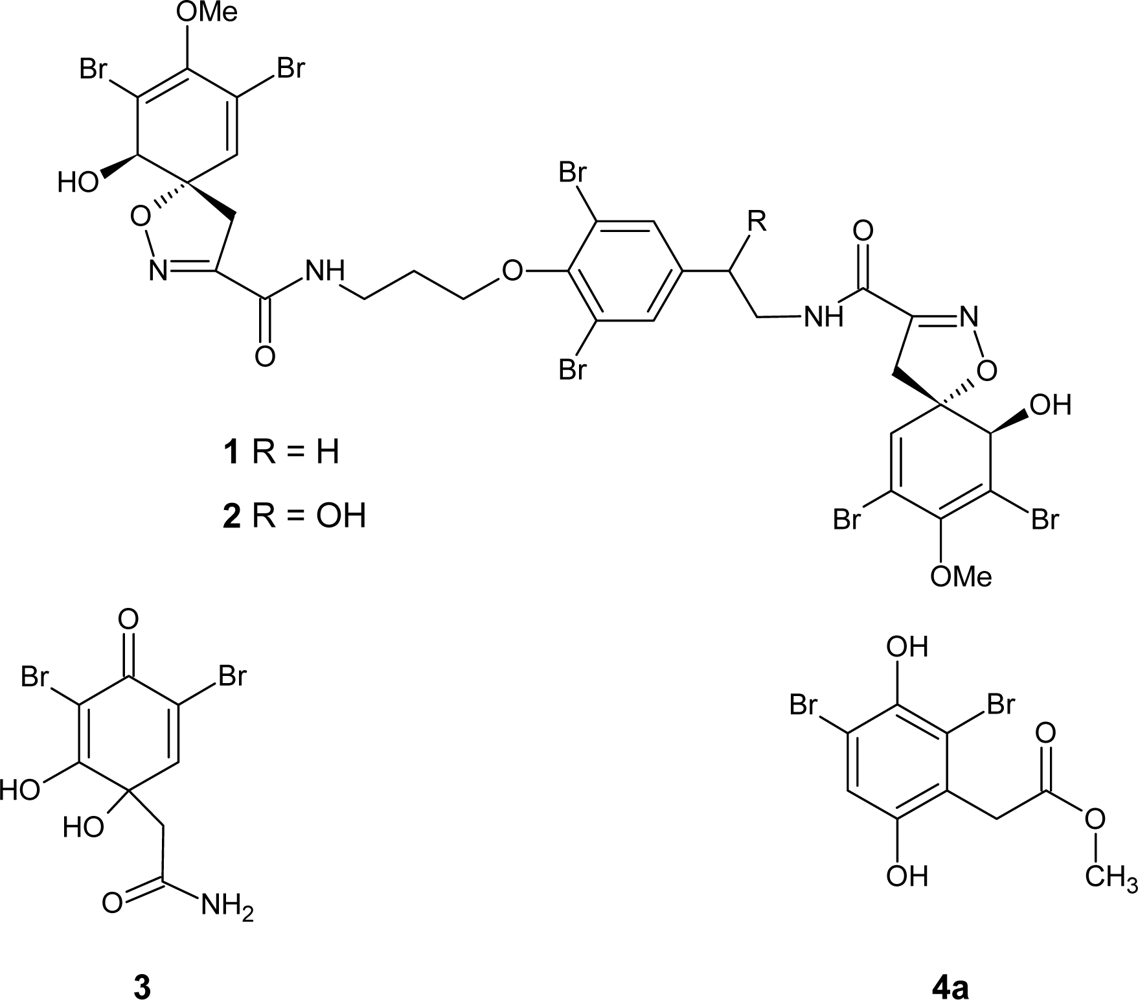
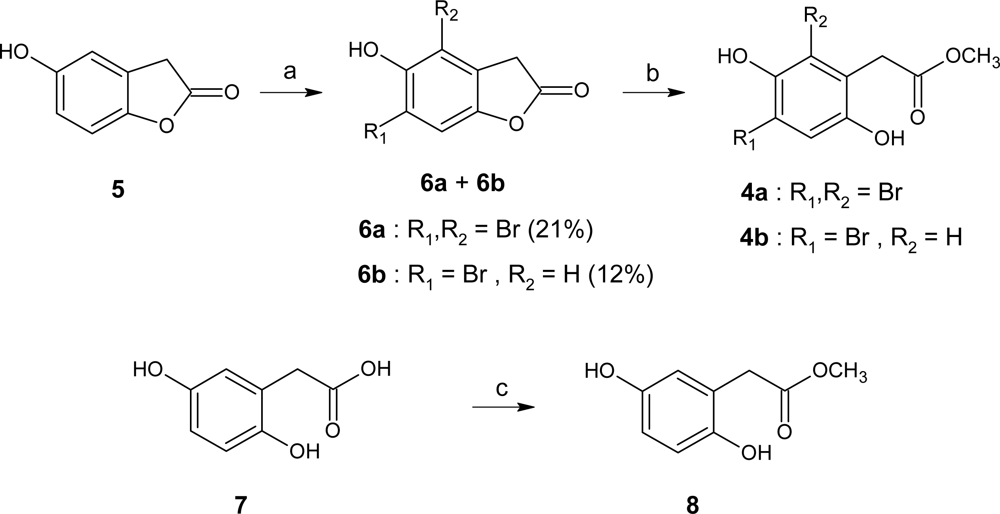
<p>The bromotyrosine metabolites, 11,19-dideoxyfistularin-3 (<bold>1</bold>)<bold>,</bold> 11-deoxyfistularin-3 (<bold>2</bold>) and dibromoverongiaquinol (<bold>3</bold>) were isolated from an ethanolic extract of <italic>Pseudoceratina</italic> sp. which was subjected to solvent partitioning between CH<sub>2</sub>Cl<sub>2</sub> and H<sub>2</sub>O. The compounds were obtained from the CH<sub>2</sub>Cl<sub>2</sub>-soluble and -insoluble extracts by chromatography on silica gel and further purification by preparative thick layer chromatography or by reverse phase HPLC. The spectroscopic properties of the isolated bromotyrosine metabolites <bold>1</bold>–<bold>3</bold> were consistent with those previously published [<xref ref-type="bibr" rid="b19-marinedrugs-07-00640">19</xref>]. A bioassay-guided fractionation based on Pfnek-1 inhibition assay led us to isolate methyl (2,4-dibromo-3,6-dihydroxyphenyl) acetate (<bold>4a</bold>). An analogue of this compound, 4,6-dibromo-2,5-dihydroxyphenylacetic acid amide, was already isolated from the sponge <italic>Verongia aurea</italic> [<xref ref-type="bibr" rid="b20-marinedrugs-07-00640">20</xref>]. Isolation of <bold>4a</bold> from <italic>Verongia aurea</italic> was also briefly mentioned in a patent [<xref ref-type="bibr" rid="b21-marinedrugs-07-00640">21</xref>], but surprisingly, no spectroscopic data were reported. For the unambiguous identification of natural compound <bold>4a</bold> as responsible for activity against Pfnek-1, it was necessary to perform its synthesis, which was achieved as reported in <xref ref-type="fig" rid="f2-marinedrugs-07-00640">Scheme 1</xref>.</p>
<p>The principal impediment of this synthesis was the difficulty in achieving the regioselective bromination of the phenyl ring. First attempts at bromination of methyl (2,5-dihydroxyphenyl)acetate (<bold>8</bold>) yielded a mixture of mono-, di- and tri-bromo derivatives. In order to increase the regioselectivity, we used as starting material 5-hydroxy-<italic>3H</italic>-benzofuran-2-one (<bold>5</bold>) which bears only one hydroxyl group. A similar pathway has been used for the synthesis of 4,6-dibromo-2,5-dihydroxyphenylacetic acid amide and derivatives [<xref ref-type="bibr" rid="b21-marinedrugs-07-00640">21</xref>,<xref ref-type="bibr" rid="b22-marinedrugs-07-00640">22</xref>]. Compounds <bold>6a</bold> and <bold>6b</bold> were thus obtained concurrently by bromination of <bold>5</bold> in the presence of <italic>N</italic>-bromosuccinimide and a catalytic amount of <italic>p</italic>-toluenesulfonic acid in CH<sub>2</sub>Cl<sub>2</sub>, and subsequently separated on silica gel by column chromatography. Ring opening of the benzofuran-2-ones was achieved with <italic>p</italic>-toluenesulfonic acid in MeOH to give <bold>4a</bold> and the monobrominated analogue <bold>4b</bold>. The spectroscopic properties (<sup>1</sup>H-, <sup>13</sup>C-NMR, MS) of the synthesized compound <bold>4a</bold> were the same as those of the natural product, thus allowing its unambiguous identification (<xref ref-type="table" rid="t1-marinedrugs-07-00640">Table 1</xref>).</p>
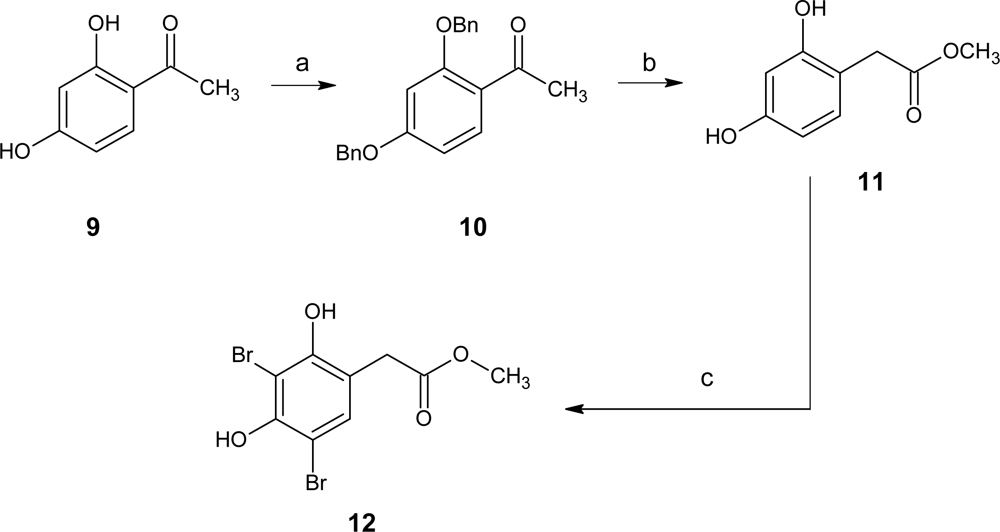
<p>In order to study the influence of the position of the two hydroxyl groups and the ester chain on the phenyl ring, we synthesized an analogue <bold>12</bold> of the natural product with hydroxyl groups in the <italic>meta</italic> position (<xref ref-type="fig" rid="f3-marinedrugs-07-00640">Scheme 2</xref>).</p>
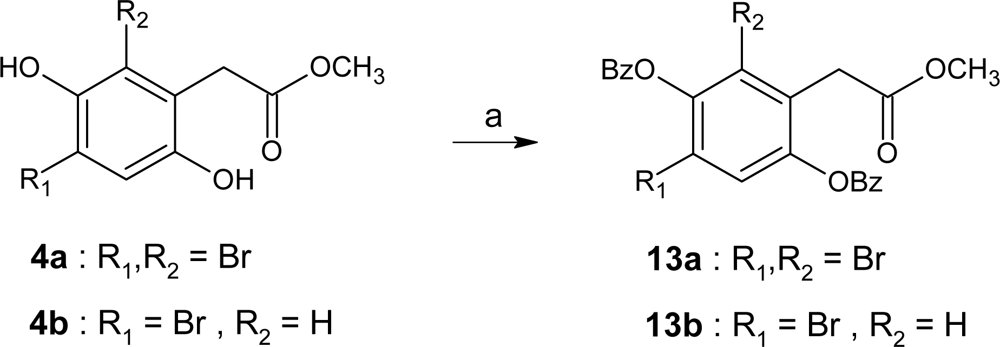
<p>Treatment of 2′,4′-dihydroxyacetophenone (<bold>9</bold>) with potassium carbonate in the presence of benzyl chloride gave compound <bold>10</bold> in 73% yield. Willgerodt-Kindler rearrangement of <bold>10</bold> with thallium trinitrate and perchloric acid, followed by subsequent generation of hydroxyl groups in the presence of palladium 10% on carbon and ammonium formate gave compound <bold>11</bold>. Electrophilic ring dibromination was then carried out with <italic>N</italic>-bromosuccinimide and <italic>p</italic>-toluenesulfonic acid as catalyst in MeOH under sonication to obtain <bold>12</bold> in good yield. Finally, to study the substitution of the two hydroxyl groups, the benzoylations of compounds <bold>4a</bold> and <bold>4b</bold> gave the two lipophilic products <bold>13a</bold> and <bold>13b</bold> (<xref ref-type="fig" rid="f4-marinedrugs-07-00640">Scheme 3</xref>).</p>
<p>Furthermore, the synthesis of <bold>12</bold> and <bold>4a</bold> allowed us to revise the structure of subreaphenol B, a natural compound isolated from the spon<italic>ge Suberea mollis</italic> and described as <bold>12</bold> [<xref ref-type="bibr" rid="b23-marinedrugs-07-00640">23</xref>]. However, the spectroscopic data (<sup>1</sup>H and <sup>13</sup>C NMR) published for the natural compound did not match with our data for <bold>12</bold>, but rather with our data for <bold>4a</bold>, showing that the structure of subreaphenol B was identical to <bold>4a</bold> and not <bold>12</bold>.</p></sec>
<sec>
<label>2.2.</label>
<title>Biological Properties</title>
<p>The ability of the pure natural products and of the synthetic compounds to inhibit Pfnek-1 activity was investigated (<xref ref-type="table" rid="t2-marinedrugs-07-00640">Table 2</xref>). Only compounds <bold>4a</bold> and <bold>4b</bold> exhibited a protein kinase inhibitor activity, particularly <bold>4a</bold> (IC<sub>50</sub> = 1.8 μM) which was five times more active than <bold>4b</bold> (IC<sub>50</sub> = 10 μM). 4,6-Dibromo-2,5-dihydroxyphenylacetic acid methyl ester (<bold>4a</bold>) was previously reported in a patent concerning homogentisic acid derivatives and their protein kinase C inhibitor activity [<xref ref-type="bibr" rid="b21-marinedrugs-07-00640">21</xref>]. The comparison of compounds <bold>4a</bold>, <bold>4b</bold> and <bold>8</bold> highlights the influence of the presence and number of bromine atoms on the phenyl ring. The non-brominated <bold>8</bold> was inactive, while monobrominated <bold>4b</bold> was moderately active; the dibrominated compound <bold>4a</bold> was the most active. Furthermore the presence of two free hydroxyl groups appears to be essential, as shown by: (i) the inactivity of the benzoyl analogues <bold>13a</bold> and <bold>13b</bold> and (ii) the inactivity of the lactone analogues <bold>6a</bold> and <bold>6b</bold>. In addition, the <italic>para</italic> position of the hydroxyl groups (hindered quinone system) is critical because the analogue <bold>12</bold> as well as the tyrosine metabolites <bold>1</bold>–<bold>3</bold> which have hydroxyl groups in the <italic>meta</italic> position are inactive. These results confirm the important role of quinone/phenolic part in the mode of action on Pfnek-1, a feature that is present in other Pfnek-1 inhibitors such as xestoquinone, halenaquinone, alisiaquinones A and B or alisiaquinol [<xref ref-type="bibr" rid="b6-marinedrugs-07-00640">6</xref>,<xref ref-type="bibr" rid="b24-marinedrugs-07-00640">24</xref>].</p>
<p>All the compounds were evaluated for <italic>in vitro</italic> antimalarial activity against a FcB1 <italic>P. falciparum</italic> strain (<xref ref-type="table" rid="t2-marinedrugs-07-00640">Table 2</xref>). Compounds <bold>1</bold>–<bold>3</bold> and <bold>12</bold> are inactive, while the other compounds have a weak antiplasmodial activity (12 μM &lt; IC<sub>50</sub> &lt; 36 μM). Two homogentisic acid derivatives, methyl 2-(1′β-geranyl-5′β-hydroxy-2′-oxocyclohex-3-enyl)acetate and 2-(1′β-geranyl-5′β-hydroxy-2′-oxocyclohex-3′-enyl)acetic acid isolated from the leaves of <italic>Glossocalyx brevipes</italic> have already shown modest activities against <italic>P. falciparum</italic> [<xref ref-type="bibr" rid="b25-marinedrugs-07-00640">25</xref>]. The <italic>para</italic> position of the hydroxyl groups is essential to promote antiplasmodial activity, and also for Pfnek-1 activity (see above), suggesting that the cellular effect may be mediated by Pfnek-1. However, no other correlations can be established between the activity against Pfnek-1 and the inhibition of <italic>P. falciparum</italic> growth. A similar situation was observed with xestoquinone and alisaquinone. This suggests that there are other targets that are affected by the compounds, in addition to Pfnek-1.</p>
<p>Besides the activity of <italic>Pseudoceratina</italic> sp. extracts on Pfnek-1 and malaria parasites, strong antibacterial activities have also been observed. Activity was evaluated by the standard microdilution plate test with human pathogenic <italic>Staphylococcus aureus</italic> and <italic>Escherichia coli</italic> at 100 μg/disc for a disc of 6 mm diameter (<xref ref-type="table" rid="t3-marinedrugs-07-00640">Table 3</xref>) [<xref ref-type="bibr" rid="b26-marinedrugs-07-00640">26</xref>]. Both 11-deoxyfistularin-3 (<bold>1</bold>) and dibromoverongiaquinol (<bold>3</bold>) showed strong antibacterial activities while 4,6-dibromo-2,5-dihydroxyphenylacetic acid methyl ester (<bold>4a</bold>) was inactive. Bromotyrosine metabolites have already been reported as antibacterials [<xref ref-type="bibr" rid="b7-marinedrugs-07-00640">7</xref>, <xref ref-type="bibr" rid="b27-marinedrugs-07-00640">27</xref>–<xref ref-type="bibr" rid="b33-marinedrugs-07-00640">33</xref>].</p>
<p>In conclusion, three bromotyrosine metabolites <bold>1</bold>–<bold>3</bold> and the homogentisic acid derivative <bold>4a</bold> have been isolated from the marine sponge <italic>Pseudoceratina</italic> sp. collected in Vanuatu. 11-Deoxyfistularin-3 (<bold>1</bold>) and dibromoverongiaquinol (<bold>3</bold>) showed strong antibacterial activities against <italic>S. aureus</italic> and <italic>E. coli</italic> like several bromotyrosine metabolites isolated from marine sponges belonging to the order Verongida. Homogentisic acid derivative <bold>4a</bold> exhibited Pfnek-1 inhibitor activity (IC<sub>50</sub> = 1.8 μM) and its unambiguous identification has been performed by synthesis. The study of the structure-activity relationships for the natural product <bold>4a</bold> and its synthetic analogues <bold>4b</bold>, <bold>5</bold>, <bold>6a</bold>, <bold>6b</bold>, <bold>8</bold>, <bold>12</bold>, <bold>13a</bold> and <bold>13b</bold> has highlighted the essential role of the bromine atoms and of the position of the hydroxyl groups for the inhibition of Pfnek-1. Consequently, the structural feature of homogentisic acid derivative <bold>4a</bold> could serve as a model for the development of new Pfnek-1 inhibitors. Replacement of the bromine atoms by other halogens (Cl, F) and the elongation of the ester chain could be particularly interesting to enhance the Pfnek-1 inhibition of these homogentisic acid derivatives. Finally, the moderate activity against <italic>P. falciparum</italic> could result from the weak capacity of the inhibitor to reach the kinase (or other) target(s), and demonstrates the difficulties met when using an enzymatic test for the screening of natural extracts and for the discovering of new anti-infectious drugs.</p></sec></sec>
<sec>
<label>3.</label>
<title>Experimental Section</title>
<sec sec-type="materials">
<label>3.1.</label>
<title>Materials</title>
<p>The sponge of the genus <italic>Pseudoceratina</italic> Carter, 1885 (order Verongida, family Pseudoceratinidae) was collected by scuba diving at 40 m depth at Rowa islands, Banks Territory (Vanuatu). A voucher specimen, voucher number G318491, is deposited with the Queensland Museum, Brisbane, Australia. The FcB1 strain of <italic>P. falciparum</italic> was kindly provided by Dr. A. Valentin, Laboratory of Parasitology, Faculty of Pharmacy, Toulouse, France. Solvents were purchased from Ajax (Australia), and distilled before use, except for the HPLC grade methanol; Biochemical reagents were purchased from Sigma-Aldrich and Cambrex. Radioactive γ-[<sup>33</sup>P] ATP was purchased from Perkin Elmer (France). HPLC was performed on a Waters apparatus, (Waters 510 pumps; Waters 996 Photodiode Array Detector) using a μBondapack C<sub>18</sub> column (125 Å, 10 μm, 4.6 × 250 mm). NMR spectra were recorded on Bruker AC 250, Bruker Avance 300, 400 and 500 spectrometers. Mass spectra were recorded on an ion trap LCQ Finnigan spectrometer in APCI ionization mode (positive or negative), except for compounds <bold>13a</bold> and <bold>13b</bold> (ESI ionization mode, positive). High resolution mass spectra were recorded on a GCT Premier apparatus (Waters Micromass) in CI (CH<sub>4</sub>) ionization mode. Radioactivity was measured using a liquid scintillation analyzer Packard Tri-carb 1600TR and Packard Ultima Gold MV scintillation cocktail.</p></sec>
<sec>
<label>3.2.</label>
<title>Extraction and Isolation</title>
<p>The freeze-dried sponge was extracted twice overnight with fresh 95% EtOH at room temperature, filtered and the ethanol was evaporated. The residue was subjected to solvent partition between CH<sub>2</sub>Cl<sub>2</sub> and H<sub>2</sub>O to give the CH<sub>2</sub>Cl<sub>2</sub> soluble extract and the CH<sub>2</sub>Cl<sub>2</sub>/H<sub>2</sub>O insoluble extract.</p>
<p>The CH<sub>2</sub>Cl<sub>2</sub> soluble extract (4 g) was subjected to silica gel column chromatography (Merck silica gel 60, 0.040–0.063 mm) using CH<sub>2</sub>Cl<sub>2</sub>/MeOH (98/2) as eluent to afford 12 fractions (F1-12). Fraction F11 (965 mg) was purified by semipreparative reversed-phase HPLC with H<sub>2</sub>O/MeOH gradient elution (t = 0: 40/60, t = 20 min: 25/75, t = 25 min: 0/100, t = 30 min: 40/60, flow rate: 3 mL/min, wavelength: 254 nm) to give 11-deoxyfistularin-3 (<bold>2</bold>; 13.6 mg, <italic>t</italic><sub>R</sub> = 12.8 min) and another fraction which was further purified by semipreparative reversed-phase HPLC with H<sub>2</sub>O/MeOH gradient elution (from t = 0 to t = 10 min: 80/20, t = 20 min: 0/100, t = 30 min: 80/20, flow rate: 3 mL/min, wavelength: 254 nm) to give dibromoverongiaquinol (<bold>3</bold>; 8.8 mg, <italic>t</italic><sub>R</sub> = 14.5 min).</p>
<p>The CH<sub>2</sub>Cl<sub>2</sub>/H<sub>2</sub>O insoluble extract (885 mg) was fractionated on silica gel by column chromatography (Merck silica gel 60, 0.040–0.063 mm) using CH<sub>2</sub>Cl<sub>2</sub>/MeOH (97/3) as eluant to afford seven fractions (F1-7). Fraction F5 (65 mg) was purified by Sep-Pak cartridge (silica, Waters) with <italic>n</italic>-hexane-AcOEt gradient elution to give methyl (2,4-dibromo-3,6-dihydroxyphenyl)acetate (<bold>4a</bold>, 24 mg). Finally, Fraction F7 (810 mg) was purified by preparative thick layer chromatography (CH<sub>2</sub>Cl<sub>2</sub>/MeOH: 97/3) to give 11,19-dideoxyfistularin-3 (<bold>1</bold>; 67 mg) and 11-deoxyfistularin-3 (<bold>2</bold>; 17 mg). The spectroscopic properties of the isolated tyrosine metabolites <bold>1</bold>–<bold>3</bold> were consistent with those previously published [<xref ref-type="bibr" rid="b18-marinedrugs-07-00640">18</xref>].</p></sec>
<sec>
<label>3.3.</label>
<title>Protein Kinase Assay</title>
<p>A GST-Pfnek-1 fusion protein was purified from the <italic>Escherichia coli</italic> BL21 strain carrying a Pfnek-1 expression plasmid harbouring an ampicillin resistance cassette (bacteria kindly provided by D. Dorin, INSERM 511) as described by Dorin <italic>et al</italic>. [<xref ref-type="bibr" rid="b5-marinedrugs-07-00640">5</xref>]. Pfnek-1 kinase activity was determined by measuring the <sup>33</sup>P incorporation in ß-caseine using γ[<sup>33</sup>P]-ATP.</p>
<p>Briefly, test compounds were dissolved in DMSO and diluted in 20 mM Tris, pH 7.5 20 mM MgCl<sub>2</sub>, 10 mM NaF and 10 mM ATP. β-casein (3 mg/mL) and γ[<sup>33</sup>P]-ATP were added prior to the addition of Pfnek-1 to start the kinase reaction. Approximately 5 μCi of γ[<sup>33</sup>P]-ATP was used per reaction. After incubation at 30 °C for 30 min, each solution was blotted on a phosphocellulose filter paper (P81 Whatman-cation exchange chromatography paper). After four washes with 1% H<sub>3</sub>PO<sub>4</sub> at, the remaining radioactivity was measured using a liquid scintillation analyzer Packard 1600TR. The IC<sub>50</sub> is defined as the concentration of compound which inhibits 50% of enzyme activity compared to the control (reaction in the absence of inhibitor).</p></sec>
<sec>
<label>3.4.</label>
<title>Activity against Erythrocytic Stages of Cultured P. falciparum</title>
<p>The antiplasmodial activity was studied <italic>in vitro</italic> against the chloroquine-resistant <italic>Plasmodium falciparum</italic> strain FcB1 by a micromethod using the lactate deshydrogenase (LDH) assay (Makler and Hinrichs [<xref ref-type="bibr" rid="b34-marinedrugs-07-00640">34</xref>]). Parasites were cultivated using the method of Trager and Jensen [<xref ref-type="bibr" rid="b35-marinedrugs-07-00640">35</xref>]. Erythrocytes infected with <italic>P. falciparum</italic> (ring stage, 1% of parasitaemia) were re-suspended in complete culture medium at a haematocrit of 1.5%. The suspension was distributed in 96-well microtitre plates (200 μL per well). Drug testing was performed in triplicate. For each assay, a parasite culture was incubated with the drug for 48 h in 5% CO<sub>2</sub> at 95% relative humidity, and frozen until the biochemical assay could be run. After defrosting, a 20 μL sub-sample of the contents of each well was mixed with 100 μL of a substrate solution containing 20 mg/mL of lithium <sc>l</sc>-lactate (Sigma), 5.5 mg/mL of TRIS (Sigma), and 3.7 mg/mL of 3-acetylpyridine adenine dinucleotide (APAD; Sigma), in the well of another microtitre plate. After incubation for 30 min, 25 μL of a mixture of NBT (1.6 mg/mL; Sigma) and PES (0.1 mg/mL; Sigma) were added to each well. After a further 35 min of incubation, the reaction was stopped by the addition of 25% acetic acid (25 μL per well). Accumulation of the reduced form of APAD was measured at λ = 650 nm, using a spectrophotometer (microplate reader, Metertech). IC<sub>50</sub> values were determined graphically in a concentration versus percent inhibition curve.</p></sec>
<sec>
<label>3.5.</label>
<title>Synthesis</title>
<sec>
<title>4,6-Dibromo-5-hydroxy-3H-benzofuran-2-one (<bold>6a</bold>) and 6-bromo-5-hydroxy-3H-benzofuran-2-one (<bold>6b</bold>)</title>
<p>5-Hydroxy-<italic>3H</italic>-benzofuran-2-one (<bold>5</bold>, 0.20 g, 1.33 mM), <italic>N</italic>-bromosuccinimide (0.52 g, 2.93 mM) and <italic>p</italic>-toluenesulfonic acid (0.30 g, 0.13 mM) were added to dichloromethane (20 mL) and stirred for 12 h at room temperature. The solution was evaporated under vacuum. The residue was diluted with water and extracted with ethyl acetate. The organic layer was washed with brine, dried over anhydrous sodium sulfate, and concentrated under vacuum. The residue was purified on silica gel by column chromatography (ethyl acetate/hexane: 1/1) to give <bold>6a</bold> (86 mg, 21%, white powder) and <bold>6b</bold> (37 mg, 12%, white powder). Compound <bold>6a</bold>: <sup>1</sup>H-NMR [300 MHz, (CD<sub>3</sub>)<sub>2</sub>SO)] δ 9.89 (s, 1H), 7.47 (s, 1H), 3.84 (s, 2H). <sup>13</sup>C-NMR [75 MHz, (CD<sub>3</sub>)<sub>2</sub>SO]: δ 173.2, 147.7, 147.6, 127.1, 113.9, 111.1, 109.5, 35.6. APCI-MS : 305, 307, 309 [M-H]<sup>−</sup>; Compound <bold>6b</bold>: <sup>1</sup>H-NMR [300 MHz, (CD<sub>3</sub>)<sub>2</sub>SO]: δ 10.09 (s, 1H), 7.36 (s, 1H), 6.95 (s,1H), 3.84 (s, 2H). <sup>13</sup>C-NMR [75 MHz, (CD<sub>3</sub>)<sub>2</sub>SO]: δ 174.9, 151.0, 147.4, 125.3, 114.5, 112.9, 107.8, 33.6; APCI-MS : 227, 229 [M-H]<sup>−</sup>.</p></sec>
<sec>
<title>Methyl (2,4-dibromo-3,6-dihydroxyphenyl)acetate (<bold>4a</bold>)</title>
<p>4,6-Dibromo-5-hydroxy-<italic>3H</italic>-benzofuran-2-one (<bold>6a</bold>, 0.14 g, 0.46 mM) and <italic>p</italic>-toluenesulfonic acid (0.17 g, 0.92 mM) were added to methanol (50 mL) and stirred for 24 h at room temperature. The solution was evaporated under vacuum. The residue was diluted with water and extracted with ethyl acetate. The organic layer was washed with brine, dried over anhydrous sodium sulfate, and concentrated under vacuum. The residue was purified on silica gel by column chromatography (ethyl acetate/hexane: 1/1) and <bold>4a</bold> was obtained (131 mg, 84%) as a white powder. <sup>1</sup>H-NMR (300 MHz, CD<sub>3</sub>OD): δ 7.00 (s, 1H), 3.85 (s, 2H), 3.70 (s, 3H); <sup>13</sup>C-NMR (75 MHz, CD<sub>3</sub>OD): δ 171.6, 149.8, 143.8, 122.2, 117.3, 115.7, 109.7, 51.1, 35.0; APCI-MS : 337, 339, 341 [M-H]<sup>−</sup>.</p></sec>
<sec>
<title>Methyl (4-bromo-3,6-dihydroxyphenyl)acetate (<bold>4b</bold>)</title>
<p>The above mentioned protocol was used to give <bold>4b</bold> (46 mg, 78%) as a white powder from <bold>6b</bold> (52 mg). <sup>1</sup>H-NMR (300 MHz, CD<sub>3</sub>OD): δ 6.84 (s, 1H), 6.65 (s, 1H), 3.61 (s, 3H), 3.46 (s, 2H); <sup>13</sup>C-NMR (75 MHz, CD<sub>3</sub>OD): δ 176.6, 152.7, 150.5, 125.6, 122.3, 121.5, 111.7, 54.9, 39.0; APCI-MS: 258, 260 [M-2H] <sup>−</sup>, 259, 261 [M-H]<sup>−</sup>; HRMS (CI, CH<sub>4</sub>): 259.9675 (Calc. for C<sub>9</sub>H<sub>9</sub>O<sub>4</sub><sup>79</sup>Br, [M]<sup>−</sup>, 259.9684).</p></sec>
<sec>
<title>Methyl (2,5-dihydroxyphenyl)acetate (<bold>8</bold>)</title>
<p>Homogentisic acid <bold>7</bold> (2 g, 11.89 mM) and concentrated hydrochloric acid (1 mL) were added to methanol (100 mL) and stirred for 24 h at room temperature. The solution was evaporated under vacuum. The residue was diluted with water and extracted with ethyl acetate. The organic layer was washed with brine, dried over anhydrous sodium sulfate, and concentrated under vacuum. The residue was purified on silica gel by column chromatography (dichloromethane) and <bold>8</bold> was thus obtained (2.1 g, 97%) as a white powder. <sup>1</sup>H-NMR [300 MHz, (CD<sub>3</sub>)<sub>2</sub>SO]: δ 8.73 (s,1H), 8.63 (s,1H), 6.60–6.46 (m, 3H), 3.58 (s, 3H), 3.47 (s, 2H); <sup>13</sup>C-NMR [75 MHz, (CD<sub>3</sub>)<sub>2</sub>SO]: δ 172.2, 150.0, 148.2, 122.0, 117.9, 115.8, 114.7, 51.8, 35.5; APCI-MS: 181 [M-H]<sup>−</sup>.</p></sec>
<sec>
<title>2′,4′-Dibenzyloxyacetophenone (<bold>10</bold>)</title>
<p>2′,4′-Dihydroxyacetophenone (<bold>9</bold>, 20.0 g, 131.5 mM), potassium carbonate (46.0 g, 332.8 mM) and benzyl bromide (47.2 g, 276.0 mM) were added to acetone (150 mL) and stirred for 15 h at room temperature. The solution was filtered and evaporated under vacuum. The residue was purified by recrystallization from hexane to give <bold>10</bold> (31.9 g, 73%) as a white powder. <sup>1</sup>H-NMR (300 MHz, CDCl<sub>3</sub>): δ 7.85 (d, <italic>J</italic> = 9.3 Hz, 1H), 7.35–7.43 (m, 10H), 6.62 (dd, <italic>J</italic> = 9.3 Hz, <italic>J</italic> = 2.6 Hz, 1H), 6.61 (d, <italic>J</italic> = 2.7 Hz, 1H), 5.12 (s, 2H), 5.09 (s, 2H), 2.56 (s, 3H); <sup>13</sup>C-NMR (75 MHz, CDCl<sub>3</sub>): δ 197.7, 163.5, 160.1, 136.2, 136.0, 132.7, 128.7–127.6, 121.7, 106.4, 100.4, 99.9, 70.7, 70.3; APCI-MS: 355 [M+Na]<sup>+</sup>, 687 [2M+Na]<sup>+</sup>.</p></sec>
<sec>
<title>Methyl (2,4-dihydroxyphenyl)acetate (<bold>11</bold>)</title>
<p>2′,4′-Dibenzyloxyacetophenone (<bold>10</bold>, 340 mg, 1.025 mM), perchloric acid (0.5 mL) and thallium trinitrate (466 mg, 1.05 mM) were added to tetrahydrofuran/methanol (1/5, 3 mL) and stirred for 18 h at room temperature. The solution was filtered and the residue was washed with methanol. The residue was diluted with water and extracted with ethyl acetate. The organic layer was washed with brine, dried over anhydrous sodium sulfate, and concentrated under vacuum. Without further purification, the mixture (278 mg), palladium 10% on carbon (190 mg) and ammonium formate 97% (331 mg, 5.25 mM) were added to methanol (12 mL) and stirred for 4 h at room temperature. The mixture was filtered over celite and the filtrate evaporated under vacuum. The residue was diluted with water and extracted with ethyl acetate. The organic layer was washed with brine, dried over anhydrous sodium sulfate, and concentrated under vacuum. The residue was purified on silica gel by column chromatography (methanol/dichloromethane: 2/98) and <bold>11</bold> was thus obtained (95 mg, 51%, two steps) as a white powder. <sup>1</sup>H-NMR (300 MHz, CDCl<sub>3</sub>): δ 8.42 (s, 2H), 6.94 (d, <italic>J</italic> = 8.2 Hz, 1H), 6.43 (d, <italic>J</italic> = 2.4 Hz, 1H), 6.39 (dd, <italic>J</italic> = 8.2 Hz, <italic>J</italic> = 2.4 Hz, 1H), 3.79 (s, 3H), 3.62 (s, 2H); APCI-MS: 181 [M-H]<sup>−</sup>.</p></sec>
<sec>
<title>Methyl (3,5-dibromo-2,4-dihydroxyphenyl)acetate (<bold>12</bold>)</title>
<p>Methyl (2,4-dihydroxyphenyl)acetate (<bold>11</bold>, 1.50 g, 8.23 mM), <italic>N</italic>-bromosuccinimide (3.08 g, 17.29 mM) and <italic>p</italic>-toluenesulfonic acid (0.16 g, 0.82 mM) were added to methanol (80 mL) and stirred for 3 h at 40 °C in an ultrasonic bath. The solution was evaporated under vacuum. The residue was diluted with water and extracted with ethyl acetate. The organic layer was washed with brine, dried over anhydrous sodium sulfate, and concentrated under vacuum. The residue was purified on silica gel by column chromatography (ethyl acetate/hexane: 1/1) and <bold>12</bold> was thus obtained (2.04 g, 73%) as a white powder. <sup>1</sup>H-NMR [400 MHz, (CD<sub>3</sub>)<sub>2</sub>SO]: δ 9.61 (s, 1H), 9.31 (s, 1H), 7.32 (s, 1H), 3.61 (s, 2H), 3.59 (s, 3H); <sup>13</sup>C-NMR [100 MHz, (CD<sub>3</sub>)<sub>2</sub>SO]: δ 172.0, 153.2, 151.0, 133.4, 117.5, 103.3, 101.3, 52.3, 35.5; <sup>1</sup>H-NMR [300 MHz, CD<sub>3</sub>OD]: δ 7.35 (s, 1H), 3.77 (s, 3H), 3.69 (s, 2H); <sup>13</sup>C-NMR [75 MHz, CD<sub>3</sub>OD]: δ 174.1, 153.9, 152.0, 133.9, 117.6, 102.2, 101.2, 52.5, 36.3; APCI-MS: 337, 339, 341 [M-H]<sup>−</sup>; HRMS (CI, CH<sub>4</sub>): 337.8787 (Calc. for C<sub>9</sub>H<sub>8</sub>O<sub>4</sub><sup>79</sup>Br<sub>2</sub>, [M]<sup>−</sup>, 337.8789).</p></sec>
<sec>
<title>Methyl (3,6-dibenzoyl-2,4-dibromophenyl)acetate (<bold>13a</bold>)</title>
<p>Methyl (2,4-dibromo-3,6-dihydroxyphenyl)acetate (<bold>4a</bold>, 20 mg, 0.0588 mM) was dissolved in dichloromethane (1mL). At 0 °C, benzoyl chloride (14.3 μL, 0.0123 mM) and triethylamine (14.1 μL, 0.123 mM) were added. After 1 hour at 0 °C, water (5 mL) and dichloromethane (5 mL) were added. The organic layer was separated, dried over anhydrous sodium sulfate, and concentrated under vacuum. The residue was purified on silica gel by column chromatography (cyclohexane, then 50/50 cyclohexane/CH<sub>2</sub>Cl<sub>2</sub>) to give <bold>13a</bold> (23 mg, 70%) as a colorless oil. <sup>1</sup>H-NMR (300 MHz, CDCl<sub>3</sub>): δ 8.32–7.54 (m, 11H), 3.92 (s, 2H), 3.65 (s, 3H); <sup>13</sup>C-NMR (75 MHz, CDCl<sub>3</sub>): δ 169.3, 163.9, 162.9, 147.6, 144.7, 134.2, 134.1, 130.6, 130.3, 128.8, 128.7, 128.6, 128.3, 126.3, 121.6, 116.4, 52.3, 36.6 ESI-MS: 569, 571, 573 [M+Na]<sup>+</sup>, 585, 587, 589 [M+K]<sup>+</sup>; HRMS (CI, CH<sub>4</sub>): 545.9308 (Calc. for C<sub>23</sub>H<sub>16</sub>O<sub>6</sub><sup>79</sup>Br<sub>2</sub>, [M]<sup>−</sup>, 545.9314).</p></sec>
<sec>
<title>Methyl (3,6-dibenzoyl-4-bromophenyl)acetate <bold>13b</bold></title>
<p>The above mentioned protocol was used to give <bold>13b</bold> from <bold>4b</bold> with a similar yield. <sup>1</sup>H-NMR (300 MHz, CDCl<sub>3</sub>): δ 8.29–7.38 (m, 12H), 3.66 (s, 2H), 3.63 (s, 3H); <sup>13</sup>C-NMR (75 MHz, DCl<sub>3</sub>): δ 170.1, 164.2, 164.1, 147.0, 146.1, 134.0, 134.9, 130.4, 130.2, 128.8, 128.7, 128.6, 128.3, 127.4, 127.3, 125.8, 115.1, 52.2, 35.9; ESI-MS: 491,493 [M+Na]<sup>+</sup>, 507, 509 [M+K]<sup>+</sup>, HRMS (CI, CH<sub>4</sub>): 468.0208 (Calc. for C<sub>23</sub>H<sub>17</sub>O<sub>6</sub><sup>79</sup>Br, [M]<sup>−</sup>, 468.0208).</p></sec></sec></sec></body>
<back>
<ack>
<p>We thank J.L. Menou and all the team of divers from the Noumea IRD centre for the collection of sponge. Work in the CD laboratory is supported by Inserm and by the FP6 (ANTIMAL Integrated Project and BioMalPar Network of Excellence) and FP7 (MALSIG project) of the European Commission.</p></ack>
<fn-group><fn>
<p><italic>Samples Availability:</italic> Available from the authors.</p></fn></fn-group>
<ref-list>
<title>References and Notes</title>
<ref id="b1-marinedrugs-07-00640"><label>1.</label><citation citation-type="journal"><person-group person-group-type="author"><name><surname>Laurent</surname><given-names>D</given-names></name><name><surname>Pietra</surname><given-names>F</given-names></name></person-group><article-title>Antiplasmodial marine natural products in the perspective of current chemotherapy and prevention of malaria. A Review</article-title><source>Mar Biotechnol</source><year>2006</year><volume>8</volume><fpage>433</fpage><lpage>447</lpage><pub-id pub-id-type="doi">10.1007/s10126-006-6100-y</pub-id><pub-id pub-id-type="pmid">16565802</pub-id></citation></ref>
<ref id="b2-marinedrugs-07-00640"><label>2.</label><citation citation-type="journal"><person-group person-group-type="author"><name><surname>Fattorusso</surname><given-names>E</given-names></name><name><surname>Taglialatela-Scafati</surname><given-names>O</given-names></name></person-group><article-title>Marine Antimalarials</article-title><source>Mar Drugs</source><year>2009</year><volume>7</volume><fpage>130</fpage><lpage>152</lpage><pub-id pub-id-type="doi">10.3390/md7020130</pub-id><pub-id pub-id-type="pmid">19597577</pub-id></citation></ref>
<ref id="b3-marinedrugs-07-00640"><label>3.</label><citation citation-type="journal"><person-group person-group-type="author"><name><surname>Gademann</surname><given-names>K</given-names></name><name><surname>Kobylinska</surname><given-names>J</given-names></name></person-group><article-title>Antimalarial natural products of marine and freshwater origin</article-title><source>Chem Rec</source><year>2009</year><volume>9</volume><fpage>187</fpage><lpage>198</lpage><pub-id pub-id-type="doi">10.1002/tcr.200900001</pub-id><pub-id pub-id-type="pmid">19424997</pub-id></citation></ref>
<ref id="b4-marinedrugs-07-00640"><label>4.</label><citation citation-type="journal"><person-group person-group-type="author"><name><surname>Kaur</surname><given-names>K</given-names></name><name><surname>Jain</surname><given-names>M</given-names></name><name><surname>Kaur</surname><given-names>T</given-names></name><name><surname>Jain</surname><given-names>R</given-names></name></person-group><article-title>Antimalarials from nature</article-title><source>Bioorg Med Chem</source><year>2009</year><volume>17</volume><fpage>3229</fpage><lpage>3256</lpage><pub-id pub-id-type="doi">10.1016/j.bmc.2009.02.050</pub-id><pub-id pub-id-type="pmid">19299148</pub-id></citation></ref>
<ref id="b5-marinedrugs-07-00640"><label>5.</label><citation citation-type="journal"><person-group person-group-type="author"><name><surname>Dorin</surname><given-names>D</given-names></name><name><surname>Le Roch</surname><given-names>K</given-names></name><name><surname>Sallicandro</surname><given-names>P</given-names></name><name><surname>Alano</surname><given-names>P</given-names></name><name><surname>Parzy</surname><given-names>D</given-names></name><name><surname>Poullet</surname><given-names>P</given-names></name><name><surname>Meijer</surname><given-names>L</given-names></name><name><surname>Doerig</surname><given-names>C</given-names></name></person-group><article-title>Pfnek-1, a NIMA-related kinase from the human malaria parasite <italic>Plasmodium falciparum</italic></article-title><source>Eur J Biochem</source><year>2001</year><volume>268</volume><fpage>2600</fpage><lpage>2608</lpage><pub-id pub-id-type="doi">10.1046/j.1432-1327.2001.02151.x</pub-id><pub-id pub-id-type="pmid">11322879</pub-id></citation></ref>
<ref id="b6-marinedrugs-07-00640"><label>6.</label><citation citation-type="journal"><person-group person-group-type="author"><name><surname>Laurent</surname><given-names>D</given-names></name><name><surname>Jullian</surname><given-names>V</given-names></name><name><surname>Parenty</surname><given-names>A</given-names></name><name><surname>Knibiehler</surname><given-names>M</given-names></name><name><surname>Dorin</surname><given-names>D</given-names></name><name><surname>Schmitt</surname><given-names>S</given-names></name><name><surname>Lozach</surname><given-names>O</given-names></name><name><surname>Lebouvier</surname><given-names>N</given-names></name><name><surname>Frostin</surname><given-names>M</given-names></name><name><surname>Alby</surname><given-names>F</given-names></name><name><surname>Maurel</surname><given-names>S</given-names></name><name><surname>Doerig</surname><given-names>C</given-names></name><name><surname>Meijer</surname><given-names>L</given-names></name><name><surname>Sauvain</surname><given-names>M</given-names></name></person-group><article-title>Antimalarial potential of xestoquinone, a protein kinase inhibitor isolated from a Vanuatu marine sponge <italic>Xestospongia</italic> sp</article-title><source>Bioorg Med Chem</source><year>2006</year><volume>14</volume><fpage>4477</fpage><lpage>4482</lpage><pub-id pub-id-type="doi">10.1016/j.bmc.2006.02.026</pub-id><pub-id pub-id-type="pmid">16513357</pub-id></citation></ref>
<ref id="b7-marinedrugs-07-00640"><label>7.</label><citation citation-type="journal"><person-group person-group-type="author"><name><surname>Takada</surname><given-names>N</given-names></name><name><surname>Watanabe</surname><given-names>R</given-names></name><name><surname>Suenaga</surname><given-names>K</given-names></name><name><surname>Yamada</surname><given-names>K</given-names></name><name><surname>Ueda</surname><given-names>K</given-names></name><name><surname>Kita</surname><given-names>M</given-names></name><name><surname>Uemura</surname><given-names>D</given-names></name></person-group><article-title>Zamamistatin, a significant antibacterial bromotyrosine derivative, from the Okinawan sponge <italic>Pseudoceratina purpurea</italic></article-title><source>Tetrahedron Lett</source><year>2001</year><volume>42</volume><fpage>5265</fpage><lpage>5267</lpage><pub-id pub-id-type="doi">10.1016/S0040-4039(01)00993-5</pub-id></citation></ref>
<ref id="b8-marinedrugs-07-00640"><label>8.</label><citation citation-type="journal"><person-group person-group-type="author"><name><surname>Benharref</surname><given-names>A</given-names></name><name><surname>Païs</surname><given-names>M</given-names></name><name><surname>Debitus</surname><given-names>C</given-names></name></person-group><article-title>Bromotyrosine Alkaloids from the Sponge <italic>Pseudoceratina verrucosa</italic></article-title><source>J Nat Prod</source><year>1996</year><volume>59</volume><fpage>177</fpage><lpage>180</lpage><pub-id pub-id-type="doi">10.1021/np9600457</pub-id></citation></ref>
<ref id="b9-marinedrugs-07-00640"><label>9.</label><citation citation-type="journal"><person-group person-group-type="author"><name><surname>Tsukamoto</surname><given-names>S</given-names></name><name><surname>Kato</surname><given-names>H</given-names></name><name><surname>Hirota</surname><given-names>H</given-names></name><name><surname>Fusetani</surname><given-names>N</given-names></name></person-group><article-title>Ceratinamides A and B: New antifouling dibromotyrosine derivatives from the marine sponge <italic>Pseudoceratina purpurea</italic></article-title><source>Tetrahedron</source><year>1996</year><volume>52</volume><fpage>181</fpage><lpage>186</lpage></citation></ref>
<ref id="b10-marinedrugs-07-00640"><label>10.</label><citation citation-type="journal"><person-group person-group-type="author"><name><surname>Kernan</surname><given-names>MR</given-names></name><name><surname>Cambie</surname><given-names>RC</given-names></name><name><surname>Bergquist</surname><given-names>PR</given-names></name></person-group><article-title>Chemistry of Sponges, VII. 11,19-Dideoxyfistularin 3 and 11-hydroxyaerothionin, bromotyrosine derivatives from <italic>Pseudoceratina durissima</italic></article-title><source>J Nat Prod</source><year>1990</year><volume>53</volume><fpage>615</fpage><lpage>622</lpage><pub-id pub-id-type="doi">10.1021/np50069a012</pub-id></citation></ref>
<ref id="b11-marinedrugs-07-00640"><label>11.</label><citation citation-type="journal"><person-group person-group-type="author"><name><surname>Piña</surname><given-names>IC</given-names></name><name><surname>Gautschi</surname><given-names>JT</given-names></name><name><surname>Wang</surname><given-names>GY</given-names></name><name><surname>Sanders</surname><given-names>ML</given-names></name><name><surname>Schmitz</surname><given-names>FJ</given-names></name><name><surname>France</surname><given-names>D</given-names></name><name><surname>Cornell-Kennon</surname><given-names>S</given-names></name><name><surname>Sambucetti</surname><given-names>LC</given-names></name><name><surname>Remiszewski</surname><given-names>SW</given-names></name><name><surname>Perez</surname><given-names>LB</given-names></name><name><surname>Bair</surname><given-names>KW</given-names></name><name><surname>Crews</surname><given-names>P</given-names></name></person-group><article-title>Psammaplins from the sponge <italic>Pseudoceratina purpurea</italic>: inhibition of both histone deacetylase and DNA methyltransferase</article-title><source>J Org Chem</source><year>2003</year><volume>68</volume><fpage>3866</fpage><lpage>3873</lpage><pub-id pub-id-type="doi">10.1021/jo034248t</pub-id><pub-id pub-id-type="pmid">12737565</pub-id></citation></ref>
<ref id="b12-marinedrugs-07-00640"><label>12.</label><citation citation-type="journal"><person-group person-group-type="author"><name><surname>Aiello</surname><given-names>A</given-names></name><name><surname>Fattorusso</surname><given-names>E</given-names></name><name><surname>Menna</surname><given-names>M</given-names></name><name><surname>Pansini</surname><given-names>M</given-names></name></person-group><article-title>Chemistry of Verongida Sponges-V. Brominated metabolites from the Caribbean Sponge <italic>Pseudoceratina</italic> sp</article-title><source>Biochem Syst Ecol</source><year>1995</year><volume>23</volume><fpage>377</fpage><lpage>381</lpage><pub-id pub-id-type="doi">10.1016/0305-1978(95)00013-K</pub-id></citation></ref>
<ref id="b13-marinedrugs-07-00640"><label>13.</label><citation citation-type="journal"><person-group person-group-type="author"><name><surname>Fusetani</surname><given-names>N</given-names></name><name><surname>Masuda</surname><given-names>Y</given-names></name><name><surname>Nakao</surname><given-names>Y</given-names></name><name><surname>Matsunaga</surname><given-names>S</given-names></name><name><surname>van Soest</surname><given-names>RWM</given-names></name></person-group><article-title>Three new bromotyrosine derivatives lethal to crab from the marine sponge, <italic>Pseudoceratina purpurea</italic></article-title><source>Tetrahedron</source><year>2001</year><volume>57</volume><fpage>7507</fpage><lpage>7511</lpage><pub-id pub-id-type="doi">10.1016/S0040-4020(01)00735-9</pub-id></citation></ref>
<ref id="b14-marinedrugs-07-00640"><label>14.</label><citation citation-type="journal"><person-group person-group-type="author"><name><surname>Albrizio</surname><given-names>S</given-names></name><name><surname>Ciminiello</surname><given-names>P</given-names></name><name><surname>Fattorusso</surname><given-names>E</given-names></name><name><surname>Magno</surname><given-names>S</given-names></name><name><surname>Pansini</surname><given-names>M</given-names></name></person-group><article-title>Chemistry of verongida sponges. I. Constituents of the Caribbean sponge <italic>Pseudoceratina crassa</italic></article-title><source>Tetrahedron</source><year>1994</year><volume>50</volume><fpage>783</fpage><lpage>788</lpage><pub-id pub-id-type="doi">10.1016/S0040-4020(01)80793-6</pub-id></citation></ref>
<ref id="b15-marinedrugs-07-00640"><label>15.</label><citation citation-type="journal"><person-group person-group-type="author"><name><surname>Jang</surname><given-names>J-H</given-names></name><name><surname>Van Soest</surname><given-names>RWM</given-names></name><name><surname>Fusetani</surname><given-names>N</given-names></name><name><surname>Matsunaga</surname><given-names>S</given-names></name></person-group><article-title>Pseudoceratins A and B, Antifungal Bicyclic Bromotyrosine-Derived Metabolites from the Marine Sponge <italic>Pseudoceratina purpurea</italic></article-title><source>J Org Chem</source><year>2007</year><volume>72</volume><fpage>1211</fpage><lpage>1217</lpage><pub-id pub-id-type="doi">10.1021/jo062010+</pub-id><pub-id pub-id-type="pmid">17256905</pub-id></citation></ref>
<ref id="b16-marinedrugs-07-00640"><label>16.</label><citation citation-type="journal"><person-group person-group-type="author"><name><surname>Schoenfeld</surname><given-names>RC</given-names></name><name><surname>Ganem</surname><given-names>B</given-names></name></person-group><article-title>Synthesis of ceratinamine and moloka’iamine: Antifouling agents from the marine sponge <italic>Pseudoceratina purpurea</italic></article-title><source>Tetrahedron Lett</source><year>1998</year><volume>39</volume><fpage>4171</fpage><lpage>4150</lpage><pub-id pub-id-type="doi">10.1016/S0040-4039(98)00777-1</pub-id></citation></ref>
<ref id="b17-marinedrugs-07-00640"><label>17.</label><citation citation-type="journal"><person-group person-group-type="author"><name><surname>Buchanan</surname><given-names>MS</given-names></name><name><surname>Carroll</surname><given-names>AR</given-names></name><name><surname>Fechner</surname><given-names>GA</given-names></name><name><surname>Boyle</surname><given-names>A</given-names></name><name><surname>Simpson</surname><given-names>M</given-names></name><name><surname>Addepalli</surname><given-names>R</given-names></name><name><surname>Avery</surname><given-names>VM</given-names></name><name><surname>Hooper</surname><given-names>JNA</given-names></name><name><surname>Cheung</surname><given-names>THC</given-names></name><name><surname>Quinn</surname><given-names>RJ</given-names></name></person-group><article-title>Aplysamine 6, an Alkaloidal Inhibitor of Isoprenylcysteine Carboxyl Methyltransferase from the Sponge <italic>Pseudoceratina</italic> sp</article-title><source>J Nat Prod</source><year>2008</year><volume>71</volume><fpage>1066</fpage><lpage>1067</lpage><pub-id pub-id-type="doi">10.1021/np0706623</pub-id><pub-id pub-id-type="pmid">18393464</pub-id></citation></ref>
<ref id="b18-marinedrugs-07-00640"><label>18.</label><citation citation-type="journal"><person-group person-group-type="author"><name><surname>Thirionet</surname><given-names>I</given-names></name><name><surname>Daloze</surname><given-names>D</given-names></name><name><surname>Braekman</surname><given-names>JC</given-names></name><name><surname>Willemsen</surname><given-names>P</given-names></name></person-group><article-title>5-Bromoverongamine, a Novel Antifouling Tyrosine Alkaloid from the Sponge <italic>Pseudoceratina</italic> sp</article-title><source>Nat Prod Res</source><year>1998</year><volume>12</volume><fpage>209</fpage><lpage>214</lpage></citation></ref>
<ref id="b19-marinedrugs-07-00640"><label>19.</label><citation citation-type="journal"><person-group person-group-type="author"><name><surname>Mancini</surname><given-names>I</given-names></name><name><surname>Guella</surname><given-names>G</given-names></name><name><surname>Laboute</surname><given-names>P</given-names></name></person-group><article-title>C., D.; Pietra, F. Hemifistularin 3: A degraded peptide or biogenetic precursor? Isolation from a sponge of the order verongida from the coral sea or generation from base treatment of 11-oxofistularin 3</article-title><source>J Chem Soc, Perkin Trans 1</source><year>1993</year><fpage>3121</fpage><lpage>3125</lpage></citation></ref>
<ref id="b20-marinedrugs-07-00640"><label>20.</label><citation citation-type="journal"><person-group person-group-type="author"><name><surname>Krejcarek</surname><given-names>GE</given-names></name><name><surname>White</surname><given-names>RH</given-names></name><name><surname>Hager</surname><given-names>LP</given-names></name><name><surname>McClure</surname><given-names>WO</given-names></name><name><surname>Johnson</surname><given-names>RD</given-names></name><name><surname>Rinehart</surname><given-names>KLJ</given-names></name><name><surname>McMillan</surname><given-names>JA</given-names></name><name><surname>Paul</surname><given-names>JC</given-names></name><name><surname>Shaw</surname><given-names>PD</given-names></name><name><surname>Brusca</surname><given-names>RC</given-names></name></person-group><article-title>A rearranged dibromotyrosine metabolite from <italic>Verongia aurea</italic></article-title><source>Tetrahedron Lett</source><year>1975</year><volume>16</volume><fpage>507</fpage><lpage>510</lpage><pub-id pub-id-type="doi">10.1016/S0040-4039(00)71906-X</pub-id></citation></ref>
<ref id="b21-marinedrugs-07-00640"><label>21.</label><citation citation-type="other"><person-group person-group-type="author"><name><surname>Patil</surname><given-names>AD</given-names></name><name><surname>Westley</surname><given-names>JW</given-names></name><name><surname>Mattern</surname><given-names>MR</given-names></name><name><surname>Hofmann</surname><given-names>GA</given-names></name></person-group>Homogentisic acid derivatives, methods of treatment of disease states mediated by protein kinase C using homogentisic acid derivatives, and pharmaceutical compositions there of. 28 september 1995, 1995.</citation></ref>
<ref id="b22-marinedrugs-07-00640"><label>22.</label><citation citation-type="journal"><person-group person-group-type="author"><name><surname>Krohn</surname><given-names>K</given-names></name></person-group><article-title>Synthese des bactereostatischen 2.4-Dibrom-homogentisinsäureamidsund verwandter verbindungen</article-title><source>Tetrahedron Lett</source><year>1975</year><volume>16</volume><fpage>4667</fpage><lpage>4668</lpage><pub-id pub-id-type="doi">10.1016/S0040-4039(00)91047-5</pub-id></citation></ref>
<ref id="b23-marinedrugs-07-00640"><label>23.</label><citation citation-type="journal"><person-group person-group-type="author"><name><surname>Abou-Shoer</surname><given-names>MI</given-names></name><name><surname>Shaala</surname><given-names>LA</given-names></name><name><surname>Youssef</surname><given-names>DTA</given-names></name><name><surname>Badr</surname><given-names>JM</given-names></name><name><surname>Habib</surname><given-names>A-AM</given-names></name></person-group><article-title>Bioactive Brominated Metabolites from the Red Sea Sponge <italic>Suberea mollis</italic></article-title><source>J Nat Prod</source><year>2008</year><volume>71</volume><fpage>1464</fpage><lpage>1467</lpage><pub-id pub-id-type="doi">10.1021/np800142n</pub-id><pub-id pub-id-type="pmid">18656986</pub-id></citation></ref>
<ref id="b24-marinedrugs-07-00640"><label>24.</label><citation citation-type="journal"><person-group person-group-type="author"><name><surname>Desoubzdanne</surname><given-names>D</given-names></name><name><surname>Marcourt</surname><given-names>L</given-names></name><name><surname>Raux</surname><given-names>R</given-names></name><name><surname>Chevalley</surname><given-names>S</given-names></name><name><surname>Dorin</surname><given-names>D</given-names></name><name><surname>Doerig</surname><given-names>C</given-names></name><name><surname>Valentin</surname><given-names>A</given-names></name><name><surname>Ausseil</surname><given-names>F</given-names></name><name><surname>Debitus</surname><given-names>C</given-names></name></person-group><article-title>Alisiaquinones and alisiaquinol, dual inhibitors of <italic>Plasmodium falciparum</italic> enzyme targets from a new caledonian deep water sponge</article-title><source>J Nat Prod</source><year>2008</year><volume>71</volume><fpage>1189</fpage><lpage>1192</lpage><pub-id pub-id-type="doi">10.1021/np8000909</pub-id><pub-id pub-id-type="pmid">18512987</pub-id></citation></ref>
<ref id="b25-marinedrugs-07-00640"><label>25.</label><citation citation-type="journal"><person-group person-group-type="author"><name><surname>Mbah</surname><given-names>JA</given-names></name><name><surname>Tane</surname><given-names>P</given-names></name><name><surname>Ngadjui</surname><given-names>BT</given-names></name><name><surname>Connolly</surname><given-names>JD</given-names></name><name><surname>Okunji</surname><given-names>CC</given-names></name><name><surname>Iwu</surname><given-names>MM</given-names></name><name><surname>Schuster</surname><given-names>BM</given-names></name></person-group><article-title>Antiplasmodial agents from the leaves of <italic>Glossocalyx brevipes</italic></article-title><source>Planta Med</source><year>2004</year><volume>70</volume><fpage>437</fpage><lpage>440</lpage><pub-id pub-id-type="doi">10.1055/s-2004-818972</pub-id><pub-id pub-id-type="pmid">15124089</pub-id></citation></ref>
<ref id="b26-marinedrugs-07-00640"><label>26.</label><citation citation-type="book"><person-group person-group-type="author"><name><surname>Kerr</surname><given-names>TJ</given-names></name><name><surname>McHale</surname><given-names>BB</given-names></name></person-group><source>Applications in General Microbiology: A Laboratory Manual</source><edition>6th ed</edition><publisher-name>Hunter Textbooks</publisher-name><publisher-loc>Winston-Salem, NC, USA</publisher-loc><year>2001</year><fpage>202</fpage><lpage>203</lpage></citation></ref>
<ref id="b27-marinedrugs-07-00640"><label>27.</label><citation citation-type="journal"><person-group person-group-type="author"><name><surname>Tilvi</surname><given-names>S</given-names></name><name><surname>Rodrigues</surname><given-names>C</given-names></name><name><surname>Naik</surname><given-names>CG</given-names></name><name><surname>Parameswaran</surname><given-names>PS</given-names></name><name><surname>Wahidhulla</surname><given-names>S</given-names></name></person-group><article-title>New bromotyrosine alkaloids from the marine sponge <italic>Psammaplysilla purpurea</italic></article-title><source>Tetrahedron</source><year>2004</year><volume>60</volume><fpage>10207</fpage><lpage>10215</lpage><pub-id pub-id-type="doi">10.1016/j.tet.2004.09.009</pub-id></citation></ref>
<ref id="b28-marinedrugs-07-00640"><label>28.</label><citation citation-type="journal"><person-group person-group-type="author"><name><surname>Yagi</surname><given-names>H</given-names></name><name><surname>Matsunaga</surname><given-names>S</given-names></name><name><surname>Fusetani</surname><given-names>N</given-names></name></person-group><article-title>Purpuramines A-I, new bromotyrosine-derived metabolites from the marine sponge <italic>Psammaplysilla purpurea</italic></article-title><source>Tetrahedron</source><year>1993</year><volume>49</volume><fpage>3749</fpage><lpage>3754</lpage><pub-id pub-id-type="doi">10.1016/S0040-4020(01)90227-3</pub-id></citation></ref>
<ref id="b29-marinedrugs-07-00640"><label>29.</label><citation citation-type="journal"><person-group person-group-type="author"><name><surname>Kobayashi</surname><given-names>J</given-names></name><name><surname>Tsuda</surname><given-names>M</given-names></name><name><surname>Agemi</surname><given-names>K</given-names></name><name><surname>Shigemori</surname><given-names>H</given-names></name><name><surname>Ishibashi</surname><given-names>M</given-names></name><name><surname>Sasakia</surname><given-names>T</given-names></name><name><surname>Mikamib</surname><given-names>Y</given-names></name></person-group><article-title>Purealidins B and C, new bromotyrosine alkaloids from the okinawan marine sponge <italic>Psammaplysilla purea</italic></article-title><source>Tetrahedron</source><year>1991</year><volume>47</volume><fpage>6617</fpage><lpage>6622</lpage><pub-id pub-id-type="doi">10.1016/S0040-4020(01)82314-0</pub-id></citation></ref>
<ref id="b30-marinedrugs-07-00640"><label>30.</label><citation citation-type="journal"><person-group person-group-type="author"><name><surname>Kim</surname><given-names>D</given-names></name><name><surname>Lee</surname><given-names>IS</given-names></name><name><surname>Jung</surname><given-names>JH</given-names></name><name><surname>Yang</surname><given-names>S-I</given-names></name></person-group><article-title>Psammaplin A, a natural bromotyrosine derivative from a sponge, possesses the antibacterial activity against methicillin-resistant <italic>Staphylococcus aureus</italic> and the DNA gyrase-inhibitory activity</article-title><source>Arch Pharm Res</source><year>1999</year><volume>22</volume><fpage>25</fpage><lpage>29</lpage><pub-id pub-id-type="doi">10.1007/BF02976431</pub-id><pub-id pub-id-type="pmid">10071955</pub-id></citation></ref>
<ref id="b31-marinedrugs-07-00640"><label>31.</label><citation citation-type="journal"><person-group person-group-type="author"><name><surname>Park</surname><given-names>Y</given-names></name><name><surname>Liu</surname><given-names>Y</given-names></name><name><surname>Hong</surname><given-names>J</given-names></name><name><surname>Lee</surname><given-names>C-O</given-names></name><name><surname>Cho</surname><given-names>H</given-names></name><name><surname>Kim</surname><given-names>D-K</given-names></name><name><surname>Im</surname><given-names>KS</given-names></name><name><surname>Jung</surname><given-names>JH</given-names></name></person-group><article-title>New bromotyrosine derivatives from an association of two sponges, <italic>Jaspis wondoensis</italic> and <italic>Poecillastra wondoensis</italic></article-title><source>J Nat Prod</source><year>2003</year><volume>66</volume><fpage>1495</fpage><lpage>1498</lpage><pub-id pub-id-type="doi">10.1021/np030162j</pub-id><pub-id pub-id-type="pmid">14640526</pub-id></citation></ref>
<ref id="b32-marinedrugs-07-00640"><label>32.</label><citation citation-type="journal"><person-group person-group-type="author"><name><surname>Pick</surname><given-names>N</given-names></name><name><surname>Rawat</surname><given-names>M</given-names></name><name><surname>Arad</surname><given-names>D</given-names></name><name><surname>Lan</surname><given-names>J</given-names></name><name><surname>Fan</surname><given-names>J</given-names></name><name><surname>Kende</surname><given-names>AS</given-names></name><name><surname>Av-Gay</surname><given-names>Y</given-names></name></person-group><article-title><italic>In vitro</italic> properties of antimicrobial bromotyrosine alkaloids</article-title><source>J Med Microbiol</source><year>2006</year><volume>55</volume><fpage>407</fpage><lpage>415</lpage><pub-id pub-id-type="doi">10.1099/jmm.0.46319-0</pub-id><pub-id pub-id-type="pmid">16533988</pub-id></citation></ref>
<ref id="b33-marinedrugs-07-00640"><label>33.</label><citation citation-type="journal"><person-group person-group-type="author"><name><surname>Matsunaga</surname><given-names>S</given-names></name><name><surname>Kobayashi</surname><given-names>H</given-names></name><name><surname>Van Soest</surname><given-names>RBW</given-names></name><name><surname>Fusetani</surname><given-names>N</given-names></name></person-group><article-title>Novel Bromotyrosine Derivatives That Inhibit Growth of the Fish Pathogenic Bacterium <italic>Aeromonas hydrophila</italic>, from a Marine Sponge <italic>Hexadella</italic> sp</article-title><source>J Org Chem</source><year>2005</year><volume>70</volume><fpage>1893</fpage><lpage>1896</lpage><pub-id pub-id-type="doi">10.1021/jo048203j</pub-id><pub-id pub-id-type="pmid">15730316</pub-id></citation></ref>
<ref id="b34-marinedrugs-07-00640"><label>34.</label><citation citation-type="journal"><person-group person-group-type="author"><name><surname>Makler</surname><given-names>MT</given-names></name><name><surname>Hinrichs</surname><given-names>D</given-names></name></person-group><article-title>Measurement of the lactate dehydrogenase activity of <italic>Plasmodium falciparum</italic> as an assessment of parasitemia</article-title><source>Am J Trop Med Hyg</source><year>1993</year><volume>48</volume><fpage>205</fpage><lpage>210</lpage><pub-id pub-id-type="pmid">8447524</pub-id></citation></ref>
<ref id="b35-marinedrugs-07-00640"><label>35.</label><citation citation-type="journal"><person-group person-group-type="author"><name><surname>Trager</surname><given-names>W</given-names></name><name><surname>Jensen</surname><given-names>JB</given-names></name></person-group><article-title>Human malaria parasites in continuous culture</article-title><source>Science</source><year>1976</year><volume>193</volume><fpage>673</fpage><lpage>675</lpage><pub-id pub-id-type="doi">10.1126/science.781840</pub-id><pub-id pub-id-type="pmid">781840</pub-id></citation></ref></ref-list>
<sec sec-type="display-objects">
<title>Figures and Tables</title>
<fig id="f1-marinedrugs-07-00640" position="float">
<label>Figure 1.</label>
<caption>
<p>Bromotyrosine metabolites <bold>1</bold>–<bold>3</bold> and methyl (2,4-dibromo-3,6-dihydroxyphenyl) acetate (<bold>4a</bold>).</p></caption><graphic xlink:href="marinedrugs-07-00640f1.gif"/></fig>
<fig id="f2-marinedrugs-07-00640" position="float">
<label>Scheme 1.</label>
<caption>
<p>Synthesis of compound <bold>4a</bold>.</p>
<p><italic>Reagents and conditions</italic>: (a) <italic>N</italic>-bromosuccinimide, <italic>p</italic>-toluenesulfonic acid, CH<sub>2</sub>Cl<sub>2</sub>, 12 h, rt; (b) <italic>p</italic>toluenesulfonic acid, MeOH, rt, 24 h, 84% (<bold>4a</bold>), 78% (<bold>4b</bold>); (c) HCl<sub>aq</sub> (1%), MeOH, rt, 24h, 97%.</p></caption><graphic xlink:href="marinedrugs-07-00640f2.gif"/></fig>
<fig id="f3-marinedrugs-07-00640" position="float">
<label>Scheme 2.</label>
<caption>
<p>Synthesis of compound <bold>12</bold>.</p>
<p><italic>Reagents and conditions</italic>: (a) potassium carbonate, benzyl bromide, acetone, 15 h, rt, 73%; (b) perchloric acid, thallium trinitrate, THF/MeOH (1/5), 18 h, rt then palladium 10% on carbon, ammonium formate, MeOH, 4 h, rt, 51% two steps; (c) <italic>N</italic>-bromosuccinimide, <italic>p</italic>-toluenesulfonic acid, MeOH, 3 h, 40 °C, ultrasonic bath, 73%.</p></caption><graphic xlink:href="marinedrugs-07-00640f3.gif"/></fig>
<fig id="f4-marinedrugs-07-00640" position="float">
<label>Scheme 3.</label>
<caption>
<p>Synthesis of <bold>13a</bold> and <bold>13b</bold>.</p>
<p><italic>Reagents and conditions</italic>: (a) benzoyl chloride, trimethylamine, CH<sub>2</sub>Cl<sub>2</sub>, 1 h, 0 °C, 70%.</p></caption><graphic xlink:href="marinedrugs-07-00640f4.gif"/></fig>
<table-wrap id="t1-marinedrugs-07-00640" position="float">
<label>Table 1.</label>
<caption>
<p>Comparison of NMR data between natural and synthetic compound <bold>4a</bold>.</p></caption>
<table frame="box" rules="groups">
<thead>
<tr><th valign="middle" align="left"/>
<th valign="middle" align="center" colspan="3"><bold><sup>1</sup>H, CD<sub>3</sub>OD, 300 MHz</bold></th>
<th valign="middle" align="center" colspan="9"><bold><sup>13</sup>C, CD<sub>3</sub>OD<xref ref-type="table-fn" rid="tfn1-marinedrugs-07-00640">1</xref></bold></th></tr></thead>
<tbody>
<tr>
<td valign="top" align="left"><bold>4a</bold> synthetic</td>
<td valign="top" align="center">7.01</td>
<td valign="top" align="center">3.86</td>
<td valign="top" align="center">3.70</td>
<td valign="top" align="center">171.6</td>
<td valign="top" align="center">149.8</td>
<td valign="top" align="center">143.8</td>
<td valign="top" align="center">122.2</td>
<td valign="top" align="center">117.3</td>
<td valign="top" align="center">115.7</td>
<td valign="top" align="center">109.7</td>
<td valign="top" align="center">51.1</td>
<td valign="top" align="center">35.0</td></tr>
<tr>
<td valign="top" align="left"><bold>4a</bold> natural</td>
<td valign="top" align="center">6.88</td>
<td valign="top" align="center">3.73</td>
<td valign="top" align="center">3.57</td>
<td valign="top" align="center">171.6</td>
<td valign="top" align="center">149.8</td>
<td valign="top" align="center">143.8</td>
<td valign="top" align="center">122.2</td>
<td valign="top" align="center">117.3</td>
<td valign="top" align="center">115.6</td>
<td valign="top" align="center">109.7</td>
<td valign="top" align="center">51.1</td>
<td valign="top" align="center">35.0</td></tr></tbody></table>
<table-wrap-foot><fn id="tfn1-marinedrugs-07-00640">
<label>1</label>
<p>The <sup>13</sup>C-NMR spectrum of the natural compound was recorded at 75 MHz; the <sup>13</sup>C-NMR spectrum of the synthetic compound was recorded at 125 MHz.</p></fn></table-wrap-foot></table-wrap>
<table-wrap id="t2-marinedrugs-07-00640" position="float">
<label>Table 2.</label>
<caption>
<p>Pfnek-1 inhibitory and <italic>P. falciparum</italic> activities of compounds <bold>1</bold>–<bold>6, 8, 12</bold>–<bold>13</bold> (IC<sub>50</sub> values are in μM).</p></caption>
<table frame="hsides" rules="groups">
<thead>
<tr>
<th valign="middle" align="center"><bold>Compound number</bold></th>
<th valign="middle" align="center"><bold>Pfnek-1</bold></th>
<th valign="middle" align="center"><bold>FCB1 of <italic>P. falciparum</italic></bold></th></tr></thead>
<tbody>
<tr>
<td valign="top" align="center"><bold>1</bold></td>
<td valign="top" align="center">&gt;50</td>
<td valign="top" align="center">&gt;100</td></tr>
<tr>
<td valign="top" align="center"><bold>2</bold></td>
<td valign="top" align="center">&gt;50</td>
<td valign="top" align="center">&gt;100</td></tr>
<tr>
<td valign="top" align="center"><bold>3</bold></td>
<td valign="top" align="center">&gt;50</td>
<td valign="top" align="center">&gt;100</td></tr>
<tr>
<td valign="top" align="center"><bold>4a</bold></td>
<td valign="top" align="center">1,8</td>
<td valign="top" align="center">12</td></tr>
<tr>
<td valign="top" align="center"><bold>4b</bold></td>
<td valign="top" align="center">10</td>
<td valign="top" align="center">26</td></tr>
<tr>
<td valign="top" align="center"><bold>5</bold></td>
<td valign="top" align="center">&gt;50</td>
<td valign="top" align="center">29</td></tr>
<tr>
<td valign="top" align="center"><bold>6a</bold></td>
<td valign="top" align="center">&gt;50</td>
<td valign="top" align="center">35</td></tr>
<tr>
<td valign="top" align="center"><bold>6b</bold></td>
<td valign="top" align="center">&gt;50</td>
<td valign="top" align="center">17</td></tr>
<tr>
<td valign="top" align="center"><bold>8</bold></td>
<td valign="top" align="center">&gt;50</td>
<td valign="top" align="center">36</td></tr>
<tr>
<td valign="top" align="center"><bold>12</bold></td>
<td valign="top" align="center">&gt;50</td>
<td valign="top" align="center">&gt;100</td></tr>
<tr>
<td valign="top" align="center"><bold>13a</bold></td>
<td valign="top" align="center">&gt;50</td>
<td valign="top" align="center">22.5</td></tr>
<tr>
<td valign="top" align="center"><bold>13b</bold></td>
<td valign="top" align="center">&gt;50</td>
<td valign="top" align="center">13</td></tr></tbody></table></table-wrap>
<table-wrap id="t3-marinedrugs-07-00640" position="float">
<label>Table 3.</label>
<caption>
<p>Antibacterial activity of natural products <bold>1</bold>–<bold>3</bold> and <bold>4a</bold>.</p></caption>
<table frame="hsides" rules="groups">
<thead>
<tr>
<th valign="middle" align="center" rowspan="2"><bold>Compound number<xref ref-type="table-fn" rid="tfn2-marinedrugs-07-00640">1</xref></bold></th>
<th valign="middle" align="center" colspan="2"><bold>Growth inhibition diameter (mm)</bold><hr/></th></tr>
<tr>
<th valign="middle" align="center"><bold><italic>S. aureus</italic></bold></th>
<th valign="middle" align="center"><bold><italic>E. coli</italic></bold></th></tr></thead>
<tbody>
<tr>
<td valign="top" align="center"><bold>1</bold></td>
<td valign="top" align="center">14</td>
<td valign="top" align="center">16</td></tr>
<tr>
<td valign="top" align="center"><bold>2</bold></td>
<td valign="top" align="center">0</td>
<td valign="top" align="center">0</td></tr>
<tr>
<td valign="top" align="center"><bold>3</bold></td>
<td valign="top" align="center">20</td>
<td valign="top" align="center">15</td></tr>
<tr>
<td valign="top" align="center"><bold>4a</bold></td>
<td valign="top" align="center">0</td>
<td valign="top" align="center">0</td></tr>
<tr>
<td valign="top" align="center">gentamycin</td>
<td valign="top" align="center">16</td>
<td valign="top" align="center">-</td></tr>
<tr>
<td valign="top" align="center">chloramphenicol</td>
<td valign="top" align="center">-</td>
<td valign="top" align="center">17</td></tr></tbody></table>
<table-wrap-foot><fn id="tfn2-marinedrugs-07-00640">
<label>1</label>
<p>Compounds <bold>1–3</bold>, <bold>4a</bold> were evaluated at 100 μg/disc, gentamicine at 10 μg/disc and chloramphenicol at 30 μg/disc.</p></fn></table-wrap-foot></table-wrap></sec></back></article>