<?xml version="1.0" encoding="UTF-8"?>
<!DOCTYPE article PUBLIC "-//NLM//DTD Journal Publishing DTD v2.3 20070202//EN" "journalpublishing.dtd">
<article xmlns:xlink="http://www.w3.org/1999/xlink" xml:lang="en" article-type="research-article">
<front>
<journal-meta>
<journal-id journal-id-type="publisher-id">MD</journal-id>
<journal-title>Marine Drugs</journal-title>
<abbrev-journal-title>MD</abbrev-journal-title>
<issn pub-type="epub">1660-3397</issn>
<publisher>
<publisher-name>Molecular Diversity Preservation International</publisher-name></publisher></journal-meta>
<article-meta>
<article-id pub-id-type="doi">10.3390/md20080020</article-id>
<article-id pub-id-type="publisher-id">marinedrugs-06-00418</article-id>
<article-categories>
<subj-group>
<subject>Article</subject></subj-group></article-categories>
<title-group>
<article-title>Purification, Characterization and <italic>in vitro</italic> Anti-Tumor Activity of Proteins from <italic>Arca subcrenata</italic> Lischke</article-title></title-group>
<contrib-group>
<contrib contrib-type="author">
<name><surname>Song</surname><given-names>Liyan</given-names></name><xref ref-type="aff" rid="af1-marinedrugs-06-00418">1</xref><xref ref-type="aff" rid="af2-marinedrugs-06-00418">2</xref></contrib>
<contrib contrib-type="author">
<name><surname>Ren</surname><given-names>Shengfang</given-names></name><xref ref-type="aff" rid="af2-marinedrugs-06-00418">2</xref></contrib>
<contrib contrib-type="author">
<name><surname>Yu</surname><given-names>Rongmin</given-names></name><xref ref-type="aff" rid="af2-marinedrugs-06-00418">2</xref><xref ref-type="corresp" rid="c1-marinedrugs-06-00418">*</xref></contrib>
<contrib contrib-type="author">
<name><surname>Yan</surname><given-names>Chunyan</given-names></name><xref ref-type="aff" rid="af2-marinedrugs-06-00418">2</xref></contrib>
<contrib contrib-type="author">
<name><surname>Li</surname><given-names>Tingfei</given-names></name><xref ref-type="aff" rid="af2-marinedrugs-06-00418">2</xref></contrib>
<contrib contrib-type="author">
<name><surname>Zhao</surname><given-names>Yu</given-names></name><xref ref-type="aff" rid="af1-marinedrugs-06-00418">1</xref><xref ref-type="corresp" rid="c1-marinedrugs-06-00418">*</xref></contrib></contrib-group>
<aff id="af1-marinedrugs-06-00418">
<label>1</label> College of Pharmaceutical Sciences, Zhejiang University, Hangzhou 310058, P.R. China</aff>
<aff id="af2-marinedrugs-06-00418">
<label>2</label> College of Pharmacy, Jinan University, Guangzhou 510632, P.R. China</aff>
<author-notes>
<corresp id="c1-marinedrugs-06-00418">* Authors to whom correspondence should be addressed; Tel.: +86-20-85220386; Fax: +86-20- 85224766; Email:
<email>tyrm@jnu.edu.cn</email> (R.M. Yu); and Tel.: +86-571-89002539; Fax: +86-571-89002539; Email:
<email>dryuzhao@hotmail.com</email> (Y. Zhao)</corresp></author-notes>
<pub-date pub-type="collection">
<month>9</month>
<year>2008</year></pub-date>
<pub-date pub-type="epub">
<day>10</day>
<month>7</month>
<year>2008</year></pub-date>
<volume>6</volume>
<issue>3</issue>
<fpage>418</fpage>
<lpage>430</lpage>
<history>
<date date-type="received">
<day>2</day>
<month>2</month>
<year>2008</year></date>
<date date-type="accepted">
<day>26</day>
<month>6</month>
<year>2008</year></date>
<date date-type="rev-recd">
<day>1</day>
<month>1</month>
<year>2008</year></date></history>
<copyright-statement>© 2008 by the authors; licensee Molecular Diversity Preservation International, Basel, Switzerland</copyright-statement>
<copyright-year>2008</copyright-year>
<license>
<p>This article is an open-access article distributed under the terms and conditions of the Creative Commons Attribution license (http://creativecommons.org/licenses/by/3.0/).</p></license>
<abstract>
<p>Two purified proteins G-6 and G-4-2 were obtained from <italic>Arca subcrenata</italic> Lischke using the homogenization, salting-out with ammonium sulfate, ion-exchange chromatography and gel filtration chromatography techniques. The purity of G-6 and G-4-2 was over 96%, as measured by RP-HPLC. G-6 and G-4-2 were measured by SDS-PAGE and IEF-PAGE to have molecular weights of 8.2 kDa and 16.0 kDa, and isoelectric points of 6.6 and 6.1, respectively. The amino acid constituents of G-6 and G-4-2 were also determined. The existence of saccharides in G-6 was demonstrated by the phenol-sulfuric acid method. G-6 and G-4-2 inhibited the proliferation of human tumor cells <italic>in vitro</italic>. By MTT assay, the IC<sub>50</sub> values of G-4-2 were 22.9 μg/mL, 46.1 μg/mL and 57.7 μg/mL against Hela, HL-60 and KB cell lines, respectively, and the IC<sub>50</sub> value of G-6 against HL-60 cell line was measured to be 123.2 μg/mL.</p></abstract>
<kwd-group>
<kwd><italic>Arca subcrenata</italic> Lischke</kwd>
<kwd>protein</kwd>
<kwd>purification</kwd>
<kwd><italic>in vitro</italic> anti-tumor activity</kwd></kwd-group></article-meta></front>
<body>
<sec sec-type="intro">
<title>1. Introduction</title>
<p>In recent years, more and more researchers have come to the realization that marine organisms hold immense potential as a source of novel molecules and new anticancer agents. Because of their longer evolutionary history, marine organisms likely possess a greater molecular diversity than do their terrestrial counterparts [<xref ref-type="bibr" rid="b1-marinedrugs-06-00418">1</xref>–<xref ref-type="bibr" rid="b2-marinedrugs-06-00418">2</xref>]. Over the past two decades, a global collaborative effort has been raised that aims at the discovery of novel and clinically useful anti-tumor agents derived from marine organisms [<xref ref-type="bibr" rid="b3-marinedrugs-06-00418">3</xref>–<xref ref-type="bibr" rid="b7-marinedrugs-06-00418">7</xref>]. According to existing literature, more than ten new experimental anti-tumor agents derived from marine sources have entered clinical trials [<xref ref-type="bibr" rid="b8-marinedrugs-06-00418">8</xref>], including bryostatin-1, aplidine, ecteinascidin-743 (ET-743) [<xref ref-type="bibr" rid="b2-marinedrugs-06-00418">2</xref>], Kahalalide F [<xref ref-type="bibr" rid="b9-marinedrugs-06-00418">9</xref>], as well as derivatives of dolastatin such as TZT-1027 [<xref ref-type="bibr" rid="b10-marinedrugs-06-00418">10</xref>] and LU 103793 [<xref ref-type="bibr" rid="b11-marinedrugs-06-00418">11</xref>].</p>
<p><italic>Arca subcrenata Lischke</italic> is a marine invertebrate that belongs to Arcidae family under Phylum Mollusca, Class Lamellibranchiata. A Chinese Traditional Material, wa leng zi (<italic>Concha Arcae</italic>), is made from <italic>A. subcrenata</italic>. As a marine mollusk native to the seas around China, <italic>A. subcrenata</italic> has been utilized in the treatments of tumor, anemia and inflammation for centuries in Chinese Traditional medicine [<xref ref-type="bibr" rid="b12-marinedrugs-06-00418">12</xref>]. The concentration of protein and saccharide, proportions of amino acid, ultraviolet spectrum analysis and trace element analysis of <italic>A. subcrenata</italic> have been previously reported [<xref ref-type="bibr" rid="b13-marinedrugs-06-00418">13</xref>]. Its hydrolysate was found to possess hypoglycemic activity on mice with alloxan-induced hyperglycemia, hypolipidic activity in experimental mouse model of hyperlipidemia [<xref ref-type="bibr" rid="b14-marinedrugs-06-00418">14</xref>], as well as protective effects on liver injuries in mice [<xref ref-type="bibr" rid="b15-marinedrugs-06-00418">15</xref>]. More recently, polysaccharide from <italic>A. subcrenata</italic> was demonstrated to induce proliferation of spleen lymphocyte <italic>in vitro</italic> [<xref ref-type="bibr" rid="b16-marinedrugs-06-00418">16</xref>]. However, no information is currently available on its anti-tumor activity either <italic>in vitro</italic> or <italic>in vivo</italic>. During the course of our extensive screening program on marine traditional Chinese medicines for <italic>in vitro</italic> anti-tumor activities, <italic>A. subcrenata</italic> was selected because of its widespread geographic distribution in China and its unique reputation in folklore medicine.</p>
<p>In our present study, purification and characterization of protein components of <italic>A. subcrenata</italic> were investigated. Their <italic>in vitro</italic> anti-tumor activity was also evaluated by examining cytotoxicity against seven human tumor cell lines.</p></sec>
<sec sec-type="materials|methods">
<title>2. Materials and Methods</title>
<sec sec-type="materials">
<title>2.1 Materials</title>
<p>DEAE Sepharose Fast Flow and Sephadex G-50 were obtained from Pharmacia Biotechnology. L-glutamide and 3-(4,5-dimethylthiazol-2-yl)-2,5-diphenyltetrazolium bromide (MTT) were purchased from Amresco Inc., Solon, Ohio, USA. Coomassie Brilliant Blue G-250 and Bovine Serum Albumin were obtained from Sino-American Biotechnology Co., USA. RPMI-1640 medium was purchased from GIBCO, USA and Cisplatin (cis-diamminedichloroplatinum, CDDP) from David Bull Laboratory. Fetal bovine serum (FBS) was provided by Hangzhou Sijiqing Corp, P.R. China. Benzylpenicillin sodium was obtained from Jiangxi Dongfeng Pharmaceutical Co., Ltd., P.R. China. Streptomycin sulfate was produced by North China Pharmaceutical Group Corporation. Molecular weight markers were obtained from Shanghai Puyi Biotechnology Co., Ltd., P.R. China. All other chemicals and reagents used were of analytical grade.</p></sec>
<sec>
<title>2.2 Extraction of total proteins</title>
<p>The visceral mass of <italic>A. subcrenata</italic> (200 g) was washed with 4 °C tap water three times, followed by washing with 4 °C distilled water three times. It was then homogenized with double volume of PBS (10 mM, pH 8.0) at 4 °C for 3 min. After centrifugation (16,000 g, 20 min) at 4 °C, the supernatant was collected and the crude extract obtained. The crude extract of <italic>A. subcrenata</italic> was fractionated by salting out with increasing concentrations of ammonium sulfate. Solid ammonium sulfate was slowly added to the above crude extract with gentle stirring, up to 35% saturation in 20 min. After the crude extract was left at 4 °C with the ammonium sulfate under vortexing for another 40 min [<xref ref-type="bibr" rid="b17-marinedrugs-06-00418">17</xref>], the protein precipitate was collected by centrifugation (16,000 g, 20 min) at 4°C. The supernatant was transferred to another beaker, and solid ammonium sulfate was added to it up to 70% saturation. The mixture was treated as above. Likewise, another protein precipitate was obtained at 70% 100% saturation of ammonium sulfate. Each of the three protein pellets was suspended in 10 ml of ice-cold PBS (10 mM, pH 8.0), and dialyzed against a large volume (3 L) of distilled water for 24 h at 4 °C. Dialysis bags, with molecular weight cut-off (MWCO) of 1000 Da (Spectro/Pro 6: Spectrum-Laboratories, Inc.), were employed. During this process, the dialysate was changed three times to completely remove any residual ammonium sulfate.</p></sec>
<sec>
<title>2.3 Purification of proteins</title>
<sec>
<title><italic>Anion exchange chromatography</italic> (DEAE Sepharose Fast Flow)</title>
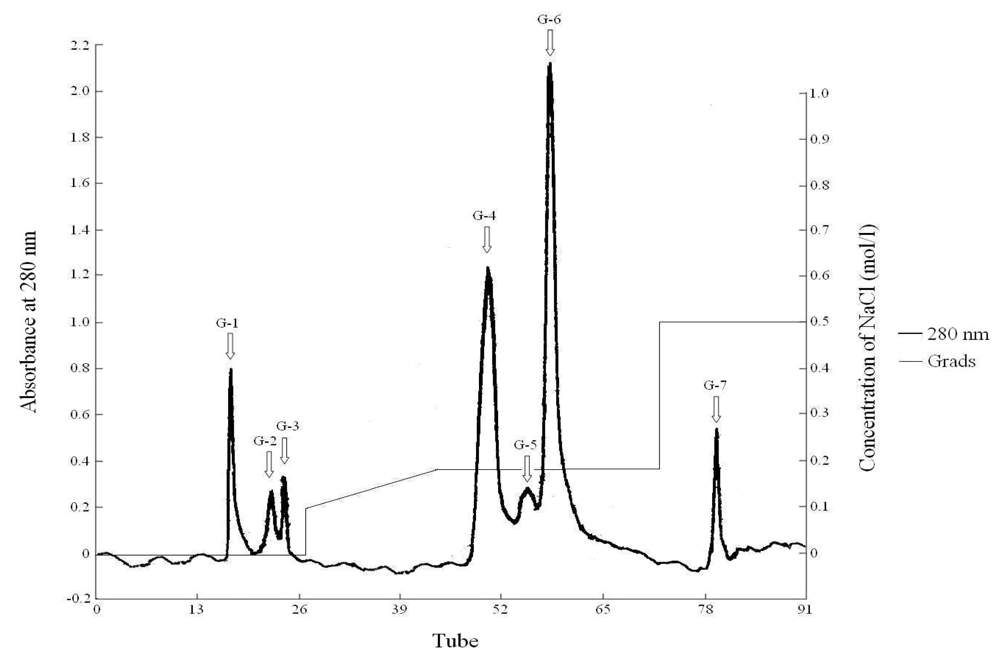
<p>Fraction III obtained from the crude extract at 70%–100% saturation of ammonium sulfate was dialyzed against 10 mM Tris-HCl, pH 7.46 for 5 h and the dialyzed solution was subsequently injected into a DEAE Sepharose Fast Flow column, which was pre-equilibrated with the aforementioned Tris-HCl buffer. The column was washed with the same buffer until the baseline returned to zero and remained stable. The column was then eluted with increasing concentration of NaCl prepared in 10 mM Tris-HCl buffer, pH 7.46 at 4 °C. Aliquots of 5 ml/tube were collected at a flow rate of 1.2 ml/min and the absorbance was measured at 280 nm. Seven A<sub>280 nm</sub> peak fractions, named G-1, G-2, G-3, G-4, G-5, G-6 and G-7, were collected respectively.</p></sec>
<sec>
<title><italic>Gel filtration chromatography</italic> (Sephadex G-50)</title>
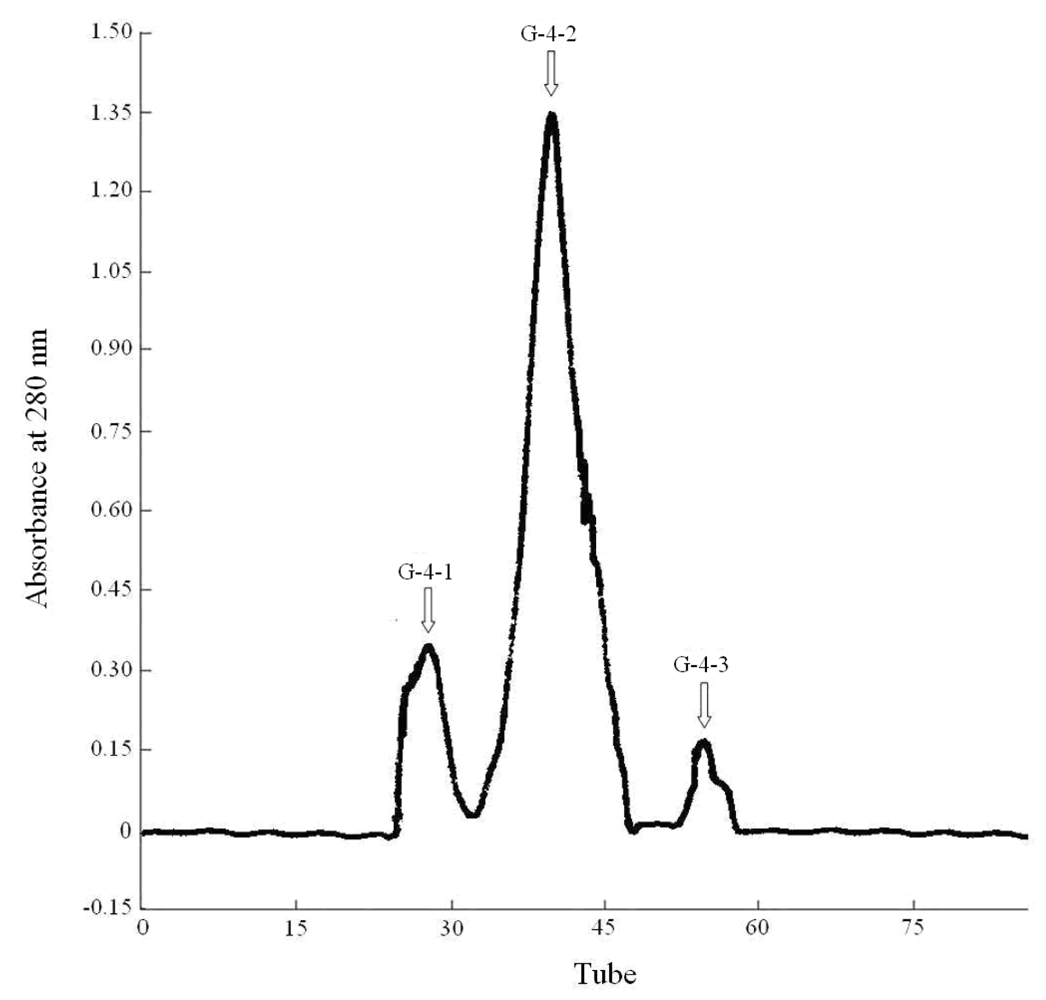
<p>The protein solution that passed through the anion exchange chromatographic column was concentrated by freeze-drying and loaded onto a Sephadex G-50 column that was pre-equilibrated with 10 mM Tris-HCl buffer, pH 7.46. The flow rate was 0.65 ml/min, and the absorbance was monitored at 280 nm. Three A<sub>280 nm</sub> peak fractions, termed as G-4-1, G-4-2 and G-4-3, were obtained respectively.</p></sec></sec>
<sec>
<title>2.4 Cytotoxicity assay</title>
<sec>
<title>Cell lines and culture</title>
<p>Tumor cell lines used in this study included seven human cell lines, namely A549 (lung cancer cells), BEL-7404 (hepatocellular carcinoma cells), CNE (nasopharyngeal carcinoma cells), Hela (cervical carcinoma cells), PC-3 (prostatic carcinoma cells), HL-60 (leukemia cells) and KB (oral epithelial cancer cells). All of cell lines were provided by Shanghai Institutes for Biological Sciences, Chinese Academy of Sciences, and the cells were cultured in RPMI 1640 medium supplemented with heat-inactivated 10% FBS, 0.2 mg/L L-glutamide, 1.0 mg/mL NaHCO<sub>3</sub>, 100 units/mL penicillin, and 100 units/mL streptomycin in a humidified incubator at 37 °C and 5% CO<sub>2</sub> atmosphere.</p></sec>
<sec>
<title>Evaluation of cytotoxicity</title>
<p>Cultured cells were taken during their exponential growth phase. Routinely, the cells were detached with 0.25% trypsin and cell suspension was made in the above medium. By trypan blue exclusion, cell viability greater than 95% was determined. One hundred microliters of cell suspensions containing 5 × 10<sup>3</sup> cells were seeded in each well of a 96-well microtiter plate and incubated at 37 °C in a humidified incubator with 5% CO<sub>2</sub>. After 24 h, the cells were treated with aseptic samples which were sterilized by passing through 0.22 μm Millipore filter, and CDDP was used as the positive control. Untreated cells were used as negative control. Each plate was incubated for another 72 h at 37 °C in a humidified incubator with 5% CO<sub>2</sub>. Cytotoxic activity was evaluated <italic>in vitro</italic> by MTT assay [<xref ref-type="bibr" rid="b18-marinedrugs-06-00418">18</xref>] and is expressed as IC<sub>50</sub>, i.e. the sample concentration able to inhibit cell growth by 50% compared with the untreated control. All experiments were carried out in triplicate, and data in the form of mean ± SD are presented.</p></sec></sec>
<sec>
<title>2.5 Protein assay</title>
<p>The protein content of total protein extract, fraction-I, fraction-II, fraction-III, G-6, G-4 and G-4-2 was determined by the method of Bradford [<xref ref-type="bibr" rid="b19-marinedrugs-06-00418">19</xref>] with bovine serum albumin as standard.</p></sec>
<sec>
<title>2.6 Sodium dodecyl sulfate-polyacrylamide gel electrophoresis (SDS-PAGE)</title>
<p>The Sodium dodecyl sulfate<italic>-</italic>polyacrylamide gel electrophoriesis (SDS-PAGE) analysis was performed with a mini-gel apparatus (Protean II. BioRAD, USA). There were two SDS- PAGE systems employed. The samples were analyzed by SDS-PAGE in Laemmli gel [<xref ref-type="bibr" rid="b20-marinedrugs-06-00418">20</xref>] with an acrylamide concentration of 5% for the stacking gel and 12% for the running gel, as well as in Tricine-SDS-PAGE [<xref ref-type="bibr" rid="b21-marinedrugs-06-00418">21</xref>] with an acrylamide concentration of 4% for the stacking gel, 10% for the space gel and 15.5% for the running gel. Five to thirty micrograms of protein per well was loaded on the gel. Protein bands were detected by the Coomassie blue staining method [<xref ref-type="bibr" rid="b22-marinedrugs-06-00418">22</xref>].</p></sec>
<sec>
<title>2.7 Isoelectric focusing-polyacrylamide gel electrophoresis (IEF)</title>
<p>Ampholyte (40%, pH 3.5–10.0) was used to prepare IEF gel with acrylamide concentration of 5%. The isoelectric focusing-polyacrylamide gel electrophoresis (IEF-PAGE) was carried out on BIO-RAD power PAC-300 and Mini-PROTEAN 3 cell provided by BIO-RADKWS at 150 V for 75 volt-hours (vh), then at 200 V for 500 vh. The IEF-PAGE gel unloaded samples was washed by double distilled water, and sliced into pieces of 0.5 cm in length from acidic terminal to basic terminal, then separately dipped into Eppendorf tubes containing 2.0 mL of 10 mM KCl for 30 min. The pH value of the liquid around each slice was measured. The gel-loaded samples was fixed with 10% trichloroacetic acid for 30 min, and rinsed thoroughly with destaining solution (0.25% SDS, 33% ethanol, and 10% acetic acid). Data were derived from calibration curve of isoelectric point with the length of gel as abscissa and pH value as ordinate.</p></sec>
<sec>
<title>2.8 Reversed-phase high performance liquid chromatography (HPLC)</title>
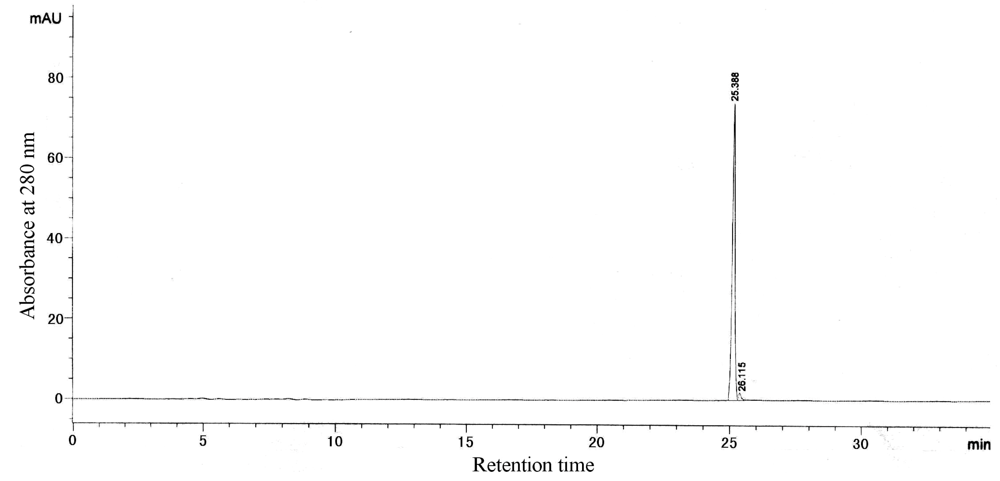
<p>HPLC analyses were performed on an Agilent series 1100 HPLC system fitted with a reversed-phase high performance liquid chromatography (RP-HPLC) cartridge, 4.6 mm × 150 mm filled with ZORBAX® 300SB-C8, 5 μm (Agilent). The solvent system was the following: solvent A: 0.1% (v/v) trifluoroacetic acid (TFA) in H<sub>2</sub>O; solvent B: 0.1% (v/v) TFA in H<sub>2</sub>O: acetonitrile 1: 4 (v/v) [<xref ref-type="bibr" rid="b23-marinedrugs-06-00418">23</xref>–<xref ref-type="bibr" rid="b28-marinedrugs-06-00418">28</xref>]. Gradient elution from 50% to 70% of solvent B in 35 min; flow rate: 1 mL/min; detection wavelength: 280 nm; column temperature 30 °C.</p></sec>
<sec sec-type="methods">
<title>2.9 Analysis of saccharides</title>
<p>The concentrations of methyl glycoproteins and glycoproteins were accurately determined by using calibration curves composed of the appropriate monosaccharide(s) obtained with a modified version of the colorimetric phenol-sulfuric acid method [<xref ref-type="bibr" rid="b29-marinedrugs-06-00418">29</xref>–<xref ref-type="bibr" rid="b31-marinedrugs-06-00418">31</xref>]. 200 μg/mL glucose solution was served as standard. The absorbance at 490 nm was used to determine the amount of carbohydrate in the sample.</p></sec>
<sec sec-type="methods">
<title>2.10 Analysis of amino acid components</title>
<p>The content of amino acids was analyzed by an amino acid automatic analyzer (Hitachi 835–50) fitted with ion exchange resin (Hitachi 2619). Appropriate amount of purified and freeze-dried samples were weighed and applied into hydrolysis tube. 6 mol/L HCl was added and the vessel was sealed and evacuated. Hydrolysis was allowed to proceed at 110°C for 24 h. The samples were then dried, dissolved in 0.02 N HCl, and centrifuged at 10,000 rpm for 15 mins. The amino acid compositions were then obtained by automatic analysis algorithm of Hitachi L 835–50. The analysis conditions were as follows: flow rate: 0.225 mL/min, column temperature: 53°C, column pressure: 80–130 kg/cm<sup>2</sup>, analysis time: 74 min.</p></sec></sec>
<sec sec-type="results|discussion">
<title>3. Results and Discussion</title>
<sec>
<title>3.1 In vitro bioactivity-guided fractionation</title>
<p>Cytotoxicity is one of the chemotherapeutic hallmarks of anti-tumor activity [<xref ref-type="bibr" rid="b32-marinedrugs-06-00418">32</xref>]. MTT assay, a well-established <italic>in vitro</italic> model for cytotoxicity against cancer cell lines, was used as one of conventional methods for the screening of compounds with potential anti-tumor properties [<xref ref-type="bibr" rid="b33-marinedrugs-06-00418">33</xref>]. Since it is well known that different cell lines can exhibit different sensitivities to a cytotoxic compound, seven tumor cell lines with different origins, morphologies, and tumorigenicities were employed.</p>
<p>To screen natural products with <italic>in vitro</italic> anti-tumor activity, the total proteins extract of <italic>A. subcrenata</italic> was subjected to cytotoxicity assay. The results showed that the total proteins extract of <italic>A. subcrenata</italic> suppressed the proliferation of Hela, HL-60, CNE and A549 cells, with IC<sub>50</sub> values of 35.6 μg/mL, 106.0 μg/mL, 145.9 μg/mL and 306.1 μg/mL, respectively (<xref ref-type="table" rid="t1-marinedrugs-06-00418">Table 1</xref>).</p>
<p>In order to identify cytotoxic components, the total proteins extract of <italic>A. subcrenata</italic> was fractionated by salting-out at increasing saturation levels of ammonium sulfate. The Fraction-I, Fraction-II, and Fraction-III were obtained at the ammonium sulfate saturation of 0–35%, 35–70% and 70–100%, and their percentage yield was 7.1%, 41.4% and 25.4%, respectively. In the evaluation of cytotoxicity of three fractions, the fraction-III exhibited the significant inhibition on the proliferation of Hela, HL-60 and KB cells with IC<sub>50</sub> values of 6.7 μg/mL, 14.7 μg/mL and 76.5 μg/mL, respectively (<xref ref-type="table" rid="t1-marinedrugs-06-00418">Table 1</xref>). The results suggested that the fraction-III warranted further purification in order to unveil the active components of <italic>A. subcrenata</italic>.</p></sec>
<sec>
<title>3.2 Purification of cytotoxic proteins from A. subcrenata</title>
<p>Fraction-III was subjected to ion exchange chromatography for purification. Seven A<sub>280 nm</sub> peak fractions were obtained through elution with increasing concentrations of NaCl containing Tris-HCl (10 mM, pH 7.46) on DEAE Sepharose Fast Flow column (<xref ref-type="fig" rid="f1-marinedrugs-06-00418">Figure 1</xref>).</p>
<p>The results of cytotoxicity experiments showed that fraction G-6 had the ability to only suppress the proliferation of HL-60 cells (IC<sub>50</sub> = 123.2 μg/mL), whereas fraction G-4 appeared to possess inhibitory activity not only against HL-60 cells (IC<sub>50</sub> = 67.8 μg/mL), but also against Hela cells (IC<sub>50</sub> = 38.2 μg/ml) and KB cells (IC<sub>50</sub> = 78.1 μg/mL).</p>
<p>Furthermore, fraction G-4 was rechromatographed on a Sephadex G-50 column (<xref ref-type="fig" rid="f2-marinedrugs-06-00418">Figure 2</xref>). The other subfractions were not found to be active against these seven human tumor cell lines.</p>
<p>Three A<sub>280 nm</sub> peak fractions were collected and evaluated for their cytotoxic activities. Among the fractions, the IC<sub>50</sub> values of fraction G-4-2 towards Hela, HL-60 and KB cell lines were measured to be 22.9 μg/mL, 46.1 μg/ml, and 57.7 μg/mL, respectively.</p>
<p>Fraction-III showed cytotoxic activity against A549, but none of its subfractions presented that activity. There are probably synergistic and additive effects among subfractions in the fractionation of natural marine medicines. These effects weaken as further isolation and purification proceeds. This is corroborated by the observation that each subfraction of fraction-III exhibits lower activity towards A549 than fraction-III. In the same way fraction-III presented a lower IC<sub>50</sub> than some of its subfractions (i.e. against Hela and HL-60 lines), and purified subfractions showed lower activities against Hela and HL-60 lines.</p></sec>
<sec>
<title>3.3 Characterization of purified proteins</title>
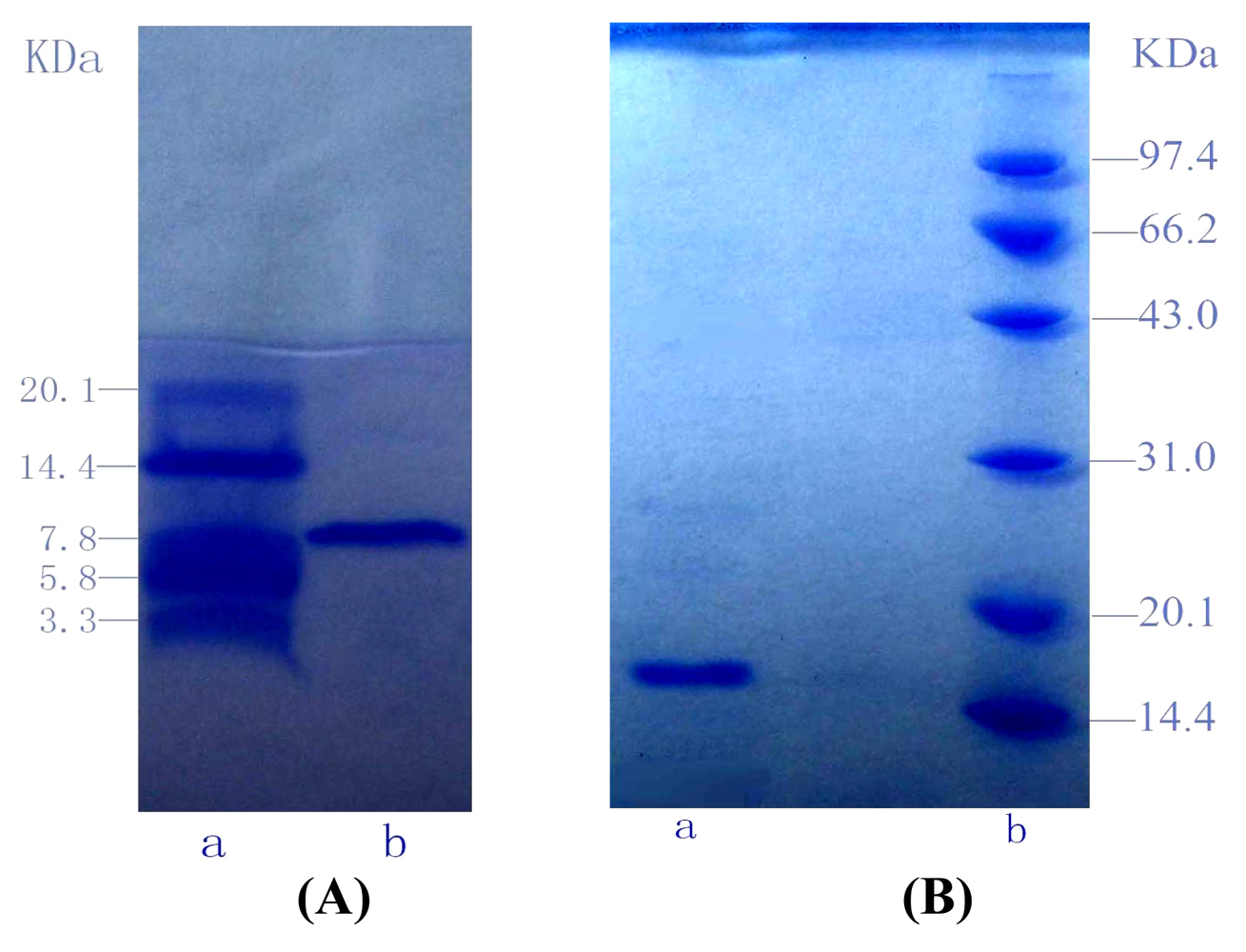
<p>To estimate the molecular weight of G-6, Tricine-glycerol SDS-PAGE was employed with molecular weight marker ranging from 3.3 kDa to 20.1 kDa as standard. Similarly, SDS-PAGE was utilized to estimate the molecular weight of G-4-2, with molecular weight marker ranging from 14.4 kDa to 97.4 kDa as standard (<xref ref-type="fig" rid="f3-marinedrugs-06-00418">Figure 3</xref>).</p>
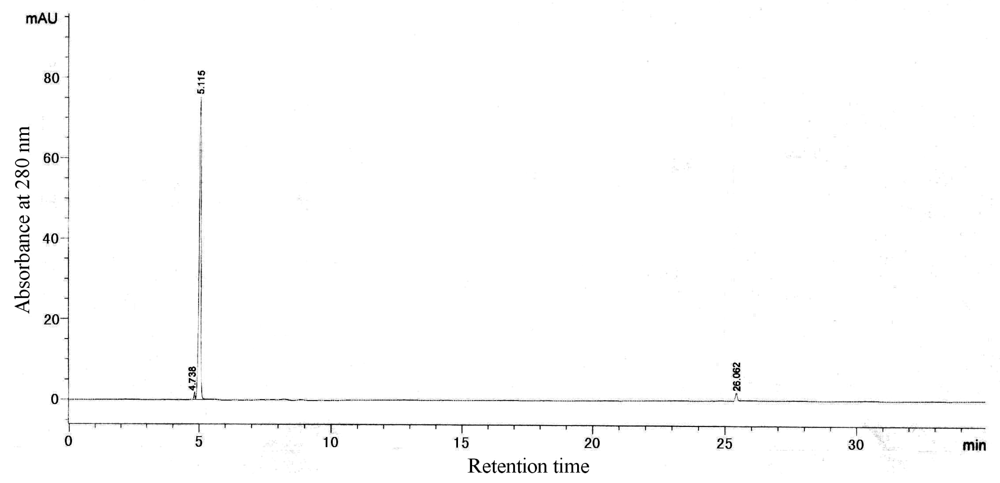
<p>According to calibration curves, the molecular weights of G-6 and G-4-2 were 8.2 kDa and 16.0 kDa. And the isoelectric points (pI) of G-6 and G-4-2 were 6.6 and 6.1, respectively. The two proteins were both single bands in SDS-PAGE and IEF-PAGE. Furthermore, the results of RP-HPLC (<xref ref-type="fig" rid="f4-marinedrugs-06-00418">Figure 4</xref> and <xref ref-type="fig" rid="f5-marinedrugs-06-00418">Figure 5</xref>) indicated the purity of G-6 and G-4-2 was 97.6% and 96.8%, respectively.</p>
<p>According to modified version of the colorimetric phenol-sulfuric acid method, G-6 may be a glycoprotein but not G-4-2. The amino acid compositions of G-6 and G-4-2 were shown in <xref ref-type="table" rid="t2-marinedrugs-06-00418">Table 2</xref> and <xref ref-type="table" rid="t3-marinedrugs-06-00418">Table 3</xref>.</p></sec></sec>
<sec sec-type="conclusions">
<title>4. Conclusions</title>
<p>Based upon the results of the <italic>in vitro</italic> cytotoxicity assay, two proteins from <italic>A. subcrenata</italic> underwent the bioactivity-guided fractionation and purification. Important characteristics of proteins G-6 and G-4-2 were identified, showing their molecular weights to be 8.2 kDa and 16.0 kDa and their isoelectric points to be 6.6 and 6.1, respectively. G-6, but not G-4-2, is shown to be a glycopeptide.</p>
<p>Additionally, our present study reveals for the first time the <italic>in vitro</italic> anti-tumor activity of <italic>A. subcrenata</italic>, and the significance of this finding is deepened by the knowledge that in the past, many pharmaceutical agents were discovered by screening natural products from plants, animals, marine organisms and microorganisms [<xref ref-type="bibr" rid="b34-marinedrugs-06-00418">34</xref>]. <italic>A. subcrenata</italic> is a member of mollusks constituting a large marine animal family. Some mollusks such as oyster have been found to contain compounds with anti-tumor activities. The extract of oyster has significant <italic>in vitro</italic> cytotoxic effect on human A549 cell lines [<xref ref-type="bibr" rid="b35-marinedrugs-06-00418">35</xref>], and <italic>in vivo</italic> anti-tumor activity against murine hepatic cancer [<xref ref-type="bibr" rid="b36-marinedrugs-06-00418">36</xref>]. In addition, there has been much interest in the research on bioactive peptides from marine sources. For example, protein from Chlamys farreri (PCF), a species of Chinese scallop, was recently shown to have potential antioxidant activity and protective effect against ultraviolet (UV) irradiation [<xref ref-type="bibr" rid="b37-marinedrugs-06-00418">37</xref>]. Similarly, a group in Korea reported that methanolic extracts from seaweed Plocamium telfairiae (PTE) exhibited a cytotoxic effect against HT-29 human colon carcinoma cells [<xref ref-type="bibr" rid="b38-marinedrugs-06-00418">38</xref>].</p>
<p>The combination of chemical and biological approaches provides scientists with a valuable tool to efficiently investigate a wide array of natural products. As a whole, the results in our paper suggest that <italic>A. subcrenata</italic> is a promising resource in the development of novel drugs for its anti-tumor potential. Further studies on mechanism of bioactive proteins, their structure-function relationships and the <italic>in vivo</italic> anti-tumor effects of <italic>A. subcrenata</italic> are currently underway.</p></sec></body>
<back>
<ack>
<title>Acknowledgments</title>
<p>5. Acknowledgments</p>
<p>This research work was financially supported from the Key Subjects of Scientific and Technological Foundation of Guangdong (Grants No. 2004A30505003) and the Key Subjects of Scientific and Technological Foundation of Guangzhou (Grants No. 2005Z2-E4031). The authors thank Dongbo Yu of University of Texas Southwestern Medical Center, USA, for proof-reading our manuscript.</p></ack>
<ref-list>
<title>References</title>
<ref id="b1-marinedrugs-06-00418"><label>1</label><citation citation-type="journal"><person-group person-group-type="author"><name><surname>Belarbi</surname><given-names>EH</given-names></name><name><surname>Contreras Gómez</surname><given-names>A</given-names></name><name><surname>Chisti</surname><given-names>Y</given-names></name><name><surname>García Camacho</surname><given-names>F</given-names></name><name><surname>Molina Grima</surname><given-names>E</given-names></name></person-group><article-title>Producing drugs from marine sponges</article-title><source>Biotechnol Adv</source><year>2003</year><volume>21</volume><fpage>585</fpage><lpage>598</lpage><pub-id pub-id-type="pmid">14516872</pub-id></citation></ref>
<ref id="b2-marinedrugs-06-00418"><label>2</label><citation citation-type="journal"><person-group person-group-type="author"><name><surname>Schwartsmann</surname><given-names>G</given-names></name><name><surname>da Rocha</surname><given-names>AB</given-names></name><name><surname>Berlinck</surname><given-names>R</given-names></name><name><surname>Jimeno</surname><given-names>J</given-names></name></person-group><article-title>Marine organisms as a source of new anticancer agents</article-title><source>Lancet Oncol</source><year>2001</year><volume>2</volume><fpage>221</fpage><lpage>225</lpage><pub-id pub-id-type="doi">10.1016/S1470-2045(00)00292-8</pub-id><pub-id pub-id-type="pmid">11905767</pub-id></citation></ref>
<ref id="b3-marinedrugs-06-00418"><label>3</label><citation citation-type="journal"><person-group person-group-type="author"><name><surname>Mayer</surname><given-names>AMS</given-names></name></person-group><article-title>Marine pharmacology in 1998: antitumor and cytotoxic compounds</article-title><source>Pharmacologist</source><year>1999</year><volume>41</volume><fpage>159</fpage><lpage>164</lpage></citation></ref>
<ref id="b4-marinedrugs-06-00418"><label>4</label><citation citation-type="journal"><person-group person-group-type="author"><name><surname>Mayer</surname><given-names>AMS</given-names></name><name><surname>Lehmann</surname><given-names>VKB</given-names></name></person-group><article-title>Marine pharmacology in 1999: antitumor and cytotoxic compounds</article-title><source>Anticancer Res</source><year>2001</year><volume>21</volume><fpage>2489</fpage><lpage>2500</lpage><pub-id pub-id-type="pmid">11724312</pub-id></citation></ref>
<ref id="b5-marinedrugs-06-00418"><label>5</label><citation citation-type="journal"><person-group person-group-type="author"><name><surname>Mayer</surname><given-names>AMS</given-names></name><name><surname>Gustafson</surname><given-names>KR</given-names></name></person-group><article-title>Marine pharmacology in 2000: antitumor and cytotoxic compounds</article-title><source>Int J Cancer</source><year>2003</year><volume>105</volume><fpage>291</fpage><lpage>299</lpage><pub-id pub-id-type="doi">10.1002/ijc.11080</pub-id><pub-id pub-id-type="pmid">12704660</pub-id></citation></ref>
<ref id="b6-marinedrugs-06-00418"><label>6</label><citation citation-type="journal"><person-group person-group-type="author"><name><surname>Mayer</surname><given-names>AMS</given-names></name><name><surname>Gustafson</surname><given-names>KR</given-names></name></person-group><article-title>Marine pharmacology in 2001–2: antitumour and cytotoxic compounds</article-title><source>Eur J Cancer</source><year>2004</year><volume>40</volume><fpage>2676</fpage><lpage>2704</lpage><pub-id pub-id-type="doi">10.1016/j.ejca.2004.09.005</pub-id><pub-id pub-id-type="pmid">15571951</pub-id></citation></ref>
<ref id="b7-marinedrugs-06-00418"><label>7</label><citation citation-type="journal"><person-group person-group-type="author"><name><surname>Mayer</surname><given-names>AMS</given-names></name><name><surname>Gustafson</surname><given-names>KR</given-names></name></person-group><article-title>Marine pharmacology in 2003–2004: anti-tumour and cytotoxic compounds</article-title><source>Eur J Cancer</source><year>2006</year><volume>42</volume><fpage>2241</fpage><lpage>2270</lpage><pub-id pub-id-type="doi">10.1016/j.ejca.2006.05.019</pub-id><pub-id pub-id-type="pmid">16901686</pub-id></citation></ref>
<ref id="b8-marinedrugs-06-00418"><label>8</label><citation citation-type="journal"><person-group person-group-type="author"><name><surname>Zhang</surname><given-names>YP</given-names></name><name><surname>Xu</surname><given-names>F</given-names></name><name><surname>Wang</surname><given-names>M</given-names></name></person-group><article-title>Progress on Marine Anticancer Drugs in R&amp;D</article-title><source>Prog Pharmaceut Sci</source><year>2006</year><volume>30</volume><fpage>433</fpage><lpage>442</lpage></citation></ref>
<ref id="b9-marinedrugs-06-00418"><label>9</label><citation citation-type="journal"><person-group person-group-type="author"><name><surname>Suárez</surname><given-names>Y</given-names></name><name><surname>González</surname><given-names>L</given-names></name><name><surname>Cuadrado</surname><given-names>A</given-names></name><name><surname>Berciano</surname><given-names>M</given-names></name><name><surname>Lafarga</surname><given-names>M</given-names></name><name><surname>Muñoz AKahalalide</surname><given-names>F</given-names></name></person-group><article-title>A new marine-derived compound, induces oncosis in human prostate and breast cancer cells</article-title><source>Mol Cancer Ther</source><year>2003</year><volume>2</volume><fpage>863</fpage><lpage>872</lpage><pub-id pub-id-type="pmid">14555705</pub-id></citation></ref>
<ref id="b10-marinedrugs-06-00418"><label>10</label><citation citation-type="journal"><person-group person-group-type="author"><name><surname>Riely</surname><given-names>GJ</given-names></name><name><surname>Gadgeel</surname><given-names>S</given-names></name><name><surname>Rothman</surname><given-names>I</given-names></name><name><surname>Saidman</surname><given-names>B</given-names></name><name><surname>Sabbath</surname><given-names>K</given-names></name><name><surname>Feit</surname><given-names>K</given-names></name><name><surname>Kris</surname><given-names>MG</given-names></name><name><surname>Rizvi</surname><given-names>NA</given-names></name></person-group><article-title>A phase 2 study of TZT-1027, administered weekly to patients with advanced non-small cell lung cancer following treatment with platinum-based chemotherapy</article-title><source>Lung Cancer</source><year>2007</year><volume>55</volume><fpage>181</fpage><lpage>185</lpage><pub-id pub-id-type="doi">10.1016/j.lungcan.2006.10.002</pub-id><pub-id pub-id-type="pmid">17092603</pub-id></citation></ref>
<ref id="b11-marinedrugs-06-00418"><label>11</label><citation citation-type="journal"><person-group person-group-type="author"><name><surname>Kerbrat</surname><given-names>P</given-names></name><name><surname>Dieras</surname><given-names>V</given-names></name><name><surname>Pavlidis</surname><given-names>N</given-names></name><name><surname>Ravaud</surname><given-names>A</given-names></name><name><surname>Wanders</surname><given-names>J</given-names></name><name><surname>Fumoleau</surname><given-names>P</given-names></name></person-group><collab>For the EORTC Early Clinical Studies Group/New Drug Development Office</collab><article-title>Phase II study of LU 103793 (dolastatin analogue) in patients with metastatic breast cancer</article-title><source>Eur J Cancer</source><year>2003</year><volume>39</volume><fpage>317</fpage><lpage>320</lpage><pub-id pub-id-type="doi">10.1016/S0959-8049(02)00531-2</pub-id><pub-id pub-id-type="pmid">12565983</pub-id></citation></ref>
<ref id="b12-marinedrugs-06-00418"><label>12</label><citation citation-type="book"><person-group person-group-type="author"><name><surname>Guo</surname><given-names>XS</given-names></name><name><surname>Li</surname><given-names>Y</given-names></name></person-group><source>Marine Chinese Traditional Medicines</source><publisher-name>Sciences Press</publisher-name><publisher-loc>Beijing, P.R. China</publisher-loc><year>2003</year><fpage>138</fpage><lpage>141</lpage></citation></ref>
<ref id="b13-marinedrugs-06-00418"><label>13</label><citation citation-type="journal"><person-group person-group-type="author"><name><surname>Li</surname><given-names>Q</given-names></name><name><surname>Li</surname><given-names>TM</given-names></name><name><surname>Wang</surname><given-names>XQ</given-names></name><name><surname>Huang</surname><given-names>Q</given-names></name><name><surname>Wu</surname><given-names>WJ</given-names></name></person-group><article-title>Biochemical properties analysis of Arca subcrenata extractive</article-title><source>Pharm Biotechnol</source><year>1998</year><volume>5</volume><fpage>245</fpage><lpage>247</lpage></citation></ref>
<ref id="b14-marinedrugs-06-00418"><label>14</label><citation citation-type="journal"><person-group person-group-type="author"><name><surname>Dou</surname><given-names>CG</given-names></name><name><surname>Yan</surname><given-names>YQ</given-names></name><name><surname>Zhang</surname><given-names>Z</given-names></name></person-group><article-title>Experimental studies on hypoglycemia and hypolipid effects of hydrolysate of <italic>Arca subcrenata</italic></article-title><source>Chin J Mar Drug</source><year>1996</year><volume>15</volume><issue>1</issue><fpage>13</fpage><lpage>15</lpage></citation></ref>
<ref id="b15-marinedrugs-06-00418"><label>15</label><citation citation-type="journal"><person-group person-group-type="author"><name><surname>Dou</surname><given-names>CG</given-names></name><name><surname>Yan</surname><given-names>YQ</given-names></name><name><surname>Zhang</surname><given-names>Z</given-names></name></person-group><article-title>The protective action of hydrolysate of <italic>Arca Subcrenata</italic> on liver injuries in mice</article-title><source>Chin J Mar Drug</source><year>1996</year><volume>15</volume><issue>3</issue><fpage>17</fpage><lpage>19</lpage></citation></ref>
<ref id="b16-marinedrugs-06-00418"><label>16</label><citation citation-type="journal"><person-group person-group-type="author"><name><surname>He</surname><given-names>YM</given-names></name><name><surname>Chen</surname><given-names>YX</given-names></name><name><surname>Liu</surname><given-names>CH</given-names></name><name><surname>Xi</surname><given-names>T</given-names></name><name><surname>Shen</surname><given-names>ZL</given-names></name><name><surname>Yao</surname><given-names>QS</given-names></name></person-group><article-title>Isolation, purification and immunological activity assay of polysaccharide from <italic>Arca subcrenata</italic> Lischke</article-title><source>Chin J Mar Drug</source><year>2007</year><volume>26</volume><issue>2</issue><fpage>23</fpage><lpage>26</lpage></citation></ref>
<ref id="b17-marinedrugs-06-00418"><label>17</label><citation citation-type="journal"><person-group person-group-type="author"><name><surname>Murphy</surname><given-names>EJ</given-names></name><name><surname>Edmondson</surname><given-names>RD</given-names></name><name><surname>Russell</surname><given-names>DH</given-names></name><name><surname>Colles</surname><given-names>S</given-names></name><name><surname>Schroeder</surname><given-names>F</given-names></name></person-group><article-title>Isolation and characterization of two distinct forms of livers fatty acid binding protein from the rat</article-title><source>Biochim Biophys Acta</source><year>1999</year><volume>1436</volume><fpage>413</fpage><lpage>425</lpage><pub-id pub-id-type="pmid">9989272</pub-id></citation></ref>
<ref id="b18-marinedrugs-06-00418"><label>18</label><citation citation-type="journal"><person-group person-group-type="author"><name><surname>Fatope</surname><given-names>MO</given-names></name><name><surname>Zeng</surname><given-names>L</given-names></name><name><surname>Ohayaga</surname><given-names>JE</given-names></name><name><surname>Shi</surname><given-names>G</given-names></name><name><surname>Mclaughlin</surname><given-names>JL</given-names></name></person-group><article-title>Selectively cytotoxic diterpenes from <italic>Euphorbia poisonii</italic></article-title><source>J Med Chem</source><year>1996</year><volume>39</volume><fpage>1005</fpage><lpage>1008</lpage><pub-id pub-id-type="pmid">8632402</pub-id></citation></ref>
<ref id="b19-marinedrugs-06-00418"><label>19</label><citation citation-type="journal"><person-group person-group-type="author"><name><surname>Bradford</surname><given-names>MM</given-names></name></person-group><article-title>A rapid and sensitive method for the quantitation of microgram quantities of protein utilizing the principle of protein-dye binding</article-title><source>Anal Biochem</source><year>1976</year><volume>72</volume><fpage>248</fpage><lpage>254</lpage><pub-id pub-id-type="doi">10.1016/0003-2697(76)90527-3</pub-id><pub-id pub-id-type="pmid">942051</pub-id></citation></ref>
<ref id="b20-marinedrugs-06-00418"><label>20</label><citation citation-type="journal"><person-group person-group-type="author"><name><surname>Laemmli</surname><given-names>UK</given-names></name></person-group><article-title>Cleavage of structural proteins during the assembly of the head of bacteriophage T4</article-title><source>Nature</source><year>1970</year><volume>227</volume><fpage>680</fpage><lpage>685</lpage><pub-id pub-id-type="doi">10.1038/227680a0</pub-id><pub-id pub-id-type="pmid">5432063</pub-id></citation></ref>
<ref id="b21-marinedrugs-06-00418"><label>21</label><citation citation-type="journal"><person-group person-group-type="author"><name><surname>Schägger</surname><given-names>H</given-names></name><name><surname>von Jagow</surname><given-names>G</given-names></name></person-group><article-title>Tricine-sodium dodecyl sulfate-polyacrylamide gel electrophoresis for the separation of proteins in the range from 1 to 100 kDa</article-title><source>Anal Biochem</source><year>1987</year><volume>166</volume><fpage>368</fpage><lpage>379</lpage><pub-id pub-id-type="doi">10.1016/0003-2697(87)90587-2</pub-id><pub-id pub-id-type="pmid">2449095</pub-id></citation></ref>
<ref id="b22-marinedrugs-06-00418"><label>22</label><citation citation-type="journal"><person-group person-group-type="author"><name><surname>Stephano</surname><given-names>JL</given-names></name><name><surname>Gould</surname><given-names>M</given-names></name><name><surname>Rojas-Galicia</surname><given-names>L</given-names></name></person-group><article-title>Advantages of picrate fixation for staining polyproteins in polyacrylamide gels</article-title><source>Anal Biochem</source><year>1986</year><volume>152</volume><fpage>308</fpage><lpage>313</lpage><pub-id pub-id-type="doi">10.1016/0003-2697(86)90414-8</pub-id><pub-id pub-id-type="pmid">2421602</pub-id></citation></ref>
<ref id="b23-marinedrugs-06-00418"><label>23</label><citation citation-type="journal"><person-group person-group-type="author"><name><surname>Thompson</surname><given-names>PE</given-names></name><name><surname>Hearn</surname><given-names>MT</given-names></name></person-group><article-title>A simple and inexpensive sample-handling method for the semi-preparative RP-HPLC of polyproteins and non-polar peptide derivatives: pre-adsorption of sample</article-title><source>J Biochem Biophys Methods</source><year>1995</year><volume>30</volume><fpage>153</fpage><lpage>161</lpage><pub-id pub-id-type="doi">10.1016/0165-022X(94)00074-N</pub-id><pub-id pub-id-type="pmid">7494092</pub-id></citation></ref>
<ref id="b24-marinedrugs-06-00418"><label>24</label><citation citation-type="journal"><person-group person-group-type="author"><name><surname>Lee</surname><given-names>RP</given-names></name><name><surname>Doughty</surname><given-names>SW</given-names></name><name><surname>Ashman</surname><given-names>K</given-names></name><name><surname>Walker</surname><given-names>J</given-names></name></person-group><article-title>Purification of hydrophobic integral membrane proteins from <italic>Mycoplasma hyopneumoniae</italic> by reversed-phase high-performance liquid chromatography</article-title><source>J Chromatogr A</source><year>1996</year><volume>737</volume><fpage>273</fpage><lpage>279</lpage><pub-id pub-id-type="doi">10.1016/0021-9673(96)00005-2</pub-id><pub-id pub-id-type="pmid">8673256</pub-id></citation></ref>
<ref id="b25-marinedrugs-06-00418"><label>25</label><citation citation-type="journal"><person-group person-group-type="author"><name><surname>Fujinari</surname><given-names>EM</given-names></name><name><surname>Manes</surname><given-names>JD</given-names></name><name><surname>Bizanek</surname><given-names>R</given-names></name></person-group><article-title>Peptide content determination of crude synthetic proteins by reversed-phase liquid chromatography and nitrogen-specific detection with a chemiluminescent nitrogen detector</article-title><source>J Chromatogr A</source><year>1996</year><volume>743</volume><fpage>85</fpage><lpage>89</lpage></citation></ref>
<ref id="b26-marinedrugs-06-00418"><label>26</label><citation citation-type="journal"><person-group person-group-type="author"><name><surname>Venkateshwaran</surname><given-names>TG</given-names></name><name><surname>Stewart</surname><given-names>JT</given-names></name><name><surname>de Haseth</surname><given-names>JA</given-names></name><name><surname>Bartlett</surname><given-names>MG</given-names></name></person-group><article-title>Solution conformation of model polyproteins with the use of particle beam LC/FT-IR spectrometry and electrospray mass spectrometry</article-title><source>J Pharm Biomed Anal</source><year>1999</year><volume>19</volume><fpage>709</fpage><lpage>723</lpage><pub-id pub-id-type="pmid">10698535</pub-id></citation></ref>
<ref id="b27-marinedrugs-06-00418"><label>27</label><citation citation-type="journal"><person-group person-group-type="author"><name><surname>Zolla</surname><given-names>L</given-names></name><name><surname>Bianchetti</surname><given-names>M</given-names></name></person-group><article-title>High-performance liquid chromatography coupled on-line with electrospray ionization mass spectrometry for the simultaneous separation and identification of the Synechocystis PCC 6803 phycobilisome proteins</article-title><source>J Chromatogr A</source><year>2001</year><volume>912</volume><fpage>269</fpage><lpage>279</lpage><pub-id pub-id-type="doi">10.1016/S0021-9673(01)00532-5</pub-id><pub-id pub-id-type="pmid">11330796</pub-id></citation></ref>
<ref id="b28-marinedrugs-06-00418"><label>28</label><citation citation-type="journal"><person-group person-group-type="author"><name><surname>Pavli</surname><given-names>V</given-names></name><name><surname>Kmetec</surname><given-names>V</given-names></name></person-group><article-title>Optimization of HPLC method for stability testing of bacitracin</article-title><source>J Pharm Biomed Anal</source><year>2001</year><volume>24</volume><fpage>977</fpage><lpage>982</lpage><pub-id pub-id-type="pmid">11248491</pub-id></citation></ref>
<ref id="b29-marinedrugs-06-00418"><label>29</label><citation citation-type="journal"><person-group person-group-type="author"><name><surname>Saha</surname><given-names>SK</given-names></name><name><surname>Brewer</surname><given-names>EF</given-names></name></person-group><article-title>Determination of the concentration of oligosaccharides: complex type carbohydrates and glycoproteins using the phenol-sulfric acid method</article-title><source>Carbohydr Res</source><year>1994</year><volume>254</volume><fpage>157</fpage><lpage>167</lpage><pub-id pub-id-type="pmid">8180982</pub-id></citation></ref>
<ref id="b30-marinedrugs-06-00418"><label>30</label><citation citation-type="journal"><person-group person-group-type="author"><name><surname>Dong</surname><given-names>Q</given-names></name><name><surname>Zheng</surname><given-names>LY</given-names></name><name><surname>Fang</surname><given-names>JY</given-names></name></person-group><article-title>Modified phenol-sulfuric acid method for determination of the content of oligosaccharides and polysaccharides</article-title><source>Chin Pharm J</source><year>1996</year><volume>31</volume><fpage>550</fpage><lpage>553</lpage></citation></ref>
<ref id="b31-marinedrugs-06-00418"><label>31</label><citation citation-type="journal"><person-group person-group-type="author"><name><surname>Bao</surname><given-names>XF</given-names></name><name><surname>Fang</surname><given-names>JN</given-names></name></person-group><article-title>Studies on difference between sporoderm-broken and nonbroken spores of gan derma lucidum (leyss. Ex fr.) karst. by polysaccharide analysis</article-title><source>China J Chin Mat Med</source><year>2001</year><volume>26</volume><fpage>326</fpage><lpage>328</lpage></citation></ref>
<ref id="b32-marinedrugs-06-00418"><label>32</label><citation citation-type="book"><person-group person-group-type="author"><name><surname>Suffness</surname><given-names>M</given-names></name><name><surname>Pezzuto</surname><given-names>JM</given-names></name></person-group><source>Methods in Plant Biochemistry</source><publisher-name>Academic Press</publisher-name><publisher-loc>New York; NY, USA</publisher-loc><volume>1</volume><year>1991</year></citation></ref>
<ref id="b33-marinedrugs-06-00418"><label>33</label><citation citation-type="book"><person-group person-group-type="author"><name><surname>Xu</surname><given-names>SY</given-names></name><name><surname>Bian</surname><given-names>RL</given-names></name><name><surname>Chen</surname><given-names>X</given-names></name></person-group><source>Methodology of Pharmacological Experiment</source><edition>3</edition><publisher-name>People’s Medical Publishing House</publisher-name><publisher-loc>Beijing, P.R. China</publisher-loc><year>1991</year></citation></ref>
<ref id="b34-marinedrugs-06-00418"><label>34</label><citation citation-type="journal"><person-group person-group-type="author"><name><surname>da Rocha</surname><given-names>AB</given-names></name><name><surname>Lopes</surname><given-names>RM</given-names></name><name><surname>Schwartsmann</surname><given-names>G</given-names></name></person-group><article-title>Natural products in anticancer therapy</article-title><source>Curr Opin Pharmacol</source><year>2001</year><volume>1</volume><fpage>364</fpage><lpage>369</lpage><pub-id pub-id-type="pmid">11710734</pub-id></citation></ref>
<ref id="b35-marinedrugs-06-00418"><label>35</label><citation citation-type="journal"><person-group person-group-type="author"><name><surname>Huang</surname><given-names>DC</given-names></name><name><surname>Li</surname><given-names>QF</given-names></name><name><surname>Li</surname><given-names>P</given-names></name><name><surname>Li</surname><given-names>XQ</given-names></name><name><surname>Song</surname><given-names>YZ</given-names></name></person-group><article-title>Effects of oyster low molecular weight bioactive substance on the human lung adenocarcinoma A549 cells</article-title><source>J Xiamen Univ (Nat Sci)</source><year>2002</year><volume>41</volume><fpage>614</fpage><lpage>617</lpage></citation></ref>
<ref id="b36-marinedrugs-06-00418"><label>36</label><citation citation-type="journal"><person-group person-group-type="author"><name><surname>Wang</surname><given-names>Y</given-names></name><name><surname>Ma</surname><given-names>AL</given-names></name><name><surname>Zhang</surname><given-names>HZ</given-names></name><name><surname>Xue</surname><given-names>BH</given-names></name><name><surname>Zhao</surname><given-names>ZJ</given-names></name><name><surname>Fu</surname><given-names>FH</given-names></name><name><surname>Zhou</surname><given-names>GY</given-names></name></person-group><article-title>Experimental studies on the antitumor effect of oyster extract</article-title><source>Chin J Mar Drug</source><year>1997</year><volume>16</volume><fpage>18</fpage><lpage>22</lpage></citation></ref>
<ref id="b37-marinedrugs-06-00418"><label>37</label><citation citation-type="journal"><person-group person-group-type="author"><name><surname>Li</surname><given-names>B-H</given-names></name><name><surname>Zhou</surname><given-names>Y-B</given-names></name><name><surname>Guo</surname><given-names>S-B</given-names></name><name><surname>Wang</surname><given-names>C-B</given-names></name></person-group><article-title>Protein from Chlamys farreri inhibits UVB-induced HaCaT cells apoptosis via inhibition CD95 pathway and reactive oxygen species</article-title><source>Free Rad Res</source><year>2007</year><volume>41</volume><fpage>1224</fpage><lpage>1232</lpage></citation></ref>
<ref id="b38-marinedrugs-06-00418"><label>38</label><citation citation-type="journal"><person-group person-group-type="author"><name><surname>Kim</surname><given-names>JY</given-names></name><name><surname>Yoon</surname><given-names>MY</given-names></name><name><surname>Cha</surname><given-names>MR</given-names></name><name><surname>Hwang</surname><given-names>JH</given-names></name><name><surname>Park</surname><given-names>E</given-names></name><name><surname>Choi</surname><given-names>SU</given-names></name><name><surname>Park</surname><given-names>H-R</given-names></name><name><surname>Hwang</surname><given-names>Y-I</given-names></name></person-group><article-title>Methanolic extracts of Plocamium telfairiae induce cytotoxicity and caspase-dependent apoptosis in HT-29 human colon carcinoma cells</article-title><source>J Med Food</source><year>2007</year><volume>10</volume><fpage>587</fpage><lpage>593</lpage><pub-id pub-id-type="pmid">18158827</pub-id></citation></ref></ref-list>
<sec sec-type="display-objects">
<title>Figures and Tables</title>
<fig id="f1-marinedrugs-06-00418" position="float">
<label>Figure 1</label>
<caption>
<title>The curve of elution in DEAE Sepharose Fast Flow chromatography</title>
<p>Column specification: 1.6 × 30 cm; Equilibrate liquid: buffer C (Tris-HCl, pH 7.46, 10 mM); Sample: Fraction-III; Detection wavelength: UV 280 nm; Flow rate: 1.2 mL/min; Collection rate: 5 mL/tube.</p></caption>
<graphic xlink:href="marinedrugs-06-00418f1.gif"/></fig>
<fig id="f2-marinedrugs-06-00418" position="float">
<label>Figure 2</label>
<caption>
<title>The curve of G-4 separated by Sephadex G-50 chromatography</title>
<p>Column specification: 1.0 × 100 cm; Equilibrate liquid: buffer C (Tris-HCl, pH 7.46, 10 mM); Sample: G-4; Detection wavelength: UV 280 nm; Flow rate: 0.65 mL/min; Collection rate: 3 mL/tube.</p></caption>
<graphic xlink:href="marinedrugs-06-00418f2.gif"/></fig>
<fig id="f3-marinedrugs-06-00418" position="float">
<label>Figure 3</label>
<caption>
<title>The SDS-PAGE of G-6 and G-4-2</title>
<p>(A) Tricine-glycerol SDS-PAGE of G-6. lane a: molecular weight marker (range from 3.3 kDa to 20.1 kDa); lane b: G-6. (B) SDS-PAGE of G-4-2. lane a: G-4-2; lane b: molecular weight marker (range from 14.4 kDa to 97.4 kDa)</p></caption>
<graphic xlink:href="marinedrugs-06-00418f3.gif"/></fig>
<fig id="f4-marinedrugs-06-00418" position="float">
<label>Figure 4</label>
<caption>
<p>RP-HPLC of G-6.</p></caption>
<graphic xlink:href="marinedrugs-06-00418f4.gif"/></fig>
<fig id="f5-marinedrugs-06-00418" position="float">
<label>Figure 5</label>
<caption>
<p>RP-HPLC of G-4-2.</p></caption>
<graphic xlink:href="marinedrugs-06-00418f5.gif"/></fig>
<table-wrap id="t1-marinedrugs-06-00418" position="float">
<label>Table 1</label>
<caption>
<p>Cytotoxicity of protein samples against seven human tumor cell lines (IC<sub>50</sub> μg/mL ± SD, n = 3).</p></caption>
<table frame="hsides" rules="groups">
<thead>
<tr>
<th align="left" rowspan="2">Samples</th>
<th colspan="7" align="center">Cell lines</th></tr>
<tr>
<th align="left">A549</th>
<th align="left">Hela</th>
<th align="left">PC-3</th>
<th align="left">HL-60</th>
<th align="left">KB</th>
<th align="left">BEL-7404</th>
<th align="left">CNE</th></tr></thead>
<tbody>
<tr>
<td align="left">Total protein extract</td>
<td align="left">306.1±28.4</td>
<td align="left">35.6±2.9</td>
<td align="left">&gt;500</td>
<td align="left">106.0±14.6</td>
<td align="left">&gt;500</td>
<td align="left">145.9±25.9</td></tr>
<tr>
<td align="left">Fraction-I</td>
<td align="left">&gt;500</td>
<td align="left">&gt;500</td></tr>
<tr>
<td align="left">Fraction-II</td>
<td align="left">&gt;500</td>
<td align="left">&gt;500</td></tr>
<tr>
<td align="left">Fraction-III</td>
<td align="left">351.7±40.6</td>
<td align="left">6.7±0.8</td>
<td align="left">&gt;500</td>
<td align="left">14.7±1.7</td>
<td align="left">76.5±4.9</td>
<td align="left">&gt;500</td>
<td align="left">&gt;500</td></tr>
<tr>
<td align="left">G-6</td>
<td align="left">&gt;500</td>
<td align="left">123.2±11.3</td>
<td align="left">&gt;500</td>
<td align="left">&gt;500</td></tr>
<tr>
<td align="left">G-4</td>
<td align="left">&gt;500</td>
<td align="left">38.2±2.7</td>
<td align="left">&gt;500</td>
<td align="left">67.8±7.1</td>
<td align="left">78.1±9.0</td>
<td align="left">&gt;500</td>
<td align="left">&gt;500</td></tr>
<tr>
<td align="left">G-4-2</td>
<td align="left">&gt;500</td>
<td align="left">22.9±2.4</td>
<td align="left">&gt;500</td>
<td align="left">46.1±3.5</td>
<td align="left">57.7±7.2</td>
<td align="left">&gt;500</td>
<td align="left">&gt;500</td></tr></tbody></table>
<table-wrap-foot><fn id="tfn1-marinedrugs-06-00418">
<p>Fraction-I: (0–35% saturated (NH<sub>4</sub>)<sub>2</sub>SO<sub>4</sub>); Fraction-II: (35–70% saturated (NH<sub>4</sub>)<sub>2</sub>SO<sub>4</sub>); Fraction-III: (70–100% saturated (NH<sub>4</sub>)<sub>2</sub>SO<sub>4</sub>)</p></fn></table-wrap-foot></table-wrap>
<table-wrap id="t2-marinedrugs-06-00418" position="float">
<label>Table 2</label>
<caption>
<p>The amino acid compositions of G-6.</p></caption>
<table frame="hsides" rules="groups">
<thead>
<tr>
<th align="center">Amino acid</th>
<th align="center">The content of amino acid(mg/ml)</th>
<th align="center">The mass percentage of amino acid (%)</th></tr></thead>
<tbody>
<tr>
<td align="center">Asp</td>
<td align="center">0.0352</td>
<td align="center">11.72</td></tr>
<tr>
<td align="center">Thr</td>
<td align="center">0.0160</td>
<td align="center">5.33</td></tr>
<tr>
<td align="center">Ser</td>
<td align="center">0.0000</td>
<td align="center">0.00</td></tr>
<tr>
<td align="center">Glu</td>
<td align="center">0.0426</td>
<td align="center">14.18</td></tr>
<tr>
<td align="center">Gly</td>
<td align="center">0.0102</td>
<td align="center">3.39</td></tr>
<tr>
<td align="center">Ala</td>
<td align="center">0.0178</td>
<td align="center">5.93</td></tr>
<tr>
<td align="center">Cys</td>
<td align="center">0.0483</td>
<td align="center">16.08</td></tr>
<tr>
<td align="center">Val</td>
<td align="center">0.0123</td>
<td align="center">4.09</td></tr>
<tr>
<td align="center">Met</td>
<td align="center">0.0056</td>
<td align="center">1.86</td></tr>
<tr>
<td align="center">Ile</td>
<td align="center">0.0079</td>
<td align="center">2.63</td></tr>
<tr>
<td align="center">Leu</td>
<td align="center">0.0142</td>
<td align="center">4.73</td></tr>
<tr>
<td align="center">Tyr</td>
<td align="center">0.0157</td>
<td align="center">5.23</td></tr>
<tr>
<td align="center">Phe</td>
<td align="center">0.0039</td>
<td align="center">1.30</td></tr>
<tr>
<td align="center">Lys</td>
<td align="center">0.0251</td>
<td align="center">8.36</td></tr>
<tr>
<td align="center">His</td>
<td align="center">0.0214</td>
<td align="center">7.12</td></tr>
<tr>
<td align="center">Arg</td>
<td align="center">0.0197</td>
<td align="center">6.56</td></tr>
<tr>
<td align="center">Pro</td>
<td align="center">0.0000</td>
<td align="center">0.00</td></tr></tbody></table></table-wrap>
<table-wrap id="t3-marinedrugs-06-00418" position="float">
<label>Table 3</label>
<caption>
<p>The amino acid compositions of G-4-2.</p></caption>
<table frame="hsides" rules="groups">
<thead>
<tr>
<th align="center">Amino acid</th>
<th align="center">The content of amino acid(mg/ml)</th>
<th align="center">The mass percentage of amino acid (%)</th></tr></thead>
<tbody>
<tr>
<td align="center">Asp</td>
<td align="center">0.2563</td>
<td align="center">15.64</td></tr>
<tr>
<td align="center">Thr</td>
<td align="center">0.1005</td>
<td align="center">6.13</td></tr>
<tr>
<td align="center">Ser</td>
<td align="center">0.0633</td>
<td align="center">3.86</td></tr>
<tr>
<td align="center">Glu</td>
<td align="center">0.2364</td>
<td align="center">14.43</td></tr>
<tr>
<td align="center">Gly</td>
<td align="center">0.0741</td>
<td align="center">4.52</td></tr>
<tr>
<td align="center">Ala</td>
<td align="center">0.0747</td>
<td align="center">4.56</td></tr>
<tr>
<td align="center">Cys</td>
<td align="center">0.0440</td>
<td align="center">2.69</td></tr>
<tr>
<td align="center">Val</td>
<td align="center">0.0657</td>
<td align="center">4.01</td></tr>
<tr>
<td align="center">Met</td>
<td align="center">0.0613</td>
<td align="center">3.74</td></tr>
<tr>
<td align="center">Ile</td>
<td align="center">0.1035</td>
<td align="center">6.32</td></tr>
<tr>
<td align="center">Leu</td>
<td align="center">0.0412</td>
<td align="center">2.51</td></tr>
<tr>
<td align="center">Tyr</td>
<td align="center">0.0758</td>
<td align="center">4.63</td></tr>
<tr>
<td align="center">Phe</td>
<td align="center">0.1056</td>
<td align="center">6.45</td></tr>
<tr>
<td align="center">Lys</td>
<td align="center">0.2100</td>
<td align="center">12.82</td></tr>
<tr>
<td align="center">His</td>
<td align="center">0.0335</td>
<td align="center">2.04</td></tr>
<tr>
<td align="center">Arg</td>
<td align="center">0.0426</td>
<td align="center">2.60</td></tr>
<tr>
<td align="center">Pro</td>
<td align="center">0.0000</td>
<td align="center">0.00</td></tr></tbody></table></table-wrap></sec></back></article>