<?xml version="1.0" encoding="UTF-8"?>
<!DOCTYPE article PUBLIC "-//NLM//DTD Journal Publishing DTD v2.3 20070202//EN" "journalpublishing.dtd">
<article xmlns:mml="http://www.w3.org/1998/Math/MathML" xmlns:xlink="http://www.w3.org/1999/xlink" xml:lang="en" article-type="review-article">
  <front>
    <journal-meta>
      <journal-id journal-id-type="publisher-id">marinedrugs</journal-id>
      <journal-title>Marine Drugs</journal-title>
      <abbrev-journal-title abbrev-type="publisher">Mar. Drugs</abbrev-journal-title>
      <abbrev-journal-title abbrev-type="pubmed">Marine Drugs</abbrev-journal-title>
      <issn pub-type="epub">1660-3397</issn>
      <publisher>
        <publisher-name>MDPI</publisher-name>
      </publisher>
    </journal-meta>
    <article-meta>
      <article-id pub-id-type="doi">10.3390/md10061244</article-id>
      <article-id pub-id-type="publisher-id">marinedrugs-10-01244</article-id>
      <article-categories>
        <subj-group>
          <subject>Review</subject>
        </subj-group>
      </article-categories>
      <title-group>
        <article-title>Conotoxins that Confer Therapeutic Possibilities </article-title>

      </title-group>
      
      <contrib-group>
        <contrib contrib-type="author">
          <name>
            <surname>Essack</surname>
            <given-names>Magbubah</given-names>
          </name>
        </contrib>
        <contrib contrib-type="author">
          <name>
            <surname>Bajic</surname>
            <given-names>Vladimir B.</given-names>
          </name>
        </contrib>
        <contrib contrib-type="author">
          <name>
            <surname>Archer</surname>
            <given-names>John A. C.</given-names>
          </name>
          <xref rid="c1-marinedrugs-10-01244" ref-type="corresp">*</xref>
        </contrib>
      </contrib-group>
      <aff id="af1-marinedrugs-10-01244">Computational Bioscience Research Center (CBRC), King Abdullah University of Science and Technology (KAUST), Thuwal 23955-6900, Jeddah, Kingdom of Saudi Arabia; Email: <email>magbubah.essack@kaust.edu.sa</email> (M.E.); <email>vladimir.bajic@kaust.edu.sa</email> (V.B.B.)</aff>
      <author-notes>
        <corresp id="c1-marinedrugs-10-01244"><label>*</label> Author to whom correspondence should be addressed; Email: <email>john.archer@kaust.edu.sa</email>; Tel.: +966-544-700-701; Fax: +966-2-802-0127.</corresp>
      </author-notes>
      <pub-date pub-type="epub">
        <day>04</day>
        <month>06</month>
        <year>2012</year>
      </pub-date>
      <pub-date pub-type="collection"><month>06</month>
        <year>2012</year>
      </pub-date>
      <volume>10</volume>
      <issue>6</issue>
      <fpage>1244</fpage>
      <lpage>1265</lpage>
      <history>
        <date date-type="received">
          <day>06</day>
          <month>02</month>
          <year>2012</year>
        </date>
        <date date-type="rev-recd">
          <day>24</day>
          <month>04</month>
          <year>2012</year>
        </date>
        <date date-type="accepted">
          <day>24</day>
          <month>05</month>
          <year>2012</year>
        </date>
      </history>
      <permissions>
        <copyright-statement>©  2012 by the authors; licensee MDPI, Basel, Switzerland.</copyright-statement>
        <copyright-year>2012</copyright-year>
        <license xmlns:xlink="http://www.w3.org/1999/xlink" license-type="open-access" xlink:href="http://creativecommons.org/licenses/by/3.0/">
          <p>This article is an open-access article distributed under the terms and conditions of the Creative Commons Attribution license (http://creativecommons.org/licenses/by/3.0/).</p>
        </license>
      </permissions>
      <abstract>
        <p>Cone snails produce a distinctive repertoire of venom peptides that are used both as a defense mechanism and also to facilitate the immobilization and digestion of prey. These peptides target a wide variety of voltage- and ligand-gated ion channels, which make them an invaluable resource for studying the properties of these ion channels in normal and diseased states, as well as being a collection of compounds of potential pharmacological use in their own right. Examples include the United States Food and Drug Administration (FDA) approved pharmaceutical drug, Ziconotide (Prialt<sup>®</sup>; Elan Pharmaceuticals, Inc.) that is the synthetic equivalent of the naturally occurring ω-conotoxin MVIIA, whilst several other conotoxins are currently being used as standard research tools and screened as potential therapeutic drugs in pre-clinical or clinical trials. These developments highlight the importance of driving conotoxin-related research. A PubMed query from 1 January 2007 to 31 August 2011 combined with hand-curation of the retrieved articles allowed for the collation of 98 recently identified conotoxins with therapeutic potential which are selectively discussed in this review. Protein sequence similarity analysis tentatively assigned uncharacterized conotoxins to predicted functional classes. Furthermore, conotoxin therapeutic potential for neurodegenerative disorders (NDD) was also inferred.</p>
      </abstract>
      <kwd-group>
        <kwd>
          <italic>Conus</italic>
        </kwd>
        <kwd>cone snail</kwd>
        <kwd>peptide</kwd>
        <kwd>neuropeptide</kwd>
        <kwd>conotoxin</kwd>
        <kwd>nicotinic acetylcholine receptor</kwd>
        <kwd>sodium channel</kwd>
        <kwd>calcium channel</kwd>
        <kwd>potassium channel</kwd>
      </kwd-group>
    </article-meta>
  </front>
  <body>
    <sec sec-type="intro">
      <title>1. Introduction</title>
      <p>Cone Snails (genus <italic>Conus</italic>) are invertebrate venomous predators comprising approximately 700 species [<xref ref-type="bibr" rid="B1-marinedrugs-10-01244">1</xref>], with each <italic>Conus</italic> species producing a distinctive repertoire of 100–200 venom peptides [<xref ref-type="bibr" rid="B2-marinedrugs-10-01244">2</xref>]. The venom peptides are used to immobilize and digest prey as well as to defend cone snails from predators. It has been demonstrated that most <italic>Conus</italic> peptides potently and specifically target the voltage- and ligand-gated ion channels in the nervous systems of prey. These <italic>Conus</italic> peptides also act on homologous mammalian ion channels due to the degree of structural conservation exhibited by the voltage- and ligand-gated ion channels across higher eukaryotes. Moreover, mammalian ion channels exhibit diverse tissue expression patterns. This difference in tissue expression patterns was demonstrated with conotoxins that target the nicotinic acetylcholine receptor (nAChR) subtypes present at the invertebrate neuromuscular junctions which, while not present in vertebrate neuromuscular junctions, are expressed in tissues relevant to pain. Thus peptides that target these ion channels may potentially be analgesic therapeutic agents in vertebrates [<xref ref-type="bibr" rid="B3-marinedrugs-10-01244">3</xref>]. </p>
      <p><italic>Conus</italic> peptides, such as the μ-conotoxins and ω-conotoxins, are currently being used as standard research tools in neuroscience. The μ-conotoxins are used for the immobilization of skeletal muscles without affecting axonal or synaptic events because of their ability to block the muscle Na<sup>+</sup> channel Na<sub>v</sub>1.4, but not axonal Na<sup>+</sup> channels Na<sub>v</sub>1.1–Na<sub>v</sub>1.3 and Na<sub>v</sub>1.6–Na<sub>v</sub>1.9 [<xref ref-type="bibr" rid="B4-marinedrugs-10-01244">4</xref>,<xref ref-type="bibr" rid="B5-marinedrugs-10-01244">5</xref>]. The ω-conotoxins are used as standard pharmacological reagents in voltage-gated calcium (Ca<sup>2+</sup>) channel-related research and are used to block neurotransmitter release [<xref ref-type="bibr" rid="B6-marinedrugs-10-01244">6</xref>,<xref ref-type="bibr" rid="B7-marinedrugs-10-01244">7</xref>]. ω-conotoxins have also been used to diagnose the Ca<sup>2+</sup> channel targeted disease, Lambert-Eaton myasthenic syndrome [<xref ref-type="bibr" rid="B8-marinedrugs-10-01244">8</xref>]. Moreover, Ziconotide (Prialt<sup>®</sup>; Elan Pharmaceuticals, Inc.) is the first United States Food and Drug Administration (FDA) approved cone snail-derived pharmaceutical drug. Ziconotide is a synthetic equivalent of a naturally occurring conopeptide known as SNX-111 or ω-conotoxin MVIIA that was isolated from the cone snail, <italic>Conus magus</italic> [<xref ref-type="bibr" rid="B3-marinedrugs-10-01244">3</xref>]<italic>.</italic> This ω-conotoxin MVIIA targets the N-type Ca<sup>2+</sup> channels that are related to algesia in the nervous system and is thus being used for the treatment of severe chronic pain in patients requiring intrathecal (IT) administration of drugs [<xref ref-type="bibr" rid="B9-marinedrugs-10-01244">9</xref>]. </p>
      <p>Other cone snail-derived peptides such as CGX-1007, CGX1160, CGX-1051, ACV1 and Xen2174, are now being tested in clinical trials. CGX-1007 (Conantokin G) isolated from the cone snail, <italic>Conus geographus</italic>, is a <italic>N</italic>-methyl-D-aspartate (NMDA) receptor antagonist that is being screened as a potential treatment for epileptic seizures [<xref ref-type="bibr" rid="B10-marinedrugs-10-01244">10</xref>]. CGX1160 (Contulakin-G) also isolated from <italic>Conus geographus</italic> [<xref ref-type="bibr" rid="B11-marinedrugs-10-01244">11</xref>], is a neurotensin subtype 1 (NTS1) receptor agonist that is being screened as a potential treatment of severe chronic pain in patients requiring IT administration of drugs [<xref ref-type="bibr" rid="B12-marinedrugs-10-01244">12</xref>]. CGX-1051 isolated from the cone snail, <italic>Conus purpurasens</italic>, is a potassium (K<sup>+</sup>) channel inhibitor that is being screened as a potential treatment for heart myocardial infarction [<xref ref-type="bibr" rid="B13-marinedrugs-10-01244">13</xref>]. ACV1 (conotoxin Vc1.1) identified from the cone snail, <italic>Conus victoriae</italic> is a neuronal nAChR antagonist that is in multiple trials as a potential treatment for sciatic neuropathic pain and diabetic neuropathy or post herpetic neuralgia [<xref ref-type="bibr" rid="B14-marinedrugs-10-01244">14</xref>]. Xen2174 (Mr1A) isolated from the cone snail, <italic>Conus marmoreus</italic>, is also a nAChR antagonist that is being screened as a potential treatment for chronic neuropathic [<xref ref-type="bibr" rid="B15-marinedrugs-10-01244">15</xref>] and post-surgical pain [<xref ref-type="bibr" rid="B16-marinedrugs-10-01244">16</xref>]. In addition, a plethora of <italic>Conus</italic> peptides have been demonstrated to: (1) induce antinociceptive [<xref ref-type="bibr" rid="B17-marinedrugs-10-01244">17</xref>], antiepileptic [<xref ref-type="bibr" rid="B18-marinedrugs-10-01244">18</xref>], neuroprotective or cardioprotective activities [<xref ref-type="bibr" rid="B19-marinedrugs-10-01244">19</xref>,<xref ref-type="bibr" rid="B20-marinedrugs-10-01244">20</xref>]; and (2) have potential relevance in cancer [<xref ref-type="bibr" rid="B21-marinedrugs-10-01244">21</xref>] and neuronal diseases [<xref ref-type="bibr" rid="B22-marinedrugs-10-01244">22</xref>,<xref ref-type="bibr" rid="B23-marinedrugs-10-01244">23</xref>].</p>
      <p>In light of these encouraging reports of conotoxin-related research, here we review recently isolated <italic>Conus</italic> peptides that may have the potential to be developed into therapeutic drugs. We used the National Center for Biotechnology Information (NCBI) PubMed database [<xref ref-type="bibr" rid="B24-marinedrugs-10-01244">24</xref>] to search for cone snail derived lead compounds using the following keywords: “<italic>Conus</italic> OR cone snail OR conotoxin OR conopeptide”.</p>
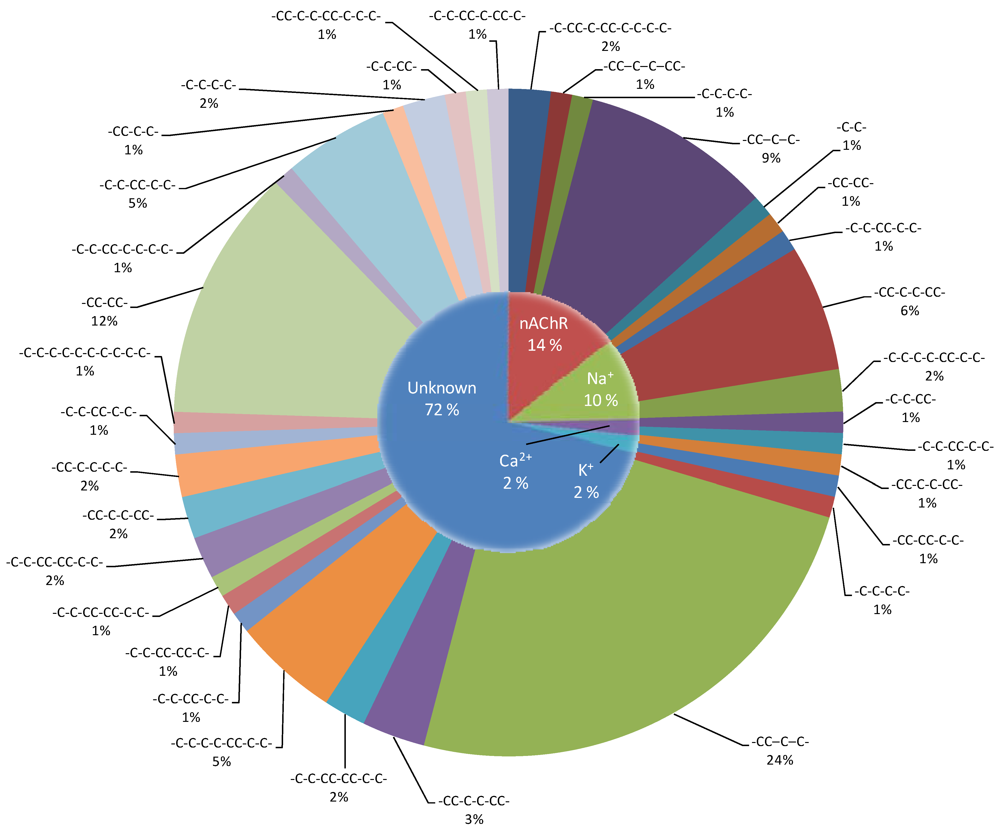
      <p>This query was limited to articles published from 1 January 2007 to 31 August 2011, so as to include only recently isolated <italic>Conus</italic> peptides. This yielded a total of 1129 documents, curation of which allowed for the identification of 98 <italic>Conus</italic> peptides that have potential to be used to generate new drugs. Here we present an overview of the 98 conotoxins that have been reported in literature from 1 January 2007 to 31 August 2011, correlated with the conotoxins cysteine arrangement and their known targets (<xref ref-type="fig" rid="marinedrugs-10-01244-f001">Figure 1</xref>). The compounds identified constitute five phenotypic classes: (1) 14 nAChR inhibitors; (2) 10 Na<sup>+</sup> channel inhibitors; (3) 2 Ca<sup>2+</sup> channel inhibitors; (4) 2 K<sup>+</sup> channel inhibitors; and (5) 70 peptides with targets that have not been defined (<xref ref-type="supplementary-material" rid="marinedrugs-10-01244-s001">Supplementary Table S1</xref>).</p>
      <fig id="marinedrugs-10-01244-f001" position="anchor">
        <label>Figure 1</label>
        <caption>
          <p>Peptides isolated from cone snails since the 1 January 2007 to 31 August 2011, categorized by their respective targets.</p>
        </caption>
        <graphic xmlns:xlink="http://www.w3.org/1999/xlink" xlink:href="marinedrugs-10-01244-g001.tif"/>
      </fig>
    </sec>
    <sec>
      <title>2. <italic>Conus</italic> Peptides That Exhibit Therapeutic Potential</title>
      <sec>
        <title>2.1. Voltage-Gated Ion Channels Targeted by Conotoxins</title>
        <p>Of the conotoxins highlighted in this review, 14% (14/98) have been demonstrated to inhibit the Na<sup>+</sup>, Ca<sup>2+</sup> or K<sup>+</sup> channels. These are transmembrane proteins that mediate the excitability of nerve and muscle cells. To date, nine mammalian Na<sup>+</sup> channel α subunits (Na<sub>v</sub>1.1–Na<sub>v</sub>1.9) have been identified and characterized with respect to sensitivity to the neurotoxin tetrodotoxin (TTX) [<xref ref-type="bibr" rid="B5-marinedrugs-10-01244">5</xref>]. These Na<sup>+</sup> channels are modulated by numerous natural toxins, either by blocking current through the pore or by modifying channel gating [<xref ref-type="bibr" rid="B25-marinedrugs-10-01244">25</xref>]. Na<sup>+</sup> channel subtypes Na<sub>v</sub>1.8 and Na<sub>v</sub>1.9 have been characterized as being tetrodotoxin-resistant (TTX-R) and are implicated in neuropathic pain states [<xref ref-type="bibr" rid="B26-marinedrugs-10-01244">26</xref>]. On the other hand, Na<sup>+</sup> channel subtypes Na<sub>v</sub>1.7, Na<sub>v</sub>1.3, Na<sub>v</sub>1.2 and Na<sub>v</sub>1.1 are tetrodotoxin-sensitive (TTX-S) and implicated in neuropathic pain [<xref ref-type="bibr" rid="B27-marinedrugs-10-01244">27</xref>], inflammation [<xref ref-type="bibr" rid="B26-marinedrugs-10-01244">26</xref>] and epilepsy [<xref ref-type="bibr" rid="B28-marinedrugs-10-01244">28</xref>,<xref ref-type="bibr" rid="B29-marinedrugs-10-01244">29</xref>]. Similarly, more than 40 known human K<sup>+</sup> channel α subunits have been identified and implicated in numerous disorders [<xref ref-type="bibr" rid="B30-marinedrugs-10-01244">30</xref>]. Some examples are: (1) K<sub>v</sub>7 has been implicated in cerebral vasospasm [<xref ref-type="bibr" rid="B31-marinedrugs-10-01244">31</xref>]; (2) K<sub>v</sub>1.4 has been implicated in trigeminal inflammatory allodynia in temporomandibular joint (TMJ) disorder [<xref ref-type="bibr" rid="B32-marinedrugs-10-01244">32</xref>]; (3) K<sub>v</sub>1.2, K<sub>v</sub>1.3 and K<sub>v</sub>1.6 have been shown to be key regulators in Dopamine release, the dysfunction of which is thought to be implicated in drug abuse and in diseases such as schizophrenia and Parkinson’s disease [<xref ref-type="bibr" rid="B33-marinedrugs-10-01244">33</xref>]; (4) K<sub>v</sub>1.3 has also been shown to a target for immunosuppression [<xref ref-type="bibr" rid="B34-marinedrugs-10-01244">34</xref>]; (5) K<sub>v</sub>2.1 has been implicated in hypoxia/anoxia induced cell apoptosis [<xref ref-type="bibr" rid="B35-marinedrugs-10-01244">35</xref>] and diabetes [<xref ref-type="bibr" rid="B36-marinedrugs-10-01244">36</xref>] and; (6) mutations in K<sub>v</sub>1.1 have been implicated in autosomal dominant hypomagnesemia and episodic ataxia type 1 [<xref ref-type="bibr" rid="B37-marinedrugs-10-01244">37</xref>]. Ten Ca<sup>2+</sup> channel subtypes have also been identified (Ca<sub>v</sub>1.1, Ca<sub>v</sub>1.2, Ca<sub>v</sub>1.3, Ca<sub>v</sub>1.4, Ca<sub>v</sub>2.1, Ca<sub>v</sub>2.2, Ca<sub>v</sub>2.3, Ca<sub>v</sub>3.1, Ca<sub>v</sub>3.2 and Ca<sub>v</sub>3.3) and implicated in numerous disorders too. Some examples are: (1) Ca<sub>v</sub>2.1 (P/Q type) and Ca<sub>v</sub>2.2 (N-type) have been implicated in bladder nociception [<xref ref-type="bibr" rid="B38-marinedrugs-10-01244">38</xref>]; (2) Ca<sub>v</sub>1.3 (L-type) has been implicated in Parkinson’s disease [<xref ref-type="bibr" rid="B39-marinedrugs-10-01244">39</xref>]; (3) Ca<sub>v</sub>3.1, Ca<sub>v</sub>3.2 and Ca<sub>v</sub>3.3 (T-type) have been implicated in age-related neurodegenerative disorders [<xref ref-type="bibr" rid="B40-marinedrugs-10-01244">40</xref>]; and (4) Ca<sub>v</sub>2.3 (R-type) has been implicated in diabetes [<xref ref-type="bibr" rid="B41-marinedrugs-10-01244">41</xref>]. To understand the function of voltage-gated ion channel subtypes in the normal and disease states will require novel inhibitors with improved voltage-gated ion channel subtype selectivity.</p>
        <sec>
          <title>2.1.1. Na<sup>+</sup> Channel Inhibitors</title>
          <p>Lt5d: Liu <italic>et al</italic><italic>.</italic> (2007) isolated the novel conotoxin, Lt5d, from the venom of <italic>Conus litteratus</italic> [<xref ref-type="bibr" rid="B42-marinedrugs-10-01244">42</xref>]. Lt5d was identified as a T-1-conotoxin comprising 12 amino acid residues with a characteristic arrangement of four-cysteine residues (-CC-CC-) (<xref ref-type="table" rid="marinedrugs-10-01244-t001">Table 1</xref>). It was further demonstrated that Lt5d inhibit tetrodotoxin-sensitive (TTX-S) sodium currents on adult rat dorsal root ganglion (DRG) neurons (IC<sub>50</sub> 156.16 nM), but has no effect on tetrodotoxin-resistant (TTX-R) sodium currents treated with 150 nM Lt5d [<xref ref-type="bibr" rid="B42-marinedrugs-10-01244">42</xref>]. Thus, Lt5d is the first T-1-conotoxin shown to inhibit TTX-S Na<sup>+</sup> channels. </p>
          <p>Lt6c: Wang <italic>et al</italic><italic>.</italic> (2008) isolated Lt6c from the venom of <italic>Conus litteratus</italic> as well [<xref ref-type="bibr" rid="B43-marinedrugs-10-01244">43</xref>]. Lt6c was shown to comprise 28 amino acid residues with a characteristic arrangement of the six-cysteine residues (-C-C-CC-C-C-) (<xref ref-type="table" rid="marinedrugs-10-01244-t001">Table 1</xref>). It was further demonstrated that 800 nM Lt6c inhibits both the TTX-S and TTX-R sodium currents on adult rat DRG neurons [<xref ref-type="bibr" rid="B43-marinedrugs-10-01244">43</xref>].</p>
          <table-wrap id="marinedrugs-10-01244-t001" position="anchor">
            <object-id pub-id-type="pii">marinedrugs-10-01244-t001_Table 1</object-id>
            <label>Table 1</label>
            <caption>
              <p>Amino acid sequence and conserved cysteine residues of the recently identified Na<sup>+</sup> channel targeting conotoxins.</p>
            </caption>
         <table>
              <thead>
                <tr>
                  <th align="left" valign="middle">Peptide</th>
                  <th align="left" valign="middle">AA Sequence</th>
                  <th align="left" valign="middle">Gene Family with Cysteine Framework and Residues</th>
                  <th align="left" valign="middle">
                    Targets 
                  </th>
                  <th align="left" valign="middle">Has no Effect on</th>
                  <th align="left" valign="middle">Reference</th>
                </tr>
              </thead>
              <tbody>
                <tr>
                  <td align="left" valign="top">Lt5d</td>
                  <td align="left" valign="top">DCCPAKLLCCNP</td>
                  <td align="left" valign="top">T superfamily  <break/>V [connectivity I–III, II–IV]  <break/>-CC-CC-</td>
                  <td align="left" valign="top">Na<sup>+</sup> channel</td>
                  <td align="left" valign="top">ND</td>
                  <td align="left" valign="top">[<xref ref-type="bibr" rid="B42-marinedrugs-10-01244">42</xref>]</td>
                </tr>
                <tr>
                  <td align="left" valign="top">Lt6c</td>
                  <td align="left" valign="top">WPCKVAGSPCGLVSECCGTCNVLRNRCV</td>
                  <td align="left" valign="top">O1 superfamily  <break/>VI/VII [connectivity I–IV, II–V, III–VI] <break/>-C-C-CC-C-C-</td>
                  <td align="left" valign="top">Na<sup>+</sup> channel</td>
                  <td align="left" valign="top">ND</td>
                  <td align="left" valign="top">[<xref ref-type="bibr" rid="B43-marinedrugs-10-01244">43</xref>]</td>
                </tr>
                <tr>
                  <td align="left" valign="top">TIIIA</td>
                  <td align="left" valign="top">RHGCCKGOKGCSSRECRPQHCC</td>
                  <td align="left" valign="top">M superfamily  <break/>III  <break/>-CC-C-C-CC-</td>
                  <td align="left" valign="top">rNa<sub>v</sub>1.2  <break/>rNa<sub>v</sub>1.4 </td>
                  <td align="left" valign="top">rNa<sub>v</sub>1.3 <break/>rNa<sub>v</sub>1.5 <break/>rNa<sub>v</sub>1.7 <break/>rNa<sub>v</sub>1.8</td>
                  <td align="left" valign="top">[<xref ref-type="bibr" rid="B44-marinedrugs-10-01244">44</xref>]</td>
                </tr>
                <tr>
                  <td align="left" valign="top">Cal12a </td>
                  <td align="left" valign="top">DVCDSLVGGHCIHNGCWCDQEAPHGNCCDTDGCTAAWWCPGTKWD</td>
                  <td align="left" valign="top">O2 superfamily <break/>XII <break/>-C-C-C-C-CC-C-C-</td>
                  <td align="left" valign="top">Na<sup>+</sup> channel</td>
                  <td align="left" valign="top">ND</td>
                  <td align="left" valign="top">[<xref ref-type="bibr" rid="B45-marinedrugs-10-01244">45</xref>]</td>
                </tr>
                <tr>
                  <td align="left" valign="top">Cal12b</td>
                  <td align="left" valign="top">DVCDSLVGGHCIHNGCWCDQDAPHGNCCDTDGCTAAWWCPGTKWD</td>
                  <td align="left" valign="top">O2 superfamily <break/>XII <break/>-C-C-C-C-CC-C-C-</td>
                  <td align="left" valign="top">Na<sup>+</sup> channel</td>
                  <td align="left" valign="top">ND</td>
                  <td align="left" valign="top">[<xref ref-type="bibr" rid="B45-marinedrugs-10-01244">45</xref>]</td>
                </tr>
                <tr>
                  <td align="left" valign="top">BuIIIA</td>
                  <td align="left" valign="top">VTDRCCKGKRECGRWCRDHSRCC</td>
                  <td align="left" valign="top">M superfamily <break/>III <break/>-CC-C-C-CC-</td>
                  <td align="left" valign="top">Na<sub>v</sub>1.4</td>
                  <td align="left" valign="top">ND</td>
                  <td align="left" valign="top">[<xref ref-type="bibr" rid="B46-marinedrugs-10-01244">46</xref>]</td>
                </tr>
                <tr>
                  <td align="left" valign="top">BuIIIB</td>
                  <td align="left" valign="top">VGERCCKNGKRGCGRWCRDHSRCC</td>
                  <td align="left" valign="top">M superfamily <break/>III <break/>-CC-C-C-CC-</td>
                  <td align="left" valign="top">Na<sub>v</sub>1.4 </td>
                  <td align="left" valign="top">ND</td>
                  <td align="left" valign="top">[<xref ref-type="bibr" rid="B46-marinedrugs-10-01244">46</xref>]</td>
                </tr>
                <tr>
                  <td align="left" valign="top">BuIIIC</td>
                  <td align="left" valign="top">IVDRCCNKGNGKRGCSRWCRDHSRCC</td>
                  <td align="left" valign="top">M superfamily <break/>III <break/>-CC-C-C-CC-</td>
                  <td align="left" valign="top">Na<sub>v</sub>1.4 </td>
                  <td align="left" valign="top">ND</td>
                  <td align="left" valign="top">[<xref ref-type="bibr" rid="B46-marinedrugs-10-01244">46</xref>]</td>
                </tr>
                <tr>
                  <td align="left" valign="top">SIIIA</td>
                  <td align="left" valign="top">ZNCCNGGCSSKWCRDHARCC</td>
                  <td align="left" valign="top">M superfamily <break/>III <break/>-CC-C-C-CC-</td>
                  <td align="left" valign="top">rNa<sub>v</sub>1.2  <break/>rNa<sub>v</sub>1.4 </td>
                  <td align="left" valign="top">rNa<sub>v</sub>1.3 <break/>rNa<sub>v</sub>1.5 <break/>rNa<sub>v</sub>1.7 <break/>rNa<sub>v</sub>1.8</td>
                  <td align="left" valign="top">[<xref ref-type="bibr" rid="B47-marinedrugs-10-01244">47</xref>]</td>
                </tr>
                <tr>
                  <td align="left" valign="top">SIIIB</td>
                  <td align="left" valign="top">ZNCCNGGCSSKWCKGHARCC</td>
                  <td align="left" valign="top">M superfamily <break/>III <break/>-CC-C-C-CC-</td>
                  <td align="left" valign="top">rNa<sub>v</sub>1.2  <break/>rNa<sub>v</sub>1.4 </td>
                  <td align="left" valign="top">rNa<sub>v</sub>1.3 <break/>rNa<sub>v</sub>1.5 <break/>rNa<sub>v</sub>1.7 <break/>rNa<sub>v</sub>1.8</td>
                  <td align="left" valign="top">[<xref ref-type="bibr" rid="B47-marinedrugs-10-01244">47</xref>]</td>
                </tr>
              </tbody>
            </table>
            <table-wrap-foot>
            <fn>
            <p>ND = no data.</p>
            </fn>
            </table-wrap-foot>
          </table-wrap>
          
          
          <p>TIIIA: Lewis <italic>et al.</italic> (2007) isolated the novel conotoxin, TIIIA, from the venom of <italic>Conus tulipa</italic> [<xref ref-type="bibr" rid="B44-marinedrugs-10-01244">44</xref>]. TIIIA was identified as a μ-conotoxin comprising 22 amino acid residues with a characteristic arrangement of the six-cysteine residues (-CC-C-C-CC-) (<xref ref-type="table" rid="marinedrugs-10-01244-t001">Table 1</xref>). TIIIA was further demonstrated to inhibit Na<sup>+</sup> channel subtype rNa<sub>v</sub>1.2 (IC<sub>50</sub> of 40 nM) and rNa<sub>v</sub>1.4 (IC<sub>50</sub> of 9 nM). Moreover, no effect was demonstrated on the Na<sup>+</sup> channel subtypes rNa<sub>v</sub>1.3, rNa<sub>v</sub>1.5, rNa<sub>v</sub>1.7 and rNa<sub>v</sub>1.8 induced with 3 μM TIIIA. Also, the TIIIA analog [E15A]TIIIA (IC<sub>50</sub> of 15 pM) had a 10-fold higher affinity than TIIIA (IC<sub>50</sub> of 148 pM) for TTX-S Na<sup>+</sup> channels [<xref ref-type="bibr" rid="B44-marinedrugs-10-01244">44</xref>]. </p>
          <p>Cal12a and Cal12b: Gilly<italic> et al.</italic> (2011) isolated two novel conotoxins, Cal12a and Cal12b, from the venom of <italic>Conus Californicus</italic> [<xref ref-type="bibr" rid="B45-marinedrugs-10-01244">45</xref>]. Both Cal12a and Cal12b were identified as μ-conotoxins comprising 45 amino acid residues with eight-cysteine residues in framework 12 (-C-C-C-C-CC-C-C-) (<xref ref-type="table" rid="marinedrugs-10-01244-t001">Table 1</xref>). It was further demonstrated that Cal12a and Cal12b reversibly block the Na<sup>+</sup> channels on giant-fiber-lobe (GFL) neurons, but have no effect on Ca<sup>2+</sup> and K<sup>+</sup> channels [<xref ref-type="bibr" rid="B45-marinedrugs-10-01244">45</xref>]. </p>
          <p>BuIIIA, BuIIIB and BuIIIC: Holford<italic> et al.</italic> (2009) identified the novel conotoxins BuIIIA, BuIIIB and BuIIIC, by cDNA cloning and peptide purification from<italic> Conus bullatus</italic>. BuIIIA, BuIIIB and BuIIIC were also identified as μ-conotoxins have a characteristic arrangement of six-cysteine residues (-CC-C-C-CC-) and comprising 23, 24 and 26 <italic>amino acid</italic> residues, respectively (<xref ref-type="table" rid="marinedrugs-10-01244-t001">Table 1</xref>). Activities of these compounds were compared to a representative set of μ-conotoxins, PIIIA, GIIIA, and KIIIA. BuIIIA and KIIIA were demonstrated to reversibly block the Na<sup>+</sup> channel skeletal muscle subtype Na<sub>v</sub>1.4 with similar potency. In contrast, BuIIIB and BuIIIC were demonstrated to be more potent irreversible inhibitors of the Na<sup>+</sup> channel subtype Na<sub>v</sub>1.4, similar to the reversible inhibitors of Na<sub>v</sub>1.4, PIIIA and GIIIA [<xref ref-type="bibr" rid="B46-marinedrugs-10-01244">46</xref>]. The novel structural determinants of BuIIIA, BuIIIB, and BuIIIC along with their ability to potently inhibit Na<sub>v</sub>1.4 make these conotoxins useful in defining features of the Na<sub>v</sub>1.4 pharmacophore and thereby facilitate the design of highly subtype-specific ligands that target Na<sub>v</sub>1.4.</p>
          <p>SIIIA and SIIIB: Schroeder<italic> et al.</italic> (2008) isolated the novel conotoxins, SIIIA and SIIIB, from the venom of <italic>Conus striatus</italic> [<xref ref-type="bibr" rid="B47-marinedrugs-10-01244">47</xref>]. Both SIIIA and SIIIB were identified as μ-conotoxin comprising 20 amino acid residues with a characteristic arrangement of six-cysteine residues (-CC-C-C-CC-) (<xref ref-type="table" rid="marinedrugs-10-01244-t001">Table 1</xref>). SIIIB was further demonstrated to inhibit Na<sup>+</sup> channel subtype rNa<sub>v</sub>1.2 (IC<sub>50</sub> of 5 nM) and rNa<sub>v</sub>1.4 (IC<sub>50</sub> of 3 nM) more potently than SIIIA (rNa<sub>v</sub>1.2: IC<sub>50</sub> of 10 nM and rNa<sub>v</sub>1.4: IC<sub>50</sub> of 60 nM). However, SIIIA is the more selective ligand for rNa<sub>v</sub>1.2 as it has a high potency for rNa<sub>v</sub>1.2 and also shows a larger difference in IC<sub>50</sub> between rNa<sub>v</sub>1.2 and rNa<sub>v</sub>1.4. Furthermore, <italic>Xenopus</italic> oocytes treated with 3 μM SIIIA and SIIIB showed little to no effect on Na<sup>+</sup> channel subtypes Na<sub>v</sub>1.3, Na<sub>v</sub>1.5, Na<sub>v</sub>1.7 and Na<sub>v</sub>1.8 [<xref ref-type="bibr" rid="B47-marinedrugs-10-01244">47</xref>]. </p>
        </sec>
        <sec>
          <title>2.1.2. Ca<sup>2+ </sup>Channel Inhibitors</title>
          <p>FVIA: Lee et al.<italic> (2010)</italic> identified the novel conotoxin, FVIA, by cDNA cloning and peptide purification from <italic>Conus fulmen</italic>. FVIA was identified as a ω-conotoxin comprising 25  amino acid  residues with a characteristic arrangement of six-cysteine residues (-C-C-CC-C-C-) (<xref ref-type="table" rid="marinedrugs-10-01244-t002">Table 2</xref>). FVIA activity was compared to the known Ca<sup>2+</sup> channel inhibitor, MVIIA. Both FVIA (IC<sub>50</sub> of 11.5 nM) and MVIIA (IC<sub>50</sub> of 7.96 nM) were shown to inhibit human N-type Ca<sup>2+</sup> channels stably expressed in HEK293 cells (C2D7 cells), but FVIA shows greater reversibility than MVIIA. FVIA was further demonstrated to have no effect on other Ca<sup>2+</sup> channels (T-type and P/Q-type) and TTX-sensitive Na<sup>+</sup> channels of mouse DRG neurons [<xref ref-type="bibr" rid="B48-marinedrugs-10-01244">48</xref>].</p>
          <p>CalTx: Bernaldez <italic>et al.</italic> (2011) isolated novel conotoxin, CalTx, from the venom of <italic>Conus californicus</italic> as well [<xref ref-type="bibr" rid="B49-marinedrugs-10-01244">49</xref>]. CalTx was shown to comprise 13 amino acid residues with a characteristic arrangement of four-cysteine residues (-C-C-CC-) (<xref ref-type="table" rid="marinedrugs-10-01244-t002">Table 2</xref>). In contrast to Cal12a and Cal12b that show no effect on Ca<sup>2+</sup> channels, CalTx was further demonstrated to reversibly block calcium current in rat DRG neurons treated with 20 μM CalTx [<xref ref-type="bibr" rid="B49-marinedrugs-10-01244">49</xref>].</p>
          <table-wrap id="marinedrugs-10-01244-t002" position="anchor">
            <object-id pub-id-type="pii">marinedrugs-10-01244-t002_Table 2</object-id>
            <label>Table 2</label>
            <caption>
              <p>Amino acid sequence and conserved cysteine residues of the recently identified Ca<sup>2+</sup> channel targeting conotoxins.</p>
            </caption>
            <table>
              <thead>
                <tr>
                  <th align="left" valign="middle">Peptide</th>
                  <th align="left" valign="middle">AA Sequence</th>
                  <th align="left" valign="middle">Gene Family with Cysteine Framework and Residues</th>
                  <th align="left" valign="middle">
                  Targets 
                  </th>
                  <th align="left" valign="middle">Has no Effect on </th>
                  <th align="left" valign="middle">Reference</th>
                </tr>
              </thead>
              <tbody>
                <tr>
                  <td align="left" valign="middle">CalTx</td>
                  <td align="left" valign="middle">NCPAGCRSQGCCM</td>
                  <td align="left" valign="middle">XVI <break/>-C-C-CC-</td>
                  <td align="left" valign="middle">N-type <break/>L-type <break/>P/Q-type <break/>R-type</td>
                  <td align="left" valign="middle">T-type </td>
                  <td align="left" valign="middle">[<xref ref-type="bibr" rid="B49-marinedrugs-10-01244">49</xref>]</td>
                </tr>
                <tr>
                  <td align="left" valign="middle">FVIA</td>
                  <td align="left" valign="middle">
                     CKGTGKSCSRIAYNCCTGSCRSGKC 
                  </td>
                  <td align="left" valign="middle">O1 superfamily <break/>VI/VII [connectivity I–IV, II–V, III–VI]  <break/>-C-C-CC-C-C-</td>
                  <td align="left" valign="middle">N-type</td>
                  <td align="left" valign="middle">T-type  <break/>P/Q-type  <break/>TTX-S  <break/>Na<sup>+</sup> channel</td>
                  <td align="left" valign="middle">[<xref ref-type="bibr" rid="B48-marinedrugs-10-01244">48</xref>]</td>
                </tr>
              </tbody>
            </table>
          </table-wrap>
          
        </sec>
        <sec>
          <title>2.1.3. K<sup>+</sup> Channel Inhibitors</title>
          <p>Sr11a: Aguilar <italic>et al.</italic> (2007) isolated the novel conotoxin, Sr11a, from the venom of <italic>Conus spurius</italic>. Sr11a was identified as a I-conotoxin comprising 22 amino acid residues with a characteristic arrangement of six-cysteine residues (-CC-CC-C-C-) (<xref ref-type="table" rid="marinedrugs-10-01244-t003">Table 3</xref>) [<xref ref-type="bibr" rid="B50-marinedrugs-10-01244">50</xref>]. In 2010, it was further demonstrated that Sr11a inhibits the K<sup>+</sup> channel subtype K<sub>v</sub>1.2 (IC<sub>50</sub> of 66 nM) and K<sub>v</sub>1.6 (IC<sub>50</sub> of 58 nM), but shows no effect on K<sub>v</sub>1.3 treated with up to 10 Mm Sr11a [<xref ref-type="bibr" rid="B51-marinedrugs-10-01244">51</xref>].</p>
          <table-wrap id="marinedrugs-10-01244-t003" position="anchor">
            <object-id pub-id-type="pii">marinedrugs-10-01244-t003_Table 3</object-id>
            <label>Table 3</label>
            <caption>
              <p>Amino acid sequence and conserved cysteine residues of the recently identified K<sup>+</sup> channel targeting conotoxins.</p>
            </caption>
            <table>
              <thead>
                <tr>
                  <th align="left" valign="middle">Peptide</th>
                  <th align="left" valign="middle">AA Sequence</th>
                  <th align="left" valign="middle">Gene Family with Cysteine Framework and Residues</th>
                  <th align="left" valign="middle">
                     Targets 
                  </th>
                  <th align="left" valign="middle">Has no Effect on </th>
                  <th align="left" valign="middle">Reference </th>
                </tr>
              </thead>
              <tbody>
                <tr>
                  <td align="left" valign="middle">Sr11a</td>
                  <td align="left" valign="middle">NQQCCWRSCCRGECEAPCRFGP</td>
                  <td align="left" valign="middle">I2 superfamily <break/>XI [connectivity I–IV, II–VI, III–VII, V–VIII] <break/>-CC-CC-C-C-</td>
                  <td align="left" valign="middle">K<sub>v</sub>1.2 <break/>K<sub>v</sub>1.6</td>
                  <td align="left" valign="middle">K<sub>v</sub>1.3</td>
                  <td align="left" valign="middle">[<xref ref-type="bibr" rid="B50-marinedrugs-10-01244">50</xref>,<xref ref-type="bibr" rid="B51-marinedrugs-10-01244">51</xref>]</td>
                </tr>
                <tr>
                  <td align="left" valign="middle">RIIIj</td>
                  <td align="left" valign="middle">LPPCCTPPKKHCPAPACKYKPCCKS</td>
                  <td align="left" valign="middle">M superfamily <break/>III <break/>-CC-C-C-CC-</td>
                  <td align="left" valign="middle">K<sub>v</sub>1.2</td>
                  <td align="left" valign="middle">K<sub>v</sub>1.1 <break/>K<sub>v</sub>1.3 <break/>K<sub>v</sub>1.4 <break/>K<sub>v</sub>1.5 <break/>K<sub>v</sub>1.6 <break/>KCNQ2/KCNQ3 <break/>BK</td>
                  <td align="left" valign="middle">[<xref ref-type="bibr" rid="B20-marinedrugs-10-01244">20</xref>]</td>
                </tr>
              </tbody>
            </table>
          </table-wrap>
          <p>RIIIJ: Chen <italic>et al.</italic> (2010) isolated the novel conotoxin, RIIIJ, from the venom of <italic>Conus radiatus</italic>. RIIIJ was identified as a κM-conotoxin comprising 25 amino acid residues with a characteristic arrangement of six-cysteine residues (-CC-C-C-CC-) (<xref ref-type="table" rid="marinedrugs-10-01244-t003">Table 3</xref>). The activity of this compound was compared to the known K<sup>+</sup> channel inhibitor, RIIIK. RIIIJ (IC<sub>50</sub> of 33 nM) was shown to reversibly inhibit the K<sup>+</sup> channel subtype K<sub>v</sub>1.2 with a higher potency than RIIIK (IC<sub>50</sub> of 352 nM). Both RIIIJ and RIIIK showed very low or no affinity for K<sup>+</sup> channel subtype K<sub>v</sub>1.1, K<sub>v</sub>1.3, K<sub>v</sub>1.4, K<sub>v</sub>1.5, K<sub>v</sub>1.6, KCNQ2/KCNQ3 and BK [<xref ref-type="bibr" rid="B20-marinedrugs-10-01244">20</xref>].</p>
        </sec>
      </sec>
      <sec>
        <title>2.2. Ligand-Gated Ion Channels Targeted by Conotoxins</title>
        <p>This review additionally highlights that 14% (14/98) of the novel identified conotoxins are also nAChR inhibitors. nAChR respond to endogenous agonists including acetylcholine and choline and participate in an extensive range of processes including cognitive function, motor movement, sound perception and immune function. nAChRs are allosteric transmembrane proteins composed of one or more α subunits (α1–α10) either alone or in combination with one or more non-α-subunits, (β subunits (β1–β4), γ, δ or ε), that together make up the functional ligand-gated ion channel complex; all nAChRs are believed to contain five such subunits. nAChR subtypes show distinct anatomical location, unique biophysical and pharmacological properties, and additionally have been implicated in numerous disorders. Some examples are: (1) α6β2 and α4β2 has been implicated in Parkinson’s disease [<xref ref-type="bibr" rid="B52-marinedrugs-10-01244">52</xref>], (2) α7 has been implicated in Alzheimer’s disease [<xref ref-type="bibr" rid="B53-marinedrugs-10-01244">53</xref>] and schizophrenia [<xref ref-type="bibr" rid="B54-marinedrugs-10-01244">54</xref>] and has been identified as the target for chemotherapy-related cognitive impairment [<xref ref-type="bibr" rid="B55-marinedrugs-10-01244">55</xref>]; and (3) α9α10 has been identified as the target for the development of analgesics for the treatment of chronic neuropathic pain [<xref ref-type="bibr" rid="B56-marinedrugs-10-01244">56</xref>]. To understand the functioning of these ligand-gated ion channel subtypes in the normal and disease states requires novel inhibitors with improved ligand-gated ion channel subtype selectivity.</p>
        <sec>
          <title>nAChR Inhibitors</title>
          <p>AlphaD-cap (αD-cap) and AlphaD-mus (αD-mus): Kauferstein <italic>et al.</italic> (2009) isolated two novel conopeptides, αD-Cp and αD-Ms, from the  venom  of <italic>Conus capitaneus</italic> and  <italic>Conus mustelinus</italic>, respectively [<xref ref-type="bibr" rid="B57-marinedrugs-10-01244">57</xref>]. Both αD-Cp and αD-Ms were shown to be structurally homologous to the αD-conopeptides (αD-VxXIIA, -B and -C) isolated from the  venom  of <italic>Conus vexillum</italic> [<xref ref-type="bibr" rid="B58-marinedrugs-10-01244">58</xref>], comprising 49 <italic>amino acid</italic> residues and having a characteristic arrangement of ten-cysteine residues (-C-CC-C-CC-C-C<sub>9</sub>C-C-) (<xref ref-type="table" rid="marinedrugs-10-01244-t004">Table 4</xref>). αD-Cp and αD-Ms were further demonstrated to specifically block neuronal  nicotinic acetylcholine receptors  (nAChRs). αD-Cp showed the same selectivity profile for the  nAChR subtypes  as αD-Ms, but has a lower potency. αD-Ms demonstrated selectivity for the α7 (IC<sub>50</sub> 0.12 nM), α3β2 (IC<sub>50</sub> 1.08 nM) and α4β2 (IC<sub>50</sub> 4.5 nM) neuronal  nAChR  subtypes. Both  peptides  showed no effect on the  nAChR subtypes  α3β4 and α4β4 and the  muscle nAChR subtype α1β1γδ at concentrations up to 3 μM [<xref ref-type="bibr" rid="B57-marinedrugs-10-01244">57</xref>].</p>
          <p>αC-PrXA: Jimenez<italic> et al.</italic> (2007) isolated the novel conotoxin, αC-PrXA, from the venom of <italic>Conus parius</italic> [<xref ref-type="bibr" rid="B59-marinedrugs-10-01244">59</xref>]. αC-PrXA is an unusual αC-conotoxin (-C-C-) comprising 32 amino acid residues (<xref ref-type="table" rid="marinedrugs-10-01244-t004">Table 4</xref>) and it is most similar in its biochemical features to snake toxin Waglerins. This compound was further demonstrated to potently block the skeletal muscle  nAChR  subtypes α1β1γδ (IC<sub>50</sub> 3.0 nM) and α1β1εδ (IC<sub>50</sub> 1.8 nM). Moreover, little to no effect was demonstrated on neuronal  nAChRs (subtypes α7,  α3β2, α3β4, α2β4, α4β2 and α9α10), NMDA receptors (subtypes NR2A and NR2B) and Na<sup>+</sup> channels (subtypes Na<sub>v</sub>1.4 and Na<sub>v</sub>1.6) induced with 10 μM αC-PrXA [<xref ref-type="bibr" rid="B59-marinedrugs-10-01244">59</xref>]. </p>
          <p>PrIIIE: Lluisma <italic>et al.</italic> (2009) identified the novel conotoxin, PrIIIE, by cDNA cloning and peptide purification from <italic>Conus parius</italic> as well. PrIIIE was identified as a ψ-conotoxin comprising 24  amino acid  residues (<xref ref-type="table" rid="marinedrugs-10-01244-t004">Table 4</xref>) with a characteristic arrangement of six-cysteine residues (-CC-C-C-CC-) [<xref ref-type="bibr" rid="B60-marinedrugs-10-01244">60</xref>], similar to ψ-conotoxins, PIIIE and PIIIF, previously isolated from <italic>Conus purpurascens</italic> [<xref ref-type="bibr" rid="B61-marinedrugs-10-01244">61</xref>]. It was further demonstrated that PrIIIE blocks the  nAChR subtypes α1β1γδ (IC<sub>50</sub> 0.25 μM) and α1β1εδ (IC<sub>50</sub> 3.24 μM). Unlike PIIIE, PrIIIE demonstrated no effect on  the  Na<sup>+</sup> channel subtype Nav1.4 induced with 5 nM PrIIIE. Moreover, PrIIIE (IC<sub>50</sub> 0.25 μM) was shown to be a significantly more potent nAChR receptor inhibitor than PIIIE (IC<sub>50</sub> 7 μM) [<xref ref-type="bibr" rid="B60-marinedrugs-10-01244">60</xref>].</p>
           <p>Pu14a and Ts14a: Peng <italic>et al.</italic> (2010) identified two novel conotoxins, Pu14a and Ts14a, by cDNA cloning and peptide purification from <italic>Conus pulicarius and Conus tessulatus</italic>, respectively. Both Pu14a and Ts14a contain the characteristic arrangement of four separate cysteine residues (C-C-C-C) and additionally share high sequence similarity comprising 19 amino acid  residues (<xref ref-type="table" rid="marinedrugs-10-01244-t004">Table 4</xref>). However, only Pu14a was further demonstrated to block the  nAChR  subtypes α3β2 (IC<sub>50</sub> 10 μM), α6α3β2 (IC<sub>50</sub> 1 μM) and α1β1γδ (IC<sub>50</sub> 1 μM). Moreover, Pu14a showed no effect on the K<sup>+</sup> channels in  mouse superior cervical ganglion neurons  [<xref ref-type="bibr" rid="B62-marinedrugs-10-01244">62</xref>].</p>
            <p>α-PIB: Lopez-Vera <italic>et al.</italic> (2007a) isolated the novel conotoxin, α-PIB, from the venom of <italic>Conus purpurascens</italic> [<xref ref-type="bibr" rid="B63-marinedrugs-10-01244">63</xref>]. α-PIB is an unusual α4/4-conotoxin (-CC-C-C-) comprising 16 amino acid residues (<xref ref-type="table" rid="marinedrugs-10-01244-t004">Table 4</xref>). This compound was further demonstrated to specifically block the skeletal muscle  nAChR  subtypes α1β1γδ (IC<sub>50</sub> 45 nM) and α1β1εδ (IC<sub>50</sub> 36 nM). Moreover, no effect was demonstrated on  nAChR subtypes α7,  α3β4, α3β2, α2β4 and α9α10 induced with 10 μM α-PIB [<xref ref-type="bibr" rid="B63-marinedrugs-10-01244">63</xref>]. </p>
            <p>SrIA and SrIB: Lopez-Vera <italic>et al.</italic> (2007b) isolated two novel α-conotoxins, SrIA and SrIB, from the venom of <italic>Conus spurius</italic> and synthesized the synthetic analog [γ15E]SrIB, by substituting glutamate for the γ-carboxyglutamate residue [<xref ref-type="bibr" rid="B64-marinedrugs-10-01244">64</xref>]. Both peptides along with [γ15E]SrIB comprise 18 amino acid residues with the typical 4/7-type framework (-CC-C-C-) (<xref ref-type="table" rid="marinedrugs-10-01244-t004">Table 4</xref>) and thus were compared to the α4/7-conotoxin EI previously isolated from the from <italic>Conus ermineus</italic> [<xref ref-type="bibr" rid="B65-marinedrugs-10-01244">65</xref>]. The results with [γ15E]SrIB were shown not to be significantly different from the natural compounds, thus [γ15E]SrIB was used for further testing owing to the limited availability of the natural toxins SrIA and SrIB. EI demonstrated strong blocking of the  nAChR subtypes  α4β2, α1β1γδ and α3β4 at 10 μΜ, whilst the novel peptides only demonstrated weak blocking of the nAChR subtypes  α4β2 and α1β1γδ at the same concentration. However, SrIA, SrIB and [γ15E]SrIB induces strong potentiation of the  nAChR subtypes  α4β2 and α1β1γδ (IC<sub>50</sub> 1.78 nM) [<xref ref-type="bibr" rid="B64-marinedrugs-10-01244">64</xref>]. </p>
             <p>Ac1.1a and Ac1.1b: Yuan <italic>et al.</italic> (2007) identified novel conotoxins, Ac1.1a and Ac1.1b, by cDNA cloning and peptide purification from <italic>Conus</italic> <italic>achatinus</italic>. It was shown that Ac1.1a and Ac1.1b are α3/5 conotoxins comprising 17 amino acid residues with a characteristic arrangement of four-cysteine residues (-CC-C-C-) (<xref ref-type="table" rid="marinedrugs-10-01244-t004">Table 4</xref>) [<xref ref-type="bibr" rid="B66-marinedrugs-10-01244">66</xref>]. Liu<italic> et al.</italic> (2007) further demonstrated that both Ac1.1a and Ac1.1b block the nAChR subtypes α1β1γδ (Ac1.1a: IC<sub>50</sub> 35.90 nM; Ac1.1b: IC<sub>50</sub> 25.80 nM), α1β1εδ (Ac1.1a: IC<sub>50</sub> 3.20 nM; Ac1.1b: IC<sub>50</sub> 0.10 nM), α2β2 (Ac1.1a and Ac1.1b: IC<sub>50</sub> &gt; 5000 nM), α3β4 (Ac1.1a and Ac1.1b: IC<sub>50</sub> &gt; 50,000 nM) and α1γβ1 (Ac1.1a and Ac1.1b: IC<sub>50</sub> &gt; 50,000 nM), indicating that both toxins strongly prefer the α1-δ subunit interface instead of the α1-γ binding site on the nAChRs [<xref ref-type="bibr" rid="B67-marinedrugs-10-01244">67</xref>].</p>
               <p>ArIA and ArIB: Whiteaker <italic>et al.</italic> (2007) identified the novel conotoxins, ArIA and ArIB, by cDNA cloning and peptide purification from <italic>Conus arenatus.</italic> It was shown that both ArIA and ArIB have the characteristic arrangement of four-cysteine residues (-CC-C-C-) and are α4/7 conotoxins comprising 22 and 20  amino acid  residues, respectively (<xref ref-type="table" rid="marinedrugs-10-01244-t004">Table 4</xref>) [<xref ref-type="bibr" rid="B68-marinedrugs-10-01244">68</xref>]. These compounds were further demonstrated to specifically block the  nAChR  subtypes α7 and α3β2. ArIB (IC<sub>50</sub> 1.81 nM) blocked α7 more potently than ArIA (IC<sub>50</sub> 6.02 nM), whilst ArIA (IC<sub>50</sub> 18.0 nM) blocked α3β2 more potently than ArIB (IC<sub>50</sub> 60.1 nM) [<xref ref-type="bibr" rid="B68-marinedrugs-10-01244">68</xref>]. Taken together, ArIB is the more selective ligand for α7 nAChRs as it has a higher potency for α7 and also showed a larger difference in IC<sub>50</sub> between α7 and α3β2 nAChRs.</p>
               <p>α-TxIA and TxIA(A10L): Dutertre <italic>et al.</italic> (2007) isolated the novel α-conotoxin, α-TxIA, from the venom of <italic>Conus textile</italic> and synthesized its synthetic analog TxIA(A10L) [<xref ref-type="bibr" rid="B69-marinedrugs-10-01244">69</xref>]. Both α-TxIA and its synthetic analog TxIA(A10L) comprise 16 amino acid residues with a characteristic arrangement of four-cysteine residues (-CC-C-C-) (<xref ref-type="table" rid="marinedrugs-10-01244-t004">Table 4</xref>). These compounds were further demonstrated to block the neuronal  nAChR  subtypes α7 and α3β2. The α3β2  nAChR was selectively targeted by  both α-TxIA (IC<sub>50</sub> 3.6 nM) and TxIA(A10L) (IC<sub>50</sub> 2.0 nM), whilst TxIA(A10L) (IC<sub>50</sub> 39 nM) blocks the α7  nAChR tenfold more potently than α-TxIA (IC<sub>50</sub> 392 nM). Moreover, both compounds exerted no effect on the α4β2 nAChR and muscle nAChR at concentrations up to 10 μM [<xref ref-type="bibr" rid="B69-marinedrugs-10-01244">69</xref>].</p>
          <table-wrap id="marinedrugs-10-01244-t004" position="anchor">
            <object-id pub-id-type="pii">marinedrugs-10-01244-t004_Table 4</object-id>
            <label>Table 4</label>
            <caption>
              <p>Amino acid sequence and conserved cysteine residues of the recently identified nAChR targeting conotoxins.</p>
            </caption>
                     <table>
              <thead>
                <tr>
                  <th align="left" valign="middle">Peptide</th>
                  <th align="left" valign="middle">AA Sequence</th>
                  <th align="left" valign="middle">Gene Family with Cysteine Framework and Residues</th>
                  <th align="left" valign="middle">
                     nAChR Targets 
                  </th>
                  <th align="left" valign="middle">Has no Effect on</th>
                  <th align="left" valign="middle">Reference</th>
                </tr>
              </thead>
              <tbody>
                <tr>
                  <td align="left" valign="top">AlphaD-cap</td>
                  <td align="left" valign="top">
                     EVQECQVDTPGSSWGKCCMTRMCGTMCCSRSVCTCVYHWRRGHGCSCPG 
                  </td>
                  <td align="left" valign="top">D superfamily <break/>XX <break/>-C-CC-C-CC-C-C-C-C-</td>
                  <td align="left" valign="top">α7 <break/>α3β2  <break/>α4β2 </td>
                  <td align="left" valign="top">α3β4  <break/>α4β4</td>
                  <td align="left" valign="top">[<xref ref-type="bibr" rid="B57-marinedrugs-10-01244">57</xref>]</td>
                </tr>
                <tr>
                  <td align="left" valign="top">AlphaD-mus</td>
                  <td align="left" valign="top">DVRECQVNTPGSKWGKCCMTRMCGTMCCARSGCTCVYHWRRGHGCSCPG</td>
                  <td align="left" valign="top">D superfamily <break/>XX <break/>-C-CC-C-CC-C-C-C-C-</td>
                  <td align="left" valign="top">α7 <break/>α3β2  <break/>α4β2 </td>
                  <td align="left" valign="top">α3β4  <break/>α4β4</td>
                  <td align="left" valign="top">[<xref ref-type="bibr" rid="B57-marinedrugs-10-01244">57</xref>]</td>
                </tr>
                <tr>
                  <td align="left" valign="top">α-PIB</td>
                  <td align="left" valign="top">ZSOGCCWNPACVKNRC</td>
                  <td align="left" valign="top">A superfamily <break/>I [connectivity I–III, II–IV]  <break/>-CC-C-C-</td>
                  <td align="left" valign="top">α1β1εδ  <break/>α1β1γδ</td>
                  <td align="left" valign="top"> α7 <break/>α3β4 <break/>α3β2 <break/>α2β4 <break/>α9α10</td>
                  <td align="left" valign="top">[<xref ref-type="bibr" rid="B63-marinedrugs-10-01244">63</xref>]</td>
                </tr>
                <tr>
                  <td align="left" valign="top">SrIA</td>
                  <td align="left" valign="top">RTCCSROTCRMγYPγLCG</td>
                  <td align="left" valign="top">A superfamily <break/>I [connectivity I–III, II–IV] <break/>-CC-C-C-</td>
                  <td align="left" valign="top">α4β2  <break/>α1β1γδ</td>
                  <td align="left" valign="top">α3β4</td>
                  <td align="left" valign="top">[<xref ref-type="bibr" rid="B64-marinedrugs-10-01244">64</xref>]</td>
                </tr>
                <tr>
                  <td align="left" valign="top">SrIB</td>
                  <td align="left" valign="top">RTCCSROTCRMEYPγLCG</td>
                  <td align="left" valign="top">A superfamily <break/>I [connectivity I-III, II-IV] <break/>-CC-C-C-</td>
                  <td align="left" valign="top">α4β2  <break/>α1β1γδ</td>
                  <td align="left" valign="top">α3β4</td>
                  <td align="left" valign="top">[<xref ref-type="bibr" rid="B64-marinedrugs-10-01244">64</xref>]</td>
                </tr>
                <tr>
                  <td align="left" valign="top">Pu14a</td>
                  <td align="left" valign="top">DCPPHPVPGMHKCVCLKTC</td>
                  <td align="left" valign="top">A superfamily <break/>XIV [connectivity I–III, II–IV] <break/>-C-C-C-C-</td>
                  <td align="left" valign="top">α3β2  <break/>α6α3β2  <break/>α1β1γδ</td>
                  <td align="left" valign="top">K<sup>+</sup> channels</td>
                  <td align="left" valign="top">
                     [<xref ref-type="bibr" rid="B62-marinedrugs-10-01244">62</xref>] 
                  </td>
                </tr>
                <tr>
                  <td align="left" valign="top">PrIIIE</td>
                  <td align="left" valign="top">AARCCTYHGSCLKEKCRRKYCCGR</td>
                  <td align="left" valign="top">M superfamily <break/>III <break/>-CC-C-C-CC-</td>
                  <td align="left" valign="top">α1β1εδ  <break/>α1β1γδ</td>
                  <td align="left" valign="top">Na<sub>v</sub>1.4</td>
                  <td align="left" valign="top">[<xref ref-type="bibr" rid="B60-marinedrugs-10-01244">60</xref>]</td>
                </tr>
                <tr valign="top">
                  <td align="left">ArIA</td>
                  <td align="left">IRDECCSNPACRVNNOHVCRRR</td>
                  <td align="left">A superfamily <break/>I [connectivity I-III, II-IV] <break/>-CC-C-C-</td>
                  <td align="left">α7 <break/>α3β2 </td>
                  <td align="left">ND</td>
                  <td align="left">[<xref ref-type="bibr" rid="B68-marinedrugs-10-01244">68</xref>]</td>
                </tr>
                <tr valign="top">
                  <td align="left">ArIB</td>
                  <td align="left">DECCSNPACRVNNPHVCRRR</td>
                  <td align="left">A superfamily <break/>I [connectivity I-III, II-IV] <break/>-CC-C-C-</td>
                  <td align="left">α7 <break/>α3β2 </td>
                  <td align="left">ND</td>
                  <td align="left">[<xref ref-type="bibr" rid="B68-marinedrugs-10-01244">68</xref>]</td>
                </tr>
                <tr valign="top">
                  <td align="left">Ac1.1a</td>
                  <td align="left">NGRCCHPACGKHFNCGR</td>
                  <td align="left">A superfamily <break/>I [connectivity I-III, II-IV] <break/>-CC-C-C-</td>
                  <td align="left">α1β1γδ  <break/>α1β1εδ  <break/>α2β2  <break/>α3β4  <break/>α1γβ1 </td>
                  <td align="left">ND</td>
                  <td align="left">[<xref ref-type="bibr" rid="B66-marinedrugs-10-01244">66</xref>,<xref ref-type="bibr" rid="B67-marinedrugs-10-01244">67</xref>] </td>
                </tr>
                <tr valign="top">
                  <td align="left">Ac1.1b</td>
                  <td align="left">NGRCCHPACGKHFNCGR</td>
                  <td align="left">A superfamily <break/>I [connectivity I-III, II-IV] <break/>-CC-C-C-</td>
                  <td align="left">α1β1εδ  <break/>α1β1γδ <break/>α2β2  <break/>α3β4  <break/>α1γβ1</td>
                  <td align="left">ND</td>
                  <td align="left">[<xref ref-type="bibr" rid="B66-marinedrugs-10-01244">66</xref>,<xref ref-type="bibr" rid="B67-marinedrugs-10-01244">67</xref>] </td>
                </tr>
                <tr valign="top">
                  <td align="left">PrXA</td>
                  <td align="left">TYGIYDAKPOFSCAGLRGGCVLPONLROKFKE</td>
                  <td align="left">-C-C-</td>
                  <td align="left">α1β1εδ  <break/>α1β1γδ</td>
                  <td align="left">α7  <break/>α3β2  <break/>α3β4  <break/>α2β4  <break/>α4β2  <break/>α9 <break/>α10 <break/>Na<sub>v</sub>1.4 <break/>Na<sub>v</sub>1.6 <break/>NR2A  <break/>NR2B</td>
                  <td align="left">[<xref ref-type="bibr" rid="B59-marinedrugs-10-01244">59</xref>]</td>
                </tr>
                <tr valign="top">
                  <td align="left">α-TxIA</td>
                  <td align="left">GCCSRPPCIANNPDLC</td>
                  <td align="left">A superfamily <break/>I [connectivity I-III, II-IV] <break/>-CC-C-C-</td>
                  <td align="left">α7  <break/>α3β2</td>
                  <td align="left">α4β2 <break/>α1β1εδ  <break/>α1β1γδ</td>
                  <td align="left">[<xref ref-type="bibr" rid="B69-marinedrugs-10-01244">69</xref>]</td>
                </tr>
                <tr valign="top">
                  <td align="left">TxIA(A10L)</td>
                  <td align="left">GCCSRPPCILNNPDLC</td>
                  <td align="left">A superfamily <break/>I [connectivity I-III, II-IV] <break/>-CC-C-C-</td>
                  <td align="left">α7  <break/>α3β2</td>
                  <td align="left">α4β2 <break/>α1β1εδ  <break/>α1β1γδ</td>
                  <td align="left">[<xref ref-type="bibr" rid="B69-marinedrugs-10-01244">69</xref>]</td>
                </tr>
              </tbody>
            </table>
            <table-wrap-foot>
            <fn>
            <p>ND = no data.</p>
            </fn>
            </table-wrap-foot>
          </table-wrap> 
        </sec>
      </sec>
    </sec>
    <sec>
      <title>3. Prediction of Conotoxin Targets</title>
      <p>By determining their protein sequence similarities, and potential number of disulfide bridges and the types of cysteine arrangement of conotoxins with known targets to the 70 conotoxins with undetermined targets using Blastp [<xref ref-type="bibr" rid="B70-marinedrugs-10-01244">70</xref>], we predicted the targets of the conotoxins whose targets are currently not defined (<xref ref-type="supplementary-material" rid="marinedrugs-10-01244-s001">Supplementary Table S1</xref>). Multiple alignments of Blastp results discussed in this review are presented using ClustalW2 [<xref ref-type="bibr" rid="B71-marinedrugs-10-01244">71</xref>]. Thus conotoxin targets are inferred based on sequence similarity. Targets could not be predicted for all conotoxins as some conotoxins such as Ca11a (I3 superfamily), Ca11b (I3 superfamily), Ca8a (S superfamily), Vi15a (V superfamily) and Ca16a (Y superfamily) belong to newly defined gene superfamilies, whilst others such as Mr1e have not been assigned to a gene superfamily as yet. Also, I2 superfamily conotoxins such as Eb12.4, Im12.10, Mr12.5, Mr12.8, Lt12.4, Lt12.9 and TxX sequence similarity infer that they may have a similar target but there are currently no known targets for conotoxins of this type (<xref ref-type="supplementary-material" rid="marinedrugs-10-01244-s001">Supplementary Figure S1</xref>). Similarly, conotoxins Pr3a, Ar11a, Qc16a, Pu5.2<italic>,</italic> Sr7a, Pr6a, Pr6b, Pr6c, Pr6d and Pu5.3 also show no significant sequence similarity to conotoxins with known targets. </p>
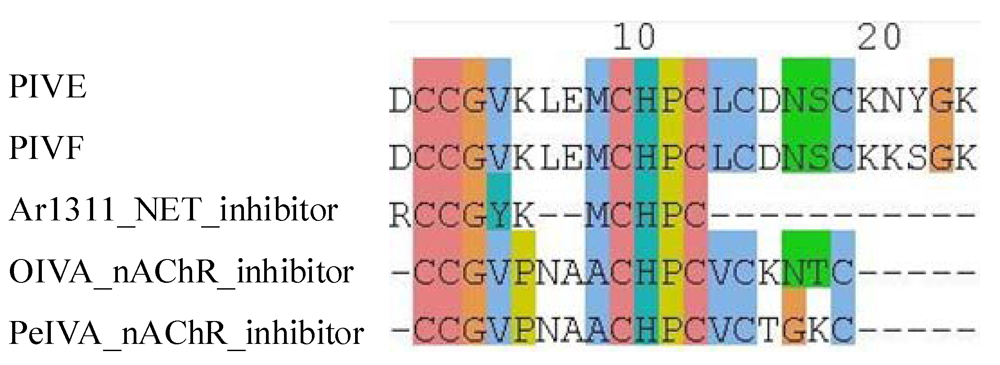
      <p>However,  in a sequence similarity search (<xref ref-type="supplementary-material" rid="marinedrugs-10-01244-s001">Supplementary Figure S1</xref>)  all the  A superfamily conotoxins belonging to the cysteine framework I [connectivity I–III, II–IV] show 40–88% identity to the known nAChR inhibitors (α-PIB, SrIA, SrIB, ArIA, ArIB, Ac1.1a, Ac1.1b, α-TxIA and TxIA(A10L)) belonging to the same gene superfamily with identical disulfide bridges and cysteine arrangement. Similarly, a sequence similarity search for PIVE and PIVF, A superfamily conotoxins belonging to cysteine framework IV [connectivity I–V, II–III, IV–VI] show 61–64% identity to the known nAChR inhibitors (OIVA and PeIVA). Both conotoxins also show 75% identity to the known NET/SLC6A2_inhibitor, Ar1311 (<xref ref-type="fig" rid="marinedrugs-10-01244-f002">Figure 2</xref>). Norepinephrine transporter (NET) inhibitors have demonstrated efficacy in the treatment of children with attention-deficit hyperactivity disorder (ADHD) [<xref ref-type="bibr" rid="B72-marinedrugs-10-01244">72</xref>]. Additionally, the nAChR inhibitor Xen2174 (Mr1A) is in phase II clinical trials as a NET inhibitor tor the treatment of pain [<xref ref-type="bibr" rid="B73-marinedrugs-10-01244">73</xref>]. Thus PIVE and/or PIVF may have the potential to be developed into therapeutic drugs for the treatment of ADHD and/or pain.</p>
      <fig id="marinedrugs-10-01244-f002" position="anchor">
        <label>Figure 2</label>
        <caption>
          <p>Multiple alignment of A superfamily conotoxins belonging to cysteine framework IV predicted to target nAChR.</p>
        </caption>
        <graphic xmlns:xlink="http://www.w3.org/1999/xlink" xlink:href="marinedrugs-10-01244-g002.tif"/>
      </fig>
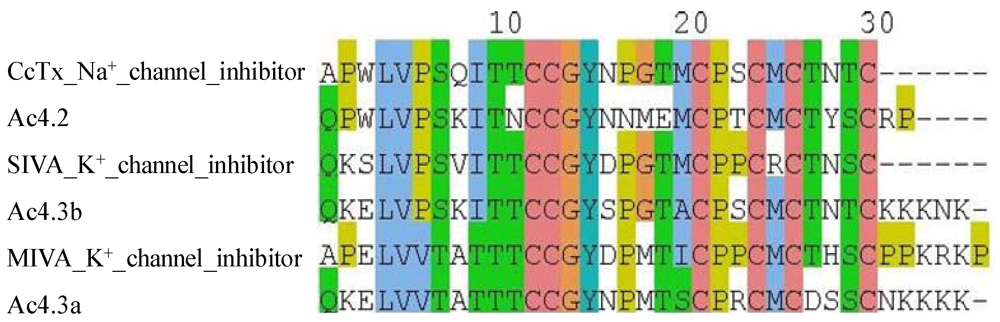
      <p>A superfamily conotoxins belonging to cysteine framework IV [connectivity I–V, II–III, IV–VI] (Ac4.2, Ac4.3a and Ac4.3b) also show 72–89% identity to known Na<sup>+</sup> channel inhibitor, CcTx and 56–77% identity to K<sup>+</sup> channel inhibitors, SIVA and MIVA. Thus, these conotoxins may be ideal candidates to increase understanding of interactions between the conotoxins and voltage- and ligand-gated ion channels (<xref ref-type="fig" rid="marinedrugs-10-01244-f003">Figure 3</xref>). Other A superfamily conotoxins belonging to cysteine framework XIV [connectivity I–III, II–IV] show 78% (Ts14a) and 52–93% (As14b, As14a) identity to known K<sup>+</sup> channel inhibitors Pu14a and vi11a, respectively. Sr11b and Sr11c, I2 superfamily conotoxins belonging to cysteine framework XI [connectivity I–IV, II–VI, III–VII, V–VIII] show 52–56% identity to K<sup>+</sup> channel inhibitor, Sr11a and 43–52% identity to the calcium activated K<sup>+</sup> channel inhibitor, BeTX (<xref ref-type="supplementary-material" rid="marinedrugs-10-01244-s001">Supplementary Figure S1</xref>). </p>
      <p>The sequence similarity search for conotoxins belonging to the T superfamily with cysteine framework V (Pu5.1, Pu5.4, Pu5.5, Pu5.6, Vi1359, Vi1361, Sr5.4, Sr5.5, Sr5.6 and Sr5.7) showed 40–75% identity to known Na<sup>+</sup> channel inhibitor, Lt5d. A member of the M superfamily with cysteine arrangement III, Pr3b and a member of the I1 superfamily with cysteine framework XI, R11d, also showed 55% and 98% identity to known Na<sup>+</sup> channel inhibitors, PIIIA and Fi11.6, respectively (<xref ref-type="supplementary-material" rid="marinedrugs-10-01244-s001">Supplementary Figure S1</xref>). Whilst, De7b and Pr6a, both members of the O1 superfamily with cysteine framework VI/VII [connectivity I–IV, II–V, III–VI] show 70 and 46% identity to Ca<sup>2+</sup> channel inhibitors, TxO1 and PnVIA, respectively. PnVIA in particular have been demonstrated to block dihydropyridine-insensitive high voltage-activated calcium channels [<xref ref-type="bibr" rid="B74-marinedrugs-10-01244">74</xref>]. This calcium channel type has demonstrated sensitivity to nonselective T-type calcium channel antagonists and has been shown to contribute to the functioning of small cerebral arteries [<xref ref-type="bibr" rid="B75-marinedrugs-10-01244">75</xref>]. Thus, we suggest that De7b, Pr6a or analogs of these particular conotoxins may render more effective treatment for therapy-refractory cerebrovascular constriction.</p>
      <fig id="marinedrugs-10-01244-f003" position="anchor">
        <label>Figure 3</label>
        <caption>
          <p>Multiple alignment of A superfamily conotoxins belonging to cysteine framework IV predicted to target both Na<sup>+</sup> and K<sup>+</sup> channels.</p>
        </caption>
        <graphic xmlns:xlink="http://www.w3.org/1999/xlink" xlink:href="marinedrugs-10-01244-g003.tif"/>
      </fig>
      
    </sec>
    <sec>
      <title>4. Literature Analysis of Conotoxins Suggest Specific Therapeutic Potential</title>
      <p>Curation of scientific literature draws attention to a similitude of neurodegenerative disorders (NDD) such as Alzheimer’s disease (AD), Parkinson’s disease (PD) and Multiple Sclerosis (MS) being characterized with aberrant neuronal excitability, caused by abnormal expression and function of ion channels. </p>
      <p>AD is characterized by neuronal loss of the superficial cortex and synaptic alterations such as reduction of pre-synaptic terminal density [<xref ref-type="bibr" rid="B76-marinedrugs-10-01244">76</xref>]. Mousavi <italic>et al</italic><italic>.</italic> demonstrated that decreased nAChR subtypes α4β2 and α7 activities plays vital roles in the progression of AD [<xref ref-type="bibr" rid="B23-marinedrugs-10-01244">23</xref>,<xref ref-type="bibr" rid="B77-marinedrugs-10-01244">77</xref>,<xref ref-type="bibr" rid="B78-marinedrugs-10-01244">78</xref>]. This finding has been supported by recent studies that demonstrate that Aβ peptides can directly and indirectly affect nAChR-mediated synaptic transmission [<xref ref-type="bibr" rid="B79-marinedrugs-10-01244">79</xref>] and that nAChR agonists increase sAPPα secretion whilst decreasing levels of Aβ peptides [<xref ref-type="bibr" rid="B80-marinedrugs-10-01244">80</xref>]. Increased intracellular Ca<sup>2+</sup> has also been implicated in the pathogenesis of AD. Specifically, Kim <italic>et al</italic><italic>.</italic> demonstrated that Aβ increases the activities of L-type Ca<sup>2+</sup> channel subtype Ca<sub>v</sub>1.2 and Ca<sub>v</sub>1.3 [<xref ref-type="bibr" rid="B81-marinedrugs-10-01244">81</xref>] and a calcium channel blocker was shown to ameliorate AD [<xref ref-type="bibr" rid="B82-marinedrugs-10-01244">82</xref>]. Ye <italic>et al</italic><italic>.</italic> additionally showed that activation of the large-conductance Ca<sup>2+</sup>-activated K<sup>+</sup> (BK) channel depresses the basal synaptic transmission in the hippocampal CA1 area in APP (swe/ind) TgCRND8 mice [<xref ref-type="bibr" rid="B83-marinedrugs-10-01244">83</xref>]. This demonstration of activated BK channels in AD may likely be attributed to the impaired calcium homeostasis. </p>
      <p>PD is characterized by a progressive loss of midbrain dopaminergic neurons and a subsequent reduction of striatal dopamine [<xref ref-type="bibr" rid="B84-marinedrugs-10-01244">84</xref>]. Perez <italic>et al</italic><italic>.</italic> demonstrated that nAChR subtypes α4β2 and α6β2 are important modulators of dopaminergic transmission in the striatum and thus play a vital role in the progression of PD [<xref ref-type="bibr" rid="B85-marinedrugs-10-01244">85</xref>]. In addition, Kawamata <italic>et al</italic><italic>.</italic> also demonstrated that nAChR subtypes α7 triggers multiple pathways that attenuate cytotoxicity in models of PD [<xref ref-type="bibr" rid="B86-marinedrugs-10-01244">86</xref>]. Ca<sup>2+</sup> channels have also been implicated in the progression of PD, Tai <italic>et al</italic><italic>.</italic> demonstrated that T-type Ca<sup>2+</sup> channels are necessary for subthalamic burst firing and that pharmacological blockade of T-type Ca<sup>2+</sup> channels reduces motor deficits in a rat model of PD [<xref ref-type="bibr" rid="B87-marinedrugs-10-01244">87</xref>]. Martel <italic>et al</italic><italic>.</italic> further demonstrated that K<sub>v</sub>1.2, K<sub>v</sub>1.3 and K<sub>v</sub>1.6 are key regulators in Dopamine release, the dysfunction of which is thought to be implicated in PD [<xref ref-type="bibr" rid="B33-marinedrugs-10-01244">33</xref>]. Since SK channels have been demonstrated to play an important role in modulating synaptic plasticity, dopaminergic neurotransmission, and learning and memory, recent reviews have focused on the contradictory roles of SK channels in modulating dopaminergic neurons in substantia nigra and whether modulation of SK channels could be a potential target for PD treatment [<xref ref-type="bibr" rid="B88-marinedrugs-10-01244">88</xref>].</p>
      <p>MS is characterized by focal destruction of myelin sheaths, gliotic scars, and axonal damage [<xref ref-type="bibr" rid="B89-marinedrugs-10-01244">89</xref>]. Craner <italic>et al</italic><italic>.</italic> demonstrated that Na<sub>v</sub>1.2 and Na<sub>v</sub>1.6 are distributed along extensive regions of demyelinated axons within acute MS plaques and that Na<sub>v</sub>1.6 which can be driven by persistent sodium current to import damaging levels of calcium into axons, is colocalized with Aβ, a marker of axonal injury, in acute MS lesions [<xref ref-type="bibr" rid="B90-marinedrugs-10-01244">90</xref>]. Craner <italic>et al.</italic> further demonstrated the distribution of Na<sub>v</sub>1.6 in microglia and macrophages in experimental autoimmune encephalomyelitis (EAE) and MS and its key role in their activation and phagocytosis. Additionally, treatment with a sodium channel blocker was shown to ameliorate neuroinflammatory disorder via anti-inflammatory mechanisms [<xref ref-type="bibr" rid="B91-marinedrugs-10-01244">91</xref>]. Similarly, Brand-Schieber and Werner demonstrated increased expression of L-type Ca<sup>2+</sup> channel subtype Ca<sub>v</sub>1.3 in mouse spinal cord axons and that calcium channel blockers ameliorated experimental autoimmune encephalomyelitis (EAE), an animal model of MS [<xref ref-type="bibr" rid="B92-marinedrugs-10-01244">92</xref>]. K<sup>+</sup> channels have also been implicated in the pathogenesis of MS, as Wulff <italic>et al.</italic> demonstrated increased expression K<sup>+</sup> channel subtype K<sub>v</sub>1.3 in activated myelin-reactive T cells from patients with MS [<xref ref-type="bibr" rid="B93-marinedrugs-10-01244">93</xref>]. </p>
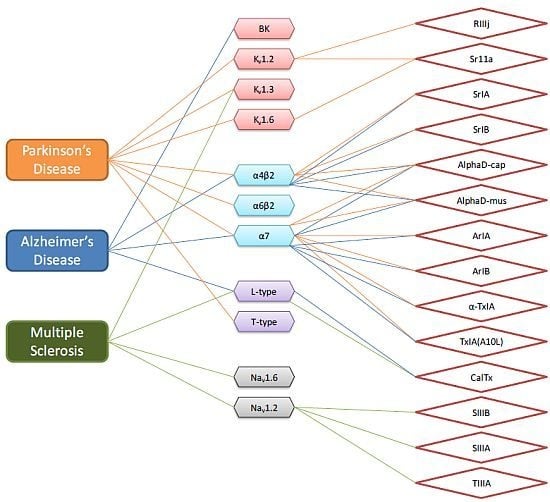
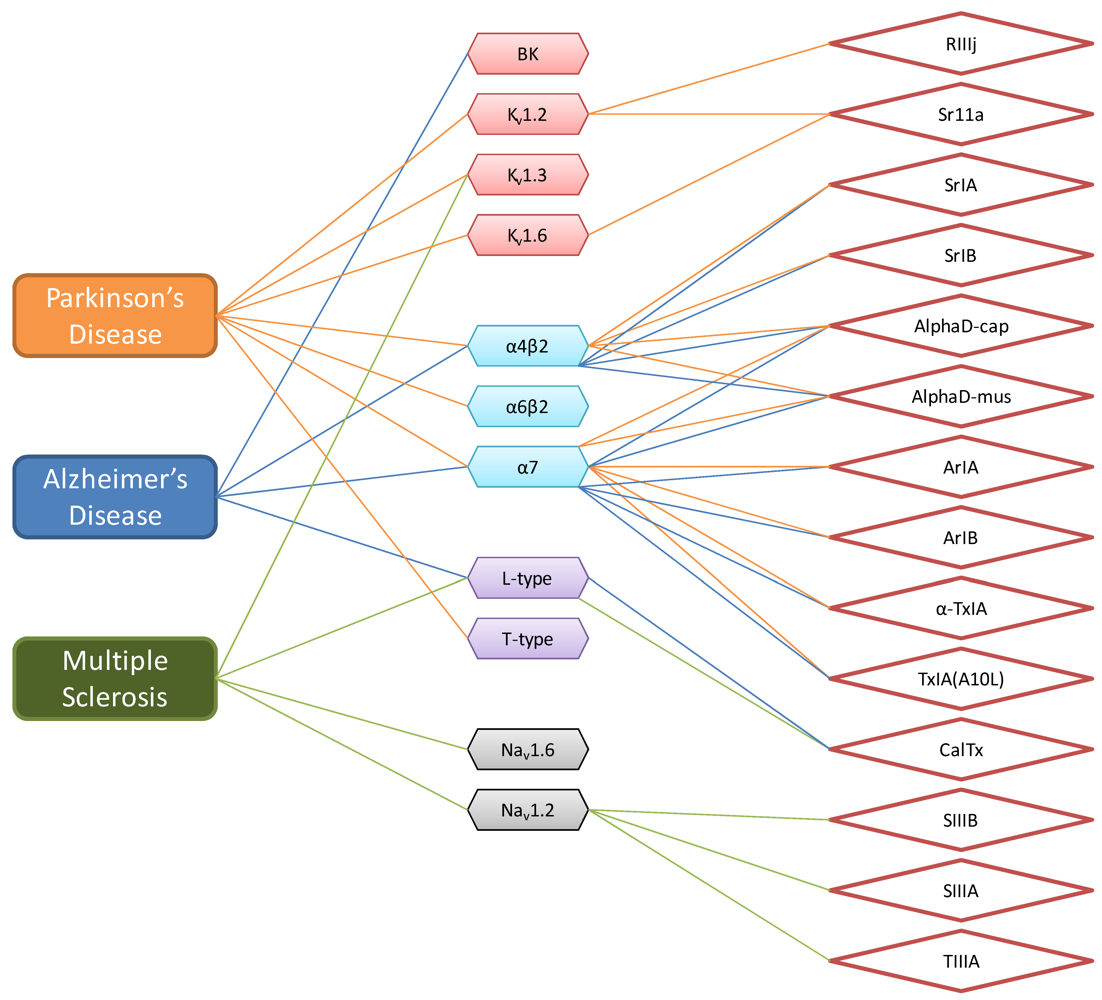
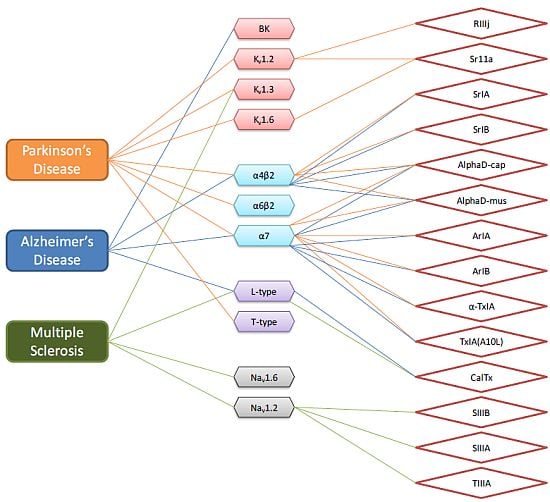
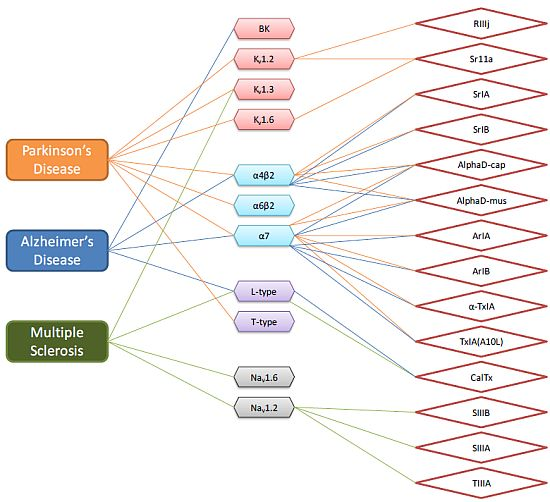
      <p>Since research findings demonstrate that drugs capable of altering the abnormal expression and function of the membrane ion channels characterizing the individual disease states have therapeutic potential [<xref ref-type="bibr" rid="B94-marinedrugs-10-01244">94</xref>]. We curated the ion channels associated with the progression of the above mentioned NDD and associated the curated ion channels with the recently identified conotoxins that have been demonstrated to target these ion channels (NDD→COMMON ION CHANNEL→CONOTOXIN) (<xref ref-type="fig" rid="marinedrugs-10-01244-f004">Figure 4</xref>).</p>
      
      <p>The schema represents potential links of NDD to the recently identified conotoxins based on the fact that these conotoxins target one of the ion channels associated with the pathogenesis of the NDD. AD and PD have been linked to two nAChR inhibitors (αD-cap and αD-mus) with cysteine arrangement -C-CC-C-CC-C-C-C-C- of the D superfamily and six nAChR inhibitors (SrIA, SrIB, ArIA, ArIB, α-TxIA and TxIA(A10L)) with the cysteine arrangement -CC-C-C- from the A superfamily. PD has additionally been linked to two K<sup>+</sup> channel inhibitors (Sr11a and RIIIj) with the cysteine arrangements -CC-CC-C-C- and -CC-C-C-CC- of the I2 and M superfamilies, respectively. Whilst MS has been linked to three Na<sup>+</sup> channel inhibitors (SIIIA, SIIIB and TIIIA) with the cysteine arrangement -CC-C-C-CC- of the M superfamily. AD and MS has also been linked to Ca<sup>2+</sup> channel inhibitor (CalTx) since it has been demonstrated that CalTx inhibits L-type Ca<sup>2+</sup> channel. However, it must be noted that it had not been demonstrated which specific L-type Ca<sup>2+</sup> channel subtype is inhibited by CalTx. In summary, the selected conotoxins or analogs thereof may possess therapeutic potential in treatment of NDD. </p>
      <fig id="marinedrugs-10-01244-f004" position="anchor">
        <label>Figure 4</label>
        <caption>
          <p>Schematic representation linking neurodegenerative disorders (NDD) to conotoxins with therapeutic potential. </p>
        </caption>
        <graphic xmlns:xlink="http://www.w3.org/1999/xlink" xlink:href="marinedrugs-10-01244-g004.tif"/>
      </fig>
    </sec>
    <sec>
      <title>5. Concluding Remarks</title>
      <p>Although the possible application of conotoxins to treat NDD have not been researched as extensively as analgesic applications, current scientific literature produced illustrates that several diverse conotoxin families have demonstrable potential for the treatment of NDD and that conotoxins targeting both voltage-gated and ligand-gated ion channel families have potential in treatment of NDD. With respect to the important physiological role of voltage- and ligand-gated ion channels in pain, inflammation and disease states, targeting specific relevant voltage- and ligand-gated ion channel subtypes could be an attractive pharmaceutical strategy, with conotoxins as promising drug development leads. </p>
    </sec>
  </body>
  <back>
    <ref-list>
      <title>References</title>
      <ref id="B1-marinedrugs-10-01244">
        <label>1.</label>
        <citation citation-type="journal">
          <person-group person-group-type="author">
            <name>
              <surname>Olivera</surname>
              <given-names>B.M.</given-names>
            </name>
          </person-group>
          <article-title><italic>Conus</italic> peptides: Biodiversity-based discovery and exogenomics</article-title>
          <source>J. Biol. Chem.</source>
          <year>2006</year>
          <volume>281</volume>
          <fpage>31173</fpage>
          <lpage>31177</lpage>
          <pub-id pub-id-type="doi">10.1074/jbc.R600020200</pub-id>
        </citation>
      </ref>
      <ref id="B2-marinedrugs-10-01244">
        <label>2.</label>
        <citation citation-type="journal">
          <person-group person-group-type="author">
            <name>
              <surname>Olivera</surname>
              <given-names>B.M.</given-names>
            </name>
            <name>
              <surname>Cruz</surname>
              <given-names>L.J.</given-names>
            </name>
          </person-group>
          <article-title>Conotoxins, in retrospect</article-title>
          <source>Toxicon</source>
          <year>2001</year>
          <volume>39</volume>
          <fpage>7</fpage>
          <lpage>14</lpage>
          <pub-id pub-id-type="doi">10.1016/S0041-0101(00)00157-4</pub-id>
        </citation>
      </ref>
      <ref id="B3-marinedrugs-10-01244">
        <label>3.</label>
        <citation citation-type="journal">
          <person-group person-group-type="author">
            <name>
              <surname>Olivera</surname>
              <given-names>B.M.</given-names>
            </name>
            <name>
              <surname>Cruz</surname>
              <given-names>L.J.</given-names>
            </name>
            <name>
              <surname>de Santos</surname>
              <given-names>V.</given-names>
            </name>
            <name>
              <surname>LeCheminant</surname>
              <given-names>G.W.</given-names>
            </name>
            <name>
              <surname>Griffin</surname>
              <given-names>D.</given-names>
            </name>
            <name>
              <surname>Zeikus</surname>
              <given-names>R.</given-names>
            </name>
            <name>
              <surname>McIntosh</surname>
              <given-names>J.M.</given-names>
            </name>
            <name>
              <surname>Galyean</surname>
              <given-names>R.</given-names>
            </name>
            <name>
              <surname>Varga</surname>
              <given-names>J.</given-names>
            </name>
            <name>
              <surname>Gray</surname>
              <given-names>W.R.</given-names>
            </name>
            <etal/>
          </person-group>
          <article-title>Neuronal calcium channel antagonists. Discrimination between calcium channel subtypes using omega-conotoxin from <italic>Conus magus</italic> venom</article-title>
          <source>Biochemistry</source>
          <year>1987</year>
          <volume>26</volume>
          <fpage>2086</fpage>
          <lpage>2090</lpage>
        <pub-id pub-id-type="doi">10.1021/bi00382a004</pub-id><pub-id pub-id-type="pmid">2441741</pub-id></citation>
      </ref>
      <ref id="B4-marinedrugs-10-01244">
        <label>4.</label>
        <citation citation-type="journal">
          <person-group person-group-type="author">
            <name>
              <surname>Safo</surname>
              <given-names>P.</given-names>
            </name>
            <name>
              <surname>Rosenbaum</surname>
              <given-names>T.</given-names>
            </name>
            <name>
              <surname>Shcherbatko</surname>
              <given-names>A.</given-names>
            </name>
            <name>
              <surname>Choi</surname>
              <given-names>D.Y.</given-names>
            </name>
            <name>
              <surname>Han</surname>
              <given-names>E.</given-names>
            </name>
            <name>
              <surname>Toledo-Aral</surname>
              <given-names>J.J.</given-names>
            </name>
            <name>
              <surname>Olivera</surname>
              <given-names>B.M.</given-names>
            </name>
            <name>
              <surname>Brehm</surname>
              <given-names>P.</given-names>
            </name>
            <name>
              <surname>Mandel</surname>
              <given-names>G.</given-names>
            </name>
          </person-group>
          <article-title>Distinction among neuronal subtypes of voltage-activated sodium channels by mu-conotoxin piiia</article-title>
          <source>J. Neurosci.</source>
          <year>2000</year>
          <volume>20</volume>
          <fpage>76</fpage>
          <lpage>80</lpage>
        <pub-id pub-id-type="pmid">10627583</pub-id></citation>
      </ref>
      <ref id="B5-marinedrugs-10-01244">
        <label>5.</label>
        <citation citation-type="journal">
          <person-group person-group-type="author">
            <name>
              <surname>Catterall</surname>
              <given-names>W.A.</given-names>
            </name>
            <name>
              <surname>Goldin</surname>
              <given-names>A.L.</given-names>
            </name>
            <name>
              <surname>Waxman</surname>
              <given-names>S.G.</given-names>
            </name>
          </person-group>
          <article-title>International union of pharmacology. XLVII. Nomenclature and structure-function relationships of voltage-gated sodium channels</article-title>
          <source>Pharmacol. Rev.</source>
          <year>2005</year>
          <volume>57</volume>
          <fpage>397</fpage>
          <lpage>409</lpage>
          <pub-id pub-id-type="doi">10.1124/pr.57.4.4</pub-id>
        </citation>
      </ref>
      <ref id="B6-marinedrugs-10-01244">
        <label>6.</label>
        <citation citation-type="journal">
          <person-group person-group-type="author">
            <name>
              <surname>Ichida</surname>
              <given-names>S.</given-names>
            </name>
            <name>
              <surname>Abe</surname>
              <given-names>J.</given-names>
            </name>
            <name>
              <surname>Zhang</surname>
              <given-names>Y.A.</given-names>
            </name>
            <name>
              <surname>Sugihara</surname>
              <given-names>K.</given-names>
            </name>
            <name>
              <surname>Imoto</surname>
              <given-names>K.</given-names>
            </name>
            <name>
              <surname>Wada</surname>
              <given-names>T.</given-names>
            </name>
            <name>
              <surname>Fujita</surname>
              <given-names>N.</given-names>
            </name>
            <name>
              <surname>Sohma</surname>
              <given-names>H.</given-names>
            </name>
          </person-group>
          <article-title>Characteristics of the inhibitory effect of calmodulin on specific [125i]omega-conotoxin GVIA binding to crude membranes from chick brain</article-title>
          <source>Neurochem. Res.</source>
          <year>2000</year>
          <volume>25</volume>
          <fpage>1629</fpage>
          <lpage>1635</lpage>
          <pub-id pub-id-type="doi">10.1023/A:1026674721542</pub-id>
        </citation>
      </ref>
      <ref id="B7-marinedrugs-10-01244">
        <label>7.</label>
        <citation citation-type="journal">
          <person-group person-group-type="author">
            <name>
              <surname>Olivera</surname>
              <given-names>B.M.</given-names>
            </name>
            <name>
              <surname>Miljanich</surname>
              <given-names>G.P.</given-names>
            </name>
            <name>
              <surname>Ramachandran</surname>
              <given-names>J.</given-names>
            </name>
            <name>
              <surname>Adams</surname>
              <given-names>M.E.</given-names>
            </name>
          </person-group>
          <article-title>Calcium channel diversity and neurotransmitter release: The omega-conotoxins and omega-agatoxins</article-title>
          <source>Annu. Rev. Biochem.</source>
          <year>1994</year>
          <volume>63</volume>
          <fpage>823</fpage>
          <lpage>867</lpage>
          <pub-id pub-id-type="doi">10.1146/annurev.bi.63.070194.004135</pub-id>
        </citation>
      </ref>
      <ref id="B8-marinedrugs-10-01244">
        <label>8.</label>
        <citation citation-type="journal">
          <person-group person-group-type="author">
            <name>
              <surname>Sher</surname>
              <given-names>E.</given-names>
            </name>
            <name>
              <surname>Gotti</surname>
              <given-names>C.</given-names>
            </name>
            <name>
              <surname>Canal</surname>
              <given-names>N.</given-names>
            </name>
            <name>
              <surname>Scoppetta</surname>
              <given-names>C.</given-names>
            </name>
            <name>
              <surname>Piccolo</surname>
              <given-names>G.</given-names>
            </name>
            <name>
              <surname>Evoli</surname>
              <given-names>A.</given-names>
            </name>
            <name>
              <surname>Clementi</surname>
              <given-names>F.</given-names>
            </name>
          </person-group>
          <article-title>Specificity of calcium channel autoantibodies in lambert-eaton myasthenic syndrome</article-title>
          <source>Lancet</source>
          <year>1989</year>
          <volume>2</volume>
          <fpage>640</fpage>
          <lpage>643</lpage>
        <pub-id pub-id-type="pmid">2570899</pub-id></citation>
      </ref>
      <ref id="B9-marinedrugs-10-01244">
        <label>9.</label>
        <citation citation-type="journal">
          <person-group person-group-type="author">
            <name>
              <surname>Bowersox</surname>
              <given-names>S.S.</given-names>
            </name>
            <name>
              <surname>Luther</surname>
              <given-names>R.</given-names>
            </name>
          </person-group>
          <article-title>Pharmacotherapeutic potential of omega-conotoxin MVIIA (SNX-111), an N-type neuronal calcium channel blocker found in the venom of <italic>Conus magus</italic></article-title>
          <source>Toxicon</source>
          <year>1998</year>
          <volume>36</volume>
          <fpage>1651</fpage>
          <lpage>1658</lpage>
          <pub-id pub-id-type="doi">10.1016/S0041-0101(98)00158-5</pub-id>
        </citation>
      </ref>
      <ref id="B10-marinedrugs-10-01244">
        <label>10.</label>
        <citation citation-type="journal">
          <person-group person-group-type="author">
            <name>
              <surname>Barton</surname>
              <given-names>M.E.</given-names>
            </name>
            <name>
              <surname>White</surname>
              <given-names>H.S.</given-names>
            </name>
            <name>
              <surname>Wilcox</surname>
              <given-names>K.S.</given-names>
            </name>
          </person-group>
          <article-title>The effect of CGX-1007 and CI-1041, novel nmda receptor antagonists, on NMDA receptor-mediated EPSCs</article-title>
          <source>Epilepsy Res.</source>
          <year>2004</year>
          <volume>59</volume>
          <fpage>13</fpage>
          <lpage>24</lpage>
          <pub-id pub-id-type="doi">10.1016/j.eplepsyres.2003.12.011</pub-id>
        </citation>
      </ref>
      <ref id="B11-marinedrugs-10-01244">
        <label>11.</label>
        <citation citation-type="journal">
          <person-group person-group-type="author">
            <name>
              <surname>Craig</surname>
              <given-names>A.G.</given-names>
            </name>
            <name>
              <surname>Norberg</surname>
              <given-names>T.</given-names>
            </name>
            <name>
              <surname>Griffin</surname>
              <given-names>D.</given-names>
            </name>
            <name>
              <surname>Hoeger</surname>
              <given-names>C.</given-names>
            </name>
            <name>
              <surname>Akhtar</surname>
              <given-names>M.</given-names>
            </name>
            <name>
              <surname>Schmidt</surname>
              <given-names>K.</given-names>
            </name>
            <name>
              <surname>Low</surname>
              <given-names>W.</given-names>
            </name>
            <name>
              <surname>Dykert</surname>
              <given-names>J.</given-names>
            </name>
            <name>
              <surname>Richelson</surname>
              <given-names>E.</given-names>
            </name>
            <name>
              <surname>Navarro</surname>
              <given-names>V.</given-names>
            </name>
            <etal/>
          </person-group>
          <article-title>Contulakin-G, an <italic>O</italic>-glycosylated invertebrate neurotensin</article-title>
          <source>J. Biol. Chem.</source>
          <year>1999</year>
          <volume>274</volume>
          <fpage>13752</fpage>
          <lpage>13759</lpage>
        <pub-id pub-id-type="doi">10.1074/jbc.274.20.13752</pub-id><pub-id pub-id-type="pmid">10318778</pub-id></citation>
      </ref>
      <ref id="B12-marinedrugs-10-01244">
        <label>12.</label>
        <citation citation-type="journal">
          <person-group person-group-type="author">
            <name>
              <surname>Kern</surname>
              <given-names>S.E.</given-names>
            </name>
            <name>
              <surname>Allen</surname>
              <given-names>J.</given-names>
            </name>
            <name>
              <surname>Wagstaff</surname>
              <given-names>J.</given-names>
            </name>
            <name>
              <surname>Shafer</surname>
              <given-names>S.L.</given-names>
            </name>
            <name>
              <surname>Yaksh</surname>
              <given-names>T.</given-names>
            </name>
          </person-group>
          <article-title>The pharmacokinetics of the conopeptide contulakin-G (CGX-1160) after intrathecal administration: An analysis of data from studies in beagles</article-title>
          <source>Anesth. Analg.</source>
          <year>2007</year>
          <volume>104</volume>
          <fpage>1514</fpage>
          <lpage>1520</lpage>
          <pub-id pub-id-type="doi">10.1213/01.ane.0000262038.58546.e6</pub-id>
        </citation>
      </ref>
      <ref id="B13-marinedrugs-10-01244">
        <label>13.</label>
        <citation citation-type="journal">
          <person-group person-group-type="author">
            <name>
              <surname>Lubbers</surname>
              <given-names>N.L.</given-names>
            </name>
            <name>
              <surname>Campbell</surname>
              <given-names>T.J.</given-names>
            </name>
            <name>
              <surname>Polakowski</surname>
              <given-names>J.S.</given-names>
            </name>
            <name>
              <surname>Bulaj</surname>
              <given-names>G.</given-names>
            </name>
            <name>
              <surname>Layer</surname>
              <given-names>R.T.</given-names>
            </name>
            <name>
              <surname>Moore</surname>
              <given-names>J.</given-names>
            </name>
            <name>
              <surname>Gross</surname>
              <given-names>G.J.</given-names>
            </name>
            <name>
              <surname>Cox</surname>
              <given-names>B.F.</given-names>
            </name>
          </person-group>
          <article-title>Postischemic administration of CGX-1051, a peptide from cone snail venom, reduces infarct size in both rat and dog models of myocardial ischemia and reperfusion</article-title>
          <source>J. Cardiovasc. Pharmacol.</source>
          <year>2005</year>
          <volume>46</volume>
          <fpage>141</fpage>
          <lpage>146</lpage>
          <pub-id pub-id-type="doi">10.1097/01.fjc.0000167015.84715.27</pub-id>
        </citation>
      </ref>
      <ref id="B14-marinedrugs-10-01244">
        <label>14.</label>
        <citation citation-type="journal">
          <person-group person-group-type="author">
            <name>
              <surname>Livett</surname>
              <given-names>B.G.</given-names>
            </name>
            <name>
              <surname>Sandall</surname>
              <given-names>D.W.</given-names>
            </name>
            <name>
              <surname>Keays</surname>
              <given-names>D.</given-names>
            </name>
            <name>
              <surname>Down</surname>
              <given-names>J.</given-names>
            </name>
            <name>
              <surname>Gayler</surname>
              <given-names>K.R.</given-names>
            </name>
            <name>
              <surname>Satkunanathan</surname>
              <given-names>N.</given-names>
            </name>
            <name>
              <surname>Khalil</surname>
              <given-names>Z.</given-names>
            </name>
          </person-group>
          <article-title>Therapeutic applications of conotoxins that target the neuronal nicotinic acetylcholine receptor</article-title>
          <source>Toxicon</source>
          <year>2006</year>
          <volume>48</volume>
          <fpage>810</fpage>
          <lpage>829</lpage>
          <pub-id pub-id-type="doi">10.1016/j.toxicon.2006.07.023</pub-id>
        </citation>
      </ref>
      <ref id="B15-marinedrugs-10-01244">
        <label>15.</label>
        <citation citation-type="journal">
          <person-group person-group-type="author">
            <name>
              <surname>Nielsen</surname>
              <given-names>C.K.</given-names>
            </name>
            <name>
              <surname>Lewis</surname>
              <given-names>R.J.</given-names>
            </name>
            <name>
              <surname>Alewood</surname>
              <given-names>D.</given-names>
            </name>
            <name>
              <surname>Drinkwater</surname>
              <given-names>R.</given-names>
            </name>
            <name>
              <surname>Palant</surname>
              <given-names>E.</given-names>
            </name>
            <name>
              <surname>Patterson</surname>
              <given-names>M.</given-names>
            </name>
            <name>
              <surname>Yaksh</surname>
              <given-names>T.L.</given-names>
            </name>
            <name>
              <surname>McCumber</surname>
              <given-names>D.</given-names>
            </name>
            <name>
              <surname>Smith</surname>
              <given-names>M.T.</given-names>
            </name>
          </person-group>
          <article-title>Anti-allodynic efficacy of the chi-conopeptide, Xen2174, in rats with neuropathic pain</article-title>
          <source>Pain</source>
          <year>2005</year>
          <volume>118</volume>
          <fpage>112</fpage>
          <lpage>124</lpage>
          <pub-id pub-id-type="doi">10.1016/j.pain.2005.08.002</pub-id>
        </citation>
      </ref>
      <ref id="B16-marinedrugs-10-01244">
        <label>16.</label>
        <citation citation-type="journal">
          <person-group person-group-type="author">
            <name>
              <surname>Obata</surname>
              <given-names>H.</given-names>
            </name>
            <name>
              <surname>Conklin</surname>
              <given-names>D.</given-names>
            </name>
            <name>
              <surname>Eisenach</surname>
              <given-names>J.C.</given-names>
            </name>
          </person-group>
          <article-title>Spinal noradrenaline transporter inhibition by reboxetine and Xen2174 reduces tactile hypersensitivity after surgery in rats</article-title>
          <source>Pain</source>
          <year>2005</year>
          <volume>113</volume>
          <fpage>271</fpage>
          <lpage>276</lpage>
          <pub-id pub-id-type="doi">10.1016/j.pain.2004.10.017</pub-id>
        </citation>
      </ref>
      <ref id="B17-marinedrugs-10-01244">
        <label>17.</label>
        <citation citation-type="journal">
          <person-group person-group-type="author">
            <name>
              <surname>Yan</surname>
              <given-names>L.D.</given-names>
            </name>
            <name>
              <surname>Liu</surname>
              <given-names>Y.L.</given-names>
            </name>
            <name>
              <surname>Zhang</surname>
              <given-names>L.</given-names>
            </name>
            <name>
              <surname>Dong</surname>
              <given-names>H.J.</given-names>
            </name>
            <name>
              <surname>Zhou</surname>
              <given-names>P.L.</given-names>
            </name>
            <name>
              <surname>Su</surname>
              <given-names>R.B.</given-names>
            </name>
            <name>
              <surname>Gong</surname>
              <given-names>Z.H.</given-names>
            </name>
            <name>
              <surname>Huang</surname>
              <given-names>P.T.</given-names>
            </name>
          </person-group>
          <article-title>Spinal antinociception of synthetic omega-conotoxin SO-3, a selective N-type neuronal voltage-sensitive calcium channel blocker, and its effects on morphine analgesia in chemical stimulus tests in rodent</article-title>
          <source>Eur. J. Pharmacol.</source>
          <year>2010</year>
          <volume>636</volume>
          <fpage>73</fpage>
          <lpage>81</lpage>
          <pub-id pub-id-type="doi">10.1016/j.ejphar.2010.03.036</pub-id>
        </citation>
      </ref>
      <ref id="B18-marinedrugs-10-01244">
        <label>18.</label>
        <citation citation-type="journal">
          <person-group person-group-type="author">
            <name>
              <surname>Gasior</surname>
              <given-names>M.</given-names>
            </name>
            <name>
              <surname>White</surname>
              <given-names>N.A.</given-names>
            </name>
            <name>
              <surname>Rogawski</surname>
              <given-names>M.A.</given-names>
            </name>
          </person-group>
          <article-title>Prolonged attenuation of amygdala-kindled seizure measures in rats by convection-enhanced delivery of the N-type calcium channel antagonists omega-conotoxin GVIA and omega-conotoxin MVIIA</article-title>
          <source>J. Pharmacol. Exp. Ther.</source>
          <year>2007</year>
          <volume>323</volume>
          <fpage>458</fpage>
          <lpage>468</lpage>
          <pub-id pub-id-type="doi">10.1124/jpet.107.125047</pub-id>
        </citation>
      </ref>
      <ref id="B19-marinedrugs-10-01244">
        <label>19.</label>
        <citation citation-type="journal">
          <person-group person-group-type="author">
            <name>
              <surname>Shahlaie</surname>
              <given-names>K.</given-names>
            </name>
            <name>
              <surname>Lyeth</surname>
              <given-names>B.G.</given-names>
            </name>
            <name>
              <surname>Gurkoff</surname>
              <given-names>G.G.</given-names>
            </name>
            <name>
              <surname>Muizelaar</surname>
              <given-names>J.P.</given-names>
            </name>
            <name>
              <surname>Berman</surname>
              <given-names>R.F.</given-names>
            </name>
          </person-group>
          <article-title>Neuroprotective effects of selective N-type VGCC blockade on stretch-injury-induced calcium dynamics in cortical neurons</article-title>
          <source>J. Neurotrauma</source>
          <year>2010</year>
          <volume>27</volume>
          <fpage>175</fpage>
          <lpage>187</lpage>
          <pub-id pub-id-type="doi">10.1089/neu.2009.1003</pub-id>
        </citation>
      </ref>
      <ref id="B20-marinedrugs-10-01244">
        <label>20.</label>
        <citation citation-type="journal">
          <person-group person-group-type="author">
            <name>
              <surname>Chen</surname>
              <given-names>P.</given-names>
            </name>
            <name>
              <surname>Dendorfer</surname>
              <given-names>A.</given-names>
            </name>
            <name>
              <surname>Finol-Urdaneta</surname>
              <given-names>R.K.</given-names>
            </name>
            <name>
              <surname>Terlau</surname>
              <given-names>H.</given-names>
            </name>
            <name>
              <surname>Olivera</surname>
              <given-names>B.M.</given-names>
            </name>
          </person-group>
          <article-title>Biochemical characterization of kappam-RIIIJ, a Kv1.2 channel blocker: Evaluation of cardioprotective effects of kappam-conotoxins</article-title>
          <source>J. Biol. Chem.</source>
          <year>2010</year>
          <volume>285</volume>
          <fpage>14882</fpage>
          <lpage>14889</lpage>
        <pub-id pub-id-type="doi">10.1074/jbc.M109.068486</pub-id><pub-id pub-id-type="pmid">20220134</pub-id></citation>
      </ref>
      <ref id="B21-marinedrugs-10-01244">
        <label>21.</label>
        <citation citation-type="journal">
          <person-group person-group-type="author">
            <name>
              <surname>Lahiry</surname>
              <given-names>A.</given-names>
            </name>
            <name>
              <surname>Dave</surname>
              <given-names>K.</given-names>
            </name>
          </person-group>
          <article-title>Conotoxins: Review and docking studies to determine potentials of conotoxin as an anticancer drug molecule</article-title>
          <source>Curr. Top. Med. Chem.</source>
          <year>2012</year>
          <comment>in press.</comment>
        </citation>
      </ref>
      <ref id="B22-marinedrugs-10-01244">
        <label>22.</label>
        <citation citation-type="journal">
          <person-group person-group-type="author">
            <name>
              <surname>Waxman</surname>
              <given-names>S.G.</given-names>
            </name>
          </person-group>
          <article-title>Axonal conduction and injury in multiple sclerosis: The role of sodium channels</article-title>
          <source>Nat. Rev. Neurosci.</source>
          <year>2006</year>
          <volume>7</volume>
          <fpage>932</fpage>
          <lpage>941</lpage>
          <pub-id pub-id-type="doi">10.1038/nrn2023</pub-id>
        </citation>
      </ref>
      <ref id="B23-marinedrugs-10-01244">
        <label>23.</label>
        <citation citation-type="journal">
          <person-group person-group-type="author">
            <name>
              <surname>Haydar</surname>
              <given-names>S.N.</given-names>
            </name>
            <name>
              <surname>Dunlop</surname>
              <given-names>J.</given-names>
            </name>
          </person-group>
          <article-title>Neuronal nicotinic acetylcholine receptors—Targets for the development of drugs to treat cognitive impairment associated with schizophrenia and Alzheimer’s disease</article-title>
          <source>Curr. Top. Med. Chem.</source>
          <year>2010</year>
          <volume>10</volume>
          <fpage>144</fpage>
          <lpage>152</lpage>
          <pub-id pub-id-type="doi">10.2174/156802610790410983</pub-id>
        </citation>
      </ref>
      <ref id="B24-marinedrugs-10-01244">
        <label>24.</label>
        <citation citation-type="journal">
          <person-group person-group-type="author">
            <name>
              <surname>Sayers</surname>
              <given-names>E.W.</given-names>
            </name>
            <name>
              <surname>Barrett</surname>
              <given-names>T.</given-names>
            </name>
            <name>
              <surname>Benson</surname>
              <given-names>D.A.</given-names>
            </name>
            <name>
              <surname>Bolton</surname>
              <given-names>E.</given-names>
            </name>
            <name>
              <surname>Bryant</surname>
              <given-names>S.H.</given-names>
            </name>
            <name>
              <surname>Canese</surname>
              <given-names>K.</given-names>
            </name>
            <name>
              <surname>Chetvernin</surname>
              <given-names>V.</given-names>
            </name>
            <name>
              <surname>Church</surname>
              <given-names>D.M.</given-names>
            </name>
            <name>
              <surname>Dicuccio</surname>
              <given-names>M.</given-names>
            </name>
            <name>
              <surname>Federhen</surname>
              <given-names>S.</given-names>
            </name>
            <etal/>
          </person-group>
          <article-title>Database resources of the national center for biotechnology information</article-title>
          <source>Nucleic Acids Res.</source>
          <year>2010</year>
          <volume>38</volume>
          <fpage>D5</fpage>
          <lpage>D16</lpage>
        <pub-id pub-id-type="doi">10.1093/nar/gkp967</pub-id><pub-id pub-id-type="pmid">19910364</pub-id></citation>
      </ref>
      <ref id="B25-marinedrugs-10-01244">
        <label>25.</label>
        <citation citation-type="journal">
          <person-group person-group-type="author">
            <name>
              <surname>French</surname>
              <given-names>R.J.</given-names>
            </name>
            <name>
              <surname>Terlau</surname>
              <given-names>H.</given-names>
            </name>
          </person-group>
          <article-title>Sodium channel toxins—Receptor targeting and therapeutic potential</article-title>
          <source>Curr. Med. Chem.</source>
          <year>2004</year>
          <volume>11</volume>
          <fpage>3053</fpage>
          <lpage>3064</lpage>
        <pub-id pub-id-type="doi">10.2174/0929867043363866</pub-id><pub-id pub-id-type="pmid">15578999</pub-id></citation>
      </ref>
      <ref id="B26-marinedrugs-10-01244">
        <label>26.</label>
        <citation citation-type="journal">
          <person-group person-group-type="author">
            <name>
              <surname>Wood</surname>
              <given-names>J.N.</given-names>
            </name>
            <name>
              <surname>Boorman</surname>
              <given-names>J.P.</given-names>
            </name>
            <name>
              <surname>Okuse</surname>
              <given-names>K.</given-names>
            </name>
            <name>
              <surname>Baker</surname>
              <given-names>M.D.</given-names>
            </name>
          </person-group>
          <article-title>Voltage-gated sodium channels and pain pathways</article-title>
          <source>J. Neurobiol.</source>
          <year>2004</year>
          <volume>61</volume>
          <fpage>55</fpage>
          <lpage>71</lpage>
          <pub-id pub-id-type="doi">10.1002/neu.20094</pub-id>
        </citation>
      </ref>
      <ref id="B27-marinedrugs-10-01244">
        <label>27.</label>
        <citation citation-type="journal">
          <person-group person-group-type="author">
            <name>
              <surname>Cox</surname>
              <given-names>J.J.</given-names>
            </name>
            <name>
              <surname>Reimann</surname>
              <given-names>F.</given-names>
            </name>
            <name>
              <surname>Nicholas</surname>
              <given-names>A.K.</given-names>
            </name>
            <name>
              <surname>Thornton</surname>
              <given-names>G.</given-names>
            </name>
            <name>
              <surname>Roberts</surname>
              <given-names>E.</given-names>
            </name>
            <name>
              <surname>Springell</surname>
              <given-names>K.</given-names>
            </name>
            <name>
              <surname>Karbani</surname>
              <given-names>G.</given-names>
            </name>
            <name>
              <surname>Jafri</surname>
              <given-names>H.</given-names>
            </name>
            <name>
              <surname>Mannan</surname>
              <given-names>J.</given-names>
            </name>
            <name>
              <surname>Raashid</surname>
              <given-names>Y.</given-names>
            </name>
            <etal/>
          </person-group>
          <article-title>An SCN9A channelopathy causes congenital inability to experience pain</article-title>
          <source>Nature</source>
          <year>2006</year>
          <volume>444</volume>
          <fpage>894</fpage>
          <lpage>898</lpage>
        <pub-id pub-id-type="doi">10.1038/nature05413</pub-id><pub-id pub-id-type="pmid">17167479</pub-id></citation>
      </ref>
      <ref id="B28-marinedrugs-10-01244">
        <label>28.</label>
        <citation citation-type="journal">
          <person-group person-group-type="author">
            <name>
              <surname>Xu</surname>
              <given-names>R.</given-names>
            </name>
            <name>
              <surname>Thomas</surname>
              <given-names>E.A.</given-names>
            </name>
            <name>
              <surname>Jenkins</surname>
              <given-names>M.</given-names>
            </name>
            <name>
              <surname>Gazina</surname>
              <given-names>E.V.</given-names>
            </name>
            <name>
              <surname>Chiu</surname>
              <given-names>C.</given-names>
            </name>
            <name>
              <surname>Heron</surname>
              <given-names>S.E.</given-names>
            </name>
            <name>
              <surname>Mulley</surname>
              <given-names>J.C.</given-names>
            </name>
            <name>
              <surname>Scheffer</surname>
              <given-names>I.E.</given-names>
            </name>
            <name>
              <surname>Berkovic</surname>
              <given-names>S.F.</given-names>
            </name>
            <name>
              <surname>Petrou</surname>
              <given-names>S.</given-names>
            </name>
          </person-group>
          <article-title>A childhood epilepsy mutation reveals a role for developmentally regulated splicing of a sodium channel</article-title>
          <source>Mol. Cell. Neurosci.</source>
          <year>2007</year>
          <volume>35</volume>
          <fpage>292</fpage>
          <lpage>301</lpage>
          <pub-id pub-id-type="doi">10.1016/j.mcn.2007.03.003</pub-id>
        </citation>
      </ref>
      <ref id="B29-marinedrugs-10-01244">
        <label>29.</label>
        <citation citation-type="journal">
          <person-group person-group-type="author">
            <name>
              <surname>Catterall</surname>
              <given-names>W.A.</given-names>
            </name>
            <name>
              <surname>Kalume</surname>
              <given-names>F.</given-names>
            </name>
            <name>
              <surname>Oakley</surname>
              <given-names>J.C.</given-names>
            </name>
          </person-group>
          <article-title>Nav1.1 channels and epilepsy</article-title>
          <source>J. Physiol.</source>
          <year>2010</year>
          <volume>588</volume>
          <fpage>1849</fpage>
          <lpage>1859</lpage>
          <pub-id pub-id-type="doi">10.1113/jphysiol.2010.187484</pub-id>
        </citation>
      </ref>
      <ref id="B30-marinedrugs-10-01244">
        <label>30.</label>
        <citation citation-type="journal">
          <person-group person-group-type="author">
            <name>
              <surname>Gutman</surname>
              <given-names>G.A.</given-names>
            </name>
            <name>
              <surname>Chandy</surname>
              <given-names>K.G.</given-names>
            </name>
            <name>
              <surname>Grissmer</surname>
              <given-names>S.</given-names>
            </name>
            <name>
              <surname>Lazdunski</surname>
              <given-names>M.</given-names>
            </name>
            <name>
              <surname>McKinnon</surname>
              <given-names>D.</given-names>
            </name>
            <name>
              <surname>Pardo</surname>
              <given-names>L.A.</given-names>
            </name>
            <name>
              <surname>Robertson</surname>
              <given-names>G.A.</given-names>
            </name>
            <name>
              <surname>Rudy</surname>
              <given-names>B.</given-names>
            </name>
            <name>
              <surname>Sanguinetti</surname>
              <given-names>M.C.</given-names>
            </name>
            <name>
              <surname>Stuhmer</surname>
              <given-names>W.</given-names>
            </name>
            <etal/>
          </person-group>
          <article-title>International union of pharmacology. LIII. Nomenclature and molecular relationships of voltage-gated potassium channels</article-title>
          <source>Pharmacol. Rev.</source>
          <year>2005</year>
          <volume>57</volume>
          <fpage>473</fpage>
          <lpage>508</lpage>
          <pub-id pub-id-type="doi">10.1124/pr.57.4.10</pub-id>
        </citation>
      </ref>
      <ref id="B31-marinedrugs-10-01244">
        <label>31.</label>
        <citation citation-type="journal">
          <person-group person-group-type="author">
            <name>
              <surname>Mani</surname>
              <given-names>B.K.</given-names>
            </name>
            <name>
              <surname>Brueggemann</surname>
              <given-names>L.I.</given-names>
            </name>
            <name>
              <surname>Cribbs</surname>
              <given-names>L.L.</given-names>
            </name>
            <name>
              <surname>Byron</surname>
              <given-names>K.L.</given-names>
            </name>
          </person-group>
          <article-title>Activation of vascular KCNQ (Kv7) potassium channels reverses spasmogen-induced constrictor responses in rat basilar artery</article-title>
          <source>Br. J. Pharmacol.</source>
          <year>2011</year>
          <volume>164</volume>
          <fpage>237</fpage>
          <lpage>249</lpage>
          <pub-id pub-id-type="doi">10.1111/j.1476-5381.2011.01273.x</pub-id>
        </citation>
      </ref>
      <ref id="B32-marinedrugs-10-01244">
        <label>32.</label>
        <citation citation-type="journal">
          <person-group person-group-type="author">
            <name>
              <surname>Takeda</surname>
              <given-names>M.</given-names>
            </name>
            <name>
              <surname>Tanimoto</surname>
              <given-names>T.</given-names>
            </name>
            <name>
              <surname>Nasu</surname>
              <given-names>M.</given-names>
            </name>
            <name>
              <surname>Matsumoto</surname>
              <given-names>S.</given-names>
            </name>
          </person-group>
          <article-title>Temporomandibular joint inflammation decreases the voltage-gated K<sup>+</sup> channel subtype 1.4-immunoreactivity of trigeminal ganglion neurons in rats</article-title>
          <source>Eur. J. Pain</source>
          <year>2008</year>
          <volume>12</volume>
          <fpage>189</fpage>
          <lpage>195</lpage>
          <pub-id pub-id-type="doi">10.1016/j.ejpain.2007.04.005</pub-id>
        </citation>
      </ref>
      <ref id="B33-marinedrugs-10-01244">
        <label>33.</label>
        <citation citation-type="journal">
          <person-group person-group-type="author">
            <name>
              <surname>Martel</surname>
              <given-names>P.</given-names>
            </name>
            <name>
              <surname>Leo</surname>
              <given-names>D.</given-names>
            </name>
            <name>
              <surname>Fulton</surname>
              <given-names>S.</given-names>
            </name>
            <name>
              <surname>Berard</surname>
              <given-names>M.</given-names>
            </name>
            <name>
              <surname>Trudeau</surname>
              <given-names>L.E.</given-names>
            </name>
          </person-group>
          <article-title>Role of Kv1 potassium channels in regulating dopamine release and presynaptic D2 receptor function</article-title>
          <source>PLoS One</source>
          <year>2011</year>
          <volume>6</volume>
        </citation>
      </ref>
      <ref id="B34-marinedrugs-10-01244">
        <label>34.</label>
        <citation citation-type="journal">
          <person-group person-group-type="author">
            <name>
              <surname>Cahalan</surname>
              <given-names>M.D.</given-names>
            </name>
            <name>
              <surname>Chandy</surname>
              <given-names>K.G.</given-names>
            </name>
          </person-group>
          <article-title>Ion channels in the immune system as targets for immunosuppression</article-title>
          <source>Curr. Opin. Biotechnol.</source>
          <year>1997</year>
          <volume>8</volume>
          <fpage>749</fpage>
          <lpage>756</lpage>
          <pub-id pub-id-type="doi">10.1016/S0958-1669(97)80130-9</pub-id>
        </citation>
      </ref>
      <ref id="B35-marinedrugs-10-01244">
        <label>35.</label>
        <citation citation-type="journal">
          <person-group person-group-type="author">
            <name>
              <surname>Yuan</surname>
              <given-names>H.</given-names>
            </name>
            <name>
              <surname>Wang</surname>
              <given-names>W.P.</given-names>
            </name>
            <name>
              <surname>Feng</surname>
              <given-names>N.</given-names>
            </name>
            <name>
              <surname>Wang</surname>
              <given-names>L.</given-names>
            </name>
            <name>
              <surname>Wang</surname>
              <given-names>X.L.</given-names>
            </name>
          </person-group>
          <article-title>Donepezil attenuated oxygen-glucose deprivation insult by blocking Kv2.1 potassium channels</article-title>
          <source>Eur. J. Pharmacol.</source>
          <year>2011</year>
          <volume>657</volume>
          <fpage>76</fpage>
          <lpage>83</lpage>
          <pub-id pub-id-type="doi">10.1016/j.ejphar.2011.01.054</pub-id>
        </citation>
      </ref>
      <ref id="B36-marinedrugs-10-01244">
        <label>36.</label>
        <citation citation-type="journal">
          <person-group person-group-type="author">
            <name>
              <surname>MacDonald</surname>
              <given-names>P.E.</given-names>
            </name>
            <name>
              <surname>Sewing</surname>
              <given-names>S.</given-names>
            </name>
            <name>
              <surname>Wang</surname>
              <given-names>J.</given-names>
            </name>
            <name>
              <surname>Joseph</surname>
              <given-names>J.W.</given-names>
            </name>
            <name>
              <surname>Smukler</surname>
              <given-names>S.R.</given-names>
            </name>
            <name>
              <surname>Sakellaropoulos</surname>
              <given-names>G.</given-names>
            </name>
            <name>
              <surname>Wang</surname>
              <given-names>J.</given-names>
            </name>
            <name>
              <surname>Saleh</surname>
              <given-names>M.C.</given-names>
            </name>
            <name>
              <surname>Chan</surname>
              <given-names>C.B.</given-names>
            </name>
            <name>
              <surname>Tsushima</surname>
              <given-names>R.G.</given-names>
            </name>
            <etal/>
          </person-group>
          <article-title>Inhibition of Kv2.1 voltage-dependent K<sup>+</sup> channels in pancreatic beta-cells enhances glucose-dependent insulin secretion</article-title>
          <source>J. Biol. Chem.</source>
          <year>2002</year>
          <volume>277</volume>
          <fpage>44938</fpage>
          <lpage>44945</lpage>
        <pub-id pub-id-type="doi">10.1074/jbc.M205532200</pub-id><pub-id pub-id-type="pmid">12270920</pub-id></citation>
      </ref>
      <ref id="B37-marinedrugs-10-01244">
        <label>37.</label>
        <citation citation-type="journal">
          <person-group person-group-type="author">
            <name>
              <surname>Ellison</surname>
              <given-names>D.H.</given-names>
            </name>
          </person-group>
          <article-title>The voltage-gated K<sup>+</sup> channel subunit Kv1.1 links kidney and brain</article-title>
          <source>J. Clin. Invest.</source>
          <year>2009</year>
          <volume>119</volume>
          <fpage>763</fpage>
          <lpage>766</lpage>
          <pub-id pub-id-type="doi">10.1172/JCI38835</pub-id>
        </citation>
      </ref>
      <ref id="B38-marinedrugs-10-01244">
        <label>38.</label>
        <citation citation-type="journal">
          <person-group person-group-type="author">
            <name>
              <surname>Su</surname>
              <given-names>X.</given-names>
            </name>
            <name>
              <surname>Leon</surname>
              <given-names>L.A.</given-names>
            </name>
            <name>
              <surname>Laping</surname>
              <given-names>N.J.</given-names>
            </name>
          </person-group>
          <article-title>Role of spinal Cav2.2 and Cav2.1 ion channels in bladder nociception</article-title>
          <source>J. Urol.</source>
          <year>2008</year>
          <volume>179</volume>
          <fpage>2464</fpage>
          <lpage>2469</lpage>
          <pub-id pub-id-type="doi">10.1016/j.juro.2008.01.088</pub-id>
        </citation>
      </ref>
      <ref id="B39-marinedrugs-10-01244">
        <label>39.</label>
        <citation citation-type="journal">
          <person-group person-group-type="author">
            <name>
              <surname>Ilijic</surname>
              <given-names>E.</given-names>
            </name>
            <name>
              <surname>Guzman</surname>
              <given-names>J.N.</given-names>
            </name>
            <name>
              <surname>Surmeier</surname>
              <given-names>D.J.</given-names>
            </name>
          </person-group>
          <article-title>The L-type channel antagonist isradipine is neuroprotective in a mouse model of Parkinson’s disease</article-title>
          <source>Neurobiol. Dis.</source>
          <year>2011</year>
          <volume>43</volume>
          <fpage>364</fpage>
          <lpage>371</lpage>
          <pub-id pub-id-type="doi">10.1016/j.nbd.2011.04.007</pub-id>
        </citation>
      </ref>
      <ref id="B40-marinedrugs-10-01244">
        <label>40.</label>
        <citation citation-type="journal">
          <person-group person-group-type="author">
            <name>
              <surname>Wildburger</surname>
              <given-names>N.C.</given-names>
            </name>
            <name>
              <surname>Lin-Ye</surname>
              <given-names>A.</given-names>
            </name>
            <name>
              <surname>Baird</surname>
              <given-names>M.A.</given-names>
            </name>
            <name>
              <surname>Lei</surname>
              <given-names>D.</given-names>
            </name>
            <name>
              <surname>Bao</surname>
              <given-names>J.</given-names>
            </name>
          </person-group>
          <article-title>Neuroprotective effects of blockers for T-type calcium channels</article-title>
          <source>Mol. Neurodegener.</source>
          <year>2009</year>
          <volume>4</volume>
        </citation>
      </ref>
      <ref id="B41-marinedrugs-10-01244">
        <label>41.</label>
        <citation citation-type="journal">
          <person-group person-group-type="author">
            <name>
              <surname>Jing</surname>
              <given-names>X.</given-names>
            </name>
            <name>
              <surname>Li</surname>
              <given-names>D.Q.</given-names>
            </name>
            <name>
              <surname>Olofsson</surname>
              <given-names>C.S.</given-names>
            </name>
            <name>
              <surname>Salehi</surname>
              <given-names>A.</given-names>
            </name>
            <name>
              <surname>Surve</surname>
              <given-names>V.V.</given-names>
            </name>
            <name>
              <surname>Caballero</surname>
              <given-names>J.</given-names>
            </name>
            <name>
              <surname>Ivarsson</surname>
              <given-names>R.</given-names>
            </name>
            <name>
              <surname>Lundquist</surname>
              <given-names>I.</given-names>
            </name>
            <name>
              <surname>Pereverzev</surname>
              <given-names>A.</given-names>
            </name>
            <name>
              <surname>Schneider</surname>
              <given-names>T.</given-names>
            </name>
            <etal/>
          </person-group>
          <article-title>Cav2.3 calcium channels control second-phase insulin release</article-title>
          <source>J. Clin. Invest.</source>
          <year>2005</year>
          <volume>115</volume>
          <fpage>146</fpage>
          <lpage>154</lpage>
        <pub-id pub-id-type="pmid">15630454</pub-id></citation>
      </ref>
      <ref id="B42-marinedrugs-10-01244">
        <label>42.</label>
        <citation citation-type="journal">
          <person-group person-group-type="author">
            <name>
              <surname>Liu</surname>
              <given-names>J.</given-names>
            </name>
            <name>
              <surname>Wu</surname>
              <given-names>Q.</given-names>
            </name>
            <name>
              <surname>Pi</surname>
              <given-names>C.</given-names>
            </name>
            <name>
              <surname>Zhao</surname>
              <given-names>Y.</given-names>
            </name>
            <name>
              <surname>Zhou</surname>
              <given-names>M.</given-names>
            </name>
            <name>
              <surname>Wang</surname>
              <given-names>L.</given-names>
            </name>
            <name>
              <surname>Chen</surname>
              <given-names>S.</given-names>
            </name>
            <name>
              <surname>Xu</surname>
              <given-names>A.</given-names>
            </name>
          </person-group>
          <article-title>Isolation and characterization of a T-superfamily conotoxin from <italic>Conus litteratus</italic> with targeting tetrodotoxin-sensitive sodium channels</article-title>
          <source>Peptides</source>
          <year>2007</year>
          <volume>28</volume>
          <fpage>2313</fpage>
          <lpage>2319</lpage>
          <pub-id pub-id-type="doi">10.1016/j.peptides.2007.09.006</pub-id>
        </citation>
      </ref>
      <ref id="B43-marinedrugs-10-01244">
        <label>43.</label>
        <citation citation-type="journal">
          <person-group person-group-type="author">
            <name>
              <surname>Wang</surname>
              <given-names>L.</given-names>
            </name>
            <name>
              <surname>Pi</surname>
              <given-names>C.</given-names>
            </name>
            <name>
              <surname>Liu</surname>
              <given-names>J.</given-names>
            </name>
            <name>
              <surname>Chen</surname>
              <given-names>S.</given-names>
            </name>
            <name>
              <surname>Peng</surname>
              <given-names>C.</given-names>
            </name>
            <name>
              <surname>Sun</surname>
              <given-names>D.</given-names>
            </name>
            <name>
              <surname>Zhou</surname>
              <given-names>M.</given-names>
            </name>
            <name>
              <surname>Xiang</surname>
              <given-names>H.</given-names>
            </name>
            <name>
              <surname>Ren</surname>
              <given-names>Z.</given-names>
            </name>
            <name>
              <surname>Xu</surname>
              <given-names>A.</given-names>
            </name>
          </person-group>
          <article-title>Identification and characterization of a novel O-superfamily conotoxin from <italic>Conus litteratus</italic></article-title>
          <source>J. Pept. Sci.</source>
          <year>2008</year>
          <volume>14</volume>
          <fpage>1077</fpage>
          <lpage>1083</lpage>
          <pub-id pub-id-type="doi">10.1002/psc.1044</pub-id>
        </citation>
      </ref>
      <ref id="B44-marinedrugs-10-01244">
        <label>44.</label>
        <citation citation-type="journal">
          <person-group person-group-type="author">
            <name>
              <surname>Lewis</surname>
              <given-names>R.J.</given-names>
            </name>
            <name>
              <surname>Schroeder</surname>
              <given-names>C.I.</given-names>
            </name>
            <name>
              <surname>Ekberg</surname>
              <given-names>J.</given-names>
            </name>
            <name>
              <surname>Nielsen</surname>
              <given-names>K.J.</given-names>
            </name>
            <name>
              <surname>Loughnan</surname>
              <given-names>M.</given-names>
            </name>
            <name>
              <surname>Thomas</surname>
              <given-names>L.</given-names>
            </name>
            <name>
              <surname>Adams</surname>
              <given-names>D.A.</given-names>
            </name>
            <name>
              <surname>Drinkwater</surname>
              <given-names>R.</given-names>
            </name>
            <name>
              <surname>Adams</surname>
              <given-names>D.J.</given-names>
            </name>
            <name>
              <surname>Alewood</surname>
              <given-names>P.F.</given-names>
            </name>
          </person-group>
          <article-title>Isolation and structure-activity of mu-conotoxin TIIIA, a potent inhibitor of tetrodotoxin-sensitive voltage-gated sodium channels</article-title>
          <source>Mol. Pharmacol.</source>
          <year>2007</year>
          <volume>71</volume>
          <fpage>676</fpage>
          <lpage>685</lpage>
        <pub-id pub-id-type="pmid">17142296</pub-id></citation>
      </ref>
      <ref id="B45-marinedrugs-10-01244">
        <label>45.</label>
        <citation citation-type="journal">
          <person-group person-group-type="author">
            <name>
              <surname>Gilly</surname>
              <given-names>W.F.</given-names>
            </name>
            <name>
              <surname>Richmond</surname>
              <given-names>T.A.</given-names>
            </name>
            <name>
              <surname>Duda</surname>
              <given-names>T.F.</given-names>
              <suffix>Jr.</suffix>
            </name>
            <name>
              <surname>Elliger</surname>
              <given-names>C.</given-names>
            </name>
            <name>
              <surname>Lebaric</surname>
              <given-names>Z.</given-names>
            </name>
            <name>
              <surname>Schulz</surname>
              <given-names>J.</given-names>
            </name>
            <name>
              <surname>Bingham</surname>
              <given-names>J.P.</given-names>
            </name>
            <name>
              <surname>Sweedler</surname>
              <given-names>J.V.</given-names>
            </name>
          </person-group>
          <article-title>A diverse family of novel peptide toxins from an unusual cone snail, <italic>Conus californicus</italic></article-title>
          <source>J. Exp. Biol.</source>
          <year>2011</year>
          <volume>214</volume>
          <fpage>147</fpage>
          <lpage>161</lpage>
        <pub-id pub-id-type="doi">10.1242/jeb.046086</pub-id><pub-id pub-id-type="pmid">21147978</pub-id></citation>
      </ref>
      <ref id="B46-marinedrugs-10-01244">
        <label>46.</label>
        <citation citation-type="journal">
          <person-group person-group-type="author">
            <name>
              <surname>Holford</surname>
              <given-names>M.</given-names>
            </name>
            <name>
              <surname>Zhang</surname>
              <given-names>M.M.</given-names>
            </name>
            <name>
              <surname>Gowd</surname>
              <given-names>K.H.</given-names>
            </name>
            <name>
              <surname>Azam</surname>
              <given-names>L.</given-names>
            </name>
            <name>
              <surname>Green</surname>
              <given-names>B.R.</given-names>
            </name>
            <name>
              <surname>Watkins</surname>
              <given-names>M.</given-names>
            </name>
            <name>
              <surname>Ownby</surname>
              <given-names>J.P.</given-names>
            </name>
            <name>
              <surname>Yoshikami</surname>
              <given-names>D.</given-names>
            </name>
            <name>
              <surname>Bulaj</surname>
              <given-names>G.</given-names>
            </name>
            <name>
              <surname>Olivera</surname>
              <given-names>B.M.</given-names>
            </name>
          </person-group>
          <article-title>Pruning nature: Biodiversity-derived discovery of novel sodium channel blocking conotoxins from <italic>Conus bullatus</italic></article-title>
          <source>Toxicon</source>
          <year>2009</year>
          <volume>53</volume>
          <fpage>90</fpage>
          <lpage>98</lpage>
          <pub-id pub-id-type="doi">10.1016/j.toxicon.2008.10.017</pub-id>
        </citation>
      </ref>
      <ref id="B47-marinedrugs-10-01244">
        <label>47.</label>
        <citation citation-type="journal">
          <person-group person-group-type="author">
            <name>
              <surname>Schroeder</surname>
              <given-names>C.I.</given-names>
            </name>
            <name>
              <surname>Ekberg</surname>
              <given-names>J.</given-names>
            </name>
            <name>
              <surname>Nielsen</surname>
              <given-names>K.J.</given-names>
            </name>
            <name>
              <surname>Adams</surname>
              <given-names>D.</given-names>
            </name>
            <name>
              <surname>Loughnan</surname>
              <given-names>M.L.</given-names>
            </name>
            <name>
              <surname>Thomas</surname>
              <given-names>L.</given-names>
            </name>
            <name>
              <surname>Adams</surname>
              <given-names>D.J.</given-names>
            </name>
            <name>
              <surname>Alewood</surname>
              <given-names>P.F.</given-names>
            </name>
            <name>
              <surname>Lewis</surname>
              <given-names>R.J.</given-names>
            </name>
          </person-group>
          <article-title>Neuronally micro-conotoxins from <italic>Conus striatus</italic> utilize an alpha-helical motif to target mammalian sodium channels</article-title>
          <source>J. Biol. Chem.</source>
          <year>2008</year>
          <volume>283</volume>
          <fpage>21621</fpage>
          <lpage>21628</lpage>
        <pub-id pub-id-type="doi">10.1074/jbc.M802852200</pub-id><pub-id pub-id-type="pmid">18522941</pub-id></citation>
      </ref>
      <ref id="B48-marinedrugs-10-01244">
        <label>48.</label>
        <citation citation-type="journal">
          <person-group person-group-type="author">
            <name>
              <surname>Lee</surname>
              <given-names>S.</given-names>
            </name>
            <name>
              <surname>Kim</surname>
              <given-names>Y.</given-names>
            </name>
            <name>
              <surname>Back</surname>
              <given-names>S.K.</given-names>
            </name>
            <name>
              <surname>Choi</surname>
              <given-names>H.W.</given-names>
            </name>
            <name>
              <surname>Lee</surname>
              <given-names>J.Y.</given-names>
            </name>
            <name>
              <surname>Jung</surname>
              <given-names>H.H.</given-names>
            </name>
            <name>
              <surname>Ryu</surname>
              <given-names>J.H.</given-names>
            </name>
            <name>
              <surname>Suh</surname>
              <given-names>H.W.</given-names>
            </name>
            <name>
              <surname>Na</surname>
              <given-names>H.S.</given-names>
            </name>
            <name>
              <surname>Kim</surname>
              <given-names>H.J.</given-names>
            </name>
            <etal/>
          </person-group>
          <article-title>Analgesic effect of highly reversible omega-conotoxin fvia on N type Ca<sup>2+</sup> channels</article-title>
          <source>Mol. Pain</source>
          <year>2010</year>
          <volume>6</volume>
        </citation>
      </ref>
      <ref id="B49-marinedrugs-10-01244">
        <label>49.</label>
        <citation citation-type="journal">
          <person-group person-group-type="author">
            <name>
              <surname>Bernaldez</surname>
              <given-names>J.</given-names>
            </name>
            <name>
              <surname>Lopez</surname>
              <given-names>O.</given-names>
            </name>
            <name>
              <surname>Licea</surname>
              <given-names>A.</given-names>
            </name>
            <name>
              <surname>Salceda</surname>
              <given-names>E.</given-names>
            </name>
            <name>
              <surname>Arellano</surname>
              <given-names>R.O.</given-names>
            </name>
            <name>
              <surname>Vega</surname>
              <given-names>R.</given-names>
            </name>
            <name>
              <surname>Soto</surname>
              <given-names>E.</given-names>
            </name>
          </person-group>
          <article-title>Electrophysiological characterization of a novel small peptide from the venom of <italic>Conus californicus</italic> that targets voltage-gated neuronal Ca<sup>2+</sup> channels</article-title>
          <source>Toxicon</source>
          <year>2011</year>
          <volume>57</volume>
          <fpage>60</fpage>
          <lpage>67</lpage>
          <pub-id pub-id-type="doi">10.1016/j.toxicon.2010.09.015</pub-id>
        </citation>
      </ref>
      <ref id="B50-marinedrugs-10-01244">
        <label>50.</label>
        <citation citation-type="journal">
          <person-group person-group-type="author">
            <name>
              <surname>Aguilar</surname>
              <given-names>M.B.</given-names>
            </name>
            <name>
              <surname>Lopez-Vera</surname>
              <given-names>E.</given-names>
            </name>
            <name>
              <surname>de la Cotera</surname>
              <given-names>E.P.H.</given-names>
            </name>
            <name>
              <surname>Falcon</surname>
              <given-names>A.</given-names>
            </name>
            <name>
              <surname>Olivera</surname>
              <given-names>B.M.</given-names>
            </name>
            <name>
              <surname>Maillo</surname>
              <given-names>M.</given-names>
            </name>
          </person-group>
          <article-title>I-conotoxins in vermivorous species of the west atlantic: Peptide sr11a from <italic>Conus spurius</italic></article-title>
          <source>Peptides</source>
          <year>2007</year>
          <volume>28</volume>
          <fpage>18</fpage>
          <lpage>23</lpage>
          <pub-id pub-id-type="doi">10.1016/j.peptides.2006.08.024</pub-id>
        </citation>
      </ref>
      <ref id="B51-marinedrugs-10-01244">
        <label>51.</label>
        <citation citation-type="journal">
          <person-group person-group-type="author">
            <name>
              <surname>Aguilar</surname>
              <given-names>M.B.</given-names>
            </name>
            <name>
              <surname>Perez-Reyes</surname>
              <given-names>L.I.</given-names>
            </name>
            <name>
              <surname>Lopez</surname>
              <given-names>Z.</given-names>
            </name>
            <name>
              <surname>de la Cotera</surname>
              <given-names>E.P.H.</given-names>
            </name>
            <name>
              <surname>Falcon</surname>
              <given-names>A.</given-names>
            </name>
            <name>
              <surname>Ayala</surname>
              <given-names>C.</given-names>
            </name>
            <name>
              <surname>Galvan</surname>
              <given-names>M.</given-names>
            </name>
            <name>
              <surname>Salvador</surname>
              <given-names>C.</given-names>
            </name>
            <name>
              <surname>Escobar</surname>
              <given-names>L.I.</given-names>
            </name>
          </person-group>
          <article-title>Peptide sr11a from <italic>Conus spurius</italic> is a novel peptide blocker for Kv1 potassium channels</article-title>
          <source>Peptides</source>
          <year>2010</year>
          <volume>31</volume>
          <fpage>1287</fpage>
          <lpage>1291</lpage>
          <pub-id pub-id-type="doi">10.1016/j.peptides.2010.04.007</pub-id>
        </citation>
      </ref>
      <ref id="B52-marinedrugs-10-01244">
        <label>52.</label>
        <citation citation-type="journal">
          <person-group person-group-type="author">
            <name>
              <surname>Quik</surname>
              <given-names>M.</given-names>
            </name>
            <name>
              <surname>Wonnacott</surname>
              <given-names>S.</given-names>
            </name>
          </person-group>
          <article-title>α6β2* and α4β2* nicotinic acetylcholine receptors as drug targets for Parkinson’s disease</article-title>
          <source>Pharmacol. Rev.</source>
          <year>2011</year>
          <volume>63</volume>
          <fpage>938</fpage>
          <lpage>966</lpage>
          <pub-id pub-id-type="doi">10.1124/pr.110.003269</pub-id>
        </citation>
      </ref>
      <ref id="B53-marinedrugs-10-01244">
        <label>53.</label>
        <citation citation-type="journal">
          <person-group person-group-type="author">
            <name>
              <surname>Tong</surname>
              <given-names>M.</given-names>
            </name>
            <name>
              <surname>Arora</surname>
              <given-names>K.</given-names>
            </name>
            <name>
              <surname>White</surname>
              <given-names>M.M.</given-names>
            </name>
            <name>
              <surname>Nichols</surname>
              <given-names>R.A.</given-names>
            </name>
          </person-group>
          <article-title>Role of key aromatic residues in the ligand-binding domain of α7 nicotinic receptors in the agonist action of β-amyloid</article-title>
          <source>J. Biol. Chem.</source>
          <year>2011</year>
          <volume>286</volume>
          <fpage>34373</fpage>
          <lpage>34381</lpage>
        <pub-id pub-id-type="doi">10.1074/jbc.M111.241299</pub-id><pub-id pub-id-type="pmid">21828053</pub-id></citation>
      </ref>
      <ref id="B54-marinedrugs-10-01244">
        <label>54.</label>
        <citation citation-type="journal">
          <person-group person-group-type="author">
            <name>
              <surname>Marquis</surname>
              <given-names>K.L.</given-names>
            </name>
            <name>
              <surname>Comery</surname>
              <given-names>T.A.</given-names>
            </name>
            <name>
              <surname>Jow</surname>
              <given-names>F.</given-names>
            </name>
            <name>
              <surname>Navarra</surname>
              <given-names>R.L.</given-names>
            </name>
            <name>
              <surname>Grauer</surname>
              <given-names>S.M.</given-names>
            </name>
            <name>
              <surname>Pulicicchio</surname>
              <given-names>C.</given-names>
            </name>
            <name>
              <surname>Kelley</surname>
              <given-names>C.</given-names>
            </name>
            <name>
              <surname>Brennan</surname>
              <given-names>J.A.</given-names>
            </name>
            <name>
              <surname>Roncarati</surname>
              <given-names>R.</given-names>
            </name>
            <name>
              <surname>Scali</surname>
              <given-names>C.</given-names>
            </name>
            <etal/>
          </person-group>
          <article-title>Preclinical assessment of an adjunctive treatment approach for cognitive impairment associated with schizophrenia using the alpha7 nicotinic acetylcholine receptor agonist WYE-103914/SEN34625</article-title>
          <source>Psychopharmacology (Berl.)</source>
          <year>2011</year>
          <volume>218</volume>
          <fpage>635</fpage>
          <lpage>647</lpage>
          <pub-id pub-id-type="doi">10.1007/s00213-011-2357-6</pub-id>
        </citation>
      </ref>
      <ref id="B55-marinedrugs-10-01244">
        <label>55.</label>
        <citation citation-type="journal">
          <person-group person-group-type="author">
            <name>
              <surname>Raffa</surname>
              <given-names>R.B.</given-names>
            </name>
          </person-group>
          <article-title>Cancer “survivor-care”: I. The alpha7 nachr as potential target for chemotherapy-related cognitive impairment</article-title>
          <source>J. Clin. Pharm. Ther.</source>
          <year>2010</year>
          <volume>36</volume>
          <fpage>437</fpage>
          <lpage>445</lpage>
          <pub-id pub-id-type="doi">10.1111/j.1365-2710.2010.01208.x</pub-id>
        </citation>
      </ref>
      <ref id="B56-marinedrugs-10-01244">
        <label>56.</label>
        <citation citation-type="journal">
          <person-group person-group-type="author">
            <name>
              <surname>Vincler</surname>
              <given-names>M.</given-names>
            </name>
            <name>
              <surname>Wittenauer</surname>
              <given-names>S.</given-names>
            </name>
            <name>
              <surname>Parker</surname>
              <given-names>R.</given-names>
            </name>
            <name>
              <surname>Ellison</surname>
              <given-names>M.</given-names>
            </name>
            <name>
              <surname>Olivera</surname>
              <given-names>B.M.</given-names>
            </name>
            <name>
              <surname>McIntosh</surname>
              <given-names>J.M.</given-names>
            </name>
          </person-group>
          <article-title>Molecular mechanism for analgesia involving specific antagonism of alpha9alpha10 nicotinic acetylcholine receptors</article-title>
          <source>Proc. Natl. Acad. Sci. USA</source>
          <year>2006</year>
          <volume>103</volume>
          <fpage>17880</fpage>
          <lpage>17884</lpage>
        <pub-id pub-id-type="doi">10.1073/pnas.0608715103</pub-id><pub-id pub-id-type="pmid">17101979</pub-id></citation>
      </ref>
      <ref id="B57-marinedrugs-10-01244">
        <label>57.</label>
        <citation citation-type="journal">
          <person-group person-group-type="author">
            <name>
              <surname>Kauferstein</surname>
              <given-names>S.</given-names>
            </name>
            <name>
              <surname>Kendel</surname>
              <given-names>Y.</given-names>
            </name>
            <name>
              <surname>Nicke</surname>
              <given-names>A.</given-names>
            </name>
            <name>
              <surname>Coronas</surname>
              <given-names>F.I.</given-names>
            </name>
            <name>
              <surname>Possani</surname>
              <given-names>L.D.</given-names>
            </name>
            <name>
              <surname>Favreau</surname>
              <given-names>P.</given-names>
            </name>
            <name>
              <surname>Krizaj</surname>
              <given-names>I.</given-names>
            </name>
            <name>
              <surname>Wunder</surname>
              <given-names>C.</given-names>
            </name>
            <name>
              <surname>Kauert</surname>
              <given-names>G.</given-names>
            </name>
            <name>
              <surname>Mebs</surname>
              <given-names>D.</given-names>
            </name>
          </person-group>
          <article-title>New conopeptides of the D-superfamily selectively inhibiting neuronal nicotinic acetylcholine receptors</article-title>
          <source>Toxicon</source>
          <year>2009</year>
          <volume>54</volume>
          <fpage>295</fpage>
          <lpage>301</lpage>
          <pub-id pub-id-type="doi">10.1016/j.toxicon.2009.04.016</pub-id>
        </citation>
      </ref>
      <ref id="B58-marinedrugs-10-01244">
        <label>58.</label>
        <citation citation-type="journal">
          <person-group person-group-type="author">
            <name>
              <surname>Loughnan</surname>
              <given-names>M.</given-names>
            </name>
            <name>
              <surname>Nicke</surname>
              <given-names>A.</given-names>
            </name>
            <name>
              <surname>Jones</surname>
              <given-names>A.</given-names>
            </name>
            <name>
              <surname>Schroeder</surname>
              <given-names>C.I.</given-names>
            </name>
            <name>
              <surname>Nevin</surname>
              <given-names>S.T.</given-names>
            </name>
            <name>
              <surname>Adams</surname>
              <given-names>D.J.</given-names>
            </name>
            <name>
              <surname>Alewood</surname>
              <given-names>P.F.</given-names>
            </name>
            <name>
              <surname>Lewis</surname>
              <given-names>R.J.</given-names>
            </name>
          </person-group>
          <article-title>Identification of a novel class of nicotinic receptor antagonists: Dimeric conotoxins VxXIIA, VxXIIB, and VxXIIC from <italic>Conus vexillu</italic></article-title>
          <source>J. Biol. Chem.</source>
          <year>2006</year>
          <volume>281</volume>
          <fpage>24745</fpage>
          <lpage>24755</lpage>
        <pub-id pub-id-type="doi">10.1074/jbc.M603703200</pub-id><pub-id pub-id-type="pmid">16790424</pub-id></citation>
      </ref>
      <ref id="B59-marinedrugs-10-01244">
        <label>59.</label>
        <citation citation-type="journal">
          <person-group person-group-type="author">
            <name>
              <surname>Jimenez</surname>
              <given-names>E.C.</given-names>
            </name>
            <name>
              <surname>Olivera</surname>
              <given-names>B.M.</given-names>
            </name>
            <name>
              <surname>Teichert</surname>
              <given-names>R.W.</given-names>
            </name>
          </person-group>
          <article-title>Alphac-conotoxin PrXA: A new family of nicotinic acetylcholine receptor antagonists</article-title>
          <source>Biochemistry</source>
          <year>2007</year>
          <volume>46</volume>
          <fpage>8717</fpage>
          <lpage>8724</lpage>
          <pub-id pub-id-type="doi">10.1021/bi700582m</pub-id>
        </citation>
      </ref>
      <ref id="B60-marinedrugs-10-01244">
        <label>60.</label>
        <citation citation-type="journal">
          <person-group person-group-type="author">
            <name>
              <surname>Lluisma</surname>
              <given-names>A.O.</given-names>
            </name>
            <name>
              <surname>Lopez-Vera</surname>
              <given-names>E.</given-names>
            </name>
            <name>
              <surname>Bulaj</surname>
              <given-names>G.</given-names>
            </name>
            <name>
              <surname>Watkins</surname>
              <given-names>M.</given-names>
            </name>
            <name>
              <surname>Olivera</surname>
              <given-names>B.M.</given-names>
            </name>
          </person-group>
          <article-title>Characterization of a novel psi-conotoxin from <italic>Conus parius</italic> reeve</article-title>
          <source>Toxicon</source>
          <year>2008</year>
          <volume>51</volume>
          <fpage>174</fpage>
          <lpage>180</lpage>
          <pub-id pub-id-type="doi">10.1016/j.toxicon.2007.07.009</pub-id>
        </citation>
      </ref>
      <ref id="B61-marinedrugs-10-01244">
        <label>61.</label>
        <citation citation-type="journal">
          <person-group person-group-type="author">
            <name>
              <surname>Shon</surname>
              <given-names>K.J.</given-names>
            </name>
            <name>
              <surname>Grilley</surname>
              <given-names>M.</given-names>
            </name>
            <name>
              <surname>Jacobsen</surname>
              <given-names>R.</given-names>
            </name>
            <name>
              <surname>Cartier</surname>
              <given-names>G.E.</given-names>
            </name>
            <name>
              <surname>Hopkins</surname>
              <given-names>C.</given-names>
            </name>
            <name>
              <surname>Gray</surname>
              <given-names>W.R.</given-names>
            </name>
            <name>
              <surname>Watkins</surname>
              <given-names>M.</given-names>
            </name>
            <name>
              <surname>Hillyard</surname>
              <given-names>D.R.</given-names>
            </name>
            <name>
              <surname>Rivier</surname>
              <given-names>J.</given-names>
            </name>
            <name>
              <surname>Torres</surname>
              <given-names>J.</given-names>
            </name>
            <etal/>
          </person-group>
          <article-title>A noncompetitive peptide inhibitor of the nicotinic acetylcholine receptor from <italic>Conus purpurascens</italic> venom</article-title>
          <source>Biochemistry</source>
          <year>1997</year>
          <volume>36</volume>
          <fpage>9581</fpage>
          <lpage>9587</lpage>
        <pub-id pub-id-type="doi">10.1021/bi970235w</pub-id><pub-id pub-id-type="pmid">9236004</pub-id></citation>
      </ref>
      <ref id="B62-marinedrugs-10-01244">
        <label>62.</label>
        <citation citation-type="journal">
          <person-group person-group-type="author">
            <name>
              <surname>Peng</surname>
              <given-names>C.</given-names>
            </name>
            <name>
              <surname>Ye</surname>
              <given-names>M.</given-names>
            </name>
            <name>
              <surname>Wang</surname>
              <given-names>Y.</given-names>
            </name>
            <name>
              <surname>Shao</surname>
              <given-names>X.</given-names>
            </name>
            <name>
              <surname>Yuan</surname>
              <given-names>D.</given-names>
            </name>
            <name>
              <surname>Liu</surname>
              <given-names>J.</given-names>
            </name>
            <name>
              <surname>Hawrot</surname>
              <given-names>E.</given-names>
            </name>
            <name>
              <surname>Wang</surname>
              <given-names>C.</given-names>
            </name>
            <name>
              <surname>Chi</surname>
              <given-names>C.</given-names>
            </name>
          </person-group>
          <article-title>A new subfamily of conotoxins belonging to the A-superfamily</article-title>
          <source>Peptides</source>
          <year>2010</year>
          <volume>31</volume>
          <fpage>2009</fpage>
          <lpage>2016</lpage>
        <pub-id pub-id-type="doi">10.1016/j.peptides.2010.07.011</pub-id><pub-id pub-id-type="pmid">20691232</pub-id></citation>
      </ref>
      <ref id="B63-marinedrugs-10-01244">
        <label>63.</label>
        <citation citation-type="journal">
          <person-group person-group-type="author">
            <name>
              <surname>Lopez-Vera</surname>
              <given-names>E.</given-names>
            </name>
            <name>
              <surname>Jacobsen</surname>
              <given-names>R.B.</given-names>
            </name>
            <name>
              <surname>Ellison</surname>
              <given-names>M.</given-names>
            </name>
            <name>
              <surname>Olivera</surname>
              <given-names>B.M.</given-names>
            </name>
            <name>
              <surname>Teichert</surname>
              <given-names>R.W.</given-names>
            </name>
          </person-group>
          <article-title>A novel alpha conotoxin (alpha-PIB) isolated from <italic>C. purpurascens</italic> is selective for skeletal muscle nicotinic acetylcholine receptors</article-title>
          <source>Toxicon</source>
          <year>2007</year>
          <volume>49</volume>
          <fpage>1193</fpage>
          <lpage>1199</lpage>
          <pub-id pub-id-type="doi">10.1016/j.toxicon.2007.02.007</pub-id>
        </citation>
      </ref>
      <ref id="B64-marinedrugs-10-01244">
        <label>64.</label>
        <citation citation-type="journal">
          <person-group person-group-type="author">
            <name>
              <surname>Lopez-Vera</surname>
              <given-names>E.</given-names>
            </name>
            <name>
              <surname>Aguilar</surname>
              <given-names>M.B.</given-names>
            </name>
            <name>
              <surname>Schiavon</surname>
              <given-names>E.</given-names>
            </name>
            <name>
              <surname>Marinzi</surname>
              <given-names>C.</given-names>
            </name>
            <name>
              <surname>Ortiz</surname>
              <given-names>E.</given-names>
            </name>
            <name>
              <surname>Restano Cassulini</surname>
              <given-names>R.</given-names>
            </name>
            <name>
              <surname>Batista</surname>
              <given-names>C.V.</given-names>
            </name>
            <name>
              <surname>Possani</surname>
              <given-names>L.D.</given-names>
            </name>
            <name>
              <surname>de la Cotera</surname>
              <given-names>E.P.H.</given-names>
            </name>
            <name>
              <surname>Peri</surname>
              <given-names>F.</given-names>
            </name>
            <etal/>
          </person-group>
          <article-title>Novel alpha-conotoxins from <italic>Conus spurius</italic> and the alpha-conotoxin ei share high-affinity potentiation and low-affinity inhibition of nicotinic acetylcholine receptors</article-title>
          <source>FEBS J.</source>
          <year>2007</year>
          <volume>274</volume>
          <fpage>3972</fpage>
          <lpage>3985</lpage>
        <pub-id pub-id-type="doi">10.1111/j.1742-4658.2007.05931.x</pub-id><pub-id pub-id-type="pmid">17635581</pub-id></citation>
      </ref>
      <ref id="B65-marinedrugs-10-01244">
        <label>65.</label>
        <citation citation-type="journal">
          <person-group person-group-type="author">
            <name>
              <surname>Park</surname>
              <given-names>K.H.</given-names>
            </name>
            <name>
              <surname>Suk</surname>
              <given-names>J.E.</given-names>
            </name>
            <name>
              <surname>Jacobsen</surname>
              <given-names>R.</given-names>
            </name>
            <name>
              <surname>Gray</surname>
              <given-names>W.R.</given-names>
            </name>
            <name>
              <surname>McIntosh</surname>
              <given-names>J.M.</given-names>
            </name>
            <name>
              <surname>Han</surname>
              <given-names>K.H.</given-names>
            </name>
          </person-group>
          <article-title>Solution conformation of alpha-conotoxin EI, a neuromuscular toxin specific for the alpha 1/delta subunit interface of torpedo nicotinic acetylcholine receptor</article-title>
          <source>J. Biol. Chem.</source>
          <year>2001</year>
          <volume>276</volume>
          <fpage>49028</fpage>
          <lpage>49033</lpage>
        <pub-id pub-id-type="doi">10.1074/jbc.M107798200</pub-id><pub-id pub-id-type="pmid">11641403</pub-id></citation>
      </ref>
      <ref id="B66-marinedrugs-10-01244">
        <label>66.</label>
        <citation citation-type="journal">
          <person-group person-group-type="author">
            <name>
              <surname>Yuan</surname>
              <given-names>D.D.</given-names>
            </name>
            <name>
              <surname>Han</surname>
              <given-names>Y.H.</given-names>
            </name>
            <name>
              <surname>Wang</surname>
              <given-names>C.G.</given-names>
            </name>
            <name>
              <surname>Chi</surname>
              <given-names>C.W.</given-names>
            </name>
          </person-group>
          <article-title>From the identification of gene organization of alpha conotoxins to the cloning of novel toxins</article-title>
          <source>Toxicon</source>
          <year>2007</year>
          <volume>49</volume>
          <fpage>1135</fpage>
          <lpage>1149</lpage>
          <pub-id pub-id-type="doi">10.1016/j.toxicon.2007.02.011</pub-id>
        </citation>
      </ref>
      <ref id="B67-marinedrugs-10-01244">
        <label>67.</label>
        <citation citation-type="journal">
          <person-group person-group-type="author">
            <name>
              <surname>Liu</surname>
              <given-names>L.</given-names>
            </name>
            <name>
              <surname>Chew</surname>
              <given-names>G.</given-names>
            </name>
            <name>
              <surname>Hawrot</surname>
              <given-names>E.</given-names>
            </name>
            <name>
              <surname>Chi</surname>
              <given-names>C.</given-names>
            </name>
            <name>
              <surname>Wang</surname>
              <given-names>C.</given-names>
            </name>
          </person-group>
          <article-title>Two potent alpha3/5 conotoxins from piscivorous <italic>Conus achatinus</italic></article-title>
          <source>Acta Biochim. Biophys. Sin. (Shanghai)</source>
          <year>2007</year>
          <volume>39</volume>
          <fpage>438</fpage>
          <lpage>444</lpage>
          <pub-id pub-id-type="doi">10.1111/j.1745-7270.2007.00301.x</pub-id>
        </citation>
      </ref>
      <ref id="B68-marinedrugs-10-01244">
        <label>68.</label>
        <citation citation-type="journal">
          <person-group person-group-type="author">
            <name>
              <surname>Whiteaker</surname>
              <given-names>P.</given-names>
            </name>
            <name>
              <surname>Christensen</surname>
              <given-names>S.</given-names>
            </name>
            <name>
              <surname>Yoshikami</surname>
              <given-names>D.</given-names>
            </name>
            <name>
              <surname>Dowell</surname>
              <given-names>C.</given-names>
            </name>
            <name>
              <surname>Watkins</surname>
              <given-names>M.</given-names>
            </name>
            <name>
              <surname>Gulyas</surname>
              <given-names>J.</given-names>
            </name>
            <name>
              <surname>Rivier</surname>
              <given-names>J.</given-names>
            </name>
            <name>
              <surname>Olivera</surname>
              <given-names>B.M.</given-names>
            </name>
            <name>
              <surname>McIntosh</surname>
              <given-names>J.M.</given-names>
            </name>
          </person-group>
          <article-title>Discovery, synthesis, and structure activity of a highly selective alpha7 nicotinic acetylcholine receptor antagonist</article-title>
          <source>Biochemistry</source>
          <year>2007</year>
          <volume>46</volume>
          <fpage>6628</fpage>
          <lpage>6638</lpage>
        <pub-id pub-id-type="doi">10.1021/bi7004202</pub-id><pub-id pub-id-type="pmid">17497892</pub-id></citation>
      </ref>
      <ref id="B69-marinedrugs-10-01244">
        <label>69.</label>
        <citation citation-type="journal">
          <person-group person-group-type="author">
            <name>
              <surname>Dutertre</surname>
              <given-names>S.</given-names>
            </name>
            <name>
              <surname>Ulens</surname>
              <given-names>C.</given-names>
            </name>
            <name>
              <surname>Buttner</surname>
              <given-names>R.</given-names>
            </name>
            <name>
              <surname>Fish</surname>
              <given-names>A.</given-names>
            </name>
            <name>
              <surname>van Elk</surname>
              <given-names>R.</given-names>
            </name>
            <name>
              <surname>Kendel</surname>
              <given-names>Y.</given-names>
            </name>
            <name>
              <surname>Hopping</surname>
              <given-names>G.</given-names>
            </name>
            <name>
              <surname>Alewood</surname>
              <given-names>P.F.</given-names>
            </name>
            <name>
              <surname>Schroeder</surname>
              <given-names>C.</given-names>
            </name>
            <name>
              <surname>Nicke</surname>
              <given-names>A.</given-names>
            </name>
            <etal/>
          </person-group>
          <article-title>Achbp-targeted alpha-conotoxin correlates distinct binding orientations with nachr subtype selectivity</article-title>
          <source>EMBO J.</source>
          <year>2007</year>
          <volume>26</volume>
          <fpage>3858</fpage>
          <lpage>3867</lpage>
          <pub-id pub-id-type="doi">10.1038/sj.emboj.7601785</pub-id>
        </citation>
      </ref>
      <ref id="B70-marinedrugs-10-01244">
        <label>70.</label>
        <citation citation-type="journal">
          <person-group person-group-type="author">
            <name>
              <surname>Johnson</surname>
              <given-names>M.</given-names>
            </name>
            <name>
              <surname>Zaretskaya</surname>
              <given-names>I.</given-names>
            </name>
            <name>
              <surname>Raytselis</surname>
              <given-names>Y.</given-names>
            </name>
            <name>
              <surname>Merezhuk</surname>
              <given-names>Y.</given-names>
            </name>
            <name>
              <surname>McGinnis</surname>
              <given-names>S.</given-names>
            </name>
            <name>
              <surname>Madden</surname>
              <given-names>T.L.</given-names>
            </name>
          </person-group>
          <article-title>NCBI BLAST: A better web interface</article-title>
          <source>Nucleic Acids Res.</source>
          <year>2008</year>
          <volume>36</volume>
          <fpage>W5</fpage>
          <lpage>W9</lpage>
          <pub-id pub-id-type="doi">10.1093/nar/gkn201</pub-id>
        </citation>
      </ref>
      <ref id="B71-marinedrugs-10-01244">
        <label>71.</label>
        <citation citation-type="journal">
          <person-group person-group-type="author">
            <name>
              <surname>Larkin</surname>
              <given-names>M.A.</given-names>
            </name>
            <name>
              <surname>Blackshields</surname>
              <given-names>G.</given-names>
            </name>
            <name>
              <surname>Brown</surname>
              <given-names>N.P.</given-names>
            </name>
            <name>
              <surname>Chenna</surname>
              <given-names>R.</given-names>
            </name>
            <name>
              <surname>McGettigan</surname>
              <given-names>P.A.</given-names>
            </name>
            <name>
              <surname>McWilliam</surname>
              <given-names>H.</given-names>
            </name>
            <name>
              <surname>Valentin</surname>
              <given-names>F.</given-names>
            </name>
            <name>
              <surname>Wallace</surname>
              <given-names>I.M.</given-names>
            </name>
            <name>
              <surname>Wilm</surname>
              <given-names>A.</given-names>
            </name>
            <name>
              <surname>Lopez</surname>
              <given-names>R.</given-names>
            </name>
            <etal/>
          </person-group>
          <article-title>Clustal W and clustal X version 2.0</article-title>
          <source>Bioinformatics</source>
          <year>2007</year>
          <volume>23</volume>
          <fpage>2947</fpage>
          <lpage>2948</lpage>
        <pub-id pub-id-type="doi">10.1093/bioinformatics/btm404</pub-id><pub-id pub-id-type="pmid">17846036</pub-id></citation>
      </ref>
      <ref id="B72-marinedrugs-10-01244">
        <label>72.</label>
        <citation citation-type="journal">
          <person-group person-group-type="author">
            <name>
              <surname>Ramoz</surname>
              <given-names>N.</given-names>
            </name>
            <name>
              <surname>Boni</surname>
              <given-names>C.</given-names>
            </name>
            <name>
              <surname>Downing</surname>
              <given-names>A.M.</given-names>
            </name>
            <name>
              <surname>Close</surname>
              <given-names>S.L.</given-names>
            </name>
            <name>
              <surname>Peters</surname>
              <given-names>S.L.</given-names>
            </name>
            <name>
              <surname>Prokop</surname>
              <given-names>A.M.</given-names>
            </name>
            <name>
              <surname>Allen</surname>
              <given-names>A.J.</given-names>
            </name>
            <name>
              <surname>Hamon</surname>
              <given-names>M.</given-names>
            </name>
            <name>
              <surname>Purper-Ouakil</surname>
              <given-names>D.</given-names>
            </name>
            <name>
              <surname>Gorwood</surname>
              <given-names>P.</given-names>
            </name>
          </person-group>
          <article-title>A haplotype of the norepinephrine transporter (Net) gene Slc6a2 is associated with clinical response to atomoxetine in attention-deficit hyperactivity disorder (ADHD)</article-title>
          <source>Neuropsychopharmacology</source>
          <year>2009</year>
          <volume>34</volume>
          <fpage>2135</fpage>
          <lpage>2142</lpage>
          <pub-id pub-id-type="doi">10.1038/npp.2009.39</pub-id>
        </citation>
      </ref>
      <ref id="B73-marinedrugs-10-01244">
        <label>73.</label>
        <citation citation-type="journal">
          <person-group person-group-type="author">
            <name>
              <surname>Brust</surname>
              <given-names>A.</given-names>
            </name>
            <name>
              <surname>Palant</surname>
              <given-names>E.</given-names>
            </name>
            <name>
              <surname>Croker</surname>
              <given-names>D.E.</given-names>
            </name>
            <name>
              <surname>Colless</surname>
              <given-names>B.</given-names>
            </name>
            <name>
              <surname>Drinkwater</surname>
              <given-names>R.</given-names>
            </name>
            <name>
              <surname>Patterson</surname>
              <given-names>B.</given-names>
            </name>
            <name>
              <surname>Schroeder</surname>
              <given-names>C.I.</given-names>
            </name>
            <name>
              <surname>Wilson</surname>
              <given-names>D.</given-names>
            </name>
            <name>
              <surname>Nielsen</surname>
              <given-names>C.K.</given-names>
            </name>
            <name>
              <surname>Smith</surname>
              <given-names>M.T.</given-names>
            </name>
            <etal/>
          </person-group>
          <article-title>chi-Conopeptide pharmacophore development: Toward a novel class of norepinephrine transporter inhibitor (Xen2174) for pain</article-title>
          <source>J. Med. Chem.</source>
          <year>2009</year>
          <volume>52</volume>
          <fpage>6991</fpage>
          <lpage>7002</lpage>
        <pub-id pub-id-type="doi">10.1021/jm9003413</pub-id><pub-id pub-id-type="pmid">19860431</pub-id></citation>
      </ref>
      <ref id="B74-marinedrugs-10-01244">
        <label>74.</label>
        <citation citation-type="journal">
          <person-group person-group-type="author">
            <name>
              <surname>Kits</surname>
              <given-names>K.S.</given-names>
            </name>
            <name>
              <surname>Lodder</surname>
              <given-names>J.C.</given-names>
            </name>
            <name>
              <surname>van der Schors</surname>
              <given-names>R.C.</given-names>
            </name>
            <name>
              <surname>Li</surname>
              <given-names>K.W.</given-names>
            </name>
            <name>
              <surname>Geraerts</surname>
              <given-names>W.P.</given-names>
            </name>
            <name>
              <surname>Fainzilber</surname>
              <given-names>M.</given-names>
            </name>
          </person-group>
          <article-title>Novel omega-conotoxins block dihydropyridine-insensitive high voltage-activated calcium channels in molluscan neurons</article-title>
          <source>J. Neurochem.</source>
          <year>1996</year>
          <volume>67</volume>
          <fpage>2155</fpage>
          <lpage>2163</lpage>
        <pub-id pub-id-type="pmid">8863526</pub-id></citation>
      </ref>
      <ref id="B75-marinedrugs-10-01244">
        <label>75.</label>
        <citation citation-type="journal">
          <person-group person-group-type="author">
            <name>
              <surname>Kuo</surname>
              <given-names>I.Y.</given-names>
            </name>
            <name>
              <surname>Ellis</surname>
              <given-names>A.</given-names>
            </name>
            <name>
              <surname>Seymour</surname>
              <given-names>V.A.</given-names>
            </name>
            <name>
              <surname>Sandow</surname>
              <given-names>S.L.</given-names>
            </name>
            <name>
              <surname>Hill</surname>
              <given-names>C.E.</given-names>
            </name>
          </person-group>
          <article-title>Dihydropyridine-insensitive calcium currents contribute to function of small cerebral arteries</article-title>
          <source>J. Cereb. Blood Flow Metab.</source>
          <year>2010</year>
          <volume>30</volume>
          <fpage>1226</fpage>
          <lpage>1239</lpage>
          <pub-id pub-id-type="doi">10.1038/jcbfm.2010.11</pub-id>
        </citation>
      </ref>
      <ref id="B76-marinedrugs-10-01244">
        <label>76.</label>
        <citation citation-type="journal">
          <person-group person-group-type="author">
            <name>
              <surname>Cummings</surname>
              <given-names>J.L.</given-names>
            </name>
            <name>
              <surname>Vinters</surname>
              <given-names>H.V.</given-names>
            </name>
            <name>
              <surname>Cole</surname>
              <given-names>G.M.</given-names>
            </name>
            <name>
              <surname>Khachaturian</surname>
              <given-names>Z.S.</given-names>
            </name>
          </person-group>
          <article-title>Alzheimer’s disease: Etiologies, pathophysiology, cognitive reserve, and treatment opportunities</article-title>
          <source>Neurology</source>
          <year>1998</year>
          <volume>51</volume>
          <fpage>S2</fpage>
          <lpage>S17</lpage>
          <comment>discussion S65–S17.</comment>
        <pub-id pub-id-type="pmid">9851723</pub-id></citation>
      </ref>
      <ref id="B77-marinedrugs-10-01244">
        <label>77.</label>
        <citation citation-type="journal">
          <person-group person-group-type="author">
            <name>
              <surname>Mousavi</surname>
              <given-names>M.</given-names>
            </name>
            <name>
              <surname>Hellstrom-Lindahl</surname>
              <given-names>E.</given-names>
            </name>
            <name>
              <surname>Guan</surname>
              <given-names>Z.Z.</given-names>
            </name>
            <name>
              <surname>Shan</surname>
              <given-names>K.R.</given-names>
            </name>
            <name>
              <surname>Ravid</surname>
              <given-names>R.</given-names>
            </name>
            <name>
              <surname>Nordberg</surname>
              <given-names>A.</given-names>
            </name>
          </person-group>
          <article-title>Protein and mrna levels of nicotinic receptors in brain of tobacco using controls and patients with Alzheimer’s disease</article-title>
          <source>Neuroscience</source>
          <year>2003</year>
          <volume>122</volume>
          <fpage>515</fpage>
          <lpage>520</lpage>
          <pub-id pub-id-type="doi">10.1016/S0306-4522(03)00460-3</pub-id>
        </citation>
      </ref>
      <ref id="B78-marinedrugs-10-01244">
        <label>78.</label>
        <citation citation-type="journal">
          <person-group person-group-type="author">
            <name>
              <surname>Yuan</surname>
              <given-names>D.D.</given-names>
            </name>
            <name>
              <surname>Liu</surname>
              <given-names>L.</given-names>
            </name>
            <name>
              <surname>Shao</surname>
              <given-names>X.X.</given-names>
            </name>
            <name>
              <surname>Peng</surname>
              <given-names>C.</given-names>
            </name>
            <name>
              <surname>Chi</surname>
              <given-names>C.W.</given-names>
            </name>
            <name>
              <surname>Guo</surname>
              <given-names>Z.Y.</given-names>
            </name>
          </person-group>
          <article-title>New conotoxins define the novel I3-superfamily</article-title>
          <source>Peptides</source>
          <year>2009</year>
          <volume>30</volume>
          <fpage>861</fpage>
          <lpage>865</lpage>
          <pub-id pub-id-type="doi">10.1016/j.peptides.2009.01.012</pub-id>
        </citation>
      </ref>
      <ref id="B79-marinedrugs-10-01244">
        <label>79.</label>
        <citation citation-type="journal">
          <person-group person-group-type="author">
            <name>
              <surname>Srivareerat</surname>
              <given-names>M.</given-names>
            </name>
            <name>
              <surname>Tran</surname>
              <given-names>T.T.</given-names>
            </name>
            <name>
              <surname>Salim</surname>
              <given-names>S.</given-names>
            </name>
            <name>
              <surname>Aleisa</surname>
              <given-names>A.M.</given-names>
            </name>
            <name>
              <surname>Alkadhi</surname>
              <given-names>K.A.</given-names>
            </name>
          </person-group>
          <article-title>Chronic nicotine restores normal abeta levels and prevents short-term memory and e-ltp impairment in abeta rat model of Alzheimer’s disease</article-title>
          <source>Neurobiol. Aging</source>
          <year>2011</year>
          <volume>32</volume>
          <fpage>834</fpage>
          <lpage>844</lpage>
          <pub-id pub-id-type="doi">10.1016/j.neurobiolaging.2009.04.015</pub-id>
        </citation>
      </ref>
      <ref id="B80-marinedrugs-10-01244">
        <label>80.</label>
        <citation citation-type="journal">
          <person-group person-group-type="author">
            <name>
              <surname>Mousavi</surname>
              <given-names>M.</given-names>
            </name>
            <name>
              <surname>Hellstrom-Lindahl</surname>
              <given-names>E.</given-names>
            </name>
          </person-group>
          <article-title>Nicotinic receptor agonists and antagonists increase sappalpha secretion and decrease abeta levels <italic>in vitro</italic></article-title>
          <source>Neurochem. Int.</source>
          <year>2009</year>
          <volume>54</volume>
          <fpage>237</fpage>
          <lpage>244</lpage>
          <pub-id pub-id-type="doi">10.1016/j.neuint.2008.12.001</pub-id>
        </citation>
      </ref>
      <ref id="B81-marinedrugs-10-01244">
        <label>81.</label>
        <citation citation-type="journal">
          <person-group person-group-type="author">
            <name>
              <surname>Kim</surname>
              <given-names>S.</given-names>
            </name>
            <name>
              <surname>Rhim</surname>
              <given-names>H.</given-names>
            </name>
          </person-group>
          <article-title>Effects of amyloid-beta peptides on voltage-gated l-type Ca<sup>v</sup>1.2 and Ca<sup>v</sup>1.3 Ca<sup>2+</sup> channels</article-title>
          <source>Mol. Cells</source>
          <year>2011</year>
          <volume>32</volume>
          <fpage>289</fpage>
          <lpage>294</lpage>
          <pub-id pub-id-type="doi">10.1007/s10059-011-0075-x</pub-id>
        </citation>
      </ref>
      <ref id="B82-marinedrugs-10-01244">
        <label>82.</label>
        <citation citation-type="journal">
          <person-group person-group-type="author">
            <name>
              <surname>Anekonda</surname>
              <given-names>T.S.</given-names>
            </name>
            <name>
              <surname>Quinn</surname>
              <given-names>J.F.</given-names>
            </name>
          </person-group>
          <article-title>Calcium channel blocking as a therapeutic strategy for Alzheimer’s disease: The case for isradipine</article-title>
          <source>Biochim. Biophys. Acta</source>
          <year>2011</year>
          <volume>1812</volume>
          <fpage>1584</fpage>
          <lpage>1590</lpage>
        <pub-id pub-id-type="doi">10.1016/j.bbadis.2011.08.013</pub-id><pub-id pub-id-type="pmid">21925266</pub-id></citation>
      </ref>
      <ref id="B83-marinedrugs-10-01244">
        <label>83.</label>
        <citation citation-type="journal">
          <person-group person-group-type="author">
            <name>
              <surname>Ye</surname>
              <given-names>H.</given-names>
            </name>
            <name>
              <surname>Jalini</surname>
              <given-names>S.</given-names>
            </name>
            <name>
              <surname>Mylvaganam</surname>
              <given-names>S.</given-names>
            </name>
            <name>
              <surname>Carlen</surname>
              <given-names>P.</given-names>
            </name>
          </person-group>
          <article-title>Activation of large-conductance Ca<sup>2+</sup>-activated K<sup>+</sup> channels depresses basal synaptic transmission in the hippocampal CA1 area in APP (swe/ind) TgCRND8 mice</article-title>
          <source>Neurobiol. Aging</source>
          <year>2010</year>
          <volume>31</volume>
          <fpage>591</fpage>
          <lpage>604</lpage>
          <pub-id pub-id-type="doi">10.1016/j.neurobiolaging.2008.05.012</pub-id>
        </citation>
      </ref>
      <ref id="B84-marinedrugs-10-01244">
        <label>84.</label>
        <citation citation-type="journal">
          <person-group person-group-type="author">
            <name>
              <surname>Meyer</surname>
              <given-names>A.K.</given-names>
            </name>
            <name>
              <surname>Maisel</surname>
              <given-names>M.</given-names>
            </name>
            <name>
              <surname>Hermann</surname>
              <given-names>A.</given-names>
            </name>
            <name>
              <surname>Stirl</surname>
              <given-names>K.</given-names>
            </name>
            <name>
              <surname>Storch</surname>
              <given-names>A.</given-names>
            </name>
          </person-group>
          <article-title>Restorative approaches in Parkinson’s disease: Which cell type wins the race?</article-title>
          <source>J. Neurol. Sci.</source>
          <year>2010</year>
          <volume>289</volume>
          <fpage>93</fpage>
          <lpage>103</lpage>
          <pub-id pub-id-type="doi">10.1016/j.jns.2009.08.024</pub-id>
        </citation>
      </ref>
      <ref id="B85-marinedrugs-10-01244">
        <label>85.</label>
        <citation citation-type="journal">
          <person-group person-group-type="author">
            <name>
              <surname>Perez</surname>
              <given-names>X.A.</given-names>
            </name>
            <name>
              <surname>Bordia</surname>
              <given-names>T.</given-names>
            </name>
            <name>
              <surname>McIntosh</surname>
              <given-names>J.M.</given-names>
            </name>
            <name>
              <surname>Quik</surname>
              <given-names>M.</given-names>
            </name>
          </person-group>
          <article-title>Alpha6ss2* and alpha4ss2* nicotinic receptors both regulate dopamine signaling with increased nigrostriatal damage: Relevance to Parkinson’s disease</article-title>
          <source>Mol. Pharmacol.</source>
          <year>2010</year>
          <volume>78</volume>
          <fpage>971</fpage>
          <lpage>980</lpage>
          <pub-id pub-id-type="doi">10.1124/mol.110.067561</pub-id>
        </citation>
      </ref>
      <ref id="B86-marinedrugs-10-01244">
        <label>86.</label>
        <citation citation-type="journal">
          <person-group person-group-type="author">
            <name>
              <surname>Kawamata</surname>
              <given-names>J.</given-names>
            </name>
            <name>
              <surname>Shimohama</surname>
              <given-names>S.</given-names>
            </name>
          </person-group>
          <article-title>Stimulating nicotinic receptors trigger multiple pathways attenuating cytotoxicity in models of Alzheimer’s and Parkinson’s diseases</article-title>
          <source>J. Alzheimers Dis.</source>
          <year>2011</year>
          <volume>24</volume>
          <fpage>95</fpage>
          <lpage>109</lpage>
        <pub-id pub-id-type="pmid">21403387</pub-id></citation>
      </ref>
      <ref id="B87-marinedrugs-10-01244">
        <label>87.</label>
        <citation citation-type="journal">
          <person-group person-group-type="author">
            <name>
              <surname>Tai</surname>
              <given-names>C.H.</given-names>
            </name>
            <name>
              <surname>Yang</surname>
              <given-names>Y.C.</given-names>
            </name>
            <name>
              <surname>Pan</surname>
              <given-names>M.K.</given-names>
            </name>
            <name>
              <surname>Huang</surname>
              <given-names>C.S.</given-names>
            </name>
            <name>
              <surname>Kuo</surname>
              <given-names>C.C.</given-names>
            </name>
          </person-group>
          <article-title>Modulation of subthalamic T-type Ca<sup>2+</sup> channels remedies locomotor deficits in a rat model of Parkinson disease</article-title>
          <source>J. Clin. Invest.</source>
          <year>2011</year>
          <volume>121</volume>
          <fpage>3289</fpage>
          <lpage>3305</lpage>
          <pub-id pub-id-type="doi">10.1172/JCI46482</pub-id>
        </citation>
      </ref>
      <ref id="B88-marinedrugs-10-01244">
        <label>88.</label>
        <citation citation-type="journal">
          <person-group person-group-type="author">
            <name>
              <surname>Liu</surname>
              <given-names>X.K.</given-names>
            </name>
            <name>
              <surname>Wang</surname>
              <given-names>G.</given-names>
            </name>
            <name>
              <surname>Chen</surname>
              <given-names>S.D.</given-names>
            </name>
          </person-group>
          <article-title>Modulation of the activity of dopaminergic neurons by SK channels: A potential target for the treatment of Parkinson’s disease?</article-title>
          <source>Neurosci. Bull.</source>
          <year>2010</year>
          <volume>26</volume>
          <fpage>265</fpage>
          <lpage>271</lpage>
          <pub-id pub-id-type="doi">10.1007/s12264-010-1217-4</pub-id>
        </citation>
      </ref>
      <ref id="B89-marinedrugs-10-01244">
        <label>89.</label>
        <citation citation-type="journal">
          <person-group person-group-type="author">
            <name>
              <surname>Compston</surname>
              <given-names>A.</given-names>
            </name>
            <name>
              <surname>Coles</surname>
              <given-names>A.</given-names>
            </name>
          </person-group>
          <article-title>Multiple sclerosis</article-title>
          <source>Lancet</source>
          <year>2008</year>
          <volume>372</volume>
          <fpage>1502</fpage>
          <lpage>1517</lpage>
          <pub-id pub-id-type="doi">10.1016/S0140-6736(08)61620-7</pub-id>
        </citation>
      </ref>
      <ref id="B90-marinedrugs-10-01244">
        <label>90.</label>
        <citation citation-type="journal">
          <person-group person-group-type="author">
            <name>
              <surname>Craner</surname>
              <given-names>M.J.</given-names>
            </name>
            <name>
              <surname>Newcombe</surname>
              <given-names>J.</given-names>
            </name>
            <name>
              <surname>Black</surname>
              <given-names>J.A.</given-names>
            </name>
            <name>
              <surname>Hartle</surname>
              <given-names>C.</given-names>
            </name>
            <name>
              <surname>Cuzner</surname>
              <given-names>M.L.</given-names>
            </name>
            <name>
              <surname>Waxman</surname>
              <given-names>S.G.</given-names>
            </name>
          </person-group>
          <article-title>Molecular changes in neurons in multiple sclerosis: Altered axonal expression of Nav1.2 and Nav1.6 sodium channels and Na<sup>+</sup>/Ca<sup>2+</sup> exchanger</article-title>
          <source>Proc. Natl. Acad. Sci. USA</source>
          <year>2004</year>
          <volume>101</volume>
          <fpage>8168</fpage>
          <lpage>8173</lpage>
        <pub-id pub-id-type="doi">10.1073/pnas.0402765101</pub-id><pub-id pub-id-type="pmid">15148385</pub-id></citation>
      </ref>
      <ref id="B91-marinedrugs-10-01244">
        <label>91.</label>
        <citation citation-type="journal">
          <person-group person-group-type="author">
            <name>
              <surname>Craner</surname>
              <given-names>M.J.</given-names>
            </name>
            <name>
              <surname>Damarjian</surname>
              <given-names>T.G.</given-names>
            </name>
            <name>
              <surname>Liu</surname>
              <given-names>S.</given-names>
            </name>
            <name>
              <surname>Hains</surname>
              <given-names>B.C.</given-names>
            </name>
            <name>
              <surname>Lo</surname>
              <given-names>A.C.</given-names>
            </name>
            <name>
              <surname>Black</surname>
              <given-names>J.A.</given-names>
            </name>
            <name>
              <surname>Newcombe</surname>
              <given-names>J.</given-names>
            </name>
            <name>
              <surname>Cuzner</surname>
              <given-names>M.L.</given-names>
            </name>
            <name>
              <surname>Waxman</surname>
              <given-names>S.G.</given-names>
            </name>
          </person-group>
          <article-title>Sodium channels contribute to microglia/macrophage activation and function in EAE and MS</article-title>
          <source>Glia</source>
          <year>2005</year>
          <volume>49</volume>
          <fpage>220</fpage>
          <lpage>229</lpage>
          <pub-id pub-id-type="doi">10.1002/glia.20112</pub-id>
        </citation>
      </ref>
      <ref id="B92-marinedrugs-10-01244">
        <label>92.</label>
        <citation citation-type="journal">
          <person-group person-group-type="author">
            <name>
              <surname>Brand-Schieber</surname>
              <given-names>E.</given-names>
            </name>
            <name>
              <surname>Werner</surname>
              <given-names>P.</given-names>
            </name>
          </person-group>
          <article-title>Calcium channel blockers ameliorate disease in a mouse model of multiple sclerosis</article-title>
          <source>Exp. Neurol.</source>
          <year>2004</year>
          <volume>189</volume>
          <fpage>5</fpage>
          <lpage>9</lpage>
          <pub-id pub-id-type="doi">10.1016/j.expneurol.2004.05.023</pub-id>
        </citation>
      </ref>
      <ref id="B93-marinedrugs-10-01244">
        <label>93.</label>
        <citation citation-type="journal">
          <person-group person-group-type="author">
            <name>
              <surname>Wulff</surname>
              <given-names>H.</given-names>
            </name>
            <name>
              <surname>Calabresi</surname>
              <given-names>P.A.</given-names>
            </name>
            <name>
              <surname>Allie</surname>
              <given-names>R.</given-names>
            </name>
            <name>
              <surname>Yun</surname>
              <given-names>S.</given-names>
            </name>
            <name>
              <surname>Pennington</surname>
              <given-names>M.</given-names>
            </name>
            <name>
              <surname>Beeton</surname>
              <given-names>C.</given-names>
            </name>
            <name>
              <surname>Chandy</surname>
              <given-names>K.G.</given-names>
            </name>
          </person-group>
          <article-title>The voltage-gated Kv1.3 K<sup>+</sup> channel in effector memory T cells as new target for MS</article-title>
          <source>J. Clin. Invest.</source>
          <year>2003</year>
          <volume>111</volume>
          <fpage>1703</fpage>
          <lpage>1713</lpage>
        <pub-id pub-id-type="pmid">12782673</pub-id></citation>
      </ref>
      <ref id="B94-marinedrugs-10-01244">
        <label>94.</label>
        <citation citation-type="journal">
          <person-group person-group-type="author">
            <name>
              <surname>Shimohama</surname>
              <given-names>S.</given-names>
            </name>
          </person-group>
          <article-title>Nicotinic receptor-mediated neuroprotection in neurodegenerative disease models</article-title>
          <source>Biol. Pharm. Bull.</source>
          <year>2009</year>
          <volume>32</volume>
          <fpage>332</fpage>
          <lpage>336</lpage>
        <pub-id pub-id-type="doi">10.1248/bpb.32.332</pub-id><pub-id pub-id-type="pmid">19252273</pub-id></citation>
      </ref>
    </ref-list>
    <app-group>
<app>
<title>Supplementary Files</title>
<supplementary-material xmlns:xlink="http://www.w3.org/1999/xlink" id="marinedrugs-10-01244-s001" xlink:href="marinedrugs-10-01244-s001.pdf">
<label>Supplementary File 1:</label>
<caption>
<p>PDF-Document (PDF, 2369 KB) </p>
</caption>
</supplementary-material>
</app>
</app-group>

  </back>
</article>