<?xml version="1.0" encoding="UTF-8"?>
<!DOCTYPE article PUBLIC "-//NLM//DTD Journal Publishing DTD v2.3 20070202//EN" "journalpublishing.dtd">
<article xmlns:mml="http://www.w3.org/1998/Math/MathML" xmlns:xlink="http://www.w3.org/1999/xlink" xml:lang="en" article-type="research-article">
  <front>
    <journal-meta>
      <journal-id journal-id-type="publisher-id">marinedrugs</journal-id>
      <journal-title>Marine Drugs</journal-title>
      <abbrev-journal-title abbrev-type="publisher">Mar. Drugs</abbrev-journal-title>
      <abbrev-journal-title abbrev-type="pubmed">Marine Drugs</abbrev-journal-title>
      <issn pub-type="epub">1660-3397</issn>
      <publisher>
        <publisher-name>MDPI</publisher-name>
      </publisher>
    </journal-meta>
    <article-meta>
      <article-id pub-id-type="doi">10.3390/md10040918</article-id>
      <article-id pub-id-type="publisher-id">marinedrugs-10-00918</article-id>
      <article-categories>
        <subj-group>
          <subject>Article</subject>
        </subj-group>
      </article-categories>
      <title-group>
        <article-title>Structural Characterization and Anti-HSV-1 and HSV-2 Activity of Glycolipids from the Marine Algae <italic>Osmundaria obtusiloba</italic> Isolated from Southeastern Brazilian Coast</article-title>
      </title-group>
      
      <contrib-group>
        <contrib contrib-type="author">
          <name>
            <surname>de Souza</surname>
            <given-names>Lauro M.</given-names>
          </name>
          <xref rid="af1-marinedrugs-10-00918" ref-type="aff">1</xref>
        </contrib>
        <contrib contrib-type="author">
          <name>
            <surname>Sassaki</surname>
            <given-names>Guilherme L.</given-names>
          </name>
          <xref rid="af1-marinedrugs-10-00918" ref-type="aff">1</xref>
        </contrib>
        <contrib contrib-type="author">
          <name>
            <surname>Romanos</surname>
            <given-names>Maria Teresa Villela</given-names>
          </name>
          <xref rid="af2-marinedrugs-10-00918" ref-type="aff">2</xref>
        </contrib>
        <contrib contrib-type="author">
          <name>
            <surname>Barreto-Bergter</surname>
            <given-names>Eliana</given-names>
          </name>
          <xref rid="af3-marinedrugs-10-00918" ref-type="aff">3</xref>
          <xref rid="c1-marinedrugs-10-00918" ref-type="corresp">*</xref>
        </contrib>
      </contrib-group>
      <aff id="af1-marinedrugs-10-00918"><label>1 </label>Department of Biochemistry and Molecular Biology, Federal University of Paraná, Curitiba 81531-990, PR, Brazil; Email: <email>laurosouza@hotmail.com</email> (L.M.S.); <email>sassaki@ufpr.br</email> (G.L.S.)</aff>
      <aff id="af2-marinedrugs-10-00918"><label>2 </label>Department of Virology , Institute of Microbiology, Federal University of Rio de Janeiro, Rio de Janeiro 21941-902, RJ, Brazil; Email: <email>teresa.romanos@micro.ufrj.br</email></aff>
      <aff id="af3-marinedrugs-10-00918"><label>3 </label>Department of General Microbiology, Federal University of Rio de Janeiro, Rio de Janeiro 21941-902, RJ, Brazil </aff>
      <author-notes>
        <corresp id="c1-marinedrugs-10-00918"><label>*</label> Author  to whom correspondence should be addressed; Email: <email>eliana.bergter@micro.ufrj.br</email>; Tel.: +55-21-2562-6741; Fax: +55-21-2560-8344.</corresp>
      </author-notes>
      <pub-date pub-type="epub">
        <day>23</day>
        <month>04</month>
        <year>2012</year>
      </pub-date>
      <pub-date pub-type="collection">
        <month>04</month>
        <year>2012</year>
      </pub-date>
      <volume>10</volume>
      <issue>4</issue>
      <fpage>918</fpage>
      <lpage>931</lpage>
      <history>
        <date date-type="received">
          <day>05</day>
          <month>03</month>
          <year>2012</year>
        </date>
        <date date-type="rev-recd">
          <day>11</day>
          <month>04</month>
          <year>2012</year>
        </date>
        <date date-type="accepted">
          <day>17</day>
          <month>04</month>
          <year>2012</year>
        </date>
      </history>
      <permissions>
        <copyright-statement>© 2012 by the authors; licensee MDPI, Basel, Switzerland.</copyright-statement>
        <copyright-year>2012</copyright-year>
        <license xmlns:xlink="http://www.w3.org/1999/xlink" license-type="open-access" xlink:href="http://creativecommons.org/licenses/by/3.0/">
          <p>This article is an open-access article distributed under the terms and conditions of the Creative Commons Attribution license (http://creativecommons.org/licenses/by/3.0/).</p>
        </license>
      </permissions>
      <abstract>
        <p>Glycolipids were extracted from the red alga <italic>Osmundaria obtusiloba </italic>from Southeastern Brazilian coast. The acetone insoluble material was extracted with chloroform/methanol and the lipids, enriched in glycolipids, were fractionated on a silica gel column eluted with chloroform, acetone and then methanol. Three major orcinol-positive bands were found in the acetone and methanol fractions, being detected by thin layer chromatography. The structures of the corresponding glycolipids were elucidated by ESI-MS and <sup>1</sup>H/<sup>13</sup>C NMR analysis, on the basis of their tandem-MS behavior and HSQC, TOCSY fingerprints. For the first time, the structure of sulfoquinovosyldiacylglycerol from the red alga <italic>Osmundaria obtusiloba</italic> was characterized. This molecule exhibited potent antiviral activity against HSV-1 and HSV-2 with EC<sub>50</sub> values of 42 µg/mL to HSV-1 and 12 µg/mL to HSV-2, respectively. Two other glycolipids, mono- and digalactosyldiacylglycerol, were also found in the alga, being characterized by ESI-MS/MS. The structural elucidation of algae glycolipids is a first step for a better understanding of the relation between these structures and their biological activities.</p>
      </abstract>
      <kwd-group>
        <kwd>
          <italic>Osmundaria obtusiloba</italic>
        </kwd>
        <kwd>red alga</kwd>
        <kwd>glycolipids</kwd>
        <kwd>sulfoquinovosyldiacylglycerol</kwd>
        <kwd>anti-herpes simplex activity</kwd>
      </kwd-group>
    </article-meta>
  </front>
  <body>
    <sec sec-type="intro">
      <title>1. Introduction</title>
      <p>Glycolipids constitute an important class of membrane lipids that are synthesized by both prokaryotic and eukaryotic organisms. Major glycolipids such as monogalactosyldiacylglycerol (MGDG), digalactosyldiacylglycerol (DGDG) and sulfoquinovosyldiacylglycerol (SQDG), along with phospholipids were isolated from red, green and brown algae, such as, for example, <italic>Anfeltia tobuchiensis </italic>(Rhodophyta), <italic>Ulva fenestrate </italic>(Chlorophyta), <italic>Laminaria japonica </italic>(Chlorophyta), <italic>Sargassum pallidum</italic> (Phaeophyta) [<xref ref-type="bibr" rid="B1-marinedrugs-10-00918">1</xref>], <italic>Sargassum thunbergii</italic> (Phaeophyta) [<xref ref-type="bibr" rid="B2-marinedrugs-10-00918">2</xref>], <italic>Exophlyllum wentii</italic> (Rhodophyta) [<xref ref-type="bibr" rid="B3-marinedrugs-10-00918">3</xref>] and <italic>Chondria armata</italic> (Rhodophyta) [<xref ref-type="bibr" rid="B4-marinedrugs-10-00918">4</xref>], as well as in simbiotic organisms having mycroalgae [<xref ref-type="bibr" rid="B5-marinedrugs-10-00918">5</xref>,<xref ref-type="bibr" rid="B6-marinedrugs-10-00918">6</xref>]. These lipids are reported to exhibit diverse biological functions [<xref ref-type="bibr" rid="B7-marinedrugs-10-00918">7</xref>,<xref ref-type="bibr" rid="B8-marinedrugs-10-00918">8</xref>]. MGDGs from the green alga <italic>Chlorella vulgaris</italic>, exhibit anti-tumor effect [<xref ref-type="bibr" rid="B9-marinedrugs-10-00918">9</xref>]. SQDG from the red alga <italic>Gigartina tenella</italic> inhibits the eukaryotic DNA polymerase and HIV-reverse transcriptase type 1 [<xref ref-type="bibr" rid="B10-marinedrugs-10-00918">10</xref>] and SQDG identified in <italic>Porphyridium purpureum</italic> and other microalgae presents antivirus activity [<xref ref-type="bibr" rid="B11-marinedrugs-10-00918">11</xref>]. Most studies show the antiviral activity of sulfated polysaccharides from marine alga [<xref ref-type="bibr" rid="B12-marinedrugs-10-00918">12</xref>,<xref ref-type="bibr" rid="B13-marinedrugs-10-00918">13</xref>,<xref ref-type="bibr" rid="B14-marinedrugs-10-00918">14</xref>,<xref ref-type="bibr" rid="B15-marinedrugs-10-00918">15</xref>,<xref ref-type="bibr" rid="B16-marinedrugs-10-00918">16</xref>,<xref ref-type="bibr" rid="B17-marinedrugs-10-00918">17</xref>,<xref ref-type="bibr" rid="B18-marinedrugs-10-00918">18</xref>] but studies using sulfoglycolipids have received less attention [<xref ref-type="bibr" rid="B19-marinedrugs-10-00918">19</xref>,<xref ref-type="bibr" rid="B20-marinedrugs-10-00918">20</xref>,<xref ref-type="bibr" rid="B21-marinedrugs-10-00918">21</xref>,<xref ref-type="bibr" rid="B22-marinedrugs-10-00918">22</xref>]. Due to economic importance of algae, as a rich source of bioactive compounds with potential biomedicinal interest, there is an increasing need for improved techniques for isolation pure compounds. In our search for potentially useful bioactive molecules of marine origin, we have isolated and identified the glycolipids from the red alga <italic>Osmundaria obtusiloba</italic> from Southeastern Brazilian coast using electrospray ionization tandem mass spectrometry (ESI-MS/MS) complemented with NMR. In the present study we also evaluated the inhibitory activity of sulfoquinovosyldiacylglycerol from the red marine alga <italic>Osmundaria obtusiloba</italic> on the herpes simplex virus type 1 (HSV-1) and type 2 (HSV-2). Herpes simplex viruses are responsible for a broad range of human infectious diseases. Despite acyclovir is the drug of choice for treating the HSV infections, new antiviral agents exhibiting different mechanisms of action is urgently needed, mainly due to the high number of acyclovir-resistant strains [<xref ref-type="bibr" rid="B23-marinedrugs-10-00918">23</xref>].</p>
    </sec>
    <sec sec-type="results">
      <title>2. Results and Discussion</title>
      <sec>
        <title>2.1. Lipid Fractionation</title>
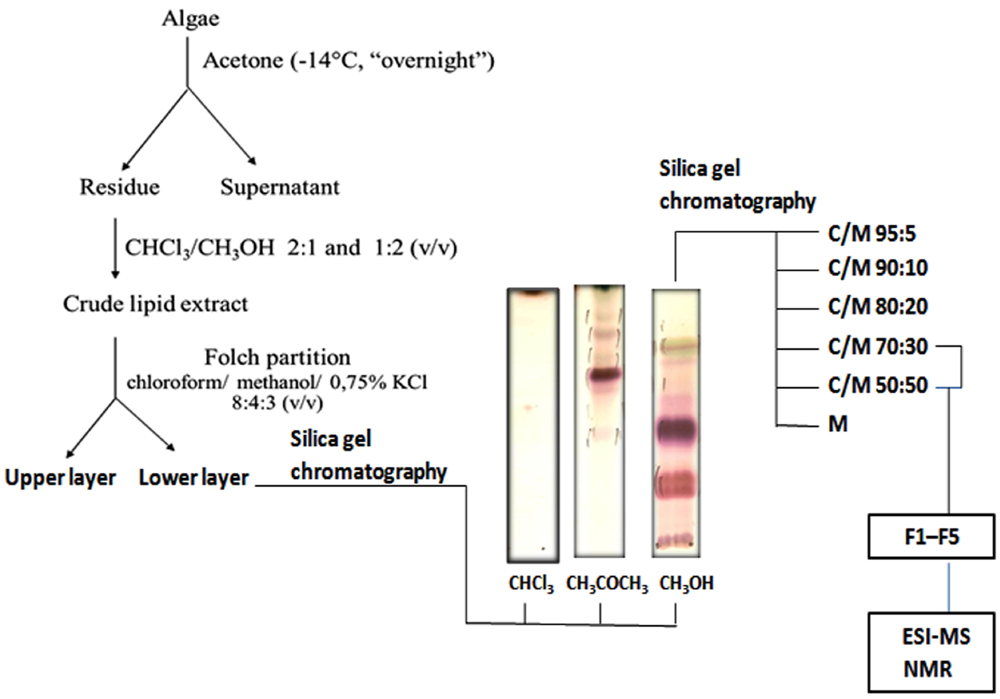
        <p><italic>Osmundaria obtusiloba</italic> was treated with acetone and kept overnight at −14 °C. The acetone insoluble material was successively extracted with chloroform/methanol 2:1 and 1:2 (v/v) at room temperature [<xref ref-type="bibr" rid="B22-marinedrugs-10-00918">22</xref>,<xref ref-type="bibr" rid="B24-marinedrugs-10-00918">24</xref>]. The combined extracts were concentrated in vacuo and the crude lipid fraction was partitioned according to Folch and coworkers [<xref ref-type="bibr" rid="B25-marinedrugs-10-00918">25</xref>]. The lipids recovered from the Folch lower layer, enriched in glycolipids, were fractionated on a silica gel column, eluted with chloroform, acetone and then methanol. <xref ref-type="fig" rid="marinedrugs-10-00918-f001">Figure 1</xref> shows the steps of purification.</p>
        <fig id="marinedrugs-10-00918-f001" position="anchor">
          <label>Figure 1</label>
          <caption>
            <p>Overview of the strategy used for purification of glycolipids from <italic>Osmundaria obtusiloba</italic>. Purified or partially purified fractions are usually resolved by TLC and visualized with iodine and orcinol-H<sub>2</sub>SO<sub>4</sub>. </p>
          </caption>
          <graphic xmlns:xlink="http://www.w3.org/1999/xlink" xlink:href="marinedrugs-10-00918-g001.tif"/>
        </fig>
        <p>Orcinol reactive bands were detected on TLC from fractions eluted with acetone and methanol. A single main spot orcinol-positive was detected in the acetone fraction (F-Ac), whereas at least three positive spots could be visualized on TLC of methanol fraction (F-MeOH). This enriched glycolipid fraction was then purified by a second silica gel chromatography, eluted by a gradient of CHCl<sub>3</sub>/MeOH, increasing the solvent polarity, giving rise to fractions F1–F5 (<xref ref-type="fig" rid="marinedrugs-10-00918-f001">Figure 1</xref>). These fractions were analyzed on TLC plates developed with CHCl<sub>3</sub>:MeOH:2M NH<sub>4</sub>OH (40:10:1 v/v/v) and visualized through iodine vapor and by spraying the plates with orcinol-sulfuric acid [<xref ref-type="bibr" rid="B26-marinedrugs-10-00918">26</xref>]. The partially purified glycolipids were then analyzed by ESI-MS in the positive and negative ionization modes.</p>
      </sec>
      <sec>
        <title>2.2. Mass Spectrometry of Neutral Glycolipids</title>
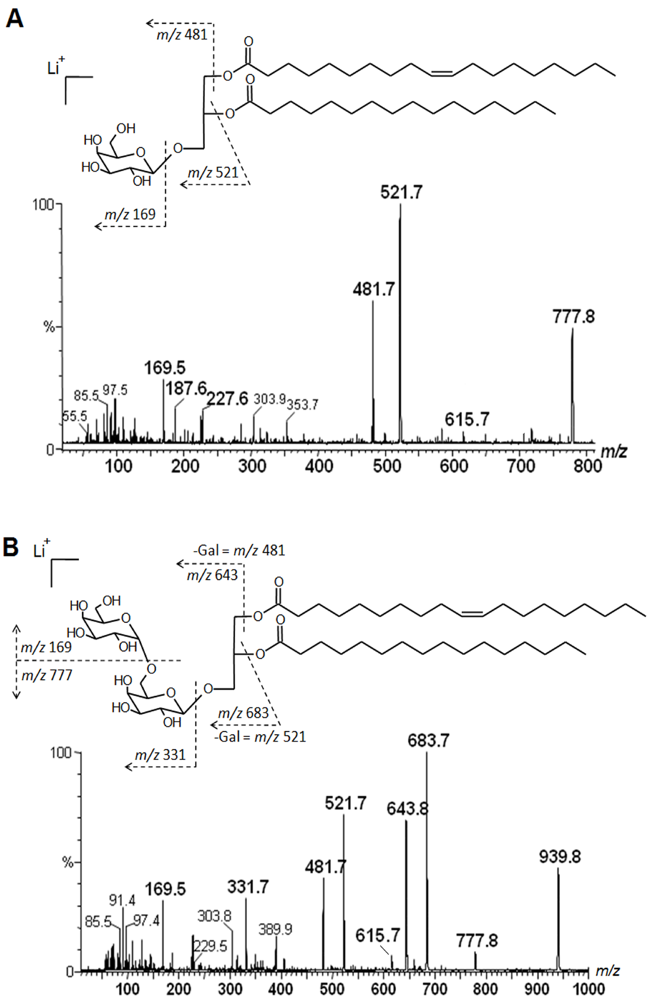
        <p>In order to improve the positive ion detection of neutral lipids, Li<sup>+</sup> (LiCl) was added in the sample solvent, giving the molecules as lithiated ions. The acetone fraction (F-Ac) gave in MS<sup>1</sup> an ion with <italic>m/z</italic> 777 [M + Li]<sup>+</sup>. This was fragmented by CID-MS, giving rise to characteristic spectrum of neutral glyceroglycolipids, with a fragment-ion at <italic>m/z</italic> 615, consistent with a monosaccharide residue loss, those at <italic>m/z</italic> 521 and 481 were consistent with loss of a palmitc acid (C<sub>16:0</sub>) and an unusual nonadecenoic (C<sub>19:1</sub>) acid, respectively. The fragment-ions from glycan moiety appeared at <italic>m/z</italic> 227, 187 and 169 (<xref ref-type="fig" rid="marinedrugs-10-00918-f002">Figure 2</xref>A), thus being consistent with the fragmentation partner of a monogalactosyldiacylglycerol (MGDG) [<xref ref-type="bibr" rid="B27-marinedrugs-10-00918">27</xref>].</p>
        <fig id="marinedrugs-10-00918-f002" position="anchor">
          <label>Figure 2</label>
          <caption>
            <p>(<bold>A</bold>) Tandem-MS and fragmentation profile obtained from lithiated monogalactosyldiacylglycerol, precursor ion at <italic>m/z</italic> 777, from acetone Fraction (F-Ac); (<bold>B</bold>) from lithiated digalactosyldiacylglycerol, precursor ion at <italic>m/z </italic>939, from Fraction 5.</p>
          </caption>
          <graphic xmlns:xlink="http://www.w3.org/1999/xlink" xlink:href="marinedrugs-10-00918-g002.tif"/>
        </fig>
        <p>Fraction 5, an orcinol-positive sub-fraction from F-MeOH, was also analyzed in positive ion mode assisted by Li<sup>+</sup>, giving a main ion at <italic>m/z</italic> 939. These were fragmented giving rise to fragments at <italic>m/z</italic> 777 and a small <italic>m/z</italic> 615, consistent with loss a monosaccharide and a disaccharide, respectively. The fragments at <italic>m/z</italic> 683 and 643 were consistent with loss of a palmitic and a nonadecenoic acid, respectively. The fragments at <italic>m/z</italic> 389, 331, 187 and 169 confirmed the presence of a disaccharide, being this glycolipid consistent with a digalactosyldiacylglycerol (DGDG) [<xref ref-type="bibr" rid="B27-marinedrugs-10-00918">27</xref>,<xref ref-type="bibr" rid="B28-marinedrugs-10-00918">28</xref>]. Other fragments are shown in <xref ref-type="fig" rid="marinedrugs-10-00918-f002">Figure 2</xref>B.</p>
      </sec>
      <sec>
        <title>2.3. Mass Spectrometry of Sulfolipids</title>
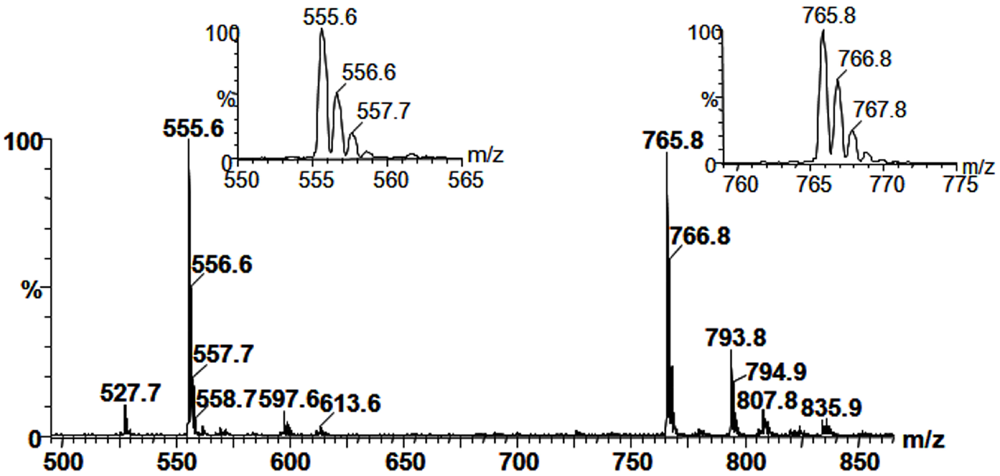
        <p>Fraction 1, a sub-fraction from F-MeOH, gave two positive spots for carbohydrate with lower <italic>R<sub>f</sub></italic> values. Furthermore, the spectrum obtained in negative MS<sup>1</sup> exhibited two main deprotonated ions with <italic>m/z</italic> 555 and 765 [M − H]<sup>−</sup> (<xref ref-type="fig" rid="marinedrugs-10-00918-f003">Figure 3</xref>).</p>
        <fig id="marinedrugs-10-00918-f003" position="anchor">
          <label>Figure 3</label>
          <caption>
            <p>Spectrum from MS<sup>1</sup> obtained in negative ionization mode from Fraction 1. The ion at <italic>m/z</italic> 555 is compatible with the structure of a sulfoquinovosylmonoacylglycerol, whereas the one at <italic>m/z</italic> 765, with sulfoquinovosyldiacylglycerol.</p>
          </caption>
          <graphic xmlns:xlink="http://www.w3.org/1999/xlink" xlink:href="marinedrugs-10-00918-g003.tif"/>
        </fig>
        <p>The distribution of isotopologues was 10:4:1.5 (for <italic>m/z</italic> 555, 556 and 557, respectively) and 10:5:2 (for <italic>m/z</italic> 765, 766 and 767). The high intensity of the heavy isotopologues at <italic>m/z</italic> 557 and 767 is an indicative for the presence of a sulfur element in the molecules [<xref ref-type="bibr" rid="B29-marinedrugs-10-00918">29</xref>], occurring because of the presence of &gt;4% of the heavy isotope (<sup>34</sup>S). In lipid fractions from vegetable sources, the presence of sulfur element added to positive result for carbohydrate strongly suggests the presence of sulfolipids, such as sulfoquinovosyldiacylglycerol (SQDG), a lipid associated with phototrophic organisms [<xref ref-type="bibr" rid="B30-marinedrugs-10-00918">30</xref>,<xref ref-type="bibr" rid="B31-marinedrugs-10-00918">31</xref>].</p>
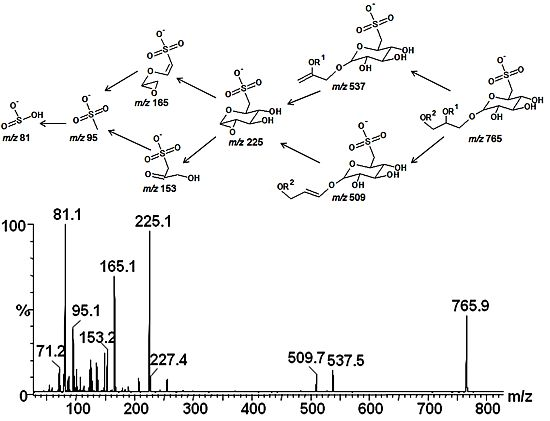
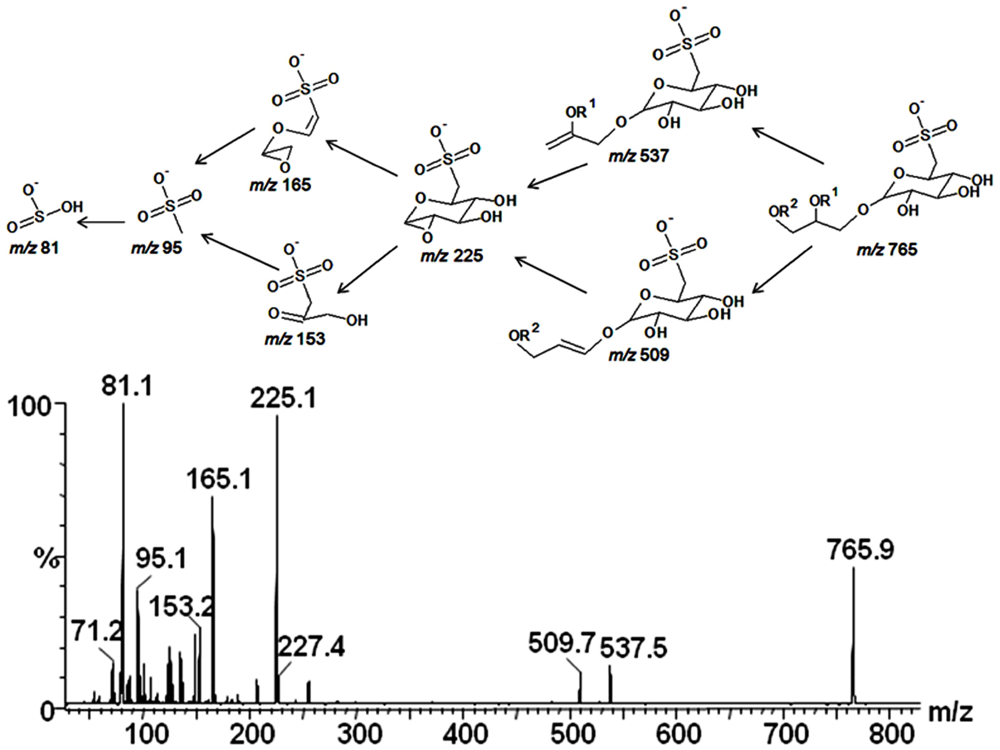
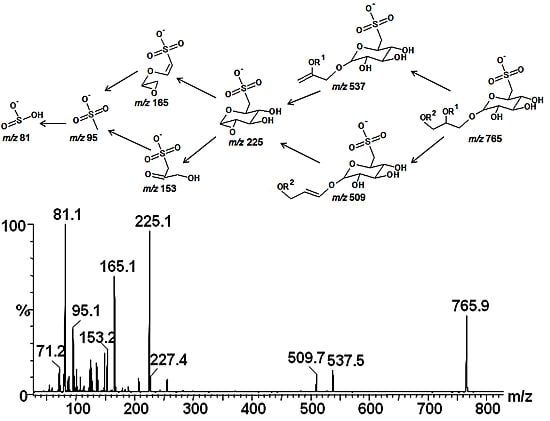
        <p>In order to confirm the structures, the ions at <italic>m/z</italic> 555 and 765 were fragmented by the second stage tandem-MS. The results were consistent with the structure of the sulfoquinovosylmonoacylglycerol (SQMG-<italic>m/z</italic> 555) with a palmitic acid (C<sub>16:0</sub>), as indicated by the presence of fragments at <italic>m/z</italic> 299, 243, 225, 165, 153, 95 and 81, whereas the ion at <italic>m/z</italic> 765 gave fragments at <italic>m/z</italic> 537 (M–C<sub>14:0</sub>), 509 (M–C<sub>16:0</sub>), 225, 165, 153, 95 and 81, as indicated in the fragmentation pathway (<xref ref-type="fig" rid="marinedrugs-10-00918-f004">Figure 4</xref>), being consistent with the SQDG structure, esterified by myristic and palmitic acids. Structures of sulfonoglycolipids are frequently studied by tandem-MS, and the fragments at <italic>m/z</italic> 225, 165, 153, 95 and 81can be considered as diagnostics for 6-deoxy-6-sulfono-hexosyl residue [<xref ref-type="bibr" rid="B6-marinedrugs-10-00918">6</xref>,<xref ref-type="bibr" rid="B28-marinedrugs-10-00918">28</xref>,<xref ref-type="bibr" rid="B32-marinedrugs-10-00918">32</xref>,<xref ref-type="bibr" rid="B33-marinedrugs-10-00918">33</xref>]. </p>
        <fig id="marinedrugs-10-00918-f004" position="anchor">
          <label>Figure 4</label>
          <caption>
            <p>Tandem-MS fingerprint and a proposed fragmentation pathway of sulfoquinovosyldiacylglycerol, precursor ion at <italic>m/z</italic> 765, under collision induced dissociation-mass spectrometry.</p>
          </caption>
          <graphic xmlns:xlink="http://www.w3.org/1999/xlink" xlink:href="marinedrugs-10-00918-g004.tif"/>
        </fig>
        <p>The lower abundant ions in the MS<sup>1</sup> spectrum occurred due to other fatty acids combination, such as that one at <italic>m/z</italic> 793, usually associated with sulfoquinovosyl-dipalmitoylglycerol or myristoyl-steaorylglycerol. Although the structures had been well characterized by MS<sup>2</sup>, the absolute hydroxyl configuration could not be determined by mass spectrometry. Since SQDG (<italic>m/z</italic> 765) was the predominant glycolipid found in Fraction 2, this fraction was used for NMR experiments, such as COSY, TOCSY and HSQC and biological activity as well.</p>
      </sec>
      <sec>
        <title>2.4. NMR Spectroscopy of Sulfolipids</title>
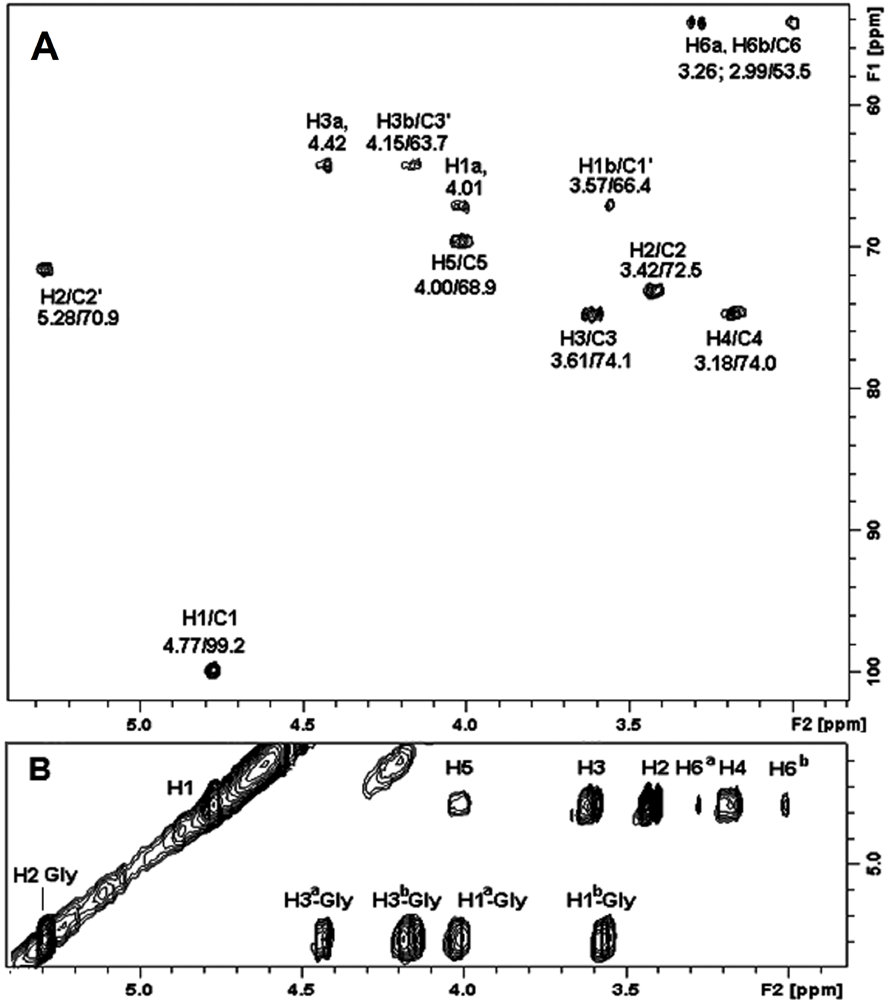
        <p>The structure of the sulfoglycolipid present in fraction 2, was confirmed by <sup>1</sup>H and <sup>13</sup>C NMR analysis, based on HSQC and TOCSY fingerprints [<xref ref-type="bibr" rid="B5-marinedrugs-10-00918">5</xref>,<xref ref-type="bibr" rid="B6-marinedrugs-10-00918">6</xref>]. The chemical shift map was obtained by HSQC and discussed as follows. The HSQC spectrum of glycolipid contained aliphatic signals from δ 22.8 to 34.6 with predominant CH<sub>2</sub> signals at δ 29.9 and CH<sub>3</sub> at δ 14.1. The spectrum suggests the presence of exclusively saturated fatty acids, since no double bond signals were observed at δ 122.0 to 133.0 [<xref ref-type="bibr" rid="B6-marinedrugs-10-00918">6</xref>,<xref ref-type="bibr" rid="B33-marinedrugs-10-00918">33</xref>] and confirms the previous ESI-MS/MS results. The signals of <sup>1</sup>H/<sup>13</sup>C-HSQC and <sup>1</sup>H/<sup>1</sup>H-TOCSY from glycerol were observed at δ 4.009, 3.570/66.4; 5.280/70.9; and 4.417, 4.159/63.5, arising from C-1, C-2, and C-3, respectively (<xref ref-type="fig" rid="marinedrugs-10-00918-f005">Figure 5</xref>A,B).</p>
        <fig id="marinedrugs-10-00918-f005" position="anchor">
          <label>Figure 5</label>
          <caption>
            <p>(<bold>A</bold>) Partial 2D <sup>1</sup>H/<sup>13</sup>C-HSQC fingerprint spectrum of sulfoquinovosyldiacylglycerol in fraction 1, showing the polar region of lipid; (<bold>B</bold>) Partial 2D <sup>1</sup>H/<sup>1</sup>H-TOCSY spectrum, showing the fingerprint region containing the monosaccharide ring connectivity and glycerol moiety of the sulfonoglycolipid.</p>
          </caption>
          <graphic xmlns:xlink="http://www.w3.org/1999/xlink" xlink:href="marinedrugs-10-00918-g005.tif"/>
        </fig>
        <p>On the <sup>1</sup>H/<sup>13</sup>C-HSQC experiment, the anomeric region contained a single signal at δ 4.770/99.2, consistent with α-quinovopyranosyl group. Also, other key <sup>1</sup>H/<sup>13</sup>C-HSQC signals were found at δ 3.267, 2.990/53.5. The presence of doublets of CH<sub>2</sub> signals in a high-field region is characteristic of <italic>S</italic>-substituted C-6, typical of 6-sulfo-α-quinovopyranosyl unit [<xref ref-type="bibr" rid="B5-marinedrugs-10-00918">5</xref>,<xref ref-type="bibr" rid="B6-marinedrugs-10-00918">6</xref>]. In addition, the total hydroxyl connectivity observed in <sup>1</sup>H/<sup>1</sup>H-TOCSY experiment (<xref ref-type="fig" rid="marinedrugs-10-00918-f005">Figure 5</xref>B) confirmed the hydroxyl configuration of a 6-deoxy-α-glucopyranoyl (α-quinovosyl) unit. These results and those from mass spectrometry were very similar to previous findings for sulfonoglycolipids [<xref ref-type="bibr" rid="B4-marinedrugs-10-00918">4</xref>,<xref ref-type="bibr" rid="B5-marinedrugs-10-00918">5</xref>,<xref ref-type="bibr" rid="B6-marinedrugs-10-00918">6</xref>,<xref ref-type="bibr" rid="B7-marinedrugs-10-00918">7</xref>,<xref ref-type="bibr" rid="B34-marinedrugs-10-00918">34</xref>,<xref ref-type="bibr" rid="B35-marinedrugs-10-00918">35</xref>,<xref ref-type="bibr" rid="B36-marinedrugs-10-00918">36</xref>], confirming the lipid identity as 1,2-di-<italic>O</italic>-acyl-3-<italic>O</italic>-(6-deoxy-6-sulfo-α-<sc>D</sc>-glucopyranosyl)-<italic>sn</italic>-glycerol (SQDG).</p>
      </sec>
      <sec>
        <title>2.5. Antiviral Activity</title>
        <p>In a previous study from our group, the antiviral activity of the crude acetone and methanol fractions from a lipid extract of <italic>O.</italic> <italic>obtusiloba</italic> was evaluated and the results have demonstrated that both fractions had potent inhibitory activity against HSV-1 (herpes simplex virus type 1) and present low toxicity for cell cultures [<xref ref-type="bibr" rid="B22-marinedrugs-10-00918">22</xref>]. A better activity was found in the crude methanol fraction. In order to find out which compounds are responsible for this activity, a purified sulfoglycolipid fraction (Fraction 2) was obtained in the present work and the antiviral activity against HSV-1 and HSV-2 (herpes simplex virus type 2) was measured (<xref ref-type="table" rid="marinedrugs-10-00918-t001">Table 1</xref>).</p>
        <table-wrap id="marinedrugs-10-00918-t001" position="anchor">
          <object-id pub-id-type="pii">marinedrugs-10-00918-t001_Table 1</object-id>
          <label>Table 1</label>
          <caption>
            <p>Cytotoxicity and antiviral activity of fraction 2 from <italic>Osmundaria obtusiloba</italic> and acyclovir.</p>
          </caption>
          <table>
            <thead>
              <tr>
                <th align="center" valign="middle"> </th>
                <th align="center" valign="middle"> </th>
                <th align="center" valign="middle"> </th>
                <th colspan="3" align="center" valign="middle">HSV-1</th>
                <th colspan="3" align="center" valign="middle">HSV-2</th>
              </tr>
              <tr>
                <th align="center" valign="middle">Compounds</th>
                <th align="center" valign="middle">MNTC (µg/mL)</th>
                <th align="center" valign="middle">CC50 (µg/mL)</th>
                <th align="center" valign="middle" style="border-top: solid thin">PI</th>
                <th align="center" valign="middle" style="border-top: solid thin">EC50 (µg/mL)</th>
                <th align="center" valign="middle" style="border-top: solid thin">SI</th>
                <th align="center" valign="middle" style="border-top: solid thin">PI</th>
                <th align="center" valign="middle" style="border-top: solid thin">EC50 (µg/mL)</th>
                <th align="center" valign="middle" style="border-top: solid thin">SI</th>
              </tr>
            </thead>
            <tbody>
              <tr>
                <td align="left" valign="middle">Fraction 2 <italic>O. obtusiloba</italic></td>
                <td align="center" valign="middle">50</td>
                <td align="center" valign="middle">72</td>
                <td align="center" valign="middle">75</td>
                <td align="center" valign="middle">42</td>
                <td align="center" valign="middle">1.7</td>
                <td align="center" valign="middle">96</td>
                <td align="center" valign="middle">12</td>
                <td align="center" valign="middle">6.0</td>
              </tr>
              <tr>
                <td align="left" valign="middle">Acyclovir</td>
                <td align="center" valign="middle">200</td>
                <td align="center" valign="middle">&gt;200</td>
                <td align="center" valign="middle">99</td>
                <td align="center" valign="middle">0.8</td>
                <td align="center" valign="middle">&gt;250</td>
                <td align="center" valign="middle">99</td>
                <td align="center" valign="middle">1.38</td>
                <td align="center" valign="middle">&gt;145</td>
              </tr>
            </tbody>
          </table>
        </table-wrap>
        <p>HSV-1, herpes simplex virus type 1; HSV-2, herpes simplex virus type 2; MNTC, maximum non-toxic concentration; CC<sub>50</sub>, 50% cytotoxic concentration; PI, percentage of inhibition; EC<sub>50</sub>, effective concentration to reduce virus titers by 50%; SI, selectivity index. Acyclovir, standard compound.</p>
        <p>Our results showed a reduction in the antiviral activity of the purified glycolipid (75%) when compared with the crude methanol fraction (99.5%) [<xref ref-type="bibr" rid="B22-marinedrugs-10-00918">22</xref>]. The somewhat higher activity of the crude methanol fraction relative to the purified fraction 2 occurred, presumably, as a result of the absence of other polar lipids in this fraction , such as MGDG and DGDG, which can trigger a synergic effect. These results suggest the importance of both glycolipids (glycoglycerolipids and sulfoglycolipids) in the antiviral activity. The anti-HSV activity of glycolipids extracted from seaweed has been demonstrated [<xref ref-type="bibr" rid="B19-marinedrugs-10-00918">19</xref>,<xref ref-type="bibr" rid="B20-marinedrugs-10-00918">20</xref>,<xref ref-type="bibr" rid="B21-marinedrugs-10-00918">21</xref>,<xref ref-type="bibr" rid="B22-marinedrugs-10-00918">22</xref>]. El-Baroty and coworkers showed that glycolipid isolated from the brown alga <italic>Dilophys fasciola</italic> was able to block the viral infectivity by interacting with HSV-1 glycoprotein [<xref ref-type="bibr" rid="B22-marinedrugs-10-00918">22</xref>]. Studies will be conducted to determine the mechanism of action of sulfoglycolipid from <italic>O. obtusiloba</italic>. DGDG and SQDG from <italic>O. obtusiloba</italic> identified in this present work have been previously detected in other red algae <italic>Hypnea musciformis</italic>, <italic>Porphyra acanthophora</italic>, <italic>Pterocladiella capillacea</italic>, the brown alga <italic>Dictyota menstrualis </italic>and <italic>D. cervicomis </italic>and in the green alga <italic>Caulerpa racemosa</italic> [<xref ref-type="bibr" rid="B22-marinedrugs-10-00918">22</xref>], confirming that these glycolipids are conserved molecules in green, red and brown algae isolated from the Southeastern Brazilian coast [<xref ref-type="bibr" rid="B22-marinedrugs-10-00918">22</xref>].</p>
      </sec>
    </sec>
    <sec>
      <title>3. Experimental Section</title>
      <sec>
        <title>3.1. Biological Material</title>
        <p><italic>Osmundaria obtusiloba</italic> (C. Agardh) R. E. Norris (Rhodophyta-Fam. Rhodomelaceae) was collected at Praia Rasa, (22°44′3.15″S, 41°57′30.15″O), located at the city of Buzios, Rio de Janeiro, Brazil. The seaweed was washed with local sea water and separated from sediments, epiphytes and other associated organisms.</p>
      </sec>
      <sec>
        <title>3.2. Extraction and Fractionation of Lipids</title>
        <p><italic>Osmundaria obtusiloba</italic> was treated with acetone and kept overnight at −14 °C. The acetone insoluble material was successively extracted at room temperature with chloroform/methanol 2:1 and 1:2 (v/v). Extracts were combined, dried and the crude lipid extract was partitioned according to Folch and coworkers [<xref ref-type="bibr" rid="B25-marinedrugs-10-00918">25</xref>]. The lipids recovered from the Folch lower phase were fractionated on a silica gel column eluted with cloroform, acetone and then methanol. The methanol fraction containing the glycolipids was further purified on a silica gel column, which was sequentially eluted with chloroform/methanol with increasing concentrations of methanol (95:5, 90:10, 80:20, 70:30, 50:50, v/v) and finally with 100% methanol. Fractions eluted with chloroform/methanol 70:30 and 50:50 (v/v) yielded partially purified glycolipid fractions F1 to F5. These fractions were analysed by TLC, developed with CHCl<sub>3</sub>:CH<sub>3</sub>OH:2M NH<sub>4</sub>OH (40:10:1 v/v/v) and the spots visualized with iodine and by spraying with orcinol/H<sub>2</sub>SO<sub>4</sub> [<xref ref-type="bibr" rid="B26-marinedrugs-10-00918">26</xref>]. Fraction 2, was further purified by preparative TLC, yielding a purified glycolipid fraction.</p>
      </sec>
      <sec>
        <title>3.3. Mass Spectrometry</title>
        <p>The MS analysis was carried out in an electrospray ionization mass spectrometry (ESI-MS), model Quattro-LC (Waters) with a triple-quadrupole mass analyzer, operating at atmospheric pressure ionization (API), assisted by a syringe pump (KDScientific) for sample infusion. Nitrogen was used as nebulizing and desovation gas and the ionization energies were 50 V on the cone and 2 kV on the capillary, operating in the negative ionization mode or 80 V (cone) and 2.5 kV (capillary) when operating in the positive ionization mode. The second stage tandem-MS was obtained by collision induced dissociation mass spectrometry (CID-MS) using argon as collision gas and collision energies ranging between 35–60 eV. The samples were prepared in MeOH at 1 mg/mL, then diluted to 0.1 mg/mL in MeOH-H<sub>2</sub>O (7:3, v/v) containing 1 mM LiCl, for the positive ion detection, and direct infused into ESI source, at a flow rate of 10 µL/min.</p>
      </sec>
      <sec>
        <title>3.4. Nuclear Magnetic Resonance</title>
        <p>The glycolipid component of F2 was deuterium exchanged by repeated dissolution in MeOD–D<sub>2</sub>O (2:1 v/v) and freeze-drying. The spectra were obtained from solutions of MeOD–CDCl<sub>3</sub> (1:1) at 30 °C, using TMS (tetramethylsilane) as reference standard (δ = 0). All spectra were obtained with a Bruker 400 MHz AVANCE <italic>III</italic> NMR spectrometer with a 5 mm inverse gradient probe. 2D-NMR experiments were carried out using HSQC, COSY and TOCSY. The experiments were recorded for quadrature detection in the indirect dimension, edited-HSQC spectra were acquired using 128 scans per series of 1 K × 256 W data points with zero filling in F1 (4 K) prior to Fourier transformation [<xref ref-type="bibr" rid="B37-marinedrugs-10-00918">37</xref>].</p>
      </sec>
      <sec>
        <title>3.5. Cells and Viruses</title>
        <p>Vero cells (African green monkey kidney) were grown in Eagle’s minimum essential medium (Eagle-MEM) and supplemented with 10% (v/v) fetal bovine serum, glutamine (2 mM), garamycin (50 µg/mL), fungizone (amphotericin B) (2.5 µg/mL), NaHCO<sub>3</sub> (0.25%) and HEPES (10 mM). HSV-1 was isolated from a typical lip lesion and HSV-2 from a typical genital lesion in the Virology Department of the Federal University of Rio de Janeiro (UFRJ), Brazil. Viruses were typed by polymerase chain reaction (PCR) using specific primers for identification [<xref ref-type="bibr" rid="B38-marinedrugs-10-00918">38</xref>].</p>
      </sec>
      <sec>
        <title>3.6. Cytotoxicity Assay</title>
        <p>The cytotoxicity of glycolipids was performed by incubating Vero (African green monkey kidney cell) cell line monolayers cultivated in 96-well microplates with two-fold serial dilutions (200–3.1 µg/mL) of the SQDG (F-2) for 48 h at 37 °C in a 5% CO<sub>2</sub> atmosphere. Cellular viability was evaluated by the neutral red dye-uptake method [<xref ref-type="bibr" rid="B39-marinedrugs-10-00918">39</xref>]. The 50% cytotoxic concentration (CC<sub>50</sub>) was deﬁned as the SQDG concentration which caused a 50% reduction in the number of viable cells.</p>
      </sec>
      <sec>
        <title>3.7. Antiviral Activity Assay</title>
        <p>The antiviral activity of SQDG and acyclovir was evaluated by the titer reduction. The virus titers were calculated using the Reed and Muench statistical method [<xref ref-type="bibr" rid="B40-marinedrugs-10-00918">40</xref>] and expressed as 50% tissue culture infective dose (TCID<sub>50</sub>) per mL. Vero cell monolayers were treated with the SQDG and acyclovir at the MNTC and 100 TCID<sub>50</sub>/mL of HSV-1 or HSV-2 suspensions were added to treated and untreated cell cultures and incubated at 37 °C for 48 h in a 5% CO<sub>2</sub> atmosphere. After incubation, the supernatant was collected and virus titers in treated and untreated cells were determined. The antiviral activity was expressed as percentage of inhibition (PI) [<xref ref-type="bibr" rid="B41-marinedrugs-10-00918">41</xref>] using antilogarithmic TCID<sub>50</sub> values as follows: PI = [1 − (antilogarithmic test value/antilogarithmic control value)] × 100. The dose-response curve was established starting from the MNTC (50–0.78 µg/mL to SQDG and 200–0.2 µg/mL to acyclovir) and the 50% effective concentration (EC<sub>50</sub>) was defined as the concentration required for 50% protection against virus induced cytopathic effects. The selectivity index (SI) was determined as the ratio of CC<sub>50</sub> to EC<sub>50</sub>.</p>
      </sec>
    </sec>
    <sec sec-type="conclusions">
      <title>4. Conclusions</title>
      <p>SQDG molecules have been isolated for the first time from the red alga <italic>Osmundaria obtusiloba</italic> and their structure elucidated by ESI-MS/MS and <sup>1</sup>H and <sup>13</sup>C NMR analysis, based on HSQC and TOCSY fingerprints. MGDG and DGDG have also been identified on the basis of electrospray ionization tandem MS/MS spectrometry. We also demonstrated that SGDG had potent antiviral activity against HSV-1 and HSV-2 and present low toxicity for cell cultures. Although acyclovir has shown better activity, the inhibitory effect in different steps of viral infection is a desirable feature allowing a more efficient action and preventing the emergence of resistance strains. The identification of the chemical structure of algae glycolipids could contribute for a better understanding of the relation between these structures and biological activities.</p>
    </sec>

  </body>
  <back>
    <ack>
    <title>Acknowledgments</title>
      <p>We thank Yocie Yoneshigue Valentin for the macroalgae and Maria de Fátima F. Soares for technical assistance. This work was supported by grants from the Brazilian agencies Fundação Araucária, FINEP (PRONEX-CARBOIDRATOS, PADCT II/SBIO), CAPES (Coordenação de Aperfeiçoamento de Pessoal de Nível Superior), Conselho Nacional de Desenvolvimento Científico e Tecnológico (CNPq), FAPERJ (Fundação de Amparo a Pesquisa do Estado do Rio de Janeiro) and Universidade Federal do Rio de Janeiro (UFRJ).</p>
      
    </ack>
    <fn-group><fn><p><italic>Samples Availability</italic>: Available from the authors.</p></fn></fn-group>
    <ref-list>
      <title>References</title>
      <ref id="B1-marinedrugs-10-00918">
        <label>1.</label>
        <citation citation-type="journal">
          <person-group person-group-type="author">
            <name>
              <surname>Sanina</surname>
              <given-names>N.M.</given-names>
            </name>
            <name>
              <surname>Goncharova</surname>
              <given-names>S.N.</given-names>
            </name>
            <name>
              <surname>Kostetsky</surname>
              <given-names>E.Y.</given-names>
            </name>
          </person-group>
          <article-title>Fatty acid composition of individual polar lipid classes from marine macrophytes</article-title>
          <source>Phytochemistry</source>
          <year>2004</year>
          <volume>65</volume>
          <fpage>721</fpage>
          <lpage>730</lpage>
        <pub-id pub-id-type="doi">10.1016/j.phytochem.2004.01.013</pub-id><pub-id pub-id-type="pmid">15016568</pub-id></citation>
      </ref>
      <ref id="B2-marinedrugs-10-00918">
        <label>2.</label>
        <citation citation-type="journal">
          <person-group person-group-type="author">
            <name>
              <surname>Kim</surname>
              <given-names>Y.H.</given-names>
            </name>
            <name>
              <surname>Kim</surname>
              <given-names>E.H.</given-names>
            </name>
            <name>
              <surname>Lee</surname>
              <given-names>C.</given-names>
            </name>
            <name>
              <surname>Kim</surname>
              <given-names>M.H.</given-names>
            </name>
            <name>
              <surname>Rho</surname>
              <given-names>J.R.</given-names>
            </name>
          </person-group>
          <article-title>Two new monogalactosyl diacylglycerols from brown alga <italic>Sargassum thunbergii</italic></article-title>
          <source>Lipids</source>
          <year>2007</year>
          <volume>42</volume>
          <fpage>395</fpage>
          <lpage>399</lpage>
        <pub-id pub-id-type="doi">10.1007/s11745-007-3035-7</pub-id><pub-id pub-id-type="pmid">17406933</pub-id></citation>
      </ref>
      <ref id="B3-marinedrugs-10-00918">
        <label>3.</label>
        <citation citation-type="journal">
          <person-group person-group-type="author">
            <name>
              <surname>Illijas</surname>
              <given-names>M.I.</given-names>
            </name>
            <name>
              <surname>Indy</surname>
              <given-names>J.R.</given-names>
            </name>
            <name>
              <surname>Yasui</surname>
              <given-names>H.</given-names>
            </name>
            <name>
              <surname>Itabashi</surname>
              <given-names>Y.</given-names>
            </name>
          </person-group>
          <article-title>Lipid class and fatty acid composition of a little-known and rarely collected alga <italic>Exophyllum wentii</italic> Weber-van Bosse from Bali Island, Indonesia</article-title>
          <source>J. Oleo Sci.</source>
          <year>2009</year>
          <volume>58</volume>
          <fpage>103</fpage>
          <lpage>110</lpage>
        <pub-id pub-id-type="doi">10.5650/jos.58.103</pub-id><pub-id pub-id-type="pmid">19202307</pub-id></citation>
      </ref>
      <ref id="B4-marinedrugs-10-00918">
        <label>4.</label>
        <citation citation-type="journal">
          <person-group person-group-type="author">
            <name>
              <surname>Al-Fadhli</surname>
              <given-names>A.</given-names>
            </name>
            <name>
              <surname>Wahidulla</surname>
              <given-names>S.</given-names>
            </name>
            <name>
              <surname>D’Souza</surname>
              <given-names>L.</given-names>
            </name>
          </person-group>
          <article-title>Glycolipids from the red alga <italic>Chondria armata</italic> (Kutz.) Okamura</article-title>
          <source>Glycobiology</source>
          <year>2006</year>
          <volume>16</volume>
          <fpage>902</fpage>
          <lpage>915</lpage>
          <pub-id pub-id-type="doi">10.1093/glycob/cwl018</pub-id>
        </citation>
      </ref>
      <ref id="B5-marinedrugs-10-00918">
        <label>5.</label>
        <citation citation-type="journal">
          <person-group person-group-type="author">
            <name>
              <surname>Sassaki</surname>
              <given-names>G.L.</given-names>
            </name>
            <name>
              <surname>Gorin</surname>
              <given-names>P.A.J.</given-names>
            </name>
            <name>
              <surname>Tischer</surname>
              <given-names>C.A.</given-names>
            </name>
            <name>
              <surname>Iacomini</surname>
              <given-names>M.</given-names>
            </name>
          </person-group>
          <article-title>Sulfonoglycolipids from the lichenized basidiomycete <italic>Dictyonema glabratum</italic>: Isolation, NMR, and ESI-MS approaches</article-title>
          <source>Glycobiology</source>
          <year>2001</year>
          <volume>11</volume>
          <fpage>345</fpage>
          <lpage>351</lpage>
        <pub-id pub-id-type="doi">10.1093/glycob/11.4.345</pub-id><pub-id pub-id-type="pmid">11358883</pub-id></citation>
      </ref>
      <ref id="B6-marinedrugs-10-00918">
        <label>6.</label>
        <citation citation-type="journal">
          <person-group person-group-type="author">
            <name>
              <surname>Souza</surname>
              <given-names>L.M.</given-names>
            </name>
            <name>
              <surname>Iacomini</surname>
              <given-names>M.</given-names>
            </name>
            <name>
              <surname>Gorin</surname>
              <given-names>P.A.J.</given-names>
            </name>
            <name>
              <surname>Sari</surname>
              <given-names>R.S.</given-names>
            </name>
            <name>
              <surname>Haddad</surname>
              <given-names>M.A.</given-names>
            </name>
            <name>
              <surname>Sassaki</surname>
              <given-names>G.L.</given-names>
            </name>
          </person-group>
          <article-title>Glyco- and sphingophosphonolipids from the medusa <italic>Phyllorhiza punctata</italic>: NMR and ESI-MS/MS fingerprints</article-title>
          <source>Chem. Phys. Lipids</source>
          <year>2007</year>
          <volume>145</volume>
          <fpage>85</fpage>
          <lpage>96</lpage>
        <pub-id pub-id-type="doi">10.1016/j.chemphyslip.2006.11.001</pub-id><pub-id pub-id-type="pmid">17174289</pub-id></citation>
      </ref>
      <ref id="B7-marinedrugs-10-00918">
        <label>7.</label>
        <citation citation-type="journal">
          <person-group person-group-type="author">
            <name>
              <surname>Gustafson</surname>
              <given-names>K.R.</given-names>
            </name>
            <name>
              <surname>Cardellina</surname>
              <given-names>J.H.</given-names>
            </name>
            <name>
              <surname>Fuller</surname>
              <given-names>R.W.</given-names>
            </name>
            <name>
              <surname>Weislow</surname>
              <given-names>O.W.</given-names>
            </name>
            <name>
              <surname>Kiser</surname>
              <given-names>R.F.</given-names>
            </name>
            <name>
              <surname>Snader</surname>
              <given-names>K.M.</given-names>
            </name>
            <name>
              <surname>Patterson</surname>
              <given-names>G.M.L.</given-names>
            </name>
            <name>
              <surname>Boyd</surname>
              <given-names>M.R.</given-names>
            </name>
          </person-group>
          <article-title>AIDS-antiviral sulfolipids from cyanobacteria (blue-green algae)</article-title>
          <source>J. Nat. Cancer Inst.</source>
          <year>1989</year>
          <volume>81</volume>
          <fpage>1254</fpage>
          <lpage>1258</lpage>
        <pub-id pub-id-type="doi">10.1093/jnci/81.16.1254</pub-id><pub-id pub-id-type="pmid">2502635</pub-id></citation>
      </ref>
      <ref id="B8-marinedrugs-10-00918">
        <label>8.</label>
        <citation citation-type="journal">
          <person-group person-group-type="author">
            <name>
              <surname>Reshef</surname>
              <given-names>V.</given-names>
            </name>
            <name>
              <surname>Mizrachi</surname>
              <given-names>E.</given-names>
            </name>
            <name>
              <surname>Maretzki</surname>
              <given-names>T.</given-names>
            </name>
            <name>
              <surname>Silberstein</surname>
              <given-names>C.</given-names>
            </name>
            <name>
              <surname>Loya</surname>
              <given-names>S.</given-names>
            </name>
            <name>
              <surname>Hizi</surname>
              <given-names>A.</given-names>
            </name>
            <name>
              <surname>Carmeli</surname>
              <given-names>S.</given-names>
            </name>
          </person-group>
          <article-title>New acylated sulfoglycolipids and digalactolipids and related known glycolipids from cyanobacteria with a potential to inhibit the reverse transcriptase of HIV-1</article-title>
          <source>J. Nat. Prod.</source>
          <year>1997</year>
          <volume>60</volume>
          <fpage>1251</fpage>
          <lpage>1260</lpage>
        <pub-id pub-id-type="doi">10.1021/np970327m</pub-id><pub-id pub-id-type="pmid">9428159</pub-id></citation>
      </ref>
      <ref id="B9-marinedrugs-10-00918">
        <label>9.</label>
        <citation citation-type="journal">
          <person-group person-group-type="author">
            <name>
              <surname>Morimoto</surname>
              <given-names>T.</given-names>
            </name>
            <name>
              <surname>Nagatsu</surname>
              <given-names>A.</given-names>
            </name>
            <name>
              <surname>Murakami</surname>
              <given-names>N.</given-names>
            </name>
            <name>
              <surname>Sakakibara</surname>
              <given-names>J.</given-names>
            </name>
            <name>
              <surname>Tokuda</surname>
              <given-names>H.</given-names>
            </name>
            <name>
              <surname>Nishimo</surname>
              <given-names>H.</given-names>
            </name>
            <name>
              <surname>Iwashima</surname>
              <given-names>A.</given-names>
            </name>
          </person-group>
          <article-title>Antitumor promoting glyceroglycolipids from the green alga <italic>Chlorella vulgaris</italic></article-title>
          <source>Phytochemistry</source>
          <year>1995</year>
          <volume>40</volume>
          <fpage>1433</fpage>
          <lpage>1437</lpage>
        <pub-id pub-id-type="doi">10.1016/0031-9422(95)00458-J</pub-id><pub-id pub-id-type="pmid">8534400</pub-id></citation>
      </ref>
      <ref id="B10-marinedrugs-10-00918">
        <label>10.</label>
        <citation citation-type="journal">
          <person-group person-group-type="author">
            <name>
              <surname>Ohta</surname>
              <given-names>K.</given-names>
            </name>
            <name>
              <surname>Mizushina</surname>
              <given-names>Y.</given-names>
            </name>
            <name>
              <surname>Hirata</surname>
              <given-names>N.</given-names>
            </name>
            <name>
              <surname>Takemura</surname>
              <given-names>M.</given-names>
            </name>
            <name>
              <surname>Sugawara</surname>
              <given-names>F.</given-names>
            </name>
            <name>
              <surname>Matsukage</surname>
              <given-names>A.</given-names>
            </name>
            <name>
              <surname>Yoshida</surname>
              <given-names>S.</given-names>
            </name>
            <name>
              <surname>Sakaguchi</surname>
              <given-names>K.</given-names>
            </name>
          </person-group>
          <article-title>Sulfoquinovosyldiacylglycerol, KM043, a new potent inhibitor of eukaryotic DNA polymerases and HIV-reverse transcriptase type 1 from a marine red alga, <italic>Gigartina tenella</italic></article-title>
          <source>Chem. Pharm. Bull. (Tokyo)</source>
          <year>1998</year>
          <volume>46</volume>
          <fpage>684</fpage>
          <lpage>686</lpage>
          <pub-id pub-id-type="doi">10.1248/cpb.46.684</pub-id>
        </citation>
      </ref>
      <ref id="B11-marinedrugs-10-00918">
        <label>11.</label>
        <citation citation-type="journal">
          <person-group person-group-type="author">
            <name>
              <surname>Naumann</surname>
              <given-names>I.</given-names>
            </name>
            <name>
              <surname>Darsow</surname>
              <given-names>K.H.</given-names>
            </name>
            <name>
              <surname>Walter</surname>
              <given-names>C.</given-names>
            </name>
            <name>
              <surname>Lange</surname>
              <given-names>H.A.</given-names>
            </name>
            <name>
              <surname>Buchholz</surname>
              <given-names>R.</given-names>
            </name>
          </person-group>
          <article-title>Identification of sulfoglycolipids from the alga <italic>Porphyridium purpureum</italic> by matrix-assisted laser desorption/ionisation quadrupole ion trap time of-flight mass spectrometry</article-title>
          <source>Rapid Commun. Mass Spectrom.</source>
          <year>2007</year>
          <volume>21</volume>
          <fpage>3185</fpage>
          <lpage>3192</lpage>
        <pub-id pub-id-type="doi">10.1002/rcm.3190</pub-id><pub-id pub-id-type="pmid">17768704</pub-id></citation>
      </ref>
      <ref id="B12-marinedrugs-10-00918">
        <label>12.</label>
        <citation citation-type="journal">
          <person-group person-group-type="author">
            <name>
              <surname>Damonte</surname>
              <given-names>E.B.</given-names>
            </name>
            <name>
              <surname>Matulewicz</surname>
              <given-names>M.C.</given-names>
            </name>
            <name>
              <surname>Cerezo</surname>
              <given-names>A.S.</given-names>
            </name>
            <name>
              <surname>Coto</surname>
              <given-names>C.E.</given-names>
            </name>
          </person-group>
          <article-title>Herpes simplex virus-inhibitory sulfated xylogalactans from the red seaweed <italic>Nothogenia fastigiata</italic></article-title>
          <source>Exp. Chemoter.</source>
          <year>1996</year>
          <volume>42</volume>
          <fpage>57</fpage>
          <lpage>64</lpage>
        </citation>
      </ref>
      <ref id="B13-marinedrugs-10-00918">
        <label>13.</label>
        <citation citation-type="journal">
          <person-group person-group-type="author">
            <name>
              <surname>Witvrouw</surname>
              <given-names>M.</given-names>
            </name>
            <name>
              <surname>de Clercq</surname>
              <given-names>E.</given-names>
            </name>
          </person-group>
          <article-title>Sulfated polysaccharides extracted from sea algae as potential antiviral drugs</article-title>
          <source>Gen. Pharm.</source>
          <year>1997</year>
          <volume>29</volume>
          <fpage>497</fpage>
          <lpage>511</lpage>
        <pub-id pub-id-type="doi">10.1016/S0306-3623(96)00563-0</pub-id></citation>
      </ref>
      <ref id="B14-marinedrugs-10-00918">
        <label>14.</label>
        <citation citation-type="journal">
          <person-group person-group-type="author">
            <name>
              <surname>Carlucci</surname>
              <given-names>M.J.</given-names>
            </name>
            <name>
              <surname>Ciancia</surname>
              <given-names>M.</given-names>
            </name>
            <name>
              <surname>Matulewicz</surname>
              <given-names>M.C.</given-names>
            </name>
            <name>
              <surname>Cerezo</surname>
              <given-names>A.S.</given-names>
            </name>
            <name>
              <surname>Damonte</surname>
              <given-names>E.B.</given-names>
            </name>
          </person-group>
          <article-title>Antiherpetic activity and mode of action of natural carrageenans of diverse structural types</article-title>
          <source>Antiviral Res.</source>
          <year>1999</year>
          <volume>43</volume>
          <fpage>93</fpage>
          <lpage>102</lpage>
        <pub-id pub-id-type="doi">10.1016/S0166-3542(99)00038-8</pub-id><pub-id pub-id-type="pmid">10517311</pub-id></citation>
      </ref>
      <ref id="B15-marinedrugs-10-00918">
        <label>15.</label>
        <citation citation-type="journal">
          <person-group person-group-type="author">
            <name>
              <surname>Duarte</surname>
              <given-names>M.E.R.</given-names>
            </name>
            <name>
              <surname>Noseda</surname>
              <given-names>D.G.</given-names>
            </name>
            <name>
              <surname>Noseda</surname>
              <given-names>M.D.</given-names>
            </name>
            <name>
              <surname>Tulio</surname>
              <given-names>S.</given-names>
            </name>
            <name>
              <surname>Pujol</surname>
              <given-names>C.A.</given-names>
            </name>
            <name>
              <surname>Damonte</surname>
              <given-names>E.B. </given-names>
            </name>
          </person-group>
          <article-title>Inhibitory effect of sulfated galactans from the marine alga <italic>Bostrychia montagnei</italic> on herpes simplex virus replication <italic>in vitro</italic></article-title>
          <source>Phytomedicine</source>
          <year>2001</year>
          <volume>8</volume>
          <fpage>53</fpage>
          <lpage>58</lpage>
          <pub-id pub-id-type="doi">10.1078/0944-7113-00007</pub-id>
        </citation>
      </ref>
      <ref id="B16-marinedrugs-10-00918">
        <label>16.</label>
        <citation citation-type="journal">
          <person-group person-group-type="author">
            <name>
              <surname>Romanos</surname>
              <given-names>M.T.V.</given-names>
            </name>
            <name>
              <surname>Andrada-Serpa</surname>
              <given-names>M.J.</given-names>
            </name>
            <name>
              <surname>Mourão</surname>
              <given-names>P.A.S.</given-names>
            </name>
            <name>
              <surname>Yoneshigue-Valentin</surname>
              <given-names>Y.</given-names>
            </name>
            <name>
              <surname>Costa</surname>
              <given-names>S.S.</given-names>
            </name>
            <name>
              <surname>Pereira</surname>
              <given-names>M.S.</given-names>
            </name>
            <name>
              <surname>Miranda</surname>
              <given-names>M.M.F.S.</given-names>
            </name>
            <name>
              <surname>Gonçalves</surname>
              <given-names>J.L.S.</given-names>
            </name>
            <name>
              <surname>Wigg</surname>
              <given-names>M.D.</given-names>
            </name>
          </person-group>
          <article-title>A sulphated fucan from the <italic>Laminaria abyssalis</italic> inhibits the human T cell lymphotropic virus type 1-induced syncytium formation in HeLa cells</article-title>
          <source>Antivir. Chem. Chemother.</source>
          <year>2002</year>
          <volume>13</volume>
          <fpage>219</fpage>
          <lpage>221</lpage>
        <pub-id pub-id-type="pmid">12495209</pub-id></citation>
      </ref>
      <ref id="B17-marinedrugs-10-00918">
        <label>17.</label>
        <citation citation-type="journal">
          <person-group person-group-type="author">
            <name>
              <surname>Duarte</surname>
              <given-names>M.E.R.</given-names>
            </name>
            <name>
              <surname>Cauduro</surname>
              <given-names>J.P.</given-names>
            </name>
            <name>
              <surname>Noseda</surname>
              <given-names>D.G.</given-names>
            </name>
            <name>
              <surname>Noseda</surname>
              <given-names>M.D.</given-names>
            </name>
            <name>
              <surname>Gonçalves</surname>
              <given-names>A.G.</given-names>
            </name>
            <name>
              <surname>Pujol</surname>
              <given-names>C.A.</given-names>
            </name>
            <name>
              <surname>Damonte</surname>
              <given-names>E.B.</given-names>
            </name>
            <name>
              <surname>Cerezo</surname>
              <given-names>A.S.</given-names>
            </name>
          </person-group>
          <article-title>The structure of the agaran sulfate from <italic>Acanthophora spicifera</italic> (Rhodomelaceae, Ceramiales) and its antiviral activity. Relation between structure and antiviral activity in agarans</article-title>
          <source>Carbohydr. Res.</source>
          <year>2004</year>
          <volume>339</volume>
          <fpage>335</fpage>
          <lpage>347</lpage>
          <pub-id pub-id-type="doi">10.1016/j.carres.2003.09.028</pub-id>
        </citation>
      </ref>
      <ref id="B18-marinedrugs-10-00918">
        <label>18.</label>
        <citation citation-type="journal">
          <person-group person-group-type="author">
            <name>
              <surname>Talarico</surname>
              <given-names>L.B.</given-names>
            </name>
            <name>
              <surname>Pujol</surname>
              <given-names>C.A.</given-names>
            </name>
            <name>
              <surname>Zibetti</surname>
              <given-names>R.G.</given-names>
            </name>
            <name>
              <surname>Faria</surname>
              <given-names>P.C.</given-names>
            </name>
            <name>
              <surname>Noseda</surname>
              <given-names>M.D.</given-names>
            </name>
            <name>
              <surname>Duarte</surname>
              <given-names>M.E.</given-names>
            </name>
            <name>
              <surname>Damonte</surname>
              <given-names>E.B.</given-names>
            </name>
          </person-group>
          <article-title>The antiviral activity of sulfated polysaccharides against dengue virus is dependent on virus serotype and host cell</article-title>
          <source>Antivir. Res.</source>
          <year>2005</year>
          <volume>66</volume>
          <fpage>103</fpage>
          <lpage>110</lpage>
        <pub-id pub-id-type="doi">10.1016/j.antiviral.2005.02.001</pub-id><pub-id pub-id-type="pmid">15911027</pub-id></citation>
      </ref>
      <ref id="B19-marinedrugs-10-00918">
        <label>19.</label>
        <citation citation-type="journal">
          <person-group person-group-type="author">
            <name>
              <surname>Wang</surname>
              <given-names>H.</given-names>
            </name>
            <name>
              <surname>Li</surname>
              <given-names>Y.L.</given-names>
            </name>
            <name>
              <surname>Shen</surname>
              <given-names>W.Z.</given-names>
            </name>
            <name>
              <surname>Rui</surname>
              <given-names>W.</given-names>
            </name>
            <name>
              <surname>Ma</surname>
              <given-names>X.J.</given-names>
            </name>
            <name>
              <surname>Cen</surname>
              <given-names>Y.Z.</given-names>
            </name>
          </person-group>
          <article-title>Antiviral activity of a sulfoquinovosyldiacylglycerol (SQDG) compound isolated from the green alga <italic>Caulerpa racemosa</italic></article-title>
          <source>Bot. Mar.</source>
          <year>2007</year>
          <volume>50</volume>
          <fpage>185</fpage>
          <lpage>190</lpage>
        </citation>
      </ref>
      <ref id="B20-marinedrugs-10-00918">
        <label>20.</label>
        <citation citation-type="journal">
          <person-group person-group-type="author">
            <name>
              <surname>Chirasuwan</surname>
              <given-names>N.</given-names>
            </name>
            <name>
              <surname>Chaiklahan</surname>
              <given-names>R.</given-names>
            </name>
            <name>
              <surname>Kittakoop</surname>
              <given-names>P.</given-names>
            </name>
            <name>
              <surname>Chanasattru</surname>
              <given-names>W.</given-names>
            </name>
            <name>
              <surname>Ruengjitchatchawalya</surname>
              <given-names>M.</given-names>
            </name>
            <name>
              <surname>Tanticharoen</surname>
              <given-names>M.</given-names>
            </name>
            <name>
              <surname>Bunnag</surname>
              <given-names>B.</given-names>
            </name>
          </person-group>
          <article-title>Anti HSV-1 activity of sulphoquinovosyl diacylglycerol isolated from <italic>Spirulina platensis</italic></article-title>
          <source>Sci. Asia</source>
          <year>2009</year>
          <volume>35</volume>
          <fpage>137</fpage>
          <lpage>141</lpage>
        <pub-id pub-id-type="doi">10.2306/scienceasia1513-1874.2009.35.137</pub-id></citation>
      </ref>
      <ref id="B21-marinedrugs-10-00918">
        <label>21.</label>
        <citation citation-type="journal">
          <person-group person-group-type="author">
            <name>
              <surname>El-Baroty</surname>
              <given-names>G.S.</given-names>
            </name>
            <name>
              <surname>El-Baz</surname>
              <given-names>F.K.</given-names>
            </name>
            <name>
              <surname>Abd-Elmoein</surname>
              <given-names>A.</given-names>
            </name>
            <name>
              <surname>Abd El Baky</surname>
              <given-names>H.H.</given-names>
            </name>
            <name>
              <surname>Ali</surname>
              <given-names>M.M.</given-names>
            </name>
            <name>
              <surname>Ibrahim</surname>
              <given-names>A.E.</given-names>
            </name>
          </person-group>
          <article-title>Evaluation of glycolipids of some egyptian marine algae as a source of bioactive substances</article-title>
          <source>EJEAFChe</source>
          <year>2011</year>
          <volume>10</volume>
          <fpage>2114</fpage>
          <lpage>2128</lpage>
        </citation>
      </ref>
      <ref id="B22-marinedrugs-10-00918">
        <label>22.</label>
        <citation citation-type="journal">
          <person-group person-group-type="author">
            <name>
              <surname>Mattos</surname>
              <given-names>B.B.</given-names>
            </name>
            <name>
              <surname>Romanos</surname>
              <given-names>M.T.V.</given-names>
            </name>
            <name>
              <surname>Souza</surname>
              <given-names>L.M.</given-names>
            </name>
            <name>
              <surname>Sassaki</surname>
              <given-names>G.L.</given-names>
            </name>
            <name>
              <surname>Barreto-Bergter</surname>
              <given-names>E.</given-names>
            </name>
          </person-group>
          <article-title>Glycolipids from macroalgae: potential biomolecules for marine biotechnology?</article-title>
          <source>Braz. J. Pharmacogn.</source>
          <year>2011</year>
          <volume>21</volume>
          <fpage>244</fpage>
          <lpage>247</lpage>
        </citation>
      </ref>
      <ref id="B23-marinedrugs-10-00918">
        <label>23.</label>
        <citation citation-type="journal">
          <person-group person-group-type="author">
            <name>
              <surname>Christophers</surname>
              <given-names>J.</given-names>
            </name>
            <name>
              <surname>Sutton</surname>
              <given-names>R.N.</given-names>
            </name>
          </person-group>
          <article-title>Characterisation of acyclovir-resistant and -sensitive clinical herpes simplex virus isolates from an immunocompromised patient</article-title>
          <source>J. Antimicrob. Chemother.</source>
          <year>1987</year>
          <volume>20</volume>
          <fpage>389</fpage>
          <lpage>398</lpage>
        <pub-id pub-id-type="doi">10.1093/jac/20.3.389</pub-id><pub-id pub-id-type="pmid">2824424</pub-id></citation>
      </ref>
      <ref id="B24-marinedrugs-10-00918">
        <label>24.</label>
        <citation citation-type="journal">
          <person-group person-group-type="author">
            <name>
              <surname>Barreto-Bergter</surname>
              <given-names>E.</given-names>
            </name>
            <name>
              <surname>Sassaki</surname>
              <given-names>G.L.</given-names>
            </name>
            <name>
              <surname>Souza</surname>
              <given-names>L.M.</given-names>
            </name>
          </person-group>
          <article-title>Structural analysis of fungal cerebrosides</article-title>
          <source>Front. Microbiol.</source>
          <year>2011</year>
          <volume>2</volume>
          <fpage>1</fpage>
          <lpage>11</lpage>
        <pub-id pub-id-type="pmid">21716958</pub-id></citation>
      </ref>
      <ref id="B25-marinedrugs-10-00918">
        <label>25.</label>
        <citation citation-type="journal">
          <person-group person-group-type="author">
            <name>
              <surname>Folch</surname>
              <given-names>J.</given-names>
            </name>
            <name>
              <surname>Lees</surname>
              <given-names>M.</given-names>
            </name>
            <name>
              <surname>Sloane-Stanley</surname>
              <given-names>G.H.</given-names>
            </name>
          </person-group>
          <article-title>A simple method for the isolation and purification of total lipids from animal tissues</article-title>
          <source>J. Biol. Chem.</source>
          <year>1957</year>
          <volume>226</volume>
          <fpage>497</fpage>
          <lpage>509</lpage>
        <pub-id pub-id-type="pmid">13428781</pub-id></citation>
      </ref>
      <ref id="B26-marinedrugs-10-00918">
        <label>26.</label>
        <citation citation-type="journal">
          <person-group person-group-type="author">
            <name>
              <surname>Skipski</surname>
              <given-names>V.P.</given-names>
            </name>
          </person-group>
          <article-title>Thin layer chromatography of neutral glycolipids</article-title>
          <source>Methods Enzymol.</source>
          <year>1975</year>
          <volume>35</volume>
          <fpage>396</fpage>
          <lpage>425</lpage>
        <pub-id pub-id-type="pmid">164604</pub-id></citation>
      </ref>
      <ref id="B27-marinedrugs-10-00918">
        <label>27.</label>
        <citation citation-type="journal">
          <person-group person-group-type="author">
            <name>
              <surname>Kim</surname>
              <given-names>Y.H.</given-names>
            </name>
            <name>
              <surname>Gil</surname>
              <given-names>J.H.</given-names>
            </name>
            <name>
              <surname>Hong</surname>
              <given-names>J.</given-names>
            </name>
            <name>
              <surname>Yoo</surname>
              <given-names>J.S.</given-names>
            </name>
          </person-group>
          <article-title>Tandem mass spectrometric analysis of fatty acyl groups of galactolipid molecular species from wheat flour</article-title>
          <source>Microchem. J.</source>
          <year>2001</year>
          <volume>68</volume>
          <fpage>143</fpage>
          <lpage>155</lpage>
        <pub-id pub-id-type="doi">10.1016/S0026-265X(00)00141-7</pub-id></citation>
      </ref>
      <ref id="B28-marinedrugs-10-00918">
        <label>28.</label>
        <citation citation-type="journal">
          <person-group person-group-type="author">
            <name>
              <surname>Scoparo</surname>
              <given-names>C.T.</given-names>
            </name>
            <name>
              <surname>Souza</surname>
              <given-names>L.M.</given-names>
            </name>
            <name>
              <surname>Dartora</surname>
              <given-names>N.</given-names>
            </name>
            <name>
              <surname>Sassaki</surname>
              <given-names>G.L.</given-names>
            </name>
            <name>
              <surname>Gorin</surname>
              <given-names>P.A.J.</given-names>
            </name>
            <name>
              <surname>Iacomini</surname>
              <given-names>I.</given-names>
            </name>
          </person-group>
          <article-title>Analysis of <italic>Camellia sinensis</italic> green and black teas via ultra high performance liquid chromatography assisted by liquid-liquid partition and two-dimensional liquid chromatography (size exclusion × reversed phase)</article-title>
          <source>J. Chromatogr. A</source>
          <year>2012</year>
          <volume>1222</volume>
          <fpage>29</fpage>
          <lpage>37</lpage>
        <pub-id pub-id-type="doi">10.1016/j.chroma.2011.11.038</pub-id><pub-id pub-id-type="pmid">22204932</pub-id></citation>
      </ref>
      <ref id="B29-marinedrugs-10-00918">
        <label>29.</label>
        <citation citation-type="journal">
          <person-group person-group-type="author">
            <name>
              <surname>Souza</surname>
              <given-names>L.M.</given-names>
            </name>
            <name>
              <surname>Müller-Santos</surname>
              <given-names>M.</given-names>
            </name>
            <name>
              <surname>Iacomini</surname>
              <given-names>M.</given-names>
            </name>
            <name>
              <surname>Gorin</surname>
              <given-names>P.A.J.</given-names>
            </name>
            <name>
              <surname>Sassaki</surname>
              <given-names>G.L.</given-names>
            </name>
          </person-group>
          <article-title>Positive- and negative-tandem mass spectrometric fingerprints of lipids from the halophilic archaea <italic>Haloarcula marismortui</italic></article-title>
          <source>J. Lipid Res.</source>
          <year>2009</year>
          <volume>50</volume>
          <fpage>1363</fpage>
          <lpage>1373</lpage>
        <pub-id pub-id-type="doi">10.1194/jlr.M800478-JLR200</pub-id><pub-id pub-id-type="pmid">19258281</pub-id></citation>
      </ref>
      <ref id="B30-marinedrugs-10-00918">
        <label>30.</label>
        <citation citation-type="journal">
          <person-group person-group-type="author">
            <name>
              <surname>Benson</surname>
              <given-names>A.A.</given-names>
            </name>
            <name>
              <surname>Daniel</surname>
              <given-names>H.</given-names>
            </name>
            <name>
              <surname>Wiser</surname>
              <given-names>R.A.</given-names>
            </name>
          </person-group>
          <article-title>A sulfolipid in plants</article-title>
          <source>Proc. Natl. Acad. Sci. USA</source>
          <year>1959</year>
          <volume>45</volume>
          <fpage>1582</fpage>
          <lpage>1587</lpage>
        <pub-id pub-id-type="doi">10.1073/pnas.45.11.1582</pub-id><pub-id pub-id-type="pmid">16590547</pub-id></citation>
      </ref>
      <ref id="B31-marinedrugs-10-00918">
        <label>31.</label>
        <citation citation-type="journal">
          <person-group person-group-type="author">
            <name>
              <surname>Benson</surname>
              <given-names>A.A.</given-names>
            </name>
          </person-group>
          <article-title>The plant sulpholipid</article-title>
          <source>Adv. Lipid Res.</source>
          <year>1963</year>
          <volume>1</volume>
          <fpage>387</fpage>
          <lpage>394</lpage>
        <pub-id pub-id-type="pmid">14248957</pub-id></citation>
      </ref>
      <ref id="B32-marinedrugs-10-00918">
        <label>32.</label>
        <citation citation-type="journal">
          <person-group person-group-type="author">
            <name>
              <surname>Naumann</surname>
              <given-names>I.</given-names>
            </name>
            <name>
              <surname>Klein</surname>
              <given-names>B.C.</given-names>
            </name>
            <name>
              <surname>Bartel</surname>
              <given-names>S.J.</given-names>
            </name>
            <name>
              <surname>Darsow</surname>
              <given-names>K.H.</given-names>
            </name>
            <name>
              <surname>Buchholz</surname>
              <given-names>R.</given-names>
            </name>
            <name>
              <surname>Lange</surname>
              <given-names>H.A.</given-names>
            </name>
          </person-group>
          <article-title>Identification of sulfoquinovosyldiacyglycerides from <italic>Phaeodactylum tricornutum</italic> by matrix-assisted laser desorption/ionization QTrap time-of-flight hybrid mass spectrometry</article-title>
          <source>Rapid Commun. Mass Spectrom.</source>
          <year>2011</year>
          <volume>25</volume>
          <fpage>2517</fpage>
          <lpage>2523</lpage>
        <pub-id pub-id-type="doi">10.1002/rcm.5137</pub-id><pub-id pub-id-type="pmid">21818812</pub-id></citation>
      </ref>
      <ref id="B33-marinedrugs-10-00918">
        <label>33.</label>
        <citation citation-type="journal">
          <person-group person-group-type="author">
            <name>
              <surname>Zhang</surname>
              <given-names>X.</given-names>
            </name>
            <name>
              <surname>Fhaner</surname>
              <given-names>C.J.</given-names>
            </name>
            <name>
              <surname>Ferguson-Miller</surname>
              <given-names>S.M.</given-names>
            </name>
            <name>
              <surname>Reid</surname>
              <given-names>G.E.</given-names>
            </name>
          </person-group>
          <article-title>Evaluation of ion activation strategies and mechanisms for the gas-phase fragmentation of sulfoquinovosyldiacylglycerol lipids from <italic>Rhodobacter sphaeroides</italic></article-title>
          <source>Int. J. Mass Spectrom.</source>
          <year>2012</year>
          <comment>in press.</comment>
        </citation>
      </ref>
      <ref id="B34-marinedrugs-10-00918">
        <label>34.</label>
        <citation citation-type="journal">
          <person-group person-group-type="author">
            <name>
              <surname>Sassaki</surname>
              <given-names>G.L.</given-names>
            </name>
            <name>
              <surname>Machado</surname>
              <given-names>M.J.</given-names>
            </name>
            <name>
              <surname>Tischer</surname>
              <given-names>C.A.</given-names>
            </name>
            <name>
              <surname>Gorin</surname>
              <given-names>P.A.J.</given-names>
            </name>
            <name>
              <surname>Iacomini</surname>
              <given-names>M.</given-names>
            </name>
          </person-group>
          <article-title>Glycosyldiacylglycerolipids from the lichen <italic>Dictyonema glabratum</italic></article-title>
          <source>J. Nat. Prod.</source>
          <year>1999</year>
          <volume>62</volume>
          <fpage>844</fpage>
          <lpage>847</lpage>
        <pub-id pub-id-type="doi">10.1021/np980547f</pub-id><pub-id pub-id-type="pmid">10395500</pub-id></citation>
      </ref>
      <ref id="B35-marinedrugs-10-00918">
        <label>35.</label>
        <citation citation-type="journal">
          <person-group person-group-type="author">
            <name>
              <surname>Siddantha</surname>
              <given-names>A.K.</given-names>
            </name>
            <name>
              <surname>Ramvat</surname>
              <given-names>B.K.</given-names>
            </name>
            <name>
              <surname>Chauvan</surname>
              <given-names>V.D.</given-names>
            </name>
            <name>
              <surname>Achari</surname>
              <given-names>B.</given-names>
            </name>
            <name>
              <surname>Dutta</surname>
              <given-names>P.K.</given-names>
            </name>
            <name>
              <surname>Pakrashi</surname>
              <given-names>S.C.</given-names>
            </name>
          </person-group>
          <article-title>Sulphoglycolipid from the green alga <italic>Enteromorpha flexuosa</italic> (Wulf)</article-title>
          <source>J. Agric. Bot. Mar.</source>
          <year>1991</year>
          <volume>34</volume>
          <fpage>365</fpage>
          <lpage>367</lpage>
        </citation>
      </ref>
      <ref id="B36-marinedrugs-10-00918">
        <label>36.</label>
        <citation citation-type="journal">
          <person-group person-group-type="author">
            <name>
              <surname>Siddhanta</surname>
              <given-names>A.K.</given-names>
            </name>
            <name>
              <surname>Mody</surname>
              <given-names>K.H.</given-names>
            </name>
            <name>
              <surname>Ramavat</surname>
              <given-names>B.K.</given-names>
            </name>
            <name>
              <surname>Chauan</surname>
              <given-names>V.D.</given-names>
            </name>
            <name>
              <surname>Sharma</surname>
              <given-names>M.</given-names>
            </name>
            <name>
              <surname>Garg</surname>
              <given-names>S.H.</given-names>
            </name>
          </person-group>
          <article-title>Characterization of Sulphonoglycolipid from the Red Alga <italic>Laurencia pedicularoides</italic></article-title>
          <source>Bot. Mar.</source>
          <year>1995</year>
          <volume>38</volume>
          <fpage>329</fpage>
          <lpage>331</lpage>
        </citation>
      </ref>
      <ref id="B37-marinedrugs-10-00918">
        <label>37.</label>
        <citation citation-type="journal">
          <person-group person-group-type="author">
            <name>
              <surname>Sassaki</surname>
              <given-names>G.L.</given-names>
            </name>
            <name>
              <surname>Riter</surname>
              <given-names>D.S.</given-names>
            </name>
            <name>
              <surname>Filho</surname>
              <given-names>A.S.P.</given-names>
            </name>
            <name>
              <surname>Guerrini</surname>
              <given-names>M.</given-names>
            </name>
            <name>
              <surname>Lima</surname>
              <given-names>M.A.</given-names>
            </name>
            <name>
              <surname>Cosentino</surname>
              <given-names>C.</given-names>
            </name>
            <name>
              <surname>Souza</surname>
              <given-names>L.M.</given-names>
            </name>
            <name>
              <surname>Cipriani</surname>
              <given-names>T.R.</given-names>
            </name>
            <name>
              <surname>Rudd</surname>
              <given-names>T.R.</given-names>
            </name>
            <name>
              <surname>Nader</surname>
              <given-names>H.B.</given-names>
            </name>
            <etal/>
          </person-group>
          <article-title>A robust method to quantify low molecular weight contaminants in heparin: detection of tris(2-<italic>n</italic>-butoxyethyl) phosphate</article-title>
          <source>Analyst</source>
          <year>2011</year>
          <volume>136</volume>
          <fpage>2330</fpage>
          <lpage>2338</lpage>
        <pub-id pub-id-type="doi">10.1039/c0an01010c</pub-id><pub-id pub-id-type="pmid">21494716</pub-id></citation>
      </ref>
      <ref id="B38-marinedrugs-10-00918">
        <label>38.</label>
        <citation citation-type="journal">
          <person-group person-group-type="author">
            <name>
              <surname>Markoulatos</surname>
              <given-names>P.</given-names>
            </name>
            <name>
              <surname>Georgopoulou</surname>
              <given-names>A.</given-names>
            </name>
            <name>
              <surname>Siafakas</surname>
              <given-names>N.</given-names>
            </name>
            <name>
              <surname>Plakokefalos</surname>
              <given-names>E.</given-names>
            </name>
            <name>
              <surname>Tzanakaki</surname>
              <given-names>G.</given-names>
            </name>
            <name>
              <surname>Kourea-Kremastinou</surname>
              <given-names>J.</given-names>
            </name>
          </person-group>
          <article-title>Laboratory diagnosis of common herpesvirus infections of the central nervous system by a multiplex PCR assay</article-title>
          <source>J. Clin. Microbiol.</source>
          <year>2001</year>
          <volume>39</volume>
          <fpage>4426</fpage>
          <lpage>4432</lpage>
        <pub-id pub-id-type="doi">10.1128/JCM.39.12.4426-4432.2001</pub-id><pub-id pub-id-type="pmid">11724856</pub-id></citation>
      </ref>
      <ref id="B39-marinedrugs-10-00918">
        <label>39.</label>
        <citation citation-type="journal">
          <person-group person-group-type="author">
            <name>
              <surname>Borenfreund</surname>
              <given-names>E.</given-names>
            </name>
            <name>
              <surname>Puerner</surname>
              <given-names>J.A.</given-names>
            </name>
          </person-group>
          <article-title>Toxicity determined <italic>in vitro</italic> by morphological alterations and neutral red absorption</article-title>
          <source>Toxicol. Lett.</source>
          <year>1985</year>
          <volume>24</volume>
          <fpage>119</fpage>
          <lpage>124</lpage>
        <pub-id pub-id-type="doi">10.1016/0378-4274(85)90046-3</pub-id><pub-id pub-id-type="pmid">3983963</pub-id></citation>
      </ref>
      <ref id="B40-marinedrugs-10-00918">
        <label>40.</label>
        <citation citation-type="journal">
          <person-group person-group-type="author">
            <name>
              <surname>Reed</surname>
              <given-names>L.J.</given-names>
            </name>
            <name>
              <surname>Muench</surname>
              <given-names>H.</given-names>
            </name>
          </person-group>
          <article-title>A simple method of estimating 50 per cent end-points</article-title>
          <source>Am. J. Hyg.</source>
          <year>1938</year>
          <volume>27</volume>
          <fpage>493</fpage>
          <lpage>497</lpage>
        </citation>
      </ref>
      <ref id="B41-marinedrugs-10-00918">
        <label>41.</label>
        <citation citation-type="journal">
          <person-group person-group-type="author">
            <name>
              <surname>Nishimura</surname>
              <given-names>T.</given-names>
            </name>
            <name>
              <surname>Toku</surname>
              <given-names>K.</given-names>
            </name>
            <name>
              <surname>Fukuyasu</surname>
              <given-names>H.</given-names>
            </name>
          </person-group>
          <article-title>Antiviral compounds. XII. Antiviral activity of aminohydrazones of alkoxyphenyl substituted carbonyl compounds against influenza virus in eggs and mice</article-title>
          <source>Kitasato Arch. Exp. Med.</source>
          <year>1977</year>
          <volume>50</volume>
          <fpage>39</fpage>
          <lpage>46</lpage>
        <pub-id pub-id-type="pmid">616473</pub-id></citation>
      </ref>
    </ref-list>
<app-group>
<app>
<title>Supplementary Files</title>
<supplementary-material xmlns:xlink="http://www.w3.org/1999/xlink" id="viruses-04-00581-s001" xlink:href="viruses-04-00581-s001.pdf">
<label>Supplementary File 1:</label>
<caption>
<p>PDF-Document (PDF, 322 KB) </p>
</caption>
</supplementary-material>
</app>
</app-group>
	</back>
</article>