<?xml version="1.0" encoding="UTF-8"?>
<!DOCTYPE article PUBLIC "-//NLM//DTD Journal Publishing DTD v2.3 20070202//EN" "journalpublishing.dtd">
<article xmlns:mml="http://www.w3.org/1998/Math/MathML" xmlns:xlink="http://www.w3.org/1999/xlink" xml:lang="en" article-type="research-article">
  <front>
    <journal-meta>
      <journal-id journal-id-type="publisher-id">marinedrugs</journal-id>
      <journal-title>Marine Drugs</journal-title>
      <abbrev-journal-title abbrev-type="publisher">Mar. Drugs</abbrev-journal-title>
      <abbrev-journal-title abbrev-type="pubmed">Marine Drugs</abbrev-journal-title>
      <issn pub-type="epub">1660-3397</issn>
      <publisher>
        <publisher-name>MDPI</publisher-name>
      </publisher>
    </journal-meta>
    <article-meta>
      <article-id pub-id-type="doi">10.3390/md10010163</article-id>
      <article-id pub-id-type="publisher-id">marinedrugs-10-00163</article-id>
      <article-categories>
        <subj-group>
          <subject>Article</subject>
        </subj-group>
      </article-categories>
      <title-group>
        <article-title>Tetrodotoxin Concentrations in <italic>Pleurobranchaea maculata</italic>: Temporal, Spatial and Individual Variability from New Zealand Populations</article-title>
      </title-group>
      
      <contrib-group>
        <contrib contrib-type="author">
          <name>
            <surname>Wood</surname>
            <given-names>Susanna A.</given-names>
          </name>
          <xref rid="af1-marinedrugs-10-00163" ref-type="aff">1</xref>
          <xref rid="af2-marinedrugs-10-00163" ref-type="aff">2</xref>
          <xref rid="c1-marinedrugs-10-00163" ref-type="corresp">*</xref>
        </contrib>
        <contrib contrib-type="author">
          <name>
            <surname>Taylor</surname>
            <given-names>David I.</given-names>
          </name>
          <xref rid="af1-marinedrugs-10-00163" ref-type="aff">1</xref>
        </contrib>
        <contrib contrib-type="author">
          <name>
            <surname>McNabb</surname>
            <given-names>Paul</given-names>
          </name>
          <xref rid="af1-marinedrugs-10-00163" ref-type="aff">1</xref>
          <xref rid="af3-marinedrugs-10-00163" ref-type="aff">3</xref>
        </contrib>
        <contrib contrib-type="author">
          <name>
            <surname>Walker</surname>
            <given-names>Jarrod</given-names>
          </name>
          <xref rid="af4-marinedrugs-10-00163" ref-type="aff">4</xref>
        </contrib>
        <contrib contrib-type="author">
          <name>
            <surname>Adamson</surname>
            <given-names>Janet</given-names>
          </name>
          <xref rid="af1-marinedrugs-10-00163" ref-type="aff">1</xref>
        </contrib>
        <contrib contrib-type="author">
          <name>
            <surname>Cary</surname>
            <given-names>Stephen Craig</given-names>
          </name>
          <xref rid="af2-marinedrugs-10-00163" ref-type="aff">2</xref>
        </contrib>
      </contrib-group>
      <aff id="af1-marinedrugs-10-00163"><label>1</label> Cawthron Institute, Private Bag 2, Nelson 7042, New Zealand; Email: <email>dave.taylor@cawthron.org.nz</email> (D.I.T.); <email>paul.mcnabb@cawthron.org.nz</email> (P.M.); <email>janet.adamson@cawthron.org.nz</email> (J.A.) </aff>
      <aff id="af2-marinedrugs-10-00163"><label>2</label> Department of Biological Sciences, University of Waikato, Private Bag 3105, Hamilton 3240, New Zealand; Email: <email>c.cary@waikato.ac.nz</email> </aff>
      <aff id="af3-marinedrugs-10-00163"><label>3</label> Department of Chemistry, Otago University, P.O. Box 56, Dunedin 9054, New Zealand</aff>
      <aff id="af4-marinedrugs-10-00163"><label>4</label> Auckland Council, 1 The Strand, Level 4, Takapuna, Auckland 0622, New Zealand; Email: <email>jarrod.walker@aucklandcouncil.govt.nz</email></aff>
      <author-notes>
        <corresp id="c1-marinedrugs-10-00163"><label>*</label> Author  to whom correspondence should be addressed; Email: <email>susie.wood@cawthron.org.nz</email>; Tel.: +64-3-548-2319; Fax: +64-3-546-9464.</corresp>
      </author-notes>
      <pub-date pub-type="epub">
        <day>17</day>
        <month>01</month>
        <year>2012</year>
      </pub-date>
      <pub-date pub-type="collection">
        <month>01</month>
        <year>2012</year>
      </pub-date>
      <volume>10</volume>
      <issue>1</issue>
      <fpage>163</fpage>
      <lpage>176</lpage>
      <history>
        <date date-type="received">
          <day>29</day>
          <month>11</month>
          <year>2011</year>
        </date>
        <date date-type="rev-recd">
          <day>11</day>
          <month>01</month>
          <year>2012</year>
        </date>
        <date date-type="accepted">
          <day>11</day>
          <month>01</month>
          <year>2012</year>
        </date>
      </history>
      <permissions>
        <copyright-statement>©  2012 by the authors; licensee MDPI, Basel, Switzerland</copyright-statement>
        <copyright-year>2012</copyright-year>
        <license xmlns:xlink="http://www.w3.org/1999/xlink" license-type="open-access" xlink:href="http://creativecommons.org/licenses/by/3.0/">
          <p>This article is an open-access article distributed under the terms and conditions of the Creative Commons Attribution license (http://creativecommons.org/licenses/by/3.0/).</p>
        </license>
      </permissions>
      <abstract>
        <p>Tetrodotoxin (TTX) is a potent neurotoxin that has been identified in a range of phylogenetically unrelated marine and terrestrial organisms. Tetrodotoxin was recently detected in New Zealand in <italic>Pleurobranchaea maculata</italic> (the grey side-gilled sea slug). From June 2010 to June 2011 wild specimens were collected from 10 locations around New Zealand. At one site (Narrow Neck Beach, Auckland) up to 10 individuals were collected monthly for 6 months. Attempts were also made to rear <italic>P. maculata</italic> in captivity. Tetrodotoxin was detected in samples from eight of the ten sites. The highest average (368.7 mg kg<sup>−1</sup>) and maximum (1414.0 mg kg<sup>−1</sup>) concentrations were measured in samples from Illiomama Rock (Auckland). Of the toxic populations tested there was significant variability in TTX concentrations among individuals, with the highest difference (62 fold) measured at Illiomama Rock. Tetrodotoxin concentrations in samples from Narrow Neck Beach varied temporally, ranging from an average of 184 mg kg<sup>−1</sup> in June 2010 to 17.5 mg kg<sup>−1</sup> by December 2010. There was no correlation between TTX levels and mass. The highest levels correspond with the egg laying season (June–August) and this, in concert with the detection of high levels of TTX in eggs and early larval stages, suggests that TTX may have a defensive function in <italic>P. maculata</italic>. Only one larva was successfully reared to full maturation and no TTX was detected. </p>
      </abstract>
      <kwd-group>
        <kwd>tetrodotoxin</kwd>
        <kwd>
          <italic>Pleurobranchaea maculata</italic>
        </kwd>
        <kwd>geographic variability</kwd>
        <kwd>temporal variability</kwd>
      </kwd-group>
    </article-meta>
  </front>
  <body>
    <sec sec-type="intro">
      <title>1. Introduction</title>
      <p>Tetrodotoxin (TTX) is a non-protein, low molecular weight neurotoxin. It is highly potent when ingested, binding to sodium channels and interfering with muscle and nerve function [<xref ref-type="bibr" rid="B1-marinedrugs-10-00163">1</xref>]. TTX was long believed to be present only in pufferfish of the family Tetraodontidae, however, since its detection in the eggs of the California newt (<italic>Taricha torosa</italic>) in 1964 [<xref ref-type="bibr" rid="B2-marinedrugs-10-00163">2</xref>], TTX has been detected in a wide range of phylogenetically unrelated terrestrial and aquatic taxa including; one dinoflagellete, red calcareous algae, arthropods, echinoderms, molluscs, worms, newts and frogs [<xref ref-type="bibr" rid="B3-marinedrugs-10-00163">3</xref>]. Despite many decades of research there is uncertainty surrounding the biological origin of TTX, and its ecological function in TTX-containing organisms.</p>
      <p>Many researchers have postulated that bacteria are responsible for producing TTX and multiple TTX-producing bacteria have been isolated from marine organisms [<xref ref-type="bibr" rid="B4-marinedrugs-10-00163">4</xref>,<xref ref-type="bibr" rid="B5-marinedrugs-10-00163">5</xref>]. However, the TTX concentrations produced by these bacteria are too low to account for the levels found in toxic organisms [<xref ref-type="bibr" rid="B3-marinedrugs-10-00163">3</xref>]. This, in concert with a lack of controls, non-specific techniques and cross-reactivity problems with the various methods used to detect TTX have introduced doubt around TTX’s microbial origins [<xref ref-type="bibr" rid="B6-marinedrugs-10-00163">6</xref>,<xref ref-type="bibr" rid="B7-marinedrugs-10-00163">7</xref>,<xref ref-type="bibr" rid="B8-marinedrugs-10-00163">8</xref>]. Evidence supporting endogenous production of TTX has been derived predominately from terrestrial taxa [<xref ref-type="bibr" rid="B9-marinedrugs-10-00163">9</xref>,<xref ref-type="bibr" rid="B10-marinedrugs-10-00163">10</xref>,<xref ref-type="bibr" rid="B11-marinedrugs-10-00163">11</xref>,<xref ref-type="bibr" rid="B12-marinedrugs-10-00163">12</xref>]. In captivity, TTX levels in the terrestrial newt <italic>T. granulosa</italic> increase with a TTX-free diet, and when induced to release TTX from their skin by electrical stimulation, regeneration of TTX occurs within nine months [<xref ref-type="bibr" rid="B11-marinedrugs-10-00163">11</xref>]. Additionally, Lehman <italic>et al.</italic>, [<xref ref-type="bibr" rid="B13-marinedrugs-10-00163">13</xref>] found no evidence of bacterial symbionts (mtDNA signatures) in TTX-laden organs of <italic>T. granulosa</italic>. </p>
      <p>Regardless of its origin, there are likely physiological costs to the TTX-conatining organisms associated with harbouring, accumulating and maintaining TTX and/or its producers, and thus any benefits must outweigh these energetic expenditures. Research suggests multiple ecological roles for TTX, which differ among organisms. These include: a defensive agent, e.g., the eggs and skin of many TTX-containing organisms have high levels of the toxin [<xref ref-type="bibr" rid="B12-marinedrugs-10-00163">12</xref>], an offensive weapon e.g., venom [<xref ref-type="bibr" rid="B14-marinedrugs-10-00163">14</xref>], and within- and between-species communication about the location of mates and potential food sources [<xref ref-type="bibr" rid="B15-marinedrugs-10-00163">15</xref>,<xref ref-type="bibr" rid="B16-marinedrugs-10-00163">16</xref>]. Among well-studied TTX-containing species both toxic and non-toxic populations have been identified (e.g., puffer fish and newts [<xref ref-type="bibr" rid="B17-marinedrugs-10-00163">17</xref>,<xref ref-type="bibr" rid="B18-marinedrugs-10-00163">18</xref>]), confounding these hypotheses somewhat. In <italic>T. granulosa</italic> marked differences in TTX between populations have been explained through chemically mediated co-evolution with its prey, the common garter snake–<italic>Thamnophis sirtalis</italic> [<xref ref-type="bibr" rid="B19-marinedrugs-10-00163">19</xref>]. Despite TTX having been identified in at least six phyla of organisms [<xref ref-type="bibr" rid="B5-marinedrugs-10-00163">5</xref>] <italic>T. granulosa</italic> are the only animals that contain TTX for which a resistant predator is known [<xref ref-type="bibr" rid="B19-marinedrugs-10-00163">19</xref>]. </p>
      <p>In 2009, an investigation into a series of dog poisonings on beaches in Auckland (North Island, New Zealand), led to the identification of TTX in <italic>Pleurobranchaea maculata</italic> (grey side-gilled sea slug). <italic>Pleurobranchaea</italic> <italic>maculata</italic> are highly opportunistic carnivores that scavenge on a range of invertebrate organisms (sea anemones, marine worms, other molluscs [<xref ref-type="bibr" rid="B20-marinedrugs-10-00163">20</xref>]). They are hermaphrodites and are found in shallow subtidal areas around New Zealand, and have also been recorded in southeastern Australia, China, Sri Lanka and Japan [<xref ref-type="bibr" rid="B21-marinedrugs-10-00163">21</xref>]. There are several features of <italic>P. maculata</italic> that make them a very amenable marine organism for investigating the origin and ecological function of TTX. They are found in relatively confined, easily accessible, shallow sub-tidal areas, as opposed to many other TTX-containing marine organisms, and they can be reared in captivity under very controlled conditions [<xref ref-type="bibr" rid="B21-marinedrugs-10-00163">21</xref>].</p>
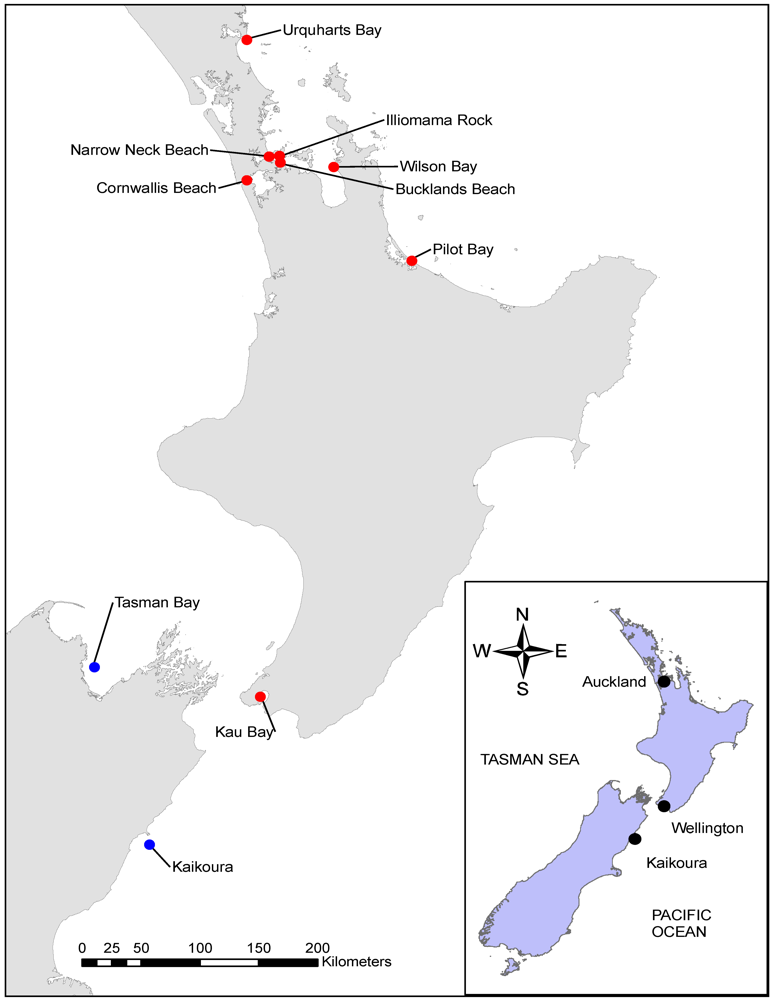
      <p>The aims of this study were to investigate temporal, spatial, individual and generational variability in TTX concentrations from New Zealand populations of <italic>P.</italic> <italic>maculata</italic>. Samples were collected from ten populations around New Zealand (<xref ref-type="fig" rid="marinedrugs-10-00163-f001">Figure 1</xref>) and their TTX levels assessed using liquid chromatography-mass spectrometry (LC-MS). <italic>Pleurobranchaea</italic> <italic>maculata</italic> were also collected monthly over six months at Narrow Neck Beach (Auckland, New Zealand), to study temporal variability in TTX concentrations. To ensure differences in TTX (see results) were not due to the presence of cryptic species between North and South islands, we extracted DNA and sequenced a region of the cytochrome oxidase subunit 1 (CO1). Generational variability was examined by rearing <italic>P.</italic> <italic>maculata</italic> from eggs to maturation in a TTX-free environment. These data may provide insights into the origins and ecological function of TTX in <italic>P.</italic> <italic>maculata.</italic></p>
      
    </sec>
    <sec sec-type="results">
      <title>2. Results</title>
      <sec>
        <title>2.1. Spatial Variability in Tetrodotoxin Concentrations in <italic>Pleurobranchaea maculata</italic> from Around New Zealand</title>
        <p>Tetrodotoxin was detected in <italic>P. maculata</italic> samples from eight of the ten sites (<xref ref-type="fig" rid="marinedrugs-10-00163-f001">Figure 1</xref>; <xref ref-type="table" rid="marinedrugs-10-00163-t001">Table 1</xref>). The highest average (368.7 mg kg<sup>−1</sup>) and maximum (1414.0 mg kg<sup>−1</sup>) concentrations were measured in samples from Illiomama Rock (<xref ref-type="table" rid="marinedrugs-10-00163-t001">Table 1</xref>). Traces levels (&lt;0.2 mg kg<sup>−1</sup>) of 11-oxoTTX were detected in several <italic>P. maculata</italic> from Illiomama Rock. The lowest concentration of TTX (0.1 mg kg<sup>−1</sup>) was measured in the individual collected from Wilsons Bay (<xref ref-type="fig" rid="marinedrugs-10-00163-f001">Figure 1</xref>; <xref ref-type="table" rid="marinedrugs-10-00163-t001">Table 1</xref>). At all sites where more than one individual was collected there was significant individual to individual variability, with a 7 (Pilot Bay) to 62 (Illiomama Rock) fold difference between the minimum and maximum TTX concentration (<xref ref-type="table" rid="marinedrugs-10-00163-t001">Table 1</xref>). Despite over 20 individuals been tested, no TTX was detected in the <italic>P. maculata</italic> from Tasman Bay. Likewise no TTX was detected in a single sample from the deep (290 m) site just off the Kaikoura coast. ANOVA analysis showed that the differences in TTX concentrations among populations of <italic>P. maculata</italic> were statistically significant (<italic>F</italic> = 34.2218, <italic>df</italic> = 5, <italic>p</italic> ≤ 0.0001). Pair-wise comparisons showed which populations were statistically different from each other (<xref ref-type="table" rid="marinedrugs-10-00163-t002">Table 2</xref>). The lower TTX concentrations in the Buckland Beach samples may be an artifact of their November collection date. The other toxic populations were sampled between June to August (see section below for data on temporal variation in TTX concentrations). </p>
        <fig id="marinedrugs-10-00163-f001" position="anchor">
        <label>Figure 1</label>
        <caption>
          <p>Sampling locations. Tetrodotoxin positive sites are plotted in red and negative in blue.</p>
        </caption>
        <graphic xmlns:xlink="http://www.w3.org/1999/xlink" xlink:href="marinedrugs-10-00163-g001.tif"/>
      </fig>
        <table-wrap id="marinedrugs-10-00163-t001" position="anchor">
          <object-id pub-id-type="pii">marinedrugs-10-00163-t001_Table 1</object-id>
          <label>Table 1</label>
          <caption>
            <p>Tetrodotoxin concentrations and masses among New Zealand populations of <italic>Pleurobranchaea maculata</italic>. Surveys were also undertaken at Narrow Neck Beach on 26/1/2011, 9/2/2011, 24/3/2011 and 13/4/2011 but No <italic>P. maculata</italic> were observed.</p>
          </caption>
          <table>
            <thead>
              <tr>
                <th rowspan="2" align="center" valign="middle">Site</th>
                <th rowspan="2" align="center" valign="middle">Depth (m)</th>
                <th rowspan="2" align="center" valign="middle">Sampling Date</th>
                <th rowspan="2" align="center" valign="middle">
                  <italic>n</italic>
                </th>
                <th colspan="4" align="center" valign="middle" style="border-bottom:solid thin">Tetrodotoxin (mg kg<sup>−1</sup>)</th>
                <th colspan="4" align="center" valign="middle" style="border-bottom:solid thin"><italic>Pleurobranchaea maculata</italic> Mass (g)</th>
              </tr>
              <tr>
                <th align="center" valign="middle">Ave</th>
                <th align="center" valign="middle">Min.</th>
                <th align="center" valign="middle">Max.</th>
                <th align="center" valign="middle">Std. Error</th>
                <th align="center" valign="middle">Ave</th>
                <th align="center" valign="middle">Min.</th>
                <th align="center" valign="middle">Max.</th>
                <th align="center" valign="middle">Std. Error</th>
              </tr>
            </thead>
            <tbody>
              <tr>
                <td style="background: #0099CC; color:#FF0000" align="left" valign="middle">Narrow Neck Beach</td>
                <td align="center" valign="middle">3–6</td>
                <td align="center" valign="middle">14/06/2010</td>
                <td align="center" valign="middle">10</td>
                <td align="center" valign="middle">181.9</td>
                <td align="center" valign="middle">9.9</td>
                <td align="center" valign="middle">506.0</td>
                <td align="center" valign="middle">48.4</td>
                <td align="center" valign="middle">7.4</td>
                <td align="center" valign="middle">1.3</td>
                <td align="center" valign="middle">12.2</td>
                <td align="center" valign="middle">0.9</td>
              </tr>
              <tr>
                <td align="left" valign="middle"> </td>
                <td align="center" valign="middle">3–6</td>
                <td align="center" valign="middle">12/07/2010</td>
                <td align="center" valign="middle">10</td>
                <td align="center" valign="middle">85.7</td>
                <td align="center" valign="middle">15.2</td>
                <td align="center" valign="middle">150.2</td>
                <td align="center" valign="middle">15.3</td>
                <td align="center" valign="middle">14.3</td>
                <td align="center" valign="middle">5.6</td>
                <td align="center" valign="middle">20.8</td>
                <td align="center" valign="middle">1.5</td>
              </tr>
              <tr>
                <td align="left" valign="middle"> </td>
                <td align="center" valign="middle">3–6</td>
                <td align="center" valign="middle">31/08/2010</td>
                <td align="center" valign="middle">9</td>
                <td align="center" valign="middle">52.6</td>
                <td align="center" valign="middle">10.3</td>
                <td align="center" valign="middle">120.5</td>
                <td align="center" valign="middle">12.1</td>
                <td align="center" valign="middle">20.7</td>
                <td align="center" valign="middle">14.0</td>
                <td align="center" valign="middle">42.7</td>
                <td align="center" valign="middle">2.9</td>
              </tr>
              <tr>
                <td align="left" valign="middle"> </td>
                <td align="center" valign="middle">3–6</td>
                <td align="center" valign="middle">11/11/2010</td>
                <td align="center" valign="middle">9</td>
                <td align="center" valign="middle">21.7</td>
                <td align="center" valign="middle">1.7</td>
                <td align="center" valign="middle">83.1</td>
                <td align="center" valign="middle">8.9</td>
                <td align="center" valign="middle">20.7</td>
                <td align="center" valign="middle">12.9</td>
                <td align="center" valign="middle">33.4</td>
                <td align="center" valign="middle">2.4</td>
              </tr>
              <tr>
                <td align="left" valign="middle"> </td>
                <td align="center" valign="middle">3–6</td>
                <td align="center" valign="middle">16/12/2010</td>
                <td align="center" valign="middle">10</td>
                <td align="center" valign="middle">17.5</td>
                <td align="center" valign="middle">1.1</td>
                <td align="center" valign="middle">48.4</td>
                <td align="center" valign="middle">5.4</td>
                <td align="center" valign="middle">15.5</td>
                <td align="center" valign="middle">7.8</td>
                <td align="center" valign="middle">25.7</td>
                <td align="center" valign="middle">1.7</td>
              </tr>
              <tr>
                <td align="left" valign="middle">Illiomama Rock</td>
                <td align="center" valign="middle">6</td>
                <td align="center" valign="middle">14/06/2010</td>
                <td align="center" valign="middle">10</td>
                <td align="center" valign="middle">368.7</td>
                <td align="center" valign="middle">22.7</td>
                <td align="center" valign="middle">1414.0</td>
                <td align="center" valign="middle">146.6</td>
                <td align="center" valign="middle">6.3</td>
                <td align="center" valign="middle">3.6</td>
                <td align="center" valign="middle">9.7</td>
                <td align="center" valign="middle">0.6</td>
              </tr>
              <tr>
                <td align="left" valign="middle">Bucklands Beach</td>
                <td align="center" valign="middle">3–6</td>
                <td align="center" valign="middle">11/11/2010</td>
                <td align="center" valign="middle">10</td>
                <td align="center" valign="middle">28.8</td>
                <td align="center" valign="middle">1.5</td>
                <td align="center" valign="middle">39.4</td>
                <td align="center" valign="middle">12.5</td>
                <td align="center" valign="middle">30.8</td>
                <td align="center" valign="middle">20.4</td>
                <td align="center" valign="middle">39.5</td>
                <td align="center" valign="middle">2.1</td>
              </tr>
              <tr>
                <td align="left" valign="middle">Tasman Bay</td>
                <td align="center" valign="middle">20</td>
                <td align="center" valign="middle">05/11/2010</td>
                <td align="center" valign="middle">20</td>
                <td align="center" valign="middle">0.0</td>
                <td align="center" valign="middle">0.0</td>
                <td align="center" valign="middle">0.0</td>
                <td align="center" valign="middle">-</td>
                <td align="center" valign="middle">50.4</td>
                <td align="center" valign="middle">24.0</td>
                <td align="center" valign="middle">89.5</td>
                <td align="center" valign="middle">4.9</td>
              </tr>
              <tr>
                <td align="left" valign="middle">Urquharts Bay</td>
                <td align="center" valign="middle">3</td>
                <td align="center" valign="middle">28/08/2010</td>
                <td align="center" valign="middle">10</td>
                <td align="center" valign="middle">16.8</td>
                <td align="center" valign="middle">1.4</td>
                <td align="center" valign="middle">30.4</td>
                <td align="center" valign="middle">2.9</td>
                <td align="center" valign="middle">23.9</td>
                <td align="center" valign="middle">13.1</td>
                <td align="center" valign="middle">31.1</td>
                <td align="center" valign="middle">1.7</td>
              </tr>
              <tr>
                <td align="left" valign="middle">Pilot Bay</td>
                <td align="center" valign="middle">3–5</td>
                <td align="center" valign="middle">08/06/2011</td>
                <td align="center" valign="middle">8</td>
                <td align="center" valign="middle">89.6</td>
                <td align="center" valign="middle">29.7</td>
                <td align="center" valign="middle">205.6</td>
                <td align="center" valign="middle">19.7</td>
                <td align="center" valign="middle">11.6</td>
                <td align="center" valign="middle">8.7</td>
                <td align="center" valign="middle">16.3</td>
                <td align="center" valign="middle">1.1</td>
              </tr>
              <tr>
                <td align="left" valign="middle">Kaikoura</td>
                <td align="center" valign="middle">290</td>
                <td align="center" valign="middle">18/11/2011</td>
                <td align="center" valign="middle">1</td>
                <td align="center" valign="middle">0.0</td>
                <td align="center" valign="middle">-</td>
                <td align="center" valign="middle">-</td>
                <td align="center" valign="middle">-</td>
                <td align="center" valign="middle">17.5</td>
                <td align="center" valign="middle">-</td>
                <td align="center" valign="middle">-</td>
                <td align="center" valign="middle">-</td>
              </tr>
              <tr>
                <td align="left" valign="middle">Cornwallis Beach</td>
                <td align="center" valign="middle">3</td>
                <td align="center" valign="middle">02/09/2010</td>
                <td align="center" valign="middle">1</td>
                <td align="center" valign="middle">130.0</td>
                <td align="center" valign="middle">-</td>
                <td align="center" valign="middle">-</td>
                <td align="center" valign="middle">-</td>
                <td align="center" valign="middle">12.9</td>
                <td align="center" valign="middle">-</td>
                <td align="center" valign="middle">-</td>
                <td align="center" valign="middle">-</td>
              </tr>
              <tr>
                <td align="left" valign="middle">Kau Bay</td>
                <td align="center" valign="middle">14</td>
                <td align="center" valign="middle">01/08/2010</td>
                <td align="center" valign="middle">1</td>
                <td align="center" valign="middle">2.2</td>
                <td align="center" valign="middle">-</td>
                <td align="center" valign="middle">-</td>
                <td align="center" valign="middle">-</td>
                <td align="center" valign="middle">1.5</td>
                <td align="center" valign="middle">-</td>
                <td align="center" valign="middle">-</td>
                <td align="center" valign="middle">-</td>
              </tr>
              <tr>
                <td align="left" valign="middle">Wilson Bay</td>
                <td align="center" valign="middle">6</td>
                <td align="center" valign="middle">15/12/2010</td>
                <td align="center" valign="middle">1</td>
                <td align="center" valign="middle">0.1</td>
                <td align="center" valign="middle">-</td>
                <td align="center" valign="middle">-</td>
                <td align="center" valign="middle">-</td>
                <td align="center" valign="middle">7.2</td>
                <td align="center" valign="middle">-</td>
                <td align="center" valign="middle">-</td>
                <td align="center" valign="middle">-</td>
              </tr>
            </tbody>
          </table>
        </table-wrap>
        <table-wrap id="marinedrugs-10-00163-t002" position="anchor">
          <object-id pub-id-type="pii">marinedrugs-10-00163-t002_Table 2</object-id>
          <label>Table 2</label>
          <caption>
            <p>Pairwise <italic>post hoc</italic> comparisons (Tukey HSD test) of mean tetrodotoxin concentrations among New Zealand populations of <italic>Pleurobranchaea maculata</italic>. Bolded values represent statistically significant differences (<italic>p</italic> &lt; 0.05).</p>
          </caption>
          <table>
            <thead>
              <tr>
                <th align="right" valign="middle"> </th>
                <th align="center" valign="middle">Urquharts Bay</th>
                <th align="center" valign="middle">Tasman Bay</th>
                <th align="center" valign="middle">Pilot Bay</th>
                <th align="center" valign="middle">Illiomama Rock</th>
                <th align="center" valign="middle">Bucklands Beach</th>
                <th align="center" valign="middle">Narrow Neck</th>
              </tr>
            </thead>
            <tbody>
              <tr>
                <td align="right" valign="middle">Urquharts Bay</td>
                <td align="center" valign="middle"> </td>
                <td align="center" valign="middle"><bold>0.0001</bold></td>
                <td align="center" valign="middle"><bold>0.0072</bold></td>
                <td align="center" valign="middle"><bold>0.0001</bold></td>
                <td align="center" valign="middle">1.0000</td>
                <td align="center" valign="middle">0.9981</td>
              </tr>
              <tr>
                <td align="right" valign="middle">Tasman Bay</td>
                <td align="center" valign="middle"><bold>0.0001</bold></td>
                <td align="center" valign="middle"> </td>
                <td align="center" valign="middle"><bold>0.0001</bold></td>
                <td align="center" valign="middle"><bold>0.0001</bold></td>
                <td align="center" valign="middle"><bold>0.0001</bold></td>
                <td align="center" valign="middle"><bold>0.0001</bold></td>
              </tr>
              <tr>
                <td align="right" valign="middle">Pilot Bay</td>
                <td align="center" valign="middle"><bold>0.0072</bold></td>
                <td align="center" valign="middle"><bold>0.0001</bold></td>
                <td align="center" valign="middle"> </td>
                <td align="center" valign="middle">0.4334</td>
                <td align="center" valign="middle"><bold>0.0064</bold></td>
                <td align="center" valign="middle"><bold>0.0022</bold></td>
              </tr>
              <tr>
                <td align="right" valign="middle">Illiomama Rock</td>
                <td align="center" valign="middle"><bold>0.0001</bold></td>
                <td align="center" valign="middle"><bold>0.0001</bold></td>
                <td align="center" valign="middle">0.4334</td>
                <td align="center" valign="middle"> </td>
                <td align="center" valign="middle">1.0000</td>
                <td align="center" valign="middle"><bold>0.0001</bold></td>
              </tr>
              <tr>
                <td align="right" valign="middle">Bucklands Beach</td>
                <td align="center" valign="middle">1.0000</td>
                <td align="center" valign="middle"><bold>0.0001</bold></td>
                <td align="center" valign="middle"><bold>0.0064</bold></td>
                <td align="center" valign="middle"><bold>0.0001</bold></td>
                <td align="center" valign="middle"> </td>
                <td align="center" valign="middle">0.9981</td>
              </tr>
              <tr>
                <td align="right" valign="middle">Narrow Neck</td>
                <td align="center" valign="middle">0.9981</td>
                <td align="center" valign="middle"><bold>0.0001</bold></td>
                <td align="center" valign="middle"><bold>0.0022</bold></td>
                <td align="center" valign="middle"><bold>0.0001</bold></td>
                <td align="center" valign="middle">0.9981</td>
                <td align="center" valign="middle"> </td>
              </tr>
            </tbody>
          </table>
        </table-wrap>
      </sec>
      <sec>
        <title>2.2. Temporal Variation in Tetrodotoxin Concentrations in <italic>Pleurobranchaea maculata</italic> from Narrow Neck Beach</title>
        <p>All <italic>P. maculata</italic> collected from Narrow Neck Beach contained TTX. However, TTX concentrations in the <italic>P. maculata</italic> sampled declined over time (<xref ref-type="table" rid="marinedrugs-10-00163-t001">Table 1</xref>), ranging from an average of 184 mg kg<sup>−1</sup> in June 2010 to 17.5 mg kg<sup>−1</sup> by December 2010. These differences were found to be statistically significant (<italic>F</italic> = 8.3764, <italic>df</italic> = 4, <italic>p</italic> &lt; 0.0001). Tukey pairwise comparisons revealed samples collected in June, July and August were not significantly different, but samples collected in November and December differed significantly from the June and July samples (Tukey HSD, MS 1.22, <italic>df</italic> = 43, <italic>p</italic> &lt; 0.05). The August, November and December samples were not significantly different (Tukey HSD, MS 1.22, <italic>df</italic> = 43, <italic>p</italic> &gt; 0.05). Within sampling periods there was considerable variability in TTX concentrations from one individual to the next with a 10 (12 July 2010) to 51 (14 June 2010) fold difference in the minimum and maximum TTX concentrations (<xref ref-type="table" rid="marinedrugs-10-00163-t001">Table 1</xref>). No <italic>P. maculata</italic> were found at the Narrow Neck Beach site after December 2010, despite four extensive surveys (<xref ref-type="table" rid="marinedrugs-10-00163-t001">Table 1</xref>).</p>
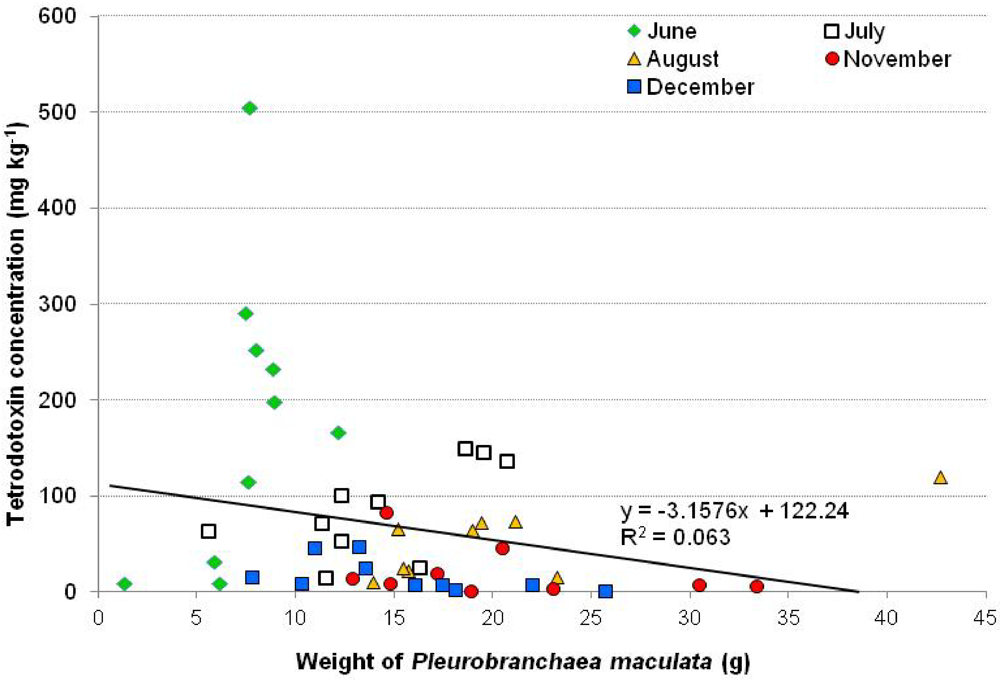
        <p>There was no relationship between concentrations of TTX in <italic>P. maculata</italic> and their mass (<italic>R</italic><sup>2</sup> = 0.063; <xref ref-type="fig" rid="marinedrugs-10-00163-f002">Figure 2</xref>). The highest levels (506 mg kg<sup>−1</sup>), were measured in an individual that weighed 7.7 g, but low levels (10 mg kg<sup>−1</sup>) were measured in a <italic>P. maculata</italic> of similar mass (6.3 g) collected on the same date (<xref ref-type="fig" rid="marinedrugs-10-00163-f002">Figure 2</xref>).</p>
        <fig id="marinedrugs-10-00163-f002" position="anchor">
          <label>Figure 2</label>
          <caption>
            <p>Tetrodotoxin concentrations in individual <italic>Pleurobranchaea maculata</italic> relative to total mass. <italic>Pleurobranchaea maculata</italic> were collected from Narrow Neck Beach (Auckland, New Zealand) between 14 June 2010 to 16 December 2010.</p>
          </caption>
          <graphic xmlns:xlink="http://www.w3.org/1999/xlink" xlink:href="marinedrugs-10-00163-g002.tif"/>
        </fig>
      </sec>
      <sec>
        <title>2.3. Rearing of a Second Generation <italic>Pleurobranchaea maculata</italic> in Captivity and Associated Tetrodotoxin</title>
        <p>The larvae collected at 5 and 10 days post-hatching were positive for TTX. Only one larva was successfully reared to full maturation. No TTX was detected in this second generation <italic>P. maculata</italic>.</p>
      </sec>
      <sec>
        <title>2.4. Cytochrome Oxidase Subunit 1 Gene Analysis of Narrow Neck Beach and Tasman Bay <italic>Pleurobranchaea maculata</italic></title>
        <p>Segments (659 bp) of the CO1 gene were successfully amplified from the Narrow Neck and Tasman Bay <italic>P. maculata</italic> samples. Among the four sequences there were only two nucleotides that differed. One of these differences occurred between the two Narrow Neck Beach samples and the other was a consistent difference in the sequences between sampling sites. The sequences only had low sequence homology to other organisms in GenBank; 82% to <italic>Pleurobranchus peroni</italic> (DQ237993), and 81% to <italic>Opisthobranchia</italic> sp. (HM425491) and <italic>Berthella plumula</italic> (AY345025).</p>
      </sec>
    </sec>
    <sec sec-type="discussion">
      <title>3. Discussion</title>
      <p>Significant variability in TTX concentrations occurred between <italic>P. maculata</italic> populations. No TTX was detected in the <italic>P. maculata</italic> population from Tasman Bay, Nelson and an individual from Kaikoura, while from Wellington to Whangarei populations showed a wide range of TTX levels. Historically there has been confusion as to whether there are multiple <italic>Pleurobranchaea</italic> species in New Zealand [<xref ref-type="bibr" rid="B20-marinedrugs-10-00163">20</xref>]. Additionally in this study morphological differences, e.g., mantel pigmentation, were observed between the Tasman Bay and other populations. To eliminate the possibility that the Tasman Bay population was a different species from the North Island population’s analysis of a segment of the CO1 gene was undertaken. This showed &lt;1% sequence variability between the Tasman Bay and Narrow Neck populations providing evidence that these populations are the same species. Variability in TTX levels across populations has been documented elsewhere. For example, populations of the newt <italic>T. granulosa</italic> from north western USA were found to have highly variable levels of TTX, ranging from 0.007 (±0.004) mg g<sup>−1</sup> to 1.752 (±0.110) mg g<sup>−1</sup>, while those collected further north around Vancouver Island, Canada, did not contain TTX [<xref ref-type="bibr" rid="B18-marinedrugs-10-00163">18</xref>]. In <italic>T. granulosa</italic>, variability in TTX levels is attributed to a coevolutionary interaction with the common garter snake <italic>T. sirtalis.</italic> In an apparent coevolutionary arms race, <italic>T. sirtalis</italic> is believed to have evolved TTX resistance in parallel with the toxicity level of <italic>T. granulosa</italic> [<xref ref-type="bibr" rid="B19-marinedrugs-10-00163">19</xref>]. Such a tight predator-prey relationship is an unlikely explanation for variability among <italic>P. maculata</italic> populations. In our studies we observed TTX-containing <italic>P. maculata</italic> in a diverse range of habitats ranging from sandy sediment to rocky reefs, where they would be exposed to predation from multiple marine organisms including fish and octopus. Geographic variability among marine TTX-containing organisms occurs in multiple species including: puffer fish [<xref ref-type="bibr" rid="B22-marinedrugs-10-00163">22</xref>,<xref ref-type="bibr" rid="B23-marinedrugs-10-00163">23</xref>], the horse-shoe crab <italic>Carcinoscorpius rotundicauda</italic> [<xref ref-type="bibr" rid="B24-marinedrugs-10-00163">24</xref>,<xref ref-type="bibr" rid="B25-marinedrugs-10-00163">25</xref>,<xref ref-type="bibr" rid="B26-marinedrugs-10-00163">26</xref>] and the starfish <italic>Astropecten polyacanthus</italic> [<xref ref-type="bibr" rid="B27-marinedrugs-10-00163">27</xref>]. Although definitive reasons for these variations are unknown the most likely explanation is that these organisms are exposed to TTX through the food chain [<xref ref-type="bibr" rid="B28-marinedrugs-10-00163">28</xref>] and that the abundance of this dietary source influences the presence and levels of TTX within an organism. Noguchi <italic>et al.</italic>, [<xref ref-type="bibr" rid="B28-marinedrugs-10-00163">28</xref>] provided evidence to support this hypothesis by culturing over 5000 specimens of the puffer fish <italic>Takifugu rubripes</italic> in net-cages and land-based aquaria. These organisms were fed TTX-free diets for between 1–3 years and all livers and other tissues tested negative for TTX. A dietary source of TTX is a plausible explanation for the variation in TTX levels in <italic>P. maculata,</italic> however in-depth benthic surveys of the flora and fauna at sites with high <italic>P. maculata</italic> abundance have only detected trace levels of TTX in a few organisms (e.g., the Sand Dollar <italic>Arachnoides zelandiae</italic> and the crab <italic>Macrophthalmus hirtipes</italic>), all of which are unlikely to be an abundant food source for <italic>P. maculata</italic> [<xref ref-type="bibr" rid="B29-marinedrugs-10-00163">29</xref>]. It is possible that if the dietary source was microbial it may not have been detected in these surveys and attempts are currently underway to isolate TTX-producing bacteria from <italic>P. maculata</italic>. Recently latitudinal gradients in marine planktonic bacteria have been demonstrated [<xref ref-type="bibr" rid="B30-marinedrugs-10-00163">30</xref>], and it is possible that latitudinal and current-induced gradients may result in differences in bacterial diversity within <italic>P. maculata</italic> populations around New Zealand. While the distances between Kaikoura and Tasman Bay (non-toxic populations) and the Wellington site (toxic individual) are only 175–215 km respectively, there is limited opportunity for oceanic exchange between theses South and North Island sites, with the prevailing oceanic currents flowing east from Tasman Bay and north from Kaikoura [<xref ref-type="bibr" rid="B31-marinedrugs-10-00163">31</xref>,<xref ref-type="bibr" rid="B32-marinedrugs-10-00163">32</xref>].</p>
      <p>In addition to between-population variability there were also significant difference in TTX concentration within toxic <italic>P. maculata</italic> populations, with the most pronounced difference (&gt;60 fold) occurring among individuals collected from Illiomama Rock. Variability in TTX-concentrations among populations has been measured in many TTX-containing organisms. In the most extreme examples both non-toxic and highly toxic individuals are found in a single population e.g., the gastropods <italic>Rapana rapiformis</italic> and <italic>R. venosa venosa</italic> [<xref ref-type="bibr" rid="B33-marinedrugs-10-00163">33</xref>] and the horseshoe crab <italic>Carcinoscorpius rotundicauda</italic> [<xref ref-type="bibr" rid="B26-marinedrugs-10-00163">26</xref>]. In other species populations tend to be either toxic or non-toxic, but within the TTX-positive populations there is a marked range in toxin levels e.g., <italic>T. granulosa</italic> [<xref ref-type="bibr" rid="B34-marinedrugs-10-00163">34</xref>,<xref ref-type="bibr" rid="B35-marinedrugs-10-00163">35</xref>]. We considered the possibility that the concentration of TTX may be related to the size of individual <italic>P. maculata</italic> and this may partly explain the variability. If TTX is produced endogenously it would be logical to expect larger <italic>P. maculata</italic> capable of producing more TTX and thus higher concentrations would be associated with heavier individuals. However, no correlation between mass and TTX concentrations was observed (<xref ref-type="fig" rid="marinedrugs-10-00163-f002">Figure 2</xref>). Similar patterns have been noted in other TTX-containing organisms. For example, there was no correlation between toxicity and body mass in specimens collected at the same place and time of the starfishes <italic>Astropecten polyacanthus</italic> and <italic>A. scoparius</italic> [<xref ref-type="bibr" rid="B27-marinedrugs-10-00163">27</xref>] or the ribbon worm <italic>Cephalothrix</italic> sp. [<xref ref-type="bibr" rid="B36-marinedrugs-10-00163">36</xref>]. Genetic variation among individual may also affect their ability to produce or sequester TTX and thus could possibly explain the lack of relationship between mass and TTX concentrations. </p>
      <p>Over seven months the population of <italic>P. maculata</italic> at Narrow Neck Beach (Auckland, New Zealand) showed a trend of decreasing levels of TTX from an initial peak in June-July to a low in December. In other TTX-containing organisms there are conflicting data regarding seasonal fluctuations. For example, although toxicity varied among samples there were no clear seasonal trends in studies of two gastropods; the lined-moon shell, <italic>Natica</italic> lineata [<xref ref-type="bibr" rid="B37-marinedrugs-10-00163">37</xref>] and <italic>Nassarius</italic> <italic>glans</italic> [<xref ref-type="bibr" rid="B38-marinedrugs-10-00163">38</xref>]. In contrast, ribbon worms (<italic>Cephalothrix</italic> sp.) collected from November 1998 to March 1999 showed mean toxicities of 2101–3278 MU g<sup>−1</sup>. These decreased in April and March, 1999 (995 MU g<sup>−1</sup>), before increasing sharply to (5843 MU g<sup>−1</sup>) in June [<xref ref-type="bibr" rid="B36-marinedrugs-10-00163">36</xref>]. Likewise in their studies of the starfish <italic>Astropecten polyacanthus</italic>, Miyazawa <italic>et al.</italic> [<xref ref-type="bibr" rid="B39-marinedrugs-10-00163">39</xref>] found that all specimens collected in autumn and winter werenon-toxic. Recent studies on puffer fish have associated seasonal changes in TTX concentrations with different sexual maturity stages. Sabrah <italic>et al.</italic> [<xref ref-type="bibr" rid="B40-marinedrugs-10-00163">40</xref>] studied different sexual maturity stages in the puffer fish (<italic>Lagocephalus sceleratus</italic>) and found highest toxicity levels during the spawning stage of maturity. Most of the specimens in maturity stage II (developing stage) were non-toxic. A similar pattern was observed in female <italic>Takifugu poecilonotus</italic> where liver toxicity was highest in the “ordinary period” (just after spawning) and ovary toxicity was highest during the “maturation period” [<xref ref-type="bibr" rid="B41-marinedrugs-10-00163">41</xref>]. Although little is known about the ecology of <italic>P. maculata</italic>, they were most abundant and significant quantities of egg masses were observed during our surveys in June to August [<xref ref-type="bibr" rid="B29-marinedrugs-10-00163">29</xref>]. This was also the period where the highest TTX-levels were measured suggesting a link between maturation stage and TTX levels in <italic>P. maculata</italic>. Our previous research and ongoing studies have detected high levels of TTX in <italic>P. maculata</italic> eggs and larvae, and demonstrate TTX levels decrease in consecutive batches of eggs [<xref ref-type="bibr" rid="B42-marinedrugs-10-00163">42</xref>,<xref ref-type="bibr" rid="B43-marinedrugs-10-00163">43</xref>]. Thus, <italic>P. maculata</italic> may invest their offspring with TTX or inoculate them with TTX-producing bacteria as a defense mechanism.</p>
      <p>To investigate whether TTX-producing bacteria are transmitted vertically between generations we attempted to rear <italic>P. maculata</italic> in captivity. The two sub-samples of planktonic larvae tested positive for TTX. Despite more than 20 pediveligers settling and more than 10 metamorphosing into juveniles, only one survived to full maturity and no TTX was detected. Unfortunately with such a limited sample size we cannot draw any definitive conclusions from this experiment. Similar experiments with captive-raised pufferfish [<xref ref-type="bibr" rid="B17-marinedrugs-10-00163">17</xref>] and riparian frogs (<italic>Atelopus variusdo</italic>) [<xref ref-type="bibr" rid="B44-marinedrugs-10-00163">44</xref>] have also found that second generation cohorts do not possess TTX. In both of these examples the researchers suggest that the lack of TTX in these captivity-reared organisms indicates that TTX may either have a dietary origin or may be dependent on environmental factors, such as microbial symbionts. Gall <italic>et al.</italic> [<xref ref-type="bibr" rid="B45-marinedrugs-10-00163">45</xref>] detected TTX in all developmental stages of <italic>T. granulosa</italic>, however, TTX concentrations declined steadily through metamorphosis. In contrast, TTX levels in the blue-ringed octopuses (<italic>Hapalochlaena</italic> spp.) continue to increase during development, suggesting that offspring or their symbionts begin producing TTX independently [<xref ref-type="bibr" rid="B46-marinedrugs-10-00163">46</xref>]. Further research tracking TTX levels through all development stages of <italic>P. maculata</italic> is required to understand it role and origin in each life stage.</p>
    </sec>
    <sec sec-type="conclusions">
      <title>4. Conclusions</title>
      <p>In summary, our initial studies on TTX in <italic>P. maculata</italic> show that this organism conforms to the trends observed in other marine TTX-containing organisms. There is significant variability in TTX concentrations within and among populations. TTX concentrations were highest during the egg laying season (June–August) and this, in concert with the detection of high levels of TTX in eggs and early larval stages [<xref ref-type="bibr" rid="B42-marinedrugs-10-00163">42</xref>], suggests that TTX may be used for defensive purposes in <italic>P. maculata</italic>. Confounding this hypothesis is the existence of populations that do not contain TTX. It is possible that these populations contain alternative chemical defense mechanisms but this requires further investigation. Our present results suggest that the occurrence of TTX in <italic>P. maculata</italic> may involve symbiotic TTX-producing bacteria, though the possibility that TTX is accumulated through the food chain or produced endogenously cannot be fully excluded.</p>
    </sec>
    <sec>
      <title>5. Experimental Section</title>
      <sec>
        <title>5.1. Sampling Sites and Collection</title>
        <p>Up to 20 <italic>P. maculata</italic> were collected at 7 sites around New Zealand by divers (<xref ref-type="fig" rid="marinedrugs-10-00163-f001">Figure 1</xref>; <xref ref-type="table" rid="marinedrugs-10-00163-t001">Table 1</xref>). Water was removed (metal sieve, 1 mm dia., 1 min) and each was frozen (−20 °C) in separate plastic bags before transportation. The individual from Kaikoura (<xref ref-type="fig" rid="marinedrugs-10-00163-f001">Figure 1</xref>; <xref ref-type="table" rid="marinedrugs-10-00163-t001">Table 1</xref>) was collected using a fish trap (290 m depth) as part of a Museum of New Zealand Te Papa Tongarewa marine surveying programme. The samples from Kau Bay and Cornwallis Beach were opportunistically collected by local divers. At the Narrow Neck Beach site, up to 10 <italic>P. maculata</italic> were collected approximately monthly over a 10-month period (<xref ref-type="table" rid="marinedrugs-10-00163-t001">Table 1</xref>). </p>
      </sec>
      <sec>
        <title>5.2. Rearing of <italic>Pleurobranchaea maculata</italic></title>
        <p>Two <italic>P. maculata</italic> collected from Narrow Neck Beach (<xref ref-type="fig" rid="marinedrugs-10-00163-f001">Figure 1</xref>) on 14 June 2010 were placed in plastic bags containing seawater (300 mL) and transported back to the laboratory in an insulated container. In the laboratory they were maintained in an aquarium (19 L) filled with 11 L of filtered seawater and aerated using a fish tank pump. Twice a week they were fed Greenshell<sup>TM</sup> mussel (<italic>Perna canaliculus</italic>) and their water exchanged. <italic>Pleurobranchaea maculata</italic> began laying eggs within two weeks. The egg mass used in this study was laid on 16 July 2010. The egg mass was transferred to a 1 L glass beaker containing 500 mL of filtered sea water. The eggs were maintained, and all further rearing undertaken using the following standard conditions: 100 ± 20 µmol photons m<sup>−2</sup> s<sup>−1</sup>; 12:12 h light:dark; 18 ± 1 °C, without aeration. Larvae hatched within ten days and were transferred to 2 L glass beakers containing 1 L filtered seawater, without aeration. Larvae were fed a 1:1:1 mixture of <italic>Chaetoceros calcitrans</italic>, <italic>Isochrysis galbana</italic> and <italic>Pavlova lutheri</italic> three times weekly and 20 µL of CoralAmino (Brightwell Aquatics) once a week. At 5 and 10 days post-hatching 30 mL subsamples of water containing larvae were collected and centrifuged (3000 × g, 5 min). The pellets were processed and analyzed for TTX as described below. After approximately 2 weeks larvae were transferred to 1 L glass beakers with a 1-week growth of biofilm on the glass surface. Settlement of the pediveligers occurred after approximately 3 weeks. Acquisition of a juvenile morphology occurred gradually over 3 weeks. Juveniles were fed commercial salmon food, and small pieces of Greenshell<sup>TM</sup> mussel were gradually introduced to their diet as they increased in size. Only one juvenile survived and after approximately six months at a mass of 19.1 g it was frozen, and processed and analyzed for TTX as described below. </p>
      </sec>
      <sec>
        <title>5.3. Tetrodotoxin Extraction and Analysis</title>
        <p>Each <italic>P. maculata</italic> was homogenized and a sub-sample (2 g) extracted with 18 mL of Milli-Q containing 0.1% v/v acetic acid. The samples were sonicated (20 min), centrifuged (3000 × g, 10 min) and an aliquot of the supernatant analysed for TTX using liquid chromatography-mass spectrometry (LC-MS) as described in McNabb <italic>et al.</italic> [<xref ref-type="bibr" rid="B42-marinedrugs-10-00163">42</xref>].</p>
      </sec>
      <sec>
        <title>5.4. DNA Extraction and CO1 Analysis</title>
        <p>DNA was extracted from a small piece of mantle from two <italic>P. maculata</italic> from Narrow Neck Beach and two from Tasman Bay using the E.Z.N.A. Mollusc DNA Kit (Omega, USA) according to the protocol supplied by the manufacturer. PCR reactions were performed in 50 µL volumes with the reaction mixture containing; 25.0 µL of i-Taq 2× PCR master mix (Intron, Gyeonggi-do, Korea), 0.4 μM of each primer (LC01490 and HC02198; [<xref ref-type="bibr" rid="B47-marinedrugs-10-00163">47</xref>]) and 10–20 ng of template DNA. The reaction mixture was held at 94 °C for 2 min followed by 35 cycles of 94 °C for 30 s, 45 °C for 30 s, 72 °C for 1 min, with a final extension of 72 °C for 7 min. PCR reactions were run on an iCycler thermal cycler (Biorad, USA). PCR products were visualized on 1% agarose gel and then purified using an AxyPrep PCR cleanup kit (Axygen, CA, USA). Bi-directional sequencing was undertaken using the BigDye Terminator v3.1 Cycle Sequencing Kit (Applied Biosystems, CA, USA). Sequences obtained in this study were deposited in the NCBI GenBank database under accession numbers JN675220-23. These were compared with sequences from the NCBI GenBank database using MegaBlast [<xref ref-type="bibr" rid="B48-marinedrugs-10-00163">48</xref>].</p>
      </sec>
      <sec>
        <title>5.5. Statistical Analysis</title>
        <p>Data were log transformed and the Cochrans test for homogeneity was non-significant. One-way ANOVAs were used to compare mean concentrations of TTX from six sites and between each of the six sampling times at the Narrow Neck site. Post-hoc pairwise comparisons of all mean TTX concentrations at six sampling sites and between the six sampling times at the Narrow Neck site were undertaken using the Tukey HSD test function in Statistica 8 [<xref ref-type="bibr" rid="B49-marinedrugs-10-00163">49</xref>].</p>
        
      </sec>
    </sec>
  </body>
  <back>
    <ack>
      <title>Acknowledgements</title>
      <p>This research was funded by the Marsden fund of the Royal Society of New Zealand (UOW1002), Ngā Pae o Te Māramatanga (Project: 10RF18) and the Auckland Council. We thank the Auckland Harbour Master and Mike McMurtry from the Auckland Council for assistance during <italic>P. maculata</italic> collections. P.M. is supported by a New Zealand Ministry for Science and Innovation Te Tipu Pūtaiao Ph.D. fellowship (CAWX0905). We are grateful to Vincent Zintzen (Museum of New Zealand Te Papa Tongarewa) for collection of the specimen from Kaikoura and David Wellar (National Institute of Water and Atmospheric Research) for collection of the sample from Kau Bay.</p>
    </ack>
    <fn-group><fn><p><italic>Samples Availability</italic>: Available from the authors.</p></fn></fn-group>
    <ref-list>
      <title>References</title>
      <ref id="B1-marinedrugs-10-00163">
        <label>1.</label>
        <citation citation-type="journal">
          <person-group person-group-type="author">
            <name>
              <surname>Noguchi</surname>
              <given-names>T.</given-names>
            </name>
            <name>
              <surname>Ebesu</surname>
              <given-names>J.S.M.</given-names>
            </name>
          </person-group>
          <article-title>Puffer poisoning: Epidemiology and treatment</article-title>
          <source>J. Toxicol. Toxin Rev.</source>
          <year>2001</year>
          <volume>20</volume>
          <fpage>1</fpage>
          <lpage>10</lpage>
        <pub-id pub-id-type="doi">10.1081/TXR-100103080</pub-id></citation>
      </ref>
      <ref id="B2-marinedrugs-10-00163">
        <label>2.</label>
        <citation citation-type="journal">
          <person-group person-group-type="author">
            <name>
              <surname>Mosher</surname>
              <given-names>H.S.</given-names>
            </name>
            <name>
              <surname>Fuhrman</surname>
              <given-names>G.J.</given-names>
            </name>
            <name>
              <surname>Fuhrman</surname>
              <given-names>F.A.</given-names>
            </name>
            <name>
              <surname>Fischer</surname>
              <given-names>H.G.</given-names>
            </name>
          </person-group>
          <article-title>Tarichatoxin-tetrodotoxin, a potent neurotoxin</article-title>
          <source>Science</source>
          <year>1965</year>
          <volume>144</volume>
          <fpage>1100</fpage>
          <lpage>1110</lpage>
        </citation>
      </ref>
      <ref id="B3-marinedrugs-10-00163">
        <label>3.</label>
        <citation citation-type="journal">
          <person-group person-group-type="author">
            <name>
              <surname>Noguchi</surname>
              <given-names>T.</given-names>
            </name>
            <name>
              <surname>Arakawa</surname>
              <given-names>O.</given-names>
            </name>
          </person-group>
          <article-title>Tetrodotoxin—Distribution and accumulation in aquatic organisms, and cases of human intoxication</article-title>
          <source>Mar. Drugs</source>
          <year>2008</year>
          <volume>6</volume>
          <fpage>220</fpage>
          <lpage>242</lpage>
        <pub-id pub-id-type="pmid">18728726</pub-id></citation>
      </ref>
      <ref id="B4-marinedrugs-10-00163">
        <label>4.</label>
        <citation citation-type="journal">
          <person-group person-group-type="author">
            <name>
              <surname>Wu</surname>
              <given-names>Z.</given-names>
            </name>
            <name>
              <surname>Xiea</surname>
              <given-names>L.</given-names>
            </name>
            <name>
              <surname>Xiab</surname>
              <given-names>G.</given-names>
            </name>
            <name>
              <surname>Zhanga</surname>
              <given-names>J.</given-names>
            </name>
            <name>
              <surname>Niea</surname>
              <given-names>Y.</given-names>
            </name>
            <name>
              <surname>Huc</surname>
              <given-names>J.</given-names>
            </name>
            <name>
              <surname>Wangc</surname>
              <given-names>S.</given-names>
            </name>
            <name>
              <surname>Zhanga</surname>
              <given-names>R.</given-names>
            </name>
          </person-group>
          <article-title>A new tetrodotoxin-producing actinomycete, <italic>Nocardiopsis dassonvillei</italic>, isolated from the ovaries of puffer fish <italic>Fugu rubripes</italic></article-title>
          <source>Toxicon</source>
          <year>2005</year>
          <volume>45</volume>
          <fpage>851</fpage>
          <lpage>859</lpage>
        <pub-id pub-id-type="doi">10.1016/j.toxicon.2005.02.005</pub-id><pub-id pub-id-type="pmid">15904680</pub-id></citation>
      </ref>
      <ref id="B5-marinedrugs-10-00163">
        <label>5.</label>
        <citation citation-type="journal">
          <person-group person-group-type="author">
            <name>
              <surname>Chau</surname>
              <given-names>R.</given-names>
            </name>
            <name>
              <surname>Kalaitzis</surname>
              <given-names>J.A.</given-names>
            </name>
            <name>
              <surname>Neilan</surname>
              <given-names>B.A.</given-names>
            </name>
          </person-group>
          <article-title>On the origins and biosynthesis of tetrodotoxin</article-title>
          <source>Aquat. Toxicol.</source>
          <year>2011</year>
          <volume>104</volume>
          <fpage>61</fpage>
          <lpage>72</lpage>
        <pub-id pub-id-type="doi">10.1016/j.aquatox.2011.04.001</pub-id><pub-id pub-id-type="pmid">21543051</pub-id></citation>
      </ref>
      <ref id="B6-marinedrugs-10-00163">
        <label>6.</label>
        <citation citation-type="journal">
          <person-group person-group-type="author">
            <name>
              <surname>Matsumura</surname>
              <given-names>K.</given-names>
            </name>
          </person-group>
          <article-title>No ability to produce tetrodotoxin in bacteria</article-title>
          <source>Appl. Environ. Microbiol.</source>
          <year>2001</year>
          <volume>67</volume>
          <fpage>2393</fpage>
          <lpage>2394</lpage>
        <pub-id pub-id-type="doi">10.1128/AEM.8.3.2393-2394.2001</pub-id><pub-id pub-id-type="pmid">11386243</pub-id></citation>
      </ref>
      <ref id="B7-marinedrugs-10-00163">
        <label>7.</label>
        <citation citation-type="journal">
          <person-group person-group-type="author">
            <name>
              <surname>Matsumura</surname>
              <given-names>K.</given-names>
            </name>
          </person-group>
          <article-title>Re-examination of tetrodotoxin production by bacteria</article-title>
          <source>Appl. Environ. Microbiol.</source>
          <year>1995</year>
          <volume>61</volume>
          <fpage>3468</fpage>
          <lpage>3470</lpage>
        <pub-id pub-id-type="pmid">7574655</pub-id></citation>
      </ref>
      <ref id="B8-marinedrugs-10-00163">
        <label>8.</label>
        <citation citation-type="journal">
          <person-group person-group-type="author">
            <name>
              <surname>Williams</surname>
              <given-names>B.L.</given-names>
            </name>
          </person-group>
          <article-title>Behavioral and chemical ecology of marine organisms with respect to tetrodotoxin</article-title>
          <source>Mar. Drugs</source>
          <year>2010</year>
          <volume>8</volume>
          <fpage>381</fpage>
          <lpage>398</lpage>
        <pub-id pub-id-type="doi">10.3390/md8030381</pub-id><pub-id pub-id-type="pmid">20411104</pub-id></citation>
      </ref>
      <ref id="B9-marinedrugs-10-00163">
        <label>9.</label>
        <citation citation-type="journal">
          <person-group person-group-type="author">
            <name>
              <surname>Shimizu</surname>
              <given-names>Y.</given-names>
            </name>
            <name>
              <surname>Kobayashi</surname>
              <given-names>M.</given-names>
            </name>
          </person-group>
          <article-title>Apparent lack of tetrodotoxin biosynthesis in captured <italic>Taricha torosa</italic> and <italic>Taricha granulosa</italic></article-title>
          <source>Chem. Pharm. Bull. (Tokyo)</source>
          <year>1983</year>
          <volume>31</volume>
          <fpage>3625</fpage>
          <lpage>3631</lpage>
        <pub-id pub-id-type="doi">10.1248/cpb.31.3625</pub-id></citation>
      </ref>
      <ref id="B10-marinedrugs-10-00163">
        <label>10.</label>
        <citation citation-type="journal">
          <person-group person-group-type="author">
            <name>
              <surname>Daly</surname>
              <given-names>J.W.</given-names>
            </name>
            <name>
              <surname>Myers</surname>
              <given-names>C.W.</given-names>
            </name>
            <name>
              <surname>Whittaker</surname>
              <given-names>N.</given-names>
            </name>
          </person-group>
          <article-title>Further classification of skin alkaloids from neotropical poison frogs (Dendrobatidae), with a general survey of toxic/noxious substances in the amphibia</article-title>
          <source>Toxicon</source>
          <year>1987</year>
          <volume>25</volume>
          <fpage>1023</fpage>
          <lpage>1095</lpage>
        <pub-id pub-id-type="doi">10.1016/0041-0101(87)90265-0</pub-id><pub-id pub-id-type="pmid">3321567</pub-id></citation>
      </ref>
      <ref id="B11-marinedrugs-10-00163">
        <label>11.</label>
        <citation citation-type="journal">
          <person-group person-group-type="author">
            <name>
              <surname>Cardall</surname>
              <given-names>B.L.</given-names>
            </name>
            <name>
              <surname>Brodie</surname>
              <given-names>E.D.</given-names>
            </name>
            <name>
              <surname>Brodie</surname>
              <given-names>E.D.</given-names>
            </name>
            <name>
              <surname>Hanifin</surname>
              <given-names>C.T.</given-names>
            </name>
          </person-group>
          <article-title>Secretion and regeneration of tetrodotoxin in the rough-skin newt (<italic>Taricha garnulsoa</italic>).</article-title>
          <source>Toxicon</source>
          <year>2004</year>
          <volume>44</volume>
          <fpage>933</fpage>
          <lpage>938</lpage>
        <pub-id pub-id-type="doi">10.1016/j.toxicon.2004.09.006</pub-id><pub-id pub-id-type="pmid">15530976</pub-id></citation>
      </ref>
      <ref id="B12-marinedrugs-10-00163">
        <label>12.</label>
        <citation citation-type="journal">
          <person-group person-group-type="author">
            <name>
              <surname>Hanifin</surname>
              <given-names>C.T.</given-names>
            </name>
            <name>
              <surname>Brodie</surname>
              <given-names>E.D.</given-names>
              <suffix>III</suffix>
            </name>
            <name>
              <surname>Brodie</surname>
              <given-names>E.D.</given-names>
              <suffix>Jr.</suffix>
            </name>
          </person-group>
          <article-title>Tetrodotoxin levels of the rough-skin newt, <italic>Taricha granuslosa</italic>, increase in long term captivity</article-title>
          <source>Toxicon</source>
          <year>2002</year>
          <volume>40</volume>
          <fpage>1149</fpage>
          <lpage>1153</lpage>
        <pub-id pub-id-type="doi">10.1016/S0041-0101(02)00115-0</pub-id><pub-id pub-id-type="pmid">12165318</pub-id></citation>
      </ref>
      <ref id="B13-marinedrugs-10-00163">
        <label>13.</label>
        <citation citation-type="journal">
          <person-group person-group-type="author">
            <name>
              <surname>Lehman</surname>
              <given-names>E.M.</given-names>
            </name>
            <name>
              <surname>Brodie</surname>
              <given-names>E.D.</given-names>
            </name>
            <name>
              <surname>Brodie</surname>
              <given-names>E.D.</given-names>
            </name>
          </person-group>
          <article-title>No evidence for an endosymbiotic bacterial origin of tetrodotoxin in the newt <italic>Taricha granulosa</italic></article-title>
          <source>Toxicon</source>
          <year>2004</year>
          <volume>44</volume>
          <fpage>243</fpage>
          <lpage>249</lpage>
        <pub-id pub-id-type="doi">10.1016/j.toxicon.2004.05.019</pub-id><pub-id pub-id-type="pmid">15302530</pub-id></citation>
      </ref>
      <ref id="B14-marinedrugs-10-00163">
        <label>14.</label>
        <citation citation-type="journal">
          <person-group person-group-type="author">
            <name>
              <surname>Ritson-Williams</surname>
              <given-names>R.R.</given-names>
            </name>
            <name>
              <surname>Yotsu-Yamashita</surname>
              <given-names>M.</given-names>
            </name>
            <name>
              <surname>Paul</surname>
              <given-names>V.</given-names>
            </name>
          </person-group>
          <article-title>Ecological functions of tetrodotoxin in a deadly polyclad flatworm</article-title>
          <source>Proc. Natl. Acad. Sci. USA</source>
          <year>2006</year>
          <volume>103</volume>
          <fpage>3176</fpage>
          <lpage>3179</lpage>
        <pub-id pub-id-type="doi">10.1073/pnas.0506093103</pub-id><pub-id pub-id-type="pmid">16492790</pub-id></citation>
      </ref>
      <ref id="B15-marinedrugs-10-00163">
        <label>15.</label>
        <citation citation-type="journal">
          <person-group person-group-type="author">
            <name>
              <surname>Hwang</surname>
              <given-names>P.A.</given-names>
            </name>
            <name>
              <surname>Noguchi</surname>
              <given-names>T.</given-names>
            </name>
            <name>
              <surname>Hwang</surname>
              <given-names>D.F.</given-names>
            </name>
          </person-group>
          <article-title>Neurotoxin tetrodotoxin as attractant for toxic snails</article-title>
          <source>Fish. Sci.</source>
          <year>2004</year>
          <volume>70</volume>
          <fpage>1106</fpage>
          <lpage>1112</lpage>
        <pub-id pub-id-type="doi">10.1111/j.1444-2906.2004.00911.x</pub-id></citation>
      </ref>
      <ref id="B16-marinedrugs-10-00163">
        <label>16.</label>
        <citation citation-type="journal">
          <person-group person-group-type="author">
            <name>
              <surname>Matsumura</surname>
              <given-names>K.</given-names>
            </name>
          </person-group>
          <article-title>Tetrodotoxin as a pheromone</article-title>
          <source>Nature</source>
          <year>1995</year>
          <volume>378</volume>
          <fpage>563</fpage>
          <lpage>564</lpage>
        <pub-id pub-id-type="pmid">8524387</pub-id></citation>
      </ref>
      <ref id="B17-marinedrugs-10-00163">
        <label>17.</label>
        <citation citation-type="journal">
          <person-group person-group-type="author">
            <name>
              <surname>Matsui</surname>
              <given-names>T.</given-names>
            </name>
            <name>
              <surname>Hamada</surname>
              <given-names>S.</given-names>
            </name>
            <name>
              <surname>Konosu</surname>
              <given-names>S.</given-names>
            </name>
          </person-group>
          <article-title>Difference in accumulation of puffer fish toxin and crystalline tetrodotoxin in the puffer fish, <italic>Fugu rubripes rubripes</italic></article-title>
          <source>Bull. Jpn. Soc. Sci. Fish.</source>
          <year>1981</year>
          <volume>47</volume>
          <fpage>535</fpage>
          <lpage>537</lpage>
        <pub-id pub-id-type="doi">10.2331/suisan.47.535</pub-id></citation>
      </ref>
      <ref id="B18-marinedrugs-10-00163">
        <label>18.</label>
        <citation citation-type="journal">
          <person-group person-group-type="author">
            <name>
              <surname>Hanifin</surname>
              <given-names>C.T.</given-names>
            </name>
            <name>
              <surname>Yotu-Yamashita</surname>
              <given-names>M.</given-names>
            </name>
            <name>
              <surname>Yasumoto</surname>
              <given-names>T.</given-names>
            </name>
            <name>
              <surname>Brodie</surname>
              <given-names>E.D.</given-names>
              <suffix>III</suffix>
            </name>
            <name>
              <surname>Brodie</surname>
              <given-names>E.D.</given-names>
              <suffix>Jr.</suffix>
            </name>
          </person-group>
          <article-title>Toxicity of dangerous prey: Variation of tetrodotoxin levels within and among populations of the newt <italic>Taricha granulosa</italic></article-title>
          <source>J. Chem. Ecol.</source>
          <year>1999</year>
          <volume>25</volume>
          <fpage>2161</fpage>
          <lpage>2175</lpage>
          <pub-id pub-id-type="doi">10.1023/A:1021049125805</pub-id>
        </citation>
      </ref>
      <ref id="B19-marinedrugs-10-00163">
        <label>19.</label>
        <citation citation-type="journal">
          <person-group person-group-type="author">
            <name>
              <surname>Brodie</surname>
              <given-names>E.D.</given-names>
              <suffix>Jr.</suffix>
            </name>
            <name>
              <surname>Ridenhour</surname>
              <given-names>B.J.</given-names>
            </name>
            <name>
              <surname>Brodie</surname>
              <given-names>E.D.</given-names>
              <suffix>III.</suffix>
            </name>
          </person-group>
          <article-title>The evolutionary response of predators to dangerous prey: Hotspots and coldspots in the geographic mosaic of coevolution between garter snakes and newts</article-title>
          <source>Evolution</source>
          <year>2002</year>
          <volume>56</volume>
          <fpage>2067</fpage>
          <lpage>2082</lpage>
          <pub-id pub-id-type="pmid">12449493</pub-id>
        </citation>
      </ref>
      <ref id="B20-marinedrugs-10-00163">
        <label>20.</label>
        <citation citation-type="journal">
          <person-group person-group-type="author">
            <name>
              <surname>Willan</surname>
              <given-names>R.C.</given-names>
            </name>
          </person-group>
          <article-title>New Zealand side-gilled sea slugs (Opisthobranchia, Notaspidea, Pleurobranchidae).</article-title>
          <source>Malacologia</source>
          <year>1983</year>
          <volume>23</volume>
          <fpage>221</fpage>
          <lpage>270</lpage>
        </citation>
      </ref>
      <ref id="B21-marinedrugs-10-00163">
        <label>21.</label>
        <citation citation-type="journal">
          <person-group person-group-type="author">
            <name>
              <surname>Gibson</surname>
              <given-names>G.D.</given-names>
            </name>
          </person-group>
          <article-title>Larval development and mtamorphosis in <italic>Pleurobranchaea maculata</italic>, with a review of development in the Notaspidea (Opisthobranchia).</article-title>
          <source>Biol. Bull.</source>
          <year>2003</year>
          <volume>205</volume>
          <fpage>121</fpage>
          <lpage>132</lpage>
        <pub-id pub-id-type="doi">10.2307/1543233</pub-id><pub-id pub-id-type="pmid">14583510</pub-id></citation>
      </ref>
      <ref id="B22-marinedrugs-10-00163">
        <label>22.</label>
        <citation citation-type="journal">
          <person-group person-group-type="author">
            <name>
              <surname>Ji</surname>
              <given-names>Y.</given-names>
            </name>
            <name>
              <surname>Liu</surname>
              <given-names>Y.</given-names>
            </name>
            <name>
              <surname>Gong</surname>
              <given-names>Q.-L.</given-names>
            </name>
            <name>
              <surname>Zhou</surname>
              <given-names>L.</given-names>
            </name>
            <name>
              <surname>Wang</surname>
              <given-names>Z.-P.</given-names>
            </name>
          </person-group>
          <article-title>Toxicity of cultured puffer fish and seasonal variations in China</article-title>
          <source>Aquacul. Res.</source>
          <year>2011</year>
          <volume>42</volume>
          <fpage>1186</fpage>
          <lpage>1195</lpage>
        <pub-id pub-id-type="doi">10.1111/j.1365-2109.2010.02707.x</pub-id></citation>
      </ref>
      <ref id="B23-marinedrugs-10-00163">
        <label>23.</label>
        <citation citation-type="journal">
          <person-group person-group-type="author">
            <name>
              <surname>Miyazawa</surname>
              <given-names>K.</given-names>
            </name>
            <name>
              <surname>Noguchi</surname>
              <given-names>T.</given-names>
            </name>
          </person-group>
          <article-title>Distribution and origin of tetrodotoxin</article-title>
          <source>Toxicol. Toxin Rev.</source>
          <year>2001</year>
          <volume>20</volume>
          <fpage>11</fpage>
          <lpage>33</lpage>
        <pub-id pub-id-type="doi">10.1081/TXR-100103081</pub-id></citation>
      </ref>
      <ref id="B24-marinedrugs-10-00163">
        <label>24.</label>
        <citation citation-type="book">
          <person-group person-group-type="author">
            <name>
              <surname>Saitanu</surname>
              <given-names>K.</given-names>
            </name>
            <name>
              <surname>Piyakarnchana</surname>
              <given-names>T.</given-names>
            </name>
            <name>
              <surname>Sato</surname>
              <given-names>S.</given-names>
            </name>
            <name>
              <surname>Ogata</surname>
              <given-names>T.</given-names>
            </name>
            <name>
              <surname>Kodama</surname>
              <given-names>M.</given-names>
            </name>
          </person-group>
          <article-title>Toxicity of Two Species of Horseshoe Crab in Thailand</article-title>
          <source>Progress in Venom and Toxin Research</source>
          <person-group person-group-type="editor">
            <name>
              <surname>Gopalakrishnakone</surname>
              <given-names>P.</given-names>
            </name>
            <name>
              <surname>Tan</surname>
              <given-names>C.K.</given-names>
            </name>
          </person-group>
          <publisher-name>Faculty of Medicine, National University of Singapore</publisher-name>
          <publisher-loc>Singapore</publisher-loc>
          <year>1988</year>
          <fpage>493</fpage>
          <lpage>498</lpage>
        </citation>
      </ref>
      <ref id="B25-marinedrugs-10-00163">
        <label>25.</label>
        <citation citation-type="journal">
          <person-group person-group-type="author">
            <name>
              <surname>Laymithuna</surname>
              <given-names>N.</given-names>
            </name>
            <name>
              <surname>Chun-Fai</surname>
              <given-names>Y.</given-names>
            </name>
            <name>
              <surname>Takatani</surname>
              <given-names>T.</given-names>
            </name>
            <name>
              <surname>Arakawa</surname>
              <given-names>O.</given-names>
            </name>
          </person-group>
          <article-title>Toxicity assessment for the horseshoe crab <italic>Carcinoscorpius rotundicauda</italic> collected from Cambodia</article-title>
          <source>Toxicon</source>
          <year>2007</year>
          <volume>49</volume>
          <fpage>843</fpage>
          <lpage>847</lpage>
        <pub-id pub-id-type="doi">10.1016/j.toxicon.2006.12.004</pub-id><pub-id pub-id-type="pmid">17261323</pub-id></citation>
      </ref>
      <ref id="B26-marinedrugs-10-00163">
        <label>26.</label>
        <citation citation-type="journal">
          <person-group person-group-type="author">
            <name>
              <surname>Dao</surname>
              <given-names>H.V.</given-names>
            </name>
            <name>
              <surname>Yoshinobu</surname>
              <given-names>T.</given-names>
            </name>
            <name>
              <surname>Sato</surname>
              <given-names>S.</given-names>
            </name>
            <name>
              <surname>Fukuyo</surname>
              <given-names>Y.</given-names>
            </name>
            <name>
              <surname>Kodama</surname>
              <given-names>M.</given-names>
            </name>
          </person-group>
          <article-title>Frequent occurrence of the tetrodotoxin-bearing horseshoe crab <italic>Carcinoscorpius rotundicauda</italic> in Vietnam</article-title>
          <source>Fish. Sci.</source>
          <year>2009</year>
          <volume>75</volume>
          <fpage>435</fpage>
          <lpage>438</lpage>
        <pub-id pub-id-type="doi">10.1007/s12562-008-0041-5</pub-id></citation>
      </ref>
      <ref id="B27-marinedrugs-10-00163">
        <label>27.</label>
        <citation citation-type="journal">
          <person-group person-group-type="author">
            <name>
              <surname>Miyazawa</surname>
              <given-names>K.</given-names>
            </name>
            <name>
              <surname>Noguchi</surname>
              <given-names>T.</given-names>
            </name>
            <name>
              <surname>Maruyama</surname>
              <given-names>J.</given-names>
            </name>
            <name>
              <surname>Jeon</surname>
              <given-names>J.K.</given-names>
            </name>
            <name>
              <surname>Otsuka</surname>
              <given-names>M.</given-names>
            </name>
            <name>
              <surname>Hashimoto</surname>
              <given-names>K.</given-names>
            </name>
          </person-group>
          <article-title>Occurrence of tetrodotoxin in the starfishes <italic>Astropecten polyacanthus</italic> and <italic>A. scoparius</italic> in the Seto Inland Sea</article-title>
          <source>Mar. Biol.</source>
          <year>1985</year>
          <volume>90</volume>
          <fpage>61</fpage>
          <lpage>64</lpage>
          <pub-id pub-id-type="doi">10.1007/BF00428215</pub-id>
        </citation>
      </ref>
      <ref id="B28-marinedrugs-10-00163">
        <label>28.</label>
        <citation citation-type="journal">
          <person-group person-group-type="author">
            <name>
              <surname>Noguchi</surname>
              <given-names>T.</given-names>
            </name>
            <name>
              <surname>Arakawa</surname>
              <given-names>O.</given-names>
            </name>
            <name>
              <surname>Takatani</surname>
              <given-names>T.</given-names>
            </name>
          </person-group>
          <article-title>Toxicity of pufferfish <italic>Takifugu rubripes</italic> cultured in net cages at sea or aquaria on land</article-title>
          <source>Comp. Biochem. Phys. D</source>
          <year>2006</year>
          <fpage>153</fpage>
          <lpage>157</lpage>
        </citation>
      </ref>
      <ref id="B29-marinedrugs-10-00163">
        <label>29.</label>
        <citation citation-type="book">
          <person-group person-group-type="author">
            <name>
              <surname>Taylor</surname>
              <given-names>D.I.</given-names>
            </name>
            <name>
              <surname>Wood</surname>
              <given-names>S.A.</given-names>
            </name>
            <name>
              <surname>McNabb</surname>
              <given-names>P.</given-names>
            </name>
          </person-group>
          <source>Population surveys of <italic>Pleurobranchaea maculata</italic> and tetrodotoxin in Waitemata Harbour. Prepared for Auckland Council, Cawthron Report No. 2006</source>
          <year>2011</year>
          <fpage>1</fpage>
          <lpage>11</lpage>
        </citation>
      </ref>
      <ref id="B30-marinedrugs-10-00163">
        <label>30.</label>
        <citation citation-type="journal">
          <person-group person-group-type="author">
            <name>
              <surname>Fuhrman</surname>
              <given-names>J.A.</given-names>
            </name>
            <name>
              <surname>Steele</surname>
              <given-names>J.A.</given-names>
            </name>
            <name>
              <surname>Hewson</surname>
              <given-names>I.</given-names>
            </name>
            <name>
              <surname>Schwalbach</surname>
              <given-names>M.S.</given-names>
            </name>
            <name>
              <surname>Brown</surname>
              <given-names>M.V.</given-names>
            </name>
            <name>
              <surname>Green</surname>
              <given-names>J.L.</given-names>
            </name>
            <name>
              <surname>Brown</surname>
              <given-names>J.H. </given-names>
            </name>
          </person-group>
          <article-title>A latitudinal diversity gradient in planktonic marine bacteria</article-title>
          <source>Proc. Natl. Acad. Sci. USA</source>
          <year>2008</year>
          <volume>105</volume>
          <fpage>7774</fpage>
          <lpage>7778</lpage>
        <pub-id pub-id-type="doi">10.1073/pnas.0803070105</pub-id><pub-id pub-id-type="pmid">18509059</pub-id></citation>
      </ref>
      <ref id="B31-marinedrugs-10-00163">
        <label>31.</label>
        <citation citation-type="journal">
          <person-group person-group-type="author">
            <name>
              <surname>Tuckey</surname>
              <given-names>B.J.</given-names>
            </name>
            <name>
              <surname>Gibbs</surname>
              <given-names>M.T.</given-names>
            </name>
            <name>
              <surname>Knight</surname>
              <given-names>B.R.</given-names>
            </name>
            <name>
              <surname>Gillespie</surname>
              <given-names>P.A.</given-names>
            </name>
          </person-group>
          <article-title>Tidal circulation in Tasman and Golden Bays: implications for river plume behaviour</article-title>
          <source>N. Z. J. Mar. Freshwat. Res.</source>
          <year>2006</year>
          <volume>40</volume>
          <fpage>305</fpage>
          <lpage>324</lpage>
        <pub-id pub-id-type="doi">10.1080/00288330.2006.9517423</pub-id></citation>
      </ref>
      <ref id="B32-marinedrugs-10-00163">
        <label>32.</label>
        <citation citation-type="journal">
          <person-group person-group-type="author">
            <name>
              <surname>Walters</surname>
              <given-names>R.</given-names>
            </name>
            <name>
              <surname>Gillibrand</surname>
              <given-names>P.</given-names>
            </name>
            <name>
              <surname>Bell</surname>
              <given-names>R.</given-names>
            </name>
            <name>
              <surname>Lane</surname>
              <given-names>E.</given-names>
            </name>
          </person-group>
          <article-title>A study of tides and currents in Cook Strait, New Zealand</article-title>
          <source>Ocean Dynam.</source>
          <year>2010</year>
          <volume>60</volume>
          <fpage>1559</fpage>
          <lpage>1580</lpage>
        <pub-id pub-id-type="doi">10.1007/s10236-010-0353-8</pub-id></citation>
      </ref>
      <ref id="B33-marinedrugs-10-00163">
        <label>33.</label>
        <citation citation-type="journal">
          <person-group person-group-type="author">
            <name>
              <surname>Hwang</surname>
              <given-names>D.E.</given-names>
            </name>
            <name>
              <surname>Lu</surname>
              <given-names>S.C.</given-names>
            </name>
            <name>
              <surname>Jeng</surname>
              <given-names>S.S.</given-names>
            </name>
          </person-group>
          <article-title>Occurrence of tetrodotoxin in the gastropods <italic>Rapana rapiformis</italic> and <italic>R. venosa venosa</italic></article-title>
          <source>Mar. Biol.</source>
          <year>1991</year>
          <volume>111</volume>
          <fpage>65</fpage>
          <lpage>69</lpage>
          <pub-id pub-id-type="doi">10.1007/BF01986347</pub-id>
        </citation>
      </ref>
      <ref id="B34-marinedrugs-10-00163">
        <label>34.</label>
        <citation citation-type="journal">
          <person-group person-group-type="author">
            <name>
              <surname>Brodie</surname>
              <given-names>E.D.</given-names>
              <suffix>Jr.</suffix>
            </name>
          </person-group>
          <article-title>Investigation on the skin toxin of the adult rough-skinned newt Taricha garnulsoa</article-title>
          <source>Copeia</source>
          <year>1968</year>
          <fpage>307</fpage>
          <lpage>313</lpage>
        </citation>
      </ref>
      <ref id="B35-marinedrugs-10-00163">
        <label>35.</label>
        <citation citation-type="journal">
          <person-group person-group-type="author">
            <name>
              <surname>Brodie</surname>
              <given-names>E.D.</given-names>
              <suffix>Jr.</suffix>
            </name>
            <name>
              <surname>Hensel</surname>
              <given-names>J.L.</given-names>
            </name>
            <name>
              <surname>Johnson</surname>
              <given-names>J.A.</given-names>
            </name>
          </person-group>
          <article-title>Toxicity of the urodele amphibians <italic>Taricha</italic>, <italic>Notophthalmus</italic>, <italic>Cynops</italic>, and <italic>Paramesotriton</italic> (Salamandridae).</article-title>
          <source>Copeia</source>
          <year>1974</year>
          <fpage>506</fpage>
          <lpage>511</lpage>
        </citation>
      </ref>
      <ref id="B36-marinedrugs-10-00163">
        <label>36.</label>
        <citation citation-type="journal">
          <person-group person-group-type="author">
            <name>
              <surname>Asakawa</surname>
              <given-names>M.</given-names>
            </name>
            <name>
              <surname>Toyoshima</surname>
              <given-names>T.</given-names>
            </name>
            <name>
              <surname>Ito</surname>
              <given-names>K.</given-names>
            </name>
            <name>
              <surname>Bessho</surname>
              <given-names>K.</given-names>
            </name>
            <name>
              <surname>Yamaguchi</surname>
              <given-names>C.</given-names>
            </name>
            <name>
              <surname>Tsunetsugu</surname>
              <given-names>S.</given-names>
            </name>
            <name>
              <surname>Shida</surname>
              <given-names>Y.</given-names>
            </name>
            <name>
              <surname>Kajihara</surname>
              <given-names>H.</given-names>
            </name>
            <name>
              <surname>Mawatari</surname>
              <given-names>S.F.</given-names>
            </name>
            <name>
              <surname>Noguchi</surname>
              <given-names>T.</given-names>
            </name>
            <name>
              <surname>Miyazawa</surname>
              <given-names>K.</given-names>
            </name>
          </person-group>
          <article-title>Paralytic toxicity in the ribbon worm <italic>Cephalothrix</italic> species (Nemertea) in Hiroshima Bay, Hiroshima Prefecture, Japan and the isolation of tetrodotoxin as a main component of its toxins</article-title>
          <source>Toxicon</source>
          <year>2003</year>
          <volume>41</volume>
          <fpage>747</fpage>
          <lpage>753</lpage>
        <pub-id pub-id-type="doi">10.1016/S0041-0101(03)00009-6</pub-id><pub-id pub-id-type="pmid">12782074</pub-id></citation>
      </ref>
      <ref id="B37-marinedrugs-10-00163">
        <label>37.</label>
        <citation citation-type="journal">
          <person-group person-group-type="author">
            <name>
              <surname>Chen</surname>
              <given-names>C.-Y.</given-names>
            </name>
            <name>
              <surname>Chou</surname>
              <given-names>H.-N.</given-names>
            </name>
          </person-group>
          <article-title>Detection of tetrodotoxin by high performance liquid chromatography in Lined-Moon shell and puffer fish</article-title>
          <source>Acta Zool. Taiwanica</source>
          <year>1998</year>
          <volume>9</volume>
          <fpage>41</fpage>
          <lpage>48</lpage>
        </citation>
      </ref>
      <ref id="B38-marinedrugs-10-00163">
        <label>38.</label>
        <citation citation-type="journal">
          <person-group person-group-type="author">
            <name>
              <surname>Taniyama</surname>
              <given-names>S.</given-names>
            </name>
            <name>
              <surname>Isami</surname>
              <given-names>Y.</given-names>
            </name>
            <name>
              <surname>Matusmoto</surname>
              <given-names>T.</given-names>
            </name>
            <name>
              <surname>Nagashima</surname>
              <given-names>Y.</given-names>
            </name>
            <name>
              <surname>Takatani</surname>
              <given-names>T.</given-names>
            </name>
            <name>
              <surname>Arakawa</surname>
              <given-names>O.</given-names>
            </name>
          </person-group>
          <article-title>Toxicity and toxin profile of tetrodotoxin detected in the scavenging gastropod <italic>Nassarius</italic> (Alectrion) <italic>glans</italic> “kinshibai”.</article-title>
          <source>J. Food Hyg. Soc. Jpn.</source>
          <year>2009</year>
          <volume>50</volume>
          <fpage>22</fpage>
          <lpage>28</lpage>
          <pub-id pub-id-type="doi">10.3358/shokueishi.50.22</pub-id>
        </citation>
      </ref>
      <ref id="B39-marinedrugs-10-00163">
        <label>39.</label>
        <citation citation-type="journal">
          <person-group person-group-type="author">
            <name>
              <surname>Miyazawa</surname>
              <given-names>K.</given-names>
            </name>
            <name>
              <surname>Higashiyama</surname>
              <given-names>M.</given-names>
            </name>
            <name>
              <surname>Hori</surname>
              <given-names>K.</given-names>
            </name>
            <name>
              <surname>Noguchi</surname>
              <given-names>T.</given-names>
            </name>
            <name>
              <surname>Ito</surname>
              <given-names>K.</given-names>
            </name>
            <name>
              <surname>Hashimoto</surname>
              <given-names>K.</given-names>
            </name>
          </person-group>
          <article-title>Distribution of tetrodotoxin in various organs of the starfish <italic>Astropecten polyacanthus</italic></article-title>
          <source>Mar. Biol.</source>
          <year>1987</year>
          <volume>96</volume>
          <fpage>385</fpage>
          <lpage>390</lpage>
        <pub-id pub-id-type="doi">10.1007/BF00412522</pub-id></citation>
      </ref>
      <ref id="B40-marinedrugs-10-00163">
        <label>40.</label>
        <citation citation-type="journal">
          <person-group person-group-type="author">
            <name>
              <surname>Sabrah</surname>
              <given-names>M.M.</given-names>
            </name>
            <name>
              <surname>El-Ganainy</surname>
              <given-names>A.A.</given-names>
            </name>
            <name>
              <surname>Zaky</surname>
              <given-names>M.A.</given-names>
            </name>
          </person-group>
          <article-title>Biology and toxicity of the pufferfish <italic>Lagocephalus sceleratus</italic> (GMELIN, 1789) from the Gulf of Suez</article-title>
          <source>Egypt. J. Aquat. Res.</source>
          <year>2006</year>
          <volume>32</volume>
          <fpage>283</fpage>
          <lpage>297</lpage>
        </citation>
      </ref>
      <ref id="B41-marinedrugs-10-00163">
        <label>41.</label>
        <citation citation-type="journal">
          <person-group person-group-type="author">
            <name>
              <surname>Ikeda</surname>
              <given-names>K.</given-names>
            </name>
            <name>
              <surname>Emoto</surname>
              <given-names>Y.</given-names>
            </name>
            <name>
              <surname>Tatsuno</surname>
              <given-names>R.</given-names>
            </name>
            <name>
              <surname>Wang</surname>
              <given-names>J.J.</given-names>
            </name>
            <name>
              <surname>Ngy</surname>
              <given-names>L.</given-names>
            </name>
            <name>
              <surname>Taniyama</surname>
              <given-names>S.</given-names>
            </name>
            <name>
              <surname>Takatani</surname>
              <given-names>T.</given-names>
            </name>
            <name>
              <surname>Arakawa</surname>
              <given-names>O.</given-names>
            </name>
          </person-group>
          <article-title>Maturation-associated changes in toxicity of the pufferfish <italic>Takifugu poecilonotus</italic></article-title>
          <source>Toxicon</source>
          <year>2010</year>
          <volume>55</volume>
          <fpage>289</fpage>
          <lpage>297</lpage>
        <pub-id pub-id-type="doi">10.1016/j.toxicon.2009.08.001</pub-id><pub-id pub-id-type="pmid">19682483</pub-id></citation>
      </ref>
      <ref id="B42-marinedrugs-10-00163">
        <label>42.</label>
        <citation citation-type="journal">
          <person-group person-group-type="author">
            <name>
              <surname>McNabb</surname>
              <given-names>P.</given-names>
            </name>
            <name>
              <surname>Selwood</surname>
              <given-names>A.I.</given-names>
            </name>
            <name>
              <surname>Munday</surname>
              <given-names>R.</given-names>
            </name>
            <name>
              <surname>Wood</surname>
              <given-names>S.A.</given-names>
            </name>
            <name>
              <surname>Taylor</surname>
              <given-names>D.I.</given-names>
            </name>
            <name>
              <surname>MacKenzie</surname>
              <given-names>A.L.</given-names>
            </name>
            <name>
              <surname>van Ginkel</surname>
              <given-names>R.</given-names>
            </name>
            <name>
              <surname>Rhodes</surname>
              <given-names>L.L.</given-names>
            </name>
            <name>
              <surname>Cornelisen</surname>
              <given-names>C.</given-names>
            </name>
            <name>
              <surname>Heasman</surname>
              <given-names>K.</given-names>
            </name>
            <etal/>
          </person-group>
          <article-title>Detection of tetrodotoxin from the grey sided-gilled sea slug-<italic>Pleurobranchaea maculata</italic>, and associated dog neurotoxicosis on beaches adjacent to the Hauraki Gulf, Auckland, New Zealand</article-title>
          <source>Toxicon</source>
          <year>2010</year>
          <volume>56</volume>
          <fpage>466</fpage>
          <lpage>473</lpage>

        <pub-id pub-id-type="doi">10.1016/j.toxicon.2010.04.017</pub-id><pub-id pub-id-type="pmid">20466016</pub-id></citation>
      </ref>
      <ref id="B43-marinedrugs-10-00163">
        <label>43.</label>
        <citation citation-type="book">
          <person-group person-group-type="author">
            <name>
              <surname>Wood</surname>
              <given-names>S.A.</given-names>
            </name>
          </person-group>
          <source>Study showed decrease in TTX concentrations in sequentially laid egg masses of Pleurobranchaea maculata</source>
          <publisher-name>Cawthron Institute</publisher-name>
          <publisher-loc>Nelson, New Zealand</publisher-loc>
          <fpage>2011</fpage>
        </citation>
      </ref>
      <ref id="B44-marinedrugs-10-00163">
        <label>44.</label>
        <citation citation-type="journal">
          <person-group person-group-type="author">
            <name>
              <surname>Daly</surname>
              <given-names>J.W.</given-names>
            </name>
            <name>
              <surname>Padgett</surname>
              <given-names>W.L.</given-names>
            </name>
            <name>
              <surname>Saunders</surname>
              <given-names>R.L.</given-names>
            </name>
            <name>
              <surname>Cover</surname>
              <given-names>J.F.</given-names>
              <suffix>Jr.</suffix>
            </name>
          </person-group>
          <article-title>Absence of tetrodotoxins in a captive-raised riparian frog, <italic>Atelopus varius</italic></article-title>
          <source>Toxicon</source>
          <year>1997</year>
          <volume>35</volume>
          <fpage>705</fpage>
          <lpage>709</lpage>
        <pub-id pub-id-type="doi">10.1016/S0041-0101(96)00165-1</pub-id><pub-id pub-id-type="pmid">9203295</pub-id></citation>
      </ref>
      <ref id="B45-marinedrugs-10-00163">
        <label>45.</label>
        <citation citation-type="journal">
          <person-group person-group-type="author">
            <name>
              <surname>Gall</surname>
              <given-names>B.G.</given-names>
            </name>
            <name>
              <surname>Stokes</surname>
              <given-names>A.N.</given-names>
            </name>
            <name>
              <surname>French</surname>
              <given-names>S.S.</given-names>
            </name>
            <name>
              <surname>Schlepphorst</surname>
              <given-names>E.A.</given-names>
            </name>
            <name>
              <surname>Brodie</surname>
              <given-names>E.D.</given-names>
              <suffix>III</suffix>
            </name>
            <name>
              <surname>Brodie</surname>
              <given-names>E.D.</given-names>
              <suffix>Jr.</suffix>
            </name>
          </person-group>
          <article-title>Tetrodtoxin levels in larval and metamorphosed newts (<italic>Taricha granulosa</italic>) and palatability to predatory dragonflies</article-title>
          <source>Toxicon</source>
          <year>2011</year>
          <volume>57</volume>
          <fpage>978</fpage>
          <lpage>983</lpage>

        <pub-id pub-id-type="doi">10.1016/j.toxicon.2011.03.020</pub-id><pub-id pub-id-type="pmid">21459104</pub-id></citation>
      </ref>
      <ref id="B46-marinedrugs-10-00163">
        <label>46.</label>
        <citation citation-type="journal">
          <person-group person-group-type="author">
            <name>
              <surname>Williams</surname>
              <given-names>B.L.</given-names>
            </name>
            <name>
              <surname>Hanifin</surname>
              <given-names>C.T.</given-names>
            </name>
            <name>
              <surname>Brodie</surname>
              <given-names>E.D.</given-names>
              <suffix>Jr.</suffix>
            </name>
            <name>
              <surname>Caldwell</surname>
              <given-names>R.L.</given-names>
            </name>
          </person-group>
          <article-title>Ontogenty of tetrodtoxin levels in blue-ringed octopuses: maternal investment and apparent independent production in offspring of <italic>Hapalochlaena lunulata</italic></article-title>
          <source>J. Chem. Ecol.</source>
          <year>2011</year>
          <volume>37</volume>
          <fpage>10</fpage>
          <lpage>17</lpage>
        <pub-id pub-id-type="doi">10.1007/s10886-010-9901-4</pub-id><pub-id pub-id-type="pmid">21165679</pub-id></citation>
      </ref>
      <ref id="B47-marinedrugs-10-00163">
        <label>47.</label>
        <citation citation-type="journal">
          <person-group person-group-type="author">
            <name>
              <surname>Folmer</surname>
              <given-names>O.</given-names>
            </name>
            <name>
              <surname>Black</surname>
              <given-names>M.</given-names>
            </name>
            <name>
              <surname>Hoeh</surname>
              <given-names>W.</given-names>
            </name>
            <name>
              <surname>Lutz</surname>
              <given-names>R.</given-names>
            </name>
            <name>
              <surname>Vrijenhoek</surname>
              <given-names>R.</given-names>
            </name>
          </person-group>
          <article-title>DNA primers for amplification of mitochondrial cytochrome c oxidase subunit I from diverse metazoan invertebrates</article-title>
          <source>Mol. Mar. Biol. Biotechnol.</source>
          <year>1994</year>
          <volume>3</volume>
          <fpage>294</fpage>
          <lpage>299</lpage>
        <pub-id pub-id-type="pmid">7881515</pub-id></citation>
      </ref>
      <ref id="B48-marinedrugs-10-00163">
        <label>48.</label>
        <citation citation-type="journal">
          <person-group person-group-type="author">
            <name>
              <surname>Benson</surname>
              <given-names>D.A.</given-names>
            </name>
            <name>
              <surname>Karsch-Mizrachi</surname>
              <given-names>I.</given-names>
            </name>
            <name>
              <surname>Lipman</surname>
              <given-names>D.J.</given-names>
            </name>
            <name>
              <surname>Ostell</surname>
              <given-names>J.</given-names>
            </name>
            <name>
              <surname>Wheeler</surname>
              <given-names>D.L.</given-names>
            </name>
          </person-group>
          <article-title>GenBank</article-title>
          <source>Nucleic Acids Res.</source>
          <year>2008</year>
          <volume>36</volume>
          <fpage>D25</fpage>
          <lpage>D30</lpage>
        <pub-id pub-id-type="doi">10.1093/nar/gkn320</pub-id><pub-id pub-id-type="pmid">18073190</pub-id></citation>
      </ref>
      <ref id="B49-marinedrugs-10-00163">
        <label>49.</label>
        <citation citation-type="other">
          <source>Statistica</source>
          <edition>Version 8</edition>
          <publisher-name>StatSoft Inc.</publisher-name>
          <publisher-loc>Tulsa, OK, USA</publisher-loc>
          <year>2008</year>
        </citation>
      </ref>
    </ref-list>
  </back>
</article>