
<?xml version="1.0" encoding="UTF-8"?>
<!DOCTYPE article PUBLIC "-//NLM//DTD Journal Publishing DTD v2.3 20070202//EN" "journalpublishing.dtd">
<article xmlns:xlink="http://www.w3.org/1999/xlink" xml:lang="en" article-type="review-article">
<front>
<journal-meta>
<journal-id journal-id-type="publisher-id">Diversity</journal-id>
<journal-title>Diversity</journal-title>
<issn pub-type="epub">1424-2818</issn>
<publisher>
<publisher-name>Molecular Diversity Preservation International (MDPI)</publisher-name></publisher></journal-meta>
<article-meta>
<article-id pub-id-type="doi">10.3390/d3030405</article-id>
<article-id pub-id-type="publisher-id">diversity-03-00405</article-id>
<article-categories>
<subj-group>
<subject>Review</subject></subj-group></article-categories>
<title-group>
<article-title>Novel Genetic Diversity Through Somatic Mutations: Fuel for Adaptation of Reef Corals?</article-title></title-group>
<contrib-group>
<contrib contrib-type="author">
<name><surname>van Oppen</surname><given-names>Madeleine J. H.</given-names></name><xref ref-type="aff" rid="af1-diversity-03-00405"><sup>1</sup></xref><xref ref-type="corresp" rid="c1-diversity-03-00405"><sup>*</sup></xref></contrib>
<contrib contrib-type="author">
<name><surname>Souter</surname><given-names>Petra</given-names></name><xref ref-type="aff" rid="af1-diversity-03-00405"><sup>1</sup></xref></contrib>
<contrib contrib-type="author">
<name><surname>Howells</surname><given-names>Emily J.</given-names></name><xref ref-type="aff" rid="af1-diversity-03-00405"><sup>1</sup></xref><xref ref-type="aff" rid="af2-diversity-03-00405"><sup>2</sup></xref><xref ref-type="aff" rid="af3-diversity-03-00405"><sup>3</sup></xref><xref ref-type="aff" rid="af4-diversity-03-00405"><sup>4</sup></xref></contrib>
<contrib contrib-type="author">
<name><surname>Heyward</surname><given-names>Andrew</given-names></name><xref ref-type="aff" rid="af5-diversity-03-00405"><sup>5</sup></xref></contrib>
<contrib contrib-type="author">
<name><surname>Berkelmans</surname><given-names>Ray</given-names></name><xref ref-type="aff" rid="af1-diversity-03-00405"><sup>1</sup></xref></contrib></contrib-group>
<aff id="af1-diversity-03-00405">
<label>1</label> Australian Institute of Marine Science, PMB 3, Townville MC, Queensland 4810, Australia; E-Mails: <email>m.vanoppen@aims.gov.au</email> (M.J.H.O.); <email>p.souter@aims.gov.au</email> (P.S.); <email>em.howells@gmail.com</email> (E.J.H.); <email>r.berkelmans@aims.gov.au</email> (R.B.)</aff>
<aff id="af2-diversity-03-00405">
<label>2</label> School of Marine and Tropical Biology, James Cook University, Townsville, Queensland 4814, Australia</aff>
<aff id="af3-diversity-03-00405">
<label>3</label> Australian Research Council Centre of Excellence for Coral Reef Studies, James Cook University, Townsville, Queensland 4814, Australia</aff>
<aff id="af4-diversity-03-00405">
<label>4</label> AIMS@JCU, Australian Institute of Marine Science, School of Marine and Tropical Biology, James Cook University, Townsville, Queensland 4814, Australia</aff>
<aff id="af5-diversity-03-00405">
<label>5</label> Australian Institute of Marine Science, UWA Oceans Institute (M096), 35 Stirling Highway, Crawley, Western Australia 6009, Australia; E-Mail: <email>a.heyward@aims.gov.au</email></aff>
<author-notes>
<corresp id="c1-diversity-03-00405">
<label>*</label> Author to whom correspondence should be addressed; E-Mail: <email>m.vanoppen@aims.gov.au</email>; Tel.: +61-7-47534370; Fax: +61-7-47725852.</corresp></author-notes>
<pub-date pub-type="collection">
<year>2011</year></pub-date>
<pub-date pub-type="epub">
<day>12</day>
<month>08</month>
<year>2011</year></pub-date>
<volume>3</volume>
<issue>3</issue>
<fpage>405</fpage>
<lpage>423</lpage>
<history>
<date date-type="received">
<day>15</day>
<month>06</month>
<year>2011</year></date>
<date date-type="rev-recd">
<day>26</day>
<month>07</month>
<year>2011</year></date>
<date date-type="accepted">
<day>27</day>
<month>07</month>
<year>2011</year></date></history>
<permissions>
<copyright-statement>© 2011 by the authors; licensee MDPI, Basel, Switzerland.</copyright-statement>
<copyright-year>2011</copyright-year>
<license>
<p>This article is an open access article distributed under the terms and conditions of the Creative Commons Attribution license (http://creativecommons.org/licenses/by/3.0/).</p></license></permissions>
<abstract>
<p>Adaptation of reef corals to climate change is an issue of much debate, and often viewed as too slow a process to be of relevance over decadal time scales. This notion is based on the long sexual generation times typical for some coral species. However, the importance of somatic mutations during asexual reproduction and growth on evolution and adaptation (<italic>i.e.</italic>, cell lineage selection) is rarely considered. Here we review the existing literature on cell lineage selection and show that the scope for somatic mutations to arise in the coral animal and associated <italic>Symbiodinium</italic> is large. For example, we estimate that ∼100 million somatic mutations can arise within a branching <italic>Acropora</italic> coral colony of average size. Similarly, the large population sizes and rapid turn-over times of <italic>in hospite Symbiodinium</italic> likely result in considerable numbers of somatic mutations. While the fate of new mutations depends on many factors, including ploidy level and force and direction of selection, we argue that they likely play a key role in the evolution of reef corals.</p></abstract>
<kwd-group>
<kwd>coral</kwd>
<kwd><italic>Symbiodinium</italic></kwd>
<kwd>adaptation</kwd>
<kwd>somatic mutations</kwd>
<kwd>cell lineage selection</kwd>
<kwd>climate change</kwd></kwd-group></article-meta></front>
<body>
<sec sec-type="intro">
<label>1.</label>
<title>Introduction</title>
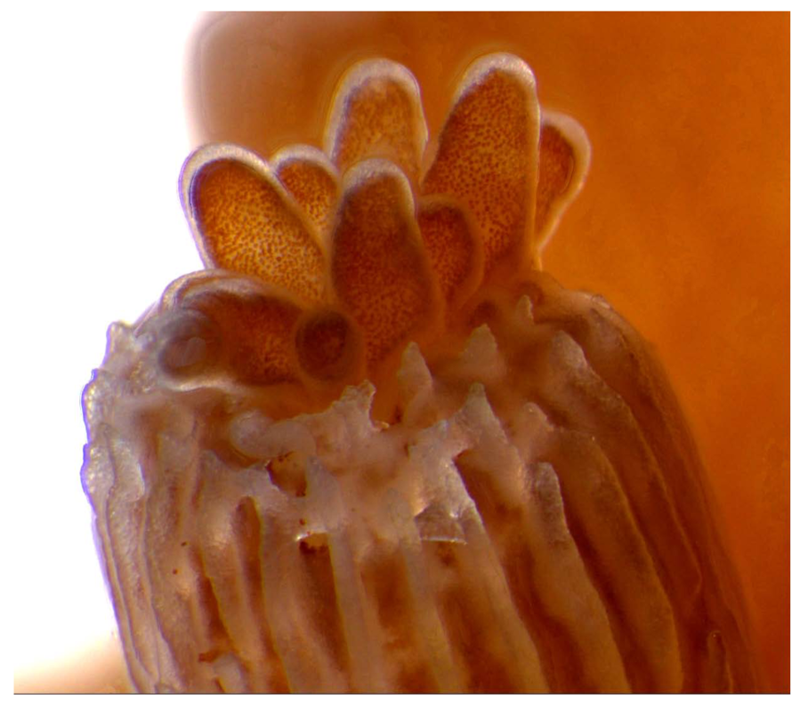
<p>The speed at which our climate is changing is unprecedented in the past 50 million years [<xref ref-type="bibr" rid="b1-diversity-03-00405">1</xref>]. Of particular concern to reef corals are the increase in seawater temperature and lowering of seawater pH (acidification). Corals are sensitive to even small temperature elevations beyond the norm, which can lead to a break-down of the obligate symbiosis between the coral animal and its algal endosymbionts (unicellular dinoflagellates of the genus <italic>Symbiodinium</italic>, also known as zooxanthellae) (<xref ref-type="fig" rid="f1-diversity-03-00405">Figure 1</xref>). This results in a paling of the coral tissues due to loss of <italic>Symbiodinium</italic> cells and/or their pigments and is therefore referred to as coral bleaching. During unusually warm summers, bleaching events often extend across many reefs and reef systems. Such mass bleaching events can severely affect many coral species and can cause considerable coral mortality. Ocean acidification, through dissolution of elevated atmospheric CO<sub>2</sub> into the seawater, is likely to affect calcification, reducing skeletal extension rates (<italic>i.e.</italic>, growth rates) and skeletal density, as well as the corals' productivity [<xref ref-type="bibr" rid="b2-diversity-03-00405">2</xref>]. These deleterious effects may further compound each other, as corals show increased sensitivity to temperature under high CO<sub>2</sub> levels [<xref ref-type="bibr" rid="b3-diversity-03-00405">3</xref>]. On a world-wide scale, contemporary coral reefs have suffered large declines in coral cover [<xref ref-type="bibr" rid="b4-diversity-03-00405">4</xref>,<xref ref-type="bibr" rid="b5-diversity-03-00405">5</xref>] (see [<xref ref-type="bibr" rid="b6-diversity-03-00405">6</xref>] for data on some regional patterns) and ∼15% of the world's coral reefs are seriously threatened with complete loss within the next 10–20 years [<xref ref-type="bibr" rid="b7-diversity-03-00405">7</xref>]. These observations indicate that unless corals can adapt, further loss of coral cover and diversity is expected to occur over the next decades.</p>
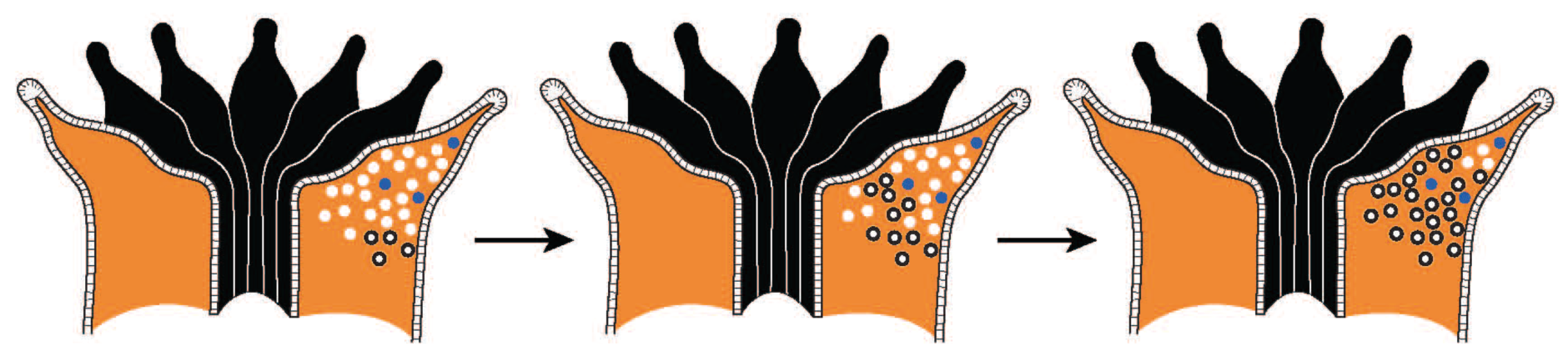
<p>It has been claimed that the rate of adaptation of the coral animal is too slow to keep up with the predicted pace of warming and ocean acidification [<xref ref-type="bibr" rid="b8-diversity-03-00405">8</xref>,<xref ref-type="bibr" rid="b9-diversity-03-00405">9</xref>] due to the long sexual generation times (<italic>i.e.</italic>, the average age at which sexual offspring is produced) of corals (see [<xref ref-type="bibr" rid="b10-diversity-03-00405">10</xref>,<xref ref-type="bibr" rid="b11-diversity-03-00405">11</xref>] for alternative opinions). Some coral species do indeed have long sexual generation times of &gt;30 years, but many common and abundant corals, such as species of <italic>Acropora</italic> and <italic>Pocillopora</italic>, mature early (from ∼4 yr of age [<xref ref-type="bibr" rid="b12-diversity-03-00405">12</xref>,<xref ref-type="bibr" rid="b13-diversity-03-00405">13</xref>]). This ‘slow adaptation’ hypothesis in corals considers adaptation solely as the result of selection on standing genetic variation from one sexual generation to the next. Corals possess attributes that may warrant more complex models of adaptation via selection on cells with different genotypes arising through somatic mutation (<italic>i.e.</italic>, mosaicism) and their evolutionary role through both asexual and sexual reproduction. Furthermore, the physiological tolerances of corals, including thermal tolerance, are strongly influenced by their <italic>Symbiodinium</italic> partners [<xref ref-type="bibr" rid="b14-diversity-03-00405">14</xref>-<xref ref-type="bibr" rid="b17-diversity-03-00405">17</xref>], which are therefore likely to be subject to strong selective pressures under climate change. <italic>In hospite</italic> populations of <italic>Symbiodinium</italic> are likely haploid [<xref ref-type="bibr" rid="b18-diversity-03-00405">18</xref>,<xref ref-type="bibr" rid="b19-diversity-03-00405">19</xref>] and maintained asexually; sexual reproduction has never been observed [<xref ref-type="bibr" rid="b20-diversity-03-00405">20</xref>,<xref ref-type="bibr" rid="b21-diversity-03-00405">21</xref>]. Non-neutral somatic mutations in <italic>Symbiodinium</italic> arising <italic>in hospite</italic> are subject to selection and if the mutation is beneficial, the new mutant can theoretically displace most if not all of the original genotype(s) within the coral colony (<xref ref-type="fig" rid="f2-diversity-03-00405">Figure 2</xref>), as has been shown in several free-living microalgae when exposed to extreme toxicity [<xref ref-type="bibr" rid="b22-diversity-03-00405">22</xref>,<xref ref-type="bibr" rid="b23-diversity-03-00405">23</xref>]. Somatic mutations and selective sweeps in non-eukaryotic microbes associated with corals may also play a role in their adaptation to climate change. These organisms are not specifically addressed here, although what we discuss applies to them also [<xref ref-type="bibr" rid="b24-diversity-03-00405">24</xref>]. The role of somatic mutations in adaptation of the coral animal was first considered by Fautin [<xref ref-type="bibr" rid="b25-diversity-03-00405">25</xref>] and Buddemeier <italic>et al.</italic> [<xref ref-type="bibr" rid="b26-diversity-03-00405">26</xref>] and those in the associated <italic>Symbiodinium</italic> by Correa and Baker [<xref ref-type="bibr" rid="b24-diversity-03-00405">24</xref>]. The ideas of these authors are expanded upon here, and we argue that evolution within mitotic cell lineages of both the coral host and its associated <italic>Symbiodinium</italic>, also known as cell-lineage selection, may play a role in the adaptation of corals to climate change. This warrants testing via robust scientific experimentation.</p></sec>
<sec>
<label>2.</label>
<title>Somatic Mutations</title>
<p>Somatic mutation rates are consistently greater than germ line mutation rates, both on a per cell division basis as well as on a per sexual generation basis [<xref ref-type="bibr" rid="b27-diversity-03-00405">27</xref>]. For example, tissue assays of mouse and rat show that somatic cells accumulate two- to six-fold more mutations than germ cells in the testes by the time of sexual maturity, and in humans the average mutation rate in four somatic cell types is 17 times higher than in the germ line [<xref ref-type="bibr" rid="b27-diversity-03-00405">27</xref>]. In organisms that reproduce sexually and where the differentiation between somatic and germ line cells (<italic>i.e.</italic>, germ line cell sequestration) occurs early in ontogeny, a clear evolutionary difference exists between a somatic and a germ line mutation. The former is mostly not heritable (unless the mutation arises during the first few cell divisions prior to germ line cell sequestration) and hence has no impact on the fitness of future generations. In contrast, corals and many other modular marine invertebrates, as well as many plants, lack segregation of germ line and somatic cells [<xref ref-type="bibr" rid="b25-diversity-03-00405">25</xref>,<xref ref-type="bibr" rid="b28-diversity-03-00405">28</xref>]. In these organisms<bold>,</bold> germ cell differentiation occurs continuously from somatic stem cells, resulting in a higher probability of somatic mutations becoming incorporated in gametes of corals than in those of organisms with germ-soma segregation. This means that somatic mutations that have a fitness effect can provide a substrate for selection and form the basis of adaptation. In humans, for instance, the number of cell divisions from the fertilized egg to formation of the female gamete is only ∼24 [<xref ref-type="bibr" rid="b29-diversity-03-00405">29</xref>]. Sperm produced in adolescents at the age of 13 has undergone ∼36 cell divisions, followed by ∼23 cell divisions per year [<xref ref-type="bibr" rid="b29-diversity-03-00405">29</xref>]. Yet in corals, innumerable cell divisions occur before gametes are formed from somatic cells, both over the life time of a coral colony and between episodes of sexual reproduction (which is typically a year in broadcast spawning corals). In essence, mutant cell lineages that arise though somatic mutations are legitimate units of selection, either where a somatic cell lineage undergoes a large number of divisions before becoming a germ cell or through asexual reproduction by fragmentation, budding or other means (see below) [<xref ref-type="bibr" rid="b30-diversity-03-00405">30</xref>]. Thus, in corals, not only gametic mutations, but also somatic mutations can eventually be represented in gametes and hence can be passed on to the next generation.</p></sec>
<sec>
<label>3.</label>
<title>Evolution through Cell Lineage Selection in Organisms Other Than Corals</title>
<p>The importance of somatic mutations in evolution and adaptation is well recognized for some organisms and life forms, such as prokaryotes and viruses (reviewed in [<xref ref-type="bibr" rid="b31-diversity-03-00405">31</xref>]), but is often ignored in eukaryotic taxa (except for plants [<xref ref-type="bibr" rid="b32-diversity-03-00405">32</xref>-<xref ref-type="bibr" rid="b35-diversity-03-00405">35</xref>]). In the absence of sexual reproduction, novel genetic variation can only arise through somatic mutations. Asexuality is found in over half of all eukaryotic phyla [<xref ref-type="bibr" rid="b28-diversity-03-00405">28</xref>,<xref ref-type="bibr" rid="b33-diversity-03-00405">33</xref>]; many higher plants, algae and animals are exclusively or largely clonal, including a range of species of aphids, cladocerans, freshwater snails, bryozoans and corals (reviewed in [<xref ref-type="bibr" rid="b36-diversity-03-00405">36</xref>]). Some asexual animal species are believed to be ancient, including darwinulid ostracods (100 Myr) [<xref ref-type="bibr" rid="b37-diversity-03-00405">37</xref>], the brine shrimp <italic>Artemia salina</italic> (30 Myr) [<xref ref-type="bibr" rid="b38-diversity-03-00405">38</xref>], bdelloid rotifers (at least 35–40 Myr) [<xref ref-type="bibr" rid="b39-diversity-03-00405">39</xref>,<xref ref-type="bibr" rid="b40-diversity-03-00405">40</xref>], the weevil, <italic>Aramigus tessellates</italic> (2 Myr) [<xref ref-type="bibr" rid="b41-diversity-03-00405">41</xref>] and salamanders of the genus <italic>Ambystoma</italic> (∼4–5 Myr) [<xref ref-type="bibr" rid="b42-diversity-03-00405">42</xref>]. These organisms have evolved through somatic mutation and selection in the absence of sex. In support of this notion, variance in many anatomical traits, karyotype, genetic markers and fecundity have been observed in natural populations of asexual aphid species (reviewed in [<xref ref-type="bibr" rid="b43-diversity-03-00405">43</xref>]). Furthermore, cell lineage selection was observed in asexual (apomictic) peach potato aphids, which led to an approximately 30-fold increase in the level of esterase production (which confers resistance to pesticides) after only 14 asexual generations under laboratory selection [<xref ref-type="bibr" rid="b44-diversity-03-00405">44</xref>]. Intra-clonal heritable genetic variation is also present in the red seaweed species <italic>Asparagopsis armata</italic> and <italic>Delisea pulchra</italic> [<xref ref-type="bibr" rid="b32-diversity-03-00405">32</xref>], and significant responses to cell lineage selection have been documented in the former [<xref ref-type="bibr" rid="b35-diversity-03-00405">35</xref>]. Moreover, somatic mutations have been documented in long-lived trees [<xref ref-type="bibr" rid="b45-diversity-03-00405">45</xref>,<xref ref-type="bibr" rid="b46-diversity-03-00405">46</xref>], and many plants with long sexual generation times are well able to keep up the arms race with their short-lived pests [<xref ref-type="bibr" rid="b36-diversity-03-00405">36</xref>], which provides further evidence that evolution can be fast in organisms with infrequent sexual reproduction. Microalgae, including dinoflagellates, undergo spontaneous genetic mutations in culture at a detectable rate, some of which are under positive selection. For example, genetic adaptation to increased nutrients and temperature was demonstrated in the asexually growing dinoflagellate <italic>Prorocentrum triestinum</italic> [<xref ref-type="bibr" rid="b47-diversity-03-00405">47</xref>]. The chlorophycean, <italic>Scenedesmus intermedius</italic>, showed the occurrence of beneficial spontaneous mutations at the rate of 2.12 × 10<sup>−5</sup> mutants per mitotic cell division when grown under stress from acid wastes rich in heavy metals/metalloids [<xref ref-type="bibr" rid="b22-diversity-03-00405">22</xref>]. The chlorophycean <italic>Dictyosphaerium chlorelloides</italic> produced mutants resistant to various environmental stressors, including low pH, trinitrotoluene, and heavy metals, at a rate of ∼1 × 10<sup>−5</sup> to ∼1 × 10<sup>−7</sup> per cell per asexual generation (<italic>i.e.</italic>, per cell division) [<xref ref-type="bibr" rid="b23-diversity-03-00405">23</xref>,<xref ref-type="bibr" rid="b48-diversity-03-00405">48</xref>-<xref ref-type="bibr" rid="b50-diversity-03-00405">50</xref>]. The studies listed are only a small subset of the many known examples of detectable somatic mutations and the evolution through selection on somatic mutations, but demonstrate that evolution occurs and can be fast in the absence of sex.</p></sec>
<sec>
<label>4.</label>
<title>Asexuality in Corals and Their Associated <italic>Symbiodinium</italic></title>
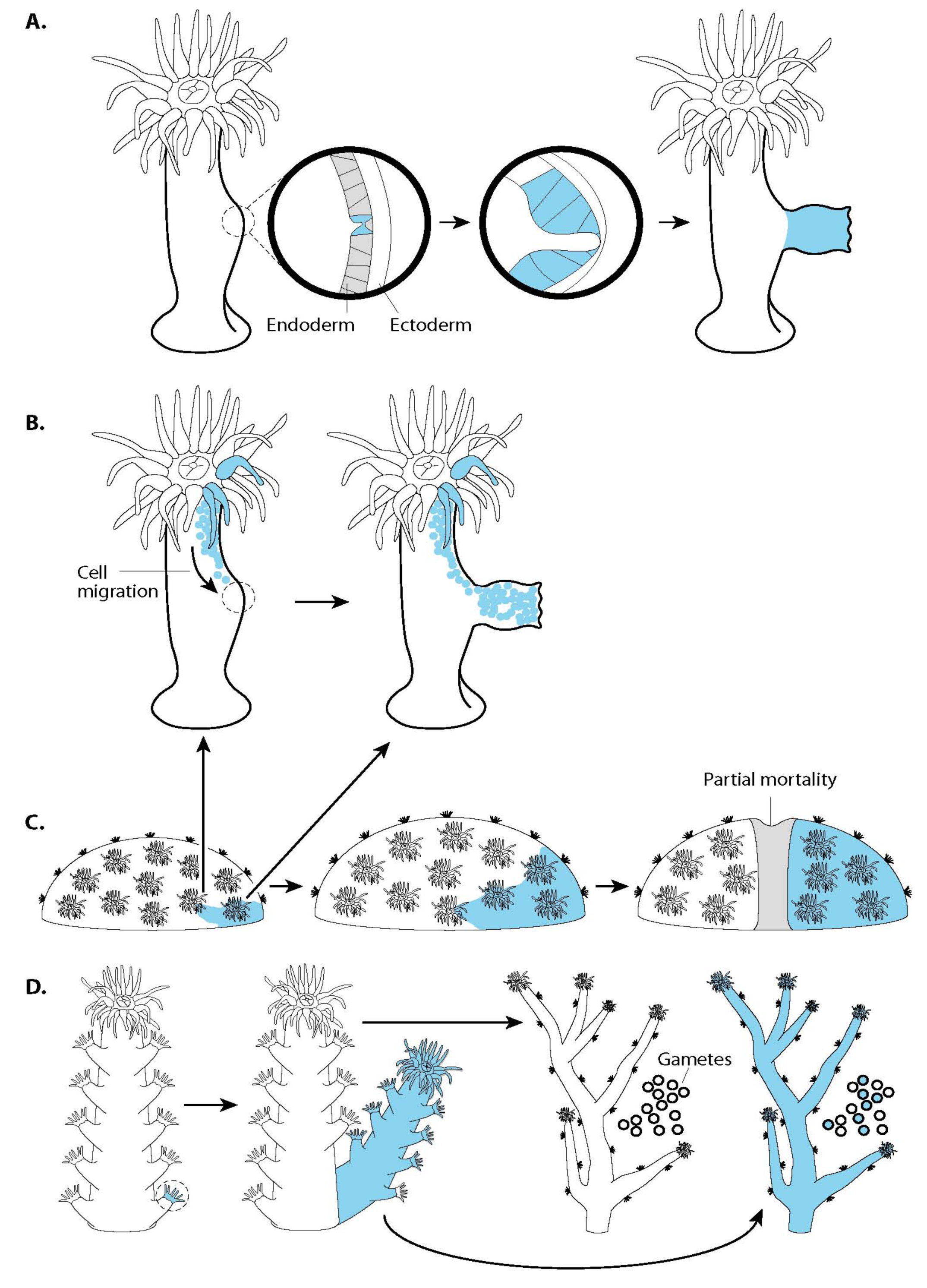
<p>Asexual reproduction is a key attribute of colonial corals that may facilitate the proliferation of localized mutations within colonies and subsequent propagation as new independent colonies. A number of modes of asexual reproduction are recognized in reef building corals [<xref ref-type="bibr" rid="b51-diversity-03-00405">51</xref>-<xref ref-type="bibr" rid="b54-diversity-03-00405">54</xref>]. Growth within colonies typically requires production of the modular polyp units via extratentacular budding (polyps forming from tissues adjacent to or in between existing polyps), or intratentacular budding (polyps forming by internal division of existing polyps). Subsets of these polyps can further proliferate into distinct colonies via fragmentation (portions of the colony becoming physically separated from the rest of the colony). In branching corals, where new branches originate through the budding of single apical polyps from radial polyps, fragmentation can be the dominant mode of colony propagation [<xref ref-type="bibr" rid="b55-diversity-03-00405">55</xref>]. This mode of asexual reproduction has also been documented in massive species [<xref ref-type="bibr" rid="b56-diversity-03-00405">56</xref>]. Other less well known forms of asexual reproduction in reef building corals include transverse division (polyps forming within the tentacular ring, also known as “strobilation”; reviewed by [<xref ref-type="bibr" rid="b52-diversity-03-00405">52</xref>]), asexual planulae (planulae genetically identical to parent polyps, exhibited by <italic>Pocillopora damicornis</italic>, several species of <italic>Tubastrea</italic> and <italic>Oulastrea crispata</italic>; reviewed by [<xref ref-type="bibr" rid="b54-diversity-03-00405">54</xref>]), polyp extrusions (extensions of tissue which flow out from corallites and attach to the substrate, exhibited by at least 20 species in nine families, including Acroporidae, Faviidae, Pocilloporidae and Agariciidae; reviewed by [<xref ref-type="bibr" rid="b53-diversity-03-00405">53</xref>]), polyp bailout (expulsion or detachment and relocation of individual polyps from the skeleton, often due to stress, exhibited by several pocilloporids, <italic>Acropora</italic> sp., <italic>Euphillia</italic> sp., <italic>Favia favus</italic> and <italic>Oculia Patagonia</italic> [<xref ref-type="bibr" rid="b53-diversity-03-00405">53</xref>,<xref ref-type="bibr" rid="b55-diversity-03-00405">55</xref>,<xref ref-type="bibr" rid="b57-diversity-03-00405">57</xref>]), and polyp balls (growth of round protrusions of polyps and skeleton on the surface or margins of some <italic>Goniopora</italic> and faviid species [<xref ref-type="bibr" rid="b53-diversity-03-00405">53</xref>,<xref ref-type="bibr" rid="b58-diversity-03-00405">58</xref>]). Almost all these modes of asexual reproduction result from a single polyp, making the propagation of a somatic mutation in one polyp into a whole new colony a distinct possibility (<xref ref-type="fig" rid="f3-diversity-03-00405">Figure 3C, 3D</xref>). The diversity of sexual and asexual reproductive modes displayed by corals may provide them with adaptive mechanisms similar to those in some plants, where mosaicism can play a significant role in adaptation [<xref ref-type="bibr" rid="b59-diversity-03-00405">59</xref>]. In some species, such as the massive <italic>Porites</italic>, individual colonies can live and reproduce for centuries, growing indeterminately through asexual budding, and consequently producing large colonies of several million polyps. In such long lived species, there is a high probability that somatic mutations will be preserved and accumulate over time.</p>
<p>Knowledge of key aspects of new polyp formation relevant to cell lineage selection in cnidarians is derived from pioneering work conducted on the non-colonial model coelenterate <italic>Hydra</italic>. In the early twentieth century, Tannreuther [<xref ref-type="bibr" rid="b60-diversity-03-00405">60</xref>] described in detail how new buds commence with an increase in volume and division of cells in the wall of the parent <italic>Hydra</italic>. Once these cells have increased in volume once or twice, the ectoderm bulges out. Cells in this bulge become differentiated into two regions: the central part which becomes the distal end of the new polyp where cells become dormant and the region on either side in which the cells divide rapidly and contribute almost entirely to the growth of the bud (<xref ref-type="fig" rid="f3-diversity-03-00405">Figure 3A</xref>). Since only one or two cells on either side of the distal end of the bud are involved in growth, any mutation within these cells has a high probability of making up the majority of the new polyp. More recently, it has been shown that in addition to the involvement of cells at the site formation of the new bud, endodermal cell motility can be involved in bud formation [<xref ref-type="bibr" rid="b61-diversity-03-00405">61</xref>,<xref ref-type="bibr" rid="b62-diversity-03-00405">62</xref>]. Transgenic cells expressing a green fluorescent protein were observed to migrate to distant sites within the polyp (including the site of formation of the new bud), and oriented cell division of the transgenic cells occurred during the migration process [<xref ref-type="bibr" rid="b61-diversity-03-00405">61</xref>]. Thus, not only mutant cells at the site of polyp formation but also mutant cells arisen elsewhere in the body may be incorporated in the newly budded polyp (<xref ref-type="fig" rid="f3-diversity-03-00405">Figure 3B</xref>) [<xref ref-type="bibr" rid="b63-diversity-03-00405">63</xref>].</p>
<p>Corals acquire <italic>Symbiodinium</italic> either from the environment as larvae or primary polyps (∼85% of species [<xref ref-type="bibr" rid="b64-diversity-03-00405">64</xref>]) or via parental transmission to eggs, larvae or asexual propagules. <italic>Symbiodinium</italic> cells occupy vacuoles within the coral gastroderm, maintaining large population sizes in the order of 10<sup>6</sup> cells per cm<sup>2</sup> of coral tissue, which vary in healthy coral symbioses from 0.5 to 9 × 10<sup>6</sup> cells per cm<sup>2</sup> among species [<xref ref-type="bibr" rid="b65-diversity-03-00405">65</xref>,<xref ref-type="bibr" rid="b66-diversity-03-00405">66</xref>] and in response to environmental parameters [<xref ref-type="bibr" rid="b67-diversity-03-00405">67</xref>-<xref ref-type="bibr" rid="b71-diversity-03-00405">71</xref>]. <italic>Symbiodinium</italic> also form symbioses with other invertebrate and protist hosts (reviewed in [<xref ref-type="bibr" rid="b72-diversity-03-00405">72</xref>]) and occur free-living in various habitats including reef sediments (&gt;10<sup>3</sup> cells per cm<sup>3</sup>), seawater (∼10<sup>2</sup> cells per cm<sup>3</sup>) [<xref ref-type="bibr" rid="b73-diversity-03-00405">73</xref>] and the surface of benthic macroalgae [<xref ref-type="bibr" rid="b74-diversity-03-00405">74</xref>,<xref ref-type="bibr" rid="b75-diversity-03-00405">75</xref>]. Populations are maintained by binary fission and it is not known whether sexual reproduction exists within the <italic>Symbiodinium</italic> life cycle [<xref ref-type="bibr" rid="b76-diversity-03-00405">76</xref>]. <italic>Symbiodinium</italic> cells in the process of dividing account for 0.4 to 12% of the <italic>in hospite</italic> population [<xref ref-type="bibr" rid="b77-diversity-03-00405">77</xref>-<xref ref-type="bibr" rid="b79-diversity-03-00405">79</xref>] corresponding to asexual generation (<italic>i.e.</italic>, doubling) times of three to 74 days, with ∼seven days being common in most corals [<xref ref-type="bibr" rid="b79-diversity-03-00405">79</xref>]. <italic>Symbiodinium</italic> growth is inversely related to density, with the fastest rates observed in new host tissue (e.g., the tips of coral branches [<xref ref-type="bibr" rid="b79-diversity-03-00405">79</xref>]) and in the re-population of bleached tissue [<xref ref-type="bibr" rid="b80-diversity-03-00405">80</xref>,<xref ref-type="bibr" rid="b81-diversity-03-00405">81</xref>]. Growth is regulated by the rate of carbon fixation and utilization [<xref ref-type="bibr" rid="b82-diversity-03-00405">82</xref>,<xref ref-type="bibr" rid="b83-diversity-03-00405">83</xref>] and the amount of nutrients provided by the host [<xref ref-type="bibr" rid="b84-diversity-03-00405">84</xref>,<xref ref-type="bibr" rid="b85-diversity-03-00405">85</xref>], with further regulation of population sizes <italic>in hospite</italic> by host digestion and extrusion of <italic>Symbiodinium</italic> cells [<xref ref-type="bibr" rid="b85-diversity-03-00405">85</xref>,<xref ref-type="bibr" rid="b86-diversity-03-00405">86</xref>]. In free-living habitats, growth rates of <italic>Symbiodinium</italic> are not known, but doubling times in the order of days to weeks have been recorded for other species of free-living dinoflagellates [<xref ref-type="bibr" rid="b79-diversity-03-00405">79</xref>]. In culture, <italic>Symbiodinium</italic> are capable of rapid growth with typical doubling times of less than 3 days [<xref ref-type="bibr" rid="b87-diversity-03-00405">87</xref>-<xref ref-type="bibr" rid="b89-diversity-03-00405">89</xref>], although some strains grow more slowly [<xref ref-type="bibr" rid="b90-diversity-03-00405">90</xref>]. The asexual mode of reproduction and large <italic>in hospite</italic> population sizes suggest that somatic mutations are likely to be an important source of novel genetic variation for <italic>Symbiodinium</italic>. The fitness effects of mutations are generally more rapidly expressed in haploid organisms, such as <italic>Symbiodinium</italic>, as the impact of the mutation is not confounded by the wild-type allele on the homologous chromosome as is the case in diploid organisms (<italic>i.e.</italic>, heterozygous state).</p></sec>
<sec>
<label>5.</label>
<title>Are Somatic Mutations Fuel for Adaptation of Corals?</title>
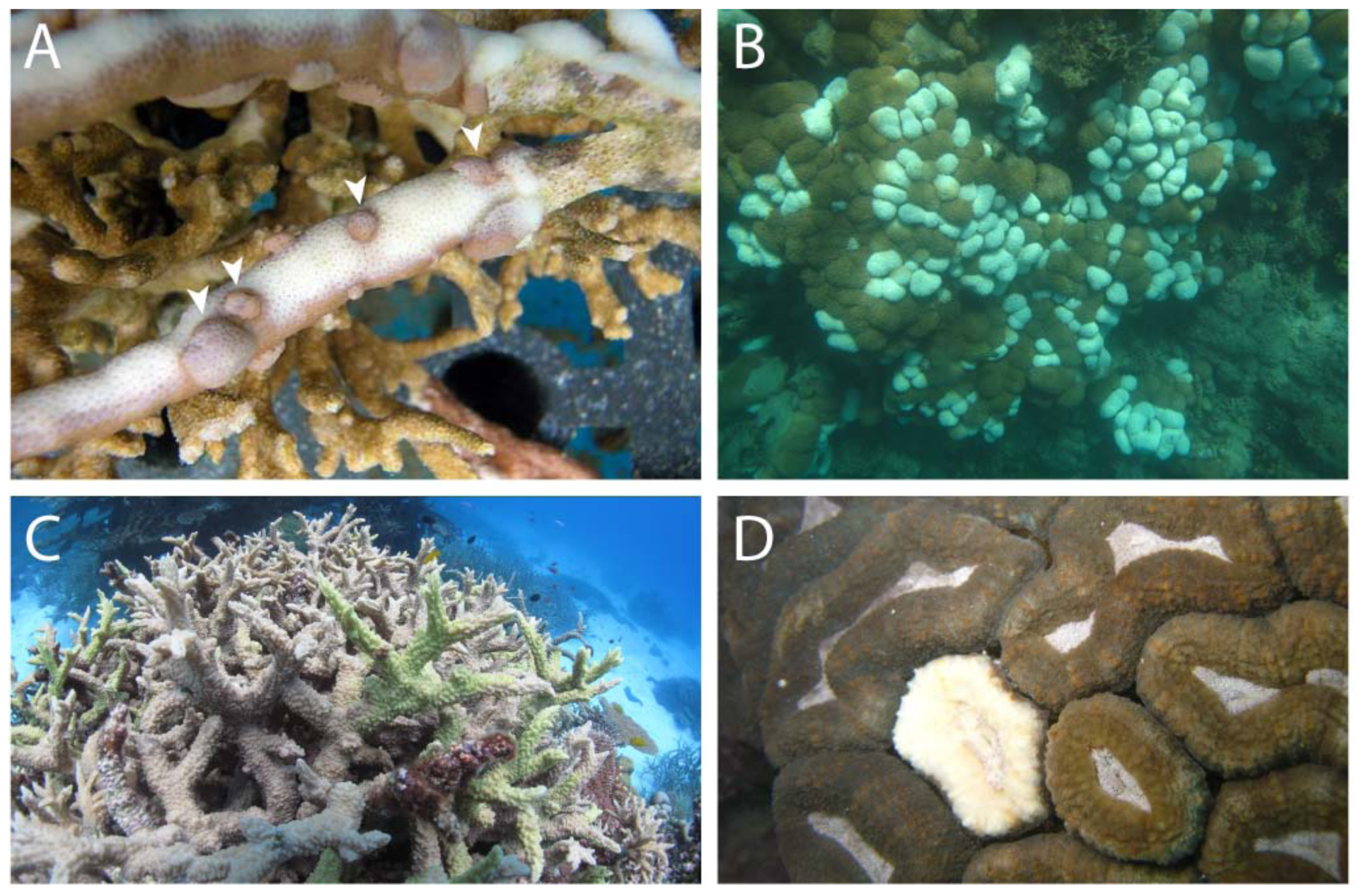
<p>The evidence summarized above from a wide range of partially or fully asexual organisms, indicates that evolution through somatic mutations and cell lineage selection in corals and associated <italic>Symbiodinium</italic> is likely to be an important mechanism for adaptation to climate change. <xref ref-type="fig" rid="f4-diversity-03-00405">Figure 4A–D</xref> show corals <italic>in situ</italic> displaying intra-colony phenotypic variation. We hypothesize that such variation may in some instances reflect mosaicism within the host and/or genetic diversity within its associated <italic>Symbiodinium</italic> population, but this remains to be tested. Based on measurements from a coral population of <italic>Acropora millepora</italic> in the southern Great Barrier Reef (GBR), we estimate that ∼100 million somatic mutations arise within a single coral colony with a diameter of 30 cm (<xref ref-type="table" rid="t1-diversity-03-00405">Table 1</xref>). A 30 cm <italic>A. millepora</italic> colony contains approximately half a million polyps, each of which spawns on average 5 eggs [<xref ref-type="bibr" rid="b91-diversity-03-00405">91</xref>] and a vast number of sperm cells every spawning event, hence, there is considerable potential for somatic mutations to be passed on to the next sexual generation (<xref ref-type="fig" rid="f3-diversity-03-00405">Figure 3D</xref>). Further, somatic mutations may be passed on to asexually produced larvae or to other polyps and colony fragments (<xref ref-type="fig" rid="f3-diversity-03-00405">Figure 3A–D</xref>). The majority of spontaneous mutations, however, is likely to be selectively neutral, <italic>i.e.</italic>, has no impact on the phenotype or fitness, and the persistence of cells carrying a non-neutral (<italic>i.e.</italic>, under negative or positive selection) mutation will depend on the strength of selection for that mutation [<xref ref-type="bibr" rid="b92-diversity-03-00405">92</xref>]. Nevertheless, estimates of beneficial mutations (<italic>i.e.</italic>, those under positive selection) under extreme experimental stress in unicellular algae are astonishingly high and only 100–10,000 fold smaller than the estimates for all (<italic>i.e.</italic>, neutral and non-neutral) somatic mutations in coral (10<sup>−5</sup>–10<sup>−7</sup> per cell generation, <xref ref-type="table" rid="t1-diversity-03-00405">Table 1</xref>). Climate change is predicted to result in an increased frequency of extreme weather events [<xref ref-type="bibr" rid="b93-diversity-03-00405">93</xref>], which act as strong selective forces on coral and <italic>Symbiodinium</italic> populations. Mosaicism within the coral host tissues or genetic diversity within <italic>Symbiodinium</italic> populations may result in different levels of environmental tolerance across a single coral colony and partial, rather than whole, colony mortality is often observed after severe bleaching events [<xref ref-type="bibr" rid="b94-diversity-03-00405">94</xref>,<xref ref-type="bibr" rid="b95-diversity-03-00405">95</xref>]. Coral bleaching events reduce <italic>in hospite Symbiodinium</italic> densities to in some cases as low as 10 % of the pre-bleaching population in coral colonies that survive the stress event [<xref ref-type="bibr" rid="b81-diversity-03-00405">81</xref>,<xref ref-type="bibr" rid="b96-diversity-03-00405">96</xref>,<xref ref-type="bibr" rid="b97-diversity-03-00405">97</xref>]. Remaining <italic>Symbiodinium</italic> cells may represent individuals that resisted bleaching because they were occupying microhabitat refuges (e.g., shaded branches) or they may represent genotypes that are better adapted to the bleaching stressor, e.g., elevated temperature. On repopulating the coral's tissues during recovery, the adapted genotype is likely to spread and increase in numbers. Such shifts have been documented for different <italic>Symbiodinium</italic> types (some even belonging to different clades) under natural [<xref ref-type="bibr" rid="b97-diversity-03-00405">97</xref>] and experimental [<xref ref-type="bibr" rid="b15-diversity-03-00405">15</xref>] field conditions following severe bleaching, but may have gone undetected if mutant cells better adapted to heat stress were present within a <italic>Symbiodinium</italic> type. In addition to extreme events, climate change is expected to cause a gradual and persistent increase in mean seawater temperatures [<xref ref-type="bibr" rid="b93-diversity-03-00405">93</xref>] and this is a continuous selective force which will push coral and <italic>Symbiodinium</italic> populations towards increased thermal tolerance if the potential exists to evolve in that direction. Field observations of reduced impact of thermal stress events on coral communities in recent years compared with earlier thermal stress events of the same or lesser severity, suggest that adaptation may already have occurred on some reefs through selective mortality of the less tolerant (host and/or <italic>Symbiodinium</italic>) genotypes [<xref ref-type="bibr" rid="b98-diversity-03-00405">98</xref>-<xref ref-type="bibr" rid="b100-diversity-03-00405">100</xref>]. Whether this involved selection on recently evolved (<italic>i.e.</italic>, mutant) genotypes is, however, unknown.</p>
<p>At the population level, the maintenance of genetic diversity is a balance between random genetic drift, migration and natural selection, which either increase or decrease the prevalence of any particular mutation within a population or species [<xref ref-type="bibr" rid="b106-diversity-03-00405">106</xref>]. For functional genetic divergence to occur between populations (<italic>i.e.</italic>, local adaptation), the intensity of selection on a certain adaptive trait or beneficial mutation needs to be greater than the combined effects of random genetic drift and migration [<xref ref-type="bibr" rid="b107-diversity-03-00405">107</xref>]. The emerging picture on levels of connectivity of both coral hosts and <italic>Symbiodinium</italic> is that gene flow is relatively restricted for most species of host and symbiont, <italic>i.e.</italic>, that most populations are largely self-seeding [<xref ref-type="bibr" rid="b108-diversity-03-00405">108</xref>-<xref ref-type="bibr" rid="b110-diversity-03-00405">110</xref>], at least over the time scales relevant to adaptation to climate change impacts. This will facilitate local adaptation as ‘dilution’ through input of less adapted alleles from outside the population is likely to be low. Drift becomes more important with decreasing effective population sizes (<italic>N<sub>e</sub></italic>), and low frequency alleles (such as new mutant alleles) have a high probability of being lost in populations with small <italic>N<sub>e</sub></italic>. <italic>N<sub>e</sub></italic> values of corals are likely significantly smaller than their census sizes [<xref ref-type="bibr" rid="b111-diversity-03-00405">111</xref>,<xref ref-type="bibr" rid="b112-diversity-03-00405">112</xref>], because (1) populations are known to greatly fluctuate in size due to a range of perturbations, including crown-of-thorn outbreaks, storms and cyclones, extreme wet seasons and bleaching events [<xref ref-type="bibr" rid="b6-diversity-03-00405">6</xref>], (2) fecundity in corals is highly variable [<xref ref-type="bibr" rid="b113-diversity-03-00405">113</xref>], (3) asexual reproduction is common in corals [<xref ref-type="bibr" rid="b54-diversity-03-00405">54</xref>], and (4) in gonochoric species, sex-ratios may be biased [<xref ref-type="bibr" rid="b114-diversity-03-00405">114</xref>]. No estimates of <italic>N<sub>e</sub></italic> exist for common species of coral, and the role of drift on the likelihood of a mutant genotype to establish itself within a population is therefore virtually impossible to assess. Other factors that affect the likelihood of a new mutation spreading through a population have been elucidated by a recent model of co-evolutionary interactions between the coral host and associated <italic>Symbiodinium</italic> [<xref ref-type="bibr" rid="b115-diversity-03-00405">115</xref>]. This model predicts that bleaching resistance alleles spread more quickly through the population when bleaching results from death of the coral-<italic>Symbiodinium</italic> partnership rather than expulsion of <italic>Symbiodinium</italic> without death, because the death of the partnership is more efficient at removing the disfavoured allele from the coral host and <italic>Symbiodinium</italic> populations [<xref ref-type="bibr" rid="b115-diversity-03-00405">115</xref>]. This finding would extend to partial mortality of tissues with less adapted genotypes within a mosaic colony. The way in which the genomes of the two symbiotic partners interact and the trade-offs between fitness traits (such as thermal tolerance and growth rate) were also found to have a considerable effect on the speed of the spread of resistance alleles. Further, in species that have to acquire <italic>Symbiodinium</italic> from the environment early in ontogeny (<italic>i.e.</italic>, in the larval or primary polyp stage; ∼85% of all species [<xref ref-type="bibr" rid="b64-diversity-03-00405">64</xref>]), the spread of <italic>Symbiodinium</italic> alleles will be affected by the force and direction of selection <italic>in</italic> and <italic>ex hospite</italic>, which need not be the same, and the extent of gene flow between the <italic>in hospite</italic> and free-living <italic>Symbiodinium</italic> populations.</p></sec>
<sec sec-type="conclusions">
<label>6.</label>
<title>Conclusions</title>
<p>Corals possess a set of attributes that theoretically provides them with considerable adaptive potential through somatic mutations and selection thereon. Many species show extensive asexual reproduction, indeterminate growth, asexual regeneration following partial colony mortality, and longevity, resulting in many mitotic cell divisions and hence, opportunities for somatic mutations to arise within an individual. All coral species lack germ cell lines. Instead, germ cells arise from somatic cells, and therefore, many cell divisions take place prior to the formation of gametes. The model cnidarian, <italic>Hydra</italic>, is believed to integrate foreign genetic material relatively easily into its genome [<xref ref-type="bibr" rid="b116-diversity-03-00405">116</xref>,<xref ref-type="bibr" rid="b117-diversity-03-00405">117</xref>], and has been shown to readily accept and incorporate mutant cells into its body [<xref ref-type="bibr" rid="b61-diversity-03-00405">61</xref>]. If these traits are also present in corals, they will facilitate cell lineage selection. All reef-building corals form an intimate symbiosis with <italic>Symbiodinium</italic>, which to a large extent determines the coral's physiological tolerances. <italic>Symbiodinium</italic> also have attributes that promote adaptation, such as large population sizes and rapid turn-over rates. Baskett <italic>et al.</italic>'s [<xref ref-type="bibr" rid="b118-diversity-03-00405">118</xref>] model of symbiont evolutionary dynamics predicts that some level of adaptation within the following decades is possible in the presence of either genetic or community-level variation in <italic>Symbiodinium</italic> thermal tolerance, however, these model outcomes have not yet been experimentally validated. We propose that future work should focus on examining the response of <italic>Symbiodinium</italic> and possibly coral tissues to selection in the laboratory [<xref ref-type="bibr" rid="b119-diversity-03-00405">119</xref>]. Recent laboratory selection experiments on 12 unicellular algal species (11 phytoplankton species and <italic>Symbiodinium</italic> sp.) have shown that adaptation to increased temperatures is possible within 8–150 generations, with the extent of the increase in temperature tolerance and the rate at which adaptation occurred varying among species [<xref ref-type="bibr" rid="b120-diversity-03-00405">120</xref>]. Whole genome sequencing of cells/tissues prior to and following the <italic>in vitro</italic> selection experiment may reveal the mutations responsible for the adaptive response.</p></sec></body>
<back>
<sec sec-type="display-objects">
<title>Figures and Table</title>
<fig id="f1-diversity-03-00405" position="float">
<label>Figure 1.</label>
<caption>
<p>Close-up photograph of a polyp of the coral species <italic>Acropora tenuis</italic> showing <italic>Symbiodinium</italic> inside the tentacle tissues. Carbon fixed by <italic>Symbiodinium</italic> photosynthesis is the primary source of nutrition in most corals. Photo credit: Jean-Baptiste Raina.</p></caption>
<graphic xlink:href="diversity-03-00405f1.gif"/></fig>
<fig id="f2-diversity-03-00405" position="float">
<label>Figure 2.</label>
<caption>
<p>Cartoon of the spread of a beneficial mutation in a <italic>Symbiodinium</italic> community <italic>in hospite</italic>. The white and blue circles represent two wild-type <italic>Symbiodinium</italic> types, the white circles with a black border represent mutant <italic>Symbiodinium</italic> cells which have evolved from the white type. The mutant cells are under positive selection and increase their relative abundance over time (from left to right).</p></caption>
<graphic xlink:href="diversity-03-00405f2.gif"/></fig>
<fig id="f3-diversity-03-00405" position="float">
<label>Figure 3.</label>
<caption>
<p>Cartoon showing several ways in which mutant cells (shown in blue) can spread in corals. (<bold>A</bold>) Coral polyp with a mutation arisen in a cell of the endodermis (=gastrodermis) at the site of new polyp formation. As the budding process progresses, the mutated cell divides to form a mutant cell lineage which constitutes the endoderm of the newly budded polyp; (<bold>B</bold>) Mutant cells arisen in the upper part of the coral polyp migrate to some of the polyp's tentacles as well as into the budding polyp. As the budding process progresses, most of the endodermal cells of the newly budded polyp are of the mutant genotype; (<bold>C</bold>) Massive coral colony in which a mutation has arisen and spreads as the colony grows. At some point in time, partial colony mortality divides the colony into two physically separated units that are of different genotypes (wild-type and mutant); and (<bold>D</bold>) Branching coral in which a mutated branch breaks off and re-establishes itself by attachment to the substratum. The wild-type ‘mother’ colony produces wild-type gametes only, while the mutant colony produces both wild-type and mutant gametes as corals are diploid [<xref ref-type="bibr" rid="b63-diversity-03-00405">63</xref>] and only half of the gametes in a heterozygous individual will carry the mutation following meiosis.</p></caption>
<graphic xlink:href="diversity-03-00405f3.gif"/></fig>
<fig id="f4-diversity-03-00405" position="float">
<label>Figure 4.</label>
<caption>
<p>Field examples of intra-colony phenotypic variation in reef corals. (<bold>A</bold>) “Tumour”-like structures (white arrow heads) on a <italic>Montipora digitata</italic> branch that has not bleached while the main branch has. Photo credit: Andrew Heyward; (<bold>B</bold>) Patchy bleaching across a <italic>Goniopora</italic> sp. colony. Photo credit: Emily Howells; (<bold>C</bold>) Differential expression of coral host pigments across a <italic>Hydnophora rigida</italic> colony. Photo credit: Ray Berkelmans; and (<bold>D</bold>) Healthy colony of <italic>Lobophyllia hemprichii</italic>, showing one severely bleached polyp. Photo credit: Emily Howells.</p></caption>
<graphic xlink:href="diversity-03-00405f4.gif"/></fig>
<table-wrap id="t1-diversity-03-00405" position="float">
<label>Table 1.</label>
<caption>
<p>Estimates of the number of somatic mutations arising in coral and <italic>Symbiodinium</italic> cells in a median size <italic>Acropora millepora</italic> colony based on the number of cells within the colony, using data from a small fringing reef in the southern Great Barrier Reef (Miall Island). Cell renewal was not taken into account, because it is not known whether cell renewal takes place in corals. In <italic>Hydra</italic>, cells are continuously being renewed and each individual cell has a relatively short life span [<xref ref-type="bibr" rid="b62-diversity-03-00405">62</xref>]. Hence, our estimate is conservative. Note that we present an estimate of all spontaneous somatic mutations (<italic>i.e.</italic>, the sum of neutral mutations and mutations under positive or negative selection) for the coral host, but an estimate of beneficial and phenotypically observable somatic mutations for <italic>Symbiodinium</italic>. The reason for this is that the latter is based on estimates for free-living unicellular algae, for which mutation rates have been estimated through laboratory selection experiments under various simulated environmental stress conditions, and mutants were phenotypically identified. Similar estimates are not available for the coral animal.</p></caption>
<table frame="hsides" rules="groups">
<thead>
<tr>
<th align="center" valign="top"><bold>Attribute</bold></th>
<th align="center" valign="top"><bold>Estimate of variable</bold></th>
<th align="center" valign="top"><bold>Reference</bold></th></tr></thead>
<tbody>
<tr>
<td align="left" valign="top">Median colony diameter (cm)</td>
<td align="center" valign="top">30</td>
<td align="left" valign="top">[<xref ref-type="bibr" rid="b101-diversity-03-00405">101</xref>]</td></tr>
<tr>
<td align="left" valign="top">No. branches/30 cm colony</td>
<td align="center" valign="top">400</td>
<td align="left" valign="top">[<xref ref-type="bibr" rid="b101-diversity-03-00405">101</xref>]</td></tr>
<tr>
<td align="left" valign="top">Surface area/branch (cm<sup>2</sup>)</td>
<td align="center" valign="top">13</td>
<td align="left" valign="top">[<xref ref-type="bibr" rid="b102-diversity-03-00405">102</xref>]</td></tr>
<tr>
<td align="left" valign="top">Surface area/30 cm, colony (cm<sup>2</sup>)</td>
<td align="center" valign="top">400 × 13 = 5200</td>
<td align="left" valign="top"/></tr>
<tr>
<td align="left" valign="top">No. <italic>Symbiodinium</italic> cells/cm<sup>2</sup></td>
<td align="center" valign="top">1.5 × 10<sup>6</sup></td>
<td align="left" valign="top">[<xref ref-type="bibr" rid="b103-diversity-03-00405">103</xref>]</td></tr>
<tr>
<td align="left" valign="top">No. <italic>Symbiodinium</italic> cells/30 cm colony</td>
<td align="center" valign="top">1.5 × 10<sup>6</sup> × 5200 = 7.8 × 10<sup>9</sup></td>
<td align="left" valign="top"/></tr>
<tr>
<td align="left" valign="top">Ratio of <italic>Symbiodinium</italic>/host cells</td>
<td align="center" valign="top">0.15</td>
<td align="left" valign="top">[<xref ref-type="bibr" rid="b103-diversity-03-00405">103</xref>]</td></tr>
<tr>
<td align="left" valign="top">No. coral host cells/30 cm colony</td>
<td align="center" valign="top">7.8 × 10<sup>9</sup>/0.15 = 5.2 × 10<sup>10</sup></td>
<td align="left" valign="top"/></tr>
<tr>
<td align="left" valign="top">Coral host somatic mutation rate per cell generation and genome (assuming ∼2 × 10<sup>4</sup> genes in corals)</td>
<td align="center" valign="top">2 × 10<sup>−3</sup></td>
<td align="left" valign="top">[<xref ref-type="bibr" rid="b104-diversity-03-00405">104</xref>,<xref ref-type="bibr" rid="b105-diversity-03-00405">105</xref>]</td></tr>
<tr>
<td align="left" valign="top">No. somatic mutations arising in coral host cells in 30 cm colony</td>
<td align="center" valign="top">10.4 × 10<sup>7</sup> ≅ 10<sup>8</sup></td>
<td align="left" valign="top"/></tr>
<tr>
<td align="left" valign="top"><italic>Symbiodinium</italic> <underline>beneficial and phenotypically observable</underline> somatic mutation rate per cell generation</td>
<td align="center" valign="top">10<sup>−5</sup>–10<sup>−7</sup></td>
<td align="left" valign="top">[<xref ref-type="bibr" rid="b22-diversity-03-00405">22</xref>,<xref ref-type="bibr" rid="b23-diversity-03-00405">23</xref>,<xref ref-type="bibr" rid="b48-diversity-03-00405">48</xref>-<xref ref-type="bibr" rid="b50-diversity-03-00405">50</xref>]</td></tr>
<tr>
<td align="left" valign="top">No. <underline>beneficial</underline> mutant <italic>Symbiodinium</italic> cells in 30 cm colony</td>
<td align="center" valign="top">7.8 × 10<sup>2</sup>–7.8 × 10<sup>4</sup> ≅ 10<sup>3</sup>–10<sup>5</sup></td>
<td align="left" valign="top"/></tr></tbody></table></table-wrap></sec>
<ack>
<p>We thank Tim Simmonds (AIMS) for producing <xref ref-type="fig" rid="f2-diversity-03-00405">Figures 2</xref> and <xref ref-type="fig" rid="f3-diversity-03-00405">3</xref>. We also thank Bob Buddemeier, Daphne Fautin and two anonymous reviewers for their valuable input into this manuscript.</p></ack>
<ref-list>
<title>References</title>
<ref id="b1-diversity-03-00405"><label>1.</label><citation citation-type="book"><person-group person-group-type="author"><name><surname>Jansen</surname><given-names>E.</given-names></name><name><surname>Overpeck</surname><given-names>J.</given-names></name><name><surname>Briffa</surname><given-names>K.R.</given-names></name><name><surname>Duplessy</surname><given-names>J.-C.</given-names></name><name><surname>Joos</surname><given-names>F.</given-names></name><name><surname>Masson-Delmotte</surname><given-names>V.</given-names></name><name><surname>Olago</surname><given-names>D.</given-names></name><name><surname>Otto-Bliesner</surname><given-names>B.</given-names></name><name><surname>Peltier</surname><given-names>W.R.</given-names></name><name><surname>Rahmstorf</surname><given-names>S.</given-names></name><etal/></person-group><article-title>Contribution of Working Group I to the Fourth Assessment Report of the Intergovernmental Panel on Climate Change</article-title><source>Climate Change 2007: The Physical Science Basis</source><person-group person-group-type="editor"><name><surname>Solomon</surname><given-names>S.</given-names></name><name><surname>Qin</surname><given-names>D.</given-names></name><name><surname>Manning</surname><given-names>M.</given-names></name><name><surname>Chen</surname><given-names>Z.</given-names></name><name><surname>Marquis</surname><given-names>M.</given-names></name><name><surname>Averyt</surname><given-names>K.B.</given-names></name><name><surname>Tignor</surname><given-names>M.</given-names></name><name><surname>Miller</surname><given-names>H.L.</given-names></name></person-group><publisher-name>Cambridge University Press</publisher-name><publisher-loc>Cambridge, UK; New York, NY, USA</publisher-loc><year>2007</year><fpage>433</fpage><lpage>497</lpage></citation></ref>
<ref id="b2-diversity-03-00405"><label>2.</label><citation citation-type="journal"><person-group person-group-type="author"><name><surname>Anthony</surname><given-names>K.R.N.</given-names></name><name><surname>Maynard</surname><given-names>J.A.</given-names></name><name><surname>Diaz-Pulido</surname><given-names>G.</given-names></name><name><surname>Mumby</surname><given-names>P.J.</given-names></name><name><surname>Marshall</surname><given-names>P.</given-names></name><name><surname>Cao</surname><given-names>L.</given-names></name><name><surname>Hoegh-Guldberg</surname><given-names>O.</given-names></name></person-group><article-title>Ocean acidification and warming will lower coral reef resilience</article-title><source>Global Change Biol.</source><year>2011</year><volume>17</volume><fpage>1798</fpage><lpage>1808</lpage><pub-id pub-id-type="doi">10.1111/j.1365-2486.2010.02364.x</pub-id></citation></ref>
<ref id="b3-diversity-03-00405"><label>3.</label><citation citation-type="journal"><person-group person-group-type="author"><name><surname>Anthony</surname><given-names>K.R.N.</given-names></name><name><surname>Kline</surname><given-names>D.I.</given-names></name><name><surname>Diaz-Pulido</surname><given-names>G.</given-names></name><name><surname>Dove</surname><given-names>S.</given-names></name><name><surname>Hoegh-Guldberg</surname><given-names>O.</given-names></name></person-group><article-title>Ocean acidification causes bleaching and productivity loss in coral reef builders</article-title><source>Proc. Natl. Acad. Sci. USA</source><year>2008</year><volume>105</volume><fpage>17442</fpage><lpage>17446</lpage><pub-id pub-id-type="doi">10.1073/pnas.0804478105</pub-id><pub-id pub-id-type="pmid">18988740</pub-id></citation></ref>
<ref id="b4-diversity-03-00405"><label>4.</label><citation citation-type="journal"><person-group person-group-type="author"><name><surname>Gardner</surname><given-names>T.A.</given-names></name><name><surname>Cote</surname><given-names>I.M.</given-names></name><name><surname>Gill</surname><given-names>J.A.</given-names></name><name><surname>Gant</surname><given-names>A.</given-names></name><name><surname>Watkinson</surname><given-names>A.R.</given-names></name></person-group><article-title>Long-term region-wide declines in Caribbean corals</article-title><source>Science</source><year>2003</year><volume>301</volume><fpage>958</fpage><lpage>960</lpage><pub-id pub-id-type="doi">10.1126/science.1086050</pub-id><pub-id pub-id-type="pmid">12869698</pub-id></citation></ref>
<ref id="b5-diversity-03-00405"><label>5.</label><citation citation-type="journal"><person-group person-group-type="author"><name><surname>Bruno</surname><given-names>J.F.</given-names></name><name><surname>Selig</surname><given-names>E.R.</given-names></name></person-group><article-title>Regional decline of coral cover in the Indo-Pacific: Timing, extent, and subregional comparisons</article-title><source>PLoS One</source><year>2007</year><volume>2</volume><fpage>e711</fpage><pub-id pub-id-type="doi">10.1371/journal.pone.0000711</pub-id><pub-id pub-id-type="pmid">17684557</pub-id></citation></ref>
<ref id="b6-diversity-03-00405"><label>6.</label><citation citation-type="journal"><person-group person-group-type="author"><name><surname>Sweatman</surname><given-names>H.</given-names></name><name><surname>Delean</surname><given-names>S.</given-names></name><name><surname>Syms</surname><given-names>C.</given-names></name></person-group><article-title>Assessing loss of coral cover on Australia's Great Barrier Reef over two decades, with implications for longer-term trends</article-title><source>Coral Reefs</source><year>2011</year><volume>30</volume><fpage>521</fpage><lpage>531</lpage><pub-id pub-id-type="doi">10.1007/s00338-010-0715-1</pub-id></citation></ref>
<ref id="b7-diversity-03-00405"><label>7.</label><citation citation-type="book"><person-group person-group-type="author"><name><surname>Wilkinson</surname><given-names>C.</given-names></name></person-group><source>Status of the Coral Reefs of the World: 2008</source><publisher-name>Global Coral Reef Monitoring Network and Reef and Rainforest Research Centre</publisher-name><publisher-loc>Townsville, Australia</publisher-loc><year>2008</year><fpage>296</fpage></citation></ref>
<ref id="b8-diversity-03-00405"><label>8.</label><citation citation-type="journal"><person-group person-group-type="author"><name><surname>Hoegh-Guldberg</surname><given-names>O.</given-names></name><name><surname>Mumby</surname><given-names>P.J.</given-names></name><name><surname>Hooten</surname><given-names>A.J.</given-names></name><name><surname>Steneck</surname><given-names>R.S.</given-names></name><name><surname>Greenfield</surname><given-names>P.</given-names></name><name><surname>Gomez</surname><given-names>E.</given-names></name><name><surname>Harvell</surname><given-names>C.D.</given-names></name><name><surname>Sale</surname><given-names>P.F.</given-names></name><name><surname>Edwards</surname><given-names>A.J.</given-names></name><name><surname>Caldeira</surname><given-names>K.</given-names></name><etal/></person-group><article-title>Coral reefs under rapid climate change and ocean acidification</article-title><source>Science</source><year>2007</year><volume>318</volume><fpage>1737</fpage><lpage>1742</lpage><pub-id pub-id-type="doi">10.1126/science.1152509</pub-id><pub-id pub-id-type="pmid">18079392</pub-id></citation></ref>
<ref id="b9-diversity-03-00405"><label>9.</label><citation citation-type="journal"><person-group person-group-type="author"><name><surname>Hoegh-Guldberg</surname><given-names>O.</given-names></name></person-group><article-title>Climate change, coral bleaching and the future of the world's coral reefs</article-title><source>Mar. Freshwater Res.</source><year>1999</year><volume>50</volume><fpage>839</fpage><lpage>866</lpage><pub-id pub-id-type="doi">10.1071/MF99078</pub-id></citation></ref>
<ref id="b10-diversity-03-00405"><label>10.</label><citation citation-type="journal"><person-group person-group-type="author"><name><surname>Baird</surname><given-names>A.H.</given-names></name><name><surname>Bhagooli</surname><given-names>R.</given-names></name><name><surname>Ralph</surname><given-names>P.J.</given-names></name><name><surname>Takahashi</surname><given-names>S.</given-names></name></person-group><article-title>Coral bleaching: The role of the host</article-title><source>Trends Ecol. Evol.</source><year>2009</year><volume>24</volume><fpage>16</fpage><lpage>20</lpage><pub-id pub-id-type="doi">10.1016/j.tree.2008.09.005</pub-id><pub-id pub-id-type="pmid">19022522</pub-id></citation></ref>
<ref id="b11-diversity-03-00405"><label>11.</label><citation citation-type="journal"><person-group person-group-type="author"><name><surname>Maynard</surname><given-names>J.A.</given-names></name><name><surname>Baird</surname><given-names>A.H.</given-names></name><name><surname>Pratchett</surname><given-names>M.S.</given-names></name></person-group><article-title>Revisiting the Cassandra syndrome; The changing climate of coral reef research</article-title><source>Coral Reefs</source><year>2008</year><volume>27</volume><fpage>745</fpage><lpage>749</lpage><pub-id pub-id-type="doi">10.1007/s00338-008-0432-1</pub-id></citation></ref>
<ref id="b12-diversity-03-00405"><label>12.</label><citation citation-type="journal"><person-group person-group-type="author"><name><surname>Babcock</surname><given-names>R.C.</given-names></name></person-group><article-title>Comparative demography of 3 species of scleractinain corals using age-dependent and size-dependent classifications</article-title><source>Monographs</source><year>1991</year><volume>61</volume><fpage>225</fpage><lpage>244</lpage><pub-id pub-id-type="doi">10.2307/2937107</pub-id></citation></ref>
<ref id="b13-diversity-03-00405"><label>13.</label><citation citation-type="journal"><person-group person-group-type="author"><name><surname>Omori</surname><given-names>M.</given-names></name></person-group><article-title>Degradation and restoration of coral reefs: Experience in Okinawa, Japan</article-title><source>Mar. Biol. Res.</source><year>2010</year><volume>7</volume><fpage>3</fpage><lpage>12</lpage></citation></ref>
<ref id="b14-diversity-03-00405"><label>14.</label><citation citation-type="journal"><person-group person-group-type="author"><name><surname>Mieog</surname><given-names>J.C.</given-names></name><name><surname>Olsen</surname><given-names>J.L.</given-names></name><name><surname>Berkelmans</surname><given-names>R.</given-names></name><name><surname>Bleuler-Martinez</surname><given-names>S.A.</given-names></name><name><surname>Willis</surname><given-names>B.L.</given-names></name><name><surname>van Oppen</surname><given-names>M.J.H.</given-names></name></person-group><article-title>The roles and interactions of symbiont, host and environment in defining coral fitness</article-title><source>PLoS One</source><year>2009</year><volume>4</volume><fpage>e6364</fpage><pub-id pub-id-type="doi">10.1371/journal.pone.0006364</pub-id><pub-id pub-id-type="pmid">19629182</pub-id></citation></ref>
<ref id="b15-diversity-03-00405"><label>15.</label><citation citation-type="journal"><person-group person-group-type="author"><name><surname>Berkelmans</surname><given-names>R.</given-names></name><name><surname>van Oppen</surname><given-names>M.J.H.</given-names></name></person-group><article-title>The role of zooxanthellae in the thermal tolerance of corals: A ‘nugget of hope’ for coral reefs in an era of climate change</article-title><source>Proc. R. Soc. London B</source><year>2006</year><volume>273</volume><fpage>2305</fpage><lpage>2312</lpage><pub-id pub-id-type="doi">10.1098/rspb.2006.3567</pub-id></citation></ref>
<ref id="b16-diversity-03-00405"><label>16.</label><citation citation-type="journal"><person-group person-group-type="author"><name><surname>Abrego</surname><given-names>D.</given-names></name><name><surname>Ulstrup</surname><given-names>K.E.</given-names></name><name><surname>Willis</surname><given-names>B.L.</given-names></name><name><surname>van Oppen</surname><given-names>M.J.H.</given-names></name></person-group><article-title>Species-specific interactions between algal endosymbionts and coral hosts define their bleaching response to heat and light stress</article-title><source>Proc. R. Soc. B</source><year>2008</year><volume>275</volume><fpage>2273</fpage><lpage>2282</lpage><pub-id pub-id-type="doi">10.1098/rspb.2008.0180</pub-id><pub-id pub-id-type="pmid">18577506</pub-id></citation></ref>
<ref id="b17-diversity-03-00405"><label>17.</label><citation citation-type="journal"><person-group person-group-type="author"><name><surname>Rowan</surname><given-names>R.</given-names></name></person-group><article-title>Thermal adaptation in reef coral symbionts</article-title><source>Nature</source><year>2004</year><volume>430</volume><fpage>742</fpage><pub-id pub-id-type="doi">10.1038/430742a</pub-id><pub-id pub-id-type="pmid">15306800</pub-id></citation></ref>
<ref id="b18-diversity-03-00405"><label>18.</label><citation citation-type="journal"><person-group person-group-type="author"><name><surname>Santos</surname><given-names>S.R.</given-names></name><name><surname>Coffroth</surname><given-names>M.A.</given-names></name></person-group><article-title>Molecular genetic evidence that dinoflagellates belonging to the genus <italic>Symbiodinium</italic> Freudenthal are haploid</article-title><source>Biol. Bull.</source><year>2003</year><volume>204</volume><fpage>111</fpage><lpage>120</lpage></citation></ref>
<ref id="b19-diversity-03-00405"><label>19.</label><citation citation-type="journal"><person-group person-group-type="author"><name><surname>Blank</surname><given-names>R.J.</given-names></name></person-group><article-title>Cell architecture of the dinoflagellate <italic>Symbiodinium</italic> sp. inhabiting the Hawaiian stony coral <italic>Montipora verrucosa</italic></article-title><source>Mar. Biol.</source><year>1987</year><volume>94</volume><fpage>143</fpage><lpage>155</lpage><pub-id pub-id-type="doi">10.1007/BF00392906</pub-id></citation></ref>
<ref id="b20-diversity-03-00405"><label>20.</label><citation citation-type="journal"><person-group person-group-type="author"><name><surname>Correa</surname><given-names>A.M.S.</given-names></name><name><surname>Baker</surname><given-names>A.C.</given-names></name></person-group><article-title>Understanding diversity in coral-algal symbiosis: A cluster-based approach to interpreting fine-scale genetic variation in the genus <italic>Symbiodinium</italic></article-title><source>Coral Reefs</source><year>2009</year><volume>28</volume><fpage>81</fpage><lpage>93</lpage><pub-id pub-id-type="doi">10.1007/s00338-008-0456-6</pub-id></citation></ref>
<ref id="b21-diversity-03-00405"><label>21.</label><citation citation-type="journal"><person-group person-group-type="author"><name><surname>Santos</surname><given-names>S.R.</given-names></name><name><surname>Gutierrez-Rodriguez</surname><given-names>C.</given-names></name><name><surname>Lasker</surname><given-names>H.R.</given-names></name><name><surname>Coffroth</surname><given-names>M.A.</given-names></name></person-group><article-title><italic>Symbiodinium</italic> sp. associations in the gorgonian <italic>Pseudopterogorgia elisabethae</italic> in the Bahamas: High levels of genetic variability and population structure in symbiotic dinoflagellates</article-title><source>Mar. Biol.</source><year>2003</year><volume>143</volume><fpage>111</fpage><lpage>120</lpage><pub-id pub-id-type="doi">10.1007/s00227-003-1065-0</pub-id></citation></ref>
<ref id="b22-diversity-03-00405"><label>22.</label><citation citation-type="journal"><person-group person-group-type="author"><name><surname>Baos</surname><given-names>R.</given-names></name><name><surname>Garcia-Villada</surname><given-names>L.</given-names></name><name><surname>Agrelo</surname><given-names>M.</given-names></name><name><surname>Lopez-Rodas</surname><given-names>V.</given-names></name><name><surname>Hiraldo</surname><given-names>F.</given-names></name><name><surname>Costas</surname><given-names>E.</given-names></name></person-group><article-title>Short-term adaptation of microalgae in highly stressful environments: An experimental model analysing the resistance of <italic>Scenedesmus intermedius</italic> (Chlorophyceae) to the heavy metals mixture from the Aznalcollar mine spill</article-title><source>Eur. J. Phycol.</source><year>2002</year><volume>37</volume><fpage>593</fpage><lpage>600</lpage><pub-id pub-id-type="doi">10.1017/S096702620200392X</pub-id></citation></ref>
<ref id="b23-diversity-03-00405"><label>23.</label><citation citation-type="journal"><person-group person-group-type="author"><name><surname>Costas</surname><given-names>E.</given-names></name><name><surname>Flores-Moya</surname><given-names>A.</given-names></name><name><surname>Perdigones</surname><given-names>N.</given-names></name><name><surname>Maneiro</surname><given-names>E.</given-names></name><name><surname>Blanco</surname><given-names>J.L.</given-names></name><name><surname>Garcia</surname><given-names>M.E.</given-names></name><name><surname>Lopez-Rodas</surname><given-names>V.</given-names></name></person-group><article-title>How eukaryotic algae can adapt to the Spain's Rio Tinto: A neo-Darwinian proposal for rapid adaptation to an extremely hostile ecosystem</article-title><source>New Phytol.</source><year>2007</year><volume>175</volume><fpage>334</fpage><lpage>339</lpage><pub-id pub-id-type="doi">10.1111/j.1469-8137.2007.02095.x</pub-id><pub-id pub-id-type="pmid">17587381</pub-id></citation></ref>
<ref id="b24-diversity-03-00405"><label>24.</label><citation citation-type="journal"><person-group person-group-type="author"><name><surname>Correa</surname><given-names>A.M.S.</given-names></name><name><surname>Baker</surname><given-names>A.</given-names></name></person-group><article-title>Disaster taxa in microbially mediated metazoans: How endosymbionts and environmental catastrophes influence the adaptive capacity of reef corals</article-title><source>Global Change Biol.</source><year>2011</year><volume>17</volume><fpage>68</fpage><lpage>75</lpage><pub-id pub-id-type="doi">10.1111/j.1365-2486.2010.02242.x</pub-id></citation></ref>
<ref id="b25-diversity-03-00405"><label>25.</label><citation citation-type="book"><person-group person-group-type="author"><name><surname>Fautin</surname><given-names>D.G.</given-names></name></person-group><article-title>Cnidarian Reproduction: Assumptions and their implications</article-title><source>Coelenterate Biology: Proceedings of the Sixth International Congress of Coelenterate Biology</source><publisher-name>Nationaal Natuurhistorisch Museum</publisher-name><publisher-loc>Leiden, The Netherlands</publisher-loc><year>1997</year><fpage>151</fpage><lpage>162</lpage></citation></ref>
<ref id="b26-diversity-03-00405"><label>26.</label><citation citation-type="confproc"><person-group person-group-type="author"><name><surname>Buddemeier</surname><given-names>R.W.</given-names></name><name><surname>Fautin</surname><given-names>D.G.</given-names></name><name><surname>Ware</surname><given-names>J.R.</given-names></name></person-group><article-title>Acclimation, adaptation and algal symbioses in reef-building scleractinian corals</article-title><conf-name>Proceedings of the 6th International Conference on Coelenterate Biology</conf-name><conf-loc>Noordwijkerhout, The Netherlands</conf-loc><conf-date>16–21 July 1995</conf-date><fpage>71</fpage><lpage>76</lpage></citation></ref>
<ref id="b27-diversity-03-00405"><label>27.</label><citation citation-type="journal"><person-group person-group-type="author"><name><surname>Lynch</surname><given-names>M.</given-names></name></person-group><article-title>Evolution of the mutation rate</article-title><source>Trends Genet.</source><year>2010</year><volume>26</volume><fpage>345</fpage><lpage>352</lpage><pub-id pub-id-type="doi">10.1016/j.tig.2010.05.003</pub-id><pub-id pub-id-type="pmid">20594608</pub-id></citation></ref>
<ref id="b28-diversity-03-00405"><label>28.</label><citation citation-type="journal"><person-group person-group-type="author"><name><surname>Buss</surname><given-names>L.W.</given-names></name></person-group><article-title>Evolution, development, and the units of selection</article-title><source>Proc. Natl. Acad. Sci. USA</source><year>1983</year><volume>80</volume><fpage>1387</fpage><lpage>1391</lpage><pub-id pub-id-type="doi">10.1073/pnas.80.5.1387</pub-id><pub-id pub-id-type="pmid">6572396</pub-id></citation></ref>
<ref id="b29-diversity-03-00405"><label>29.</label><citation citation-type="journal"><person-group person-group-type="author"><name><surname>Crow</surname><given-names>J.F.</given-names></name></person-group><article-title>How much do we know about spontaneous human mutation-rates?</article-title><source>Environ. Mol. Mutagen.</source><year>1993</year><volume>21</volume><fpage>122</fpage><lpage>129</lpage><pub-id pub-id-type="doi">10.1002/em.2850210205</pub-id><pub-id pub-id-type="pmid">8444142</pub-id></citation></ref>
<ref id="b30-diversity-03-00405"><label>30.</label><citation citation-type="book"><person-group person-group-type="author"><name><surname>Rinkevich</surname><given-names>B.</given-names></name><name><surname>Matranga</surname><given-names>V.</given-names></name></person-group><source>Stem Cells in Marine Organisms</source><publisher-name>Springer</publisher-name><publisher-loc>Dordrecht, The Netherlands</publisher-loc><year>2009</year></citation></ref>
<ref id="b31-diversity-03-00405"><label>31.</label><citation citation-type="journal"><person-group person-group-type="author"><name><surname>Lushai</surname><given-names>G.</given-names></name><name><surname>Loxdale</surname><given-names>H.D.</given-names></name><name><surname>Allen</surname><given-names>J.A.</given-names></name></person-group><article-title>The dynamic clonal genome and its adaptive potential</article-title><source>Biol. J. Linn. Soc.</source><year>2003</year><volume>79</volume><fpage>193</fpage><lpage>208</lpage><pub-id pub-id-type="doi">10.1046/j.1095-8312.2003.00189.x</pub-id></citation></ref>
<ref id="b32-diversity-03-00405"><label>32.</label><citation citation-type="journal"><person-group person-group-type="author"><name><surname>Monro</surname><given-names>K.</given-names></name><name><surname>Poore</surname><given-names>A.G.B.</given-names></name></person-group><article-title>Selection in modular organisms: Is intraclonal variation in macroalgae evolutionarily important?</article-title><source>Am. Nat.</source><year>2004</year><volume>163</volume><fpage>564</fpage><lpage>578</lpage><pub-id pub-id-type="doi">10.1086/382551</pub-id><pub-id pub-id-type="pmid">15122503</pub-id></citation></ref>
<ref id="b33-diversity-03-00405"><label>33.</label><citation citation-type="journal"><person-group person-group-type="author"><name><surname>Fagerstrom</surname><given-names>T.</given-names></name><name><surname>Briscoe</surname><given-names>D.A.</given-names></name><name><surname>Sunnucks</surname><given-names>P.</given-names></name></person-group><article-title>Evolution of mitotic cell-lineages in multicellular organisms</article-title><source>Trends Ecol. Evol.</source><year>1998</year><volume>13</volume><fpage>117</fpage><lpage>120</lpage><pub-id pub-id-type="doi">10.1016/S0169-5347(97)01314-1</pub-id><pub-id pub-id-type="pmid">21238227</pub-id></citation></ref>
<ref id="b34-diversity-03-00405"><label>34.</label><citation citation-type="journal"><person-group person-group-type="author"><name><surname>Pineda-Krch</surname><given-names>M.</given-names></name><name><surname>Fagerstrom</surname><given-names>T.</given-names></name></person-group><article-title>On the potential for evolutionary change in meristematic cell lineages through intraorganismal selection</article-title><source>J. Evol. Biol.</source><year>1999</year><volume>12</volume><fpage>681</fpage><lpage>688</lpage><pub-id pub-id-type="doi">10.1046/j.1420-9101.1999.00066.x</pub-id></citation></ref>
<ref id="b35-diversity-03-00405"><label>35.</label><citation citation-type="journal"><person-group person-group-type="author"><name><surname>Monro</surname><given-names>K.</given-names></name><name><surname>Poore</surname><given-names>A.G.B.</given-names></name></person-group><article-title>The potential for evolutionary responses to cell-lineage selection on growth form and its plasticity in a red seaweed</article-title><source>Am. Nat.</source><year>2009</year><volume>173</volume><fpage>151</fpage><lpage>163</lpage><pub-id pub-id-type="doi">10.1086/595758</pub-id><pub-id pub-id-type="pmid">19115857</pub-id></citation></ref>
<ref id="b36-diversity-03-00405"><label>36.</label><citation citation-type="journal"><person-group person-group-type="author"><name><surname>Gill</surname><given-names>D.E.</given-names></name><name><surname>Chao</surname><given-names>L.</given-names></name><name><surname>Perkins</surname><given-names>S.L.</given-names></name><name><surname>Wolf</surname><given-names>J.B.</given-names></name></person-group><article-title>Genetic mosaicism in plants and clonal animals</article-title><source>Annu. Rev. Ecol. Syst.</source><year>1995</year><volume>26</volume><fpage>423</fpage><lpage>444</lpage></citation></ref>
<ref id="b37-diversity-03-00405"><label>37.</label><citation citation-type="journal"><person-group person-group-type="author"><name><surname>Butlin</surname><given-names>R.</given-names></name><name><surname>Schon</surname><given-names>I.</given-names></name><name><surname>Martens</surname><given-names>K.</given-names></name></person-group><article-title>Asexual reproduction in nonmarine ostracods</article-title><source>Heredity</source><year>1998</year><volume>81</volume><fpage>473</fpage><lpage>480</lpage><pub-id pub-id-type="doi">10.1046/j.1365-2540.1998.00454.x</pub-id></citation></ref>
<ref id="b38-diversity-03-00405"><label>38.</label><citation citation-type="journal"><person-group person-group-type="author"><name><surname>Perez</surname><given-names>M.L.</given-names></name><name><surname>Valverde</surname><given-names>J.R.</given-names></name><name><surname>Batuecas</surname><given-names>B.</given-names></name><name><surname>Amat</surname><given-names>F.</given-names></name><name><surname>Marco</surname><given-names>R.</given-names></name><name><surname>Garesse</surname><given-names>R.</given-names></name></person-group><article-title>Speciation in the <italic>Artemia</italic> genus—mitochindrial-DNA analysis of bisexual and parthenogenetic brine shrimps</article-title><source>J. Mol. Evol.</source><year>1994</year><volume>38</volume><fpage>156</fpage><lpage>168</lpage><pub-id pub-id-type="doi">10.1007/BF00166162</pub-id><pub-id pub-id-type="pmid">8169960</pub-id></citation></ref>
<ref id="b39-diversity-03-00405"><label>39.</label><citation citation-type="journal"><person-group person-group-type="author"><name><surname>Welch</surname><given-names>D.B.M.</given-names></name><name><surname>Meselson</surname><given-names>M.</given-names></name></person-group><article-title>Oocyte nuclear DNA content and GC proportion in rotifers of the anciently asexual Class Bdelloidea</article-title><source>Biol. J. Linn. Soc.</source><year>2003</year><volume>79</volume><fpage>85</fpage><lpage>91</lpage><pub-id pub-id-type="doi">10.1046/j.1095-8312.2003.00180.x</pub-id></citation></ref>
<ref id="b40-diversity-03-00405"><label>40.</label><citation citation-type="journal"><person-group person-group-type="author"><name><surname>Welch</surname><given-names>D.B.M.</given-names></name><name><surname>Meselson</surname><given-names>M.</given-names></name></person-group><article-title>Evidence for the evolution of bdelloid rotifers without sexual reproduction or genetic exchange</article-title><source>Science</source><year>2000</year><volume>288</volume><fpage>1211</fpage><lpage>1215</lpage><pub-id pub-id-type="doi">10.1126/science.288.5469.1211</pub-id><pub-id pub-id-type="pmid">10817991</pub-id></citation></ref>
<ref id="b41-diversity-03-00405"><label>41.</label><citation citation-type="journal"><person-group person-group-type="author"><name><surname>Normark</surname><given-names>B.B.</given-names></name></person-group><article-title>Phylogeny and evolution of parthenogenetic weevils of the <italic>Aramigus tessellatus</italic> species complex (Coleoptera: Curculionidae: Naupactini): Evidence from mitochondrial DNA sequences</article-title><source>Evolution</source><year>1996</year><volume>50</volume><fpage>734</fpage><lpage>745</lpage><pub-id pub-id-type="doi">10.2307/2410846</pub-id></citation></ref>
<ref id="b42-diversity-03-00405"><label>42.</label><citation citation-type="journal"><person-group person-group-type="author"><name><surname>Hedges</surname><given-names>S.B.</given-names></name><name><surname>Bogart</surname><given-names>J.P.</given-names></name><name><surname>Maxson</surname><given-names>L.R.</given-names></name></person-group><article-title>Ancestry of unisexual salamanders</article-title><source>Nature</source><year>1992</year><volume>356</volume><fpage>708</fpage><lpage>710</lpage><pub-id pub-id-type="doi">10.1038/356708a0</pub-id><pub-id pub-id-type="pmid">1570014</pub-id></citation></ref>
<ref id="b43-diversity-03-00405"><label>43.</label><citation citation-type="journal"><person-group person-group-type="author"><name><surname>Loxdale</surname><given-names>H.D.</given-names></name><name><surname>Lushai</surname><given-names>G.</given-names></name></person-group><article-title>Rapid changes in clonal lines: The death of a ‘sacred cow’</article-title><source>Biol. J. Linn. Soc.</source><year>2003</year><volume>79</volume><fpage>3</fpage><lpage>16</lpage><pub-id pub-id-type="doi">10.1046/j.1095-8312.2003.00177.x</pub-id></citation></ref>
<ref id="b44-diversity-03-00405"><label>44.</label><citation citation-type="journal"><person-group person-group-type="author"><name><surname>Bunting</surname><given-names>S.</given-names></name><name><surname>van Emden</surname><given-names>H.F.</given-names></name></person-group><article-title>Rapid response to selection for increased esterease-activity on small populations of an apomictic clone of <italic>Myzus-persicae</italic></article-title><source>Nature</source><year>1980</year><volume>285</volume><fpage>502</fpage><lpage>503</lpage><pub-id pub-id-type="doi">10.1038/285502a0</pub-id></citation></ref>
<ref id="b45-diversity-03-00405"><label>45.</label><citation citation-type="journal"><person-group person-group-type="author"><name><surname>Ally</surname><given-names>D.</given-names></name><name><surname>Ritland</surname><given-names>K.</given-names></name><name><surname>Otto</surname><given-names>S.P.</given-names></name></person-group><article-title>Can clone size serve as a proxy for clone age? An exploration using microsatellite divergence in <italic>Populus tremuloides</italic></article-title><source>Mol. Ecol.</source><year>2008</year><volume>17</volume><fpage>4897</fpage><lpage>4911</lpage><pub-id pub-id-type="doi">10.1111/j.1365-294X.2008.03962.x</pub-id><pub-id pub-id-type="pmid">19140980</pub-id></citation></ref>
<ref id="b46-diversity-03-00405"><label>46.</label><citation citation-type="journal"><person-group person-group-type="author"><name><surname>Schnittler</surname><given-names>M.</given-names></name><name><surname>Eusemann</surname><given-names>P.</given-names></name></person-group><article-title>Consequences of genotyping errors for estimation of clonality: A case study on <italic>Populus euphratica</italic> Oliv. (Salicaceae)</article-title><source>Evol. Ecol.</source><year>2010</year><volume>24</volume><fpage>1417</fpage><lpage>1432</lpage><pub-id pub-id-type="doi">10.1007/s10682-010-9389-y</pub-id></citation></ref>
<ref id="b47-diversity-03-00405"><label>47.</label><citation citation-type="journal"><person-group person-group-type="author"><name><surname>Flores-Moya</surname><given-names>A.</given-names></name><name><surname>Costas</surname><given-names>E.</given-names></name><name><surname>Lopez-Rodas</surname><given-names>V.</given-names></name></person-group><article-title>Roles of adaptation, chance and history in the evolution of the dinoflagellate <italic>Prorocentrum triestinum</italic></article-title><source>Naturwissenschaften</source><year>2008</year><volume>95</volume><fpage>697</fpage><lpage>703</lpage><pub-id pub-id-type="doi">10.1007/s00114-008-0372-1</pub-id><pub-id pub-id-type="pmid">18350265</pub-id></citation></ref>
<ref id="b48-diversity-03-00405"><label>48.</label><citation citation-type="journal"><person-group person-group-type="author"><name><surname>Garcia-Villada</surname><given-names>L.</given-names></name><name><surname>Lopez-Rodas</surname><given-names>V.</given-names></name><name><surname>Banares-Espana</surname><given-names>E.</given-names></name><name><surname>Flores-Moya</surname><given-names>A.</given-names></name><name><surname>Agrelo</surname><given-names>M.</given-names></name><name><surname>Martin-Otero</surname><given-names>L.</given-names></name><name><surname>Costas</surname><given-names>E.</given-names></name></person-group><article-title>Evolution of microalgae in highly stressing environments: An experimental model analyzing the rapid adaptation of <italic>Dictyosphaerium chlorelloides</italic> (Chlorophyceae) from sensitivity to resistance against 2,4,6-trinitrotoluene by rare preselective mutations</article-title><source>J. Phycol.</source><year>2002</year><volume>38</volume><fpage>1074</fpage><lpage>1081</lpage><pub-id pub-id-type="doi">10.1046/j.1529-8817.2002.01128.x</pub-id></citation></ref>
<ref id="b49-diversity-03-00405"><label>49.</label><citation citation-type="journal"><person-group person-group-type="author"><name><surname>Lopez-Rodas</surname><given-names>V.</given-names></name><name><surname>Costas</surname><given-names>E.</given-names></name><name><surname>Maneiro</surname><given-names>E.</given-names></name><name><surname>Marva</surname><given-names>F.</given-names></name><name><surname>Rouco</surname><given-names>M.</given-names></name><name><surname>Delgado</surname><given-names>A.</given-names></name><name><surname>Flores-Moya</surname><given-names>A.</given-names></name></person-group><article-title>Living in Vulcan's forge: Algal adaptation to stressful geothermal ponds on Vulcano Island (southern Italy) as a result of pre-selective mutations</article-title><source>Phycol. Res.</source><year>2009</year><volume>57</volume><fpage>111</fpage><lpage>117</lpage><pub-id pub-id-type="doi">10.1111/j.1440-1835.2009.00527.x</pub-id></citation></ref>
<ref id="b50-diversity-03-00405"><label>50.</label><citation citation-type="journal"><person-group person-group-type="author"><name><surname>Lopez-Rodas</surname><given-names>V.</given-names></name><name><surname>Marva</surname><given-names>F.</given-names></name><name><surname>Rouco</surname><given-names>M.</given-names></name><name><surname>Costas</surname><given-names>E.</given-names></name><name><surname>Flores-Moya</surname><given-names>A.</given-names></name></person-group><article-title>Adaptation of the chlorophycean Dictyosphaerium chlorelloides to stressful acidic, mine metal-rich waters as result of pre-selective mutations</article-title><source>Chemosphere</source><year>2008</year><volume>5</volume><fpage>703</fpage><lpage>707</lpage></citation></ref>
<ref id="b51-diversity-03-00405"><label>51.</label><citation citation-type="book"><person-group person-group-type="author"><name><surname>Wells</surname><given-names>J.W.</given-names></name></person-group><article-title>Scleractinia</article-title><source>Treatise on Invertebrate Palaeontology</source><person-group person-group-type="editor"><name><surname>Moore</surname><given-names>R.C.</given-names></name></person-group><publisher-name>Geological Society of America</publisher-name><publisher-loc>Boulder, CO, USA</publisher-loc><year>1956</year><fpage>328</fpage><lpage>444</lpage></citation></ref>
<ref id="b52-diversity-03-00405"><label>52.</label><citation citation-type="confproc"><person-group person-group-type="author"><name><surname>Cairns</surname><given-names>S.D.</given-names></name></person-group><article-title>Asexual Reproduction in Solitary Scleractinia</article-title><conf-name>Proceedings of the 6th International Coral Reef Symposium</conf-name><conf-loc>Townsville, Australia</conf-loc><conf-date>8–12 August 1988</conf-date><volume>2</volume><fpage>641</fpage><lpage>646</lpage></citation></ref>
<ref id="b53-diversity-03-00405"><label>53.</label><citation citation-type="confproc"><person-group person-group-type="author"><name><surname>Borneman</surname><given-names>E.H.</given-names></name></person-group><article-title>Reproduction in aquarium corals</article-title><conf-name>Proceedings of the 10th International Coral Reef Symposium</conf-name><conf-loc>Okinawa, Japan</conf-loc><conf-date>28 June–2 July 2004</conf-date><fpage>50</fpage><lpage>60</lpage></citation></ref>
<ref id="b54-diversity-03-00405"><label>54.</label><citation citation-type="book"><person-group person-group-type="author"><name><surname>Harrison</surname><given-names>P.L.</given-names></name></person-group><article-title>Sexual reproduction of scleractinian corals</article-title><source>Coral Reefs: An Ecosystem in Transition</source><edition>1st ed.</edition><person-group person-group-type="editor"><name><surname>Dubinsky</surname><given-names>Z.</given-names></name><name><surname>Stambler</surname><given-names>N.</given-names></name></person-group><publisher-name>Springer Science+Business Media, B.V.</publisher-name><publisher-loc>Dordrecht, The Nehterlands</publisher-loc><year>2011</year><fpage>59</fpage><lpage>85</lpage></citation></ref>
<ref id="b55-diversity-03-00405"><label>55.</label><citation citation-type="journal"><person-group person-group-type="author"><name><surname>Sammarco</surname><given-names>P.W.</given-names></name></person-group><article-title>Polyp bail-out: An escape response to environmental stress and a new means of reproduction in corals</article-title><source>Mar. Ecol. Prog. Ser.</source><year>1982</year><volume>10</volume><fpage>57</fpage><lpage>65</lpage><pub-id pub-id-type="doi">10.3354/meps010057</pub-id></citation></ref>
<ref id="b56-diversity-03-00405"><label>56.</label><citation citation-type="journal"><person-group person-group-type="author"><name><surname>Highsmith</surname><given-names>R.C.</given-names></name></person-group><article-title>Reproduction by fragmentation in corals</article-title><source>Mar. Ecol. Prog. Ser.</source><year>1982</year><volume>7</volume><fpage>207</fpage><lpage>226</lpage><pub-id pub-id-type="doi">10.3354/meps007207</pub-id></citation></ref>
<ref id="b57-diversity-03-00405"><label>57.</label><citation citation-type="journal"><person-group person-group-type="author"><name><surname>Kramarsky-Winter</surname><given-names>E.</given-names></name><name><surname>Fine</surname><given-names>M.</given-names></name><name><surname>Loya</surname><given-names>Y.</given-names></name></person-group><article-title>Coral polyp expulsion</article-title><source>Nature</source><year>1997</year><volume>387</volume><fpage>137</fpage><lpage>137</lpage><pub-id pub-id-type="doi">10.1038/387137a0</pub-id></citation></ref>
<ref id="b58-diversity-03-00405"><label>58.</label><citation citation-type="journal"><person-group person-group-type="author"><name><surname>Rosen</surname><given-names>B.R.</given-names></name><name><surname>Taylor</surname><given-names>J.D.</given-names></name></person-group><article-title>Reef coral from Aldabra: New mode of reproduction</article-title><source>Science</source><year>1969</year><volume>166</volume><fpage>119</fpage><lpage>121</lpage><pub-id pub-id-type="doi">10.1126/science.166.3901.119</pub-id><pub-id pub-id-type="pmid">17769760</pub-id></citation></ref>
<ref id="b59-diversity-03-00405"><label>59.</label><citation citation-type="journal"><person-group person-group-type="author"><name><surname>O'Connell</surname><given-names>L.M.</given-names></name><name><surname>Ritland</surname><given-names>K.</given-names></name></person-group><article-title>Somatic mutations at microsatellite loci in western redcedar (<italic>Thuja plicata</italic>: Cupressaceae)</article-title><source>J. Hered.</source><year>2004</year><volume>95</volume><fpage>172</fpage><lpage>176</lpage><pub-id pub-id-type="doi">10.1093/jhered/esh024</pub-id><pub-id pub-id-type="pmid">15073234</pub-id></citation></ref>
<ref id="b60-diversity-03-00405"><label>60.</label><citation citation-type="journal"><person-group person-group-type="author"><name><surname>Tannreuther</surname><given-names>G.W.</given-names></name></person-group><article-title>Budding in <italic>Hydra</italic></article-title><source>Biol. Bull.</source><year>1909</year><volume>16</volume><fpage>210</fpage><lpage>214</lpage><pub-id pub-id-type="doi">10.2307/1536151</pub-id></citation></ref>
<ref id="b61-diversity-03-00405"><label>61.</label><citation citation-type="journal"><person-group person-group-type="author"><name><surname>Wittlieb</surname><given-names>J.</given-names></name><name><surname>Khalturin</surname><given-names>K.</given-names></name><name><surname>Lohmann</surname><given-names>J.U.</given-names></name><name><surname>Anton-Erxleben</surname><given-names>F.</given-names></name><name><surname>Bosch</surname><given-names>T.C.G.</given-names></name></person-group><article-title>Transgenic <italic>Hydra</italic> allow <italic>in vivo</italic> tracking of individual stem cells during morphogenesis</article-title><source>Proc. Natl. Acad. Sci. USA</source><year>2006</year><volume>103</volume><fpage>6208</fpage><lpage>6211</lpage><pub-id pub-id-type="doi">10.1073/pnas.0510163103</pub-id><pub-id pub-id-type="pmid">16556723</pub-id></citation></ref>
<ref id="b62-diversity-03-00405"><label>62.</label><citation citation-type="journal"><person-group person-group-type="author"><name><surname>Bosch</surname><given-names>T.C.G.</given-names></name></person-group><article-title><italic>Hydra</italic> and the evolution of stem cells</article-title><source>BioEssays</source><year>2009</year><volume>31</volume><fpage>478</fpage><lpage>486</lpage><pub-id pub-id-type="doi">10.1002/bies.200800183</pub-id><pub-id pub-id-type="pmid">19274660</pub-id></citation></ref>
<ref id="b63-diversity-03-00405"><label>63.</label><citation citation-type="journal"><person-group person-group-type="author"><name><surname>Kenyon</surname><given-names>J.C.</given-names></name></person-group><article-title>Models of reticulate evolution in the coral genus <italic>Acropora</italic> based on chromosome numbers: Parallels with plants</article-title><source>Evolution</source><year>1997</year><volume>51</volume><fpage>756</fpage><lpage>767</lpage><pub-id pub-id-type="doi">10.2307/2411152</pub-id></citation></ref>
<ref id="b64-diversity-03-00405"><label>64.</label><citation citation-type="book"><person-group person-group-type="author"><name><surname>Richmond</surname><given-names>R.H.</given-names></name></person-group><article-title>Reproduction and recruitment in corals: critical links in the persistence of reefs</article-title><source>Life and Death of Coral Reefs</source><edition>1st ed.</edition><person-group person-group-type="editor"><name><surname>Birkeland</surname><given-names>C.</given-names></name></person-group><publisher-name>Chapman &amp; Hall</publisher-name><publisher-loc>New York, NY, USA</publisher-loc><year>1997</year><fpage>175</fpage><lpage>197</lpage></citation></ref>
<ref id="b65-diversity-03-00405"><label>65.</label><citation citation-type="journal"><person-group person-group-type="author"><name><surname>Drew</surname><given-names>E.A.</given-names></name></person-group><article-title>The biology and physiology of alga invertebrate symbioses part 2: The density of symbiotic algal cells in a number of hermatypic hard corals and alcyonarians from various depths</article-title><source>J. Exp. Mar. Biol. Ecol.</source><year>1972</year><volume>9</volume><fpage>71</fpage><lpage>75</lpage><pub-id pub-id-type="doi">10.1016/0022-0981(72)90008-1</pub-id></citation></ref>
<ref id="b66-diversity-03-00405"><label>66.</label><citation citation-type="journal"><person-group person-group-type="author"><name><surname>Kawaguti</surname><given-names>S.</given-names></name><name><surname>Nakayama</surname><given-names>T.</given-names></name></person-group><article-title>Population densities of zooxanthellae in reef corals</article-title><source>Biol. J. Okayama Univ.</source><year>1973</year><volume>16</volume><fpage>67</fpage><lpage>71</lpage></citation></ref>
<ref id="b67-diversity-03-00405"><label>67.</label><citation citation-type="journal"><person-group person-group-type="author"><name><surname>Dustan</surname><given-names>P.</given-names></name></person-group><article-title>Distribution of zooxanthellae and photosynthetic chloroplast pigments of the reef building coral <italic>Montastrea-annularis</italic> in relation to depth on a West-Indian coral reef</article-title><source>Bull. Mar. Sci.</source><year>1979</year><volume>29</volume><fpage>79</fpage><lpage>95</lpage></citation></ref>
<ref id="b68-diversity-03-00405"><label>68.</label><citation citation-type="journal"><person-group person-group-type="author"><name><surname>Falkowski</surname><given-names>P.G.</given-names></name><name><surname>Dubinsky</surname><given-names>Z.</given-names></name></person-group><article-title>Light shade adaptation of <italic>Stylophora-pistillata</italic>, a hermatypic coral from the Gulf of Eilat, Aqaba, Red Sea</article-title><source>Nature</source><year>1981</year><volume>289</volume><fpage>172</fpage><lpage>174</lpage><pub-id pub-id-type="doi">10.1038/289172a0</pub-id></citation></ref>
<ref id="b69-diversity-03-00405"><label>69.</label><citation citation-type="journal"><person-group person-group-type="author"><name><surname>McCloskey</surname><given-names>L.R.</given-names></name><name><surname>Muscatine</surname><given-names>L.</given-names></name></person-group><article-title>Production and respiration in the Red Sea coral <italic>Stylophora pistillata</italic> as a function of depth</article-title><source>Proc. R. Soc. London B</source><year>1984</year><volume>222</volume><fpage>215</fpage><lpage>230</lpage><pub-id pub-id-type="doi">10.1098/rspb.1984.0060</pub-id></citation></ref>
<ref id="b70-diversity-03-00405"><label>70.</label><citation citation-type="journal"><person-group person-group-type="author"><name><surname>Stimson</surname><given-names>J.</given-names></name></person-group><article-title>The annual cycle of density of zooxanthellae in the tissues of field and laboratory-held <italic>Pocillopora damicornis</italic> (Linnaeus)</article-title><source>J. Exp. Mar. Biol. Ecol.</source><year>1997</year><volume>214</volume><fpage>35</fpage><lpage>48</lpage><pub-id pub-id-type="doi">10.1016/S0022-0981(96)02753-0</pub-id></citation></ref>
<ref id="b71-diversity-03-00405"><label>71.</label><citation citation-type="journal"><person-group person-group-type="author"><name><surname>Fagoonee</surname><given-names>I.</given-names></name><name><surname>Wilson</surname><given-names>H.B.</given-names></name><name><surname>Hassell</surname><given-names>M.P.</given-names></name><name><surname>Turner</surname><given-names>J.R.</given-names></name></person-group><article-title>The dynamics of zooxanthellae populations: A long-term study in the field</article-title><source>Science</source><year>1999</year><volume>283</volume><fpage>843</fpage><lpage>845</lpage><pub-id pub-id-type="doi">10.1126/science.283.5403.843</pub-id><pub-id pub-id-type="pmid">9933167</pub-id></citation></ref>
<ref id="b72-diversity-03-00405"><label>72.</label><citation citation-type="journal"><person-group person-group-type="author"><name><surname>Coffroth</surname><given-names>M.A.</given-names></name><name><surname>Santos</surname><given-names>S.R.</given-names></name></person-group><article-title>Genetic diversity of symbiotic dinoflagellates in the genus <italic>Symbiodinium</italic></article-title><source>Protist</source><year>2005</year><volume>156</volume><fpage>19</fpage><lpage>34</lpage><pub-id pub-id-type="doi">10.1016/j.protis.2005.02.004</pub-id><pub-id pub-id-type="pmid">16048130</pub-id></citation></ref>
<ref id="b73-diversity-03-00405"><label>73.</label><citation citation-type="journal"><person-group person-group-type="author"><name><surname>Littman</surname><given-names>R.A.</given-names></name><name><surname>van Oppen</surname><given-names>M.J.H.</given-names></name><name><surname>Willis</surname><given-names>B.L.</given-names></name></person-group><article-title>Methods for sampling free-living <italic>Symbiodinium</italic> (zooxanthellae) and their distribution and abundance at Lizard Island (Great Barrier Reef)</article-title><source>J. Exp. Mar. Biol. Ecol.</source><year>2008</year><volume>364</volume><fpage>48</fpage><lpage>53</lpage><pub-id pub-id-type="doi">10.1016/j.jembe.2008.06.034</pub-id></citation></ref>
<ref id="b74-diversity-03-00405"><label>74.</label><citation citation-type="journal"><person-group person-group-type="author"><name><surname>Porto</surname><given-names>I.</given-names></name><name><surname>Granados</surname><given-names>C.</given-names></name><name><surname>Restrepo</surname><given-names>J.C.</given-names></name><name><surname>Sanchez</surname><given-names>J.A.</given-names></name></person-group><article-title>Macroalgal-associated dinoflagellates belonging to the genus <italic>Symbiodinium</italic> in Caribbean reefs</article-title><source>PLoS One</source><year>2008</year><volume>3</volume><fpage>e2160</fpage><pub-id pub-id-type="doi">10.1371/journal.pone.0002160</pub-id><pub-id pub-id-type="pmid">18478069</pub-id></citation></ref>
<ref id="b75-diversity-03-00405"><label>75.</label><citation citation-type="journal"><person-group person-group-type="author"><name><surname>Venera-Ponton</surname><given-names>D.E.</given-names></name><name><surname>Diaz-Pulido</surname><given-names>G.</given-names></name><name><surname>Rodriguez-Lanetty</surname><given-names>M.</given-names></name><name><surname>Hoegh-Guldberg</surname><given-names>O.</given-names></name></person-group><article-title>Presence of <italic>Symbiodinium</italic> spp. in macroalgal microhabitats from the southern Great Barrier Reef</article-title><source>Coral Reefs</source><year>2010</year><volume>29</volume><fpage>1049</fpage><lpage>1060</lpage><pub-id pub-id-type="doi">10.1007/s00338-010-0666-6</pub-id></citation></ref>
<ref id="b76-diversity-03-00405"><label>76.</label><citation citation-type="journal"><person-group person-group-type="author"><name><surname>LaJeunesse</surname><given-names>T.C.</given-names></name></person-group><article-title>Investigating the biodiversity, ecology, and phylogeny of endosymbiotic dinoflagellates in the genus <italic>Symbiodinium</italic> using the ITS region: In search of a “species” level marker</article-title><source>J. Phycol.</source><year>2001</year><volume>37</volume><fpage>866</fpage><lpage>880</lpage><pub-id pub-id-type="doi">10.1046/j.1529-8817.2001.01031.x</pub-id></citation></ref>
<ref id="b77-diversity-03-00405"><label>77.</label><citation citation-type="journal"><person-group person-group-type="author"><name><surname>Muscatine</surname><given-names>L.</given-names></name><name><surname>Falkowski</surname><given-names>P.G.</given-names></name><name><surname>Porter</surname><given-names>J.W.</given-names></name><name><surname>Dubinsky</surname><given-names>Z.</given-names></name></person-group><article-title>Fate of photosynthetic fixed carbon in light- and shade-adpated colonies of the symbiotic coral <italic>Stylophora pistillata</italic></article-title><source>Proc. R. Soc. London B</source><year>1984</year><volume>222</volume><fpage>181</fpage><lpage>202</lpage><pub-id pub-id-type="doi">10.1098/rspb.1984.0058</pub-id></citation></ref>
<ref id="b78-diversity-03-00405"><label>78.</label><citation citation-type="journal"><person-group person-group-type="author"><name><surname>Hoegh-Guldberg</surname><given-names>O.</given-names></name><name><surname>McCloskey</surname><given-names>L.R.</given-names></name><name><surname>Muscatine</surname><given-names>L.</given-names></name></person-group><article-title>Expulsion of zooxanthellae by symbiotic cnidarians from the Red Sea</article-title><source>Coral Reefs</source><year>1987</year><volume>5</volume><fpage>201</fpage><lpage>204</lpage><pub-id pub-id-type="doi">10.1007/BF00300964</pub-id></citation></ref>
<ref id="b79-diversity-03-00405"><label>79.</label><citation citation-type="journal"><person-group person-group-type="author"><name><surname>Wilkerson</surname><given-names>F.P.</given-names></name><name><surname>Kobayashi</surname><given-names>D.</given-names></name><name><surname>Muscatine</surname><given-names>L.</given-names></name></person-group><article-title>Mitotic index and size of symbiotic algae in Caribbean reef corals</article-title><source>Coral Reefs</source><year>1988</year><volume>7</volume><fpage>29</fpage><lpage>36</lpage><pub-id pub-id-type="doi">10.1007/BF00301979</pub-id></citation></ref>
<ref id="b80-diversity-03-00405"><label>80.</label><citation citation-type="journal"><person-group person-group-type="author"><name><surname>Fitt</surname><given-names>W.K.</given-names></name><name><surname>Spero</surname><given-names>H.J.</given-names></name><name><surname>Halas</surname><given-names>J.</given-names></name><name><surname>White</surname><given-names>M.W.</given-names></name><name><surname>Porter</surname><given-names>J.W.</given-names></name></person-group><article-title>Recovery of the coral <italic>Montastrea annularis</italic> in the Florida Keys after the 1987 Caribbean “bleaching event”</article-title><source>Coral Reefs</source><year>1993</year><volume>12</volume><fpage>57</fpage><lpage>64</lpage><pub-id pub-id-type="doi">10.1007/BF00302102</pub-id></citation></ref>
<ref id="b81-diversity-03-00405"><label>81.</label><citation citation-type="journal"><person-group person-group-type="author"><name><surname>Jones</surname><given-names>R.J.</given-names></name><name><surname>Yellowlees</surname><given-names>D.</given-names></name></person-group><article-title>Regulation and control of intracellular algae (equals zooxanthellae) in hard corals</article-title><source>Philos. Trans. R. Soc. London B</source><year>1997</year><volume>352</volume><fpage>457</fpage><lpage>468</lpage><pub-id pub-id-type="doi">10.1098/rstb.1997.0033</pub-id></citation></ref>
<ref id="b82-diversity-03-00405"><label>82.</label><citation citation-type="journal"><person-group person-group-type="author"><name><surname>Stat</surname><given-names>M.</given-names></name><name><surname>Morris</surname><given-names>E.</given-names></name><name><surname>Gates</surname><given-names>R.D.</given-names></name></person-group><article-title>Functional diversity in coral-dinoflagellate symbiosis</article-title><source>Proc. Natl. Acad. Sci. USA</source><year>2008</year><volume>105</volume><fpage>9256</fpage><lpage>9261</lpage><pub-id pub-id-type="doi">10.1073/pnas.0801328105</pub-id><pub-id pub-id-type="pmid">18591663</pub-id></citation></ref>
<ref id="b83-diversity-03-00405"><label>83.</label><citation citation-type="journal"><person-group person-group-type="author"><name><surname>Cantin</surname><given-names>N.E.</given-names></name><name><surname>van Oppen</surname><given-names>M.J.H.</given-names></name><name><surname>Willis</surname><given-names>B.L.</given-names></name><name><surname>Mieog</surname><given-names>J.C.</given-names></name><name><surname>Negri</surname><given-names>A.P.</given-names></name></person-group><article-title>Juvenile corals can acquire more carbon from high-performance algal symbionts</article-title><source>Coral Reefs</source><year>2009</year><volume>28</volume><fpage>405</fpage><lpage>414</lpage><pub-id pub-id-type="doi">10.1007/s00338-009-0478-8</pub-id></citation></ref>
<ref id="b84-diversity-03-00405"><label>84.</label><citation citation-type="journal"><person-group person-group-type="author"><name><surname>Cook</surname><given-names>C.B.</given-names></name><name><surname>D'Elia</surname><given-names>C.F.</given-names></name><name><surname>Muller-Parker</surname><given-names>G.</given-names></name></person-group><article-title>Host feeding and nutrient sufficiency for zooxanthellae in the sea anemone <italic>Aiptasia-pallida</italic></article-title><source>Mar. Biol.</source><year>1988</year><volume>98</volume><fpage>253</fpage><lpage>262</lpage><pub-id pub-id-type="doi">10.1007/BF00391203</pub-id></citation></ref>
<ref id="b85-diversity-03-00405"><label>85.</label><citation citation-type="journal"><person-group person-group-type="author"><name><surname>Titlyanov</surname><given-names>E.A.</given-names></name><name><surname>Titlyanova</surname><given-names>T.V.</given-names></name><name><surname>Leletkin</surname><given-names>V.A.</given-names></name><name><surname>Tsukahara</surname><given-names>J.</given-names></name><name><surname>van Woesik</surname><given-names>R.</given-names></name><name><surname>Yamazato</surname><given-names>K.</given-names></name></person-group><article-title>Degradation of zooxanthellae and regulation of their density in hermatypic corals</article-title><source>Mar. Ecol. Prog. Ser.</source><year>1996</year><volume>139</volume><fpage>167</fpage><lpage>178</lpage><pub-id pub-id-type="doi">10.3354/meps139167</pub-id></citation></ref>
<ref id="b86-diversity-03-00405"><label>86.</label><citation citation-type="journal"><person-group person-group-type="author"><name><surname>Muscatine</surname><given-names>L.</given-names></name><name><surname>Pool</surname><given-names>R.R.</given-names></name></person-group><article-title>Regulation of numbers of intra-cellular algae</article-title><source>Proc. R. Soc. London B</source><year>1979</year><volume>204</volume><fpage>131</fpage><lpage>139</lpage><pub-id pub-id-type="doi">10.1098/rspb.1979.0018</pub-id></citation></ref>
<ref id="b87-diversity-03-00405"><label>87.</label><citation citation-type="journal"><person-group person-group-type="author"><name><surname>Kinzie</surname><given-names>R.A.</given-names><suffix>III</suffix></name><name><surname>Takayama</surname><given-names>M.</given-names></name><name><surname>Santos</surname><given-names>S.R.</given-names></name><name><surname>Coffroth</surname><given-names>M.A.</given-names></name></person-group><article-title>The adaptive bleaching hypothesis: Experimental tests of critical assumptions</article-title><source>Biol. Bull.</source><year>2001</year><volume>200</volume><fpage>51</fpage><lpage>58</lpage><pub-id pub-id-type="doi">10.2307/1543084</pub-id><pub-id pub-id-type="pmid">11249211</pub-id></citation></ref>
<ref id="b88-diversity-03-00405"><label>88.</label><citation citation-type="journal"><person-group person-group-type="author"><name><surname>Taguchi</surname><given-names>S.</given-names></name><name><surname>Kinzie</surname><given-names>R.A.</given-names><suffix>III</suffix></name></person-group><article-title>Growth of zooxanthellae in culture with two nitrogen sources</article-title><source>Mar. Biol.</source><year>2001</year><volume>138</volume><fpage>149</fpage><lpage>155</lpage><pub-id pub-id-type="doi">10.1007/s002270000435</pub-id></citation></ref>
<ref id="b89-diversity-03-00405"><label>89.</label><citation citation-type="journal"><person-group person-group-type="author"><name><surname>Fitt</surname><given-names>W.K.</given-names></name><name><surname>Trench</surname><given-names>R.K.</given-names></name></person-group><article-title>Relation of diel patterns of cell division to diel patterns of motility in the symbiotic dinoflagellate <italic>Symbiodinium-microadriaticum</italic> in culture</article-title><source>New Phytol.</source><year>1983</year><volume>94</volume><fpage>421</fpage><lpage>432</lpage><pub-id pub-id-type="doi">10.1111/j.1469-8137.1983.tb03456.x</pub-id></citation></ref>
<ref id="b90-diversity-03-00405"><label>90.</label><citation citation-type="journal"><person-group person-group-type="author"><name><surname>Purkis</surname><given-names>S.J.</given-names></name><name><surname>Renegar</surname><given-names>D.A.</given-names></name><name><surname>Riegl</surname><given-names>B.M.</given-names></name></person-group><article-title>The most temperature-adapted corals have an Achilles' Heel</article-title><source>Mar. Pollut. Bull.</source><year>2011</year><volume>62</volume><fpage>246</fpage><lpage>250</lpage><pub-id pub-id-type="doi">10.1016/j.marpolbul.2010.11.005</pub-id><pub-id pub-id-type="pmid">21094502</pub-id></citation></ref>
<ref id="b91-diversity-03-00405"><label>91.</label><citation citation-type="journal"><person-group person-group-type="author"><name><surname>Hall</surname><given-names>V.R.</given-names></name><name><surname>Hughes</surname><given-names>T.P.</given-names></name></person-group><article-title>Reproductive strategies of modular organisms: Comparative studies of reef-building corals</article-title><source>Ecology</source><year>1996</year><volume>77</volume><fpage>950</fpage><lpage>963</lpage><pub-id pub-id-type="doi">10.2307/2265514</pub-id></citation></ref>
<ref id="b92-diversity-03-00405"><label>92.</label><citation citation-type="journal"><person-group person-group-type="author"><name><surname>Otto</surname><given-names>S.P.</given-names></name><name><surname>Hastings</surname><given-names>I.M.</given-names></name></person-group><article-title>Mutation and selection within the individual</article-title><source>Genetica</source><year>1998</year><volume>102-103</volume><fpage>507</fpage><lpage>524</lpage><pub-id pub-id-type="doi">10.1023/A:1017074823337</pub-id><pub-id pub-id-type="pmid">9766963</pub-id></citation></ref>
<ref id="b93-diversity-03-00405"><label>93.</label><citation citation-type="book"><person-group person-group-type="author"><name><surname>Allison</surname><given-names>I.</given-names></name><name><surname>Bindoff</surname><given-names>N.L.</given-names></name><name><surname>Bindschadler</surname><given-names>R.A.</given-names></name><name><surname>Cox</surname><given-names>P.M.</given-names></name><name><surname>de Noblet</surname><given-names>N.</given-names></name><name><surname>England</surname><given-names>M.H.</given-names></name><name><surname>Francis</surname><given-names>J.E.</given-names></name><name><surname>Gruber</surname><given-names>N.</given-names></name><name><surname>Haywood</surname><given-names>A.M.</given-names></name><name><surname>Karoly</surname><given-names>D.J.</given-names></name><etal/></person-group><source>The Copenhagen Diagnosis, 2009: Updating the world on the Latest Climate Science</source><publisher-name>The University of New South Wales Climate Change Research Centre (CCRC)</publisher-name><publisher-loc>Sydney, Australia</publisher-loc><year>2009</year><fpage>60</fpage></citation></ref>
<ref id="b94-diversity-03-00405"><label>94.</label><citation citation-type="journal"><person-group person-group-type="author"><name><surname>Jones</surname><given-names>R.J.</given-names></name></person-group><article-title>Coral bleaching, bleaching-induced mortality, and the adaptive significance of the bleaching response</article-title><source>Mar. Biol.</source><year>2008</year><volume>154</volume><fpage>65</fpage><lpage>80</lpage><pub-id pub-id-type="doi">10.1007/s00227-007-0900-0</pub-id></citation></ref>
<ref id="b95-diversity-03-00405"><label>95.</label><citation citation-type="journal"><person-group person-group-type="author"><name><surname>Montano</surname><given-names>S.</given-names></name><name><surname>Seveso</surname><given-names>D.</given-names></name><name><surname>Galli</surname><given-names>P.</given-names></name><name><surname>Obura</surname><given-names>D.O.</given-names></name></person-group><article-title>Assessing coral bleaching and recovery with a colour reference card in Watamu Marine Park, Kenya</article-title><source>Hydrobiologia</source><year>2010</year><volume>655</volume><fpage>99</fpage><lpage>108</lpage><pub-id pub-id-type="doi">10.1007/s10750-010-0407-4</pub-id></citation></ref>
<ref id="b96-diversity-03-00405"><label>96.</label><citation citation-type="journal"><person-group person-group-type="author"><name><surname>Hoegh-Guldberg</surname><given-names>O.</given-names></name><name><surname>McCloskey</surname><given-names>L.R.</given-names></name><name><surname>Muscatine</surname><given-names>L.</given-names></name></person-group><article-title>Expulsion of zooxanthellae by symbiotic cnidatians from the Red-Sea</article-title><source>Coral Reefs</source><year>1987</year><volume>5</volume><fpage>201</fpage><lpage>204</lpage><pub-id pub-id-type="doi">10.1007/BF00300964</pub-id></citation></ref>
<ref id="b97-diversity-03-00405"><label>97.</label><citation citation-type="journal"><person-group person-group-type="author"><name><surname>Jones</surname><given-names>A.M.</given-names></name><name><surname>Berkelmans</surname><given-names>R.</given-names></name><name><surname>van Oppen</surname><given-names>M.J.H.</given-names></name><name><surname>Mieog</surname><given-names>J.C.</given-names></name><name><surname>Sinclair</surname><given-names>W.</given-names></name></person-group><article-title>A community change in the algal endosymbionts of a scleractinian coral following a natural bleaching event: Field evidence of acclimatization</article-title><source>Proc. R. Soc. B</source><year>2008</year><volume>275</volume><fpage>1359</fpage><lpage>1365</lpage><pub-id pub-id-type="doi">10.1098/rspb.2008.0069</pub-id><pub-id pub-id-type="pmid">18348962</pub-id></citation></ref>
<ref id="b98-diversity-03-00405"><label>98.</label><citation citation-type="journal"><person-group person-group-type="author"><name><surname>Maynard</surname><given-names>J.A.</given-names></name><name><surname>Anthony</surname><given-names>K.R.N.</given-names></name><name><surname>Marshall</surname><given-names>P.A.</given-names></name><name><surname>Masiri</surname><given-names>I.</given-names></name></person-group><article-title>Major bleaching events can lead to increased thermal tolerance in corals</article-title><source>Mar. Biol.</source><year>2008</year><volume>155</volume><fpage>173</fpage><lpage>182</lpage><pub-id pub-id-type="doi">10.1007/s00227-008-1015-y</pub-id></citation></ref>
<ref id="b99-diversity-03-00405"><label>99.</label><citation citation-type="book"><person-group person-group-type="author"><name><surname>Berkelmans</surname><given-names>R.</given-names></name></person-group><article-title>Bleaching and Mortality Thresholds: How much is too much?</article-title><source>Coral Bleaching: Patterns, Processes, Causes and Consequences</source><person-group person-group-type="editor"><name><surname>van Oppen</surname><given-names>M.J.H.</given-names></name><name><surname>Lough</surname><given-names>J.M.</given-names></name></person-group><publisher-name>Ecological Studies, Springer-Verlag</publisher-name><publisher-loc>Berlin, Heidelberg, German</publisher-loc><year>2009</year><fpage>103</fpage><lpage>119</lpage></citation></ref>
<ref id="b100-diversity-03-00405"><label>100.</label><citation citation-type="journal"><person-group person-group-type="author"><name><surname>Thompson</surname><given-names>D.M.</given-names></name><name><surname>van Woesik</surname><given-names>R.</given-names></name></person-group><article-title>Corals escape bleaching in regions that recently and historically experienced frequent thermal stress</article-title><source>Proc. R. Soc. B</source><year>2009</year><volume>276</volume><fpage>2893</fpage><lpage>2901</lpage><pub-id pub-id-type="doi">10.1098/rspb.2009.0591</pub-id><pub-id pub-id-type="pmid">19474044</pub-id></citation></ref>
<ref id="b101-diversity-03-00405"><label>101.</label><citation citation-type="book"><person-group person-group-type="author"><name><surname>Puill-Stephan</surname><given-names>E.</given-names></name></person-group><source>State of Acropora millepora in the Keppel Islands (August 2006)</source><comment>Report to the Great Barrier Reef Marine Park Authority</comment><year>2006</year></citation></ref>
<ref id="b102-diversity-03-00405"><label>102.</label><note><p>Berkelmans, R. Unpublished data.</p></note></ref>
<ref id="b103-diversity-03-00405"><label>103.</label><citation citation-type="journal"><person-group person-group-type="author"><name><surname>Mieog</surname><given-names>J.C.</given-names></name><name><surname>van Oppen</surname><given-names>M.J.H.</given-names></name><name><surname>Berkelmans</surname><given-names>R.</given-names></name><name><surname>Stam</surname><given-names>W.T.</given-names></name><name><surname>Olsen</surname><given-names>J.L.</given-names></name></person-group><article-title>Quantification of algal endosymbionts (<italic>Symbiodinium</italic>) in coral tissue using real-time PCR</article-title><source>Mol. Ecol. Resour.</source><year>2009</year><volume>9</volume><fpage>74</fpage><lpage>82</lpage><pub-id pub-id-type="doi">10.1111/j.1755-0998.2008.02222.x</pub-id><pub-id pub-id-type="pmid">21564569</pub-id></citation></ref>
<ref id="b104-diversity-03-00405"><label>104.</label><citation citation-type="journal"><person-group person-group-type="author"><name><surname>Technau</surname><given-names>U.</given-names></name><name><surname>Rudd</surname><given-names>S.</given-names></name><name><surname>Maxwell</surname><given-names>P.</given-names></name><name><surname>Gordon</surname><given-names>P.M.K.</given-names></name><name><surname>Saina</surname><given-names>M.</given-names></name><name><surname>Grasso</surname><given-names>L.C.</given-names></name><name><surname>Hayward</surname><given-names>D.C.</given-names></name><name><surname>Sensen</surname><given-names>C.W.</given-names></name><name><surname>Saint</surname><given-names>R.</given-names></name><name><surname>Holstein</surname><given-names>T.W.</given-names></name><etal/></person-group><article-title>Maintenance of ancestral complexity and non-metazoan genes in two basal cnidarians</article-title><source>Trends Genet.</source><year>2005</year><volume>21</volume><fpage>633</fpage><lpage>639</lpage><pub-id pub-id-type="doi">10.1016/j.tig.2005.09.007</pub-id><pub-id pub-id-type="pmid">16226338</pub-id></citation></ref>
<ref id="b105-diversity-03-00405"><label>105.</label><citation citation-type="journal"><person-group person-group-type="author"><name><surname>Orive</surname><given-names>M.E.</given-names></name></person-group><article-title>Somatic mutations in organisms with complex life histories</article-title><source>Theor. Popul. Biol.</source><year>2001</year><volume>59</volume><fpage>235</fpage><lpage>249</lpage><pub-id pub-id-type="doi">10.1006/tpbi.2001.1515</pub-id><pub-id pub-id-type="pmid">11444962</pub-id></citation></ref>
<ref id="b106-diversity-03-00405"><label>106.</label><citation citation-type="book"><person-group person-group-type="author"><name><surname>Hartl</surname><given-names>D.L.</given-names></name><name><surname>Clark</surname><given-names>A.G.</given-names></name></person-group><source>Principles of Population Genetics</source><edition>3rd ed.</edition><publisher-name>Sinauer Associates Inc.</publisher-name><publisher-loc>Sunderland, MA, USA</publisher-loc><year>1997</year><fpage>542</fpage></citation></ref>
<ref id="b107-diversity-03-00405"><label>107.</label><citation citation-type="journal"><person-group person-group-type="author"><name><surname>Beaumont</surname><given-names>M.A.</given-names></name><name><surname>Balding</surname><given-names>D.J.</given-names></name></person-group><article-title>Identifying adaptive genetic divergence among populations from genome scans</article-title><source>Mol. Ecol.</source><year>2004</year><volume>13</volume><fpage>969</fpage><lpage>980</lpage><pub-id pub-id-type="doi">10.1111/j.1365-294X.2004.02125.x</pub-id><pub-id pub-id-type="pmid">15012769</pub-id></citation></ref>
<ref id="b108-diversity-03-00405"><label>108.</label><citation citation-type="journal"><person-group person-group-type="author"><name><surname>Kirk</surname><given-names>N.L.</given-names></name><name><surname>Andras</surname><given-names>J.P.</given-names></name><name><surname>Harvell</surname><given-names>C.D.</given-names></name><name><surname>Santos</surname><given-names>S.R.</given-names></name><name><surname>Coffroth</surname><given-names>M.A.</given-names></name></person-group><article-title>Population structure of <italic>Symbiodinium</italic> sp. associated with the common sea fan, <italic>Gorgonia ventalina</italic>, in the Florida Keys across distance, depth, and time</article-title><source>Mar. Biol.</source><year>2009</year><volume>156</volume><fpage>1609</fpage><lpage>1623</lpage><pub-id pub-id-type="doi">10.1007/s00227-009-1196-z</pub-id></citation></ref>
<ref id="b109-diversity-03-00405"><label>109.</label><citation citation-type="journal"><person-group person-group-type="author"><name><surname>Jones</surname><given-names>G.P.</given-names></name><name><surname>Almany</surname><given-names>G.R.</given-names></name><name><surname>Russ</surname><given-names>G.R.</given-names></name><name><surname>Sale</surname><given-names>P.F.</given-names></name><name><surname>Steneck</surname><given-names>R.S.</given-names></name><name><surname>van Oppen</surname><given-names>M.J.H.</given-names></name><name><surname>Willis</surname><given-names>B.L.</given-names></name></person-group><article-title>Larval retention and connectivity among populations of corals and reef fishes: History, advances and challenges</article-title><source>Coral Reefs</source><year>2009</year><volume>28</volume><fpage>307</fpage><lpage>325</lpage><pub-id pub-id-type="doi">10.1007/s00338-009-0469-9</pub-id></citation></ref>
<ref id="b110-diversity-03-00405"><label>110.</label><citation citation-type="journal"><person-group person-group-type="author"><name><surname>Howells</surname><given-names>E.J.</given-names></name><name><surname>van Oppen</surname><given-names>M.J.H.</given-names></name><name><surname>Willis</surname><given-names>B.L.</given-names></name></person-group><article-title>High genetic differentiation and cross-shelf patterns of genetic diversity among Great Barrier Reef populations of <italic>Symbiodinium</italic></article-title><source>Coral Reefs</source><year>2009</year><volume>28</volume><fpage>215</fpage><lpage>225</lpage><pub-id pub-id-type="doi">10.1007/s00338-008-0450-z</pub-id></citation></ref>
<ref id="b111-diversity-03-00405"><label>111.</label><citation citation-type="journal"><person-group person-group-type="author"><name><surname>Hughes</surname><given-names>T.P.</given-names></name><name><surname>Ayre</surname><given-names>D.J.</given-names></name><name><surname>Connell</surname><given-names>J.H.</given-names></name></person-group><article-title>The evolutionary ecology of corals</article-title><source>Trends Ecol. Evol.</source><year>1992</year><volume>7</volume><fpage>292</fpage><lpage>295</lpage><pub-id pub-id-type="doi">10.1016/0169-5347(92)90225-Z</pub-id><pub-id pub-id-type="pmid">21236037</pub-id></citation></ref>
<ref id="b112-diversity-03-00405"><label>112.</label><citation citation-type="journal"><person-group person-group-type="author"><name><surname>Frankham</surname><given-names>R.</given-names></name></person-group><article-title>Effective population-size, adult-population size ratios in wildlife—A review</article-title><source>Genet. Res.</source><year>1995</year><volume>66</volume><fpage>95</fpage><lpage>107</lpage><pub-id pub-id-type="doi">10.1017/S0016672300034455</pub-id></citation></ref>
<ref id="b113-diversity-03-00405"><label>113.</label><citation citation-type="journal"><person-group person-group-type="author"><name><surname>Wallace</surname><given-names>C.C.</given-names></name></person-group><article-title>Reproduction, recruitment and fragmentation in nine sympatric species of the coral genus <italic>Acropora</italic></article-title><source>Mar. Biol.</source><year>1985</year><volume>88</volume><fpage>217</fpage><lpage>233</lpage><pub-id pub-id-type="doi">10.1007/BF00392585</pub-id></citation></ref>
<ref id="b114-diversity-03-00405"><label>114.</label><citation citation-type="journal"><person-group person-group-type="author"><name><surname>Loya</surname><given-names>Y.</given-names></name><name><surname>Sakai</surname><given-names>K.</given-names></name></person-group><article-title>Bidirectional sex change in mushroom stony corals</article-title><source>Proc. R. Soc. B</source><year>2008</year><volume>275</volume><fpage>2335</fpage><lpage>2343</lpage><pub-id pub-id-type="doi">10.1098/rspb.2008.0675</pub-id><pub-id pub-id-type="pmid">18611848</pub-id></citation></ref>
<ref id="b115-diversity-03-00405"><label>115.</label><citation citation-type="journal"><person-group person-group-type="author"><name><surname>Day</surname><given-names>T.</given-names></name><name><surname>Nagel</surname><given-names>L.</given-names></name><name><surname>van Oppen</surname><given-names>M.J.H.</given-names></name><name><surname>Caley</surname><given-names>M.J.</given-names></name></person-group><article-title>Factors affecting the evolution of bleaching resistance in corals</article-title><source>Am. Nat.</source><year>2008</year><volume>171</volume><fpage>E72</fpage><lpage>E88</lpage><pub-id pub-id-type="doi">10.1086/524956</pub-id><pub-id pub-id-type="pmid">18197764</pub-id></citation></ref>
<ref id="b116-diversity-03-00405"><label>116.</label><citation citation-type="journal"><person-group person-group-type="author"><name><surname>Habetha</surname><given-names>M.</given-names></name><name><surname>Bosch</surname><given-names>T.C.G.</given-names></name></person-group><article-title>Symbiotic <italic>Hydra</italic> express a plant-like peroxidase gene during oogenesis</article-title><source>J. Exp. Biol.</source><year>2005</year><volume>208</volume><fpage>2157</fpage><lpage>2164</lpage><pub-id pub-id-type="doi">10.1242/jeb.01571</pub-id><pub-id pub-id-type="pmid">15914659</pub-id></citation></ref>
<ref id="b117-diversity-03-00405"><label>117.</label><citation citation-type="journal"><person-group person-group-type="author"><name><surname>Steele</surname><given-names>R.E.</given-names></name><name><surname>Hampson</surname><given-names>S.E.</given-names></name><name><surname>Stover</surname><given-names>N.A.</given-names></name><name><surname>Kibler</surname><given-names>D.F.</given-names></name><name><surname>Bode</surname><given-names>H.R.</given-names></name></person-group><article-title>Probable horizontal transfer of a gene between a protist and a cnidarian</article-title><source>Curr. Biol.</source><year>2004</year><volume>14</volume><fpage>R298</fpage><lpage>R299</lpage><pub-id pub-id-type="doi">10.1016/j.cub.2004.03.047</pub-id><pub-id pub-id-type="pmid">15084296</pub-id></citation></ref>
<ref id="b118-diversity-03-00405"><label>118.</label><citation citation-type="journal"><person-group person-group-type="author"><name><surname>Baskett</surname><given-names>M.L.</given-names></name><name><surname>Gaines</surname><given-names>S.D.</given-names></name><name><surname>Nisbet</surname><given-names>R.M.</given-names></name></person-group><article-title>Symbiont diversity may help coral reefs survive moderate climate change</article-title><source>Ecol. Appl.</source><year>2009</year><volume>19</volume><fpage>3</fpage><lpage>17</lpage><pub-id pub-id-type="doi">10.1890/08-0139.1</pub-id><pub-id pub-id-type="pmid">19323170</pub-id></citation></ref>
<ref id="b119-diversity-03-00405"><label>119.</label><citation citation-type="journal"><person-group person-group-type="author"><name><surname>Huertas</surname><given-names>I.E.</given-names></name><name><surname>Rouco</surname><given-names>M.</given-names></name><name><surname>Lopez-Rodas</surname><given-names>V.</given-names></name><name><surname>Costas</surname><given-names>E.</given-names></name></person-group><article-title>Estimating the capability of different phytoplankton groups to adapt to contamination: Herbicides will affect phytoplankton species differently</article-title><source>New Phytol.</source><year>2010</year><volume>188</volume><fpage>478</fpage><lpage>487</lpage><pub-id pub-id-type="doi">10.1111/j.1469-8137.2010.03370.x</pub-id><pub-id pub-id-type="pmid">20630023</pub-id></citation></ref>
<ref id="b120-diversity-03-00405"><label>120.</label><citation citation-type="journal"><person-group person-group-type="author"><name><surname>Huertas</surname><given-names>I.E.R.</given-names></name><name><surname>Lopez-Rodas</surname><given-names>V.</given-names></name><name><surname>Costas</surname><given-names>E.</given-names></name></person-group><article-title>Warming will affect phytoplankton differently: Evidence through a mechanistic approach</article-title><source>Proc. R. Soc. B</source><year>2011</year><pub-id pub-id-type="doi">10.1098/rspb.2011.0160</pub-id></citation></ref></ref-list></back></article>