<?xml version="1.0" encoding="UTF-8"?>
<!DOCTYPE article PUBLIC "-//NLM//DTD Journal Publishing DTD v2.3 20070202//EN" "journalpublishing.dtd">
<article xmlns:xlink="http://www.w3.org/1999/xlink" xml:lang="en" article-type="research-article">
<front>
<journal-meta>
<journal-id journal-id-type="publisher-id">Diversity</journal-id>
<journal-title>Diversity</journal-title>
<issn pub-type="epub">1424-2818</issn>
<publisher>
<publisher-name>Molecular Diversity Preservation International (MDPI)</publisher-name></publisher></journal-meta>
<article-meta>
<article-id pub-id-type="doi">10.3390/d3030390</article-id>
<article-id pub-id-type="publisher-id">diversity-03-00390</article-id>
<article-categories>
<subj-group>
<subject>Article</subject></subj-group></article-categories>
<title-group>
<article-title>No Evidence for Temporal Variation in a Cryptic Species Community of Freshwater Amphipods of the <italic>Hyalella azteca</italic> Species Complex</article-title></title-group>
<contrib-group>
<contrib contrib-type="author">
<name><surname>Dionne</surname><given-names>Kaven</given-names></name><xref ref-type="aff" rid="af1-diversity-03-00390"><sup>1</sup></xref><xref ref-type="corresp" rid="c1-diversity-03-00390"><sup>*</sup></xref></contrib>
<contrib contrib-type="author">
<name><surname>Vergilino</surname><given-names>Roland</given-names></name><xref ref-type="aff" rid="af1-diversity-03-00390"><sup>1</sup></xref></contrib>
<contrib contrib-type="author">
<name><surname>Dufresne</surname><given-names>France</given-names></name><xref ref-type="aff" rid="af1-diversity-03-00390"><sup>1</sup></xref></contrib>
<contrib contrib-type="author">
<name><surname>Charles</surname><given-names>François</given-names></name><xref ref-type="aff" rid="af2-diversity-03-00390"><sup>2</sup></xref><xref ref-type="aff" rid="af3-diversity-03-00390"><sup>3</sup></xref></contrib>
<contrib contrib-type="author">
<name><surname>Nozais</surname><given-names>Christian</given-names></name><xref ref-type="aff" rid="af1-diversity-03-00390"><sup>1</sup></xref><xref ref-type="aff" rid="af4-diversity-03-00390"><sup>4</sup></xref></contrib></contrib-group>
<aff id="af1-diversity-03-00390">
<label>1</label> Département de Biologie et Centre d'études nordiques, Université du Québec à Rimouski, 300 Allée des Ursulines, Rimouski, Canada, G5L 3A1; E-Mails: <email>roland.vergilino@uqar.qc.ca</email> (R.V.); <email>france_dufresne@uqar.qc.ca</email> (F.D.); <email>christian_nozais@uqar.qc.ca</email> (C.N.)</aff>
<aff id="af2-diversity-03-00390">
<label>2</label> UPMC Univ Paris 06, FRE 3350, LECOB, Observatoire Océanologique, F-66651, Banyuls/mer, France; E-Mail: <email>francois.charles@obs-banyuls.fr</email> (F.C.)</aff>
<aff id="af3-diversity-03-00390">
<label>3</label> CNRS, FRE 3350, LECOB, Observatoire Océanologique, F-66651, Banyuls/mer, France</aff>
<aff id="af4-diversity-03-00390">
<label>4</label> Department of Zoology, Miami University, 212 Pearson Hall, Oxford, Ohio 45056, USA</aff>
<author-notes>
<corresp id="c1-diversity-03-00390">
<label>*</label> Author to whom correspondence should be addressed; E-Mail: <email>kaven.dionne@uqar.qc.ca</email>; Tel.: +1-418-723-1986 # 1485; Fax: +1-418-724-1849.</corresp></author-notes>
<pub-date pub-type="collection">
<year>2011</year></pub-date>
<pub-date pub-type="epub">
<day>08</day>
<month>08</month>
<year>2011</year></pub-date>
<volume>3</volume>
<issue>3</issue>
<fpage>390</fpage>
<lpage>404</lpage>
<history>
<date date-type="received">
<day>30</day>
<month>06</month>
<year>2011</year></date>
<date date-type="accepted">
<day>27</day>
<month>07</month>
<year>2011</year></date></history>
<permissions>
<copyright-statement>© 2011 by the authors; licensee MDPI, Basel, Switzerland.</copyright-statement>
<copyright-year>2011</copyright-year>
<license>
<p>This article is an open access article distributed under the terms and conditions of the Creative Commons Attribution license (http://creativecommons.org/licenses/by/3.0/).</p></license></permissions>
<abstract>
<p>The co-occurrence of cryptic species of <italic>Hyalella</italic> amphipods is a challenge to our traditional views of how species assemble. Since these species have similar morphologies, it is not evident that they have developed phenotypic differences that would allow them to occupy different ecological niches. We examined the structure of a community of <italic>Hyalella</italic> amphipods in the littoral zone of a boreal lake to verify if temporal variation was present in relative abundances. Morphological and molecular analyses using the mitochondrial cytochrome <italic>c</italic> oxidase I (COI) gene enabled us to detect three cryptic species at the study site. No temporal variation was observed in the community, as one cryptic species was always more abundant than the two others. The relative abundances of each species in the community appeared constant at least for the open-water season, both for adult and juvenile amphipods. Niche differences are still to be found among these species, but it is suggested that migration from nearby sites may be an important factor explaining the species co-occurrence.</p></abstract>
<kwd-group>
<kwd>ecological niche</kwd>
<kwd>COI haplotypes</kwd>
<kwd>morphological analyses</kwd>
<kwd>migration</kwd>
<kwd>littoral zone</kwd>
<kwd>boreal lake</kwd></kwd-group></article-meta></front>
<body>
<sec sec-type="intro">
<label>1.</label>
<title>Introduction</title>
<p>Cryptic species are two or more species that share similar morphologies but have high genetic differences between them suggesting their distinct species status [<xref ref-type="bibr" rid="b1-diversity-03-00390">1</xref>-<xref ref-type="bibr" rid="b3-diversity-03-00390">3</xref>]. The fact that many cryptic species live in sympatry challenges our traditional view of how species assemble [<xref ref-type="bibr" rid="b4-diversity-03-00390">4</xref>-<xref ref-type="bibr" rid="b6-diversity-03-00390">6</xref>]. To coexist at the local scale, species must be ecologically distinct in a manner that makes intraspecific competition more important for the population of a species than interspecific competition [<xref ref-type="bibr" rid="b7-diversity-03-00390">7</xref>]. If this is the case, a species should be able to increase when rare in the community (referred to as the invasibility criterion, which is a fundamental prerequisite for stable species coexistence [<xref ref-type="bibr" rid="b7-diversity-03-00390">7</xref>,<xref ref-type="bibr" rid="b8-diversity-03-00390">8</xref>]). To be ecologically distinct, species develop trade-offs that enable them to occupy different ecological niches [<xref ref-type="bibr" rid="b9-diversity-03-00390">9</xref>]; these trade-offs are often linked with morphological differences between competing species [<xref ref-type="bibr" rid="b10-diversity-03-00390">10</xref>,<xref ref-type="bibr" rid="b11-diversity-03-00390">11</xref>]. It is not evident that cryptic species living in sympatry exhibit such differences. Fine morphological differences, however, may allow species to occupy different niches. Moreover, differences in other phenotypes (<italic>i.e.</italic> physiology and behavior) or life history traits may allow species to exploit different niches and foster stable coexistence. [<xref ref-type="bibr" rid="b6-diversity-03-00390">6</xref>,<xref ref-type="bibr" rid="b12-diversity-03-00390">12</xref>]. Alternatively, cryptic species living in sympatry may only be co-occurring rather than coexisting, e.g., their persistence together is not necessarily indefinite [<xref ref-type="bibr" rid="b5-diversity-03-00390">5</xref>,<xref ref-type="bibr" rid="b13-diversity-03-00390">13</xref>]. In that case, co-occurring cryptic species could possibly be ecologically similar; however, without migration from other sites, all species but one are expected to be eventually driven to extinction via neutral dynamics [<xref ref-type="bibr" rid="b7-diversity-03-00390">7</xref>,<xref ref-type="bibr" rid="b13-diversity-03-00390">13</xref>]. Co-occurring cryptic species could also be maintained in a local area by migration of individuals from other areas via source-sink dynamics [<xref ref-type="bibr" rid="b5-diversity-03-00390">5</xref>,<xref ref-type="bibr" rid="b7-diversity-03-00390">7</xref>,<xref ref-type="bibr" rid="b13-diversity-03-00390">13</xref>]. In that case, species could persist at a local site despite poor performance because of the migration of new recruits from the source.</p>
<p>Amphipods of the <italic>Hyalella azteca</italic> (Saussure) species complex are freshwater benthic crustaceans considered to be omnivorous detritivores living in macrophytes communities, on sediments and on organic debris [<xref ref-type="bibr" rid="b14-diversity-03-00390">14</xref>-<xref ref-type="bibr" rid="b16-diversity-03-00390">16</xref>]. Traditionally, <italic>H. azteca</italic> amphipods were considered on a morphological basis as one species found all over North America, Central America and northern South America [<xref ref-type="bibr" rid="b17-diversity-03-00390">17</xref>,<xref ref-type="bibr" rid="b18-diversity-03-00390">18</xref>]. However, recent genetic studies using different molecular markers [<xref ref-type="bibr" rid="b12-diversity-03-00390">12</xref>,<xref ref-type="bibr" rid="b19-diversity-03-00390">19</xref>-<xref ref-type="bibr" rid="b22-diversity-03-00390">22</xref>] and interbreeding trials [<xref ref-type="bibr" rid="b23-diversity-03-00390">23</xref>] revealed that they were in fact a cryptic species complex composed of at least 33 provisional species [<xref ref-type="bibr" rid="b21-diversity-03-00390">21</xref>]; this number is probably an underestimate as it was found by a study limited to the southern Great Basin region of California and Nevada [<xref ref-type="bibr" rid="b21-diversity-03-00390">21</xref>]. Cryptic species of <italic>Hyalella</italic> amphipods often live in sympatry at the same site in a water body [<xref ref-type="bibr" rid="b6-diversity-03-00390">6</xref>,<xref ref-type="bibr" rid="b21-diversity-03-00390">21</xref>]. A recent study by Wellborn and Cothran [<xref ref-type="bibr" rid="b6-diversity-03-00390">6</xref>] suggests that <italic>Hyalella</italic> cryptic species can, in some cases, exhibit niche partitioning despite being similar in morphology and life history [<xref ref-type="bibr" rid="b6-diversity-03-00390">6</xref>,<xref ref-type="bibr" rid="b12-diversity-03-00390">12</xref>]. For example, different <italic>Hyalella</italic> cryptic species can have different predation risks and different spatial distributions both across a distance-from-shore gradient and a vertical depth gradient [<xref ref-type="bibr" rid="b6-diversity-03-00390">6</xref>]. It was suggested that <italic>Hyalella</italic> cryptic species could coexist in the littoral zone of a lake via a trade-off between predator avoidance and resource exploitation [<xref ref-type="bibr" rid="b6-diversity-03-00390">6</xref>]. However, predation risk (by fish and by macroinvertebrates) [<xref ref-type="bibr" rid="b24-diversity-03-00390">24</xref>,<xref ref-type="bibr" rid="b25-diversity-03-00390">25</xref>] and the use and the availability of resources (food and substrates like macrophytes and leaves) [<xref ref-type="bibr" rid="b26-diversity-03-00390">26</xref>-<xref ref-type="bibr" rid="b29-diversity-03-00390">29</xref>] also vary with season in the littoral zone of lakes [<xref ref-type="bibr" rid="b30-diversity-03-00390">30</xref>]. Seasonal changes in the environmental conditions can also affect the spatial distribution of amphipods in lakes. For instance, it has been suggested that <italic>Hyalella</italic> amphipods can migrate to deeper, colder water in summer to optimize their metabolism when temperature rises in the littoral zone [<xref ref-type="bibr" rid="b31-diversity-03-00390">31</xref>,<xref ref-type="bibr" rid="b32-diversity-03-00390">32</xref>]. The impact of such temporal variation has not been investigated in <italic>Hyalella</italic> cryptic species communities. If the dominant species in a habitat changes with season, it could suggest that <italic>Hyalella</italic> amphipods coexist at a site via a temporal trade-off. For non-cryptic species, seasonal succession in growth patterns and life cycles keyed to the predictable input of leaves in autumn are observed for insect shredders in streams [<xref ref-type="bibr" rid="b33-diversity-03-00390">33</xref>] and have been recently suggested for their lakes counterparts [<xref ref-type="bibr" rid="b29-diversity-03-00390">29</xref>]. For amphipods, temporal succession has at least been reported for non-cryptic species of the genus <italic>Gammarus</italic> that live in Danish brackish waters [<xref ref-type="bibr" rid="b34-diversity-03-00390">34</xref>]. Other cryptic species complex such as <italic>Capitella</italic> polychaetes [<xref ref-type="bibr" rid="b35-diversity-03-00390">35</xref>] and monogont rotifers [<xref ref-type="bibr" rid="b36-diversity-03-00390">36</xref>,<xref ref-type="bibr" rid="b37-diversity-03-00390">37</xref>] can exhibit seasonal successions which are explained to a large extent by differential adaptation to different environmental conditions. However, in all these cases, there are periods when the distributions of at least two species overlap spatially, especially for the most morphologically similar species.</p>
<p>This study aims at assessing whether relative abundances of <italic>Hyalella</italic> cryptic species in a community are constant or variable through time in a boreal lake. Specific objectives were to determine the number of <italic>Hyalella</italic> cryptic species present in Lac des Baies, a large Canadian boreal lake, to verify the occurrence throughout the open-water (ice-free) season of morphological differences between the species that could ease their coexistence via niche diversification and to evaluate the temporal variation throughout the open-water season of the relative abundance of each cryptic species in the community.</p></sec>
<sec sec-type="material|methods">
<label>2.</label>
<title>Material and Methods</title>
<sec>
<label>2.1.</label>
<title>Determination of the Number of Species in Lac des Baies</title>
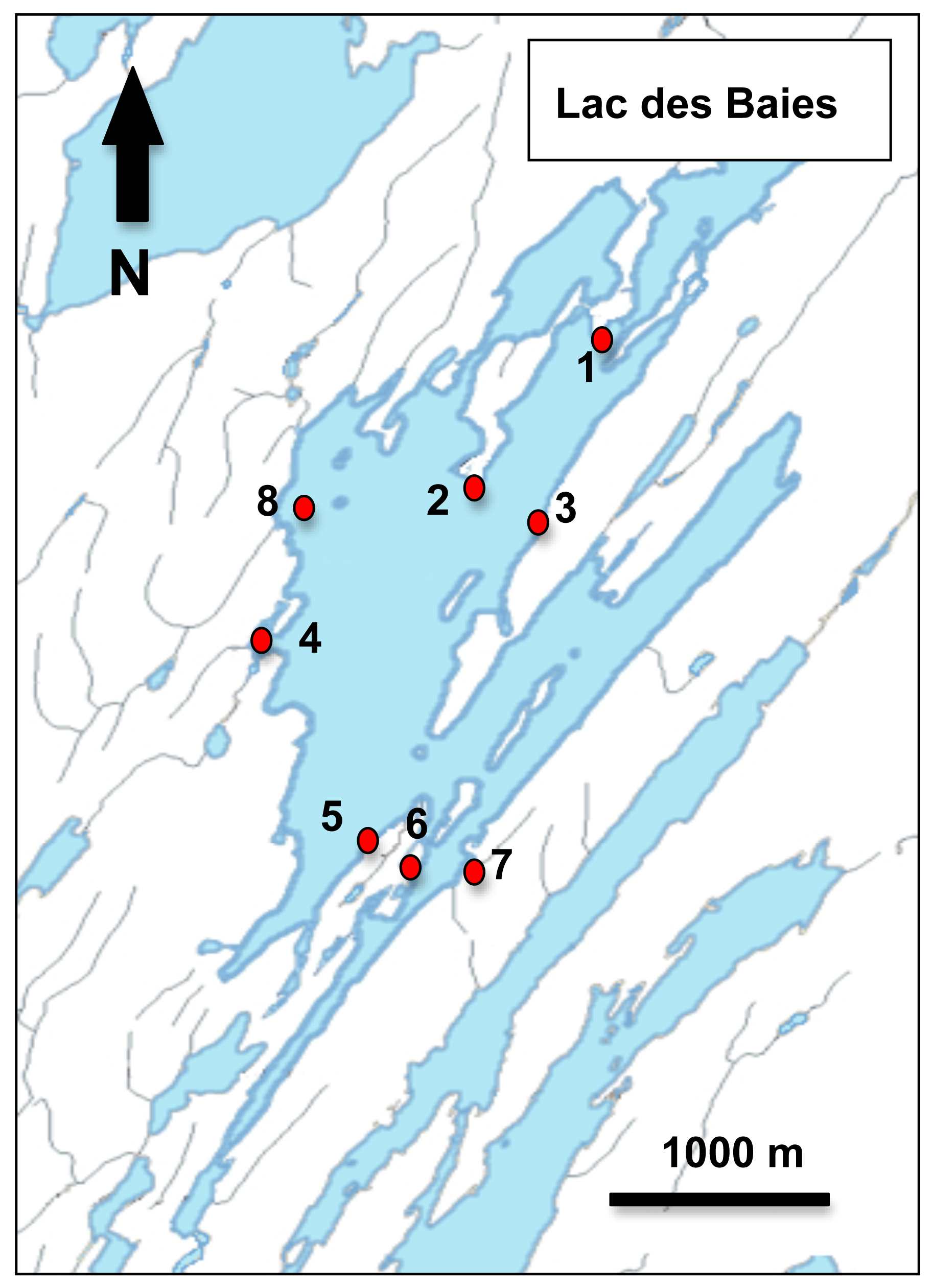
<p>Lac des Baies is an oligotrophic lake of 569.8 hectares located in Eastern Québec, Canada (<xref ref-type="fig" rid="f1-diversity-03-00390">Figure 1</xref>). It is a large lake surrounded by boreal forest with both deciduous and evergreen trees. The lake has many bays more or less isolated from each other.</p>
<p>To estimate the number of <italic>Hyalella</italic> cryptic species and their distribution within Lac des Baies, amphipods were sampled from nine sites in the lake in August 2007 (site 1 to 5) and July 2008 (site 6, 7a, 7b and 8) using a dip net (500 μm mesh size) for littoral sites or an Ekman dredge for profundal sites (<xref ref-type="table" rid="t1-diversity-03-00390">Table 1</xref>). For sampling with the dip net, sediments were kicked to suspend the benthos into the water and the dip net was swept into the suspended sediments to collect the amphipods. Each sample was preserved in 95% ethanol. These amphipods were subjected to morphological and molecular analyses.</p></sec>
<sec>
<label>2.2.</label>
<title>Morphological Variation Among Species</title>
<p>Each amphipod was first identified under a dissecting microscope as <italic>H. azteca</italic> using the morphological traits described in Bousfield [<xref ref-type="bibr" rid="b17-diversity-03-00390">17</xref>,<xref ref-type="bibr" rid="b38-diversity-03-00390">38</xref>,<xref ref-type="bibr" rid="b39-diversity-03-00390">39</xref>]. <italic>Gammarus lacustris</italic> is also present in Lac des Baies [<xref ref-type="bibr" rid="b40-diversity-03-00390">40</xref>]; <italic>H. azteca</italic> amphipods are easily distinguished from other amphipods by their small adult body size, their second pair of antennae 1.2 × longer than the first pair, the presence of spines on pleon segments 1 and 2 (except for the <italic>inermis</italic> form) and the distinct shapes of the second gnathopod between males and females. After identification, body length was measured following the curve of the body from the first segment of the pereon to the tip of the urosome using a Leica MZ16 A image analyzer (Bannockburn, Illinois, USA) with the Northern Eclipse 6.0 software from Empix Imaging Inc (Mississauga, Ontario, Canada). Body length is an important trait that varies among species of the <italic>H. azteca</italic> complex [<xref ref-type="bibr" rid="b12-diversity-03-00390">12</xref>,<xref ref-type="bibr" rid="b23-diversity-03-00390">23</xref>]. The total number of segments on the two pairs of antennae was counted as an index of age (adults &gt; 21 segments) [<xref ref-type="bibr" rid="b14-diversity-03-00390">14</xref>,<xref ref-type="bibr" rid="b41-diversity-03-00390">41</xref>]. The size and the shape of the second gnathopod were examined to determine the sex of the individuals; females have small and parachelate second gnathopods while adult males usually have large subchelate second gnathopods [<xref ref-type="bibr" rid="b17-diversity-03-00390">17</xref>]. Some males had small second gnathopods only slightly larger than female gnathopods; this difference was noted to verify if it was linked to different species. This gnathopod is subject to sexual selection in <italic>Hyalella</italic> amphipods [<xref ref-type="bibr" rid="b42-diversity-03-00390">42</xref>-<xref ref-type="bibr" rid="b44-diversity-03-00390">44</xref>].</p></sec>
<sec>
<label>2.3.</label>
<title>Molecular Analyses</title>
<p>Total DNA was extracted using a QuickExtract DNA Extraction Kit from Epicentre Biotechnologies (Madison, Wisconsin, USA). Depending on the size of the individual, a quarter to a half of an amphipod was used for the extraction. A 710-bp fragment of the mitochondrial cytochrome <italic>c</italic> oxidase I (COI) gene was amplified using the LCO1490 and HCO2198 universal primers from Folmer <italic>et al.</italic> [<xref ref-type="bibr" rid="b45-diversity-03-00390">45</xref>]. The HCO2198 primer was labeled with HEX fluorescent (AlphaDNA, Montréal, Québec, Canada). The polymerase chain reaction (PCR) contained 1 μL of DNA template, 2.5 μL of 10× PCR buffer, 0.25 μM of each primer, 25 mM MgCl<sub>2</sub>, 0.25 μM of each dNTP and 1.5 units of <italic>Taq</italic> DNA polymerase in a final volume of 25 μL. PCR conditions were 3 min at 94 °C followed by 5 cycles of 60 s at 94 °C, 90 s at 45 °C and 60 s at 72 °C; followed by 35 cycles of 60 s at 94 °C, 90 s at 51 °C and 60 s at 72 °C; followed by 5 min at 72 °C (Biometra Uno-II, Goettingen, Germany).</p>
<p>To discriminate haplotypes (variants of COI), PCR products were run on denaturing gradient gel electrophoresis (DGGE) using a CBS DGGE-4001-Rev.B apparatus (Del Mar, California, USA). Briefly, 30% polyacrylamide (acrylamide: bisacrylamide 37.5 : 1), 1 mm thick gels with a linear denaturant gradient of 10 to 100% (where 100% denaturant = 40 % formamide and 7 M urea), were run for 15 h at 120 V in a 60 °C bath of 1× TAE buffer (40 mM Tris, 40 mM acetic acid, 1 mM EDTA, pH 7.4). Fluorescent dye-labeled alleles were detected on a FMBIO III fluorescent scanner (Hitachi Software Engineering America Ltd., San Bruno, California, USA) and analyzed using the ImageAnalysis v.3.0.0.21 software (Miraibio, San Francisco, California, USA). Each haplotype found with DGGE was also sequenced using the LCO1490 primer (McGill University and Genome Quebec Innovation Centre, Montréal, Québec, Canada).</p>
<p>COI sequences were aligned using the CLUSTALW Multiple alignment module in BioEdit version 7.0.9.0 [<xref ref-type="bibr" rid="b46-diversity-03-00390">46</xref>]. Pairwise sequence divergences among haplotypes were calculated using Kimura's 2-parameter model in <italic>MEGA</italic> version 4 [<xref ref-type="bibr" rid="b47-diversity-03-00390">47</xref>]. To discriminate cryptic species, we used a species screening threshold (SST) of 3.75% as calculated by Witt <italic>et al.</italic> [<xref ref-type="bibr" rid="b21-diversity-03-00390">21</xref>] for <italic>H. azteca</italic> populations of the southern Great Basin region of California and Nevada. Note that SSTs and DNA barcoding using COI do not constitute a species concept and must be considered as tools to discriminate biological units corresponding to provisional species that need further investigation [<xref ref-type="bibr" rid="b21-diversity-03-00390">21</xref>]. COI sequences were also compared with other sequences of the <italic>Hyalella</italic> cryptic species complex found on the GenBank database (<ext-link xlink:href="http://www.ncbi.nlm.nih.gov/" ext-link-type="uri">http://www.ncbi.nlm.nih.gov/</ext-link>).</p></sec>
<sec>
<label>2.4.</label>
<title>Relative Abundances of Species Over Time</title>
<p>To compare the relative abundances of each species over time, amphipods were sampled each month from May to November 2007 at site 1 (<xref ref-type="table" rid="t1-diversity-03-00390">Table 1</xref>). This site was chosen because we had previously determined that it had the greatest number of amphipods in a study on different populations of <italic>Hyalella</italic> amphipods in Lac des Baies [<xref ref-type="bibr" rid="b40-diversity-03-00390">40</xref>]. This site seems to be representative of the most common habitat in the littoral zone of the lake; it is devoid of macrophytes year round and is composed of sandy sediments. Different food resources were available across seasons; during the summer months (June-September), periphyton growing on sediments was probably the main food available for amphipods while during autumn months (September-November), leaves from the riparian zone of the lake became available [<xref ref-type="bibr" rid="b40-diversity-03-00390">40</xref>]. Predation risks and competition from other taxa were not estimated during our study, but it is clear that the insect larvae community changed during the season at the study site. For example, dragonfly and damselfly larvae were more abundant in spring (May and June) than at other periods of the year; during autumn (September to November), <italic>Hyalella</italic> amphipods were the main component of the macroinvertebrate community at the study site (K. Dionne, personal observation). Physical and chemical parameters were measured each month using a YSI 556 MPS multiparametric sonde from YSI (Yellow Springs, Ohio, USA). Water temperature peaked at 20.3 °C in July and was at its lowest point in November at 5.7 °C; pH was stable for all months with a mean of 7.4 while dissolved oxygen decreased gradually from 11.5 mg L<sup>−1</sup> in May to 6.1 mg L<sup>−1</sup> in September and finished to a point of 10.6 mg L<sup>−1</sup> in November.</p>
<p>For the determination of the relative abundances of each cryptic species in the community, three replicates were collected at a depth of about 0.3 m in areas of about six square-meters with a distance of three meters between them. For each replicate, sediments were kicked during three minutes to suspend the benthos into the water, and a dip net (500 μm mesh size) was swept into the suspended sediments during that time. Sampling was always performed by the same person to keep the sampling effort constant. Each replicate was preserved in 95% ethanol before sorting in the laboratory for the amphipods. For each replicate, all amphipods were counted and submitted to morphological analyses. Then, for each replicate, ten amphipods were randomly chosen for molecular analyses.</p>
<p>To evaluate temporal variation in the community, the relative abundance of each species was compared between months using ANOVA. The month was the factor and the relative abundance of one species was the dependent variable. Similar analyses were made separately on adults and on juveniles. Cryptic species of <italic>Hyalella</italic> amphipods can exhibit different life history traits [<xref ref-type="bibr" rid="b12-diversity-03-00390">12</xref>,<xref ref-type="bibr" rid="b23-diversity-03-00390">23</xref>]; this could foster different proportions for each species in the community of juveniles. Also, different relative abundances in the community of adults and juveniles could be possible if one or more species were not residents of the study site since juveniles and adults do not have the same mortality risks [<xref ref-type="bibr" rid="b48-diversity-03-00390">48</xref>] and might not have the same capacity to establish in a sink site. All statistical analyses were performed on the SAS 9.2 software (SAS Institute Inc, Cary, North Carolina, USA).</p>
<p>Probably due to problems of preservation, we were unable to extract total DNA from the amphipods sampled in September and October 2007. Instead, we extracted DNA from 30 adult amphipods sampled for another study [<xref ref-type="bibr" rid="b40-diversity-03-00390">40</xref>] using the same methods on the same dates and at the same site. Unfortunately, the animals used for that study were pooled across replicates, therefore, the September and October samples were excluded from the ANOVA on relative abundances of species over time. To explore the complete data set, we pooled samples within months and used chi-squared tests to evaluate temporal variation in amphipod relative abundances.</p></sec></sec>
<sec sec-type="results">
<label>3.</label>
<title>Results</title>
<sec>
<label>3.1.</label>
<title>Determination of the Number of Species in Lac des Baies</title>
<p>All amphipods used in the molecular analyses belonged morphologically to <italic>H. azteca</italic>. Five COI haplotypes were detected in Lac des Baies using molecular analyses on a total of 282 amphipods (GenBank accession numbers JN161817-JN161821). Haplotypes 2, 3 and 4 had paired divergences of 1% or below, suggesting that they belonged to the same species (<xref ref-type="table" rid="t2-diversity-03-00390">Table 2</xref>). Other COI haplotypes had divergences over 20% between them, suggesting the occurrence of three cryptic species: species A (haplotype 1), species B (haplotypes 2, 3 and 4) and species C (haplotype 5) (<xref ref-type="table" rid="t2-diversity-03-00390">Table 2</xref>). Comparisons with other sequences found on GenBank revealed that species A was genetically similar to haplotype 1–5 from clade 1 of Witt <italic>et al.</italic> [<xref ref-type="bibr" rid="b49-diversity-03-00390">49</xref>] (COI divergence = 0.6%), species B was genetically similar to the haplotype from the B Clade of Wellborn and Broughton [<xref ref-type="bibr" rid="b22-diversity-03-00390">22</xref>] occurring in Duck Lake, Michigan (COI divergences varying between 1.0% and 1.8%) and species C was genetically similar to haplotype 6–3 from clade 6 of Witt <italic>et al.</italic> [<xref ref-type="bibr" rid="b49-diversity-03-00390">49</xref>] (COI divergence = 0.8%). For all sites, at least two cryptic species were found living in sympatry (<xref ref-type="table" rid="t1-diversity-03-00390">Table 1</xref>). Very few amphipods, essentially <italic>G. lacustris</italic>, were found living in the profundal zone of the lake. <italic>G. lacustris</italic> was also present in the littoral zone at site 6.</p></sec>
<sec>
<label>3.2.</label>
<title>Morphological Variation Among Species</title>
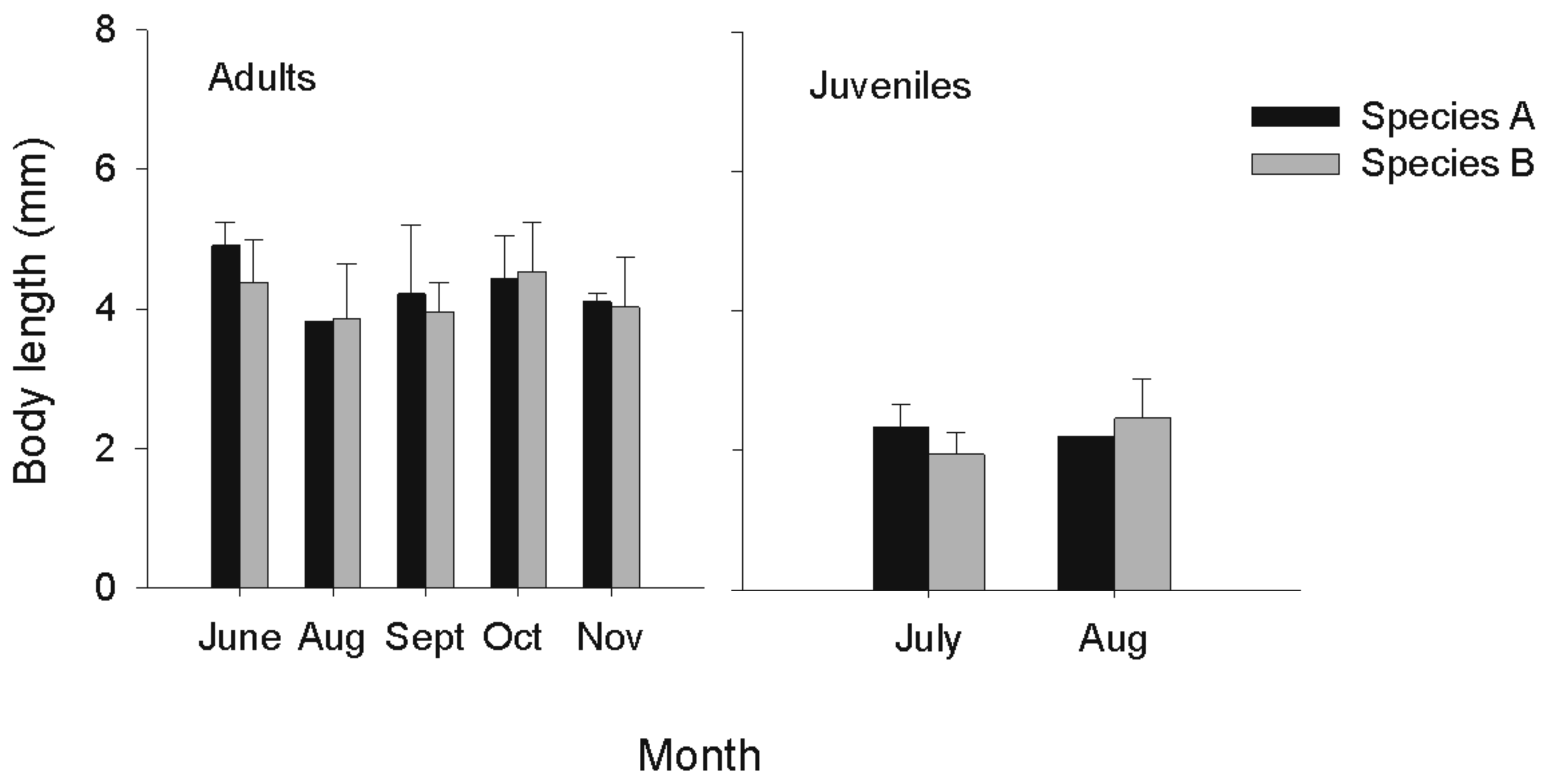
<p>No morphological differences were found among <italic>Hyalella</italic> species for any month. All <italic>Hyalella</italic> amphipods had two spines on pleon segments 1 and 2, excluding the presence of the form <italic>inermis</italic>. Throughout the open-water season, all species had some adult males with small second gnathopods (species A = 3, species B = 5, species C = 2, on a total of 81 males), suggesting inter-individual variation rather than an inter-specific difference. Since species A and C were rare (total number of adult individuals = 20 and 4, respectively), we could not statistically compare their body lengths with species B. However, by visually comparing the mean body lengths of species A and B for each month (<xref ref-type="fig" rid="f2-diversity-03-00390">Figure 2</xref>), one can see a large overlap in body lengths for adults and juveniles of these species for all months.</p></sec>
<sec>
<label>3.3.</label>
<title>Relative Abundances of Species Over Time</title>
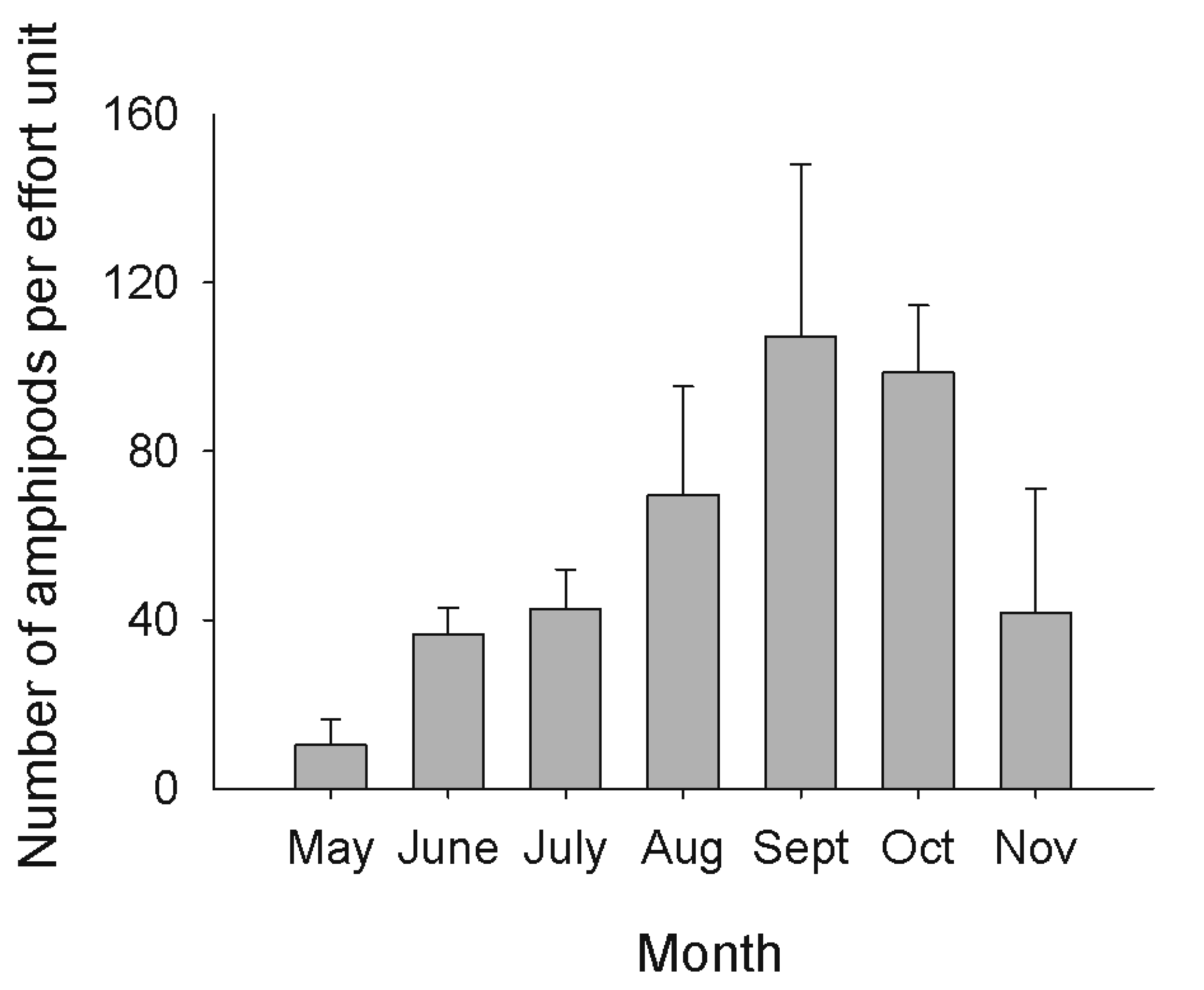
<p>From May to November 2007, 1240 amphipods were sampled at site 1. Abundances were at their lowest in May, increased to reach a peak in September and then decreased in October and November (<xref ref-type="fig" rid="f3-diversity-03-00390">Figure 3</xref>). The samples of amphipods used for molecular analyses represented from 9% (in September) to 28% (in August) of the total number of amphipods. May was not included in the analyses since not enough amphipods were present at the site. In July, adults were seldom found and juveniles were dominant in the community. Juveniles were mainly present at the site in July and August. Species C was excluded from the analyses since it was only represented by one or two individuals per month. One <italic>G. lacustris</italic> was found in October.</p>
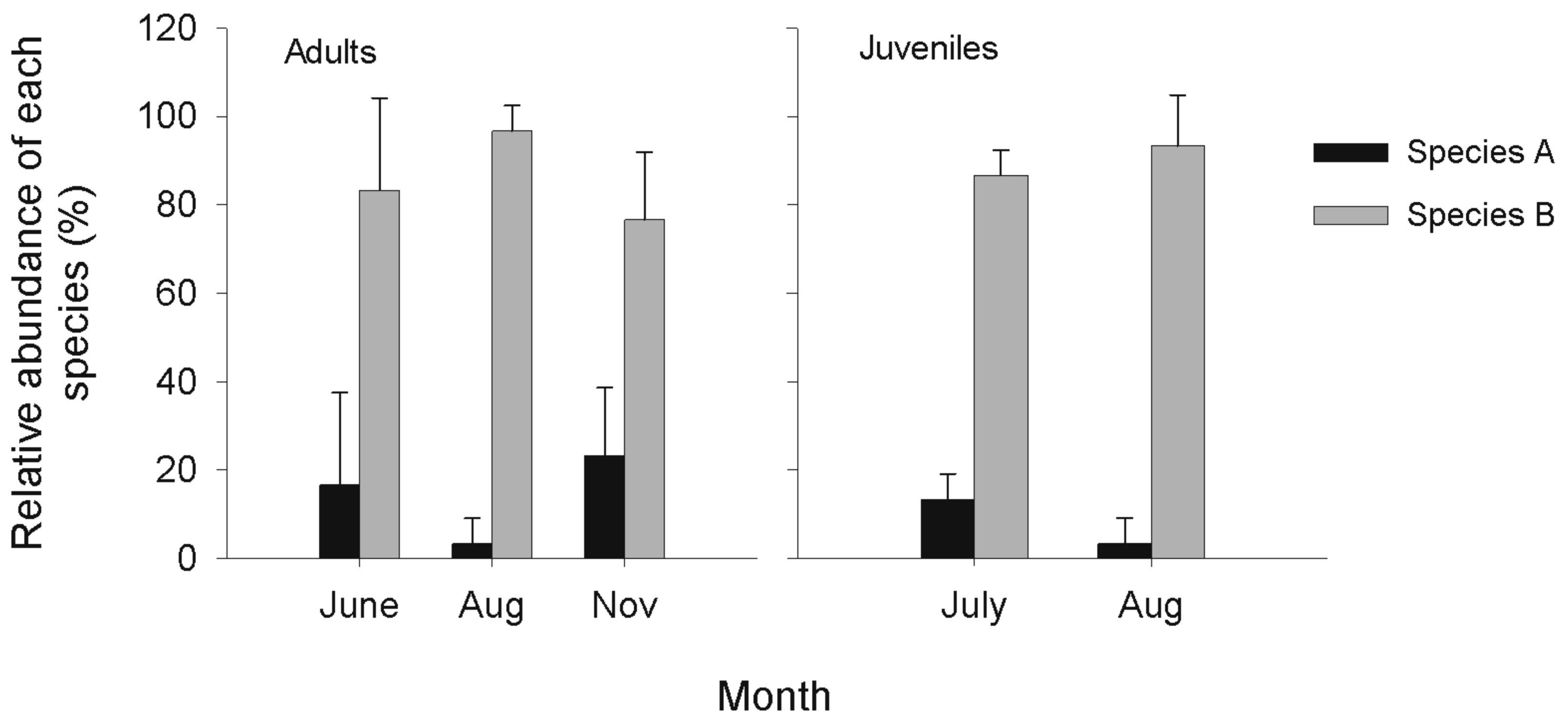
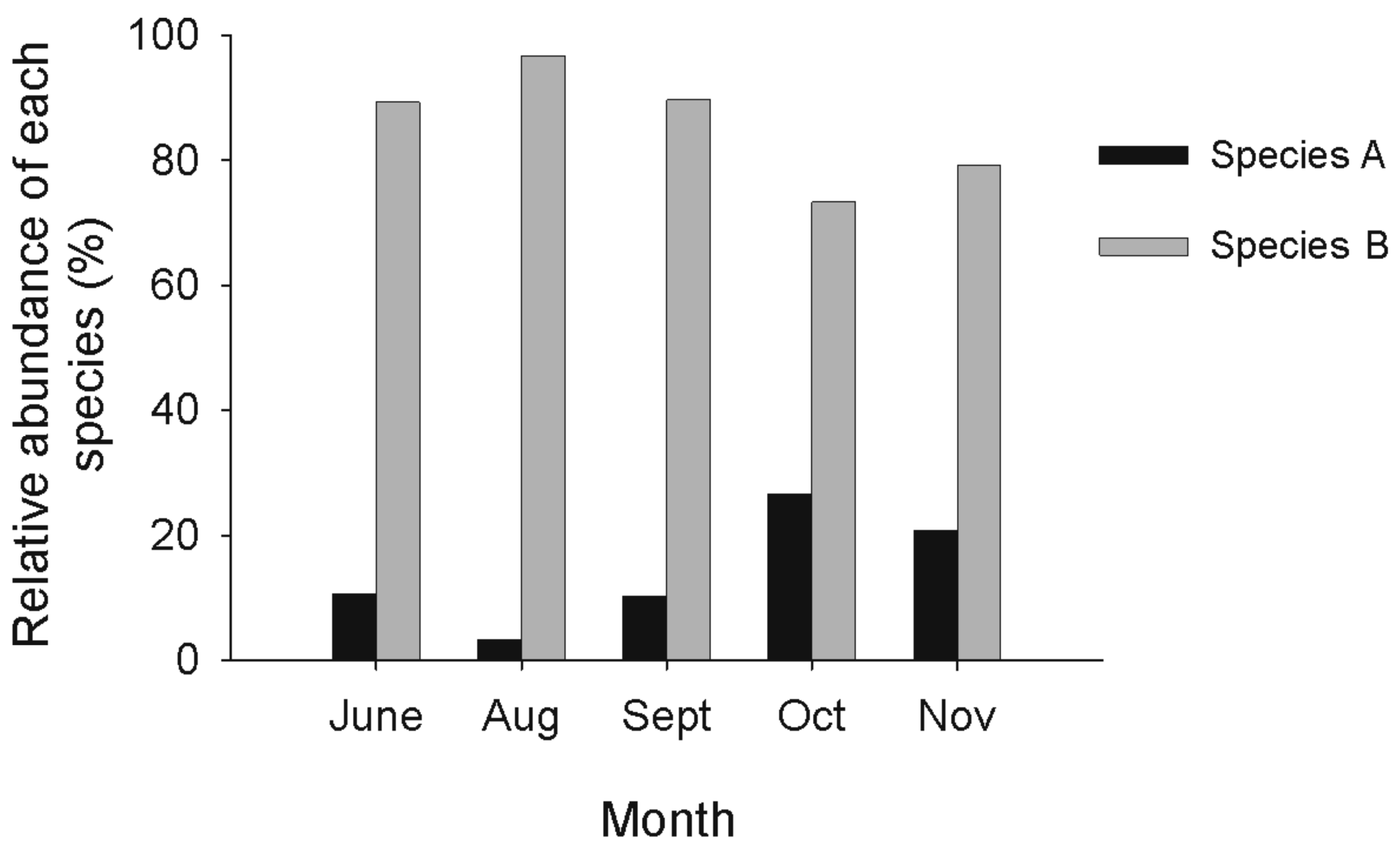
<p>No significant variation was observed among months in the relative abundance of each species in the community, both for adults (reduced data set) (ANOVA F = 1.33, <italic>df</italic> = 2, <italic>P</italic> = 0.33) and juveniles (ANOVA F = 0.80, <italic>df</italic> = 1, <italic>P</italic> = 0.42). Both adults and juveniles of species B were more abundant than species A for all months (<xref ref-type="fig" rid="f4-diversity-03-00390">Figure 4</xref>). By including adult amphipods sampled with the protocol of Dionne [<xref ref-type="bibr" rid="b40-diversity-03-00390">40</xref>] in September and October (complete data set), still no significant variation was observed among months in the relative abundance of each species (χ<sup>2</sup> = 8.28, <italic>df</italic>= 4, <italic>P</italic> = 0.08) (<xref ref-type="fig" rid="f5-diversity-03-00390">Figure 5</xref>).</p></sec></sec>
<sec sec-type="discussion">
<label>4.</label>
<title>Discussion</title>
<sec>
<label>4.1.</label>
<title>Species Identification</title>
<p>Three cryptic species of the <italic>H. azteca</italic> species complex were found in Lac des Baies. Morphological measurements are consistent with the morphological descriptions given by Witt <italic>et al.</italic> [<xref ref-type="bibr" rid="b49-diversity-03-00390">49</xref>] and Wellborn and Broughton [<xref ref-type="bibr" rid="b22-diversity-03-00390">22</xref>] for related haplotypes. Body length measurements suggest that all species belong to the small ecomorph of the <italic>Hyalella</italic> complex [<xref ref-type="bibr" rid="b22-diversity-03-00390">22</xref>,<xref ref-type="bibr" rid="b23-diversity-03-00390">23</xref>]. Genetic divergences for COI were high between species (over 20%); such high genetic divergences for sympatric <italic>H. azteca</italic> cryptic species were also reported by Wellborn and Cothran [<xref ref-type="bibr" rid="b6-diversity-03-00390">6</xref>] and Witt <italic>et al.</italic> [<xref ref-type="bibr" rid="b21-diversity-03-00390">21</xref>]. Further studies are needed to assess if differences occur in life history traits of these species or if differences exist in their morphology, physiology or behavior, as it is the case for other communities of <italic>H. azteca</italic> amphipods [<xref ref-type="bibr" rid="b6-diversity-03-00390">6</xref>,<xref ref-type="bibr" rid="b12-diversity-03-00390">12</xref>].</p></sec>
<sec>
<label>4.2.</label>
<title>Constant Composition of the Community</title>
<p>Despite environmental variations, the composition of the <italic>Hyalella</italic> species complex remained constant during the open-water season in the littoral zone of Lac des Baies. Species B was always more abundant than species A and C. It is not clear if <italic>Hyalella</italic> cryptic species of Lac des Baies coexist via undetected trade-offs that enable them to occupy different ecological niches or if they only co-occur at the site. However, the fact that these species were also found together at other sites of the lake that have similar and different environmental conditions than the study site suggests that their ecological niches probably overlap importantly. In comparison, <italic>G. lacustris</italic> had a more restricted niche in the lake; it was mainly found in shallow water (a few centimeters deep) in well-developed leaf litters or in the profundal zone of the lake (K. Dionne, personal observation). Further studies comparing the relative abundances of each <italic>Hyalella</italic> cryptic species among different habitats of the lake could be informative on the specific niche of each species.</p>
<p>Migration from nearby sites may explain the presence of species at low abundances at a given site. The fairly low contributions of species C and to a lesser extent species A to the community would suggest that these species are not permanent residents at the study site. As mentioned by Wellborn and Cothran [<xref ref-type="bibr" rid="b6-diversity-03-00390">6</xref>], the community structure of a local site could be maintained year round via source-sink dynamics [<xref ref-type="bibr" rid="b50-diversity-03-00390">50</xref>-<xref ref-type="bibr" rid="b52-diversity-03-00390">52</xref>]. In such a system, a species that is a bad competitor in one particular habitat can be rescued from local exclusion by individuals that emigrate from another habitat where this species is a good competitor [<xref ref-type="bibr" rid="b51-diversity-03-00390">51</xref>-<xref ref-type="bibr" rid="b52-diversity-03-00390">52</xref>]. In Lac des Baies, the fact that species B dominates at the study site suggests that it could be a specialist of this habitat. Wellborn and Cothran [<xref ref-type="bibr" rid="b6-diversity-03-00390">6</xref>] reported that species B dominated in the narrow-edge habitat of Sullivan Lake, Michigan, where it could be a good competitor for resources while being particularly vulnerable to predation risk from fish in deeper water [<xref ref-type="bibr" rid="b6-diversity-03-00390">6</xref>]. In the present case, it is likely that the rarer species A and C are outcompeted in the habitat of the study site and that the occurrence of these species in the community is only maintained via migration from other habitats where species A and C could be, for instance, predator-avoidance specialists. Since the study site is located on bare sediments, it would be worth comparing its community with communities inhabiting nearby macrophytes located in deeper water (2 m) to verify if species A and C are more abundant in this habitat. Our results also show that adults and juveniles of species A were always more abundant than species C. This could mean that either species A migrates from a nearer site than species C, or that it is more abundant at the source.</p>
<p>Migration is also important in the formation of the amphipod community in the spring. In May, amphipods were seldom found at the study site, whereas they were more abundant in June. Since no juvenile was detected before July, amphipods at the study site were probably individuals that had migrated from nearby sites. Indeed, some studies have reported the occurrence of <italic>Hyalella</italic> amphipods at different depths in temperate lakes depending on the season and suggest their ability to perform extensive intra-lake migrations [<xref ref-type="bibr" rid="b31-diversity-03-00390">31</xref>,<xref ref-type="bibr" rid="b32-diversity-03-00390">32</xref>,<xref ref-type="bibr" rid="b53-diversity-03-00390">53</xref>]. In winter, <italic>Hyalella</italic> amphipods are absent in the frozen narrow edges of lakes; these animals do not possess any resting stage capable of surviving in such harsh conditions. This means that when ice melts in spring, the whole littoral zone can be colonized by amphipods returning from their winter refuge, but also by amphipods from other locations of the lake. In that latter case, the species composition of the community could change from one year to another, especially if little differences exist in dispersal capacity and in ecological niche between species. Over long distances, amphipods probably act as passive dispersers [<xref ref-type="bibr" rid="b54-diversity-03-00390">54</xref>], so their migration rates could be greatly influenced by seasonal events such as spring and autumn mixings and occasional great winds [<xref ref-type="bibr" rid="b31-diversity-03-00390">31</xref>]. These events could explain why, despite being statistically non-significant, species A became slightly more abundant in the community in October and November, and why we found a lone <italic>G. lacustris</italic> in October.</p>
<p>Our study shows that cryptic species of <italic>Hyalella</italic> amphipods can co-occur in the littoral zone of a boreal lake without temporal variation in their community. However, since our study is only focused on one site during one open-water season, its scale do not suffice to completely explain the composition of the community of <italic>Hyalella</italic> amphipods during the open-water season. Processes related to metacommunities that may be important in explaining the co-occurrence of species act both at the local (site) and regional (lake) scales [<xref ref-type="bibr" rid="b13-diversity-03-00390">13</xref>,<xref ref-type="bibr" rid="b52-diversity-03-00390">52</xref>,<xref ref-type="bibr" rid="b55-diversity-03-00390">55</xref>,<xref ref-type="bibr" rid="b56-diversity-03-00390">56</xref>]. A lake is a heterogeneous ecosystem that contains many habitats that vary both in space and time; this variability can help species to coexist by offering them a diversity of niches to exploit. This could also favor cryptic species co-occurrence by offering them various possibilities to actively or passively migrate in the lake. Further studies should compare relative abundances of cryptic species among multiple habitats at different periods of a year and among many years. Such studies would help to comprehend the effects of the spatiotemporal variability of habitats on cryptic species assemblage and its interaction with neutral and metacommunity-related processes.</p></sec></sec></body>
<back>
<sec sec-type="display-objects">
<title>Figures and Tables</title>
<fig id="f1-diversity-03-00390" position="float">
<label>Figure 1.</label>
<caption>
<p>Sites sampled in August 2007 and July 2008 in Lac des Baies, Québec, Canada.</p></caption>
<graphic xlink:href="diversity-03-00390f1.gif"/></fig>
<fig id="f2-diversity-03-00390" position="float">
<label>Figure 2.</label>
<caption>
<p>Body lengths of <italic>Hyalella</italic> amphipods of species A and B for adults and juveniles for all months (mean ± standard deviation, where relevant).</p></caption>
<graphic xlink:href="diversity-03-00390f2.gif"/></fig>
<fig id="f3-diversity-03-00390" position="float">
<label>Figure 3.</label>
<caption>
<p>Monthly total abundance of amphipods sampled at site 1 in 2007 (mean ± standard deviation).</p></caption>
<graphic xlink:href="diversity-03-00390f3.gif"/></fig>
<fig id="f4-diversity-03-00390" position="float">
<label>Figure 4.</label>
<caption>
<p>Monthly relative abundance of species A and B for adults and juveniles (mean ± standard deviation, number of replicates = 3 for each month).</p></caption>
<graphic xlink:href="diversity-03-00390f4.gif"/></fig>
<fig id="f5-diversity-03-00390" position="float">
<label>Figure 5.</label>
<caption>
<p>Monthly relative abundance of species A and B for the community of adults based on genotyping 30 individuals for each month.</p></caption>
<graphic xlink:href="diversity-03-00390f5.gif"/></fig>
<table-wrap id="t1-diversity-03-00390" position="float">
<label>Table 1.</label>
<caption>
<p>Site characteristics and <italic>Hyalella</italic> species present for each site sampled in August 2007 and July 2008 in Lac des Baies.</p></caption>
<table frame="hsides" rules="groups">
<thead>
<tr>
<th align="center" valign="middle"><bold>Site</bold></th>
<th align="center" valign="middle"><bold>Latitude/Longitude</bold></th>
<th align="center" valign="middle"><bold>Depth (m)</bold></th>
<th align="center" valign="middle"><bold>Current velocity</bold></th>
<th align="center" valign="middle"><bold>Substrate</bold></th>
<th align="center" valign="middle"><bold>Species (<italic>N</italic>)</bold></th></tr></thead>
<tbody>
<tr>
<td align="center" valign="middle"><bold>1</bold></td>
<td align="center" valign="middle">48°11′22″N<break/>68°39′24″W</td>
<td align="center" valign="middle">0.3</td>
<td align="center" valign="middle">Low</td>
<td align="center" valign="middle">Sand with organic detritus</td>
<td align="center" valign="middle">sp. A (1), sp. B (28), sp. C (1)</td></tr>
<tr>
<td align="center" valign="middle"><bold>2</bold></td>
<td align="center" valign="middle">48°10′76″N<break/>68°39′72″W</td>
<td align="center" valign="middle">0.3</td>
<td align="center" valign="middle">Low</td>
<td align="center" valign="middle">Sand with organic detritus</td>
<td align="center" valign="middle">sp. A (2), sp. B (4)</td></tr>
<tr>
<td align="center" valign="middle"><bold>3</bold></td>
<td align="center" valign="middle">48°10′68″N<break/>68°39′43″W</td>
<td align="center" valign="middle">0.3</td>
<td align="center" valign="middle">High</td>
<td align="center" valign="middle">Rocks</td>
<td align="center" valign="middle">sp. A (1), sp. B (1)</td></tr>
<tr>
<td align="center" valign="middle"><bold>4</bold></td>
<td align="center" valign="middle">48°09′96″N<break/>68°40′65″W</td>
<td align="center" valign="middle">0.3</td>
<td align="center" valign="middle">Low</td>
<td align="center" valign="middle">Sand with organic detritus</td>
<td align="center" valign="middle">sp. A (1), sp. B (16), sp. C (2)</td></tr>
<tr>
<td align="center" valign="middle"><bold>5</bold></td>
<td align="center" valign="middle">48°09′58″N<break/>68°40′05″W</td>
<td align="center" valign="middle">0.3</td>
<td align="center" valign="middle">Medium</td>
<td align="center" valign="middle">Rocks</td>
<td align="center" valign="middle">sp. A (4), sp. B (1)</td></tr>
<tr>
<td align="center" valign="middle"><bold>6</bold></td>
<td align="center" valign="middle">48°09′31″N<break/>68°40′15″W</td>
<td align="center" valign="middle">0.3</td>
<td align="center" valign="middle">Low</td>
<td align="center" valign="middle">Mud with organic detritus</td>
<td align="center" valign="middle">sp. B (9), sp. C (4)</td></tr>
<tr>
<td align="center" valign="middle"><bold>7a</bold></td>
<td align="center" valign="middle">48°09′48″N<break/>68°39′81″W</td>
<td align="center" valign="middle">0.3</td>
<td align="center" valign="middle">Low</td>
<td align="center" valign="middle">Sand with macrophytes</td>
<td align="center" valign="middle">sp. A (2), sp. B (2), sp. C (2)</td></tr>
<tr>
<td align="center" valign="middle"><bold>7b</bold></td>
<td align="center" valign="middle">48°09′48″N<break/>68°39′81″W</td>
<td align="center" valign="middle">0.3</td>
<td align="center" valign="middle">Low</td>
<td align="center" valign="middle">Sand with organic detritus</td>
<td align="center" valign="middle">sp. B (14), sp. C (1)</td></tr>
<tr>
<td align="center" valign="middle"><bold>8</bold></td>
<td align="center" valign="middle">48°10′30″N<break/>68°40′00″W</td>
<td align="center" valign="middle">13.0</td>
<td align="center" valign="middle">Medium</td>
<td align="center" valign="middle">Mud</td>
<td align="center" valign="middle">sp. B (2), sp. C (4)</td></tr></tbody></table></table-wrap>
<table-wrap id="t2-diversity-03-00390" position="float">
<label>Table 2.</label>
<caption>
<p>Percentage sequence divergences at <italic>c</italic> oxidase I (COI) between each pair of haplotypes.</p></caption>
<table frame="hsides" rules="groups">
<thead>
<tr>
<th align="center" valign="top"><bold>Haplotypes</bold></th>
<th align="center" valign="top"><bold>1</bold></th>
<th align="center" valign="top"><bold>2</bold></th>
<th align="center" valign="top"><bold>3</bold></th>
<th align="center" valign="top"><bold>4</bold></th></tr></thead>
<tbody>
<tr>
<td align="center" valign="top"><bold>2</bold></td>
<td align="center" valign="top">22.3</td>
<td align="center" valign="top"/>
<td align="center" valign="top"/></tr>
<tr>
<td align="center" valign="top"><bold>3</bold></td>
<td align="center" valign="top">22.9</td>
<td align="center" valign="top">0.8</td>
<td align="center" valign="top"/>
<td align="center" valign="top"/></tr>
<tr>
<td align="center" valign="top"><bold>4</bold></td>
<td align="center" valign="top">23.2</td>
<td align="center" valign="top">1.0</td>
<td align="center" valign="top"/></tr>
<tr>
<td align="center" valign="top"><bold>5</bold></td>
<td align="center" valign="top">25.9</td>
<td align="center" valign="top">20.6</td>
<td align="center" valign="top">20.3</td>
<td align="center" valign="top">20.4</td></tr></tbody></table></table-wrap></sec>
<ack>
<p>We thank Richard Cloutier for allowing us to use his equipments for the morphological analyses. We are grateful to Beatrix Beisner, Dominique Gravel and three anonymous reviewers for their comments on an earlier version of this manuscript. Special thanks to Chantal Lacoste, Katherine Gareau, Catherine Ménard and Martin Pelletier for their assistance in the field, to Robert Chabot and Marion Trudel for their help with the morphological identification of <italic>G. lacustris</italic> and to the Réserve faunique Duchénier personnel for the access in the study site. This work was supported by a grant from the Natural Sciences and Engineering Research Council of Canada to CN and FD and a scholarship from the Fonds Québécois de la Recherche sur la Nature et les Technologies to KD. This study is a contribution to the research programs of the Centre d'études nordiques and Boréas.</p></ack>
<ref-list>
<title>References</title>
<ref id="b1-diversity-03-00390"><label>1.</label><citation citation-type="journal"><person-group person-group-type="author"><name><surname>Knowlton</surname><given-names>K.</given-names></name></person-group><article-title>Sibling species in the sea</article-title><source>Annu. Rev. Ecol. Syst.</source><year>1993</year><volume>24</volume><fpage>189</fpage><lpage>216</lpage><pub-id pub-id-type="doi">10.1146/annurev.es.24.110193.001201</pub-id></citation></ref>
<ref id="b2-diversity-03-00390"><label>2.</label><citation citation-type="journal"><person-group person-group-type="author"><name><surname>Sáez</surname><given-names>A.G.</given-names></name><name><surname>Lozano</surname><given-names>E.</given-names></name></person-group><article-title>Body doubles</article-title><source>Nature</source><year>2005</year><volume>433</volume><fpage>111</fpage><pub-id pub-id-type="doi">10.1038/433111a</pub-id><pub-id pub-id-type="pmid">15650721</pub-id></citation></ref>
<ref id="b3-diversity-03-00390"><label>3.</label><citation citation-type="journal"><person-group person-group-type="author"><name><surname>Bickford</surname><given-names>D.</given-names></name><name><surname>Lohman</surname><given-names>D.J.</given-names></name><name><surname>Sodhi</surname><given-names>N.S.</given-names></name><name><surname>Ng</surname><given-names>P.K.L.</given-names></name><name><surname>Meier</surname><given-names>R.</given-names></name><name><surname>Winker</surname><given-names>K.</given-names></name><name><surname>Ingram</surname><given-names>K.K.</given-names></name><name><surname>Das</surname><given-names>I.</given-names></name></person-group><article-title>Cryptic species as a window on diversity and conservation</article-title><source>Trends Ecol. Evol.</source><year>2006</year><volume>22</volume><fpage>148</fpage><lpage>155</lpage><pub-id pub-id-type="pmid">17129636</pub-id></citation></ref>
<ref id="b4-diversity-03-00390"><label>4.</label><citation citation-type="journal"><person-group person-group-type="author"><name><surname>Zhang</surname><given-names>D.-Y.</given-names></name><name><surname>Lin</surname><given-names>K.</given-names></name><name><surname>Hanski</surname><given-names>I.</given-names></name></person-group><article-title>Coexistence of cryptic species</article-title><source>Ecol. Lett.</source><year>2004</year><volume>7</volume><fpage>165</fpage><lpage>169</lpage><pub-id pub-id-type="doi">10.1111/j.1461-0248.2004.00569.x</pub-id></citation></ref>
<ref id="b5-diversity-03-00390"><label>5.</label><citation citation-type="book"><person-group person-group-type="author"><name><surname>McPeek</surname><given-names>M.A.</given-names></name><name><surname>Gomulkiewicz</surname><given-names>R.</given-names></name></person-group><article-title>Assembling and depleting species richness in metacommunities: Insights from ecology, population genetics and macroevolution</article-title><source>Metacommunities: Spatial Dynamics and Ecological Communities</source><person-group person-group-type="editor"><name><surname>Holyoak</surname><given-names>M.</given-names></name><name><surname>Leibold</surname><given-names>M.A.</given-names></name><name><surname>Holt</surname><given-names>R.D.</given-names></name></person-group><publisher-name>University of Chicago Press</publisher-name><publisher-loc>Chicago, USA</publisher-loc><year>2005</year><fpage>355</fpage><lpage>373</lpage></citation></ref>
<ref id="b6-diversity-03-00390"><label>6.</label><citation citation-type="journal"><person-group person-group-type="author"><name><surname>Wellborn</surname><given-names>G.A.</given-names></name><name><surname>Cothran</surname><given-names>R.D.</given-names></name></person-group><article-title>Niche diversity in crustacean cryptic species: Complementarity in spatial distribution and predation risk</article-title><source>Oecologia</source><year>2007</year><volume>154</volume><fpage>175</fpage><lpage>183</lpage><pub-id pub-id-type="doi">10.1007/s00442-007-0816-x</pub-id><pub-id pub-id-type="pmid">17684770</pub-id></citation></ref>
<ref id="b7-diversity-03-00390"><label>7.</label><citation citation-type="journal"><person-group person-group-type="author"><name><surname>Chesson</surname><given-names>P.</given-names></name></person-group><article-title>Mechanisms of maintenance of species diversity</article-title><source>Annu. Rev. Ecol. Syst.</source><year>2000</year><volume>31</volume><fpage>343</fpage><lpage>366</lpage><pub-id pub-id-type="doi">10.1146/annurev.ecolsys.31.1.343</pub-id></citation></ref>
<ref id="b8-diversity-03-00390"><label>8.</label><citation citation-type="journal"><person-group person-group-type="author"><name><surname>Siepielski</surname><given-names>A.M.</given-names></name><name><surname>McPeek</surname><given-names>M.A.</given-names></name></person-group><article-title>On the evidence for species coexistence: A critique of the coexistence program</article-title><source>Ecology</source><year>2010</year><volume>91</volume><fpage>3153</fpage><lpage>3164</lpage><pub-id pub-id-type="doi">10.1890/10-0154.1</pub-id><pub-id pub-id-type="pmid">21141177</pub-id></citation></ref>
<ref id="b9-diversity-03-00390"><label>9.</label><citation citation-type="journal"><person-group person-group-type="author"><name><surname>Silvertown</surname><given-names>J.</given-names></name></person-group><article-title>Plant coexistence and the niche</article-title><source>Trends Ecol. Evol.</source><year>2004</year><volume>19</volume><fpage>605</fpage><lpage>611</lpage><pub-id pub-id-type="doi">10.1016/j.tree.2004.09.003</pub-id></citation></ref>
<ref id="b10-diversity-03-00390"><label>10.</label><citation citation-type="journal"><person-group person-group-type="author"><name><surname>Schluter</surname><given-names>D.</given-names></name><name><surname>McPhail</surname><given-names>J.D.</given-names></name></person-group><article-title>Ecological character displacement and speciation in sticklebacks</article-title><source>Am. Nat.</source><year>1992</year><volume>140</volume><fpage>85</fpage><lpage>108</lpage><pub-id pub-id-type="doi">10.1086/285404</pub-id><pub-id pub-id-type="pmid">19426066</pub-id></citation></ref>
<ref id="b11-diversity-03-00390"><label>11.</label><citation citation-type="journal"><person-group person-group-type="author"><name><surname>Grant</surname><given-names>P.R.</given-names></name><name><surname>Grant</surname><given-names>B.R.</given-names></name></person-group><article-title>Evolution of character displacement in Darwin's finches</article-title><source>Science</source><year>2006</year><volume>313</volume><fpage>224</fpage><lpage>226</lpage><pub-id pub-id-type="doi">10.1126/science.1128374</pub-id><pub-id pub-id-type="pmid">16840700</pub-id></citation></ref>
<ref id="b12-diversity-03-00390"><label>12.</label><citation citation-type="journal"><person-group person-group-type="author"><name><surname>Wellborn</surname><given-names>G.A.</given-names></name><name><surname>Cothran</surname><given-names>R.D.</given-names></name></person-group><article-title>Phenotypic similarity and differentiation among sympatric cryptic species in a freshwater amphipod complex</article-title><source>Freshwater Biol.</source><year>2004</year><volume>49</volume><fpage>1</fpage><lpage>13</lpage><pub-id pub-id-type="doi">10.1046/j.1365-2426.2003.01160.x</pub-id></citation></ref>
<ref id="b13-diversity-03-00390"><label>13.</label><citation citation-type="journal"><person-group person-group-type="author"><name><surname>Leibold</surname><given-names>M.A.</given-names></name><name><surname>McPeek</surname><given-names>M.A.</given-names></name></person-group><article-title>Coexistence of the niche and neutral perspectives in community ecology</article-title><source>Ecology</source><year>2006</year><volume>87</volume><fpage>1399</fpage><lpage>1410</lpage><pub-id pub-id-type="doi">10.1890/0012-9658(2006)87[1399:COTNAN]2.0.CO;2</pub-id><pub-id pub-id-type="pmid">16869414</pub-id></citation></ref>
<ref id="b14-diversity-03-00390"><label>14.</label><citation citation-type="journal"><person-group person-group-type="author"><name><surname>Cooper</surname><given-names>W.E.</given-names></name></person-group><article-title>Dynamics and production of a natural population of a fresh-water amphipod</article-title><source>Hyalella azteca. Ecol. Monogr.</source><year>1965</year><volume>35</volume><fpage>377</fpage><lpage>394</lpage><pub-id pub-id-type="doi">10.2307/1942147</pub-id></citation></ref>
<ref id="b15-diversity-03-00390"><label>15.</label><citation citation-type="journal"><person-group person-group-type="author"><name><surname>Hargrave</surname><given-names>B.T.</given-names></name></person-group><article-title>The utilization of benthic microflora by <italic>Hyalella azteca</italic> (Amphipoda)</article-title><source>J. Anim. Ecol.</source><year>1970</year><volume>39</volume><fpage>427</fpage><lpage>437</lpage><pub-id pub-id-type="doi">10.2307/2980</pub-id></citation></ref>
<ref id="b16-diversity-03-00390"><label>16.</label><citation citation-type="journal"><person-group person-group-type="author"><name><surname>Strong</surname><given-names>D.R.</given-names></name></person-group><article-title>Life history variation among populations of an amphipod (<italic>Hyalella azteca</italic>)</article-title><source>Ecology</source><year>1972</year><volume>53</volume><fpage>1103</fpage><lpage>1111</lpage><pub-id pub-id-type="doi">10.2307/1935422</pub-id></citation></ref>
<ref id="b17-diversity-03-00390"><label>17.</label><citation citation-type="journal"><person-group person-group-type="author"><name><surname>Bousfield</surname><given-names>E.L.</given-names></name></person-group><article-title>A contribution to the reclassification of neotropical freshwater hyalellid amphipods (Crustacea: Gammaridea, Talitroidea)</article-title><source>Boll. Mus. Civ. St. Nat. Verona</source><year>1996</year><volume>20</volume><fpage>175</fpage><lpage>224</lpage></citation></ref>
<ref id="b18-diversity-03-00390"><label>18.</label><citation citation-type="journal"><person-group person-group-type="author"><name><surname>Gonzalez</surname><given-names>E.R.</given-names></name><name><surname>Watling</surname><given-names>L.</given-names></name></person-group><article-title>Redescription of <italic>Hyalella azteca</italic> from its type locality, Vera Cruz, Mexico (Amphipoda: Hyalellidae)</article-title><source>J. Crust. Biol.</source><year>2002</year><volume>22</volume><fpage>173</fpage><lpage>183</lpage><pub-id pub-id-type="doi">10.1651/0278-0372(2002)022[0173:ROHAFI]2.0.CO;2</pub-id></citation></ref>
<ref id="b19-diversity-03-00390"><label>19.</label><citation citation-type="journal"><person-group person-group-type="author"><name><surname>Hogg</surname><given-names>I.D.</given-names></name><name><surname>Larose</surname><given-names>C.</given-names></name><name><surname>de Lafontaine</surname><given-names>Y.</given-names></name><name><surname>Doe</surname><given-names>K.G.</given-names></name></person-group><article-title>Genetic evidence for a <italic>Hyalella</italic> species complex within the Great Lakes—St. Lawrence River drainage basin: Implications for ecotoxicology and conservation biology</article-title><source>Can. J. Zool.</source><year>1998</year><volume>76</volume><fpage>1134</fpage><lpage>1140</lpage><pub-id pub-id-type="doi">10.1139/z98-034</pub-id></citation></ref>
<ref id="b20-diversity-03-00390"><label>20.</label><citation citation-type="journal"><person-group person-group-type="author"><name><surname>Witt</surname><given-names>J.D.S.</given-names></name><name><surname>Hebert</surname><given-names>P.D.N.</given-names></name></person-group><article-title>Cryptic species diversity and evolution in the amphipod genus <italic>Hyalella</italic> within central glaciated North America: A molecular phylogenetic approach</article-title><source>Can. J. Fish. Aquat. Sci.</source><year>2000</year><volume>57</volume><fpage>687</fpage><lpage>698</lpage><pub-id pub-id-type="doi">10.1139/f99-285</pub-id></citation></ref>
<ref id="b21-diversity-03-00390"><label>21.</label><citation citation-type="journal"><person-group person-group-type="author"><name><surname>Witt</surname><given-names>J.D.S.</given-names></name><name><surname>Threloff</surname><given-names>D.L.</given-names></name><name><surname>Hebert</surname><given-names>P.D.N.</given-names></name></person-group><article-title>DNA barcoding reveals extraordinary cryptic diversity in an amphipod genus: Implications for desert spring conservation</article-title><source>Mol. Ecol.</source><year>2006</year><volume>15</volume><fpage>3073</fpage><lpage>3082</lpage><pub-id pub-id-type="doi">10.1111/j.1365-294X.2006.02999.x</pub-id><pub-id pub-id-type="pmid">16911222</pub-id></citation></ref>
<ref id="b22-diversity-03-00390"><label>22.</label><citation citation-type="journal"><person-group person-group-type="author"><name><surname>Wellborn</surname><given-names>G.A.</given-names></name><name><surname>Broughton</surname><given-names>R.E.</given-names></name></person-group><article-title>Diversification on an ecologically constrained adaptative landscape</article-title><source>Mol. Ecol.</source><year>2008</year><volume>17</volume><fpage>2927</fpage><lpage>2936</lpage><pub-id pub-id-type="doi">10.1111/j.1365-294X.2008.03805.x</pub-id><pub-id pub-id-type="pmid">18522695</pub-id></citation></ref>
<ref id="b23-diversity-03-00390"><label>23.</label><citation citation-type="journal"><person-group person-group-type="author"><name><surname>Wellborn</surname><given-names>G.A.</given-names></name><name><surname>Cothran</surname><given-names>R.</given-names></name><name><surname>Bartholf</surname><given-names>S.</given-names></name></person-group><article-title>Life history and allozyme diversification in regional ecomorphs of the <italic>Hyalella azteca</italic> (Crustacea: Amphipoda) species complex</article-title><source>Biol. J. Linn. Soc.</source><year>2005</year><volume>84</volume><fpage>161</fpage><lpage>175</lpage><pub-id pub-id-type="doi">10.1111/j.1095-8312.2005.00422.x</pub-id></citation></ref>
<ref id="b24-diversity-03-00390"><label>24.</label><citation citation-type="journal"><person-group person-group-type="author"><name><surname>Gilinsky</surname><given-names>E.</given-names></name></person-group><article-title>The role of fish predation and spatial heterogeneity in determining benthic community structure</article-title><source>Ecology</source><year>1984</year><volume>65</volume><fpage>455</fpage><lpage>468</lpage><pub-id pub-id-type="doi">10.2307/1941408</pub-id></citation></ref>
<ref id="b25-diversity-03-00390"><label>25.</label><citation citation-type="book"><person-group person-group-type="author"><name><surname>Cummins</surname><given-names>K.W.</given-names></name><name><surname>Merritt</surname><given-names>R.W.</given-names></name></person-group><article-title>Ecology and distribution of aquatic insects</article-title><source>An Introduction to the Aquatic Insects of North America</source><edition>3rd ed.</edition><person-group person-group-type="editor"><name><surname>Merritt</surname><given-names>R.W.</given-names></name><name><surname>Cummins</surname><given-names>K.W.</given-names></name></person-group><publisher-name>Kendall Hunt Publishing</publisher-name><publisher-loc>Dubuque, IA, USA</publisher-loc><year>1996</year><fpage>74</fpage><lpage>86</lpage></citation></ref>
<ref id="b26-diversity-03-00390"><label>26.</label><citation citation-type="journal"><person-group person-group-type="author"><name><surname>Rosine</surname><given-names>W.N.</given-names></name></person-group><article-title>The distribution of invertebrates on submerged aquatic plant surfaces in Muskee Lake, Colorado</article-title><source>Ecology</source><year>1955</year><volume>36</volume><fpage>308</fpage><lpage>314</lpage><pub-id pub-id-type="doi">10.2307/1933237</pub-id></citation></ref>
<ref id="b27-diversity-03-00390"><label>27.</label><citation citation-type="journal"><person-group person-group-type="author"><name><surname>Cattaneo</surname><given-names>A.</given-names></name></person-group><article-title>Grazing on epiphytes</article-title><source>Limnol. Oceanogr.</source><year>1983</year><volume>28</volume><fpage>124</fpage><lpage>132</lpage><pub-id pub-id-type="doi">10.4319/lo.1983.28.1.0124</pub-id></citation></ref>
<ref id="b28-diversity-03-00390"><label>28.</label><citation citation-type="journal"><person-group person-group-type="author"><name><surname>Pope</surname><given-names>R.J.</given-names></name><name><surname>Gordon</surname><given-names>A.M.</given-names></name><name><surname>Kaushik</surname><given-names>N.K.</given-names></name></person-group><article-title>Leaf litter colonization by invertebrates in the littoral zone of a small oligotrophic lake</article-title><source>Hydrobiologia</source><year>1999</year><volume>392</volume><fpage>99</fpage><lpage>112</lpage><pub-id pub-id-type="doi">10.1023/A:1003537232319</pub-id></citation></ref>
<ref id="b29-diversity-03-00390"><label>29.</label><citation citation-type="journal"><person-group person-group-type="author"><name><surname>Bjelke</surname><given-names>U.</given-names></name><name><surname>Bohman</surname><given-names>I.M</given-names></name><name><surname>Herrmann</surname><given-names>J.</given-names></name></person-group><article-title>Temporal niches of shredders in lake littorals with possible implications on ecosystem functioning</article-title><source>Aquat. Ecol.</source><year>2005</year><volume>39</volume><fpage>41</fpage><lpage>53</lpage><pub-id pub-id-type="doi">10.1007/s10452-004-3524-1</pub-id></citation></ref>
<ref id="b30-diversity-03-00390"><label>30.</label><citation citation-type="book"><person-group person-group-type="author"><name><surname>Wetzel</surname><given-names>R.G.</given-names></name></person-group><source>Limnology: Lake and River Ecosystems</source><publisher-name>Academic Press</publisher-name><publisher-loc>Waltham, MA, USA</publisher-loc><year>2001</year></citation></ref>
<ref id="b31-diversity-03-00390"><label>31.</label><citation citation-type="journal"><person-group person-group-type="author"><name><surname>Mathias</surname><given-names>J.A.</given-names></name></person-group><article-title>Energy flow and secondary production of the amphipods <italic>Hyalella azteca</italic> and <italic>Crangonyx richmondensis occidentalis</italic> in Marion Lake, British Columbia</article-title><source>J. Fish. Res. Board Can.</source><year>1971</year><volume>28</volume><fpage>711</fpage><lpage>726</lpage><pub-id pub-id-type="doi">10.1139/f71-100</pub-id></citation></ref>
<ref id="b32-diversity-03-00390"><label>32.</label><citation citation-type="journal"><person-group person-group-type="author"><name><surname>Panov</surname><given-names>V.E.</given-names></name><name><surname>McQueen</surname><given-names>D.J.</given-names></name></person-group><article-title>Effects of temperature on individual growth rate and body size of a freshwater amphipod</article-title><source>Can. J. Zool.</source><year>1998</year><volume>76</volume><fpage>1107</fpage><lpage>1116</lpage><pub-id pub-id-type="doi">10.1139/z98-025</pub-id></citation></ref>
<ref id="b33-diversity-03-00390"><label>33.</label><citation citation-type="journal"><person-group person-group-type="author"><name><surname>Cummins</surname><given-names>K.W.</given-names></name><name><surname>Wilzbach</surname><given-names>M.A.</given-names></name><name><surname>Gates</surname><given-names>D.M.</given-names></name><name><surname>Perry</surname><given-names>J.B.</given-names></name><name><surname>Bruce Taliaferro</surname><given-names>W.</given-names></name></person-group><article-title>Shredders and riparian vegetation</article-title><source>BioScience</source><year>1989</year><volume>39</volume><fpage>24</fpage><lpage>30</lpage><pub-id pub-id-type="doi">10.2307/1310804</pub-id></citation></ref>
<ref id="b34-diversity-03-00390"><label>34.</label><citation citation-type="journal"><person-group person-group-type="author"><name><surname>Kolding</surname><given-names>S.</given-names></name><name><surname>Fenchel</surname><given-names>T.M.</given-names></name></person-group><article-title>Coexistence and life cycle characteristics of five species of the amphipod genus Gammarus</article-title><source>Oikos</source><year>1979</year><volume>33</volume><fpage>323</fpage><lpage>327</lpage><pub-id pub-id-type="doi">10.2307/3544009</pub-id></citation></ref>
<ref id="b35-diversity-03-00390"><label>35.</label><citation citation-type="book"><person-group person-group-type="author"><name><surname>Grassle</surname><given-names>J.F.</given-names></name><name><surname>Grassle</surname><given-names>J.P.</given-names></name></person-group><article-title>Temporal adaptations in sibling species of <italic>Capitella</italic></article-title><source>Ecology of Marine Benthos</source><person-group person-group-type="editor"><name><surname>Coull</surname><given-names>B.C.</given-names></name></person-group><publisher-name>University of South Carolina Press</publisher-name><publisher-loc>Columbia, SC, USA</publisher-loc><year>1977</year><fpage>177</fpage><lpage>189</lpage></citation></ref>
<ref id="b36-diversity-03-00390"><label>36.</label><citation citation-type="journal"><person-group person-group-type="author"><name><surname>King</surname><given-names>C.E.</given-names></name><name><surname>Serra</surname><given-names>M.</given-names></name></person-group><article-title>Seasonal variation as a determinant of population structure in rotifers reproducing by cyclical parthenogenesis</article-title><source>Hydrobiologia</source><year>1998</year><volume>387/388</volume><fpage>361</fpage><lpage>372</lpage></citation></ref>
<ref id="b37-diversity-03-00390"><label>37.</label><citation citation-type="journal"><person-group person-group-type="author"><name><surname>Ortells</surname><given-names>R.</given-names></name><name><surname>Gómez</surname><given-names>A.</given-names></name><name><surname>Serra</surname><given-names>M.</given-names></name></person-group><article-title>Coexistence of cryptic rotifer species: Ecological and genetic characterization of <italic>Brachionus plicatilis</italic></article-title><source>Freshwater Biol.</source><year>2003</year><volume>48</volume><fpage>2194</fpage><lpage>2202</lpage><pub-id pub-id-type="doi">10.1046/j.1365-2427.2003.01159.x</pub-id></citation></ref>
<ref id="b38-diversity-03-00390"><label>38.</label><citation citation-type="journal"><person-group person-group-type="author"><name><surname>Bousfield</surname><given-names>E.L.</given-names></name></person-group><article-title>Fresh-water amphipod crustaceans of glaciated North America</article-title><source>Can. Field Nat.</source><year>1958</year><volume>72</volume><fpage>55</fpage><lpage>113</lpage></citation></ref>
<ref id="b39-diversity-03-00390"><label>39.</label><citation citation-type="book"><person-group person-group-type="author"><name><surname>Bousfield</surname><given-names>E.L.</given-names></name></person-group><source>Shallow-Water Gammaridean Amphipoda of New England</source><publisher-name>Cornell University Press</publisher-name><publisher-loc>Ithaca, NY, USA</publisher-loc><year>1973</year></citation></ref>
<ref id="b40-diversity-03-00390"><label>40.</label><citation citation-type="thesis"><person-group person-group-type="author"><name><surname>Dionne</surname><given-names>K.</given-names></name></person-group><article-title>Structure d'une communauté d'amphipodes Hyalella azteca et sa consommation des détritus organiques selon la saison dans la zone littorale d'un lac boréal</article-title><source>M.Sc. thesis</source><publisher-name>Université du Québec à Rimouski</publisher-name><publisher-loc>Rimouski, Canada</publisher-loc><year>2009</year></citation></ref>
<ref id="b41-diversity-03-00390"><label>41.</label><citation citation-type="journal"><person-group person-group-type="author"><name><surname>Geisler</surname><given-names>F.S.</given-names></name></person-group><article-title>Studies on the postembryonic development of <italic>Hyalella azteca</italic> (Saussure)</article-title><source>Biol. Bull.</source><year>1944</year><volume>86</volume><fpage>6</fpage><lpage>22</lpage><pub-id pub-id-type="doi">10.2307/1537947</pub-id></citation></ref>
<ref id="b42-diversity-03-00390"><label>42.</label><citation citation-type="journal"><person-group person-group-type="author"><name><surname>Wellborn</surname><given-names>G.A.</given-names></name></person-group><article-title>Selection on a sexually dimorphic trait in ecotypes within the Hyalella azteca species complex (Amphipoda: Hyalellidae)</article-title><source>Am. Midl. Nat.</source><year>2000</year><volume>143</volume><fpage>212</fpage><lpage>225</lpage><pub-id pub-id-type="doi">10.1674/0003-0031(2000)143[0212:SOASDT]2.0.CO;2</pub-id></citation></ref>
<ref id="b43-diversity-03-00390"><label>43.</label><citation citation-type="journal"><person-group person-group-type="author"><name><surname>Wellborn</surname><given-names>G.A.</given-names></name><name><surname>Bartholf</surname><given-names>S.E.</given-names></name></person-group><article-title>Ecological context and the importance of body and gnathopod size for pairing success in two amphipod ecomorphs</article-title><source>Oecologia</source><year>2005</year><volume>143</volume><fpage>308</fpage><lpage>316</lpage><pub-id pub-id-type="doi">10.1007/s00442-004-1786-x</pub-id><pub-id pub-id-type="pmid">15776289</pub-id></citation></ref>
<ref id="b44-diversity-03-00390"><label>44.</label><citation citation-type="journal"><person-group person-group-type="author"><name><surname>Cothran</surname><given-names>R.D.</given-names></name><name><surname>Kuzmic</surname><given-names>A.</given-names></name><name><surname>Wellborn</surname><given-names>G.A.</given-names></name><name><surname>Relyea</surname><given-names>R.A.</given-names></name></person-group><article-title>Phenotypic manipulation provides insights into the function of a sexually selected trait in a freshwater crustacean species complex</article-title><source>Anim. Behav.</source><year>2010</year><volume>80</volume><fpage>543</fpage><lpage>549</lpage><pub-id pub-id-type="doi">10.1016/j.anbehav.2010.06.019</pub-id></citation></ref>
<ref id="b45-diversity-03-00390"><label>45.</label><citation citation-type="journal"><person-group person-group-type="author"><name><surname>Folmer</surname><given-names>O.</given-names></name><name><surname>Black</surname><given-names>M.</given-names></name><name><surname>Hoeh</surname><given-names>W.</given-names></name><name><surname>Lutz</surname><given-names>R.</given-names></name><name><surname>Vrijenhoek</surname><given-names>R.</given-names></name></person-group><article-title>DNA primers for amplification of mitochondrial cytochrome <italic>c</italic> oxidase subunit I from diverse metazoan invertebrates</article-title><source>Biol. Biotechnol.</source><year>1994</year><volume>3</volume><fpage>294</fpage><lpage>299</lpage></citation></ref>
<ref id="b46-diversity-03-00390"><label>46.</label><citation citation-type="journal"><person-group person-group-type="author"><name><surname>Hall</surname><given-names>T.A.</given-names></name></person-group><article-title>BioEdit: a user-friendly biological sequence alignment editor and analysis program for Windows 95/98/NT</article-title><source>Nucleic Acids Symp. Ser.</source><year>1999</year><volume>41</volume><fpage>95</fpage><lpage>98</lpage></citation></ref>
<ref id="b47-diversity-03-00390"><label>47.</label><citation citation-type="journal"><person-group person-group-type="author"><name><surname>Tamura</surname><given-names>K.</given-names></name><name><surname>Dudley</surname><given-names>J.</given-names></name><name><surname>Nei</surname><given-names>M.</given-names></name><name><surname>Kumar</surname><given-names>S.</given-names></name></person-group><article-title>MEGA4: Molecular Evolutionary Genetics Analysis (MEGA) software version 4.0</article-title><source>Mol. Biol. Evol.</source><year>2007</year><volume>24</volume><fpage>1596</fpage><lpage>1599</lpage><pub-id pub-id-type="doi">10.1093/molbev/msm092</pub-id><pub-id pub-id-type="pmid">17488738</pub-id></citation></ref>
<ref id="b48-diversity-03-00390"><label>48.</label><citation citation-type="journal"><person-group person-group-type="author"><name><surname>Wellborn</surname><given-names>G.A.</given-names></name></person-group><article-title>Size-biased predation and prey life histories: A comparative study of freshwater amphipod populations</article-title><source>Ecology</source><year>1994</year><volume>75</volume><fpage>2104</fpage><lpage>2117</lpage><pub-id pub-id-type="doi">10.2307/1941614</pub-id></citation></ref>
<ref id="b49-diversity-03-00390"><label>49.</label><citation citation-type="journal"><person-group person-group-type="author"><name><surname>Witt</surname><given-names>J.D.S.</given-names></name><name><surname>Blinn</surname><given-names>D.W.</given-names></name><name><surname>Hebert</surname><given-names>P.D.N.</given-names></name></person-group><article-title>The recent evolutionary origin of the phenotypically novel amphipod <italic>Hyalella montezuma</italic> offers an ecological explanation for morphological stasis in a closely allied species complex</article-title><source>Mol. Ecol.</source><year>2003</year><volume>12</volume><fpage>405</fpage><lpage>413</lpage><pub-id pub-id-type="doi">10.1046/j.1365-294X.2003.01728.x</pub-id><pub-id pub-id-type="pmid">12535091</pub-id></citation></ref>
<ref id="b50-diversity-03-00390"><label>50.</label><citation citation-type="journal"><person-group person-group-type="author"><name><surname>Shmida</surname><given-names>A.</given-names></name><name><surname>Wilson</surname><given-names>M.V.</given-names></name></person-group><article-title>Biological determinants of species diversity</article-title><source>J. Biogeogr.</source><year>1985</year><volume>12</volume><fpage>1</fpage><lpage>20</lpage><pub-id pub-id-type="doi">10.2307/2845026</pub-id></citation></ref>
<ref id="b51-diversity-03-00390"><label>51.</label><citation citation-type="journal"><person-group person-group-type="author"><name><surname>Mouquet</surname><given-names>N.</given-names></name><name><surname>Loreau</surname><given-names>M.</given-names></name></person-group><article-title>Community patterns in source-sink metacommunities</article-title><source>Am. Nat.</source><year>2003</year><volume>162</volume><fpage>544</fpage><lpage>557</lpage><pub-id pub-id-type="doi">10.1086/378857</pub-id><pub-id pub-id-type="pmid">14618534</pub-id></citation></ref>
<ref id="b52-diversity-03-00390"><label>52.</label><citation citation-type="book"><person-group person-group-type="author"><name><surname>Holyoak</surname><given-names>M.</given-names></name><name><surname>Leibold</surname><given-names>M.A.</given-names></name><name><surname>Mouquet</surname><given-names>N.</given-names></name><name><surname>Holt</surname><given-names>R.D.</given-names></name><name><surname>Hoopes</surname><given-names>M.F.</given-names></name></person-group><article-title>Metacommunities—A framework for large-scale community ecology</article-title><source>Metacommunities: Spatial Dynamics and Ecological Communities</source><person-group person-group-type="editor"><name><surname>Holyoak</surname><given-names>M.</given-names></name><name><surname>Leibold</surname><given-names>M.A.</given-names></name><name><surname>Holt</surname><given-names>R.D.</given-names></name></person-group><publisher-name>University of Chicago Press</publisher-name><publisher-loc>Chicago, IL, USA</publisher-loc><year>2005</year><fpage>1</fpage><fpage>31</fpage></citation></ref>
<ref id="b53-diversity-03-00390"><label>53.</label><citation citation-type="journal"><person-group person-group-type="author"><name><surname>Kruschwitz</surname><given-names>L.G.</given-names></name></person-group><article-title>Environmental factors controlling reproduction of the amphipod <italic>Hyalella azteca</italic></article-title><source>Proc. Okla. Acad. Sci.</source><year>1978</year><volume>58</volume><fpage>16</fpage><lpage>21</lpage></citation></ref>
<ref id="b54-diversity-03-00390"><label>54.</label><citation citation-type="journal"><person-group person-group-type="author"><name><surname>Bilton</surname><given-names>D.T.</given-names></name><name><surname>Freeland</surname><given-names>J.R.</given-names></name><name><surname>Okamura</surname><given-names>B.</given-names></name></person-group><article-title>Dispersal in freshwater invertebrates</article-title><source>Annu. Rev. Ecol. Syst.</source><year>2001</year><volume>32</volume><fpage>159</fpage><lpage>181</lpage><pub-id pub-id-type="doi">10.1146/annurev.ecolsys.32.081501.114016</pub-id></citation></ref>
<ref id="b55-diversity-03-00390"><label>55.</label><citation citation-type="journal"><person-group person-group-type="author"><name><surname>Leibold</surname><given-names>M.A.</given-names></name><name><surname>Holyoak</surname><given-names>M.</given-names></name><name><surname>Mouquet</surname><given-names>N.</given-names></name><name><surname>Amarasekare</surname><given-names>P.</given-names></name><name><surname>Chase</surname><given-names>J.M.</given-names></name><name><surname>Hoopes</surname><given-names>M.F.</given-names></name><name><surname>Holt</surname><given-names>R.D.</given-names></name><name><surname>Shurin</surname><given-names>J.B.</given-names></name><name><surname>Law</surname><given-names>R.</given-names></name><name><surname>Tilman</surname><given-names>D.</given-names></name><name><surname>Loreau</surname><given-names>M.</given-names></name><name><surname>Gonzalez</surname><given-names>A.</given-names></name></person-group><article-title>The metacommunity concept: A framework for multi-scale community ecology</article-title><source>Ecol. Lett.</source><year>2004</year><volume>7</volume><fpage>601</fpage><lpage>613</lpage><pub-id pub-id-type="doi">10.1111/j.1461-0248.2004.00608.x</pub-id></citation></ref>
<ref id="b56-diversity-03-00390"><label>56.</label><citation citation-type="journal"><person-group person-group-type="author"><name><surname>Leibold</surname><given-names>M.A.</given-names></name><name><surname>Geddes</surname><given-names>P.</given-names></name></person-group><article-title>El concepto de nicho en las metacommunidades</article-title><source>Ecol. Austral</source><year>2005</year><volume>15</volume><fpage>117</fpage><lpage>129</lpage></citation></ref></ref-list></back></article>