


Abstract
Recently, autism-related research has focused on the identification of various genes and disturbed pathways causing the genetically heterogeneous group of autism spectrum disorders (ASD). The list of autism-related genes has significantly increased due to better awareness with advances in genetic technology and expanding searchable genomic databases. We compiled a master list of known and clinically relevant autism spectrum disorder genes identified with supporting evidence from peer-reviewed medical literature sources by searching key words related to autism and genetics and from authoritative autism-related public access websites, such as the Simons Foundation Autism Research Institute autism genomic database dedicated to gene discovery and characterization. Our list consists of 792 genes arranged in alphabetical order in tabular form with gene symbols placed on high-resolution human chromosome ideograms, thereby enabling clinical and laboratory geneticists and genetic counsellors to access convenient visual images of the location and distribution of ASD genes. Meaningful correlations of the observed phenotype in patients with suspected/confirmed ASD gene(s) at the chromosome region or breakpoint band site can be made to inform diagnosis and gene-based personalized care and provide genetic counselling for families.
1. Introduction
Classical autism or autistic disorder is common, with developmental difficulties noted by three years of age. It belongs to a group of heterogeneous conditions known as autism spectrum disorders (ASDs) with significant impairments in verbal and non-verbal communication and social interactions with restricted repetitive behaviors, specifically in movements and interests [1,2,3]. Other symptoms include lack of eye contact or focus, sleep disturbances and tactile defensiveness beginning at an early age. Several validated rating scales are used at a young age to help establish the diagnosis, including the autism diagnostic observation schedule (ADOS) and the autism diagnostic interview-revised (ADI-R) supported by pertinent medical history and clinical findings [4,5,6]. ASD affects about 1% of children in the general U.S. population with a 4:1 male to female ratio, usually without congenital anomalies or growth retardation [7,8].
Autism was first used as a term by Kanner in 1943 when describing a group of children lacking the ability to establish interpersonal contact and communication [9]. About one-fourth of children with autism are diagnosed by 2–3 years of age and show regression of skills in about 30% of cases. About 60% of ASD subjects show intellectual disabilities at a young age [10,11]. When comparing the prevalence of health disorders involving the central nervous system, autism ranks higher than epilepsy (6.5 cases per 1000), brain paralysis or dementia (2.5 cases/1000 for each) and Parkinson disease (two cases per 1000); genetic factors are related to many of these disorders [12,13]. Autism also occurs more commonly than congenital malformations in the general population, but dysmorphic findings are present in about 25% of children with autism. Microcephaly is seen in about 10% of cases, but macrocephaly is documented with larger frontal and smaller occipital lobes in about 20% of children with autism. Those with autism and extreme macrocephaly are at a greater risk to have PTEN tumor suppressor gene mutations [14], while another autism-related gene (CHD8) can also lead to macrocephaly and autism [15].
Autism is due to a wide range of genetic abnormalities, as well as non-genetic causes, including the environment, environmental and gene interaction (epigenetics) and metabolic disturbances (e.g., mitochondrial dysfunction), with the recurrence risk dependent on the family history and presence or absence of dysmorphic features. Candidate genes for ASD are identified by different means, including cytogenetic abnormalities (i.e., translocations at chromosome breakpoints or deletions (e.g., the 22q11.2 deletion) indicating the location or loss of specific genes) in individuals with ASD along with overlapping linkage and functional data related to the clinical presentation, with certain chromosome regions identified by genetic linkage using DNA markers that co-inherit with the specific phenotype [16,17]. A representative example for such an occurrence is the proto-oncogene (MET) involved in pathways related to neuronal development [18] and found to be linked to the chromosome 7q31 band, where this gene is located. Decreased activity of the gene promoter was recognized when specific single nucleotide polymorphisms (SNPs) were present in this region by linkage studies. However, genetic linkage studies have received only limited success in the study of the genetics of autism. On the other hand, chromosomal microarray analysis using DNA probes disturbed across the genome can be used to detect chromosomal abnormalities at >100-times smaller than seen in high-resolution chromosome studies. Microarray studies have also become the first tier of genetic testing for this patient population and are recommended for all ASD patients [19]. Greater than 20% of studied patients with microarray analysis are found to have submicroscopic deletions or duplications in the genome containing genes that play a role in causing autism [20,21]. Identification of causative mutations is important to guide treatment selection and to manage medical co-morbidities, such as risks for seizures, developmental regression or for cancer (e.g., the PTEN gene).
Routine cytogenetic studies have shown abnormalities of chromosomes 2, 3, 4, 5, 7, 8, 11, 13, 15, 16, 17, 19, 22 and X, including deletions, duplications, translocations and inversions involving specific chromosome regions where known or candidate genes for ASD are located [22]. These studies further support the role of genetic factors in the causation of this common neurodevelopment disorder. Specifically, cytogenetic abnormalities involving the 15q11–q13 region are found in at least 1% of individuals with ASD and include CYFIP1, GABRB3 and UBE3A genes in this chromosome region [23] and most recently the 15q11.2 BP1-BP2 microdeletion (Burnside-Butler) syndrome [24]. DNA copy number changes have also shown recurrent small deletions or duplications of the chromosome 16p11.2 band using microarray analysis [25,26] and the chromosome 15q13.2–q13.3 region [27], whereas copy number changes are noted throughout the genome in individuals with ASD, indicating the presence of multiple candidate genes on every human chromosome. These copy number changes are more often of the deletion type.
For idiopathic or non-syndromic autism, the empirical risk for siblings to be similarly affected is between 2% and 8% with an average of 4% [28]. In multiplex families having two or more affected children with autism, the recurrence risk may be as high as 25%, but generally ranges from 13% [29] to 19% [30] if due to single-gene disturbances as the cause, a major focus of this illustrative review. Advances in genetic technology beyond linkage or cytogenetic analysis of affected families with ASD or other complex disorders have led to genome-wide association studies (GWAS) involving hundreds of affected and control individuals by analyzing the distribution and clustering of hundreds and thousands of SNPs that have successfully been searched for candidate genes. The first GWAS for ASD was undertaken by Lauritsen et al. in 2006 [31] using 600 DNA markers in an isolated population of affected individuals from the Faroe Islands. They found an association of the chromosome 3p25.3 band, and later, other investigators studied more subjects with larger collections of genotyped markers and found several chromosome bands and regions ascertained when specific SNPs were over-represented in the ASD subjects, including 5p14.1, 5p15 and 16p13–p21 [32,33,34,35,36,37]. The studies implicated several gene families, including the cadherin family, encoding proteins for neuronal cell adhesion, while other genes (e.g., SEMA5A) were implicated in axonal guidance with lower gene expression levels in brain specimens from individuals with ASD [33], reviewed by Holt and Monaco [17]. Since that time, several additional studies searching for clinically relevant and known genes for ASD have identified a new collection of ASD genes [38,39,40,41,42,43,44,45,46,47,48,49,50,51,52,53].
The ability to identify an increased number of SNPs with advanced genetic platforms and extensive approaches using bioinformatics have led to improved access and a more thorough analysis. This has led to comparing genotyping data from GWAS and DNA copy number variants (CNVs) with the identification of structural genetic defects, such as submicroscopic deletions or duplications of the genome, which was not possible a few years ago. Separate studies using array comparative genomic hybridization or microarray analysis to investigate those individuals with ASD continue to yield useful data in identifying candidate genes for ASD in affected individuals [20,21,54]. The yield for microarray analysis is reported to be approximately 20% for identifying deletions or duplications at sites where known or candidate ASD genes are present. The use of more advanced technology, such as next-generation sequencing (whole genome or exome) will yield additional valuable information on the location and description of lesions of genes contributing to ASD with increasing evidence for specific and recurring mutations of single genes involved with neurodevelopment and function, leading to potential therapeutic discoveries and interventions.
Autism is frequent in single-gene conditions, such as fragile X syndrome, tuberous sclerosis, Rett syndrome or neurofibromatosis, but single-gene disorders as a whole account for less than 20% of all cases; therefore, most individuals with ASD are non-syndromic. The heritability of ASD, which takes into consideration the extent of genetic factors contributing to autism, is estimated to be as high as 90% [55]; hence the relevance and continued importance of investigating the role of genetics in the causation of ASD and expanded diagnostic testing to inform and guide treatment for individuals with identifiable genetic disturbances.
A current list of clinically relevant and known candidate genes for ASD is needed for diagnostic testing and genetic counselling purposes in the clinical setting. Historically, a previous list of known or candidate genes showing an association with ASD was reported in 2011 by Holt and Monaco [17] with the placement of 175 genes on chromosome ideograms. A much greater number of validated genes are now recognized as playing a pivotal role in ASD, warranting an updated, revised summary. We will utilize high-resolution chromosome ideograms (850 band level) to plot the location of genes now recognized by searching the literature and website information as playing a documented role in ASD. In tabular form, we will list the individual gene symbol, expanded name or description and chromosome location.
2. Results and Discussion
The diagnostic approach for an individual with ASD should include a clinical genetics evaluation with interviews of parents and health caregivers for the collection and overview of historical problems, a three-generation family pedigree, recording of developmental milestones and description of atypical behaviors along with medical and surgical procedures and a current list of medications and ongoing treatments. Laboratory tests should include lead, thyroid function, lactate and pyruvate levels in order to assess metabolic and mitochondrial functions that may be impacted by an underlying genetic disturbance along with cholesterol and urine collection for organic acid levels. Brain imaging and electroencephalogram patterns should be reviewed, if available. In addition, the ADI-R and ADOS instruments are used to test the diagnosis of ASD.
To further increase the diagnostic yield in individuals with ASD presenting for genetic service, Schaefer et al. [19] proposed and utilized a three-tier approach to include a genetic work-up by a clinical geneticist with expertise in dysmorphology to identify known syndromes with or without dysmorphic features (e.g., birth marks), growth anomalies (e.g., microcephaly, macrocephaly and short stature), viral titers (e.g., rubella) and metabolic screening (urine for organic acids and mucopolysaccharides, plasma lactate and amino acid levels). DNA testing for fragile X syndrome and Rett syndrome in females and males is also available, along with chromosomal and DNA microarrays to examine structural DNA lesions in those with a sporadic form of autism and the use of SNP arrays to examine for regions of homozygosity or uniparental disomy, whereby both members of a chromosome pair come from one parent [56]. Exome sequencing is now available particularly to those affected subjects with a positive family history of autism (multiplex families), if other diagnostic tests are uninformative. PTEN gene mutation screening would be indicated in those patients with extreme macrocephaly (head size > 2 SD) [14], if not previously done, and a review of brain MRI results. Serum and urine uric acid levels and assays for adenylate succinase deficiency should be done to include biochemical genetic studies and mitochondrial genome screening and function [57] if the above testing protocols are not diagnostic. Up to one in five children with ASD show findings of mitochondrial dysfunction [57], and a detailed genetic work-up will significantly increase the yield for the diagnosis of ASD, leading to a better understanding of causation, treatment and more accurate genetic counselling for those presenting for genetic services [20,21,54].
Advances made in genetic technology and bioinformatics have led to vastly improved genetic testing options for application in the clinical setting in patients presenting for genetic services [54]. Significant discoveries have been made with the recognition of genetic defects in the causation of ASD using microarray technology and, now, next generation sequencing. This technology has flourished with a combination of DNA probes used for both copy number variation and SNPs being required to identify segmental deletions and duplications in the genome and regions of homozygosity for the determination of identical by descent for the calculation of inbreeding coefficients or consanguinity status along with uniparental disomy of individual chromosomes [56].
Next generation exome DNA sequencing and RNA sequencing allows for discoveries of disease-causing genes and regulatory sequences required for normal function. Identifying and characterizing molecular signatures for novel or disturbed gene or exon expression and disease-specific profiles and patterns with expression heat maps have led to the recognition of interconnected disturbed gene pathways in many diseases, including a growing body of genetic evidence for autism and other psychiatric or aberrant behavioral disorders [54].
The position for each known or candidate gene for ASD susceptibility is plotted on high-resolution chromosome ideograms (850 band level), as shown in Figure 1 below. We have included gene symbols and expanded names along with the chromosome band location in Table 1 for the 792 genes recognized as playing a role in ASD.
Figure 1.
High-resolution human chromosome ideograms (850 band level) with the ASD gene symbol placed at the chromosomal band location. The centromere area, highlighted in black, separates the upper short “p” arm and lower long “q” arm for each chromosome. The gene symbols are arranged in alphabetical order with the expanded name and chromosome band position listed in Table 1.
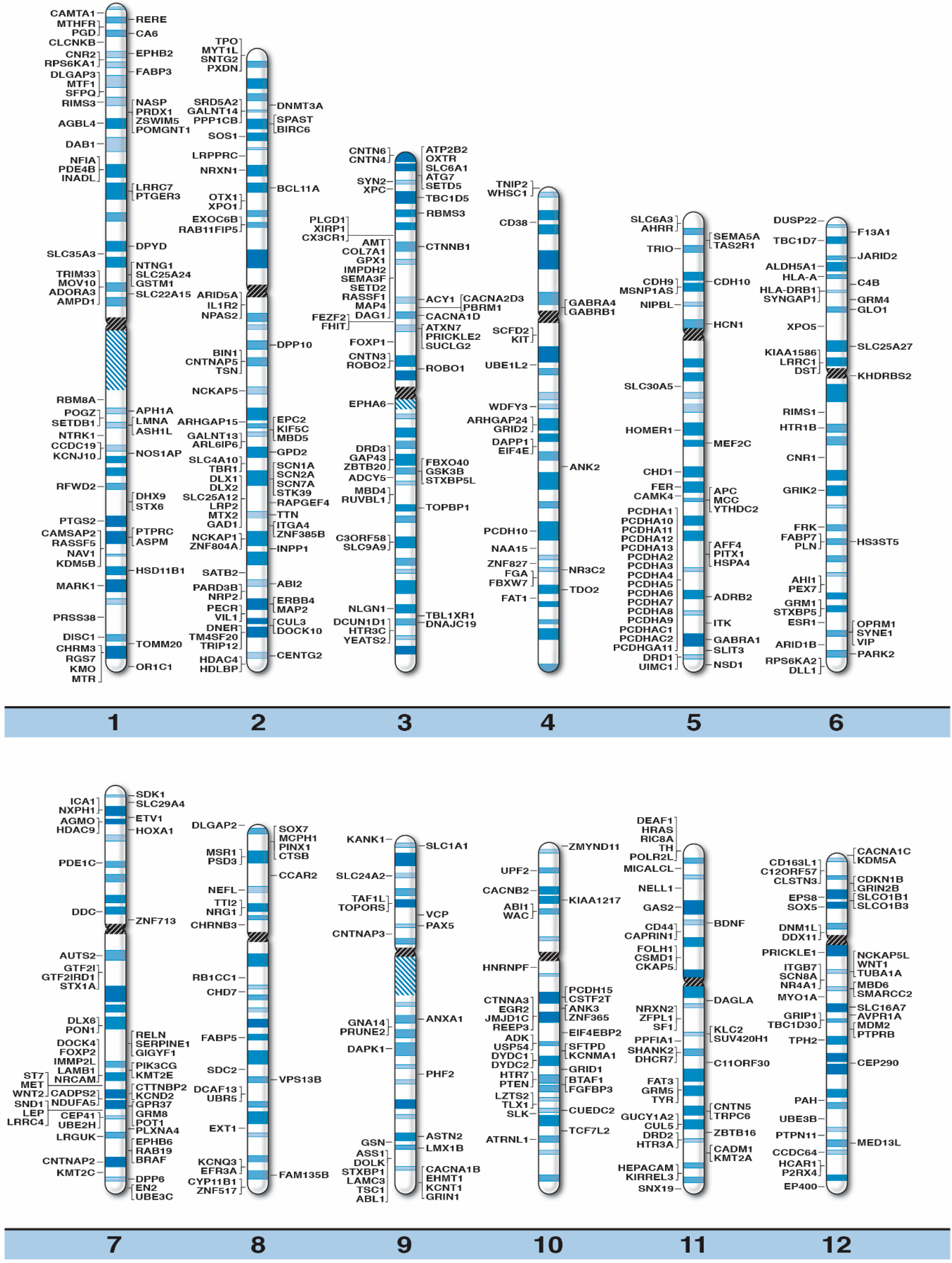
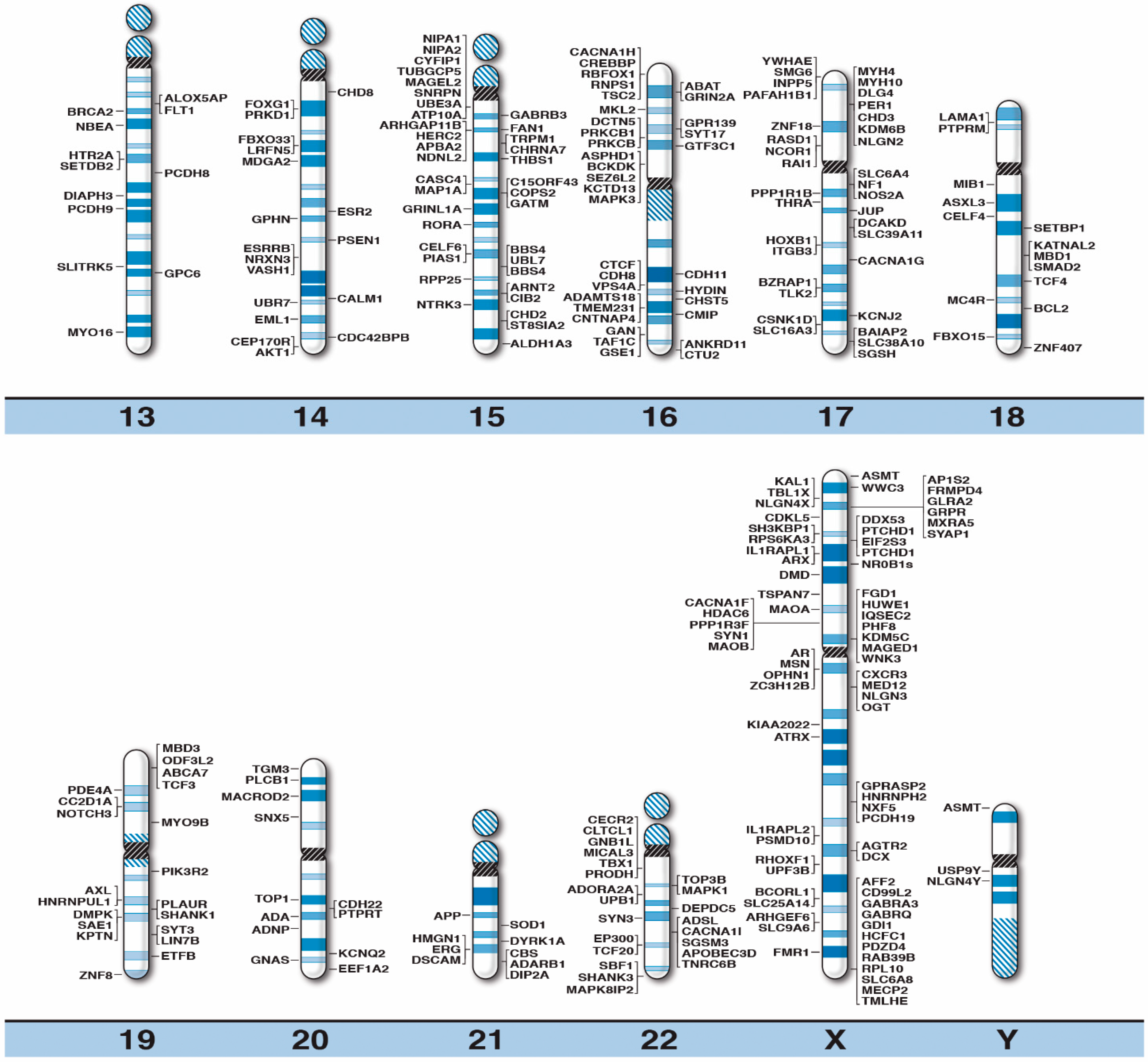
Table 1.
Recognized genes for autism spectrum disorders (ASD) and their chromosome locations.
3. Experimental Section
We used computer-based internet websites and PubMed (https://www.ncbi.nlm.nih.gov/pubmed) to search key words for genetics and autism. This included the integrated catalogue of human genetic studies related to autism found at the Simons Foundation Autism Research Initiative (SFARI) website (https://gene.sfari.org), which currently lists 667 genes reported as of 25 February 2015. This public access initiative is an ongoing curated collection of clinically proven ASD genes supported by clinical and autism experts, medical geneticists and laboratory specialists in the study of autism. This site includes gene description and evidence of support for causation with cited literature reports. We examined peer-reviewed articles found in the medical literature following our search for genetic evidence (i.e., gene variants, mutations or disturbed gene function) and the involvement of genetics playing a role in autism. Sources included whole-genome sequencing of ASD families randomly selected with at least one unaffected sibling [40] or gene expression profiles in ASD [39] along with other informative websites (e.g., Online Mendelian Inheritance in Man, www.OMIM.org). We then compiled the list of genes from these major sources for a total of 792 genes, whereby at least one mechanism was involved for each gene that could lead to ASD, a heterogeneous condition involving many genes; as our report is focused on the compilation of ASD genes from peer-reviewed research articles and authoritative computer website genomic databases for autism and not necessarily related to causal relationships between the individual gene and ASD. Those genes recognized, to date, as playing a role in ASD susceptibility and causation generally appear to impact chromatin remodeling, metabolism, mRNA translation, cell adhesion and synaptic function [39].
SFARI is a publicly available manually curated web-based searchable site of human genes with links to ASD and includes genes in catalogue form based on five categories—genetic association, syndromic, rare single-gene variant and functional and multi-genetic copy number variation—supported by cited research publications for each. Additional literature sources in our study consisted of both primary research articles and reviews summarizing genetic evidence. Many of the listed genes were identified in multiple research studies and widely reported in literature reviews, data repositories and/or computer genomic-based websites for autism (e.g., SFARI). A large number of genes showed a varied relationship to autism and neurodevelopment, but the mass of the literature surveyed limits the reliability of our relative strength estimates for the ASD and gene associations. The gene would be included if cited and recognized in peer-reviewed publications (e.g., PubMed) with supportive genetic evidence (e.g., genetic linkage, GWAS, functional gene expression patterns, informative SNPs, CNVs or identified gene mutations). Other supporting genetic evidence can be found at Simons Foundation Autism Research Initiative (SFARI) at https://sfari.org/sfari-initiatives/simons-simplex-collection, the National Institutes of Health (NIH) at https://www.ncbi.nlm.nih.gov/gap, the Online Inheritance in Man (OMIM) at www.omim.org or Genecards at https://www.genecards.org.
4. Conclusions
Readily available tissue sources, such as peripheral blood, established lymphoblastoid cell lines and saliva, hold promise for more advances in ASD by enabling the identification of new genes and a better understanding of the causation and disease mechanisms to further stimulate research with the hope to discover new treatment modalities impacted by the recognition of known disease-causing or candidate genes for ASD. We illustrated the master list of clinically relevant and known ASD genes in our summary by plotting individual genes on high-resolution chromosome ideograms and generated a tabular form to increase the awareness required for genetic testing and counselling purposes for family members presenting for genetic services. Creating a master list of genes related to ASD is a complicated process; new genes are continually identified, but not all genes are equally important or certain to be causative. Additional research is needed to further investigate the causal relationships between the specific gene and ASD. The authors encourage the use of this collection of known and clinically relevant candidate genes for ASD in their evaluation of patients and families presenting for genetic testing options and for accurate genetic counselling.
Acknowledgments
We thank Carla Meister for expert preparation of the manuscript and Lorie Gavulic for excellent artistic design and preparation of chromosome ideograms. We acknowledge support from National Institute of Child Health and Human Development (NICHD) HD02528.
Author Contributions
Merlin G. Butler conceived of the study, reviewed data from ASD gene literature reports and wrote the manuscript; Syed K. Rafi obtained and reviewed articles pertaining to ASD genes and summarized the master gene list; and Ann M. Manzardo contributed to gene data review and interpretation, contributed to the content of the manuscript and reviewed the literature.
Conflicts of Interest
The authors declare no conflict of interest.
References
- American Psychiatric Association. Diagnostic and Statistical Manual of Mental Disorders, 4th ed.; American Psychiatric Association: Washington, DC, USA, 2000. [Google Scholar]
- Johnson, C.P.; Myers, S.M.; American Academy of Pediatrics Counsel on Children with Disablities. Identifiction and evaluation of children with autism spectrum disorders. Pediatrics 2007, 120, 1183–1215. [Google Scholar] [CrossRef]
- Hughes, J.R. Update on autism: A review of 1300 reports published in 2008. Epilepsy Behav. 2009, 16, 569–589. [Google Scholar] [CrossRef] [PubMed]
- Lord, C.; Risi, S.; Lambrecht, L.; Cook, E.H., Jr.; Leventhal, B.L.; DiLavore, P.C.; Pickles, A.; Rutter, M. The autism diagnostic observation schedule-generic: A standard measure of social and communication deficits associated with the spectrum of autism. J. Autism Dev. Disord. 2000, 30, 205–223. [Google Scholar] [CrossRef] [PubMed]
- Le Couteur, A.; Lord, C.; Rutter, M. Autism Diagnostic Interview-Reviewed (ADI-R); Western Psychological Services: Los Angeles, CA, USA, 2003. [Google Scholar]
- Constantino, J.N.; Davis, S.A.; Todd, R.D.; Schindler, M.K.; Gross, M.M.; Brophy, S.L.; Metzger, L.M.; Shoushtari, C.S.; Splinter, R.; Reich, W. Validation of a brief quantitative measure of autistic traits: Comparison of the social responsiveness scale with the autism diagnostic interview-revised. J. Autism Dev. Disord. 2003, 33, 427–433. [Google Scholar] [CrossRef] [PubMed]
- Rice, C. Prevalence of autism spectrum disorders-autism and developmental disabilities monitoring network, United States, 2006. MMWR Surveill. Summ. 2009, 58, 3–8. [Google Scholar]
- Fombonne, E. Epidemiology of autistic disorder and other pervasive developmental disorders. J. Clin. Psychiatry 2005, 66 (Suppl. 10), 3–8. [Google Scholar] [PubMed]
- Kanner, L. Autistic psychopathy in childhood. Nerv. Child. 1943, 2, 217–250. [Google Scholar]
- Rapin, I. Autistic regression and disintegrative disorder: How important the role of epilepsy? Semin. Pediatr. Neurol. 1995, 2, 278–285. [Google Scholar] [CrossRef] [PubMed]
- Geschwind, D.H.; Levitt, P. Autism spectrum disorders: Developmental disconnection syndromes. Curr. Opin. Neurobiol. 2007, 17, 103–111. [Google Scholar] [CrossRef] [PubMed]
- Kurtzke, J. Neuroepidemiology. In Neurology in Clinical Practice; Bradley, W., Daroff, R., Fenichel, G., Marsden, C., Eds.; Butterworth-Heinemann: Stoneham, MA, USA, 1991; pp. 545–560. [Google Scholar]
- Gadia, C.A.; Tuchman, R.; Rotta, N.T. Autism and pervasive developmental disorders. J. Pediatr. 2004, 80, S83–S94. [Google Scholar]
- Butler, M.G.; Dasouki, M.J.; Zhou, X.P.; Talebizadeh, Z.; Brown, M.; Takahashi, T.N.; Miles, J.H.; Wang, C.H.; Stratton, R.; Pilarski, R.; et al. Subset of individuals with autism spectrum disorders and extreme macrocephaly associated with germline PTEN tumour suppressor gene mutations. J. Med. Genet. 2005, 42, 318–321. [Google Scholar] [CrossRef]
- Prontera, P.; Ottaviani, V.; Toccaceli, D.; Rogaia, D.; Ardisia, C.; Romani, R.; Stangoni, G.; Pierini, A.; Donti, E. Recurrent approximately 100 kb microdeletion in the chromosomal region 14q11.2, involving CHD8 gene, is associated with autism and macrocephaly. Am. J. Med. Genet. A 2014, 164, 3137–3141. [Google Scholar] [CrossRef]
- Benvenuto, A.; Moavero, R.; Alessandrelli, R.; Manzi, B.; Curatolo, P. Syndromic autism: Causes and pathogenetic pathways. World J. Pediatr. 2009, 5, 169–176. [Google Scholar] [CrossRef] [PubMed]
- Holt, R.; Monaco, A.P. Links between genetics and pathophysiology in the autism spectrum disorders. EMBO Mol. Med. 2011, 3, 438–450. [Google Scholar] [CrossRef] [PubMed]
- Campbell, D.B.; Sutcliffe, J.S.; Ebert, P.J.; Militerni, R.; Bravaccio, C.; Trillo, S.; Elia, M.; Schneider, C.; Melmed, R.; Sacco, R.; et al. A genetic variant that disrupts MET transcription is associated with autism. Proc. Natl. Acad. Sci. USA 2006, 103, 16834–16839. [Google Scholar] [CrossRef]
- Schaefer, G.B.; Starr, L.; Pickering, D.; Skar, G.; Dehaai, K.; Sanger, W.G. Array comparative genomic hybridization findings in a cohort referred for an autism evaluation. J. Child Neurol. 2010, 25, 1498–1503. [Google Scholar] [CrossRef] [PubMed]
- Roberts, J.L.; Hovanes, K.; Dasouki, M.; Manzardo, A.M.; Butler, M.G. Chromosomal microarray analysis of consecutive individuals with autism spectrum disorders or learning disability presenting for genetic services. Gene 2014, 535, 70–78. [Google Scholar] [CrossRef] [PubMed]
- Butler, M.G.; Usrey, K.; Roberts, J.L.; Schroeder, S.R.; Manzardo, A.M. Clinical presentation and microarray analysis of Peruvian children with atypical development and/or aberrant behavior. Genet. Res. Int. 2014, 2014, 408516. [Google Scholar] [PubMed]
- Miles, J.H. Autism spectrum disorders—A genetics review. Genet. Med. 2011, 13, 278–294. [Google Scholar] [CrossRef] [PubMed]
- Liu, X.; Takumi, T. Genomic and genetic aspects of autism spectrum disorder. Biochem. Biophys. Res. Commun. 2014, 452, 244–253. [Google Scholar] [CrossRef] [PubMed]
- Cox, D.M.; Butler, M.G. The 15q11.2 BP1-BP2 microdeletion syndrome: A review. Int. J. Mol. Sci. 2015, 16, 4068–4082. [Google Scholar] [CrossRef] [PubMed]
- Hempel, M.; Rivera Brugues, N.; Wagenstaller, J.; Lederer, G.; Weitensteiner, A.; Seidel, H.; Meitinger, T.; Strom, T.M. Microdeletion syndrome 16p11.2-p12.2: Clinical and molecular characterization. Am. J. Med. Genet. A 2009, 149, 2106–2112. [Google Scholar] [CrossRef]
- Fernandez, B.A.; Roberts, W.; Chung, B.; Weksberg, R.; Meyn, S.; Szatmari, P.; Joseph-George, A.M.; Mackay, S.; Whitten, K.; Noble, B.; et al. Phenotypic spectrum associated with de novo and inherited deletions and duplications at 16p11.2 in individuals ascertained for diagnosis of autism spectrum disorder. J. Med. Genet. 2010, 47, 195–203. [Google Scholar] [CrossRef]
- Miller, D.T.; Shen, Y.; Weiss, L.A.; Korn, J.; Anselm, I.; Bridgemohan, C.; Cox, G.F.; Dickinson, H.; Gentile, J.; Harris, D.J.; et al. Microdeletion/duplication at 15q13.2q13.3 among individuals with features of autism and other neuropsychiatric disorders. J. Med. Genet. 2009, 46, 242–248. [Google Scholar] [CrossRef]
- Ritvo, E.R.; Jorde, L.B.; Mason-Brothers, A.; Freeman, B.J.; Pingree, C.; Jones, M.B.; McMahon, W.M.; Petersen, P.B.; Jenson, W.R.; Mo, A. The UCLA-university of Utah epidemiologic survey of autism: Recurrence risk estimates and genetic counseling. Am. J. Psychiatry 1989, 146, 1032–1036. [Google Scholar] [CrossRef] [PubMed]
- Sandin, S.; Lichtenstein, P.; Kuja-Halkola, R.; Larsson, H.; Hultman, C.M.; Reichenberg, A. The familial risk of autism. JAMA 2014, 311, 1770–1777. [Google Scholar] [CrossRef] [PubMed]
- Sebat, J.; Lakshmi, B.; Malhotra, D.; Troge, J.; Lese-Martin, C.; Walsh, T.; Yamrom, B.; Yoon, S.; Krasnitz, A.; Kendall, J.; et al. Strong association of de novo copy number mutations with autism. Science 2007, 316, 445–449. [Google Scholar] [CrossRef] [PubMed]
- Lauritsen, M.B.; Als, T.D.; Dahl, H.A.; Flint, T.J.; Wang, A.G.; Vang, M.; Kruse, T.A.; Ewald, H.; Mors, O. A genome-wide search for alleles and haplotypes associated with autism and related pervasive developmental disorders on the Faroe islands. Mol. Psychiatry 2006, 11, 37–46. [Google Scholar] [CrossRef] [PubMed]
- Ma, D.; Salyakina, D.; Jaworski, J.M.; Konidari, I.; Whitehead, P.L.; Andersen, A.N.; Hoffman, J.D.; Slifer, S.H.; Hedges, D.J.; Cukier, H.N.; et al. A genome-wide association study of autism reveals a common novel risk locus at 5p14.1. Ann. Hum. Genet. 2009, 73, 263–273. [Google Scholar] [CrossRef]
- Weiss, L.A.; Arking, D.E.; Gene Discovery Project of Johns Hopkins & the Autism Consortium; Daly, M.J.; Chakravarti, A. A genome-wide linkage and association scan reveals novel loci for autism. Nature 2009, 461, 802–808. [Google Scholar] [CrossRef] [PubMed]
- Anney, R.; Klei, L.; Pinto, D.; Regan, R.; Conroy, J.; Magalhaes, T.R.; Correia, C.; Abrahams, B.S.; Sykes, N.; Pagnamenta, A.T.; et al. A genome-wide scan for common alleles affecting risk for autism. Hum. Mol. Genet. 2010, 19, 4072–4082. [Google Scholar] [CrossRef]
- Wang, K.; Zhang, H.; Ma, D.; Bucan, M.; Glessner, J.T.; Abrahams, B.S.; Salyakina, D.; Imielinski, M.; Bradfield, J.P.; Sleiman, P.M.; et al. Common genetic variants on 5p14.1 associate with autism spectrum disorders. Nature 2009, 459, 528–533. [Google Scholar] [CrossRef]
- Pinto, D.; Pagnamenta, A.T.; Klei, L.; Anney, R.; Merico, D.; Regan, R.; Conroy, J.; Magalhaes, T.R.; Correia, C.; Abrahams, B.S.; et al. Functional impact of global rare copy number variation in autism spectrum disorders. Nature 2010, 466, 368–372. [Google Scholar] [CrossRef]
- Pagnamenta, A.T.; Khan, H.; Walker, S.; Gerrelli, D.; Wing, K.; Bonaglia, M.C.; Giorda, R.; Berney, T.; Mani, E.; Molteni, M.; et al. Rare familial 16q21 microdeletions under a linkage peak implicate cadherin 8 (CDH8) in susceptibility to autism and learning disability. J. Med. Genet. 2011, 48, 48–54. [Google Scholar] [CrossRef]
- Klei, L.; Sanders, S.J.; Murtha, M.T.; Hus, V.; Lowe, J.K.; Willsey, A.J.; Moreno-De-Luca, D.; Yu, T.W.; Fombonne, E.; Geschwind, D.; et al. Common genetic variants, acting additively, are a major source of risk for autism. Mol. Autism 2012, 3, 9. [Google Scholar] [CrossRef]
- Campbell, M.G.; Kohane, I.S.; Kong, S.W. Pathway-based outlier method reveals heterogeneous genomic structure of autism in blood transcriptome. BMC Med. Genomics 2013, 6, 34. [Google Scholar] [CrossRef] [PubMed]
- Jiang, Y.H.; Yuen, R.K.; Jin, X.; Wang, M.; Chen, N.; Wu, X.; Ju, J.; Mei, J.; Shi, Y.; He, M.; et al. Detection of clinically relevant genetic variants in autism spectrum disorder by whole-genome sequencing. Am. J. Hum. Genet. 2013, 93, 249–263. [Google Scholar] [CrossRef] [PubMed]
- Huguet, G.; Ey, E.; Bourgeron, T. The genetic landscapes of autism spectrum disorders. Ann. Rev. Genomics Hum. Genet. 2013, 14, 191–213. [Google Scholar] [CrossRef]
- Correia, C.; Oliveira, G.; Vicente, A.M. Protein interaction networks reveal novel autism risk genes within gwas statistical noise. PLoS One 2014, 9, e112399. [Google Scholar] [CrossRef] [PubMed]
- Merikangas, A.K.; Segurado, R.; Heron, E.A.; Anney, R.J.; Paterson, A.D.; Cook, E.H.; Pinto, D.; Scherer, S.W.; Szatmari, P.; Gill, M.; et al. The phenotypic manifestations of rare genic CNVs in autism spectrum disorder. Mol. Psychiatry 2014. [Google Scholar] [CrossRef]
- Lossifov, I.; O’Roak, B.J.; Sanders, S.J.; Ronemus, M.; Krumm, N.; Levy, D.; Stessman, H.A.; Witherspoon, K.T.; Vives, L.; Patterson, K.E.; et al. The contribution of de novo coding mutations to autism spectrum disorder. Nature 2014, 515, 216–221. [Google Scholar] [CrossRef] [PubMed]
- Goldani, A.A.S.; Downs, S.R.; Widjaja, F.; Lawton, B.; Hendren, R.L. Biomarkers in autism. Front. Psychiatry 2014, 5, 100. [Google Scholar] [CrossRef] [PubMed]
- Ch’ng, C.; Kwok, W.; Rogic, S.; Pavlidis, P. Meta-analysis of gene expression in autism spectrum disorder. 2015. [Google Scholar] [CrossRef]
- Uddin, M.; Tammimies, K.; Pellecchia, G.; Alipanahi, B.; Hu, P.; Wang, Z.; Pinto, D.; Lau, L.; Nalpathamkalam, T.; Marshall, C.R.; et al. Brain-expressed exons under purifying selection are enriched for de novo mutations in autism spectrum disorder. Nat. Genet. 2014, 46, 742–747. [Google Scholar] [CrossRef] [PubMed]
- De Rubeis, S.; He, X.; Goldberg, A.P.; Poultney, C.S.; Samocha, K.; Cicek, A.E.; Kou, Y.; Liu, L.; Fromer, M.; Walker, S.; et al. Synaptic, transcriptional and chromatin genes disrupted in autism. Nature 2014, 515, 209–215. [Google Scholar] [CrossRef] [PubMed]
- Hadley, D.; Wu, Z.L.; Kao, C.; Kini, A.; Mohamed-Hadley, A.; Thomas, K.; Vazquez, L.; Qiu, H.; Mentch, F.; Pellegrino, R.; et al. The impact of the metabotropic glutamate receptor and other gene family interaction networks on autism. Nat. Commun. 2014. [Google Scholar] [CrossRef]
- Butler, M.G.; Rafi, S.K.; Hossain, W.; Stephan, D.A.; Manzardo, A.M. Whole exome sequencing in females with autism implicates novel and candidate genes. Int. J. Mol. Sci. 2015, 16, 1312–1335. [Google Scholar] [CrossRef] [PubMed]
- Yuen, R.K.; Thiruvahindrapuram, B.; Merico, D.; Walker, S.; Tammimies, K.; Hoang, N.; Chrysler, C.; Nalpathamkalam, T.; Pellecchia, G.; Liu, Y.; et al. Whole-genome sequencing of quartet families with autism spectrum disorder. Nat. Med. 2015, 21, 185–191. [Google Scholar] [CrossRef] [PubMed]
- Willsey, J.A.; State, M.W. Autism spectrum disorders: From genes to neurobiology. Curr. Opin. Neurobiol. 2015, 30, 92–99. [Google Scholar] [CrossRef] [PubMed]
- Hormozdiari, F.; Penn, O.; Borenstein, E.; Eichler, E.E. The discovery of integrated gene networks for autism and related disorders. Genome Res. 2015, 25, 142–154. [Google Scholar] [CrossRef] [PubMed]
- Butler, M.G.; Youngs, E.L.; Roberts, J.L.; Hellings, J.A. Assessment and treatment in autism spectrum disorders: A focus on genetics and psychiatry. Autism Res. Treat. 2012. [Google Scholar] [CrossRef]
- Herman, G.E.; Henninger, N.; Ratliff-Schaub, K.; Pastore, M.; Fitzgerald, S.; McBride, K.L. Genetic testing in autism: How much is enough? Genet. Med. 2007, 9, 268–274. [Google Scholar] [CrossRef] [PubMed]
- Butler, M.G. Prader-willi syndrome: Obesity due to genomic imprinting. Curr. Genomics 2011, 12, 204–215. [Google Scholar] [CrossRef] [PubMed]
- Dhillon, S.; Hellings, J.A.; Butler, M.G. Genetics and mitochondrial abnormalities in autism spectrum disorders: A review. Curr. Genomics 2011, 12, 322–332. [Google Scholar] [CrossRef] [PubMed]
© 2015 by the authors; licensee MDPI, Basel, Switzerland. This article is an open access article distributed under the terms and conditions of the Creative Commons Attribution license (http://creativecommons.org/licenses/by/4.0/).