
<?xml version="1.0" encoding="UTF-8"?>
<!DOCTYPE article PUBLIC "-//NLM//DTD Journal Publishing DTD v2.3 20070202//EN" "journalpublishing.dtd">
<article xmlns:xlink="http://www.w3.org/1999/xlink" xml:lang="en" article-type="research-article">
<front>
<journal-meta>
<journal-id journal-id-type="publisher-id">ijms</journal-id>
<journal-title>International Journal of Molecular Sciences</journal-title>
<abbrev-journal-title>Int. J. Mol. Sci.</abbrev-journal-title>
<issn pub-type="epub">1422-0067</issn>
<publisher>
<publisher-name>Molecular Diversity Preservation International (MDPI)</publisher-name></publisher></journal-meta>
<article-meta>
<article-id pub-id-type="doi">10.3390/ijms14011713</article-id>
<article-id pub-id-type="publisher-id">ijms-14-01713</article-id>
<article-categories>
<subj-group>
<subject>Articles</subject></subj-group></article-categories>
<title-group>
<article-title>CXCR4/CXCL12 in Non-Small-Cell Lung Cancer Metastasis to the Brain</article-title></title-group>
<contrib-group>
<contrib contrib-type="author">
<name><surname>Cavallaro</surname><given-names>Sebastiano</given-names></name></contrib>
<aff id="af1-ijms-14-01713">Functional Genomics Center, Institute of Neurological Sciences, Italian National Research Council, Via Paolo Gaifami, 18, Catania 95125, Italy; E-Mail: <email>sebastiano.cavallaro@cnr.it</email></aff></contrib-group>
<pub-date pub-type="collection">
<year>2013</year></pub-date>
<pub-date pub-type="epub">
<day>15</day>
<month>01</month>
<year>2013</year></pub-date>
<volume>14</volume>
<issue>1</issue>
<fpage>1713</fpage>
<lpage>1727</lpage>
<history>
<date date-type="received">
<day>12</day>
<month>11</month>
<year>2012</year></date>
<date date-type="rev-recd">
<day>04</day>
<month>01</month>
<year>2013</year></date>
<date date-type="accepted">
<day>07</day>
<month>01</month>
<year>2013</year></date></history>
<permissions>
<copyright-statement>© 2013 by the authors; licensee Molecular Diversity Preservation International, Basel, Switzerland.</copyright-statement>
<copyright-year>2013</copyright-year>
<license license-type="open-access" xlink:href="http://creativecommons.org/licenses/by/3.0">
<p>This article is an open-access article distributed under the terms and conditions of the Creative Commons Attribution license (http://creativecommons.org/licenses/by/3.0/).</p></license></permissions>
<abstract>
<p>Lung cancer represents the leading cause of cancer-related mortality throughout the world. Patients die of local progression, disseminated disease, or both. At least one third of the people with lung cancer develop brain metastases at some point during their disease, even often before the diagnosis of lung cancer is made. The high rate of brain metastasis makes lung cancer the most common type of tumor to spread to the brain. It is critical to understand the biologic basis of brain metastases to develop novel diagnostic and therapeutic approaches. This review will focus on the emerging data supporting the involvement of the chemokine CXCL12 and its receptor CXCR4 in the brain metastatic evolution of non-small-cell lung cancer (NSCLC) and the pharmacological tools that may be used to interfere with this signaling axis.</p></abstract>
<kwd-group>
<kwd>brain metastases</kwd>
<kwd>chemokines</kwd>
<kwd>CXCL12</kwd>
<kwd>CXCR4</kwd>
<kwd>lung cancer</kwd>
<kwd>metastasis</kwd></kwd-group></article-meta></front>
<body>
<sec sec-type="intro">
<title>1. Introduction</title>
<p>Chemokines (chemotactic cytokines) are small, mostly secreted proteins that are implicated in many biological processes. Although the chief role for chemokines is differential regulation of leukocyte trafficking in hematopoiesis and in innate and adaptive immunity, they exert several other functions, such as antimicrobial activity, embryogenesis, angiogenic or angiostatic activity, hematopoiesis, apoptosis or mitogenic activity, and tumor-promoting or tumor-inhibiting activity [<xref ref-type="bibr" rid="b1-ijms-14-01713">1</xref>–<xref ref-type="bibr" rid="b4-ijms-14-01713">4</xref>]. They comprise a family of small (~70–80 amino acids in length), mostly secreted proteins, which can be classified into CXC, CC, C or CX3C subfamilies based on the arrangement of the two cysteine residues near the <italic>N</italic>-terminus [<xref ref-type="bibr" rid="b5-ijms-14-01713">5</xref>]. Most chemokines belong to the CC and CXC classes, whereas there are only two known C chemokines, and one known CX3C chemokine. Chemokines act by binding to 7-transmembrane domain, G protein-coupled receptors. To date, 18 human chemokine receptors [<xref ref-type="bibr" rid="b6-ijms-14-01713">6</xref>–<xref ref-type="bibr" rid="b9-ijms-14-01713">9</xref>] and over 50 distinct chemokines [<xref ref-type="bibr" rid="b5-ijms-14-01713">5</xref>] have been described. Some of these receptors are highly selective for one endogenous chemokine ligand (monogamous receptors), whereas others are highly promiscuous and may be activated by more than one chemokine.</p>
<p>An important member of the CXC chemokine subfamily, CXCL12 has been widely explored in cancer [<xref ref-type="bibr" rid="b10-ijms-14-01713">10</xref>–<xref ref-type="bibr" rid="b13-ijms-14-01713">13</xref>]. The cDNA encoding CXCL12 was originally cloned from a murine bone marrow stroma cell line and its gene was originally named stromal cell-derived factor-1 (SDF1) [<xref ref-type="bibr" rid="b14-ijms-14-01713">14</xref>]. Few years later, two groups identified its receptor, an orphan GPCR called LESTR/fusin [<xref ref-type="bibr" rid="b15-ijms-14-01713">15</xref>,<xref ref-type="bibr" rid="b16-ijms-14-01713">16</xref>]. This receptor was also the first identified receptor for human immunodeficiency virus (HIV-1) infection of CD4<sup>+</sup> lymphocytes [<xref ref-type="bibr" rid="b17-ijms-14-01713">17</xref>] and CXCL12 was able to inhibit infection by T-tropic HIV-1 of HeLa-CD4 cells [<xref ref-type="bibr" rid="b15-ijms-14-01713">15</xref>,<xref ref-type="bibr" rid="b16-ijms-14-01713">16</xref>]. Based on its ability to bind and respond to CXCL12, the designation CXCR4 was later used to replace LESTR/fusion.</p>
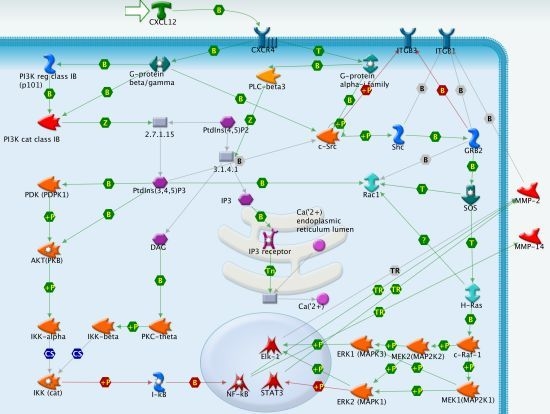
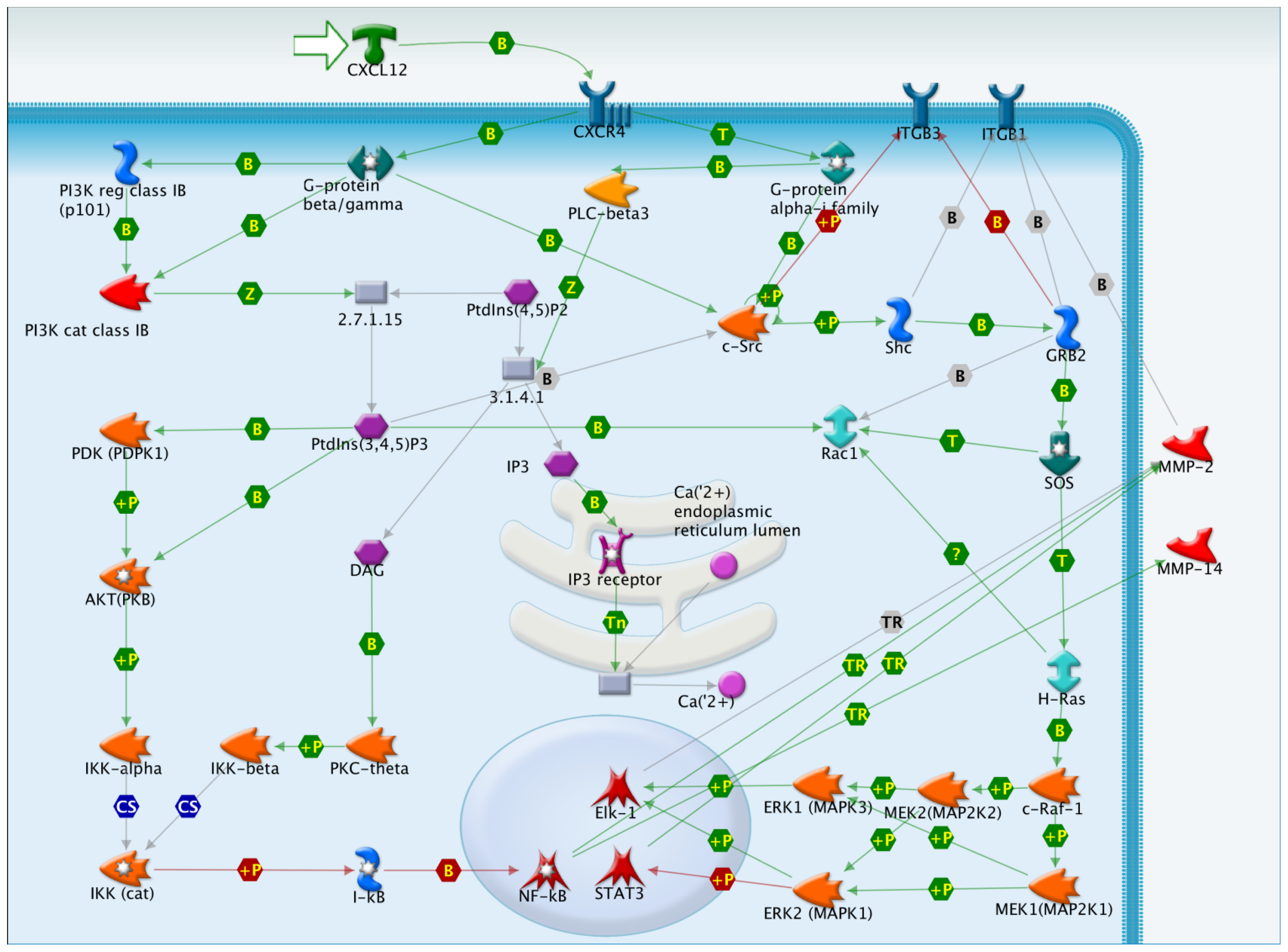
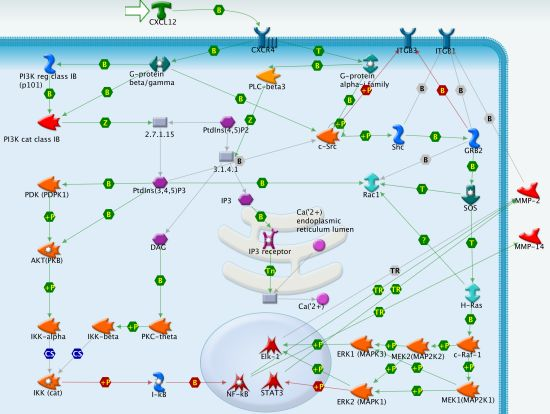
<p>Association of CXCL12 with CXCR4 is known to activate multiple signaling pathways (<xref ref-type="fig" rid="f1-ijms-14-01713">Figure 1</xref>) [<xref ref-type="bibr" rid="b18-ijms-14-01713">18</xref>–<xref ref-type="bibr" rid="b25-ijms-14-01713">25</xref>]. Activation of CXCR4 by CXCL12 promotes interaction between the receptor and the trimeric G-protein alpha (i), beta/gamma. This causes the exchange of GDP for GTP bound to G protein alpha subunits and the dissociation of the beta/gamma heterodimers. The G-protein beta/gamma heterodimers activate PI3K gamma, recruiting non catalytic p101 subunit and directly stimulating catalytic p110 gamma subunits. PI3K converts phosphatidylinositol 4,5-biphosphate to phosphatidylinositol 3,4,5-triphosphate [PI(3,4,5)P3]. PI(3,4,5)P3 is a second messenger that directly binds to PtdIns (3,4,5)P3-dependent protein kinase-1 (PDK1) and protein kinase B (AKT). PDK phosphorylates AKT, AKT in turn, activates Inhibitor of nuclear factor kappa-B kinase (IKK), and IKK phosphorylates the I-kappa-B (I-κB) proteins, making them available for destruction via the ubiquitination pathway, thereby allowing activation of the NF-kappa-B (NF-κB) complex. Activation of phospholipase C (PLC) results in hydrolysis of phosphatidylinositol (4,5)-bisphosphate (PtdIns(4,5)P2) and generation of the second messengers 1,2-diacylglycerol (DAG) and inositol (1,4,5)-trisphosphate (IP3). DAG is a physiological activator of Protein kinase C (PKC) whereas IP3 binds to a specific receptor present on the endoplasmic reticulum, resulting in the release of intracellular stored Ca(2+). PKC can signal through IKK. G-alpha-protein directly stimulates kinase activity of the Src family kinase tyrosine-protein kinase c-Src, binds to the catalytic domain and changes the conformation of c-Src. In turn, c-Src activates H-Ras-c-Raf-1-MEK1/2-ERK1/2 pathway through phosphorylation of adaptor protein Shc and recruitment of adaptor protein GRB2 and positive regulator of RAS guanine nucleotide exchange protein SOS, leading to the increased transactivation ability of transcription factor Elk1 and the repressed transactivation ability of transcription factor STAT3 which both are phosphorylated by ERK2. Although the exact CXCR4/CXCL12 signaling pathways implicated in lung cancer metastasis are almost unknown, CXCR4 regulates migration of lung cells through activation of Rac1 and matrix metalloproteinases (MMP-2 and MMP-14) [<xref ref-type="bibr" rid="b19-ijms-14-01713">19</xref>], and through the combined action of ERK, IKK, NF-kappaB and integrins (ITGB1 and ITGB3) [<xref ref-type="bibr" rid="b22-ijms-14-01713">22</xref>].</p>
<p>In addition to their pleiotropic effects, activation of CXCR4 by its ligand CXCL12 has been shown to play an important role in growth and metastasis of various tumors [<xref ref-type="bibr" rid="b10-ijms-14-01713">10</xref>,<xref ref-type="bibr" rid="b11-ijms-14-01713">11</xref>,<xref ref-type="bibr" rid="b26-ijms-14-01713">26</xref>–<xref ref-type="bibr" rid="b30-ijms-14-01713">30</xref>]. This review will focus on the emerging data supporting the putative involvement of the CXCR4/CXCL12 signaling axis in non-small-cell lung cancer (NSCLC) metastasis to the brain. These insights are providing new opportunities to improve current therapies that address lung cancer spread.</p></sec>
<sec>
<title>2. NSCLC Metastasis to the Brain</title>
<p>NSCLC accounts for 85% of all cases of lung cancers and adenocarcinoma is the most common histologic subtype [<xref ref-type="bibr" rid="b31-ijms-14-01713">31</xref>–<xref ref-type="bibr" rid="b33-ijms-14-01713">33</xref>]. Despite advances over the last decade in diagnostic, staging and surgical techniques, as well as new pharmacological and radiotherapy protocols, lung cancer represents the leading cause of cancer-related mortality in both men and women throughout the world. Patients die of local progression, disseminated disease, or both. Following its primary development, NSCLC can progress along three different courses, which often occur together: local invasion of adjacent structures (mediastinum and the chest wall), lymphatic spread to regional lymph nodes, and distant hematogenous metastasis. The most common sites of metastasis are the bones, liver, adrenal glands, pericardium, brain, and spinal cord [<xref ref-type="bibr" rid="b34-ijms-14-01713">34</xref>]. Synchronous or metachronous brain metastasis occur in approximately 33% of NSCLC patients [<xref ref-type="bibr" rid="b35-ijms-14-01713">35</xref>]. Lymph node involvement at diagnosis confers a higher risk of CNS recurrence [<xref ref-type="bibr" rid="b36-ijms-14-01713">36</xref>,<xref ref-type="bibr" rid="b37-ijms-14-01713">37</xref>]. In locally advanced (LAD)-NSCLC, brain metastasis are reported in 17% to 38% of patients, with a median time-to-brain relapse in the range of 7.5–9.3 months [<xref ref-type="bibr" rid="b38-ijms-14-01713">38</xref>–<xref ref-type="bibr" rid="b41-ijms-14-01713">41</xref>]. In this setting, brain metastasis are mostly observed within two years from initial diagnosis [<xref ref-type="bibr" rid="b38-ijms-14-01713">38</xref>,<xref ref-type="bibr" rid="b42-ijms-14-01713">42</xref>] being the first site of failure in 29% of all recurrences, and the exclusive site of recurrence in 72% of these cases (21% of all recurrences). Among brain recurrences, 36% of them are single brain metastases, whereas multiple brain metastases occur in the rest of the cases [<xref ref-type="bibr" rid="b43-ijms-14-01713">43</xref>]. Overall, solitary metastases are reported in approximately 30% of NSCLC [<xref ref-type="bibr" rid="b35-ijms-14-01713">35</xref>].</p>
<p>In LAD-NSCLC, age and other clinical features (complete <italic>versus</italic> incomplete resection, non-squamous <italic>versus</italic> squamous histology, size of the primary tumor, and adjuvant chemotherapy <italic>versus</italic> none) are clinical prognostic indicators of brain metastasis occurrence [<xref ref-type="bibr" rid="b40-ijms-14-01713">40</xref>,<xref ref-type="bibr" rid="b43-ijms-14-01713">43</xref>,<xref ref-type="bibr" rid="b44-ijms-14-01713">44</xref>]. The number of mediastinal lymph node regions involved and the overall number of mediastinal metastases (less than 4, 4–6, and more than 6) are also significantly associated with the frequency of brain metastasis in LAD-NSCLC. Based on clinical data, a mathematical model to predict brain metastasis risk was proposed with the aim of aiding in selection of patients with LAD-NSCLC for prophylactic cranial irradiation in clinical trials [<xref ref-type="bibr" rid="b40-ijms-14-01713">40</xref>].</p>
<p>Regarding chemotherapy, brain has been reported as a frequent site of disease recurrence in patients with NSCLC after multimodality therapy and an initial response to the tyrosine-kinase inhibitor gefitinib [<xref ref-type="bibr" rid="b45-ijms-14-01713">45</xref>,<xref ref-type="bibr" rid="b46-ijms-14-01713">46</xref>]. In the latter study, brain was the first site of disease recurrence in 33% and the sole site of disease progression in 57% of the cases. Several reasons may explain this finding: the resistance of tumor metastatic clones, incomplete CNS penetrance of gefitinib, longer survival of patients treated with gefitinib, and possible difference in tumor biological characteristics, such as the status of the EGFR receptor [<xref ref-type="bibr" rid="b43-ijms-14-01713">43</xref>,<xref ref-type="bibr" rid="b47-ijms-14-01713">47</xref>]. The high rate of isolated brain metastasis in LAD-NSCLC patients after multimodality treatment, has suggested some authors a renewed interest in prophylactic cranial irradiation [<xref ref-type="bibr" rid="b41-ijms-14-01713">41</xref>,<xref ref-type="bibr" rid="b48-ijms-14-01713">48</xref>], as well as new strategies of follow-up aimed to increase the chances of effective and timely treatment [<xref ref-type="bibr" rid="b42-ijms-14-01713">42</xref>,<xref ref-type="bibr" rid="b49-ijms-14-01713">49</xref>]. In a German multicenter randomized trial [<xref ref-type="bibr" rid="b50-ijms-14-01713">50</xref>], the addition of prophylactic cranial irradiation within a trimodality treatment protocol (chemotherapy, chemoradiotherapy, surgery) for patients with operable stage IIIA NSCLC was effective in preventing brain metastasis with no significant neurological/cognitive related late effects. The use of routine scans of the brain in follow-up examinations and prophylactic chemotherapy in patients at high-risk of brain metastasis, therefore, are potentially useful options but still need to be validated in clinical controlled trials.</p></sec>
<sec>
<title>3. CXCR4 and CXCR12 in NSCLC Metastasis to the Brain</title>
<p>Chemokines and chemokine receptors could be important in explaining the different propensity to brain metastatization among different NSCLCs. Chemokines selectively regulate the recruitment and trafficking of leukocyte subsets to inflammatory sites through chemoattraction and by activating leukocyte integrins to bind their adhesion receptors on endothelial cells [<xref ref-type="bibr" rid="b51-ijms-14-01713">51</xref>]. The mechanisms involved in leukocyte trafficking may also be used by tumor cells, and a chemokine gradient (migration is towards increasing chemokine concentration) may be established between the chemokine receptor of a cancer cell and the respective ligand expressed at sites of tumor spread. Indeed, different chemokines and their respective receptors have been implicated in the development of primary tumor and metastases, providing biological support of the “seed and soil” theory [<xref ref-type="bibr" rid="b52-ijms-14-01713">52</xref>–<xref ref-type="bibr" rid="b54-ijms-14-01713">54</xref>]. The next paragraphs will review the potential role of CXCR4 and CXCR12 in NSCLC metastasis to the brain.</p>
<p>CXCR4 is expressed by a majority of tumors, including those of epithelial, mesenchymal and hematopoietic origin, and it appears to be a ubiquitous receptor [<xref ref-type="bibr" rid="b55-ijms-14-01713">55</xref>]. Based on the well-characterized roles of CXCL12 and CXCR4 in chemotaxis and the similarities between chemotactic cell migration and cancer cell movement to distant sites, this receptor-ligand pair has been hypothesized to play a role in cancer pathogenesis and metastasis. The CXCR4-CXCL12 interaction and downstream signaling has been shown to promote growth/survival of tumor cells and allow them to grow in distant and less favorable sites [<xref ref-type="bibr" rid="b24-ijms-14-01713">24</xref>,<xref ref-type="bibr" rid="b56-ijms-14-01713">56</xref>–<xref ref-type="bibr" rid="b59-ijms-14-01713">59</xref>]. CXCR4 expression has been identified as a predictive factor of worse outcome in some metastatic tumors and in malignant gliomas [<xref ref-type="bibr" rid="b60-ijms-14-01713">60</xref>]. CXCL12/CXCR4 axis is supposed to be crucial in brain metastasis formation from breast cancer [<xref ref-type="bibr" rid="b12-ijms-14-01713">12</xref>].</p>
<p>In lung cancer, in particular, several studies have demonstrated a correlation between CXCR4 expression and clinical outcomes, with increased expression in tumor tissue over normal lung tissue, and increased expression in tumors of patients with metastatic disease <italic>versus</italic> those without clinical metastasis [<xref ref-type="bibr" rid="b61-ijms-14-01713">61</xref>–<xref ref-type="bibr" rid="b69-ijms-14-01713">69</xref>]. In a recent study, we have investigated the expression of CXCR4, together with those of its ligand CXCL12, in primary NSCLC specimens of patients with and without brain metastasis, using a quantitative double-labeling immunofluorescence analysis [<xref ref-type="bibr" rid="b70-ijms-14-01713">70</xref>]. We matched a M0 NSCLC group with a M1 NSCLC group, using clinical and pathological characteristics (gender, age, histology, T stage, and N stage) as consistent as possible. The results obtained showed that CXCL12 and CXCR4 immunoreactivities in M1 NSCLC samples were significantly higher than that in paired M0 NSCLC. Altogether, these findings support a role of CXCL12 and CXCR4 in the process of NSCLC metastatic spread to brain.</p>
<sec>
<title>3.1. CXCR4 Signaling in NSCLC Metastasis</title>
<p>The metastatic potential of NSCLC is dependent on several orchestrated events, such as active locomotion, extracellular matrix degradation, and adhesion to vascular endothelial cells. Although there has been limited research on the signal transduction pathways mediated by CXCR4 in lung cancer cells (<xref ref-type="fig" rid="f1-ijms-14-01713">Figure 1</xref>), some of the mechanisms involved in NSCLC metastasis are beginning to be elucidated. CXCL12 was shown to increase the migration of lung cancer cells through the CXCR4-mediated activation of ERK, which in turn activates IKKa/b and NF-κB, resulting in the activations of integrins (ITGB1 and ITGB3) [<xref ref-type="bibr" rid="b22-ijms-14-01713">22</xref>]. In addition to integrin activation and signaling, CXCR4 also stimulates the production of matrix metalloproteases in lung cells. CXCR4, for example, has been recently shown to regulate migration of lung cells also through activation of Rac1 and matrix metalloproteinases (MMP-2 and MMP-14) [<xref ref-type="bibr" rid="b19-ijms-14-01713">19</xref>]. Additional studies are still required to identify the signaling pathways by which CXCL12 and CXCR4 may regulate NSCLC metastasis. Since their actions influence gene expression, microarray analysis could be employed as it has been done to investigate CXCL12 induced signaling in T cells [<xref ref-type="bibr" rid="b71-ijms-14-01713">71</xref>], breast cancer [<xref ref-type="bibr" rid="b72-ijms-14-01713">72</xref>] or glioma cells [<xref ref-type="bibr" rid="b73-ijms-14-01713">73</xref>].</p></sec>
<sec>
<title>3.2. CXCL12 and CXCR4 Expression in NSCLC</title>
<p>When CXCR4 is blocked by the antagonist AMD-3100, or knocked down by short hairpin RNA, cell migration is significantly inhibited [<xref ref-type="bibr" rid="b19-ijms-14-01713">19</xref>]. If CXCR4 truly mediates metastasis, when lung cancer cells enter the blood or lymphatic systems, they would preferentially migrate and adhere to areas with high expression of CXCL12. Previous <italic>in vitro</italic> studies have shown that NSCLC cell lines express high levels of CXCR4 and that CXCL12-activated CXCR4 promotes migration and invasion of these cell lines [<xref ref-type="bibr" rid="b74-ijms-14-01713">74</xref>].</p>
<p>Different factors can also influence CXCL12 and CXCR4 expression in lung cancer. Hypoxia has been shown to promote CXCR4 expression in NSCLC. Overexpression of the epidermal growth factor receptor (EGFR) is associated with the majority of NSCLC and has been implicated in the process of malignant transformation by promoting cell proliferation, cell survival, and motility. Activation of EGFR by the Epidermal Growth Factor (EGF), especially under hypoxic conditions, increases CXCR4 expression and the migratory capacity of NSCLC cells [<xref ref-type="bibr" rid="b75-ijms-14-01713">75</xref>]. This EGFR-mediated increase of CXCR4 appears to be mediated by phosphatidylinositol 3-kinase/PTEN/AKT/mTOR signal transduction pathway, and by the activation of hypoxia inducible factor (HIF) 1α, a transcription factor that allows tumor to prosper under conditions of low oxygen tension.</p>
<p>CXCR4 downregulation by an antisense nucleotide fragment or a neutralizing antibody significantly decreases migration, invasion, and adhesion of NSCLC cell line cells [<xref ref-type="bibr" rid="b67-ijms-14-01713">67</xref>]. <italic>In vivo</italic> studies using a mouse model of heterotopic or orthotopic xenoengraftment of human NSCLC cells show that preferential sites of lung cancer metastases have significantly higher levels of CXCL12 protein expression than the primary tumor or plasma levels, suggesting that a chemotactic gradient may be established between the site of the primary tumor and metastatic sites [<xref ref-type="bibr" rid="b74-ijms-14-01713">74</xref>]. Neutralization of CXCL12 by an anti-CXCL12 or anti-CXCR4 monoclonal antibody resulted in a significant decrease of NSCLC metastases to several organs including the adrenal glands, liver, lung, brain, and bone marrow [<xref ref-type="bibr" rid="b74-ijms-14-01713">74</xref>,<xref ref-type="bibr" rid="b75-ijms-14-01713">75</xref>]. Similar results were found in a retrospective clinical study showing a correlation between primary tumor CXCR4 expression and clinical outcome in NSCLC patients [<xref ref-type="bibr" rid="b67-ijms-14-01713">67</xref>].</p>
<p>In line with the above studies, CXCL12 and CXCR4 may be used as markers of risk-prediction for metastasis in the initial staging of NSCLC patients. In order to assess this hypothesis, we performed Receiver Operating Characteristics (ROC) analysis in order to define optimal cut-off values for CXCL12 and CXCR4 immunoreactivities that could discriminate between NSCLC patients without and with brain metastasis [<xref ref-type="bibr" rid="b70-ijms-14-01713">70</xref>]. ROC curves showed a good diagnostic accuracy and adequate predictive power for both CXCL12 and CXCR4, supporting their potential use as prognostic markers. However, since our analysis utilized a retrospective cohort of NSCLC patients and a small sample size, the results obtained should be confirmed in a larger study.</p>
<p>Another issue that remains to be investigated regards the role of CXCL12 and CXCR4 in the evolution of NSCLC metastatic traits and their affinity for brain. To this end, it would be useful to characterize the expression of CXCL12 and CXCR4 in NSCLC brain metastasis and correlate the sites of CXCL12 expression in the brain with the site of metastasis formation. In regard to the latter, it is important to point out that both CXCL12 and CXCR4 are constitutively expressed in the brain by neurons and glial cells, and have been involved in several brain processes, such as development, cell migration, neuronal survival, and neurotransmission [<xref ref-type="bibr" rid="b76-ijms-14-01713">76</xref>]. Furthermore, the expression of CXCL12 and CXCR4 can be altered during pathological conditions [<xref ref-type="bibr" rid="b77-ijms-14-01713">77</xref>–<xref ref-type="bibr" rid="b79-ijms-14-01713">79</xref>]. Moving from the primary tumor to the site of metastasis may not be easy, since candidates for surgery removal of brain metastasis constitute a very small percentage of NSCLC patients.</p>
<p>Although further studies are still needed to better evaluate the role of CXCL12 and CXCR4 in the process of NSCLC metastatic spread to brain, their use as predictive markers of metastasis in brain (with or without extracranic sites) may be clinically relevant for the invalidating consequences on patient’s autonomy and quality of life, and the opportunity to implement radiological surveillance.</p></sec></sec>
<sec>
<title>4. Antagonist of CXCR4-Mediated Brain Metastasis</title>
<p>In consideration of the role of chemokines and their receptors in tumor growth and metastasis, a number of therapeutic agents that specifically target chemokine receptors have been used for cancer therapy. Drugs (small molecule or peptide inhibitors) targeting chemokine receptors or monoclonal antibodies blocking their ligands were shown, both <italic>in vitro</italic> and <italic>in vivo</italic>, to inhibit tumor cell growth and prevent metastases [<xref ref-type="bibr" rid="b80-ijms-14-01713">80</xref>,<xref ref-type="bibr" rid="b81-ijms-14-01713">81</xref>].</p>
<p>CXCR4 antagonists include low-molecular-weight molecules, such as AMD3100 and MSX-122, and peptides, such as ALX40-4C or the polyphemusin analogues (TN14003/BKT140), T22, and CTCE-9908 [<xref ref-type="bibr" rid="b82-ijms-14-01713">82</xref>].</p>
<p>Although several studies have assessed the antimetastatic effects of CXCR4 inhibitors in different cancer types [<xref ref-type="bibr" rid="b83-ijms-14-01713">83</xref>–<xref ref-type="bibr" rid="b98-ijms-14-01713">98</xref>], only few have investigated their effects in lung cancer. TF14016, a small peptidic inhibitor of CXCL12 receptor CXCR4, has been recently shown to suppress metastases of small-cell lung cancer cells in mice [<xref ref-type="bibr" rid="b99-ijms-14-01713">99</xref>]. Treatment with AMD3100 (also known as Plerixafor and Mozobil), a bicyclam currently used in the mobilization of hematopoietic stem cells from the bone marrow [<xref ref-type="bibr" rid="b100-ijms-14-01713">100</xref>], or TN14003/BKT140 were shown to disrupt CXCR4-mediated tumor cell adhesion to stromal cells and sensitize lung cancer cells to cytotoxic drugs [<xref ref-type="bibr" rid="b101-ijms-14-01713">101</xref>,<xref ref-type="bibr" rid="b102-ijms-14-01713">102</xref>]. In addition to their ability to sensitize NSCLC cells to conventional anticancer therapies, CXCR4 antagonists are known to directly influence the NSCLC metastatic spread to brain. An <italic>in vitro</italic> study showed that blockade of the CXCR4/CXCL12 axis by transfection with a CXCR4 antisense nucleotide fragment or by a CXCR4 neutralizing antibody significantly decreases migration, invasion, and adhesion of NSCLC cell line cells [<xref ref-type="bibr" rid="b67-ijms-14-01713">67</xref>]. <italic>In vivo</italic>, depletion of CXCL12 by the administration of neutralizing anti-CXCL12 antibodies in immunodeficient mice expressing human NSCLC significantly impairs metastases to the adrenal glands, bone marrow, liver, and brain [<xref ref-type="bibr" rid="b103-ijms-14-01713">103</xref>]. More recently, BKT140, a highly selective inverse agonist of CXCR4, was shown to reduce the colony-forming capacity of NSCLC cell lines <italic>in vitro</italic>, and the growth of NSCLC cell line xenografts <italic>in vivo</italic>[<xref ref-type="bibr" rid="b104-ijms-14-01713">104</xref>]. Although these findings are very encouraging, additional studies are still necessary to test the safety and efficacy of CXCR4 inhibitors against lung cancer brain metastasis.</p></sec>
<sec sec-type="conclusions">
<title>5. Conclusions</title>
<p>There is emerging evidence to support a role for the CXCR4/CXCL12 signaling axis in the brain metastatic evolution of NSCLC. The field is now ready to move from preclinical research into clinical trials where the role of CXCR4/CXCL12 axis, together with the safety and efficacy of CXCR4 inhibitors in NSCLC, should be fully assessed.</p></sec></body>
<back>
<fn-group><fn id="fn1-ijms-14-01713">
<p><bold>Conflict of Interest</bold></p>
<p>The authors declare no conflict of interest.</p></fn></fn-group>
<ref-list>
<title>References</title>
<ref id="b1-ijms-14-01713"><label>1</label><citation citation-type="journal"><person-group person-group-type="author"><name><surname>Ono</surname><given-names>S.J.</given-names></name><name><surname>Nakamura</surname><given-names>T.</given-names></name><name><surname>Miyazaki</surname><given-names>D.</given-names></name><name><surname>Ohbayashi</surname><given-names>M.</given-names></name><name><surname>Dawson</surname><given-names>M.</given-names></name><name><surname>Toda</surname><given-names>M.</given-names></name></person-group><article-title>Chemokines: Roles in leukocyte development, trafficking, and effector function</article-title><source>J. Allergy Clin. Immunol</source><year>2003</year><volume>111</volume><fpage>1185</fpage><lpage>1199</lpage><pub-id pub-id-type="doi">10.1067/mai.2003.1594</pub-id><pub-id pub-id-type="pmid">12789214</pub-id></citation></ref>
<ref id="b2-ijms-14-01713"><label>2</label><citation citation-type="journal"><person-group person-group-type="author"><name><surname>Mukaida</surname><given-names>N.</given-names></name><name><surname>Baba</surname><given-names>T.</given-names></name></person-group><article-title>Chemokines in tumor development and progression</article-title><source>Exp. Cell Res</source><year>2012</year><volume>318</volume><fpage>95</fpage><lpage>102</lpage><pub-id pub-id-type="doi">10.1016/j.yexcr.2011.10.012</pub-id><pub-id pub-id-type="pmid">22036649</pub-id></citation></ref>
<ref id="b3-ijms-14-01713"><label>3</label><citation citation-type="journal"><person-group person-group-type="author"><name><surname>Keeley</surname><given-names>E.C.</given-names></name><name><surname>Mehrad</surname><given-names>B.</given-names></name><name><surname>Strieter</surname><given-names>R.M.</given-names></name></person-group><article-title>Chemokines as mediators of tumor angiogenesis and neovascularization</article-title><source>Exp. Cell Res</source><year>2011</year><volume>317</volume><fpage>685</fpage><lpage>690</lpage><pub-id pub-id-type="doi">10.1016/j.yexcr.2010.10.020</pub-id><pub-id pub-id-type="pmid">21040721</pub-id></citation></ref>
<ref id="b4-ijms-14-01713"><label>4</label><citation citation-type="journal"><person-group person-group-type="author"><name><surname>Gerber</surname><given-names>P.A.</given-names></name><name><surname>Hippe</surname><given-names>A.</given-names></name><name><surname>Buhren</surname><given-names>B.A.</given-names></name><name><surname>Muller</surname><given-names>A.</given-names></name><name><surname>Homey</surname><given-names>B.</given-names></name></person-group><article-title>Chemokines in tumor-associated angiogenesis</article-title><source>Biol. Chem</source><year>2009</year><volume>390</volume><fpage>1213</fpage><lpage>1223</lpage><pub-id pub-id-type="pmid">19804363</pub-id></citation></ref>
<ref id="b5-ijms-14-01713"><label>5</label><citation citation-type="journal"><person-group person-group-type="author"><name><surname>Zlotnik</surname><given-names>A.</given-names></name><name><surname>Yoshie</surname><given-names>O.</given-names></name></person-group><article-title>Chemokines: A new classification system and their role in immunity</article-title><source>Immunity</source><year>2000</year><volume>12</volume><fpage>121</fpage><lpage>127</lpage><pub-id pub-id-type="doi">10.1016/S1074-7613(00)80165-X</pub-id><pub-id pub-id-type="pmid">10714678</pub-id></citation></ref>
<ref id="b6-ijms-14-01713"><label>6</label><citation citation-type="journal"><person-group person-group-type="author"><name><surname>Zaballos</surname><given-names>A.</given-names></name><name><surname>Gutierrez</surname><given-names>J.</given-names></name><name><surname>Varona</surname><given-names>R.</given-names></name><name><surname>Ardavin</surname><given-names>C.</given-names></name><name><surname>Marquez</surname><given-names>G.</given-names></name></person-group><article-title>Cutting edge: Identification of the orphan chemokine receptor GPR-9-6 as CCR9, the receptor for the chemokine TECK</article-title><source>J. Immunol</source><year>1999</year><volume>162</volume><fpage>5671</fpage><lpage>5675</lpage><pub-id pub-id-type="pmid">10229797</pub-id></citation></ref>
<ref id="b7-ijms-14-01713"><label>7</label><citation citation-type="journal"><person-group person-group-type="author"><name><surname>Yoshida</surname><given-names>T.</given-names></name><name><surname>Imai</surname><given-names>T.</given-names></name><name><surname>Kakizaki</surname><given-names>M.</given-names></name><name><surname>Nishimura</surname><given-names>M.</given-names></name><name><surname>Takagi</surname><given-names>S.</given-names></name><name><surname>Yoshie</surname><given-names>O.</given-names></name></person-group><article-title>Identification of single C motif-1/lymphotactin receptor XCR1</article-title><source>J. Biol. Chem</source><year>1998</year><volume>273</volume><fpage>16551</fpage><lpage>16554</lpage><pub-id pub-id-type="doi">10.1074/jbc.273.26.16551</pub-id><pub-id pub-id-type="pmid">9632725</pub-id></citation></ref>
<ref id="b8-ijms-14-01713"><label>8</label><citation citation-type="journal"><person-group person-group-type="author"><name><surname>Homey</surname><given-names>B.</given-names></name><name><surname>Wang</surname><given-names>W.</given-names></name><name><surname>Soto</surname><given-names>H.</given-names></name><name><surname>Buchanan</surname><given-names>M.E.</given-names></name><name><surname>Wiesenborn</surname><given-names>A.</given-names></name><name><surname>Catron</surname><given-names>D.</given-names></name><name><surname>Muller</surname><given-names>A.</given-names></name><name><surname>McClanahan</surname><given-names>T.K.</given-names></name><name><surname>Dieu-Nosjean</surname><given-names>M.C.</given-names></name><name><surname>Orozco</surname><given-names>R.</given-names></name><etal/></person-group><article-title>Cutting edge: The orphan chemokine receptor G protein-coupled receptor-2 (GPR-2, CCR10) binds the skin-associated chemokine CCL27 (CTACK/ALP/ILC)</article-title><source>J. Immunol</source><year>2000</year><volume>164</volume><fpage>3465</fpage><lpage>3470</lpage><pub-id pub-id-type="pmid">10725697</pub-id></citation></ref>
<ref id="b9-ijms-14-01713"><label>9</label><citation citation-type="journal"><person-group person-group-type="author"><name><surname>Schweickart</surname><given-names>V.L.</given-names></name><name><surname>Epp</surname><given-names>A.</given-names></name><name><surname>Raport</surname><given-names>C.J.</given-names></name><name><surname>Gray</surname><given-names>P.W.</given-names></name></person-group><article-title>CCR11 is a functional receptor for the monocyte chemoattractant protein family of chemokines</article-title><source>J. Biol. Chem</source><year>2000</year><volume>275</volume><fpage>9550</fpage><lpage>9556</lpage><pub-id pub-id-type="doi">10.1074/jbc.275.13.9550</pub-id><pub-id pub-id-type="pmid">10734104</pub-id></citation></ref>
<ref id="b10-ijms-14-01713"><label>10</label><citation citation-type="journal"><person-group person-group-type="author"><name><surname>Sun</surname><given-names>X.</given-names></name><name><surname>Cheng</surname><given-names>G.</given-names></name><name><surname>Hao</surname><given-names>M.</given-names></name><name><surname>Zheng</surname><given-names>J.</given-names></name><name><surname>Zhou</surname><given-names>X.</given-names></name><name><surname>Zhang</surname><given-names>J.</given-names></name><name><surname>Taichman</surname><given-names>R.S.</given-names></name><name><surname>Pienta</surname><given-names>K.J.</given-names></name><name><surname>Wang</surname><given-names>J.</given-names></name></person-group><article-title>CXCL12/CXCR4/CXCR7 chemokine axis and cancer progression</article-title><source>Cancer Metastasis Rev</source><year>2010</year><volume>29</volume><fpage>709</fpage><lpage>722</lpage><pub-id pub-id-type="doi">10.1007/s10555-010-9256-x</pub-id><pub-id pub-id-type="pmid">20839032</pub-id></citation></ref>
<ref id="b11-ijms-14-01713"><label>11</label><citation citation-type="journal"><person-group person-group-type="author"><name><surname>Teicher</surname><given-names>B.A.</given-names></name><name><surname>Fricker</surname><given-names>S.P.</given-names></name></person-group><article-title>CXCL12 (SDF-1)/CXCR4 pathway in cancer</article-title><source>Clin. Cancer Res</source><year>2010</year><volume>16</volume><fpage>2927</fpage><lpage>2931</lpage><pub-id pub-id-type="doi">10.1158/1078-0432.CCR-09-2329</pub-id><pub-id pub-id-type="pmid">20484021</pub-id></citation></ref>
<ref id="b12-ijms-14-01713"><label>12</label><citation citation-type="journal"><person-group person-group-type="author"><name><surname>Hinton</surname><given-names>C.V.</given-names></name><name><surname>Avraham</surname><given-names>S.</given-names></name><name><surname>Avraham</surname><given-names>H.K.</given-names></name></person-group><article-title>Role of the CXCR4/CXCL12 signaling axis in breast cancer metastasis to the brain</article-title><source>Clin. Exp. Metastasis</source><year>2010</year><volume>27</volume><fpage>97</fpage><lpage>105</lpage><pub-id pub-id-type="doi">10.1007/s10585-008-9210-2</pub-id><pub-id pub-id-type="pmid">18814042</pub-id></citation></ref>
<ref id="b13-ijms-14-01713"><label>13</label><citation citation-type="journal"><person-group person-group-type="author"><name><surname>Arya</surname><given-names>M.</given-names></name><name><surname>Ahmed</surname><given-names>H.</given-names></name><name><surname>Silhi</surname><given-names>N.</given-names></name><name><surname>Williamson</surname><given-names>M.</given-names></name><name><surname>Patel</surname><given-names>H.R.</given-names></name></person-group><article-title>Clinical importance and therapeutic implications of the pivotal CXCL12-CXCR4 (chemokine ligand-receptor) interaction in cancer cell migration</article-title><source>Tumour Biol</source><year>2007</year><volume>28</volume><fpage>123</fpage><lpage>131</lpage><pub-id pub-id-type="doi">10.1159/000102979</pub-id><pub-id pub-id-type="pmid">17510563</pub-id></citation></ref>
<ref id="b14-ijms-14-01713"><label>14</label><citation citation-type="journal"><person-group person-group-type="author"><name><surname>Tashiro</surname><given-names>K.</given-names></name><name><surname>Tada</surname><given-names>H.</given-names></name><name><surname>Heilker</surname><given-names>R.</given-names></name><name><surname>Shirozu</surname><given-names>M.</given-names></name><name><surname>Nakano</surname><given-names>T.</given-names></name><name><surname>Honjo</surname><given-names>T.</given-names></name></person-group><article-title>Signal sequence trap: A cloning strategy for secreted proteins and type I membrane proteins</article-title><source>Science</source><year>1993</year><volume>261</volume><fpage>600</fpage><lpage>603</lpage><pub-id pub-id-type="doi">10.1126/science.8342023</pub-id><pub-id pub-id-type="pmid">8342023</pub-id></citation></ref>
<ref id="b15-ijms-14-01713"><label>15</label><citation citation-type="journal"><person-group person-group-type="author"><name><surname>Bleul</surname><given-names>C.C.</given-names></name><name><surname>Farzan</surname><given-names>M.</given-names></name><name><surname>Choe</surname><given-names>H.</given-names></name><name><surname>Parolin</surname><given-names>C.</given-names></name><name><surname>Clark-Lewis</surname><given-names>I.</given-names></name><name><surname>Sodroski</surname><given-names>J.</given-names></name><name><surname>Springer</surname><given-names>T.A.</given-names></name></person-group><article-title>The lymphocyte chemoattractant SDF-1 is a ligand for LESTR/fusin and blocks HIV-1 entry</article-title><source>Nature</source><year>1996</year><volume>382</volume><fpage>829</fpage><lpage>833</lpage><pub-id pub-id-type="doi">10.1038/382829a0</pub-id><pub-id pub-id-type="pmid">8752280</pub-id></citation></ref>
<ref id="b16-ijms-14-01713"><label>16</label><citation citation-type="journal"><person-group person-group-type="author"><name><surname>Oberlin</surname><given-names>E.</given-names></name><name><surname>Amara</surname><given-names>A.</given-names></name><name><surname>Bachelerie</surname><given-names>F.</given-names></name><name><surname>Bessia</surname><given-names>C.</given-names></name><name><surname>Virelizier</surname><given-names>J.L.</given-names></name><name><surname>Arenzana-Seisdedos</surname><given-names>F.</given-names></name><name><surname>Schwartz</surname><given-names>O.</given-names></name><name><surname>Heard</surname><given-names>J.M.</given-names></name><name><surname>Clark-Lewis</surname><given-names>I.</given-names></name><name><surname>Legler</surname><given-names>D.F.</given-names></name><etal/></person-group><article-title>The CXC chemokine SDF-1 is the ligand for LESTR/fusin and prevents infection by T-cell-line-adapted HIV-1</article-title><source>Nature</source><year>1996</year><volume>382</volume><fpage>833</fpage><lpage>835</lpage><pub-id pub-id-type="doi">10.1038/382833a0</pub-id><pub-id pub-id-type="pmid">8752281</pub-id></citation></ref>
<ref id="b17-ijms-14-01713"><label>17</label><citation citation-type="journal"><person-group person-group-type="author"><name><surname>Feng</surname><given-names>Y.</given-names></name><name><surname>Broder</surname><given-names>C.C.</given-names></name><name><surname>Kennedy</surname><given-names>P.E.</given-names></name><name><surname>Berger</surname><given-names>E.A.</given-names></name></person-group><article-title>HIV-1 entry cofactor: Functional cDNA cloning of a seven-transmembrane, G protein-coupled receptor</article-title><source>Science</source><year>1996</year><volume>272</volume><fpage>872</fpage><lpage>877</lpage><pub-id pub-id-type="doi">10.1126/science.272.5263.872</pub-id><pub-id pub-id-type="pmid">8629022</pub-id></citation></ref>
<ref id="b18-ijms-14-01713"><label>18</label><citation citation-type="journal"><person-group person-group-type="author"><name><surname>Kucia</surname><given-names>M.</given-names></name><name><surname>Jankowski</surname><given-names>K.</given-names></name><name><surname>Reca</surname><given-names>R.</given-names></name><name><surname>Wysoczynski</surname><given-names>M.</given-names></name><name><surname>Bandura</surname><given-names>L.</given-names></name><name><surname>Allendorf</surname><given-names>D.J.</given-names></name><name><surname>Zhang</surname><given-names>J.</given-names></name><name><surname>Ratajczak</surname><given-names>J.</given-names></name><name><surname>Ratajczak</surname><given-names>M.Z.</given-names></name></person-group><article-title>CXCR4-SDF-1 signalling, locomotion, chemotaxis and adhesion</article-title><source>J. Mol. Histol</source><year>2004</year><volume>35</volume><fpage>233</fpage><lpage>245</lpage><pub-id pub-id-type="pmid">15339043</pub-id></citation></ref>
<ref id="b19-ijms-14-01713"><label>19</label><citation citation-type="journal"><person-group person-group-type="author"><name><surname>Ghosh</surname><given-names>M.C.</given-names></name><name><surname>Makena</surname><given-names>P.S.</given-names></name><name><surname>Gorantla</surname><given-names>V.</given-names></name><name><surname>Sinclair</surname><given-names>S.E.</given-names></name><name><surname>Waters</surname><given-names>C.M.</given-names></name></person-group><article-title>CXCR4 regulates migration of lung alveolar epithelial cells through activation of Rac1 and matrix metalloproteinase-2</article-title><source>Am. J. Physiol. Lung Cell Mol. Physiol</source><year>2012</year><volume>302</volume><fpage>L846</fpage><lpage>L856</lpage><pub-id pub-id-type="doi">10.1152/ajplung.00321.2011</pub-id><pub-id pub-id-type="pmid">22345572</pub-id></citation></ref>
<ref id="b20-ijms-14-01713"><label>20</label><citation citation-type="journal"><person-group person-group-type="author"><name><surname>Wald</surname><given-names>O.</given-names></name><name><surname>Izhar</surname><given-names>U.</given-names></name><name><surname>Amir</surname><given-names>G.</given-names></name><name><surname>Kirshberg</surname><given-names>S.</given-names></name><name><surname>Shlomai</surname><given-names>Z.</given-names></name><name><surname>Zamir</surname><given-names>G.</given-names></name><name><surname>Peled</surname><given-names>A.</given-names></name><name><surname>Shapira</surname><given-names>O.M.</given-names></name></person-group><article-title>Interaction between neoplastic cells and cancer-associated fibroblasts through the CXCL12/CXCR4 axis: Role in non-small cell lung cancer tumor proliferation</article-title><source>J. Thorac. Cardiovasc. Surg</source><year>2011</year><volume>141</volume><fpage>1503</fpage><lpage>1512</lpage><pub-id pub-id-type="doi">10.1016/j.jtcvs.2010.11.056</pub-id><pub-id pub-id-type="pmid">21463876</pub-id></citation></ref>
<ref id="b21-ijms-14-01713"><label>21</label><citation citation-type="journal"><person-group person-group-type="author"><name><surname>Liu</surname><given-names>Y.</given-names></name><name><surname>Wang</surname><given-names>B.</given-names></name><name><surname>Wang</surname><given-names>J.</given-names></name><name><surname>Wan</surname><given-names>W.</given-names></name><name><surname>Sun</surname><given-names>R.</given-names></name><name><surname>Zhao</surname><given-names>Y.</given-names></name><name><surname>Zhang</surname><given-names>N.</given-names></name></person-group><article-title>Down-regulation of PKCzeta expression inhibits chemotaxis signal transduction in human lung cancer cells</article-title><source>Lung Cancer</source><year>2009</year><volume>63</volume><fpage>210</fpage><lpage>218</lpage><pub-id pub-id-type="doi">10.1016/j.lungcan.2008.05.010</pub-id><pub-id pub-id-type="pmid">18701187</pub-id></citation></ref>
<ref id="b22-ijms-14-01713"><label>22</label><citation citation-type="journal"><person-group person-group-type="author"><name><surname>Huang</surname><given-names>Y.C.</given-names></name><name><surname>Hsiao</surname><given-names>Y.C.</given-names></name><name><surname>Chen</surname><given-names>Y.J.</given-names></name><name><surname>Wei</surname><given-names>Y.Y.</given-names></name><name><surname>Lai</surname><given-names>T.H.</given-names></name><name><surname>Tang</surname><given-names>C.H.</given-names></name></person-group><article-title>Stromal cell-derived factor-1 enhances motility and integrin up-regulation through CXCR4, ERK and NF-κB-dependent pathway in human lung cancer cells</article-title><source>Biochem. Pharmacol</source><year>2007</year><volume>74</volume><fpage>1702</fpage><lpage>1712</lpage><pub-id pub-id-type="doi">10.1016/j.bcp.2007.08.025</pub-id><pub-id pub-id-type="pmid">17904532</pub-id></citation></ref>
<ref id="b23-ijms-14-01713"><label>23</label><citation citation-type="journal"><person-group person-group-type="author"><name><surname>Oonakahara</surname><given-names>K.</given-names></name><name><surname>Matsuyama</surname><given-names>W.</given-names></name><name><surname>Higashimoto</surname><given-names>I.</given-names></name><name><surname>Kawabata</surname><given-names>M.</given-names></name><name><surname>Arimura</surname><given-names>K.</given-names></name><name><surname>Osame</surname><given-names>M.</given-names></name></person-group><article-title>Stromal-derived factor-1α/CXCL12-CXCR 4 axis is involved in the dissemination of NSCLC cells into pleural space</article-title><source>Am. J. Respir. Cell Mol. Biol</source><year>2004</year><volume>30</volume><fpage>671</fpage><lpage>677</lpage><pub-id pub-id-type="doi">10.1165/rcmb.2003-0340OC</pub-id><pub-id pub-id-type="pmid">14672915</pub-id></citation></ref>
<ref id="b24-ijms-14-01713"><label>24</label><citation citation-type="journal"><person-group person-group-type="author"><name><surname>Kijima</surname><given-names>T.</given-names></name><name><surname>Maulik</surname><given-names>G.</given-names></name><name><surname>Ma</surname><given-names>P.C.</given-names></name><name><surname>Tibaldi</surname><given-names>E.V.</given-names></name><name><surname>Turner</surname><given-names>R.E.</given-names></name><name><surname>Rollins</surname><given-names>B.</given-names></name><name><surname>Sattler</surname><given-names>M.</given-names></name><name><surname>Johnson</surname><given-names>B.E.</given-names></name><name><surname>Salgia</surname><given-names>R.</given-names></name></person-group><article-title>Regulation of cellular proliferation, cytoskeletal function, and signal transduction through CXCR4 and c-Kit in small cell lung cancer cells</article-title><source>Cancer Res</source><year>2002</year><volume>62</volume><fpage>6304</fpage><lpage>6311</lpage><pub-id pub-id-type="pmid">12414661</pub-id></citation></ref>
<ref id="b25-ijms-14-01713"><label>25</label><citation citation-type="journal"><person-group person-group-type="author"><name><surname>Murdoch</surname><given-names>C.</given-names></name><name><surname>Monk</surname><given-names>P.N.</given-names></name><name><surname>Finn</surname><given-names>A.</given-names></name></person-group><article-title>Functional expression of chemokine receptor CXCR4 on human epithelial cells</article-title><source>Immunology</source><year>1999</year><volume>98</volume><fpage>36</fpage><lpage>41</lpage><pub-id pub-id-type="doi">10.1046/j.1365-2567.1999.00848.x</pub-id><pub-id pub-id-type="pmid">10469231</pub-id></citation></ref>
<ref id="b26-ijms-14-01713"><label>26</label><citation citation-type="journal"><person-group person-group-type="author"><name><surname>Sun</surname><given-names>Y.X.</given-names></name><name><surname>Schneider</surname><given-names>A.</given-names></name><name><surname>Jung</surname><given-names>Y.</given-names></name><name><surname>Wang</surname><given-names>J.</given-names></name><name><surname>Dai</surname><given-names>J.</given-names></name><name><surname>Cook</surname><given-names>K.</given-names></name><name><surname>Osman</surname><given-names>N.I.</given-names></name><name><surname>Koh-Paige</surname><given-names>A.J.</given-names></name><name><surname>Shim</surname><given-names>H.</given-names></name><name><surname>Pienta</surname><given-names>K.J.</given-names></name><etal/></person-group><article-title>Skeletal localization and neutralization of the SDF-1(CXCL12)/CXCR4 axis blocks prostate cancer metastasis and growth in osseous sites <italic>in vivo</italic></article-title><source>J. Bone Miner. Res</source><year>2005</year><volume>20</volume><fpage>318</fpage><lpage>329</lpage><pub-id pub-id-type="pmid">15647826</pub-id></citation></ref>
<ref id="b27-ijms-14-01713"><label>27</label><citation citation-type="journal"><person-group person-group-type="author"><name><surname>Domanska</surname><given-names>U.M.</given-names></name><name><surname>Kruizinga</surname><given-names>R.C.</given-names></name><name><surname>Nagengast</surname><given-names>W.B.</given-names></name><name><surname>Timmer-Bosscha</surname><given-names>H.</given-names></name><name><surname>Huls</surname><given-names>G.</given-names></name><name><surname>de Vries</surname><given-names>E.G.</given-names></name><name><surname>Walenkamp</surname><given-names>A.M.</given-names></name></person-group><article-title>A review on CXCR4/CXCL12 axis in oncology: No place to hide</article-title><source>Eur. J. Cancer</source><year>2013</year><volume>49</volume><fpage>219</fpage><lpage>230</lpage><pub-id pub-id-type="doi">10.1016/j.ejca.2012.05.005</pub-id><pub-id pub-id-type="pmid">22683307</pub-id></citation></ref>
<ref id="b28-ijms-14-01713"><label>28</label><citation citation-type="journal"><person-group person-group-type="author"><name><surname>Patrussi</surname><given-names>L.</given-names></name><name><surname>Baldari</surname><given-names>C.T.</given-names></name></person-group><article-title>The CXCL12/CXCR4 axis as a therapeutic target in cancer and HIV-1 infection</article-title><source>Curr. Med. Chem</source><year>2011</year><volume>18</volume><fpage>497</fpage><lpage>512</lpage><pub-id pub-id-type="doi">10.2174/092986711794480159</pub-id><pub-id pub-id-type="pmid">21143114</pub-id></citation></ref>
<ref id="b29-ijms-14-01713"><label>29</label><citation citation-type="journal"><person-group person-group-type="author"><name><surname>Furusato</surname><given-names>B.</given-names></name><name><surname>Mohamed</surname><given-names>A.</given-names></name><name><surname>Uhlen</surname><given-names>M.</given-names></name><name><surname>Rhim</surname><given-names>J.S.</given-names></name></person-group><article-title>CXCR4 and cancer</article-title><source>Pathol. Int</source><year>2010</year><volume>60</volume><fpage>497</fpage><lpage>505</lpage><pub-id pub-id-type="doi">10.1111/j.1440-1827.2010.02548.x</pub-id><pub-id pub-id-type="pmid">20594270</pub-id></citation></ref>
<ref id="b30-ijms-14-01713"><label>30</label><citation citation-type="journal"><person-group person-group-type="author"><name><surname>Petrushev</surname><given-names>B.</given-names></name><name><surname>Tomuleasa</surname><given-names>C.</given-names></name><name><surname>Susman</surname><given-names>S.</given-names></name><name><surname>Sorisau</surname><given-names>O.</given-names></name><name><surname>Aldea</surname><given-names>M.</given-names></name><name><surname>Kacso</surname><given-names>G.</given-names></name><name><surname>Buiga</surname><given-names>R.</given-names></name><name><surname>Irimie</surname><given-names>A.</given-names></name></person-group><article-title>The axis of evil in the fight against cancer</article-title><source>Rom. J. Intern. Med</source><year>2011</year><volume>49</volume><fpage>319</fpage><lpage>325</lpage><pub-id pub-id-type="pmid">22568277</pub-id></citation></ref>
<ref id="b31-ijms-14-01713"><label>31</label><citation citation-type="journal"><person-group person-group-type="author"><name><surname>Dela Cruz</surname><given-names>C.S.</given-names></name><name><surname>Tanoue</surname><given-names>L.T.</given-names></name><name><surname>Matthay</surname><given-names>R.A.</given-names></name></person-group><article-title>Lung cancer: Epidemiology, etiology, and prevention</article-title><source>Clin. Chest. Med</source><year>2011</year><volume>32</volume><fpage>605</fpage><lpage>644</lpage><pub-id pub-id-type="doi">10.1016/j.ccm.2011.09.001</pub-id><pub-id pub-id-type="pmid">22054876</pub-id></citation></ref>
<ref id="b32-ijms-14-01713"><label>32</label><citation citation-type="journal"><person-group person-group-type="author"><name><surname>Molina</surname><given-names>J.R.</given-names></name><name><surname>Yang</surname><given-names>P.</given-names></name><name><surname>Cassivi</surname><given-names>S.D.</given-names></name><name><surname>Schild</surname><given-names>S.E.</given-names></name><name><surname>Adjei</surname><given-names>A.A.</given-names></name></person-group><article-title>Non-small cell lung cancer: Epidemiology, risk factors, treatment, and survivorship</article-title><source>Mayo. Clin. Proc</source><year>2008</year><volume>83</volume><fpage>584</fpage><lpage>594</lpage><pub-id pub-id-type="pmid">18452692</pub-id></citation></ref>
<ref id="b33-ijms-14-01713"><label>33</label><citation citation-type="journal"><person-group person-group-type="author"><name><surname>Steliga</surname><given-names>M.A.</given-names></name><name><surname>Dresler</surname><given-names>C.M.</given-names></name></person-group><article-title>Epidemiology of lung cancer: Smoking, secondhand smoke, and genetics</article-title><source>Surg. Oncol. Clin. N. Am</source><year>2011</year><volume>20</volume><fpage>605</fpage><lpage>618</lpage><pub-id pub-id-type="doi">10.1016/j.soc.2011.07.003</pub-id><pub-id pub-id-type="pmid">21986260</pub-id></citation></ref>
<ref id="b34-ijms-14-01713"><label>34</label><citation citation-type="journal"><person-group person-group-type="author"><name><surname>Sher</surname><given-names>T.</given-names></name><name><surname>Dy</surname><given-names>G.K.</given-names></name><name><surname>Adjei</surname><given-names>A.A.</given-names></name></person-group><article-title>Small cell lung cancer</article-title><source>Mayo. Clin. Proc</source><year>2008</year><volume>83</volume><fpage>355</fpage><lpage>367</lpage><pub-id pub-id-type="doi">10.4065/83.3.355</pub-id><pub-id pub-id-type="pmid">18316005</pub-id></citation></ref>
<ref id="b35-ijms-14-01713"><label>35</label><citation citation-type="journal"><person-group person-group-type="author"><name><surname>Quint</surname><given-names>L.E.</given-names></name><name><surname>Tummala</surname><given-names>S.</given-names></name><name><surname>Brisson</surname><given-names>L.J.</given-names></name><name><surname>Francis</surname><given-names>I.R.</given-names></name><name><surname>Krupnick</surname><given-names>A.S.</given-names></name><name><surname>Kazerooni</surname><given-names>E.A.</given-names></name><name><surname>Iannettoni</surname><given-names>M.D.</given-names></name><name><surname>Whyte</surname><given-names>R.I.</given-names></name><name><surname>Orringer</surname><given-names>M.B.</given-names></name></person-group><article-title>Distribution of distant metastases from newly diagnosed non-small cell lung cancer</article-title><source>Ann. Thorac. Surg</source><year>1996</year><volume>62</volume><fpage>246</fpage><lpage>250</lpage><pub-id pub-id-type="doi">10.1016/0003-4975(96)00220-2</pub-id><pub-id pub-id-type="pmid">8678651</pub-id></citation></ref>
<ref id="b36-ijms-14-01713"><label>36</label><citation citation-type="journal"><person-group person-group-type="author"><name><surname>Figlin</surname><given-names>R.A.</given-names></name><name><surname>Piantadosi</surname><given-names>S.</given-names></name><name><surname>Feld</surname><given-names>R.</given-names></name></person-group><article-title>Intracranial recurrence of carcinoma after complete surgical resection of stage I, II, and III non-small-cell lung cancer</article-title><source>N. Engl. J. Med</source><year>1988</year><volume>318</volume><fpage>1300</fpage><lpage>1305</lpage><pub-id pub-id-type="doi">10.1056/NEJM198805193182004</pub-id><pub-id pub-id-type="pmid">2834646</pub-id></citation></ref>
<ref id="b37-ijms-14-01713"><label>37</label><citation citation-type="journal"><person-group person-group-type="author"><name><surname>Jacobs</surname><given-names>R.H.</given-names></name><name><surname>Awan</surname><given-names>A.</given-names></name><name><surname>Bitran</surname><given-names>J.D.</given-names></name><name><surname>Hoffman</surname><given-names>P.C.</given-names></name><name><surname>Little</surname><given-names>A.G.</given-names></name><name><surname>Ferguson</surname><given-names>M.K.</given-names></name><name><surname>Weichselbaum</surname><given-names>R.</given-names></name><name><surname>Golomb</surname><given-names>H.M.</given-names></name></person-group><article-title>Prophylactic cranial irradiation in adenocarcinoma of the lung. A possible role</article-title><source>Cancer</source><year>1987</year><volume>59</volume><fpage>2016</fpage><lpage>2019</lpage><pub-id pub-id-type="doi">10.1002/1097-0142(19870615)59:12&lt;2016::AID-CNCR2820591208&gt;3.0.CO;2-4</pub-id><pub-id pub-id-type="pmid">3567864</pub-id></citation></ref>
<ref id="b38-ijms-14-01713"><label>38</label><citation citation-type="journal"><person-group person-group-type="author"><name><surname>Eberhardt</surname><given-names>W.</given-names></name><name><surname>Wilke</surname><given-names>H.</given-names></name><name><surname>Stamatis</surname><given-names>G.</given-names></name><name><surname>Stuschke</surname><given-names>M.</given-names></name><name><surname>Harstrick</surname><given-names>A.</given-names></name><name><surname>Menker</surname><given-names>H.</given-names></name><name><surname>Krause</surname><given-names>B.</given-names></name><name><surname>Mueller</surname><given-names>M.R.</given-names></name><name><surname>Stahl</surname><given-names>M.</given-names></name><name><surname>Flasshove</surname><given-names>M.</given-names></name><etal/></person-group><article-title>Preoperative chemotherapy followed by concurrent chemoradiation therapy based on hyperfractionated accelerated radiotherapy and definitive surgery in locally advanced non-small-cell lung cancer: Mature results of a phase II trial</article-title><source>J. Clin. Oncol</source><year>1998</year><volume>16</volume><fpage>622</fpage><lpage>634</lpage><pub-id pub-id-type="pmid">9469351</pub-id></citation></ref>
<ref id="b39-ijms-14-01713"><label>39</label><citation citation-type="journal"><person-group person-group-type="author"><name><surname>Kumar</surname><given-names>P.</given-names></name><name><surname>Herndon</surname><given-names>J.</given-names><suffix>II</suffix></name><name><surname>Langer</surname><given-names>M.</given-names></name><name><surname>Kohman</surname><given-names>L.J.</given-names></name><name><surname>Elias</surname><given-names>A.D.</given-names></name><name><surname>Kass</surname><given-names>F.C.</given-names></name><name><surname>Eaton</surname><given-names>W.L.</given-names></name><name><surname>Seagren</surname><given-names>S.L.</given-names></name><name><surname>Green</surname><given-names>M.R.</given-names></name><name><surname>Sugarbaker</surname><given-names>D.J.</given-names></name></person-group><article-title>Patterns of disease failure after trimodality therapy of nonsmall cell lung carcinoma pathologic stage IIIA (N2). Analysis of Cancer and Leukemia Group B Protocol 8935</article-title><source>Cancer</source><year>1996</year><volume>77</volume><fpage>2393</fpage><lpage>2399</lpage><pub-id pub-id-type="doi">10.1002/(SICI)1097-0142(19960601)77:11&lt;2393::AID-CNCR31&gt;3.0.CO;2-Q</pub-id><pub-id pub-id-type="pmid">8635112</pub-id></citation></ref>
<ref id="b40-ijms-14-01713"><label>40</label><citation citation-type="journal"><person-group person-group-type="author"><name><surname>Wang</surname><given-names>S.Y.</given-names></name><name><surname>Ye</surname><given-names>X.</given-names></name><name><surname>Ou</surname><given-names>W.</given-names></name><name><surname>Lin</surname><given-names>Y.B.</given-names></name><name><surname>Zhang</surname><given-names>B.B.</given-names></name><name><surname>Yang</surname><given-names>H.</given-names></name></person-group><article-title>Risk of cerebral metastases for postoperative locally advanced non-small-cell lung cancer</article-title><source>Lung Cancer</source><year>2009</year><volume>64</volume><fpage>238</fpage><lpage>243</lpage><pub-id pub-id-type="doi">10.1016/j.lungcan.2008.08.012</pub-id><pub-id pub-id-type="pmid">18838190</pub-id></citation></ref>
<ref id="b41-ijms-14-01713"><label>41</label><citation citation-type="journal"><person-group person-group-type="author"><name><surname>Stuschke</surname><given-names>M.</given-names></name><name><surname>Eberhardt</surname><given-names>W.</given-names></name><name><surname>Pottgen</surname><given-names>C.</given-names></name><name><surname>Stamatis</surname><given-names>G.</given-names></name><name><surname>Wilke</surname><given-names>H.</given-names></name><name><surname>Stuben</surname><given-names>G.</given-names></name><name><surname>Stoblen</surname><given-names>F.</given-names></name><name><surname>Wilhelm</surname><given-names>H.H.</given-names></name><name><surname>Menker</surname><given-names>H.</given-names></name><name><surname>Teschler</surname><given-names>H.</given-names></name><etal/></person-group><article-title>Prophylactic cranial irradiation in locally advanced non-small-cell lung cancer after multimodality treatment: Long-term follow-up and investigations of late neuropsychologic effects</article-title><source>J. Clin. Oncol</source><year>1999</year><volume>17</volume><fpage>2700</fpage><lpage>2709</lpage><pub-id pub-id-type="pmid">10561344</pub-id></citation></ref>
<ref id="b42-ijms-14-01713"><label>42</label><citation citation-type="journal"><person-group person-group-type="author"><name><surname>Law</surname><given-names>A.</given-names></name><name><surname>Karp</surname><given-names>D.D.</given-names></name><name><surname>Dipetrillo</surname><given-names>T.</given-names></name><name><surname>Daly</surname><given-names>B.T.</given-names></name></person-group><article-title>Emergence of increased cerebral metastasis after high-dose preoperative radiotherapy with chemotherapy in patients with locally advanced nonsmall cell lung carcinoma</article-title><source>Cancer</source><year>2001</year><volume>92</volume><fpage>160</fpage><lpage>164</lpage><pub-id pub-id-type="doi">10.1002/1097-0142(20010701)92:1&lt;160::AID-CNCR1304&gt;3.0.CO;2-X</pub-id><pub-id pub-id-type="pmid">11443622</pub-id></citation></ref>
<ref id="b43-ijms-14-01713"><label>43</label><citation citation-type="journal"><person-group person-group-type="author"><name><surname>Ceresoli</surname><given-names>G.L.</given-names></name><name><surname>Reni</surname><given-names>M.</given-names></name><name><surname>Chiesa</surname><given-names>G.</given-names></name><name><surname>Carretta</surname><given-names>A.</given-names></name><name><surname>Schipani</surname><given-names>S.</given-names></name><name><surname>Passoni</surname><given-names>P.</given-names></name><name><surname>Bolognesi</surname><given-names>A.</given-names></name><name><surname>Zannini</surname><given-names>P.</given-names></name><name><surname>Villa</surname><given-names>E.</given-names></name></person-group><article-title>Brain metastases in locally advanced nonsmall cell lung carcinoma after multimodality treatment: Risk factors analysis</article-title><source>Cancer</source><year>2002</year><volume>95</volume><fpage>605</fpage><lpage>612</lpage><pub-id pub-id-type="doi">10.1002/cncr.10687</pub-id><pub-id pub-id-type="pmid">12209754</pub-id></citation></ref>
<ref id="b44-ijms-14-01713"><label>44</label><citation citation-type="journal"><person-group person-group-type="author"><name><surname>Mujoomdar</surname><given-names>A.</given-names></name><name><surname>Austin</surname><given-names>J.H.</given-names></name><name><surname>Malhotra</surname><given-names>R.</given-names></name><name><surname>Powell</surname><given-names>C.A.</given-names></name><name><surname>Pearson</surname><given-names>G.D.</given-names></name><name><surname>Shiau</surname><given-names>M.C.</given-names></name><name><surname>Raftopoulos</surname><given-names>H.</given-names></name></person-group><article-title>Clinical predictors of metastatic disease to the brain from non-small cell lung carcinoma: Primary tumor size, cell type, and lymph node metastases</article-title><source>Radiology</source><year>2007</year><volume>242</volume><fpage>882</fpage><lpage>888</lpage><pub-id pub-id-type="doi">10.1148/radiol.2423051707</pub-id><pub-id pub-id-type="pmid">17229875</pub-id></citation></ref>
<ref id="b45-ijms-14-01713"><label>45</label><citation citation-type="journal"><person-group person-group-type="author"><name><surname>Chen</surname><given-names>A.M.</given-names></name><name><surname>Jahan</surname><given-names>T.M.</given-names></name><name><surname>Jablons</surname><given-names>D.M.</given-names></name><name><surname>Garcia</surname><given-names>J.</given-names></name><name><surname>Larson</surname><given-names>D.A.</given-names></name></person-group><article-title>Risk of cerebral metastases and neurological death after pathological complete response to neoadjuvant therapy for locally advanced nonsmall-cell lung cancer: Clinical implications for the subsequent management of the brain</article-title><source>Cancer</source><year>2007</year><volume>109</volume><fpage>1668</fpage><lpage>1675</lpage><pub-id pub-id-type="doi">10.1002/cncr.22565</pub-id><pub-id pub-id-type="pmid">17342770</pub-id></citation></ref>
<ref id="b46-ijms-14-01713"><label>46</label><citation citation-type="journal"><person-group person-group-type="author"><name><surname>Omuro</surname><given-names>A.M.</given-names></name><name><surname>Kris</surname><given-names>M.G.</given-names></name><name><surname>Miller</surname><given-names>V.A.</given-names></name><name><surname>Franceschi</surname><given-names>E.</given-names></name><name><surname>Shah</surname><given-names>N.</given-names></name><name><surname>Milton</surname><given-names>D.T.</given-names></name><name><surname>Abrey</surname><given-names>L.E.</given-names></name></person-group><article-title>High incidence of disease recurrence in the brain and leptomeninges in patients with nonsmall cell lung carcinoma after response to gefitinib</article-title><source>Cancer</source><year>2005</year><volume>103</volume><fpage>2344</fpage><lpage>2348</lpage><pub-id pub-id-type="doi">10.1002/cncr.21033</pub-id><pub-id pub-id-type="pmid">15844174</pub-id></citation></ref>
<ref id="b47-ijms-14-01713"><label>47</label><citation citation-type="journal"><person-group person-group-type="author"><name><surname>Costa</surname><given-names>D.B.</given-names></name><name><surname>Kobayashi</surname><given-names>S.</given-names></name></person-group><article-title>Response of intracranial metastases to epidermal growth factor receptor tyrosine kinase inhibitors: It may all depend on EGFR mutations</article-title><source>J. Clin. Oncol</source><year>2008</year><volume>26</volume><fpage>686</fpage><pub-id pub-id-type="pmid">18235134</pub-id></citation></ref>
<ref id="b48-ijms-14-01713"><label>48</label><citation citation-type="journal"><person-group person-group-type="author"><name><surname>Robnett</surname><given-names>T.J.</given-names></name><name><surname>Machtay</surname><given-names>M.</given-names></name><name><surname>Stevenson</surname><given-names>J.P.</given-names></name><name><surname>Algazy</surname><given-names>K.M.</given-names></name><name><surname>Hahn</surname><given-names>S.M.</given-names></name></person-group><article-title>Factors affecting the risk of brain metastases after definitive chemoradiation for locally advanced non-small-cell lung carcinoma</article-title><source>J. Clin. Oncol</source><year>2001</year><volume>19</volume><fpage>1344</fpage><lpage>1349</lpage><pub-id pub-id-type="pmid">11230477</pub-id></citation></ref>
<ref id="b49-ijms-14-01713"><label>49</label><citation citation-type="journal"><person-group person-group-type="author"><name><surname>Yokoi</surname><given-names>K.</given-names></name><name><surname>Kamiya</surname><given-names>N.</given-names></name><name><surname>Matsuguma</surname><given-names>H.</given-names></name><name><surname>Machida</surname><given-names>S.</given-names></name><name><surname>Hirose</surname><given-names>T.</given-names></name><name><surname>Mori</surname><given-names>K.</given-names></name><name><surname>Tominaga</surname><given-names>K.</given-names></name></person-group><article-title>Detection of brain metastasis in potentially operable non-small cell lung cancer: A comparison of CT and MRI</article-title><source>Chest</source><year>1999</year><volume>115</volume><fpage>714</fpage><lpage>719</lpage><pub-id pub-id-type="doi">10.1378/chest.115.3.714</pub-id><pub-id pub-id-type="pmid">10084481</pub-id></citation></ref>
<ref id="b50-ijms-14-01713"><label>50</label><citation citation-type="journal"><person-group person-group-type="author"><name><surname>Pottgen</surname><given-names>C.</given-names></name><name><surname>Eberhardt</surname><given-names>W.</given-names></name><name><surname>Grannass</surname><given-names>A.</given-names></name><name><surname>Korfee</surname><given-names>S.</given-names></name><name><surname>Stuben</surname><given-names>G.</given-names></name><name><surname>Teschler</surname><given-names>H.</given-names></name><name><surname>Stamatis</surname><given-names>G.</given-names></name><name><surname>Wagner</surname><given-names>H.</given-names></name><name><surname>Passlick</surname><given-names>B.</given-names></name><name><surname>Petersen</surname><given-names>V.</given-names></name><etal/></person-group><article-title>Prophylactic cranial irradiation in operable stage IIIA non small-cell lung cancer treated with neoadjuvant chemoradiotherapy: Results from a German multicenter randomized trial</article-title><source>J. Clin. Oncol</source><year>2007</year><volume>25</volume><fpage>4987</fpage><lpage>4992</lpage><pub-id pub-id-type="doi">10.1200/JCO.2007.12.5468</pub-id><pub-id pub-id-type="pmid">17971598</pub-id></citation></ref>
<ref id="b51-ijms-14-01713"><label>51</label><citation citation-type="journal"><person-group person-group-type="author"><name><surname>Ebnet</surname><given-names>K.</given-names></name><name><surname>Vestweber</surname><given-names>D.</given-names></name></person-group><article-title>Molecular mechanisms that control leukocyte extravasation: The selectins and the chemokines</article-title><source>Histochem. Cell Biol</source><year>1999</year><volume>112</volume><fpage>1</fpage><lpage>23</lpage><pub-id pub-id-type="doi">10.1007/s004180050387</pub-id><pub-id pub-id-type="pmid">10461808</pub-id></citation></ref>
<ref id="b52-ijms-14-01713"><label>52</label><citation citation-type="journal"><person-group person-group-type="author"><name><surname>Koizumi</surname><given-names>K.</given-names></name><name><surname>Hojo</surname><given-names>S.</given-names></name><name><surname>Akashi</surname><given-names>T.</given-names></name><name><surname>Yasumoto</surname><given-names>K.</given-names></name><name><surname>Saiki</surname><given-names>I.</given-names></name></person-group><article-title>Chemokine receptors in cancer metastasis and cancer cell-derived chemokines in host immune response</article-title><source>Cancer Sci</source><year>2007</year><volume>98</volume><fpage>1652</fpage><lpage>1658</lpage><pub-id pub-id-type="doi">10.1111/j.1349-7006.2007.00606.x</pub-id><pub-id pub-id-type="pmid">17894551</pub-id></citation></ref>
<ref id="b53-ijms-14-01713"><label>53</label><citation citation-type="journal"><person-group person-group-type="author"><name><surname>Zlotnik</surname><given-names>A.</given-names></name></person-group><article-title>Involvement of chemokine receptors in organ-specific metastasis</article-title><source>Contrib. Microbiol</source><year>2006</year><volume>13</volume><fpage>191</fpage><lpage>199</lpage><pub-id pub-id-type="pmid">16627966</pub-id></citation></ref>
<ref id="b54-ijms-14-01713"><label>54</label><citation citation-type="journal"><person-group person-group-type="author"><name><surname>Kakinuma</surname><given-names>T.</given-names></name><name><surname>Hwang</surname><given-names>S.T.</given-names></name></person-group><article-title>Chemokines, chemokine receptors, and cancer metastasis</article-title><source>J. Leukoc. Biol</source><year>2006</year><volume>79</volume><fpage>639</fpage><lpage>651</lpage><pub-id pub-id-type="doi">10.1189/jlb.1105633</pub-id><pub-id pub-id-type="pmid">16478915</pub-id></citation></ref>
<ref id="b55-ijms-14-01713"><label>55</label><citation citation-type="journal"><person-group person-group-type="author"><name><surname>Balkwill</surname><given-names>F.</given-names></name></person-group><article-title>Cancer and the chemokine network</article-title><source>Nat. Rev. Cancer</source><year>2004</year><volume>4</volume><fpage>540</fpage><lpage>550</lpage><pub-id pub-id-type="doi">10.1038/nrc1388</pub-id><pub-id pub-id-type="pmid">15229479</pub-id></citation></ref>
<ref id="b56-ijms-14-01713"><label>56</label><citation citation-type="journal"><person-group person-group-type="author"><name><surname>Schrader</surname><given-names>A.J.</given-names></name><name><surname>Lechner</surname><given-names>O.</given-names></name><name><surname>Templin</surname><given-names>M.</given-names></name><name><surname>Dittmar</surname><given-names>K.E.</given-names></name><name><surname>Machtens</surname><given-names>S.</given-names></name><name><surname>Mengel</surname><given-names>M.</given-names></name><name><surname>Probst-Kepper</surname><given-names>M.</given-names></name><name><surname>Franzke</surname><given-names>A.</given-names></name><name><surname>Wollensak</surname><given-names>T.</given-names></name><name><surname>Gatzlaff</surname><given-names>P.</given-names></name><etal/></person-group><article-title>CXCR4/CXCL12 expression and signalling in kidney cancer</article-title><source>Br. J. Cancer</source><year>2002</year><volume>86</volume><fpage>1250</fpage><lpage>1256</lpage><pub-id pub-id-type="doi">10.1038/sj.bjc.6600221</pub-id><pub-id pub-id-type="pmid">11953881</pub-id></citation></ref>
<ref id="b57-ijms-14-01713"><label>57</label><citation citation-type="journal"><person-group person-group-type="author"><name><surname>Zhou</surname><given-names>Y.</given-names></name><name><surname>Larsen</surname><given-names>P.H.</given-names></name><name><surname>Hao</surname><given-names>C.</given-names></name><name><surname>Yong</surname><given-names>V.W.</given-names></name></person-group><article-title>CXCR4 is a major chemokine receptor on glioma cells and mediates their survival</article-title><source>J. Biol. Chem</source><year>2002</year><volume>277</volume><fpage>49481</fpage><lpage>49487</lpage><pub-id pub-id-type="doi">10.1074/jbc.M206222200</pub-id><pub-id pub-id-type="pmid">12388552</pub-id></citation></ref>
<ref id="b58-ijms-14-01713"><label>58</label><citation citation-type="journal"><person-group person-group-type="author"><name><surname>Barbero</surname><given-names>S.</given-names></name><name><surname>Bonavia</surname><given-names>R.</given-names></name><name><surname>Bajetto</surname><given-names>A.</given-names></name><name><surname>Porcile</surname><given-names>C.</given-names></name><name><surname>Pirani</surname><given-names>P.</given-names></name><name><surname>Ravetti</surname><given-names>J.L.</given-names></name><name><surname>Zona</surname><given-names>G.L.</given-names></name><name><surname>Spaziante</surname><given-names>R.</given-names></name><name><surname>Florio</surname><given-names>T.</given-names></name><name><surname>Schettini</surname><given-names>G.</given-names></name></person-group><article-title>Stromal cell-derived factor 1α stimulates human glioblastoma cell growth through the activation of both extracellular signal-regulated kinases 1/2 and Akt</article-title><source>Cancer Res</source><year>2003</year><volume>63</volume><fpage>1969</fpage><lpage>1974</lpage><pub-id pub-id-type="pmid">12702590</pub-id></citation></ref>
<ref id="b59-ijms-14-01713"><label>59</label><citation citation-type="journal"><person-group person-group-type="author"><name><surname>Sun</surname><given-names>Y.X.</given-names></name><name><surname>Wang</surname><given-names>J.</given-names></name><name><surname>Shelburne</surname><given-names>C.E.</given-names></name><name><surname>Lopatin</surname><given-names>D.E.</given-names></name><name><surname>Chinnaiyan</surname><given-names>A.M.</given-names></name><name><surname>Rubin</surname><given-names>M.A.</given-names></name><name><surname>Pienta</surname><given-names>K.J.</given-names></name><name><surname>Taichman</surname><given-names>R.S.</given-names></name></person-group><article-title>Expression of CXCR4 and CXCL12 (SDF-1) in human prostate cancers (PCa) <italic>in vivo</italic></article-title><source>J. Cell Biochem</source><year>2003</year><volume>89</volume><fpage>462</fpage><lpage>473</lpage><pub-id pub-id-type="doi">10.1002/jcb.10522</pub-id><pub-id pub-id-type="pmid">12761880</pub-id></citation></ref>
<ref id="b60-ijms-14-01713"><label>60</label><citation citation-type="journal"><person-group person-group-type="author"><name><surname>Scala</surname><given-names>S.</given-names></name><name><surname>Ottaiano</surname><given-names>A.</given-names></name><name><surname>Ascierto</surname><given-names>P.A.</given-names></name><name><surname>Cavalli</surname><given-names>M.</given-names></name><name><surname>Simeone</surname><given-names>E.</given-names></name><name><surname>Giuliano</surname><given-names>P.</given-names></name><name><surname>Napolitano</surname><given-names>M.</given-names></name><name><surname>Franco</surname><given-names>R.</given-names></name><name><surname>Botti</surname><given-names>G.</given-names></name><name><surname>Castello</surname><given-names>G.</given-names></name></person-group><article-title>Expression of CXCR4 predicts poor prognosis in patients with malignant melanoma</article-title><source>Clin. Cancer Res</source><year>2005</year><volume>11</volume><fpage>1835</fpage><lpage>1841</lpage><pub-id pub-id-type="doi">10.1158/1078-0432.CCR-04-1887</pub-id><pub-id pub-id-type="pmid">15756007</pub-id></citation></ref>
<ref id="b61-ijms-14-01713"><label>61</label><citation citation-type="journal"><person-group person-group-type="author"><name><surname>Wagner</surname><given-names>P.L.</given-names></name><name><surname>Hyjek</surname><given-names>E.</given-names></name><name><surname>Vazquez</surname><given-names>M.F.</given-names></name><name><surname>Meherally</surname><given-names>D.</given-names></name><name><surname>Liu</surname><given-names>Y.F.</given-names></name><name><surname>Chadwick</surname><given-names>P.A.</given-names></name><name><surname>Rengifo</surname><given-names>T.</given-names></name><name><surname>Sica</surname><given-names>G.L.</given-names></name><name><surname>Port</surname><given-names>J.L.</given-names></name><name><surname>Lee</surname><given-names>P.C.</given-names></name><etal/></person-group><article-title>CXCL12 and CXCR4 in adenocarcinoma of the lung: Association with metastasis and survival</article-title><source>J. Thorac. Cardiovasc. Surg</source><year>2009</year><volume>137</volume><fpage>615</fpage><lpage>621</lpage><pub-id pub-id-type="doi">10.1016/j.jtcvs.2008.07.039</pub-id><pub-id pub-id-type="pmid">19258077</pub-id></citation></ref>
<ref id="b62-ijms-14-01713"><label>62</label><citation citation-type="journal"><person-group person-group-type="author"><name><surname>Na</surname><given-names>I.K.</given-names></name><name><surname>Scheibenbogen</surname><given-names>C.</given-names></name><name><surname>Adam</surname><given-names>C.</given-names></name><name><surname>Stroux</surname><given-names>A.</given-names></name><name><surname>Ghadjar</surname><given-names>P.</given-names></name><name><surname>Thiel</surname><given-names>E.</given-names></name><name><surname>Keilholz</surname><given-names>U.</given-names></name><name><surname>Coupland</surname><given-names>S.E.</given-names></name></person-group><article-title>Nuclear expression of CXCR4 in tumor cells of non-small cell lung cancer is correlated with lymph node metastasis</article-title><source>Hum. Pathol</source><year>2008</year><volume>39</volume><fpage>1751</fpage><lpage>1755</lpage><pub-id pub-id-type="doi">10.1016/j.humpath.2008.04.017</pub-id><pub-id pub-id-type="pmid">18701133</pub-id></citation></ref>
<ref id="b63-ijms-14-01713"><label>63</label><citation citation-type="journal"><person-group person-group-type="author"><name><surname>Imai</surname><given-names>H.</given-names></name><name><surname>Sunaga</surname><given-names>N.</given-names></name><name><surname>Shimizu</surname><given-names>Y.</given-names></name><name><surname>Kakegawa</surname><given-names>S.</given-names></name><name><surname>Shimizu</surname><given-names>K.</given-names></name><name><surname>Sano</surname><given-names>T.</given-names></name><name><surname>Ishizuka</surname><given-names>T.</given-names></name><name><surname>Oyama</surname><given-names>T.</given-names></name><name><surname>Saito</surname><given-names>R.</given-names></name><name><surname>Minna</surname><given-names>J.D.</given-names></name><etal/></person-group><article-title>Clinicopathological and therapeutic significance of CXCL12 expression in lung cancer</article-title><source>Int. J. Immunopathol. Pharmacol</source><year>2010</year><volume>23</volume><fpage>153</fpage><lpage>164</lpage><pub-id pub-id-type="pmid">20378003</pub-id></citation></ref>
<ref id="b64-ijms-14-01713"><label>64</label><citation citation-type="journal"><person-group person-group-type="author"><name><surname>Gangadhar</surname><given-names>T.</given-names></name><name><surname>Nandi</surname><given-names>S.</given-names></name><name><surname>Salgia</surname><given-names>R.</given-names></name></person-group><article-title>The role of chemokine receptor CXCR4 in lung cancer</article-title><source>Cancer Biol. Ther</source><year>2010</year><volume>9</volume><fpage>409</fpage><lpage>416</lpage><pub-id pub-id-type="doi">10.4161/cbt.9.6.11233</pub-id><pub-id pub-id-type="pmid">20147779</pub-id></citation></ref>
<ref id="b65-ijms-14-01713"><label>65</label><citation citation-type="journal"><person-group person-group-type="author"><name><surname>Pfeiffer</surname><given-names>M.</given-names></name><name><surname>Hartmann</surname><given-names>T.N.</given-names></name><name><surname>Leick</surname><given-names>M.</given-names></name><name><surname>Catusse</surname><given-names>J.</given-names></name><name><surname>Schmitt-Graeff</surname><given-names>A.</given-names></name><name><surname>Burger</surname><given-names>M.</given-names></name></person-group><article-title>Alternative implication of CXCR4 in JAK2/STAT3 activation in small cell lung cancer</article-title><source>Br. J. Cancer</source><year>2009</year><volume>100</volume><fpage>1949</fpage><lpage>1956</lpage><pub-id pub-id-type="doi">10.1038/sj.bjc.6605068</pub-id><pub-id pub-id-type="pmid">19455144</pub-id></citation></ref>
<ref id="b66-ijms-14-01713"><label>66</label><citation citation-type="journal"><person-group person-group-type="author"><name><surname>Chen</surname><given-names>G.</given-names></name><name><surname>Wang</surname><given-names>Z.</given-names></name><name><surname>Liu</surname><given-names>X.Y.</given-names></name><name><surname>Liu</surname><given-names>F.Y.</given-names></name></person-group><article-title>High-level CXCR4 expression correlates with brain-specific metastasis of non-small cell lung cancer</article-title><source>World J. Surg</source><year>2011</year><volume>35</volume><fpage>56</fpage><lpage>61</lpage><pub-id pub-id-type="doi">10.1007/s00268-010-0784-x</pub-id><pub-id pub-id-type="pmid">21046385</pub-id></citation></ref>
<ref id="b67-ijms-14-01713"><label>67</label><citation citation-type="journal"><person-group person-group-type="author"><name><surname>Su</surname><given-names>L.</given-names></name><name><surname>Zhang</surname><given-names>J.</given-names></name><name><surname>Xu</surname><given-names>H.</given-names></name><name><surname>Wang</surname><given-names>Y.</given-names></name><name><surname>Chu</surname><given-names>Y.</given-names></name><name><surname>Liu</surname><given-names>R.</given-names></name><name><surname>Xiong</surname><given-names>S.</given-names></name></person-group><article-title>Differential expression of CXCR4 is associated with the metastatic potential of human non-small cell lung cancer cells</article-title><source>Clin. Cancer Res</source><year>2005</year><volume>11</volume><fpage>8273</fpage><lpage>8280</lpage><pub-id pub-id-type="doi">10.1158/1078-0432.CCR-05-0537</pub-id><pub-id pub-id-type="pmid">16322285</pub-id></citation></ref>
<ref id="b68-ijms-14-01713"><label>68</label><citation citation-type="journal"><person-group person-group-type="author"><name><surname>Spano</surname><given-names>J.P.</given-names></name><name><surname>Andre</surname><given-names>F.</given-names></name><name><surname>Morat</surname><given-names>L.</given-names></name><name><surname>Sabatier</surname><given-names>L.</given-names></name><name><surname>Besse</surname><given-names>B.</given-names></name><name><surname>Combadiere</surname><given-names>C.</given-names></name><name><surname>Deterre</surname><given-names>P.</given-names></name><name><surname>Martin</surname><given-names>A.</given-names></name><name><surname>Azorin</surname><given-names>J.</given-names></name><name><surname>Valeyre</surname><given-names>D.</given-names></name><etal/></person-group><article-title>Chemokine receptor CXCR4 and early-stage non-small cell lung cancer: Pattern of expression and correlation with outcome</article-title><source>Ann. Oncol</source><year>2004</year><volume>15</volume><fpage>613</fpage><lpage>617</lpage><pub-id pub-id-type="doi">10.1093/annonc/mdh136</pub-id><pub-id pub-id-type="pmid">15033669</pub-id></citation></ref>
<ref id="b69-ijms-14-01713"><label>69</label><citation citation-type="journal"><person-group person-group-type="author"><name><surname>Burger</surname><given-names>M.</given-names></name><name><surname>Glodek</surname><given-names>A.</given-names></name><name><surname>Hartmann</surname><given-names>T.</given-names></name><name><surname>Schmitt-Graff</surname><given-names>A.</given-names></name><name><surname>Silberstein</surname><given-names>L.E.</given-names></name><name><surname>Fujii</surname><given-names>N.</given-names></name><name><surname>Kipps</surname><given-names>T.J.</given-names></name><name><surname>Burger</surname><given-names>J.A.</given-names></name></person-group><article-title>Functional expression of CXCR4 (CD184) on small-cell lung cancer cells mediates migration, integrin activation, and adhesion to stromal cells</article-title><source>Oncogene</source><year>2003</year><volume>22</volume><fpage>8093</fpage><lpage>8101</lpage><pub-id pub-id-type="doi">10.1038/sj.onc.1207097</pub-id><pub-id pub-id-type="pmid">14603250</pub-id></citation></ref>
<ref id="b70-ijms-14-01713"><label>70</label><citation citation-type="journal"><person-group person-group-type="author"><name><surname>Paratore</surname><given-names>S.</given-names></name><name><surname>Banna</surname><given-names>G.L.</given-names></name><name><surname>D’Arrigo</surname><given-names>M.</given-names></name><name><surname>Saita</surname><given-names>S.</given-names></name><name><surname>Iemmolo</surname><given-names>R.</given-names></name><name><surname>Lucenti</surname><given-names>L.</given-names></name><name><surname>Bellia</surname><given-names>D.</given-names></name><name><surname>Lipari</surname><given-names>H.</given-names></name><name><surname>Buscarino</surname><given-names>C.</given-names></name><name><surname>Cunsolo</surname><given-names>R.</given-names></name><etal/></person-group><article-title>CXCR4 and CXCL12 immunoreactivities differentiate primary non-small-cell lung cancer with or without brain metastases</article-title><source>Cancer Biomark</source><year>2011</year><volume>10</volume><fpage>79</fpage><lpage>89</lpage><pub-id pub-id-type="pmid">22430135</pub-id></citation></ref>
<ref id="b71-ijms-14-01713"><label>71</label><citation citation-type="journal"><person-group person-group-type="author"><name><surname>Ghosh</surname><given-names>M.C.</given-names></name><name><surname>Collins</surname><given-names>G.D.</given-names></name><name><surname>Vandanmagsar</surname><given-names>B.</given-names></name><name><surname>Patel</surname><given-names>K.</given-names></name><name><surname>Brill</surname><given-names>M.</given-names></name><name><surname>Carter</surname><given-names>A.</given-names></name><name><surname>Lustig</surname><given-names>A.</given-names></name><name><surname>Becker</surname><given-names>K.G.</given-names></name><name><surname>Wood</surname><given-names>W.W.</given-names><suffix>III</suffix></name><name><surname>Emeche</surname><given-names>C.D.</given-names></name><etal/></person-group><article-title>Activation of Wnt5A signaling is required for CXC chemokine ligand 12-mediated T-cell migration</article-title><source>Blood</source><year>2009</year><volume>114</volume><fpage>1366</fpage><lpage>1373</lpage><pub-id pub-id-type="doi">10.1182/blood-2008-08-175869</pub-id><pub-id pub-id-type="pmid">19520808</pub-id></citation></ref>
<ref id="b72-ijms-14-01713"><label>72</label><citation citation-type="journal"><person-group person-group-type="author"><name><surname>Subik</surname><given-names>K.</given-names></name><name><surname>Shu</surname><given-names>L.</given-names></name><name><surname>Wu</surname><given-names>C.</given-names></name><name><surname>Liang</surname><given-names>Q.</given-names></name><name><surname>Hicks</surname><given-names>D.</given-names></name><name><surname>Boyce</surname><given-names>B.</given-names></name><name><surname>Schiffhauer</surname><given-names>L.</given-names></name><name><surname>Chen</surname><given-names>D.</given-names></name><name><surname>Chen</surname><given-names>C.</given-names></name><name><surname>Tang</surname><given-names>P.</given-names></name><name><surname>Xing</surname><given-names>L.</given-names></name></person-group><article-title>The ubiquitin E3 ligase WWP1 decreases CXCL12-mediated MDA231 breast cancer cell migration and bone metastasis</article-title><source>Bone</source><year>2012</year><volume>50</volume><fpage>813</fpage><lpage>823</lpage><pub-id pub-id-type="doi">10.1016/j.bone.2011.12.022</pub-id><pub-id pub-id-type="pmid">22266093</pub-id></citation></ref>
<ref id="b73-ijms-14-01713"><label>73</label><citation citation-type="journal"><person-group person-group-type="author"><name><surname>Oh</surname><given-names>J.W.</given-names></name><name><surname>Olman</surname><given-names>M.</given-names></name><name><surname>Benveniste</surname><given-names>E.N.</given-names></name></person-group><article-title>CXCL12-mediated induction of plasminogen activator inhibitor-1 expression in human CXCR4 positive astroglioma cells</article-title><source>Biol. Pharm. Bull</source><year>2009</year><volume>32</volume><fpage>573</fpage><lpage>577</lpage><pub-id pub-id-type="doi">10.1248/bpb.32.573</pub-id><pub-id pub-id-type="pmid">19336886</pub-id></citation></ref>
<ref id="b74-ijms-14-01713"><label>74</label><citation citation-type="journal"><person-group person-group-type="author"><name><surname>Belperio</surname><given-names>J.A.</given-names></name><name><surname>Phillips</surname><given-names>R.J.</given-names></name><name><surname>Burdick</surname><given-names>M.D.</given-names></name><name><surname>Lutz</surname><given-names>M.</given-names></name><name><surname>Keane</surname><given-names>M.</given-names></name><name><surname>Strieter</surname><given-names>R.</given-names></name></person-group><article-title>The SDF-1/CXCL 12/CXCR4 biological axis in non-small cell lung cancer metastases</article-title><source>Chest</source><year>2004</year><volume>125</volume><fpage>S156</fpage></citation></ref>
<ref id="b75-ijms-14-01713"><label>75</label><citation citation-type="journal"><person-group person-group-type="author"><name><surname>Phillips</surname><given-names>R.J.</given-names></name><name><surname>Mestas</surname><given-names>J.</given-names></name><name><surname>Gharaee-Kermani</surname><given-names>M.</given-names></name><name><surname>Burdick</surname><given-names>M.D.</given-names></name><name><surname>Sica</surname><given-names>A.</given-names></name><name><surname>Belperio</surname><given-names>J.A.</given-names></name><name><surname>Keane</surname><given-names>M.P.</given-names></name><name><surname>Strieter</surname><given-names>R.M.</given-names></name></person-group><article-title>Epidermal growth factor and hypoxia-induced expression of CXC chemokine receptor 4 on non-small cell lung cancer cells is regulated by the phosphatidylinositol 3-kinase/PTEN/AKT/mammalian target of rapamycin signaling pathway and activation of hypoxia inducible factor-1α</article-title><source>J. Biol. Chem</source><year>2005</year><volume>280</volume><fpage>22473</fpage><lpage>22481</lpage><pub-id pub-id-type="doi">10.1074/jbc.M500963200</pub-id><pub-id pub-id-type="pmid">15802268</pub-id></citation></ref>
<ref id="b76-ijms-14-01713"><label>76</label><citation citation-type="journal"><person-group person-group-type="author"><name><surname>Li</surname><given-names>M.</given-names></name><name><surname>Ransohoff</surname><given-names>R.M.</given-names></name></person-group><article-title>Multiple roles of chemokine CXCL12 in the central nervous system: A migration from immunology to neurobiology</article-title><source>Prog. Neurobiol</source><year>2008</year><volume>84</volume><fpage>116</fpage><lpage>131</lpage><pub-id pub-id-type="doi">10.1016/j.pneurobio.2007.11.003</pub-id><pub-id pub-id-type="pmid">18177992</pub-id></citation></ref>
<ref id="b77-ijms-14-01713"><label>77</label><citation citation-type="journal"><person-group person-group-type="author"><name><surname>Wang</surname><given-names>Y.</given-names></name><name><surname>Huang</surname><given-names>J.</given-names></name><name><surname>Li</surname><given-names>Y.</given-names></name><name><surname>Yang</surname><given-names>G.Y.</given-names></name></person-group><article-title>Roles of chemokine CXCL12 and its receptors in ischemic stroke</article-title><source>Curr. Drug Targets</source><year>2012</year><volume>13</volume><fpage>166</fpage><lpage>172</lpage><pub-id pub-id-type="doi">10.2174/138945012799201603</pub-id><pub-id pub-id-type="pmid">22204316</pub-id></citation></ref>
<ref id="b78-ijms-14-01713"><label>78</label><citation citation-type="journal"><person-group person-group-type="author"><name><surname>Terasaki</surname><given-names>M.</given-names></name><name><surname>Sugita</surname><given-names>Y.</given-names></name><name><surname>Arakawa</surname><given-names>F.</given-names></name><name><surname>Okada</surname><given-names>Y.</given-names></name><name><surname>Ohshima</surname><given-names>K.</given-names></name><name><surname>Shigemori</surname><given-names>M.</given-names></name></person-group><article-title>CXCL12/CXCR4 signaling in malignant brain tumors: A potential pharmacological therapeutic target</article-title><source>Brain Tumor. Pathol</source><year>2011</year><volume>28</volume><fpage>89</fpage><lpage>97</lpage><pub-id pub-id-type="doi">10.1007/s10014-010-0013-1</pub-id><pub-id pub-id-type="pmid">21210239</pub-id></citation></ref>
<ref id="b79-ijms-14-01713"><label>79</label><citation citation-type="journal"><person-group person-group-type="author"><name><surname>Savarin-Vuaillat</surname><given-names>C.</given-names></name><name><surname>Ransohoff</surname><given-names>R.M.</given-names></name></person-group><article-title>Chemokines and chemokine receptors in neurological disease: Raise, retain, or reduce?</article-title><source>Neurotherapeutics</source><year>2007</year><volume>4</volume><fpage>590</fpage><lpage>601</lpage><pub-id pub-id-type="doi">10.1016/j.nurt.2007.07.004</pub-id><pub-id pub-id-type="pmid">17920540</pub-id></citation></ref>
<ref id="b80-ijms-14-01713"><label>80</label><citation citation-type="journal"><person-group person-group-type="author"><name><surname>Fujisawa</surname><given-names>N.</given-names></name><name><surname>Sakao</surname><given-names>Y.</given-names></name><name><surname>Hayashi</surname><given-names>S.</given-names></name><name><surname>Hadden</surname><given-names>W.A.</given-names><suffix>3rd</suffix></name><name><surname>Harmon</surname><given-names>C.L.</given-names></name><name><surname>Miller</surname><given-names>E.J.</given-names></name></person-group><article-title>α-Chemokine growth factors for adenocarcinomas; a synthetic peptide inhibitor for α-chemokines inhibits the growth of adenocarcinoma cell lines</article-title><source>J. Cancer Res. Clin. Oncol.</source><year>2000</year><volume>126</volume><fpage>19</fpage><lpage>26</lpage><pub-id pub-id-type="doi">10.1007/PL00008460</pub-id><pub-id pub-id-type="pmid">10641745</pub-id></citation></ref>
<ref id="b81-ijms-14-01713"><label>81</label><citation citation-type="journal"><person-group person-group-type="author"><name><surname>Galffy</surname><given-names>G.</given-names></name><name><surname>Mohammed</surname><given-names>K.A.</given-names></name><name><surname>Dowling</surname><given-names>P.A.</given-names></name><name><surname>Nasreen</surname><given-names>N.</given-names></name><name><surname>Ward</surname><given-names>M.J.</given-names></name><name><surname>Antony</surname><given-names>V.B.</given-names></name></person-group><article-title>Interleukin 8: An autocrine growth factor for malignant mesothelioma</article-title><source>Cancer Res</source><year>1999</year><volume>59</volume><fpage>367</fpage><lpage>371</lpage><pub-id pub-id-type="pmid">9927048</pub-id></citation></ref>
<ref id="b82-ijms-14-01713"><label>82</label><citation citation-type="journal"><person-group person-group-type="author"><name><surname>Burger</surname><given-names>J.A.</given-names></name><name><surname>Peled</surname><given-names>A.</given-names></name></person-group><article-title>CXCR4 antagonists: Targeting the microenvironment in leukemia and other cancers</article-title><source>Leukemia</source><year>2009</year><volume>23</volume><fpage>43</fpage><lpage>52</lpage><pub-id pub-id-type="doi">10.1038/leu.2008.299</pub-id><pub-id pub-id-type="pmid">18987663</pub-id></citation></ref>
<ref id="b83-ijms-14-01713"><label>83</label><citation citation-type="journal"><person-group person-group-type="author"><name><surname>Shin</surname><given-names>H.N.</given-names></name><name><surname>Moon</surname><given-names>H.H.</given-names></name><name><surname>Ku</surname><given-names>J.L.</given-names></name></person-group><article-title>Stromal cell-derived factor-1α and macrophage migration-inhibitory factor induce metastatic behavior in CXCR4-expressing colon cancer cells</article-title><source>Int. J. Mol. Med</source><year>2012</year><volume>30</volume><fpage>1537</fpage><lpage>1543</lpage><pub-id pub-id-type="pmid">23023114</pub-id></citation></ref>
<ref id="b84-ijms-14-01713"><label>84</label><citation citation-type="journal"><person-group person-group-type="author"><name><surname>Liang</surname><given-names>Z.</given-names></name><name><surname>Zhan</surname><given-names>W.</given-names></name><name><surname>Zhu</surname><given-names>A.</given-names></name><name><surname>Yoon</surname><given-names>Y.</given-names></name><name><surname>Lin</surname><given-names>S.</given-names></name><name><surname>Sasaki</surname><given-names>M.</given-names></name><name><surname>Klapproth</surname><given-names>J.M.</given-names></name><name><surname>Yang</surname><given-names>H.</given-names></name><name><surname>Grossniklaus</surname><given-names>H.E.</given-names></name><name><surname>Xu</surname><given-names>J.</given-names></name><etal/></person-group><article-title>Development of a unique small molecule modulator of CXCR4</article-title><source>PLoS One</source><year>2012</year><volume>7</volume><fpage>e34038</fpage><pub-id pub-id-type="doi">10.1371/journal.pone.0034038</pub-id><pub-id pub-id-type="pmid">22485156</pub-id></citation></ref>
<ref id="b85-ijms-14-01713"><label>85</label><citation citation-type="journal"><person-group person-group-type="author"><name><surname>Ma</surname><given-names>M.</given-names></name><name><surname>Ye</surname><given-names>J.Y.</given-names></name><name><surname>Deng</surname><given-names>R.</given-names></name><name><surname>Dee</surname><given-names>C.M.</given-names></name><name><surname>Chan</surname><given-names>G.C.</given-names></name></person-group><article-title>Mesenchymal stromal cells may enhance metastasis of neuroblastoma via SDF-1/CXCR4 and SDF-1/CXCR7 signaling</article-title><source>Cancer Lett</source><year>2011</year><volume>312</volume><fpage>1</fpage><lpage>10</lpage><pub-id pub-id-type="doi">10.1016/j.canlet.2011.06.028</pub-id><pub-id pub-id-type="pmid">21906874</pub-id></citation></ref>
<ref id="b86-ijms-14-01713"><label>86</label><citation citation-type="journal"><person-group person-group-type="author"><name><surname>Zhao</surname><given-names>B.C.</given-names></name><name><surname>Wang</surname><given-names>Z.J.</given-names></name><name><surname>Mao</surname><given-names>W.Z.</given-names></name><name><surname>Ma</surname><given-names>H.C.</given-names></name><name><surname>Han</surname><given-names>J.G.</given-names></name><name><surname>Zhao</surname><given-names>B.</given-names></name><name><surname>Xu</surname><given-names>H.M.</given-names></name></person-group><article-title>CXCR4/SDF-1 axis is involved in lymph node metastasis of gastric carcinoma</article-title><source>World J. Gastroenterol</source><year>2011</year><volume>17</volume><fpage>2389</fpage><lpage>2396</lpage><pub-id pub-id-type="doi">10.3748/wjg.v17.i19.2389</pub-id><pub-id pub-id-type="pmid">21633638</pub-id></citation></ref>
<ref id="b87-ijms-14-01713"><label>87</label><citation citation-type="journal"><person-group person-group-type="author"><name><surname>Wang</surname><given-names>H.</given-names></name><name><surname>Yang</surname><given-names>D.</given-names></name><name><surname>Wang</surname><given-names>K.</given-names></name><name><surname>Wang</surname><given-names>J.</given-names></name></person-group><article-title>Expression and potential role of chemokine receptor CXCR4 in human bladder carcinoma cell lines with different metastatic ability</article-title><source>Mol. Med. Report</source><year>2011</year><volume>4</volume><fpage>525</fpage><lpage>528</lpage><pub-id pub-id-type="pmid">21468602</pub-id></citation></ref>
<ref id="b88-ijms-14-01713"><label>88</label><citation citation-type="journal"><person-group person-group-type="author"><name><surname>Uchida</surname><given-names>D.</given-names></name><name><surname>Onoue</surname><given-names>T.</given-names></name><name><surname>Kuribayashi</surname><given-names>N.</given-names></name><name><surname>Tomizuka</surname><given-names>Y.</given-names></name><name><surname>Tamatani</surname><given-names>T.</given-names></name><name><surname>Nagai</surname><given-names>H.</given-names></name><name><surname>Miyamoto</surname><given-names>Y.</given-names></name></person-group><article-title>Blockade of CXCR4 in oral squamous cell carcinoma inhibits lymph node metastases</article-title><source>Eur. J. Cancer</source><year>2011</year><volume>47</volume><fpage>452</fpage><lpage>459</lpage><pub-id pub-id-type="doi">10.1016/j.ejca.2010.09.028</pub-id><pub-id pub-id-type="pmid">20965717</pub-id></citation></ref>
<ref id="b89-ijms-14-01713"><label>89</label><citation citation-type="journal"><person-group person-group-type="author"><name><surname>Hassan</surname><given-names>S.</given-names></name><name><surname>Buchanan</surname><given-names>M.</given-names></name><name><surname>Jahan</surname><given-names>K.</given-names></name><name><surname>Aguilar-Mahecha</surname><given-names>A.</given-names></name><name><surname>Gaboury</surname><given-names>L.</given-names></name><name><surname>Muller</surname><given-names>W.J.</given-names></name><name><surname>Alsawafi</surname><given-names>Y.</given-names></name><name><surname>Mourskaia</surname><given-names>A.A.</given-names></name><name><surname>Siegel</surname><given-names>P.M.</given-names></name><name><surname>Salvucci</surname><given-names>O.</given-names></name><etal/></person-group><article-title>CXCR4 peptide antagonist inhibits primary breast tumor growth, metastasis and enhances the efficacy of anti-VEGF treatment or docetaxel in a transgenic mouse model</article-title><source>Int. J. Cancer</source><year>2011</year><volume>129</volume><fpage>225</fpage><lpage>232</lpage><pub-id pub-id-type="doi">10.1002/ijc.25665</pub-id><pub-id pub-id-type="pmid">20830712</pub-id></citation></ref>
<ref id="b90-ijms-14-01713"><label>90</label><citation citation-type="journal"><person-group person-group-type="author"><name><surname>Richert</surname><given-names>M.M.</given-names></name><name><surname>Vaidya</surname><given-names>K.S.</given-names></name><name><surname>Mills</surname><given-names>C.N.</given-names></name><name><surname>Wong</surname><given-names>D.</given-names></name><name><surname>Korz</surname><given-names>W.</given-names></name><name><surname>Hurst</surname><given-names>D.R.</given-names></name><name><surname>Welch</surname><given-names>D.R.</given-names></name></person-group><article-title>Inhibition of CXCR4 by CTCE-9908 inhibits breast cancer metastasis to lung and bone</article-title><source>Oncol. Rep</source><year>2009</year><volume>21</volume><fpage>761</fpage><lpage>767</lpage><pub-id pub-id-type="pmid">19212637</pub-id></citation></ref>
<ref id="b91-ijms-14-01713"><label>91</label><citation citation-type="journal"><person-group person-group-type="author"><name><surname>Tan</surname><given-names>C.T.</given-names></name><name><surname>Chu</surname><given-names>C.Y.</given-names></name><name><surname>Lu</surname><given-names>Y.C.</given-names></name><name><surname>Chang</surname><given-names>C.C.</given-names></name><name><surname>Lin</surname><given-names>B.R.</given-names></name><name><surname>Wu</surname><given-names>H.H.</given-names></name><name><surname>Liu</surname><given-names>H.L.</given-names></name><name><surname>Cha</surname><given-names>S.T.</given-names></name><name><surname>Prakash</surname><given-names>E.</given-names></name><name><surname>Ko</surname><given-names>J.Y.</given-names></name><etal/></person-group><article-title>CXCL12/CXCR4 promotes laryngeal and hypopharyngeal squamous cell carcinoma metastasis through MMP-13-dependent invasion via the ERK1/2/AP-1 pathway</article-title><source>Carcinogenesis</source><year>2008</year><volume>29</volume><fpage>1519</fpage><lpage>1527</lpage><pub-id pub-id-type="doi">10.1093/carcin/bgn108</pub-id><pub-id pub-id-type="pmid">18487224</pub-id></citation></ref>
<ref id="b92-ijms-14-01713"><label>92</label><citation citation-type="journal"><person-group person-group-type="author"><name><surname>Kim</surname><given-names>S.Y.</given-names></name><name><surname>Lee</surname><given-names>C.H.</given-names></name><name><surname>Midura</surname><given-names>B.V.</given-names></name><name><surname>Yeung</surname><given-names>C.</given-names></name><name><surname>Mendoza</surname><given-names>A.</given-names></name><name><surname>Hong</surname><given-names>S.H.</given-names></name><name><surname>Ren</surname><given-names>L.</given-names></name><name><surname>Wong</surname><given-names>D.</given-names></name><name><surname>Korz</surname><given-names>W.</given-names></name><name><surname>Merzouk</surname><given-names>A.</given-names></name><etal/></person-group><article-title>Inhibition of the CXCR4/CXCL12 chemokine pathway reduces the development of murine pulmonary metastases</article-title><source>Clin. Exp. Metastasis</source><year>2008</year><volume>25</volume><fpage>201</fpage><lpage>211</lpage><pub-id pub-id-type="doi">10.1007/s10585-007-9133-3</pub-id><pub-id pub-id-type="pmid">18071913</pub-id></citation></ref>
<ref id="b93-ijms-14-01713"><label>93</label><citation citation-type="journal"><person-group person-group-type="author"><name><surname>Kajiyama</surname><given-names>H.</given-names></name><name><surname>Shibata</surname><given-names>K.</given-names></name><name><surname>Terauchi</surname><given-names>M.</given-names></name><name><surname>Ino</surname><given-names>K.</given-names></name><name><surname>Nawa</surname><given-names>A.</given-names></name><name><surname>Kikkawa</surname><given-names>F.</given-names></name></person-group><article-title>Involvement of SDF-α/CXCR4 axis in the enhanced peritoneal metastasis of epithelial ovarian carcinoma</article-title><source>Int. J. Cancer</source><year>2008</year><volume>122</volume><fpage>91</fpage><lpage>99</lpage><pub-id pub-id-type="doi">10.1002/ijc.23083</pub-id><pub-id pub-id-type="pmid">17893878</pub-id></citation></ref>
<ref id="b94-ijms-14-01713"><label>94</label><citation citation-type="journal"><person-group person-group-type="author"><name><surname>Yoon</surname><given-names>Y.</given-names></name><name><surname>Liang</surname><given-names>Z.</given-names></name><name><surname>Zhang</surname><given-names>X.</given-names></name><name><surname>Choe</surname><given-names>M.</given-names></name><name><surname>Zhu</surname><given-names>A.</given-names></name><name><surname>Cho</surname><given-names>H.T.</given-names></name><name><surname>Shin</surname><given-names>D.M.</given-names></name><name><surname>Goodman</surname><given-names>M.M.</given-names></name><name><surname>Chen</surname><given-names>Z.G.</given-names></name><name><surname>Shim</surname><given-names>H.</given-names></name></person-group><article-title>CXC chemokine receptor-4 antagonist blocks both growth of primary tumor and metastasis of head and neck cancer in xenograft mouse models</article-title><source>Cancer Res</source><year>2007</year><volume>67</volume><fpage>7518</fpage><lpage>7524</lpage><pub-id pub-id-type="doi">10.1158/0008-5472.CAN-06-2263</pub-id><pub-id pub-id-type="pmid">17671223</pub-id></citation></ref>
<ref id="b95-ijms-14-01713"><label>95</label><citation citation-type="journal"><person-group person-group-type="author"><name><surname>Uchida</surname><given-names>D.</given-names></name><name><surname>Onoue</surname><given-names>T.</given-names></name><name><surname>Tomizuka</surname><given-names>Y.</given-names></name><name><surname>Begum</surname><given-names>N.M.</given-names></name><name><surname>Miwa</surname><given-names>Y.</given-names></name><name><surname>Yoshida</surname><given-names>H.</given-names></name><name><surname>Sato</surname><given-names>M.</given-names></name></person-group><article-title>Involvement of an autocrine stromal cell derived factor-1/CXCR4 system on the distant metastasis of human oral squamous cell carcinoma</article-title><source>Mol. Cancer Res</source><year>2007</year><volume>5</volume><fpage>685</fpage><lpage>694</lpage><pub-id pub-id-type="doi">10.1158/1541-7786.MCR-06-0368</pub-id><pub-id pub-id-type="pmid">17634424</pub-id></citation></ref>
<ref id="b96-ijms-14-01713"><label>96</label><citation citation-type="journal"><person-group person-group-type="author"><name><surname>Takenaga</surname><given-names>M.</given-names></name><name><surname>Tamamura</surname><given-names>H.</given-names></name><name><surname>Hiramatsu</surname><given-names>K.</given-names></name><name><surname>Nakamura</surname><given-names>N.</given-names></name><name><surname>Yamaguchi</surname><given-names>Y.</given-names></name><name><surname>Kitagawa</surname><given-names>A.</given-names></name><name><surname>Kawai</surname><given-names>S.</given-names></name><name><surname>Nakashima</surname><given-names>H.</given-names></name><name><surname>Fujii</surname><given-names>N.</given-names></name><name><surname>Igarashi</surname><given-names>R.</given-names></name></person-group><article-title>A single treatment with microcapsules containing a CXCR4 antagonist suppresses pulmonary metastasis of murine melanoma</article-title><source>Biochem. Biophys. Res. Commun</source><year>2004</year><volume>320</volume><fpage>226</fpage><lpage>232</lpage><pub-id pub-id-type="doi">10.1016/j.bbrc.2004.05.155</pub-id><pub-id pub-id-type="pmid">15207725</pub-id></citation></ref>
<ref id="b97-ijms-14-01713"><label>97</label><citation citation-type="journal"><person-group person-group-type="author"><name><surname>Liang</surname><given-names>Z.</given-names></name><name><surname>Wu</surname><given-names>T.</given-names></name><name><surname>Lou</surname><given-names>H.</given-names></name><name><surname>Yu</surname><given-names>X.</given-names></name><name><surname>Taichman</surname><given-names>R.S.</given-names></name><name><surname>Lau</surname><given-names>S.K.</given-names></name><name><surname>Nie</surname><given-names>S.</given-names></name><name><surname>Umbreit</surname><given-names>J.</given-names></name><name><surname>Shim</surname><given-names>H.</given-names></name></person-group><article-title>Inhibition of breast cancer metastasis by selective synthetic polypeptide against CXCR4</article-title><source>Cancer Res</source><year>2004</year><volume>64</volume><fpage>4302</fpage><lpage>4308</lpage><pub-id pub-id-type="doi">10.1158/0008-5472.CAN-03-3958</pub-id><pub-id pub-id-type="pmid">15205345</pub-id></citation></ref>
<ref id="b98-ijms-14-01713"><label>98</label><citation citation-type="journal"><person-group person-group-type="author"><name><surname>Mori</surname><given-names>T.</given-names></name><name><surname>Doi</surname><given-names>R.</given-names></name><name><surname>Koizumi</surname><given-names>M.</given-names></name><name><surname>Toyoda</surname><given-names>E.</given-names></name><name><surname>Ito</surname><given-names>D.</given-names></name><name><surname>Kami</surname><given-names>K.</given-names></name><name><surname>Masui</surname><given-names>T.</given-names></name><name><surname>Fujimoto</surname><given-names>K.</given-names></name><name><surname>Tamamura</surname><given-names>H.</given-names></name><name><surname>Hiramatsu</surname><given-names>K.</given-names></name><etal/></person-group><article-title>CXCR4 antagonist inhibits stromal cell-derived factor 1-induced migration and invasion of human pancreatic cancer</article-title><source>Mol. Cancer Ther</source><year>2004</year><volume>3</volume><fpage>29</fpage><lpage>37</lpage><pub-id pub-id-type="pmid">14749473</pub-id></citation></ref>
<ref id="b99-ijms-14-01713"><label>99</label><citation citation-type="journal"><person-group person-group-type="author"><name><surname>Otani</surname><given-names>Y.</given-names></name><name><surname>Kijima</surname><given-names>T.</given-names></name><name><surname>Kohmo</surname><given-names>S.</given-names></name><name><surname>Oishi</surname><given-names>S.</given-names></name><name><surname>Minami</surname><given-names>T.</given-names></name><name><surname>Nagatomo</surname><given-names>I.</given-names></name><name><surname>Takahashi</surname><given-names>R.</given-names></name><name><surname>Hirata</surname><given-names>H.</given-names></name><name><surname>Suzuki</surname><given-names>M.</given-names></name><name><surname>Inoue</surname><given-names>K.</given-names></name><etal/></person-group><article-title>Suppression of metastases of small cell lung cancer cells in mice by a peptidic CXCR4 inhibitor TF14016</article-title><source>FEBS Lett</source><year>2012</year><volume>586</volume><fpage>3639</fpage><lpage>3644</lpage><pub-id pub-id-type="doi">10.1016/j.febslet.2012.08.011</pub-id><pub-id pub-id-type="pmid">22992418</pub-id></citation></ref>
<ref id="b100-ijms-14-01713"><label>100</label><citation citation-type="journal"><person-group person-group-type="author"><name><surname>De Clercq</surname><given-names>E.</given-names></name></person-group><article-title>The AMD3100 story: The path to the discovery of a stem cell mobilizer (Mozobil)</article-title><source>Biochem. Pharmacol.</source><year>2009</year><volume>77</volume><fpage>1655</fpage><lpage>1664</lpage><pub-id pub-id-type="doi">10.1016/j.bcp.2008.12.014</pub-id><pub-id pub-id-type="pmid">19161986</pub-id></citation></ref>
<ref id="b101-ijms-14-01713"><label>101</label><citation citation-type="journal"><person-group person-group-type="author"><name><surname>Burger</surname><given-names>J.A.</given-names></name><name><surname>Stewart</surname><given-names>D.J.</given-names></name><name><surname>Wald</surname><given-names>O.</given-names></name><name><surname>Peled</surname><given-names>A.</given-names></name></person-group><article-title>Potential of CXCR4 antagonists for the treatment of metastatic lung cancer</article-title><source>Expert Rev. Anticancer Ther</source><year>2011</year><volume>11</volume><fpage>621</fpage><lpage>630</lpage><pub-id pub-id-type="doi">10.1586/era.11.11</pub-id><pub-id pub-id-type="pmid">21504328</pub-id></citation></ref>
<ref id="b102-ijms-14-01713"><label>102</label><citation citation-type="journal"><person-group person-group-type="author"><name><surname>Burger</surname><given-names>J.A.</given-names></name><name><surname>Stewart</surname><given-names>D.J.</given-names></name></person-group><article-title>CXCR4 chemokine receptor antagonists: Perspectives in SCLC</article-title><source>Expert Opin. Investig. Drugs</source><year>2009</year><volume>18</volume><fpage>481</fpage><lpage>490</lpage><pub-id pub-id-type="doi">10.1517/13543780902804249</pub-id><pub-id pub-id-type="pmid">19335276</pub-id></citation></ref>
<ref id="b103-ijms-14-01713"><label>103</label><citation citation-type="journal"><person-group person-group-type="author"><name><surname>Phillips</surname><given-names>R.J.</given-names></name><name><surname>Burdick</surname><given-names>M.D.</given-names></name><name><surname>Lutz</surname><given-names>M.</given-names></name><name><surname>Belperio</surname><given-names>J.A.</given-names></name><name><surname>Keane</surname><given-names>M.P.</given-names></name><name><surname>Strieter</surname><given-names>R.M.</given-names></name></person-group><article-title>The stromal derived factor-1/CXCL12-CXC chemokine receptor 4 biological axis in non-small cell lung cancer metastases</article-title><source>Am. J. Respir. Crit. Care Med</source><year>2003</year><volume>167</volume><fpage>1676</fpage><lpage>1686</lpage><pub-id pub-id-type="doi">10.1164/rccm.200301-071OC</pub-id><pub-id pub-id-type="pmid">12626353</pub-id></citation></ref>
<ref id="b104-ijms-14-01713"><label>104</label><citation citation-type="journal"><person-group person-group-type="author"><name><surname>Fahham</surname><given-names>D.</given-names></name><name><surname>Weiss</surname><given-names>I.D.</given-names></name><name><surname>Abraham</surname><given-names>M.</given-names></name><name><surname>Beider</surname><given-names>K.</given-names></name><name><surname>Hanna</surname><given-names>W.</given-names></name><name><surname>Shlomai</surname><given-names>Z.</given-names></name><name><surname>Eizenberg</surname><given-names>O.</given-names></name><name><surname>Zamir</surname><given-names>G.</given-names></name><name><surname>Izhar</surname><given-names>U.</given-names></name><name><surname>Shapira</surname><given-names>O.M.</given-names></name><etal/></person-group><article-title><italic>In vitro</italic> and <italic>in vivo</italic> therapeutic efficacy of CXCR4 antagonist BKT140 against human non-small cell lung cancer</article-title><source>J. Thorac. Cardiovasc. Surg.</source><year>2012</year><volume>144</volume><fpage>1167</fpage><lpage>1175</lpage><fpage>e1</fpage><pub-id pub-id-type="doi">10.1016/j.jtcvs.2012.03.020</pub-id><pub-id pub-id-type="pmid">22980065</pub-id></citation></ref></ref-list>
<sec sec-type="display-objects">
<title>Figure</title>
<fig id="f1-ijms-14-01713" position="float">
<label>Figure 1</label>
<caption>
<p>Intracellular CXCR4/CXCL12 signaling. Association of CXCL12 with CXCR4, a G-protein couple receptor, is known to activate multiple signaling pathways. Interaction, relation and color labels: B, binding; +P, phosphorylation; TR, transcription regulation, Z, catalysis; CS, complex subunit; green link, positive effect; red link, negative effect; grey link, unknown effect.</p></caption>
<graphic xlink:href="ijms-14-01713f1.gif"/></fig></sec></back></article>