<?xml version="1.0" encoding="UTF-8"?>
<!DOCTYPE article PUBLIC "-//NLM//DTD Journal Publishing DTD v2.3 20070202//EN" "journalpublishing.dtd">
<article xmlns:mml="http://www.w3.org/1998/Math/MathML" xmlns:xlink="http://www.w3.org/1999/xlink" xml:lang="en" article-type="research-article">
<front>
<journal-meta>
<journal-id journal-id-type="publisher-id">ijms</journal-id>
<journal-title>International Journal of Molecular Sciences</journal-title>
<abbrev-journal-title>Int. J. Mol. Sci.</abbrev-journal-title>
<issn pub-type="epub">1422-0067</issn>
<publisher>
<publisher-name>Molecular Diversity Preservation International (MDPI)</publisher-name></publisher></journal-meta>
<article-meta>
<article-id pub-id-type="doi">10.3390/ijms130911941</article-id>
<article-id pub-id-type="publisher-id">ijms-13-11941</article-id>
<article-categories>
<subj-group>
<subject>Article</subject></subj-group></article-categories>
<title-group>
<article-title>Room Temperature Radiolytic Synthesized Cu@CuAlO<sub>2</sub>-Al<sub>2</sub>O<sub>3</sub> Nanoparticles</article-title></title-group>
<contrib-group>
<contrib contrib-type="author">
<name><surname>Abedini</surname><given-names>Alam</given-names></name><xref ref-type="corresp" rid="c1-ijms-13-11941">*</xref></contrib>
<contrib contrib-type="author">
<name><surname>Saion</surname><given-names>Elias</given-names></name></contrib>
<contrib contrib-type="author">
<name><surname>Larki</surname><given-names>Farhad</given-names></name></contrib>
<contrib contrib-type="author">
<name><surname>Zakaria</surname><given-names>Azmi</given-names></name></contrib>
<contrib contrib-type="author">
<name><surname>Noroozi</surname><given-names>Monir</given-names></name></contrib>
<contrib contrib-type="author">
<name><surname>Soltani</surname><given-names>Nayereh</given-names></name></contrib>
<aff id="af1-ijms-13-11941">Department of Physics, Faculty of Science, Universiti Putra Malaysia, Serdang, Selangor 43400, Malaysia; E-Mails: <email>elias@science.upm.edu.my</email> (E.S.); <email>farhad.larki@gmail.com</email> (F.L.); <email>azmizak@science.upm.edu.my</email> (A.Z.); <email>monir_noroozi@yahoo.com</email> (M.N.); <email>nayereh.soltani@gmail.com</email> (N.S.)</aff></contrib-group>
<author-notes>
<corresp id="c1-ijms-13-11941">
<label>*</label>Author to whom correspondence should be addressed; E-Mail: <email>alamabedini@gmail.com</email>; Tel.: +60-3-8946-6654; Fax: +60-3-8945-4454.</corresp></author-notes>
<pub-date pub-type="collection">
<year>2012</year></pub-date>
<pub-date pub-type="epub">
<day>20</day>
<month>09</month>
<year>2012</year></pub-date>
<volume>13</volume>
<issue>9</issue>
<fpage>11941</fpage>
<lpage>11953</lpage>
<history>
<date date-type="received">
<day>07</day>
<month>07</month>
<year>2012</year></date>
<date date-type="rev-recd">
<day>02</day>
<month>09</month>
<year>2012</year></date>
<date date-type="accepted">
<day>09</day>
<month>09</month>
<year>2012</year></date></history>
<permissions>
<copyright-statement>© 2012 by the authors; licensee Molecular Diversity Preservation International, Basel, Switzerland.</copyright-statement>
<copyright-year>2012</copyright-year>
<license license-type="open-access" xlink:href="http://creativecommons.org/licenses/by/3.0">
<p>This article is an open-access article distributed under the terms and conditions of the Creative Commons Attribution license (http://creativecommons.org/licenses/by/3.0/).</p></license></permissions>
<abstract>
<p>Colloidal Cu@CuAlO<sub>2</sub>-Al<sub>2</sub>O<sub>3</sub> bimetallic nanoparticles were prepared by a gamma irradiation method in an aqueous system in the presence of polyvinyl pyrrolidone (PVP) and isopropanol respectively as a colloidal stabilizer and scavenger of hydrogen and hydroxyl radicals. The gamma irradiation was carried out in a <sup>60</sup>Co gamma source chamber with different doses up to 120 kGy. The formation of Cu@CuAlO<sub>2</sub>-Al<sub>2</sub>O<sub>3</sub> nanoparticles was observed initially by the change in color of the colloidal samples from colorless to brown. Fourier transform infrared spectroscopy (FTIR) confirmed the presence of bonds between polymer chains and the metal surface at all radiation doses. Results of transmission electron microscopy (TEM), energy dispersive X-ray spectrometry (EDX), and X-ray diffraction (XRD) showed that Cu@CuAlO<sub>2</sub>-Al<sub>2</sub>O<sub>3</sub> nanoparticles are in a core-shell structure. By controlling the absorbed dose and precursor concentration, nanoclusters with different particle sizes were obtained. The average particle diameter increased with increased precursor concentration and decreased with increased dose. This is due to the competition between nucleation, growth, and aggregation processes in the formation of nanoclusters during irradiation.</p></abstract>
<kwd-group>
<kwd>colloidal Cu@CuAlO<sub>2</sub>-Al<sub>2</sub>O<sub>3</sub> nanoparticles</kwd>
<kwd>polyvinyl pyrrolidone (PVP)</kwd>
<kwd>gamma radiolytic method</kwd>
<kwd>core-shell structure</kwd></kwd-group></article-meta></front>
<body>
<sec sec-type="intro">
<title>1. Introduction</title>
<p>Investigation on bimetallic nanoparticles in colloidal solution is of great interest due to their applications in catalysis [<xref ref-type="bibr" rid="b1-ijms-13-11941">1</xref>–<xref ref-type="bibr" rid="b4-ijms-13-11941">4</xref>], electronics [<xref ref-type="bibr" rid="b5-ijms-13-11941">5</xref>], optics [<xref ref-type="bibr" rid="b5-ijms-13-11941">5</xref>,<xref ref-type="bibr" rid="b6-ijms-13-11941">6</xref>], and the change in the surface plasmon band energy [<xref ref-type="bibr" rid="b7-ijms-13-11941">7</xref>,<xref ref-type="bibr" rid="b8-ijms-13-11941">8</xref>] relative to the component monometallic particles [<xref ref-type="bibr" rid="b9-ijms-13-11941">9</xref>]. Two different types of bimetallic colloids exist: alloys, and those with a core-shell structure [<xref ref-type="bibr" rid="b10-ijms-13-11941">10</xref>,<xref ref-type="bibr" rid="b11-ijms-13-11941">11</xref>]. In particular, Al-Cu bimetallic nanoparticles have been more recently studied for improving the materials properties of aluminum in terms of increasing hardness or strength associated with decreasing particle size [<xref ref-type="bibr" rid="b12-ijms-13-11941">12</xref>]. There are several routes for producing Al-Cu bimetallic nanoparticles, such as laser ablation [<xref ref-type="bibr" rid="b13-ijms-13-11941">13</xref>], spark plasma sintering [<xref ref-type="bibr" rid="b14-ijms-13-11941">14</xref>], electrochemical deposition [<xref ref-type="bibr" rid="b15-ijms-13-11941">15</xref>], self-propagating high-temperature synthesis [<xref ref-type="bibr" rid="b16-ijms-13-11941">16</xref>], and radiolytic reduction [<xref ref-type="bibr" rid="b12-ijms-13-11941">12</xref>]. Among these, the gamma irradiation induced technique has proven to be an appropriate method for fabrication of monometallic or bimetallic nanoparticles because it produces fully reduced and highly pure metallic nanoparticles, free from by-products and reducing agents [<xref ref-type="bibr" rid="b9-ijms-13-11941">9</xref>,<xref ref-type="bibr" rid="b17-ijms-13-11941">17</xref>,<xref ref-type="bibr" rid="b18-ijms-13-11941">18</xref>]. Large numbers of free electrons and solvated electrons produced during gamma-ray irradiation in colloidal solutions can reduce the metal ions into zero-valent metal atoms without using reducing agents or catalysts and their consequent side reactions [<xref ref-type="bibr" rid="b19-ijms-13-11941">19</xref>,<xref ref-type="bibr" rid="b20-ijms-13-11941">20</xref>]. In addition, hydroxyl and hydrogen radicals (OH<sup>•</sup> and H<sup>•</sup>), induced in radiolysis of water are also strong reducing agents in aqueous colloidal solution. To prevent this, the OH<sup>•</sup> and H<sup>•</sup> radicals scavenger, isopropanol, was commonly added into the precursor solutions. Isopropanol scavenged OH<sup>•</sup> and H<sup>•</sup> radicals and at the same time isopropanol changed into isopropanol radicals, which eventually reduced Al<sup>3+</sup> and Cu<sup>2+</sup> into zero-valent atoms of Al<sup>0</sup> and Cu<sup>0</sup> as shown in the following reactions [<xref ref-type="bibr" rid="b3-ijms-13-11941">3</xref>]:</p>
<disp-formula id="FD1">
<label>(1)</label>
<mml:math id="mm1" display="block">
<mml:semantics id="sm1">
<mml:mrow>
<mml:msup>
<mml:mrow>
<mml:mrow>
<mml:mtext>OH</mml:mtext></mml:mrow></mml:mrow>
<mml:mo>•</mml:mo></mml:msup>
<mml:mo>+</mml:mo>
<mml:msub>
<mml:mrow>
<mml:mrow>
<mml:mtext>CH</mml:mtext></mml:mrow></mml:mrow>
<mml:mn>3</mml:mn></mml:msub>
<mml:mtext>CH</mml:mtext>
<mml:mo stretchy="false">(</mml:mo>
<mml:mtext>OH</mml:mtext>
<mml:mo stretchy="false">)</mml:mo>
<mml:msub>
<mml:mrow>
<mml:mrow>
<mml:mtext>CH</mml:mtext></mml:mrow></mml:mrow>
<mml:mn>3</mml:mn></mml:msub>
<mml:mo>→</mml:mo>
<mml:msub>
<mml:mrow>
<mml:mtext>H</mml:mtext></mml:mrow>
<mml:mn>2</mml:mn></mml:msub>
<mml:mtext>O</mml:mtext>
<mml:mo>+</mml:mo>
<mml:msub>
<mml:mrow>
<mml:mtext>H</mml:mtext></mml:mrow>
<mml:mn>3</mml:mn></mml:msub>
<mml:msup>
<mml:mrow>
<mml:mrow>
<mml:mtext>CC</mml:mtext></mml:mrow></mml:mrow>
<mml:mo>•</mml:mo></mml:msup>
<mml:mo stretchy="false">(</mml:mo>
<mml:mtext>OH</mml:mtext>
<mml:mo stretchy="false">)</mml:mo>
<mml:msub>
<mml:mrow>
<mml:mrow>
<mml:mtext>CH</mml:mtext></mml:mrow></mml:mrow>
<mml:mn>3</mml:mn></mml:msub></mml:mrow></mml:semantics></mml:math></disp-formula>
<disp-formula id="FD2">
<label>(2)</label>
<mml:math id="mm2" display="block">
<mml:semantics id="sm2">
<mml:mrow>
<mml:msup>
<mml:mrow>
<mml:mtext>H</mml:mtext></mml:mrow>
<mml:mo>•</mml:mo></mml:msup>
<mml:mo>+</mml:mo>
<mml:msub>
<mml:mrow>
<mml:mrow>
<mml:mtext>CH</mml:mtext></mml:mrow></mml:mrow>
<mml:mn>3</mml:mn></mml:msub>
<mml:mtext>CH</mml:mtext>
<mml:mo stretchy="false">(</mml:mo>
<mml:mtext>OH</mml:mtext>
<mml:mo stretchy="false">)</mml:mo>
<mml:msub>
<mml:mrow>
<mml:mrow>
<mml:mtext>CH</mml:mtext></mml:mrow></mml:mrow>
<mml:mn>3</mml:mn></mml:msub>
<mml:mo>→</mml:mo>
<mml:msub>
<mml:mrow>
<mml:mtext>H</mml:mtext></mml:mrow>
<mml:mn>2</mml:mn></mml:msub>
<mml:mo>+</mml:mo>
<mml:msub>
<mml:mrow>
<mml:mtext>H</mml:mtext></mml:mrow>
<mml:mn>3</mml:mn></mml:msub>
<mml:msup>
<mml:mrow>
<mml:mrow>
<mml:mtext>CC</mml:mtext></mml:mrow></mml:mrow>
<mml:mo>•</mml:mo></mml:msup>
<mml:mo stretchy="false">(</mml:mo>
<mml:mtext>OH</mml:mtext>
<mml:mo stretchy="false">)</mml:mo>
<mml:msub>
<mml:mrow>
<mml:mrow>
<mml:mtext>CH</mml:mtext></mml:mrow></mml:mrow>
<mml:mn>3</mml:mn></mml:msub></mml:mrow></mml:semantics></mml:math></disp-formula>
<disp-formula id="FD3">
<label>(3)</label>
<mml:math id="mm3" display="block">
<mml:semantics id="sm3">
<mml:mrow>
<mml:msup>
<mml:mrow>
<mml:mrow>
<mml:mtext>Cu</mml:mtext></mml:mrow></mml:mrow>
<mml:mrow>
<mml:mn>2</mml:mn>
<mml:mo>+</mml:mo></mml:mrow></mml:msup>
<mml:mo>+</mml:mo>
<mml:mn>2</mml:mn>
<mml:mo stretchy="false">(</mml:mo>
<mml:msub>
<mml:mrow>
<mml:mtext>H</mml:mtext></mml:mrow>
<mml:mn>3</mml:mn></mml:msub>
<mml:mo>-</mml:mo>
<mml:msup>
<mml:mrow>
<mml:mrow>
<mml:mtext>CC</mml:mtext></mml:mrow></mml:mrow>
<mml:mo>•</mml:mo></mml:msup>
<mml:mo stretchy="false">(</mml:mo>
<mml:mtext>OH</mml:mtext>
<mml:mo stretchy="false">)</mml:mo>
<mml:msub>
<mml:mrow>
<mml:mrow>
<mml:mtext>CH</mml:mtext></mml:mrow></mml:mrow>
<mml:mn>3</mml:mn></mml:msub>
<mml:mo stretchy="false">)</mml:mo>
<mml:mo>→</mml:mo>
<mml:mn>2</mml:mn>
<mml:mo stretchy="false">(</mml:mo>
<mml:msub>
<mml:mrow>
<mml:mrow>
<mml:mtext>CH</mml:mtext></mml:mrow></mml:mrow>
<mml:mn>3</mml:mn></mml:msub>
<mml:mo>-</mml:mo>
<mml:mtext>CO</mml:mtext>
<mml:mo>-</mml:mo>
<mml:msub>
<mml:mrow>
<mml:mrow>
<mml:mtext>CH</mml:mtext></mml:mrow></mml:mrow>
<mml:mn>3</mml:mn></mml:msub>
<mml:mo stretchy="false">)</mml:mo>
<mml:mo>+</mml:mo>
<mml:msup>
<mml:mrow>
<mml:mrow>
<mml:mtext>Cu</mml:mtext></mml:mrow></mml:mrow>
<mml:mn>0</mml:mn></mml:msup>
<mml:mo>+</mml:mo>
<mml:mn>2</mml:mn>
<mml:msup>
<mml:mrow>
<mml:mtext>H</mml:mtext></mml:mrow>
<mml:mo>+</mml:mo></mml:msup></mml:mrow></mml:semantics></mml:math></disp-formula>
<disp-formula id="FD4">
<label>(4)</label>
<mml:math id="mm4" display="block">
<mml:semantics id="sm4">
<mml:mrow>
<mml:msup>
<mml:mrow>
<mml:mrow>
<mml:mtext>Al</mml:mtext></mml:mrow></mml:mrow>
<mml:mrow>
<mml:mn>3</mml:mn>
<mml:mo>+</mml:mo></mml:mrow></mml:msup>
<mml:mo>+</mml:mo>
<mml:mn>3</mml:mn>
<mml:mo stretchy="false">(</mml:mo>
<mml:msub>
<mml:mrow>
<mml:mtext>H</mml:mtext></mml:mrow>
<mml:mn>3</mml:mn></mml:msub>
<mml:mo>-</mml:mo>
<mml:msup>
<mml:mrow>
<mml:mrow>
<mml:mtext>CC</mml:mtext></mml:mrow></mml:mrow>
<mml:mo>•</mml:mo></mml:msup>
<mml:mo stretchy="false">(</mml:mo>
<mml:mtext>OH</mml:mtext>
<mml:mo stretchy="false">)</mml:mo>
<mml:msub>
<mml:mrow>
<mml:mrow>
<mml:mtext>CH</mml:mtext></mml:mrow></mml:mrow>
<mml:mn>3</mml:mn></mml:msub>
<mml:mo stretchy="false">)</mml:mo>
<mml:mo>→</mml:mo>
<mml:mn>3</mml:mn>
<mml:mo stretchy="false">(</mml:mo>
<mml:msub>
<mml:mrow>
<mml:mrow>
<mml:mtext>CH</mml:mtext></mml:mrow></mml:mrow>
<mml:mn>3</mml:mn></mml:msub>
<mml:mo>-</mml:mo>
<mml:mtext>CO</mml:mtext>
<mml:mo>-</mml:mo>
<mml:msub>
<mml:mrow>
<mml:mrow>
<mml:mtext>CH</mml:mtext></mml:mrow></mml:mrow>
<mml:mn>3</mml:mn></mml:msub>
<mml:mo stretchy="false">)</mml:mo>
<mml:mo>+</mml:mo>
<mml:msup>
<mml:mrow>
<mml:mrow>
<mml:mtext>Al</mml:mtext></mml:mrow></mml:mrow>
<mml:mn>0</mml:mn></mml:msup>
<mml:mo>+</mml:mo>
<mml:mn>3</mml:mn>
<mml:msup>
<mml:mrow>
<mml:mtext>H</mml:mtext></mml:mrow>
<mml:mo>+</mml:mo></mml:msup></mml:mrow></mml:semantics></mml:math></disp-formula>
<p>To prevent increasing particle size, a polymer is often used, either natural or synthetic, with some affinity for metals. The polymer is adsorbed on the cluster in aqueous solution and reduced surface tension [<xref ref-type="bibr" rid="b21-ijms-13-11941">21</xref>]. These substances also control both the reduction rate of metal ions and the aggregation process of metal atoms [<xref ref-type="bibr" rid="b22-ijms-13-11941">22</xref>]. It was reported that polyvinyl pyrrolidone (PVP) could stabilize colloidal particles in water and many non-aqueous solvents by adsorbing onto a broad range of materials, such as metals (e.g., gold, silver, and iron), and metal oxides (kaolinite, TiO<sub>2</sub>, iron oxide, and alumina) [<xref ref-type="bibr" rid="b23-ijms-13-11941">23</xref>,<xref ref-type="bibr" rid="b24-ijms-13-11941">24</xref>]. Fourier transform infrared spectroscopy (FTIR) could be used to confirm the presence of bonds between polymer chains and the metal surface.</p>
<p>The purpose of the present work is to report the synthesis of the PVP-capped colloidal Al-Cu bimetallic nanoparticles under the gamma-irradiation method. The textural and morphological characteristics of the prepared Al-Cu bimetallic nanoparticles were studied with various techniques to verify the influence of dose and ion concentrations on morphology and particle size distribution of the nanoparticles, as well as to explore other parameters of interest.</p></sec>
<sec sec-type="results|discussion">
<title>2. Results and Discussion</title>
<sec>
<title>2.1. Formation of Al-Cu Clusters in the Presence of PVP</title>
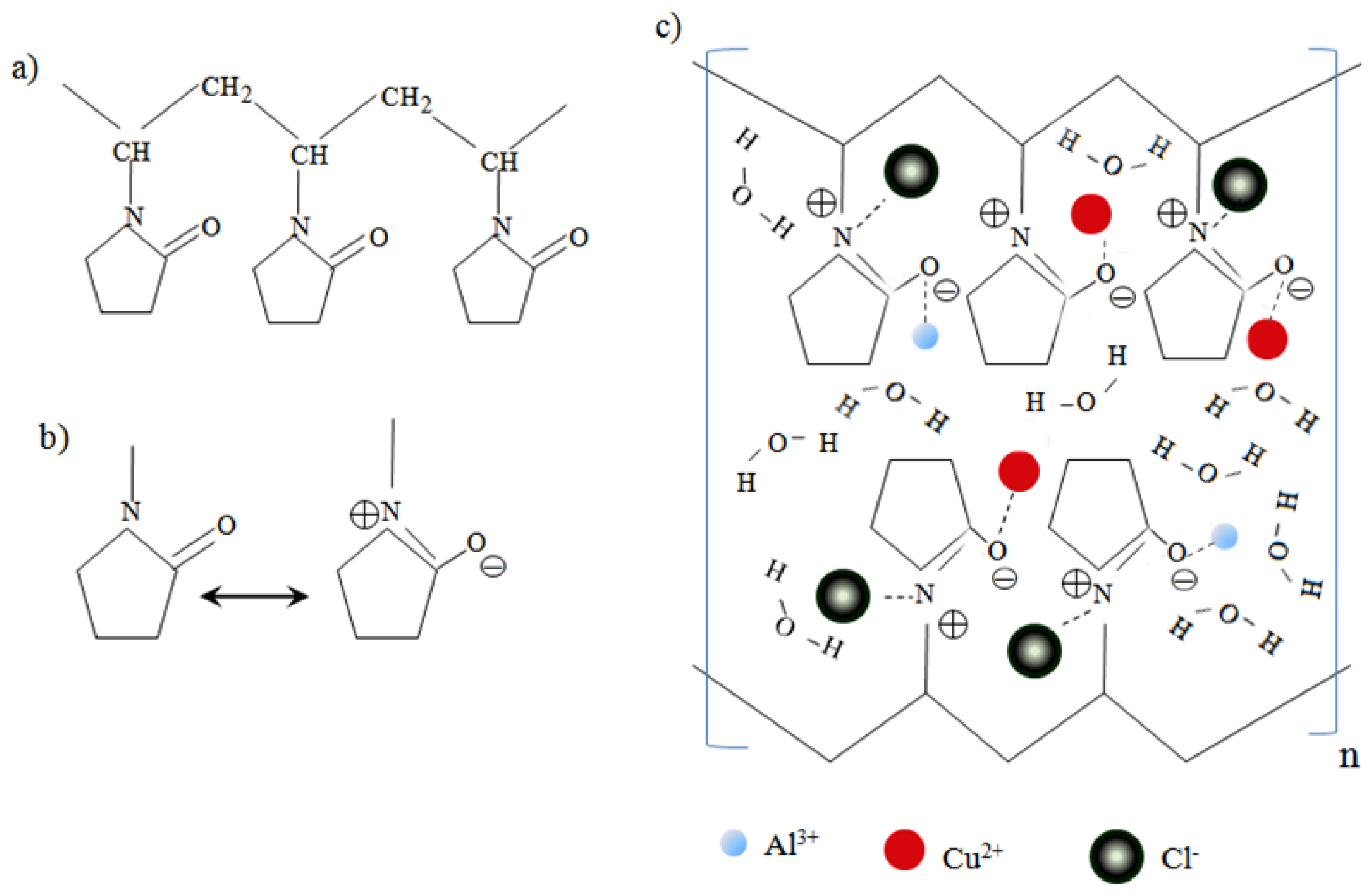
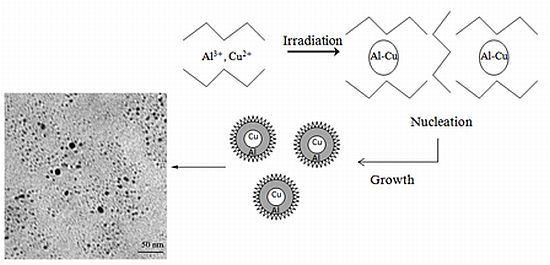
<p>An oversimplified scheme of the interactions between the PVP capping agent and metal ions before irradiation is shown in <xref ref-type="fig" rid="f1-ijms-13-11941">Figure 1</xref>, which shows that the Al (III) and Cu (II) ions are bound by the ionic bonds between the metallic ions and the amide group in a polymeric chain. PVP acts as a stabilizer for dissolved metallic salts through steric and electrostatic stabilization of the amide groups of the pyrrolidone rings [<xref ref-type="bibr" rid="b25-ijms-13-11941">25</xref>]. However, the real mechanism is more complex, due to the presence of hydrogen bonds between water molecules themselves and between the water molecules and the carbonyl polarized groups or positivity nitrogen from the pyrrolidone rings. Moreover, each ion is surrounded with a shell of water molecules [<xref ref-type="bibr" rid="b26-ijms-13-11941">26</xref>,<xref ref-type="bibr" rid="b27-ijms-13-11941">27</xref>].</p>
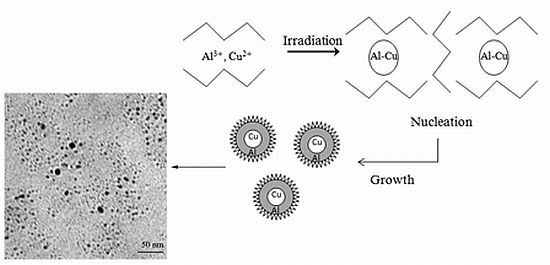
<p>The reduction process is controlled by the respective redox potentials [<xref ref-type="bibr" rid="b28-ijms-13-11941">28</xref>]. Copper ions (Cu<sup>2+</sup>) are more easily reduced (higher redox potential, E<sup>0</sup>(V) = +0.34) than aluminum ions (Al<sup>3+</sup>, E<sup>0</sup>(V) = −1.66) and for this reason the rate of reaction of solvated electrons in the solution with Cu ions are higher than with Al ions. Thus, when bivalent Cu ions are irradiated, the reduction occurs from the reaction of solvated electrons and possibly H<sup>•</sup> atoms, in so far as H<sup>•</sup> atoms are not scavenged by isopropanol, and Cu zero-valent content increases (reaction 5). Then in a further step, when Cu<sup>2+</sup> ions are depleted, the reduction of Al<sup>3+</sup> increased, which occurs exclusively at the surface of the Cu particles (reactions 6 and 7) [<xref ref-type="bibr" rid="b12-ijms-13-11941">12</xref>]. Accordingly, the resulting particles are bilayered with a core of the more easily reduced metal and a shell made of the other metal.</p>
<disp-formula id="FD5">
<label>(5)</label>
<mml:math id="mm5" display="block">
<mml:semantics id="sm5">
<mml:mrow>
<mml:msup>
<mml:mrow>
<mml:mrow>
<mml:mtext>Cu</mml:mtext></mml:mrow></mml:mrow>
<mml:mrow>
<mml:mn>2</mml:mn>
<mml:mo>+</mml:mo></mml:mrow></mml:msup>
<mml:mo>+</mml:mo>
<mml:mn>2</mml:mn>
<mml:msubsup>
<mml:mrow>
<mml:mtext>e</mml:mtext></mml:mrow>
<mml:mrow>
<mml:mtext>aq</mml:mtext></mml:mrow>
<mml:mo>-</mml:mo></mml:msubsup>
<mml:mo>→</mml:mo>
<mml:msup>
<mml:mrow>
<mml:mrow>
<mml:mtext>Cu</mml:mtext></mml:mrow></mml:mrow>
<mml:mn>0</mml:mn></mml:msup>
<mml:mrow>
<mml:mo>(</mml:mo>
<mml:mrow>
<mml:mtext>or   </mml:mtext>
<mml:msup>
<mml:mrow>
<mml:mrow>
<mml:mtext>Cu</mml:mtext></mml:mrow></mml:mrow>
<mml:mrow>
<mml:mn>2</mml:mn>
<mml:mo>+</mml:mo></mml:mrow></mml:msup>
<mml:mo>+</mml:mo>
<mml:mn>2</mml:mn>
<mml:msup>
<mml:mrow>
<mml:mtext>H</mml:mtext></mml:mrow>
<mml:mo>•</mml:mo></mml:msup>
<mml:mo>→</mml:mo>
<mml:msup>
<mml:mrow>
<mml:mrow>
<mml:mtext>Cu</mml:mtext></mml:mrow></mml:mrow>
<mml:mn>0</mml:mn></mml:msup>
<mml:mo>+</mml:mo>
<mml:mn>2</mml:mn>
<mml:msup>
<mml:mrow>
<mml:mtext>H</mml:mtext></mml:mrow>
<mml:mo>+</mml:mo></mml:msup></mml:mrow>
<mml:mo>)</mml:mo></mml:mrow>
<mml:mi>   </mml:mi>
<mml:mo>,</mml:mo>
<mml:msup>
<mml:mrow>
<mml:mrow>
<mml:mtext>Cu</mml:mtext></mml:mrow></mml:mrow>
<mml:mn>0</mml:mn></mml:msup>
<mml:mo>+</mml:mo>
<mml:msup>
<mml:mrow>
<mml:mrow>
<mml:mtext>Cu</mml:mtext></mml:mrow></mml:mrow>
<mml:mn>0</mml:mn></mml:msup>
<mml:mo>→</mml:mo>
<mml:msubsup>
<mml:mrow>
<mml:mrow>
<mml:mtext>Cu</mml:mtext></mml:mrow></mml:mrow>
<mml:mn>2</mml:mn>
<mml:mn>0</mml:mn></mml:msubsup></mml:mrow></mml:semantics></mml:math></disp-formula>
<disp-formula id="FD6">
<label>(6)</label>
<mml:math id="mm6" display="block">
<mml:semantics id="sm6">
<mml:mrow>
<mml:msubsup>
<mml:mrow>
<mml:mrow>
<mml:mtext>Cu</mml:mtext></mml:mrow></mml:mrow>
<mml:mtext>n</mml:mtext>
<mml:mn>0</mml:mn></mml:msubsup>
<mml:mo>+</mml:mo>
<mml:msup>
<mml:mrow>
<mml:mrow>
<mml:mtext>Al</mml:mtext></mml:mrow></mml:mrow>
<mml:mrow>
<mml:mn>3</mml:mn>
<mml:mo>+</mml:mo></mml:mrow></mml:msup>
<mml:mo>→</mml:mo>
<mml:msup>
<mml:mrow>
<mml:mrow>
<mml:mo stretchy="false">(</mml:mo>
<mml:msub>
<mml:mrow>
<mml:mrow>
<mml:mtext>Cu</mml:mtext></mml:mrow></mml:mrow>
<mml:mtext>n</mml:mtext></mml:msub>
<mml:mtext>Al</mml:mtext>
<mml:mo stretchy="false">)</mml:mo></mml:mrow></mml:mrow>
<mml:mrow>
<mml:mn>3</mml:mn>
<mml:mo>+</mml:mo></mml:mrow></mml:msup>
<mml:mo>+</mml:mo>
<mml:mn>3</mml:mn>
<mml:msubsup>
<mml:mrow>
<mml:mtext>e</mml:mtext></mml:mrow>
<mml:mrow>
<mml:mtext>aq</mml:mtext></mml:mrow>
<mml:mo>-</mml:mo></mml:msubsup>
<mml:mo>→</mml:mo>
<mml:msup>
<mml:mrow>
<mml:mrow>
<mml:mo stretchy="false">(</mml:mo>
<mml:msub>
<mml:mrow>
<mml:mrow>
<mml:mtext>Cu</mml:mtext></mml:mrow></mml:mrow>
<mml:mtext>n</mml:mtext></mml:msub>
<mml:mtext>Al</mml:mtext>
<mml:mo stretchy="false">)</mml:mo></mml:mrow></mml:mrow>
<mml:mn>0</mml:mn></mml:msup></mml:mrow></mml:semantics></mml:math></disp-formula>
<disp-formula id="FD7">
<label>(7)</label>
<mml:math id="mm7" display="block">
<mml:semantics id="sm7">
<mml:mtable columnalign="left">
<mml:mtr>
<mml:mtd>
<mml:msup>
<mml:mrow>
<mml:mo stretchy="false">(</mml:mo>
<mml:msub>
<mml:mrow>
<mml:mtext>Cu</mml:mtext></mml:mrow>
<mml:mtext>n</mml:mtext></mml:msub>
<mml:msub>
<mml:mrow>
<mml:mtext>Al</mml:mtext></mml:mrow>
<mml:mtext>m</mml:mtext></mml:msub>
<mml:mo stretchy="false">)</mml:mo></mml:mrow>
<mml:mrow>
<mml:mtext>x</mml:mtext>
<mml:mo>+</mml:mo></mml:mrow></mml:msup>
<mml:mo>+</mml:mo>
<mml:msup>
<mml:mrow>
<mml:mtext>Al</mml:mtext></mml:mrow>
<mml:mrow>
<mml:mn>3</mml:mn>
<mml:mo>+</mml:mo></mml:mrow></mml:msup>
<mml:mo>→</mml:mo>
<mml:msup>
<mml:mrow>
<mml:mo stretchy="false">(</mml:mo>
<mml:msub>
<mml:mrow>
<mml:mtext>Cu</mml:mtext></mml:mrow>
<mml:mtext>n</mml:mtext></mml:msub>
<mml:msub>
<mml:mrow>
<mml:mtext>Al</mml:mtext></mml:mrow>
<mml:mrow>
<mml:mtext>m</mml:mtext>
<mml:mo>+</mml:mo>
<mml:mn>1</mml:mn></mml:mrow></mml:msub>
<mml:mo stretchy="false">)</mml:mo></mml:mrow>
<mml:mrow>
<mml:mo stretchy="false">(</mml:mo>
<mml:mtext>x</mml:mtext>
<mml:mo>+</mml:mo>
<mml:mn>3</mml:mn>
<mml:mo stretchy="false">)</mml:mo>
<mml:mo>+</mml:mo></mml:mrow></mml:msup>
<mml:mo>+</mml:mo>
<mml:msubsup>
<mml:mrow>
<mml:mtext>e</mml:mtext></mml:mrow>
<mml:mrow>
<mml:mtext>aq</mml:mtext></mml:mrow>
<mml:mo>-</mml:mo></mml:msubsup>
<mml:mo>→</mml:mo></mml:mtd></mml:mtr>
<mml:mtr>
<mml:mtd>
<mml:msup>
<mml:mrow>
<mml:mo stretchy="false">(</mml:mo>
<mml:msub>
<mml:mrow>
<mml:mtext>Cu</mml:mtext></mml:mrow>
<mml:mtext>n</mml:mtext></mml:msub>
<mml:msub>
<mml:mrow>
<mml:mtext>Al</mml:mtext></mml:mrow>
<mml:mrow>
<mml:mtext>m</mml:mtext>
<mml:mo>+</mml:mo>
<mml:mn>1</mml:mn></mml:mrow></mml:msub>
<mml:mo stretchy="false">)</mml:mo></mml:mrow>
<mml:mrow>
<mml:mo stretchy="false">(</mml:mo>
<mml:mtext>x</mml:mtext>
<mml:mo>+</mml:mo>
<mml:mn>2</mml:mn>
<mml:mo stretchy="false">)</mml:mo>
<mml:mo>+</mml:mo></mml:mrow></mml:msup>
<mml:mo>⋯</mml:mo>
<mml:mo>→</mml:mo>
<mml:msup>
<mml:mrow>
<mml:mo stretchy="false">(</mml:mo>
<mml:msub>
<mml:mrow>
<mml:mtext>Cu</mml:mtext></mml:mrow>
<mml:mtext>n</mml:mtext></mml:msub>
<mml:msub>
<mml:mrow>
<mml:mtext>Al</mml:mtext></mml:mrow>
<mml:mrow>
<mml:mtext>m</mml:mtext>
<mml:mo>+</mml:mo>
<mml:mn>1</mml:mn></mml:mrow></mml:msub>
<mml:mo stretchy="false">)</mml:mo></mml:mrow>
<mml:mn>0</mml:mn></mml:msup>
<mml:mo>→</mml:mo>
<mml:mtext>Al</mml:mtext>
<mml:mo stretchy="false">(</mml:mo>
<mml:mtext>shell</mml:mtext>
<mml:mo stretchy="false">)</mml:mo>
<mml:mo>-</mml:mo>
<mml:mtext>Cu</mml:mtext>
<mml:mo stretchy="false">(</mml:mo>
<mml:mtext>core</mml:mtext>
<mml:mo stretchy="false">)</mml:mo></mml:mtd></mml:mtr></mml:mtable></mml:semantics></mml:math></disp-formula>
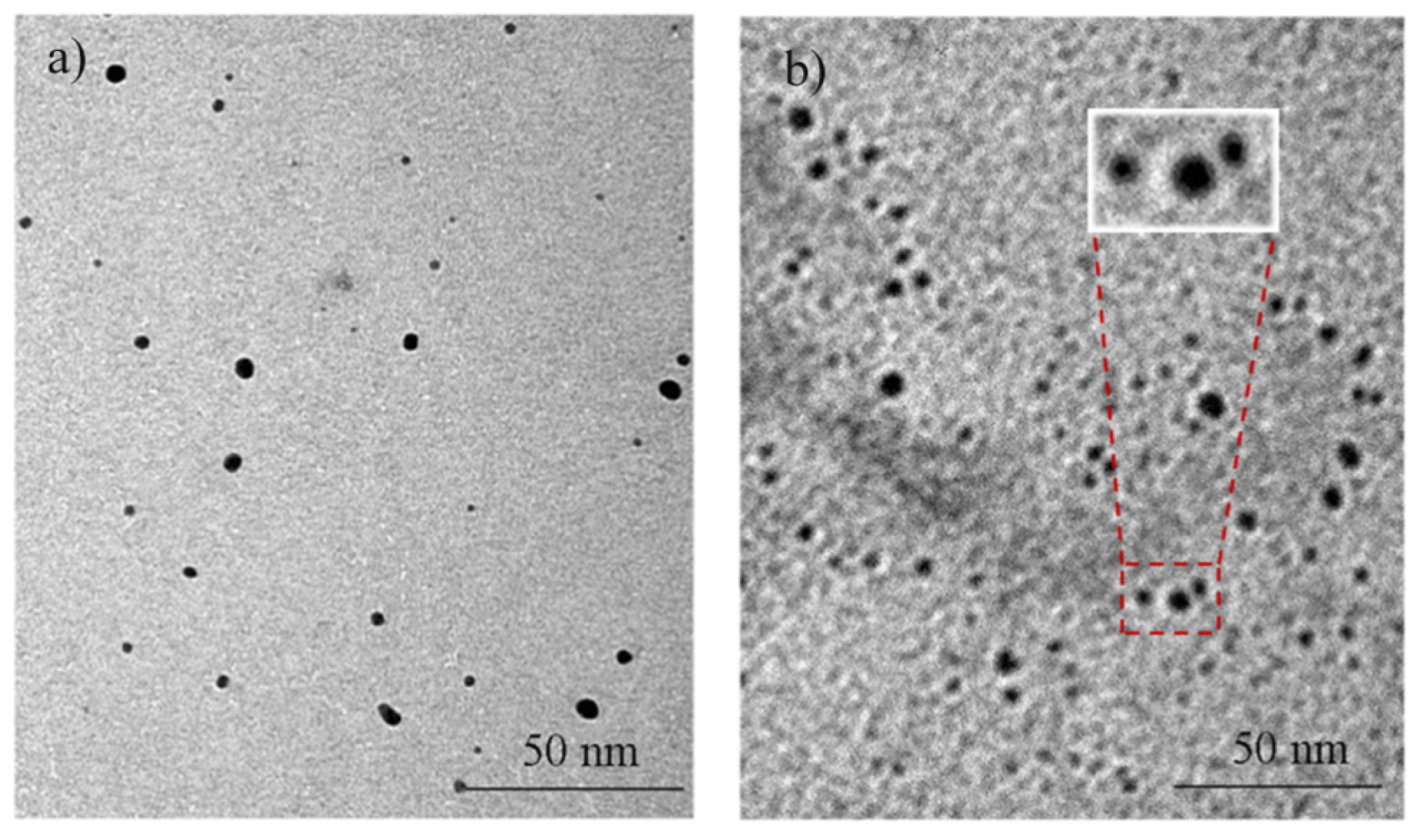
<p>It is a well known fact that to prepare pure Cu, Al, or Al-Cu bimetallic nanoparticles by radiation synthesis in air without the influence of oxygen is not easy. The intended Al-Cu bimetallic nanoparticles are contaminated with oxygen. Therefore, it is safe to note that the final product of this synthesis would be Cu@CuAlO<sub>2</sub>-Al<sub>2</sub>O<sub>3</sub> nanoparticles as we can see later from the EDX and XRD analyses. <xref ref-type="fig" rid="f2-ijms-13-11941">Figure 2</xref> shows the comparison between TEM images of Cu nanoparticles and the core-shell structure of Cu@CuAlO<sub>2</sub>-Al<sub>2</sub>O<sub>3</sub> nanoparticles. In a TEM image (<xref ref-type="fig" rid="f2-ijms-13-11941">Figure 2b</xref>), the shells can be partially distinguished from the cores, because the lower atomic number of Al provides less contrast in a TEM image than Cu. The boundary between the core and shell is not sharp, however, which suggests that the shells might not be pure Al, but CuAlO<sub>2</sub> and Al<sub>2</sub>O<sub>3</sub> instead. The same interpretation reported for other elements by M. S. Shore [<xref ref-type="bibr" rid="b29-ijms-13-11941">29</xref>].</p>
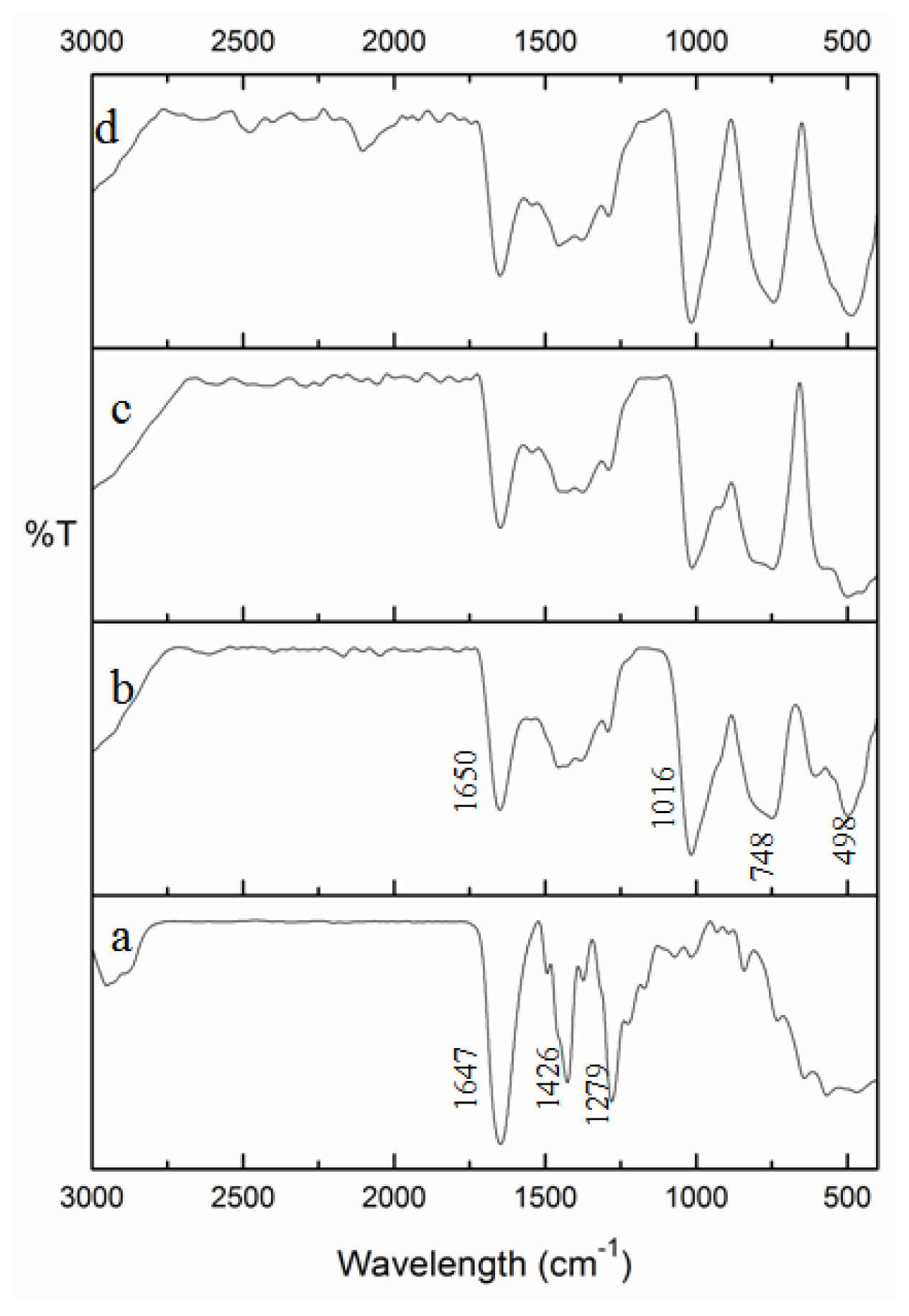
<p><xref ref-type="fig" rid="f3-ijms-13-11941">Figure 3</xref> presents a comparison of FT-IR spectra of PVP alone and PVP-capped Cu@CuAlO<sub>2</sub>-Al<sub>2</sub>O<sub>3</sub> nanoparticles at doses of 80, 100, and 120 kGy. The spectra are given in the range 3000–400 cm<sup>−1</sup>, because the main chemical changes occurred in this range. In the spectrum of pure-PVP (<xref ref-type="fig" rid="f3-ijms-13-11941">Figure 3a</xref>), the peaks located at 1647, 1426, and 1279 cm<sup>−1</sup>, are assigned to the C=O stretching vibration, CH<sub>2</sub> bending vibration, and C-N stretching vibration band, respectively [<xref ref-type="bibr" rid="b30-ijms-13-11941">30</xref>–<xref ref-type="bibr" rid="b33-ijms-13-11941">33</xref>]. The PVP molecules in aqueous solution may take resonance structures as shown in <xref ref-type="fig" rid="f1-ijms-13-11941">Figure 1b</xref> [<xref ref-type="bibr" rid="b24-ijms-13-11941">24</xref>]. In the FT-IR spectrum of PVP-capped Cu@CuAlO<sub>2</sub>-Al<sub>2</sub>O<sub>3</sub> nanoparticles (<xref ref-type="fig" rid="f3-ijms-13-11941">Figure 3b</xref>), compared to pure PVP (<xref ref-type="fig" rid="f3-ijms-13-11941">Figure 3a</xref>), the intensity of the C=O stretching band decreased, indicating on the formation of intermolecular bonds between PVP and shell. As shown in <xref ref-type="fig" rid="f3-ijms-13-11941">Figure 3b</xref>, the adsorption band appeared at 1016 cm<sup>−1</sup> generally assigned to C-N, indicating the coordination between N and Cu@CuAlO<sub>2</sub>-Al<sub>2</sub>O<sub>3</sub> nanoparticles. Compared to pure PVP, this peak was reduced due to the strengthened C–N bonds of the pyridine when the metal was incorporated. The change of the peak shape below 900 cm<sup>−1</sup> is associated with the Al-O bond vibrations [<xref ref-type="bibr" rid="b34-ijms-13-11941">34</xref>,<xref ref-type="bibr" rid="b35-ijms-13-11941">35</xref>]. These peaks slightly increased with increasing dose, indicating the amount of that the oxide form of Al on the surface of Cu nanoparticles increased (<xref ref-type="fig" rid="f3-ijms-13-11941">Figure 3b–d</xref>).</p></sec>
<sec>
<title>2.2. Effect of Dose</title>
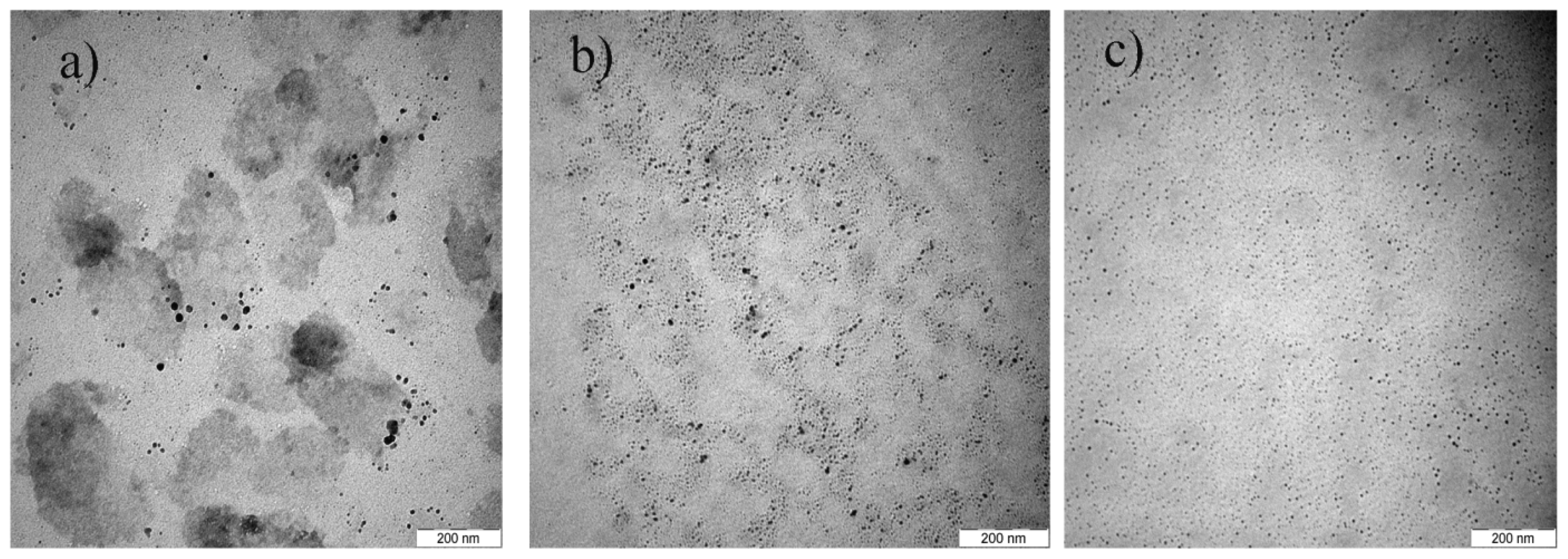
<p>The morphology of the Cu@CuAlO<sub>2</sub>-Al<sub>2</sub>O<sub>3</sub> colloidal nanoparticles was observed by employing the TEM technique. The shape of the particles in all colloids was quasi-spherical. <xref ref-type="fig" rid="f4-ijms-13-11941">Figure 4</xref> shows a representative TEM image of the PVP-capped Cu@CuAlO<sub>2</sub>-Al<sub>2</sub>O<sub>3</sub> nanoparticles at various radiation doses. It appears that the Cu@CuAlO<sub>2</sub>-Al<sub>2</sub>O<sub>3</sub> particles are well separated with no agglomeration tendency, which is roughly parallel to the stability of the colloids.</p>
<p>The average size of Cu@CuAlO<sub>2</sub>-Al<sub>2</sub>O<sub>3</sub> nanoparticles decreases from 12 nm at 80 kGy to 4.5 nm at 120 kGy radiation dose. Variation in the particle size could refer to the difference in the nucleation and growth processes. At low doses, the reduction rate was slow and only small numbers of nuclei were formed. So the number of nuclei remained constant or increased slower than the amount of unreduced ions. The unreduced ions collided with the nuclei already formed that led to the formation of larger ions and subsequently after interacting with solvated electrons produced larger particles. At higher doses, the enhanced reduction rate favored the generation of many more nuclei. When the number of nuclei increased faster than that of unreduced ions, little ion association can take place and smaller particles would be obtained [<xref ref-type="bibr" rid="b36-ijms-13-11941">36</xref>].</p>
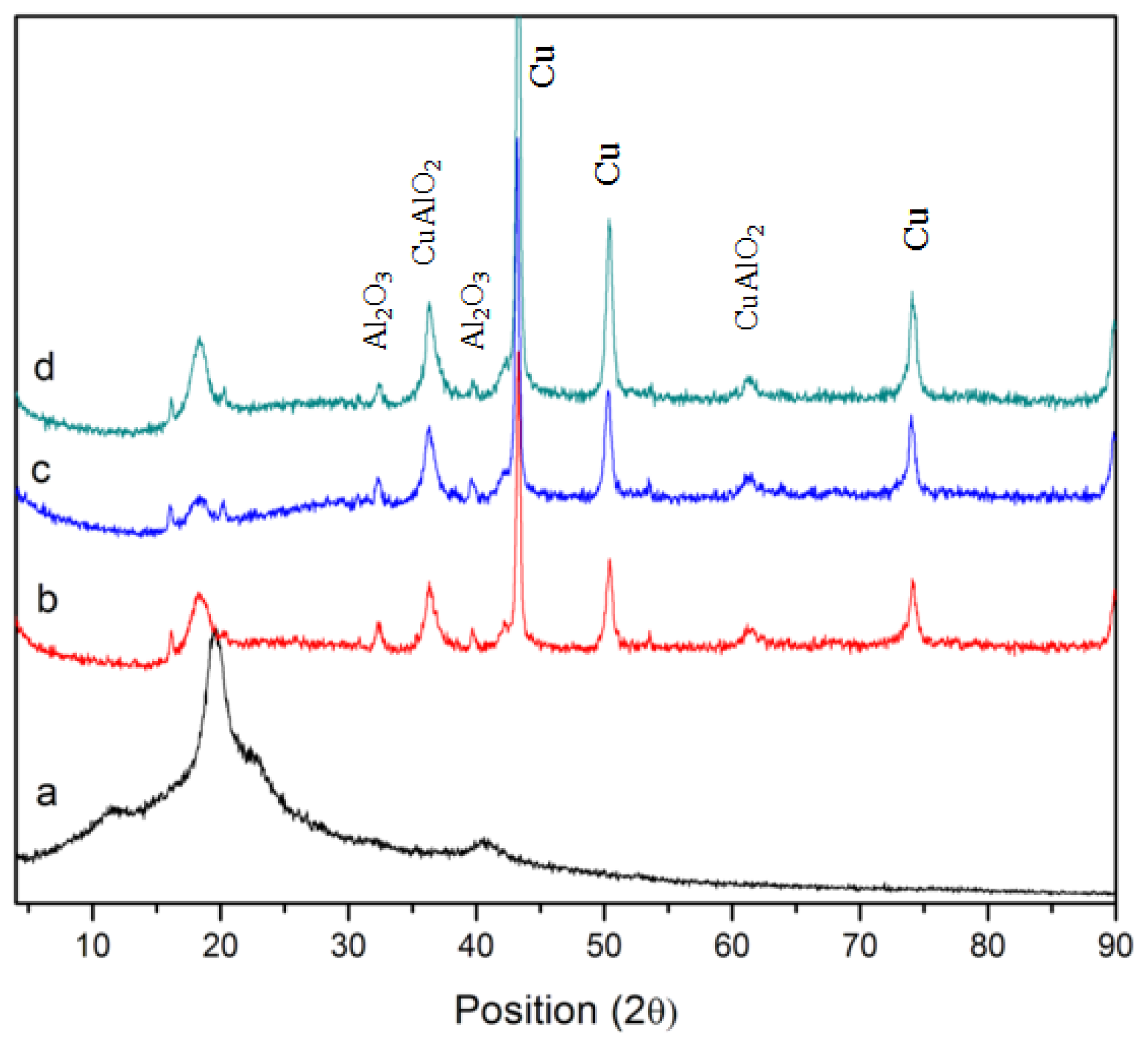
<p>XRD patterns of pure PVP and PVP-capped Cu@CuAlO<sub>2</sub>-Al<sub>2</sub>O<sub>3</sub> nanoparticles at various radiation doses are presented in <xref ref-type="fig" rid="f5-ijms-13-11941">Figure 5</xref>. In <xref ref-type="fig" rid="f5-ijms-13-11941">Figure 5b–d</xref>, diagrams exhibit reflections that could clearly be assigned to the typical face-centered cubic (fcc) Cu pattern, that increased by increasing dose. In addition, Al<sub>2</sub>O<sub>3</sub> and CuAlO<sub>2</sub> reflections were found in the samples. Low intensities of CuAlO<sub>2</sub> and Al<sub>2</sub>O<sub>3</sub> diffraction peaks are assumed to arise from the fact that Al clusters are thinly coated on the Cu nanoparticles. The oxidation form of Al may result in a slight inevitable surface oxidation during the process of PVP-capping, washing, or drying. This result is in good agreement with the EDX results of samples.</p>
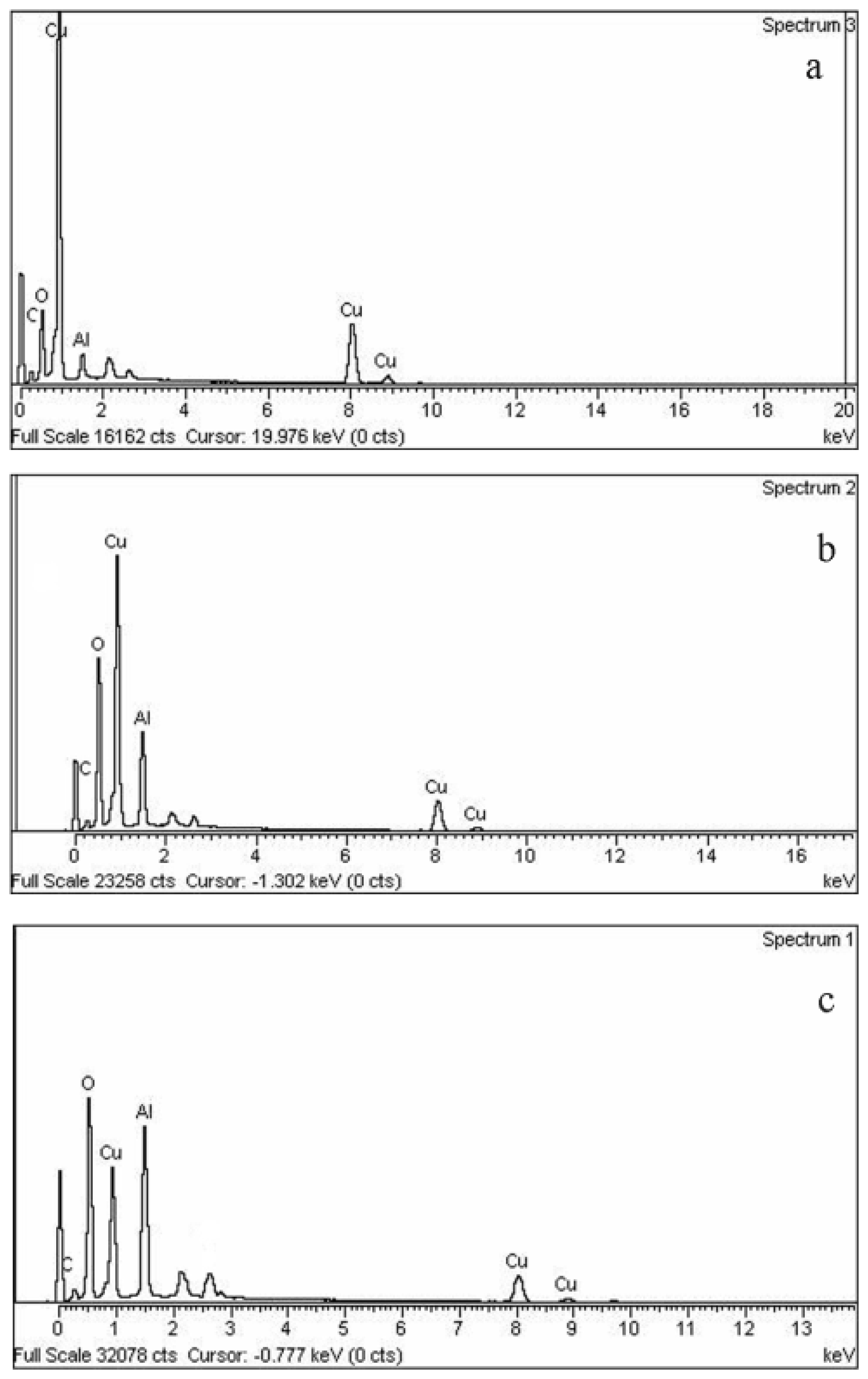
<p>The quantitative determination of the Al and Cu contents, on the surface of the samples, was made by EDX analysis (<xref ref-type="fig" rid="f6-ijms-13-11941">Figure 6</xref>). At low dose, the reduction starts by reducing copper ions to zerovalent atoms as far as Cu<sup>0</sup> atoms were more concentrated than Cu<sup>2+</sup> ions. In further steps by increasing dose, the reduction of Al<sup>3+</sup> increased, which was eventually assaulted by oxygen at the surface of the Cu particles. The existence of a carbon peak confirms the presence of PVP stabilizer in the prepared EDX samples.</p></sec>
<sec>
<title>2.3. Effect of Initial Ion Concentration</title>
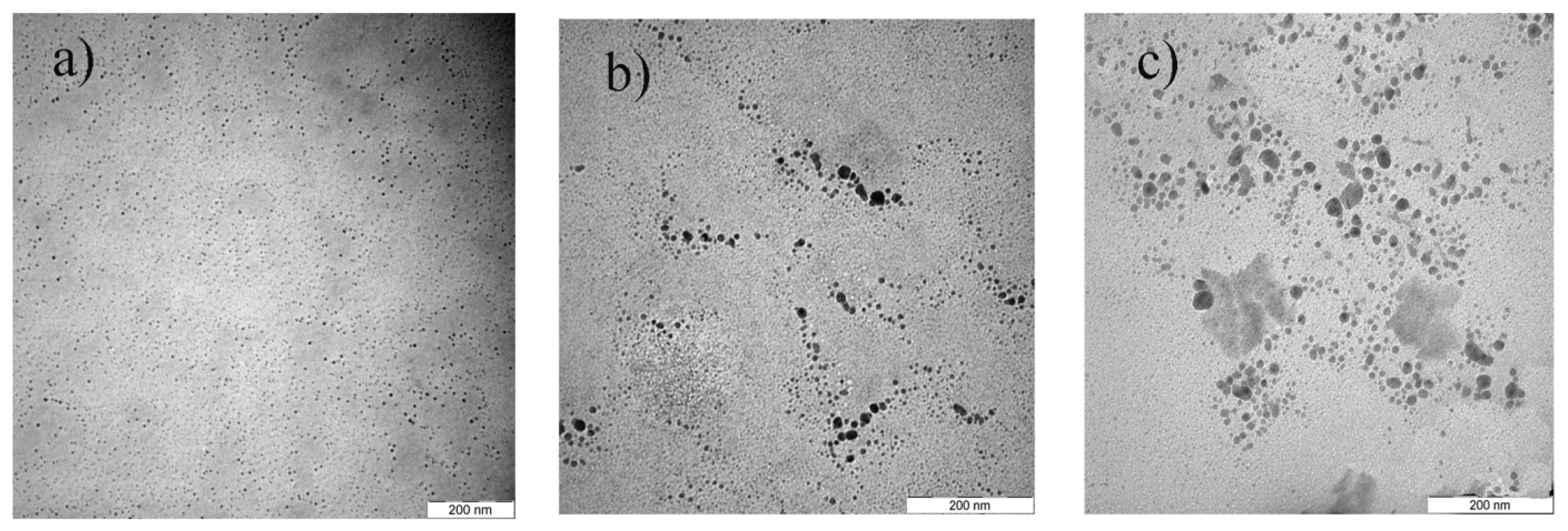
<p>The effect of precursor concentration on the formation of Cu@CuAlO<sub>2</sub>-Al<sub>2</sub>O<sub>3</sub> nanoparticles was studied with varying concentrations of total ions: 5.0 × 10<sup>−5</sup>, 5.4 × 10<sup>−5</sup>, 5.7 × 10<sup>−5</sup>, 6.0 × 10<sup>−5</sup>, and 6.4 × 10<sup>−5</sup> mol/mL at a constant concentration of PVP and at the fixed Al/Cu mole ratio of 70/30. In this mole ratio, the most probable case is the existence of a uniform core-shell structure of Cu@CuAlO<sub>2</sub>-Al<sub>2</sub>O<sub>3</sub>. <xref ref-type="fig" rid="f7-ijms-13-11941">Figure 7</xref> shows the TEM results of the Cu@CuAlO<sub>2</sub>-Al<sub>2</sub>O<sub>3</sub> nanoparticles obtained at various AlCl<sub>3</sub> and CuCl<sub>2</sub> concentrations. Only the TEM images for ion concentrations of 5.0 × 10<sup>−5</sup>, 5.7 × 10<sup>−5</sup>, and 6.4 × 10<sup>−5</sup> mol/mL at 120 kGy are shown here. TEM results show the average size of Cu@CuAlO<sub>2</sub>-Al<sub>2</sub>O<sub>3</sub> nanoparticles increases from 4.5 nm at the lowest ion concentration to 13 nm at the highest.</p>
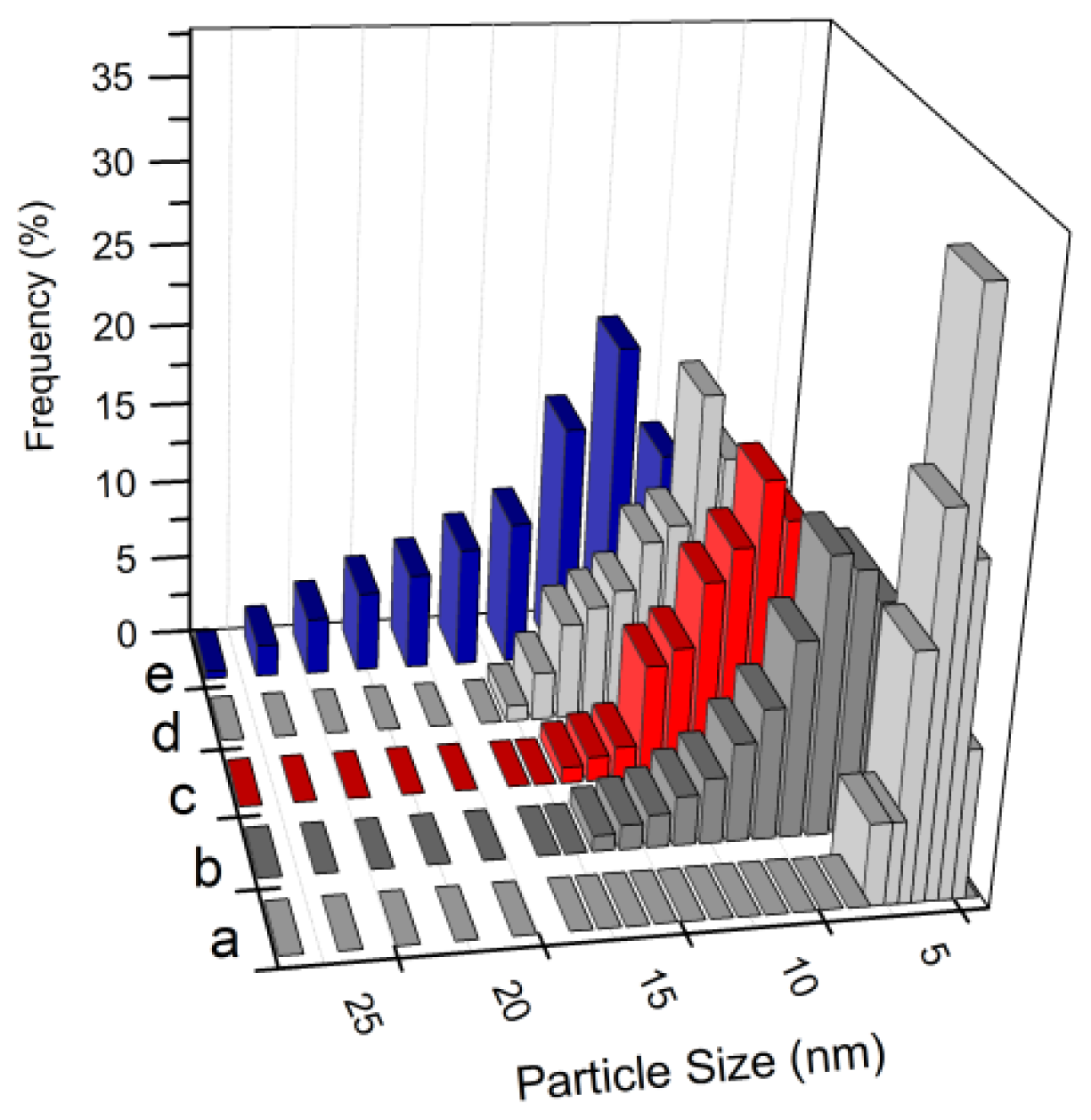
<p>Increasing ion concentration causes the bimetallic nanoparticles to become larger in size, which can be seen by shifting the center of size distribution in <xref ref-type="fig" rid="f8-ijms-13-11941">Figure 8</xref> towards a larger size. Three main reasons describe these behaviors of nanoparticles. Firstly, by increasing concentration of metal ions in the solution, the rate of ion association under irradiation to form larger particles increases. Secondly, the small particles make wavy movements and collide with each other in solution, leading to particle aggregation. On the other hand, the viscosity of the aqueous solution and therefore speed of particle movement can be changed by the ratio of polymer/ions. Increasing the ion concentration (decreasing ratio of polymer/ions) can increase the collision probability. Finally, the adsorption of PVP on the surface of nanoparticles can reduce the surface energy and further agglomeration of nanoparticles [<xref ref-type="bibr" rid="b37-ijms-13-11941">37</xref>,<xref ref-type="bibr" rid="b38-ijms-13-11941">38</xref>]. Thus, increasing ion concentration reduces the tendency of polymer capping on the surface of nanoparticles, leading to larger particles.</p>
<p>Composition analysis for each ion concentration of Cu@CuAlO<sub>2</sub>-Al<sub>2</sub>O<sub>3</sub> by EDX is summarized in <xref ref-type="table" rid="t1-ijms-13-11941">Table 1</xref>. Results of EDX show that, under the same radiation dose by increasing ion concentration, concentration of reduced Al atoms increases. The atomic percentages of Al nanoparticles are always higher than that of Cu nanoparticles, indicating that the Cu core was mostly covered by an Al layer.</p>
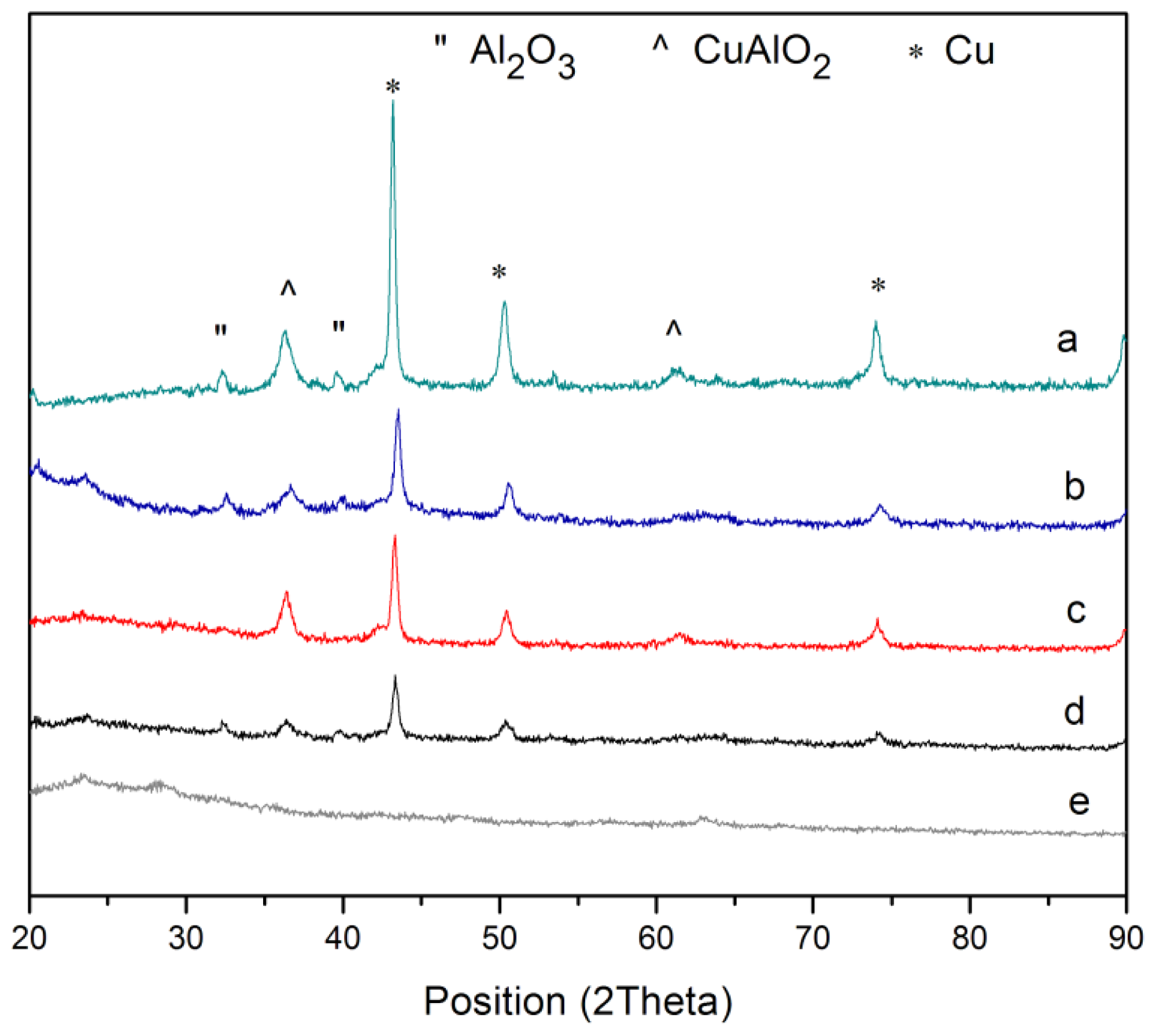
<p>X-ray powder diffraction diagrams of Cu@CuAlO<sub>2</sub>-Al<sub>2</sub>O<sub>3</sub> colloids, presented in <xref ref-type="fig" rid="f9-ijms-13-11941">Figure 9</xref>. As can be observed, at lower precursor concentration of zero-valent state copper and alumina reflections was found. The alumina layer mostly covered the Cu core, thus protecting it from corrosion. The oxidation of Al may results in a slight inevitable surface oxidation during the process of washing and drying. By increasing ion concentration, the thickness of the alumina layer that coated the Cu core increased, which can affect the crystallinity of Cu. Therefore, the count of reflection peaks of Cu decreases with increasing ion concentration. The XRD diagram for sample with the highest ion concentration clearly shows that the sample is entirely amorphous (<xref ref-type="fig" rid="f9-ijms-13-11941">Figure 9e</xref>).</p></sec></sec>
<sec>
<title>3. Experimental Section</title>
<sec sec-type="materials">
<title>3.1. Materials</title>
<p>Copper chloride dihydrate (CuCl2·2H2O) and aluminum chloride hexahydrate (AlCl3·6H2O), which are used as precursors, were purchased from Systerm. PVP (MW = 29,000, Sigma Aldrich, St Louis, MO, USA) and isopropanol were used as a capping agent to reduce the agglomeration and radical scavenger of hydroxyl radicals, respectively. The precursors, capping agent, and radical scavenger were used “as received”, without further purification.</p></sec>
<sec>
<title>3.2. Preparation of PVP-Capped Cu@CuAlO<sub>2</sub>-Al2O<sub>3</sub> Nanoparticles</title>
<p>In order to make PVP-capped Cu@CuAlO<sub>2</sub>-Al<sub>2</sub>O<sub>3</sub> nanoparticles, we used a stock solution of 3% PVP by dissolving PVP powder in distilled water, then AlCl3 and CuCl2 were added into the PVP solution at constant Al/Cu mole ratio (Al/Cu = 70/30) in the presence of isopropanol (1.3 mol/L). The solution was magnetically stirred, bubbled with nitrogen for 1 h at 70 °C, and the solution divided into several parts in the glass tubes. The mixture solution was irradiated by Co-60 γ-ray source chamber with a dose rate of 2.9 kGyh<sup>−1</sup> and each sample received different doses of 80, 100, and 120 kGy. In this method, γ-rays interact with matter in the solution, mainly by photoelectric absorption and Compton scattering to reduce secondary electrons which induced reactive species, such as solvated electrons. These electrons reduce the metal ions to metal atoms, which then aggregated to form metallic nanoparticles.</p></sec>
<sec>
<title>3.3. Characterization</title>
<p>FT-IR spectra were recorded using a PerkinElmer FTIR model 1650 spectrometer. The particle size and particle distribution were determined from transmission electron microscopy (TEM) micrographs (HITACHI H-7100 TEM). Samples for TEM studies were prepared by placing a drop of the irradiated solutions on a TEM copper grid. The sample on the grids was allowed to dry naturally for several hours. The TEM characterization was carried out at 100 keV. The microstructure of the Al-Cu nanoparticles was characterized by the XRD technique using a Shimadzu diffractometer (Model XRD 6000) using Cu Kα (0.154 nm) X-rays to generate diffraction patterns. Energy dispersive X-ray analysis (EDX-JSM-6400 JEOL) was used to determine the composition of the bimetallic nanoparticles and their element weight percentage. For the preparation of EDX, XRD and FTIR samples, colloidal samples were washed several times with water and ethanol by centrifugation and finally dried at 50 °C at atmospheric pressure to make a fine powder.</p></sec></sec>
<sec sec-type="conclusions">
<title>4. Conclusions</title>
<p>We have succeeded in synthesizing Cu@CuAlO<sub>2</sub>-Al<sub>2</sub>O<sub>3</sub> nanoparticles in core-shell structure from a CuCl2 and AlCl3 solution stabilized in PVP by a gamma radiolytic technique. The FT-IR analysis of colloidal nanoparticles shows that PVP was absorbed onto the Al shell during particle growth. The particle size was determined by using transmission electron microscopy. At high doses and low ion concentration, where the nucleation event is very fast, the radiation synthesis produced smaller sizes of nanoparticles. At lower doses and higher ion concentration, where the nucleation event is less than the unreduced ions, the radiation synthesis produced larger sizes of nanoparticles following aggregation. Consequently, at a fixed PVP, capping the Cu@CuAlO<sub>2</sub>-Al<sub>2</sub>O<sub>3</sub> nanoparticle growth process is a dose and precursor concentration dependent process.</p></sec></body>
<back>
<ref-list>
<title>References</title>
<ref id="b1-ijms-13-11941"><label>1</label><citation citation-type="journal"><person-group person-group-type="author"><name><surname>Toshima</surname><given-names>N.</given-names></name><name><surname>Yonezawa</surname><given-names>T.</given-names></name><name><surname>Kushihashi</surname><given-names>K.</given-names></name></person-group><article-title>Polymer-protected palladium–platinum bimetallic clusters: Preparation, catalytic properties and structural considerations</article-title><source>J. Chem. Soc. Faraday Trans</source><year>1993</year><volume>89</volume><fpage>2537</fpage><lpage>2543</lpage><pub-id pub-id-type="doi">10.1039/ft9938902537</pub-id></citation></ref>
<ref id="b2-ijms-13-11941"><label>2</label><citation citation-type="journal"><person-group person-group-type="author"><name><surname>Esumi</surname><given-names>K.</given-names></name><name><surname>Goino</surname><given-names>M.</given-names></name><name><surname>Koide</surname><given-names>Y.</given-names></name></person-group><article-title>Adsorption and adsolubilization by monomeric, dimeric, or trimeric quaternary ammonium surfactant at silica/water interface</article-title><source>J. Colloid Interface Sci</source><year>1996</year><volume>183</volume><fpage>539</fpage><lpage>545</lpage><pub-id pub-id-type="doi">10.1006/jcis.1996.0577</pub-id><pub-id pub-id-type="pmid">8954698</pub-id></citation></ref>
<ref id="b3-ijms-13-11941"><label>3</label><citation citation-type="journal"><person-group person-group-type="author"><name><surname>Belloni</surname><given-names>J.</given-names></name></person-group><article-title>Nucleation, growth and properties of nanoclusters studied by radiation chemistry: Application to catalysis</article-title><source>Catal. Today</source><year>2006</year><volume>113</volume><fpage>141</fpage><lpage>156</lpage><pub-id pub-id-type="doi">10.1016/j.cattod.2005.11.082</pub-id></citation></ref>
<ref id="b4-ijms-13-11941"><label>4</label><citation citation-type="journal"><person-group person-group-type="author"><name><surname>Bonelli</surname><given-names>R.</given-names></name><name><surname>Zacchini</surname><given-names>S.</given-names></name><name><surname>Albonetti</surname><given-names>S.</given-names></name></person-group><article-title>Gold/iron carbonyl clusters for tailored Au/FeO<sub>x</sub> supported catalysts</article-title><source>Catalysts</source><year>2011</year><volume>2</volume><fpage>1</fpage><lpage>23</lpage><pub-id pub-id-type="doi">10.3390/catal2010001</pub-id></citation></ref>
<ref id="b5-ijms-13-11941"><label>5</label><citation citation-type="journal"><person-group person-group-type="author"><name><surname>Schön</surname><given-names>G.</given-names></name><name><surname>Simon</surname><given-names>U.</given-names></name></person-group><article-title>A fascinating new field in colloid science: Small ligand-stabilized metal clusters and possible application in microelectronics</article-title><source>Colloid Polym. Sci</source><year>1995</year><volume>273</volume><fpage>101</fpage><lpage>117</lpage><pub-id pub-id-type="doi">10.1007/BF00654007</pub-id></citation></ref>
<ref id="b6-ijms-13-11941"><label>6</label><citation citation-type="journal"><person-group person-group-type="author"><name><surname>Liu</surname><given-names>R.S.</given-names></name><name><surname>Chen</surname><given-names>H.M.</given-names></name><name><surname>Hu</surname><given-names>S.F.</given-names></name></person-group><article-title>Synthesis and characterization of nano metals with core-shell structure</article-title><source>China Part</source><year>2004</year><volume>2</volume><fpage>160</fpage><lpage>163</lpage><pub-id pub-id-type="doi">10.1016/S1672-2515(07)60048-7</pub-id></citation></ref>
<ref id="b7-ijms-13-11941"><label>7</label><citation citation-type="journal"><person-group person-group-type="author"><name><surname>Link</surname><given-names>S.</given-names></name><name><surname>El-Sayed</surname><given-names>M.A.</given-names></name></person-group><article-title>Spectral properties and relaxation dynamics of surface plasmon electronic oscillations in gold and silver nanodots and nanorods</article-title><source>J. Phys. Chem</source><year>1999</year><volume>103</volume><fpage>8410</fpage><lpage>8426</lpage></citation></ref>
<ref id="b8-ijms-13-11941"><label>8</label><citation citation-type="journal"><person-group person-group-type="author"><name><surname>Han</surname><given-names>S.W.</given-names></name><name><surname>Kim</surname><given-names>Y.</given-names></name><name><surname>Kim</surname><given-names>K.</given-names></name></person-group><article-title>Dodecanethiol-derivatized Au/Ag bimetallic nanoparticles: TEM, UV/VIS, XPS, and FTIR analysis</article-title><source>J. Colloid Interface Sci</source><year>1998</year><volume>208</volume><fpage>272</fpage><lpage>278</lpage><pub-id pub-id-type="doi">10.1006/jcis.1998.5812</pub-id><pub-id pub-id-type="pmid">9820774</pub-id></citation></ref>
<ref id="b9-ijms-13-11941"><label>9</label><citation citation-type="journal"><person-group person-group-type="author"><name><surname>Zhang</surname><given-names>Z.</given-names></name><name><surname>Nenoff</surname><given-names>T.M.</given-names></name><name><surname>Huang</surname><given-names>J.Y.</given-names></name><name><surname>Berry</surname><given-names>D.T.</given-names></name><name><surname>Provencio</surname><given-names>P.P.</given-names></name></person-group><article-title>Room temperature synthesis of thermally immiscible Ag-Ni nanoalloys</article-title><source>J. Phys. Chem</source><year>2009</year><volume>113</volume><fpage>1155</fpage><lpage>1159</lpage></citation></ref>
<ref id="b10-ijms-13-11941"><label>10</label><citation citation-type="journal"><person-group person-group-type="author"><name><surname>Mallin</surname><given-names>M.P.</given-names></name><name><surname>Murphy</surname><given-names>C.J.</given-names></name></person-group><article-title>Solution-phase synthesis of sub-10 nm Au-Ag alloy nanoparticles</article-title><source>Nano Lett</source><year>2002</year><volume>2</volume><fpage>1235</fpage><lpage>1237</lpage><pub-id pub-id-type="doi">10.1021/nl025774n</pub-id></citation></ref>
<ref id="b11-ijms-13-11941"><label>11</label><citation citation-type="journal"><person-group person-group-type="author"><name><surname>Zhang</surname><given-names>Z.</given-names></name><name><surname>Nenoff</surname><given-names>T.M.</given-names></name><name><surname>Leung</surname><given-names>K.</given-names></name><name><surname>Ferreira</surname><given-names>S.R.</given-names></name><name><surname>Huang</surname><given-names>J.Y.</given-names></name><name><surname>Berry</surname><given-names>D.T.</given-names></name><name><surname>Provencio</surname><given-names>P.P.</given-names></name><name><surname>Stumpf</surname><given-names>R.</given-names></name></person-group><article-title>Room-temperature synthesis of Ag−Ni and Pd−Ni alloy nanoparticles</article-title><source>J. Phys. Chem</source><year>2010</year><volume>114</volume><fpage>14309</fpage><lpage>14318</lpage></citation></ref>
<ref id="b12-ijms-13-11941"><label>12</label><citation citation-type="journal"><person-group person-group-type="author"><name><surname>Abedini</surname><given-names>A.</given-names></name><name><surname>Saion</surname><given-names>E.</given-names></name><name><surname>Larki</surname><given-names>F.</given-names></name></person-group><article-title>Radiation-induced reduction of mixed copper and aluminum ionic aqueous solution</article-title><source>J. Radioanal. Nucl. Chem</source><year>2012</year><volume>292</volume><fpage>983</fpage><lpage>987</lpage><pub-id pub-id-type="doi">10.1007/s10967-012-1697-y</pub-id></citation></ref>
<ref id="b13-ijms-13-11941"><label>13</label><citation citation-type="journal"><person-group person-group-type="author"><name><surname>Teghil</surname><given-names>R.</given-names></name><name><surname>D’Alessio</surname><given-names>L.</given-names></name><name><surname>Simone</surname><given-names>M.</given-names></name><name><surname>Zaccagnino</surname><given-names>M.</given-names></name><name><surname>Ferro</surname><given-names>D.</given-names></name><name><surname>Sordelet</surname><given-names>D.</given-names></name></person-group><article-title>Pulsed laser ablation of Al-Cu-Fe quasicrystals</article-title><source>Appl. Surf. Sci</source><year>2000</year><volume>168</volume><fpage>267</fpage><lpage>269</lpage><pub-id pub-id-type="doi">10.1016/S0169-4332(00)00620-6</pub-id></citation></ref>
<ref id="b14-ijms-13-11941"><label>14</label><citation citation-type="journal"><person-group person-group-type="author"><name><surname>Roy</surname><given-names>D.</given-names></name><name><surname>Kumari</surname><given-names>S.</given-names></name><name><surname>Mitra</surname><given-names>R.</given-names></name><name><surname>Manna</surname><given-names>I.</given-names></name></person-group><article-title>Microstructure and mechanical properties of mechanically alloyed and spark plasma sintered amorphous-nanocrystalline Al65Cu20Ti15 intermetallic matrix composite reinforced with TiO<sub>2</sub> nanoparticles</article-title><source>Intermetallics</source><year>2007</year><volume>15</volume><fpage>1595</fpage><lpage>1605</lpage><pub-id pub-id-type="doi">10.1016/j.intermet.2007.06.012</pub-id></citation></ref>
<ref id="b15-ijms-13-11941"><label>15</label><citation citation-type="journal"><person-group person-group-type="author"><name><surname>Denisova</surname><given-names>J.</given-names></name><name><surname>Katkevics</surname><given-names>J.</given-names></name><name><surname>Erts</surname><given-names>D.</given-names></name><name><surname>Viksna</surname><given-names>A</given-names></name></person-group><article-title>An impedance study of complex Al/Cu-Al<sub>2</sub>O<sub>3</sub> electrode</article-title><source>Conf. Ser. Mater. Sci. Eng</source><year>2011</year><pub-id pub-id-type="doi">10.1088/1757-899X/23/1/012040</pub-id></citation></ref>
<ref id="b16-ijms-13-11941"><label>16</label><citation citation-type="journal"><person-group person-group-type="author"><name><surname>Jin</surname><given-names>S.</given-names></name><name><surname>Shen</surname><given-names>P.</given-names></name><name><surname>Zhou</surname><given-names>D.</given-names></name><name><surname>Jiang</surname><given-names>Q.</given-names></name></person-group><article-title>Self-propagating high-temperature synthesis of nano-TiCx particles with different shapes by using carbon nano-tube as C source</article-title><source>Nanoscale Res. Lett</source><year>2011</year><volume>6</volume><fpage>515</fpage><pub-id pub-id-type="doi">10.1186/1556-276X-6-515</pub-id><pub-id pub-id-type="pmid">21878133</pub-id></citation></ref>
<ref id="b17-ijms-13-11941"><label>17</label><citation citation-type="journal"><person-group person-group-type="author"><name><surname>Abedini</surname><given-names>A.</given-names></name><name><surname>Larki</surname><given-names>F.</given-names></name><name><surname>Saion</surname><given-names>E.</given-names></name><name><surname>Zakaria</surname><given-names>A.</given-names></name><name><surname>Zobir Hussein</surname><given-names>M.</given-names></name></person-group><article-title>Influence of dose and ion concentration on formation of inary Al-Ni alloy nanoclusters</article-title><source>Rad. Phys. Chem</source><year>2012</year><volume>81</volume><fpage>1653</fpage><lpage>1658</lpage><pub-id pub-id-type="doi">10.1016/j.radphyschem.2012.05.015</pub-id></citation></ref>
<ref id="b18-ijms-13-11941"><label>18</label><citation citation-type="journal"><person-group person-group-type="author"><name><surname>Naghavi</surname><given-names>K.</given-names></name><name><surname>Saion</surname><given-names>E.</given-names></name><name><surname>Rezaee</surname><given-names>K.</given-names></name><name><surname>Yunus</surname><given-names>W.M.M.</given-names></name></person-group><article-title>Influence of dose on particle size of colloidal silver nanoparticles synthesized by gamma radiation</article-title><source>Radiat. Phys. Chem</source><year>2010</year><volume>79</volume><fpage>1203</fpage><lpage>1208</lpage><pub-id pub-id-type="doi">10.1016/j.radphyschem.2010.07.009</pub-id></citation></ref>
<ref id="b19-ijms-13-11941"><label>19</label><citation citation-type="journal"><person-group person-group-type="author"><name><surname>Abedini</surname><given-names>A.</given-names></name><name><surname>Larki</surname><given-names>F.</given-names></name><name><surname>Saion</surname><given-names>E.B.</given-names></name><name><surname>Zakaria</surname><given-names>A.</given-names></name><name><surname>Hussein</surname><given-names>M.Z.</given-names></name></person-group><article-title>Radiation formation of Al–Ni bimetallic nanoparticles in aqueous system</article-title><source>J. Radioanal. Nucl. Chem</source><year>2012</year><volume>292</volume><fpage>1</fpage><lpage>6</lpage><pub-id pub-id-type="doi">10.1007/s10967-011-1603-z</pub-id></citation></ref>
<ref id="b20-ijms-13-11941"><label>20</label><citation citation-type="journal"><person-group person-group-type="author"><name><surname>Nenoff</surname><given-names>T.M.</given-names></name><name><surname>Jacobs</surname><given-names>B.W.</given-names></name><name><surname>Robinson</surname><given-names>D.B.</given-names></name><name><surname>Provencio</surname><given-names>P.P.</given-names></name><name><surname>Huang</surname><given-names>J.</given-names></name><name><surname>Ferreira</surname><given-names>S.</given-names></name><name><surname>Hanson</surname><given-names>D.J.</given-names></name></person-group><article-title>Synthesis and low temperature <italic>in situ</italic> sintering of uranium oxide nanoparticles</article-title><source>Chem. Mater</source><year>2011</year><volume>23</volume><fpage>5185</fpage><lpage>5190</lpage><pub-id pub-id-type="doi">10.1021/cm2020669</pub-id></citation></ref>
<ref id="b21-ijms-13-11941"><label>21</label><citation citation-type="journal"><person-group person-group-type="author"><name><surname>Zhiqiang</surname><given-names>L.</given-names></name><name><surname>Xiaobin</surname><given-names>L.</given-names></name><name><surname>Zhihong</surname><given-names>P.</given-names></name></person-group><article-title>The mechanism of agglomeration and control in the process of ultrafine powder prepared by wetchemical method</article-title><source>Chemistry</source><year>1999</year><volume>7</volume><fpage>54</fpage><lpage>57</lpage></citation></ref>
<ref id="b22-ijms-13-11941"><label>22</label><citation citation-type="journal"><person-group person-group-type="author"><name><surname>Toshima</surname><given-names>N.</given-names></name><name><surname>Yonezawa</surname><given-names>T.</given-names></name></person-group><article-title>Bimetallic nanoparticles—Novel materials for chemical and physical applications</article-title><source>New J. Chem</source><year>1998</year><volume>22</volume><fpage>1179</fpage><lpage>1201</lpage><pub-id pub-id-type="doi">10.1039/a805753b</pub-id></citation></ref>
<ref id="b23-ijms-13-11941"><label>23</label><citation citation-type="journal"><person-group person-group-type="author"><name><surname>Wang</surname><given-names>J.</given-names></name><name><surname>Tsuzuki</surname><given-names>T.</given-names></name><name><surname>Tang</surname><given-names>B.</given-names></name><name><surname>Cizek</surname><given-names>P.</given-names></name><name><surname>Sun</surname><given-names>L.</given-names></name><name><surname>Wang</surname><given-names>X.</given-names></name></person-group><article-title>Synthesis of silica-coated ZnO nanocomposite: The resonance structure of polyvinyl pyrrolidone (PVP) as a coupling agent</article-title><source>Colloid Polym. Sci</source><year>2010</year><volume>288</volume><fpage>1705</fpage><lpage>1711</lpage><pub-id pub-id-type="doi">10.1007/s00396-010-2313-8</pub-id></citation></ref>
<ref id="b24-ijms-13-11941"><label>24</label><citation citation-type="journal"><person-group person-group-type="author"><name><surname>Pattanaik</surname><given-names>M.</given-names></name><name><surname>Bhaumik</surname><given-names>S.K.</given-names></name></person-group><article-title>Adsorption behaviour of polyvinyl pyrrolidone on oxide surfaces</article-title><source>Mater. Lett</source><year>2000</year><volume>44</volume><fpage>352</fpage><lpage>360</lpage><pub-id pub-id-type="doi">10.1016/S0167-577X(00)00058-6</pub-id></citation></ref>
<ref id="b25-ijms-13-11941"><label>25</label><citation citation-type="journal"><person-group person-group-type="author"><name><surname>Naseri</surname><given-names>M.G.</given-names></name><name><surname>Saion</surname><given-names>E.B.</given-names></name><name><surname>Ahangar</surname><given-names>H.A.</given-names></name><name><surname>Hashim</surname><given-names>M.</given-names></name><name><surname>Shaari</surname><given-names>A.H.</given-names></name></person-group><article-title>Simple preparation and characterization of nickel ferrite nanocrystals by a thermal treatment method</article-title><source>Powder Technol</source><year>2011</year><volume>1</volume><fpage>80</fpage><lpage>88</lpage></citation></ref>
<ref id="b26-ijms-13-11941"><label>26</label><citation citation-type="journal"><person-group person-group-type="author"><name><surname>Rudolph</surname><given-names>W.W.</given-names></name><name><surname>Mason</surname><given-names>R.</given-names></name><name><surname>Pye</surname><given-names>C.C.</given-names></name></person-group><article-title>Aluminium (III) hydration in aqueous solution. A Raman spectroscopic investigation and an <italic>ab initio</italic> molecular orbital study of aluminium (III) water clusters</article-title><source>Phys. Chem. Chem. Phys</source><year>2000</year><volume>2</volume><fpage>5030</fpage><lpage>5040</lpage><pub-id pub-id-type="doi">10.1039/b003764h</pub-id></citation></ref>
<ref id="b27-ijms-13-11941"><label>27</label><citation citation-type="journal"><person-group person-group-type="author"><name><surname>Yamanaka</surname><given-names>K.</given-names></name><name><surname>Kameda</surname><given-names>Y.</given-names></name><name><surname>Amo</surname><given-names>Y.</given-names></name><name><surname>Usuki</surname><given-names>T.</given-names></name></person-group><article-title>Local structure around chloride ion in anion exchange resin</article-title><source>J. Phys. Chem</source><year>2007</year><volume>111</volume><fpage>11337</fpage><lpage>11341</lpage></citation></ref>
<ref id="b28-ijms-13-11941"><label>28</label><citation citation-type="journal"><person-group person-group-type="author"><name><surname>Jiao</surname><given-names>D.</given-names></name><name><surname>Leung</surname><given-names>K.</given-names></name><name><surname>Rempe</surname><given-names>S.B.</given-names></name><name><surname>Nenoff</surname><given-names>T.M.</given-names></name></person-group><article-title>First principles calculations of atomic nickel redox potentials and dimerization free energies: A study of metal nanoparticle growth</article-title><source>J. Chem. Theory Comput</source><year>2011</year><volume>7</volume><fpage>485</fpage><lpage>495</lpage><pub-id pub-id-type="doi">10.1021/ct100431m</pub-id></citation></ref>
<ref id="b29-ijms-13-11941"><label>29</label><citation citation-type="journal"><person-group person-group-type="author"><name><surname>Shore</surname><given-names>M.S.</given-names></name><name><surname>Wang</surname><given-names>J.</given-names></name><name><surname>Johnston Peck</surname><given-names>A.C.</given-names></name><name><surname>Oldenburg</surname><given-names>A.L.</given-names></name><name><surname>Tracy</surname><given-names>J.B.</given-names></name></person-group><article-title>Synthesis of Au (Core)/Ag (Shell) nanoparticles and their conversion to AuAg alloy nanoparticles</article-title><source>Small</source><year>2011</year><volume>7</volume><fpage>230</fpage><lpage>234</lpage><pub-id pub-id-type="doi">10.1002/smll.201001138</pub-id><pub-id pub-id-type="pmid">21213387</pub-id></citation></ref>
<ref id="b30-ijms-13-11941"><label>30</label><citation citation-type="journal"><person-group person-group-type="author"><name><surname>Maensiri</surname><given-names>S.</given-names></name><name><surname>Laokul</surname><given-names>P.</given-names></name><name><surname>Promarak</surname><given-names>V.</given-names></name></person-group><article-title>Synthesis and optical properties of nanocrystalline ZnO powders by a simple method using zinc acetate dihydrate and poly(vinyl pyrrolidone)</article-title><source>J. Cryst. Growth</source><year>2006</year><volume>289</volume><fpage>102</fpage><lpage>106</lpage><pub-id pub-id-type="doi">10.1016/j.jcrysgro.2005.10.145</pub-id></citation></ref>
<ref id="b31-ijms-13-11941"><label>31</label><citation citation-type="journal"><person-group person-group-type="author"><name><surname>Sui</surname><given-names>X.</given-names></name><name><surname>Liu</surname><given-names>Y.</given-names></name><name><surname>Shao</surname><given-names>C.</given-names></name><name><surname>Xu</surname><given-names>C.</given-names></name></person-group><article-title>Structural and photoluminescent properties of ZnO hexagonal nanoprisms synthesized by microemulsion with polyvinyl pyrrolidone served as surfactant and passivant</article-title><source>Chem. Phys. Lett</source><year>2006</year><volume>424</volume><fpage>340</fpage><lpage>344</lpage><pub-id pub-id-type="doi">10.1016/j.cplett.2006.04.053</pub-id></citation></ref>
<ref id="b32-ijms-13-11941"><label>32</label><citation citation-type="journal"><person-group person-group-type="author"><name><surname>Wang</surname><given-names>H.</given-names></name><name><surname>Qiao</surname><given-names>X.</given-names></name><name><surname>Chen</surname><given-names>J.</given-names></name><name><surname>Wang</surname><given-names>X.</given-names></name><name><surname>Ding</surname><given-names>S.</given-names></name></person-group><article-title>Mechanisms of PVP in the preparation of silver nanoparticles</article-title><source>Mater. Chem. Phys</source><year>2005</year><volume>94</volume><fpage>449</fpage><lpage>453</lpage><pub-id pub-id-type="doi">10.1016/j.matchemphys.2005.05.005</pub-id></citation></ref>
<ref id="b33-ijms-13-11941"><label>33</label><citation citation-type="book"><person-group person-group-type="author"><name><surname>Pavia</surname><given-names>D.L.</given-names></name></person-group><source>Introduction to Spectroscopy</source><edition>3th ed</edition><publisher-name>Brooks/Cole Pub Co</publisher-name><publisher-loc>Washington DC, USA</publisher-loc><year>2009</year><fpage>680</fpage></citation></ref>
<ref id="b34-ijms-13-11941"><label>34</label><citation citation-type="journal"><person-group person-group-type="author"><name><surname>Oréfice</surname><given-names>R.L.</given-names></name><name><surname>Vasconcelos</surname><given-names>W.L.</given-names></name></person-group><article-title>Sol-gel transition and structural evolution on multicomponent gels derived from the alumina-silica system</article-title><source>J. Sol-Gel Sci. Technol</source><year>1997</year><volume>9</volume><fpage>239</fpage><lpage>249</lpage></citation></ref>
<ref id="b35-ijms-13-11941"><label>35</label><citation citation-type="journal"><person-group person-group-type="author"><name><surname>Urretavizcaya</surname><given-names>G.</given-names></name><name><surname>Cavalieri</surname><given-names>A.</given-names></name><name><surname>López</surname><given-names>J.M.P.</given-names></name><name><surname>Sobrados</surname><given-names>I.</given-names></name><name><surname>Sanz</surname><given-names>J.</given-names></name></person-group><article-title>Thermal evolution of alumina prepared by the sol-gel technique</article-title><source>J. Mater. Synth. Process</source><year>1998</year><volume>6</volume><fpage>1</fpage><lpage>7</lpage><pub-id pub-id-type="doi">10.1023/A:1022674107059</pub-id></citation></ref>
<ref id="b36-ijms-13-11941"><label>36</label><citation citation-type="journal"><person-group person-group-type="author"><name><surname>Chen</surname><given-names>D.H.</given-names></name><name><surname>Wu</surname><given-names>S.H.</given-names></name></person-group><article-title>Synthesis of nickel nanoparticles in water-in-oil microemulsions</article-title><source>Chem. Mater</source><year>2000</year><volume>12</volume><fpage>1354</fpage><lpage>1360</lpage><pub-id pub-id-type="doi">10.1021/cm991167y</pub-id></citation></ref>
<ref id="b37-ijms-13-11941"><label>37</label><citation citation-type="journal"><person-group person-group-type="author"><name><surname>Zhang</surname><given-names>X.</given-names></name><name><surname>Zhou</surname><given-names>R.</given-names></name><name><surname>He</surname><given-names>L.</given-names></name><name><surname>Rao</surname><given-names>W.</given-names></name><name><surname>Chen</surname><given-names>Y.</given-names></name><name><surname>Xin</surname><given-names>L.</given-names></name></person-group><article-title>Influence of PVA and PEG on Fe<sub>3</sub>O<sub>4</sub> nano-particles prepared by EB irradiation</article-title><source>J. Radiat. Res</source><year>2005</year><volume>6</volume><fpage>325</fpage><lpage>328</lpage></citation></ref>
<ref id="b38-ijms-13-11941"><label>38</label><citation citation-type="journal"><person-group person-group-type="author"><name><surname>Zhou</surname><given-names>F.</given-names></name><name><surname>Zhou</surname><given-names>R.</given-names></name><name><surname>Hao</surname><given-names>X.</given-names></name><name><surname>Wu</surname><given-names>X.</given-names></name><name><surname>Rao</surname><given-names>W.</given-names></name><name><surname>Chen</surname><given-names>Y.</given-names></name><name><surname>Gao</surname><given-names>D.</given-names></name></person-group><article-title>Influences of surfactant (PVA) concentration and pH on the preparation of copper nanoparticles by electron beam irradiation</article-title><source>Radiat. Phys. Chem</source><year>2008</year><volume>77</volume><fpage>169</fpage><lpage>173</lpage><pub-id pub-id-type="doi">10.1016/j.radphyschem.2007.05.007</pub-id></citation></ref></ref-list>
<sec sec-type="display-objects">
<title>Figures and Table</title>
<fig id="f1-ijms-13-11941" position="float">
<label>Figure 1</label>
<caption>
<p>(<bold>a</bold>) A description of one short chain of PVP polymer; (<bold>b</bold>) Resonance structures of a pyrene ring in PVP molecule [<xref ref-type="bibr" rid="b23-ijms-13-11941">23</xref>]; (<bold>c</bold>) A proposed oversimplified mechanism of interactions between PVP and metal ions before irradiation.</p></caption>
<graphic xlink:href="ijms-13-11941f1.gif"/></fig>
<fig id="f2-ijms-13-11941" position="float">
<label>Figure 2</label>
<caption>
<p>TEM images of (<bold>a</bold>) Cu nanoparticles and (<bold>b</bold>) Cu@CuAlO<sub>2</sub>-Al<sub>2</sub>O<sub>3</sub> nanoparticles.</p></caption>
<graphic xlink:href="ijms-13-11941f2.gif"/></fig>
<fig id="f3-ijms-13-11941" position="float">
<label>Figure 3</label>
<caption>
<p>FT-IR spectra of (<bold>a</bold>) pure PVP, and PVP-capped Cu@CuAlO<sub>2</sub>-Al<sub>2</sub>O<sub>3</sub> nanoparticles at: (<bold>b</bold>) 80; (<bold>c</bold>) 100; and (<bold>d</bold>) 120 kGy radiation dose.</p></caption>
<graphic xlink:href="ijms-13-11941f3.gif"/></fig>
<fig id="f4-ijms-13-11941" position="float">
<label>Figure 4</label>
<caption>
<p>TEM image of colloidal Cu@CuAlO<sub>2</sub>-Al<sub>2</sub>O<sub>3</sub> nanoparticles at: (<bold>a</bold>) 80 kGy with average size 12 nm; (<bold>b</bold>) 100 kGy with average size 6 nm; and (<bold>c</bold>) 120 kGy with average size 4.5 nm.</p></caption>
<graphic xlink:href="ijms-13-11941f4.gif"/></fig>
<fig id="f5-ijms-13-11941" position="float">
<label>Figure 5</label>
<caption>
<p>X-ray diffraction patterns of: (<bold>a</bold>) pure PVP, PVP-capped Cu@CuAlO<sub>2</sub>-Al<sub>2</sub>O<sub>3</sub> nanoparticles at: (<bold>b</bold>) 80; (<bold>c</bold>) 100; and (<bold>d</bold>) 120 kGy radiation dose.</p></caption>
<graphic xlink:href="ijms-13-11941f5.gif"/></fig>
<fig id="f6-ijms-13-11941" position="float">
<label>Figure 6</label>
<caption>
<p>EDX spectrum of PVP-capped Cu@CuAlO<sub>2</sub>-Al<sub>2</sub>O<sub>3</sub> nanoparticles at: (<bold>a</bold>) 80; (<bold>b</bold>) 100; and (<bold>c</bold>) 120 kGy radiation dose.</p></caption>
<graphic xlink:href="ijms-13-11941f6.gif"/></fig>
<fig id="f7-ijms-13-11941" position="float">
<label>Figure 7</label>
<caption>
<p>TEM images of Cu@CuAlO<sub>2</sub>-Al<sub>2</sub>O<sub>3</sub> nanoparticles with total ion concentration of: (<bold>a</bold>) 5.0 × 10<sup>−5</sup> mol/mL and average size of 4.5 nm; (<bold>b</bold>) 5.7 × 10<sup>−5</sup> mol/mL and average size of 10 nm; and (<bold>c</bold>) 6.4 × 10<sup>−5</sup> mol/mL and average size of 13 nm at 120 kGy.</p></caption>
<graphic xlink:href="ijms-13-11941f7.gif"/></fig>
<fig id="f8-ijms-13-11941" position="float">
<label>Figure 8</label>
<caption>
<p>Particle size distribution of Cu@CuAlO<sub>2</sub>-Al<sub>2</sub>O<sub>3</sub> nanoparticles at 120 kGy and for various concentrations: (<bold>a</bold>) 5.0 × 10<sup>−5</sup>; (<bold>b</bold>) 5.4 × 10<sup>−5</sup>; (<bold>c</bold>) 5.7 × 10<sup>−5</sup>; (<bold>d</bold>) 6.0 × 10<sup>−5</sup>; and (<bold>e</bold>) 6.4 × 10<sup>−5</sup> mol/mL.</p></caption>
<graphic xlink:href="ijms-13-11941f8.gif"/></fig>
<fig id="f9-ijms-13-11941" position="float">
<label>Figure 9</label>
<caption>
<p>XRD patterns of Cu@CuAlO<sub>2</sub>-Al<sub>2</sub>O<sub>3</sub> nanoparticles at 120 kGy for various ion concentrations: (<bold>a</bold>) 5.0 × 10<sup>−5</sup>; (<bold>b</bold>) 5.4 × 10<sup>−5</sup>; (<bold>c</bold>) 5.7 × 10<sup>−5</sup>; (<bold>d</bold>) 6 × 10<sup>−5</sup>; and (<bold>e</bold>) 6.4 × 10<sup>−5</sup> mol/mL.</p></caption>
<graphic xlink:href="ijms-13-11941f9.gif"/></fig>
<table-wrap id="t1-ijms-13-11941" position="float">
<label>Table 1</label>
<caption>
<p>Results of EDX for Cu@CuAlO<sub>2</sub>-Al<sub>2</sub>O<sub>3</sub> nanoparticles in various ion concentrations at 120 kGy and fixed precursor mole ratio of Al/Cu = 70/30.</p></caption>
<table frame="hsides" rules="groups">
<thead>
<tr>
<th align="center" valign="top">Precursor ion concentration (mol/mL)</th>
<th align="center" valign="top">Al content after irradiation (atomic %)</th>
<th align="center" valign="top">Cu content after irradiation (atomic %)</th></tr></thead>
<tbody>
<tr>
<td align="center" valign="top">5.0 × 10<sup>−5</sup></td>
<td align="center" valign="top">64</td>
<td align="center" valign="top">36</td></tr>
<tr>
<td align="center" valign="top">5.4 × 10<sup>−5</sup></td>
<td align="center" valign="top">83.19</td>
<td align="center" valign="top">16.81</td></tr>
<tr>
<td align="center" valign="top">5.7 × 10<sup>−5</sup></td>
<td align="center" valign="top">86.8</td>
<td align="center" valign="top">13.2</td></tr>
<tr>
<td align="center" valign="top">6.0 × 10<sup>−5</sup></td>
<td align="center" valign="top">86.9</td>
<td align="center" valign="top">13.1</td></tr>
<tr>
<td align="center" valign="top">6.4 × 10<sup>−5</sup></td>
<td align="center" valign="top">87.48</td>
<td align="center" valign="top">12.52</td></tr></tbody></table></table-wrap></sec></back></article>