<?xml version="1.0" encoding="UTF-8"?>
<!DOCTYPE article PUBLIC "-//NLM//DTD Journal Publishing DTD v2.3 20070202//EN" "journalpublishing.dtd">
<article xmlns:xlink="http://www.w3.org/1999/xlink" xml:lang="en" article-type="research-article">
<front>
<journal-meta>
<journal-id journal-id-type="publisher-id">ijms</journal-id>
<journal-title>International Journal of Molecular Sciences</journal-title>
<abbrev-journal-title>Int. J. Mol. Sci.</abbrev-journal-title>
<issn pub-type="epub">1422-0067</issn>
<publisher>
<publisher-name>Molecular Diversity Preservation International (MDPI)</publisher-name></publisher></journal-meta>
<article-meta>
<article-id pub-id-type="doi">10.3390/ijms130810387</article-id>
<article-id pub-id-type="publisher-id">ijms-13-10387</article-id>
<article-categories>
<subj-group>
<subject>Article</subject></subj-group></article-categories>
<title-group>
<article-title>MUC16/CA125 in the Context of Modular Proteins with an Annotated Role in Adhesion-Related Processes: <italic>In Silico</italic> Analysis</article-title></title-group>
<contrib-group>
<contrib contrib-type="author">
<name><surname>Jankovic</surname><given-names>Miroslava</given-names></name><xref ref-type="corresp" rid="c1-ijms-13-10387">*</xref></contrib>
<contrib contrib-type="author">
<name><surname>Mitic</surname><given-names>Ninoslav</given-names></name></contrib>
<aff id="af1-ijms-13-10387">Department for Immunochemistry and Glycobiology, Institute for the Application of Nuclear Energy-INEP, University of Belgrade, Banatska 31 b, Belgrade 11080, Serbia; E-Mail: <email>ninoslavm@inep.co.rs</email></aff></contrib-group>
<author-notes>
<corresp id="c1-ijms-13-10387">
<label>*</label>Author to whom correspondence should be addressed; E-Mail: <email>miraj@inep.co.rs</email>; Tel.: +381-112-199-949; Fax: +381-112-618-724.</corresp></author-notes>
<pub-date pub-type="collection">
<year>2012</year></pub-date>
<pub-date pub-type="epub">
<day>21</day>
<month>08</month>
<year>2012</year></pub-date>
<volume>13</volume>
<issue>8</issue>
<fpage>10387</fpage>
<lpage>10400</lpage>
<history>
<date date-type="rev-recd">
<day>23</day>
<month>07</month>
<year>2012</year></date>
<date date-type="accepted">
<day>09</day>
<month>08</month>
<year>2012</year></date></history>
<permissions>
<copyright-statement>© 2012 by the authors; licensee Molecular Diversity Preservation International, Basel, Switzerland.</copyright-statement>
<copyright-year>2012</copyright-year>
<license license-type="open-access" xlink:href="http://creativecommons.org/licenses/by/3.0">
<p>This article is an open-access article distributed under the terms and conditions of the Creative Commons Attribution license (http://creativecommons.org/licenses/by/3.0/).</p></license></permissions>
<abstract>
<p>Mucin 16 (MUC16) is a type I transmembrane protein, the extracellular portion of which is shed after proteolytic degradation and is denoted as CA125 antigen, a well known tumor marker for ovarian cancer. Regarding its polypeptide and glycan structures, as yet there is no detailed insight into their heterogeneity and ligand properties, which may greatly influence its function and biomarker potential. This study was aimed at obtaining further insight into the biological capacity of MUC16/CA125, using <italic>in silico</italic> analysis of corresponding mucin sequences, including similarity searches as well as GO (gene ontology)-based function prediction. The results obtained pointed to the similarities within extracellular serine/threonine rich regions of MUC16 to sequences of proteins expressed in evolutionary distant taxa, all having in common an annotated role in adhesion-related processes. Specifically, a homology to conserved domains from the family of herpesvirus major outer envelope protein (BLLF1) was found. In addition, the possible involvement of MUC16/CA125 in carbohydrate-binding interactions or cellular transport of protein/ion was suggested.</p></abstract>
<kwd-group>
<kwd>MUC16</kwd>
<kwd>CA125</kwd>
<kwd><italic>in silico</italic></kwd>
<kwd>conserved domain</kwd>
<kwd>adhesion</kwd>
<kwd>herpesvirus</kwd>
<kwd>yeast</kwd>
<kwd>sugar-binding</kwd>
<kwd>ion transport</kwd></kwd-group></article-meta></front>
<body>
<sec sec-type="intro">
<title>1. Introduction</title>
<p>Mucins comprise a family of secreted or transmembrane proteins, characterized by extensive <italic>O</italic>-glycosylation on multiple tandem repeats of proline/threonine/serine rich (PTS) amino acid sequences [<xref ref-type="bibr" rid="b1-ijms-13-10387">1</xref>–<xref ref-type="bibr" rid="b4-ijms-13-10387">4</xref>]. Owing to their structural specificities, mucins contribute to mucociliary defense, acting as physical and chemical barriers, and to innate immune defense as part of signal transduction pathways [<xref ref-type="bibr" rid="b5-ijms-13-10387">5</xref>–<xref ref-type="bibr" rid="b9-ijms-13-10387">9</xref>].</p>
<p>Mucin 16 (MUC16) is a type I transmembrane protein, the extracellular portion of which is shed after proteolytic degradation. This is denoted as CA125 antigen, a well known tumor marker for ovarian cancer [<xref ref-type="bibr" rid="b10-ijms-13-10387">10</xref>–<xref ref-type="bibr" rid="b12-ijms-13-10387">12</xref>]. It is placed in the mucin family according to the results of partial cloning of sequence, but due to its specific properties, such as <italic>N</italic>-glycan composition, MUC16 does not fit well into either class of mucin molecules [<xref ref-type="bibr" rid="b13-ijms-13-10387">13</xref>–<xref ref-type="bibr" rid="b15-ijms-13-10387">15</xref>]. It has an extremely long amino acid sequence, and the available data indicate that this is dominated by 56 SEA (sea urchin sperm protein, enterokinase, agrin) repeats and 2 ANK (ankyrin) repeats, which occur in diverse functionally different proteins [<xref ref-type="bibr" rid="b16-ijms-13-10387">16</xref>]. SEA is an extracellular domain associated with <italic>O</italic>-glycosylation, which might regulate or assist binding to neighboring carbohydrate moieties [<xref ref-type="bibr" rid="b17-ijms-13-10387">17</xref>]. The ankyrin repeats are tandemly repeated modules of about 33 amino acids, which are one of the most common protein–protein interaction motifs [<xref ref-type="bibr" rid="b18-ijms-13-10387">18</xref>]. Regarding its polypeptide and glycan structures, as yet there is no detailed insight into their heterogeneity and ligand properties, which may greatly influence the function and biomarker potential of MUC16/CA125 [<xref ref-type="bibr" rid="b19-ijms-13-10387">19</xref>–<xref ref-type="bibr" rid="b23-ijms-13-10387">23</xref>].</p>
<p>This study was aimed at gaining more insight into the biological capacity of this mucin by exploiting a combination of computational and experimental approaches. Thus, we performed <italic>in silico</italic> analysis of corresponding mucin sequences, including similarity searches as well as GO (gene ontology)-based function prediction. Subsequently, selected computationally identified hits were experimentally validated based on CA125-immunoreactivity.</p>
<p>The results obtained pointed to similarities within extracellular serine/threonine (Ser/Thr) rich regions of Muc16 to protein sequences expressed in evolutionary distant taxa, as well as homology to conserved domains, all having in common an annotated role in adhesion-related processes.</p></sec>
<sec sec-type="results|discussion">
<title>2. Results and Discussion</title>
<p><xref ref-type="table" rid="t1-ijms-13-10387">Table 1</xref> lists the highest scoring candidates (putative/uncharacterized protein hits not considered) obtained when the MUC16/CA125 sequence was submitted to BLAST similarity searches through the following protein databases: virus, bacteria, fungi, eukaryota.</p>
<p>The membrane glycoprotein (039781)/glycoprotein gp2 (Q6SV6W0) from <italic>Equine herpesvirus</italic> 1 as well as glycoprotein gp350-220 (E2GKY4) from <italic>Epstein Barr virus</italic> (EBV) were reported as viral hits exhibiting sequence similarity to the target sequence. Human and animal herpesviruses are large, enveloped virions with related glycoproteins incorporated into the virion envelope. Conservation is manifested at both the structural and functional level. Gp2 is a virion membrane protein involved in viral reproduction [<xref ref-type="bibr" rid="b24-ijms-13-10387">24</xref>–<xref ref-type="bibr" rid="b26-ijms-13-10387">26</xref>]. Gp350-220 is the most abundantly expressed part of the viral envelope and its binding to CD21 is an essential step in infection of B lymphocytes by the EBV [<xref ref-type="bibr" rid="b27-ijms-13-10387">27</xref>–<xref ref-type="bibr" rid="b29-ijms-13-10387">29</xref>].</p>
<p>Cell wall surface anchor family protein (B2ISC7/Q97P71) from <italic>Streptococcus pneumoniae</italic> and serine-rich adhesin for platelets (Q4L9P0) from <italic>Staphylococcus haemolyticus</italic> were reported as bacterial hits. GO annotation described these entries as having transmembrane transporter activity and virulence activity mediating binding to specific cells [<xref ref-type="bibr" rid="b30-ijms-13-10387">30</xref>–<xref ref-type="bibr" rid="b33-ijms-13-10387">33</xref>].</p>
<p>The search through the fungi database pointed to high scoring candidates, known to exhibit mucin-like properties: cell surface flocculin, Flo11 (E9P8M0) and Muc1p (C8ZAR8) from <italic>Saccharomyces cerevisiae</italic>. Ser/Thr rich regions in high scoring hits, are known to be involved in cell adhesion and pseudohyphal formation or binding to polysaccharides in the natural environment and/or efficient invasive growth on such substrates [<xref ref-type="bibr" rid="b34-ijms-13-10387">34</xref>–<xref ref-type="bibr" rid="b39-ijms-13-10387">39</xref>].</p>
<p>In addition, the search through the eukaryota database reported mucin-like proteophosphoglycan 5 (E9AEM9) from <italic>Leishmania major</italic> exhibiting similarity to MUC16. It belongs to a family of heterogeneous polypeptides of unusual composition and structure and is the major cell surface molecule of promastigotes known to mediate attachment to the vector [<xref ref-type="bibr" rid="b40-ijms-13-10387">40</xref>]. In addition, it is able to activate complement, but is poorly immunogenic and behaves immunologically like a carbohydrate [<xref ref-type="bibr" rid="b41-ijms-13-10387">41</xref>].</p>
<p>Taken together, the results obtained put MUC16 in the context of evolutionary distant modular proteins sharing common features in terms of GO functional categories: cellular component (GO:0005575), biological processes (GO:0008150), and molecular function (GO:0003674). Thus, the highest scoring reported candidates are associated with the membrane/cell wall/extracellular region and are involved in different types of adhesion processes based on protein-protein or protein-sugar binding.</p>
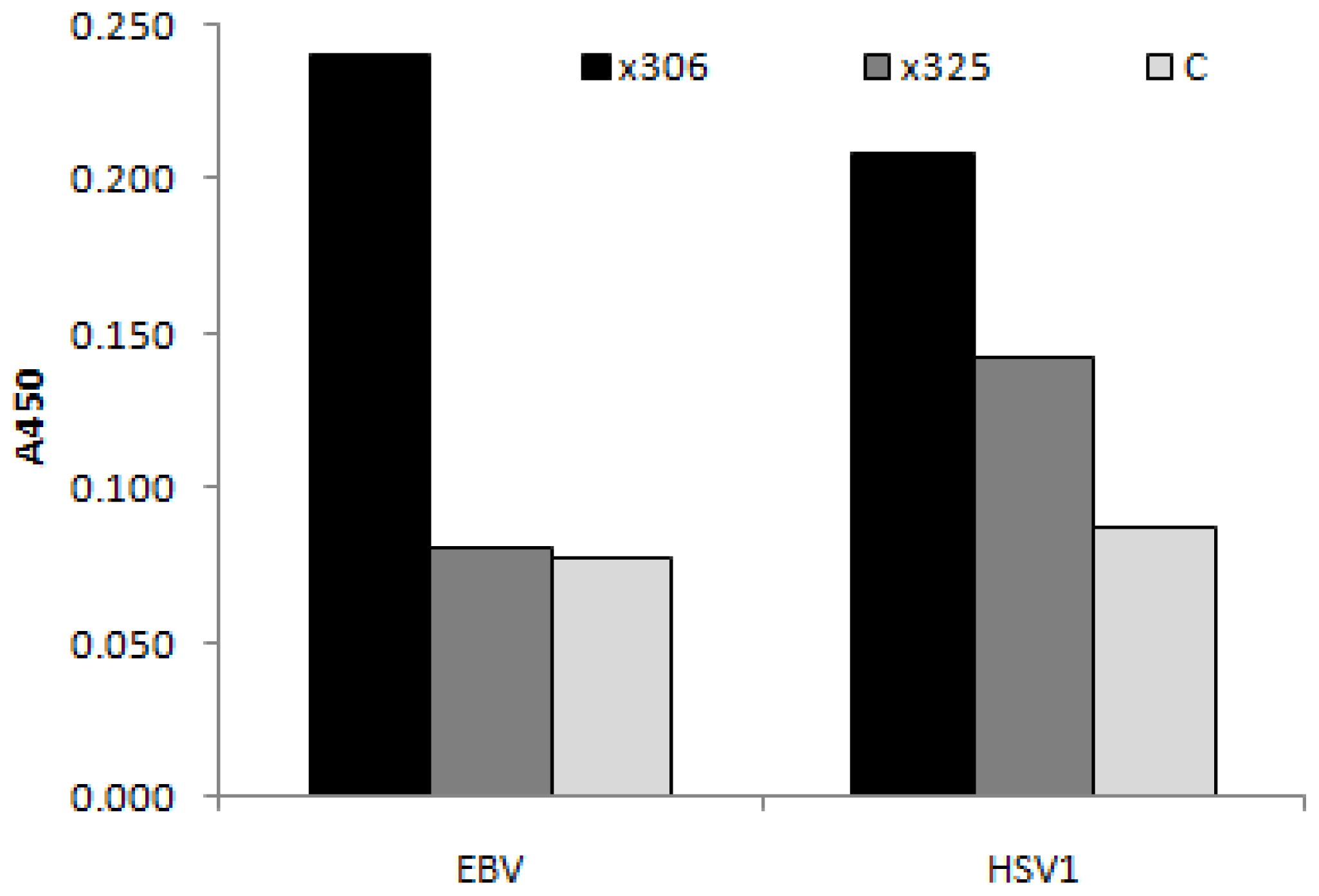
<p>All reported similarities were found within the extracellular Ser/Thr-rich regions of MUC16, which are typical of mucin molecules in general. No relation to annotated domains from available databases appeared, except for gp2/BLLF1 (herpesvirus major outer envelope glycoprotein) from conserved domain database (CDD) [<xref ref-type="bibr" rid="b42-ijms-13-10387">42</xref>]. As already mentioned, BLLF1 (also termed gp 350/220) represents a major antigen responsible for production of neutralizing antibodies <italic>in vivo</italic>. Starting from these observations as well as reported data on elevated CA125 concentration in patients with different type of B cell lymphomas, which could be associated with EBV infection [<xref ref-type="bibr" rid="b43-ijms-13-10387">43</xref>,<xref ref-type="bibr" rid="b44-ijms-13-10387">44</xref>], anti-human CA125 antibodies were probed for reactivity with herpesviruses glycoproteins. Thus, EBV capsid antigen and HSV 1 antigen were probed with two classes of monoclonal antibodies to MUC16/CA125: OC125/OC125-like and M11/M11-like, reacting mainly with the repeated peptide sequences [<xref ref-type="bibr" rid="b13-ijms-13-10387">13</xref>,<xref ref-type="bibr" rid="b14-ijms-13-10387">14</xref>,<xref ref-type="bibr" rid="b45-ijms-13-10387">45</xref>].</p>
<p>In a solid phase binding assay with immobilized targets (<xref ref-type="fig" rid="f1-ijms-13-10387">Figure 1</xref>), OC125-like antibody, but not M11-like antibody, gave a signal above background indicating measurable reactivity to EBV CA, but it was weak relative to the reaction with CA125. As for HSV 1 antigens, both antibodies gave measurable reactivity, being slightly higher for OC125-like antibody.</p>
<p>Generally, there is a phenomenon that unrelated organisms can have antigens in common [<xref ref-type="bibr" rid="b46-ijms-13-10387">46</xref>–<xref ref-type="bibr" rid="b48-ijms-13-10387">48</xref>]. Thus, it is well known that the agglutination test for EBV is based on the finding that it has an antigen in common with sheep and horse erythrocytes [<xref ref-type="bibr" rid="b43-ijms-13-10387">43</xref>]. Moreover, fungal antigen crossreactivity is reported between <italic>Candida</italic> species and human ovarian carcinoma [<xref ref-type="bibr" rid="b49-ijms-13-10387">49</xref>], whereas crossreaction of <italic>Saccharomyces cerevisiae</italic> was found in the human colon <italic>i.e.</italic>, in granulation tissue of inflamed colonic mucosa and peripheral leukocytes in patients with Crohns disease [<xref ref-type="bibr" rid="b50-ijms-13-10387">50</xref>,<xref ref-type="bibr" rid="b51-ijms-13-10387">51</xref>]. However, crude yeast extract, as a source of the identified mucin-like molecules, showed no trace of CA125-immunoreactivity (data not shown).</p>
<p>The available data indicate that 4% of 600 monoclonal antibodies against a large variety of viruses crossreacted with healthy host tissues and that heterologous immunity may be elicited even by very short common sequences (such as six amino acids) [<xref ref-type="bibr" rid="b52-ijms-13-10387">52</xref>]. The biological meaning of such crossreactivity <italic>i.e.</italic>, heterologous immunity, in general, is not understood and also it is not known whether it may have any functional consequences.</p>
<p>As part of a strategy for assignment of structural/functional domains, a BLAST search starts with the basic assumption that higher sequence similarity increases confidence in function annotation transfer [<xref ref-type="bibr" rid="b53-ijms-13-10387">53</xref>,<xref ref-type="bibr" rid="b54-ijms-13-10387">54</xref>]. However, there is no threshold and homology does not always mean similar function. Thus, in addition to BLAST, protein function prediction software based on GO annotations were also used for computational analysis of CA125 sequence (<xref ref-type="table" rid="t2-ijms-13-10387">Tables 2</xref> and <xref ref-type="table" rid="t3-ijms-13-10387">3</xref>). Although, the reported matches had low probability scores, they put MUC16/CA125 in the context of modular proteins with an annotated role in adhesion-related processes. In terms molecular function, GO category: binding (GO:0005488) was associated with purine nucleotide (GO:0017076), metal ion/ion (GO:0046872/GO:0043197) or sugar binding (GO:0005529). The predicted sugar binding ability was related to 1,4-alpha-<sc>d</sc>-glucan (GO:0004339) and chitin (GO:0008061) [<xref ref-type="bibr" rid="b55-ijms-13-10387">55</xref>,<xref ref-type="bibr" rid="b56-ijms-13-10387">56</xref>]. In terms of biological processes, GO category: cellular process (GO:0009987) was associated with cell-matrix adhesion (GO:0007160), and GO category: physiological process (GO:0007582) was associated with cell growth (GO:0016049), transport (GO:0006810) and metabolism (GO:0008152). Thus, invasive growth (GO:0001403), cation transport (GO:0006812), <italic>i.e.</italic>, ATP synthesis coupled proton transport (GO:0015986) and polysaccharide metabolism (GO:0000272), were annotated, respectively [<xref ref-type="bibr" rid="b57-ijms-13-10387">57</xref>,<xref ref-type="bibr" rid="b58-ijms-13-10387">58</xref>].</p>
<p>So far, several lines of experimental evidence obtained on cancer- or pregnancy-associated MUC16/CA125 antigen, indicate possible involvement in adhesive/anti-adhesive processes during cancer progression or embryonic development [<xref ref-type="bibr" rid="b59-ijms-13-10387">59</xref>–<xref ref-type="bibr" rid="b62-ijms-13-10387">62</xref>]. The precise mechanisms of these processes are not fully explained. Generally, it is suggested that there is link between cell adhesion and ion transport. For instance, local extracellular pH levels at tumor focal adhesion sites modulate the strength of cell adhesion <italic>i.e</italic>., more protons leads to tighter adhesion and decreased migration [<xref ref-type="bibr" rid="b63-ijms-13-10387">63</xref>]. These processes can involve different molecules, but there are data substantiating the existence of adhesion molecules with amino acid identity (40%) and immunologically cross-reactive to the beta subunit of Na/K-ATPase [<xref ref-type="bibr" rid="b64-ijms-13-10387">64</xref>]. It is speculated that adhesive or anti-adhesive properties of a particular molecule may result from its influence on different transducing systems in the form of an ion pump, channel or carrier [<xref ref-type="bibr" rid="b64-ijms-13-10387">64</xref>].</p>
<p>In addition, they can be dependent on its glycosylation status. It is known that mucins as ligands for cell-cell adhesion molecules (CAM) or as CAM themselves are an important part of the adhesion interaction network based on carbohydrate-binding interactions. Indeed, the results obtained indicated distinct GO terms, whose annotations, refer to lectin- or lectin-like interactions.</p>
<p>In terms of biological processes, besides cellular processes, carbohydrate-binding is also supposed to be relevant for physiological processes such as invasive growth (GO:0001403) or substrate-bound cell migration (GO:0006929). Thus, flocculin, identified as one of the high scoring hits, is associated with fimbrialike structures and it is involved in invasion and filamentous growth [<xref ref-type="bibr" rid="b65-ijms-13-10387">65</xref>]. On the other hand, MUC16 was reported to be localized on the surface of uterodome (pinopode) protrusions of the endometrium, acting as a barrier for trophoblast adherence [<xref ref-type="bibr" rid="b62-ijms-13-10387">62</xref>]. Cell-matrix contact structures, <italic>i.e</italic>., cellular protrusions can be morphologically different, but mechanisms of spreading are thought to be similar in normal and pathologically altered cells [<xref ref-type="bibr" rid="b66-ijms-13-10387">66</xref>]. However, there are no data on flocculin or CA125 activities in terms of sugar-binding interactions.</p>
<p>MUC16 has a distinct evolutionary relationship with other transmembrane mucins. Using sequence comparison of well characterized mucin domains: SEA, NIDO, AMOP and VWD, it was shown that MUC16 evolved separately, before the divergence of birds and mammals [<xref ref-type="bibr" rid="b67-ijms-13-10387">67</xref>]. Thus, in contrast to the others, it has homology in non-mammalian species, based on the SEA domain. In this study, the starting point was modular organization and the preposition that sharing evolutionary conserved structural and functional motifs, other than those already known, can give us more information about its position in the human interactome.</p>
<p>Collectively, the results obtained direct further investigation of CA125 antigen towards collecting data to substantiate the involvement of common conserved protein motifs in functional activities of evolutionarily diversified molecules, as has emerged from this study.</p></sec>
<sec>
<title>3. Experimental Section</title>
<sec sec-type="methods">
<title>3.1. Dataset</title>
<p>The protein sequence of human mucin 16 (MUC16) (ovarian cancer-related tumor marker CA125), accession number Q8WXI7 (UniProtKB, The Universal Protein Knowledgebase), accession number IPI00103552 (IPI, The International Protein Index), accession number NP_078966.2 (NCBI refSeq, National Center for Biotechnology Information Reference Sequence) was retrieved from public databases [<xref ref-type="bibr" rid="b68-ijms-13-10387">68</xref>,<xref ref-type="bibr" rid="b69-ijms-13-10387">69</xref>].</p></sec>
<sec>
<title>3.2. Similarity Search</title>
<p>The protein sequence of human mucin 16 (MUC16) was subjected to a similarity search in the Protein Knowledgebase (UniProtKB) using BLAST (Basic Local Alignment Search Tool) [<xref ref-type="bibr" rid="b70-ijms-13-10387">70</xref>–<xref ref-type="bibr" rid="b72-ijms-13-10387">72</xref>]. The following protein knowledgebases were searched: bacteria, viruses, fungi, eukaryota; and the highest scoring candidates were ranked under different parameter settings (threshold, matrix, filtering, gapped sequence).</p></sec>
<sec>
<title>3.3. Protein Function Prediction</title>
<p>Functions were assigned based on the homologues identified using protein function prediction servers: JAFA metaserver (Joined Assembly of Function Annotations) at <ext-link xlink:href="http://jafa.burnham.org" ext-link-type="uri">http://jafa.burnham.org</ext-link>, PFP (Automated Protein Function Prediction) at <ext-link xlink:href="http://dragon.bio.purdue.edu/pfp" ext-link-type="uri">http://dragon.bio.purdue.edu/pfp</ext-link>, and GO (GeneOntology) at <ext-link xlink:href="http://www.geneontology.com" ext-link-type="uri">http://www.geneontology.com</ext-link>, which gives a definition of functional context and provides machine-legible functional annotation [<xref ref-type="bibr" rid="b73-ijms-13-10387">73</xref>–<xref ref-type="bibr" rid="b78-ijms-13-10387">78</xref>].</p></sec>
<sec>
<title>3.4. CA125-Immunoreactivity</title>
<sec>
<title>3.4.1. Viral Antigens</title>
<p>Mouse monoclonal anti-human CA125 antibodies: clone X325 (M-11 like) and clone X306 (OC125-like) were from HyTest (PharmaCity, Turku, Finland). They were allowed to react with immobilized Epstein-Barr Virus (EBV) capsid antigens (CA), from Epstein-Barr Virus (EBV) VCA IgG kit (Virion/Serion GmbH, Wurzburg, Germany), or Herpes simplex virus type 1 (HSV 1) cell culture-derived antigens, from Herpes simplex virus type 1 IgG kit (Human GmbH, Wiesbaden, Germany). After incubation for 3 h at room temperature (RT), the wells were washed three times with 0.1 M PBS, pH 7.2 and biotinylated goat anti-mouse IgG (Vector Laboratories, Burlinghame, CA, USA) was added. Subsequent to incubation for 1 h, the wells were rinsed and Vectastain Elite ABC reagent (Vector Laboratories, Burlinghame, CA, USA) was added followed by incubation for 30 min. After another washing step, addition of TMB substrate solution and incubation for 10 min, the reaction was stopped with 0.16 M H<sub>2</sub>SO<sub>4</sub>. The absorbance was measured at 450 nm on a Wallac 1420 Multilabel Counter (Monza, Italy). In parallel, a control assay was performed with an irrelevant monoclonal anti-hCG IgG, clone 5008-SP-5 (Medix Biochemica, Kauniainen, Finland) to determine non-specific binding.</p></sec>
<sec>
<title>3.4.2. Crude Yeast (<italic>Saccharomyces cerevisiae</italic>) Extract</title>
<p>Serial dilutions of crude yeast (<italic>Saccharomyces cerevisiae</italic>) extract in 0.01 M carbonate buffer, pH 9.2, were adsorbed on polystyrene test tubes (Spektar, Cacak, Serbia) overnight at 4 °C. The tubes were then rinsed three times with 0.1 M PBS, pH 7.2, blocked with 1% casein for 2 h at RT and rinsed again three times with 0.1 M PBS, pH 7.2. Reaction with the corresponding monoclonal anti-human CA125-antibodies was then allowed as described for viral antigens.</p></sec></sec></sec>
<sec sec-type="conclusions">
<title>4. Conclusions</title>
<p>Since protein function has many facets and is highly contextual, bioinformatic data on the predicted GO molecular function of CA125 can be considered in the light of possible general principles shared across distant distinct, yet related proteins. The results obtained suggested a possible correlation between the role of the serine/threonine rich domain of yeast, acting as a sensor for extracellular osmotic pressure and that of the mucin domain of transmembrane mucins in monitoring extracellular ion gradients and pH [<xref ref-type="bibr" rid="b35-ijms-13-10387">35</xref>,<xref ref-type="bibr" rid="b79-ijms-13-10387">79</xref>,<xref ref-type="bibr" rid="b80-ijms-13-10387">80</xref>]. In addition, a possible relationship has emerged between mucin participation in polarized growth and directional motility <italic>i.e.</italic>, amoeboid mechanisms of propulsion and mucin-like fungal proteins in pseudohyphal and filamentous growth involving sugar-substrate binding [<xref ref-type="bibr" rid="b81-ijms-13-10387">81</xref>,<xref ref-type="bibr" rid="b82-ijms-13-10387">82</xref>].</p></sec></body>
<back>
<ack>
<title>Acknowledgment</title>
<p>This work was supported by the Ministry for Education and Science of the Republic of Serbia, project code 173010.</p></ack>
<fn-group><fn id="fn1-ijms-13-10387">
<p><bold>Conflict of Interest</bold></p>
<p>The authors declare no financial or commercial conflict of interest.</p></fn></fn-group>
<ref-list>
<title>References</title>
<ref id="b1-ijms-13-10387"><label>1</label><citation citation-type="journal"><person-group person-group-type="author"><name><surname>Gum</surname><given-names>J.R.</given-names></name></person-group><article-title>Mucin genes and proteins they encode: Structure, diversity and regulation</article-title><source>Am. J. Respir. Cell Mol. Biol</source><year>1992</year><volume>7</volume><fpage>557</fpage><lpage>564</lpage><pub-id pub-id-type="pmid">1449803</pub-id></citation></ref>
<ref id="b2-ijms-13-10387"><label>2</label><citation citation-type="book"><person-group person-group-type="author"><name><surname>Perez-Vilar</surname><given-names>J.</given-names></name><name><surname>Hill</surname><given-names>R.L.</given-names></name></person-group><article-title>Mucin Family of Glycoproteins</article-title><source>Encyclopedia of Biological Chemistry</source><person-group person-group-type="editor"><name><surname>Lennarz</surname><given-names>L.</given-names></name></person-group><publisher-name>Academic Press/Elsevier</publisher-name><publisher-loc>Oxford, UK</publisher-loc><year>2004</year><volume>2</volume><fpage>758</fpage><lpage>764</lpage></citation></ref>
<ref id="b3-ijms-13-10387"><label>3</label><citation citation-type="journal"><person-group person-group-type="author"><name><surname>Desseyn</surname><given-names>J.L.</given-names></name><name><surname>Tetaert</surname><given-names>D.</given-names></name><name><surname>Gouyer</surname><given-names>V.</given-names></name></person-group><article-title>Architecture of the large membrane-bound mucins</article-title><source>Gene</source><year>2008</year><volume>410</volume><fpage>215</fpage><lpage>222</lpage><pub-id pub-id-type="doi">10.1016/j.gene.2007.12.014</pub-id><pub-id pub-id-type="pmid">18242885</pub-id></citation></ref>
<ref id="b4-ijms-13-10387"><label>4</label><citation citation-type="journal"><person-group person-group-type="author"><name><surname>Hattrup</surname><given-names>C.L.</given-names></name><name><surname>Gendler</surname><given-names>S.J.</given-names></name></person-group><article-title>Structure and function of the cell surface (tethered) mucins</article-title><source>Annu. Rev. Physiol</source><year>2008</year><volume>70</volume><fpage>431</fpage><lpage>457</lpage><pub-id pub-id-type="doi">10.1146/annurev.physiol.70.113006.100659</pub-id><pub-id pub-id-type="pmid">17850209</pub-id></citation></ref>
<ref id="b5-ijms-13-10387"><label>5</label><citation citation-type="journal"><person-group person-group-type="author"><name><surname>Jonckheere</surname><given-names>N.</given-names></name><name><surname>van Seuningen</surname><given-names>I.</given-names></name></person-group><article-title>The membrane-bound mucins: From cell signalling to transcriptional regulation and expression in epithelial cancers</article-title><source>Biochimie</source><year>2009</year><volume>92</volume><fpage>1</fpage><lpage>11</lpage><pub-id pub-id-type="pmid">19818375</pub-id></citation></ref>
<ref id="b6-ijms-13-10387"><label>6</label><citation citation-type="journal"><person-group person-group-type="author"><name><surname>Bafna</surname><given-names>S.</given-names></name><name><surname>Kaur</surname><given-names>S.</given-names></name><name><surname>Batra</surname><given-names>S.K.</given-names></name></person-group><article-title>Membrane-Bound mucins: The mechanistic basis for alterations in the growth and survival of cancer cells</article-title><source>Oncogene</source><year>2010</year><volume>29</volume><fpage>2893</fpage><lpage>2904</lpage><pub-id pub-id-type="doi">10.1038/onc.2010.87</pub-id><pub-id pub-id-type="pmid">20348949</pub-id></citation></ref>
<ref id="b7-ijms-13-10387"><label>7</label><citation citation-type="journal"><person-group person-group-type="author"><name><surname>Palileo</surname><given-names>C.</given-names></name><name><surname>Kaunitz</surname><given-names>J.D.</given-names></name></person-group><article-title>Gastrointestinal defense mechanisms</article-title><source>Curr. Opin. Gastroenterol</source><year>2011</year><volume>27</volume><fpage>543</fpage><lpage>548</lpage><pub-id pub-id-type="doi">10.1097/MOG.0b013e32834b3fcb</pub-id><pub-id pub-id-type="pmid">21897225</pub-id></citation></ref>
<ref id="b8-ijms-13-10387"><label>8</label><citation citation-type="journal"><person-group person-group-type="author"><name><surname>McGuckin</surname><given-names>M.A.</given-names></name><name><surname>Lindén</surname><given-names>S.K.</given-names></name><name><surname>Sutton</surname><given-names>P.</given-names></name><name><surname>Florin</surname><given-names>T.H.</given-names></name></person-group><article-title>Mucin dynamics and enteric pathogens</article-title><source>Nat. Rev. Microbiol</source><year>2011</year><volume>4</volume><fpage>265</fpage><lpage>278</lpage></citation></ref>
<ref id="b9-ijms-13-10387"><label>9</label><citation citation-type="journal"><person-group person-group-type="author"><name><surname>Parker</surname><given-names>D.</given-names></name><name><surname>Prince</surname><given-names>A.</given-names></name></person-group><article-title>Innate immunity in the respiratory epithelium</article-title><source>Am. J. Respir. Cell Mol. Biol</source><year>2011</year><volume>45</volume><fpage>189</fpage><lpage>201</lpage><pub-id pub-id-type="doi">10.1165/rcmb.2011-0011RT</pub-id><pub-id pub-id-type="pmid">21330463</pub-id></citation></ref>
<ref id="b10-ijms-13-10387"><label>10</label><citation citation-type="book"><person-group person-group-type="author"><name><surname>Montz</surname><given-names>F.J.</given-names></name></person-group><article-title>CA 125</article-title><source>Serological Cancer Markers</source><person-group person-group-type="editor"><name><surname>Sell</surname><given-names>S.</given-names></name></person-group><publisher-name>The Humana Press</publisher-name><publisher-loc>Totowa, NJ, USA</publisher-loc><year>1992</year><fpage>417</fpage><lpage>425</lpage></citation></ref>
<ref id="b11-ijms-13-10387"><label>11</label><citation citation-type="journal"><person-group person-group-type="author"><name><surname>Scholler</surname><given-names>N.</given-names></name><name><surname>Urban</surname><given-names>N.</given-names></name></person-group><article-title>CA 125 in ovarian cancer</article-title><source>Biomark. Med</source><year>2007</year><volume>1</volume><fpage>513</fpage><lpage>523</lpage><pub-id pub-id-type="doi">10.2217/17520363.1.4.513</pub-id><pub-id pub-id-type="pmid">20477371</pub-id></citation></ref>
<ref id="b12-ijms-13-10387"><label>12</label><citation citation-type="journal"><person-group person-group-type="author"><name><surname>Perez</surname><given-names>B.H.</given-names></name><name><surname>Gipson</surname><given-names>I.K.</given-names></name></person-group><article-title>Focus on molecules: Human mucin MUC16</article-title><source>Exp. Eye Res</source><year>2008</year><volume>87</volume><fpage>400</fpage><lpage>401</lpage><pub-id pub-id-type="doi">10.1016/j.exer.2007.12.008</pub-id><pub-id pub-id-type="pmid">18289532</pub-id></citation></ref>
<ref id="b13-ijms-13-10387"><label>13</label><citation citation-type="journal"><person-group person-group-type="author"><name><surname>Yin</surname><given-names>B.W.</given-names></name><name><surname>Lloyd</surname><given-names>K.O.</given-names></name></person-group><article-title>Molecular cloning of the CA 125 ovarian cancer antigen: Identification as a new mucin, MUC16</article-title><source>J. Biol. Chem</source><year>2001</year><volume>276</volume><fpage>27371</fpage><lpage>27375</lpage><pub-id pub-id-type="doi">10.1074/jbc.M103554200</pub-id><pub-id pub-id-type="pmid">11369781</pub-id></citation></ref>
<ref id="b14-ijms-13-10387"><label>14</label><citation citation-type="journal"><person-group person-group-type="author"><name><surname>O’Brien</surname><given-names>T.J.</given-names></name><name><surname>Beard</surname><given-names>J.B.</given-names></name><name><surname>Underwood</surname><given-names>L.J.</given-names></name><name><surname>Dennis</surname><given-names>R.A.</given-names></name><name><surname>Santin</surname><given-names>A.D.</given-names></name><name><surname>York</surname><given-names>L.</given-names></name></person-group><article-title>The CA 125 gene: An extracellular superstructure dominated by repeat sequences</article-title><source>Tumour Biol</source><year>2001</year><volume>22</volume><fpage>348</fpage><lpage>366</lpage><pub-id pub-id-type="doi">10.1159/000050638</pub-id><pub-id pub-id-type="pmid">11786729</pub-id></citation></ref>
<ref id="b15-ijms-13-10387"><label>15</label><citation citation-type="journal"><person-group person-group-type="author"><name><surname>O’Brien</surname><given-names>T.J.</given-names></name><name><surname>Beard</surname><given-names>J.B.</given-names></name><name><surname>Underwood</surname><given-names>L.J.</given-names></name><name><surname>Shigemasa</surname><given-names>K.</given-names></name></person-group><article-title>The CA 125 gene: A newly discovered extension of the glycosylated <italic>N</italic>-terminal domain doubles the size of this extracellular superstructure</article-title><source>Tumour Biol</source><year>2002</year><volume>23</volume><fpage>154</fpage><lpage>169</lpage><pub-id pub-id-type="doi">10.1159/000064032</pub-id><pub-id pub-id-type="pmid">12218296</pub-id></citation></ref>
<ref id="b16-ijms-13-10387"><label>16</label><citation citation-type="journal"><person-group person-group-type="author"><name><surname>Maeda</surname><given-names>T.</given-names></name><name><surname>Inoue</surname><given-names>M.</given-names></name><name><surname>Koshiba</surname><given-names>S.</given-names></name><name><surname>Yabuki</surname><given-names>T.</given-names></name><name><surname>Aoki</surname><given-names>M.</given-names></name><name><surname>Nunokawa</surname><given-names>E.</given-names></name><name><surname>Seki</surname><given-names>E.</given-names></name><name><surname>Matsuda</surname><given-names>T.</given-names></name><name><surname>Motoda</surname><given-names>Y.</given-names></name><name><surname>Kobayashi</surname><given-names>A.</given-names></name><etal/></person-group><article-title>Solution structure of the SEA domain from the murine homologue of ovarian cancer antigen CA 125 (MUC16)</article-title><source>J. Biol. Chem</source><year>2004</year><volume>279</volume><fpage>13174</fpage><lpage>13182</lpage><pub-id pub-id-type="pmid">14764598</pub-id></citation></ref>
<ref id="b17-ijms-13-10387"><label>17</label><citation citation-type="web"><collab>IPR000082 SEA</collab><comment>Available online: <ext-link xlink:href="http://www.ebi.ac.uk/interpro/IEntry?ac=IPR000082" ext-link-type="uri">http://www.ebi.ac.uk/interpro/IEntry?ac=IPR000082</ext-link></comment><access-date>accessed on 3 April 2012</access-date></citation></ref>
<ref id="b18-ijms-13-10387"><label>18</label><citation citation-type="journal"><person-group person-group-type="author"><name><surname>Sedgwick</surname><given-names>S.G.</given-names></name><name><surname>Smerdon</surname><given-names>S.J.</given-names></name></person-group><article-title>The ankyrin repeat: A diversity of interactions on a common structural framework</article-title><source>Trends Biochem. Sci</source><year>1999</year><volume>24</volume><fpage>311</fpage><lpage>316</lpage><pub-id pub-id-type="doi">10.1016/S0968-0004(99)01426-7</pub-id><pub-id pub-id-type="pmid">10431175</pub-id></citation></ref>
<ref id="b19-ijms-13-10387"><label>19</label><citation citation-type="journal"><person-group person-group-type="author"><name><surname>Wong</surname><given-names>N.K.</given-names></name><name><surname>Easton</surname><given-names>R.L.</given-names></name><name><surname>Pancio</surname><given-names>M.</given-names></name><name><surname>Sutton-Smith</surname><given-names>M.</given-names></name><name><surname>Morrison</surname><given-names>J.C.</given-names></name><name><surname>Lattanzio</surname><given-names>F.A.</given-names></name><name><surname>Moris</surname><given-names>H.R.</given-names></name><name><surname>Clark</surname><given-names>G.F.</given-names></name><name><surname>Dell</surname><given-names>A.</given-names></name><name><surname>Patankar</surname><given-names>M.S.</given-names></name></person-group><article-title>Characterization of the oligosaccharides associated with human ovarian tumor marker CA125</article-title><source>J. Biol. Chem</source><year>2003</year><volume>278</volume><fpage>28619</fpage><lpage>28634</lpage><pub-id pub-id-type="doi">10.1074/jbc.M302741200</pub-id><pub-id pub-id-type="pmid">12734200</pub-id></citation></ref>
<ref id="b20-ijms-13-10387"><label>20</label><citation citation-type="journal"><person-group person-group-type="author"><name><surname>Jankovic</surname><given-names>M.</given-names></name><name><surname>Tapuskovic</surname><given-names>B.</given-names></name></person-group><article-title>Molecular forms and microheterogeneity of the oligosaccharide chains of pregnancy-associated CA125 antigen</article-title><source>Hum. Reprod</source><year>2005</year><volume>20</volume><fpage>2632</fpage><lpage>2638</lpage><pub-id pub-id-type="doi">10.1093/humrep/dei095</pub-id><pub-id pub-id-type="pmid">15905287</pub-id></citation></ref>
<ref id="b21-ijms-13-10387"><label>21</label><citation citation-type="journal"><person-group person-group-type="author"><name><surname>Jankovic</surname><given-names>M.</given-names></name><name><surname>Milutinovic</surname><given-names>B.</given-names></name></person-group><article-title>Glycoforms of CA125 antigen as possible cancer biomarker</article-title><source>Cancer Biomark</source><year>2008</year><volume>1</volume><fpage>1</fpage><lpage>8</lpage></citation></ref>
<ref id="b22-ijms-13-10387"><label>22</label><citation citation-type="journal"><person-group person-group-type="author"><name><surname>Jankovic</surname><given-names>M.M.</given-names></name><name><surname>Milutinovic</surname><given-names>B.S.</given-names></name></person-group><article-title>Pregnancy-Associated CA125 antigen as mucin: Evaluation of ferning morphology</article-title><source>Mol. Hum. Reprod</source><year>2007</year><volume>13</volume><fpage>405</fpage><lpage>408</lpage><pub-id pub-id-type="doi">10.1093/molehr/gam022</pub-id><pub-id pub-id-type="pmid">17449537</pub-id></citation></ref>
<ref id="b23-ijms-13-10387"><label>23</label><citation citation-type="journal"><person-group person-group-type="author"><name><surname>Bouanène</surname><given-names>H.</given-names></name><name><surname>Saibi</surname><given-names>W.</given-names></name><name><surname>Mokni</surname><given-names>M.</given-names></name><name><surname>Sriha</surname><given-names>B.</given-names></name><name><surname>Ben Fatma</surname><given-names>L.</given-names></name><name><surname>Ben Limem</surname><given-names>H.</given-names></name><name><surname>Ben Ahmed</surname><given-names>S.</given-names></name><name><surname>Gargouri</surname><given-names>A.</given-names></name><name><surname>Miled</surname><given-names>A.</given-names></name></person-group><article-title>Biochemical and morphological differences between CA125 isolated from healthy women and patients with epithelial ovarian cancer from Tunisian population</article-title><source>Pathol. Oncol. Res</source><year>2012</year><volume>18</volume><fpage>325</fpage><lpage>330</lpage><pub-id pub-id-type="doi">10.1007/s12253-011-9448-x</pub-id><pub-id pub-id-type="pmid">21901274</pub-id></citation></ref>
<ref id="b24-ijms-13-10387"><label>24</label><citation citation-type="journal"><person-group person-group-type="author"><name><surname>Whittaker</surname><given-names>G.R.</given-names></name><name><surname>Wheldon</surname><given-names>L.A.</given-names></name><name><surname>Giles</surname><given-names>L.E.</given-names></name><name><surname>Stocks</surname><given-names>J.M.</given-names></name><name><surname>Halliburton</surname><given-names>I.W.</given-names></name><name><surname>Killington</surname><given-names>R.A.</given-names></name><name><surname>Meredith</surname><given-names>D.M.</given-names></name></person-group><article-title>Characterization of the high M<sub>r</sub> glycoprotein (gp300) of equine herpesvirus type 1 as a novel glycoprotein with extensive O-linked carbohydrate</article-title><source>J. Gen. Virol</source><year>1990</year><volume>71</volume><label>2407</label><fpage>2416</fpage></citation></ref>
<ref id="b25-ijms-13-10387"><label>25</label><citation citation-type="journal"><person-group person-group-type="author"><name><surname>Wellington</surname><given-names>J.E.</given-names></name><name><surname>Allen</surname><given-names>G.P.</given-names></name><name><surname>Gooley</surname><given-names>A.A.</given-names></name><name><surname>Love</surname><given-names>D.N.</given-names></name><name><surname>Packer</surname><given-names>N.H.</given-names></name><name><surname>Yan</surname><given-names>J.X.</given-names></name><name><surname>Whalley</surname><given-names>J.M.</given-names></name></person-group><article-title>The highly O-glycosylated glycoprotein gp2 of equine herpesvirus 1 is encoded by gene 71</article-title><source>J. Virol.</source><year>1996</year><volume>70</volume><label>8195</label><fpage>8198</fpage></citation></ref>
<ref id="b26-ijms-13-10387"><label>26</label><citation citation-type="journal"><person-group person-group-type="author"><name><surname>Learmonth</surname><given-names>G.S.</given-names></name><name><surname>Love</surname><given-names>D.N.</given-names></name><name><surname>Gilkerson</surname><given-names>J.R.</given-names></name><name><surname>Wellington</surname><given-names>J.E.</given-names></name><name><surname>Whalley</surname><given-names>J.M.</given-names></name></person-group><article-title>The <italic>C</italic>-terminal regions of the envelope glycoprotein gp2 of equine herpesvirus 1 and 4 are antigenically distinct</article-title><source>Arch. Virol</source><year>2002</year><volume>147</volume><fpage>607</fpage><lpage>615</lpage><pub-id pub-id-type="doi">10.1007/s007050200010</pub-id><pub-id pub-id-type="pmid">11958459</pub-id></citation></ref>
<ref id="b27-ijms-13-10387"><label>27</label><citation citation-type="journal"><person-group person-group-type="author"><name><surname>Tanner</surname><given-names>J.</given-names></name><name><surname>Weis</surname><given-names>J.</given-names></name><name><surname>Fearon</surname><given-names>D.</given-names></name><name><surname>Whang</surname><given-names>Y.</given-names></name><name><surname>Kieff</surname><given-names>E.</given-names></name></person-group><article-title>Epstein-Barr virus gp350/220 binding to the B lymphocyte C3d receptor mediates adsorption, capping, and endocytosis</article-title><source>Cell</source><year>1987</year><volume>50</volume><fpage>203</fpage><lpage>213</lpage><pub-id pub-id-type="doi">10.1016/0092-8674(87)90216-9</pub-id><pub-id pub-id-type="pmid">3036369</pub-id></citation></ref>
<ref id="b28-ijms-13-10387"><label>28</label><citation citation-type="journal"><person-group person-group-type="author"><name><surname>Janz</surname><given-names>A.</given-names></name><name><surname>Oezel</surname><given-names>M.</given-names></name><name><surname>Kurzeder</surname><given-names>C.</given-names></name><name><surname>Mautner</surname><given-names>J.</given-names></name><name><surname>Pich</surname><given-names>D.</given-names></name><name><surname>Kost</surname><given-names>M.</given-names></name><name><surname>Hammerschmidt</surname><given-names>W.</given-names></name><name><surname>Delecluse</surname><given-names>H.J.</given-names></name></person-group><article-title>Infectious Epstein-Barr virus lacking major glycoprotein BLLF1 (gp350/220) demonstrates the existence of additional viral ligands</article-title><source>J. Virol</source><year>2000</year><volume>74</volume><fpage>10142</fpage><lpage>10152</lpage><pub-id pub-id-type="doi">10.1128/JVI.74.21.10142-10152.2000</pub-id><pub-id pub-id-type="pmid">11024143</pub-id></citation></ref>
<ref id="b29-ijms-13-10387"><label>29</label><citation citation-type="journal"><person-group person-group-type="author"><name><surname>Luo</surname><given-names>B.</given-names></name><name><surname>Liu</surname><given-names>M.</given-names></name><name><surname>Chao</surname><given-names>Y.</given-names></name><name><surname>Wang</surname><given-names>Y.</given-names></name><name><surname>Jing</surname><given-names>Y.</given-names></name><name><surname>Sun</surname><given-names>Z.</given-names></name></person-group><article-title>Characterization of Epstein-Barr virus gp350/220 gene variants in virus isolates from gastric carcinoma and nasopharyngeal carcinoma</article-title><source>Arch. Virol</source><year>2012</year><volume>157</volume><fpage>207</fpage><lpage>216</lpage><pub-id pub-id-type="doi">10.1007/s00705-011-1148-z</pub-id><pub-id pub-id-type="pmid">22038027</pub-id></citation></ref>
<ref id="b30-ijms-13-10387"><label>30</label><citation citation-type="web"><source>Cell wall surface anchor family protein</source><comment>Available online: <ext-link xlink:href="http://www.uniprot.org/uniprot/B2ISC7" ext-link-type="uri">http://www.uniprot.org/uniprot/B2ISC7</ext-link></comment><access-date>accessed on 5 April 2012</access-date></citation></ref>
<ref id="b31-ijms-13-10387"><label>31</label><citation citation-type="journal"><person-group person-group-type="author"><name><surname>Ding</surname><given-names>F.</given-names></name><name><surname>Tang</surname><given-names>P.</given-names></name><name><surname>Hsu</surname><given-names>M.H.</given-names></name><name><surname>Cui</surname><given-names>P.</given-names></name><name><surname>Hu</surname><given-names>S.</given-names></name><name><surname>Yu</surname><given-names>J.</given-names></name><name><surname>Chiu</surname><given-names>C.H.</given-names></name></person-group><article-title>Genome evolution driven by host adaptations results in a more virulent and antimicrobial-resistant <italic>Streptococcus pneumoniae</italic> serotype 14</article-title><source>BMC Genomics</source><year>2009</year><volume>10</volume><fpage>158</fpage><pub-id pub-id-type="doi">10.1186/1471-2164-10-158</pub-id><pub-id pub-id-type="pmid">19361343</pub-id></citation></ref>
<ref id="b32-ijms-13-10387"><label>32</label><citation citation-type="web"><source>Serine-rich adhesin for platelets</source><comment>Available online: <ext-link xlink:href="http://www.uniprot.org/uniprot/Q4L9P0" ext-link-type="uri">http://www.uniprot.org/uniprot/Q4L9P0</ext-link></comment><access-date>accessed on 5 April 2012</access-date></citation></ref>
<ref id="b33-ijms-13-10387"><label>33</label><citation citation-type="journal"><person-group person-group-type="author"><name><surname>Takeuchi</surname><given-names>F.</given-names></name><name><surname>Watanabe</surname><given-names>S.</given-names></name><name><surname>Baba</surname><given-names>T.</given-names></name><name><surname>Yuzawa</surname><given-names>H.</given-names></name><name><surname>Ito</surname><given-names>T.</given-names></name><name><surname>Morimoto</surname><given-names>Y.</given-names></name><name><surname>Kuroda</surname><given-names>M.</given-names></name><name><surname>Cui</surname><given-names>L.</given-names></name><name><surname>Takahashi</surname><given-names>M.</given-names></name><name><surname>Ankai</surname><given-names>A.</given-names></name><etal/></person-group><article-title>Whole-Genome sequencing of <italic>Staphylococcus haemolyticus</italic> uncovers the extreme plasticity of its genome and the evolution of human-colonizing staphylococcal species</article-title><source>J. Bacteriol</source><year>2005</year><volume>187</volume><fpage>7292</fpage><lpage>7308</lpage><pub-id pub-id-type="doi">10.1128/JB.187.21.7292-7308.2005</pub-id><pub-id pub-id-type="pmid">16237012</pub-id></citation></ref>
<ref id="b34-ijms-13-10387"><label>34</label><citation citation-type="web"><source>Cell surface flocculin</source><comment>Available online: <ext-link xlink:href="http://www.uniprot.org/uniprot/E9P8M0" ext-link-type="uri">http://www.uniprot.org/uniprot/E9P8M0</ext-link></comment><access-date>accessed on 5 April 2012</access-date></citation></ref>
<ref id="b35-ijms-13-10387"><label>35</label><citation citation-type="journal"><person-group person-group-type="author"><name><surname>Lo</surname><given-names>W.S.</given-names></name><name><surname>Dranginis</surname><given-names>A.M.</given-names></name></person-group><article-title>The cell surface flocculin Flo11 is required for pseudohyphae formation and invasion by <italic>Saccharomyces cerevisiae</italic></article-title><source>Mol. Biol. Cell</source><year>1998</year><volume>9</volume><fpage>161</fpage><lpage>171</lpage><pub-id pub-id-type="pmid">9436998</pub-id></citation></ref>
<ref id="b36-ijms-13-10387"><label>36</label><citation citation-type="journal"><person-group person-group-type="author"><name><surname>Karunanithi</surname><given-names>S.</given-names></name><name><surname>Vadaie</surname><given-names>N.</given-names></name><name><surname>Chavel</surname><given-names>C.A.</given-names></name><name><surname>Birkaya</surname><given-names>B.</given-names></name><name><surname>Joshi</surname><given-names>J.</given-names></name><name><surname>Grell</surname><given-names>L.</given-names></name><name><surname>Cullen</surname><given-names>P.J.</given-names></name></person-group><article-title>Shedding of the mucin-like flocculin Flo11p reveals a new aspect of fungal adhesion regulation</article-title><source>Curr. Biol</source><year>2010</year><volume>20</volume><fpage>1389</fpage><lpage>1395</lpage><pub-id pub-id-type="doi">10.1016/j.cub.2010.06.033</pub-id><pub-id pub-id-type="pmid">20619652</pub-id></citation></ref>
<ref id="b37-ijms-13-10387"><label>37</label><citation citation-type="journal"><person-group person-group-type="author"><name><surname>Veelders</surname><given-names>M.</given-names></name><name><surname>Brückner</surname><given-names>S.</given-names></name><name><surname>Ott</surname><given-names>D.</given-names></name><name><surname>Unverzagt</surname><given-names>C.</given-names></name><name><surname>Mösch</surname><given-names>H.U.</given-names></name><name><surname>Essen</surname><given-names>L.O.</given-names></name></person-group><article-title>Structural basis of flocculin-mediated social behavior in yeast</article-title><source>Proc. Natl. Acad. Sci. USA</source><year>2010</year><volume>107</volume><fpage>22511</fpage><lpage>22516</lpage><pub-id pub-id-type="doi">10.1073/pnas.1013210108</pub-id><pub-id pub-id-type="pmid">21149680</pub-id></citation></ref>
<ref id="b38-ijms-13-10387"><label>38</label><citation citation-type="web"><collab>Muc1p</collab><comment>Available online: <ext-link xlink:href="http://www.uniprot.org/uniprot/C8ZAR8" ext-link-type="uri">http://www.uniprot.org/uniprot/C8ZAR8</ext-link></comment><access-date>accessed on 6 April 2012</access-date></citation></ref>
<ref id="b39-ijms-13-10387"><label>39</label><citation citation-type="journal"><person-group person-group-type="author"><name><surname>Lambrechts</surname><given-names>M.G.</given-names></name><name><surname>Bauer</surname><given-names>F.F.</given-names></name><name><surname>Marmur</surname><given-names>J.</given-names></name><name><surname>Pretorius</surname><given-names>I.J.</given-names></name></person-group><article-title>Muc1, a mucin-like protein that is regulated by Mss10, is critical for pseudohyphal differentiation in yeast</article-title><source>Proc. Natl. Acad. Sci. USA</source><year>1996</year><volume>93</volume><fpage>8419</fpage><lpage>8424</lpage><pub-id pub-id-type="doi">10.1073/pnas.93.16.8419</pub-id><pub-id pub-id-type="pmid">8710886</pub-id></citation></ref>
<ref id="b40-ijms-13-10387"><label>40</label><citation citation-type="journal"><person-group person-group-type="author"><name><surname>Secundino</surname><given-names>N.</given-names></name><name><surname>Kimblin</surname><given-names>N.</given-names></name><name><surname>Peters</surname><given-names>N.C.</given-names></name><name><surname>Lawyer</surname><given-names>P.</given-names></name><name><surname>Capul</surname><given-names>A.A.</given-names></name><name><surname>Beverley</surname><given-names>S.M.</given-names></name><name><surname>Turco</surname><given-names>S.J.</given-names></name><name><surname>Sacks</surname><given-names>D.</given-names></name></person-group><article-title>Proteophosphoglycan confers resistance of <italic>Leishmania major</italic> to midgut digestive enzymes induced by blood feeding in vector sand flies</article-title><source>Cell Microbiol</source><year>2010</year><volume>12</volume><fpage>906</fpage><lpage>918</lpage><pub-id pub-id-type="doi">10.1111/j.1462-5822.2010.01439.x</pub-id><pub-id pub-id-type="pmid">20088949</pub-id></citation></ref>
<ref id="b41-ijms-13-10387"><label>41</label><citation citation-type="journal"><person-group person-group-type="author"><name><surname>Aebischer</surname><given-names>T.</given-names></name><name><surname>Harbecke</surname><given-names>D.</given-names></name><name><surname>Ilg</surname><given-names>T.</given-names></name></person-group><article-title>Proteophosphoglycan, a major secreted product of intracellular <italic>Leishmania mexicana</italic> amastigotes, is a poor b-cell antigen and does not elicit a specific conventional CD4<sup>+</sup> T-cell response</article-title><source>Infect. Immun</source><year>1999</year><volume>67</volume><fpage>5379</fpage><lpage>5385</lpage><pub-id pub-id-type="pmid">10496920</pub-id></citation></ref>
<ref id="b42-ijms-13-10387"><label>42</label><citation citation-type="journal"><person-group person-group-type="author"><name><surname>Marchler-Bauer</surname><given-names>A.</given-names></name><name><surname>Shennan</surname><given-names>L.</given-names></name><name><surname>Anderson</surname><given-names>J.B.</given-names></name><name><surname>Chitsaz</surname><given-names>F.</given-names></name><name><surname>Derbyshire</surname><given-names>M.K.</given-names></name><name><surname>DeWeese-Scott</surname><given-names>C.</given-names></name><name><surname>Fong</surname><given-names>J.H.</given-names></name><name><surname>Geer</surname><given-names>L.Y.</given-names></name><name><surname>Geer</surname><given-names>R.C.</given-names></name><name><surname>Gonzales</surname><given-names>N.R.</given-names></name><etal/></person-group><article-title>CDD: A conserved domain database for the functional annotation of proteins</article-title><source>Nucleic Acid Res</source><year>2011</year><volume>39</volume><fpage>225</fpage><lpage>229</lpage><pub-id pub-id-type="doi">10.1093/nar/gkq769</pub-id><pub-id pub-id-type="pmid">20823090</pub-id></citation></ref>
<ref id="b43-ijms-13-10387"><label>43</label><citation citation-type="journal"><person-group person-group-type="author"><name><surname>Hsieh</surname><given-names>W.C.</given-names></name><name><surname>Chang</surname><given-names>Y.</given-names></name><name><surname>Hsu</surname><given-names>M.C.</given-names></name><name><surname>Lan</surname><given-names>B.S.</given-names></name><name><surname>Hsiao</surname><given-names>G.C.</given-names></name><name><surname>Chuang</surname><given-names>H.C.</given-names></name><name><surname>Su</surname><given-names>I.J.</given-names></name></person-group><article-title>Emergence of anti-red blood cell antibodies triggers red cell phagocytosis by activated macrophages in a rabbit model of Epstein-Barr virus-associated hemophagocytic syndrome</article-title><source>Am. J. Pathol</source><year>2007</year><volume>170</volume><fpage>1629</fpage><lpage>1639</lpage><pub-id pub-id-type="doi">10.2353/ajpath.2007.060772</pub-id><pub-id pub-id-type="pmid">17456768</pub-id></citation></ref>
<ref id="b44-ijms-13-10387"><label>44</label><citation citation-type="journal"><person-group person-group-type="author"><name><surname>Bairey</surname><given-names>O.</given-names></name><name><surname>Blickstein</surname><given-names>D.</given-names></name><name><surname>Stark</surname><given-names>P.</given-names></name><name><surname>Prokocimer</surname><given-names>M.</given-names></name><name><surname>Nativ</surname><given-names>H.M.</given-names></name><name><surname>Kirgner</surname><given-names>I.</given-names></name><name><surname>Shaklai</surname><given-names>M.</given-names></name></person-group><article-title>Serum CA 125 as a prognostic factor in non-Hodgkin’s lymphoma</article-title><source>Leuk. Lymphoma</source><year>2003</year><volume>44</volume><fpage>1733</fpage><lpage>1738</lpage><pub-id pub-id-type="doi">10.1080/1042819031000104079</pub-id><pub-id pub-id-type="pmid">14692526</pub-id></citation></ref>
<ref id="b45-ijms-13-10387"><label>45</label><citation citation-type="journal"><person-group person-group-type="author"><name><surname>Yin</surname><given-names>B.W.</given-names></name><name><surname>Dnistrian</surname><given-names>A.</given-names></name><name><surname>Lloyd</surname><given-names>K.O.</given-names></name></person-group><article-title>Ovarian cancer antigen CA125 is encoded by the MUC16 mucin gene</article-title><source>Int. J. Cancer</source><year>2002</year><volume>98</volume><fpage>737</fpage><lpage>740</lpage><pub-id pub-id-type="doi">10.1002/ijc.10250</pub-id><pub-id pub-id-type="pmid">11920644</pub-id></citation></ref>
<ref id="b46-ijms-13-10387"><label>46</label><citation citation-type="journal"><person-group person-group-type="author"><name><surname>Albert</surname><given-names>L.J.</given-names></name><name><surname>Inman</surname><given-names>R.D.</given-names></name></person-group><article-title>Molecular mimicry and autoimmunity</article-title><source>N. Engl. J. Med</source><year>1999</year><volume>341</volume><fpage>2068</fpage><lpage>2074</lpage><pub-id pub-id-type="doi">10.1056/NEJM199912303412707</pub-id><pub-id pub-id-type="pmid">10615080</pub-id></citation></ref>
<ref id="b47-ijms-13-10387"><label>47</label><citation citation-type="journal"><person-group person-group-type="author"><name><surname>Rose</surname><given-names>N.R.</given-names></name><name><surname>Mackay</surname><given-names>I.R.</given-names></name></person-group><article-title>Molecular mimicry: A critical look at exemplary instances in human diseases</article-title><source>Cell Mol. Life Sci</source><year>2000</year><volume>57</volume><fpage>542</fpage><lpage>551</lpage><pub-id pub-id-type="doi">10.1007/PL00000716</pub-id><pub-id pub-id-type="pmid">11130454</pub-id></citation></ref>
<ref id="b48-ijms-13-10387"><label>48</label><citation citation-type="journal"><person-group person-group-type="author"><name><surname>Welsh</surname><given-names>R.M.</given-names></name><name><surname>Fujinami</surname><given-names>R.S.</given-names></name></person-group><article-title>Pathogenic epitopes, heterologous immunity and vaccine design</article-title><source>Nat. Rev. Microbiol</source><year>2007</year><volume>5</volume><fpage>555</fpage><lpage>563</lpage><pub-id pub-id-type="doi">10.1038/nrmicro1709</pub-id><pub-id pub-id-type="pmid">17558423</pub-id></citation></ref>
<ref id="b49-ijms-13-10387"><label>49</label><citation citation-type="journal"><person-group person-group-type="author"><name><surname>Schneider</surname><given-names>J.</given-names></name><name><surname>Moragues</surname><given-names>D.</given-names></name><name><surname>MartÃnez</surname><given-names>N.</given-names></name><name><surname>Romero</surname><given-names>H.</given-names></name><name><surname>Jimenez</surname><given-names>E.</given-names></name><name><surname>Pontin</surname><given-names>J.</given-names></name></person-group><article-title>Cross-Reactivity between <italic>Candida albicans</italic> and human ovarian carcinoma as revealed by monoclonal antibodies PA10F and C6</article-title><source>Br. J. Cancer</source><year>1998</year><volume>77</volume><fpage>1015</fpage><lpage>1020</lpage><pub-id pub-id-type="doi">10.1038/bjc.1998.167</pub-id><pub-id pub-id-type="pmid">9528850</pub-id></citation></ref>
<ref id="b50-ijms-13-10387"><label>50</label><citation citation-type="journal"><person-group person-group-type="author"><name><surname>Krause</surname><given-names>I.</given-names></name><name><surname>Blank</surname><given-names>M.</given-names></name><name><surname>Cervera</surname><given-names>R.</given-names></name><name><surname>Font</surname><given-names>J.</given-names></name><name><surname>Matthias</surname><given-names>T.</given-names></name><name><surname>Pfeiffer</surname><given-names>S.</given-names></name><name><surname>Wies</surname><given-names>I.</given-names></name><name><surname>Fraser</surname><given-names>A.</given-names></name><name><surname>Shoenfeld</surname><given-names>Y.</given-names></name></person-group><article-title>Cross-Reactive epitopes on beta2-glycoprotein-I and <italic>Saccharomyces cerevisiae</italic> in patients with the antiphospholipid syndrome</article-title><source>Ann. N. Y. Acad. Sci</source><year>2007</year><volume>1108</volume><fpage>481</fpage><lpage>488</lpage><pub-id pub-id-type="doi">10.1196/annals.1422.051</pub-id><pub-id pub-id-type="pmid">17894013</pub-id></citation></ref>
<ref id="b51-ijms-13-10387"><label>51</label><citation citation-type="journal"><person-group person-group-type="author"><name><surname>Oshitani</surname><given-names>N.</given-names></name><name><surname>Hato</surname><given-names>F.</given-names></name><name><surname>Suzuki</surname><given-names>K.</given-names></name><name><surname>Sawa</surname><given-names>Y.</given-names></name><name><surname>Matsumoto</surname><given-names>T.</given-names></name><name><surname>Maeda</surname><given-names>K.</given-names></name><name><surname>Higuchi</surname><given-names>K.</given-names></name><name><surname>Kitagawa</surname><given-names>S.</given-names></name><name><surname>Arakawa</surname><given-names>T.</given-names></name></person-group><article-title>Cross-Reactivity of yeast antigens in human colon and peripheral leukocytes</article-title><source>J. Pathol</source><year>2003</year><volume>199</volume><fpage>361</fpage><lpage>367</lpage><pub-id pub-id-type="doi">10.1002/path.1276</pub-id><pub-id pub-id-type="pmid">12579538</pub-id></citation></ref>
<ref id="b52-ijms-13-10387"><label>52</label><citation citation-type="journal"><person-group person-group-type="author"><name><surname>Srinivasappa</surname><given-names>J.</given-names></name><name><surname>Saegusa</surname><given-names>J.</given-names></name><name><surname>Prabhakar</surname><given-names>B.S.</given-names></name><name><surname>Gentry</surname><given-names>M.K.</given-names></name><name><surname>Buchmeier</surname><given-names>M.J.</given-names></name><name><surname>Wiktor</surname><given-names>T.J.</given-names></name><name><surname>Koprowski</surname><given-names>H.</given-names></name><name><surname>Oldstone</surname><given-names>M.B.</given-names></name><name><surname>Notkins</surname><given-names>A.L.</given-names></name></person-group><article-title>Molecular mimicry: Frequency of reactivity of monoclonal antiviral antibodies with normal tissues</article-title><source>J. Virol</source><year>1986</year><volume>57</volume><fpage>397</fpage><lpage>401</lpage><pub-id pub-id-type="pmid">3753614</pub-id></citation></ref>
<ref id="b53-ijms-13-10387"><label>53</label><citation citation-type="journal"><person-group person-group-type="author"><name><surname>Punta</surname><given-names>M.</given-names></name><name><surname>Ofran</surname><given-names>Y.</given-names></name></person-group><article-title>The rough guide to <italic>in silico</italic> function prediction, or how to use sequence and structure information to predict protein function</article-title><source>PLoS Comput. Biol</source><year>2008</year><volume>4</volume><fpage>e1000160</fpage><pub-id pub-id-type="doi">10.1371/journal.pcbi.1000160</pub-id><pub-id pub-id-type="pmid">18974821</pub-id></citation></ref>
<ref id="b54-ijms-13-10387"><label>54</label><citation citation-type="journal"><person-group person-group-type="author"><name><surname>Sleator</surname><given-names>R.D.</given-names></name><name><surname>Walsh</surname><given-names>P.</given-names></name></person-group><article-title>An overview of <italic>in silico</italic> protein function prediction</article-title><source>Arch. Microbiol</source><year>2010</year><volume>192</volume><fpage>151</fpage><lpage>155</lpage><pub-id pub-id-type="doi">10.1007/s00203-010-0549-9</pub-id><pub-id pub-id-type="pmid">20127480</pub-id></citation></ref>
<ref id="b55-ijms-13-10387"><label>55</label><citation citation-type="web"><source>Glucan 1,4-alpha-glucosidase activity</source><comment>Available online: <ext-link xlink:href="http://amigo.geneontology.org/cgi-bin/amigo/term-details.cgi?term=GO:0004339" ext-link-type="uri">http://amigo.geneontology.org/cgi-bin/amigo/term-details.cgi?term=GO:0004339</ext-link></comment><access-date>accessed on 9 April 2012</access-date></citation></ref>
<ref id="b56-ijms-13-10387"><label>56</label><citation citation-type="web"><source>GO:0008061 chitin binding</source><comment>Available online: <ext-link xlink:href="http://www.ebi.ac.uk/QuickGO/GTerm?id=GO:0008061" ext-link-type="uri">http://www.ebi.ac.uk/QuickGO/GTerm?id=GO:0008061</ext-link></comment><access-date>accessed on 9 April 2012</access-date></citation></ref>
<ref id="b57-ijms-13-10387"><label>57</label><citation citation-type="web"><source>Cation transport</source><comment>Available online: <ext-link xlink:href="http://amigo.geneontology.org/cgi-bin/amigo/term-details.cgi?term=GO:0006812" ext-link-type="uri">http://amigo.geneontology.org/cgi-bin/amigo/term-details.cgi?term=GO:0006812</ext-link></comment><access-date>accessed on 9 April 2012</access-date></citation></ref>
<ref id="b58-ijms-13-10387"><label>58</label><citation citation-type="web"><source>ATP synthesis coupled proton transport</source><comment>Available online: <ext-link xlink:href="http://amigo.geneontology.org/cgi-bin/amigo/term-details.cgi?term=GO:0015986" ext-link-type="uri">http://amigo.geneontology.org/cgi-bin/amigo/term-details.cgi?term=GO:0015986</ext-link></comment><access-date>accessed on 9 April 2012</access-date></citation></ref>
<ref id="b59-ijms-13-10387"><label>59</label><citation citation-type="journal"><person-group person-group-type="author"><name><surname>Seelenmeyer</surname><given-names>C.</given-names></name><name><surname>Wegehingel</surname><given-names>S.</given-names></name><name><surname>Lechner</surname><given-names>J.</given-names></name><name><surname>Nickel</surname><given-names>W.</given-names></name></person-group><article-title>The cancer antigen CA125 represents a novel counter receptor for galectin-1</article-title><source>J. Cell Sci</source><year>2003</year><volume>116</volume><fpage>1305</fpage><lpage>1318</lpage><pub-id pub-id-type="doi">10.1242/jcs.00312</pub-id><pub-id pub-id-type="pmid">12615972</pub-id></citation></ref>
<ref id="b60-ijms-13-10387"><label>60</label><citation citation-type="journal"><person-group person-group-type="author"><name><surname>Rump</surname><given-names>A.</given-names></name><name><surname>Morikawa</surname><given-names>Y.</given-names></name><name><surname>Tanaka</surname><given-names>M.</given-names></name><name><surname>Minam</surname><given-names>S.</given-names></name><name><surname>Umesaki</surname><given-names>N.</given-names></name><name><surname>Takeuchi</surname><given-names>M.</given-names></name><name><surname>Miyajima</surname><given-names>A.</given-names></name></person-group><article-title>Binding of ovarian cancer antigen CA125/MUC16 to mesothelin mediates cell adhesion</article-title><source>J. Biol. Chem</source><year>2004</year><volume>279</volume><fpage>9190</fpage><lpage>9198</lpage><pub-id pub-id-type="doi">10.1074/jbc.M312372200</pub-id><pub-id pub-id-type="pmid">14676194</pub-id></citation></ref>
<ref id="b61-ijms-13-10387"><label>61</label><citation citation-type="journal"><person-group person-group-type="author"><name><surname>Patankar</surname><given-names>M.S.</given-names></name><name><surname>Jing</surname><given-names>Y.</given-names></name><name><surname>Morrison</surname><given-names>J.C.</given-names></name><name><surname>Belisle</surname><given-names>J.A.</given-names></name><name><surname>Lattanzio</surname><given-names>F.A.</given-names></name><name><surname>Deng</surname><given-names>Y.</given-names></name><name><surname>Wong</surname><given-names>N.K.</given-names></name><name><surname>Morris</surname><given-names>H.R.</given-names></name><name><surname>Dell</surname><given-names>A.</given-names></name><name><surname>Clark</surname><given-names>G.F.</given-names></name></person-group><article-title>Potent suppression of natural killer cell response mediated by the ovarian tumor marker</article-title><source>Gynecol. Oncol</source><year>2005</year><volume>99</volume><fpage>704</fpage><lpage>713</lpage><pub-id pub-id-type="doi">10.1016/j.ygyno.2005.07.030</pub-id><pub-id pub-id-type="pmid">16126266</pub-id></citation></ref>
<ref id="b62-ijms-13-10387"><label>62</label><citation citation-type="journal"><person-group person-group-type="author"><name><surname>Gipson</surname><given-names>I.K.</given-names></name><name><surname>Blalok</surname><given-names>T.</given-names></name><name><surname>Tisdale</surname><given-names>A.</given-names></name><name><surname>Spurr-Michaud</surname><given-names>S.</given-names></name><name><surname>Allcorn</surname><given-names>S.</given-names></name><name><surname>Stavreus-Evers</surname><given-names>A.</given-names></name><name><surname>Gemzell</surname><given-names>K.</given-names></name></person-group><article-title>Muc16 is lost from the uterodome (pinopode) surface of the receptive human endometrium: <italic>In vitro</italic> evidence that MUC16 is a barrier to trophoblast adherence</article-title><source>Biol. Reprod</source><year>2008</year><volume>78</volume><fpage>134</fpage><lpage>142</lpage><pub-id pub-id-type="doi">10.1095/biolreprod.106.058347</pub-id><pub-id pub-id-type="pmid">17942799</pub-id></citation></ref>
<ref id="b63-ijms-13-10387"><label>63</label><citation citation-type="journal"><person-group person-group-type="author"><name><surname>Özkucur</surname><given-names>N.</given-names></name><name><surname>Perike</surname><given-names>S.</given-names></name><name><surname>Sharma</surname><given-names>P.</given-names></name><name><surname>Funk</surname><given-names>R.H.W.</given-names></name></person-group><article-title>Persistent directional cell migration requires ion transport proteins as direction sensors and membrane potential differences in order to maintain directedness</article-title><source>BMC Cell Biol</source><year>2011</year><volume>12</volume><pub-id pub-id-type="doi">10.1186/1471-2121-12-4</pub-id></citation></ref>
<ref id="b64-ijms-13-10387"><label>64</label><citation citation-type="journal"><person-group person-group-type="author"><name><surname>Gloor</surname><given-names>S.</given-names></name><name><surname>Antonicek</surname><given-names>H.</given-names></name><name><surname>Sweadner</surname><given-names>K.J.</given-names></name><name><surname>Pagliusi</surname><given-names>S.</given-names></name><name><surname>Frank</surname><given-names>R.</given-names></name><name><surname>Moos</surname><given-names>M.</given-names></name><name><surname>Schachner</surname><given-names>M.</given-names></name></person-group><article-title>The adhesion molecule on glia (AMOG) is a homologue of the beta subunit of the Na,K-ATPase</article-title><source>J. Cell Biol</source><year>1990</year><volume>110</volume><fpage>165</fpage><lpage>174</lpage><pub-id pub-id-type="doi">10.1083/jcb.110.1.165</pub-id><pub-id pub-id-type="pmid">1688561</pub-id></citation></ref>
<ref id="b65-ijms-13-10387"><label>65</label><citation citation-type="journal"><person-group person-group-type="author"><name><surname>Straver</surname><given-names>M.H.</given-names></name><name><surname>Smit</surname><given-names>G.</given-names></name><name><surname>Kijne</surname><given-names>J.W.</given-names></name></person-group><article-title>Purification and partial characterization of a flocculin from brewer’s yeast</article-title><source>Appl. Environ. Microbiol</source><year>1994</year><volume>60</volume><fpage>2754</fpage><lpage>2758</lpage><pub-id pub-id-type="pmid">8085818</pub-id></citation></ref>
<ref id="b66-ijms-13-10387"><label>66</label><citation citation-type="journal"><person-group person-group-type="author"><name><surname>Adams</surname><given-names>J.C.</given-names></name></person-group><article-title>Cell-Matrix contact structures</article-title><source>Cell Mol. Life Sci</source><year>2001</year><volume>58</volume><fpage>371</fpage><lpage>392</lpage><pub-id pub-id-type="doi">10.1007/PL00000864</pub-id><pub-id pub-id-type="pmid">11315186</pub-id></citation></ref>
<ref id="b67-ijms-13-10387"><label>67</label><citation citation-type="journal"><person-group person-group-type="author"><name><surname>Duraisamy</surname><given-names>S.</given-names></name><name><surname>Ramasamy</surname><given-names>S.</given-names></name><name><surname>Kharbanda</surname><given-names>S.</given-names></name><name><surname>Kufe</surname><given-names>D.</given-names></name></person-group><article-title>Distinct evolution of the human carcinoma-associated transmembrane mucins, MUC1, MUC4 and MUC16</article-title><source>Gene</source><year>2006</year><volume>373</volume><fpage>28</fpage><lpage>34</lpage><pub-id pub-id-type="doi">10.1016/j.gene.2005.12.021</pub-id><pub-id pub-id-type="pmid">16500040</pub-id></citation></ref>
<ref id="b68-ijms-13-10387"><label>68</label><citation citation-type="web"><collab>UniProtKB</collab><comment>Available online: <ext-link xlink:href="http://www.uniprot.org/" ext-link-type="uri">http://www.uniprot.org/</ext-link></comment><access-date>accessed on 2 April 2012</access-date></citation></ref>
<ref id="b69-ijms-13-10387"><label>69</label><citation citation-type="web"><collab>National Center for Biotechnology Information</collab><comment>Available online: <ext-link xlink:href="http://www.ncbi.nlm.nih.gov" ext-link-type="uri">http://www.ncbi.nlm.nih.gov</ext-link></comment><access-date>accessed on 30 March 2012</access-date></citation></ref>
<ref id="b70-ijms-13-10387"><label>70</label><citation citation-type="journal"><collab>The UniProt Consortium (UniProt)</collab><article-title>Reorganizing the protein space at the Universal Protein Resource (UniProt)</article-title><source>Nucleic Acids Res.</source><year>2012</year><volume>40</volume><fpage>D71</fpage><lpage>D75</lpage><pub-id pub-id-type="doi">10.1093/nar/gkr981</pub-id><pub-id pub-id-type="pmid">22102590</pub-id></citation></ref>
<ref id="b71-ijms-13-10387"><label>71</label><citation citation-type="journal"><person-group person-group-type="author"><name><surname>Altschul</surname><given-names>S.</given-names></name><name><surname>Gish</surname><given-names>W.</given-names></name><name><surname>Miller</surname><given-names>W.</given-names></name><name><surname>Myers</surname><given-names>E.</given-names></name><name><surname>Lipman</surname><given-names>D.</given-names></name></person-group><article-title>Basic local alignment search tool</article-title><source>J. Mol. Biol</source><year>1990</year><volume>215</volume><fpage>403</fpage><lpage>410</lpage><pub-id pub-id-type="pmid">2231712</pub-id></citation></ref>
<ref id="b72-ijms-13-10387"><label>72</label><citation citation-type="book"><person-group person-group-type="author"><name><surname>Mountm</surname><given-names>D.W.</given-names></name></person-group><article-title>Using the Basic amd Local Alignment Search Tool (BLAST)</article-title><source>Cold Spring Harbor Protocols</source><publisher-name>Cold Spring Harbor Laboratory Press</publisher-name><publisher-loc>Cold Spring Harbor, NY, USA</publisher-loc><year>2007</year><volume>14</volume><fpage>17</fpage></citation></ref>
<ref id="b73-ijms-13-10387"><label>73</label><citation citation-type="journal"><person-group person-group-type="author"><name><surname>Friedberg</surname><given-names>I.</given-names></name><name><surname>Harder</surname><given-names>T.</given-names></name><name><surname>Godzik</surname><given-names>A.</given-names></name></person-group><article-title>JAFA: A protein function annotation meta-server</article-title><source>Nucleic Acids Res</source><year>2006</year><volume>34</volume><fpage>W379</fpage><lpage>W381</lpage><pub-id pub-id-type="doi">10.1093/nar/gkl045</pub-id><pub-id pub-id-type="pmid">16845030</pub-id></citation></ref>
<ref id="b74-ijms-13-10387"><label>74</label><citation citation-type="web"><collab>Joined Assembly of Function Annotations-JAFA</collab><comment>Available online: <ext-link xlink:href="http://jafa.burnham.org/" ext-link-type="uri">http://jafa.burnham.org/</ext-link></comment><access-date>accessed on 6 December 2006</access-date></citation></ref>
<ref id="b75-ijms-13-10387"><label>75</label><citation citation-type="journal"><person-group person-group-type="author"><name><surname>Hawkins</surname><given-names>T.</given-names></name><name><surname>Luban</surname><given-names>S.</given-names></name><name><surname>Kihara</surname><given-names>D.</given-names></name></person-group><article-title>Enhanced automated function prediction using distantly related sequences and contextual association by PFP</article-title><source>Protein Sci</source><year>2006</year><volume>15</volume><fpage>1550</fpage><lpage>1556</lpage><pub-id pub-id-type="doi">10.1110/ps.062153506</pub-id><pub-id pub-id-type="pmid">16672240</pub-id></citation></ref>
<ref id="b76-ijms-13-10387"><label>76</label><citation citation-type="web"><collab>Kihara Bioinformatics Laboratory</collab><comment>Available online: <ext-link xlink:href="http://dragon.bio.purdue.edu/pfp" ext-link-type="uri">http://dragon.bio.purdue.edu/pfp</ext-link></comment><access-date>accessed on 21 August 2008</access-date></citation></ref>
<ref id="b77-ijms-13-10387"><label>77</label><citation citation-type="journal"><person-group person-group-type="author"><name><surname>Juhl Jensen</surname><given-names>L.</given-names></name><name><surname>Stærfeldt</surname><given-names>H.H.</given-names></name><name><surname>Brunak</surname><given-names>S.</given-names></name></person-group><article-title>Prediction of human protein function according to Gene Ontology categories</article-title><source>Bioinformatics</source><year>2003</year><volume>19</volume><fpage>635</fpage><lpage>642</lpage><pub-id pub-id-type="doi">10.1093/bioinformatics/btg036</pub-id><pub-id pub-id-type="pmid">12651722</pub-id></citation></ref>
<ref id="b78-ijms-13-10387"><label>78</label><citation citation-type="web"><collab>GO Annotation Tools</collab><comment>Available online: <ext-link xlink:href="http://www.geneontology.org/GO.tools.annotation.shtml" ext-link-type="uri">http://www.geneontology.org/GO.tools.annotation.shtml</ext-link></comment><access-date>accessed on 21 February 2012</access-date></citation></ref>
<ref id="b79-ijms-13-10387"><label>79</label><citation citation-type="journal"><person-group person-group-type="author"><name><surname>Tatebayashi</surname><given-names>K.</given-names></name><name><surname>Tanaka</surname><given-names>K.</given-names></name><name><surname>Yang</surname><given-names>H.Y.</given-names></name><name><surname>Yamamoto</surname><given-names>K.</given-names></name><name><surname>Matsushita</surname><given-names>Y.</given-names></name><name><surname>Tomida</surname><given-names>T.</given-names></name><name><surname>Imai</surname><given-names>M.</given-names></name><name><surname>Saito</surname><given-names>H</given-names></name></person-group><article-title>Transmembrane mucins Hkr1 and Msb2 are putative osmosensors in the SHO1 branch of yeast HOG pathway</article-title><source>EMBO J</source><year>2007</year><volume>26</volume><fpage>3521</fpage><lpage>3533</lpage><pub-id pub-id-type="doi">10.1038/sj.emboj.7601796</pub-id><pub-id pub-id-type="pmid">17627274</pub-id></citation></ref>
<ref id="b80-ijms-13-10387"><label>80</label><citation citation-type="journal"><person-group person-group-type="author"><name><surname>Pelaseyed</surname><given-names>T.</given-names></name><name><surname>Hansson</surname><given-names>G.C.</given-names></name></person-group><article-title>CFTR anion channel modulates expression of human transmembrane mucin MUC3 through the PDZ protein GOPC</article-title><source>J. Cell Sci</source><year>2011</year><volume>124</volume><fpage>3074</fpage><lpage>3083</lpage><pub-id pub-id-type="doi">10.1242/jcs.076943</pub-id><pub-id pub-id-type="pmid">21852426</pub-id></citation></ref>
<ref id="b81-ijms-13-10387"><label>81</label><citation citation-type="journal"><person-group person-group-type="author"><name><surname>Cullen</surname><given-names>P.J.</given-names></name><name><surname>Spraguem</surname><given-names>G.F.</given-names></name></person-group><article-title>The roles of bud-site-selection proteins during haploid invasive growth in yeast</article-title><source>Mol. Biol. Cell</source><year>2002</year><volume>13</volume><fpage>2990</fpage><lpage>3004</lpage><pub-id pub-id-type="doi">10.1091/mbc.E02-03-0151</pub-id><pub-id pub-id-type="pmid">12221111</pub-id></citation></ref>
<ref id="b82-ijms-13-10387"><label>82</label><citation citation-type="journal"><person-group person-group-type="author"><name><surname>Bozzuto</surname><given-names>G.</given-names></name><name><surname>Ruggieri</surname><given-names>P.</given-names></name><name><surname>Molinari</surname><given-names>A.</given-names></name></person-group><article-title>Molecular aspects of tumor cell migration and invasion</article-title><source>Ann. Ist. Super. Sanita</source><year>2010</year><volume>46</volume><fpage>66</fpage><lpage>80</lpage><pub-id pub-id-type="pmid">20348621</pub-id></citation></ref></ref-list>
<sec sec-type="display-objects">
<title>Figure and Tables</title>
<fig id="f1-ijms-13-10387" position="float">
<label>Figure 1</label>
<caption>
<p>CA125-immunoreactivity of Herpesvirus antigens. Mouse monoclonal anti-human CA125 antibodies: clone X306 (OC125-like) and clone X325 (M-11 like) were allowed to react with immobilized Epstein-Barr Virus (EBV) capsid antigens or Herpes simplex virus type 1 antigens (HSV1). Binding was detected using biotinylated goat anti-mouse IgG and Vectastain Elite ABC reagent. The absorbance was measured at 450 nm. Non-specific binding was estimated using an irrelevant monoclonal anti-hCG antibody (c).</p></caption>
<graphic xlink:href="ijms-13-10387f1.gif"/></fig>
<table-wrap id="t1-ijms-13-10387" position="float">
<label>Table 1</label>
<caption>
<p>Sequence similarity search for Q8WXI7 (MUC16/CA125) entry.</p></caption>
<table frame="hsides" rules="rows">
<thead>
<tr>
<th align="center" valign="bottom">Database</th>
<th align="center" valign="bottom">Hit <xref ref-type="table-fn" rid="tfn2-ijms-13-10387">*</xref></th>
<th align="center" valign="bottom">Protein/<italic>Conserved Domain</italic> <xref ref-type="table-fn" rid="tfn3-ijms-13-10387">**</xref></th>
<th align="center" valign="bottom">Organism</th>
<th align="center" valign="bottom">Length</th>
<th align="center" valign="bottom">Identity</th>
<th align="center" valign="bottom">Score</th>
<th align="center" valign="bottom"><italic>E</italic>-value</th></tr></thead>
<tbody>
<tr>
<td align="center" valign="middle" rowspan="2"><bold>Virus</bold></td>
<td align="center" valign="middle">O39781/Q6SV6WO</td>
<td align="center" valign="middle">MembraneGlycoprotein, gp2<italic>/Gp2</italic> <xref ref-type="table-fn" rid="tfn3-ijms-13-10387">**</xref></td>
<td align="center" valign="middle"><italic>Equine herpesvirus 1</italic></td>
<td align="center" valign="middle">806</td>
<td align="center" valign="middle">25%</td>
<td align="center" valign="middle">295</td>
<td align="center" valign="middle">1 × 10<sup>−23</sup></td></tr>
<tr>
<td align="center" valign="middle">E2GKY4</td>
<td align="center" valign="middle">Glycoproteingp350-220<italic>/BLLF1</italic> <xref ref-type="table-fn" rid="tfn3-ijms-13-10387">**</xref></td>
<td align="center" valign="middle"><italic>Epstein Barr virus</italic></td>
<td align="center" valign="middle">877</td>
<td align="center" valign="middle">26%</td>
<td align="center" valign="middle">170</td>
<td align="center" valign="middle">3 × 10<sup>−9</sup></td></tr>
<tr>
<td align="center" valign="middle" rowspan="2"><bold>Bacteria</bold></td>
<td align="center" valign="middle">B2ISC7/Q97P71</td>
<td align="center" valign="middle">Cell surface anchor family protein</td>
<td align="center" valign="middle"><italic>Streptococcus pneumoniae(strain GSP14)</italic></td>
<td align="center" valign="middle">4695</td>
<td align="center" valign="middle">17%</td>
<td align="center" valign="middle">669</td>
<td align="center" valign="middle">4 × 10<sup>−66</sup></td></tr>
<tr>
<td align="center" valign="middle">Q4L9PO</td>
<td align="center" valign="middle">Serine-rich adhesion for platelets</td>
<td align="center" valign="middle"><italic>Staphylococcus haemolyticus (strain JCSC1435)</italic></td>
<td align="center" valign="middle">3608</td>
<td align="center" valign="middle">20%</td>
<td align="center" valign="middle">625</td>
<td align="center" valign="middle">5 × 10<sup>−61</sup></td></tr>
<tr>
<td align="center" valign="middle" rowspan="2"><bold>Fungi</bold></td>
<td align="center" valign="middle">E9P8M0</td>
<td align="center" valign="middle">Cell surface flocculin</td>
<td align="center" valign="middle"><italic>Saccharomyces cerevisiae</italic></td>
<td align="center" valign="middle">1630</td>
<td align="center" valign="middle">24%</td>
<td align="center" valign="middle">499</td>
<td align="center" valign="middle">4 × 10<sup>−47</sup></td></tr>
<tr>
<td align="center" valign="middle">C8ZAR8</td>
<td align="center" valign="middle">Muc1p</td>
<td align="center" valign="middle"><italic>Saccharomyces cerevisiae</italic></td>
<td align="center" valign="middle">1576</td>
<td align="center" valign="middle">23%</td>
<td align="center" valign="middle">429</td>
<td align="center" valign="middle">6 × 10<sup>−39</sup></td></tr>
<tr>
<td align="center" valign="middle"><bold>Eukaryota</bold></td>
<td align="center" valign="middle">E9AEM9</td>
<td align="center" valign="middle">Proteophosphoglycan 5</td>
<td align="center" valign="middle"><italic>Leishmania major</italic></td>
<td align="center" valign="middle">17392</td>
<td align="center" valign="middle">18%</td>
<td align="center" valign="middle">1003</td>
<td align="center" valign="middle">6 × 10<sup>−105</sup></td></tr></tbody></table>
<table-wrap-foot><fn id="tfn1-ijms-13-10387">
<p><italic>E</italic>-value: &lt;1 × 10<sup>−50</sup>—homology; 0.01–1 × 10<sup>−50</sup>—may be homology; 0.01–10 not significant, distant homology; &gt;10—random;</p></fn><fn id="tfn2-ijms-13-10387">
<label>*</label>
<p>searched by BLAST;</p></fn><fn id="tfn3-ijms-13-10387">
<label>**</label>
<p>search by CDD v2.26-38392 PSSMs.</p></fn></table-wrap-foot></table-wrap>
<table-wrap id="t2-ijms-13-10387" position="float">
<label>Table 2</label>
<caption>
<p>Predicted gene ontology (GO) categories for Q8WXI7 (MUC16/CA125) entry <xref ref-type="table-fn" rid="tfn4-ijms-13-10387">*</xref>.</p></caption>
<table frame="hsides" rules="rows">
<thead>
<tr>
<th colspan="3" align="center" valign="bottom">Biological process</th>
<th colspan="3" align="center" valign="bottom">Molecular function</th>
<th colspan="3" align="center" valign="bottom">Cellular component</th></tr>
<tr>
<th align="center" valign="bottom">GO</th>
<th align="center" valign="bottom">Score</th>
<th align="center" valign="bottom">Definition</th>
<th align="center" valign="bottom">GO</th>
<th align="center" valign="bottom">Score</th>
<th align="center" valign="bottom">Definition</th>
<th align="center" valign="bottom">GO</th>
<th align="center" valign="bottom">Score</th>
<th align="center" valign="bottom">Definition</th></tr></thead>
<tbody>
<tr>
<td align="center" valign="middle">0006812</td>
<td align="center" valign="middle">5363</td>
<td align="center" valign="middle">Cation transport</td>
<td align="center" valign="middle">0005515</td>
<td align="center" valign="middle">3567</td>
<td align="center" valign="middle">Protein binding</td>
<td align="center" valign="middle">0005624</td>
<td align="center" valign="middle">2,4775</td>
<td align="center" valign="middle">Membrane</td></tr>
<tr>
<td align="center" valign="middle">0007155</td>
<td align="center" valign="middle">4679</td>
<td align="center" valign="middle">Cell adhesion</td>
<td align="center" valign="middle">0004867</td>
<td align="center" valign="middle">3371</td>
<td align="center" valign="middle">Endopeptidase inhibitor activity</td>
<td align="center" valign="middle">0005887</td>
<td align="center" valign="middle">4,420</td>
<td align="center" valign="middle">Integral to plasma membrane</td></tr>
<tr>
<td align="center" valign="middle">0007275</td>
<td align="center" valign="middle">4273</td>
<td align="center" valign="middle">Development</td>
<td align="center" valign="middle">0004872</td>
<td align="center" valign="middle">3133</td>
<td align="center" valign="middle">Receptor activity</td>
<td align="center" valign="middle">0016020</td>
<td align="center" valign="middle">4,305</td>
<td align="center" valign="middle">Membrane</td></tr>
<tr>
<td align="center" valign="middle">0006929</td>
<td align="center" valign="middle">3310</td>
<td align="center" valign="middle">Substrate-bound cell migration</td>
<td align="center" valign="middle">0004672</td>
<td align="center" valign="middle">2914</td>
<td align="center" valign="middle">Protein kinase activity</td>
<td align="center" valign="middle">0005622</td>
<td align="center" valign="middle">3,129</td>
<td align="center" valign="middle">Intracellular</td></tr>
<tr>
<td align="center" valign="middle">0050652</td>
<td align="center" valign="middle">2664</td>
<td align="center" valign="middle">Polysachharide biosynthesis</td>
<td align="center" valign="middle">0004674</td>
<td align="center" valign="middle">2623</td>
<td align="center" valign="middle">Ser/Thr kinase activity</td>
<td align="center" valign="middle">0016021</td>
<td align="center" valign="middle">2,363</td>
<td align="center" valign="middle">Integral to membrane</td></tr>
<tr>
<td align="center" valign="middle">0007166</td>
<td align="center" valign="middle">2554</td>
<td align="center" valign="middle">Cell surface receptor linked signal transduction</td>
<td align="center" valign="middle">0005529</td>
<td align="center" valign="middle">2445</td>
<td align="center" valign="middle">Sugar binding</td>
<td align="center" valign="middle">0005578</td>
<td align="center" valign="middle">2,118</td>
<td align="center" valign="middle">Extracellular matrix (sensu Metazoa)</td></tr>
<tr>
<td align="center" valign="middle">0007165</td>
<td align="center" valign="middle">2416</td>
<td align="center" valign="middle">Signal transduction</td>
<td align="center" valign="middle">0005524</td>
<td align="center" valign="middle">2219</td>
<td align="center" valign="middle">ATP binding</td>
<td align="center" valign="middle">0005634</td>
<td align="center" valign="middle">1,939</td>
<td align="center" valign="middle">Nucleus</td></tr>
<tr>
<td align="center" valign="middle">0006917</td>
<td align="center" valign="middle">2213</td>
<td align="center" valign="middle">Induction of apoptosis</td>
<td align="center" valign="middle">0008270</td>
<td align="center" valign="middle">2206</td>
<td align="center" valign="middle">Zinc ion binding</td>
<td align="center" valign="middle">0005856</td>
<td align="center" valign="middle">1,764</td>
<td align="center" valign="middle">Cytoskeleton</td></tr>
<tr>
<td align="center" valign="middle">0008228</td>
<td align="center" valign="middle">2079</td>
<td align="center" valign="middle">Opsonization</td>
<td align="center" valign="middle">0003804</td>
<td align="center" valign="middle">2154</td>
<td align="center" valign="middle">Coagulation factor Xa activity</td>
<td align="center" valign="middle">0009897</td>
<td align="center" valign="middle">1,633</td>
<td align="center" valign="middle">External side of plasma membrane</td></tr>
<tr>
<td align="center" valign="middle">0035162</td>
<td align="center" valign="middle">2071</td>
<td align="center" valign="middle">Embryonic hemopoiesis</td>
<td align="center" valign="middle">0046703</td>
<td align="center" valign="middle">2075</td>
<td align="center" valign="middle">NK cell like-receptor binding</td>
<td align="center" valign="middle">0005615</td>
<td align="center" valign="middle">1,531</td>
<td align="center" valign="middle">Extracellular space</td></tr></tbody></table>
<table-wrap-foot><fn id="tfn4-ijms-13-10387">
<label>*</label>
<p>searched by <ext-link xlink:href="http://dragon.bio.purdue.edu/pfp" ext-link-type="uri">http://dragon.bio.purdue.edu/pfp</ext-link>; selected results.</p></fn></table-wrap-foot></table-wrap>
<table-wrap id="t3-ijms-13-10387" position="float">
<label>Table 3</label>
<caption>
<p>Predicted GO categories for Q8WXI7 (MUC16/CA125) entry <xref ref-type="table-fn" rid="tfn5-ijms-13-10387">*</xref>.</p></caption>
<table frame="hsides" rules="rows">
<thead>
<tr>
<th colspan="3" align="center" valign="top">Biological process</th>
<th colspan="3" align="center" valign="top">Molecular function</th>
<th colspan="3" align="center" valign="top">Cellular component</th></tr>
<tr>
<th align="center" valign="top">GO/GO-Level</th>
<th align="center" valign="top">Score</th>
<th align="center" valign="top">Name</th>
<th align="center" valign="top">GO/GO-Level</th>
<th align="center" valign="top">Score</th>
<th align="center" valign="top">Name</th>
<th align="center" valign="top">GO/GO-Level</th>
<th align="center" valign="top">Score</th>
<th align="center" valign="top">Name</th></tr></thead>
<tbody>
<tr>
<td align="center" valign="top"><bold>0015986/6</bold></td>
<td align="center" valign="top">2.00</td>
<td align="center" valign="top">ATP synthesis coupled proton transport</td>
<td align="center" valign="top">0004339/6</td>
<td align="center" valign="top">2.00</td>
<td align="center" valign="top">Glucan 1,4-alpha glucosidase activity</td>
<td align="center" valign="top">0005886/3</td>
<td align="center" valign="top">1.00</td>
<td align="center" valign="top">Plasma membrane</td></tr>
<tr>
<td align="center" valign="top"><bold>0006030/6</bold></td>
<td align="center" valign="top">2.00</td>
<td align="center" valign="top">Chitin metabolism</td>
<td align="center" valign="top">0005524/5</td>
<td align="center" valign="top">1.67</td>
<td align="center" valign="top">ATP binding</td>
<td align="center" valign="top">0016469/2</td>
<td align="center" valign="top">0.67</td>
<td align="center" valign="top">Proton-transporting two-sector ATPase complex</td></tr>
<tr>
<td align="center" valign="top"><bold>0000272/6</bold></td>
<td align="center" valign="top">2.00</td>
<td align="center" valign="top">Polysaccharide catabolism</td>
<td align="center" valign="top">0008061/4</td>
<td align="center" valign="top">1.33</td>
<td align="center" valign="top">Chitin binding</td>
<td align="center" valign="top">0005615/2</td>
<td align="center" valign="top">0.67</td>
<td align="center" valign="top">Extracellular space</td></tr>
<tr>
<td align="center" valign="top"><bold>0007160/4</bold></td>
<td align="center" valign="top">1.33</td>
<td align="center" valign="top">Cell matrix adhesion</td>
<td align="center" valign="top">0005515/2</td>
<td align="center" valign="top">0.67</td>
<td align="center" valign="top">Protein binding</td>
<td align="center" valign="top">-</td>
<td align="center" valign="top">-</td></tr>
<tr>
<td align="center" valign="top"><bold>0007124/3</bold></td>
<td align="center" valign="top">1.00</td>
<td align="center" valign="top">Pseudohyphal growth</td>
<td align="center" valign="top">0005554/1</td>
<td align="center" valign="top">0.33</td>
<td align="center" valign="top">Molecular function unknown</td>
<td align="center" valign="top">-</td>
<td align="center" valign="top">-</td></tr>
<tr>
<td align="center" valign="top"><bold>0001403/3</bold></td>
<td align="center" valign="top">1.00</td>
<td align="center" valign="top">Invasive growth (sensu <italic>Saccharomyces</italic>)</td>
<td align="center" valign="top">-</td>
<td align="center" valign="top">-</td></tr></tbody></table>
<table-wrap-foot><fn id="tfn5-ijms-13-10387">
<label>*</label>
<p>searched by <ext-link xlink:href="http://jafa.burnham.org" ext-link-type="uri">http://jafa.burnham.org</ext-link>; selected results.</p></fn></table-wrap-foot></table-wrap></sec></back></article>