<?xml version="1.0" encoding="UTF-8"?>
<!DOCTYPE article PUBLIC "-//NLM//DTD Journal Publishing DTD v2.3 20070202//EN" "journalpublishing.dtd">
<article xmlns:xlink="http://www.w3.org/1999/xlink" xml:lang="en" article-type="research-article">
<front>
<journal-meta>
<journal-id journal-id-type="publisher-id">ijms</journal-id>
<journal-title>International Journal of Molecular Sciences</journal-title>
<abbrev-journal-title>Int. J. Mol. Sci.</abbrev-journal-title>
<issn pub-type="epub">1422-0067</issn>
<publisher>
<publisher-name>Molecular Diversity Preservation International (MDPI)</publisher-name></publisher></journal-meta>
<article-meta>
<article-id pub-id-type="doi">10.3390/ijms13078159</article-id>
<article-id pub-id-type="publisher-id">ijms-13-08159</article-id>
<article-categories>
<subj-group>
<subject>Article</subject></subj-group></article-categories>
<title-group>
<article-title>Genetic Variation and Population Differentiation in a Medical Herb <italic>Houttuynia cordata</italic> in China Revealed by Inter-Simple Sequence Repeats (ISSRs)</article-title></title-group>
<contrib-group>
<contrib contrib-type="author">
<name><surname>Wei</surname><given-names>Lin</given-names></name><xref ref-type="aff" rid="af1-ijms-13-08159">1</xref><xref ref-type="aff" rid="af2-ijms-13-08159">2</xref><xref ref-type="aff" rid="af3-ijms-13-08159">3</xref></contrib>
<contrib contrib-type="author">
<name><surname>Wu</surname><given-names>Xian-Jin</given-names></name><xref ref-type="aff" rid="af1-ijms-13-08159">1</xref><xref ref-type="aff" rid="af2-ijms-13-08159">2</xref><xref ref-type="aff" rid="af3-ijms-13-08159">3</xref><xref ref-type="corresp" rid="c1-ijms-13-08159">*</xref></contrib></contrib-group>
<aff id="af1-ijms-13-08159">
<label>1</label>The Department of Life Science, Huaihua University, Huaihua 418008, China; E-Mail: <email>hhweilin@163.com</email></aff>
<aff id="af2-ijms-13-08159">
<label>2</label>Key Laboratory of Hunan Province for Study and Utilization of Ethnic Medicinal Plant Resources, Huaihua 418008, China</aff>
<aff id="af3-ijms-13-08159">
<label>3</label>Key Laboratory of Hunan Higher Education for Hunan-Western Medicinal Plant and Ethnobotany, Huaihua 418008, China</aff>
<author-notes>
<corresp id="c1-ijms-13-08159">
<label>*</label>Author to whom correspondence should be addressed; E-Mail: <email>hhwuxianjin@163.com</email>; Tel.: +86-745-2851-037; Fax: +86-745-2851-305.</corresp></author-notes>
<pub-date pub-type="collection">
<year>2012</year></pub-date>
<pub-date pub-type="epub">
<day>02</day>
<month>07</month>
<year>2012</year></pub-date>
<volume>13</volume>
<issue>7</issue>
<fpage>8159</fpage>
<lpage>8170</lpage>
<history>
<date date-type="received">
<day>16</day>
<month>04</month>
<year>2012</year></date>
<date date-type="rev-recd">
<day>14</day>
<month>06</month>
<year>2012</year></date>
<date date-type="accepted">
<day>25</day>
<month>06</month>
<year>2012</year></date></history>
<permissions>
<copyright-statement>© 2012 by the authors; licensee Molecular Diversity Preservation International, Basel, Switzerland.</copyright-statement>
<copyright-year>2012</copyright-year>
<license license-type="open-access" xlink:href="http://creativecommons.org/licenses/by/3.0">
<p>This article is an open-access article distributed under the terms and conditions of the Creative Commons Attribution license (http://creativecommons.org/licenses/by/3.0/).</p></license></permissions>
<abstract>
<p><italic>Houttuynia cordata</italic> is an important traditional Chinese herb with unresolved genetics and taxonomy, which lead to potential problems in the conservation and utilization of the resource. Inter-simple sequence repeat (ISSR) markers were used to assess the level and distribution of genetic diversity in 226 individuals from 15 populations of <italic>H. cordata</italic> in China. ISSR analysis revealed low genetic variations within populations but high genetic differentiations among populations. This genetic structure probably mainly reflects the historical association among populations. Genetic cluster analysis showed that the basal clade is composed of populations from Southwest China, and the other populations have continuous and eastward distributions. The structure of genetic diversity in <italic>H. cordata</italic> demonstrated that this species might have survived in Southwest China during the glacial age, and subsequently experienced an eastern postglacial expansion. Based on the results of genetic analysis, it was proposed that as many as possible targeted populations for conservation be included.</p></abstract>
<kwd-group>
<kwd>genetic variation</kwd>
<kwd><italic>Houttuynia cordata</italic></kwd>
<kwd>ISSR</kwd>
<kwd>population differentiation</kwd></kwd-group></article-meta></front>
<body>
<sec sec-type="intro">
<title>1. Introduction</title>
<p>Saururaceae, a member of paleoherbs, is an ancient family with six species in four genera, <italic>i.e</italic>., <italic>Anemopsis</italic>, <italic>Gymnotheca</italic>, <italic>Houttuynia</italic> and <italic>Saururus</italic> [<xref ref-type="bibr" rid="b1-ijms-13-08159">1</xref>]. <italic>H. cordata</italic> Thunb is the only species in the genus <italic>Houttuynia</italic> [<xref ref-type="bibr" rid="b2-ijms-13-08159">2</xref>,<xref ref-type="bibr" rid="b3-ijms-13-08159">3</xref>]. This herb propagates by formation and separation of underground stems and by parthenogenesis [<xref ref-type="bibr" rid="b4-ijms-13-08159">4</xref>,<xref ref-type="bibr" rid="b5-ijms-13-08159">5</xref>], although sexual reproduction has not yet been determined. It is distributed mainly in the central, southeastern and southwestern regions of China, and extends to Japan, Korea and Southeast Asia, where it grows in moist, shady places. <italic>H. cordata</italic> is used as a traditional Chinese medical herb. It plays a unique role in improving the immune system of patients with severe acute respiratory syndrome (SARS) [<xref ref-type="bibr" rid="b6-ijms-13-08159">6</xref>], and the steam distillate from fresh plants inhibits herpes simplex virus type 1, influenza virus and human immunodeficiency virus type 1 without cytotoxicity [<xref ref-type="bibr" rid="b7-ijms-13-08159">7</xref>]. <italic>H. cordata</italic> is also consumed as a vegetable in China for its special aroma. Although <italic>H. cordata</italic> is of high medicinal and economic value, wild <italic>H. cordata</italic> population resources are limited, which is a main hurdle for the breeding of new cultivated varieties. Therefore, it is critical to arrest this dearth of information on this important natural resource and study the genetic diversity of the remaining population.</p>
<p>Knowledge of population genetic structure provides evolutionary perspectives of a species, allows for the prediction of population response to natural and artificial changes in the future [<xref ref-type="bibr" rid="b8-ijms-13-08159">8</xref>], and is essential for the successful preservation and utilization of rare species [<xref ref-type="bibr" rid="b9-ijms-13-08159">9</xref>]. Wu <italic>et al</italic>. [<xref ref-type="bibr" rid="b10-ijms-13-08159">10</xref>,<xref ref-type="bibr" rid="b11-ijms-13-08159">11</xref>] have determined the geographic distribution of <italic>H. cordata</italic>, as well as the relationship between its genetic variation and life history based on morphological features, isozyme, chromosome number and RAMP markers. However, samples in these studies were collected from limited areas in the Sichuan Basin of China, and the genetic information was not sufficient for the conservation of the rare but valuable species.</p>
<p>Because large numbers of polymorphic fragments can be produced by inter-simple sequence repeats (ISSR)-PCR at a relatively low cost [<xref ref-type="bibr" rid="b12-ijms-13-08159">12</xref>,<xref ref-type="bibr" rid="b13-ijms-13-08159">13</xref>], this technique has great potential in analyzing genetic variation below species level, particularly population structure and differentiation, including gene flow among populations and genetic variation within a population [<xref ref-type="bibr" rid="b14-ijms-13-08159">14</xref>]. In this paper, we analyze the genetic structure of <italic>H. cordata</italic> based on ISSRs using a large number of individuals sampled from wide areas including central, southeastern and southwestern China. The purposes of this study are to address the following questions. What is the level of genetic diversity and the degree of differentiation among populations in <italic>H. cordata</italic> from its main range? What does the genetic structure imply for the evolutionary history? How can the species be conserved and used effectively based on the revealed genetic information?</p></sec>
<sec sec-type="results">
<title>2. Results</title>
<sec>
<title>2.1. Genetic Diversity</title>
<p>The 10 selected primers amplified a total of 115 reproducible and distinct ISSR bands with a percentage of polymorphic markers of 97.39%. Among the 115 bands scored, 25 bands (21.7%) were found in 50–100% of samples, 27 bands (23.5%) were found in 30–49% of samples, and 63 bands (54.8%) were found in less than 30% of samples. A few population-specific bands were observed in the data set. <xref ref-type="table" rid="t1-ijms-13-08159">Table 1</xref> describes the polymorphism in this species revealed by ISSR in detail. The percentage of polymorphic loci (<italic>P</italic><italic><sub>p</sub></italic>) was 30.49% on average, ranging from 12.17% to 42.61% at the population level. Nei’s genetic diversity (<italic>H</italic>) was estimated to be 0.0923 at the population level and 0.2820 at the species level, while Shannon indices (<italic>I</italic>) were 0.1413 and 0.4338 at these levels, respectively. Among the 15 populations, population KM exhibited the highest level of variability (<italic>H</italic> = 0.1494; <italic>I</italic> = 0.2239), while population LX exhibited the lowest level of variability (<italic>H</italic> = 0.0364; <italic>I</italic> = 0.0565).</p></sec>
<sec>
<title>2.2. Genetic Differentiation</title>
<p>Differentiation among populations was significant in this species. The coefficient of genetic differentiation among populations (G<italic><sub>ST</sub></italic>, estimated by partitioning of the total gene diversity) was 0.6728. The level of gene flow among populations (<italic>Nm</italic>) was estimated to be 0.2431, indicating that there was a low migration rate among populations. This finding was consistent with the type of genetic structure predicted by the Shannon’s diversity index analysis, which suggested that 67.42% of the total variation was partitioned among populations. <xref ref-type="table" rid="t2-ijms-13-08159">Table 2</xref> shows an estimate of Nei’s genetic identities (<italic>G</italic><italic><sub>I</sub></italic>) and genetic distance (<italic>G</italic><italic><sub>D</sub></italic>) for each pairwise comparison between two populations. Genetic identities between populations varied from 0.6936 to 0.9184 with a mean of 0.7764 ± 0.0437. Correlative analysis with SAS software showed that there was no significant correlation either between genetic differentiation and latitude (<italic>p</italic> = 0.9408), or between genetic differentiation and longitude (<italic>p</italic> = 0.3368). The AMOVA indicated that most (77%) of the molecular variation in <italic>H. cordata</italic> populations existed among populations, with lesser amounts within populations (23%). Permutation tests (based on 999 permutations) suggest that the overall ΦPT was significantly different from the null distribution (ΦPT = 0.769, <italic>p</italic> = 0.010) (<xref ref-type="table" rid="t3-ijms-13-08159">Table 3</xref>), which indicates the differences among populations are significant.</p>
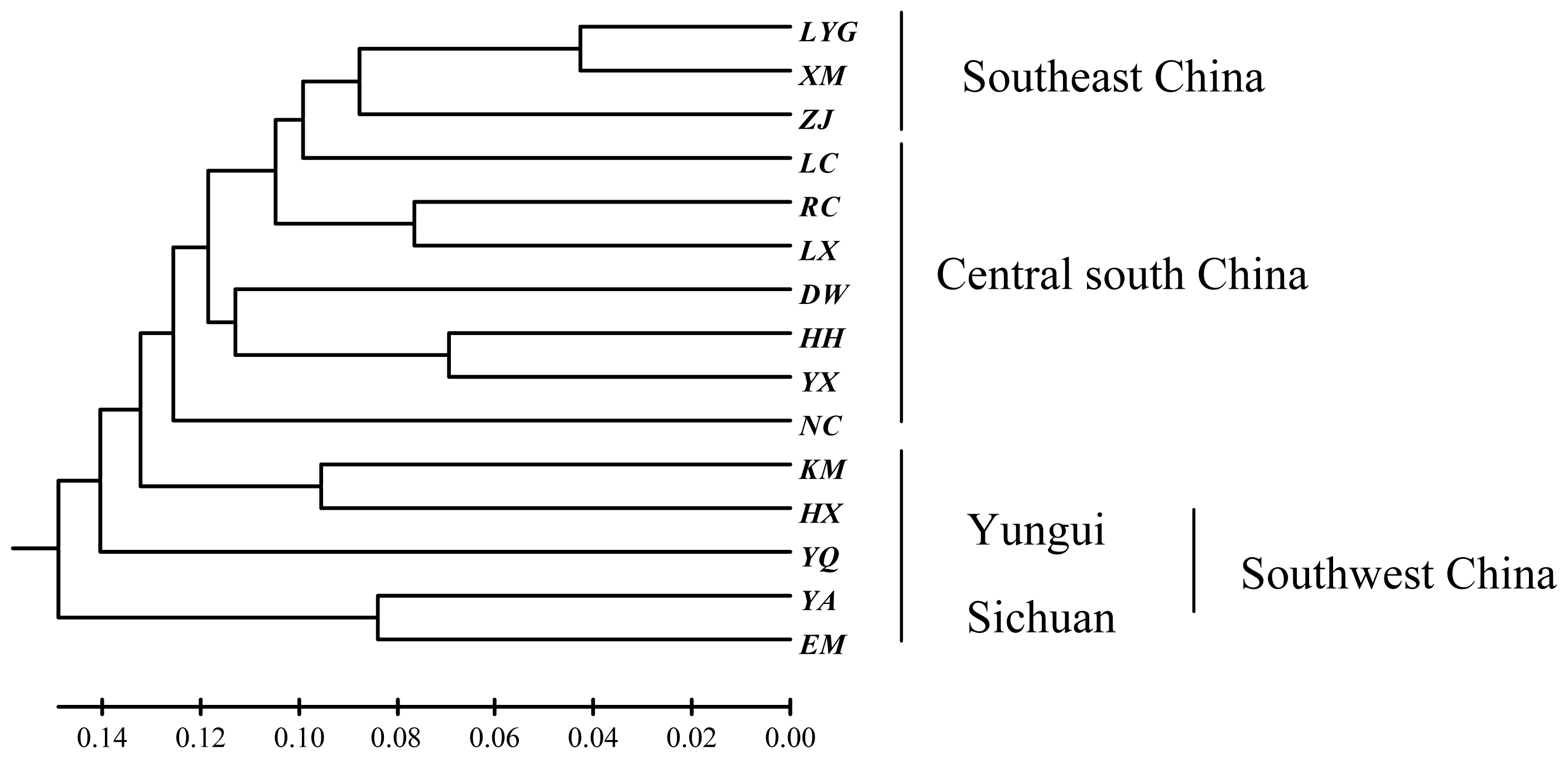
<p>A UPGMA dendrogram based on Nei’s (1972) genetic distance indicated that the 15 populations were clustered into four geographically distinct groups, including Sichuan basin (EM, YA and YQ), Yungui Plateau (KM and HX), central south China (HH, YX and DW) and southeast China (LX, LC, ZJ, XM and LYG) (<xref ref-type="fig" rid="f1-ijms-13-08159">Figure 1</xref>). The Mantel tests indicated that there was no significant associated relationship between genetic distance and geographic distance among populations in <italic>H. cordata</italic> (<italic>r</italic> = 0.0400, <italic>p</italic> = 0.3760).</p></sec></sec>
<sec sec-type="discussion">
<title>3. Discussion</title>
<sec sec-type="methods">
<title>3.1. Genetic Structure in H. cordata</title>
<p>The genetic structure of plant populations reflects interactions amongst a range of different processes, including the long-term evolutionary history of the species (such as shifts in distribution, habitat fragmentation and population isolation), mutation, genetic drift, mating systems, as well as gene flow and selection [<xref ref-type="bibr" rid="b15-ijms-13-08159">15</xref>]. In this study, the genetic structure of <italic>H. cordata</italic> was generally characterized by high genetic variation at species level (Shannon indices of 0.4338 and Nei’s gene diversity of 0.2820) and low genetic variation within population (0.1413 and 0.0923 on average, respectively). These results were similar to those obtained using other molecular markers (such as RAPD and SSR) previously in a much smaller sample size [<xref ref-type="bibr" rid="b16-ijms-13-08159">16</xref>]. This herb survived and adapted as a result of agamic reproduction in the central and southern areas of the Northern Hemisphere during late tertiary to early quaternary [<xref ref-type="bibr" rid="b1-ijms-13-08159">1</xref>]. At the glacial maxima, <italic>H. cordata</italic> was restricted to refugia with an endurable temperature, and such areas were expected to be small. One of the major genetic consequences of long-term habitation at a small population size is high levels of genetic drift [<xref ref-type="bibr" rid="b17-ijms-13-08159">17</xref>,<xref ref-type="bibr" rid="b18-ijms-13-08159">18</xref>]. This factor could be, at least partially, responsible for the low genetic variation within population and high genetic variation among populations.</p>
<p>The individuals in different regions were not from the same migratory routes derived from distinct sister groups that once lived in the refuge. In the present study, 15 sampled populations were collected from 13 provinces in China. Latitude and longitude of the areas vary from 21°12′ (N) to 34°36′ (N) and from 101°31′ (E) to 119°36′ (E), respectively. Different geographical distribution ranges, the intricate landform and the weather conditions of the sampled populations might have limited migration. In this study, the coefficient of genetic differentiation (<italic>G</italic><italic><sub>ST</sub></italic>) of the species was 0.6728, the proportion of diversity among populations based on the Shannon indices was similarly high (67.42%); correspondingly, the estimate of gene flow (Nm) is low (0.2431); and the AMOVA test also showed that there was high genetic diversity among populations (77%) and low genetic diversity within the population (23%). <italic>H. cordata</italic> is a relic of its agamic race [<xref ref-type="bibr" rid="b1-ijms-13-08159">1</xref>], and the plant is small and short. This constrains gene flow via seed and pollen dispersal, and thus the plant fails to reproduce extraneously in each highly isolated population. Cytological examinations revealed that <italic>H. cordata</italic> is a polyploidy complex with 36 to 126 chromosomes [<xref ref-type="bibr" rid="b19-ijms-13-08159">19</xref>], which hinders gene exchanges among populations harboring different numbers of chromosomes. Therefore, these patterns of variation are due not to ongoing gene flow, but rather to historical association among populations. According to the geographical distribution and the affinities shown in the UPGMA dendrogram (<xref ref-type="fig" rid="f1-ijms-13-08159">Figure 1</xref>), <italic>H. cordata</italic> might have survived in Southwest China during the last Pleistocene glaciation. The route extended southeastward of Southwest China along the Yungui Plateau Range, where the present distribution pattern appeared. The strong differentiation among populations may be mainly due to subsequent genetic drift and natural selection. Genetic drift changes the distribution of genetic variation either by reducing variation within a population or by increasing the differentiation among populations [<xref ref-type="bibr" rid="b18-ijms-13-08159">18</xref>]. Although the UPGMA dendrogram (<xref ref-type="fig" rid="f1-ijms-13-08159">Figure 1</xref>) indicated that the distribution of <italic>H. cordata</italic> in China took on an overall pattern of eastward expansion, the lack of significant correlation between genetic distance and geographical distance supports the hypothesis of historical relationships and the subsequent action of genetic drift accounts for current-day patterns of variation.</p></sec>
<sec>
<title>3.2. Implication for Taxonomy</title>
<p>A new species <italic>H. emeiensis</italic> Z.Y. Zhu and S. L. Zhang in the genus <italic>Houttuynia</italic> was collected at E’mei mountain in Sichuan province, China, and classified by Zhu and Zhang according to the color of the stem, the width and length of the inflorescence, and the number of flowers and bract [<xref ref-type="bibr" rid="b20-ijms-13-08159">20</xref>]. However, in this study, Nei’s original measures of genetic distance (<xref ref-type="table" rid="t2-ijms-13-08159">Table 2</xref>) and the UPGMA dendrogram (<xref ref-type="fig" rid="f1-ijms-13-08159">Figure 1</xref>) failed to provide support for their conclusions. The largest and the smallest genetic distances between EM and other populations was 0.3659 (KM) and 0.1679 (YA), respectively, with a mean of 0.2882 ± 0.0608. The overall correlation between genetic differentiation and geographical distance was weak. Cluster analysis showed strong correlations between EM and YA, YQ and NC, KM and HX, as well as RC and LX. EM was not classified as one group based on ISSR markers. Since <italic>H. emeiensis</italic> (EM) did not stand alone in these analyses, it is necessary to deliberate in classifying it as a new species.</p></sec>
<sec>
<title>3.3. Implication for Conservation</title>
<p>Our results also provide theory for further protection of the germplasm resources. The low levels of genetic diversity within a population and the low gene flow among populations point towards the possibility of the possession of unique genotypes in a single population that are not found in other populations. It is therefore imperative for conservation planners, when designing conservation strategies for wild populations of <italic>H. cordata</italic> in China, to ensure that as many as possible separate populations are targeted for conservation rather than a few selected populations. <italic>Ex situ</italic> conservation may also be appropriate, because the total genetic diversity in a population of <italic>H. cordata</italic> may be adequately captured in only a few plants from the wild, which would not be the case for species with high levels of genetic diversity within a population. It would be beneficial to find ways to strengthen the gene flow between populations to maintain the natural genetic variation of <italic>H. cordata</italic>. Considering the high genetic differentiation among the wild populations, preservation of only a few populations may not adequately protect the genetic variation within the species in central China. Therefore, several populations throughout the entire range of the species in the country should be considered for conservation.</p></sec></sec>
<sec>
<title>4. Experimental Section</title>
<sec>
<title>4.1. Sample Collection</title>
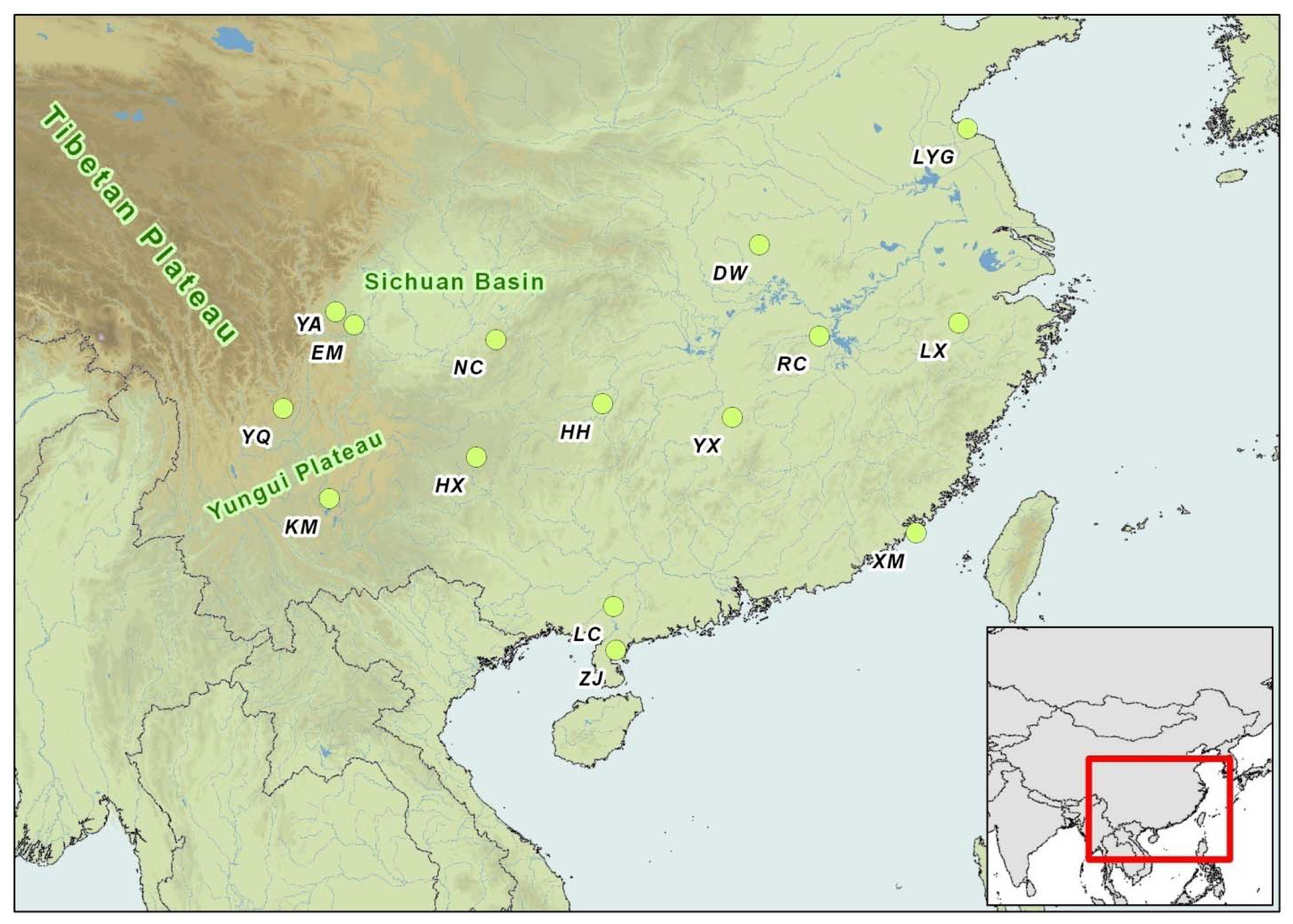
<p>Leaf samples were collected from 266 individuals of <italic>H. cordata</italic> Thunb from 15 populations located in the natural distribution of the species in 13 provinces of China (<xref ref-type="table" rid="t4-ijms-13-08159">Table 4</xref> and <xref ref-type="fig" rid="f2-ijms-13-08159">Figure 2</xref>). The samples were taken from individuals at least 2 km apart in each population to avoid sampling clonal relatives. Leaves were dried, and preserved in silica gel until DNA extraction.</p></sec>
<sec>
<title>4.2. DNA Extraction, PCR Amplification and Electrophoresis</title>
<p>Genomic DNA was extracted from the leaves of each individual using CTAB protocol [<xref ref-type="bibr" rid="b21-ijms-13-08159">21</xref>], dissolved in double distilled water, and quantified using a spectrophotometer comparing band intensities with known standards of lambda DNA on 1.5% agarose gels. In a preliminary experiment, 100 ISSR primers (designed by the University of British Columbia (UBC), Vancouver, Canada) were tested on five random individuals from all the populations. Ten primers (USB #807(AG)<sub>8</sub>T, #808(AG)<sub>8</sub>C, #810(GA)<sub>8</sub>, # 811(GA)<sub>8</sub>C, #812(GA)<sub>8</sub>A, #825(AC)<sub>8</sub>T, #826(AC)<sub>8</sub>C, #848(CA)<sub>8</sub>RG, #850(GT)<sub>8</sub>YC, and #873(GACA)<sub>4</sub>) that produced clear bands were chosen for all the 266 individuals in subsequent PCR reactions. For each primer analyzed, amplification was repeated once in the same situation to test the reproducibility of the ISSR bands, with a sample composed of two or three individuals selected randomly from each population.</p>
<p>PCR amplification was performed in a 10-μL reaction volume containing about 20 ng of template DNA, 1.0 μL 10× PCR buffer, 2.0–2.2 mM MgCl<sub>2</sub>, 0.21 mM dNTPs, 200 nM primers, 1.0 unit of Taq polymerase and double-distilled water. Amplification was performed in a PTC-100 thermal cycler (MJ Research, Inc.) programmed for an initial step of 3 min at 94 °C, followed by 35 cycles of 1 min at 94 °C, 1 min at 50 °C or 52 °C and 1.5 min at 72 °C, and a final 8 min extension at 72 °C. A negative control reaction without template DNA was also included to verify the absence of contamination. PCR products were separated in 1.2% agarose gels buffered with 1× TBE. Only bands reproducible in different PCR reactions were further analyzed. Bands with similar migration distance amplified from different individuals were considered homologous. A positive control (PCR products amplified from a standard individual) and a Gene Ruler DNA 100 bp ladder (Bio Basic Inc.) were run on each gel for homology assessments of PCR products on different gels.</p></sec>
<sec>
<title>4.3. Statistical Analyses</title>
<p>The presence or absence of a PCR band was scored as 1 or 0, respectively. Two people scored the bands together in order to minimize the scoring of artificial bands. Only bands that were consistently amplified were considered, while smearing and weak bands were excluded. We refrained from pruning the loci that fulfilled Lynch and Milligan’s [<xref ref-type="bibr" rid="b22-ijms-13-08159">22</xref>] criterion because that might lead to significant bias in the estimation of population genetic parameters [<xref ref-type="bibr" rid="b23-ijms-13-08159">23</xref>]. This bias was substantially eliminated if a high number of polymorphic dominant markers were generated [<xref ref-type="bibr" rid="b24-ijms-13-08159">24</xref>]. Statistical analyses of ISSR patterns were based on the following assumptions: (1) ISSR fragments behave as diploid, and the dominant marker alleles are either present (amplified) or absent (non-amplified); (2) co-migrating fragments represent homologous loci; (3) polymorphic loci are inherited in a nuclear (Mendelian) fashion [<xref ref-type="bibr" rid="b25-ijms-13-08159">25</xref>]; and (4) populations are in Hardy-Weinberg equilibrium (HWE; Fis = 0).</p>
<p>Four genetic diversity parameters were analyzed using POPGENE (version 1.31) [<xref ref-type="bibr" rid="b26-ijms-13-08159">26</xref>]: effective number of alleles (<italic>Ne</italic>), Nei’s gene diversity (<italic>H</italic>) [<xref ref-type="bibr" rid="b27-ijms-13-08159">27</xref>], Shannon’s Information index (<italic>I</italic>) [<xref ref-type="bibr" rid="b28-ijms-13-08159">28</xref>], and percentage of polymorphic loci (<italic>P</italic><italic><sub>p</sub></italic>). To examine population genetic structure, the proportion of genetic divergence was estimated within and among populations as described by Nei [<xref ref-type="bibr" rid="b27-ijms-13-08159">27</xref>], and <italic>G</italic><italic><sub>ST</sub></italic> was designated as the coefficient of gene differentiation among populations. The genetic identity (<italic>G</italic><italic><sub>I</sub></italic>) and the genetic distance (<italic>G</italic><italic><sub>D</sub></italic>) among populations were also computed using the model presented by Nei [<xref ref-type="bibr" rid="b17-ijms-13-08159">17</xref>]. Gene flow estimates (<italic>Nm</italic>) were calculated as <italic>Nm = (1</italic> – <italic>G</italic><italic><sub>ST</sub></italic><italic>)/4G</italic><italic><sub>ST</sub></italic> [<xref ref-type="bibr" rid="b29-ijms-13-08159">29</xref>]. Differentiation among population was analyzed with an analysis of molecular variance (AMOVA) using Genalex 6.1 based on 999 permutations. The AMOVA procedure in Genalex follows the methods of Excoffier <italic>et al.</italic> 1992, which estimates and partitions total molecular variance within and between populations and then tests the significance of partitioned variance components using permutational testing procedures. When the data are binary, AMOVA calculates the ΦPT value, which is analogous to Fst representing the proportion of the total variance among populations [<xref ref-type="bibr" rid="b30-ijms-13-08159">30</xref>–<xref ref-type="bibr" rid="b32-ijms-13-08159">32</xref>].</p>
<p>An unweighted pair group method using an arithmetic average (UPGMA) dendrogram was performed on the data matrix of mean character difference between pairs of samples with software MEGA version 2.1 (downloaded from the website at <ext-link xlink:href="http://www.oup-usa.org/sc/0195135857" ext-link-type="uri">http://www.oup-usa.org/sc/0195135857</ext-link>). The relationship between latitude and longitude and the molecular indices was calculated as a two-polynomial regression. Correlations were calculated with software SAS version 6.12.</p>
<p>Finally, a Mantel correlation test [<xref ref-type="bibr" rid="b33-ijms-13-08159">33</xref>] was applied, by using GenAlEx 6, to a matrix of pairwise geographic and pairwise genetic distances, with 999 random permutations to determine significance.</p></sec></sec>
<sec sec-type="conclusions">
<title>5. Conclusions</title>
<p>In summary, ISSR analysis revealed low genetic variations within a population but high genetic differentiations among populations in the medical herb <italic>H. cordata</italic> in China. This genetic structure probably reflected the historical association among populations, and subsequent severe genetic drift of small and isolated populations further promoting random divergence among populations. The observed genetic structure of the populations implies that as many populations as possible should be considered for both <italic>in situ</italic> and <italic>ex situ</italic> conservation practices on this species.</p></sec></body>
<back>
<ack>
<title>Acknowledgments</title>
<p>We sincerely thank Xiao Long-qian and Li Hong-Tao for their help in data analysis and many helpful discussions and constructive suggestions. Thanks also go to two anonymous reviewers for valuable suggestions and comments. This work was supported by National Natural Science Foundation of China (No. 30870230) and the Foundation of Hunan Key Discipline Construction Projects.</p></ack>
<ref-list>
<title>References</title>
<ref id="b1-ijms-13-08159"><label>1</label><citation citation-type="journal"><person-group person-group-type="author"><name><surname>Liang</surname><given-names>H.X.</given-names></name></person-group><article-title>On the evolution and distribution in Saururaceae</article-title><source>Acta Bot. Yunnanica</source><year>1995</year><volume>17</volume><fpage>255</fpage><lpage>267</lpage></citation></ref>
<ref id="b2-ijms-13-08159"><label>2</label><citation citation-type="book"><person-group person-group-type="author"><name><surname>Fang</surname><given-names>W.P.</given-names></name></person-group><source>Flora Sichuanica</source><publisher-name>Sichuan People Press</publisher-name><publisher-loc>Chengdu, China</publisher-loc><year>1981</year><volume>1</volume><fpage>126</fpage><lpage>127</lpage></citation></ref>
<ref id="b3-ijms-13-08159"><label>3</label><citation citation-type="book"><person-group person-group-type="author"><name><surname>Tseng</surname><given-names>Y.C.</given-names></name></person-group><source>Florae Reipublicae Popularis Sinicae</source><publisher-name>Science Press</publisher-name><publisher-loc>Beijing, China</publisher-loc><year>1982</year><volume>20</volume><fpage>8</fpage></citation></ref>
<ref id="b4-ijms-13-08159"><label>4</label><citation citation-type="journal"><person-group person-group-type="author"><name><surname>Mihara</surname><given-names>T.</given-names></name></person-group><article-title>On the reduction division of Houttuynia cordata Thunb</article-title><source>Bot. Mag. Tokyo</source><year>1960</year><volume>73</volume><fpage>498</fpage></citation></ref>
<ref id="b5-ijms-13-08159"><label>5</label><citation citation-type="journal"><person-group person-group-type="author"><name><surname>Shibata</surname><given-names>K.</given-names></name><name><surname>Miyake</surname><given-names>H.</given-names></name></person-group><article-title>Ueber Parthenogenesis bei <italic>Houttuynia cordata</italic></article-title><source>Bot. Mag. Tokyo</source><year>1908</year><volume>22</volume><fpage>141</fpage><lpage>144</lpage></citation></ref>
<ref id="b6-ijms-13-08159"><label>6</label><citation citation-type="journal"><person-group person-group-type="author"><name><surname>Lu</surname><given-names>H.M.</given-names></name><name><surname>Liang</surname><given-names>Y.Z.</given-names></name><name><surname>Yi</surname><given-names>L.Z.</given-names></name><name><surname>Wu</surname><given-names>X.J.</given-names></name></person-group><article-title>Anti-inflammatory effect of <italic>Houttuynia cordata</italic> injection</article-title><source>J. Ethnopharmacol</source><year>2006</year><volume>104</volume><fpage>245</fpage><lpage>249</lpage><pub-id pub-id-type="doi">10.1016/j.jep.2005.09.012</pub-id><pub-id pub-id-type="pmid">16213118</pub-id></citation></ref>
<ref id="b7-ijms-13-08159"><label>7</label><citation citation-type="journal"><person-group person-group-type="author"><name><surname>Hayashi</surname><given-names>K.</given-names></name><name><surname>Kamiya</surname><given-names>M.</given-names></name><name><surname>Hayashi</surname><given-names>T.</given-names></name></person-group><article-title>Virucidal effects of the steam distillate from <italic>Houttuynia cordata</italic> and its components on HSV-1, influenza virus, and HIV</article-title><source>Planta Med</source><year>1995</year><volume>61</volume><fpage>237</fpage><lpage>241</lpage><pub-id pub-id-type="doi">10.1055/s-2006-958063</pub-id><pub-id pub-id-type="pmid">7617766</pub-id></citation></ref>
<ref id="b8-ijms-13-08159"><label>8</label><citation citation-type="journal"><person-group person-group-type="author"><name><surname>Wallace</surname><given-names>L.E.</given-names></name></person-group><article-title>Examining the effects of fragmentation on genetic variation in <italic>Platanthera leucophaea</italic> (Orchidaceae): Inferences from allozyme and random amplified polymorphic DNA markers</article-title><source>Plant Species Biol</source><year>2002</year><volume>17</volume><fpage>37</fpage><lpage>49</lpage><pub-id pub-id-type="doi">10.1046/j.1442-1984.2002.00072.x</pub-id></citation></ref>
<ref id="b9-ijms-13-08159"><label>9</label><citation citation-type="journal"><person-group person-group-type="author"><name><surname>Begoña</surname><given-names>R.M.</given-names></name><name><surname>Sergio</surname><given-names>G.</given-names></name><name><surname>Nebauer</surname><given-names>E.S.</given-names></name><name><surname>Joel</surname><given-names>A.</given-names></name><name><surname>Caligari</surname><given-names>P.S.</given-names></name><name><surname>Egura</surname><given-names>J.</given-names></name></person-group><article-title>Genetic diversity and structure of natural and managed populations of <italic>Cedrus atlantica</italic> (Pinaceae) assessed using random amplified polymorphic DNA</article-title><source>Am. J. Bot</source><year>2005</year><volume>92</volume><fpage>875</fpage><lpage>884</lpage><pub-id pub-id-type="doi">10.3732/ajb.92.5.875</pub-id><pub-id pub-id-type="pmid">21652469</pub-id></citation></ref>
<ref id="b10-ijms-13-08159"><label>10</label><citation citation-type="journal"><person-group person-group-type="author"><name><surname>Wu</surname><given-names>W.</given-names></name><name><surname>Zheng</surname><given-names>Y.L.</given-names></name><name><surname>Chen</surname><given-names>L.</given-names></name><name><surname>Yang</surname><given-names>R.W.</given-names></name><name><surname>Yan</surname><given-names>Z.H.</given-names></name><name><surname>Wei</surname><given-names>Y.M.</given-names></name></person-group><article-title>Isozymes variations among the germplasm resources of <italic>Houttuynia</italic> in Sichuan</article-title><source>J. Chin. Med. Mater</source><year>2002</year><volume>25</volume><fpage>695</fpage><lpage>698</lpage></citation></ref>
<ref id="b11-ijms-13-08159"><label>11</label><citation citation-type="journal"><person-group person-group-type="author"><name><surname>Wu</surname><given-names>W.</given-names></name><name><surname>Zheng</surname><given-names>Y.L.</given-names></name><name><surname>Yang</surname><given-names>R.W.</given-names></name><name><surname>Chen</surname><given-names>L.</given-names></name><name><surname>Wei</surname><given-names>Y.M.</given-names></name></person-group><article-title>Variation of the chromosome number and cytomixis of <italic>Houttuynia cordata</italic> from China</article-title><source>Acta Phytotaxonomica Sinica</source><year>2003</year><volume>41</volume><fpage>245</fpage><lpage>257</lpage></citation></ref>
<ref id="b12-ijms-13-08159"><label>12</label><citation citation-type="journal"><person-group person-group-type="author"><name><surname>Fang</surname><given-names>D.Q.</given-names></name><name><surname>Roose</surname><given-names>M.L.</given-names></name><name><surname>Krueger</surname><given-names>R.R.</given-names></name><name><surname>Federici</surname><given-names>C.T.</given-names></name></person-group><article-title>Fingerprinting trifoliate orange germ plasm accessions with isozymes, RFLPs, and inter-simple sequences repeat marker</article-title><source>Theor. Appl. Genet</source><year>1997</year><volume>95</volume><fpage>211</fpage><lpage>219</lpage><pub-id pub-id-type="doi">10.1007/s001220050550</pub-id></citation></ref>
<ref id="b13-ijms-13-08159"><label>13</label><citation citation-type="journal"><person-group person-group-type="author"><name><surname>Moreno</surname><given-names>S.</given-names></name><name><surname>Martin</surname><given-names>J.P.</given-names></name><name><surname>Ortiz</surname><given-names>J.M.</given-names></name></person-group><article-title>Inter-simple sequence repeats PCR for characterization of closely related grapevine germplasm</article-title><source>Euphytica</source><year>1998</year><volume>101</volume><fpage>117</fpage><lpage>125</lpage><pub-id pub-id-type="doi">10.1023/A:1018379805873</pub-id></citation></ref>
<ref id="b14-ijms-13-08159"><label>14</label><citation citation-type="journal"><person-group person-group-type="author"><name><surname>Nybom</surname><given-names>H.</given-names></name><name><surname>Bartish</surname><given-names>I.V.</given-names></name></person-group><article-title>Effects of life history traits and sampling strategies on genetic diversity estimates obtained with RAPD markers in plants</article-title><source>Perspect. Plant Ecol. Evol. Syst</source><year>2000</year><volume>31</volume><fpage>93</fpage><lpage>114</lpage></citation></ref>
<ref id="b15-ijms-13-08159"><label>15</label><citation citation-type="journal"><person-group person-group-type="author"><name><surname>Schaal</surname><given-names>B.A.</given-names></name><name><surname>Hayworth</surname><given-names>D.A.</given-names></name><name><surname>Olsen</surname><given-names>K.M.</given-names></name><name><surname>Rauscher</surname><given-names>J.T.</given-names></name><name><surname>Smith</surname><given-names>W.A.</given-names></name></person-group><article-title>Phylogeographic studies in plants: Problems and prospects</article-title><source>Mol. Ecol</source><year>1998</year><volume>7</volume><fpage>465</fpage><lpage>474</lpage><pub-id pub-id-type="doi">10.1046/j.1365-294x.1998.00318.x</pub-id></citation></ref>
<ref id="b16-ijms-13-08159"><label>16</label><citation citation-type="journal"><person-group person-group-type="author"><name><surname>Wu</surname><given-names>W.</given-names></name><name><surname>Zheng</surname><given-names>Y.L.</given-names></name><name><surname>Chen</surname><given-names>L.</given-names></name><name><surname>Wei</surname><given-names>Y.M.</given-names></name><name><surname>Yan</surname><given-names>Z.H.</given-names></name><name><surname>Yang</surname><given-names>R.W.</given-names></name></person-group><article-title>PCR-RFLP analysis of cpDNA and mtDNA in the genus Houttuynia in some areas of China</article-title><source>Hereditas</source><year>2005</year><volume>142</volume><fpage>1</fpage><lpage>9</lpage><pub-id pub-id-type="pmid">16970604</pub-id></citation></ref>
<ref id="b17-ijms-13-08159"><label>17</label><citation citation-type="book"><person-group person-group-type="author"><name><surname>Barrett</surname><given-names>S.C.H.</given-names></name><name><surname>Kohn</surname><given-names>J.K.</given-names></name></person-group><article-title>Genetic and Evolutionary Consequences of Small Population Size in Plants: Implications for Conservation</article-title><source>Genetics and Conservation of Rare Plants</source><person-group person-group-type="editor"><name><surname>Falk</surname><given-names>D.A.</given-names></name><name><surname>Holsinger</surname><given-names>K.E.</given-names></name></person-group><publisher-name>Oxford University Press</publisher-name><publisher-loc>New York, NY, USA</publisher-loc><year>1991</year></citation></ref>
<ref id="b18-ijms-13-08159"><label>18</label><citation citation-type="journal"><person-group person-group-type="author"><name><surname>Ellstrand</surname><given-names>N.C.</given-names></name><name><surname>Elam</surname><given-names>D.R.</given-names></name></person-group><article-title>Population genetic consequences of small population size: Implication for plant conservation</article-title><source>Annu. Rev. Ecol. Syst</source><year>1993</year><volume>24</volume><fpage>217</fpage><lpage>242</lpage><pub-id pub-id-type="doi">10.1146/annurev.es.24.110193.001245</pub-id></citation></ref>
<ref id="b19-ijms-13-08159"><label>19</label><citation citation-type="journal"><person-group person-group-type="author"><name><surname>Wu</surname><given-names>W.</given-names></name><name><surname>Zheng</surname><given-names>Y.L.</given-names></name><name><surname>Chen</surname><given-names>L.</given-names></name><name><surname>Wei</surname><given-names>Y.M.</given-names></name><name><surname>Yan</surname><given-names>Z.H.</given-names></name><name><surname>Yang</surname><given-names>R.W.</given-names></name></person-group><article-title>RAPD analysis on the germplasm resources of herba <italic>Houttuynia</italic></article-title><source>Acta Pharm. Sin</source><year>2002</year><volume>37</volume><fpage>986</fpage><lpage>992</lpage></citation></ref>
<ref id="b20-ijms-13-08159"><label>20</label><citation citation-type="journal"><person-group person-group-type="author"><name><surname>Zhu</surname><given-names>Z.Y.</given-names></name><name><surname>Zhang</surname><given-names>S.L.</given-names></name></person-group><article-title>A new species of <italic>Houttuynia</italic> medicinal plants in Emeishan</article-title><source>Bull. Bot. Res</source><year>2001</year><volume>21</volume><fpage>1</fpage><lpage>2</lpage></citation></ref>
<ref id="b21-ijms-13-08159"><label>21</label><citation citation-type="book"><person-group person-group-type="author"><name><surname>Doyle</surname><given-names>J.</given-names></name></person-group><article-title>DNA Protocols for Plants CTAB Total DNA Isolation</article-title><source>Molecular Techniques in Taxonomy</source><person-group person-group-type="editor"><name><surname>Hewitt</surname><given-names>G.M.</given-names></name><name><surname>Johnston</surname><given-names>A.</given-names></name></person-group><publisher-name>Springer</publisher-name><publisher-loc>Berlin, Germany</publisher-loc><year>1991</year></citation></ref>
<ref id="b22-ijms-13-08159"><label>22</label><citation citation-type="journal"><person-group person-group-type="author"><name><surname>Lynch</surname><given-names>M.</given-names></name><name><surname>Milligan</surname><given-names>B.G.</given-names></name></person-group><article-title>Analysis of population genetic structure with RAPD markers</article-title><source>Mol. Ecol</source><year>1994</year><volume>3</volume><fpage>91</fpage><lpage>99</lpage><pub-id pub-id-type="doi">10.1111/j.1365-294X.1994.tb00109.x</pub-id><pub-id pub-id-type="pmid">8019690</pub-id></citation></ref>
<ref id="b23-ijms-13-08159"><label>23</label><citation citation-type="journal"><person-group person-group-type="author"><name><surname>Lee</surname><given-names>S.W.</given-names></name><name><surname>Ledig</surname><given-names>F.T.</given-names></name><name><surname>Johnson</surname><given-names>D.R.</given-names></name></person-group><article-title>Genetic variation at allozyme and RAPD markers in <italic>Pinus longaeva</italic> (Pinaceae) of the White Mountains, California</article-title><source>Am. J. Bot</source><year>2002</year><volume>89</volume><fpage>566</fpage><lpage>577</lpage><pub-id pub-id-type="doi">10.3732/ajb.89.4.566</pub-id><pub-id pub-id-type="pmid">21665657</pub-id></citation></ref>
<ref id="b24-ijms-13-08159"><label>24</label><citation citation-type="journal"><person-group person-group-type="author"><name><surname>Krauss</surname><given-names>S.L.</given-names></name></person-group><article-title>Accurate gene diversity estimates from amplified fragment length polymorphism (AFLP) markers</article-title><source>Mol. Ecol</source><year>2000</year><volume>9</volume><fpage>1241</fpage><lpage>1245</lpage><pub-id pub-id-type="doi">10.1046/j.1365-294x.2000.01001.x</pub-id><pub-id pub-id-type="pmid">10972764</pub-id></citation></ref>
<ref id="b25-ijms-13-08159"><label>25</label><citation citation-type="journal"><person-group person-group-type="author"><name><surname>Arafeh</surname><given-names>R.M.H.</given-names></name><name><surname>Sapir</surname><given-names>Y.</given-names></name><name><surname>Shmida</surname><given-names>A.</given-names></name><name><surname>Iraki</surname><given-names>N.</given-names></name><name><surname>Fragman</surname><given-names>O.</given-names></name><name><surname>Comes</surname><given-names>H.P.</given-names></name></person-group><article-title>Patterns of genetic and phenotypic variation in Iris haynei and I. atrofusca (Iris sect. Oncocyclus 5 the Royal Irises) along an ecogeographical gradient in Israel and the West Bank</article-title><source>Mol. Ecol</source><year>2002</year><volume>11</volume><fpage>39</fpage><lpage>53</lpage><pub-id pub-id-type="doi">10.1046/j.0962-1083.2001.01417.x</pub-id><pub-id pub-id-type="pmid">11903903</pub-id></citation></ref>
<ref id="b26-ijms-13-08159"><label>26</label><citation citation-type="book"><person-group person-group-type="author"><name><surname>Yeh</surname><given-names>F.C.</given-names></name><name><surname>Yang</surname><given-names>R.C.</given-names></name><name><surname>Boyle</surname><given-names>T</given-names></name></person-group><source>POPGENE Microsoft Windows-Based Freeware for Population Genetic Analysis. Release 1.31</source><publisher-name>University of Alberta</publisher-name><publisher-loc>Edmonton, Canada</publisher-loc><year>1999</year></citation></ref>
<ref id="b27-ijms-13-08159"><label>27</label><citation citation-type="journal"><person-group person-group-type="author"><name><surname>Nei</surname><given-names>M.</given-names></name></person-group><article-title>Analysis of gene diversity in subdivided populations</article-title><source>Proc. Natl. Acad. Sci. USA</source><year>1973</year><volume>70</volume><fpage>3321</fpage><lpage>3323</lpage><pub-id pub-id-type="doi">10.1073/pnas.70.12.3321</pub-id><pub-id pub-id-type="pmid">4519626</pub-id></citation></ref>
<ref id="b28-ijms-13-08159"><label>28</label><citation citation-type="journal"><person-group person-group-type="author"><name><surname>Lewontin</surname><given-names>R.C.</given-names></name></person-group><article-title>The apportionment of human diversity</article-title><source>Evol. Biol</source><year>1972</year><volume>6</volume><fpage>381</fpage><lpage>394</lpage></citation></ref>
<ref id="b29-ijms-13-08159"><label>29</label><citation citation-type="journal"><person-group person-group-type="author"><name><surname>Slatkin</surname><given-names>M.</given-names></name><name><surname>Barton</surname><given-names>N.H.</given-names></name></person-group><article-title>A comparison of three indirect methods for estimating average levels of gene flow</article-title><source>Evolution</source><year>1989</year><volume>43</volume><fpage>1349</fpage><lpage>1368</lpage><pub-id pub-id-type="doi">10.2307/2409452</pub-id></citation></ref>
<ref id="b30-ijms-13-08159"><label>30</label><citation citation-type="journal"><person-group person-group-type="author"><name><surname>Excoffier</surname><given-names>L.</given-names></name><name><surname>Smouse</surname><given-names>P.E.</given-names></name><name><surname>Quattro</surname><given-names>J.M.</given-names></name></person-group><article-title>Analysis of molecular variance inferred from metric distances among DNA haplotypes: Application to human mitochondrial DNA restriction data</article-title><source>Genetics</source><year>1992</year><volume>131</volume><fpage>479</fpage><lpage>491</lpage><pub-id pub-id-type="pmid">1644282</pub-id></citation></ref>
<ref id="b31-ijms-13-08159"><label>31</label><citation citation-type="journal"><person-group person-group-type="author"><name><surname>Huff</surname><given-names>D.R.</given-names></name></person-group><article-title>RAPD characterization of heterogeneous perennial ryegrass populations</article-title><source>Crop Sci</source><year>1997</year><volume>37</volume><fpage>557</fpage><lpage>564</lpage><pub-id pub-id-type="doi">10.2135/cropsci1997.0011183X003700020041x</pub-id></citation></ref>
<ref id="b32-ijms-13-08159"><label>32</label><citation citation-type="journal"><person-group person-group-type="author"><name><surname>Peakall</surname><given-names>R.</given-names></name><name><surname>Smouse</surname><given-names>P.E.</given-names></name></person-group><article-title>GENALEX 6: Genetic analysis in Excel. Population genetic software for teaching and research</article-title><source>Mol. Ecol. Notes</source><year>2006</year><volume>6</volume><fpage>288</fpage><lpage>295</lpage><pub-id pub-id-type="doi">10.1111/j.1471-8286.2005.01155.x</pub-id></citation></ref>
<ref id="b33-ijms-13-08159"><label>33</label><citation citation-type="journal"><person-group person-group-type="author"><name><surname>Mantel</surname><given-names>N.</given-names></name></person-group><article-title>The detection of disease clustering and a generalized regression approach</article-title><source>Cancer Res</source><year>1967</year><volume>27</volume><fpage>209</fpage><lpage>220</lpage><pub-id pub-id-type="pmid">6018555</pub-id></citation></ref></ref-list>
<sec sec-type="display-objects">
<title>Figures and Tables</title>
<fig id="f1-ijms-13-08159" position="float">
<label>Figure 1</label>
<caption>
<p>UPGMA dendrogram based on Nei’s (1972) genetic distance.</p></caption>
<graphic xlink:href="ijms-13-08159f1.gif"/></fig>
<fig id="f2-ijms-13-08159" position="float">
<label>Figure 2</label>
<caption>
<p>Locations of the sampled populations of <italic>H. cordata</italic>.</p></caption>
<graphic xlink:href="ijms-13-08159f2.gif"/></fig>
<table-wrap id="t1-ijms-13-08159" position="float">
<label>Table 1</label>
<caption>
<p>Molecular variation measured as effective number of alleles (<italic>N</italic>e), Nei’s (1973) gene diversity (<italic>H</italic>), the Shannon index (<italic>I</italic>), and the percentage of polymorphic bands (<italic>P</italic><sub>p</sub>) per population as well as their Standard deviations (S.D.), population-specific bands (PSB).</p></caption>
<table frame="hsides" rules="groups">
<thead>
<tr>
<th align="center" valign="middle">Pop. ID</th>
<th align="center" valign="middle"><italic>Ne</italic> (S.D.)</th>
<th align="center" valign="middle"><italic>H</italic> (S.D.)</th>
<th align="center" valign="middle"><italic>I</italic> (S.D.)</th>
<th align="center" valign="middle"><italic>P</italic><italic><sub>p</sub></italic></th>
<th align="center" valign="middle">PSB</th></tr></thead>
<tbody>
<tr>
<td align="center" valign="top">LYG</td>
<td align="center" valign="top">1.1981 (0.3149)</td>
<td align="center" valign="top">0.1202 (0.1755)</td>
<td align="center" valign="top">0.1846 (0.2562)</td>
<td align="center" valign="top">40.00%</td>
<td align="center" valign="top">1</td></tr>
<tr>
<td align="center" valign="top">XM</td>
<td align="center" valign="top">1.1274 (0.2552)</td>
<td align="center" valign="top">0.0802 (0.1475)</td>
<td align="center" valign="top">0.1265 (0.2191)</td>
<td align="center" valign="top">30.43%</td>
<td align="center" valign="top">0</td></tr>
<tr>
<td align="center" valign="top">YA</td>
<td align="center" valign="top">1.1069 (0.2486)</td>
<td align="center" valign="top">0.0653 (0.1417)</td>
<td align="center" valign="top">0.1011 (0.2088)</td>
<td align="center" valign="top">23.48%</td>
<td align="center" valign="top">0</td></tr>
<tr>
<td align="center" valign="top">EM</td>
<td align="center" valign="top">1.0741 (0.2290)</td>
<td align="center" valign="top">0.0427 (0.1253)</td>
<td align="center" valign="top">0.0639 (0.1816)</td>
<td align="center" valign="top">13.04%</td>
<td align="center" valign="top">0</td></tr>
<tr>
<td align="center" valign="top">KM</td>
<td align="center" valign="top">1.2556 (0.3574)</td>
<td align="center" valign="top">0.1494 (0.1940)</td>
<td align="center" valign="top">0.2239 (0.2798)</td>
<td align="center" valign="top">42.61%</td>
<td align="center" valign="top">1</td></tr>
<tr>
<td align="center" valign="top">HX</td>
<td align="center" valign="top">1.1263 (0.2690)</td>
<td align="center" valign="top">0.0767 (0.1515)</td>
<td align="center" valign="top">0.1178 (0.2229)</td>
<td align="center" valign="top">25.22%</td>
<td align="center" valign="top">0</td></tr>
<tr>
<td align="center" valign="top">NC</td>
<td align="center" valign="top">1.1460 (0.2913)</td>
<td align="center" valign="top">0.0871 (0.1618)</td>
<td align="center" valign="top">0.1325 (0.2362)</td>
<td align="center" valign="top">27.83%</td>
<td align="center" valign="top">0</td></tr>
<tr>
<td align="center" valign="top">LC</td>
<td align="center" valign="top">1.1491 (0.2757)</td>
<td align="center" valign="top">0.0924 (0.1586)</td>
<td align="center" valign="top">0.1438 (0.2336)</td>
<td align="center" valign="top">33.91%</td>
<td align="center" valign="top">3</td></tr>
<tr>
<td align="center" valign="top">DW</td>
<td align="center" valign="top">1.1964 (0.3439)</td>
<td align="center" valign="top">0.1125 (0.1829)</td>
<td align="center" valign="top">0.1683 (0.2628)</td>
<td align="center" valign="top">32.17%</td>
<td align="center" valign="top">0</td></tr>
<tr>
<td align="center" valign="top">YQ</td>
<td align="center" valign="top">1.1817 (0.3235)</td>
<td align="center" valign="top">0.1057 (0.1783)</td>
<td align="center" valign="top">0.1586 (0.2572)</td>
<td align="center" valign="top">33.04%</td>
<td align="center" valign="top">0</td></tr>
<tr>
<td align="center" valign="top">HH</td>
<td align="center" valign="top">1.1555 (0.2667)</td>
<td align="center" valign="top">0.0998 (0.1541)</td>
<td align="center" valign="top">0.1596 (0.2288)</td>
<td align="center" valign="top">41.74%</td>
<td align="center" valign="top">0</td></tr>
<tr>
<td align="center" valign="top">YX</td>
<td align="center" valign="top">1.1964 (0.3123)</td>
<td align="center" valign="top">0.1198 (0.1732)</td>
<td align="center" valign="top">0.1859 (0.2520)</td>
<td align="center" valign="top">42.61%</td>
<td align="center" valign="top">0</td></tr>
<tr>
<td align="center" valign="top">RC</td>
<td align="center" valign="top">1.1083 (0.2663)</td>
<td align="center" valign="top">0.0630 (0.1471)</td>
<td align="center" valign="top">0.0942 (0.2137)</td>
<td align="center" valign="top">18.26%</td>
<td align="center" valign="top">0</td></tr>
<tr>
<td align="center" valign="top">LX</td>
<td align="center" valign="top">1.0583 (0.1854)</td>
<td align="center" valign="top">0.0364 (0.1085)</td>
<td align="center" valign="top">0.0565 (0.1626)</td>
<td align="center" valign="top">12.17%</td>
<td align="center" valign="top">1</td></tr>
<tr>
<td align="center" valign="top">ZJ</td>
<td align="center" valign="top">1.2272 (0.3463)</td>
<td align="center" valign="top">0.1335 (0.1869)</td>
<td align="center" valign="top">0.2018 (0.2697)</td>
<td align="center" valign="top">40.87%</td>
<td align="center" valign="top">1</td></tr>
<tr>
<td align="center" valign="top">Total</td>
<td align="center" valign="top">1.4622 (0.3210)</td>
<td align="center" valign="top">0.2820 (0.1596)</td>
<td align="center" valign="top">0.4338 (0.2097)</td>
<td align="center" valign="top">97.39%</td>
<td align="center" valign="top">7</td></tr></tbody></table></table-wrap>
<table-wrap id="t2-ijms-13-08159" position="float">
<label>Table 2</label>
<caption>
<p>Nei’s (1972) original measures of genetic identity (above diagonal) and genetic distance (below diagonal).</p></caption>
<table frame="hsides" rules="groups">
<thead>
<tr>
<th align="center" valign="middle">Pop. ID</th>
<th align="center" valign="middle">LYG</th>
<th align="center" valign="middle">XM</th>
<th align="center" valign="middle">YA</th>
<th align="center" valign="middle">EM</th>
<th align="center" valign="middle">KM</th>
<th align="center" valign="middle">HX</th>
<th align="center" valign="middle">NC</th>
<th align="center" valign="middle">LC</th>
<th align="center" valign="middle">DW</th>
<th align="center" valign="middle">YQ</th>
<th align="center" valign="middle">HH</th>
<th align="center" valign="middle">YX</th>
<th align="center" valign="middle">RC</th>
<th align="center" valign="middle">LX</th>
<th align="center" valign="middle">ZJ</th></tr></thead>
<tbody>
<tr>
<td align="center" valign="top">LYG</td>
<td align="center" valign="top">-</td>
<td align="center" valign="top">0.9184</td>
<td align="center" valign="top">0.7467</td>
<td align="center" valign="top">0.7708</td>
<td align="center" valign="top">0.8137</td>
<td align="center" valign="top">0.7494</td>
<td align="center" valign="top">0.8114</td>
<td align="center" valign="top">0.8273</td>
<td align="center" valign="top">0.8431</td>
<td align="center" valign="top">0.7826</td>
<td align="center" valign="top">0.7941</td>
<td align="center" valign="top">0.8273</td>
<td align="center" valign="top">0.8333</td>
<td align="center" valign="top">0.8563</td>
<td align="center" valign="top">0.8571</td></tr>
<tr>
<td align="center" valign="top">XM</td>
<td align="center" valign="top">0.0851</td>
<td align="center" valign="top">-</td>
<td align="center" valign="top">0.7421</td>
<td align="center" valign="top">0.7461</td>
<td align="center" valign="top">0.8168</td>
<td align="center" valign="top">0.7842</td>
<td align="center" valign="top">0.8117</td>
<td align="center" valign="top">0.8484</td>
<td align="center" valign="top">0.8178</td>
<td align="center" valign="top">0.7637</td>
<td align="center" valign="top">0.8075</td>
<td align="center" valign="top">0.8350</td>
<td align="center" valign="top">0.8153</td>
<td align="center" valign="top">0.7976</td>
<td align="center" valign="top">0.8223</td></tr>
<tr>
<td align="center" valign="top">YA</td>
<td align="center" valign="top">0.2921</td>
<td align="center" valign="top">0.2982</td>
<td align="center" valign="top">-</td>
<td align="center" valign="top">0.8454</td>
<td align="center" valign="top">0.6834</td>
<td align="center" valign="top">0.7421</td>
<td align="center" valign="top">0.7413</td>
<td align="center" valign="top">0.7252</td>
<td align="center" valign="top">0.7511</td>
<td align="center" valign="top">0.7213</td>
<td align="center" valign="top">0.7800</td>
<td align="center" valign="top">0.7946</td>
<td align="center" valign="top">0.6960</td>
<td align="center" valign="top">0.7486</td>
<td align="center" valign="top">0.7845</td></tr>
<tr>
<td align="center" valign="top">EM</td>
<td align="center" valign="top">0.2604</td>
<td align="center" valign="top">0.2929</td>
<td align="center" valign="top">0.1679</td>
<td align="center" valign="top">-</td>
<td align="center" valign="top">0.6936</td>
<td align="center" valign="top">0.6943</td>
<td align="center" valign="top">0.7143</td>
<td align="center" valign="top">0.7144</td>
<td align="center" valign="top">0.7856</td>
<td align="center" valign="top">0.7202</td>
<td align="center" valign="top">0.7914</td>
<td align="center" valign="top">0.8097</td>
<td align="center" valign="top">0.7190</td>
<td align="center" valign="top">0.7320</td>
<td align="center" valign="top">0.7756</td></tr>
<tr>
<td align="center" valign="top">KM</td>
<td align="center" valign="top">0.2062</td>
<td align="center" valign="top">0.2023</td>
<td align="center" valign="top">0.3807</td>
<td align="center" valign="top">0.3659</td>
<td align="center" valign="top">-</td>
<td align="center" valign="top">0.8264</td>
<td align="center" valign="top">0.7670</td>
<td align="center" valign="top">0.7511</td>
<td align="center" valign="top">0.7231</td>
<td align="center" valign="top">0.7683</td>
<td align="center" valign="top">0.7756</td>
<td align="center" valign="top">0.7645</td>
<td align="center" valign="top">0.7496</td>
<td align="center" valign="top">0.7393</td>
<td align="center" valign="top">0.8153</td></tr>
<tr>
<td align="center" valign="top">HX</td>
<td align="center" valign="top">0.2885</td>
<td align="center" valign="top">0.2431</td>
<td align="center" valign="top">0.2983</td>
<td align="center" valign="top">0.3649</td>
<td align="center" valign="top">0.1907</td>
<td align="center" valign="top">-</td>
<td align="center" valign="top">0.7871</td>
<td align="center" valign="top">0.8088</td>
<td align="center" valign="top">0.7795</td>
<td align="center" valign="top">0.7435</td>
<td align="center" valign="top">0.7633</td>
<td align="center" valign="top">0.7820</td>
<td align="center" valign="top">0.7232</td>
<td align="center" valign="top">0.7210</td>
<td align="center" valign="top">0.7497</td></tr>
<tr>
<td align="center" valign="top">NC</td>
<td align="center" valign="top">0.2090</td>
<td align="center" valign="top">0.2087</td>
<td align="center" valign="top">0.2994</td>
<td align="center" valign="top">0.3365</td>
<td align="center" valign="top">0.2653</td>
<td align="center" valign="top">0.2393</td>
<td align="center" valign="top">-</td>
<td align="center" valign="top">0.8041</td>
<td align="center" valign="top">0.7495</td>
<td align="center" valign="top">0.7168</td>
<td align="center" valign="top">0.7590</td>
<td align="center" valign="top">0.7851</td>
<td align="center" valign="top">0.7693</td>
<td align="center" valign="top">0.7142</td>
<td align="center" valign="top">0.8032</td></tr>
<tr>
<td align="center" valign="top">LC</td>
<td align="center" valign="top">0.1896</td>
<td align="center" valign="top">0.1644</td>
<td align="center" valign="top">0.3213</td>
<td align="center" valign="top">0.3364</td>
<td align="center" valign="top">0.2862</td>
<td align="center" valign="top">0.2122</td>
<td align="center" valign="top">0.2180</td>
<td align="center" valign="top">-</td>
<td align="center" valign="top">0.7589</td>
<td align="center" valign="top">0.7265</td>
<td align="center" valign="top">0.7590</td>
<td align="center" valign="top">0.8043</td>
<td align="center" valign="top">0.8045</td>
<td align="center" valign="top">0.8137</td>
<td align="center" valign="top">0.7854</td></tr>
<tr>
<td align="center" valign="top">DW</td>
<td align="center" valign="top">0.1707</td>
<td align="center" valign="top">0.2011</td>
<td align="center" valign="top">0.2862</td>
<td align="center" valign="top">0.2413</td>
<td align="center" valign="top">0.3242</td>
<td align="center" valign="top">0.2491</td>
<td align="center" valign="top">0.2883</td>
<td align="center" valign="top">0.2759</td>
<td align="center" valign="top">-</td>
<td align="center" valign="top">0.7454</td>
<td align="center" valign="top">0.7918</td>
<td align="center" valign="top">0.8045</td>
<td align="center" valign="top">0.7268</td>
<td align="center" valign="top">0.7425</td>
<td align="center" valign="top">0.7970</td></tr>
<tr>
<td align="center" valign="top">YQ</td>
<td align="center" valign="top">0.2452</td>
<td align="center" valign="top">0.2695</td>
<td align="center" valign="top">0.3268</td>
<td align="center" valign="top">0.3282</td>
<td align="center" valign="top">0.2636</td>
<td align="center" valign="top">0.2964</td>
<td align="center" valign="top">0.3330</td>
<td align="center" valign="top">0.3195</td>
<td align="center" valign="top">0.2938</td>
<td align="center" valign="top">-</td>
<td align="center" valign="top">0.7422</td>
<td align="center" valign="top">0.7736</td>
<td align="center" valign="top">0.7566</td>
<td align="center" valign="top">0.7433</td>
<td align="center" valign="top">0.8016</td></tr>
<tr>
<td align="center" valign="top">HH</td>
<td align="center" valign="top">0.2306</td>
<td align="center" valign="top">0.2138</td>
<td align="center" valign="top">0.2484</td>
<td align="center" valign="top">0.2340</td>
<td align="center" valign="top">0.2541</td>
<td align="center" valign="top">0.2701</td>
<td align="center" valign="top">0.2757</td>
<td align="center" valign="top">0.2335</td>
<td align="center" valign="top">0.2981</td>
<td align="center" valign="top">-</td>
<td align="center" valign="top">0.8704</td>
<td align="center" valign="top">0.7383</td>
<td align="center" valign="top">0.7721</td>
<td align="center" valign="top">0.7946</td></tr>
<tr>
<td align="center" valign="top">YX</td>
<td align="center" valign="top">0.1896</td>
<td align="center" valign="top">0.1804</td>
<td align="center" valign="top">0.2300</td>
<td align="center" valign="top">0.2111</td>
<td align="center" valign="top">0.2685</td>
<td align="center" valign="top">0.2458</td>
<td align="center" valign="top">0.2420</td>
<td align="center" valign="top">0.2178</td>
<td align="center" valign="top">0.2176</td>
<td align="center" valign="top">0.2567</td>
<td align="center" valign="top">0.1388</td>
<td align="center" valign="top">-</td>
<td align="center" valign="top">0.7909</td>
<td align="center" valign="top">0.7682</td>
<td align="center" valign="top">0.8399</td></tr>
<tr>
<td align="center" valign="top">RC</td>
<td align="center" valign="top">0.1824</td>
<td align="center" valign="top">0.2042</td>
<td align="center" valign="top">0.3624</td>
<td align="center" valign="top">0.3299</td>
<td align="center" valign="top">0.2882</td>
<td align="center" valign="top">0.3240</td>
<td align="center" valign="top">0.2622</td>
<td align="center" valign="top">0.2176</td>
<td align="center" valign="top">0.3191</td>
<td align="center" valign="top">0.2789</td>
<td align="center" valign="top">0.3034</td>
<td align="center" valign="top">0.2346</td>
<td align="center" valign="top">-</td>
<td align="center" valign="top">0.8584</td>
<td align="center" valign="top">0.7746</td></tr>
<tr>
<td align="center" valign="top">LX</td>
<td align="center" valign="top">0.1551</td>
<td align="center" valign="top">0.2261</td>
<td align="center" valign="top">0.2896</td>
<td align="center" valign="top">0.3119</td>
<td align="center" valign="top">0.3020</td>
<td align="center" valign="top">0.3272</td>
<td align="center" valign="top">0.3367</td>
<td align="center" valign="top">0.2062</td>
<td align="center" valign="top">0.2978</td>
<td align="center" valign="top">0.2967</td>
<td align="center" valign="top">0.2586</td>
<td align="center" valign="top">0.2637</td>
<td align="center" valign="top">0.1527</td>
<td align="center" valign="top">-</td>
<td align="center" valign="top">0.7974</td></tr>
<tr>
<td align="center" valign="top">ZJ</td>
<td align="center" valign="top">0.1542</td>
<td align="center" valign="top">0.1957</td>
<td align="center" valign="top">0.2427</td>
<td align="center" valign="top">0.2541</td>
<td align="center" valign="top">0.2041</td>
<td align="center" valign="top">0.2881</td>
<td align="center" valign="top">0.2192</td>
<td align="center" valign="top">0.2416</td>
<td align="center" valign="top">0.2269</td>
<td align="center" valign="top">0.2211</td>
<td align="center" valign="top">0.2299</td>
<td align="center" valign="top">0.1744</td>
<td align="center" valign="top">0.2554</td>
<td align="center" valign="top">0.2264</td>
<td align="center" valign="top">-</td></tr></tbody></table></table-wrap>
<table-wrap id="t3-ijms-13-08159" position="float">
<label>Table 3</label>
<caption>
<p>Analysis of molecular variances for 15 <italic>H. cordata</italic> populations.</p></caption>
<table frame="hsides" rules="groups">
<thead>
<tr>
<th align="left" valign="middle">Source of Variation</th>
<th align="center" valign="middle">Degrees of Freedom</th>
<th align="center" valign="middle">Sum of Squares</th>
<th align="center" valign="middle">Mean Squares</th>
<th align="center" valign="middle">Variance Components</th>
<th align="center" valign="middle">% Total Variance</th></tr></thead>
<tbody>
<tr>
<td align="left" valign="top">Among populations</td>
<td align="center" valign="top">14</td>
<td align="center" valign="top">51.150</td>
<td align="center" valign="top">3.654</td>
<td align="center" valign="top">0.203</td>
<td align="center" valign="top">77%</td></tr>
<tr>
<td align="left" valign="top">Within populations</td>
<td align="center" valign="top">251</td>
<td align="center" valign="top">15.316</td>
<td align="center" valign="top">0.061</td>
<td align="center" valign="top">23%</td></tr>
<tr>
<td align="left" valign="top">Total</td>
<td align="center" valign="top">265</td>
<td align="center" valign="top">66.466</td>
<td align="center" valign="top"/>
<td align="center" valign="top">0.264</td>
<td align="center" valign="top">100%</td></tr>
<tr>
<td colspan="6" align="center" valign="top">
<hr/></td></tr>
<tr>
<td align="left" valign="top">Stat</td>
<td align="center" valign="top">Value</td>
<td align="center" valign="top"/>
<td colspan="2" align="center" valign="top"><italic>p</italic> (rand &gt;= data)</td>
<td align="center" valign="top"/></tr>
<tr>
<td align="left" valign="top">ΦPT</td>
<td align="center" valign="top">0.769</td>
<td align="center" valign="top"/>
<td colspan="2" align="center" valign="top">0.010</td>
<td align="center" valign="top"/></tr></tbody></table></table-wrap>
<table-wrap id="t4-ijms-13-08159" position="float">
<label>Table 4</label>
<caption>
<p>Populations of <italic>H. cordata</italic> Thunb examined in the inter-simple sequence repeat (ISSR) analysis.</p></caption>
<table frame="hsides" rules="groups">
<thead>
<tr>
<th align="center" valign="middle">Code</th>
<th align="center" valign="middle">Populations</th>
<th align="center" valign="middle">Number of Samples</th>
<th align="center" valign="middle">Latitude (N)</th>
<th align="center" valign="middle">Longitude (E)</th>
<th align="center" valign="middle">Altitude (M)</th></tr></thead>
<tbody>
<tr>
<td align="center" valign="top">LYG</td>
<td align="center" valign="top">Lianyungang, JiangSu</td>
<td align="center" valign="top">18</td>
<td align="center" valign="top">34°36′</td>
<td align="center" valign="top">119°36′</td>
<td align="center" valign="top">20</td></tr>
<tr>
<td align="center" valign="top">XM</td>
<td align="center" valign="top">Xiamen, FuJian</td>
<td align="center" valign="top">19</td>
<td align="center" valign="top">24°13′</td>
<td align="center" valign="top">118°14′</td>
<td align="center" valign="top">18</td></tr>
<tr>
<td align="center" valign="top">YA</td>
<td align="center" valign="top">Ya’an, SiChuan</td>
<td align="center" valign="top">20</td>
<td align="center" valign="top">29° 54′</td>
<td align="center" valign="top">102°54′</td>
<td align="center" valign="top">2636</td></tr>
<tr>
<td align="center" valign="top">EM</td>
<td align="center" valign="top">Emei, SiChuan</td>
<td align="center" valign="top">18</td>
<td align="center" valign="top">29°34′</td>
<td align="center" valign="top">103°24′</td>
<td align="center" valign="top">2449</td></tr>
<tr>
<td align="center" valign="top">KM</td>
<td align="center" valign="top">Kunming, YunNan</td>
<td align="center" valign="top">20</td>
<td align="center" valign="top">25°06′</td>
<td align="center" valign="top">102°44′</td>
<td align="center" valign="top">1895</td></tr>
<tr>
<td align="center" valign="top">HX</td>
<td align="center" valign="top">Huaxi, GuiZhou</td>
<td align="center" valign="top">18</td>
<td align="center" valign="top">26°10′</td>
<td align="center" valign="top">106°37′</td>
<td align="center" valign="top">1112</td></tr>
<tr>
<td align="center" valign="top">NC</td>
<td align="center" valign="top">Nanchuan, ChongQing</td>
<td align="center" valign="top">17</td>
<td align="center" valign="top">29°11′</td>
<td align="center" valign="top">107°08′</td>
<td align="center" valign="top">468</td></tr>
<tr>
<td align="center" valign="top">LC</td>
<td align="center" valign="top">Luchuan, GuangXi</td>
<td align="center" valign="top">20</td>
<td align="center" valign="top">22°20′</td>
<td align="center" valign="top">110°15′</td>
<td align="center" valign="top">218</td></tr>
<tr>
<td align="center" valign="top">DW</td>
<td align="center" valign="top">Dawu, HuBei</td>
<td align="center" valign="top">20</td>
<td align="center" valign="top">31°37′</td>
<td align="center" valign="top">114°06′</td>
<td align="center" valign="top">389</td></tr>
<tr>
<td align="center" valign="top">YQ</td>
<td align="center" valign="top">YanQiao, SiChuan</td>
<td align="center" valign="top">20</td>
<td align="center" valign="top">27°25′</td>
<td align="center" valign="top">101°31′</td>
<td align="center" valign="top">1987</td></tr>
<tr>
<td align="center" valign="top">HH</td>
<td align="center" valign="top">Huaihua, HuNan</td>
<td align="center" valign="top">20</td>
<td align="center" valign="top">27°32′</td>
<td align="center" valign="top">109°57′</td>
<td align="center" valign="top">866</td></tr>
<tr>
<td align="center" valign="top">YX</td>
<td align="center" valign="top">Youxian, HuNan</td>
<td align="center" valign="top">20</td>
<td align="center" valign="top">27°11′</td>
<td align="center" valign="top">113°23′</td>
<td align="center" valign="top">452</td></tr>
<tr>
<td align="center" valign="top">RC</td>
<td align="center" valign="top">Ruichang, JiangXi</td>
<td align="center" valign="top">17</td>
<td align="center" valign="top">29°17′</td>
<td align="center" valign="top">115°41′</td>
<td align="center" valign="top">157</td></tr>
<tr>
<td align="center" valign="top">LX</td>
<td align="center" valign="top">Lanxi, ZheJiang</td>
<td align="center" valign="top">13</td>
<td align="center" valign="top">29°37′</td>
<td align="center" valign="top">119°22′</td>
<td align="center" valign="top">121</td></tr>
<tr>
<td align="center" valign="top">ZJ</td>
<td align="center" valign="top">Zhanjiang, GuangDong</td>
<td align="center" valign="top">6</td>
<td align="center" valign="top">21°12′</td>
<td align="center" valign="top">110°18′</td>
<td align="center" valign="top">24</td></tr></tbody></table></table-wrap></sec></back></article>