
<?xml version="1.0" encoding="UTF-8"?>
<!DOCTYPE article PUBLIC "-//NLM//DTD Journal Publishing DTD v2.3 20070202//EN" "journalpublishing.dtd">
<article xmlns:xlink="http://www.w3.org/1999/xlink" xml:lang="en" article-type="research-article">
<front>
<journal-meta>
<journal-id journal-id-type="publisher-id">ijms</journal-id>
<journal-title>International Journal of Molecular Sciences</journal-title>
<abbrev-journal-title>Int. J. Mol. Sci.</abbrev-journal-title>
<issn pub-type="epub">1422-0067</issn>
<publisher>
<publisher-name>Molecular Diversity Preservation International (MDPI)</publisher-name></publisher></journal-meta>
<article-meta>
<article-id pub-id-type="doi">10.3390/ijms13077938</article-id>
<article-id pub-id-type="publisher-id">ijms-13-07938</article-id>
<article-categories>
<subj-group>
<subject>Article</subject></subj-group></article-categories>
<title-group>
<article-title>Degradability Enhancement of Poly(Lactic Acid) by Stearate-Zn<sub>3</sub>Al LDH Nanolayers</article-title></title-group>
<contrib-group>
<contrib contrib-type="author">
<name><surname>Eili</surname><given-names>Mahboobeh</given-names></name><xref ref-type="aff" rid="af1-ijms-13-07938">1</xref><xref ref-type="corresp" rid="c1-ijms-13-07938">*</xref></contrib>
<contrib contrib-type="author">
<name><surname>Shameli</surname><given-names>Kamyar</given-names></name><xref ref-type="aff" rid="af1-ijms-13-07938">1</xref></contrib>
<contrib contrib-type="author">
<name><surname>Ibrahim</surname><given-names>Nor Azowa</given-names></name><xref ref-type="aff" rid="af1-ijms-13-07938">1</xref><xref ref-type="corresp" rid="c1-ijms-13-07938">*</xref></contrib>
<contrib contrib-type="author">
<name><surname>Yunus</surname><given-names>Wan Md Zin Wan</given-names></name><xref ref-type="aff" rid="af2-ijms-13-07938">2</xref></contrib></contrib-group>
<aff id="af1-ijms-13-07938">
<label>1</label>Department of Chemistry, Faculty of Science, Universiti Putra Malaysia, Serdang, Selangor 43400, Malaysia; E-Mail: <email>kamyarshameli@gmail.com</email></aff>
<aff id="af2-ijms-13-07938">
<label>2</label>Department of Chemistry, Centre for Defence Foundation Studies, National Defence University of Malaysia, Kuala Lumpur 57000, Malaysia; E-Mail: <email>wanmdzin@upnm.edu.my</email></aff>
<author-notes>
<corresp id="c1-ijms-13-07938">
<label>*</label>Authors to whom correspondence should be addressed; E-Mails: <email>m_eili@yahoo.com</email> (M.E.); <email>norazowa@science.upm.edu.my</email> (N.A.I.); Tel.: +603-8946-6808 (N.A.I.); Fax: +603-8943-5380 (N.A.I.).</corresp></author-notes>
<pub-date pub-type="collection">
<year>2012</year></pub-date>
<pub-date pub-type="epub">
<day>26</day>
<month>06</month>
<year>2012</year></pub-date>
<volume>13</volume>
<issue>7</issue>
<fpage>7938</fpage>
<lpage>7951</lpage>
<history>
<date date-type="received">
<day>10</day>
<month>04</month>
<year>2012</year></date>
<date date-type="rev-recd">
<day>23</day>
<month>05</month>
<year>2012</year></date>
<date date-type="accepted">
<day>13</day>
<month>06</month>
<year>2012</year></date></history>
<permissions>
<copyright-statement>© 2012 by the authors; licensee Molecular Diversity Preservation International, Basel, Switzerland.</copyright-statement>
<copyright-year>2012</copyright-year>
<license license-type="open-access" xlink:href="http://creativecommons.org/licenses/by/3.0">
<p>This article is an open-access article distributed under the terms and conditions of the Creative Commons Attribution license (http://creativecommons.org/licenses/by/3.0/).</p></license></permissions>
<abstract>
<p>Recent environmental problems and societal concerns associated with the disposal of petroleum based plastics throughout the world have triggered renewed efforts to develop new biodegradable products compatible with our environment. This article describes the preparation, characterization and biodegradation study of poly(lactic acid)/layered double hydroxide (PLA/LDH) nanocomposites from PLA and stearate-Zn<sub>3</sub>Al LDH. A solution casting method was used to prepare PLA/stearate-Zn<sub>3</sub>Al LDH nanocomposites. The anionic clay Zn<sub>3</sub>Al LDH was firstly prepared by co-precipitation method from a nitrate salt solution at pH 7.0 and then modified by stearate anions through an ion exchange reaction. This modification increased the basal spacing of the synthetic clay from 8.83 Å to 40.10 Å. The morphology and properties of the prepared PLA/stearate-Zn<sub>3</sub>Al LDH nanocomposites were studied by X-ray diffraction (XRD), transmission electron microscope (TEM), scanning electron microscope (SEM), thermogravimetric analysis (TGA), tensile tests as well as biodegradation studies. From the XRD analysis and TEM observation, the stearate-Zn<sub>3</sub>Al LDH lost its ordered stacking-structure and was greatly exfoliated in the PLA matrix. Tensile test results of PLA/stearate-Zn<sub>3</sub>Al LDH nanocomposites showed that the presence of around 1.0–3.0 wt % of the stearate-Zn<sub>3</sub>Al LDH in the PLA drastically improved its elongation at break. The biodegradation studies demonstrated a significant biodegradation rate improvement of PLA in the presence of stearate-Zn<sub>3</sub>Al LDH nanolayers. This effect can be caused by the catalytic role of the stearate groups in the biodegradation mechanism leading to much faster disintegration of nanocomposites than pure PLA.</p></abstract>
<kwd-group>
<kwd>poly(lactic acid)</kwd>
<kwd>nanocomposites</kwd>
<kwd>layered double hydroxide</kwd>
<kwd>biodegradability enhancement</kwd>
<kwd>flexibility improvement</kwd></kwd-group></article-meta></front>
<body>
<sec sec-type="intro">
<title>1. Introduction</title>
<p>Nowadays a great amount of various petroleum based polymers such as polyolefins, poly(vinyl chloride) and polystyrene are used. It is estimated that their production exceeds 10<sup>8</sup> t/a [<xref ref-type="bibr" rid="b1-ijms-13-07938">1</xref>]. Since these polymers are highly stable towards most environmental conditions, their consumption and discarding into the environment are major contributions to non-degradable wastes. Although recycling is an environmentally attractive solution, only a minor portion of plastics is recycled, and most of these wastes end up in municipal burial sites [<xref ref-type="bibr" rid="b2-ijms-13-07938">2</xref>]. In addition, satisfactory landfill sites are also limited and disposal of these wastes in incineration leads to the production of toxic or noxious products that contribute to global pollution. Therefore, it seems that the best solution to overcome these problems is the development of biodegradable polymers or green polymeric materials [<xref ref-type="bibr" rid="b3-ijms-13-07938">3</xref>,<xref ref-type="bibr" rid="b4-ijms-13-07938">4</xref>].</p>
<p>Biodegradable polymers are referred to as those environment friendly polymers that can be enzymatically or hydrolytically degraded after a limited time of exposure to humidity, light or microorganism without releasing any toxic or noxious gases [<xref ref-type="bibr" rid="b5-ijms-13-07938">5</xref>].</p>
<p>Factors such as the chemical structure and the molar mass of the polymers, the rigidity of the polymer chain, the removal and dissolution of fission products from the surface, the surface activation of the enzyme, the kind and value of the microorganisms existing in the environment, <italic>etc</italic>. are determining factors to control the degradation process [<xref ref-type="bibr" rid="b6-ijms-13-07938">6</xref>,<xref ref-type="bibr" rid="b7-ijms-13-07938">7</xref>].</p>
<p>Depending upon the nature of the biodegradable polymers, their degradation might take three to twelve months [<xref ref-type="bibr" rid="b8-ijms-13-07938">8</xref>]. Different biological, chemical and physical phenomena can be responsible for the biodegradation of polymers. In the environment (soil, compost, municipal waste deposits, <italic>etc.</italic>), polymers are usually degraded by microbial consortia. The biodegradation level can be monitored by determining the carbon dioxide evolution derived from the test samples or oxygen consumption by them. However, the most common biodegradability test is the soil burial test. In this method, biodegradability is studied by evaluating the weight loss of the samples over a specific time in a soil environment [<xref ref-type="bibr" rid="b9-ijms-13-07938">9</xref>].</p>
<p>Aliphatic polyesters are a main category of biodegradable polymers. The degradation of aliphatic polyesters is a complex process, which consists of mainly four phenomena: water absorption, ester cleavage and formation of oligomer fragments, diffusion of soluble oligomers and solubilization of fragments [<xref ref-type="bibr" rid="b10-ijms-13-07938">10</xref>]. Poly(lactic acid) (PLA, from L-Lactic acid, D-Lactic acid or mixes of both) is one of the most popular members of this group that can be naturally degraded in soil or compost by fungi (<italic>Aspergillus niger</italic> and <italic>Aspergillus flavus</italic>) or by enzymes [<xref ref-type="bibr" rid="b6-ijms-13-07938">6</xref>]. Although PLA presents a much slower soil degradation rate compared to the other aliphatic polyesters like polybutylene succinate (PBS), polybutylene adipate (PBA) and poly(ɛ-caprolactone) (PCl), it can be completely degraded into water and carbon dioxide without any eco-toxicological effect [<xref ref-type="bibr" rid="b11-ijms-13-07938">11</xref>–<xref ref-type="bibr" rid="b13-ijms-13-07938">13</xref>].</p>
<p>The biodegradability, thermoplasticity, transparency and fabricability of PLA as well as its high strength and high modulus make it a promising material for tissue engineering, service wares, waste-composting bags, mulch films, controlled release matrices for fertilizers, pesticides and herbicides [<xref ref-type="bibr" rid="b14-ijms-13-07938">14</xref>,<xref ref-type="bibr" rid="b15-ijms-13-07938">15</xref>]. However, its applications are limited due to its brittleness and nonflexibility, high crystallinity, slow degradation and costliness [<xref ref-type="bibr" rid="b16-ijms-13-07938">16</xref>].</p>
<p>The effect of the montmorillonite (MMT) silicate layers on the biodegradability of aliphatic polyesters has been an interesting aspect of the research in the field of polymer/clay nanocomposites [<xref ref-type="bibr" rid="b17-ijms-13-07938">17</xref>]. The research on the biodegradability of the PCL/MMT and PLA/MMT nanocomposites revealed a significant improvement of the biodegradability of the neat PCL and PLA after nanocomposite preparation with organo-modified MMT. However there is not any report in the literature regarding the effect of layered double hydroxide (LDH) nanolayers on the biodegradability of aliphatic polyesters.</p>
<p>LDHs or hydrotalcite-like compounds (HTs) are anionic clays which can be represented as [M(II)<sub>1−</sub><italic><sub>X</sub></italic> M(III)<italic><sub>X</sub></italic> (OH)<sub>2</sub>]<italic><sup>X</sup></italic><sup>+</sup> [<italic>A</italic><italic><sub>X</sub></italic><sub>/</sub><italic><sub>n</sub></italic><italic><sup>n</sup></italic><sup>−</sup>□<italic>m</italic>H<sub>2</sub>O]<italic><sup>X</sup></italic><sup>−</sup> where M (II) and M (III) are divalent and trivalent cations, respectively, and <italic>A</italic><italic><sup>n</sup></italic><sup>−</sup> is an exchangeable anion [<xref ref-type="bibr" rid="b18-ijms-13-07938">18</xref>].</p>
<p>LDHs are composed of octahedral M<sup>2+</sup>(OH)<sub>6</sub> brucite-like layers which are positively charged by the partial substitution of M<sup>3+</sup> for M<sup>2+</sup>. Thus, anions are intercalated into the interlayers to achieve charge neutrality [<xref ref-type="bibr" rid="b19-ijms-13-07938">19</xref>]. The most useful property of LDH is its anion exchangeable ability that has made it attractive as a subject of many researches in different fields such as catalysts [<xref ref-type="bibr" rid="b20-ijms-13-07938">20</xref>], ion exchangers [<xref ref-type="bibr" rid="b21-ijms-13-07938">21</xref>], sorbents [<xref ref-type="bibr" rid="b22-ijms-13-07938">22</xref>], electrochemistry [<xref ref-type="bibr" rid="b23-ijms-13-07938">23</xref>], <italic>etc</italic>.</p>
<p>Anions are typically intercalated into LDH interlayers by three approaches [<xref ref-type="bibr" rid="b24-ijms-13-07938">24</xref>]. The first approach is the co-precipitation method, which requires an addition of a solution of M<sup>2+</sup> and M<sup>3+</sup> ions into a base solution of the desired anions. The second technique is the direct ion exchange method, in which LDHs are stirred in a solution of the chosen anions at a suitable concentration. The last method is the rehydration method in which calcined LDH is added to a solution of desired anions [<xref ref-type="bibr" rid="b25-ijms-13-07938">25</xref>]. The selection of anions for modification of LDH depends on the next application of LDH. For example, Mg–Al LDHs intercalated with dodecylsulfate and dodecylbenzenesulfonate have been used to adsorb pesticides, such as triadimefon, linuron, atrazine, acephate, and diazinon, from aqueous solution [<xref ref-type="bibr" rid="b26-ijms-13-07938">26</xref>]. Also LDHs containing interlayer carboxylate anions have attracted considerable attention in recent years due to interesting properties and potential applications e.g., LDH modified with citrate, malate and tartrate ions are able to take up hazardous organic materials and heavy metal ions from an aqueous solution [<xref ref-type="bibr" rid="b27-ijms-13-07938">27</xref>].</p>
<p>The interest in using LDH as a filler for polymer matrixes is given by some advantages of LDH which are lacking in more common fillers from the smectite group mineral compounds such as montmorillonite (MMT). Some of these specific advantages of LDH are: its higher ion exchange capacity, its highly tunable properties like particle size and aspect ratio, and its positively layered charge that can be modified with anionic surfactants [<xref ref-type="bibr" rid="b28-ijms-13-07938">28</xref>]. The preparation and characterization of different polymer/LDH nanocomposites have been reported [<xref ref-type="bibr" rid="b29-ijms-13-07938">29</xref>–<xref ref-type="bibr" rid="b36-ijms-13-07938">36</xref>]. However, there are no reports on biodegradation studies of polymer/LDH nanocomposites. The objective of our research is to investigate the influence of the stearate-Zn<sub>3</sub>Al LDH nanolayers on the tensile properties and the biodegradability of PLA.</p></sec>
<sec sec-type="results|discussion">
<title>2. Results and Discussion</title>
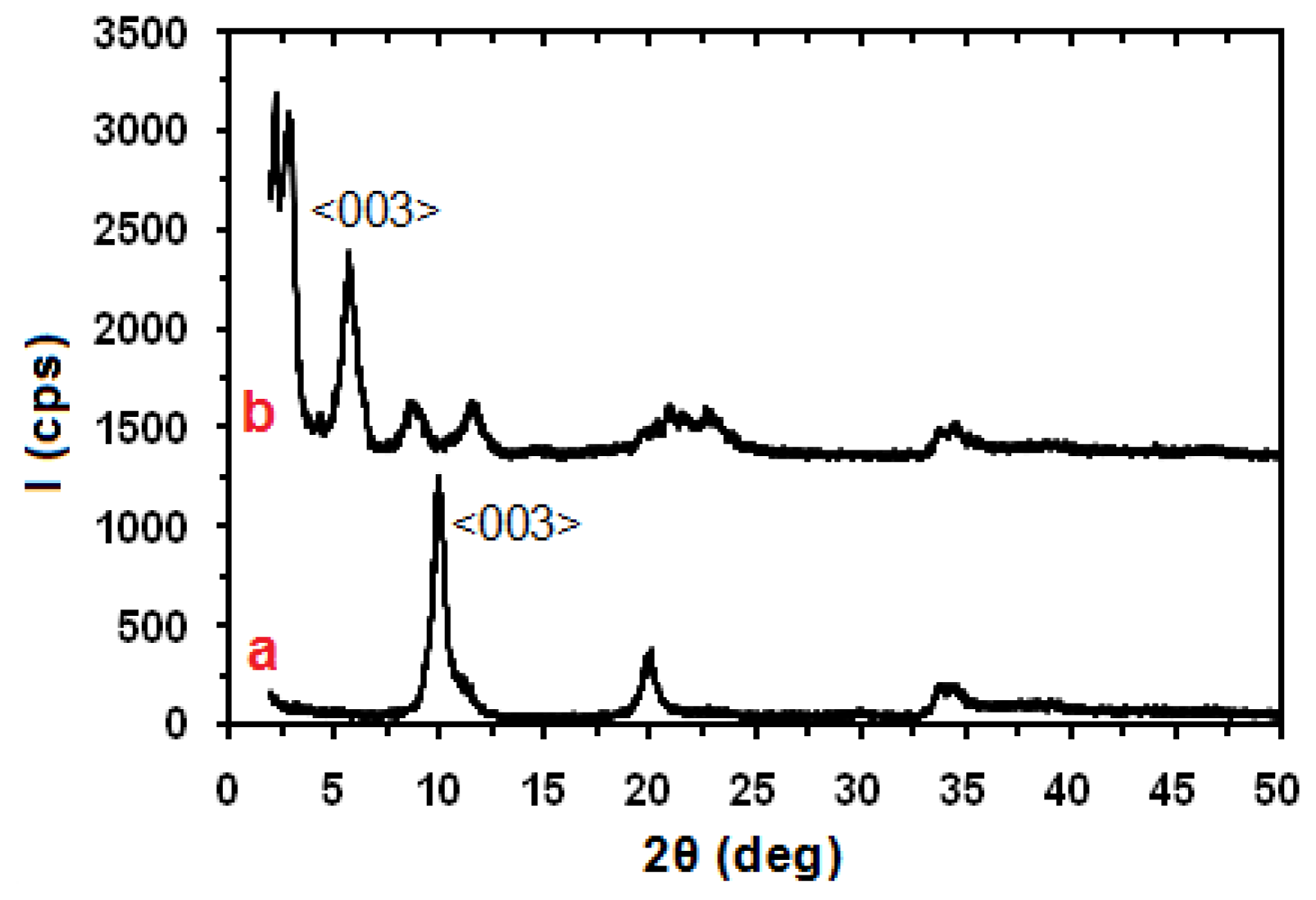
<p>The X-ray diffraction (XRD) patterns in the range of 2<italic>θ</italic> from 2 to 50° for the pristine and modified Zn<sub>3</sub>Al LDH are shown in <xref ref-type="fig" rid="f1-ijms-13-07938">Figure 1</xref>. It is apparent that both Zn<sub>3</sub>Al LDH and stearate-Zn<sub>3</sub>Al LDH are crystalline in nature with a well-defined layered structure. The basal spacing (<italic>d</italic>) of the Zn<sub>3</sub>Al LDH or stearate-Zn<sub>3</sub>Al LDH is calculated from the first diffraction peak using Bragg’s equation, <italic>n</italic>λ = 2 dsin<italic>θ</italic>, where n is equal to 1 for the &lt;003&gt; peak, <italic>λ</italic> is the wave length of Cu-Kα radiation, and <italic>θ</italic> is the half of the scattering angle. The modification of Zn<sub>3</sub>Al LDH with stearate ions increases the clay interlayer distance from 8.83 Å in Zn<sub>3</sub>Al LDH (corresponding 2<italic>θ</italic> value of &lt;003&gt; peak is 10.00°) to 40.1 Å in stearate-Zn<sub>3</sub>Al LDH (2<italic>θ</italic> = 2.156°). The increase of the basal spacing indicates that the anions are successfully intercalated into the interlayers of Zn<sub>3</sub>Al LDH [<xref ref-type="bibr" rid="b37-ijms-13-07938">37</xref>].</p>
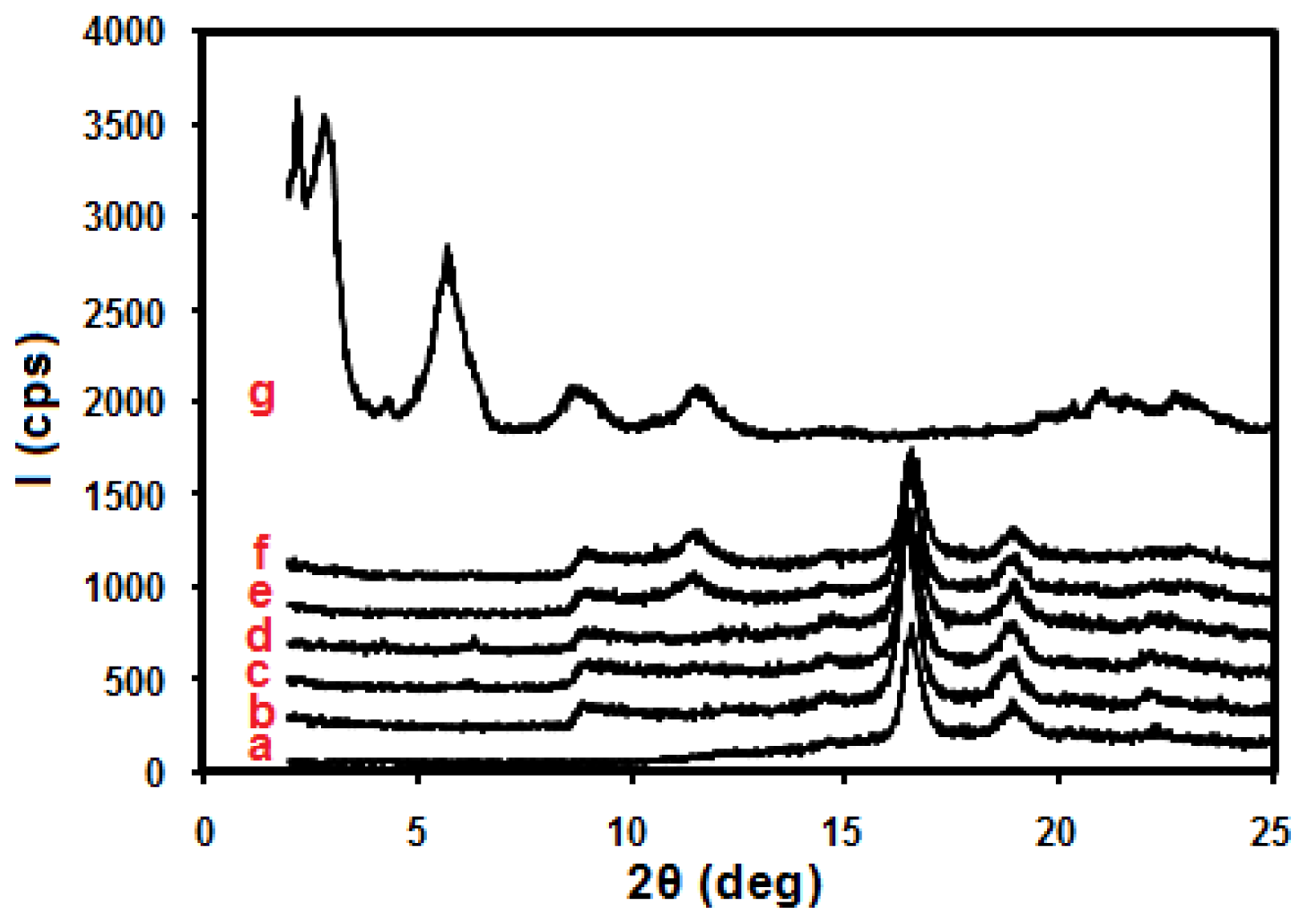
<p>X-ray diffraction patterns of the stearate-Zn<sub>3</sub>Al LDH, pure PLA and PLA/stearate-Zn<sub>3</sub>Al LDH nanocomposites containing various amounts of stearate-Zn<sub>3</sub>Al LDH are shown in <xref ref-type="fig" rid="f2-ijms-13-07938">Figure 2</xref>. As it can be observed, in the case of PLA/stearate-Zn<sub>3</sub>Al LDH nanocomposites, the diffraction peaks disappear indicating complete exfoliation of the LDH layers in the PLA matrix.</p>
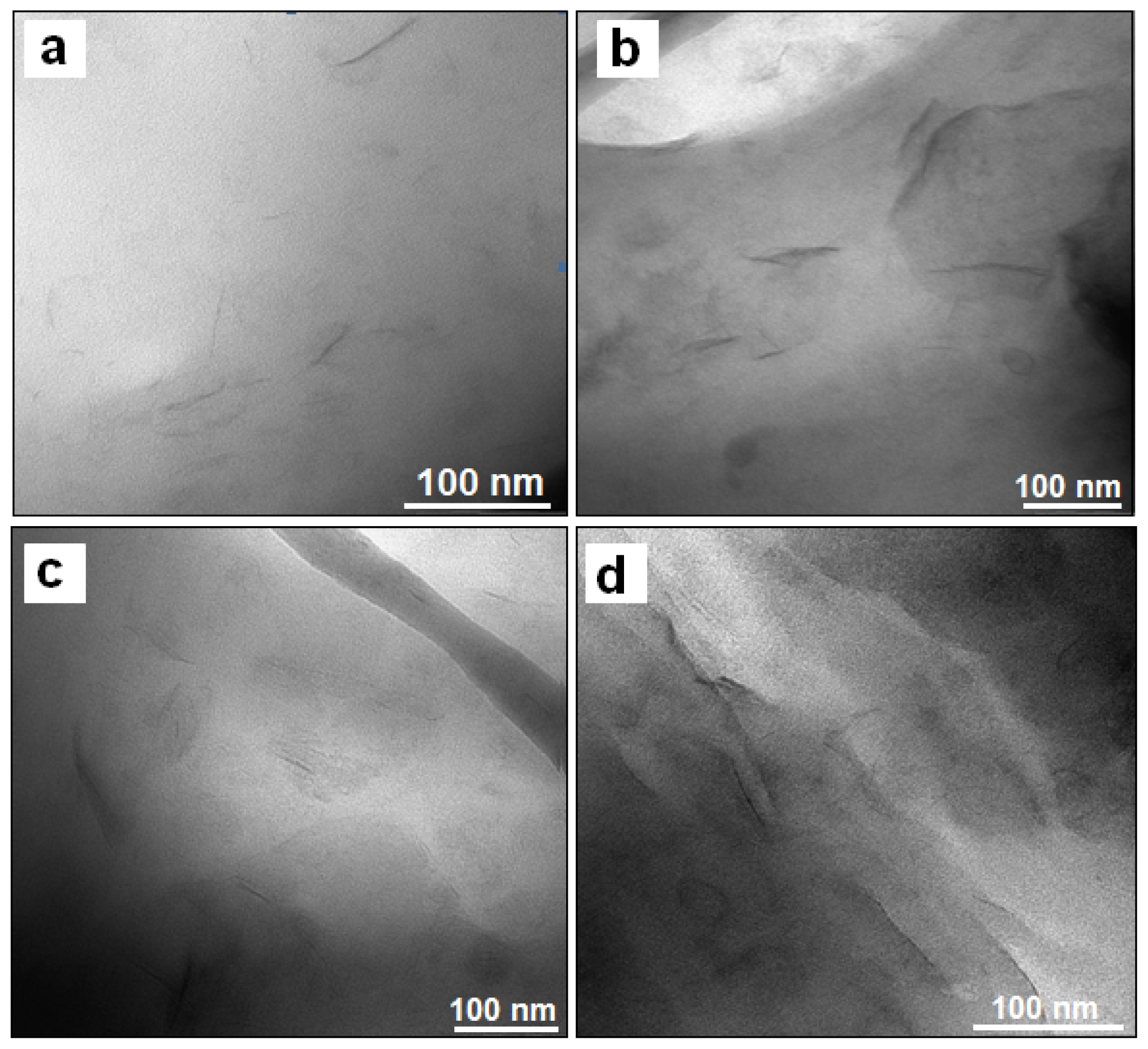
<p>The investigation of the internal structure of composites using XRD alone can often be misleading, since the XRD technique cannot detect layers that are in relatively disordered patterns in exfoliated nanocomposites [<xref ref-type="bibr" rid="b38-ijms-13-07938">38</xref>] or it is unable to detect regular stacking that exceeds 88 Å in intercalated nanocomposites [<xref ref-type="bibr" rid="b39-ijms-13-07938">39</xref>]. <xref ref-type="fig" rid="f3-ijms-13-07938">Figure 3</xref> presents the high magnification transmission electron microscope (TEM) images of PLA/stearate-Zn<sub>3</sub>Al LDH nanocomposites containing 3.0, 5.0, 7.0 and 10.0 wt % stearate-Zn<sub>3</sub>Al LDH, respectively. The dark lines represent the LDH nanolayers, whereas the gray areas correspond to the PLA matrix. The images clearly reveal that the Zn<sub>3</sub>Al LDH layers have lost their stacking order and are randomly dispersed in the PLA matrix. The absence of aggregates confirms the high degree of exfoliation of the LDH plates within PLA matrix. Therefore the nanocomposites are the exfoliated type. The exfoliated structure observed here by TEM is in good agreement with the XRD results. Similar results are reported for Co Al LDH/polycaprolactone (PCL) nanocomposites [<xref ref-type="bibr" rid="b40-ijms-13-07938">40</xref>].</p>
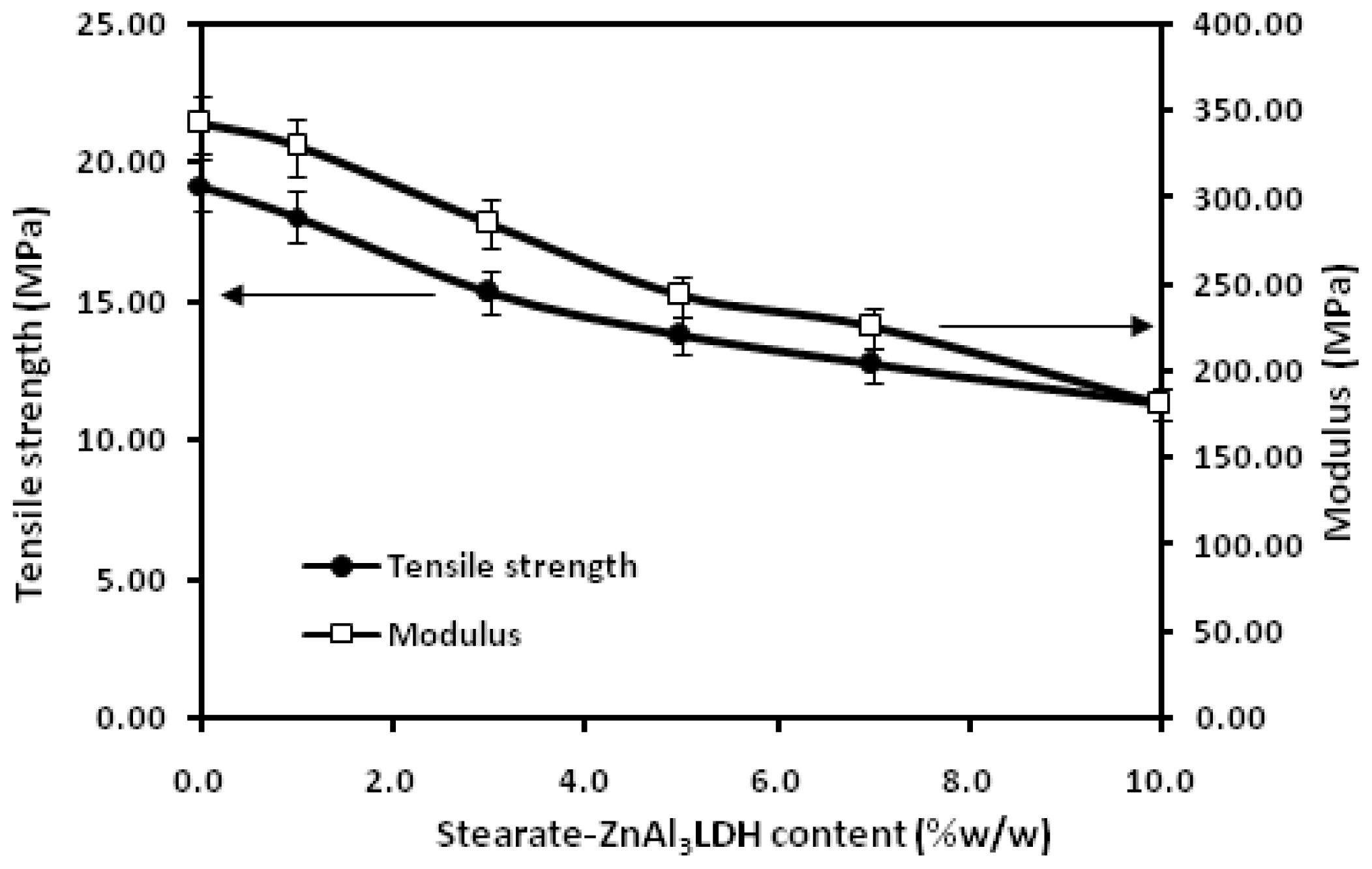
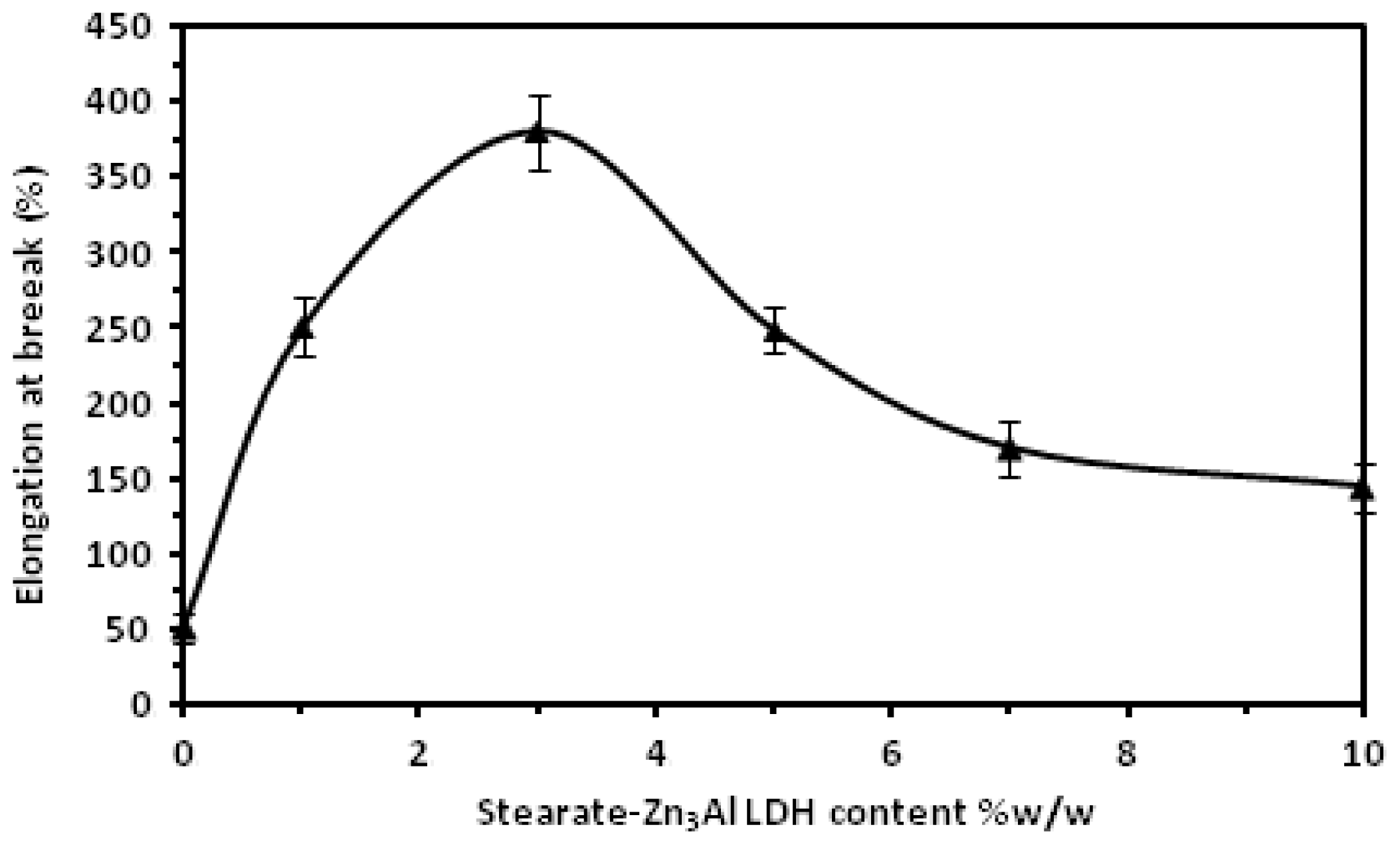
<p>The dependences of the tensile strength, elastic modulus and elongation at break of the PLA/stearate-Zn<sub>3</sub>Al LDH nanocomposites on the stearate-Zn<sub>3</sub>Al LDH content are plotted in <xref ref-type="fig" rid="f4-ijms-13-07938">Figures 4</xref> and <xref ref-type="fig" rid="f5-ijms-13-07938">5</xref>. The error bars represent s.d. of at least two independent experiments in duplicate wells. <xref ref-type="fig" rid="f4-ijms-13-07938">Figure 4</xref> shows that both tensile strength and elastic modulus decrease gradually as the filler content is increased, while <xref ref-type="fig" rid="f5-ijms-13-07938">Figure 5</xref> displays that the addition of stearate-Zn<sub>3</sub>Al LDH content from 1.0 to 3.0 wt % into the PLA matrix leads to a dramatical increase (of more than 600%) of elongation at break. The diminution of tensile strength besides the flexibility improvement is usually reported for different polymers in the presence of various plasticizers [<xref ref-type="bibr" rid="b41-ijms-13-07938">41</xref>–<xref ref-type="bibr" rid="b44-ijms-13-07938">44</xref>]. It can be attributed to this fact that the plasticizer behaves like a solvent when mixed with a polymer, it causes the decrease of polymer chain cohesion and thus a reduction of tensile strength properties [<xref ref-type="bibr" rid="b45-ijms-13-07938">45</xref>]. The significant increase in the elongation at break of the nanocomposites is maybe due to the presence of the long chain hydrocarbon parts of stearate anions in the modified stearate-Zn<sub>3</sub>Al LDH that act as a plasticizer. However the remarkable point is this that using a small amount of stearate-Zn<sub>3</sub>Al LDH promoted the flexibility and ductility of the final nanocomposites but did not decrease the tensile effectively, while the main drawback of most of the plasticizers that have been used for PLA matrix so far is the big drop of tensile strength and modulus of the products due to the large amount of plasticizer agent that is needed to plasticize it [<xref ref-type="bibr" rid="b46-ijms-13-07938">46</xref>].</p>
<p>However, a further increase of the stearate-Zn<sub>3</sub>Al LDH content decreases the elongation at break. A high content of stearate-Zn<sub>3</sub>Al LDH can induce agglomerations of the filler that can cause reduction of elongation at break [<xref ref-type="bibr" rid="b47-ijms-13-07938">47</xref>]. A similar finding was reported by Baiardo <italic>et al.</italic> [<xref ref-type="bibr" rid="b48-ijms-13-07938">48</xref>] when acetyl tri-<italic>n</italic>-butyl citrate (ATBC) was applied as a plasticizer for PLA.</p>
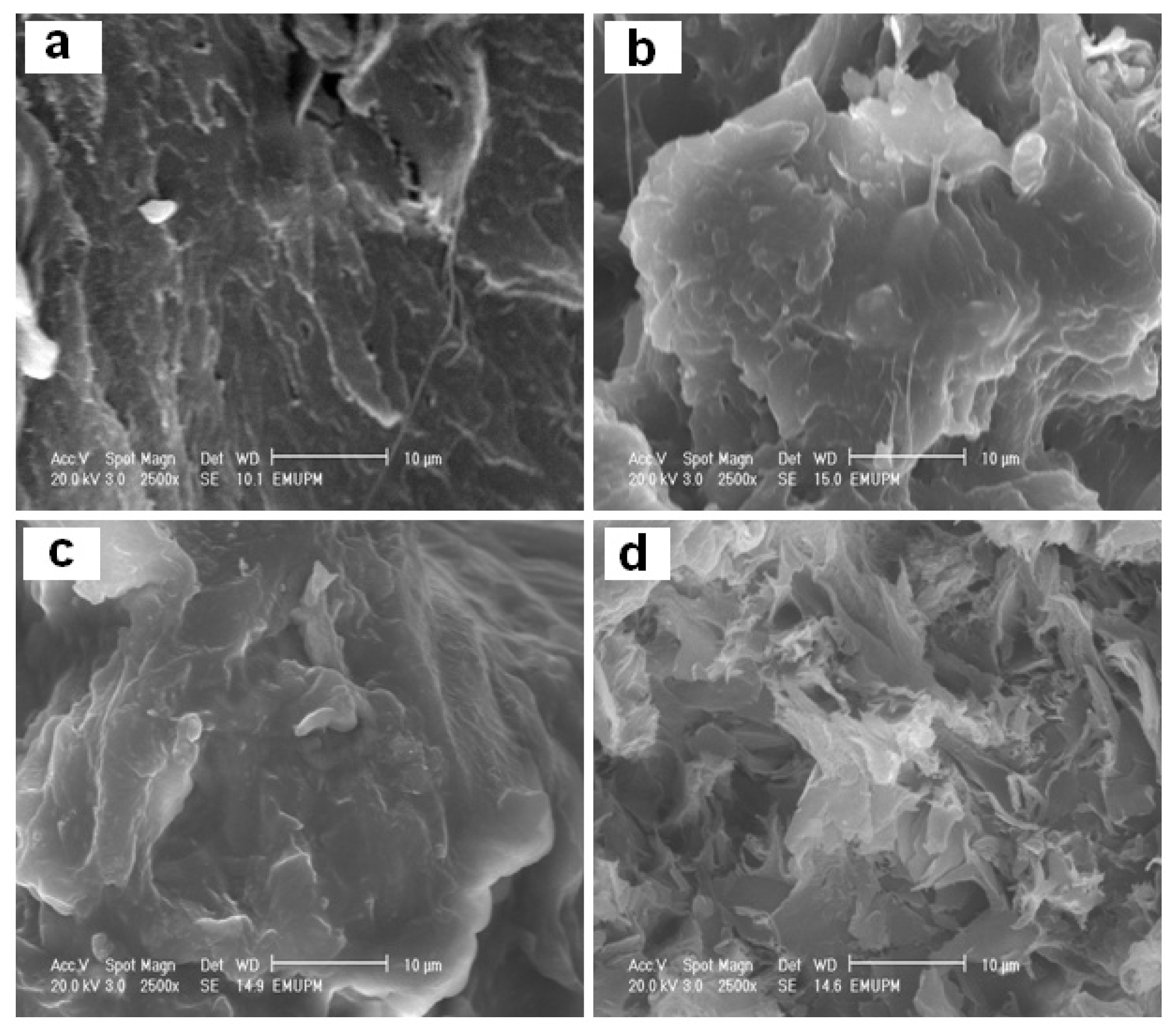
<p><xref ref-type="fig" rid="f6-ijms-13-07938">Figure 6</xref> shows scanning electron microscopy (SEM) micrographs obtained from the fractured cross-section surfaces of unfilled PLA and its stearate-Zn<sub>3</sub>Al LDH nanocomposites. The micrographs of unfilled PLA reveal rather compact solid and brittle fracture surfaces with little plastic deformation. Few long threads of a deformed material are observed on the fracture surface of PLA. On the entire fracture surfaces of the PLA with 1.0, 3.0 and 5.0 wt % of stearate-Zn<sub>3</sub>Al LDH, a large amount of plastically deformed material is discernible due to ductility and flexibility improvement of new nanocomposites. Similar images were obtained for PLA plasticized with poly ethylene glycol [<xref ref-type="bibr" rid="b41-ijms-13-07938">41</xref>].</p>
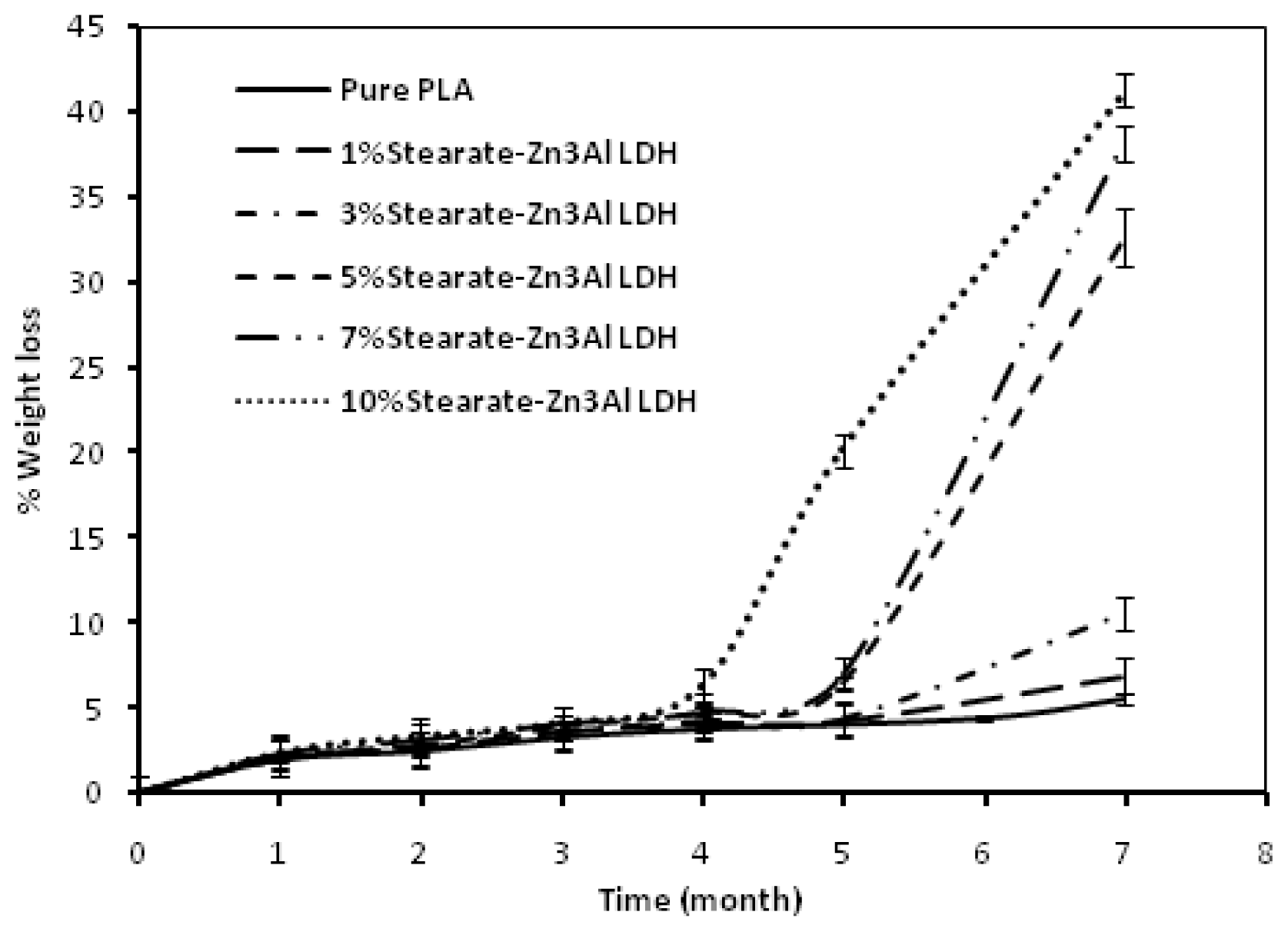
<p><xref ref-type="fig" rid="f7-ijms-13-07938">Figure 7</xref> shows the biodegradability of the pure PLA and PLA/stearate-Zn<sub>3</sub>Al LDH nanocomposites in soil for up to seven months. The nanocomposites exhibit a much higher disintegration rate than that of the pure PLA and the weight loss percentage increases as the filler loading is increased. The enhancement of biodegradation rate of PLA in soil as a result of the presence of stearate-Zn<sub>3</sub>Al LDH could be interpreted by the mechanism suggested by Ray <italic>et al.</italic> who found out that the disintegration rate of PLA is enhanced with the presence octadecyltrimethylammonium-modified MMT [<xref ref-type="bibr" rid="b49-ijms-13-07938">49</xref>,<xref ref-type="bibr" rid="b50-ijms-13-07938">50</xref>]. They suggested that this improvement might be caused by the existence of terminal hydroxylated edge groups in the silicate layers that homogeneously dispersed in the PLA matrix. These hydroxyl groups can absorb water from compost and start heterogeneous hydrolysis of the PLA matrix leading to faster degradation. The same mechanism can be assumed in the case of PLA/stearate-Zn<sub>3</sub>Al LDH nanocomposites, where the rates of weight loss of the PLA and PLA/stearate-Zn<sub>3</sub>Al LDH nanocomposites are almost the same up to around four months. However, after four months the weight loss rate of the nanocomposites is bigger than that of the unfilled PLA and a higher weight loss rate is observed when PLA/stearate-Zn<sub>3</sub>Al LDH is increased.</p>
<p>Another factor that may be associated with biodegradability improvement of the PLA nanocomposites is the faster degradation rate of stearate groups in the nanocomposite films than that of the PLA matrix. Therefore the PLA matrix will be broken down into smaller particles, resulting in an increased disintegration rate of nanocomposites films containing stearate-Zn<sub>3</sub>Al LDH than that of neat PLA film.</p>
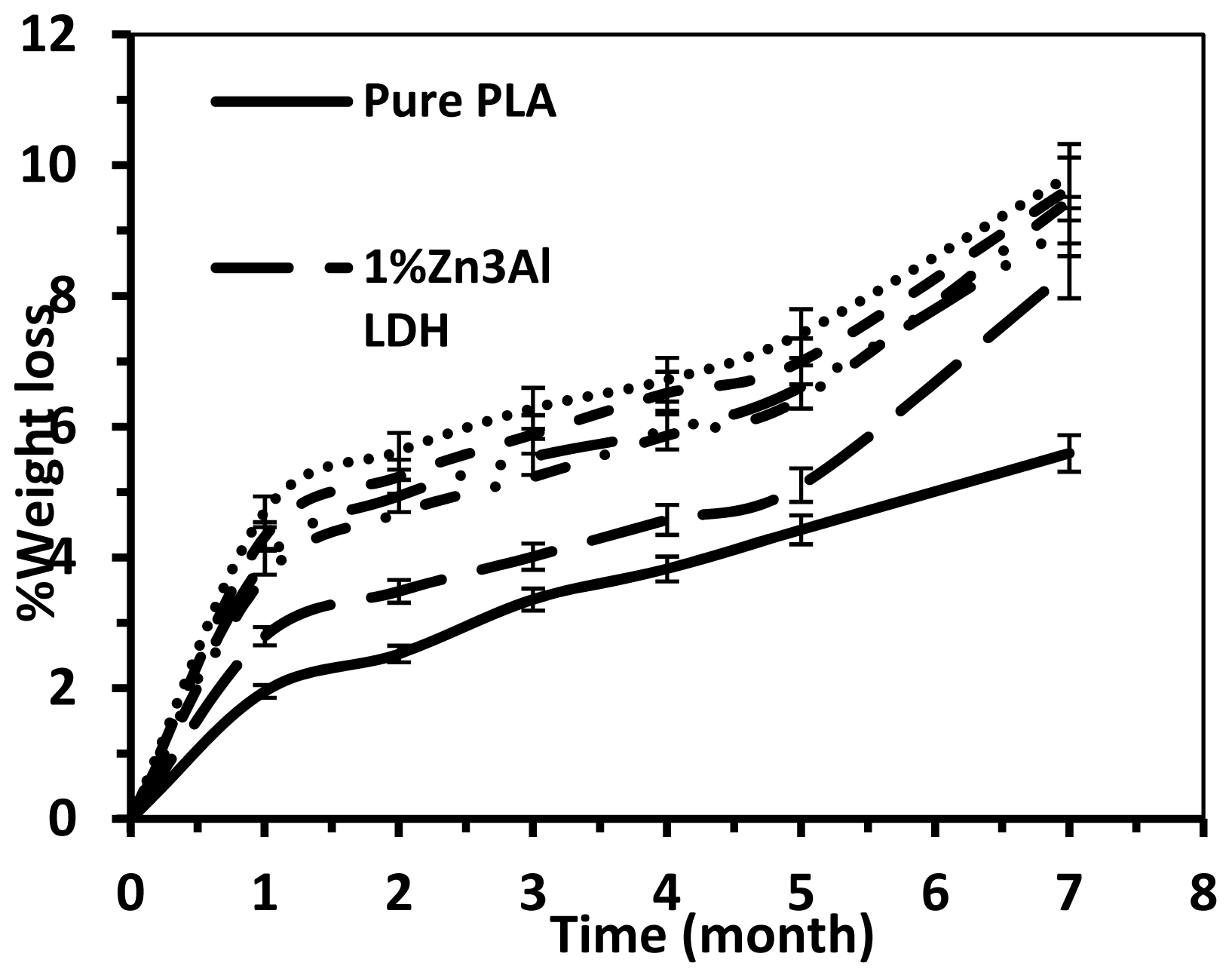
<p>The biodegradability of the pure PLA and PLA/Zn<sub>3</sub>Al LDH composites in the soil for up to seven months is shown in <xref ref-type="fig" rid="f8-ijms-13-07938">Figure 8</xref>. The rate of weight loss of macrocomposites is higher than that of the pure PLA. However, comparison of the results in <xref ref-type="fig" rid="f7-ijms-13-07938">Figures 7</xref>,<xref ref-type="fig" rid="f8-ijms-13-07938">8</xref> shows that the degradation rate of nanocomposites is much higher than that of the macrocomposites. This may be due to the compactness of the unmodified LDH plates, which hinders water diffusion. These experiments were repeated three times for all of samples to show biodegradable properties.</p>
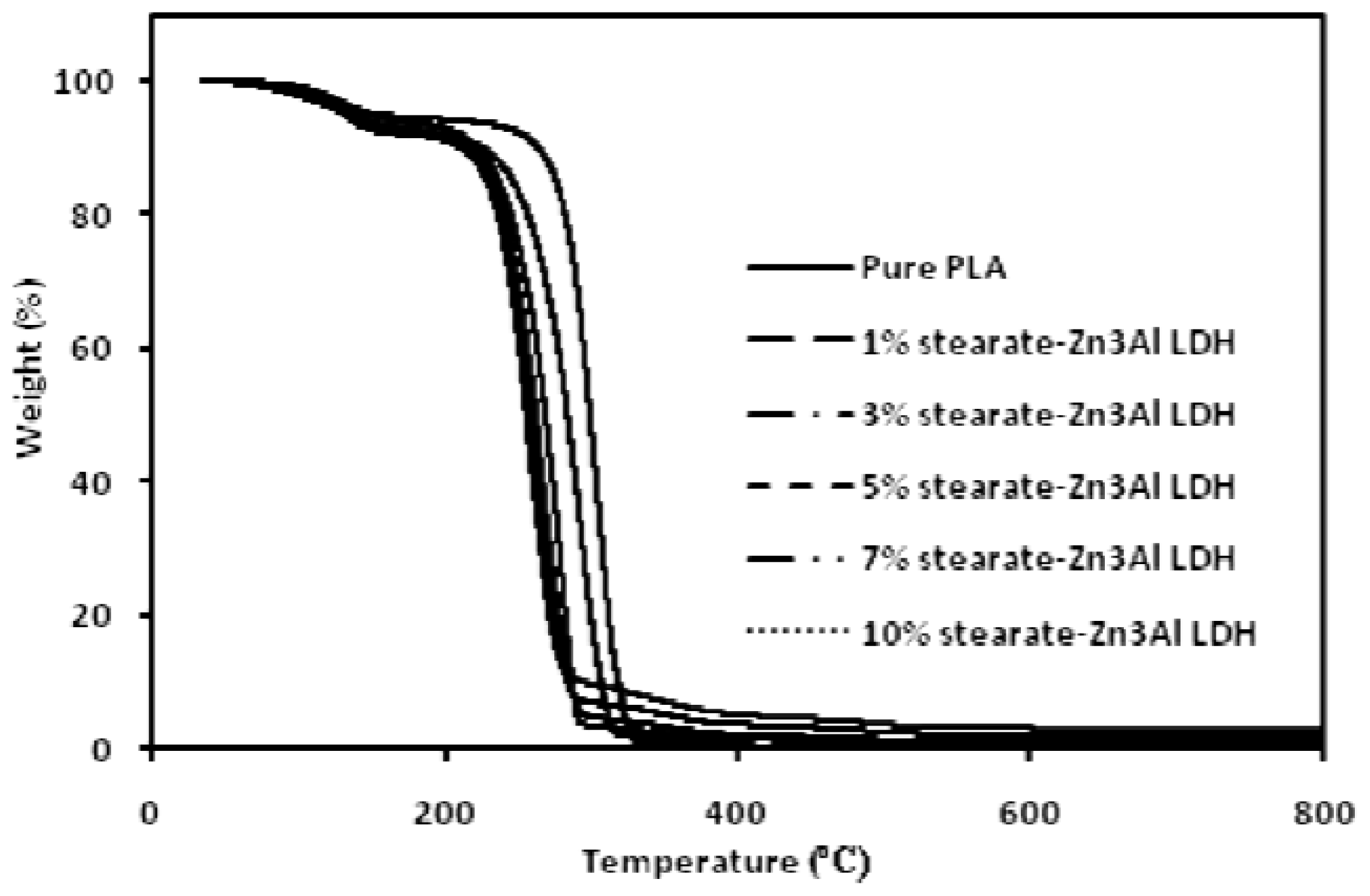
<p>Thermogravimetric analysis (TGA) measurements were carried out to obtain information on the thermal stability of the nanocomposite samples.</p>
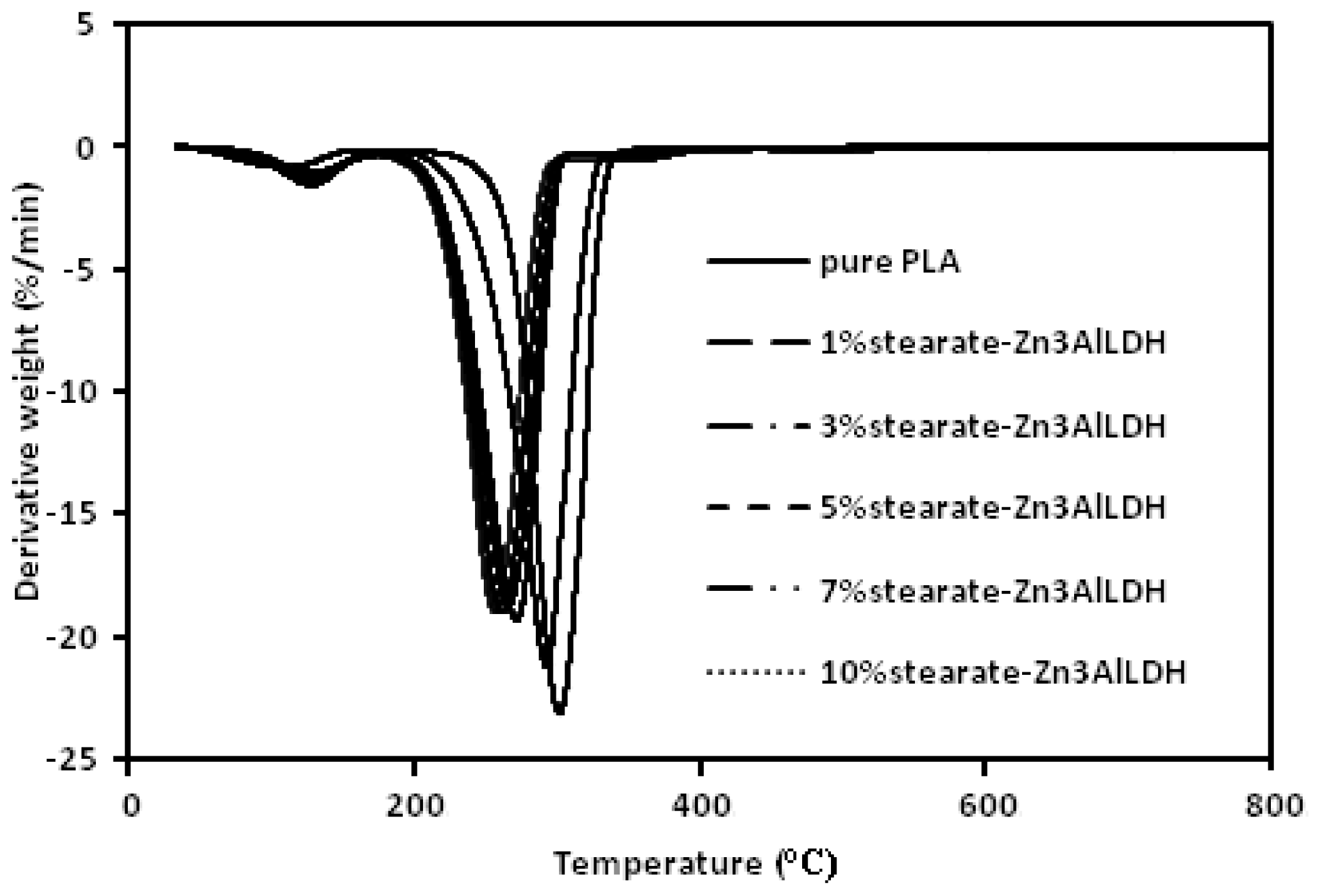
<p>The TGA and differential thermal analysis (DTA) curves of the pure PLA and its stearate-Zn<sub>3</sub>Al LDH nanocomposites are presented in <xref ref-type="fig" rid="f9-ijms-13-07938">Figures 9</xref> and <xref ref-type="fig" rid="f10-ijms-13-07938">10</xref>, respectively. A two-stage decomposition process is observed for all samples, the first stage is maybe related to the loss of physically bonded water below 200 °C. However, the main decomposition step associated with the degradation of the PLA and its nanocomposites occurs at the temperature of 250–350 °C. It is clear that the <italic>T</italic><sub>onset</sub> of the PLA/stearate-Zn<sub>3</sub>Al LDH nanocomposites decreases as the amount of the stearate-Zn<sub>3</sub>Al LDH is increased. This reduction of <italic>T</italic><sub>onset</sub> may be attributed to the presence of long chain hydrocarbons, which may increase chain mobility and decrease strength and toughness. Since this product is useful for the packaging industry, this reduction cannot influence the next applications of products.</p></sec>
<sec>
<title>3. Experimental Section</title>
<sec sec-type="materials">
<title>3.1. Materials</title>
<p>Aluminium nitrate nonahydrate was supplied by HmbG (Germany). Zinc nitrate hexahydrate was purchased from Bendosen Laboratory Chemicals (Malaysia). Sodium stearate was purchased from R &amp; M chemicals (UK). Sodium hydroxide pellets and chloroform were obtained from Merk (Germany) and Polylactide resin 4042D (92% L, 8% D) was supplied by NatureWorks LLC (USA). All the above-mentioned commercial chemicals were used as received.</p></sec>
<sec>
<title>3.2. Synthesis of Zn<sub>3</sub>Al LDH</title>
<p>The Zn<sub>3</sub>Al LDH was prepared by adding drop-wise a solution of NaOH (1 M) into a 250 mL solution of 22.30 g Zn(NO<sub>3</sub>)<sub>2</sub>·6H<sub>2</sub>O and 9.38 g Al(NO<sub>3</sub>)<sub>3</sub>·9H<sub>2</sub>O (with the mol ratio of 3 to 1) until pH 7 was obtained. The resulting suspension was shaken at 100 rpm and 70 °C for 16 h. The slurry was filtered, washed thoroughly with deionized water and dried at 60 °C for 24 h to obtain the Zn<sub>3</sub>Al LDH.</p></sec>
<sec>
<title>3.3. Preparation of Stearate-Zn<sub>3</sub>Al LDH</title>
<p>The stearate-Zn<sub>3</sub>Al LDH was prepared by replacing nitrate ions in the LDH layers with stearate ions using the following procedure. One gram of the dry Zn<sub>3</sub>Al LDH was first transferred into 750 mL of 0.003 M solution of sodium stearate solution and stirred at room temperature for 24 h. The white solid obtained was then filtered, washed with deionized water three times and dried in a vacuum desicator at room temperature.</p></sec>
<sec>
<title>3.4. Preparation of PLA/Stearate-Zn<sub>3</sub>Al LDH Nanocomposites</title>
<p>The nanocomposites of PLA with different amounts of stearate-Zn<sub>3</sub>Al LDH were prepared by a solution casting method. The desired amount of stearate-Zn<sub>3</sub>Al LDH in 40 mL chloroform was first sonicated for 3 h, transferred into a solution of 10 g PLA in 200 mL chloroform and refluxed for 24 h. The viscous suspensions were casted in a glass petri dish and dried in the solvent atmosphere to obtain the sample sheets.</p></sec>
<sec>
<title>3.5. Characterization Techniques</title>
<p>X-ray diffraction (XRD) patterns of the LDHs and composites were recorded using a Shidmadzu XRD 6000 Diffractometer at 30 kV and 30 mA with Cu-Kα radiation of the wavelength of 1.5405 nm.</p>
<p>Scanning electron microscopy (SEM) images were obtained using a Philips XL30 Environmental scanning electron microscope. The clean and dry samples were first coated with gold using a Bal-Tec SCD 005 sputter coater.</p>
<p>The transmission electron microscopy (TEM) images were obtained by employing a transmission electron microscope Hitachi, H7100 with an accelerating voltage of 200 kV. The samples were dispersed in chloroform and diluted to the right concentration. The suspension was then dropped on to the TEM sample grid and allowed to dry. The very thin layer on the grid was observed on the microscope.</p>
<p>The pure PLA and its nanocomposites were subjected to thermogravimetric analysis using Perkin-Elmer Thermal Analyzer (model TGA 7). The tests were carried out under a nitrogen gas atmosphere with a flow rate of 20 cm<sup>3</sup>·min<sup>−1</sup> using a scan rate of 10 °C·min<sup>−1</sup>. The temperature range of 40 to 800 °C was used to study the thermal decomposition of the samples. The weight of each sample was about 30 mg. The weight loss of the samples during heating was automatically recorded and plotted as a function of temperature.</p>
<p>Tensile tests were performed by using a Universal Tester, Instron–4302, LEO. Tensile tests were performed according to the guidelines of ASTM D-638-V. The samples were cut into dumbbell shapes using a dumbbell cutter (Die BS 6476). The thicknesses of the samples were measured using a thickness gauge. A load cell of 1.0 kN was applied at a constant crosshead speed of 10 mm/min at room temperature. The reported results were the average of at least five measurements of tensile determinations (in duplicate).</p>
<p>Biodegradability of the samples was studied by measuring the weight loss of the thin-plate specimens buried in soil. Samples of 30 × 30 × 1 mm were weighed and then buried at a depth of 15 cm in the garden pots with an approximate capacity of 15 L and some holes at the bottom of the pots. The soil used in the tests was fertile soil for gardening without any pretreatment. The pots were placed in an uncovered gazebo with the temperature varying from 20 °C to 30 °C and a humidity above 80%. The buried samples were taken out once a month, washed in distilled water to remove the soil, dried in an oven at 60 °C for 24 h and the weight of dry samples was recorded. Based on the sample weight before and after degradation, the average percentage of weight loss for each sample was calculated. Weight loss of the specimens with time was used to indicate degradation rate in the soil burial test. The soil burial degradation test started on 5 October 2009 and ended on 5 May 2010.</p></sec></sec>
<sec sec-type="conclusions">
<title>4. Conclusions</title>
<p>Stearate-Zn<sub>3</sub>Al LDH, which was prepared by co-precipitation and ion exchange reaction, was used as nanofiller in a poly lactic acid (PLA) matrix. The internal structure of the nanocomposites in the nanometer range was established using X-ray diffraction and transmission electron microscope analysis. The effect of stearate-Zn<sub>3</sub>Al LDH loading on tensile properties and soil biodegradation was studied. Significant improvement of elongation at break was observed as a result of the addition of 1.0–3.0 wt % of stearate-Zn<sub>3</sub>Al LDH to the poly lactic acid. The presence of stearate-Zn<sub>3</sub>Al LDH nanolayers increased the rate of degradation of PLA in the soil. The thermogravimetric analysis showed that the presence of modified LDHs nanolayers does not lead to any improvement in thermal stability of PLA/stearate-Zn<sub>3</sub>Al LDH nanocomposites.</p></sec></body>
<back>
<ack>
<title>Acknowledgments</title>
<p>The authors thank the staff at the Institute of Bioscience Universiti Putra Malaysia for their support with SEM and TEM instruments.</p></ack>
<ref-list>
<title>References</title>
<ref id="b1-ijms-13-07938"><label>1</label><citation citation-type="journal"><person-group person-group-type="author"><name><surname>Marten</surname><given-names>E.</given-names></name><name><surname>Müller</surname><given-names>R.J.</given-names></name><name><surname>Deckwer</surname><given-names>W.D.</given-names></name></person-group><article-title>Studies on the enzymatic hydrolysis of polyesters I. Low molecular mass model esters and aliphatic polyesters</article-title><source>Polym. Degrad. Stabil</source><year>2003</year><volume>80</volume><fpage>485</fpage><lpage>501</lpage><pub-id pub-id-type="doi">10.1016/S0141-3910(03)00032-6</pub-id></citation></ref>
<ref id="b2-ijms-13-07938"><label>2</label><citation citation-type="journal"><person-group person-group-type="author"><name><surname>Wu</surname><given-names>C.S.</given-names></name></person-group><article-title>Physical properties and biodegradability of maleated-polycaprolactone/starch composite</article-title><source>Polym. Degrad. Stabil</source><year>2003</year><volume>80</volume><fpage>127</fpage><lpage>134</lpage><pub-id pub-id-type="doi">10.1016/S0141-3910(02)00393-2</pub-id></citation></ref>
<ref id="b3-ijms-13-07938"><label>3</label><citation citation-type="journal"><person-group person-group-type="author"><name><surname>Ray</surname><given-names>S.S.</given-names></name><name><surname>Bousmina</surname><given-names>M.</given-names></name></person-group><article-title>Biodegradable polymers and their layered silicate nanocomposites: In greening the 21st century materials world</article-title><source>Prog. Mat. Sci</source><year>2005</year><volume>50</volume><fpage>962</fpage><lpage>1079</lpage><pub-id pub-id-type="doi">10.1016/j.pmatsci.2005.05.002</pub-id></citation></ref>
<ref id="b4-ijms-13-07938"><label>4</label><citation citation-type="journal"><person-group person-group-type="author"><name><surname>Tang</surname><given-names>X.</given-names></name><name><surname>Alavi</surname><given-names>S.</given-names></name></person-group><article-title>Recent advances in starch, polyvinyl alcohol based polymer blends, nanocomposites and their biodegradability</article-title><source>Carbohydr. Polym</source><year>2011</year><volume>85</volume><fpage>7</fpage><lpage>16</lpage><pub-id pub-id-type="doi">10.1016/j.carbpol.2011.01.030</pub-id></citation></ref>
<ref id="b5-ijms-13-07938"><label>5</label><citation citation-type="journal"><person-group person-group-type="author"><name><surname>Umare</surname><given-names>S.S.</given-names></name><name><surname>Chandure</surname><given-names>A.S.</given-names></name><name><surname>Pandey</surname><given-names>R.A.</given-names></name></person-group><article-title>Synthesis, characterization and biodegradable studies of 1,3-propanediol based polyesters</article-title><source>Polym. Degrad. Stabil</source><year>2007</year><volume>92</volume><fpage>464</fpage><lpage>479</lpage><pub-id pub-id-type="doi">10.1016/j.polymdegradstab.2006.10.007</pub-id></citation></ref>
<ref id="b6-ijms-13-07938"><label>6</label><citation citation-type="journal"><person-group person-group-type="author"><name><surname>Chandra</surname><given-names>R.</given-names></name><name><surname>Rustgi</surname><given-names>R.</given-names></name></person-group><article-title>Biodegradable polymers</article-title><source>Prog. Polym. Sci</source><year>1998</year><volume>23</volume><fpage>1273</fpage><lpage>1335</lpage><pub-id pub-id-type="doi">10.1016/S0079-6700(97)00039-7</pub-id></citation></ref>
<ref id="b7-ijms-13-07938"><label>7</label><citation citation-type="journal"><person-group person-group-type="author"><name><surname>Scherer</surname><given-names>T.M.</given-names></name><name><surname>Fuller</surname><given-names>R.C.</given-names></name><name><surname>Lenz</surname><given-names>R.W.</given-names></name><name><surname>Goodwin</surname><given-names>S.</given-names></name></person-group><article-title>Hydrolase activity of an extracellular depolymerase from aspergillus fumigatus with bacterial and synthetic polyesters</article-title><source>Polym. Degrad Stabil</source><year>1999</year><volume>64</volume><fpage>267</fpage><lpage>275</lpage><pub-id pub-id-type="doi">10.1016/S0141-3910(98)00201-8</pub-id></citation></ref>
<ref id="b8-ijms-13-07938"><label>8</label><citation citation-type="journal"><person-group person-group-type="author"><name><surname>Athanasiou</surname><given-names>K.A.</given-names></name><name><surname>Agrawal</surname><given-names>C.M.</given-names></name><name><surname>Barber</surname><given-names>F.A.</given-names></name><name><surname>Burkhart</surname><given-names>S.S.</given-names></name></person-group><article-title>Orthopaedic applications for PLA-PGA biodegradable polymers</article-title><source>Arthrosc. J. Arthrosc. Relat. Surg</source><year>1998</year><volume>14</volume><fpage>726</fpage><lpage>737</lpage><pub-id pub-id-type="doi">10.1016/S0749-8063(98)70099-4</pub-id></citation></ref>
<ref id="b9-ijms-13-07938"><label>9</label><citation citation-type="journal"><person-group person-group-type="author"><name><surname>Muller</surname><given-names>R.J.</given-names></name></person-group><article-title>Biodegradability of polymers: Regulations and methods for testing</article-title><source>Biopolym. Online</source><year>2005</year><pub-id pub-id-type="doi">10.1002/3527600035.bpola012</pub-id></citation></ref>
<ref id="b10-ijms-13-07938"><label>10</label><citation citation-type="journal"><person-group person-group-type="author"><name><surname>Liu</surname><given-names>J.W.</given-names></name><name><surname>Zhao</surname><given-names>Q.</given-names></name><name><surname>Wan</surname><given-names>C.X.</given-names></name></person-group><article-title>Research progresses on degradation mechanism <italic>in vivo</italic> and medical applications of polylactic acid</article-title><source>Space Med. Med. Eng</source><year>2001</year><volume>14</volume><fpage>308</fpage><lpage>312</lpage></citation></ref>
<ref id="b11-ijms-13-07938"><label>11</label><citation citation-type="journal"><person-group person-group-type="author"><name><surname>Bordes</surname><given-names>P.</given-names></name><name><surname>Pollet</surname><given-names>E.</given-names></name><name><surname>Avérous</surname><given-names>L.</given-names></name></person-group><article-title>Nano-biocomposites: Biodegradable polyester/nanoclay systems</article-title><source>Prog. Polym. Sci</source><year>2009</year><volume>34</volume><fpage>125</fpage><lpage>155</lpage><pub-id pub-id-type="doi">10.1016/j.progpolymsci.2008.10.002</pub-id></citation></ref>
<ref id="b12-ijms-13-07938"><label>12</label><citation citation-type="journal"><person-group person-group-type="author"><name><surname>Fukushima</surname><given-names>K.</given-names></name><name><surname>Abbate</surname><given-names>C.</given-names></name><name><surname>Tabuani</surname><given-names>D.</given-names></name><name><surname>Gennari</surname><given-names>M.</given-names></name><name><surname>Camino</surname><given-names>G.</given-names></name></person-group><article-title>Biodegradation of poly(lactic acid) and its nanocomposites</article-title><source>Polym. Degrad. Stabil</source><year>2009</year><volume>94</volume><fpage>1646</fpage><lpage>1655</lpage><pub-id pub-id-type="doi">10.1016/j.polymdegradstab.2009.07.001</pub-id></citation></ref>
<ref id="b13-ijms-13-07938"><label>13</label><citation citation-type="journal"><person-group person-group-type="author"><name><surname>Tuominen</surname><given-names>J.</given-names></name><name><surname>Kylma</surname><given-names>J.</given-names></name><name><surname>Kapanen</surname><given-names>A.</given-names></name><name><surname>Venelampi</surname><given-names>O.</given-names></name><name><surname>Itävaara</surname><given-names>M.</given-names></name><name><surname>Seppälä</surname><given-names>J.</given-names></name></person-group><article-title>Biodegradation of lactic acid based polymers under controlled composting conditions and evaluation of the ecotoxicological impact</article-title><source>Biomacromolecules</source><year>2002</year><volume>3</volume><fpage>445</fpage><lpage>455</lpage><pub-id pub-id-type="doi">10.1021/bm0101522</pub-id><pub-id pub-id-type="pmid">12005513</pub-id></citation></ref>
<ref id="b14-ijms-13-07938"><label>14</label><citation citation-type="journal"><person-group person-group-type="author"><name><surname>Gupta</surname><given-names>B.</given-names></name><name><surname>Revagade</surname><given-names>N.</given-names></name><name><surname>Hilborn</surname><given-names>J.</given-names></name></person-group><article-title>Poly(lactic acid) fiber: An overview</article-title><source>Prog. Polym. Sci</source><year>2007</year><volume>32</volume><fpage>455</fpage><lpage>482</lpage><pub-id pub-id-type="doi">10.1016/j.progpolymsci.2007.01.005</pub-id></citation></ref>
<ref id="b15-ijms-13-07938"><label>15</label><citation citation-type="journal"><person-group person-group-type="author"><name><surname>Lee</surname><given-names>S.Y.</given-names></name><name><surname>Chen</surname><given-names>H.</given-names></name><name><surname>Hanna</surname><given-names>M.A.</given-names></name></person-group><article-title>Preparation and characterization of tapioca starch-poly(lactic acid) nanocomposite foams by melt intercalation based on clay type</article-title><source>Ind. Crop. Prod</source><year>2008</year><volume>28</volume><fpage>95</fpage><lpage>106</lpage><pub-id pub-id-type="doi">10.1016/j.indcrop.2008.01.009</pub-id></citation></ref>
<ref id="b16-ijms-13-07938"><label>16</label><citation citation-type="journal"><person-group person-group-type="author"><name><surname>Li</surname><given-names>B.</given-names></name><name><surname>Dong</surname><given-names>F.X.</given-names></name><name><surname>Wang</surname><given-names>X.L.</given-names></name><name><surname>Yang</surname><given-names>J.</given-names></name><name><surname>Wang</surname><given-names>D.Y.</given-names></name><name><surname>Wang</surname><given-names>Y.Z.</given-names></name></person-group><article-title>Organically modified rectorite toughened poly(lactic acid): Nanostructures, crystallization and mechanical properties</article-title><source>Eur. Polym. J</source><year>2009a</year><volume>45</volume><fpage>2996</fpage><lpage>3003</lpage><pub-id pub-id-type="doi">10.1016/j.eurpolymj.2009.08.015</pub-id></citation></ref>
<ref id="b17-ijms-13-07938"><label>17</label><citation citation-type="journal"><person-group person-group-type="author"><name><surname>Pavlidou</surname><given-names>S.</given-names></name><name><surname>Papaspyrides</surname><given-names>C.D.</given-names></name></person-group><article-title>A review on polymer-layered silicate nanocomposites</article-title><source>Prog. Polym. Sci</source><year>2008</year><volume>33</volume><fpage>1119</fpage><lpage>1198</lpage><pub-id pub-id-type="doi">10.1016/j.progpolymsci.2008.07.008</pub-id></citation></ref>
<ref id="b18-ijms-13-07938"><label>18</label><citation citation-type="journal"><person-group person-group-type="author"><name><surname>Carrado</surname><given-names>K.A.</given-names></name><name><surname>Kostapapas</surname><given-names>A.</given-names></name><name><surname>Suib</surname><given-names>S.L.</given-names></name></person-group><article-title>Layered double hydroxides (LDHs)</article-title><source>Solid State Ion</source><year>1988</year><volume>26</volume><fpage>77</fpage><lpage>86</lpage><pub-id pub-id-type="doi">10.1016/0167-2738(88)90018-5</pub-id></citation></ref>
<ref id="b19-ijms-13-07938"><label>19</label><citation citation-type="journal"><person-group person-group-type="author"><name><surname>Hsueh</surname><given-names>H.B.</given-names></name><name><surname>Chen</surname><given-names>C.Y.</given-names></name></person-group><article-title>Preparation and properties of LDHs/polyimide nanocomposites</article-title><source>Polymer</source><year>2003</year><volume>44</volume><fpage>1151</fpage><lpage>1161</lpage><pub-id pub-id-type="doi">10.1016/S0032-3861(02)00887-X</pub-id></citation></ref>
<ref id="b20-ijms-13-07938"><label>20</label><citation citation-type="journal"><person-group person-group-type="author"><name><surname>Li</surname><given-names>E.</given-names></name><name><surname>Xu</surname><given-names>Z.P.</given-names></name><name><surname>Rudolph</surname><given-names>V.</given-names></name></person-group><article-title>MgCoAl-LDH derived heterogeneous catalysts for the ethanol transesterification of canola oil to biodiesel</article-title><source>Appl. Catal. Environ</source><year>2009b</year><volume>88</volume><fpage>42</fpage><lpage>49</lpage><pub-id pub-id-type="doi">10.1016/j.apcatb.2008.09.022</pub-id></citation></ref>
<ref id="b21-ijms-13-07938"><label>21</label><citation citation-type="journal"><person-group person-group-type="author"><name><surname>Coronado</surname><given-names>E.</given-names></name><name><surname>Martí-Gastaldo</surname><given-names>C.</given-names></name><name><surname>Navarro-Moratalla</surname><given-names>E.</given-names></name><name><surname>Ribera</surname><given-names>A.</given-names></name></person-group><article-title>Intercalation of [M(ox)<sub>3</sub>]<sup>3−</sup> (M = Cr, Rh) complexes into NiIIFeIII-LDH</article-title><source>Appl. Clay Sci</source><year>2009</year><volume>48</volume><fpage>228</fpage><lpage>234</lpage></citation></ref>
<ref id="b22-ijms-13-07938"><label>22</label><citation citation-type="journal"><person-group person-group-type="author"><name><surname>Triantafyllidis</surname><given-names>K.S.</given-names></name><name><surname>Peleka</surname><given-names>E.N.</given-names></name><name><surname>Komvokis</surname><given-names>V.G.</given-names></name><name><surname>Mavros</surname><given-names>P.P.</given-names></name></person-group><article-title>Iron-modified hydrotalcite-like materials as highly efficient phosphate sorbents</article-title><source>J. Colloid Interf. Sci</source><year>2009</year><volume>342</volume><fpage>427</fpage><lpage>436</lpage></citation></ref>
<ref id="b23-ijms-13-07938"><label>23</label><citation citation-type="journal"><person-group person-group-type="author"><name><surname>Schwenzer</surname><given-names>B.</given-names></name><name><surname>Neilson</surname><given-names>J.R.</given-names></name><name><surname>Sivula</surname><given-names>K.</given-names></name><name><surname>Woo</surname><given-names>C.</given-names></name><name><surname>Fréchet</surname><given-names>J.M.J.</given-names></name><name><surname>Morse</surname><given-names>D.E.</given-names></name></person-group><article-title>Nanostructured p-type cobalt layered double hydroxide/n-type polymer bulk heterojunction yields an inexpensive photovoltaic cell</article-title><source>Thin Solid Films</source><year>2009</year><volume>517</volume><fpage>5722</fpage><lpage>5727</lpage><pub-id pub-id-type="doi">10.1016/j.tsf.2009.02.131</pub-id></citation></ref>
<ref id="b24-ijms-13-07938"><label>24</label><citation citation-type="journal"><person-group person-group-type="author"><name><surname>Forano</surname><given-names>C.</given-names></name><name><surname>Hibino</surname><given-names>T.</given-names></name><name><surname>Leroux</surname><given-names>F.</given-names></name><name><surname>Taviot-Guého</surname><given-names>C.</given-names></name></person-group><article-title>Layered double hydroxides</article-title><source>Dev. Clay Sci</source><year>2006</year><volume>1</volume><fpage>1021</fpage><lpage>1095</lpage></citation></ref>
<ref id="b25-ijms-13-07938"><label>25</label><citation citation-type="journal"><person-group person-group-type="author"><name><surname>Olfs</surname><given-names>H.W.</given-names></name><name><surname>Torres-Dorante</surname><given-names>L.O.</given-names></name><name><surname>Eckelt</surname><given-names>R.</given-names></name><name><surname>Kosslick</surname><given-names>H.</given-names></name></person-group><article-title>Comparison of different synthesis routes for Mg-Al layered double hydroxides (LDH): Characterization of the structural phases and anion exchange properties</article-title><source>Appl. Clay Sci</source><year>2009</year><volume>43</volume><fpage>459</fpage><lpage>464</lpage><pub-id pub-id-type="doi">10.1016/j.clay.2008.10.009</pub-id></citation></ref>
<ref id="b26-ijms-13-07938"><label>26</label><citation citation-type="journal"><person-group person-group-type="author"><name><surname>Villa</surname><given-names>M.V.</given-names></name><name><surname>Sánchez-Martín</surname><given-names>M.J.</given-names></name><name><surname>Sánchez-Camazano</surname><given-names>M.</given-names></name></person-group><article-title>Hydrotalcites and organo-hydrotalcites as sorbents for removing pesticides from water</article-title><source>J. Environ. Sci. Health Pestic. Food Contam. Agric. Wastes</source><year>1999</year><volume>34</volume><fpage>509</fpage><lpage>525</lpage></citation></ref>
<ref id="b27-ijms-13-07938"><label>27</label><citation citation-type="journal"><person-group person-group-type="author"><name><surname>Kameda</surname><given-names>T.</given-names></name><name><surname>Takeuchi</surname><given-names>H.</given-names></name><name><surname>Yoshioka</surname><given-names>T.</given-names></name></person-group><article-title>Preparation of organic acid anion-modified magnesium hydroxides by coprecipitation: A novel material for the uptake of heavy metal ions from aqueous solutions</article-title><source>J. Phys. Chem. Solids</source><year>2009</year><volume>70</volume><fpage>1104</fpage><lpage>1108</lpage><pub-id pub-id-type="doi">10.1016/j.jpcs.2009.06.006</pub-id></citation></ref>
<ref id="b28-ijms-13-07938"><label>28</label><citation citation-type="journal"><person-group person-group-type="author"><name><surname>Costa</surname><given-names>F.R.</given-names></name><name><surname>Leuteritz</surname><given-names>A.</given-names></name><name><surname>Wagenknecht</surname><given-names>U.</given-names></name><name><surname>Jehnichen</surname><given-names>D.</given-names></name><name><surname>Häußler</surname><given-names>L.</given-names></name><name><surname>Heinrich</surname><given-names>G.</given-names></name></person-group><article-title>Intercalation of Mg–Al layered double hydroxide by anionic surfactants: Preparation and characterization</article-title><source>Appl. Clay Sci</source><year>2008</year><volume>38</volume><fpage>153</fpage><lpage>164</lpage><pub-id pub-id-type="doi">10.1016/j.clay.2007.03.006</pub-id></citation></ref>
<ref id="b29-ijms-13-07938"><label>29</label><citation citation-type="journal"><person-group person-group-type="author"><name><surname>Sugahara</surname><given-names>Y.</given-names></name><name><surname>Yokoyama</surname><given-names>N.</given-names></name><name><surname>Kuroda</surname><given-names>K.</given-names></name><name><surname>Kato</surname><given-names>C.</given-names></name></person-group><article-title>AlN formation from a hydrotalcite-polyacrylonitrile intercalation compound by carbothermal reduction</article-title><source>Ceram. Int</source><year>1988</year><volume>14</volume><fpage>163</fpage><lpage>167</lpage><pub-id pub-id-type="doi">10.1016/0272-8842(88)90005-3</pub-id></citation></ref>
<ref id="b30-ijms-13-07938"><label>30</label><citation citation-type="journal"><person-group person-group-type="author"><name><surname>Oriakhi</surname><given-names>C.O.</given-names></name><name><surname>Farr</surname><given-names>I.V.</given-names></name><name><surname>Lerner</surname><given-names>M.M.</given-names></name></person-group><article-title>Incorporation of poly(acrylic acid), poly(vinylsulfonate) and poly(styrenesulfonate) within layered double hydroxides</article-title><source>J. Mater. Chem</source><year>1996</year><volume>6</volume><fpage>103</fpage><lpage>107</lpage><pub-id pub-id-type="doi">10.1039/jm9960600103</pub-id></citation></ref>
<ref id="b31-ijms-13-07938"><label>31</label><citation citation-type="journal"><person-group person-group-type="author"><name><surname>Hsueh</surname><given-names>H.B.</given-names></name><name><surname>Chen</surname><given-names>C.Y.</given-names></name></person-group><article-title>Preparation and properties of LDHs/polyimide nanocomposites</article-title><source>Polymer</source><year>2003</year><volume>44</volume><fpage>1151</fpage><lpage>1161</lpage><pub-id pub-id-type="doi">10.1016/S0032-3861(02)00887-X</pub-id></citation></ref>
<ref id="b32-ijms-13-07938"><label>32</label><citation citation-type="journal"><person-group person-group-type="author"><name><surname>Yuan</surname><given-names>Y.</given-names></name><name><surname>Zhang</surname><given-names>Y.</given-names></name><name><surname>Shi</surname><given-names>W.</given-names></name></person-group><article-title>A novel approach for preparing exfoliated UV-cured polymer/LDH nanocomposites via pre-exfoliated organic LDH</article-title><source>Appl. Clay Sci</source><year>2011</year><volume>53</volume><fpage>608</fpage><lpage>614</lpage><pub-id pub-id-type="doi">10.1016/j.clay.2011.05.010</pub-id></citation></ref>
<ref id="b33-ijms-13-07938"><label>33</label><citation citation-type="journal"><person-group person-group-type="author"><name><surname>Ardanuy</surname><given-names>M.</given-names></name><name><surname>Velasco</surname><given-names>J.I.</given-names></name><name><surname>Realinho</surname><given-names>V.</given-names></name><name><surname>Arencón</surname><given-names>D.</given-names></name><name><surname>Martínez</surname><given-names>A.B.</given-names></name></person-group><article-title>Non-isothermal crystallization kinetics and activity of filler in polypropylene/Mg–Al layered double hydroxide nanocomposites</article-title><source>Thermochim. Acta</source><year>2008</year><volume>479</volume><fpage>45</fpage><lpage>52</lpage><pub-id pub-id-type="doi">10.1016/j.tca.2008.09.016</pub-id></citation></ref>
<ref id="b34-ijms-13-07938"><label>34</label><citation citation-type="journal"><person-group person-group-type="author"><name><surname>Tsai</surname><given-names>T.Y.</given-names></name><name><surname>Lu</surname><given-names>S.W.</given-names></name><name><surname>Li</surname><given-names>F.S.</given-names></name></person-group><article-title>Preparation and characterization of epoxy/layered double hydroxides nanocomposites</article-title><source>J. Phys. Chem. Solids</source><year>2008</year><volume>69</volume><fpage>1386</fpage><lpage>1390</lpage><pub-id pub-id-type="doi">10.1016/j.jpcs.2007.10.132</pub-id></citation></ref>
<ref id="b35-ijms-13-07938"><label>35</label><citation citation-type="journal"><person-group person-group-type="author"><name><surname>Matusinovic</surname><given-names>Z.</given-names></name><name><surname>Rogosic</surname><given-names>M.</given-names></name><name><surname>Sipusic</surname><given-names>J.</given-names></name></person-group><article-title>Synthesis and characterization of poly(styrene-co-methyl methacrylate)/layered double hydroxide nanocomposites via <italic>in situ</italic> polymerization</article-title><source>Polym. Degrad. Stab</source><year>2009</year><volume>94</volume><fpage>95</fpage><lpage>101</lpage><pub-id pub-id-type="doi">10.1016/j.polymdegradstab.2008.10.001</pub-id></citation></ref>
<ref id="b36-ijms-13-07938"><label>36</label><citation citation-type="journal"><person-group person-group-type="author"><name><surname>Peng</surname><given-names>D.</given-names></name><name><surname>Baojun</surname><given-names>Q.</given-names></name></person-group><article-title>Synthesis and characterization of polystyrene/layered double-hydroxide nanocomposites via <italic>in situ</italic> emulsion and suspension polymerization</article-title><source>J. Appl. Polym. Sci</source><year>2006</year><volume>101</volume><fpage>3758</fpage><lpage>3766</lpage><pub-id pub-id-type="doi">10.1002/app.23447</pub-id></citation></ref>
<ref id="b37-ijms-13-07938"><label>37</label><citation citation-type="journal"><person-group person-group-type="author"><name><surname>Pradhan</surname><given-names>S.</given-names></name><name><surname>Costa</surname><given-names>F.R.</given-names></name><name><surname>Wagenknecht</surname><given-names>U.</given-names></name><name><surname>Jehnichen</surname><given-names>D.</given-names></name><name><surname>Bhowmick</surname><given-names>A.K.</given-names></name><name><surname>Heinrich</surname><given-names>G.</given-names></name></person-group><article-title>Elastomer/LDH nanocomposites: Synthesis and studies on nanoparticle dispersion, mechanical properties and interfacial adhesion</article-title><source>Eur. Polym. J</source><year>2008</year><volume>44</volume><fpage>3122</fpage><lpage>3132</lpage><pub-id pub-id-type="doi">10.1016/j.eurpolymj.2008.07.025</pub-id></citation></ref>
<ref id="b38-ijms-13-07938"><label>38</label><citation citation-type="book"><person-group person-group-type="author"><name><surname>Mai</surname><given-names>Y.W.</given-names></name><name><surname>Yu</surname><given-names>Z.Z.</given-names></name></person-group><source>Polymer Nanocomposites</source><publisher-name>Woodhead Publishing Ltd</publisher-name><publisher-loc>Cambridge, UK</publisher-loc><year>2006</year></citation></ref>
<ref id="b39-ijms-13-07938"><label>39</label><citation citation-type="journal"><person-group person-group-type="author"><name><surname>Kornmann</surname><given-names>X.</given-names></name><name><surname>Lindberg</surname><given-names>H.</given-names></name><name><surname>Berglund</surname><given-names>L.A.</given-names></name></person-group><article-title>Synthesis of epoxy-clay nanocomposites: Influence of the nature of the clay on structure</article-title><source>Polymer</source><year>2001</year><volume>42</volume><fpage>1303</fpage><lpage>1310</lpage><pub-id pub-id-type="doi">10.1016/S0032-3861(00)00346-3</pub-id></citation></ref>
<ref id="b40-ijms-13-07938"><label>40</label><citation citation-type="journal"><person-group person-group-type="author"><name><surname>Peng</surname><given-names>H.</given-names></name><name><surname>Han</surname><given-names>Y.</given-names></name><name><surname>Liu</surname><given-names>T.</given-names></name><name><surname>Tjiu</surname><given-names>W.C.</given-names></name><name><surname>He</surname><given-names>C.</given-names></name></person-group><article-title>Morphology and thermal degradation behavior of highly exfoliated CoAl-layered double hydroxide/polycaprolactone nanocomposites prepared by simple solution intercalation</article-title><source>Thermochim. Acta</source><year>2010</year><volume>502</volume><fpage>1</fpage><lpage>7</lpage><pub-id pub-id-type="doi">10.1016/j.tca.2010.01.009</pub-id></citation></ref>
<ref id="b41-ijms-13-07938"><label>41</label><citation citation-type="journal"><person-group person-group-type="author"><name><surname>Kulinski</surname><given-names>Z.</given-names></name><name><surname>Piorkowska</surname><given-names>E.</given-names></name></person-group><article-title>Crystallization, structure and properties of plasticized poly(L-lactide)</article-title><source>Polymer</source><year>2005</year><volume>46</volume><fpage>10290</fpage><lpage>10300</lpage><pub-id pub-id-type="doi">10.1016/j.polymer.2005.07.101</pub-id></citation></ref>
<ref id="b42-ijms-13-07938"><label>42</label><citation citation-type="journal"><person-group person-group-type="author"><name><surname>Landreau</surname><given-names>E.</given-names></name><name><surname>Tighzert</surname><given-names>L.</given-names></name><name><surname>Bliard</surname><given-names>C.</given-names></name><name><surname>Berzin</surname><given-names>F.</given-names></name><name><surname>Lacoste</surname><given-names>C.</given-names></name></person-group><article-title>Morphologies and properties of plasticized starch/polyamide compatibilized blends</article-title><source>Eur. Polym. J</source><year>2009</year><volume>45</volume><fpage>2609</fpage><lpage>2618</lpage><pub-id pub-id-type="doi">10.1016/j.eurpolymj.2009.06.017</pub-id></citation></ref>
<ref id="b43-ijms-13-07938"><label>43</label><citation citation-type="journal"><person-group person-group-type="author"><name><surname>Sun</surname><given-names>S.</given-names></name><name><surname>Song</surname><given-names>Y.</given-names></name><name><surname>Zheng</surname><given-names>Q.</given-names></name></person-group><article-title>Morphology and mechanical properties of thermo-molded bioplastics based on glycerol-plasticized wheat gliadins</article-title><source>J. Cereal Sci</source><year>2008</year><volume>48</volume><fpage>613</fpage><lpage>618</lpage><pub-id pub-id-type="doi">10.1016/j.jcs.2008.01.005</pub-id></citation></ref>
<ref id="b44-ijms-13-07938"><label>44</label><citation citation-type="journal"><person-group person-group-type="author"><name><surname>Yang</surname><given-names>J.H.</given-names></name><name><surname>Yu</surname><given-names>J.G.</given-names></name><name><surname>Ma</surname><given-names>X.F.</given-names></name></person-group><article-title>Study on the properties of ethylenebisformamide and sorbitol plasticized corn starch (ESPTPS)</article-title><source>Carbohydr. Polym</source><year>2006</year><volume>66</volume><fpage>110</fpage><lpage>116</lpage><pub-id pub-id-type="doi">10.1016/j.carbpol.2006.02.029</pub-id></citation></ref>
<ref id="b45-ijms-13-07938"><label>45</label><citation citation-type="journal"><person-group person-group-type="author"><name><surname>Baiardo</surname><given-names>M.</given-names></name><name><surname>Frisoni</surname><given-names>G.</given-names></name><name><surname>Scandola</surname><given-names>M.</given-names></name><name><surname>Rimelen</surname><given-names>M.</given-names></name><name><surname>Lips</surname><given-names>D.</given-names></name></person-group><article-title>Thermal and mechanical properties of plasticized poly(L-lactic acid)</article-title><source>J. Appl. Polym. Sci</source><year>2003</year><volume>90</volume><fpage>1731</fpage><lpage>1738</lpage><pub-id pub-id-type="doi">10.1002/app.12549</pub-id></citation></ref>
<ref id="b46-ijms-13-07938"><label>46</label><citation citation-type="journal"><person-group person-group-type="author"><name><surname>Piorkowska</surname><given-names>E.</given-names></name><name><surname>Kulinski</surname><given-names>Z.</given-names></name><name><surname>Galeski</surname><given-names>A.</given-names></name><name><surname>Masirek</surname><given-names>R.</given-names></name></person-group><article-title>Plasticization of semicrystalline poly(L-lactide) with poly(propylene glycol)</article-title><source>Polymer</source><year>2006</year><volume>47</volume><fpage>7178</fpage><lpage>7188</lpage><pub-id pub-id-type="doi">10.1016/j.polymer.2006.03.115</pub-id></citation></ref>
<ref id="b47-ijms-13-07938"><label>47</label><citation citation-type="journal"><person-group person-group-type="author"><name><surname>Chang</surname><given-names>J.H.</given-names></name><name><surname>An</surname><given-names>Y.U.</given-names></name><name><surname>Cho</surname><given-names>D.</given-names></name><name><surname>Giannelis</surname><given-names>E.P.</given-names></name></person-group><article-title>Poly(lactic acid) nanocomposites: Comparison of their properties with montmorillonite and synthetic mica (II)</article-title><source>Polymer</source><year>2003</year><volume>44</volume><fpage>3715</fpage><lpage>3720</lpage><pub-id pub-id-type="doi">10.1016/S0032-3861(03)00276-3</pub-id></citation></ref>
<ref id="b48-ijms-13-07938"><label>48</label><citation citation-type="journal"><person-group person-group-type="author"><name><surname>Murariu</surname><given-names>M.</given-names></name><name><surname>da Silva Ferreira</surname><given-names>A.</given-names></name><name><surname>Pluta</surname><given-names>M.</given-names></name><name><surname>Bonnaud</surname><given-names>L.</given-names></name><name><surname>Alexandre</surname><given-names>M.</given-names></name><name><surname>Dubois</surname><given-names>P.</given-names></name></person-group><article-title>Polylactide (PLA)-CaSO<sub>4</sub> composites toughened with low molecular weight and polymeric ester-like plasticizers and related performances</article-title><source>Eur. Polym. J</source><year>2008</year><volume>44</volume><fpage>3842</fpage><lpage>3852</lpage><pub-id pub-id-type="doi">10.1016/j.eurpolymj.2008.07.055</pub-id></citation></ref>
<ref id="b49-ijms-13-07938"><label>49</label><citation citation-type="journal"><person-group person-group-type="author"><name><surname>Ray</surname><given-names>S.S.</given-names></name><name><surname>Okamoto</surname><given-names>M.</given-names></name></person-group><article-title>Polymer/layered silicate nanocomposites: A review from preparation to processing</article-title><source>Prog. Polym. Sci</source><year>2003</year><volume>28</volume><fpage>1539</fpage><lpage>1641</lpage><pub-id pub-id-type="doi">10.1016/j.progpolymsci.2003.08.002</pub-id></citation></ref>
<ref id="b50-ijms-13-07938"><label>50</label><citation citation-type="journal"><person-group person-group-type="author"><name><surname>Ray</surname><given-names>S.S.</given-names></name><name><surname>Yamada</surname><given-names>K.</given-names></name><name><surname>Okamoto</surname><given-names>M.</given-names></name><name><surname>Ueda</surname><given-names>K.</given-names></name></person-group><article-title>New polylactide-layered silicate nanocomposites. 2. Concurrent improvements of material properties, biodegradability and melt rheology</article-title><source>Polymer</source><year>2003</year><volume>44</volume><fpage>857</fpage><lpage>866</lpage><pub-id pub-id-type="doi">10.1016/S0032-3861(02)00818-2</pub-id></citation></ref></ref-list>
<sec sec-type="display-objects">
<title>Figures</title>
<fig id="f1-ijms-13-07938" position="float">
<label>Figure 1</label>
<caption>
<p>X-ray diffraction (XRD) pattern of (<bold>a</bold>) pristine Zn<sub>3</sub>Al layered double hydroxide (LDH) and (<bold>b</bold>) stearate-Zn<sub>3</sub>Al LDH.</p></caption>
<graphic xlink:href="ijms-13-07938f1.gif"/></fig>
<fig id="f2-ijms-13-07938" position="float">
<label>Figure 2</label>
<caption>
<p>XRD spectra of (<bold>a</bold>) pure poly(lactic acid) (PLA) and the nanocomposites of PLA with (<bold>b</bold>) 1.0, (<bold>c</bold>) 3.0, (<bold>d</bold>) 5.0, (<bold>e</bold>) 7.0, (<bold>f</bold>) 10.0 wt % stearate-Zn<sub>3</sub>Al LDH content and (<bold>g</bold>) stearate/Zn<sub>3</sub>Al LDH.</p></caption>
<graphic xlink:href="ijms-13-07938f2.gif"/></fig>
<fig id="f3-ijms-13-07938" position="float">
<label>Figure 3</label>
<caption>
<p>Transmission electron microscope (TEM) images of PLA/stearate-Zn<sub>3</sub>Al LDH nanocomposites with (<bold>a</bold>) 3.0, (<bold>b</bold>) 5.0, (<bold>c</bold>) 7.0, and (<bold>d</bold>) 10.0 wt % stearate-Zn<sub>3</sub>Al LDH content. (Magnification is 200 k).</p></caption>
<graphic xlink:href="ijms-13-07938f3.gif"/></fig>
<fig id="f4-ijms-13-07938" position="float">
<label>Figure 4</label>
<caption>
<p>Tensile strength and elastic modulus of PLA with different stearate-Zn<sub>3</sub>Al LDH content.</p></caption>
<graphic xlink:href="ijms-13-07938f4.gif"/></fig>
<fig id="f5-ijms-13-07938" position="float">
<label>Figure 5</label>
<caption>
<p>The elongation at break of PLA with different stearate-Zn<sub>3</sub>Al LDH content.</p></caption>
<graphic xlink:href="ijms-13-07938f5.gif"/></fig>
<fig id="f6-ijms-13-07938" position="float">
<label>Figure 6</label>
<caption>
<p>The fractured morphology of pure PLA (<bold>a</bold>) and PLA/stearate-Zn<sub>3</sub>Al LDH nanocomposites with (<bold>b</bold>) 1.0, (<bold>c</bold>) 3.0, and (<bold>d</bold>) 5.0 wt % stearate-Zn<sub>3</sub>Al LDH content. (Magnification is 2500 k).</p></caption>
<graphic xlink:href="ijms-13-07938f6.gif"/></fig>
<fig id="f7-ijms-13-07938" position="float">
<label>Figure 7</label>
<caption>
<p>Weight losses of pure PLA and its stearate-Zn<sub>3</sub>Al LDH nanocomposites in soil for up to seven months.</p></caption>
<graphic xlink:href="ijms-13-07938f7.gif"/></fig>
<fig id="f8-ijms-13-07938" position="float">
<label>Figure 8</label>
<caption>
<p>Weight losses of pure PLA and its Zn<sub>3</sub>Al LDH macrocomposites in soil for up to seven months.</p></caption>
<graphic xlink:href="ijms-13-07938f8.gif"/></fig>
<fig id="f9-ijms-13-07938" position="float">
<label>Figure 9</label>
<caption>
<p>Thermogravimetric analysis (TGA) thermograms of the pure PLA and its stearate-Zn<sub>3</sub>Al LDH nanocomposites.</p></caption>
<graphic xlink:href="ijms-13-07938f9.gif"/></fig>
<fig id="f10-ijms-13-07938" position="float">
<label>Figure 10</label>
<caption>
<p>Differential thermal analysis (DTA) of the pure PLA and its stearate-Zn<sub>3</sub>Al LDH nanocomposites.</p></caption>
<graphic xlink:href="ijms-13-07938f10.gif"/></fig></sec></back></article>