<?xml version="1.0" encoding="UTF-8"?>
<!DOCTYPE article PUBLIC "-//NLM//DTD Journal Publishing DTD v2.3 20070202//EN" "journalpublishing.dtd">
<article xmlns:xlink="http://www.w3.org/1999/xlink" xml:lang="en" article-type="research-article">
<front>
<journal-meta>
<journal-id journal-id-type="publisher-id">ijms</journal-id>
<journal-title>International Journal of Molecular Sciences</journal-title>
<abbrev-journal-title>Int. J. Mol. Sci.</abbrev-journal-title>
<issn pub-type="epub">1422-0067</issn>
<publisher>
<publisher-name>Molecular Diversity Preservation International (MDPI)</publisher-name></publisher></journal-meta>
<article-meta>
<article-id pub-id-type="doi">10.3390/ijms13066698</article-id>
<article-id pub-id-type="publisher-id">ijms-13-06698</article-id>
<article-categories>
<subj-group>
<subject>Article</subject></subj-group></article-categories>
<title-group>
<article-title>Perforin Expression by CD4+ Regulatory T Cells Increases at Multiple Sclerosis Relapse: Sex Differences</article-title></title-group>
<contrib-group>
<contrib contrib-type="author">
<name><surname>Tejera-Alhambra</surname><given-names>Marta</given-names></name><xref ref-type="aff" rid="af1-ijms-13-06698">1</xref></contrib>
<contrib contrib-type="author">
<name><surname>Alonso</surname><given-names>Bárbara</given-names></name><xref ref-type="aff" rid="af1-ijms-13-06698">1</xref></contrib>
<contrib contrib-type="author">
<name><surname>Teijeiro</surname><given-names>Roseta</given-names></name><xref ref-type="aff" rid="af1-ijms-13-06698">1</xref></contrib>
<contrib contrib-type="author">
<name><surname>Ramos-Medina</surname><given-names>Rocío</given-names></name><xref ref-type="aff" rid="af1-ijms-13-06698">1</xref></contrib>
<contrib contrib-type="author">
<name><surname>Aristimuño</surname><given-names>Carol</given-names></name><xref ref-type="aff" rid="af1-ijms-13-06698">1</xref></contrib>
<contrib contrib-type="author">
<name><surname>Valor</surname><given-names>Larissa</given-names></name><xref ref-type="aff" rid="af1-ijms-13-06698">1</xref></contrib>
<contrib contrib-type="author">
<name><surname>de Andrés</surname><given-names>Clara</given-names></name><xref ref-type="aff" rid="af2-ijms-13-06698">2</xref></contrib>
<contrib contrib-type="author">
<name><surname>Sánchez-Ramón</surname><given-names>Silvia</given-names></name><xref ref-type="aff" rid="af1-ijms-13-06698">1</xref><xref ref-type="corresp" rid="c1-ijms-13-06698">*</xref></contrib></contrib-group>
<aff id="af1-ijms-13-06698">
<label>1</label>Department of Immunology, Hospital General Universitario Gregorio Marañón, Doctor Esquerdo 46, Madrid 28007, Spain; E-Mails: <email>marta.tejeraal@salud.madrid.org</email> (M.T.-A.); <email>barbara.alonso@hotmail.com</email> (B.A.); <email>rosetatm@yahoo.es</email> (R.T.); <email>rrm-83@hotmail.com</email> (R.R.-M.); <email>aristimuno@gaiker.es</email> (C.A.); <email>valormendez@yahoo.de</email> (L.V.)</aff>
<aff id="af2-ijms-13-06698">
<label>2</label>Department of Neurology, General University Hospital Gregorio Marañón, Doctor Esquerdo 46, Madrid 28007, Spain; E-Mail: <email>claradeandres@hotmail.com</email></aff>
<author-notes>
<corresp id="c1-ijms-13-06698">
<label>*</label>Author to whom correspondence should be addressed; E-Mail: <email>ssanchez.hgugm@salud.madrid.org</email>; Tel.: +34-91-426-5181; Fax: +34-91-586-8018.</corresp></author-notes>
<pub-date pub-type="collection">
<year>2012</year></pub-date>
<pub-date pub-type="epub">
<day>01</day>
<month>06</month>
<year>2012</year></pub-date>
<volume>13</volume>
<issue>6</issue>
<fpage>6698</fpage>
<lpage>6710</lpage>
<history>
<date date-type="received">
<day>29</day>
<month>02</month>
<year>2012</year></date>
<date date-type="rev-recd">
<day>10</day>
<month>05</month>
<year>2012</year></date>
<date date-type="accepted">
<day>22</day>
<month>05</month>
<year>2012</year></date></history>
<permissions>
<copyright-statement>© 2012 by the authors; licensee Molecular Diversity Preservation International, Basel, Switzerland.</copyright-statement>
<copyright-year>2012</copyright-year>
<license license-type="open-access" xlink:href="http://creativecommons.org/licenses/by/3.0">
<p>This article is an open-access article distributed under the terms and conditions of the Creative Commons Attribution license (http://creativecommons.org/licenses/by/3.0/).</p></license></permissions>
<abstract>
<p>Multiple sclerosis (MS) represents the leading cause of neurological deficit among young adults, affecting women more frequently than men. In MS, the extent of central nervous system lesions is determined by the net balance between self-reactive and regulatory T-cells at any given time, among other factors, as well as by the effect of inflammatory response. Here, we studied both CD4+ and CD8+ T<sub>Reg</sub> in parallel in blood and CSF during MS relapse. A recruitment of both regulatory CD4+ and CD8+ T cells (T<sub>Reg</sub>) within the cerebrospinal fluid (CSF) takes place during MS relapse. Not previously described, the presence of CD4+ T<sub>Reg</sub> in CSF was higher in women than in men, which could account for the sexual dimorphism in the incidence of MS. A direct correlation between plasma oestradiol (E2) and IL-2 levels was observed, in line with a putative circuit of E2 and perforin expression by CD4+ T<sub>Reg</sub> playing a role in MS. Also, serum IFN-alpha was higher in females, with direct correlation with serum E2 levels. This is the first study to analyze perforin expression by CD4+ T<sub>Reg</sub> in MS, which was greatly enhanced in CSF, what points out a relevant role of this molecule in the suppressive effects of the CD4+ T<sub>Reg</sub> in MS, and contributes to the understanding of MS pathophysiology.</p></abstract>
<kwd-group>
<kwd>cerebrospinal fluid</kwd>
<kwd>regulatory T-lymphocytes</kwd>
<kwd>multiple sclerosis</kwd>
<kwd>perforin expression</kwd></kwd-group></article-meta></front>
<body>
<sec sec-type="intro">
<title>1. Introduction</title>
<p>Multiple sclerosis (MS), a prototype autoimmune disease of the central nervous system (CNS), is the leading cause of neurological deficit among Caucasian young adults [<xref ref-type="bibr" rid="b1-ijms-13-06698">1</xref>]. MS is a chronic inflammatory demyelinating disorder, in which the interplay of diverse self-reactive and regulatory T cell subsets drives the magnitude of tissue damage and the duration of MS relapse. Theoretically, a disturbed balance between cells that induce or cause demyelination (self-reactive effector T-cells, mainly Th1 and Th17) and regulatory CD4+ and CD8+ T cells (T<sub>Reg</sub>) that are capable of suppressing these self-reactive T cells underlies MS pathogenesis [<xref ref-type="bibr" rid="b2-ijms-13-06698">2</xref>].</p>
<p>CD4+ T<sub>Reg</sub> play an important role in maintaining immune homeostasis and thus in preventing autoimmune diseases, such as MS. Indeed, T<sub>Reg</sub> from patients with relapsing-remitting MS (RR-MS) have shown a diminished suppressive function [<xref ref-type="bibr" rid="b3-ijms-13-06698">3</xref>–<xref ref-type="bibr" rid="b5-ijms-13-06698">5</xref>]. Several subsets of regulatory T-cells have been already identified in mice and humans [<xref ref-type="bibr" rid="b6-ijms-13-06698">6</xref>], from which the CD4+CD25<sup>hi+</sup>FoxP3+ T<sub>Reg</sub> subset exhibits the strongest suppressive function [<xref ref-type="bibr" rid="b7-ijms-13-06698">7</xref>]. On the other hand, the CD8+ regulatory/suppressive T-cell subsets although were the first to be described [<xref ref-type="bibr" rid="b8-ijms-13-06698">8</xref>] have not been more thoroughly characterized until recently [<xref ref-type="bibr" rid="b9-ijms-13-06698">9</xref>]. Similarly to CD4+ T<sub>Reg</sub>, CD8+ T<sub>Reg</sub> mechanisms for suppressing immune responses involve cell-to-cell contact-mediated suppression and anti-inflammatory cytokines’ secretion (IL-10 and TGF-β) [<xref ref-type="bibr" rid="b10-ijms-13-06698">10</xref>]. Different lines of evidence suggest that CD8+ T<sub>Reg</sub> are a highly heterogeneous cell population that contributes to the suppression of immune responses by different mechanisms not fully understood. We and others have studied the presence and function of circulating CD4+ and CD8+ T<sub>Reg</sub> of patients with MS [<xref ref-type="bibr" rid="b3-ijms-13-06698">3</xref>–<xref ref-type="bibr" rid="b5-ijms-13-06698">5</xref>,<xref ref-type="bibr" rid="b11-ijms-13-06698">11</xref>–<xref ref-type="bibr" rid="b13-ijms-13-06698">13</xref>]. However, the presence of such T<sub>Reg</sub> subsets within the CNS compartment of MS patients has been studied in a very few studies [<xref ref-type="bibr" rid="b14-ijms-13-06698">14</xref>–<xref ref-type="bibr" rid="b16-ijms-13-06698">16</xref>]. The cerebrospinal fluid (CSF) seems to be an adequate compartment to analyze the immunological signature reflecting the actual inflammation within the CNS, due to the difficulty of studying the brain, the target organ in MS disease. In this observational study, we studied the presence of CD4+ and CD8+ T<sub>Reg</sub> lymphocytes in the CSF and peripheral blood. As one of the recently proposed suppressive mechanisms of human CD4+ T<sub>Reg</sub> that causes autologous target cell death in cancer and autoimmunity involves the perforin-granzyme pathway [<xref ref-type="bibr" rid="b11-ijms-13-06698">11</xref>,<xref ref-type="bibr" rid="b17-ijms-13-06698">17</xref>,<xref ref-type="bibr" rid="b18-ijms-13-06698">18</xref>], we sought to ascertain whether the expression of perforin by these regulatory lymphocytes was a relevant mechanism in MS pathophysiology.</p>
<p>On the other hand, a sexual dimorphism exists in the incidence and severity of autoimmune diseases, such as MS, which seems to be intrinsically involved in the pathophysiology of these diseases. In fact, MS is twice as frequent in women than in men [<xref ref-type="bibr" rid="b19-ijms-13-06698">19</xref>], with clinical onset at reproductive age and clinical variations with menstrual cycle and pregnancy. Our group has demonstrated that oestradiol (E2) enhances the suppressive function of CD4+ T<sub>Reg</sub> <italic>in vitro</italic>, process mediated in part by perforin [<xref ref-type="bibr" rid="b17-ijms-13-06698">17</xref>]. For this reason, we also sought to determine the contribution of CD4+ and CD8+ T<sub>Reg</sub> both in women and men within the CNS compartment at MS relapse. This approach has not previously been explored.</p></sec>
<sec sec-type="results|discussion">
<title>2. Results and Discussion</title>
<sec sec-type="subjects">
<title>2.1. Comparison among Proportions of Regulatory CD4+ and CD8+ T-Cells Subsets in CSF and Peripheral Blood in MS Patients at First Clinical Relapse</title>
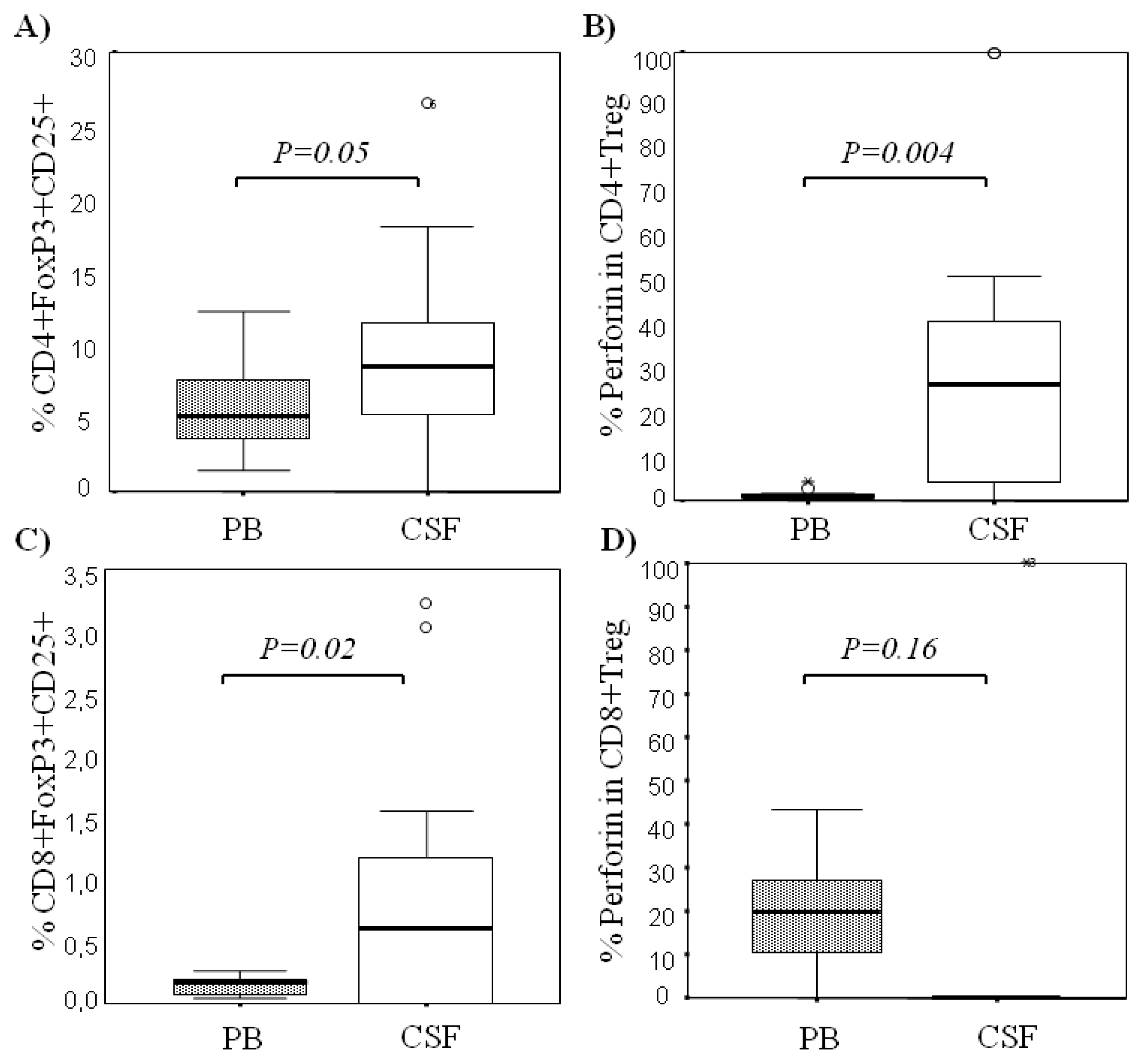
<p>When we studied paired samples of peripheral blood and CSF in MS patients at first clinical relapse, the frequencies of CD4+ T<sub>Reg</sub> (CD4+CD25+FoxP3+ and CD4+CD25bright) were significantly higher in CSF in comparison to their peripheral blood counterparts: CD4+CD25+FoxP3+ were 8.96 ± 6.84, 8.49 (7.89) <italic>vs</italic>. 5.65 ± 2.90, 5.13 (4.55), (<italic>p</italic> = 0.053) and CD4+CD25bright were 3.19 ± 1.77, 3.23 (2.91) <italic>vs</italic>. 1.23 ± 0.57, 1.20 (0.91) (<italic>p</italic> = 0.002), respectively. The proportions of CD4+CD25+FoxP3+ in CSF and PB are shown in <xref ref-type="fig" rid="f1-ijms-13-06698">Figure 1A</xref>. Notably, intracellular expression of perforin on CD4+ T<sub>Reg</sub> was significantly higher in CSF than in circulating cells: The percentages of CD4+CD25+FoxP3+ T<sub>Reg</sub> that co-expressed perforin in the CSF compartment were 32.32 ± 32.65, 25.82 (39.37) <italic>vs</italic>. 1.54 ± 1.22, 1.24 (1.4), <italic>p</italic> = 0.004 (<xref ref-type="fig" rid="f1-ijms-13-06698">Figure 1B</xref>). At the single cell level, the mean fluorescence intensity (MFI) of perforin in CD4+ T<sub>Reg</sub> showed a trend to be higher in the CSF than in the periphery: 79.60 ± 87.06, 52.77 (132.95) <italic>vs</italic>. 45.50 ± 47.10, 26.64 (45.81), <italic>p</italic> = 0.1.</p>
<p>The MFI of the co-stimulatory molecule CD28 on CD4+ T<sub>Reg</sub> was also analyzed in a subgroup of patients (<italic>n</italic> = 10) and interestingly, we found that the expression of this co-stimulatory signal was significantly reduced in CD4+ T<sub>Reg</sub> in the CSF compared to the periphery (MFI CD4+CD25<sup>med</sup>: 69.71 ± 40.76 <italic>vs</italic>. 289.75 ± 63.87, <italic>p</italic> &lt; 0.0001; MFI CD4+CD25<sup>hi+</sup>: 79.08 ± 40.28 <italic>vs</italic>. 325.77 ± 68.01, <italic>p</italic> = 0.006).</p>
<p>With respect to CD8+ T<sub>Reg</sub> subsets (CD8+FoxP3+, CD8+CD25+FoxP3+) were also significantly higher in the CSF compartment with respect to the periphery (<xref ref-type="table" rid="t1-ijms-13-06698">Table 1</xref>). Most of the CD8+FoxP3+ T<sub>Reg</sub> expressed on their surface the molecule CD25 and both subsets, CD8+FoxP3+ and CD8+CD25+FoxP3+ (<xref ref-type="fig" rid="f1-ijms-13-06698">Figure 1C</xref>), were present in higher proportions in CSF (<italic>p</italic> = 0.02 and <italic>p</italic> = 0.02, respectively) than in peripheral blood. The proportions of CD8+ T<sub>Reg</sub> are illustrated in <xref ref-type="table" rid="t1-ijms-13-06698">Table 1</xref>. In contrast to CD4+ T<sub>Reg</sub>, most of the CD8+CD25+FoxP3+ in CSF did not coexpress perforin (Median 0 (0) <italic>vs</italic>. 21.47 (22.73)) (<xref ref-type="fig" rid="f1-ijms-13-06698">Figure 1D</xref>).</p></sec>
<sec sec-type="subjects">
<title>2.2. Comparison of Regulatory T-Cells and Their Content of Perforin in Peripheral Blood between MS Patients and Healthy Controls</title>
<p>We found no differences in the frequencies of CD4+CD25+FoxP3+ T<sub>Reg</sub> between MS patients at MS relapse and healthy controls. CD4+CD25<sup>hi+</sup> T<sub>Reg</sub> showed a trend to a higher frequency in healthy controls than in MS patients at relapse 1.27 ± 0.73, 1.24 (1.03) <italic>vs</italic>. 0.93 ± 0.64, 1.01 (1.22) <italic>p</italic> = 0.08. When comparing only women, the differences reached statistical significance (1.30 ± 0.70, 1.26 (0.99) <italic>vs</italic>. 0.84 ± 0.68, 0.73 (1.27) <italic>p</italic> = 0.03). By contrast, there were no such differences between healthy controls and patients in any of the CD8+ T<sub>Reg</sub> subsets studied.</p>
<p>MS is associated with a functional defect of natural CD4+ T<sub>Reg</sub> [<xref ref-type="bibr" rid="b4-ijms-13-06698">4</xref>,<xref ref-type="bibr" rid="b5-ijms-13-06698">5</xref>,<xref ref-type="bibr" rid="b20-ijms-13-06698">20</xref>], defect that can be restored by some disease course modifying therapies, such as IFNβ or copaxone [<xref ref-type="bibr" rid="b3-ijms-13-06698">3</xref>]. This study simultaneously analyzed CD4+ and CD8+ T<sub>Reg</sub> in CSF and peripheral blood, confirming the higher frequencies of CD4+CD25+FoxP3+ T<sub>Reg</sub> in the CSF compared to the blood in a series of patients at first clinical relapse that were later on diagnosed as MS, in line with authors that had characterized CSF T<sub>Reg</sub> as CD4+CD25<sup>hi+</sup>CD27+ [<xref ref-type="bibr" rid="b14-ijms-13-06698">14</xref>,<xref ref-type="bibr" rid="b21-ijms-13-06698">21</xref>] and as CD4+CD25+FoxP3+ [<xref ref-type="bibr" rid="b15-ijms-13-06698">15</xref>]. This is the first study analyzing the perforin expression on T<sub>Reg</sub> within the CSF during MS relapse, pointing out this molecule as a putative mechanism mediating suppressive activity of CD4+ T<sub>Reg</sub> at the CNS, but not by CD8+ T<sub>Reg</sub>. In contrast, negligible quantities of perforin were expressed by their circulating CD4+ T<sub>Reg</sub> counterparts. Prior studies on cancer patients and in the mice model had shown that perforin expression on CD4+ T<sub>Reg</sub> was a relevant cell-cell contact suppression mechanism of this cell subset [<xref ref-type="bibr" rid="b18-ijms-13-06698">18</xref>,<xref ref-type="bibr" rid="b22-ijms-13-06698">22</xref>], further indicating that perforin expression could be mediating direct killing of dendritic cells and other target cells. A recent study has shown that immune regulation mediated by T<sub>Reg</sub> is dependent on the presence of IFN-γ and the perforin pathway to suppress EAE, the animal model of MS [<xref ref-type="bibr" rid="b23-ijms-13-06698">23</xref>].</p>
<p>Our group has recently described an E2-dependent perforin expression on CD4+ T<sub>Reg</sub> of healthy pregnants [<xref ref-type="bibr" rid="b17-ijms-13-06698">17</xref>]. In the present study, we show that this perforin-dependent mechanism may play a relevant role in MS. Indeed, the proportions and the expression of perforin at the single cell level in CD4+ T<sub>Reg</sub> in the CSF were significantly higher than those in peripheral blood. We have previously demonstrated the expression of surface lysosomal-associated membrane glycoproteins (LAMP)-1 and LAMP-2 by <italic>in vitro</italic> activated T<sub>Reg</sub>, which is a sign of cell degranulation and of the cytotoxicity exerted by these cells [<xref ref-type="bibr" rid="b17-ijms-13-06698">17</xref>]. Therefore, such enhanced perforin expression by CD4+ T<sub>Reg</sub> within the CSF of MS patients at first clinical relapse represents the first <italic>in vivo</italic> report indicating that perforin might play a role in the cytotoxicity and killing of target T cells, namely autorreactive/effector cells, in order to counteract the damage by autoreactive T and B cells. Indeed, a recent work shows that perforin involves a molecular mechanism of T<sub>Reg</sub>-mediated killing of the pathogenic T cells in the experimental model of MS [<xref ref-type="bibr" rid="b23-ijms-13-06698">23</xref>]. Also, in a tumor mice model, perforin mediated a tumor-antigen-dependent mechanism of DC killing by T<sub>Reg</sub> [<xref ref-type="bibr" rid="b22-ijms-13-06698">22</xref>]. Other data point out a relevant role of perforin in the pathogenesis of MS. Variations in the PRF1 gene have been described in MS patients with a higher frequency than in healthy controls [<xref ref-type="bibr" rid="b24-ijms-13-06698">24</xref>]. Other authors have described a generalized defect in the expression of perforin in a subgroup of male patients with PPMS [<xref ref-type="bibr" rid="b25-ijms-13-06698">25</xref>]. By contrast, CD8+ T<sub>Reg</sub> content of perforin was significantly decreased in the CNS as compared to blood, which suggests that this subset does not seem to use the perforin pathway for their suppressive function in MS within the central nervous compartment. In this study, we found also higher frequencies of CD8+CD25+FoxP3+ T<sub>Reg</sub> within the CNS compartment. This is in contrast to other authors that have recently described lower levels of CD8+CD25+FoxP3+ T<sub>Reg</sub> in the CSF than in blood of patients with MS during acute exacerbations [<xref ref-type="bibr" rid="b16-ijms-13-06698">16</xref>].</p>
<p>On the other hand, CD28 expression was markedly and significantly diminished on CD4+ T lymphocytes in the CSF of patients at acute MS relapse compared with that at the peripheral blood. CD28 is constitutively expressed on the surface of naïve T cells and its role in co-stimulation has been demonstrated in a variety of model systems [<xref ref-type="bibr" rid="b26-ijms-13-06698">26</xref>]. This finding points out an additional immune mechanism of peripheral tolerance taking place as part of the immune response within the CNS compartment.</p></sec>
<sec>
<title>2.3. Sexual Dimorphism in Regulatory T Cells</title>
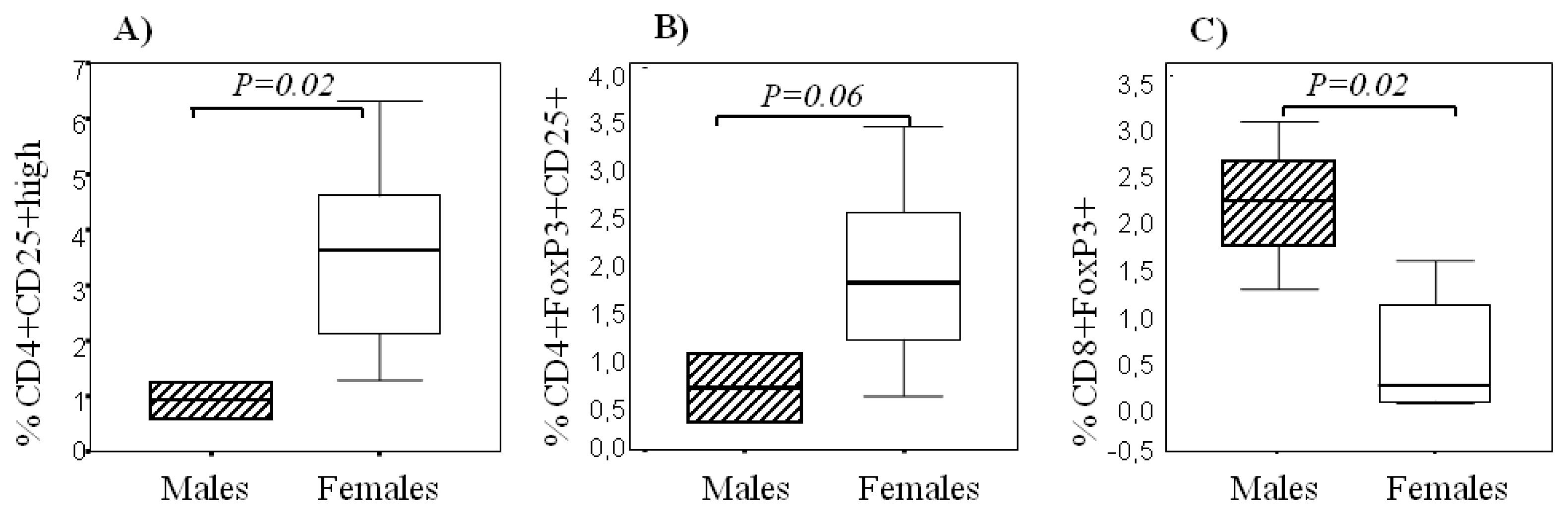
<p>We sought to determine the contribution of CD4+ and CD8+ T<sub>Reg</sub> in both women and men within CNS compartment at MS relapse. Our results pointed to something that has not been previously described: females presented higher frequencies of CD4+ T<sub>Reg</sub>, namely CD4+CD25<sup>hi+</sup> (<italic>p</italic> = 0.02) (<xref ref-type="fig" rid="f2-ijms-13-06698">Figure 2A</xref>), CD4+CD25+FoxP3+ (<italic>p</italic> = 0.06) (<xref ref-type="fig" rid="f2-ijms-13-06698">Figure 2B</xref>) in the CSF compartment. By contrast, males presented significantly higher proportions of CD8+ T<sub>Reg</sub>, measured as CD8+FoxP3<bold>+</bold> (<italic>p</italic> = 0.02) (<xref ref-type="fig" rid="f2-ijms-13-06698">Figure 2C</xref>). In the peripheral blood of MS patients, we observed again a trend of higher proportions of CD4+CD25+FoxP3+ T<sub>Reg</sub> in females than in males (<italic>p</italic> = 0.1). By contrast, CD4+CD25+FoxP3+ T<sub>Reg</sub> in the healthy control group were more abundant in men than in all women (<italic>p</italic> = 0.01). However, when we compared healthy women at day 14 of the menstrual cycle and men, females’ CD4+CD25+FoxP3+ T<sub>Reg</sub> co-expressed significantly higher perforin levels than males (median in females, 0.84 <italic>vs</italic>. median in males, 0.0, <italic>p</italic> = 0.004) and MFI of perforin (median in females, 20.06 <italic>vs</italic>. median in males, 0.0, <italic>p</italic> &lt; 0.001). A direct correlation was observed between the percentage of perforin in CD4+CD25+FoxP3+ T<sub>Reg</sub> and the levels of serum testosterone in women from the group of healthy controls (<italic>r</italic> = 0.34, <italic>p</italic> = 0.01). Moreover, in healthy controls the percentage of CD4+ T<sub>Reg</sub> correlated with the levels of serum testosterone both in men (<italic>r</italic> = 0.52, <italic>p</italic> = 0.05) and in women (<italic>r</italic> = 0.45, <italic>p</italic> &lt; 0.0001).</p>
<p>Compatible with the data previously reported by us for perforin expression on T<sub>Reg</sub> in the setting of normal pregnancy, expression of perforin in CSF of MS patients was confined to the FoxP3+ and HLA-DR+ T<sub>Reg</sub> subsets. All T<sub>Reg</sub> expressing perforin were also positive for granzyme (data not shown).</p>
<p>The presence of CD4+CD25<sup>hi+</sup> was higher within the CSF in MS females with respect to MS males and the presence of CD4+ T<sub>Reg</sub> within the CSF showed a trend to be higher, whereas CD8+ T<sub>Reg</sub> lymphocytes within CSF were higher in males. This has not been previously described, Recent results of our group have shown that E2 <italic>in vitro</italic> enhances the percentages and suppressive function of CD4+ T<sub>Reg</sub> [<xref ref-type="bibr" rid="b17-ijms-13-06698">17</xref>]; and that CD4+ T<sub>Reg</sub> show a differential higher expression of E2 and progesterone receptors than effector T-cells, which may render CD4+ T<sub>Reg</sub> more sensitive to these sex hormones [<xref ref-type="bibr" rid="b27-ijms-13-06698">27</xref>]. Our findings in this cohort of MS patients show that perforin expression on CD4+ T<sub>Reg</sub> was higher in MS males. This could be due to the diluting effect of MS women at any time point of the menstrual cycle and to the activation of the hypothalamic-pituitary-gonadal axis during MS relapse. However, when we compared the group of healthy women at day 14 with healthy men, expression of perforin on CD4+ T<sub>Reg</sub> was higher in women, in line with our previous results [<xref ref-type="bibr" rid="b17-ijms-13-06698">17</xref>]. These studies suggest an important role of these lymphocytes subset in the regulation of the effector response in the CNS, which could contribute to the understanding of why women are more prone to MS relapses than men, while the disease in men tends to be more severe. All this body of evidence suggests that perforin may play a relevant role in the pathogenesis of MS and gender might affect its expression. A defective perforin cell-mediated suppression on CD4+ T<sub>Reg</sub> may thus have a role in lymphocyte accumulation and autoimmune disease.</p></sec>
<sec>
<title>2.4. Sex Hormones and Cytokine Levels</title>
<p>The content of sex hormones in the CSF and in plasma samples (<italic>n</italic> = 17) was analyzed. As expected, the content of measurable sex hormones in the CSF compartment was negligible. Progesterone was only detected in three CSF samples of three women (0.2, 0.3, 0.5 μg/L). Oestradiol (E2) was not detected in any of the CSF samples analyzed. Testosterone was only detected in one of the five males analyzed (0.2 μg/L). By contrast, the stress hormone cortisol was detected in the CSF samples from 7 out of the 12 women analyzed and in all the 5 men analyzed (median (IQR), 1.2 (0.2) μg/dL). We found no differences by sex in the concentration of cortisol.</p>
<p>From the set of 11 cytokines and chemokines measured in parallel in blood and CSF (pairs of CSF and plasma from 10 MS patients, 5 males and 5 females), only IL-2 and IFN-α were detected in the CSF of our group of MS patients at relapse: IL-2 (<italic>n</italic> = 7) (median (IQR), 22.82 (0.94); IFN-α (<italic>n</italic> = 9) 17.67, (3.97). In plasma, the following cytokines were detected: IL12p70 (<italic>n</italic> = 3) 6.54, (5.29); IL-2 (<italic>n</italic> = 9) 28.42, (5.25); IL10 (<italic>n</italic> = 2) 7.62, (1.71); IFN-α (<italic>n</italic> = 9) 22.37, (2.48); TNF-α (<italic>n</italic> = 8) 18.28, (2.30); RANTES (<italic>n</italic> = 10) 2,652.11, (3346.89). All the cytokines were measured in pg/mL. Serum IFN-α was higher in women than in men (mean ± SD, median (IQR), women 27.13 ± 6.64, 23.7 (12.67); men 17.50 ± 9.82, 21.22 (12.2), <italic>p</italic> = 0.1), though this difference was not statistically significant probably due to the small number of samples.</p>
<p>Interestingly, a positive correlation was found between serum E2 and IL-2 showed (<italic>r</italic> = 0.64, <italic>p</italic> = 0.04); and a trend between E2 and IFN-α (<italic>r</italic> = 0.57, <italic>p</italic> = 0.08), whilst with testosterone there was a trend of inverse correlation (<italic>r</italic> = −0.57, <italic>p</italic> = 0.08).</p>
<p>When we analyzed the concentration of key cytokines and sex hormones in pairwise plasma and CSF samples IFN-α and IL-2 were the only cytokines detected both in plasma and CSF. TNF-α and RANTES were only detected in plasma. IL-2 has been described to modulate <italic>in vitro</italic> human CD4+CD25<sup>hi+</sup> T<sub>Reg</sub> and CD4+CD25<sup>-</sup> responder T cells death/growth arrest by differentially using the granzyme-perforin pathway depending on its concentration. We observed a direct correlation between plasma E2 and IL-2 levels, compatible with what we have previously described of how E2 enhances <italic>in vitro</italic> the suppressive activity of CD4+ T<sub>Reg</sub> mediated by perforin [<xref ref-type="bibr" rid="b17-ijms-13-06698">17</xref>]. Taking this into account and considering the limitations of the small sample size, we can speculate that our <italic>ex vivo</italic> data suggest a circuit relating E2, IL-2, perforin and CD4+ T<sub>Reg</sub>. Also, serum IFN-α was higher in women in agreement with previously described [<xref ref-type="bibr" rid="b28-ijms-13-06698">28</xref>], and here we show a direct correlation with serum E2 levels.</p></sec></sec>
<sec>
<title>3. Experimental Section</title>
<sec sec-type="subjects">
<title>3.1. Patients</title>
<p>A total of 26 patients: Males (<italic>n</italic>: 7) and females (<italic>n</italic>: 19) (median age: 38 years old, range: 21 to 57 years old) with first clinical isolated syndrome (CIS) that later on fulfilled MS diagnosis criteria defined by MCDonald’s criteria at first clinical relapse were enrolled in this study. One-hundred and nineteen sex-and-age matched healthy controls were enrolled in the study (102 females (<italic>n</italic> = 66 at day 1 and <italic>n</italic> = 36 at day 14 of the menstrual cycle) and 17 males) (median age: 34.5 years-old, range: 19 to 50 years). None of the MS patients had received any anti-inflammatory, immunosuppressive or disease-modifying agents at least 3-months before blood sampling for this study. Relapse was defined as the appearance or reappearance of one or more neurological abnormalities that persisted for at least 24 h and which had been preceded by at least 30 days of stable or improved neurological state, without any underlying infectious disease. Clinical physical severity was quantified by Kurtzke’s Expanded Disability Status Scale (EDSS).</p>
<p>The Hospital Review Board approved the study protocol and written informed consent was obtained from all participants prior to study commencement and sample collection.</p></sec>
<sec>
<title>3.2. Blood and CSF Sampling</title>
<p>Peripheral blood and 1 to 3 mL of CSF samples were obtained at the same time by venipuncture and lumbar puncture, respectively. We counted approximately between 130,000 to 200,000 lymphocytes per 3 mL of CSF in most MS patients. Both samples were processed within 2-h from collection. The study was conducted according to the ethical guidelines of our institution and the Declaration of Helsinki.</p></sec>
<sec sec-type="methods">
<title>3.3. Characterization and Quantitative Analysis of Regulatory CD4+ T Lymphocytes</title>
<p>Peripheral blood samples were taken and collected in EDTA Vacutainers and processed immediately. Whole blood (100 μL) samples were labeled by direct staining with appropriate fluorochrome-conjugated monoclonal antibodies (mAbs) for 20 min at room temperature and then lysed and washed, as previously described [<xref ref-type="bibr" rid="b3-ijms-13-06698">3</xref>]. CSF was processed immediately after spinal tap, centrifuged after collection and then the obtained cells were resuspended in 100 μL of complete medium (RPMI 1640 containing 10% foetal calf serum (FCS), streptomycin, penicillin and glutamine) before staining with the corresponding antibodies for 30 min at 4 °C in the dark. Direct conjugated mAbs: CD4-FITC, CD8-FITC, CD25 APC were obtained from Becton Dickinson (BD Immunocytometry Systems, San Jose, CA, USA).</p>
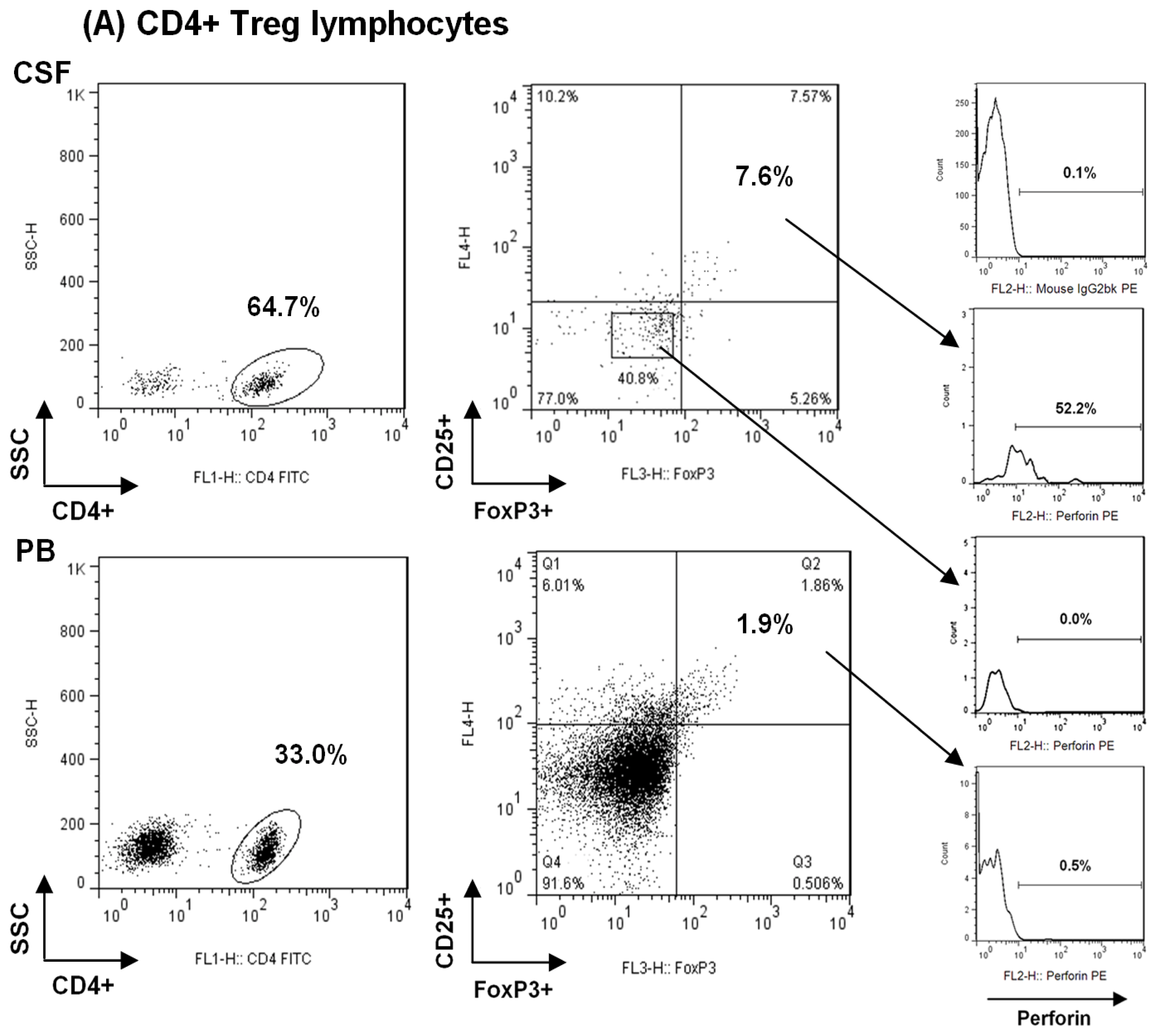
<p>T<sub>Reg</sub> were defined as CD4+CD25+FoxP3+ and CD4+CD25<sup>hi+</sup> co-expression, as previously described [<xref ref-type="bibr" rid="b3-ijms-13-06698">3</xref>]. Expression of FoxP3 and perforin were assessed by intracellular staining (<xref ref-type="fig" rid="f3-ijms-13-06698">Figure 3</xref>). Briefly, previously surface-stained cells were resuspended in 1 mL of freshly prepared permeabilization solution (eBioscience Fixation/Permeabilization), incubated for 30 min at 4 °C in the dark and washed. Next, cells were stained with anti-human FoxP3 antibody (PE-Cy5, clone PCH101, eBioscience) and anti-human Perforin antibody (PE, clone δG9, BD Pharmingen) and after 30 min incubation at 4 °C, cells were washed. Isotype control mAbs were used to determine background fluorescence levels. Acquisition and analysis were performed in a FACSort flow cytometer (Becton Dickinson), using a CELLQUEST Software (Becton Dickinson). A gate was drawn to include the lymphocytes in a dot plot of forward scatter <italic>vs</italic>. side scatter and a total of 20,000 events were collected in peripheral blood and at least 3000 events in CSF.</p>
<p>The frequencies of these subsets are expressed as percentage of total CD4+ T-lymphocytes. In a subgroup of patients (<italic>n</italic> = 10), the mean fluorescence intensity (MFI) of CD28 on CD4+CD25<sup>hi+</sup> cells was also analyzed.</p>
<sec sec-type="methods">
<title>Analysis of Regulatory CD8+ T Lymphocytes</title>
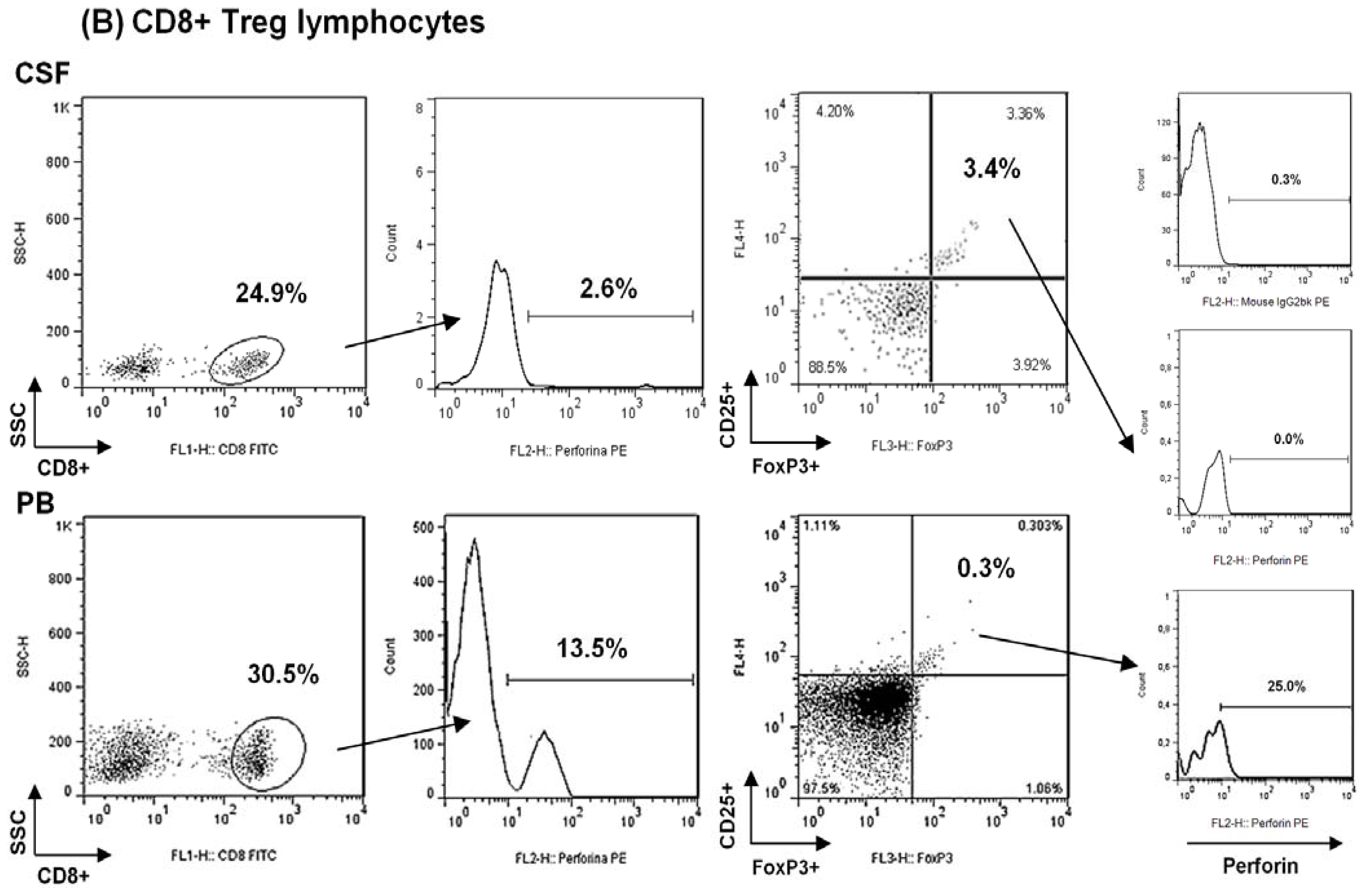
<p>For analysis of the regulatory CD8+ T lymphocytes, a first gate on a side scatter/C8-FITC dot plot was set up to collect CD8+ high cells. A second dot plot (FoxP3-PE-Cy5/CD25-APC) was set up to quantify CD8+ T<sub>Reg</sub>, as previously described [<xref ref-type="bibr" rid="b11-ijms-13-06698">11</xref>]. Within the CD8+CD25+FoxP3+ T<sub>Reg</sub> subset, the content of perforin was measured.</p></sec></sec>
<sec>
<title>3.4. Sex Hormones and Cytokine Detection</title>
<p>Serum samples were obtained about 8:30 am from all patients and controls. We separated serum in a refrigerated centrifuge, and stored at −80 °C until use. Serum cortisol was quantified by competitive immunoassay (IMMULITE 2000, Diagnostic Products Corporation, Los Angeles, CA, USA). Serum testosterone, E2 and P2 were determined by a chemiluminescent immunoassay (Immuno I, Bayer, Leverkusen, Germany).</p>
<p>The following cytokines were measured in plasma and in CSF of each patient using the Human Basic Kit FlowCytomix (eBioscience), according to the manufacturer’s instructions: IL12p70, IFN-γ, IL17a, IL2, IL10, IFN-α, IL4, IL5, IL1b, TNF-α, RANTES.</p></sec>
<sec sec-type="methods">
<title>3.5. Statistical Analysis</title>
<p>Data are presented as mean ± standard deviation (SD), median (interquartile range). To compare the percentage of expression of each T-cells subpopulation, we used the Mann-Whitney <italic>U</italic>-test to compare pairs of groups. Differences between groups were considered significant at <italic>p</italic> &lt; 0.05. All statistical analyses were performed using the SPSS (SPSS, Inc, Chicago, IL, USA) software packages. The correlation between variables was analyzed by Spearman coefficient.</p></sec></sec>
<sec sec-type="conclusions">
<title>4. Conclusions</title>
<p>In summary, a recruitment of both CD4+ and CD8+ T<sub>Reg</sub> was found within the CSF during MS relapse. Here, we describe that perforin expression by CD4+ T<sub>Reg</sub>, was greatly enhanced in CSF, suggesting a relevant role of this molecule in the cell-contact suppressive effects of the CD4+ T<sub>Reg</sub> in MS. Moreover, the proportions of CD4+ T<sub>Reg</sub> in the CSF were significantly higher in women than in men, which could account for the sexual dimorphism clinically evident in the incidence of MS. Despite the small sample size of our study, our preliminary data indicate a direct correlation between plasma E2 and IL-2 levels, which suggest that a putative circuit of E2 and perforin expression by CD4+ T<sub>Reg</sub> play a role in MS pathophysiology. Further studies should be performed to confirm these findings.</p></sec></body>
<back>
<ack>
<title>Acknowledgments</title>
<p>We would like to thank our patients with MS and the healthy volunteers that generously contributed blood samples to this study. We wish to thank Adela Harto for excellent nursing care of our patients. This study was supported by grants from the Fundación Salud 2000 and Fundación Mapfre.</p></ack>
<ref-list>
<title>References</title>
<ref id="b1-ijms-13-06698"><label>1</label><citation citation-type="journal"><person-group person-group-type="author"><name><surname>McFarlin</surname><given-names>D.E.</given-names></name><name><surname>McFarland</surname><given-names>H.F.</given-names></name></person-group><article-title>Multiple sclerosis (second of two parts)</article-title><source>N. Engl. J. Med</source><year>1982</year><volume>307</volume><fpage>1246</fpage><lpage>1251</lpage><pub-id pub-id-type="doi">10.1056/NEJM198211113072005</pub-id><pub-id pub-id-type="pmid">6290885</pub-id></citation></ref>
<ref id="b2-ijms-13-06698"><label>2</label><citation citation-type="journal"><person-group person-group-type="author"><name><surname>Cvetanovich</surname><given-names>G.L.</given-names></name><name><surname>Hafler</surname><given-names>D.A.</given-names></name></person-group><article-title>Human regulatory T cells in autoimmune diseases</article-title><source>Curr. Opin. Immunol</source><year>2010</year><volume>22</volume><fpage>753</fpage><lpage>760</lpage><pub-id pub-id-type="doi">10.1016/j.coi.2010.08.012</pub-id><pub-id pub-id-type="pmid">20869862</pub-id></citation></ref>
<ref id="b3-ijms-13-06698"><label>3</label><citation citation-type="journal"><person-group person-group-type="author"><name><surname>De Andres</surname><given-names>C.</given-names></name><name><surname>Aristimuno</surname><given-names>C.</given-names></name><name><surname>de Las Heras</surname><given-names>V.</given-names></name><name><surname>Martinez-Gines</surname><given-names>M.L.</given-names></name><name><surname>Bartolome</surname><given-names>M.</given-names></name><name><surname>Arroyo</surname><given-names>R.</given-names></name><name><surname>Navarro</surname><given-names>J.</given-names></name><name><surname>Gimenez-Roldan</surname><given-names>S.</given-names></name><name><surname>Fernandez-Cruz</surname><given-names>E.</given-names></name><name><surname>Sanchez-Ramon</surname><given-names>S.</given-names></name></person-group><article-title>Interferon beta-1a therapy enhances CD4+ regulatory T-cell function: An <italic>ex vivo</italic> and <italic>in vitro</italic> longitudinal study in relapsing-remitting multiple sclerosis</article-title><source>J. Neuroimmunol</source><year>2007</year><volume>182</volume><fpage>204</fpage><lpage>211</lpage><pub-id pub-id-type="doi">10.1016/j.jneuroim.2006.09.012</pub-id><pub-id pub-id-type="pmid">17157927</pub-id></citation></ref>
<ref id="b4-ijms-13-06698"><label>4</label><citation citation-type="journal"><person-group person-group-type="author"><name><surname>Haas</surname><given-names>J.</given-names></name><name><surname>Hug</surname><given-names>A.</given-names></name><name><surname>Viehover</surname><given-names>A.</given-names></name><name><surname>Fritzsching</surname><given-names>B.</given-names></name><name><surname>Falk</surname><given-names>C.S.</given-names></name><name><surname>Filser</surname><given-names>A.</given-names></name><name><surname>Vetter</surname><given-names>T.</given-names></name><name><surname>Milkova</surname><given-names>L.</given-names></name><name><surname>Korporal</surname><given-names>M.</given-names></name><name><surname>Fritz</surname><given-names>B.</given-names></name><etal/></person-group><article-title>Reduced suppressive effect of CD4+CD25high regulatory T cells on the T cell immune response against myelin oligodendrocyte glycoprotein in patients with multiple sclerosis</article-title><source>Eur. J. Immunol</source><year>2005</year><volume>35</volume><fpage>3343</fpage><lpage>3352</lpage><pub-id pub-id-type="doi">10.1002/eji.200526065</pub-id><pub-id pub-id-type="pmid">16206232</pub-id></citation></ref>
<ref id="b5-ijms-13-06698"><label>5</label><citation citation-type="journal"><person-group person-group-type="author"><name><surname>Viglietta</surname><given-names>V.</given-names></name><name><surname>Baecher-Allan</surname><given-names>C.</given-names></name><name><surname>Weiner</surname><given-names>H.L.</given-names></name><name><surname>Hafler</surname><given-names>D.A.</given-names></name></person-group><article-title>Loss of functional suppression by CD4+CD25+ regulatory T cells in patients with multiple sclerosis</article-title><source>J. Exp. Med</source><year>2004</year><volume>199</volume><fpage>971</fpage><lpage>979</lpage><pub-id pub-id-type="doi">10.1084/jem.20031579</pub-id><pub-id pub-id-type="pmid">15067033</pub-id></citation></ref>
<ref id="b6-ijms-13-06698"><label>6</label><citation citation-type="journal"><person-group person-group-type="author"><name><surname>Maggi</surname><given-names>E.</given-names></name><name><surname>Cosmi</surname><given-names>L.</given-names></name><name><surname>Liotta</surname><given-names>F.</given-names></name><name><surname>Romagnani</surname><given-names>P.</given-names></name><name><surname>Romagnani</surname><given-names>S.</given-names></name><name><surname>Annunziato</surname><given-names>F.</given-names></name></person-group><article-title>Thymic regulatory T cells</article-title><source>Autoimmun. Rev</source><year>2005</year><volume>4</volume><fpage>579</fpage><lpage>586</lpage><pub-id pub-id-type="doi">10.1016/j.autrev.2005.04.010</pub-id><pub-id pub-id-type="pmid">16214099</pub-id></citation></ref>
<ref id="b7-ijms-13-06698"><label>7</label><citation citation-type="journal"><person-group person-group-type="author"><name><surname>Baecher-Allan</surname><given-names>C.</given-names></name><name><surname>Viglietta</surname><given-names>V.</given-names></name><name><surname>Hafler</surname><given-names>D.A.</given-names></name></person-group><article-title>Human CD4+CD25+ regulatory T cells</article-title><source>Semin. Immunol</source><year>2004</year><volume>16</volume><fpage>89</fpage><lpage>98</lpage><pub-id pub-id-type="doi">10.1016/j.smim.2003.12.005</pub-id><pub-id pub-id-type="pmid">15036232</pub-id></citation></ref>
<ref id="b8-ijms-13-06698"><label>8</label><citation citation-type="journal"><person-group person-group-type="author"><name><surname>Green</surname><given-names>D.R.</given-names></name><name><surname>Flood</surname><given-names>P.M.</given-names></name><name><surname>Gershon</surname><given-names>R.K.</given-names></name></person-group><article-title>Immunoregulatory T-cell pathways</article-title><source>Annu. Rev. Immunol</source><year>1983</year><volume>1</volume><fpage>439</fpage><lpage>463</lpage><pub-id pub-id-type="doi">10.1146/annurev.iy.01.040183.002255</pub-id><pub-id pub-id-type="pmid">6152712</pub-id></citation></ref>
<ref id="b9-ijms-13-06698"><label>9</label><citation citation-type="journal"><person-group person-group-type="author"><name><surname>Cosmi</surname><given-names>L.</given-names></name><name><surname>Liotta</surname><given-names>F.</given-names></name><name><surname>Lazzeri</surname><given-names>E.</given-names></name><name><surname>Francalanci</surname><given-names>M.</given-names></name><name><surname>Angeli</surname><given-names>R.</given-names></name><name><surname>Mazzinghi</surname><given-names>B.</given-names></name><name><surname>Santarlasci</surname><given-names>V.</given-names></name><name><surname>Manetti</surname><given-names>R.</given-names></name><name><surname>Vanini</surname><given-names>V.</given-names></name><name><surname>Romagnani</surname><given-names>P.</given-names></name><etal/></person-group><article-title>Human CD8+CD25+ thymocytes share phenotypic and functional features with CD4+CD25+ regulatory thymocytes</article-title><source>Blood</source><year>2003</year><volume>102</volume><fpage>4107</fpage><lpage>4114</lpage><pub-id pub-id-type="doi">10.1182/blood-2003-04-1320</pub-id><pub-id pub-id-type="pmid">12893750</pub-id></citation></ref>
<ref id="b10-ijms-13-06698"><label>10</label><citation citation-type="journal"><person-group person-group-type="author"><name><surname>Vlad</surname><given-names>G.</given-names></name><name><surname>Suciu-Foca</surname><given-names>N.</given-names></name></person-group><article-title>Resurgence or emergence of CD8+ Ts</article-title><source>Hum. Immunol.</source><year>2008</year><volume>69</volume><fpage>679</fpage><lpage>680</lpage><pub-id pub-id-type="doi">10.1016/j.humimm.2008.10.010</pub-id><pub-id pub-id-type="pmid">19026353</pub-id></citation></ref>
<ref id="b11-ijms-13-06698"><label>11</label><citation citation-type="journal"><person-group person-group-type="author"><name><surname>Aristimuno</surname><given-names>C.</given-names></name><name><surname>de Andres</surname><given-names>C.</given-names></name><name><surname>Bartolome</surname><given-names>M.</given-names></name><name><surname>de las Heras</surname><given-names>V.</given-names></name><name><surname>Martinez-Gines</surname><given-names>M.L.</given-names></name><name><surname>Arroyo</surname><given-names>R.</given-names></name><name><surname>Fernandez-Cruz</surname><given-names>E.</given-names></name><name><surname>Sanchez-Ramon</surname><given-names>S.</given-names></name></person-group><article-title>IFNbeta-1a therapy for multiple sclerosis expands regulatory CD8+ T cells and decreases memory CD8+ subset: a longitudinal 1-year study</article-title><source>Clin. Immunol</source><year>2009</year><volume>134</volume><fpage>148</fpage><lpage>157</lpage><pub-id pub-id-type="pmid">19900844</pub-id></citation></ref>
<ref id="b12-ijms-13-06698"><label>12</label><citation citation-type="journal"><person-group person-group-type="author"><name><surname>Aristimuño</surname><given-names>C.</given-names></name><name><surname>Navarro</surname><given-names>J.</given-names></name><name><surname>de Andres</surname><given-names>C.</given-names></name><name><surname>Martinez-Gines</surname><given-names>L.</given-names></name><name><surname>Gimenez-Roldan</surname><given-names>S.</given-names></name><name><surname>Fernandez-Cruz</surname><given-names>E.</given-names></name><name><surname>Sanchez-Ramon</surname><given-names>S.</given-names></name></person-group><article-title>Expansion of regulatory CD8+ T-lymphocytes and fall of activated CD8+ T-lymphocytes after i.v. methyl-prednisolone for multiple sclerosis relapse</article-title><source>J. Neuroimmunol</source><year>2008</year><volume>204</volume><fpage>131</fpage><lpage>135</lpage><pub-id pub-id-type="doi">10.1016/j.jneuroim.2008.08.009</pub-id><pub-id pub-id-type="pmid">18835045</pub-id></citation></ref>
<ref id="b13-ijms-13-06698"><label>13</label><citation citation-type="journal"><person-group person-group-type="author"><name><surname>Tennakoon</surname><given-names>D.K.</given-names></name><name><surname>Mehta</surname><given-names>R.S.</given-names></name><name><surname>Ortega</surname><given-names>S.B.</given-names></name><name><surname>Bhoj</surname><given-names>V.</given-names></name><name><surname>Racke</surname><given-names>M.K.</given-names></name><name><surname>Karandikar</surname><given-names>N.J.</given-names></name></person-group><article-title>Therapeutic induction of regulatory, cytotoxic CD8+ T cells in multiple sclerosis</article-title><source>J. Immunol</source><year>2006</year><volume>176</volume><fpage>7119</fpage><lpage>7129</lpage><pub-id pub-id-type="pmid">16709875</pub-id></citation></ref>
<ref id="b14-ijms-13-06698"><label>14</label><citation citation-type="journal"><person-group person-group-type="author"><name><surname>Feger</surname><given-names>U.</given-names></name><name><surname>Luther</surname><given-names>C.</given-names></name><name><surname>Poeschel</surname><given-names>S.</given-names></name><name><surname>Melms</surname><given-names>A.</given-names></name><name><surname>Tolosa</surname><given-names>E.</given-names></name><name><surname>Wiendl</surname><given-names>H.</given-names></name></person-group><article-title>Increased frequency of CD4+ CD25+ regulatory T cells in the cerebrospinal fluid but not in the blood of multiple sclerosis patients</article-title><source>Clin. Exp. Immunol</source><year>2007</year><volume>147</volume><fpage>412</fpage><lpage>418</lpage><pub-id pub-id-type="doi">10.1111/j.1365-2249.2006.03271.x</pub-id><pub-id pub-id-type="pmid">17302889</pub-id></citation></ref>
<ref id="b15-ijms-13-06698"><label>15</label><citation citation-type="journal"><person-group person-group-type="author"><name><surname>Fritzsching</surname><given-names>B.</given-names></name><name><surname>Haas</surname><given-names>J.</given-names></name><name><surname>Konig</surname><given-names>F.</given-names></name><name><surname>Kunz</surname><given-names>P.</given-names></name><name><surname>Fritzsching</surname><given-names>E.</given-names></name><name><surname>Poschl</surname><given-names>J.</given-names></name><name><surname>Krammer</surname><given-names>P.H.</given-names></name><name><surname>Bruck</surname><given-names>W.</given-names></name><name><surname>Suri-Payer</surname><given-names>E.</given-names></name><name><surname>Wildemann</surname><given-names>B.</given-names></name></person-group><article-title>Intracerebral human regulatory T cells: Analysis of CD4+ CD25+ FOXP3+ T cells in brain lesions and cerebrospinal fluid of multiple sclerosis patients</article-title><source>PLoS One</source><year>2011</year><volume>6</volume><pub-id pub-id-type="doi">10.1371/journal.pone.0017988</pub-id></citation></ref>
<ref id="b16-ijms-13-06698"><label>16</label><citation citation-type="journal"><person-group person-group-type="author"><name><surname>Correale</surname><given-names>J.</given-names></name><name><surname>Villa</surname><given-names>A.</given-names></name></person-group><article-title>Role of CD8+ CD25+ Foxp3+ regulatory T cells in multiple sclerosis</article-title><source>Ann. Neurol</source><year>2010</year><volume>67</volume><fpage>625</fpage><lpage>638</lpage><pub-id pub-id-type="pmid">20437560</pub-id></citation></ref>
<ref id="b17-ijms-13-06698"><label>17</label><citation citation-type="journal"><person-group person-group-type="author"><name><surname>Valor</surname><given-names>L.</given-names></name><name><surname>Teijeiro</surname><given-names>R.</given-names></name><name><surname>Aristimuno</surname><given-names>C.</given-names></name><name><surname>Faure</surname><given-names>F.</given-names></name><name><surname>Alonso</surname><given-names>B.</given-names></name><name><surname>de Andres</surname><given-names>C.</given-names></name><name><surname>Tejera</surname><given-names>M.</given-names></name><name><surname>Lopez-Lazareno</surname><given-names>N.</given-names></name><name><surname>Fernandez-Cruz</surname><given-names>E.</given-names></name><name><surname>Sanchez-Ramon</surname><given-names>S.</given-names></name></person-group><article-title>Estradiol-dependent perforin expression by human regulatory T-cells</article-title><source>Eur. J. Clin. Invest</source><year>2010</year><volume>41</volume><fpage>357</fpage><lpage>364</lpage><pub-id pub-id-type="pmid">21114488</pub-id></citation></ref>
<ref id="b18-ijms-13-06698"><label>18</label><citation citation-type="journal"><person-group person-group-type="author"><name><surname>Grossman</surname><given-names>W.J.</given-names></name><name><surname>Verbsky</surname><given-names>J.W.</given-names></name><name><surname>Barchet</surname><given-names>W.</given-names></name><name><surname>Colonna</surname><given-names>M.</given-names></name><name><surname>Atkinson</surname><given-names>J.P.</given-names></name><name><surname>Ley</surname><given-names>T.J.</given-names></name></person-group><article-title>Human T regulatory cells can use the perforin pathway to cause autologous target cell death</article-title><source>Immunity</source><year>2004</year><volume>21</volume><fpage>589</fpage><lpage>601</lpage><pub-id pub-id-type="doi">10.1016/j.immuni.2004.09.002</pub-id><pub-id pub-id-type="pmid">15485635</pub-id></citation></ref>
<ref id="b19-ijms-13-06698"><label>19</label><citation citation-type="journal"><person-group person-group-type="author"><name><surname>McCombe</surname><given-names>P.A.</given-names></name><name><surname>Greer</surname><given-names>J.M.</given-names></name><name><surname>Mackay</surname><given-names>I.R.</given-names></name></person-group><article-title>Sexual dimorphism in autoimmune disease</article-title><source>Curr. Mol. Med</source><year>2009</year><volume>9</volume><fpage>1058</fpage><lpage>1079</lpage><pub-id pub-id-type="doi">10.2174/156652409789839116</pub-id><pub-id pub-id-type="pmid">19747114</pub-id></citation></ref>
<ref id="b20-ijms-13-06698"><label>20</label><citation citation-type="journal"><person-group person-group-type="author"><name><surname>Sanchez-Ramon</surname><given-names>S.</given-names></name><name><surname>Navarro</surname><given-names>A.J.</given-names></name><name><surname>Aristimuno</surname><given-names>C.</given-names></name><name><surname>Rodriguez-Mahou</surname><given-names>M.</given-names></name><name><surname>Bellon</surname><given-names>J.M.</given-names></name><name><surname>Fernandez-Cruz</surname><given-names>E.</given-names></name><name><surname>de Andres</surname><given-names>C.</given-names></name></person-group><article-title>Pregnancy-induced expansion of regulatory T-lymphocytes may mediate protection to multiple sclerosis activity</article-title><source>Immunol. Lett</source><year>2005</year><volume>96</volume><fpage>195</fpage><lpage>201</lpage><pub-id pub-id-type="doi">10.1016/j.imlet.2004.09.004</pub-id><pub-id pub-id-type="pmid">15585323</pub-id></citation></ref>
<ref id="b21-ijms-13-06698"><label>21</label><citation citation-type="journal"><person-group person-group-type="author"><name><surname>Venken</surname><given-names>K.</given-names></name><name><surname>Hellings</surname><given-names>N.</given-names></name><name><surname>Thewissen</surname><given-names>M.</given-names></name><name><surname>Somers</surname><given-names>V.</given-names></name><name><surname>Hensen</surname><given-names>K.</given-names></name><name><surname>Rummens</surname><given-names>J.L.</given-names></name><name><surname>Medaer</surname><given-names>R.</given-names></name><name><surname>Hupperts</surname><given-names>R.</given-names></name><name><surname>Stinissen</surname><given-names>P.</given-names></name></person-group><article-title>Compromised CD4+ CD25(high) regulatory T-cell function in patients with relapsing-remitting multiple sclerosis is correlated with a reduced frequency of FOXP3-positive cells and reduced FOXP3 expression at the single-cell level</article-title><source>Immunology</source><year>2008</year><volume>123</volume><fpage>79</fpage><lpage>89</lpage><pub-id pub-id-type="doi">10.1111/j.1365-2567.2007.02690.x</pub-id><pub-id pub-id-type="pmid">17897326</pub-id></citation></ref>
<ref id="b22-ijms-13-06698"><label>22</label><citation citation-type="journal"><person-group person-group-type="author"><name><surname>Boissonnas</surname><given-names>A.</given-names></name><name><surname>Scholer-Dahirel</surname><given-names>A.</given-names></name><name><surname>Simon-Blancal</surname><given-names>V.</given-names></name><name><surname>Pace</surname><given-names>L.</given-names></name><name><surname>Valet</surname><given-names>F.</given-names></name><name><surname>Kissenpfennig</surname><given-names>A.</given-names></name><name><surname>Sparwasser</surname><given-names>T.</given-names></name><name><surname>Malissen</surname><given-names>B.</given-names></name><name><surname>Fetler</surname><given-names>L.</given-names></name><name><surname>Amigorena</surname><given-names>S.</given-names></name></person-group><article-title>Foxp3+ T cells induce perforin-dependent dendritic cell death in tumor-draining lymph nodes</article-title><source>Immunity</source><year>2010</year><volume>32</volume><fpage>266</fpage><lpage>278</lpage><pub-id pub-id-type="doi">10.1016/j.immuni.2009.11.015</pub-id><pub-id pub-id-type="pmid">20137985</pub-id></citation></ref>
<ref id="b23-ijms-13-06698"><label>23</label><citation citation-type="journal"><person-group person-group-type="author"><name><surname>Beeston</surname><given-names>T.</given-names></name><name><surname>Smith</surname><given-names>T.R.</given-names></name><name><surname>Maricic</surname><given-names>I.</given-names></name><name><surname>Tang</surname><given-names>X.</given-names></name><name><surname>Kumar</surname><given-names>V.</given-names></name></person-group><article-title>Involvement of IFN-γ and perforin, but not Fas/FasL interactions in regulatory T cell-mediated suppression of experimental autoimmune encephalomyelitis</article-title><source>J. Neuroimmunol</source><year>2010</year><volume>229</volume><fpage>91</fpage><lpage>97</lpage><pub-id pub-id-type="doi">10.1016/j.jneuroim.2010.07.007</pub-id><pub-id pub-id-type="pmid">20708278</pub-id></citation></ref>
<ref id="b24-ijms-13-06698"><label>24</label><citation citation-type="journal"><person-group person-group-type="author"><name><surname>Cappellano</surname><given-names>G.</given-names></name><name><surname>Orilieri</surname><given-names>E.</given-names></name><name><surname>Comi</surname><given-names>C.</given-names></name><name><surname>Chiocchetti</surname><given-names>A.</given-names></name><name><surname>Bocca</surname><given-names>S.</given-names></name><name><surname>Boggio</surname><given-names>E.</given-names></name><name><surname>Bernardone</surname><given-names>I.S.</given-names></name><name><surname>Cometa</surname><given-names>A.</given-names></name><name><surname>Clementi</surname><given-names>R.</given-names></name><name><surname>Barizzone</surname><given-names>N.</given-names></name><etal/></person-group><article-title>Variations of the perforin gene in patients with multiple sclerosis</article-title><source>Genes. Immun</source><year>2008</year><volume>9</volume><fpage>438</fpage><lpage>444</lpage><pub-id pub-id-type="doi">10.1038/gene.2008.35</pub-id><pub-id pub-id-type="pmid">18496551</pub-id></citation></ref>
<ref id="b25-ijms-13-06698"><label>25</label><citation citation-type="journal"><person-group person-group-type="author"><name><surname>Camiña-Tato</surname><given-names>M.</given-names></name><name><surname>Morcillo-Suarez</surname><given-names>C.</given-names></name><name><surname>Bustamante</surname><given-names>M.F.</given-names></name><name><surname>Ortega</surname><given-names>I.</given-names></name><name><surname>Navarro</surname><given-names>A.</given-names></name><name><surname>Muntasell</surname><given-names>A.</given-names></name><name><surname>Lopez-Botet</surname><given-names>M.</given-names></name><name><surname>Sanchez</surname><given-names>A.</given-names></name><name><surname>Carmona</surname><given-names>P.</given-names></name><name><surname>Julia</surname><given-names>E.</given-names></name><etal/></person-group><article-title>Gender-associated differences of perforin polymorphisms in the susceptibility to multiple sclerosis</article-title><source>J. Immunol</source><year>2010</year><volume>185</volume><fpage>5392</fpage><lpage>5404</lpage><pub-id pub-id-type="doi">10.4049/jimmunol.1000102</pub-id><pub-id pub-id-type="pmid">20921521</pub-id></citation></ref>
<ref id="b26-ijms-13-06698"><label>26</label><citation citation-type="journal"><person-group person-group-type="author"><name><surname>Lenschow</surname><given-names>D.J.</given-names></name><name><surname>Walunas</surname><given-names>T.L.</given-names></name><name><surname>Bluestone</surname><given-names>J.A.</given-names></name></person-group><article-title>CD28/B7 system of T cell costimulation</article-title><source>Annu. Rev. Immunol.</source><year>1996</year><volume>14</volume><fpage>233</fpage><lpage>258</lpage><pub-id pub-id-type="doi">10.1146/annurev.immunol.14.1.233</pub-id><pub-id pub-id-type="pmid">8717514</pub-id></citation></ref>
<ref id="b27-ijms-13-06698"><label>27</label><citation citation-type="journal"><person-group person-group-type="author"><name><surname>Aristimuno</surname><given-names>C.</given-names></name><name><surname>Teijeiro</surname><given-names>R.</given-names></name><name><surname>Valor</surname><given-names>L.</given-names></name><name><surname>Alonso</surname><given-names>B.</given-names></name><name><surname>Tejera-Alhambra</surname><given-names>M.</given-names></name><name><surname>de Andres</surname><given-names>C.</given-names></name><name><surname>Minarro</surname><given-names>D.O.</given-names></name><name><surname>Lopez-Lazareno</surname><given-names>N.</given-names></name><name><surname>Faure</surname><given-names>F.</given-names></name><name><surname>Sanchez-Ramon</surname><given-names>S.</given-names></name></person-group><article-title>Sex-hormone receptors pattern on regulatory T-cells: clinical implications for multiple sclerosis</article-title><source>Clin. Exp. Med</source><year>2012</year><pub-id pub-id-type="doi">10.1007/s10238-011-0172-3</pub-id></citation></ref>
<ref id="b28-ijms-13-06698"><label>28</label><citation citation-type="journal"><person-group person-group-type="author"><name><surname>Berghofer</surname><given-names>B.</given-names></name><name><surname>Frommer</surname><given-names>T.</given-names></name><name><surname>Haley</surname><given-names>G.</given-names></name><name><surname>Fink</surname><given-names>L.</given-names></name><name><surname>Bein</surname><given-names>G.</given-names></name><name><surname>Hackstein</surname><given-names>H.</given-names></name></person-group><article-title>TLR7 ligands induce higher IFN-alpha production in females</article-title><source>J. Immunol</source><year>2006</year><volume>177</volume><fpage>2088</fpage><lpage>2096</lpage><pub-id pub-id-type="pmid">16887967</pub-id></citation></ref></ref-list>
<sec sec-type="display-objects">
<title>Figures and Table</title>
<fig id="f1-ijms-13-06698" position="float">
<label>Figure 1</label>
<caption>
<p>CD4+ T<sub>Reg</sub> and CD8+ T<sub>Reg</sub> frequencies with their expression of perforin in the cerebrospinal fluid (CSF) and in peripheral blood (PB) of MS patients with first clinical isolated syndrome (CIS). (<bold>A</bold>) CD4+ T<sub>Reg</sub>, defined as CD4+FoxP3+CD25+, frequencies in CSF and PB; (<bold>B</bold>) CD4+ T<sub>Reg</sub> expression of perforin in CSF and PB; (<bold>C</bold>) CD8+ T<sub>Reg</sub>, defined as CD8+FoxP3+CD25+ frequencies in CSF and PB; (<bold>D</bold>) CD8+ T<sub>Reg</sub> expression of perforin in CSF and PB.</p></caption>
<graphic xlink:href="ijms-13-06698f1.gif"/></fig>
<fig id="f2-ijms-13-06698" position="float">
<label>Figure 2</label>
<caption>
<p>Sexual dimorphism in regulatory T cells in the cerebrospinal fluid (CSF) of MS patients with first clinical isolated syndrome (CIS). (<bold>A</bold>) CD4+ T<sub>Reg</sub>, defined as CD4+CD25<sup>hi+</sup>, frequencies in the CSF of men and women with CIS; (<bold>B</bold>) CD4+ T<sub>Reg</sub>, defined as CD4+FoxP3+CD25+; and (<bold>C</bold>) CD8+ T<sub>Reg</sub>, defined as CD8+ FoxP3+, frequencies in the CSF of men and women with CIS.</p></caption>
<graphic xlink:href="ijms-13-06698f2.gif"/></fig>
<fig id="f3-ijms-13-06698" position="float">
<label>Figure 3</label>
<caption>
<p>(<bold>A</bold>) shows the gating strategy by which CD4+T<sub>Reg</sub> were characterized and their perforin staining; (<bold>B</bold>) shows CD8+ T<sub>Reg</sub> gating strategy and perforin staining of CD8+ T cells as positive control for perforin staining. CD8+ T cells showed lower expression of perforin in the CSF than in the periphery.</p></caption>
<graphic xlink:href="ijms-13-06698f3a.gif"/>
<graphic xlink:href="ijms-13-06698f3b.gif"/></fig>
<table-wrap id="t1-ijms-13-06698" position="float">
<label>Table 1</label>
<caption>
<p>Proportions of regulatory CD8+ T-cells subsets in cerebrospinal fluid (CSF) and peripheral blood (PB) in patients at first MS relapse.</p></caption>
<table frame="box" rules="all">
<thead>
<tr>
<th align="center" valign="top"/>
<th align="center" valign="top">CSF</th>
<th align="center" valign="top">PB</th>
<th align="center" valign="top"><italic>P</italic></th></tr></thead>
<tbody>
<tr>
<td align="center" valign="top"><bold>% CD8+FoxP3+ T cells</bold></td>
<td align="center" valign="top">0.95 ± 1.00<break/>0.99 (1.49)</td>
<td align="center" valign="top">0.13 ± 0.08<break/>0.14 (0.12)</td>
<td align="center" valign="top">0.02</td></tr>
<tr>
<td align="center" valign="top"><bold>% CD8+CD25+FoxP3+ T cells</bold></td>
<td align="center" valign="top">0.84 ± 1.05<break/>0.60 (1.23)</td>
<td align="center" valign="top">0.13 ± 0.07<break/>0.16 (0.15)</td>
<td align="center" valign="top">0.02</td></tr></tbody></table></table-wrap></sec></back></article>