<?xml version="1.0" encoding="UTF-8"?>
<!DOCTYPE article PUBLIC "-//NLM//DTD Journal Publishing DTD v2.3 20070202//EN" "journalpublishing.dtd">
<article xmlns:xlink="http://www.w3.org/1999/xlink" xml:lang="en" article-type="research-article">
<front>
<journal-meta>
<journal-id journal-id-type="publisher-id">ijms</journal-id>
<journal-title>International Journal of Molecular Sciences</journal-title>
<abbrev-journal-title>Int. J. Mol. Sci.</abbrev-journal-title>
<issn pub-type="epub">1422-0067</issn>
<publisher>
<publisher-name>Molecular Diversity Preservation International (MDPI)</publisher-name></publisher></journal-meta>
<article-meta>
<article-id pub-id-type="doi">10.3390/ijms13022263</article-id>
<article-id pub-id-type="publisher-id">ijms-13-02263</article-id>
<article-categories>
<subj-group>
<subject>Article</subject></subj-group></article-categories>
<title-group>
<article-title>Comprehensive and Facile Synthesis of Some Functionalized Bis-Heterocyclic Compounds Containing a Thieno[2,3-<italic>b</italic>]thiophene Motif</article-title></title-group>
<contrib-group>
<contrib contrib-type="author">
<name><surname>Mabkhot</surname><given-names>Yahia N.</given-names></name><xref ref-type="corresp" rid="c1-ijms-13-02263">*</xref></contrib>
<contrib contrib-type="author">
<name><surname>Barakat</surname><given-names>Assem</given-names></name><xref ref-type="corresp" rid="c1-ijms-13-02263">*</xref></contrib>
<contrib contrib-type="author">
<name><surname>Al-Majid</surname><given-names>Abdullah M.</given-names></name></contrib>
<contrib contrib-type="author">
<name><surname>Alshahrani</surname><given-names>Saeed A.</given-names></name></contrib>
<aff id="af1-ijms-13-02263">Department of Chemistry, Faculty of Science, King Saud University, P.O. Box 2455, Riyadh 11451, Saudi Arabia; E-Mails: <email>amajid@ksu.edu.sa</email> (A.M.A.-M.); <email>saddah096@hotmail.com</email> (S.A.A.)</aff></contrib-group>
<author-notes>
<corresp id="c1-ijms-13-02263">
<label>*</label>Authors to whom correspondence should be addressed; E-Mails: <email>yahia@ksu.edu.sa</email> (Y.N.M.); <email>ambarakat@ksu.edu.sa</email> (A.B.); Tel.: +96614675884; Fax: +96614675992.</corresp></author-notes>
<pub-date pub-type="collection">
<year>2012</year></pub-date>
<pub-date pub-type="epub">
<day>20</day>
<month>2</month>
<year>2012</year></pub-date>
<volume>13</volume>
<issue>2</issue>
<fpage>2263</fpage>
<lpage>2275</lpage>
<history>
<date date-type="received">
<day>06</day>
<month>1</month>
<year>2012</year></date>
<date date-type="rev-recd">
<day>09</day>
<month>2</month>
<year>2012</year></date>
<date date-type="accepted">
<day>13</day>
<month>2</month>
<year>2012</year></date></history>
<permissions>
<copyright-statement>© 2012 by the authors; licensee Molecular Diversity Preservation International, Basel, Switzerland.</copyright-statement>
<copyright-year>2012</copyright-year>
<license license-type="open-access" xlink:href="http://creativecommons.org/licenses/by/3.0">
<p>This article is an open-access article distributed under the terms and conditions of the Creative Commons Attribution license (http://creativecommons.org/licenses/by/3.0/).</p></license></permissions>
<abstract>
<p>A comprehensive and facile method for the synthesis of new functionalized bis-heterocyclic compounds containing a thieno[2,3-<italic>b</italic>]thiophene motif is described. The hitherto unknown bis-pyrazolothieno[2,3-<italic>b</italic>]thiophene derivatives <bold>2a</bold>–<bold>c</bold>, bis-pyridazin othieno[2,3-<italic>b</italic>]thiophene derivatives <bold>4</bold>, bis-pyridinothieno[2,3-<italic>b</italic>]thiophene derivatives <bold>6a</bold>,<bold>b</bold>, and to an analogous bis-pyridinothieno[2,3-<italic>b</italic>]thiophene nitrile derivatives <bold>7</bold> are obtained. Additionally, the novel bis-pyradazinonothieno[2,3-<italic>b</italic>]thiophene derivatives <bold>9</bold>, and nicotinic acid derivatives <bold>10</bold>, <bold>11</bold> are obtained via bis-dienamide <bold>8</bold>. The structures of all newly synthesized compounds have been elucidated by <sup>1</sup>H, <sup>13</sup>C NMR, GCMS, and IR spectrometry. These compounds represent a new class of sulfur and Nitrogen containing heterocycles that should also be of interest as new materials.</p></abstract>
<kwd-group>
<kwd>pyrazole</kwd>
<kwd>nicotinic acid</kwd>
<kwd>thieno[2,3-<italic>b</italic>]thiophene</kwd>
<kwd>enaminone</kwd>
<kwd>heterocycle</kwd></kwd-group></article-meta></front>
<body>
<sec sec-type="intro">
<title>1. Introduction</title>
<p>Heterocycles are well known for displaying a wide range of biological properties [<xref ref-type="bibr" rid="b1-ijms-13-02263">1</xref>]. The structural diversity and biological importance of <italic>N</italic>-containing heterocycles have made them attractive synthetic targets over many years. Pyrazole and pyrazoline derivatives are in general well-known five-membered <italic>N</italic>-containing heterocyclic compounds [<xref ref-type="bibr" rid="b2-ijms-13-02263">2</xref>,<xref ref-type="bibr" rid="b3-ijms-13-02263">3</xref>]. Compounds with pyrazole ring are of interest due to their broad spectrum of biological activities as NOS inhibitors [<xref ref-type="bibr" rid="b4-ijms-13-02263">4</xref>], monoamine oxidase inhibitor [<xref ref-type="bibr" rid="b5-ijms-13-02263">5</xref>], antibacterial [<xref ref-type="bibr" rid="b6-ijms-13-02263">6</xref>], and antiamoebic compounds [<xref ref-type="bibr" rid="b7-ijms-13-02263">7</xref>]. Moreover, <italic>N</italic>-phenylpyrazole derivatives play an important role in antitumor screening [<xref ref-type="bibr" rid="b8-ijms-13-02263">8</xref>] as well as potent antimicrobial products [<xref ref-type="bibr" rid="b9-ijms-13-02263">9</xref>,<xref ref-type="bibr" rid="b10-ijms-13-02263">10</xref>]. Furthermore, a number of pyridine and pyridazine derivatives are gaining synthetic interest in recent years due to their broad spectrum of biological activities [<xref ref-type="bibr" rid="b11-ijms-13-02263">11</xref>]. On the other hand, many thiophene-containing compounds, including annulated compounds, exhibit biological activities [<xref ref-type="bibr" rid="b12-ijms-13-02263">12</xref>,<xref ref-type="bibr" rid="b13-ijms-13-02263">13</xref>]. Thienothiophene derivatives have been developed for different purposes in the pharmaceutical field and have been tested as potential antitumor, antiviral and antibiotic, antiglaucoma drugs, or as inhibitors of platelet aggregation [<xref ref-type="bibr" rid="b14-ijms-13-02263">14</xref>–<xref ref-type="bibr" rid="b18-ijms-13-02263">18</xref>]. In addition, thienothiophenes have potential applications in a wide variety of optical and electronic systems [<xref ref-type="bibr" rid="b19-ijms-13-02263">19</xref>–<xref ref-type="bibr" rid="b21-ijms-13-02263">21</xref>]. Furthermore, bis-heterocyclic have received great attention as being model compounds for main chain polymers [<xref ref-type="bibr" rid="b22-ijms-13-02263">22</xref>–<xref ref-type="bibr" rid="b26-ijms-13-02263">26</xref>]. It is also reported that many biologically active natural and synthetic products have molecular symmetry [<xref ref-type="bibr" rid="b27-ijms-13-02263">27</xref>]. Keeping the above facts in mind and in continuation of our interest in the synthesis of bis(hetrocycles) [<xref ref-type="bibr" rid="b28-ijms-13-02263">28</xref>–<xref ref-type="bibr" rid="b31-ijms-13-02263">31</xref>], we describe herein a simple and efficient route for the synthesis of novel bis(enaminones) and studied their synthetic utilities as key intermediates for the synthesis of novel bis-heterocycles pyrazoles, pryridines, and pyridazine derivatives.</p></sec>
<sec sec-type="results|discussion">
<title>2. Results and Discussion</title>
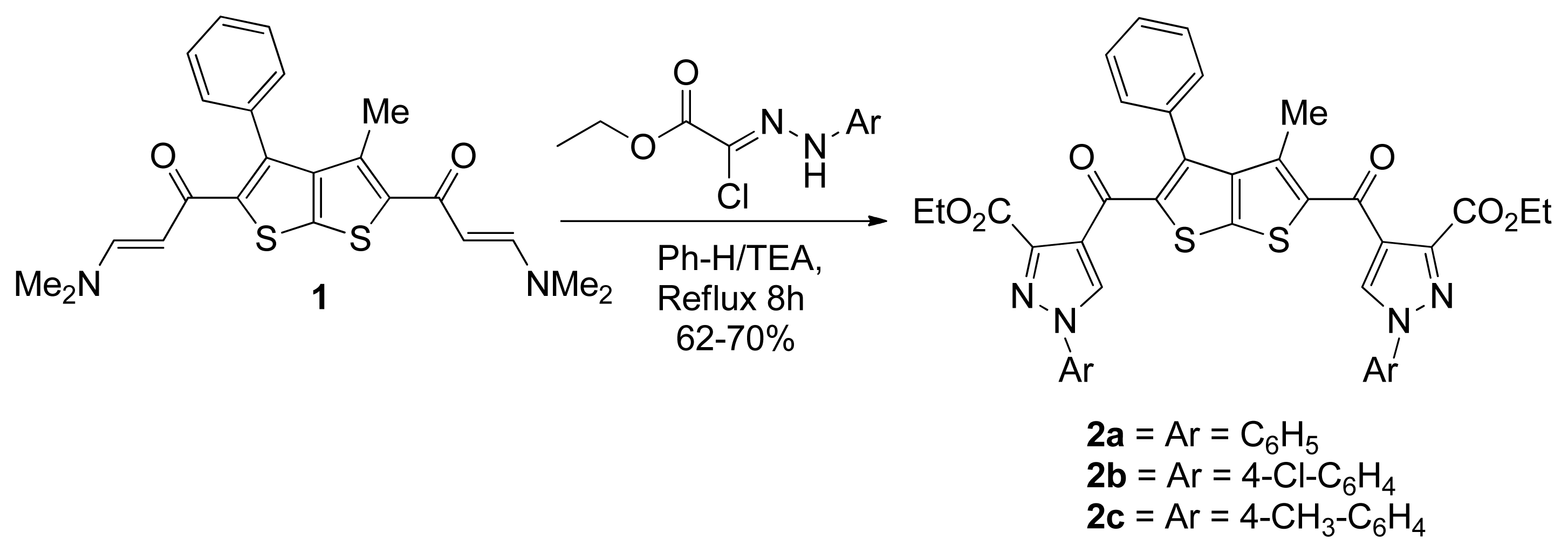
<p>Recently, enaminones <bold>1</bold> were prepared by different synthetic approaches and their use as building blocks for the synthesis of a wide variety of heterocycles has been investigated [<xref ref-type="bibr" rid="b3-ijms-13-02263">3</xref>,<xref ref-type="bibr" rid="b32-ijms-13-02263">32</xref>–<xref ref-type="bibr" rid="b35-ijms-13-02263">35</xref>]. The new bis(enaminones) <bold>1</bold> being now available to us prompted us to study its synthetic utility as key intermediate for novel bis(5- and 6-membered) heterocycles with the thieno[2,3-<italic>b</italic>]thiophene core. Thus, heating the bis(enaminone) with ethyl-2-(2-arylhydrazono)-2-chloroacetate which is commercially available in dry benzene and TEA (Tri ethyl amine) resulted in the formation of the bis(1-Phenyl-1-<italic>H</italic>-pyrazole-3-carboxylate) derivatives (<bold>2a</bold>) in 62% yield as depicted in <xref ref-type="fig" rid="f3-ijms-13-02263">Scheme 1</xref>.</p>
<p>The structure of compound <bold>2a</bold> was determined from its elemental and spectroscopic analyses. Its IR spectrum showed the presence of an absorption band characteristic for C=O as well as the presence of C=N absorption at 1627 cm<sup>−1</sup>. The <sup>1</sup>H NMR spectrum of <bold>2a</bold> showed a singlet at 10.6 ppm due to the pyrazole ring (5-CH). It is noteworthy to mention that the bis(pyrazoles) <bold>2a</bold>, <bold>2b</bold> could also be prepared from <bold>1</bold> in 67 and 70% yields, respectively, using the above synthetic methodology (<xref ref-type="fig" rid="f3-ijms-13-02263">Scheme 1</xref>). The formation of the bis(pyrazole) <bold>2a</bold> from <bold>2b</bold> or <bold>2c</bold> is supposed to proceed through the formation of the nonisolable intermediates followed by the elimination of two molecules of the secondary amines.</p>
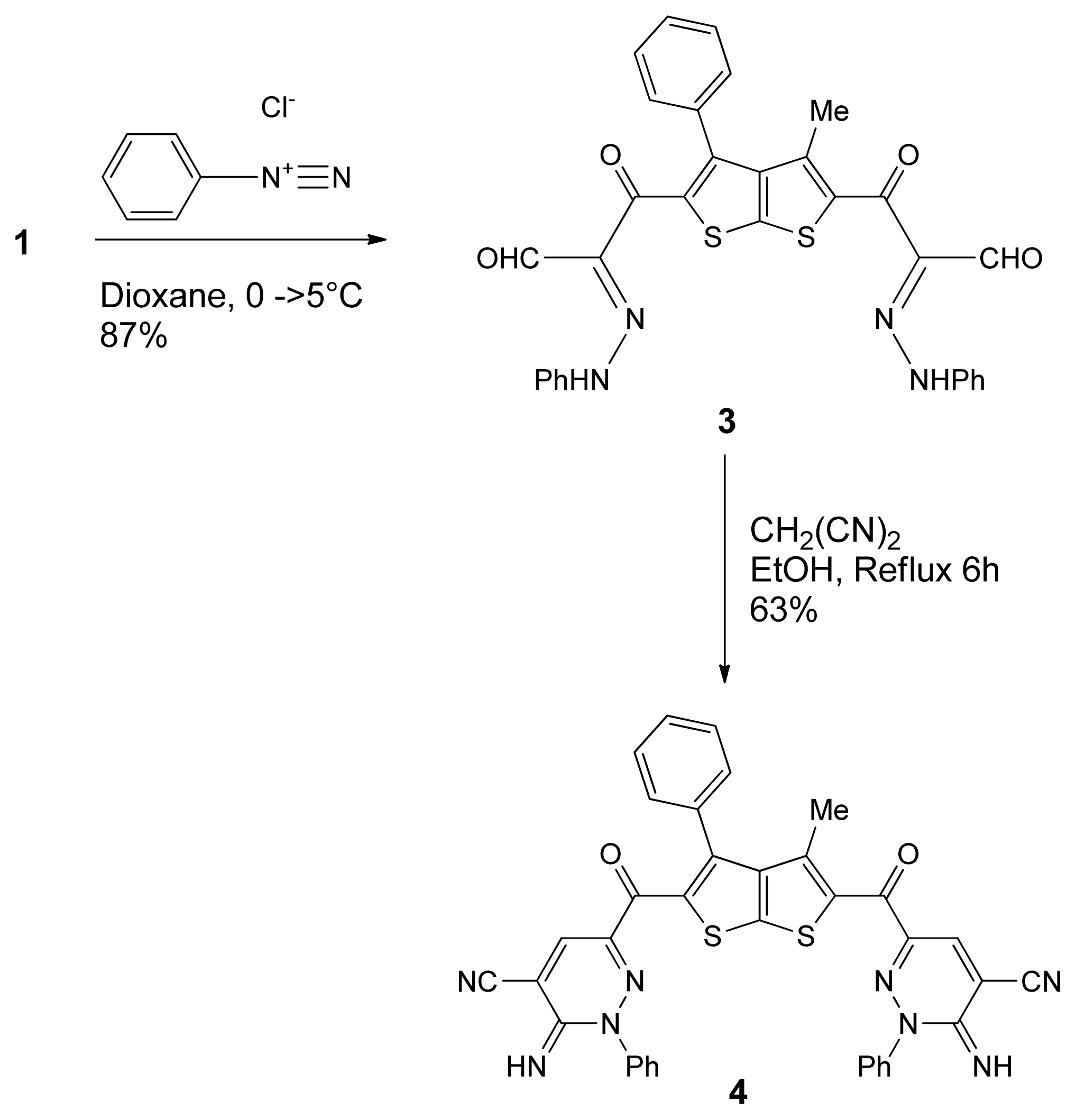
<p>Our study is now extended to include the synthesis of new bis(pyridines) and bis(pyridazines) derivatives. Thus, <bold>1</bold> was allowed to react with benzenediazoniumchloride which was prepared <italic>in situ</italic> from aniline in a HCl with aqueous NaNO<sub>2</sub> in dioxane at 0–5°C to give a single product as examined by TLC. Elemental analyses and mass spectrum of the isolated product were completely in agreement with the molecular formula C<sub>31</sub>H<sub>22</sub>N<sub>4</sub>O<sub>4</sub>S<sub>2</sub>. The structure of the product, obtained in 87% yield, is assumed to be <bold>3</bold> according to the rationale outlined in <xref ref-type="fig" rid="f4-ijms-13-02263">Scheme 2</xref>. The later compound reacts with malononitrile in refluxing EtOH which undergoes intramolecular cyclization to give compound <bold>4</bold> in 63% yield. The <sup>1</sup>H NMR spectrum of compound <bold>4</bold> was free of aldehydic proton and exhibited one characteristic singlet at 7.89 pmm integrated for 1H (for C–H of the pyridazine moiety). In addition, one singlet at 8.16 pmm integrated for 1H (for the NH-Pyridazine moietiy). Furthermore, the appearance of CN, and NH absorption at 2187, 3305 cm<sup>−1</sup>, respectively in the IR spectrum as well as its appearance as a broad singlet (8.16 pmm) in the <sup>1</sup>H NMR spectrum strongly supported this assignment.</p>
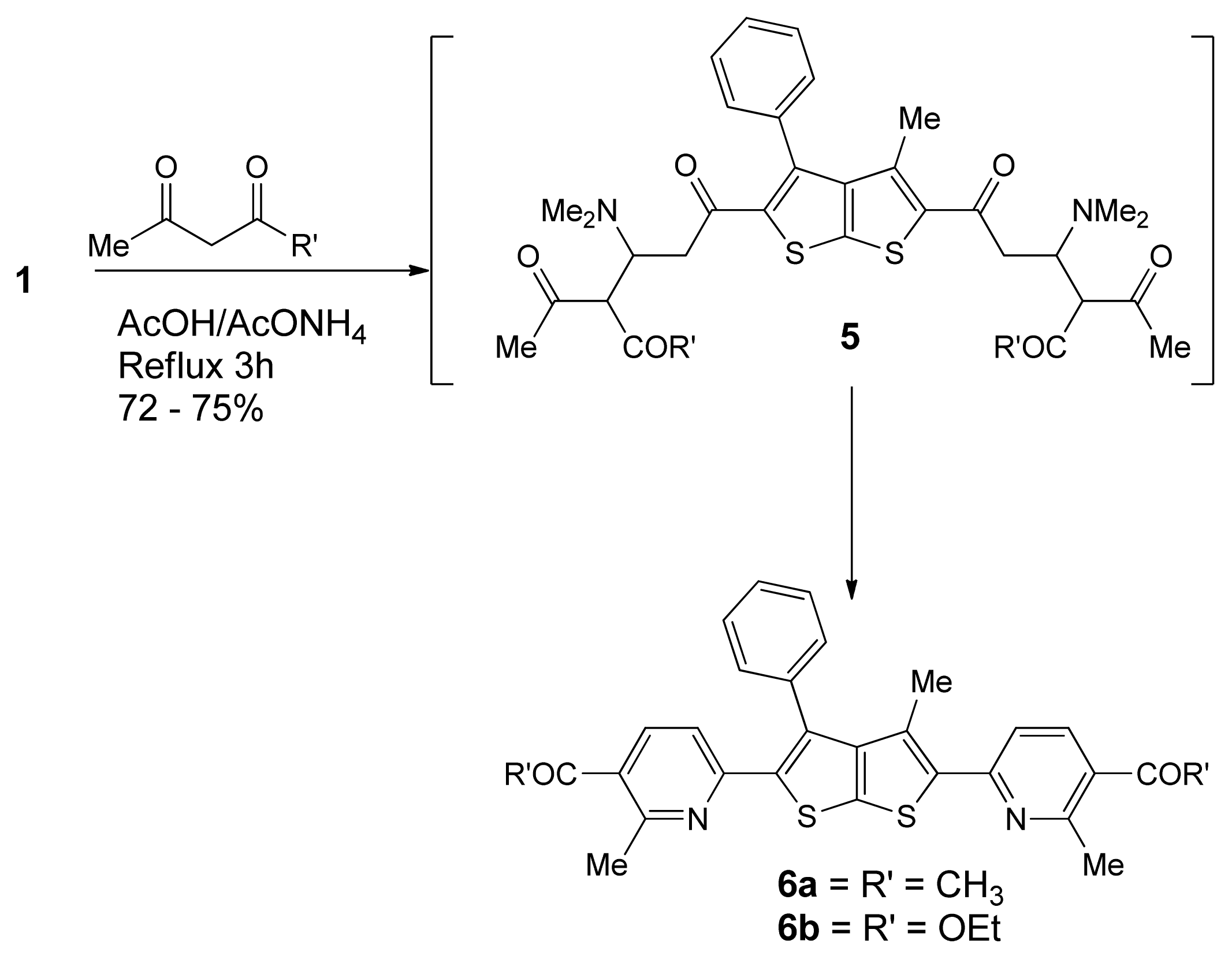
<p>Next, we have also described the synthesis of the new bis(pyridine) derivatives <bold>6a</bold>,<bold>b</bold> in 72–75% by the reaction of <bold>1</bold> with the corresponding acetone derivatives. Thus, reaction of <bold>1</bold> with acetylacetone in refluxing AcOH in the presence of NH<sub>4</sub>OAc afforded the corresponding bis(pyridine) derivative <bold>6a</bold> in 72% yields. Similarly, reaction of <bold>1</bold> with ethyl acetoacetate under the same reaction conditions gave the target bis(pyridine) <bold>6b</bold> in 75% yields as outlined in <xref ref-type="fig" rid="f5-ijms-13-02263">Scheme 3</xref>. It is assumed that enolates are initially added via 1,4-addition to the enaminones <bold>1</bold> to give the nonisolable intermediate <bold>5</bold>. Subsequent intermolecular cyclization via dimethylamine elimination gave the target compounds <bold>6a</bold>,<bold>b</bold>. The structures of compounds <bold>6a</bold>,<bold>b</bold> were inferred from different spectroscopic and analytical data.</p>
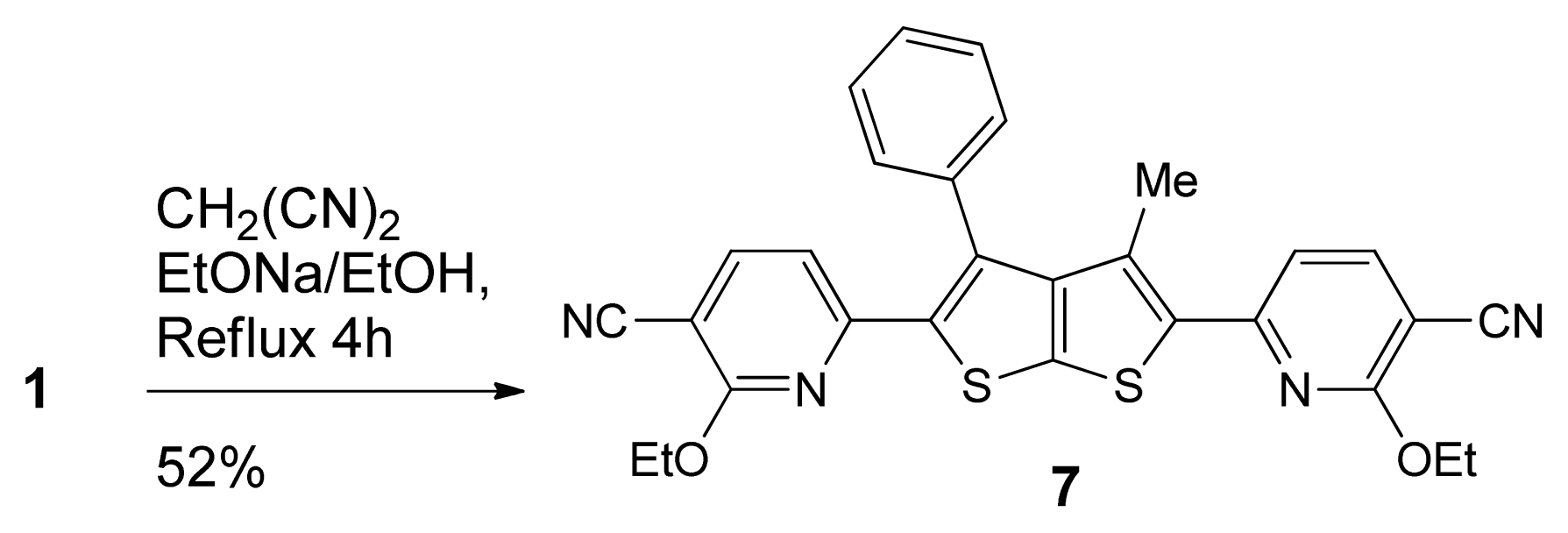
<p>It is noteworthy to mention here that the bis-(heterocycle) <bold>7</bold> was also prepared from the corresponding enaminones <bold>1</bold> but in moderate yield, as depicted in <xref ref-type="fig" rid="f6-ijms-13-02263">Scheme 4</xref>.</p>
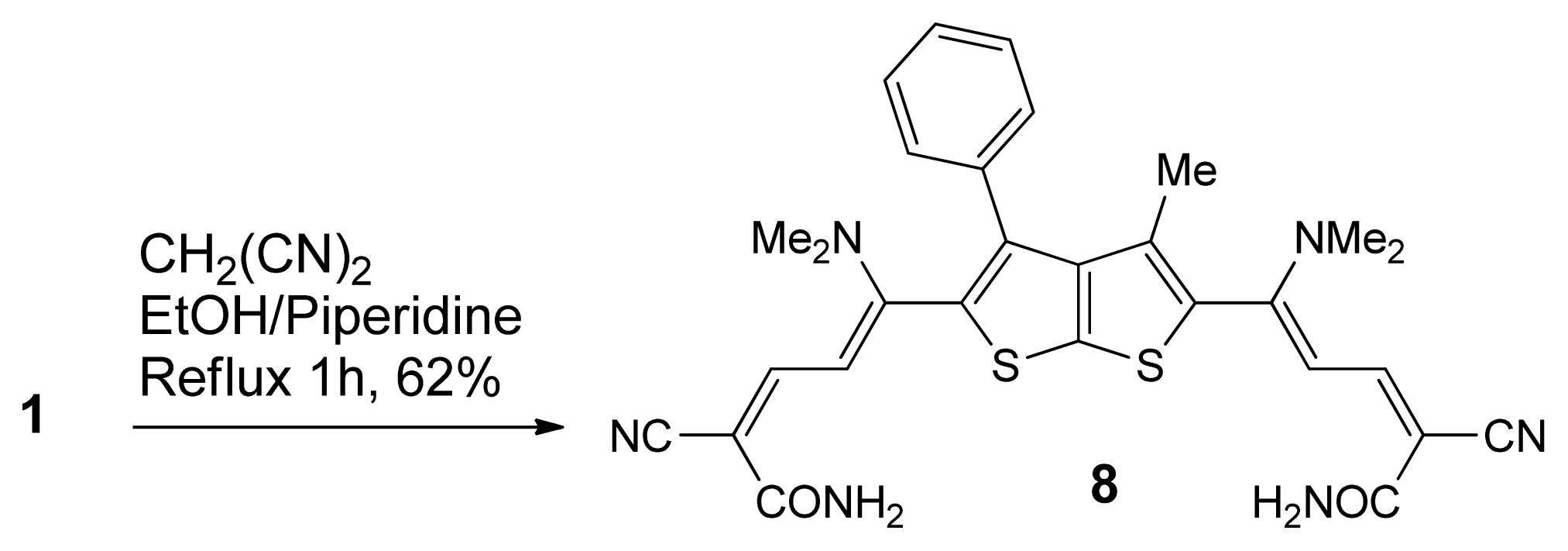
<p>When enaminone <bold>1</bold> was treated with malononitrile in ethanolic piperidine under reflux for 1h which was a red crystalline product, bis-dienamide derivatives <bold>8</bold> was obtained in 62% yield (<xref ref-type="fig" rid="f7-ijms-13-02263">Scheme 5</xref>), used as key intermediate for the synthesis of a wide variety of bis-(pyridazinones) <bold>9</bold>, and bis-(pyridinones) <bold>10</bold>, <bold>11</bold> as drawn in <xref ref-type="fig" rid="f8-ijms-13-02263">Schemes 6</xref> and <xref ref-type="fig" rid="f9-ijms-13-02263">7</xref>.</p>
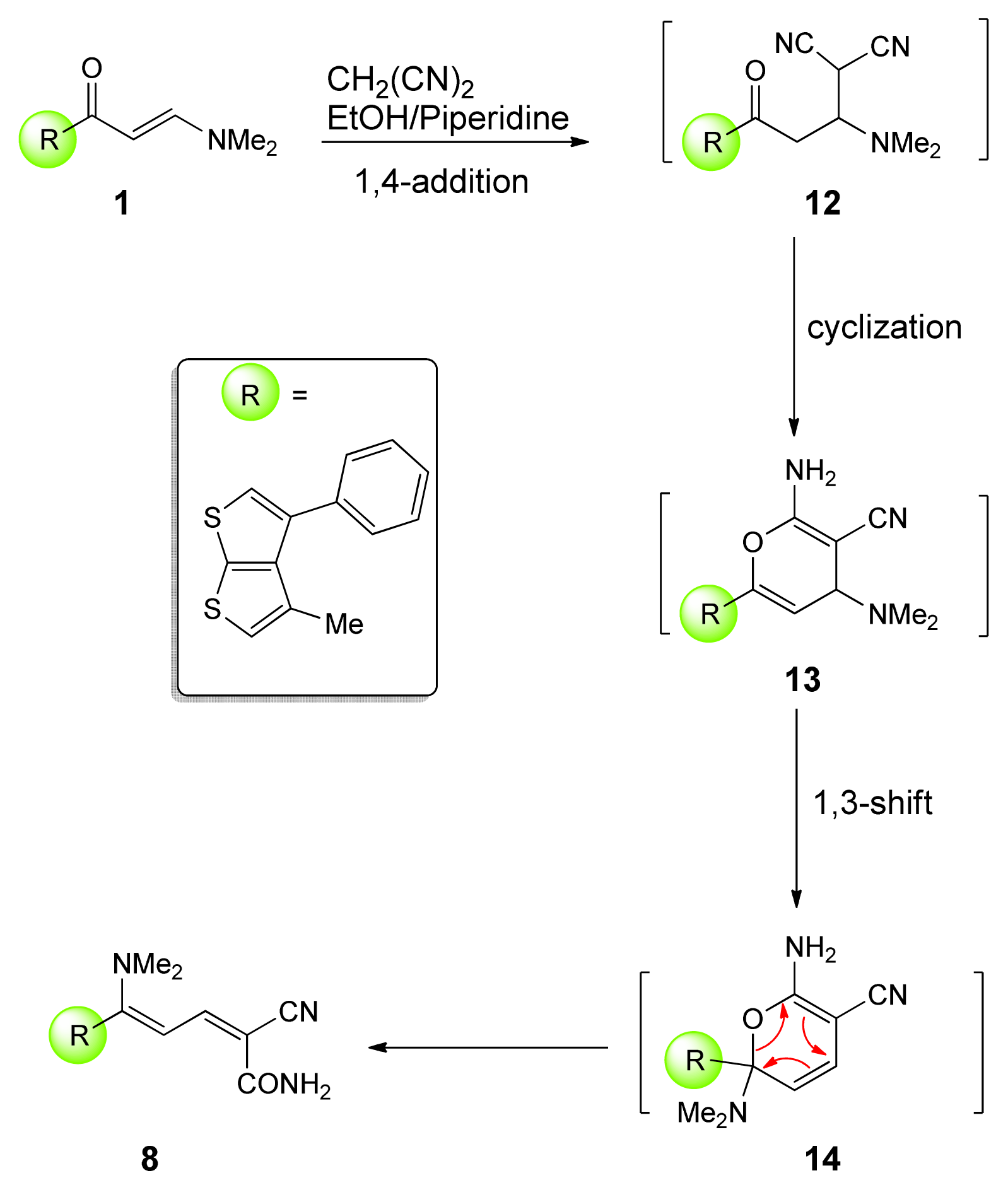
<p>In consideration of the reported data we believe that <bold>8</bold> was formed [<xref ref-type="bibr" rid="b36-ijms-13-02263">36</xref>] via initial 1,4-addition of malononitrile across the C=C bond to yield <bold>12</bold> that cyclized to <bold>13</bold> and then rearranged to <bold>14</bold> via an allowed 1,3-nitrogen shift (<xref ref-type="fig" rid="f1-ijms-13-02263">Figure 1</xref>).</p>
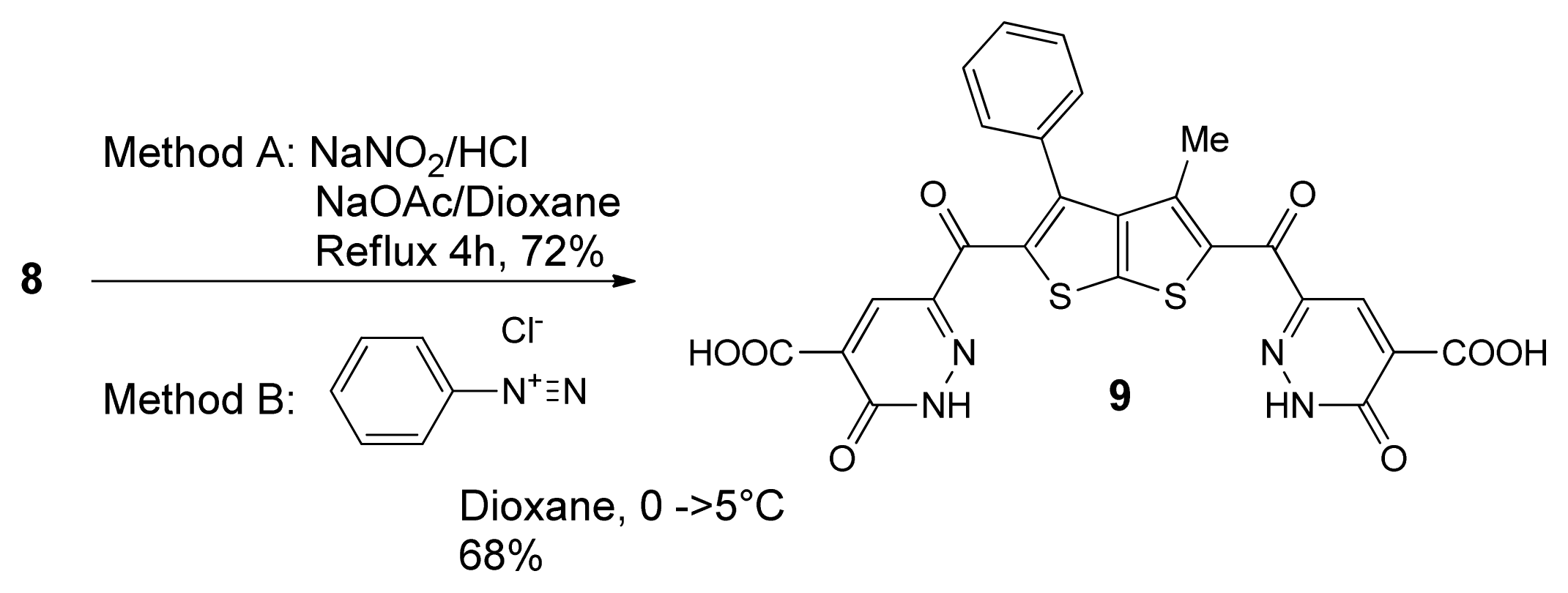
<p>It is noteworthy to mention that the bis(pyradazinone) derivatives <bold>9</bold> could also be prepared from the appropriate bis-dienamide <bold>8</bold> [<xref ref-type="bibr" rid="b36-ijms-13-02263">36</xref>]. Two methods were studied for the synthesis of <bold>9</bold>. In the first method, treating <bold>8</bold> with NaNO<sub>2</sub>/HCl in refluxing dioxane in the presence of NaOAc for 4 h afforded the final product in 72% yield. Alternatively, by coupling of <bold>8</bold> with phenyl diazonium salt gave the authentic product in 68% yield as drawn in <xref ref-type="fig" rid="f8-ijms-13-02263">Scheme 6</xref>.</p>
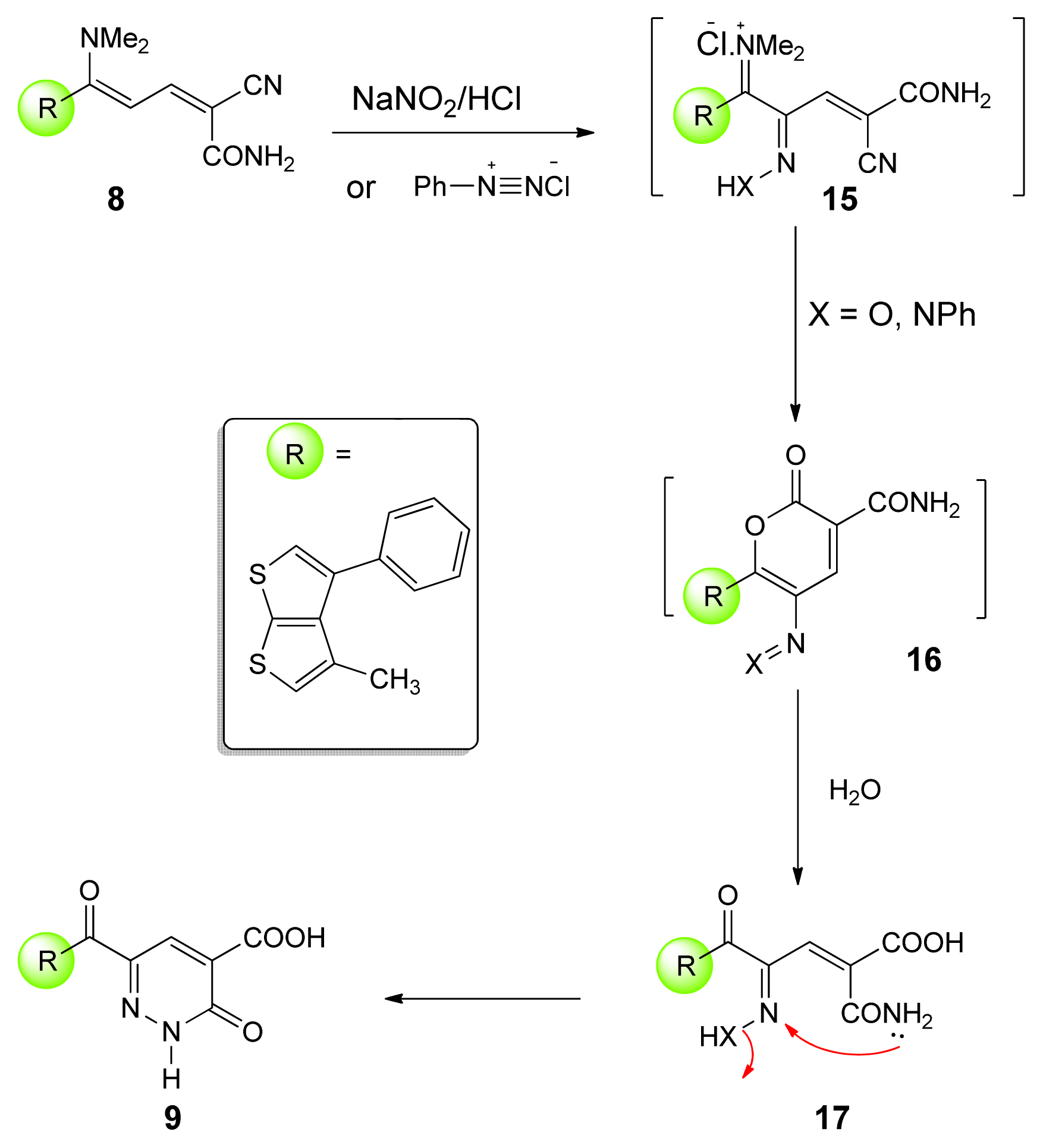
<p>Consequently, a plausible mechanism for the formation of compounds <bold>9</bold> is illustrated in <xref ref-type="fig" rid="f2-ijms-13-02263">Figure 2</xref>. It is assumed that the initially formed <bold>15</bold> is subject to a cyclization to <bold>16</bold>, which is further hydrolysed to <bold>17</bold> under the reaction conditions. Finally, the lone pairs on the amide N-atom react with the oxime N-atom kicking out H<sub>2</sub>O producing <bold>9.</bold></p>
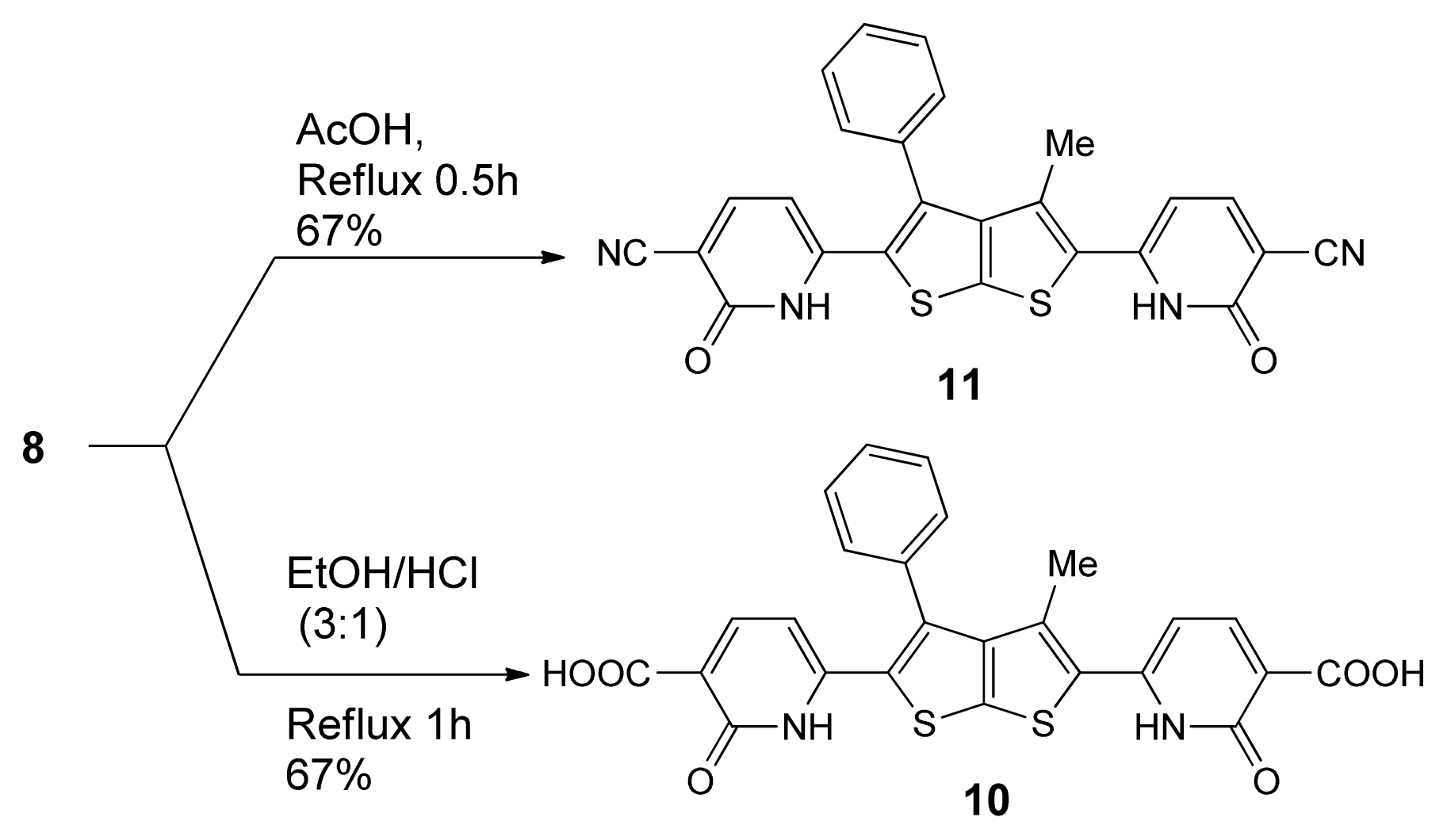
<p>Conversions of <bold>8</bold> into nicotinic acid derivatives <bold>10</bold> were achieved by boiling in EtOH/HCl. When, however, <bold>8</bold> was heated under reflux in AcOH, nicotinic nitrile derivative <bold>11</bold> was obtained. The novel bis pyridinones <bold>10</bold>, <bold>11</bold> were assumed to be formed via nucleophilic attack of NH at the activated C=C bond of the enamine derivative to eliminate two molecules of Me<sub>2</sub>NH affording the final product as depicted in <xref ref-type="fig" rid="f9-ijms-13-02263">Scheme 7</xref>. The structures of compounds <bold>10</bold>, <bold>11</bold> were inferred from their spectroscopic and analytical data.</p></sec>
<sec>
<title>3. Experimental Section</title>
<p>M.P. were measured on a Gallenkamp melting point apparatus in open glass capillaries and are uncorrected. IR spectra were measured as KBr pellets on a Perking Elmer FT 1000 spectrophotometer. The NMR spectra were recorded on a Varian Mercury Jeol-400 NMR spectrometer. <sup>1</sup>H-NMR (400 MHz) and <sup>13</sup>C-NMR (100 MHz) were run in (DMSO-<italic>d</italic><sub>6</sub>). Chemical shifts (δ) are referred in ppm and coupling constants <italic>J</italic> are given in Hz. Abbreviations for multiplicity are as follows: s (singulet), d (doublet), t (triplet), q (quadruplet), m (multiplet). Mass spectra were recorded on a Shimadzu GCMS-QP 1000 EX mass spectrometer at 70 eV. Elemental analysis was carried out on an Elementar Vario EL analyzer.</p>
<p>General procedure for the synthesis of compounds <bold>2a</bold>–<bold>c</bold> (GP1). To a soln of <bold>1</bold> (0.5 mmol, 0.21 g) in dry benzene (20 mL), ethyl 2-(2-arylhydrazono)-2-chloroacetate derivative (2 equiv., 1 mmol) was added in the presence of few drops of Et<sub>3</sub>N, thus the reaction mixture was heated under reflux for 8 h. The solid product was collected by filtration, and recrystallized from EtOH.</p>
<sec>
<title>Diethyl-4,4′-(3-Methyl-4-phenylthieno[2,3-b]thiophene-2,5-dicarbonyl)bis(1-phenyl-1H-pyrazole-3-carboxylate) (<bold>2a</bold>)</title>
<p><bold>2a</bold> was prepared from ethyl 2-(2-phenylhydrazono)-2-chloroacetate following GP1, pale brown crystals, yield (62%); m.p. 206–208 °C; IR (ν<sub>max</sub>): 1716–1732 (C=O), 1627 (C=N) cm<sup>−1;</sup> <sup>1</sup>H-NMR (400 MHz, DMSO-<italic>d</italic><sub>6</sub>): 1.30 (t, 3H, <italic>J</italic> = 6.9 Hz, CH<sub>3</sub>, ester), 1.96 (s, 3H, CH<sub>3</sub>), 4.25 (q, 2H, <italic>J</italic> = 16.6 Hz, CH<sub>2</sub>, ester), 7.36–7.76 (m, 15H, Ar-H), 10.6 (s, 1H, pyrazolo-H); <sup>13</sup>C-NMR (100 MHz, DMSO-<italic>d</italic><sub>6</sub>) δ (ppm): 14.49, 21.70, 66.25, 168.27, 192.12; MS <italic>m/z</italic> (%): 714 [M<sup>+</sup>, 1%], 240 (74), 166 (100), 98 (72); Anal. Calcd for C<sub>39</sub>H<sub>30</sub>N<sub>4</sub>O<sub>6</sub>S<sub>2</sub>: C, 65.53; H, 4.23; N, 7.84; S, 8.97; Found: C, 65.57; H, 4.21; N, 7.82; S, 9.</p></sec>
<sec>
<title>Diethyl-4,4′-(3-methyl-4-phenylthieno[2,3-b]thiophene-2,5-dicarbonyl)bis(1-(4-chlorophenyl)-1H-pyrazole-3-carboxylate) (<bold>2b</bold>)</title>
<p><bold>2b</bold> was prepared from Ethyl 2-(2-(4-chlorophenyl)hydrazono)-2-chloroacetate following GP1 as a yellow crystal, yield (67%); m.p. 236–238 °C; IR (ν<sub>max</sub>): 1710 (C=O), 1624 (C=N) cm<sup>−1;</sup> <sup>1</sup>H-NMR (400 MHz, DMSO-<italic>d</italic><sub>6</sub>) δ (ppm): 1.30 (t, 3H, <italic>J</italic> = 6.9 Hz, CH<sub>3</sub>, ester), 1.96 (s, 3H, CH<sub>3</sub>), 4.25 (q, 2H, <italic>J</italic> = 16.6 Hz, CH<sub>2</sub>, ester), 7.36–7.96 (m, 13H, Ar-H), 10.6 (s, 1H, pyrazolo-H); <sup>13</sup>C-NMR (100 MHz, DMSO-<italic>d</italic><sub>6</sub>): 14.49, 21.70, 66.25, 168.27, 192.12; MS <italic>m/z</italic> (%): 782 [M<sup>+</sup>, 1.5%]; Anal. Calcd for C<sub>39</sub>H<sub>28</sub>Cl<sub>2</sub>N<sub>4</sub>O<sub>6</sub>S<sub>2</sub>: C, 59.77; H, 3.60; Cl, 9.05; N, 7.15; O, 12.25; S, 8.18; Found: C, 59.80; H, 3.58; Cl, 9.07; N, 7.14; S, 8.18.</p></sec>
<sec>
<title>Diethyl-4,4′-(3-methyl-4-phenylthieno[2,3-b]thiophene-2,5-dicarbonyl)bis(1-(4-methoxyphenyl)-1H-pyrazole- 3-carboxylate) (<bold>2c</bold>)</title>
<p><bold>2c</bold> was prepared from Ethyl 2-(2-(4-methylphenyl) hydrazono)-2-chloroacetate following GP1 as a yellow crystal, yield (70%); m.p. 240–242 °C; IR (ν<sub>max</sub>): 1728 (C=O), 1624 (C=N) cm<sup>−1;</sup> <sup>1</sup>H-NMR (400 MHz, DMSO-<italic>d</italic><sub>6</sub>) δ (ppm): 1.2 (t, 3H, <italic>J</italic> = 6.9 Hz, CH<sub>3</sub>, ester), 1.96 (s, 3H, CH<sub>3</sub>), 2.22 (s, 3H, CH<sub>3</sub>), 4.25 (q, 2H, <italic>J</italic> = 16.6 Hz, CH<sub>2</sub>, ester), 7.13–7.66 (m, 13H, Ar-H), 10.5 (s, 1H, pyrazolo-H); <sup>13</sup>C-NMR (100 MHz, DMSO-<italic>d</italic><sub>6</sub>) δ (ppm): 8.2, 14.49, 21.70, 66.25, 168.27, 192.12; MS <italic>m/z</italic> (%): 742 [M<sup>+</sup>, 1.8%]; Anal. Calcd for C<sub>41</sub>H<sub>34</sub>N<sub>4</sub>O<sub>6</sub>S<sub>2</sub>: C, 66.29; H, 4.61; N, 7.54; O, 12.92; S, 8.63; Found: C, 66.32; H, 4.60; N, 7.52; S, 8.58.</p></sec>
<sec>
<title>3,3′-(3-Methyl-4-phenylthieno[2,3-b]thiophene-2,5-diyl)bis(3-oxo-2-(2-phenylhydrazono)propanal) (<bold>3</bold>)</title>
<p>To a stirred soln. of <bold>1</bold> (0.5 mmol, 0.21 g) in dioxane (15 mL) was cooled in an ice bath at 0–5 °C, a soln. of the benzenediazonium chloride [Freshly prepared by diazotizing aniline (1 mmol) in HCl (0.28 mL) with NaNO<sub>2</sub> (2 mmol) in H<sub>2</sub>O (4 mL)] was added drop wise over a period of 20 min. The reaction mixture was kept in a refrigerator overnight. The solid product was collected by filtration, and recrystallized from EtOH to give yellow crystal, yield (87%); m.p. 176–178 °C; IR (ν<sub>max</sub>): 1591 (C=N), 1627–1639 (C=O), 3435 (NH) cm<sup>−1;</sup> <sup>1</sup>H-NMR (400 MHz, DMSO-<italic>d</italic><sub>6</sub>) δ (ppm): 2.08 (s, 3H, CH<sub>3</sub>), 7.19–7.61 (m, 15H, Ar-H), 7.69 (s, 1H, N-H), 8.66 (s, 1H, CHO); <sup>13</sup>C-NMR (100 MHz, DMSO-<italic>d</italic><sub>6</sub>) δ (ppm): 14.13, 122.46, 128.62, 129.35, 129.96, 130.36, 130.54, 136.37, 145.83, 147.23, 187.13, 188.86. MS <italic>m/z</italic> (%):578 [M<sup>+</sup>, 45%]; Anal. Calcd for C<sub>31</sub>H<sub>22</sub>N<sub>4</sub>O<sub>4</sub>S<sub>2</sub>: C, 64.34; H, 3.83; N, 9.68; O, 11.06; S, 11.08; Found: C, 64.37; H, 3.80; N, 9.63; S, 11.14.</p></sec>
<sec>
<title>6-(5-(5-Cyano-6-imino-1,6-dihydropyridazine-3-carbonyl)-3-methyl-4-phenylthieno [2,3-b]thiophene-2-carbonyl)-3-imino-2,3-dihydropyridazine-4-carbonitrile (<bold>4</bold>)</title>
<p>To a stirred solution of 1 (0.5 mmol, 0.21 g) in EtOH (10 mL). Malononitrile (1 mmol, 0.07 g) was added and the resulting reaction mixture was heated under reflux for 6 h. The solid product was collected by filtration, and recrystallized from (EtOH). B was obtained as yellow crystal, yield (63%); m.p. &gt; 320–322 °C; IR (ν<sub>max</sub>): 1593 (C=N), 1627 (C=O), 2187 (CN),3305 (NH) cm<sup>−1;</sup> <sup>1</sup>H-NMR (400 MHz, DMSO-<italic>d</italic><sub>6</sub>) δ (ppm): 2.01 (s, 3H, CH<sub>3</sub>), 7.23–7.63 (m, 15H, Ar-H), 7.89 (s, 1H, CH, pyridazyl), 8.16 (s, 1H, N-H); <sup>13</sup>C-NMR (100 MHz, DMSO-<italic>d</italic><sub>6</sub>) δ (ppm): 14.13, 107.98, 115.98, 122.42, 128.42, 129.45, 129.96, 130.36, 130.54, 136.37, 145.83, 147.23, 154.22, 187.33; MS <italic>m/z</italic> (%): 674 [M<sup>+</sup>, 45%]; Anal. Calcd for C<sub>37</sub>H<sub>22</sub>N<sub>8</sub>O<sub>2</sub>S<sub>2</sub>: C, 65.86; H, 3.29; N, 16.61; O, 4.74; S, 9.50; Found: C, 65.84; H, 3.29; N, 16.63; S, 9.50.</p>
<p>General procedure for the synthesis of compounds <bold>6a</bold>–<bold>c</bold> (GP2). To a solution of 1 (0.5 mmol, 0.21 g) in acetic acid glacial (10 mL). Acetyl acetone derivatives (2 equiv., 1 mmol) was added in the presence of catalytic amount of ammonium acetate. The reaction mixture was heated under reflux for 3 h. The solid product was collected by filtration, and recrystallized from (EtOH).</p></sec>
<sec>
<title>1,1′-(6,6′-(3-methyl-4-phenylthieno[2,3-b]thiophene-2,5-diyl)bis(2-methylpyridine-6,3-diyl))diethanone (<bold>6a</bold>)</title>
<p><bold>6a</bold> was prepared from acetylacetone following GP2 as a dark yellow crystal, yield (72%); m.p. 241–243 °C; IR (ν<sub>max</sub>): 1682 (C=O), 1624 (C=N) cm<sup>−1;</sup> <sup>1</sup>H-NMR (400 MHz, DMSO-<italic>d</italic><sub>6</sub>) δ (ppm): 1.96 (s, 3H, CH<sub>3</sub>), 2.51 (s, 3H, COCH<sub>3</sub>), 2.62 (s, 3H, CH<sub>3</sub>, pyridyl), 7.29–7.59 (m, 5H, C<sub>6</sub>H<sub>5</sub>), 7.95 (d, 1H, <italic>J</italic> = 6.6 Hz, CH, pyridyl), 8.25 (d, 1H, <italic>J</italic> = 8.0 Hz, CH, pyridyl); <sup>13</sup>C-NMR (100 MHz, DMSO-<italic>d</italic><sub>6</sub>) δ (ppm): 14.49, 29.37, 30.55, 129.23, 129.55, 129.87, 134.79, 138.82, 141.84, 147.68, 151.23, 166.13, 194.1; MS <italic>m/z</italic> (%): 496 [M<sup>+</sup>, 3%]; Anal. Calcd for C<sub>29</sub>H<sub>24</sub>N<sub>2</sub>O<sub>2</sub>S<sub>2</sub>: C, 70.13; H, 4.87; N, 5.64; S, 12.91; Found: C, 70.18; H, 4.84; N, 5.6; 1; S, 12.96.</p></sec>
<sec>
<title>Diethyl-6,6′-(3-methyl-4-phenylthieno[2,3-b]thiophene-2,5-diyl)bis(2-methylnicotinate) (<bold>6b</bold>)</title>
<p><bold>6b</bold> was prepared from ethylacetoacetate following GP2 as a yellow crystal, yield (75%); m.p. 228–230 °C; IR (ν<sub>max</sub>): 1714 (C=O), 1622 (C=N) cm<sup>−1;</sup> <sup>1</sup>H-NMR (400 MHz, DMSO-<italic>d</italic><sub>6</sub>) δ (ppm): 1.29 (t, 3H, <italic>J</italic> = 8.0Hz, CH<sub>3</sub>, ester), 1.98 (s, 3H, CH<sub>3</sub>), 2.5 (s, 3H, CH<sub>3</sub>, pyridyl), 4.25 (q, 3H, <italic>J</italic> = 8.0 Hz, CH<sub>3</sub>, ester), 7.14–7.58 (m, 5H, C<sub>6</sub>H<sub>5</sub>), 7.85 (d, 1H, <italic>J</italic> = 6.5 Hz, CH, pyridyl), 8.20 (d, 1H, <italic>J</italic> = 7.5 Hz, CH, pyridyl); <sup>13</sup>C-NMR (100 MHz, DMSO-<italic>d</italic><sub>6</sub>) δ (ppm): 14.49, 29.37, 30.55, 62.17, 129.23, 129.55, 129.87, 134.79, 138.82, 141.84, 147.68, 151.23, 166.13, 194.1; MS <italic>m/z</italic> (%): 556 [M<sup>+</sup>, 38%], 435 (12), 363 (48), 250 (55), 98 (100), 97 (45); Anal. Calcd for C<sub>31</sub>H<sub>28</sub>N<sub>2</sub>O<sub>4</sub>S<sub>2</sub>: C, 66.88; H, 5.07; N, 5.03; S, 11.52; Found: C, 66.91; H, 5.04; N, 5.02; S, 11.52.</p></sec>
<sec>
<title>6,6′-(3-methyl-4-phenylthieno[2,3-b]thiophene-2,5-diyl)bis(2-ethoxynicotinonitrile) (<bold>7</bold>)</title>
<p>To a solution of 1 (0.5 mmol, 0.21 g) in EtONa (Na 0.02g/EtOH 10 mL), malononitrile (1 mmol, 0.07 g) was added and the resulting reaction mixture was heated under reflux for 4 h. The solid product was collected by filtration, 7 was obtained as red crystal, yield (52%); m.p. &gt; 330–332 °C; IR (ν<sub>max</sub>) : 1573 (C=N), 2200 (CN) cm<sup>−1;</sup> <sup>1</sup>H-NMR (400 MHz, DMSO-<italic>d</italic><sub>6</sub>) δ (ppm): 1.32 (t, 3H, <italic>J</italic> = 8.0 Hz, CH<sub>3</sub>), 1.89 (s, 3H, CH<sub>3</sub>), 5.15–5.90 (q, 2H, <italic>J</italic> = 8.0 Hz, CH<sub>2</sub>), 7.22 (d, 1H, <italic>J</italic> = 7.5 Hz, CH), 7.36–7.43 (m, 5H, Ar-H), 8.44 (d, 1H, <italic>J</italic> = 7.5 Hz, CH). <sup>13</sup>C-NMR (100 MHz, DMSO-<italic>d</italic><sub>6</sub>) δ (ppm): 14.8, 29.58, 69.92, 103, 115, 119, 128.68, 128.81, 129.98, 133.61, 143,8, 149.1, 176, 180; MS <italic>m/z</italic> (%): 522 [M<sup>+</sup>, 12%], 492(6), 403(14), 149(100), 91(64); Anal. Calcd for C<sub>29</sub>H<sub>22</sub>N<sub>4</sub>O<sub>2</sub>S<sub>2</sub>: C, 66.64; H, 4.24; N, 10.72; S, 12.27; Found: C, 66.67; H, 4.23; N, 10.71; S, 12.25.</p></sec>
<sec>
<title>5,5′-(3-methyl-4-phenylthieno[2,3-b]thiophene-2,5-diyl)bis(2-cyano-5-(dimethylamino)penta-2,4- dienamide) (<bold>8</bold>)</title>
<p>To a solution of 1 (0.5 mmol, 0.21 g) in EtOH (10 mL), malononitrile (1 mmol, 0.07 g) was added in the presence of catalytic amount of piperidine. The reaction mixture was heated under reflux for 1 h. The solid product was collected by filtration, 8 was obtained as red crystal, yield (62%); m.p. 201–203 °C; IR (ν<sub>max</sub>): 1616 (C=O), 2193 (CN), 3388 (NH2) cm<sup>−1;</sup> <sup>1</sup>H-NMR (400 MHz, DMSO-<italic>d</italic><sub>6</sub>) δ (ppm): 1.95 (s, 3H, CH<sub>3</sub>), 2.99–3.00 (s, 12H, N-CH<sub>3</sub>), 5.9(d, 1H, <italic>J</italic> = 12.8 Hz, CH), 7.2 (d, 1H, <italic>J</italic> = 12.8 Hz, CH), 7.32–7.90 (m, 5H, Ar-H), 8.2 (s, 2H, NH<sub>2</sub>); <sup>13</sup>C-NMR (100 MHz, DMSO-d<sub>6</sub>) δ (ppm): 180.04, 176.68, 160.58, 149.18, 148.6, 133.6, 129.98, 128.80, 128.68, 119.20, 103, 79.12, 43.2, 14.85; MS <italic>m/z</italic> (%): 556 [M<sup>+</sup>, 1.2], 191 (6.1), 149 (100),73 (34); Anal. Calcd for C<sub>29</sub>H<sub>28</sub>N<sub>6</sub>O<sub>2</sub>S<sub>2</sub>: C, 62.57; H, 5.07; N, 15.10; S, 11.52; Found: C, 62.60; H, 5.04; N, 15.08; S, 11.48.</p></sec>
<sec>
<title>6-(5-(5-cyano-6-oxo-1,6-dihydropyridin-2-yl)-3-methyl-4-phenylthieno[2,3-b]thiophen-2-yl)-2-oxo-1,2-dihydropyridine-3-carboxylic acid (<bold>11</bold>)</title>
<p>To a solution of 8 (0.5 mmol, 0.28 g) in a mixture of EtOH/HCl (3:1, 10 mL) was refluxed for 1 h. The solid product was collected by filtration, and recrystallized from (EtOH). 11 was obtained as deep red crystal, yield (67%); m.p. 287–289 °C; IR (ν<sub>max</sub>): 1722–1631 (C=O), 3174 (OH), 3450 (NH) cm<sup>−1;</sup> <sup>1</sup>H-NMR (400 MHz, DMSO-<italic>d</italic><sub>6</sub>) δ (ppm): 1.95 (s, 3H, CH<sub>3</sub>), 5.86 (d, 1H, <italic>J</italic> = 7.5 Hz, CH), 7.02 (s, 1H, NH), 7.14–7.90 (m, 5H, Ar-H), 8.34 (d, 1H, <italic>J</italic> = 7.5 Hz, CH), 11.35 (s, 1H, OH); <sup>13</sup>C-NMR (100 MHz, DMSO-<italic>d</italic><sub>6</sub>) δ (ppm): 14.44, 105.89, 123.71, 128.57, 129.87, 151.36, 162.88, 175.10; MS <italic>m/z</italic> (%): 485 [M<sup>+</sup>, 45%]; Anal. Calcd for C<sub>25</sub>H<sub>15</sub>N<sub>3</sub>O<sub>4</sub>S<sub>2</sub>: C, 61.84; H, 3.11; N, 8.65; S, 13.21; Found: C, 61.85; H, 3.10; N, 8.67; S, 13.24.</p></sec>
<sec>
<title>6-(5-(5-cyano-6-oxo-1,6-dihydropyridin-2-yl)-3-methyl-4-phenylthieno[2,3-b]thiophen-2-yl)-2-oxo-1,2-dihydropyridine-3-carbonitrile (<bold>10</bold>)</title>
<p>To a solution of <bold>8</bold> (0.5 mmol, 0.28 g) in acetic acid glacial (10mL), and the resulting mixture was refluxed for 30 min. The solid product was collected by filtration, and recrystallized from (EtOH). <bold>10</bold> was obtained as red crystal, yield (67%); m.p. &gt; 320–322 °C; IR (ν<sub>max</sub>): 1737 (C=O), 2206 (CN), 3390 (C=N), cm<sup>−1;</sup> <sup>1</sup>H-NMR (400 MHz, DMSO-<italic>d</italic><sub>6</sub>) δ (ppm): 1.91 (s, 3H, CH<sub>3</sub>), 6.70 (d, 1H, <italic>J</italic> = 8.6, CH), 7.42–7.90 (m, 5H, Ar-H), 8.13 (d, 1H, <italic>J</italic> = 8.6, CH), 11.97 (s, 1H, NH); <sup>13</sup>C-NMR (100 MHz, DMSO-<italic>d</italic><sub>6</sub>) δ (ppm): 14.46, 106.18, 98.86, 115.20, 129.86, 151.36, 162.89. MS <italic>m/z</italic> (%): 466 [M<sup>+</sup>, 45%]; Anal. Calcd for C<sub>25</sub>H<sub>14</sub>N<sub>4</sub>O<sub>2</sub>S<sub>2</sub>: C, 64.36; H, 3.02; N, 12.01; S, 13.75; Found: C, 64.38; H, 3.02; N, 12.03; S, 13.75.</p></sec>
<sec>
<title>6,6′-(3-methyl-4-phenylthieno[2,3-b]thiophene-2,5-dicarbonyl)bis(3-oxo-2,3-dihydropyridazine-4-carboxylic acid) (<bold>9</bold>)</title>
<p>Procedure A: To a solution of compound 8 (0.5 mmol, 0.278 g) in a mixture of dioxane (15 mL) and HCl (2 mL). A solution of NaNO<sub>2</sub> (0.069 g, 1 mmol) and sodium acetate (1.5 mmol) in water (6 mL) was added dropwise. The resulting reaction mixture was heated under reflux for 4 h. The solid product was collected by filtration, and recrystallized from dioxane.</p>
<p>Procedure B: Coupling reaction to a stirred solution of the compound 8 (0.5 mmol, 0.28 g) in dioxane (15 mL) and the mixture was cooled in an ice bath to 0–5 °C. A solution of the benzenediazonium chloride, [freshly prepared by diazotizing the respective aniline (1 mmol) in hydrochloric acid (0.28 mL) with sodium nitrite solution (2 mmol) in (4 mL) water] was added drop wise over 20 min. The whole mixture was then left in a refrigerator overnight. The solid product was collected by filtration, and recrystallized from (EtOH). 9 was obtained as brown crystal, yield (72<sup>a</sup>, 68<sup>b</sup>%); m.p. &gt; 320–322 °C; IR (ν<sub>max</sub>): 1579 (C=N),1666–1643 (C=O), 3444 (OH), 3444 (NH) cm<sup>−1;</sup> <sup>1</sup>H-NMR (400 MHz, DMSO-<italic>d</italic><sub>6</sub>) δ (ppm): 2.08 (s, 3H, CH<sub>3</sub>), 6.68 (s, 1H, NH) 7.42–7.80 (m, 5H, Ar-H), 8.09 (s, 1H, CH), 8.35 (s, 1H, OH); <sup>13</sup>C-NMR (100 MHz, DMSO-<italic>d</italic><sub>6</sub>) δ (ppm): 14.89, 125.68, 128.92, 129.96, 131.56, 149.85, 152.16, 163.76, 178.22, 191.62; MS <italic>m/z</italic> (%): 562 [M<sup>+</sup>, 45%]; Anal. Calcd for C<sub>25</sub>H<sub>14</sub>N<sub>4</sub>O<sub>8</sub>S<sub>2</sub>: C, 53.38; H, 2.51; N, 9.96; S, 11.40; Found: C, 53.40; H, 2.50; N, 9.94; S, 11.42.</p></sec></sec>
<sec sec-type="conclusions">
<title>4. Conclusions</title>
<p>In conclusion, the present investigation describes an efficient method for access toward novel bis-(heterocycles) containing two biologically active moieties. We believe that these new series of bis-(hetrocycles) may exhibit potentially diverse useful applications in the field of medicinal chemistry. Also, development of the above synthetic methodology should lead to the synthesis of a large number of bis-(hetrocycles) with a wide variety of substituent as well as different bridges.</p></sec></body>
<back>
<ack>
<title>Acknowledgments</title>
<p>This project was supported by King Saud University, Deanship of Scientific Research, College of Science Research Center.</p></ack>
<ref-list>
<title>References</title>
<ref id="b1-ijms-13-02263"><label>1</label><citation citation-type="journal"><person-group person-group-type="author"><name><surname>Shen</surname><given-names>D.</given-names></name><name><surname>Shu</surname><given-names>M.</given-names></name><name><surname>Chapman</surname><given-names>K.T.</given-names></name></person-group><article-title>Versatile and efficient solid-phase syntheses of pyrazoles and isoxazoles</article-title><source>Org. Lett</source><year>2000</year><volume>2</volume><fpage>2789</fpage><lpage>2792</lpage><pub-id pub-id-type="doi">10.1021/ol006197h</pub-id><pub-id pub-id-type="pmid">10964366</pub-id></citation></ref>
<ref id="b2-ijms-13-02263"><label>2</label><citation citation-type="journal"><person-group person-group-type="author"><name><surname>Dadiboyena</surname><given-names>S.</given-names></name><name><surname>Valente</surname><given-names>E.J.</given-names></name><name><surname>Hamme</surname><given-names>A.T.</given-names><suffix>II</suffix></name></person-group><article-title>A novel synthesis of 1,3,5-trisubstituted pyrazoles through a spiro-pyrazoline intermediate via a tandem 1,3-dipolar cycloaddition/elimination</article-title><source>Tetrahedron Lett.</source><year>2009</year><volume>50</volume><fpage>291</fpage><lpage>294</lpage><pub-id pub-id-type="doi">10.1016/j.tetlet.2008.10.145</pub-id><pub-id pub-id-type="pmid">20098488</pub-id></citation></ref>
<ref id="b3-ijms-13-02263"><label>3</label><citation citation-type="journal"><person-group person-group-type="author"><name><surname>Mabkhot</surname><given-names>N.Y.</given-names></name><name><surname>Barakat</surname><given-names>A.</given-names></name><name><surname>Al-Majid</surname><given-names>A.M.</given-names></name><name><surname>Al-Othman</surname><given-names>Z.A.</given-names></name><name><surname>Alamary</surname><given-names>A.S.</given-names></name></person-group><article-title>A facile and convenient synthesis of some novel hydrazones, Schiff’s base and pyrazoles incorporating thieno[2,3-<italic>b</italic>]thiophenes</article-title><source>Int. J. Mol. Sci</source><year>2011</year><volume>12</volume><fpage>7824</fpage><lpage>7834</lpage><pub-id pub-id-type="doi">10.3390/ijms12117824</pub-id><pub-id pub-id-type="pmid">22174635</pub-id></citation></ref>
<ref id="b4-ijms-13-02263"><label>4</label><citation citation-type="journal"><person-group person-group-type="author"><name><surname>Carrion</surname><given-names>M.D.</given-names></name><name><surname>Lopez Cara</surname><given-names>L.C.</given-names></name><name><surname>Camacho</surname><given-names>E.V.</given-names></name><name><surname>Tapias</surname><given-names>M.</given-names></name><name><surname>Escames</surname><given-names>G.</given-names></name><name><surname>Acuna-Castroviejo</surname><given-names>D.</given-names></name><name><surname>Espinosa</surname><given-names>A.</given-names></name><name><surname>Gallo</surname><given-names>M.A.</given-names></name><name><surname>Entrena</surname><given-names>A.</given-names></name></person-group><article-title>Pyrazoles and pyrazolines as neural and inducible nitric oxide synthase (nNOS and iNOS) potential inhibitors (III)</article-title><source>Eur. J. Med. Chem</source><year>2008</year><volume>43</volume><fpage>2579</fpage><lpage>2591</lpage><pub-id pub-id-type="doi">10.1016/j.ejmech.2008.01.014</pub-id><pub-id pub-id-type="pmid">18325637</pub-id></citation></ref>
<ref id="b5-ijms-13-02263"><label>5</label><citation citation-type="journal"><person-group person-group-type="author"><name><surname>Gokhan-Kelekçi</surname><given-names>N.</given-names></name><name><surname>Koyunoglu</surname><given-names>S.</given-names></name><name><surname>Yabanoglu</surname><given-names>S.</given-names></name><name><surname>Yelekçi</surname><given-names>K.</given-names></name><name><surname>Özgen</surname><given-names>Ö.</given-names></name><name><surname>Uçar</surname><given-names>G.</given-names></name><name><surname>Erol</surname><given-names>K.</given-names></name><name><surname>Kendi</surname><given-names>E.</given-names></name><name><surname>Yesilada</surname><given-names>A.</given-names></name></person-group><article-title>New pyrazoline bearing 4(3<italic>H</italic>)-quinazolinone inhibitors of monoamine oxidase: Synthesis biological evaluation, and structural determinants of MAO-A and MAO-B selectivity</article-title><source>Bioorg. Med. Chem.</source><year>2009</year><volume>17</volume><fpage>675</fpage><lpage>689</lpage><pub-id pub-id-type="doi">10.1016/j.bmc.2008.11.068</pub-id><pub-id pub-id-type="pmid">19091581</pub-id></citation></ref>
<ref id="b6-ijms-13-02263"><label>6</label><citation citation-type="journal"><person-group person-group-type="author"><name><surname>Liu</surname><given-names>X.-H.</given-names></name><name><surname>Zhi</surname><given-names>L.-P.</given-names></name><name><surname>Song</surname><given-names>B.-A.</given-names></name><name><surname>Xu</surname><given-names>H.-L.</given-names></name></person-group><article-title>Synthesis, Characterization and Antibacterial Activity of New 5-Aryl Pyrazole Oxime Ester Derivatives</article-title><source>Chem. Res</source><year>2008</year><volume>24</volume><fpage>454</fpage><lpage>458</lpage></citation></ref>
<ref id="b7-ijms-13-02263"><label>7</label><citation citation-type="journal"><person-group person-group-type="author"><name><surname>Abid</surname><given-names>M.</given-names></name><name><surname>Bhat</surname><given-names>A.R.</given-names></name><name><surname>Athar</surname><given-names>F.</given-names></name><name><surname>Azam</surname><given-names>A.</given-names></name></person-group><article-title>Synthesis, spectral studies and antiamoebic activity of new 1-<italic>N</italic>-substituted thiocarbamoyl-3-phenyl-2-pyrazolines</article-title><source>Eur. J. Med. Chem</source><year>2009</year><volume>44</volume><fpage>417</fpage><lpage>425</lpage><pub-id pub-id-type="doi">10.1016/j.ejmech.2007.10.032</pub-id><pub-id pub-id-type="pmid">18068873</pub-id></citation></ref>
<ref id="b8-ijms-13-02263"><label>8</label><citation citation-type="journal"><person-group person-group-type="author"><name><surname>Farag</surname><given-names>A.M.</given-names></name><name><surname>Mayhoub</surname><given-names>A.S.</given-names></name><name><surname>Barakat</surname><given-names>S.E.</given-names></name><name><surname>Bayomi</surname><given-names>A.H.</given-names></name></person-group><article-title>Regioselective synthesis and antitumor screening of some novel <italic>N</italic>-phenylpyrazole derivatives</article-title><source>Bioorg. Med. Chem</source><year>2008</year><volume>16</volume><fpage>881</fpage><lpage>889</lpage><pub-id pub-id-type="doi">10.1016/j.bmc.2007.10.015</pub-id><pub-id pub-id-type="pmid">17962022</pub-id></citation></ref>
<ref id="b9-ijms-13-02263"><label>9</label><citation citation-type="journal"><person-group person-group-type="author"><name><surname>Farag</surname><given-names>A.M.</given-names></name><name><surname>Mayhoub</surname><given-names>A.S.</given-names></name><name><surname>Barakat</surname><given-names>S.E.</given-names></name><name><surname>Bayomi</surname><given-names>A.H.</given-names></name></person-group><article-title>Synthesis of new <italic>N</italic>-phenylpyrazole derivatives with potent antimicrobial activity</article-title><source>Bioorg. Med. Chem</source><year>2008</year><volume>16</volume><fpage>4569</fpage><lpage>4578</lpage><pub-id pub-id-type="doi">10.1016/j.bmc.2008.02.043</pub-id><pub-id pub-id-type="pmid">18313934</pub-id></citation></ref>
<ref id="b10-ijms-13-02263"><label>10</label><citation citation-type="journal"><person-group person-group-type="author"><name><surname>Hui</surname><given-names>Y.</given-names></name><name><surname>Ptak</surname><given-names>R.</given-names></name><name><surname>Paulman</surname><given-names>R.</given-names></name><name><surname>Pallansch</surname><given-names>M.</given-names></name><name><surname>Chang</surname><given-names>C.W.T.</given-names></name></person-group><article-title>Synthesis of novel guanidine incorporated aminoglycosides, guanidinopyranmycins</article-title><source>Tetrahedron Lett</source><year>2002</year><volume>43</volume><fpage>9255</fpage><lpage>9257</lpage><pub-id pub-id-type="doi">10.1016/S0040-4039(02)02248-7</pub-id></citation></ref>
<ref id="b11-ijms-13-02263"><label>11</label><citation citation-type="journal"><person-group person-group-type="author"><name><surname>Kashman</surname><given-names>Y.</given-names></name><name><surname>Rudi</surname><given-names>A.</given-names></name><name><surname>Pappo</surname><given-names>D.</given-names></name></person-group><article-title>Recent heterocyclic compounds from marine invertebrates: Structure and synthesis</article-title><source>Pure Appl. Chem</source><year>2007</year><volume>79</volume><fpage>491</fpage><lpage>505</lpage><pub-id pub-id-type="doi">10.1351/pac200779040491</pub-id></citation></ref>
<ref id="b12-ijms-13-02263"><label>12</label><citation citation-type="journal"><person-group person-group-type="author"><name><surname>Chakrabarti</surname><given-names>J.K.</given-names></name><name><surname>Horsman</surname><given-names>L.</given-names></name><name><surname>Hotten</surname><given-names>T.M.</given-names></name><name><surname>Pullar</surname><given-names>I.A.</given-names></name><name><surname>Tupper</surname><given-names>D.E.</given-names></name><name><surname>Wright</surname><given-names>F.C.</given-names></name></person-group><article-title>Heteroarenobenzodiazepines. 3. 4-Piperazinyl-10<italic>H</italic>-thieno[2,3-<italic>b</italic>][1,5]benzodiazepines as potential neuroleptics</article-title><source>J. Med. Chem</source><year>1980</year><volume>23</volume><fpage>878</fpage><lpage>884</lpage><pub-id pub-id-type="doi">10.1021/jm00182a013</pub-id><pub-id pub-id-type="pmid">6105216</pub-id></citation></ref>
<ref id="b13-ijms-13-02263"><label>13</label><citation citation-type="journal"><person-group person-group-type="author"><name><surname>Ram</surname><given-names>V.J.</given-names></name><name><surname>Pandey</surname><given-names>H.K.</given-names></name><name><surname>Vlientick</surname><given-names>A.J.</given-names></name></person-group><article-title>Thieno[2,3-<italic>d</italic>]pyrimidines as potential chemotherapeutic agents. II</article-title><source>J. Heterocycl. Chem</source><year>1981</year><volume>18</volume><fpage>1277</fpage><lpage>1280</lpage></citation></ref>
<ref id="b14-ijms-13-02263"><label>14</label><citation citation-type="journal"><person-group person-group-type="author"><name><surname>Jarak</surname><given-names>I.</given-names></name><name><surname>Kralj</surname><given-names>M.</given-names></name><name><surname>Piantanida</surname><given-names>I.</given-names></name><name><surname>Suman</surname><given-names>L.</given-names></name><name><surname>Zinic</surname><given-names>M.</given-names></name><name><surname>Pavelic</surname><given-names>K.</given-names></name><name><surname>Karminski-Zamola</surname><given-names>G.</given-names></name></person-group><article-title>Novel cyano- and amidino-substituted derivatives of thieno[2,3-<italic>b</italic>]- and thieno[3,2-<italic>b</italic>]thiophene-2-carboxanilides and thieno[3<italic>′</italic>,2<italic>′</italic>:4,5]thieno and thieno[2<italic>′</italic>,3<italic>′</italic>:4,5] thieno[2,3-<italic>c</italic>]quinolones: Synthesis, photochemical synthesis, DNA binding, and antitumor evaluation</article-title><source>Bioorg. Med. Chem</source><year>2006</year><volume>14</volume><fpage>2859</fpage><lpage>2868</lpage><pub-id pub-id-type="doi">10.1016/j.bmc.2005.12.004</pub-id><pub-id pub-id-type="pmid">16412644</pub-id></citation></ref>
<ref id="b15-ijms-13-02263"><label>15</label><citation citation-type="journal"><person-group person-group-type="author"><name><surname>Peters</surname><given-names>D.</given-names></name><name><surname>Hornfeldt</surname><given-names>A.B.</given-names></name><name><surname>Gronowitz</surname><given-names>S.</given-names></name></person-group><article-title>Synthesis of various 5-substituted uracils</article-title><source>J. Heterocycl. Chem</source><year>1990</year><volume>27</volume><fpage>2165</fpage><lpage>2173</lpage><pub-id pub-id-type="doi">10.1002/jhet.5570270756</pub-id></citation></ref>
<ref id="b16-ijms-13-02263"><label>16</label><citation citation-type="journal"><person-group person-group-type="author"><name><surname>Kukolja</surname><given-names>S.</given-names></name><name><surname>Draheim</surname><given-names>S.E.</given-names></name><name><surname>Graves</surname><given-names>B.J.</given-names></name><name><surname>Hunden</surname><given-names>D.C.</given-names></name><name><surname>Pfeil</surname><given-names>J.L.</given-names></name><name><surname>Cooper</surname><given-names>R.D.G.</given-names></name><name><surname>Ott</surname><given-names>J.L.</given-names></name><name><surname>Couter</surname><given-names>F.T.</given-names></name></person-group><article-title>Orally absorbable cephalosporin antibiotics. 2. Structure-activity studies of bicyclic glycine derivatives of 7-aminodeacetoxycephalosporanic acid</article-title><source>J. Med. Chem</source><year>1985</year><volume>28</volume><fpage>1896</fpage><lpage>1903</lpage><pub-id pub-id-type="doi">10.1021/jm00150a023</pub-id><pub-id pub-id-type="pmid">3877809</pub-id></citation></ref>
<ref id="b17-ijms-13-02263"><label>17</label><citation citation-type="journal"><person-group person-group-type="author"><name><surname>Prugh</surname><given-names>J.D.</given-names></name><name><surname>Hartman</surname><given-names>G.D.</given-names></name><name><surname>Mallorga</surname><given-names>P.J.</given-names></name><name><surname>McKeever</surname><given-names>B.M.</given-names></name><name><surname>Michelson</surname><given-names>S.R.</given-names></name><name><surname>Murcko</surname><given-names>M.A.</given-names></name><name><surname>Schwam</surname><given-names>H.</given-names></name><name><surname>Smith</surname><given-names>R.L.</given-names></name><name><surname>Sondey</surname><given-names>J.M.</given-names></name><name><surname>Springer</surname><given-names>J.P.</given-names></name><name><surname>Surgrue</surname><given-names>M.F.</given-names></name></person-group><article-title>New isomeric classes of topically active ocular hypotensive carbonic anhydrase inhibitors: 5-substituted thieno[2,3-<italic>b</italic>] thiophene-2-sulfonamides and 5-substituted thieno[3,2-<italic>b</italic>]thiophene-2-sulfonamides</article-title><source>J. Med. Chem</source><year>1991</year><volume>34</volume><fpage>1805</fpage><lpage>1818</lpage><pub-id pub-id-type="doi">10.1021/jm00110a008</pub-id><pub-id pub-id-type="pmid">2061922</pub-id></citation></ref>
<ref id="b18-ijms-13-02263"><label>18</label><citation citation-type="journal"><person-group person-group-type="author"><name><surname>Hartman</surname><given-names>G.D.</given-names></name><name><surname>Ansdale</surname><given-names>P.A.</given-names></name></person-group><article-title>Substituted thieno[2,3-<italic>b</italic>]thiophene-2-sulfonamides as antiglaucoma agents</article-title><source>U.S. Patent 4,806,562</source><day>21</day><month>February</month><year>1989</year></citation></ref>
<ref id="b19-ijms-13-02263"><label>19</label><citation citation-type="journal"><person-group person-group-type="author"><name><surname>Litvinov</surname><given-names>V.P.</given-names></name></person-group><article-title>The latest achievements in thienothiophene chemistry</article-title><source>Russ. Chem. Rev</source><year>2005</year><volume>74</volume><fpage>217</fpage><lpage>248</lpage><pub-id pub-id-type="doi">10.1070/RC2005v074n03ABEH000889</pub-id></citation></ref>
<ref id="b20-ijms-13-02263"><label>20</label><citation citation-type="journal"><person-group person-group-type="author"><name><surname>Gather</surname><given-names>M.C.</given-names></name><name><surname>Heeny</surname><given-names>M.</given-names></name><name><surname>Zhang</surname><given-names>W.</given-names></name><name><surname>Whitehead</surname><given-names>K.S.</given-names></name><name><surname>Bradley</surname><given-names>D.D.C.</given-names></name><name><surname>McCulloch</surname><given-names>I.</given-names></name><name><surname>Campbell</surname><given-names>A</given-names></name></person-group><article-title>An alignable fluorene thienothiophene copolymer with deep-blue electroluminescent emission at 410 nm</article-title><source>Chem. Commun</source><year>2008</year><fpage>1079</fpage><lpage>1081</lpage></citation></ref>
<ref id="b21-ijms-13-02263"><label>21</label><citation citation-type="journal"><person-group person-group-type="author"><name><surname>He</surname><given-names>M.</given-names></name><name><surname>Li</surname><given-names>J.</given-names></name><name><surname>Sorensen</surname><given-names>M.L.</given-names></name><name><surname>Zhang</surname><given-names>F.</given-names></name><name><surname>Hancock</surname><given-names>R.R.</given-names></name><name><surname>Fong</surname><given-names>H.H.</given-names></name><name><surname>Pozdin</surname><given-names>V.A.</given-names></name><name><surname>Smilgies</surname><given-names>D.</given-names></name><name><surname>Malliaras</surname><given-names>G.G.</given-names></name></person-group><article-title>Alkylsubstituted thienothiophene semiconducting materials: Structure property relationships</article-title><source>J. Am. Chem. Soc</source><year>2009</year><volume>131</volume><fpage>11930</fpage><lpage>11938</lpage><pub-id pub-id-type="doi">10.1021/ja903895s</pub-id><pub-id pub-id-type="pmid">19645495</pub-id></citation></ref>
<ref id="b22-ijms-13-02263"><label>22</label><citation citation-type="journal"><person-group person-group-type="author"><name><surname>Griffin</surname><given-names>A.G.</given-names></name><name><surname>Britt</surname><given-names>T.R.</given-names></name></person-group><article-title>Effect of molecular structure on mesomorphism. 12. Flexible-center Siamese-twin liquid crystalline diesters—A “prepolymer” model</article-title><source>J. Am. Chem. Soc</source><year>1981</year><volume>103</volume><fpage>4957</fpage><lpage>4959</lpage><pub-id pub-id-type="doi">10.1021/ja00406a056</pub-id></citation></ref>
<ref id="b23-ijms-13-02263"><label>23</label><citation citation-type="journal"><person-group person-group-type="author"><name><surname>Galli</surname><given-names>G.</given-names></name><name><surname>Laus</surname><given-names>M.</given-names></name><name><surname>Angeloni</surname><given-names>A.S.</given-names></name></person-group><article-title>Synthesis and thermotropic properties of new mesogenic diacrylate monomers</article-title><source>Makromol. Chem</source><year>1986</year><volume>187</volume><fpage>289</fpage><lpage>296</lpage><pub-id pub-id-type="doi">10.1002/macp.1986.021870206</pub-id></citation></ref>
<ref id="b24-ijms-13-02263"><label>24</label><citation citation-type="journal"><person-group person-group-type="author"><name><surname>Finkelmann</surname><given-names>H.</given-names></name></person-group><article-title>Liquid crystalline polymers</article-title><source>Angew. Chem. Int. Ed. Engl</source><year>1987</year><volume>26</volume><fpage>816</fpage><lpage>824</lpage><pub-id pub-id-type="doi">10.1002/anie.198708161</pub-id></citation></ref>
<ref id="b25-ijms-13-02263"><label>25</label><citation citation-type="journal"><person-group person-group-type="author"><name><surname>Aguilera</surname><given-names>C.</given-names></name><name><surname>Parra</surname><given-names>M.</given-names></name><name><surname>Fuentes</surname><given-names>G.</given-names></name></person-group><article-title>Synthesis and mesomorphic properties of polymethylene-α,ω-bis [2-thio-5-(4′,4″<italic>n</italic>-alcoxybenzoyloxy)phenyl]-1,3,4-oxadiazole</article-title><source>Z. Naturforsch</source><year>1998</year><volume>53b</volume><fpage>367</fpage><lpage>370</lpage></citation></ref>
<ref id="b26-ijms-13-02263"><label>26</label><citation citation-type="journal"><person-group person-group-type="author"><name><surname>Braun</surname><given-names>D.</given-names></name><name><surname>Langendorf</surname><given-names>R.</given-names></name></person-group><article-title>Vitrigens. I. Synthesis and characterization of low molecular weight organic glasses</article-title><source>J. Prakt. Chem</source><year>1999</year><volume>341</volume><fpage>128</fpage><lpage>137</lpage><pub-id pub-id-type="doi">10.1002/(SICI)1521-3897(199902)341:2&lt;128::AID-PRAC128&gt;3.0.CO;2-M</pub-id></citation></ref>
<ref id="b27-ijms-13-02263"><label>27</label><citation citation-type="book"><person-group person-group-type="editor"><name><surname>Ariens</surname><given-names>E.J.</given-names></name></person-group><source>Drug Design</source><publisher-name>Academic Press</publisher-name><publisher-loc>New York NY, USA</publisher-loc><year>1971</year><volume>1</volume><fpage>1</fpage></citation></ref>
<ref id="b28-ijms-13-02263"><label>28</label><citation citation-type="journal"><person-group person-group-type="author"><name><surname>Elwahy</surname><given-names>A.H.M.</given-names></name><name><surname>Abbas</surname><given-names>A.A.</given-names></name></person-group><article-title>Bis(difunctional) compounds: Versatile starting materials for novel bis(heterocycles)</article-title><source>Synth. Commun</source><year>2000</year><volume>30</volume><fpage>2903</fpage><lpage>2921</lpage><pub-id pub-id-type="doi">10.1080/00397910008087441</pub-id></citation></ref>
<ref id="b29-ijms-13-02263"><label>29</label><citation citation-type="journal"><person-group person-group-type="author"><name><surname>Abbas</surname><given-names>A.A.</given-names></name><name><surname>Elneairy</surname><given-names>M.A.A.</given-names></name><name><surname>Mabkhout</surname><given-names>Y.N.</given-names></name></person-group><article-title>Versatile starting materials for novel 1,ω-bis(pyridin-4-ylphenoxy)alkanes, and their corresponding bis(thieno[2,3-<italic>b</italic>]pyridin-4-ylphenoxy) derivatives</article-title><source>J. Chem. Res</source><year>2001</year><volume>2001</volume><fpage>124</fpage><lpage>126</lpage><pub-id pub-id-type="doi">10.3184/030823401103169388</pub-id></citation></ref>
<ref id="b30-ijms-13-02263"><label>30</label><citation citation-type="journal"><person-group person-group-type="author"><name><surname>Elneairy</surname><given-names>M.A.A.</given-names></name><name><surname>Abbas</surname><given-names>A.A.</given-names></name><name><surname>Mabkhout</surname><given-names>Y.N.</given-names></name></person-group><article-title>Synthesis of novel bis-2-(1,3,4-thiadiazolin-3-ylphenoxy) alkane derivatives</article-title><source>Phosphorus Sulfur Silicon</source><year>2003</year><volume>178</volume><fpage>1747</fpage><lpage>1757</lpage><pub-id pub-id-type="doi">10.1080/10426500307823</pub-id></citation></ref>
<ref id="b31-ijms-13-02263"><label>31</label><citation citation-type="journal"><person-group person-group-type="author"><name><surname>Abbas</surname><given-names>A.A.</given-names></name><name><surname>Rateb</surname><given-names>N.M.</given-names></name></person-group><article-title>A Facile and Convenient Method for the Synthesis of Bis-Hydrazonoyl Halides and Bis-(1,3,4-Thiadiazol-3-ylphenoxy)ethers</article-title><source>Phosphorus Sulfur Silicon</source><year>2005</year><volume>180</volume><fpage>497</fpage><lpage>511</lpage><pub-id pub-id-type="doi">10.1080/104265090517226</pub-id></citation></ref>
<ref id="b32-ijms-13-02263"><label>32</label><citation citation-type="journal"><person-group person-group-type="author"><name><surname>Elassar</surname><given-names>A.A.</given-names></name><name><surname>El-Khair</surname><given-names>A.A.</given-names></name></person-group><article-title>Recent developments in the chemistry of enaminones</article-title><source>Tetrahedron</source><year>2003</year><volume>59</volume><fpage>8463</fpage><lpage>8480</lpage><pub-id pub-id-type="doi">10.1016/S0040-4020(03)01201-8</pub-id></citation></ref>
<ref id="b33-ijms-13-02263"><label>33</label><citation citation-type="journal"><person-group person-group-type="author"><name><surname>Stanovnik</surname><given-names>B.</given-names></name><name><surname>Svete</surname><given-names>J.</given-names></name></person-group><article-title>Synthesis of Heterocycles from Alkyl 3-(Dimethylamino)propenoates and Related Enaminones</article-title><source>Chem. Rev</source><year>2004</year><volume>104</volume><fpage>2433</fpage><lpage>2480</lpage><pub-id pub-id-type="doi">10.1021/cr020093y</pub-id><pub-id pub-id-type="pmid">15137796</pub-id></citation></ref>
<ref id="b34-ijms-13-02263"><label>34</label><citation citation-type="journal"><person-group person-group-type="author"><name><surname>Mabkhot</surname><given-names>Y.N.</given-names></name><name><surname>Al-Majid</surname><given-names>A.M.</given-names></name><name><surname>Barakat</surname><given-names>A.</given-names></name><name><surname>Alshahrani</surname><given-names>S.</given-names></name><name><surname>Yamin</surname><given-names>S.</given-names></name></person-group><article-title>1,1′-(3-Methyl-4-phenylthieno[2,3-<italic>b</italic>]thiophene-2,5-diyl)diethanone as a building block in heterocyclic synthesis. Novel synthesis of some pyrazole and pyrimidine derivatives</article-title><source>Molecules</source><year>2011</year><volume>16</volume><fpage>6502</fpage><lpage>6511</lpage><pub-id pub-id-type="doi">10.3390/molecules16086502</pub-id><pub-id pub-id-type="pmid">21814162</pub-id></citation></ref>
<ref id="b35-ijms-13-02263"><label>35</label><citation citation-type="journal"><person-group person-group-type="author"><name><surname>Mabkhot</surname><given-names>Y.N.</given-names></name><name><surname>Al-Majid</surname><given-names>A.M.</given-names></name><name><surname>Alamary</surname><given-names>A.S.</given-names></name></person-group><article-title>Synthesis and chemical characterisation of some new diheteroaryl thienothiophene derivatives</article-title><source>Molecules</source><year>2011</year><volume>16</volume><fpage>7706</fpage><lpage>7714</lpage><pub-id pub-id-type="doi">10.3390/molecules16097706</pub-id><pub-id pub-id-type="pmid">21904270</pub-id></citation></ref>
<ref id="b36-ijms-13-02263"><label>36</label><citation citation-type="journal"><person-group person-group-type="author"><name><surname>Alnajjar</surname><given-names>A.-A.</given-names></name><name><surname>Abdelkhalik</surname><given-names>M.M.</given-names></name><name><surname>Al-Enezi</surname><given-names>A.</given-names></name><name><surname>Elnagdi</surname><given-names>M.H.</given-names></name></person-group><article-title>Enaminones as Building blocks in heterocyclic syntheses: Reinvestigating the product structures of enaminones with malononitrile. A novel route to 6-substituted-3-oxo-2,3-dihydropyridazine-4-carboxylic acids</article-title><source>Molecules</source><year>2009</year><volume>14</volume><fpage>68</fpage><lpage>77</lpage></citation></ref></ref-list>
<sec sec-type="display-objects">
<title>Figures</title>
<fig id="f1-ijms-13-02263" position="float">
<label>Figure 1</label>
<caption>
<p>Proposed mechanism for the formation of bis-dienamide <bold>8</bold>.</p></caption>
<graphic xlink:href="ijms-13-02263f1.gif"/></fig>
<fig id="f2-ijms-13-02263" position="float">
<label>Figure 2</label>
<caption>
<p>Proposed mechanism for the nitrozation and coupling reactions.</p></caption>
<graphic xlink:href="ijms-13-02263f2.gif"/></fig>
<fig id="f3-ijms-13-02263" position="float">
<label>Scheme 1</label>
<caption>
<p>The synthesis of bis-pyrazole derivatives <bold>2a</bold>–<bold>c</bold>.</p></caption>
<graphic xlink:href="ijms-13-02263f3.gif"/></fig>
<fig id="f4-ijms-13-02263" position="float">
<label>Scheme 2</label>
<caption>
<p>The synthesis of bis-pyridazine derivatives <bold>4</bold>.</p></caption>
<graphic xlink:href="ijms-13-02263f4.gif"/></fig>
<fig id="f5-ijms-13-02263" position="float">
<label>Scheme 3</label>
<caption>
<p>The synthesis of bis-pyridine derivatives <bold>6a</bold>,<bold>b</bold>.</p></caption>
<graphic xlink:href="ijms-13-02263f5.gif"/></fig>
<fig id="f6-ijms-13-02263" position="float">
<label>Scheme 4</label>
<caption>
<p>Synthesis of bis-pyridine nitrile derivatives <bold>7</bold>.</p></caption>
<graphic xlink:href="ijms-13-02263f6.gif"/></fig>
<fig id="f7-ijms-13-02263" position="float">
<label>Scheme 5</label>
<caption>
<p>Synthesis of bis-dienamide <bold>8</bold>.</p></caption>
<graphic xlink:href="ijms-13-02263f7.gif"/></fig>
<fig id="f8-ijms-13-02263" position="float">
<label>Scheme 6</label>
<caption>
<p>Synthesis of bis-(pyradazinone) derivatives <bold>9</bold>.</p></caption>
<graphic xlink:href="ijms-13-02263f8.gif"/></fig>
<fig id="f9-ijms-13-02263" position="float">
<label>Scheme 7</label>
<caption>
<p>The synthesis of nicotinic acid derivatives <bold>10</bold>, <bold>11</bold>.</p></caption>
<graphic xlink:href="ijms-13-02263f9.gif"/></fig></sec></back></article>