<?xml version="1.0" encoding="UTF-8"?>
<!DOCTYPE article PUBLIC "-//NLM//DTD Journal Publishing DTD v2.3 20070202//EN" "journalpublishing.dtd">
<article xmlns:xlink="http://www.w3.org/1999/xlink" xml:lang="en" article-type="review-article">
<front>
<journal-meta>
<journal-id journal-id-type="publisher-id">ijms</journal-id>
<journal-title>International Journal of Molecular Sciences</journal-title>
<abbrev-journal-title>Int. J. Mol. Sci.</abbrev-journal-title>
<issn pub-type="epub">1422-0067</issn>
<publisher>
<publisher-name>Molecular Diversity Preservation International (MDPI)</publisher-name></publisher></journal-meta>
<article-meta>
<article-id pub-id-type="doi">10.3390/ijms13021886</article-id>
<article-id pub-id-type="publisher-id">ijms-13-01886</article-id>
<article-categories>
<subj-group>
<subject>Review</subject></subj-group></article-categories>
<title-group>
<article-title>The mTOR Signalling Pathway in Human Cancer</article-title></title-group>
<contrib-group>
<contrib contrib-type="author">
<name><surname>Pópulo</surname><given-names>Helena</given-names></name><xref ref-type="aff" rid="af1-ijms-13-01886">1</xref><xref ref-type="aff" rid="af2-ijms-13-01886">2</xref></contrib>
<contrib contrib-type="author">
<name><surname>Lopes</surname><given-names>José Manuel</given-names></name><xref ref-type="aff" rid="af1-ijms-13-01886">1</xref><xref ref-type="aff" rid="af2-ijms-13-01886">2</xref><xref ref-type="aff" rid="af3-ijms-13-01886">3</xref></contrib>
<contrib contrib-type="author">
<name><surname>Soares</surname><given-names>Paula</given-names></name><xref ref-type="aff" rid="af1-ijms-13-01886">1</xref><xref ref-type="aff" rid="af2-ijms-13-01886">2</xref><xref ref-type="corresp" rid="c1-ijms-13-01886">*</xref></contrib></contrib-group>
<aff id="af1-ijms-13-01886">
<label>1</label>Institute of Molecular Pathology and Immunology of University of Porto (IPATIMUP), University of Porto, 4200-465, Porto, Portugal; E-Mails: <email>hpopulo@ipatimup.pt</email> (H.P.); <email>jmlopes@ipatimup.pt</email> (J.M.L.)</aff>
<aff id="af2-ijms-13-01886">
<label>2</label>Medical Faculty, University of Porto, 4200-465 Porto, Portugal</aff>
<aff id="af3-ijms-13-01886">
<label>3</label>Department of Pathology, Hospital São João, 4200-465 Porto, Portugal</aff>
<author-notes>
<corresp id="c1-ijms-13-01886">
<label>*</label>Author to whom correspondence should be addressed; E-Mail: <email>psoares@ipatimup.pt</email>; Tel.: +351-225570700; Fax: +351-225570799.</corresp></author-notes>
<pub-date pub-type="collection">
<year>2012</year></pub-date>
<pub-date pub-type="epub">
<day>10</day>
<month>2</month>
<year>2012</year></pub-date>
<volume>13</volume>
<issue>2</issue>
<fpage>1886</fpage>
<lpage>1918</lpage>
<history>
<date date-type="received">
<day>02</day>
<month>12</month>
<year>2011</year></date>
<date date-type="rev-recd">
<day>28</day>
<month>1</month>
<year>2012</year></date>
<date date-type="accepted">
<day>30</day>
<month>1</month>
<year>2012</year></date></history>
<permissions>
<copyright-statement>© 2012 by the authors; licensee Molecular Diversity Preservation International, Basel, Switzerland.</copyright-statement>
<copyright-year>2012</copyright-year>
<license license-type="open-access" xlink:href="http://creativecommons.org/licenses/by/3.0">
<p>This article is an open-access article distributed under the terms and conditions of the Creative Commons Attribution license (http://creativecommons.org/licenses/by/3.0/).</p></license></permissions>
<abstract>
<p>The conserved serine/threonine kinase mTOR (the mammalian target of rapamycin), a downstream effector of the PI3K/AKT pathway, forms two distinct multiprotein complexes: mTORC1 and mTORC2. mTORC1 is sensitive to rapamycin, activates S6K1 and 4EBP1, which are involved in mRNA translation. It is activated by diverse stimuli, such as growth factors, nutrients, energy and stress signals, and essential signalling pathways, such as PI3K, MAPK and AMPK, in order to control cell growth, proliferation and survival. mTORC2 is considered resistant to rapamycin and is generally insensitive to nutrients and energy signals. It activates PKC-α and AKT and regulates the actin cytoskeleton. Deregulation of multiple elements of the mTOR pathway (<italic>PI3K</italic> amplification/mutation, <italic>PTEN</italic> loss of function, AKT overexpression, and S6K1, 4EBP1 and eIF4E overexpression) has been reported in many types of cancers, particularly in melanoma, where alterations in major components of the mTOR pathway were reported to have significant effects on tumour progression. Therefore, mTOR is an appealing therapeutic target and mTOR inhibitors, including the rapamycin analogues deforolimus, everolimus and temsirolimus, are submitted to clinical trials for treating multiple cancers, alone or in combination with inhibitors of other pathways. Importantly, temsirolimus and everolimus were recently approved by the FDA for the treatment of renal cell carcinoma, PNET and giant cell astrocytoma. Small molecules that inhibit mTOR kinase activity and dual PI3K-mTOR inhibitors are also being developed. In this review, we aim to survey relevant research, the molecular mechanisms of signalling, including upstream activation and downstream effectors, and the role of mTOR in cancer, mainly in melanoma.</p></abstract>
<kwd-group>
<kwd>mTOR</kwd>
<kwd>cancer</kwd>
<kwd>melanoma</kwd>
<kwd>therapy</kwd>
<kwd>rapamycin</kwd></kwd-group></article-meta></front>
<body>
<sec sec-type="intro">
<title>1. Introduction</title>
<p>Cell behaviour is modulated by local circumstances: metabolism is hindered by the lack of nutrients and growth factors, with associated alterations in the expression of various genes involved in cellular physiology. Protein synthesis is consequently downregulated, thereby having a negative impact on growth and proliferation. An understanding of the mechanisms by which cells receive and integrate extracellular signals, triggering a cascade of intracellular signals that influence cell growth and metabolism, is essential to developing a well-targeted chemotherapy. One of these mechanisms is the mTOR signalling pathway, which links growth factors, nutrients and energy availability to cell survival, growth, proliferation, and motility (reviewed in refs. [<xref ref-type="bibr" rid="b1-ijms-13-01886">1</xref>–<xref ref-type="bibr" rid="b3-ijms-13-01886">3</xref>]).</p>
<p>The target of rapamycin (TOR) was originally discovered in the budding yeast <italic>Saccharomyces cerevisiae</italic>, as a target of the macrolide fungicide rapamycin, through mutants that showed growth resistance to rapamycin [<xref ref-type="bibr" rid="b4-ijms-13-01886">4</xref>]. The structurally and functionally conserved mammalian counterpart (mTOR) was subsequently discovered biochemically based on its rapamycin inhibitory properties [<xref ref-type="bibr" rid="b5-ijms-13-01886">5</xref>–<xref ref-type="bibr" rid="b7-ijms-13-01886">7</xref>]. To date, every eukaryote genome examined (including yeasts, algae, plants, worms, flies and mammals) contains a TOR gene.</p>
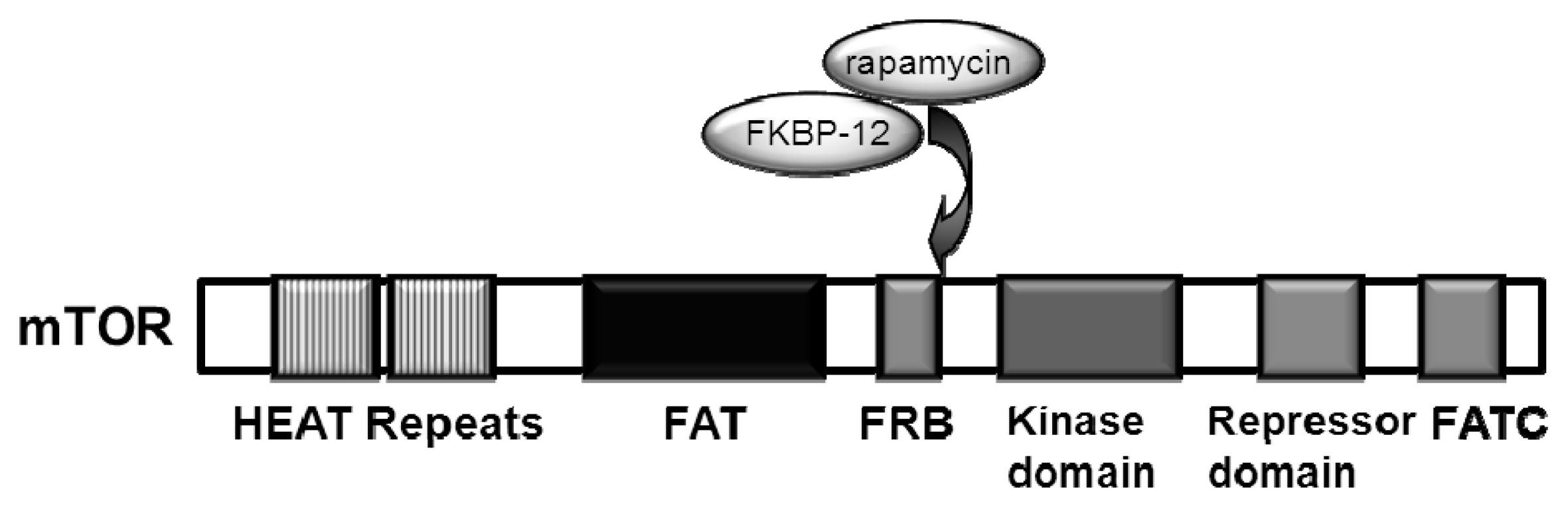
<p>mTOR (the mammalian target of rapamycin), also known as FRAP (FKBP12-rapamcyin-associated protein), RAFT1 (rapamycin and FKBP12 target), RAPT 1 (rapamycin target 1), or SEP (sirolimus effector protein), is a 289 kDa serine/threonine kinase [<xref ref-type="bibr" rid="b7-ijms-13-01886">7</xref>] that belongs to the PI3K-related protein kinase (PIKKs) family, since its <italic>C</italic>-terminus shares strong homology to the catalytic domain of PI3K (<xref ref-type="fig" rid="f1-ijms-13-01886">Figure 1</xref>) [<xref ref-type="bibr" rid="b8-ijms-13-01886">8</xref>,<xref ref-type="bibr" rid="b9-ijms-13-01886">9</xref>].</p>
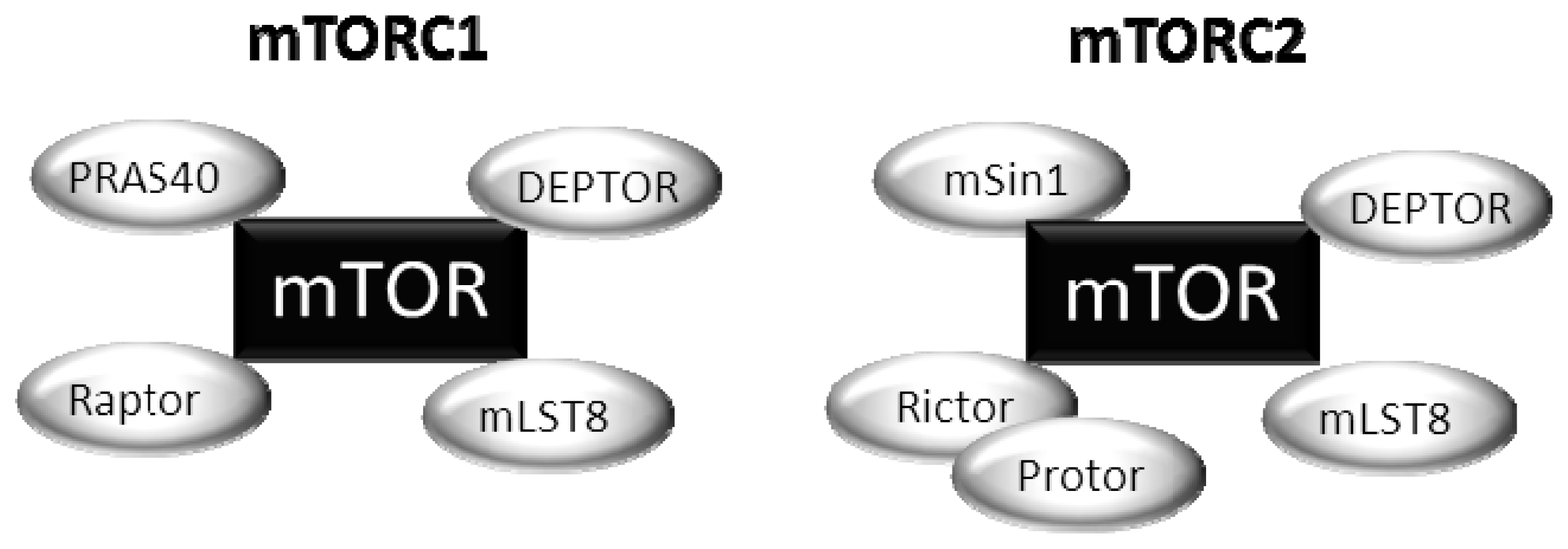
<p>mTOR encompasses two functionally distinct protein complexes: mTOR complex 1 and mTOR complex 2 (<xref ref-type="fig" rid="f2-ijms-13-01886">Figure 2</xref>) [<xref ref-type="bibr" rid="b11-ijms-13-01886">11</xref>,<xref ref-type="bibr" rid="b12-ijms-13-01886">12</xref>]. The mTORC1 consists of mTOR, raptor, mLST8, and two negative regulators, PRAS40 and DEPTOR [<xref ref-type="bibr" rid="b13-ijms-13-01886">13</xref>–<xref ref-type="bibr" rid="b16-ijms-13-01886">16</xref>]. Raptor regulates mTOR activity and functions as a scaffold for recruiting mTORC1 substrates [<xref ref-type="bibr" rid="b13-ijms-13-01886">13</xref>,<xref ref-type="bibr" rid="b14-ijms-13-01886">14</xref>]. Recent studies suggested that mTORC1 activity can be regulated by the phosphorylation status of raptor [<xref ref-type="bibr" rid="b17-ijms-13-01886">17</xref>]. mLST8, another subunit of mTORC1, thought to bind to the kinase domain of mTOR, and to regulate positively the mTOR kinase activity, seems essential to maintain a nutrient and rapamycin-sensitive interaction between raptor and mTOR [<xref ref-type="bibr" rid="b18-ijms-13-01886">18</xref>]. Other studies indicate that mLST8 is necessary for maintaining the rictor-mTOR interaction also in mTORC2 complex [<xref ref-type="bibr" rid="b19-ijms-13-01886">19</xref>], leading to the proposal that mLST8 might be important for shuttling mTOR between the two mTOR complexes and consistent with the dynamic equilibrium of these complexes in mammalian cells [<xref ref-type="bibr" rid="b20-ijms-13-01886">20</xref>]. PRAS40, another subunit of mTORC1, associates with mTORC1 via raptor and inhibits its activity [<xref ref-type="bibr" rid="b15-ijms-13-01886">15</xref>]. A recent study identified DEPTOR as a mTOR-interacting protein [<xref ref-type="bibr" rid="b16-ijms-13-01886">16</xref>]. DEPTOR interacts with both mTORC1 and mTORC2, negatively regulating their activities.</p>
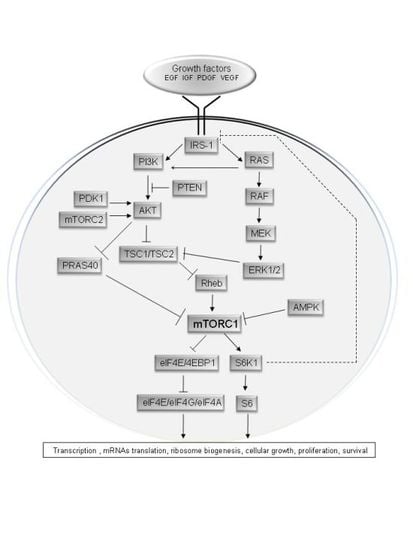
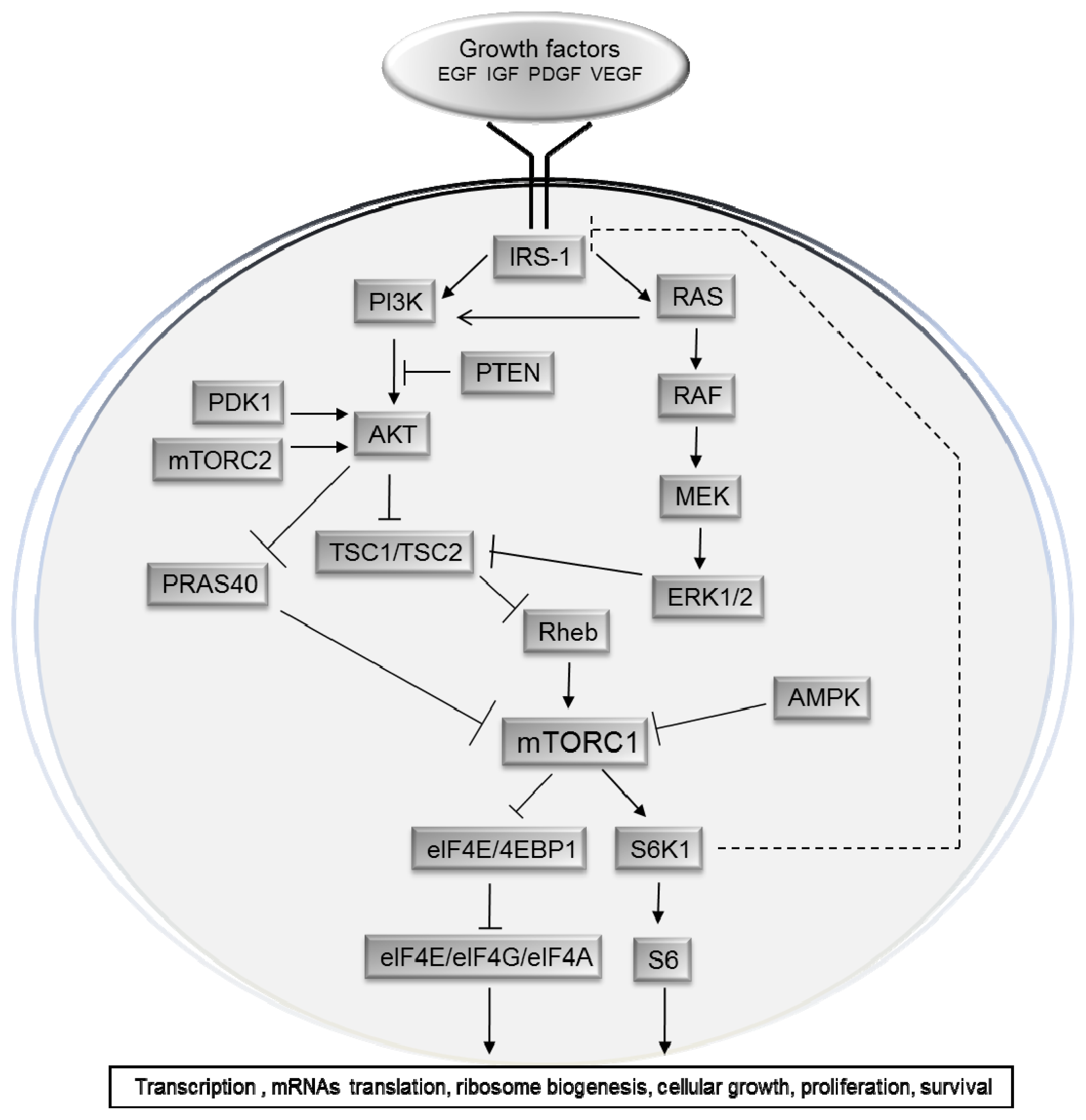
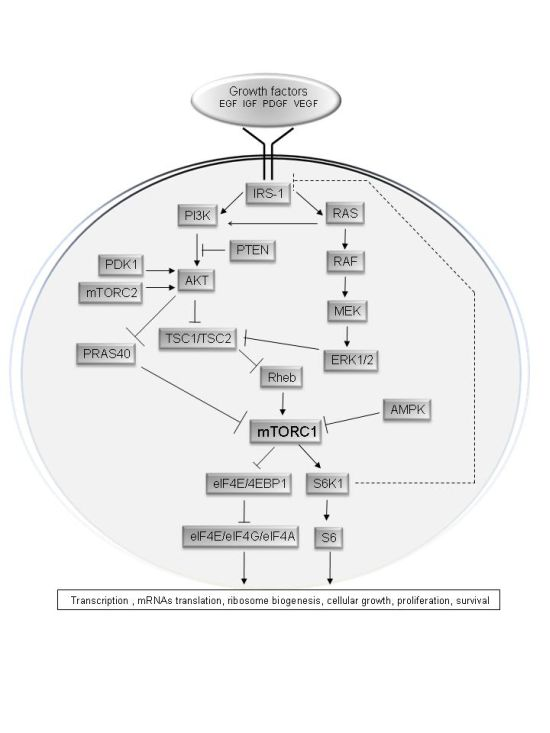
<p>mTORC1 is activated by the PI3K/AKT pathway (<xref ref-type="fig" rid="f3-ijms-13-01886">Figure 3</xref>) and inhibited by the TSC1/TSC2 complex; it is a major regulator of ribosomal biogenesis and protein synthesis [<xref ref-type="bibr" rid="b21-ijms-13-01886">21</xref>], through the phosphorylation and activation of S6K, and the phosphorylation and inactivation of the repressor of mRNA translation 4EBP1. Since they are the best characterized downstream targets of mTOR, the phosphorylation status of S6K and 4EBP1 are commonly used to evaluate mTORC1 activity <italic>in vivo</italic>. In addition, mTORC1 is also involved in the regulation of other proteins including CLIP-170 (cytoplasm linker protein-170) [<xref ref-type="bibr" rid="b22-ijms-13-01886">22</xref>], eEF2 (eukaryotic elongation factor 2) kinase [<xref ref-type="bibr" rid="b23-ijms-13-01886">23</xref>], ODC (ornithine decarboxylase) [<xref ref-type="bibr" rid="b24-ijms-13-01886">24</xref>], glycogen synthase [<xref ref-type="bibr" rid="b25-ijms-13-01886">25</xref>], HIF-1 α (hypoxia-inducible factor 1α) [<xref ref-type="bibr" rid="b26-ijms-13-01886">26</xref>], lipin [<xref ref-type="bibr" rid="b27-ijms-13-01886">27</xref>], PKCδ and PKCɛ [<xref ref-type="bibr" rid="b28-ijms-13-01886">28</xref>], PP2A (protein phosphatase 2A) [<xref ref-type="bibr" rid="b29-ijms-13-01886">29</xref>], p21Cip1 and p27Kip1 cyclin-dependent kinase inhibitors [<xref ref-type="bibr" rid="b30-ijms-13-01886">30</xref>,<xref ref-type="bibr" rid="b31-ijms-13-01886">31</xref>], Rb (retinoblastoma) protein [<xref ref-type="bibr" rid="b32-ijms-13-01886">32</xref>], and STAT3 (signal transducer and activator of transcription 3) [<xref ref-type="bibr" rid="b33-ijms-13-01886">33</xref>].</p>
<p>mTORC2 contains mTOR, rictor, mLST8, mSin1, and the newly identified components Protor, Hsp70 and DEPTOR [<xref ref-type="bibr" rid="b12-ijms-13-01886">12</xref>,<xref ref-type="bibr" rid="b34-ijms-13-01886">34</xref>–<xref ref-type="bibr" rid="b36-ijms-13-01886">36</xref>]. Rictor is an mTOR-associated protein that is exclusive from mTORC2 [<xref ref-type="bibr" rid="b12-ijms-13-01886">12</xref>]. mLST8 is a stable component of both mTOR complexes [<xref ref-type="bibr" rid="b19-ijms-13-01886">19</xref>]. mSin1 is an essential subunit of mTORC2, important for mTORC2 integrity and mTOR activity toward AKT Ser473 phosphorylation [<xref ref-type="bibr" rid="b35-ijms-13-01886">35</xref>]. Protor-1 (protein observed with rictor-1) interacts with rictor, although it is not essential for the assembly of other mTORC2 subunits into the complex [<xref ref-type="bibr" rid="b36-ijms-13-01886">36</xref>]. Hsp70, a heat shock protein, is required for the proper formation and kinase activity of mTORC2 under basal conditions and following heat shock [<xref ref-type="bibr" rid="b37-ijms-13-01886">37</xref>]. DEPTOR is a negative regulator of both mTORC1 and mTORC2 [<xref ref-type="bibr" rid="b16-ijms-13-01886">16</xref>].</p>
<p>mTORC2 is activated by growth factors, phosphorylates PKC-α, AKT (on Ser473) and paxillin (focal adhesion-associated adaptor protein), and regulates the activity of the small GTPases Rac and Rho related to cell survival, migration and regulation of the actin cytoskeleton [<xref ref-type="bibr" rid="b12-ijms-13-01886">12</xref>,<xref ref-type="bibr" rid="b38-ijms-13-01886">38</xref>,<xref ref-type="bibr" rid="b39-ijms-13-01886">39</xref>]. Hence, mTORC2 and mTORC1 have different physiological functions.</p>
<p>The complexes differ in their sensitivity to the macrolide fungicide rapamycin; mTORC1 is sensitive and mTORC2 is deemed resistant. However, it was described that long-term treatment (over 24 h) with rapamycin can disrupt mTORC2 assembly and function by sequestering newly synthesized mTOR molecules [<xref ref-type="bibr" rid="b39-ijms-13-01886">39</xref>].</p>
<p>The mTORC1 signalling cascade is activated by phosphorylated AKT (<xref ref-type="fig" rid="f3-ijms-13-01886">Figure 3</xref>). Class I PI3K produces the second messenger PtdIns(3,4,5)P3 [<xref ref-type="bibr" rid="b40-ijms-13-01886">40</xref>]. PtdIns(3,4,5) P3 binds to the pleckstrin-homology (PH) domain of target proteins, including AKT and PDK1 [<xref ref-type="bibr" rid="b2-ijms-13-01886">2</xref>]. Binding of PtdIns(3,4,5)P3 to the PH domain of AKT engages this kinase to the cell membrane where it is activated by phosphorylation at Thr308 by PDK1 [<xref ref-type="bibr" rid="b41-ijms-13-01886">41</xref>,<xref ref-type="bibr" rid="b42-ijms-13-01886">42</xref>], and by phosphorylation at Ser473 by mTORC2 [<xref ref-type="bibr" rid="b43-ijms-13-01886">43</xref>], being both phosphorylation required for the full activation of AKT kinase activity [<xref ref-type="bibr" rid="b41-ijms-13-01886">41</xref>]. PTEN is a negative regulator of AKT activation, as it converts PtdIns(3,4,5)P3 into PtdIns(4,5)P2, leading to a reduced recruitment of AKT to the cell membrane [<xref ref-type="bibr" rid="b44-ijms-13-01886">44</xref>]. Activated AKT has several downstream substrates, including GSK3, FOXO transcription factors and TSC2 [<xref ref-type="bibr" rid="b45-ijms-13-01886">45</xref>]. The phosphorylation of TSC2 prevents TSC1/TSC2 complex formation, which drives the small GTPase Rheb into the GTP-bound active state [<xref ref-type="bibr" rid="b40-ijms-13-01886">40</xref>], leading to the activation of mTORC1 at Ser2448 [<xref ref-type="bibr" rid="b46-ijms-13-01886">46</xref>,<xref ref-type="bibr" rid="b47-ijms-13-01886">47</xref>]. The exact mechanism by which Rheb activates mTORC1 is unknown, but it was described to entail the interaction of GTP-bound Rheb with the amino-terminal lobe of the mTOR kinase domain [<xref ref-type="bibr" rid="b47-ijms-13-01886">47</xref>] and the farnesylation and subsequent localization of Rheb in the Golgi and endomembranes [<xref ref-type="bibr" rid="b48-ijms-13-01886">48</xref>,<xref ref-type="bibr" rid="b49-ijms-13-01886">49</xref>]. AKT also phosphorylates and inhibits PRAS40, which negatively regulates mTORC1 by antagonizing its activation by Rheb [<xref ref-type="bibr" rid="b15-ijms-13-01886">15</xref>,<xref ref-type="bibr" rid="b50-ijms-13-01886">50</xref>].</p>
<p>Activated mTORC1 phosphorylates downstream effectors, including S6K1 and 4EBP1, via an interaction between raptor and a TOR signalling (TOS) motif in S6K and 4EBP [<xref ref-type="bibr" rid="b51-ijms-13-01886">51</xref>–<xref ref-type="bibr" rid="b53-ijms-13-01886">53</xref>]. The TOS motif is a conserved five amino acid segment found in the <italic>N</italic> terminus of S6K1 (Phe-Asp-Ile-Asp-Leu) and in the <italic>C</italic> terminus of 4E-BP1 (Phe-Glu-Met-Asp-Ile) that is necessary for the <italic>in vivo</italic> phosphorylation of these proteins by mTORC1 [<xref ref-type="bibr" rid="b54-ijms-13-01886">54</xref>].</p>
<p>The serine/threonine kinase p70S6K1 is one of the most well-known downstream targets of mTORC1. S6K1 can also be activated by TOR-insensitive signalling pathways such as PDK1, MAPK and SAPK (stress-activated protein kinase). In spite of this, the phosphorylation of S6K1 at Thr389 by mTORC1 is required for its activation and the three phosphorylation sites identified of S6K1 can all be blocked by mTOR inhibitors [<xref ref-type="bibr" rid="b55-ijms-13-01886">55</xref>]. Activated mTORC1 phosphorylates S6K1, which phosphorylates S6 (40S ribosomal protein S6), enhancing the translation of mRNAs with a 5′-terminal oligopolypyrimidine (5′-TOP). The targets of S6K1 include ribosomal proteins, elongation factors, and insulin growth factor 2 [<xref ref-type="bibr" rid="b56-ijms-13-01886">56</xref>].</p>
<p>4EBP1 is another well-characterized mTORC1 target. 4EBP1 inhibits the initiation of protein translation by binding and inactivating eIF4E (eukaryotic translation initiation factor 4E) [<xref ref-type="bibr" rid="b57-ijms-13-01886">57</xref>]. mTORC1 phosphorylates 4EBP1 at multiple sites to promote the dissociation of eIF4E from 4EBP1, relieving the inhibitory effect of 4EBP1 on eIF4E-dependent translation initiation [<xref ref-type="bibr" rid="b58-ijms-13-01886">58</xref>]. Free eIF4E can form the multisubunit eIF4F complex binding to eIF4G (a large scaffolding protein), eIF4A (an ATP-dependent RNA helicase), and eIF4B, enabling cap-dependent protein translation, and inducing increased translation of mRNAs with regulatory elements in the 5′-untranslated terminal regions (5′-UTR) of its downstream target genes (e.g., c-myc, ornithine decarboxylase and cyclin D1), which are required for G1-to-S phase transition [<xref ref-type="bibr" rid="b56-ijms-13-01886">56</xref>]. Differently, in quiescent cells or under low growth factors levels, unphosphorylated 4EBP1 binds to eIF4E, inhibiting the initiation of protein translation. The inhibition of mTOR by rapamycin also causes 4EBP1 dephosphorylation, which prevents protein translation [<xref ref-type="bibr" rid="b59-ijms-13-01886">59</xref>].</p>
<p>Several studies suggest the existence of a negative feedback loop from the mTOR-S6K1 pathway to the upstream IRS pathway (<xref ref-type="fig" rid="f3-ijms-13-01886">Figure 3</xref>) [<xref ref-type="bibr" rid="b60-ijms-13-01886">60</xref>,<xref ref-type="bibr" rid="b61-ijms-13-01886">61</xref>]. Activation of mTORC1 and S6K1 regulates IRS-1 both at the transcriptional level and through direct phosphorylation on specific residues which prevent its recruitment and binding to RTKs, leading to a negative feedback regulation of both PI3K [<xref ref-type="bibr" rid="b62-ijms-13-01886">62</xref>] and MAPK signalling [<xref ref-type="bibr" rid="b63-ijms-13-01886">63</xref>].</p>
<p>In summary, the serine/threonine kinase mTOR, a downstream effector of the PI3K/AKT pathway, forms two complexes: mTORC1 and mTORC2. The complexes are constituted by different proteins and play distinct functions for cell maintenance. mTORC1 is sensitive to rapamycin, activates S6K1 and 4EBP1, which are involved in mRNA translation. mTORC2 is considered resistant to rapamycin, activates PKC-α and AKT and regulates the actin cytoskeleton.</p></sec>
<sec>
<title>2. Upstream Regulation of the mTOR Pathway</title>
<p>Growth factors and hormones, such as insulin, regulate mTORC1 signalling by the activation of class I PI3K and its downstream effector AKT, which reverses the inhibitory effect of TSC1/TSC2 complex and PRAS40 on mTORC1 signalling [<xref ref-type="bibr" rid="b64-ijms-13-01886">64</xref>]. Stimulation of class I PI3K initiates several selective signalling cascades that lead to increased cell growth and proliferation [<xref ref-type="bibr" rid="b65-ijms-13-01886">65</xref>].</p>
<p>mTORC1 can also be activated by nutrients. It was described that induction of S6K1 and 4EBP1 phosphorylation by amino acids depends on mTORC1 [<xref ref-type="bibr" rid="b66-ijms-13-01886">66</xref>]. Another study described that amino-acid withdrawal results in the rapid dephosphorylation of S6K1 and 4EBP1, whereas addition of amino acids rescues this response in a rapamycin-sensitive manner [<xref ref-type="bibr" rid="b67-ijms-13-01886">67</xref>]. Furthermore, it has been suggested that TSC1/TSC2 complex is not required for the regulation of mTORC1 by amino acids, although Rheb–GTP is required for this response [<xref ref-type="bibr" rid="b68-ijms-13-01886">68</xref>]. Another mechanism by which amino acids may affect mTORC1 activity is via the class III PI3K, hVps34 (human vacuolar protein sorting-34). hVps34 is activated by amino acids and is involved in mediating the effect of amino acids on mTORC1 [<xref ref-type="bibr" rid="b68-ijms-13-01886">68</xref>,<xref ref-type="bibr" rid="b69-ijms-13-01886">69</xref>]. It is unknown if hVps34 signals through Rheb or if it affects directly mTORC1.</p>
<p>Cellular energy status also converges to mTOR. In response to energy starvation (low ATP level), mTORC1 activity is inhibited through the phosphorylation of TSC2 by AMPK (AMP-activated protein kinase). AMPK is activated by LKB1 (Liver kinase B1) that directly phosphorylates the activation loop and increases AMPK kinase activity [<xref ref-type="bibr" rid="b70-ijms-13-01886">70</xref>]. It was proposed that AKT counteracts this effect by the preservation of nutrient uptake that sustain high levels of ATP and a low level of AMPK activity, leading to the inhibition of TSC2 and the activation of mTORC1 [<xref ref-type="bibr" rid="b71-ijms-13-01886">71</xref>]. In response to energy starvation, cells also increase the mRNA levels of the hypoxia-inducible gene REDD1 (Regulated in development and DNA damage responses 1), which activates TSC2 and inhibits Rheb [<xref ref-type="bibr" rid="b72-ijms-13-01886">72</xref>].Hypoxia has also an inhibitory effect on mTORC1 activity, which is in part mediated by the induction of REDD1 [<xref ref-type="bibr" rid="b73-ijms-13-01886">73</xref>]. Transcriptional upregulation of REDD1 during hypoxia has been described to be dependent on the hypoxia-inducible transcription factor, HIF-1 [<xref ref-type="bibr" rid="b74-ijms-13-01886">74</xref>]. Hypoxia can also inhibit mTORC1 independently of REDD1 and HIF-1, via the induction of energy stress. AMPK/TSC2/Rheb pathway is activated at low oxygen levels, resulting in mTORC1 inhibition [<xref ref-type="bibr" rid="b75-ijms-13-01886">75</xref>].</p>
<p>In addition to activation by PI3K and AMPK, RAS/MAPK signalling has also been shown to trigger the activation of mTORC1 signalling. RAS proteins (H-, K- and N-RAS) function as a GDP/GTP-regulated switch and may have an important role as oncoproteins. In normal quiescent cells, RAS is GDP-bound and inactive. Upon stimulation by growth factors, hormones or cytokines, the activated GTP-bound form of RAS binds to and activates RAF kinase [<xref ref-type="bibr" rid="b76-ijms-13-01886">76</xref>,<xref ref-type="bibr" rid="b77-ijms-13-01886">77</xref>]. Upon activation, RAF phosphorylates and activates MEK, which activates ERK/RSK pathway. ERK phosphorylates both cytosolic and nuclear substrates leading to regulation of gene expression, cytoskeleton and metabolic remodelling [<xref ref-type="bibr" rid="b78-ijms-13-01886">78</xref>,<xref ref-type="bibr" rid="b79-ijms-13-01886">79</xref>]. ERK and RSK induce inhibitory phosphorylation of TSC2 at Ser664 and Ser1798 respectively, which promotes TSC1/TSC2 dissociation, which in turn leads to mTORC1 activation [<xref ref-type="bibr" rid="b80-ijms-13-01886">80</xref>–<xref ref-type="bibr" rid="b82-ijms-13-01886">82</xref>]. Interestingly, it was recently described that RSK also targets directly the mTORC1 complex by phosphorylating raptor, and thereby promotes mTORC1 kinase activity [<xref ref-type="bibr" rid="b83-ijms-13-01886">83</xref>]. As tumour promoting phorbol esters and some growth factors activate mTORC1 signalling independently of AKT, phosphorylation of raptor by RSK might provide a mechanism to overcome the inhibitory effects of PRAS40. In addition, the ERK activated protein kinases MNK1 and MNK2 (MAPK-interacting protein kinase 1 and 2) directly phosphorylate eIF4E [<xref ref-type="bibr" rid="b84-ijms-13-01886">84</xref>,<xref ref-type="bibr" rid="b85-ijms-13-01886">85</xref>]. Together, these findings may indicate that the mitogens activated RAS-ERK-RSK signalling, in parallel with the PI3K-AKT pathway, contain several inputs to stimulate mTORC1 signalling.</p>
<p>Cytokines, such as TNFα (tumour necrosis factor α), can also activate mTORC1 [<xref ref-type="bibr" rid="b86-ijms-13-01886">86</xref>,<xref ref-type="bibr" rid="b87-ijms-13-01886">87</xref>]. It has been described that IKKβ (inhibitor of nuclear factor κB (NFκB) kinase β), a major downstream kinase in the TNFα signalling pathway, phosphorylates TSC1 at Ser487 and Ser511, leading to the inhibition of TSC1/TSC2 complex formation and mTORC1 activation [<xref ref-type="bibr" rid="b88-ijms-13-01886">88</xref>]. Moreover, TNFα also signals to AKT [<xref ref-type="bibr" rid="b89-ijms-13-01886">89</xref>]. Activated AKT induces IKKα, another major downstream kinase in the TNFα signalling pathway [<xref ref-type="bibr" rid="b90-ijms-13-01886">90</xref>]. It has been described that IKKα associates with mTORC1 in an AKT dependent manner. Importantly, IKKα is required for the efficient induction of mTORC1 activity by AKT in cell lines [<xref ref-type="bibr" rid="b91-ijms-13-01886">91</xref>].</p>
<p>Although mTORC1 activity is prone to multiple positive and negative regulations driven by extracellular growth factors and stress stimuli, mTORC2 regulation mechanisms remain largely unknown. In mammalian cells, mTORC2 phosphorylates AKT upon serum stimulation, namely growth factors such as insulin and IGF1 (insulin-like growth factor 1), suggesting that mTORC2 is regulated by the PI3K pathway [<xref ref-type="bibr" rid="b35-ijms-13-01886">35</xref>,<xref ref-type="bibr" rid="b92-ijms-13-01886">92</xref>]. Nevertheless, the mechanism by which insulin or other growth factors activate mTORC2 is unclear. A recent study advocates that growth factors may signal to mTORC2 via the TSC1/TSC2 complex. Huang and co-authors proposed that the TSC1/TSC2 complex, the upstream negative regulator of mTORC1, may also bind to and regulate mTORC2 activity by direct binding to mTORC2 [<xref ref-type="bibr" rid="b93-ijms-13-01886">93</xref>]. Distinctive to the negative regulation of mTORC1, TSC1/TSC2 seems to regulate positively mTORC2 activity in a GAP-independent manner. The GTPase Rheb, which is a downstream of TSC1/TSC2 and activates mTORC1 [<xref ref-type="bibr" rid="b62-ijms-13-01886">62</xref>], does not appear to operate upstream of mTORC2. Since TSC1/TSC2 GAP activity is not required for mTORC2 activation, it appears that it is independent of mTORC1 activation and of the negative feedback loop from mTORC1 and S6K1 to the upstream IRS [<xref ref-type="bibr" rid="b94-ijms-13-01886">94</xref>].</p>
<p>Thus, the mTOR pathway can be activated by diverse exogenous stimuli, such as growth factors, nutrients, energy and stress signals, and essential signalling pathways, such as PI3K, MAPK and AMPK, in order to regulate several physiological events.</p></sec>
<sec>
<title>3. Physiological Roles of the mTOR Pathway in Control of Growth and Lifespan</title>
<p>Cell growth includes the time and space process of mass accumulation. In the presence of appropriate growth stimuli, cells upregulate macromolecular synthesis and thereby increase in size and mass. In response to stress, cells restrain macromolecular synthesis and enhance turnover of mass burden. Studies in yeast described that TOR plays two essential functions in the control of growth: when and where a cell grows (reviewed in [<xref ref-type="bibr" rid="b2-ijms-13-01886">2</xref>]). When growth conditions are favourable, TOR is active and yeast cells maintain a robust rate of ribosome biogenesis, translation initiation, and nutrient import. Noteworthy, rapidly growing yeast cells treated with rapamycin, starved for nitrogen, or depleted of both TOR1 and TOR2 downregulate general protein synthesis and activate several stress-responsive transcription factors. Mutation of dTOR in <italic>Drosophila</italic> and rapamycin treatment in mammalian systems induces a significant reduction on cell size [<xref ref-type="bibr" rid="b70-ijms-13-01886">70</xref>,<xref ref-type="bibr" rid="b95-ijms-13-01886">95</xref>,<xref ref-type="bibr" rid="b96-ijms-13-01886">96</xref>]. These results indicate that TOR is an important cell size regulator. Additionally, it has been suggested that S6K1 and 4EBP1, two of the well-characterized TOR targets, are key TOR pathway elements that mediate the regulation of cell size [<xref ref-type="bibr" rid="b96-ijms-13-01886">96</xref>]. TOR2 also functions to regulate spatial aspects of yeast cell growth, by controlling the actin cytoskeleton [<xref ref-type="bibr" rid="b2-ijms-13-01886">2</xref>]. In yeast, rapamycin-insensitive TORC2 controls the cell cycle-dependent polarization of the actin cytoskeleton. TORC2 signals to the actin cytoskeleton by activating a Rho1 GTPase switch. Upon activation, Rho1 interacts and activates PKC1, which in turn signals to the actin cytoskeleton via MAPK pathway [<xref ref-type="bibr" rid="b97-ijms-13-01886">97</xref>,<xref ref-type="bibr" rid="b98-ijms-13-01886">98</xref>]. mTORC2 also signals to the actin cytoskeleton, and although the direct targets of mTORC2 are unknown, this signalling may involve PKCα and the small GTPases Rho and Rac [<xref ref-type="bibr" rid="b12-ijms-13-01886">12</xref>,<xref ref-type="bibr" rid="b34-ijms-13-01886">34</xref>].</p>
<p>mTORC1 signalling controls transcription of many genes, some of which are involved in metabolic and biosynthetic pathways, as described in microarray experiments on rapamycin-treated mammalian cells [<xref ref-type="bibr" rid="b99-ijms-13-01886">99</xref>]. mTOR also regulates nutrient-responsive transcription programs [<xref ref-type="bibr" rid="b100-ijms-13-01886">100</xref>,<xref ref-type="bibr" rid="b101-ijms-13-01886">101</xref>]. Furthermore, mTOR has been described to phosphorylate STAT1 and STAT3 (signal transducer and activator of transcription) [<xref ref-type="bibr" rid="b102-ijms-13-01886">102</xref>] and to activate the nuclear receptor PPARγ, in a rapamycin-sensitive manner.</p>
<p>Cells must have mechanisms that regulate their growth and proliferation, by tight control of ribosomal biogenesis, which is an energy and nutrient-consuming process. Studies in both yeast and mammalian cells described that TOR regulates ribosome biogenesis at multiple levels, including transcription, rRNA processing, and translation, which can be inhibited by rapamycin or by nutrient starvation [<xref ref-type="bibr" rid="b103-ijms-13-01886">103</xref>–<xref ref-type="bibr" rid="b105-ijms-13-01886">105</xref>].</p>
<p>mTOR has also been described as a key signalling regulator of autophagy. Autophagy is a highly conserved eukaryotic intracellular homeostatic process carrying out degradation of cytoplasm components, including damaged or superfluous organelles, toxic protein aggregates, and intracellular pathogens in lysosomes [<xref ref-type="bibr" rid="b106-ijms-13-01886">106</xref>,<xref ref-type="bibr" rid="b107-ijms-13-01886">107</xref>]. Autophagy can be upregulated during metabolic, genotoxic or hypoxic stress conditions in order to ensure cell survival [<xref ref-type="bibr" rid="b106-ijms-13-01886">106</xref>]. Inhibition of mTOR kinase by specific inhibitors, rapamycin or nutrient deprivation, induces activation of autophagy [<xref ref-type="bibr" rid="b107-ijms-13-01886">107</xref>]. The role of mTOR in autophagy is conserved from yeast to mammals, and regulates the induction of the autophagy process [<xref ref-type="bibr" rid="b108-ijms-13-01886">108</xref>]. In mammals this process may be mediated in part through mTOR-dependent phosphorylation of eEF2K (eukaryotic translation elongation factor 2 kinase), where mTOR inhibition leads to activation of eEF2K and induction of autophagy [<xref ref-type="bibr" rid="b109-ijms-13-01886">109</xref>]. The release of amino acids from autophagic degradation leads to the reactivation of mTORC1 and to the restoration of the cellular lysosomal population [<xref ref-type="bibr" rid="b110-ijms-13-01886">110</xref>].</p>
<p>mTORC1 also regulates translation via S6K1 and 4EBP1, as referred above [<xref ref-type="bibr" rid="b21-ijms-13-01886">21</xref>,<xref ref-type="bibr" rid="b111-ijms-13-01886">111</xref>].</p>
<p>TOR controls many aspects of cellular metabolism, such as amino acid biosynthesis and glucose homeostasis [<xref ref-type="bibr" rid="b112-ijms-13-01886">112</xref>]. mTORC1 appears also to play an important role in adipogenesis; rapamycin treatment prevents adipocyte differentiation and lipid accumulation [<xref ref-type="bibr" rid="b113-ijms-13-01886">113</xref>]. The mechanism by which mTOR controls adipogenesis might involve the nuclear receptor PPARγ that is responsible for the efficiency of energy storage [<xref ref-type="bibr" rid="b114-ijms-13-01886">114</xref>], since its activity is inhibited by rapamycin treatment [<xref ref-type="bibr" rid="b113-ijms-13-01886">113</xref>]. The regulation of fat metabolism by mTORC1 also involves signalling via S6K1. S6K1 mutant mice display reduced adipose tissue and a decrease in fat accumulation due to enhanced β oxidation [<xref ref-type="bibr" rid="b115-ijms-13-01886">115</xref>].</p>
<p>Partial inhibition of TOR function in yeast, worms, and flies results in a significant lifespan increase of these organisms, possibly by mimicking calorie restriction (reviewed in [<xref ref-type="bibr" rid="b116-ijms-13-01886">116</xref>]). It appears that during development, TOR controls primarily growth, whereas in the adult, when there is a relative slow growth, TOR controls aging and other aspects of nutrient-related physiology. Recent studies corroborate the role of calorie restriction also in the lifespan extension of mammals [<xref ref-type="bibr" rid="b117-ijms-13-01886">117</xref>,<xref ref-type="bibr" rid="b118-ijms-13-01886">118</xref>]. Rapamycin, an mTORC1 inhibitor, is the only pharmacological agent that has been described to mimic calorie restriction and extended lifespan [<xref ref-type="bibr" rid="b118-ijms-13-01886">118</xref>].</p>
<p>Hence, the mTOR pathway is a central coordinator of fundamental biological events, playing a key role in cell growth and size, regulation of actin cytoskeleton, gene transcription, ribosome biogenesis, mRNA translation, cell survival and lifespan.</p></sec>
<sec>
<title>4. The mTOR Pathway in Cancer</title>
<p>Given the key role of mTOR in cell growth and metabolism, it is predictable the existence of an association between mTOR pathway activity and pathological states, including cancer.</p>
<p>Activation of the mTOR signalling is involved in some of the cancer hallmarks described by Hanahan and Weinberg [<xref ref-type="bibr" rid="b119-ijms-13-01886">119</xref>]. In a number of <italic>in vitro</italic> cell-lines and <italic>in vivo</italic> murine xenograft models, aberrant mTOR pathway activation through oncogene stimulation or loss of tumour suppressors contributes to tumour growth, angiogenesis and metastasis [<xref ref-type="bibr" rid="b56-ijms-13-01886">56</xref>]. Mutations in mTOR gene that confer constitutive activation of mTOR signalling, even under nutrient starvation conditions, have been identified in a few human cancers, although not clearly linked to tumour development [<xref ref-type="bibr" rid="b120-ijms-13-01886">120</xref>]. In spite of this, as summarized in <xref ref-type="table" rid="t1-ijms-13-01886">Table 1</xref>, the signalling components upstream and downstream of mTORC1 are frequently altered in human tumours.</p>
<p>Upstream, PI3K/AKT signalling is deregulated through a variety of mechanisms, including overexpression or activation of growth factor receptors, such as HER-2 (human epidermal growth factor receptor 2) and IGFR (insulin-like growth factor receptor), mutations in <italic>PI3K</italic> and mutations/amplifications of <italic>AKT</italic> [<xref ref-type="bibr" rid="b121-ijms-13-01886">121</xref>–<xref ref-type="bibr" rid="b123-ijms-13-01886">123</xref>].</p>
<p>PTEN, the negative regulator of PI3K signalling, decreases its expression in many cancers, and may be downregulated through several mechanisms, including mutation, loss of heterozygosity, methylation, aberrant expression of regulatory microRNA, and protein instability [<xref ref-type="bibr" rid="b124-ijms-13-01886">124</xref>,<xref ref-type="bibr" rid="b125-ijms-13-01886">125</xref>].</p>
<p>mTOR downstream effectors S6K1, 4EBP1 and eIF4E are implicated in cellular transformation, and their overexpression has been linked to poor cancer prognosis [<xref ref-type="bibr" rid="b127-ijms-13-01886">127</xref>,<xref ref-type="bibr" rid="b137-ijms-13-01886">137</xref>,<xref ref-type="bibr" rid="b150-ijms-13-01886">150</xref>,<xref ref-type="bibr" rid="b151-ijms-13-01886">151</xref>]. Activated mTOR signalling is also related to the development of syndromes, including Cowden’s syndrome (<italic>PTEN</italic> mutations), Peutz-Jeghers syndrome (<italic>LKB1</italic> mutations) and tuberous sclerosis (<italic>TSC1/2</italic> mutations) [<xref ref-type="bibr" rid="b143-ijms-13-01886">143</xref>,<xref ref-type="bibr" rid="b152-ijms-13-01886">152</xref>–<xref ref-type="bibr" rid="b154-ijms-13-01886">154</xref>]. These syndromes, in which the patients develop benign tumours that contain architecturally disorganized but well differentiated cells, affect a wide variety of tissues, comprising brain, skin, kidneys, heart, lung, and the gastrointestinal tract. Though benign, these syndromes may progress to malignancy.</p>
<p>Thus, mTOR signalling is activated in conditions of proliferation deregulation and in many cancer types. Deregulation of multiple elements of the mTOR pathway (<italic>PI3K</italic> amplification/mutation, <italic>PTEN</italic> loss of function, AKT overexpression, and S6K1, 4EBP1 and eIF4E overexpression) has been reported in cancer, such as breast, ovarian, renal, colon and head and neck cancers. Taken together, these data underscore the importance of mTOR signalling in cancer and reinforce the importance of considering mTOR targeting in cancer therapy.</p></sec>
<sec>
<title>5. The mTOR Pathway in Melanoma</title>
<p>Activation of the AKT/mTOR signalling pathways plays a role in the initiation of melanocyte tumours by modulating the extracellular signals that control cell growth, proliferation and apoptosis [<xref ref-type="bibr" rid="b138-ijms-13-01886">138</xref>,<xref ref-type="bibr" rid="b155-ijms-13-01886">155</xref>].</p>
<p>Loss of <italic>PTEN</italic>, the negative regulator of PI3K pathway, was described in 30–50% of melanomas, and correlates with melanoma progression and with shorter 5-year survival [<xref ref-type="bibr" rid="b156-ijms-13-01886">156</xref>,<xref ref-type="bibr" rid="b157-ijms-13-01886">157</xref>]. Studies in melanoma cell lines and primary or metastatic melanomas described that disruption of <italic>PTEN</italic> by allelic loss or mutation contributes to the pathogenesis of malignant melanoma [<xref ref-type="bibr" rid="b158-ijms-13-01886">158</xref>,<xref ref-type="bibr" rid="b159-ijms-13-01886">159</xref>]. Loss of <italic>PTEN</italic> and <italic>RAS</italic> activation seems comparable in their ability to increase oncogenic signalling through PI3K pathway [<xref ref-type="bibr" rid="b160-ijms-13-01886">160</xref>], due to the coexistence of <italic>PTEN</italic> somatic mutations in melanoma harbouring <italic>BRAF</italic> mutations but not with <italic>NRAS</italic> [<xref ref-type="bibr" rid="b161-ijms-13-01886">161</xref>]. <italic>AKT</italic> gene amplification, owing to copy number increase in the long arm of chromosome 1 and activating mutation, was also described in cutaneous melanomas [<xref ref-type="bibr" rid="b156-ijms-13-01886">156</xref>,<xref ref-type="bibr" rid="b162-ijms-13-01886">162</xref>]. Immunohistochemistry studies described AKT overexpression in 60% of melanomas, differing from common and dysplastic nevi that do not exhibit significant AKT expression [<xref ref-type="bibr" rid="b163-ijms-13-01886">163</xref>]. Amongst the three AKT isoforms, AKT3 is the isoform more frequently deregulated in melanoma cells [<xref ref-type="bibr" rid="b164-ijms-13-01886">164</xref>]. In melanoma, the increased pAKT expression associates with tumour progression and shorter survival of patients [<xref ref-type="bibr" rid="b164-ijms-13-01886">164</xref>,<xref ref-type="bibr" rid="b165-ijms-13-01886">165</xref>]. Notably, AKT activity seems to cooperate in <italic>BRAF</italic><italic><sup>V600E</sup></italic>-mediated model of melanoma development [<xref ref-type="bibr" rid="b166-ijms-13-01886">166</xref>]. PRAS40, a substrate of the AKT, was described to be downregulated in melanoma [<xref ref-type="bibr" rid="b167-ijms-13-01886">167</xref>]. Concordantly, results from our group indicate that the mTOR pathway is activated in cutaneous melanoma, displaying different levels of activation in different histological subtypes, and relate with MAPK pathway activation. Our results suggest an association between higher mTOR effectors expression and worse prognosis as well as with the presence of <italic>BRAF</italic> mutations [<xref ref-type="bibr" rid="b138-ijms-13-01886">138</xref>].</p>
<p>There is also evidence that the AKT/mTOR pathway is altered in uveal melanoma [<xref ref-type="bibr" rid="b168-ijms-13-01886">168</xref>,<xref ref-type="bibr" rid="b169-ijms-13-01886">169</xref>]. PTEN displays decreased expression in aggressive tumours [<xref ref-type="bibr" rid="b170-ijms-13-01886">170</xref>] and expression of AKT phosphorylated at Ser473 was proposed as a marker of worse prognosis [<xref ref-type="bibr" rid="b168-ijms-13-01886">168</xref>]. Furthermore, results from our group also indicate that the mTOR pathway is activated in ocular melanoma and is related with MAPK pathway activation. Our results show that the pathway activation seems to be higher in conjunctival than in uveal melanomas and this activation seems to be associated with worse prognosis, especially in conjunctival melanomas. Besides, higher expression of pAKT Thr308 was found in metastatic uveal melanoma [<xref ref-type="bibr" rid="b169-ijms-13-01886">169</xref>].</p>
<p>Overall, the alterations in major components of the MAPK, such as <italic>BRAF</italic> and <italic>NRAS</italic> mutations, and mTOR pathways, <italic>PTEN</italic> loss and AKT overexpression, seem to have substantial influence in melanoma progression, being both pathways linked to survival and chemoresistence in melanoma [<xref ref-type="bibr" rid="b3-ijms-13-01886">3</xref>,<xref ref-type="bibr" rid="b171-ijms-13-01886">171</xref>,<xref ref-type="bibr" rid="b172-ijms-13-01886">172</xref>].</p></sec>
<sec>
<title>6. mTOR Pathway Inhibitors in Cancer Therapy</title>
<p>mTOR inhibitors can be grouped in two classes: rapamycin and rapamycin analogues that are allosteric inhibitors of mTORC1 and the small molecules that are mTOR kinase inhibitors.</p>
<p>Rapamycin was first isolated from the bacterium <italic>Streptomyces hygroscopicus</italic>, which was found in a soil sample taken from Easter Island, as a fungicide and subsequently discovered to have potent immunosuppressive and anti-tumour properties [<xref ref-type="bibr" rid="b173-ijms-13-01886">173</xref>–<xref ref-type="bibr" rid="b175-ijms-13-01886">175</xref>]. As an immunosuppressive drug, rapamycin (rapamune, sirolimus) was approved by FDA (USA Food and Drug Administration) in 1999 for prevention of renal allograft rejection [<xref ref-type="bibr" rid="b176-ijms-13-01886">176</xref>]. Subsequent studies described that rapamycin can also act as a cytostatic agent, slowing or arresting growth of cell lines derived from different tumour types such as rhabdomyosarcoma [<xref ref-type="bibr" rid="b177-ijms-13-01886">177</xref>], glioblastoma [<xref ref-type="bibr" rid="b178-ijms-13-01886">178</xref>], small cell lung cancer [<xref ref-type="bibr" rid="b179-ijms-13-01886">179</xref>], osteosarcoma [<xref ref-type="bibr" rid="b180-ijms-13-01886">180</xref>], pancreatic cancer [<xref ref-type="bibr" rid="b181-ijms-13-01886">181</xref>], breast cancer [<xref ref-type="bibr" rid="b182-ijms-13-01886">182</xref>], prostate cancer [<xref ref-type="bibr" rid="b183-ijms-13-01886">183</xref>], and B-cell lymphoma [<xref ref-type="bibr" rid="b184-ijms-13-01886">184</xref>]. In addition to direct anti-tumour effects, rapamycin also inhibits cell proliferation, survival and angiogenesis [<xref ref-type="bibr" rid="b185-ijms-13-01886">185</xref>,<xref ref-type="bibr" rid="b186-ijms-13-01886">186</xref>].</p>
<p>Several derivatives of rapamycin (sirolimus, Wyeth, Madison, NJ, USA), with more favourable pharmacokinetic and solubility properties, have been synthesized, such as CCI-779 (temsirolimus, Wyeth, Madison, NJ, USA), RAD001 (everolimus, Novartis, Novartis, Basel, Switzerland), AP23573 (deforolimus, ARIAD, Cambridge, MA, USA), 32-deoxorapamycin (SAR943) or ABT-578 (zotarolimus, Abbott Laboratories, Abbott Park, IL, USA) (<xref ref-type="table" rid="t2-ijms-13-01886">Table 2</xref>). Like rapamycin, these rapamycin analogues form a complex with the intracellular receptor FKBP12. This complex binds to mTOR and inhibits mTORC1 downstream signalling, detected by the suppression of S6K1 and 4EBP1 phosphorylation [<xref ref-type="bibr" rid="b187-ijms-13-01886">187</xref>,<xref ref-type="bibr" rid="b188-ijms-13-01886">188</xref>]. The FKBP12-rapamycin complex cannot bind directly to mTORC2, although prolonged treatments can disturb mTORC2 assembly and inhibit the phosphorylation of its downstream substrate AKT on Ser473 [<xref ref-type="bibr" rid="b34-ijms-13-01886">34</xref>,<xref ref-type="bibr" rid="b39-ijms-13-01886">39</xref>].</p>
<p>Rapamycin and its analogues temsirolimus, everolimus and deforolimus are currently being evaluated in clinical trials for cancer treatment (<xref ref-type="table" rid="t2-ijms-13-01886">Table 2</xref>) [<xref ref-type="bibr" rid="b189-ijms-13-01886">189</xref>]. In preclinical studies they were described to carry out antiproliferative activity in a variety of cancers, and there are clinical studies reporting encouraging results in a subset of cancers [<xref ref-type="bibr" rid="b190-ijms-13-01886">190</xref>–<xref ref-type="bibr" rid="b192-ijms-13-01886">192</xref>]. Remarkably, a high objective response rate was reported with treatment with rapamycin analogues of several tumour types. Phase II studies with everolimus achieved an objective response rate of 47%, 30% and 12%, with median duration of response of 7.2, 5.7 and 13.1 months in Hodgkin lymphoma, non-Hodgkin’s lymphoma and breast cancer, respectively [<xref ref-type="bibr" rid="b193-ijms-13-01886">193</xref>–<xref ref-type="bibr" rid="b195-ijms-13-01886">195</xref>]. Phase II/III studies with temsirolimus achieved an objective response rate of 4 to 14% and 22%, with median duration of response of 4.3 to 5.1 and 4.8 months in endometrial cancer and mantle-cell lymphoma, respectively [<xref ref-type="bibr" rid="b196-ijms-13-01886">196</xref>,<xref ref-type="bibr" rid="b197-ijms-13-01886">197</xref>].</p>
<p>However, several studies also suggested that the antiproliferative effects of the analogues are variable in cancer cells due to failure of mTORC2 inhibition in some tumour types. The specific inhibition of mTORC1 by RAD001 might induce upstream receptor tyrosine kinase signalling and AKT upregulation, leading to the attenuation of its therapeutic effects [<xref ref-type="bibr" rid="b198-ijms-13-01886">198</xref>]. Thus, the combination therapy or a dual-specificity agent that targets both mTOR function and AKT activation may improve anti-tumour activity.</p>
<p>Noteworthy, temsirolimus and everolimus were approved by the FDA for the treatment of renal cell carcinoma (RCC) (<ext-link xlink:href="http://www.fda.gov" ext-link-type="uri">http://www.fda.gov</ext-link>). mTOR inhibition seems to downregulate HIF, which is frequently overexpressed in RCC, due to loss of function of VHL (Von Hippel-Lindau) gene [<xref ref-type="bibr" rid="b199-ijms-13-01886">199</xref>,<xref ref-type="bibr" rid="b200-ijms-13-01886">200</xref>]. Likewise, everolimus was approved by FDA for the treatment of progressive endocrine tumours of pancreatic origin (PNET) in patients with unresectable, locally advanced or metastatic disease and for patients with subependymal giant cell astrocytoma (SEGA) associated with tuberous sclerosis (TS) (<ext-link xlink:href="http://www.fda.gov" ext-link-type="uri">http://www.fda.gov</ext-link>).</p>
<p>A new generation of mTOR inhibitors, which bind to the ATP-binding site of mTOR and inhibit the catalytic activity of mTORC1 and mTORC2, were developed (<xref ref-type="table" rid="t2-ijms-13-01886">Table 2</xref>).</p>
<p>Distinct from rapamycin analogues, these molecules block both mTORC1-dependent phosphorylation of S6K1 and mTORC2-dependent phosphorylation of the AKT Ser473 residue. The anticancer efficacy of these inhibitors reported in preclinical evaluation has been superior to rapamycin analogues. This was related to a more effective blocking of cell proliferation, 4EBP1 phosphorylation and protein translation, compared to rapamycin [<xref ref-type="bibr" rid="b201-ijms-13-01886">201</xref>,<xref ref-type="bibr" rid="b202-ijms-13-01886">202</xref>]. Two active-site inhibitors of mTOR, PP242 and PP30, which inhibit insulin-stimulated phosphorylation of AKT at Ser473, were reported as having potent inhibitory effects on protein synthesis and cell proliferation [<xref ref-type="bibr" rid="b201-ijms-13-01886">201</xref>]. Torin1, another selective ATP-competitive mTOR inhibitor, which directly inhibits both mTORC1 and mTORC2, also seems to inhibit cell growth and proliferation more effectively than rapamycin [<xref ref-type="bibr" rid="b202-ijms-13-01886">202</xref>]. Several selective mTOR inhibitors are in development stage and more studies are warranted to further evaluate the efficacy of these agents in the treatment of cancers affected by hyperactive PI3K/mTOR pathway.</p>
<p>Dual PI3K-mTOR inhibitors are also being developed. This class of inhibitors includes XL-765 (Sanofi-Aventis/Exelixis Inc) [<xref ref-type="bibr" rid="b203-ijms-13-01886">203</xref>], which is undergoing phase I clinical trials for the treatment of solid tumours and gliomas (NCT00485719, NCT00704080 and NCT00777699), PI-103 [<xref ref-type="bibr" rid="b204-ijms-13-01886">204</xref>] and NVP-BEZ235 (Novartis AG), which is undergoing phase I/II trials for the treatment of advanced solid tumours and metastatic breast cancer [<xref ref-type="bibr" rid="b205-ijms-13-01886">205</xref>]. These compounds were reported to prevent the activity of PI3K-mTOR axis biomarkers more effectively than rapamycin, by inhibiting both mTORC1 and mTORC2. The dual PI3K-mTOR inhibitors are still in phase I/II clinical trials.</p>
<p>So far and for most tumour types, mTOR inhibitors have been reported to predominantly lead to disease stabilization rather than tumour regression. Assuming these results, targeted therapies for mTOR may be used in combination therapy, aiming to induce a cytotoxic rather than a cytostatic response and subsequent tumour regression. mTOR inhibitors have been described to be additive or synergistic with conventional chemotherapy agents, such as paclitaxel, carboplatin, cisplatin, vinorelbine, doxorubicin, and camptothecin [<xref ref-type="bibr" rid="b178-ijms-13-01886">178</xref>,<xref ref-type="bibr" rid="b213-ijms-13-01886">213</xref>–<xref ref-type="bibr" rid="b215-ijms-13-01886">215</xref>]. Compared to single agent therapy, the combination of rapamycin with chemotherapy enhances apoptosis <italic>in vitro</italic> and enhance anti-tumour efficacy <italic>in vivo</italic>. Clinical trials to evaluate the efficacy of rapamycin and analogues in combination with chemotherapeutic agents are in progress.</p>
<p>Rapamycin analogues are also being tested in combination with EGFR or HER-2 inhibitors. Early trials of EGFR inhibitors combined with analogues in glioblastoma patients did not disclose any positive results and lung cancer patients resistant to EGFR inhibitors showed toxic effects that required discontinuation or dose reductions in some patients [<xref ref-type="bibr" rid="b216-ijms-13-01886">216</xref>,<xref ref-type="bibr" rid="b217-ijms-13-01886">217</xref>]. Trials combining hormonal therapies with mTOR inhibitors are been performed in breast cancer, since resistance to hormonal therapy has been associated with overactivation of the mTOR pathway [<xref ref-type="bibr" rid="b218-ijms-13-01886">218</xref>]. Phase I/II trials with trastuzumab combined with everolimus in Her-2+ metastatic breast cancer that progressed on trastuzumab therapy reported clinical benefit and restore trastuzumab sensitivity [<xref ref-type="bibr" rid="b219-ijms-13-01886">219</xref>]. Phase I and II trials of mTOR inhibitors in combination with erlotinib, gefitinib or cetuximab are ongoing.</p>
<p>Since mTOR inhibitors downregulate HIF and VEGF, combination of temsirolimus or everolimus with bevacizumab, sorafenib or sunitinib are being tested in clinical trials. The combination with bevacizumab seems to be better tolerated and more effective than combinations using small molecules targeting VEGFR [<xref ref-type="bibr" rid="b220-ijms-13-01886">220</xref>]. The combination of temsirolimus with sorafenib, which targets RAF-1 and other kinases in addition to VEGFR, required a 50% reduction of the single-agent dose of sorafenib to achieve an acceptable range of toxic effects [<xref ref-type="bibr" rid="b221-ijms-13-01886">221</xref>]. Temsirolimus combined with sunitinib, which also inhibits VEGFR and other kinases, caused excessive toxic effects [<xref ref-type="bibr" rid="b222-ijms-13-01886">222</xref>]. Trials evaluating temsirolimus combined with bevacizumab, temsirolimus combined with sorafenib and compared with bevacizumab alone are ongoing in a randomized phase II study of untreated patients with metastatic RCC (NCT00378703). Besides, an ongoing phase III trial is evaluating the combination of bevacizumab and temsirolimus as second-line of therapy for RCC (NCT00631371). Other drug combinations being tested are directed to the feedback loops triggered by mTORC1 inhibition. As rapamycin analogues treatment leads to AKT activation through IRS-1 signalling [<xref ref-type="bibr" rid="b223-ijms-13-01886">223</xref>], mTORC2 phosphorylation of AKT Ser473, or activation of the MAPK pathway [<xref ref-type="bibr" rid="b63-ijms-13-01886">63</xref>], the combinations with inhibitors targeting these pathways were evaluated. Studies of analogues combined with IGF-1 inhibitors or MAPK2 inhibitors reported synergistic effects [<xref ref-type="bibr" rid="b224-ijms-13-01886">224</xref>–<xref ref-type="bibr" rid="b226-ijms-13-01886">226</xref>]. Phase I clinical trials are in progress to evaluate the safety and tolerability of these combination therapies.</p>
<p>Regarding melanoma, rapamycin, may also synergistically increase apoptosis and chemosensitivity in melanoma cells [<xref ref-type="bibr" rid="b227-ijms-13-01886">227</xref>,<xref ref-type="bibr" rid="b228-ijms-13-01886">228</xref>]. The anti-tumour effects of rapamycin seem to be enhanced when combined with MAPK pathway inhibitors and PI3K inhibitors. The PI3K inhibitor LY294002 abrogates the AKT phosphorylation induced by mTORC1 inhibition [<xref ref-type="bibr" rid="b229-ijms-13-01886">229</xref>], while the MAPK pathway inhibitor sorafenib downregulates the expression of the anti-apoptotic proteins Mcl-1 and Bcl-2 [<xref ref-type="bibr" rid="b225-ijms-13-01886">225</xref>,<xref ref-type="bibr" rid="b227-ijms-13-01886">227</xref>]. Temsirolimus combined with cisplatin efficiently induced regression of melanomas in SCID mice, being both inhibitors much less effective when applied as single agents [<xref ref-type="bibr" rid="b230-ijms-13-01886">230</xref>]. Although phase II clinical trials with mTOR inhibitors alone yield minor responses and/or high toxicity in melanoma patients (reviewed in ref. [<xref ref-type="bibr" rid="b231-ijms-13-01886">231</xref>]), phase II clinical trials combining temsirolimus and sorafenib are ongoing (NCT00349206). In addition, as vemurafenib, a specific BRAF<sup>V600E</sup> inhibitor, was approved by the FDA for the treatment of patients with unresectable or metastatic melanoma with BRAF<sup>V600E</sup> mutation, a trial combining vemurafenib with mTOR inhibitors may be valuable.</p>
<p>Thus, mTOR is an appealing therapeutic target. The rapamycin analogues deforolimus, everolimus and temsirolimus, are being evaluated in clinical trials for treating multiple cancers, alone or in combination with inhibitors of other pathways. Importantly, temsirolimus and everolimus were recently approved by the FDA for the treatment of renal cell carcinoma, PNET and giant cell astrocytoma. Small molecules that inhibit mTOR kinase activity and dual PI3K-mTOR inhibitors are also being developed.</p></sec>
<sec>
<title>7. mTOR Therapy Predictive Biomarkers</title>
<p>A major challenge for the development of cancer therapy is the identification of predictive biomarkers of efficacy. There are no known predictive biomarkers for the efficacy or resistance in cancer of mTOR inhibitors. Activation of PI3K signalling, through AKT activation, PTEN deletion, growth factor stimulation or aberrant growth factor receptor signalling, may indicate potential sensitivity of tumours to mTOR inhibition [<xref ref-type="bibr" rid="b232-ijms-13-01886">232</xref>]. Thus, the differential expression of mTOR pathway proteins (PTEN and active forms of AKT and S6) may be possibly predictive markers for tumour response to mTOR inhibition, as described in glioblastoma, prostate and breast cancer cell lines [<xref ref-type="bibr" rid="b233-ijms-13-01886">233</xref>,<xref ref-type="bibr" rid="b234-ijms-13-01886">234</xref>]. Nevertheless, these predictors of response have been proposed based only on preclinical data and in specific types of cancer, and have not been clinically validated, with the exception of the loss of PTEN expression, that was used in clinical trials as a marker to evaluate glioblastoma sensitivity to rapamycin treatment [<xref ref-type="bibr" rid="b235-ijms-13-01886">235</xref>]. Moreover, there is a considerable variation in the therapeutic benefits detected in patients harbouring tumours predicted to be responders to mTOR inhibition, because the genetic context in which the altered phenotype occurs may also be important for the patient response to therapy.</p>
<p>Therefore, there is an emergent need to identify predictive markers of response that may be useful to prospectively select patients bearing tumours which may respond and benefit from mTOR inhibition therapies.</p></sec>
<sec sec-type="conclusions">
<title>8. Conclusions</title>
<p>In the last years, a significant progress has been achieved in understanding the mTOR signalling pathway. mTOR has been suggested to play a key role in several normal biological processes as well as in disease. It is known that mTOR forms two multiprotein complexes, mTORC1 and mTORC2, which have distinct physiological functions. Deregulation of multiple elements of the mTOR pathway has been reported in many types of cancers.</p>
<p>Most of the research on the mTOR signalling pathway has been focused on using rapamycin, which blocks mainly mTORC1 activity. Novel compounds that inhibit mTORC1 and mTORC2 are likely to reveal as yet undiscovered components and complexities of the mTOR pathway. Eventually, the study of the mTOR pathway may bring novel insights into mTOR biology, and also assist in the development of more effective therapeutic strategies for treating mTOR-related diseases, particularly cancer. mTOR is now considered a substantiated target in the treatment of cancer. The major limitation for the development of mTOR inhibition therapy is the absence of predictive biomarkers of efficacy and its resistance mechanisms in cancer. The lack of routine genotyping of tumours is also part of the limitations in establishing predictive biomarkers for the use of mTOR inhibitors across the spectrum of human tumours. Stratification of patients and selection of drug combination therapies may enhance the efficacy of mTOR inhibition, leading to a more effective and personalized cancer therapy.</p></sec></body>
<back>
<ack>
<title>Acknowledgments</title>
<p>This study was supported by the Portuguese Foundation for Science and Technology through project grants and a PhD grant to HP (Ref.: SFRH/BD/31369/2006). We thank NOVARTIS Oncology-Portugal for partial funding of this study through a research project. IPATIMUP is an Associate Laboratory of the Portuguese Ministry of Science, Technology and Higher Education, and is partly supported by the Fundação para a Ciência e Tecnologia.</p></ack>
<fn-group><fn id="fn1-ijms-13-01886">
<p><bold>Conflict of Interest</bold></p>
<p>The authors declare no conflict of interest.</p></fn></fn-group>
<glossary id="GL">
<title>Non-Standard Abbreviations</title>
<def-list>
<def-item>
<term id="G1">4EBP1</term>
<def>
<p>Eukaryotic translation initiation factor 4E-binding protein 1</p></def></def-item>
<def-item>
<term id="G2">AMPK</term>
<def>
<p>5′ Adenosine monophosphate-activated protein kinase</p></def></def-item>
<def-item>
<term id="G3">AKT/PKB</term>
<def>
<p>Protein kinase B</p></def></def-item>
<def-item>
<term id="G4">Bcl-2</term>
<def>
<p>B-cell lymphoma 2</p></def></def-item>
<def-item>
<term id="G5">BRAF</term>
<def>
<p>v-RAF murine sarcoma viral oncogene homolog B</p></def></def-item>
<def-item>
<term id="G6">DEPTOR</term>
<def>
<p>DEP domain-containing mTOR-interacting protein</p></def></def-item>
<def-item>
<term id="G7">eEF2K</term>
<def>
<p>Eukaryotic elongation factor-2 kinase</p></def></def-item>
<def-item>
<term id="G8">EGFR</term>
<def>
<p>Epidermal growth factor receptor</p></def></def-item>
<def-item>
<term id="G9">eIF4E</term>
<def>
<p>Eucaryotic translation initiation factor 4E</p></def></def-item>
<def-item>
<term id="G10">ERK</term>
<def>
<p>Extracellular regulated MAP kinase</p></def></def-item>
<def-item>
<term id="G11">FDA</term>
<def>
<p>Food and drug administration</p></def></def-item>
<def-item>
<term id="G12">FOXO</term>
<def>
<p>Forkhead transcriptor factor</p></def></def-item>
<def-item>
<term id="G13">GAP</term>
<def>
<p>Gtpase-activating protein</p></def></def-item>
<def-item>
<term id="G14">GNAQ</term>
<def>
<p>Guanine nucleotide-binding protein G(q) subunit alpha</p></def></def-item>
<def-item>
<term id="G15">GSK3</term>
<def>
<p>Glycogen synthase kinase 3</p></def></def-item>
<def-item>
<term id="G16">HIF-1</term>
<def>
<p>Hypoxia-inducible factor 1</p></def></def-item>
<def-item>
<term id="G17">Hsp<bold>7</bold>0</term>
<def>
<p>Heat shock protein <bold>7</bold>0-alpha</p></def></def-item>
<def-item>
<term id="G18">IRS-1</term>
<def>
<p>Insulin receptor substrate 1</p></def></def-item>
<def-item>
<term id="G19">KIT</term>
<def>
<p>v-kit Hardy-Zuckerman 4 feline sarcoma viral oncogene homolog</p></def></def-item>
<def-item>
<term id="G20">MAPK</term>
<def>
<p>Mitogen-activated protein kinase</p></def></def-item>
<def-item>
<term id="G21">MEK</term>
<def>
<p>Mitogen activated protein kinase kinase</p></def></def-item>
<def-item>
<term id="G22">MITF</term>
<def>
<p>Microphthalmia-associated transcription factor</p></def></def-item>
<def-item>
<term id="G23">mLST8</term>
<def>
<p>Mammalian lethal with SEC13 protein 8</p></def></def-item>
<def-item>
<term id="G24">mSin1</term>
<def>
<p>Mammalian stress activated protein kinase interacting protein 1</p></def></def-item>
<def-item>
<term id="G25">mTOR</term>
<def>
<p>Mammalian target of rapamycin</p></def></def-item>
<def-item>
<term id="G26">mTORC1/2</term>
<def>
<p>mTOR complex 1/2</p></def></def-item>
<def-item>
<term id="G27">MYC</term>
<def>
<p>Myelocytomatosis viral oncogene</p></def></def-item>
<def-item>
<term id="G28">NRAS</term>
<def>
<p>Neuroblastoma RAS viral (v-ras) oncogene homolog</p></def></def-item>
<def-item>
<term id="G29">PARP</term>
<def>
<p>Poly (ADP-ribose) polymerase</p></def></def-item>
<def-item>
<term id="G30">PDK 1</term>
<def>
<p>Phosphoinositide-dependent kinase 1</p></def></def-item>
<def-item>
<term id="G31">PI3K</term>
<def>
<p>Phosphatidylinositol 3-kinase</p></def></def-item>
<def-item>
<term id="G32">PIP2/ PtdIns(4,5)P2</term>
<def>
<p>Phosphatidylinositol-4,5-bisphosphate</p></def></def-item>
<def-item>
<term id="G33">PIP3/PtdIns(3,4,5)P3</term>
<def>
<p>Phosphatidylinositol-3,4,5-triphosphate</p></def></def-item>
<def-item>
<term id="G34">PKC</term>
<def>
<p>Protein kinase C</p></def></def-item>
<def-item>
<term id="G35">PRAS40</term>
<def>
<p>Proline rich Akt substrate 40</p></def></def-item>
<def-item>
<term id="G36">PRR5/Protor</term>
<def>
<p>Proline rich protein 5 / protein observed with rictor</p></def></def-item>
<def-item>
<term id="G37">PTEN</term>
<def>
<p>Phosphatase and tensin homologue deleted on chromosome ten</p></def></def-item>
<def-item>
<term id="G38">Raptor</term>
<def>
<p>Regulatory associated protein of mTOR</p></def></def-item>
<def-item>
<term id="G39">RAS</term>
<def>
<p>Rat sarcoma virus oncogene</p></def></def-item>
<def-item>
<term id="G40">REDD1</term>
<def>
<p>Protein regulated in development and DNA damage response 1</p></def></def-item>
<def-item>
<term id="G41">Rheb</term>
<def>
<p>Ras homolog enriched in brain</p></def></def-item>
<def-item>
<term id="G42">Rictor</term>
<def>
<p>Rapamycin insensitive companion of mTOR</p></def></def-item>
<def-item>
<term id="G43">RSK</term>
<def>
<p>p90 ribosomal S6 kinase</p></def></def-item>
<def-item>
<term id="G44">RTK</term>
<def>
<p>Receptor tyrosine kinase</p></def></def-item>
<def-item>
<term id="G45">S6K</term>
<def>
<p>S6 kinase</p></def></def-item>
<def-item>
<term id="G46">STAT</term>
<def>
<p>Signal transducer and activator of transcription</p></def></def-item>
<def-item>
<term id="G47">TSC 1/2</term>
<def>
<p>Tuberous sclerosis complex 1/2</p></def></def-item>
<def-item>
<term id="G48">VEGFR</term>
<def>
<p>Vascular Endothelial Growth Factor Receptor</p></def></def-item></def-list></glossary>
<ref-list>
<title>References</title>
<ref id="b1-ijms-13-01886"><label>1</label><citation citation-type="journal"><person-group person-group-type="author"><name><surname>Huang</surname><given-names>S.</given-names></name><name><surname>Houghton</surname><given-names>P.J.</given-names></name></person-group><article-title>Targeting mTOR signaling for cancer therapy</article-title><source>Curr. Opin. Pharmacol</source><year>2003</year><volume>3</volume><fpage>371</fpage><lpage>377</lpage><pub-id pub-id-type="doi">10.1016/S1471-4892(03)00071-7</pub-id><pub-id pub-id-type="pmid">12901945</pub-id></citation></ref>
<ref id="b2-ijms-13-01886"><label>2</label><citation citation-type="journal"><person-group person-group-type="author"><name><surname>Wullschleger</surname><given-names>S.</given-names></name><name><surname>Loewith</surname><given-names>R.</given-names></name><name><surname>Hall</surname><given-names>M.N.</given-names></name></person-group><article-title>TOR signaling in growth and metabolism</article-title><source>Cell</source><year>2006</year><volume>124</volume><fpage>471</fpage><lpage>484</lpage><pub-id pub-id-type="doi">10.1016/j.cell.2006.01.016</pub-id><pub-id pub-id-type="pmid">16469695</pub-id></citation></ref>
<ref id="b3-ijms-13-01886"><label>3</label><citation citation-type="journal"><person-group person-group-type="author"><name><surname>Guertin</surname><given-names>D.A.</given-names></name><name><surname>Sabatini</surname><given-names>D.M.</given-names></name></person-group><article-title>Defining the role of mTOR in cancer</article-title><source>Cancer Cell</source><year>2007</year><volume>12</volume><fpage>9</fpage><lpage>22</lpage><pub-id pub-id-type="doi">10.1016/j.ccr.2007.05.008</pub-id><pub-id pub-id-type="pmid">17613433</pub-id></citation></ref>
<ref id="b4-ijms-13-01886"><label>4</label><citation citation-type="journal"><person-group person-group-type="author"><name><surname>Heitman</surname><given-names>J.</given-names></name><name><surname>Movva</surname><given-names>N.R.</given-names></name><name><surname>Hall</surname><given-names>M.N.</given-names></name></person-group><article-title>Targets for cell cycle arrest by the immunosuppressant rapamycin in yeast</article-title><source>Science</source><year>1991</year><volume>253</volume><fpage>905</fpage><lpage>909</lpage><pub-id pub-id-type="doi">10.1126/science.1715094</pub-id><pub-id pub-id-type="pmid">1715094</pub-id></citation></ref>
<ref id="b5-ijms-13-01886"><label>5</label><citation citation-type="journal"><person-group person-group-type="author"><name><surname>Sabers</surname><given-names>C.J.</given-names></name><name><surname>Martin</surname><given-names>M.M.</given-names></name><name><surname>Brunn</surname><given-names>G.J.</given-names></name><name><surname>Williams</surname><given-names>J.M.</given-names></name><name><surname>Dumont</surname><given-names>F.J.</given-names></name><name><surname>Wiederrecht</surname><given-names>G.</given-names></name><name><surname>Abraham</surname><given-names>R.T.</given-names></name></person-group><article-title>Isolation of a protein target of the FKBP12-rapamycin complex in mammalian cells</article-title><source>J. Biol. Chem</source><year>1995</year><volume>270</volume><fpage>815</fpage><lpage>822</lpage><pub-id pub-id-type="doi">10.1074/jbc.270.2.815</pub-id><pub-id pub-id-type="pmid">7822316</pub-id></citation></ref>
<ref id="b6-ijms-13-01886"><label>6</label><citation citation-type="journal"><person-group person-group-type="author"><name><surname>Sabatini</surname><given-names>D.M.</given-names></name><name><surname>Erdjument-Bromage</surname><given-names>H.</given-names></name><name><surname>Lui</surname><given-names>M.</given-names></name><name><surname>Tempst</surname><given-names>P.</given-names></name><name><surname>Snyder</surname><given-names>S.H.</given-names></name></person-group><article-title>RAFT1: A mammalian protein that binds to FKBP12 in a rapamycin-dependent fashion and is homologous to yeast TORs</article-title><source>Cell</source><year>1994</year><volume>78</volume><fpage>35</fpage><lpage>43</lpage><pub-id pub-id-type="doi">10.1016/0092-8674(94)90570-3</pub-id><pub-id pub-id-type="pmid">7518356</pub-id></citation></ref>
<ref id="b7-ijms-13-01886"><label>7</label><citation citation-type="journal"><person-group person-group-type="author"><name><surname>Brown</surname><given-names>E.J.</given-names></name><name><surname>Albers</surname><given-names>M.W.</given-names></name><name><surname>Shin</surname><given-names>T.B.</given-names></name><name><surname>Ichikawa</surname><given-names>K.</given-names></name><name><surname>Keith</surname><given-names>C.T.</given-names></name><name><surname>Lane</surname><given-names>W.S.</given-names></name><name><surname>Schreiber</surname><given-names>S.L.</given-names></name></person-group><article-title>A mammalian protein targeted by G1-arresting rapamycin-receptor complex</article-title><source>Nature</source><year>1994</year><volume>369</volume><fpage>756</fpage><lpage>758</lpage><pub-id pub-id-type="doi">10.1038/369756a0</pub-id><pub-id pub-id-type="pmid">8008069</pub-id></citation></ref>
<ref id="b8-ijms-13-01886"><label>8</label><citation citation-type="journal"><person-group person-group-type="author"><name><surname>Keith</surname><given-names>C.T.</given-names></name><name><surname>Schreiber</surname><given-names>S.L.</given-names></name></person-group><article-title>PIK-related kinases: DNA repair, recombination, and cell cycle checkpoints</article-title><source>Science</source><year>1995</year><volume>270</volume><fpage>50</fpage><lpage>51</lpage><pub-id pub-id-type="doi">10.1126/science.270.5233.50</pub-id><pub-id pub-id-type="pmid">7569949</pub-id></citation></ref>
<ref id="b9-ijms-13-01886"><label>9</label><citation citation-type="journal"><person-group person-group-type="author"><name><surname>Kunz</surname><given-names>J.</given-names></name><name><surname>Henriquez</surname><given-names>R.</given-names></name><name><surname>Schneider</surname><given-names>U.</given-names></name><name><surname>Deuter-Reinhard</surname><given-names>M.</given-names></name><name><surname>Movva</surname><given-names>N.R.</given-names></name><name><surname>Hall</surname><given-names>M.N.</given-names></name></person-group><article-title>Target of rapamycin in yeast, TOR2, is an essential phosphatidylinositol kinase homolog required for G1 progression</article-title><source>Cell</source><year>1993</year><volume>73</volume><fpage>585</fpage><lpage>596</lpage><pub-id pub-id-type="doi">10.1016/0092-8674(93)90144-F</pub-id><pub-id pub-id-type="pmid">8387896</pub-id></citation></ref>
<ref id="b10-ijms-13-01886"><label>10</label><citation citation-type="journal"><person-group person-group-type="author"><name><surname>Zhou</surname><given-names>H.</given-names></name><name><surname>Huang</surname><given-names>S.</given-names></name></person-group><article-title>The complexes of mammalian target of rapamycin</article-title><source>Curr. Protein Pept. Sci</source><year>2010</year><volume>11</volume><fpage>409</fpage><lpage>424</lpage><pub-id pub-id-type="doi">10.2174/138920310791824093</pub-id><pub-id pub-id-type="pmid">20491627</pub-id></citation></ref>
<ref id="b11-ijms-13-01886"><label>11</label><citation citation-type="journal"><person-group person-group-type="author"><name><surname>Loewith</surname><given-names>R.</given-names></name><name><surname>Jacinto</surname><given-names>E.</given-names></name><name><surname>Wullschleger</surname><given-names>S.</given-names></name><name><surname>Lorberg</surname><given-names>A.</given-names></name><name><surname>Crespo</surname><given-names>J.L.</given-names></name><name><surname>Bonenfant</surname><given-names>D.</given-names></name><name><surname>Oppliger</surname><given-names>W.</given-names></name><name><surname>Jenoe</surname><given-names>P.</given-names></name><name><surname>Hall</surname><given-names>M.N.</given-names></name></person-group><article-title>Two TOR complexes, only one of which is rapamycin sensitive, have distinct roles in cell growth control</article-title><source>Mol. Cell</source><year>2002</year><volume>10</volume><fpage>457</fpage><lpage>468</lpage><pub-id pub-id-type="doi">10.1016/S1097-2765(02)00636-6</pub-id><pub-id pub-id-type="pmid">12408816</pub-id></citation></ref>
<ref id="b12-ijms-13-01886"><label>12</label><citation citation-type="journal"><person-group person-group-type="author"><name><surname>Sarbassov</surname><given-names>D.D.</given-names></name><name><surname>Ali</surname><given-names>S.M.</given-names></name><name><surname>Kim</surname><given-names>D.H.</given-names></name><name><surname>Guertin</surname><given-names>D.A.</given-names></name><name><surname>Latek</surname><given-names>R.R.</given-names></name><name><surname>Erdjument-Bromage</surname><given-names>H.</given-names></name><name><surname>Tempst</surname><given-names>P.</given-names></name><name><surname>Sabatini</surname><given-names>D.M.</given-names></name></person-group><article-title>Rictor, a novel binding partner of mTOR, defines a rapamycin-insensitive and raptor-independent pathway that regulates the cytoskeleton</article-title><source>Curr. Biol</source><year>2004</year><volume>14</volume><fpage>1296</fpage><lpage>1302</lpage><pub-id pub-id-type="doi">10.1016/j.cub.2004.06.054</pub-id><pub-id pub-id-type="pmid">15268862</pub-id></citation></ref>
<ref id="b13-ijms-13-01886"><label>13</label><citation citation-type="journal"><person-group person-group-type="author"><name><surname>Hara</surname><given-names>K.</given-names></name><name><surname>Maruki</surname><given-names>Y.</given-names></name><name><surname>Long</surname><given-names>X.</given-names></name><name><surname>Yoshino</surname><given-names>K.</given-names></name><name><surname>Oshiro</surname><given-names>N.</given-names></name><name><surname>Hidayat</surname><given-names>S.</given-names></name><name><surname>Tokunaga</surname><given-names>C.</given-names></name><name><surname>Avruch</surname><given-names>J.</given-names></name><name><surname>Yonezawa</surname><given-names>K.</given-names></name></person-group><article-title>Raptor, a binding partner of target of rapamycin (TOR), mediates TOR action</article-title><source>Cell</source><year>2002</year><volume>110</volume><fpage>177</fpage><lpage>189</lpage><pub-id pub-id-type="doi">10.1016/S0092-8674(02)00833-4</pub-id><pub-id pub-id-type="pmid">12150926</pub-id></citation></ref>
<ref id="b14-ijms-13-01886"><label>14</label><citation citation-type="journal"><person-group person-group-type="author"><name><surname>Kim</surname><given-names>D.H.</given-names></name><name><surname>Sarbassov</surname><given-names>D.D.</given-names></name><name><surname>Ali</surname><given-names>S.M.</given-names></name><name><surname>King</surname><given-names>J.E.</given-names></name><name><surname>Latek</surname><given-names>R.R.</given-names></name><name><surname>Erdjument-Bromage</surname><given-names>H.</given-names></name><name><surname>Tempst</surname><given-names>P.</given-names></name><name><surname>Sabatini</surname><given-names>D.M.</given-names></name></person-group><article-title>mTOR interacts with raptor to form a nutrient-sensitive complex that signals to the cell growth machinery</article-title><source>Cell</source><year>2002</year><volume>110</volume><fpage>163</fpage><lpage>175</lpage><pub-id pub-id-type="doi">10.1016/S0092-8674(02)00808-5</pub-id><pub-id pub-id-type="pmid">12150925</pub-id></citation></ref>
<ref id="b15-ijms-13-01886"><label>15</label><citation citation-type="journal"><person-group person-group-type="author"><name><surname>Sancak</surname><given-names>Y.</given-names></name><name><surname>Thoreen</surname><given-names>C.C.</given-names></name><name><surname>Peterson</surname><given-names>T.R.</given-names></name><name><surname>Lindquist</surname><given-names>R.A.</given-names></name><name><surname>Kang</surname><given-names>S.A.</given-names></name><name><surname>Spooner</surname><given-names>E.</given-names></name><name><surname>Carr</surname><given-names>S.A.</given-names></name><name><surname>Sabatini</surname><given-names>D.M.</given-names></name></person-group><article-title>PRAS40 is an insulin-regulated inhibitor of the mTORC1 protein kinase</article-title><source>Mol. Cell</source><year>2007</year><volume>25</volume><fpage>903</fpage><lpage>915</lpage><pub-id pub-id-type="doi">10.1016/j.molcel.2007.03.003</pub-id><pub-id pub-id-type="pmid">17386266</pub-id></citation></ref>
<ref id="b16-ijms-13-01886"><label>16</label><citation citation-type="journal"><person-group person-group-type="author"><name><surname>Peterson</surname><given-names>T.R.</given-names></name><name><surname>Laplante</surname><given-names>M.</given-names></name><name><surname>Thoreen</surname><given-names>C.C.</given-names></name><name><surname>Sancak</surname><given-names>Y.</given-names></name><name><surname>Kang</surname><given-names>S.A.</given-names></name><name><surname>Kuehl</surname><given-names>W.M.</given-names></name><name><surname>Gray</surname><given-names>N.S.</given-names></name><name><surname>Sabatini</surname><given-names>D.M.</given-names></name></person-group><article-title>DEPTOR is an mTOR inhibitor frequently overexpressed in multiple myeloma cells and required for their survival</article-title><source>Cell</source><year>2009</year><volume>137</volume><fpage>873</fpage><lpage>886</lpage><pub-id pub-id-type="doi">10.1016/j.cell.2009.03.046</pub-id><pub-id pub-id-type="pmid">19446321</pub-id></citation></ref>
<ref id="b17-ijms-13-01886"><label>17</label><citation citation-type="journal"><person-group person-group-type="author"><name><surname>Gwinn</surname><given-names>D.M.</given-names></name><name><surname>Shackelford</surname><given-names>D.B.</given-names></name><name><surname>Egan</surname><given-names>D.F.</given-names></name><name><surname>Mihaylova</surname><given-names>M.M.</given-names></name><name><surname>Mery</surname><given-names>A.</given-names></name><name><surname>Vasquez</surname><given-names>D.S.</given-names></name><name><surname>Turk</surname><given-names>B.E.</given-names></name><name><surname>Shaw</surname><given-names>R.J.</given-names></name></person-group><article-title>AMPK phosphorylation of raptor mediates a metabolic checkpoint</article-title><source>Mol Cell</source><year>2008</year><volume>30</volume><fpage>214</fpage><lpage>226</lpage><pub-id pub-id-type="doi">10.1016/j.molcel.2008.03.003</pub-id><pub-id pub-id-type="pmid">18439900</pub-id></citation></ref>
<ref id="b18-ijms-13-01886"><label>18</label><citation citation-type="journal"><person-group person-group-type="author"><name><surname>Kim</surname><given-names>D.H.</given-names></name><name><surname>Sarbassov</surname><given-names>D.D.</given-names></name><name><surname>Ali</surname><given-names>S.M.</given-names></name><name><surname>Latek</surname><given-names>R.R.</given-names></name><name><surname>Guntur</surname><given-names>K.V.</given-names></name><name><surname>Erdjument-Bromage</surname><given-names>H.</given-names></name><name><surname>Tempst</surname><given-names>P.</given-names></name><name><surname>Sabatini</surname><given-names>D.M.</given-names></name></person-group><article-title>GβL, a positive regulator of the rapamycin-sensitive pathway required for the nutrient-sensitive interaction between raptor and mTOR</article-title><source>Mol. Cell</source><year>2003</year><volume>11</volume><fpage>895</fpage><lpage>904</lpage><pub-id pub-id-type="doi">10.1016/S1097-2765(03)00114-X</pub-id><pub-id pub-id-type="pmid">12718876</pub-id></citation></ref>
<ref id="b19-ijms-13-01886"><label>19</label><citation citation-type="journal"><person-group person-group-type="author"><name><surname>Guertin</surname><given-names>D.A.</given-names></name><name><surname>Stevens</surname><given-names>D.M.</given-names></name><name><surname>Thoreen</surname><given-names>C.C.</given-names></name><name><surname>Burds</surname><given-names>A.A.</given-names></name><name><surname>Kalaany</surname><given-names>N.Y.</given-names></name><name><surname>Moffat</surname><given-names>J.</given-names></name><name><surname>Brown</surname><given-names>M.</given-names></name><name><surname>Fitzgerald</surname><given-names>K.J.</given-names></name><name><surname>Sabatini</surname><given-names>D.M.</given-names></name></person-group><article-title>Ablation in mice of the mTORC components raptor, rictor, or mLST8 reveals that mTORC2 is required for signaling to Akt-FOXO and PKCα, but not S6K1</article-title><source>Dev. Cell</source><year>2006</year><volume>11</volume><fpage>859</fpage><lpage>871</lpage><pub-id pub-id-type="doi">10.1016/j.devcel.2006.10.007</pub-id><pub-id pub-id-type="pmid">17141160</pub-id></citation></ref>
<ref id="b20-ijms-13-01886"><label>20</label><citation citation-type="journal"><person-group person-group-type="author"><name><surname>Zeng</surname><given-names>Z.</given-names></name><name><surname>Sarbassov dos</surname><given-names>D.</given-names></name><name><surname>Samudio</surname><given-names>I.J.</given-names></name><name><surname>Yee</surname><given-names>K.W.</given-names></name><name><surname>Munsell</surname><given-names>M.F.</given-names></name><name><surname>Ellen Jackson</surname><given-names>C.</given-names></name><name><surname>Giles</surname><given-names>F.J.</given-names></name><name><surname>Sabatini</surname><given-names>D.M.</given-names></name><name><surname>Andreeff</surname><given-names>M.</given-names></name><name><surname>Konopleva</surname><given-names>M.</given-names></name></person-group><article-title>Rapamycin derivatives reduce mTORC2 signaling and inhibit AKT activation in AML</article-title><source>Blood</source><year>2007</year><volume>109</volume><fpage>3509</fpage><lpage>3512</lpage><pub-id pub-id-type="doi">10.1182/blood-2006-06-030833</pub-id><pub-id pub-id-type="pmid">17179228</pub-id></citation></ref>
<ref id="b21-ijms-13-01886"><label>21</label><citation citation-type="journal"><person-group person-group-type="author"><name><surname>Hay</surname><given-names>N.</given-names></name><name><surname>Sonenberg</surname><given-names>N.</given-names></name></person-group><article-title>Upstream and downstream of mTOR</article-title><source>Genes Dev</source><year>2004</year><volume>18</volume><fpage>1926</fpage><lpage>1945</lpage><pub-id pub-id-type="doi">10.1101/gad.1212704</pub-id><pub-id pub-id-type="pmid">15314020</pub-id></citation></ref>
<ref id="b22-ijms-13-01886"><label>22</label><citation citation-type="journal"><person-group person-group-type="author"><name><surname>Choi</surname><given-names>J.H.</given-names></name><name><surname>Bertram</surname><given-names>P.G.</given-names></name><name><surname>Drenan</surname><given-names>R.</given-names></name><name><surname>Carvalho</surname><given-names>J.</given-names></name><name><surname>Zhou</surname><given-names>H.H.</given-names></name><name><surname>Zheng</surname><given-names>X.F.</given-names></name></person-group><article-title>The FKBP12-rapamycin-associated protein (FRAP) is a CLIP-170 kinase</article-title><source>EMBO Rep</source><year>2002</year><volume>3</volume><fpage>988</fpage><lpage>994</lpage><pub-id pub-id-type="doi">10.1093/embo-reports/kvf197</pub-id><pub-id pub-id-type="pmid">12231510</pub-id></citation></ref>
<ref id="b23-ijms-13-01886"><label>23</label><citation citation-type="journal"><person-group person-group-type="author"><name><surname>Redpath</surname><given-names>N.T.</given-names></name><name><surname>Foulstone</surname><given-names>E.J.</given-names></name><name><surname>Proud</surname><given-names>C.G.</given-names></name></person-group><article-title>Regulation of translation elongation factor-2 by insulin via a rapamycin-sensitive signalling pathway</article-title><source>EMBO J</source><year>1996</year><volume>15</volume><fpage>2291</fpage><lpage>2297</lpage><pub-id pub-id-type="pmid">8641294</pub-id></citation></ref>
<ref id="b24-ijms-13-01886"><label>24</label><citation citation-type="journal"><person-group person-group-type="author"><name><surname>Seidel</surname><given-names>E.R.</given-names></name><name><surname>Ragan</surname><given-names>V.L.</given-names></name></person-group><article-title>Inhibition by rapamycin of ornithine decarboxylase and epithelial cell proliferation in intestinal IEC-6 cells in culture</article-title><source>Br. J. Pharmacol</source><year>1997</year><volume>120</volume><fpage>571</fpage><lpage>574</lpage><pub-id pub-id-type="doi">10.1038/sj.bjp.0700936</pub-id><pub-id pub-id-type="pmid">9051292</pub-id></citation></ref>
<ref id="b25-ijms-13-01886"><label>25</label><citation citation-type="journal"><person-group person-group-type="author"><name><surname>Azpiazu</surname><given-names>I.</given-names></name><name><surname>Saltiel</surname><given-names>A.R.</given-names></name><name><surname>DePaoli-Roach</surname><given-names>A.A.</given-names></name><name><surname>Lawrence</surname><given-names>J.C.</given-names></name></person-group><article-title>Regulation of both glycogen synthase and PHAS-I by insulin in rat skeletal muscle involves mitogen-activated protein kinase-independent and rapamycin-sensitive pathways</article-title><source>J. Biol. Chem</source><year>1996</year><volume>271</volume><fpage>5033</fpage><lpage>5039</lpage><pub-id pub-id-type="doi">10.1074/jbc.271.9.5033</pub-id><pub-id pub-id-type="pmid">8617780</pub-id></citation></ref>
<ref id="b26-ijms-13-01886"><label>26</label><citation citation-type="journal"><person-group person-group-type="author"><name><surname>Hudson</surname><given-names>C.C.</given-names></name><name><surname>Liu</surname><given-names>M.</given-names></name><name><surname>Chiang</surname><given-names>G.G.</given-names></name><name><surname>Otterness</surname><given-names>D.M.</given-names></name><name><surname>Loomis</surname><given-names>D.C.</given-names></name><name><surname>Kaper</surname><given-names>F.</given-names></name><name><surname>Giaccia</surname><given-names>A.J.</given-names></name><name><surname>Abraham</surname><given-names>R.T.</given-names></name></person-group><article-title>Regulation of hypoxia-inducible factor 1α expression and function by the mammalian target of rapamycin</article-title><source>Mol. Cell Biol</source><year>2002</year><volume>22</volume><fpage>7004</fpage><lpage>7014</lpage><pub-id pub-id-type="doi">10.1128/MCB.22.20.7004-7014.2002</pub-id><pub-id pub-id-type="pmid">12242281</pub-id></citation></ref>
<ref id="b27-ijms-13-01886"><label>27</label><citation citation-type="journal"><person-group person-group-type="author"><name><surname>Huffman</surname><given-names>T.A.</given-names></name><name><surname>Mothe-Satney</surname><given-names>I.</given-names></name><name><surname>Lawrence</surname><given-names>J.C.</given-names><suffix>Jr</suffix></name></person-group><article-title>Insulin-stimulated phosphorylation of lipin mediated by the mammalian target of rapamycin</article-title><source>Proc. Natl. Acad. Sci. USA</source><year>2002</year><volume>99</volume><fpage>1047</fpage><lpage>1052</lpage><pub-id pub-id-type="doi">10.1073/pnas.022634399</pub-id><pub-id pub-id-type="pmid">11792863</pub-id></citation></ref>
<ref id="b28-ijms-13-01886"><label>28</label><citation citation-type="journal"><person-group person-group-type="author"><name><surname>Parekh</surname><given-names>D.</given-names></name><name><surname>Ziegler</surname><given-names>W.</given-names></name><name><surname>Yonezawa</surname><given-names>K.</given-names></name><name><surname>Hara</surname><given-names>K.</given-names></name><name><surname>Parker</surname><given-names>P.J.</given-names></name></person-group><article-title>Mammalian TOR controls one of two kinase pathways acting upon nPKCδ and nPKCɛ</article-title><source>J. Biol. Chem</source><year>1999</year><volume>274</volume><fpage>34758</fpage><lpage>34764</lpage><pub-id pub-id-type="doi">10.1074/jbc.274.49.34758</pub-id><pub-id pub-id-type="pmid">10574945</pub-id></citation></ref>
<ref id="b29-ijms-13-01886"><label>29</label><citation citation-type="journal"><person-group person-group-type="author"><name><surname>Peterson</surname><given-names>R.T.</given-names></name><name><surname>Desai</surname><given-names>B.N.</given-names></name><name><surname>Hardwick</surname><given-names>J.S.</given-names></name><name><surname>Schreiber</surname><given-names>S.L.</given-names></name></person-group><article-title>Protein phosphatase 2A interacts with the 70-kDa S6 kinase and is activated by inhibition of FKBP12-rapamycinassociated protein</article-title><source>Proc. Natl. Acad. Sci. USA</source><year>1999</year><volume>96</volume><fpage>4438</fpage><lpage>4442</lpage><pub-id pub-id-type="doi">10.1073/pnas.96.8.4438</pub-id><pub-id pub-id-type="pmid">10200280</pub-id></citation></ref>
<ref id="b30-ijms-13-01886"><label>30</label><citation citation-type="journal"><person-group person-group-type="author"><name><surname>Huang</surname><given-names>S.</given-names></name><name><surname>Liu</surname><given-names>L.N.</given-names></name><name><surname>Hosoi</surname><given-names>H.</given-names></name><name><surname>Dilling</surname><given-names>M.B.</given-names></name><name><surname>Shikata</surname><given-names>T.</given-names></name><name><surname>Houghton</surname><given-names>P.J.</given-names></name></person-group><article-title>p53/p21(CIP1) cooperate in enforcing rapamycin-induced G(1) arrest and determine the cellular response to rapamycin</article-title><source>Cancer Res</source><year>2001</year><volume>61</volume><fpage>3373</fpage><lpage>3381</lpage><pub-id pub-id-type="pmid">11309295</pub-id></citation></ref>
<ref id="b31-ijms-13-01886"><label>31</label><citation citation-type="journal"><person-group person-group-type="author"><name><surname>Nourse</surname><given-names>J.</given-names></name><name><surname>Firpo</surname><given-names>E.</given-names></name><name><surname>Flanagan</surname><given-names>W.M.</given-names></name><name><surname>Coats</surname><given-names>S.</given-names></name><name><surname>Polyak</surname><given-names>K.</given-names></name><name><surname>Lee</surname><given-names>M.H.</given-names></name><name><surname>Massague</surname><given-names>J.</given-names></name><name><surname>Crabtree</surname><given-names>G.R.</given-names></name><name><surname>Roberts</surname><given-names>J.M.</given-names></name></person-group><article-title>Interleukin-2-mediated elimination of the p27Kip1 cyclin-dependent kinase inhibitor prevented by rapamycin</article-title><source>Nature</source><year>1994</year><volume>372</volume><fpage>570</fpage><lpage>573</lpage><pub-id pub-id-type="doi">10.1038/372570a0</pub-id><pub-id pub-id-type="pmid">7990932</pub-id></citation></ref>
<ref id="b32-ijms-13-01886"><label>32</label><citation citation-type="journal"><person-group person-group-type="author"><name><surname>Usui</surname><given-names>I.</given-names></name><name><surname>Haruta</surname><given-names>T.</given-names></name><name><surname>Iwata</surname><given-names>M.</given-names></name><name><surname>Takano</surname><given-names>A.</given-names></name><name><surname>Uno</surname><given-names>T.</given-names></name><name><surname>Kawahara</surname><given-names>J.</given-names></name><name><surname>Ueno</surname><given-names>E.</given-names></name><name><surname>Sasaoka</surname><given-names>T.</given-names></name><name><surname>Kobayashi</surname><given-names>M.</given-names></name></person-group><article-title>Retinoblastoma protein phosphorylation via PI 3-kinase and mTOR pathway regulates adipocyte differentiation</article-title><source>Biochem. Biophys. Res. Commun</source><year>2000</year><volume>275</volume><fpage>115</fpage><lpage>120</lpage><pub-id pub-id-type="doi">10.1006/bbrc.2000.3201</pub-id><pub-id pub-id-type="pmid">10944451</pub-id></citation></ref>
<ref id="b33-ijms-13-01886"><label>33</label><citation citation-type="journal"><person-group person-group-type="author"><name><surname>Yokogami</surname><given-names>K.</given-names></name><name><surname>Wakisaka</surname><given-names>S.</given-names></name><name><surname>Avruch</surname><given-names>J.</given-names></name><name><surname>Reeves</surname><given-names>S.A.</given-names></name></person-group><article-title>Serine phosphorylation and maximal activation of STAT3 during CNTF signaling is mediated by the rapamycin target mTOR</article-title><source>Curr. Biol</source><year>2000</year><volume>10</volume><fpage>47</fpage><lpage>50</lpage><pub-id pub-id-type="doi">10.1016/S0960-9822(99)00268-7</pub-id><pub-id pub-id-type="pmid">10660304</pub-id></citation></ref>
<ref id="b34-ijms-13-01886"><label>34</label><citation citation-type="journal"><person-group person-group-type="author"><name><surname>Jacinto</surname><given-names>E.</given-names></name><name><surname>Loewith</surname><given-names>R.</given-names></name><name><surname>Schmidt</surname><given-names>A.</given-names></name><name><surname>Lin</surname><given-names>S.</given-names></name><name><surname>Ruegg</surname><given-names>M.A.</given-names></name><name><surname>Hall</surname><given-names>A.</given-names></name><name><surname>Hall</surname><given-names>M.N.</given-names></name></person-group><article-title>Mammalian TOR complex 2 controls the actin cytoskeleton and is rapamycin insensitive</article-title><source>Nat. Cell Biol</source><year>2004</year><volume>6</volume><fpage>1122</fpage><lpage>1128</lpage><pub-id pub-id-type="doi">10.1038/ncb1183</pub-id><pub-id pub-id-type="pmid">15467718</pub-id></citation></ref>
<ref id="b35-ijms-13-01886"><label>35</label><citation citation-type="journal"><person-group person-group-type="author"><name><surname>Frias</surname><given-names>M.A.</given-names></name><name><surname>Thoreen</surname><given-names>C.C.</given-names></name><name><surname>Jaffe</surname><given-names>J.D.</given-names></name><name><surname>Schroder</surname><given-names>W.</given-names></name><name><surname>Sculley</surname><given-names>T.</given-names></name><name><surname>Carr</surname><given-names>S.A.</given-names></name><name><surname>Sabatini</surname><given-names>D.M.</given-names></name></person-group><article-title>mSin1 is necessary for Akt/PKB phosphorylation, and its isoforms define three distinct mTORC2s</article-title><source>Curr. Biol</source><year>2006</year><volume>16</volume><fpage>1865</fpage><lpage>1870</lpage><pub-id pub-id-type="doi">10.1016/j.cub.2006.08.001</pub-id><pub-id pub-id-type="pmid">16919458</pub-id></citation></ref>
<ref id="b36-ijms-13-01886"><label>36</label><citation citation-type="journal"><person-group person-group-type="author"><name><surname>Pearce</surname><given-names>L.R.</given-names></name><name><surname>Huang</surname><given-names>X.</given-names></name><name><surname>Boudeau</surname><given-names>J.</given-names></name><name><surname>Pawlowski</surname><given-names>R.</given-names></name><name><surname>Wullschleger</surname><given-names>S.</given-names></name><name><surname>Deak</surname><given-names>M.</given-names></name><name><surname>Ibrahim</surname><given-names>A.F.</given-names></name><name><surname>Gourlay</surname><given-names>R.</given-names></name><name><surname>Magnuson</surname><given-names>M.A.</given-names></name><name><surname>Alessi</surname><given-names>D.R.</given-names></name></person-group><article-title>Identification of Protor as a novel Rictor-binding component of mTOR complex-2</article-title><source>Biochem. J</source><year>2007</year><volume>405</volume><fpage>513</fpage><lpage>522</lpage><pub-id pub-id-type="doi">10.1042/BJ20070540</pub-id><pub-id pub-id-type="pmid">17461779</pub-id></citation></ref>
<ref id="b37-ijms-13-01886"><label>37</label><citation citation-type="journal"><person-group person-group-type="author"><name><surname>Martin</surname><given-names>J.</given-names></name><name><surname>Masri</surname><given-names>J.</given-names></name><name><surname>Bernath</surname><given-names>A.</given-names></name><name><surname>Nishimura</surname><given-names>R.N.</given-names></name><name><surname>Gera</surname><given-names>J.</given-names></name></person-group><article-title>Hsp70 associates with Rictor and is required for mTORC2 formation and activity</article-title><source>Biochem. Biophys. Res. Commun</source><year>2008</year><volume>372</volume><fpage>578</fpage><lpage>583</lpage><pub-id pub-id-type="doi">10.1016/j.bbrc.2008.05.086</pub-id><pub-id pub-id-type="pmid">18505677</pub-id></citation></ref>
<ref id="b38-ijms-13-01886"><label>38</label><citation citation-type="journal"><person-group person-group-type="author"><name><surname>Hresko</surname><given-names>R.C.</given-names></name><name><surname>Mueckler</surname><given-names>M.</given-names></name></person-group><article-title>mTOR.RICTOR is the Ser473 kinase for Akt/protein kinase B in 3T3-L1 adipocytes</article-title><source>J. Biol. Chem</source><year>2005</year><volume>280</volume><fpage>40406</fpage><lpage>40416</lpage><pub-id pub-id-type="doi">10.1074/jbc.M508361200</pub-id><pub-id pub-id-type="pmid">16221682</pub-id></citation></ref>
<ref id="b39-ijms-13-01886"><label>39</label><citation citation-type="journal"><person-group person-group-type="author"><name><surname>Sarbassov</surname><given-names>D.D.</given-names></name><name><surname>Ali</surname><given-names>S.M.</given-names></name><name><surname>Sengupta</surname><given-names>S.</given-names></name><name><surname>Sheen</surname><given-names>J.H.</given-names></name><name><surname>Hsu</surname><given-names>P.P.</given-names></name><name><surname>Bagley</surname><given-names>A.F.</given-names></name><name><surname>Markhard</surname><given-names>A.L.</given-names></name><name><surname>Sabatini</surname><given-names>D.M.</given-names></name></person-group><article-title>Prolonged rapamycin treatment inhibits mTORC2 assembly and Akt/PKB</article-title><source>Mol. Cell</source><year>2006</year><volume>22</volume><fpage>159</fpage><lpage>168</lpage><pub-id pub-id-type="doi">10.1016/j.molcel.2006.03.029</pub-id><pub-id pub-id-type="pmid">16603397</pub-id></citation></ref>
<ref id="b40-ijms-13-01886"><label>40</label><citation citation-type="journal"><person-group person-group-type="author"><name><surname>Um</surname><given-names>S.H.</given-names></name><name><surname>D’Alessio</surname><given-names>D.</given-names></name><name><surname>Thomas</surname><given-names>G.</given-names></name></person-group><article-title>Nutrient overload, insulin resistance, and ribosomal protein S6 kinase 1, S6K1</article-title><source>Cell Metab</source><year>2006</year><volume>3</volume><fpage>393</fpage><lpage>402</lpage><pub-id pub-id-type="doi">10.1016/j.cmet.2006.05.003</pub-id><pub-id pub-id-type="pmid">16753575</pub-id></citation></ref>
<ref id="b41-ijms-13-01886"><label>41</label><citation citation-type="journal"><person-group person-group-type="author"><name><surname>Alessi</surname><given-names>D.R.</given-names></name><name><surname>James</surname><given-names>S.R.</given-names></name><name><surname>Downes</surname><given-names>C.P.</given-names></name><name><surname>Holmes</surname><given-names>A.B.</given-names></name><name><surname>Gaffney</surname><given-names>P.R.</given-names></name><name><surname>Reese</surname><given-names>C.B.</given-names></name><name><surname>Cohen</surname><given-names>P.</given-names></name></person-group><article-title>Characterization of a 3-phosphoinositide-dependent protein kinase which phosphorylates and activates protein kinase Bα</article-title><source>Curr. Biol</source><year>1997</year><volume>7</volume><fpage>261</fpage><lpage>269</lpage><pub-id pub-id-type="doi">10.1016/S0960-9822(06)00122-9</pub-id><pub-id pub-id-type="pmid">9094314</pub-id></citation></ref>
<ref id="b42-ijms-13-01886"><label>42</label><citation citation-type="journal"><person-group person-group-type="author"><name><surname>Stokoe</surname><given-names>D.</given-names></name><name><surname>Stephens</surname><given-names>L.R.</given-names></name><name><surname>Copeland</surname><given-names>T.</given-names></name><name><surname>Gaffney</surname><given-names>P.R.</given-names></name><name><surname>Reese</surname><given-names>C.B.</given-names></name><name><surname>Painter</surname><given-names>G.F.</given-names></name><name><surname>Holmes</surname><given-names>A.B.</given-names></name><name><surname>McCormick</surname><given-names>F.</given-names></name><name><surname>Hawkins</surname><given-names>P.T.</given-names></name></person-group><article-title>Dual role of phosphatidylinositol-3,4,5-trisphosphate in the activation of protein kinase B</article-title><source>Science</source><year>1997</year><volume>277</volume><fpage>567</fpage><lpage>570</lpage><pub-id pub-id-type="doi">10.1126/science.277.5325.567</pub-id><pub-id pub-id-type="pmid">9228007</pub-id></citation></ref>
<ref id="b43-ijms-13-01886"><label>43</label><citation citation-type="journal"><person-group person-group-type="author"><name><surname>Sarbassov</surname><given-names>D.D.</given-names></name><name><surname>Guertin</surname><given-names>D.A.</given-names></name><name><surname>Ali</surname><given-names>S.M.</given-names></name><name><surname>Sabatini</surname><given-names>D.M.</given-names></name></person-group><article-title>Phosphorylation and regulation of Akt/PKB by the rictor-mTOR complex</article-title><source>Science</source><year>2005</year><volume>307</volume><fpage>1098</fpage><lpage>1101</lpage><pub-id pub-id-type="doi">10.1126/science.1106148</pub-id><pub-id pub-id-type="pmid">15718470</pub-id></citation></ref>
<ref id="b44-ijms-13-01886"><label>44</label><citation citation-type="journal"><person-group person-group-type="author"><name><surname>Stambolic</surname><given-names>V.</given-names></name><name><surname>Suzuki</surname><given-names>A.</given-names></name><name><surname>de la Pompa</surname><given-names>J.L.</given-names></name><name><surname>Brothers</surname><given-names>G.M.</given-names></name><name><surname>Mirtsos</surname><given-names>C.</given-names></name><name><surname>Sasaki</surname><given-names>T.</given-names></name><name><surname>Ruland</surname><given-names>J.</given-names></name><name><surname>Penninger</surname><given-names>J.M.</given-names></name><name><surname>Siderovski</surname><given-names>D.P.</given-names></name><name><surname>Mak</surname><given-names>T.W.</given-names></name></person-group><article-title>Negative regulation of PKB/Akt-dependent cell survival by the tumor suppressor PTEN</article-title><source>Cell</source><year>1998</year><volume>95</volume><fpage>29</fpage><lpage>39</lpage><pub-id pub-id-type="doi">10.1016/S0092-8674(00)81780-8</pub-id><pub-id pub-id-type="pmid">9778245</pub-id></citation></ref>
<ref id="b45-ijms-13-01886"><label>45</label><citation citation-type="journal"><person-group person-group-type="author"><name><surname>Inoki</surname><given-names>K.</given-names></name><name><surname>Li</surname><given-names>Y.</given-names></name><name><surname>Zhu</surname><given-names>T.</given-names></name><name><surname>Wu</surname><given-names>J.</given-names></name><name><surname>Guan</surname><given-names>K.L.</given-names></name></person-group><article-title>TSC2 is phosphorylated and inhibited by Akt and suppresses mTOR signalling</article-title><source>Nat. Cell Biol</source><year>2002</year><volume>4</volume><fpage>648</fpage><lpage>657</lpage><pub-id pub-id-type="doi">10.1038/ncb839</pub-id><pub-id pub-id-type="pmid">12172553</pub-id></citation></ref>
<ref id="b46-ijms-13-01886"><label>46</label><citation citation-type="journal"><person-group person-group-type="author"><name><surname>Inoki</surname><given-names>K.</given-names></name><name><surname>Li</surname><given-names>Y.</given-names></name><name><surname>Xu</surname><given-names>T.</given-names></name><name><surname>Guan</surname><given-names>K.L.</given-names></name></person-group><article-title>Rheb GTPase is a direct target of TSC2 GAP activity and regulates mTOR signaling</article-title><source>Genes Dev</source><year>2003</year><volume>17</volume><fpage>1829</fpage><lpage>1834</lpage><pub-id pub-id-type="doi">10.1101/gad.1110003</pub-id><pub-id pub-id-type="pmid">12869586</pub-id></citation></ref>
<ref id="b47-ijms-13-01886"><label>47</label><citation citation-type="journal"><person-group person-group-type="author"><name><surname>Long</surname><given-names>X.</given-names></name><name><surname>Lin</surname><given-names>Y.</given-names></name><name><surname>Ortiz-Vega</surname><given-names>S.</given-names></name><name><surname>Yonezawa</surname><given-names>K.</given-names></name><name><surname>Avruch</surname><given-names>J.</given-names></name></person-group><article-title>Rheb binds and regulates the mTOR kinase</article-title><source>Curr. Biol</source><year>2005</year><volume>15</volume><fpage>702</fpage><lpage>713</lpage><pub-id pub-id-type="doi">10.1016/j.cub.2005.02.053</pub-id><pub-id pub-id-type="pmid">15854902</pub-id></citation></ref>
<ref id="b48-ijms-13-01886"><label>48</label><citation citation-type="journal"><person-group person-group-type="author"><name><surname>Takahashi</surname><given-names>K.</given-names></name><name><surname>Nakagawa</surname><given-names>M.</given-names></name><name><surname>Young</surname><given-names>S.G.</given-names></name><name><surname>Yamanaka</surname><given-names>S.</given-names></name></person-group><article-title>Differential membrane localization of ERas and Rheb, two Ras-related proteins involved in the phosphatidylinositol 3-kinase/mTOR pathway</article-title><source>J. Biol. Chem</source><year>2005</year><volume>280</volume><fpage>32768</fpage><lpage>32774</lpage><pub-id pub-id-type="doi">10.1074/jbc.M506280200</pub-id><pub-id pub-id-type="pmid">16046393</pub-id></citation></ref>
<ref id="b49-ijms-13-01886"><label>49</label><citation citation-type="journal"><person-group person-group-type="author"><name><surname>Buerger</surname><given-names>C.</given-names></name><name><surname>DeVries</surname><given-names>B.</given-names></name><name><surname>Stambolic</surname><given-names>V.</given-names></name></person-group><article-title>Localization of Rheb to the endomembrane is critical for its signaling function</article-title><source>Biochem. Biophys. Res. Commun</source><year>2006</year><volume>344</volume><fpage>869</fpage><lpage>880</lpage><pub-id pub-id-type="doi">10.1016/j.bbrc.2006.03.220</pub-id><pub-id pub-id-type="pmid">16631613</pub-id></citation></ref>
<ref id="b50-ijms-13-01886"><label>50</label><citation citation-type="journal"><person-group person-group-type="author"><name><surname>Kovacina</surname><given-names>K.S.</given-names></name><name><surname>Park</surname><given-names>G.Y.</given-names></name><name><surname>Bae</surname><given-names>S.S.</given-names></name><name><surname>Guzzetta</surname><given-names>A.W.</given-names></name><name><surname>Schaefer</surname><given-names>E.</given-names></name><name><surname>Birnbaum</surname><given-names>M.J.</given-names></name><name><surname>Roth</surname><given-names>R.A.</given-names></name></person-group><article-title>Identification of a proline-rich Akt substrate as a 14-3-3 binding partner</article-title><source>J Biol Chem</source><year>2003</year><volume>278</volume><fpage>10189</fpage><lpage>10194</lpage><pub-id pub-id-type="doi">10.1074/jbc.M210837200</pub-id><pub-id pub-id-type="pmid">12524439</pub-id></citation></ref>
<ref id="b51-ijms-13-01886"><label>51</label><citation citation-type="journal"><person-group person-group-type="author"><name><surname>Lim</surname><given-names>H.K.</given-names></name><name><surname>Choi</surname><given-names>Y.A.</given-names></name><name><surname>Park</surname><given-names>W.</given-names></name><name><surname>Lee</surname><given-names>T.</given-names></name><name><surname>Ryu</surname><given-names>S.H.</given-names></name><name><surname>Kim</surname><given-names>S.Y.</given-names></name><name><surname>Kim</surname><given-names>J.R.</given-names></name><name><surname>Kim</surname><given-names>J.H.</given-names></name><name><surname>Baek</surname><given-names>S.H.</given-names></name></person-group><article-title>Phosphatidic acid regulates systemic inflammatory responses by modulating the Akt-mammalian target of rapamycin-p70 S6 kinase 1 pathway</article-title><source>J. Biol. Chem</source><year>2003</year><volume>278</volume><fpage>45117</fpage><lpage>45127</lpage><pub-id pub-id-type="doi">10.1074/jbc.M303789200</pub-id><pub-id pub-id-type="pmid">12960176</pub-id></citation></ref>
<ref id="b52-ijms-13-01886"><label>52</label><citation citation-type="journal"><person-group person-group-type="author"><name><surname>Nojima</surname><given-names>H.</given-names></name><name><surname>Tokunaga</surname><given-names>C.</given-names></name><name><surname>Eguchi</surname><given-names>S.</given-names></name><name><surname>Oshiro</surname><given-names>N.</given-names></name><name><surname>Hidayat</surname><given-names>S.</given-names></name><name><surname>Yoshino</surname><given-names>K.</given-names></name><name><surname>Hara</surname><given-names>K.</given-names></name><name><surname>Tanaka</surname><given-names>N.</given-names></name><name><surname>Avruch</surname><given-names>J.</given-names></name><name><surname>Yonezawa</surname><given-names>K.</given-names></name></person-group><article-title>The mammalian target of rapamycin (mTOR) partner, raptor, binds the mTOR substrates p70 S6 kinase and 4E-BP1 through their TOR signaling (TOS) motif</article-title><source>J. Biol. Chem</source><year>2003</year><volume>278</volume><fpage>15461</fpage><lpage>15464</lpage><pub-id pub-id-type="doi">10.1074/jbc.C200665200</pub-id><pub-id pub-id-type="pmid">12604610</pub-id></citation></ref>
<ref id="b53-ijms-13-01886"><label>53</label><citation citation-type="journal"><person-group person-group-type="author"><name><surname>Schalm</surname><given-names>S.S.</given-names></name><name><surname>Fingar</surname><given-names>D.C.</given-names></name><name><surname>Sabatini</surname><given-names>D.M.</given-names></name><name><surname>Blenis</surname><given-names>J.</given-names></name></person-group><article-title>TOS motif-mediated raptor binding regulates 4E-BP1 multisite phosphorylation and function</article-title><source>Curr. Biol</source><year>2003</year><volume>13</volume><fpage>797</fpage><lpage>806</lpage><pub-id pub-id-type="doi">10.1016/S0960-9822(03)00329-4</pub-id><pub-id pub-id-type="pmid">12747827</pub-id></citation></ref>
<ref id="b54-ijms-13-01886"><label>54</label><citation citation-type="journal"><person-group person-group-type="author"><name><surname>Schalm</surname><given-names>S.S.</given-names></name><name><surname>Blenis</surname><given-names>J.</given-names></name></person-group><article-title>Identification of a conserved motif required for mTOR signaling</article-title><source>Curr. Biol</source><year>2002</year><volume>12</volume><fpage>632</fpage><lpage>639</lpage><pub-id pub-id-type="doi">10.1016/S0960-9822(02)00762-5</pub-id><pub-id pub-id-type="pmid">11967149</pub-id></citation></ref>
<ref id="b55-ijms-13-01886"><label>55</label><citation citation-type="journal"><person-group person-group-type="author"><name><surname>Dennis</surname><given-names>P.B.</given-names></name><name><surname>Pullen</surname><given-names>N.</given-names></name><name><surname>Kozma</surname><given-names>S.C.</given-names></name><name><surname>Thomas</surname><given-names>G.</given-names></name></person-group><article-title>The principal rapamycin-sensitive p70(s6k) phosphorylation sites, T-229 and T-389, are differentially regulated by rapamycin-insensitive kinase kinases</article-title><source>Mol. Cell Biol</source><year>1996</year><volume>16</volume><fpage>6242</fpage><lpage>6251</lpage><pub-id pub-id-type="pmid">8887654</pub-id></citation></ref>
<ref id="b56-ijms-13-01886"><label>56</label><citation citation-type="journal"><person-group person-group-type="author"><name><surname>Faivre</surname><given-names>S.</given-names></name><name><surname>Kroemer</surname><given-names>G.</given-names></name><name><surname>Raymond</surname><given-names>E.</given-names></name></person-group><article-title>Current development of mTOR inhibitors as anticancer agents</article-title><source>Nat. Rev. Drug Discov</source><year>2006</year><volume>5</volume><fpage>671</fpage><lpage>688</lpage><pub-id pub-id-type="doi">10.1038/nrd2062</pub-id><pub-id pub-id-type="pmid">16883305</pub-id></citation></ref>
<ref id="b57-ijms-13-01886"><label>57</label><citation citation-type="journal"><person-group person-group-type="author"><name><surname>Sonenberg</surname><given-names>N.</given-names></name><name><surname>Gingras</surname><given-names>A.C.</given-names></name></person-group><article-title>The mRNA 5′ cap-binding protein eIF4E and control of cell growth</article-title><source>Curr. Opin. Cell Biol</source><year>1998</year><volume>10</volume><fpage>268</fpage><lpage>275</lpage><pub-id pub-id-type="doi">10.1016/S0955-0674(98)80150-6</pub-id><pub-id pub-id-type="pmid">9561852</pub-id></citation></ref>
<ref id="b58-ijms-13-01886"><label>58</label><citation citation-type="journal"><person-group person-group-type="author"><name><surname>Pause</surname><given-names>A.</given-names></name><name><surname>Belsham</surname><given-names>G.J.</given-names></name><name><surname>Gingras</surname><given-names>A.C.</given-names></name><name><surname>Donze</surname><given-names>O.</given-names></name><name><surname>Lin</surname><given-names>T.A.</given-names></name><name><surname>Lawrence</surname><given-names>J.C.</given-names><suffix>Jr</suffix></name><name><surname>Sonenberg</surname><given-names>N.</given-names></name></person-group><article-title>Insulin-dependent stimulation of protein synthesis by phosphorylation of a regulator of 5′-cap function</article-title><source>Nature</source><year>1994</year><volume>371</volume><fpage>762</fpage><lpage>767</lpage><pub-id pub-id-type="doi">10.1038/371762a0</pub-id><pub-id pub-id-type="pmid">7935836</pub-id></citation></ref>
<ref id="b59-ijms-13-01886"><label>59</label><citation citation-type="journal"><person-group person-group-type="author"><name><surname>Jastrzebski</surname><given-names>K.</given-names></name><name><surname>Hannan</surname><given-names>K.M.</given-names></name><name><surname>Tchoubrieva</surname><given-names>E.B.</given-names></name><name><surname>Hannan</surname><given-names>R.D.</given-names></name><name><surname>Pearson</surname><given-names>R.B.</given-names></name></person-group><article-title>Coordinate regulation of ribosome biogenesis and function by the ribosomal protein S6 kinase, a key mediator of mTOR function</article-title><source>Growth Factors</source><year>2007</year><volume>25</volume><fpage>209</fpage><lpage>226</lpage><pub-id pub-id-type="doi">10.1080/08977190701779101</pub-id><pub-id pub-id-type="pmid">18092230</pub-id></citation></ref>
<ref id="b60-ijms-13-01886"><label>60</label><citation citation-type="journal"><person-group person-group-type="author"><name><surname>Harrington</surname><given-names>L.S.</given-names></name><name><surname>Findlay</surname><given-names>G.M.</given-names></name><name><surname>Gray</surname><given-names>A.</given-names></name><name><surname>Tolkacheva</surname><given-names>T.</given-names></name><name><surname>Wigfield</surname><given-names>S.</given-names></name><name><surname>Rebholz</surname><given-names>H.</given-names></name><name><surname>Barnett</surname><given-names>J.</given-names></name><name><surname>Leslie</surname><given-names>N.R.</given-names></name><name><surname>Cheng</surname><given-names>S.</given-names></name><name><surname>Shepherd</surname><given-names>P.R.</given-names></name><etal/></person-group><article-title>The TSC1-2 tumor suppressor controls insulin-PI3K signaling via regulation of IRS proteins</article-title><source>J. Cell Biol</source><year>2004</year><volume>166</volume><fpage>213</fpage><lpage>223</lpage><pub-id pub-id-type="doi">10.1083/jcb.200403069</pub-id><pub-id pub-id-type="pmid">15249583</pub-id></citation></ref>
<ref id="b61-ijms-13-01886"><label>61</label><citation citation-type="journal"><person-group person-group-type="author"><name><surname>Shah</surname><given-names>O.J.</given-names></name><name><surname>Wang</surname><given-names>Z.</given-names></name><name><surname>Hunter</surname><given-names>T.</given-names></name></person-group><article-title>Inappropriate activation of the TSC/Rheb/mTOR/S6K cassette induces IRS1/2 depletion, insulin resistance, and cell survival deficiencies</article-title><source>Curr. Biol</source><year>2004</year><volume>14</volume><fpage>1650</fpage><lpage>1656</lpage><pub-id pub-id-type="doi">10.1016/j.cub.2004.08.026</pub-id><pub-id pub-id-type="pmid">15380067</pub-id></citation></ref>
<ref id="b62-ijms-13-01886"><label>62</label><citation citation-type="journal"><person-group person-group-type="author"><name><surname>Manning</surname><given-names>B.D.</given-names></name><name><surname>Cantley</surname><given-names>L.C.</given-names></name></person-group><article-title>Rheb fills a GAP between TSC and TOR</article-title><source>Trends Biochem. Sci</source><year>2003</year><volume>28</volume><fpage>573</fpage><lpage>576</lpage><pub-id pub-id-type="doi">10.1016/j.tibs.2003.09.003</pub-id><pub-id pub-id-type="pmid">14607085</pub-id></citation></ref>
<ref id="b63-ijms-13-01886"><label>63</label><citation citation-type="journal"><person-group person-group-type="author"><name><surname>Carracedo</surname><given-names>A.</given-names></name><name><surname>Ma</surname><given-names>L.</given-names></name><name><surname>Teruya-Feldstein</surname><given-names>J.</given-names></name><name><surname>Rojo</surname><given-names>F.</given-names></name><name><surname>Salmena</surname><given-names>L.</given-names></name><name><surname>Alimonti</surname><given-names>A.</given-names></name><name><surname>Egia</surname><given-names>A.</given-names></name><name><surname>Sasaki</surname><given-names>A.T.</given-names></name><name><surname>Thomas</surname><given-names>G.</given-names></name><name><surname>Kozma</surname><given-names>S.C.</given-names></name><etal/></person-group><article-title>Inhibition of mTORC1 leads to MAPK pathway activation through a PI3K-dependent feedback loop in human cancer</article-title><source>J. Clin. Invest</source><year>2008</year><volume>118</volume><fpage>3065</fpage><lpage>3074</lpage><pub-id pub-id-type="pmid">18725988</pub-id></citation></ref>
<ref id="b64-ijms-13-01886"><label>64</label><citation citation-type="journal"><person-group person-group-type="author"><name><surname>Vander Haar</surname><given-names>E.</given-names></name><name><surname>Lee</surname><given-names>S.I.</given-names></name><name><surname>Bandhakavi</surname><given-names>S.</given-names></name><name><surname>Griffin</surname><given-names>T.J.</given-names></name><name><surname>Kim</surname><given-names>D.H.</given-names></name></person-group><article-title>Insulin signalling to mTOR mediated by the Akt/PKB substrate PRAS40</article-title><source>Nat. Cell Biol</source><year>2007</year><volume>9</volume><fpage>316</fpage><lpage>323</lpage><pub-id pub-id-type="doi">10.1038/ncb1547</pub-id><pub-id pub-id-type="pmid">17277771</pub-id></citation></ref>
<ref id="b65-ijms-13-01886"><label>65</label><citation citation-type="journal"><person-group person-group-type="author"><name><surname>Engelman</surname><given-names>J.A.</given-names></name><name><surname>Luo</surname><given-names>J.</given-names></name><name><surname>Cantley</surname><given-names>L.C.</given-names></name></person-group><article-title>The evolution of phosphatidylinositol 3-kinases as regulators of growth and metabolism</article-title><source>Nat. Rev. Genet</source><year>2006</year><volume>7</volume><fpage>606</fpage><lpage>619</lpage><pub-id pub-id-type="pmid">16847462</pub-id></citation></ref>
<ref id="b66-ijms-13-01886"><label>66</label><citation citation-type="journal"><person-group person-group-type="author"><name><surname>Dann</surname><given-names>S.G.</given-names></name><name><surname>Thomas</surname><given-names>G.</given-names></name></person-group><article-title>The amino acid sensitive TOR pathway from yeast to mammals</article-title><source>FEBS Lett</source><year>2006</year><volume>580</volume><fpage>2821</fpage><lpage>2829</lpage><pub-id pub-id-type="doi">10.1016/j.febslet.2006.04.068</pub-id><pub-id pub-id-type="pmid">16684541</pub-id></citation></ref>
<ref id="b67-ijms-13-01886"><label>67</label><citation citation-type="journal"><person-group person-group-type="author"><name><surname>Kimball</surname><given-names>S.R.</given-names></name><name><surname>Jefferson</surname><given-names>L.S.</given-names></name></person-group><article-title>Signaling pathways and molecular mechanisms through which branched-chain amino acids mediate translational control of protein synthesis</article-title><source>J. Nutr</source><year>2006</year><volume>136</volume><fpage>227S</fpage><lpage>231S</lpage><pub-id pub-id-type="pmid">16365087</pub-id></citation></ref>
<ref id="b68-ijms-13-01886"><label>68</label><citation citation-type="journal"><person-group person-group-type="author"><name><surname>Nobukuni</surname><given-names>T.</given-names></name><name><surname>Joaquin</surname><given-names>M.</given-names></name><name><surname>Roccio</surname><given-names>M.</given-names></name><name><surname>Dann</surname><given-names>S.G.</given-names></name><name><surname>Kim</surname><given-names>S.Y.</given-names></name><name><surname>Gulati</surname><given-names>P.</given-names></name><name><surname>Byfield</surname><given-names>M.P.</given-names></name><name><surname>Backer</surname><given-names>J.M.</given-names></name><name><surname>Natt</surname><given-names>F.</given-names></name><name><surname>Bos</surname><given-names>J.L.</given-names></name><etal/></person-group><article-title>Amino acids mediate mTOR/raptor signaling through activation of class 3 phosphatidylinositol 3OH-kinase</article-title><source>Proc. Natl. Acad. Sci. USA</source><year>2005</year><volume>102</volume><fpage>14238</fpage><lpage>14243</lpage><pub-id pub-id-type="doi">10.1073/pnas.0506925102</pub-id><pub-id pub-id-type="pmid">16176982</pub-id></citation></ref>
<ref id="b69-ijms-13-01886"><label>69</label><citation citation-type="journal"><person-group person-group-type="author"><name><surname>Byfield</surname><given-names>M.P.</given-names></name><name><surname>Murray</surname><given-names>J.T.</given-names></name><name><surname>Backer</surname><given-names>J.M.</given-names></name></person-group><article-title>hVps34 is a nutrient-regulated lipid kinase required for activation of p70 S6 kinase</article-title><source>J. Biol. Chem</source><year>2005</year><volume>280</volume><fpage>33076</fpage><lpage>33082</lpage><pub-id pub-id-type="doi">10.1074/jbc.M507201200</pub-id><pub-id pub-id-type="pmid">16049009</pub-id></citation></ref>
<ref id="b70-ijms-13-01886"><label>70</label><citation citation-type="journal"><person-group person-group-type="author"><name><surname>Inoki</surname><given-names>K.</given-names></name><name><surname>Zhu</surname><given-names>T.</given-names></name><name><surname>Guan</surname><given-names>K.L.</given-names></name></person-group><article-title>TSC2 mediates cellular energy response to control cell growth and survival</article-title><source>Cell</source><year>2003</year><volume>115</volume><fpage>577</fpage><lpage>590</lpage><pub-id pub-id-type="doi">10.1016/S0092-8674(03)00929-2</pub-id><pub-id pub-id-type="pmid">14651849</pub-id></citation></ref>
<ref id="b71-ijms-13-01886"><label>71</label><citation citation-type="journal"><person-group person-group-type="author"><name><surname>Hahn-Windgassen</surname><given-names>A.</given-names></name><name><surname>Nogueira</surname><given-names>V.</given-names></name><name><surname>Chen</surname><given-names>C.C.</given-names></name><name><surname>Skeen</surname><given-names>J.E.</given-names></name><name><surname>Sonenberg</surname><given-names>N.</given-names></name><name><surname>Hay</surname><given-names>N.</given-names></name></person-group><article-title>Akt activates the mammalian target of rapamycin by regulating cellular ATP level and AMPK activity</article-title><source>J. Biol. Chem</source><year>2005</year><volume>280</volume><fpage>32081</fpage><lpage>32089</lpage><pub-id pub-id-type="doi">10.1074/jbc.M502876200</pub-id><pub-id pub-id-type="pmid">16027121</pub-id></citation></ref>
<ref id="b72-ijms-13-01886"><label>72</label><citation citation-type="journal"><person-group person-group-type="author"><name><surname>Sofer</surname><given-names>A.</given-names></name><name><surname>Lei</surname><given-names>K.</given-names></name><name><surname>Johannessen</surname><given-names>C.M.</given-names></name><name><surname>Ellisen</surname><given-names>L.W.</given-names></name></person-group><article-title>Regulation of mTOR and cell growth in response to energy stress by REDD1</article-title><source>Mol. Cell Biol</source><year>2005</year><volume>25</volume><fpage>5834</fpage><lpage>5845</lpage><pub-id pub-id-type="doi">10.1128/MCB.25.14.5834-5845.2005</pub-id><pub-id pub-id-type="pmid">15988001</pub-id></citation></ref>
<ref id="b73-ijms-13-01886"><label>73</label><citation citation-type="journal"><person-group person-group-type="author"><name><surname>Brugarolas</surname><given-names>J.</given-names></name><name><surname>Lei</surname><given-names>K.</given-names></name><name><surname>Hurley</surname><given-names>R.L.</given-names></name><name><surname>Manning</surname><given-names>B.D.</given-names></name><name><surname>Reiling</surname><given-names>J.H.</given-names></name><name><surname>Hafen</surname><given-names>E.</given-names></name><name><surname>Witters</surname><given-names>L.A.</given-names></name><name><surname>Ellisen</surname><given-names>L.W.</given-names></name><name><surname>Kaelin</surname><given-names>W.G.</given-names><suffix>Jr</suffix></name></person-group><article-title>Regulation of mTOR function in response to hypoxia by REDD1 and the TSC1/TSC2 tumor suppressor complex</article-title><source>Genes Dev.</source><year>2004</year><volume>18</volume><fpage>2893</fpage><lpage>2904</lpage><pub-id pub-id-type="doi">10.1101/gad.1256804</pub-id><pub-id pub-id-type="pmid">15545625</pub-id></citation></ref>
<ref id="b74-ijms-13-01886"><label>74</label><citation citation-type="journal"><person-group person-group-type="author"><name><surname>Shoshani</surname><given-names>T.</given-names></name><name><surname>Faerman</surname><given-names>A.</given-names></name><name><surname>Mett</surname><given-names>I.</given-names></name><name><surname>Zelin</surname><given-names>E.</given-names></name><name><surname>Tenne</surname><given-names>T.</given-names></name><name><surname>Gorodin</surname><given-names>S.</given-names></name><name><surname>Moshel</surname><given-names>Y.</given-names></name><name><surname>Elbaz</surname><given-names>S.</given-names></name><name><surname>Budanov</surname><given-names>A.</given-names></name><name><surname>Chajut</surname><given-names>A.</given-names></name><etal/></person-group><article-title>Identification of a novel hypoxia-inducible factor 1-responsive gene, <italic>RTP801</italic>, involved in apoptosis</article-title><source>Mol. Cell Biol</source><year>2002</year><volume>22</volume><fpage>2283</fpage><lpage>2293</lpage><pub-id pub-id-type="doi">10.1128/MCB.22.7.2283-2293.2002</pub-id><pub-id pub-id-type="pmid">11884613</pub-id></citation></ref>
<ref id="b75-ijms-13-01886"><label>75</label><citation citation-type="journal"><person-group person-group-type="author"><name><surname>Liu</surname><given-names>L.</given-names></name><name><surname>Cash</surname><given-names>T.P.</given-names></name><name><surname>Jones</surname><given-names>R.G.</given-names></name><name><surname>Keith</surname><given-names>B.</given-names></name><name><surname>Thompson</surname><given-names>C.B.</given-names></name><name><surname>Simon</surname><given-names>M.C.</given-names></name></person-group><article-title>Hypoxia-induced energy stress regulates mRNA translation and cell growth</article-title><source>Mol. Cell</source><year>2006</year><volume>21</volume><fpage>521</fpage><lpage>531</lpage><pub-id pub-id-type="doi">10.1016/j.molcel.2006.01.010</pub-id><pub-id pub-id-type="pmid">16483933</pub-id></citation></ref>
<ref id="b76-ijms-13-01886"><label>76</label><citation citation-type="journal"><person-group person-group-type="author"><name><surname>Wolthuis</surname><given-names>R.M.</given-names></name><name><surname>Bos</surname><given-names>J.L.</given-names></name></person-group><article-title>Ras caught in another affair: The exchange factors for Ral</article-title><source>Curr. Opin. Genet. Dev</source><year>1999</year><volume>9</volume><fpage>112</fpage><lpage>117</lpage><pub-id pub-id-type="doi">10.1016/S0959-437X(99)80016-1</pub-id><pub-id pub-id-type="pmid">10072355</pub-id></citation></ref>
<ref id="b77-ijms-13-01886"><label>77</label><citation citation-type="journal"><person-group person-group-type="author"><name><surname>Repasky</surname><given-names>G.A.</given-names></name><name><surname>Chenette</surname><given-names>E.J.</given-names></name><name><surname>Der</surname><given-names>C.J.</given-names></name></person-group><article-title>Renewing the conspiracy theory debate: Does Raf function alone to mediate Ras oncogenesis?</article-title><source>Trends Cell Biol</source><year>2004</year><volume>14</volume><fpage>639</fpage><lpage>647</lpage><pub-id pub-id-type="doi">10.1016/j.tcb.2004.09.014</pub-id><pub-id pub-id-type="pmid">15519853</pub-id></citation></ref>
<ref id="b78-ijms-13-01886"><label>78</label><citation citation-type="journal"><person-group person-group-type="author"><name><surname>Roberts</surname><given-names>P.J.</given-names></name><name><surname>Der</surname><given-names>C.J.</given-names></name></person-group><article-title>Targeting the Raf-MEK-ERK mitogen-activated protein kinase cascade for the treatment of cancer</article-title><source>Oncogene</source><year>2007</year><volume>26</volume><fpage>3291</fpage><lpage>3310</lpage><pub-id pub-id-type="doi">10.1038/sj.onc.1210422</pub-id><pub-id pub-id-type="pmid">17496923</pub-id></citation></ref>
<ref id="b79-ijms-13-01886"><label>79</label><citation citation-type="journal"><person-group person-group-type="author"><name><surname>Schubbert</surname><given-names>S.</given-names></name><name><surname>Bollag</surname><given-names>G.</given-names></name><name><surname>Shannon</surname><given-names>K.</given-names></name></person-group><article-title>Deregulated Ras signaling in developmental disorders: New tricks for an old dog</article-title><source>Curr. Opin. Genet. Dev</source><year>2007</year><volume>17</volume><fpage>15</fpage><lpage>22</lpage><pub-id pub-id-type="doi">10.1016/j.gde.2006.12.004</pub-id><pub-id pub-id-type="pmid">17208427</pub-id></citation></ref>
<ref id="b80-ijms-13-01886"><label>80</label><citation citation-type="journal"><person-group person-group-type="author"><name><surname>Ballif</surname><given-names>B.A.</given-names></name><name><surname>Roux</surname><given-names>P.P.</given-names></name><name><surname>Gerber</surname><given-names>S.A.</given-names></name><name><surname>MacKeigan</surname><given-names>J.P.</given-names></name><name><surname>Blenis</surname><given-names>J.</given-names></name><name><surname>Gygi</surname><given-names>S.P.</given-names></name></person-group><article-title>Quantitative phosphorylation profiling of the ERK/p90 ribosomal S6 kinase-signaling cassette and its targets, the tuberous sclerosis tumor suppressors</article-title><source>Proc. Natl. Acad. Sci. USA</source><year>2005</year><volume>102</volume><fpage>667</fpage><lpage>672</lpage><pub-id pub-id-type="doi">10.1073/pnas.0409143102</pub-id><pub-id pub-id-type="pmid">15647351</pub-id></citation></ref>
<ref id="b81-ijms-13-01886"><label>81</label><citation citation-type="journal"><person-group person-group-type="author"><name><surname>Ma</surname><given-names>L.</given-names></name><name><surname>Chen</surname><given-names>Z.</given-names></name><name><surname>Erdjument-Bromage</surname><given-names>H.</given-names></name><name><surname>Tempst</surname><given-names>P.</given-names></name><name><surname>Pandolfi</surname><given-names>P.P.</given-names></name></person-group><article-title>Phosphorylation and functional inactivation of TSC2 by Erk implications for tuberous sclerosis and cancer pathogenesis</article-title><source>Cell</source><year>2005</year><volume>121</volume><fpage>179</fpage><lpage>193</lpage><pub-id pub-id-type="doi">10.1016/j.cell.2005.02.031</pub-id><pub-id pub-id-type="pmid">15851026</pub-id></citation></ref>
<ref id="b82-ijms-13-01886"><label>82</label><citation citation-type="journal"><person-group person-group-type="author"><name><surname>Ma</surname><given-names>L.</given-names></name><name><surname>Teruya-Feldstein</surname><given-names>J.</given-names></name><name><surname>Bonner</surname><given-names>P.</given-names></name><name><surname>Bernardi</surname><given-names>R.</given-names></name><name><surname>Franz</surname><given-names>D.N.</given-names></name><name><surname>Witte</surname><given-names>D.</given-names></name><name><surname>Cordon-Cardo</surname><given-names>C.</given-names></name><name><surname>Pandolfi</surname><given-names>P.P.</given-names></name></person-group><article-title>Identification of S664 TSC2 phosphorylation as a marker for extracellular signal-regulated kinase mediated mTOR activation in tuberous sclerosis and human cancer</article-title><source>Cancer Res</source><year>2007</year><volume>67</volume><fpage>7106</fpage><lpage>7112</lpage><pub-id pub-id-type="doi">10.1158/0008-5472.CAN-06-4798</pub-id><pub-id pub-id-type="pmid">17671177</pub-id></citation></ref>
<ref id="b83-ijms-13-01886"><label>83</label><citation citation-type="journal"><person-group person-group-type="author"><name><surname>Carriere</surname><given-names>A.</given-names></name><name><surname>Ray</surname><given-names>H.</given-names></name><name><surname>Blenis</surname><given-names>J.</given-names></name><name><surname>Roux</surname><given-names>P.P.</given-names></name></person-group><article-title>The RSK factors of activating the Ras/MAPK signaling cascade</article-title><source>Front. Biosci</source><year>2008</year><volume>13</volume><fpage>4258</fpage><lpage>4275</lpage><pub-id pub-id-type="pmid">18508509</pub-id></citation></ref>
<ref id="b84-ijms-13-01886"><label>84</label><citation citation-type="journal"><person-group person-group-type="author"><name><surname>Pyronnet</surname><given-names>S.</given-names></name><name><surname>Imataka</surname><given-names>H.</given-names></name><name><surname>Gingras</surname><given-names>A.C.</given-names></name><name><surname>Fukunaga</surname><given-names>R.</given-names></name><name><surname>Hunter</surname><given-names>T.</given-names></name><name><surname>Sonenberg</surname><given-names>N.</given-names></name></person-group><article-title>Human eukaryotic translation initiation factor 4G (eIF4G) recruits mnk1 to phosphorylate eIF4E</article-title><source>EMBO J</source><year>1999</year><volume>18</volume><fpage>270</fpage><lpage>279</lpage><pub-id pub-id-type="doi">10.1093/emboj/18.1.270</pub-id><pub-id pub-id-type="pmid">9878069</pub-id></citation></ref>
<ref id="b85-ijms-13-01886"><label>85</label><citation citation-type="journal"><person-group person-group-type="author"><name><surname>Scheper</surname><given-names>G.C.</given-names></name><name><surname>Morrice</surname><given-names>N.A.</given-names></name><name><surname>Kleijn</surname><given-names>M.</given-names></name><name><surname>Proud</surname><given-names>C.G.</given-names></name></person-group><article-title>The mitogen-activated protein kinase signal-integrating kinase Mnk2 is a eukaryotic initiation factor 4E kinase with high levels of basal activity in mammalian cells</article-title><source>Mol. Cell Biol</source><year>2001</year><volume>21</volume><fpage>743</fpage><lpage>754</lpage><pub-id pub-id-type="doi">10.1128/MCB.21.3.743-754.2001</pub-id><pub-id pub-id-type="pmid">11154262</pub-id></citation></ref>
<ref id="b86-ijms-13-01886"><label>86</label><citation citation-type="journal"><person-group person-group-type="author"><name><surname>Ozes</surname><given-names>O.N.</given-names></name><name><surname>Akca</surname><given-names>H.</given-names></name><name><surname>Mayo</surname><given-names>L.D.</given-names></name><name><surname>Gustin</surname><given-names>J.A.</given-names></name><name><surname>Maehama</surname><given-names>T.</given-names></name><name><surname>Dixon</surname><given-names>J.E.</given-names></name><name><surname>Donner</surname><given-names>D.B.</given-names></name></person-group><article-title>A phosphatidylinositol 3-kinase/Akt/mTOR pathway mediates and PTEN antagonizes tumor necrosis factor inhibition of insulin signaling through insulin receptor substrate-1</article-title><source>Proc. Natl. Acad. Sci. USA</source><year>2001</year><volume>98</volume><fpage>4640</fpage><lpage>4645</lpage><pub-id pub-id-type="doi">10.1073/pnas.051042298</pub-id><pub-id pub-id-type="pmid">11287630</pub-id></citation></ref>
<ref id="b87-ijms-13-01886"><label>87</label><citation citation-type="journal"><person-group person-group-type="author"><name><surname>Glantschnig</surname><given-names>H.</given-names></name><name><surname>Fisher</surname><given-names>J.E.</given-names></name><name><surname>Wesolowski</surname><given-names>G.</given-names></name><name><surname>Rodan</surname><given-names>G.A.</given-names></name><name><surname>Reszka</surname><given-names>A.A.</given-names></name></person-group><article-title>M-CSF, TNFα and RANK ligand promote osteoclast survival by signaling through mTOR/S6 kinase</article-title><source>Cell Death Differ</source><year>2003</year><volume>10</volume><fpage>1165</fpage><lpage>1177</lpage><pub-id pub-id-type="doi">10.1038/sj.cdd.4401285</pub-id><pub-id pub-id-type="pmid">14502240</pub-id></citation></ref>
<ref id="b88-ijms-13-01886"><label>88</label><citation citation-type="journal"><person-group person-group-type="author"><name><surname>Lee</surname><given-names>D.F.</given-names></name><name><surname>Kuo</surname><given-names>H.P.</given-names></name><name><surname>Chen</surname><given-names>C.T.</given-names></name><name><surname>Hsu</surname><given-names>J.M.</given-names></name><name><surname>Chou</surname><given-names>C.K.</given-names></name><name><surname>Wei</surname><given-names>Y.</given-names></name><name><surname>Sun</surname><given-names>H.L.</given-names></name><name><surname>Li</surname><given-names>L.Y.</given-names></name><name><surname>Ping</surname><given-names>B.</given-names></name><name><surname>Huang</surname><given-names>W.C.</given-names></name><etal/></person-group><article-title>IKK β suppression of TSC1 links inflammation and tumor angiogenesis via the mTOR pathway</article-title><source>Cell</source><year>2007</year><volume>130</volume><fpage>440</fpage><lpage>455</lpage><pub-id pub-id-type="doi">10.1016/j.cell.2007.05.058</pub-id><pub-id pub-id-type="pmid">17693255</pub-id></citation></ref>
<ref id="b89-ijms-13-01886"><label>89</label><citation citation-type="journal"><person-group person-group-type="author"><name><surname>Magnusson</surname><given-names>C.</given-names></name><name><surname>Vaux</surname><given-names>D.L.</given-names></name></person-group><article-title>Signalling by CD95 and TNF receptors: Not only life and death</article-title><source>Immunol. Cell Biol</source><year>1999</year><volume>77</volume><fpage>41</fpage><lpage>46</lpage><pub-id pub-id-type="doi">10.1046/j.1440-1711.1999.00800.x</pub-id><pub-id pub-id-type="pmid">10101685</pub-id></citation></ref>
<ref id="b90-ijms-13-01886"><label>90</label><citation citation-type="journal"><person-group person-group-type="author"><name><surname>Karin</surname><given-names>M.</given-names></name></person-group><article-title>The IκB kinase—a bridge between inflammation and cancer</article-title><source>Cell Res</source><year>2008</year><volume>18</volume><fpage>334</fpage><lpage>342</lpage><pub-id pub-id-type="doi">10.1038/cr.2008.30</pub-id><pub-id pub-id-type="pmid">18301380</pub-id></citation></ref>
<ref id="b91-ijms-13-01886"><label>91</label><citation citation-type="journal"><person-group person-group-type="author"><name><surname>Dan</surname><given-names>H.C.</given-names></name><name><surname>Baldwin</surname><given-names>A.S.</given-names></name></person-group><article-title>Differential involvement of IκB kinases α and β in cytokine- and insulin-induced mammalian target of rapamycin activation determined by Akt</article-title><source>J. Immunol</source><year>2008</year><volume>180</volume><fpage>7582</fpage><lpage>7589</lpage><pub-id pub-id-type="pmid">18490760</pub-id></citation></ref>
<ref id="b92-ijms-13-01886"><label>92</label><citation citation-type="journal"><person-group person-group-type="author"><name><surname>Jacinto</surname><given-names>E.</given-names></name><name><surname>Facchinetti</surname><given-names>V.</given-names></name><name><surname>Liu</surname><given-names>D.</given-names></name><name><surname>Soto</surname><given-names>N.</given-names></name><name><surname>Wei</surname><given-names>S.</given-names></name><name><surname>Jung</surname><given-names>S.Y.</given-names></name><name><surname>Huang</surname><given-names>Q.</given-names></name><name><surname>Qin</surname><given-names>J.</given-names></name><name><surname>Su</surname><given-names>B.</given-names></name></person-group><article-title>SIN1/MIP1 maintains rictor-mTOR complex integrity and regulates Akt phosphorylation and substrate specificity</article-title><source>Cell</source><year>2006</year><volume>127</volume><fpage>125</fpage><lpage>137</lpage><pub-id pub-id-type="doi">10.1016/j.cell.2006.08.033</pub-id><pub-id pub-id-type="pmid">16962653</pub-id></citation></ref>
<ref id="b93-ijms-13-01886"><label>93</label><citation citation-type="journal"><person-group person-group-type="author"><name><surname>Huang</surname><given-names>J.</given-names></name><name><surname>Dibble</surname><given-names>C.C.</given-names></name><name><surname>Matsuzaki</surname><given-names>M.</given-names></name><name><surname>Manning</surname><given-names>B.D.</given-names></name></person-group><article-title>The TSC1-TSC2 complex is required for proper activation of mTOR complex 2</article-title><source>Mol. Cell Biol</source><year>2008</year><volume>28</volume><fpage>4104</fpage><lpage>4115</lpage><pub-id pub-id-type="doi">10.1128/MCB.00289-08</pub-id><pub-id pub-id-type="pmid">18411301</pub-id></citation></ref>
<ref id="b94-ijms-13-01886"><label>94</label><citation citation-type="journal"><person-group person-group-type="author"><name><surname>Tremblay</surname><given-names>F.</given-names></name><name><surname>Brule</surname><given-names>S.</given-names></name><name><surname>Hee Um</surname><given-names>S.</given-names></name><name><surname>Li</surname><given-names>Y.</given-names></name><name><surname>Masuda</surname><given-names>K.</given-names></name><name><surname>Roden</surname><given-names>M.</given-names></name><name><surname>Sun</surname><given-names>X.J.</given-names></name><name><surname>Krebs</surname><given-names>M.</given-names></name><name><surname>Polakiewicz</surname><given-names>R.D.</given-names></name><name><surname>Thomas</surname><given-names>G.</given-names></name><name><surname>Marette</surname><given-names>A.</given-names></name></person-group><article-title>Identification of IRS-1 Ser-1101 as a target of S6K1 in nutrient- and obesity-induced insulin resistance</article-title><source>Proc. Natl. Acad. Sci. USA</source><year>2007</year><volume>104</volume><fpage>14056</fpage><lpage>14061</lpage><pub-id pub-id-type="doi">10.1073/pnas.0706517104</pub-id><pub-id pub-id-type="pmid">17709744</pub-id></citation></ref>
<ref id="b95-ijms-13-01886"><label>95</label><citation citation-type="journal"><person-group person-group-type="author"><name><surname>Oldham</surname><given-names>S.</given-names></name><name><surname>Montagne</surname><given-names>J.</given-names></name><name><surname>Radimerski</surname><given-names>T.</given-names></name><name><surname>Thomas</surname><given-names>G.</given-names></name><name><surname>Hafen</surname><given-names>E.</given-names></name></person-group><article-title>Genetic and biochemical characterization of dTOR, the Drosophila homolog of the target of rapamycin</article-title><source>Genes Dev</source><year>2000</year><volume>14</volume><fpage>2689</fpage><lpage>2694</lpage><pub-id pub-id-type="doi">10.1101/gad.845700</pub-id><pub-id pub-id-type="pmid">11069885</pub-id></citation></ref>
<ref id="b96-ijms-13-01886"><label>96</label><citation citation-type="journal"><person-group person-group-type="author"><name><surname>Fingar</surname><given-names>D.C.</given-names></name><name><surname>Salama</surname><given-names>S.</given-names></name><name><surname>Tsou</surname><given-names>C.</given-names></name><name><surname>Harlow</surname><given-names>E.</given-names></name><name><surname>Blenis</surname><given-names>J.</given-names></name></person-group><article-title>Mammalian cell size is controlled by mTOR and its downstream targets S6K1 and 4EBP1/eIF4E</article-title><source>Genes Dev</source><year>2002</year><volume>16</volume><fpage>1472</fpage><lpage>1487</lpage><pub-id pub-id-type="doi">10.1101/gad.995802</pub-id><pub-id pub-id-type="pmid">12080086</pub-id></citation></ref>
<ref id="b97-ijms-13-01886"><label>97</label><citation citation-type="journal"><person-group person-group-type="author"><name><surname>Audhya</surname><given-names>A.</given-names></name><name><surname>Loewith</surname><given-names>R.</given-names></name><name><surname>Parsons</surname><given-names>A.B.</given-names></name><name><surname>Gao</surname><given-names>L.</given-names></name><name><surname>Tabuchi</surname><given-names>M.</given-names></name><name><surname>Zhou</surname><given-names>H.</given-names></name><name><surname>Boone</surname><given-names>C.</given-names></name><name><surname>Hall</surname><given-names>M.N.</given-names></name><name><surname>Emr</surname><given-names>S.D.</given-names></name></person-group><article-title>Genome-wide lethality screen identifies new PI4,5P2 effectors that regulate the actin cytoskeleton</article-title><source>EMBO J</source><year>2004</year><volume>23</volume><fpage>3747</fpage><lpage>3757</lpage><pub-id pub-id-type="doi">10.1038/sj.emboj.7600384</pub-id><pub-id pub-id-type="pmid">15372071</pub-id></citation></ref>
<ref id="b98-ijms-13-01886"><label>98</label><citation citation-type="journal"><person-group person-group-type="author"><name><surname>Fadri</surname><given-names>M.</given-names></name><name><surname>Daquinag</surname><given-names>A.</given-names></name><name><surname>Wang</surname><given-names>S.</given-names></name><name><surname>Xue</surname><given-names>T.</given-names></name><name><surname>Kunz</surname><given-names>J.</given-names></name></person-group><article-title>The pleckstrin homology domain proteins Slm1 and Slm2 are required for actin cytoskeleton organization in yeast and bind phosphatidylinositol-4,5-bisphosphate and TORC2</article-title><source>Mol. Biol. Cell</source><year>2005</year><volume>16</volume><fpage>1883</fpage><lpage>1900</lpage><pub-id pub-id-type="doi">10.1091/mbc.E04-07-0564</pub-id><pub-id pub-id-type="pmid">15689497</pub-id></citation></ref>
<ref id="b99-ijms-13-01886"><label>99</label><citation citation-type="journal"><person-group person-group-type="author"><name><surname>Peng</surname><given-names>T.</given-names></name><name><surname>Golub</surname><given-names>T.R.</given-names></name><name><surname>Sabatini</surname><given-names>D.M.</given-names></name></person-group><article-title>The immunosuppressant rapamycin mimics a starvation-like signal distinct from amino acid and glucose deprivation</article-title><source>Mol. Cell Biol</source><year>2002</year><volume>22</volume><fpage>5575</fpage><lpage>5584</lpage><pub-id pub-id-type="doi">10.1128/MCB.22.15.5575-5584.2002</pub-id><pub-id pub-id-type="pmid">12101249</pub-id></citation></ref>
<ref id="b100-ijms-13-01886"><label>100</label><citation citation-type="journal"><person-group person-group-type="author"><name><surname>Hannan</surname><given-names>K.M.</given-names></name><name><surname>Brandenburger</surname><given-names>Y.</given-names></name><name><surname>Jenkins</surname><given-names>A.</given-names></name><name><surname>Sharkey</surname><given-names>K.</given-names></name><name><surname>Cavanaugh</surname><given-names>A.</given-names></name><name><surname>Rothblum</surname><given-names>L.</given-names></name><name><surname>Moss</surname><given-names>T.</given-names></name><name><surname>Poortinga</surname><given-names>G.</given-names></name><name><surname>McArthur</surname><given-names>G.A.</given-names></name><name><surname>Pearson</surname><given-names>R.B.</given-names></name><etal/></person-group><article-title>mTOR-dependent regulation of ribosomal gene transcription requires S6K1 and is mediated by phosphorylation of the carboxy-terminal activation domain of the nucleolar transcription factor UBF</article-title><source>Mol. Cell Biol</source><year>2003</year><volume>23</volume><fpage>8862</fpage><lpage>8877</lpage><pub-id pub-id-type="doi">10.1128/MCB.23.23.8862-8877.2003</pub-id><pub-id pub-id-type="pmid">14612424</pub-id></citation></ref>
<ref id="b101-ijms-13-01886"><label>101</label><citation citation-type="journal"><person-group person-group-type="author"><name><surname>Mayer</surname><given-names>C.</given-names></name><name><surname>Zhao</surname><given-names>J.</given-names></name><name><surname>Yuan</surname><given-names>X.</given-names></name><name><surname>Grummt</surname><given-names>I.</given-names></name></person-group><article-title>mTOR-dependent activation of the transcription factor TIF-IA links rRNA synthesis to nutrient availability</article-title><source>Genes Dev</source><year>2004</year><volume>18</volume><fpage>423</fpage><lpage>434</lpage><pub-id pub-id-type="doi">10.1101/gad.285504</pub-id><pub-id pub-id-type="pmid">15004009</pub-id></citation></ref>
<ref id="b102-ijms-13-01886"><label>102</label><citation citation-type="journal"><person-group person-group-type="author"><name><surname>Kristof</surname><given-names>A.S.</given-names></name><name><surname>Marks-Konczalik</surname><given-names>J.</given-names></name><name><surname>Billings</surname><given-names>E.</given-names></name><name><surname>Moss</surname><given-names>J.</given-names></name></person-group><article-title>Stimulation of signal transducer and activator of transcription-1 (STAT1)-dependent gene transcription by lipopolysaccharide and interferon-gamma is regulated by mammalian target of rapamycin</article-title><source>J. Biol. Chem</source><year>2003</year><volume>278</volume><fpage>33637</fpage><lpage>33644</lpage><pub-id pub-id-type="doi">10.1074/jbc.M301053200</pub-id><pub-id pub-id-type="pmid">12807916</pub-id></citation></ref>
<ref id="b103-ijms-13-01886"><label>103</label><citation citation-type="journal"><person-group person-group-type="author"><name><surname>Cardenas</surname><given-names>M.E.</given-names></name><name><surname>Cutler</surname><given-names>N.S.</given-names></name><name><surname>Lorenz</surname><given-names>M.C.</given-names></name><name><surname>Di Como</surname><given-names>C.J.</given-names></name><name><surname>Heitman</surname><given-names>J.</given-names></name></person-group><article-title>The TOR signaling cascade regulates gene expression in response to nutrients</article-title><source>Genes Dev</source><year>1999</year><volume>13</volume><fpage>3271</fpage><lpage>3279</lpage><pub-id pub-id-type="doi">10.1101/gad.13.24.3271</pub-id><pub-id pub-id-type="pmid">10617575</pub-id></citation></ref>
<ref id="b104-ijms-13-01886"><label>104</label><citation citation-type="journal"><person-group person-group-type="author"><name><surname>Hardwick</surname><given-names>J.S.</given-names></name><name><surname>Kuruvilla</surname><given-names>F.G.</given-names></name><name><surname>Tong</surname><given-names>J.K.</given-names></name><name><surname>Shamji</surname><given-names>A.F.</given-names></name><name><surname>Schreiber</surname><given-names>S.L.</given-names></name></person-group><article-title>Rapamycin-modulated transcription defines the subset of nutrient-sensitive signaling pathways directly controlled by the Tor proteins</article-title><source>Proc. Natl. Acad. Sci. USA</source><year>1999</year><volume>96</volume><fpage>14866</fpage><lpage>14870</lpage><pub-id pub-id-type="doi">10.1073/pnas.96.26.14866</pub-id><pub-id pub-id-type="pmid">10611304</pub-id></citation></ref>
<ref id="b105-ijms-13-01886"><label>105</label><citation citation-type="journal"><person-group person-group-type="author"><name><surname>Powers</surname><given-names>T.</given-names></name><name><surname>Walter</surname><given-names>P.</given-names></name></person-group><article-title>Regulation of ribosome biogenesis by the rapamycin-sensitive TOR-signaling pathway in Saccharomyces cerevisiae</article-title><source>Mol. Biol. Cell</source><year>1999</year><volume>10</volume><fpage>987</fpage><lpage>1000</lpage><pub-id pub-id-type="pmid">10198052</pub-id></citation></ref>
<ref id="b106-ijms-13-01886"><label>106</label><citation citation-type="journal"><person-group person-group-type="author"><name><surname>Levine</surname><given-names>B.</given-names></name><name><surname>Kroemer</surname><given-names>G.</given-names></name></person-group><article-title>Autophagy in the pathogenesis of disease</article-title><source>Cell</source><year>2008</year><volume>132</volume><fpage>27</fpage><lpage>42</lpage><pub-id pub-id-type="doi">10.1016/j.cell.2007.12.018</pub-id><pub-id pub-id-type="pmid">18191218</pub-id></citation></ref>
<ref id="b107-ijms-13-01886"><label>107</label><citation citation-type="journal"><person-group person-group-type="author"><name><surname>Mizushima</surname><given-names>N.</given-names></name><name><surname>Levine</surname><given-names>B.</given-names></name><name><surname>Cuervo</surname><given-names>A.M.</given-names></name><name><surname>Klionsky</surname><given-names>D.J.</given-names></name></person-group><article-title>Autophagy fights disease through cellular self-digestion</article-title><source>Nature</source><year>2008</year><volume>451</volume><fpage>1069</fpage><lpage>1075</lpage><pub-id pub-id-type="doi">10.1038/nature06639</pub-id><pub-id pub-id-type="pmid">18305538</pub-id></citation></ref>
<ref id="b108-ijms-13-01886"><label>108</label><citation citation-type="journal"><person-group person-group-type="author"><name><surname>Levine</surname><given-names>B.</given-names></name><name><surname>Klionsky</surname><given-names>D.J.</given-names></name></person-group><article-title>Development by self-digestion: Molecular mechanisms and biological functions of autophagy</article-title><source>Dev. Cell</source><year>2004</year><volume>6</volume><fpage>463</fpage><lpage>477</lpage><pub-id pub-id-type="doi">10.1016/S1534-5807(04)00099-1</pub-id><pub-id pub-id-type="pmid">15068787</pub-id></citation></ref>
<ref id="b109-ijms-13-01886"><label>109</label><citation citation-type="journal"><person-group person-group-type="author"><name><surname>Wu</surname><given-names>H.</given-names></name><name><surname>Yang</surname><given-names>J.M.</given-names></name><name><surname>Jin</surname><given-names>S.</given-names></name><name><surname>Zhang</surname><given-names>H.</given-names></name><name><surname>Hait</surname><given-names>W.N.</given-names></name></person-group><article-title>Elongation factor-2 kinase regulates autophagy in human glioblastoma cells</article-title><source>Cancer Res</source><year>2006</year><volume>66</volume><fpage>3015</fpage><lpage>3023</lpage><pub-id pub-id-type="doi">10.1158/0008-5472.CAN-05-1554</pub-id><pub-id pub-id-type="pmid">16540650</pub-id></citation></ref>
<ref id="b110-ijms-13-01886"><label>110</label><citation citation-type="journal"><person-group person-group-type="author"><name><surname>Yu</surname><given-names>L.</given-names></name><name><surname>McPhee</surname><given-names>C.K.</given-names></name><name><surname>Zheng</surname><given-names>L.</given-names></name><name><surname>Mardones</surname><given-names>G.A.</given-names></name><name><surname>Rong</surname><given-names>Y.</given-names></name><name><surname>Peng</surname><given-names>J.</given-names></name><name><surname>Mi</surname><given-names>N.</given-names></name><name><surname>Zhao</surname><given-names>Y.</given-names></name><name><surname>Liu</surname><given-names>Z.</given-names></name><name><surname>Wan</surname><given-names>F.</given-names></name><etal/></person-group><article-title>Termination of autophagy and reformation of lysosomes regulated by mTOR</article-title><source>Nature</source><year>2010</year><volume>465</volume><fpage>942</fpage><lpage>946</lpage><pub-id pub-id-type="doi">10.1038/nature09076</pub-id><pub-id pub-id-type="pmid">20526321</pub-id></citation></ref>
<ref id="b111-ijms-13-01886"><label>111</label><citation citation-type="journal"><person-group person-group-type="author"><name><surname>Tee</surname><given-names>A.R.</given-names></name><name><surname>Blenis</surname><given-names>J.</given-names></name></person-group><article-title>mTOR, translational control and human disease</article-title><source>Semin. Cell Dev. Biol</source><year>2005</year><volume>16</volume><fpage>29</fpage><lpage>37</lpage><pub-id pub-id-type="doi">10.1016/j.semcdb.2004.11.005</pub-id><pub-id pub-id-type="pmid">15659337</pub-id></citation></ref>
<ref id="b112-ijms-13-01886"><label>112</label><citation citation-type="journal"><person-group person-group-type="author"><name><surname>Thomas</surname><given-names>G.V.</given-names></name><name><surname>Horvath</surname><given-names>S.</given-names></name><name><surname>Smith</surname><given-names>B.L.</given-names></name><name><surname>Crosby</surname><given-names>K.</given-names></name><name><surname>Lebel</surname><given-names>L.A.</given-names></name><name><surname>Schrage</surname><given-names>M.</given-names></name><name><surname>Said</surname><given-names>J.</given-names></name><name><surname>de Kernion</surname><given-names>J.</given-names></name><name><surname>Reiter</surname><given-names>R.E.</given-names></name><name><surname>Sawyers</surname><given-names>C.L.</given-names></name></person-group><article-title>Antibody-based profiling of the phosphoinositide 3-kinase pathway in clinical prostate cancer</article-title><source>Clin. Cancer Res</source><year>2004</year><volume>10</volume><fpage>8351</fpage><lpage>8356</lpage><pub-id pub-id-type="doi">10.1158/1078-0432.CCR-04-0130</pub-id><pub-id pub-id-type="pmid">15623612</pub-id></citation></ref>
<ref id="b113-ijms-13-01886"><label>113</label><citation citation-type="journal"><person-group person-group-type="author"><name><surname>Kim</surname><given-names>J.E.</given-names></name><name><surname>Chen</surname><given-names>J.</given-names></name></person-group><article-title>regulation of peroxisome proliferator-activated receptor-gamma activity by mammalian target of rapamycin and amino acids in adipogenesis</article-title><source>Diabetes</source><year>2004</year><volume>53</volume><fpage>2748</fpage><lpage>2756</lpage><pub-id pub-id-type="doi">10.2337/diabetes.53.11.2748</pub-id><pub-id pub-id-type="pmid">15504954</pub-id></citation></ref>
<ref id="b114-ijms-13-01886"><label>114</label><citation citation-type="journal"><person-group person-group-type="author"><name><surname>Lazar</surname><given-names>M.A.</given-names></name></person-group><article-title>PPAR gamma, 10 years later</article-title><source>Biochimie</source><year>2005</year><volume>87</volume><fpage>9</fpage><lpage>13</lpage><pub-id pub-id-type="doi">10.1016/j.biochi.2004.10.021</pub-id><pub-id pub-id-type="pmid">15733730</pub-id></citation></ref>
<ref id="b115-ijms-13-01886"><label>115</label><citation citation-type="journal"><person-group person-group-type="author"><name><surname>Um</surname><given-names>S.H.</given-names></name><name><surname>Frigerio</surname><given-names>F.</given-names></name><name><surname>Watanabe</surname><given-names>M.</given-names></name><name><surname>Picard</surname><given-names>F.</given-names></name><name><surname>Joaquin</surname><given-names>M.</given-names></name><name><surname>Sticker</surname><given-names>M.</given-names></name><name><surname>Fumagalli</surname><given-names>S.</given-names></name><name><surname>Allegrini</surname><given-names>P.R.</given-names></name><name><surname>Kozma</surname><given-names>S.C.</given-names></name><name><surname>Auwerx</surname><given-names>J.</given-names></name><name><surname>Thomas</surname><given-names>G.</given-names></name></person-group><article-title>Absence of S6K1 protects against age- and diet-induced obesity while enhancing insulin sensitivity</article-title><source>Nature</source><year>2004</year><volume>431</volume><fpage>200</fpage><lpage>205</lpage><pub-id pub-id-type="doi">10.1038/nature02866</pub-id><pub-id pub-id-type="pmid">15306821</pub-id></citation></ref>
<ref id="b116-ijms-13-01886"><label>116</label><citation citation-type="journal"><person-group person-group-type="author"><name><surname>Martin</surname><given-names>D.E.</given-names></name><name><surname>Hall</surname><given-names>M.N.</given-names></name></person-group><article-title>The expanding TOR signaling network</article-title><source>Curr. Opin. Cell Biol</source><year>2005</year><volume>17</volume><fpage>158</fpage><lpage>166</lpage><pub-id pub-id-type="doi">10.1016/j.ceb.2005.02.008</pub-id><pub-id pub-id-type="pmid">15780592</pub-id></citation></ref>
<ref id="b117-ijms-13-01886"><label>117</label><citation citation-type="journal"><person-group person-group-type="author"><name><surname>Colman</surname><given-names>R.J.</given-names></name><name><surname>Anderson</surname><given-names>R.M.</given-names></name><name><surname>Johnson</surname><given-names>S.C.</given-names></name><name><surname>Kastman</surname><given-names>E.K.</given-names></name><name><surname>Kosmatka</surname><given-names>K.J.</given-names></name><name><surname>Beasley</surname><given-names>T.M.</given-names></name><name><surname>Allison</surname><given-names>D.B.</given-names></name><name><surname>Cruzen</surname><given-names>C.</given-names></name><name><surname>Simmons</surname><given-names>H.A.</given-names></name><name><surname>Kemnitz</surname><given-names>J.W.</given-names></name><etal/></person-group><article-title>Caloric restriction delays disease onset and mortality in rhesus monkeys</article-title><source>Science</source><year>2009</year><volume>325</volume><fpage>201</fpage><lpage>204</lpage><pub-id pub-id-type="doi">10.1126/science.1173635</pub-id><pub-id pub-id-type="pmid">19590001</pub-id></citation></ref>
<ref id="b118-ijms-13-01886"><label>118</label><citation citation-type="journal"><person-group person-group-type="author"><name><surname>Harrison</surname><given-names>D.E.</given-names></name><name><surname>Strong</surname><given-names>R.</given-names></name><name><surname>Sharp</surname><given-names>Z.D.</given-names></name><name><surname>Nelson</surname><given-names>J.F.</given-names></name><name><surname>Astle</surname><given-names>C.M.</given-names></name><name><surname>Flurkey</surname><given-names>K.</given-names></name><name><surname>Nadon</surname><given-names>N.L.</given-names></name><name><surname>Wilkinson</surname><given-names>J.E.</given-names></name><name><surname>Frenkel</surname><given-names>K.</given-names></name><name><surname>Carter</surname><given-names>C.S.</given-names></name><etal/></person-group><article-title>Rapamycin fed late in life extends lifespan in genetically heterogeneous mice</article-title><source>Nature</source><year>2009</year><volume>460</volume><fpage>392</fpage><lpage>395</lpage><pub-id pub-id-type="pmid">19587680</pub-id></citation></ref>
<ref id="b119-ijms-13-01886"><label>119</label><citation citation-type="journal"><person-group person-group-type="author"><name><surname>Hanahan</surname><given-names>D.</given-names></name><name><surname>Weinberg</surname><given-names>R.A.</given-names></name></person-group><article-title>Hallmarks of cancer: The next generation</article-title><source>Cell</source><year>2011</year><volume>144</volume><fpage>646</fpage><lpage>674</lpage><pub-id pub-id-type="doi">10.1016/j.cell.2011.02.013</pub-id><pub-id pub-id-type="pmid">21376230</pub-id></citation></ref>
<ref id="b120-ijms-13-01886"><label>120</label><citation citation-type="journal"><person-group person-group-type="author"><name><surname>Sato</surname><given-names>T.</given-names></name><name><surname>Nakashima</surname><given-names>A.</given-names></name><name><surname>Guo</surname><given-names>L.</given-names></name><name><surname>Coffman</surname><given-names>K.</given-names></name><name><surname>Tamanoi</surname><given-names>F.</given-names></name></person-group><article-title>Single amino-acid changes that confer constitutive activation of mTOR are discovered in human cancer</article-title><source>Oncogene</source><year>2010</year><volume>29</volume><fpage>2746</fpage><lpage>2752</lpage><pub-id pub-id-type="doi">10.1038/onc.2010.28</pub-id><pub-id pub-id-type="pmid">20190810</pub-id></citation></ref>
<ref id="b121-ijms-13-01886"><label>121</label><citation citation-type="journal"><person-group person-group-type="author"><name><surname>Zhou</surname><given-names>B.P.</given-names></name><name><surname>Hu</surname><given-names>M.C.</given-names></name><name><surname>Miller</surname><given-names>S.A.</given-names></name><name><surname>Yu</surname><given-names>Z.</given-names></name><name><surname>Xia</surname><given-names>W.</given-names></name><name><surname>Lin</surname><given-names>S.Y.</given-names></name><name><surname>Hung</surname><given-names>M.C.</given-names></name></person-group><article-title>HER-2/neu blocks tumor necrosis factor-induced apoptosis via the Akt/NF-κB pathway</article-title><source>J. Biol. Chem</source><year>2000</year><volume>275</volume><fpage>8027</fpage><lpage>8031</lpage><pub-id pub-id-type="doi">10.1074/jbc.275.11.8027</pub-id><pub-id pub-id-type="pmid">10713122</pub-id></citation></ref>
<ref id="b122-ijms-13-01886"><label>122</label><citation citation-type="journal"><person-group person-group-type="author"><name><surname>Chung</surname><given-names>J.</given-names></name><name><surname>Bachelder</surname><given-names>R.E.</given-names></name><name><surname>Lipscomb</surname><given-names>E.A.</given-names></name><name><surname>Shaw</surname><given-names>L.M.</given-names></name><name><surname>Mercurio</surname><given-names>A.M.</given-names></name></person-group><article-title>Integrin (α6β4) regulation of eIF-4E activity and VEGF translation: A survival mechanism for carcinoma cells</article-title><source>J. Cell Biol</source><year>2002</year><volume>158</volume><fpage>165</fpage><lpage>174</lpage><pub-id pub-id-type="doi">10.1083/jcb.200112015</pub-id><pub-id pub-id-type="pmid">12105188</pub-id></citation></ref>
<ref id="b123-ijms-13-01886"><label>123</label><citation citation-type="journal"><person-group person-group-type="author"><name><surname>Stemke-Hale</surname><given-names>K.</given-names></name><name><surname>Gonzalez-Angulo</surname><given-names>A.M.</given-names></name><name><surname>Lluch</surname><given-names>A.</given-names></name><name><surname>Neve</surname><given-names>R.M.</given-names></name><name><surname>Kuo</surname><given-names>W.L.</given-names></name><name><surname>Davies</surname><given-names>M.</given-names></name><name><surname>Carey</surname><given-names>M.</given-names></name><name><surname>Hu</surname><given-names>Z.</given-names></name><name><surname>Guan</surname><given-names>Y.</given-names></name><name><surname>Sahin</surname><given-names>A.</given-names></name><etal/></person-group><article-title>An integrative genomic and proteomic analysis of PIK3CA, PTEN, and AKT mutations in breast cancer</article-title><source>Cancer Res</source><year>2008</year><volume>68</volume><fpage>6084</fpage><lpage>6091</lpage><pub-id pub-id-type="doi">10.1158/0008-5472.CAN-07-6854</pub-id><pub-id pub-id-type="pmid">18676830</pub-id></citation></ref>
<ref id="b124-ijms-13-01886"><label>124</label><citation citation-type="journal"><person-group person-group-type="author"><name><surname>Sansal</surname><given-names>I.</given-names></name><name><surname>Sellers</surname><given-names>W.R.</given-names></name></person-group><article-title>The biology and clinical relevance of the PTEN tumor suppressor pathway</article-title><source>J. Clin. Oncol</source><year>2004</year><volume>22</volume><fpage>2954</fpage><lpage>2963</lpage><pub-id pub-id-type="doi">10.1200/JCO.2004.02.141</pub-id><pub-id pub-id-type="pmid">15254063</pub-id></citation></ref>
<ref id="b125-ijms-13-01886"><label>125</label><citation citation-type="journal"><person-group person-group-type="author"><name><surname>Tamguney</surname><given-names>T.</given-names></name><name><surname>Stokoe</surname><given-names>D.</given-names></name></person-group><article-title>New insights into PTEN</article-title><source>J. Cell Sci</source><year>2007</year><volume>120</volume><fpage>4071</fpage><lpage>4079</lpage><pub-id pub-id-type="doi">10.1242/jcs.015230</pub-id><pub-id pub-id-type="pmid">18032782</pub-id></citation></ref>
<ref id="b126-ijms-13-01886"><label>126</label><citation citation-type="journal"><person-group person-group-type="author"><name><surname>Vivanco</surname><given-names>I.</given-names></name><name><surname>Sawyers</surname><given-names>C.L.</given-names></name></person-group><article-title>The phosphatidylinositol 3-Kinase AKT pathway in human cancer</article-title><source>Nat. Rev. Cancer</source><year>2002</year><volume>2</volume><fpage>489</fpage><lpage>501</lpage><pub-id pub-id-type="doi">10.1038/nrc839</pub-id><pub-id pub-id-type="pmid">12094235</pub-id></citation></ref>
<ref id="b127-ijms-13-01886"><label>127</label><citation citation-type="journal"><person-group person-group-type="author"><name><surname>Armengol</surname><given-names>G.</given-names></name><name><surname>Rojo</surname><given-names>F.</given-names></name><name><surname>Castellvi</surname><given-names>J.</given-names></name><name><surname>Iglesias</surname><given-names>C.</given-names></name><name><surname>Cuatrecasas</surname><given-names>M.</given-names></name><name><surname>Pons</surname><given-names>B.</given-names></name><name><surname>Baselga</surname><given-names>J.</given-names></name><name><surname>Ramon y Cajal</surname><given-names>S.</given-names></name></person-group><article-title>4E-binding protein 1: A key molecular “funnel factor” in human cancer with clinical implications</article-title><source>Cancer Res</source><year>2007</year><volume>67</volume><fpage>7551</fpage><lpage>7555</lpage><pub-id pub-id-type="doi">10.1158/0008-5472.CAN-07-0881</pub-id><pub-id pub-id-type="pmid">17699757</pub-id></citation></ref>
<ref id="b128-ijms-13-01886"><label>128</label><citation citation-type="journal"><person-group person-group-type="author"><name><surname>Coleman</surname><given-names>L.J.</given-names></name><name><surname>Peter</surname><given-names>M.B.</given-names></name><name><surname>Teall</surname><given-names>T.J.</given-names></name><name><surname>Brannan</surname><given-names>R.A.</given-names></name><name><surname>Hanby</surname><given-names>A.M.</given-names></name><name><surname>Honarpisheh</surname><given-names>H.</given-names></name><name><surname>Shaaban</surname><given-names>A.M.</given-names></name><name><surname>Smith</surname><given-names>L.</given-names></name><name><surname>Speirs</surname><given-names>V.</given-names></name><name><surname>Verghese</surname><given-names>E.T.</given-names></name><etal/></person-group><article-title>Combined analysis of eIF4E and 4E-binding protein expression predicts breast cancer survival and estimates eIF4E activity</article-title><source>Br. J. Cancer</source><year>2009</year><volume>100</volume><fpage>1393</fpage><lpage>1399</lpage><pub-id pub-id-type="doi">10.1038/sj.bjc.6605044</pub-id><pub-id pub-id-type="pmid">19367274</pub-id></citation></ref>
<ref id="b129-ijms-13-01886"><label>129</label><citation citation-type="journal"><person-group person-group-type="author"><name><surname>No</surname><given-names>J.H.</given-names></name><name><surname>Jeon</surname><given-names>Y.T.</given-names></name><name><surname>Park</surname><given-names>I.A.</given-names></name><name><surname>Kim</surname><given-names>Y.B.</given-names></name><name><surname>Kim</surname><given-names>J.W.</given-names></name><name><surname>Park</surname><given-names>N.H.</given-names></name><name><surname>Kang</surname><given-names>S.B.</given-names></name><name><surname>Han</surname><given-names>J.Y.</given-names></name><name><surname>Lim</surname><given-names>J.M.</given-names></name><name><surname>Song</surname><given-names>Y.S.</given-names></name></person-group><article-title>Activation of mTOR signaling pathway associated with adverse prognostic factors of epithelial ovarian cancer</article-title><source>Gynecol. Oncol</source><year>2011</year><volume>121</volume><fpage>8</fpage><lpage>12</lpage><pub-id pub-id-type="doi">10.1016/j.ygyno.2010.12.364</pub-id><pub-id pub-id-type="pmid">21276607</pub-id></citation></ref>
<ref id="b130-ijms-13-01886"><label>130</label><citation citation-type="journal"><person-group person-group-type="author"><name><surname>Bjornsti</surname><given-names>M.A.</given-names></name><name><surname>Houghton</surname><given-names>P.J.</given-names></name></person-group><article-title>Lost in translation: Dysregulation of cap-dependent translation and cancer</article-title><source>Cancer Cell</source><year>2004</year><volume>5</volume><fpage>519</fpage><lpage>523</lpage><pub-id pub-id-type="doi">10.1016/j.ccr.2004.05.027</pub-id><pub-id pub-id-type="pmid">15193254</pub-id></citation></ref>
<ref id="b131-ijms-13-01886"><label>131</label><citation citation-type="journal"><person-group person-group-type="author"><name><surname>Ruggero</surname><given-names>D.</given-names></name><name><surname>Montanaro</surname><given-names>L.</given-names></name><name><surname>Ma</surname><given-names>L.</given-names></name><name><surname>Xu</surname><given-names>W.</given-names></name><name><surname>Londei</surname><given-names>P.</given-names></name><name><surname>Cordon-Cardo</surname><given-names>C.</given-names></name><name><surname>Pandolfi</surname><given-names>P.P.</given-names></name></person-group><article-title>The translation factor eIF-4E promotes tumor formation and cooperates with c-Myc in lymphomagenesis</article-title><source>Nat. Med</source><year>2004</year><volume>10</volume><fpage>484</fpage><lpage>486</lpage><pub-id pub-id-type="doi">10.1038/nm1042</pub-id><pub-id pub-id-type="pmid">15098029</pub-id></citation></ref>
<ref id="b132-ijms-13-01886"><label>132</label><citation citation-type="journal"><person-group person-group-type="author"><name><surname>Li</surname><given-names>J.</given-names></name><name><surname>Yen</surname><given-names>C.</given-names></name><name><surname>Liaw</surname><given-names>D.</given-names></name><name><surname>Podsypanina</surname><given-names>K.</given-names></name><name><surname>Bose</surname><given-names>S.</given-names></name><name><surname>Wang</surname><given-names>S.I.</given-names></name><name><surname>Puc</surname><given-names>J.</given-names></name><name><surname>Miliaresis</surname><given-names>C.</given-names></name><name><surname>Rodgers</surname><given-names>L.</given-names></name><name><surname>McCombie</surname><given-names>R.</given-names></name><etal/></person-group><article-title><italic>PTEN</italic>, a putative protein tyrosine phosphatase gene mutated in human brain, breast, and prostate cancer</article-title><source>Science</source><year>1997</year><volume>275</volume><fpage>1943</fpage><lpage>1947</lpage><pub-id pub-id-type="doi">10.1126/science.275.5308.1943</pub-id><pub-id pub-id-type="pmid">9072974</pub-id></citation></ref>
<ref id="b133-ijms-13-01886"><label>133</label><citation citation-type="journal"><person-group person-group-type="author"><name><surname>Campbell</surname><given-names>I.G.</given-names></name><name><surname>Russell</surname><given-names>S.E.</given-names></name><name><surname>Choong</surname><given-names>D.Y.</given-names></name><name><surname>Montgomery</surname><given-names>K.G.</given-names></name><name><surname>Ciavarella</surname><given-names>M.L.</given-names></name><name><surname>Hooi</surname><given-names>C.S.</given-names></name><name><surname>Cristiano</surname><given-names>B.E.</given-names></name><name><surname>Pearson</surname><given-names>R.B.</given-names></name><name><surname>Phillips</surname><given-names>W.A.</given-names></name></person-group><article-title>Mutation of the <italic>PIK3CA</italic> gene in ovarian and breast cancer</article-title><source>Cancer Res</source><year>2004</year><volume>64</volume><fpage>7678</fpage><lpage>7681</lpage><pub-id pub-id-type="doi">10.1158/0008-5472.CAN-04-2933</pub-id><pub-id pub-id-type="pmid">15520168</pub-id></citation></ref>
<ref id="b134-ijms-13-01886"><label>134</label><citation citation-type="journal"><person-group person-group-type="author"><name><surname>Shaw</surname><given-names>R.J.</given-names></name><name><surname>Cantley</surname><given-names>L.C.</given-names></name></person-group><article-title>Ras, PI(3)K and mTOR signalling controls tumour cell growth</article-title><source>Nature</source><year>2006</year><volume>441</volume><fpage>424</fpage><lpage>430</lpage><pub-id pub-id-type="doi">10.1038/nature04869</pub-id><pub-id pub-id-type="pmid">16724053</pub-id></citation></ref>
<ref id="b135-ijms-13-01886"><label>135</label><citation citation-type="journal"><person-group person-group-type="author"><name><surname>Basso</surname><given-names>A.D.</given-names></name><name><surname>Mirza</surname><given-names>A.</given-names></name><name><surname>Liu</surname><given-names>G.</given-names></name><name><surname>Long</surname><given-names>B.J.</given-names></name><name><surname>Bishop</surname><given-names>W.R.</given-names></name><name><surname>Kirschmeier</surname><given-names>P.</given-names></name></person-group><article-title>The farnesyl transferase inhibitor (FTI) SCH66336 (lonafarnib) inhibits Rheb farnesylation and mTOR signaling. Role in FTI enhancement of taxane and tamoxifen anti-tumor activity</article-title><source>J. Biol. Chem</source><year>2005</year><volume>280</volume><fpage>31101</fpage><lpage>31108</lpage><pub-id pub-id-type="doi">10.1074/jbc.M503763200</pub-id><pub-id pub-id-type="pmid">16006564</pub-id></citation></ref>
<ref id="b136-ijms-13-01886"><label>136</label><citation citation-type="journal"><person-group person-group-type="author"><name><surname>Lu</surname><given-names>Z.H.</given-names></name><name><surname>Shvartsman</surname><given-names>M.B.</given-names></name><name><surname>Lee</surname><given-names>A.Y.</given-names></name><name><surname>Shao</surname><given-names>J.M.</given-names></name><name><surname>Murray</surname><given-names>M.M.</given-names></name><name><surname>Kladney</surname><given-names>R.D.</given-names></name><name><surname>Fan</surname><given-names>D.</given-names></name><name><surname>Krajewski</surname><given-names>S.</given-names></name><name><surname>Chiang</surname><given-names>G.G.</given-names></name><name><surname>Mills</surname><given-names>G.B.</given-names></name><etal/></person-group><article-title>Mammalian target of rapamycin activator RHEB is frequently overexpressed in human carcinomas and is critical and sufficient for skin epithelial carcinogenesis</article-title><source>Cancer Res</source><year>2010</year><volume>70</volume><fpage>3287</fpage><lpage>3298</lpage><pub-id pub-id-type="doi">10.1158/0008-5472.CAN-09-3467</pub-id><pub-id pub-id-type="pmid">20388784</pub-id></citation></ref>
<ref id="b137-ijms-13-01886"><label>137</label><citation citation-type="journal"><person-group person-group-type="author"><name><surname>Barlund</surname><given-names>M.</given-names></name><name><surname>Forozan</surname><given-names>F.</given-names></name><name><surname>Kononen</surname><given-names>J.</given-names></name><name><surname>Bubendorf</surname><given-names>L.</given-names></name><name><surname>Chen</surname><given-names>Y.</given-names></name><name><surname>Bittner</surname><given-names>M.L.</given-names></name><name><surname>Torhorst</surname><given-names>J.</given-names></name><name><surname>Haas</surname><given-names>P.</given-names></name><name><surname>Bucher</surname><given-names>C.</given-names></name><name><surname>Sauter</surname><given-names>G.</given-names></name><etal/></person-group><article-title>Detecting activation of ribosomal protein S6 kinase by complementary DNA and tissue microarray analysis</article-title><source>J. Natl. Cancer Inst</source><year>2000</year><volume>92</volume><fpage>1252</fpage><lpage>1259</lpage><pub-id pub-id-type="doi">10.1093/jnci/92.15.1252</pub-id><pub-id pub-id-type="pmid">10922410</pub-id></citation></ref>
<ref id="b138-ijms-13-01886"><label>138</label><citation citation-type="journal"><person-group person-group-type="author"><name><surname>Populo</surname><given-names>H.</given-names></name><name><surname>Soares</surname><given-names>P.</given-names></name><name><surname>Faustino</surname><given-names>A.</given-names></name><name><surname>Rocha</surname><given-names>A.S.</given-names></name><name><surname>Silva</surname><given-names>P.</given-names></name><name><surname>Azevedo</surname><given-names>F.</given-names></name><name><surname>Lopes</surname><given-names>J.M.</given-names></name></person-group><article-title>mTOR pathway activation in cutaneous melanoma is associated with poorer prognosis characteristics</article-title><source>Pigment Cell Melanoma Res</source><year>2011</year><volume>24</volume><fpage>254</fpage><lpage>257</lpage><pub-id pub-id-type="doi">10.1111/j.1755-148X.2010.00796.x</pub-id><pub-id pub-id-type="pmid">21029395</pub-id></citation></ref>
<ref id="b139-ijms-13-01886"><label>139</label><citation citation-type="journal"><person-group person-group-type="author"><name><surname>Hiramatsu</surname><given-names>M.</given-names></name><name><surname>Ninomiya</surname><given-names>H.</given-names></name><name><surname>Inamura</surname><given-names>K.</given-names></name><name><surname>Nomura</surname><given-names>K.</given-names></name><name><surname>Takeuchi</surname><given-names>K.</given-names></name><name><surname>Satoh</surname><given-names>Y.</given-names></name><name><surname>Okumura</surname><given-names>S.</given-names></name><name><surname>Nakagawa</surname><given-names>K.</given-names></name><name><surname>Yamori</surname><given-names>T.</given-names></name><name><surname>Matsuura</surname><given-names>M.</given-names></name><etal/></person-group><article-title>Activation status of receptor tyrosine kinase downstream pathways in primary lung adenocarcinoma with reference of KRAS and EGFR mutations</article-title><source>Lung Cancer</source><year>2010</year><volume>70</volume><fpage>94</fpage><lpage>102</lpage><pub-id pub-id-type="doi">10.1016/j.lungcan.2010.01.001</pub-id><pub-id pub-id-type="pmid">20117855</pub-id></citation></ref>
<ref id="b140-ijms-13-01886"><label>140</label><citation citation-type="journal"><person-group person-group-type="author"><name><surname>Noh</surname><given-names>W.C.</given-names></name><name><surname>Kim</surname><given-names>Y.H.</given-names></name><name><surname>Kim</surname><given-names>M.S.</given-names></name><name><surname>Koh</surname><given-names>J.S.</given-names></name><name><surname>Kim</surname><given-names>H.A.</given-names></name><name><surname>Moon</surname><given-names>N.M.</given-names></name><name><surname>Paik</surname><given-names>N.S.</given-names></name></person-group><article-title>Activation of the mTOR signaling pathway in breast cancer and its correlation with the clinicopathologic variables</article-title><source>Breast Cancer Res. Treat</source><year>2008</year><volume>110</volume><fpage>477</fpage><lpage>483</lpage><pub-id pub-id-type="doi">10.1007/s10549-007-9746-x</pub-id><pub-id pub-id-type="pmid">17805960</pub-id></citation></ref>
<ref id="b141-ijms-13-01886"><label>141</label><citation citation-type="journal"><person-group person-group-type="author"><name><surname>Pantuck</surname><given-names>A.J.</given-names></name><name><surname>Seligson</surname><given-names>D.B.</given-names></name><name><surname>Klatte</surname><given-names>T.</given-names></name><name><surname>Yu</surname><given-names>H.</given-names></name><name><surname>Leppert</surname><given-names>J.T.</given-names></name><name><surname>Moore</surname><given-names>L.</given-names></name><name><surname>O’Toole</surname><given-names>T.</given-names></name><name><surname>Gibbons</surname><given-names>J.</given-names></name><name><surname>Belldegrun</surname><given-names>A.S.</given-names></name><name><surname>Figlin</surname><given-names>R.A.</given-names></name></person-group><article-title>Prognostic relevance of the mTOR pathway in renal cell carcinoma: Implications for molecular patient selection for targeted therapy</article-title><source>Cancer</source><year>2007</year><volume>109</volume><fpage>2257</fpage><lpage>2267</lpage><pub-id pub-id-type="doi">10.1002/cncr.22677</pub-id><pub-id pub-id-type="pmid">17440983</pub-id></citation></ref>
<ref id="b142-ijms-13-01886"><label>142</label><citation citation-type="journal"><person-group person-group-type="author"><name><surname>Zhou</surname><given-names>L.</given-names></name><name><surname>Huang</surname><given-names>Y.</given-names></name><name><surname>Li</surname><given-names>J.</given-names></name><name><surname>Wang</surname><given-names>Z.</given-names></name></person-group><article-title>The mTOR pathway is associated with the poor prognosis of human hepatocellular carcinoma</article-title><source>Med. Oncol</source><year>2010</year><volume>27</volume><fpage>255</fpage><lpage>261</lpage><pub-id pub-id-type="doi">10.1007/s12032-009-9201-4</pub-id><pub-id pub-id-type="pmid">19301157</pub-id></citation></ref>
<ref id="b143-ijms-13-01886"><label>143</label><citation citation-type="journal"><person-group person-group-type="author"><name><surname>Inoki</surname><given-names>K.</given-names></name><name><surname>Corradetti</surname><given-names>M.N.</given-names></name><name><surname>Guan</surname><given-names>K.L.</given-names></name></person-group><article-title>Dysregulation of the TSC-mTOR pathway in human disease</article-title><source>Nat. Genet</source><year>2005</year><volume>37</volume><fpage>19</fpage><lpage>24</lpage><pub-id pub-id-type="doi">10.1038/ng1494</pub-id><pub-id pub-id-type="pmid">15624019</pub-id></citation></ref>
<ref id="b144-ijms-13-01886"><label>144</label><citation citation-type="journal"><person-group person-group-type="author"><name><surname>Vignot</surname><given-names>S.</given-names></name><name><surname>Faivre</surname><given-names>S.</given-names></name><name><surname>Aguirre</surname><given-names>D.</given-names></name><name><surname>Raymond</surname><given-names>E.</given-names></name></person-group><article-title>mTOR-targeted therapy of cancer with rapamycin derivatives</article-title><source>Ann. Oncol</source><year>2005</year><volume>16</volume><fpage>525</fpage><lpage>537</lpage><pub-id pub-id-type="doi">10.1093/annonc/mdi113</pub-id><pub-id pub-id-type="pmid">15728109</pub-id></citation></ref>
<ref id="b145-ijms-13-01886"><label>145</label><citation citation-type="journal"><person-group person-group-type="author"><name><surname>Hager</surname><given-names>M.</given-names></name><name><surname>Haufe</surname><given-names>H.</given-names></name><name><surname>Kemmerling</surname><given-names>R.</given-names></name><name><surname>Mikuz</surname><given-names>G.</given-names></name><name><surname>Kolbitsch</surname><given-names>C.</given-names></name><name><surname>Moser</surname><given-names>P.L.</given-names></name></person-group><article-title>PTEN expression in renal cell carcinoma and oncocytoma and prognosis</article-title><source>Pathology</source><year>2007</year><volume>39</volume><fpage>482</fpage><lpage>485</lpage><pub-id pub-id-type="doi">10.1080/00313020701570012</pub-id><pub-id pub-id-type="pmid">17886097</pub-id></citation></ref>
<ref id="b146-ijms-13-01886"><label>146</label><citation citation-type="journal"><person-group person-group-type="author"><name><surname>Madhunapantula</surname><given-names>S.V.</given-names></name><name><surname>Robertson</surname><given-names>G.P.</given-names></name></person-group><article-title>The PTEN-AKT3 signaling cascade as a therapeutic target in melanoma</article-title><source>Pigment Cell Melanoma Res</source><year>2009</year><volume>22</volume><fpage>400</fpage><lpage>419</lpage><pub-id pub-id-type="doi">10.1111/j.1755-148X.2009.00585.x</pub-id><pub-id pub-id-type="pmid">19493313</pub-id></citation></ref>
<ref id="b147-ijms-13-01886"><label>147</label><citation citation-type="journal"><person-group person-group-type="author"><name><surname>Johnson</surname><given-names>S.R.</given-names></name><name><surname>Tattersfield</surname><given-names>A.E.</given-names></name></person-group><article-title>Lymphangioleiomyomatosis</article-title><source>Semin. Respir. Crit. Care Med</source><year>2002</year><volume>23</volume><fpage>85</fpage><lpage>92</lpage><pub-id pub-id-type="doi">10.1055/s-2002-25298</pub-id><pub-id pub-id-type="pmid">16088601</pub-id></citation></ref>
<ref id="b148-ijms-13-01886"><label>148</label><citation citation-type="journal"><person-group person-group-type="author"><name><surname>Kwiatkowski</surname><given-names>D.J.</given-names></name></person-group><article-title>Tuberous sclerosis: From tubers to mTOR</article-title><source>Ann. Hum. Genet</source><year>2003</year><volume>67</volume><fpage>87</fpage><lpage>96</lpage><pub-id pub-id-type="doi">10.1046/j.1469-1809.2003.00012.x</pub-id><pub-id pub-id-type="pmid">12556239</pub-id></citation></ref>
<ref id="b149-ijms-13-01886"><label>149</label><citation citation-type="journal"><person-group person-group-type="author"><name><surname>Manning</surname><given-names>B.D.</given-names></name><name><surname>Cantley</surname><given-names>L.C.</given-names></name></person-group><article-title>United at last: The tuberous sclerosis complex gene products connect the phosphoinositide 3-kinase/Akt pathway to mammalian target of rapamycin (mTOR) signalling</article-title><source>Biochem. Soc. Trans</source><year>2003</year><volume>31</volume><fpage>573</fpage><lpage>578</lpage><pub-id pub-id-type="pmid">12773158</pub-id></citation></ref>
<ref id="b150-ijms-13-01886"><label>150</label><citation citation-type="journal"><person-group person-group-type="author"><name><surname>De Benedetti</surname><given-names>A.</given-names></name><name><surname>Graff</surname><given-names>J.R.</given-names></name></person-group><article-title>eIF-4E expression and its role in malignancies and metastases</article-title><source>Oncogene</source><year>2004</year><volume>23</volume><fpage>3189</fpage><lpage>3199</lpage><pub-id pub-id-type="doi">10.1038/sj.onc.1207545</pub-id><pub-id pub-id-type="pmid">15094768</pub-id></citation></ref>
<ref id="b151-ijms-13-01886"><label>151</label><citation citation-type="journal"><person-group person-group-type="author"><name><surname>Nakamura</surname><given-names>J.L.</given-names></name><name><surname>Garcia</surname><given-names>E.</given-names></name><name><surname>Pieper</surname><given-names>R.O.</given-names></name></person-group><article-title>S6K1 plays a key role in glial transformation</article-title><source>Cancer Res</source><year>2008</year><volume>68</volume><fpage>6516</fpage><lpage>6523</lpage><pub-id pub-id-type="doi">10.1158/0008-5472.CAN-07-6188</pub-id><pub-id pub-id-type="pmid">18701474</pub-id></citation></ref>
<ref id="b152-ijms-13-01886"><label>152</label><citation citation-type="journal"><person-group person-group-type="author"><name><surname>Liaw</surname><given-names>D.</given-names></name><name><surname>Marsh</surname><given-names>D.J.</given-names></name><name><surname>Li</surname><given-names>J.</given-names></name><name><surname>Dahia</surname><given-names>P.L.</given-names></name><name><surname>Wang</surname><given-names>S.I.</given-names></name><name><surname>Zheng</surname><given-names>Z.</given-names></name><name><surname>Bose</surname><given-names>S.</given-names></name><name><surname>Call</surname><given-names>K.M.</given-names></name><name><surname>Tsou</surname><given-names>H.C.</given-names></name><name><surname>Peacocke</surname><given-names>M.</given-names></name><etal/></person-group><article-title>Germline mutations of the <italic>PTEN</italic> gene in Cowden disease, an inherited breast and thyroid cancer syndrome</article-title><source>Nat. Genet</source><year>1997</year><volume>16</volume><fpage>64</fpage><lpage>67</lpage><pub-id pub-id-type="doi">10.1038/ng0597-64</pub-id><pub-id pub-id-type="pmid">9140396</pub-id></citation></ref>
<ref id="b153-ijms-13-01886"><label>153</label><citation citation-type="journal"><person-group person-group-type="author"><name><surname>Shaw</surname><given-names>R.J.</given-names></name><name><surname>Bardeesy</surname><given-names>N.</given-names></name><name><surname>Manning</surname><given-names>B.D.</given-names></name><name><surname>Lopez</surname><given-names>L.</given-names></name><name><surname>Kosmatka</surname><given-names>M.</given-names></name><name><surname>DePinho</surname><given-names>R.A.</given-names></name><name><surname>Cantley</surname><given-names>L.C.</given-names></name></person-group><article-title>The LKB1 tumor suppressor negatively regulates mTOR signaling</article-title><source>Cancer Cell</source><year>2004</year><volume>6</volume><fpage>91</fpage><lpage>99</lpage><pub-id pub-id-type="doi">10.1016/j.ccr.2004.06.007</pub-id><pub-id pub-id-type="pmid">15261145</pub-id></citation></ref>
<ref id="b154-ijms-13-01886"><label>154</label><citation citation-type="journal"><person-group person-group-type="author"><name><surname>Johannessen</surname><given-names>C.M.</given-names></name><name><surname>Reczek</surname><given-names>E.E.</given-names></name><name><surname>James</surname><given-names>M.F.</given-names></name><name><surname>Brems</surname><given-names>H.</given-names></name><name><surname>Legius</surname><given-names>E.</given-names></name><name><surname>Cichowski</surname><given-names>K.</given-names></name></person-group><article-title>The NF1 tumor suppressor critically regulates TSC2 and mTOR</article-title><source>Proc. Natl. Acad. Sci. USA</source><year>2005</year><volume>102</volume><fpage>8573</fpage><lpage>8578</lpage><pub-id pub-id-type="doi">10.1073/pnas.0503224102</pub-id><pub-id pub-id-type="pmid">15937108</pub-id></citation></ref>
<ref id="b155-ijms-13-01886"><label>155</label><citation citation-type="journal"><person-group person-group-type="author"><name><surname>Dahl</surname><given-names>C.</given-names></name><name><surname>Guldberg</surname><given-names>P.</given-names></name></person-group><article-title>The genome and epigenome of malignant melanoma</article-title><source>Apmis</source><year>2007</year><volume>115</volume><fpage>1161</fpage><lpage>1176</lpage><pub-id pub-id-type="doi">10.1111/j.1600-0463.2007.apm_855.xml.x</pub-id><pub-id pub-id-type="pmid">18042149</pub-id></citation></ref>
<ref id="b156-ijms-13-01886"><label>156</label><citation citation-type="journal"><person-group person-group-type="author"><name><surname>Dai</surname><given-names>D.L.</given-names></name><name><surname>Martinka</surname><given-names>M.</given-names></name><name><surname>Li</surname><given-names>G.</given-names></name></person-group><article-title>Prognostic significance of activated Akt expression in melanoma: A clinicopathologic study of 292 cases</article-title><source>J. Clin. Oncol</source><year>2005</year><volume>23</volume><fpage>1473</fpage><lpage>1482</lpage><pub-id pub-id-type="doi">10.1200/JCO.2005.07.168</pub-id><pub-id pub-id-type="pmid">15735123</pub-id></citation></ref>
<ref id="b157-ijms-13-01886"><label>157</label><citation citation-type="journal"><person-group person-group-type="author"><name><surname>Wu</surname><given-names>H.</given-names></name><name><surname>Goel</surname><given-names>V.</given-names></name><name><surname>Haluska</surname><given-names>F.G.</given-names></name></person-group><article-title>PTEN signaling pathways in melanoma</article-title><source>Oncogene</source><year>2003</year><volume>22</volume><fpage>3113</fpage><lpage>3122</lpage><pub-id pub-id-type="doi">10.1038/sj.onc.1206451</pub-id><pub-id pub-id-type="pmid">12789288</pub-id></citation></ref>
<ref id="b158-ijms-13-01886"><label>158</label><citation citation-type="journal"><person-group person-group-type="author"><name><surname>Reifenberger</surname><given-names>J.</given-names></name><name><surname>Wolter</surname><given-names>M.</given-names></name><name><surname>Bostrom</surname><given-names>J.</given-names></name><name><surname>Buschges</surname><given-names>R.</given-names></name><name><surname>Schulte</surname><given-names>K.W.</given-names></name><name><surname>Megahed</surname><given-names>M.</given-names></name><name><surname>Ruzicka</surname><given-names>T.</given-names></name><name><surname>Reifenberger</surname><given-names>G.</given-names></name></person-group><article-title>Allelic losses on chromosome arm 10q and mutation of the <italic>PTEN</italic> (<italic>MMAC1</italic>) tumour suppressor gene in primary and metastatic malignant melanomas</article-title><source>Virchows Arch</source><year>2000</year><volume>436</volume><fpage>487</fpage><lpage>493</lpage><pub-id pub-id-type="doi">10.1007/s004280050477</pub-id><pub-id pub-id-type="pmid">10881743</pub-id></citation></ref>
<ref id="b159-ijms-13-01886"><label>159</label><citation citation-type="journal"><person-group person-group-type="author"><name><surname>Celebi</surname><given-names>J.T.</given-names></name><name><surname>Shendrik</surname><given-names>I.</given-names></name><name><surname>Silvers</surname><given-names>D.N.</given-names></name><name><surname>Peacocke</surname><given-names>M.</given-names></name></person-group><article-title>Identification of <italic>PTEN</italic> mutations in metastatic melanoma specimens</article-title><source>J. Med. Genet</source><year>2000</year><volume>37</volume><fpage>653</fpage><lpage>657</lpage><pub-id pub-id-type="doi">10.1136/jmg.37.9.653</pub-id><pub-id pub-id-type="pmid">10978354</pub-id></citation></ref>
<ref id="b160-ijms-13-01886"><label>160</label><citation citation-type="journal"><person-group person-group-type="author"><name><surname>Tsao</surname><given-names>H.</given-names></name><name><surname>Zhang</surname><given-names>X.</given-names></name><name><surname>Fowlkes</surname><given-names>K.</given-names></name><name><surname>Haluska</surname><given-names>F.G.</given-names></name></person-group><article-title>Relative reciprocity of NRAS and PTEN/MMAC1 alterations in cutaneous melanoma cell lines</article-title><source>Cancer Res</source><year>2000</year><volume>60</volume><fpage>1800</fpage><lpage>1804</lpage><pub-id pub-id-type="pmid">10766161</pub-id></citation></ref>
<ref id="b161-ijms-13-01886"><label>161</label><citation citation-type="journal"><person-group person-group-type="author"><name><surname>Tsao</surname><given-names>H.</given-names></name><name><surname>Goel</surname><given-names>V.</given-names></name><name><surname>Wu</surname><given-names>H.</given-names></name><name><surname>Yang</surname><given-names>G.</given-names></name><name><surname>Haluska</surname><given-names>F.G.</given-names></name></person-group><article-title>Genetic interaction between <italic>NRAS</italic> and <italic>BRAF</italic> mutations and <italic>PTEN</italic>/<italic>MMAC1</italic> inactivation in melanoma</article-title><source>J. Invest. Dermatol</source><year>2004</year><volume>122</volume><fpage>337</fpage><lpage>341</lpage><pub-id pub-id-type="doi">10.1046/j.0022-202X.2004.22243.x</pub-id><pub-id pub-id-type="pmid">15009714</pub-id></citation></ref>
<ref id="b162-ijms-13-01886"><label>162</label><citation citation-type="journal"><person-group person-group-type="author"><name><surname>Davies</surname><given-names>M.A.</given-names></name><name><surname>Stemke-Hale</surname><given-names>K.</given-names></name><name><surname>Tellez</surname><given-names>C.</given-names></name><name><surname>Calderone</surname><given-names>T.L.</given-names></name><name><surname>Deng</surname><given-names>W.</given-names></name><name><surname>Prieto</surname><given-names>V.G.</given-names></name><name><surname>Lazar</surname><given-names>A.J.</given-names></name><name><surname>Gershenwald</surname><given-names>J.E.</given-names></name><name><surname>Mills</surname><given-names>G.B.</given-names></name></person-group><article-title>A novel <italic>AKT3</italic> mutation in melanoma tumours and cell lines</article-title><source>Br. J. Cancer</source><year>2008</year><volume>99</volume><fpage>1265</fpage><lpage>1268</lpage><pub-id pub-id-type="doi">10.1038/sj.bjc.6604637</pub-id><pub-id pub-id-type="pmid">18813315</pub-id></citation></ref>
<ref id="b163-ijms-13-01886"><label>163</label><citation citation-type="journal"><person-group person-group-type="author"><name><surname>Dhawan</surname><given-names>P.</given-names></name><name><surname>Singh</surname><given-names>A.B.</given-names></name><name><surname>Ellis</surname><given-names>D.L.</given-names></name><name><surname>Richmond</surname><given-names>A.</given-names></name></person-group><article-title>Constitutive activation of Akt/protein kinase B in melanoma leads to up-regulation of nuclear factor-κB and tumor progression</article-title><source>Cancer Res</source><year>2002</year><volume>62</volume><fpage>7335</fpage><lpage>7342</lpage><pub-id pub-id-type="pmid">12499277</pub-id></citation></ref>
<ref id="b164-ijms-13-01886"><label>164</label><citation citation-type="journal"><person-group person-group-type="author"><name><surname>Stahl</surname><given-names>J.M.</given-names></name><name><surname>Sharma</surname><given-names>A.</given-names></name><name><surname>Cheung</surname><given-names>M.</given-names></name><name><surname>Zimmerman</surname><given-names>M.</given-names></name><name><surname>Cheng</surname><given-names>J.Q.</given-names></name><name><surname>Bosenberg</surname><given-names>M.W.</given-names></name><name><surname>Kester</surname><given-names>M.</given-names></name><name><surname>Sandirasegarane</surname><given-names>L.</given-names></name><name><surname>Robertson</surname><given-names>G.P.</given-names></name></person-group><article-title>Deregulated Akt3 activity promotes development of malignant melanoma</article-title><source>Cancer Res</source><year>2004</year><volume>64</volume><fpage>7002</fpage><lpage>7010</lpage><pub-id pub-id-type="doi">10.1158/0008-5472.CAN-04-1399</pub-id><pub-id pub-id-type="pmid">15466193</pub-id></citation></ref>
<ref id="b165-ijms-13-01886"><label>165</label><citation citation-type="journal"><person-group person-group-type="author"><name><surname>Meier</surname><given-names>F.</given-names></name><name><surname>Schittek</surname><given-names>B.</given-names></name><name><surname>Busch</surname><given-names>S.</given-names></name><name><surname>Garbe</surname><given-names>C.</given-names></name><name><surname>Smalley</surname><given-names>K.</given-names></name><name><surname>Satyamoorthy</surname><given-names>K.</given-names></name><name><surname>Li</surname><given-names>G.</given-names></name><name><surname>Herlyn</surname><given-names>M.</given-names></name></person-group><article-title>The RAS/RAF/MEK/ERK and PI3K/AKT signaling pathways present molecular targets for the effective treatment of advanced melanoma</article-title><source>Front. Biosci</source><year>2005</year><volume>10</volume><fpage>2986</fpage><lpage>3001</lpage><pub-id pub-id-type="doi">10.2741/1755</pub-id><pub-id pub-id-type="pmid">15970553</pub-id></citation></ref>
<ref id="b166-ijms-13-01886"><label>166</label><citation citation-type="journal"><person-group person-group-type="author"><name><surname>Cheung</surname><given-names>M.</given-names></name><name><surname>Sharma</surname><given-names>A.</given-names></name><name><surname>Madhunapantula</surname><given-names>S.V.</given-names></name><name><surname>Robertson</surname><given-names>G.P.</given-names></name></person-group><article-title>Akt3 and mutant <sup>V600E</sup>B-Raf cooperate to promote early melanoma development</article-title><source>Cancer Res</source><year>2008</year><volume>68</volume><fpage>3429</fpage><lpage>3439</lpage><pub-id pub-id-type="doi">10.1158/0008-5472.CAN-07-5867</pub-id><pub-id pub-id-type="pmid">18451171</pub-id></citation></ref>
<ref id="b167-ijms-13-01886"><label>167</label><citation citation-type="journal"><person-group person-group-type="author"><name><surname>Madhunapantula</surname><given-names>S.V.</given-names></name><name><surname>Sharma</surname><given-names>A.</given-names></name><name><surname>Robertson</surname><given-names>G.P.</given-names></name></person-group><article-title>PRAS40 deregulates apoptosis in malignant melanoma</article-title><source>Cancer Res</source><year>2007</year><volume>67</volume><fpage>3626</fpage><lpage>3636</lpage><pub-id pub-id-type="doi">10.1158/0008-5472.CAN-06-4234</pub-id><pub-id pub-id-type="pmid">17440074</pub-id></citation></ref>
<ref id="b168-ijms-13-01886"><label>168</label><citation citation-type="journal"><person-group person-group-type="author"><name><surname>Saraiva</surname><given-names>V.S.</given-names></name><name><surname>Caissie</surname><given-names>A.L.</given-names></name><name><surname>Segal</surname><given-names>L.</given-names></name><name><surname>Edelstein</surname><given-names>C.</given-names></name><name><surname>Burnier</surname><given-names>M.N.</given-names><suffix>Jr</suffix></name></person-group><article-title>Immunohistochemical expression of phospho-Akt in uveal melanoma</article-title><source>Melanoma Res.</source><year>2005</year><volume>15</volume><fpage>245</fpage><lpage>250</lpage><pub-id pub-id-type="doi">10.1097/00008390-200508000-00003</pub-id><pub-id pub-id-type="pmid">16034301</pub-id></citation></ref>
<ref id="b169-ijms-13-01886"><label>169</label><citation citation-type="journal"><person-group person-group-type="author"><name><surname>Populo</surname><given-names>H.</given-names></name><name><surname>Soares</surname><given-names>P.</given-names></name><name><surname>Rocha</surname><given-names>A.S.</given-names></name><name><surname>Silva</surname><given-names>P.</given-names></name><name><surname>Lopes</surname><given-names>J.M.</given-names></name></person-group><article-title>Evaluation of the mTOR pathway in ocular (uvea and conjunctiva) melanoma</article-title><source>Melanoma Res</source><year>2010</year><volume>20</volume><fpage>107</fpage><lpage>117</lpage><pub-id pub-id-type="doi">10.1097/CMR.0b013e32832ccd09</pub-id><pub-id pub-id-type="pmid">20173664</pub-id></citation></ref>
<ref id="b170-ijms-13-01886"><label>170</label><citation citation-type="journal"><person-group person-group-type="author"><name><surname>Abdel-Rahman</surname><given-names>M.H.</given-names></name><name><surname>Yang</surname><given-names>Y.</given-names></name><name><surname>Zhou</surname><given-names>X.P.</given-names></name><name><surname>Craig</surname><given-names>E.L.</given-names></name><name><surname>Davidorf</surname><given-names>F.H.</given-names></name><name><surname>Eng</surname><given-names>C.</given-names></name></person-group><article-title>High frequency of submicroscopic hemizygous deletion is a major mechanism of loss of expression of PTEN in uveal melanoma</article-title><source>J. Clin. Oncol</source><year>2006</year><volume>24</volume><fpage>288</fpage><lpage>295</lpage><pub-id pub-id-type="pmid">16344319</pub-id></citation></ref>
<ref id="b171-ijms-13-01886"><label>171</label><citation citation-type="journal"><person-group person-group-type="author"><name><surname>Smalley</surname><given-names>K.S.</given-names></name><name><surname>Eisen</surname><given-names>T.G.</given-names></name></person-group><article-title>Farnesyl transferase inhibitor SCH66336 is cytostatic, pro-apoptotic and enhances chemosensitivity to cisplatin in melanoma cells</article-title><source>Int. J. Cancer</source><year>2003</year><volume>105</volume><fpage>165</fpage><lpage>175</lpage><pub-id pub-id-type="doi">10.1002/ijc.11064</pub-id><pub-id pub-id-type="pmid">12673674</pub-id></citation></ref>
<ref id="b172-ijms-13-01886"><label>172</label><citation citation-type="journal"><person-group person-group-type="author"><name><surname>Easton</surname><given-names>J.B.</given-names></name><name><surname>Houghton</surname><given-names>P.J.</given-names></name></person-group><article-title>mTOR and cancer therapy</article-title><source>Oncogene</source><year>2006</year><volume>25</volume><fpage>6436</fpage><lpage>6446</lpage><pub-id pub-id-type="doi">10.1038/sj.onc.1209886</pub-id><pub-id pub-id-type="pmid">17041628</pub-id></citation></ref>
<ref id="b173-ijms-13-01886"><label>173</label><citation citation-type="journal"><person-group person-group-type="author"><name><surname>Vezina</surname><given-names>C.</given-names></name><name><surname>Kudelski</surname><given-names>A.</given-names></name><name><surname>Sehgal</surname><given-names>S.N.</given-names></name></person-group><article-title>Rapamycin (AY-22,989), a new antifungal antibiotic. I. Taxonomy of the producing streptomycete and isolation of the active principle</article-title><source>J. Antibiot. (Tokyo)</source><year>1975</year><volume>28</volume><fpage>721</fpage><lpage>726</lpage><pub-id pub-id-type="doi">10.7164/antibiotics.28.721</pub-id></citation></ref>
<ref id="b174-ijms-13-01886"><label>174</label><citation citation-type="journal"><person-group person-group-type="author"><name><surname>Eng</surname><given-names>C.P.</given-names></name><name><surname>Sehgal</surname><given-names>S.N.</given-names></name><name><surname>Vezina</surname><given-names>C.</given-names></name></person-group><article-title>Activity of rapamycin (AY-22,989) against transplanted tumors</article-title><source>J. Antibiot. (Tokyo)</source><year>1984</year><volume>37</volume><fpage>1231</fpage><lpage>1237</lpage><pub-id pub-id-type="doi">10.7164/antibiotics.37.1231</pub-id></citation></ref>
<ref id="b175-ijms-13-01886"><label>175</label><citation citation-type="journal"><person-group person-group-type="author"><name><surname>Linhares</surname><given-names>M.M.</given-names></name><name><surname>Gonzalez</surname><given-names>A.M.</given-names></name><name><surname>Trivino</surname><given-names>T.</given-names></name><name><surname>Melaragno</surname><given-names>C.</given-names></name><name><surname>Moura</surname><given-names>R.M.</given-names></name><name><surname>Garcez</surname><given-names>M.H.</given-names></name><name><surname>Sa</surname><given-names>J.R.</given-names></name><name><surname>Aguiar</surname><given-names>W.F.</given-names></name><name><surname>Succi</surname><given-names>T.</given-names></name><name><surname>Barbosa</surname><given-names>C.S.</given-names></name><etal/></person-group><article-title>Simultaneous pancreas-kidney transplantation initial experience</article-title><source>Transplant. Proc</source><year>2003</year><volume>35</volume><fpage>1109</fpage><pub-id pub-id-type="doi">10.1016/S0041-1345(03)00328-2</pub-id><pub-id pub-id-type="pmid">12947878</pub-id></citation></ref>
<ref id="b176-ijms-13-01886"><label>176</label><citation citation-type="journal"><person-group person-group-type="author"><name><surname>Huang</surname><given-names>S.</given-names></name><name><surname>Houghton</surname><given-names>P.J.</given-names></name></person-group><article-title>Resistance to rapamycin: A novel anticancer drug</article-title><source>Cancer Metastasis Rev</source><year>2001</year><volume>20</volume><fpage>69</fpage><lpage>78</lpage><pub-id pub-id-type="doi">10.1023/A:1013167315885</pub-id><pub-id pub-id-type="pmid">11831650</pub-id></citation></ref>
<ref id="b177-ijms-13-01886"><label>177</label><citation citation-type="journal"><person-group person-group-type="author"><name><surname>Dilling</surname><given-names>M.B.</given-names></name><name><surname>Dias</surname><given-names>P.</given-names></name><name><surname>Shapiro</surname><given-names>D.N.</given-names></name><name><surname>Germain</surname><given-names>G.S.</given-names></name><name><surname>Johnson</surname><given-names>R.K.</given-names></name><name><surname>Houghton</surname><given-names>P.J.</given-names></name></person-group><article-title>Rapamycin selectively inhibits the growth of childhood rhabdomyosarcoma cells through inhibition of signaling via the type I insulin-like growth factor receptor</article-title><source>Cancer Res</source><year>1994</year><volume>54</volume><fpage>903</fpage><lpage>907</lpage><pub-id pub-id-type="pmid">7508822</pub-id></citation></ref>
<ref id="b178-ijms-13-01886"><label>178</label><citation citation-type="journal"><person-group person-group-type="author"><name><surname>Geoerger</surname><given-names>B.</given-names></name><name><surname>Kerr</surname><given-names>K.</given-names></name><name><surname>Tang</surname><given-names>C.B.</given-names></name><name><surname>Fung</surname><given-names>K.M.</given-names></name><name><surname>Powell</surname><given-names>B.</given-names></name><name><surname>Sutton</surname><given-names>L.N.</given-names></name><name><surname>Phillips</surname><given-names>P.C.</given-names></name><name><surname>Janss</surname><given-names>A.J.</given-names></name></person-group><article-title>Antitumor activity of the rapamycin analog CCI-779 in human primitive neuroectodermal tumor/medulloblastoma models as single agent and in combination chemotherapy</article-title><source>Cancer Res</source><year>2001</year><volume>61</volume><fpage>1527</fpage><lpage>1532</lpage><pub-id pub-id-type="pmid">11245461</pub-id></citation></ref>
<ref id="b179-ijms-13-01886"><label>179</label><citation citation-type="journal"><person-group person-group-type="author"><name><surname>Seufferlein</surname><given-names>T.</given-names></name><name><surname>Rozengurt</surname><given-names>E.</given-names></name></person-group><article-title>Rapamycin inhibits constitutive p70s6k phosphorylation, cell proliferation, and colony formation in small cell lung cancer cells</article-title><source>Cancer Res</source><year>1996</year><volume>56</volume><fpage>3895</fpage><lpage>3897</lpage><pub-id pub-id-type="pmid">8752154</pub-id></citation></ref>
<ref id="b180-ijms-13-01886"><label>180</label><citation citation-type="journal"><person-group person-group-type="author"><name><surname>Ogawa</surname><given-names>T.</given-names></name><name><surname>Tokuda</surname><given-names>M.</given-names></name><name><surname>Tomizawa</surname><given-names>K.</given-names></name><name><surname>Matsui</surname><given-names>H.</given-names></name><name><surname>Itano</surname><given-names>T.</given-names></name><name><surname>Konishi</surname><given-names>R.</given-names></name><name><surname>Nagahata</surname><given-names>S.</given-names></name><name><surname>Hatase</surname><given-names>O.</given-names></name></person-group><article-title>Osteoblastic differentiation is enhanced by rapamycin in rat osteoblast-like osteosarcoma (ROS 17/2.8) cells</article-title><source>Biochem. Biophys. Res. Commun</source><year>1998</year><volume>249</volume><fpage>226</fpage><lpage>230</lpage><pub-id pub-id-type="doi">10.1006/bbrc.1998.9118</pub-id><pub-id pub-id-type="pmid">9705862</pub-id></citation></ref>
<ref id="b181-ijms-13-01886"><label>181</label><citation citation-type="journal"><person-group person-group-type="author"><name><surname>Grewe</surname><given-names>M.</given-names></name><name><surname>Gansauge</surname><given-names>F.</given-names></name><name><surname>Schmid</surname><given-names>R.M.</given-names></name><name><surname>Adler</surname><given-names>G.</given-names></name><name><surname>Seufferlein</surname><given-names>T.</given-names></name></person-group><article-title>Regulation of cell growth and cyclin D1 expression by the constitutively active FRAP-p70s6K pathway in human pancreatic cancer cells</article-title><source>Cancer Res</source><year>1999</year><volume>59</volume><fpage>3581</fpage><lpage>3587</lpage><pub-id pub-id-type="pmid">10446965</pub-id></citation></ref>
<ref id="b182-ijms-13-01886"><label>182</label><citation citation-type="journal"><person-group person-group-type="author"><name><surname>Pang</surname><given-names>H.</given-names></name><name><surname>Faber</surname><given-names>L.E.</given-names></name></person-group><article-title>Estrogen and rapamycin effects on cell cycle progression in T47D breast cancer cells</article-title><source>Breast Cancer Res. Treat</source><year>2001</year><volume>70</volume><fpage>21</fpage><lpage>26</lpage><pub-id pub-id-type="doi">10.1023/A:1012570204923</pub-id><pub-id pub-id-type="pmid">11767001</pub-id></citation></ref>
<ref id="b183-ijms-13-01886"><label>183</label><citation citation-type="journal"><person-group person-group-type="author"><name><surname>van der Poel</surname><given-names>H.G.</given-names></name><name><surname>Hanrahan</surname><given-names>C.</given-names></name><name><surname>Zhong</surname><given-names>H.</given-names></name><name><surname>Simons</surname><given-names>J.W.</given-names></name></person-group><article-title>Rapamycin induces Smad activity in prostate cancer cell lines</article-title><source>Urol. Res</source><year>2003</year><volume>30</volume><fpage>380</fpage><lpage>386</lpage><pub-id pub-id-type="pmid">12599018</pub-id></citation></ref>
<ref id="b184-ijms-13-01886"><label>184</label><citation citation-type="journal"><person-group person-group-type="author"><name><surname>Muthukkumar</surname><given-names>S.</given-names></name><name><surname>Ramesh</surname><given-names>T.M.</given-names></name><name><surname>Bondada</surname><given-names>S.</given-names></name></person-group><article-title>Rapamycin, a potent immunosuppressive drug, causes programmed cell death in B lymphoma cells</article-title><source>Transplantation</source><year>1995</year><volume>60</volume><fpage>264</fpage><lpage>270</lpage><pub-id pub-id-type="doi">10.1097/00007890-199508000-00010</pub-id><pub-id pub-id-type="pmid">7544036</pub-id></citation></ref>
<ref id="b185-ijms-13-01886"><label>185</label><citation citation-type="journal"><person-group person-group-type="author"><name><surname>Phung</surname><given-names>T.L.</given-names></name><name><surname>Ziv</surname><given-names>K.</given-names></name><name><surname>Dabydeen</surname><given-names>D.</given-names></name><name><surname>Eyiah-Mensah</surname><given-names>G.</given-names></name><name><surname>Riveros</surname><given-names>M.</given-names></name><name><surname>Perruzzi</surname><given-names>C.</given-names></name><name><surname>Sun</surname><given-names>J.</given-names></name><name><surname>Monahan-Earley</surname><given-names>R.A.</given-names></name><name><surname>Shiojima</surname><given-names>I.</given-names></name><name><surname>Nagy</surname><given-names>J.A.</given-names></name><etal/></person-group><article-title>Pathological angiogenesis is induced by sustained Akt signaling and inhibited by rapamycin</article-title><source>Cancer Cell</source><year>2006</year><volume>10</volume><fpage>159</fpage><lpage>170</lpage><pub-id pub-id-type="doi">10.1016/j.ccr.2006.07.003</pub-id><pub-id pub-id-type="pmid">16904613</pub-id></citation></ref>
<ref id="b186-ijms-13-01886"><label>186</label><citation citation-type="journal"><person-group person-group-type="author"><name><surname>Thomas</surname><given-names>G.V.</given-names></name><name><surname>Tran</surname><given-names>C.</given-names></name><name><surname>Mellinghoff</surname><given-names>I.K.</given-names></name><name><surname>Welsbie</surname><given-names>D.S.</given-names></name><name><surname>Chan</surname><given-names>E.</given-names></name><name><surname>Fueger</surname><given-names>B.</given-names></name><name><surname>Czernin</surname><given-names>J.</given-names></name><name><surname>Sawyers</surname><given-names>C.L.</given-names></name></person-group><article-title>Hypoxia-inducible factor determines sensitivity to inhibitors of mTOR in kidney cancer</article-title><source>Nat. Med</source><year>2006</year><volume>12</volume><fpage>122</fpage><lpage>127</lpage><pub-id pub-id-type="doi">10.1038/nm1337</pub-id><pub-id pub-id-type="pmid">16341243</pub-id></citation></ref>
<ref id="b187-ijms-13-01886"><label>187</label><citation citation-type="journal"><person-group person-group-type="author"><name><surname>Gingras</surname><given-names>A.C.</given-names></name><name><surname>Raught</surname><given-names>B.</given-names></name><name><surname>Gygi</surname><given-names>S.P.</given-names></name><name><surname>Niedzwiecka</surname><given-names>A.</given-names></name><name><surname>Miron</surname><given-names>M.</given-names></name><name><surname>Burley</surname><given-names>S.K.</given-names></name><name><surname>Polakiewicz</surname><given-names>R.D.</given-names></name><name><surname>Wyslouch-Cieszynska</surname><given-names>A.</given-names></name><name><surname>Aebersold</surname><given-names>R.</given-names></name><name><surname>Sonenberg</surname><given-names>N.</given-names></name></person-group><article-title>Hierarchical phosphorylation of the translation inhibitor 4E-BP1</article-title><source>Genes Dev</source><year>2001</year><volume>15</volume><fpage>2852</fpage><lpage>2864</lpage><pub-id pub-id-type="pmid">11691836</pub-id></citation></ref>
<ref id="b188-ijms-13-01886"><label>188</label><citation citation-type="journal"><person-group person-group-type="author"><name><surname>Dumont</surname><given-names>F.J.</given-names></name><name><surname>Su</surname><given-names>Q.</given-names></name></person-group><article-title>Mechanism of action of the immunosuppressant rapamycin</article-title><source>Life Sci</source><year>1996</year><volume>58</volume><fpage>373</fpage><lpage>395</lpage><pub-id pub-id-type="pmid">8594303</pub-id></citation></ref>
<ref id="b189-ijms-13-01886"><label>189</label><citation citation-type="journal"><person-group person-group-type="author"><name><surname>Dancey</surname><given-names>J.E.</given-names></name></person-group><article-title>Therapeutic targets: MTOR and related pathways</article-title><source>Cancer Biol. Ther</source><year>2006</year><volume>5</volume><fpage>1065</fpage><lpage>1073</lpage><pub-id pub-id-type="doi">10.4161/cbt.5.9.3175</pub-id><pub-id pub-id-type="pmid">16969122</pub-id></citation></ref>
<ref id="b190-ijms-13-01886"><label>190</label><citation citation-type="journal"><person-group person-group-type="author"><name><surname>Rini</surname><given-names>B.I.</given-names></name></person-group><article-title>Temsirolimus, an inhibitor of mammalian target of rapamycin</article-title><source>Clin. Cancer Res</source><year>2008</year><volume>14</volume><fpage>1286</fpage><lpage>1290</lpage><pub-id pub-id-type="doi">10.1158/1078-0432.CCR-07-4719</pub-id><pub-id pub-id-type="pmid">18316545</pub-id></citation></ref>
<ref id="b191-ijms-13-01886"><label>191</label><citation citation-type="journal"><person-group person-group-type="author"><name><surname>Rizzieri</surname><given-names>D.A.</given-names></name><name><surname>Feldman</surname><given-names>E.</given-names></name><name><surname>Dipersio</surname><given-names>J.F.</given-names></name><name><surname>Gabrail</surname><given-names>N.</given-names></name><name><surname>Stock</surname><given-names>W.</given-names></name><name><surname>Strair</surname><given-names>R.</given-names></name><name><surname>Rivera</surname><given-names>V.M.</given-names></name><name><surname>Albitar</surname><given-names>M.</given-names></name><name><surname>Bedrosian</surname><given-names>C.L.</given-names></name><name><surname>Giles</surname><given-names>F.J.</given-names></name></person-group><article-title>A phase 2 clinical trial of deforolimus (AP23573, MK-8669), a novel mammalian target of rapamycin inhibitor, in patients with relapsed or refractory hematologic malignancies</article-title><source>Clin. Cancer Res</source><year>2008</year><volume>14</volume><fpage>2756</fpage><lpage>2762</lpage><pub-id pub-id-type="doi">10.1158/1078-0432.CCR-07-1372</pub-id><pub-id pub-id-type="pmid">18451242</pub-id></citation></ref>
<ref id="b192-ijms-13-01886"><label>192</label><citation citation-type="journal"><person-group person-group-type="author"><name><surname>Wolpin</surname><given-names>B.M.</given-names></name><name><surname>Hezel</surname><given-names>A.F.</given-names></name><name><surname>Abrams</surname><given-names>T.</given-names></name><name><surname>Blaszkowsky</surname><given-names>L.S.</given-names></name><name><surname>Meyerhardt</surname><given-names>J.A.</given-names></name><name><surname>Chan</surname><given-names>J.A.</given-names></name><name><surname>Enzinger</surname><given-names>P.C.</given-names></name><name><surname>Allen</surname><given-names>B.</given-names></name><name><surname>Clark</surname><given-names>J.W.</given-names></name><name><surname>Ryan</surname><given-names>D.P.</given-names></name><etal/></person-group><article-title>Oral mTOR inhibitor everolimus in patients with gemcitabine-refractory metastatic pancreatic cancer</article-title><source>J. Clin. Oncol</source><year>2009</year><volume>27</volume><fpage>193</fpage><lpage>198</lpage><pub-id pub-id-type="doi">10.1200/JCO.2008.18.9514</pub-id><pub-id pub-id-type="pmid">19047305</pub-id></citation></ref>
<ref id="b193-ijms-13-01886"><label>193</label><citation citation-type="journal"><person-group person-group-type="author"><name><surname>Johnston</surname><given-names>P.B.</given-names></name><name><surname>Inwards</surname><given-names>D.J.</given-names></name><name><surname>Colgan</surname><given-names>J.P.</given-names></name><name><surname>Laplant</surname><given-names>B.R.</given-names></name><name><surname>Kabat</surname><given-names>B.F.</given-names></name><name><surname>Habermann</surname><given-names>T.M.</given-names></name><name><surname>Micallef</surname><given-names>I.N.</given-names></name><name><surname>Porrata</surname><given-names>L.F.</given-names></name><name><surname>Ansell</surname><given-names>S.M.</given-names></name><name><surname>Reeder</surname><given-names>C.B.</given-names></name><etal/></person-group><article-title>A Phase II trial of the oral mTOR inhibitor everolimus in relapsed Hodgkin lymphoma</article-title><source>Am. J. Hematol</source><year>2010</year><volume>85</volume><fpage>320</fpage><lpage>324</lpage><pub-id pub-id-type="pmid">20229590</pub-id></citation></ref>
<ref id="b194-ijms-13-01886"><label>194</label><citation citation-type="journal"><person-group person-group-type="author"><name><surname>Witzig</surname><given-names>T.E.</given-names></name><name><surname>Reeder</surname><given-names>C.B.</given-names></name><name><surname>LaPlant</surname><given-names>B.R.</given-names></name><name><surname>Gupta</surname><given-names>M.</given-names></name><name><surname>Johnston</surname><given-names>P.B.</given-names></name><name><surname>Micallef</surname><given-names>I.N.</given-names></name><name><surname>Porrata</surname><given-names>L.F.</given-names></name><name><surname>Ansell</surname><given-names>S.M.</given-names></name><name><surname>Colgan</surname><given-names>J.P.</given-names></name><name><surname>Jacobsen</surname><given-names>E.D.</given-names></name><etal/></person-group><article-title>A phase II trial of the oral mTOR inhibitor everolimus in relapsed aggressive lymphoma</article-title><source>Leukemia</source><year>2011</year><volume>25</volume><fpage>341</fpage><lpage>347</lpage><pub-id pub-id-type="doi">10.1038/leu.2010.226</pub-id><pub-id pub-id-type="pmid">21135857</pub-id></citation></ref>
<ref id="b195-ijms-13-01886"><label>195</label><citation citation-type="journal"><person-group person-group-type="author"><name><surname>Ellard</surname><given-names>S.L.</given-names></name><name><surname>Clemons</surname><given-names>M.</given-names></name><name><surname>Gelmon</surname><given-names>K.A.</given-names></name><name><surname>Norris</surname><given-names>B.</given-names></name><name><surname>Kennecke</surname><given-names>H.</given-names></name><name><surname>Chia</surname><given-names>S.</given-names></name><name><surname>Pritchard</surname><given-names>K.</given-names></name><name><surname>Eisen</surname><given-names>A.</given-names></name><name><surname>Vandenberg</surname><given-names>T.</given-names></name><name><surname>Taylor</surname><given-names>M.</given-names></name><etal/></person-group><article-title>Randomized phase II study comparing two schedules of everolimus in patients with recurrent/metastatic breast cancer: NCIC Clinical Trials Group IND.163</article-title><source>J. Clin. Oncol</source><year>2009</year><volume>27</volume><fpage>4536</fpage><lpage>4541</lpage><pub-id pub-id-type="doi">10.1200/JCO.2008.21.3033</pub-id><pub-id pub-id-type="pmid">19687332</pub-id></citation></ref>
<ref id="b196-ijms-13-01886"><label>196</label><citation citation-type="journal"><person-group person-group-type="author"><name><surname>Oza</surname><given-names>A.M.</given-names></name><name><surname>Elit</surname><given-names>L.</given-names></name><name><surname>Tsao</surname><given-names>M.S.</given-names></name><name><surname>Kamel-Reid</surname><given-names>S.</given-names></name><name><surname>Biagi</surname><given-names>J.</given-names></name><name><surname>Provencher</surname><given-names>D.M.</given-names></name><name><surname>Gotlieb</surname><given-names>W.H.</given-names></name><name><surname>Hoskins</surname><given-names>P.J.</given-names></name><name><surname>Ghatage</surname><given-names>P.</given-names></name><name><surname>Tonkin</surname><given-names>K.S.</given-names></name><etal/></person-group><article-title>Phase II study of temsirolimus in women with recurrent or metastatic endometrial cancer: A trial of the NCIC Clinical Trials Group</article-title><source>J. Clin. Oncol</source><year>2011</year><volume>29</volume><fpage>3278</fpage><lpage>3285</lpage><pub-id pub-id-type="doi">10.1200/JCO.2010.34.1578</pub-id><pub-id pub-id-type="pmid">21788564</pub-id></citation></ref>
<ref id="b197-ijms-13-01886"><label>197</label><citation citation-type="journal"><person-group person-group-type="author"><name><surname>Hess</surname><given-names>G.</given-names></name><name><surname>Herbrecht</surname><given-names>R.</given-names></name><name><surname>Romaguera</surname><given-names>J.</given-names></name><name><surname>Verhoef</surname><given-names>G.</given-names></name><name><surname>Crump</surname><given-names>M.</given-names></name><name><surname>Gisselbrecht</surname><given-names>C.</given-names></name><name><surname>Laurell</surname><given-names>A.</given-names></name><name><surname>Offner</surname><given-names>F.</given-names></name><name><surname>Strahs</surname><given-names>A.</given-names></name><name><surname>Berkenblit</surname><given-names>A.</given-names></name><etal/></person-group><article-title>Phase III study to evaluate temsirolimus compared with investigator’s choice therapy for the treatment of relapsed or refractory mantle cell lymphoma</article-title><source>J. Clin. Oncol</source><year>2009</year><volume>27</volume><fpage>3822</fpage><lpage>389</lpage><pub-id pub-id-type="doi">10.1200/JCO.2008.20.7977</pub-id><pub-id pub-id-type="pmid">19581539</pub-id></citation></ref>
<ref id="b198-ijms-13-01886"><label>198</label><citation citation-type="journal"><person-group person-group-type="author"><name><surname>O’Reilly</surname><given-names>K.E.</given-names></name><name><surname>Rojo</surname><given-names>F.</given-names></name><name><surname>She</surname><given-names>Q.B.</given-names></name><name><surname>Solit</surname><given-names>D.</given-names></name><name><surname>Mills</surname><given-names>G.B.</given-names></name><name><surname>Smith</surname><given-names>D.</given-names></name><name><surname>Lane</surname><given-names>H.</given-names></name><name><surname>Hofmann</surname><given-names>F.</given-names></name><name><surname>Hicklin</surname><given-names>D.J.</given-names></name><name><surname>Ludwig</surname><given-names>D.L.</given-names></name><etal/></person-group><article-title>mTOR inhibition induces upstream receptor tyrosine kinase signaling and activates Akt</article-title><source>Cancer Res</source><year>2006</year><volume>66</volume><fpage>1500</fpage><lpage>1508</lpage><pub-id pub-id-type="doi">10.1158/0008-5472.CAN-05-2925</pub-id><pub-id pub-id-type="pmid">16452206</pub-id></citation></ref>
<ref id="b199-ijms-13-01886"><label>199</label><citation citation-type="journal"><person-group person-group-type="author"><name><surname>Del Bufalo</surname><given-names>D.</given-names></name><name><surname>Ciuffreda</surname><given-names>L.</given-names></name><name><surname>Trisciuoglio</surname><given-names>D.</given-names></name><name><surname>Desideri</surname><given-names>M.</given-names></name><name><surname>Cognetti</surname><given-names>F.</given-names></name><name><surname>Zupi</surname><given-names>G.</given-names></name><name><surname>Milella</surname><given-names>M.</given-names></name></person-group><article-title>Antiangiogenic potential of the Mammalian target of rapamycin inhibitor temsirolimus</article-title><source>Cancer Res</source><year>2006</year><volume>66</volume><fpage>5549</fpage><lpage>5554</lpage><pub-id pub-id-type="doi">10.1158/0008-5472.CAN-05-2825</pub-id><pub-id pub-id-type="pmid">16740688</pub-id></citation></ref>
<ref id="b200-ijms-13-01886"><label>200</label><citation citation-type="journal"><person-group person-group-type="author"><name><surname>Gossage</surname><given-names>L.</given-names></name><name><surname>Eisen</surname><given-names>T.</given-names></name></person-group><article-title>Alterations in VHL as potential biomarkers in renal-cell carcinoma</article-title><source>Nat. Rev. Clin. Oncol</source><year>2010</year><volume>7</volume><fpage>277</fpage><lpage>288</lpage><pub-id pub-id-type="doi">10.1038/nrclinonc.2010.42</pub-id><pub-id pub-id-type="pmid">20368728</pub-id></citation></ref>
<ref id="b201-ijms-13-01886"><label>201</label><citation citation-type="journal"><person-group person-group-type="author"><name><surname>Feldman</surname><given-names>M.E.</given-names></name><name><surname>Apsel</surname><given-names>B.</given-names></name><name><surname>Uotila</surname><given-names>A.</given-names></name><name><surname>Loewith</surname><given-names>R.</given-names></name><name><surname>Knight</surname><given-names>Z.A.</given-names></name><name><surname>Ruggero</surname><given-names>D.</given-names></name><name><surname>Shokat</surname><given-names>K.M.</given-names></name></person-group><article-title>Active-site inhibitors of mTOR target rapamycin-resistant outputs of mTORC1 and mTORC2</article-title><source>PLoS Biol</source><year>2009</year><volume>7</volume><fpage>e38</fpage><pub-id pub-id-type="doi">10.1371/journal.pbio.1000038</pub-id><pub-id pub-id-type="pmid">19209957</pub-id></citation></ref>
<ref id="b202-ijms-13-01886"><label>202</label><citation citation-type="journal"><person-group person-group-type="author"><name><surname>Thoreen</surname><given-names>C.C.</given-names></name><name><surname>Kang</surname><given-names>S.A.</given-names></name><name><surname>Chang</surname><given-names>J.W.</given-names></name><name><surname>Liu</surname><given-names>Q.</given-names></name><name><surname>Zhang</surname><given-names>J.</given-names></name><name><surname>Gao</surname><given-names>Y.</given-names></name><name><surname>Reichling</surname><given-names>L.J.</given-names></name><name><surname>Sim</surname><given-names>T.</given-names></name><name><surname>Sabatini</surname><given-names>D.M.</given-names></name><name><surname>Gray</surname><given-names>N.S.</given-names></name></person-group><article-title>An ATP-competitive mammalian target of rapamycin inhibitor reveals rapamycin-resistant functions of mTORC1</article-title><source>J. Biol. Chem</source><year>2009</year><volume>284</volume><fpage>8023</fpage><lpage>8032</lpage><pub-id pub-id-type="doi">10.1074/jbc.M900301200</pub-id><pub-id pub-id-type="pmid">19150980</pub-id></citation></ref>
<ref id="b203-ijms-13-01886"><label>203</label><citation citation-type="journal"><person-group person-group-type="author"><name><surname>Molckovsky</surname><given-names>A.</given-names></name><name><surname>Siu</surname><given-names>L.L.</given-names></name></person-group><article-title>First-in-class, first-in-human phase I results of targeted agents: Highlights of the 2008 American society of clinical oncology meeting</article-title><source>J. Hematol. Oncol</source><year>2008</year><volume>1</volume><fpage>20</fpage><pub-id pub-id-type="doi">10.1186/1756-8722-1-20</pub-id><pub-id pub-id-type="pmid">18959794</pub-id></citation></ref>
<ref id="b204-ijms-13-01886"><label>204</label><citation citation-type="journal"><person-group person-group-type="author"><name><surname>Yap</surname><given-names>T.A.</given-names></name><name><surname>Garrett</surname><given-names>M.D.</given-names></name><name><surname>Walton</surname><given-names>M.I.</given-names></name><name><surname>Raynaud</surname><given-names>F.</given-names></name><name><surname>de Bono</surname><given-names>J.S.</given-names></name><name><surname>Workman</surname><given-names>P.</given-names></name></person-group><article-title>Targeting the PI3K-AKT-mTOR pathway: Progress, pitfalls, and promises</article-title><source>Curr. Opin. Pharmacol</source><year>2008</year><volume>8</volume><fpage>393</fpage><lpage>412</lpage><pub-id pub-id-type="doi">10.1016/j.coph.2008.08.004</pub-id><pub-id pub-id-type="pmid">18721898</pub-id></citation></ref>
<ref id="b205-ijms-13-01886"><label>205</label><citation citation-type="journal"><person-group person-group-type="author"><name><surname>Liu</surname><given-names>T.J.</given-names></name><name><surname>Koul</surname><given-names>D.</given-names></name><name><surname>LaFortune</surname><given-names>T.</given-names></name><name><surname>Tiao</surname><given-names>N.</given-names></name><name><surname>Shen</surname><given-names>R.J.</given-names></name><name><surname>Maira</surname><given-names>S.M.</given-names></name><name><surname>Garcia-Echevrria</surname><given-names>C.</given-names></name><name><surname>Yung</surname><given-names>W.K.</given-names></name></person-group><article-title>NVP-BEZ235, a novel dual phosphatidylinositol 3-kinase/mammalian target of rapamycin inhibitor, elicits multifaceted antitumor activities in human gliomas</article-title><source>Mol. Cancer Ther</source><year>2009</year><volume>8</volume><fpage>2204</fpage><lpage>2210</lpage><pub-id pub-id-type="doi">10.1158/1535-7163.MCT-09-0160</pub-id><pub-id pub-id-type="pmid">19671762</pub-id></citation></ref>
<ref id="b206-ijms-13-01886"><label>206</label><citation citation-type="journal"><person-group person-group-type="author"><name><surname>Ballou</surname><given-names>L.M.</given-names></name><name><surname>Lin</surname><given-names>R.Z.</given-names></name></person-group><article-title>Rapamycin and mTOR kinase inhibitors</article-title><source>J. Chem. Biol</source><year>2008</year><volume>1</volume><fpage>27</fpage><lpage>36</lpage><pub-id pub-id-type="doi">10.1007/s12154-008-0003-5</pub-id><pub-id pub-id-type="pmid">19568796</pub-id></citation></ref>
<ref id="b207-ijms-13-01886"><label>207</label><citation citation-type="journal"><person-group person-group-type="author"><name><surname>Chresta</surname><given-names>C.M.</given-names></name><name><surname>Davies</surname><given-names>B.R.</given-names></name><name><surname>Hickson</surname><given-names>I.</given-names></name><name><surname>Harding</surname><given-names>T.</given-names></name><name><surname>Cosulich</surname><given-names>S.</given-names></name><name><surname>Critchlow</surname><given-names>S.E.</given-names></name><name><surname>Vincent</surname><given-names>J.P.</given-names></name><name><surname>Ellston</surname><given-names>R.</given-names></name><name><surname>Jones</surname><given-names>D.</given-names></name><name><surname>Sini</surname><given-names>P.</given-names></name><etal/></person-group><article-title>AZD8055 is a potent, selective, and orally bioavailable ATP-competitive mammalian target of rapamycin kinase inhibitor with <italic>in vitro</italic> and <italic>in vivo</italic> antitumor activity</article-title><source>Cancer Res</source><year>2010</year><volume>70</volume><fpage>288</fpage><lpage>298</lpage><pub-id pub-id-type="doi">10.1158/0008-5472.CAN-09-1751</pub-id><pub-id pub-id-type="pmid">20028854</pub-id></citation></ref>
<ref id="b208-ijms-13-01886"><label>208</label><citation citation-type="journal"><person-group person-group-type="author"><name><surname>Garcia-Martinez</surname><given-names>J.M.</given-names></name><name><surname>Moran</surname><given-names>J.</given-names></name><name><surname>Clarke</surname><given-names>R.G.</given-names></name><name><surname>Gray</surname><given-names>A.</given-names></name><name><surname>Cosulich</surname><given-names>S.C.</given-names></name><name><surname>Chresta</surname><given-names>C.M.</given-names></name><name><surname>Alessi</surname><given-names>D.R.</given-names></name></person-group><article-title>Ku-0063794 is a specific inhibitor of the mammalian target of rapamycin (mTOR)</article-title><source>Biochem. J</source><year>2009</year><volume>421</volume><fpage>29</fpage><lpage>42</lpage><pub-id pub-id-type="doi">10.1042/BJ20090489</pub-id><pub-id pub-id-type="pmid">19402821</pub-id></citation></ref>
<ref id="b209-ijms-13-01886"><label>209</label><citation citation-type="journal"><person-group person-group-type="author"><name><surname>Yu</surname><given-names>K.</given-names></name><name><surname>Toral-Barza</surname><given-names>L.</given-names></name><name><surname>Shi</surname><given-names>C.</given-names></name><name><surname>Zhang</surname><given-names>W.G.</given-names></name><name><surname>Lucas</surname><given-names>J.</given-names></name><name><surname>Shor</surname><given-names>B.</given-names></name><name><surname>Kim</surname><given-names>J.</given-names></name><name><surname>Verheijen</surname><given-names>J.</given-names></name><name><surname>Curran</surname><given-names>K.</given-names></name><name><surname>Malwitz</surname><given-names>D.J.</given-names></name><etal/></person-group><article-title>Biochemical, cellular, and <italic>in vivo</italic> activity of novel ATP-competitive and selective inhibitors of the mammalian target of rapamycin</article-title><source>Cancer Res</source><year>2009</year><volume>69</volume><fpage>6232</fpage><lpage>6240</lpage><pub-id pub-id-type="doi">10.1158/0008-5472.CAN-09-0299</pub-id><pub-id pub-id-type="pmid">19584280</pub-id></citation></ref>
<ref id="b210-ijms-13-01886"><label>210</label><citation citation-type="journal"><person-group person-group-type="author"><name><surname>Raynaud</surname><given-names>F.I.</given-names></name><name><surname>Eccles</surname><given-names>S.</given-names></name><name><surname>Clarke</surname><given-names>P.A.</given-names></name><name><surname>Hayes</surname><given-names>A.</given-names></name><name><surname>Nutley</surname><given-names>B.</given-names></name><name><surname>Alix</surname><given-names>S.</given-names></name><name><surname>Henley</surname><given-names>A.</given-names></name><name><surname>Di-Stefano</surname><given-names>F.</given-names></name><name><surname>Ahmad</surname><given-names>Z.</given-names></name><name><surname>Guillard</surname><given-names>S.</given-names></name><etal/></person-group><article-title>Pharmacologic characterization of a potent inhibitor of class I phosphatidylinositide 3-kinases</article-title><source>Cancer Res</source><year>2007</year><volume>67</volume><fpage>5840</fpage><lpage>5850</lpage><pub-id pub-id-type="doi">10.1158/0008-5472.CAN-06-4615</pub-id><pub-id pub-id-type="pmid">17575152</pub-id></citation></ref>
<ref id="b211-ijms-13-01886"><label>211</label><citation citation-type="journal"><person-group person-group-type="author"><name><surname>Venkatesan</surname><given-names>A.M.</given-names></name><name><surname>Chen</surname><given-names>Z.</given-names></name><name><surname>dos Santos</surname><given-names>O.</given-names></name><name><surname>Dehnhardt</surname><given-names>C.</given-names></name><name><surname>Santos</surname><given-names>E.D.</given-names></name><name><surname>Ayral-Kaloustian</surname><given-names>S.</given-names></name><name><surname>Mallon</surname><given-names>R.</given-names></name><name><surname>Hollander</surname><given-names>I.</given-names></name><name><surname>Feldberg</surname><given-names>L.</given-names></name><name><surname>Lucas</surname><given-names>J.</given-names></name><etal/></person-group><article-title>PKI-179: An orally efficacious dual phosphatidylinositol-3-kinase (PI3K)/mammalian target of rapamycin (mTOR) inhibitor</article-title><source>Bioorg. Med. Chem. Lett</source><year>2010</year><volume>20</volume><fpage>5869</fpage><lpage>5873</lpage><pub-id pub-id-type="doi">10.1016/j.bmcl.2010.07.104</pub-id><pub-id pub-id-type="pmid">20797855</pub-id></citation></ref>
<ref id="b212-ijms-13-01886"><label>212</label><citation citation-type="journal"><person-group person-group-type="author"><name><surname>Venkatesan</surname><given-names>A.M.</given-names></name><name><surname>Dehnhardt</surname><given-names>C.M.</given-names></name><name><surname>Delos Santos</surname><given-names>E.</given-names></name><name><surname>Chen</surname><given-names>Z.</given-names></name><name><surname>Dos Santos</surname><given-names>O.</given-names></name><name><surname>Ayral-Kaloustian</surname><given-names>S.</given-names></name><name><surname>Khafizova</surname><given-names>G.</given-names></name><name><surname>Brooijmans</surname><given-names>N.</given-names></name><name><surname>Mallon</surname><given-names>R.</given-names></name><name><surname>Hollander</surname><given-names>I.</given-names></name><etal/></person-group><article-title>Bis(morpholino-1,3,5-triazine) derivatives: Potent adenosine 5′-triphosphate competitive phosphatidylinositol-3-kinase/mammalian target of rapamycin inhibitors: Discovery of compound 26 (PKI-587), a highly efficacious dual inhibitor</article-title><source>J. Med. Chem</source><year>2010</year><volume>53</volume><fpage>2636</fpage><lpage>2645</lpage><pub-id pub-id-type="doi">10.1021/jm901830p</pub-id><pub-id pub-id-type="pmid">20166697</pub-id></citation></ref>
<ref id="b213-ijms-13-01886"><label>213</label><citation citation-type="journal"><person-group person-group-type="author"><name><surname>Grunwald</surname><given-names>V.</given-names></name><name><surname>DeGraffenried</surname><given-names>L.</given-names></name><name><surname>Russel</surname><given-names>D.</given-names></name><name><surname>Friedrichs</surname><given-names>W.E.</given-names></name><name><surname>Ray</surname><given-names>R.B.</given-names></name><name><surname>Hidalgo</surname><given-names>M.</given-names></name></person-group><article-title>Inhibitors of mTOR reverse doxorubicin resistance conferred by PTEN status in prostate cancer cells</article-title><source>Cancer Res</source><year>2002</year><volume>62</volume><fpage>6141</fpage><lpage>6145</lpage><pub-id pub-id-type="pmid">12414639</pub-id></citation></ref>
<ref id="b214-ijms-13-01886"><label>214</label><citation citation-type="journal"><person-group person-group-type="author"><name><surname>Mondesire</surname><given-names>W.H.</given-names></name><name><surname>Jian</surname><given-names>W.</given-names></name><name><surname>Zhang</surname><given-names>H.</given-names></name><name><surname>Ensor</surname><given-names>J.</given-names></name><name><surname>Hung</surname><given-names>M.C.</given-names></name><name><surname>Mills</surname><given-names>G.B.</given-names></name><name><surname>Meric-Bernstam</surname><given-names>F.</given-names></name></person-group><article-title>Targeting mammalian target of rapamycin synergistically enhances chemotherapy-induced cytotoxicity in breast cancer cells</article-title><source>Clin. Cancer Res</source><year>2004</year><volume>10</volume><fpage>7031</fpage><lpage>7042</lpage><pub-id pub-id-type="doi">10.1158/1078-0432.CCR-04-0361</pub-id><pub-id pub-id-type="pmid">15501983</pub-id></citation></ref>
<ref id="b215-ijms-13-01886"><label>215</label><citation citation-type="journal"><person-group person-group-type="author"><name><surname>Steelman</surname><given-names>L.S.</given-names></name><name><surname>Navolanic</surname><given-names>P.M.</given-names></name><name><surname>Sokolosky</surname><given-names>M.L.</given-names></name><name><surname>Taylor</surname><given-names>J.R.</given-names></name><name><surname>Lehmann</surname><given-names>B.D.</given-names></name><name><surname>Chappell</surname><given-names>W.H.</given-names></name><name><surname>Abrams</surname><given-names>S.L.</given-names></name><name><surname>Wong</surname><given-names>E.W.</given-names></name><name><surname>Stadelman</surname><given-names>K.M.</given-names></name><name><surname>Terrian</surname><given-names>D.M.</given-names></name><etal/></person-group><article-title>Suppression of PTEN function increases breast cancer chemotherapeutic drug resistance while conferring sensitivity to mTOR inhibitors</article-title><source>Oncogene</source><year>2008</year><volume>27</volume><fpage>4086</fpage><lpage>4095</lpage><pub-id pub-id-type="doi">10.1038/onc.2008.49</pub-id><pub-id pub-id-type="pmid">18332865</pub-id></citation></ref>
<ref id="b216-ijms-13-01886"><label>216</label><citation citation-type="journal"><person-group person-group-type="author"><name><surname>Kreisl</surname><given-names>T.N.</given-names></name><name><surname>Lassman</surname><given-names>A.B.</given-names></name><name><surname>Mischel</surname><given-names>P.S.</given-names></name><name><surname>Rosen</surname><given-names>N.</given-names></name><name><surname>Scher</surname><given-names>H.I.</given-names></name><name><surname>Teruya-Feldstein</surname><given-names>J.</given-names></name><name><surname>Shaffer</surname><given-names>D.</given-names></name><name><surname>Lis</surname><given-names>E.</given-names></name><name><surname>Abrey</surname><given-names>L.E.</given-names></name></person-group><article-title>A pilot study of everolimus and gefitinib in the treatment of recurrent glioblastoma (GBM)</article-title><source>J. Neurooncol</source><year>2009</year><volume>92</volume><fpage>99</fpage><lpage>105</lpage><pub-id pub-id-type="doi">10.1007/s11060-008-9741-z</pub-id><pub-id pub-id-type="pmid">19018475</pub-id></citation></ref>
<ref id="b217-ijms-13-01886"><label>217</label><citation citation-type="journal"><person-group person-group-type="author"><name><surname>Reardon</surname><given-names>D.A.</given-names></name><name><surname>Desjardins</surname><given-names>A.</given-names></name><name><surname>Vredenburgh</surname><given-names>J.J.</given-names></name><name><surname>Gururangan</surname><given-names>S.</given-names></name><name><surname>Friedman</surname><given-names>A.H.</given-names></name><name><surname>Herndon</surname><given-names>J.E.</given-names><suffix>2nd</suffix></name><name><surname>Marcello</surname><given-names>J.</given-names></name><name><surname>Norfleet</surname><given-names>J.A.</given-names></name><name><surname>McLendon</surname><given-names>R.E.</given-names></name><name><surname>Sampson</surname><given-names>J.H.</given-names></name><etal/></person-group><article-title>Phase 2 trial of erlotinib plus sirolimus in adults with recurrent glioblastoma</article-title><source>J. Neurooncol</source><year>2010</year><volume>96</volume><fpage>219</fpage><lpage>230</lpage><pub-id pub-id-type="doi">10.1007/s11060-009-9950-0</pub-id><pub-id pub-id-type="pmid">19562254</pub-id></citation></ref>
<ref id="b218-ijms-13-01886"><label>218</label><citation citation-type="journal"><person-group person-group-type="author"><name><surname>Johnston</surname><given-names>S.R.</given-names></name></person-group><article-title>New strategies in estrogen receptor-positive breast cancer</article-title><source>Clin. Cancer Res</source><year>2010</year><volume>16</volume><fpage>1979</fpage><lpage>1987</lpage><pub-id pub-id-type="doi">10.1158/1078-0432.CCR-09-1823</pub-id><pub-id pub-id-type="pmid">20332324</pub-id></citation></ref>
<ref id="b219-ijms-13-01886"><label>219</label><citation citation-type="journal"><person-group person-group-type="author"><name><surname>Morrow</surname><given-names>P.K.</given-names></name><name><surname>Wulf</surname><given-names>G.M.</given-names></name><name><surname>Ensor</surname><given-names>J.</given-names></name><name><surname>Booser</surname><given-names>D.J.</given-names></name><name><surname>Moore</surname><given-names>J.A.</given-names></name><name><surname>Flores</surname><given-names>P.R.</given-names></name><name><surname>Xiong</surname><given-names>Y.</given-names></name><name><surname>Zhang</surname><given-names>S.</given-names></name><name><surname>Krop</surname><given-names>I.E.</given-names></name><name><surname>Winer</surname><given-names>E.P.</given-names></name><etal/></person-group><article-title>Phase I/II study of trastuzumab in combination with everolimus (RAD001) in patients with HER2-overexpressing metastatic breast cancer who progressed on trastuzumab-based therapy</article-title><source>J. Clin. Oncol</source><year>2011</year><volume>29</volume><fpage>3126</fpage><lpage>3132</lpage><pub-id pub-id-type="doi">10.1200/JCO.2010.32.2321</pub-id><pub-id pub-id-type="pmid">21730275</pub-id></citation></ref>
<ref id="b220-ijms-13-01886"><label>220</label><citation citation-type="journal"><person-group person-group-type="author"><name><surname>Merchan</surname><given-names>J.R.</given-names></name><name><surname>Pitot</surname><given-names>H.C.</given-names></name><name><surname>Qin</surname><given-names>R.</given-names></name><name><surname>Liu</surname><given-names>G.</given-names></name><name><surname>Fitch</surname><given-names>T.R.</given-names></name><name><surname>Picus</surname><given-names>J.</given-names></name><name><surname>Maples</surname><given-names>W.J.</given-names></name><name><surname>Erlichman</surname><given-names>C</given-names></name></person-group><article-title>Phase I/II trial of CCI 779 and bevacizumab in advanced renal cell carcinoma (RCC): Safety and activity in RTKI refractory RCC patients</article-title><source>J. Clin. Oncol</source><year>2009</year><volume>27</volume><comment>abstract 5039</comment><pub-id pub-id-type="doi">10.1200/JCO.2008.21.3223</pub-id><pub-id pub-id-type="pmid">19451427</pub-id></citation></ref>
<ref id="b221-ijms-13-01886"><label>221</label><citation citation-type="journal"><person-group person-group-type="author"><name><surname>Patnaik</surname><given-names>A.</given-names></name><name><surname>Ricart</surname><given-names>A.</given-names></name><name><surname>Cooper</surname><given-names>J.</given-names></name><name><surname>Papadopoulos</surname><given-names>K.</given-names></name><name><surname>Beeram</surname><given-names>M.</given-names></name><name><surname>Mita</surname><given-names>C.</given-names></name><name><surname>Mita</surname><given-names>M.M.</given-names></name><name><surname>Hufnagel</surname><given-names>D.</given-names></name><name><surname>Izbicka</surname><given-names>E.</given-names></name><name><surname>Tolcher</surname><given-names>A.W.</given-names></name></person-group><article-title>A phase I, pharmacokinetic and pharmacodynamic study of sorafenib (S), a multi-targeted kinase inhibitor in combination with temsirolimus (T), an mTOR inhibitor in patients with advanced solid malignancies</article-title><source>J. Clin. Oncol</source><year>2007</year><volume>25</volume><comment>abstract 3512</comment></citation></ref>
<ref id="b222-ijms-13-01886"><label>222</label><citation citation-type="journal"><person-group person-group-type="author"><name><surname>Patel</surname><given-names>P.H.</given-names></name><name><surname>Senico</surname><given-names>P.L.</given-names></name><name><surname>Curiel</surname><given-names>R.E.</given-names></name><name><surname>Motzer</surname><given-names>R.J.</given-names></name></person-group><article-title>Phase I study combining treatment with temsirolimus and sunitinib malate in patients with advanced renal cell carcinoma</article-title><source>Clin. Genitourin. Cancer</source><year>2009</year><volume>7</volume><fpage>24</fpage><lpage>27</lpage><pub-id pub-id-type="doi">10.3816/CGC.2009.n.004</pub-id><pub-id pub-id-type="pmid">19213664</pub-id></citation></ref>
<ref id="b223-ijms-13-01886"><label>223</label><citation citation-type="confproc"><person-group person-group-type="author"><name><surname>Houghton</surname><given-names>P</given-names></name></person-group><article-title>Targeting the IGF-1/mTOR pathway</article-title><conf-name>Second AACR Centennial Conference on Translational Cancer Medicine</conf-name><conf-loc>Monterey, CA, USA</conf-loc><conf-date>20–23 July 2008</conf-date><publisher-name>AACR</publisher-name><publisher-loc>Washington DC, Philadelphia, USA</publisher-loc><year>2008</year><comment>Abstract number PL05-03</comment></citation></ref>
<ref id="b224-ijms-13-01886"><label>224</label><citation citation-type="journal"><person-group person-group-type="author"><name><surname>Kurmasheva</surname><given-names>R.T.</given-names></name><name><surname>Easton</surname><given-names>J.B.</given-names></name><name><surname>Houghton</surname><given-names>P.J.</given-names></name></person-group><article-title>Combined targeting of mTOR and the insulin-like growth factor pathway</article-title><source>ASCO Educ. Book 2008</source><year>2008</year><fpage>460</fpage><lpage>464</lpage></citation></ref>
<ref id="b225-ijms-13-01886"><label>225</label><citation citation-type="journal"><person-group person-group-type="author"><name><surname>Lasithiotakis</surname><given-names>K.G.</given-names></name><name><surname>Sinnberg</surname><given-names>T.W.</given-names></name><name><surname>Schittek</surname><given-names>B.</given-names></name><name><surname>Flaherty</surname><given-names>K.T.</given-names></name><name><surname>Kulms</surname><given-names>D.</given-names></name><name><surname>Maczey</surname><given-names>E.</given-names></name><name><surname>Garbe</surname><given-names>C.</given-names></name><name><surname>Meier</surname><given-names>F.E.</given-names></name></person-group><article-title>Combined inhibition of MAPK and mTOR signaling inhibits growth, induces cell death, and abrogates invasive growth of melanoma cells</article-title><source>J. Invest. Dermatol</source><year>2008</year><volume>128</volume><fpage>2013</fpage><lpage>2023</lpage><pub-id pub-id-type="doi">10.1038/jid.2008.44</pub-id><pub-id pub-id-type="pmid">18323781</pub-id></citation></ref>
<ref id="b226-ijms-13-01886"><label>226</label><citation citation-type="journal"><person-group person-group-type="author"><name><surname>McDaid</surname><given-names>H.M.</given-names></name><name><surname>Legrier</surname><given-names>M.</given-names></name><name><surname>Yang</surname><given-names>C.H.</given-names></name><name><surname>Yan</surname><given-names>H.G.</given-names></name><name><surname>Lopez-Barcons</surname><given-names>L.</given-names></name><name><surname>Keller</surname><given-names>S.M.</given-names></name><name><surname>Horwitz</surname><given-names>S.B.</given-names></name></person-group><article-title>Combined MEK and mTOR suppression is synergistic in human NSCLC and is mediated via inhibition of protein translation</article-title><source>J. Clin. Oncol</source><year>2007</year><volume>25</volume><comment>abstract 10615</comment></citation></ref>
<ref id="b227-ijms-13-01886"><label>227</label><citation citation-type="journal"><person-group person-group-type="author"><name><surname>Molhoek</surname><given-names>K.R.</given-names></name><name><surname>Brautigan</surname><given-names>D.L.</given-names></name><name><surname>Slingluff</surname><given-names>C.L.</given-names><suffix>Jr.</suffix></name></person-group><article-title>Synergistic inhibition of human melanoma proliferation by combination treatment with B-Raf inhibitor BAY43-9006 and mTOR inhibitor Rapamycin</article-title><source>J. Transl. Med</source><year>2005</year><volume>3</volume><pub-id pub-id-type="doi">10.1186/1479-5876-3-39.</pub-id></citation></ref>
<ref id="b228-ijms-13-01886"><label>228</label><citation citation-type="journal"><person-group person-group-type="author"><name><surname>Romano</surname><given-names>M.F.</given-names></name><name><surname>Avellino</surname><given-names>R.</given-names></name><name><surname>Petrella</surname><given-names>A.</given-names></name><name><surname>Bisogni</surname><given-names>R.</given-names></name><name><surname>Romano</surname><given-names>S.</given-names></name><name><surname>Venuta</surname><given-names>S.</given-names></name></person-group><article-title>Rapamycin inhibits doxorubicin-induced NF-κB/Rel nuclear activity and enhances the apoptosis of melanoma cells</article-title><source>Eur. J. Cancer</source><year>2004</year><volume>40</volume><fpage>2829</fpage><lpage>2836</lpage><pub-id pub-id-type="doi">10.1016/j.ejca.2004.08.017</pub-id><pub-id pub-id-type="pmid">15571967</pub-id></citation></ref>
<ref id="b229-ijms-13-01886"><label>229</label><citation citation-type="journal"><person-group person-group-type="author"><name><surname>Werzowa</surname><given-names>J.</given-names></name><name><surname>Cejka</surname><given-names>D.</given-names></name><name><surname>Fuereder</surname><given-names>T.</given-names></name><name><surname>Dekrout</surname><given-names>B.</given-names></name><name><surname>Thallinger</surname><given-names>C.</given-names></name><name><surname>Pehamberger</surname><given-names>H.</given-names></name><name><surname>Wacheck</surname><given-names>V.</given-names></name><name><surname>Pratscher</surname><given-names>B.</given-names></name></person-group><article-title>Suppression of mTOR complex 2-dependent AKT phosphorylation in melanoma cells by combined treatment with rapamycin and LY294002</article-title><source>Br. J. Dermatol</source><year>2009</year><volume>160</volume><fpage>955</fpage><lpage>964</lpage><pub-id pub-id-type="doi">10.1111/j.1365-2133.2008.08991.x</pub-id><pub-id pub-id-type="pmid">19120326</pub-id></citation></ref>
<ref id="b230-ijms-13-01886"><label>230</label><citation citation-type="journal"><person-group person-group-type="author"><name><surname>Thallinger</surname><given-names>C.</given-names></name><name><surname>Poeppl</surname><given-names>W.</given-names></name><name><surname>Pratscher</surname><given-names>B.</given-names></name><name><surname>Mayerhofer</surname><given-names>M.</given-names></name><name><surname>Valent</surname><given-names>P.</given-names></name><name><surname>Tappeiner</surname><given-names>G.</given-names></name><name><surname>Joukhadar</surname><given-names>C.</given-names></name></person-group><article-title>CCI-779 plus cisplatin is highly effective against human melanoma in a SCID mouse xenotranplantation model</article-title><source>Pharmacology</source><year>2007</year><volume>79</volume><fpage>207</fpage><lpage>213</lpage><pub-id pub-id-type="doi">10.1159/000101008</pub-id><pub-id pub-id-type="pmid">17377418</pub-id></citation></ref>
<ref id="b231-ijms-13-01886"><label>231</label><citation citation-type="journal"><person-group person-group-type="author"><name><surname>Eberle</surname><given-names>J.</given-names></name><name><surname>Kurbanov</surname><given-names>B.M.</given-names></name><name><surname>Hossini</surname><given-names>A.M.</given-names></name><name><surname>Trefzer</surname><given-names>U.</given-names></name><name><surname>Fecker</surname><given-names>L.F.</given-names></name></person-group><article-title>Overcoming apoptosis deficiency of melanoma-hope for new therapeutic approaches</article-title><source>Drug Resist. Updat</source><year>2007</year><volume>10</volume><fpage>218</fpage><lpage>234</lpage><pub-id pub-id-type="doi">10.1016/j.drup.2007.09.001</pub-id><pub-id pub-id-type="pmid">18054518</pub-id></citation></ref>
<ref id="b232-ijms-13-01886"><label>232</label><citation citation-type="journal"><person-group person-group-type="author"><name><surname>Noh</surname><given-names>W.C.</given-names></name><name><surname>Mondesire</surname><given-names>W.H.</given-names></name><name><surname>Peng</surname><given-names>J.</given-names></name><name><surname>Jian</surname><given-names>W.</given-names></name><name><surname>Zhang</surname><given-names>H.</given-names></name><name><surname>Dong</surname><given-names>J.</given-names></name><name><surname>Mills</surname><given-names>G.B.</given-names></name><name><surname>Hung</surname><given-names>M.C.</given-names></name><name><surname>Meric-Bernstam</surname><given-names>F.</given-names></name></person-group><article-title>Determinants of rapamycin sensitivity in breast cancer cells</article-title><source>Clin. Cancer Res</source><year>2004</year><volume>10</volume><fpage>1013</fpage><lpage>1023</lpage><pub-id pub-id-type="doi">10.1158/1078-0432.CCR-03-0043</pub-id><pub-id pub-id-type="pmid">14871980</pub-id></citation></ref>
<ref id="b233-ijms-13-01886"><label>233</label><citation citation-type="journal"><person-group person-group-type="author"><name><surname>Neshat</surname><given-names>M.S.</given-names></name><name><surname>Mellinghoff</surname><given-names>I.K.</given-names></name><name><surname>Tran</surname><given-names>C.</given-names></name><name><surname>Stiles</surname><given-names>B.</given-names></name><name><surname>Thomas</surname><given-names>G.</given-names></name><name><surname>Petersen</surname><given-names>R.</given-names></name><name><surname>Frost</surname><given-names>P.</given-names></name><name><surname>Gibbons</surname><given-names>J.J.</given-names></name><name><surname>Wu</surname><given-names>H.</given-names></name><name><surname>Sawyers</surname><given-names>C.L.</given-names></name></person-group><article-title>Enhanced sensitivity of PTEN-deficient tumors to inhibition of FRAP/mTOR</article-title><source>Proc. Natl. Acad. Sci. USA</source><year>2001</year><volume>98</volume><fpage>10314</fpage><lpage>10319</lpage><pub-id pub-id-type="doi">10.1073/pnas.171076798</pub-id><pub-id pub-id-type="pmid">11504908</pub-id></citation></ref>
<ref id="b234-ijms-13-01886"><label>234</label><citation citation-type="journal"><person-group person-group-type="author"><name><surname>Yu</surname><given-names>K.</given-names></name><name><surname>Toral-Barza</surname><given-names>L.</given-names></name><name><surname>Discafani</surname><given-names>C.</given-names></name><name><surname>Zhang</surname><given-names>W.G.</given-names></name><name><surname>Skotnicki</surname><given-names>J.</given-names></name><name><surname>Frost</surname><given-names>P.</given-names></name><name><surname>Gibbons</surname><given-names>J.J.</given-names></name></person-group><article-title>mTOR, a novel target in breast cancer: The effect of CCI-779, an mTOR inhibitor, in preclinical models of breast cancer</article-title><source>Endocr. Relat. Cancer</source><year>2001</year><volume>8</volume><fpage>249</fpage><lpage>258</lpage><pub-id pub-id-type="doi">10.1677/erc.0.0080249</pub-id><pub-id pub-id-type="pmid">11566616</pub-id></citation></ref>
<ref id="b235-ijms-13-01886"><label>235</label><citation citation-type="journal"><person-group person-group-type="author"><name><surname>Cloughesy</surname><given-names>T.F.</given-names></name><name><surname>Yoshimoto</surname><given-names>K.</given-names></name><name><surname>Nghiemphu</surname><given-names>P.</given-names></name><name><surname>Brown</surname><given-names>K.</given-names></name><name><surname>Dang</surname><given-names>J.</given-names></name><name><surname>Zhu</surname><given-names>S.</given-names></name><name><surname>Hsueh</surname><given-names>T.</given-names></name><name><surname>Chen</surname><given-names>Y.</given-names></name><name><surname>Wang</surname><given-names>W.</given-names></name><name><surname>Youngkin</surname><given-names>D.</given-names></name><etal/></person-group><article-title>Antitumor activity of rapamycin in a Phase I trial for patients with recurrent PTEN-deficient glioblastoma</article-title><source>PLoS Med</source><year>2008</year><volume>5</volume><pub-id pub-id-type="doi">10.1371/journal.pmed.0050008.</pub-id></citation></ref></ref-list>
<sec sec-type="display-objects">
<title>Figures and Tables</title>
<fig id="f1-ijms-13-01886" position="float">
<label>Figure 1</label>
<caption>
<p>Domain structure of mTOR. The <italic>N</italic>-terminus of mTOR contains two tandem repeated HEAT motifs (protein interaction domains found in Huntington, Elongation factor 3, PR65/A and TOR), followed by a FAT (domain shared by FRAP, Ataxia telangiectasia mutated, and TRRAP, all of which are PIKK family members) domain, a FRB (FKBP12-rapamycin-binding site, found in all eukaryotic TOR orthologs) domain, a PtdIns 3-kinase related catalytic domain, an auto-inhibitory (repressor domain or RD domain), and a FATC (FAT <italic>C</italic> terminus) domain that is located at the <italic>C</italic>-terminus of the protein. The FRB domain forms a deep hydrophobic cleft that serves as the high-affinity binding site for the inhibitory complex FKBP12-rapamycin (Adapted from [<xref ref-type="bibr" rid="b10-ijms-13-01886">10</xref>]).</p></caption>
<graphic xlink:href="ijms-13-01886f1.gif"/></fig>
<fig id="f2-ijms-13-01886" position="float">
<label>Figure 2</label>
<caption>
<p>Schematic components of the mTOR complexes (mTORC). mTOR functions in two structural and functional distinct protein complexes: mTORC1, which contains two positive regulatory subunits, raptor and mLST8, and two negative regulators, PRAS40 and DEPTOR; and mTORC2, which contains rictor, mSin1 and Protor, and also mLST8 and DEPTOR.</p></caption>
<graphic xlink:href="ijms-13-01886f2.gif"/></fig>
<fig id="f3-ijms-13-01886" position="float">
<label>Figure 3</label>
<caption>
<p>Diagram of the mTOR signalling pathway (see text for details). mTOR is a central regulator of cell growth and proliferation in response to environmental and nutritional conditions. The mTOR signalling pathway is regulated by growth factors, amino acids, and ATP and O<sub>2</sub> levels. Signalling through mTOR modulates several downstream pathways that regulate cell-cycle progression, translation initiation, transcriptional stress responses, protein stability, and survival of cells.</p></caption>
<graphic xlink:href="ijms-13-01886f3.gif"/></fig>
<table-wrap id="t1-ijms-13-01886" position="float">
<label>Table 1</label>
<caption>
<p>Proto-oncogenes and tumour suppressor genes linked to the mTOR pathway.</p></caption>
<table frame="hsides" rules="rows">
<thead>
<tr>
<th align="center" valign="middle">Proto-oncogenes</th>
<th align="center" valign="middle">Alterations described</th>
<th align="center" valign="middle">References</th></tr></thead>
<tbody>
<tr>
<td align="center" valign="middle"><italic>AKT</italic></td>
<td align="left" valign="middle"><italic>AKT</italic> is amplified in a subset of human cancers, such as breast and ovarian cancers.</td>
<td align="center" valign="middle">[<xref ref-type="bibr" rid="b126-ijms-13-01886">126</xref>]</td></tr>
<tr>
<td align="center" valign="middle"><italic>4EBP1</italic></td>
<td align="left" valign="middle">4EBP1 expression was found to be associated with poor prognosis in several human tumours, such as breast, colon, ovarian and prostate cancers. The phosphorylation of 4EBP1 was also found to be associated with chemoresistance in ovarian cancer.</td>
<td align="center" valign="middle">[<xref ref-type="bibr" rid="b127-ijms-13-01886">127</xref>–<xref ref-type="bibr" rid="b129-ijms-13-01886">129</xref>]</td></tr>
<tr>
<td align="center" valign="middle"><italic>eIF4E</italic></td>
<td align="left" valign="middle">Ectopic overexpression of eIF4E can transform cells <italic>ex vivo</italic> and <italic>in vivo</italic>. eIF4E is overexpressed in many human tumours, such as breast, colon, and head and neck cancers, non-Hodgkin’s lymphomas, and chronic and acute myelogenous leukemias.</td>
<td align="center" valign="middle">[<xref ref-type="bibr" rid="b130-ijms-13-01886">130</xref>,<xref ref-type="bibr" rid="b131-ijms-13-01886">131</xref>]</td></tr>
<tr>
<td align="center" valign="middle"><italic>PI3K</italic></td>
<td align="left" valign="middle">High <italic>PI3K</italic> activity was implicated in cell transformation and tumour progression and described in several human cancers, such as ovarian, gastrointestinal, breast and prostate cancers.</td>
<td align="center" valign="middle">[<xref ref-type="bibr" rid="b126-ijms-13-01886">126</xref>, <xref ref-type="bibr" rid="b132-ijms-13-01886">132</xref>–<xref ref-type="bibr" rid="b134-ijms-13-01886">134</xref>]</td></tr>
<tr>
<td align="center" valign="middle"><italic>Rheb</italic></td>
<td align="left" valign="middle">Rheb overexpression is described in many tumour cells, and Rheb upregulation is critical for squamous carcinoma and associates with poor prognosis in breast and head and neck cancers.</td>
<td align="center" valign="middle">[<xref ref-type="bibr" rid="b135-ijms-13-01886">135</xref>,<xref ref-type="bibr" rid="b136-ijms-13-01886">136</xref>]</td></tr>
<tr>
<td align="center" valign="middle"><italic>S6K1</italic></td>
<td align="left" valign="middle">S6K1 is overexpressed in in lung and ovary cancers and its expression correlates with poor prognosis in breast, kidney and hepatocellular carcinomas.</td>
<td align="center" valign="middle">[<xref ref-type="bibr" rid="b137-ijms-13-01886">137</xref>–<xref ref-type="bibr" rid="b142-ijms-13-01886">142</xref>]</td></tr>
<tr>
<td colspan="3" align="left" valign="middle"><bold>Tumour suppressor genes</bold></td></tr>
<tr>
<td align="center" valign="middle"><italic>LKB1</italic></td>
<td align="left" valign="middle">Individuals with mutations in <italic>LKB1</italic> develop Peutz-Jeghers syndrome, which includes the occurrence of gastrointestinal tract hamartomas.</td>
<td align="center" valign="middle">[<xref ref-type="bibr" rid="b111-ijms-13-01886">111</xref>,<xref ref-type="bibr" rid="b143-ijms-13-01886">143</xref>]</td></tr>
<tr>
<td align="center" valign="middle"><italic>PTEN</italic></td>
<td align="left" valign="middle">Loss of <italic>PTEN</italic> function has been described in a large proportion of advanced human cancers, such as melanoma, breast, prostate and renal cancers. Individuals with inherited mutations in <italic>PTEN</italic> develop hamartoma tumour syndromes (Cowden disease, Bannayan-Riley-Ruvalcaba syndrome, Proteus syndrome, Lhermitte-Duclos disease) and are at higher risk for developing several cancers.</td>
<td align="center" valign="middle">[<xref ref-type="bibr" rid="b124-ijms-13-01886">124</xref>,<xref ref-type="bibr" rid="b132-ijms-13-01886">132</xref>, <xref ref-type="bibr" rid="b143-ijms-13-01886">143</xref>–<xref ref-type="bibr" rid="b146-ijms-13-01886">146</xref>]</td></tr>
<tr>
<td align="center" valign="middle"><italic>TSC1/TSC2</italic></td>
<td align="left" valign="middle">Patients with mutations in <italic>TSC1</italic> or <italic>TSC2</italic> develop tuberous sclerosis complex (TSC), a syndrome that includes the development of hamartomas in many organs. Mutations in <italic>TSC2</italic> may also lead to the development of Lymphangioleiomyomatosis (LAM).</td>
<td align="center" valign="middle">[<xref ref-type="bibr" rid="b147-ijms-13-01886">147</xref>–<xref ref-type="bibr" rid="b149-ijms-13-01886">149</xref>]</td></tr></tbody></table></table-wrap>
<table-wrap id="t2-ijms-13-01886" position="float">
<label>Table 2</label>
<caption>
<p>mTOR inhibitors in clinical trials.</p></caption>
<table frame="hsides" rules="rows">
<thead>
<tr>
<th align="center" valign="middle">mTOR inhibitors</th>
<th align="center" valign="middle">Mechanism of action</th>
<th align="center" valign="middle">References</th></tr></thead>
<tbody>
<tr>
<td colspan="3" align="left" valign="top"><bold>Rapamycin and analogues</bold></td></tr>
<tr>
<td align="center" valign="middle">Deforolimus</td>
<td align="left" valign="middle">Binding to the immunophilin FKBP12<break/>Partial mTORC1 inhibitor<break/>Cell-type specific mTORC2 inhibitor</td>
<td align="center" valign="middle">[<xref ref-type="bibr" rid="b206-ijms-13-01886">206</xref>]</td></tr>
<tr>
<td align="center" valign="middle">Everolimus</td>
<td align="left" valign="middle">Binding to the immunophilin FKBP12<break/>Partial mTORC1 inhibitor<break/>Cell-type specific mTORC2 inhibitor</td>
<td align="center" valign="middle">[<xref ref-type="bibr" rid="b206-ijms-13-01886">206</xref>]</td></tr>
<tr>
<td align="center" valign="middle">Sirolimus</td>
<td align="left" valign="middle">Binding to the immunophilin FKBP12<break/>Partial mTORC1 inhibitor<break/>Cell-type specific mTORC2 inhibitor</td>
<td align="center" valign="middle">[<xref ref-type="bibr" rid="b206-ijms-13-01886">206</xref>]</td></tr>
<tr>
<td align="center" valign="middle">Temsirolimus</td>
<td align="left" valign="middle">Binding to the immunophilin FKBP12<break/>Partial mTORC1 inhibitor<break/>Cell-type specific mTORC2 inhibitor</td>
<td align="center" valign="middle">[<xref ref-type="bibr" rid="b206-ijms-13-01886">206</xref>]</td></tr>
<tr>
<td colspan="3" align="left" valign="top"><bold>Small molecule inhibitors of kinases</bold></td></tr>
<tr>
<td align="center" valign="middle">AZD8055</td>
<td align="left" valign="middle">ATP competitive inhibitor of mTOR</td>
<td align="center" valign="middle">[<xref ref-type="bibr" rid="b207-ijms-13-01886">207</xref>]</td></tr>
<tr>
<td align="center" valign="middle">Ku-0063794</td>
<td align="left" valign="middle">Specific mTORC1 and mTORC2 inhibitor</td>
<td align="center" valign="middle">[<xref ref-type="bibr" rid="b208-ijms-13-01886">208</xref>]</td></tr>
<tr>
<td align="center" valign="middle">PP242</td>
<td align="left" valign="middle">mTOR kinase inhibitor</td>
<td align="center" valign="middle">[<xref ref-type="bibr" rid="b201-ijms-13-01886">201</xref>]</td></tr>
<tr>
<td align="center" valign="middle">PP30</td>
<td align="left" valign="middle">mTOR kinase inhibitor</td>
<td align="center" valign="middle">[<xref ref-type="bibr" rid="b201-ijms-13-01886">201</xref>]</td></tr>
<tr>
<td align="center" valign="middle">Torin1</td>
<td align="left" valign="middle">mTOR kinase inhibitor</td>
<td align="center" valign="middle">[<xref ref-type="bibr" rid="b202-ijms-13-01886">202</xref>]</td></tr>
<tr>
<td align="center" valign="middle">WYE-354</td>
<td align="left" valign="middle">ATP competitive inhibitor of mTOR</td>
<td align="center" valign="middle">[<xref ref-type="bibr" rid="b209-ijms-13-01886">209</xref>]</td></tr>
<tr>
<td colspan="3" align="left" valign="top"><bold>mTOR and PI3K dual-specificity inhibitors</bold></td></tr>
<tr>
<td align="center" valign="middle">NVP-BEZ235</td>
<td align="left" valign="middle">ATP-competitive inhibitor of PI3K and mTOR</td>
<td align="center" valign="middle">[<xref ref-type="bibr" rid="b205-ijms-13-01886">205</xref>]</td></tr>
<tr>
<td align="center" valign="middle">PI-103</td>
<td align="left" valign="middle">ATP competitive inhibitor of DNA-PK, PI3K and mTOR</td>
<td align="center" valign="middle">[<xref ref-type="bibr" rid="b210-ijms-13-01886">210</xref>]</td></tr>
<tr>
<td align="center" valign="middle">PKI-179, PKI-587</td>
<td align="left" valign="middle">ATP competitive inhibitor of DNA-PK, PI3K and mTOR</td>
<td align="center" valign="middle">[<xref ref-type="bibr" rid="b211-ijms-13-01886">211</xref>,<xref ref-type="bibr" rid="b212-ijms-13-01886">212</xref>]</td></tr>
<tr>
<td align="center" valign="middle">XL765</td>
<td align="left" valign="middle">ATP-competitive inhibitor of DNA-PK, PI3K and mTOR</td>
<td align="center" valign="middle">[<xref ref-type="bibr" rid="b203-ijms-13-01886">203</xref>]</td></tr></tbody></table></table-wrap></sec></back></article>