<?xml version="1.0" encoding="UTF-8"?>
<!DOCTYPE article PUBLIC "-//NLM//DTD Journal Publishing DTD v2.3 20070202//EN" "journalpublishing.dtd">
<article xmlns:mml="http://www.w3.org/1998/Math/MathML" xmlns:xlink="http://www.w3.org/1999/xlink" xml:lang="en" article-type="research-article">
<front>
<journal-meta>
<journal-id journal-id-type="publisher-id">ijms</journal-id>
<journal-title>International Journal of Molecular Sciences</journal-title>
<abbrev-journal-title>Int. J. Mol. Sci.</abbrev-journal-title>
<issn pub-type="epub">1422-0067</issn>
<publisher>
<publisher-name>Molecular Diversity Preservation International (MDPI)</publisher-name></publisher></journal-meta>
<article-meta>
<article-id pub-id-type="doi">10.3390/ijms131114679</article-id>
<article-id pub-id-type="publisher-id">ijms-13-14679</article-id>
<article-categories>
<subj-group>
<subject>Article</subject></subj-group></article-categories>
<title-group>
<article-title>Dual Bioactivities of Essential Oil Extracted from the Leaves of <italic>Artemisia argyi</italic> as an Antimelanogenic <italic>versus</italic> Antioxidant Agent and Chemical Composition Analysis by GC/MS</article-title></title-group>
<contrib-group>
<contrib contrib-type="author">
<name><surname>Huang</surname><given-names>Huey-Chun</given-names></name><xref ref-type="aff" rid="af1-ijms-13-14679">1</xref></contrib>
<contrib contrib-type="author">
<name><surname>Wang</surname><given-names>Hsiao-Fen</given-names></name><xref ref-type="aff" rid="af2-ijms-13-14679">2</xref></contrib>
<contrib contrib-type="author">
<name><surname>Yih</surname><given-names>Kuang-Hway</given-names></name><xref ref-type="aff" rid="af3-ijms-13-14679">3</xref></contrib>
<contrib contrib-type="author">
<name><surname>Chang</surname><given-names>Long-Zen</given-names></name><xref ref-type="aff" rid="af4-ijms-13-14679">4</xref></contrib>
<contrib contrib-type="author">
<name><surname>Chang</surname><given-names>Tsong-Min</given-names></name><xref ref-type="aff" rid="af3-ijms-13-14679">3</xref><xref ref-type="corresp" rid="c1-ijms-13-14679">*</xref></contrib></contrib-group>
<aff id="af1-ijms-13-14679">
<label>1</label>Department of Medical Laboratory Science and Biotechnology, China Medical University, No 91 Hsueh-Shih Road, Taichung 40402, Taiwan; E-Mail: <email>lchuang@mail.cmu.edu.tw</email></aff>
<aff id="af2-ijms-13-14679">
<label>2</label>Department of Hair styling &amp; Design, Hung Kuang University, No. 34, Chung-Chie Road, Shalu, Taichung 43302, Taiwan; E-Mail: <email>ygl615@yahoo.com.tw</email></aff>
<aff id="af3-ijms-13-14679">
<label>3</label>Department of Applied Cosmetology &amp; Master Program of Cosmetic Science, Hung Kuang University, No. 34, Chung-Chie Road, Shalu, Taichung 43302, Taiwan; E-Mail: <email>khyih@sunrise.hk.edu.tw</email></aff>
<aff id="af4-ijms-13-14679">
<label>4</label>General of Agriculture Bureau of Taichung City, No. 89, Sec 2, Taichung Port Road, Xitun Dist., Taichung 40701, Taiwan; E-Mail: <email>m35208@taichung.gov.tw</email></aff>
<author-notes>
<corresp id="c1-ijms-13-14679">
<label>*</label>Author to whom correspondence should be addressed; E-Mail: <email>ctm@sunrise.hk.edu.tw</email>; Tel.: +886-4-26318652 (ext. 5309/2216); Fax: +886-4-26321046.</corresp></author-notes>
<pub-date pub-type="collection">
<year>2012</year></pub-date>
<pub-date pub-type="epub">
<day>12</day>
<month>11</month>
<year>2012</year></pub-date>
<volume>13</volume>
<issue>11</issue>
<fpage>14679</fpage>
<lpage>14697</lpage>
<history>
<date date-type="received">
<day>25</day>
<month>05</month>
<year>2012</year></date>
<date date-type="rev-recd">
<day>06</day>
<month>11</month>
<year>2012</year></date>
<date date-type="accepted">
<day>08</day>
<month>11</month>
<year>2012</year></date></history>
<permissions>
<copyright-statement>© 2012 by the authors; licensee Molecular Diversity Preservation International, Basel, Switzerland.</copyright-statement>
<copyright-year>2012</copyright-year>
<license license-type="open-access" xlink:href="http://creativecommons.org/licenses/by/3.0">
<p>This article is an open-access article distributed under the terms and conditions of the Creative Commons Attribution license (http://creativecommons.org/licenses/by/3.0/).</p></license></permissions>
<abstract>
<p>The study was aimed at investigating the antimelanogenic and antioxidant properties of essential oil when extracted from the leaves of <italic>Artemisia argyi</italic>, then analyzing the chemical composition of the essential oil. The inhibitory effect of the essential oil on melanogenesis was evaluated by a mushroom tyrosinase activity assay and B16F10 melanoma cell model. The antioxidant capacity of the essential oil was assayed by spectrophotometric analysis, and the volatile chemical composition of the essential oil was analyzed with gas chromatography-mass spectrometry (GC/MS). The results revealed that the essential oil significantly inhibits mushroom tyrosinase activity (IC<sub>50</sub> = 19.16 mg/mL), down-regulates B16F10 intracellular tyrosinase activity and decreases the amount of melanin content in a dose-dependent pattern. Furthermore, the essential oil significantly scavenged 2,2-diphenyl-1-picryl-hydrazyl (DPPH) and 2,2′-azino-bis (3-ethylbenzthiazoline- 6-sulphonic acid) ABTS radicals, showed an apparent reduction power as compared with metal-ion chelating activities. The chemicals constituents in the essential oil are ether (23.66%), alcohols (16.72%), sesquiterpenes (15.21%), esters (11.78%), monoterpenes (11.63%), ketones (6.09%), aromatic compounds (5.01%), and account for a 90.10% analysis of its chemical composition. It is predicted that eucalyptol and the other constituents, except for alcohols, in the essential oil may contribute to its antioxidant activities. The results indicated that essential oil extracted from <italic>A. argyi</italic> leaves decreased melanin production in B16F10 cells and showed potent antioxidant activity. The essential oil can thereby be applied as an inhibitor of melanogenesis and could also act as a natural antioxidant in skin care products.</p></abstract>
<kwd-group>
<kwd><italic>Artemisia argyi</italic></kwd>
<kwd>essential oil</kwd>
<kwd>tyrosinase</kwd>
<kwd>melanin</kwd>
<kwd>antioxidant</kwd></kwd-group></article-meta></front>
<body>
<sec sec-type="intro">
<title>1. Introduction</title>
<p>Melanin is a dark pigment produced by epidermal melanocytes. It is responsible for skin color and also plays an important role in protecting the skin from UV light-induced damage. UV-induced skin hyperpigmentation is resulted from abnormal melanin production [<xref ref-type="bibr" rid="b1-ijms-13-14679">1</xref>]. It is also reported that several skin hyperpigmentation disorders such as freckles, melasma, age spots, post-inflammatory melanoderma and other hyperpigmentation syndromes are the result of abnormal accumulation of melanin [<xref ref-type="bibr" rid="b2-ijms-13-14679">2</xref>]. In the first two steps of melanogenesis pathway, tyrosinase is a rate-limiting enzyme involved in hydroxylation of <sc>l</sc>-tyrosine to <sc>l</sc>-3,4-dihydroxyphenylalanine (<sc>l</sc>-DOPA), and <sc>l</sc>-DOPA is further oxidized to the corresponding <italic>o</italic>-quinone [<xref ref-type="bibr" rid="b3-ijms-13-14679">3</xref>]. Hence, many skin depigmenting chemicals such as kojic acid [<xref ref-type="bibr" rid="b4-ijms-13-14679">4</xref>], arbutin [<xref ref-type="bibr" rid="b5-ijms-13-14679">5</xref>] and azelaic acid [<xref ref-type="bibr" rid="b6-ijms-13-14679">6</xref>], which act as tyrosinase inhibitors, have been applied in skin whitening products for the treatment or prevention of abnormal skin pigmentation [<xref ref-type="bibr" rid="b7-ijms-13-14679">7</xref>]. However, various chemical depigmenting agents show side effects such as the genotoxic effect of arbutin [<xref ref-type="bibr" rid="b8-ijms-13-14679">8</xref>] and pigmented contact dermatitis due to kojic acid [<xref ref-type="bibr" rid="b9-ijms-13-14679">9</xref>]; furthermore, transient erythema and skin irritation caused by azelaic acid [<xref ref-type="bibr" rid="b10-ijms-13-14679">10</xref>] have been reported. Hence, searching for a safe and effective skin whitening agent is still a goal in the fields of cosmetic research and development.</p>
<p>Antioxidants have been intensively studied in pharmaceutical and dermatological fields as a prevention or treatment of disorders related to oxidative stress. In the past, antioxidants also have been used in the food industry to protect against the deterioration of food and in the cosmetic industry to delay or prevent skin aging. Free radicals and reactive oxygen species (ROS) are reported to be associated with several diseases such as inflammation [<xref ref-type="bibr" rid="b11-ijms-13-14679">11</xref>], aging and age-related diseases [<xref ref-type="bibr" rid="b12-ijms-13-14679">12</xref>]. Importantly, free radical damage on the skin caused by ROS and UV-irradiation stress plays a key role in photoaging [<xref ref-type="bibr" rid="b13-ijms-13-14679">13</xref>,<xref ref-type="bibr" rid="b14-ijms-13-14679">14</xref>]. Antioxidants are reported to interfere with the oxidation process by scavenging free radicals and ROS or by chelating oxidation-catalytic metals [<xref ref-type="bibr" rid="b15-ijms-13-14679">15</xref>,<xref ref-type="bibr" rid="b16-ijms-13-14679">16</xref>]. Hence, many natural antioxidants or antioxidant supplements have been used to reduce oxidative stress or damage in the human body [<xref ref-type="bibr" rid="b17-ijms-13-14679">17</xref>,<xref ref-type="bibr" rid="b18-ijms-13-14679">18</xref>]. However, some synthetic chemical antioxidants, such as <italic>tert</italic>-butyl hydroxyanisole (BHA) and <italic>tert</italic>-butyl hydroxytoluene (BHT) have been shown to exhibit carcinogenic effects on human health [<xref ref-type="bibr" rid="b19-ijms-13-14679">19</xref>]. Therefore, a lot of studies on plant-derived antioxidants have been reported over the past decade. Additionally, it is found that ROS can accelerate skin pigmentation. Among the ROS derived from keratinocytes, NO acts to induce melanogenesis by increasing the amount of tyrosinase and tyrosinase-related protein 1(TRP-1) [<xref ref-type="bibr" rid="b20-ijms-13-14679">20</xref>,<xref ref-type="bibr" rid="b21-ijms-13-14679">21</xref>]. The contribution of ROS to melanogenesis has been studied by using antioxidants such as <italic>N</italic>-acetyl cysteine to abolish UVB-induced α-Melanocyte stimulating hormone [<xref ref-type="bibr" rid="b22-ijms-13-14679">22</xref>]. In addition, it was found that stimulation of an endogenous antioxidant, metallothionein, also suppress melanogenesis in melanocytes [<xref ref-type="bibr" rid="b23-ijms-13-14679">23</xref>].</p>
<p>Furthermore, it was found that melanogenesis produces hydrogen peroxide (H<sub>2</sub>O<sub>2</sub>) and ROS which places melanocytes under high-grade oxidative stress. Importantly, it is well known that some ROS scavengers and inhibitors of ROS generation may downregulate UV-induced melanin production [<xref ref-type="bibr" rid="b24-ijms-13-14679">24</xref>]. Therefore, inhibitors of melanogenesis, antioxidants and ROS scavengers have been increasingly applied to skin care cosmetics for the prevention of undesirable skin hyperpigmentation [<xref ref-type="bibr" rid="b25-ijms-13-14679">25</xref>].</p>
<p><italic>Artemisia argyi</italic> is herbaceous perennial plant and is a widely used traditional Chinese medicine. It is native to China, Japan and is also grown in many parts of Taiwan on account of its medicinal properties. <italic>A. argyi</italic> is reported to possess various pharmacological activities including an antimutagenic effect [<xref ref-type="bibr" rid="b26-ijms-13-14679">26</xref>], anti-tumor activity [<xref ref-type="bibr" rid="b27-ijms-13-14679">27</xref>–<xref ref-type="bibr" rid="b29-ijms-13-14679">29</xref>] and inhibitory activity against the HPV oncoprotein function [<xref ref-type="bibr" rid="b30-ijms-13-14679">30</xref>]. The biological activities of essential oils extracted from <italic>A. argyi</italic> leaves have been studied. For example, the essential oil from leaves of <italic>A. argyi</italic> is reported to show anti-histamatic effect [<xref ref-type="bibr" rid="b31-ijms-13-14679">31</xref>] and antifungal activity [<xref ref-type="bibr" rid="b32-ijms-13-14679">32</xref>]. Recently, the chemical composition of essential oils extracted from leaves or flowers of <italic>A. argyi</italic> has been reported [<xref ref-type="bibr" rid="b32-ijms-13-14679">32</xref>,<xref ref-type="bibr" rid="b33-ijms-13-14679">33</xref>]. However, the inhibitory action of essential oils extracted from <italic>A. argyi</italic> on melanogenesis has never been explored. Recently, our laboratory has focused on searching for valuable plant essential oils with dermatological usefulness [<xref ref-type="bibr" rid="b34-ijms-13-14679">34</xref>]. In this study, we examined the inhibitory effects on melanogenesis and antioxidant capacity of essential oil extracted from leaves of <italic>A. argyi</italic> and analyzed its chemical composition by GC/MS. Hence, antimelanogenic <italic>versus</italic> antioxidant efficacy of <italic>A. argyi</italic> essential oil and its chemical composition are reported in the present study.</p></sec>
<sec sec-type="results|discussion">
<title>2. Results and Discussion</title>
<sec>
<title>2.1. Inhibitory Effect of <italic>A. argyi</italic> Essential Oil on Mushroom Tyrosinase Activity</title>
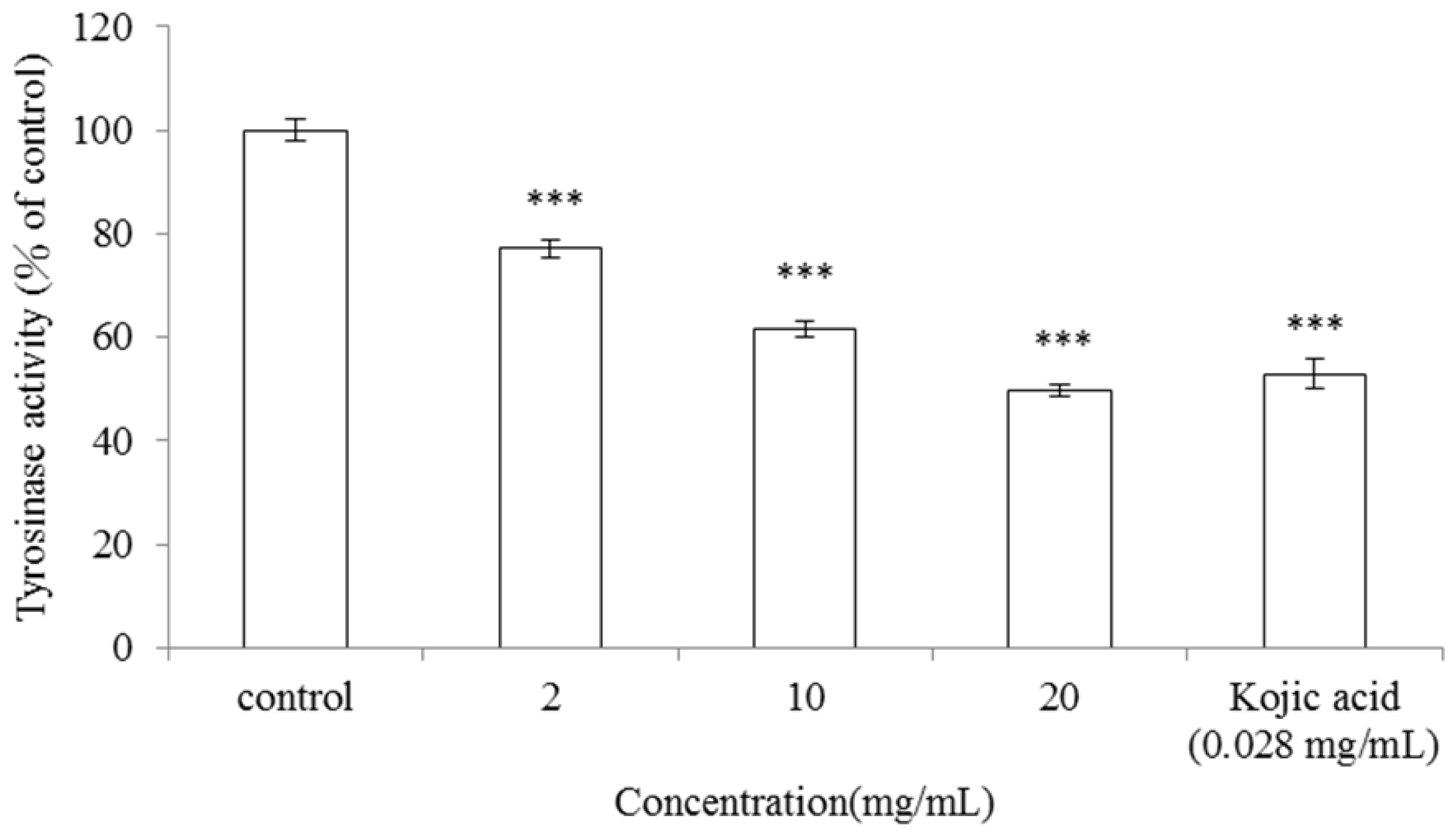
<p>To determine the potential inhibitory effect of <italic>A. argyi</italic> essential oil on mushroom tyrosinase activity, enzyme inhibition experiments were done in triplicate. Kojic acid was used as a positive standard. The data indicated that mushroom tyrosinase activity was inhibited by the various concentrations of <italic>A. argyi</italic> essential oil (2, 10 and 20 mg/mL). The residual tyrosinase activity was 77.12% ± 1.64%, 61.49% ± 1.48% and 49.77% ± 1.14% of control, respectively (<italic>p</italic> &lt; 0.001). IC<sub>50</sub> of the essential oil is 19.16 mg/mL. Simultaneously, mushroom tyrosinase activity was inhibited by kojic acid (0.028 mg/mL) and the remained enzyme activity was 52.93% ± 2.82% of that of control (<italic>p</italic> &lt; 0.001) (<xref ref-type="fig" rid="f1-ijms-13-14679">Figure 1</xref>).</p>
<p>Mushroom tyrosinase has been widely used as the enzyme for screening possible inhibitors of melanogenesis. The results indicated that the essential oil extracted from leaves of <italic>A. argyi</italic> effectively inhibited mushroom tyrosinase activity. The highest concentration of the essential oil (20 mg/mL) exhibited a similar inhibitory effect on mushroom tyrosinase activity as kojic acid does, hence <italic>A. argyi</italic> essential oil may act as a possible tyrosinase inhibitor. So far, there is no report about the dermatological application of essential oils extracted from plants of the <italic>Artemisia</italic> family. This is the first report that essential oil extracted from leaves of <italic>A. argyi</italic> significantly inhibits mushroom tyrosinase activity.</p></sec>
<sec>
<title>2.2. Effect of <italic>A. argyi</italic> Essential Oil on Melanogenesis in B16F10 Cells</title>
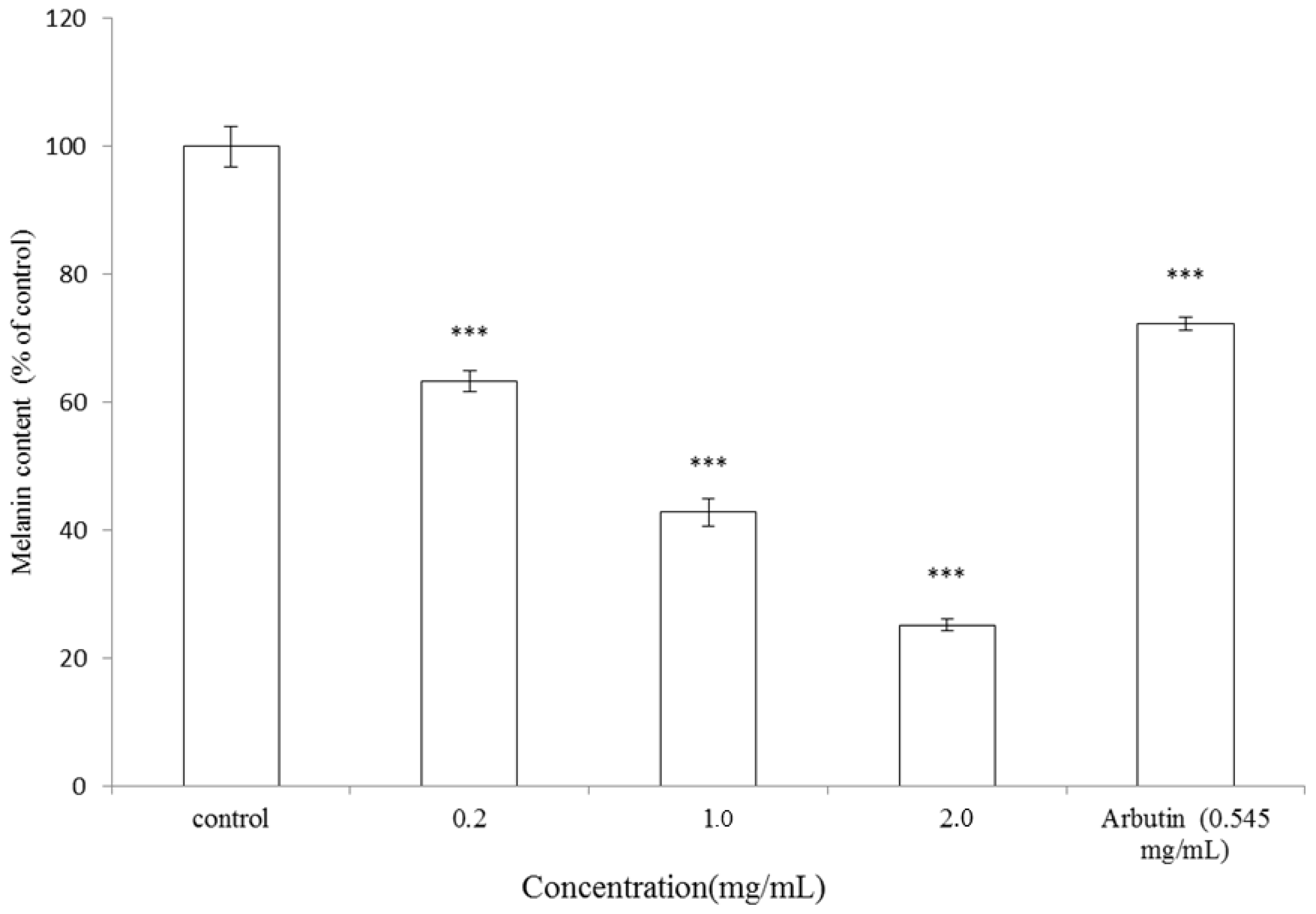
<p>In order to investigate the inhibitory effect of <italic>A. argyi</italic> essential oil on melanogenesis, the melanin content in B16F10 melanoma cells was measured after treatment with various concentrations of the essential oil. B16F10 cells were first stimulated with α-melanocyte stimulating hormone (α-MSH) for 24 h and then cultured in the presence of the essential oil at 0.2, 1.0 and 2.0 mg/mL or arbutin (0.545 mg/mL) for another 24 h. Treatment with <italic>A. argyi</italic> essential oil showed a significant inhibitory effect on melanin synthesis in a dose-dependent pattern. The melanin content was represented as a percentage of control. After treatment, the melanin content was 63.27% ± 1.16%, 42.84% ± 2.09% and 25.19% ± 0.98% for 0.2, 1.0 and 2.0 mg/mL of the essential oil, respectively (<italic>p</italic> &lt; 0.001). IC<sub>50</sub> of the essential oil is 0.769 mg/mL. Meanwhile, arbutin (0.545 mg/mL) was used as a positive standard and the residual intracellular melanin content after arbutin treatment was 72.31% ± 1.03% of control (<italic>p</italic> &lt; 0.001) (<xref ref-type="fig" rid="f2-ijms-13-14679">Figure 2</xref>). The results shown in <xref ref-type="fig" rid="f2-ijms-13-14679">Figure 2</xref> indicated that essential oil extracted from leaves of <italic>A. argyi</italic> exhibit a stronger inhibitory effect on melanin formation in B16F10 cells than arbutin.</p></sec>
<sec>
<title>2.3. Inhibitory Effect of <italic>A. argyi</italic> Essential Oil on Intracellular Tyrosinase Activity in B16F10 Cells</title>
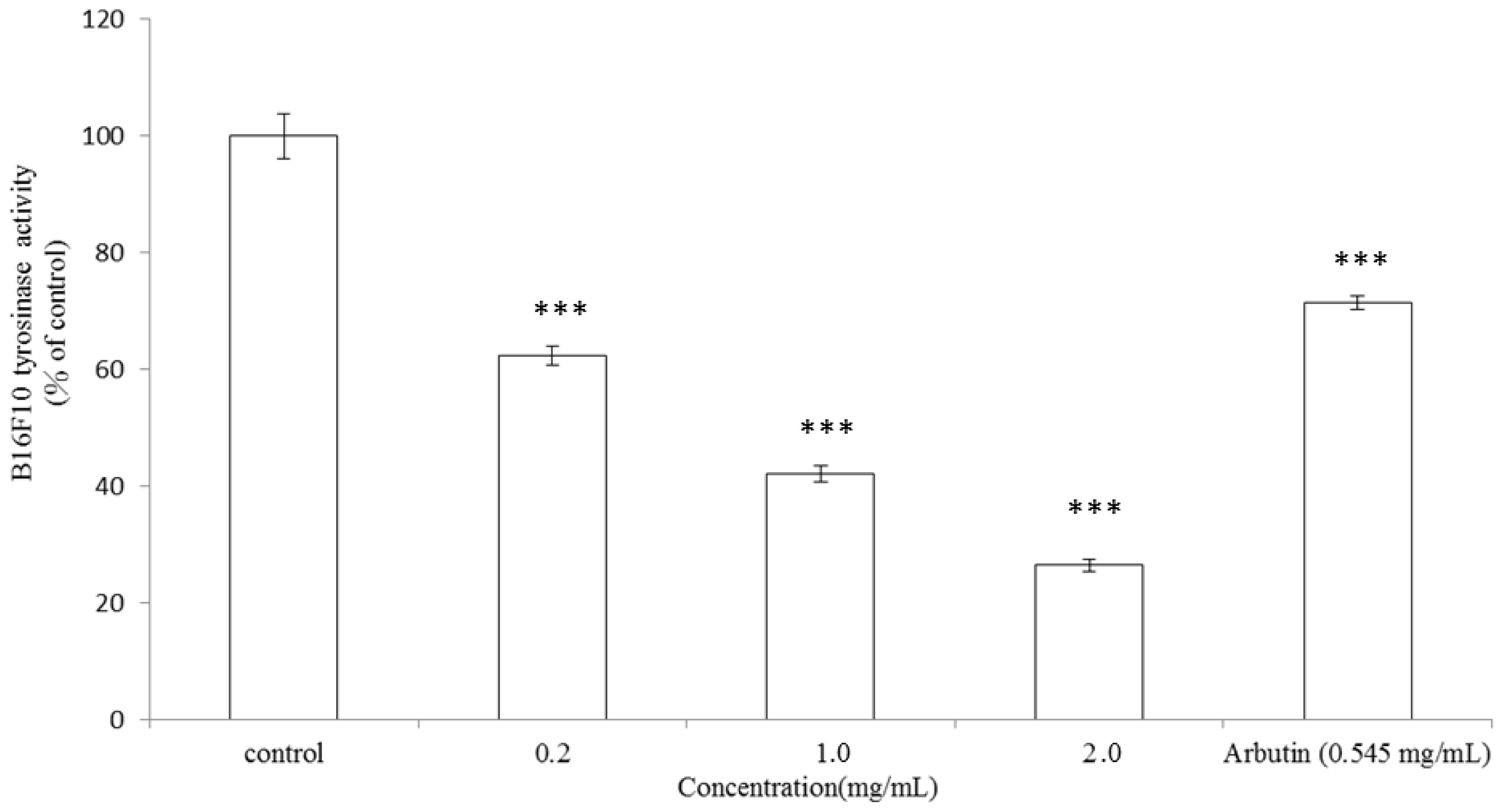
<p>To further examine the action mechanism of the inhibitory effect of <italic>A. argyi</italic> essential oil on melanogenesis, we assessed intracellular tyrosinase activity in B16F10 cells after treatment with the essential oil. The cells were stimulated with α-MSH (100 n<sc>m</sc>) for 24 h, and with various concentrations of the essential oil at 0.2, 1.0 and 2.0 mg/mL or arbutin (0.545 mg/mL) for another 24 h. The essential oil significantly inhibited α-MSH-induced tyrosinase activity in a dose-dependent pattern (<xref ref-type="fig" rid="f3-ijms-13-14679">Figure 3</xref>). After these treatments, the remaining intracellular tyrosinase activity was 62.36% ± 1.72%, 42.09% ± 1.35% and 26.42% ± 0.95% for 0.2, 1.0 and 2.0 mg/mL of the essential oil, respectively (<italic>p</italic> &lt; 0.001). IC<sub>50</sub> of the essential oil is 0.744 mg/mL. On the other hand, the intracellular tyrosinase activity was 71.4% ± 1.13% after arbutin treatment (<italic>p</italic> &lt; 0.001). The results shown in <xref ref-type="fig" rid="f3-ijms-13-14679">Figure 3</xref> were in accordance with the results indicated in <xref ref-type="fig" rid="f2-ijms-13-14679">Figure 2</xref>, which implies that essential oil extracted from leaves of <italic>A. argyi</italic> inhibited B16F10 intracellular tyrosinase activity and then decreased the melanin content in a dose-dependent manner. The action concentration of arbutin (0.545 mg/mL) is equivalent to 2.0 mM, which is often used as a standard concentration in assays of cellular tyrosinase and melanin content.</p>
<p>It should be emphasized that there is no report about dermatological application of essential oil extracted from leaves of <italic>A. argyi</italic>. Furthermore, the present study proved that <italic>A. argyi</italic> essential oil shows considerable depigmentation potential in the B16F10 cell model. The results shown in <xref ref-type="fig" rid="f2-ijms-13-14679">Figure 2</xref> indicated that <italic>A. argyi</italic> essential oil has a stronger inhibitory effect on melanin synthesis in B16F10 cells than arbutin. Additionally, the essential oil also inhibited α-MSH-induced intracellular tyrosinase activity in a dose-dependent pattern (<xref ref-type="fig" rid="f3-ijms-13-14679">Figure 3</xref>). In these experiments, α-MSH acted as a cyclic-3′,5′-adenosine monophosphate (cAMP) inducer to stimulate melanin synthesis. It is reported that α-MSH can bind melanocortin 1 receptor (MC1R) and activate adenylate cyclase, which in turn transforms ATP to cAMP, thus increasing intracellular cAMP levels [<xref ref-type="bibr" rid="b35-ijms-13-14679">35</xref>]. In the present study, the results evidenced that <italic>A. argyi</italic> essential oil inhibited B16F10 melanogenesis induced by α-MSH mediated intracellular cAMP up-regulation.</p></sec>
<sec>
<title>2.4. DPPH Scavenging Capacity Assay</title>
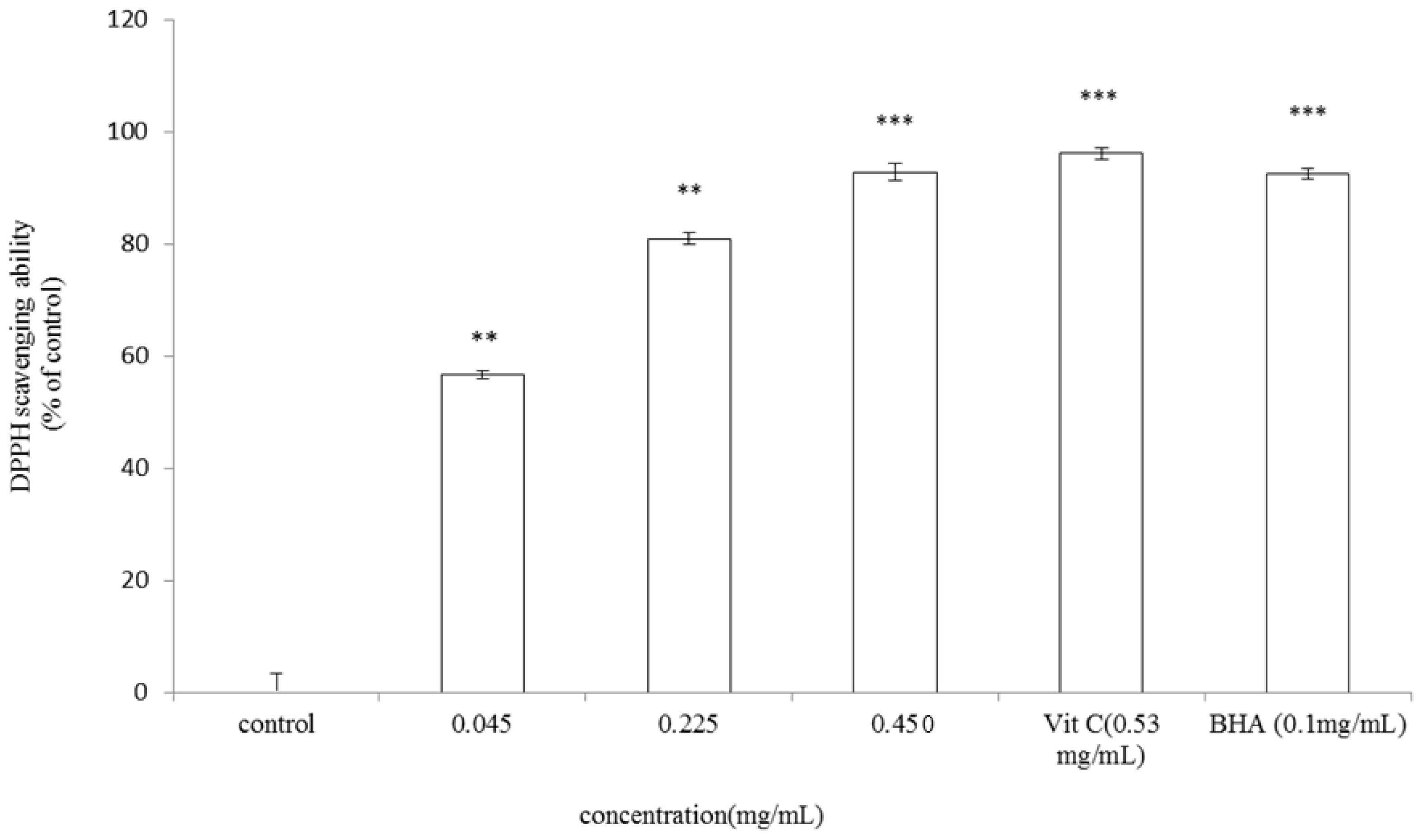
<p>The antioxidant capacity of <italic>A. argyi</italic> essential oil was first determined by measuring its DPPH scavenging ability. The <italic>A. argyi</italic> essential oil showed DPPH radical scavenging activity in a dose-dependent pattern as shown in <xref ref-type="fig" rid="f4-ijms-13-14679">Figure 4</xref>. DPPH scavenging activity of 0.045, 0.225 and 0.450 mg/mL of the essential oil was 56.67% ± 0.66%, 80.89% ± 1.06% and 92.79% ± 1.56% of control, respectively. The activity of the essential oil is slightly less effective than that of vitamin C (96.09% ± 1.01%), but is similar to that of BHA (92.41% ± 0.95%). DPPH assay is a common method to give reliable information concerning the antioxidant activity of specific compounds or extracts across a short time scale. Our results indicated that essential oil extracted from the leaves of <italic>A. argyi</italic> exhibit DPPH free radical scavenging activity and therefore could be applied as an antioxidant agent.</p></sec>
<sec>
<title>2.5. ABTS Scavenging Ability Assay</title>
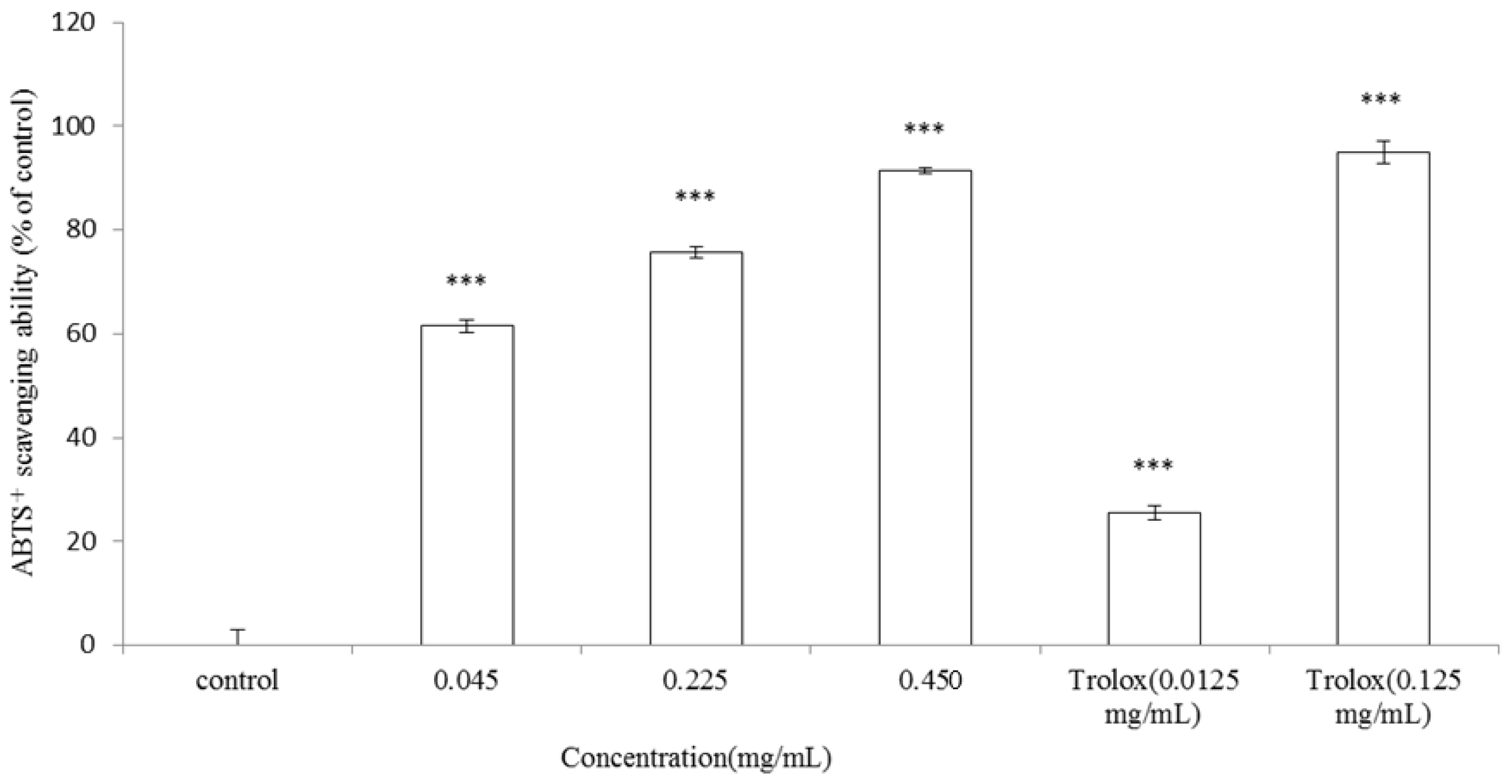
<p>The ABTS<sup>+</sup> assay was further employed to confirm the antioxidant activity of the essential oil. Different concentrations of the <italic>A. argyi</italic> essential oil (0.045, 0.225 and 0.450 mg/mL) or Trolox<sup>®</sup> (0.0125 or 0.125 mg/mL) were incubated with ABTS<sup>+</sup> solution, respectively. The ABTS<sup>+</sup> scavenging capacity of the essential oil was 61.49% ± 1.12%, 75.7% ± 1.16% and 91.41% ± 0.57% of control for the essential oil at the dosage of 0.045, 0.225 and 0.450 mg/mL, respectively (<italic>p</italic> &lt; 0.001). Meanwhile, the ABTS<sup>+</sup> scavenging capacity of Trolox<sup>®</sup> (0.0125 mg/mL) was 25.49% ± 1.31% (<italic>p</italic> &lt; 0.001). The results indicated that essential oil extracted from the leaves of <italic>A. argyi</italic> scavenged ABTS<sup>+</sup> radicals significantly in a dose-dependent pattern. However, the higher concentration of Trolox<sup>®</sup> (0.125 mg/mL) still showed the strongest ABTS<sup>+</sup> radical scavenging capacity (94.97% ± 2.15%) (<italic>p</italic> &lt; 0.001) (<xref ref-type="fig" rid="f5-ijms-13-14679">Figure 5</xref>).</p></sec>
<sec>
<title>2.6. Determination of Reducing Power of <italic>A. argyi</italic> Essential Oil</title>
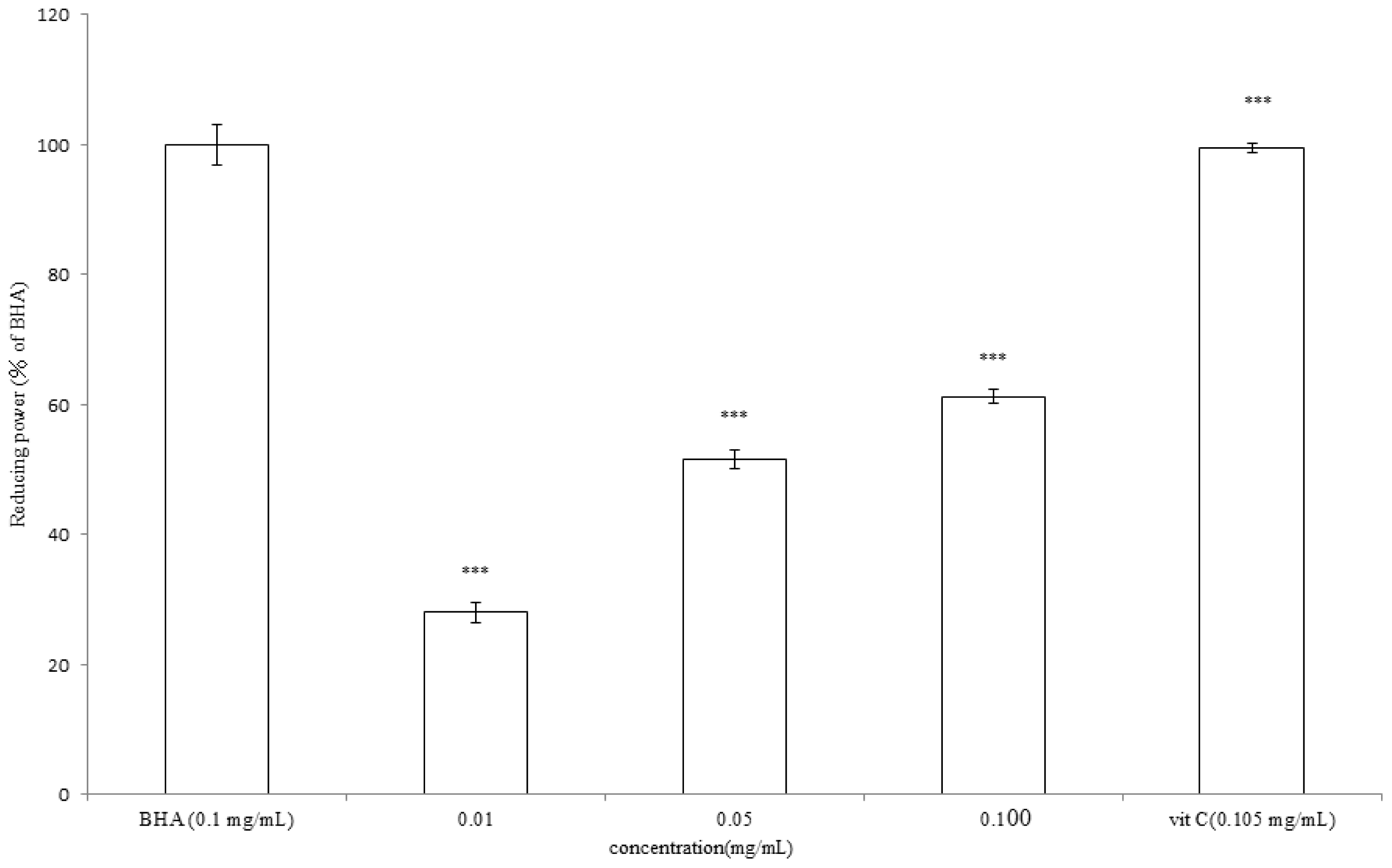
<p>To measure the reducing power of <italic>A. argyi</italic> essential oil, various concentrations of the essential oil or vitamin C (0.105 mg/mL) or BHA (0.1 mg/mL) were tested according to the method of Oyaizu with a slight modification [<xref ref-type="bibr" rid="b36-ijms-13-14679">36</xref>]. The results shown in <xref ref-type="fig" rid="f6-ijms-13-14679">Figure 6</xref> revealed that higher concentrations of the essential oil present apparent reducing power. The reducing power of 0.01, 0.05, 0.100 mg/mL of <italic>A. argyi</italic> essential oil was 28.05% ± 1.52%, 51.68% ± 1.44% and 61.26% ± 1.09% when compared to 0.1 mg/mL of BHA (<italic>p</italic> &lt; 0.001). Even though increases the dosage, the reducing power of the essential oil was still lower than those of vitamin C. Besides, the reducing power of vitamin C was almost equivalent to that of BHA.</p></sec>
<sec>
<title>2.7. Metal-ion Chelating Activity of <italic>A. argyi</italic> Essential Oil</title>
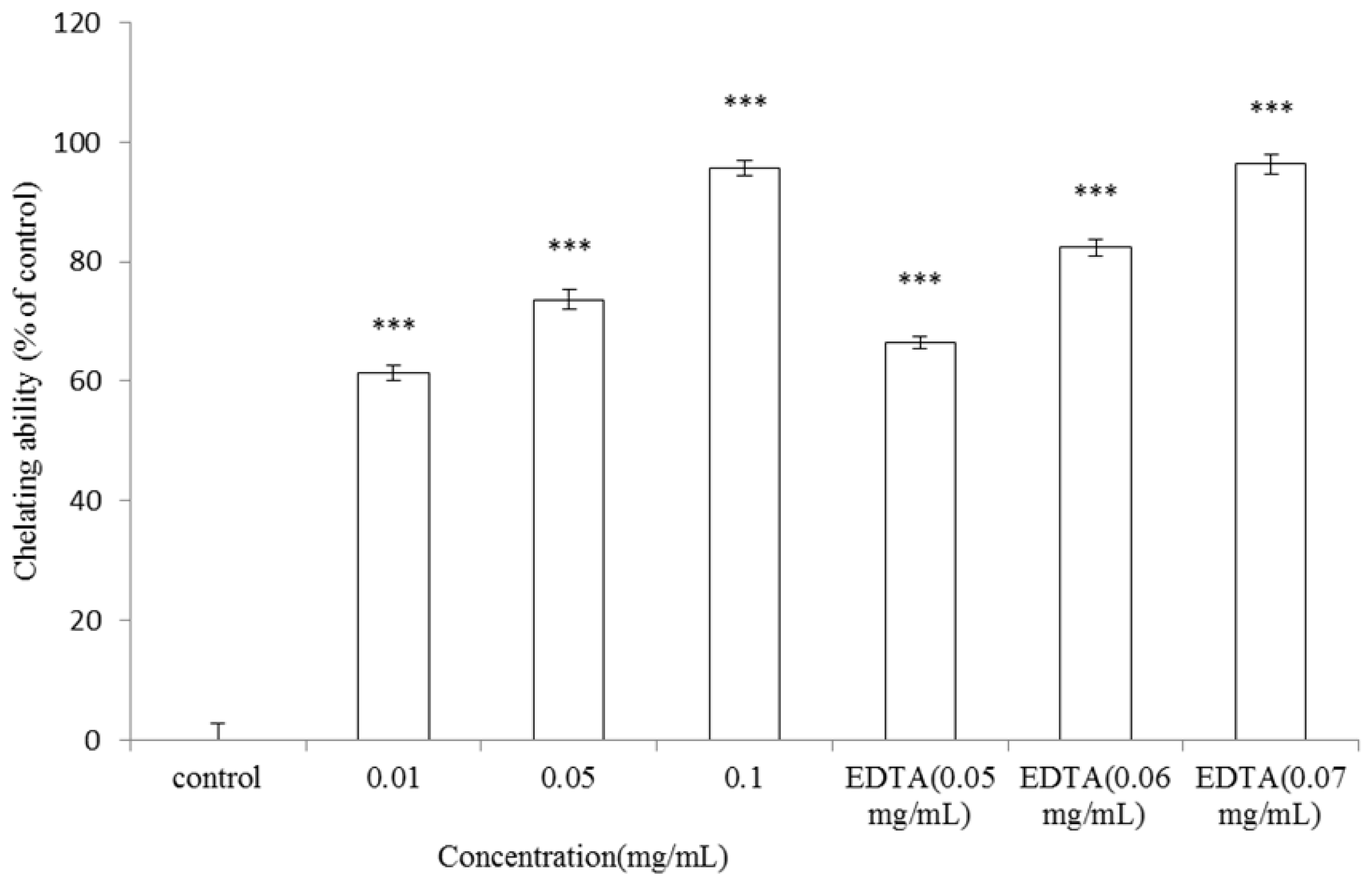
<p>The metal-ion chelating ability of 0.01, 0.05, and 0.1 mg/mL of <italic>A. argyi</italic> essential oil was 61.37% ± 1.19%, 73.65% ± 1.75% and 95.63% ± 1.19% of control, respectively (<italic>p</italic> &lt; 0.001). On the other hand, the metal-ion chelating capacity of 0.05, 0.06 and 0.07 mg/mL of EDTA (ethylene diamine-<italic>N</italic>,<italic>N</italic>-tetraacetic acid) were 66.51% ± 1.02%, 82.30% ± 1.49% and 96.22% ± 1.70%, respectively (<italic>p</italic> &lt; 0.001) (<xref ref-type="fig" rid="f7-ijms-13-14679">Figure 7</xref>). Antioxidants may interact with ferrous ions to form insoluble metal complexes and then inhibit interaction between metal and lipid. The results shown in <xref ref-type="fig" rid="f7-ijms-13-14679">Figure 7</xref> indicated that the reducing power of 0.1 mg/mL essential oil is equivalent to that of 0.07 mg/mL of EDTA. It was further confirmed that <italic>A. argyi</italic> essential oil has potent antioxidant capacity.</p>
<p>Human skin is exposed to UV light or environmental oxidizing pollutants and becomes a preferred target of oxidative stress. It is evidenced that UV irradiation induces ROS generation in cutaneous tissue provoking damages such as enzyme inactivation and lipid peroxidation [<xref ref-type="bibr" rid="b37-ijms-13-14679">37</xref>]. In order to counteract the oxidative damage, skin is equipped with a network of enzymatic and non-enzymatic antioxidant systems [<xref ref-type="bibr" rid="b38-ijms-13-14679">38</xref>]. To elucidate the antioxidant activity of <italic>A. argyi</italic> essential oil, DPPH, ABTS<sup>+</sup> radical scavenging activity, reducing power and metal-chelating capacity of the essential oil were determined as previously described [<xref ref-type="bibr" rid="b36-ijms-13-14679">36</xref>,<xref ref-type="bibr" rid="b39-ijms-13-14679">39</xref>]. <italic>A. argyi</italic> essential oil showed considerable antioxidant potential in all the above analytical studies. The results proved the antioxidant potential of <italic>A. argyi</italic> essential oil over different ranges with distinct efficiencies. The differential free radical scavenging activities of the essential oil against DPPH and ABTS<sup>+</sup> radicals may be resulted from different mechanisms of the antioxidant-radical interactions in the two assays. Besides, the stoichiometry of reactions between the potential antioxidant chemicals in the essential oil may be different, which result in the difference in radical scavenging capacity [<xref ref-type="bibr" rid="b40-ijms-13-14679">40</xref>]. The reducing power of the antioxidant converts a Fe<sup>3+</sup>/ferricyanide complex to the ferrous form and can serve as an indicator of the antioxidant capacity. The existence of reductones accounts for the reducing power and exhibits the antioxidant activities by donating a hydrogen atom. The percentage of ketone content in the essential oil is 6.09%, which may account for its reducing power. Antioxidant may form insoluble metal complexes with ferrous ion and then inhibit interaction between metal and lipid. The higher metal-ion chelating capacity of the essential oil indicated its potent antioxidant activity (<xref ref-type="fig" rid="f7-ijms-13-14679">Figure 7</xref>). It is reported that various metal chelators such as kojic acid [<xref ref-type="bibr" rid="b41-ijms-13-14679">41</xref>] and <italic>N</italic>-phenylthiourea (PTU) [<xref ref-type="bibr" rid="b42-ijms-13-14679">42</xref>] act as tyrosinase inhibitors because the enzyme has a dinuclear copper in its active site.</p>
<p>The idea behind searching antioxidants for skin-whitening efficacies lies in the hypothesis that the oxidative stress resulted from UV-irradiation may contribute to stimulation of melanogenesis. It was reported that UV irradiation can produce ROS in the cutaneous tissues that may induce melanogenesis by activating tyrosinase as the enzyme prefers superoxide anion radical (O<sub>2</sub><sup>−</sup>) over oxygen molecule (O<sub>2</sub>) [<xref ref-type="bibr" rid="b43-ijms-13-14679">43</xref>]. Additionally, it was found that redox agents can also influence melanin production by interacting with copper ion at the active site of tyrosinase or with <italic>o</italic>-quinones to block the oxidative polymerization of melanin intermediates [<xref ref-type="bibr" rid="b44-ijms-13-14679">44</xref>]. Moreover, antioxidants such as vitamin B, vitamin C or vitamin E can also reduce the photooxidation of pre-existing melanin particles. Hence, these vitamins with antioxidant activity are common applied in skin-whitening cosmetic formulations [<xref ref-type="bibr" rid="b45-ijms-13-14679">45</xref>]. In addition, our research showed the apparent antioxidant capacities of <italic>A. argyi</italic> essential oil also indicated it could be applied into formulation of skin care cosmetic products.</p></sec>
<sec>
<title>2.8. Chemical Composition of <italic>A. argyi</italic> Essential Oil</title>
<p>The chemical composition of <italic>A. argyi</italic> essential oil was analyzed by GC/MS as shown in <xref ref-type="table" rid="t1-ijms-13-14679">Table 1</xref>. The major component in the oil is eucalyptol (23.66%). There are 16.72% of alcohols in the oil including (−)-borneol (6.55%), linalool (3.31%), longiborneol (2.67%), (−)-terpinen-4-ol (1.40%), (−)-menthol (1.19%), nerolidol (0.88%), dihydrocarveol (0.55%) and α-terpieol (0.17%). The sesquiterpenes in the essential oil are caryophyllene (10.19%), humulene (1.40%), β-cubebene (1.29%), α-gurjunene (0.74%), (<italic>Z</italic>)-β-farnesene (0.59%), δ-cadinene (0.59%) and α-bergamotene (0.41%). The oil contains six types of esters including bergamiol (3.91%), bornyl acetate (3.63%), cedryl acetate (2.28%), nerol acetate (0.99%), geranyl acetate (0.88%) and geranyl isovalerate (0.1%). There are six types of monoterpenes in the essential oil such as (−)-β-pinene (5.62%), 3-carene (4.64%), camphene (0.48%), τ-terpinene (0.36%), 1<italic>R</italic>-α-pinene (0.34%) and myrcene (0.19%). Menthone (4.18%), camphor (1.53%), 3-octanone (0.25%) and (+)-carvone (0.13%) are four ketones existed in the oil. The only aromatic compound in the oil was <italic>o</italic>-cymene (5.01%). However, there are 9.90% of unknown compounds in the essential oil.</p>
<p>The GC/MS data revealed the presence of seven classes of chemical components in <italic>A. argyi</italic> essential oil, which are summarized in <xref ref-type="table" rid="t1-ijms-13-14679">Table 1</xref>, including ethers (23.66%), alcohols (16.72%), sesquiterpenes (15.21%), esters (11.78%), monoterpenes (11.63%), ketones (6.09%) and aromatic compounds (5.01%), which account for 90.10% of the essential oil. Recently, an earlier report studied volatiles from leaves and flowers of <italic>A. argyi</italic>. revealed that the presence of borneol and bornyl acetate existed in the two parts of the plant [<xref ref-type="bibr" rid="b33-ijms-13-14679">33</xref>]. In the present study, we also found (−)-borneol (6.55%) and bornyl acetate (3.63%) in <italic>A. argyi</italic> essential oil. There are several factors involved in the regulation of the constituents in the essential oil such as different plant cultivation and/or harvesting procedures. Furthermore, different analytical technique may also result in different GC/MS data. Eucalyptol, also named as 1,8-cineole, is the major and only ether component in the essential oil. Since some synthetic ethers have been reported to show antioxidant activities [<xref ref-type="bibr" rid="b46-ijms-13-14679">46</xref>], we hypothesized that eucalyptol may account for the antioxidant activities of the essential oil. Additionally, the other components such as sesquiterpenes, esters [<xref ref-type="bibr" rid="b47-ijms-13-14679">47</xref>], monoterpenes [<xref ref-type="bibr" rid="b48-ijms-13-14679">48</xref>], ketones [<xref ref-type="bibr" rid="b49-ijms-13-14679">49</xref>,<xref ref-type="bibr" rid="b50-ijms-13-14679">50</xref>] and aromatic compound [<xref ref-type="bibr" rid="b51-ijms-13-14679">51</xref>] may also contribute the antioxidant activities of the essential oil extracted from the leaves of <italic>A. argyi</italic>.</p>
<p>It was found that the secondary metabolites and bioactive phytoconstituents identified by GC/MS in different plants have been previously reported which show antimicrobial, anti-inflammatory and antioxidant activities [<xref ref-type="bibr" rid="b52-ijms-13-14679">52</xref>–<xref ref-type="bibr" rid="b55-ijms-13-14679">55</xref>]. Further, we have screened over thirty types of plants and evaluated the potential dermatological effects of the essential oils extracted from these plants, and found the essential oils isolated from the leaves of <italic>Vitex negundo</italic> Linn and <italic>Acorus macrospadiceus</italic> (Yamamoto, F. N. Wei, Y. K. Li <italic>et al</italic>.) exhibit antioxidant activities and antimelanogenic properties [<xref ref-type="bibr" rid="b34-ijms-13-14679">34</xref>,<xref ref-type="bibr" rid="b56-ijms-13-14679">56</xref>]. Therefore, the chemical constituents found in <italic>Artemisia argyi</italic> leaves may play major roles in the biological activities and pharmacological properties, but the biological roles of the chemicals in both essential oils still remained to be elucidated in the near future.</p></sec></sec>
<sec>
<title>3. Experimental Section</title>
<sec>
<title>3.1. Plant Material and Extraction of Essential Oils</title>
<p>The leaves of <italic>A. argyi</italic> were gathered during April to July in 2010, dried in a shady place and identified at Taichung District Agricultural Research and Extension Station in Taiwan. Essential oil was extracted from the leaves (2 kg) by steam hydrodistillation in a Clevenger-type apparatus at 100 °C for 2 h. The essential oil was collected in a sealed glass bottle and stored in a 4 °C refrigerator until analysis. In the present study, the essential oil was diluted with dimethyl sulfoxide (DMSO) and DMSO was used as a negative control in the following experiments. The IC<sub>50</sub> is the concentration of the essential oil where the absorbance is reduced by half. The IC<sub>50</sub> is calculated using Microsoft excel and linear interpolation method. Briefly, five values of concentration containing the tested values were evaluated for their activities. Raw data (relative activities) are plotted against the essential concentrations. IC<sub>50</sub> values can be determined using linear interpolation method.</p></sec>
<sec>
<title>3.2. Mushroom Tyrosinase Actvity Measurement</title>
<p>To measure the inhibitory effects of <italic>A. argyi</italic> essential oil on mushroom tyrosinase, enzyme inhibition experiments were carried out in triplicate as previously described with a slight modification [<xref ref-type="bibr" rid="b57-ijms-13-14679">57</xref>]. Briefly, 20 μL of aqueous solution of mushroom tyrosinase (200 units) was added to a 96-well microplate, in a total volume of 200 μL mixture containing 5 mM <sc>l</sc>-dopa dissolved in 50 mM phosphate buffer (pH 6.8) and <italic>A. argyi</italic> essential oil (2, 10 and 20 mg/mL) or kojic acid (0.028 mg/mL). The assay mixture was incubated at 37 °C for 30 min. After incubation, the amount of dopachrome produced in the reaction mixture was determined by spectrophotometric analysis of absorbance at 490 nm.</p></sec>
<sec>
<title>3.3. B16F10 Intracellular Melanin Content Measurement</title>
<p>B16F10 melanoma cells (ATCC CRL-6475) were cultured in DMEM with 10% fetal bovine serum (FBS; Gibco, Langley, OK, USA) and penicillin/streptomycin (100 IU/50 μg/mL) in a humidified atmosphere containing 5% CO<sub>2</sub> in air at 37 °C. Intracellular melanin content was measured as previous described with some modifications [<xref ref-type="bibr" rid="b58-ijms-13-14679">58</xref>]. The cells were treated with α-MSH (100 nM) for 24 h, and further treated with either <italic>A. argyi</italic> essential oil (0.2, 1.0 and 2.0 mg/mL) or arbutin (0.545 mg/mL) for another 24 h. After treatments, the cells were detached by incubation in trypsin/EDTA and subsequently centrifuged at 5000<italic>g</italic> for 5 min, and then the cell pellets were solubilized in 1 N NaOH at 60 °C for 60 min. The melanin content was assayed at 405 nm absorbance by spectrophotometric analysis.</p></sec>
<sec>
<title>3.4. B16F10 Intracellular Tyrosinase Activity Assay</title>
<p>B16F10 intracellular tyrosinase activity was determined as described previously with minor modifications [<xref ref-type="bibr" rid="b59-ijms-13-14679">59</xref>]. The cells were treated with α-MSH (100 nM) for 24 h, and then further treated with various concentrations of <italic>A. argyi</italic> essential oil (0.2, 1.0 and 2.0 mg/mL) or arbutin (0.545 mg/mL) for another 24 h. After treatments, the cells were washed twice with phosphate-buffered saline and homogenized with 50 mM PBS (pH 7.5) buffer containing 1.0% Triton X-100 and 0.1 mM phenylmethyl sulfonyl fluoride (PMSF). Cellular extracts (100 μL) were mixed with freshly prepared <sc>l</sc>-dopa solution (5.0 mM in 50 mM phosphate-buffered saline, pH 6.8) and incubated at 37 °C for 30 min. The absorbance at 490 nm was measured with a microplate reader Gen 5™ (BIO-TEK Instrument, Winooski, VT, USA) to monitor the production of dopachrome.</p></sec>
<sec>
<title>3.5. DPPH Scavenging Activity Assay</title>
<p>The antioxidant activity of <italic>A. argyi</italic> essential oil was first determined by measuring the DPPH scavenging ability [<xref ref-type="bibr" rid="b60-ijms-13-14679">60</xref>,<xref ref-type="bibr" rid="b61-ijms-13-14679">61</xref>]. The essential oil at various concentrations (0.045, 0.225 and 0.45 mg/mL) was added to 2.9 mL of DPPH (60 μM) solution. When DPPH reacts with any antioxidant in the essential oil that can donate hydrogen, it gets reduced form and the resulting decrease in absorbance at 517 nm was recorded using a UV-Vis spectrophotometer (Jasco, V-630, Tokyo, Japan). In this study, vitamin C (0.53 mg/mL) and BHA (0.1 mg/mL) were used as antioxidant standards.</p></sec>
<sec>
<title>3.6. ABTS<sup>+</sup> Scavenging Capacity Assay</title>
<p>The ABTS decolorisation assays were carried out as previously described [<xref ref-type="bibr" rid="b62-ijms-13-14679">62</xref>]. It involves the generation of ABTS<sup>+</sup> chromophore by oxidation of ABTS with potassium persulfate. The ABTS radical cation (ABTS<sup>+</sup>) was produced by reacting 7 mM stock solution of ABTS with 2.45 mM potassium persulfate and allowing the mixture to stand in the dark for at least 6 h before use. Absorbance at 734 nm was measured 10 min after mixing of different concentrations of the <italic>A. argyi</italic> essential oil (0.045, 0.225 and 0.45 mg/mL) with 1 mL of ABTS<sup>+</sup> solution. The ABTS<sup>+</sup> scavenging capacity of <italic>A. argyi</italic> essential oil was compared with that of Trolox<sup>®</sup> (0.0125 or 0.125 mg/mL).</p></sec>
<sec>
<title>3.7. Determination of Reducing Power</title>
<p>The reducing power of the essential oil was determined according to the method previously described by Oyaizu [<xref ref-type="bibr" rid="b36-ijms-13-14679">36</xref>]. Different concentrations of <italic>A. argyi</italic> essential oil (0.01, 0.05, 0.1 mg/mL), vitamin C (0.105 mg/mL) or BHA (0.1 mg/mL) was mixed with phosphate buffer (2.5 mL, 0.2 M, pH 6.6) and potassium ferricyanide [K<sub>3</sub>Fe(CN)<sub>6</sub>] (2.5 mL, 1% <italic>w</italic>/<italic>v</italic>). The mixture was incubated at 50 °C for 20 min. A portion (2.5 mL) of trichloroacetic acid (10% <italic>w</italic>/<italic>v</italic>) was added to the mixture, which was then centrifuged at 1000<italic>g</italic> for 10 min. The upper layer of solution (2.5 mL) was mixed with distilled water (2.5 mL) and FeCl<sub>3</sub> (0.5 mL, 0.1% <italic>w</italic>/<italic>v</italic>), and the absorbance was measured at 700 nm in a UV-Vis spectrophotometer. Higher absorbance of the reaction mixture indicated greater reducing power of the test sample.</p></sec>
<sec>
<title>3.8. Measurement of Metal-Ion Chelating Capacity</title>
<p>The chelation of ferrous ions by the <italic>A. argyi</italic> essential oil was determined as the previous method with slight modifications [<xref ref-type="bibr" rid="b39-ijms-13-14679">39</xref>]. Different concentrations of essential oil (0.01, 0.05 and 0.1 mg/mL) or the positive standard EDTA (0.05, 0.06 and 0.07 mg/mL) were added to a solution of 1 mM FeCl<sub>2</sub> (0.05 mL). Then 0.1 mL of ferrozine (1 mM) was added to the reaction mixture and the mixture was quantified to 1 mL with methanol, left standing at 25 °C for 10 min. The absorbance of the reaction mixture was measured at 562 nm. The percentage of chelating capacity of test sample was calculated as follows:</p>
<disp-formula id="FD1">
<label>(1)</label>
<mml:math id="mm1" display="block">
<mml:semantics id="sm1">
<mml:mrow>
<mml:mtext>chelating capacity</mml:mtext>
<mml:mo>%</mml:mo>
<mml:mo>=</mml:mo>
<mml:mo stretchy="false">[</mml:mo>
<mml:mo stretchy="false">(</mml:mo>
<mml:msub>
<mml:mrow>
<mml:mi>A</mml:mi></mml:mrow>
<mml:mn>1</mml:mn></mml:msub>
<mml:mo>-</mml:mo>
<mml:msub>
<mml:mrow>
<mml:mi>A</mml:mi></mml:mrow>
<mml:mn>2</mml:mn></mml:msub>
<mml:mo stretchy="false">)</mml:mo>
<mml:mo>/</mml:mo>
<mml:msub>
<mml:mrow>
<mml:mi>A</mml:mi></mml:mrow>
<mml:mn>1</mml:mn></mml:msub>
<mml:mo>×</mml:mo>
<mml:mn>100</mml:mn>
<mml:mo stretchy="false">]</mml:mo></mml:mrow></mml:semantics></mml:math></disp-formula>
<p>where <italic>A</italic><sub>1</sub> is the absorbance of control and <italic>A</italic><sub>2</sub> is the absorbance in the presence of essential oil or EDTA.</p></sec>
<sec>
<title>3.9. Gas Chromatography-Mass Spectrometry (GC/MS)</title>
<p>Chemical components analysis of the volatiles in the <italic>A. argyi</italic> essential oil was carried out using a Thermo GC/MS system (GC/MS Trace DSQ-Mass Spectrometer, MSD 201351, Thermo, Minneapolis, MN, USA). The Equity-5 capillary column (Supelco, St. Louis, MO, USA) with 30 m length and 0.25 mm inside diameter was used with a 0.25 μm thick film. The oven temperature gradient was programmed as follows: isothermal at 40 °C, followed by a 5 °C temperature ramp every minute to 100 °C, which was held for 5 min. Subsequently, the temperature was increased 5 °C every minute to 250 °C and stayed for 20 min. The carrier gas was helium (1 mL/min). The temperature of injection port and detector was 250 °C. Ionization of the test essential oil (1 μL) was performed in the EI mode (70 eV). The linear retention indices for all compounds were determined by co-injection of the essential oil with a solution containing a homologous series of C8–C22 <italic>n</italic>-alkanes [<xref ref-type="bibr" rid="b63-ijms-13-14679">63</xref>]. The individual components were identified by retention indices and compared with compounds known from the literature [<xref ref-type="bibr" rid="b64-ijms-13-14679">64</xref>]. The mass spectra were also compared with known, previously obtained, compounds or from the Trace DSQ-MASS spectral database (Thermo, New York, NY, USA).</p></sec>
<sec sec-type="methods">
<title>3.10. Statistical Analysis</title>
<p>Statistical analysis of the experimental data points was performed by the ANOVA test, which was used for comparison of measured data using SPSS 12.0 statistical software (SPSS Inc.: Chicago, IL, USA). Differences were considered as statistically significant at <italic>p</italic> &lt; 0.05.</p></sec></sec>
<sec sec-type="conclusions">
<title>4. Conclusions</title>
<p>This is the first report on the inhibitory effect of essential oil as extracted from the leaves of <italic>A. argyi</italic> and its melanin production. We also analyzed the chemical composition and antioxidant capacities of the essential oil. The present study concludes that <italic>A. argyi</italic> essential oil shows antioxidant potential, which simultaneously inhibits melanin synthesis in B16F10 melanoma cells. The results indicated that <italic>A. argyi</italic> essential oil decreased melanin production might be attributed to its inhibitory action upon the signaling pathway regulating tyrosinase activity or depletion of cellular oxidative stress. The essential oil can thereby serve as a natural antioxidant, which could also inhibit melanin production. Our research shows that essential oils extracted from leaves of <italic>A. argyi</italic> could be applied into the cosmetic formulations of skin-whitening products.</p></sec></body>
<back>
<ack>
<title>Acknowledgements</title>
<p>This study was supported financially by the National Science Council, Taiwan, under grant number NSC 101-2221-E-241-013 and NSC 101-2320-B-039-037. The authors have no conflicts of interest to declare.</p></ack>
<fn-group><fn id="fn1-ijms-13-14679">
<p><bold>Conflict of Interest</bold></p>
<p>The authors declare no conflict of interest.</p></fn></fn-group>
<ref-list>
<title>References</title>
<ref id="b1-ijms-13-14679"><label>1</label><citation citation-type="journal"><person-group person-group-type="author"><name><surname>Panich</surname><given-names>U.</given-names></name><name><surname>Tangsupa-a-nan</surname><given-names>V.</given-names></name><name><surname>Onkoksoong</surname><given-names>T.</given-names></name><name><surname>Kongtaphan</surname><given-names>K.</given-names></name><name><surname>Kasetsinsombat</surname><given-names>K.</given-names></name><name><surname>Akarasereenont</surname><given-names>P.</given-names></name><name><surname>Wongkajornsilp</surname><given-names>A.</given-names></name></person-group><article-title>Inhibition of UVA-mediated melanogenesis by ascorbic acid through modulation of antioxidant defense and nitric oxide system</article-title><source>Arch. Pharma. Res</source><year>2011</year><volume>34</volume><fpage>811</fpage><lpage>820</lpage><pub-id pub-id-type="doi">10.1007/s12272-011-0515-3</pub-id></citation></ref>
<ref id="b2-ijms-13-14679"><label>2</label><citation citation-type="journal"><person-group person-group-type="author"><name><surname>Briganti</surname><given-names>S.</given-names></name><name><surname>Camera</surname><given-names>E.</given-names></name><name><surname>Picardo</surname><given-names>M.</given-names></name></person-group><article-title>Chemical and instrumental approaches to treat hyperpigmentation</article-title><source>Pigment Cell. Res</source><year>2003</year><volume>16</volume><fpage>101</fpage><lpage>110</lpage><pub-id pub-id-type="doi">10.1034/j.1600-0749.2003.00029.x</pub-id><pub-id pub-id-type="pmid">12622786</pub-id></citation></ref>
<ref id="b3-ijms-13-14679"><label>3</label><citation citation-type="journal"><person-group person-group-type="author"><name><surname>Slominski</surname><given-names>A.</given-names></name><name><surname>Zmijewski</surname><given-names>M.A.</given-names></name><name><surname>Pawelek</surname><given-names>J.</given-names></name></person-group><article-title>l-tyrosine and l-dihydroxyphenylalanine as hormone-like regulators of melanocyte functions</article-title><source>Pigment Cell. Melanoma Res</source><year>2012</year><volume>25</volume><fpage>14</fpage><lpage>27</lpage><pub-id pub-id-type="doi">10.1111/j.1755-148X.2011.00898.x</pub-id><pub-id pub-id-type="pmid">21834848</pub-id></citation></ref>
<ref id="b4-ijms-13-14679"><label>4</label><citation citation-type="journal"><person-group person-group-type="author"><name><surname>Garcia</surname><given-names>A.</given-names></name><name><surname>Fulton</surname><given-names>J.E.</given-names><suffix>Jr</suffix></name></person-group><article-title>The combination of glycolic acid and hydroquinone or kojic acid for the treatment of melasma and related conditions</article-title><source>Dermatol. Surg.</source><year>1996</year><volume>22</volume><fpage>443</fpage><lpage>447</lpage><pub-id pub-id-type="doi">10.1016/1076-0512(96)00065-9</pub-id><pub-id pub-id-type="pmid">8634807</pub-id></citation></ref>
<ref id="b5-ijms-13-14679"><label>5</label><citation citation-type="journal"><person-group person-group-type="author"><name><surname>Virador</surname><given-names>V.M.</given-names></name><name><surname>Kobayashi</surname><given-names>N.</given-names></name><name><surname>Matsunaga</surname><given-names>J.</given-names></name><name><surname>Hearing</surname><given-names>V.J.</given-names></name></person-group><article-title>A standardized protocol for assessing regulators of pigmentation</article-title><source>Anal. Biochem</source><year>1999</year><volume>270</volume><fpage>207</fpage><lpage>219</lpage><pub-id pub-id-type="doi">10.1006/abio.1999.4090</pub-id><pub-id pub-id-type="pmid">10334838</pub-id></citation></ref>
<ref id="b6-ijms-13-14679"><label>6</label><citation citation-type="journal"><person-group person-group-type="author"><name><surname>Sarkar</surname><given-names>R.</given-names></name><name><surname>Bhalla</surname><given-names>M.</given-names></name><name><surname>Kanwar</surname><given-names>A.J.</given-names></name></person-group><article-title>A comparative study of 20% azelaic acid cream monotherapy versus a sequential therapy in the treatment of melasma in dark-skinned patients</article-title><source>Dermatology</source><year>2002</year><volume>205</volume><fpage>249</fpage><lpage>254</lpage><pub-id pub-id-type="doi">10.1159/000065851</pub-id><pub-id pub-id-type="pmid">12399672</pub-id></citation></ref>
<ref id="b7-ijms-13-14679"><label>7</label><citation citation-type="journal"><person-group person-group-type="author"><name><surname>Rendon</surname><given-names>M.I.</given-names></name><name><surname>Gaviria</surname><given-names>J.I.</given-names></name></person-group><article-title>Review of skin-lightening agents</article-title><source>Dermatol. Surg</source><year>2005</year><volume>31</volume><fpage>886</fpage><lpage>889</lpage><pub-id pub-id-type="pmid">16029683</pub-id></citation></ref>
<ref id="b8-ijms-13-14679"><label>8</label><citation citation-type="journal"><person-group person-group-type="author"><name><surname>Cheng</surname><given-names>S.L.</given-names></name><name><surname>Liu</surname><given-names>R.H.</given-names></name><name><surname>Sheu</surname><given-names>J.N.</given-names></name><name><surname>Chen</surname><given-names>S.T.</given-names></name><name><surname>Sinchaikul</surname><given-names>S.</given-names></name><name><surname>Tsay</surname><given-names>G.J.</given-names></name></person-group><article-title>Toxicogenomics of A375 human malignant melanoma cells treated with arbutin</article-title><source>J. Biomed. Sci</source><year>2007</year><volume>14</volume><fpage>87</fpage><lpage>105</lpage><pub-id pub-id-type="doi">10.1007/s11373-006-9130-6</pub-id><pub-id pub-id-type="pmid">17103032</pub-id></citation></ref>
<ref id="b9-ijms-13-14679"><label>9</label><citation citation-type="journal"><person-group person-group-type="author"><name><surname>Garcia-Gavin</surname><given-names>J.</given-names></name><name><surname>Gonzalez-Vilas</surname><given-names>D.</given-names></name><name><surname>Fernandez-Redondo</surname><given-names>V.</given-names></name><name><surname>Toribio</surname><given-names>J.</given-names></name></person-group><article-title>Pigmented contact dermatitis due to kojic acid. A paradoxical side effect of a skin lightener</article-title><source>Contact Dermatitis</source><year>2010</year><volume>62</volume><fpage>63</fpage><lpage>64</lpage><pub-id pub-id-type="doi">10.1111/j.1600-0536.2009.01673.x</pub-id><pub-id pub-id-type="pmid">20136888</pub-id></citation></ref>
<ref id="b10-ijms-13-14679"><label>10</label><citation citation-type="journal"><person-group person-group-type="author"><name><surname>Balina</surname><given-names>L.M.</given-names></name><name><surname>Graupe</surname><given-names>K.</given-names></name></person-group><article-title>The treatment of melasma. 20% azelaic acid <italic>versus</italic> 4% hydroquinone cream</article-title><source>Int J. Dermatol</source><year>1991</year><volume>30</volume><fpage>893</fpage><lpage>895</lpage><pub-id pub-id-type="doi">10.1111/j.1365-4362.1991.tb04362.x</pub-id><pub-id pub-id-type="pmid">1816137</pub-id></citation></ref>
<ref id="b11-ijms-13-14679"><label>11</label><citation citation-type="journal"><person-group person-group-type="author"><name><surname>Halliwell</surname><given-names>B.</given-names></name></person-group><article-title>Free radicals, antioxidants, and human disease: Curiosity, cause, or consequence?</article-title><source>Lancet</source><year>1994</year><volume>344</volume><fpage>721</fpage><lpage>724</lpage><pub-id pub-id-type="doi">10.1016/S0140-6736(94)92211-X</pub-id><pub-id pub-id-type="pmid">7915779</pub-id></citation></ref>
<ref id="b12-ijms-13-14679"><label>12</label><citation citation-type="journal"><person-group person-group-type="author"><name><surname>Finkel</surname><given-names>T.</given-names></name><name><surname>Holbrook</surname><given-names>N.J.</given-names></name></person-group><article-title>Oxidants, oxidative stress and the biology of ageing</article-title><source>Nature</source><year>2000</year><volume>408</volume><fpage>239</fpage><lpage>247</lpage><pub-id pub-id-type="doi">10.1038/35041687</pub-id><pub-id pub-id-type="pmid">11089981</pub-id></citation></ref>
<ref id="b13-ijms-13-14679"><label>13</label><citation citation-type="journal"><person-group person-group-type="author"><name><surname>Sardy</surname><given-names>M.</given-names></name></person-group><article-title>Role of matrix metalloproteinases in skin ageing</article-title><source>Connect. Tissue Res</source><year>2009</year><volume>50</volume><fpage>132</fpage><lpage>138</lpage><pub-id pub-id-type="doi">10.1080/03008200802585622</pub-id><pub-id pub-id-type="pmid">19296304</pub-id></citation></ref>
<ref id="b14-ijms-13-14679"><label>14</label><citation citation-type="journal"><person-group person-group-type="author"><name><surname>Wlaschek</surname><given-names>M.</given-names></name><name><surname>Briviba</surname><given-names>K.</given-names></name><name><surname>Stricklin</surname><given-names>G.P.</given-names></name><name><surname>Sies</surname><given-names>H.</given-names></name><name><surname>Scharffetter-Kochanek</surname><given-names>K.</given-names></name></person-group><article-title>Singlet oxygen may mediate the ultraviolet A-induced synthesis of interstitial collagenase</article-title><source>J. Invest. Dermatol</source><year>1995</year><volume>104</volume><fpage>194</fpage><lpage>198</lpage><pub-id pub-id-type="doi">10.1111/1523-1747.ep12612751</pub-id><pub-id pub-id-type="pmid">7829875</pub-id></citation></ref>
<ref id="b15-ijms-13-14679"><label>15</label><citation citation-type="journal"><person-group person-group-type="author"><name><surname>Buyukokuroglu</surname><given-names>M.E.</given-names></name><name><surname>GulcIn</surname><given-names>I.</given-names></name><name><surname>Oktay</surname><given-names>M.</given-names></name><name><surname>Kufrevioglu</surname><given-names>O.I.</given-names></name></person-group><article-title><italic>In vitro</italic> antioxidant properties of dantrolene sodium</article-title><source>Pharmacol. Res</source><year>2001</year><volume>44</volume><fpage>491</fpage><lpage>494</lpage><pub-id pub-id-type="doi">10.1006/phrs.2001.0890</pub-id><pub-id pub-id-type="pmid">11735355</pub-id></citation></ref>
<ref id="b16-ijms-13-14679"><label>16</label><citation citation-type="journal"><person-group person-group-type="author"><name><surname>Shahidul Alam</surname><given-names>M.</given-names></name><name><surname>Quader</surname><given-names>M.A.</given-names></name><name><surname>Rashid</surname><given-names>M.A.</given-names></name></person-group><article-title>HIV-inhibitory diterpenoid from Anisomeles indica</article-title><source>Fitoterapia</source><year>2000</year><volume>71</volume><fpage>574</fpage><lpage>576</lpage><pub-id pub-id-type="doi">10.1016/S0367-326X(00)00197-0</pub-id><pub-id pub-id-type="pmid">11449512</pub-id></citation></ref>
<ref id="b17-ijms-13-14679"><label>17</label><citation citation-type="journal"><person-group person-group-type="author"><name><surname>Gulcin</surname><given-names>I.</given-names></name><name><surname>Oktay</surname><given-names>M.</given-names></name><name><surname>Kufrevioglu</surname><given-names>O.I.</given-names></name><name><surname>Aslan</surname><given-names>A.</given-names></name></person-group><article-title>Determination of antioxidant activity of lichen <italic>Cetraria islandica</italic> (L.) Ach</article-title><source>J. Ethnopharmacol</source><year>2002</year><volume>79</volume><fpage>325</fpage><lpage>329</lpage><pub-id pub-id-type="doi">10.1016/S0378-8741(01)00396-8</pub-id><pub-id pub-id-type="pmid">11849836</pub-id></citation></ref>
<ref id="b18-ijms-13-14679"><label>18</label><citation citation-type="journal"><person-group person-group-type="author"><name><surname>Guo</surname><given-names>C.H.</given-names></name><name><surname>Liu</surname><given-names>P.J.</given-names></name><name><surname>Lin</surname><given-names>K.P.</given-names></name><name><surname>Chen</surname><given-names>P.C.</given-names></name></person-group><article-title>Nutritional supplement therapy improves oxidative stress, immune response, pulmonary function, and quality of life in allergic asthma patients: An open-label pilot study</article-title><source>Altern. Med. Rev</source><year>2012</year><volume>17</volume><fpage>42</fpage><lpage>56</lpage><pub-id pub-id-type="pmid">22502622</pub-id></citation></ref>
<ref id="b19-ijms-13-14679"><label>19</label><citation citation-type="journal"><person-group person-group-type="author"><name><surname>Ito</surname><given-names>N.</given-names></name><name><surname>Hirose</surname><given-names>M.</given-names></name><name><surname>Fukushima</surname><given-names>S.</given-names></name><name><surname>Tsuda</surname><given-names>H.</given-names></name><name><surname>Shirai</surname><given-names>T.</given-names></name><name><surname>Tatematsu</surname><given-names>M.</given-names></name></person-group><article-title>Studies on antioxidants: Their carcinogenic and modifying effects on chemical carcinogenesis</article-title><source>Food Chem. Toxicol</source><year>1986</year><volume>24</volume><fpage>1071</fpage><lpage>1082</lpage><pub-id pub-id-type="doi">10.1016/0278-6915(86)90291-7</pub-id><pub-id pub-id-type="pmid">3804112</pub-id></citation></ref>
<ref id="b20-ijms-13-14679"><label>20</label><citation citation-type="journal"><person-group person-group-type="author"><name><surname>Romero-Graillet</surname><given-names>C.</given-names></name><name><surname>Aberdam</surname><given-names>E.</given-names></name><name><surname>Clement</surname><given-names>M.</given-names></name><name><surname>Ortonne</surname><given-names>J.P.</given-names></name><name><surname>Ballotti</surname><given-names>R.</given-names></name></person-group><article-title>Nitric oxide produced by ultraviolet-irradiated keratinocytes stimulates melanogenesis</article-title><source>J. Clin. Invest</source><year>1997</year><volume>99</volume><fpage>635</fpage><lpage>642</lpage><pub-id pub-id-type="doi">10.1172/JCI119206</pub-id><pub-id pub-id-type="pmid">9045865</pub-id></citation></ref>
<ref id="b21-ijms-13-14679"><label>21</label><citation citation-type="journal"><person-group person-group-type="author"><name><surname>Sasaki</surname><given-names>M.</given-names></name><name><surname>Horikoshi</surname><given-names>T.</given-names></name><name><surname>Uchiwa</surname><given-names>H.</given-names></name><name><surname>Miyachi</surname><given-names>Y.</given-names></name></person-group><article-title>Up-regulation of tyrosinase gene by nitric oxide in human melanocytes</article-title><source>Pigment Cell. Res</source><year>2000</year><volume>13</volume><fpage>248</fpage><lpage>252</lpage><pub-id pub-id-type="doi">10.1034/j.1600-0749.2000.130406.x</pub-id><pub-id pub-id-type="pmid">10952392</pub-id></citation></ref>
<ref id="b22-ijms-13-14679"><label>22</label><citation citation-type="journal"><person-group person-group-type="author"><name><surname>Chakraborty</surname><given-names>A.K.</given-names></name><name><surname>Funasaka</surname><given-names>Y.</given-names></name><name><surname>Slominski</surname><given-names>A.</given-names></name><name><surname>Ermak</surname><given-names>G.</given-names></name><name><surname>Hwang</surname><given-names>J.</given-names></name><name><surname>Pawelek</surname><given-names>J.M.</given-names></name><name><surname>Ichihashi</surname><given-names>M.</given-names></name></person-group><article-title>Production and release of proopiomelanocortin (POMC) derived peptides by human melanocytes and keratinocytes in culture: Regulation by ultraviolet B</article-title><source>Biochim. Biophys. Acta</source><year>1996</year><volume>1313</volume><fpage>130</fpage><lpage>138</lpage><pub-id pub-id-type="doi">10.1016/0167-4889(96)00063-8</pub-id><pub-id pub-id-type="pmid">8781560</pub-id></citation></ref>
<ref id="b23-ijms-13-14679"><label>23</label><citation citation-type="journal"><person-group person-group-type="author"><name><surname>Sasaki</surname><given-names>M.</given-names></name><name><surname>Kizawa</surname><given-names>K.</given-names></name><name><surname>Igarashi</surname><given-names>S.</given-names></name><name><surname>Horikoshi</surname><given-names>T.</given-names></name><name><surname>Uchiwa</surname><given-names>H.</given-names></name><name><surname>Miyachi</surname><given-names>Y.</given-names></name></person-group><article-title>Suppression of melanogenesis by induction of endogenous intracellular metallothionein in human melanocytes</article-title><source>Exp. Dermatol</source><year>2004</year><volume>13</volume><fpage>465</fpage><lpage>471</lpage><pub-id pub-id-type="doi">10.1111/j.0906-6705.2004.00204.x</pub-id><pub-id pub-id-type="pmid">15265010</pub-id></citation></ref>
<ref id="b24-ijms-13-14679"><label>24</label><citation citation-type="journal"><person-group person-group-type="author"><name><surname>Yasui</surname><given-names>H.</given-names></name><name><surname>Sakurai</surname><given-names>H.</given-names></name></person-group><article-title>Age-dependent generation of reactive oxygen species in the skin of live hairless rats exposed to UVA light</article-title><source>Exp. Dermatol</source><year>2003</year><volume>12</volume><fpage>655</fpage><lpage>661</lpage><pub-id pub-id-type="doi">10.1034/j.1600-0625.2003.00033.x</pub-id><pub-id pub-id-type="pmid">14705807</pub-id></citation></ref>
<ref id="b25-ijms-13-14679"><label>25</label><citation citation-type="journal"><person-group person-group-type="author"><name><surname>Funasaka</surname><given-names>Y.</given-names></name><name><surname>Komoto</surname><given-names>M.</given-names></name><name><surname>Ichihashi</surname><given-names>M.</given-names></name></person-group><article-title>Depigmenting effect of alpha-tocopheryl ferulate on normal human melanocytes</article-title><source>Pigment Cell. Res</source><year>2000</year><volume>13</volume><fpage>170</fpage><lpage>174</lpage><pub-id pub-id-type="doi">10.1111/j.0893-5785.2000.130830.x</pub-id><pub-id pub-id-type="pmid">11041377</pub-id></citation></ref>
<ref id="b26-ijms-13-14679"><label>26</label><citation citation-type="journal"><person-group person-group-type="author"><name><surname>Nakasugi</surname><given-names>T.</given-names></name><name><surname>Nakashima</surname><given-names>M.</given-names></name><name><surname>Komai</surname><given-names>K.</given-names></name></person-group><article-title>Antimutagens in gaiyou (Artemisia argyi levl. et vant.)</article-title><source>J. Agric. Food Chem</source><year>2000</year><volume>48</volume><fpage>3256</fpage><lpage>3266</lpage><pub-id pub-id-type="doi">10.1021/jf9906679</pub-id><pub-id pub-id-type="pmid">10956099</pub-id></citation></ref>
<ref id="b27-ijms-13-14679"><label>27</label><citation citation-type="journal"><person-group person-group-type="author"><name><surname>Adams</surname><given-names>M.</given-names></name><name><surname>Efferth</surname><given-names>T.</given-names></name><name><surname>Bauer</surname><given-names>R.</given-names></name></person-group><article-title>Activity-guided isolation of scopoletin and isoscopoletin, the inhibitory active principles towards CCRF-CEM leukaemia cells and multi-drug resistant CEM/ADR5000 cells, from <italic>Artemisia argyi</italic></article-title><source>Planta Med</source><year>2006</year><volume>72</volume><fpage>862</fpage><lpage>864</lpage><pub-id pub-id-type="doi">10.1055/s-2006-947165</pub-id><pub-id pub-id-type="pmid">16881019</pub-id></citation></ref>
<ref id="b28-ijms-13-14679"><label>28</label><citation citation-type="journal"><person-group person-group-type="author"><name><surname>Jeong</surname><given-names>M.A.</given-names></name><name><surname>Lee</surname><given-names>K.W.</given-names></name><name><surname>Yoon</surname><given-names>D.Y.</given-names></name><name><surname>Lee</surname><given-names>H.J.</given-names></name></person-group><article-title>Jaceosidin, a pharmacologically active flavone derived from Artemisia argyi, inhibits phorbol-ester-induced upregulation of COX-2 and MMP-9 by blocking phosphorylation of ERK-1 and -2 in cultured human mammary epithelial cells</article-title><source>Ann. N. Y. Acad. Sci</source><year>2007</year><volume>1095</volume><fpage>458</fpage><lpage>466</lpage><pub-id pub-id-type="doi">10.1196/annals.1397.049</pub-id><pub-id pub-id-type="pmid">17404058</pub-id></citation></ref>
<ref id="b29-ijms-13-14679"><label>29</label><citation citation-type="journal"><person-group person-group-type="author"><name><surname>Seo</surname><given-names>J.M.</given-names></name><name><surname>Kang</surname><given-names>H.M.</given-names></name><name><surname>Son</surname><given-names>K.H.</given-names></name><name><surname>Kim</surname><given-names>J.H.</given-names></name><name><surname>Lee</surname><given-names>C.W.</given-names></name><name><surname>Kim</surname><given-names>H.M.</given-names></name><name><surname>Chang</surname><given-names>S.I.</given-names></name><name><surname>Kwon</surname><given-names>B.M.</given-names></name></person-group><article-title>Antitumor activity of flavones isolated from <italic>Artemisia argyi</italic></article-title><source>Planta Med</source><year>2003</year><volume>69</volume><fpage>218</fpage><lpage>222</lpage><pub-id pub-id-type="doi">10.1055/s-2003-38486</pub-id><pub-id pub-id-type="pmid">12677524</pub-id></citation></ref>
<ref id="b30-ijms-13-14679"><label>30</label><citation citation-type="journal"><person-group person-group-type="author"><name><surname>Lee</surname><given-names>H.G.</given-names></name><name><surname>Yu</surname><given-names>K.A.</given-names></name><name><surname>Oh</surname><given-names>W.K.</given-names></name><name><surname>Baeg</surname><given-names>T.W.</given-names></name><name><surname>Oh</surname><given-names>H.C.</given-names></name><name><surname>Ahn</surname><given-names>J.S.</given-names></name><name><surname>Jang</surname><given-names>W.C.</given-names></name><name><surname>Kim</surname><given-names>J.W.</given-names></name><name><surname>Lim</surname><given-names>J.S.</given-names></name><name><surname>Choe</surname><given-names>Y.K.</given-names></name><etal/></person-group><article-title>Inhibitory effect of jaceosidin isolated from Artemisiaargyi on the function of E6 and E7 oncoproteins of HPV 16</article-title><source>J. Ethnopharmacol</source><year>2005</year><volume>98</volume><fpage>339</fpage><lpage>343</lpage><pub-id pub-id-type="doi">10.1016/j.jep.2005.01.054</pub-id><pub-id pub-id-type="pmid">15814270</pub-id></citation></ref>
<ref id="b31-ijms-13-14679"><label>31</label><citation citation-type="journal"><person-group person-group-type="author"><name><surname>Bian</surname><given-names>R.L.</given-names></name></person-group><article-title>Pharmacological studies on the antiasthmatic principle of essential oil of <italic>Artemisia argyi--</italic>terpinenol-4 (author’s transl)</article-title><source>Zhonghua Jie He He Hu Xi Xi Ji Bing Za Zhi</source><year>1981</year><volume>4</volume><fpage>203</fpage><lpage>206</lpage><pub-id pub-id-type="pmid">7341156</pub-id></citation></ref>
<ref id="b32-ijms-13-14679"><label>32</label><citation citation-type="journal"><person-group person-group-type="author"><name><surname>Wenqiang</surname><given-names>G.</given-names></name><name><surname>Shufen</surname><given-names>L.</given-names></name><name><surname>Ruixiang</surname><given-names>Y.</given-names></name><name><surname>Yanfeng</surname><given-names>H.</given-names></name></person-group><article-title>Comparison of composition and antifungal activity of <italic>Artemisia argyi</italic> Levl. et Vant inflorescence essential oil extracted by hydrodistillation and supercritical carbon dioxide</article-title><source>Nat. Prod. Res</source><year>2006</year><volume>20</volume><fpage>992</fpage><lpage>998</lpage><pub-id pub-id-type="doi">10.1080/14786410600921599</pub-id><pub-id pub-id-type="pmid">17032625</pub-id></citation></ref>
<ref id="b33-ijms-13-14679"><label>33</label><citation citation-type="journal"><person-group person-group-type="author"><name><surname>Li</surname><given-names>N.</given-names></name><name><surname>Mao</surname><given-names>Y.</given-names></name><name><surname>Deng</surname><given-names>C.</given-names></name><name><surname>Zhang</surname><given-names>X.</given-names></name></person-group><article-title>Separation and identification of volatile constituents in <italic>Artemisia argyi</italic> flowers by GC-MS with SPME and steam distillation</article-title><source>J. Chromatogr. Sci</source><year>2008</year><volume>46</volume><fpage>401</fpage><lpage>405</lpage><pub-id pub-id-type="pmid">18492349</pub-id></citation></ref>
<ref id="b34-ijms-13-14679"><label>34</label><citation citation-type="journal"><person-group person-group-type="author"><name><surname>Huang</surname><given-names>H.C.</given-names></name><name><surname>Chang</surname><given-names>T.Y.</given-names></name><name><surname>Chang</surname><given-names>L.Z.</given-names></name><name><surname>Wang</surname><given-names>H.F.</given-names></name><name><surname>Yih</surname><given-names>K.H.</given-names></name><name><surname>Hsieh</surname><given-names>W.Y.</given-names></name><name><surname>Chang</surname><given-names>T.M.</given-names></name></person-group><article-title>Inhibition of melanogenesis <italic>versus</italic> antioxidant properties of essential oil extracted from leaves of <italic>Vitex negundo</italic> Linn and chemical composition analysis by GC-MS</article-title><source>Molecules</source><year>2012</year><volume>17</volume><fpage>3902</fpage><lpage>3916</lpage><pub-id pub-id-type="doi">10.3390/molecules17043902</pub-id><pub-id pub-id-type="pmid">22466851</pub-id></citation></ref>
<ref id="b35-ijms-13-14679"><label>35</label><citation citation-type="journal"><person-group person-group-type="author"><name><surname>Busca</surname><given-names>R.</given-names></name><name><surname>Ballotti</surname><given-names>R.</given-names></name></person-group><article-title>Cyclic AMP a key messenger in the regulation of skin pigmentation</article-title><source>Pigment Cell. Res</source><year>2000</year><volume>13</volume><fpage>60</fpage><lpage>69</lpage><pub-id pub-id-type="doi">10.1034/j.1600-0749.2000.130203.x</pub-id><pub-id pub-id-type="pmid">10841026</pub-id></citation></ref>
<ref id="b36-ijms-13-14679"><label>36</label><citation citation-type="journal"><person-group person-group-type="author"><name><surname>Oyaizu</surname><given-names>M.</given-names></name></person-group><article-title>Studies on products of browing reaction: Antioxidative activity of product of browing reaction preapared from glucosamine</article-title><source>Jpn. J. Nutr</source><year>1986</year><volume>44</volume><fpage>307</fpage><lpage>315</lpage><pub-id pub-id-type="doi">10.5264/eiyogakuzashi.44.307</pub-id></citation></ref>
<ref id="b37-ijms-13-14679"><label>37</label><citation citation-type="journal"><person-group person-group-type="author"><name><surname>Emerit</surname><given-names>I.</given-names></name></person-group><article-title>Free radicals and aging of the skin</article-title><source>EXS</source><year>1992</year><volume>62</volume><fpage>328</fpage><lpage>341</lpage><pub-id pub-id-type="pmid">1450595</pub-id></citation></ref>
<ref id="b38-ijms-13-14679"><label>38</label><citation citation-type="journal"><person-group person-group-type="author"><name><surname>Wlaschek</surname><given-names>M.</given-names></name><name><surname>Tantcheva-Poor</surname><given-names>I.</given-names></name><name><surname>Naderi</surname><given-names>L.</given-names></name><name><surname>Ma</surname><given-names>W.</given-names></name><name><surname>Schneider</surname><given-names>L.A.</given-names></name><name><surname>Razi-Wolf</surname><given-names>Z.</given-names></name><name><surname>Schuller</surname><given-names>J.</given-names></name><name><surname>Scharffetter-Kochanek</surname><given-names>K.</given-names></name></person-group><article-title>Solar UV irradiation and dermal photoaging</article-title><source>J. Photochem. Photobiol. B</source><year>2001</year><volume>63</volume><fpage>41</fpage><lpage>51</lpage><pub-id pub-id-type="doi">10.1016/S1011-1344(01)00201-9</pub-id><pub-id pub-id-type="pmid">11684450</pub-id></citation></ref>
<ref id="b39-ijms-13-14679"><label>39</label><citation citation-type="journal"><person-group person-group-type="author"><name><surname>Dinis</surname><given-names>T.C.</given-names></name><name><surname>Maderia</surname><given-names>V.M.</given-names></name><name><surname>Almeida</surname><given-names>L.M.</given-names></name></person-group><article-title>Action of phenolic derivatives (acetaminophen, salicylate, and 5-aminosalicylate) as inhibitors of membrane lipid peroxidation and as peroxyl radical scavengers</article-title><source>Arch. Biochem. Biophys</source><year>1994</year><volume>315</volume><fpage>161</fpage><lpage>169</lpage><pub-id pub-id-type="doi">10.1006/abbi.1994.1485</pub-id><pub-id pub-id-type="pmid">7979394</pub-id></citation></ref>
<ref id="b40-ijms-13-14679"><label>40</label><citation citation-type="journal"><person-group person-group-type="author"><name><surname>Yu</surname><given-names>L.</given-names></name><name><surname>Haley</surname><given-names>S.</given-names></name><name><surname>Perret</surname><given-names>J.</given-names></name><name><surname>Harris</surname><given-names>M.</given-names></name><name><surname>Wilson</surname><given-names>J.</given-names></name><name><surname>Qian</surname><given-names>M.</given-names></name></person-group><article-title>Free radical scavenging properties of wheat extracts</article-title><source>J. Agric. Food Chem</source><year>2002</year><volume>50</volume><fpage>1619</fpage><lpage>1624</lpage><pub-id pub-id-type="doi">10.1021/jf010964p</pub-id><pub-id pub-id-type="pmid">11879046</pub-id></citation></ref>
<ref id="b41-ijms-13-14679"><label>41</label><citation citation-type="journal"><person-group person-group-type="author"><name><surname>Battaini</surname><given-names>G.</given-names></name><name><surname>Monzani</surname><given-names>E.</given-names></name><name><surname>Casella</surname><given-names>L.</given-names></name><name><surname>Santagostini</surname><given-names>L.</given-names></name><name><surname>Pagliarin</surname><given-names>R.</given-names></name></person-group><article-title>Inhibition of the catecholase activity of biomimetic dinuclear copper complexes by kojic acid</article-title><source>J. Biol. Inorg. Chem</source><year>2000</year><volume>5</volume><fpage>262</fpage><lpage>268</lpage><pub-id pub-id-type="doi">10.1007/s007750050370</pub-id><pub-id pub-id-type="pmid">10819471</pub-id></citation></ref>
<ref id="b42-ijms-13-14679"><label>42</label><citation citation-type="journal"><person-group person-group-type="author"><name><surname>Klabunde</surname><given-names>T.</given-names></name><name><surname>Eicken</surname><given-names>C.</given-names></name><name><surname>Sacchettini</surname><given-names>J.C.</given-names></name><name><surname>Krebs</surname><given-names>B.</given-names></name></person-group><article-title>Crystal structure of a plant catechol oxidase containing a dicopper center</article-title><source>Nat. Struct. Biol</source><year>1998</year><volume>5</volume><fpage>1084</fpage><lpage>1090</lpage><pub-id pub-id-type="doi">10.1038/4193</pub-id><pub-id pub-id-type="pmid">9846879</pub-id></citation></ref>
<ref id="b43-ijms-13-14679"><label>43</label><citation citation-type="journal"><person-group person-group-type="author"><name><surname>Wood</surname><given-names>J.M.</given-names></name><name><surname>Schallreuter</surname><given-names>K.U.</given-names></name></person-group><article-title>Studies on the reactions between human tyrosinase, superoxide anion, hydrogen peroxide and thiols</article-title><source>Biochim. Biophys. Acta</source><year>1991</year><volume>1074</volume><fpage>378</fpage><lpage>385</lpage><pub-id pub-id-type="doi">10.1016/0304-4165(91)90088-X</pub-id><pub-id pub-id-type="pmid">1653610</pub-id></citation></ref>
<ref id="b44-ijms-13-14679"><label>44</label><citation citation-type="journal"><person-group person-group-type="author"><name><surname>Karg</surname><given-names>E.</given-names></name><name><surname>Odh</surname><given-names>G.</given-names></name><name><surname>Wittbjer</surname><given-names>A.</given-names></name><name><surname>Rosengren</surname><given-names>E.</given-names></name><name><surname>Rorsman</surname><given-names>H.</given-names></name></person-group><article-title>Hydrogen peroxide as an inducer of elevated tyrosinase level in melanoma cells</article-title><source>J. Invest. Dermatol</source><year>1993</year><volume>100</volume><fpage>209S</fpage><lpage>213S</lpage><pub-id pub-id-type="pmid">8433009</pub-id></citation></ref>
<ref id="b45-ijms-13-14679"><label>45</label><citation citation-type="journal"><person-group person-group-type="author"><name><surname>Ebanks</surname><given-names>J.P.</given-names></name><name><surname>Wickett</surname><given-names>R.R.</given-names></name><name><surname>Boissy</surname><given-names>R.E.</given-names></name></person-group><article-title>Mechanisms regulating skin pigmentation: The rise and fall of complexion coloration</article-title><source>Int. J. Mol. Sci</source><year>2009</year><volume>10</volume><fpage>4066</fpage><lpage>4087</lpage><pub-id pub-id-type="doi">10.3390/ijms10094066</pub-id><pub-id pub-id-type="pmid">19865532</pub-id></citation></ref>
<ref id="b46-ijms-13-14679"><label>46</label><citation citation-type="journal"><person-group person-group-type="author"><name><surname>Ciftci</surname><given-names>O.</given-names></name><name><surname>Ozdemir</surname><given-names>I.</given-names></name><name><surname>Tanyildizi</surname><given-names>S.</given-names></name><name><surname>Yildiz</surname><given-names>S.</given-names></name><name><surname>Oguzturk</surname><given-names>H.</given-names></name></person-group><article-title>Antioxidative effects of curcumin, beta-myrcene and 1,8-cineole against 2,3,7,8-tetrachlorodibenzo-<italic>p</italic>-dioxin-induced oxidative stress in rats liver</article-title><source>Toxicol. Ind. Health</source><year>2011</year><volume>27</volume><fpage>447</fpage><lpage>453</lpage><pub-id pub-id-type="doi">10.1177/0748233710388452</pub-id><pub-id pub-id-type="pmid">21245202</pub-id></citation></ref>
<ref id="b47-ijms-13-14679"><label>47</label><citation citation-type="journal"><person-group person-group-type="author"><name><surname>Sud'ina</surname><given-names>G.F.</given-names></name><name><surname>Mirzoeva</surname><given-names>O.K.</given-names></name><name><surname>Pushkareva</surname><given-names>M.A.</given-names></name><name><surname>Korshunova</surname><given-names>G.A.</given-names></name><name><surname>Sumbatyan</surname><given-names>N.V.</given-names></name><name><surname>Varfolomeev</surname><given-names>S.D.</given-names></name></person-group><article-title>Caffeic acid phenethyl ester as a lipoxygenase inhibitor with antioxidant properties</article-title><source>FEBS Lett</source><year>1993</year><volume>329</volume><fpage>21</fpage><lpage>24</lpage><pub-id pub-id-type="doi">10.1016/0014-5793(93)80184-V</pub-id><pub-id pub-id-type="pmid">7689063</pub-id></citation></ref>
<ref id="b48-ijms-13-14679"><label>48</label><citation citation-type="journal"><person-group person-group-type="author"><name><surname>Loreto</surname><given-names>F.</given-names></name><name><surname>Pinelli</surname><given-names>P.</given-names></name><name><surname>Manes</surname><given-names>F.</given-names></name><name><surname>Kollist</surname><given-names>H.</given-names></name></person-group><article-title>Impact of ozone on monoterpene emissions and evidence for an isoprene-like antioxidant action of monoterpenes emitted by <italic>Quercus ilex</italic> leaves</article-title><source>Tree Physiol</source><year>2004</year><volume>24</volume><fpage>361</fpage><lpage>367</lpage><pub-id pub-id-type="doi">10.1093/treephys/24.4.361</pub-id><pub-id pub-id-type="pmid">14757575</pub-id></citation></ref>
<ref id="b49-ijms-13-14679"><label>49</label><citation citation-type="journal"><person-group person-group-type="author"><name><surname>Hussain</surname><given-names>T.</given-names></name><name><surname>Siddiqui</surname><given-names>H.L.</given-names></name><name><surname>Zia-ur-Rehman</surname><given-names>M.</given-names></name><name><surname>Masoom Yasinzai</surname><given-names>M.</given-names></name><name><surname>Parvez</surname><given-names>M.</given-names></name></person-group><article-title>Anti-oxidant, anti-fungal and anti-leishmanial activities of novel 3-[4-(1<italic>H</italic>-imidazol-1-yl) phenyl]prop-2-en-1- ones</article-title><source>Eur. J. Med. Chem</source><year>2009</year><volume>44</volume><fpage>4654</fpage><lpage>4660</lpage><pub-id pub-id-type="doi">10.1016/j.ejmech.2009.06.038</pub-id><pub-id pub-id-type="pmid">19664864</pub-id></citation></ref>
<ref id="b50-ijms-13-14679"><label>50</label><citation citation-type="journal"><person-group person-group-type="author"><name><surname>Cheng</surname><given-names>J.H.</given-names></name><name><surname>Hung</surname><given-names>C.F.</given-names></name><name><surname>Yang</surname><given-names>S.C.</given-names></name><name><surname>Wang</surname><given-names>J.P.</given-names></name><name><surname>Won</surname><given-names>S.J.</given-names></name><name><surname>Lin</surname><given-names>C.N.</given-names></name></person-group><article-title>Synthesis and cytotoxic, anti-inflammatory, and anti-oxidant activities of 2′,5′-dialkoxylchalcones as cancer chemopreventive agents</article-title><source>Bioorg. Med. Chem</source><year>2008</year><volume>16</volume><fpage>7270</fpage><lpage>7276</lpage><pub-id pub-id-type="doi">10.1016/j.bmc.2008.06.031</pub-id><pub-id pub-id-type="pmid">18606546</pub-id></citation></ref>
<ref id="b51-ijms-13-14679"><label>51</label><citation citation-type="journal"><person-group person-group-type="author"><name><surname>Yoshikawa</surname><given-names>K.</given-names></name><name><surname>Kawahara</surname><given-names>Y.</given-names></name><name><surname>Arihara</surname><given-names>S.</given-names></name><name><surname>Hashimoto</surname><given-names>T.</given-names></name></person-group><article-title>Aromatic compounds and their antioxidant activity of <italic>Acer saccharum</italic></article-title><source>J. Nat. Med</source><year>2011</year><volume>65</volume><fpage>191</fpage><lpage>193</lpage><pub-id pub-id-type="doi">10.1007/s11418-010-0450-5</pub-id><pub-id pub-id-type="pmid">20686865</pub-id></citation></ref>
<ref id="b52-ijms-13-14679"><label>52</label><citation citation-type="journal"><person-group person-group-type="author"><name><surname>Kumar</surname><given-names>P.K.S.</given-names></name><name><surname>Lalitha</surname><given-names>C.</given-names></name></person-group><article-title>Screening of antioxidant activity, total phenolics and GC-MS study of <italic>Vitex negundo</italic></article-title><source>Afri. J. Biochem. Res</source><year>2010</year><volume>4</volume><fpage>191</fpage><lpage>195</lpage></citation></ref>
<ref id="b53-ijms-13-14679"><label>53</label><citation citation-type="journal"><person-group person-group-type="author"><name><surname>Hussain</surname><given-names>A.I.</given-names></name><name><surname>Anwar</surname><given-names>F.</given-names></name><name><surname>Chatha</surname><given-names>S.A.S.</given-names></name><name><surname>Jabbar</surname><given-names>A.</given-names></name><name><surname>Mahboob</surname><given-names>S.</given-names></name><name><surname>Nigam</surname><given-names>P.S.</given-names></name></person-group><article-title>Rosmarinus officinalis essential oil: Antiproliferative, antioxidant and antibacterial activities</article-title><source>Braz. J. Microbiol</source><year>2010</year><volume>41</volume><fpage>1070</fpage><lpage>1078</lpage><pub-id pub-id-type="doi">10.1590/S1517-83822010000400027</pub-id></citation></ref>
<ref id="b54-ijms-13-14679"><label>54</label><citation citation-type="journal"><person-group person-group-type="author"><name><surname>Abad</surname><given-names>M.J.</given-names></name><name><surname>Bedoya</surname><given-names>L.M.</given-names></name><name><surname>Apaza</surname><given-names>L.</given-names></name><name><surname>Bermejo</surname><given-names>P.</given-names></name></person-group><article-title>The <italic>Artemisia</italic> L. Genus: A review of bioactive essential oils</article-title><source>Molecules</source><year>2012</year><volume>17</volume><fpage>2542</fpage><lpage>2566</lpage><pub-id pub-id-type="doi">10.3390/molecules17032542</pub-id><pub-id pub-id-type="pmid">22388966</pub-id></citation></ref>
<ref id="b55-ijms-13-14679"><label>55</label><citation citation-type="journal"><person-group person-group-type="author"><name><surname>Marzoug</surname><given-names>H.N.B.</given-names></name><name><surname>Romdhane</surname><given-names>M.</given-names></name><name><surname>Lebrihi</surname><given-names>A.</given-names></name><name><surname>Mathieu</surname><given-names>F.</given-names></name><name><surname>Couderc</surname><given-names>F.</given-names></name><name><surname>Abderraba</surname><given-names>M.</given-names></name><name><surname>Khouja</surname><given-names>M.L.</given-names></name><name><surname>Bouajila</surname><given-names>J.</given-names></name></person-group><article-title><italic>Eucalyptus oleosa</italic> essential oils: Chemical composition and antimicrobial and antioxidant activities of the oils from different plant parts (stems, leaves, flowers and fruits)</article-title><source>Molecules</source><year>2011</year><volume>16</volume><fpage>1695</fpage><lpage>1709</lpage><pub-id pub-id-type="doi">10.3390/molecules16021695</pub-id><pub-id pub-id-type="pmid">21330958</pub-id></citation></ref>
<ref id="b56-ijms-13-14679"><label>56</label><citation citation-type="journal"><person-group person-group-type="author"><name><surname>Huang</surname><given-names>H.-C.</given-names></name><name><surname>Wang</surname><given-names>H.-F.</given-names></name><name><surname>Yih</surname><given-names>K.-H.</given-names></name><name><surname>Chang</surname><given-names>L.-Z.</given-names></name><name><surname>Chang</surname><given-names>T.-M.</given-names></name></person-group><article-title>The dual antimelanogenic and antioxidant activities of the essential oil extracted from the leaves of <italic>Acorus macrospadiceus</italic> (Yamamoto) F. N. Wei et Y. K. Li</article-title><source>Evid.-Based Complement. Altern. Med.</source><year>2012</year><volume>2012</volume><pub-id pub-id-type="doi">10.1155/2012/781280</pub-id></citation></ref>
<ref id="b57-ijms-13-14679"><label>57</label><citation citation-type="journal"><person-group person-group-type="author"><name><surname>Bilodeau</surname><given-names>M.L.</given-names></name><name><surname>Greulich</surname><given-names>J.D.</given-names></name><name><surname>Hullinger</surname><given-names>R.L.</given-names></name><name><surname>Bertolotto</surname><given-names>C.</given-names></name><name><surname>Ballotti</surname><given-names>R.</given-names></name><name><surname>Andrisani</surname><given-names>O.M.</given-names></name></person-group><article-title>BMP-2 stimulates tyrosinase gene expression and melanogenesis in differentiated melanocytes</article-title><source>Pigment Cell. Res</source><year>2001</year><volume>14</volume><fpage>328</fpage><lpage>336</lpage><pub-id pub-id-type="doi">10.1034/j.1600-0749.2001.140504.x</pub-id><pub-id pub-id-type="pmid">11601654</pub-id></citation></ref>
<ref id="b58-ijms-13-14679"><label>58</label><citation citation-type="journal"><person-group person-group-type="author"><name><surname>Tsuboi</surname><given-names>T.</given-names></name><name><surname>Kondoh</surname><given-names>H.</given-names></name><name><surname>Hiratsuka</surname><given-names>J.</given-names></name><name><surname>Mishima</surname><given-names>Y.</given-names></name></person-group><article-title>Enhanced melanogenesis induced by tyrosinase gene-transfer increases boron-uptake and killing effect of boron neutron capture therapy for amelanotic melanoma</article-title><source>Pigment Cell. Res</source><year>1998</year><volume>11</volume><fpage>275</fpage><lpage>282</lpage><pub-id pub-id-type="doi">10.1111/j.1600-0749.1998.tb00736.x</pub-id><pub-id pub-id-type="pmid">9877098</pub-id></citation></ref>
<ref id="b59-ijms-13-14679"><label>59</label><citation citation-type="journal"><person-group person-group-type="author"><name><surname>Yang</surname><given-names>J.Y.</given-names></name><name><surname>Koo</surname><given-names>J.H.</given-names></name><name><surname>Song</surname><given-names>Y.G.</given-names></name><name><surname>Kwon</surname><given-names>K.B.</given-names></name><name><surname>Lee</surname><given-names>J.H.</given-names></name><name><surname>Sohn</surname><given-names>H.S.</given-names></name><name><surname>Park</surname><given-names>B.H.</given-names></name><name><surname>Jhee</surname><given-names>E.C.</given-names></name><name><surname>Park</surname><given-names>J.W.</given-names></name></person-group><article-title>Stimulation of melanogenesis by scoparone in B16 melanoma cells</article-title><source>Acta Pharmacol. Sin</source><year>2006</year><volume>27</volume><fpage>1467</fpage><lpage>1473</lpage><pub-id pub-id-type="doi">10.1111/j.1745-7254.2006.00435.x</pub-id><pub-id pub-id-type="pmid">17049123</pub-id></citation></ref>
<ref id="b60-ijms-13-14679"><label>60</label><citation citation-type="journal"><person-group person-group-type="author"><name><surname>Brand-Williams</surname><given-names>W.</given-names></name><name><surname>Cuvelier</surname><given-names>M.E.</given-names></name><name><surname>Berset</surname><given-names>C.</given-names></name></person-group><article-title>Use of a free radical method to evaluate antioxidant activity</article-title><source>LWT-Food Sci. Technol</source><year>1995</year><volume>28</volume><fpage>25</fpage><lpage>30</lpage><pub-id pub-id-type="doi">10.1016/S0023-6438(95)80008-5</pub-id></citation></ref>
<ref id="b61-ijms-13-14679"><label>61</label><citation citation-type="journal"><person-group person-group-type="author"><name><surname>Sánchez-Moreno</surname><given-names>C.</given-names></name><name><surname>Larrauri</surname><given-names>J.A.</given-names></name><name><surname>Saura-Calixto</surname><given-names>F.</given-names></name></person-group><article-title>A procedure to measure the antiradical efficiency of polyphenols</article-title><source>J. Sci. Food Agric</source><year>1998</year><volume>76</volume><fpage>270</fpage><lpage>276</lpage><pub-id pub-id-type="doi">10.1002/(SICI)1097-0010(199802)76:2&lt;270::AID-JSFA945&gt;3.0.CO;2-9</pub-id></citation></ref>
<ref id="b62-ijms-13-14679"><label>62</label><citation citation-type="journal"><person-group person-group-type="author"><name><surname>Re</surname><given-names>R.</given-names></name><name><surname>Pellegrini</surname><given-names>N.</given-names></name><name><surname>Proteggente</surname><given-names>A.</given-names></name><name><surname>Pannala</surname><given-names>A.</given-names></name><name><surname>Yang</surname><given-names>M.</given-names></name><name><surname>Rice-Evans</surname><given-names>C.</given-names></name></person-group><article-title>Antioxidant activity applying an improved ABTS radical cation decolorization assay</article-title><source>Free Radic. Biol. Med</source><year>1999</year><volume>26</volume><fpage>1231</fpage><lpage>1237</lpage><pub-id pub-id-type="doi">10.1016/S0891-5849(98)00315-3</pub-id><pub-id pub-id-type="pmid">10381194</pub-id></citation></ref>
<ref id="b63-ijms-13-14679"><label>63</label><citation citation-type="book"><person-group person-group-type="author"><name><surname>Adama</surname><given-names>R.P.</given-names></name></person-group><source>Identification of Essential Oil Components by Gas Chromatography/Mass Spectroscopy</source><publisher-name>Allured Publishing Co.</publisher-name><publisher-loc>Carol Stream, IL, USA</publisher-loc><year>1995</year><fpage>57</fpage><lpage>332</lpage></citation></ref>
<ref id="b64-ijms-13-14679"><label>64</label><citation citation-type="journal"><person-group person-group-type="author"><name><surname>Vandendool</surname><given-names>H.</given-names></name><name><surname>Kratz</surname><given-names>P.D.</given-names></name></person-group><article-title>A generalization of the retention index system including linear temperature programmed gas-liquid partition chromatography</article-title><source>J. Chromatogr</source><year>1963</year><volume>11</volume><fpage>463</fpage><lpage>471</lpage><pub-id pub-id-type="doi">10.1016/S0021-9673(01)80947-X</pub-id><pub-id pub-id-type="pmid">14062605</pub-id></citation></ref></ref-list>
<sec sec-type="display-objects">
<title>Figures and Table</title>
<fig id="f1-ijms-13-14679" position="float">
<label>Figure 1</label>
<caption>
<p>Inhibitory effect of <italic>A. argyi</italic> essential oil on mushroom tyrosinase activity. Different concentrations of <italic>A. argyi</italic> essential oil (2, 10, 20 mg/mL) or kojic acid (0.028 mg/mL) were incubated with the same units of mushroom tyrosinase. Results are represented as percentages of control, and data are presented as mean ± SD for three separate experiments. Values are significantly different by comparison with control. *** <italic>p</italic> &lt; 0.001.</p></caption>
<graphic xlink:href="ijms-13-14679f1.gif"/></fig>
<fig id="f2-ijms-13-14679" position="float">
<label>Figure 2</label>
<caption>
<p>Effect of <italic>A. argyi</italic> essential oil on melanogenesis in B16F10 cells. Melanin content measurement was performed as briefly described below. The cells were cultured with α-MSH (100 nM) for 24 h, and then the melanin content was measured after treatment with various concentrations of <italic>A. argyi</italic> essential oil (0.2, 1.0 and 2.0 mg/mL) or arbutin (0.545 mg/mL) for 24 h. Results are represented as percentages of the control, and data are presented as mean ± SD for three separate experiments. Values are significantly different by comparison with control. *** <italic>p</italic> &lt; 0.001.</p></caption>
<graphic xlink:href="ijms-13-14679f2.gif"/></fig>
<fig id="f3-ijms-13-14679" position="float">
<label>Figure 3</label>
<caption>
<p>Inhibitory effect of <italic>A. argyi</italic> essential oil on intracellular tyrosinase activity in B16F10 cells. B16F10 cells were stimulated with α-MSH (100 nM) for 24 h, and the cellular tyrosinase activity was assayed after treatment with <italic>A. argyi</italic> essential oil (0.2, 1.0 and 2.0 mg/mL) or arbutin (0.545 mg/mL). Results are represented as percentages of control, and the data are mean ± SD for three separate experiments. Values are significantly different by comparison with control. *** <italic>p</italic> &lt; 0.001.</p></caption>
<graphic xlink:href="ijms-13-14679f3.gif"/></fig>
<fig id="f4-ijms-13-14679" position="float">
<label>Figure 4</label>
<caption>
<p>DPPH radical scavenging capacity of <italic>A. argyi</italic> essential oil. The essential oil at various concentrations (0.045, 0.225, 0.450 mg/mL), vitamin C (0.53 mg/mL) or BHA (0.1 mg/mL) was interacted with DPPH, respectively. The control indicated DPPH only. Results are represented as percentages of control, and the data are mean ± SD for three separate experiments. Values are significantly different by comparison with control. ** <italic>p</italic> &lt; 0.01, *** <italic>p</italic> &lt; 0.001.</p></caption>
<graphic xlink:href="ijms-13-14679f4.gif"/></fig>
<fig id="f5-ijms-13-14679" position="float">
<label>Figure 5</label>
<caption>
<p>ABTS<sup>+</sup> radical scavenging ability of <italic>A. argyi</italic> essential oil. The essential oil (0.045, 0.225 and 0.450 mg/mL) or Trolox<sup>®</sup> (0.0125 or 0.125 mg/mL) were incubated with ABTS. The control indicated ABTS only. Results are represented as percentages of control, and the data are mean ± SD for three separate experiments. Values are significantly different by comparison with control. *** <italic>p</italic> &lt; 0.001.</p></caption>
<graphic xlink:href="ijms-13-14679f5.gif"/></fig>
<fig id="f6-ijms-13-14679" position="float">
<label>Figure 6</label>
<caption>
<p>Reducing power of <italic>A. argyi</italic> essential oil. Different concentrations of <italic>A. argyi</italic> essential oil (0.01, 0.05, 0.100 mg/mL), vitamin C (0.105 mg/mL) or <italic>tert</italic>-butyl hydroxyanisole (BHA) (0.1 mg/mL) were used in the study. Results are represented as percentages of control, and the data are mean ± SD for three separate experiments. Values are significantly different by comparison with control. *** <italic>p</italic> &lt; 0.001.</p></caption>
<graphic xlink:href="ijms-13-14679f6.gif"/></fig>
<fig id="f7-ijms-13-14679" position="float">
<label>Figure 7</label>
<caption>
<p>Metal-ion chelating activity of <italic>A. argyi</italic> essential oil. Different concentrations of <italic>A. argyi</italic> essential oil (0.01, 0.05, and 0.1 mg/mL) or EDTA (0.05, 0.06 and 0.07 mg/mL) were used in the study. The control indicated metal-ion solution only. Results are represented as percentages of control, and the data are mean ± SD for three separate experiments. Values are significantly different by comparison with control. *** <italic>p</italic> &lt; 0.001.</p></caption>
<graphic xlink:href="ijms-13-14679f7.gif"/></fig>
<table-wrap id="t1-ijms-13-14679" position="float">
<label>Table 1</label>
<caption>
<p>Chemical composition of essential oil from leaves of <italic>A. argyi</italic>. The chemical constituents of <italic>A. argyi</italic> essential oil were analyzed by a Thermo GC/MS system.</p></caption>
<table frame="hsides" rules="groups">
<thead>
<tr>
<th align="center" valign="bottom"><italic>R</italic><sub>t</sub><xref ref-type="table-fn" rid="tfn1-ijms-13-14679">a</xref></th>
<th align="center" valign="bottom">Compound <xref ref-type="table-fn" rid="tfn2-ijms-13-14679">b</xref></th>
<th align="center" valign="bottom">M. f. <xref ref-type="table-fn" rid="tfn3-ijms-13-14679">c</xref></th>
<th align="center" valign="bottom">Peak area (%)</th>
<th align="center" valign="bottom">Classification</th></tr></thead>
<tbody>
<tr>
<td align="center" valign="top">20.22</td>
<td align="center" valign="top">3-Carene</td>
<td align="center" valign="top">C<sub>10</sub>H<sub>16</sub></td>
<td align="center" valign="top">4.64</td>
<td align="center" valign="top">monoterpene</td></tr>
<tr>
<td align="center" valign="top">21.52</td>
<td align="center" valign="top">Camphene</td>
<td align="center" valign="top">C<sub>10</sub>H<sub>16</sub></td>
<td align="center" valign="top">0.48</td>
<td align="center" valign="top">monoterpene</td></tr>
<tr>
<td align="center" valign="top">24.03</td>
<td align="center" valign="top">(−)-β-Pinene</td>
<td align="center" valign="top">C<sub>10</sub>H<sub>16</sub></td>
<td align="center" valign="top">5.62</td>
<td align="center" valign="top">monoterpene</td></tr>
<tr>
<td align="center" valign="top">25.35</td>
<td align="center" valign="top">3-Octanone</td>
<td align="center" valign="top">C<sub>8</sub>H<sub>16</sub>O</td>
<td align="center" valign="top">0.25</td>
<td align="center" valign="top">ketone</td></tr>
<tr>
<td align="center" valign="top">25.54</td>
<td align="center" valign="top">Myrcene</td>
<td align="center" valign="top">C<sub>10</sub>H<sub>16</sub></td>
<td align="center" valign="top">0.19</td>
<td align="center" valign="top">monoterpene</td></tr>
<tr>
<td align="center" valign="top">26.82</td>
<td align="center" valign="top">Dihydrocarveol</td>
<td align="center" valign="top">C<sub>10</sub>H<sub>18</sub>O</td>
<td align="center" valign="top">0.55</td>
<td align="center" valign="top">alcohol</td></tr>
<tr>
<td align="center" valign="top">27.25</td>
<td align="center" valign="top"><italic>o</italic>-Cymene</td>
<td align="center" valign="top">C<sub>10</sub>H<sub>14</sub></td>
<td align="center" valign="top">5.01</td>
<td align="center" valign="top">aromatic compound</td></tr>
<tr>
<td align="center" valign="top">27.55</td>
<td align="center" valign="top">Eucalyptol</td>
<td align="center" valign="top">C<sub>10</sub>H<sub>18</sub>O</td>
<td align="center" valign="top">23.66</td>
<td align="center" valign="top">ether</td></tr>
<tr>
<td align="center" valign="top">28.18</td>
<td align="center" valign="top">1R-α-Pinene</td>
<td align="center" valign="top">C<sub>10</sub>H<sub>16</sub></td>
<td align="center" valign="top">0.34</td>
<td align="center" valign="top">monoterpene</td></tr>
<tr>
<td align="center" valign="top">29.04</td>
<td align="center" valign="top">τ-Terpinene</td>
<td align="center" valign="top">C<sub>10</sub>H<sub>16</sub></td>
<td align="center" valign="top">0.36</td>
<td align="center" valign="top">monoterpene</td></tr>
<tr>
<td align="center" valign="top">30.94</td>
<td align="center" valign="top">Linalool</td>
<td align="center" valign="top">C<sub>10</sub>H<sub>18</sub>O</td>
<td align="center" valign="top">3.31</td>
<td align="center" valign="top">alcohol</td></tr>
<tr>
<td align="center" valign="top">32.59</td>
<td align="center" valign="top">Camphor</td>
<td align="center" valign="top">C<sub>10</sub>H<sub>16</sub>O</td>
<td align="center" valign="top">1.53</td>
<td align="center" valign="top">ketone</td></tr>
<tr>
<td align="center" valign="top">33.03</td>
<td align="center" valign="top">Menthone</td>
<td align="center" valign="top">C<sub>10</sub>H<sub>18</sub>O</td>
<td align="center" valign="top">4.18</td>
<td align="center" valign="top">ketone</td></tr>
<tr>
<td align="center" valign="top">33.58</td>
<td align="center" valign="top">(−)-Borneol</td>
<td align="center" valign="top">C<sub>10</sub>H<sub>18</sub>O</td>
<td align="center" valign="top">6.55</td>
<td align="center" valign="top">alcohol</td></tr>
<tr>
<td align="center" valign="top">33.97</td>
<td align="center" valign="top">(−)-Menthol</td>
<td align="center" valign="top">C<sub>10</sub>H<sub>20</sub>O</td>
<td align="center" valign="top">1.19</td>
<td align="center" valign="top">alcohol</td></tr>
<tr>
<td align="center" valign="top">34.15</td>
<td align="center" valign="top">(−)-Terpinen-4-ol</td>
<td align="center" valign="top">C<sub>10</sub>H<sub>18</sub>O</td>
<td align="center" valign="top">1.40</td>
<td align="center" valign="top">alcohol</td></tr>
<tr>
<td align="center" valign="top">34.89</td>
<td align="center" valign="top">α-Terpieol</td>
<td align="center" valign="top">C<sub>10</sub>H<sub>18</sub>O</td>
<td align="center" valign="top">0.17</td>
<td align="center" valign="top">alcohol</td></tr>
<tr>
<td align="center" valign="top">38.05</td>
<td align="center" valign="top">(+)-Carvone</td>
<td align="center" valign="top">C<sub>10</sub>H<sub>14</sub>O</td>
<td align="center" valign="top">0.13</td>
<td align="center" valign="top">ketone</td></tr>
<tr>
<td align="center" valign="top">39.07</td>
<td align="center" valign="top">Bergamiol</td>
<td align="center" valign="top">C<sub>12</sub>H<sub>20</sub>O<sub>2</sub></td>
<td align="center" valign="top">3.91</td>
<td align="center" valign="top">ester</td></tr>
<tr>
<td align="center" valign="top">41.31</td>
<td align="center" valign="top">Bornyl acetate</td>
<td align="center" valign="top">C<sub>12</sub>H<sub>20</sub>O<sub>2</sub></td>
<td align="center" valign="top">3.62</td>
<td align="center" valign="top">ester</td></tr>
<tr>
<td align="center" valign="top">44.59</td>
<td align="center" valign="top">α-Gurjunene</td>
<td align="center" valign="top">C<sub>15</sub>H<sub>24</sub></td>
<td align="center" valign="top">0.74</td>
<td align="center" valign="top">Sesquiterpene</td></tr>
<tr>
<td align="center" valign="top">45.56</td>
<td align="center" valign="top">Nerol acetate</td>
<td align="center" valign="top">C<sub>12</sub>H<sub>20</sub>O<sub>2</sub></td>
<td align="center" valign="top">0.99</td>
<td align="center" valign="top">ester</td></tr>
<tr>
<td align="center" valign="top">46.93</td>
<td align="center" valign="top">Cedryl acetate</td>
<td align="center" valign="top">C<sub>17</sub>H<sub>28</sub>O<sub>2</sub></td>
<td align="center" valign="top">2.28</td>
<td align="center" valign="top">ester</td></tr>
<tr>
<td align="center" valign="top">47.48</td>
<td align="center" valign="top">Geranyl acetate</td>
<td align="center" valign="top">C<sub>12</sub>H<sub>20</sub>O<sub>2</sub></td>
<td align="center" valign="top">0.88</td>
<td align="center" valign="top">ester</td></tr>
<tr>
<td align="center" valign="top">48.83</td>
<td align="center" valign="top">Caryophyllene</td>
<td align="center" valign="top">C<sub>15</sub>H<sub>24</sub></td>
<td align="center" valign="top">10.19</td>
<td align="center" valign="top">Sesquiterpene</td></tr>
<tr>
<td align="center" valign="top">49.54</td>
<td align="center" valign="top">α-Bergamotene</td>
<td align="center" valign="top">C<sub>15</sub>H<sub>24</sub></td>
<td align="center" valign="top">0.41</td>
<td align="center" valign="top">Sesquiterpene</td></tr>
<tr>
<td align="center" valign="top">50.15</td>
<td align="center" valign="top">Humulene</td>
<td align="center" valign="top">C<sub>15</sub>H<sub>24</sub></td>
<td align="center" valign="top">1.40</td>
<td align="center" valign="top">Sesquiterpene</td></tr>
<tr>
<td align="center" valign="top">50.37</td>
<td align="center" valign="top">(<italic>Z</italic>)-β-Farnesene</td>
<td align="center" valign="top">C<sub>15</sub>H<sub>24</sub></td>
<td align="center" valign="top">0.59</td>
<td align="center" valign="top">Sesquiterpene</td></tr>
<tr>
<td align="center" valign="top">51.15</td>
<td align="center" valign="top">β-Cubebene</td>
<td align="center" valign="top">C<sub>15</sub>H<sub>24</sub></td>
<td align="center" valign="top">1.29</td>
<td align="center" valign="top">Sesquiterpene</td></tr>
<tr>
<td align="center" valign="top">51.68</td>
<td align="center" valign="top">Geranyl isovalerate</td>
<td align="center" valign="top">C<sub>15</sub>H<sub>26</sub>O<sub>2</sub></td>
<td align="center" valign="top">0.1</td>
<td align="center" valign="top">ester</td></tr>
<tr>
<td align="center" valign="top">52.11</td>
<td align="center" valign="top">Nerolidol</td>
<td align="center" valign="top">C<sub>15</sub>H<sub>26</sub>O</td>
<td align="center" valign="top">0.88</td>
<td align="center" valign="top">alcohol</td></tr>
<tr>
<td align="center" valign="top">52.55</td>
<td align="center" valign="top">δ-Cadinene</td>
<td align="center" valign="top">C<sub>15</sub>H<sub>24</sub></td>
<td align="center" valign="top">0.59</td>
<td align="center" valign="top">Sesquiterpene</td></tr>
<tr>
<td align="center" valign="top">54.29</td>
<td align="center" valign="top">Longiborneol</td>
<td align="center" valign="top">C<sub>15</sub>H<sub>26</sub>O</td>
<td align="center" valign="top">2.67</td>
<td align="center" valign="top">alcohol</td></tr>
<tr>
<td align="center" valign="top"/>
<td align="center" valign="top">Unknown</td>
<td align="center" valign="top"/>
<td align="center" valign="top">9.90</td>
<td align="center" valign="top"/></tr></tbody></table>
<table-wrap-foot><fn id="tfn1-ijms-13-14679">
<label>a</label>
<p>R<sub>t</sub>: Retention time (min);</p></fn><fn id="tfn2-ijms-13-14679">
<label>b</label>
<p>The components were identified by their mass spectra and retention indices (RIs) with that of the Wiley and NIST mass spectral databases and the previously published RIs;</p></fn><fn id="tfn3-ijms-13-14679">
<label>c</label>
<p>M. f.: Molecular formula.</p></fn></table-wrap-foot></table-wrap></sec></back></article>