<?xml version="1.0" encoding="UTF-8"?>
<!DOCTYPE article PUBLIC "-//NLM//DTD Journal Publishing DTD v2.3 20070202//EN" "journalpublishing.dtd">
<article xmlns:xlink="http://www.w3.org/1999/xlink" xml:lang="en" article-type="research-article">
<front>
<journal-meta>
<journal-id journal-id-type="publisher-id">ijms</journal-id>
<journal-title>International Journal of Molecular Sciences</journal-title>
<abbrev-journal-title>Int. J. Mol. Sci.</abbrev-journal-title>
<issn pub-type="epub">1422-0067</issn>
<publisher>
<publisher-name>Molecular Diversity Preservation International (MDPI)</publisher-name></publisher></journal-meta>
<article-meta>
<article-id pub-id-type="doi">10.3390/ijms13010115</article-id>
<article-id pub-id-type="publisher-id">ijms-13-00115</article-id>
<article-categories>
<subj-group>
<subject>Article</subject></subj-group></article-categories>
<title-group>
<article-title>New PCR Assays for the Identification of <italic>Fusarium verticillioides</italic>, <italic>Fusarium subglutinans</italic>, and Other Species of the <italic>Gibberella fujikuroi</italic> Complex</article-title></title-group>
<contrib-group>
<contrib contrib-type="author">
<name><surname>Faria</surname><given-names>Carla Bertechini</given-names></name><xref ref-type="aff" rid="af1-ijms-13-00115">1</xref></contrib>
<contrib contrib-type="author">
<name><surname>Abe</surname><given-names>Camila Agnes Lumi</given-names></name><xref ref-type="aff" rid="af2-ijms-13-00115">2</xref></contrib>
<contrib contrib-type="author">
<name><surname>Silva</surname><given-names>Cleiltan Novais da</given-names></name><xref ref-type="aff" rid="af2-ijms-13-00115">2</xref></contrib>
<contrib contrib-type="author">
<name><surname>Tessmann</surname><given-names>Dauri José</given-names></name><xref ref-type="aff" rid="af2-ijms-13-00115">2</xref></contrib>
<contrib contrib-type="author">
<name><surname>Barbosa-Tessmann</surname><given-names>Ione Parra</given-names></name><xref ref-type="aff" rid="af1-ijms-13-00115">1</xref><xref ref-type="corresp" rid="c1-ijms-13-00115">*</xref></contrib></contrib-group>
<aff id="af1-ijms-13-00115">
<label>1</label>Department of Biochemistry, State University of Maringá, Av. Colombo, 5790, 87020-900, Maringá, PR, Brazil; E-Mails: <email>cbertechini.faria@gmail.com</email> (C.B.F.); <email>camilaagneslumiabe@gmail.com</email> (C.A.L.A.)</aff>
<aff id="af2-ijms-13-00115">
<label>2</label>Department of Agronomy, State University of Maringá, Av. Colombo, 5790, 87020-900, Maringá, PR, Brazil; E-Mails: <email>cleiltan@gmail.com</email> (C.N.S.); <email>djtessmann@uem.br</email> (D.J.T.)</aff>
<author-notes>
<corresp id="c1-ijms-13-00115">
<label>*</label>Author to whom correspondence should be addressed; E-Mail: <email>ipbtessmann@uem.br</email>; Tel.: +55-44-3011-4808; Fax: +55-44-3011-4714.</corresp></author-notes>
<pub-date pub-type="collection">
<year>2012</year></pub-date>
<pub-date pub-type="epub">
<day>23</day>
<month>12</month>
<year>2011</year></pub-date>
<volume>13</volume>
<issue>1</issue>
<fpage>115</fpage>
<lpage>132</lpage>
<history>
<date date-type="received">
<day>28</day>
<month>10</month>
<year>2011</year></date>
<date date-type="rev-recd">
<day>02</day>
<month>12</month>
<year>2011</year></date>
<date date-type="accepted">
<day>08</day>
<month>12</month>
<year>2011</year></date></history>
<permissions>
<copyright-statement>© 2012 by the authors; licensee Molecular Diversity Preservation International, Basel, Switzerland.</copyright-statement>
<copyright-year>2012</copyright-year>
<license license-type="open-access" xlink:href="http://creativecommons.org/licenses/by/3.0">
<p>This article is an open-access article distributed under the terms and conditions of the Creative Commons Attribution license (http://creativecommons.org/licenses/by/3.0/).</p></license></permissions>
<abstract>
<p><italic>Fusarium verticillioides</italic> and <italic>Fusarium subglutinans</italic> are important fungal pathogens of maize and other cereals worldwide. In this study, we developed PCR-based protocols for the identification of these pathogens targeting the <italic>gaoB</italic> gene, which codes for galactose oxidase. The designed primers recognized isolates of <italic>F. verticillioides</italic> and <italic>F. subglutinans</italic> that were obtained from maize seeds from several producing regions of Brazil but did not recognize other <italic>Fusarium</italic> spp. or other fungal genera that were either obtained from fungal collections or isolated from maize seeds. A multiplex PCR protocol was established to simultaneously detect the genomic DNA from <italic>F. verticillioides</italic> and <italic>F. subglutinans</italic>. This protocol could detect the DNA from these fungi growing in artificially or naturally infected maize seeds. Another multiplex reaction with a pair of primers developed in this work combined with a pre-existing pair of primers has allowed identifying <italic>F. subglutinans</italic>, <italic>F. konzum</italic>, and <italic>F. thapsinum</italic>. In addition, the identification of <italic>F. nygamai</italic> was also possible using a combination of two PCR reactions described in this work, and another described in the literature.</p></abstract>
<kwd-group>
<kwd>PCR</kwd>
<kwd><italic>gaoB</italic> gene</kwd>
<kwd>molecular identification</kwd>
<kwd><italic>Gibberella fujikuroi</italic></kwd></kwd-group></article-meta></front>
<body>
<sec sec-type="intro">
<title>1. Introduction</title>
<p><italic>Fusarium</italic> species are important fungal pathogens of maize (<italic>Zea mays</italic> L.) and other cereals worldwide [<xref ref-type="bibr" rid="b1-ijms-13-00115">1</xref>]. <italic>Fusarium verticillioides</italic> (Saccardo) Nirenberg (teleomorph: <italic>Gibberella moniliformis</italic>) is the fungus most commonly found associated with maize stem and ear-rot. This species belongs to mating population A of the species complex <italic>Gibberella fujikuroi</italic> (Sawada) Ito in Ito and K. Kimura, which has nine mating populations (A to I) with different toxicological profiles and preferential hosts [<xref ref-type="bibr" rid="b2-ijms-13-00115">2</xref>]. <italic>Fusarium subglutinans</italic> (Wollenweber and Reinking) Nelson, Toussoun and Marasas (teleomorph: <italic>Gibberella subglutinans</italic>) belongs to mating population E of the <italic>G. fujikuroi</italic> species complex and is also a maize pathogen found mainly in cold regions of the world where maize is cultivated.</p>
<p>In addition to its importance in agriculture, <italic>Fusarium</italic> species can also cause several diseases in humans and animals because they produce harmful mycotoxins. The species <italic>F. verticillioides</italic> can produce significant amounts of fumonisins and other mycotoxins in maize grains. Fumonisins interfere with sphingolipid metabolism, and especially the isoform B1 (FB1) presents a great mycotoxicological concern because of its abundance in maize grains [<xref ref-type="bibr" rid="b3-ijms-13-00115">3</xref>]. FB1 causes leukoencephalomalacia in horses, pulmonary edema in swine, poor performance in poultry, altered hepatic and immune function in cattle, and it has been associated with human esophageal cancer [<xref ref-type="bibr" rid="b3-ijms-13-00115">3</xref>]. The species <italic>F. subglutinans</italic> produces low levels or no fumonisins but can produce other mycotoxins [<xref ref-type="bibr" rid="b1-ijms-13-00115">1</xref>].</p>
<p>Seeds provide one of the most efficient methods of pathogen dissemination at great distances and allow pathogen introduction into new areas. In maize, both species <italic>F. verticillioides</italic> and <italic>F. subglutinans</italic> can be spread by seeds [<xref ref-type="bibr" rid="b1-ijms-13-00115">1</xref>,<xref ref-type="bibr" rid="b4-ijms-13-00115">4</xref>]. These pathogens reduce germination by seed decay, damping-off, and seedling blight. The extent to which maize seed contamination can be reduced is dependent upon the development of an efficient screening system. Such a screening system can also be of great utility in research programs aimed at expanding the knowledge of <italic>Fusarium</italic> disease epidemiology and in the selection of resistant maize genotypes.</p>
<p>The methods currently employed for the identification and differentiation of <italic>F. verticillioides</italic> and <italic>F. subglutinans</italic> from the other <italic>Fusarium</italic> species are based mainly on the morphology. Fertility tests with mating test lineages are necessary for specific identification. These methods are relatively simple and cheap in terms of the materials used, but they can be laborious and it may take weeks to obtain results. Furthermore, these methods are highly dependent on the analyst’s expertise. Molecular techniques, such as the polymerase chain reaction (PCR), are also used for species detection and identification of the <italic>Fusarium</italic> species genera [<xref ref-type="bibr" rid="b5-ijms-13-00115">5</xref>]. PCR is a fast, sensitive, and very specific technique. Indeed, this technique has yielded great perspectives in seed pathology because only a small quantity of DNA is required to confirm the pathogen’s identity and its presence in host tissues [<xref ref-type="bibr" rid="b6-ijms-13-00115">6</xref>]. There are several reports in the literature about the use of PCR for the detection of <italic>F. verticillioides</italic>, <italic>F. subglutinans</italic>, and <italic>Fusarium proliferatum</italic> [<xref ref-type="bibr" rid="b7-ijms-13-00115">7</xref>–<xref ref-type="bibr" rid="b19-ijms-13-00115">19</xref>]. However, almost all primer pairs developed so far for the identification of <italic>F. verticillioides</italic> and <italic>F. subglutinans</italic> had cross-reactivity with other species, and some of them could identify only toxigenic strains. Moreover, there is no method for the detection of some of the <italic>G. fujikuroi</italic> species that are pathogenic to sorghum (<italic>Sorghum bicolor</italic>, L. Moench), such as <italic>Fusarium thapsinum</italic> and <italic>Fusarium nygamai</italic>.</p>
<p>The galactose oxidase <italic>gaoA</italic> gene [<xref ref-type="bibr" rid="b20-ijms-13-00115">20</xref>] has been used as a target for primers in PCR reactions for the specific detection of <italic>Fusarium graminearum</italic> (teleomorph: <italic>Gibberella zeae</italic>) [<xref ref-type="bibr" rid="b21-ijms-13-00115">21</xref>,<xref ref-type="bibr" rid="b22-ijms-13-00115">22</xref>]. Galactose oxidase is a copper enzyme that catalyzes the oxidation of primary alcohols to aldehydes with the concomitant reduction of O<sub>2</sub> to H<sub>2</sub>O<sub>2</sub> [<xref ref-type="bibr" rid="b23-ijms-13-00115">23</xref>]. Three ortholog lineages of this gene have been identified in <italic>Fusarium</italic> and the lineage <italic>gaoB</italic> has been cloned in our laboratory from <italic>F. verticillioides</italic> and from <italic>F. subglutinans</italic> [<xref ref-type="bibr" rid="b24-ijms-13-00115">24</xref>]. The <italic>gaoB</italic> lineage lacks introns and is 2040 bp in length [<xref ref-type="bibr" rid="b24-ijms-13-00115">24</xref>].</p>
<p>Considering that <italic>F. verticillioides</italic> and <italic>F. subglutinans</italic> are important pathogens of maize and that they are transmitted by seeds, we have reasoned that it would be very important to develop a specific, reliable, and useful molecular diagnostic method for the detection of these pathogens in maize seeds. Thus, the objectives of the present work were: (i) to develop a PCR method for the molecular detection of <italic>F. verticillioides</italic> and <italic>F. subglutinans</italic> with primers targeting the recently cloned <italic>gaoB</italic> gene from those pathogens; and (ii) to use these primers in a multiplex PCR to simultaneously detect both species.</p></sec>
<sec sec-type="results|discussion">
<title>2. Results and Discussion</title>
<sec sec-type="methods">
<title>2.1. DNA Amplification and Primer Sensitivity Analysis</title>
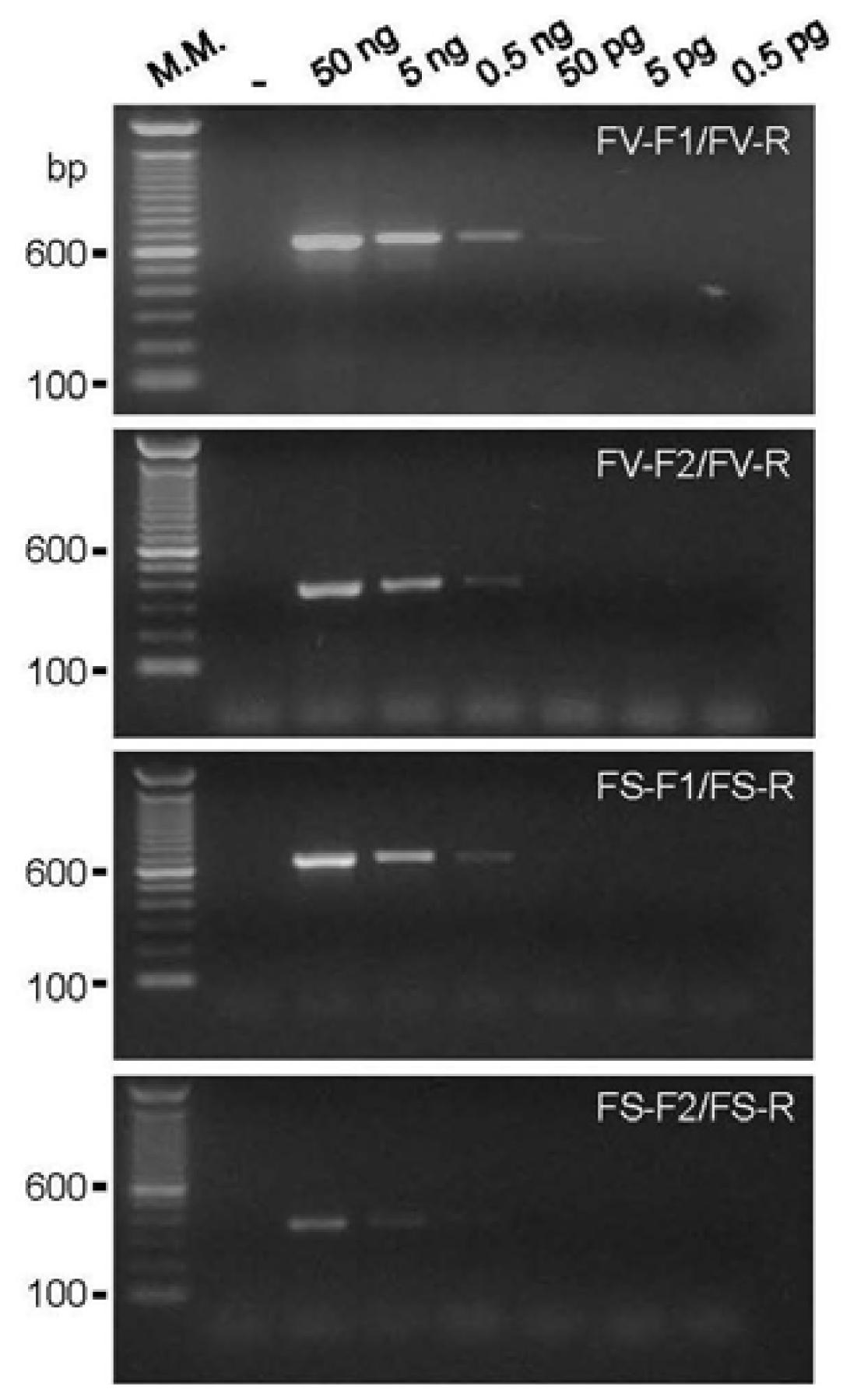
<p>All of the new primer pairs amplified a unique band of the expected size with the genomic DNA from the control strains <italic>F. verticillioides</italic> (CML 767) or <italic>F. subglutinans</italic> (UnB 379). The lowest amount of genomic DNA of the control isolates that could generate a visible band in a conventional agarose gel stained with ethidium bromide was 50 pg (0.05 ng) for the primer pair FV-F1/FV-R and 500 pg (0.5 ng) for the other new primer pairs (<xref ref-type="fig" rid="f1-ijms-13-00115">Figure 1</xref>). This sensitivity is similar as that of other primers described in the literature [<xref ref-type="bibr" rid="b13-ijms-13-00115">13</xref>,<xref ref-type="bibr" rid="b14-ijms-13-00115">14</xref>,<xref ref-type="bibr" rid="b25-ijms-13-00115">25</xref>].</p></sec>
<sec sec-type="methods">
<title>2.2. Primer Specificity Analysis</title>
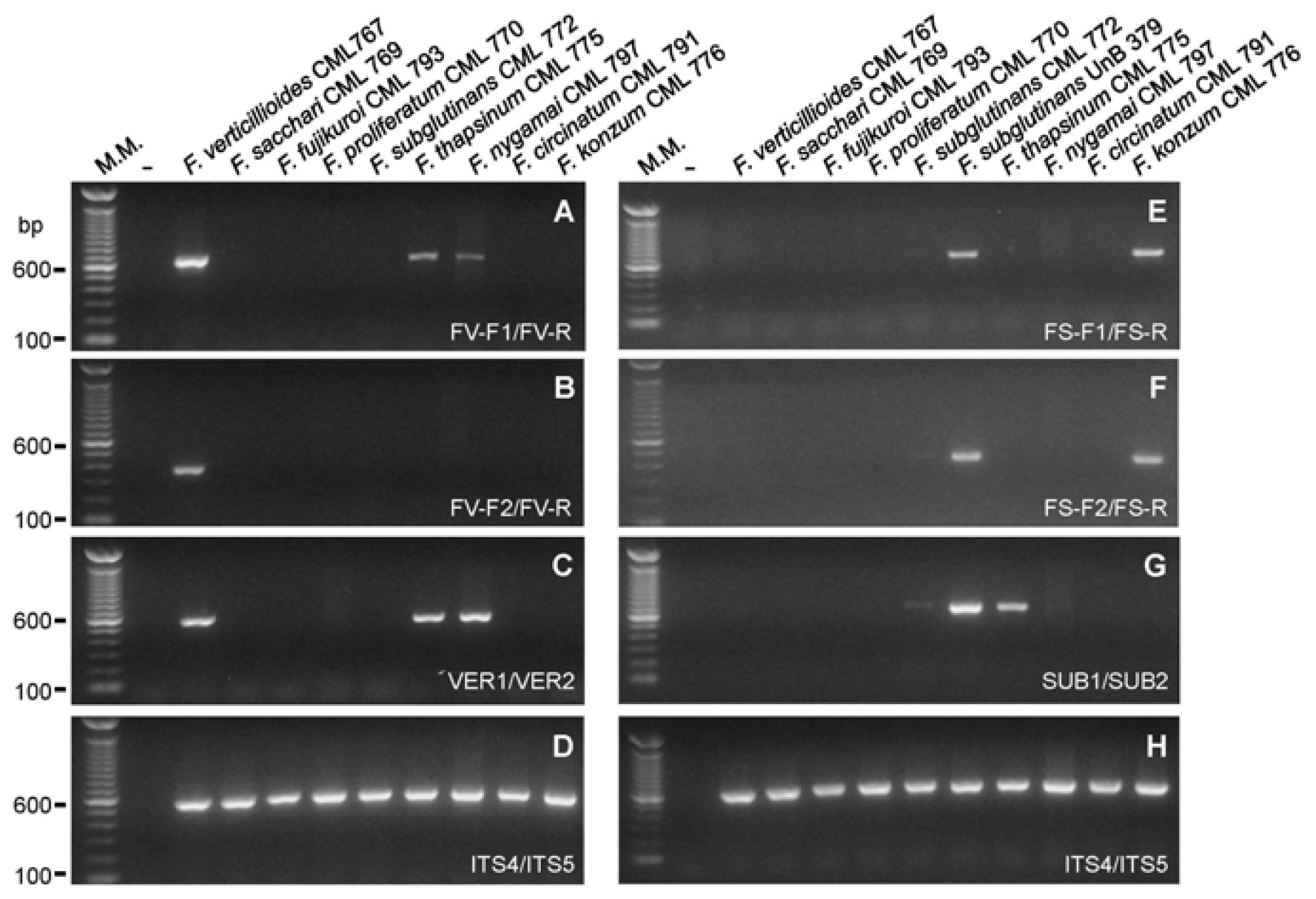
<p>Regarding to the specificity analysis with the <italic>G. fujikuroi</italic> species, the primer pair FV-F1/FV-R targeting the <italic>gaoB</italic> gene from <italic>F. verticillioides</italic> amplified a DNA fragment of the expected size from the genomic DNA from <italic>F. verticillioides</italic>, but also from <italic>F. thapsinum</italic> and <italic>F. nygamai</italic>, two species phylogenetically related to <italic>F. verticillioides</italic> [<xref ref-type="bibr" rid="b2-ijms-13-00115">2</xref>] (<xref ref-type="fig" rid="f2-ijms-13-00115">Figure 2A</xref>). The primer pair FV-F2/FV-R amplified a DNA fragment only from the <italic>F. verticillioides</italic> genomic DNA (<xref ref-type="fig" rid="f2-ijms-13-00115">Figure 2B</xref>). The two FS primer sets targeting the <italic>gaoB</italic> gene of <italic>F. subglutinans</italic> have amplified a DNA fragment of the expected size from the genomic DNA from the <italic>F. subglutinans</italic> strains used as control (UnB 379 and CML 772) and from <italic>F. konzum</italic> (<xref ref-type="fig" rid="f2-ijms-13-00115">Figure 2E,F</xref>), a species phylogenetic related to <italic>F. subglutinans</italic> [<xref ref-type="bibr" rid="b1-ijms-13-00115">1</xref>]. The primer pair VER1/VER2 described by Mulè <italic>et al.</italic> [<xref ref-type="bibr" rid="b14-ijms-13-00115">14</xref>] and targeting the calmodulin gene had specificity similar to the primer pair FV-F1/FV-R (<xref ref-type="fig" rid="f2-ijms-13-00115">Figure 2C</xref>). The primer set SUB1/SUB2 described by Mulè <italic>et al.</italic> [<xref ref-type="bibr" rid="b14-ijms-13-00115">14</xref>] had a slightly different specificity of the FS primers, amplifying a DNA fragment from the genomic DNA from <italic>F. subglutinans</italic> and also from <italic>F. thapsinum</italic> (<xref ref-type="fig" rid="f2-ijms-13-00115">Figure 2G</xref>). The specificity of these primer pairs described by Mulè <italic>et al.</italic> [<xref ref-type="bibr" rid="b14-ijms-13-00115">14</xref>] to the <italic>G. fujikuroi</italic> isolates had not been tested before.</p>
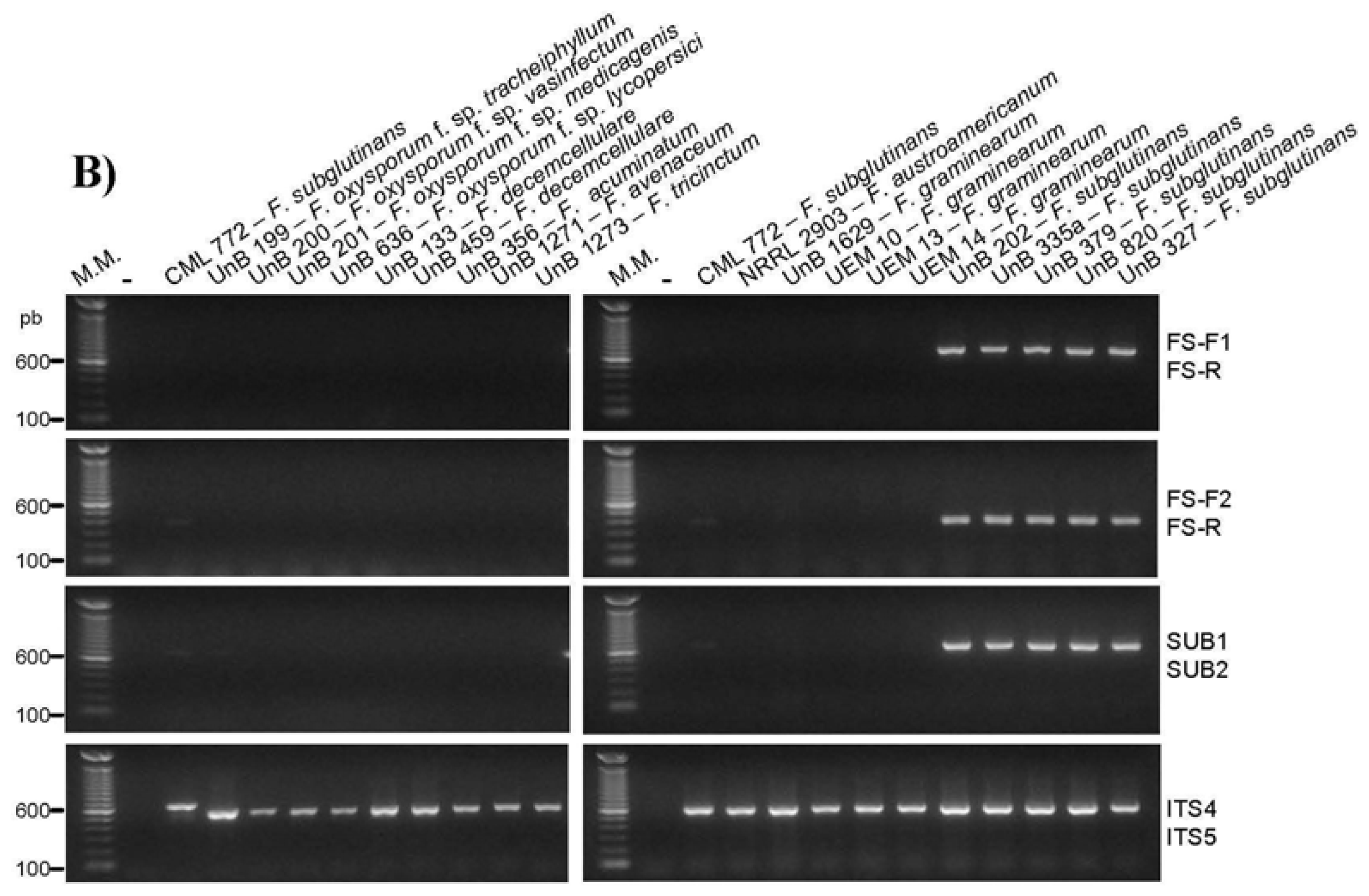
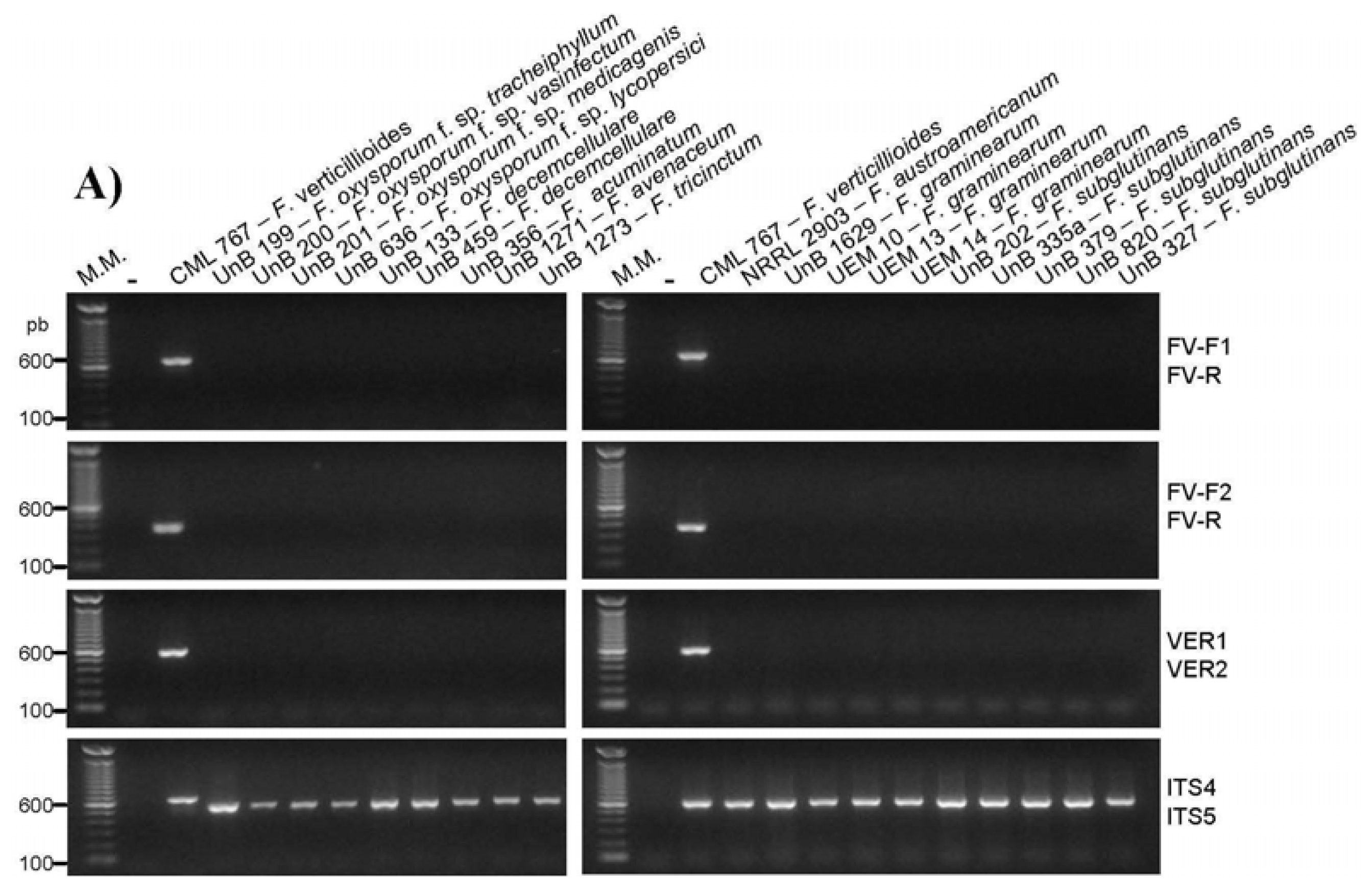
<p>All designed primer pairs were unable to amplify any DNA fragment, specific or nonspecific, from the genomic DNA of several species of the <italic>Fusarium</italic> genera and from several other fungal genera that could be associated with maize seeds (<xref ref-type="table" rid="t1-ijms-13-00115">Table 1</xref>, <xref ref-type="fig" rid="f3-ijms-13-00115">Figure 3</xref>). In addition, the FV-F2/FV-R and FS primer pairs were also unable to recognize any target in the genomic DNA of several fungi that were isolated from maize seeds in this work as <italic>Penicillium purpurogenum</italic>, <italic>Penicillium digitatum</italic>, <italic>Penicillium</italic> sp., <italic>Stenocarpella</italic> sp., <italic>Curvularia</italic> sp., <italic>Cladosporium</italic> sp., <italic>Phlebiopsis</italic> sp., <italic>Pichia</italic> sp., <italic>Rhyzopus</italic> sp., <italic>Phoma</italic> sp., <italic>Thrichoderma</italic> sp., <italic>Epicocum</italic> sp., <italic>Cladosporium</italic> sp., <italic>Irpex</italic> sp., <italic>Microdochium nivale</italic>, <italic>Epicocum</italic> sp., <italic>Mucor</italic> sp., <italic>Fusarium graminearum</italic>, <italic>Aspergillus oryzae</italic>, <italic>Aspergillus candidus</italic>, <italic>Aspergillus flavus</italic>, and <italic>Aspergillus niger</italic>.</p>
<p>Concerning the primer sensitivity testing against <italic>Fusarium</italic> isolates found in maize seeds, the two FV primer pairs were able to amplify a DNA fragment from all 47 <italic>F. verticillioides</italic> isolates obtained from maize seeds (<xref ref-type="table" rid="t2-ijms-13-00115">Table 2</xref>). The FS primer pairs were also able to molecularly identify the obtained <italic>F. subglutinans</italic> isolates. The DNA of other found <italic>Fusarium</italic> species was not recognized by the new primer pairs (<xref ref-type="table" rid="t2-ijms-13-00115">Table 2</xref>). The genomic DNA of the isolate RV27-2 resulted in positive PCR reactions for the primer pairs FV-F1/FV-R and VER1/VER2 [<xref ref-type="bibr" rid="b14-ijms-13-00115">14</xref>], indicating that it could be <italic>F. verticillioides</italic>, <italic>F. nygamai</italic>, or <italic>F. thapsinum</italic>. As it resulted in a negative PCR reaction with the more specific FV-F2/FV-R primer pair, it could not be <italic>F. verticillioides</italic>. In addition, it also resulted in a negative PCR reaction with the SUB1/SUB2 [<xref ref-type="bibr" rid="b14-ijms-13-00115">14</xref>] primer pair, demonstrating that it is neither <italic>F. thapsinum</italic> nor <italic>F. subglutinans</italic>. Thus we have concluded that this isolate is <italic>F. nygamai</italic>, what was confirmed in the Fusarium-ID analysis. The identification of the isolate RV 27-2 as <italic>F. nygamai</italic> points out that the combination of individual PCR reactions with the primers FV-F2/FV-R (this work), FV-F1/FV-R (this work), and SUB1/SUB2 [<xref ref-type="bibr" rid="b14-ijms-13-00115">14</xref>] can be used for the identification of <italic>F. nygamai</italic>. The information that the FV and FS primer pairs do not recognize the <italic>gaoB</italic> gene of <italic>F. andiyazi</italic> (<xref ref-type="table" rid="t2-ijms-13-00115">Table 2</xref>) enhances the data about their specificity.</p></sec>
<sec>
<title>2.3. Multiplex PCR Reactions</title>
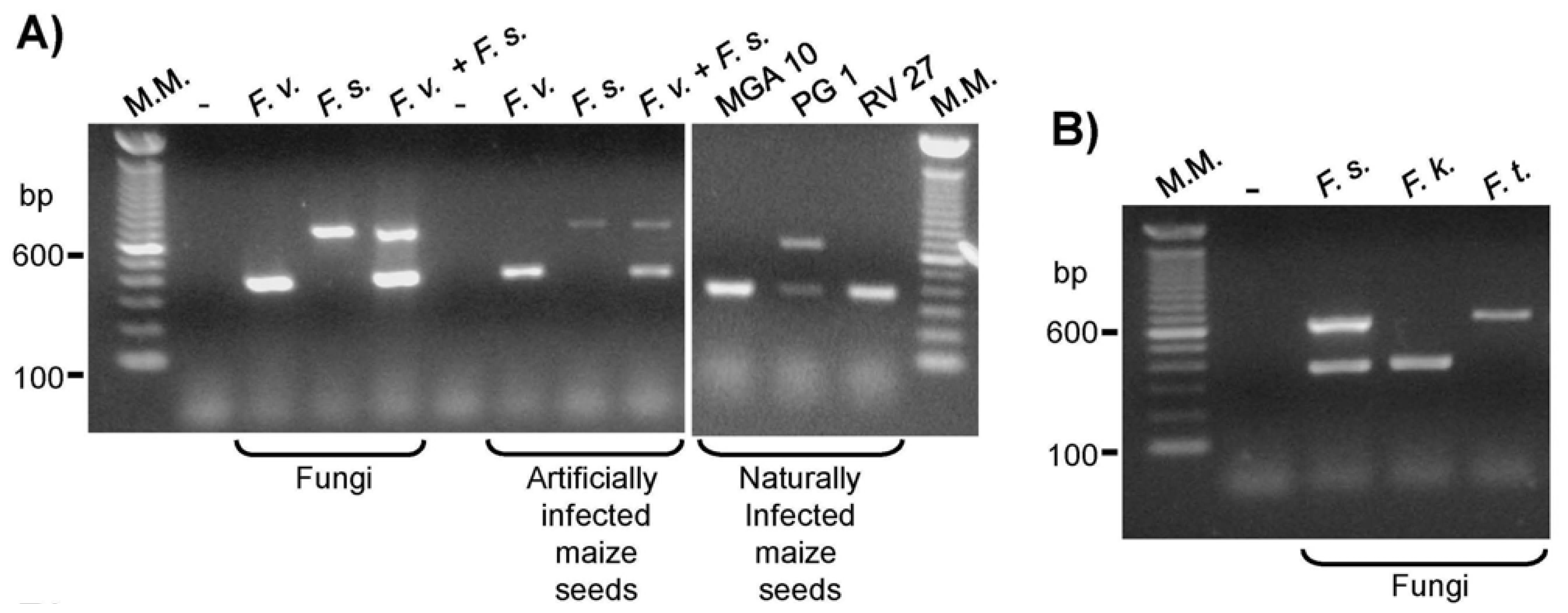
<p>The combination of the primer pairs FV-F2/FV-R and FS-F1/FS-R in only one PCR reaction could amplify a 370 bp DNA fragment from the <italic>F. verticillioides</italic> genomic DNA and a 649 bp DNA fragment from <italic>F. subglutinans</italic> genomic DNA (<xref ref-type="fig" rid="f4-ijms-13-00115">Figure 4A</xref>), what is consistent with the amplicon sizes obtained with the primer pairs used individually (<xref ref-type="fig" rid="f1-ijms-13-00115">Figure 1</xref>). In addition, this established reaction could also amplify DNA fragments of the expected size from genomic DNA extracted from fungi growing on and on the medium around the maize seeds that were artificially or naturally contaminated with <italic>F. verticillioides</italic> or <italic>F. subglutinans</italic>, or both species (<xref ref-type="fig" rid="f4-ijms-13-00115">Figure 4A</xref>). The naturally contaminated maize seed lots chosen for this analysis were: MGA 10 from which <italic>F. verticillioides</italic> was isolated, PG 1 from which <italic>F. subglutinans</italic> was isolated, and RV 27 from which neither of these fungi was initially isolated. The results obtained (<xref ref-type="fig" rid="f4-ijms-13-00115">Figure 4A</xref>) indicate the presence of <italic>F. subglutinans</italic> in the PG 1 sample and the presence of <italic>F. verticillioides</italic> in all three naturally contaminated seed samples tested, what is in accordance with the literature that reports the presence of <italic>F. verticillioides</italic> in 100% of the maize seeds in Brazil [<xref ref-type="bibr" rid="b26-ijms-13-00115">26</xref>]. Möller <italic>et al.</italic> [<xref ref-type="bibr" rid="b13-ijms-13-00115">13</xref>] have also set up a multiplex PCR to detect <italic>F. verticillioides</italic> and <italic>F. subglutinans</italic> simultaneously, but there are no data on the specificity of these primers with the genomic DNA of <italic>F. circinatum</italic>, <italic>F. konzum</italic>, and <italic>F. andiyazi</italic>. The present multiplex PCR reaction represents a significant advance for the simultaneous molecular detection of <italic>F. verticillioides</italic> and <italic>F. subglutinans</italic>.</p>
<p>When the primer pair FS-F2/FS-R was used in a multiplex reaction with the primer pair SUB1/SUB2 [<xref ref-type="bibr" rid="b14-ijms-13-00115">14</xref>], two DNA fragments were amplified from the genomic DNA of <italic>F. subglutinans</italic>: one of 370 bp and one of 631 bp (<xref ref-type="fig" rid="f4-ijms-13-00115">Figure 4B</xref>). In addition, this set of primers could amplify a single DNA fragment of 370 bp when the genomic DNA from <italic>F. konzum</italic> was present in the reaction or a single DNA fragment of 631 bp when the genomic DNA from <italic>F. thapsinum</italic> was used in the reaction (<xref ref-type="fig" rid="f4-ijms-13-00115">Figure 4B</xref>). This reaction represents an improvement to the described reactions designed to detect <italic>F. subglutinans</italic>. The primers developed by Möller <italic>et al.</italic> [<xref ref-type="bibr" rid="b13-ijms-13-00115">13</xref>] to identify <italic>F. subglutinans</italic> were not tested for all <italic>G. fujikuroi</italic> isolates, and the primers designed by Zheng and Ploetz [<xref ref-type="bibr" rid="b19-ijms-13-00115">19</xref>] were specific for <italic>F. subglutinans</italic> and <italic>F. nygamai</italic>. In addition, there are few data in the literature about reactions to identify <italic>F. thapsinum</italic>, which is an important sorghum pathogen.</p>
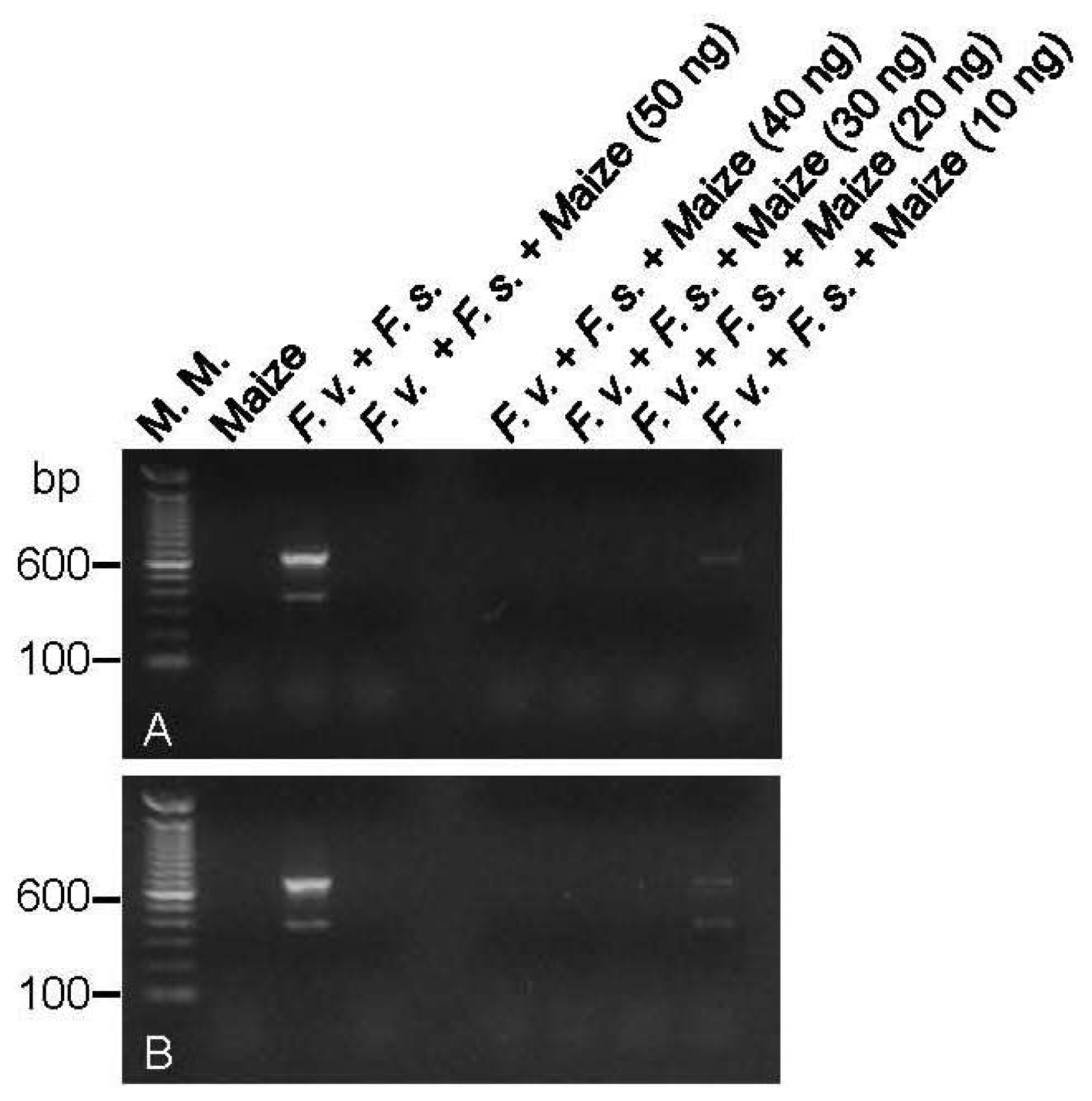
<p>The isolation of DNA directly from the seeds, without previous culture to obtain mycelia, was also tried but resulted in no DNA amplification in the multiplex PCR reaction to detect <italic>F. verticillioides</italic> and <italic>F. subglutinans</italic>. This could have happened because the amount of fungal cells in the contaminated seeds is too low or because of the presence of inhibitors in the extracted DNA. To test for the presence of inhibitors in the DNA extracted from maize, the established multiplex PCR reaction to simultaneously detect <italic>F. verticillioides</italic> and <italic>F. subglutinans</italic> was performed with the lowest amount of fungi DNA that could result in amplification spiked with increasing amounts of genomic DNA extracted from healthy maize seeds. The results shown in <xref ref-type="fig" rid="f5-ijms-13-00115">Figure 5</xref> evidenced that maize DNA only did not inhibit the reaction when present in a low amount.</p></sec></sec>
<sec>
<title>3. Experimental Section</title>
<sec>
<title>3.1. Fungal Isolates</title>
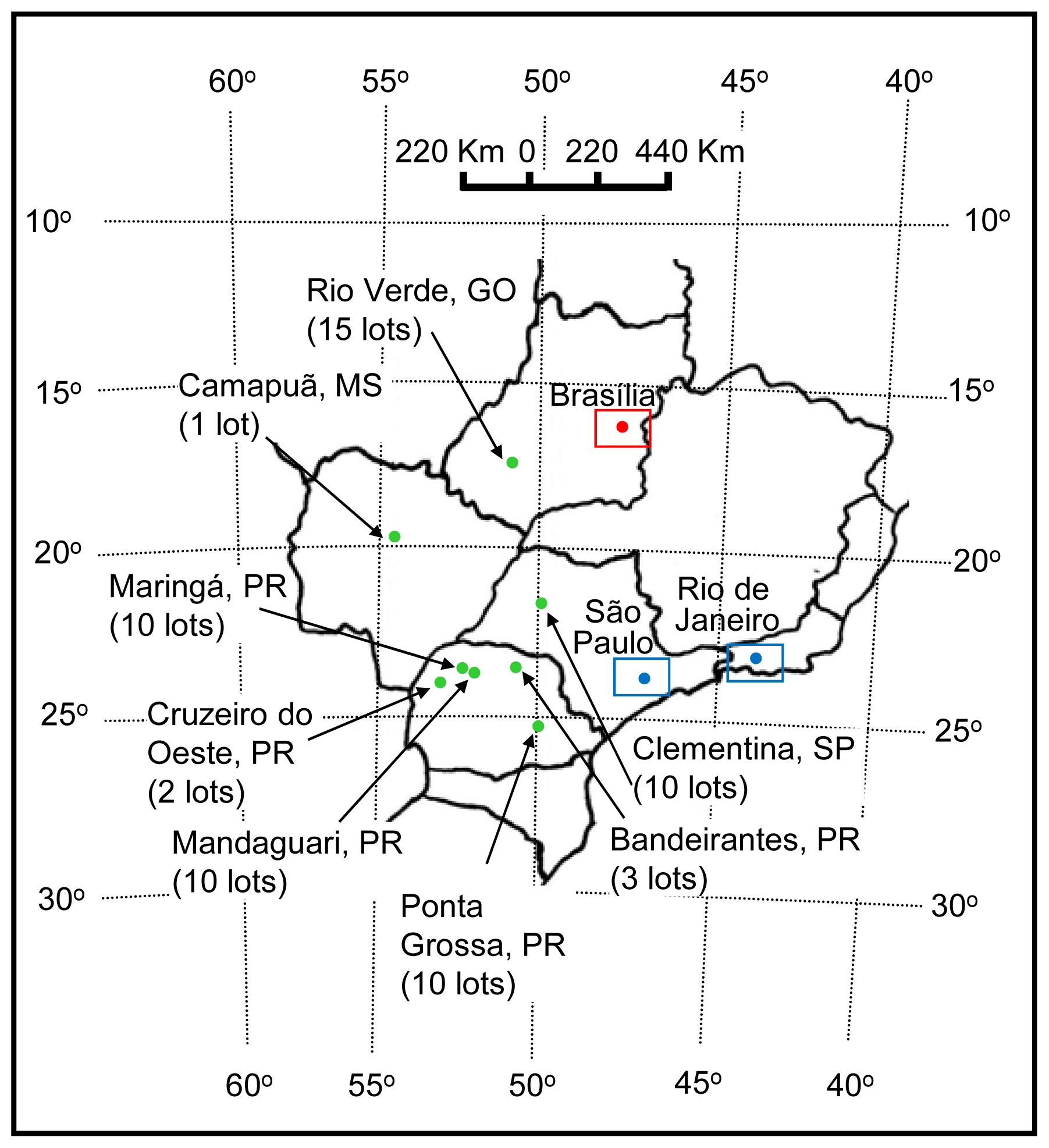
<p>The fungal isolates used in this work are listed in <xref ref-type="table" rid="t1-ijms-13-00115">Table 1</xref>. To obtain a <italic>Fusarium</italic> collection from maize seeds, corn spikes showing signs of rot were collected from January to October of 2009, in fields in several producing regions of Brazil (<xref ref-type="fig" rid="f6-ijms-13-00115">Figure 6</xref>). The seeds of each spike were denominated as a lot and were kept in paper bags at 4 °C after insecticide treatment. A total of 57 maize seed lots were collected and analyzed. Six maize seeds of each lot, in duplicate, were disinfected by one min incubation in a solution containing 0.2% active chlorine, washed in sterile distilled water, and inoculated in a 10 mm diameter dish containing Malaquite Green Agar-MGA [<xref ref-type="bibr" rid="b27-ijms-13-00115">27</xref>] supplemented with 350,000 UI/L of penicillin and 145 UI/L of streptomycin. The seeds plated in the medium were incubated for four to five days at 25 °C, with a photoperiod of 12 h. After germination, mycelia and conidia of peach or violet colored colonies were transferred to Petri dishes containing Carnation Leaf-piece Agar-CLA [<xref ref-type="bibr" rid="b1-ijms-13-00115">1</xref>], which were incubated for a period of seven days at 25 °C, with a photoperiod of 12 h. A well-colonized carnation leaf fragment in the CLA culture was used for monosporic isolation as described in Nelson <italic>et al.</italic> [<xref ref-type="bibr" rid="b28-ijms-13-00115">28</xref>]. The isolates morphologic characteristics were analyzed in micro culture performed in a one-cm<sup>3</sup> block of Spezieller Nährstoffarmer Agar-SNA [<xref ref-type="bibr" rid="b1-ijms-13-00115">1</xref>]. The isolates with cultural and morphological characteristics of <italic>Fusarium</italic> were cultivated for DNA extraction and molecular identification with the specific primers described by Mulè <italic>et al.</italic> [<xref ref-type="bibr" rid="b14-ijms-13-00115">14</xref>]. These primers were chosen because they target a protein coding gene as the primers designed in this work. The genomic DNA of <italic>Fusarium</italic> isolates that were not identified as <italic>F. verticillioides</italic> or <italic>F. subglutinans</italic> were used in PCR reactions with specific primers for <italic>F. proliferatum</italic> [<xref ref-type="bibr" rid="b14-ijms-13-00115">14</xref>]. These fungi were also analyzed using the methodology described in Geiser <italic>et al.</italic> [<xref ref-type="bibr" rid="b29-ijms-13-00115">29</xref>] in which a portion of the elongation factor α was amplified through PCR, purified with the ExoSap-IT Kit (GE HealthCare, USA), and sequenced in the Center for the Human Genome Studies (CEGH) in the University of São Paulo (USP), Brazil. For the isolate identification, the obtained sequences were compared with sequences deposited in the data bank Fusarium-ID [<xref ref-type="bibr" rid="b29-ijms-13-00115">29</xref>]. All obtained isolates are being maintained in the laboratory collection on PDA and SNA media with trimestral passages and in SNA medium under mineral oil.</p>
<p>To obtain fungi other than <italic>F. verticillioides</italic> or <italic>F. subglutinans</italic> from maize seeds, to be used in the primers specificity analysis, six maize seeds of each lot, in triplicate, were disinfected as described above and inoculated in a 10 mm diameter dish containing PDA, pH 4.5 with lactic acid [<xref ref-type="bibr" rid="b6-ijms-13-00115">6</xref>], supplemented with penicillin and streptomycin, as described above. The seeds plated in the medium were incubated for five to seven days at 25 °C, with a photoperiod of 12 h. The fungi growing on and on the medium around the maize seeds with culture characteristics different from <italic>G. fujikuroi</italic> were submitted to monosporic isolation [<xref ref-type="bibr" rid="b28-ijms-13-00115">28</xref>]. The classification of <italic>Aspergillus</italic> and <italic>Penicillium</italic> isolates was performed as described in Pitt and Hocking [<xref ref-type="bibr" rid="b30-ijms-13-00115">30</xref>] with cultures in specific media. The molecular identification of the isolates of other genera was performed by the amplification of an rRNA gene fragment with the ITS4/5 primers [<xref ref-type="bibr" rid="b31-ijms-13-00115">31</xref>], purification of the amplified DNA fragment with the PureLink™ PCR purification kit (Invitrogen, USA), sequencing in the CEGH (USP, Brazil) and comparison with sequences deposited in data banks. Specific identification of <italic>F. graminearum</italic> was performed in PCR reactions with the GOF/R specific primers [<xref ref-type="bibr" rid="b21-ijms-13-00115">21</xref>]. All isolates obtained are being maintained in the laboratory collection on PDA with trimestral passages and on PDA medium under mineral oil.</p></sec>
<sec sec-type="methods">
<title>3.2. Primer Design</title>
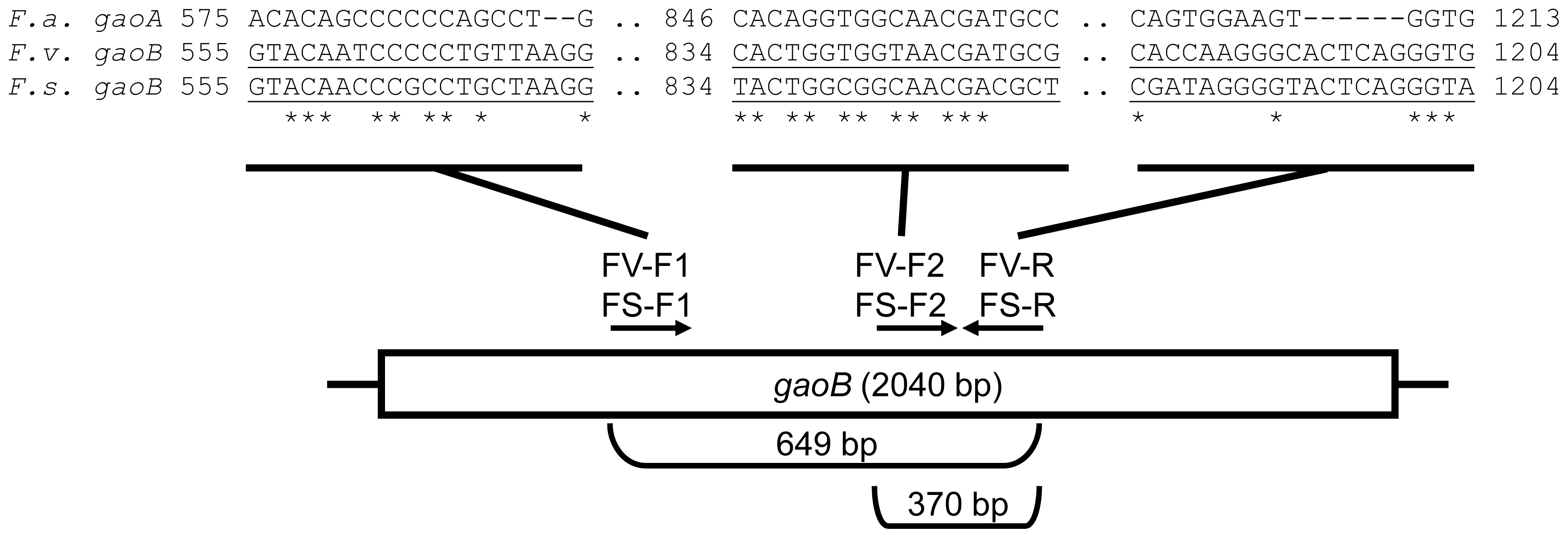
<p>Initially, the <italic>gaoB</italic> genes from <italic>F. verticillioides</italic> and <italic>F. subglutinans</italic> [<xref ref-type="bibr" rid="b24-ijms-13-00115">24</xref>] (GenBank AN HM069186 and HM069185, respectively) and the <italic>gaoA</italic> gene from <italic>F. austroamericanum</italic> [<xref ref-type="bibr" rid="b20-ijms-13-00115">20</xref>] (GenBank AN M86819) were aligned with the ClustalW program. Low similarity regions were chosen for primer design. Four pairs of primers were designed; two directed to the <italic>gaoB</italic> gene from <italic>F. verticillioides</italic> (FV-F1/FV-R and FV-F2/FV-R) and two other for the <italic>gaoB</italic> gene from <italic>F. subglutinans</italic> (FS-F1/FS-R and FS-F2/FS-R) to amplify a DNA fragment of 649 bp and 370 bp, respectively (<xref ref-type="fig" rid="f7-ijms-13-00115">Figure 7</xref>).</p>
<p>The primer sensitivity was tested by a ten-fold serial dilution of the control isolates genomic DNA in the established PCR reactions. The primer specificity was tested in PCR reactions using genomic DNA from <italic>G. fujikuroi</italic> species isolates, other <italic>Fusarium</italic> spp., other fungal genera, and fungi isolated from maize seeds.</p></sec>
<sec>
<title>3.3. DNA Extraction</title>
<p>For the DNA extractions, an approximately one-cm<sup>3</sup> fragment of a monosporic culture in inclined PDA was smashed and shaken in 5 mL of distilled water. Two mL of the obtained suspension were used as inoculum in Erlenmeyer flasks of 125 mL containing 25 mL of potato dextrose medium. These flasks were incubated for five days at 25 °C. The mycelia were collected by filtration in sterile gauze. The mycelia was macerated in a mortar with liquid nitrogen, and transferred to microcentrifuge tubes. The DNA was extracted from the macerated mycelia using the protocol described by Koenig <italic>et al.</italic> [<xref ref-type="bibr" rid="b32-ijms-13-00115">32</xref>]. The DNA obtained was quantified by measuring the absorbance at 260 nm and/or by fluorometry using the Qubit Quantitation Fluorometer and the Quant-it™ dsDNA HS Assay Kit (Invitrogen, USA).</p></sec>
<sec>
<title>3.4. Polymerase Chain Reaction—PCR</title>
<p>The PCR with the primer pairs designed in this work was performed in a total volume of 25 μL of the following mixture: 1X enzyme buffer (20 mM Tris, pH 8.4, and 50 mM KCl), 1.5 mM MgCl<sub>2</sub>, 1.5 U of Platinum<sup>®</sup> <italic>Taq</italic> DNA polymerase (Invitrogen, USA), 0.2 mM of each dNTP, 25 pmol of each primer (FW and RV), and 50 ng of the genomic DNA. The reaction consisted of 25 cycles of 1.5 min at 94 °C, 1.5 min at the recommended annealing temperature for each pair of primers (<xref ref-type="table" rid="t3-ijms-13-00115">Table 3</xref>), and 2 min at 72 °C in a Techne Thermocycler (England). Before the cycles, the samples were heated for 5 min at 94 °C, and after the cycles, the samples were incubated for 10 min at 72 °C. Negative controls (no DNA template) were used in each experiment to test for the presence of DNA contamination of reagents and reaction mixtures. Ten microliters of the PCR reaction were analyzed in an agarose gel containing ethidium bromide (0.25 μg/mL). Molecular weight markers were the 100 bp markers from Invitrogen (USA). The PCR products were visualized and photographed under UV light. All genomic DNA that resulted in nonamplification with the other used primers was tested for PCR amplification quality with the primers ITS4/5 [<xref ref-type="bibr" rid="b31-ijms-13-00115">31</xref>]. All the PCR with the other primer pairs used in this work was performed as above with the exception with the primer pair ef1/ef2 [<xref ref-type="bibr" rid="b29-ijms-13-00115">29</xref>] that was performed in a total volume of 25 μL with 50 ng of genomic DNA template and following the authors’ methodology.</p></sec>
<sec>
<title>3.5. Multiplex PCR Reactions</title>
<p>A first multiplex PCR reaction to simultaneously detect <italic>F. verticillioides</italic> and <italic>F. subglutinans</italic> was established with the primer pairs FS-F1/FS-R and FV-F2/FV-R. Another multiplex PCR reaction to identify <italic>F. subglutinans</italic> was established with the primer pairs FS-F2/FS-R (this work) and SUB1/SUB2 [<xref ref-type="bibr" rid="b14-ijms-13-00115">14</xref>]. Genomic DNA from <italic>F. konzum</italic> and <italic>F. thapsinum</italic> gave a positive signal in this last multiplex PCR reaction as well.</p>
<p>The reaction established to simultaneously detect <italic>F. verticillioides</italic> and <italic>F. subglutinans</italic> was also tested with genomic DNA extracted directly from artificially or naturally contaminated seeds or from fungi growing on artificially or naturally contaminated maize seeds using the protocol described by Koenig <italic>et al.</italic> [<xref ref-type="bibr" rid="b32-ijms-13-00115">32</xref>]. To artificially contaminate maize seeds, healthy maize seeds were disinfected as described above and incubated for 5 min in 5 mL of a suspension of 10<sup>4</sup> spores/mL of <italic>F. verticillioides</italic>, or <italic>F. subglutinans</italic>, and of <italic>F. verticillioides</italic> together with 10<sup>4</sup> spores/mL of <italic>F. subglutinans</italic>. The artificially contaminated seeds were inoculated in Petri dishes containing MGA-penicillin-streptomycin medium [<xref ref-type="bibr" rid="b27-ijms-13-00115">27</xref>], prepared as described above. These seeds were incubated for five days at 25 °C on the medium, with a period of 12 h of light. Naturally infected maize seeds (Ponta Grossa-1, Rio Verde 27, and Maringá-10) showing signs of rot were disinfected and incubated in the same way. The mycelia growing on the seeds and on the agar around the seeds were scraped and used for the DNA extraction that was conducted with the method described by Koenig <italic>et al.</italic> [<xref ref-type="bibr" rid="b32-ijms-13-00115">32</xref>]. To test if maize DNA could inhibit the reaction, maize DNA was also extracted from health maize seeds using the protocol described by Koenig <italic>et al.</italic> [<xref ref-type="bibr" rid="b32-ijms-13-00115">32</xref>] and this DNA was added in multiplex PCR reactions with DNA from the reference isolates of <italic>F. verticillioides</italic> and <italic>F. subglutinans</italic>.</p>
<p>The multiplex reactions were performed as shown above, except that they contained 25 pmol of each primer. The annealing temperatures are listed in <xref ref-type="table" rid="t3-ijms-13-00115">Table 3</xref>. The amplification of specific fragments was analyzed by running 10 μL of the PCR reaction on a 1.5% agarose gel that was stained with ethidium bromide (0.25 μg/mL).</p></sec></sec>
<sec sec-type="conclusions">
<title>4. Conclusions</title>
<p>In conclusion, in this work, primers to identify <italic>F. verticillioides</italic> and <italic>F. subglutinans</italic> were designed and tested in PCR reactions. Additionally, they could be combined in a multiplex reaction to simultaneously detect these two species in naturally and artificially contaminated maize seeds. Another multiplex reaction with a pair of primers developed in this work combined with a pre-existing pair of primers [<xref ref-type="bibr" rid="b14-ijms-13-00115">14</xref>] has allowed identifying <italic>F. subglutinans</italic>, <italic>F. konzum</italic>, and <italic>F. thapsinum</italic>. In addition, the identification of <italic>F. nygamai</italic> was also possible using a combination of two different reactions described in this work and one described previously [<xref ref-type="bibr" rid="b14-ijms-13-00115">14</xref>]. The results obtained in this work and the used experimental approaches have a great potential value for the molecular based identification of difficult fungal phytopathogens.</p></sec></body>
<back>
<ack>
<title>Acknowledgments</title>
<p>The authors are truly grateful to the International Foundation for Science (IFS—Sweden), National Council of Technological and Scientific Development (CNPq—Brazil), and Araucária Foundation (Paraná State, Brazil) for financial support; to the Coordination for the Improvement of the Higher Level Personnel (CAPES) for financial support of CB Faria and CN Silva; and to LH Pfenning (UFLA), JC Dianese (UnB), and C Kemmelmeier (UEM) for the kind donation of the isolates.</p></ack>
<ref-list>
<title>References</title>
<ref id="b1-ijms-13-00115"><label>1</label><citation citation-type="book"><person-group person-group-type="author"><name><surname>Leslie</surname><given-names>J.F.</given-names></name><name><surname>Summerell</surname><given-names>B.A.</given-names></name></person-group><source>The Fusarium Laboratory Manual</source><publisher-name>Blackwell Publishing</publisher-name><publisher-loc>Oxford, UK</publisher-loc><year>2006</year></citation></ref>
<ref id="b2-ijms-13-00115"><label>2</label><citation citation-type="journal"><person-group person-group-type="author"><name><surname>O’Donnell</surname><given-names>K.</given-names></name><name><surname>Cigelnick</surname><given-names>E.</given-names></name><name><surname>Nirenberg</surname><given-names>H.I.</given-names></name></person-group><article-title>Molecular systematics and phylogeography of the <italic>Gibberella fujikuroi</italic> species complex</article-title><source>Mycologia</source><year>1998</year><volume>90</volume><fpage>465</fpage><lpage>493</lpage><pub-id pub-id-type="doi">10.2307/3761407</pub-id></citation></ref>
<ref id="b3-ijms-13-00115"><label>3</label><citation citation-type="journal"><person-group person-group-type="author"><name><surname>Richard</surname><given-names>J.L.</given-names></name></person-group><article-title>Some major mycotoxins and their mycotoxicoses—An overview</article-title><source>Int. J. Food Microbiol</source><year>2007</year><volume>119</volume><fpage>3</fpage><lpage>10</lpage><pub-id pub-id-type="doi">10.1016/j.ijfoodmicro.2007.07.019</pub-id><pub-id pub-id-type="pmid">17719115</pub-id></citation></ref>
<ref id="b4-ijms-13-00115"><label>4</label><citation citation-type="journal"><person-group person-group-type="author"><name><surname>Wilke</surname><given-names>A.L.</given-names></name><name><surname>Bronson</surname><given-names>C.R.</given-names></name><name><surname>Tomas</surname><given-names>A.</given-names></name><name><surname>Munkvold</surname><given-names>G.P.</given-names></name></person-group><article-title>Seed transmission of <italic>Fusarium verticillioides</italic> in maize plants grown under three different temperature regimes</article-title><source>Plant Dis</source><year>2007</year><volume>91</volume><fpage>1109</fpage><lpage>1115</lpage><pub-id pub-id-type="doi">10.1094/PDIS-91-9-1109</pub-id></citation></ref>
<ref id="b5-ijms-13-00115"><label>5</label><citation citation-type="journal"><person-group person-group-type="author"><name><surname>Niessen</surname><given-names>L.</given-names></name></person-group><article-title>PCR-based diagnosis and quantification of mycotoxin producing fungi</article-title><source>Int. J. Food Microbiol</source><year>2007</year><volume>119</volume><fpage>38</fpage><lpage>46</lpage><pub-id pub-id-type="doi">10.1016/j.ijfoodmicro.2007.07.023</pub-id><pub-id pub-id-type="pmid">17804102</pub-id></citation></ref>
<ref id="b6-ijms-13-00115"><label>6</label><citation citation-type="book"><person-group person-group-type="author"><name><surname>Machado</surname><given-names>J.C.</given-names></name><name><surname>Langerak</surname><given-names>C.J.</given-names></name><name><surname>Jaccoud-Filho</surname><given-names>D.S.</given-names></name></person-group><source>Seed-Borne Fungi: A Contribution to Routine Seed Health Analysis</source><publisher-name>ISTA/UFLA</publisher-name><publisher-loc>Bassersdorf, Switzerland</publisher-loc><year>2002</year></citation></ref>
<ref id="b7-ijms-13-00115"><label>7</label><citation citation-type="journal"><person-group person-group-type="author"><name><surname>Baird</surname><given-names>R.</given-names></name><name><surname>Abbas</surname><given-names>H.K.</given-names></name><name><surname>Windham</surname><given-names>G.</given-names></name><name><surname>Williams</surname><given-names>P.</given-names></name><name><surname>Baird</surname><given-names>S.</given-names></name><name><surname>Ma</surname><given-names>P.</given-names></name><name><surname>Kelley</surname><given-names>R.</given-names></name><name><surname>Hawkins</surname><given-names>L.</given-names></name><name><surname>Scruggs</surname><given-names>M.</given-names></name></person-group><article-title>Identification of select fumonisin forming <italic>Fusarium</italic> species using PCR applications of the polyketide synthase gene and its relationship to fumonisin production <italic>in vitro</italic></article-title><source>Int. J. Mol. Sci</source><year>2008</year><volume>9</volume><fpage>554</fpage><lpage>570</lpage><pub-id pub-id-type="doi">10.3390/ijms9040554</pub-id><pub-id pub-id-type="pmid">19325769</pub-id></citation></ref>
<ref id="b8-ijms-13-00115"><label>8</label><citation citation-type="patent"><person-group person-group-type="author"><name><surname>Beck</surname><given-names>J.J.</given-names></name><name><surname>Barnett</surname><given-names>C.J.</given-names></name></person-group><article-title>Detection of <italic>Fusarium</italic> species infecting corn using the polymerase chain reaction</article-title><patent>U.S. Patent 6846631</patent><month>25 January</month><year>2005</year></citation></ref>
<ref id="b9-ijms-13-00115"><label>9</label><citation citation-type="journal"><person-group person-group-type="author"><name><surname>Bluhm</surname><given-names>B.M.</given-names></name><name><surname>Flaherty</surname><given-names>J.E.</given-names></name><name><surname>Cousin</surname><given-names>M.A.</given-names></name><name><surname>Woloshuk</surname><given-names>C.P.</given-names></name></person-group><article-title>Multiplex polymerase chain reaction assay for the differential detection of trichothecene- and fumonisin-producing species of <italic>Fusarium</italic> in cornmeal</article-title><source>J. Food Prot</source><year>2002</year><volume>65</volume><fpage>1955</fpage><lpage>1961</lpage><pub-id pub-id-type="pmid">12495016</pub-id></citation></ref>
<ref id="b10-ijms-13-00115"><label>10</label><citation citation-type="journal"><person-group person-group-type="author"><name><surname>González-Jaén</surname><given-names>M.T.</given-names></name><name><surname>Mirete</surname><given-names>S.</given-names></name><name><surname>Patiño</surname><given-names>B.</given-names></name><name><surname>López-Errasquín</surname><given-names>E.</given-names></name><name><surname>Vázquez</surname><given-names>C.</given-names></name></person-group><article-title>Genetic markers for the analysis of variability and for production of specific diagnostic sequences in fumonisin-producing strains of <italic>Fusarium verticillioides</italic></article-title><source>Eur. J. Plant Pathol</source><year>2004</year><volume>110</volume><fpage>525</fpage><lpage>532</lpage><pub-id pub-id-type="doi">10.1023/B:EJPP.0000032392.20106.81</pub-id></citation></ref>
<ref id="b11-ijms-13-00115"><label>11</label><citation citation-type="journal"><person-group person-group-type="author"><name><surname>Grimm</surname><given-names>C.</given-names></name><name><surname>Geiser</surname><given-names>R.</given-names></name></person-group><article-title>A PCR-ELISA for the detection of potential fumonisin producing <italic>Fusarium</italic> species</article-title><source>Lett. Appl. Microbiol</source><year>1998</year><volume>26</volume><fpage>456</fpage><lpage>462</lpage><pub-id pub-id-type="doi">10.1046/j.1472-765X.1998.00366.x</pub-id><pub-id pub-id-type="pmid">9717319</pub-id></citation></ref>
<ref id="b12-ijms-13-00115"><label>12</label><citation citation-type="journal"><person-group person-group-type="author"><name><surname>Hinojo</surname><given-names>M.J.</given-names></name><name><surname>Llorens</surname><given-names>A.</given-names></name><name><surname>Mateo</surname><given-names>R.</given-names></name><name><surname>Patiño</surname><given-names>B.</given-names></name><name><surname>Gonzáles-Jaén</surname><given-names>M.T.</given-names></name><name><surname>Jiménez</surname><given-names>M.</given-names></name></person-group><article-title>Utility of the polymerase chain reaction-restriction fragment length polymorphisms of the intergenic spacer region of the rDNA for characterizing <italic>Gibberella fujikuroi</italic> isolates</article-title><source>Syst. Appl. Microbiol</source><year>2004</year><volume>27</volume><fpage>681</fpage><lpage>688</lpage><pub-id pub-id-type="doi">10.1078/0723202042369938</pub-id><pub-id pub-id-type="pmid">15612625</pub-id></citation></ref>
<ref id="b13-ijms-13-00115"><label>13</label><citation citation-type="journal"><person-group person-group-type="author"><name><surname>Möller</surname><given-names>E.M.</given-names></name><name><surname>Chełkowski</surname><given-names>J.</given-names></name><name><surname>Geiger</surname><given-names>H.H.</given-names></name></person-group><article-title>Species-specific PCR assays for the fungal pathogens <italic>Fusarium moniliforme</italic> and <italic>Fusarium subglutinans</italic> and their application to diagnose maize ear rot disease</article-title><source>J. Phytopathol</source><year>1999</year><volume>147</volume><fpage>497</fpage><lpage>508</lpage><pub-id pub-id-type="doi">10.1111/j.1439-0434.1999.tb03856.x</pub-id></citation></ref>
<ref id="b14-ijms-13-00115"><label>14</label><citation citation-type="journal"><person-group person-group-type="author"><name><surname>Mulè</surname><given-names>G.</given-names></name><name><surname>Susca</surname><given-names>A.</given-names></name><name><surname>Stea</surname><given-names>G.</given-names></name><name><surname>Moretti</surname><given-names>A.</given-names></name></person-group><article-title>A species-specific assay based on the calmodulin partial gene for identification of <italic>Fusarium verticillioides</italic>, <italic>Fusarium proliferatum</italic> and <italic>Fusarium subglutinans</italic></article-title><source>Eur. J. Plant Pathol</source><year>2004</year><volume>110</volume><fpage>495</fpage><lpage>502</lpage><pub-id pub-id-type="doi">10.1023/B:EJPP.0000032389.84048.71</pub-id></citation></ref>
<ref id="b15-ijms-13-00115"><label>15</label><citation citation-type="journal"><person-group person-group-type="author"><name><surname>Murillo</surname><given-names>I.</given-names></name><name><surname>Cavallarin</surname><given-names>L.</given-names></name><name><surname>San-Segundo</surname><given-names>B.</given-names></name></person-group><article-title>The development of a rapid PCR assay for detection of <italic>Fusarium moniliforme</italic></article-title><source>Eur. J. Plant Pathol</source><year>1998</year><volume>104</volume><fpage>301</fpage><lpage>311</lpage><pub-id pub-id-type="doi">10.1023/A:1008698919376</pub-id></citation></ref>
<ref id="b16-ijms-13-00115"><label>16</label><citation citation-type="journal"><person-group person-group-type="author"><name><surname>Patiño</surname><given-names>B.</given-names></name><name><surname>Mirete</surname><given-names>S.</given-names></name><name><surname>González-Jaén</surname><given-names>M.T.</given-names></name><name><surname>Mulè</surname><given-names>G.</given-names></name><name><surname>Rodríguez</surname><given-names>M.T.</given-names></name><name><surname>Vázquez</surname><given-names>C.</given-names></name></person-group><article-title>PCR detection assay of fumonisin-producing <italic>Fusarium verticillioides</italic> strains</article-title><source>J. Food Prot</source><year>2004</year><volume>67</volume><fpage>1278</fpage><lpage>1283</lpage><pub-id pub-id-type="pmid">15222565</pub-id></citation></ref>
<ref id="b17-ijms-13-00115"><label>17</label><citation citation-type="journal"><person-group person-group-type="author"><name><surname>Sanchez-Rangel</surname><given-names>D.</given-names></name><name><surname>SanJuan-Badillo</surname><given-names>A.</given-names></name><name><surname>Plasencia</surname><given-names>J.</given-names></name></person-group><article-title>Fumonisin production by <italic>Fusarium verticillioides</italic> strains isolated from maize in Mexico and development of a polymerase chain reaction to detect potential toxigenic strains in grains</article-title><source>J. Agric. Food Chem</source><year>2005</year><volume>53</volume><fpage>8565</fpage><lpage>857</lpage><pub-id pub-id-type="doi">10.1021/jf0514827</pub-id><pub-id pub-id-type="pmid">16248554</pub-id></citation></ref>
<ref id="b18-ijms-13-00115"><label>18</label><citation citation-type="journal"><person-group person-group-type="author"><name><surname>Visentin</surname><given-names>I.</given-names></name><name><surname>Tamietti</surname><given-names>G.</given-names></name><name><surname>Valentino</surname><given-names>D.</given-names></name><name><surname>Portis</surname><given-names>E.</given-names></name><name><surname>Karlovsky</surname><given-names>P.</given-names></name><name><surname>Moretti</surname><given-names>A.</given-names></name><name><surname>Cardinale</surname><given-names>F.</given-names></name></person-group><article-title>The ITS region as a taxonomic discriminator between <italic>Fusarium verticillioides</italic> and <italic>Fusarium proliferatum</italic></article-title><source>Mycol. Res</source><year>2009</year><volume>113</volume><fpage>1137</fpage><lpage>1145</lpage><pub-id pub-id-type="doi">10.1016/j.mycres.2009.07.011</pub-id><pub-id pub-id-type="pmid">19631741</pub-id></citation></ref>
<ref id="b19-ijms-13-00115"><label>19</label><citation citation-type="journal"><person-group person-group-type="author"><name><surname>Zheng</surname><given-names>Q.</given-names></name><name><surname>Ploetz</surname><given-names>R.</given-names></name></person-group><article-title>Genetic diversity in the mango malformation pathogen and development of a PCR assay</article-title><source>Plant Pathol</source><year>2002</year><volume>51</volume><fpage>208</fpage><lpage>216</lpage><pub-id pub-id-type="doi">10.1046/j.1365-3059.2002.00677.x</pub-id></citation></ref>
<ref id="b20-ijms-13-00115"><label>20</label><citation citation-type="journal"><person-group person-group-type="author"><name><surname>McPherson</surname><given-names>M.J.</given-names></name><name><surname>Ogel</surname><given-names>Z.B.</given-names></name><name><surname>Stevens</surname><given-names>C.</given-names></name><name><surname>Yadav</surname><given-names>K.D.S.</given-names></name><name><surname>Keen</surname><given-names>J.N.</given-names></name><name><surname>Knowles</surname><given-names>P.F.</given-names></name></person-group><article-title>Galactose oxidase of <italic>Dactylium dendroides</italic>. Gene cloning and sequence analysis</article-title><source>J. Biol. Chem</source><year>1992</year><volume>267</volume><fpage>8146</fpage><lpage>8152</lpage><pub-id pub-id-type="pmid">1569070</pub-id></citation></ref>
<ref id="b21-ijms-13-00115"><label>21</label><citation citation-type="journal"><person-group person-group-type="author"><name><surname>Biazio</surname><given-names>G.R.</given-names></name><name><surname>Leite</surname><given-names>G.G.S.</given-names></name><name><surname>Tessmann</surname><given-names>D.J.</given-names></name><name><surname>Barbosa-Tessmann</surname><given-names>I.P.</given-names></name></person-group><article-title>A new PCR approach for the identification of <italic>Fusarium graminearum</italic></article-title><source>Br. J. Microbiol</source><year>2008</year><volume>39</volume><fpage>554</fpage><lpage>560</lpage><pub-id pub-id-type="doi">10.1590/S1517-83822008000300028</pub-id></citation></ref>
<ref id="b22-ijms-13-00115"><label>22</label><citation citation-type="journal"><person-group person-group-type="author"><name><surname>Niessen</surname><given-names>M.L.</given-names></name><name><surname>Vogel</surname><given-names>R.F.</given-names></name></person-group><article-title>Specific identification of <italic>Fusarium graminearum</italic> by PCR with <italic>gao</italic>A targeted primers</article-title><source>Syst. Appl. Microbiol</source><year>1997</year><volume>20</volume><fpage>111</fpage><lpage>113</lpage><pub-id pub-id-type="doi">10.1016/S0723-2020(97)80055-0</pub-id></citation></ref>
<ref id="b23-ijms-13-00115"><label>23</label><citation citation-type="journal"><person-group person-group-type="author"><name><surname>Whittaker</surname><given-names>J.W.</given-names></name></person-group><article-title>The radical chemistry of galactose oxidase</article-title><source>Arch. Biochem. Biophys</source><year>2005</year><volume>433</volume><fpage>227</fpage><lpage>239</lpage><pub-id pub-id-type="doi">10.1016/j.abb.2004.08.034</pub-id><pub-id pub-id-type="pmid">15581579</pub-id></citation></ref>
<ref id="b24-ijms-13-00115"><label>24</label><citation citation-type="journal"><person-group person-group-type="author"><name><surname>Cordeiro</surname><given-names>F.A.</given-names></name><name><surname>Faria</surname><given-names>C.B.</given-names></name><name><surname>Barbosa-Tessmann</surname><given-names>I.P.</given-names></name></person-group><article-title>Identification of new galactose oxidase genes in <italic>Fusarium</italic> spp</article-title><source>J. Basic Microbiol</source><year>2010</year><volume>50</volume><fpage>527</fpage><lpage>537</lpage><pub-id pub-id-type="doi">10.1002/jobm.201000078</pub-id><pub-id pub-id-type="pmid">21077113</pub-id></citation></ref>
<ref id="b25-ijms-13-00115"><label>25</label><citation citation-type="journal"><person-group person-group-type="author"><name><surname>Jurado</surname><given-names>M.</given-names></name><name><surname>Vásquez</surname><given-names>C.</given-names></name><name><surname>Marín</surname><given-names>S.</given-names></name><name><surname>Sanchis</surname><given-names>V.</given-names></name><name><surname>González-Jaén</surname><given-names>M.T.</given-names></name></person-group><article-title>PCR-based strategy to detect contamination with mycotoxigenic <italic>Fusarium</italic> species in maize</article-title><source>Syst. Appl. Microbiol</source><year>2006</year><volume>29</volume><fpage>681</fpage><lpage>689</lpage><pub-id pub-id-type="doi">10.1016/j.syapm.2006.01.014</pub-id><pub-id pub-id-type="pmid">16513314</pub-id></citation></ref>
<ref id="b26-ijms-13-00115"><label>26</label><citation citation-type="journal"><person-group person-group-type="author"><name><surname>Rocha</surname><given-names>L.O.</given-names></name><name><surname>Nakai</surname><given-names>V.K.</given-names></name><name><surname>Braghini</surname><given-names>R.</given-names></name><name><surname>Reis</surname><given-names>T.A.</given-names></name><name><surname>Kobashigawa</surname><given-names>E.</given-names></name><name><surname>Corrêa</surname><given-names>B.</given-names></name></person-group><article-title>Mycoflora and co-occurrence of fumonisins and aflatoxins in freshly harvested corn in different regions of Brazil</article-title><source>Int. J. Mol. Sci</source><year>2009</year><volume>10</volume><fpage>5090</fpage><lpage>5103</lpage><pub-id pub-id-type="doi">10.3390/ijms10115090</pub-id><pub-id pub-id-type="pmid">20087478</pub-id></citation></ref>
<ref id="b27-ijms-13-00115"><label>27</label><citation citation-type="journal"><person-group person-group-type="author"><name><surname>Castellá</surname><given-names>G.</given-names></name><name><surname>Bragulat</surname><given-names>M.R.</given-names></name><name><surname>Rubiales</surname><given-names>M.V.</given-names></name><name><surname>Cabañes</surname><given-names>F.J.</given-names></name></person-group><article-title>Malachite green agar, a new selective medium for <italic>Fusarium</italic></article-title><source>Mycopathologia</source><year>1997</year><volume>137</volume><fpage>173</fpage><lpage>178</lpage><pub-id pub-id-type="doi">10.1023/A:1006886529511</pub-id><pub-id pub-id-type="pmid">16283458</pub-id></citation></ref>
<ref id="b28-ijms-13-00115"><label>28</label><citation citation-type="book"><person-group person-group-type="author"><name><surname>Nelson</surname><given-names>P.E.</given-names></name><name><surname>Touson</surname><given-names>T.A.</given-names></name><name><surname>Marasas</surname><given-names>W.F.O.</given-names></name></person-group><source>Fusarium Species, An Illustrated Manual for Identification</source><publisher-name>Pennsylvania State University Press</publisher-name><publisher-loc>University Park, PA, USA</publisher-loc><year>1983</year></citation></ref>
<ref id="b29-ijms-13-00115"><label>29</label><citation citation-type="journal"><person-group person-group-type="author"><name><surname>Geiser</surname><given-names>D.M.</given-names></name><name><surname>del Mar Jiménez-Gasco</surname><given-names>M.</given-names></name><name><surname>Kang</surname><given-names>S.</given-names></name><name><surname>Makalowska</surname><given-names>I.</given-names></name><name><surname>Veeraraghavan</surname><given-names>N.</given-names></name><name><surname>Ward</surname><given-names>T.J.</given-names></name><name><surname>Zhang</surname><given-names>N.</given-names></name><name><surname>Kuldau</surname><given-names>G.A.</given-names></name><name><surname>O’Donnell</surname><given-names>K.</given-names></name></person-group><article-title>FUSARIUM-ID v. 1.0: A DNA sequence database for identifying <italic>Fusarium</italic></article-title><source>Eur. J. Plant Pathol</source><year>2004</year><volume>110</volume><fpage>473</fpage><lpage>479</lpage><pub-id pub-id-type="doi">10.1023/B:EJPP.0000032386.75915.a0</pub-id></citation></ref>
<ref id="b30-ijms-13-00115"><label>30</label><citation citation-type="book"><person-group person-group-type="author"><name><surname>Pitt</surname><given-names>J.I.</given-names></name><name><surname>Hocking</surname><given-names>A.D.</given-names></name></person-group><source>Fungi and Food Spoilage</source><edition>3rd ed</edition><publisher-name>Springer</publisher-name><publisher-loc>New York, NY, USA</publisher-loc><year>2009</year></citation></ref>
<ref id="b31-ijms-13-00115"><label>31</label><citation citation-type="book"><person-group person-group-type="author"><name><surname>White</surname><given-names>T.J.</given-names></name><name><surname>Bruns</surname><given-names>T.</given-names></name><name><surname>Lee</surname><given-names>S.</given-names></name><name><surname>Taylor</surname><given-names>J.</given-names></name></person-group><person-group person-group-type="editor"><name><surname>Innis</surname><given-names>MA.</given-names></name><name><surname>Gelfand</surname><given-names>H.</given-names></name><name><surname>Sninsky</surname><given-names>J.J.</given-names></name><name><surname>White</surname><given-names>T.J.</given-names></name></person-group><source>PCR Protocols, a Guide to Methods and Applications</source><publisher-name>Academic Press Inc</publisher-name><publisher-loc>San Diego, CA, USA</publisher-loc><year>1990</year><fpage>315</fpage><lpage>322</lpage></citation></ref>
<ref id="b32-ijms-13-00115"><label>32</label><citation citation-type="journal"><person-group person-group-type="author"><name><surname>Koenig</surname><given-names>R.L.</given-names></name><name><surname>Ploetz</surname><given-names>R.C.</given-names></name><name><surname>Kistler</surname><given-names>H.C.</given-names></name></person-group><article-title><italic>Fusarium oxysporum</italic> f. sp. <italic>cubense</italic> consists of a small number of divergent and globally distributed clonal lineages</article-title><source>Phytopathology</source><year>1997</year><volume>87</volume><fpage>915</fpage><lpage>923</lpage><pub-id pub-id-type="doi">10.1094/PHYTO.1997.87.9.915</pub-id><pub-id pub-id-type="pmid">18945062</pub-id></citation></ref></ref-list>
<sec sec-type="display-objects">
<title>Figures and Tables</title>
<fig id="f1-ijms-13-00115" position="float">
<label>Figure 1</label>
<caption>
<p>Sensitivity analysis. Electrophoresis on a 1.5% agarose gel stained with ethidium bromide showing the PCR reactions for the genomic DNA of <italic>F. verticillioides</italic> CML 767 with a 10-fold serial dilution for the FV primer pairs of and from <italic>F. subglutinans</italic> UnB 379 also with a 10-fold serial dilution for the FS primer pairs. M.M. indicates the 100-bp molecular marker (Invitrogen, USA). The negative sign (−) indicates the negative control reaction with no DNA added.</p></caption>
<graphic xlink:href="ijms-13-00115f1.gif"/></fig>
<fig id="f2-ijms-13-00115" position="float">
<label>Figure 2</label>
<caption>
<p>Specificity analysis of the primer pairs FV and FS described in this work and the primer pairs VER1/VER2 and SUB1/SUB2 described by Mulè <italic>et al.</italic> [<xref ref-type="bibr" rid="b14-ijms-13-00115">14</xref>] with the <italic>G. fujikuroi</italic> species complex isolates genomic DNA. The PCR reactions were analyzed in 1.5% agarose gel stained with ethidium bromide. M.M. indicates the 100-bp molecular marker from Invitrogen (USA). (−) indicates the negative control reaction in which no DNA was added.</p></caption>
<graphic xlink:href="ijms-13-00115f2.gif"/></fig>
<fig id="f3-ijms-13-00115" position="float">
<label>Figure 3</label>
<caption>
<p>Specificity analysis with the isolates of <italic>Fusarium</italic> spp. genomic DNA. (<bold>A</bold>) FV (this work) and VER1/VER2 [<xref ref-type="bibr" rid="b14-ijms-13-00115">14</xref>] primer pairs. (<bold>B</bold>) FS (this work) and SUB1/SUB2 [<xref ref-type="bibr" rid="b14-ijms-13-00115">14</xref>] primer pairs. The PCR reactions were analyzed in 1.5% agarose gels stained with ethidium bromide. M.M. indicates the 100-bp molecular marker from Invitrogen (USA). (−) indicates the negative control reaction.</p></caption>
<graphic xlink:href="ijms-13-00115f3a.gif"/>
<graphic xlink:href="ijms-13-00115f3b.gif"/></fig>
<fig id="f4-ijms-13-00115" position="float">
<label>Figure 4</label>
<caption>
<p>Multiplex PCR reactions. (<bold>A</bold>) A multiplex PCR reaction for the simultaneous detection of <italic>F. verticillioides</italic> and <italic>F. subglutinans</italic>. The PCR reactions were performed with FV-F2/FV-R and FS-F1/FS-R primer pairs and the genomic DNA of only <italic>F. verticillioides</italic> (50 ng), only <italic>F. subglutinans</italic> (50 ng), or of <italic>F. verticillioides</italic> (25 ng) together with <italic>F. subglutinans</italic> (25 ng). The genomic DNA (50 ng) extracted from mycelia of fungi growing on the top of and around cultured maize seeds that were artificially or naturally contaminated (MGA 10, PG 1, and RV 27 seed lots) was also used in the reaction. (<bold>B</bold>) The multiplex reactions with primer pairs FS-F2/FS-R and SUB1/SUB2 [<xref ref-type="bibr" rid="b14-ijms-13-00115">14</xref>] to identify <italic>F. subglutinans</italic>, <italic>F. thapsinum</italic>, and <italic>F. konzum</italic>. M.M. indicates the 100-bp molecular marker from Invitrogen (USA). (−) indicates the negative control reaction in which no DNA was added. <italic>F. v.</italic> is <italic>Fusarium verticillioides</italic> CML 767. <italic>F. s.</italic> is <italic>F. subglutinans</italic> UnB 379. <italic>F. k.</italic> is <italic>F. konzum</italic> CML 776. <italic>F. t.</italic> is <italic>F. thapsinum</italic> CML 775.</p></caption>
<graphic xlink:href="ijms-13-00115f4.gif"/></fig>
<fig id="f5-ijms-13-00115" position="float">
<label>Figure 5</label>
<caption>
<p>Multiplex PCR reactions for the simultaneous detection of <italic>F. verticillioides</italic> and <italic>F. subglutinans</italic> in the presence of maize DNA. The PCR reactions were performed with FV-F2/FV-R and FS-F1/FS-R primer pairs and the genomic DNA of maize (50 ng), of <italic>F. verticillioides</italic> together with <italic>F. subglutinans</italic> (0.5 ng of each in A and 5 ng of each in B) alone or with increasing amounts of maize DNA. M.M. indicates the 100-bp molecular marker from Invitrogen (USA). <italic>F. v.</italic> is <italic>Fusarium verticillioides</italic> CML 767. <italic>F. s.</italic> is <italic>F. subglutinans</italic> UnB 379.</p></caption>
<graphic xlink:href="ijms-13-00115f5.gif"/></fig>
<fig id="f6-ijms-13-00115" position="float">
<label>Figure 6</label>
<caption>
<p>Map of Brazil indicating the cities and states where the maize seeds were obtained. The collected and analyzed number lots in each city are indicated. The largest cities in Brazil, São Paulo and Rio de Janeiro, and the capital, Brasília, are indicated.</p></caption>
<graphic xlink:href="ijms-13-00115f6.gif"/></fig>
<fig id="f7-ijms-13-00115" position="float">
<label>Figure 7</label>
<caption>
<p>Primer design. The ClustalW alignment of portions of the galactose oxidase-coding <italic>gaoA</italic> gene from <italic>F. austroamericanum</italic> (<italic>F. a.—</italic>GenBank M86819) and the <italic>gaoB</italic> gene from <italic>F. verticillioides</italic> (<italic>F. v.</italic>—GenBank HM069186) and <italic>F. subglutinans</italic> (<italic>F. s.</italic>—GenBank HM069185) is shown above the positions of the designed primers regarding the <italic>gaoB</italic> gene from <italic>F. verticillioides</italic> and <italic>F. subglutinans</italic>. The primers sequences are underlined and the orientations are indicated by the arrows. The amplicon’s size is indicated on the bottom.</p></caption>
<graphic xlink:href="ijms-13-00115f7.gif"/></fig>
<table-wrap id="t1-ijms-13-00115" position="float">
<label>Table 1</label>
<caption>
<p>Fungal isolates used in this study and PCR results with the indicated primers.</p></caption>
<table frame="hsides" rules="cols">
<thead>
<tr>
<th align="center" valign="middle" rowspan="3">Isolates</th>
<th align="center" valign="middle" rowspan="3">References</th>
<th colspan="6" align="center" valign="middle">Primers</th></tr>
<tr>
<th colspan="6" align="left" valign="middle">
<hr/></th></tr>
<tr>
<th align="center" valign="middle">FV-F1<break/>FV-R</th>
<th align="center" valign="middle">FV-F2<break/>FV-R</th>
<th align="center" valign="middle">FS-F1<break/>FS-R</th>
<th align="center" valign="middle">FS-F2<break/>FS-R</th>
<th align="center" valign="middle">VER1<break/>VER2</th>
<th align="center" valign="middle">SUB1<break/>SUB2</th></tr>
<tr>
<th colspan="8" align="left" valign="middle">
<hr/></th></tr></thead>
<tbody>
<tr>
<td align="left" valign="top"><italic>Fusarium verticillioides</italic> (MP A) <xref ref-type="table-fn" rid="tfn5-ijms-13-00115">*</xref></td>
<td align="left" valign="top">CML 767 <xref ref-type="table-fn" rid="tfn1-ijms-13-00115">a</xref> / KSU 999</td>
<td align="center" valign="top">+</td>
<td align="center" valign="top">−</td>
<td align="center" valign="top">+</td>
<td align="center" valign="top">−</td></tr>
<tr>
<td align="left" valign="top"><italic>Fusarium sacchari</italic> (MP B) <xref ref-type="table-fn" rid="tfn5-ijms-13-00115">*</xref></td>
<td align="left" valign="top">CML 769 <xref ref-type="table-fn" rid="tfn1-ijms-13-00115">a</xref> / KSU 3853</td>
<td align="center" valign="top">−</td>
<td align="center" valign="top">−</td></tr>
<tr>
<td align="left" valign="top"><italic>Fusarium fujikuroi</italic> (MP C) <xref ref-type="table-fn" rid="tfn5-ijms-13-00115">*</xref></td>
<td align="left" valign="top">CML 793 <xref ref-type="table-fn" rid="tfn1-ijms-13-00115">a</xref> / KSU 1994</td>
<td align="center" valign="top">−</td>
<td align="center" valign="top">−</td></tr>
<tr>
<td align="left" valign="top"><italic>Fusarium proliferatum</italic> (MP D) <xref ref-type="table-fn" rid="tfn5-ijms-13-00115">*</xref></td>
<td align="left" valign="top">CML 770 <xref ref-type="table-fn" rid="tfn1-ijms-13-00115">a</xref> / KSU 4853</td>
<td align="center" valign="top">−</td>
<td align="center" valign="top">−</td></tr>
<tr>
<td align="left" valign="top"><italic>Fusarium subglutinans</italic> (MP E) <xref ref-type="table-fn" rid="tfn5-ijms-13-00115">*</xref></td>
<td align="left" valign="top">CML 772 <xref ref-type="table-fn" rid="tfn1-ijms-13-00115">a</xref> / KSU 0990</td>
<td align="center" valign="top">−</td>
<td align="center" valign="top">+</td>
<td align="center" valign="top">−</td>
<td align="center" valign="top">+</td></tr>
<tr>
<td align="left" valign="top"><italic>Fusarium thapsinum</italic> (MP F) <xref ref-type="table-fn" rid="tfn5-ijms-13-00115">*</xref></td>
<td align="left" valign="top">CML 775 <xref ref-type="table-fn" rid="tfn1-ijms-13-00115">a</xref> / KSU 4094</td>
<td align="center" valign="top">+</td>
<td align="center" valign="top">−</td>
<td align="center" valign="top">+</td>
<td align="center" valign="top">+</td></tr>
<tr>
<td align="left" valign="top"><italic>Fusarium nygamai</italic> (MP G) <xref ref-type="table-fn" rid="tfn5-ijms-13-00115">*</xref></td>
<td align="left" valign="top">CML 797 <xref ref-type="table-fn" rid="tfn1-ijms-13-00115">a</xref> / KSU 5111</td>
<td align="center" valign="top">+</td>
<td align="center" valign="top">−</td>
<td align="center" valign="top">+</td>
<td align="center" valign="top">−</td></tr>
<tr>
<td align="left" valign="top"><italic>Fusarium circinatum</italic> (MP H <xref ref-type="table-fn" rid="tfn5-ijms-13-00115">*</xref></td>
<td align="left" valign="top">CML 791 <xref ref-type="table-fn" rid="tfn1-ijms-13-00115">a</xref> / KSU 10850</td>
<td align="center" valign="top">−</td>
<td align="center" valign="top">−</td></tr>
<tr>
<td align="left" valign="top"><italic>Fusarium konzum</italic> (MP I) <xref ref-type="table-fn" rid="tfn5-ijms-13-00115">*</xref></td>
<td align="left" valign="top">CML 776 <xref ref-type="table-fn" rid="tfn1-ijms-13-00115">a</xref> / KSU 10653</td>
<td align="center" valign="top">−</td>
<td align="center" valign="top">+</td>
<td align="center" valign="top">−</td>
<td align="center" valign="top">−</td></tr>
<tr>
<td align="left" valign="top"><italic>Fusarium oxysporum</italic> f. sp. <italic>tracheiphyllum</italic></td>
<td align="left" valign="top">UnB 199 <xref ref-type="table-fn" rid="tfn2-ijms-13-00115">b</xref></td>
<td align="center" valign="top">−</td>
<td align="center" valign="top">−</td></tr>
<tr>
<td align="left" valign="top"><italic>Fusarium oxysporum</italic> f. sp. <italic>vasinfectum</italic></td>
<td align="left" valign="top">UnB 200 <xref ref-type="table-fn" rid="tfn2-ijms-13-00115">b</xref></td>
<td align="center" valign="top">−</td>
<td align="center" valign="top">−</td></tr>
<tr>
<td align="left" valign="top"><italic>Fusarium oxysporum</italic> f. sp. <italic>medicagenis</italic></td>
<td align="left" valign="top">UnB 201 <xref ref-type="table-fn" rid="tfn2-ijms-13-00115">b</xref></td>
<td align="center" valign="top">−</td>
<td align="center" valign="top">−</td></tr>
<tr>
<td align="left" valign="top"><italic>Fusarium oxysporum</italic> f. sp. <italic>lycopersici</italic></td>
<td align="left" valign="top">UnB 636 <xref ref-type="table-fn" rid="tfn2-ijms-13-00115">b</xref></td>
<td align="center" valign="top">−</td>
<td align="center" valign="top">−</td></tr>
<tr>
<td align="left" valign="top"><italic>Fusarium decemcellulare</italic></td>
<td align="left" valign="top">UnB 133 <xref ref-type="table-fn" rid="tfn2-ijms-13-00115">b</xref></td>
<td align="center" valign="top">−</td>
<td align="center" valign="top">−</td></tr>
<tr>
<td align="left" valign="top"><italic>Fusarium decemcellulare</italic></td>
<td align="left" valign="top">UnB 459 <xref ref-type="table-fn" rid="tfn2-ijms-13-00115">b</xref></td>
<td align="center" valign="top">−</td>
<td align="center" valign="top">−</td></tr>
<tr>
<td align="left" valign="top"><italic>Fusarium acuminatum</italic></td>
<td align="left" valign="top">UnB 326 <xref ref-type="table-fn" rid="tfn2-ijms-13-00115">b</xref></td>
<td align="center" valign="top">−</td>
<td align="center" valign="top">−</td></tr>
<tr>
<td align="left" valign="top"><italic>Fusarium avenaceum</italic></td>
<td align="left" valign="top">UnB 1271 <xref ref-type="table-fn" rid="tfn2-ijms-13-00115">b</xref></td>
<td align="center" valign="top">−</td>
<td align="center" valign="top">−</td></tr>
<tr>
<td align="left" valign="top"><italic>Fusarium tricinctum</italic></td>
<td align="left" valign="top">UnB 1273 <xref ref-type="table-fn" rid="tfn2-ijms-13-00115">b</xref></td>
<td align="center" valign="top">−</td>
<td align="center" valign="top">−</td></tr>
<tr>
<td align="left" valign="top"><italic>Fusarium austroamericanum</italic></td>
<td align="left" valign="top">NRRL 2903 <xref ref-type="table-fn" rid="tfn3-ijms-13-00115">c</xref> / ATCC 46032</td>
<td align="center" valign="top">−</td>
<td align="center" valign="top">−</td></tr>
<tr>
<td align="left" valign="top"><italic>Fusarium graminearum</italic></td>
<td align="left" valign="top">UnB 1269 <xref ref-type="table-fn" rid="tfn2-ijms-13-00115">b</xref></td>
<td align="center" valign="top">−</td>
<td align="center" valign="top">−</td></tr>
<tr>
<td align="left" valign="top"><italic>Fusarium graminearum</italic></td>
<td align="left" valign="top">UEM 10 <xref ref-type="table-fn" rid="tfn4-ijms-13-00115">d</xref></td>
<td align="center" valign="top">−</td>
<td align="center" valign="top">−</td></tr>
<tr>
<td align="left" valign="top"><italic>Fusarium graminearum</italic></td>
<td align="left" valign="top">UEM 13 <xref ref-type="table-fn" rid="tfn4-ijms-13-00115">d</xref></td>
<td align="center" valign="top">−</td>
<td align="center" valign="top">−</td></tr>
<tr>
<td align="left" valign="top"><italic>Fusarium graminearum</italic></td>
<td align="left" valign="top">UEM 14 <xref ref-type="table-fn" rid="tfn4-ijms-13-00115">d</xref></td>
<td align="center" valign="top">−</td>
<td align="center" valign="top">−</td></tr>
<tr>
<td align="left" valign="top"><italic>Fusarium subglutinans</italic></td>
<td align="left" valign="top">UnB 202 <xref ref-type="table-fn" rid="tfn2-ijms-13-00115">b</xref></td>
<td align="center" valign="top">−</td>
<td align="center" valign="top">+</td>
<td align="center" valign="top">−</td>
<td align="center" valign="top">+</td></tr>
<tr>
<td align="left" valign="top"><italic>Fusarium subglutinans</italic></td>
<td align="left" valign="top">UnB 335a <xref ref-type="table-fn" rid="tfn2-ijms-13-00115">b</xref></td>
<td align="center" valign="top">−</td>
<td align="center" valign="top">+</td>
<td align="center" valign="top">−</td>
<td align="center" valign="top">+</td></tr>
<tr>
<td align="left" valign="top"><italic>Fusarium subglutinans</italic></td>
<td align="left" valign="top">UnB 379 <xref ref-type="table-fn" rid="tfn2-ijms-13-00115">b</xref></td>
<td align="center" valign="top">−</td>
<td align="center" valign="top">+</td>
<td align="center" valign="top">−</td>
<td align="center" valign="top">+</td></tr>
<tr>
<td align="left" valign="top"><italic>Fusarium subglutinans</italic></td>
<td align="left" valign="top">UnB 820 <xref ref-type="table-fn" rid="tfn2-ijms-13-00115">b</xref></td>
<td align="center" valign="top">−</td>
<td align="center" valign="top">+</td>
<td align="center" valign="top">−</td>
<td align="center" valign="top">+</td></tr>
<tr>
<td align="left" valign="top"><italic>Fusarium subglutinans</italic></td>
<td align="left" valign="top">UnB 327 <xref ref-type="table-fn" rid="tfn2-ijms-13-00115">b</xref></td>
<td align="center" valign="top">−</td>
<td align="center" valign="top">+</td>
<td align="center" valign="top">−</td>
<td align="center" valign="top">+</td></tr>
<tr>
<td align="left" valign="top"><italic>Fusarium verticillioides</italic></td>
<td align="left" valign="top">CMI 112801 <xref ref-type="table-fn" rid="tfn3-ijms-13-00115">c</xref> / NRRL 2284</td>
<td align="center" valign="top">+</td>
<td align="center" valign="top">−</td>
<td align="center" valign="top">+</td>
<td align="center" valign="top">−</td></tr>
<tr>
<td align="left" valign="top"><italic>Curvularia</italic> sp.</td>
<td align="left" valign="top">UnB 64 <xref ref-type="table-fn" rid="tfn2-ijms-13-00115">b</xref></td>
<td align="center" valign="top">−</td>
<td align="center" valign="top">−</td></tr>
<tr>
<td align="left" valign="top"><italic>Phoma</italic> sp.</td>
<td align="left" valign="top">UnB 614 <xref ref-type="table-fn" rid="tfn2-ijms-13-00115">b</xref></td>
<td align="center" valign="top">−</td>
<td align="center" valign="top">−</td></tr>
<tr>
<td align="left" valign="top"><italic>Glomerella</italic> sp.</td>
<td align="left" valign="top">UnB 1067 <xref ref-type="table-fn" rid="tfn2-ijms-13-00115">b</xref></td>
<td align="center" valign="top">−</td>
<td align="center" valign="top">−</td></tr>
<tr>
<td align="left" valign="top"><italic>Penicillium chrysogenum</italic></td>
<td align="left" valign="top">CMI 37767 <xref ref-type="table-fn" rid="tfn3-ijms-13-00115">c</xref> / ATCC 10002</td>
<td align="center" valign="top">−</td>
<td align="center" valign="top">−</td></tr>
<tr>
<td align="left" valign="top"><italic>Penicillium expansum</italic></td>
<td align="left" valign="top"><xref ref-type="table-fn" rid="tfn3-ijms-13-00115">c</xref></td>
<td align="center" valign="top">−</td>
<td align="center" valign="top">−</td></tr>
<tr>
<td align="left" valign="top"><italic>Penicillium brevicompactum</italic></td>
<td align="left" valign="top"><xref ref-type="table-fn" rid="tfn3-ijms-13-00115">c</xref></td>
<td align="center" valign="top">−</td>
<td align="center" valign="top">−</td></tr>
<tr>
<td align="left" valign="top"><italic>Peniclillium griseofulvum</italic></td>
<td align="left" valign="top"><xref ref-type="table-fn" rid="tfn3-ijms-13-00115">c</xref></td>
<td align="center" valign="top">−</td>
<td align="center" valign="top">−</td></tr>
<tr>
<td align="left" valign="top"><italic>Colletotrichum truncatum</italic></td>
<td align="left" valign="top">UEPG 14 <xref ref-type="table-fn" rid="tfn3-ijms-13-00115">c</xref></td>
<td align="center" valign="top">−</td>
<td align="center" valign="top">−</td></tr>
<tr>
<td align="left" valign="top"><italic>Cochliobolus</italic> sp.</td>
<td align="left" valign="top">UnB 580 <xref ref-type="table-fn" rid="tfn2-ijms-13-00115">b</xref></td>
<td align="center" valign="top">−</td>
<td align="center" valign="top">−</td></tr>
<tr>
<td align="left" valign="top"><italic>Ascochyta pisi</italic></td>
<td align="left" valign="top">UnB 617 <xref ref-type="table-fn" rid="tfn2-ijms-13-00115">b</xref></td>
<td align="center" valign="top">−</td>
<td align="center" valign="top">−</td></tr>
<tr>
<td align="left" valign="top"><italic>Pyrenophora</italic> sp.</td>
<td align="left" valign="top">UEPG 67 <xref ref-type="table-fn" rid="tfn3-ijms-13-00115">c</xref></td>
<td align="center" valign="top">−</td>
<td align="center" valign="top">−</td></tr>
<tr>
<td align="left" valign="top"><italic>Cylindrocladium scoparium</italic></td>
<td align="left" valign="top">UEPG 16 <xref ref-type="table-fn" rid="tfn3-ijms-13-00115">c</xref></td>
<td align="center" valign="top">−</td>
<td align="center" valign="top">−</td></tr>
<tr>
<td align="left" valign="top"><italic>Phomopsis</italic> sp.</td>
<td align="left" valign="top">UnB 602 <xref ref-type="table-fn" rid="tfn2-ijms-13-00115">b</xref></td>
<td align="center" valign="top">−</td>
<td align="center" valign="top">−</td></tr>
<tr>
<td align="left" valign="top"><italic>Macrophomina phaseolina</italic></td>
<td align="left" valign="top"><xref ref-type="table-fn" rid="tfn3-ijms-13-00115">c</xref></td>
<td align="center" valign="top">−</td>
<td align="center" valign="top">−</td></tr>
<tr>
<td align="left" valign="top"><italic>Sordaria</italic> spp.</td>
<td align="left" valign="top">UnB 37 <xref ref-type="table-fn" rid="tfn2-ijms-13-00115">b</xref></td>
<td align="center" valign="top">−</td>
<td align="center" valign="top">−</td></tr>
<tr>
<td align="left" valign="top"><italic>Pestalotia</italic> sp.</td>
<td align="left" valign="top">UnB 754 <xref ref-type="table-fn" rid="tfn2-ijms-13-00115">b</xref></td>
<td align="center" valign="top">−</td>
<td align="center" valign="top">−</td></tr>
<tr>
<td align="left" valign="top"><italic>Alternaria alternata</italic></td>
<td align="left" valign="top">UnB 555 <xref ref-type="table-fn" rid="tfn2-ijms-13-00115">b</xref></td>
<td align="center" valign="top">−</td>
<td align="center" valign="top">−</td></tr>
<tr>
<td align="left" valign="top"><italic>Aspergillus flavus</italic></td>
<td align="left" valign="top"><xref ref-type="table-fn" rid="tfn3-ijms-13-00115">c</xref></td>
<td align="center" valign="top">−</td>
<td align="center" valign="top">−</td></tr>
<tr>
<td align="left" valign="top"><italic>Aspergillus fumigatus</italic></td>
<td align="left" valign="top">30R <xref ref-type="table-fn" rid="tfn3-ijms-13-00115">c</xref></td>
<td align="center" valign="top">−</td>
<td align="center" valign="top">−</td></tr>
<tr>
<td align="left" valign="top"><italic>Rhyzopus arrhyzus</italic></td>
<td align="left" valign="top">CMI 83711 <xref ref-type="table-fn" rid="tfn3-ijms-13-00115">c</xref> / ATCC 2456</td>
<td align="center" valign="top">−</td>
<td align="center" valign="top">−</td></tr></tbody></table>
<table-wrap-foot><fn id="tfn1-ijms-13-00115">
<label>a</label>
<p>Dr. L. Pfenning, Federal University of Lavras, Brazil;</p></fn><fn id="tfn2-ijms-13-00115">
<label>b</label>
<p>Dr. J. C. Dianese, Brasília University, Brazil;</p></fn><fn id="tfn3-ijms-13-00115">
<label>c</label>
<p>Dr. C. Kemmelmeier, State University of Maringá, Brazil;</p></fn><fn id="tfn4-ijms-13-00115">
<label>d</label>
<p>Molecularly classified in a previous work [<xref ref-type="bibr" rid="b21-ijms-13-00115">21</xref>];</p></fn><fn id="tfn5-ijms-13-00115">
<label>*</label>
<p>MP = <italic>G. Fukikuroi</italic> complex Mating Population. nt = non tested.</p></fn></table-wrap-foot></table-wrap>
<table-wrap id="t2-ijms-13-00115" position="float">
<label>Table 2</label>
<caption>
<p> <italic>Fusarium</italic> isolates obtained from maize seeds and the PCR results with the indicated primers.</p></caption>
<table frame="hsides" rules="cols">
<thead>
<tr>
<th align="center" valign="middle" rowspan="3">Isolate</th>
<th align="center" valign="middle" rowspan="3">Geographic origin (City, State)</th>
<th align="center" valign="middle" rowspan="3"><italic>Fusarium</italic> species</th>
<th colspan="7" align="center" valign="middle">Primers</th></tr>
<tr>
<th colspan="7" align="left" valign="middle">
<hr/></th></tr>
<tr>
<th align="center" valign="middle">FV-F1<break/>FV-R</th>
<th align="center" valign="middle">FV-F2<break/>FV-R</th>
<th align="center" valign="middle">FS-F1<break/>FS-R</th>
<th align="center" valign="middle">FS-F2<break/>FS-R</th>
<th align="center" valign="middle">VER1<break/>VER2 <xref ref-type="table-fn" rid="tfn7-ijms-13-00115">*</xref></th>
<th align="center" valign="middle">SUB1<break/>SUB2 <xref ref-type="table-fn" rid="tfn7-ijms-13-00115">*</xref></th>
<th align="center" valign="middle">PRO1<break/>PRO2 <xref ref-type="table-fn" rid="tfn7-ijms-13-00115">*</xref></th></tr>
<tr>
<th colspan="10" align="left" valign="middle">
<hr/></th></tr></thead>
<tbody>
<tr>
<td align="left" valign="top">MGA 2-2</td>
<td align="left" valign="top">Maringá, PR</td>
<td align="left" valign="top"><italic>F. verticillioides</italic></td>
<td align="center" valign="top">+</td>
<td align="center" valign="top">−</td>
<td align="center" valign="top">+</td>
<td align="center" valign="top">nt</td>
<td align="center" valign="top">nt</td></tr>
<tr>
<td align="left" valign="top">MGA 5-1</td>
<td align="left" valign="top">Maringá, PR</td>
<td align="left" valign="top"><italic>F. verticillioides</italic></td>
<td align="center" valign="top">+</td>
<td align="center" valign="top">−</td>
<td align="center" valign="top">+</td>
<td align="center" valign="top">nt</td>
<td align="center" valign="top">nt</td></tr>
<tr>
<td align="left" valign="top">MGA 6-1</td>
<td align="left" valign="top">Maringá, PR</td>
<td align="left" valign="top"><italic>F. verticillioides</italic></td>
<td align="center" valign="top">+</td>
<td align="center" valign="top">−</td>
<td align="center" valign="top">+</td>
<td align="center" valign="top">nt</td>
<td align="center" valign="top">nt</td></tr>
<tr>
<td align="left" valign="top">MGA 9-2</td>
<td align="left" valign="top">Maringá, PR</td>
<td align="left" valign="top"><italic>F. verticillioides</italic></td>
<td align="center" valign="top">+</td>
<td align="center" valign="top">−</td>
<td align="center" valign="top">+</td>
<td align="center" valign="top">nt</td>
<td align="center" valign="top">nt</td></tr>
<tr>
<td align="left" valign="top">MGA 10-1</td>
<td align="left" valign="top">Maringá, PR</td>
<td align="left" valign="top"><italic>F. verticillioides</italic></td>
<td align="center" valign="top">+</td>
<td align="center" valign="top">−</td>
<td align="center" valign="top">+</td>
<td align="center" valign="top">nt</td>
<td align="center" valign="top">nt</td></tr>
<tr>
<td align="left" valign="top">MGA 17-2</td>
<td align="left" valign="top">Maringá, PR</td>
<td align="left" valign="top"><italic>F. verticillioides</italic></td>
<td align="center" valign="top">+</td>
<td align="center" valign="top">−</td>
<td align="center" valign="top">+</td>
<td align="center" valign="top">nt</td>
<td align="center" valign="top">nt</td></tr>
<tr>
<td align="left" valign="top">MGA 19-2</td>
<td align="left" valign="top">Maringá, PR</td>
<td align="left" valign="top"><italic>F. verticillioides</italic></td>
<td align="center" valign="top">+</td>
<td align="center" valign="top">−</td>
<td align="center" valign="top">+</td>
<td align="center" valign="top">nt</td>
<td align="center" valign="top">nt</td></tr>
<tr>
<td align="left" valign="top">MGA 42-1</td>
<td align="left" valign="top">Maringá, PR</td>
<td align="left" valign="top"><italic>F. verticillioides</italic></td>
<td align="center" valign="top">+</td>
<td align="center" valign="top">−</td>
<td align="center" valign="top">+</td>
<td align="center" valign="top">nt</td>
<td align="center" valign="top">nt</td></tr>
<tr>
<td align="left" valign="top">MGA 45-1</td>
<td align="left" valign="top">Maringá, PR</td>
<td align="left" valign="top"><italic>F. verticillioides</italic></td>
<td align="center" valign="top">+</td>
<td align="center" valign="top">−</td>
<td align="center" valign="top">+</td>
<td align="center" valign="top">nt</td>
<td align="center" valign="top">nt</td></tr>
<tr>
<td align="left" valign="top">MGA 49-2</td>
<td align="left" valign="top">Maringá, PR</td>
<td align="left" valign="top"><italic>F. verticillioides</italic></td>
<td align="center" valign="top">+</td>
<td align="center" valign="top">−</td>
<td align="center" valign="top">+</td>
<td align="center" valign="top">nt</td>
<td align="center" valign="top">nt</td></tr>
<tr>
<td align="left" valign="top">MGI 1-1</td>
<td align="left" valign="top">Mandaguari, PR</td>
<td align="left" valign="top"><italic>F. verticillioides</italic></td>
<td align="center" valign="top">+</td>
<td align="center" valign="top">−</td>
<td align="center" valign="top">+</td>
<td align="center" valign="top">nt</td>
<td align="center" valign="top">nt</td></tr>
<tr>
<td align="left" valign="top">MGI 3-2</td>
<td align="left" valign="top">Mandaguari, PR</td>
<td align="left" valign="top"><italic>F. verticillioides</italic></td>
<td align="center" valign="top">+</td>
<td align="center" valign="top">−</td>
<td align="center" valign="top">+</td>
<td align="center" valign="top">nt</td>
<td align="center" valign="top">nt</td></tr>
<tr>
<td align="left" valign="top">MGI 5-2</td>
<td align="left" valign="top">Mandaguari, PR</td>
<td align="left" valign="top"><italic>F. verticillioides</italic></td>
<td align="center" valign="top">+</td>
<td align="center" valign="top">−</td>
<td align="center" valign="top">+</td>
<td align="center" valign="top">nt</td>
<td align="center" valign="top">nt</td></tr>
<tr>
<td align="left" valign="top">MGI 6-1</td>
<td align="left" valign="top">Mandaguari, PR</td>
<td align="left" valign="top"><italic>F. verticillioides</italic></td>
<td align="center" valign="top">+</td>
<td align="center" valign="top">−</td>
<td align="center" valign="top">+</td>
<td align="center" valign="top">nt</td>
<td align="center" valign="top">nt</td></tr>
<tr>
<td align="left" valign="top">MGI 7-1</td>
<td align="left" valign="top">Mandaguari, PR</td>
<td align="left" valign="top"><italic>F. verticillioides</italic></td>
<td align="center" valign="top">+</td>
<td align="center" valign="top">−</td>
<td align="center" valign="top">+</td>
<td align="center" valign="top">nt</td>
<td align="center" valign="top">nt</td></tr>
<tr>
<td align="left" valign="top">MGI 10-2</td>
<td align="left" valign="top">Mandaguari, PR</td>
<td align="left" valign="top"><italic>F. verticillioides</italic></td>
<td align="center" valign="top">+</td>
<td align="center" valign="top">−</td>
<td align="center" valign="top">+</td>
<td align="center" valign="top">nt</td>
<td align="center" valign="top">nt</td></tr>
<tr>
<td align="left" valign="top">MGI 18-1</td>
<td align="left" valign="top">Mandaguari, PR</td>
<td align="left" valign="top"><italic>F. verticillioides</italic></td>
<td align="center" valign="top">+</td>
<td align="center" valign="top">−</td>
<td align="center" valign="top">+</td>
<td align="center" valign="top">nt</td>
<td align="center" valign="top">nt</td></tr>
<tr>
<td align="left" valign="top">MGI 19-2</td>
<td align="left" valign="top">Mandaguari, PR</td>
<td align="left" valign="top"><italic>F. verticillioides</italic></td>
<td align="center" valign="top">+</td>
<td align="center" valign="top">−</td>
<td align="center" valign="top">+</td>
<td align="center" valign="top">nt</td>
<td align="center" valign="top">nt</td></tr>
<tr>
<td align="left" valign="top">MGI 20-2</td>
<td align="left" valign="top">Mandaguari, PR</td>
<td align="left" valign="top"><italic>F. verticillioides</italic></td>
<td align="center" valign="top">+</td>
<td align="center" valign="top">−</td>
<td align="center" valign="top">+</td>
<td align="center" valign="top">nt</td>
<td align="center" valign="top">nt</td></tr>
<tr>
<td align="left" valign="top">PG-2-1</td>
<td align="left" valign="top">Ponta Grossa, PR</td>
<td align="left" valign="top"><italic>F. verticillioides</italic></td>
<td align="center" valign="top">+</td>
<td align="center" valign="top">−</td>
<td align="center" valign="top">+</td>
<td align="center" valign="top">nt</td>
<td align="center" valign="top">nt</td></tr>
<tr>
<td align="left" valign="top">PG-3-1</td>
<td align="left" valign="top">Ponta Grossa, PR</td>
<td align="left" valign="top"><italic>F. verticillioides</italic></td>
<td align="center" valign="top">+</td>
<td align="center" valign="top">−</td>
<td align="center" valign="top">+</td>
<td align="center" valign="top">nt</td>
<td align="center" valign="top">nt</td></tr>
<tr>
<td align="left" valign="top">PG-4-1</td>
<td align="left" valign="top">Ponta Grossa, PR</td>
<td align="left" valign="top"><italic>F. verticillioides</italic></td>
<td align="center" valign="top">+</td>
<td align="center" valign="top">−</td>
<td align="center" valign="top">+</td>
<td align="center" valign="top">nt</td>
<td align="center" valign="top">nt</td></tr>
<tr>
<td align="left" valign="top">PG-5-2</td>
<td align="left" valign="top">Ponta Grossa, PR</td>
<td align="left" valign="top"><italic>F. verticillioides</italic></td>
<td align="center" valign="top">+</td>
<td align="center" valign="top">−</td>
<td align="center" valign="top">+</td>
<td align="center" valign="top">nt</td>
<td align="center" valign="top">nt</td></tr>
<tr>
<td align="left" valign="top">PG-6-1</td>
<td align="left" valign="top">Ponta Grossa, PR</td>
<td align="left" valign="top"><italic>F. verticillioides</italic></td>
<td align="center" valign="top">+</td>
<td align="center" valign="top">−</td>
<td align="center" valign="top">+</td>
<td align="center" valign="top">nt</td>
<td align="center" valign="top">nt</td></tr>
<tr>
<td align="left" valign="top">CO 2-2</td>
<td align="left" valign="top">Cruzeiro do Oeste, PR</td>
<td align="left" valign="top"><italic>F. verticillioides</italic></td>
<td align="center" valign="top">+</td>
<td align="center" valign="top">−</td>
<td align="center" valign="top">+</td>
<td align="center" valign="top">nt</td>
<td align="center" valign="top">nt</td></tr>
<tr>
<td align="left" valign="top">CO 3-2</td>
<td align="left" valign="top">Cruzeiro do Oeste, PR</td>
<td align="left" valign="top"><italic>F. verticillioides</italic></td>
<td align="center" valign="top">+</td>
<td align="center" valign="top">−</td>
<td align="center" valign="top">+</td>
<td align="center" valign="top">nt</td>
<td align="center" valign="top">nt</td></tr>
<tr>
<td align="left" valign="top">BAN 2-2</td>
<td align="left" valign="top">Bandeirantes, PR</td>
<td align="left" valign="top"><italic>F. verticillioides</italic></td>
<td align="center" valign="top">+</td>
<td align="center" valign="top">−</td>
<td align="center" valign="top">+</td>
<td align="center" valign="top">nt</td>
<td align="center" valign="top">nt</td></tr>
<tr>
<td align="left" valign="top">BAN 4-2</td>
<td align="left" valign="top">Bandeirantes, PR</td>
<td align="left" valign="top"><italic>F. verticillioides</italic></td>
<td align="center" valign="top">+</td>
<td align="center" valign="top">−</td>
<td align="center" valign="top">+</td>
<td align="center" valign="top">nt</td>
<td align="center" valign="top">nt</td></tr>
<tr>
<td align="left" valign="top">BAN 5-2</td>
<td align="left" valign="top">Bandeirantes, PR</td>
<td align="left" valign="top"><italic>F. verticillioides</italic></td>
<td align="center" valign="top">+</td>
<td align="center" valign="top">−</td>
<td align="center" valign="top">+</td>
<td align="center" valign="top">nt</td>
<td align="center" valign="top">nt</td></tr>
<tr>
<td align="left" valign="top">CPÃ 1-1</td>
<td align="left" valign="top">Camapuã, MS</td>
<td align="left" valign="top"><italic>F. verticillioides</italic></td>
<td align="center" valign="top">+</td>
<td align="center" valign="top">−</td>
<td align="center" valign="top">+</td>
<td align="center" valign="top">nt</td>
<td align="center" valign="top">nt</td></tr>
<tr>
<td align="left" valign="top">RV 8-1</td>
<td align="left" valign="top">Rio Verde, GO</td>
<td align="left" valign="top"><italic>F. verticillioides</italic></td>
<td align="center" valign="top">+</td>
<td align="center" valign="top">−</td>
<td align="center" valign="top">+</td>
<td align="center" valign="top">nt</td>
<td align="center" valign="top">nt</td></tr>
<tr>
<td align="left" valign="top">RV 12-2</td>
<td align="left" valign="top">Rio Verde, GO</td>
<td align="left" valign="top"><italic>F. verticillioides</italic></td>
<td align="center" valign="top">+</td>
<td align="center" valign="top">−</td>
<td align="center" valign="top">+</td>
<td align="center" valign="top">nt</td>
<td align="center" valign="top">nt</td></tr>
<tr>
<td align="left" valign="top">RV 14-1</td>
<td align="left" valign="top">Rio Verde, GO</td>
<td align="left" valign="top"><italic>F. verticillioides</italic></td>
<td align="center" valign="top">+</td>
<td align="center" valign="top">−</td>
<td align="center" valign="top">+</td>
<td align="center" valign="top">nt</td>
<td align="center" valign="top">nt</td></tr>
<tr>
<td align="left" valign="top">RV 17-1</td>
<td align="left" valign="top">Rio Verde, GO</td>
<td align="left" valign="top"><italic>F. verticillioides</italic></td>
<td align="center" valign="top">+</td>
<td align="center" valign="top">−</td>
<td align="center" valign="top">+</td>
<td align="center" valign="top">nt</td>
<td align="center" valign="top">nt</td></tr>
<tr>
<td align="left" valign="top">RV 21-2</td>
<td align="left" valign="top">Rio Verde, GO</td>
<td align="left" valign="top"><italic>F. verticillioides</italic></td>
<td align="center" valign="top">+</td>
<td align="center" valign="top">−</td>
<td align="center" valign="top">+</td>
<td align="center" valign="top">nt</td>
<td align="center" valign="top">nt</td></tr>
<tr>
<td align="left" valign="top">RV 25-1</td>
<td align="left" valign="top">Rio Verde, GO</td>
<td align="left" valign="top"><italic>F. verticillioides</italic></td>
<td align="center" valign="top">+</td>
<td align="center" valign="top">−</td>
<td align="center" valign="top">+</td>
<td align="center" valign="top">nt</td>
<td align="center" valign="top">nt</td></tr>
<tr>
<td align="left" valign="top">RV 26-1</td>
<td align="left" valign="top">Rio Verde, GO</td>
<td align="left" valign="top"><italic>F. verticillioides</italic></td>
<td align="center" valign="top">+</td>
<td align="center" valign="top">−</td>
<td align="center" valign="top">+</td>
<td align="center" valign="top">nt</td>
<td align="center" valign="top">nt</td></tr>
<tr>
<td align="left" valign="top">RV 28-1</td>
<td align="left" valign="top">Rio Verde, GO</td>
<td align="left" valign="top"><italic>F. verticillioides</italic></td>
<td align="center" valign="top">+</td>
<td align="center" valign="top">−</td>
<td align="center" valign="top">+</td>
<td align="center" valign="top">nt</td>
<td align="center" valign="top">nt</td></tr>
<tr>
<td align="left" valign="top">RV 29-2</td>
<td align="left" valign="top">Rio Verde, GO</td>
<td align="left" valign="top"><italic>F. verticillioides</italic></td>
<td align="center" valign="top">+</td>
<td align="center" valign="top">−</td>
<td align="center" valign="top">+</td>
<td align="center" valign="top">nt</td>
<td align="center" valign="top">nt</td></tr>
<tr>
<td align="left" valign="top">CMA 2-1</td>
<td align="left" valign="top">Clementina, SP</td>
<td align="left" valign="top"><italic>F. verticillioides</italic></td>
<td align="center" valign="top">+</td>
<td align="center" valign="top">−</td>
<td align="center" valign="top">+</td>
<td align="center" valign="top">nt</td>
<td align="center" valign="top">nt</td></tr>
<tr>
<td align="left" valign="top">CMA 3-1</td>
<td align="left" valign="top">Clementina, SP</td>
<td align="left" valign="top"><italic>F. verticillioides</italic></td>
<td align="center" valign="top">+</td>
<td align="center" valign="top">−</td>
<td align="center" valign="top">+</td>
<td align="center" valign="top">nt</td>
<td align="center" valign="top">nt</td></tr>
<tr>
<td align="left" valign="top">CMA 4-1</td>
<td align="left" valign="top">Clementina, SP</td>
<td align="left" valign="top"><italic>F. verticillioides</italic></td>
<td align="center" valign="top">+</td>
<td align="center" valign="top">−</td>
<td align="center" valign="top">+</td>
<td align="center" valign="top">nt</td>
<td align="center" valign="top">nt</td></tr>
<tr>
<td align="left" valign="top">CMA 6-2</td>
<td align="left" valign="top">Clementina, SP</td>
<td align="left" valign="top"><italic>F. verticillioides</italic></td>
<td align="center" valign="top">+</td>
<td align="center" valign="top">−</td>
<td align="center" valign="top">+</td>
<td align="center" valign="top">nt</td>
<td align="center" valign="top">nt</td></tr>
<tr>
<td align="left" valign="top">CMA 7-2</td>
<td align="left" valign="top">Clementina, SP</td>
<td align="left" valign="top"><italic>F. verticillioides</italic></td>
<td align="center" valign="top">+</td>
<td align="center" valign="top">−</td>
<td align="center" valign="top">+</td>
<td align="center" valign="top">nt</td>
<td align="center" valign="top">nt</td></tr>
<tr>
<td align="left" valign="top">CMA 8-1</td>
<td align="left" valign="top">Clementina, SP</td>
<td align="left" valign="top"><italic>F. verticillioides</italic></td>
<td align="center" valign="top">+</td>
<td align="center" valign="top">−</td>
<td align="center" valign="top">+</td>
<td align="center" valign="top">nt</td>
<td align="center" valign="top">nt</td></tr>
<tr>
<td align="left" valign="top">CMA 9-1</td>
<td align="left" valign="top">Clementina, SP</td>
<td align="left" valign="top"><italic>F. verticillioides</italic></td>
<td align="center" valign="top">+</td>
<td align="center" valign="top">−</td>
<td align="center" valign="top">+</td>
<td align="center" valign="top">nt</td>
<td align="center" valign="top">nt</td></tr>
<tr>
<td align="left" valign="top">CMA 10-2</td>
<td align="left" valign="top">Clementina, SP</td>
<td align="left" valign="top"><italic>F. verticillioides</italic></td>
<td align="center" valign="top">+</td>
<td align="center" valign="top">−</td>
<td align="center" valign="top">+</td>
<td align="center" valign="top">nt</td>
<td align="center" valign="top">nt</td></tr>
<tr>
<td align="left" valign="top">PG-1-2</td>
<td align="left" valign="top">Ponta Grossa, PR</td>
<td align="left" valign="top"><italic>F. subglutinans</italic></td>
<td align="center" valign="top">−</td>
<td align="center" valign="top">+</td>
<td align="center" valign="top">−</td>
<td align="center" valign="top">+</td>
<td align="center" valign="top">−</td></tr>
<tr>
<td align="left" valign="top">RV 23-2</td>
<td align="left" valign="top">Rio Verde, GO</td>
<td align="left" valign="top"><italic>F. subglutinans</italic></td>
<td align="center" valign="top">−</td>
<td align="center" valign="top">+</td>
<td align="center" valign="top">−</td>
<td align="center" valign="top">+</td>
<td align="center" valign="top">−</td></tr>
<tr>
<td align="left" valign="top">PG-1-1</td>
<td align="left" valign="top">Ponta Grossa, PR</td>
<td align="left" valign="top"><italic>F. circinatum</italic></td>
<td align="center" valign="top">−</td>
<td align="center" valign="top">−</td></tr>
<tr>
<td align="left" valign="top">RV 27-1</td>
<td align="left" valign="top">Rio Verde, GO</td>
<td align="left" valign="top"><italic>F. andiyazi</italic></td>
<td align="center" valign="top">−</td>
<td align="center" valign="top">−</td></tr>
<tr>
<td align="left" valign="top">RV 27-2</td>
<td align="left" valign="top">Rio Verde, GO</td>
<td align="left" valign="top"><italic>F. nygamai</italic></td>
<td align="center" valign="top">+</td>
<td align="center" valign="top">−</td>
<td align="center" valign="top">+</td>
<td align="center" valign="top">−</td>
<td align="center" valign="top">−</td></tr>
<tr>
<td align="left" valign="top">RV 18-1</td>
<td align="left" valign="top">Rio Verde, GO</td>
<td align="left" valign="top"><italic>F. incarnatum-equiseti</italic></td>
<td align="center" valign="top">−</td>
<td align="center" valign="top">−</td></tr>
<tr>
<td align="left" valign="top">CMA 1-2</td>
<td align="left" valign="top">Clementina, SP</td>
<td align="left" valign="top"><italic>F. incarnatum-equiseti</italic></td>
<td align="center" valign="top">−</td>
<td align="center" valign="top">−</td></tr>
<tr>
<td align="left" valign="top">CMA 5-1</td>
<td align="left" valign="top">Clementina, SP</td>
<td align="left" valign="top"><italic>F. incarnatum-equiseti</italic></td>
<td align="center" valign="top">−</td>
<td align="center" valign="top">−</td></tr></tbody></table>
<table-wrap-foot><fn id="tfn6-ijms-13-00115">
<p>nt = non tested.</p></fn><fn id="tfn7-ijms-13-00115">
<label>*</label>
<p>= Mulè <italic>et al.</italic> [<xref ref-type="bibr" rid="b14-ijms-13-00115">14</xref>].</p></fn></table-wrap-foot></table-wrap>
<table-wrap id="t3-ijms-13-00115" position="float">
<label>Table 3</label>
<caption>
<p>Used primers.</p></caption>
<table frame="hsides" rules="cols">
<thead>
<tr>
<th align="center" valign="middle">Primer code</th>
<th align="center" valign="middle">Sequence</th>
<th align="center" valign="middle">Reference</th>
<th align="center" valign="middle">Annealing temperature</th></tr>
<tr>
<th colspan="4" align="left" valign="top">
<hr/></th></tr></thead>
<tbody>
<tr>
<td align="center" valign="top">VER1</td>
<td align="left" valign="top">5′-CTTCCTGCGATGTTTCTCC</td>
<td align="center" valign="middle" rowspan="2">Mulè <italic>et al.</italic> [<xref ref-type="bibr" rid="b14-ijms-13-00115">14</xref>]</td>
<td align="center" valign="middle" rowspan="2">56 °C</td></tr>
<tr>
<td align="center" valign="top">VER2</td>
<td align="left" valign="top">5′-AATTGGCCATTGGTATTATATATCTA</td></tr>
<tr>
<td colspan="4" align="left" valign="top">
<hr/></td></tr>
<tr>
<td align="center" valign="top">SUB1</td>
<td align="left" valign="top">5′-CTGTCGCTAACCTCTTTATCCA</td>
<td align="center" valign="middle" rowspan="2">Mulè <italic>et al.</italic> [<xref ref-type="bibr" rid="b14-ijms-13-00115">14</xref>]</td>
<td align="center" valign="middle" rowspan="2">56 °C</td></tr>
<tr>
<td align="center" valign="top">SUB2</td>
<td align="left" valign="top">5′-CAGTATGGACGTTGGTATTATATCTAA</td></tr>
<tr>
<td colspan="4" align="left" valign="top">
<hr/></td></tr>
<tr>
<td align="center" valign="top">PRO1</td>
<td align="left" valign="top">5′-CTTTCCGCCAAGTTTCTTC</td>
<td align="center" valign="middle" rowspan="2">Mulè <italic>et al.</italic> [<xref ref-type="bibr" rid="b14-ijms-13-00115">14</xref>]</td>
<td align="center" valign="middle" rowspan="2">56 °C</td></tr>
<tr>
<td align="center" valign="top">PRO2</td>
<td align="left" valign="top">5′-TGTCAGTAACTCGACGTTGTTG</td></tr>
<tr>
<td colspan="4" align="left" valign="top">
<hr/></td></tr>
<tr>
<td align="center" valign="top">ITS4</td>
<td align="left" valign="top">5′-TCCTCCGCTTATTGATATGC</td>
<td align="center" valign="middle" rowspan="2">White <italic>et al.</italic> [<xref ref-type="bibr" rid="b31-ijms-13-00115">31</xref>]</td>
<td align="center" valign="middle" rowspan="2">50 °C</td></tr>
<tr>
<td align="center" valign="top">ITS5</td>
<td align="left" valign="top">5′-GAAGTAAAAGTCGTAACAAGG</td></tr>
<tr>
<td colspan="4" align="left" valign="top">
<hr/></td></tr>
<tr>
<td align="center" valign="top">FV-F1</td>
<td align="left" valign="top">5′-GTACAATCCCCCTGTTAAGG</td>
<td align="center" valign="middle" rowspan="2">This work</td>
<td align="center" valign="middle" rowspan="2">62 °C</td></tr>
<tr>
<td align="center" valign="top">FV-R</td>
<td align="left" valign="top">5′-CACCCTGAGTGCCCTTGGTG</td></tr>
<tr>
<td colspan="4" align="left" valign="top">
<hr/></td></tr>
<tr>
<td align="center" valign="top">FV-F2</td>
<td align="left" valign="top">5′-CACTGGTGGTAACGATGCG</td>
<td align="center" valign="middle" rowspan="2">This work</td>
<td align="center" valign="middle" rowspan="2">64 °C</td></tr>
<tr>
<td align="center" valign="top">FV-R</td>
<td align="left" valign="top">5′-CACCCTGAGTGCCCTTGGTG</td></tr>
<tr>
<td colspan="4" align="left" valign="top">
<hr/></td></tr>
<tr>
<td align="center" valign="top">FS-F1</td>
<td align="left" valign="top">5′-GTACAACCCGCCTGCTAAGG</td>
<td align="center" valign="middle" rowspan="2">This work</td>
<td align="center" valign="middle" rowspan="2">62 °C</td></tr>
<tr>
<td align="center" valign="top">FS-R</td>
<td align="left" valign="top">5′-TACCCTGAGTACCCCTATCG</td></tr>
<tr>
<td colspan="4" align="left" valign="top">
<hr/></td></tr>
<tr>
<td align="center" valign="top">FS-F2</td>
<td align="left" valign="top">5′-TACTGGCGGCAACGACGCT</td>
<td align="center" valign="middle" rowspan="2">This work</td>
<td align="center" valign="middle" rowspan="2">62 °C</td></tr>
<tr>
<td align="center" valign="top">FS-R</td>
<td align="left" valign="top">5′-TACCCTGAGTACCCCTATCG</td></tr>
<tr>
<td colspan="4" align="left" valign="top">
<hr/></td></tr>
<tr>
<td align="center" valign="top">ef1</td>
<td align="left" valign="top">5′-ATGGGTAAGGA(A/G)GACAAGAC</td>
<td align="center" valign="middle" rowspan="2">Geiser <italic>et al.</italic> [<xref ref-type="bibr" rid="b29-ijms-13-00115">29</xref>]</td>
<td align="center" valign="middle" rowspan="2">60 °C</td></tr>
<tr>
<td align="center" valign="top">ef2</td>
<td align="left" valign="top">5′-GGA(G/A)GTACCAGT(G/C)ATCATGTT</td></tr>
<tr>
<td colspan="4" align="left" valign="top">
<hr/></td></tr>
<tr>
<td align="center" valign="top">GOFW</td>
<td align="left" valign="top">5′-ACCTCTGTTGTTCTTCCAGACGG</td>
<td align="center" valign="middle" rowspan="2">Biazio <italic>et al.</italic> [<xref ref-type="bibr" rid="b21-ijms-13-00115">21</xref>]</td>
<td align="center" valign="middle" rowspan="2">55 °C</td></tr>
<tr>
<td align="center" valign="top">GORV</td>
<td align="left" valign="top">5′-CTGGTCAGTATTAACCGTGTGTG</td></tr>
<tr>
<td colspan="4" align="left" valign="top">
<hr/></td></tr>
<tr>
<td align="center" valign="top">FV-F2</td>
<td align="left" valign="top">5′-CACTGGTGGTAACGATGCG</td>
<td align="center" valign="middle" rowspan="2">This work</td>
<td align="center" valign="middle" rowspan="4">64 °C</td></tr>
<tr>
<td align="center" valign="top">FV-R</td>
<td align="left" valign="top">5′-CACCCTGAGTGCCCTTGGTG</td></tr>
<tr>
<td align="center" valign="top">FS-F1</td>
<td align="left" valign="top">5′-GTACAACCCGCCTGCTAAGG</td>
<td align="center" valign="middle" rowspan="2">This work</td></tr>
<tr>
<td align="center" valign="top">FS-R</td>
<td align="left" valign="top">5′-TACCCTGAGTACCCCTATCG</td></tr>
<tr>
<td colspan="4" align="left" valign="top">
<hr/></td></tr>
<tr>
<td align="center" valign="top">FS-F1</td>
<td align="left" valign="top">5′-TACTGGCGGCAACGACGCT</td>
<td align="center" valign="middle" rowspan="2">This work</td>
<td align="center" valign="middle" rowspan="4">56 °C</td></tr>
<tr>
<td align="center" valign="top">FS-R</td>
<td align="left" valign="top">5′-TACCCTGAGTACCCCTATCG</td></tr>
<tr>
<td align="center" valign="top">SUB1</td>
<td align="left" valign="top">5′-CTGTCGCTAACCTCTTTATCCA</td>
<td align="center" valign="middle" rowspan="2">Mulè <italic>et al.</italic> [<xref ref-type="bibr" rid="b14-ijms-13-00115">14</xref>]</td></tr>
<tr>
<td align="center" valign="top">SUB2</td>
<td align="left" valign="top">5′-CAGTATGGACGTTGGTATTATATCTAA</td></tr></tbody></table></table-wrap></sec></back></article>