<?xml version="1.0" encoding="UTF-8"?>
<!DOCTYPE article PUBLIC "-//NLM//DTD Journal Publishing DTD v2.3 20070202//EN" "journalpublishing.dtd">
<article xmlns:xlink="http://www.w3.org/1999/xlink" xml:lang="en" article-type="research-article">
<front>
<journal-meta>
<journal-id journal-id-type="publisher-id">ijms</journal-id>
<journal-title>International Journal of Molecular Sciences</journal-title>
<abbrev-journal-title>Int. J. Mol. Sci.</abbrev-journal-title>
<issn pub-type="epub">1422-0067</issn>
<publisher>
<publisher-name>Molecular Diversity Preservation International (MDPI)</publisher-name></publisher></journal-meta>
<article-meta>
<article-id pub-id-type="doi">10.3390/ijms12042641</article-id>
<article-id pub-id-type="publisher-id">ijms-12-02641</article-id>
<article-categories>
<subj-group>
<subject>Article</subject></subj-group></article-categories>
<title-group>
<article-title>Infrared Assisted Production of 3,4-Dihydro-2(1<italic>H</italic>)-pyridones in Solvent-Free Conditions</article-title></title-group>
<contrib-group>
<contrib contrib-type="author">
<name><surname>Noguez</surname><given-names>M. Olivia</given-names></name><xref ref-type="aff" rid="af1-ijms-12-02641"><sup>1</sup></xref></contrib>
<contrib contrib-type="author">
<name><surname>Marcelino</surname><given-names>Vanessa</given-names></name><xref ref-type="aff" rid="af1-ijms-12-02641"><sup>1</sup></xref></contrib>
<contrib contrib-type="author">
<name><surname>Rodríguez</surname><given-names>Hortensia</given-names></name><xref ref-type="aff" rid="af2-ijms-12-02641"><sup>2</sup></xref></contrib>
<contrib contrib-type="author">
<name><surname>Martín</surname><given-names>Osnieski</given-names></name><xref ref-type="aff" rid="af2-ijms-12-02641"><sup>2</sup></xref></contrib>
<contrib contrib-type="author">
<name><surname>Martínez</surname><given-names>Joel O.</given-names></name><xref ref-type="aff" rid="af1-ijms-12-02641"><sup>1</sup></xref></contrib>
<contrib contrib-type="author">
<name><surname>Arroyo</surname><given-names>Gabriel A.</given-names></name><xref ref-type="aff" rid="af1-ijms-12-02641"><sup>1</sup></xref></contrib>
<contrib contrib-type="author">
<name><surname>Pérez</surname><given-names>Francisco J.</given-names></name><xref ref-type="aff" rid="af3-ijms-12-02641"><sup>3</sup></xref></contrib>
<contrib contrib-type="author">
<name><surname>Suárez</surname><given-names>Margarita</given-names></name><xref ref-type="aff" rid="af2-ijms-12-02641"><sup>2</sup></xref></contrib>
<contrib contrib-type="author">
<name><surname>Miranda</surname><given-names>René</given-names></name><xref ref-type="aff" rid="af1-ijms-12-02641"><sup>1</sup></xref><xref ref-type="corresp" rid="c1-ijms-12-02641"><sup>*</sup></xref></contrib></contrib-group>
<aff id="af1-ijms-12-02641">
<label>1</label>Departamento de Ciencias Químicas, Facultad de Estudios Superiores Cuautitlán-UNAM, Estado de México, 54754, Mexico; E-Mails: <email>olinoco@yahoo.com.mx</email> (M.O.N.); <email>atlanta126@hotmail.com</email> (J.O.M.); <email>garroyo@unam.mx</email> (G.A.A.)</aff>
<aff id="af2-ijms-12-02641">
<label>2</label>Laboratorio de Síntesis Orgánica, Facultad de Química, Universidad de la Habana, 10400 Ciudad Habana, Cuba; E-Mails: <email>horten@fq.uh.cu</email> (H.R.); <email>osniesky@gmail.com</email> (O.M.); <email>msuarez@fq.uh.cu</email> (M.S.)</aff>
<aff id="af3-ijms-12-02641">
<label>3</label>Instituto de Química, Universidad Nacional Autónoma de México, Ciudad Universitaria, Coyoacán, D.F., 04510, Mexico; E-Mail: <email>japeflo10@hotmail.com</email></aff>
<author-notes>
<corresp id="c1-ijms-12-02641">
<label>*</label>Author to whom correspondence should be addressed; E-Mail: <email>mirruv@yahoo.com.mx</email>; Tel.: +52-5556232056; Fax: +52-5556232024.</corresp></author-notes>
<pub-date pub-type="epub">
<day>18</day>
<month>4</month>
<year>2011</year></pub-date>
<pub-date pub-type="collection">
<year>2011</year></pub-date>
<volume>12</volume>
<issue>4</issue>
<fpage>2641</fpage>
<lpage>2649</lpage>
<history>
<date date-type="received">
<day>10</day>
<month>2</month>
<year>2011</year></date>
<date date-type="rev-recd">
<day>14</day>
<month>3</month>
<year>2011</year></date>
<date date-type="accepted">
<day>30</day>
<month>3</month>
<year>2011</year></date></history>
<permissions>
<copyright-statement>© 2011 by the authors; licensee MDPI, Basel, Switzerland.</copyright-statement>
<copyright-year>2011</copyright-year>
<license license-type="open-access" xlink:href="http://creativecommons.org/licenses/by/3.0">
<p>This article is an open-access article distributed under the terms and conditions of the Creative Commons Attribution license (http://creativecommons.org/licenses/by/3.0/).</p></license></permissions>
<abstract>
<p>A green approach for the synthesis of a set of ten 4-aryl substituted-5-alcoxy carbonyl-6-methyl-3,4-dihydro-2(1<italic>H</italic>)-pyridones using Meldrum’s acid has been devised, the absence of solvent and the activation with infrared irradiation in addition to a multicomponent protocol are the main reaction conditions. The transformations proceeded with moderated yields (50–75%) with a reasonable reaction rate (3 h). It is worth noting that two novel molecules of the new class of the <italic>bis</italic>-3,4-dihydropyridones were also obtained. In addition, a comparison without the use of infrared irradiation was performed.</p></abstract>
<kwd-group>
<kwd>green approach</kwd>
<kwd>infrared irradiation</kwd>
<kwd>dihydropyridones</kwd>
<kwd>multicomponent reaction</kwd>
<kwd>Meldrum’s acid</kwd></kwd-group></article-meta></front>
<body>
<sec sec-type="intro">
<label>1.</label>
<title>Introduction</title>
<p>One of the main objectives of green chemistry [<xref ref-type="bibr" rid="b1-ijms-12-02641">1</xref>] is to carry out reactions using conditions which are not detrimental to the environment [<xref ref-type="bibr" rid="b2-ijms-12-02641">2</xref>]. Following this protocol, an ideal synthesis is one in which a target molecule is produced quantitatively in one step, from readily available and inexpensive starting compounds, in an environmentally acceptable process [<xref ref-type="bibr" rid="b3-ijms-12-02641">3</xref>]; it is important to note that multicomponent reactions must be considered as appropriate green methods [<xref ref-type="bibr" rid="b4-ijms-12-02641">4</xref>].</p>
<p>On the other hand, Meldrum’s acid or 2,2-dimethyl-1,3-dioxane-4,6-dione (<bold>1</bold>), has attracted considerable attention due to its high acidity and rigid cyclic structure [<xref ref-type="bibr" rid="b5-ijms-12-02641">5</xref>]. This versatile molecule is an important substrate in many interesting organic transformations in particular for the production of 4-aryl substituted-5-alcoxycarbonyl-6-methyl-3,4-dihydro-2(1<italic>H</italic>)-pyridones (DHPDOs). This class of compounds containing the 2(1<italic>H</italic>)-pyridone moiety are found in nature, and in some cases, useful biological properties for them have been detected [<xref ref-type="bibr" rid="b6-ijms-12-02641">6</xref>]. Consequently, the synthesis of DHPDOs is an area of current interest due to the large number of biologically active molecules of this type [<xref ref-type="bibr" rid="b7-ijms-12-02641">7</xref>–<xref ref-type="bibr" rid="b9-ijms-12-02641">9</xref>]. In particular, two molecules of commercial interest are Amrinone [<xref ref-type="bibr" rid="b10-ijms-12-02641">10</xref>] and Milrinone [<xref ref-type="bibr" rid="b11-ijms-12-02641">11</xref>–<xref ref-type="bibr" rid="b12-ijms-12-02641">12</xref>]. In addition, several natural compounds with this structure have emerged during the last ten years with potent antitumor [<xref ref-type="bibr" rid="b13-ijms-12-02641">13</xref>–<xref ref-type="bibr" rid="b15-ijms-12-02641">15</xref>], antifungal [<xref ref-type="bibr" rid="b16-ijms-12-02641">16</xref>], antiviral [<xref ref-type="bibr" rid="b17-ijms-12-02641">17</xref>] and psychotherapeutic effects [<xref ref-type="bibr" rid="b18-ijms-12-02641">18</xref>], along with a new antibiotic [<xref ref-type="bibr" rid="b19-ijms-12-02641">19</xref>]. The DHPDOs are also key intermediates in the synthesis of the corresponding pyridines [<xref ref-type="bibr" rid="b20-ijms-12-02641">20</xref>]. The title molecules have been prepared by numerous methods [<xref ref-type="bibr" rid="b21-ijms-12-02641">21</xref>], e.g., oxidation of <italic>N</italic>-substituted pyridinium salts [<xref ref-type="bibr" rid="b22-ijms-12-02641">22</xref>], by means of Knoevenagel-type reactions [<xref ref-type="bibr" rid="b23-ijms-12-02641">23</xref>] such as the cross-condensation of cyanoacetoamide and β-dicarbonyl compounds with basic catalysts or by the reaction of 2-pyrones with amides. Despite the large number of known methods for their synthesis, the importance of this class of molecules means that new procedures must always be welcomed, in particular using suitable green techniques [<xref ref-type="bibr" rid="b24-ijms-12-02641">24</xref>–<xref ref-type="bibr" rid="b26-ijms-12-02641">26</xref>], in order to be less aggressive to the environment.</p>
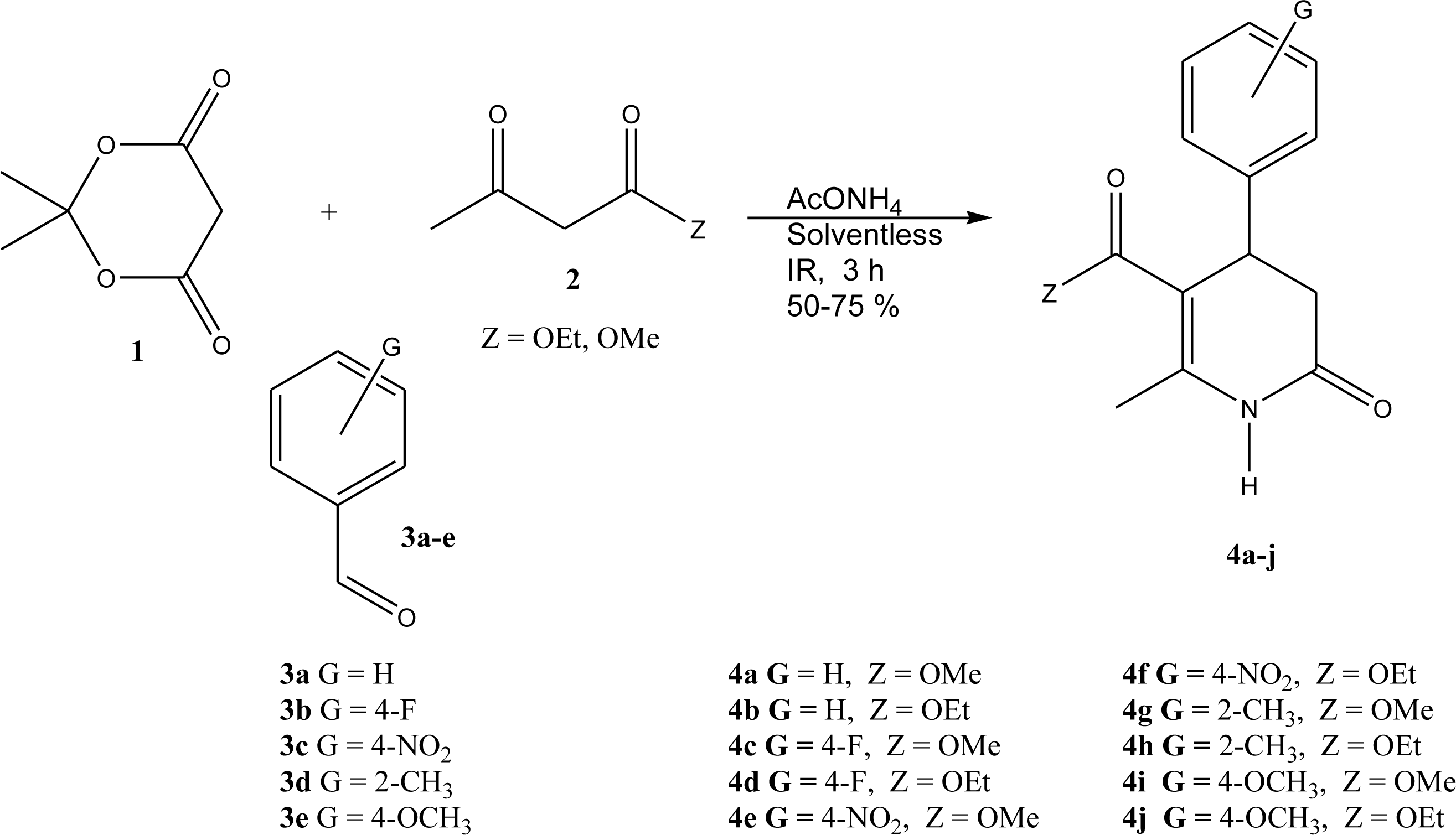
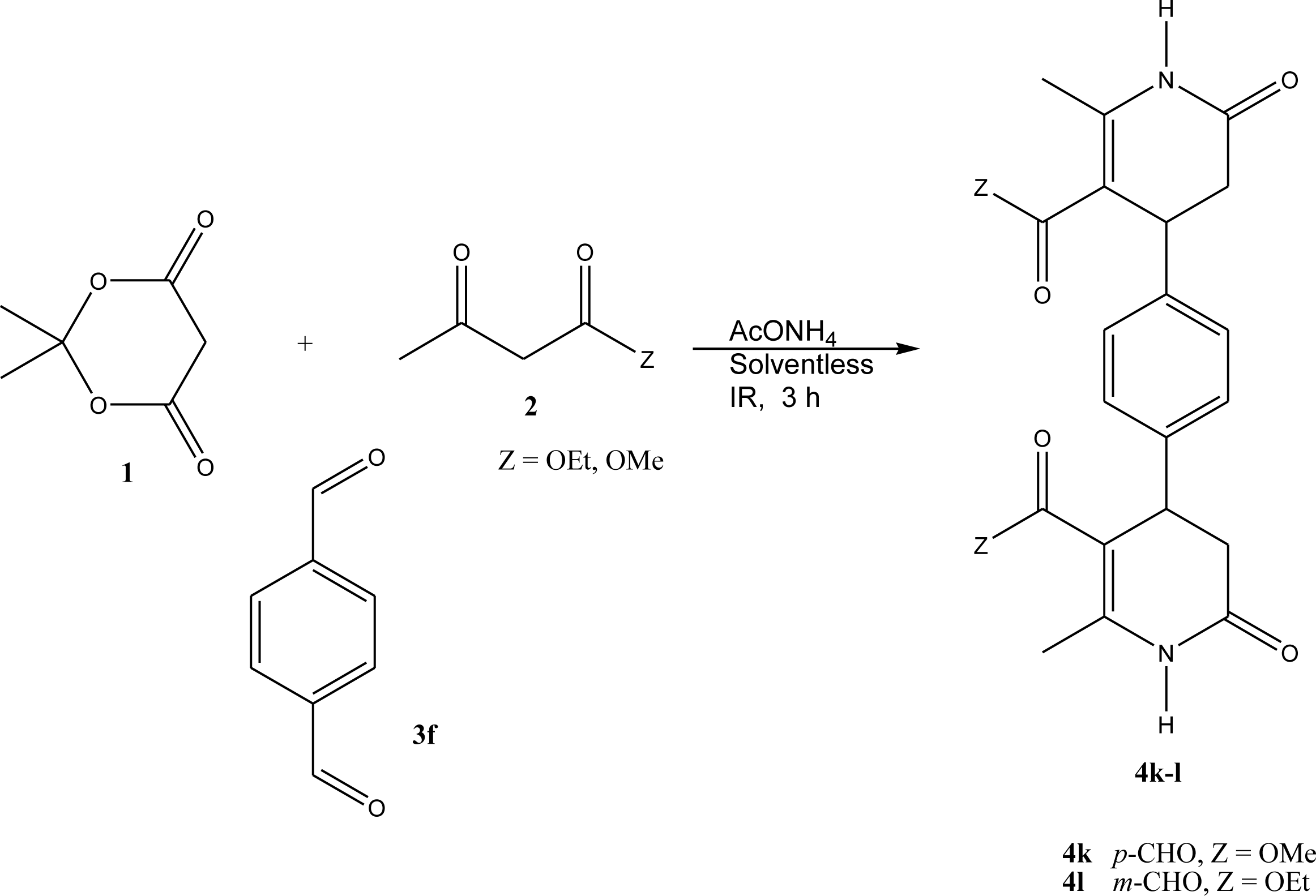
<p>As a part of our research program, in particular by the employment of infrared irradiation as the activating mode of the reaction, we have been interested in the production of heterocyclic compounds with important pharmacological effects [<xref ref-type="bibr" rid="b27-ijms-12-02641">27</xref>–<xref ref-type="bibr" rid="b30-ijms-12-02641">30</xref>], mainly using eco-conditions. Thus, the goal of this paper is to present a new mode for the synthesis of a set of ten 3,4-dihidro-2(1<italic>H</italic>)-pyridones (<bold>4a–j</bold>), in addition to the two novel <italic>bis</italic>-3,4-dihydro-2(1<italic>H</italic>)-pyridones (<bold>4k–l</bold>), using solvent-free conditions and for the first time the activation with infrared irradiation, for this purpose, as summarized in <xref ref-type="fig" rid="f1-ijms-12-02641">Schemes 1</xref>–<xref ref-type="fig" rid="f2-ijms-12-02641">2</xref>. This methodology must be considered as a green approach for the production of these classes of molecules, validating the employment of infrared irradiation as a nonclassical heating technique for many organic transformations.</p></sec>
<sec sec-type="results|discussion">
<label>2.</label>
<title>Results and Discussion</title>
<p>The results of this new and ecologically sound method for the production of this series of twelve 4-aryl substituted-5-alcoxycarbonyl-6-methyl-3,4-dihydro-2(1<italic>H</italic>)-pyridones, are summarized in <xref ref-type="table" rid="t1-ijms-12-02641">Table 1</xref>.</p>
<p>As it can be seen, a wide range of aldehydes undergo this reaction with moderate yields (50–75%) of the corresponding products. The known molecules (<bold>4a–j</bold>) (<xref ref-type="fig" rid="f1-ijms-12-02641">Scheme 1</xref>) were identified by correlating the corresponding physical and spectroscopic data with literature values [<xref ref-type="bibr" rid="b31-ijms-12-02641">31</xref>–<xref ref-type="bibr" rid="b36-ijms-12-02641">36</xref>]. Moreover, this procedure must be considered as a new and simple method with an appropriately green approach, since no solvent was employed, in addition to the use of infrared irradiation to give a clean and rapid activation of this multicomponent reaction.</p>
<p>In addition, an appropriate comparison with the corresponding thermal reactions was also performed using a heating mantle (neat, same time and temperature); no more than 40% of substrate transformation was achieved, maybe because heat transference by the thermal method is less effective.</p>
<p>The molecules were structurally confirmed by NMR and MS studies. The <sup>1</sup>H-NMR spectra of these compounds show the two proton on C-3 confirmed by a doublet of doublets at δ 4.4–4.7 corresponding to the proton on C-4 subject to the splitting by coupling with the protons C-3a,b. It is important to note that, in general, the corresponding signal of the proton C-4 appears as a doublet due to weak coupling with one of the protons C-3a, b (<italic>J</italic><sub>3b,4</sub> = 1.9 Hz and <italic>J</italic><sub>3a,4</sub> = 8.3 Hz). In this sense, the signals of the protons C-3 correspond to a doublet of doublets between δ 2.8–3.2. The <sup>13</sup>C-NMR spectra of the title compounds show the signals of the olefinic carbons at 104 and 148 assigned to C-5 and C-6, respectively. Other characteristic signals were observed at δ ≈ 169 and δ ≈ 166 corresponding to C-2 and C-8, respectively [<xref ref-type="bibr" rid="b35-ijms-12-02641">35</xref>].</p>
<p>Along with the assignment of the MS data of the compounds studied, the corresponding molecular ions M<sup>+</sup> were observed with significant relative abundances (25–83). In addition, a series of common fragments were observed, including [M-CH<sub>3</sub>]<sup>+</sup>, [M-OCH<sub>3</sub>]<sup>+</sup> and [M-OCH<sub>2</sub>CH<sub>3</sub>]<sup>+</sup>. Moreover, it is important to note that structures of the new <italic>bis</italic>-3,4-dihydropyridones (<bold>4k–l</bold>) (<xref ref-type="fig" rid="f2-ijms-12-02641">Scheme 2</xref>) were also confirmed by their high resolution mass spectrometry data.</p></sec>
<sec>
<label>3.</label>
<title>Experimental Section</title>
<p>The aldehydes, used as substrates, are commercially available (Sigma-Aldrich Chemical Co.) and were employed without further purification. The reactions were monitored by <italic>tlc</italic> on percolated (0.25 mm) Merck silica-gel 60-F<sub>254</sub> aluminum sheets. In general, the product visualization was done using a 254 and 365 nm UV lamp, I<sub>2</sub> or CeSO<sub>4</sub>·H<sub>2</sub>SO<sub>4</sub> 1%. Melting points, uncorrected, were measured using a Fisher Scientific apparatus. The mass spectrometric analyses (EIMS, HRMS) were performed using a JEOL MStation JMS-700 mass spectrometer with a source temperature of 230 °C, an ionization energy of 70 eV and an ionization trap current of 300 μA. In the HRMS studies, perfluorokerosene was used as internal mass reference. The corresponding range of mass measurements was set so as to include the two standard peaks that encompassed the sample peak of interest, in addition the mass resolution and scan speed used were 30,000 (10% valley) and 60 s/decade, respectively. The accurate mass was calculated as the average of the values measured in 5–10 scans, determined from the mass centroids of the M<sup>+•</sup> ion and the other peaks. The corresponding elemental composition data was calculated within a mass window of ±10 ppm from the measured accurate mass using the program installed in the data system. Thus the elemental composition with a mass that best fitted the measured value and that made chemical sense was assigned to the ion of interest. NMR experiments were carried out using a Varian Mercury-300 at 300 MHz and 75 MHz for hydrogen and carbon respectively, the solvents used were DMSO-d6 and CDCl<sub>3</sub>; TMS was employed as the internal reference. The infrared irradiation was performed using a Phillips IR lamp (375 W/220 V) integrated to an infrared reactor [<xref ref-type="bibr" rid="b27-ijms-12-02641">27</xref>–<xref ref-type="bibr" rid="b28-ijms-12-02641">28</xref>], designed by our research group [<xref ref-type="bibr" rid="b29-ijms-12-02641">29</xref>–<xref ref-type="bibr" rid="b30-ijms-12-02641">30</xref>] and validated by a wide number of applications summarized in a recent review [<xref ref-type="bibr" rid="b31-ijms-12-02641">31</xref>].</p>
<p><bold>General Method: (<xref ref-type="table" rid="t1-ijms-12-02641">Table 1</xref>, entry 4a–j)</bold> A mixture of Meldrum’s acid, methyl or ethyl acetoacetate, substituted benzaldehyde and ammonium acetate (1 mmol of each reagent), were thoroughly mixed in a round-bottomed flask (50 mL), equipped with a condenser. This mixture was exposed to infrared irradiation for 3 h. The reactions were monitored by <italic>tlc</italic> using <italic>n</italic>-hexane: ethyl acetate (80:20 or 60:40) as eluent. The purification of the products was carried out by means of preparative chromatography, using <italic>n</italic>-hexane/ethyl acetate (80:20 or 60:40) as eluent; the product was dissolved in acetone and then supported on percolated Merck silica-gel 60-F<sub>230</sub> glass sheets. For the production of <bold>4k–l</bold> were employed 2 mmol of Meldrum’s acid, methyl or ethyl acetoacetate, ammonium acetate and 1 mmol of the <italic>para</italic>-dialdehyde.</p>
<sec>
<title>4-(4’-Fluorophenyl)-5-methoxycarbonyl-6-methyl-3,4-dihydro-2(1<italic>H</italic>)-pyridone (4c)</title>
<p><bold>¹H-NMR</bold> (DMSO-<italic>d</italic>6/TMS, δ ppm): 9.95 (s, 1H, NH); 7.31–7.06 (m, 4H, Ar); 4.72 (d, 1H, H-4, <italic>J</italic> = 8.1 Hz); 4.20 (s, 3H, OCH<sub>3</sub>-9); 2.93 (dd, 1H, H-3a, <italic>J</italic> = 16.3 Hz, <italic>J</italic> = 8.1 Hz), 2.69 (d, 1H, H-3b); 2.33 (s, 3H, CH<sub>3</sub>-7).</p>
<p><bold><sup>13</sup>C-NMR</bold> (CDCl<sub>3</sub>-<italic>d</italic>6/TMS, δ ppm): 169.7 (C-2); 166.9 (C=O); 164.8 (C-4’); 148.8 (C-6); 138.5; 131.8; 128.4 (C-Ar); 106.6 (C-5); 52.1 (CH<sub>3</sub>-9); 38.3 (C-3); 36.6 (C-4); 18.9 (C-7).</p>
<p><bold>EI-MS m/z</bold> (relative abundance %): <sup>·</sup>263(25) M<sup>+</sup>; 204(100); 149(80) [M-114]<sup>+</sup>; 122(50) [M-141]<sup>+</sup>.</p></sec>
<sec>
<title>5-Ethoxycarbonyl 4-(4’-fluorophenyl)-6-methyl-3,4-dihydro-2(1<italic>H</italic>)-pyridone (4d)</title>
<p><bold>¹H-NMR</bold> (DMSO-<italic>d</italic>6/TMS, δ ppm): 9.93 (s, 1H, NH); 7.21–7.06 (m, 4H, Ar); 4.12 (dd, 1H, H-4, <italic>J</italic> = 7.4 Hz); 4.01 (q, 2H, CH<sub>2</sub>-9); 2.93(dd, 1H, H-3a, <italic>J</italic> = 16.0 Hz, <italic>J</italic> = 7.4 Hz), 2.70 (dd, 1H, H-3b, <italic>J</italic> = 16.0 Hz); 2.31 (s, 3H, CH<sub>3</sub>-7); 1.09 (t, 3H, CH<sub>3</sub>-10).</p>
<p><bold><sup>13</sup>C-NMR</bold> (DMSO-<italic>d</italic>6/TMS, δ ppm): 169.6 (C-2); 166.4 (C-8); 148.3 (C-6); 138.9 (C-4’); 128.4; 115.4; 115.0 (C-Ar); 104.9 (C-5); 59.4 (CH<sub>3</sub>-9); 38.2 (C-3), 36.7 (C-4); 18.3 (C-7); 14.1 (C-10).</p>
<p><bold>EI-MS m/z</bold> (relative abundance %): 277(75) M<sup>+</sup>; 248(85)[M-29]<sup>+</sup>; 231(55) [M-46]<sup>+</sup>; 204(100).</p></sec>
<sec>
<title>6-Methyl-4-(2’-methylphenyl)-5-methoxycarbonyl-3,4-dihydro-2(1<italic>H</italic>)-pyridone (4g)</title>
<p><bold>¹H-NMR</bold> (DMSO-<italic>d</italic>6/TMS, δ ppm): 9.95 (s, 1H, NH); 7.18–6.88 (m, 4H, Ar); 4.31 (d, 1H, H-4, <italic>J</italic> = 8.2 Hz); 3.49 (s, 3H, CH<sub>3</sub>-9); 2.95 (dd, 1H, H-3a, <italic>J</italic> = 16.3Hz; <italic>J</italic> = 8.2 Hz); 2.45 (d, 1H, H-3b, <italic>J</italic> = 16.3 Hz); 2.36(s, 3H, CH<sub>3</sub>-2’); 2.34 (s, 3H, CH<sub>3</sub>-7).</p>
<p><bold><sup>13</sup>C-NMR</bold> (DMSO<italic>d</italic>6, δ ppm): 169.5 (C-2); 169.9 (C-8); 148.9 (C-6); 140.4; 134.9; 130.8; 126.6; 126.2; 125.1 (C-Ar); 104.8 (C-5); 51.1 (CH<sub>3</sub>-9); 36.9 (C-3); 33.9 (C-4); 18.9(CH<sub>3</sub>-C-2’); 18.1 (C-7).</p>
<p><bold>EI-MS m/z</bold> (relative abundance %): 259(55) M<sup>+</sup>; 244(10) [M-15]<sup>+</sup>; 200(65); 115(40) [M-114]<sup>+</sup>; 43(100) [M-216]<sup>+</sup>.</p></sec>
<sec>
<title>5-Ethoxycarbonyl-6-methyl-4-(2’-methylphenyl)-3,4-dihydro-2(1<italic>H</italic>)-pyridone (4h)</title>
<p><bold>¹H-NMR</bold> (DMSO-<italic>d</italic>6/TMS, δ ppm): 9.94 (s, 1H, NH); 7.20–6.89 (m, 4H, Ar); 4.32 (dd, 1H, H-4, <italic>J</italic> = 8.2 Hz); 3.93 (q, 3H, OCH<sub>2</sub>-9); 2.94 (dd, 1H, H-3a, <italic>J</italic> = 16.4 Hz, <italic>J</italic> = 8.2 Hz), 2.40 (dd, 1H, H-3b, <italic>J</italic> = 16.4 Hz); 2.36 (s,3H, CH<sub>3</sub>-C2’); 2.34 (s, 3H, CH<sub>3</sub>-7); 1.39 (t, 3H, CH<sub>3</sub>-10).</p>
<p><bold><sup>13</sup>C-NMR</bold>. (DMSO-<italic>d</italic>6/TMS, δ ppm): 169.4 (C-2); 166.4 (C-8); 148.5 (C-6); 140.7; 134.8; 130.7; 126.5; 126.2; 125.1 (C-Ar); 105.1 (C-5); 59.4 (CH<sub>2</sub>-9); 38.2 (C-3); 33.8 (C-4); 18.9 (CH<sub>3</sub>-C2’); 18.2 (C-7); 14.0 (C-10).</p>
<p><bold>EI-MS m/z</bold> (relative abundance %): 273(80) M<sup>+</sup>; 258(10) [M-15]<sup>+</sup>; 244(50) [M-29]<sup>+</sup>; 212(80) [M-61]<sup>+</sup>; 200(100).</p></sec>
<sec>
<title>Phenylene-1’,4’-di-(4-(6-methyl-5-methoxycarbonyl-3,4-dihydro-2(1<italic>H</italic>)-pyridone)) (4k)</title>
<p><bold>¹H-NMR</bold> (DMSO-<italic>d</italic>6/TMS, δ ppm): 9.97 (s, 1H, NH); 7.41–6.93 (m, 4H, Ar); 4.17–3.94 (m, 6H, H-4, OCH<sub>2</sub>-9); 2.51 (dd, 1H, H-3a); 2.21 (s, 3H, CH<sub>3</sub>-7); 1.07 (t, 3H, CH<sub>3</sub>-10).</p>
<p><bold><sup>13</sup>C-NMR</bold>. (DMSO-<italic>d</italic>6/TMS, δ ppm): 169.6 (C-2); 163.7 (C-8); 148.0 (C-6); 140.9; 134.8; 128.2; 127.0; 126.7; (C-Ar); 104.9 (C-5); 59.3 (CH<sub>2</sub>-9); 38.6 (C-3); 37.3 (C-4); 18.9 (CH<sub>3</sub>-C2’); 18.2 (C-7); 14.1 (C-10).</p>
<p><bold>EI-MS m/z</bold> (relative abundance %): 412(0) M<sup>+</sup>; 381(5) [M-31]<sup>+</sup>; 354(7) [M-61]<sup>+</sup>; 245(20) [C<sub>14</sub>H<sub>15</sub>O<sub>3</sub>N]<sup>+</sup>; 169(15)[C<sub>8</sub>H<sub>10</sub>O<sub>2</sub>N]<sup>+</sup>.</p>
<p><bold>HR-MS:</bold> observed 412.1628, expected 412.1634, C<sub>22</sub>H<sub>24</sub>N<sub>2</sub>O<sub>6</sub>.</p></sec>
<sec>
<title>Phenylene-1’,4’-di-(4-(5-ethoxycarbonyl-6-methyl-3,4-dihydro-2(1<italic>H</italic>)-pyridone)) (4l)</title>
<p><bold>¹H-NMR</bold> (DMSO-<italic>d</italic>6/TMS, δ ppm): 9.84 (s, 1H, NH); 7.40–6.90 (m, 4H, Ar); 4.20–3.90 (m, 6H, H-4, OCH<sub>2</sub>-9); 2.94 (dd, 1H, H-3a); 2.25 (s, 3H, CH<sub>3</sub>-7); 1.05 (t, 3H, CH<sub>3</sub>-10).</p>
<p><bold><sup>13</sup>C-NMR</bold>. (DMSO-<italic>d</italic>6/TMS, δ ppm): 169.7 (C-2); 167.5 (C-8); 148.0 (C-6); 140.9; 134.8; 128.3; 127.0; 126.7; (C-Ar); 104.9 (C-5); 59.4 (CH<sub>2</sub>-9); 38.3 (C-3); 36.9 (C-4); 18.9 (CH<sub>3</sub>-C2’); 18.2 (C-7); 14.1 (C-10).</p>
<p><bold>EI-MS m/z</bold> (relative abundance %): 440(5) M<sup>+</sup>; 396(4) [M-OEt]<sup>+</sup>; 367(5) [M-CO<sub>2</sub>Et]<sup>+</sup>; 259(10) [M-C<sub>9</sub>H<sub>12</sub>O<sub>2</sub>N]<sup>+</sup>; 182(5)[C<sub>9</sub>H<sub>12</sub>O<sub>2</sub>N]<sup>+</sup>.</p>
<p><bold>HR-MS:</bold> observed 440.1941, expected 440.1947, C<sub>24</sub>H<sub>28</sub>N<sub>2</sub>O<sub>6</sub>.</p></sec></sec>
<sec sec-type="conclusions">
<label>4.</label>
<title>Conclusions</title>
<p>This procedure for the production of 3,4-dihydro-2(1<italic>H</italic>)-pyridones should be regarded as a new and simple method with an appropriately green approach, since no solvent was employed. This, in addition to the use of infrared irradiation, provides a clean and rapid mode for the activation of this multicomponent reaction. Finally, this work is another contribution detailing the employment of infrared irradiation as a nonclassical heating technique for the transformation of many organic molecules.</p></sec></body>
<back>
<ack>
<p>To DGAPA-UNAM grant PAPIIT IN228010 for financial support; O. Noguez to CONACyT for a PHD scholarship (grant-191585) and to Red Macro Universidades for a scholarship to Osnieski Martin.</p></ack>
<ref-list>
<title>References</title>
<ref id="b1-ijms-12-02641"><label>1.</label><citation citation-type="journal"><person-group person-group-type="author"><name><surname>Tundo</surname><given-names>P</given-names></name><name><surname>Anastas</surname><given-names>P</given-names></name><name><surname>Black</surname><given-names>DC</given-names></name><name><surname>Breen</surname><given-names>J</given-names></name><name><surname>Collins</surname><given-names>T</given-names></name><name><surname>Memoli</surname><given-names>S</given-names></name><name><surname>Miyamoto</surname><given-names>J</given-names></name><name><surname>Polyakoff</surname><given-names>M</given-names></name><name><surname>Tumas</surname><given-names>W</given-names></name></person-group><article-title>Synthetic pathways and processes in green chemistry. Introductory overview</article-title><source>Pure Appl. Chem</source><year>2000</year><volume>72</volume><fpage>1207</fpage><lpage>1228</lpage><pub-id pub-id-type="doi">10.1351/pac200072071207</pub-id></citation></ref>
<ref id="b2-ijms-12-02641"><label>2.</label><citation citation-type="book"><person-group person-group-type="author"><name><surname>Anastas</surname><given-names>PT</given-names></name><name><surname>Williamson</surname><given-names>TC</given-names></name></person-group><source>Green Chemistry, Frontiers in Benign Chemical Syntheses and Processes</source><publisher-name>Oxford University Press</publisher-name><publisher-loc>Great Britain, UK</publisher-loc><year>1998</year><fpage>2</fpage></citation></ref>
<ref id="b3-ijms-12-02641"><label>3.</label><citation citation-type="journal"><person-group person-group-type="author"><name><surname>Wender</surname><given-names>PA</given-names></name><name><surname>Handy</surname><given-names>ST</given-names></name><name><surname>Wright</surname><given-names>DL</given-names></name></person-group><article-title>Towards the ideal synthesis</article-title><source>Chem Ind</source><year>1997</year><fpage>765</fpage><lpage>769</lpage></citation></ref>
<ref id="b4-ijms-12-02641"><label>4.</label><citation citation-type="book"><person-group person-group-type="author"><name><surname>Zhu</surname><given-names>J</given-names></name><name><surname>Bienaymé</surname><given-names>H</given-names></name></person-group><source>Multicomponent Reactions</source><publisher-name>Wiley-VCH</publisher-name><publisher-loc>Weinheim, Germany</publisher-loc><year>2004</year></citation></ref>
<ref id="b5-ijms-12-02641"><label>5.</label><citation citation-type="journal"><person-group person-group-type="author"><name><surname>Pihlaja</surname><given-names>K</given-names></name><name><surname>Seilo</surname><given-names>M</given-names></name></person-group><article-title>The acidity and general base catalyzed hydrolysis of Meldrum’s acid and its methyl derivates</article-title><source>Acta Chem. Scand</source><year>1969</year><volume>23</volume><fpage>3003</fpage><lpage>3010</lpage><pub-id pub-id-type="doi">10.3891/acta.chem.scand.23-3003</pub-id></citation></ref>
<ref id="b6-ijms-12-02641"><label>6.</label><citation citation-type="journal"><person-group person-group-type="author"><name><surname>Ochoa</surname><given-names>E</given-names></name><name><surname>Suárez</surname><given-names>M</given-names></name><name><surname>Verdecia</surname><given-names>Y</given-names></name><name><surname>Pita</surname><given-names>B</given-names></name><name><surname>Matín</surname><given-names>N</given-names></name><name><surname>Quinteiro</surname><given-names>M</given-names></name><name><surname>Seoane</surname><given-names>C</given-names></name><name><surname>Soto</surname><given-names>JL</given-names></name><name><surname>Duque</surname><given-names>J</given-names></name><name><surname>Pomés</surname><given-names>R</given-names></name></person-group><article-title>Structural study of 3,4-dihydropyridones and furo[3,4-b]-2(1<italic>H</italic>)-pyridones as potentional calcium channel modulators</article-title><source>Tetrahedron</source><year>1998</year><volume>54</volume><fpage>12409</fpage><lpage>12420</lpage><pub-id pub-id-type="doi">10.1016/S0040-4020(98)00760-1</pub-id></citation></ref>
<ref id="b7-ijms-12-02641"><label>7.</label><citation citation-type="book"><person-group person-group-type="author"><name><surname>Smith</surname><given-names>D</given-names></name><name><surname>Sammes</surname><given-names>PG</given-names></name></person-group><source>Comprehensive Organic Chemistry</source><publisher-name>Pergamon</publisher-name><publisher-loc>Oxford, UK</publisher-loc><year>1979</year><volume>4</volume><fpage>3</fpage></citation></ref>
<ref id="b8-ijms-12-02641"><label>8.</label><citation citation-type="book"><person-group person-group-type="author"><name><surname>Bayley</surname><given-names>T</given-names></name><name><surname>Goe</surname><given-names>G</given-names></name><name><surname>Scriven</surname><given-names>E</given-names></name></person-group><source>Heterocyclic Compounds</source><person-group person-group-type="editor"><name><surname>Newkome</surname><given-names>GRW</given-names></name></person-group><publisher-name>Wiley</publisher-name><publisher-loc>New York, NY, USA</publisher-loc><year>1984</year><volume>14</volume><fpage>1</fpage></citation></ref>
<ref id="b9-ijms-12-02641"><label>9.</label><citation citation-type="book"><person-group person-group-type="author"><name><surname>McKillop</surname><given-names>A</given-names></name></person-group><source>Comprehensive Heterocyclic Chemistry</source><person-group person-group-type="editor"><name><surname>McKillop</surname><given-names>A</given-names></name><name><surname>Boulton</surname><given-names>A</given-names></name></person-group><publisher-name>Pergamon</publisher-name><publisher-loc>Oxford, UK</publisher-loc><year>1984</year><volume>2</volume><fpage>67</fpage></citation></ref>
<ref id="b10-ijms-12-02641"><label>10.</label><citation citation-type="journal"><person-group person-group-type="author"><name><surname>Bristol</surname><given-names>JA</given-names></name><name><surname>Sircar</surname><given-names>I</given-names></name><name><surname>Moos</surname><given-names>WH</given-names></name><name><surname>Evans</surname><given-names>DB</given-names></name><name><surname>Weishaar</surname><given-names>RE</given-names></name></person-group><article-title>Cardiotonic agents 1.4,5-dyhidro-6-[4-(1<italic>H</italic>-imidazol-1-yl)phenyl]-3(2<italic>H</italic>)-pyridazinones: Novel positive inotropic agents for the treatment of congestive heart failure</article-title><source>J. Med. Chem</source><year>1984</year><volume>27</volume><fpage>1099</fpage><lpage>1101</lpage><pub-id pub-id-type="doi">10.1021/jm00375a001</pub-id><pub-id pub-id-type="pmid">6471063</pub-id></citation></ref>
<ref id="b11-ijms-12-02641"><label>11.</label><citation citation-type="journal"><person-group person-group-type="author"><name><surname>Lemke</surname><given-names>JV</given-names></name></person-group><article-title>New inotropic drugs: amrinone and milrinone</article-title><source>J. Med. Assoc. Ga</source><year>1987</year><volume>76</volume><fpage>854</fpage><lpage>857</lpage><pub-id pub-id-type="pmid">3694072</pub-id></citation></ref>
<ref id="b12-ijms-12-02641"><label>12.</label><citation citation-type="journal"><person-group person-group-type="author"><name><surname>Iven</surname><given-names>H</given-names></name><name><surname>Brasch</surname><given-names>M</given-names></name><name><surname>Armah</surname><given-names>BI</given-names></name></person-group><article-title>Electrophysiologic effects of saterinone and milrinone in the isolated guinea pig myocardium</article-title><source>Arneim. Forcg. Drugs Res</source><year>1988</year><volume>38</volume><fpage>1298</fpage><lpage>1302</lpage></citation></ref>
<ref id="b13-ijms-12-02641"><label>13.</label><citation citation-type="journal"><person-group person-group-type="author"><name><surname>Schultz</surname><given-names>AG</given-names></name></person-group><article-title>Camptothecin</article-title><source>Chem. Rev</source><year>1973</year><volume>73</volume><fpage>385</fpage><lpage>405</lpage><pub-id pub-id-type="doi">10.1021/cr60284a004</pub-id><pub-id pub-id-type="pmid">4578778</pub-id></citation></ref>
<ref id="b14-ijms-12-02641"><label>14.</label><citation citation-type="journal"><person-group person-group-type="author"><name><surname>Kelly</surname><given-names>TR</given-names></name><name><surname>Bell</surname><given-names>SH</given-names></name><name><surname>Osashi</surname><given-names>N</given-names></name><name><surname>Armstrong-Chong</surname><given-names>RJ</given-names></name></person-group><article-title>Synthesis of (+)-fredericamycin A</article-title><source>J. Am. Chem. Soc</source><year>1988</year><volume>110</volume><fpage>6471</fpage><lpage>6480</lpage><pub-id pub-id-type="doi">10.1021/ja00227a030</pub-id></citation></ref>
<ref id="b15-ijms-12-02641"><label>15.</label><citation citation-type="journal"><person-group person-group-type="author"><name><surname>Curran</surname><given-names>DP</given-names></name><name><surname>Liu</surname><given-names>H</given-names></name></person-group><article-title>New 4 + 1 radical annulations. A formal total synthesis of (+)-camptothecin</article-title><source>J. Am. Chem. Soc</source><year>1992</year><volume>114</volume><fpage>5863</fpage><lpage>5864</lpage><pub-id pub-id-type="doi">10.1021/ja00040a060</pub-id></citation></ref>
<ref id="b16-ijms-12-02641"><label>16.</label><citation citation-type="journal"><person-group person-group-type="author"><name><surname>Cox</surname><given-names>RJ</given-names></name><name><surname>O’Hagan</surname><given-names>D</given-names></name></person-group><article-title>Synthesis of isotopically labelled 3-amino-2-phenylpropionic acid and its role as a precursor in the biosynthesis of tenellin and tropic acid</article-title><source>J. Chem. Soc. Perkin Trans</source><year>1991</year><volume>1</volume><fpage>2537</fpage><lpage>2540</lpage></citation></ref>
<ref id="b17-ijms-12-02641"><label>17.</label><citation citation-type="journal"><person-group person-group-type="author"><name><surname>Williams</surname><given-names>D</given-names></name><name><surname>Lowder</surname><given-names>P</given-names></name><name><surname>Gu</surname><given-names>YG</given-names></name></person-group><article-title>Studies toward funiculosin. Intramolecular carbonyl condensations using carboxamidimidazolide intermediates</article-title><source>Tetrahedron Lett</source><year>1997</year><volume>38</volume><fpage>327</fpage><lpage>330</lpage><pub-id pub-id-type="doi">10.1016/S0040-4039(96)02343-X</pub-id></citation></ref>
<ref id="b18-ijms-12-02641"><label>18.</label><citation citation-type="journal"><person-group person-group-type="author"><name><surname>Kozikowski</surname><given-names>AP</given-names></name><name><surname>Campiani</surname><given-names>G</given-names></name><name><surname>Sun</surname><given-names>LQ</given-names></name><name><surname>Wang</surname><given-names>S</given-names></name><name><surname>Saxena</surname><given-names>A</given-names></name><name><surname>Doctor</surname><given-names>BP</given-names></name></person-group><article-title>Identification of a more potent analogue of the naturally occurring alkaloid Huperzine a. Predictive molecular modeling of its interactions with ACLE</article-title><source>J. Am. Chem. Soc</source><year>1996</year><volume>118</volume><fpage>11357</fpage><lpage>11362</lpage><pub-id pub-id-type="doi">10.1021/ja9622822</pub-id></citation></ref>
<ref id="b19-ijms-12-02641"><label>19.</label><citation citation-type="journal"><person-group person-group-type="author"><name><surname>Brickner</surname><given-names>S</given-names></name></person-group><article-title>Multidrug-resistant bacterial infections: Driving the search for new antibiotics</article-title><source>Chem Ind</source><year>1997</year><fpage>131</fpage><lpage>135</lpage></citation></ref>
<ref id="b20-ijms-12-02641"><label>20.</label><citation citation-type="journal"><person-group person-group-type="author"><name><surname>Murray</surname><given-names>T</given-names></name><name><surname>Zimmerman</surname><given-names>S</given-names></name></person-group><article-title>7-amido-1,8-naphthyridines as hydrogen bonding units for the complexation of guanine derivates. The role of 2-alkoxyl groups in decreasing binding affinity</article-title><source>Tetrahedron Lett</source><year>1995</year><volume>36</volume><fpage>7627</fpage><lpage>7630</lpage><pub-id pub-id-type="doi">10.1016/0040-4039(95)01586-7</pub-id></citation></ref>
<ref id="b21-ijms-12-02641"><label>21.</label><citation citation-type="book"><person-group person-group-type="author"><name><surname>Jones</surname><given-names>G</given-names></name><name><surname>Katritzky</surname><given-names>A</given-names></name><name><surname>Rees</surname><given-names>CW</given-names></name><name><surname>Scriven</surname><given-names>EF</given-names></name></person-group><source>Comprehensive Heterocyclic Chemistry II</source><publisher-name>Pergamon Press</publisher-name><publisher-loc>Oxford, UK</publisher-loc><year>1996</year></citation></ref>
<ref id="b22-ijms-12-02641"><label>22.</label><citation citation-type="journal"><person-group person-group-type="author"><name><surname>Mohrle</surname><given-names>H</given-names></name><name><surname>Weber</surname><given-names>H</given-names></name></person-group><article-title>Oxidation von 1-methyl-und 1,3-dimethylpyridium salzen: überpyridone—I</article-title><source>Tetrahedron</source><year>1970</year><volume>26</volume><fpage>2953</fpage><lpage>2958</lpage><pub-id pub-id-type="doi">10.1016/S0040-4020(01)92875-3</pub-id></citation></ref>
<ref id="b23-ijms-12-02641"><label>23.</label><citation citation-type="journal"><person-group person-group-type="author"><name><surname>Jones</surname><given-names>G</given-names></name></person-group><article-title>The Knoevenagel condensation</article-title><source>Org. React</source><year>1967</year><volume>15</volume><fpage>204</fpage><lpage>582</lpage></citation></ref>
<ref id="b24-ijms-12-02641"><label>24.</label><citation citation-type="journal"><person-group person-group-type="author"><name><surname>Alberola</surname><given-names>A</given-names></name><name><surname>Calvo</surname><given-names>LA</given-names></name><name><surname>González-Ortega</surname><given-names>A</given-names></name><name><surname>Sañudo Ruíz</surname><given-names>MC</given-names></name><name><surname>Yustos</surname><given-names>P</given-names></name><name><surname>García</surname><given-names>S</given-names></name><name><surname>García-Rodríguez</surname><given-names>E</given-names></name></person-group><article-title>Regioselective synthesis of 2(1<italic>H</italic>)-pyridones from β–aminoenones and malonitrile. Reaction mechanism</article-title><source>J. Org. Chem</source><year>1999</year><volume>64</volume><fpage>9493</fpage><lpage>9498</lpage><pub-id pub-id-type="doi">10.1021/jo991121o</pub-id></citation></ref>
<ref id="b25-ijms-12-02641"><label>25.</label><citation citation-type="journal"><person-group person-group-type="author"><name><surname>Brun</surname><given-names>E</given-names></name><name><surname>Gil</surname><given-names>S</given-names></name><name><surname>Mestres</surname><given-names>R</given-names></name><name><surname>Parra</surname><given-names>M</given-names></name></person-group><article-title>A new synthetic method to 2-pyridones</article-title><source>Synthesis</source><year>2000</year><volume>2000</volume><fpage>273</fpage><lpage>280</lpage><pub-id pub-id-type="doi">10.1055/s-2000-6254</pub-id></citation></ref>
<ref id="b26-ijms-12-02641"><label>26.</label><citation citation-type="journal"><person-group person-group-type="author"><name><surname>Paulvannan</surname><given-names>K</given-names></name><name><surname>Chen</surname><given-names>T</given-names></name></person-group><article-title>Solid-phase synthesis of 1,2,3,4-tetrahydro-2 pyridones via aza-annulation of enamines</article-title><source>J. Org. Chem</source><year>2000</year><volume>65</volume><fpage>6160</fpage><lpage>6166</lpage><pub-id pub-id-type="doi">10.1021/jo000676c</pub-id><pub-id pub-id-type="pmid">10987954</pub-id></citation></ref>
<ref id="b27-ijms-12-02641"><label>27.</label><citation citation-type="journal"><person-group person-group-type="author"><name><surname>Gómez-Pliego</surname><given-names>R</given-names></name><name><surname>Ramírez-San</surname><given-names>JE</given-names></name><name><surname>Miranda</surname><given-names>R</given-names></name><name><surname>Villalobos-Molina</surname><given-names>R</given-names></name><name><surname>Delgado</surname><given-names>F</given-names></name><name><surname>Osnaya</surname><given-names>R</given-names></name><name><surname>Trujillo-Ferrara</surname><given-names>JG</given-names></name></person-group><article-title>Vasodilator effects of <italic>bis</italic>-dihydropyridines structurally related to nifedipine</article-title><source>Med. Chem</source><year>2006</year><volume>2</volume><fpage>527</fpage><lpage>534</lpage><pub-id pub-id-type="doi">10.2174/157340606778250243</pub-id><pub-id pub-id-type="pmid">17017993</pub-id></citation></ref>
<ref id="b28-ijms-12-02641"><label>28.</label><citation citation-type="journal"><person-group person-group-type="author"><name><surname>Velasco-Bejarano</surname><given-names>B</given-names></name><name><surname>Trujillo-Ferrara</surname><given-names>J</given-names></name><name><surname>Miranda</surname><given-names>R</given-names></name></person-group><article-title>Preparation of apoptotic inducer, 2,2-diphrnyl-1,3,2-oxazaborolidin-5-ones, under alkaline conditions</article-title><source>Synlett</source><year>2007</year><volume>6</volume><fpage>921</fpage><lpage>924</lpage></citation></ref>
<ref id="b29-ijms-12-02641"><label>29.</label><citation citation-type="journal"><person-group person-group-type="author"><name><surname>Velasco</surname><given-names>B</given-names></name><name><surname>Trujillo-Ferrara</surname><given-names>JG</given-names></name><name><surname>Fabila Castillo</surname><given-names>LH</given-names></name><name><surname>Miranda</surname><given-names>R</given-names></name><name><surname>Sánchez-Torres</surname><given-names>LE</given-names></name></person-group><article-title><italic>In vitro</italic> apoptotic activity of 2,2-diphenyl-1,3,2-oxazaborolidin-5-ones in L58178Y cells</article-title><source>Life Sci</source><year>2007</year><volume>80</volume><fpage>1007</fpage><lpage>1013</lpage><pub-id pub-id-type="doi">10.1016/j.lfs.2006.11.034</pub-id><pub-id pub-id-type="pmid">17208255</pub-id></citation></ref>
<ref id="b30-ijms-12-02641"><label>30.</label><citation citation-type="journal"><person-group person-group-type="author"><name><surname>Noguez</surname><given-names>O</given-names></name><name><surname>García</surname><given-names>A</given-names></name><name><surname>Ibarra</surname><given-names>C</given-names></name><name><surname>Cabrera</surname><given-names>A</given-names></name><name><surname>Aceves</surname><given-names>JM</given-names></name><name><surname>Miranda</surname><given-names>R</given-names></name></person-group><article-title>Green synthesis of <italic>bis</italic>-Biginelli esters, with vasodilatory effects, their mass spectrometric and physical</article-title><source>Trends Org. Chem</source><year>2009</year><volume>13</volume><fpage>75</fpage><lpage>82</lpage></citation></ref>
<ref id="b31-ijms-12-02641"><label>31.</label><citation citation-type="journal"><person-group person-group-type="author"><name><surname>Miranda</surname><given-names>R</given-names></name><name><surname>Noguez</surname><given-names>O</given-names></name><name><surname>Velasco</surname><given-names>B</given-names></name><name><surname>Arroyo</surname><given-names>G</given-names></name><name><surname>Penieres</surname><given-names>G</given-names></name><name><surname>Martínez</surname><given-names>JO</given-names></name><name><surname>Delgado</surname><given-names>F</given-names></name></person-group><article-title>Irradiación infrarroja una alternativa para la activación de reacciones y su contribución a la química verde</article-title><source>Educ. Quím</source><year>2009</year><volume>20</volume><fpage>421</fpage><lpage>425</lpage></citation></ref>
<ref id="b32-ijms-12-02641"><label>32.</label><citation citation-type="journal"><person-group person-group-type="author"><name><surname>Suárez</surname><given-names>M</given-names></name><name><surname>Verdecia</surname><given-names>Y</given-names></name><name><surname>Ochoa</surname><given-names>E</given-names></name><name><surname>Salfrán</surname><given-names>E</given-names></name><name><surname>Morán</surname><given-names>L</given-names></name><name><surname>Martín</surname><given-names>N</given-names></name><name><surname>Martínez</surname><given-names>R</given-names></name><name><surname>Quinteiro</surname><given-names>M</given-names></name><name><surname>Seoane</surname><given-names>C</given-names></name><name><surname>Soto</surname><given-names>JL</given-names></name><name><surname>Novoa</surname><given-names>H</given-names></name><name><surname>Blaton</surname><given-names>N</given-names></name><name><surname>Peeters</surname><given-names>OM</given-names></name><name><surname>de Ranter</surname><given-names>C</given-names></name></person-group><article-title>Synthesis and structural study of 3,4-dihydro-2(1<italic>H</italic>)-pyridones and isoxazolo[5,4-b]pyridin-6(7<italic>H</italic>)-ones</article-title><source>Eur J Org Chem</source><year>2000</year><fpage>2079</fpage><lpage>2088</lpage></citation></ref>
<ref id="b33-ijms-12-02641"><label>33.</label><citation citation-type="journal"><person-group person-group-type="author"><name><surname>Martínez</surname><given-names>R</given-names></name><name><surname>Suárez</surname><given-names>M</given-names></name><name><surname>Martín</surname><given-names>N</given-names></name><name><surname>Ochoa</surname><given-names>E</given-names></name><name><surname>Seoane</surname><given-names>C</given-names></name><name><surname>Verdecia</surname><given-names>Y</given-names></name></person-group><article-title>Mass spectral fragmentation patterns of new 5-acetyl-4-aryl-6-methyl-2(1<italic>H</italic>) pyridones</article-title><source>Rapid Commun. Mass Espectrom</source><year>1999</year><volume>13</volume><fpage>2180</fpage><lpage>2182</lpage><pub-id pub-id-type="doi">10.1002/(SICI)1097-0231(19991115)13:21&lt;2180::AID-RCM772&gt;3.0.CO;2-S</pub-id></citation></ref>
<ref id="b34-ijms-12-02641"><label>34.</label><citation citation-type="journal"><person-group person-group-type="author"><name><surname>Suárez</surname><given-names>M</given-names></name><name><surname>Martínez-Álvarez</surname><given-names>R</given-names></name><name><surname>Martín</surname><given-names>N</given-names></name><name><surname>Verdecia</surname><given-names>Y</given-names></name><name><surname>Ochoa</surname><given-names>E</given-names></name><name><surname>Alba</surname><given-names>L</given-names></name><name><surname>Seoane</surname><given-names>C</given-names></name><name><surname>Kayali</surname><given-names>N</given-names></name></person-group><article-title>Electrospray ionisation and ion-trap fragmentation of substituted 3,4-dihydro-2(1<italic>H</italic>)-pyridin-2-ones</article-title><source>Rapid Commun. Mass Espectrom</source><year>2002</year><volume>16</volume><fpage>740</fpage><lpage>754</lpage><pub-id pub-id-type="doi">10.1002/rcm.643</pub-id></citation></ref>
<ref id="b35-ijms-12-02641"><label>35.</label><citation citation-type="journal"><person-group person-group-type="author"><name><surname>Molero</surname><given-names>D</given-names></name><name><surname>Suárez</surname><given-names>M</given-names></name><name><surname>Martínez-Álvarez</surname><given-names>R</given-names></name><name><surname>Verdecia</surname><given-names>Y</given-names></name><name><surname>Martín</surname><given-names>N</given-names></name><name><surname>Seoane</surname><given-names>C</given-names></name><name><surname>Ochoa</surname><given-names>E</given-names></name></person-group><article-title><sup>1</sup>H and <sup>13</sup>C spectral assignment of 2(1<italic>H</italic>)-pyridin-2-ones derivates</article-title><source>Magn. Reson. Chem</source><year>2004</year><volume>42</volume><fpage>704</fpage><lpage>708</lpage><pub-id pub-id-type="doi">10.1002/mrc.1385</pub-id><pub-id pub-id-type="pmid">15248259</pub-id></citation></ref>
<ref id="b36-ijms-12-02641"><label>36.</label><citation citation-type="journal"><person-group person-group-type="author"><name><surname>Morales</surname><given-names>A</given-names></name><name><surname>Ochoa</surname><given-names>E</given-names></name><name><surname>Suárez</surname><given-names>M</given-names></name><name><surname>González</surname><given-names>L</given-names></name><name><surname>Verdecia</surname><given-names>Y</given-names></name><name><surname>Martín</surname><given-names>N</given-names></name><name><surname>Quinteiro</surname><given-names>M</given-names></name><name><surname>Seoane</surname><given-names>C</given-names></name><name><surname>Soto</surname><given-names>JL</given-names></name></person-group><article-title>Novel hexahydrofuro [3,4-b]-2(1<italic>H</italic>)-pyridones from 4-aryl substituted 5-alkoxycarbonyl-6-methyl-3,4-dihydropyridones</article-title><source>J. Heterocyclic Chem</source><year>1996</year><volume>33</volume><fpage>103</fpage><lpage>107</lpage><pub-id pub-id-type="doi">10.1002/jhet.5570330118</pub-id></citation></ref></ref-list>
<sec sec-type="display-objects">
<title>Figures and Table</title>
<fig id="f1-ijms-12-02641" position="float">
<label>Scheme 1.</label>
<graphic xlink:href="ijms-12-02641f1.gif"/></fig>
<fig id="f2-ijms-12-02641" position="float">
<label>Scheme 2.</label>
<graphic xlink:href="ijms-12-02641f2.gif"/></fig>
<table-wrap id="t1-ijms-12-02641" position="float">
<label>Table 1.</label>
<caption>
<p>Dihydropyridones (<bold>4a–j</bold>) produced under infrared irradiation<xref ref-type="table-fn" rid="tfn1-ijms-12-02641"><sup>a</sup></xref>.</p></caption>
<table frame="hsides" rules="groups">
<thead>
<tr>
<th align="center" valign="middle"><bold>Compound</bold></th>
<th align="center" valign="middle"><bold>Melting point<xref ref-type="table-fn" rid="tfn2-ijms-12-02641"><sup>[b]</sup></xref> (°C)</bold></th>
<th align="center" valign="middle"><bold>Yield<xref ref-type="table-fn" rid="tfn3-ijms-12-02641"><sup>[c]</sup></xref>%</bold></th></tr></thead>
<tbody>
<tr>
<td align="center" valign="top"><bold>4a</bold></td>
<td align="center" valign="top">197–198(197–198) [<xref ref-type="bibr" rid="b12-ijms-12-02641">12</xref>,<xref ref-type="bibr" rid="b28-ijms-12-02641">28</xref>]</td>
<td align="center" valign="top">75</td></tr>
<tr>
<td align="center" valign="top"><bold>4b</bold></td>
<td align="center" valign="top">168–171</td>
<td align="center" valign="top">75</td></tr>
<tr>
<td align="center" valign="top"><bold>4c</bold></td>
<td align="center" valign="top">206–208(207–209) [<xref ref-type="bibr" rid="b12-ijms-12-02641">12</xref>,<xref ref-type="bibr" rid="b28-ijms-12-02641">28</xref>]</td>
<td align="center" valign="top">75</td></tr>
<tr>
<td align="center" valign="top"><bold>4d</bold></td>
<td align="center" valign="top">184–186(184–186) [<xref ref-type="bibr" rid="b29-ijms-12-02641">29</xref>]</td>
<td align="center" valign="top">70</td></tr>
<tr>
<td align="center" valign="top"><bold>4e</bold></td>
<td align="center" valign="top">200–202(201–201) [<xref ref-type="bibr" rid="b29-ijms-12-02641">29</xref>]</td>
<td align="center" valign="top">75</td></tr>
<tr>
<td align="center" valign="top"><bold>4f</bold></td>
<td align="center" valign="top">130–133</td>
<td align="center" valign="top">60</td></tr>
<tr>
<td align="center" valign="top"><bold>4g</bold></td>
<td align="center" valign="top">oil</td>
<td align="center" valign="top">70</td></tr>
<tr>
<td align="center" valign="top"><bold>4h</bold></td>
<td align="center" valign="top">oil</td>
<td align="center" valign="top">60</td></tr>
<tr>
<td align="center" valign="top"><bold>4i</bold></td>
<td align="center" valign="top">180–183</td>
<td align="center" valign="top">55</td></tr>
<tr>
<td align="center" valign="top"><bold>4j</bold></td>
<td align="center" valign="top">185–188</td>
<td align="center" valign="top">50</td></tr>
<tr>
<td align="center" valign="top"><bold>4k</bold></td>
<td align="center" valign="top">oil</td>
<td align="center" valign="top">65</td></tr>
<tr>
<td align="center" valign="top"><bold>4l</bold></td>
<td align="center" valign="top">oil</td>
<td align="center" valign="top">59</td></tr></tbody></table>
<table-wrap-foot><fn id="tfn1-ijms-12-02641">
<label>[a]</label>
<p>3 hours</p></fn><fn id="tfn2-ijms-12-02641">
<label>[b]</label>
<p>Experimental</p></fn><fn id="tfn3-ijms-12-02641">
<label>[c]</label>
<p>Isolated pure product.</p></fn></table-wrap-foot></table-wrap></sec></back></article>