<?xml version="1.0" encoding="UTF-8"?>
<!DOCTYPE article PUBLIC "-//NLM//DTD Journal Publishing DTD v2.3 20070202//EN" "journalpublishing.dtd">
<article xmlns:xlink="http://www.w3.org/1999/xlink" xml:lang="en" article-type="research-article">
<front>
<journal-meta>
<journal-id journal-id-type="publisher-id">ijms</journal-id>
<journal-title>International Journal of Molecular Sciences</journal-title>
<abbrev-journal-title>Int. J. Mol. Sci.</abbrev-journal-title>
<issn pub-type="epub">1422-0067</issn>
<publisher>
<publisher-name>Molecular Diversity Preservation International (MDPI)</publisher-name></publisher></journal-meta>
<article-meta>
<article-id pub-id-type="doi">10.3390/ijms10062722</article-id>
<article-id pub-id-type="publisher-id">ijms-10-02722</article-id>
<article-categories>
<subj-group>
<subject>Article</subject></subj-group></article-categories>
<title-group>
<article-title>Amino Acid Synthesis in a Supercritical Carbon Dioxide - Water System</article-title></title-group>
<contrib-group>
<contrib contrib-type="author">
<name><surname>Fujioka</surname><given-names>Kouki</given-names></name><xref ref-type="aff" rid="af1-ijms-10-02722">1</xref><xref ref-type="aff" rid="af2-ijms-10-02722">2</xref></contrib>
<contrib contrib-type="author">
<name><surname>Futamura</surname><given-names>Yasuhiro</given-names></name><xref ref-type="aff" rid="af1-ijms-10-02722">1</xref><xref ref-type="corresp" rid="c1-ijms-10-02722">*</xref></contrib>
<contrib contrib-type="author">
<name><surname>Shiohara</surname><given-names>Tomoo</given-names></name><xref ref-type="aff" rid="af3-ijms-10-02722">3</xref></contrib>
<contrib contrib-type="author">
<name><surname>Hoshino</surname><given-names>Akiyoshi</given-names></name><xref ref-type="aff" rid="af1-ijms-10-02722">1</xref></contrib>
<contrib contrib-type="author">
<name><surname>Kanaya</surname><given-names>Fumihide</given-names></name><xref ref-type="aff" rid="af1-ijms-10-02722">1</xref></contrib>
<contrib contrib-type="author">
<name><surname>Manome</surname><given-names>Yoshinobu</given-names></name><xref ref-type="aff" rid="af2-ijms-10-02722">2</xref></contrib>
<contrib contrib-type="author">
<name><surname>Yamamoto</surname><given-names>Kenji</given-names></name><xref ref-type="aff" rid="af1-ijms-10-02722">1</xref><xref ref-type="corresp" rid="c1-ijms-10-02722">*</xref></contrib></contrib-group>
<aff id="af1-ijms-10-02722">
<label>1</label> International Clinical Research Centre, Research Institute, International Medical Centre of Japan, 1-21-1 Toyama, Shinjuku-ku, Tokyo, Japan; E-Mails:
<email>kfujioka@ri.imcj.go.jp</email> (K.F.);
<email>hoshinoa@nih.go.jp</email> (A.H.)</aff>
<aff id="af2-ijms-10-02722">
<label>2</label> Department of Molecular Cell Biology, Institute of DNA Medicine, Jikei University School of Medicine, 3-25-8 Nishi-shimbashi, Minato-ku, Tokyo, Japan; E-Mail:
<email>manome@jikei.ac.jp</email></aff>
<aff id="af3-ijms-10-02722">
<label>3</label> Sekisui Chemical Co., Ltd., 2-1 Hyakuyama, Shimamoto-cho, Mishima-gun, Osaka, Japan; E-Mail:
<email>shiohara002@sekisui.jp</email></aff>
<author-notes>
<corresp id="c1-ijms-10-02722">
<label>*</label> Authors to whom correspondence should be addressed; E-Mails:
<email>backen@ri.imcj.go.jp</email> (K.Y.);
<email>futamura@nih.go.jp</email> (Y.F.); Tel. +81-3-3202-7181; Fax: +81-3-3202-7364</corresp></author-notes>
<pub-date pub-type="collection">
<month>6</month>
<year>2009</year></pub-date>
<pub-date pub-type="epub">
<day>15</day>
<month>6</month>
<year>2009</year></pub-date>
<volume>10</volume>
<issue>6</issue>
<fpage>2722</fpage>
<lpage>2732</lpage>
<history>
<date date-type="received">
<day>21</day>
<month>5</month>
<year>2009</year></date>
<date date-type="rev-recd">
<day>5</day>
<month>6</month>
<year>2009</year></date>
<date date-type="accepted">
<day>8</day>
<month>6</month>
<year>2009</year></date></history>
<permissions>
<copyright-statement>© 2009 by the authors; licensee Molecular Diversity Preservation International, Basel, Switzerland.</copyright-statement>
<copyright-year>2009</copyright-year>
<license license-type="open-access" xlink:href="http://creativecommons.org/licenses/by/3.0">
<p>This article is an open-access article distributed under the terms and conditions of the Creative Commons Attribution license (http://creativecommons.org/licenses/by/3.0/).</p></license></permissions>
<abstract>
<p>Mars is a CO<sub>2</sub>-abundant planet, whereas early Earth is thought to be also CO<sub>2</sub>-abundant. In addition, water was also discovered on Mars in 2008. From the facts and theory, we assumed that soda fountains were present on both planets, and this affected amino acid synthesis. Here, using a supercritical CO<sub>2</sub>/liquid H<sub>2</sub>O (10:1) system which mimicked crust soda fountains, we demonstrate production of amino acids from hydroxylamine (nitrogen source) and keto acids (oxylic acid sources). In this research, several amino acids were detected with an amino acid analyzer. Moreover, alanine polymers were detected with LC-MS. Our research lights up a new pathway in the study of life’s origin.</p></abstract>
<kwd-group>
<kwd>supercritical carbon oxide</kwd>
<kwd>amino acid</kwd>
<kwd>prebiotic chemistry</kwd>
<kwd>soda fountain</kwd>
<kwd>Mars</kwd></kwd-group></article-meta></front>
<body>
<sec sec-type="intro">
<label>1.</label>
<title>Introduction</title>
<p>Prebiotic amino acids syntheses have attracted the attention of scientists [<xref ref-type="bibr" rid="b1-ijms-10-02722">1</xref>], since amino acids are one of the essential materials for chemical evolution in early Earth. The prebiotic synthesis by electric discharge in reducing gasses (CH<sub>4</sub>, NH<sub>3</sub>, H<sub>2</sub>, and H<sub>2</sub>O) through Miller’s experiment has given experimental support to the chemical evolution [<xref ref-type="bibr" rid="b2-ijms-10-02722">2</xref>]. After Miller’s report, many prebiotic syntheses in various types of geological environments have been examined, including volcanoes [<xref ref-type="bibr" rid="b3-ijms-10-02722">3</xref>], hydrothermal system [<xref ref-type="bibr" rid="b4-ijms-10-02722">4</xref>–<xref ref-type="bibr" rid="b8-ijms-10-02722">8</xref>], meteorites[<xref ref-type="bibr" rid="b9-ijms-10-02722">9</xref>,<xref ref-type="bibr" rid="b10-ijms-10-02722">10</xref>], and other planetary bodies [<xref ref-type="bibr" rid="b11-ijms-10-02722">11</xref>].</p>
<p>In the recent research, however, the early Earth atmosphere is thought to have had a moderately oxidative state, being mostly composed of CO<sub>2</sub> and N<sub>2</sub> [<xref ref-type="bibr" rid="b12-ijms-10-02722">12</xref>]. There are few reports on the synthesis of organic molecules including amino acids under such a condition [<xref ref-type="bibr" rid="b13-ijms-10-02722">13</xref>]. For this reason, the fundamental question about the origin of life – how organic molecules appeared in the early Earth – nowadays is still open. From the early Earth atmosphere, we focused on CO<sub>2</sub>, which is also a component of the atmosphere of Mars, as a reaction medium. CO<sub>2</sub> is known to change directly from solid phase to gas phase through sublimation at −78.51 ºC and normal pressure on Earth. Liquid carbon forms only above the triple point (−56.6 ºC, 0.52 MPa). The critical point of CO<sub>2</sub> is known at 31.1 ºC, 7.38 MPa and supercritical CO<sub>2</sub> is reactive towards other molecules.</p>
<p>Considering the reactivity, we assumed that the supercritical CO<sub>2</sub> in soda fountains in the crusts on early Earth and Mars affected amino acid synthesis. For the existence of such soda fountains, there are two essential factors: (1) abundant CO<sub>2</sub> (carbonate) and H<sub>2</sub>O and (2) late stage of volcanoes. Although McKay <italic>et al.</italic> reported the detection of polycyclic aromatic hydrocarbons in the Martian meteorite ALH84001 as a clue of organic synthesis [<xref ref-type="bibr" rid="b14-ijms-10-02722">14</xref>], is there any evidence of soda fountains on Mars? Different from the Earth, on Mars the main component of the atmosphere is CO<sub>2</sub>. Moreover, carbonate globules were also detected in the Martian meteorite. Additionally, like on Earth, H<sub>2</sub>O was present abundantly on early Mars, since the vestiges of rivers were found on the over-3-Gyr ground [<xref ref-type="bibr" rid="b15-ijms-10-02722">15</xref>]. On the other hand, there are thought to have been some active volcanoes 3.5–2.5 Gyr before, due to the volcanism simulation based on the model of Martian mantle convection [<xref ref-type="bibr" rid="b16-ijms-10-02722">16</xref>]. Therefore soda fountains could existence on early Earth or Mars. To the best of our knowledge, no previous study has examined soda fountains in the crusts as a reaction medium for producing organic molecules necessary for the origin of life.</p>
<p>The principal objective of this study was to determine the possibility of amino acid synthesis in the co-existence of supercritical CO<sub>2</sub> and liquid H<sub>2</sub>O, mimicking crust soda fountains which represent more moderate conditions than supercritical H<sub>2</sub>O. Our research does not contradict other hypotheses of the life’s origin and we assumed that simple organic molecules from other prebiotic syntheses enter to our synthesis system. Therefore we chose hydroxylamine and pyruvic acid as the primary reactants, which could be synthesized in other prebiotic synthesis [<xref ref-type="bibr" rid="b17-ijms-10-02722">17</xref>,<xref ref-type="bibr" rid="b18-ijms-10-02722">18</xref>]. In this paper, we demonstrated that the co-existence of supercritical CO<sub>2</sub> and liquid H<sub>2</sub>O could produce some amino acids and polymers from the simple organic molecules.</p></sec>
<sec sec-type="results|discussion">
<label>2.</label>
<title>Results and Discussion</title>
<sec>
<label>2.1.</label>
<title>Amino acid synthesis in supercritical carbon dioxide</title>
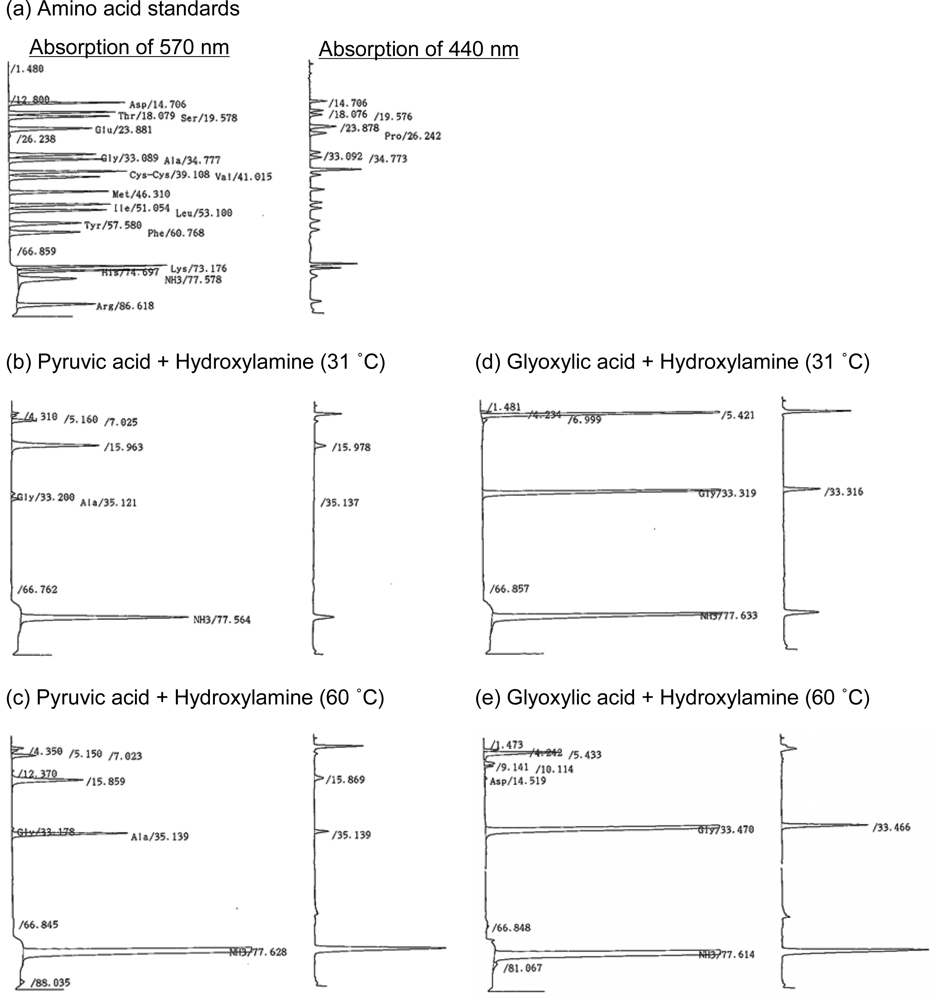
<p>We investigated the possibility that amino acids can be synthesized from hydroxylamine and pyruvic acid or glyoxylic acid, under supercritical CO<sub>2</sub> conditions (60 ºC). Additionally, in order to compare the conditions, we repeated the same reaction under subcritical CO<sub>2</sub> conditions (31 ºC) as a control. For the detection of amino acids, an amino acid analyzer was used (<xref ref-type="fig" rid="f1-ijms-10-02722">Figure 1</xref>). Since this analysis system is adjusted for detecting amino-acid monomers, the differences before and after the hydrolysis reaction indicates the amount of polymer hidden in the original products.</p>
<p>Using pyruvic acid as carbon sourcs, two kinds of amino acids, alanine and glycine, were detected at 60 ºC and 31 ºC (<xref ref-type="table" rid="t1-ijms-10-02722">Table 1</xref>). The free alanine yield at 60 ºC (60.7 μmol) was higher than that at 31 ºC (4.1 μmol), whereas the free glycine yield at 60 ºC (0.99 μmol) was lower than that at 31 ºC (2.2 μmol). These results suggested that alanine synthesis was conducted more effectively at 60 ºC.</p>
<p>After hydrolysis treatment with 6N HCl, 256.2 μmol and 70.2 μmol of alanine were detected at 60 ºC and 31 ºC, respectively (<xref ref-type="table" rid="t1-ijms-10-02722">Table 1</xref>). Additionally, arginine (0.32 μmol) was detected at 60 ºC. From the significant differences of concentrations between before and after hydrolysis reaction, alanine polymers were synthesized in larger quantity at 60 ºC. However, the ratios of free alanine: alanine polymers, were 1:3.2 at 60 ºC; 1:16.5 at 31 ºC. Considering these results, alanine polymers may be more stable in lower temperature or degraded at high temperature.</p>
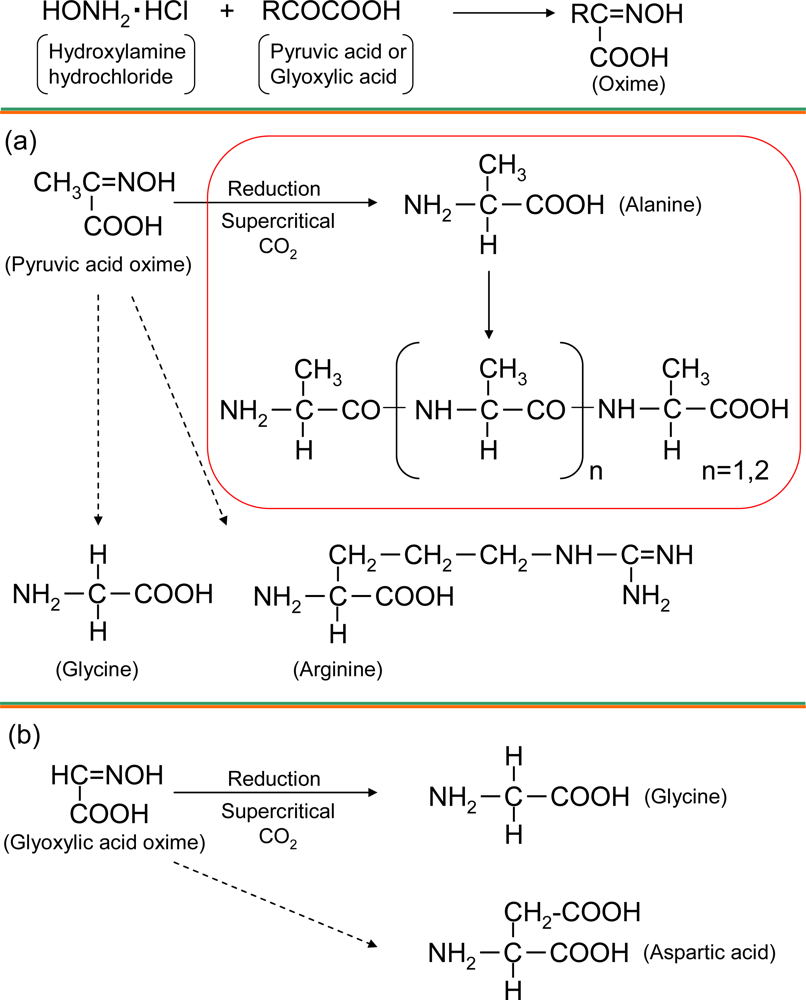
<p>In order to estimate the mechanism of alanine synthesis, we compared the reactions using glyoxylic acids as another carboxylic acid source. Different from the reaction using pyruvic acid, free alanine was not detected at both temperatures, whereas free glycine was detected at 60 ºC (866.3 μmol) and 31 ºC (183.3 μmol); free aspartic acid (2.5 μmol) was detected at 60 ºC (<xref ref-type="table" rid="t1-ijms-10-02722">Table 1</xref>). These results suggested that the methyl group of alanine synthesized from pyruvic acid were derived from the methyl group of pyruvic acid, and that the alanine was synthesized from hydrogenation of pyruvic acid oxime, since alanine was not detected in the glyoxylic acid reaction.</p>
<p>Some methods have been proposed for the synthesis of alanine from pyruvic acid oxime. Hamlin <italic>et al</italic>. reported a hydrogenation of the oxime with a palladium-charcoal catalyst [<xref ref-type="bibr" rid="b19-ijms-10-02722">19</xref>], and Borszeky <italic>et al</italic>. reported that a hydrogenation of pyruvic acid oxime with palladium/alumina catalysts provided the high yields of racemic alanine [<xref ref-type="bibr" rid="b20-ijms-10-02722">20</xref>]. Although these hydrogenation were conducted with catalysts, we speculated that oxime hydrogenation also occurred under our supercritical CO<sub>2</sub> conditions.</p>
<p>After the hydrolysis of the product from glyoxylic acid, glycine (819.2 μmol) and aspartic acid (1.8 μmol) were detected at 60 ºC, whereas glycine (209.2 μmol) was detected at 31 ºC reaction (<xref ref-type="table" rid="t1-ijms-10-02722">Table 1</xref>). Additionally, 1/2-cystine (1.2 μmol) and leucine (0.37 μmol) was detected at 60 ºC and 31 ºC, respectively (data not shown). The sulfur atoms of leucine and 1/2-cystine may be derived from impurities of the product of hydroxylamine hydrochloride (see Experimental Section).</p>
<p>The main detected amino acids both before/after hydrolysis conditions, alanine, glycine, and aspartic acid, are GNC code encoding amino acids (N means either of four bases). Ikehara <italic>et al</italic>. proposed in their hypothesis a [glycine, alanine, aspartic acid, and valine (GADV)]-protein world hypothesis on the origin of life, based on the GNC code encoding amino acids as the most primitive genetic code [<xref ref-type="bibr" rid="b21-ijms-10-02722">21</xref>]. These GADV amino acids are known to be detected in the Miller discharge experiment [<xref ref-type="bibr" rid="b2-ijms-10-02722">2</xref>] and the Miller volcanic spark discharge experiment using his apparatus performed after after his death [<xref ref-type="bibr" rid="b22-ijms-10-02722">22</xref>]. Although valine was not detected in our experiments using pyruvic acid or glyoxylic acid, as a hypothesis, if the carboxylic acid source is changed to α-ketoisovaleric acid (3-methyl-2-oxobutanoic acid), valine may be synthesized under supercritical CO<sub>2</sub> conditions. Our data in CO<sub>2</sub> were thus partially agreement with the GADV-protein world hypothesis.</p>
<p>Surprisingly, in the glyoxylic acid reaction, the concentrations of glycine before and after hydrolysis reaction did not change dramatically (after hydrolysis reaction: before hydrolysis reaction = 209.2 μmol:183.3 μmol at 31 ºC; 819.2:866.3 at 60 ºC). Comparing the alanine data in the pyruvic acid reaction, it was estimated that glycine polymers were more unstable under supercritical or subcritical CO<sub>2</sub> conditions, since the ratio of alanine polymers was higher than that of free alanine in the above experiments. In contrast with the results, our previous study showed that glycine polymers, including decaglycine, were obtained from glycine monomer under hydrothermal condition (270 ºC, 10 MPa, and 27-second reaction) with an adiabatic expansion cooling system [<xref ref-type="bibr" rid="b23-ijms-10-02722">23</xref>]. The cooling system may be an essential condition to obtain unstable glycine polymers. We speculated that alanine polymers were stable due to the formation of helix forms [<xref ref-type="bibr" rid="b24-ijms-10-02722">24</xref>,<xref ref-type="bibr" rid="b25-ijms-10-02722">25</xref>], but glycine polymers were unstable due to the large flexibility of the residues under CO<sub>2</sub> conditions, like in the aqueous model [<xref ref-type="bibr" rid="b25-ijms-10-02722">25</xref>].</p></sec>
<sec sec-type="methods">
<label>2.2.</label>
<title>Analysis of alanine polymer</title>
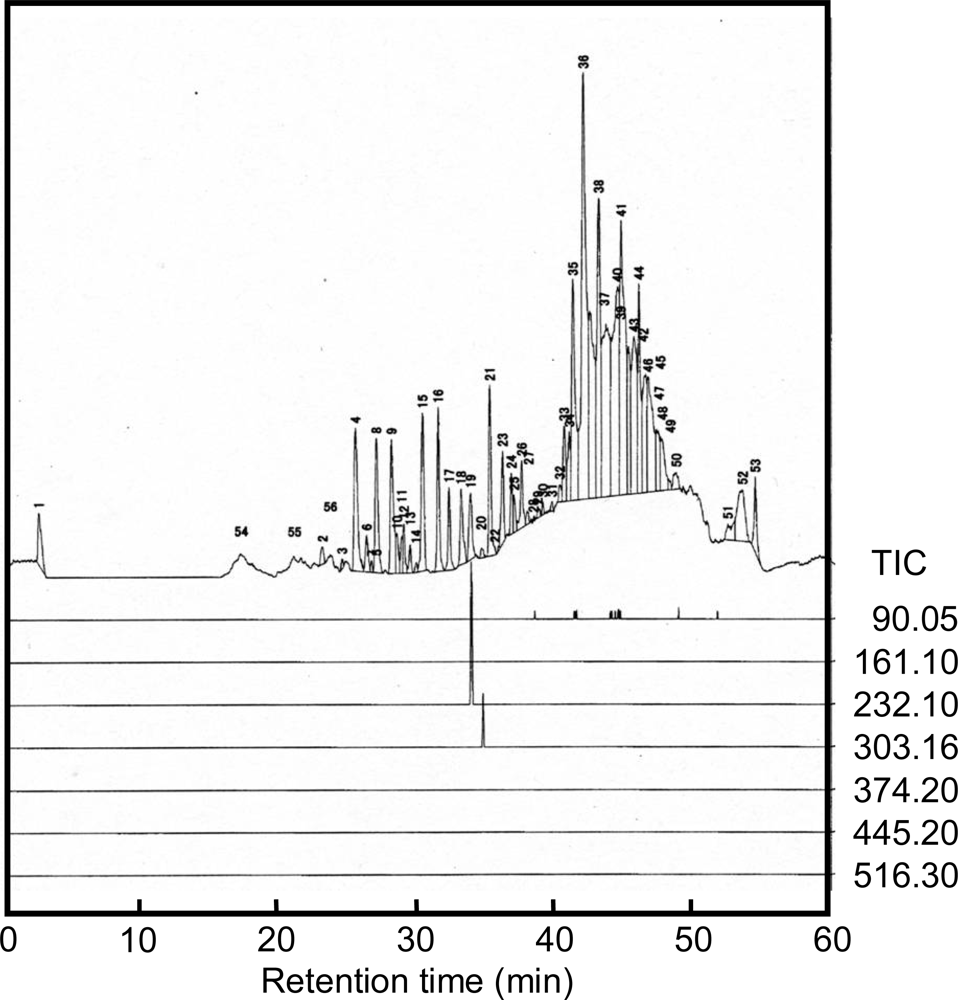
<p>In order to confirm alanine polymer synthesis under supercritical CO<sub>2</sub> conditions, we analyzed the sample from pyruvic acid at 60 ºC with a LC-MS. We obtained 56 peaks under the gradient LC conditions used (<xref ref-type="fig" rid="f2-ijms-10-02722">Figure 2</xref>). Among these peaks, the positive ions, [M+H]<sup>+</sup>, of 232.13 (alanine trimer) and 303.16 (alanine tetramer) were detected at 33.7 and 34.6 min retention time, respectively (<xref ref-type="table" rid="t2-ijms-10-02722">Table 2</xref>). The alanine dimer and 5 – 7 mers were not detected. These results suggested that alanine trimer and tetramer were stable under CO<sub>2</sub> supercritical conditions. From the ESR spectroscopic data, several alanine-based forms can adopt the 3<sub>10</sub> helix formation in aqueous solution [<xref ref-type="bibr" rid="b26-ijms-10-02722">26</xref>,<xref ref-type="bibr" rid="b27-ijms-10-02722">27</xref>]. Also under these supercritical conditions, the tetramers could be stable by forming the 3<sub>10</sub> helix and were thus detected in the aqueous sample due to their stability. However, we could not found out the reason why the trimer was stable under CO<sub>2</sub> supercritical conditions. We speculate that the trimer was a metastable structure in the supercritical CO<sub>2</sub>; therefore the trimer was synthesized directly from three alanine monomers, not through the dimer structure, and the tetramer was synthesized from a trimer + monomer reaction. The polymers higher then pentamer may be separated out as deposits from supercritical CO<sub>2</sub>. This deposition polymerization in supercritical CO<sub>2</sub> is known in ethylene polymerizations [<xref ref-type="bibr" rid="b28-ijms-10-02722">28</xref>,<xref ref-type="bibr" rid="b29-ijms-10-02722">29</xref>]. At the present, it is outside the scope of our research to investigate the deposition, but it will be the subject in future studies.</p></sec></sec>
<sec>
<label>3.</label>
<title>Experimental Section</title>
<sec>
<label>3.1.</label>
<title>CO<sub>2</sub> reaction conditions</title>
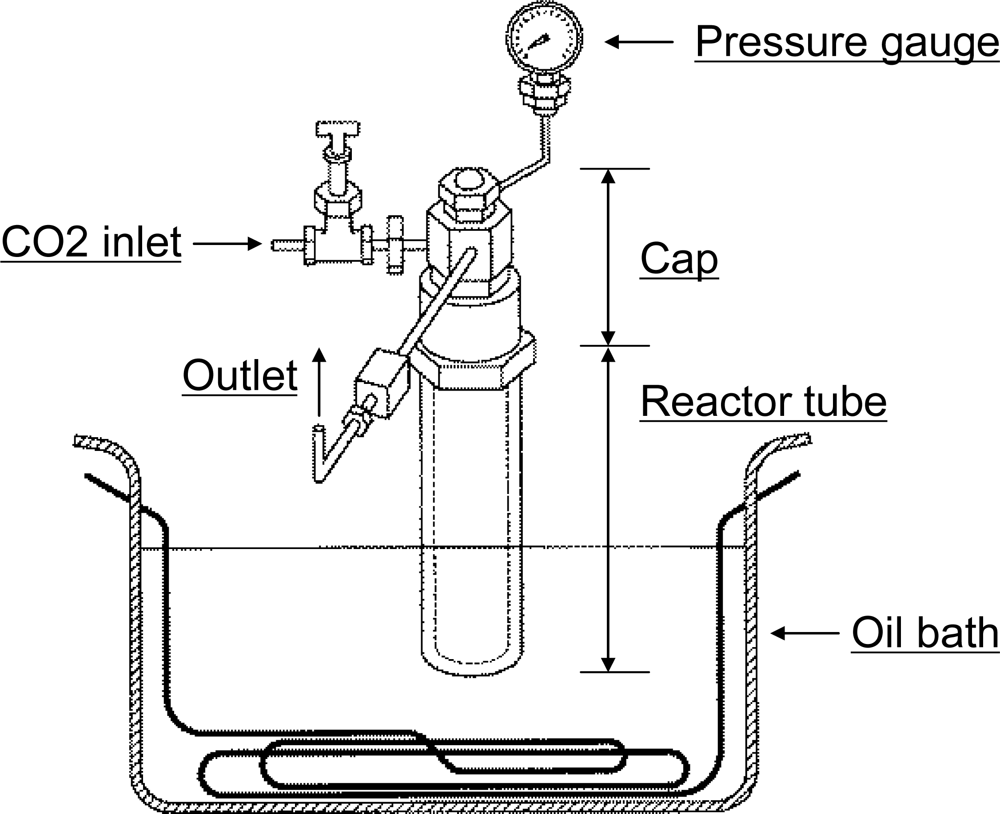
<p>The reactor was made of stainless steel and was connected to a CO<sub>2</sub> inlet and outlet that have valves and a pressure gauge (<xref ref-type="fig" rid="f3-ijms-10-02722">Figure 3</xref>). Twenty six mmol of hydroxylamine hydrochloride (&gt;97%; Tokyo Chemical Industry Co. Ltd.) and 26 mmol of pyruvic acid (98%; Alfa Aesar) or glyoxylic acid monohydrate (98%; Alfa Aesar) were mixed with 3 mL of Milli-Q (Millipore) water gently in a glass tube. The hydroxylamine hydrochloride could contain the following impurities: sulfate: max. 0.005%; copper: max. 2 ppm; lead: max. 2 ppm; iron: max. 5 ppm. After the glass tube was inserted into the stainless tube, the stainless tube was capped and CO<sub>2</sub> liquid was injected to purge the air inside. Then 20 g of CO<sub>2</sub> liquid was injected through the inlet of the reactor contained in an ice box. In order to compare the reaction conditions, we conducted reactions under two sets of conditions: supercritical condition (60 °C, over 7.4 MPa) and subcritical condition (31 °C, less than 7.2 MPa). This subcritical condition was chosen on the basis of our hypothesis that subcritical CO<sub>2</sub> conditions near the supercritical conditions are most effective for the reactions. The reactor was placed in an oil bath for two h in each condition. After the reactions, the reactors were rapidly moved into an ice box and the CO<sub>2</sub> gas released. One mL of Milli-Q water was added into the glass tube, and all the samples were transferred to a new glass bottle.</p></sec>
<sec sec-type="methods">
<label>3.2.</label>
<title>Amino-acid analysis</title>
<p>The aqueous samples (10 μL) were diluted with purified water (200-fold dilution) and filtered with 0.22-μm filters. On the other hand, the samples for hydrolysis studies were evaporated to dryness under reduced pressure. The dried residues were treated with 100 μL of 6N HCl. After vacuum sealing, the samples were hydrolyzed for 22 hr at 110 °C. After the hydrolysis, the hydrolyzed residues were evaporated to dryness under reduced pressure. The dried residues were dissolved with 200 μL of purified water and filtered with 0.22-μm filters. The filtrate samples were diluted with purified water (50-fold dilution). Both the aqueous samples and hydrolyzed samples were analyzed with an aminoacid analyzer, L-8500 (Hitachi High Technologies Co.), based on the absorbencies of 570 nm and 440 nm after ninhydrin reaction.</p></sec>
<sec sec-type="methods">
<label>3.3.</label>
<title>LC-MS analysis</title>
<p>LC-MS analysis of the 60 °C sample using pyruvic acid was performed using LCMS-IT-TOF (Shimadzu Co.). The LC-MS components included a LC-20AD pump, a CBM-20A system controller, SPD-20A UV detector. The column used for reversed-phase LC analysis was a TSKgel ODS-80Ts (Tosoh Co.) packed with 5 μm particles (2.0 × 250 mm) and it was incubated at 40 °C.</p>
<p>The LC analysis consisted of the following conditions: Mobile phase A: 100% H<sub>2</sub>O (0.1% formic acid); Mobile phase B: 80% ACN + 20% H<sub>2</sub>O (0.1% formic acid); Flow rate: 0.200 mL/min; Gradient: 0 min 1% B, 10 min 1% B, 40 min 65% B, 40.01 min 100% B, 50 min 100% B, 50.01 min 1% B, and 60 min 1% B. Stop time: 60 min. A 100 μL of injection volume was used. The LCMS-IT-TOF was operated under the following conditions: ESI in positive mode; Detection voltage: 1.53 kV; MS scan range: 80 – 800 m/z. Both amino-acid analyses and LC-MS analyses were conducted at Toray Research Center. Inc.</p></sec></sec>
<sec sec-type="conclusions">
<label>4.</label>
<title>Conclusions</title>
<p>In this research, we have demonstrated that four kinds of amino acid including alanine, glycine, aspartic acid, and arginine were obtained from hydroxylamine hydrochloride and pyruvic acid or glyoxylic acid under supercritical CO<sub>2</sub> condition, mimicking a soda fountain (<xref ref-type="fig" rid="f4-ijms-10-02722">Figure 4</xref>). Additionally, trimer and tetramer alanine polymers from pyruvic acid were abundantly detected under supercritical CO<sub>2</sub> conditions, but glycine polymers were almost not detected. From these data, we conclude that even at low temperatures less than 60 °C, supercritical CO<sub>2</sub> and liquid H<sub>2</sub>O conditions could provide a variety of amino acids and short polymers when the formations are stable. Although the reaction mechanism was not revealed clearly (e.g. which factor is more important, temperature or pressure?), our research opens a new pathway in the study of the origin of life.</p></sec></body>
<back>
<ack>
<p>We thank Mr. Tsuneo Shimazu, Mr. Yasuhiro Kagawa, Ms. Yasuko Mizuno, and Ms. Satoko Ota (Toray Research Center), for analyzing our products. We also thank Mr. Akira Nakasuga, Mr. Motoi Nagano, Mr. Yasuhiro Nakatani, Mr. Yohei Nishimura, and Ms. Hiroko Minamino (Sekisui Chemical Co., Ltd.) for great advices and managements of our research.</p></ack>
<ref-list>
<title>References and Notes</title>
<ref id="b1-ijms-10-02722"><label>1.</label><citation citation-type="journal"><person-group person-group-type="author"><name><surname>Simoneit</surname><given-names>BRT</given-names></name></person-group><article-title>Prebiotic organic synthesis under hydrothermal conditions: an overview</article-title><source>Adv. Space Res</source><year>2004</year><volume>33</volume><fpage>88</fpage><lpage>94</lpage><pub-id pub-id-type="doi">10.1016/j.asr.2003.05.006</pub-id></citation></ref>
<ref id="b2-ijms-10-02722"><label>2.</label><citation citation-type="journal"><person-group person-group-type="author"><name><surname>Miller</surname><given-names>SL</given-names></name></person-group><article-title>A production of amino acids under possible primitive Earth conditions</article-title><source>Science</source><year>1953</year><volume>117</volume><fpage>528</fpage><lpage>529</lpage><pub-id pub-id-type="doi">10.1126/science.117.3046.528</pub-id><pub-id pub-id-type="pmid">13056598</pub-id></citation></ref>
<ref id="b3-ijms-10-02722"><label>3.</label><citation citation-type="journal"><person-group person-group-type="author"><name><surname>Markhinin</surname><given-names>EK</given-names></name><name><surname>Podkletnov</surname><given-names>NE</given-names></name></person-group><article-title>The phenomenon of formation of prebiological compounds in volcanic processes</article-title><source>Orig. Life</source><year>1977</year><volume>3</volume><fpage>225</fpage><lpage>235</lpage></citation></ref>
<ref id="b4-ijms-10-02722"><label>4.</label><citation citation-type="journal"><person-group person-group-type="author"><name><surname>Charlou</surname><given-names>J</given-names></name><name><surname>Donval</surname><given-names>J</given-names></name></person-group><article-title>Hydrothermal methane venting between 12<sup>o</sup>N and 6<sup>o</sup>N along the Mid-Atlantic Ridge</article-title><source>J. Geophys. Res</source><year>1993</year><volume>98</volume><fpage>9625</fpage><lpage>9642</lpage><pub-id pub-id-type="doi">10.1029/92JB02047</pub-id></citation></ref>
<ref id="b5-ijms-10-02722"><label>5.</label><citation citation-type="journal"><person-group person-group-type="author"><name><surname>Gunter</surname><given-names>BD</given-names></name></person-group><article-title>C<sub>1</sub>-C<sub>4</sub> hydrocarbons in hydrothermal gases</article-title><source>Geochim. Cosmochim. Acta</source><year>1978</year><volume>42</volume><fpage>137</fpage><lpage>139</lpage><pub-id pub-id-type="doi">10.1016/0016-7037(78)90223-5</pub-id></citation></ref>
<ref id="b6-ijms-10-02722"><label>6.</label><citation citation-type="journal"><person-group person-group-type="author"><name><surname>Simoneit</surname><given-names>BRT</given-names></name><name><surname>Kawka</surname><given-names>OE</given-names></name><name><surname>Brault</surname><given-names>M</given-names></name></person-group><article-title>Origin of gasses and condensates in the Guaymas Basin hydrothermal system (Gulf of California)</article-title><source>Chem. Geol</source><year>1988</year><volume>71</volume><fpage>169</fpage><lpage>182</lpage><pub-id pub-id-type="doi">10.1016/0009-2541(88)90113-1</pub-id></citation></ref>
<ref id="b7-ijms-10-02722"><label>7.</label><citation citation-type="journal"><person-group person-group-type="author"><name><surname>Welhan</surname><given-names>JA</given-names></name></person-group><article-title>Origins of methane in hydrothermal systems</article-title><source>Chem. Geol</source><year>1988</year><volume>71</volume><fpage>183</fpage><lpage>198</lpage><pub-id pub-id-type="doi">10.1016/0009-2541(88)90114-3</pub-id></citation></ref>
<ref id="b8-ijms-10-02722"><label>8.</label><citation citation-type="journal"><person-group person-group-type="author"><name><surname>Welhan</surname><given-names>JA</given-names></name><name><surname>Lupton</surname><given-names>JE</given-names></name></person-group><article-title>Light hydrocarbon gasses in Guaymas Basin hydrothermal fluids: Themogenic versus abiogenic origin</article-title><source>Am. Assoc. Petrol. Geol. Bull</source><year>1987</year><volume>71</volume><fpage>215</fpage><lpage>223</lpage></citation></ref>
<ref id="b9-ijms-10-02722"><label>9.</label><citation citation-type="journal"><person-group person-group-type="author"><name><surname>Furukawa</surname><given-names>Y</given-names></name><name><surname>Siekine</surname><given-names>T</given-names></name><name><surname>Oba</surname><given-names>M</given-names></name><name><surname>Kakegawa</surname><given-names>T</given-names></name><name><surname>Nakazawa</surname><given-names>H</given-names></name></person-group><article-title>Biomolecule formation by oceanic impacts on early Earth</article-title><source>Nature Geosci</source><year>2009</year><volume>2</volume><fpage>62</fpage><lpage>66</lpage><pub-id pub-id-type="doi">10.1038/ngeo383</pub-id></citation></ref>
<ref id="b10-ijms-10-02722"><label>10.</label><citation citation-type="journal"><person-group person-group-type="author"><name><surname>Gelpi</surname><given-names>E</given-names></name><name><surname>Han</surname><given-names>L</given-names></name><name><surname>Nooner</surname><given-names>DW</given-names></name><name><surname>Oro</surname><given-names>J</given-names></name></person-group><article-title>Closed system Fischer Tropsch synthesis over meteoric iron, iron ore and nickel iron alloy</article-title><source>Geochim. Cosmochim. Acta</source><year>1970</year><volume>34</volume><fpage>965</fpage><lpage>979</lpage><pub-id pub-id-type="doi">10.1016/0016-7037(70)90079-7</pub-id></citation></ref>
<ref id="b11-ijms-10-02722"><label>11.</label><citation citation-type="journal"><person-group person-group-type="author"><name><surname>Studier</surname><given-names>MH</given-names></name><name><surname>Hayatsu</surname><given-names>R</given-names></name><name><surname>Anders</surname><given-names>E</given-names></name></person-group><article-title>Origin of organic matter in early solar system (I. Hydrocarbons)</article-title><source>Geochim. Cosmochim. Acta</source><year>1968</year><volume>32</volume><fpage>151</fpage><lpage>173</lpage><pub-id pub-id-type="doi">10.1016/S0016-7037(68)80002-X</pub-id></citation></ref>
<ref id="b12-ijms-10-02722"><label>12.</label><citation citation-type="journal"><person-group person-group-type="author"><name><surname>Kasting</surname><given-names>JF</given-names></name></person-group><article-title>Bolide impacts and the oxidation of carbon in the Earth's early atmosphere</article-title><source>Orig. Life Evol. Biosphere</source><year>1989</year><volume>20</volume><fpage>199</fpage><lpage>231</lpage></citation></ref>
<ref id="b13-ijms-10-02722"><label>13.</label><citation citation-type="journal"><person-group person-group-type="author"><name><surname>Kobayashi</surname><given-names>K</given-names></name><name><surname>Tsuchiya</surname><given-names>M</given-names></name><name><surname>Oshima</surname><given-names>T</given-names></name><name><surname>Yanagawa</surname><given-names>H</given-names></name></person-group><article-title>Abiotic synthesis of amino acids and imidazol by proton irradiation of simulated primitive Earth's early atmosphere</article-title><source>Orig. Life Evol. Biosphere</source><year>1990</year><volume>20</volume><fpage>99</fpage><lpage>109</lpage><pub-id pub-id-type="doi">10.1007/BF01808270</pub-id></citation></ref>
<ref id="b14-ijms-10-02722"><label>14.</label><citation citation-type="journal"><person-group person-group-type="author"><name><surname>McKay</surname><given-names>DS</given-names></name><name><surname>Gibson</surname><given-names>EK</given-names></name><name><surname>Thomas-Keprta</surname><given-names>KL</given-names></name><name><surname>Vali</surname><given-names>H</given-names></name><name><surname>Romanek</surname><given-names>CS</given-names></name><name><surname>Clemett</surname><given-names>SJ</given-names></name><name><surname>Chillier</surname><given-names>XDF</given-names></name><name><surname>Maechling</surname><given-names>CR</given-names></name><name><surname>Zare</surname><given-names>RN</given-names></name></person-group><article-title>Search for Past Life on Mars: Possibble Relic Biogenic Activity in Martian Meteorite ALH84001</article-title><source>Science</source><year>1996</year><volume>273</volume><fpage>924</fpage><lpage>930</lpage><pub-id pub-id-type="doi">10.1126/science.273.5277.924</pub-id><pub-id pub-id-type="pmid">8688069</pub-id></citation></ref>
<ref id="b15-ijms-10-02722"><label>15.</label><citation citation-type="journal"><person-group person-group-type="author"><name><surname>Sagan</surname><given-names>C</given-names></name><name><surname>Toon</surname><given-names>OB</given-names></name><name><surname>Gierasch</surname><given-names>PJ</given-names></name></person-group><article-title>Climatic Change on Mars</article-title><source>Science</source><year>1973</year><volume>181</volume><fpage>1045</fpage><lpage>1049</lpage><pub-id pub-id-type="doi">10.1126/science.181.4104.1045</pub-id><pub-id pub-id-type="pmid">17731265</pub-id></citation></ref>
<ref id="b16-ijms-10-02722"><label>16.</label><citation citation-type="journal"><person-group person-group-type="author"><name><surname>Harder</surname><given-names>H</given-names></name><name><surname>Christensen</surname><given-names>UR</given-names></name></person-group><article-title>A one-plume model of martian mantle convection</article-title><source>Nature</source><year>1996</year><volume>380</volume><fpage>507</fpage><lpage>509</lpage><pub-id pub-id-type="doi">10.1038/380507a0</pub-id></citation></ref>
<ref id="b17-ijms-10-02722"><label>17.</label><citation citation-type="journal"><person-group person-group-type="author"><name><surname>Cody</surname><given-names>GD</given-names></name><name><surname>Boctor</surname><given-names>NZ</given-names></name><name><surname>Filley</surname><given-names>TR</given-names></name><name><surname>Hazen</surname><given-names>RM</given-names></name><name><surname>Scott</surname><given-names>JH</given-names></name><name><surname>Sharma</surname><given-names>A</given-names></name><name><surname>Yoder</surname><given-names>HS</given-names><suffix>Jr</suffix></name></person-group><article-title>Primordial synthesis of carbonylated iron-sulfur clusters and the synthesis of pyruvate</article-title><source>Science</source><year>2000</year><volume>289</volume><fpage>1337</fpage><lpage>1340</lpage><pub-id pub-id-type="doi">10.1126/science.289.5483.1337</pub-id><pub-id pub-id-type="pmid">10958777</pub-id></citation></ref>
<ref id="b18-ijms-10-02722"><label>18.</label><citation citation-type="journal"><person-group person-group-type="author"><name><surname>Sokolskaya</surname><given-names>A</given-names></name></person-group><article-title>Glycine and alanine synthesis from formaldehyde and hydroxylamine in the field of ultrasound waves</article-title><source>Orig. Life</source><year>1976</year><volume>7</volume><fpage>183</fpage><lpage>185</lpage><pub-id pub-id-type="doi">10.1007/BF00926935</pub-id><pub-id pub-id-type="pmid">1012708</pub-id></citation></ref>
<ref id="b19-ijms-10-02722"><label>19.</label><citation citation-type="journal"><person-group person-group-type="author"><name><surname>Hamlin</surname><given-names>KE</given-names><suffix>Jr</suffix></name><name><surname>Hartung</surname><given-names>WH</given-names></name></person-group><article-title>The synthesis of α-amino acids from substituted acetoacetic esters</article-title><source>J. Biol. Chem</source><year>1942</year><volume>145</volume><fpage>349</fpage><lpage>357</lpage></citation></ref>
<ref id="b20-ijms-10-02722"><label>20.</label><citation citation-type="journal"><person-group person-group-type="author"><name><surname>Borszeky</surname><given-names>K</given-names></name><name><surname>Mallat</surname><given-names>T</given-names></name><name><surname>Aeschiman</surname><given-names>R</given-names></name><name><surname>Schweizer</surname><given-names>WB</given-names></name><name><surname>Baiker</surname><given-names>A</given-names></name></person-group><article-title>Enantioselective Hydrogenation of Pyruvic Acid Oxime to Alanine on Pd/Alumina</article-title><source>J. Catalysis</source><year>1996</year><volume>161</volume><fpage>451</fpage><lpage>458</lpage><pub-id pub-id-type="doi">10.1006/jcat.1996.0203</pub-id></citation></ref>
<ref id="b21-ijms-10-02722"><label>21.</label><citation citation-type="journal"><person-group person-group-type="author"><name><surname>Ikehara</surname><given-names>K</given-names></name></person-group><article-title>Origins of gene, genetic code, protein, and life</article-title><source>Viva Origino</source><year>2001</year><volume>29</volume><fpage>66</fpage><lpage>85</lpage></citation></ref>
<ref id="b22-ijms-10-02722"><label>22.</label><citation citation-type="journal"><person-group person-group-type="author"><name><surname>Johnson</surname><given-names>AP</given-names></name><name><surname>Cleaves</surname><given-names>HJ</given-names></name><name><surname>Dwokin</surname><given-names>JP</given-names></name><name><surname>Glavin</surname><given-names>DP</given-names></name><name><surname>Lazcano</surname><given-names>A</given-names></name><name><surname>Bada</surname><given-names>JL</given-names></name></person-group><article-title>The miller volcanic spark discharge experiment</article-title><source>Science</source><year>2008</year><volume>322</volume><fpage>404</fpage><pub-id pub-id-type="doi">10.1126/science.1161527</pub-id><pub-id pub-id-type="pmid">18927386</pub-id></citation></ref>
<ref id="b23-ijms-10-02722"><label>23.</label><citation citation-type="journal"><person-group person-group-type="author"><name><surname>Goto</surname><given-names>T</given-names></name><name><surname>Futamura</surname><given-names>Y</given-names></name><name><surname>Yamaguchi</surname><given-names>Y</given-names></name><name><surname>Yamamoto</surname><given-names>K</given-names></name></person-group><article-title>Condensation reaction of amino acids under hydrothermal conditions with adiabatic expansion cooling</article-title><source>J. Chem. Eng. Jpn</source><year>2005</year><volume>38</volume><fpage>295</fpage><lpage>299</lpage><pub-id pub-id-type="doi">10.1252/jcej.38.295</pub-id></citation></ref>
<ref id="b24-ijms-10-02722"><label>24.</label><citation citation-type="journal"><person-group person-group-type="author"><name><surname>Bixon</surname><given-names>M</given-names></name><name><surname>Scheraga</surname><given-names>HA</given-names></name><name><surname>Lifson</surname><given-names>S</given-names></name></person-group><article-title>Effect of hydrophobic binding on the stability of poly-l-alanine helixes in water</article-title><source>Biopolymers</source><year>1963</year><volume>1</volume><fpage>419</fpage><lpage>429</lpage><pub-id pub-id-type="doi">10.1002/bip.360010503</pub-id></citation></ref>
<ref id="b25-ijms-10-02722"><label>25.</label><citation citation-type="journal"><person-group person-group-type="author"><name><surname>Aleman</surname><given-names>C</given-names></name><name><surname>Roca</surname><given-names>R</given-names></name><name><surname>Luque</surname><given-names>FJ</given-names></name><name><surname>Orozco</surname><given-names>M</given-names></name></person-group><article-title>Helical Preferences of alanine, glycine, and aminoisobutyric homopeptides</article-title><source>Proteins</source><year>1997</year><volume>28</volume><fpage>83</fpage><lpage>93</lpage><pub-id pub-id-type="doi">10.1002/(SICI)1097-0134(199705)28:1&lt;83::AID-PROT8&gt;3.0.CO;2-K</pub-id><pub-id pub-id-type="pmid">9144793</pub-id></citation></ref>
<ref id="b26-ijms-10-02722"><label>26.</label><citation citation-type="journal"><person-group person-group-type="author"><name><surname>Miick</surname><given-names>SM</given-names></name><name><surname>Martinez</surname><given-names>GV</given-names></name><name><surname>Fiori</surname><given-names>WR</given-names></name><name><surname>Todd</surname><given-names>AP</given-names></name><name><surname>Millhouser</surname><given-names>GL</given-names></name></person-group><article-title>Short alanine-based peptides may form 3(10)-helices and not alpha-helices in aqueous solution</article-title><source>Nature</source><year>1992</year><volume>359</volume><fpage>653</fpage><lpage>655</lpage><pub-id pub-id-type="doi">10.1038/359653a0</pub-id><pub-id pub-id-type="pmid">1328890</pub-id></citation></ref>
<ref id="b27-ijms-10-02722"><label>27.</label><citation citation-type="journal"><person-group person-group-type="author"><name><surname>Fiori</surname><given-names>WR</given-names></name><name><surname>Miick</surname><given-names>SM</given-names></name><name><surname>Millhouser</surname><given-names>GL</given-names></name></person-group><article-title>Increasing sequence length favors alpha-helix over 3(10)-helix in alanine-based peptides: Evidence for a length dependent structural transition</article-title><source>Biochemistry</source><year>1993</year><volume>32</volume><fpage>11957</fpage><lpage>11962</lpage><pub-id pub-id-type="doi">10.1021/bi00096a003</pub-id><pub-id pub-id-type="pmid">8218270</pub-id></citation></ref>
<ref id="b28-ijms-10-02722"><label>28.</label><citation citation-type="journal"><person-group person-group-type="author"><name><surname>Hagiwara</surname><given-names>M</given-names></name><name><surname>Mitsui</surname><given-names>H</given-names></name><name><surname>Machi</surname><given-names>S</given-names></name><name><surname>Kagiya</surname><given-names>T</given-names></name></person-group><article-title>Liquid carbon dioxide as a solvent for the radiation polymerization of ethylene</article-title><source>J. Polym. Sci. A-Polym. Chem</source><year>1968</year><volume>6</volume><fpage>603</fpage><lpage>608</lpage><pub-id pub-id-type="doi">10.1002/pol.1968.150060316</pub-id></citation></ref>
<ref id="b29-ijms-10-02722"><label>29.</label><citation citation-type="journal"><person-group person-group-type="author"><name><surname>Hagiwara</surname><given-names>M</given-names></name><name><surname>Mitsui</surname><given-names>H</given-names></name><name><surname>Machi</surname><given-names>S</given-names></name><name><surname>Kagiya</surname><given-names>T</given-names></name></person-group><article-title>Kinetics of the γ-radiation-induced polymerization of ethylene in liquid carbon dioxide</article-title><source>J. Polym. Sci. A-Polym. Chem</source><year>1968</year><volume>6</volume><fpage>609</fpage><lpage>621</lpage><pub-id pub-id-type="doi">10.1002/pol.1968.150060317</pub-id></citation></ref></ref-list>
<sec sec-type="display-objects">
<title>Figures and Tables</title>
<fig id="f1-ijms-10-02722" position="float">
<label>Figure 1.</label>
<caption>
<p>Chromatograms of amino-acid analysis. (a) Amino acid standards. (b) Pyruvic acid + Hydroxylamine at 31 ºC. (c) Pyruvic acid + Hydroxylamine at 60 ºC. (d) Glyoxylic acid + Hydroxylamine at 31 ºC. (e) Glyoxylic acid + Hydroxylamine at 60 ºC.</p></caption>
<graphic xlink:href="ijms-10-02722f1.gif"/></fig>
<fig id="f2-ijms-10-02722" position="float">
<label>Figure 2.</label>
<caption>
<p>Total ion chromatogram (TIC) and MS chromatograms of alanine monomer and polymers.</p></caption>
<graphic xlink:href="ijms-10-02722f2.gif"/></fig>
<fig id="f3-ijms-10-02722" position="float">
<label>Figure 3.</label>
<caption>
<p>Diagram of the autoclave reactor for the supercritical CO<sub>2</sub> reaction.</p></caption>
<graphic xlink:href="ijms-10-02722f3.gif"/></fig>
<fig id="f4-ijms-10-02722" position="float">
<label>Figure 4.</label>
<caption>
<p>Reaction overview of the supercritical CO<sub>2</sub>/liquid H<sub>2</sub>O reactions. (a) Hydroxylamine + Pyruvic acid (Pyruvic acid oxime) (b) Hydroxylamine + Glyoxylic acid (Glyoxylic acid oxime).</p></caption>
<graphic xlink:href="ijms-10-02722f4.gif"/></fig>
<table-wrap id="t1-ijms-10-02722" position="float">
<label>Table 1.</label>
<caption>
<p>Products obtained from keto acids and hydroxylamine in supercritical conditions (60 ºC) or subcritical condition (31 ºC) before/after hydrolysis reaction.</p></caption>
<table frame="hsides" rules="rows">
<thead>
<tr>
<th valign="middle" align="left" rowspan="3">Primary Reactant</th>
<th valign="middle" align="center" rowspan="3">Temp. (ºC)</th>
<th valign="middle" align="center" colspan="8">Products (μmol)</th></tr>
<tr>
<th valign="middle" align="center" colspan="4">Before hydrolysis reaction</th>
<th valign="middle" align="center" colspan="4">After hydrolysis reaction</th></tr>
<tr>
<th valign="bottom" align="center">Ala</th>
<th valign="bottom" align="center">Gly</th>
<th valign="bottom" align="center">Asp</th>
<th valign="bottom" align="center">Arg</th>
<th valign="bottom" align="center">Ala</th>
<th valign="bottom" align="center">Gly</th>
<th valign="bottom" align="center">Asp</th>
<th valign="bottom" align="center">Arg</th></tr></thead>
<tbody>
<tr>
<td valign="middle" align="left" rowspan="2">Pyruvic acid</td>
<td valign="bottom" align="center">60</td>
<td valign="bottom" align="center">60.7</td>
<td valign="bottom" align="center">0.99</td>
<td valign="bottom" align="center">—</td>
<td valign="bottom" align="center">256.2</td>
<td valign="bottom" align="center">1.5</td>
<td valign="bottom" align="center">—</td>
<td valign="bottom" align="center">0.32</td></tr>
<tr>
<td valign="bottom" align="center">31</td>
<td valign="bottom" align="center">4.1</td>
<td valign="bottom" align="center">2.2</td>
<td valign="bottom" align="center">—</td>
<td valign="bottom" align="center">70.2</td>
<td valign="bottom" align="center">3.4</td>
<td valign="bottom" align="center">—</td>
<td valign="bottom" align="center">—</td></tr>
<tr>
<td valign="middle" align="left" rowspan="2">Glyoxylic acid</td>
<td valign="bottom" align="center">60</td>
<td valign="bottom" align="center">—</td>
<td valign="bottom" align="center">866.3</td>
<td valign="bottom" align="center">2.5</td>
<td valign="bottom" align="center">—</td>
<td valign="bottom" align="center">819.2</td>
<td valign="bottom" align="center">1.8</td>
<td valign="bottom" align="center">—</td></tr>
<tr>
<td valign="bottom" align="center">31</td>
<td valign="bottom" align="center">—</td>
<td valign="bottom" align="center">183.3</td>
<td valign="bottom" align="center">—</td>
<td valign="bottom" align="center">209.2</td>
<td valign="bottom" align="center">—</td>
<td valign="bottom" align="center">—</td></tr></tbody></table>
<table-wrap-foot><fn id="tfn1-ijms-10-02722">
<p>— indicates “Not Detected”.</p></fn></table-wrap-foot></table-wrap>
<table-wrap id="t2-ijms-10-02722" position="float">
<label>Table 2.</label>
<caption>
<p>Polymers obtained from pyruvic acid and hydroxylamine in supercritical conditions.</p></caption>
<table frame="hsides" rules="rows">
<thead>
<tr>
<th valign="middle" align="left"/>
<th valign="middle" align="center">Alanine monomer</th>
<th valign="middle" align="center">Dimer</th>
<th valign="middle" align="center">Trimer</th>
<th valign="middle" align="center">Tetramer</th>
<th valign="middle" align="center">Pentamer</th>
<th valign="middle" align="center">Hexamer</th>
<th valign="middle" align="center">Heptamer</th></tr></thead>
<tbody>
<tr>
<td valign="middle" align="left">Calculated [M+H]<sup>+</sup></td>
<td valign="middle" align="center">90.05</td>
<td valign="middle" align="center">161.09</td>
<td valign="middle" align="center">232.13</td>
<td valign="middle" align="center">303.16</td>
<td valign="middle" align="center">374.20</td>
<td valign="middle" align="center">445.24</td>
<td valign="middle" align="center">516.28</td></tr>
<tr>
<td valign="middle" align="left">Retention time(min)</td>
<td valign="middle" align="center">suspended</td>
<td valign="middle" align="center">—</td>
<td valign="middle" align="center">33.7</td>
<td valign="middle" align="center">34.6</td>
<td valign="middle" align="center">—</td>
<td valign="middle" align="center">—</td></tr></tbody></table>
<table-wrap-foot><fn id="tfn2-ijms-10-02722">
<p>— indicates “Not Detected”. The retention time for alanine monomer in the sample could not be specified with the LC-MS system used.</p></fn></table-wrap-foot></table-wrap></sec></back></article>