<?xml version="1.0" encoding="UTF-8"?>
<!DOCTYPE article PUBLIC "-//NLM//DTD Journal Publishing DTD v2.3 20070202//EN" "journalpublishing.dtd">
<article xmlns:mml="http://www.w3.org/1998/Math/MathML" xmlns:xlink="http://www.w3.org/1999/xlink" xml:lang="en" article-type="research-article">
<front>
<journal-meta>
<journal-id journal-id-type="publisher-id">ijms</journal-id>
<journal-title>International Journal of Molecular Sciences</journal-title>
<abbrev-journal-title>Int. J. Mol. Sci.</abbrev-journal-title>
<issn pub-type="epub">1422-0067</issn>
<publisher>
<publisher-name>Molecular Diversity Preservation International (MDPI)</publisher-name></publisher></journal-meta>
<article-meta>
<article-id pub-id-type="doi">10.3390/ijms10041601</article-id>
<article-id pub-id-type="publisher-id">ijms-10-01601</article-id>
<article-categories>
<subj-group>
<subject>Article</subject></subj-group></article-categories>
<title-group>
<article-title>Probing the Structure, Stability and Hydrogen Adsorption of Lithium Functionalized Isoreticular MOF-5 (Fe, Cu, Co, Ni and Zn) by Density Functional Theory</article-title></title-group>
<contrib-group>
<contrib contrib-type="author">
<name><surname>Venkataramanan</surname><given-names>Natarajan Sathiyamoorthy</given-names></name><xref ref-type="corresp" rid="c1-ijms-10-01601">*</xref></contrib>
<contrib contrib-type="author">
<name><surname>Sahara</surname><given-names>Ryoji</given-names></name></contrib>
<contrib contrib-type="author">
<name><surname>Mizuseki</surname><given-names>Hiroshi</given-names></name></contrib>
<contrib contrib-type="author">
<name><surname>Kawazoe</surname><given-names>Yoshiyuki</given-names></name></contrib>
<aff id="af1-ijms-10-01601">Institute for Materials Research(IMR), 2-1-1, Katahira, Aoba-Ku, Sendai, Japan 980 8577; E-Mails:
<email>sahara@imr.edu</email> (R.S.);
<email>Mizuseki@imr.edu</email> (H.M.);
<email>kawazoe@imr.edu</email> (Y.K.)</aff></contrib-group>
<author-notes>
<corresp id="c1-ijms-10-01601">
<label>*</label> Author to whom correspondence should be addressed; E-Mail:
<email>ramanan@imr.edu</email>; Tel. +81-22-215-2054; Fax: +81-22-215-2052</corresp></author-notes>
<pub-date pub-type="collection">
<month>4</month>
<year>2009</year></pub-date>
<pub-date pub-type="epub">
<day>14</day>
<month>4</month>
<year>2009</year></pub-date>
<volume>10</volume>
<issue>4</issue>
<fpage>1601</fpage>
<lpage>1608</lpage>
<history>
<date date-type="received">
<day>21</day>
<month>2</month>
<year>2009</year></date>
<date date-type="rev-recd">
<day>5</day>
<month>3</month>
<year>2009</year></date>
<date date-type="accepted">
<day>9</day>
<month>4</month>
<year>2009</year></date></history>
<permissions>
<copyright-statement>© 2009 by the authors; licensee Molecular Diversity Preservation International, Basel, Switzerland.</copyright-statement>
<copyright-year>2009</copyright-year>
<license license-type="open-access" xlink:href="http://creativecommons.org/licenses/by/3.0">
<p>This article is an open-access article distributed under the terms and conditions of the Creative Commons Attribution license (http://creativecommons.org/licenses/by/3.0/).</p></license></permissions>
<abstract>
<p>Li adsorption on isoreticular MOFs with metal Fe, Cu, Co, Ni and Zn was studied using density function theory. Li functionalization shows a considerable structural change associated with a volume change in isoreticular MOF-5 except for the Zn metal center. Hydrogen binding energies on Li functionalized MOFs are seen to be in the range of 0.2 eV, which is the desired value for an ideal reversible storage system. This study has clearly shown that Li doping is possible only in Zn-based MOF-5, which would be better candidate to reversibly store hydrogen.</p></abstract>
<kwd-group>
<kwd>Density functional Theory (DFT)</kwd>
<kwd>Metal-organic frameworks (MOF’s)</kwd>
<kwd>Hydrogen storage: Li-functionalization</kwd></kwd-group></article-meta></front>
<body>
<sec sec-type="intro">
<label>1.</label>
<title>Introduction</title>
<p>Nowadays, worldwide interest is focused on using a clean burning substitute such as hydrogen in place of fossil fuels, due to both economic and environmental reasons [<xref ref-type="bibr" rid="b1-ijms-10-01601">1</xref>,<xref ref-type="bibr" rid="b2-ijms-10-01601">2</xref>]. However, hydrogen storage is one of the most important challenges impeding its practical application. Physisorption on large surface area materials is one significant approach for storing hydrogen. Some metal-organic frameworks (MOFs) show promising results for hydrogen adsorption, but the storage pressure and temperature conditions make their use economically unfavorable [<xref ref-type="bibr" rid="b3-ijms-10-01601">3</xref>–<xref ref-type="bibr" rid="b5-ijms-10-01601">5</xref>].</p>
<p>In order to improve the storage conditions, it is important to design new MOF materials having not only tailored pore dimensions and large void volumes, but also incorporating strong adsorption sites, like for instance, adsorbing alkali metals on the surface [<xref ref-type="bibr" rid="b6-ijms-10-01601">6</xref>–<xref ref-type="bibr" rid="b10-ijms-10-01601">10</xref>]. In addition, researchers have proposed that metal centers present in the MOFs play an important role in the gas adsorption property [<xref ref-type="bibr" rid="b11-ijms-10-01601">11</xref>–<xref ref-type="bibr" rid="b13-ijms-10-01601">13</xref>]. Recently, Li doping was performed to enhance the storage capacity of MOFs both by experimental and theoretical means and to provide the desired binding enthalpies in the range of 0.2 – 0.3 eV for hydrogen [<xref ref-type="bibr" rid="b14-ijms-10-01601">14</xref>–<xref ref-type="bibr" rid="b18-ijms-10-01601">18</xref>].</p>
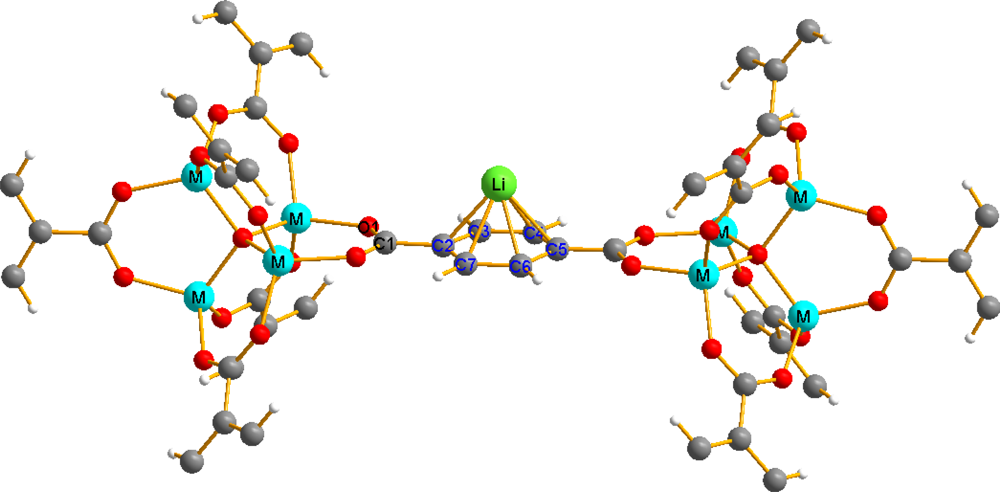
<p>In the report, by means of first-principles calculations, we have studied the binding energies for hydrogen molecules on the Li functionalized Zn-MOF-5. Furthermore, we have made a study on Li-functionalized isoreticular M-MOF-5’s characterized by the presence of different metal centers (<xref ref-type="fig" rid="f2-ijms-10-01601">Scheme 1</xref>) to find the stability and structure of MOF’s after doping the M-MOF-5 unit (M = Fe, Co, Ni Cu and Zn) with Li atoms. The paper is organized as follows. In the first part, the effect of Li doping on the MOF-5 unit is explored by doping Li atom. In the second part we have studied the binding of hydrogen molecules on the Li functionalized Zn-MOFs. In the third part we have studied the structure and stability of lithium functionalized isoreticular MOF-5 and our conclusions are given in Section 4.</p></sec>
<sec sec-type="results|discussion">
<label>2.</label>
<title>Results and Discussion</title>
<p>The structure of the primitive cell representing the unit cell was fully optimized without any geometrical constraints. In <xref ref-type="table" rid="t1-ijms-10-01601">Table 1</xref> we compare the present computational result of the MOF-5 structure with experimental data, which are in good agreement. This provides confidence in our computational method.</p>
<sec>
<label>2.1.</label>
<title>Stability of the Li doping on MOF’s</title>
<p>To examine the effect of Li doping, we first investigated the adsorption energy of doping Li atom on the benzene unit of Zn-MOF-5. A summary of Li adsorption energy on Zn-MOF-5 can be seen in <xref ref-type="table" rid="t1-ijms-10-01601">Table 1</xref>. The energy gain in attaching Li to a MOF-5 unit is called the adsorption energy (ΔAE) and is defined as follows:
<disp-formula id="FD1">
<label>(1)</label>
<mml:math display="block">
<mml:mi>Δ</mml:mi>
<mml:mi>A</mml:mi>
<mml:mi>E</mml:mi>
<mml:mo>=</mml:mo>
<mml:mi>E</mml:mi>
<mml:mo stretchy="false">(</mml:mo>
<mml:mtext>Li</mml:mtext>
<mml:mo>−</mml:mo>
<mml:mtext>MOF</mml:mtext>
<mml:mo stretchy="false">)</mml:mo>
<mml:mo>−</mml:mo>
<mml:mi>E</mml:mi>
<mml:mo stretchy="false">(</mml:mo>
<mml:mtext>Li</mml:mtext>
<mml:mo stretchy="false">)</mml:mo>
<mml:mo>−</mml:mo>
<mml:mi>E</mml:mi>
<mml:mo stretchy="false">(</mml:mo>
<mml:mtext>MOF</mml:mtext>
<mml:mo stretchy="false">)</mml:mo></mml:math></disp-formula>where <italic>E</italic>(Li-MOF), <italic>E</italic>(Li) and <italic>E</italic>(MOF) are the total energies of the unit cell containing the adsorbed Li atoms and the energy of the MOF-5 unit respectively. A positive value of <italic>ΔAE</italic> would indicate an energy gain in attaching the Li to the MOF-5 surface, and the negative value is energy lost during the process. From our calculations it is evident that doping Li atom was found to be exothermic in nature. In addition a significant change in the bond length of benzene unit was observed, which was attributed to the charge transfer from the Li cation to the MOF-5 unit. Furthermore, up on Li functionalization only a slight change in structure and bond parameters is found to occur near OZn<sub>4</sub> tetrahedra site. The calculated Li atom - benzene adsorption energy was lower than the reported values of 1.6 eV by Dixon and co-workers [<xref ref-type="bibr" rid="b19-ijms-10-01601">19</xref>]. Such a decrease in expected as there exists effective conjugation between OZn<sub>4</sub> tetrahedra unit and linker Benzene dicarboxylic (BDC) unit. Bader charge analysis on the system revealed, that Li atom carries a +0.9e charge over it. It is important to specify here that Rao and Jena had shown that a positive charge atom can bind a large amount of hydrogen that by a neutral atom by charge polarization mechanism [<xref ref-type="bibr" rid="b20-ijms-10-01601">20</xref>].</p></sec>
<sec>
<label>2.2.</label>
<title>Hydrogen adsorption on Li-functionalized MOF’s</title>
<p>To understand the effect of hydrogen adsorption on the Li-functionalized MOF’s we have optimized the Li-functionalized Zn-MOF-5 with hydrogen molecules near to the Li atom. Upon structural relaxation only slight change in structure and bond parameters was found to occur on the organic linker and near OZn<sub>4</sub> tetrahedra. The hydrogen interaction or the binding energy per hydrogen molecule (<italic>ΔE<sub>b</sub></italic>) can be defined as:
<disp-formula id="FD2">
<label>(2)</label>
<mml:math display="block">
<mml:mi>Δ</mml:mi>
<mml:msub>
<mml:mi>E</mml:mi>
<mml:mi>b</mml:mi></mml:msub>
<mml:mo>=</mml:mo>
<mml:mo stretchy="false">[</mml:mo>
<mml:msub>
<mml:mi>E</mml:mi>
<mml:mi>T</mml:mi></mml:msub>
<mml:mo stretchy="false">(</mml:mo>
<mml:mtext>Li</mml:mtext>
<mml:mo>−</mml:mo>
<mml:mtext>MOF</mml:mtext>
<mml:mo stretchy="false">)</mml:mo>
<mml:mo>+</mml:mo>
<mml:msub>
<mml:mi>E</mml:mi>
<mml:mi>T</mml:mi></mml:msub>
<mml:mo stretchy="false">(</mml:mo>
<mml:msub>
<mml:mtext>H</mml:mtext>
<mml:mn>2</mml:mn></mml:msub>
<mml:mo stretchy="false">)</mml:mo>
<mml:mo>−</mml:mo>
<mml:msub>
<mml:mi>E</mml:mi>
<mml:mi>T</mml:mi></mml:msub>
<mml:mo stretchy="false">(</mml:mo>
<mml:mtext>Li</mml:mtext>
<mml:mo>−</mml:mo>
<mml:mtext>MOF</mml:mtext>
<mml:mo>+</mml:mo>
<mml:msub>
<mml:mtext>H</mml:mtext>
<mml:mn>2</mml:mn></mml:msub>
<mml:mo stretchy="false">)</mml:mo>
<mml:mo stretchy="false">]</mml:mo>
<mml:mo>/</mml:mo>
<mml:msub>
<mml:mtext>nH</mml:mtext>
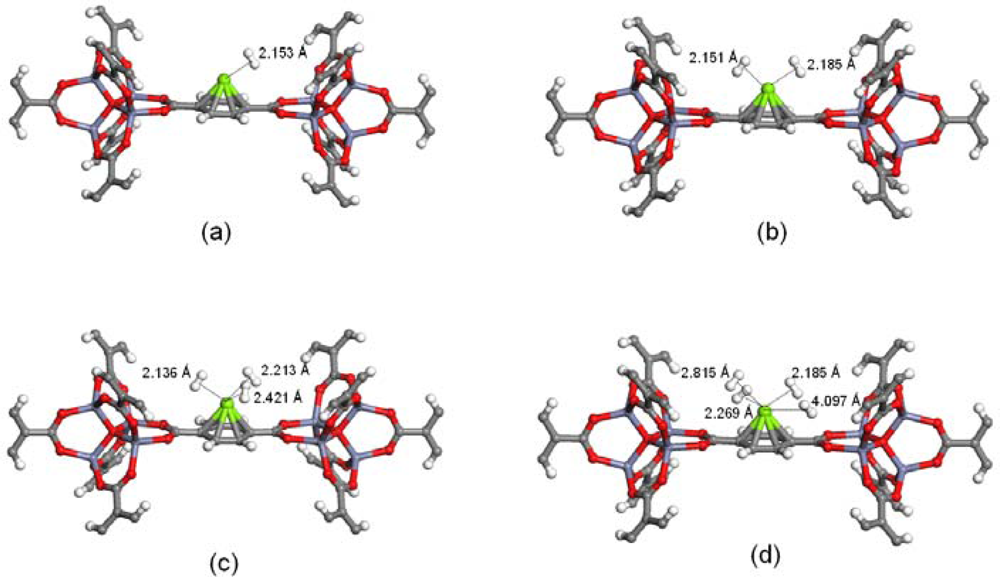
<mml:mn>2</mml:mn></mml:msub></mml:math></disp-formula>where <italic>E<sub>T</sub></italic>(Li-MOF+H<sub>2</sub>) and <italic>E<sub>T</sub></italic>(Li-MOF) refer to the total energy of the Li- functionalized Zn-MOF with and without hydrogen molecule respectively, while the <italic>E<sub>T</sub></italic>(H<sub>2</sub>) refers to the total energy of the free hydrogen molecule and “n” is the number of hydrogen molecules. In the current work we have added one to four hydrogen molecules near the Li center. The calculated structural parameters and the binding energies are provided in <xref ref-type="table" rid="t2-ijms-10-01601">Table 2</xref>, while the optimized structures are provided in <xref ref-type="fig" rid="f1-ijms-10-01601">Figure 1</xref>.</p>
<p>For the first H<sub>2</sub>, the interaction energy is 0.213 eV, with an intermolecular distance of 2.153 Ǻ. This binding energy per atom was close to the value reported for systems that can be used for an ideal reversible hydrogen storage system [<xref ref-type="bibr" rid="b22-ijms-10-01601">22</xref>].The orientation of hydrogen is in T-shape, with a H-H bond distance of 0.760 Å, which corresponds to a very small change compared to the 0.750 Å bond length in a free hydrogen molecule. This indicates that the Li cation holds the H<sub>2</sub> molecules by a charge – quadruple and charge – induced dipole interaction [<xref ref-type="bibr" rid="b23-ijms-10-01601">23</xref>]. When the second hydrogen is introduced, the Li – H<sub>2</sub> distance increases to 2.124 Å, while the binding energy per H<sub>2</sub> molecule gets reduced to 0.209 eV. To know the number of hydrogen molecules a Li cation can hold, we doped the third and fourth H<sub>2</sub> near the Li cation. With the introduction of third H<sub>2</sub> the Li – H<sub>2</sub> distance increases along with a decreases in the interaction energy value. A noticeable feature is the H – H distance which decreases with the increase in the number of H<sub>2</sub>. When the fourth hydrogen is introduced near the Li cation, three H<sub>2</sub> are place near the Li atom and the other H<sub>2</sub> molecule is moved away to a nonbonding distance of 4.036 Å. Thus each Li cation can hold up to 3 hydrogen molecules in a quasi molecular form. Furthermore, each BDC unit can adsorb one Li atom on each face and can maximize its storage to 6 hydrogen molecules per BDC unit. Further the existence of several metal sites will increase the storage capacity of the Li-functionalized MOF’s.</p></sec>
<sec>
<label>2.3.</label>
<title>Effect of metal center on Li-functionalized MOF’s</title>
<p>To know the possibility of extending the Li doping to other IRMOF-5, we studied the adsorption of Li cation on IRMOF-5. We have selected metals (M= Fe, Co, Ni, Cu and Zn) from the same column of the periodic table by replacing Zn centers. Structural relaxation without Li atom shows only a slight change in volume to occur up on the change in metal sites. However, up on doping with Li atom a considerable change in shape and structure was observed for other materials except Zn. <xref ref-type="table" rid="t3-ijms-10-01601">Table 3</xref> contains structural information for the linker and the benzene-Li mean distance. One can observe that the linker unit benzene remains practically unchanged in all the studied compounds.</p>
<p>In <xref ref-type="table" rid="t4-ijms-10-01601">Table 4</xref>. we have collected the M-O1, C1-O1, C1-C2 bond lengths, O1-M-O2 bond angles and the adsorption energy of Li for the optimized structure of M-MOF-5 system. From the table it is evident that a significant structural change is observed around the OM<sub>4</sub> tetrahedra unit and linker BDC unit. The metal-metal distance deviation is shorter in the case of Zn, and very high reduction in distance is observed for iron system. Further, calculated adsorption energy for these compounds don’t show any regular trend with the metals. These results suggest that adsorption energy of Li not only depend on the metal centers but are greatly influenced by the structural change and the volume of the system that changes upon Li doping.</p></sec></sec>
<sec sec-type="methods">
<label>3.</label>
<title>Computational Methods</title>
<p>The calculations were performed using density functional theory (DFT) in the generalized gradient approximation (GGA) with the exchange-correlation function proposed by Perdew–Wang (PW91) [<xref ref-type="bibr" rid="b24-ijms-10-01601">24</xref>] as implemented in the VASP plane wave. To represent the atomic cores, we use the projector augmented wave pseudopotentials. Ionic positions and cell parameters were relaxed with respect to minimum forces and stress by using conjugated-gradient algorithms. All atoms were fully relaxed with the energy converged to less than 10<sup>−5</sup> eV. Electronic wave functions are represented by plane waves up to 400 eV. Calculations were preformed on a 106-atom, primitive cell of dimension 26 Å X 13 Å X 13 Å which imposes periodic boundary conditions. As we are dealing with a large system, the Γ-point was used for sampling the Brillouin zone.</p></sec>
<sec sec-type="conclusions">
<label>4.</label>
<title>Conclusions</title>
<p>In summary, we have performed a DFT study to determine the stability of Li atom binding on Zn-MOF. The adsorption energy calculated shows that Li atom adsorption is exothermic in MOF system. Hydrogen adsorption on Li functionalized Zn-MOF-5 occurs with only a small structural change. Doping Li enhances the binding energy of hydrogen molecules to the desired value. Each Li was found to hold up to three hydrogen molecules in a near molecular form. Introduction of Li on isoreticular MOFs with metals Fe, Co, Ni, Cu shows a considerable structural change, to occurs near the OM<sub>4</sub> tetrahedral site, leading to the reduction in the volume of the materials. The adsorption energy and stability of Li doping on these materials not only depend on the metal centers by are greatly influenced by the structural change and the volume of the system that changes after Li doping.</p></sec></body>
<back>
<ack>
<p>This work has been supported by New Energy and Industrial Technology Development Organization (NEDO) under “Advanced Fundamental Research Project on Hydrogen Storage Materials”. The authors thank the crew of the Center for Computational Materials Science at Institute for Materials Research, Tohoku University, for their continuous support of the HITACHI SR11000 supercomputing facility.</p></ack>
<ref-list>
<title>References and Notes</title>
<ref id="b1-ijms-10-01601"><label>1.</label><citation citation-type="journal"><person-group person-group-type="author"><name><surname>Orimo</surname><given-names>SI</given-names></name><name><surname>Nakamori</surname><given-names>Y</given-names></name><name><surname>Eliseo</surname><given-names>JR</given-names></name><name><surname>Züttel</surname><given-names>A</given-names></name><name><surname>Jensen</surname><given-names>CM</given-names></name></person-group><article-title>Complex Hydrides for Hydrogen Storage</article-title><source>Chem. Rev</source><year>2007</year><volume>107</volume><fpage>4111</fpage><lpage>4132</lpage><pub-id pub-id-type="doi">10.1021/cr0501846</pub-id><pub-id pub-id-type="pmid">17848101</pub-id></citation></ref>
<ref id="b2-ijms-10-01601"><label>2.</label><citation citation-type="journal"><person-group person-group-type="author"><name><surname>vanden Berg</surname><given-names>AWC</given-names></name><name><surname>Areán</surname><given-names>CO</given-names></name></person-group><article-title>Materials for hydrogen storage: current research trends and perspectives</article-title><source>Chem Commun</source><year>2008</year><fpage>668</fpage><lpage>681</lpage></citation></ref>
<ref id="b3-ijms-10-01601"><label>3.</label><citation citation-type="journal"><person-group person-group-type="author"><name><surname>Rosi</surname><given-names>NL</given-names></name><name><surname>Eckert</surname><given-names>J</given-names></name><name><surname>Eddaoudi</surname><given-names>M</given-names></name><name><surname>Vodak</surname><given-names>DT</given-names></name><name><surname>Kim</surname><given-names>J</given-names></name><name><surname>O’Keeffe</surname><given-names>M</given-names></name><name><surname>Yaghi</surname><given-names>OM</given-names></name></person-group><article-title>Hydrogen Storage in Microporous Metal-Organic Frameworks</article-title><source>Science</source><year>2003</year><volume>300</volume><fpage>1127</fpage><lpage>1129</lpage><pub-id pub-id-type="doi">10.1126/science.1083440</pub-id><pub-id pub-id-type="pmid">12750515</pub-id></citation></ref>
<ref id="b4-ijms-10-01601"><label>4.</label><citation citation-type="journal"><person-group person-group-type="author"><name><surname>Rowsell</surname><given-names>JLC</given-names></name><name><surname>Spencer</surname><given-names>EC</given-names></name><name><surname>Eckert</surname><given-names>J</given-names></name><name><surname>Howard</surname><given-names>JAK</given-names></name><name><surname>Yaghi</surname><given-names>OM</given-names></name></person-group><article-title>Gas Adsorption Sites in a Large-Pore Metal-Organic Framework</article-title><source>Science</source><year>2005</year><volume>309</volume><fpage>1350</fpage><lpage>1354</lpage><pub-id pub-id-type="doi">10.1126/science.1113247</pub-id><pub-id pub-id-type="pmid">16123294</pub-id></citation></ref>
<ref id="b5-ijms-10-01601"><label>5.</label><citation citation-type="journal"><person-group person-group-type="author"><name><surname>Farha</surname><given-names>OK</given-names></name><name><surname>Spokoyny</surname><given-names>AM</given-names></name><name><surname>Mulfort</surname><given-names>JK</given-names></name><name><surname>Hawthrone</surname><given-names>MF</given-names></name><name><surname>Mirkin</surname><given-names>CA</given-names></name><name><surname>Hupp</surname><given-names>JT</given-names></name></person-group><article-title>Syntheis and Hydrogen Sorption Properties of Carborane Based Metal-Organic Framework Materials</article-title><source>J. Am. Chem. Soc</source><year>2007</year><volume>129</volume><fpage>12680</fpage><lpage>12681</lpage><pub-id pub-id-type="doi">10.1021/ja076167a</pub-id><pub-id pub-id-type="pmid">17900124</pub-id></citation></ref>
<ref id="b6-ijms-10-01601"><label>6.</label><citation citation-type="journal"><person-group person-group-type="author"><name><surname>Mulfort</surname><given-names>KL</given-names></name><name><surname>Hupp</surname><given-names>JT</given-names></name></person-group><article-title>Alkali Metal Cation Effects on Hydrogen Uptake and Binding in Metal-Organic Frameworks</article-title><source>Inorg. Chem</source><year>2008</year><volume>47</volume><fpage>7936</fpage><lpage>7938</lpage><pub-id pub-id-type="doi">10.1021/ic800700h</pub-id><pub-id pub-id-type="pmid">18549202</pub-id></citation></ref>
<ref id="b7-ijms-10-01601"><label>7.</label><citation citation-type="journal"><person-group person-group-type="author"><name><surname>Yang</surname><given-names>S</given-names></name><name><surname>Lin</surname><given-names>X</given-names></name><name><surname>Blake</surname><given-names>AJ</given-names></name><name><surname>Thomas</surname><given-names>KM</given-names></name><name><surname>Hubberstey</surname><given-names>P</given-names></name><name><surname>Champness</surname><given-names>NR</given-names></name><name><surname>Schroder</surname><given-names>M</given-names></name></person-group><article-title>Enhancement of H<sub>2</sub> Adsorption in Li<sup>+</sup>-exchanged Co-ordination Framework Materials</article-title><source>Chem Commun</source><year>2008</year><fpage>6108</fpage><lpage>6110</lpage></citation></ref>
<ref id="b8-ijms-10-01601"><label>8.</label><citation citation-type="journal"><person-group person-group-type="author"><name><surname>Chen</surname><given-names>B</given-names></name><name><surname>Ockwig</surname><given-names>NW</given-names></name><name><surname>Millward</surname><given-names>AR</given-names></name><name><surname>Contreras</surname><given-names>DS</given-names></name><name><surname>Yaghi</surname><given-names>OM</given-names></name></person-group><article-title>High H<sub>2</sub> Adsorption in a Microporous Metal-Organic Framework with Open metal Sites</article-title><source>Angew. Chem. Int. Ed</source><year>2005</year><volume>44</volume><fpage>4745</fpage><lpage>4749</lpage><pub-id pub-id-type="doi">10.1002/anie.200462787</pub-id></citation></ref>
<ref id="b9-ijms-10-01601"><label>9.</label><citation citation-type="journal"><person-group person-group-type="author"><name><surname>Dinca</surname><given-names>M</given-names></name><name><surname>Long</surname><given-names>JR</given-names></name></person-group><article-title>Strong H<sub>2</sub> Binding and Selective Gas Adsorption within the Microporous Coordination Solid Mg<sub>3</sub>(O<sub>2</sub>C-C<sub>10</sub>H<sub>6</sub>-CO<sub>2</sub>)<sub>3</sub></article-title><source>J. Am. Chem. Soc</source><year>2005</year><volume>127</volume><fpage>9376</fpage><lpage>9377</lpage><pub-id pub-id-type="doi">10.1021/ja0523082</pub-id><pub-id pub-id-type="pmid">15984858</pub-id></citation></ref>
<ref id="b10-ijms-10-01601"><label>10.</label><citation citation-type="journal"><person-group person-group-type="author"><name><surname>Li</surname><given-names>Y</given-names></name><name><surname>Xie</surname><given-names>L</given-names></name><name><surname>Liu</surname><given-names>Y</given-names></name><name><surname>Yang</surname><given-names>R</given-names></name><name><surname>Li</surname><given-names>X</given-names></name></person-group><article-title>Favorable Hydrogen Storage Properties of M(HBTC)(4,4′-bipy).3DMF (M = Ni and Co)</article-title><source>Inorg. Chem</source><year>2008</year><volume>47</volume><fpage>10372</fpage><lpage>10377</lpage><pub-id pub-id-type="doi">10.1021/ic800919k</pub-id><pub-id pub-id-type="pmid">18855378</pub-id></citation></ref>
<ref id="b11-ijms-10-01601"><label>11.</label><citation citation-type="journal"><person-group person-group-type="author"><name><surname>Ramsahye</surname><given-names>NA</given-names></name><name><surname>Maurin</surname><given-names>G</given-names></name><name><surname>Bourrelly</surname><given-names>S</given-names></name><name><surname>Llewellyn</surname><given-names>PL</given-names></name><name><surname>Serre</surname><given-names>C</given-names></name><name><surname>Loiseau</surname><given-names>T</given-names></name><name><surname>Devic</surname><given-names>T</given-names></name><name><surname>Férey</surname><given-names>G</given-names></name></person-group><article-title>Probing the Adsorption Sites for CO<sub>2</sub> in Metal Organic Frameworks Materials MIL-53 (Al, Cr) and MIL-47 (V) by Density Functional Theory</article-title><source>J. Phys. Chem. C</source><year>2008</year><volume>112</volume><fpage>514</fpage><lpage>520</lpage><pub-id pub-id-type="doi">10.1021/jp075782y</pub-id></citation></ref>
<ref id="b12-ijms-10-01601"><label>12.</label><citation citation-type="journal"><person-group person-group-type="author"><name><surname>Vitillo</surname><given-names>JG</given-names></name><name><surname>Regli</surname><given-names>L</given-names></name><name><surname>Chavan</surname><given-names>S</given-names></name><name><surname>Ricchiardi</surname><given-names>G</given-names></name><name><surname>Spoto</surname><given-names>G</given-names></name><name><surname>Dietzel</surname><given-names>PDC</given-names></name><name><surname>Bordiga</surname><given-names>S</given-names></name><name><surname>Zecchina</surname><given-names>A</given-names></name></person-group><article-title>Role of Exposed Metal Sites in Hydrogen Storage in MOFs</article-title><source>J. Am. Chem. Soc</source><year>2008</year><volume>130</volume><fpage>8386</fpage><lpage>8396</lpage><pub-id pub-id-type="doi">10.1021/ja8007159</pub-id><pub-id pub-id-type="pmid">18533719</pub-id></citation></ref>
<ref id="b13-ijms-10-01601"><label>13.</label><citation citation-type="journal"><person-group person-group-type="author"><name><surname>Mueller</surname><given-names>T</given-names></name><name><surname>Ceder</surname><given-names>G</given-names></name></person-group><article-title>A Density Functional Theory Study on Hydrogen Adsorption in MOF-5</article-title><source>J. Phys. Chem. B</source><year>2005</year><volume>109</volume><fpage>17974</fpage><lpage>17983</lpage><pub-id pub-id-type="doi">10.1021/jp051202q</pub-id><pub-id pub-id-type="pmid">16853307</pub-id></citation></ref>
<ref id="b14-ijms-10-01601"><label>14.</label><citation citation-type="journal"><person-group person-group-type="author"><name><surname>Han</surname><given-names>SS</given-names></name><name><surname>Goddard</surname><given-names>WA</given-names></name></person-group><article-title>Lithium-Doped Metal-Organic Frameworks for Reversible H<sub>2</sub> Storage at Ambient Temperature</article-title><source>J. Am. Chem. Soc</source><year>2007</year><volume>129</volume><fpage>8422</fpage><lpage>8423</lpage><pub-id pub-id-type="doi">10.1021/ja072599+</pub-id><pub-id pub-id-type="pmid">17569539</pub-id></citation></ref>
<ref id="b15-ijms-10-01601"><label>15.</label><citation citation-type="journal"><person-group person-group-type="author"><name><surname>Mulfort</surname><given-names>KL</given-names></name><name><surname>Hupp</surname><given-names>JT</given-names></name></person-group><article-title>Chemical Reduction of Metal-Organic Framework materials as a Method to Enchance Gas Uptake and Binding</article-title><source>J. Am. Chem. Soc</source><year>2007</year><volume>129</volume><fpage>9604</fpage><lpage>9605</lpage><pub-id pub-id-type="doi">10.1021/ja0740364</pub-id><pub-id pub-id-type="pmid">17636927</pub-id></citation></ref>
<ref id="b16-ijms-10-01601"><label>16.</label><citation citation-type="journal"><person-group person-group-type="author"><name><surname>Zhao</surname><given-names>D</given-names></name><name><surname>Yuan</surname><given-names>D</given-names></name><name><surname>Zhou</surname><given-names>H-C</given-names></name></person-group><article-title>The Current Status of Hydrogen Storage in Metal-Organic Frameworks</article-title><source>Energy Environ. Sci</source><year>2008</year><volume>1</volume><fpage>222</fpage><lpage>235</lpage><pub-id pub-id-type="doi">10.1039/b808322n</pub-id></citation></ref>
<ref id="b17-ijms-10-01601"><label>17.</label><citation citation-type="journal"><person-group person-group-type="author"><name><surname>Klontazas</surname><given-names>E</given-names></name><name><surname>Mavrandonakis</surname><given-names>A</given-names></name><name><surname>Tylianakis</surname><given-names>E</given-names></name><name><surname>Froudakis</surname><given-names>GE</given-names></name></person-group><article-title>Improving Hydroen Storage Capacity of MOF by Functionalization of the Organic Linker with Lithium Atoms</article-title><source>Nano Lett</source><year>2008</year><volume>8</volume><fpage>1572</fpage><lpage>1576</lpage><pub-id pub-id-type="doi">10.1021/nl072941g</pub-id><pub-id pub-id-type="pmid">18494530</pub-id></citation></ref>
<ref id="b18-ijms-10-01601"><label>18.</label><citation citation-type="journal"><person-group person-group-type="author"><name><surname>Blomqvist</surname><given-names>A</given-names></name><name><surname>Araújo</surname><given-names>CM</given-names></name><name><surname>Srepusharawoot</surname><given-names>P</given-names></name><name><surname>Ahuja</surname><given-names>R</given-names></name></person-group><article-title>Li-decorated Metal-Organic Framework-5: A Route to Achieving a Suitable Hydrogen Storage Medium</article-title><source>Proc. Natl. Acad. Sci. USA</source><year>2007</year><volume>104</volume><fpage>20173</fpage><lpage>20176</lpage><pub-id pub-id-type="doi">10.1073/pnas.0708603104</pub-id><pub-id pub-id-type="pmid">18093960</pub-id></citation></ref>
<ref id="b19-ijms-10-01601"><label>19.</label><citation citation-type="journal"><person-group person-group-type="author"><name><surname>Amicangelo</surname><given-names>JC</given-names></name><name><surname>Armentrout</surname><given-names>PB</given-names></name></person-group><article-title>Absolute Binding Energies of Alkali-Metal Cation Complexes with Benzene Determined by Threshold Collision-Induced Dissociation Experiments and ab Initio Theory</article-title><source>J. Phys. Chem. A</source><year>2000</year><volume>104</volume><fpage>11420</fpage><lpage>11432</lpage><pub-id pub-id-type="doi">10.1021/jp002652f</pub-id></citation></ref>
<ref id="b20-ijms-10-01601"><label>20.</label><citation citation-type="journal"><person-group person-group-type="author"><name><surname>Niu</surname><given-names>J</given-names></name><name><surname>Rao</surname><given-names>BK</given-names></name><name><surname>Jena</surname><given-names>P</given-names></name></person-group><article-title>Binding of hydrogen molecules by transition-metal ion</article-title><source>Phys. Rev. Lett</source><year>1992</year><volume>68</volume><fpage>2277</fpage><lpage>2280</lpage><pub-id pub-id-type="doi">10.1103/PhysRevLett.68.2277</pub-id><pub-id pub-id-type="pmid">10045354</pub-id></citation></ref>
<ref id="b21-ijms-10-01601"><label>21.</label><citation citation-type="journal"><person-group person-group-type="author"><name><surname>Li</surname><given-names>H</given-names></name><name><surname>Eddaoudi</surname><given-names>M</given-names></name><name><surname>O’Keeffe</surname><given-names>MO</given-names></name><name><surname>Yaghi</surname><given-names>OM</given-names></name></person-group><article-title>Design and Synthesis of an Exceptionally Stable and Highly Porous Metal-Organic Framework</article-title><source>Nature (London)</source><year>1999</year><volume>402</volume><fpage>276</fpage><lpage>279</lpage><pub-id pub-id-type="doi">10.1038/46248</pub-id></citation></ref>
<ref id="b22-ijms-10-01601"><label>22.</label><citation citation-type="journal"><person-group person-group-type="author"><name><surname>Ströbel</surname><given-names>R</given-names></name><name><surname>Garche</surname><given-names>J</given-names></name><name><surname>Moseley</surname><given-names>PT</given-names></name><name><surname>Jörissen</surname><given-names>L</given-names></name><name><surname>Wold</surname><given-names>G</given-names></name></person-group><article-title>Hydrogen Storage by Carbon Materials</article-title><source>J. Power Sources</source><year>2006</year><volume>159</volume><fpage>781</fpage><lpage>801</lpage><pub-id pub-id-type="doi">10.1016/j.jpowsour.2006.03.047</pub-id></citation></ref>
<ref id="b23-ijms-10-01601"><label>23.</label><citation citation-type="journal"><person-group person-group-type="author"><name><surname>Lochan</surname><given-names>RC</given-names></name><name><surname>Head-Gordon</surname><given-names>M</given-names></name></person-group><article-title>Computational Studies of Molecular Hydrogen Binding Affinities: The Role of Dispersion Forces, Electrostatics and Orbital Interactions</article-title><source>Phys. Chem. Chem. Phys</source><year>2006</year><volume>8</volume><fpage>1357</fpage><lpage>1370</lpage><pub-id pub-id-type="doi">10.1039/b515409j</pub-id><pub-id pub-id-type="pmid">16633617</pub-id></citation></ref>
<ref id="b24-ijms-10-01601"><label>24.</label><citation citation-type="journal"><person-group person-group-type="author"><name><surname>Perdew</surname><given-names>JP</given-names></name><name><surname>Wang</surname><given-names>Y</given-names></name></person-group><article-title>Accurate and Simple Analytic Representation of the Electron-Gas Correlation Energy</article-title><source>Phys Rev B</source><year>1992</year><volume>45</volume><fpage>13244</fpage><lpage>13249</lpage><pub-id pub-id-type="doi">10.1103/PhysRevB.45.13244</pub-id></citation></ref></ref-list>
<sec sec-type="display-objects">
<title>Figures and Tables</title>
<fig id="f1-ijms-10-01601" position="float">
<label>Figure 1.</label>
<caption>
<p>Optimized geometries of adsorbed hydrogen molecules on Li functionalized Zn-MOF-5 with one (a), two (b), three (c) and four (d) hydrogen molecules. Colors grey (C atoms), white (H atoms, red (O atoms) green (Li atoms) pale gray (Zn atoms).</p></caption>
<graphic xlink:href="ijms-10-01601f1.gif"/></fig>
<fig id="f2-ijms-10-01601" position="float">
<label>Scheme 1.</label>
<caption>
<p>Primitive unit cell of isoreticular MOF-5 (M = Fe, Co, Ni, Cu, Zn). Colors: blue (Metal center), gray (C atoms), white (H atoms), green (Li atom), red (oxygen). The structure is formed by OM<sub>4</sub> tetrahedra at the corners linked by benzene dicarboxylic (BDC) groups.</p></caption>
<graphic xlink:href="ijms-10-01601f2.gif"/></fig>
<table-wrap id="t1-ijms-10-01601" position="float">
<label>Table 1.</label>
<caption>
<p>Adsorption energy (AE, eV) and selected bond parameters (Å) for Li atom on Zn-MOF-5 unit.</p></caption>
<table frame="hsides" rules="rows">
<thead>
<tr>
<th align="center" valign="middle">System</th>
<th align="center" valign="middle"><italic>ΔAE</italic> eV</th>
<th align="center" valign="middle">C2–C3<xref ref-type="table-fn" rid="tfn1-ijms-10-01601">a</xref></th>
<th align="center" valign="middle">C3–C4<xref ref-type="table-fn" rid="tfn1-ijms-10-01601">a</xref></th>
<th align="center" valign="middle">C4–C5<xref ref-type="table-fn" rid="tfn1-ijms-10-01601">a</xref></th>
<th align="center" valign="middle">C5–C6<xref ref-type="table-fn" rid="tfn1-ijms-10-01601">a</xref></th>
<th align="center" valign="middle">C6–C7<xref ref-type="table-fn" rid="tfn1-ijms-10-01601">a</xref></th>
<th align="center" valign="middle">C7–C2<xref ref-type="table-fn" rid="tfn1-ijms-10-01601">a</xref></th>
<th align="center" valign="middle">C<sub>M</sub>–Li<xref ref-type="table-fn" rid="tfn2-ijms-10-01601">b</xref></th></tr></thead>
<tbody>
<tr>
<td align="center" valign="top">Li–Zn-MOF</td>
<td align="center" valign="top">−1.56</td>
<td align="center" valign="top">1.428</td>
<td align="center" valign="top">1.380</td>
<td align="center" valign="top">1.428</td>
<td align="center" valign="top">1.380</td>
<td align="center" valign="top">1.428</td>
<td align="center" valign="top">2.229</td></tr>
<tr>
<td align="center" valign="middle">Zn-MOF<xref ref-type="table-fn" rid="tfn3-ijms-10-01601">c</xref></td>
<td align="center" valign="middle"/>
<td align="center" valign="middle">1.399 (1.388)</td>
<td align="center" valign="middle">1.384 (1.375)</td>
<td align="center" valign="middle">1.399 (1.392)</td>
<td align="center" valign="middle">1.399 (1.397)</td>
<td align="center" valign="middle">1.384 (1.379)</td>
<td align="center" valign="middle">1.399 (1.392)</td>
<td align="center" valign="middle"/></tr></tbody></table>
<table-wrap-foot><fn id="tfn1-ijms-10-01601">
<p><sup>a</sup>For numbering see <xref ref-type="fig" rid="f2-ijms-10-01601">Scheme 1</xref>.</p></fn><fn id="tfn2-ijms-10-01601">
<p><sup>b</sup>Mean Li–C distance</p></fn><fn id="tfn3-ijms-10-01601">
<p><sup>c</sup>Values in parenthesis are experimental values from ref. [<xref ref-type="bibr" rid="b21-ijms-10-01601">21</xref>].</p></fn></table-wrap-foot></table-wrap>
<table-wrap id="t2-ijms-10-01601" position="float">
<label>Table 2.</label>
<caption>
<p>Selected bond parameters (Å) and binding energy per hydrogen molecule (eV) for the adsorption of hydrogen on Li functionalized Zn-MOF.</p></caption>
<table frame="hsides" rules="groups">
<thead>
<tr>
<th align="center" valign="middle">No. of H<sub>2</sub></th>
<th align="center" valign="middle">Avg. Benzene – Li (Å)</th>
<th align="center" valign="middle">Li – H<sub>2</sub> (Å)</th>
<th align="center" valign="middle">Avg. H – H (Å)</th>
<th align="center" valign="middle"><italic>ΔE</italic><sub><italic>b</italic></sub> (eV)</th></tr></thead>
<tbody>
<tr>
<td align="center" valign="top">0</td>
<td align="center" valign="top">2.206</td>
<td align="center" valign="top">-</td>
<td align="center" valign="top">0.750</td>
<td align="center" valign="top">-</td></tr>
<tr>
<td align="center" valign="top">1</td>
<td align="center" valign="top">2.223</td>
<td align="center" valign="top">2.096</td>
<td align="center" valign="top">0.760</td>
<td align="center" valign="top">0.213</td></tr>
<tr>
<td align="center" valign="top">2</td>
<td align="center" valign="top">2.241</td>
<td align="center" valign="top">2.124</td>
<td align="center" valign="top">0.759</td>
<td align="center" valign="top">0.209</td></tr>
<tr>
<td align="center" valign="top">3</td>
<td align="center" valign="top">2.257</td>
<td align="center" valign="top">2.315</td>
<td align="center" valign="top">0.755</td>
<td align="center" valign="top">0.196</td></tr>
<tr>
<td align="center" valign="top">4</td>
<td align="center" valign="top">2.252</td>
<td align="center" valign="top">2.379 (4.036)</td>
<td align="center" valign="top">0.755 (0.751)</td>
<td align="center" valign="top">0.163</td></tr></tbody></table></table-wrap>
<table-wrap id="t3-ijms-10-01601" position="float">
<label>Table 3.</label>
<caption>
<p>Calculated structural parameters (Å) in the organic linker of Li cation doped M-MOF-5 (M = Fe, Co, Ni, Cu, Zn).</p></caption>
<table frame="hsides" rules="groups">
<thead>
<tr>
<th align="left" valign="middle">System</th>
<th align="center" valign="middle">C2–C3</th>
<th align="center" valign="middle">C3–C4</th>
<th align="center" valign="middle">C4–C5</th>
<th align="center" valign="middle">C5–C6</th>
<th align="center" valign="middle">C6–C7</th>
<th align="center" valign="middle">C7–C2</th>
<th align="right" valign="middle">C<sub>M</sub>–Li<xref ref-type="table-fn" rid="tfn4-ijms-10-01601">a</xref></th></tr></thead>
<tbody>
<tr>
<td align="left" valign="top">Fe-MOF-5</td>
<td align="center" valign="top">1.425</td>
<td align="center" valign="top">1.369</td>
<td align="center" valign="top">1.425</td>
<td align="center" valign="top">1.396</td>
<td align="center" valign="top">1.425</td>
<td align="right" valign="top">2.274</td></tr>
<tr>
<td align="left" valign="top">Co-MOF-5</td>
<td align="center" valign="top">1.417</td>
<td align="center" valign="top">1.407</td>
<td align="center" valign="top">1.417</td>
<td align="center" valign="top">1.407</td>
<td align="center" valign="top">1.417</td>
<td align="right" valign="top">2.292</td></tr>
<tr>
<td align="left" valign="top">Ni-MOF-5</td>
<td align="center" valign="top">1.410</td>
<td align="center" valign="top">1.391</td>
<td align="center" valign="top">1.410</td>
<td align="center" valign="top">1.391</td>
<td align="center" valign="top">1.410</td>
<td align="right" valign="top">2.280</td></tr>
<tr>
<td align="left" valign="top">Cu-MOF-5</td>
<td align="center" valign="top">1.407</td>
<td align="center" valign="top">1.396</td>
<td align="center" valign="top">1.408</td>
<td align="center" valign="top">1.407</td>
<td align="center" valign="top">1.394</td>
<td align="center" valign="top">1.404</td>
<td align="right" valign="top">2.285</td></tr>
<tr>
<td align="left" valign="top">Zn-MOF-5</td>
<td align="center" valign="top">1.436</td>
<td align="center" valign="top">1.377</td>
<td align="center" valign="top">1.437</td>
<td align="center" valign="top">1.377</td>
<td align="center" valign="top">1.436</td>
<td align="right" valign="top">2.209</td></tr></tbody></table>
<table-wrap-foot><fn id="tfn4-ijms-10-01601">
<p><sup>a</sup>Mean benzene – Li distance</p></fn></table-wrap-foot></table-wrap>
<table-wrap id="t4-ijms-10-01601" position="float">
<label>Table 4.</label>
<caption>
<p>Selected bond lengths (Å) bond angles (deg) and adsorption energy of Li on M-MOF-5 (M = Fe, Co, Ni, Cu, Zn).</p></caption>
<table frame="hsides" rules="groups">
<thead>
<tr>
<th align="center" valign="middle">System</th>
<th align="center" valign="middle">M–O1</th>
<th align="center" valign="middle">C1–O1</th>
<th align="center" valign="middle">C1–C2</th>
<th align="center" valign="middle">O1–C–O2</th>
<th align="center" valign="middle">M1–M2</th>
<th align="center" valign="middle">ΔAE eV</th></tr></thead>
<tbody>
<tr>
<td align="left" valign="top">Fe-MOF-5</td>
<td align="center" valign="top">1.915</td>
<td align="center" valign="top">1.289</td>
<td align="center" valign="top">1.479</td>
<td align="center" valign="top">123.6</td>
<td align="center" valign="top">2.881</td>
<td align="center" valign="top">0.621</td></tr>
<tr>
<td align="left" valign="top">Co-MOF-5</td>
<td align="center" valign="top">2.010</td>
<td align="center" valign="top">1.276</td>
<td align="center" valign="top">1.527</td>
<td align="center" valign="top">125.4</td>
<td align="center" valign="top">2.399</td>
<td align="center" valign="top">0.548</td></tr>
<tr>
<td align="left" valign="top">Ni-MOF-5</td>
<td align="center" valign="top">1.949</td>
<td align="center" valign="top">1.270</td>
<td align="center" valign="top">1.481</td>
<td align="center" valign="top">127.1</td>
<td align="center" valign="top">2.864</td>
<td align="center" valign="top">0.776</td></tr>
<tr>
<td align="left" valign="top">Cu-MOF-5</td>
<td align="center" valign="top">2.009</td>
<td align="center" valign="top">1.265</td>
<td align="center" valign="top">1.501</td>
<td align="center" valign="top">128.2</td>
<td align="center" valign="top">2.939</td>
<td align="center" valign="top">3.14</td></tr>
<tr>
<td align="left" valign="top">Zn-MOF-5</td>
<td align="center" valign="top">1.956</td>
<td align="center" valign="top">1.264</td>
<td align="center" valign="top">1.491</td>
<td align="center" valign="top">129.5</td>
<td align="center" valign="top">3.128</td>
<td align="center" valign="top">1.15</td></tr>
<tr>
<td align="left" valign="top">Zn-MOF-5<xref ref-type="table-fn" rid="tfn5-ijms-10-01601">a</xref></td>
<td align="center" valign="top">1.937 (1.911)</td>
<td align="center" valign="top">1.274 (1.300)</td>
<td align="center" valign="top">1.479</td>
<td align="center" valign="top">129.3 (125.0)</td>
<td align="center" valign="top">3.128 (3.160)</td>
<td align="center" valign="top">-</td></tr></tbody></table>
<table-wrap-foot><fn id="tfn5-ijms-10-01601">
<p><sup>a</sup>Calculated and experimental values (in parenthesis) for Zn-MOF-5 without Li doping. Experimental values are from ref. [<xref ref-type="bibr" rid="b20-ijms-10-01601">20</xref>].</p></fn></table-wrap-foot></table-wrap></sec></back></article>