<?xml version="1.0" encoding="UTF-8"?>
<!DOCTYPE article PUBLIC "-//NLM//DTD Journal Publishing DTD v2.3 20070202//EN" "journalpublishing.dtd">
<article xmlns:mml="http://www.w3.org/1998/Math/MathML" xmlns:xlink="http://www.w3.org/1999/xlink" xml:lang="en" article-type="review-article">
<front>
<journal-meta>
<journal-id journal-id-type="publisher-id">ijms</journal-id>
<journal-title>International Journal of Molecular Sciences</journal-title>
<abbrev-journal-title>Int. J. Mol. Sci.</abbrev-journal-title>
<issn pub-type="epub">1422-0067</issn>
<publisher>
<publisher-name>Molecular Diversity Preservation International (MDPI)</publisher-name></publisher></journal-meta>
<article-meta>
<article-id pub-id-type="doi">10.3390/ijms10104559</article-id>
<article-id pub-id-type="publisher-id">ijms-10-04559</article-id>
<article-categories>
<subj-group>
<subject>Review</subject></subj-group></article-categories>
<title-group>
<article-title>Application of Δ- and Λ-Isomerism of Octahedral Metal Complexes for Inducing Chiral Nematic Phases</article-title></title-group>
<contrib-group>
<contrib contrib-type="author">
<name><surname>Sato</surname><given-names>Hisako</given-names></name><xref ref-type="aff" rid="af1-ijms-10-04559">1</xref><xref ref-type="aff" rid="af2-ijms-10-04559">2</xref><xref ref-type="corresp" rid="c1-ijms-10-04559">*</xref></contrib>
<contrib contrib-type="author">
<name><surname>Yamagishi</surname><given-names>Akihiko</given-names></name><xref ref-type="aff" rid="af3-ijms-10-04559">3</xref></contrib></contrib-group>
<aff id="af1-ijms-10-04559">
<label>1</label> Department of Chemistry, Faculty of Science, Ehime University/Matsuyama, 790-8577, Japan</aff>
<aff id="af2-ijms-10-04559">
<label>2</label> PRESTO/JST/Chiba, 277-8561, Japan</aff>
<aff id="af3-ijms-10-04559">
<label>3</label> Department of Chemistry, Faculty of Science, Ehime University, Ochanomizu University/Tokyo, 112-8610, Japan; E-Mail: 
<email>yamagishi.akihiko@ocha.ac.jp</email> (A.Y.)</aff>
<author-notes>
<corresp id="c1-ijms-10-04559">
<label>*</label> Author to whom correspondence should be addressed; E-Mail: 
<email>hsato@chem.sci.ehime-u.ac.jp</email>; Tel.: +81-89-927-9599; Fax: +81-89-927-9599.</corresp></author-notes>
<pub-date pub-type="collection">
<month>10</month>
<year>2009</year></pub-date>
<pub-date pub-type="epub">
<day>20</day>
<month>11</month>
<year>2009</year></pub-date>
<volume>10</volume>
<issue>10</issue>
<fpage>4559</fpage>
<lpage>4574</lpage>
<history>
<date date-type="received">
<day>3</day>
<month>9</month>
<year>2009</year></date>
<date date-type="rev-recd">
<day>29</day>
<month>9</month>
<year>2009</year></date>
<date date-type="accepted">
<day>22</day>
<month>10</month>
<year>2009</year></date></history>
<permissions>
<copyright-statement>© 2009 by the authors; licensee Molecular Diversity Preservation International, Basel, Switzerland.</copyright-statement>
<copyright-year>2009</copyright-year>
<license license-type="open-access" xlink:href="http://creativecommons.org/licenses/by/3.0">
<p>This article is an open-access article distributed under the terms and conditions of the Creative Commons Attribution license (http://creativecommons.org/licenses/by/3.0/).</p></license></permissions>
<abstract>
<p>The Δ- and Λ-isomerism of octahedral metal complexes is employed as a source of chirality for inducing chiral nematic phases. By applying a wide range of chiral metal complexes as a dopant, it has been found that tris(β-diketonato)metal(III) complexes exhibit an extremely high value of helical twisting power. The mechanism of induction of the chiral nematic phase is postulated on the basis of a surface chirality model. The strategy for designing an efficient dopant is described, together with the results using a number of examples of Co(III), Cr(III) and Ru(III) complexes with C<sub>2</sub> symmetry. The development of photo-responsive dopants to achieve the photo-induced structural change of liquid crystal by use of photo-isomerization of chiral metal complexes is also described.</p></abstract>
<kwd-group>
<kwd>metal complex</kwd>
<kwd>chiral</kwd>
<kwd>dopant</kwd>
<kwd>nematic</kwd>
<kwd>twisting power</kwd>
<kwd>vibrational circular dichroism</kwd></kwd-group></article-meta></front>
<body>
<sec sec-type="intro">
<label>1.</label>
<title>Introduction</title>
<p>The effect of chirality in liquid crystals has long intrigued scientists in broad disciplines [<xref ref-type="bibr" rid="b1-ijms-10-04559">1</xref>–<xref ref-type="bibr" rid="b8-ijms-10-04559">8</xref>] since the discovery of a cholesteric liquid crystal in 1888. Molecular chirality continues to be regarded as one of the symmetry lowering elements, particularly in the area of emerging novel phases [<xref ref-type="bibr" rid="b7-ijms-10-04559">7</xref>]. There still remains a crucial question as to how the helical ordering is associated with molecular chirality. In the cases of bent–core mesogens, for example, some workers favor a view that molecules of <italic>C</italic><sub>2v</sub> symmetry can still give rise to layer chirality [<xref ref-type="bibr" rid="b9-ijms-10-04559">9</xref>], if coupled to the tilt, while others seem to believe in molecular conformational chirality implemented in the mesophase. Apart from these fundamental problems, the phenomenon of chiral phase induction has been actively investigated from the practical points in the areas of organic and polymer chemistry, and is recognized as a useful means of elucidating chiral structures on mesoscopic and macroscopic scales [<xref ref-type="bibr" rid="b11-ijms-10-04559">11</xref>–<xref ref-type="bibr" rid="b13-ijms-10-04559">13</xref>].</p>
<p>Nematic liquid crystal (N) phases are known to transform to chiral nematic liquid crystal (N* or cholesteric liquid crystal) phases on use of small amounts of chiral molecules as chiral dopants [<xref ref-type="bibr" rid="b1-ijms-10-04559">1</xref>]. In these phenomena, the chirality of dopant molecules is the cause of induction of a helical structure. In liquid crystal systems, one of the most interesting aspects is that the molecular properties of a dopant molecule are reflected on various levels of molecular architectures. When chiral photochromic molecules are used as a dopant, for example, the helical pitch expands or contracts on a micrometer scale in response to the photo-irradiation [<xref ref-type="bibr" rid="b14-ijms-10-04559">14</xref>–<xref ref-type="bibr" rid="b23-ijms-10-04559">23</xref>].</p>
<p>The power of inducing an N* phase is measured in terms of Helical Twisting Power (denoted by HTP or <italic>β<sub>M</sub></italic>) according to the following equation:
<disp-formula id="FD1">
<label>(1)</label>
<mml:math display="block">
<mml:mrow>
<mml:msub>
<mml:mi>β</mml:mi>
<mml:mi>M</mml:mi></mml:msub>
<mml:mo>=</mml:mo>
<mml:msub>
<mml:mrow>
<mml:mrow>
<mml:mo>(</mml:mo>
<mml:mrow>
<mml:mfrac>
<mml:mrow>
<mml:mo>∂</mml:mo>
<mml:msup>
<mml:mi>P</mml:mi>
<mml:mrow>
<mml:mo>−</mml:mo>
<mml:mn>1</mml:mn></mml:mrow></mml:msup></mml:mrow>
<mml:mrow>
<mml:mo>∂</mml:mo>
<mml:mi>x</mml:mi></mml:mrow></mml:mfrac></mml:mrow>
<mml:mo>)</mml:mo></mml:mrow></mml:mrow>
<mml:mrow>
<mml:mi>x</mml:mi>
<mml:mo>→</mml:mo>
<mml:mn>0</mml:mn></mml:mrow></mml:msub></mml:mrow></mml:math></disp-formula>in which <italic>x</italic> is the molar fraction of a dopant and <italic>p</italic> the pitch length of an induced helix, respectively [<xref ref-type="bibr" rid="b1-ijms-10-04559">1</xref>]. The basic mechanisms of the transition from N to N* phases by chiral molecules have been studied theoretically to predict the HTP on the basis of the surface chirality model [<xref ref-type="bibr" rid="b10-ijms-10-04559">10</xref>–<xref ref-type="bibr" rid="b12-ijms-10-04559">12</xref>]. In some cases, however, correlation between the structure of a chiral dopant and induced helix is implicit and the magnitude of <italic>β<sub>M</sub></italic> value, even its sign, is difficult to predict.</p>
<p>A wide variety of organic molecules have been applied as chiral dopants in order to clarify the above problems [<xref ref-type="bibr" rid="b3-ijms-10-04559">3</xref>]. In contrast, inorganic compounds are not used so extensively, although the chirality of metal complexes is a main issue in coordination chemistry [<xref ref-type="bibr" rid="b24-ijms-10-04559">24</xref>–<xref ref-type="bibr" rid="b27-ijms-10-04559">27</xref>]. Motivated by these circumstances, more than ten years ago we initiated an attempt to develop metal complexes as efficient chiral dopants. In this review, we summarize our attempts at using the ΔΛ chirality of octahedral Co(III), Cr(III) and Ru(III) metal complexes in nematic liquid crystals [<xref ref-type="bibr" rid="b24-ijms-10-04559">24</xref>–<xref ref-type="bibr" rid="b31-ijms-10-04559">31</xref>]. In comparison to the chirality based on asymmetric carbon atoms, the ΔΛ isomerism of metal complexes is differentiated by the following characteristics:
<list list-type="order">
<list-item>
<p>The ΔΛ chirality has a more rigid nature than that of asymmetric carbon. Besides its size extends over 1 nm as a whole including a central metal ion and ligands. The scope under the influence of a chiral metal complex is even larger when it includes a bulky planar ligand such as aromatic rings.</p></list-item>
<list-item>
<p>The molecular properties of a dopant can be changed systematically by changing the coordination structures such as the degree of ligand replacement, geometrical isomers and the linking of coordination units by bridging ligands. This character would be helpful to reveal the structure-function relations on this topic.</p></list-item>
<list-item>
<p>Additional functions are attached to a dopant molecule by coupling the properties of metal ions such as photo-response, redox properties and asymmetric catalyses. This property may be utilized to construct a bi-functional liquid crystal system.</p></list-item></list></p>
<p>Because of these characteristics, the ΔΛ-isomerism of transition metal <italic>tris</italic>-chelates bears unique steric and electronic characters, not achievable by carbon centers, and they are expected to provide significant new insights into the understanding of chiral liquid crystal phases [<xref ref-type="bibr" rid="b32-ijms-10-04559">32</xref>–<xref ref-type="bibr" rid="b34-ijms-10-04559">34</xref>].</p>
<p>In the present review, we would like to show how the above characteristic properties are manifested by using a chiral metal complex as a dopant in liquid crystal phases. The works are selected to focus on the following two issues: the first topic is the mechanism of induction of the helical arrangement involving tens of thousands of host molecules by a single chiral molecule. What is a factor determining helical sense of such mesoscopic arrangement? In relation to this, we also discuss what property of metal complex is a main factor to attain high HTP. This point is, of course, of practical importance to develop an efficient dopant [<xref ref-type="bibr" rid="b24-ijms-10-04559">24</xref>–<xref ref-type="bibr" rid="b28-ijms-10-04559">28</xref>]. As the second issue, we attempted to develop a bi-functional molecule such as a light responsive dopant [<xref ref-type="bibr" rid="b28-ijms-10-04559">28</xref>–<xref ref-type="bibr" rid="b31-ijms-10-04559">31</xref>].</p></sec>
<sec>
<label>2.</label>
<title>Application of β-Diketonato Complexes as Chiral Dopants</title>
<p>The first attempt of using metal complexes as a dopant was reported by Spada and coworkers [<xref ref-type="bibr" rid="b32-ijms-10-04559">32</xref>]. They demonstrated that the enantiomerically pure metal acetylacetonates, [M(acac)<sub>3</sub>], which belong to the <italic>D</italic><sub>3</sub> point group, exhibited high ability to induce chiral nematic phases. Hoshino <italic>et al.</italic> reported the Δ-enantiomer of a Ru(II) complex [Ru(acac)<sub>2</sub>L] (L = an elongated mesogenic derivative of bpy, 5,5’-(4-octylphenyloxycarbonyl)−2,2’-bipyridyl). In contrast to [M(acac)<sub>3</sub>], the complex was designed to have <italic>C</italic><sub>2</sub> symmetry with two acetylacetonato moieties acting as “chiral blades” [<xref ref-type="bibr" rid="b33-ijms-10-04559">33</xref>]. This type of metal complex was found to exhibit a remarkably high helical twisting power (HTP) for nematic liquid crystals. As the attempts of using other kinds of metal ions, Shirakawa <italic>et al</italic>. reported the binol-derived titanate dopants [<xref ref-type="bibr" rid="b35-ijms-10-04559">35</xref>]. The very high HTP values are also reported using the metal complexes of Zn(II) and Ti(IV) [<xref ref-type="bibr" rid="b36-ijms-10-04559">36</xref>–<xref ref-type="bibr" rid="b38-ijms-10-04559">38</xref>].</p>
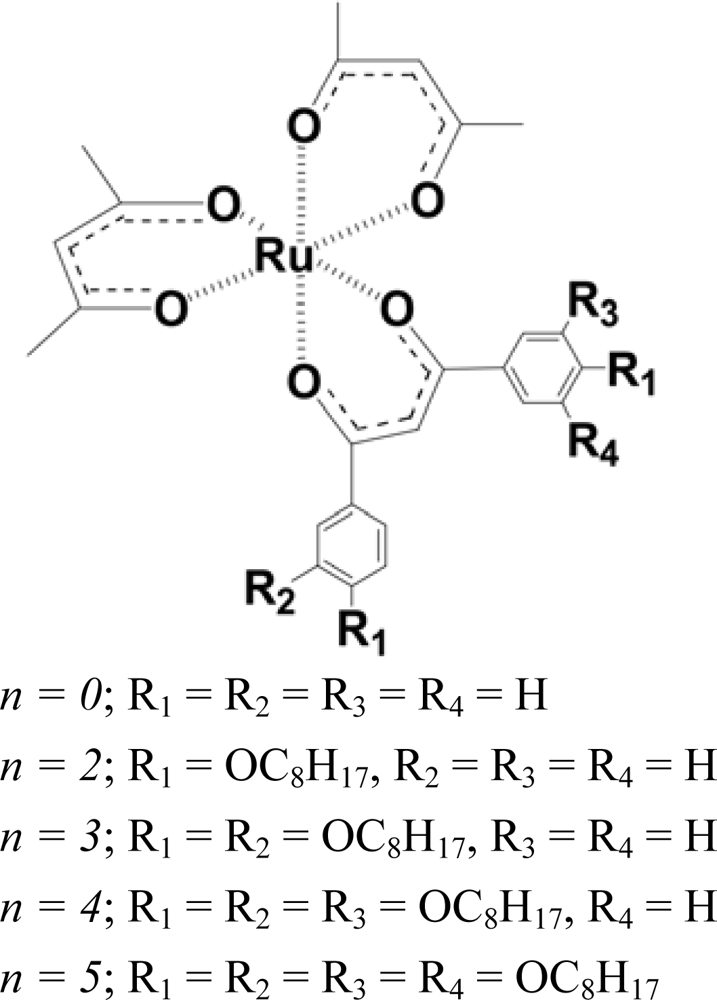
<p>Motivated by this successful approach, we elaborated the molecular design in order to improve the dopant performance [<xref ref-type="bibr" rid="b24-ijms-10-04559">24</xref>]. As a result, a new series of Ru(III) complexes [Ru(acac)<sub>2</sub>(L-<italic>n</italic>)] (L-<italic>n</italic> = a dibenzoylmethanate ligand substituted with <italic>n</italic> octyloxy chains), were prepared (<xref ref-type="fig" rid="f4-ijms-10-04559">Scheme 1</xref>) and optically resolved by means of a clay column chromatography [<xref ref-type="bibr" rid="b24-ijms-10-04559">24</xref>,<xref ref-type="bibr" rid="b39-ijms-10-04559">39</xref>]. For example, the number of octyloxy groups (<italic>n</italic>) was varied from 0 (unsubstituted) and 2 through 5 by a systematic synthetic approach. The induced CD (ICD) spectra were measured for MBBA materials doped with either Δ- or Λ- enantiomers at various concentrations. <xref ref-type="table" rid="t1-ijms-10-04559">Table 1</xref> summarizes HTP values at room temperature in MBBA.</p></sec>
<sec>
<label>3.</label>
<title>Molecular Mechanism in Induction of Chiral Nematic Phases</title>
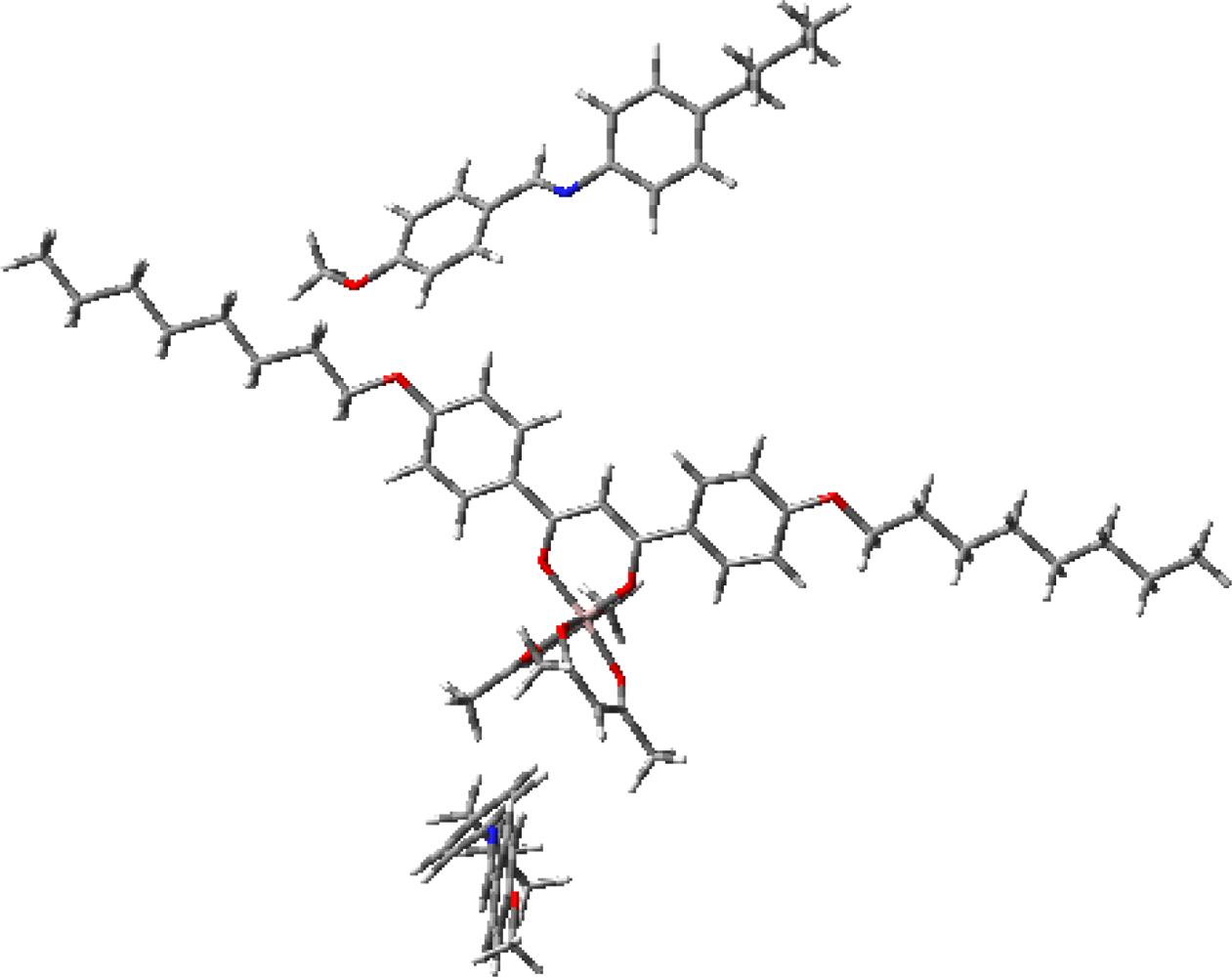
<p>Theoretical interpretation for the structure-HTP correlation as shown in <xref ref-type="table" rid="t1-ijms-10-04559">Table 1</xref> may require some knowledge of the chirality and orientational characteristics of the dopant used. A computational approach to HTP based on the atomistic details is usually taken to determine the equilibrium structure of a dopant [<xref ref-type="bibr" rid="b12-ijms-10-04559">12</xref>]. Thus we conducted <italic>ab initio</italic> calculations for the most stable geometry of an Al(III) complex with n = 2. There were a number of conformers encountered that must be carefully sorted out before meaningful chirality parameters could be enumerated. We therefore resorted to further calculations of the energy minimized configuration of a trio of the complex and a pair of MBBA molecules [Δ-Al(acac)<sub>2</sub>(L-<italic>2</italic>) + 2MBBA], and investigating the chirality recognition in this locus. Due to the presence of such ligands as L-<italic>n</italic>, we could conclude that our dopants will align generally like rodlike mesogens with the biaxiality increasing with <italic>n</italic> [<xref ref-type="bibr" rid="b24-ijms-10-04559">24</xref>,<xref ref-type="bibr" rid="b25-ijms-10-04559">25</xref>] <xref ref-type="fig" rid="f1-ijms-10-04559">Figure 1</xref> shows the angled view of the energy-minimized structure of [Δ-Al(acac)<sub>2</sub>(L-<italic>2</italic>) + 2MBBA]. It is noted that the mutually left-handed orientation of two MBBA molecules is achieved, when these host molecules are intervened between two acac ligands. This is completely in accord with the experimental observation that the Δ-enantimer induced the left-handed helical arrangement in a chiral nematic phase. In other words, an elongated ligand helped a dopant molecule to align in a host medium, while two acac ligands achieved the helical twisting of the host molecules that were in contact with the dopant. It was suspected that such local helicity would propagate through a liquid crystal medium to construct a helical arrangement on a micrometer scale. As for this propagation process, we also conducted further theoretical investigation based on a continuum medium model that the local twisting could be an origin of macromolecular helical architectures [<xref ref-type="bibr" rid="b25-ijms-10-04559">25</xref>]. According to the model, the host molecules interacted attractively with dopant, being twisted in the same direction as the helical conformation of the ligands. Interaction energy was assessed as a function of the dihedral angle between the two host molecules, leading to a quadratic dependence with a minimum at the equilibrium twisting angle. Based in this, we derived the expression, in which helical twisting power was given in terms of the equilibrium twisting angle of a pair of strongly interaction host molecules.</p></sec>
<sec sec-type="methods">
<label>4.</label>
<title>Control of Handedness in Chiral Nematic Phases on the Basis of Molecular Design</title>
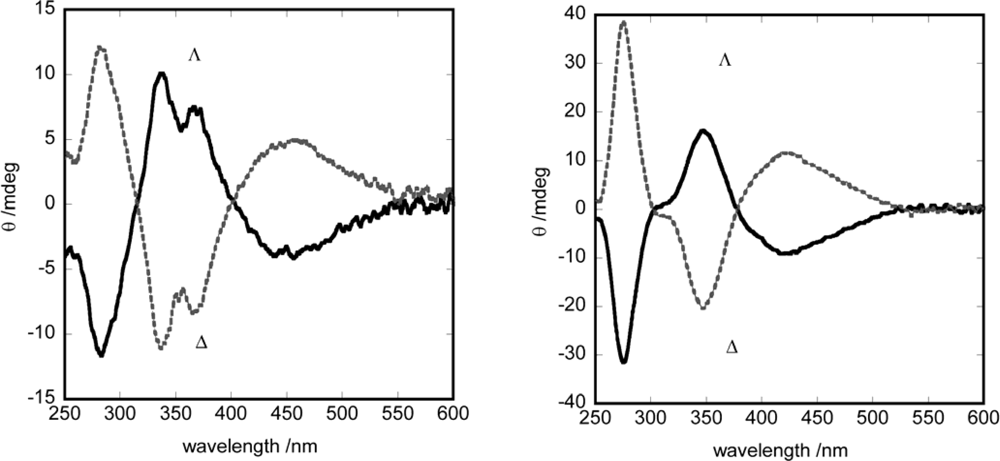
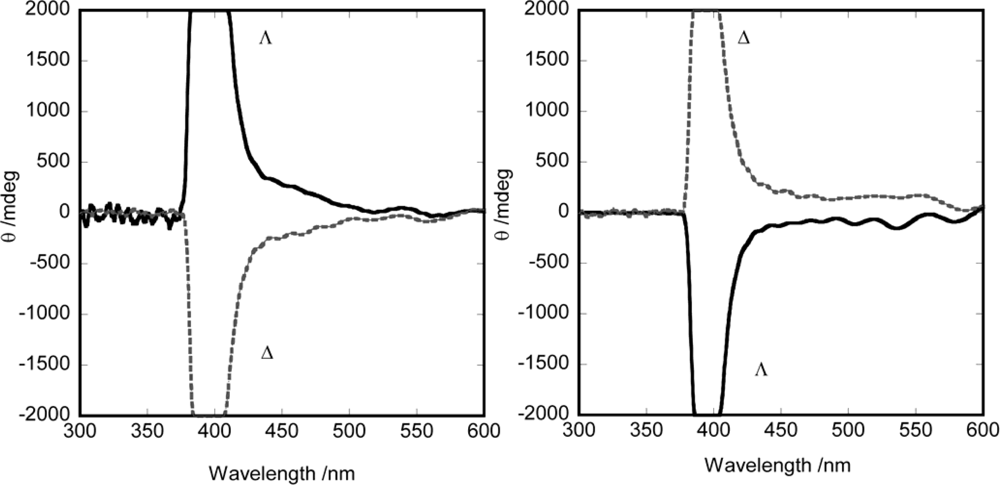
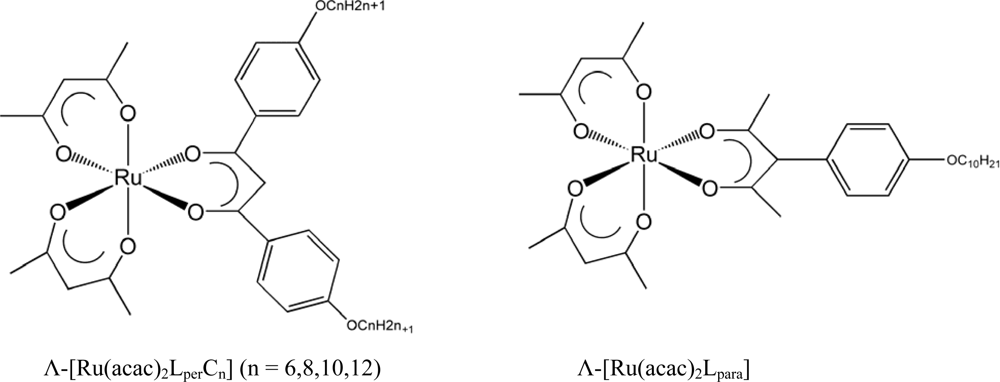
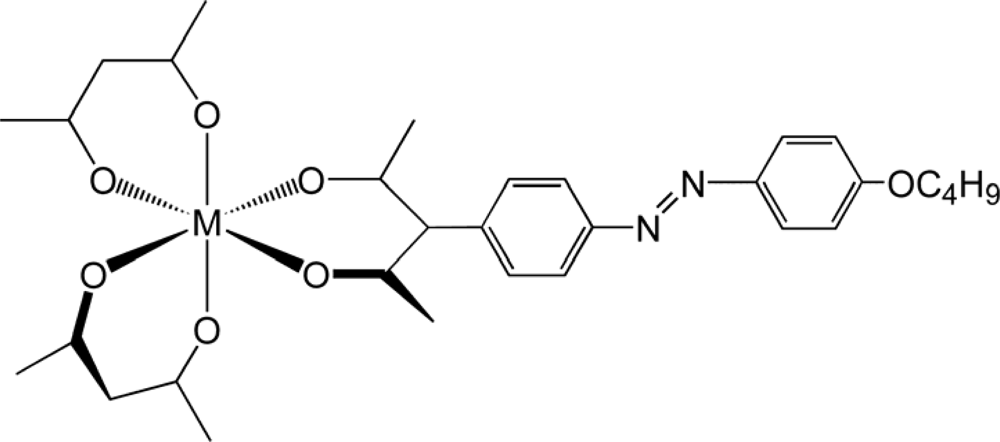
<p>As a consequence of the mechanism of helical induction as explained above, we postulated a model in which that the relation between ΔΛ configuration and the helical sense would depend crucially on the molecular orientation. Based on this prediction, two types of tris(chelated) molecules were compared as a chiral dopant, as shown in <xref ref-type="fig" rid="f5-ijms-10-04559">Scheme 2</xref>. One was elongated in the direction perpendicular to the C<sub>2</sub> axis (denoted by [Ru(acac)<sub>2</sub>L<sub>per</sub>C<sub>n</sub>] (n = 6,8,10,12)), while the other was elongated in the direction parallel with the C<sub>2</sub> axis (denoted by [Ru(acac)<sub>2</sub>L<sub>para</sub>]). These two molecules were expected to orient with their C<sub>2</sub> axes perpendicularly to or in parallel with the director of a host, respectively. Their optical purity was ascertained by the circular dichroism spectra of their methanol solutions in <xref ref-type="fig" rid="f1-ijms-10-04559">Figure 1</xref>. When these complexes were dissolved as a dopant in a nematic host (EBBA), they showed the induced circular dichroism (ICD) as shown in <xref ref-type="fig" rid="f2-ijms-10-04559">Figure 2</xref>. Such intense ICD spectra of positive and negative sings of CD for [Ru(acac)<sub>2</sub>L<sub>per</sub>C<sub>n</sub>] and [Ru(acac)<sub>2</sub>L<sub>para</sub>] meant the induction of right(<italic>P-</italic>) and left handed (<italic>M-</italic>) helix, respectively. The chirality versus twist sense correlation for complex 1 was therefore concluded to be Δ-<italic>M</italic> and Λ-<italic>P</italic> and for complex 2 Δ-<italic>P</italic> and Λ-<italic>M</italic>, respectively. In other words, the Λ-isomer of [Ru(acac)<sub>2</sub>L<sub>per</sub>C<sub>n</sub>] induced right-handed helix, while the Λ-isomer of [Ru(acac)<sub>2</sub>L<sub>para</sub>] induced left-handed helix as summarized in <xref ref-type="table" rid="t2-ijms-10-04559">Table 2</xref> in terms of HTP values [<xref ref-type="bibr" rid="b27-ijms-10-04559">27</xref>]. These examples demonstrate that the opposite handedness of induced helices for the complexes with the same Λ-configuration arises from the distinction of the elongation direction between L<sub>per</sub> and L<sub>para</sub>.</p>
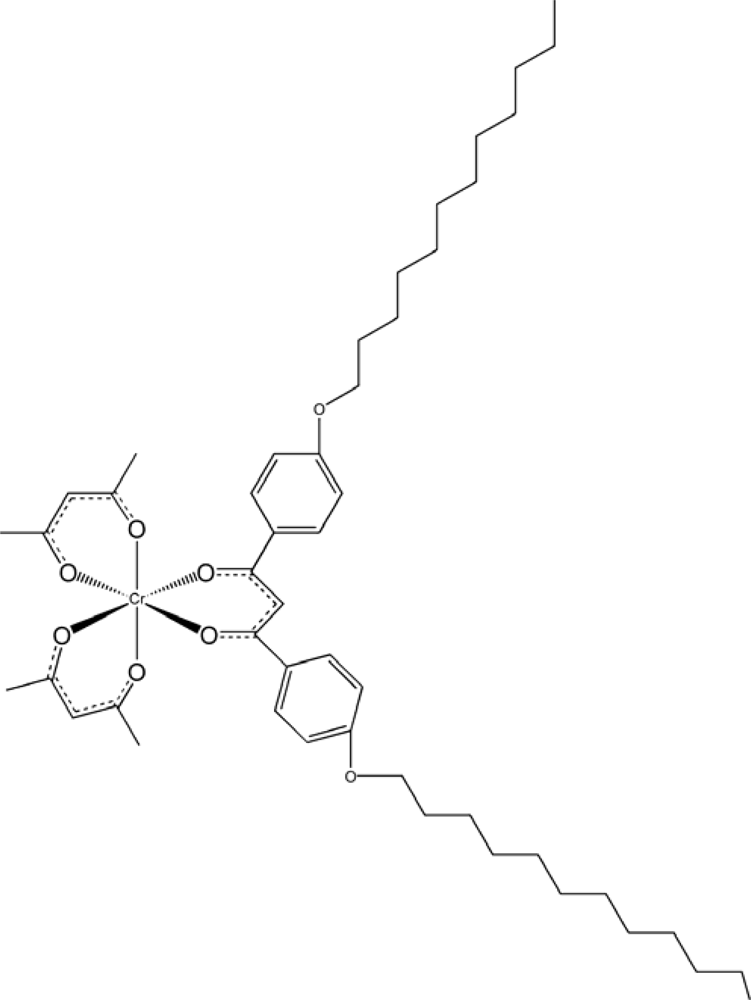
<p>Extending the above works, and also with the purpose of clarifying the mechanisms of helical induction, the order parameters (<italic>S</italic>) of dissolved metal complexes were determined by means of polarized UV-vis measurements on nematic liquid crystals doped with racemic Co(III) complexes [<xref ref-type="bibr" rid="b28-ijms-10-04559">28</xref>]. A tris(<italic>β</italic>-diketonato)complex, [M(acac)<sub>2</sub>(LC<sub>12</sub>)] (Co(III); LC<sub>12</sub> = 1,3-didodecyloxyphenyl-1,3-propanedionato), was synthesized. Here LC<sub>12</sub> was designed to be elongated perpendicular to the molecular <italic>C</italic><sub>2</sub> axis. The enantiomers were dissolved as chiral dopants in three kinds of nematic liquid crystals, <italic>N</italic>-methoxybenzylidene-4-<italic>n</italic>-butylaniline (MBBA), <italic>N</italic>-ethoxybenzylidene-4-<italic>n</italic>-butylaniline (EBBA), and a mixture of 4-(4-alkylcyclohexyl)benzonitrile and 4-(4-alkylcyclohexyl)-4’-cyano-biphenyl derivatives (ZLI-1132). The sign of HTP was determined by measuring the induced circular dichroism (ICD) spectra in the range of 350∼400 nm. The positive or negative ICD spectrum was related to the formation of <italic>P</italic>-(right-handed) or <italic>M</italic>-(left-handed) helix, respectively. The results of HTP measurements are summarized in <xref ref-type="table" rid="t3-ijms-10-04559">Table 3</xref>. The direction of the elongated ligand in [Co(acac)<sub>2</sub>(LC12)] was determined from the anisotropic ratio of their polarized electronic absorption spectra in the doped state. It was found that the long axis of the ligand, LC12, really aligned in the direction of the director with <italic>S</italic> = 0.5 ± 0.05. These results supported the induction mechanisms of a chiral metal complex as theoretically proposed in the preceding section.</p></sec>
<sec sec-type="methods">
<label>5.</label>
<title>Design of Photoresponsive Dopant of ΔΛ-Isomerism</title>
<p>As a host of photoresponsive species, liquid crystals are quite interesting in comparison to ordinary liquid and crystal media [<xref ref-type="bibr" rid="b14-ijms-10-04559">14</xref>–<xref ref-type="bibr" rid="b23-ijms-10-04559">23</xref>]. In particular, the chiral nematic (N*) phases, which are characterized by the superstructures with a helical arrangement, may undergo macroscopic structural transformations due to the photo-induced reactions of dissolved species. A number of attempts based on this strategy have been reported by using photoresponsive chiral organic and polymer compounds [<xref ref-type="bibr" rid="b14-ijms-10-04559">14</xref>–<xref ref-type="bibr" rid="b23-ijms-10-04559">23</xref>]. In contrast, there are only a limited number of works reporting the use of chiral metal complexes for those purposes [<xref ref-type="bibr" rid="b40-ijms-10-04559">40</xref>–<xref ref-type="bibr" rid="b42-ijms-10-04559">42</xref>]. Horie <italic>et al.</italic>, for example, studied the photoracemization of tris(β-diketonato)chromium(III) complex dissolved in a liquid crystal. The asymmetric synthesis was also attempted by illuminating a racemic mixture with a circularly polarized light [<xref ref-type="bibr" rid="b40-ijms-10-04559">40</xref>,<xref ref-type="bibr" rid="b41-ijms-10-04559">41</xref>].</p>
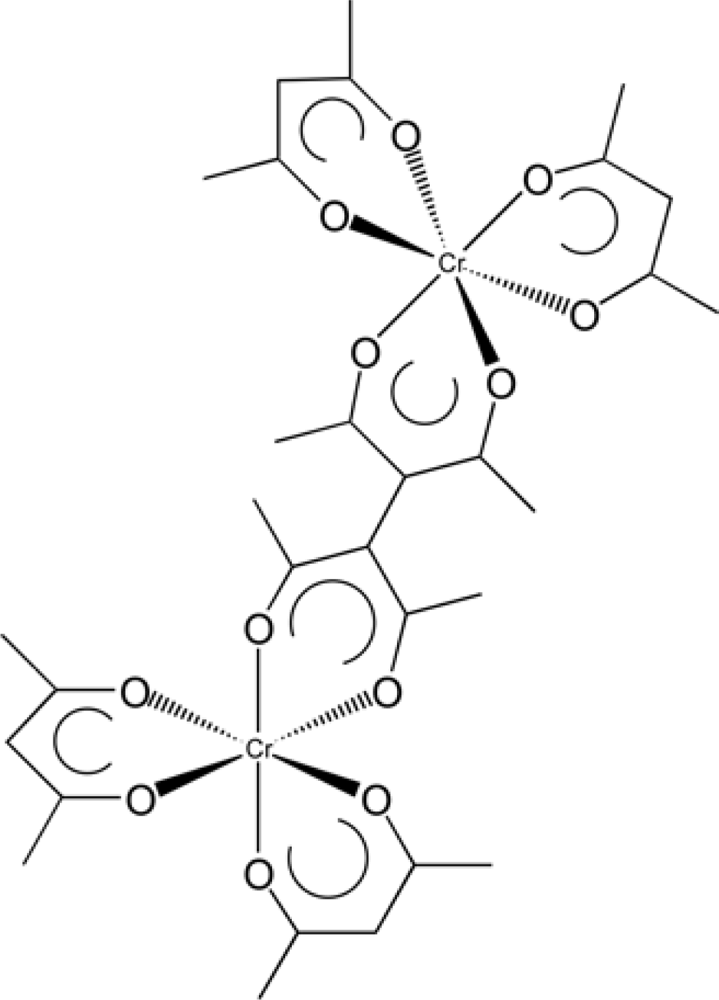
<p>We studied the photo-epimerization of the chiral linkage effect of a binuclear acetylacetonato chromium(III), ΔΔ-[Cr(acac)<sub>2</sub>(taet)Cr(acac)<sub>2</sub>] (<xref ref-type="fig" rid="f6-ijms-10-04559">Scheme 3</xref>), by dissolving it in liquid crystal phases [<xref ref-type="bibr" rid="b29-ijms-10-04559">29</xref>]. The linked compounds were synthesized by the thermal reaction between [Cr(acac)<sub>3</sub>] and a bridging ligand, tetraacetylmethane (taetH<sub>2</sub>) (<xref ref-type="fig" rid="f6-ijms-10-04559">Scheme 3</xref>). The diastereomeric separation of these oligomers was performed by chromatographic resolution on a chiral column [<xref ref-type="bibr" rid="b39-ijms-10-04559">39</xref>]. The HTP of Cr(III) oligomers are summarized in <xref ref-type="table" rid="t4-ijms-10-04559">Table 4</xref>, indicating the linkage effects. The table also includes the results for monomeric complexes ([M(acac)<sub>3</sub>]) [<xref ref-type="bibr" rid="b32-ijms-10-04559">32</xref>]. According to the table, the enhancement of helical twisting power was not realized by connecting two monomer units with the bridging ligand, taet. Based on the present model, one reason for this lies in the fact that two connected units are perpendicularly twisted with respect to their C<sub>2</sub> axes.</p>
<p>In order to investigate the photo-responsive properties of these liquid crystal systems, a UV light (335 nm) was irradiated at room temperature onto a glass cell containing ZLI-1132 doped with ΔΔ -[Cr(acac)<sub>2</sub>(taet)Cr(acac)<sub>2</sub>]. The change of helical pitch length of the host medium was caused by the photoisomerization of the Cr(III) complex as a dopant. The degree of photoisomerization was determined from the circular dichroism spectra of an isotropic phase of the hosts at higher temperature. The first order rate constant (k<sub>r</sub>) was obtained from the initial slope of the CD absorption. In a chiral nematic phase, the quantum yield was obtained to be 7.9 × 10<sup>−4</sup>, which was 30% of that in a homogeneous solution. This was an example that a photo-responsive metal complex behaved in a different way between a homogeneous solution and a liquid crystal host.</p>
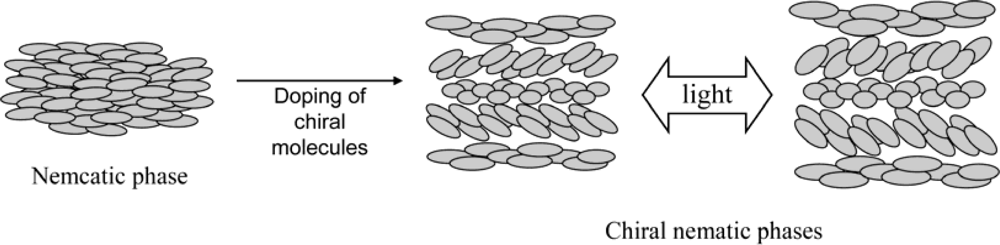
<p>We also pursued the possibility to control the helical pitch of a chiral nematic liquid crystal by use of a photo-responsive metal complex [<xref ref-type="bibr" rid="b30-ijms-10-04559">30</xref>]. The principle of our attempt is shown by the schematic drawing in <xref ref-type="fig" rid="f7-ijms-10-04559">Scheme 5</xref>.</p>
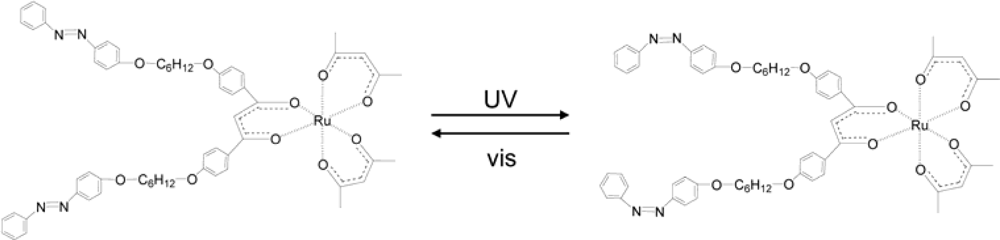
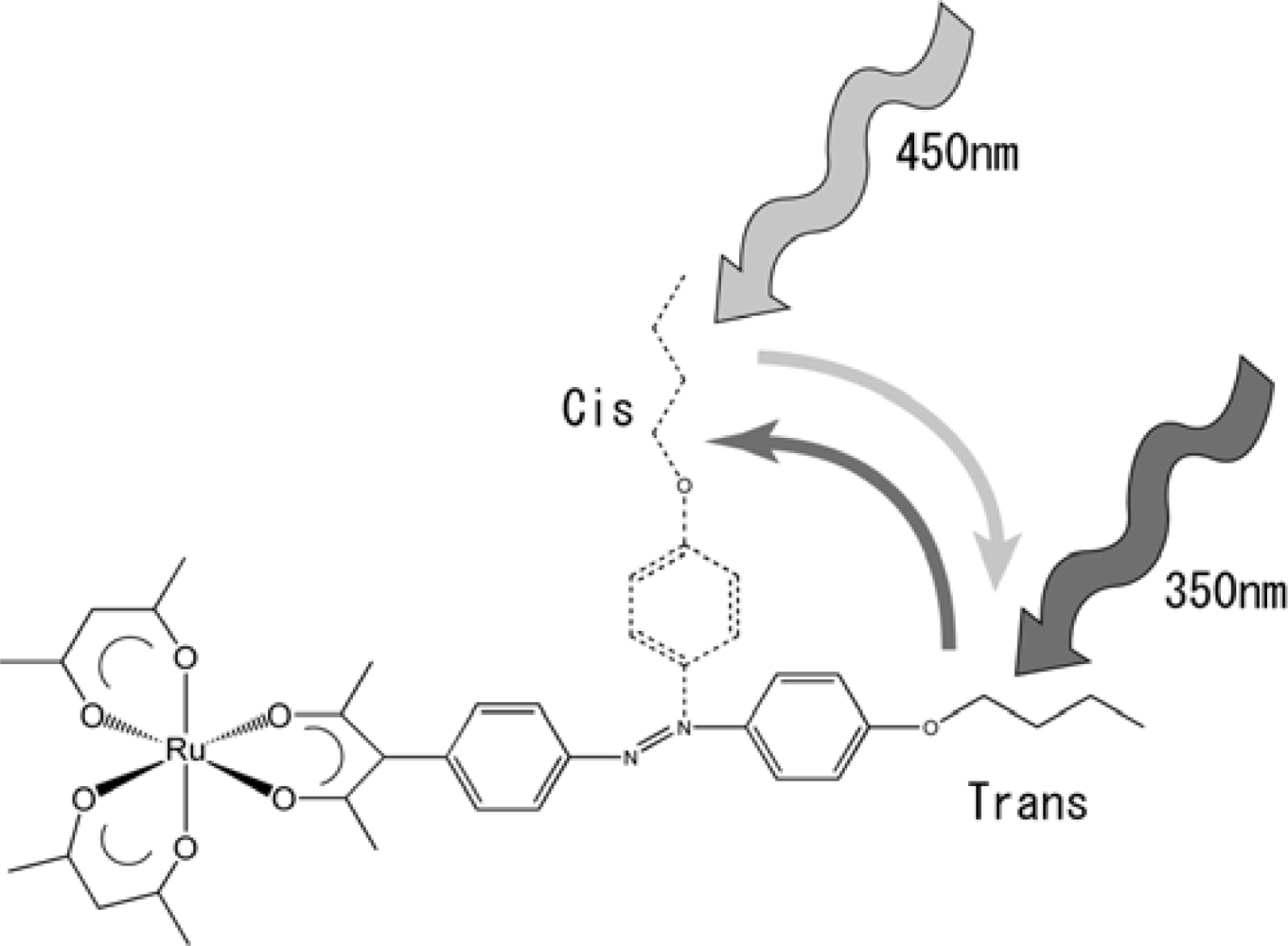
<p>In order to elucidate such a photo-responsive system based on metal complexes, a novel Ru(III) complex, [Ru(acac)<sub>2</sub>(L)], was synthesized, where acac and L denote acetylacetonato and 1,3-bis-{4-[6-(4-phenylazo- phenoxy)-hexyloxy]-phenyl}-propane-1,3-dione, respectively (Ru(acac)<sub>2</sub>(L<sub>azo</sub>)<sub>per</sub>). It should be noted that this complex undergoes a cis/trans photoisomerization in methanol solution by illuminating with UV (360 nm) or visible (450 nm) light (<xref ref-type="fig" rid="f8-ijms-10-04559">Scheme 6</xref>). When the complex was doped into a room temperature nematic liquid crystal (ZLI-1132), it induced a chiral nematic phase. Under the illumination of UV or visible light, the helical pitch of a chiral nematic phase changed reversibly by the amount of 50%. In corresponding to the change, the helical twisting power (HTP) of the complex varied as shown in <xref ref-type="table" rid="t5-ijms-10-04559">Table 5</xref> at 35 °C. As far as our literature survey was concerned, this was a first attempt of combining ΔΛ chirality and cis/trans isomerization for the development of a photoresponsive dopant.</p>
<p>The photoresponsive behaviour of [Ru(acac)<sub>2</sub>(L<sub>azo</sub>)<sub>para</sub>] and [Co(acac)<sub>2</sub>(L<sub>azo</sub>)<sub>para</sub>] was also studied as shown in <xref ref-type="fig" rid="f9-ijms-10-04559">Scheme 7</xref> [<xref ref-type="bibr" rid="b28-ijms-10-04559">28</xref>]. In case of the chloroform solution of [Ru(acac)<sub>2</sub>(L<sub>azo</sub>)<sub>para</sub>], the absorption peak at 356 nm decreased under the illumination of a UV light shorter than 400 nm. The absorption intensity of the peak recovered reversibly when the solution was illuminated by a visible light longer than 400 nm. The results were ascribed to the cis-trans isomerization of the azobenzene moiety in [Ru(acac)<sub>2</sub>(L<sub>azo</sub>)<sub>para</sub>]. The similar change was also observed for [Co(acac)<sub>2</sub>(L<sub>azo</sub>)<sub>para</sub>]. No change was induced in CD spectra under the irradiation of either UV or visible light. This was rationalized in terms of the assumption that the isomerization of the azobenzene moiety occurred in the plane perpendicular to the vicinal acac- ligand. The similar reaction was studied by doping these complexes into a nematic host. The reversible change of HTP was observed when Δ- or Λ-[M(acac)<sub>2</sub>(L<sub>azo</sub>)<sub>para</sub>] doped in a ZLI-1132 sample was photo-irradiated. HTP (μm<sup>−1</sup>) varied from 27 to 16 for the Δ-isomer and from −31 to −18 for the Λ-isomer for Ru (III), respectively. The results could be explained by the change of order parameter <italic>S</italic> before and after photo-irradiation. The cis-type of L<sub>azo</sub> in [M(acac)<sub>2</sub>(cis-L<sub>azo</sub>)] (M = Co(III) and Ru(III)) was assumed to align no longer with the C<sub>2</sub> axis, leading to the decrease of S value. These situations are schematically shown in <xref ref-type="fig" rid="f10-ijms-10-04559">Scheme 8</xref>.</p></sec>
<sec>
<label>6.</label>
<title>Application of New Spectroscopic Method to Observation of Structural Changes</title>
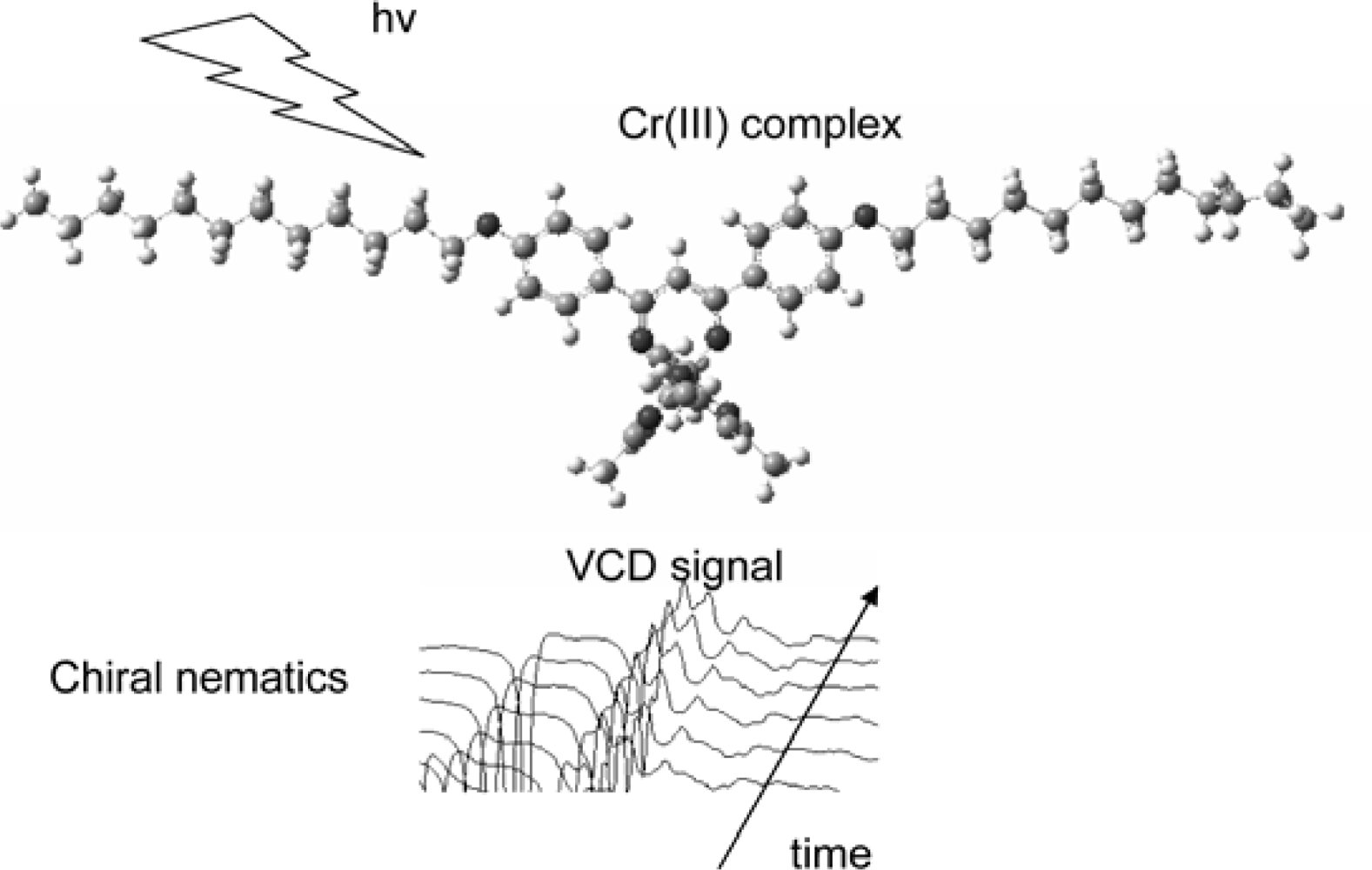
<p>A number of spectroscopic methods are applied for observation of structural changes in liquid crystal phases such as light scattering, NMR and electronic circular dichroism spectra [<xref ref-type="bibr" rid="b4-ijms-10-04559">4</xref>]. Recently vibrational circular dichroism (VCD) spectroscopy has been applied to chiral liquid crystals for photoirradiation [<xref ref-type="bibr" rid="b31-ijms-10-04559">31</xref>,<xref ref-type="bibr" rid="b43-ijms-10-04559">43</xref>]. We attempted the real time monitoring of helical rewind process in chiral nematics liquid crystals by use of VCD spectroscopy [<xref ref-type="bibr" rid="b31-ijms-10-04559">31</xref>]. VCD was applied for monitoring <italic>in situ</italic> the rewind of supramolecular helices in a chiral nematic phase under the illumination of UV light (365 nm). Here the change was caused by the photoracemization of a doped chromium(III) complex. For that purpose, a novel complex, [Cr(acac)<sub>2</sub>(2C12)] (acac = acetylacetonate; 2C12 = 4,4’-didodecyloxyated dibenzoylmethanate), was synthesized (<xref ref-type="fig" rid="f11-ijms-10-04559">Scheme 9</xref>). It should be noted that the rewinding process of the helix was visualized as the change of the spectral shape at each of the four vibrational peaks (<xref ref-type="fig" rid="f12-ijms-10-04559">Scheme 10</xref>). This was the first application of VCD spectroscopy to photoresponsive systems.</p></sec>
<sec sec-type="conclusions">
<label>7.</label>
<title>Conclusions</title>
<p>This review article summarizes our recent attempts at using the ΔΛ isomerism as a chiral dopant inducing chiral nematic phases. As a result, a series of metal complexes expressed by the formula of [M(III)(blade)<sub>2</sub>(backbone)] (M = Ru, Co, Cr) were shown to have extremely high HTP values. The backbone ligands provided an essential factor for molecular orientation to achieve high HTP in addition to the ΔΛ- chirality. The bi-functional nature of metal complexes, particularly of transition metal complexes, was coupled with this doping effect. For example, photoresponsive dopants were designed with the linkage effects of Cr(III) polynuclear metal complexes. Moreover we attempted the combination of the ΔΛ chirality with cis-trans isomerization of an azobenzene group for the photomodulation of chiral nematics. Finally VCD (vibrational circular dichroism) spectroscopy was proposed as a novel spectroscopic method to monitor the change of helical pitch <italic>in situ</italic>.</p></sec></body>
<back>
<ack>
<p>We thank the late Naomi Hoshino (Hokkaido University), Jun Yoshida (The University of Tokyo), Yuki Matsuoka (The University of Tokyo), Yasuaki Einaga (Keio University), Tadashi Mitsuoka (Keio University), Yutaka Fukuda (Ochanomizu University), Yuka Furuno (Ochanomizu University), Kenji Monde (Hokkaido University) and Tohru Taniguchi (Hokkaido University) for their sincere cooperation throughout the investigation described in the present review.</p></ack>
<ref-list>
<title>References and Notes</title>
<ref id="b1-ijms-10-04559"><label>1.</label><citation citation-type="book"><person-group person-group-type="author"><name><surname>Kitzerow</surname><given-names>H-S</given-names></name><name><surname>Bahr</surname><given-names>C</given-names></name></person-group><source>Chirality in Liquid Crystals</source><publisher-name>Springer-Verlag</publisher-name><publisher-loc>New York, NY, USA</publisher-loc><year>2001</year></citation></ref>
<ref id="b2-ijms-10-04559"><label>2.</label><citation citation-type="journal"><person-group person-group-type="author"><name><surname>Solladie</surname><given-names>G</given-names></name><name><surname>Zimmermann</surname><given-names>RG</given-names></name></person-group><article-title>Liquid crystals: A tool for studies on chirality</article-title><source>Angew. Chem. Int. Ed</source><year>1984</year><volume>23</volume><fpage>348</fpage><lpage>362</lpage><pub-id pub-id-type="doi">10.1002/anie.198403481</pub-id></citation></ref>
<ref id="b3-ijms-10-04559"><label>3.</label><citation citation-type="journal"><person-group person-group-type="author"><name><surname>Goodby</surname><given-names>JW</given-names></name></person-group><article-title>Chirality in liquid crystals</article-title><source>J. Mater. Chem</source><year>1991</year><volume>1</volume><fpage>307</fpage><lpage>318</lpage><pub-id pub-id-type="doi">10.1039/jm9910100307</pub-id></citation></ref>
<ref id="b4-ijms-10-04559"><label>4.</label><citation citation-type="journal"><person-group person-group-type="author"><name><surname>Lee</surname><given-names>S-E</given-names></name><name><surname>Raynes</surname><given-names>EP</given-names></name></person-group><article-title>Transmission and amplification of information and properties in nanostructured liquid crystals</article-title><source>Angew. Chem. Int. Ed</source><year>2008</year><volume>47</volume><fpage>2754</fpage><lpage>2787</lpage><pub-id pub-id-type="doi">10.1002/anie.200701111</pub-id></citation></ref>
<ref id="b5-ijms-10-04559"><label>5.</label><citation citation-type="journal"><person-group person-group-type="author"><name><surname>Ernst</surname><given-names>K-H</given-names></name></person-group><article-title>Amplification of chirality in two-dimensional molecular lattices</article-title><source>Curr. Opin. Colloid Interface Sci</source><year>2008</year><volume>13</volume><fpage>54</fpage><lpage>59</lpage><pub-id pub-id-type="doi">10.1016/j.cocis.2007.08.011</pub-id></citation></ref>
<ref id="b6-ijms-10-04559"><label>6.</label><citation citation-type="journal"><person-group person-group-type="author"><name><surname>Pijper</surname><given-names>D</given-names></name><name><surname>Feringa</surname><given-names>BL</given-names></name></person-group><article-title>Control of dynamic helicity at the macro- and supramolecular level</article-title><source>Soft Matter</source><year>2008</year><volume>7</volume><fpage>1349</fpage><lpage>1372</lpage></citation></ref>
<ref id="b7-ijms-10-04559"><label>7.</label><citation citation-type="journal"><person-group person-group-type="author"><name><surname>Takezoe</surname><given-names>H</given-names></name><name><surname>Takanishi</surname><given-names>Y</given-names></name></person-group><article-title>Bent-core liquid crystals: Their mysterious and attractive world</article-title><source>Jpn. J. Appl. Phys. PT. 1</source><year>2006</year><volume>45</volume><fpage>597</fpage><lpage>625</lpage><pub-id pub-id-type="doi">10.1143/JJAP.45.597</pub-id></citation></ref>
<ref id="b8-ijms-10-04559"><label>8.</label><citation citation-type="journal"><person-group person-group-type="author"><name><surname>Hofmeier</surname><given-names>H</given-names></name><name><surname>Schubert</surname><given-names>US</given-names></name></person-group><article-title>Recent developments in the supramolecular chemistry of terpyridine-metal complexes</article-title><source>Chem. Soc. Rev</source><year>2004</year><volume>33</volume><fpage>373</fpage><lpage>399</lpage><pub-id pub-id-type="doi">10.1039/b400653b</pub-id><pub-id pub-id-type="pmid">15280970</pub-id></citation></ref>
<ref id="b9-ijms-10-04559"><label>9.</label><citation citation-type="journal"><person-group person-group-type="author"><name><surname>Link</surname><given-names>DR</given-names></name><name><surname>Natale</surname><given-names>G</given-names></name><name><surname>Shao</surname><given-names>R</given-names></name><name><surname>Maclennan</surname><given-names>JE</given-names></name><name><surname>Clark</surname><given-names>NA</given-names></name><name><surname>Körblova</surname><given-names>E</given-names></name><name><surname>Walba</surname><given-names>DM</given-names></name></person-group><article-title>Spontaneous formation of macroscopic chiral domains in a fluid smectic phase of achiral molecules</article-title><source>Science</source><year>1997</year><volume>278</volume><fpage>1924</fpage><lpage>1927</lpage><pub-id pub-id-type="doi">10.1126/science.278.5345.1924</pub-id><pub-id pub-id-type="pmid">9395390</pub-id></citation></ref>
<ref id="b10-ijms-10-04559"><label>10.</label><citation citation-type="journal"><person-group person-group-type="author"><name><surname>Di Matteo</surname><given-names>A</given-names></name><name><surname>Todd</surname><given-names>SM</given-names></name><name><surname>Gottarelli</surname><given-names>G</given-names></name><name><surname>Solladié</surname><given-names>G</given-names></name><name><surname>Williams</surname><given-names>VE</given-names></name><name><surname>Lemieux</surname><given-names>RP</given-names></name><name><surname>Ferrarini</surname><given-names>A</given-names></name><name><surname>Spada</surname><given-names>GP</given-names></name></person-group><article-title>Correlation between molecular structure and helicity of induced chiral nematics in terms of short-range and electrostatic-induction interactions. The case of chiral biphenyls</article-title><source>J. Am. Chem. Soc</source><year>2001</year><volume>123</volume><fpage>7842</fpage><lpage>7851</lpage><pub-id pub-id-type="doi">10.1021/ja010406r</pub-id><pub-id pub-id-type="pmid">11493057</pub-id></citation></ref>
<ref id="b11-ijms-10-04559"><label>11.</label><citation citation-type="journal"><person-group person-group-type="author"><name><surname>Pieraccini</surname><given-names>S</given-names></name><name><surname>Ferrarini</surname><given-names>A</given-names></name><name><surname>Spada</surname><given-names>GP</given-names></name></person-group><article-title>Chiral doping of nematic phases and its application to the determination of absolute configuration</article-title><source>Chirality</source><year>2008</year><volume>20</volume><fpage>749</fpage><lpage>759</lpage><pub-id pub-id-type="doi">10.1002/chir.20482</pub-id><pub-id pub-id-type="pmid">17924420</pub-id></citation></ref>
<ref id="b12-ijms-10-04559"><label>12.</label><citation citation-type="journal"><person-group person-group-type="author"><name><surname>Ferrarini</surname><given-names>A</given-names></name><name><surname>Moro</surname><given-names>GJ</given-names></name><name><surname>Nordio</surname><given-names>PL</given-names></name></person-group><article-title>Simple molecular model for induced cholesteric phases</article-title><source>Phys. Rev. E</source><year>1996</year><volume>53</volume><fpage>681</fpage><lpage>688</lpage><pub-id pub-id-type="doi">10.1103/PhysRevE.53.681</pub-id></citation></ref>
<ref id="b13-ijms-10-04559"><label>13.</label><citation citation-type="journal"><person-group person-group-type="author"><name><surname>Tang</surname><given-names>K</given-names></name><name><surname>Green</surname><given-names>MM</given-names></name><name><surname>Cheon</surname><given-names>KS</given-names></name><name><surname>Selinger</surname><given-names>JV</given-names></name><name><surname>Garetz</surname><given-names>BA</given-names></name></person-group><article-title>Chiral conflict. The effect of temperature on the helical sense of a polymer controlled by the competition between structurally different enantiomers: From dilute solution to the lyotropic liquid crystal state</article-title><source>J. Am. Chem. Soc</source><year>2003</year><volume>125</volume><fpage>7313</fpage><lpage>7323</lpage><pub-id pub-id-type="doi">10.1021/ja030065c</pub-id><pub-id pub-id-type="pmid">12797806</pub-id></citation></ref>
<ref id="b14-ijms-10-04559"><label>14.</label><citation citation-type="journal"><person-group person-group-type="author"><name><surname>Eelkema</surname><given-names>R</given-names></name><name><surname>van Delden</surname><given-names>RA</given-names></name><name><surname>Feringa</surname><given-names>BL</given-names></name></person-group><article-title>Direct visual detection of the stereoselectivity of a catalytic reaction</article-title><source>Angew. Chem. Int. Ed</source><year>2004</year><volume>43</volume><fpage>5013</fpage><lpage>5016</lpage><pub-id pub-id-type="doi">10.1002/anie.200460822</pub-id></citation></ref>
<ref id="b15-ijms-10-04559"><label>15.</label><citation citation-type="journal"><person-group person-group-type="author"><name><surname>Eelkema</surname><given-names>R</given-names></name><name><surname>Feringa</surname><given-names>BL</given-names></name></person-group><article-title>Amplification of chirality in liquid crystals</article-title><source>Org. Biomol. Chem</source><year>2006</year><volume>4</volume><fpage>3729</fpage><lpage>3745</lpage><pub-id pub-id-type="doi">10.1039/b608749c</pub-id><pub-id pub-id-type="pmid">17024276</pub-id></citation></ref>
<ref id="b16-ijms-10-04559"><label>16.</label><citation citation-type="journal"><person-group person-group-type="author"><name><surname>Feringa</surname><given-names>BL</given-names></name><name><surname>Huck</surname><given-names>NPM</given-names></name><name><surname>van Doren</surname><given-names>HA</given-names></name></person-group><article-title>Chiroptical switching between liquid crystalline phases</article-title><source>J. Am. Chem. Soc</source><year>1995</year><volume>117</volume><fpage>9929</fpage><lpage>9930</lpage><pub-id pub-id-type="doi">10.1021/ja00144a027</pub-id></citation></ref>
<ref id="b17-ijms-10-04559"><label>17.</label><citation citation-type="journal"><person-group person-group-type="author"><name><surname>Ruslim</surname><given-names>C</given-names></name><name><surname>Ichimura</surname><given-names>K</given-names></name></person-group><article-title>Conformational effect on macroscopic chirality modification of cholesteric mesophases by photochromic azobenzene dopants</article-title><source>J. Phys. Chem. B</source><year>2000</year><volume>104</volume><fpage>6529</fpage><lpage>6535</lpage><pub-id pub-id-type="doi">10.1021/jp000338f</pub-id></citation></ref>
<ref id="b18-ijms-10-04559"><label>18.</label><citation citation-type="journal"><person-group person-group-type="author"><name><surname>Mathews</surname><given-names>M</given-names></name><name><surname>Tamaoki</surname><given-names>N</given-names></name></person-group><article-title>Planar chiral azobenzenophanes as chiroptic switches for photon mode reversible reflection color control in induced chiral nematic liquid crystals</article-title><source>J. Am. Chem. Soc</source><year>2008</year><volume>130</volume><fpage>11409</fpage><lpage>11416</lpage><pub-id pub-id-type="doi">10.1021/ja802472t</pub-id><pub-id pub-id-type="pmid">18680250</pub-id></citation></ref>
<ref id="b19-ijms-10-04559"><label>19.</label><citation citation-type="journal"><person-group person-group-type="author"><name><surname>Mathews</surname><given-names>M</given-names></name><name><surname>Tamaoki</surname><given-names>N</given-names></name></person-group><article-title>Reversibly tunable helicity induction and inversion in liquid crystal self-assembly by a planar chiroptic trigger molecule</article-title><source>Chem Commun</source><year>2009</year><fpage>3609</fpage><lpage>3611</lpage></citation></ref>
<ref id="b20-ijms-10-04559"><label>20.</label><citation citation-type="journal"><person-group person-group-type="author"><name><surname>Ichimura</surname><given-names>K</given-names></name></person-group><article-title>Photoalignment of liquid-crystal systems</article-title><source>Chem. Rev</source><year>2000</year><volume>100</volume><fpage>1847</fpage><lpage>1873</lpage><pub-id pub-id-type="doi">10.1021/cr980079e</pub-id><pub-id pub-id-type="pmid">11777423</pub-id></citation></ref>
<ref id="b21-ijms-10-04559"><label>21.</label><citation citation-type="journal"><person-group person-group-type="author"><name><surname>Ikeda</surname><given-names>T</given-names></name><name><surname>Mamiya</surname><given-names>J-I</given-names></name><name><surname>Yu</surname><given-names>Y</given-names></name></person-group><article-title>Photomechanics of liquid-crystalline elastomers and other polymers</article-title><source>Angew. Chem. Int. Ed</source><year>2007</year><volume>46</volume><fpage>506</fpage><lpage>528</lpage><pub-id pub-id-type="doi">10.1002/anie.200602372</pub-id></citation></ref>
<ref id="b22-ijms-10-04559"><label>22.</label><citation citation-type="journal"><person-group person-group-type="author"><name><surname>Tejedor</surname><given-names>RM</given-names></name><name><surname>Oriol</surname><given-names>L</given-names></name><name><surname>Serrano</surname><given-names>JL</given-names></name><name><surname>Sierra</surname><given-names>T</given-names></name></person-group><article-title>Chiral photochemical induction in liquid crystals</article-title><source>J. Mater. Chem</source><year>2008</year><volume>18</volume><fpage>2899</fpage><lpage>2908</lpage><pub-id pub-id-type="doi">10.1039/b803561j</pub-id></citation></ref>
<ref id="b23-ijms-10-04559"><label>23.</label><citation citation-type="journal"><person-group person-group-type="author"><name><surname>Choi</surname><given-names>S-W</given-names></name><name><surname>Kawauchi</surname><given-names>S</given-names></name><name><surname>Ha</surname><given-names>NY</given-names></name><name><surname>Takezoe</surname><given-names>H</given-names></name></person-group><article-title>Photoinduced chirality in azobenzene-containing polymer systems</article-title><source>Phys. Chem. Chem. Phys</source><year>2007</year><volume>9</volume><fpage>3671</fpage><lpage>3681</lpage><pub-id pub-id-type="doi">10.1039/b702835k</pub-id><pub-id pub-id-type="pmid">17622402</pub-id></citation></ref>
<ref id="b24-ijms-10-04559"><label>24.</label><citation citation-type="journal"><person-group person-group-type="author"><name><surname>Matsuoka</surname><given-names>Y</given-names></name><name><surname>Sato</surname><given-names>H</given-names></name><name><surname>Yamagishi</surname><given-names>A</given-names></name><name><surname>Okamoto</surname><given-names>K</given-names></name><name><surname>Hoshino</surname><given-names>N</given-names></name></person-group><article-title>ΔΛ-Isomerism of mixed 1,3-diketonate complexes of Ru(III)—A designed new source of chirality in nematic liquid crystals</article-title><source>Chem Mater</source><year>2005</year><volume>17</volume><fpage>4910</fpage><lpage>4917</lpage>and references therein<pub-id pub-id-type="doi">10.1021/cm048121b</pub-id></citation></ref>
<ref id="b25-ijms-10-04559"><label>25.</label><citation citation-type="journal"><person-group person-group-type="author"><name><surname>Sato</surname><given-names>H</given-names></name><name><surname>Yamagishi</surname><given-names>A</given-names></name><name><surname>Yoshida</surname><given-names>J</given-names></name><name><surname>Nakano</surname><given-names>H</given-names></name><name><surname>Hoshino</surname><given-names>N</given-names></name></person-group><article-title>A microscopic model for helical twisting power by the optical isomers of an octahedral metal complex</article-title><source>Jpn J App Phys</source><year>2005</year><volume>44</volume><fpage>4067</fpage><lpage>4072</lpage><pub-id pub-id-type="doi">10.1143/JJAP.44.4067</pub-id></citation></ref>
<ref id="b26-ijms-10-04559"><label>26.</label><citation citation-type="journal"><person-group person-group-type="author"><name><surname>Sato</surname><given-names>H</given-names></name><name><surname>Yamagishi</surname><given-names>A</given-names></name></person-group><article-title>Application of the ΔΛ isomerism of octahedral metal complexes as a chiral source in photochemistry</article-title><source>J. Photochem. Photobiol. C: Photochem. Rev</source><year>2007</year><volume>8</volume><fpage>67</fpage><lpage>84</lpage><pub-id pub-id-type="doi">10.1016/j.jphotochemrev.2007.04.001</pub-id></citation></ref>
<ref id="b27-ijms-10-04559"><label>27.</label><citation citation-type="journal"><person-group person-group-type="author"><name><surname>Yoshida</surname><given-names>J</given-names></name><name><surname>Sato</surname><given-names>H</given-names></name><name><surname>Yamagishi</surname><given-names>A</given-names></name><name><surname>Hoshino</surname><given-names>N</given-names></name></person-group><article-title>On the parity in helical twisting power of Ru(III) 1,3-diketonates of C<sub>2</sub> symmetry in nematic liquid crystals</article-title><source>J. Am. Chem. Soc</source><year>2005</year><volume>127</volume><fpage>8453</fpage><lpage>8456</lpage><pub-id pub-id-type="doi">10.1021/ja042549u</pub-id><pub-id pub-id-type="pmid">15941279</pub-id></citation></ref>
<ref id="b28-ijms-10-04559"><label>28.</label><citation citation-type="journal"><person-group person-group-type="author"><name><surname>Yoshida</surname><given-names>J</given-names></name><name><surname>Sato</surname><given-names>H</given-names></name><name><surname>Yamagishi</surname><given-names>A</given-names></name><name><surname>Hoshino</surname><given-names>N</given-names></name></person-group><article-title>Induction and structural control of chiral nematic phases by the use of photoresponsive tris(β-diketonato) Co(III) and Ru(III) complexes</article-title><source>J. Phys. Chem. B</source><year>2008</year><volume>112</volume><fpage>9677</fpage><lpage>9683</lpage><pub-id pub-id-type="doi">10.1021/jp8011206</pub-id><pub-id pub-id-type="pmid">18646813</pub-id></citation></ref>
<ref id="b29-ijms-10-04559"><label>29.</label><citation citation-type="journal"><person-group person-group-type="author"><name><surname>Furuno</surname><given-names>F</given-names></name><name><surname>Sato</surname><given-names>H</given-names></name><name><surname>Yoshida</surname><given-names>Y</given-names></name><name><surname>Hoshino</surname><given-names>H</given-names></name><name><surname>Fukuda</surname><given-names>F</given-names></name><name><surname>Yamagishi</surname><given-names>A</given-names></name></person-group><article-title>Linkage effects of chromium(III) acetylacetonato units on chiral induction of liquid crystal phases</article-title><source>J. Phys. Chem. B</source><year>2007</year><volume>111</volume><fpage>521</fpage><lpage>526</lpage><pub-id pub-id-type="pmid">17228909</pub-id></citation></ref>
<ref id="b30-ijms-10-04559"><label>30.</label><citation citation-type="journal"><person-group person-group-type="author"><name><surname>Mitsuoka</surname><given-names>T</given-names></name><name><surname>Sato</surname><given-names>H</given-names></name><name><surname>Yoshida</surname><given-names>J</given-names></name><name><surname>Yamagishi</surname><given-names>A</given-names></name><name><surname>Einaga</surname><given-names>Y</given-names></name></person-group><article-title>Photomodulation of a chiral nematic liquid crystal by the use of a photoresponsive ruthenium(III) complex</article-title><source>Chem. Mater</source><year>2006</year><volume>18</volume><fpage>3442</fpage><lpage>3447</lpage><pub-id pub-id-type="doi">10.1021/cm060282n</pub-id></citation></ref>
<ref id="b31-ijms-10-04559"><label>31.</label><citation citation-type="journal"><person-group person-group-type="author"><name><surname>Taniguchi</surname><given-names>T</given-names></name><name><surname>Monde</surname><given-names>K</given-names></name><name><surname>Nishimura</surname><given-names>S-I</given-names></name><name><surname>Yoshida</surname><given-names>J</given-names></name><name><surname>Sato</surname><given-names>H</given-names></name><name><surname>Yamagishi</surname><given-names>A</given-names></name></person-group><article-title>Rewinding of helical systems by use of the Cr(III) complex as a photoresponsive chiral dopant</article-title><source>Mol. Cryst. Liq. Cryst</source><year>2006</year><volume>460</volume><fpage>107</fpage><lpage>116</lpage><pub-id pub-id-type="doi">10.1080/15421400600914916</pub-id></citation></ref>
<ref id="b32-ijms-10-04559"><label>32.</label><citation citation-type="journal"><person-group person-group-type="author"><name><surname>Drake</surname><given-names>AF</given-names></name><name><surname>Gian</surname><given-names>GG</given-names></name><name><surname>Spada</surname><given-names>P</given-names></name></person-group><article-title>The twisting power of some chiral tris-(pentane-2,4-dionato)metal(III) complexes in nematic liquid crystals</article-title><source>Chem. Phys. Lett</source><year>1984</year><volume>110</volume><fpage>630</fpage><lpage>633</lpage><pub-id pub-id-type="doi">10.1016/0009-2614(84)85476-7</pub-id></citation></ref>
<ref id="b33-ijms-10-04559"><label>33.</label><citation citation-type="journal"><person-group person-group-type="author"><name><surname>Hoshino</surname><given-names>N</given-names></name><name><surname>Matsuoka</surname><given-names>Y</given-names></name><name><surname>Okamoto</surname><given-names>K</given-names></name><name><surname>Yamagishi</surname><given-names>A</given-names></name></person-group><article-title>Δ-[Ru(acac)L] (L = a mesogenic derivative of bpy) as a novel chiral dopant for nematic liquid crystals with large helical twisting power</article-title><source>J. Am. Chem. Soc</source><year>2003</year><volume>125</volume><fpage>1718</fpage><lpage>1719</lpage><pub-id pub-id-type="doi">10.1021/ja0293960</pub-id><pub-id pub-id-type="pmid">12580595</pub-id></citation></ref>
<ref id="b34-ijms-10-04559"><label>34.</label><citation citation-type="journal"><person-group person-group-type="author"><name><surname>Zheng</surname><given-names>H</given-names></name><name><surname>Lai</surname><given-names>CK</given-names></name><name><surname>Swager</surname><given-names>TM</given-names></name></person-group><article-title>Controlling intermolecular interactions between metallomesogens: Side-chain effects in discotic copper, palladium, and vanadyl bis(β-diketonates)</article-title><source>Chem. Mater</source><year>1995</year><volume>7</volume><fpage>2067</fpage><lpage>2077</lpage><pub-id pub-id-type="doi">10.1021/cm00059a013</pub-id></citation></ref>
<ref id="b35-ijms-10-04559"><label>35.</label><citation citation-type="journal"><person-group person-group-type="author"><name><surname>Piao</surname><given-names>G</given-names></name><name><surname>Akagi</surname><given-names>K</given-names></name><name><surname>Shirakawa</surname><given-names>H</given-names></name></person-group><article-title>Chiroptical titanium complexes as catalytically active chiral dopants available for asymmetric acetylene polymerization</article-title><source>Synth. Metals</source><year>1999</year><volume>101</volume><fpage>92</fpage><lpage>93</lpage><pub-id pub-id-type="doi">10.1016/S0379-6779(98)01216-8</pub-id></citation></ref>
<ref id="b36-ijms-10-04559"><label>36.</label><citation citation-type="journal"><person-group person-group-type="author"><name><surname>Hamakubo</surname><given-names>K</given-names></name><name><surname>Hama</surname><given-names>S</given-names></name><name><surname>Yagi</surname><given-names>S</given-names></name><name><surname>Nakazumi</surname><given-names>H</given-names></name><name><surname>Mizutani</surname><given-names>T</given-names></name></person-group><article-title>Extraordinary doping effects of chiral helical linear tetrapyrrole–Zn(II) complexes on chiral nematic induction of MBBA liquid crystal</article-title><source>Chem. Lett</source><year>2005</year><volume>34</volume><fpage>1454</fpage><lpage>1455</lpage><pub-id pub-id-type="doi">10.1246/cl.2005.1454</pub-id></citation></ref>
<ref id="b37-ijms-10-04559"><label>37.</label><citation citation-type="journal"><person-group person-group-type="author"><name><surname>Braun</surname><given-names>M</given-names></name><name><surname>Hahn</surname><given-names>A</given-names></name><name><surname>Engelmann</surname><given-names>M</given-names></name><name><surname>Fleischer</surname><given-names>R</given-names></name><name><surname>Frank</surname><given-names>W</given-names></name><name><surname>Kryschi</surname><given-names>C</given-names></name><name><surname>Haremza</surname><given-names>S</given-names></name><name><surname>Kürschner</surname><given-names>K</given-names></name><name><surname>Parker</surname><given-names>R</given-names></name></person-group><article-title>Bis-chelated imine-alkoxytitanium complexes: Novel chiral dopants with high helical twisting power in liquid crystals</article-title><source>Chem. Eur. J</source><year>2005</year><volume>11</volume><fpage>3405</fpage><lpage>3412</lpage><pub-id pub-id-type="doi">10.1002/chem.200401292</pub-id><pub-id pub-id-type="pmid">15803519</pub-id></citation></ref>
<ref id="b38-ijms-10-04559"><label>38.</label><citation citation-type="journal"><person-group person-group-type="author"><name><surname>Engelmann</surname><given-names>M</given-names></name><name><surname>Braun</surname><given-names>M</given-names></name><name><surname>Kuball</surname><given-names>H-G</given-names></name></person-group><article-title>Helical twisting power of chiral titanium complexes in nematic compounds</article-title><source>Liq. Cryst</source><year>2007</year><volume>34</volume><fpage>73</fpage><lpage>77</lpage><pub-id pub-id-type="doi">10.1080/02678290601061496</pub-id></citation></ref>
<ref id="b39-ijms-10-04559"><label>39.</label><citation citation-type="journal"><person-group person-group-type="author"><name><surname>Yamagishi</surname><given-names>A</given-names></name><name><surname>Taniguchi</surname><given-names>M</given-names></name><name><surname>Imamura</surname><given-names>Y</given-names></name><name><surname>Sato</surname><given-names>H</given-names></name></person-group><article-title>Clay column chromatography for optical resolution: Selectivities of Λ-[Ru(phen)] and Λ-[Ru(bpy)] laponite columns towards 1,1′-binaphthol</article-title><source>Appl. Clay Sci</source><year>1996</year><volume>11</volume><fpage>1</fpage><lpage>10</lpage><pub-id pub-id-type="doi">10.1016/0169-1317(96)00010-5</pub-id></citation></ref>
<ref id="b40-ijms-10-04559"><label>40.</label><citation citation-type="journal"><person-group person-group-type="author"><name><surname>Anzai</surname><given-names>N</given-names></name><name><surname>Machida</surname><given-names>S</given-names></name><name><surname>Horie</surname><given-names>K</given-names></name></person-group><article-title>Chirooptical control of liquid crystalline textures containing chromium complex by irradiation of circular polarized light</article-title><source>Chem Lett</source><year>2001</year><fpage>888</fpage><lpage>889</lpage></citation></ref>
<ref id="b41-ijms-10-04559"><label>41.</label><citation citation-type="journal"><person-group person-group-type="author"><name><surname>Anzai</surname><given-names>N</given-names></name><name><surname>Machida</surname><given-names>S</given-names></name><name><surname>Horie</surname><given-names>K</given-names></name></person-group><article-title>Light-induced control of textures and cholesteric pitch in liquid crystals containing chromium complexes, by means of circular and linear polarized light</article-title><source>Liq. Cryst</source><year>2003</year><volume>30</volume><fpage>359</fpage><lpage>366</lpage><pub-id pub-id-type="doi">10.1080/0267829031000083740</pub-id></citation></ref>
<ref id="b42-ijms-10-04559"><label>42.</label><citation citation-type="journal"><person-group person-group-type="author"><name><surname>Stevenson</surname><given-names>KL</given-names></name></person-group><article-title>Partial photoresolution. III. The tris(acetylacetonato)chromium(III) system</article-title><source>J. Am. Chem. Soc</source><year>1972</year><volume>94</volume><fpage>6652</fpage><lpage>6654</lpage><pub-id pub-id-type="doi">10.1021/ja00774a015</pub-id></citation></ref>
<ref id="b43-ijms-10-04559"><label>43.</label><citation citation-type="journal"><person-group person-group-type="author"><name><surname>Choi</surname><given-names>S-W</given-names></name><name><surname>Kawauchi</surname><given-names>S</given-names></name><name><surname>Tanaka</surname><given-names>S</given-names></name><name><surname>Watanabe</surname><given-names>J</given-names></name><name><surname>Takezoe</surname><given-names>H</given-names></name></person-group><article-title>Vibrational circular dichroism spectroscopic study on circularly polarized light-induced chiral domains in the B4 phase of a bent mesogen</article-title><source>Chem. Lett</source><year>2007</year><volume>36</volume><fpage>1018</fpage><lpage>1019</lpage><pub-id pub-id-type="doi">10.1246/cl.2007.1018</pub-id></citation></ref></ref-list>
<sec sec-type="display-objects">
<title>Figures and Tables</title>
<fig id="f1-ijms-10-04559" position="float">
<label>Figure 1.</label>
<caption>
<p>The energy-minimized structure of [Δ-[Al(acac)<sub>2</sub>(L-<italic>2</italic>) + 2MBBA], showing the mutually left-handed orientation of two MBBA molecules. This figure is a modified version of the one from reference [<xref ref-type="bibr" rid="b24-ijms-10-04559">24</xref>].</p></caption><graphic xlink:href="ijms-10-04559f1.gif"/></fig>
<fig id="f2-ijms-10-04559" position="float">
<label>Figure 2.</label>
<caption>
<p>CD spectra of enantiomers in methanol (left) [Ru(acac)<sub>2</sub>L<sub>per</sub>C<sub>6</sub>] (right) [Ru(acac)<sub>2</sub>L<sub>para</sub>].</p></caption><graphic xlink:href="ijms-10-04559f2.gif"/></fig>
<fig id="f3-ijms-10-04559" position="float">
<label>Figure 3.</label>
<caption>
<p>ICD spectra for EBBA doped Δ- and Λ-enantiomers. (left) [Ru(acac)<sub>2</sub>L<sub>per</sub>C<sub>12</sub>] (right) Λ-[Ru(acac)<sub>2</sub>L<sub>para</sub>].</p></caption><graphic xlink:href="ijms-10-04559f3.gif"/></fig>
<fig id="f4-ijms-10-04559" position="float">
<label>Scheme 1.</label>
<caption>
<p>Structure of the Complexes (Illustrated for the Δ-Enantiomers) (modified from reference [<xref ref-type="bibr" rid="b24-ijms-10-04559">24</xref>]).</p></caption><graphic xlink:href="ijms-10-04559f4.gif"/></fig>
<fig id="f5-ijms-10-04559" position="float">
<label>Scheme 2.</label>
<caption>
<p>Structures of the Complexes Studied (Illustrated for the Λ-Enantiomers). This figure is modified one from reference [<xref ref-type="bibr" rid="b27-ijms-10-04559">27</xref>].</p></caption><graphic xlink:href="ijms-10-04559f5.gif"/></fig>
<fig id="f6-ijms-10-04559" position="float">
<label>Scheme 3.</label>
<caption>
<p>Structure of ΔΔ-[Cr(acac)<sub>2</sub>(taet)Cr(acac)<sub>2</sub>]. Modified from reference [<xref ref-type="bibr" rid="b26-ijms-10-04559">26</xref>].</p></caption><graphic xlink:href="ijms-10-04559f6.gif"/></fig>
<fig id="f7-ijms-10-04559" position="float">
<label>Scheme 5.</label>
<caption>
<p>Orientation control of liquid crystals under illumination. This is modified one from reference [<xref ref-type="bibr" rid="b26-ijms-10-04559">26</xref>].</p></caption><graphic xlink:href="ijms-10-04559f7.gif"/></fig>
<fig id="f8-ijms-10-04559" position="float">
<label>Scheme 6.</label>
<caption>
<p>Isomerization of photoresponsive chiral Ru(III) complex, [Ru(acac)<sub>2</sub>(L<sub>azo</sub>)<sub>per</sub>], where acac and cis/trans photoisomerization in methanol by illuminating UV or visible light. Modified from reference [<xref ref-type="bibr" rid="b30-ijms-10-04559">30</xref>].</p></caption><graphic xlink:href="ijms-10-04559f8.gif"/></fig>
<fig id="f9-ijms-10-04559" position="float">
<label>Scheme 7.</label>
<caption>
<p>Δ-[M(acac)<sub>2</sub>(L<sub>azo</sub>)<sub>para</sub>] (trans form) modified from reference [<xref ref-type="bibr" rid="b28-ijms-10-04559">28</xref>].</p></caption><graphic xlink:href="ijms-10-04559f9.gif"/></fig>
<fig id="f10-ijms-10-04559" position="float">
<label>Scheme 8.</label>
<caption>
<p>Photoresponsive behavior of [Ru(acac)<sub>2</sub>(L<sub>azo</sub>)<sub>para</sub>].</p></caption><graphic xlink:href="ijms-10-04559f10.gif"/></fig>
<fig id="f11-ijms-10-04559" position="float">
<label>Scheme 9.</label>
<caption>
<p>Structures of Λ-[Cr(acac)<sub>2</sub>(2C12)] (acac = acetylacetonate; 2C12 = 4,4’-didodecyloxyated dibenzoylmethanate).</p></caption><graphic xlink:href="ijms-10-04559f11.gif"/></fig>
<fig id="f12-ijms-10-04559" position="float">
<label>Scheme 10.</label>
<caption>
<p>Real time monitoring of helical pitch modulation by means of vibrational circular dichroism (VCD) spectroscopy. Modified from reference [<xref ref-type="bibr" rid="b26-ijms-10-04559">26</xref>].</p></caption><graphic xlink:href="ijms-10-04559f12.gif"/></fig>
<table-wrap id="t1-ijms-10-04559" position="float">
<label>Table 1.</label>
<caption>
<p>Values for HTP (β<sub>M</sub>)<xref ref-type="table-fn" rid="tfn1-ijms-10-04559">a</xref> at room temperature of [Ru(acac)<sub>2</sub>(L-<italic>n</italic>)] in MBBA.</p></caption>
<table frame="hsides" rules="groups">
<thead>
<tr>
<th valign="middle" align="center" rowspan="2"><bold><italic>n</italic></bold></th>
<th valign="middle" align="center" colspan="2"><bold><italic>β</italic><sub>M</sub>/μm<sup>−1</sup></bold><hr/></th></tr>
<tr>
<th valign="middle" align="center">Λ</th>
<th valign="middle" align="center">Δ</th></tr></thead>
<tbody>
<tr>
<td valign="top" align="center">0</td>
<td valign="top" align="right">−</td>
<td valign="top" align="right">−48</td></tr>
<tr>
<td valign="top" align="center">2</td>
<td valign="top" align="right">176</td>
<td valign="top" align="right">−175</td></tr>
<tr>
<td valign="top" align="center">3</td>
<td valign="top" align="right">131</td>
<td valign="top" align="right">−133</td></tr>
<tr>
<td valign="top" align="center">4</td>
<td valign="top" align="right">(84)</td>
<td valign="top" align="right">−95</td></tr>
<tr>
<td valign="top" align="center">5</td>
<td valign="top" align="right">70</td>
<td valign="top" align="right">(−38)</td></tr></tbody></table>
<table-wrap-foot><fn id="tfn1-ijms-10-04559">
<label>a</label>
<p>The signs + and − indicate that right- and left-handed helical superstructures are induced, respectively. The values were evaluated according to <xref ref-type="disp-formula" rid="FD1">Equation 1</xref>. – Not determined. The parentheses are estimated as one sample so that they were considered to contain a large error. This table is modified from one in reference [<xref ref-type="bibr" rid="b24-ijms-10-04559">24</xref>].</p></fn></table-wrap-foot></table-wrap>
<table-wrap id="t2-ijms-10-04559" position="float">
<label>Table 2.</label>
<caption>
<p>Values for HTP (<italic>β</italic><sub>M</sub>) at room temperature of [Ru(acac)<sub>2</sub>L<sub>per</sub>C<sub>n</sub>] and [Ru(acac)<sub>2</sub>L<sub>para</sub>] in MBBA. This table is modified one from reference [<xref ref-type="bibr" rid="b27-ijms-10-04559">27</xref>].</p></caption>
<table frame="below" rules="groups">
<thead>
<tr>
<th valign="bottom" align="center" colspan="5"><bold>(a)</bold> [Ru(acac)<sub>2</sub>L<sub>per</sub>C<sub>n</sub>]<hr/></th></tr>
<tr>
<th valign="top" align="left"><bold><italic>β</italic>M/μm−<sup>1</sup></bold></th>
<th valign="bottom" align="left"><bold>n = 6</bold></th>
<th valign="bottom" align="left"><bold>8</bold></th>
<th valign="bottom" align="left"><bold>10</bold></th>
<th valign="bottom" align="left"><bold>12</bold></th></tr></thead>
<tbody>
<tr>
<td valign="top" align="left">Λ</td>
<td valign="top" align="left">130</td>
<td valign="top" align="left">176</td>
<td valign="top" align="left">130</td>
<td valign="top" align="left">120</td></tr>
<tr>
<td valign="top" align="left">Δ</td>
<td valign="top" align="left">−146</td>
<td valign="top" align="left">−175</td>
<td valign="top" align="left">−140</td>
<td valign="top" align="left">−127</td></tr></tbody></table>
<table frame="below" rules="groups">
<thead>
<tr>
<th valign="top" align="center" colspan="2">(b) [Ru(acac)<sub>2</sub>L<sub>para</sub>]<hr/></th></tr>
<tr>
<th valign="top" align="left"><bold><italic>β</italic>M/μm<sup>−1</sup></bold></th>
<th valign="top" align="left"><bold>n = 10</bold></th></tr></thead>
<tbody>
<tr>
<td valign="top" align="left">Λ</td>
<td valign="top" align="left">−24</td></tr>
<tr>
<td valign="top" align="left">Δ</td>
<td valign="top" align="left">24</td></tr></tbody></table>
<table-wrap-foot><fn id="tfn2-ijms-10-04559">
<label>*</label>
<p>The signs + and – indeicate that <italic>P-</italic> and <italic>M-</italic> helical superstructures are induced respectively.</p></fn></table-wrap-foot></table-wrap>
<table-wrap id="t3-ijms-10-04559" position="float">
<label>Table 3.</label>
<caption>
<p>Values for HTP (<italic>β<sub>M</sub></italic> /μm<sup>−1</sup>) of Δ, Λ-[M(acac)<sub>2</sub>(LC<sub>12</sub>)] in MBBA (30 °C), EBBA (60 °C) and ZLI-1132 (35 °C). This table is modified from one in reference [<xref ref-type="bibr" rid="b28-ijms-10-04559">28</xref>].</p></caption>
<table frame="hsides" rules="groups">
<thead>
<tr>
<th valign="bottom" align="left"><bold>Dopant</bold></th>
<th valign="bottom" align="center"><bold>MBBA</bold></th>
<th valign="bottom" align="center"><bold>EBBA</bold></th>
<th valign="bottom" align="center"><bold>ZLI-1132</bold></th></tr></thead>
<tbody>
<tr>
<td valign="top" align="left">Δ-Ru(acac)<sub>2</sub>(LC<sub>12</sub>)]</td>
<td valign="top" align="left">−127</td>
<td valign="top" align="left">−66</td>
<td valign="top" align="left">−55</td></tr>
<tr>
<td valign="top" align="left">Λ-Ru(acac)<sub>2</sub>(LC<sub>12</sub>)]</td>
<td valign="top" align="left">120</td>
<td valign="top" align="left">72</td>
<td valign="top" align="left">58</td></tr>
<tr>
<td valign="top" align="left">Δ-[Co(acac)<sub>2</sub>(LC<sub>12</sub>)]</td>
<td valign="top" align="left">−144</td>
<td valign="top" align="left">−64</td>
<td valign="top" align="left">−69</td></tr>
<tr>
<td valign="top" align="left">Λ-[Co(acac)<sub>2</sub>(LC<sub>12</sub>)]</td>
<td valign="top" align="left">135</td>
<td valign="top" align="left">68</td>
<td valign="top" align="left">71</td></tr></tbody></table></table-wrap>
<table-wrap id="t4-ijms-10-04559" position="float">
<label>Table 4.</label>
<caption>
<p>The spectroscopic properties of [Cr(acac)<sub>3</sub>] oligomers and their HTP values in MBBA and ZLI-1132 at 30 °C. Table modified from reference [<xref ref-type="bibr" rid="b29-ijms-10-04559">29</xref>].</p></caption>
<table frame="hsides" rules="rows">
<thead>
<tr>
<th valign="top" align="left"><bold>Oligomer</bold></th>
<th valign="top" align="left"><bold>Isomer</bold></th>
<th valign="top" align="left"><bold>β(μm<sup>−1</sup>)/MBBA</bold></th>
<th valign="top" align="left"><bold>β(μm<sup>−1</sup>)/ ZLI-1132</bold></th></tr></thead>
<tbody>
<tr>
<td valign="top" align="left" rowspan="2">Monomer</td>
<td valign="top" align="left">Λ</td>
<td valign="top" align="left">+99.5</td>
<td valign="top" align="left">+23.0</td></tr>
<tr>
<td valign="top" align="left">Δ</td>
<td valign="top" align="left">−91.0</td>
<td valign="top" align="left">−25.3</td></tr>
<tr>
<td valign="top" align="left" rowspan="2">Binuclear species</td>
<td valign="top" align="left">ΛΛ</td>
<td valign="top" align="left">+97.9</td>
<td valign="top" align="left">+26.0</td></tr>
<tr>
<td valign="top" align="left">ΔΔ</td>
<td valign="top" align="left">−88.9</td>
<td valign="top" align="left">−29.1</td></tr>
<tr>
<td valign="top" align="left" rowspan="2">Trinuclear species</td>
<td valign="top" align="left">ΛΛΔ or ΛΔΛ</td>
<td valign="top" align="left">+128.0</td>
<td valign="top" align="left">−</td></tr>
<tr>
<td valign="top" align="left">ΔΔΛ or ΔΛΔ</td>
<td valign="top" align="left">−90.9</td>
<td valign="top" align="left">−</td></tr></tbody></table></table-wrap>
<table-wrap id="t5-ijms-10-04559" position="float">
<label>Table 5.</label>
<caption>
<p>Photo-modulation of HTP in 0.2% solutions of enantiomeric [Ru(acac)<sub>2</sub>(L<sub>azo</sub>)<sub>per</sub>] doped in ZLI-1132 at 35.0 °C. The experiments were performed for one sample so that they might contain a large error (this table is a modified version of one in reference [<xref ref-type="bibr" rid="b30-ijms-10-04559">30</xref>]).</p></caption>
<table frame="hsides" rules="rows">
<thead>
<tr><th valign="middle" align="left"/><th valign="middle" align="left"/>
<th valign="middle" align="center"><bold>Initial</bold></th>
<th valign="middle" align="center"><bold>Visible</bold></th>
<th valign="middle" align="center"><bold>UV</bold></th></tr></thead>
<tbody>
<tr>
<td valign="middle" align="center">Λ</td>
<td valign="middle" align="center"><italic>β</italic><sub><italic>M</italic></sub> /μm<sup>−1</sup></td>
<td valign="middle" align="center">+38</td>
<td valign="middle" align="center">+34</td>
<td valign="middle" align="center">+22</td></tr>
<tr>
<td valign="middle" align="center">Δ</td>
<td valign="middle" align="center"><italic>β<sub>M</sub></italic> /μm<sup>−1</sup></td>
<td valign="middle" align="center">−50</td>
<td valign="middle" align="center">−44</td>
<td valign="middle" align="center">−27</td></tr></tbody></table></table-wrap></sec></back></article>