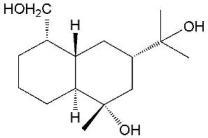

A New Sesquiterpene from the Fruits of Daucus carota L.

Abstract
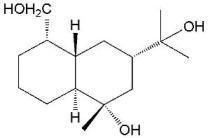
Introduction
Results and Discussion
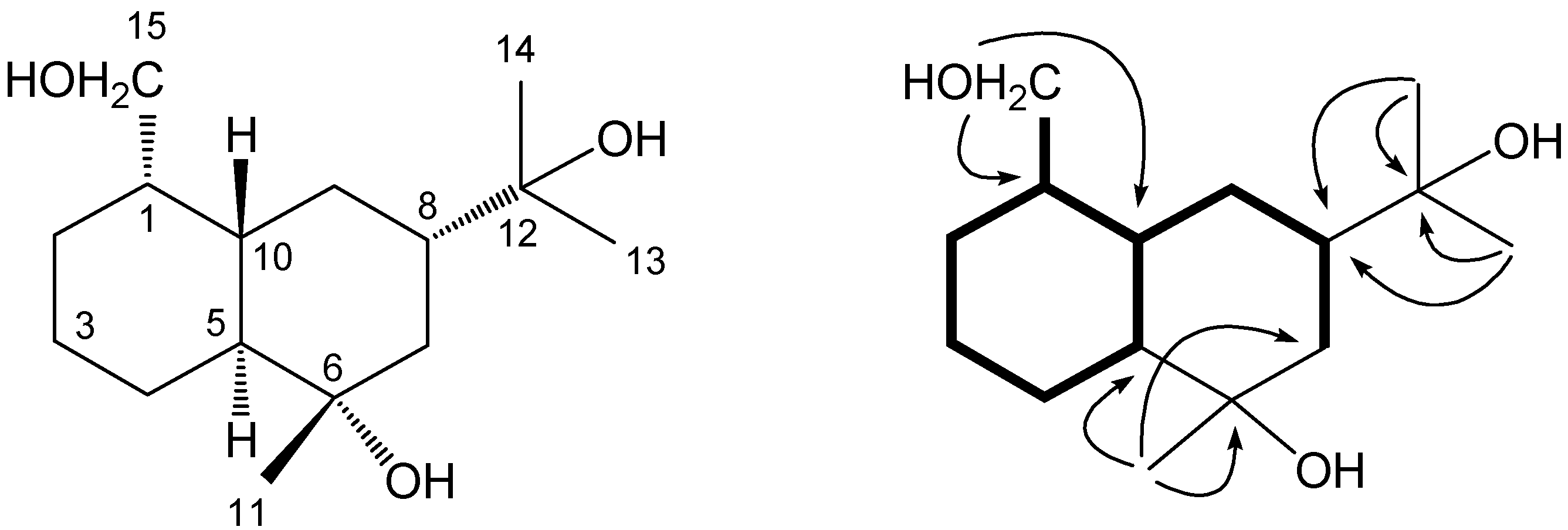
Structure Elucidation
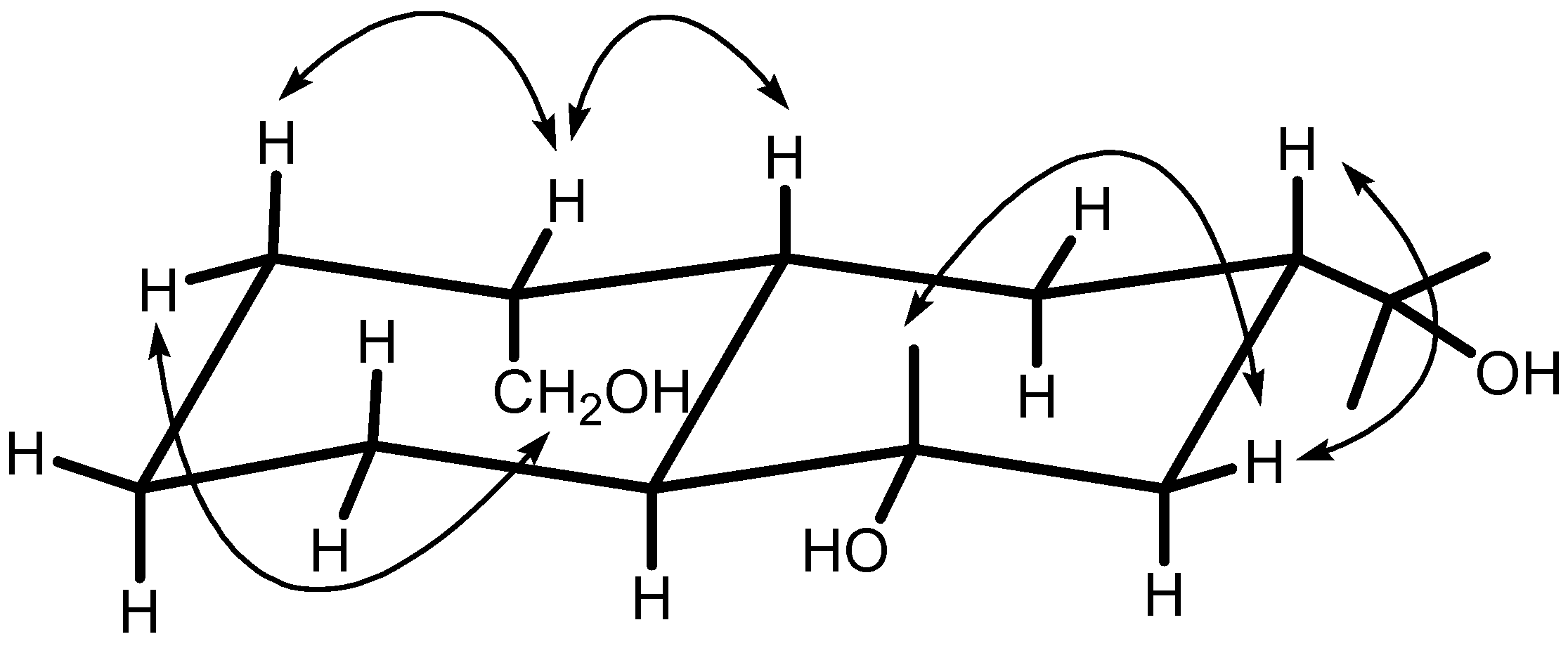


Cytotoxicity Assay
Experimental
General
Plant Material
Extraction and Isolation
Cytotoxicity Assay
Conclusions
Supplementary Files
Supplementary File 1References and Notes
- Pant, B.; Manandhar, S. In vitro propagation of carrot (Daucus carota). Scientific World 2007, 5, 51. [Google Scholar]
- Rossi, P.G.; Bao, L.; Luciani, A.; Panighi, J.; Desjobert, J.M.; Costa, J.; Casanova, J.; Bolla, J. M.; Berti, L. (E)-methylisoeugenol and elemicin: antibacterial components of Daucus carota L. essential oil against Campylobacter jejuni. J. Agr. Food Chem. 2007, 55, 7332–7336. [Google Scholar] [CrossRef]
- Tavares, A.C.; Goncalves, M.J.; Cavaleiro, C.; Cruz, M.T.; Lopes, M.C.; Canhoto, J.; Salgueiro, L.R. Essential oil of Daucus carota subsp. halophilus: Composition, antifungal activity and cytotoxicity. J. Ethnopharmacol. 2008, 119, 129–134. [Google Scholar] [CrossRef]
- Bishayee, A.; Sarkar, A.; Chatterjee, M. Hepatoprotective activity of carrot (Daucus carota L.) against carbon tetrachloride intoxication in mouse liver. J. Ethanopharmacol. 1995, 47, 69–74. [Google Scholar] [CrossRef]
- Yang, R.L.; Yan, Z.H.; Lu, Y. Cytotoxic Phenylpropanoids from Carrot. J. Agr. Food Chem. 2008, 56, 3024–3027. [Google Scholar] [CrossRef]
- Ahmed, A.A.; Bishr, M.M.; El-Shanawany, M.A.; Attia, E.Z.; Ross, S.A.; Pare, P.W. Rare trisubstituted sesquiterpenes daucanes from the wild Daucus carota. Phytochemistry 2005, 66, 1680–1684. [Google Scholar] [CrossRef]
- Dhillon, R.S.; Gautam, V.K.; Kalsi, P.S.; Chhabra, B.R. Carota-1,4-β-oxide, a sesquiterpene from Daucus carota. Phytochemistry 1989, 28, 639–640. [Google Scholar] [CrossRef]
- Cool, L.G. Ent-Daucane and acorane sesquiterpenes from Cupressocyparis leylandii foliage. Phytochemistry 2001, 58, 969–972. [Google Scholar] [CrossRef]
- Czepa, A.; Hofmann, T. Structural and sensory characterization of compounds contributing to the bitter off-taste of carrots (Daucus carota L.) and carrot puree. J. Agr. Food Chem. 2003, 51, 3865–3873. [Google Scholar] [CrossRef]
- Gebhardt, Y.; Witte, S.; Forkmann, G.; Lukacin, R.; Matern, U.; Martens, S. Molecular evolution of flavonoid dioxygenases in the family Apiaceae. Phytochemistry 2005, 66, 1273–1284. [Google Scholar] [CrossRef]
- Gupta, K.R.; Niranjan, G.S. A new flavone glycoside from seeds of Daucus carota. Planta Med. 1982, 46, 240–241. [Google Scholar] [CrossRef]
- Ivie, G.W.; Beier, R.C.; Holt, D.L. Analysis of the garden carrot (Daucus carota L.) for linear furocoumarins (psoralens) at the sub parts per million level. J. Agr. Food Chem. 1982, 30, 413–416. [Google Scholar] [CrossRef]
- Kurilich, A.C.; Clevidence, B.A.; Britz, S.J.; Simon, P.W.; Novotny, J.A. Plasma and urine responses are lower for acylated vs nonacylated anthocyanins from raw and cooked purple carrots. J. Agr. Food Chem. 2005, 53, 6537–6542. [Google Scholar] [CrossRef]
- Hemingson, J.C.; Collins, R.P. Anthocyanins present in cell cultures of Daucus carota. J. Nat. Prod. 1982, 45, 385–389. [Google Scholar] [CrossRef]
- Fu, H.W.; Zhang, H.L.; Pei, Y.H. A new coumestan from Arachis hypogaea L. Chinese Chem. Lett. 2005, 16, 918–920. [Google Scholar]
- Li, F.; Li, W.; Fu, H.W.; Zhang, Q.B.; Koike, K. Pancreatic lipase-inhibiting triterpenoid saponins from fruits of Acanthopanax senticosus. Chem. Pharm. Bull. 2007, 55, 1087–1089. [Google Scholar] [CrossRef]
- Wang, N.; Li, Z.L.; Song, D.D.; Li, W.; Fu, H.W.; Koike, K.; Pei, Y.H.; Jing, Y.K.; Hua, H.M. Lanostane-type triterpenoids from the roots of Kadsura coccinea. J. Nat. Prod. 2008, 71, 990–994. [Google Scholar] [CrossRef]
- Chang, X.L.; Li, W.; Jia, Z.H.; Satou, T.; Fushiya, S.J.; Koike, K. Biologically active triterpenoid saponins from Ardisia japonica. J. Nat. Prod. 2007, 70, 179–187. [Google Scholar] [CrossRef]
- Li, Y.L.; Gan, G.P.; Zhang, H.Z.; Wu, H.Z.; Li, C.L.; Huang, Y.P.; Liu, Y.W.; Liu, J.W. A flavonoid glycoside isolated from Smilax china L. rhizome in vitro anticancer effects on human cancer cell lines. J. Ethnopharmacol. 2007, 113, 115–124. [Google Scholar] [CrossRef]
- Sample Availability: Sample of the compound 1 for research is available from the authors.
© 2009 by the authors; licensee Molecular Diversity Preservation International, Basel, Switzerland. This article is an open-access article distributed under the terms and conditions of the Creative Commons Attribution license ( http://creativecommons.org/licenses/by/3.0/).
Share and Cite
Fu, H.-W.; Zhang, L.; Yi, T.; Tian, J.-K. A New Sesquiterpene from the Fruits of Daucus carota L. Molecules 2009, 14, 2862-2867. https://doi.org/10.3390/molecules14082862
Fu H-W, Zhang L, Yi T, Tian J-K. A New Sesquiterpene from the Fruits of Daucus carota L. Molecules. 2009; 14(8):2862-2867. https://doi.org/10.3390/molecules14082862
Chicago/Turabian StyleFu, Hong-Wei, Lin Zhang, Tao Yi, and Jing-Kui Tian. 2009. "A New Sesquiterpene from the Fruits of Daucus carota L." Molecules 14, no. 8: 2862-2867. https://doi.org/10.3390/molecules14082862
APA StyleFu, H.-W., Zhang, L., Yi, T., & Tian, J.-K. (2009). A New Sesquiterpene from the Fruits of Daucus carota L. Molecules, 14(8), 2862-2867. https://doi.org/10.3390/molecules14082862