
Assessing the Sorting Efficiency of Plastic Packaging Waste in an Italian Material Recovery Facility: Current and Upgraded Configuration

 ,
,  ,
,  ,
, 

Abstract
1. Introduction
2. Results
2.1. Input Waste Stream
2.2. Output Waste Streams
2.3. Current and Upgraded MRF Sorting Efficiencies
3. Discussion
4. Materials and Methods
4.1. ASM Material Recovery Facility
- Multi-material packaging stream (composed of plastic, aluminum, and metal packaging waste) from municipal separate collection;
- Mono-material packaging stream (composed of only plastic waste, without aluminum and metal waste) from pre-selection plants, where the separate collected plastic waste was preliminarily selected and cleaned in order to increase the stream quality.
- Light (CTL), bluish (CTA), and colored (CTC) PET bottles;
- PE liquid containers (CTE);
- PE packaging film larger than an A3 sheet (FIL/M);
- Mixed PP packaging (IPP);
- Plastic crates (CAS);
- Rigid polyolefin packaging (MPR);
- Aluminum and metal packaging.
4.2. Input and Output Waste Analysis
- Bottles for liquid (CPL): PET and PE bottles and vials with a capacity between 0.33 and 5 L. This fraction could be further divided into the following subcategories:
- ○
- PET bottles, selectable and non-selectable (e.g., capacity <0.33 L, bottles still filled with liquid to more than 5% of their capacity, bottles covered by a label, etc.);
- ○
- PE bottles, selectable and non-selectable (e.g., capacity <0.33 L, bottles still filled with liquid to more than 5% of their capacity, bottles fully covered by a label, etc.);
- Tracers: flexible packaging films with a dimension > A2 sheet (42 × 59.4 cm); strapping; bin bags;
- Plastic crates (CAS);
- Aluminum and metal packaging;
- Rigid polyolefin packaging (MPR);
- Other plastic packaging: all plastic packaging not included in liquid bottles, such as the following:
- ○
- PE packaging film larger (FIL/M) or smaller (FIL/S) than an A3 sheet;
- ○
- Rigid and expanded PS food packaging;
- ○
- Mixed PP packaging (IPP);
- ○
- PET trays;
- ○
- Other packaging type;
- Fine fraction (fine materials such as powdered plastics <40 mm);
- Scrap waste, including no plastic packaging or other materials such as paper, glass, or bioplastic (these materials should not be collected within the plastic packaging waste stream from separate collection; they are an indicator of contamination).
4.3. Sorting Efficiency
5. Conclusions
Author Contributions
Funding
Data Availability Statement
Acknowledgments
Conflicts of Interest
References
- Li, P.; Wang, X.; Su, M.; Zou, X.; Duan, L.; Zhang, H. Characteristics of Plastic Pollution in the Environment: A Review. Bull. Environ. Contam. Toxicol. 2021, 107, 577–584. [Google Scholar] [CrossRef] [Scilit]
- Plasctic Europe. Plastics—The Facts 2021 An analysis of European plastics production, demand and waste data. Plast. Eur. 2021, 1–34. Available online: http://www.plasticseurope.org (accessed on 16 January 2023).
- European Parliament and Council Directive (EU) 2018/852 of the European Parliament and of the Council of 30 May 2018 amending Directive 94/62/EC on packaging and packaging waste. Off. J. Eur. Union 2018. Available online: https://eur-lex.europa.eu/legal-content/EN/TXT/PDF/?uri=CELEX:32018L0852&from=EN (accessed on 16 January 2023).
- Geyer, R.; Jambeck, J.R.; Law, K.L. Production, use, and fate of all plastics ever made. Sci. Adv. 2017, 3, e1700782. [Google Scholar] [CrossRef] [Scilit] [PubMed]
- Tonini, D.; Albizzati, P.F.; Caro, D.; De Meester, S.; Garbarino, E.; Blengini, G.A. Quality of recycling: Urgent and undefined. Waste Manag. 2022, 146, 11–19. [Google Scholar] [CrossRef] [Scilit]
- Cimpan, C.; Maul, A.; Jansen, M.; Pretz, T.; Wenzel, H. Central sorting and recovery of MSW recyclable materials: A review of technological state-of-the-art, cases, practice and implications for materials recycling. J. Environ. Manag. 2015, 156, 181–199. [Google Scholar] [CrossRef] [Scilit]
- Mastellone, M.L.; Cremiato, R.; Zaccariello, L.; Lotito, R. Evaluation of performance indicators applied to a material recovery facility fed by mixed packaging waste. Waste Manag. 2017, 64, 3–11. [Google Scholar] [CrossRef] [Scilit]
- Mastellone, M.L. A feasibility assessment of an integrated plastic waste system adopting mechanical and thermochemical conversion processes. Resour. Conserv. Recycl. X 2019, 4, 100017. [Google Scholar] [CrossRef] [Scilit]
- Gadaleta, G.; De Gisi, S.; Binetti, S.M.C.; Notarnicola, M. Outlining a comprehensive techno-economic approach to evaluate the performance of an advanced sorting plant for plastic waste recovery. Process Saf. Environ. Prot. 2020, 143, 248–261. [Google Scholar] [CrossRef] [Scilit]
- Lederer, J.; Bartl, A.; Blasenbauer, D.; Breslmayer, G.; Gritsch, L.; Hofer, S.; Lipp, A.-M.; Mühl, J. A review of recent trends to increase the share of post-consumer packaging waste to recycling in europe. Detritus 2022, 3, 3–17. [Google Scholar] [CrossRef] [Scilit]
- Ragaert, K.; Delva, L.; Van Geem, K. Mechanical and chemical recycling of solid plastic waste. Waste Manag. 2017, 69, 24–58. [Google Scholar] [CrossRef] [Scilit]
- Alaerts, L.; Augustinus, M.; Van Acker, K. Impact of Bio-Based Plastics on Current Recycling of Plastics. Sustainability 2018, 10, 1487. [Google Scholar] [CrossRef] [Scilit]
- Rigamonti, L.; Grosso, M.; Møller, J.; Martinez Sanchez, V.; Magnani, S.; Christensen, T.H. Environmental evaluation of plastic waste management scenarios. Resour. Conserv. Recycl. 2014, 85, 42–53. [Google Scholar] [CrossRef] [Scilit]
- Miranda, R.; Monte, M.C.; Blanco, A. Analysis of the quality of the recovered paper from commingled collection systems. Resour. Conserv. Recycl. 2013, 72, 60–66. [Google Scholar] [CrossRef] [Scilit]
- Warrings, R.; Fellner, J. Management of aluminium packaging waste in selected European countries. Waste Manag. Res. 2019, 37, 357–364. [Google Scholar] [CrossRef] [Scilit]
- Bianchini, A.; Rossi, J. Design, implementation and assessment of a more sustainable model to manage plastic waste at sport events. J. Clean. Prod. 2021, 281, 125345. [Google Scholar] [CrossRef] [Scilit]
- Rossi, J.; Bianchini, A. ScienceDirect ScienceDirect “ Plastic waste free ”—A new circular model for the management of plastic packaging in food value chain. Transp. Res. Procedia 2022, 67, 153–162. [Google Scholar] [CrossRef] [Scilit]
- Gadaleta, G.; De Gisi, S.; Todaro, F.; Notarnicola, M. Carbon Footprint and Total Cost Evaluation of Different Bio-Plastics Waste Treatment Strategies. Clean Technol. 2022, 4, 570–583. [Google Scholar] [CrossRef] [Scilit]
- Pinter, E.; Welle, F.; Mayrhofer, E.; Pechhacker, A.; Motloch, L.; Lahme, V.; Grant, A.; Tacker, M. Circularity Study on PET Bottle-To-Bottle Recycling. Sustainability 2021, 13, 7370. [Google Scholar] [CrossRef] [Scilit]
- Faraca, G.; Astrup, T. Plastic waste from recycling centres: Characterisation and evaluation of plastic recyclability. Waste Manag. 2019, 95, 388–398. [Google Scholar] [CrossRef] [Scilit] [PubMed]
- Gadaleta, G.; De Gisi, S.; Todaro, F.; Campanaro, V.; Teodosiu, C.; Notarnicola, M. Sustainability assessment of municipal solid waste separate collection and treatment systems in a large metropolitan area. Sustain. Prod. Consum. 2021, 29, 328–340. [Google Scholar] [CrossRef] [Scilit]
- Peri, G.; Ferrante, P.; La Gennusa, M.; Pianello, C.; Rizzo, G. Greening MSW management systems by saving footprint: The contribution of the waste transportation. J. Environ. Manag. 2018, 219, 74–83. [Google Scholar] [CrossRef] [Scilit] [PubMed]
- Agovino, M.; Garofalo, A.; Mariani, A. Separate waste collection in Italy: The role of socio-cultural factors and targets set by law. Environ. Dev. Sustain. 2017, 19, 589–605. [Google Scholar] [CrossRef] [Scilit]
- Dahlbo, H.; Poliakova, V.; Mylläri, V.; Sahimaa, O.; Anderson, R. Recycling potential of post-consumer plastic packaging waste in Finland. Waste Manag. 2018, 71, 52–61. [Google Scholar] [CrossRef] [Scilit]
- Brouwer, M.; Picuno, C.; Thoden van Velzen, E.U.; Kuchta, K.; De Meester, S.; Ragaert, K. The impact of collection portfolio expansion on key performance indicators of the Dutch recycling system for Post-Consumer Plastic Packaging Waste, a comparison between 2014 and 2017. Waste Manag. 2019, 100, 112–121. [Google Scholar] [CrossRef] [Scilit]
- Antonopoulos, I.; Faraca, G.; Tonini, D. Recycling of post-consumer plastic packaging waste in EU: Process efficiencies, material flows, and barriers. Waste Manag. 2021, 126, 694–705. [Google Scholar] [CrossRef] [Scilit] [PubMed]
- Horodytska, O.; Valdés, F.J.; Fullana, A. Plastic flexible films waste management—A state of art review. Waste Manag. 2018, 77, 413–425. [Google Scholar] [CrossRef] [Scilit]
- Brooks, A.L.; Wang, S.; Jambeck, J.R. The Chinese import ban and its impact on global plastic waste trade. Sci. Adv. 2018, 4, eaat0131. [Google Scholar] [CrossRef] [Scilit]
- Gundupalli, S.P.; Hait, S.; Thakur, A. Classification of metallic and non-metallic fractions of e-waste using thermal imaging-based technique. Process Saf. Environ. Prot. 2018, 118, 32–39. [Google Scholar] [CrossRef] [Scilit]
- Cucina, M.; de Nisi, P.; Tambone, F.; Adani, F. The role of waste management in reducing bioplastics’ leakage into the environment: A review. Bioresour. Technol. 2021, 337, 125459. [Google Scholar] [CrossRef] [Scilit]
- Gadaleta, G.; De Gisi, S.; Picuno, C.; Heerenklage, J.; Di Iaconi, C.; Notarnicola, M.; Kuchta, K.; Sorrentino, A. Effects of cellulose-based bio-plastics on the aerobic biological stabilization treatment of mixed municipal solid waste: A lab-scale assessment. J. Environ. Manag. 2022, 318, 115585. [Google Scholar] [CrossRef] [Scilit] [PubMed]
- Gadaleta, G.; De Gisi, S.; Picuno, C.; Heerenklage, J.; Cafiero, L.; Oliviero, M.; Notarnicola, M.; Kuchta, K.; Sorrentino, A. The influence of bio-plastics for food packaging on combined anaerobic digestion and composting treatment of organic municipal waste. Waste Manag. 2022, 144, 87–97. [Google Scholar] [CrossRef] [Scilit] [PubMed]
- Abraham, A.; Park, H.; Choi, O.; Sang, B.I. Anaerobic co-digestion of bioplastics as a sustainable mode of waste management with improved energy production—A review. Bioresour. Technol. 2021, 322, 124537. [Google Scholar] [CrossRef] [Scilit] [PubMed]
- De Gisi, S.; Gadaleta, G.; Gorrasi, G.; La Mantia, F.P.; Notarnicola, M.; Sorrentino, A. The role of (bio)degradability on the management of petrochemical and bio-based plastic waste. J. Environ. Manag. 2022, 310, 114769. [Google Scholar] [CrossRef] [Scilit] [PubMed]
- Achour, F.; de Araujo Morais, J.; Rouez, M.; de Brauer, C.; Ducomi, G.; Bayard, R. Characterisation of organic matter in municipal solid wastes: A pertinent tool for the assessment of a mechanical-biological treatment. In Proceedings of the International Symposium MBT 2005; Kühle-Weidemeier, M., Ed.; Cuvillier Verlag: Hanover, Germany, 2005; pp. 559–568. [Google Scholar]
- COREPLA. Allegato n. 09—Modalità di Calcolo Dei Bilanci di Materia (In Italian). 2017. Available online: https://www.corepla.it/centri-di-selezione (accessed on 27 September 2022).
- Kleinhans, K.; Hallemans, M.; Huysveld, S.; Thomassen, G.; Ragaert, K.; Van Geem, K.M.; Roosen, M.; Mys, N.; Dewulf, J.; De Meester, S. Development and application of a predictive modelling approach for household packaging waste flows in sorting facilities. Waste Manag. 2021, 120, 290–302. [Google Scholar] [CrossRef] [Scilit]



| Waste Fraction | Average (%) | St. Dev. |
|---|---|---|
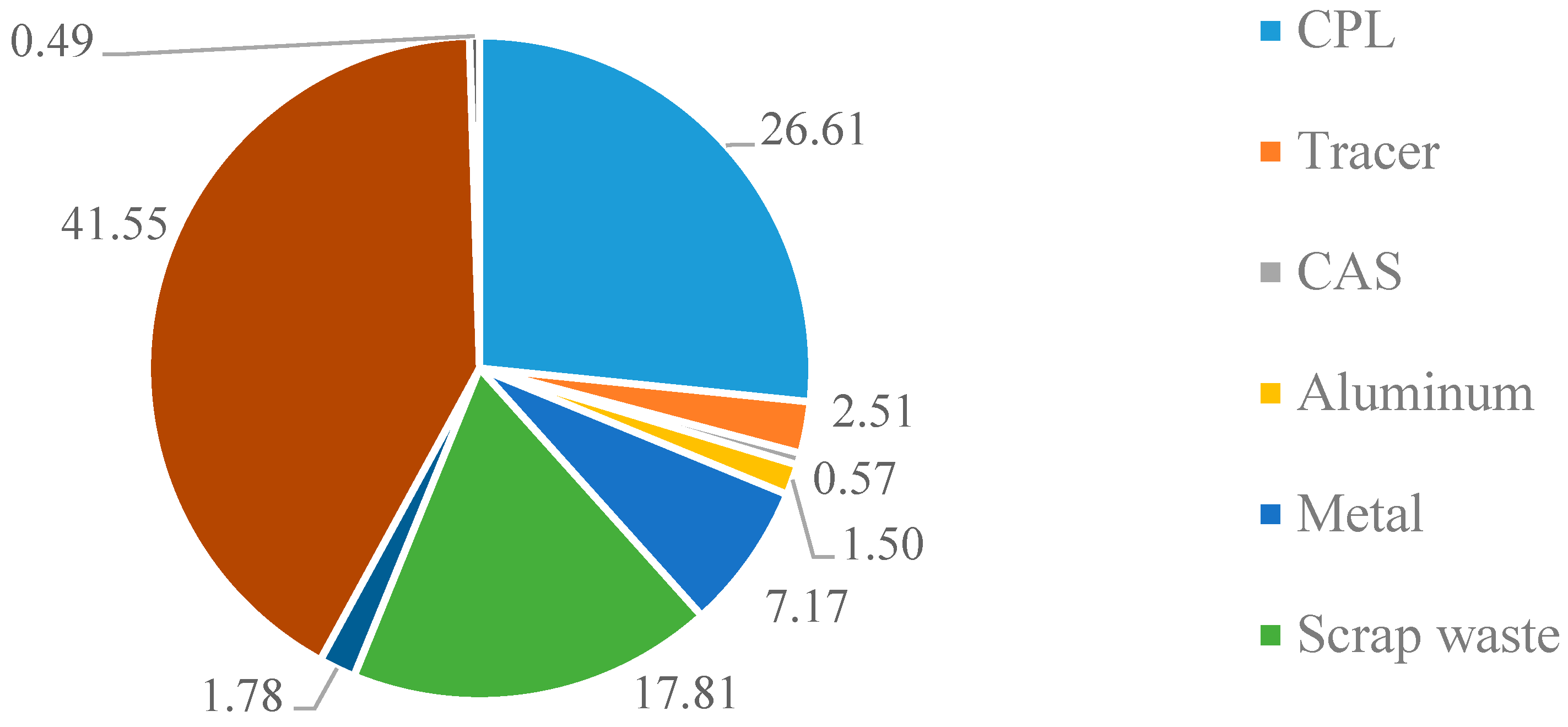
| Bottles for liquid (CPL) | 26.61 | ±3.52 |
| Selectable PET bottles | 17.91 | ±2.52 |
| Selectable PE bottles | 4.92 | ±0.94 |
| Non-selectable PET bottles | 2.78 | ±1.24 |
| Non-selectable PE bottles | 1.00 | ±0.63 |
| Tracers | 2.51 | ±1.57 |
| Plastic crates (CAS) | 0.57 | ±0.39 |
| Aluminum packaging | 1.50 | ±0.58 |
| Metal packaging | 7.17 | ±2.18 |
| Scrap waste | 17.81 | ±3.56 |
| Paper | 1.15 | ±0.71 |
| Glass | 0.67 | ±0.06 |
| Bioplastics | 1.22 | ±0.26 |
| Other | 14.77 | ±4.77 |
| Rigid packaging in polyolefin (MPR) | 1.78 | ±0.26 |
| Other packaging | 41.55 | ±6.23 |
| PE film < A3 (FIL/S) | 13.67 | ±3.69 |
| PE film > A3 (FIL/S) | 7.22 | ±2.43 |
| Rigid PS | 2.58 | ±0.93 |
| Expanded PS | 1.47 | ±0.57 |
| Mixed PP packaging (IPP) | 8.86 | ±1.27 |
| PET trays | 2.34 | ±0.58 |
| Others | 5.41 | ±1.95 |
| Fine fraction | 0.49 | ±0.19 |
| Selected Waste Stream | Amount (tons) | Amount (%) |
|---|---|---|
| CTL | 47.65 | 5.5 |
| CTA | 43.44 | 5.0 |
| CTC | 33.95 | 3.9 |
| CTE | 99.75 | 4.6 |
| FIL/M | 30.61 | 3.5 |
| MPR | 2.94 | 0.3 |
| CAS | 3.93 | 0.5 |
| IPP | 43.65 | 5.0 |
| Aluminum | 3.23 | 0.4 |
| Metal | 49.46 | 5.7 |
| PLASMIX E.L. | 215.53 | 24.8 |
| PLASMIX Add. | 337.44 | 38.8 |
| PLASMIX fine | 18.55 | 2.1 |
| Total | 870.12 | 100.0 |
| Output Streams | Non-Selectable PET (%) | FIL/S (%) | PET Trays (%) | Rigid PS (%) | Bioplastics (%) |
|---|---|---|---|---|---|
| CTA | 0.28 ± 0.12 | 1.66 ± 0.77 | |||
| CTC | 1.22 ± 0.28 | 0.86 ± 0.20 | |||
| CTL | 1.39 ± 0.17 | 3.68 ± 1.20 | |||
| IPP | 1.08 ± 0.28 | 2.74 ± 0.69 | 0.40 ± 0.03 | ||
| FIL/M | 2.45 ± 0.71 | 0.38 ± 0.03 | |||
| PLASMIX E.L. | 10.10 ± 2.10 | 3.09 ± 0.44 | 3.42 ± 0.48 | ||
| PLASMIX Add. | 27.36 ± 5.70 | 2.10 ± 0.67 | 2.32 ± 0.74 | 3.30 ± 0.55 | |
| PLASMIX fine | 3.13 ± 0.62 | 3.46 ± 0.69 |
| Selected Stream | Input (%) | Output (Current) (%) | Es (%) | Output (Upgraded) (%) | Es (%) |
|---|---|---|---|---|---|
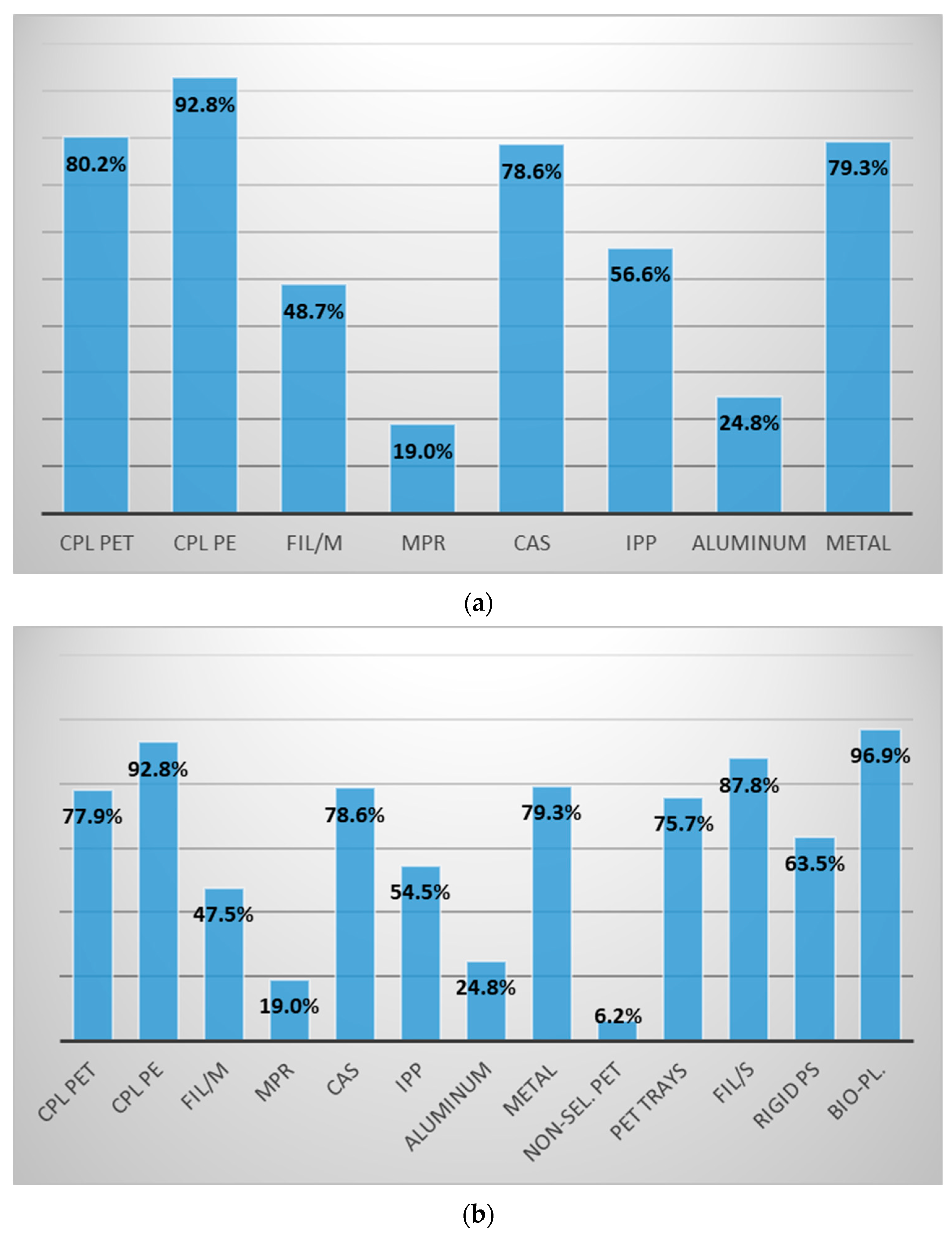
| CPL PET | 17.91 | 14.37 | 80.2 | 13.96 | 77.9 |
| CPL PE | 4.92 | 4.57 | 92.8 | 4.57 | 92.8 |
| FIL/M | 7.22 | 3.52 | 48.7 | 3.43 | 47.5 |
| MPR | 1.78 | 0.34 | 19.0 | 0.34 | 19.0 |
| CAS | 0.57 | 0.45 | 78.6 | 0.45 | 78.6 |
| IPP | 8.86 | 5.02 | 56.6 | 4.83 | 54.5 |
| Aluminum | 1.50 | 0.37 | 24.8 | 0.37 | 24.8 |
| Metal | 7.17 | 5.68 | 79.3 | 5.68 | 79.3 |
| Non-sel. PET | 2.78 | 0.17 | 6.2 | ||
| PET trays | 2.34 | 1.77 | 75.7 | ||
| FIL/S | 13.67 | 12.00 | 87.8 | ||
| Rigid PS | 2.58 | 1.64 | 63.5 | ||
| Bioplastics | 1.22 | 1.18 | 96.9 | ||
| Tot. | 34.32 | 50.39 |
| Output Streams | Non-Selectable PET | FIL/S | PET Trays | PS Rigid | Bioplastics |
|---|---|---|---|---|---|
| CTA | ✔ | ✔ | |||
| CTC | ✔ | ✔ | |||
| CTL | ✔ | ✔ | |||
| IPP | ✔ | ✔ | ✔ | ||
| FIL/M | ✔ | ✔ | |||
| PLASMIX E.L. | ✔ | ✔ | ✔ | ||
| PLASMIX Add. | ✔ | ✔ | ✔ | ✔ | |
| PLASMIX Fine | ✔ | ✔ |
Disclaimer/Publisher’s Note: The statements, opinions and data contained in all publications are solely those of the individual author(s) and contributor(s) and not of MDPI and/or the editor(s). MDPI and/or the editor(s) disclaim responsibility for any injury to people or property resulting from any ideas, methods, instructions or products referred to in the content. |
© 2023 by the authors. Licensee MDPI, Basel, Switzerland. This article is an open access article distributed under the terms and conditions of the Creative Commons Attribution (CC BY) license (https://creativecommons.org/licenses/by/4.0/).
Share and Cite
Gadaleta, G.; De Gisi, S.; Todaro, F.; D’Alessandro, G.; Binetti, S.; Notarnicola, M. Assessing the Sorting Efficiency of Plastic Packaging Waste in an Italian Material Recovery Facility: Current and Upgraded Configuration. Recycling 2023, 8, 25. https://doi.org/10.3390/recycling8010025
Gadaleta G, De Gisi S, Todaro F, D’Alessandro G, Binetti S, Notarnicola M. Assessing the Sorting Efficiency of Plastic Packaging Waste in an Italian Material Recovery Facility: Current and Upgraded Configuration. Recycling. 2023; 8(1):25. https://doi.org/10.3390/recycling8010025
Chicago/Turabian StyleGadaleta, Giovanni, Sabino De Gisi, Francesco Todaro, Giuseppe D’Alessandro, Silvio Binetti, and Michele Notarnicola. 2023. "Assessing the Sorting Efficiency of Plastic Packaging Waste in an Italian Material Recovery Facility: Current and Upgraded Configuration" Recycling 8, no. 1: 25. https://doi.org/10.3390/recycling8010025
APA StyleGadaleta, G., De Gisi, S., Todaro, F., D’Alessandro, G., Binetti, S., & Notarnicola, M. (2023). Assessing the Sorting Efficiency of Plastic Packaging Waste in an Italian Material Recovery Facility: Current and Upgraded Configuration. Recycling, 8(1), 25. https://doi.org/10.3390/recycling8010025