<?xml version="1.0" encoding="UTF-8"?>
<!DOCTYPE article PUBLIC "-//NLM//DTD Journal Publishing DTD v2.3 20070202//EN" "journalpublishing.dtd">
<article xmlns:mml="http://www.w3.org/1998/Math/MathML" xmlns:xlink="http://www.w3.org/1999/xlink" xml:lang="en" article-type="review-article">
  <front>
    <journal-meta>
      <journal-id journal-id-type="publisher-id">information</journal-id>
      <journal-title>Information</journal-title>
      <abbrev-journal-title abbrev-type="publisher">Information</abbrev-journal-title>
      <abbrev-journal-title abbrev-type="pubmed">Information</abbrev-journal-title>
      <issn pub-type="epub">2078-2489</issn>
      <publisher>
        <publisher-name>MDPI</publisher-name>
      </publisher>
    </journal-meta>
    <article-meta>
      <article-id pub-id-type="doi">10.3390/info3010036</article-id>
      <article-id pub-id-type="publisher-id">information-03-00036</article-id>
      <article-categories>
        <subj-group>
          <subject>Review</subject>
        </subj-group>
      </article-categories>
      <title-group>
        <article-title>Strategies for Successful Information Technology Adoption in Small and Medium-sized Enterprises</article-title>
      </title-group>
      <contrib-group>
        <contrib contrib-type="author">
          <name>
            <surname>Ghobakhloo</surname>
            <given-names>Morteza</given-names>
          </name>
          <xref rid="af1-information-03-00036" ref-type="aff">1</xref>
          <xref rid="c1-information-03-00036" ref-type="corresp">*</xref>
        </contrib>
        <contrib contrib-type="author">
          <name>
            <surname>Hong</surname>
            <given-names>Tang Sai</given-names>
          </name>
          <xref rid="af1-information-03-00036" ref-type="aff">1</xref>
        </contrib>
        <contrib contrib-type="author">
          <name>
            <surname>Sabouri</surname>
            <given-names>Mohammad Sadegh</given-names>
          </name>
          <xref rid="af2-information-03-00036" ref-type="aff">2</xref>
        </contrib>
        <contrib contrib-type="author">
          <name>
            <surname>Zulkifli</surname>
            <given-names>Norzima</given-names>
          </name>
          <xref rid="af1-information-03-00036" ref-type="aff">1</xref>
        </contrib>
      </contrib-group>
      <aff id="af1-information-03-00036"><label>1 </label>Department of Mechanical and Manufacturing Engineering, Universiti Putra Malaysia, 43400 UPM Serdang, Selangor, Malaysia; Email: <email>saihong@eng.upm.edu.my</email> (T.S.H.); <email>norzima@eng.upm.edu.my</email> (N.Z.)</aff>
      <aff id="af2-information-03-00036"><label>2 </label>Department of Agriculture and Young Researchers Club, Garmsar Branch, Islamic Azad University, Garmsar, Iran; Email: <email>mssabouri@iau-garmsar.ac.ir</email></aff>
      <author-notes>
        <corresp id="c1-information-03-00036"><label>*</label> Author to whom correspondence should be addressed; Email: <email>morteza_ghobakhloo@yahoo.com</email>.</corresp>
      </author-notes>
      <pub-date pub-type="epub">
        <day>13</day>
        <month>02</month>
        <year>2012</year>
      </pub-date>
      <pub-date pub-type="collection">
        <month>03</month>
        <year>2012</year>
      </pub-date>
      <volume>3</volume>
      <issue>1</issue>
      <fpage>36</fpage>
      <lpage>67</lpage>
      <history>
        <date date-type="received">
          <day>31</day>
          <month>10</month>
          <year>2011</year>
        </date>
        <date date-type="rev-recd">
          <day>22</day>
          <month>01</month>
          <year>2012</year>
        </date>
        <date date-type="accepted">
          <day>31</day>
          <month>01</month>
          <year>2012</year>
        </date>
      </history>
      <permissions>
        <copyright-statement>© 2012 by the authors; licensee MDPI, Basel, Switzerland.</copyright-statement>
        <copyright-year>2012</copyright-year>
        <license xmlns:xlink="http://www.w3.org/1999/xlink" license-type="open-access" xlink:href="http://creativecommons.org/licenses/by/3.0/">
          <p>This article is an open-access article distributed under the terms and conditions of the Creative Commons Attribution license (http://creativecommons.org/licenses/by/3.0/).</p>
        </license>
      </permissions>
      <abstract>
        <p>Information Technology (IT) adoption is an important field of study in a number of areas, which include small and medium-sized enterprises (SMEs). Due to the numerous advantages of IT, SMEs are trying to adopt IT applications to support their businesses. IT adoption by SMEs differs from larger organizations because of their specific characteristics, such as resources constraints. Therefore, this research aims to provide a better and clearer understanding of IT adoption within SMEs by reviewing and analyzing current IT literature. In this research, the review of literature includes theories, perspectives, empirical research and case studies related to IT adoption, in particular within SMEs from various databases such as Business Premier, Science Direct, JStor, Emerald Insight and Springer Link. The proposed model of effective IT adoption is believed to provide managers, vendors, consultants and governments with a practical synopsis of the IT adoption process in SMEs, which will in turn assist them to be successful with IT institutionalization within these businesses. </p>
      </abstract>
      <kwd-group>
        <kwd>initial adoption</kwd>
        <kwd>implementation</kwd>
        <kwd>post adoption</kwd>
        <kwd>information technology</kwd>
        <kwd>information system</kwd>
        <kwd>small and medium-sized enterprises</kwd>
      </kwd-group>
    </article-meta>
  </front>
  <body>
    <sec sec-type="intro">
      <title>1. Introduction</title>
      <p>In this 21st century, a worldwide system of commerce is evolving, in much the same way as national markets evolved from local and regional networks. The modern economic environment which is dominated by globalization, hyper-competition and the knowledge and information revolution has revolutionized the way business is conducted [<xref ref-type="bibr" rid="B1-information-03-00036">1</xref>]. This new technological epoch is apparent through intensified investment in computer-processing and data preparation appliances in the manufacturing and service industries and telecommunications infrastructure, and also to its widespread usage in government agencies, educational organizations, and, more recently, in the household. As a result of this technological progress, the implementation and application of IT is a significant driving force behind many socioeconomic changes [<xref ref-type="bibr" rid="B2-information-03-00036">2</xref>]. As the utilization and commercialization of IT becomes more widespread throughout the world, the adoption of novel IT can generate new business opportunities and various benefits. Nowadays, both large organizations and small and medium-sized enterprises (SMEs) are seeking ways to reinforce their competitive position and improve their productivity [<xref ref-type="bibr" rid="B3-information-03-00036">3</xref>]. Accordingly, there is an increasing consciousness of the necessity to derive profit through investment in IT within SMEs. IT tools can significantly assist SMEs by supplying the required infrastructure, which is necessary for providing appropriate types of information at the right time. IT can also provide SMEs with competitiveness through integration between supply chain partners and inter-organizational functions, as well as by providing critical information [<xref ref-type="bibr" rid="B4-information-03-00036">4</xref>]. However, prior IT literature has shown that only a small number of studies focused on the adoption and use of IT in SMEs [<xref ref-type="bibr" rid="B5-information-03-00036">5</xref>]. Moreover, it has been found that in spite of the exponential growth of IT within SMEs, the rate of IT adoption by these businesses has remained relatively low [<xref ref-type="bibr" rid="B6-information-03-00036">6</xref>], and large organizations have noticeably profited more than SMEs in both IT-enabled improved sale and costs savings [<xref ref-type="bibr" rid="B7-information-03-00036">7</xref>]. In looking for reasons for such differences in IT adoption in SMEs, unique characteristics of these businesses can be highlighted. SMEs generally have limited access to market information and suffer from globalization constraint [<xref ref-type="bibr" rid="B8-information-03-00036">8</xref>]. In addition, management techniques such as financial analysis, forecasting and project management are rarely used by SMEs [<xref ref-type="bibr" rid="B9-information-03-00036">9</xref>]. A tendency to employ generalists rather than specialists, reliance on short-term planning, informal and dynamic strategies and decision-making process, plus an unwillingness to develop and the use of standard operating procedures are other distinctive characteristics of SMEs [<xref ref-type="bibr" rid="B10-information-03-00036">10</xref>,<xref ref-type="bibr" rid="B11-information-03-00036">11</xref>]. However, it is the restricted resources controlled by SMEs, commonly referred to as resource poverty [<xref ref-type="bibr" rid="B12-information-03-00036">12</xref>,<xref ref-type="bibr" rid="B13-information-03-00036">13</xref>], that is the major differentiator between SMEs and large organizations. Compared with large organizations, SMEs are relatively weaker at various levels (<italic>i.e.</italic>, organizational, managerial, technological, individual and environmental). Therefore, IT adoption and usage in SMEs is at a disadvantage [<xref ref-type="bibr" rid="B14-information-03-00036">14</xref>,<xref ref-type="bibr" rid="B15-information-03-00036">15</xref>]. </p>
      <p>The aim of this research is to achieve a better understanding of IT adoption in SMEs through explicitly and understandably exploring and identifying factors influencing IT adoption processes within SMEs in both developed and developing countries. This will be undertaken by reviewing existing literature with a high concentration of certain SME-related issues. The proposed conceptual framework demonstrates the determinants of the IT adoption process in SMEs through a review of prior literature, including concepts, methodologies, theories, empirical research and case studies related to IT adoption among SMEs, and by combining existing perspectives. The research investigates and reveals a number of internal and external issues pressuring and persuading SMEs to adopt IT solutions. Likewise, barriers to IT adoption in SMEs will be addressed by reviewing and classifying IT adoption factors. In addition, by using the proposed conceptual model of effective IT adoption, the authors propose a systematic IT adoption strategy for SMEs to succeed in IT institutionalization at different adoption stages.</p>
    </sec>
    <sec>
      <title>2. IT Adoption within SMEs</title>
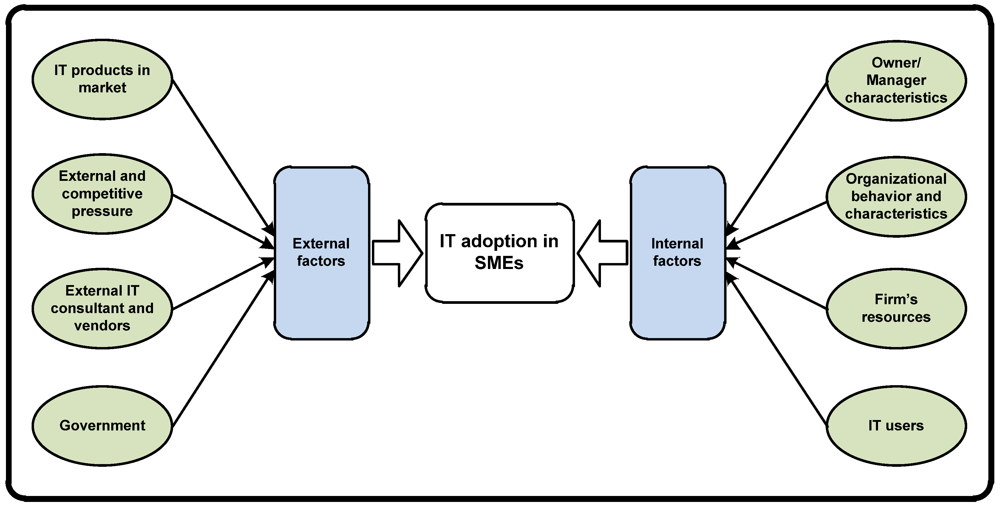
      <p>In this review, IT will cover a wide range of information processing and computer applications in organizations, since various definitions of IT have been employed widely by different researchers. Therefore, IT will cover Information System (IS), Information and Communication Technology (ICT) and the Internet, as well as and their infrastructure, including computer hardware and software, and those technologies that process or transmit information to enhance the effectiveness of individuals and organizations. A variety of perspectives on factors that affect the IT adoption process is available in a huge body of literature. The review of previous research has identified a number of influencing factors. Most of these perspectives and studies have concentrated on influencing factors such as top management, organizational behavior and characteristics, firms’ resources, government, customers, supplier and external IT consultant and vendors. From a macro-perspective, and based on the review of the existing literature on IT adoption in SMEs, an integrated framework has been developed and used to classify various issues and factors related to the process of IS/IT adoption within SMEs (<xref ref-type="fig" rid="information-03-00036-f001">Figure 1</xref>). This framework merely comprises different aspects of internal and external IT adoption factors (Drivers, Influencing factors and barriers) and does not categorize adoption factors based on being drivers or barriers of IT adoption in SMEs. </p>
      <fig id="information-03-00036-f001" position="anchor">
        <label>Figure 1</label>
        <caption>
          <p>Proposed framework of IT adoption influencing factors in SME context.</p>
        </caption>
        <graphic xmlns:xlink="http://www.w3.org/1999/xlink" xlink:href="information-03-00036-g001.tif"/>
      </fig>
      <p>Likewise, the authors will address different concepts of IT adoption (also considered as different IT adoption phases) suggested by prior literature, such as decisions to accept and use innovation [<xref ref-type="bibr" rid="B16-information-03-00036">16</xref>,<xref ref-type="bibr" rid="B17-information-03-00036">17</xref>,<xref ref-type="bibr" rid="B18-information-03-00036">18</xref>,<xref ref-type="bibr" rid="B19-information-03-00036">19</xref>], the full use of innovation as intended by the designer [<xref ref-type="bibr" rid="B20-information-03-00036">20</xref>], implementation success [<xref ref-type="bibr" rid="B21-information-03-00036">21</xref>], extent of usage [<xref ref-type="bibr" rid="B5-information-03-00036">5</xref>,<xref ref-type="bibr" rid="B22-information-03-00036">22</xref>] and the effectiveness and success of adopted IT based on acceptance of, or satisfaction with, IT [<xref ref-type="bibr" rid="B23-information-03-00036">23</xref>,<xref ref-type="bibr" rid="B24-information-03-00036">24</xref>,<xref ref-type="bibr" rid="B25-information-03-00036">25</xref>,<xref ref-type="bibr" rid="B26-information-03-00036">26</xref>,<xref ref-type="bibr" rid="B27-information-03-00036">27</xref>]. </p>
    </sec>
    <sec>
      <title>3. Influencing Factors</title>
      <p>Within this study and as suggested in <xref ref-type="fig" rid="information-03-00036-f001">Figure 1</xref>, influencing factors are categorized into two major clusters of factors and their subcategories: internal and external factors. In addition, a brief review and categorizations of factors influencing IT adoption in SMEs have been offered in <xref ref-type="table" rid="information-03-00036-t001">Table 1</xref>: factors that are merely SME-related. Internal factors are defined as factors within the technological context and organizational context of SMEs. Technological context describes the internal technologies relevant to the firm. Organizational context refers to descriptive measures regarding the organization, such as firm size and scope, managerial structure and internal resources. External factors, however, refer to the factors within the environmental context that describe the arena in which a firm conducts its business: its industry, competitors and dealings with government [<xref ref-type="bibr" rid="B28-information-03-00036">28</xref>,<xref ref-type="bibr" rid="B29-information-03-00036">29</xref>,<xref ref-type="bibr" rid="B30-information-03-00036">30</xref>].</p>
      <table-wrap id="information-03-00036-t001" position="anchor">
        <object-id pub-id-type="pii">information-03-00036-t001_Table 1</object-id>
        <label>Table 1</label>
        <caption>
          <p>Factors affecting IT adoption in SMEs.</p>
        </caption>
        <table>
<tbody>
            <tr style="border-top: solid thin; border-bottom: solid thin">
              <td colspan="3" align="center" valign="middle">
                <bold>Internal factors</bold>
              </td>
            </tr>
            <tr style="border-top: solid thin">
              <td align="center" valign="middle">Influencing factors</td>
              <td align="left" valign="top">Factors</td>
              <td align="left" valign="top">References</td>
    </tr>
            <tr style="border-top: solid thin">
              <td rowspan="7" align="center" valign="middle">
                <bold>Top management (CEO)</bold>
              </td>
              <td align="left" valign="top">Perception of and attitude toward IT adoption </td>
              <td align="left" valign="top">[<xref ref-type="bibr" rid="B31-information-03-00036">31</xref>,<xref ref-type="bibr" rid="B32-information-03-00036">32</xref>,<xref ref-type="bibr" rid="B33-information-03-00036">33</xref>]</td>
    </tr>
            <tr>
              <td align="left" valign="top">CEO’s (Chief Executive Officer) support and commitment</td>
              <td align="left" valign="top">[<xref ref-type="bibr" rid="B3-information-03-00036">3</xref>,<xref ref-type="bibr" rid="B12-information-03-00036">12</xref>,<xref ref-type="bibr" rid="B16-information-03-00036">16</xref>,<xref ref-type="bibr" rid="B21-information-03-00036">21</xref>,<xref ref-type="bibr" rid="B34-information-03-00036">34</xref>,<xref ref-type="bibr" rid="B35-information-03-00036">35</xref>,<xref ref-type="bibr" rid="B36-information-03-00036">36</xref>]</td>
    </tr>
            <tr>
              <td align="left" valign="top">IT knowledge and experiences</td>
              <td align="left" valign="top">[<xref ref-type="bibr" rid="B33-information-03-00036">33</xref>,<xref ref-type="bibr" rid="B35-information-03-00036">35</xref>,<xref ref-type="bibr" rid="B37-information-03-00036">37</xref>,<xref ref-type="bibr" rid="B38-information-03-00036">38</xref>,<xref ref-type="bibr" rid="B39-information-03-00036">39</xref>]</td>
    </tr>
            <tr>
              <td align="left" valign="top">CEO innovativeness</td>
              <td align="left" valign="top">[<xref ref-type="bibr" rid="B33-information-03-00036">33</xref>]</td>
    </tr>
            <tr>
              <td align="left" valign="top">Perceived behavioral control over IT</td>
              <td align="left" valign="top">[<xref ref-type="bibr" rid="B32-information-03-00036">32</xref>]</td>
    </tr>
            <tr>
              <td align="left" valign="top">CEOs desire for growth</td>
              <td align="left" valign="top">[<xref ref-type="bibr" rid="B37-information-03-00036">37</xref>]</td>
    </tr>
            <tr>
              <td align="left" valign="top">Familiarity with administration</td>
              <td align="left" valign="top">[<xref ref-type="bibr" rid="B37-information-03-00036">37</xref>]</td>
    </tr>
            <tr style="border-top: solid thin">
              <td rowspan="3" align="center" valign="middle">
                <bold>Resources</bold>
              </td>
              <td align="left" valign="top">Financial resources availability</td>
              <td align="left" valign="top">[<xref ref-type="bibr" rid="B33-information-03-00036">33</xref>,<xref ref-type="bibr" rid="B35-information-03-00036">35</xref>,<xref ref-type="bibr" rid="B40-information-03-00036">40</xref>,<xref ref-type="bibr" rid="B41-information-03-00036">41</xref>]</td>
    </tr>
            <tr>
              <td align="left" valign="top">Level of IT investment</td>
              <td align="left" valign="top">[<xref ref-type="bibr" rid="B21-information-03-00036">21</xref>,<xref ref-type="bibr" rid="B42-information-03-00036">42</xref>]</td>
    </tr>
            <tr>
              <td align="left" valign="top">In-house IT experts</td>
              <td align="left" valign="top">[<xref ref-type="bibr" rid="B34-information-03-00036">34</xref>,<xref ref-type="bibr" rid="B39-information-03-00036">39</xref>,<xref ref-type="bibr" rid="B43-information-03-00036">43</xref>,<xref ref-type="bibr" rid="B44-information-03-00036">44</xref>]</td>
    </tr>
            <tr style="border-top: solid thin">
              <td align="center" valign="middle">Influencing factors</td>
              <td align="left" valign="top">Factors</td>
              <td align="left" valign="top">References</td>
    </tr>
            <tr style="border-top: solid thin">
              <td rowspan="4" align="center" valign="middle">
                <bold>End users (staff)</bold>
              </td>
              <td align="left" valign="top">Users’ IT competence (knowledge of IT)</td>
              <td align="left" valign="top">[<xref ref-type="bibr" rid="B21-information-03-00036">21</xref>,<xref ref-type="bibr" rid="B31-information-03-00036">31</xref>,<xref ref-type="bibr" rid="B45-information-03-00036">45</xref>]</td>
    </tr>
            <tr>
              <td align="left" valign="top">Users’ training</td>
              <td align="left" valign="top">[<xref ref-type="bibr" rid="B16-information-03-00036">16</xref>,<xref ref-type="bibr" rid="B42-information-03-00036">42</xref>,<xref ref-type="bibr" rid="B43-information-03-00036">43</xref>]</td>
    </tr>
            <tr>
              <td align="left" valign="top">Users’ attitudes and opinions toward IT</td>
              <td align="left" valign="top">[<xref ref-type="bibr" rid="B31-information-03-00036">31</xref>,<xref ref-type="bibr" rid="B43-information-03-00036">43</xref>]</td>
    </tr>
            <tr>
              <td align="left" valign="top">Users’ participation and involvement</td>
              <td align="left" valign="top">[<xref ref-type="bibr" rid="B31-information-03-00036">31</xref>,<xref ref-type="bibr" rid="B37-information-03-00036">37</xref>,<xref ref-type="bibr" rid="B39-information-03-00036">39</xref>,<xref ref-type="bibr" rid="B46-information-03-00036">46</xref>]</td>
    </tr>
            <tr style="border-top: solid thin">
              <td rowspan="12" align="center" valign="middle">
                <bold>Organizational behavior and characteristics</bold>
              </td>
              <td align="left" valign="top">Business growth and expansion</td>
              <td align="left" valign="top">[<xref ref-type="bibr" rid="B35-information-03-00036">35</xref>,<xref ref-type="bibr" rid="B46-information-03-00036">46</xref>,<xref ref-type="bibr" rid="B47-information-03-00036">47</xref>]</td>
    </tr>
            <tr>
              <td align="left" valign="top">SME’s strategic context</td>
              <td align="left" valign="top">[<xref ref-type="bibr" rid="B31-information-03-00036">31</xref>,<xref ref-type="bibr" rid="B37-information-03-00036">37</xref>,<xref ref-type="bibr" rid="B48-information-03-00036">48</xref>,<xref ref-type="bibr" rid="B49-information-03-00036">49</xref>]</td>
    </tr>
            <tr>
              <td align="left" valign="top">Business size (turnover and numbers of employees)</td>
              <td align="left" valign="top">[<xref ref-type="bibr" rid="B3-information-03-00036">3</xref>,<xref ref-type="bibr" rid="B16-information-03-00036">16</xref>,<xref ref-type="bibr" rid="B33-information-03-00036">33</xref>,<xref ref-type="bibr" rid="B38-information-03-00036">38</xref>,<xref ref-type="bibr" rid="B39-information-03-00036">39</xref>,<xref ref-type="bibr" rid="B40-information-03-00036">40</xref>,<xref ref-type="bibr" rid="B42-information-03-00036">42</xref>,<xref ref-type="bibr" rid="B50-information-03-00036">50</xref>,<xref ref-type="bibr" rid="B51-information-03-00036">51</xref>,<xref ref-type="bibr" rid="B52-information-03-00036">52</xref>]</td>
    </tr>
            <tr>
              <td align="left" valign="top">Type of industry</td>
              <td align="left" valign="top">[<xref ref-type="bibr" rid="B33-information-03-00036">33</xref>,<xref ref-type="bibr" rid="B35-information-03-00036">35</xref>,<xref ref-type="bibr" rid="B52-information-03-00036">52</xref>,<xref ref-type="bibr" rid="B53-information-03-00036">53</xref>,<xref ref-type="bibr" rid="B54-information-03-00036">54</xref>]</td>
    </tr>
            <tr>
              <td align="left" valign="top">Information intensity</td>
              <td align="left" valign="top">[<xref ref-type="bibr" rid="B33-information-03-00036">33</xref>,<xref ref-type="bibr" rid="B38-information-03-00036">38</xref>,<xref ref-type="bibr" rid="B55-information-03-00036">55</xref>]</td>
    </tr>
            <tr>
              <td align="left" valign="top">Business maturity (high tech and knowledge intensive)</td>
              <td align="left" valign="top">[<xref ref-type="bibr" rid="B35-information-03-00036">35</xref>,<xref ref-type="bibr" rid="B37-information-03-00036">37</xref>]</td>
    </tr>
            <tr>
              <td align="left" valign="top">Organizational structure</td>
              <td align="left" valign="top">[<xref ref-type="bibr" rid="B31-information-03-00036">31</xref>]</td>
    </tr>
            <tr>
              <td align="left" valign="top">Organizational culture </td>
              <td align="left" valign="top">[<xref ref-type="bibr" rid="B39-information-03-00036">39</xref>,<xref ref-type="bibr" rid="B46-information-03-00036">46</xref>,<xref ref-type="bibr" rid="B56-information-03-00036">56</xref>,<xref ref-type="bibr" rid="B57-information-03-00036">57</xref>]</td>
    </tr>
            <tr>
              <td align="left" valign="top">Family intervention on management</td>
              <td align="left" valign="top">[<xref ref-type="bibr" rid="B37-information-03-00036">37</xref>,<xref ref-type="bibr" rid="B46-information-03-00036">46</xref>,<xref ref-type="bibr" rid="B58-information-03-00036">58</xref>]</td>
    </tr>
            <tr>
              <td align="left" valign="top">Change (technological change and business expansion)</td>
              <td align="left" valign="top">[<xref ref-type="bibr" rid="B40-information-03-00036">40</xref>,<xref ref-type="bibr" rid="B44-information-03-00036">44</xref>]</td>
    </tr>
            <tr>
              <td align="left" valign="top">Integration of internal processes</td>
              <td align="left" valign="top">[<xref ref-type="bibr" rid="B56-information-03-00036">56</xref>]</td>
    </tr>
            <tr>
              <td align="left" valign="top">IS planning</td>
              <td align="left" valign="top">[<xref ref-type="bibr" rid="B21-information-03-00036">21</xref>]</td>
    </tr>
            <tr style="border-top: solid thin">
              <td colspan="3" align="center" valign="middle">
                <bold>External factors</bold>
              </td>
            </tr>
            <tr>
              <td align="center" valign="middle">Influencing factors</td>
              <td align="left" valign="top">Factors</td>
              <td align="left" valign="top">References</td>
    </tr>
            <tr>
              <td rowspan="7" align="center" valign="middle">
                <bold>IT products in market</bold>
              </td>
              <td align="left" valign="top">Type and age of implemented IS/ITs</td>
              <td align="left" valign="top">[<xref ref-type="bibr" rid="B31-information-03-00036">31</xref>,<xref ref-type="bibr" rid="B53-information-03-00036">53</xref>,<xref ref-type="bibr" rid="B59-information-03-00036">59</xref>] </td>
    </tr>
            <tr>
              <td align="left" valign="top">Quality of software available in market</td>
              <td align="left" valign="top">[<xref ref-type="bibr" rid="B31-information-03-00036">31</xref>]</td>
    </tr>
            <tr>
              <td align="left" valign="top">The costs of ITs </td>
              <td align="left" valign="top">[<xref ref-type="bibr" rid="B17-information-03-00036">17</xref>,<xref ref-type="bibr" rid="B39-information-03-00036">39</xref>,<xref ref-type="bibr" rid="B43-information-03-00036">43</xref>,<xref ref-type="bibr" rid="B60-information-03-00036">60</xref>]</td>
    </tr>
            <tr>
              <td align="left" valign="top">Perceived impacts and benefits of IS/ITs in organization</td>
              <td align="left" valign="top">[<xref ref-type="bibr" rid="B3-information-03-00036">3</xref>,<xref ref-type="bibr" rid="B16-information-03-00036">16</xref>,<xref ref-type="bibr" rid="B17-information-03-00036">17</xref>,<xref ref-type="bibr" rid="B21-information-03-00036">21</xref>,<xref ref-type="bibr" rid="B35-information-03-00036">35</xref>,<xref ref-type="bibr" rid="B41-information-03-00036">41</xref>,<xref ref-type="bibr" rid="B45-information-03-00036">45</xref>,<xref ref-type="bibr" rid="B61-information-03-00036">61</xref>]</td>
    </tr>
            <tr>
              <td align="left" valign="top">Process compatibility</td>
              <td align="left" valign="top">[<xref ref-type="bibr" rid="B3-information-03-00036">3</xref>,<xref ref-type="bibr" rid="B16-information-03-00036">16</xref>,<xref ref-type="bibr" rid="B17-information-03-00036">17</xref>,<xref ref-type="bibr" rid="B56-information-03-00036">56</xref>]</td>
    </tr>
            <tr>
              <td align="left" valign="top">User-friendliness, complexity and popularity </td>
              <td align="left" valign="top">[<xref ref-type="bibr" rid="B16-information-03-00036">16</xref>,<xref ref-type="bibr" rid="B17-information-03-00036">17</xref>,<xref ref-type="bibr" rid="B26-information-03-00036">26</xref>,<xref ref-type="bibr" rid="B43-information-03-00036">43</xref>,<xref ref-type="bibr" rid="B52-information-03-00036">52</xref>,<xref ref-type="bibr" rid="B62-information-03-00036">62</xref>,<xref ref-type="bibr" rid="B63-information-03-00036">63</xref>]</td>
    </tr>
            <tr>
              <td align="left" valign="top">Security</td>
              <td align="left" valign="top"> </td>
    </tr>
            <tr style="border-top: solid thin">
              <td align="center" valign="middle">
                <bold>External and competitive pressure </bold>
              </td>
              <td align="left" valign="top">Competitiveness of environment (the necessity to stay competitive)</td>
              <td align="left" valign="top">[<xref ref-type="bibr" rid="B3-information-03-00036">3</xref>,<xref ref-type="bibr" rid="B33-information-03-00036">33</xref>,<xref ref-type="bibr" rid="B35-information-03-00036">35</xref>,<xref ref-type="bibr" rid="B40-information-03-00036">40</xref>,<xref ref-type="bibr" rid="B53-information-03-00036">53</xref>,<xref ref-type="bibr" rid="B54-information-03-00036">54</xref>]</td>
    </tr>
            <tr style="border-top: solid thin">
              <td align="center" valign="middle">
                <bold>Government</bold>
              </td>
              <td align="left" valign="top">Legal issues</td>
              <td align="left" valign="top">[<xref ref-type="bibr" rid="B63-information-03-00036">63</xref>,<xref ref-type="bibr" rid="B64-information-03-00036">64</xref>]</td>
    </tr>
            <tr style="border-top: solid thin">
              <td align="center" valign="middle">
                <bold>External IT consultant and vendors</bold>
              </td>
              <td align="left" valign="top">External expertise and services availability and support</td>
              <td align="left" valign="top">[<xref ref-type="bibr" rid="B12-information-03-00036">12</xref>,<xref ref-type="bibr" rid="B16-information-03-00036">16</xref>,<xref ref-type="bibr" rid="B31-information-03-00036">31</xref>,<xref ref-type="bibr" rid="B34-information-03-00036">34</xref>,<xref ref-type="bibr" rid="B39-information-03-00036">39</xref>,<xref ref-type="bibr" rid="B43-information-03-00036">43</xref>,<xref ref-type="bibr" rid="B60-information-03-00036">60</xref>]</td>
    </tr>
          </tbody>
        </table>
      </table-wrap>
      <sec>
        <title>3.1. Internal Factors</title>
        <sec>
          <title>3.1.1. Top Management</title>
          <p>In SMEs, the IT adoption process is directly affected by top management where all decisions from daily functions to future investments are made by them [<xref ref-type="bibr" rid="B46-information-03-00036">46</xref>,<xref ref-type="bibr" rid="B58-information-03-00036">58</xref>]. SMEs mainly have simple and highly centralized structures with the CEOs in which, in most cases, the owner and chief manager are the same person [<xref ref-type="bibr" rid="B65-information-03-00036">65</xref>]. A number of studies have revealed that in SMEs, the role of CEOs (top management or owner/manager) is central to the enterprise, since their decision influences all firms’ activities, both currently and in the future [<xref ref-type="bibr" rid="B66-information-03-00036">66</xref>,<xref ref-type="bibr" rid="B67-information-03-00036">67</xref>]. This also refers to IT adoption decision from planning stage to the implementation, maintaining, and system upgrade stages [<xref ref-type="bibr" rid="B46-information-03-00036">46</xref>,<xref ref-type="bibr" rid="B58-information-03-00036">58</xref>,<xref ref-type="bibr" rid="B68-information-03-00036">68</xref>]. </p>
          <p>Similarly, and based on the upper echelon theory, prior literature suggests that CEO’s demographic characteristics and personality traits of openness and extraversion are the significant determinants of IT usage behavior and performance within businesses [<xref ref-type="bibr" rid="B69-information-03-00036">69</xref>,<xref ref-type="bibr" rid="B70-information-03-00036">70</xref>,<xref ref-type="bibr" rid="B71-information-03-00036">71</xref>]. </p>
          <p>Several factors, including management’s perception of and attitude on IT, support and commitment, IT knowledge and experiences, innovativeness, perceived behavioral control over IT, desire for growth and familiarity with administration directly affect the process of IT adoption in SMEs [<xref ref-type="bibr" rid="B3-information-03-00036">3</xref>,<xref ref-type="bibr" rid="B32-information-03-00036">32</xref>,<xref ref-type="bibr" rid="B35-information-03-00036">35</xref>,<xref ref-type="bibr" rid="B36-information-03-00036">36</xref>]. Accordingly, the characteristics of CEOs should be taken into consideration in the investigation of strategic activities, such as the adoption of innovation, including IT as a new technology [<xref ref-type="bibr" rid="B72-information-03-00036">72</xref>]. Small businesses that have adopted IT are more likely to have CEOs who possess better positive attitudes in IT adoption [<xref ref-type="bibr" rid="B18-information-03-00036">18</xref>,<xref ref-type="bibr" rid="B33-information-03-00036">33</xref>]. This view is reinforced by Caldeira and Ward [<xref ref-type="bibr" rid="B31-information-03-00036">31</xref>] who found that the positive attitude of top management has resulted in relative success of IS/IT adoption in SMEs, especially in manufacturing industry. In addition, it is argued that a greater intention to adopt IT solutions is directly attributable to the more positive attitude of small and minority business owners in IT adoption [<xref ref-type="bibr" rid="B32-information-03-00036">32</xref>]. Consequently, if the CEO perceives that benefits of IT adoption outweigh its risks, then the business is more likely to adopt IT [<xref ref-type="bibr" rid="B33-information-03-00036">33</xref>]. Likewise, when management has been highly willing to implement IT application, SMEs do not perceive management priority on IT as a major barrier in adopting IS applications [<xref ref-type="bibr" rid="B4-information-03-00036">4</xref>]. In this regard, a positive attitude by top management in using IT (as the users of IT in SMEs) will result in IT acceptance and subsequently success in SMEs [<xref ref-type="bibr" rid="B24-information-03-00036">24</xref>,<xref ref-type="bibr" rid="B73-information-03-00036">73</xref>,<xref ref-type="bibr" rid="B74-information-03-00036">74</xref>].</p>
          <p>On the other hand, IT adoption literature has provided evidence that top management support and commitment towards IS/IT adoption is one of the key cornerstones of higher levels of success and satisfaction with IS/IT adoption and use in SMEs [<xref ref-type="bibr" rid="B3-information-03-00036">3</xref>,<xref ref-type="bibr" rid="B21-information-03-00036">21</xref>,<xref ref-type="bibr" rid="B39-information-03-00036">39</xref>,<xref ref-type="bibr" rid="B74-information-03-00036">74</xref>]. Cragg and Zinatelli [<xref ref-type="bibr" rid="B34-information-03-00036">34</xref>] identified insufficient attention by management to IS as one of the three main problem areas for computing in small firms. Since top management support and commitment are key factors contributing to IS success within small firms, these authors argued that top management directly affects IS evolution and sophistication. For success of IT in Malaysian SMEs however, it was found that the anticipated benefits of computerization in SMEs can only be achieved by the existence of five conditions, including strong top management support as the key condition [<xref ref-type="bibr" rid="B25-information-03-00036">25</xref>]. In a similar context, and interpreting the successful adoption and use of IS/IT from the resource based theory, Caldeira and Ward [<xref ref-type="bibr" rid="B31-information-03-00036">31</xref>], and Ghobakhloo <italic>et al.</italic> [<xref ref-type="bibr" rid="B75-information-03-00036">75</xref>] demonstrated that management support towards IS/IT adoption significantly improved IS/IT adoption success within SMEs. However, some prior studies have provided evidence of an insignificant relationship between the levels of IS effectiveness and CEO support [<xref ref-type="bibr" rid="B12-information-03-00036">12</xref>,<xref ref-type="bibr" rid="B36-information-03-00036">36</xref>]. Thong <italic>et al.</italic> [<xref ref-type="bibr" rid="B12-information-03-00036">12</xref>] defined top management support based on five elements (<xref ref-type="table" rid="information-03-00036-t002">Table 2</xref>). They discussed that there is no difference in the level of IS effectiveness between small businesses with high levels of top management support and small businesses with low levels of top management support. However, the majority of prior studies have implied the significant role of top management support in IT adoption within SMEs, and Thong <italic>et al.</italic>'s [<xref ref-type="bibr" rid="B12-information-03-00036">12</xref>,<xref ref-type="bibr" rid="B36-information-03-00036">36</xref>] inconsistency in providing the support for this factor can be attributed to their unique definition of top management support and its measurement construct in their research. </p>
          <table-wrap id="information-03-00036-t002" position="anchor">
            <object-id pub-id-type="pii">information-03-00036-t002_Table 2</object-id>
            <label>Table 2</label>
            <caption>
              <p>Thong <italic>et al.</italic> [<xref ref-type="bibr" rid="B12-information-03-00036">12</xref>] definition of top management support.</p>
            </caption>
            <table>
              <thead>
                <tr>
                  <th align="center" valign="middle">Variables</th>
                  <th align="center" valign="middle">CEO support elements</th>
                </tr>
              </thead>
              <tbody>
                <tr>
                  <td align="left" valign="middle">Top management support</td>
                  <td align="left" valign="middle">Frequency of attendance at computerization project meetings</td>
                </tr>
                <tr>
                  <td align="left" valign="middle"> </td>
                  <td align="left" valign="middle">Level of involvement in information requirements analysis</td>
                </tr>
                <tr>
                  <td align="left" valign="middle"> </td>
                  <td align="left" valign="middle">Level of involvement in decision-making relating to a computerization project</td>
                </tr>
                <tr>
                  <td align="left" valign="middle"> </td>
                  <td align="left" valign="middle">Level of involvement in reviewing consultants’ recommendations</td>
                </tr>
                <tr>
                  <td align="left" valign="middle"> </td>
                  <td align="left" valign="middle">Level of involvement in monitoring the project</td>
                </tr>
              </tbody>
            </table>
          </table-wrap>
          <p>The literature (particularly studies using upper echelon theory) suggests that CEO’s IT knowledge and experience of IT is another trait affecting IT adoption in SMEs [<xref ref-type="bibr" rid="B35-information-03-00036">35</xref>,<xref ref-type="bibr" rid="B37-information-03-00036">37</xref>,<xref ref-type="bibr" rid="B65-information-03-00036">65</xref>,<xref ref-type="bibr" rid="B69-information-03-00036">69</xref>]. It is suggested that the greater knowledge of CEOs will reduce the degree of uncertainty entangled with IT which will result in lower risk of IT adoption [<xref ref-type="bibr" rid="B18-information-03-00036">18</xref>]. Thus, small businesses with CEOs who are more knowledgeable about IT are more likely to adopt it [<xref ref-type="bibr" rid="B33-information-03-00036">33</xref>]. Moreover, CEOs with higher levels of computing skills are more satisfied with the implementation of IS rather than those having inferior skills [<xref ref-type="bibr" rid="B27-information-03-00036">27</xref>], given that satisfaction with IS/IT is one of the most applied measures of IT success in organizations [<xref ref-type="bibr" rid="B26-information-03-00036">26</xref>,<xref ref-type="bibr" rid="B76-information-03-00036">76</xref>,<xref ref-type="bibr" rid="B77-information-03-00036">77</xref>]. These views are consistent with the results of other studies, which found that sufficient knowledge of IT, and its consequent influences over organization, could be provocative and supportive for IT adoption in SMEs [<xref ref-type="bibr" rid="B37-information-03-00036">37</xref>,<xref ref-type="bibr" rid="B39-information-03-00036">39</xref>,<xref ref-type="bibr" rid="B78-information-03-00036">78</xref>].</p>
          <p>Another influencing factor attributable to the top management characteristics is CEO innovativeness, both in general and IT-specific terms [<xref ref-type="bibr" rid="B65-information-03-00036">65</xref>,<xref ref-type="bibr" rid="B75-information-03-00036">75</xref>]. Personal Innovativeness in IT (PIIT) has been revealed to be a reliable predictor of users’ attitude about the simplicity of use and effectiveness of new technologies [<xref ref-type="bibr" rid="B79-information-03-00036">79</xref>]. PIIT refers to “the willingness of an individual to try out any new information technology” [<xref ref-type="bibr" rid="B80-information-03-00036">80</xref>]. Agarwal and Prasad [<xref ref-type="bibr" rid="B80-information-03-00036">80</xref>] discuss that PIIT is a major determinant of IT acceptance by moderating in Perceived Usefulness (PU), compatibility and Perceived Ease of Use (PEOU). Here, it should be considered that in most of IT acceptance models, such as Technology Acceptance Model (TAM) [<xref ref-type="bibr" rid="B22-information-03-00036">22</xref>], Decomposed Theory of Planned Behavior (DTPB) (firstly introduced by Taylor and Todd [<xref ref-type="bibr" rid="B81-information-03-00036">81</xref>]), Unified Theory of Acceptance and Use of Technology (UTAUT) [<xref ref-type="bibr" rid="B82-information-03-00036">82</xref>], as well as in the majority of models of users’ satisfaction, including End User Satisfaction (EUS) model [<xref ref-type="bibr" rid="B76-information-03-00036">76</xref>], Model of Small Business User IT Satisfaction [<xref ref-type="bibr" rid="B27-information-03-00036">27</xref>] and Wixom and Todd [<xref ref-type="bibr" rid="B83-information-03-00036">83</xref>] integrated model of user satisfaction and technology acceptance with IT, PU and PEOU, are two key constructs of user behavioral intention and subsequently IT usage behavior. Thatcher and Perrewe [<xref ref-type="bibr" rid="B84-information-03-00036">84</xref>] demonstrated that highly innovative individuals with higher levels of PIIT are more likely to look for stimulating experiences, as well as having more confidence in their competence to use IT. On the other hand, individuals possessing lower levels of PIIT are more likely to present general computer anxiety, and they might have less tolerance for risk. </p>
          <p>In general terms however and in SME context, studies by Ghobakhloo <italic>et al.</italic> [<xref ref-type="bibr" rid="B65-information-03-00036">65</xref>], Thong and Yap [<xref ref-type="bibr" rid="B33-information-03-00036">33</xref>], and Thong [<xref ref-type="bibr" rid="B18-information-03-00036">18</xref>] revealed that movement toward IT adoption in small enterprises with innovator CEO are more probable. Innovator CEOs would prefer to apply distinctive and risky solutions such as IT that change the structure in which the problems are generated. Thus, CEOs’ desire to be more innovative will expedite the process of IT adoption [<xref ref-type="bibr" rid="B33-information-03-00036">33</xref>]. Hence, it can be inferred that the above mentioned studies and researches stress the importance of innovativeness in both general terms, as well as PIIT on user perception and system acceptance, whereas Scott and Walczak [<xref ref-type="bibr" rid="B85-information-03-00036">85</xref>] emphasized that individuals with higher levels of PIIT will possess greater cognitive absorption and show higher computer self-efficiency. In SMEs, where users of a new information system are both employees and owner/managers, innovative owner/managers will have a better attitude toward IT adoption.</p>
          <p>Desire for growth is another characteristic of CEOs that deserves our attention as an important influencing factor over adoption of IT. Lybaert [<xref ref-type="bibr" rid="B37-information-03-00036">37</xref>] discusses that firm’s size is positively related to the decision to accumulate additional information, and growth of a firm is coupled with the gathering of additional information. They found that an SME’s owner/manager, who makes most of the critical decisions and allows the firm to grow, uses more information when he/she possesses a greater desire for growth. Moreover, familiarity with administration is other important CEO-related determinant which influences the use of information and IS within SMEs. Lybaert [<xref ref-type="bibr" rid="B37-information-03-00036">37</xref>] showed that in comparison with CEOs not possessing knowledge of administration, CEOs with high familiarity with administration will use more information and subsequently IT. </p>
        </sec>
        <sec>
          <title>3.1.2. Resources</title>
          <p>SMEs have generally been distinguished by and are suffering from their restricted access to particular resources compared with large organizations [<xref ref-type="bibr" rid="B86-information-03-00036">86</xref>,<xref ref-type="bibr" rid="B87-information-03-00036">87</xref>]. The literature on IT adoption suggest that, due to the SMEs’ unique characteristics, their financial resources, technical and managerial resources, information resources accessibility, internal and external expertise, market accessibility and in-house IT knowledge and experience can hinder or simplify the adoption of IT in SMEs, and positively or negatively affect this process as well [<xref ref-type="bibr" rid="B21-information-03-00036">21</xref>,<xref ref-type="bibr" rid="B31-information-03-00036">31</xref>,<xref ref-type="bibr" rid="B34-information-03-00036">34</xref>,<xref ref-type="bibr" rid="B37-information-03-00036">37</xref>,<xref ref-type="bibr" rid="B39-information-03-00036">39</xref>,<xref ref-type="bibr" rid="B42-information-03-00036">42</xref>,<xref ref-type="bibr" rid="B44-information-03-00036">44</xref>,<xref ref-type="bibr" rid="B58-information-03-00036">58</xref>]. </p>
          <p>Financial resources are one of the most crucial resources which are known as the key SMEs performance requirements and are the critical success factors, based on resource-based theory [<xref ref-type="bibr" rid="B88-information-03-00036">88</xref>]. In general, most SMEs suffer from the lack of sufficient financial resources and most owner/managers invest their own personal assets [<xref ref-type="bibr" rid="B66-information-03-00036">66</xref>]. Limited financial resources compel SMEs to be cautious about their investment and capital spending [<xref ref-type="bibr" rid="B75-information-03-00036">75</xref>]. An imprecise IT investment decision can cause drastic financial consequences for SMEs and in extreme circumstances, may lead to insolvency and economical failure [<xref ref-type="bibr" rid="B78-information-03-00036">78</xref>]. As implementation of a new IT system and its components requires long term investment [<xref ref-type="bibr" rid="B58-information-03-00036">58</xref>] as well as the high cost of IT infrastructure [<xref ref-type="bibr" rid="B60-information-03-00036">60</xref>], only SMEs that have adequate financial resources would consider adoption of IT as a feasible project to undertake [<xref ref-type="bibr" rid="B33-information-03-00036">33</xref>]. Hence, SMEs’ owner/managers who have access to necessary financial resources are more able to establish the desired IS [<xref ref-type="bibr" rid="B37-information-03-00036">37</xref>]. However, despite a number of studies, it has been revealed that the financial restriction of SMEs regarding IT adoption is attributable to the high cost of IT tools and infrastructure [<xref ref-type="bibr" rid="B3-information-03-00036">3</xref>,<xref ref-type="bibr" rid="B43-information-03-00036">43</xref>,<xref ref-type="bibr" rid="B60-information-03-00036">60</xref>]. However, Dibrell <italic>et al.</italic> [<xref ref-type="bibr" rid="B10-information-03-00036">10</xref>] and Wu <italic>et al.</italic> [<xref ref-type="bibr" rid="B89-information-03-00036">89</xref>] suggested that IT implementation expense is not major factor hindering IT adoption process in SMEs, since the price of computer hardware and software has considerably declined in recent years. Nevertheless, it should be considered that along with the initial cost of computer hardware and software, other IS/IT implementation expenses, which include the cost of users training and development, and the post deployment costs should be undertaken by SMEs during different phases of IT adoption [<xref ref-type="bibr" rid="B58-information-03-00036">58</xref>]. Consistent with this view, Ein-Dor and Segev [<xref ref-type="bibr" rid="B90-information-03-00036">90</xref>] suggested that through investing sufficient financial resources, the probability of IS implementation success within organizations will be increased. This view is empirically reinforced by Thong [<xref ref-type="bibr" rid="B21-information-03-00036">21</xref>] who demonstrated that after external expertise, IS investment is the second most significant determinant of IS implementation success in Singaporean small businesses. Their study demonstrated that higher levels of allocation for IS investment will amplify the possibility of IS implementation success in small businesses, while through this allocation for investment, small businesses will be able to hire more experienced external experts and/or implement better IS that meet their goals. Furthermore, due to the above mentioned restrictions, and regardless of decrease in the price of preliminary IT tools, SMEs are generally unable to meet the expense of other IT adoption costs such as taking expert professionals into service [<xref ref-type="bibr" rid="B75-information-03-00036">75</xref>]. Therefore, SMEs face great difficulty hiring IT specialists to successfully implement IT with regard to financial constraints [<xref ref-type="bibr" rid="B31-information-03-00036">31</xref>,<xref ref-type="bibr" rid="B78-information-03-00036">78</xref>]. </p>
          <p>On the other hand, and comparing with large organization, it has been acknowledged that SMEs are suffering from a lack of in-house IT expertise which might negatively affect the process of IT adoption [<xref ref-type="bibr" rid="B34-information-03-00036">34</xref>,<xref ref-type="bibr" rid="B39-information-03-00036">39</xref>,<xref ref-type="bibr" rid="B43-information-03-00036">43</xref>]. As a result, SMEs are facing significant risks and problems with their computerization regarding their inadequate knowledge of IS/IT implementation [<xref ref-type="bibr" rid="B86-information-03-00036">86</xref>]. Cragg and Zinatelli [<xref ref-type="bibr" rid="B34-information-03-00036">34</xref>] conducted a longitudinal study over an eight-year period of IS sophistication and evolution in eighteen small firms and demonstrated that evolution and sophistication of IS within small firms will be drastically inhibited when small enterprises suffer a lack of internal expertise. This view is supported through a study by Caldeira and Ward [<xref ref-type="bibr" rid="B31-information-03-00036">31</xref>] who revealed that internal expertise consisting of employees, supervisors, or those from top management teams are powerful determinants of IT adoption and success. In addition, knowledge of IT is another key resource influencing IT adoption in SMEs. Development of internal IS/IT knowledge and skills is one of the most important bases required for providing superior levels of IS/IT adoption and satisfaction in SMEs [<xref ref-type="bibr" rid="B31-information-03-00036">31</xref>]. In general, the lack of IT knowledge in SMEs can be regarded as a barrier to IT adoption since CEOs of SMEs might be bewildered by swift development of IT tools and a countless variety of choices [<xref ref-type="bibr" rid="B78-information-03-00036">78</xref>,<xref ref-type="bibr" rid="B91-information-03-00036">91</xref>]. </p>
        </sec>
        <sec>
          <title>3.1.3. End Users</title>
          <p>In most organizations, employees are regarded as significant assets, and along with the role of owner/manager, seriously affect the firm’s survival and success [<xref ref-type="bibr" rid="B58-information-03-00036">58</xref>,<xref ref-type="bibr" rid="B92-information-03-00036">92</xref>]. These assets, as the users of IT within SMEs, are another precious resource for firms [<xref ref-type="bibr" rid="B31-information-03-00036">31</xref>] which need to be developed to contribute to the success of business [<xref ref-type="bibr" rid="B93-information-03-00036">93</xref>,<xref ref-type="bibr" rid="B94-information-03-00036">94</xref>]. </p>
          <p>Characteristics of IT users, including knowledge of IT, training, attitudes and intention toward IT, and participation and involvement in adoption process could affect IS/IT acceptance, or its adoption process as well [<xref ref-type="bibr" rid="B21-information-03-00036">21</xref>,<xref ref-type="bibr" rid="B31-information-03-00036">31</xref>,<xref ref-type="bibr" rid="B95-information-03-00036">95</xref>,<xref ref-type="bibr" rid="B96-information-03-00036">96</xref>]. Lack of training and skills of IT in organizations will result in a limited use of IT and lack of success in reaping benefits from computer hardware and software in organizations. This situation will further lead to a lack of IS/IT adoption success in SMEs, given that the successful adoption of IT needs the sharing of knowledge, training, and higher levels of skills by those employees who use IT [<xref ref-type="bibr" rid="B74-information-03-00036">74</xref>,<xref ref-type="bibr" rid="B93-information-03-00036">93</xref>].</p>
          <p>In order to facilitate the successful implementation of IS in SMEs, and to avoid adoption failure, these businesses should also augment the level of IS knowledge among potential IS users through providing employees with computer education and training courses [<xref ref-type="bibr" rid="B21-information-03-00036">21</xref>]. Sarosa and Zowghi [<xref ref-type="bibr" rid="B78-information-03-00036">78</xref>] and Ghobakhloo <italic>et al.</italic> [<xref ref-type="bibr" rid="B74-information-03-00036">74</xref>] suggested that IT acceptance among users of IT who form part of a firms’ employee base will impose positive impacts on IT adoption. According to these authors, the level of IT adoption and usage by users will be affected through the provision of IT courses and training, while higher knowledge of IT among users would help them in implementing new technology.</p>
          <p>Premkumar and Roberts [<xref ref-type="bibr" rid="B16-information-03-00036">16</xref>] suggested that increasing users’ awareness of the benefits of information telecommunication technologies will also positively influence the process of adopting these technologies, while this awareness could be amplified through improved education and training. Correspondingly, a study by Kleintop and Blau [<xref ref-type="bibr" rid="B97-information-03-00036">97</xref>] investigating the impact of end user training on electronic mail system implementation has demonstrated that end users practicing with new IT systems before implementation will result in higher level of IT system acceptance. In addition, their research suggested that the increment in amount of training among end users before IT implementation might lead to higher levels of perceived ease of using IT, as well as perception of IS usefulness. Moreover, it was suggested that positive change or improvement of business functionality through new systems (e.g., new IT applications) may not be believed by some employees [<xref ref-type="bibr" rid="B98-information-03-00036">98</xref>]. In such circumstances, it was suggested that employing new staff instead of training current employees might be more effective [<xref ref-type="bibr" rid="B46-information-03-00036">46</xref>]. </p>
          <p>A number of prior studies have demonstrated that employee acceptance and usage of, and satisfaction with, IT might be immoderately problematic regarding adoption success [<xref ref-type="bibr" rid="B73-information-03-00036">73</xref>,<xref ref-type="bibr" rid="B86-information-03-00036">86</xref>,<xref ref-type="bibr" rid="B94-information-03-00036">94</xref>], where, according to Bull [<xref ref-type="bibr" rid="B99-information-03-00036">99</xref>], more than half of the computer systems implemented in western countries are underused or not utilized at all. The acceptance of IT by users including managers, professionals and operating level personnel which is an essential condition for its success can be regarded as the adoption success measure [<xref ref-type="bibr" rid="B24-information-03-00036">24</xref>]. Lack of user acceptance has long been confirmed to be an impediment to the success of new IS, so user acceptance is regarded as the key factor determining success or failure of IS/IT projects [<xref ref-type="bibr" rid="B73-information-03-00036">73</xref>]. In SMEs, employee attitudes toward IT adoption might have significant impact on system acceptance and adoption success, as negative attitudes of some users toward IT could negatively affect successful implementation of IT [<xref ref-type="bibr" rid="B58-information-03-00036">58</xref>]. They may not perceive that new IT can change or improve business function and when it comes to adopting IT; they might be worried about consequences such as threat of losing job [<xref ref-type="bibr" rid="B100-information-03-00036">100</xref>]. Nonetheless, employee attitudes toward the use of the IS will be encouraged by clear support from top management, which will bring about a more tolerable conversion in existing work practices and company operations [<xref ref-type="bibr" rid="B12-information-03-00036">12</xref>]. Moreover, Davis [<xref ref-type="bibr" rid="B73-information-03-00036">73</xref>], Igbaria <italic>et al.</italic> [<xref ref-type="bibr" rid="B86-information-03-00036">86</xref>], Straub <italic>et al.</italic> [<xref ref-type="bibr" rid="B101-information-03-00036">101</xref>] and Szajna [<xref ref-type="bibr" rid="B102-information-03-00036">102</xref>] found that attitudes toward using IT along with PU and PEOU can fully affect the acceptance of IT by its users. The above mentioned view was validated in a small business context through a study by Igbaria <italic>et al.</italic> [<xref ref-type="bibr" rid="B86-information-03-00036">86</xref>] who demonstrated that users’ IT acceptance in small businesses is directly affected by PU and PEOU. In addition, the contribution of PU in promoting personal computing acceptance in small businesses is mediated by PEOU. </p>
          <p>On the other hand, employee (as the users of IT) satisfaction with IT is another dimension of IT adoption success in SMEs [<xref ref-type="bibr" rid="B24-information-03-00036">24</xref>,<xref ref-type="bibr" rid="B27-information-03-00036">27</xref>,<xref ref-type="bibr" rid="B62-information-03-00036">62</xref>,<xref ref-type="bibr" rid="B76-information-03-00036">76</xref>,<xref ref-type="bibr" rid="B103-information-03-00036">103</xref>]. Contrary to technological acceptance literature focusing on individual behavior and beliefs, system and information characteristics have been regarded as core concepts in user satisfaction literature [<xref ref-type="bibr" rid="B74-information-03-00036">74</xref>]. Adam Mahmood <italic>et al.</italic> [<xref ref-type="bibr" rid="B103-information-03-00036">103</xref>] argue that end-user information satisfaction is strongly affected by perceived benefit and expectations characteristics, user background and involvement, and organizational support and encouragement, as well as by subcomponents of these three factors. On the other hand, Palvia [<xref ref-type="bibr" rid="B26-information-03-00036">26</xref>], and Palvia and Palvia [<xref ref-type="bibr" rid="B27-information-03-00036">27</xref>] found that the unique characteristics of SMEs such as specific computing environment, mandatory environment, resource constraints, and generalist employees (employees and managers of SMEs as the users of IT are inclined to act as specialists in various aspects of IS, while not being very well qualified or expert in different IT roles) are specific attributes of user satisfaction with IT in SMEs. In this regard, Palvia [<xref ref-type="bibr" rid="B26-information-03-00036">26</xref>] formulated the SBUSIT model to evaluate IT impact over SMEs, based on IT user satisfaction measures. Subsequently, this model was developed by Palvia and Palvia [<xref ref-type="bibr" rid="B27-information-03-00036">27</xref>] through adding business related factors and owner/manager characteristics as two other determinants of users’ satisfaction with IT in SMEs.</p>
          <p>Despite SBUSIT and its developed version addressing user satisfaction in small businesses in connection with their particular characteristics, this model has excluded user involvement as a determinant of user satisfaction in small business. User involvement in IS/IT development has been largely considered as a significant mechanism leading to successful implementation of a new system [<xref ref-type="bibr" rid="B104-information-03-00036">104</xref>,<xref ref-type="bibr" rid="B105-information-03-00036">105</xref>,<xref ref-type="bibr" rid="B106-information-03-00036">106</xref>], specifically in SMEs [<xref ref-type="bibr" rid="B21-information-03-00036">21</xref>,<xref ref-type="bibr" rid="B25-information-03-00036">25</xref>,<xref ref-type="bibr" rid="B39-information-03-00036">39</xref>,<xref ref-type="bibr" rid="B75-information-03-00036">75</xref>]. In general, a firm initiating a change to a new information and computer system may causes concern over job security, causing employees to worry about the adoption outcomes, such as the threat of losing jobs [<xref ref-type="bibr" rid="B99-information-03-00036">99</xref>,<xref ref-type="bibr" rid="B100-information-03-00036">100</xref>]. As previously mentioned, some employees may not believe that IT will result in positive progress or improvement of organization functionality [<xref ref-type="bibr" rid="B98-information-03-00036">98</xref>]. Thus, there should be assurance by owner/managers that employees are aware and have an understanding of the effects of changes to a new computer system on the organization [<xref ref-type="bibr" rid="B58-information-03-00036">58</xref>,<xref ref-type="bibr" rid="B99-information-03-00036">99</xref>]. Moreover, managers should keep employees aware that new IS/IT will enable them to make the best use of resources that can help them be more productive [<xref ref-type="bibr" rid="B16-information-03-00036">16</xref>]. In such circumstances, involving employees as a part of new projects and systems will make them believe that as members of a family, team or organization, they are very important to and responsible for the new projects’ success in the organization. Hence, involving employees in the adoption process will result in higher levels of success [<xref ref-type="bibr" rid="B104-information-03-00036">104</xref>,<xref ref-type="bibr" rid="B105-information-03-00036">105</xref>]. Stewart <italic>et al.</italic> [<xref ref-type="bibr" rid="B107-information-03-00036">107</xref>] suggest that this user involvement should be initiated from the commencement of IT project feasibility studies, continue throughout the design phase and must be maintained during the deployment and testing stages.</p>
          <p>In term of IS success, Thong [<xref ref-type="bibr" rid="B21-information-03-00036">21</xref>] demonstrated that user involvement in IS implementation is one of the most important factors for successful IS implementation and user information satisfaction. If end users could be encouraged to become involved with IS/IT implementation through having time off from routine responsibilities, several advantages would be achieved. These advantages include a better fit of IT to users’ expectations, ease in using IT applications due to achieved IT knowledge and learning experience during the design phase, a strong sensation of ownership and decreased resistance to change [<xref ref-type="bibr" rid="B18-information-03-00036">18</xref>,<xref ref-type="bibr" rid="B39-information-03-00036">39</xref>]. Accordingly, these factors could increase the probability of successful IT implementation as well [<xref ref-type="bibr" rid="B21-information-03-00036">21</xref>]. </p>
          <p>In summary, it could be inferred that CEOs of SMEs are not the only users of IT who contribute to the success of the implemented IT. As the valuable assets of firms, employees also have a drastic influence over adoption and successful implementation of new IT. Therefore, development of these resources seems to be necessary for the success of the business [<xref ref-type="bibr" rid="B75-information-03-00036">75</xref>,<xref ref-type="bibr" rid="B93-information-03-00036">93</xref>]. </p>
        </sec>
        <sec>
          <title>3.1.4. Organizational Characteristics</title>
          <p>Prior research on IS/IT within SMEs have revealed a number of organizational characteristics as potential determinants of the adoption process which include SME strategies, business size, type of industry, information intensity, organizational culture and technological maturity [<xref ref-type="bibr" rid="B31-information-03-00036">31</xref>,<xref ref-type="bibr" rid="B35-information-03-00036">35</xref>,<xref ref-type="bibr" rid="B40-information-03-00036">40</xref>,<xref ref-type="bibr" rid="B49-information-03-00036">49</xref>,<xref ref-type="bibr" rid="B50-information-03-00036">50</xref>,<xref ref-type="bibr" rid="B52-information-03-00036">52</xref>,<xref ref-type="bibr" rid="B56-information-03-00036">56</xref>]. Strategically, IT tools are employed within SMEs in order to achieve pre-determined business strategy. Therefore, SMEs’ investments in IT are strongly affected by their strategic context, such as cost reduction versus value added strategies [<xref ref-type="bibr" rid="B49-information-03-00036">49</xref>]. According to Nguyen [<xref ref-type="bibr" rid="B58-information-03-00036">58</xref>], many businesses adopt new IT merely to keep up with other SMEs which have implemented these technologies. Under such circumstances, lack of definition or strategy of the purposes of IT adoption will lead to project failure. </p>
          <p>Business size definable by turnover and/or number of employees is one of the most important determinants of IT adoption [<xref ref-type="bibr" rid="B16-information-03-00036">16</xref>,<xref ref-type="bibr" rid="B33-information-03-00036">33</xref>]. The importance of firm size is partly due to its role as the source of the firm’s capabilities [<xref ref-type="bibr" rid="B40-information-03-00036">40</xref>]. Another rationale, however, is the fact that firm’s resources, including financial and human capital, might be an approximation of firm size [<xref ref-type="bibr" rid="B18-information-03-00036">18</xref>]. Thong and Yap's [<xref ref-type="bibr" rid="B33-information-03-00036">33</xref>] survey points out that business size is the most important discriminator between adopters and non-adopters of IT within Singaporean small businesses. Likewise, an investigation by Premkumar and Roberts [<xref ref-type="bibr" rid="B16-information-03-00036">16</xref>] of rural small businesses revealed that even within the small business category, firm size is the most important determinant to the adoption of IT. This finding is reinforced by a study of Premkumar [<xref ref-type="bibr" rid="B3-information-03-00036">3</xref>] on IT adoption within 207 SMEs who indicated that larger firms in the small business group have a higher inclination to adopt communication technologies than smaller ones. </p>
          <p>Another organizational characteristic that affects the adoption of IT in SMEs is specification of industry sectors to which they belong. Prior literature provides support for type of business and information intensity as determinants of IT adoption in SMEs [<xref ref-type="bibr" rid="B65-information-03-00036">65</xref>]. It is suggested that, consistent with other researches on IT adoption in different countries such as US, Malaysia or Singapore, IT adoption in Bruneian SMEs is significantly affected by type of business [<xref ref-type="bibr" rid="B38-information-03-00036">38</xref>]. Likewise, it has been reported that structure of IS/IT in organizations is considerably influenced by the types of business. Salmeron and Bueno [<xref ref-type="bibr" rid="B53-information-03-00036">53</xref>] found that SMEs in a same industry sector tend to implement the similar IS/IT, have similar attitudes towards technological changes and have personnel with similar attitudes toward using new technology. Porter and Millar [<xref ref-type="bibr" rid="B108-information-03-00036">108</xref>] suggest that the importance and the role of IT in various industry sectors are different, due to company type and information intensity. This view is reinforced by Love <italic>et al.</italic> [<xref ref-type="bibr" rid="B52-information-03-00036">52</xref>] who demonstrated that the level of IT investment made by Australian SMEs from different industry sectors will be significantly different. Consistent with these views, Thong and Yap [<xref ref-type="bibr" rid="B33-information-03-00036">33</xref>] discussed that companies from different industries have dissimilar information processing requirements, and those SMEs in more information‑intensive sectors might a greater propensity to adopt IT than those in a less information‑intensive environment. Similarly, Malaysian service industries make more use of IT and are more integrated with IT, in comparison with distribution and manufacturing firms as they are active in a more information intensive environment [<xref ref-type="bibr" rid="B55-information-03-00036">55</xref>]. Drew [<xref ref-type="bibr" rid="B35-information-03-00036">35</xref>] suggests that high-technology/knowledge intensive SMEs are considerably more influenced by internet technologies than other types of firms, besides being more sophisticated in the use of internet technologies. Thus, SMEs must assess their IT maturity to determine their IT readiness and whether the available IT tools could be satisfactorily implemented in the current organizational and environmental conditions [<xref ref-type="bibr" rid="B78-information-03-00036">78</xref>]. </p>
          <p>Organizational change is another significant influencing factor over IT adoption. Business growth forces SMEs to adopt novel and more effective technological solutions [<xref ref-type="bibr" rid="B46-information-03-00036">46</xref>]. The use of ICTs in small firms is the result of many internal factors such as business expansion, downsizing or relocation, and finding and capturing new markets which bring about change in organizations. Owner/managers may regard IT or ICTs as an essential tool to help managing changes [<xref ref-type="bibr" rid="B44-information-03-00036">44</xref>]. This view is supported by Drew [<xref ref-type="bibr" rid="B35-information-03-00036">35</xref>], suggesting that industry changes and trends and opportunities for growth are some of the major driving forces pushing SMEs toward the adoption of IT. Since in SMEs the concept of business growth requires and is associated with deployment of a total quality system and professionalization processes as well, IT adoption might be regarded as a rational response to these alterations from managers [<xref ref-type="bibr" rid="B46-information-03-00036">46</xref>]. </p>
          <p>In addition, organizational culture is another significant determinant of IS/IT implementation in organizations [<xref ref-type="bibr" rid="B46-information-03-00036">46</xref>,<xref ref-type="bibr" rid="B57-information-03-00036">57</xref>,<xref ref-type="bibr" rid="B109-information-03-00036">109</xref>,<xref ref-type="bibr" rid="B110-information-03-00036">110</xref>]. A number of organizational culture definitions can be found within the body of literature. For SMEs, culture can be regarded as the way of doing and sharing things for individuals through compliance with the firm’s beliefs, values, and attributes [<xref ref-type="bibr" rid="B58-information-03-00036">58</xref>], or, it can be defined as indigenous characteristics of organization including level of openness to change and characteristics of human resources [<xref ref-type="bibr" rid="B111-information-03-00036">111</xref>]. Stewart <italic>et al.</italic> [<xref ref-type="bibr" rid="B107-information-03-00036">107</xref>] suggested that characterizing organizational culture is necessitated since the culture and its various impacts are the key to success of IT projects (such as Enterprise Resource Planning (ERP)) that are an integral part of significant organizational change. These authors argued that many ERP failures can be attributed to paying inadequate attention to the culture of the organization while it is imperative to notice that in most of the time, ‘desired’ and the “actual” organizational culture are different [<xref ref-type="bibr" rid="B112-information-03-00036">112</xref>]. In light of organizational readiness to change, Jones <italic>et al.</italic> [<xref ref-type="bibr" rid="B113-information-03-00036">113</xref>] suggested that organizational cultures having a more supportive climate and flexible structures might be more advantageous to successful deployment of new technologies in organizations than less flexible and mechanistic cultures. In addition, constructs of organizational culture, including perceived norms, values and attitudes, predominant in organizations, might affect the behavior of employees toward ICT in those organizations [<xref ref-type="bibr" rid="B114-information-03-00036">114</xref>]. Regarding these findings, Jones <italic>et al.</italic> [<xref ref-type="bibr" rid="B113-information-03-00036">113</xref>] asserted that employees perceiving the culture of their organization as open system are more inclined to have positive attitudes toward organizational change, and subsequently will perceive more readiness for changes before the deployment of new technology in the organization. These authors demonstrated that employees who perceive strong human relations values in their area have shown a greater readiness for change prior to the deployment of a new computing system.</p>
          <p>In SMEs, culture is highly affected by owner/manager attitude, perceptions and characteristics [<xref ref-type="bibr" rid="B58-information-03-00036">58</xref>]. Thus, it is imperative for managers to know that employees’ usage of ICT might be affected by supervisors’ (managers at different levels) behavior toward work and IT [<xref ref-type="bibr" rid="B114-information-03-00036">114</xref>]. Moreover IT conflict with organizational culture can result in user resistance to IT adoption [<xref ref-type="bibr" rid="B109-information-03-00036">109</xref>]. As stated previously, openness to change is an important characteristic of organizational culture [<xref ref-type="bibr" rid="B111-information-03-00036">111</xref>,<xref ref-type="bibr" rid="B115-information-03-00036">115</xref>]. Thus, and given that IT deployment will often bring about significant change in SMEs, some researchers suggested that SMEs possessing an adaptable and flexible organizational culture with higher levels of openness to change will be more inclined and prepared to accept IT-related changes that might result in IT project success [<xref ref-type="bibr" rid="B58-information-03-00036">58</xref>,<xref ref-type="bibr" rid="B110-information-03-00036">110</xref>,<xref ref-type="bibr" rid="B116-information-03-00036">116</xref>]. From the other point of view, it was suggested that the examination of SME culture should also be addressed through studying organizational learning and the learning organization pattern [<xref ref-type="bibr" rid="B117-information-03-00036">117</xref>], since interrelationship between SME culture and learning processes might result in the enhancement of a firm’s competitive capacity [<xref ref-type="bibr" rid="B115-information-03-00036">115</xref>]. Newell <italic>et al.</italic> [<xref ref-type="bibr" rid="B118-information-03-00036">118</xref>] suggested that knowledge required for the adoption of complex IT projects which is vastly distributed needs to be integrated within the organization through a process of networking and knowledge sharing, while the effectiveness of this process is rooted in the culture of SMEs. Moreover, the adoption process requires the integration of internal and external knowledge within the firm. </p>
          <p>Furthermore, family involvement and intervention in firm management could have significant impacts upon IT adoption [<xref ref-type="bibr" rid="B37-information-03-00036">37</xref>,<xref ref-type="bibr" rid="B46-information-03-00036">46</xref>]. It has been largely confirmed that in family businesses, the tenure of senior managers who are family members is much higher than those in non-family organizations [<xref ref-type="bibr" rid="B73-information-03-00036">73</xref>,<xref ref-type="bibr" rid="B119-information-03-00036">119</xref>,<xref ref-type="bibr" rid="B120-information-03-00036">120</xref>]. Family firm managers are less inclined to have higher educational levels than those in non-family firms [<xref ref-type="bibr" rid="B119-information-03-00036">119</xref>]. Family firms have also been characterized by having smaller management teams while larger management team, can result in more effective business management [<xref ref-type="bibr" rid="B121-information-03-00036">121</xref>]. Smith [<xref ref-type="bibr" rid="B67-information-03-00036">67</xref>] provided evidence that the size of a firm is a dominant determinant of managerial differences, since these differences between micro, small and medium enterprises have been found to be more significant than those between family and non-family businesses. The above mentioned findings, together with specific characteristics of family businesses (such as lack of professionalization, more informal organizational structures, and reliance on informal internal control systems) suggest that the objective of IT adoption as well as the implementation process might be highly different in family SMEs [<xref ref-type="bibr" rid="B46-information-03-00036">46</xref>,<xref ref-type="bibr" rid="B67-information-03-00036">67</xref>]. In addition, the involvement and intervention of family members in day-to-day activities and management of family business may bring about organizational issues since, in most small businesses, family members are hired to fill vital positions [<xref ref-type="bibr" rid="B37-information-03-00036">37</xref>,<xref ref-type="bibr" rid="B46-information-03-00036">46</xref>,<xref ref-type="bibr" rid="B67-information-03-00036">67</xref>,<xref ref-type="bibr" rid="B122-information-03-00036">122</xref>]. Compared with the hiring of external staff that are better fitted for positions in the business, family members’ non-qualification often results in management problems such as ineffective IT usage [<xref ref-type="bibr" rid="B58-information-03-00036">58</xref>]. A study by De Lema and Duréndez [<xref ref-type="bibr" rid="B122-information-03-00036">122</xref>] on managerial behavior of family SMEs found that when businesses are managed by family members, lack of attention to personnel training and management qualifications and a commitment to family well-being might result in inefficiency in the decision making process. Likewise, an empirical study by Lybaert [<xref ref-type="bibr" rid="B37-information-03-00036">37</xref>] found that less significant family ownership and intervention in strategic management tends to produce higher levels of information use in SMEs. </p>
          <p>Another influencing factor attributable to the organizational characteristics is IS/IT planning. Through IS planning, the chance of successful implementation of IS within small firms might be higher [<xref ref-type="bibr" rid="B21-information-03-00036">21</xref>]. IT planning means that SMEs should determine why and how IT can enhance their business processes and profitability, and then develop a strategy and objectives to obtain the anticipated results [<xref ref-type="bibr" rid="B52-information-03-00036">52</xref>]. SMEs owners/managers should assign the resources and dedicate significant time and attention to manage the adoption process [<xref ref-type="bibr" rid="B78-information-03-00036">78</xref>]. They must understand that IT, requiring long-term commitment and sizeable investment, as well as having high strategic importance, can have a significant influence over organizational capacity, validity and survival. Planning of IT is perceived to be even more essential with regard to the speed at which technological innovations take place, along with the continuous efforts required by the SMEs’ internal environments to absorb them [<xref ref-type="bibr" rid="B21-information-03-00036">21</xref>]. Therefore, SMEs can fully benefit from adoption of IT through IT planning to evaluate the threats and opportunities created by IT [<xref ref-type="bibr" rid="B9-information-03-00036">9</xref>]. In addition, IS planning in SMEs, requiring integration with business strategy, has become more crucial as IS becomes more central to the future success and growth of SMEs and business strategy and IS strategy become intertwined [<xref ref-type="bibr" rid="B123-information-03-00036">123</xref>]. When IS/IT adoption is not planned strategically, for example when SMEs invest in IS with the aim of only improving production processing without integrating other systems, IT-based competitive advantages are typically accidental rather than planned [<xref ref-type="bibr" rid="B49-information-03-00036">49</xref>]. According to the literature, IS planning includes five phases; financial resources planning, human resources planning, information requirements analysis, implementation (software development, installation, and conversion) and post implementation (operation, maintenance, future needs) [<xref ref-type="bibr" rid="B124-information-03-00036">124</xref>]. In addition, a review of IT adoption literature by Ayman <italic>et al.</italic> [<xref ref-type="bibr" rid="B125-information-03-00036">125</xref>] places emphasis on IT projects management and argues that “highly regarded IT projects can be badly delivered if they are not properly managed”. Accordingly, a short-term strategic decision making cycle and lack of planning in some SMEs may bring about particular problems in implementation of IT [<xref ref-type="bibr" rid="B9-information-03-00036">9</xref>,<xref ref-type="bibr" rid="B126-information-03-00036">126</xref>]. Although it is generally believed that barriers to IT adoption arise mostly out of inaccessibility to funds and technology, the major barrier to IT adoption among US small business is the lack of an information system plan [<xref ref-type="bibr" rid="B127-information-03-00036">127</xref>]. </p>
        </sec>
      </sec>
      <sec>
        <title>3.2. External Factors</title>
        <sec>
          <title>3.2.1. External and Competitive Pressure</title>
          <p>For many firms, pressure to keep up with the competition, providing a means to enhance survival and/or growth, managing change, promoting services to customers and staying competitive and/or enhancing innovation abilities have forced them to adopt IT [<xref ref-type="bibr" rid="B3-information-03-00036">3</xref>,<xref ref-type="bibr" rid="B16-information-03-00036">16</xref>,<xref ref-type="bibr" rid="B35-information-03-00036">35</xref>,<xref ref-type="bibr" rid="B40-information-03-00036">40</xref>,<xref ref-type="bibr" rid="B41-information-03-00036">41</xref>,<xref ref-type="bibr" rid="B58-information-03-00036">58</xref>]. Prior literature suggests that as small businesses are susceptible to customer pressure, these firms adopted IT as a result of demand from customers to develop the efficiency of their inter-organizational dealings [<xref ref-type="bibr" rid="B128-information-03-00036">128</xref>]. Hence, it has become an indispensable strategy for firms to have these technologies [<xref ref-type="bibr" rid="B16-information-03-00036">16</xref>], while others suggested that the main driving forces to move toward IT tools adoption in SMEs are internal factors., including industry changes and trends, maintaining current market, finding new markets, opportunities for growth and the necessity to keep up with competition [<xref ref-type="bibr" rid="B35-information-03-00036">35</xref>,<xref ref-type="bibr" rid="B44-information-03-00036">44</xref>]. </p>
          <p>A more inclusive view on the innovation literature draws attention to relevance and importance of both internal and external drivers for change [<xref ref-type="bibr" rid="B129-information-03-00036">129</xref>,<xref ref-type="bibr" rid="B130-information-03-00036">130</xref>]. Mehrtens <italic>et al.</italic> [<xref ref-type="bibr" rid="B131-information-03-00036">131</xref>] discussed that the issue of credibility has risen as a significant motivator for adopting IT tools within SMEs. These researchers argued that credibility could be achieved through fulfilling customers’ and suppliers’ pressure and, in addition, significantly meet expectations of receiving better services. A study by Dutta and Evrard [<xref ref-type="bibr" rid="B42-information-03-00036">42</xref>] on European small enterprises showed that the main focus of European small enterprises is to make use of IT to deliver a superior level of customer service and better communication with distant partners/customers. Moreover, a study by Premkumar and Roberts [<xref ref-type="bibr" rid="B16-information-03-00036">16</xref>] on rural small businesses suggested that external pressure and competitive pressure are important determinants to the adoption of ICTs. Likewise, it was suggested that client and supplier pressure to adopt IS/IT was an important factor influencing the levels of IS/IT adoption and success in Portuguese manufacturing SMEs [<xref ref-type="bibr" rid="B31-information-03-00036">31</xref>]. These results are consistent with studies by De Burca <italic>et al.</italic> [<xref ref-type="bibr" rid="B56-information-03-00036">56</xref>] and Mole <italic>et al.</italic> [<xref ref-type="bibr" rid="B40-information-03-00036">40</xref>] who suggested that customers, suppliers and larger counterpart demand were significant determinants of IT tool adoption.</p>
          <p>On the other hand, and according to prior IS literature, drivers for IT/IS adoption in SMEs are also attributable to firms’ desires and needs to stay competitive and innovative as necessities for their survival [<xref ref-type="bibr" rid="B65-information-03-00036">65</xref>]. The expression “competitive advantage” is one of the most lasting topics in the business strategy and strategic management literature and its theories have been well-founded [<xref ref-type="bibr" rid="B132-information-03-00036">132</xref>,<xref ref-type="bibr" rid="B133-information-03-00036">133</xref>,<xref ref-type="bibr" rid="B134-information-03-00036">134</xref>,<xref ref-type="bibr" rid="B135-information-03-00036">135</xref>]. Porter [<xref ref-type="bibr" rid="B134-information-03-00036">134</xref>] defined competitive advantage as a direct consequence of the strategies implemented by a firm intended for adding value to customers. It has been demonstrated that competitive pressure will affect the adoption of new technologies when SMEs perceive that these technologies will possibly support their competitive position, therefore, SMEs adopt IT to gain competitive advantage [<xref ref-type="bibr" rid="B75-information-03-00036">75</xref>]. Porter and Millar [<xref ref-type="bibr" rid="B108-information-03-00036">108</xref>] argued that the nature of competition might change through the adoption of IT. They found that IT has changed the rules of competition through changing industrial structure, creating competitive advantage by delivering businesses in new ways to outperform their competitors and spawning new businesses by making new business technologically feasible, creating demand for products and regenerating old businesses. SMEs active in industries having a high rate of innovation and intense competitive challenge are more likely to perceive IT tools as a stronger driver for strategic change than those in other types of industries [<xref ref-type="bibr" rid="B16-information-03-00036">16</xref>,<xref ref-type="bibr" rid="B35-information-03-00036">35</xref>,<xref ref-type="bibr" rid="B136-information-03-00036">136</xref>,<xref ref-type="bibr" rid="B137-information-03-00036">137</xref>,<xref ref-type="bibr" rid="B138-information-03-00036">138</xref>]. The study by Pontikakis <italic>et al.</italic> [<xref ref-type="bibr" rid="B54-information-03-00036">54</xref>] investigating IT adoption within Greek SMEs suggested that highly competitive industries are often technologically intensive and SMEs operating in innovation-intensive industries might face intense competition initiated by innovations than those who are generally inclined to be more risk-averse. They found that SMEs which perceived their industries as highly competitive were more than six times more likely to adopt IT solutions. IS/IT utilization could bring about more effectiveness in the internal and external aspects of SMEs, so SMEs considered IT as an essential tool with the purpose of competing for organizational adaptation as well as environmental change [<xref ref-type="bibr" rid="B65-information-03-00036">65</xref>]. Furthermore, IS/IT enhances SME survival rates where they are functioning in a competitive environment with the risk of higher rates of failure [<xref ref-type="bibr" rid="B49-information-03-00036">49</xref>]. </p>
        </sec>
        <sec>
          <title>3.2.2. IT Solution (Computer Application)</title>
          <p>The process of IT adoption within SMEs also depends on characteristics of marketed IS/IT itself which consist of a cluster of factors including type, process compatibility, user friendliness and popularity of implemented IS/IT, quality of software available in market and the costs of IT [<xref ref-type="bibr" rid="B3-information-03-00036">3</xref>,<xref ref-type="bibr" rid="B25-information-03-00036">25</xref>,<xref ref-type="bibr" rid="B31-information-03-00036">31</xref>,<xref ref-type="bibr" rid="B53-information-03-00036">53</xref>,<xref ref-type="bibr" rid="B60-information-03-00036">60</xref>,<xref ref-type="bibr" rid="B106-information-03-00036">106</xref>]. For adoption of enterprise application software, easy-to-understand and relatively long-experienced enterprise applications are more effective in SMEs as compared to hard-to-understand and brand-new applications [<xref ref-type="bibr" rid="B59-information-03-00036">59</xref>]. Given that information systems and technologies are considered as the major enablers of superior business performance, quality of IS/IT products available in the market (e.g., attribute of the selected product, its reliability and usefulness) could be an important determinant when it comes to deciding on the adoption IS/IT products among SMEs [<xref ref-type="bibr" rid="B31-information-03-00036">31</xref>,<xref ref-type="bibr" rid="B139-information-03-00036">139</xref>]. </p>
          <p>The technological characteristics of IT products available in the market, including their compatibility and security, are also significant determinants of IT adoption in organizations [<xref ref-type="bibr" rid="B5-information-03-00036">5</xref>]. Compatibility is an important technological characteristic perceived by individuals, which was suggested by Diffusion of Innovation theory as a driver of the decision to adopt a new system [<xref ref-type="bibr" rid="B140-information-03-00036">140</xref>]. IT compatibility can be defined as the extent (or ease) with which IT is integrated with the existing technological infrastructure, culture, values, and preferred work practices of an organization [<xref ref-type="bibr" rid="B141-information-03-00036">141</xref>]. Several prior studies on IT adoption within SMEs found that IT adoption and usage is significantly affected by the compatibility of relative products [<xref ref-type="bibr" rid="B142-information-03-00036">142</xref>,<xref ref-type="bibr" rid="B143-information-03-00036">143</xref>]. It is imperative that CEOs of SMEs consider the most appropriate application in their businesses when deciding whether or not to implement new IT [<xref ref-type="bibr" rid="B58-information-03-00036">58</xref>]. Deficient IT investment decisions (regarding the compatibility and security issues of IT products) can impose a significant impact on organizational profitability [<xref ref-type="bibr" rid="B65-information-03-00036">65</xref>]. It can participate in enhancing SME performance. Nevertheless, with no effectual IT adoption and development strategy in the right place, the anticipated and demanded performance enhancement may not materialize. Therefore, with its counter-productiveness, IT might be considered as an asset sinkhole [<xref ref-type="bibr" rid="B75-information-03-00036">75</xref>]. In this regard, it was found that the high cost of IT tools and expensive software in addition to ICT security concerns are the major risks of ICT adoption perceived by Malaysian and Australian SMEs [<xref ref-type="bibr" rid="B17-information-03-00036">17</xref>,<xref ref-type="bibr" rid="B52-information-03-00036">52</xref>]. With regard to the above-mentioned findings, it could be inferred that technological characteristics of marketed IT products has become one of the common concern of SMEs when it comes to adopting IT.</p>
          <p>Another factor that affects adoption of IT within SMEs is cost of IS/IT. It is imperative that managers consider the elements of IT costs (hardware and software) closely during IT adoption process within SMEs [<xref ref-type="bibr" rid="B39-information-03-00036">39</xref>]. From a similar perspective, Walczuch <italic>et al.</italic> [<xref ref-type="bibr" rid="B60-information-03-00036">60</xref>] studied internet adoption barriers for small firms in the Netherlands and explained that high costs are the important reason for Dutch small firms not having internet access and their own websites. Moreover, most US businesses have significant difficulty affording the costs of ICT tools while 90% of these businesses consider lack of financial resources and skills as the main barriers to ICT adoption [<xref ref-type="bibr" rid="B144-information-03-00036">144</xref>]. With regard to the financial constraints experienced by the majority of SMEs, as well as the high start-up costs of ICT or very expensive software or ready-to-use online packages, it is expected that SMEs generally cannot afford to adopt ICT or reap its benefits through the effective use of ICT, in short or medium period of time [<xref ref-type="bibr" rid="B21-information-03-00036">21</xref>,<xref ref-type="bibr" rid="B75-information-03-00036">75</xref>]. Premkumar [<xref ref-type="bibr" rid="B3-information-03-00036">3</xref>] however argues that IT adoption cost is not a significant factor in determining adoption within SMEs. This view is empirically supported through a study by Tan <italic>et al.</italic> (2009) who discussed that despite IT costs being one of the major risks perceived by Malaysian SMEs, there are no significant associations between high ICT infrastructure costs and ICT adoption in these businesses. Love <italic>et al.</italic> [<xref ref-type="bibr" rid="B52-information-03-00036">52</xref>] suggested that although the prices of hardware and software have noticeably decreased and become more affordable, the difficulty of estimating the costs of IT adoption (which leads to uncertainty about anticipated IT benefits) is still a significant barrier to IT investment in SMEs. According to Love <italic>et al.</italic> [<xref ref-type="bibr" rid="B52-information-03-00036">52</xref>], although IT’s direct costs result from the implementation of new technology, however, these direct costs are usually underestimated and regarded as the cost of hardware, software and installation. It is suggested that beside initial costs of software and hardware, costs of IT implementation should include personnel training and development expenses, as well as costs of post implementation [<xref ref-type="bibr" rid="B52-information-03-00036">52</xref>,<xref ref-type="bibr" rid="B58-information-03-00036">58</xref>]. In addition, indirect costs of IT adoption may be more significant than direct costs [<xref ref-type="bibr" rid="B52-information-03-00036">52</xref>]. Indirect costs also comprise the early cost of any temporary loss in a firm’s productivity [<xref ref-type="bibr" rid="B145-information-03-00036">145</xref>], human factors costs, organizational costs for transforming from former systems to new work practices, and costs associated with any changes to systems and business procedures [<xref ref-type="bibr" rid="B146-information-03-00036">146</xref>], while management time is the main, considerable indirect cost in various organizations [<xref ref-type="bibr" rid="B145-information-03-00036">145</xref>]. With regard to the aforementioned perspectives, it could be inferred that cost is still regarded as an essential issue when it comes to adopting and implementing IT in SMEs [<xref ref-type="bibr" rid="B58-information-03-00036">58</xref>]. The rationale behind it is that in spite of decreases in the initial and direct costs of IT adoption, such as costs of hardware, installation and configuration, software and/or licensing in recent years, SMEs, characterized by restricted financial resources typically experience difficulty in estimating and affording total and long-term expenses associated with IT adoption. It should be noted that in addition to direct costs, such as hardware, software and installation costs, IT adoption expenses also go beyond indirect costs and include costs of staff training and motivation, transformation from old to new systems in terms of procedures and organizational structure, as well as post IT implementation expenses, cost of management time and effort, productivity losses and finally expenses encompassing the costs of maintenance and development [<xref ref-type="bibr" rid="B52-information-03-00036">52</xref>,<xref ref-type="bibr" rid="B145-information-03-00036">145</xref>,<xref ref-type="bibr" rid="B146-information-03-00036">146</xref>]. </p>
          <p>On the other hand, time-permanency is another characteristic of IT tools which might affect the IT adoption process in SMEs. Salmeron and Bueno [<xref ref-type="bibr" rid="B53-information-03-00036">53</xref>] stressed the positive role of a time-permanency factor in isomorphic application of IT tools is manifested within SMEs: in particular between those belonging to the same industry. A possible explanation for this isomorphism is that most SME managers are interested in old, safe and vastly applied IT solutions which have a lower risk of failure. As the majority of SMEs have limited financial resources [<xref ref-type="bibr" rid="B58-information-03-00036">58</xref>,<xref ref-type="bibr" rid="B75-information-03-00036">75</xref>], deficient IT investment decisions can impose momentous impacts on organizational profitability or even survival, while investment in newly presented technology often involve high risk and might imperil an SMEs’ survival [<xref ref-type="bibr" rid="B65-information-03-00036">65</xref>]. However, it is imperative for managers to know that pioneers in adopting new information technologies reap most benefits. For example, in the banking industry, pioneer banks that adopted new technology or developed new applications for existing technologies are the organizations that achieved the most benefits from their risky investment [<xref ref-type="bibr" rid="B27-information-03-00036">27</xref>]. Consistent with the resource-based view of the firm suggesting the complementarities of firm resources in value creation [<xref ref-type="bibr" rid="B147-information-03-00036">147</xref>], and due to wide availability of generic IT in the market, simple IT alone cannot be a source of competitive advantage [<xref ref-type="bibr" rid="B148-information-03-00036">148</xref>]. The adoption of state-of-the-art IT applications ahead of competitors will make IT resources ‘firm specific’ and imperfectly mobile across firms, providing the adopting firm with additional business value not achievable by late users [<xref ref-type="bibr" rid="B89-information-03-00036">89</xref>].</p>
        </sec>
        <sec>
          <title>3.2.3. External IT Consultant and Vendors</title>
          <p>There is a body of research that show that the assistance of external IT expertise, consultants and vendors and their respective quality is one of the most important aspects of the IT adoption process within SMEs [<xref ref-type="bibr" rid="B75-information-03-00036">75</xref>]. Their professional abilities could have positive impacts on the IT adoption process while most SMEs suffer from a lack of both IT experts and the hiring of external consultants [<xref ref-type="bibr" rid="B16-information-03-00036">16</xref>,<xref ref-type="bibr" rid="B21-information-03-00036">21</xref>,<xref ref-type="bibr" rid="B58-information-03-00036">58</xref>,<xref ref-type="bibr" rid="B60-information-03-00036">60</xref>,<xref ref-type="bibr" rid="B149-information-03-00036">149</xref>,<xref ref-type="bibr" rid="B150-information-03-00036">150</xref>,<xref ref-type="bibr" rid="B151-information-03-00036">151</xref>]. Cragg and Zinatelli [<xref ref-type="bibr" rid="B34-information-03-00036">34</xref>] pointed out that a lack of internal expertise has seriously hindered IS sophistication and evolution within small firms, therefore, they must overcome this problem through either seeking help from external sources or developing their own internal end-user computing skills [<xref ref-type="bibr" rid="B152-information-03-00036">152</xref>]. Shin [<xref ref-type="bibr" rid="B59-information-03-00036">59</xref>] found that SMEs are moving toward the adoption of enterprise application (EA) software to survive in competitive global markets while consultants often have a greater share in providing EA than vendors (e.g., up to 60% of ERP project costs are devoted to services provided by outside consultants). According to Thong <italic>et al.</italic> [<xref ref-type="bibr" rid="B12-information-03-00036">12</xref>] and Thong [<xref ref-type="bibr" rid="B18-information-03-00036">18</xref>], external consultants and vendors are the main sources of external IS expertise regarding IS implementation within small businesses. </p>
          <p>Owing to the importance of external assistance to SMEs, these business are facing difficulties as IT vendors often restrict their marketing to larger organizations and generally do not understand SMEs’ unique needs [<xref ref-type="bibr" rid="B153-information-03-00036">153</xref>]. Consequently, if powerful technology suppliers develop their marketing strategies and become more aware of issues, including quality, training provision and maintenance regarding SMEs’ needs, this will encourage SMEs to implement IT to improve their performance [<xref ref-type="bibr" rid="B44-information-03-00036">44</xref>]. In general, the duties undertaken by external expertise comprise IS project management, encouraging employees to accept new systems and overcome their fear of new technology, fulfilling information requirements analysis of business needs, IS user training and recommending suitable computer hardware and software [<xref ref-type="bibr" rid="B12-information-03-00036">12</xref>,<xref ref-type="bibr" rid="B33-information-03-00036">33</xref>]. These external consultants act as intermediaries to compensate for the absence of IT knowledge in SMEs and diminish the IS knowledge barrier to successful and effective IS/IT implementation [<xref ref-type="bibr" rid="B21-information-03-00036">21</xref>].</p>
          <p>It is crucial for management to consider the fact that external supports provided by vendors are essential for SMEs having no sufficient IT expertise to implement these new technologies [<xref ref-type="bibr" rid="B152-information-03-00036">152</xref>]. A study by Soh <italic>et al.</italic> [<xref ref-type="bibr" rid="B151-information-03-00036">151</xref>] of 96 Singaporean small businesses revealed that the level of IS usage within small businesses hiring consultants is higher than those of small businesses without consultants. This result is reinforced by Thong <italic>et al.</italic> [<xref ref-type="bibr" rid="B12-information-03-00036">12</xref>] who demonstrated that SMEs with high levels of external IS expertise have higher levels of IS effectiveness. In the similar context, effectiveness of external expertise is also an influencing process factor of IT adoption within SMEs [<xref ref-type="bibr" rid="B21-information-03-00036">21</xref>,<xref ref-type="bibr" rid="B39-information-03-00036">39</xref>,<xref ref-type="bibr" rid="B150-information-03-00036">150</xref>]. Thong [<xref ref-type="bibr" rid="B21-information-03-00036">21</xref>] revealed that small businesses with higher levels of IS consultant effectiveness have higher levels of user satisfaction and overall IS effectiveness. In fact, the use of ICT among SMEs is also affected by the marketing strategies of ICT suppliers [<xref ref-type="bibr" rid="B44-information-03-00036">44</xref>]. These views are sported by Caldeira and Ward [<xref ref-type="bibr" rid="B31-information-03-00036">31</xref>] who suggested that IS/IT vendor support is an important factor influencing IT adoption success within SMEs.</p>
          <p>Based on the above-mentioned viewpoints and studies, the authors conclude that regarding the lack of IT knowledge and internal IT/IS experience and skills, SMEs could fill this knowledge gap the through the use of external assistance, such as engaging external experts and the use of vendor assistance. The authors suggest that because of the unique characteristics of SME resources and financial poverty, SMEs should cautiously consider the available financial resources for hiring external consultants since they generally entail considerable expense. Moreover, it should be considered that external experts’ recommendations and suggestions might not be always a practical fit for SME requirements if strategies and objectives of the businesses are not sufficiently understood. As a result, a clear objective and definition of new IT implementation within SMEs seems to be necessary [<xref ref-type="bibr" rid="B58-information-03-00036">58</xref>]. </p>
        </sec>
        <sec>
          <title>3.2.4. Government</title>
          <p>According to the literature, significant positive relationships could be found between IT adoption and government support [<xref ref-type="bibr" rid="B17-information-03-00036">17</xref>,<xref ref-type="bibr" rid="B44-information-03-00036">44</xref>,<xref ref-type="bibr" rid="B124-information-03-00036">124</xref>,<xref ref-type="bibr" rid="B154-information-03-00036">154</xref>]. Because of their size and lack of resources, SMEs generally depend more on external resources and support than other companies [<xref ref-type="bibr" rid="B78-information-03-00036">78</xref>]. According to Fink [<xref ref-type="bibr" rid="B39-information-03-00036">39</xref>], government support for facilitating information transfers to SMEs is incrementally increasing. Government initiatives and policies could directly and/or indirectly stimulate the development of IT infrastructure and information provision to energize faster technology diffusion [<xref ref-type="bibr" rid="B65-information-03-00036">65</xref>]. Nevertheless, the literature suggests that governmental assistance is generally not advantageous. A study by Dutta and Evrard [<xref ref-type="bibr" rid="B42-information-03-00036">42</xref>] on small businesses in six different European countries indicates that although governments have tried to assist SMEs in adopting IT through increasing public spending on technology projects, however, there are adoption barriers built into governmental agency mechanisms designed to help these businesses. These adoption barriers are attributable to the gap between what is really required by SMEs and what is provided by the government [<xref ref-type="bibr" rid="B78-information-03-00036">78</xref>]. This result is supported by Yap <italic>et al.</italic> (1994) for analyzing the computerization experience of 40 small businesses which have computerized through government incentive programs, with another 40 small businesses which have computerized without government assistance. Yap <italic>et al.</italic> [<xref ref-type="bibr" rid="B124-information-03-00036">124</xref>] showed that participation in a government computerization program has not resulted in more effectual IS. However, this program has encouraged small businesses which suffer a lack of financial resources and technical expertise to computerize their operations. From a similar perspective, Fink [<xref ref-type="bibr" rid="B39-information-03-00036">39</xref>] found that government grants do not appear to be a significant factor supporting IT adoption within Australian SMEs.</p>
          <p>Despite the above-mentioned results showing that government assistance has not generally been found to be helpful, recent studies, particularly in developing countries, have revealed that IT adoption in SMEs has significantly improved through government policies and initiatives. In light of this view, Fathian <italic>et al.</italic> [<xref ref-type="bibr" rid="B64-information-03-00036">64</xref>] explained that an Iranian government plan of ICT development (TAKFA) has resulted in significant improvement in IT adoption and e-readiness within Iranian SMEs. From a similar perspective, a recent study by Tan <italic>et al.</italic> [<xref ref-type="bibr" rid="B17-information-03-00036">17</xref>] found that Malaysian SMEs generally disagree with the view that cost is a significant determinant of ICT adoption. Tan <italic>et al.</italic> [<xref ref-type="bibr" rid="B17-information-03-00036">17</xref>] discussed that since most SMEs are aware of government financial support and incentives, ICT costs are not regarded as a major barrier by Malaysian SMEs. This view is empirically supported by Alam and Noor [<xref ref-type="bibr" rid="B45-information-03-00036">45</xref>] who demonstrated that ICT adoption in Malaysian SMEs is not directly affected by perceived ICT costs. According to them, the underlying rationale is that all types of financial support to these businesses have been provided by government for ICT adoption. For example, Malaysian SMEs do not perceive the costs of training required for successful IT adoption as a barrier since government agencies have offered and provided a number of necessary training programs [<xref ref-type="bibr" rid="B17-information-03-00036">17</xref>]. Thus, it could be concluded that, with regard to the supportive policies and comprehensive IT support provided by the Malaysian government, for example through the Malaysian Technology Development Corporation, Multimedia Super Corridor (MSC), newly established SME Bank, and Small and Medium scale Industries Development Corporation (SMIDEC), the IT adoption process seems to be considerably simplified for Malaysian SMEs [<xref ref-type="bibr" rid="B17-information-03-00036">17</xref>,<xref ref-type="bibr" rid="B45-information-03-00036">45</xref>]. </p>
        </sec>
      </sec>
    </sec>
    <sec>
      <title>4. Guidelines for IT Adoption in SMEs</title>
      <p>Based on suggested categorization and reviewed influencing factors, and to come up with more systematic guidelines for effective IT adoption by SMEs, the authors put forward a conceptual model (<xref ref-type="fig" rid="information-03-00036-f002">Figure 2</xref>) that is believed to assist successful IT institutionalization in this context. This model has been conceptualized based on extant perspectives and theories, and uses the technological innovation literature as a reference discipline. As suggested by prior literature, initial IT adoption, IT implementation and post-implementation of IT are three different stages in the technology innovation cycle [<xref ref-type="bibr" rid="B21-information-03-00036">21</xref>]. Initial IT adoption refers to a stage in which decisions are made about whether to adopt a new IS/IT. If the decision is to go ahead with adoption, the IT implementation stage involves implementing the IT infrastructures (including hardware and software) in the organization. Once the IT has been implemented successfully, the IT post-implementation stage is concerned with how much organizational learning takes place within the business so as to facilitate further IT adoption [<xref ref-type="bibr" rid="B18-information-03-00036">18</xref>,<xref ref-type="bibr" rid="B21-information-03-00036">21</xref>]. Accordingly, our suggested model of the IT adoption process addresses all the three different stages and definitions of IT adoption in providing guidelines for successful IT adoption in SMEs. It is believed that the presented categorization of IT adoption issues and factors through the developed conceptual framework and conceptual model of effective IT adoption process can help governments, organizations, managers and IT consultants to achieve a clearer understanding of the IT adoption process. It may also increase the knowledge and literature bases by providing a clearer understanding of the reasons and methods that SMEs adopt IT, and establish the determinants that contribute to the success of the IT adoption process in these businesses.</p>
      <fig id="information-03-00036-f002" position="anchor">
        <label>Figure 2</label>
        <caption>
          <p>Conceptual model of effective IT adoption process within SMEs.</p>
        </caption>
        <graphic xmlns:xlink="http://www.w3.org/1999/xlink" xlink:href="information-03-00036-g002.tif"/>
      </fig>
      <p>To come up with more an organized and efficient deployment and application of IT, SMEs must precisely realize their need for it and the proportionate advantages of IT for their business. SMEs ought to judge costs and benefits associated with utilizing IT. In this regard and in addition to taking advantage of external consultants, CEOs should actively participate in the IT benefit/risk evaluation process to assess whether the benefits of IT for their business overweight its risks. In general, IS/IT is regarded as a crucial resource required for better communication and integrating business functions [<xref ref-type="bibr" rid="B4-information-03-00036">4</xref>]. It is believed that IT promises many benefits for SMEs, ranging from modest advantages, such as reduced communication and administration costs, to transformative advantages such as quick response retailing [<xref ref-type="bibr" rid="B65-information-03-00036">65</xref>,<xref ref-type="bibr" rid="B75-information-03-00036">75</xref>]. However, the appearance of new inter-organizational systems such as electronic customer relationship management (E-CRM) and ERP has made it more sophisticated to identify and evaluate the benefits of IT adoption which necessitates more effective benefit monitoring. In particular, SMEs managers should realize that it is not only generic IT, <italic>per se</italic>, that directly affects relative firm performance, rather, higher-order process capabilities act as the mediators between IT resources and firm performance which transform the value of IT resources controlled by SMEs to business performance. In other words, a firm's IT resources can augment critical organizational capabilities (such as green management, integrated supply chain processes, and coordinated manufacturing), which can result in improved company performance.</p>
      <p>In addition, SME managers need to assess available IT products and services that are compatible with their need and should find out existing obtainable external aid and incentives supplied by government-related agencies, advisors, vendors, and their counterparts, namely the external sources that might assist them in adopting IT. SMEs need to consider what predictable effects could be imposed by adopting IT on their business situations, customers, suppliers, competitive positions as well as their competitors. Thus, SMEs have to consider these drivers, barriers and issues that might affect the successful adoption of IT solutions. It is imperative that SMEs precisely evaluate their capability to reap benefits from IT adoption and not to underestimate them. They should know that IT is competent to act as a strategic tool to assist them in competing with their larger counterparts in the globalized market. However, it should be considered that deficient IT investment decisions and imprecise IT adoption strategies may imperil business survival. At the initial adoption stage, vendors should follow marketing strategies that enable SMEs to easily afford their products and services. Likewise, they should cooperate with SMEs to jointly improve the compatibility of IT applications with specific the characteristics of SMEs that are active in different industries.</p>
      <p>For the implementation stage, and as suggested in literature, external assistance is imperative for successful IT implementation in SMEs, as these businesses generally suffer from a lack of IT knowledge, skills and training resources. As a result, external consultants and vendors are the main sources of external IT knowledge and skills in SMEs. Accordingly, higher levels of external consultants and vendor effectiveness and support will increase IT effectiveness in SMEs [<xref ref-type="bibr" rid="B21-information-03-00036">21</xref>,<xref ref-type="bibr" rid="B43-information-03-00036">43</xref>]. Nevertheless, regarding the fact that SMEs typically do not have sufficient financial resources to afford the costs associated with hiring external experts and IT training campaign expenses, as well as the fact that some SMEs do not trust in using external expertise and consultants, the role of government support and initiatives to help and encourage the adoption of IT is much more significant in the context of SMEs. Likewise, it is very important that governments precisely consider what is demanded to support IT adoption in SMEs in order to eliminate the gap between the support provided by government and the needs of SMEs. In spite of some reports of disadvantageous and ineffective assistance provided by governments, a number of studies have demonstrated that IT adoption in SMEs has been significantly improved through supportive policies and initiatives provided by both developed and developing governments, especially in recent years. Thus, governments should provide comprehensive policies and support to encourage small and medium enterprises to develop and use IT. Policies and support should be periodically re-evaluated to suit the dynamic characteristics of SMEs, IT tools, dynamism within the global economy and market conditions. On the other hand, SMEs are very susceptible to security issues, such as a sense of insecurity and vulnerability about performing transactions through the internet, as well as the risk of information loss and digital theft when putting information online. Therefore, it could be suggested that through the passing of cyber laws by governments to regulate and secure online transaction activities, and also by providing appropriate anti-virus and/or firewall/security protocols for SMEs by vendors and service providers to reduce or prevent the attacks of hackers, viruses and spyware, the perceived risk of IT adoption by these businesses, should be alleviated. </p>
      <p>The CEOs of SMEs are required to be supportive regarding the implementation of IT in their businesses and should actively participate in the implementation process. This means that they should be willing and committed to provide the necessary resources and authority/power for IT adoption. This support can involve providing training campaigns, allocation of adequate resources such as financial resources and encouraging staff to use IS in their daily activities. Likewise, user IT knowledge is a significant facilitator of implementation success within SMEs. SMEs have to ponder the fact that due to the general lack of IS expertise in these businesses and the difficulty of recruiting IS professionals, user IS knowledge can facilitate more successful IS implementation through a decreasing degree of uncertainty entangled with IS implementation, increasing satisfaction with the implemented IS and enhancing the effectiveness of contributions to the different phases of IS adoption. Therefore, the level of IS knowledge and skills of users of IS in SMEs should be improved. Similarly, these businesses should provide themselves with potential knowledge resources from networking and also benefit from it when it comes to implementing IT, given that SMEs’ employees generally lack IT skills (e.g., IT knowledge and computing skills). In SMEs, networking can be defined as the amount of interaction between organizations, counterparts, suppliers, customers, and vendors so that they could be either personal network or business network [<xref ref-type="bibr" rid="B27-information-03-00036">27</xref>]. Hence, networks are crucial ways for acquiring access to external knowledge required for successful implementation of IT [<xref ref-type="bibr" rid="B58-information-03-00036">58</xref>].</p>
    </sec>
    <sec>
      <title>5. Conclusion and Future Directions</title>
      <p>IT has critically become an indispensable tool for the daily operations of organizations. SMEs now invest significant amounts of financial resources in IT to strengthen their competitive positions [<xref ref-type="bibr" rid="B3-information-03-00036">3</xref>]. Due to the large-scale application of IT among SMEs, they have been exposed to several associated risks within the adoption and development of IT solutions [<xref ref-type="bibr" rid="B63-information-03-00036">63</xref>]. Prior literature on IT adoption in SMEs shows that approximately most failures and most dissatisfaction resulted in one or more of the following reasons [<xref ref-type="bibr" rid="B31-information-03-00036">31</xref>,<xref ref-type="bibr" rid="B32-information-03-00036">32</xref>,<xref ref-type="bibr" rid="B33-information-03-00036">33</xref>,<xref ref-type="bibr" rid="B34-information-03-00036">34</xref>,<xref ref-type="bibr" rid="B49-information-03-00036">49</xref>,<xref ref-type="bibr" rid="B58-information-03-00036">58</xref>,<xref ref-type="bibr" rid="B78-information-03-00036">78</xref>,<xref ref-type="bibr" rid="B127-information-03-00036">127</xref>,<xref ref-type="bibr" rid="B155-information-03-00036">155</xref>,<xref ref-type="bibr" rid="B156-information-03-00036">156</xref>]: </p>
      <list list-type="bullet">
        <list-item>
          <p>inappropriate connection between adopted IT and enterprise strategies,</p>
        </list-item>
        <list-item>
          <p>Inadequate realization of organizational issues,</p>
        </list-item>
        <list-item>
          <p>Inadequate realization of end user necessities,</p>
        </list-item>
        <list-item>
          <p>Lack of manager and employee involvement in different stages of IT adoption,</p>
        </list-item>
        <list-item>
          <p>Lack of required resources (knowledge, skills, finance, management),</p>
        </list-item>
        <list-item>
          <p>Inadequate teaching and preparation of end users,</p>
        </list-item>
        <list-item>
          <p>Business size and fund limitations to employ IT specialists,</p>
        </list-item>
        <list-item>
          <p>Unqualified management in highly centralized CEO structures,</p>
        </list-item>
        <list-item>
          <p>Inappropriate government assistance role and supportive regulation,</p>
        </list-item>
        <list-item>
          <p>Dissatisfaction with IT-created competitive advantages due to improper interactions with competitors, suppliers and customers, and</p>
        </list-item>
        <list-item>
          <p>The particular characteristics of organizations, their culture and family involvement in the business.</p>
        </list-item>
      </list>
      <p>A number of prior studies have attempted to gain a clear understanding of numerous pitfalls and challenges associated with IT adoption awaiting SMEs, as well as evaluate those factors affecting the successful deployment of IT. The authors categorized influencing factors into two main groups: internal and external. Internal factors include top management, a firm’s resources, end users and organizational characteristics. External factors comprise characteristics of IT products, external and competitive pressure, external IT consultants and vendors, and government. The authors believe that the categorization of IT adoption issues and SME-related factors through a developed, integrated framework and suggested model of effective IT adoption process can help organizations, managers and IT consultants to achieve clearer understanding of IT adoption influencing factors, and also add further knowledge to the literature. Although the authors inclusively discussed various distinguished influencing factors affecting IT adoption decisions, acceptance, satisfaction and usage, the authors did not categorize the reviewed influencing factors in terms of different adoption concepts. This issue can be addressed by future research. This paper might not cover all aspects of the IT adoption process in the literature. Likewise, due to the unique characteristics of each organization and its specific conditions of technological innovation diffusion, it is not claimed that this framework is applicable for all firms or is able to deal with all of their issues. For this reason, these findings require empirical testing to determine their relevance and conformity in the practical setting. In addition, a more comprehensive study of IT adoption within SMEs for investigating SME-related influencing factors simultaneously with other aspects (drivers, enablers and inhibitors) of IT adoption seems to be necessary.</p>
    </sec>
  </body>
  <back>
    <ref-list>
      <title>References</title>
      <ref id="B1-information-03-00036">
        <label>1.</label>
        <citation citation-type="journal">
          <person-group person-group-type="author">
            <name>
              <surname>Pavic</surname>
              <given-names>S.</given-names>
            </name>
            <name>
              <surname>Koh</surname>
              <given-names>S.C.L.</given-names>
            </name>
            <name>
              <surname>Simpson</surname>
              <given-names>M.</given-names>
            </name>
            <name>
              <surname>Padmore</surname>
              <given-names>J.</given-names>
            </name>
          </person-group>
          <article-title>Could e-business create a competitive advantage in UK SMEs?</article-title>
          <source>Benchmarking</source>
          <year>2007</year>
          <volume>14</volume>
          <fpage>320</fpage>
          <lpage>351</lpage>
          <pub-id pub-id-type="doi">10.1108/14635770710753112</pub-id>
        </citation>
      </ref>
      <ref id="B2-information-03-00036">
        <label>2.</label>
        <citation citation-type="journal">
          <person-group person-group-type="author">
            <name>
              <surname>Dierckx</surname>
              <given-names>M.A.F.</given-names>
            </name>
            <name>
              <surname>Stroeken</surname>
              <given-names>J.H.M.</given-names>
            </name>
          </person-group>
          <article-title>Information technology and innovation in small and medium-sized enterprises</article-title>
          <source>Technol. Forecast. Soc. Change</source>
          <year>1999</year>
          <volume>60</volume>
          <fpage>149</fpage>
          <lpage>166</lpage>
          <pub-id pub-id-type="doi">10.1016/S0040-1625(98)00043-2</pub-id>
        </citation>
      </ref>
      <ref id="B3-information-03-00036">
        <label>3.</label>
        <citation citation-type="journal">
          <person-group person-group-type="author">
            <name>
              <surname>Premkumar</surname>
              <given-names>G.</given-names>
            </name>
          </person-group>
          <article-title>A meta-analysis of research on information technology implementation in small business</article-title>
          <source>J. Org. Comp. Elect. Com</source>
          <year>2003</year>
          <volume>13</volume>
          <fpage>91</fpage>
          <lpage>121</lpage>
          <pub-id pub-id-type="doi">10.1207/S15327744JOCE1302_2</pub-id>
        </citation>
      </ref>
      <ref id="B4-information-03-00036">
        <label>4.</label>
        <citation citation-type="journal">
          <person-group person-group-type="author">
            <name>
              <surname>Bhagwat</surname>
              <given-names>R.</given-names>
            </name>
            <name>
              <surname>Sharma</surname>
              <given-names>M.K.</given-names>
            </name>
          </person-group>
          <article-title>Information system architecture: A framework for a cluster of small- and medium-sized enterprises (SMEs)</article-title>
          <source>Prod. Plan. Control</source>
          <year>2007</year>
          <volume>18</volume>
          <fpage>283</fpage>
          <lpage>296</lpage>
          <pub-id pub-id-type="doi">10.1080/09537280701248578</pub-id>
        </citation>
      </ref>
      <ref id="B5-information-03-00036">
        <label>5.</label>
        <citation citation-type="journal">
          <person-group person-group-type="author">
            <name>
              <surname>Grandon</surname>
              <given-names>E.E.</given-names>
            </name>
            <name>
              <surname>Pearson</surname>
              <given-names>J.M.</given-names>
            </name>
          </person-group>
          <article-title>Electronic commerce adoption: An empirical study of small and medium US businesses</article-title>
          <source>Inf. Manag.</source>
          <year>2004</year>
          <volume>42</volume>
          <fpage>197</fpage>
          <lpage>216</lpage>
          <pub-id pub-id-type="doi">10.1016/j.im.2003.12.010</pub-id>
        </citation>
      </ref>
      <ref id="B6-information-03-00036">
        <label>6.</label>
        <citation citation-type="journal">
          <person-group person-group-type="author">
            <name>
              <surname>MacGregor</surname>
              <given-names>R.C.</given-names>
            </name>
            <name>
              <surname>Vrazalic</surname>
              <given-names>L.</given-names>
            </name>
          </person-group>
          <article-title>A basic model of electronic commerce adoption barriers: A study of regional small businesses in Sweden and Australia</article-title>
          <source>J. Small Bus. Enterp. Dev.</source>
          <year>2005</year>
          <volume>12</volume>
          <fpage>510</fpage>
          <lpage>527</lpage>
          <pub-id pub-id-type="doi">10.1108/14626000510628199</pub-id>
        </citation>
      </ref>
      <ref id="B7-information-03-00036">
        <label>7.</label>
        <citation citation-type="journal">
          <person-group person-group-type="author">
            <name>
              <surname>Riquelme</surname>
              <given-names>H.</given-names>
            </name>
          </person-group>
          <article-title>Commercial Internet adoption in China: Comparing the experience of small, medium and large businesses</article-title>
          <source>Internet Res.</source>
          <year>2002</year>
          <volume>12</volume>
          <fpage>276</fpage>
          <lpage>286</lpage>
          <pub-id pub-id-type="doi">10.1108/10662240210430946</pub-id>
        </citation>
      </ref>
      <ref id="B8-information-03-00036">
        <label>8.</label>
        <citation citation-type="journal">
          <person-group person-group-type="author">
            <name>
              <surname>Madrid-Guijarro</surname>
              <given-names>A.</given-names>
            </name>
            <name>
              <surname>Garcia</surname>
              <given-names>D.</given-names>
            </name>
            <name>
              <surname>van Auken</surname>
              <given-names>H.</given-names>
            </name>
          </person-group>
          <article-title>Barriers to innovation among Spanish manufacturing SMEs</article-title>
          <source>J. Small Bus. Manag.</source>
          <year>2009</year>
          <volume>47</volume>
          <fpage>465</fpage>
          <lpage>488</lpage>
          <pub-id pub-id-type="doi">10.1111/j.1540-627X.2009.00279.x</pub-id>
        </citation>
      </ref>
      <ref id="B9-information-03-00036">
        <label>9.</label>
        <citation citation-type="journal">
          <person-group person-group-type="author">
            <name>
              <surname>Blili</surname>
              <given-names>S.</given-names>
            </name>
            <name>
              <surname>Raymond</surname>
              <given-names>L.</given-names>
            </name>
          </person-group>
          <article-title>Information technology: Threats and opportunities for small and medium-sized enterprises</article-title>
          <source>Int. J. Inf. Manag.</source>
          <year>1993</year>
          <volume>13</volume>
          <fpage>439</fpage>
          <lpage>448</lpage>
          <pub-id pub-id-type="doi">10.1016/0268-4012(93)90060-H</pub-id>
        </citation>
      </ref>
      <ref id="B10-information-03-00036">
        <label>10.</label>
        <citation citation-type="journal">
          <person-group person-group-type="author">
            <name>
              <surname>Dibrell</surname>
              <given-names>C.</given-names>
            </name>
            <name>
              <surname>Davis</surname>
              <given-names>P.S.</given-names>
            </name>
            <name>
              <surname>Craig</surname>
              <given-names>J.</given-names>
            </name>
          </person-group>
          <article-title>Fueling innovation through information technology in SMEs</article-title>
          <source>J. Small Bus. Manag.</source>
          <year>2008</year>
          <volume>46</volume>
          <fpage>203</fpage>
          <lpage>218</lpage>
          <pub-id pub-id-type="doi">10.1111/j.1540-627X.2008.00240.x</pub-id>
        </citation>
      </ref>
      <ref id="B11-information-03-00036">
        <label>11.</label>
        <citation citation-type="journal">
          <person-group person-group-type="author">
            <name>
              <surname>Thong</surname>
              <given-names>J.Y.L.</given-names>
            </name>
            <name>
              <surname>Yap</surname>
              <given-names>C.S.</given-names>
            </name>
            <name>
              <surname>Raman</surname>
              <given-names>K.S.</given-names>
            </name>
          </person-group>
          <article-title>Top management support, external expertise and information systems implementation in small businesses</article-title>
          <source>Inf. Syst. Res.</source>
          <year>1996</year>
          <volume>7</volume>
          <fpage>248</fpage>
          <lpage>267</lpage>
          <pub-id pub-id-type="doi">10.1287/isre.7.2.248</pub-id>
        </citation>
      </ref>
      <ref id="B12-information-03-00036">
        <label>12.</label>
        <citation citation-type="journal">
          <person-group person-group-type="author">
            <name>
              <surname>Thong</surname>
              <given-names>J.Y.L.</given-names>
            </name>
            <name>
              <surname>Yap</surname>
              <given-names>C.S.</given-names>
            </name>
            <name>
              <surname>Raman</surname>
              <given-names>K.S.</given-names>
            </name>
          </person-group>
          <article-title>Environments for information systems implementation in small businesses</article-title>
          <source>J. Org. Comput. Electron.Commer.</source>
          <year>1997</year>
          <volume>7</volume>
          <fpage>253</fpage>
          <lpage>278</lpage>
        <pub-id pub-id-type="doi">10.1207/s15327744joce0704_1</pub-id></citation>
      </ref>
      <ref id="B13-information-03-00036">
        <label>13.</label>
        <citation citation-type="journal">
          <person-group person-group-type="author">
            <name>
              <surname>Welsh</surname>
              <given-names>J.A.</given-names>
            </name>
            <name>
              <surname>White</surname>
              <given-names>J.F.</given-names>
            </name>
          </person-group>
          <article-title>A small business is not a little big business</article-title>
          <source>Harv. Bus. Rev.</source>
          <year>1981</year>
          <volume>59</volume>
          <fpage>18</fpage>
          <lpage>32</lpage>
        </citation>
      </ref>
      <ref id="B14-information-03-00036">
        <label>14.</label>
        <citation citation-type="journal">
          <person-group person-group-type="author">
            <name>
              <surname>Al-Qirim</surname>
              <given-names>N.</given-names>
            </name>
          </person-group>
          <article-title>The adoption of eCommerce communications and applications technologies in small businesses in New Zealand</article-title>
          <source>Electron. Commer. Res. Appl.</source>
          <year>2007</year>
          <volume>6</volume>
          <fpage>462</fpage>
          <lpage>473</lpage>
          <pub-id pub-id-type="doi">10.1016/j.elerap.2007.02.012</pub-id>
        </citation>
      </ref>
      <ref id="B15-information-03-00036">
        <label>15.</label>
        <citation citation-type="journal">
          <person-group person-group-type="author">
            <name>
              <surname>MacGregor</surname>
              <given-names>R.C.</given-names>
            </name>
            <name>
              <surname>Vrazalic</surname>
              <given-names>L.</given-names>
            </name>
          </person-group>
          <article-title>E-commerce adoption barriers in small business and the differential effects of gender</article-title>
          <source>J. Electron. Commer. Org.</source>
          <year>2006</year>
          <volume>4</volume>
          <fpage>1</fpage>
          <lpage>24</lpage>
          <pub-id pub-id-type="doi">10.4018/jeco.2006040101</pub-id>
        </citation>
      </ref>
      <ref id="B16-information-03-00036">
        <label>16.</label>
        <citation citation-type="journal">
          <person-group person-group-type="author">
            <name>
              <surname>Premkumar</surname>
              <given-names>G.</given-names>
            </name>
            <name>
              <surname>Roberts</surname>
              <given-names>M.</given-names>
            </name>
          </person-group>
          <article-title>Adoption of new information technologies in rural small businesses</article-title>
          <source>Omega</source>
          <year>1999</year>
          <volume>27</volume>
          <fpage>467</fpage>
          <lpage>484</lpage>
          <pub-id pub-id-type="doi">10.1016/S0305-0483(98)00071-1</pub-id>
        </citation>
      </ref>
      <ref id="B17-information-03-00036">
        <label>17.</label>
        <citation citation-type="journal">
          <person-group person-group-type="author">
            <name>
              <surname>Tan</surname>
              <given-names>K.S.</given-names>
            </name>
            <name>
              <surname>Chong</surname>
              <given-names>S.C.</given-names>
            </name>
            <name>
              <surname>Lin</surname>
              <given-names>B.</given-names>
            </name>
            <name>
              <surname>Eze</surname>
              <given-names>U.C.</given-names>
            </name>
          </person-group>
          <article-title>Internet-based ICT adoption: Evidence from Malaysian SMEs</article-title>
          <source>Ind. Manag. Data Syst.</source>
          <year>2009</year>
          <volume>109</volume>
          <fpage>224</fpage>
          <lpage>244</lpage>
          <pub-id pub-id-type="doi">10.1108/02635570910930118</pub-id>
        </citation>
      </ref>
      <ref id="B18-information-03-00036">
        <label>18.</label>
        <citation citation-type="journal">
          <person-group person-group-type="author">
            <name>
              <surname>Thong</surname>
              <given-names>J.Y.L.</given-names>
            </name>
          </person-group>
          <article-title>An integrated model of information systems adoption in small businesses</article-title>
          <source>J. Manag. Inf. Syst.</source>
          <year>1999</year>
          <volume>15</volume>
          <fpage>187</fpage>
          <lpage>214</lpage>
        </citation>
      </ref>
      <ref id="B19-information-03-00036">
        <label>19.</label>
        <citation citation-type="book">
          <person-group person-group-type="author">
            <name>
              <surname>Zaltman</surname>
              <given-names>G.</given-names>
            </name>
            <name>
              <surname>Duncan</surname>
              <given-names>R.</given-names>
            </name>
            <name>
              <surname>Holbek</surname>
              <given-names>J.</given-names>
            </name>
          </person-group>
          <source>Innovations and Organizations</source>
          <publisher-name>Wiley</publisher-name>
          <publisher-loc>New York, NY, USA</publisher-loc>
          <year>1973</year>
        </citation>
      </ref>
      <ref id="B20-information-03-00036">
        <label>20.</label>
        <citation citation-type="book">
          <person-group person-group-type="author">
            <name>
              <surname>Bøving</surname>
              <given-names>K.B.</given-names>
            </name>
            <name>
              <surname>Bødker</surname>
              <given-names>K.</given-names>
            </name>
          </person-group>
          <article-title>Where is the innovation?</article-title>
          <source>Networked Information Technologies; Diffusion and Adoption</source>
          <publisher-name>Springer Boston</publisher-name>
          <publisher-loc>Copenhagen, Denmark</publisher-loc>
          <year>2004</year>
          <volume>138</volume>
          <fpage>39</fpage>
          <lpage>52</lpage>
        </citation>
      </ref>
      <ref id="B21-information-03-00036">
        <label>21.</label>
        <citation citation-type="journal">
          <person-group person-group-type="author">
            <name>
              <surname>Thong</surname>
              <given-names>J.Y.L.</given-names>
            </name>
          </person-group>
          <article-title>Resource constraints and information systems implementation in Singaporean small businesses</article-title>
          <source>Omega</source>
          <year>2001</year>
          <volume>29</volume>
          <fpage>143</fpage>
          <lpage>156</lpage>
          <pub-id pub-id-type="doi">10.1016/S0305-0483(00)00035-9</pub-id>
        </citation>
      </ref>
      <ref id="B22-information-03-00036">
        <label>22.</label>
        <citation citation-type="journal">
          <person-group person-group-type="author">
            <name>
              <surname>Davis</surname>
              <given-names>F.D.</given-names>
            </name>
          </person-group>
          <article-title>Perceived usefulness, perceived ease of use, and user acceptance of information technology</article-title>
          <source>MIS Q.</source>
          <year>1989</year>
          <volume>13</volume>
          <fpage>319</fpage>
          <lpage>339</lpage>
          <pub-id pub-id-type="doi">10.2307/249008</pub-id>
        </citation>
      </ref>
      <ref id="B23-information-03-00036">
        <label>23.</label>
        <citation citation-type="journal">
          <person-group person-group-type="author">
            <name>
              <surname>Al-Gahtani</surname>
              <given-names>S.S.</given-names>
            </name>
            <name>
              <surname>Hubona</surname>
              <given-names>G.S.</given-names>
            </name>
            <name>
              <surname>Wang</surname>
              <given-names>J.</given-names>
            </name>
          </person-group>
          <article-title>Information technology (IT) in Saudi Arabia: Culture and the acceptance and use of IT</article-title>
          <source>Inf. Manag.</source>
          <year>2007</year>
          <volume>44</volume>
          <fpage>681</fpage>
          <lpage>691</lpage>
          <pub-id pub-id-type="doi">10.1016/j.im.2007.09.002</pub-id>
        </citation>
      </ref>
      <ref id="B24-information-03-00036">
        <label>24.</label>
        <citation citation-type="journal">
          <person-group person-group-type="author">
            <name>
              <surname>Al-Gahtani</surname>
              <given-names>S.S.</given-names>
            </name>
            <name>
              <surname>King</surname>
              <given-names>M.</given-names>
            </name>
          </person-group>
          <article-title>Attitudes, satisfaction and usage: Factors contributing to each in the acceptance of information technology</article-title>
          <source>Behav. Inf. Technol.</source>
          <year>1999</year>
          <volume>18</volume>
          <fpage>277</fpage>
          <lpage>297</lpage>
          <pub-id pub-id-type="doi">10.1080/014492999119020</pub-id>
        </citation>
      </ref>
      <ref id="B25-information-03-00036">
        <label>25.</label>
        <citation citation-type="journal">
          <person-group person-group-type="author">
            <name>
              <surname>Foong</surname>
              <given-names>S.Y.</given-names>
            </name>
          </person-group>
          <article-title>Effect of end-user personal and systems attributes on computer-based information system success in Malaysian SMEs</article-title>
          <source>J. Small Bus. Manag.</source>
          <year>1999</year>
          <volume>37</volume>
          <fpage>81</fpage>
          <lpage>87</lpage>
        </citation>
      </ref>
      <ref id="B26-information-03-00036">
        <label>26.</label>
        <citation citation-type="journal">
          <person-group person-group-type="author">
            <name>
              <surname>Palvia</surname>
              <given-names>P.C.</given-names>
            </name>
          </person-group>
          <article-title>A model and instrument for measuring small business user satisfaction with information technology</article-title>
          <source>Inf. Manag.</source>
          <year>1996</year>
          <volume>31</volume>
          <fpage>151</fpage>
          <lpage>163</lpage>
          <pub-id pub-id-type="doi">10.1016/S0378-7206(96)01069-5</pub-id>
        </citation>
      </ref>
      <ref id="B27-information-03-00036">
        <label>27.</label>
        <citation citation-type="journal">
          <person-group person-group-type="author">
            <name>
              <surname>Palvia</surname>
              <given-names>P.C.</given-names>
            </name>
            <name>
              <surname>Palvia</surname>
              <given-names>S.C.</given-names>
            </name>
          </person-group>
          <article-title>An examination of the IT satisfaction of small-business users</article-title>
          <source>Inf. Manag.</source>
          <year>1999</year>
          <volume>35</volume>
          <fpage>127</fpage>
          <lpage>137</lpage>
          <pub-id pub-id-type="doi">10.1016/S0378-7206(98)00086-X</pub-id>
        </citation>
      </ref>
      <ref id="B28-information-03-00036">
        <label>28.</label>
        <citation citation-type="journal">
          <person-group person-group-type="author">
            <name>
              <surname>Pan</surname>
              <given-names>M.</given-names>
            </name>
            <name>
              <surname>Jang</surname>
              <given-names>W.</given-names>
            </name>
          </person-group>
          <article-title>Determinants of the adoption of enterprise resource planning within the technology-organization-environment framework: Taiwan’s communications</article-title>
          <source>J. Comput. Inform. Syst</source>
          <year>2008</year>
          <volume>48</volume>
          <fpage>94</fpage>
          <lpage>102</lpage>
        </citation>
      </ref>
      <ref id="B29-information-03-00036">
        <label>29.</label>
        <citation citation-type="journal">
          <person-group person-group-type="author">
            <name>
              <surname>Zhu</surname>
              <given-names>K.</given-names>
            </name>
            <name>
              <surname>Kraemer</surname>
              <given-names>K.</given-names>
            </name>
            <name>
              <surname>Xu</surname>
              <given-names>S.</given-names>
            </name>
          </person-group>
          <article-title>Electronic business adoption by European firms: a cross-country assessment of the facilitators and inhibitors</article-title>
          <source>Eur. J. Inf. Syst.</source>
          <year>2003</year>
          <volume>12</volume>
          <fpage>251</fpage>
          <lpage>268</lpage>
          <pub-id pub-id-type="doi">10.1057/palgrave.ejis.3000475</pub-id>
        </citation>
      </ref>
      <ref id="B30-information-03-00036">
        <label>30.</label>
        <citation citation-type="journal">
          <person-group person-group-type="author">
            <name>
              <surname>Zhu</surname>
              <given-names>K.</given-names>
            </name>
            <name>
              <surname>Kraemer</surname>
              <given-names>K. L.</given-names>
            </name>
          </person-group>
          <article-title>Post-adoption variations in usage and value of e-business by organizations: Cross-country evidence from the retail industry</article-title>
          <source>Inf. Syst. Res.</source>
          <year>2005</year>
          <volume>16</volume>
          <fpage>61</fpage>
          <lpage>84</lpage>
          <pub-id pub-id-type="doi">10.1287/isre.1050.0045</pub-id>
        </citation>
      </ref>
      <ref id="B31-information-03-00036">
        <label>31.</label>
        <citation citation-type="journal">
          <person-group person-group-type="author">
            <name>
              <surname>Caldeira</surname>
              <given-names>M.M.</given-names>
            </name>
            <name>
              <surname>Ward</surname>
              <given-names>J.M.</given-names>
            </name>
          </person-group>
          <article-title>Using resource-based theory to interpret the successful adoption and use of information systems and technology in manufacturing small and medium-sized enterprises</article-title>
          <source>Eur. J. Inf. Syst.</source>
          <year>2003</year>
          <volume>12</volume>
          <fpage>127</fpage>
          <lpage>141</lpage>
          <pub-id pub-id-type="doi">10.1057/palgrave.ejis.3000454</pub-id>
        </citation>
      </ref>
      <ref id="B32-information-03-00036">
        <label>32.</label>
        <citation citation-type="confproc">
          <person-group person-group-type="author">
            <name>
              <surname>Qureshi</surname>
              <given-names>S.</given-names>
            </name>
            <name>
              <surname>York</surname>
              <given-names>A.S.</given-names>
            </name>
          </person-group>
          <article-title>Information technology adoption by small businesses in minority and ethnic communities</article-title>
          <source>Proceedings of the Annual Hawaii International Conference on System Sciences</source>
          <conf-loc>Big Island, HI, USA</conf-loc>
          <conf-date>January 2008</conf-date>
          <fpage>1530</fpage>
          <lpage>1605</lpage>
        </citation>
      </ref>
      <ref id="B33-information-03-00036">
        <label>33.</label>
        <citation citation-type="journal">
          <person-group person-group-type="author">
            <name>
              <surname>Thong</surname>
              <given-names>J.Y.L.</given-names>
            </name>
            <name>
              <surname>Yap</surname>
              <given-names>C.S.</given-names>
            </name>
          </person-group>
          <article-title>CEO characteristics, organizational characteristics and information technology adoption in small businesses</article-title>
          <source>Omega</source>
          <year>1995</year>
          <volume>23</volume>
          <fpage>429</fpage>
          <lpage>442</lpage>
          <pub-id pub-id-type="doi">10.1016/0305-0483(95)00017-I</pub-id>
        </citation>
      </ref>
      <ref id="B34-information-03-00036">
        <label>34.</label>
        <citation citation-type="journal">
          <person-group person-group-type="author">
            <name>
              <surname>Cragg</surname>
              <given-names>P.B.</given-names>
            </name>
            <name>
              <surname>Zinatelli</surname>
              <given-names>N.</given-names>
            </name>
          </person-group>
          <article-title>The evolution of information systems in small firms</article-title>
          <source>Inf. Manag.</source>
          <year>1995</year>
          <volume>29</volume>
          <fpage>1</fpage>
          <lpage>8</lpage>
          <pub-id pub-id-type="doi">10.1016/0378-7206(95)00012-L</pub-id>
        </citation>
      </ref>
      <ref id="B35-information-03-00036">
        <label>35.</label>
        <citation citation-type="journal">
          <person-group person-group-type="author">
            <name>
              <surname>Drew</surname>
              <given-names>S.</given-names>
            </name>
          </person-group>
          <article-title>Strategic uses of e-commerce by SMEs in the east of England</article-title>
          <source>Eur. Manag. J.</source>
          <year>2003</year>
          <volume>21</volume>
          <fpage>79</fpage>
          <lpage>88</lpage>
          <pub-id pub-id-type="doi">10.1016/S0263-2373(02)00148-2</pub-id>
        </citation>
      </ref>
      <ref id="B36-information-03-00036">
        <label>36.</label>
        <citation citation-type="confproc">
          <person-group person-group-type="author">
            <name>
              <surname>Thong</surname>
              <given-names>J.Y.L.</given-names>
            </name>
            <name>
              <surname>Yap</surname>
              <given-names>C.-S.</given-names>
            </name>
            <name>
              <surname>Raman</surname>
              <given-names>K.S.</given-names>
            </name>
          </person-group>
          <article-title>Top management support in small business information systems implementation: How important is it?</article-title>
          <source>Proceedings of the ACM SIGCPR Conference</source>
          <conf-loc>Syracuse, NY, USA</conf-loc>
          <conf-date>April 1993</conf-date>
        </citation>
      </ref>
      <ref id="B37-information-03-00036">
        <label>37.</label>
        <citation citation-type="journal">
          <person-group person-group-type="author">
            <name>
              <surname>Lybaert</surname>
              <given-names>N.</given-names>
            </name>
          </person-group>
          <article-title>The information use in a SME: Its importance and some elements of influence</article-title>
          <source>Small Bus. Econ.</source>
          <year>1998</year>
          <volume>10</volume>
          <fpage>171</fpage>
          <lpage>191</lpage>
          <pub-id pub-id-type="doi">10.1023/A:1007967721235</pub-id>
        </citation>
      </ref>
      <ref id="B38-information-03-00036">
        <label>38.</label>
        <citation citation-type="journal">
          <person-group person-group-type="author">
            <name>
              <surname>Seyal</surname>
              <given-names>A.H.</given-names>
            </name>
            <name>
              <surname>Rahim</surname>
              <given-names>M.M.</given-names>
            </name>
            <name>
              <surname>Rahman</surname>
              <given-names>M.N.A.</given-names>
            </name>
            <name>
              <surname>Begawan</surname>
              <given-names>B.S.</given-names>
            </name>
            <name>
              <surname>Darussalam</surname>
              <given-names>B.</given-names>
            </name>
          </person-group>
          <article-title>An empirical investigation of use of information technology among small and medium business organizations: A Bruneian scenario</article-title>
          <source>Electron. J. Inf. Syst. Dev. Ctries.</source>
          <year>2000</year>
          <volume>2</volume>
          <fpage>1</fpage>
          <lpage>17</lpage>
        </citation>
      </ref>
      <ref id="B39-information-03-00036">
        <label>39.</label>
        <citation citation-type="journal">
          <person-group person-group-type="author">
            <name>
              <surname>Fink</surname>
              <given-names>D.</given-names>
            </name>
          </person-group>
          <article-title>Guidelines for the successful adoption of information technology in small and medium enterprises</article-title>
          <source>Int. J. Inf. Manag.</source>
          <year>1998</year>
          <volume>18</volume>
          <fpage>243</fpage>
          <lpage>253</lpage>
          <pub-id pub-id-type="doi">10.1016/S0268-4012(98)00013-9</pub-id>
        </citation>
      </ref>
      <ref id="B40-information-03-00036">
        <label>40.</label>
        <citation citation-type="journal">
          <person-group person-group-type="author">
            <name>
              <surname>Mole</surname>
              <given-names>K.F.</given-names>
            </name>
            <name>
              <surname>Ghobadian</surname>
              <given-names>A.</given-names>
            </name>
            <name>
              <surname>O’Regan</surname>
              <given-names>N.</given-names>
            </name>
            <name>
              <surname>Liu</surname>
              <given-names>J.</given-names>
            </name>
          </person-group>
          <article-title>The use and deployment of soft process technologies within UK manufacturing SMEs: An empirical assessment using logit models</article-title>
          <source>J. Small Bus. Manag.</source>
          <year>2004</year>
          <volume>42</volume>
          <fpage>303</fpage>
          <lpage>324</lpage>
        <pub-id pub-id-type="doi">10.1111/j.1540-627X.2004.00113.x</pub-id></citation>
      </ref>
      <ref id="B41-information-03-00036">
        <label>41.</label>
        <citation citation-type="journal">
          <person-group person-group-type="author">
            <name>
              <surname>Riemenschneider</surname>
              <given-names>C.K.</given-names>
            </name>
            <name>
              <surname>Harrison</surname>
              <given-names>D.A.</given-names>
            </name>
            <name>
              <surname>Mykytyn</surname>
              <given-names>P.P.</given-names>
            </name>
          </person-group>
          <article-title>Understanding IT adoption decisions in small business: Integrating current theories</article-title>
          <source>Inf. Manag.</source>
          <year>2003</year>
          <volume>40</volume>
          <fpage>269</fpage>
          <lpage>285</lpage>
          <pub-id pub-id-type="doi">10.1016/S0378-7206(02)00010-1</pub-id>
        </citation>
      </ref>
      <ref id="B42-information-03-00036">
        <label>42.</label>
        <citation citation-type="journal">
          <person-group person-group-type="author">
            <name>
              <surname>Dutta</surname>
              <given-names>S.</given-names>
            </name>
            <name>
              <surname>Evrard</surname>
              <given-names>P.</given-names>
            </name>
          </person-group>
          <article-title>Information technology and organisation within European small enterprises</article-title>
          <source>Eur. Manag. J.</source>
          <year>1999</year>
          <volume>17</volume>
          <fpage>239</fpage>
          <lpage>251</lpage>
          <pub-id pub-id-type="doi">10.1016/S0263-2373(99)00003-1</pub-id>
        </citation>
      </ref>
      <ref id="B43-information-03-00036">
        <label>43.</label>
        <citation citation-type="journal">
          <person-group person-group-type="author">
            <name>
              <surname>Chau</surname>
              <given-names>P.Y.K.</given-names>
            </name>
          </person-group>
          <article-title>Factors used in the selection of packaged software in small businesses: Views of owners and managers</article-title>
          <source>Inf. Manag.</source>
          <year>1995</year>
          <volume>29</volume>
          <fpage>71</fpage>
          <lpage>78</lpage>
          <pub-id pub-id-type="doi">10.1016/0378-7206(95)00016-P</pub-id>
        </citation>
      </ref>
      <ref id="B44-information-03-00036">
        <label>44.</label>
        <citation citation-type="journal">
          <person-group person-group-type="author">
            <name>
              <surname>Southern</surname>
              <given-names>A.</given-names>
            </name>
            <name>
              <surname>Tilley</surname>
              <given-names>F.</given-names>
            </name>
          </person-group>
          <article-title>Small firms and information and communication technologies (ICTs): Toward a typology of ICTs usage</article-title>
          <source>New Technol. Work Employ.</source>
          <year>2000</year>
          <volume>15</volume>
          <fpage>138</fpage>
          <lpage>154</lpage>
        <pub-id pub-id-type="doi">10.1111/1468-005X.00070</pub-id></citation>
      </ref>
      <ref id="B45-information-03-00036">
        <label>45.</label>
        <citation citation-type="journal">
          <person-group person-group-type="author">
            <name>
              <surname>Alam</surname>
              <given-names>S.S.</given-names>
            </name>
            <name>
              <surname>Noor</surname>
              <given-names>M K.M.</given-names>
            </name>
          </person-group>
          <article-title>ICT adoption in small and medium enterprises: An empirical evidence of service sectors in Malaysia</article-title>
          <source>Int. J. Bus. Manag.</source>
          <year>2009</year>
          <volume>4</volume>
          <fpage>112</fpage>
          <lpage>125</lpage>
        </citation>
      </ref>
      <ref id="B46-information-03-00036">
        <label>46.</label>
        <citation citation-type="journal">
          <person-group person-group-type="author">
            <name>
              <surname>Bruque</surname>
              <given-names>S.</given-names>
            </name>
            <name>
              <surname>Moyano</surname>
              <given-names>J.</given-names>
            </name>
          </person-group>
          <article-title>Organisational determinants of information technology adoption and implementation in SMEs: The case of family and cooperative firms</article-title>
          <source>Technovation</source>
          <year>2007</year>
          <volume>27</volume>
          <fpage>241</fpage>
          <lpage>253</lpage>
          <pub-id pub-id-type="doi">10.1016/j.technovation.2006.12.003</pub-id>
        </citation>
      </ref>
      <ref id="B47-information-03-00036">
        <label>47.</label>
        <citation citation-type="journal">
          <person-group person-group-type="author">
            <name>
              <surname>Harrison</surname>
              <given-names>D. A.</given-names>
            </name>
            <name>
              <surname>Mykytyn Jr</surname>
              <given-names>P. P.</given-names>
            </name>
            <name>
              <surname>Riemenschneider</surname>
              <given-names>C. K.</given-names>
            </name>
          </person-group>
          <article-title>Executive decisions about adoption of information technology in small business: Theory and empirical tests</article-title>
          <source>Inform. Syst. Res.</source>
          <year>1997</year>
          <volume>8</volume>
          <fpage>171</fpage>
          <lpage>195</lpage>
          <pub-id pub-id-type="doi">10.1287/isre.8.2.171</pub-id>
        </citation>
      </ref>
      <ref id="B48-information-03-00036">
        <label>48.</label>
        <citation citation-type="journal">
          <person-group person-group-type="author">
            <name>
              <surname>Andries</surname>
              <given-names>P.</given-names>
            </name>
            <name>
              <surname>Debackere</surname>
              <given-names>K.</given-names>
            </name>
          </person-group>
          <article-title>Adaptation in new technology-based ventures: Insights at the company level</article-title>
          <source>Int. J. Manag. Rev.</source>
          <year>2006</year>
          <volume>8</volume>
          <fpage>91</fpage>
          <lpage>112</lpage>
          <pub-id pub-id-type="doi">10.1111/j.1468-2370.2006.00122.x</pub-id>
        </citation>
      </ref>
      <ref id="B49-information-03-00036">
        <label>49.</label>
        <citation citation-type="journal">
          <person-group person-group-type="author">
            <name>
              <surname>Levy</surname>
              <given-names>M.</given-names>
            </name>
            <name>
              <surname>Powell</surname>
              <given-names>P.</given-names>
            </name>
            <name>
              <surname>Yetton</surname>
              <given-names>P.</given-names>
            </name>
          </person-group>
          <article-title>SMEs: Aligning IS and the strategic context</article-title>
          <source>J. Inf. Technol.</source>
          <year>2001</year>
          <volume>16</volume>
          <fpage>133</fpage>
          <lpage>144</lpage>
          <pub-id pub-id-type="doi">10.1080/02683960110063672</pub-id>
        </citation>
      </ref>
      <ref id="B50-information-03-00036">
        <label>50.</label>
        <citation citation-type="journal">
          <person-group person-group-type="author">
            <name>
              <surname>Acar</surname>
              <given-names>E.</given-names>
            </name>
            <name>
              <surname>Koçak</surname>
              <given-names>I.</given-names>
            </name>
            <name>
              <surname>Sey</surname>
              <given-names>Y.</given-names>
            </name>
            <name>
              <surname>Arditi</surname>
              <given-names>D.</given-names>
            </name>
          </person-group>
          <article-title>Use of information and communication technologies by small and medium-sized enterprises (SMEs) in building construction</article-title>
          <source>Constr. Manag. Econ.</source>
          <year>2005</year>
          <volume>23</volume>
          <fpage>713</fpage>
          <lpage>722</lpage>
          <pub-id pub-id-type="doi">10.1080/01446190500127112</pub-id>
        </citation>
      </ref>
      <ref id="B51-information-03-00036">
        <label>51.</label>
        <citation citation-type="journal">
          <person-group person-group-type="author">
            <name>
              <surname>Gremillion</surname>
              <given-names>L.L.</given-names>
            </name>
          </person-group>
          <article-title>Organization size and information system use: An empirical study</article-title>
          <source>J. Manag. Inf. Syst.</source>
          <year>1984</year>
          <volume>1</volume>
          <fpage>4</fpage>
          <lpage>17</lpage>
        </citation>
      </ref>
      <ref id="B52-information-03-00036">
        <label>52.</label>
        <citation citation-type="journal">
          <person-group person-group-type="author">
            <name>
              <surname>Love</surname>
              <given-names>P.E.D.</given-names>
            </name>
            <name>
              <surname>Irani</surname>
              <given-names>Z.</given-names>
            </name>
            <name>
              <surname>Standing</surname>
              <given-names>C.</given-names>
            </name>
            <name>
              <surname>Lin</surname>
              <given-names>C.</given-names>
            </name>
            <name>
              <surname>Burn</surname>
              <given-names>J.M.</given-names>
            </name>
          </person-group>
          <article-title>The enigma of evaluation: Benefits, costs and risks of IT in Australian small–medium-sized enterprises</article-title>
          <source>Inf. Manag.</source>
          <year>2005</year>
          <volume>42</volume>
          <fpage>947</fpage>
          <lpage>964</lpage>
          <pub-id pub-id-type="doi">10.1016/j.im.2004.10.004</pub-id>
        </citation>
      </ref>
      <ref id="B53-information-03-00036">
        <label>53.</label>
        <citation citation-type="journal">
          <person-group person-group-type="author">
            <name>
              <surname>Salmeron</surname>
              <given-names>J.L.</given-names>
            </name>
            <name>
              <surname>Bueno</surname>
              <given-names>S.</given-names>
            </name>
          </person-group>
          <article-title>An information technologies and information systems industry-based classification in small and medium-sized enterprises: An institutional view</article-title>
          <source>Eur. J. Oper. Res.</source>
          <year>2006</year>
          <volume>173</volume>
          <fpage>1012</fpage>
          <lpage>1025</lpage>
          <pub-id pub-id-type="doi">10.1016/j.ejor.2005.07.002</pub-id>
        </citation>
      </ref>
      <ref id="B54-information-03-00036">
        <label>54.</label>
        <citation citation-type="journal">
          <person-group person-group-type="author">
            <name>
              <surname>Pontikakis</surname>
              <given-names>D.</given-names>
            </name>
            <name>
              <surname>Lin</surname>
              <given-names>Y.</given-names>
            </name>
            <name>
              <surname>Demirbas</surname>
              <given-names>D.</given-names>
            </name>
          </person-group>
          <article-title>History matters in Greece: The adoption of Internet-enabled computers by small and medium sized enterprises</article-title>
          <source>Inf. Econ. Policy</source>
          <year>2006</year>
          <volume>18</volume>
          <fpage>332</fpage>
          <lpage>358</lpage>
          <pub-id pub-id-type="doi">10.1016/j.infoecopol.2006.03.004</pub-id>
        </citation>
      </ref>
      <ref id="B55-information-03-00036">
        <label>55.</label>
        <citation citation-type="confproc">
          <person-group person-group-type="author">
            <name>
              <surname>Valida</surname>
              <given-names>A.C.</given-names>
            </name>
            <name>
              <surname>Leng</surname>
              <given-names>A.C.</given-names>
            </name>
            <name>
              <surname>Kasiran</surname>
              <given-names>M.K.</given-names>
            </name>
            <name>
              <surname>Hashim</surname>
              <given-names>S.</given-names>
            </name>
            <name>
              <surname>Suradi</surname>
              <given-names>Z.</given-names>
            </name>
          </person-group>
          <article-title>A Survey of Information Technology Utilization among Business Organizations in Malaysia</article-title>
          <source>Proceedings of International Conference on IT</source>
          <conf-loc>Kuala Lumpur, Malaysia</conf-loc>
          <conf-date>1994</conf-date>
        </citation>
      </ref>
      <ref id="B56-information-03-00036">
        <label>56.</label>
        <citation citation-type="journal">
          <person-group person-group-type="author">
            <name>
              <surname>De Burca</surname>
              <given-names>S.</given-names>
            </name>
            <name>
              <surname>Fynes</surname>
              <given-names>B.</given-names>
            </name>
            <name>
              <surname>Marshall</surname>
              <given-names>D.</given-names>
            </name>
          </person-group>
          <article-title>Strategic technology adoption: Extending ERP across the supply chain</article-title>
          <source>J. Enterp. Inf. Manag.</source>
          <year>2005</year>
          <volume>18</volume>
          <fpage>427</fpage>
          <lpage>440</lpage>
        <pub-id pub-id-type="doi">10.1108/17410390510609581</pub-id></citation>
      </ref>
      <ref id="B57-information-03-00036">
        <label>57.</label>
        <citation citation-type="journal">
          <person-group person-group-type="author">
            <name>
              <surname>Kanungo</surname>
              <given-names>S.</given-names>
            </name>
          </person-group>
          <article-title>An empirical study of organizational culture and network-based computer use</article-title>
          <source>Comput. Hum. Behav.</source>
          <year>1998</year>
          <volume>14</volume>
          <fpage>79</fpage>
          <lpage>91</lpage>
          <pub-id pub-id-type="doi">10.1016/S0747-5632(97)00033-2</pub-id>
        </citation>
      </ref>
      <ref id="B58-information-03-00036">
        <label>58.</label>
        <citation citation-type="journal">
          <person-group person-group-type="author">
            <name>
              <surname>Nguyen</surname>
              <given-names>T.U.H.</given-names>
            </name>
          </person-group>
          <article-title>Information technology adoption in SMEs: An integrated framework</article-title>
          <source>Int. J. Entrep. Behav. Res.</source>
          <year>2009</year>
          <volume>15</volume>
          <fpage>162</fpage>
          <lpage>186</lpage>
          <pub-id pub-id-type="doi">10.1108/13552550910944566</pub-id>
        </citation>
      </ref>
      <ref id="B59-information-03-00036">
        <label>59.</label>
        <citation citation-type="journal">
          <person-group person-group-type="author">
            <name>
              <surname>Shin</surname>
              <given-names>I.</given-names>
            </name>
          </person-group>
          <article-title>Adoption of enterprise application software and firm performance</article-title>
          <source>Small Bus. Econ.</source>
          <year>2006</year>
          <volume>26</volume>
          <fpage>241</fpage>
          <lpage>256</lpage>
          <pub-id pub-id-type="doi">10.1007/s11187-005-0215-9</pub-id>
        </citation>
      </ref>
      <ref id="B60-information-03-00036">
        <label>60.</label>
        <citation citation-type="journal">
          <person-group person-group-type="author">
            <name>
              <surname>Walczuch</surname>
              <given-names>R.</given-names>
            </name>
            <name>
              <surname>Van Braven</surname>
              <given-names>G.</given-names>
            </name>
            <name>
              <surname>Lundgren</surname>
              <given-names>H.</given-names>
            </name>
          </person-group>
          <article-title>Internet adoption barriers for small firms in the Netherlands</article-title>
          <source>Eur. Manag. J.</source>
          <year>2000</year>
		  <volume>18</volume>
          <fpage>561</fpage>
          <lpage>572</lpage>
        <pub-id pub-id-type="doi">10.1016/S0263-2373(00)00045-1</pub-id></citation>
      </ref>
      <ref id="B61-information-03-00036">
        <label>61.</label>
        <citation citation-type="journal">
          <person-group person-group-type="author">
            <name>
              <surname>Poon</surname>
              <given-names>S.</given-names>
            </name>
            <name>
              <surname>Swatman</surname>
              <given-names>P.M.C.</given-names>
            </name>
          </person-group>
          <article-title>An exploratory study of small business Internet commerce issues</article-title>
          <source>Inf. Manag.</source>
          <year>1999</year>
          <volume>35</volume>
          <fpage>9</fpage>
          <lpage>18</lpage>
          <pub-id pub-id-type="doi">10.1016/S0378-7206(98)00079-2</pub-id>
        </citation>
      </ref>
      <ref id="B62-information-03-00036">
        <label>62.</label>
        <citation citation-type="confproc">
          <person-group person-group-type="author">
            <name>
              <surname>Yan</surname>
              <given-names>L.</given-names>
            </name>
            <name>
              <surname>Yingwu</surname>
              <given-names>C.</given-names>
            </name>
            <name>
              <surname>Changfeng</surname>
              <given-names>Z.</given-names>
            </name>
          </person-group>
          <article-title>Determinants affecting end-user satisfaction of information technology service</article-title>
          <source>Proceedings of ICSSSM’06: 2006 International Conference on Service Systems and Service Management</source>
          <conf-loc>Troyes, France</conf-loc>
          <conf-date>1 October 2007</conf-date>
          <fpage>25</fpage>
          <lpage>27</lpage>
        </citation>
      </ref>
      <ref id="B63-information-03-00036">
        <label>63.</label>
        <citation citation-type="journal">
          <person-group person-group-type="author">
            <name>
              <surname>Kazi</surname>
              <given-names>A.U.</given-names>
            </name>
          </person-group>
          <article-title>Small and medium business enterprises and the use and adoption of information and communication technology: A study of legal issues and legal perspectives</article-title>
          <source>Int. J. Organ. Behav.</source>
          <year>2007</year>
          <volume>12</volume>
          <fpage>144</fpage>
          <lpage>160</lpage>
        </citation>
      </ref>
      <ref id="B64-information-03-00036">
        <label>64.</label>
        <citation citation-type="journal">
          <person-group person-group-type="author">
            <name>
              <surname>Fathian</surname>
              <given-names>M.</given-names>
            </name>
            <name>
              <surname>Akhavan</surname>
              <given-names>P.</given-names>
            </name>
            <name>
              <surname>Hoorali</surname>
              <given-names>M.</given-names>
            </name>
          </person-group>
          <article-title>E-readiness assessment of non-profit ICT SMEs in a developing country: The case of Iran</article-title>
          <source>Technovation</source>
          <year>2008</year>
          <volume>28</volume>
          <fpage>578</fpage>
          <lpage>590</lpage>
          <pub-id pub-id-type="doi">10.1016/j.technovation.2008.02.002</pub-id>
        </citation>
      </ref>
      <ref id="B65-information-03-00036">
        <label>65.</label>
        <citation citation-type="confproc">
          <person-group person-group-type="author">
            <name>
              <surname>Ghobakhloo</surname>
              <given-names>M.</given-names>
            </name>
            <name>
              <surname>Benitez-Amado</surname>
              <given-names>J.</given-names>
            </name>
            <name>
              <surname>Arias-Aranda</surname>
              <given-names>D.</given-names>
            </name>
          </person-group>
          <article-title>Reasons for Information Technology Adoption and Sophistication within Manufacturing SMEs</article-title>
          <source>the POMS 22nd Annual Conference: Operations Management: The Enabling Link</source>
          <conf-loc>Reno, NV, USA</conf-loc>
          <conf-date>29 April–2 May 2011</conf-date>
        </citation>
      </ref>
      <ref id="B66-information-03-00036">
        <label>66.</label>
        <citation citation-type="journal">
          <person-group person-group-type="author">
            <name>
              <surname>Fuller-Love</surname>
              <given-names>N.</given-names>
            </name>
          </person-group>
          <article-title>Management development in small firms</article-title>
          <source>Int. J. Manag. Rev.</source>
          <year>2006</year>
          <volume>8</volume>
          <fpage>175</fpage>
          <lpage>190</lpage>
          <pub-id pub-id-type="doi">10.1111/j.1468-2370.2006.00125.x</pub-id>
        </citation>
      </ref>
      <ref id="B67-information-03-00036">
        <label>67.</label>
        <citation citation-type="journal">
          <person-group person-group-type="author">
            <name>
              <surname>Smith</surname>
              <given-names>M.</given-names>
            </name>
          </person-group>
          <article-title>“Real” managerial differences between family and non-family firms</article-title>
          <source>Int. J. Entrep. Behav. Res.</source>
          <year>2007</year>
          <volume>13</volume>
          <fpage>278</fpage>
          <lpage>295</lpage>
          <pub-id pub-id-type="doi">10.1108/13552550710780876</pub-id>
        </citation>
      </ref>
      <ref id="B68-information-03-00036">
        <label>68.</label>
        <citation citation-type="journal">
          <person-group person-group-type="author">
            <name>
              <surname>Fuller</surname>
              <given-names>T.</given-names>
            </name>
            <name>
              <surname>Lewis</surname>
              <given-names>J.</given-names>
            </name>
          </person-group>
          <article-title>Relationships mean everything’; A typology of small-business relationship strategies in a reflexive context</article-title>
          <source>Br. J. Manag.</source>
          <year>2002</year>
          <volume>13</volume>
          <fpage>317</fpage>
          <lpage>336</lpage>
        <pub-id pub-id-type="doi">10.1111/1467-8551.00249</pub-id></citation>
      </ref>
      <ref id="B69-information-03-00036">
        <label>69.</label>
        <citation citation-type="journal">
          <person-group person-group-type="author">
            <name>
              <surname>Chuang</surname>
              <given-names>T.T.</given-names>
            </name>
            <name>
              <surname>Nakatani</surname>
              <given-names>K.</given-names>
            </name>
            <name>
              <surname>Zhou</surname>
              <given-names>D.</given-names>
            </name>
          </person-group>
          <article-title>An exploratory study of the extent of information technology adoption in SMEs: An application of upper echelon theory</article-title>
          <source>J. Enterp. Inf. Manag.</source>
          <year>2009</year>
          <volume>22</volume>
          <fpage>183</fpage>
          <lpage>196</lpage>
        <pub-id pub-id-type="doi">10.1108/17410390910932821</pub-id></citation>
      </ref>
      <ref id="B70-information-03-00036">
        <label>70.</label>
        <citation citation-type="journal">
          <person-group person-group-type="author">
            <name>
              <surname>Karake</surname>
              <given-names>Z.A.</given-names>
            </name>
          </person-group>
          <article-title>Information technology performance: Agency and upper echelon theories</article-title>
          <source>Manag. Decis.</source>
          <year>1995</year>
          <volume>33</volume>
          <fpage>30</fpage>
          <lpage>37</lpage>
          <pub-id pub-id-type="doi">10.1108/00251749510098964</pub-id>
        </citation>
      </ref>
      <ref id="B71-information-03-00036">
        <label>71.</label>
        <citation citation-type="journal">
          <person-group person-group-type="author">
            <name>
              <surname>Li</surname>
              <given-names>Y.</given-names>
            </name>
            <name>
              <surname>Tan</surname>
              <given-names>C.H.</given-names>
            </name>
            <name>
              <surname>Teo</surname>
              <given-names>H.H.</given-names>
            </name>
            <name>
              <surname>Tan</surname>
              <given-names>B.C.Y.</given-names>
            </name>
          </person-group>
          <article-title>Innovative usage of information technology in Singapore organizations: Do CIO characteristics make a difference?</article-title>
          <source>IEEE Trans. Eng. Manag.</source>
          <year>2006</year>
          <volume>53</volume>
          <fpage>177</fpage>
          <lpage>190</lpage>
          <pub-id pub-id-type="doi">10.1109/TEM.2006.872250</pub-id>
        </citation>
      </ref>
      <ref id="B72-information-03-00036">
        <label>72.</label>
        <citation citation-type="journal">
          <person-group person-group-type="author">
            <name>
              <surname>Lefebvre</surname>
              <given-names>E.</given-names>
            </name>
            <name>
              <surname>Lefebvre</surname>
              <given-names>L.A.</given-names>
            </name>
          </person-group>
          <article-title>Firm innovativeness and CEO characteristics in small manufacturing firms</article-title>
          <source>J. Eng. Technol. Manag.</source>
          <year>1992</year>
          <volume>9</volume>
          <fpage>243</fpage>
          <lpage>277</lpage>
          <pub-id pub-id-type="doi">10.1016/0923-4748(92)90018-Z</pub-id>
        </citation>
      </ref>
      <ref id="B73-information-03-00036">
        <label>73.</label>
        <citation citation-type="journal">
          <person-group person-group-type="author">
            <name>
              <surname>Davis</surname>
              <given-names>F.D.</given-names>
            </name>
          </person-group>
          <article-title>User acceptance of information technology: System characteristics, user perceptions and behavioral impacts</article-title>
          <source>Int. J. Man-Mach. Stud.</source>
          <year>1993</year>
          <volume>38</volume>
          <fpage>475</fpage>
          <lpage>487</lpage>
          <pub-id pub-id-type="doi">10.1006/imms.1993.1022</pub-id>
        </citation>
      </ref>
      <ref id="B74-information-03-00036">
        <label>74.</label>
        <citation citation-type="journal">
          <person-group person-group-type="author">
            <name>
              <surname>Ghobakhloo</surname>
              <given-names>M.</given-names>
            </name>
            <name>
              <surname>Zulkifli</surname>
              <given-names>N.B.</given-names>
            </name>
            <name>
              <surname>Aziz</surname>
              <given-names>F.A.</given-names>
            </name>
          </person-group>
          <article-title>The interactive model of User information technology acceptance and satisfaction in small and medium-sized enterprises</article-title>
          <source>Eur. J. Econ Financ. Adm. Sci.</source>
          <year>2010</year>
          <volume>19</volume>
          <fpage>7</fpage>
          <lpage>27</lpage>
        </citation>
      </ref>
      <ref id="B75-information-03-00036">
        <label>75.</label>
        <citation citation-type="confproc">
          <person-group person-group-type="author">
            <name>
              <surname>Ghobakhloo</surname>
              <given-names>M.</given-names>
            </name>
            <name>
              <surname>Arias-Aranda</surname>
              <given-names>D.</given-names>
            </name>
            <name>
              <surname>Benitez-Amado</surname>
              <given-names>J.</given-names>
            </name>
          </person-group>
          <article-title>Information technology implementation success within SMEs in developing countries: An interactive model</article-title>
          <source>the POMS 22nd Annual Conference: Operations Management: The Enabling link</source>
          <conf-loc>Reno, NV, USA</conf-loc>
          <conf-date>29 April to 2 May 2011</conf-date>
        </citation>
      </ref>
      <ref id="B76-information-03-00036">
        <label>76.</label>
        <citation citation-type="journal">
          <person-group person-group-type="author">
            <name>
              <surname>Adamson</surname>
              <given-names>I.</given-names>
            </name>
            <name>
              <surname>Shine</surname>
              <given-names>J.</given-names>
            </name>
          </person-group>
          <article-title>Extending the new technology acceptance model to measure the end user information systems satisfaction in a mandatory environment: A Bank’s Treasury</article-title>
          <source>Technol. Anal. Strateg. Manag.</source>
          <year>2003</year>
          <volume>15</volume>
          <fpage>441</fpage>
          <lpage>455</lpage>
          <pub-id pub-id-type="doi">10.1080/095373203000136033</pub-id>
        </citation>
      </ref>
      <ref id="B77-information-03-00036">
        <label>77.</label>
        <citation citation-type="journal">
          <person-group person-group-type="author">
            <name>
              <surname>Jayasuriya</surname>
              <given-names>R.</given-names>
            </name>
          </person-group>
          <article-title>Determinants of microcomputer technology use: Implications for education and training of health staff</article-title>
          <source>Int. J. Med. Inf.</source>
          <year>1998</year>
          <volume>50</volume>
          <fpage>187</fpage>
          <lpage>194</lpage>
          <pub-id pub-id-type="doi">10.1016/S1386-5056(98)00067-7</pub-id>
        </citation>
      </ref>
      <ref id="B78-information-03-00036">
        <label>78.</label>
        <citation citation-type="journal">
          <person-group person-group-type="author">
            <name>
              <surname>Sarosa</surname>
              <given-names>S.</given-names>
            </name>
            <name>
              <surname>Zowghi</surname>
              <given-names>D.</given-names>
            </name>
          </person-group>
          <article-title>Strategy for adopting information technology for SMEs: Experience in adopting email within an Indonesian furniture company</article-title>
          <source>Electron. J. Inf. Syst. Eval.</source>
          <year>2003</year>
          <volume>6</volume>
          <fpage>165</fpage>
          <lpage>176</lpage>
        </citation>
      </ref>
      <ref id="B79-information-03-00036">
        <label>79.</label>
        <citation citation-type="confproc">
          <person-group person-group-type="author">
            <name>
              <surname>Nov</surname>
              <given-names>O.</given-names>
            </name>
            <name>
              <surname>Ye</surname>
              <given-names>C.</given-names>
            </name>
          </person-group>
          <article-title>Personality and technology acceptance: personal innovativeness in IT, openness and resistance to change</article-title>
          <source>Proceedings of the Annual Hawaii International Conference on System Sciences</source>
          <conf-loc>USA</conf-loc>
          <conf-date>1 January 2008</conf-date>
        </citation>
      </ref>
      <ref id="B80-information-03-00036">
        <label>80.</label>
        <citation citation-type="journal">
          <person-group person-group-type="author">
            <name>
              <surname>Agarwal</surname>
              <given-names>R.</given-names>
            </name>
            <name>
              <surname>Prasad</surname>
              <given-names>J.</given-names>
            </name>
          </person-group>
          <article-title>A conceptual and operational definition of personal innovativeness in the domain of information technology</article-title>
          <source>Inf. Syst. Res.</source>
          <year>1998</year>
          <volume>9</volume>
          <fpage>204</fpage>
          <lpage>215</lpage>
          <pub-id pub-id-type="doi">10.1287/isre.9.2.204</pub-id>
        </citation>
      </ref>
      <ref id="B81-information-03-00036">
        <label>81.</label>
        <citation citation-type="journal">
          <person-group person-group-type="author">
            <name>
              <surname>Taylor</surname>
              <given-names>S.</given-names>
            </name>
            <name>
              <surname>Todd</surname>
              <given-names>P.A.</given-names>
            </name>
          </person-group>
          <article-title>Understanding information technology usage: A test of competing models</article-title>
          <source>Inf. Syst. Res.</source>
          <year>1995</year>
          <volume>6</volume>
          <fpage>144</fpage>
          <lpage>176</lpage>
          <pub-id pub-id-type="doi">10.1287/isre.6.2.144</pub-id>
        </citation>
      </ref>
      <ref id="B82-information-03-00036">
        <label>82.</label>
        <citation citation-type="journal">
          <person-group person-group-type="author">
            <name>
              <surname>Venkatesh</surname>
              <given-names>V.</given-names>
            </name>
            <name>
              <surname>Morris</surname>
              <given-names>M.G.</given-names>
            </name>
            <name>
              <surname>Davis</surname>
              <given-names>G.B.</given-names>
            </name>
            <name>
              <surname>Davis</surname>
              <given-names>F.D.</given-names>
            </name>
          </person-group>
          <article-title>User acceptance of information technology: Toward a unified view</article-title>
          <source>MIS Q.</source>
          <year>2003</year>
          <volume>27</volume>
          <fpage>425</fpage>
          <lpage>478</lpage>
        </citation>
      </ref>
      <ref id="B83-information-03-00036">
        <label>83.</label>
        <citation citation-type="journal">
          <person-group person-group-type="author">
            <name>
              <surname>Wixom</surname>
              <given-names>B.H.</given-names>
            </name>
            <name>
              <surname>Todd</surname>
              <given-names>P.A.</given-names>
            </name>
          </person-group>
          <article-title>A theoretical integration of user satisfaction and technology acceptance</article-title>
          <source>Inf. Syst. Res.</source>
          <year>2005</year>
          <volume>16</volume>
          <fpage>85</fpage>
          <lpage>102</lpage>
          <pub-id pub-id-type="doi">10.1287/isre.1050.0042</pub-id>
        </citation>
      </ref>
      <ref id="B84-information-03-00036">
        <label>84.</label>
        <citation citation-type="journal">
          <person-group person-group-type="author">
            <name>
              <surname>Thatcher</surname>
              <given-names>J.B.</given-names>
            </name>
            <name>
              <surname>Perrewe</surname>
              <given-names>P.L.</given-names>
            </name>
          </person-group>
          <article-title>An empirical examination of individual traits as antecedents to computer anxiety and computer self-efficacy</article-title>
          <source>MIS Q.</source>
          <year>2002</year>
          <volume>26</volume>
          <fpage>381</fpage>
          <lpage>396</lpage>
          <pub-id pub-id-type="doi">10.2307/4132314</pub-id>
        </citation>
      </ref>
      <ref id="B85-information-03-00036">
        <label>85.</label>
        <citation citation-type="journal">
          <person-group person-group-type="author">
            <name>
              <surname>Scott</surname>
              <given-names>J.E.</given-names>
            </name>
            <name>
              <surname>Walczak</surname>
              <given-names>S.</given-names>
            </name>
          </person-group>
          <article-title>Cognitive engagement with a multimedia ERP training tool: Assessing computer self-efficacy and technology acceptance</article-title>
          <source>Inf. Manag.</source>
          <year>2009</year>
          <volume>46</volume>
          <fpage>221</fpage>
          <lpage>232</lpage>
          <pub-id pub-id-type="doi">10.1016/j.im.2008.10.003</pub-id>
        </citation>
      </ref>
      <ref id="B86-information-03-00036">
        <label>86.</label>
        <citation citation-type="journal">
          <person-group person-group-type="author">
            <name>
              <surname>Igbaria</surname>
              <given-names>M.</given-names>
            </name>
            <name>
              <surname>Tan</surname>
              <given-names>M.</given-names>
            </name>
          </person-group>
          <article-title>The consequences of information technology acceptance on subsequent individual performance</article-title>
          <source>Inf. Manag.</source>
          <year>1997</year>
          <volume>32</volume>
          <fpage>113</fpage>
          <lpage>121</lpage>
          <pub-id pub-id-type="doi">10.1016/S0378-7206(97)00006-2</pub-id>
        </citation>
      </ref>
      <ref id="B87-information-03-00036">
        <label>87.</label>
        <citation citation-type="journal">
          <person-group person-group-type="author">
            <name>
              <surname>Nieto</surname>
              <given-names>M.J.</given-names>
            </name>
            <name>
              <surname>Fernández</surname>
              <given-names>Z.</given-names>
            </name>
          </person-group>
          <article-title>The role of information technology in corporate strategy of small and medium enterprises</article-title>
          <source>J. Int. Entrep.</source>
          <year>2005</year>
          <volume>3</volume>
          <fpage>251</fpage>
          <lpage>262</lpage>
          <pub-id pub-id-type="doi">10.1007/s10843-006-7854-z</pub-id>
        </citation>
      </ref>
      <ref id="B88-information-03-00036">
        <label>88.</label>
        <citation citation-type="journal">
          <person-group person-group-type="author">
            <name>
              <surname>Rangone</surname>
              <given-names>A.</given-names>
            </name>
          </person-group>
          <article-title>A resource-based approach to strategy analysis in small-medium sized enterprises</article-title>
          <source>Small Bus. Econ.</source>
          <year>1999</year>
          <volume>12</volume>
          <fpage>233</fpage>
          <lpage>248</lpage>
          <pub-id pub-id-type="doi">10.1023/A:1008046917465</pub-id>
        </citation>
      </ref>
      <ref id="B89-information-03-00036">
        <label>89.</label>
        <citation citation-type="journal">
          <person-group person-group-type="author">
            <name>
              <surname>Wu</surname>
              <given-names>F.</given-names>
            </name>
            <name>
              <surname>Yeniyurt</surname>
              <given-names>S.</given-names>
            </name>
            <name>
              <surname>Kim</surname>
              <given-names>D.</given-names>
            </name>
            <name>
              <surname>Cavusgil</surname>
              <given-names>S.T.</given-names>
            </name>
          </person-group>
          <article-title>The impact of information technology on supply chain capabilities and firm performance: A resource-based view</article-title>
          <source>Ind. Mark. Manag.</source>
          <year>2006</year>
          <volume>35</volume>
          <fpage>493</fpage>
          <lpage>504</lpage>
          <pub-id pub-id-type="doi">10.1016/j.indmarman.2005.05.003</pub-id>
        </citation>
      </ref>
      <ref id="B90-information-03-00036">
        <label>90.</label>
        <citation citation-type="journal">
          <person-group person-group-type="author">
            <name>
              <surname>Ein-Dor</surname>
              <given-names>P.</given-names>
            </name>
            <name>
              <surname>Segev</surname>
              <given-names>E.</given-names>
            </name>
          </person-group>
          <article-title>Organizational context and the success of management information systems</article-title>
          <source>Manag. Sci.</source>
          <year>1978</year>
          <volume>24</volume>
          <fpage>55</fpage>
          <lpage>68</lpage>
        </citation>
      </ref>
      <ref id="B91-information-03-00036">
        <label>91.</label>
        <citation citation-type="journal">
          <person-group person-group-type="author">
            <name>
              <surname>Venkatesh</surname>
              <given-names>V.</given-names>
            </name>
            <name>
              <surname>Brown</surname>
              <given-names>S. A.</given-names>
            </name>
          </person-group>
          <article-title>A longitudinal investigation of personal computers in homes: adoption determinants and emerging challenges</article-title>
          <source>MIS Q.</source>
          <year>2004</year>
          <volume>25</volume>
          <fpage>71</fpage>
          <lpage>102</lpage>
          <pub-id pub-id-type="doi">10.2307/3250959</pub-id>
        </citation>
      </ref>
      <ref id="B92-information-03-00036">
        <label>92.</label>
        <citation citation-type="journal">
          <person-group person-group-type="author">
            <name>
              <surname>Melville</surname>
              <given-names>N.</given-names>
            </name>
            <name>
              <surname>Kraemer</surname>
              <given-names>K.</given-names>
            </name>
            <name>
              <surname>Gurbaxani</surname>
              <given-names>V.</given-names>
            </name>
          </person-group>
          <article-title>Review: Information technology and organizational performance: An integrative model of IT business value</article-title>
          <source>MIS Q.</source>
          <year>2004</year>
          <volume>28</volume>
          <fpage>283</fpage>
          <lpage>322</lpage>
        </citation>
      </ref>
      <ref id="B93-information-03-00036">
        <label>93.</label>
        <citation citation-type="journal">
          <person-group person-group-type="author">
            <name>
              <surname>Egbu</surname>
              <given-names>C.O.</given-names>
            </name>
            <name>
              <surname>Hari</surname>
              <given-names>S.</given-names>
            </name>
            <name>
              <surname>Renukappa</surname>
              <given-names>S.H.</given-names>
            </name>
          </person-group>
          <article-title>Knowledge management for sustainable competitiveness in small and medium surveying practices</article-title>
          <source>Struct. Survey</source>
          <year>2005</year>
          <volume>23</volume>
          <fpage>7</fpage>
          <lpage>21</lpage>
          <pub-id pub-id-type="doi">10.1108/02630800510586871</pub-id>
        </citation>
      </ref>
      <ref id="B94-information-03-00036">
        <label>94.</label>
        <citation citation-type="journal">
          <person-group person-group-type="author">
            <name>
              <surname>Zhou</surname>
              <given-names>Z.</given-names>
            </name>
            <name>
              <surname>Li</surname>
              <given-names>G.</given-names>
            </name>
            <name>
              <surname>Lam</surname>
              <given-names>T.</given-names>
            </name>
          </person-group>
          <article-title>The role of task-fit in employees’ adoption of IT in Chinese hotels</article-title>
          <source>J. Hum. Resour. Hosp. Tour.</source>
          <year>2009</year>
          <volume>8</volume>
          <fpage>96</fpage>
          <lpage>105</lpage>
        </citation>
      </ref>
      <ref id="B95-information-03-00036">
        <label>95.</label>
        <citation citation-type="journal">
          <person-group person-group-type="author">
            <name>
              <surname>Fisher</surname>
              <given-names>S.L.</given-names>
            </name>
            <name>
              <surname>Howell</surname>
              <given-names>A.W.</given-names>
            </name>
          </person-group>
          <article-title>Beyond user acceptance: An examination of employee reactions to information technology systems</article-title>
          <source>Hum. Resour. Manag.</source>
          <year>2004</year>
          <volume>43</volume>
          <fpage>243</fpage>
          <lpage>258</lpage>
          <pub-id pub-id-type="doi">10.1002/hrm.20018</pub-id>
        </citation>
      </ref>
      <ref id="B96-information-03-00036">
        <label>96.</label>
        <citation citation-type="journal">
          <person-group person-group-type="author">
            <name>
              <surname>Robey</surname>
              <given-names>D.</given-names>
            </name>
            <name>
              <surname>Zeller</surname>
              <given-names>R.L.</given-names>
            </name>
          </person-group>
          <article-title>Factors affecting the success and failure of an information system for product quality</article-title>
          <source>Interfaces</source>
          <year>1978</year>
          <volume>8</volume>
          <fpage>70</fpage>
          <lpage>75</lpage>
          <pub-id pub-id-type="doi">10.1287/inte.8.2.70</pub-id>
        </citation>
      </ref>
      <ref id="B97-information-03-00036">
        <label>97.</label>
        <citation citation-type="confproc">
          <person-group person-group-type="author">
            <name>
              <surname>Kleintop</surname>
              <given-names>W.A.</given-names>
            </name>
            <name>
              <surname>Blau</surname>
              <given-names>G.</given-names>
            </name>
          </person-group>
          <article-title>Practice Makes Use: Using Information Technologies before Implementation and the Effect on Acceptance by end Users</article-title>
          <source>Proceedings of the ACM SIGCPR Conference</source>
          <conf-loc>Alexandria, VA, USA</conf-loc>
          <conf-date>March 1994</conf-date>
          <fpage>24</fpage>
          <lpage>26</lpage>
        </citation>
      </ref>
      <ref id="B98-information-03-00036">
        <label>98.</label>
        <citation citation-type="journal">
          <person-group person-group-type="author">
            <name>
              <surname>Anderson</surname>
              <given-names>R.E.</given-names>
            </name>
            <name>
              <surname>Huang</surname>
              <given-names>W.Y.</given-names>
            </name>
          </person-group>
          <article-title>Empowering salespeople: Personal, managerial, and organizational perspectives</article-title>
          <source>Psychol. Mark.</source>
          <year>2006</year>
          <volume>23</volume>
          <fpage>139</fpage>
          <lpage>159</lpage>
          <pub-id pub-id-type="doi">10.1002/mar.20104</pub-id>
        </citation>
      </ref>
      <ref id="B99-information-03-00036">
        <label>99.</label>
        <citation citation-type="journal">
          <person-group person-group-type="author">
            <name>
              <surname>Bull</surname>
              <given-names>C.</given-names>
            </name>
          </person-group>
          <article-title>Strategic issues in customer relationship management (CRM) implementation</article-title>
          <source>Bus. Process Manag. J.</source>
          <year>2003</year>
          <volume>9</volume>
          <fpage>592</fpage>
          <lpage>602</lpage>
          <pub-id pub-id-type="doi">10.1108/14637150310496703</pub-id>
        </citation>
      </ref>
      <ref id="B100-information-03-00036">
        <label>100.</label>
        <citation citation-type="journal">
          <person-group person-group-type="author">
            <name>
              <surname>Irani</surname>
              <given-names>Z.</given-names>
            </name>
            <name>
              <surname>Love</surname>
              <given-names>P.E.D.</given-names>
            </name>
            <name>
              <surname>Li</surname>
              <given-names>H.</given-names>
            </name>
            <name>
              <surname>Cheng</surname>
              <given-names>E.Q.L.</given-names>
            </name>
            <name>
              <surname>Tse</surname>
              <given-names>R.Y.C.</given-names>
            </name>
          </person-group>
          <article-title>An empirical analysis of the barriers to implementing e-commerce in small-medium sized construction contractors in the state of Victoria, Australia</article-title>
          <source>J. Constr. Innov.</source>
          <year>2001</year>
          <volume>1</volume>
          <fpage>31</fpage>
          <lpage>41</lpage>
          <pub-id pub-id-type="doi">10.1191/147141701701571599</pub-id>
        </citation>
      </ref>
      <ref id="B101-information-03-00036">
        <label>101.</label>
        <citation citation-type="journal">
          <person-group person-group-type="author">
            <name>
              <surname>Straub</surname>
              <given-names>D.</given-names>
            </name>
            <name>
              <surname>Limayem</surname>
              <given-names>M.</given-names>
            </name>
            <name>
              <surname>Karahanna-Evaristo</surname>
              <given-names>E.</given-names>
            </name>
          </person-group>
          <article-title>Measuring system usage: Implications for IS theory testing</article-title>
          <source>Manag. Sci.</source>
          <year>1995</year>
          <volume>41</volume>
          <fpage>1328</fpage>
          <lpage>1342</lpage>
          <pub-id pub-id-type="doi">10.1287/mnsc.41.8.1328</pub-id>
        </citation>
      </ref>
      <ref id="B102-information-03-00036">
        <label>102.</label>
        <citation citation-type="journal">
          <person-group person-group-type="author">
            <name>
              <surname>Szajna</surname>
              <given-names>B.</given-names>
            </name>
          </person-group>
          <article-title>Empirical evaluation of the revised technology acceptance model</article-title>
          <source>Manag. Sci.</source>
          <year>1996</year>
          <volume>42</volume>
          <fpage>85</fpage>
          <lpage>92</lpage>
          <pub-id pub-id-type="doi">10.1287/mnsc.42.1.85</pub-id>
        </citation>
      </ref>
      <ref id="B103-information-03-00036">
        <label>103.</label>
        <citation citation-type="journal">
          <person-group person-group-type="author">
            <name>
              <surname>Adam Mahmood</surname>
              <given-names>M.</given-names>
            </name>
            <name>
              <surname>Burn</surname>
              <given-names>J.M.</given-names>
            </name>
            <name>
              <surname>Gemoets</surname>
              <given-names>L.A.</given-names>
            </name>
            <name>
              <surname>Jacquez</surname>
              <given-names>C.</given-names>
            </name>
          </person-group>
          <article-title>Variables affecting information technology end-user satisfaction: A meta-analysis of the empirical literature</article-title>
          <source>Int. J. Hum. Comput. Stud.</source>
          <year>2000</year>
          <volume>52</volume>
          <fpage>751</fpage>
          <lpage>771</lpage>
          <pub-id pub-id-type="doi">10.1006/ijhc.1999.0353</pub-id>
        </citation>
      </ref>
      <ref id="B104-information-03-00036">
        <label>104.</label>
        <citation citation-type="journal">
          <person-group person-group-type="author">
            <name>
              <surname>Amoako-Gyampah</surname>
              <given-names>K.</given-names>
            </name>
          </person-group>
          <article-title>Perceived usefulness, user involvement and behavioral intention: An empirical study of ERP implementation</article-title>
          <source>Comput. Hum. Behav.</source>
          <year>2007</year>
          <volume>23</volume>
          <fpage>1232</fpage>
          <lpage>1248</lpage>
          <pub-id pub-id-type="doi">10.1016/j.chb.2004.12.002</pub-id>
        </citation>
      </ref>
      <ref id="B105-information-03-00036">
        <label>105.</label>
        <citation citation-type="journal">
          <person-group person-group-type="author">
            <name>
              <surname>Baroudi</surname>
              <given-names>J.J.</given-names>
            </name>
            <name>
              <surname>Olson</surname>
              <given-names>M.H.</given-names>
            </name>
            <name>
              <surname>Ives</surname>
              <given-names>B.</given-names>
            </name>
          </person-group>
          <article-title>An empirical study of the impact of user involvement on system usage and information satisfaction</article-title>
          <source>Commun. ACM</source>
          <year>1986</year>
          <volume>39</volume>
          <fpage>212</fpage>
          <lpage>238</lpage>
        </citation>
      </ref>
      <ref id="B106-information-03-00036">
        <label>106.</label>
        <citation citation-type="journal">
          <person-group person-group-type="author">
            <name>
              <surname>Cynthia</surname>
              <given-names>M.J.</given-names>
            </name>
            <name>
              <surname>Simeon</surname>
              <given-names>C.</given-names>
            </name>
            <name>
              <surname>Robert</surname>
              <given-names>A.L.</given-names>
            </name>
          </person-group>
          <article-title>Toward an understanding of the behavioral intention to use an information system</article-title>
          <source>Decis. Sci.</source>
          <year>1997</year>
          <volume>28</volume>
          <fpage>357</fpage>
          <lpage>389</lpage>
          <pub-id pub-id-type="doi">10.1111/j.1540-5915.1997.tb01315.x</pub-id>
        </citation>
      </ref>
      <ref id="B107-information-03-00036">
        <label>107.</label>
        <citation citation-type="confproc">
          <person-group person-group-type="author">
            <name>
              <surname>Stewart</surname>
              <given-names>G.</given-names>
            </name>
            <name>
              <surname>Milford</surname>
              <given-names>M.</given-names>
            </name>
            <name>
              <surname>Jewels</surname>
              <given-names>T.</given-names>
            </name>
            <name>
              <surname>Hunter</surname>
              <given-names>T.</given-names>
            </name>
            <name>
              <surname>Hunter</surname>
              <given-names>B.</given-names>
            </name>
          </person-group>
          <article-title>Organisational readiness for ERP implementation</article-title>
          <source>Americas Conference on Information Systems AMCIS</source>
          <conf-loc>Long Beach, CA, USA</conf-loc>
          <conf-date>1 January 2000</conf-date>
        </citation>
      </ref>
      <ref id="B108-information-03-00036">
        <label>108.</label>
        <citation citation-type="journal">
          <person-group person-group-type="author">
            <name>
              <surname>Porter</surname>
              <given-names>M.E.</given-names>
            </name>
            <name>
              <surname>Millar</surname>
              <given-names>V.</given-names>
            </name>
          </person-group>
          <article-title>How information gives you competitive advantage</article-title>
          <source>Harv. Bus. Rev.</source>
          <year>1985</year>
          <volume>63</volume>
          <fpage>149</fpage>
          <lpage>160</lpage>
        </citation>
      </ref>
      <ref id="B109-information-03-00036">
        <label>109.</label>
        <citation citation-type="journal">
          <person-group person-group-type="author">
            <name>
              <surname>Cooper</surname>
              <given-names>R.B.</given-names>
            </name>
          </person-group>
          <article-title>The inertial impact of culture on IT implementation</article-title>
          <source>Inf. Manag.</source>
          <year>1994</year>
          <volume>27</volume>
          <fpage>17</fpage>
          <lpage>31</lpage>
          <pub-id pub-id-type="doi">10.1016/0378-7206(94)90099-X</pub-id>
        </citation>
      </ref>
      <ref id="B110-information-03-00036">
        <label>110.</label>
        <citation citation-type="journal">
          <person-group person-group-type="author">
            <name>
              <surname>Riolli</surname>
              <given-names>L.</given-names>
            </name>
            <name>
              <surname>Savicki</surname>
              <given-names>V.</given-names>
            </name>
          </person-group>
          <article-title>Information system organizational resilience</article-title>
          <source>Omega</source>
          <year>2003</year>
          <volume>31</volume>
          <fpage>227</fpage>
          <lpage>233</lpage>
          <pub-id pub-id-type="doi">10.1016/S0305-0483(03)00023-9</pub-id>
        </citation>
      </ref>
      <ref id="B111-information-03-00036">
        <label>111.</label>
        <citation citation-type="journal">
          <person-group person-group-type="author">
            <name>
              <surname>Hall</surname>
              <given-names>A.</given-names>
            </name>
            <name>
              <surname>Melin</surname>
              <given-names>L.</given-names>
            </name>
            <name>
              <surname>Nordqvist</surname>
              <given-names>M.</given-names>
            </name>
          </person-group>
          <article-title>Entrepreneurship as radical change in the family business: Exploring the role of cultural patterns</article-title>
          <source>Fam. Bus. Rev.</source>
          <year>2001</year>
          <volume>14</volume>
          <fpage>193</fpage>
          <lpage>208</lpage>
        <pub-id pub-id-type="doi">10.1111/j.1741-6248.2001.00193.x</pub-id></citation>
      </ref>
      <ref id="B112-information-03-00036">
        <label>112.</label>
        <citation citation-type="journal">
          <person-group person-group-type="author">
            <name>
              <surname>Bliss</surname>
              <given-names>W.G.</given-names>
            </name>
          </person-group>
          <article-title>Why is corporate culture important</article-title>
          <source>Workforce</source>
          <year>1999</year>
          <volume>78</volume>
          <fpage>8</fpage>
          <lpage>9</lpage>
        </citation>
      </ref>
      <ref id="B113-information-03-00036">
        <label>113.</label>
        <citation citation-type="journal">
          <person-group person-group-type="author">
            <name>
              <surname>Jones</surname>
              <given-names>R.A.</given-names>
            </name>
            <name>
              <surname>Jimmieson</surname>
              <given-names>N.L.</given-names>
            </name>
            <name>
              <surname>Griffiths</surname>
              <given-names>A.</given-names>
            </name>
          </person-group>
          <article-title>The impact of organizational culture and reshaping capabilities on change implementation success: The mediating role of readiness for change</article-title>
          <source>J. Manag. Stud.</source>
          <year>2005</year>
          <volume>42</volume>
          <fpage>361</fpage>
          <lpage>386</lpage>
          <pub-id pub-id-type="doi">10.1111/j.1467-6486.2005.00500.x</pub-id>
        </citation>
      </ref>
      <ref id="B114-information-03-00036">
        <label>114.</label>
        <citation citation-type="journal">
          <person-group person-group-type="author">
            <name>
              <surname>Carmeli</surname>
              <given-names>A.</given-names>
            </name>
            <name>
              <surname>Sternberg</surname>
              <given-names>A.</given-names>
            </name>
            <name>
              <surname>Elizur</surname>
              <given-names>D.</given-names>
            </name>
          </person-group>
          <article-title>Organizational culture, creative behavior, and information and communication technology (ICT) usage: A facet analysis</article-title>
          <source>Cyberpsychol. Behav.</source>
          <year>2008</year>
          <volume>11</volume>
          <fpage>175</fpage>
          <lpage>180</lpage>
          <pub-id pub-id-type="doi">10.1089/cpb.2007.0037</pub-id>
        </citation>
      </ref>
      <ref id="B115-information-03-00036">
        <label>115.</label>
        <citation citation-type="journal">
          <person-group person-group-type="author">
            <name>
              <surname>Minguzzi</surname>
              <given-names>A.</given-names>
            </name>
            <name>
              <surname>Passaro</surname>
              <given-names>R.</given-names>
            </name>
          </person-group>
          <article-title>The network of relationships between the economic environment and the entrepreneurial culture in small firms</article-title>
          <source>J. Bus. Ventur.</source>
          <year>2001</year>
          <volume>16</volume>
          <fpage>181</fpage>
          <lpage>207</lpage>
          <pub-id pub-id-type="doi">10.1016/S0883-9026(99)00045-2</pub-id>
        </citation>
      </ref>
      <ref id="B116-information-03-00036">
        <label>116.</label>
        <citation citation-type="confproc">
          <person-group person-group-type="author">
            <name>
              <surname>Arroyo</surname>
              <given-names>P. E.</given-names>
            </name>
            <name>
              <surname>Ramirez</surname>
              <given-names>J. A.</given-names>
            </name>
            <name>
              <surname>Erosa</surname>
              <given-names>V. E.</given-names>
            </name>
          </person-group>
          <article-title>The elaboration of a model to explain the adoption of information technologies for supply chain</article-title>
          <source>Portland International Conference on Management of Engineering and Technology</source>
          <conf-loc>Portland, OR, USA</conf-loc>
          <conf-date>1 August 2007</conf-date>
          <fpage>2379</fpage>
          <lpage>2390</lpage>
        </citation>
      </ref>
      <ref id="B117-information-03-00036">
        <label>117.</label>
        <citation citation-type="journal">
          <person-group person-group-type="author">
            <name>
              <surname>Graham</surname>
              <given-names>C.M.</given-names>
            </name>
            <name>
              <surname>Nafukho</surname>
              <given-names>F.M.</given-names>
            </name>
          </person-group>
          <article-title>Culture, organizational learning and selected employee background variables in small-size business enterprises</article-title>
          <source>J. Eur. Ind. Train.</source>
          <year>2007</year>
          <volume>31</volume>
          <fpage>127</fpage>
          <lpage>144</lpage>
          <pub-id pub-id-type="doi">10.1108/03090590710734354</pub-id>
        </citation>
      </ref>
      <ref id="B118-information-03-00036">
        <label>118.</label>
        <citation citation-type="journal">
          <person-group person-group-type="author">
            <name>
              <surname>Newell</surname>
              <given-names>S.</given-names>
            </name>
            <name>
              <surname>Swan</surname>
              <given-names>J.A.</given-names>
            </name>
            <name>
              <surname>Galliers</surname>
              <given-names>R.D.</given-names>
            </name>
          </person-group>
          <article-title>A knowledge-focused perspective on the diffusion and adoption of complex information technologies: The BPR example</article-title>
          <source>Inf. Syst. J.</source>
          <year>2000</year>
          <volume>10</volume>
          <fpage>239</fpage>
          <lpage>259</lpage>
          <pub-id pub-id-type="doi">10.1046/j.1365-2575.2000.00079.x</pub-id>
        </citation>
      </ref>
      <ref id="B119-information-03-00036">
        <label>119.</label>
        <citation citation-type="journal">
          <person-group person-group-type="author">
            <name>
              <surname>Jorissen</surname>
              <given-names>A.</given-names>
            </name>
            <name>
              <surname>Laveren</surname>
              <given-names>E.</given-names>
            </name>
            <name>
              <surname>Martens</surname>
              <given-names>R.</given-names>
            </name>
            <name>
              <surname>Reheul</surname>
              <given-names>A.M.</given-names>
            </name>
          </person-group>
          <article-title>Real versus sample-based differences in comparative family business research</article-title>
          <source>Fam. Bus. Rev.</source>
          <year>2005</year>
          <volume>18</volume>
          <fpage>229</fpage>
          <lpage>246</lpage>
          <pub-id pub-id-type="doi">10.1111/j.1741-6248.2005.00044.x</pub-id>
        </citation>
      </ref>
      <ref id="B120-information-03-00036">
        <label>120.</label>
        <citation citation-type="journal">
          <person-group person-group-type="author">
            <name>
              <surname>Moores</surname>
              <given-names>K.</given-names>
            </name>
            <name>
              <surname>Mula</surname>
              <given-names>J.</given-names>
            </name>
          </person-group>
          <article-title>The salience of market, bureaucratic, and clan controls in the management of family firm transitions: Some tentative Australian evidence</article-title>
          <source>Fam. Bus. Rev.</source>
          <year>2000</year>
          <volume>13</volume>
          <fpage>91</fpage>
        <pub-id pub-id-type="doi">10.1111/j.1741-6248.2000.00091.x</pub-id></citation>
      </ref>
      <ref id="B121-information-03-00036">
        <label>121.</label>
        <citation citation-type="journal">
          <person-group person-group-type="author">
            <name>
              <surname>Van den Berghe</surname>
              <given-names>L.A.A.</given-names>
            </name>
            <name>
              <surname>Carchon</surname>
              <given-names>S.</given-names>
            </name>
          </person-group>
          <article-title>Corporate governance practices in Flemish family businesses</article-title>
          <source>Corp. Gov.: Int. Rev.</source>
          <year>2002</year>
          <volume>10</volume>
          <fpage>225</fpage>
          <lpage>245</lpage>
        <pub-id pub-id-type="doi">10.1111/1467-8683.00286</pub-id></citation>
      </ref>
      <ref id="B122-information-03-00036">
        <label>122.</label>
        <citation citation-type="journal">
          <person-group person-group-type="author">
            <name>
              <surname>De Lema</surname>
              <given-names>D.G.P.</given-names>
            </name>
            <name>
              <surname>Duréndez</surname>
              <given-names>A.</given-names>
            </name>
          </person-group>
          <article-title>Managerial behaviour of small and medium-sized family businesses: An empirical study</article-title>
          <source>Int. J. Entrep. Behav. Res.</source>
          <year>2007</year>
          <volume>13</volume>
          <fpage>151</fpage>
          <lpage>172</lpage>
          <pub-id pub-id-type="doi">10.1108/13552550710751030</pub-id>
        </citation>
      </ref>
      <ref id="B123-information-03-00036">
        <label>123.</label>
        <citation citation-type="journal">
          <person-group person-group-type="author">
            <name>
              <surname>Levy</surname>
              <given-names>M.</given-names>
            </name>
            <name>
              <surname>Powell</surname>
              <given-names>P.</given-names>
            </name>
          </person-group>
          <article-title>Information systems strategy for small and medium sized enterprises: An organisational perspective</article-title>
          <source>J. Strateg. Inf. Syst.</source>
          <year>2000</year>
          <volume>9</volume>
          <fpage>63</fpage>
          <lpage>84</lpage>
          <pub-id pub-id-type="doi">10.1016/S0963-8687(00)00028-7</pub-id>
        </citation>
      </ref>
      <ref id="B124-information-03-00036">
        <label>124.</label>
        <citation citation-type="journal">
          <person-group person-group-type="author">
            <name>
              <surname>Yap</surname>
              <given-names>C.S.</given-names>
            </name>
            <name>
              <surname>Thong</surname>
              <given-names>J.Y.L.</given-names>
            </name>
            <name>
              <surname>Raman</surname>
              <given-names>K.S.</given-names>
            </name>
          </person-group>
          <article-title>Effect of government incentives on computerization in small business</article-title>
          <source>Eur. J. Inf. Syst.</source>
          <year>1994</year>
          <volume>3</volume>
          <fpage>191</fpage>
          <lpage>206</lpage>
          <pub-id pub-id-type="doi">10.1057/ejis.1994.20</pub-id>
        </citation>
      </ref>
      <ref id="B125-information-03-00036">
        <label>125.</label>
        <citation citation-type="confproc">
          <person-group person-group-type="author">
            <name>
              <surname>Ayman</surname>
              <given-names>A.T.</given-names>
            </name>
            <name>
              <surname>Mohamed</surname>
              <given-names>Z.</given-names>
            </name>
            <name>
              <surname>Mumtaz</surname>
              <given-names>K.</given-names>
            </name>
          </person-group>
          <article-title>Factors Influencing the Adoption of IT Projects: A Proposed Model</article-title>
          <source>Proceedings of 2008 IEEE International Symposium on IT in Medicine and Education, ITME 2008</source>
          <conf-loc>Xiamen, China</conf-loc>
          <conf-date>1 December 2008</conf-date>
        </citation>
      </ref>
      <ref id="B126-information-03-00036">
        <label>126.</label>
        <citation citation-type="journal">
          <person-group person-group-type="author">
            <name>
              <surname>Rice</surname>
              <given-names>G.H.</given-names>
            </name>
            <name>
              <surname>Hamilton</surname>
              <given-names>R.E.</given-names>
            </name>
          </person-group>
          <article-title>Decision theory and the small businessman</article-title>
          <source>Am. J. Small Bus.</source>
          <year>1979</year>
          <volume>4</volume>
          <fpage>1</fpage>
          <lpage>9</lpage>
        </citation>
      </ref>
      <ref id="B127-information-03-00036">
        <label>127.</label>
        <citation citation-type="journal">
          <person-group person-group-type="author">
            <name>
              <surname>Arendt</surname>
              <given-names>L.</given-names>
            </name>
          </person-group>
          <article-title>Barriers to ICT adoption in SMEs: How to bridge the digital divide?</article-title>
          <source>J. Syst. Inf. Technol.</source>
          <year>2008</year>
          <volume>10</volume>
          <fpage>93</fpage>
          <lpage>108</lpage>
          <pub-id pub-id-type="doi">10.1108/13287260810897738</pub-id>
        </citation>
      </ref>
      <ref id="B128-information-03-00036">
        <label>128.</label>
        <citation citation-type="journal">
          <person-group person-group-type="author">
            <name>
              <surname>Levy</surname>
              <given-names>M.</given-names>
            </name>
            <name>
              <surname>Powell</surname>
              <given-names>P.</given-names>
            </name>
            <name>
              <surname>Yetton</surname>
              <given-names>P.</given-names>
            </name>
          </person-group>
          <article-title>The dynamics of SME information systems</article-title>
          <source>Small Bus. Econ.</source>
          <year>2002</year>
          <volume>19</volume>
          <fpage>341</fpage>
          <lpage>354</lpage>
          <pub-id pub-id-type="doi">10.1023/A:1019654030019</pub-id>
        </citation>
      </ref>
      <ref id="B129-information-03-00036">
        <label>129.</label>
        <citation citation-type="journal">
          <person-group person-group-type="author">
            <name>
              <surname>Morel</surname>
              <given-names>B.</given-names>
            </name>
            <name>
              <surname>Ramanujam</surname>
              <given-names>R.</given-names>
            </name>
          </person-group>
          <article-title>Through the looking glass of complexity: The dynamics of organizations as adaptive and evolving systems</article-title>
          <source>Org. Sci.</source>
          <year>1999</year>
          <volume>10</volume>
          <fpage>278</fpage>
          <lpage>293</lpage>
          <pub-id pub-id-type="doi">10.1287/orsc.10.3.278</pub-id>
        </citation>
      </ref>
      <ref id="B130-information-03-00036">
        <label>130.</label>
        <citation citation-type="journal">
          <person-group person-group-type="author">
            <name>
              <surname>Siggelkow</surname>
              <given-names>N.</given-names>
            </name>
            <name>
              <surname>Levinthal</surname>
              <given-names>D.A.</given-names>
            </name>
          </person-group>
          <article-title>Escaping real (non-benign) competency traps: Linking the dynamics of organizational structure to the dynamics of search</article-title>
          <source>Strateg. Org.</source>
          <year>2005</year>
          <volume>3</volume>
          <fpage>85</fpage>
          <lpage>115</lpage>
          <pub-id pub-id-type="doi">10.1177/1476127005050521</pub-id>
        </citation>
      </ref>
      <ref id="B131-information-03-00036">
        <label>131.</label>
        <citation citation-type="journal">
          <person-group person-group-type="author">
            <name>
              <surname>Mehrtens</surname>
              <given-names>J.</given-names>
            </name>
            <name>
              <surname>Cragg</surname>
              <given-names>P.B.</given-names>
            </name>
            <name>
              <surname>Mills</surname>
              <given-names>A.M.</given-names>
            </name>
          </person-group>
          <article-title>A model of Internet adoption by SMEs</article-title>
          <source>Inf. Manag.</source>
          <year>2001</year>
          <volume>39</volume>
          <fpage>165</fpage>
          <lpage>176</lpage>
          <pub-id pub-id-type="doi">10.1016/S0378-7206(01)00086-6</pub-id>
        </citation>
      </ref>
      <ref id="B132-information-03-00036">
        <label>132.</label>
        <citation citation-type="journal">
          <person-group person-group-type="author">
            <name>
              <surname>Barney</surname>
              <given-names>J.B.</given-names>
            </name>
          </person-group>
          <article-title>Firm resources and sustained competitive advantage</article-title>
          <source>Adv. Strateg. Manag.</source>
          <year>2000</year>
          <volume>17</volume>
          <fpage>203</fpage>
          <lpage>227</lpage>
          <pub-id pub-id-type="doi">10.1016/S0742-3322(00)17018-4</pub-id>
        </citation>
      </ref>
      <ref id="B133-information-03-00036">
        <label>133.</label>
        <citation citation-type="journal">
          <person-group person-group-type="author">
            <name>
              <surname>Dierickx</surname>
              <given-names>I.</given-names>
            </name>
            <name>
              <surname>Cool</surname>
              <given-names>K.</given-names>
            </name>
          </person-group>
          <article-title>Asset stock accumulation and sustainability of competitive advantage</article-title>
          <source>Manag. Sci.</source>
          <year>1989</year>
          <volume>35</volume>
          <fpage>1504</fpage>
          <lpage>1511</lpage>
          <pub-id pub-id-type="doi">10.1287/mnsc.35.12.1504</pub-id>
        </citation>
      </ref>
      <ref id="B134-information-03-00036">
        <label>134.</label>
        <citation citation-type="book">
          <person-group person-group-type="author">
            <name>
              <surname>Porter</surname>
              <given-names>M.E.</given-names>
            </name>
          </person-group>
          <article-title>Competition in global industries: A conceptual framework</article-title>
          <source>Competition in Global Industries</source>
          <person-group person-group-type="editor">
            <name>
              <surname>Porter</surname>
              <given-names>M.E.</given-names>
            </name>
          </person-group>
          <publisher-name>Harvard Business School Press</publisher-name>
          <publisher-loc>Boston, MA, USA</publisher-loc>
          <year>1986</year>
        </citation>
      </ref>
      <ref id="B135-information-03-00036">
        <label>135.</label>
        <citation citation-type="book">
          <person-group person-group-type="author">
            <name>
              <surname>Porter</surname>
              <given-names>M.E.</given-names>
            </name>
          </person-group>
          <source>Competitive Advantage: Creating and Sustaining Superior Performance: With A New Introduction</source>
          <edition>1st</edition>
          <publisher-name>Free Press</publisher-name>
          <publisher-loc>New York, NY, USA</publisher-loc>
          <year>1998</year>
        </citation>
      </ref>
      <ref id="B136-information-03-00036">
        <label>136.</label>
        <citation citation-type="journal">
          <person-group person-group-type="author">
            <name>
              <surname>Gunasekaran</surname>
              <given-names>A.</given-names>
            </name>
            <name>
              <surname>Marri</surname>
              <given-names>H.B.</given-names>
            </name>
            <name>
              <surname>Lee</surname>
              <given-names>B.</given-names>
            </name>
          </person-group>
          <article-title>Design and implementation of computer integrated manufacturing in small and medium-sized enterprises: A case study</article-title>
          <source>Int. J. Adv. Manuf. Technol.</source>
          <year>2000</year>
          <volume>16</volume>
          <fpage>46</fpage>
          <lpage>54</lpage>
          <pub-id pub-id-type="doi">10.1007/PL00013131</pub-id>
        </citation>
      </ref>
      <ref id="B137-information-03-00036">
        <label>137.</label>
        <citation citation-type="journal">
          <person-group person-group-type="author">
            <name>
              <surname>Migiro</surname>
              <given-names>S.O.</given-names>
            </name>
            <name>
              <surname>Ocholla</surname>
              <given-names>D.N.</given-names>
            </name>
          </person-group>
          <article-title>Information and communication technologies in small and medium scale tourism enterprises in Durban, South Africa</article-title>
          <source>Inf. Dev.</source>
          <year>2005</year>
          <volume>21</volume>
          <fpage>283</fpage>
          <lpage>294</lpage>
          <pub-id pub-id-type="doi">10.1177/0266666905060089</pub-id>
        </citation>
      </ref>
      <ref id="B138-information-03-00036">
        <label>138.</label>
        <citation citation-type="journal">
          <person-group person-group-type="author">
            <name>
              <surname>Tye</surname>
              <given-names>E.M.W.N.</given-names>
            </name>
            <name>
              <surname>Chau</surname>
              <given-names>P.Y.K.</given-names>
            </name>
          </person-group>
          <article-title>A study of information technology adoption in Hong Kong</article-title>
          <source>J. Inf. Sci.</source>
          <year>1995</year>
          <volume>21</volume>
          <fpage>11</fpage>
          <lpage>19</lpage>
          <pub-id pub-id-type="doi">10.1177/016555159502100102</pub-id>
        </citation>
      </ref>
      <ref id="B139-information-03-00036">
        <label>139.</label>
        <citation citation-type="journal">
          <person-group person-group-type="author">
            <name>
              <surname>Sardana</surname>
              <given-names>G.D.</given-names>
            </name>
          </person-group>
          <article-title>Measuring business performance: A conceptual framework with focus on improvement</article-title>
          <source>Perform. Improv.</source>
          <year>2008</year>
          <volume>47</volume>
          <fpage>31</fpage>
          <lpage>40</lpage>
          <pub-id pub-id-type="doi">10.1002/pfi.20014</pub-id>
        </citation>
      </ref>
      <ref id="B140-information-03-00036">
        <label>140.</label>
        <citation citation-type="book">
          <person-group person-group-type="author">
            <name>
              <surname>Rogers</surname>
              <given-names>E. M.</given-names>
            </name>
          </person-group>
          <source>Diffusion of Innovations</source>
          <publisher-name>Free Press</publisher-name>
          <publisher-loc>New York, NY, USA</publisher-loc>
          <year>1983</year>
        </citation>
      </ref>
      <ref id="B141-information-03-00036">
        <label>141.</label>
        <citation citation-type="journal">
          <person-group person-group-type="author">
            <name>
              <surname>Beatty</surname>
              <given-names>R. C.</given-names>
            </name>
            <name>
              <surname>Shim</surname>
              <given-names>J. P.</given-names>
            </name>
            <name>
              <surname>Jones</surname>
              <given-names>M. C.</given-names>
            </name>
          </person-group>
          <article-title>Factors influencing corporate web site adoption: A time-based assessment</article-title>
          <source>Inf. Manag.</source>
          <year>2001</year>
          <volume>38</volume>
          <fpage>337</fpage>
          <lpage>354</lpage>
          <pub-id pub-id-type="doi">10.1016/S0378-7206(00)00064-1</pub-id>
        </citation>
      </ref>
      <ref id="B142-information-03-00036">
        <label>142.</label>
        <citation citation-type="journal">
          <person-group person-group-type="author">
            <name>
              <surname>Hong</surname>
              <given-names>W.</given-names>
            </name>
            <name>
              <surname>Zhu</surname>
              <given-names>K.</given-names>
            </name>
          </person-group>
          <article-title>Migrating to internet-based e-commerce: Factors affecting e-commerce adoption and migration at the firm level</article-title>
          <source>Inf. Manag.</source>
          <year>2006</year>
          <volume>43</volume>
          <fpage>204</fpage>
          <lpage>221</lpage>
          <pub-id pub-id-type="doi">10.1016/j.im.2005.06.003</pub-id>
        </citation>
      </ref>
      <ref id="B143-information-03-00036">
        <label>143.</label>
        <citation citation-type="journal">
          <person-group person-group-type="author">
            <name>
              <surname>Saffu</surname>
              <given-names>K.</given-names>
            </name>
            <name>
              <surname>Walker</surname>
              <given-names>J. H.</given-names>
            </name>
            <name>
              <surname>Hinson</surname>
              <given-names>R.</given-names>
            </name>
          </person-group>
          <article-title>Strategic value and electronic commerce adoption among small and medium-sized enterprises in a transitional economy</article-title>
          <source>J. Bus. Ind. Mark.</source>
          <year>2008</year>
		  <volume>23</volume>
          <fpage>395</fpage>
          <lpage>404</lpage>
        <pub-id pub-id-type="doi">10.1108/08858620810894445</pub-id></citation>
      </ref>
      <ref id="B144-information-03-00036">
        <label>144.</label>
        <citation citation-type="web">
          <person-group person-group-type="author">
            <name>
              <surname>Duncombe</surname>
              <given-names>R.</given-names>
            </name>
            <name>
              <surname>Heeks</surname>
              <given-names>R.</given-names>
            </name>
          </person-group>
          <article-title>Information and communication technologies (ICTs) and small enterprise in Africa: Lessons from Botswana</article-title>
          <year>2001</year>
          <access-date>(accessed on 1 September 2011)</access-date>
          <comment>Available online:<ext-link xmlns:xlink="http://www.w3.org/1999/xlink" xlink:href="http://www.man.ac.uk/idpm" ext-link-type="uri">http://www.man.ac.uk/idpm</ext-link></comment>
        </citation>
      </ref>
      <ref id="B145-information-03-00036">
        <label>145.</label>
        <citation citation-type="journal">
          <person-group person-group-type="author">
            <name>
              <surname>Love</surname>
              <given-names>P.E.D.</given-names>
            </name>
            <name>
              <surname>Irani</surname>
              <given-names>Z.</given-names>
            </name>
          </person-group>
          <article-title>An exploratory study of information technology evaluation and benefits management practices of SMEs in the construction industry</article-title>
          <source>Inf. Manag.</source>
          <year>2004</year>
          <volume>42</volume>
          <fpage>227</fpage>
          <lpage>242</lpage>
          <pub-id pub-id-type="doi">10.1016/j.im.2003.12.011</pub-id>
        </citation>
      </ref>
      <ref id="B146-information-03-00036">
        <label>146.</label>
        <citation citation-type="book">
          <person-group person-group-type="author">
            <name>
              <surname>Hochstrasser</surname>
              <given-names>B.</given-names>
            </name>
            <name>
              <surname>Griffiths</surname>
              <given-names>C.</given-names>
            </name>
          </person-group>
          <source>Controlling IT Investment: Strategy and Management</source>
          <publisher-name>Chapman and Hall</publisher-name>
          <publisher-loc>London, UK</publisher-loc>
          <year>1991</year>
        </citation>
      </ref>
      <ref id="B147-information-03-00036">
        <label>147.</label>
        <citation citation-type="journal">
          <person-group person-group-type="author">
            <name>
              <surname>Tippins</surname>
              <given-names>M.J.</given-names>
            </name>
            <name>
              <surname>Sohi</surname>
              <given-names>R.S.</given-names>
            </name>
          </person-group>
          <article-title>IT competency and firm performance: Is organizational learning a missing link?</article-title>
          <source>Strateg. Manag. J.</source>
          <year>2003</year>
          <volume>24</volume>
          <fpage>745</fpage>
          <lpage>761</lpage>
          <pub-id pub-id-type="doi">10.1002/smj.337</pub-id>
        </citation>
      </ref>
      <ref id="B148-information-03-00036">
        <label>148.</label>
        <citation citation-type="journal">
          <person-group person-group-type="author">
            <name>
              <surname>Kim</surname>
              <given-names>D.</given-names>
            </name>
            <name>
              <surname>Cavusgil</surname>
              <given-names>S.T.</given-names>
            </name>
            <name>
              <surname>Calantone</surname>
              <given-names>R.J.</given-names>
            </name>
          </person-group>
          <article-title>Information system innovations and supply chain management: Channel relationships and firm performance</article-title>
          <source>J. Acad. Mark. Sci.</source>
          <year>2006</year>
          <volume>34</volume>
          <fpage>40</fpage>
          <lpage>54</lpage>
          <pub-id pub-id-type="doi">10.1177/0092070305281619</pub-id>
        </citation>
      </ref>
      <ref id="B149-information-03-00036">
        <label>149.</label>
        <citation citation-type="journal">
          <person-group person-group-type="author">
            <name>
              <surname>Gable</surname>
              <given-names>G.G.</given-names>
            </name>
          </person-group>
          <article-title>Consultant engagement for computer system selection: A pro-active client role in small businesses</article-title>
          <source>Inf. Manag.</source>
          <year>1991</year>
          <volume>20</volume>
          <fpage>83</fpage>
          <lpage>93</lpage>
          <pub-id pub-id-type="doi">10.1016/0378-7206(91)90046-5</pub-id>
        </citation>
      </ref>
      <ref id="B150-information-03-00036">
        <label>150.</label>
        <citation citation-type="journal">
          <person-group person-group-type="author">
            <name>
              <surname>Morgan</surname>
              <given-names>A.</given-names>
            </name>
            <name>
              <surname>Colebourne</surname>
              <given-names>D.</given-names>
            </name>
            <name>
              <surname>Thomas</surname>
              <given-names>B.</given-names>
            </name>
          </person-group>
          <article-title>The development of ICT advisors for SME businesses: An innovative approach</article-title>
          <source>Technovation</source>
          <year>2006</year>
          <volume>26</volume>
          <fpage>980</fpage>
          <lpage>987</lpage>
          <pub-id pub-id-type="doi">10.1016/j.technovation.2005.09.001</pub-id>
        </citation>
      </ref>
      <ref id="B151-information-03-00036">
        <label>151.</label>
        <citation citation-type="journal">
          <person-group person-group-type="author">
            <name>
              <surname>Soh</surname>
              <given-names>C.P.P.</given-names>
            </name>
            <name>
              <surname>Yap</surname>
              <given-names>C.S.</given-names>
            </name>
            <name>
              <surname>Raman</surname>
              <given-names>K.S.</given-names>
            </name>
          </person-group>
          <article-title>Impact of consultants on computerization success in small businesses</article-title>
          <source>Inf. Manag.</source>
          <year>1992</year>
          <volume>22</volume>
          <fpage>309</fpage>
          <lpage>319</lpage>
          <pub-id pub-id-type="doi">10.1016/0378-7206(92)90077-S</pub-id>
        </citation>
      </ref>
      <ref id="B152-information-03-00036">
        <label>152.</label>
        <citation citation-type="journal">
          <person-group person-group-type="author">
            <name>
              <surname>DeLone</surname>
              <given-names>W.H.</given-names>
            </name>
          </person-group>
          <article-title>Firm size and the characteristics of computer use</article-title>
          <source>MIS Q.</source>
          <year>1981</year>
          <volume>5</volume>
          <fpage>65</fpage>
          <lpage>77</lpage>
          <pub-id pub-id-type="doi">10.2307/249328</pub-id>
        </citation>
      </ref>
      <ref id="B153-information-03-00036">
        <label>153.</label>
        <citation citation-type="journal">
          <person-group person-group-type="author">
            <name>
              <surname>Stockdale</surname>
              <given-names>R.</given-names>
            </name>
            <name>
              <surname>Standing</surname>
              <given-names>C.</given-names>
            </name>
          </person-group>
          <article-title>Other papers Benefits and barriers of electronic marketplace participation: An SME perspective</article-title>
          <source>J. Enterp. Inf. Manag.</source>
          <year>2004</year>
          <volume>17</volume>
          <fpage>301</fpage>
          <lpage>311</lpage>
        <pub-id pub-id-type="doi">10.1108/17410390410548715</pub-id></citation>
      </ref>
      <ref id="B154-information-03-00036">
        <label>154.</label>
        <citation citation-type="journal">
          <person-group person-group-type="author">
            <name>
              <surname>Ahuja</surname>
              <given-names>V.</given-names>
            </name>
            <name>
              <surname>Yang</surname>
              <given-names>J.</given-names>
            </name>
            <name>
              <surname>Shankar</surname>
              <given-names>R.</given-names>
            </name>
          </person-group>
          <article-title>Study of ICT adoption for building project management in the Indian construction industry</article-title>
          <source>Autom. Constr.</source>
          <year>2009</year>
          <volume>18</volume>
          <fpage>415</fpage>
          <lpage>423</lpage>
          <pub-id pub-id-type="doi">10.1016/j.autcon.2008.10.009</pub-id>
        </citation>
      </ref>
      <ref id="B155-information-03-00036">
        <label>155.</label>
        <citation citation-type="journal">
          <person-group person-group-type="author">
            <name>
              <surname>Cragg</surname>
              <given-names>P.B.</given-names>
            </name>
            <name>
              <surname>King</surname>
              <given-names>M.</given-names>
            </name>
          </person-group>
          <article-title>Small-firm computing: Motivators and inhibitors</article-title>
          <source>MIS Q.</source>
          <year>1993</year>
          <volume>17</volume>
          <fpage>47</fpage>
          <lpage>60</lpage>
          <pub-id pub-id-type="doi">10.2307/249509</pub-id>
        </citation>
      </ref>
      <ref id="B156-information-03-00036">
        <label>156.</label>
        <citation citation-type="journal">
          <person-group person-group-type="author">
            <name>
              <surname>Tarafdar</surname>
              <given-names>M.</given-names>
            </name>
            <name>
              <surname>Vaidya</surname>
              <given-names>S.D.</given-names>
            </name>
          </person-group>
          <article-title>Adoption and implementation of IT in developing nations: Experiences from two public sector enterprises in India</article-title>
          <source>J. Cases Inf. Technol.</source>
          <year>2005</year>
          <volume>7</volume>
          <fpage>111</fpage>
          <lpage>135</lpage>
          <pub-id pub-id-type="doi">10.4018/jcit.2005010107</pub-id>
        </citation>
      </ref>
    </ref-list>
  </back>
</article>