<?xml version="1.0" encoding="UTF-8"?>
<!DOCTYPE article PUBLIC "-//NLM//DTD Journal Publishing DTD v2.3 20070202//EN" "journalpublishing.dtd">
<article xmlns:mml="http://www.w3.org/1998/Math/MathML" xmlns:xlink="http://www.w3.org/1999/xlink" xml:lang="en" article-type="research-article">
  <front>
    <journal-meta>
      <journal-id journal-id-type="publisher-id">metals</journal-id>
      <journal-title>Metals</journal-title>
      <abbrev-journal-title abbrev-type="publisher">Metals</abbrev-journal-title>
      <abbrev-journal-title abbrev-type="pubmed">Metals</abbrev-journal-title>
      <issn pub-type="epub">2075-4701</issn>
      <publisher>
        <publisher-name>MDPI</publisher-name>
      </publisher>
    </journal-meta>
    <article-meta>
      <article-id pub-id-type="doi">10.3390/met3010069</article-id>
      <article-id pub-id-type="publisher-id">metals-03-00069</article-id>
      <article-categories>
        <subj-group>
          <subject>Article</subject>
        </subj-group>
      </article-categories>
      <title-group>
        <article-title>Exchange Bias and Inverse Magnetocaloric Effect in Co and Mn Co-Doped Ni<sub>2</sub>MnGa Shape Memory Alloy</article-title>
      </title-group>
	  <contrib-group>
        <contrib contrib-type="author">
          <name>
            <surname>Wang</surname>
            <given-names>Baomin</given-names>
          </name>
        </contrib>
        <contrib contrib-type="author">
          <name>
            <surname>Liu</surname>
            <given-names>Yong</given-names>
          </name>
          <xref rid="c1-metals-03-00069" ref-type="corresp">*</xref>
        </contrib>
      </contrib-group>
      
      <aff id="af1-metals-03-00069">School of Mechanical and Aerospace Engineering, Nanyang Technological University, 50 Nanyang Avenue, Singapore 639798, Singapore; E-Mail: <email>wang0366@e.ntu.edu.sg</email></aff>
      <author-notes>
        <corresp id="c1-metals-03-00069"><label>*</label> Author to whom correspondence should be addressed; E-Mail: <email>mliuy@ntu.edu.sg</email>; Tel./Fax: +65-67904951.</corresp>
      </author-notes>
      <pub-date pub-type="epub">
        <day>25</day>
        <month>01</month>
        <year>2013</year>
      </pub-date>
      <pub-date pub-type="collection">
	  <month>03</month>
        <year>2013</year>
      </pub-date>
      <volume>3</volume>
      <issue>1</issue>
      <fpage>69</fpage>
      <lpage>76</lpage>
      <history>
        <date date-type="received">
          <day>13</day>
          <month>12</month>
          <year>2012</year>
        </date>
        <date date-type="rev-recd">
          <day>08</day>
          <month>01</month>
          <year>2013</year>
        </date>
        <date date-type="accepted">
          <day>17</day>
          <month>01</month>
          <year>2013</year>
        </date>
      </history>
      <permissions>
        <copyright-statement>© 2013 by the authors; licensee MDPI, Basel, Switzerland.</copyright-statement>
        <copyright-year>2013</copyright-year>
        <license xmlns:xlink="http://www.w3.org/1999/xlink" license-type="open-access" xlink:href="http://creativecommons.org/licenses/by/3.0/">
          <p>This article is an open-access article distributed under the terms and conditions of the Creative Commons Attribution license (<uri>http://creativecommons.org/licenses/by/3.0/</uri>).</p>
        </license>
      </permissions>
      <abstract>
        <p>Exchange bias effect observed in the Ni<sub>1.68</sub>Co<sub>0.32</sub>Mn<sub>1.20</sub>Ga<sub>0.80</sub> alloy confirms the coexistence of antiferromagnetic and ferromagnetic phases in the martensite phase. A large inverse magnetocaloric effect has been observed within the martensitic transformation temperature range, which is originated from modified magnetic order through magnetic-field-induced phase transformation from partially antiferromagnetic martensite to ferromagnetic austenite. The magnetic entropy change is 16.2 J kg<sup>−1</sup> K<sup>−1</sup> at 232 K under ΔH = 60 kOe, with the net refrigerant capacity of 68 J kg<sup>−1</sup>. These properties indicate Co and Mn co-doped Ni<sub>2</sub>MnGa alloy is a multifunctional material potentially suitable for magnetic refrigeration and spintronics applications.</p>
      </abstract>
      <kwd-group>
        <kwd>shape memory alloy</kwd>
        <kwd>exchange bias</kwd>
        <kwd>inverse magnetocaloric effect</kwd>
        <kwd>Ni-Mn-Ga</kwd>
        <kwd>martensitic transformation</kwd>
      </kwd-group>
    </article-meta>
  </front>
  <body>
    <sec sec-type="intro">
      <title>1. Introduction</title>
      <p>Stoichiometric Ni<sub>2</sub>MnGa is a full Heusler alloy that undergoes two separate transitions on cooling: (i) a magnetic transition (paramagnetic-ferromagnetic (FM) transition in the austenite) at <italic>T</italic><sub>c</sub>= 376 K, and (ii) a structural transition (martensitic transformation (MT) from austenite to martensite) at <italic>T</italic><sub>M</sub>= 202 K [<xref ref-type="bibr" rid="B1-metals-03-00069">1</xref>]. In both austenitic (below Curie temperature <italic>T</italic><sub>c</sub>) and martensitic states, the magnetic couplings are FM, giving rise to a small magnetization difference (Δ<italic>M</italic>) between austenite and martensite. A large magnetocaloric effect (MCE) has been observed when applying a magnetic field at temperatures close to the MT [<xref ref-type="bibr" rid="B2-metals-03-00069">2</xref>,<xref ref-type="bibr" rid="B3-metals-03-00069">3</xref>,<xref ref-type="bibr" rid="B4-metals-03-00069">4</xref>,<xref ref-type="bibr" rid="B5-metals-03-00069">5</xref>,<xref ref-type="bibr" rid="B6-metals-03-00069">6</xref>]. By varying the composition, the transition temperature can be altered within a broad temperature range. The maximum MCE was obtained when structural and magnetic transition temperatures overlap each other (<italic>T</italic><sub>M</sub> = <italic>T</italic><sub>c</sub>) [<xref ref-type="bibr" rid="B3-metals-03-00069">3</xref>]. Furthermore, an extrinsic inverse MCE (IMCE, namely, positive Δ<italic>S</italic><sub>M</sub>) phenomenon has also been reported in several Ni-Mn-Ga alloys under application of low magnetic field, arising from the coupling between the martensitic and magnetic domains at the mesoscale [<xref ref-type="bibr" rid="B4-metals-03-00069">4</xref>], <italic>i.e.</italic>, magnetization change due to martensite reorientation associated with the high magnetic anisotropy. However, this process cannot result in a true Δ<italic>S</italic><sub>M</sub> since it is originated from the field dependent change of magnetic order parameter [<xref ref-type="bibr" rid="B7-metals-03-00069">7</xref>]. On the other hand, the intrinsic IMCE has been observed in several other systems around the first order magnetic transition with reduction of magnetization during cooling [<xref ref-type="bibr" rid="B8-metals-03-00069">8</xref>,<xref ref-type="bibr" rid="B9-metals-03-00069">9</xref>,<xref ref-type="bibr" rid="B10-metals-03-00069">10</xref>,<xref ref-type="bibr" rid="B11-metals-03-00069">11</xref>,<xref ref-type="bibr" rid="B12-metals-03-00069">12</xref>]. In this paper, we report the IMCE in Ni<sub>1.68</sub>Co<sub>0.32</sub>Mn<sub>1.20</sub>Ga<sub>0.80</sub> alloy, in which structural transformation is accompanied with a large metamagnetic transition below <italic>T</italic><sub>c</sub> (<italic>T</italic><sub>M</sub> &lt; <italic>T</italic><sub>c</sub>). The observation of exchange bias (EB) effect confirms the coexistence of AFM and FM phases in the martensitic state.</p>
    </sec>
    <sec sec-type="results">
      <title>2. Results and Discussion</title>
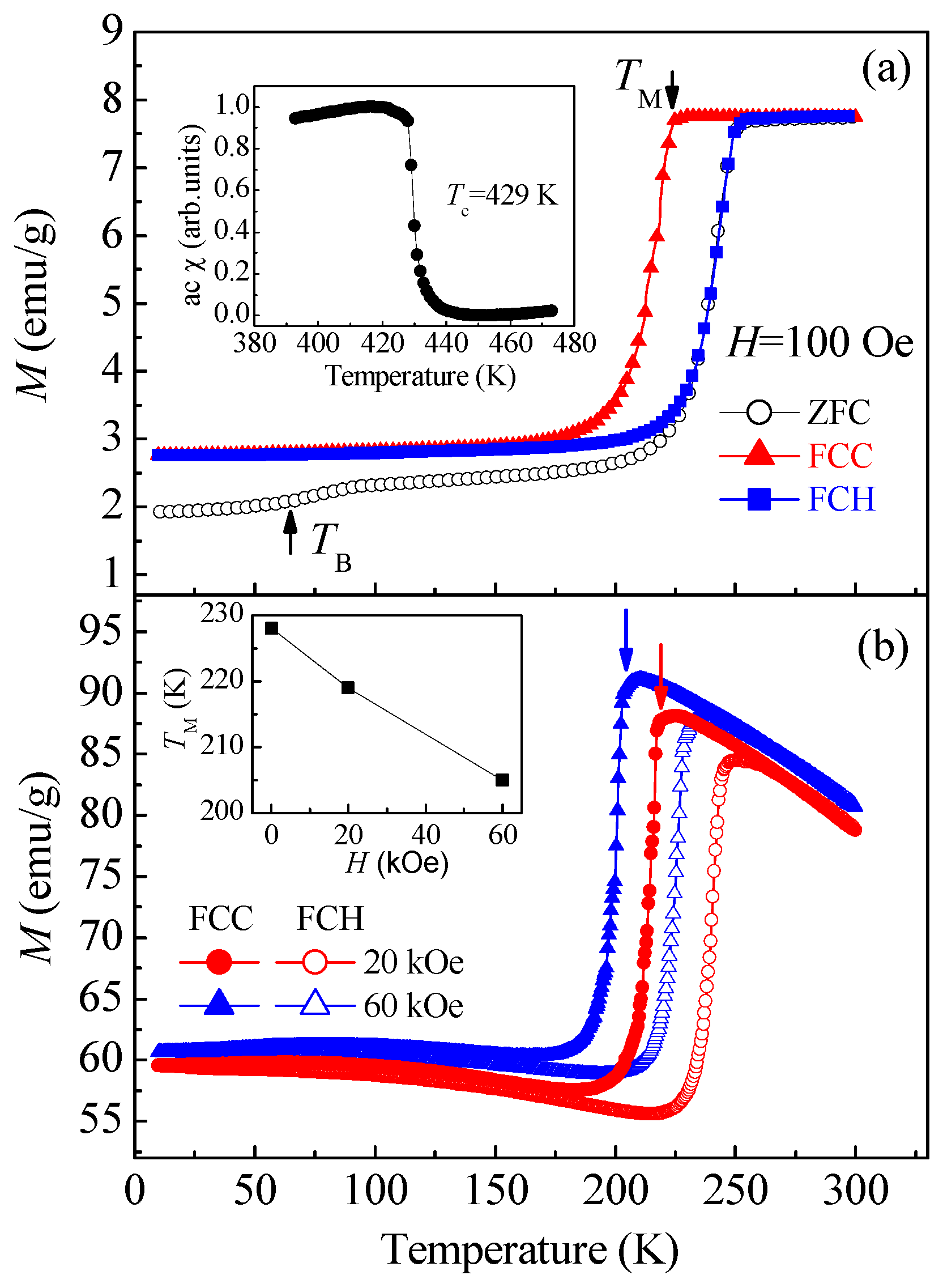
      <p><xref ref-type="fig" rid="metals-03-00069-f001">Figure 1</xref>a shows the temperature dependence of magnetization <italic>M</italic>(T) measured at <italic>H</italic> = 100 Oe under zero-field-cooled (ZFC), field-cooled cooling (FCC) and field-cooled heating (FCH) modes, respectively. At high temperatures, in the austenitic state, the sample is paramagnetic and orders ferromagnetically below <italic>T</italic><sub>c</sub> = 429 K (inset of <xref ref-type="fig" rid="metals-03-00069-f001">Figure 1</xref>a). However, as the temperature further decreases, a sudden drop in magnetization takes place at about 228 K as a result of the MT and entered a steady state with a lower magnetization. The thermal hysteresis observed between the FCC and FCH processes across the MT confirms the first order nature of this transition. The behavior of the magnetization of martensitic state depends strongly on the thermomagnetic history of the sample. The <italic>M</italic>(T) curves measured under 20 and 60 kOe fields are similar to that of 100 Oe, showing a large Δ<italic>M</italic> between austenite and martensite. MT temperatures decrease with increasing magnetic field, e.g., the <italic>T</italic><sub>M</sub> is decreased by about 23 K with the application of 60 kOe field (inset of <xref ref-type="fig" rid="metals-03-00069-f001">Figure 1</xref>b). This shows that the magnetic field can induce reverse MT from martensite to austenite in the Co and Mn co-doped Ni<sub>2</sub>MnGa alloy which is further confirmed by the resistivity measurement and shows a giant magnetoresistance effect [<xref ref-type="bibr" rid="B13-metals-03-00069">13</xref>].</p>
      <p>As we know, the Δ<italic>M</italic> of Ni<sub>2</sub>MnGa across the MT is very small due to the fact that both martensitic and austenitic states are FM. However, in the Mn-doped Ni<sub>2</sub>MnGa alloy, the extra Mn atoms which occupy the Ga sites reduce the distance between Mn atoms, leading to the magnetic moments partially align antiferromagnetically in both martensite and austenite [<xref ref-type="bibr" rid="B14-metals-03-00069">14</xref>]. On the other hand, the partial substitution of Ni by Co in Mn-doped Ni<sub>2</sub>MnGa can further change the magnetic ordering in the austenitic state from antiferromagnetic (AFM) to FM [<xref ref-type="bibr" rid="B15-metals-03-00069">15</xref>]. As a result, the Co and Mn co-doping produces a competition between AFM and FM, which is similar to the state in the Co and Fe co-doped Ni<sub>2</sub>MnGa alloys [<xref ref-type="bibr" rid="B12-metals-03-00069">12</xref>]. Extended X-ray Absorption Fine Structure (EXAFS) results show that the distance of Mn atoms decreases across MT from austenite to martensite [<xref ref-type="bibr" rid="B16-metals-03-00069">16</xref>]. The decrease of the Mn-Mn distance between 4(<italic>a</italic>) and 4(<italic>b</italic>) sites (4(<italic>a</italic>) and 4(<italic>b</italic>) sites are the Mn and Ga sites in the stoichiometric compound, respectively) may introduce AFM exchange, forming partial AFM in the FM matrix, <italic>i.e.</italic>, coexistence of FM and AFM in martensite in the present alloy. One way to clarify this point is to study the EB effect of the sample, which has been used successfully in NiMn-based alloys [<xref ref-type="bibr" rid="B17-metals-03-00069">17</xref>,<xref ref-type="bibr" rid="B18-metals-03-00069">18</xref>,<xref ref-type="bibr" rid="B19-metals-03-00069">19</xref>,<xref ref-type="bibr" rid="B20-metals-03-00069">20</xref>,<xref ref-type="bibr" rid="B21-metals-03-00069">21</xref>]. </p>
	  <fig id="metals-03-00069-f001" position="float">
        <label>Figure 1</label>
        <caption>
          <p>(<bold>a</bold>) zero-field-cooled (ZFC), field-cooled cooling (FCC), and field-cooled heating (FCH) <italic>M</italic>(T) of the sample measured under <italic>H</italic> = 100 Oe. The inset shows the temperature dependence of the ac susceptibility (χ(<italic>T</italic>)) at higher temperatures intended to obtain the <italic>T</italic><sub>c</sub>. (<bold>b</bold>) <italic>M</italic>(T) of the sample under high magnetic fields in FCC and FCH conditions respectively. The inset shows the field dependence of MT starting temperature (<italic>T</italic><sub>M</sub>(<italic>H</italic>)). The <italic>T</italic><sub>M</sub> temperatures under different fields are indicated by arrows. </p>
        </caption>
        <graphic xmlns:xlink="http://www.w3.org/1999/xlink" xlink:href="metals-03-00069-g001.tif"/>
      </fig>
      
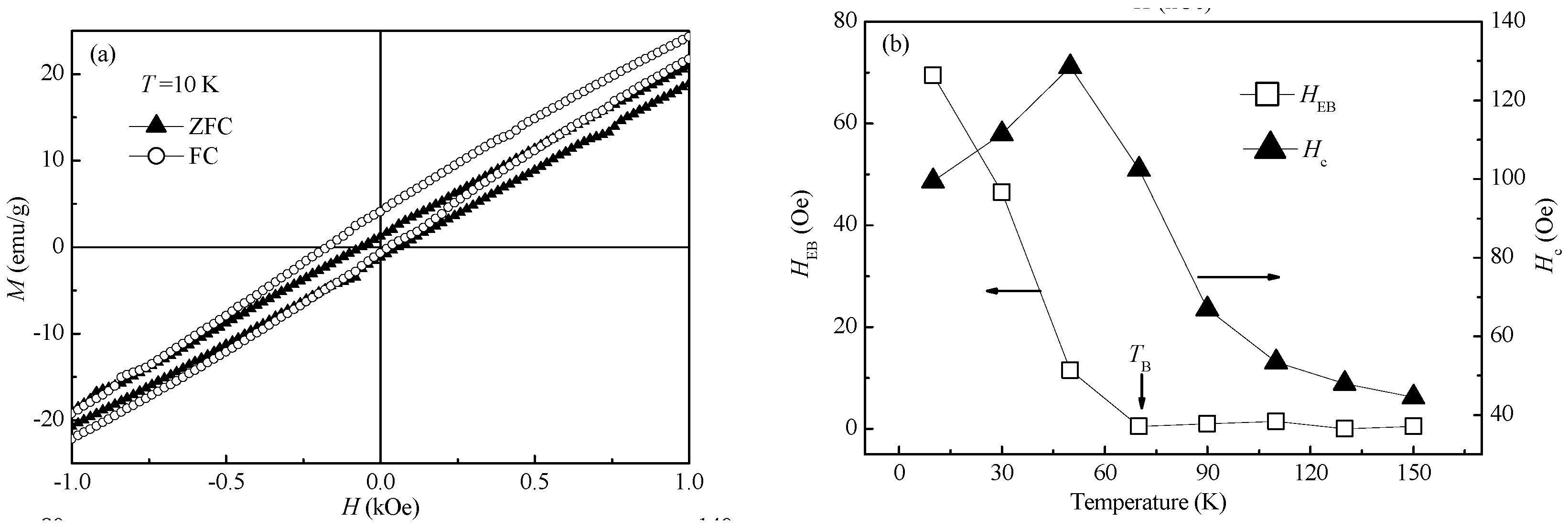
      <p>It is well known that when a sample with FM/AFM interfaces is cooled under magnetic field, the hysteresis loop is shifted along the field axis (called EB) below blocking temperature (<italic>T</italic><sub>B</sub>) [<xref ref-type="bibr" rid="B19-metals-03-00069">19</xref>,<xref ref-type="bibr" rid="B22-metals-03-00069">22</xref>]. In order to confirm the coexistence of AFM and FM, we measured the hysteresis loops of magnetizations from −20 kOe to 20 kOe at 10 K after ZFC and FCC (<italic>H</italic> = 10 kOe) from 300 K, respectively. For clear visualization of the loops shift, only the loops form −1 to 1 kOe are shown in <xref ref-type="fig" rid="metals-03-00069-f002">Figure 2</xref>a. The ZFC loop is symmetrical around zero point, whereas the shift of the FCC loops towards negative field provides evidence on the existence of EB. Moreover, the coercivity (<italic>H</italic><sub>c</sub>) of FCC loop (99.5 Oe) is higher than that of ZFC loop (61.5 Oe), which is ascribed to the development of the exchange anisotropy after FCC [<xref ref-type="bibr" rid="B22-metals-03-00069">22</xref>]. <xref ref-type="fig" rid="metals-03-00069-f002">Figure 2</xref>b shows the EB field (<italic>H</italic><sub>EB</sub>) and <italic>H</italic><sub>c</sub> as a function of temperature. The <italic>H</italic><sub>EB</sub> and <italic>H</italic><sub>c</sub> are defined as <italic>H</italic><sub>EB</sub> = −(<italic>H</italic><sub>1</sub> + <italic>H</italic><sub>2</sub>)/2 and <italic>H</italic><sub>c</sub> = −(<italic>H</italic><sub>1</sub> − <italic>H</italic><sub>2</sub>)/2, respectively. Here, <italic>H</italic><sub>1</sub> and <italic>H</italic><sub>2</sub> are the left and right coercive fields, respectively. The <italic>H</italic><sub>EB</sub> approximately linearly decreases with increasing temperature in the low temperature regions and gradually disappears around <italic>T</italic><sub>B</sub>. The <italic>T</italic><sub>B</sub> can also be identified from ZFC <italic>M</italic>(T) curve (<xref ref-type="fig" rid="metals-03-00069-f001">Figure 1</xref>a). The magnetization increases at <italic>T</italic><sub>B</sub> indicating the AFM can no longer pin the FM domain. With the anisotropy of AFM deceasing with increasing temperature, the FM rotation can drag more AFM spins, giving rise to the increase in <italic>H</italic><sub>c</sub>; whereas the AFM no longer hinders the FM rotation above <italic>T</italic><sub>B</sub>. As a result, the <italic>H</italic><sub>c</sub> reaches its maximum value and <italic>H</italic><sub>EB</sub> reduces to zero at higher temperatures. This further confirms that some AFM exchange occurs inside the FM matrix in the martensite. </p>
      <fig id="metals-03-00069-f002" position="float">
        <label>Figure 2</label>
        <caption>
          <p>(<bold>a</bold>) Hysteresis loops of magnetization at 10 K after ZFC and FCC (<italic>H</italic> = 10 kOe) from 300 K. (<bold>b</bold>) EB field (<italic>H</italic><sub>EB</sub>) and coercivity (<italic>H</italic><sub>c</sub>) as a function of temperature.</p>
        </caption>
        <graphic xmlns:xlink="http://www.w3.org/1999/xlink" xlink:href="metals-03-00069-g002.tif"/>
      </fig>
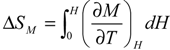
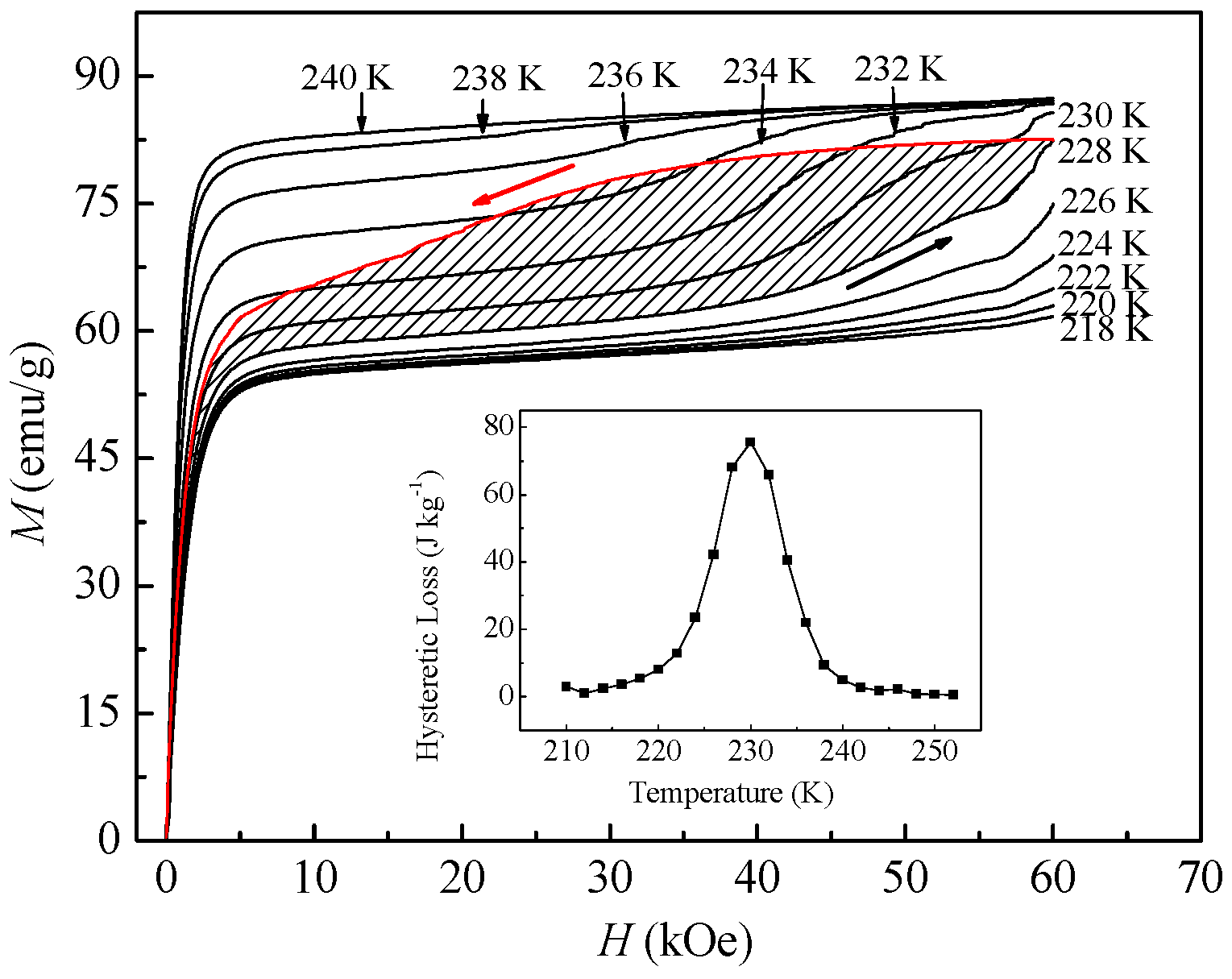
      <p>The IMCE can be expected within the MT temperature range in Co and Mn co-doped Ni<sub>2</sub>MnGa alloy due to the reduction of magnetization during the MT resulting from the formation of partially AFM phase. In order to determine the magnetic entropy change (Δ<italic>S</italic><sub>M</sub>) across the MT, we measured the isothermal magnetization <italic>M</italic>(H) curves of Ni<sub>1.68</sub>Co<sub>0.32</sub>Mn<sub>1.20</sub>Ga<sub>0.80</sub>. Magnetic field up to 60 kOe was applied isothermally between 210 and 252 K. In <xref ref-type="fig" rid="metals-03-00069-f003">Figure 3</xref>, only a portion of the curves within the transformation temperature range is shown for clarity. The typical metamagnetic behavior due to the field-induced reverse MT is observed between 222 and 238 K. Above 240 K, the magnetization curves exhibit characteristics of a ferromagnet. Similarly, the metamagnetic behavior disappears below 220 K, giving rise to a FM behavior with lower saturation magnetization than that of high-temperature phase. The Δ<italic>S</italic><sub>M</sub> can be calculated from magnetization isotherms using the Maxwell relation:
      <disp-formula id="metals-03-00069-i001"><inline-graphic xmlns:xlink="http://www.w3.org/1999/xlink" xlink:href="metals-03-00069-i001.tif"/><label>(1)</label></disp-formula></p>
      <p>For magnetization measurements made at discrete temperatures and field intervals, the Δ<italic>S</italic><sub>M</sub> can be approximated by:
      <disp-formula id="metals-03-00069-i002"><inline-graphic xmlns:xlink="http://www.w3.org/1999/xlink" xlink:href="metals-03-00069-i002.tif"/><label>(2)</label></disp-formula></p>
      <p>For a truly discontinuous first order phase transition, since the [∂<italic>M</italic>/∂<italic>T</italic>]<italic><sub>H</sub></italic> does not exist theoretically, Equations 1 and 2 cannot be used to calculate the Δ<italic>S</italic><sub>M</sub>. But in reality, the first order phase transition is not ideal and the change of magnetization occurs over a few Kelvin temperature range, as a result, the [∂<italic>M</italic>/∂<italic>T</italic>]<italic><sub>H</sub></italic> can be measured experimentally [<xref ref-type="bibr" rid="B23-metals-03-00069">23</xref>]. </p>
	  <fig id="metals-03-00069-f003" position="float">
        <label>Figure 3</label>
        <caption>
          <p>Isothermal <italic>M</italic>(H) of Ni<sub>1.68</sub>Co<sub>0.32</sub>Mn<sub>1.20</sub>Ga<sub>0.80</sub> around the MT temperature range. The arrows indicate the direction of change of the applied field, and the shaded area represents the hysteretic loss for <italic>T</italic> = 228 K isotherm. The inset shows the hysteretic loss as a function of temperature.</p>
        </caption>
        <graphic xmlns:xlink="http://www.w3.org/1999/xlink" xlink:href="metals-03-00069-g003.tif"/>
      </fig>
      
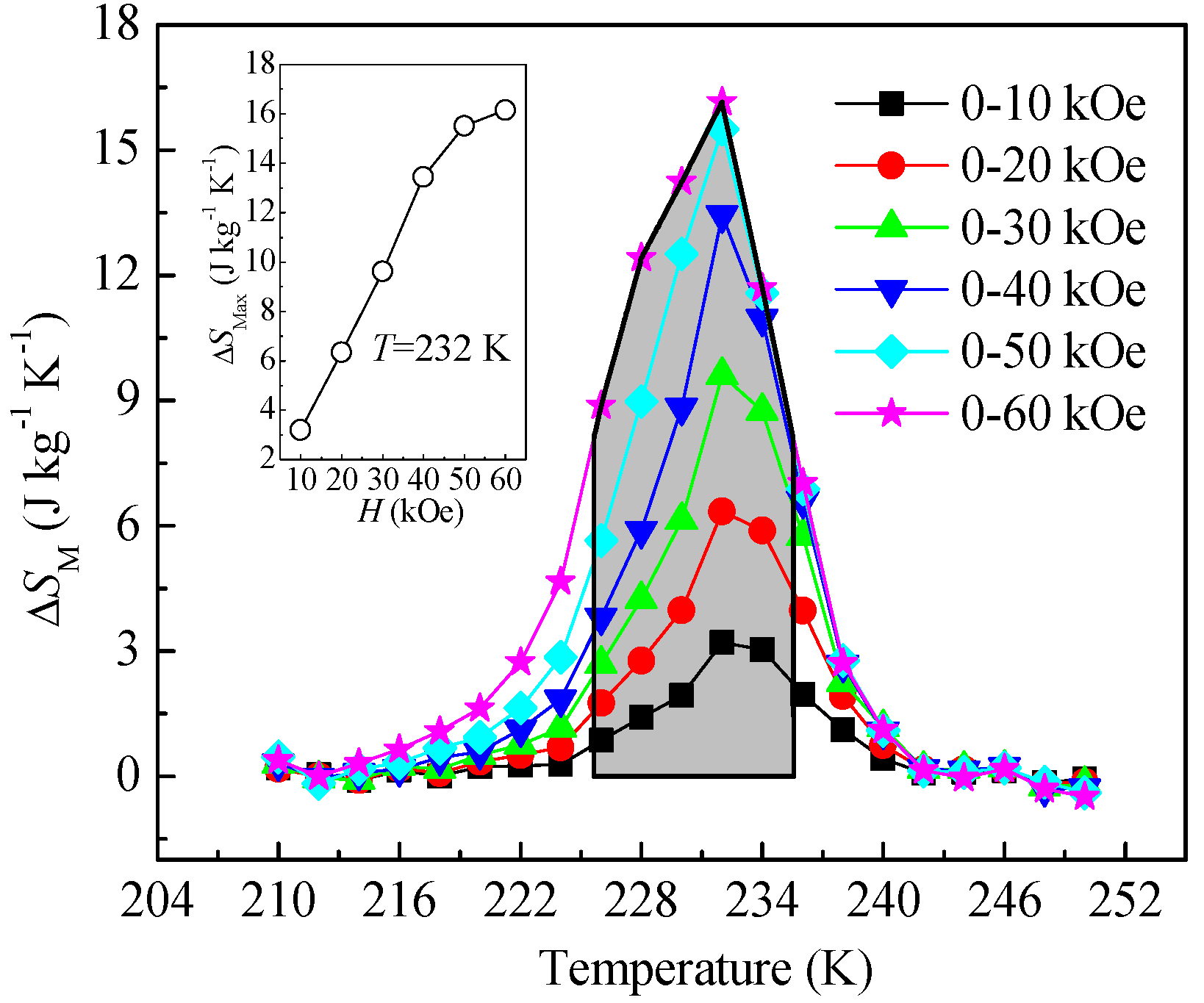
      <p>The temperature dependencies of the Δ<italic>S</italic><sub>M</sub> under different magnetic fields are shown in <xref ref-type="fig" rid="metals-03-00069-f004">Figure 4</xref>. The most striking features of the Δ<italic>S</italic><sub>M</sub> are the large and positive entropy change within the MT temperature range. The positive sign of Δ<italic>S</italic><sub>M</sub> exists even under high magnetic field, showing the mechanism involved is different from that of Co-free Ni-Mn-Ga alloys which is related to the coupling between the martensitic and magnetic domains [<xref ref-type="bibr" rid="B4-metals-03-00069">4</xref>]. The modification of magnetic order through magnetic-field-induced reverse MT from partially AFM martensite to FM austenite is responsible for the IMCE in the present alloy. The Δ<italic>S</italic><sub>M</sub><sup>max</sup> increases with Δ<italic>H</italic> and shows saturation for lager Δ<italic>H</italic> (inset of <xref ref-type="fig" rid="metals-03-00069-f004">Figure 4</xref>). The saturation of the Δ<italic>S</italic><sub>M</sub><sup>max</sup> as a function of the field and the broadening of Δ<italic>S</italic><sub>M</sub> (<italic>T</italic>) with increasing field are characteristic features of first order magnetic transition [<xref ref-type="bibr" rid="B7-metals-03-00069">7</xref>]. The Δ<italic>S</italic><sub>M</sub> is 16.2 J Kg<sup>−1</sup> K<sup>−1</sup> for Δ<italic>H</italic> = 60 kOe field. Compared with other IMCE materials, the Δ<italic>S</italic><sub>M</sub> for Δ<italic>H</italic> = 60 kOe in the present alloy is comparable to the value observed in Ni-Mn-Sn alloys [<xref ref-type="bibr" rid="B10-metals-03-00069">10</xref>], and is two times larger than the value observed in Mn<sub>1.95</sub>Cr<sub>0.05</sub>Sb [<xref ref-type="bibr" rid="B8-metals-03-00069">8</xref>]. One important parameter to evaluate the magnetocaloric properties of a given material is the refrigeration capacity (RC), giving the amount of heat that can be transferred in one thermodynamic cycle. The RC is usually calculated by integrating the Δ<italic>S</italic><sub>M</sub> (T) curve over the full width at half maximum (the shaded area in <xref ref-type="fig" rid="metals-03-00069-f004">Figure 4</xref>), which yields a value of about 125 J kg<sup>−1</sup> for Δ<italic>H</italic> = 60 kOe. For a first order magnetic phase transition, the hysteretic loss is another key parameter for evaluating the MCE around transition, which is equal to the area between the increasing and decreasing magnetic field segments of the magnetization curves (the shaded area in <xref ref-type="fig" rid="metals-03-00069-f003">Figure 3</xref>). The hysteretic loss as a function of the temperature is shown in the inset of <xref ref-type="fig" rid="metals-03-00069-f002">Figure 2</xref>, giving a maximum at almost the same temperature as the maximum of the Δ<italic>S</italic><sub>M</sub> (T) curve.The average hysteretic loss over the same temperature range as that of RC is about 57 J kg<sup>−1</sup>. Thus, the net RC is 68 J kg<sup>−1</sup> obtained by subtracting the average hysteretic loss from the RC. This value is comparable to the maximum value obtained by Cu doping in Ni<sub>2</sub>MnGa alloys, but with opposite sign in Δ<italic>S</italic><sub>M</sub> [<xref ref-type="bibr" rid="B6-metals-03-00069">6</xref>]. Note that the high value of the Δ<italic>S</italic><sub>M</sub> alone is not enough to evaluate the MCE of a material. Another important parameter for MCE is adiabatic temperature change (Δ<italic>T</italic><sub>ad</sub>), which can be measured directly in adiabatic system with application of a magnetic field [<xref ref-type="bibr" rid="B7-metals-03-00069">7</xref>,<xref ref-type="bibr" rid="B11-metals-03-00069">11</xref>,<xref ref-type="bibr" rid="B24-metals-03-00069">24</xref>] or be estimated from the magnetization and specific heat measurements [<xref ref-type="bibr" rid="B25-metals-03-00069">25</xref>]. Thus, some further studies, such as the measurement of Δ<italic>T</italic><sub>ad</sub>, are needed to further evaluate the IMCE in the present alloy.</p>
      <fig id="metals-03-00069-f004" position="float">
        <label>Figure 4</label>
        <caption>
          <p>Temperature dependence of the Δ<italic>S</italic><sub>M</sub> under different magnetic field variations (Δ<italic>H</italic>). The shaded area indicates the RC at Δ<italic>H</italic> = 60 kOe. The inset shows the field dependence of maximum Δ<italic>S</italic><sub>M</sub> within the MT temperature range at <italic>T</italic> = 232 K.</p>
        </caption>
        <graphic xmlns:xlink="http://www.w3.org/1999/xlink" xlink:href="metals-03-00069-g004.tif"/>
      </fig>
    </sec>
    <sec>
      <title>3. Experimental Section</title>
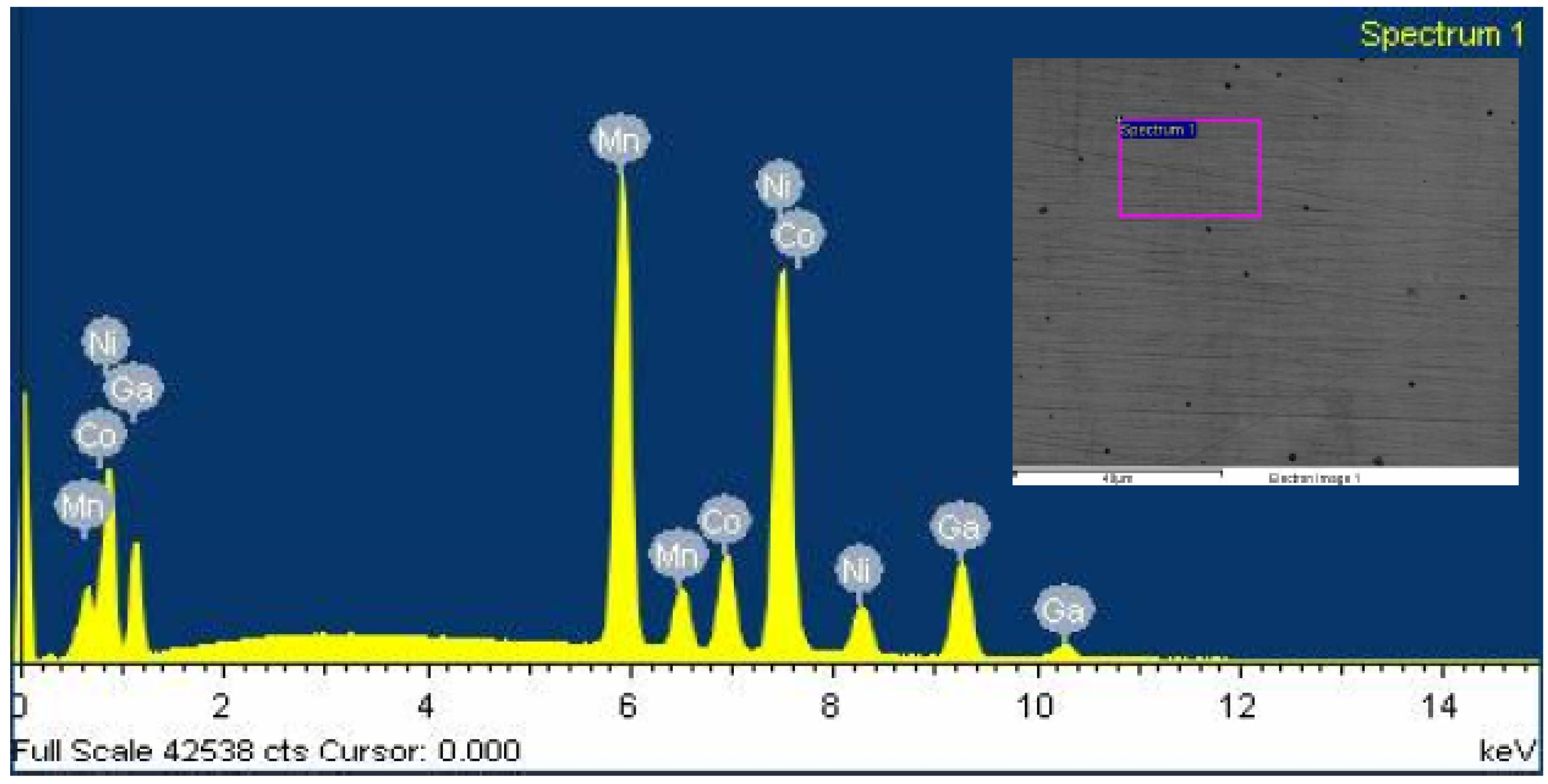
      <p>A polycrystalline Ni<sub>1.68</sub>Co<sub>0.32</sub>Mn<sub>1.20</sub>Ga<sub>0.80</sub> alloy was prepared with an arc-melting technique under argon atmosphere using Ni, Co, Mn, and Ga of 99.9% purity. The sample was remelted several times and subsequently annealed at 1000 °C for 24 h before being slowly cooled to room temperature to ensure homogeneity. The composition was determined by energy dispersive X-ray analysis (EDX) (<xref ref-type="fig" rid="metals-03-00069-f005">Figure 5</xref>). The ac susceptibility measurement was performed to determine the <italic>T</italic><sub>c</sub>. The magnetization measurements were performed on a physical properties measurement system (Quantum Design) platform with a vibrating sample magnetometer module.</p>
      <fig id="metals-03-00069-f005" position="float">
        <label>Figure 5</label>
        <caption>
          <p>EDX spectrum of Ni<sub>1.68</sub>Co<sub>0.32</sub>Mn<sub>1.20</sub>Ga<sub>0.80</sub>. The inset shows the scanning electron microscopic image. The little rectangle marks the position at which the EDX spectrum was taken.</p>
        </caption>
        <graphic xmlns:xlink="http://www.w3.org/1999/xlink" xlink:href="metals-03-00069-g005.tif"/>
      </fig>
    </sec>
    <sec sec-type="conclusions">
      <title>4. Conclusions</title>
      <p>In conclusion, a large positive Δ<italic>S</italic><sub>M</sub> has been found in Mn and Co co-doped Ni<sub>2</sub>MnGa alloy within the MT temperature range. The partial substitution of Ni by Co in Mn-doped Ni<sub>2</sub>MnGa, a typical partially AFM material, modifies the exchange interaction among Mn atoms and results in a change from AFM to FM in the austenite. The modification of magnetic order from partially AFM martensite to FM austenite through magnetic-field-induced reverse MT is responsible for the IMCE in the present alloy. The observation of EB effect confirms that some AFM exchange exists inside the FM matrix of martensite. The IMCE with a high net RC indicates that the present alloy may be a promising candidate for magnetic refrigeration. </p>
    </sec>
    
  </body>
  <back><notes>
      <title>Conflict of Interest</title>
      <p>The authors declare no conflict of interest.</p>
    </notes>
    <ref-list>
      <title>References</title>
      <ref id="B1-metals-03-00069">
        <label>1.</label>
        <citation citation-type="journal">
          <person-group person-group-type="author">
            <name>
              <surname>Vasil’ev</surname>
              <given-names>A.N.</given-names>
            </name>
            <name>
              <surname>Bozhko</surname>
              <given-names>A.D.</given-names>
            </name>
            <name>
              <surname>Khovailo</surname>
              <given-names>V.V.</given-names>
            </name>
            <name>
              <surname>Dikshtein</surname>
              <given-names>I.E.</given-names>
            </name>
            <name>
              <surname>Shavrov</surname>
              <given-names>V.G.</given-names>
            </name>
            <name>
              <surname>Buchelnikov</surname>
              <given-names>V.D.</given-names>
            </name>
            <name>
              <surname>Matsumoto</surname>
              <given-names>M.</given-names>
            </name>
            <name>
              <surname>Suzuki</surname>
              <given-names>S.</given-names>
            </name>
            <name>
              <surname>Takagi</surname>
              <given-names>T.</given-names>
            </name>
            <name>
              <surname>Tani</surname>
              <given-names>J.</given-names>
            </name>
          </person-group>
          <article-title>Structural and magnetic phase transitions in shape-memory alloys Ni<sub>2 + x</sub>Mn<sub>1 − x</sub>Ga</article-title>
          <source>Phys. Rev. B</source>
          <year>1999</year>
          <volume>59</volume>
          <fpage>1113</fpage>
          <lpage>1120</lpage>
        <pub-id pub-id-type="doi">10.1103/PhysRevB.59.1113</pub-id></citation>
      </ref>
      <ref id="B2-metals-03-00069">
        <label>2.</label>
        <citation citation-type="journal">
          <person-group person-group-type="author">
            <name>
              <surname>Hu</surname>
              <given-names>F.X.</given-names>
            </name>
            <name>
              <surname>Shen</surname>
              <given-names>B.G.</given-names>
            </name>
            <name>
              <surname>Sun</surname>
              <given-names>J.R.</given-names>
            </name>
          </person-group>
          <article-title>Magnetic entropy change in Ni<sub>51.5</sub>Mn<sub>22.7</sub>Ga<sub>25.8</sub> alloy</article-title>
          <source>Appl. Phys. Lett.</source>
          <year>2000</year>
          <volume>76</volume>
          <fpage>3460</fpage>
          <lpage>3463</lpage>
          <pub-id pub-id-type="doi">10.1063/1.126677</pub-id>
        </citation>
      </ref>
      <ref id="B3-metals-03-00069">
        <label>3.</label>
        <citation citation-type="journal">
          <person-group person-group-type="author">
            <name>
              <surname>Pareti</surname>
              <given-names>L.</given-names>
            </name>
            <name>
              <surname>Solzi</surname>
              <given-names>M.</given-names>
            </name>
            <name>
              <surname>Albertini</surname>
              <given-names>F.</given-names>
            </name>
            <name>
              <surname>Paoluzi</surname>
              <given-names>A.</given-names>
            </name>
          </person-group>
          <article-title>Giant entropy change at the co-occurrence of structural and magnetic transitions in the Ni<sub>2.19</sub>Mn<sub>0.81</sub>Ga Heusler alloy</article-title>
          <source>Eur. Phys. J. B</source>
          <year>2003</year>
          <volume>32</volume>
          <fpage>303</fpage>
          <lpage>307</lpage>
          <pub-id pub-id-type="doi">10.1140/epjb/e2003-00102-y</pub-id>
        </citation>
      </ref>
      <ref id="B4-metals-03-00069">
        <label>4.</label>
        <citation citation-type="journal">
          <person-group person-group-type="author">
            <name>
              <surname>Marcos</surname>
              <given-names>J.</given-names>
            </name>
            <name>
              <surname>Mañosa</surname>
              <given-names>L.</given-names>
            </name>
            <name>
              <surname>Planes</surname>
              <given-names>A.</given-names>
            </name>
            <name>
              <surname>Casanova</surname>
              <given-names>F.</given-names>
            </name>
            <name>
              <surname>Batlle</surname>
              <given-names>X.</given-names>
            </name>
            <name>
              <surname>Labarta</surname>
              <given-names>A.</given-names>
            </name>
          </person-group>
          <article-title>Multiscale origin of the magnetocaloric effect in Ni-Mn-Ga shape-memory alloys</article-title>
          <source>Phys. Rev. B</source>
          <year>2003</year>
          <volume>68</volume>
          <fpage>094401:1</fpage>
          <lpage>094404:6</lpage>
        </citation>
      </ref>
      <ref id="B5-metals-03-00069">
        <label>5.</label>
        <citation citation-type="journal">
          <person-group person-group-type="author">
            <name>
              <surname>Pasquale</surname>
              <given-names>M.</given-names>
            </name>
            <name>
              <surname>Sasso</surname>
              <given-names>C.P.</given-names>
            </name>
            <name>
              <surname>Lewis</surname>
              <given-names>L.H.</given-names>
            </name>
            <name>
              <surname>Giudici</surname>
              <given-names>L.</given-names>
            </name>
            <name>
              <surname>Lograsso</surname>
              <given-names>T.</given-names>
            </name>
            <name>
              <surname>Schlagel</surname>
              <given-names>D. </given-names>
            </name>
          </person-group>
          <article-title>Magnetostructural transition and magnetocaloric effect in Ni<sub>55</sub>Mn<sub>20</sub>Ga<sub>25</sub> single crystals</article-title>
          <source>Phys. Rev. B</source>
          <year>2005</year>
          <volume>72</volume>
          <pub-id pub-id-type="doi">10.1103/PhysRevB.72.094435</pub-id>
        </citation>
      </ref>
      <ref id="B6-metals-03-00069">
        <label>6.</label>
        <citation citation-type="journal">
          <person-group person-group-type="author">
            <name>
              <surname>Stadler</surname>
              <given-names>S.</given-names>
            </name>
            <name>
              <surname>Khan</surname>
              <given-names>M.</given-names>
            </name>
            <name>
              <surname>Mitchell</surname>
              <given-names>J.</given-names>
            </name>
            <name>
              <surname>Ali</surname>
              <given-names>N.</given-names>
            </name>
            <name>
              <surname>Gomes</surname>
              <given-names>A.M.</given-names>
            </name>
            <name>
              <surname>Dubenko</surname>
              <given-names>I.</given-names>
            </name>
            <name>
              <surname>Takeuchi</surname>
              <given-names>A.Y.</given-names>
            </name>
            <name>
              <surname>Guimaraes</surname>
              <given-names>A.P.</given-names>
            </name>
          </person-group>
          <article-title>Magnetocaloric properties of Ni<sub>2</sub>Mn<sub>1 − x</sub>Cu<sub>x</sub>Ga</article-title>
          <source>Appl. Phys. Lett.</source>
          <year>2006</year>
          <volume>88</volume>
          <fpage>192511:1</fpage>
          <lpage>192511:3</lpage>
        </citation>
      </ref>
      <ref id="B7-metals-03-00069">
        <label>7.</label>
        <citation citation-type="journal">
          <person-group person-group-type="author">
            <name>
              <surname>Giguère</surname>
              <given-names>A.</given-names>
            </name>
            <name>
              <surname>Foldeaki</surname>
              <given-names>M.</given-names>
            </name>
            <name>
              <surname>Ravi Gopal</surname>
              <given-names>B.</given-names>
            </name>
            <name>
              <surname>Chahine</surname>
              <given-names>R.</given-names>
            </name>
            <name>
              <surname>Bose</surname>
              <given-names>T.K.</given-names>
            </name>
            <name>
              <surname>Frydman</surname>
              <given-names>A.</given-names>
            </name>
            <name>
              <surname>Barclay</surname>
              <given-names>J.A.</given-names>
            </name>
          </person-group>
          <article-title>Direct measurement of the “giant” adiabatic temperature change in Gd<sub>5</sub>Si<sub>2</sub>Ge<sub>2</sub></article-title>
          <source>Phys. Rev. Lett.</source>
          <year>1999</year>
          <volume>83</volume>
          <fpage>2262</fpage>
          <lpage>2265</lpage>
          <pub-id pub-id-type="doi">10.1103/PhysRevLett.83.2262</pub-id>
        </citation>
      </ref>
      <ref id="B8-metals-03-00069">
        <label>8.</label>
        <citation citation-type="journal">
          <person-group person-group-type="author">
            <name>
              <surname>Tegus</surname>
              <given-names>O.</given-names>
            </name>
            <name>
              <surname>Bruck</surname>
              <given-names>E.</given-names>
            </name>
            <name>
              <surname>Zhang</surname>
              <given-names>L.</given-names>
            </name>
            <name>
              <surname>Dagula</surname>
            </name>
            <name>
              <surname>Buschow</surname>
              <given-names>K.H.J.</given-names>
            </name>
            <name>
              <surname>de Boer</surname>
              <given-names>F.R.</given-names>
            </name>
          </person-group>
          <article-title>Magnetic-phase transitions and magnetocaloric effects</article-title>
          <source>Physica B</source>
          <year>2002</year>
          <volume>319</volume>
          <fpage>174</fpage>
          <lpage>192</lpage>
          <pub-id pub-id-type="doi">10.1016/S0921-4526(02)01119-5</pub-id>
        </citation>
      </ref>
      <ref id="B9-metals-03-00069">
        <label>9.</label>
        <citation citation-type="journal">
          <person-group person-group-type="author">
            <name>
              <surname>Han</surname>
              <given-names>Z.D.</given-names>
            </name>
            <name>
              <surname>Wang</surname>
              <given-names>D.H.</given-names>
            </name>
            <name>
              <surname>Zhang</surname>
              <given-names>C.L.</given-names>
            </name>
            <name>
              <surname>Tang</surname>
              <given-names>S.L.</given-names>
            </name>
            <name>
              <surname>Gu</surname>
              <given-names>B.X.</given-names>
            </name>
            <name>
              <surname>Du</surname>
              <given-names>Y.W.</given-names>
            </name>
          </person-group>
          <article-title>Large magnetic entropy changes in the Ni<sub>45.4</sub>Mn<sub>41.5</sub>In<sub>13.1</sub> ferromagnetic shape memory alloy</article-title>
          <source>Appl. Phys. Lett.</source>
          <year>2006</year>
          <volume>89</volume>
          <fpage>182507:1</fpage>
          <lpage>182507:3</lpage>
        </citation>
      </ref>
      <ref id="B10-metals-03-00069">
        <label>10.</label>
        <citation citation-type="journal">
          <person-group person-group-type="author">
            <name>
              <surname>Krenke</surname>
              <given-names>T.</given-names>
            </name>
            <name>
              <surname>Duman</surname>
              <given-names>E.</given-names>
            </name>
            <name>
              <surname>Acet</surname>
              <given-names>M.</given-names>
            </name>
            <name>
              <surname>Wassermann</surname>
              <given-names>E.F.</given-names>
            </name>
            <name>
              <surname>Moya</surname>
              <given-names>X.</given-names>
            </name>
            <name>
              <surname>Mañosa</surname>
              <given-names>L.</given-names>
            </name>
            <name>
              <surname>Planes</surname>
              <given-names>A.</given-names>
            </name>
          </person-group>
          <article-title>Inverse magnetocaloric effect in ferromagnetic Ni-Mn-Sn alloys</article-title>
          <source>Nat. Mater.</source>
          <year>2005</year>
          <volume>4</volume>
          <fpage>450</fpage>
          <lpage>454</lpage>
          <pub-id pub-id-type="doi">10.1038/nmat1395</pub-id>
        </citation>
      </ref>
      <ref id="B11-metals-03-00069">
        <label>11.</label>
        <citation citation-type="journal">
          <person-group person-group-type="author">
            <name>
              <surname>Moya</surname>
              <given-names>X.</given-names>
            </name>
            <name>
              <surname>Mañosa</surname>
              <given-names>L.</given-names>
            </name>
            <name>
              <surname>Planes</surname>
              <given-names>A.</given-names>
            </name>
            <name>
              <surname>Aksoy</surname>
              <given-names>S.</given-names>
            </name>
            <name>
              <surname>Acet</surname>
              <given-names>M.</given-names>
            </name>
            <name>
              <surname>Wassermann</surname>
              <given-names>E.F.</given-names>
            </name>
            <name>
              <surname>Krenke</surname>
              <given-names>T. </given-names>
            </name>
          </person-group>
          <article-title>Cooling and heating by adiabatic magnetization in the Ni<sub>50</sub>Mn<sub>34</sub>In<sub>16</sub> magnetic shape-memory alloy</article-title>
          <source>Phys. Rev. B</source>
          <year>2007</year>
          <volume>75</volume>
          <fpage>184412:1</fpage>
          <lpage>184412:5</lpage>
        </citation>
      </ref>
      <ref id="B12-metals-03-00069">
        <label>12.</label>
        <citation citation-type="journal">
          <person-group person-group-type="author">
            <name>
              <surname>Pathak</surname>
              <given-names>A.K.</given-names>
            </name>
            <name>
              <surname>Dubenko</surname>
              <given-names>I.</given-names>
            </name>
            <name>
              <surname>Karaca</surname>
              <given-names>H.E.</given-names>
            </name>
            <name>
              <surname>Stadler</surname>
              <given-names>S.</given-names>
            </name>
            <name>
              <surname>Ali</surname>
              <given-names>N.</given-names>
            </name>
          </person-group>
          <article-title>Large inverse magnetic entropy changes and magnetoresistance in the vicinity of a field-induced martensitic transformation in Ni<sub>50 − x</sub>Co<sub>x</sub>Mn<sub>32 − y</sub>Fe<sub>y</sub>Ga<sub>18</sub></article-title>
          <source>Appl. Phys. Lett.</source>
          <year>2010</year>
          <volume>97</volume>
          <fpage>062505:1</fpage>
          <lpage>062505:3</lpage>
        </citation>
      </ref>
      <ref id="B13-metals-03-00069">
        <label>13.</label>
        <citation citation-type="journal">
          <person-group person-group-type="author">
            <name>
              <surname>Wang</surname>
              <given-names>B.M.</given-names>
            </name>
            <name>
              <surname>Ren</surname>
              <given-names>P.</given-names>
            </name>
            <name>
              <surname>Liu</surname>
              <given-names>Y.</given-names>
            </name>
            <name>
              <surname>Wang</surname>
              <given-names>L.</given-names>
            </name>
          </person-group>
          <article-title>Enhanced magnetoresistance through magnetic-field-induced phase transition in Ni2MnGa co-doped with Co and Mn</article-title>
          <source>J. Magn. Magn. Mater.</source>
          <year>2010</year>
          <volume>322</volume>
          <fpage>715</fpage>
          <lpage>717</lpage>
          <pub-id pub-id-type="doi">10.1016/j.jmmm.2009.10.047</pub-id>
        </citation>
      </ref>
      <ref id="B14-metals-03-00069">
        <label>14.</label>
        <citation citation-type="journal">
          <person-group person-group-type="author">
            <name>
              <surname>Enkovaara</surname>
              <given-names>J.</given-names>
            </name>
            <name>
              <surname>Heczko</surname>
              <given-names>O.</given-names>
            </name>
            <name>
              <surname>Ayuela</surname>
              <given-names>A.</given-names>
            </name>
            <name>
              <surname>Nieminen</surname>
              <given-names>R.M.</given-names>
            </name>
          </person-group>
          <article-title>Coexistence of ferromagnetic and antiferromagnetic order in Mn-doped Ni<sub>2</sub>MnGa</article-title>
          <source>Phys. Rev. B</source>
          <year>2003</year>
          <volume>67</volume>
          <fpage>212405:1</fpage>
          <lpage>212405:4</lpage>
        </citation>
      </ref>
      <ref id="B15-metals-03-00069">
        <label>15.</label>
        <citation citation-type="journal">
          <person-group person-group-type="author">
            <name>
              <surname>Yu</surname>
              <given-names>S.Y.</given-names>
            </name>
            <name>
              <surname>Cao</surname>
              <given-names>Z.X.</given-names>
            </name>
            <name>
              <surname>Ma</surname>
              <given-names>L.</given-names>
            </name>
            <name>
              <surname>Liu</surname>
              <given-names>G.D.</given-names>
            </name>
            <name>
              <surname>Chen</surname>
              <given-names>J.L.</given-names>
            </name>
            <name>
              <surname>Wu</surname>
              <given-names>G.H.</given-names>
            </name>
            <name>
              <surname>Zhang</surname>
              <given-names>B.</given-names>
            </name>
            <name>
              <surname>Zhang</surname>
              <given-names>X.X. </given-names>
            </name>
          </person-group>
          <article-title>Realization of magnetic field-induced reversible martensitic transformation in NiCoMnGa alloys</article-title>
          <source>Appl. Phys. Lett.</source>
          <year>2007</year>
          <volume>91</volume>
          <fpage>102507:1</fpage>
          <lpage>102507:3</lpage>
        </citation>
      </ref>
      <ref id="B16-metals-03-00069">
        <label>16.</label>
        <citation citation-type="journal">
          <person-group person-group-type="author">
            <name>
              <surname>Bhobe</surname>
              <given-names>P.A.</given-names>
            </name>
            <name>
              <surname>Priolkar</surname>
              <given-names>K.R.</given-names>
            </name>
            <name>
              <surname>Sarode</surname>
              <given-names>P.R.</given-names>
            </name>
          </person-group>
          <article-title>Factors influencing the martensitic transformation in Ni<sub>50</sub>Mn<sub>35</sub>Sn<sub>15</sub>: An EXAFS study</article-title>
          <source>J. Phys. Condens. Mater.</source>
          <year>2008</year>
          <volume>20</volume>
          <pub-id pub-id-type="doi">10.1088/0953-8984/20/01/015219</pub-id>
        </citation>
      </ref>
      <ref id="B17-metals-03-00069">
        <label>17.</label>
        <citation citation-type="journal">
          <person-group person-group-type="author">
            <name>
              <surname>Khan</surname>
              <given-names>M.</given-names>
            </name>
            <name>
              <surname>Dubenko</surname>
              <given-names>I.</given-names>
            </name>
            <name>
              <surname>Stadler</surname>
              <given-names>S.</given-names>
            </name>
            <name>
              <surname>Ali</surname>
              <given-names>N.</given-names>
            </name>
          </person-group>
          <article-title>Exchange bias in bulk Mn rich Ni-Mn-Sn Heusler alloys</article-title>
          <source>J. Appl. Phys.</source>
          <year>2007</year>
          <volume>102</volume>
          <fpage>113914:1</fpage>
          <lpage>113914:4</lpage>
        </citation>
      </ref>
      <ref id="B18-metals-03-00069">
        <label>18.</label>
        <citation citation-type="journal">
          <person-group person-group-type="author">
            <name>
              <surname>Pathak</surname>
              <given-names>A.K.</given-names>
            </name>
            <name>
              <surname>Khan</surname>
              <given-names>M.</given-names>
            </name>
            <name>
              <surname>Gautam</surname>
              <given-names>B.R.</given-names>
            </name>
            <name>
              <surname>Stadler</surname>
              <given-names>S.</given-names>
            </name>
            <name>
              <surname>Dubenko</surname>
              <given-names>I.</given-names>
            </name>
            <name>
              <surname>Ali</surname>
              <given-names>N.</given-names>
            </name>
          </person-group>
          <article-title>Exchange bias in bulk Ni-Mn-In-based Heusler alloys</article-title>
          <source>J. Magn. Magn. Mater.</source>
          <year>2009</year>
          <volume>321</volume>
          <fpage>963</fpage>
          <lpage>965</lpage>
          <pub-id pub-id-type="doi">10.1016/j.jmmm.2008.03.008</pub-id>
        </citation>
      </ref>
      <ref id="B19-metals-03-00069">
        <label>19.</label>
        <citation citation-type="journal">
          <person-group person-group-type="author">
            <name>
              <surname>Wang</surname>
              <given-names>B.M.</given-names>
            </name>
            <name>
              <surname>Liu</surname>
              <given-names>Y.</given-names>
            </name>
            <name>
              <surname>Wang</surname>
              <given-names>L.</given-names>
            </name>
            <name>
              <surname>Huang</surname>
              <given-names>S.L.</given-names>
            </name>
            <name>
              <surname>Zhao</surname>
              <given-names>Y.</given-names>
            </name>
            <name>
              <surname>Yang</surname>
              <given-names>Y.</given-names>
            </name>
            <name>
              <surname>Zhang</surname>
              <given-names>H.</given-names>
            </name>
          </person-group>
          <article-title>Exchange bias and its training effect in the martensitic state of bulk polycrystalline Ni<sub>49.5</sub>Mn<sub>34.5</sub>In<sub>16</sub></article-title>
          <source>J. Appl. Phys.</source>
          <year>2008</year>
          <volume>104</volume>
          <fpage>043916:1</fpage>
          <lpage>043916:4</lpage>
        </citation>
      </ref>
      <ref id="B20-metals-03-00069">
        <label>20.</label>
        <citation citation-type="journal">
          <person-group person-group-type="author">
            <name>
              <surname>Wang</surname>
              <given-names>B.M.</given-names>
            </name>
            <name>
              <surname>Liu</surname>
              <given-names>Y.</given-names>
            </name>
            <name>
              <surname>Xia</surname>
              <given-names>B.</given-names>
            </name>
            <name>
              <surname>Ren</surname>
              <given-names>P.</given-names>
            </name>
            <name>
              <surname>Wang</surname>
              <given-names>L.</given-names>
            </name>
          </person-group>
          <article-title>Large exchange bias obtainable through zero-field cooling from an unmagnetized state in Ni-Mn-Sn alloys</article-title>
          <source>J. Appl. Phys.</source>
          <year>2012</year>
          <volume>111</volume>
          <fpage>043912:1</fpage>
          <lpage>043912:7</lpage>
        </citation>
      </ref>
      <ref id="B21-metals-03-00069">
        <label>21.</label>
        <citation citation-type="journal">
          <person-group person-group-type="author">
            <name>
              <surname>Wang</surname>
              <given-names>B.M.</given-names>
            </name>
            <name>
              <surname>Liu</surname>
              <given-names>Y.</given-names>
            </name>
            <name>
              <surname>Ren</surname>
              <given-names>P.</given-names>
            </name>
            <name>
              <surname>Xia</surname>
              <given-names>B.</given-names>
            </name>
            <name>
              <surname>Ruan</surname>
              <given-names>K.B.</given-names>
            </name>
            <name>
              <surname>Yi</surname>
              <given-names>J.B.</given-names>
            </name>
            <name>
              <surname>Ding</surname>
              <given-names>J.</given-names>
            </name>
            <name>
              <surname>Li</surname>
              <given-names>X.G.</given-names>
            </name>
            <name>
              <surname>Wang</surname>
              <given-names>L.</given-names>
            </name>
          </person-group>
          <article-title>Large exchange bias after zero-field cooling from an unmagnetized state</article-title>
          <source>Phys. Rev. Lett.</source>
          <year>2011</year>
          <volume>106</volume>
          <fpage>077203:1</fpage>
          <lpage>077203:4</lpage>
        </citation>
      </ref>
      <ref id="B22-metals-03-00069">
        <label>22.</label>
        <citation citation-type="journal">
          <person-group person-group-type="author">
            <name>
              <surname>Nogués</surname>
              <given-names>J.</given-names>
            </name>
            <name>
              <surname>Schuller</surname>
              <given-names>I.K.</given-names>
            </name>
          </person-group>
          <article-title>Exchange bias</article-title>
          <source>J. Magn. Magn. Mater.</source>
          <year>1999</year>
          <volume>192</volume>
          <fpage>203</fpage>
          <lpage>232</lpage>
          <pub-id pub-id-type="doi">10.1016/S0304-8853(98)00266-2</pub-id>
        </citation>
      </ref>
      <ref id="B23-metals-03-00069">
        <label>23.</label>
        <citation citation-type="journal">
          <person-group person-group-type="author">
            <name>
              <surname>Gschneidner</surname>
              <given-names>K.A.</given-names>
              <suffix>Jr.</suffix>
            </name>
            <name>
              <surname>Pecharsky</surname>
              <given-names>V.K.</given-names>
            </name>
            <name>
              <surname>Tsokol</surname>
              <given-names>A.O.</given-names>
            </name>
          </person-group>
          <article-title>Recent developments in magnetocaloric materials</article-title>
          <source>Rep. Prog. Phys.</source>
          <year>2005</year>
          <volume>68</volume>
          <fpage>10</fpage>
          <lpage>1088</lpage>
        </citation>
      </ref>
      <ref id="B24-metals-03-00069">
        <label>24.</label>
        <citation citation-type="journal">
          <person-group person-group-type="author">
            <name>
              <surname>Khovaylo</surname>
              <given-names>V.V.</given-names>
            </name>
            <name>
              <surname>Skokov</surname>
              <given-names>K.P.</given-names>
            </name>
            <name>
              <surname>Koshkid’ko</surname>
              <given-names>Y.S.</given-names>
            </name>
            <name>
              <surname>Koledov</surname>
              <given-names>V.V.</given-names>
            </name>
            <name>
              <surname>Shavrov</surname>
              <given-names>V.G.</given-names>
            </name>
            <name>
              <surname>Buchelnikov</surname>
              <given-names>V.D.</given-names>
            </name>
            <name>
              <surname>Taskaev</surname>
              <given-names>S.V.</given-names>
            </name>
            <name>
              <surname>Miki</surname>
              <given-names>H.</given-names>
            </name>
            <name>
              <surname>Takagi</surname>
              <given-names>T.</given-names>
            </name>
            <name>
              <surname>Vasiliev</surname>
              <given-names>A.N.</given-names>
            </name>
          </person-group>
          <article-title>Adiabatic temperature change at first-order magnetic phase transitions: Ni<sub>2.19</sub>Mn<sub>0.81</sub>Ga as a case study</article-title>
          <source>Phys. Rev. B</source>
          <year>2008</year>
          <volume>78</volume>
          <fpage>060403:1</fpage>
          <lpage>060403:4</lpage>
        </citation>
      </ref>
      <ref id="B25-metals-03-00069">
        <label>25.</label>
        <citation citation-type="journal">
          <person-group person-group-type="author">
            <name>
              <surname>Pecharsky</surname>
              <given-names>V.K.</given-names>
            </name>
            <name>
              <surname>Gschneidner</surname>
              <given-names>K.A.</given-names>
              <suffix>Jr.</suffix>
            </name>
          </person-group>
          <article-title>Giant magnetocaloric effect in Gd<sub>5</sub>(Si<sub>2</sub>Ge<sub>2</sub>)</article-title>
          <source>Phys. Rev. Lett.</source>
          <year>1997</year>
          <volume>78</volume>
          <fpage>4494</fpage>
          <lpage>4497</lpage>
          <pub-id pub-id-type="doi">10.1103/PhysRevLett.78.4494</pub-id>
        </citation>
      </ref>
    </ref-list>
  </back>
</article>