<?xml version="1.0" encoding="UTF-8"?>
<!DOCTYPE article PUBLIC "-//NLM//DTD Journal Publishing DTD v2.3 20070202//EN" "journalpublishing.dtd">
<article xmlns:mml="http://www.w3.org/1998/Math/MathML" xmlns:xlink="http://www.w3.org/1999/xlink" xml:lang="en" article-type="research-article">
  <front>
    <journal-meta>
      <journal-id journal-id-type="publisher-id">minerals</journal-id>
      <journal-title>Minerals</journal-title>
      <abbrev-journal-title abbrev-type="publisher">Minerals</abbrev-journal-title>
      <abbrev-journal-title abbrev-type="pubmed">Minerals</abbrev-journal-title>
      <issn pub-type="epub">2075-163X</issn>
      <publisher>
        <publisher-name>MDPI</publisher-name>
      </publisher>
    </journal-meta>
    <article-meta>
      <article-id pub-id-type="doi">10.3390/min2030208</article-id>
      <article-id pub-id-type="publisher-id">minerals-02-00208</article-id>
      <article-categories>
        <subj-group>
          <subject>Article</subject>
        </subj-group>
      </article-categories>
      <title-group>
        <article-title>Characterizing Frothers through Critical Coalescence Concentration (CCC)95-Hydrophile-Lipophile Balance (HLB) Relationship</article-title>
      </title-group>
      <contrib-group>
        <contrib contrib-type="author">
          <name>
            <surname>Zhang</surname>
            <given-names>Wei</given-names>
          </name>
          <xref rid="af1-minerals-02-00208" ref-type="aff">1</xref>
        </contrib>
        <contrib contrib-type="author">
          <name>
            <surname>Nesset</surname>
            <given-names>Jan E.</given-names>
          </name>
          <xref rid="af2-minerals-02-00208" ref-type="aff">2</xref>
        </contrib>
        <contrib contrib-type="author">
          <name>
            <surname>Rao</surname>
            <given-names>Ramachandra</given-names>
          </name>
          <xref rid="af1-minerals-02-00208" ref-type="aff">1</xref>
        </contrib>
        <contrib contrib-type="author">
          <name>
            <surname>Finch</surname>
            <given-names>James A.</given-names>
          </name>
          <xref rid="af1-minerals-02-00208" ref-type="aff">1</xref>
          <xref rid="c1-minerals-02-00208" ref-type="corresp">*</xref>
        </contrib>
      </contrib-group>
      <aff id="af1-minerals-02-00208"><label>1</label> Department of Mining and Materials Engineering, McGill University, 3610 Univeristy Street, Wong Building, Montreal, QC H3A 2B2, Canada; Email: <email>wei.zhang3@mail.mcgill.ca</email> (W.Z.); <email>ram.rao@mcgill.ca</email> (R.R.)</aff>
      <aff id="af2-minerals-02-00208"><label>2</label> NesseTech Consulting Services Inc., 17-35 Sculler’s Way, St., Catharines, ON L2N 7S9, Canada; Email: <email>nessetech@bell.net</email></aff>
      <author-notes>
        <corresp id="c1-minerals-02-00208"><label>*</label> Author  to whom correspondence should be addressed; Email: <email>jim.finch@mcgill.ca</email>; Tel.: +001-514-398-1452; Fax: +001-514-398-4492.</corresp>
      </author-notes>
      <pub-date pub-type="epub">
        <day>13</day>
        <month>08</month>
        <year>2012</year>
      </pub-date>
      <pub-date pub-type="collection"><month>09</month>
        <year>2012</year>
      </pub-date>
      <volume>2</volume>
      <issue>3</issue>
      <fpage>208</fpage>
      <lpage>227</lpage>
      <history>
        <date date-type="received">
          <day>22</day>
          <month>06</month>
          <year>2012</year>
        </date>
        <date date-type="rev-recd">
          <day>26</day>
          <month>07</month>
          <year>2012</year>
        </date>
        <date date-type="accepted">
          <day>31</day>
          <month>07</month>
          <year>2012</year>
        </date>
      </history>
      <permissions>
        <copyright-statement>©  2012 by the authors; licensee MDPI, Basel, Switzerland.</copyright-statement>
        <copyright-year>2012</copyright-year>
        <license xmlns:xlink="http://www.w3.org/1999/xlink" license-type="open-access" xlink:href="http://creativecommons.org/licenses/by/3.0/">
          <p>This article is an open-access article distributed under the terms and conditions of the Creative Commons Attribution license (http://creativecommons.org/licenses/by/3.0/).</p>
        </license>
      </permissions>
      <abstract>
        <p>Frothers are surfactants commonly used to reduce bubble size in mineral flotation. This paper describes a methodology to characterize frothers by relating impact on bubble size reduction represented by CCC (critical coalescence concentration) to frother structure represented by HLB (hydrophile-lipophile balance). Thirty-six surfactants were tested from three frother families: Aliphatic Alcohols, Polypropylene Glycol Alkyl Ethers and Polypropylene Glycols, covering a range in alkyl groups (represented by n, the number of carbon atoms) and number of Propylene Oxide groups (represented by m). The Sauter mean size (D<sub>32</sub>) was derived from bubble size distribution measured in a 0.8 m<sup>3</sup> mechanical flotation cell. The D<sub>32</sub> <italic>vs.</italic> concentration data were fitted to a 3-parameter model to determine CCC95, the concentration giving 95% reduction in bubble size compared to water only. It was shown that each family exhibits a unique CCC95-HLB relationship dependent on n and m. Empirical models were developed to predict CCC95 either from HLB or directly from n and m. Commercial frothers of known family were shown to fit the relationships. Use of the model to predict D<sub>32</sub> is illustrated. </p>
      </abstract>
      <kwd-group>
        <kwd>flotation</kwd>
        <kwd>frothers</kwd>
        <kwd>bubbles</kwd>
        <kwd>coalescence</kwd>
        <kwd>CCC</kwd>
        <kwd>HLB</kwd>
      </kwd-group>
    </article-meta>
  </front>
  <body>
    <sec sec-type="intro">
      <title>1. Introduction</title>
      <p>Flotation, widely used for processing mineral ores, is based on the capture of hydrophobic particles by air bubbles [<xref ref-type="bibr" rid="B1-minerals-02-00208">1</xref>]. In the process surface-active agents known as frothers are commonly employed to aid production of fine air bubbles which facilitate particle capture and transport. </p>
      <p>Bubbles in flotation machines in the absence of frother exhibit a wide, often bi-modal size distribution with a Sauter mean size (diameter, D<sub>32</sub>) <italic>ca.</italic> 4 mm which the addition of frother narrows to a mono-modal distribution of Sauter mean size typically <italic>ca.</italic> 1 mm [<xref ref-type="bibr" rid="B2-minerals-02-00208">2</xref>]. This reduced bubble size enhances flotation kinetics. Treating flotation as a first order kinetic process, Gorain <italic>et al. </italic>[<xref ref-type="bibr" rid="B3-minerals-02-00208">3</xref>,<xref ref-type="bibr" rid="B4-minerals-02-00208">4</xref>] showed that the flotation rate constant increased inversely with bubble size (1/D<sub>b</sub>) a dependence used in the JKSimFloat simulator [<xref ref-type="bibr" rid="B5-minerals-02-00208">5</xref>]. Others have suggested an even stronger dependence, as high as 1/D<sub>b</sub><sup>3</sup> [<xref ref-type="bibr" rid="B6-minerals-02-00208">6</xref>]. Recent plant-based work showed dependence on 1/D<sub>b</sub><sup>2</sup> [<xref ref-type="bibr" rid="B7-minerals-02-00208">7</xref>]. Regardless, it is evident that flotation rate is related to bubble size and thus to the effect of frother on bubble size. </p>
      <p>Three frother families are the subject of the present work: Aliphatic Alcohols (C<sub>n</sub>H<sub>2n+1</sub>OH), PPGAE (Polypropylene Glycol Alkyl Ethers, C<sub>n</sub>H<sub>2n+1</sub>(OC<sub>3</sub>H<sub>6</sub>)<sub>m</sub>OH) and PPG (Polypropylene Glycols, H(OC<sub>3</sub>H<sub>6</sub>)<sub>m</sub>OH), the latter two sometimes lumped as “Polyglycols”. The purpose is to determine the link between frother’s role in reducing bubble size measured by CCC (critical coalescence concentration) and frother structure measured by HLB (hydrophile-lipophile balance); <italic>i.e</italic>., to forge a structure-function relationship. Some background will justify the choice of CCC and HLB.</p>
    </sec>
    <sec>
      <title>2. Critical Coalescence Concentration and Hydrophile-lipophile Balance</title>
      <p>The general dependence on frother concentration (C) is that D<sub>32 </sub>decreases exponentially to reach a minimum size at some concentration [<xref ref-type="bibr" rid="B8-minerals-02-00208">8</xref>]. This action is usually ascribed to frothers acting to reduce coalescence [<xref ref-type="bibr" rid="B9-minerals-02-00208">9</xref>]. Combining these points Cho and Laskowski [<xref ref-type="bibr" rid="B10-minerals-02-00208">10</xref>] introduced the term critical coalescence concentration (CCC) to describe the minimum concentration giving the minimum bubble size. Laskowski [<xref ref-type="bibr" rid="B11-minerals-02-00208">11</xref>] showed that all frothers produced a similar D<sub>32</sub>-C trend, differing only in their CCC, for example DowFroth 250 with CCC 9.1 ppm and MIBC 11.2 ppm. This self-similarity gave a unique trend line for all frothers by plotting D<sub>32</sub> against the normalized concentration C/CCC. </p>
      <p>Laskowski [<xref ref-type="bibr" rid="B11-minerals-02-00208">11</xref>] described a graphical method to estimate CCC. Recognizing the difficulty in identifying the end point of an exponential function Nesset <italic>et al</italic>. [<xref ref-type="bibr" rid="B2-minerals-02-00208">2</xref>] substituted a 3-parameter model to fit the D<sub>32</sub>-C data and estimate CCC as the concentration giving 95% reduction in bubble size to that in water alone, termed the CCC95. The 3-parameter model was presented as:</p>
      <p><disp-formula id="minerals-02-00208-i001"><inline-graphic xmlns:xlink="http://www.w3.org/1999/xlink" xlink:href="minerals-02-00208-i001.tif"/><label>(1)</label></disp-formula></p>
      <p>where D<sub>L</sub> is the minimum (limiting) bubble size, A the bubble size reduction (<italic>i.e</italic>., D<sub>0</sub>, the initial (zero-frother) bubble size, minus D<sub>L</sub>), and B the decay constant, which depends on the frother in question. </p>
      <p>The normalized trend then becomes:</p>
      <p><disp-formula id="minerals-02-00208-i002"><inline-graphic xmlns:xlink="http://www.w3.org/1999/xlink" xlink:href="minerals-02-00208-i002.tif"/><label>(2)</label></disp-formula></p>
      <p>where <italic>b</italic> can be derived as following:</p>
      <p><disp-formula id="minerals-02-00208-i003"><inline-graphic xmlns:xlink="http://www.w3.org/1999/xlink" xlink:href="minerals-02-00208-i003.tif"/><label>(3)</label></disp-formula></p>
      <p>It is evident in Equation (2) that other CCCx values could be quoted; for example CCC75 would mean the concentration giving 75% reduction in bubble size from water alone.</p>
      <p>Grau <italic>et al</italic>. [<xref ref-type="bibr" rid="B12-minerals-02-00208">12</xref>] suggested CCC is a material constant; <italic>i.e</italic>., is unique for a given frother. Nesset <italic>et al</italic>. [<xref ref-type="bibr" rid="B2-minerals-02-00208">2</xref>,<xref ref-type="bibr" rid="B13-minerals-02-00208">13</xref>] explored the dependence of CCC95 on operating variables, for example showing it was independent of impeller speed but increased with air rate. Both research groups employed mechanical flotation machines (air is dispersed through a rotating impeller). Data on CCC for other flotation machines is too limited to determine a “machine” effect. While the CCC95 is, therefore, not entirely a material constant it does meet the criterion here of quantifying the role of frother type in effecting bubble size reduction. </p>
      <p>The hydrophile-lipophile balance (HLB) is one of the most widely used indicators of a surfactant’s suitability for a given application. Since its introduction by Griffin [<xref ref-type="bibr" rid="B14-minerals-02-00208">14</xref>] there have been several attempts to develop a rapid and reproducible technique to determine HLB both experimentally and computationally [<xref ref-type="bibr" rid="B15-minerals-02-00208">15</xref>,<xref ref-type="bibr" rid="B16-minerals-02-00208">16</xref>,<xref ref-type="bibr" rid="B17-minerals-02-00208">17</xref>,<xref ref-type="bibr" rid="B18-minerals-02-00208">18</xref>]. Among all, the Davies method has been most widely used [<xref ref-type="bibr" rid="B15-minerals-02-00208">15</xref>,<xref ref-type="bibr" rid="B19-minerals-02-00208">19</xref>]. Davies assumed that HLB was additive with hydrophilic and lipophilic (hydrophobic) group numbers assigned to various structural components. In the Davies approach the HLB is given by:</p>
		<p><disp-formula id="minerals-02-00208-i004"><inline-graphic xmlns:xlink="http://www.w3.org/1999/xlink" xlink:href="minerals-02-00208-i004.tif"/><label>(4)</label></disp-formula></p>	  
      <p>Typically HLB values range between 1 and 20 [<xref ref-type="bibr" rid="B20-minerals-02-00208">20</xref>], with high numbers indicating high water solubility (high hydrophilicity) and vice versa. Applications for different ranges of HLB are shown in <xref ref-type="table" rid="minerals-02-00208-t001">Table 1</xref>. The group numbers related to the present investigation are listed in <xref ref-type="table" rid="minerals-02-00208-t002">Table 2</xref>.</p>
      <table-wrap id="minerals-02-00208-t001" position="anchor">
        <object-id pub-id-type="pii">minerals-02-00208-t001_Table 1</object-id>
        <label>Table 1</label>
        <caption>
          <p>Correlation of HLB and application [<xref ref-type="bibr" rid="B20-minerals-02-00208">20</xref>].</p>
        </caption>
        <table>
          <thead>
            <tr>
              <th align="center" valign="middle">HLB value</th>
              <th align="center" valign="middle">Application</th>
            </tr>
          </thead>
          <tbody>
            <tr>
              <td align="center" valign="middle">1.5–3</td>
              <td align="center" valign="middle">Antifoaming agents</td>
            </tr>
            <tr>
              <td align="center" valign="middle">3.5–6</td>
              <td align="center" valign="middle">Water-in-oil emulsifiers</td>
            </tr>
            <tr>
              <td align="center" valign="middle">4–10</td>
              <td align="center" valign="middle">Frothers</td>
            </tr>
            <tr>
              <td align="center" valign="middle">7–9</td>
              <td align="center" valign="middle">Wetting agents</td>
            </tr>
            <tr>
              <td align="center" valign="middle">8–18</td>
              <td align="center" valign="middle">Oil-in-water emulsifiers</td>
            </tr>
            <tr>
              <td align="center" valign="middle">10–20</td>
              <td align="center" valign="middle">Collectors</td>
            </tr>
            <tr>
              <td align="center" valign="middle">13–15</td>
              <td align="center" valign="middle">Detergents</td>
            </tr>
            <tr>
              <td align="center" valign="middle">15–18</td>
              <td align="center" valign="middle">Solubilizers</td>
            </tr>
          </tbody>
        </table>
      </table-wrap>
      <table-wrap id="minerals-02-00208-t002" position="anchor">
        <object-id pub-id-type="pii">minerals-02-00208-t002_Table 2</object-id>
        <label>Table 2</label>
        <caption>
          <p>The selected group number used in the Davies method of estimating hydrophile-lipophile balance (HLB).</p>
        </caption>
        <table>
  <thead>
            <tr>
              <th style="border-right:solid thin" align="center" valign="middle">Functional group</th>
              <th align="center" valign="middle">Group contribution number</th>
            </tr>
  </thead>
  <tbody>
            <tr>
              <td colspan="2" align="center" valign="middle">Hydrophilic</td>
            </tr>
            <tr>
              <td style="border-right:solid thin" align="center" valign="middle">–OH</td>
              <td align="center" valign="middle">1.9</td>
            </tr>
            <tr>
              <td style="border-right:solid thin" align="center" valign="middle">–O–</td>
              <td align="center" valign="middle">1.3</td>
            </tr>
            <tr>
              <td colspan="2" align="center" valign="middle">Lipophilic (or hydrophobic)</td>
            </tr>
            <tr>
              <td style="border-right:solid thin" align="center" valign="middle">–CH–; CH<sub>2</sub>–; –CH<sub>3</sub>–; =CH</td>
              <td align="center" valign="middle">−0.475</td>
            </tr>
  </tbody>
        </table>
      </table-wrap>
      <p>An example calculation is given for Dipropylene Glycol (H(OC<sub>3</sub>H<sub>6</sub>)<sub>2</sub>OH) (Equation (5)) where there are 2 OH groups, 6 C atoms in the alkyl chain, and 1 O atom:</p>
		<p><disp-formula id="minerals-02-00208-i005"><inline-graphic xmlns:xlink="http://www.w3.org/1999/xlink" xlink:href="minerals-02-00208-i005.tif"/><label>(5)</label></disp-formula></p>
	  <p>Laskowski [<xref ref-type="bibr" rid="B11-minerals-02-00208">11</xref>] and Pugh [<xref ref-type="bibr" rid="B21-minerals-02-00208">21</xref>] have discussed a link between frother functions and HLB. Laskowski noted that frothers with low CCC values had low HLB numbers, <italic>i.e</italic>., were more hydrophobic than frothers with higher CCC values, but no general correlation emerged. His data base was dominated by commercial frothers and did not include Polypropylene Glycols. In the current paper a range of pure surfactants from the three families is studied, varying both n in the alkyl group and m the number of Propylene Oxide groups. </p>
      <p>Establishing a correlation between CCC and HLB is a step towards predicting bubble size in flotation systems from frother structure which is illustrated in the paper for commercial frothers. The work is designed to aid frother selection and might lead to fundamental understanding of how frother structure impacts bubble size that could result in new frother formulations with properties tailored to a particular duty. </p>
    </sec>
    <sec>
      <title>3. Experimental Section</title>
      <sec>
        <title>3.1. Apparatus</title>
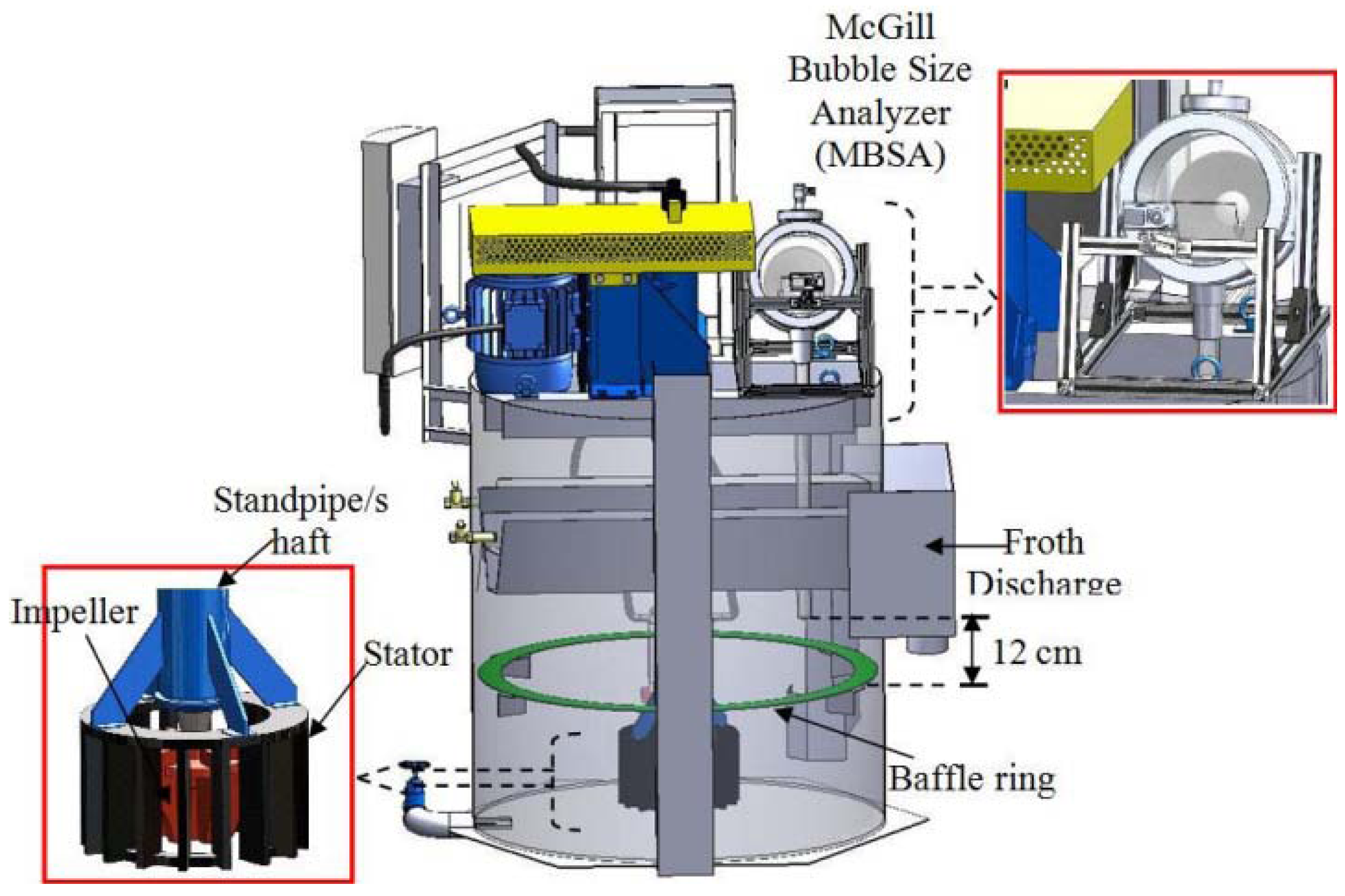
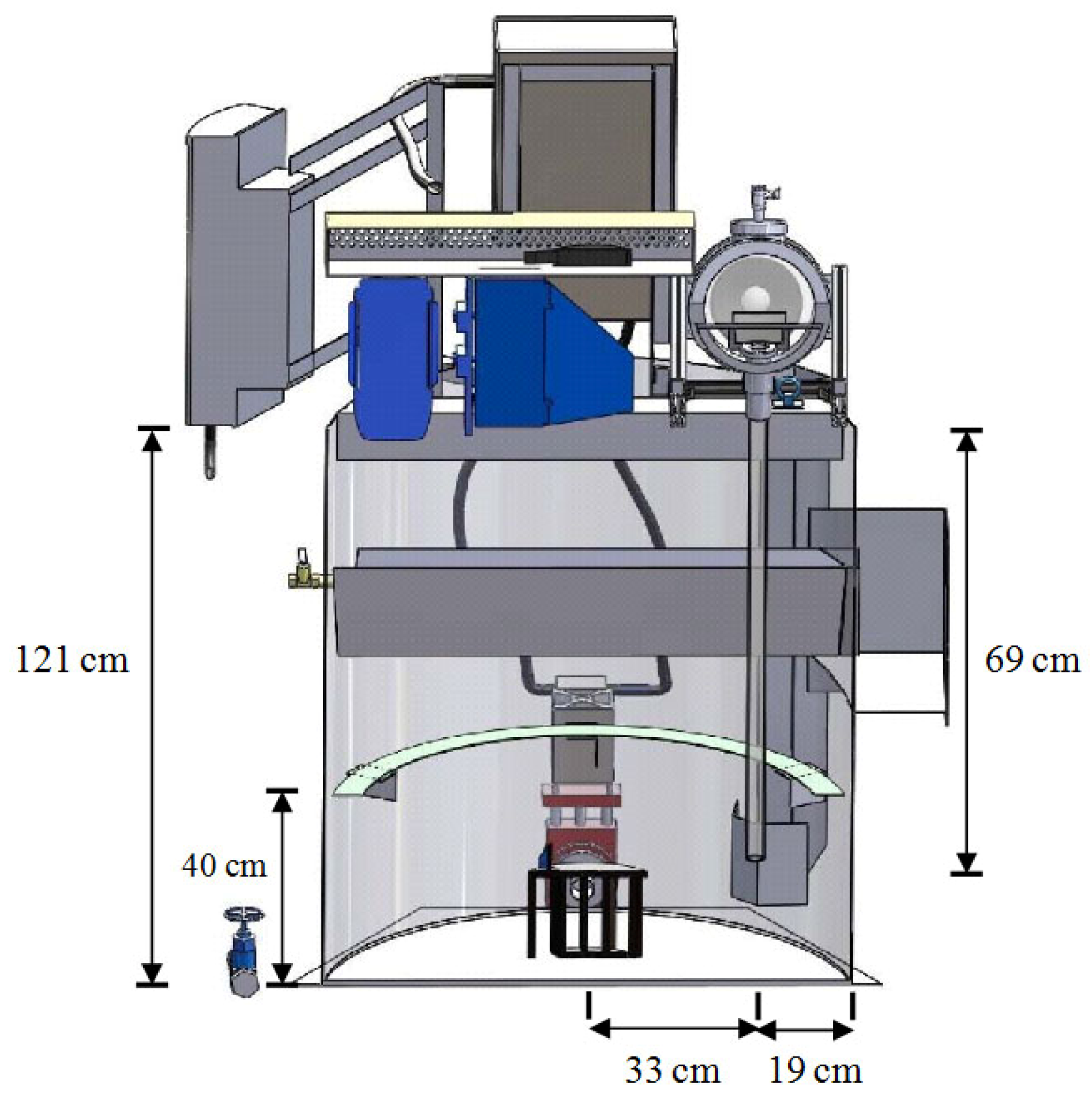
        <p>An AutoCAD sketch of the set-up to measure bubble size is shown in <xref ref-type="fig" rid="minerals-02-00208-f001">Figure 1</xref> and <xref ref-type="fig" rid="minerals-02-00208-f002">Figure 2</xref>. The nominal volume of the cell is 800 L, with a standard test volume of 700 L being employed. The impeller diameter was 21 cm and that of the outside diffuser 33 cm. A feature of the design is the baffle ring at 40 cm from the bottom of the tank (32 cm below water surface) which divides the turbulent zone around the impeller from the quiescent zone above where bubble size was determined. Air supply was from a compressed air system and manipulated via a 400 LPM KMS<sup>TM</sup> mass flow meter. </p>
        <fig id="minerals-02-00208-f001" position="anchor">
          <label>Figure 1</label>
          <caption>
            <p>Schematic CAD drawing of Metso RCS<sup>TM</sup> 0.8 m<sup>3</sup> mechanical cell and accessories. </p>
          </caption>
          <graphic xmlns:xlink="http://www.w3.org/1999/xlink" xlink:href="minerals-02-00208-g001.tif"/>
        </fig>
        <p>Bubble sizing employed the McGill Bubble Size Analyzer (MBSA), a sampling-for-imaging technique [<xref ref-type="bibr" rid="B22-minerals-02-00208">22</xref>,<xref ref-type="bibr" rid="B23-minerals-02-00208">23</xref>]. The sampling tube of the MBSA was positioned 33 cm from the central shaft (19 cm from the wall) and 52 cm from the bottom of the tank (20 cm below the water surface). This location inside the quiescent zone had been established previously as being both representative of the average air rate in the cell and giving reproducible data [<xref ref-type="bibr" rid="B2-minerals-02-00208">2</xref>]. All experiments were run under the following conditions: air superficial velocity (J<sub>g</sub>, <italic>i.e</italic>., volumetric air rate divided by cell cross-sectional area) 0.5 cm/s; room temperature 20–22 °C; and impeller speed 1,500 rpm (equivalent to 5.73 m/s tip speed). From previous work on this unit the air velocity was selected to correspond to the “base” air rate in the bubble size model of Nesset <italic>et al</italic>. [<xref ref-type="bibr" rid="B2-minerals-02-00208">2</xref>,<xref ref-type="bibr" rid="B13-minerals-02-00208">13</xref>]; and the impeller speed was selected as being within the range determined to have no impact on bubble size [<xref ref-type="bibr" rid="B2-minerals-02-00208">2</xref>,<xref ref-type="bibr" rid="B13-minerals-02-00208">13</xref>].</p>
        <fig id="minerals-02-00208-f002" position="anchor">
          <label>Figure 2</label>
          <caption>
            <p>A cut-away view of Metso RCS<sup>TM</sup> 0.8 m<sup>3</sup> mechanical cell showing dimensions and location of McGill Bubble Size Analyzer (MBSA) sampling tube.</p>
          </caption>
          <graphic xmlns:xlink="http://www.w3.org/1999/xlink" xlink:href="minerals-02-00208-g002.tif"/>
        </fig>
        <p>Experiments were conducted in a water-air system. The cell was filled with Montréal tap water one day before the test to equilibrate the water to room temperature. Frother solutions were prepared for the cell (“cell concentration”) and for the MBSA assembly (“chamber concentration”) independently. The chamber concentration was kept at least above the CCC75 for surfactant (frother) being tested to prevent coalescence in the sampling tube [<xref ref-type="bibr" rid="B24-minerals-02-00208">24</xref>]. Fifteen minutes of agitation at 4200 rpm without air prior to testing ensured the frother was fully mixed.</p>
        <p>Frother was added incrementally to give some 20 concentration points ranging up to 200 ppm. This number of points ensures reliable estimation of the three fitted parameters (Equation (1)). The bubble size data were corrected to report at standard temperature and pressure. Up to 100,000 bubbles were counted at each concentration.</p>
        <p>The bubble sizing technique was validated against an independent measure using particle imaging velocimetry (PIV). For this a bubble column (110 cm × 10 cm) was used to provide the necessary transparent wall for the PIV laser light. Bubbles were generated at a stainless steel sparger (5 μm nominal porosity). The bubble size was measured by PIV at the same location as the MBSA sampling point. The PIV apparatus (model: Gemini 200–15 Hz) consisted of two CCD cameras (lens model: Nikon AF 50 mm) and laser synchronizer (model: 630149-G). The bubbles which passed the laser plane were observed in the PIV images. The imaged area was 74 mm × 92.5 mm giving a smallest detectable bubble size of about 0.3 mm (0.1 mm for MBSA technique). A threshold method was used to identify bubbles from the PIV images. Some 100 images comprising up to 15,000 bubbles were recorded in each experiment.</p>
      </sec>
      <sec>
        <title>3.2. Reagents</title>
        <p>The surfactants from the three frother families are identified in <xref ref-type="table" rid="minerals-02-00208-t003">Table 3</xref>a which shows the range in n and m and corresponding range in HLB (note, Polypropylene Glycol Ethyl Ethers (<italic>i.e</italic>., n = 2) are not available). All were reagent grade from Aldrich-Sigma (St. Louis, MO, USA) (98%~99.9% purity). Several commercial frothers were included and are listed in <xref ref-type="table" rid="minerals-02-00208-t003">Table 3</xref>b. </p>
        <table-wrap id="minerals-02-00208-t003" position="anchor">
          <object-id pub-id-type="pii">minerals-02-00208-t003_Table 3</object-id>
          <label>Table 3</label>
          <caption>
            <p>(<bold>a</bold>) Frother families and range of surfactants (n, m and HLB) used in the study; (<bold>b</bold>) Commercial frothers used in the study.</p>
          </caption>
          <table rules="rows">
            <tbody>
              <tr>
                <td colspan="7" align="center" valign="middle"><bold>(a)</bold></td>
              </tr>
              <tr>
                <td align="center" valign="middle" colspan=""><bold>Frother family</bold></td>
                <td align="center" valign="middle" colspan="3"><bold>Chemical structure</bold></td>
                <td align="center" valign="middle"><bold>n</bold></td>
                <td align="center" valign="middle"><bold>m</bold></td>
                <td align="center" valign="middle"><bold>HLB</bold></td>
              </tr>
              <tr>
                <td align="center" valign="middle">Aliphatic Alcohols</td>
                <td align="center" valign="middle" colspan="3"><inline-graphic xmlns:xlink="http://www.w3.org/1999/xlink" xlink:href="minerals-02-00208-i028.tif"/></td>
                <td align="center" valign="middle">3–8</td>
                <td align="center" valign="middle">–</td>
                <td align="center" valign="middle">5–7.5</td>
              </tr>
              <tr>
                <td align="center" valign="middle">Polypropylene Glycols (PPG)</td>
                <td align="center" valign="middle" colspan="3"><inline-graphic xmlns:xlink="http://www.w3.org/1999/xlink" xlink:href="minerals-02-00208-i029.tif"/></td>
                <td align="center" valign="middle">0</td>
                <td align="center" valign="middle">3–17</td>
                <td align="center" valign="middle">7.4–9.3</td>
              </tr>
              <tr>
                <td align="center" valign="middle">Polypropylene Glycol Alkyl Ethers (PPGAE)</td>
                <td align="center" valign="middle" colspan="3"><inline-graphic xmlns:xlink="http://www.w3.org/1999/xlink" xlink:href="minerals-02-00208-i030.tif"/></td>
                <td align="center" valign="middle">1,3,4</td>
                <td align="center" valign="middle">1–7</td>
                <td align="center" valign="middle">6.5–8.3</td>
              </tr>
              <tr>
                <td colspan="7" align="center" valign="middle"><bold>(b)</bold></td>
              </tr>
              <tr>
                <td align="center" valign="middle"><bold>Frother Family</bold></td>
                <td align="center" valign="middle"><bold>Commercial Frother Type</bold></td>
                <td align="center" valign="middle"><bold>Supplier</bold></td>
                <td align="center" valign="middle"><bold>n</bold></td>
                <td align="center" valign="middle"><bold>m</bold></td>
                <td align="center" valign="middle"><bold>Molecular Weight</bold></td>
                <td align="center" valign="middle"><bold>HLB</bold></td>
              </tr>
              <tr>
                <td align="center" valign="middle">Aliphatic Alcohols</td>
                <td align="center" valign="middle">FX120-01</td>
                <td align="center" valign="middle">Flottec</td>
                <td align="center" valign="middle">6</td>
                <td align="center" valign="middle">-</td>
                <td align="center" valign="middle">102</td>
                <td align="center" valign="middle">6.05</td>
              </tr>
              <tr>
                <td align="center" valign="middle">Polypropylene Glycol (PPG)</td>
                <td align="center" valign="middle">F150</td>
                <td align="center" valign="middle">Flottec</td>
                <td align="center" valign="middle">0</td>
                <td align="center" valign="middle">7</td>
                <td align="center" valign="middle">425</td>
                <td align="center" valign="middle">8.625</td>
              </tr>
              <tr>
                <td rowspan="5" align="center" valign="middle">Polypropylene Glycol Alkyl Ether (PPGAE)</td>
                <td align="center" valign="middle">DowFroth 250</td>
                <td align="center" valign="middle">Dow Chemical</td>
                <td align="center" valign="middle">1</td>
                <td align="center" valign="middle">4</td>
                <td align="center" valign="middle">264</td>
                <td align="center" valign="middle">7.83</td>
              </tr>
              <tr>
                <td align="center" valign="middle">DowFroth 1012</td>
                <td align="center" valign="middle">Dow Chemical</td>
                <td align="center" valign="middle">1</td>
                <td align="center" valign="middle">6.7</td>
                <td align="center" valign="middle">398</td>
                <td align="center" valign="middle">7.48</td>
              </tr>
              <tr>
                <td align="center" valign="middle">FX160-01</td>
                <td align="center" valign="middle">Flottec</td>
                <td align="center" valign="middle">1</td>
                <td align="center" valign="middle">3.8</td>
                <td align="center" valign="middle">251</td>
                <td align="center" valign="middle">7.86</td>
              </tr>
              <tr>
                <td align="center" valign="middle">FX160-05</td>
                <td align="center" valign="middle">Flottec</td>
                <td align="center" valign="middle">3</td>
                <td align="center" valign="middle">2.5</td>
                <td align="center" valign="middle">207</td>
                <td align="center" valign="middle">7.11</td>
              </tr>
              <tr>
                <td align="center" valign="middle">F160</td>
                <td align="center" valign="middle">Flottec</td>
                <td align="center" valign="middle">4</td>
                <td align="center" valign="middle">2.5</td>
                <td align="center" valign="middle">217</td>
                <td align="center" valign="middle">6.63</td>
              </tr>
            </tbody>
          </table>
        </table-wrap>
      </sec>
    </sec>
    <sec sec-type="results">
      <title>4. Results</title>
      <sec>
        <title>4.1. Reliability and Validation</title>
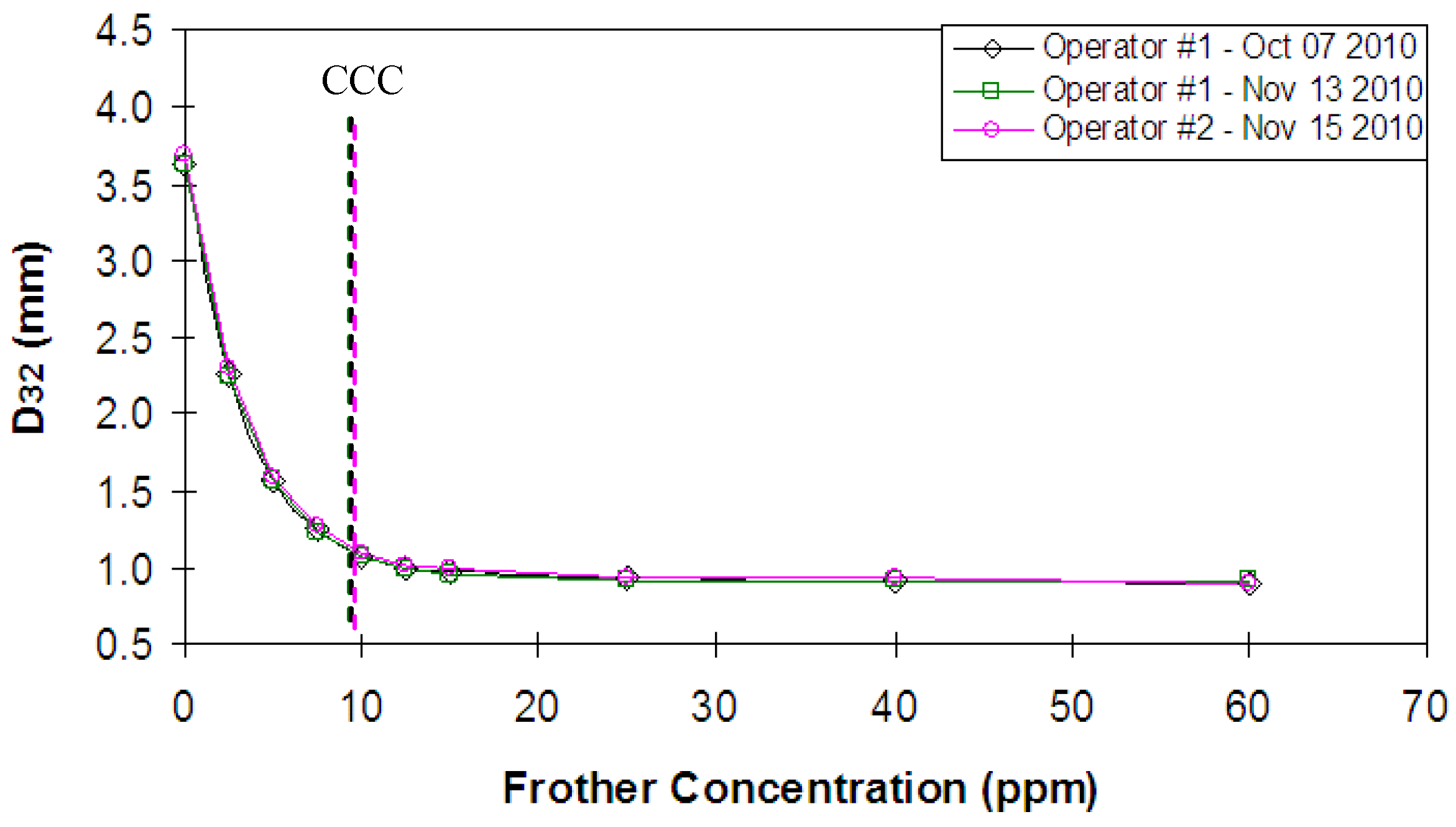
        <p><xref ref-type="fig" rid="minerals-02-00208-f003">Figure 3</xref> shows Sauter mean bubble size (D<sub>32</sub>) as a function of concentration for three repeats for the commercial frother DowFroth 250 (DF 250). Replicate tests (<italic>i.e</italic>., starting from solution preparation) were conducted by two different operators at three different times. The D<sub>32</sub>-C curves were consistent and the 95% confidence interval on the calculated CCC95 was 0.6 ppm or 0.0024 mmol/L, which is too small to indicate on subsequent plots. </p>
        <fig id="minerals-02-00208-f003" position="anchor">
          <label>Figure 3</label>
          <caption>
            <p>Reliability: Inter-operator and intra-operator replicated experiments at same conditions for DowFroth 250 (DF 250).</p>
          </caption>
          <graphic xmlns:xlink="http://www.w3.org/1999/xlink" xlink:href="minerals-02-00208-g003.tif"/>
        </fig>
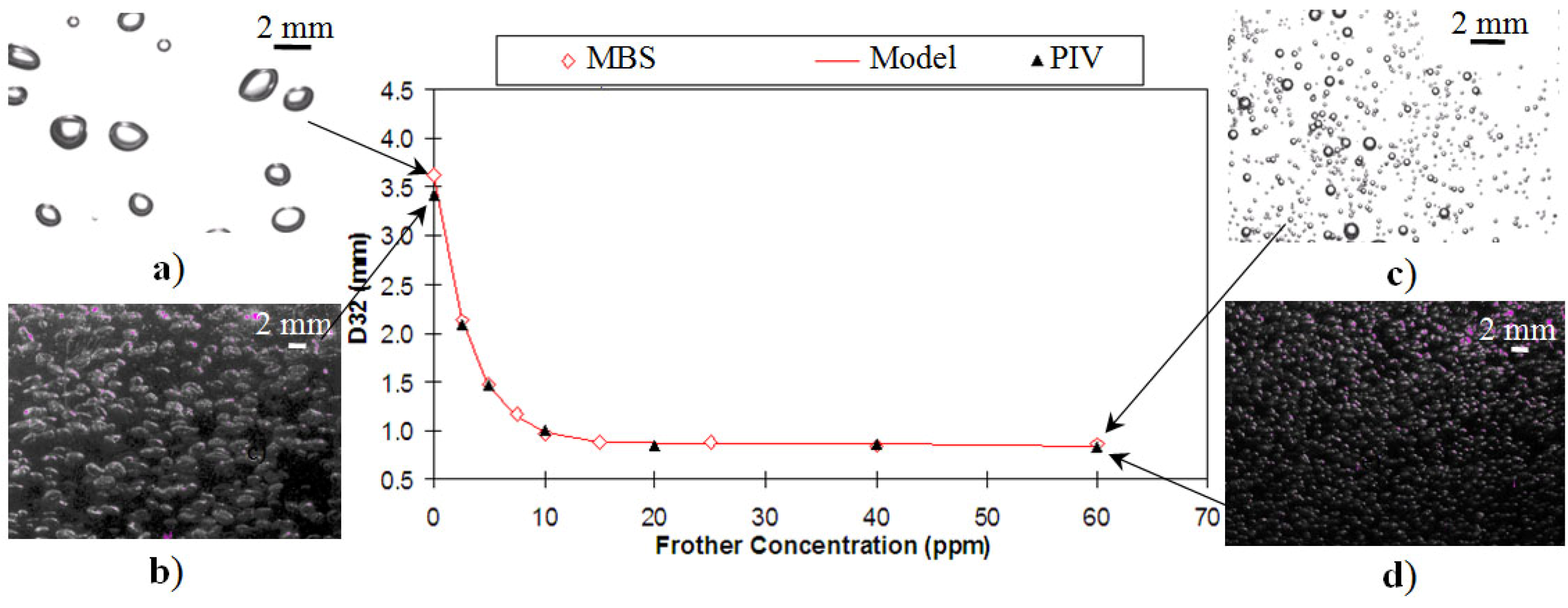
        <p>As validation, the results (<xref ref-type="fig" rid="minerals-02-00208-f004">Figure 4</xref>) show that the D<sub>32</sub> data from MBSA are in good agreement with D<sub>32</sub> from PIV. Together <xref ref-type="fig" rid="minerals-02-00208-f003">Figure 3</xref> and <xref ref-type="fig" rid="minerals-02-00208-f004">Figure 4</xref> confirm reliability and validity, respectively, of the bubble size data.</p>
        <fig id="minerals-02-00208-f004" position="anchor">
          <label>Figure 4</label>
          <caption>
            <p>Validation: Sauter mean bubble size as a function of frother DF 250 concentration measured by the MBSA technique (open diamonds) and the particle imaging velocimetry (PIV) technique (closed triangles); (<bold>a</bold>) Example image at 0 ppm concentration by MBSA technique; (<bold>b</bold>) Example image at 0 ppm concentration by PIV technique; (<bold>c</bold>) Example image at 60ppm concentration by MBSA technique; (<bold>d</bold>) Example image at 60 ppm concentration by PIV technique. (Note, line is the 3-parameter model fit to the MBSA D<sub>32</sub>-C data.)</p>
          </caption>
          <graphic xmlns:xlink="http://www.w3.org/1999/xlink" xlink:href="minerals-02-00208-g004.tif"/>
        </fig>
      </sec>
      <sec>
        <title>4.2. CCC95 <italic>vs.</italic> HLB</title>
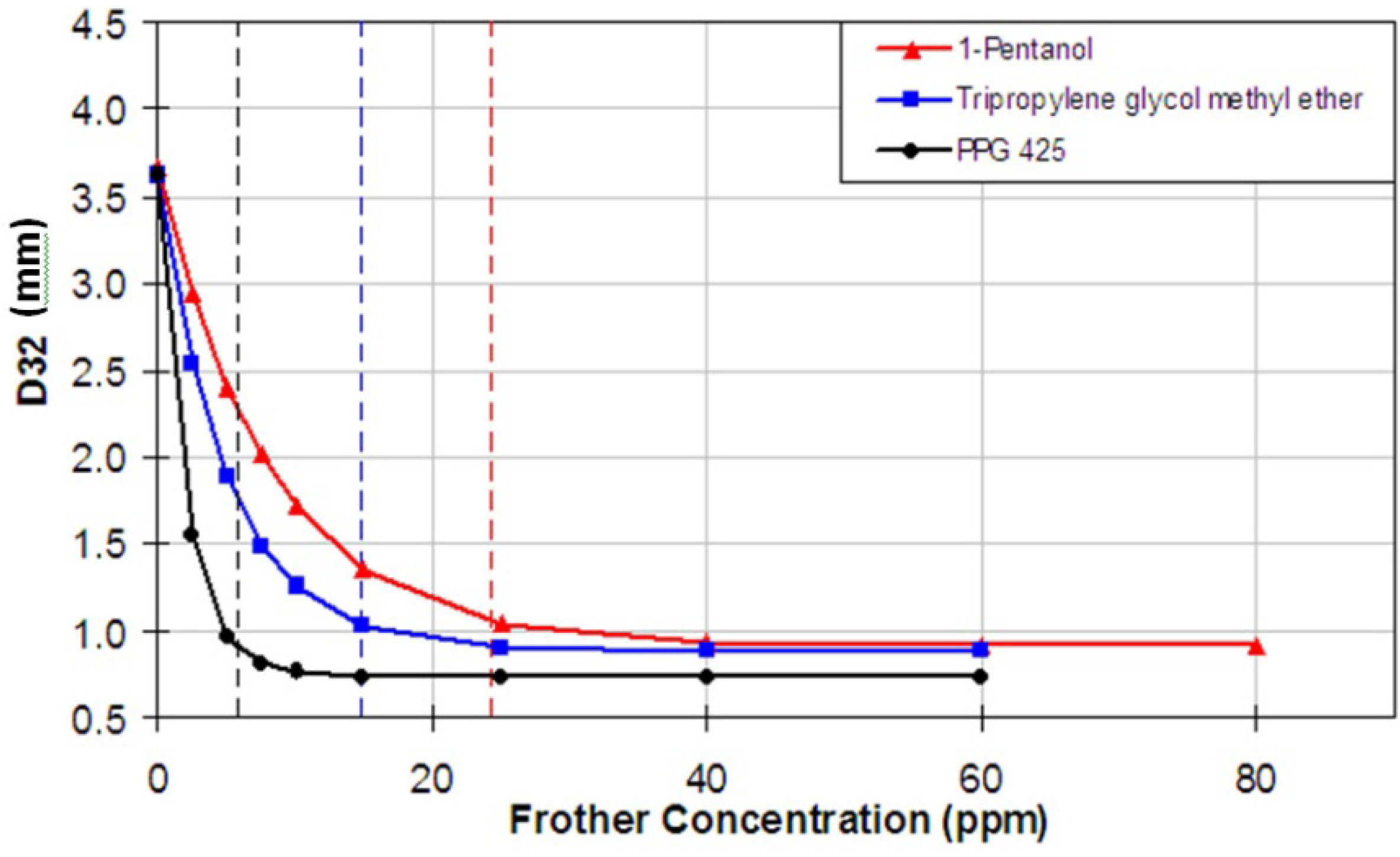
        <p>The trend in <xref ref-type="fig" rid="minerals-02-00208-f003">Figure 3</xref> was seen for all frothers, illustrated in <xref ref-type="fig" rid="minerals-02-00208-f005">Figure 5</xref> for three surfactants. <xref ref-type="table" rid="minerals-02-00208-t004">Table 4</xref> summarizes the parameters from fitting to the 3-parameter model, Equation (1), for all reagents tested with their corresponding molecular weight (MW) and HLB. The literature CCC values included for reference are in agreement with the current values.</p>
        <fig id="minerals-02-00208-f005" position="anchor">
          <label>Figure 5</label>
          <caption>
            <p>The effect of frother addition on D<sub>32</sub> for three frother types; the critical coalescence concentration (CCC)95 is noted by the vertical dashed line.</p>
          </caption>
          <graphic xmlns:xlink="http://www.w3.org/1999/xlink" xlink:href="minerals-02-00208-g005.tif"/>
        </fig>
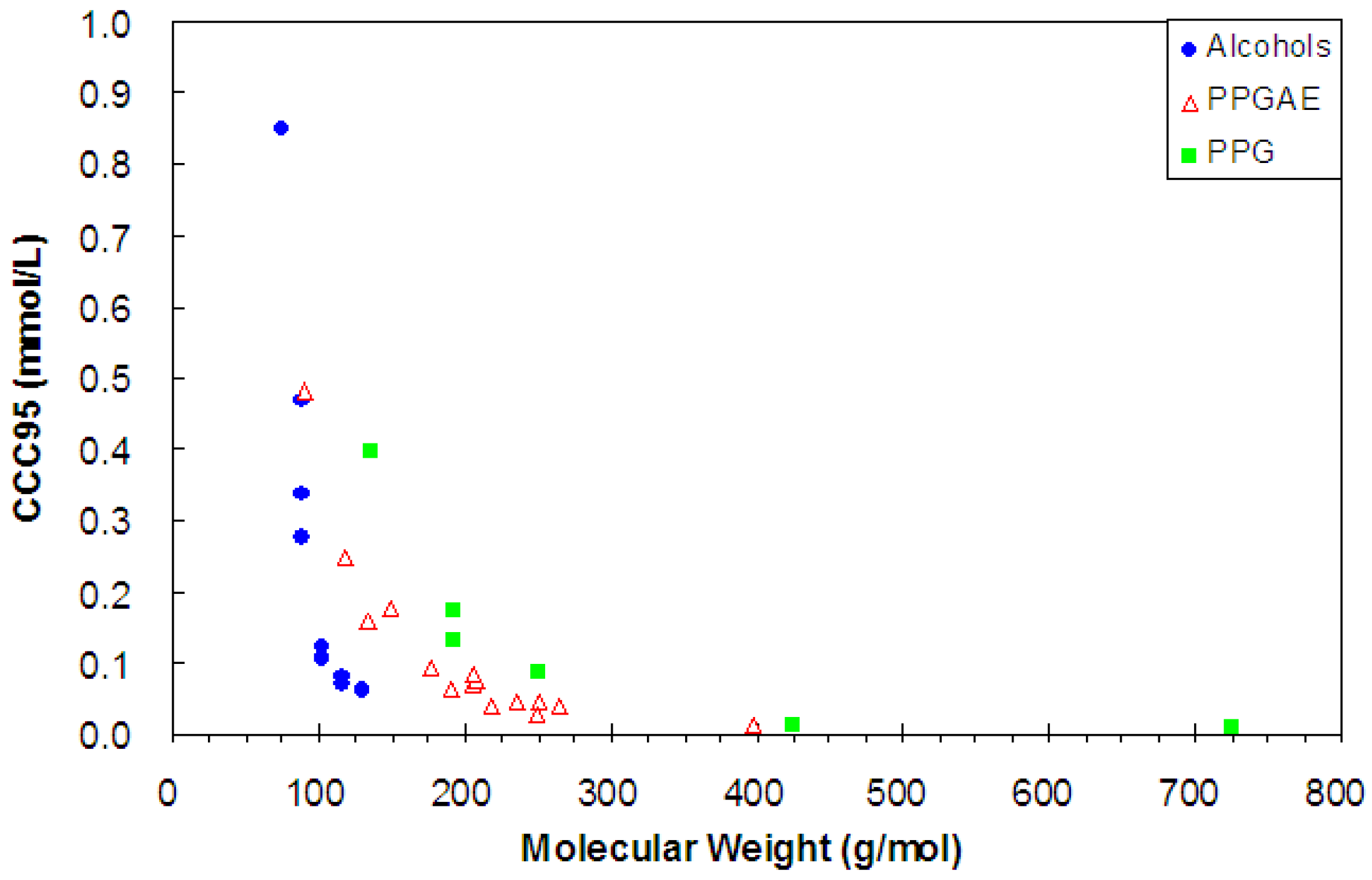
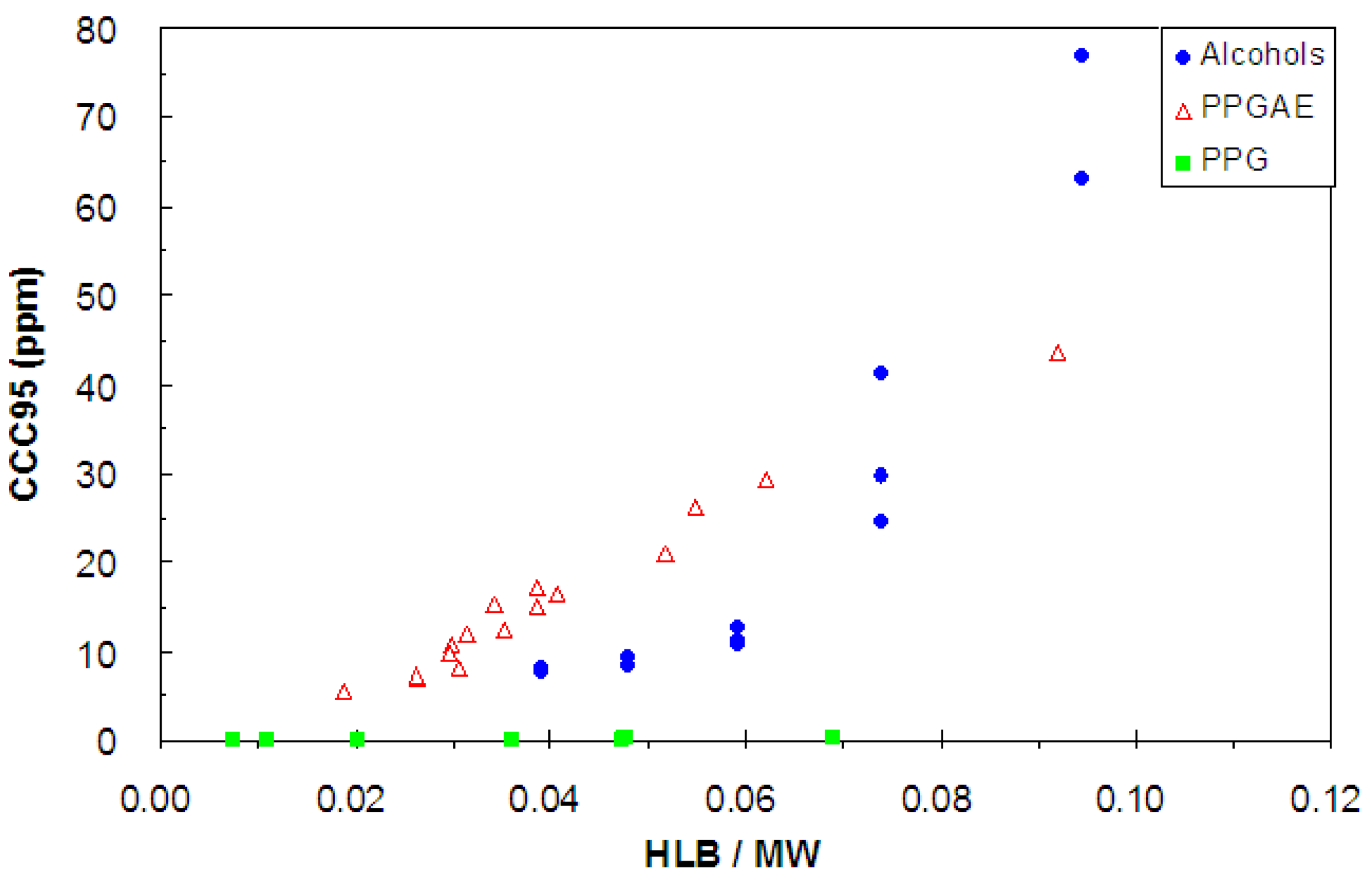
        <p>Laskowski [<xref ref-type="bibr" rid="B11-minerals-02-00208">11</xref>] considered a dependency between the CCC and molecular weight. This is tested in <xref ref-type="fig" rid="minerals-02-00208-f006">Figure 6</xref> which shows trends dependent on family. Nesset <italic>et al.</italic> [<xref ref-type="bibr" rid="B13-minerals-02-00208">13</xref>] correlated CCC95 in ppm against HLB/MW for a selection of commercial frothers; this is tested in <xref ref-type="fig" rid="minerals-02-00208-f007">Figure 7</xref> for all 36 frothers. The trend for the Alcohols is consistent but for the Polyglygols it becomes progressively scattered. </p>
        <fig id="minerals-02-00208-f006" position="anchor">
          <label>Figure 6</label>
          <caption>
            <p>CCC95 (mmol/L) <italic>versus</italic> molecular weight for the 36 frothers.</p>
          </caption>
          <graphic xmlns:xlink="http://www.w3.org/1999/xlink" xlink:href="minerals-02-00208-g006.tif"/>
        </fig>
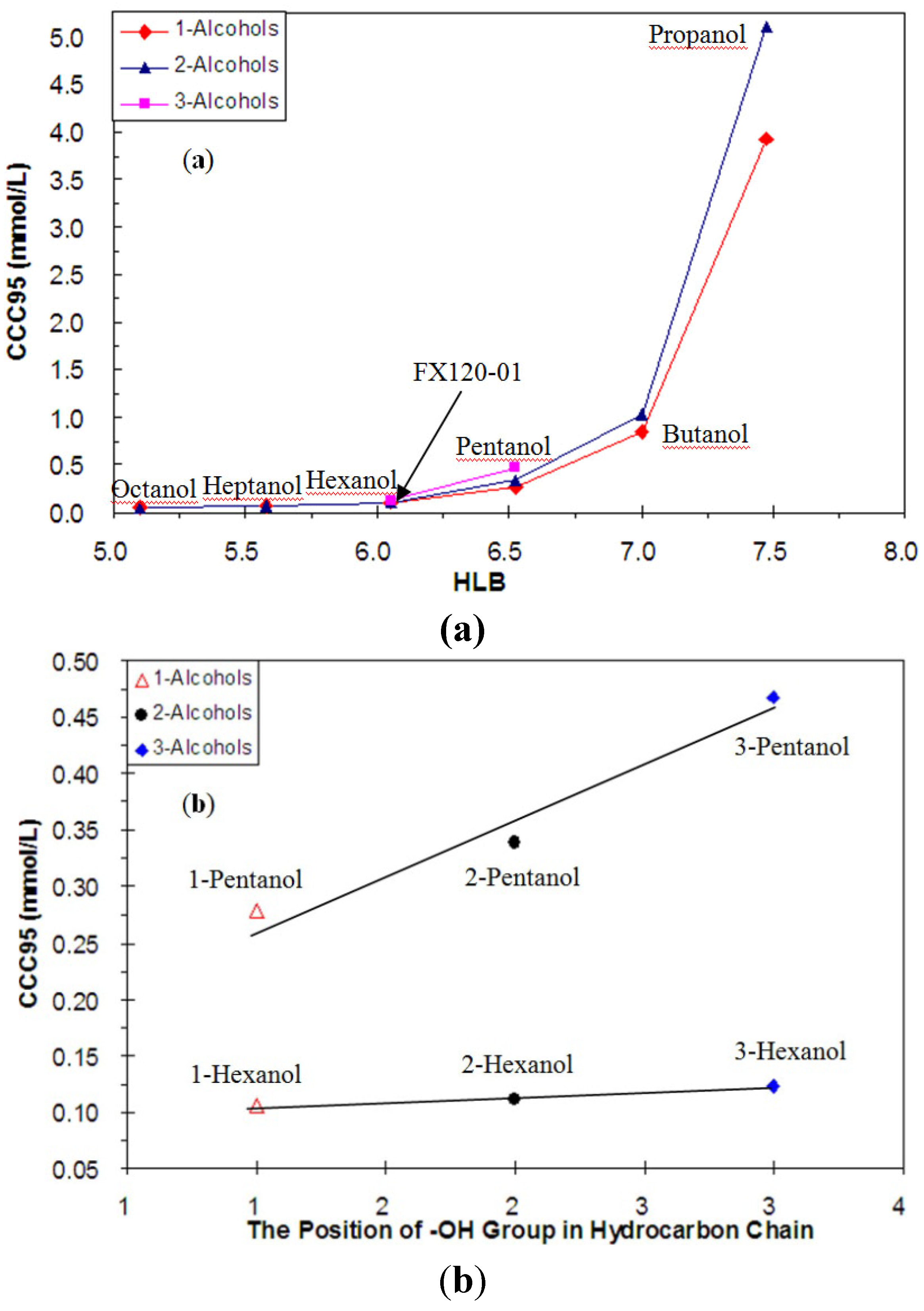
        <p><xref ref-type="fig" rid="minerals-02-00208-f008">Figure 8</xref>a shows the CCC95-HLB relationship for the Aliphatic Alcohols. Starting with Propanol there is a sharp decrease in CCC95 as HLB decreases (<italic>i.e</italic>., n increases) which levels off above 6 carbons (n = 6 or C-6). For C &lt; 6 there is an increasing isomer effect, <italic>i.e</italic>., effect of position of the OH group, which is illustrated by comparing Hexanol and Pentanol in <xref ref-type="fig" rid="minerals-02-00208-f008">Figure 8</xref>b. For practical purposes, however, since such short chain Alcohols are not employed as frothers, the isomer effect is later ignored. The commercial frother FX120-01 is seen to fit the trend (<xref ref-type="fig" rid="minerals-02-00208-f008">Figure 8</xref>a).</p>
        <table-wrap id="minerals-02-00208-t004" position="anchor">
          <object-id pub-id-type="pii">minerals-02-00208-t004_Table 4</object-id>
          <label>Table 4</label>
          <caption>
            <p>Summary of properties (n, m and HLB), CCC95 and D<sub>L</sub> determined for the tested surfactants.</p>
          </caption>
          <table>
<thead>
              <tr>
                <th rowspan="2" align="center" valign="middle">Frother Family</th>
                <th rowspan="2" align="center" valign="middle">Frother Type</th>
                <th rowspan="2" align="center" valign="middle">n</th>
                <th rowspan="2" align="center" valign="middle">m</th>
                <th rowspan="2" align="center" valign="middle">HLB</th>
                <th rowspan="2" align="center" valign="middle">Molecular Weight /(g/mol)</th>
                <th style="border-bottom:solid thin" align="center" valign="middle">Grau and Laskowski, 2006 [25]</th>
                <th colspan="5" style="border-bottom:solid thin" align="center" valign="middle">Current Work</th>
    </tr>
              <tr>
                <th align="center" valign="middle">CCC/ppm</th>
                <th align="center" valign="middle">CCC95/ppm</th>
                <th align="center" valign="middle">CCC95/(mmol/L)</th>
                <th align="center" valign="middle"><italic>D<sub>L</sub></italic>/mm</th>
                <th align="center" valign="middle">A</th>
                <th align="center" valign="middle">b</th>
              </tr>
            </thead>
            <tbody>
              <tr>
                <td rowspan="14" style="border-bottom:solid thin" align="center" valign="middle">
                  <bold>Aliphatic Alcohols</bold>                </td>
                <td align="center" valign="middle"><bold>1-Propanol</bold></td>
                <td align="center" valign="middle">3</td>
                <td align="center" valign="middle">-</td>
                <td align="center" valign="middle">7.48</td>
                <td align="center" valign="middle">60</td>
                <td align="center" valign="middle">-</td>
                <td align="center" valign="middle">236</td>
                <td align="center" valign="middle">3.92</td>
                <td align="center" valign="middle">0.87</td>
                <td align="center" valign="middle">2.84</td>
                <td align="center" valign="middle">−0.01</td>
              </tr>
              <tr>
                <td align="center" valign="middle"><bold>1-Butanol</bold></td>
                <td align="center" valign="middle">4</td>
                <td align="center" valign="middle">-</td>
                <td align="center" valign="middle">7</td>
                <td align="center" valign="middle">74</td>
                <td align="center" valign="middle">-</td>
                <td align="center" valign="middle">63</td>
                <td align="center" valign="middle">0.85</td>
                <td align="center" valign="middle">0.88</td>
                <td align="center" valign="middle">2.72</td>
                <td align="center" valign="middle">−0.05</td>
              </tr>
              <tr>
                <td align="center" valign="middle"><bold>1-Pentanol</bold></td>
                <td align="center" valign="middle">5</td>
                <td align="center" valign="middle">-</td>
                <td align="center" valign="middle">6.53</td>
                <td align="center" valign="middle">88</td>
                <td align="center" valign="middle">-</td>
                <td align="center" valign="middle">25</td>
                <td align="center" valign="middle">0.29</td>
                <td align="center" valign="middle">0.92</td>
                <td align="center" valign="middle">2.74</td>
                <td align="center" valign="middle">−0.12</td>
              </tr>
              <tr>
                <td align="center" valign="middle"><bold>1-Hexanol</bold></td>
                <td align="center" valign="middle">6</td>
                <td align="center" valign="middle">-</td>
                <td align="center" valign="middle">6.05</td>
                <td align="center" valign="middle">102</td>
                <td align="center" valign="middle">11</td>
                <td align="center" valign="middle">11</td>
                <td align="center" valign="middle">0.11</td>
                <td align="center" valign="middle">1.00</td>
                <td align="center" valign="middle">2.62</td>
                <td align="center" valign="middle">−0.28</td>
              </tr>
              <tr>
                <td align="center" valign="middle"><bold>1-Heptanol</bold></td>
                <td align="center" valign="middle">7</td>
                <td align="center" valign="middle">-</td>
                <td align="center" valign="middle">5.58</td>
                <td align="center" valign="middle">116</td>
                <td align="center" valign="middle">-</td>
                <td align="center" valign="middle">8</td>
                <td align="center" valign="middle">0.072</td>
                <td align="center" valign="middle">1.08</td>
                <td align="center" valign="middle">2.54</td>
                <td align="center" valign="middle">−0.36</td>
              </tr>
              <tr>
                <td align="center" valign="middle"><bold>1-Octanol</bold></td>
                <td align="center" valign="middle">8</td>
                <td align="center" valign="middle">-</td>
                <td align="center" valign="middle">5.1</td>
                <td align="center" valign="middle">130</td>
                <td align="center" valign="middle">-</td>
                <td align="center" valign="middle">8</td>
                <td align="center" valign="middle">0.060</td>
                <td align="center" valign="middle">1.15</td>
                <td align="center" valign="middle">2.47</td>
                <td align="center" valign="middle">−0.39</td>
              </tr>
              <tr>
                <td align="center" valign="middle"><bold>2-Propanol</bold></td>
                <td align="center" valign="middle">3</td>
                <td align="center" valign="middle">-</td>
                <td align="center" valign="middle">7.48</td>
                <td align="center" valign="middle">60</td>
                <td align="center" valign="middle">-</td>
                <td align="center" valign="middle">307</td>
                <td align="center" valign="middle">5.10</td>
                <td align="center" valign="middle">0.86</td>
                <td align="center" valign="middle">2.77</td>
                <td align="center" valign="middle">−0.01</td>
              </tr>
              <tr>
                <td align="center" valign="middle"><bold>2-Butanol</bold></td>
                <td align="center" valign="middle">4</td>
                <td align="center" valign="middle">-</td>
                <td align="center" valign="middle">7</td>
                <td align="center" valign="middle">74</td>
                <td align="center" valign="middle">-</td>
                <td align="center" valign="middle">77</td>
                <td align="center" valign="middle">1.04</td>
                <td align="center" valign="middle">0.88</td>
                <td align="center" valign="middle">2.76</td>
                <td align="center" valign="middle">−0.04</td>
              </tr>
              <tr>
                <td align="center" valign="middle"><bold>2-Pentanol</bold></td>
                <td align="center" valign="middle">5</td>
                <td align="center" valign="middle">-</td>
                <td align="center" valign="middle">6.53</td>
                <td align="center" valign="middle">88</td>
                <td align="center" valign="middle">-</td>
                <td align="center" valign="middle">30</td>
                <td align="center" valign="middle">0.34</td>
                <td align="center" valign="middle">0.91</td>
                <td align="center" valign="middle">2.67</td>
                <td align="center" valign="middle">−0.10</td>
              </tr>
              <tr>
                <td align="center" valign="middle"><bold>2-Hexanol</bold></td>
                <td align="center" valign="middle">6</td>
                <td align="center" valign="middle">-</td>
                <td align="center" valign="middle">6.05</td>
                <td align="center" valign="middle">102</td>
                <td align="center" valign="middle">-</td>
                <td align="center" valign="middle">11</td>
                <td align="center" valign="middle">0.11</td>
                <td align="center" valign="middle">1.01</td>
                <td align="center" valign="middle">2.60</td>
                <td align="center" valign="middle">−0.26</td>
              </tr>
              <tr>
                <td align="center" valign="middle"><bold>2-Heptanol</bold></td>
                <td align="center" valign="middle">7</td>
                <td align="center" valign="middle">-</td>
                <td align="center" valign="middle">5.58</td>
                <td align="center" valign="middle">116</td>
                <td align="center" valign="middle">-</td>
                <td align="center" valign="middle">9</td>
                <td align="center" valign="middle">0.080</td>
                <td align="center" valign="middle">1.08</td>
                <td align="center" valign="middle">2.54</td>
                <td align="center" valign="middle">−0.32</td>
              </tr>
              <tr>
                <td align="center" valign="middle"><bold>2-Octanol</bold></td>
                <td align="center" valign="middle">8</td>
                <td align="center" valign="middle">-</td>
                <td align="center" valign="middle">5.1</td>
                <td align="center" valign="middle">130</td>
                <td align="center" valign="middle">-</td>
                <td align="center" valign="middle">8</td>
                <td align="center" valign="middle">0.062</td>
                <td align="center" valign="middle">1.12</td>
                <td align="center" valign="middle">2.49</td>
                <td align="center" valign="middle">−0.37</td>
              </tr>
              <tr>
                <td align="center" valign="middle"><bold>3-Pentanol</bold></td>
                <td align="center" valign="middle">5</td>
                <td align="center" valign="middle">-</td>
                <td align="center" valign="middle">6.53</td>
                <td align="center" valign="middle">88</td>
                <td align="center" valign="middle">-</td>
                <td align="center" valign="middle">41</td>
                <td align="center" valign="middle">0.47</td>
                <td align="center" valign="middle">0.93</td>
                <td align="center" valign="middle">2.65</td>
                <td align="center" valign="middle">−0.07</td>
              </tr>
              <tr>
                <td style="border-bottom:solid thin" align="center" valign="middle"><bold>3-Hexanol</bold></td>
                <td style="border-bottom:solid thin" align="center" valign="middle">6</td>
                <td style="border-bottom:solid thin" align="center" valign="middle">-</td>
                <td style="border-bottom:solid thin" align="center" valign="middle">6.05</td>
                <td style="border-bottom:solid thin" align="center" valign="middle">102</td>
                <td style="border-bottom:solid thin" align="center" valign="middle">-</td>
                <td style="border-bottom:solid thin" align="center" valign="middle">13</td>
                <td style="border-bottom:solid thin" align="center" valign="middle">0.12</td>
                <td style="border-bottom:solid thin" align="center" valign="middle">1.00</td>
                <td style="border-bottom:solid thin" align="center" valign="middle">2.64</td>
                <td style="border-bottom:solid thin" align="center" valign="middle">−0.24</td>
              </tr>
              <tr>
                <td rowspan="9" style="border-bottom:solid thin" align="center" valign="middle">
                  <bold>Polypropylene Glycol Ethers</bold>                </td>
                <td align="center" valign="middle"><bold>Propylene Glycol Methyl Ether</bold></td>
                <td align="center" valign="middle">1</td>
                <td align="center" valign="middle">1</td>
                <td align="center" valign="middle">8.28</td>
                <td align="center" valign="middle">90</td>
                <td align="center" valign="middle">47</td>
                <td align="center" valign="middle">44</td>
                <td align="center" valign="middle">0.48</td>
                <td align="center" valign="middle">0.84</td>
                <td align="center" valign="middle">2.77</td>
                <td align="center" valign="middle">−0.07</td>
              </tr>
              <tr>
                <td align="center" valign="middle"><bold>Propylene Glycol Propyl Ether</bold></td>
                <td align="center" valign="middle">3</td>
                <td align="center" valign="middle">1</td>
                <td align="center" valign="middle">7.33</td>
                <td align="center" valign="middle">118</td>
                <td align="center" valign="middle">-</td>
                <td align="center" valign="middle">29</td>
                <td align="center" valign="middle">0.25</td>
                <td align="center" valign="middle">0.88</td>
                <td align="center" valign="middle">2.75</td>
                <td align="center" valign="middle">−0.10</td>
              </tr>
              <tr>
                <td align="center" valign="middle"><bold>Propylene Glycol Butyl Ether</bold></td>
                <td align="center" valign="middle">4</td>
                <td align="center" valign="middle">1</td>
                <td align="center" valign="middle">6.85</td>
                <td align="center" valign="middle">132</td>
                <td align="center" valign="middle">-</td>
                <td align="center" valign="middle">21</td>
                <td align="center" valign="middle">0.16</td>
                <td align="center" valign="middle">0.92</td>
                <td align="center" valign="middle">2.72</td>
                <td align="center" valign="middle">−0.14</td>
              </tr>
              <tr>
                <td align="center" valign="middle"><bold>Di(Propylene Glycol) Methyl Ether</bold></td>
                <td align="center" valign="middle">1</td>
                <td align="center" valign="middle">2</td>
                <td align="center" valign="middle">8.13</td>
                <td align="center" valign="middle">148</td>
                <td align="center" valign="middle">25</td>
                <td align="center" valign="middle">26</td>
                <td align="center" valign="middle">0.18</td>
                <td align="center" valign="middle">0.83</td>
                <td align="center" valign="middle">2.86</td>
                <td align="center" valign="middle">−0.11</td>
              </tr>
              <tr>
                <td align="center" valign="middle"><bold>Di(Propylene Glycol) Propyl Ether</bold></td>
                <td align="center" valign="middle">3</td>
                <td align="center" valign="middle">2</td>
                <td align="center" valign="middle">7.18</td>
                <td align="center" valign="middle">176</td>
                <td align="center" valign="middle">-</td>
                <td align="center" valign="middle">16</td>
                <td align="center" valign="middle">0.094</td>
                <td align="center" valign="middle">0.89</td>
                <td align="center" valign="middle">2.71</td>
                <td align="center" valign="middle">−0.18</td>
              </tr>
              <tr>
                <td rowspan="2" align="center" valign="middle"><bold>Di(Propylene Glycol) Butyl EtherTri(Propylene Glycol) Methyl Ether</bold></td>
                <td align="center" valign="middle">4</td>
                <td align="center" valign="middle">2</td>
                <td align="center" valign="middle">6.7</td>
                <td align="center" valign="middle">190</td>
                <td align="center" valign="middle">-</td>
                <td align="center" valign="middle">12</td>
                <td align="center" valign="middle">0.066</td>
                <td align="center" valign="middle">0.91</td>
                <td align="center" valign="middle">2.73</td>
                <td align="center" valign="middle">−0.24</td>
              </tr>
              <tr>
                <td align="center" valign="middle">1</td>
                <td align="center" valign="middle">3</td>
                <td align="center" valign="middle">7.98</td>
                <td align="center" valign="middle">206</td>
                <td align="center" valign="middle">17</td>
                <td align="center" valign="middle">15</td>
                <td align="center" valign="middle">0.073</td>
                <td align="center" valign="middle">0.89</td>
                <td align="center" valign="middle">2.74</td>
                <td align="center" valign="middle">−0.20</td>
              </tr>
              <tr>
                <td align="center" valign="middle"><bold>Tri(Propylene Glycol) Propyl Ether</bold></td>
                <td align="center" valign="middle">3</td>
                <td align="center" valign="middle">3</td>
                <td align="center" valign="middle">7.03</td>
                <td align="center" valign="middle">234</td>
                <td align="center" valign="middle">-</td>
                <td align="center" valign="middle">11</td>
                <td align="center" valign="middle">0.045</td>
                <td align="center" valign="middle">0.92</td>
                <td align="center" valign="middle">2.70</td>
                <td align="center" valign="middle">−0.28</td>
              </tr>
              <tr>
                <td style="border-bottom:solid thin" align="center" valign="middle"><bold>Tri(Propylene Glycol) Butyl Ether</bold></td>
                <td style="border-bottom:solid thin" align="center" valign="middle">4</td>
                <td style="border-bottom:solid thin" align="center" valign="middle">3</td>
                <td style="border-bottom:solid thin" align="center" valign="middle">6.55</td>
                <td style="border-bottom:solid thin" align="center" valign="middle">248</td>
                <td style="border-bottom:solid thin" align="center" valign="middle">-</td>
                <td style="border-bottom:solid thin" align="center" valign="middle">7</td>
                <td style="border-bottom:solid thin" align="center" valign="middle">0.029</td>
                <td style="border-bottom:solid thin" align="center" valign="middle">0.96</td>
                <td style="border-bottom:solid thin" align="center" valign="middle">2.67</td>
                <td style="border-bottom:solid thin" align="center" valign="middle">−0.42</td>
              </tr>
              <tr>
                <td rowspan="6" style="border-bottom:solid thin" align="center" valign="middle">
                  <bold>Polypropylene Glycols</bold>                </td>
                <td align="center" valign="middle"><bold>Di Propylene Glycol</bold></td>
                <td align="center" valign="middle">-</td>
                <td align="center" valign="middle">2</td>
                <td align="center" valign="middle">9.25</td>
                <td align="center" valign="middle">134</td>
                <td align="center" valign="middle">-</td>
                <td align="center" valign="middle">53</td>
                <td align="center" valign="middle">0.40</td>
                <td align="center" valign="middle">0.71</td>
                <td align="center" valign="middle">2.89</td>
                <td align="center" valign="middle">−0.06</td>
              </tr>
              <tr>
                <td align="center" valign="middle"><bold>Tri Propylene Glycol</bold></td>
                <td align="center" valign="middle">-</td>
                <td align="center" valign="middle">3</td>
                <td align="center" valign="middle">9.125</td>
                <td align="center" valign="middle">192</td>
                <td align="center" valign="middle">-</td>
                <td align="center" valign="middle">33</td>
                <td align="center" valign="middle">0.17</td>
                <td align="center" valign="middle">0.69</td>
                <td align="center" valign="middle">3.01</td>
                <td align="center" valign="middle">−0.09</td>
              </tr>
              <tr>
                <td align="center" valign="middle"><bold>Tetra Propylene Glycol</bold></td>
                <td align="center" valign="middle">-</td>
                <td align="center" valign="middle">4</td>
                <td align="center" valign="middle">9</td>
                <td align="center" valign="middle">250</td>
                <td align="center" valign="middle">-</td>
                <td align="center" valign="middle">22</td>
                <td align="center" valign="middle">0.088</td>
                <td align="center" valign="middle">0.71</td>
                <td align="center" valign="middle">2.90</td>
                <td align="center" valign="middle">−0.14</td>
              </tr>
              <tr>
                <td align="center" valign="middle"><bold>Polypropylene Glycol 425</bold></td>
                <td align="center" valign="middle">-</td>
                <td align="center" valign="middle">7</td>
                <td align="center" valign="middle">8.625</td>
                <td align="center" valign="middle">425</td>
                <td align="center" valign="middle">-</td>
                <td align="center" valign="middle">6</td>
                <td align="center" valign="middle">0.014</td>
                <td align="center" valign="middle">0.74</td>
                <td align="center" valign="middle">2.88</td>
                <td align="center" valign="middle">−0.50</td>
              </tr>
              <tr>
                <td align="center" valign="middle"><bold>Polypropylene Glycol 725</bold></td>
                <td align="center" valign="middle">-</td>
                <td align="center" valign="middle">12</td>
                <td align="center" valign="middle">8</td>
                <td align="center" valign="middle">725</td>
                <td align="center" valign="middle">-</td>
                <td align="center" valign="middle">7</td>
                <td align="center" valign="middle">0.0091</td>
                <td align="center" valign="middle">0.79</td>
                <td align="center" valign="middle">2.84</td>
                <td align="center" valign="middle">−0.45</td>
              </tr>
              <tr>
                <td style="border-bottom:solid thin" align="center" valign="middle"><bold>Polypropylene Glycol 1000</bold></td>
                <td style="border-bottom:solid thin" align="center" valign="middle">-</td>
                <td style="border-bottom:solid thin" align="center" valign="middle">17</td>
                <td style="border-bottom:solid thin" align="center" valign="middle">7.375</td>
                <td style="border-bottom:solid thin" align="center" valign="middle">1000</td>
                <td style="border-bottom:solid thin" align="center" valign="middle">-</td>
                <td style="border-bottom:solid thin" align="center" valign="middle">8</td>
                <td style="border-bottom:solid thin" align="center" valign="middle">0.0084</td>
                <td style="border-bottom:solid thin" align="center" valign="middle">0.88</td>
                <td style="border-bottom:solid thin" align="center" valign="middle">2.73</td>
                <td style="border-bottom:solid thin" align="center" valign="middle">−0.36</td>
              </tr>
              <tr>
                <td rowspan="7" align="center" valign="middle">
                  <bold>Commercial Frothers</bold>                </td>
                <td align="center" valign="middle"><bold>FX120-01</bold></td>
                <td align="center" valign="middle">6</td>
                <td align="center" valign="middle">-</td>
                <td align="center" valign="middle">6.05</td>
                <td align="center" valign="middle">102</td>
                <td align="center" valign="middle">-</td>
                <td align="center" valign="middle">11</td>
                <td align="center" valign="middle">0.10</td>
                <td align="center" valign="middle">0.98</td>
                <td align="center" valign="middle">2.68</td>
                <td align="center" valign="middle">−0.27</td>
              </tr>
              <tr>
                <td align="center" valign="middle"><bold>DowFroth250</bold></td>
                <td align="center" valign="middle">1</td>
                <td align="center" valign="middle">4</td>
                <td align="center" valign="middle">7.83</td>
                <td align="center" valign="middle">264</td>
                <td align="center" valign="middle">9</td>
                <td align="center" valign="middle">10</td>
                <td align="center" valign="middle">0.038</td>
                <td align="center" valign="middle">0.85</td>
                <td align="center" valign="middle">2.76</td>
                <td align="center" valign="middle">−0.30</td>
              </tr>
              <tr>
                <td align="center" valign="middle"><bold>DowFroth1012</bold></td>
                <td align="center" valign="middle">1</td>
                <td align="center" valign="middle">6.7</td>
                <td align="center" valign="middle">7.48</td>
                <td align="center" valign="middle">420</td>
                <td align="center" valign="middle">6</td>
                <td align="center" valign="middle">6</td>
                <td align="center" valign="middle">0.014</td>
                <td align="center" valign="middle">0.86</td>
                <td align="center" valign="middle">2.75</td>
                <td align="center" valign="middle">−0.53</td>
              </tr>
              <tr>
                <td align="center" valign="middle"><bold>FX160-05</bold></td>
                <td align="center" valign="middle">3</td>
                <td align="center" valign="middle">2.5</td>
                <td align="center" valign="middle">7.11</td>
                <td align="center" valign="middle">207</td>
                <td align="center" valign="middle">-</td>
                <td align="center" valign="middle">15</td>
                <td align="center" valign="middle">0.074</td>
                <td align="center" valign="middle">0.90</td>
                <td align="center" valign="middle">2.72</td>
                <td align="center" valign="middle">−0.20</td>
              </tr>
              <tr>
                <td align="center" valign="middle"><bold>FX160-01</bold></td>
                <td align="center" valign="middle">1</td>
                <td align="center" valign="middle">3.8</td>
                <td align="center" valign="middle">7.86</td>
                <td align="center" valign="middle">251</td>
                <td align="center" valign="middle">-</td>
                <td align="center" valign="middle">12</td>
                <td align="center" valign="middle">0.048</td>
                <td align="center" valign="middle">0.88</td>
                <td align="center" valign="middle">2.73</td>
                <td align="center" valign="middle">−0.25</td>
              </tr>
              <tr>
                <td align="center" valign="middle"><bold>F150</bold></td>
                <td align="center" valign="middle">-</td>
                <td align="center" valign="middle">7</td>
                <td align="center" valign="middle">8.625</td>
                <td align="center" valign="middle">425</td>
                <td align="center" valign="middle">-</td>
                <td align="center" valign="middle">6</td>
                <td align="center" valign="middle">0.014</td>
                <td align="center" valign="middle">0.76</td>
                <td align="center" valign="middle">2.85</td>
                <td align="center" valign="middle">−0.49</td>
              </tr>
              <tr>
                <td align="center" valign="middle"><bold>F160</bold></td>
                <td align="center" valign="middle">4</td>
                <td align="center" valign="middle">2.5</td>
                <td align="center" valign="middle">6.63</td>
                <td align="center" valign="middle">217</td>
                <td align="center" valign="middle">-</td>
                <td align="center" valign="middle">8</td>
                <td align="center" valign="middle">0.037</td>
                <td align="center" valign="middle">0.95</td>
                <td align="center" valign="middle">2.66</td>
                <td align="center" valign="middle">−0.37</td>
              </tr>
            </tbody>
          </table>
        </table-wrap>
        <fig id="minerals-02-00208-f007" position="anchor">
          <label>Figure 7</label>
          <caption>
            <p>CCC95 (ppm) <italic>versus</italic> HLB/molecular weight for the 36 frothers.</p>
          </caption>
          <graphic xmlns:xlink="http://www.w3.org/1999/xlink" xlink:href="minerals-02-00208-g007.tif"/>
        </fig>
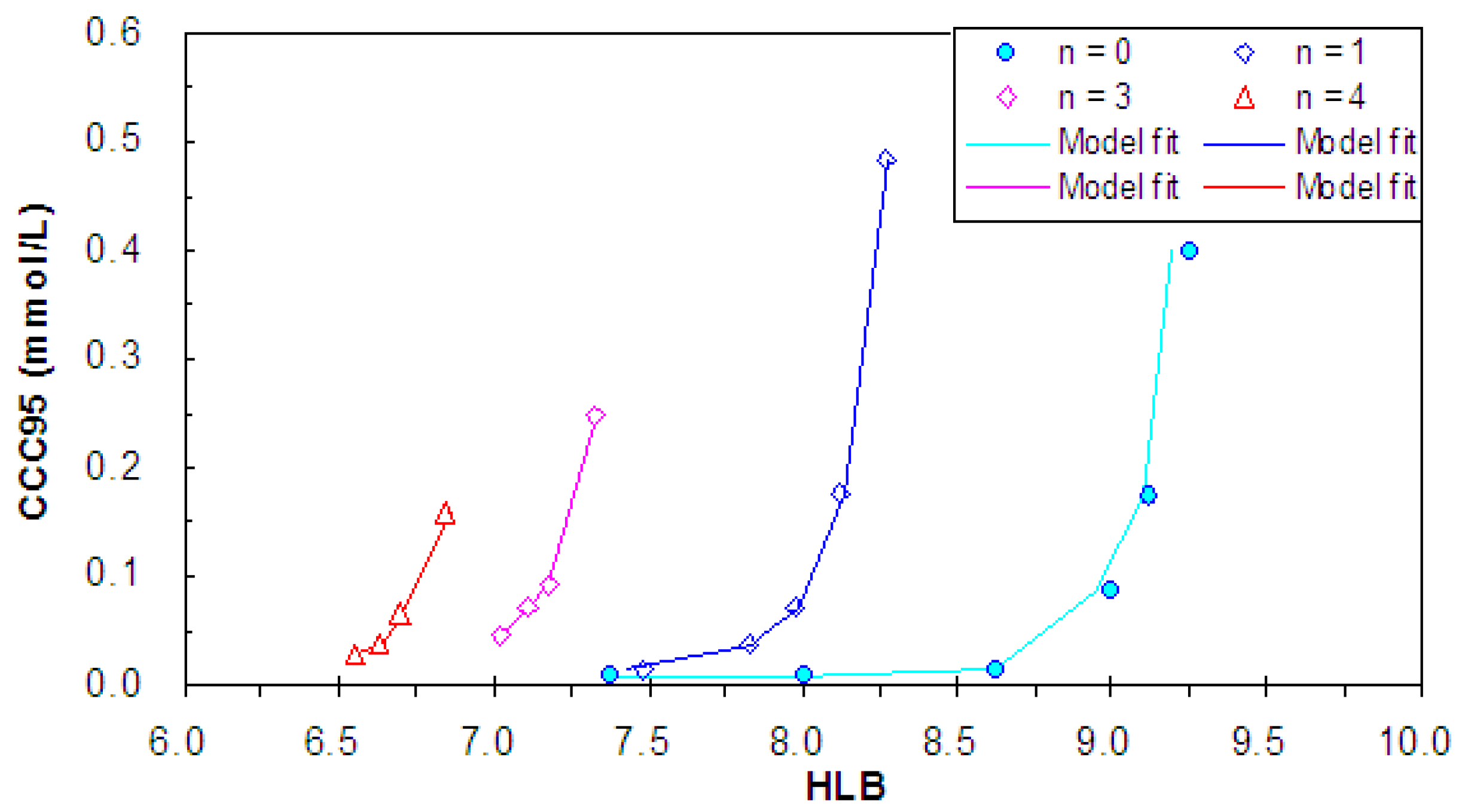
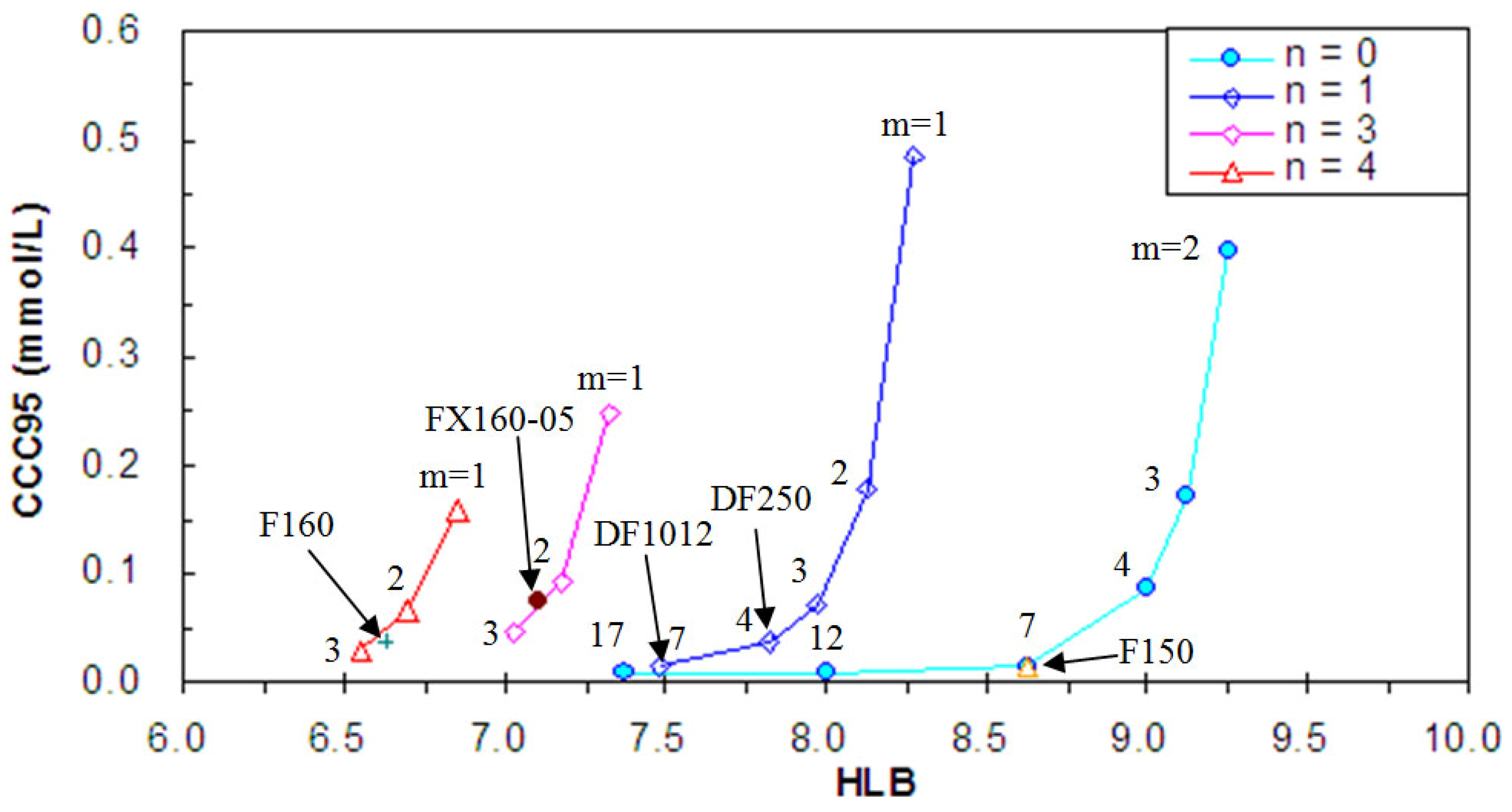
        <p><xref ref-type="fig" rid="minerals-02-00208-f009">Figure 9</xref> shows CCC95 <italic>vs.</italic> HLB for the two Polyglycol families, in this case as a function of m for a given n. There is a pattern: CCC95 decreases with increasing m in a series of parallel or self-similar plots which trend to lower HLB with increasing n. For n = 0 (<italic>i.e</italic>., Polypropylene Glycols) m = 1 was tested but showed no bubble size reduction up to 13 mmol/L (1,000 ppm) and is omitted. The commercial frothers are shown to fit the pattern. </p>
        <fig id="minerals-02-00208-f008" position="anchor">
          <label>Figure 8</label>
          <caption>
            <p>(<bold>a</bold>) CCC95 <italic>versus</italic> HLB for the Aliphatic Alcohols and their isomers (1-Alcohol, 2-Alcohol and 3-Alcohol); (<bold>b</bold>) the effect of –OH group position on CCC95 for Pentanol and Hexanol isomers.</p>
          </caption>
          <graphic xmlns:xlink="http://www.w3.org/1999/xlink" xlink:href="minerals-02-00208-g008.tif"/>
        </fig>
        <fig id="minerals-02-00208-f009" position="anchor">
          <label>Figure 9</label>
          <caption>
            <p>CCC95 <italic>versus</italic> HLB for the Polyglycols as function of m and n.</p>
          </caption>
          <graphic xmlns:xlink="http://www.w3.org/1999/xlink" xlink:href="minerals-02-00208-g009.tif"/>
        </fig>
      </sec>
      <sec>
        <title>4.3. Developing a CCC-HLB Model</title>
        <p>The trends in <xref ref-type="fig" rid="minerals-02-00208-f008">Figure 8</xref>a and <xref ref-type="fig" rid="minerals-02-00208-f009">Figure 9</xref> show consistent patterns that can be fitted to the following exponential Equation: </p>
        <p><disp-formula id="minerals-02-00208-i014"><inline-graphic xmlns:xlink="http://www.w3.org/1999/xlink" xlink:href="minerals-02-00208-i014.tif"/><label>(6)</label></disp-formula></p>
        <p>where α and β are constants that depend on the family (<italic>i.e.</italic>, n and m). <xref ref-type="table" rid="minerals-02-00208-t005">Table 5</xref> gives the values for the Polyglycols and 1-Alcohols. </p>
        <table-wrap id="minerals-02-00208-t005" position="anchor">
          <object-id pub-id-type="pii">minerals-02-00208-t005_Table 5</object-id>
          <label>Table 5</label>
          <caption>
            <p>The constants in Equation (6) for the range of n and m and goodness-of-fit (precision) statistics. </p>
          </caption>
          <table>
<thead>
              <tr>
                <th rowspan="2" align="center" valign="middle">Family</th>
                <th rowspan="2" align="center" valign="middle">n</th>
                <th rowspan="2" align="center" valign="middle">m</th>
                <th rowspan="2" align="center" valign="middle">α</th>
                <th rowspan="2" style="border-right:solid thin" align="center" valign="middle">β</th>
                <th colspan="5" style="border-bottom:solid thin" align="center" valign="middle">Precision</th>
              </tr>
              <tr>
                <th align="center" valign="middle">Data Points, N</th>
                <th align="center" valign="middle">R<sup>2</sup></th>
                <th align="center" valign="middle">R<sup>2</sup><sub>Adjusted</sub></th>
                <th align="center" valign="middle">SSE</th>
                <th align="center" valign="middle">RMSE</th>
              </tr>
            </thead>
            <tbody>
              <tr>
                <td align="center" valign="middle">1-Alcohol</td>
                <td align="center" valign="middle">3–8</td>
                <td align="center" valign="middle">0</td>
                <td align="center" valign="middle">
                  <bold>1.52E-10</bold>
                </td>
                <td style="border-right:solid thin" align="center" valign="middle">
                  <bold>3.207</bold>
                </td>
                <td align="center" valign="middle">6</td>
                <td align="center" valign="middle">0.9815</td>
                <td align="center" valign="middle">0.9769</td>
                <td align="center" valign="middle">0.002136</td>
                <td align="center" valign="middle">0.02311</td>
              </tr>
              <tr>
                <td align="center" valign="middle">Polypropylene Glycol</td>
                <td align="center" valign="middle">0</td>
                <td align="center" valign="middle">2–17</td>
                <td align="center" valign="middle">
                  <bold>4.76E-17</bold>
                </td>
                <td style="border-right:solid thin" align="center" valign="middle">
                  <bold>3.951</bold>
                </td>
                <td align="center" valign="middle">6</td>
                <td align="center" valign="middle">0.9615</td>
                <td align="center" valign="middle">0.942</td>
                <td align="center" valign="middle">0.006069</td>
                <td align="center" valign="middle">0.04498</td>
              </tr>
              <tr>
                <td align="center" valign="middle">Polypropylene Glycol Methyl Ether</td>
                <td align="center" valign="middle">1</td>
                <td align="center" valign="middle">1–7</td>
                <td align="center" valign="middle">
                  <bold>1.61E-18</bold>
                </td>
                <td style="border-right:solid thin" align="center" valign="middle">
                  <bold>4.855</bold>
                </td>
                <td align="center" valign="middle">6</td>
                <td align="center" valign="middle">0.9745</td>
                <td align="center" valign="middle">0.9682</td>
                <td align="center" valign="middle">0.004049</td>
                <td align="center" valign="middle">0.03181</td>
              </tr>
              <tr>
                <td align="center" valign="middle">Polypropylene Glycol Propyl Ether</td>
                <td align="center" valign="middle">3</td>
                <td align="center" valign="middle">1–3</td>
                <td align="center" valign="middle">
                  <bold>3.15E-19</bold>
                </td>
                <td style="border-right:solid thin" align="center" valign="middle">
                  <bold>5.624</bold>
                </td>
                <td align="center" valign="middle">4</td>
                <td align="center" valign="middle">0.9937</td>
                <td align="center" valign="middle">0.9905</td>
                <td align="center" valign="middle">0.0001581</td>
                <td align="center" valign="middle">0.008891</td>
              </tr>
              <tr>
                <td align="center" valign="middle">Polypropylene Glycol Butyl Ether</td>
                <td align="center" valign="middle">4</td>
                <td align="center" valign="middle">1–3</td>
                <td align="center" valign="middle">
                  <bold>9.58E-20</bold>
                </td>
                <td style="border-right:solid thin" align="center" valign="middle">
                  <bold>6.125</bold>
                </td>
                <td align="center" valign="middle">4</td>
                <td align="center" valign="middle">0.9972</td>
                <td align="center" valign="middle">0.9957</td>
                <td align="center" valign="middle">3.027E-5</td>
                <td align="center" valign="middle">0.003891</td>
              </tr>
            </tbody>
          </table>
        </table-wrap>
        <p>For Polyglycols, the α and β can be linked to n as follows:</p>
        <p><disp-formula id="minerals-02-00208-i015"><inline-graphic xmlns:xlink="http://www.w3.org/1999/xlink" xlink:href="minerals-02-00208-i015.tif"/><label>(7)</label></disp-formula></p>
        <p><disp-formula id="minerals-02-00208-i016"><inline-graphic xmlns:xlink="http://www.w3.org/1999/xlink" xlink:href="minerals-02-00208-i016.tif"/><label>(8)</label></disp-formula></p>
      </sec>
      <sec>
        <title>4.4. Developing CCC95 Model as a Function of n and m</title>
        <sec>
          <title>4.4.1. Polyglycols</title>
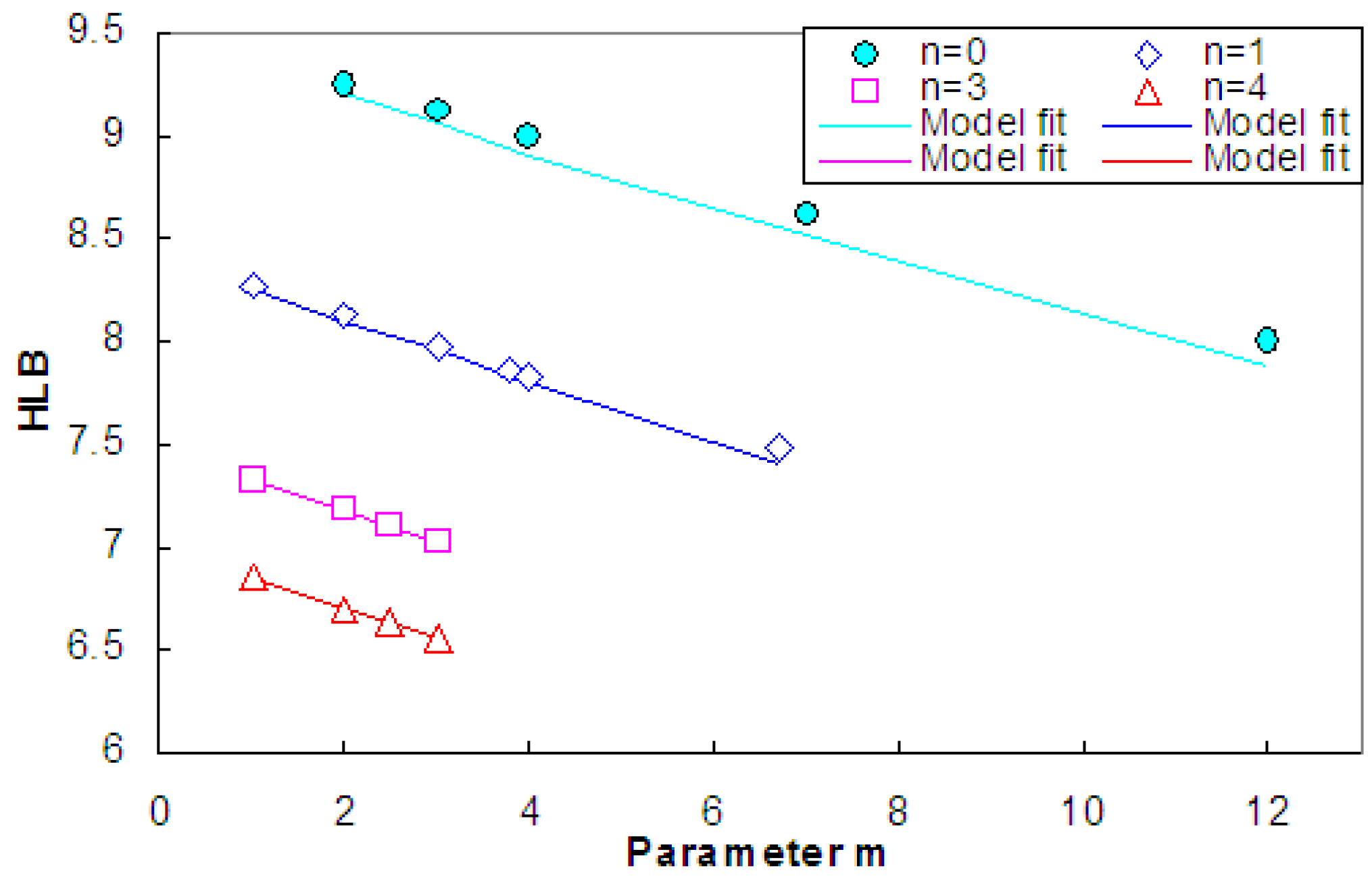
          <p><xref ref-type="fig" rid="minerals-02-00208-f010">Figure 10</xref> presents HLB values <italic>versus</italic> m, which shows simple linear relationships. Taking 0.149 as the average slope this yields:</p>
          <p><disp-formula id="minerals-02-00208-i017"><inline-graphic xmlns:xlink="http://www.w3.org/1999/xlink" xlink:href="minerals-02-00208-i017.tif"/><label>(9)</label></disp-formula></p>
          <p>where γ depends on n (see inset).</p>
          <p>The γ is then correlated to n, yielding:</p>
          <p><disp-formula id="minerals-02-00208-i018"><inline-graphic xmlns:xlink="http://www.w3.org/1999/xlink" xlink:href="minerals-02-00208-i018.tif"/><label>(10)</label></disp-formula></p>
          <p>To define the relationship between HLB and parameters m and n, Equation (8) and (9) are combined:</p>
          <p><disp-formula id="minerals-02-00208-i019"><inline-graphic xmlns:xlink="http://www.w3.org/1999/xlink" xlink:href="minerals-02-00208-i019.tif"/><label>(11)</label></disp-formula></p>
          <p>The expressions for α (Equation (7)), β (Equation (8)) and HLB (Equation (11)) are inserted into Equation (6) to obtain an overall expression for CCC95 as a function of m and n. After re-arranging and gathering terms one obtains:</p>
          <p><disp-formula id="minerals-02-00208-i020"><inline-graphic xmlns:xlink="http://www.w3.org/1999/xlink" xlink:href="minerals-02-00208-i020.tif"/><label>(12)</label></disp-formula></p>
          <p>Equation (12), while cumbersome, gives an excellent fit (<xref ref-type="fig" rid="minerals-02-00208-f011">Figure 11</xref>) for n = 1, 3 and 4 and an acceptable fit for n = 0. It is evident, therefore, that knowing m and n for Polyglycols, in essence the structure, CCC95 can be predicted.</p>
          <fig id="minerals-02-00208-f010" position="anchor">
            <label>Figure 10</label>
            <caption>
              <p>HLB for the polyglycols as function of m for a given n.</p>
            </caption>
            <graphic xmlns:xlink="http://www.w3.org/1999/xlink" xlink:href="minerals-02-00208-g010.tif"/>
          </fig>
          <fig id="minerals-02-00208-f011" position="anchor">
            <label>Figure 11</label>
            <caption>
              <p>Model (Equation (12)) fit CCC95 <italic>versus</italic> HLB data for the Polyglycols plotted as function of m for a given n.</p>
            </caption>
            <graphic xmlns:xlink="http://www.w3.org/1999/xlink" xlink:href="minerals-02-00208-g011.tif"/>
          </fig>
        </sec>
        <sec>
          <title>4.4.2. 1-Alcohols</title>
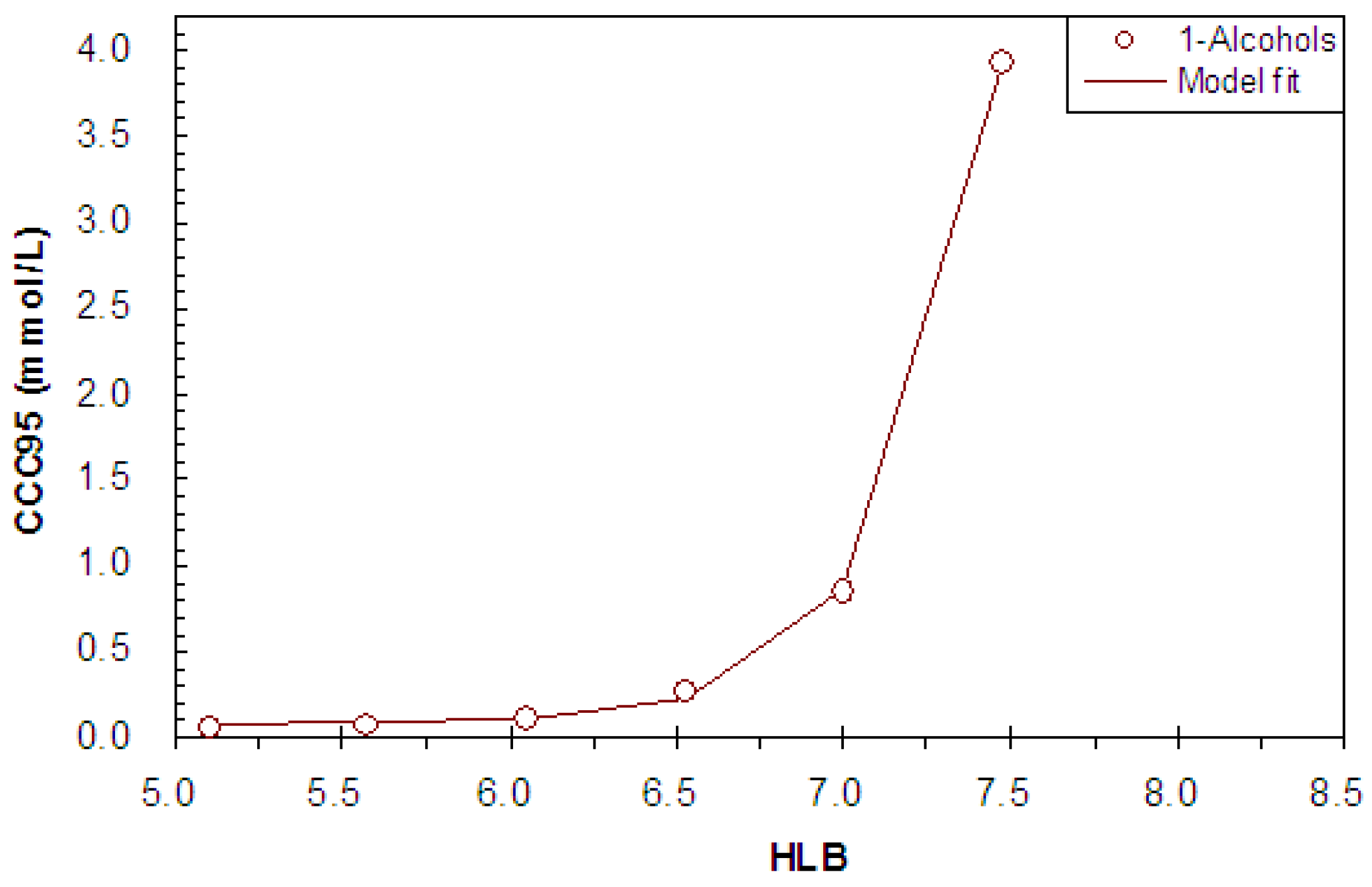
          <p>Applying the same approach as described for Polyglycols, the CCC95 for 1-Alcohols can be expressed by the general relationship:</p>
          <p><disp-formula id="minerals-02-00208-i023"><inline-graphic xmlns:xlink="http://www.w3.org/1999/xlink" xlink:href="minerals-02-00208-i023.tif"/><label>(13)</label></disp-formula></p>
          <p>The experimental data and model fit (line) are shown in <xref ref-type="fig" rid="minerals-02-00208-f012">Figure 12</xref>; it is evident that the CCC95 of 1-Alcohols can be predicted if n is known.</p>
          <fig id="minerals-02-00208-f012" position="anchor">
            <label>Figure 12</label>
            <caption>
              <p>Model (Equation (12)) fit to CCC95 <italic>versus</italic> HLB data for the 1-Alcohols. </p>
            </caption>
            <graphic xmlns:xlink="http://www.w3.org/1999/xlink" xlink:href="minerals-02-00208-g012.tif"/>
          </fig>
        </sec>
      </sec>
      <sec>
        <title>4.5. D<sub>L</sub> and HLB</title>
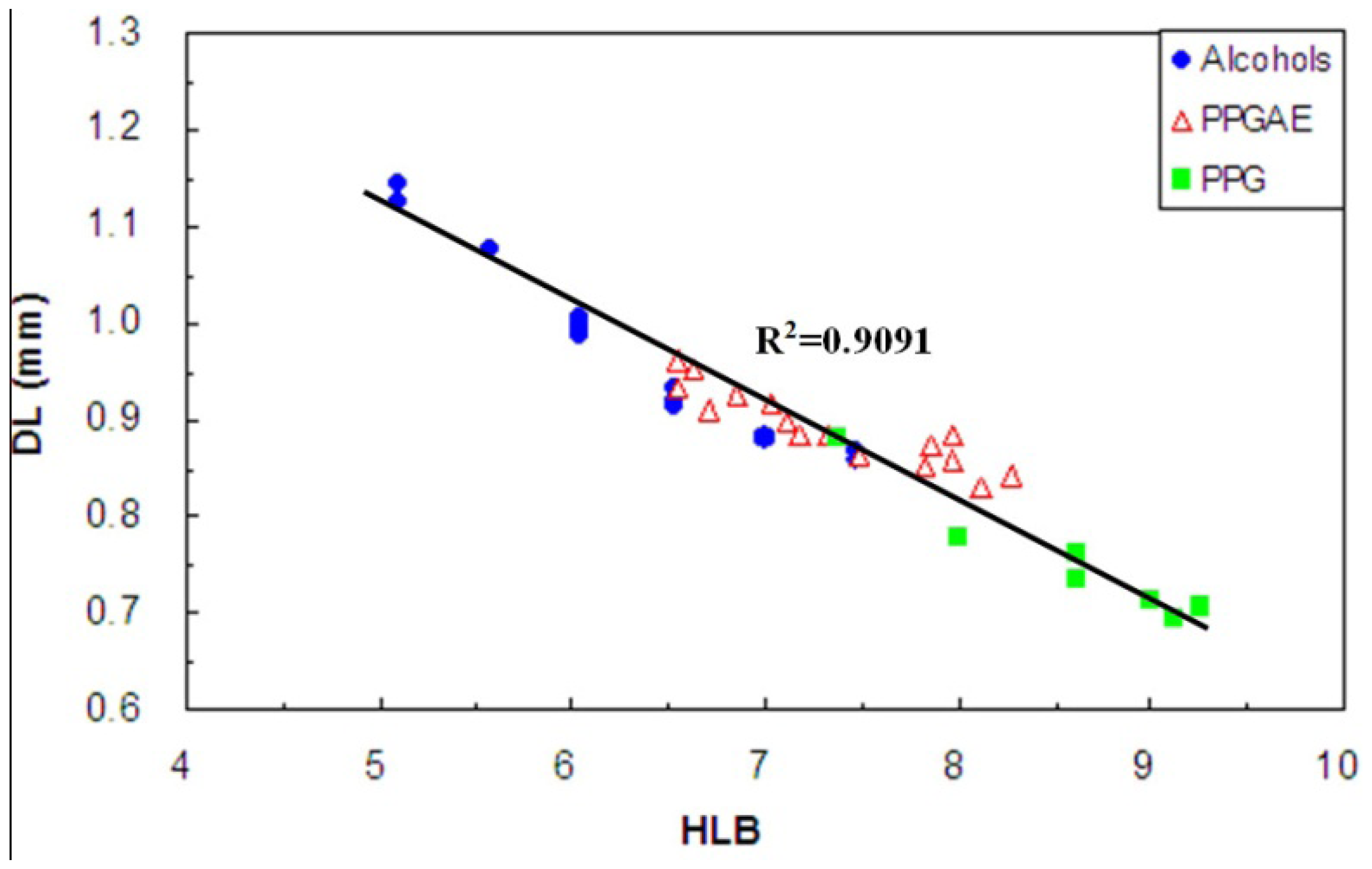
        <p>Nesset <italic>et al</italic>. [<xref ref-type="bibr" rid="B2-minerals-02-00208">2</xref>] suggested that the minimum bubble diameter (determined from the model fit, Equation (1), D<sub>L</sub>) tended to decrease as CCC95 increased, <italic>i.e.</italic>, as HLB increased. <xref ref-type="fig" rid="minerals-02-00208-f013">Figure 13</xref> expands the database and confirms this trend, showing a linear decrease in D<sub>L</sub> as HLB increases fitted by:</p>
        <p><disp-formula id="minerals-02-00208-i025"><inline-graphic xmlns:xlink="http://www.w3.org/1999/xlink" xlink:href="minerals-02-00208-i025.tif"/><label>(14)</label></disp-formula></p>
        <fig id="minerals-02-00208-f013" position="anchor">
          <label>Figure 13</label>
          <caption>
            <p>Minimum bubble size D<sub>L</sub> <italic>versus</italic> HLB for all surfactants tested: the line is the regression model, Equation (14).</p>
          </caption>
          <graphic xmlns:xlink="http://www.w3.org/1999/xlink" xlink:href="minerals-02-00208-g013.tif"/>
        </fig>
      </sec>
      <sec>
        <title>4.6. Predicting D<sub>32</sub></title>
        <p>According to Equation (2), for a given frother the D<sub>32</sub> at any concentration can be predicted knowing D<sub>L</sub>, A, b and CCC95. The b is calculated from Equation (3) and D<sub>L</sub> is determined from Equation (14), once the frother’s molecular structure is known (<italic>i.e</italic>., HLB is known). The constant A can be estimated from the difference between D<sub>0</sub> and D<sub>L</sub>. Example calculation is given using a commercial frother FX160-05 (<xref ref-type="table" rid="minerals-02-00208-t004">Table 4</xref>).</p>
        <table-wrap id="minerals-02-00208-t006" position="anchor">
          <object-id pub-id-type="pii">minerals-02-00208-t006_Table 6</object-id>
          <label>Table 6</label>
          <caption>
            <p>D<sub>32</sub> prediction for FX160-05.</p>
          </caption>
          <table>
<thead>
              <tr>
                <th colspan="2" style="border-bottom:solid thin; border-right:solid thin" align="center" valign="top">Input</th>
                <th colspan="2" style="border-bottom:solid thin" align="center" valign="top">Output</th>
    </tr>
              <tr>
                <th colspan="2" style="border-right:solid thin" align="center" valign="top">Structural info. (given)</th>
                <th colspan="2" align="center" valign="top">Bubble size related info. (calculated)</th>
    </tr>
  </thead>
            <tbody>
              <tr>
                <td align="center" valign="top">Frother type</td>
                <td align="center" valign="top" style="border-right:solid thin">Polypropylene Glycol Propyl Ether</td>
                <td align="center" valign="top">CCC95/(mmol/L)</td>
                <td align="center" valign="top">0.074</td>
              </tr>
              <tr>
                <td align="center" valign="top">n</td>
                <td style="border-right:solid thin" align="center" valign="top">3</td>
                <td align="center" valign="top">D<sub>L</sub>/mm</td>
                <td align="center" valign="top">0.90</td>
              </tr>
              <tr>
                <td align="center" valign="top">m</td>
                <td style="border-right:solid thin" align="center" valign="top">2.5</td>
                <td align="center" valign="top">b</td>
                <td align="center" valign="top">−0.20</td>
              </tr>
              <tr>
                <td align="center" valign="top">Calculated HLB</td>
                <td style="border-right:solid thin" align="center" valign="top">7.11</td>
                <td align="center" valign="top">A</td>
                <td align="center" valign="top">2.72</td>
              </tr>
            </tbody>
          </table>
        </table-wrap>
        <p>Assembling the output data from <xref ref-type="table" rid="minerals-02-00208-t006">Table 6</xref> into Equation (2), the equation to predict D<sub>32</sub> forFX 160-05 becomes:</p>
        <p><disp-formula id="minerals-02-00208-i027"><inline-graphic xmlns:xlink="http://www.w3.org/1999/xlink" xlink:href="minerals-02-00208-i027.tif"/><label>(15)</label></disp-formula></p>
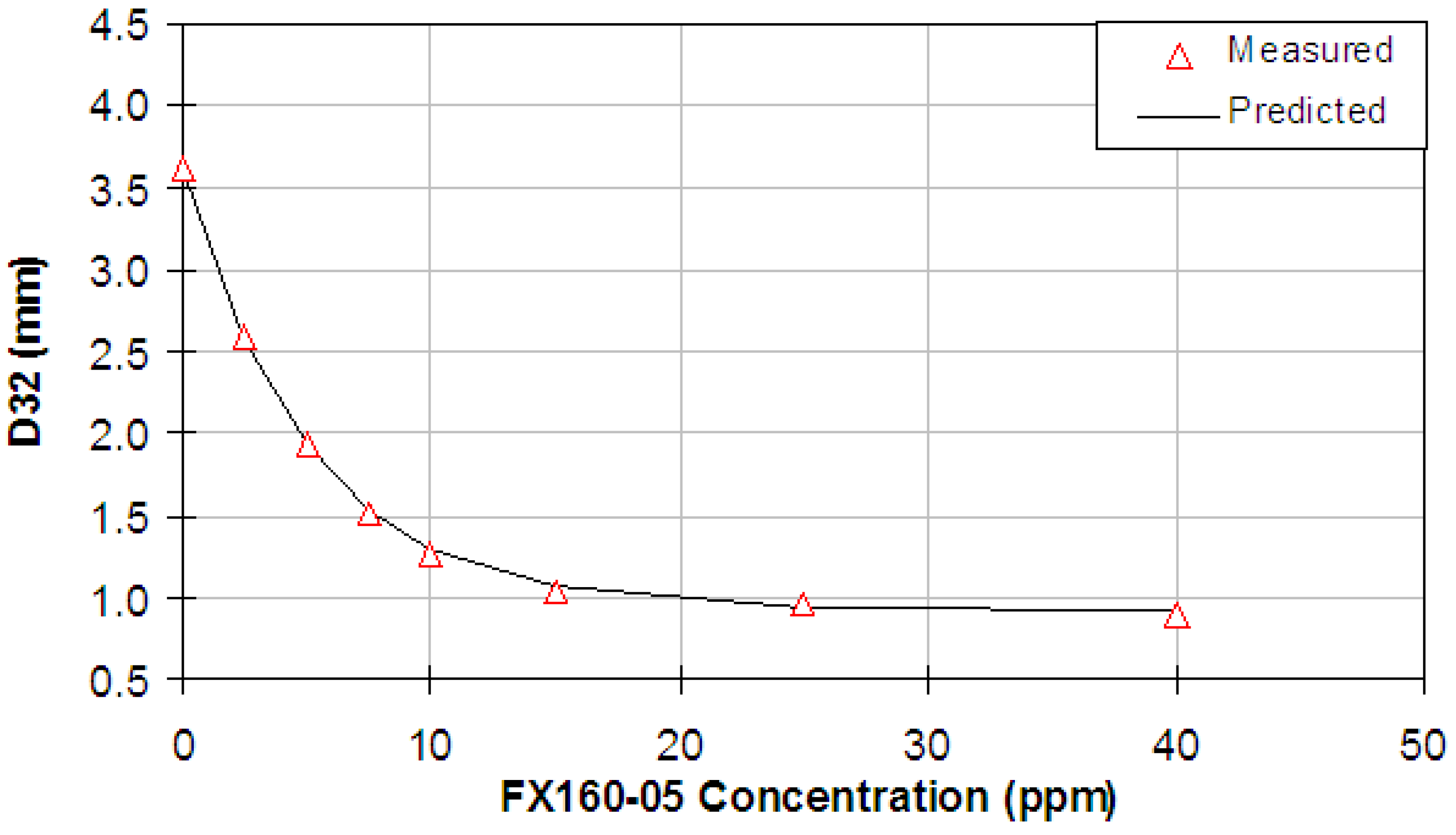
        <p><xref ref-type="fig" rid="minerals-02-00208-f014">Figure 14</xref> shows the predicted and measured D<sub>32</sub>-C trends are in excellent agreement. </p>
        <fig id="minerals-02-00208-f014" position="anchor">
          <label>Figure 14</label>
          <caption>
            <p>Comparison of measured and predicted D<sub>32</sub> <italic>versus</italic> FX160-05 frother concentration. </p>
          </caption>
          <graphic xmlns:xlink="http://www.w3.org/1999/xlink" xlink:href="minerals-02-00208-g014.tif"/>
        </fig>
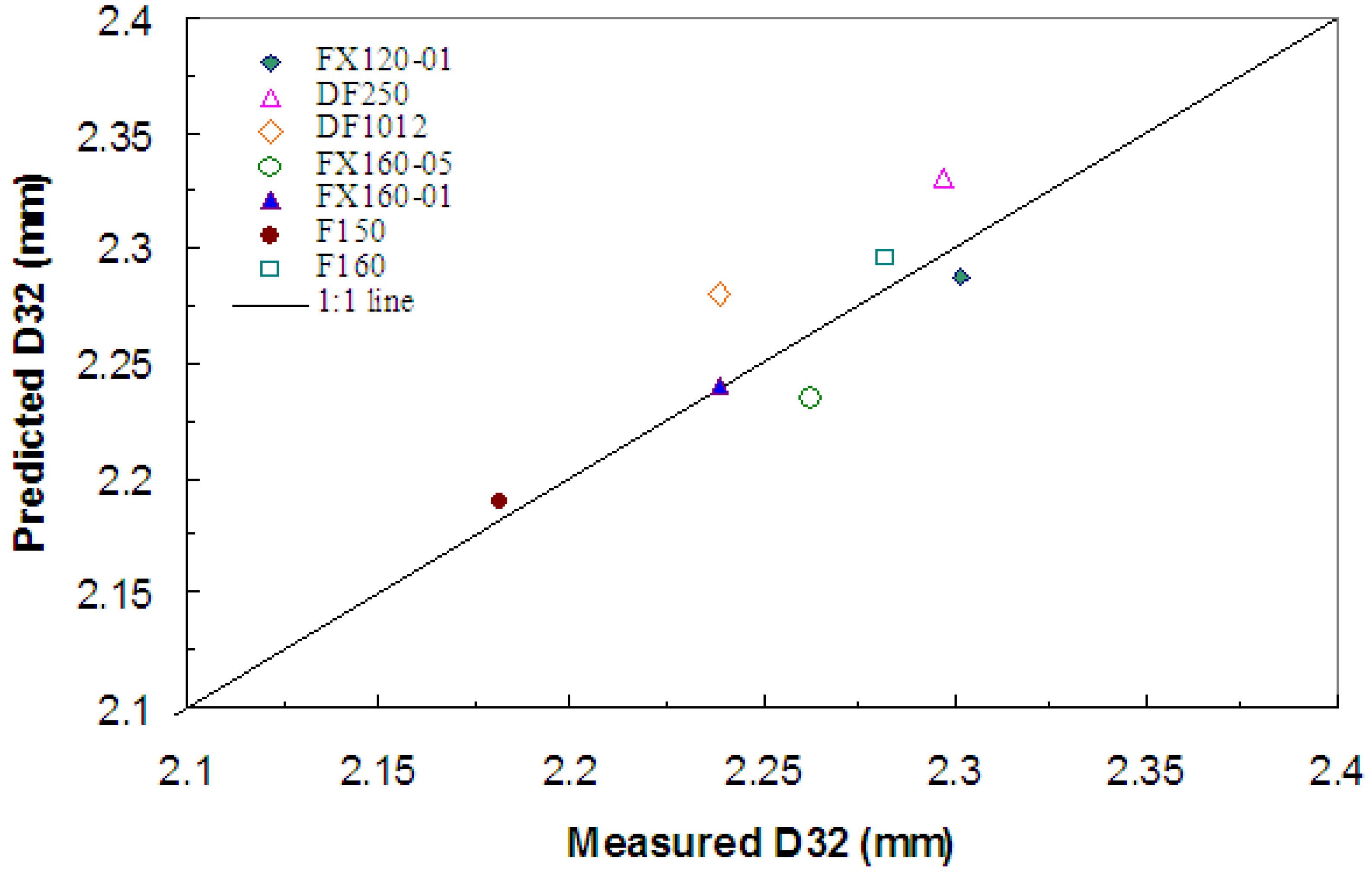
        <p>To test more than one frother we select the D<sub>32</sub> at the CCC50: <xref ref-type="fig" rid="minerals-02-00208-f015">Figure 15</xref> shows the fit obtained for all the commercial frothers examined. </p>
        <fig id="minerals-02-00208-f015" position="anchor">
          <label>Figure 15</label>
          <caption>
            <p>Comparison of measured and predicted D<sub>32</sub> at CCC50 for all commercial frothers</p>
          </caption>
          <graphic xmlns:xlink="http://www.w3.org/1999/xlink" xlink:href="minerals-02-00208-g015.tif"/>
        </fig>
      </sec>
    </sec>
    <sec sec-type="discussion">
      <title>5. Discussion</title>
      <p>In many flotation systems, frothers have the key function of controlling bubble size. Consequently understanding and predicting their action is of interest to modellers and plant operators alike. The approach here was to explore a structure-function relationship. To quantify structure HLB was used as it encompasses the hydrophilic-hydrophobic (amphipathic) character that controls adsorption at the air-water interface, which arguably is the basis for frother action. The function, bubble size reduction, was quantified through the CCC concept derived from the plot of Sauter mean diameter (D<sub>32</sub>) <italic>versus</italic> concentration (C). The D<sub>32</sub> was calculated from bubble size distribution obtained using a sampling-for-imaging technique and validated against a second, PIV-based method. The estimation of CCC95 from the 3-parameter model fit to the D<sub>32</sub> <italic>vs.</italic> C data proved reliable based on replicated tests and by showing CCC95 values were similar to published CCC data (<xref ref-type="table" rid="minerals-02-00208-t004">Table 4</xref>). The large cell volume (700 L water) permitted sufficient chamber surfactant concentration in the MBSA to avoid coalescence without contaminating the cell contents (water in the MBSA is displaced into the cell, as bubbles (air) accumulate) which improves data reliability at cell concentrations below CCC95 and thus improves the fit to Equation (1). Previous work had established that bubble size response in water-air systems translates well to three-phase flotation systems [<xref ref-type="bibr" rid="B2-minerals-02-00208">2</xref>,<xref ref-type="bibr" rid="B13-minerals-02-00208">13</xref>].</p>
      <p>Efforts along this structure-function approach by Laskowski [<xref ref-type="bibr" rid="B11-minerals-02-00208">11</xref>] and Nesset <italic>et al</italic>. [<xref ref-type="bibr" rid="B2-minerals-02-00208">2</xref>,<xref ref-type="bibr" rid="B13-minerals-02-00208">13</xref>] laid a foundation. Correlations involving molecular weight were explored in <xref ref-type="fig" rid="minerals-02-00208-f006">Figure 6</xref> and <xref ref-type="fig" rid="minerals-02-00208-f007">Figure 7</xref> but the focus was to employ HLB alone. That pursuit revealed a family-based CCC-HLB pattern, confirming the possibility entertained by Pugh [<xref ref-type="bibr" rid="B21-minerals-02-00208">21</xref>]. For the Alcohols the trend was a decrease in CCC95 as HLB was reduced by increasing the number of carbons (n), especially going from n = 3 to 6 (<xref ref-type="fig" rid="minerals-02-00208-f008">Figure 8</xref>a). Studies on inhibition of bubble coalescence by Alcohols reveal a similar trend, the concentration required decreasing with increasing n to approach a limiting value for n &gt; 6 [<xref ref-type="bibr" rid="B26-minerals-02-00208">26</xref>,<xref ref-type="bibr" rid="B27-minerals-02-00208">27</xref>]. The work here also identified an isomer effect (<xref ref-type="fig" rid="minerals-02-00208-f008">Figure 8</xref>b). Given this only becomes significant for C &lt; 5 and such alcohols are not commonly employed commercially as frothers we chose to omit the isomer effect in subsequent analysis.</p>
      <p>The pattern for Polyglycols was that CCC95 decreased as m increased in a series of self-similar plots shifting to lower HLB as n increased (<xref ref-type="fig" rid="minerals-02-00208-f009">Figure 9</xref>). Although the PPGAEs and PPGs are usually considered separate families, the pattern suggests they can be treated as one. </p>
      <p>The large database permitted development of empirical models, which well describe the results for Polyglycols (<xref ref-type="fig" rid="minerals-02-00208-f011">Figure 11</xref>) and 1-Alcohols (<xref ref-type="fig" rid="minerals-02-00208-f012">Figure 12</xref>). Thus it is possible to deduce CCC95 knowing n and m, either directly via Equations (12) (Polyglycols) and (13) (1-Alcohols) or from HLB via Equation (6) and <xref ref-type="table" rid="minerals-02-00208-t005">Table 5</xref>. Either approach represents a significant step towards a structure-based prediction of the impact of frother on bubble size in flotation machines which was illustrated for the commercial frothers. </p>
      <p>At present the prediction relates directly to mechanical flotation cells. The correlations are derived for one impeller speed and one air superficial velocity, J<sub>g</sub>. As reported by Nesset <italic>et al.</italic> [<xref ref-type="bibr" rid="B13-minerals-02-00208">13</xref>] impeller speed over the range from 3 to 9 m/s, covering the normal operating range, has no effect on D<sub>32</sub> and their correlation of D<sub>32 </sub>with J<sub>g</sub> means, in principle, the predictions can be extended to other air velocities. For other flotation machines the same trends found here will most likely apply. Future work may see a relationship between CCC and machine type enabling the present results to be generalized.</p>
      <p>In flotation practice there are reagents other than frother that could influence bubble size. Collectors in sulphide flotation probably have little effect but amines and fatty acids used in non-sulphide systems may contribute to bubble size reduction. High concentrations of some salts likewise can reduce bubble size. The most important starting point in addressing chemical control of bubble size, however, is the frother. </p>
      <p>There are some objections to using the Davies definition of HLB and the group numbers assigned. The results for Alcohol isomers where HLB is constant show there is an effect on CCC95 as the OH position changes, especially as chain length (n) decreases. An argument can be advanced that the OH group number should reflect its position in the molecule. Likewise, the unique number for all CH groups can be questioned. With a sufficient database perhaps new empirical group numbers could be deduced that apply to prediction of CCC95. There are precedents for such modifications [<xref ref-type="bibr" rid="B28-minerals-02-00208">28</xref>,<xref ref-type="bibr" rid="B29-minerals-02-00208">29</xref>,<xref ref-type="bibr" rid="B30-minerals-02-00208">30</xref>,<xref ref-type="bibr" rid="B31-minerals-02-00208">31</xref>,<xref ref-type="bibr" rid="B32-minerals-02-00208">32</xref>,<xref ref-type="bibr" rid="B33-minerals-02-00208">33</xref>].</p>
      <p>There are alternatives to HLB. We are exploring the use of nuclear magnetic resonance (NMR) spectroscopy to determine the H-ratio to substitute for HLB [<xref ref-type="bibr" rid="B34-minerals-02-00208">34</xref>]. The NMR spectrum also provides structural information, <italic>i.e.</italic>, helps identify the family which is a necessary first step in applying the correlations reported here to commercial frothers. The use of NMR will be addressed in a future paper.</p>
      <p>While the emphasis was CCC95 it became evident that the minimum Sauter mean bubble size (D<sub>L</sub>) is not constant but decreases as HLB increases. One consequence is that the unique trend normalized by C/CCC95 is compromised. Thus in the prediction of D<sub>32</sub> we need to estimate the A, b values, as the example illustrated. A practical aspect of the finding is that unless there is a specific reason otherwise it is usually desirable to have the minimum bubble size in flotation to achieve maximum bubble surface area flux (S<sub>b</sub>), and, hence, flotation kinetics. From the work here a finer minimum bubble size (D<sub>L</sub>) can be achieved by selecting a surfactant of higher HLB which may be worth considering for increasing recovery kinetics especially of fine particles. The observation also raises a fundamental question. The CCC concept implies frother is involved only in preserving the bubble size produced by the machine; <italic>i.e</italic>., the machine produces, frother preserves hypothesis [<xref ref-type="bibr" rid="B10-minerals-02-00208">10</xref>,<xref ref-type="bibr" rid="B35-minerals-02-00208">35</xref>]. This argument means that D<sub>L</sub> is the machine-produced Sauter mean size and might be expected to be invariant for given machine operating conditions but <xref ref-type="fig" rid="minerals-02-00208-f013">Figure 13</xref> argues that frothers play some role in the initial bubble creation size. There seem to be three possibilities: bubbles produced are finer than D<sub>L</sub> and the different frothers control coalescence to a different extent to reach different D<sub>L</sub>; frother affects breakup of the air mass; or frother affects breakup of bubbles circulated through the impeller. </p>
    </sec>
    <sec sec-type="conclusions">
      <title>6. Conclusions</title>
      <p>A structure-function approach to characterizing frothers is explored using hydrophile-lipophile balance (HLB) to represent chemical structure and critical coalescence concentration (CCC95) to represent the bubble size reduction function. The tests were conducted in a 0.8 m<sup>3</sup> mechanical cell on 36 pure surfactants and commercial frothers of the Aliphatic Alcohol, and Polypropylene Glycol Alkyl Ether and Polypropylene Glycol (Polyglycol) families. The result was a series of self-similar CCC95-HLB trends dependent on n (number of C-atoms in alkyl group) and m (number of Propylene Oxide groups). The Alcohol data also showed an isomer effect at <italic>n</italic> &lt; 5. Empirical models were developed for the Polyglycols and 1-Alcohols showing that CCC95 could be predicted knowing n and m, <italic>i.e</italic>., knowing the structure. Application of the model to predict Sauter mean bubble size is illustrated. </p>
    </sec>
  </body>
  <back>
    <ack>
      <title>Acknowledgements</title>
      <p>The authors thank Kinnor Chattopadhyay, Luis Calzado and Donghui Li for their assistance in the PIV experiments. The work was funded through the Chair in Mineral Processing sponsored by Vale, Teck Resources, Barrick Gold, Xstrata Process Support, Shell Canada, SGS Lakefield, COREM and Flottec, and through the Amira International P9O project, both under the NSERC (Natural Sciences and Engineering Research Council of Canada) CRD (Collaborative Research and Development) program.</p>
    </ack>
    <ref-list>
      <title>References</title>
      <ref id="B1-minerals-02-00208">
        <label>1.</label>
        <citation citation-type="book">
          <person-group person-group-type="author">
            <name>
              <surname>Rao</surname>
              <given-names>S.R.</given-names>
            </name>
            <name>
              <surname>Leja</surname>
              <given-names>J.</given-names>
            </name>
          </person-group>
          <source>Surface Chemistry of Froth Flotation</source>
          <edition>2nd</edition>
          <publisher-name>Kluwer Academic Publication</publisher-name>
          <publisher-loc>New York, NY, USA</publisher-loc>
          <year>2004</year>
        </citation>
      </ref>
      <ref id="B2-minerals-02-00208">
        <label>2.</label>
        <citation citation-type="confproc">
          <person-group person-group-type="author">
            <name>
              <surname>Nesset</surname>
              <given-names>J.E.</given-names>
            </name>
            <name>
              <surname>Finch</surname>
              <given-names>J.A.</given-names>
            </name>
            <name>
              <surname>Gomez</surname>
              <given-names>C.O.</given-names>
            </name>
          </person-group>
          <article-title>Operating variables affecting bubble size in force-air mechanical flotation machines</article-title>
          <source>Proceeding of the 9th Mill Operators Conference</source>
          <conf-loc>Fremantle, Australia</conf-loc>
          <conf-date>19-21 March 2007</conf-date>
          <fpage>55</fpage>
          <lpage>65</lpage>
        </citation>
      </ref>
      <ref id="B3-minerals-02-00208">
        <label>3.</label>
        <citation citation-type="journal">
          <person-group person-group-type="author">
            <name>
              <surname>Gorain</surname>
              <given-names>B.K.</given-names>
            </name>
            <name>
              <surname>Franzidis</surname>
              <given-names>J.P.</given-names>
            </name>
            <name>
              <surname>Manlapig</surname>
              <given-names>E.V.</given-names>
            </name>
          </person-group>
          <article-title>Studies on impeller type, impeller speed and air flow rate in an industrial scale flotation cell. Part 4: Effect of bubble surface area flux on flotation performance</article-title>
          <source>Miner. Eng.</source>
          <year>1997</year>
          <volume>10</volume>
          <fpage>367</fpage>
          <lpage>379</lpage>
          <pub-id pub-id-type="doi">10.1016/S0892-6875(97)00014-9</pub-id>
        </citation>
      </ref>
      <ref id="B4-minerals-02-00208">
        <label>4.</label>
        <citation citation-type="journal">
          <person-group person-group-type="author">
            <name>
              <surname>Gorain</surname>
              <given-names>B.K.</given-names>
            </name>
            <name>
              <surname>Napier-Munn</surname>
              <given-names>T.J.</given-names>
            </name>
            <name>
              <surname>Franzidis</surname>
              <given-names>J.P.</given-names>
            </name>
            <name>
              <surname>Manlapig</surname>
              <given-names>E.V.</given-names>
            </name>
          </person-group>
          <article-title>Studies on impeller type, impeller speed and air flow rate in an industrial scale flotation cell. Part 5: Validation of the k-Sb relationship and effect of froth depth</article-title>
          <source>Miner. Eng.</source>
          <year>1998</year>
          <volume>11</volume>
          <fpage>615</fpage>
          <lpage>626</lpage>
          <pub-id pub-id-type="doi">10.1016/S0892-6875(98)00046-6</pub-id>
        </citation>
      </ref>
      <ref id="B5-minerals-02-00208">
        <label>5.</label>
        <citation citation-type="confproc">
          <person-group person-group-type="author">
            <name>
              <surname>Harris</surname>
              <given-names>M.C.</given-names>
            </name>
            <name>
              <surname>Runge</surname>
              <given-names>K.C.</given-names>
            </name>
            <name>
              <surname>Whiten</surname>
              <given-names>W.J.</given-names>
            </name>
            <name>
              <surname>Morrison</surname>
              <given-names>R.D.</given-names>
            </name>
          </person-group>
          <article-title>JKSimFloat as a practical tool for flotation process design and optimization</article-title>
          <source>Proceedings of the Mineral Processing Plant Design Practice and Control Conference</source>
          <person-group person-group-type="editor">
            <name>
              <surname>Mular</surname>
              <given-names>A.L.</given-names>
            </name>
            <name>
              <surname>Halbe</surname>
              <given-names>D.N.</given-names>
            </name>
            <name>
              <surname>Barratt</surname>
              <given-names>D.L.</given-names>
            </name>
          </person-group>
          <publisher-name>Society for Mining Metallurgy &amp; Exploration</publisher-name>
          <publisher-loc>New York, NY, USA</publisher-loc>
          <conf-loc>BC, Canada</conf-loc>
          <conf-date>20-24 October 2002</conf-date>
          <year>2002</year>
          <fpage>461</fpage>
          <lpage>478</lpage>
        </citation>
      </ref>
      <ref id="B6-minerals-02-00208">
        <label>6.</label>
        <citation citation-type="journal">
          <person-group person-group-type="author">
            <name>
              <surname>Yoon</surname>
              <given-names>R.H.</given-names>
            </name>
          </person-group>
          <article-title>Microbubble flotation</article-title>
          <source>Miner. Eng.</source>
          <year>1993</year>
          <volume>6</volume>
          <fpage>619</fpage>
          <lpage>630</lpage>
          <pub-id pub-id-type="doi">10.1016/0892-6875(93)90116-5</pub-id>
        </citation>
      </ref>
      <ref id="B7-minerals-02-00208">
        <label>7.</label>
        <citation citation-type="journal">
          <person-group person-group-type="author">
            <name>
              <surname>Hernandez-Aguilar</surname>
              <given-names>J.R.</given-names>
            </name>
            <name>
              <surname>Basi</surname>
              <given-names>J.</given-names>
            </name>
            <name>
              <surname>Finch</surname>
              <given-names>J.A.</given-names>
            </name>
          </person-group>
          <article-title>Improving column flotation operation in a copper/molybdenum separation circuit</article-title>
          <source>CIM J.</source>
          <year>2010</year>
          <volume>1</volume>
          <fpage>165</fpage>
          <lpage>175</lpage>
          <issue>3</issue>
        </citation>
      </ref>
      <ref id="B8-minerals-02-00208">
        <label>8.</label>
        <citation citation-type="journal">
          <person-group person-group-type="author">
            <name>
              <surname>Finch</surname>
              <given-names>J.A.</given-names>
            </name>
            <name>
              <surname>Dobby</surname>
              <given-names>G.S.</given-names>
            </name>
          </person-group>
          <article-title>Column flotation—A selected review</article-title>
          <source>Part 1. Int. J. Miner. Proc.</source>
          <year>1991</year>
          <volume>33</volume>
          <fpage>343</fpage>
          <lpage>354</lpage>
        </citation>
      </ref>
      <ref id="B9-minerals-02-00208">
        <label>9.</label>
        <citation citation-type="book">
          <person-group person-group-type="author">
            <name>
              <surname>Harris</surname>
              <given-names>C.C.</given-names>
            </name>
          </person-group>
          <article-title>Flotation machines</article-title>
          <source>Flotation, A.M. Gaudin Memorial Volume</source>
          <person-group person-group-type="editor">
            <name>
              <surname>Fuerstenau</surname>
              <given-names>M.C.</given-names>
            </name>
          </person-group>
          <publisher-name>AM Gaudin Memorial Volume AIME</publisher-name>
          <publisher-loc>New York, NY, USA</publisher-loc>
          <year>1976</year>
          <volume>2</volume>
          <fpage>753</fpage>
          <lpage>815</lpage>
        </citation>
      </ref>
      <ref id="B10-minerals-02-00208">
        <label>10.</label>
        <citation citation-type="journal">
          <person-group person-group-type="author">
            <name>
              <surname>Cho</surname>
              <given-names>Y.S.</given-names>
            </name>
            <name>
              <surname>Laskowski</surname>
              <given-names>J.S.</given-names>
            </name>
          </person-group>
          <article-title>Effect of flotation frothers on bubble size and foam Stability</article-title>
          <source>Int. J. Miner. Process.</source>
          <year>2002</year>
          <volume>64</volume>
          <fpage>69</fpage>
          <lpage>80</lpage>
          <issue>2-3</issue>
          <pub-id pub-id-type="doi">10.1016/S0301-7516(01)00064-3</pub-id>
        </citation>
      </ref>
      <ref id="B11-minerals-02-00208">
        <label>11.</label>
        <citation citation-type="confproc">
          <person-group person-group-type="author">
            <name>
              <surname>Laskowski</surname>
              <given-names>J.S.</given-names>
            </name>
          </person-group>
          <article-title>Fundamental properties of flotation frothers</article-title>
          <source>Proceedings of the 22nd International Mineral Processing Congress</source>
          <conf-loc>Cape Town, South Africa</conf-loc>
          <conf-date>28 September-3 October 2003</conf-date>
          <fpage>788</fpage>
          <lpage>797</lpage>
        </citation>
      </ref>
      <ref id="B12-minerals-02-00208">
        <label>12.</label>
        <citation citation-type="journal">
          <person-group person-group-type="author">
            <name>
              <surname>Grau</surname>
              <given-names>R.A.</given-names>
            </name>
            <name>
              <surname>Laskowski</surname>
              <given-names>J.S.</given-names>
            </name>
            <name>
              <surname>Heiskanen</surname>
              <given-names>K.</given-names>
            </name>
          </person-group>
          <article-title>Effect of frothers on bubble size</article-title>
          <source>Int. J. Miner. Process.</source>
          <year>2005</year>
          <volume>76</volume>
          <fpage>225</fpage>
          <lpage>233</lpage>
          <pub-id pub-id-type="doi">10.1016/j.minpro.2005.01.004</pub-id>
        </citation>
      </ref>
      <ref id="B13-minerals-02-00208">
        <label>13.</label>
        <citation citation-type="confproc">
          <person-group person-group-type="author">
            <name>
              <surname>Nesset</surname>
              <given-names>J.E.</given-names>
            </name>
            <name>
              <surname>Zhang</surname>
              <given-names>W.</given-names>
            </name>
            <name>
              <surname>Finch</surname>
              <given-names>J.A.</given-names>
            </name>
          </person-group>
          <article-title>A benchmarking tool for assessing flotation cell performance</article-title>
          <source>Proceedings of 2012—44th Annual Meeting of the Canadian Mineral Processors (CIM)</source>
          <conf-loc>Ottawa, Canada</conf-loc>
          <conf-date>17-19 January 2012</conf-date>
          <fpage>183</fpage>
          <lpage>209</lpage>
        </citation>
      </ref>
      <ref id="B14-minerals-02-00208">
        <label>14.</label>
        <citation citation-type="journal">
          <person-group person-group-type="author">
            <name>
              <surname>Griffin</surname>
              <given-names>W.C.</given-names>
            </name>
          </person-group>
          <article-title>Classification of surface-active agents by HLB</article-title>
          <source>J. Cosmet. Chem.</source>
          <year>1949</year>
          <volume>1</volume>
          <fpage>311</fpage>
          <lpage>326</lpage>
        </citation>
      </ref>
      <ref id="B15-minerals-02-00208">
        <label>15.</label>
        <citation citation-type="confproc">
          <person-group person-group-type="author">
            <name>
              <surname>Davies</surname>
              <given-names>J.T.</given-names>
            </name>
          </person-group>
          <article-title>De door Davies toegekende HLB-groepswaarden zijn gebaseerd op een klein aantal experimenteel bepaalde HLB-waarden en daardoor beperkt toepasbaar. Het feit dat de groepswaarden toch veelvuldig gebruikt worden,wijst op een duidelijke behoefte om emulsiesl.abili telt te kunnen vooi—Spellen op basis van de chemische structuur van de emulgator. In</article-title>
          <source>Proceeding of 2nd International Congress on Surface Activity</source>
          <conf-loc>London, UK</conf-loc>
          <conf-date>1957</conf-date>
          <volume>1</volume>
          <fpage>426</fpage>
        </citation>
      </ref>
      <ref id="B16-minerals-02-00208">
        <label>16.</label>
        <citation citation-type="book">
          <person-group person-group-type="author">
            <name>
              <surname>Mittal</surname>
              <given-names>K.L.</given-names>
            </name>
            <name>
              <surname>Lindman</surname>
              <given-names>B.</given-names>
            </name>
          </person-group>
          <source>Surfactants in Solution</source>
          <publisher-name>Plenum Press</publisher-name>
          <publisher-loc>New York, NY, USA</publisher-loc>
          <year>1984</year>
          <volume>3</volume>
          <fpage>1925</fpage>
        </citation>
      </ref>
      <ref id="B17-minerals-02-00208">
        <label>17.</label>
        <citation citation-type="journal">
          <person-group person-group-type="author">
            <name>
              <surname>Proverbio</surname>
              <given-names>Z.E.</given-names>
            </name>
            <name>
              <surname>Bardavid</surname>
              <given-names>S.M.</given-names>
            </name>
            <name>
              <surname>Arancibia</surname>
              <given-names>E.L.</given-names>
            </name>
            <name>
              <surname>Schulz</surname>
              <given-names>P.C.</given-names>
            </name>
          </person-group>
          <article-title>Hydrophile-lipophile balance and solubility parameter of cationic surfactants</article-title>
          <source>Colloid. Surface. A</source>
          <year>2003</year>
          <volume>214</volume>
          <fpage>167</fpage>
          <lpage>171</lpage>
          <pub-id pub-id-type="doi">10.1016/S0927-7757(02)00404-1</pub-id>
        </citation>
      </ref>
      <ref id="B18-minerals-02-00208">
        <label>18.</label>
        <citation citation-type="journal">
          <person-group person-group-type="author">
            <name>
              <surname>Wu</surname>
              <given-names>J.Y.</given-names>
            </name>
            <name>
              <surname>Xu</surname>
              <given-names>Y.M.</given-names>
            </name>
            <name>
              <surname>Dabros</surname>
              <given-names>T.</given-names>
            </name>
            <name>
              <surname>Hamza</surname>
              <given-names>H.</given-names>
            </name>
          </person-group>
          <article-title>Development of a method for measurement of relative solubility of nonionic surfactants</article-title>
          <source>Colloid. Surface. A</source>
          <year>2004</year>
          <volume>232</volume>
          <fpage>229</fpage>
          <lpage>137</lpage>
          <pub-id pub-id-type="doi">10.1016/j.colsurfa.2003.10.028</pub-id>
        </citation>
      </ref>
      <ref id="B19-minerals-02-00208">
        <label>19.</label>
        <citation citation-type="book">
          <person-group person-group-type="author">
            <name>
              <surname>Davies</surname>
              <given-names>J.T.</given-names>
            </name>
            <name>
              <surname>Rideal</surname>
              <given-names>E.K.</given-names>
            </name>
          </person-group>
          <source>Interfacial Phenomena</source>
          <publisher-name>Academic Press</publisher-name>
          <publisher-loc>New York, NY, USA</publisher-loc>
          <year>1961</year>
          <fpage>371</fpage>
        </citation>
      </ref>
      <ref id="B20-minerals-02-00208">
        <label>20.</label>
        <citation citation-type="book">
          <person-group person-group-type="author">
            <name>
              <surname>Tanaka</surname>
              <given-names>K.</given-names>
            </name>
            <name>
              <surname>Igarashi</surname>
              <given-names>A.</given-names>
            </name>
          </person-group>
          <article-title>Determination of nonionic surfactants</article-title>
          <source>Handbook of Detergents Part C: Analysis</source>
          <person-group person-group-type="editor">
            <name>
              <surname>Waldhoff</surname>
              <given-names>H.</given-names>
            </name>
            <name>
              <surname>Spilker</surname>
              <given-names>R.</given-names>
            </name>
          </person-group>
          <publisher-name>CRC Press</publisher-name>
          <publisher-loc>Boca Raton, FL, USA</publisher-loc>
          <year>2005</year>
          <fpage>149</fpage>
          <lpage>214</lpage>
        </citation>
      </ref>
      <ref id="B21-minerals-02-00208">
        <label>21.</label>
        <citation citation-type="book">
          <person-group person-group-type="author">
            <name>
              <surname>Pugh</surname>
              <given-names>R.J.</given-names>
            </name>
          </person-group>
          <article-title>The physics and chemistry of frothers</article-title>
          <source>Froth Flotation:A Century of Innovation</source>
          <person-group person-group-type="editor">
            <name>
              <surname>Fuerstenau</surname>
              <given-names>M.C.</given-names>
            </name>
            <name>
              <surname>Jameson</surname>
              <given-names>G.</given-names>
            </name>
            <name>
              <surname>Yoon</surname>
              <given-names>R.H.</given-names>
            </name>
          </person-group>
          <publisher-name>SME</publisher-name>
          <publisher-loc>Englewood, CO, USA</publisher-loc>
          <year>2007</year>
          <fpage>259</fpage>
          <lpage>281</lpage>
        </citation>
      </ref>
      <ref id="B22-minerals-02-00208">
        <label>22.</label>
        <citation citation-type="confproc">
          <person-group person-group-type="author">
            <name>
              <surname>Hernandez-Aguilar</surname>
              <given-names>J.R.</given-names>
            </name>
            <name>
              <surname>Gomez</surname>
              <given-names>C.O.</given-names>
            </name>
            <name>
              <surname>Finch</surname>
              <given-names>J.A.</given-names>
            </name>
          </person-group>
          <article-title>A technique for the direct measurement of bubble size distribution in industrial flotation cells</article-title>
          <source>Proceedings of 2002—34th Annual Meeting of the Canadian Mineral Processors (CIM)</source>
          <conf-loc>Ottawa, Canada</conf-loc>
          <conf-date>22-24 January 2002</conf-date>
          <fpage>389</fpage>
          <lpage>402</lpage>
        </citation>
      </ref>
      <ref id="B23-minerals-02-00208">
        <label>23.</label>
        <citation citation-type="journal">
          <person-group person-group-type="author">
            <name>
              <surname>Gomez</surname>
              <given-names>C.O.</given-names>
            </name>
            <name>
              <surname>Finch</surname>
              <given-names>J.A.</given-names>
            </name>
          </person-group>
          <article-title>Gas dispersion measurements in flotation cells</article-title>
          <source>Int. J. Miner. Process.</source>
          <year>2007</year>
          <volume>84</volume>
          <fpage>51</fpage>
          <lpage>58</lpage>
          <pub-id pub-id-type="doi">10.1016/j.minpro.2007.03.009</pub-id>
        </citation>
      </ref>
      <ref id="B24-minerals-02-00208">
        <label>24.</label>
        <citation citation-type="journal">
          <person-group person-group-type="author">
            <name>
              <surname>Zhang</surname>
              <given-names>W.</given-names>
            </name>
            <name>
              <surname>Kolahdoozan</surname>
              <given-names>M.</given-names>
            </name>
            <name>
              <surname>Nesset</surname>
              <given-names>J.E.</given-names>
            </name>
            <name>
              <surname>Finch</surname>
              <given-names>J.A.</given-names>
            </name>
          </person-group>
          <article-title>Use of frother with sampling-for-imaging bubble sizing technique</article-title>
          <source>Miner. Eng.</source>
          <year>2009</year>
          <volume>22</volume>
          <fpage>513</fpage>
          <lpage>515</lpage>
          <pub-id pub-id-type="doi">10.1016/j.mineng.2008.11.004</pub-id>
        </citation>
      </ref>
      <ref id="B25-minerals-02-00208">
        <label>25.</label>
        <citation citation-type="journal">
          <person-group person-group-type="author">
            <name>
              <surname>Grau</surname>
              <given-names>R.A.</given-names>
            </name>
            <name>
              <surname>Laskowski</surname>
              <given-names>J.S.</given-names>
            </name>
          </person-group>
          <article-title>Role of frothers in bubble generation and coalescence in a mechanical flotation cell</article-title>
          <source>Can. J. Chem. Eng.</source>
          <year>2006</year>
          <volume>84</volume>
          <fpage>170</fpage>
          <lpage>182</lpage>
        </citation>
      </ref>
      <ref id="B26-minerals-02-00208">
        <label>26.</label>
        <citation citation-type="journal">
          <person-group person-group-type="author">
            <name>
              <surname>Keitel</surname>
              <given-names>G.</given-names>
            </name>
            <name>
              <surname>Onken</surname>
              <given-names>U.</given-names>
            </name>
          </person-group>
          <article-title>Inhibition of bubble coalescence by solutes in air/water dispersions</article-title>
          <source>Chem. Eng. Sci.</source>
          <year>1982</year>
          <volume>37</volume>
          <fpage>1635</fpage>
          <lpage>1638</lpage>
          <pub-id pub-id-type="doi">10.1016/0009-2509(82)80033-X</pub-id>
        </citation>
      </ref>
      <ref id="B27-minerals-02-00208">
        <label>27.</label>
        <citation citation-type="journal">
          <person-group person-group-type="author">
            <name>
              <surname>Drogaris</surname>
              <given-names>G.</given-names>
            </name>
            <name>
              <surname>Weiland</surname>
              <given-names>P.</given-names>
            </name>
          </person-group>
          <article-title>Coalescence behaviour of gas bubbles in aqueous solutions of n-alcohols and fatty acids</article-title>
          <source>Chem. Eng. Sci.</source>
          <year>1983</year>
          <volume>38</volume>
          <fpage>1501</fpage>
          <lpage>1506</lpage>
          <pub-id pub-id-type="doi">10.1016/0009-2509(83)80085-2</pub-id>
        </citation>
      </ref>
      <ref id="B28-minerals-02-00208">
        <label>28.</label>
        <citation citation-type="journal">
          <person-group person-group-type="author">
            <name>
              <surname>Lin</surname>
              <given-names>I.J.</given-names>
            </name>
            <name>
              <surname>Somasundaran</surname>
              <given-names>P.</given-names>
            </name>
          </person-group>
          <article-title>Free energy changes on transfer of surface active agents between various colloidal and interfacial states</article-title>
          <source>J.Colloid Interface Sci.</source>
          <year>1971</year>
          <volume>37</volume>
          <fpage>731</fpage>
          <lpage>743</lpage>
          <pub-id pub-id-type="doi">10.1016/0021-9797(71)90352-3</pub-id>
        </citation>
      </ref>
      <ref id="B29-minerals-02-00208">
        <label>29.</label>
        <citation citation-type="journal">
          <person-group person-group-type="author">
            <name>
              <surname>Lin</surname>
              <given-names>I.J.</given-names>
            </name>
            <name>
              <surname>Friend</surname>
              <given-names>J.P.</given-names>
            </name>
            <name>
              <surname>Zimmels</surname>
              <given-names>Y.</given-names>
            </name>
          </person-group>
          <article-title>The effect of structural modification on the hydrophile-lipophile balance of ionic surfactants</article-title>
          <source>J. Colloid Interface Sci.</source>
          <year>1973</year>
          <volume>45</volume>
          <fpage>378</fpage>
          <lpage>385</lpage>
          <pub-id pub-id-type="doi">10.1016/0021-9797(73)90275-0</pub-id>
        </citation>
      </ref>
      <ref id="B30-minerals-02-00208">
        <label>30.</label>
        <citation citation-type="journal">
          <person-group person-group-type="author">
            <name>
              <surname>Lin</surname>
              <given-names>I.J.</given-names>
            </name>
            <name>
              <surname>Marszall</surname>
              <given-names>L.</given-names>
            </name>
          </person-group>
          <article-title>CMC, HLB, and effective chain length of surface-active anionic and cationic substances containing oxyethylene groups</article-title>
          <source>J. Colloid Interface Sci.</source>
          <year>1976</year>
          <volume>57</volume>
          <fpage>85</fpage>
          <lpage>93</lpage>
          <pub-id pub-id-type="doi">10.1016/0021-9797(76)90178-8</pub-id>
        </citation>
      </ref>
      <ref id="B31-minerals-02-00208">
        <label>31.</label>
        <citation citation-type="book">
          <person-group person-group-type="author">
            <name>
              <surname>Lin</surname>
              <given-names>I.J.</given-names>
            </name>
          </person-group>
          <source>Colloid and Interface Science</source>
          <person-group person-group-type="editor">
            <name>
              <surname>Kevker</surname>
              <given-names>M.</given-names>
            </name>
          </person-group>
          <publisher-name>Academic Press</publisher-name>
          <publisher-loc>New York, NY, USA</publisher-loc>
          <year>1976</year>
          <volume>2</volume>
          <fpage>431</fpage>
        </citation>
      </ref>
      <ref id="B32-minerals-02-00208">
        <label>32.</label>
        <citation citation-type="journal">
          <person-group person-group-type="author">
            <name>
              <surname>McGowan</surname>
              <given-names>J.C.</given-names>
            </name>
          </person-group>
          <article-title>A new approach for the calculation of hydrophile-lipophile balance values of surfactants</article-title>
          <source>Tenside Surfactants Deterg.</source>
          <year>1990</year>
          <volume>27</volume>
          <fpage>229</fpage>
          <lpage>230</lpage>
        </citation>
      </ref>
      <ref id="B33-minerals-02-00208">
        <label>33.</label>
        <citation citation-type="journal">
          <person-group person-group-type="author">
            <name>
              <surname>Sowada</surname>
              <given-names>R.</given-names>
            </name>
            <name>
              <surname>McGowan</surname>
              <given-names>J.C.</given-names>
            </name>
          </person-group>
          <article-title>Calculation of Hydrophile-lipophile Balance (HLB) group number for some structural units of emulsifying agents</article-title>
          <source>Tenside Surfactants Deterg.</source>
          <year>1992</year>
          <volume>29</volume>
          <fpage>109</fpage>
          <lpage>113</lpage>
        </citation>
      </ref>
      <ref id="B34-minerals-02-00208">
        <label>34.</label>
        <citation citation-type="journal">
          <person-group person-group-type="author">
            <name>
              <surname>Berguerio</surname>
              <given-names>J.R.</given-names>
            </name>
            <name>
              <surname>Bao</surname>
              <given-names>M.</given-names>
            </name>
            <name>
              <surname>Casares</surname>
              <given-names>J.J.</given-names>
            </name>
          </person-group>
          <article-title>Determination of HLB of non-ionic dispersants by NMR</article-title>
          <source>Anal. Quim.</source>
          <year>1978</year>
          <volume>74</volume>
          <fpage>529</fpage>
          <lpage>530</lpage>
        </citation>
      </ref>
      <ref id="B35-minerals-02-00208">
        <label>35.</label>
        <citation citation-type="journal">
          <person-group person-group-type="author">
            <name>
              <surname>Gomez</surname>
              <given-names>C.O.</given-names>
            </name>
            <name>
              <surname>Finch</surname>
              <given-names>J.A.</given-names>
            </name>
          </person-group>
          <article-title>Gas dispersion measurements in flotation machines</article-title>
          <source>CIM Bull. </source>
          <year>2002</year>
          <volume>95</volume>
          <fpage>73</fpage>
          <lpage>78</lpage>
          <issue>1066</issue>
        </citation>
      </ref>
    </ref-list>
  </back>
</article>