
<?xml version="1.0" encoding="UTF-8"?>
<!DOCTYPE article PUBLIC "-//NLM//DTD Journal Publishing DTD v2.3 20070202//EN" "journalpublishing.dtd">
<article xmlns:mml="http://www.w3.org/1998/Math/MathML" xmlns:xlink="http://www.w3.org/1999/xlink" xml:lang="en" article-type="research-article">
  <front>
    <journal-meta>
      <journal-id journal-id-type="publisher-id">atmosphere</journal-id>
      <journal-title>Atmosphere</journal-title>
      <abbrev-journal-title abbrev-type="publisher">Atmosphere</abbrev-journal-title>
      <abbrev-journal-title abbrev-type="pubmed">Atmosphere</abbrev-journal-title>
      <issn pub-type="epub">2073-4433</issn>
      <publisher>
        <publisher-name>MDPI</publisher-name>
      </publisher>
    </journal-meta>
    <article-meta>
      <article-id pub-id-type="doi">10.3390/atmos3020266</article-id>
      <article-id pub-id-type="publisher-id">atmosphere-03-00266</article-id>
      <article-categories>
        <subj-group>
          <subject>Article</subject>
        </subj-group>
      </article-categories>
      <title-group>
        <article-title>An Examination of the Sensitivity of Sulfur Dioxide, Nitric Oxide, and Nitrogen Dioxide Concentrations to the Important Factors Affecting Air Quality Inside a Public Transportation Bus</article-title>
      </title-group>
      
      <contrib-group>
        <contrib contrib-type="author">
          <name>
            <surname>Kadiyala</surname>
            <given-names>Akhil</given-names>
          </name>
        </contrib>
        <contrib contrib-type="author">
          <name>
            <surname>Kumar</surname>
            <given-names>Ashok</given-names>
          </name>
          <xref rid="c1-atmosphere-03-00266" ref-type="corresp">*</xref>
        </contrib>
      </contrib-group>
      <aff id="af1-atmosphere-03-00266">Department of Civil Engineering, The University of Toledo, Toledo, OH 43606, USA; Email: <email>akadiya@rockets.utoledo.edu</email></aff>
      <author-notes>
        <corresp id="c1-atmosphere-03-00266"><label>*</label> Author  to whom correspondence should be addressed; Email: <email>akumar@utnet.utoledo.edu</email>; Tel.: +1-419-530-8136; Fax: +1-419-530-8116.</corresp>
      </author-notes>
      <pub-date pub-type="epub">
        <day>15</day>
        <month>06</month>
        <year>2012</year>
      </pub-date>
      <pub-date pub-type="collection"><month>06</month>
        <year>2012</year>
      </pub-date>
      <volume>3</volume>
      <issue>2</issue>
      <fpage>266</fpage>
      <lpage>287</lpage>
      <history>
        <date date-type="received">
          <day>16</day>
          <month>04</month>
          <year>2012</year>
        </date>
        <date date-type="rev-recd">
          <day>30</day>
          <month>05</month>
          <year>2012</year>
        </date>
        <date date-type="accepted">
          <day>07</day>
          <month>06</month>
          <year>2012</year>
        </date>
      </history>
      <permissions>
        <copyright-statement>©  2012 by the authors; licensee MDPI, Basel, Switzerland.</copyright-statement>
        <copyright-year>2012</copyright-year>
        <license xmlns:xlink="http://www.w3.org/1999/xlink" license-type="open-access" xlink:href="http://creativecommons.org/licenses/by/3.0/">
          <p>This article is an open-access article distributed under the terms and conditions of the Creative Commons Attribution license (http://creativecommons.org/licenses/by/3.0/).</p>
        </license>
      </permissions>
      <abstract>
        <p>The present study examined the sensitivity of sulfur dioxide (SO<sub>2</sub>), nitric oxide (NO), and nitrogen dioxide (NO<sub>2</sub>) concentrations to the important factors affecting air quality inside a public transportation bus. Additionally, this study quantified the in-bus contaminant concentrations in relation to the ranked statistically significant variables. The independent variables to which the monitored contaminant concentrations are the most sensitive to were determined using regression trees and the analysis of variance. A comprehensive one-year database, of the monitored contaminant concentrations and the independent factors that affect an indoor microenvironment (meteorology, monitoring periods, outdoor sources, and ventilation settings) was developed to study the sensitivity of monitored in-bus contaminants. SO<sub>2</sub> concentrations were extremely sensitive to the month, weather conditions, and heavy vehicles. NO concentrations were sensitive to the month/season, ventilation, and ambient temperature; while NO<sub>2</sub> concentrations were additionally sensitive to the monitoring period and the ambient mixing ratio. Quantified in-bus relationships revealed NO and NO<sub>2</sub> concentrations to be less than 0.6 ppm and 0.1 ppm, respectively. SO<sub>2</sub> concentrations of 0.4 ppm were observed in the fall-winter months, when the lead heavy vehicles were at a minimum density of 56 per hour; &lt;0.4 ppm SO<sub>2</sub> concentrations remained for the rest of the year.</p>
      </abstract>
      <kwd-group>
        <kwd>indoor air quality</kwd>
        <kwd>regression trees</kwd>
        <kwd>analysis of variance</kwd>
        <kwd>sulfur dioxide</kwd>
        <kwd>nitric oxide</kwd>
        <kwd>nitrogen dioxide</kwd>
        <kwd>sensitivity analysis</kwd>
      </kwd-group>
    </article-meta>
  </front>
  <body>
    <sec sec-type="intro">
      <title>1. Introduction</title>
      <p>Indoor air quality (IAQ) is a major environmental concern, since people spend 90% of their time indoors and about 7% of their daily time is spent commuting, mostly between the workplace and their residences [<xref ref-type="bibr" rid="B1-atmosphere-03-00266">1</xref>]. A comprehensive study of IAQ in relation to the sensitivity of in-vehicle contaminant concentrations is of utmost importance because people are exposed to high concentrations of traffic contaminants when they drive in heavy traffic, stand near idling vehicles, and spend time at places near roads that have high traffic, especially if the location is downwind of the road [<xref ref-type="bibr" rid="B2-atmosphere-03-00266">2</xref>]. There are only a limited number of vehicular studies that used regression analysis to characterize the IAQ by monitoring sulfur dioxide (SO<sub>2</sub>), nitric oxide (NO), and nitrogen dioxide (NO<sub>2</sub>) concentrations [<xref ref-type="bibr" rid="B3-atmosphere-03-00266">3</xref>,<xref ref-type="bibr" rid="B4-atmosphere-03-00266">4</xref>,<xref ref-type="bibr" rid="B5-atmosphere-03-00266">5</xref>,<xref ref-type="bibr" rid="B6-atmosphere-03-00266">6</xref>,<xref ref-type="bibr" rid="B7-atmosphere-03-00266">7</xref>,<xref ref-type="bibr" rid="B8-atmosphere-03-00266">8</xref>,<xref ref-type="bibr" rid="B9-atmosphere-03-00266">9</xref>,<xref ref-type="bibr" rid="B10-atmosphere-03-00266">10</xref>]. According to the available literature on vehicular IAQ studies [<xref ref-type="bibr" rid="B3-atmosphere-03-00266">3</xref>,<xref ref-type="bibr" rid="B4-atmosphere-03-00266">4</xref>,<xref ref-type="bibr" rid="B5-atmosphere-03-00266">5</xref>,<xref ref-type="bibr" rid="B6-atmosphere-03-00266">6</xref>,<xref ref-type="bibr" rid="B7-atmosphere-03-00266">7</xref>,<xref ref-type="bibr" rid="B8-atmosphere-03-00266">8</xref>,<xref ref-type="bibr" rid="B9-atmosphere-03-00266">9</xref>,<xref ref-type="bibr" rid="B10-atmosphere-03-00266">10</xref>], the contaminant concentration buildup within a transit microenvironment was observed to be predominantly influenced by the indoor contaminant sources (such as the passenger density, emissions from various indoor components, <italic>etc</italic>.), ventilation settings, and outdoor air quality (affected by the test vehicle and lead vehicular exhaust emissions, and the ambient contaminant background concentrations in relation to different meteorological conditions). There are no in-vehicle sources for SO<sub>2</sub>, NO, and NO<sub>2</sub> concentrations; the contaminant buildup within the vehicle compartment is primarily dependent on the ventilation settings and outdoor air quality. </p>
      <p>The influence of ventilation settings (represented by the door and window positions) predominately depends on whether the monitored contaminants are directly-emitted from the indoor sources, or had contributions from outdoor emission sources and ambient background concentrations [<xref ref-type="bibr" rid="B3-atmosphere-03-00266">3</xref>]. For the directly-emitted and the outdoor-generated indoor contaminants, such as the carbon dioxide (CO<sub>2</sub>), the contaminant concentration buildup within the vehicle is mainly affected by the indoor source strength (passenger density) when there is not enough ventilation. With sufficient ventilating conditions, the contaminant buildup depends on the source strength as well as the amount of infiltrated outdoor-generated CO<sub>2</sub> concentrations [<xref ref-type="bibr" rid="B6-atmosphere-03-00266">6</xref>,<xref ref-type="bibr" rid="B11-atmosphere-03-00266">11</xref>]. For the outdoor-generated contaminants that infiltrated into the vehicle cabin, in-vehicle contaminant concentration buildup was inversely proportional to the wind speed, under sufficient ventilating conditions [<xref ref-type="bibr" rid="B11-atmosphere-03-00266">11</xref>,<xref ref-type="bibr" rid="B12-atmosphere-03-00266">12</xref>]. There is an accumulation of the outdoor-generated contaminants inside the vehicle cabin at low wind speeds, while at high wind speeds there is a dilution of the accumulated in-vehicle contaminants.</p>
      <p>Outdoor-generated SO<sub>2</sub>, NO, and NO<sub>2</sub> concentrations are directly proportional to the test vehicle and lead vehicular exhaust emissions, and the ambient background concentrations. With ample ventilating conditions, in-vehicle SO<sub>2</sub>, NO, and NO<sub>2</sub> concentrations are directly proportional to the lead vehicular traffic, and there is also more self-pollution for the test vehicle when it operates at relatively low moving speeds, especially in the winter season when the roads are icy [<xref ref-type="bibr" rid="B5-atmosphere-03-00266">5</xref>]. SO<sub>2</sub>, NO, and NO<sub>2</sub> exhaust emission concentrations from heavy vehicles (public transport buses/garbage disposal trucks) in Toledo, Ohio, USA were higher during the idling mode of operation, compared to when they were in transit [<xref ref-type="bibr" rid="B13-atmosphere-03-00266">13</xref>,<xref ref-type="bibr" rid="B14-atmosphere-03-00266">14</xref>,<xref ref-type="bibr" rid="B15-atmosphere-03-00266">15</xref>,<xref ref-type="bibr" rid="B16-atmosphere-03-00266">16</xref>]. The slow-moving traffic in combination with the increased idling times at traffic signals during the winter contribute to large amounts of local SO<sub>2</sub>, NO, and NO<sub>2</sub> concentrations that are not normally experienced at other times. This is largely due to the relatively higher fuel consumption by vehicles in the winter (represented by low temperature and high humidity conditions) and the initial cold-start warm-up phase of the engine caused by low ambient temperatures, which result in higher vehicular exhaust emissions [<xref ref-type="bibr" rid="B13-atmosphere-03-00266">13</xref>,<xref ref-type="bibr" rid="B14-atmosphere-03-00266">14</xref>,<xref ref-type="bibr" rid="B15-atmosphere-03-00266">15</xref>,<xref ref-type="bibr" rid="B16-atmosphere-03-00266">16</xref>]. The lower ambient temperatures in the winter also inhibit the dispersion of SO<sub>2</sub>, NO, and NO<sub>2</sub> exhaust emission concentrations, thereby accumulating the corresponding exhaust emission concentrations outdoors. Therefore, one can assume that the exhaust emission contributed SO<sub>2</sub>, NO, and NO<sub>2</sub> concentrations vary positively with the ambient humidity and negatively with the ambient temperature.</p>
      <p>Atmospheric SO<sub>2</sub> is removed by the gas-phase reaction, dissolution into clouds and rain, and deposition to the ground [<xref ref-type="bibr" rid="B17-atmosphere-03-00266">17</xref>]. Consequently, atmospheric SO<sub>2</sub> concentrations vary negatively with the amount of precipitation. The gas-phase conversion mechanism of atmospheric SO<sub>2</sub> with the hydroxyl radical (OH) and the hydroperoxyl radical (HO<sub>2</sub>) are represented by reaction equations R1 and R2, respectively [<xref ref-type="bibr" rid="B18-atmosphere-03-00266">18</xref>,<xref ref-type="bibr" rid="B19-atmosphere-03-00266">19</xref>,<xref ref-type="bibr" rid="B20-atmosphere-03-00266">20</xref>]. Note that ‘M’ in reaction R1 refers to another molecule that serves to carry excess energy away from the reaction. Urban areas with colder climates, such as Toledo, Ohio, USA, experience higher atmospheric SO<sub>2</sub> concentrations during the late fall and winter because it is less reactive in these climates [<xref ref-type="bibr" rid="B21-atmosphere-03-00266">21</xref>]. The rates of oxidation of atmospheric SO<sub>2</sub> concentrations are higher in the summer than in the winter and higher in the midday than in the nights, which indicate the negative and positive relationship of atmospheric SO<sub>2</sub> concentrations with the ambient temperature and the ambient humidity, respectively. Persistence of SO<sub>2</sub> concentrations indoors is limited due to its high reactive property with fresh emulsion paints, carpets, and wallpaper [<xref ref-type="bibr" rid="B22-atmosphere-03-00266">22</xref>].</p>
      <p>OH + SO<sub>2</sub> + M → HSO<sub>3</sub> + M       (R1)</p>
      <p>SO<sub>2</sub> + HO<sub>2</sub> → SO<sub>3</sub> + OH         (R2)</p>
      <p>Combustion of atmospheric nitrogen (N<sub>2</sub>) with oxygen (O<sub>2</sub>), dissociation of the atmospheric NO<sub>2</sub> in the presence of sunlight energy (hυ), and rapid cooling of the vehicular exhausts on dilution in the atmosphere are the three primary mechanisms that yield high outdoor NO concentrations [<xref ref-type="bibr" rid="B20-atmosphere-03-00266">20</xref>]. Combustion of atmospheric N<sub>2</sub> and dissociation of the atmospheric NO<sub>2</sub> are shown by the reactions, R3 and R4, respectively. Reaction R3 is a slow-occurring non-elementary process, where thermal NO formation is dependent on the reactions involving free radicals. At high temperatures, R3 moves to the right; at low temperatures, R3 moves to the left. Therefore, one can expect the atmospheric NO concentrations to vary positively with the ambient temperature and sunlight, and negatively with the ambient humidity. </p>
      <p>N<sub>2</sub> + O<sub>2</sub> ↔ 2NO         (R3)</p>
      <p>NO<sub>2</sub> + hυ → NO + O       (R4)</p>
      <p>The major source of atmospheric NO<sub>2</sub> formation is the oxidation of NO as shown by reaction R5 [<xref ref-type="bibr" rid="B20-atmosphere-03-00266">20</xref>,<xref ref-type="bibr" rid="B23-atmosphere-03-00266">23</xref>]. Reaction R5 is a slow-occurring non-elementary process in the ambient air, which is important only when NO is greater than 1 ppm. Atmospheric oxidation of NO to NO<sub>2</sub> is based on the reactions with other oxidants such as ozone (O<sub>3</sub>), HO<sub>2</sub>, and other peroxy radicals, as indicated by the reactions R6, R7, and R8, respectively. Reaction R6 occurs during the nighttime, when NO is oxidized by O<sub>3</sub> without sunlight [<xref ref-type="bibr" rid="B24-atmosphere-03-00266">24</xref>]. During the daytime, some NO<sub>2</sub> disintegrates in the presence of sunlight to form NO and singlet oxygen (O) as shown by reaction R4; and on oxidation with the hydroxyl radical (OH), forms gaseous nitric acid as shown by reaction R9 [<xref ref-type="bibr" rid="B24-atmosphere-03-00266">24</xref>]. Atmospheric NO<sub>2</sub> concentrations are more prevalent during midmorning than midday or afternoon, since sunlight breaks down NO<sub>2</sub> past midmorning [<xref ref-type="bibr" rid="B17-atmosphere-03-00266">17</xref>]. Outdoor NO<sub>2</sub> concentrations are expected to be the highest, early in the mornings, due to exhaust emissions from the morning vehicular rush and the reaction of newly emitted NO with O<sub>3</sub> without sunlight to form NO<sub>2</sub>. In the afternoon, outdoor NO<sub>2</sub> concentrations are the lowest, due to the photochemical dissociation of NO<sub>2</sub>, as shown by the reaction R4. In the evenings and the nights, outdoor NO<sub>2</sub> concentrations are expected to be relatively higher than in the afternoon. The higher outdoor NO<sub>2</sub> concentrations are a result of vehicular exhaust emissions in the evening rush hours. The dominance of reaction R6 coupled with the low ambient temperatures inhibiting the dispersion of NO<sub>2</sub>, leads to relatively higher outdoor NO<sub>2</sub> concentrations in the night than in the afternoon. Considering the above-mentioned factors, one can note that the atmospheric NO<sub>2</sub> concentrations are extremely sensitive to the time of day, sunlight, and humidity. Also, one can anticipate the outdoor NO<sub>2</sub> concentrations to be inversely proportional to the ambient temperature, the sunlight, the ambient humidity, and the precipitation (on relating the ambient temperature and the sunlight to the time of the day; the dominance of reaction R9 in the presence of OH, associated with the ambient humidity and the precipitation).</p>
      <p>2NO + O<sub>2</sub> → 2NO<sub>2</sub>        (R5)</p>
      <p>O<sub>3</sub> + NO → NO<sub>2</sub> + O<sub>2</sub>       (R6)</p>
      <p>HO<sub>2</sub> + NO → NO<sub>2</sub> + OH       (R7)</p>
      <p>RO<sub>2</sub> + NO → RO + NO<sub>2</sub>      (R8)</p>
      <p>NO<sub>2</sub> + OH + M → HNO<sub>3</sub> + M      (R9)</p>
      <p>The objective of this study is to develop quantified relationships for the monitored SO<sub>2</sub>, NO, and NO<sub>2</sub> concentrations inside one transit bus, by examining the association of monitored contaminant concentrations with a set of identified influential variables, and analyzing their behavior in reference to the atmospheric physiochemical interactions. In view of the fact that regression trees perform better than the conventional techniques, like regression, in determining the important factors affecting IAQ of a public transit bus [<xref ref-type="bibr" rid="B25-atmosphere-03-00266">25</xref>], this study extends the work done by Kadiyala and Kumar [<xref ref-type="bibr" rid="B11-atmosphere-03-00266">11</xref>,<xref ref-type="bibr" rid="B12-atmosphere-03-00266">12</xref>] in establishing the sensitivity relationships for in-bus SO<sub>2</sub>, NO, and NO<sub>2</sub> concentrations. Firstly, the important factors affecting the monitored in-bus contaminant concentrations were obtained from a comprehensive set of independent variables that affect an indoor environment, using the regression tree method, with CART<sup>®</sup> software. Secondly, the identified factors obtained from performing the regression tree analysis were further screened using the analysis of variance (ANOVA) to determine a subset of the statistically significant variables. The statistically significant variables identified from performing the ANOVA were ranked based on the <italic>F</italic> values computed using the SPSS<sup>®</sup> software. Thirdly, the relationships between the monitored in-bus gaseous concentrations and the identified statistically significant variables (obtained from the regression tree models developed in the first step) were quantified. The behavior of in-bus SO<sub>2</sub>, NO, and NO<sub>2</sub> concentrations were analyzed further to compare the dynamics of in-bus pollution with atmospheric physics, to have a better understanding of the quantified relationships.</p>
    </sec>
    <sec sec-type="methods">
      <title>2. Methodology</title>
      <sec>
        <title>2.1. Study Area</title>
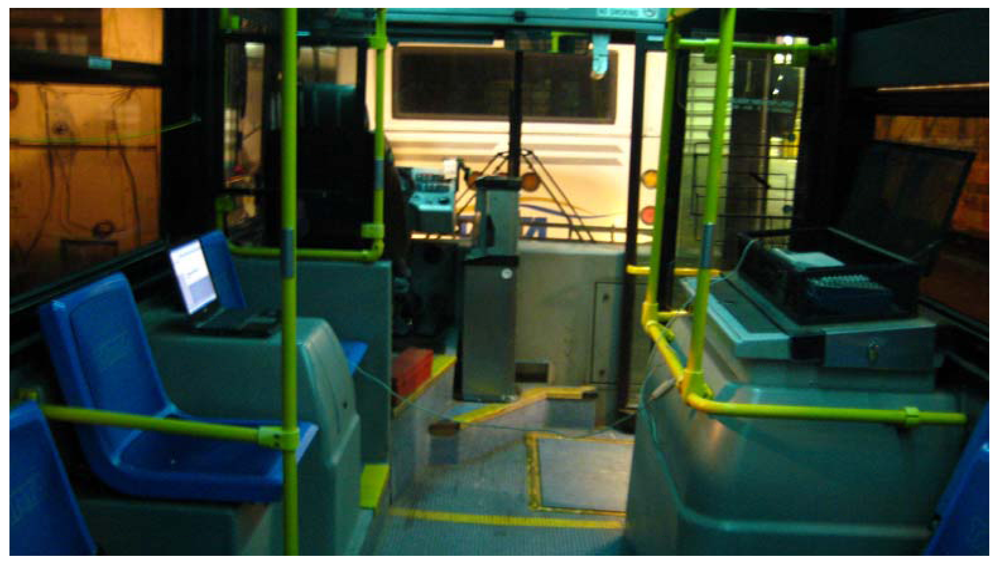
        <p>A 20% grade biodiesel (BD20) air-conditioned bus with 106 K miles was selected from the Toledo Area Regional Transit Authority (TARTA) 500 series fleet. The route selected for the study was Route 20, which runs between the TARTA garage and Meijer on the Central Avenue Strip [<xref ref-type="bibr" rid="B26-atmosphere-03-00266">26</xref>]. The route selected is a standard two-lane (dual direction) asphalt urban road with a speed limit of 40 mph (65 kmph). For the most part, it has stop-and-go traffic resulting from the combination of heavy traffic, with traffic signals and bus stops. The BD20 test bus kept to the right lane for majority of the run, and the variation of in-bus concentrations with driving lane, roadway type, commuting mode, vehicle size, and the route selected, were eliminated with consistency in the test run throughout the testing period. The GPS unit, located inside the test bus, was used to track its location, when in transit. Continuous monitoring of SO<sub>2</sub>, NO, and NO<sub>2</sub> gases inside the test bus were done simultaneously with two important indoor comfort parameters: indoor temperature (temp.) and indoor relative humidity (RH), on a one-second interval basis using the YES Plus air quality monitor [<xref ref-type="bibr" rid="B27-atmosphere-03-00266">27</xref>], placed on an elevation within the vicinity of driver, as shown in <xref ref-type="fig" rid="atmosphere-03-00266-f001">Figure 1</xref>. A wired mesh box was provided to safeguard the instrument and the instrument drew power continuously from the bus. More details on the experimental setup and the test protocol, adopted by the researchers to monitor in-vehicle contaminants 24 hours a day 7 days a week, were documented elsewhere [<xref ref-type="bibr" rid="B6-atmosphere-03-00266">6</xref>,<xref ref-type="bibr" rid="B7-atmosphere-03-00266">7</xref>].</p>
        <fig id="atmosphere-03-00266-f001" position="anchor">
          <label>Figure 1</label>
          <caption>
            <p>Yes Plus instrument setup and data collection.</p>
          </caption>
          <graphic xmlns:xlink="http://www.w3.org/1999/xlink" xlink:href="atmosphere-03-00266-g001.tif"/>
        </fig>
        <p>The “Yes Plus” instrument is equipped with one microprocessor controlled circuit board with built-in temperature and humidity sensors, and is capable of handling 12 additional plug and play sensors. The instrument comes with a rechargeable nickel-metal hydride battery pack to support 18–24 hours of continuous operation time, and includes an internal, automatic sample pump for “active” sampling of the target environment with a flow rate of 0.5 liters per minute (LPM). Data collected in the preceding week were downloaded from the Yes Plus instrument to a laptop (<xref ref-type="fig" rid="atmosphere-03-00266-f001">Figure 1</xref>), prior to calibration of the gaseous sensors. The methodology associated with calibration of the gaseous sensors included the following steps. The researchers ensured that the batteries were fully charged (before starting the calibration) and a 20-minute warm up time was allowed for the instrument sensors to stabilize, so that accurate results were produced. The zero and span gas calibration was achieved by flowing the “zero gas” and the “span gas” (both acquired from CALGAZ [<xref ref-type="bibr" rid="B28-atmosphere-03-00266">28</xref>] in cylinders) into the inlet port of the instrument with a cylinder regulator adjusted to a flow rate of 0.7 LPM, in accordance with the instrument supplier specification. The calibration is automated and the researchers only needed to specify the concentration of the span gas. <xref ref-type="table" rid="atmosphere-03-00266-t001">Table 1</xref> provides additional details on the Yes Plus instrument and the precision of gaseous sensors were mathematically computed using Equation (1).</p>
        <p>Precision = [1 − (maximum variation from span gas concentration/span gas concentration)]*100%    (1)</p>
        <table-wrap id="atmosphere-03-00266-t001" position="anchor">
          <object-id pub-id-type="pii">atmosphere-03-00266-t001_Table 1</object-id>
          <label>Table 1</label>
          <caption>
            <p>Yes Plus instrument sensor capabilities and calibration details.</p>
          </caption>
          <table rules="all" style="border: solid thin">
            <thead>
              <tr>
                <th align="center" valign="middle"> </th>
                <th align="center" valign="middle">Temp.</th>
                <th align="center" valign="middle">RH</th>
                <th align="center" valign="middle">SO<sub>2</sub></th>
                <th align="center" valign="middle">NO</th>
                <th align="center" valign="middle">NO<sub>2</sub></th>
              </tr>
            </thead>
            <tbody>
              <tr>
                <td colspan="6" align="left" valign="middle">
                  <bold>Sensor</bold>
                </td>
              </tr>
              <tr>
                <td align="left" valign="middle">Type</td>
                <td align="left" valign="middle">negative coefficient thermistor</td>
                <td align="left" valign="middle">thin film captive</td>
                <td align="left" valign="middle">electrochemical</td>
                <td align="left" valign="middle">electrochemical</td>
                <td align="left" valign="middle">electrochemical</td>
              </tr>
              <tr>
                <td align="left" valign="middle">Range (lower to upper detection limits)</td>
                <td align="left" valign="middle">23 °F to 131 °F (−5 °C to 55 °C)</td>
                <td align="left" valign="middle">0%–100%</td>
                <td align="left" valign="middle">0–20 ppm</td>
                <td align="left" valign="middle">0–100 ppm</td>
                <td align="left" valign="middle">0–10 ppm</td>
              </tr>
              <tr>
                <td align="left" valign="middle">Precision</td>
                <td align="left" valign="middle">---</td>
                <td align="left" valign="middle">---</td>
                <td align="left" valign="middle">99% (at 5 ppm)</td>
                <td align="left" valign="middle">99.8% (at 50 ppm)</td>
                <td align="left" valign="middle">98.2% (at 5 ppm)</td>
              </tr>
              <tr>
                <td align="left" valign="middle">Resolution (factory guaranteed, upper limit)</td>
                <td align="left" valign="middle">0.1 °C at 25 °C, --- (32 °F at 77 °F, ---)</td>
                <td align="left" valign="middle">2%, ---</td>
                <td align="left" valign="middle">&lt;0.1 ppm, 0.01 ppm</td>
                <td align="left" valign="middle">&lt;0.2 ppm, 0.01 ppm</td>
                <td align="left" valign="middle">0.1 ppm, 0.05 ppm</td>
              </tr>
              <tr>
                <td align="left" valign="middle">Long term drift</td>
                <td align="left" valign="middle">±33 °F (±0.5 °C)</td>
                <td align="left" valign="middle">±2%</td>
                <td align="left" valign="middle">&lt;2% change per month</td>
                <td align="left" valign="middle">zero: 0.5 ppm equivalent change from −4 °F to 68 °F (−20 °C to 20 °C), 1 to 3 ppm equivalent change from 68 °F to 122 °F (20 °C to 50 °C)</td>
                <td align="left" valign="middle">&lt;2% signal loss per month</td>
              </tr>
              <tr>
                <td align="left" valign="middle">Response time</td>
                <td align="left" valign="middle">&lt;10 seconds</td>
                <td align="left" valign="middle">&lt;10 seconds</td>
                <td align="left" valign="middle">t<sub>90</sub> ≤ 25 seconds from 0 to 10 ppm</td>
                <td align="left" valign="middle">t<sub>90</sub> ≤ 20 seconds from 0 to 50 ppm</td>
                <td align="left" valign="middle">t<sub>90</sub> ≤ 25 seconds</td>
              </tr>
              <tr>
                <td colspan="6" align="left" valign="middle">
                  <bold>Calibration</bold>
                </td>
              </tr>
              <tr>
                <td align="left" valign="middle">Calibration details</td>
                <td align="left" valign="middle">77 °F (25 °C) using digital RH/temperature calibration chamber</td>
                <td align="left" valign="middle">40% using digital RH/temperature calibration chamber</td>
                <td align="left" valign="middle">flow regulator, zero air gas, SO<sub>2 </sub>span gas (5 ppm)</td>
                <td align="left" valign="middle">flow regulator, 99.99% N<sub>2</sub> gas for zero function, NOspan gas (50 ppm)</td>
                <td align="left" valign="middle">flow regulator, zero air gas, NO<sub>2 </sub>span gas (5 ppm)</td>
              </tr>
              <tr>
                <td align="left" valign="middle">Implemented calibration frequency (recommended)</td>
                <td align="left" valign="middle">once per year at the factory (once per year)</td>
                <td align="left" valign="middle">once per year at the factory (once per year)</td>
                <td align="left" valign="middle">once per week at TARTA (once for every six months)</td>
                <td align="left" valign="middle">once per week at TARTA (once for every six months)</td>
                <td align="left" valign="middle">once per week at TARTA (once for every six months)</td>
              </tr>
            </tbody>
          </table>
        </table-wrap>
        
      </sec>
      <sec>
        <title>2.2. Database Development</title>
        <p>Database development included downloading data from the instrument, obtaining meteorological data, monitoring a hard drive that recorded the real-time video to obtain on-road variables, and designating time-related variables. Only the data collected between 6:00 a.m. and 11:00 p.m., over a period of one year (April 2007–March 2008) that represented the real-time transit conditions, were considered for analysis in this study. Data downloaded from the Yes Plus instrument (indoor temp., indoor RH, SO<sub>2</sub>, NO, and NO<sub>2</sub>) on a one-second interval basis; meteorological variables (ambient temp., ambient RH, wind speed, sky condition, visibility, weather type, and precipitation) downloaded for the Toledo Express Airport station, from the National Climatic Data Center [<xref ref-type="bibr" rid="B29-atmosphere-03-00266">29</xref>] on a one-hour interval basis; and real-time on-road variables monitored from the hard drive (outdoor sources such as the light vehicles (cars/SUVs) ahead, heavy vehicles (buses/trucks) ahead, and ventilation settings that were representative of the bus status (idle/run) and door position (open/close): run/close, idle/open, idle/close) on a one-minute interval basis were all averaged to one-hour for analysis. Time-related variables such as the month of the year, the season of the year, and the monitoring period (the time of day) were designated to the hourly averaged database. The different seasons used in this study are defined as spring (April 2007–June 2007); summer (July 2007–September 2007); fall (October 2007–December 2007); and winter (January 2008–March 2008). Taking into consideration that one only needs to change the temperature to alter the RH, the indoor RH and the ambient RH variables were replaced with the corresponding computed mixing ratio’s (MR), <italic>i.e.</italic>, indoor MR and ambient MR. Missing variables in the database were a result of camera error, hard disk problems, and the amount of time required to record the observations on a one-minute interval basis. The database developed, from here on referred to as “complete database,” includes only the hourly averaged data points with no missing values for any of the independent or dependent variables. The complete database had 2,172 hourly data points. </p>
        <p><xref ref-type="table" rid="atmosphere-03-00266-t002">Table 2</xref> presents a summary of the seasonal descriptive statistics such as the mean (µ), standard deviation (SD), minimum (min), quartile 1 (Q1), median (Med.), quartile 3 (Q3), and maximum (Max.). A prior study on the exposure of commuters to contaminant concentrations inside buses reported the average SO<sub>2</sub>, NO, and NO<sub>2</sub> concentrations to be 0.020 ppm, 0.490 ppm, and 0.077 ppm, respectively [<xref ref-type="bibr" rid="B30-atmosphere-03-00266">30</xref>]. The averaged SO<sub>2</sub> concentrations (refer to <xref ref-type="table" rid="atmosphere-03-00266-t002">Table 2</xref>) in this study are much higher than the concentrations normally observed inside buses, while NO and NO<sub>2</sub> concentrations were not significantly different from the typical in-bus concentrations. Accumulated roadside SO<sub>2</sub> concentrations from vehicular exhaust emissions ranged between 0.5 ppm and 4 ppm [<xref ref-type="bibr" rid="B31-atmosphere-03-00266">31</xref>,<xref ref-type="bibr" rid="B32-atmosphere-03-00266">32</xref>,<xref ref-type="bibr" rid="B33-atmosphere-03-00266">33</xref>,<xref ref-type="bibr" rid="B34-atmosphere-03-00266">34</xref>]. Based on the consideration that there are no indoor sources for any of the monitored contaminant concentrations, the higher SO<sub>2</sub>, NO, and NO<sub>2</sub> concentrations observed inside the TARTA test bus can be attributed to the corresponding roadside contaminant concentrations and ventilation settings. The average SO<sub>2</sub>, NO, and NO<sub>2</sub> exhaust emission concentrations from Toledo area heavy vehicles, <italic>i.e.</italic>, the TARTA public transport buses and the City of Toledo garbage disposal trucks, in transit were observed to be 40 ppm, 600 ppm, 80 ppm, and 70 ppm, 400 ppm, 60 ppm, respectively [<xref ref-type="bibr" rid="B13-atmosphere-03-00266">13</xref>,<xref ref-type="bibr" rid="B14-atmosphere-03-00266">14</xref>,<xref ref-type="bibr" rid="B15-atmosphere-03-00266">15</xref>,<xref ref-type="bibr" rid="B16-atmosphere-03-00266">16</xref>]. In view of the relative difference between indoor and ambient parameters of the temperature (or the MR), and the average time for which the bus was in idle/open condition (refer to <xref ref-type="table" rid="atmosphere-03-00266-t002">Table 2</xref>), one can observe that there was good ventilation in the summer, moderate ventilation in the fall and the spring, and reduced ventilation in the winter for the public transport test bus used in this study. Also, lead vehicular traffic was the highest in the fall season, followed by the winter, summer, and spring seasons.</p>
        <table-wrap id="atmosphere-03-00266-t002" position="anchor">
          <object-id pub-id-type="pii">atmosphere-03-00266-t002_Table 2</object-id>
          <label>Table 2</label>
          <caption>
            <p>Seasonal descriptive statistics for different numeric variables considered in this study.</p>
          </caption>
           <table rules="all" style="border: solid thin">
            <thead>
              <tr>
                <th align="left" valign="middle">Variable </th>
                <th align="left" valign="middle">Season</th>
                <th align="center" valign="middle">µ ± SD</th>
                <th align="center" valign="middle">min</th>
                <th align="center" valign="middle">Q1</th>
                <th align="center" valign="middle">Med.</th>
                <th align="center" valign="middle">Q3</th>
                <th align="center" valign="middle">Max.</th>
              </tr>
            </thead>
            <tbody>
              <tr>
                <td rowspan="4" align="left" valign="middle">SO<sub>2</sub>, in ppm</td>
                <td align="left" valign="middle">Fall (<italic>n =</italic> 570)</td>
                <td align="center" valign="middle">0.2 ± 0.1</td>
                <td align="center" valign="middle">0</td>
                <td align="center" valign="middle">0.1</td>
                <td align="center" valign="middle">0.2</td>
                <td align="center" valign="middle">0.2</td>
                <td align="center" valign="middle">0.7</td>
              </tr>
              <tr>
                <td align="left" valign="middle">Spring (<italic>n =</italic> 613)</td>
                <td align="center" valign="middle">0.1 ± 0.1</td>
                <td align="center" valign="middle">0</td>
                <td align="center" valign="middle">0.1</td>
                <td align="center" valign="middle">0.1</td>
                <td align="center" valign="middle">0.2</td>
                <td align="center" valign="middle">0.7</td>
              </tr>
              <tr>
                <td align="left" valign="middle">Summer (<italic>n =</italic> 695)</td>
                <td align="center" valign="middle">0.2 ± 0.1</td>
                <td align="center" valign="middle">0</td>
                <td align="center" valign="middle">0.1</td>
                <td align="center" valign="middle">0.2</td>
                <td align="center" valign="middle">0.2</td>
                <td align="center" valign="middle">0.7</td>
              </tr>
              <tr>
                <td align="left" valign="middle">Winter (<italic>n =</italic> 294)</td>
                <td align="center" valign="middle">0.2 ± 0.1</td>
                <td align="center" valign="middle">0</td>
                <td align="center" valign="middle">0.1</td>
                <td align="center" valign="middle">0.1</td>
                <td align="center" valign="middle">0.2</td>
                <td align="center" valign="middle">1</td>
              </tr>
              <tr>
                <td rowspan="4" align="left" valign="middle">NO, in ppm</td>
                <td align="left" valign="middle">Fall (<italic>n =</italic> 570)</td>
                <td align="center" valign="middle">0.3 ± 1.3</td>
                <td align="center" valign="middle">0</td>
                <td align="center" valign="middle">0.1</td>
                <td align="center" valign="middle">0.1</td>
                <td align="center" valign="middle">0.2</td>
                <td align="center" valign="middle">24.4</td>
              </tr>
              <tr>
                <td align="left" valign="middle">Spring (<italic>n =</italic> 613)</td>
                <td align="center" valign="middle">0.4 ± 0.5</td>
                <td align="center" valign="middle">0</td>
                <td align="center" valign="middle">0.1</td>
                <td align="center" valign="middle">0.1</td>
                <td align="center" valign="middle">0.4</td>
                <td align="center" valign="middle">4.2</td>
              </tr>
              <tr>
                <td align="left" valign="middle">Summer (<italic>n =</italic> 695)</td>
                <td align="center" valign="middle">0.3 ± 0.5</td>
                <td align="center" valign="middle">0</td>
                <td align="center" valign="middle">0</td>
                <td align="center" valign="middle">0.1</td>
                <td align="center" valign="middle">0.4</td>
                <td align="center" valign="middle">4.9</td>
              </tr>
              <tr>
                <td align="left" valign="middle">Winter (<italic>n =</italic> 294)</td>
                <td align="center" valign="middle">0.5 ± 2.1</td>
                <td align="center" valign="middle">0</td>
                <td align="center" valign="middle">0</td>
                <td align="center" valign="middle">0.1</td>
                <td align="center" valign="middle">0.2</td>
                <td align="center" valign="middle">15</td>
              </tr>
              <tr>
                <td rowspan="4" align="left" valign="middle">NO<sub>2</sub> in ppm</td>
                <td align="left" valign="middle">Fall (<italic>n =</italic> 570)</td>
                <td align="center" valign="middle">0.1 ± 0.01</td>
                <td align="center" valign="middle">0</td>
                <td align="center" valign="middle">0</td>
                <td align="center" valign="middle">0</td>
                <td align="center" valign="middle">0.1</td>
                <td align="center" valign="middle">0.2</td>
              </tr>
              <tr>
                <td align="left" valign="middle">Spring (<italic>n =</italic> 613)</td>
                <td align="center" valign="middle">0.1 ± 0.02</td>
                <td align="center" valign="middle">0</td>
                <td align="center" valign="middle">0</td>
                <td align="center" valign="middle">0</td>
                <td align="center" valign="middle">0.1</td>
                <td align="center" valign="middle">0.5</td>
              </tr>
              <tr>
                <td align="left" valign="middle">Summer (<italic>n =</italic> 695)</td>
                <td align="center" valign="middle">0.1 ± 0.01</td>
                <td align="center" valign="middle">0</td>
                <td align="center" valign="middle">0</td>
                <td align="center" valign="middle">0</td>
                <td align="center" valign="middle">0.1</td>
                <td align="center" valign="middle">0.1</td>
              </tr>
              <tr>
                <td align="left" valign="middle">Winter (<italic>n =</italic> 294)</td>
                <td align="center" valign="middle">0.1 ± 0.3</td>
                <td align="center" valign="middle">0</td>
                <td align="center" valign="middle">0</td>
                <td align="center" valign="middle">0</td>
                <td align="center" valign="middle">0.1</td>
                <td align="center" valign="middle">3.1</td>
              </tr>
              <tr>
                <td rowspan="4" align="left" valign="middle">Indoor temp., in °F (°C)</td>
                <td align="left" valign="middle">Fall (<italic>n =</italic> 570)</td>
                <td align="center" valign="middle">77.7 ± 4.1 <break/>(25.4 ± −15.5)</td>
                <td align="center" valign="middle">59 <break/>(15)</td>
                <td align="center" valign="middle">75.3 <break/>(24.1)</td>
                <td align="center" valign="middle">77.1 <break/>(25)</td>
                <td align="center" valign="middle">79.3 <break/>(26.3)</td>
                <td align="center" valign="middle">96.8 <break/>(36)</td>
              </tr>
              <tr>
                <td align="left" valign="middle">Spring (<italic>n =</italic> 613)</td>
                <td align="center" valign="middle">76.8 ± 4.2 <break/>(24.9 ± −15.4)</td>
                <td align="center" valign="middle">59.6 <break/>(15.3)</td>
                <td align="center" valign="middle">74.4 <break/>(23.6)</td>
                <td align="center" valign="middle">76.4 <break/>(24.7)</td>
                <td align="center" valign="middle">78.4 <break/>(25.8)</td>
                <td align="center" valign="middle">95.3 <break/>(35.2)</td>
              </tr>
              <tr>
                <td align="left" valign="middle">Summer (<italic>n =</italic> 695)</td>
                <td align="center" valign="middle">76.4 ± 8.4 <break/>(24.7 ± −13.1)</td>
                <td align="center" valign="middle">31.5 <break/>(−0.3)</td>
                <td align="center" valign="middle">74.6 <break/>(23.7)</td>
                <td align="center" valign="middle">76.4 <break/>(24.6)</td>
                <td align="center" valign="middle">78.3 <break/>(25.7)</td>
                <td align="center" valign="middle">104.4 <break/>(40.2)</td>
              </tr>
              <tr>
                <td align="left" valign="middle">Winter (<italic>n =</italic> 294)</td>
                <td align="center" valign="middle">77.2 ± 6.8 <break/>(25.1 ± −13.9)</td>
                <td align="center" valign="middle">34.2 <break/>(1.2)</td>
                <td align="center" valign="middle">74.6 <break/>(23.7)</td>
                <td align="center" valign="middle">75.9 <break/>(24.4)</td>
                <td align="center" valign="middle">79.7 <break/>(26.5)</td>
                <td align="center" valign="middle">95.7 <break/>(35.4)</td>
              </tr>
              <tr>
                <td rowspan="4" align="left" valign="middle">Indoor MR</td>
                <td align="left" valign="middle">Fall (<italic>n =</italic> 570)</td>
                <td align="center" valign="middle">21.1 ± 3.2</td>
                <td align="center" valign="middle">11</td>
                <td align="center" valign="middle">19.3</td>
                <td align="center" valign="middle">20.5</td>
                <td align="center" valign="middle">22.2</td>
                <td align="center" valign="middle">39.7</td>
              </tr>
              <tr>
                <td align="left" valign="middle">Spring (<italic>n =</italic> 613)</td>
                <td align="center" valign="middle">20.6 ± 3.2</td>
                <td align="center" valign="middle">11.2</td>
                <td align="center" valign="middle">18.8</td>
                <td align="center" valign="middle">20</td>
                <td align="center" valign="middle">21.5</td>
                <td align="center" valign="middle">37.6</td>
              </tr>
              <tr>
                <td align="left" valign="middle">Summer (<italic>n =</italic> 695)</td>
                <td align="center" valign="middle">20.8 ± 5.4</td>
                <td align="center" valign="middle">3.8</td>
                <td align="center" valign="middle">18.6</td>
                <td align="center" valign="middle">19.9</td>
                <td align="center" valign="middle">21.4</td>
                <td align="center" valign="middle">50.7</td>
              </tr>
              <tr>
                <td align="left" valign="middle">Winter (<italic>n =</italic> 294)</td>
                <td align="center" valign="middle">20.6 ± 5.3</td>
                <td align="center" valign="middle">1</td>
                <td align="center" valign="middle">18.8</td>
                <td align="center" valign="middle">19.7</td>
                <td align="center" valign="middle">22.1</td>
                <td align="center" valign="middle">38</td>
              </tr>
              <tr>
                <td rowspan="4" align="left" valign="middle">Ambient temp., in °F (°C)</td>
                <td align="left" valign="middle">Fall (<italic>n =</italic> 570)</td>
                <td align="center" valign="middle">60.4 ± 19.3 <break/>(15.8 ± −7)</td>
                <td align="center" valign="middle">14 <break/>(−10)</td>
                <td align="center" valign="middle">50.3 <break/>(10.1)</td>
                <td align="center" valign="middle">66 <break/>(18.9)</td>
                <td align="center" valign="middle">75 <break/>(23.9)</td>
                <td align="center" valign="middle">90 <break/>(32.2)</td>
              </tr>
              <tr>
                <td align="left" valign="middle">Spring (<italic>n =</italic> 613)</td>
                <td align="center" valign="middle">59.7 ± 17.5 <break/>(15.4 ± −8.1)</td>
                <td align="center" valign="middle">13 <break/>(−10.6)</td>
                <td align="center" valign="middle">45.5 <break/>(7.5)</td>
                <td align="center" valign="middle">61 <break/>(16.1)</td>
                <td align="center" valign="middle">74 <break/>(23.3)</td>
                <td align="center" valign="middle">91 <break/>(32.8)</td>
              </tr>
              <tr>
                <td align="left" valign="middle">Summer (<italic>n =</italic> 695)</td>
                <td align="center" valign="middle">75.8 ± 9.4 <break/>(24.3 ± −12.6)</td>
                <td align="center" valign="middle">36 <break/>(2.2)</td>
                <td align="center" valign="middle">69 <break/>(20.6)</td>
                <td align="center" valign="middle">77 <break/>(25)</td>
                <td align="center" valign="middle">83 <break/>(28.3)</td>
                <td align="center" valign="middle">95 <break/>(35)</td>
              </tr>
              <tr>
                <td align="left" valign="middle">Winter (<italic>n =</italic> 294)</td>
                <td align="center" valign="middle">28.6 ± 13 <break/>(−1.9 ± −10.6)</td>
                <td align="center" valign="middle">2 <break/>(−16.7)</td>
                <td align="center" valign="middle">21 <break/>(−6.1)</td>
                <td align="center" valign="middle">28 <break/>(−2.2)</td>
                <td align="center" valign="middle">35 <break/>(1.7)</td>
                <td align="center" valign="middle">66 <break/>(18.9)</td>
              </tr>
              <tr>
                <td rowspan="4" align="left" valign="middle">Ambient MR</td>
                <td align="left" valign="middle">Fall (<italic>n =</italic> 570)</td>
                <td align="center" valign="middle">8.2 ± 5.4</td>
                <td align="center" valign="middle">1.8</td>
                <td align="center" valign="middle">3.9</td>
                <td align="center" valign="middle">6.4</td>
                <td align="center" valign="middle">11.6</td>
                <td align="center" valign="middle">29.5</td>
              </tr>
              <tr>
                <td align="left" valign="middle">Spring (<italic>n =</italic> 613)</td>
                <td align="center" valign="middle">18.8 ± 6.6</td>
                <td align="center" valign="middle">4.6</td>
                <td align="center" valign="middle">13.7</td>
                <td align="center" valign="middle">17.9</td>
                <td align="center" valign="middle">23.5</td>
                <td align="center" valign="middle">37.4</td>
              </tr>
              <tr>
                <td align="left" valign="middle">Summer (<italic>n =</italic> 695)</td>
                <td align="center" valign="middle">19.8 ± 5.6</td>
                <td align="center" valign="middle">6.9</td>
                <td align="center" valign="middle">15.6</td>
                <td align="center" valign="middle">19.6</td>
                <td align="center" valign="middle">23.5</td>
                <td align="center" valign="middle">33.9</td>
              </tr>
              <tr>
                <td align="left" valign="middle">Winter (<italic>n =</italic> 294)</td>
                <td align="center" valign="middle">3.9 ± 2.4</td>
                <td align="center" valign="middle">1</td>
                <td align="center" valign="middle">2.4</td>
                <td align="center" valign="middle">3.6</td>
                <td align="center" valign="middle">4.4</td>
                <td align="center" valign="middle">14</td>
              </tr>
              <tr>
                <td rowspan="4" align="left" valign="middle">Wind speed, in mph (kmph)</td>
                <td align="left" valign="middle">Fall (<italic>n =</italic> 570)</td>
                <td align="center" valign="middle">7.5 ± 4.9<break/>(12.1 ± 7.8)</td>
                <td align="center" valign="middle">0 <break/>(0)</td>
                <td align="center" valign="middle">5 <break/>(8.1)</td>
                <td align="center" valign="middle">7 <break/>(11.3)</td>
                <td align="center" valign="middle">10 <break/>(16.1)</td>
                <td align="center" valign="middle">30 <break/>(48.3)</td>
              </tr>
              <tr>
                <td align="left" valign="middle">Spring (<italic>n =</italic> 613)</td>
                <td align="center" valign="middle">7.5 ± 5.6 <break/>(12 ± 9)</td>
                <td align="center" valign="middle">0 <break/>(0)</td>
                <td align="center" valign="middle">3 <break/>(4.8)</td>
                <td align="center" valign="middle">7 <break/>(11.3)</td>
                <td align="center" valign="middle">10 <break/>(16.1)</td>
                <td align="center" valign="middle">29 <break/>(46.7)</td>
              </tr>
              <tr>
                <td align="left" valign="middle">Summer (<italic>n =</italic> 695)</td>
                <td align="center" valign="middle">6.3 ± 4.3 <break/>(10 ± 6.9)</td>
                <td align="center" valign="middle">0 <break/>(0)</td>
                <td align="center" valign="middle">3 <break/>(4.8)</td>
                <td align="center" valign="middle">6 <break/>(9.7)</td>
                <td align="center" valign="middle">8 <break/>(12.9)</td>
                <td align="center" valign="middle">24 <break/>(38.6)</td>
              </tr>
              <tr>
                <td align="left" valign="middle">Winter (<italic>n =</italic> 294)</td>
                <td align="center" valign="middle">10.7 ± 5.5 <break/>(17.2 ± 8.8)</td>
                <td align="center" valign="middle">0 <break/>(0)</td>
                <td align="center" valign="middle">7 <break/>(11.3)</td>
                <td align="center" valign="middle">10 <break/>(16.1)</td>
                <td align="center" valign="middle">15 <break/>(24.1)</td>
                <td align="center" valign="middle">29 <break/>(46.7)</td>
              </tr>
              <tr>
                <td rowspan="4" align="left" valign="middle">Precipitation, in inches (cms)</td>
                <td align="left" valign="middle">Fall (<italic>n</italic> = 570)</td>
                <td align="center" valign="middle">0.01 ± 0.06 <break/>(0.03 ± 0.15)</td>
                <td align="center" valign="middle">0 <break/>(0)</td>
                <td align="center" valign="middle">0 <break/>(0)</td>
                <td align="center" valign="middle">0 <break/>(0)</td>
                <td align="center" valign="middle">0 <break/>(0)</td>
                <td align="center" valign="middle">1.01 <break/>(2.57)</td>
              </tr>
              <tr>
                <td align="left" valign="middle">Spring (<italic>n =</italic> 613)</td>
                <td align="center" valign="middle">0 ± 0.01 <break/>(0 ± 0.03)</td>
                <td align="center" valign="middle">0 <break/>(0)</td>
                <td align="center" valign="middle">0 <break/>(0)</td>
                <td align="center" valign="middle">0 <break/>(0)</td>
                <td align="center" valign="middle">0 <break/>(0)</td>
                <td align="center" valign="middle">0.22 <break/>(0.56)</td>
              </tr>
              <tr>
                <td align="left" valign="middle">Summer (<italic>n =</italic> 695)</td>
                <td align="center" valign="middle">0.01 ± 0.05 <break/>(0.02 ± 0.13)</td>
                <td align="center" valign="middle">0 <break/>(0)</td>
                <td align="center" valign="middle">0 <break/>(0)</td>
                <td align="center" valign="middle">0 <break/>(0)</td>
                <td align="center" valign="middle">0 <break/>(0)</td>
                <td align="center" valign="middle">0.74 <break/>(1.88)</td>
              </tr>
              <tr>
                <td align="left" valign="middle">Winter (<italic>n =</italic> 294)</td>
                <td align="center" valign="middle">0.01 ± 0.03 <break/>(0.03 ± 0.07)</td>
                <td align="center" valign="middle">0 <break/>(0)</td>
                <td align="center" valign="middle">0 <break/>(0)</td>
                <td align="center" valign="middle">0 <break/>(0)</td>
                <td align="center" valign="middle">0 <break/>(0)</td>
                <td align="center" valign="middle">0.24 <break/>(0.61)</td>
              </tr>
              <tr>
                <td rowspan="4" align="left" valign="middle">Visibility, in statute miles (km)</td>
                <td align="left" valign="middle">Fall (<italic>n =</italic> 570)</td>
                <td align="center" valign="middle">8.3 ± 2.6 <break/>(13.4 ± 4.2)</td>
                <td align="center" valign="middle">0.8 <break/>(1.2)</td>
                <td align="center" valign="middle">6 <break/>(9.7)</td>
                <td align="center" valign="middle">10 <break/>(16.1)</td>
                <td align="center" valign="middle">10 <break/>(16.1)</td>
                <td align="center" valign="middle">10 <break/>(16.1)</td>
              </tr>
              <tr>
                <td align="left" valign="middle">Spring (<italic>n =</italic> 613)</td>
                <td align="center" valign="middle">8.9 ± 2.3 <break/>(14.4 ± 3.8)</td>
                <td align="center" valign="middle">0 <break/>(0)</td>
                <td align="center" valign="middle">10 <break/>(16.1)</td>
                <td align="center" valign="middle">10 <break/>(16.1)</td>
                <td align="center" valign="middle">10 <break/>(16.1)</td>
                <td align="center" valign="middle">10 <break/>(16.1)</td>
              </tr>
              <tr>
                <td align="left" valign="middle">Summer (<italic>n =</italic> 695)</td>
                <td align="center" valign="middle">8.9 ± 2.1 <break/>(14.4 ± 3.5)</td>
                <td align="center" valign="middle">0.5 <break/>(0.8)</td>
                <td align="center" valign="middle">9 <break/>(14.5)</td>
                <td align="center" valign="middle">10 <break/>(16.1)</td>
                <td align="center" valign="middle">10 <break/>(16.1)</td>
                <td align="center" valign="middle">10 <break/>(16.1)</td>
              </tr>
              <tr>
                <td align="left" valign="middle">Winter (<italic>n =</italic> 294)</td>
                <td align="center" valign="middle">6.7 ± 3.8 <break/>(10.7 ± 6.1)</td>
                <td align="center" valign="middle">0 <break/>(0)</td>
                <td align="center" valign="middle">3 <break/>(4.9)</td>
                <td align="center" valign="middle">9 <break/>(14.5)</td>
                <td align="center" valign="middle">10 <break/>(16.1)</td>
                <td align="center" valign="middle">10 <break/>(16.1)</td>
              </tr>
              <tr>
                <td rowspan="4" align="left" valign="middle">Light vehicles, in numbers per minute</td>
                <td align="left" valign="middle">Fall (<italic>n =</italic> 570)</td>
                <td align="center" valign="middle">0.4 ± 0.3</td>
                <td align="center" valign="middle">0</td>
                <td align="center" valign="middle">0.1</td>
                <td align="center" valign="middle">0.3</td>
                <td align="center" valign="middle">0.5</td>
                <td align="center" valign="middle">2</td>
              </tr>
              <tr>
                <td align="left" valign="middle">Spring (<italic>n =</italic> 613)</td>
                <td align="center" valign="middle">0.2 ± 0.2</td>
                <td align="center" valign="middle">0</td>
                <td align="center" valign="middle">0.1</td>
                <td align="center" valign="middle">0.2</td>
                <td align="center" valign="middle">0.4</td>
                <td align="center" valign="middle">1.4</td>
              </tr>
              <tr>
                <td align="left" valign="middle">Summer (<italic>n =</italic> 695)</td>
                <td align="center" valign="middle">0.3 ± 0.3</td>
                <td align="center" valign="middle">0</td>
                <td align="center" valign="middle">0.1</td>
                <td align="center" valign="middle">0.2</td>
                <td align="center" valign="middle">0.3</td>
                <td align="center" valign="middle">2</td>
              </tr>
              <tr>
                <td align="left" valign="middle">Winter (<italic>n =</italic> 294)</td>
                <td align="center" valign="middle">0.3 ± 0.3</td>
                <td align="center" valign="middle">0</td>
                <td align="center" valign="middle">0.1</td>
                <td align="center" valign="middle">0.2</td>
                <td align="center" valign="middle">0.4</td>
                <td align="center" valign="middle">1.4</td>
              </tr>
              <tr>
                <td rowspan="4" align="left" valign="middle">Heavy vehicles, in numbers per minute</td>
                <td align="left" valign="middle">Fall (<italic>n =</italic> 570)</td>

                <td align="center" valign="middle">0.2 ± 0.2</td>
                <td align="center" valign="middle">0</td>
                <td align="center" valign="middle">0</td>
                <td align="center" valign="middle">0.1</td>
                <td align="center" valign="middle">0.3</td>
                <td align="center" valign="middle">1</td>
              </tr>
              <tr>
                <td align="left" valign="middle">Spring (<italic>n =</italic> 613)</td>
                <td align="center" valign="middle">0.1 ± 0.1</td>
                <td align="center" valign="middle">0</td>
                <td align="center" valign="middle">0</td>
                <td align="center" valign="middle">0.1</td>
                <td align="center" valign="middle">0.2</td>
                <td align="center" valign="middle">0.8</td>
              </tr>
              <tr>
                <td align="left" valign="middle">Summer (<italic>n =</italic> 695)</td>
                <td align="center" valign="middle">0.2 ± 0.2</td>
                <td align="center" valign="middle">0</td>
                <td align="center" valign="middle">0</td>
                <td align="center" valign="middle">0.1</td>
                <td align="center" valign="middle">0.2</td>
                <td align="center" valign="middle">1</td>
              </tr>
              <tr>
                <td align="left" valign="middle">Winter (<italic>n =</italic> 294)</td>
                <td align="center" valign="middle">0.2 ± 0.2</td>
                <td align="center" valign="middle">0</td>
                <td align="center" valign="middle">0</td>
                <td align="center" valign="middle">0.1</td>
                <td align="center" valign="middle">0.2</td>
                <td align="center" valign="middle">1</td>
              </tr>
              <tr>
                <td rowspan="4" align="left" valign="middle">Run/close, in minutes per hour</td>
                <td align="left" valign="middle">Fall (<italic>n =</italic> 570)</td>
                <td align="center" valign="middle">38 ± 9</td>
                <td align="center" valign="middle">10</td>
                <td align="center" valign="middle">32</td>
                <td align="center" valign="middle">38</td>
                <td align="center" valign="middle">45</td>
                <td align="center" valign="middle">60</td>
              </tr>
              <tr>
                <td align="left" valign="middle">Spring (<italic>n =</italic> 613)</td>
                <td align="center" valign="middle">42 ± 13</td>
                <td align="center" valign="middle">0</td>
                <td align="center" valign="middle">33</td>
                <td align="center" valign="middle">44</td>
                <td align="center" valign="middle">53</td>
                <td align="center" valign="middle">60</td>
              </tr>
              <tr>
                <td align="left" valign="middle">Summer (<italic>n =</italic> 695)</td>
                <td align="center" valign="middle">40 ± 9</td>
                <td align="center" valign="middle">0</td>
                <td align="center" valign="middle">34</td>
                <td align="center" valign="middle">40</td>
                <td align="center" valign="middle">45</td>
                <td align="center" valign="middle">60</td>
              </tr>
              <tr>
                <td align="left" valign="middle">Winter (<italic>n =</italic> 294)</td>
                <td align="center" valign="middle">37 ± 7</td>
                <td align="center" valign="middle">10</td>
                <td align="center" valign="middle">32</td>
                <td align="center" valign="middle">38</td>
                <td align="center" valign="middle">42</td>
                <td align="center" valign="middle">52</td>
              </tr>
              <tr>
                <td rowspan="4" align="left" valign="middle">Idle/open, in minutes per hour</td>
                <td align="left" valign="middle">Fall (<italic>n =</italic> 570)</td>
                <td align="center" valign="middle">9 ± 7</td>
                <td align="center" valign="middle">0</td>
                <td align="center" valign="middle">4</td>
                <td align="center" valign="middle">8</td>
                <td align="center" valign="middle">14</td>
                <td align="center" valign="middle">33</td>
              </tr>
              <tr>
                <td align="left" valign="middle">Spring (<italic>n =</italic> 613)</td>
                <td align="center" valign="middle">8 ± 8</td>
                <td align="center" valign="middle">0</td>
                <td align="center" valign="middle">2</td>
                <td align="center" valign="middle">6</td>
                <td align="center" valign="middle">12</td>
                <td align="center" valign="middle">34</td>
              </tr>
              <tr>
                <td align="left" valign="middle">Summer (<italic>n =</italic> 695)</td>
                <td align="center" valign="middle">10 ± 7</td>
                <td align="center" valign="middle">0</td>
                <td align="center" valign="middle">5</td>
                <td align="center" valign="middle">9</td>
                <td align="center" valign="middle">14</td>
                <td align="center" valign="middle">32</td>
              </tr>
              <tr>
                <td align="left" valign="middle">Winter (<italic>n =</italic> 294)</td>
                <td align="center" valign="middle">8 ± 6</td>
                <td align="center" valign="middle">0</td>
                <td align="center" valign="middle">3</td>
                <td align="center" valign="middle">7</td>
                <td align="center" valign="middle">11</td>
                <td align="center" valign="middle">27</td>
              </tr>
              <tr>
                <td rowspan="4" align="left" valign="middle">Idle/close, in minutes per hour</td>
                <td align="left" valign="middle">Fall (<italic>n =</italic> 570)</td>
                <td align="center" valign="middle">13 ± 10</td>
                <td align="center" valign="middle">0</td>
                <td align="center" valign="middle">5</td>
                <td align="center" valign="middle">10</td>
                <td align="center" valign="middle">18</td>
                <td align="center" valign="middle">48</td>
              </tr>
              <tr>
                <td align="left" valign="middle">Spring (<italic>n =</italic> 613)</td>
                <td align="center" valign="middle">10 ± 11</td>
                <td align="center" valign="middle">0</td>
                <td align="center" valign="middle">2</td>
                <td align="center" valign="middle">5</td>
                <td align="center" valign="middle">15</td>
                <td align="center" valign="middle">60</td>
              </tr>
              <tr>
                <td align="left" valign="middle">Summer (<italic>n =</italic> 695)</td>
                <td align="center" valign="middle">10 ± 9</td>
                <td align="center" valign="middle">0</td>
                <td align="center" valign="middle">5</td>
                <td align="center" valign="middle">8</td>
                <td align="center" valign="middle">14</td>
                <td align="center" valign="middle">60</td>
              </tr>
              <tr>
                <td align="left" valign="middle">Winter (<italic>n =</italic> 294)</td>
                <td align="center" valign="middle">15 ± 8</td>
                <td align="center" valign="middle">1</td>
                <td align="center" valign="middle">9</td>
                <td align="center" valign="middle">14</td>
                <td align="center" valign="middle">20</td>
                <td align="center" valign="middle">40</td>
              </tr>
            </tbody>
          </table>
        </table-wrap>
        <p>Some of the independent variables considered in this study such as the month and the season are not statistically independent of other variables. To better understand the association between different independent variables considered in this study, the Pearson correlation (R) matrix developed by SPSS<sup>®</sup> software was used. Time of the day was statistically independent of all other independent variables. Only a few statistically significant relationships were observed in the R-matrix that had moderate/strong correlations (moderate correlation: 0.4–0.8; strong correlation: 0.8–1.0) and are as follows: </p>
        <list list-type="bullet">
          <list-item>
            <p>The month was strongly correlated (0.962) to the season and moderately correlated (0.414) to the ambient temperature. The season and the ambient temperature were moderately correlated (0.430).</p>
          </list-item>
          <list-item>
            <p>The indoor temperature and the indoor MR were strongly correlated (0.944).</p>
          </list-item>
          <list-item>
            <p>The ambient temperature and the ambient MR were moderately correlated (0.528).</p>
          </list-item>
          <list-item>
            <p>The run/close ventilating conditions were moderately correlated (−0.746) with the idle/close ventilating conditions.</p>
          </list-item>
        </list>
      </sec>
    </sec>
    <sec sec-type="results">
      <title>3. Results and Discussion</title>
      <p>First, the important factors affecting each monitored contaminant were short-listed using the regression tree method, with CART software, on the basis of “Score”. CART software computes the variable importance “Score” as a measure that represents the improvement attributable to each independent variable in its role as a surrogate (alternative variable) to the primary split. The values of the improvements are summed up over each node and totaled, and are scaled relative to the best performing variable. The variable with the highest sum of improvements is scored 100, and all other variables are graded downward to zero. No restriction was specified for the number of nodes in the regression tree, so that mean responses obtained can account for all the variability in the output that can be captured by partitioning the dataset. Complete details of the developed regression tree models for in-bus SO<sub>2</sub>, NO, and NO<sub>2</sub> gas concentrations were documented in the unpublished CART Report [<xref ref-type="bibr" rid="B35-atmosphere-03-00266">35</xref>]. Next, the short-listed factors obtained from performing the regression tree analysis were screened with the ANOVA to determine a final subset of the statistically significant variables, based on the <italic>F</italic> values. Finally, the monitored in-bus gaseous concentrations were quantified in relation to the subset of statistically significant variables identified from performing the ANOVA on regression tree results. To better understand the quantified relationships between the monitored in-bus gaseous concentrations and the identified statistically significant variables, the 2 sample <italic>t</italic>-test was executed to compute the statistical significance of the difference in the means for both the dependent and the identified statistically significant independent variables, with MINITAB<sup>®</sup> 16 software. The difference in the computed means of any variable between two datasets is statistically significant when the computed <italic>p</italic>-value (<italic>p</italic>) ≤ 0.05.</p>
      <sec>
        <title>3.1. Sulfur Dioxide</title>
        <p>Based on the “Score” values computed by the CART software, the month, sky condition, ambient temperature, heavy vehicles, indoor temperature, indoor MR, run/close ventilating condition, weather type, ambient MR, season, light vehicles, idle/close ventilating condition, and precipitation were short-listed as the important factors that influenced in-bus SO<sub>2</sub> concentrations. From the short-listed factors, one can observe that CART accounted for all the moderate and strong correlations associated with the month. The month was the primary variable to which in-bus SO<sub>2</sub> concentrations were most sensitive, as it was selected as the first basis for splitting the data, and also selected in the subsequent nodes at lower level of the regression tree. <xref ref-type="table" rid="atmosphere-03-00266-t003">Table 3</xref> presents the sensitivity analysis results obtained from performing the ANOVA over regression tree results to study the relationships conditional on the month. The first dataset included data within the months April 2007 to July 2007, September 2007, November 2007, and January 2008, while the second dataset contained data from the months of August 2007, October 2007, December 2007, February 2008, and March 2008. The large differences between the F values for the statistically significant (Sig.) input variables less than 0.05 indicate that the prioritization is robust. From <xref ref-type="table" rid="atmosphere-03-00266-t003">Table 3</xref>, one can observe that only the ambient temperature and the ambient MR had a significant impact on both the datasets. The sky condition and the weather type had a significant effect on in-bus SO<sub>2</sub> concentrations in the first dataset, while the precipitation, heavy vehicles, and the idle/close ventilating conditions had a significant effect only in the second dataset. </p>
        <table-wrap id="atmosphere-03-00266-t003" position="anchor">
          <object-id pub-id-type="pii">atmosphere-03-00266-t003_Table 3</object-id>
          <label>Table 3</label>
          <caption>
            <p>ANOVA results for the complete database SO<sub>2</sub> regression tree.</p>
          </caption>
                     <table rules="all" style="border: solid thin">
            <thead>
              <tr>
                <th align="left" valign="middle">Variable</th>
                <th align="center" valign="middle"><italic>F</italic> Value</th>
                <th align="center" valign="middle">Sig.</th>
                <th align="center" valign="middle">Significant</th>
                <th align="center" valign="middle">Rank</th>
                <th align="left" valign="middle">Variable</th>
                <th align="center" valign="middle"><italic>F</italic> Value</th>
                <th align="center" valign="middle">Sig.</th>
                <th align="center" valign="middle">Significant</th>
                <th align="center" valign="middle">Rank</th>
              </tr>
              <tr>
                <th colspan="5" align="center" valign="middle">Month = Apr. 07 to July 07, Sep. 07, Nov. 07, Jan. 08</th>
                <th colspan="5" align="center" valign="middle">Month = Aug. 07, Oct. 07, Dec. 07, Feb. 08, Mar. 08</th>
              </tr>
            </thead>
            <tbody>
              <tr>
                <td align="left" valign="middle">Sky condition</td>
                <td align="center" valign="middle">13.792</td>
                <td align="center" valign="middle">&lt;0.0001</td>
                <td align="center" valign="middle">Yes</td>
                <td align="center" valign="middle">1</td>
                <td align="left" valign="middle">Sky condition</td>
                <td align="center" valign="middle">0.008</td>
                <td align="center" valign="middle">0.930</td>
                <td align="center" valign="middle">No</td>
                <td align="center" valign="middle">------</td>
              </tr>
              <tr>
                <td align="left" valign="middle">Ambient temp.</td>
                <td align="center" valign="middle">1.745</td>
                <td align="center" valign="middle">&lt;0.0001</td>
                <td align="center" valign="middle">Yes</td>
                <td align="center" valign="middle">3</td>
                <td align="left" valign="middle">Ambient temp.</td>
                <td align="center" valign="middle">1.311</td>
                <td align="center" valign="middle">0.049</td>
                <td align="center" valign="middle">Yes</td>
                <td align="center" valign="middle">4</td>
              </tr>
              <tr>
                <td align="left" valign="middle">Heavy vehicles</td>
                <td align="center" valign="middle">0.976</td>
                <td align="center" valign="middle">0.527</td>
                <td align="center" valign="middle">No</td>
                <td align="center" valign="middle">------</td>
                <td align="left" valign="middle">Heavy vehicles</td>
                <td align="center" valign="middle">1.789</td>
                <td align="center" valign="middle">0.001</td>
                <td align="center" valign="middle">Yes</td>
                <td align="center" valign="middle">3</td>
              </tr>
              <tr>
                <td align="left" valign="middle">Indoor temp.</td>
                <td align="center" valign="middle">1.162</td>
                <td align="center" valign="middle">0.477</td>
                <td align="center" valign="middle">No</td>
                <td align="center" valign="middle">------</td>
                <td align="left" valign="middle">Indoor temp.</td>
                <td align="center" valign="middle">1.427</td>
                <td align="center" valign="middle">0.503</td>
                <td align="center" valign="middle">No</td>
                <td align="center" valign="middle">------</td>
              </tr>
              <tr>
                <td align="left" valign="middle">Indoor MR</td>
                <td align="center" valign="middle">0.695</td>
                <td align="center" valign="middle">0.769</td>
                <td align="center" valign="middle">No</td>
                <td align="center" valign="middle">------</td>
                <td align="left" valign="middle">Indoor MR</td>
                <td align="center" valign="middle">------</td>
                <td align="center" valign="middle">------</td>
                <td align="center" valign="middle">------</td>
                <td align="center" valign="middle">------</td>
              </tr>
              <tr>
                <td align="left" valign="middle">Run/close</td>
                <td align="center" valign="middle">0.859</td>
                <td align="center" valign="middle">0.869</td>
                <td align="center" valign="middle">No</td>
                <td align="center" valign="middle">------</td>
                <td align="left" valign="middle">Run/close</td>
                <td align="center" valign="middle">1.019</td>
                <td align="center" valign="middle">0.444</td>
                <td align="center" valign="middle">No</td>
                <td align="center" valign="middle">------</td>
              </tr>
              <tr>
                <td align="left" valign="middle">Weather type</td>
                <td align="center" valign="middle">2.746</td>
                <td align="center" valign="middle">0.002</td>
                <td align="center" valign="middle">Yes</td>
                <td align="center" valign="middle">2</td>
                <td align="left" valign="middle">Weather type</td>
                <td align="center" valign="middle">1.193</td>
                <td align="center" valign="middle">0.301</td>
                <td align="center" valign="middle">No</td>
                <td align="center" valign="middle">------</td>
              </tr>
              <tr>
                <td align="left" valign="middle">Ambient MR</td>
                <td align="center" valign="middle">1.315</td>
                <td align="center" valign="middle">0.007</td>
                <td align="center" valign="middle">Yes</td>
                <td align="center" valign="middle">4</td>
                <td align="left" valign="middle">Ambient MR</td>
                <td align="center" valign="middle">1.793</td>
                <td align="center" valign="middle">0.003</td>
                <td align="center" valign="middle">Yes</td>
                <td align="center" valign="middle">2</td>
              </tr>
              <tr>
                <td align="left" valign="middle">Season</td>
                <td align="center" valign="middle">0.677</td>
                <td align="center" valign="middle">0.566</td>
                <td align="center" valign="middle">No</td>
                <td align="center" valign="middle">------</td>
                <td align="left" valign="middle">Season</td>
                <td align="center" valign="middle">2.258</td>
                <td align="center" valign="middle">0.106</td>
                <td align="center" valign="middle">No</td>
                <td align="center" valign="middle">------</td>
              </tr>
              <tr>
                <td align="left" valign="middle">Light vehicles</td>
                <td align="center" valign="middle">0.966</td>
                <td align="center" valign="middle">0.572</td>
                <td align="center" valign="middle">No</td>
                <td align="center" valign="middle">------</td>
                <td align="left" valign="middle">Light vehicles</td>
                <td align="center" valign="middle">0.816</td>
                <td align="center" valign="middle">0.868</td>
                <td align="center" valign="middle">No</td>
                <td align="center" valign="middle">------</td>
              </tr>
              <tr>
                <td align="left" valign="middle">Idle/close</td>
                <td align="center" valign="middle">0.894</td>
                <td align="center" valign="middle">0.845</td>
                <td align="center" valign="middle">No</td>
                <td align="center" valign="middle">------</td>
                <td align="left" valign="middle">Idle/close</td>
                <td align="center" valign="middle">1.276</td>
                <td align="center" valign="middle">0.039</td>
                <td align="center" valign="middle">Yes</td>
                <td align="center" valign="middle">5</td>
              </tr>
              <tr>
                <td align="left" valign="middle">Precipitation</td>
                <td align="center" valign="middle">1.047</td>
                <td align="center" valign="middle">0.402</td>
                <td align="center" valign="middle">No</td>
                <td align="center" valign="middle">------</td>
                <td align="left" valign="middle">Precipitation</td>
                <td align="center" valign="middle">2.938</td>
                <td align="center" valign="middle">&lt;0.0001</td>
                <td align="center" valign="middle">Yes</td>
                <td align="center" valign="middle">1</td>
              </tr>
            </tbody>
          </table>
        </table-wrap>
        <p>Considering the complete database SO<sub>2</sub> regression tree and the ANOVA sensitivity analysis results, the month, ambient MR, ambient temperature, sky condition, precipitation, weather type, heavy vehicles, and idle/close ventilating conditions were ranked one to eight, respectively, that influenced the in-bus SO<sub>2</sub> concentrations. In view of the strong/moderate correlations between the independent variables considered in this study and <italic>F</italic>-values from <xref ref-type="table" rid="atmosphere-03-00266-t003">Table 3</xref>, one can say the SO<sub>2</sub> concentrations inside the bus were extremely sensitive to the month, weather conditions (ambient MR, ambient temperature, sky condition, precipitation, weather type), and heavy vehicles.</p>
        <p>Prior studies observed the outdoor SO<sub>2</sub> concentrations (vehicular exhaust emissions and atmospheric background concentrations) to vary negatively with the ambient temperature and precipitation, and positively with the ambient humidity; the outdoor SO<sub>2</sub> concentrations are higher during the late fall and winter months in colder places, such as Toledo, Ohio, USA [<xref ref-type="bibr" rid="B17-atmosphere-03-00266">17</xref>,<xref ref-type="bibr" rid="B18-atmosphere-03-00266">18</xref>,<xref ref-type="bibr" rid="B19-atmosphere-03-00266">19</xref>,<xref ref-type="bibr" rid="B20-atmosphere-03-00266">20</xref>,<xref ref-type="bibr" rid="B21-atmosphere-03-00266">21</xref>]. On studying the optimal regression tree model developed with CART software, similar relationships were obtained for the in-bus SO<sub>2</sub> concentrations. This could mainly be a result of the lack of indoor SO<sub>2</sub> sources. To better understand the quantified relationships, this study categorized the in-bus SO<sub>2</sub> concentrations into three classes (at one-third range approximation): low (&lt;0.4 ppm), medium (0.4–0.7 ppm), and high (&gt;0.7 ppm) concentrations. Additional details on the quantified relationships for in-bus SO<sub>2</sub> concentrations are discussed in the subsequent sections.</p>
        <sec>
          <title>3.1.1. Influence of the Month (Ambient Temperature) under Changing Ventilation Conditions</title>
          <p>Low in-bus SO<sub>2</sub> concentrations were observed for both the combinations of (a) the spring-summer months dominated dataset, <italic>i.e.</italic>, Dataset 1; and (b) the fall-winter months dominated dataset, <italic>i.e.</italic>, Dataset 2. In-bus SO<sub>2</sub> concentrations were statistically significantly (<italic>t</italic> = −7.27, <italic>p</italic> = 0.000) higher in the fall-winter months dominated dataset (µ = 0.2 ppm) when compared with the spring-summer months dominated dataset (µ = 0.1 ppm). <xref ref-type="table" rid="atmosphere-03-00266-t004">Table 4</xref> presents a summary of the statistical significance of the difference between the computed means of the ranked numeric variables (obtained from performing the 2-sample <italic>t</italic>-test), using the two datasets. From <xref ref-type="table" rid="atmosphere-03-00266-t004">Table 4</xref>, one can observe the precipitation and the heavy vehicles as statistically similar for the two datasets. The spring-summer months dominated dataset had significantly higher ambient temperature and ambient MR, and significantly lower idle/close ventilating conditions when compared with the fall-winter months dominated dataset. The following observations were made on studying the optimal SO<sub>2</sub> regression tree model:</p>
          
          <list list-type="bullet">
            <list-item>
              <p>On an average, there was significantly higher in-bus SO<sub>2</sub> concentrations observed in the fall-winter months dominated dataset when compared with the spring-summer months dominated dataset.</p>
            </list-item>
            <list-item>
              <p>With significantly more idling time and reduced ventilation settings (idle/open ventilating conditions), the higher in-bus SO<sub>2</sub> concentrations observed in the fall-winter months dominated dataset can be attributed to have resulted from the greater infiltration of the higher outdoor SO<sub>2</sub> concentrations, normally observed in the late fall and winter.</p>
            </list-item>
            <list-item>
              <p>In-bus SO<sub>2</sub> concentrations (with no indoor sources) showed a negative relationship with the ambient temperature and the ambient MR, which was consistent with the behavior of outdoor-generated SO<sub>2</sub> concentrations.</p>
            </list-item>
          </list>
          <table-wrap id="atmosphere-03-00266-t004" position="anchor">
            <object-id pub-id-type="pii">atmosphere-03-00266-t004_Table 4</object-id>
            <label>Table 4</label>
            <caption>
              <p>2-Sample <italic>t</italic>-test results for the spring-summer months dominated dataset and the fall-winter months dominated dataset.</p>
            </caption>
            <table rules="all" style="border: solid thin">
              <thead>
                <tr>
                  <th rowspan="2" align="left" valign="middle">Variable</th>
                  <th colspan="2" align="center" valign="middle">µ</th>
                  <th rowspan="2" align="center" valign="middle">Sig. (
                  <italic>t</italic>-value, <italic>p</italic>-value)</th>
                  <th rowspan="2" align="center" valign="middle">Significant</th>
                </tr>
                <tr>
                  <th valign="middle">Spring-Summer Dataset</th>
                  <th valign="middle">Fall-Winter Dataset</th>
                </tr>
              </thead>
              <tbody>
                <tr>
                  <td align="left" valign="middle">Ambient temp. in °F (°C)</td>
                  <td align="center" valign="middle">63.2 (17.3)</td>
                  <td align="center" valign="middle">58.9 (14.9)</td>
                  <td align="center" valign="middle">(3.51, 0.000)</td>
                  <td align="center" valign="middle">Yes</td>
                </tr>
                <tr>
                  <td align="left" valign="middle">Ambient MR</td>
                  <td align="center" valign="middle">15.8</td>
                  <td align="center" valign="middle">12.5</td>
                  <td align="center" valign="middle">(6.94, 0.000)</td>
                  <td align="center" valign="middle">Yes</td>
                </tr>
                <tr>
                  <td align="left" valign="middle">Precipitation in inches (cms)</td>
                  <td align="center" valign="middle">0.01 (0.02)</td>
                  <td align="center" valign="middle">0.01 (0.02)</td>
                  <td align="center" valign="middle">(−1.23, 0.219)</td>
                  <td align="center" valign="middle">No</td>
                </tr>
                <tr>
                  <td align="left" valign="middle">Heavy vehicles in numbers per minute</td>
                  <td align="center" valign="middle">0.2</td>
                  <td align="center" valign="middle">0.2</td>
                  <td align="center" valign="middle">(0.47, 0.641)</td>
                  <td align="center" valign="middle">No</td>
                </tr>
                <tr>
                  <td align="left" valign="middle">Idle/close in minutes per hour</td>
                  <td align="center" valign="middle">11</td>
                  <td align="center" valign="middle">13</td>
                  <td align="center" valign="middle">(−3.73, 0.000)</td>
                  <td align="center" valign="middle">Yes</td>
                </tr>
              </tbody>
            </table>
          </table-wrap>
        </sec>
        <sec>
          <title>3.1.2. Influence of the Heavy Vehicles in the Fall-Winter Dominated Months</title>
          <p>Medium and low in-bus SO<sub>2</sub> concentrations were observed in the fall-winter months dominated dataset. In-bus SO<sub>2</sub> concentrations were statistically significantly higher (<italic>t</italic> = −3.06, <italic>p</italic> = 0.038) when the heavy vehicle density &gt;56/h or 0.94/min (µ = 0.4 ppm), as compared with the case of heavy vehicle density ≤56/h or 0.94/min (µ = 0.2 ppm) in the fall-winter months dominated dataset. <xref ref-type="table" rid="atmosphere-03-00266-t005">Table 5</xref> presents a summary of the statistical significance of the difference between the computed means of the ranked numeric variables (obtained from performing the 2-sample <italic>t</italic>-test) with the fall-winter months dominated dataset, which was conditional on heavy vehicle classification. From <xref ref-type="table" rid="atmosphere-03-00266-t005">Table 5</xref>, one can observe that there is statistically no significant difference between any of the ranked numeric variables. The following observation was made on studying the optimal SO<sub>2</sub> regression tree model:</p>
          <list list-type="bullet">
            <list-item>
              <p>With statistically similar atmospheric parameters and ventilating conditions, in-bus SO<sub>2</sub> concentrations were strongly influenced by the lead heavy vehicular traffic in the fall-winter months and were shown to be positively related to the lead heavy vehicular traffic.</p>
            </list-item>
          </list>
          <table-wrap id="atmosphere-03-00266-t005" position="anchor">
            <object-id pub-id-type="pii">atmosphere-03-00266-t005_Table 5</object-id>
            <label>Table 5</label>
            <caption>
              <p>2-Sample <italic>t</italic>-test results for the fall-winter months dominated dataset classification conditional on the heavy vehicles.</p>
            </caption>
                       <table rules="all" style="border: solid thin">
              <thead>
                <tr>
                  <th rowspan="2" align="left" valign="middle">Variable</th>
                  <th colspan="2" align="center" valign="middle">µ</th>
                  <th rowspan="2" align="center" valign="middle">Sig. (
                  <italic>t</italic>-value, <italic>p</italic>-value)</th>
                  <th rowspan="2" align="center" valign="middle">Significant</th>
                </tr>
                <tr>
                  <th valign="middle">Heavy Vehicles ≤ 56/h</th>
                  <th valign="middle">Heavy Vehicles &gt; 56/h</th>
                </tr>
              </thead>
              <tbody>
                <tr>
                  <td align="left" valign="middle">Ambient temp. in °F (°C)</td>
                  <td align="center" valign="middle">58.7 (14.9)</td>
                  <td align="center" valign="middle">72.4 (22. 5)</td>
                  <td align="center" valign="middle">(−1.41, 0.230)</td>
                  <td align="center" valign="middle">No</td>
                </tr>
                <tr>
                  <td align="left" valign="middle">Ambient MR</td>
                  <td align="center" valign="middle">12.5</td>
                  <td align="center" valign="middle">12.1</td>
                  <td align="center" valign="middle">(0.20, 0.855)</td>
                  <td align="center" valign="middle">No</td>
                </tr>
                <tr>
                  <td align="left" valign="middle">Precipitation in inches (cms)</td>
                  <td align="center" valign="middle">0.01 (0.02)</td>
                  <td align="center" valign="middle">0.03 (0.08)</td>
                  <td align="center" valign="middle">(−1.11, 0.331)</td>
                  <td align="center" valign="middle">No</td>
                </tr>
                <tr>
                  <td align="left" valign="middle">Idle/close in minutes per hour</td>
                  <td align="center" valign="middle">13</td>
                  <td align="center" valign="middle">14</td>
                  <td align="center" valign="middle">(−0.21, 0.845)</td>
                  <td align="center" valign="middle">No</td>
                </tr>
              </tbody>
            </table>
          </table-wrap>
          
        </sec>
        <sec>
          <title>3.1.3. Influence of the Weather Type, the Ambient MR, and the Precipitation on Days with Broken/Broken-Overcast Sky Conditions in the Spring-Summer Months</title>
          <p>For the spring-summer months dominated dataset with broken/broken-overcast (BKN/BKN-OVC) sky conditions, low in-bus SO<sub>2</sub> concentrations were observed throughout the year, irrespective of the weather type, precipitation amounts, and ventilating settings. In-bus SO<sub>2</sub> concentrations were statistically significantly lower (<italic>t</italic> = −3.07, <italic>p</italic> = 0.003) on days with haze, rain, thunderstorm, and mist weather types (µ = 0.1 ppm), when compared with days having fog and normal weather conditions (µ = 0.2 ppm). <xref ref-type="table" rid="atmosphere-03-00266-t006">Table 6</xref> presents a summary of the statistical significance of the difference between the computed means of the ranked numeric variables (obtained from performing the 2-sample <italic>t</italic>-test), for the spring-summer months dominated dataset with BKN/BKN-OVC sky conditions, which are conditional on the weather type classification. From <xref ref-type="table" rid="atmosphere-03-00266-t006">Table 6</xref>, one can observe the ambient temperature, heavy vehicles, and idle/close ventilating conditions are statistically similar for the two datasets. The spring-summer months dominated dataset with BKN/BKN-OVC sky conditions had significantly higher ambient MR and precipitation on days with haze, rain, thunderstorm, and mist weather types when compared to the days when the weather is foggy or normal. The ambient MR was directly proportional to the precipitation. Based on the above-mentioned conditions and upon studying the optimal SO<sub>2</sub> regression tree model, the following observations were made:</p>
          <list list-type="bullet">
            <list-item>
              <p>For statistically similar ventilating conditions and heavy vehicular traffic, significantly lower in-bus SO<sub>2</sub> concentrations were observed on days with haze, rain, thunderstorm, and mist weather types, when compared with the foggy and normal weather type days, in the spring-summer months dominated dataset with BKN/BKN-OVC sky conditions.</p>
            </list-item>
            <list-item>
              <p>In-bus SO<sub>2</sub> concentrations (with no indoor sources) showed an inverse relationship with the precipitation and the ambient MR. These relationships are in accordance with the relationships exhibited by atmospheric SO<sub>2</sub> concentrations, considering outdoor SO<sub>2</sub> concentrations also vary negatively with the precipitation.</p>
            </list-item>
          </list>
          <table-wrap id="atmosphere-03-00266-t006" position="anchor">
            <object-id pub-id-type="pii">atmosphere-03-00266-t006_Table 6</object-id>
            <label>Table 6</label>
            <caption>
              <p>2-Sample <italic>t</italic>-test results for the spring-summer months dominated dataset with BKN/BKN-OVC sky conditions classification conditional on the weather type.</p>
            </caption>
                       <table rules="all" style="border: solid thin">
              <thead>
                <tr>
                  <th rowspan="2" align="left" valign="middle">Variable</th>
                  <th colspan="2" align="center" valign="middle">µ</th>
                  <th rowspan="2" align="center" valign="middle">Sig. (
                  <italic>t</italic>-value, <italic>p</italic>-value)</th>
                  <th rowspan="2" align="center" valign="middle">Significant</th>
                </tr>
                <tr>
                  <th valign="middle">Haze, Rain, Thunderstorm, Mist</th>
                  <th valign="middle">Fog, Normal</th>
                </tr>
              </thead>
              <tbody>
                <tr>
                  <td align="left" valign="middle">Ambient temp. in °F (°C)</td>
                  <td align="center" valign="middle">67.4 (19.7)</td>
                  <td align="center" valign="middle">65.4 (18.6)</td>
                  <td align="center" valign="middle">(1.40, 0.165)</td>
                  <td align="center" valign="middle">No</td>
                </tr>
                <tr>
                  <td align="left" valign="middle">Ambient MR</td>
                  <td align="center" valign="middle">18.8</td>
                  <td align="center" valign="middle">15.5</td>
                  <td align="center" valign="middle">(3.28, 0.002)</td>
                  <td align="center" valign="middle">Yes</td>
                </tr>
                <tr>
                  <td align="left" valign="middle">Precipitation in inches (cms)</td>
                  <td align="center" valign="middle">0.03 (0.07)</td>
                  <td align="center" valign="middle">0.01 (0.01)</td>
                  <td align="center" valign="middle">(2.34, 0.023)</td>
                  <td align="center" valign="middle">Yes</td>
                </tr>
                <tr>
                  <td align="left" valign="middle">Heavy vehicles in numbers per minute</td>
                  <td align="center" valign="middle">0.03</td>
                  <td align="center" valign="middle">0.03</td>
                  <td align="center" valign="middle">(0.10, 0.923)</td>
                  <td align="center" valign="middle">No</td>
                </tr>
                <tr>
                  <td align="left" valign="middle">Idle/close in minutes per hour</td>
                  <td align="center" valign="middle">11</td>
                  <td align="center" valign="middle">11</td>
                  <td align="center" valign="middle">(−0.33, 0.740)</td>
                  <td align="center" valign="middle">No</td>
                </tr>
              </tbody>
            </table>
          </table-wrap>
          
        </sec>
      </sec>
      <sec>
        <title>3.2. Nitric Oxide</title>
        <p>CART software short-listed the month, ambient MR, wind speed, ambient temperature, time of the day, run/close, idle/close, idle/open, light vehicles, indoor temperature, indoor MR, season, and weather type as the influential variables affecting in-bus NO concentrations. The month was the most important factor to which in-bus NO was sensitive, since it was selected as the first basis for splitting the data. <xref ref-type="table" rid="atmosphere-03-00266-t007">Table 7</xref> presents the sensitivity analysis results obtained from performing the ANOVA over NO regression tree results to study the relationships conditional on the month. The first dataset included data with the months May 2007 to November 2007, referred as the summer dominated dataset. The second dataset contained data with the months April 2007 and December 2007 to March 2008, referred as the winter dominated dataset. From <xref ref-type="table" rid="atmosphere-03-00266-t007">Table 7</xref>, one can observe the run/close and the idle/close ventilating conditions to be influential in both the cases. The season and the ambient temperature additionally influenced the summer dominated dataset, while the winter dominated dataset was also influenced by the idle/open ventilating conditions. </p>
        <table-wrap id="atmosphere-03-00266-t007" position="anchor">
          <object-id pub-id-type="pii">atmosphere-03-00266-t007_Table 7</object-id>
          <label>Table 7</label>
          <caption>
            <p>ANOVA results for the complete database NO regression tree.</p>
          </caption>
                  <table rules="all" style="border: solid thin">
            <thead>
              <tr>
                <th align="left" valign="middle">Variable</th>
                <th align="center" valign="middle"><italic>F</italic> Value</th>
                <th align="center" valign="middle">Sig.</th>
                <th align="center" valign="middle">Significant</th>
                <th align="center" valign="middle">Rank</th>
                <th align="left" valign="middle">Variable</th>
                <th align="center" valign="middle"><italic>F</italic> Value</th>
                <th align="center" valign="middle">Sig.</th>
                <th align="center" valign="middle">Significant</th>
                <th align="center" valign="middle">Rank</th>
              </tr>
              <tr>
                <th colspan="5" align="center" valign="middle">Month = May. 07 to Nov. 07</th>
                <th colspan="5" align="center" valign="middle">Month = Apr. 07, Dec. 07 to Mar. 08</th>
              </tr>
            </thead>
            <tbody>
              <tr>
                <td align="left" valign="middle">Ambient MR</td>
                <td align="center" valign="middle">0.925</td>
                <td align="center" valign="middle">0.795</td>
                <td align="center" valign="middle">No</td>
                <td align="center" valign="middle">------</td>
                <td align="left" valign="middle">Ambient MR</td>
                <td align="center" valign="middle">0.130</td>
                <td align="center" valign="middle">1.000</td>
                <td align="center" valign="middle">No</td>
                <td align="center" valign="middle">------</td>
              </tr>
              <tr>
                <td align="left" valign="middle">Wind speed</td>
                <td align="center" valign="middle">0.602</td>
                <td align="center" valign="middle">0.919</td>
                <td align="center" valign="middle">No</td>
                <td align="center" valign="middle">------</td>
                <td align="left" valign="middle">Wind speed</td>
                <td align="center" valign="middle">1.508</td>
                <td align="center" valign="middle">0.071</td>
                <td align="center" valign="middle">No</td>
                <td align="center" valign="middle">------</td>
              </tr>
              <tr>
                <td align="left" valign="middle">Ambient temp.</td>
                <td align="center" valign="middle">1.710</td>
                <td align="center" valign="middle">&lt;0.0001</td>
                <td align="center" valign="middle">Yes</td>
                <td align="center" valign="middle">2</td>
                <td align="left" valign="middle">Ambient temp.</td>
                <td align="center" valign="middle">0.802</td>
                <td align="center" valign="middle">0.878</td>
                <td align="center" valign="middle">No</td>
                <td align="center" valign="middle">------</td>
              </tr>
              <tr>
                <td align="left" valign="middle">Time of the day</td>
                <td align="center" valign="middle">0.854</td>
                <td align="center" valign="middle">0.624</td>
                <td align="center" valign="middle">No</td>
                <td align="center" valign="middle">------</td>
                <td align="left" valign="middle">Time of the day</td>
                <td align="center" valign="middle">0.841</td>
                <td align="center" valign="middle">0.639</td>
                <td align="center" valign="middle">No</td>
                <td align="center" valign="middle">------</td>
              </tr>
              <tr>
                <td align="left" valign="middle">Run/close</td>
                <td align="center" valign="middle">1.401</td>
                <td align="center" valign="middle">0.005</td>
                <td align="center" valign="middle">Yes</td>
                <td align="center" valign="middle">4</td>
                <td align="left" valign="middle">Run/close</td>
                <td align="center" valign="middle">7.930</td>
                <td align="center" valign="middle">&lt;0.0001</td>
                <td align="center" valign="middle">Yes</td>
                <td align="center" valign="middle">1</td>
              </tr>
              <tr>
                <td align="left" valign="middle">Idle/close</td>
                <td align="center" valign="middle">1.536</td>
                <td align="center" valign="middle">&lt;0.0001</td>
                <td align="center" valign="middle">Yes</td>
                <td align="center" valign="middle">3</td>
                <td align="left" valign="middle">Idle/close</td>
                <td align="center" valign="middle">2.090</td>
                <td align="center" valign="middle">&lt;0.0001</td>
                <td align="center" valign="middle">Yes</td>
                <td align="center" valign="middle">3</td>
              </tr>
              <tr>
                <td align="left" valign="middle">Idle/open</td>
                <td align="center" valign="middle">1.112</td>
                <td align="center" valign="middle">0.212</td>
                <td align="center" valign="middle">No</td>
                <td align="center" valign="middle">------</td>
                <td align="left" valign="middle">Idle/open</td>
                <td align="center" valign="middle">3.748</td>
                <td align="center" valign="middle">&lt;0.0001</td>
                <td align="center" valign="middle">Yes</td>
                <td align="center" valign="middle">2</td>
              </tr>
              <tr>
                <td align="left" valign="middle">Light vehicles</td>
                <td align="center" valign="middle">0.543</td>
                <td align="center" valign="middle">1.000</td>
                <td align="center" valign="middle">No</td>
                <td align="center" valign="middle">------</td>
                <td align="left" valign="middle">Light vehicles</td>
                <td align="center" valign="middle">0.910</td>
                <td align="center" valign="middle">0.695</td>
                <td align="center" valign="middle">No</td>
                <td align="center" valign="middle">------</td>
              </tr>
              <tr>
                <td align="left" valign="middle">Indoor temp.</td>
                <td align="center" valign="middle">0.409</td>
                <td align="center" valign="middle">0.983</td>
                <td align="center" valign="middle">No</td>
                <td align="center" valign="middle">------</td>
                <td align="left" valign="middle">Indoor temp.</td>
                <td align="center" valign="middle">11.621</td>
                <td align="center" valign="middle">0.231</td>
                <td align="center" valign="middle">No</td>
                <td align="center" valign="middle">------</td>
              </tr>
              <tr>
                <td align="left" valign="middle">Indoor MR</td>
                <td align="center" valign="middle">0.354</td>
                <td align="center" valign="middle">0.907</td>
                <td align="center" valign="middle">No</td>
                <td align="center" valign="middle">------</td>
                <td align="left" valign="middle">Indoor MR</td>
                <td align="center" valign="middle">------</td>
                <td align="center" valign="middle">------</td>
                <td align="center" valign="middle">------</td>
                <td align="center" valign="middle">------</td>
              </tr>
              <tr>
                <td align="left" valign="middle">Season</td>
                <td align="center" valign="middle">6.427</td>
                <td align="center" valign="middle">0.002</td>
                <td align="center" valign="middle">Yes</td>
                <td align="center" valign="middle">1</td>
                <td align="left" valign="middle">Season</td>
                <td align="center" valign="middle">0.811</td>
                <td align="center" valign="middle">0.445</td>
                <td align="center" valign="middle">No</td>
                <td align="center" valign="middle">------</td>
              </tr>
              <tr>
                <td align="left" valign="middle">Weather type</td>
                <td align="center" valign="middle">1.067</td>
                <td align="center" valign="middle">0.384</td>
                <td align="center" valign="middle">No</td>
                <td align="center" valign="middle">------</td>
                <td align="left" valign="middle">Weather type</td>
                <td align="center" valign="middle">0.247</td>
                <td align="center" valign="middle">0.981</td>
                <td align="center" valign="middle">No</td>
                <td align="center" valign="middle">------</td>
              </tr>
            </tbody>
          </table>
        </table-wrap>
        <p>Considering the complete database NO regression tree and the results of the ANOVA sensitivity analysis, the month, run/close, idle/close, season, idle/open, and ambient temperature were ranked from one to six, respectively, to which in-bus NO concentrations were sensitive.</p>
        <p>Prior studies indicated that atmospheric NO concentrations (formed by the oxidation of atmospheric N<sub>2</sub>) varied positively with the ambient temperature, while NO concentrations from the vehicular exhaust emissions varied negatively with the ambient temperature [<xref ref-type="bibr" rid="B20-atmosphere-03-00266">20</xref>]. Thus, the variation of outdoor NO concentrations largely depends on the formation mechanism. In colder places, such as Toledo, Ohio, USA, vehicular NO exhaust emission concentrations form the dominant part of the outdoor NO concentrations, due to NO formation by rapid cooling of the vehicular exhaust emissions and inhibition of NO dispersion at lower temperatures. Accordingly, outdoor NO concentrations are expected to be the highest in the winter months. Based on the developed NO complete database regression tree model, in-bus NO concentrations were categorized into three classes (at one-third range approximation): low (&lt;8 ppm), medium (8–16 ppm), and high (&gt;16 ppm) concentrations to better understand the quantified relationships. Additional details on the quantified relationships for in-bus NO concentrations are discussed in the subsequent sections.</p>
        <sec>
          <title>3.2.1. Influence of the Month/Season (Ambient Temperature) under Different Ventilation Levels</title>
          <p>Low NO concentrations were observed inside the test bus cabin throughout the year, regardless of the dataset classification, which was conditional on the month. In-bus NO concentrations were statistically significantly (<italic>t </italic>= −2.18, <italic>p</italic> = 0.030) higher in the winter months dominated dataset (µ = 0.6 ppm) when compared with the summer months dominated dataset (µ = 0.3 ppm). <xref ref-type="table" rid="atmosphere-03-00266-t008">Table 8</xref> presents a summary of the statistical significance of the difference between the computed means for the ranked numeric variables (obtained from performing the 2-sample <italic>t</italic>-test), for the two datasets, conditional on the month. From <xref ref-type="table" rid="atmosphere-03-00266-t008">Table 8</xref>, one can observe the ambient temperature, run/close, and idle/open conditions were significantly higher in the summer-dominated dataset, while the idle/close conditions were significantly higher in the winter-dominated dataset. The following observations were made in consideration of the above-mentioned conditions, as well as studying the optimal NO regression tree model:</p>
          <list list-type="bullet">
            <list-item>
              <p>In-bus NO concentrations always remained low, irrespective of the month/season.</p>
            </list-item>
            <list-item>
              <p>Even with significantly reduced ventilation settings in the winter months dominated dataset, significantly higher in-bus NO concentrations were observed. This was possibly due to accumulation of the higher outdoor NO concentrations under limited ventilating conditions in winter months. Note that the lead vehicular traffic was also greater in the winter when compared to other seasons (refer to <xref ref-type="table" rid="atmosphere-03-00266-t002">Table 2</xref>).</p>
            </list-item>
            <list-item>
              <p>In the summer months dominated dataset, there was good ventilation that caused the dilution of accumulated in-bus NO concentrations. There was also a possibility of increased dispersion of the outdoor NO concentrations, normally associated with higher ambient temperatures, which could have contributed to less in-bus NO concentration buildup.</p>
            </list-item>
            <list-item>
              <p>In-bus NO concentrations (with no indoor sources) have shown a negative relationship with the ambient temperature, considering that the ambient temperature is a function of the month/season.</p>
            </list-item>
          </list>
          <table-wrap id="atmosphere-03-00266-t008" position="anchor">
            <object-id pub-id-type="pii">atmosphere-03-00266-t008_Table 8</object-id>
            <label>Table 8</label>
            <caption>
              <p>2-Sample <italic>t-</italic>test results for the summer-dominated dataset and winter-dominated dataset.</p>
            </caption>
                           <table rules="all" style="border: solid thin">
              <thead>
                <tr>
                  <th rowspan="2" align="center" valign="middle">Variable</th>
                  <th colspan="2" align="center" valign="middle">µ</th>
                  <th rowspan="2" align="center" valign="middle">Sig. (
                  <italic>t</italic>-value, <italic>p</italic>-value)</th>
                  <th rowspan="2" align="center" valign="middle">Significant</th>
                </tr>
                <tr>
                  <th valign="middle">Summer Dataset</th>
                  <th valign="middle">Winter Dataset</th>
                </tr>
              </thead>
              <tbody>
                <tr>
                  <td align="left" valign="middle">Run/close in minutes per hour</td>
                  <td align="center" valign="middle">41</td>
                  <td align="center" valign="middle">38</td>
                  <td align="center" valign="middle">(4.77, 0.000)</td>
                  <td align="center" valign="middle">Yes</td>
                </tr>
                <tr>
                  <td align="left" valign="middle">Idle/close in minutes per hour</td>
                  <td align="center" valign="middle">10</td>
                  <td align="center" valign="middle">15</td>
                  <td align="center" valign="middle">(−7.77, 0.000)</td>
                  <td align="center" valign="middle">Yes</td>
                </tr>
                <tr>
                  <td align="left" valign="middle">Idle/open in minutes per hour</td>
                  <td align="center" valign="middle">9</td>
                  <td align="center" valign="middle">8</td>
                  <td align="center" valign="middle">(4.77, 0.000)</td>
                  <td align="center" valign="middle">Yes</td>
                </tr>
                <tr>
                  <td align="left" valign="middle">Ambient temp. in °F (°C)</td>
                  <td align="center" valign="middle">70.1 (21.2)</td>
                  <td align="center" valign="middle">42.6 (5.9)</td>
                  <td align="center" valign="middle">(25.80, 0.000)</td>
                  <td align="center" valign="middle">Yes</td>
                </tr>
              </tbody>
            </table>
          </table-wrap>
          
        </sec>
      </sec>
      <sec>
        <title>3.3. Nitrogen Dioxide</title>
        <p>The time of day, month, idle/close, ambient MR, light vehicles, season, run/close, ambient temperature, and idle/open conditions were short-listed by the CART software, to which in-bus NO<sub>2</sub> concentrations were sensitive. The time of day was observed to be the most sensitive factor, as it was selected as the first basis for splitting the data. <xref ref-type="table" rid="atmosphere-03-00266-t009">Table 9</xref> presents the sensitivity analysis results obtained from performing the ANOVA, which were conditional on the time of day. The first dataset included data monitored between 6:00 a.m. and 7:00 a.m. The second dataset contained data monitored between 7:00 a.m. and 11:00 p.m. From <xref ref-type="table" rid="atmosphere-03-00266-t009">Table 9</xref>, one can note the ambient MR was significant in both the datasets. The first dataset was also influenced by the idle/close and run/close ventilating conditions, while the second dataset was additionally influenced by the month, season, and ambient temperature.</p>
        <table-wrap id="atmosphere-03-00266-t009" position="anchor">
          <object-id pub-id-type="pii">atmosphere-03-00266-t009_Table 9</object-id>
          <label>Table 9</label>
          <caption>
            <p>ANOVA results for the complete database NO<sub>2</sub>regression tree.</p>
          </caption>
                       <table rules="all" style="border: solid thin">
            <thead>
              <tr>
                <th align="left" valign="middle">Variable</th>
                <th align="center" valign="middle"><italic>F</italic> Value</th>
                <th align="center" valign="middle">Sig.</th>
                <th align="center" valign="middle">Significant</th>
                <th align="center" valign="middle">Rank</th>
                <th align="left" valign="middle">Variable</th>
                <th align="center" valign="middle"><italic>F</italic> Value</th>
                <th align="center" valign="middle">Sig.</th>
                <th align="center" valign="middle">Significant</th>
                <th align="center" valign="middle">Rank</th>
              </tr>
              <tr>
                <th colspan="5" align="center" valign="middle">Time of day = 6:00 a.m. to 7:00 a.m.</th>
                <th colspan="5" align="center" valign="middle">Time of day = 7:00 a.m. to 11:00 p.m.</th>
              </tr>
            </thead>
            <tbody>
              <tr>
                <td align="left" valign="middle">Month</td>
                <td align="center" valign="middle">1.123</td>
                <td align="center" valign="middle">0.355</td>
                <td align="center" valign="middle">No</td>
                <td align="center" valign="middle">------</td>
                <td align="left" valign="middle">Month</td>
                <td align="center" valign="middle">40.636</td>
                <td align="center" valign="middle">&lt;0.0001</td>
                <td align="center" valign="middle">Yes</td>
                <td align="center" valign="middle">1</td>
              </tr>
              <tr>
                <td align="left" valign="middle">Idle/close</td>
                <td align="center" valign="middle">1,314.106</td>
                <td align="center" valign="middle">&lt;0.0001</td>
                <td align="center" valign="middle">Yes</td>
                <td align="center" valign="middle">1</td>
                <td align="left" valign="middle">Idle/close</td>
                <td align="center" valign="middle">0.164</td>
                <td align="center" valign="middle">1.000</td>
                <td align="center" valign="middle">No</td>
                <td align="center" valign="middle">------</td>
              </tr>
              <tr>
                <td align="left" valign="middle">Ambient MR</td>
                <td align="center" valign="middle">215.640</td>
                <td align="center" valign="middle">0.005</td>
                <td align="center" valign="middle">Yes</td>
                <td align="center" valign="middle">2</td>
                <td align="left" valign="middle">Ambient MR</td>
                <td align="center" valign="middle">1.533</td>
                <td align="center" valign="middle">&lt;0.0001</td>
                <td align="center" valign="middle">Yes</td>
                <td align="center" valign="middle">4</td>
              </tr>
              <tr>
                <td align="left" valign="middle">Light vehicles</td>
                <td align="center" valign="middle">0.073</td>
                <td align="center" valign="middle">1.000</td>
                <td align="center" valign="middle">No</td>
                <td align="center" valign="middle">------</td>
                <td align="left" valign="middle">Light vehicles</td>
                <td align="center" valign="middle">0.333</td>
                <td align="center" valign="middle">1.000</td>
                <td align="center" valign="middle">No</td>
                <td align="center" valign="middle">------</td>
              </tr>
              <tr>
                <td align="left" valign="middle">Season</td>
                <td align="center" valign="middle">0.806</td>
                <td align="center" valign="middle">0.494</td>
                <td align="center" valign="middle">No</td>
                <td align="center" valign="middle">------</td>
                <td align="left" valign="middle">Season</td>
                <td align="center" valign="middle">16.999</td>
                <td align="center" valign="middle">&lt;0.0001</td>
                <td align="center" valign="middle">Yes</td>
                <td align="center" valign="middle">2</td>
              </tr>
              <tr>
                <td align="left" valign="middle">Run/close</td>
                <td align="center" valign="middle">102.393</td>
                <td align="center" valign="middle">&lt;0.0001</td>
                <td align="center" valign="middle">Yes</td>
                <td align="center" valign="middle">3</td>
                <td align="left" valign="middle">Run/close</td>
                <td align="center" valign="middle">0.157</td>
                <td align="center" valign="middle">1.000</td>
                <td align="center" valign="middle">No</td>
                <td align="center" valign="middle">------</td>
              </tr>
              <tr>
                <td align="left" valign="middle">Ambient temp.</td>
                <td align="center" valign="middle">0.345</td>
                <td align="center" valign="middle">1.000</td>
                <td align="center" valign="middle">No</td>
                <td align="center" valign="middle">------</td>
                <td align="left" valign="middle">Ambient temp.</td>
                <td align="center" valign="middle">1.772</td>
                <td align="center" valign="middle">&lt;0.0001</td>
                <td align="center" valign="middle">Yes</td>
                <td align="center" valign="middle">3</td>
              </tr>
              <tr>
                <td align="left" valign="middle">Idle/open</td>
                <td align="center" valign="middle">0.145</td>
                <td align="center" valign="middle">1.000</td>
                <td align="center" valign="middle">No</td>
                <td align="center" valign="middle">------</td>
                <td align="left" valign="middle">Idle/open</td>
                <td align="center" valign="middle">0.173</td>
                <td align="center" valign="middle">1.000</td>
                <td align="center" valign="middle">No</td>
                <td align="center" valign="middle">------</td>
              </tr>
            </tbody>
          </table>
        </table-wrap>
        <p>Considering the complete database NO<sub>2</sub> regression tree and results of the ANOVA secondary analysis, in-bus NO<sub>2</sub> concentrations were most sensitive to the time of day, ambient MR, idle/close, run/close, month, season, and ambient temperature, ranked in ascending order.</p>
        <p>Prior studies observed outdoor NO<sub>2</sub> concentrations were highest, early in the mornings (as a consequence of the exhaust emissions from morning vehicular rush and reaction of the newly emitted NO with O<sub>3</sub> without sunlight to form NO<sub>2</sub>), while ambient temperature was inversely related to outdoor NO<sub>2</sub> concentrations [<xref ref-type="bibr" rid="B24-atmosphere-03-00266">24</xref>]. On studying the optimal NO<sub>2</sub> regression tree model, similar relationships were observed for the in-bus NO<sub>2</sub> concentrations. This shows the strong influence of outdoor NO<sub>2</sub> concentrations on in-bus NO<sub>2</sub> concentrations, with no indoor sources. To better understand the quantified relationships, NO<sub>2</sub> concentrations inside the bus were categorized into three classes (at one-third range approximation): low (&lt;1 ppm), medium (1–2 ppm), and high (&gt;2 ppm) concentrations. More details on the quantified relationships for in-bus NO<sub>2</sub> concentrations are discussed in the subsequent sections.</p>
        <sec>
          <title>3.3.1. Influence of the Time of Day under Different Ventilation Levels</title>
          <p>Low in-bus NO<sub>2</sub> concentrations were observed throughout the year, despite the time of day. In-bus NO<sub>2</sub> concentrations were statistically significantly (<italic>t</italic> = −1.97, <italic>p</italic> = 0.049) higher in the early morning dataset (µ = 0.1 ppm), <italic>i.e.</italic>, between 6:00 a.m. and 7:00 a.m., when compared with rest of the day dataset (µ = 0 ppm), <italic>i.e.</italic>, between 7:00 a.m. and 11:00 p.m. <xref ref-type="table" rid="atmosphere-03-00266-t010">Table 10</xref> presents a summary of the statistical significance of the difference between the computed means for the ranked numeric variables of the two time of day datasets (obtained from performing the 2-sample <italic>t</italic>-test). From <xref ref-type="table" rid="atmosphere-03-00266-t010">Table 10</xref>, one can observe the ambient temperature to be statistically similar for the two datasets. The higher ambient temperatures associated with warm days/afternoon were leveled with the lower ambient temperatures associated with cold days/evening and nights. Consequently, this resulted in more or less equivalent ambient temperatures for the early morning and rest-of-the-day datasets. The early morning dataset had significantly lower ambient MR and idle/close ventilating conditions, and significantly higher run/close ventilating conditions when compared with rest-of-the-day dataset. The following observations were made upon studying the optimal NO<sub>2</sub> regression tree model:</p>
          <list list-type="bullet">
            <list-item>
              <p>In-bus NO<sub>2</sub> concentrations always remained low regardless of the time of day.</p>
            </list-item>
            <list-item>
              <p>With equivalent idle/open ventilating conditions, significantly higher in-bus NO<sub>2</sub> concentrations were observed early in the mornings when compared with rest-of-the-day NO<sub>2</sub> concentrations inside the bus. This result could be primarily due to the infiltration of higher outdoor NO<sub>2</sub> concentrations (normally associated with the early mornings).</p>
            </list-item>
          </list>
          <table-wrap id="atmosphere-03-00266-t010" position="anchor">
            <object-id pub-id-type="pii">atmosphere-03-00266-t010_Table 10</object-id>
            <label>Table 10</label>
            <caption>
              <p>2-Sample <italic>t</italic>-test results for the early morning and rest of the day datasets.</p>
            </caption>
                         <table rules="all" style="border: solid thin">
              <thead>
                <tr>
                  <th rowspan="2" align="center" valign="middle">Variable</th>
                  <th colspan="2" align="center" valign="middle">µ</th>
                  <th rowspan="2" align="center" valign="middle">Sig. (
                  <italic>t</italic>-value, <italic>p</italic>-value)</th>
                  <th rowspan="2" align="center" valign="middle">Significant</th>
                </tr>
                <tr>
                  <th valign="middle">Early Morning Dataset</th>
                  <th valign="middle">Rest-of-the-Day Dataset</th>
                </tr>
              </thead>
              <tbody>
                <tr>
                  <td align="left" valign="middle">Ambient MR</td>
                  <td align="center" valign="middle">10.1</td>
                  <td align="center" valign="middle">14.8</td>
                  <td align="center" valign="middle">(−7.93, 0.000)</td>
                  <td align="center" valign="middle">Yes</td>
                </tr>
                <tr>
                  <td align="left" valign="middle">Idle/close in minutes per hour</td>
                  <td align="center" valign="middle">10</td>
                  <td align="center" valign="middle">12</td>
                  <td align="center" valign="middle">(−1.99, 0.049)</td>
                  <td align="center" valign="middle">Yes</td>
                </tr>
                <tr>
                  <td align="left" valign="middle">Run/close in minutes per hour</td>
                  <td align="center" valign="middle">42</td>
                  <td align="center" valign="middle">40</td>
                  <td align="center" valign="middle">(2.28, 0.025)</td>
                  <td align="center" valign="middle">Yes</td>
                </tr>
                <tr>
                  <td align="left" valign="middle">Ambient temp. in °F (°C)</td>
                  <td align="center" valign="middle">61.9 (16.6)</td>
                  <td align="center" valign="middle">61 (16.1)</td>
                  <td align="center" valign="middle">(0.38, 0.707)</td>
                  <td align="center" valign="middle">No</td>
                </tr>
              </tbody>
            </table>
          </table-wrap>
          
        </sec>
        <sec>
          <title>3.3.2. Influence of the Month/Season (Ambient Temperature) under Different Ventilation Levels</title>
          <p>Low NO<sub>2</sub> concentrations were observed inside the bus compartment, regardless of the month. In-bus NO<sub>2</sub> concentrations were statistically significantly (<italic>t</italic> = −2.91, <italic>p</italic> = 0.004)) higher in the winter-spring months dominated dataset (µ = 0.1 ppm) when compared to the summer-fall months dominated dataset (µ = 0 ppm). The winter-spring months dominated dataset included the observations from May 2007, June 2007, December 2007, February 2008, and March 2008, while the summer-fall dominated dataset included the months April 2007, July 2007 to November 2007, and January 2008. <xref ref-type="table" rid="atmosphere-03-00266-t011">Table 11</xref> presents a summary of the statistical significance of the difference between the computed means for the ranked numeric variables (obtained from performing the 2-sample <italic>t</italic>-test) for the two datasets classified on the basis of the month. From <xref ref-type="table" rid="atmosphere-03-00266-t011">Table 11</xref>, one can observe the ambient MR and run/close ventilating conditions to be statistically similar for the two datasets. The winter-spring dataset had significantly higher idle/close ventilating conditions and significantly lower ambient temperature, when compared to the summer-fall dataset. The following observations were made upon studying the optimal NO<sub>2</sub> regression tree model:</p>
          <list list-type="bullet">
            <list-item>
              <p>Significantly higher in-bus NO<sub>2</sub> concentrations were observed in the winter-spring months (with lower ambient temperatures) when compared with the summer-fall months (with higher ambient temperatures).</p>
            </list-item>
            <list-item>
              <p>In-bus NO<sub>2</sub> concentrations were negatively related to the ambient temperatures. As there are no NO<sub>2</sub> sources inside the bus, this relationship holds true, considering a similar relationship existed between the ambient temperature and outdoor NO<sub>2</sub> concentrations.</p>
            </list-item>
          </list>
          <table-wrap id="atmosphere-03-00266-t011" position="anchor">
            <object-id pub-id-type="pii">atmosphere-03-00266-t011_Table 11</object-id>
            <label>Table 11</label>
            <caption>
              <p>2-Sample <italic>t</italic>-test results for rest of the day datasets conditional on the month.</p>
            </caption>
                        <table rules="all" style="border: solid thin">
              <thead>
                <tr>
                  <th rowspan="2" align="left" valign="middle">Variable</th>
                  <th colspan="2" align="center" valign="middle">µ</th>
                  <th rowspan="2" align="center" valign="middle">Sig. (
                  <italic>t</italic>-value, <italic>p</italic>-value)</th>
                  <th rowspan="2" align="center" valign="middle">Significant</th>
                </tr>
                <tr>
                  <th valign="middle">Summer-Fall Dataset</th>
                  <th valign="middle">Winter-Spring Dataset</th>
                </tr>
              </thead>
              <tbody>
                <tr>
                  <td align="left" valign="middle">Ambient MR</td>
                  <td align="center" valign="middle">15.1</td>
                  <td align="center" valign="middle">14.3</td>
                  <td align="center" valign="middle">(1.76, 0.078)</td>
                  <td align="center" valign="middle">No</td>
                </tr>
                <tr>
                  <td align="left" valign="middle">Idle/close in minutes per hour</td>
                  <td align="center" valign="middle">11</td>
                  <td align="center" valign="middle">12</td>
                  <td align="center" valign="middle">(−2.84, 0.005)</td>
                  <td align="center" valign="middle">Yes</td>
                </tr>
                <tr>
                  <td align="left" valign="middle">Run/close in minutes per hour</td>
                  <td align="center" valign="middle">39</td>
                  <td align="center" valign="middle">40</td>
                  <td align="center" valign="middle">(−0.57, 0.570)</td>
                  <td align="center" valign="middle">No</td>
                </tr>
                <tr>
                  <td align="left" valign="middle">Ambient temp. in °F (°C)</td>
                  <td align="center" valign="middle">67.8 (19.9)</td>
                  <td align="center" valign="middle">51.2 (10.7)</td>
                  <td align="center" valign="middle">(15.20, 0.000)</td>
                  <td align="center" valign="middle">Yes</td>
                </tr>
              </tbody>
            </table>
          </table-wrap>
          
        </sec>
      </sec>
    </sec>
    <sec sec-type="methods">
      <title>4. Validation of the Methodology</title>
      <p>This study validated the methodology by using the ANOVA as a secondary analysis to the regression tree results that helped determine a subset of statistically significant variables. Results obtained from using the complete database were compared with the results obtained from using the test database (90% of the hourly data points from the complete database) at two stages. In the first stage, the important variables short-listed from using the complete and test databases (using CART software) were compared. In the second stage, the statistically significant subsets of important variables (identified from using the ANOVA on regression tree results) were compared to see the consistency in the methodology. More detailed information on the validation results were documented in an unpublished CART report [<xref ref-type="bibr" rid="B35-atmosphere-03-00266">35</xref>]. The following observations summarize the validation results on using the two databases:</p>
      <list list-type="bullet">
        <list-item>
          <p>The regression tree primary splitting criterion remained unchanged, irrespective of the database considered.</p>
        </list-item>
        <list-item>
          <p>Regression tree analysis performed well in determining a set of important factors affecting each monitored in-bus contaminant concentration, considering that the short-listed factors (primary variable included) obtained from using the complete database were also attained from using the test database.</p>
        </list-item>
        <list-item>
          <p>In addition to the complete database short-listed factors, a few other variables (with very low scores) affected the test database.</p>
        </list-item>
        <list-item>
          <p>The ANOVA ranking results were consistent for both the databases, considering the same set of variables were determined to be statistically significant.</p>
        </list-item>
        <list-item>
          <p>The additional factors short-listed by the regression trees, using the test database, were observed to be not statistically significant.</p>
        </list-item>
      </list>
    </sec>
    <sec sec-type="conclusions">
      <title>5. Conclusions</title>
      <p>The sensitivity of SO<sub>2</sub>, NO, and NO<sub>2</sub> concentrations to the statistically significant factors affecting in-bus air quality was studied. Regression trees and the ANOVA were used to accomplish the research objectives of quantifying the in-bus SO<sub>2</sub>, NO, and NO<sub>2</sub> concentration relationships, using a comprehensive one-year database of the independent variables and the monitored contaminant concentrations. SO<sub>2</sub> concentrations inside the bus compartment were extremely sensitive to the month, weather conditions, and heavy vehicles. In-bus NO concentrations were sensitive to the month/season, ventilation settings, and ambient temperature; while NO<sub>2</sub> concentrations inside the bus were influenced by the time of day, ambient MR, idle/close, run/close, month/season, and ambient temperature. NO and NO<sub>2</sub> concentrations inside the bus remained low throughout the year, irrespective of the conditions. Medium in-bus SO<sub>2</sub> concentrations were observed only in the fall-winter months, when the lead heavy vehicular density was a minimum of 56 per hour. For the remainder of the year, the in-bus SO<sub>2</sub> concentrations remained low. It should be noted that this study is based on the data collected inside a single transit bus and that, while it illustrates a technique for interpreting the data, the results may not be generalizable. Considering the closeness of monitored SO<sub>2</sub>, NO, and NO<sub>2</sub> concentrations to the Yes Plus instrument lower detection limits, an experimental framework that can incorporate more number of test buses must be designed and the proposed methodology of quantification implemented to achieve the generalized quantitative in-bus relationships. </p>
    </sec>
    
  </body>
  <back>
   <ack>
      <title>Acknowledgments</title>
      <p>The authors would like to thank the United States Department of Transportation and the Toledo Area Regional Transit Authority (TARTA) for the alternate fuel grant awarded to the Intermodal Transportation Institute of the University of Toledo. The authors also express their sincere gratitude to the TARTA management and the employees for their interest and involvement in this work during data collection throughout the grant period. The authors do not have any financial relationships or gains in relation to using the Yes Plus<sup>®</sup> instrument and commercial software packages used in this study such as CART<sup>®</sup>, SPSS<sup>®</sup>, and MINITAB<sup>®</sup>. The views expressed in this paper are those of the authors alone and do not represent the views of the funding organizations.</p>
    </ack>
    <ref-list>
      <title>References</title>
      <ref id="B1-atmosphere-03-00266">
        <label>1.</label>
        <citation citation-type="journal">
          <person-group person-group-type="author">
            <name>
              <surname>Klepeis</surname>
              <given-names>N.E.</given-names>
            </name>
            <name>
              <surname>Nelson</surname>
              <given-names>W.C.</given-names>
            </name>
            <name>
              <surname>Ott</surname>
              <given-names>W.R.</given-names>
            </name>
            <name>
              <surname>Robinson</surname>
              <given-names>J.P.</given-names>
            </name>
            <name>
              <surname>Tsang</surname>
              <given-names>A.M.</given-names>
            </name>
            <name>
              <surname>Switzer</surname>
              <given-names>P.</given-names>
            </name>
            <name>
              <surname>Behar</surname>
              <given-names>J.V.</given-names>
            </name>
            <name>
              <surname>Hern</surname>
              <given-names>S.C.</given-names>
            </name>
            <name>
              <surname>Engelmann</surname>
              <given-names>W.H.</given-names>
            </name>
          </person-group>
          <article-title>The national human activity pattern survey (NHAPS): A resource for assessing exposure to environmental pollutants</article-title>
          <source>J. Expo. Anal. Environ. Epidemiol.</source>
          <year>2001</year>
          <volume>11</volume>
          <fpage>231</fpage>
          <lpage>252</lpage>
          <pub-id pub-id-type="doi">10.1038/sj.jea.7500165</pub-id>
        </citation>
      </ref>
      <ref id="B2-atmosphere-03-00266">
        <label>2.</label>
        <citation citation-type="web">
         <collab>Office of Environmental Health Hazard Assessment</collab>
         <collab>California Air Resources Board</collab>
         <collab>California Department of Health Services</collab>
            <source>Air Pollution from Nearby Traffic and Children’s Health: Information for Schools</source>
          <year>2004</year>
          <access-date>(accessed on 28 December 2011)</access-date>
          <comment>Available online:<ext-link xmlns:xlink="http://www.w3.org/1999/xlink" xlink:href="http://oehha.ca.gov/public_info/facts/pdf/Factsheetschools.pdf" ext-link-type="uri">http://oehha.ca.gov/public_info/facts/pdf/Factsheetschools.pdf</ext-link></comment>
        </citation>
      </ref>
      <ref id="B3-atmosphere-03-00266">
        <label>3.</label>
        <citation citation-type="web">
          <person-group person-group-type="author">
            <name>
              <surname>Fitz</surname>
              <given-names>D.R.</given-names>
            </name>
            <name>
              <surname>Winer</surname>
              <given-names>A.M.</given-names>
            </name>
            <name>
              <surname>Colome</surname>
              <given-names>S.</given-names>
            </name>
             <name>
              <surname>Behrentz</surname>
              <given-names>E.</given-names>
            </name>
            <name>
              <surname>Sabin</surname>
              <given-names>L.D.</given-names>
             </name>
            <name>
              <surname>Lee</surname>
              <given-names>S.J.</given-names>
            </name>
            <name>
              <surname>Wong</surname>
              <given-names>K.</given-names>
            </name>
            <name>
              <surname>Kozawa</surname>
              <given-names>K.</given-names>
            </name>
            <name>
              <surname>Pankratz</surname>
              <given-names>D.</given-names>
            </name>
            <name>
              <surname>Bumiller</surname>
              <given-names>K.</given-names>
            </name>
            <etal/>
          </person-group>
          <source>Characterizing the Range of Children’s Pollutant Exposure during School Bus Commutes: Final Report for the California Air Resource Board, Contract No. 00-322</source>
          <year>2003</year>
          <access-date>(accessed on 28 December 2011)</access-date>
          <comment>Available online:<ext-link xmlns:xlink="http://www.w3.org/1999/xlink" xlink:href="http://www.arb.ca.gov/research/apr/past/00-322.pdf" ext-link-type="uri">http://www.arb.ca.gov/research/apr/past/00-322.pdf</ext-link></comment>
        </citation>
      </ref>
      <ref id="B4-atmosphere-03-00266">
        <label>4.</label>
        <citation citation-type="journal">
          <person-group person-group-type="author">
            <name>
              <surname>Fruin</surname>
              <given-names>S.</given-names>
            </name>
            <name>
              <surname>Westerdahl</surname>
              <given-names>D.</given-names>
            </name>
            <name>
              <surname>Sax</surname>
              <given-names>T.</given-names>
            </name>
            <name>
              <surname>Sioutas</surname>
              <given-names>C.</given-names>
            </name>
            <name>
              <surname>Fine</surname>
              <given-names>P.M.</given-names>
            </name>
          </person-group>
          <article-title>Measurements and predictors of on-road ultrafine particle concentrations and associated pollutants in Los Angeles</article-title>
          <source>Atmos. Environ.</source>
          <year>2008</year>
          <volume>42</volume>
          <fpage>207</fpage>
          <lpage>219</lpage>
          <pub-id pub-id-type="doi">10.1016/j.atmosenv.2007.09.057</pub-id>
        </citation>
      </ref>
      <ref id="B5-atmosphere-03-00266">
        <label>5.</label>
        <citation citation-type="journal">
          <person-group person-group-type="author">
            <name>
              <surname>Sabin</surname>
              <given-names>L.D.</given-names>
            </name>
            <name>
              <surname>Kozawa</surname>
              <given-names>K.</given-names>
            </name>
            <name>
              <surname>Behrentz</surname>
              <given-names>E.</given-names>
            </name>
            <name>
              <surname>Winer</surname>
              <given-names>A.M.</given-names>
            </name>
            <name>
              <surname>Fitz</surname>
              <given-names>D.R.</given-names>
            </name>
            <name>
              <surname>Pankratz</surname>
              <given-names>D.V.</given-names>
            </name>
            <name>
              <surname>Colome</surname>
              <given-names>S.D.</given-names>
            </name>
            <name>
              <surname>Fruin</surname>
              <given-names>S.A.</given-names>
            </name>
          </person-group>
          <article-title>Analysis of real-time variables affecting children’s exposure to diesel-related pollutants during school bus commutes in Los Angeles</article-title>
          <source>Atmos. Environ.</source>
          <year>2005</year>
          <volume>39</volume>
          <fpage>5243</fpage>
          <lpage>5254</lpage>
        <pub-id pub-id-type="doi">10.1016/j.atmosenv.2005.05.037</pub-id></citation>
      </ref>
      <ref id="B6-atmosphere-03-00266">
        <label>6.</label>
        <citation citation-type="journal">
          <person-group person-group-type="author">
            <name>
              <surname>Kadiyala</surname>
              <given-names>A.</given-names>
            </name>
            <name>
              <surname>Kumar</surname>
              <given-names>A.</given-names>
            </name>
            <name>
              <surname>Vijayan</surname>
              <given-names>A.</given-names>
            </name>
          </person-group>
          <article-title>Study of occupant exposure of drivers and commuters with temporal variation of in-vehicle pollutant concentrations in public transport buses operating on alternative diesel fuels</article-title>
          <source>Open Environ. Eng. J.</source>
          <year>2010</year>
          <volume>3</volume>
          <fpage>55</fpage>
          <lpage>70</lpage>
          <pub-id pub-id-type="doi">10.2174/1874829501003010055</pub-id>
        </citation>
      </ref>
      <ref id="B7-atmosphere-03-00266">
        <label>7.</label>
        <citation citation-type="journal">
          <person-group person-group-type="author">
            <name>
              <surname>Kadiyala</surname>
              <given-names>A.</given-names>
            </name>
            <name>
              <surname>Kumar</surname>
              <given-names>A.</given-names>
            </name>
          </person-group>
          <article-title>Study of in-vehicle pollutant variation in public transport buses operating on alternative fuels in the city of Toledo, Ohio</article-title>
          <source>Open Environ. Biol. Monit. J.</source>
          <year>2011</year>
          <volume>4</volume>
          <fpage>1</fpage>
          <lpage>20</lpage>
          <pub-id pub-id-type="doi">10.2174/1875040001104010001</pub-id>
        </citation>
      </ref>
      <ref id="B8-atmosphere-03-00266">
        <label>8.</label>
        <citation citation-type="confproc">
          <person-group person-group-type="author">
            <name>
              <surname>Vijayan</surname>
              <given-names>A.</given-names>
            </name>
            <name>
              <surname>Kumar</surname>
              <given-names>A.</given-names>
            </name>
          </person-group>
          <article-title>Characterization of Indoor Air Quality Inside Public Transport Buses Using Alternative Diesel Fuels</article-title>
          <source>Proceedings of theTRB Conference</source>
          <conf-loc>Washington, DC, USA</conf-loc>
          <conf-date>13–17 February 2008</conf-date>
          <fpage>17</fpage>
        </citation>
      </ref>
      <ref id="B9-atmosphere-03-00266">
        <label>9.</label>
        <citation citation-type="journal">
          <person-group person-group-type="author">
            <name>
              <surname>Chan</surname>
              <given-names>C.C.</given-names>
            </name>
            <name>
              <surname>Ozkaynak</surname>
              <given-names>H.</given-names>
            </name>
            <name>
              <surname>Spengler</surname>
              <given-names>J.D.</given-names>
            </name>
            <name>
              <surname>Sheldon</surname>
              <given-names>L.</given-names>
            </name>
          </person-group>
          <article-title>Driver exposure to volatile organic compounds, carbon monoxide, ozone, and nitrogen dioxide under different driving conditions</article-title>
          <source>Environ. Sci. Technol.</source>
          <year>1991</year>
          <volume>25</volume>
          <fpage>964</fpage>
          <lpage>972</lpage>
          <pub-id pub-id-type="doi">10.1021/es00017a021</pub-id>
        </citation>
      </ref>
      <ref id="B10-atmosphere-03-00266">
        <label>10.</label>
        <citation citation-type="journal">
          <person-group person-group-type="author">
            <name>
              <surname>Chan</surname>
              <given-names>L.Y.</given-names>
            </name>
            <name>
              <surname>Chan</surname>
              <given-names>C.Y.</given-names>
            </name>
            <name>
              <surname>Qin</surname>
              <given-names>Y.</given-names>
            </name>
          </person-group>
          <article-title>The effect of commuting microenvironment on commuter exposures to vehicular emission in Hong Kong</article-title>
          <source>Atmos. Environ.</source>
          <year>1999</year>
          <volume>33</volume>
          <fpage>1777</fpage>
          <lpage>1787</lpage>
          <pub-id pub-id-type="doi">10.1016/S1352-2310(98)00338-0</pub-id>
        </citation>
      </ref>
      <ref id="B11-atmosphere-03-00266">
        <label>11.</label>
        <citation citation-type="journal">
          <person-group person-group-type="author">
            <name>
              <surname>Kadiyala</surname>
              <given-names>A.</given-names>
            </name>
            <name>
              <surname>Kumar</surname>
              <given-names>A.</given-names>
            </name>
          </person-group>
          <article-title>Quantification of in-vehicle gaseous contaminants of carbon dioxide and carbon monoxide under varying climatic conditions</article-title>
          <source>Air Qual. Atmos. Health</source>
          <year>2011</year>
        </citation>
      </ref>
      <ref id="B12-atmosphere-03-00266">
        <label>12.</label>
        <citation citation-type="journal">
          <person-group person-group-type="author">
            <name>
              <surname>Kadiyala</surname>
              <given-names>A.</given-names>
            </name>
            <name>
              <surname>Kumar</surname>
              <given-names>A.</given-names>
            </name>
          </person-group>
          <article-title>Development and application of a methodology to identify and rank the important factors affecting in-vehicle particulate matter</article-title>
          <source>J. Hazard. Mater.</source>
          <year>2012</year>
          <volume>213–214</volume>
          <fpage>140</fpage>
          <lpage>146</lpage>
          <pub-id pub-id-type="doi">10.1016/j.jhazmat.2012.01.072</pub-id>
        </citation>
      </ref>
      <ref id="B13-atmosphere-03-00266">
        <label>13.</label>
        <citation citation-type="journal">
          <person-group person-group-type="author">
            <name>
              <surname>Vijayan</surname>
              <given-names>A.</given-names>
            </name>
            <name>
              <surname>Kumar</surname>
              <given-names>A.</given-names>
            </name>
            <name>
              <surname>Abraham</surname>
              <given-names>M.</given-names>
            </name>
          </person-group>
          <article-title>Experimental analysis of vehicle operation parameters affecting emission behavior of public transport buses with alternative diesel fuels</article-title>
          <source>Transp. Res. Rec. J. Transp. Res. Board.</source>
          <year>2008</year>
          <volume>2058</volume>
          <fpage>68</fpage>
          <lpage>78</lpage>
          <pub-id pub-id-type="doi">10.3141/2058-09</pub-id>
        </citation>
      </ref>
      <ref id="B14-atmosphere-03-00266">
        <label>14.</label>
        <citation citation-type="journal">
          <person-group person-group-type="author">
            <name>
              <surname>Kumar</surname>
              <given-names>A.</given-names>
            </name>
            <name>
              <surname>Nerella</surname>
              <given-names>V.K.V.</given-names>
            </name>
          </person-group>
          <article-title>Experimental analysis of exhaust emissions from transit buses fuelled with biodiesel</article-title>
          <source>Open Environ. Eng. J.</source>
          <year>2009</year>
          <volume>2</volume>
          <fpage>81</fpage>
          <lpage>96</lpage>
          <pub-id pub-id-type="doi">10.2174/1874829500902010081</pub-id>
        </citation>
      </ref>
      <ref id="B15-atmosphere-03-00266">
        <label>15.</label>
        <citation citation-type="book">
          <person-group person-group-type="author">
            <name>
              <surname>Garimella</surname>
              <given-names>V.N.R.</given-names>
            </name>
            <name>
              <surname>Kumar</surname>
              <given-names>A.</given-names>
            </name>
          </person-group>
          <article-title>Analysis of Emissions from Ultra Low Sulfur Diesel and Biodiesel Operated Garbage Trucks</article-title>
          <source>Biodiesel: Blends, Properties and Applications</source>
          <person-group person-group-type="editor">
            <name>
              <surname>Marchetti</surname>
              <given-names>J.M.</given-names>
            </name>
            <name>
              <surname>Fang</surname>
              <given-names>Z.</given-names>
            </name>
          </person-group>
          <publisher-name>Nova Science publishers, Inc.</publisher-name>
          <publisher-loc>Hauppauge, NY, USA</publisher-loc>
          <year>2011</year>
          <fpage>1</fpage>
          <lpage>40</lpage>
        </citation>
      </ref>
      <ref id="B16-atmosphere-03-00266">
        <label>16.</label>
        <citation citation-type="web">
         <collab>Toledo Area Regional Transit Authority</collab>
         <collab>City of Toledo</collab>
         <collab>Intermodal Transportation Institute at The University of Toledo</collab>
         <collab>H<sub>2</sub> Engine Systems</collab>
         <collab>Shrader Tire and Oil</collab>
         <collab>Chevron</collab>
         <collab>Biodiesel Partners for Renewable Energy</collab>
           <source>Final Report: Toledo Area Regional Transit Authority (TARTA) and the City of Toledo Biodiesel Study</source>
          <year>2009</year>
          <access-date>(accessed on 28 December 2011)</access-date>
          <comment>Available online:<ext-link xmlns:xlink="http://www.w3.org/1999/xlink" xlink:href="http://www.utoledo.edu/research/iti/ITI_ContribPDFs/Biodiesel_Composite_Report_FIN.pdf" ext-link-type="uri">http://www.utoledo.edu/research/iti/ITI_ContribPDFs/Biodiesel_Composite_Report_FIN.pdf</ext-link></comment>
        </citation>
      </ref>
      <ref id="B17-atmosphere-03-00266">
        <label>17.</label>
        <citation citation-type="book">
          <person-group person-group-type="author">
            <name>
              <surname>Jacobson</surname>
              <given-names>M.Z.</given-names>
            </name>
          </person-group>
          <source>Fundamentals of Atmospheric Modeling</source>
          <publisher-name>Cambridge University Press</publisher-name>
          <publisher-loc>New York, NY, USA</publisher-loc>
          <year>2005</year>
          <fpage>340</fpage>
          <lpage>341</lpage>
        </citation>
      </ref>
      <ref id="B18-atmosphere-03-00266">
        <label>18.</label>
        <citation citation-type="journal">
          <person-group person-group-type="author">
            <name>
              <surname>Davis</surname>
              <given-names>D.D.</given-names>
            </name>
            <name>
              <surname>Smith</surname>
              <given-names>G.</given-names>
            </name>
            <name>
              <surname>Klauber</surname>
              <given-names>G.</given-names>
            </name>
          </person-group>
          <article-title>Trace gas analysis of power plant plumes via aircraft measurements: O<sub>3</sub>, NO<sub>x</sub> and SO<sub>2</sub> chemistry</article-title>
          <source>Science</source>
          <year>1974</year>
          <volume>186</volume>
          <fpage>733</fpage>
          <lpage>736</lpage>
        <pub-id pub-id-type="doi">10.1126/science.186.4165.733</pub-id><pub-id pub-id-type="pmid">17792265</pub-id></citation>
      </ref>
      <ref id="B19-atmosphere-03-00266">
        <label>19.</label>
        <citation citation-type="journal">
          <person-group person-group-type="author">
            <name>
              <surname>Wood</surname>
              <given-names>W.P.</given-names>
            </name>
            <name>
              <surname>Castleman</surname>
              <given-names>A.W.</given-names>
              <suffix>Jr.</suffix>
            </name>
            <name>
              <surname>Tang</surname>
              <given-names>I.N.</given-names>
            </name>
          </person-group>
          <article-title>Mechanisms of aerosol formation from SO<sub>2</sub></article-title>
          <source>J. Aerosol Sci.</source>
          <year>1975</year>
          <volume>6</volume>
          <fpage>367</fpage>
          <lpage>374</lpage>
          <pub-id pub-id-type="doi">10.1016/0021-8502(75)90024-5</pub-id>
        </citation>
      </ref>
      <ref id="B20-atmosphere-03-00266">
        <label>20.</label>
        <citation citation-type="book">
          <person-group person-group-type="author">
            <name>
              <surname>Phalen</surname>
              <given-names>R.F.</given-names>
            </name>
            <name>
              <surname>Phalen</surname>
              <given-names>R.N.</given-names>
            </name>
          </person-group>
          <source>Introduction to Air Pollution Science: A Public Health Perspective</source>
          <publisher-name>Jones &amp; Bartlett Learning</publisher-name>
          <publisher-loc>Burlington, MA, USA</publisher-loc>
          <year>2013</year>
          <fpage>69</fpage>
          <lpage>70</lpage>
        </citation>
      </ref>
      <ref id="B21-atmosphere-03-00266">
        <label>21.</label>
        <citation citation-type="journal">
          <person-group person-group-type="author">
            <name>
              <surname>Kindzierski</surname>
              <given-names>W.B.</given-names>
            </name>
            <name>
              <surname>Sembaluk</surname>
              <given-names>S.</given-names>
            </name>
          </person-group>
          <article-title>Indoor-outdoor relationship of SO<sub>2</sub> concentrations in a rural and an urban community of Alberta</article-title>
          <source>Can. J. Civ. Eng.</source>
          <year>2001</year>
          <volume>28</volume>
          <fpage>163</fpage>
          <lpage>169</lpage>
          <pub-id pub-id-type="doi">10.1139/cjce-28-S1-163</pub-id>
        </citation>
      </ref>
      <ref id="B22-atmosphere-03-00266">
        <label>22.</label>
        <citation citation-type="journal">
          <person-group person-group-type="author">
            <name>
              <surname>Walsh</surname>
              <given-names>M.</given-names>
            </name>
            <name>
              <surname>Black</surname>
              <given-names>A.</given-names>
            </name>
            <name>
              <surname>Morgan</surname>
              <given-names>A.</given-names>
            </name>
            <name>
              <surname>Crawshaw</surname>
              <given-names>G.H.</given-names>
            </name>
          </person-group>
          <article-title>Sorption of SO<sub>2</sub> by typical indoor surfaces, including wool carpets, wallpaper, and paint</article-title>
          <source>Atmos. Environ.</source>
          <year>1977</year>
          <volume>11</volume>
          <fpage>1107</fpage>
          <lpage>1111</lpage>
          <pub-id pub-id-type="doi">10.1016/0004-6981(77)90242-6</pub-id>
        </citation>
      </ref>
      <ref id="B23-atmosphere-03-00266">
        <label>23.</label>
        <citation citation-type="web">
          <person-group person-group-type="author">
            <name>
              <surname>Brauer</surname>
              <given-names>M.</given-names>
            </name>
            <name>
              <surname>Henderson</surname>
              <given-names>S.</given-names>
            </name>
            <name>
              <surname>Kirkham</surname>
              <given-names>T.</given-names>
            </name>
            <name>
              <surname>Lee</surname>
              <given-names>K.S.</given-names>
            </name>
            <name>
              <surname>Rich</surname>
              <given-names>K.</given-names>
            </name>
            <name>
              <surname>Teschke</surname>
              <given-names>K.</given-names>
            </name>
          </person-group>
          <source>Review of the Health Risks Associated with Nitrogen Dioxide and Sulfur Dioxide in Indoor Air: Report to Health Canada</source>
          <year>2002</year>
          <access-date>(accessed on 28 April 2012)</access-date>
          <comment>Available online:<ext-link xmlns:xlink="http://www.w3.org/1999/xlink" xlink:href="https://circle.ubc.ca/bitstream/id/3561/IAQNO2SO2full.pdf" ext-link-type="uri">https://circle.ubc.ca/bitstream/id/3561/IAQNO2SO2full.pdf</ext-link></comment>
        </citation>
      </ref>
      <ref id="B24-atmosphere-03-00266">
        <label>24.</label>
        <citation citation-type="journal">
          <person-group person-group-type="author">
            <name>
              <surname>Song</surname>
              <given-names>F.</given-names>
            </name>
            <name>
              <surname>Shin</surname>
              <given-names>J.Y.</given-names>
            </name>
            <name>
              <surname>Jusino-Atresino</surname>
              <given-names>R.</given-names>
            </name>
            <name>
              <surname>Gao</surname>
              <given-names>Y.</given-names>
            </name>
          </person-group>
          <article-title>Relationships among the springtime ground-level NO<sub>x</sub>, O<sub>3</sub>, and NO<sub>3</sub>, in the vicinity of highways in the US East Coast</article-title>
          <source>Atmos. Poll.Res.</source>
          <year>2011</year>
          <volume>2</volume>
          <fpage>374</fpage>
          <lpage>383</lpage>
        </citation>
      </ref>
      <ref id="B25-atmosphere-03-00266">
        <label>25.</label>
        <citation citation-type="journal">
          <person-group person-group-type="author">
            <name>
              <surname>Kadiyala</surname>
              <given-names>A.</given-names>
            </name>
            <name>
              <surname>Kumar</surname>
              <given-names>A.</given-names>
            </name>
          </person-group>
          <article-title>Application of CART and Minitab software to identify variables affecting indoor concentration levels</article-title>
          <source>Environ. Prog.</source>
          <year>2008</year>
          <volume>27</volume>
          <fpage>160</fpage>
          <lpage>168</lpage>
          <pub-id pub-id-type="doi">10.1002/ep.10292</pub-id>
        </citation>
      </ref>
      <ref id="B26-atmosphere-03-00266">
        <label>26.</label>
        <citation citation-type="web">
          <source>TARTA Routes and Timings. Route 20</source>
          <access-date>(accessed on 28 December 2011)</access-date>
          <comment>Available online:<ext-link xmlns:xlink="http://www.w3.org/1999/xlink" xlink:href="http://www.tarta.com/wp-content/uploads/routes/20.pdf" ext-link-type="uri">http://www.tarta.com/wp-content/uploads/routes/20.pdf</ext-link></comment>
        </citation>
      </ref>
      <ref id="B27-atmosphere-03-00266">
        <label>27.</label>
        <citation citation-type="web">
		  <collab>Critical Environment Technologies</collab>
           <article-title>Yes Plus LGA 15-Channel IAQ Monitor</article-title>
          <access-date>(accessed on 28 December 2011)</access-date>
          <comment>Available online:<ext-link xmlns:xlink="http://www.w3.org/1999/xlink" xlink:href="http://www.critical-environment.com/products/yes-plus-lga.html" ext-link-type="uri">http://www.critical-environment.com/products/yes-plus-lga.html</ext-link></comment>
        </citation>
      </ref>
      <ref id="B28-atmosphere-03-00266">
        <label>28.</label>
        <citation citation-type="web">
		  <collab>CALGAZ</collab>
           <article-title>CALGAZ Cylinders</article-title>
          <access-date>(accessed on 28 December 2011)</access-date>
          <comment>Available online:<ext-link xmlns:xlink="http://www.w3.org/1999/xlink" xlink:href="http://www.calgaz.com/en/welcome.html" ext-link-type="uri">http://www.calgaz.com/en/welcome.html</ext-link></comment>
        </citation>
      </ref>
      <ref id="B29-atmosphere-03-00266">
        <label>29.</label>
        <citation citation-type="web">
		  <collab>National Climatic Data Center</collab>
           <article-title>Unedited Local Climatological Data</article-title>
          <access-date>(accessed on 28 December 2011)</access-date>
          <comment>Available online:<ext-link xmlns:xlink="http://www.w3.org/1999/xlink" xlink:href="http://cdo.ncdc.noaa.gov/ulcd/ULCD" ext-link-type="uri">http://cdo.ncdc.noaa.gov/ulcd/ULCD</ext-link></comment>
        </citation>
      </ref>
      <ref id="B30-atmosphere-03-00266">
        <label>30.</label>
        <citation citation-type="journal">
          <person-group person-group-type="author">
            <name>
              <surname>Chan</surname>
              <given-names>L.Y.</given-names>
            </name>
            <name>
              <surname>Wu</surname>
              <given-names>H.W.Y.</given-names>
            </name>
          </person-group>
          <article-title>A study of bus commuter and pedestrian exposure to traffic air pollution in Hong Kong</article-title>
          <source>Environ. Int.</source>
          <year>1993</year>
          <volume>19</volume>
          <fpage>121</fpage>
          <lpage>132</lpage>
          <pub-id pub-id-type="doi">10.1016/0160-4120(93)90363-M</pub-id>
        </citation>
      </ref>
      <ref id="B31-atmosphere-03-00266">
        <label>31.</label>
        <citation citation-type="web">
          <person-group person-group-type="author">
            <name>
              <surname>Stedman</surname>
              <given-names>D.H.</given-names>
            </name>
            <name>
              <surname>Bishop</surname>
              <given-names>G.A.</given-names>
            </name>
            <name>
              <surname>Peddle</surname>
              <given-names>A.</given-names>
            </name>
          </person-group>
          <source>On-Road Vehicle Emissions Including NH<sub>3</sub>, SO<sub>2</sub>, and NO<sub>2</sub>; Final Report for the California Air Resource Board, Contract No. 07-319</source>
          <year>2009</year>
          <access-date>(accessed on 28 December 2011)</access-date>
          <comment>Available online:<ext-link xmlns:xlink="http://www.w3.org/1999/xlink" xlink:href="http://www.arb.ca.gov/research/apr/past/07-319.pdf" ext-link-type="uri">http://www.arb.ca.gov/research/apr/past/07-319.pdf</ext-link></comment>
        </citation>
      </ref>
      <ref id="B32-atmosphere-03-00266">
        <label>32.</label>
        <citation citation-type="journal">
          <person-group person-group-type="author">
            <name>
              <surname>Jackson</surname>
              <given-names>M.M.</given-names>
            </name>
          </person-group>
          <article-title>Roadside concentrations of gaseous and particulate matter pollutants and risk assessment in Dar-es-Salaam, Tanzania</article-title>
          <source>Environ. Monit. Assess.</source>
          <year>2005</year>
          <volume>104</volume>
          <fpage>385</fpage>
          <lpage>407</lpage>
          <pub-id pub-id-type="doi">10.1007/s10661-005-1680-y</pub-id>
        </citation>
      </ref>
      <ref id="B33-atmosphere-03-00266">
        <label>33.</label>
        <citation citation-type="journal">
          <person-group person-group-type="author">
            <name>
              <surname>Zazouli</surname>
              <given-names>M.A.</given-names>
            </name>
            <name>
              <surname>Jolodar</surname>
              <given-names>A.N.</given-names>
            </name>
            <name>
              <surname>Hoseinei</surname>
              <given-names>M.</given-names>
            </name>
          </person-group>
          <article-title>Determination of vehicular pollution in the road tunnel of Vana (Haraz road) in the North of Iran</article-title>
          <source>J. Appl. Sci. Environ. Manag.</source>
          <year>2008</year>
          <volume>12</volume>
          <fpage>119</fpage>
          <lpage>121</lpage>
        </citation>
      </ref>
      <ref id="B34-atmosphere-03-00266">
        <label>34.</label>
        <citation citation-type="journal">
          <person-group person-group-type="author">
            <name>
              <surname>Othman</surname>
              <given-names>O.C.</given-names>
            </name>
          </person-group>
          <article-title>Roadside levels of ambient air pollutants: SO<sub>2</sub>, NO<sub>2</sub>, NO, CO, and SPM in Dar es Salaam City</article-title>
          <source>Tanzan. J. Nat. Appl. Sci.</source>
          <year>2010</year>
          <volume>1</volume>
          <fpage>202</fpage>
          <lpage>210</lpage>
        </citation>
      </ref>
      <ref id="B35-atmosphere-03-00266">
        <label>35.</label>
        <citation citation-type="web">
          <person-group person-group-type="author">
            <name>
              <surname>Kadiyala</surname>
              <given-names>A.</given-names>
            </name>
            <name>
              <surname>Kumar</surname>
              <given-names>A.</given-names>
            </name>
          </person-group>
          <source>CART Supplementary Report (SO<sub>2</sub>, NO, NO<sub>2</sub>)</source>
          <year>2012</year>
          <access-date>(accessed on 28 April 2012)</access-date>
          <comment>Available online:<ext-link xmlns:xlink="http://www.w3.org/1999/xlink" xlink:href="http://www.eng.utoledo.edu/aprg/tarta/CARTReport1.pdf" ext-link-type="uri">http://www.eng.utoledo.edu/aprg/tarta/CARTReport1.pdf</ext-link></comment>
        </citation>
      </ref>
    </ref-list>
  </back>
</article>