<?xml version="1.0" encoding="UTF-8"?>
<!DOCTYPE article PUBLIC "-//NLM//DTD Journal Publishing DTD v2.3 20070202//EN" "journalpublishing.dtd">
<article xmlns:mml="http://www.w3.org/1998/Math/MathML" xmlns:xlink="http://www.w3.org/1999/xlink" xml:lang="en" article-type="research-article">
<front>
<journal-meta>
<journal-id journal-id-type="publisher-id">Polymers</journal-id>
<journal-title>Polymers</journal-title>
<issn pub-type="epub">2073-4360</issn>
<publisher>
<publisher-name>Molecular Diversity Preservation International (MDPI)</publisher-name></publisher></journal-meta>
<article-meta>
<article-id pub-id-type="doi">10.3390/polym3020942</article-id>
<article-id pub-id-type="publisher-id">polymers-03-00942</article-id>
<article-categories>
<subj-group>
<subject>Article</subject></subj-group></article-categories>
<title-group>
<article-title>Behavior of Na<sup>+</sup>-Polystyrene Sulfonate at the Interface with Single-Walled Carbon Nanotubes (SWNTs) and Its Implication to SWNT Suspension Stability</article-title></title-group>
<contrib-group>
<contrib contrib-type="author">
<name><surname>Dobbins</surname><given-names>Tabbetha</given-names></name><xref ref-type="aff" rid="af1-polymers-03-00942"><sup>1</sup></xref><xref ref-type="aff" rid="af2-polymers-03-00942"><sup>2</sup></xref><xref ref-type="corresp" rid="c1-polymers-03-00942"><sup>*</sup></xref></contrib>
<contrib contrib-type="author">
<name><surname>Chevious</surname><given-names>Richard</given-names></name><xref ref-type="aff" rid="af1-polymers-03-00942"><sup>1</sup></xref></contrib>
<contrib contrib-type="author">
<name><surname>Lvov</surname><given-names>Yuri</given-names></name><xref ref-type="aff" rid="af1-polymers-03-00942"><sup>1</sup></xref></contrib></contrib-group>
<aff id="af1-polymers-03-00942">
<label>1</label> Institute for Micromanufacturing, Louisiana Tech University, 911 Hergot Avenue, Ruston, LA 71270, USA; E-Mails: <email>rtc009@latech.edu</email> (R.C.); <email>ylvov@latech.edu</email> (Y.L.)</aff>
<aff id="af2-polymers-03-00942">
<label>2</label> Department of Physics, Grambling State University, Carver Hall, Grambling, LA 71245, USA</aff>
<author-notes>
<corresp id="c1-polymers-03-00942">
<label>*</label> Author to whom correspondence should be addressed; E-Mail: <email>tdobbins@latech.edu</email>; Tel.: +1-318-257-5134; Fax: +1-318-257-5104.</corresp></author-notes>
<pub-date pub-type="collection">
<year>2011</year></pub-date>
<pub-date pub-type="epub">
<day>14</day>
<month>06</month>
<year>2011</year></pub-date>
<volume>3</volume>
<issue>2</issue>
<fpage>942</fpage>
<lpage>954</lpage>
<history>
<date date-type="received">
<day>16</day>
<month>05</month>
<year>2011</year></date>
<date date-type="accepted">
<day>12</day>
<month>06</month>
<year>2011</year></date></history>
<permissions>
<copyright-statement>© 2011 by the authors; licensee MDPI, Basel, Switzerland.</copyright-statement>
<copyright-year>2011</copyright-year>
<license>
<p>This article is an open access article distributed under the terms and conditions of the Creative Commons Attribution license (http://creativecommons.org/licenses/by/3.0/).</p></license></permissions>
<abstract>
<p>The assembly of sodium polystyrene sulfonate (Na<sup>+</sup>-PSS) at the surface of single-walled carbon nanotubes (SWNTs) in pH 3 aqueous solution is described. Rather than forming linear or sheet-like chain morphologies over SWNT surfaces, Na<sup>+</sup>-PSS adopts a spherically collapsed conformation believed to be the result of cation (either Na<sup>+</sup> or H<sup>+</sup>) condensation onto the ionized polymer chain. It is well reported that cations (and also anions) adsorb preferentially onto single-walled and multi-walled carbon nanotube surfaces leading to an increased ion concentration in the near surface regions relative to the bulk solution. This work provides experimental evidence for preferentially absorbed cation condensation onto PSS anions until those cations are spaced at distances corresponding to the Bjerrum length (ℓ<sub>B</sub>), as defined by the Manning theory of ion condensation, at the SWNT surface. The resulting electrostearic repulsions allow the SWNTs to remain suspended for days. Furthermore, coulombic repulsion among SWNT bundles after cation adsorption alone is not sufficient to form stable suspensions—but rather the stearic repulsions associated with spherically collapsed PSS at the nanotube surface is responsible for suspension stability. It is believed that the ultrasonic agitation drives cations into the small spaces between SWNT bundles and coulombic potential attracts the PSS to those regions.</p></abstract>
<kwd-group>
<kwd>polyelectrolytes</kwd>
<kwd>carbon nanotubes</kwd>
<kwd>PEL assembly</kwd>
<kwd>PEL behavior in solution and at interfaces</kwd>
<kwd>PEL for materials development</kwd>
<kwd>PEL as process aids</kwd></kwd-group></article-meta></front>
<body>
<sec sec-type="intro">
<label>1.</label>
<title>Introduction</title>
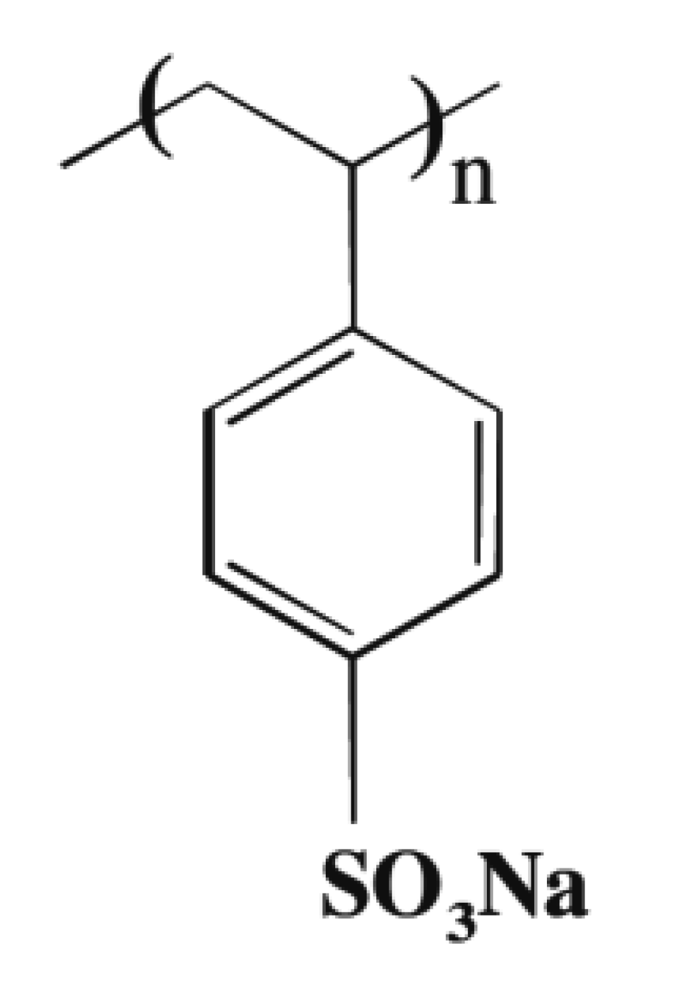
<p>Polyelectrolyte self-assembly is widely applicable technology which is simple in construct, yet stands to gain from further understanding of fundamental processes occurring during the assembly approach [<xref ref-type="bibr" rid="b1-polymers-03-00942">1</xref>,<xref ref-type="bibr" rid="b2-polymers-03-00942">2</xref>]. This is particularly true when coating nanomaterials—as ionic concentrations in the near surface regions may be drastically different from bulk concentrations due to radius of curvature considerations alone. Ariga <italic>et al.</italic> highlight several works aimed at elucidating the fundamentals of physico-chemical processes occurring during polyelectrolyte self-assembly [<xref ref-type="bibr" rid="b2-polymers-03-00942">2</xref>]. Most notably is the reported ubiquitous relationship between multilayer film formation and the properties of polyelectrolytes in solution. It is reported that low linear charge density polyelectrolytes, which occurs in the presence of increased salt concentration, continue to form multilayers via nonelectrostatic interactions [<xref ref-type="bibr" rid="b2-polymers-03-00942">2</xref>]. The conformation of polyelectrolytes in solution is controlled by the effective charge on the polyion. Weakly charged polyelectrolytes, <italic>i.e.</italic>, those whose charge has been compensated for by the presence of counterions in solution, tend to collapse into spherical morphologies [<xref ref-type="bibr" rid="b3-polymers-03-00942">3</xref>] and adsorb onto oppositely charges surfaces with greater film thicknesses, relative to rod-like morphologies [<xref ref-type="bibr" rid="b4-polymers-03-00942">4</xref>]. This change in film thickness is potentially associated with the adsorption of spherically collapsed morphologies. Strongly charged polyelectrolytes form rod-like molecular morphologies. One of the first models to account for conformation changes in polyelectrolytes associated with counterion condensation was described by Manning [<xref ref-type="bibr" rid="b5-polymers-03-00942">5</xref>]. The Manning model has since been used as a starting point to examine conformational changes in polyelectrolytes due to the presence of (and coulombic interaction with) monovalent and multivalent counter ions [<xref ref-type="bibr" rid="b6-polymers-03-00942">6</xref>-<xref ref-type="bibr" rid="b8-polymers-03-00942">8</xref>]. The Manning model has also been used for examining mobility of polyelectrolytes present in solution with counterions [<xref ref-type="bibr" rid="b9-polymers-03-00942">9</xref>,<xref ref-type="bibr" rid="b10-polymers-03-00942">10</xref>]. The Manning model proposes that counterion condensation on the polyion backbone occurs until a resulting lowered effective charge on the polyion is achieved. In the case of polystyrene sulfonate (PSS), the effective charge is reduced to less than 40% of the theoretical fully ionized charge via counterion adsorption [<xref ref-type="bibr" rid="b3-polymers-03-00942">3</xref>]. The solution retains a concentration of counterions equivalent to the unneutralized charges on the polymer. The counterions in solution are treated with the Debye-Huckel model [<xref ref-type="bibr" rid="b5-polymers-03-00942">5</xref>]. In the Manning model, the polyelectrolyte is envisioned as an infinite line of charge comprised of monomer units each having a point charge of −Z<sub>p</sub>e with the distance between each monomer unit of <bold>ℓ</bold> [<xref ref-type="bibr" rid="b3-polymers-03-00942">3</xref>]. <xref ref-type="fig" rid="f1-polymers-03-00942">Figure 1</xref> shows the monomer unit of sodium polystyrene sulfonate (PSS), the polyelectrolyte used in this study. Bringing a point charge counter ion having charge +Z<sub>c</sub>e from infinity to within a distance x (in a plane perpendicular to the bisector of the line of charge) of the line of charge will change in the electrostatic potential energy (V(x)) by
<disp-formula id="FD1">
<label>(1)</label>
<mml:math id="mm1" display="block">
<mml:semantics id="sm1">
<mml:mrow>
<mml:mi>V</mml:mi>
<mml:mrow>
<mml:mo>(</mml:mo>
<mml:mi>x</mml:mi>
<mml:mo>)</mml:mo></mml:mrow>
<mml:mspace width="0.2em"/>
<mml:mo>=</mml:mo>
<mml:mspace width="0.2em"/>
<mml:mfrac>
<mml:mrow>
<mml:msub>
<mml:mi>Z</mml:mi>
<mml:mi>p</mml:mi></mml:msub>
<mml:msub>
<mml:mi>Z</mml:mi>
<mml:mi>c</mml:mi></mml:msub>
<mml:msup>
<mml:mi>e</mml:mi>
<mml:mn>2</mml:mn></mml:msup></mml:mrow>
<mml:mrow>
<mml:mn>2</mml:mn>
<mml:mi>π</mml:mi>
<mml:msub>
<mml:mi>ε</mml:mi>
<mml:mi>r</mml:mi></mml:msub>
<mml:msub>
<mml:mi>ε</mml:mi>
<mml:mn>0</mml:mn></mml:msub>
<mml:mo>ℓ</mml:mo></mml:mrow></mml:mfrac>
<mml:mtext mathvariant="italic">log</mml:mtext>
<mml:mrow>
<mml:mo>(</mml:mo>
<mml:mi>x</mml:mi>
<mml:mo>)</mml:mo></mml:mrow></mml:mrow></mml:semantics></mml:math></disp-formula>where e is the charge on an electron, <italic><bold>ε<sub>r</sub></bold></italic> is the dielectric constant of the solution, and ε<sub>0</sub> is the permittivity of free space.</p>
<p>In the Manning model, V(x) = 0 is taken at x<sub>o</sub> = unity. The partition sum, Z (related to the Helmholtz free energy of the system), is given by:
<disp-formula id="FD2">
<label>(2)</label>
<mml:math id="mm2" display="block">
<mml:semantics id="sm2">
<mml:mrow>
<mml:mi>Z</mml:mi>
<mml:mspace width="0.2em"/>
<mml:mo>=</mml:mo>
<mml:mspace width="0.2em"/>
<mml:mrow>
<mml:mo>∫</mml:mo>
<mml:mrow>
<mml:mi>d</mml:mi>
<mml:mi>x</mml:mi>
<mml:mspace width="0.2em"/>
<mml:mtext mathvariant="italic">exp</mml:mtext>
<mml:mspace width="0.2em"/>
<mml:mrow>
<mml:mo>[</mml:mo>
<mml:mrow>
<mml:mo>−</mml:mo>
<mml:mspace width="0.2em"/>
<mml:mfrac>
<mml:mrow>
<mml:mi>V</mml:mi>
<mml:mrow>
<mml:mo>(</mml:mo>
<mml:mi>x</mml:mi>
<mml:mo>)</mml:mo></mml:mrow></mml:mrow>
<mml:mrow>
<mml:msub>
<mml:mi>k</mml:mi>
<mml:mi>b</mml:mi></mml:msub>
<mml:mi mathvariant="italic">T</mml:mi></mml:mrow></mml:mfrac></mml:mrow>
<mml:mo>]</mml:mo></mml:mrow></mml:mrow></mml:mrow></mml:mrow></mml:semantics></mml:math></disp-formula>where k<sub>b</sub> is Boltzmann's constant and T is temperature.</p>
<p>The mathematical criterion for counterion condensation is avoidance of a diverging partition sum at monomer spacing closer than the Bjerrum length, <bold>ℓ</bold><sub>B</sub>, times the electrostatic point charges, Z<sub>c</sub>Z<sub>p</sub>. That is to say, at the condition
<disp-formula id="FD3">
<label>(3)</label>
<mml:math id="mm3" display="block">
<mml:semantics id="sm3">
<mml:mrow>
<mml:mo>ℓ</mml:mo>
<mml:mspace width="0.2em"/>
<mml:mo>&lt;</mml:mo>
<mml:mspace width="0.2em"/>
<mml:mfrac>
<mml:mrow>
<mml:msub>
<mml:mi>Z</mml:mi>
<mml:mi>p</mml:mi></mml:msub>
<mml:msub>
<mml:mi>Z</mml:mi>
<mml:mi>c</mml:mi></mml:msub>
<mml:msup>
<mml:mi>e</mml:mi>
<mml:mn>2</mml:mn></mml:msup></mml:mrow>
<mml:mrow>
<mml:mn>2</mml:mn>
<mml:mi>π</mml:mi>
<mml:msub>
<mml:mi>ε</mml:mi>
<mml:mi>r</mml:mi></mml:msub>
<mml:msub>
<mml:mi>ε</mml:mi>
<mml:mn>0</mml:mn></mml:msub>
<mml:msub>
<mml:mi>k</mml:mi>
<mml:mi>b</mml:mi></mml:msub>
<mml:mi mathvariant="italic">T</mml:mi></mml:mrow></mml:mfrac>
<mml:mspace width="0.2em"/></mml:mrow></mml:semantics></mml:math></disp-formula>the partition sum, Z, will diverge. This is a physically unrealistic condition. The condition then imposed is that the condensation length <bold>ℓ</bold> may not fall below the distance:
<disp-formula id="FD4">
<label>(4)</label>
<mml:math id="mm4" display="block">
<mml:semantics id="sm4">
<mml:mrow>
<mml:mo>ℓ</mml:mo>
<mml:mspace width="0.2em"/>
<mml:mo>=</mml:mo>
<mml:mspace width="0.2em"/>
<mml:msub>
<mml:mi>Z</mml:mi>
<mml:mi>p</mml:mi></mml:msub>
<mml:msub>
<mml:mi>Z</mml:mi>
<mml:mi>c</mml:mi></mml:msub>
<mml:msub>
<mml:mo>ℓ</mml:mo>
<mml:mi>B</mml:mi></mml:msub></mml:mrow></mml:semantics></mml:math></disp-formula>where <bold>ℓ</bold><sub>B</sub> is the Bjerrum length given by:
<disp-formula id="FD5">
<label>(5)</label>
<mml:math id="mm5" display="block">
<mml:semantics id="sm5">
<mml:mrow>
<mml:msub>
<mml:mo>ℓ</mml:mo>
<mml:mi>B</mml:mi></mml:msub>
<mml:mspace width="0.2em"/>
<mml:mo>=</mml:mo>
<mml:mspace width="0.2em"/>
<mml:mfrac>
<mml:mrow>
<mml:msup>
<mml:mi>e</mml:mi>
<mml:mn>2</mml:mn></mml:msup></mml:mrow>
<mml:mrow>
<mml:mn>2</mml:mn>
<mml:mi>π</mml:mi>
<mml:msub>
<mml:mi>ε</mml:mi>
<mml:mi>r</mml:mi></mml:msub>
<mml:msub>
<mml:mi>ε</mml:mi>
<mml:mn>0</mml:mn></mml:msub>
<mml:msub>
<mml:mi>k</mml:mi>
<mml:mi>b</mml:mi></mml:msub>
<mml:mi mathvariant="italic">T</mml:mi></mml:mrow></mml:mfrac>
<mml:mspace width="0.2em"/></mml:mrow></mml:semantics></mml:math></disp-formula>when counterions and monomer units are specifically monovalent, the charges Z<sub>p</sub> = Z<sub>c</sub> = 1 and the condition for Manning condensation is <bold>ℓ</bold> = <bold>ℓ<sub><italic>B</italic></sub></bold>[<xref ref-type="bibr" rid="b3-polymers-03-00942">3</xref>].</p>
<p>A significant conclusion of the Manning condensation theory is that so long as counterions (such as Na<sup>+</sup> and H<sup>+</sup>) are present in large enough quantities to compensate charges until <bold>ℓ</bold><sub>B</sub> = <bold>ℓ</bold>, these ions will condense onto the polyion resulting in both change in conformation to the spherical coil and reduction in polyionic effective charge.</p>
<p>The sp<sup>2</sup> hybridized carbons on nanotubes and graphene have electronic structures which are still under debate in the literature. The key arguments surround whether the sp<sup>2</sup> hydridized orbitals remain as H or O terminated groups, as free radicals, adopt the carbene structure at zigzag sites with two lone pair electrons, or adopt the carbine structure at armchair sites having a triple bond nature [<xref ref-type="bibr" rid="b11-polymers-03-00942">11</xref>]. The nature of the processing approach will dictate surface termination—and thus, dictate the interaction of nanotubes with various ions in solution [<xref ref-type="bibr" rid="b12-polymers-03-00942">12</xref>,<xref ref-type="bibr" rid="b13-polymers-03-00942">13</xref>]. It is well-documented that carbon nanotubes are able to absorb anions such as Br<sup>−</sup> [<xref ref-type="bibr" rid="b12-polymers-03-00942">12</xref>] as well as heavy metal cations such as Ni<sup>2+</sup>, Zn<sup>2+</sup> and Pb<sup>2+</sup> [<xref ref-type="bibr" rid="b13-polymers-03-00942">13</xref>]. The preferential adsorption of Ni<sup>2+</sup> cations on oxidized multiwalled carbon nanotubes proved to follow the Langmuir adsorption isotherm model [<xref ref-type="bibr" rid="b13-polymers-03-00942">13</xref>]. Analyzed using the Langmuir model, as produced CNTs and oxidized CNTs show Ni<sup>2+</sup> uptake concentrations of 18.08 mg Ni<sup>2+</sup>/g-CNT and 9.26 mg Ni<sup>2+</sup>/g-CNT, respectively [<xref ref-type="bibr" rid="b13-polymers-03-00942">13</xref>]. The binding of ions near the surface of carbon is pH dependent [<xref ref-type="bibr" rid="b13-polymers-03-00942">13</xref>]— indicating that H<sup>+</sup> and OH<sup>−</sup> ions adsorbed near CNT surfaces mitigate cation and anion adsorption from solution. As well, EXAFS experiments indicate a multiplicity of near surface sites for ionic binding [<xref ref-type="bibr" rid="b12-polymers-03-00942">12</xref>]. For example, adsorbed Br<sup>−</sup> ions measured by EXAFS were determined to reside above the carbon surface at distances which vary from 2.67 Å to 4.52 Å [<xref ref-type="bibr" rid="b12-polymers-03-00942">12</xref>]. The adsorption of ions from solution by carbon nanotubes is a key aspect in explaining the morphology adopted by polyelectrolytes when adsorbed onto nanotube surfaces.</p>
<p>This paper seeks to describe the morphology of PSS adsorbed onto the surface of carbon nanotubes and to discuss the role of surface adsorption of cations on carbon nanotubes in structuring the conformation of PSS into spherical-like morphologies. Results show that PSS adsorbs at the nanotube surface in a spherically coiled morphology and disperse CNT bundles into individual tubes which remain in suspension for days.</p></sec>
<sec sec-type="results|discussion">
<label>2.</label>
<title>Results and Discussion</title>
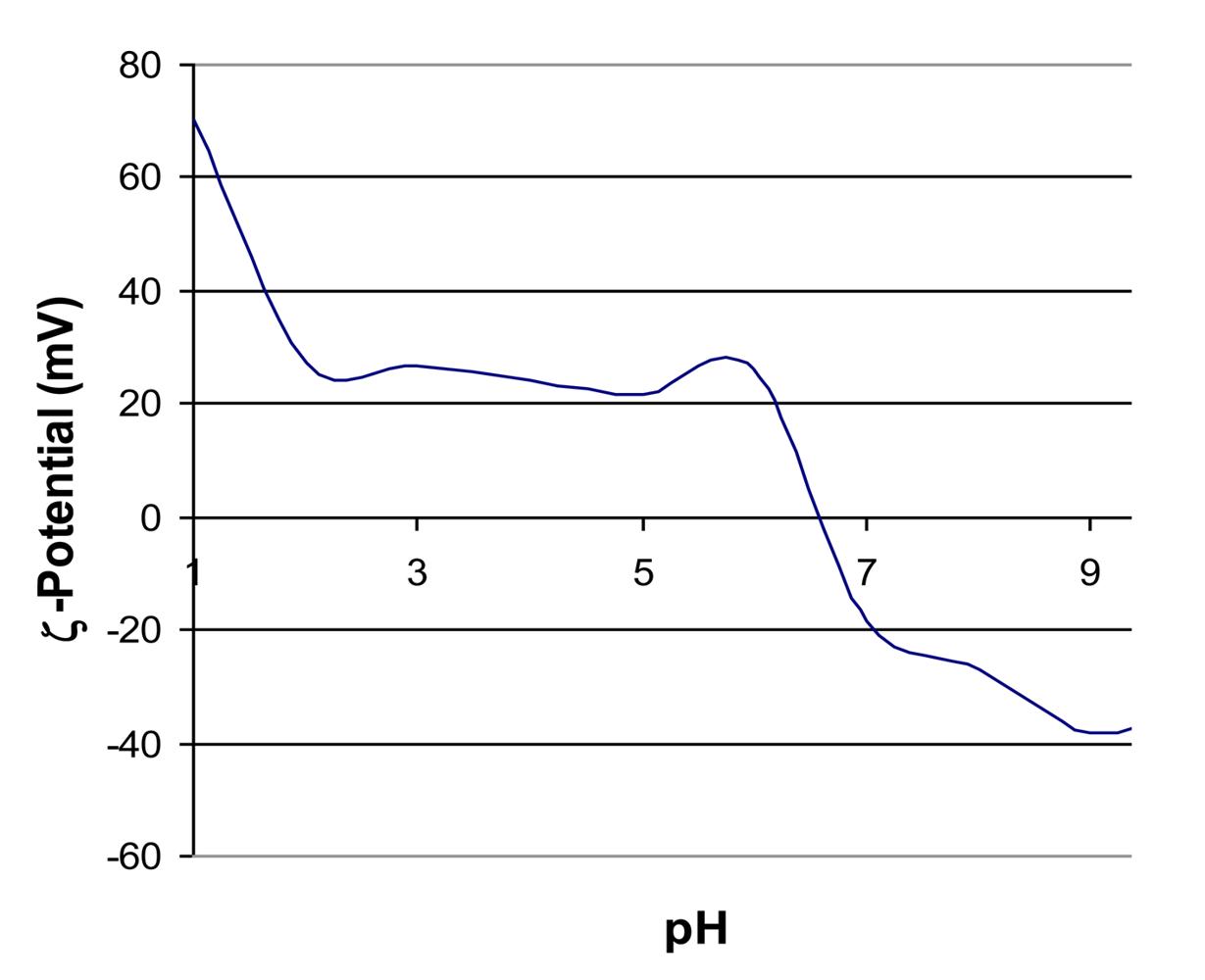
<p>The approach taken in driving the adsorption of PSS onto SWNT surfaces is the electrostatic layer-by-layer (LbL) approach—in which positively charged SWNT surfaces coulombically attract the PSS polyanion. The net positive charge on the SWNT surfaces are formed by adjusting the pH of the aqueous medium to a value at which the electric double layer around the CNT is terminated by positive H<sup>+</sup> ions. Here, the LbL reaction is terminated after the deposition of one layer of PSS over SWNT surfaces. Positively charged SWNTs are achieved at pH values below 6.5 [<xref ref-type="bibr" rid="b13-polymers-03-00942">13</xref>], <xref ref-type="fig" rid="f2-polymers-03-00942">Figure 2</xref> shows the surface charge (in mV) of as-purchased SWNTs as a function of pH at values ranging from 1 to 9. The surface charge varies from +70 mV (at pH of 1) to lower than −35 mV (at pH of 9). Surface charges of greater than |ζ| = 30 mV generate stable colloidal suspensions due to electrostatic repulsion of nm-scale entities. The working pH used for electrostatic assembly of PSS anion is 3—and at this pH the SWNTs have a positive charge just above +20 mV. Ultrasonication, therefore, plays a role in maintaining the SWNTs in a suspended state while ionic interactions at their surfaces occur.</p>
<sec>
<label>2.1.</label>
<title>Morphology of PSS at SWNT Surfaces</title>
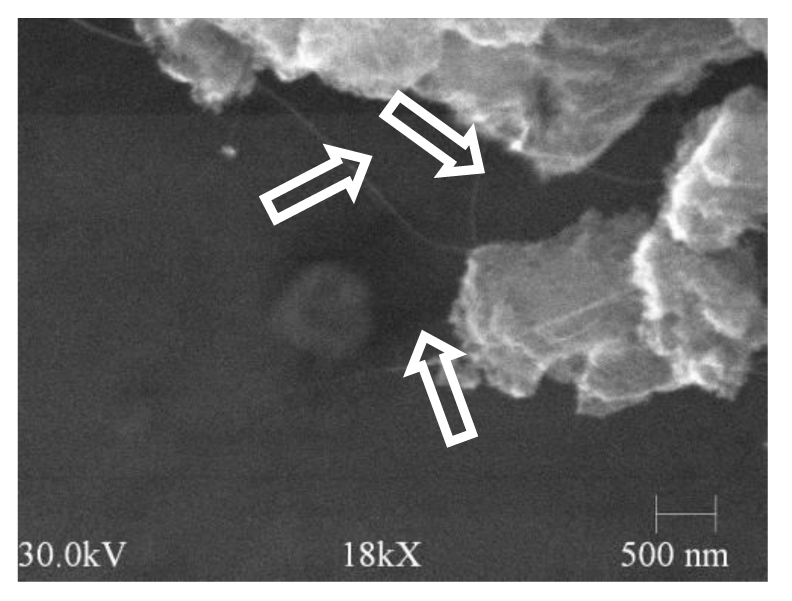
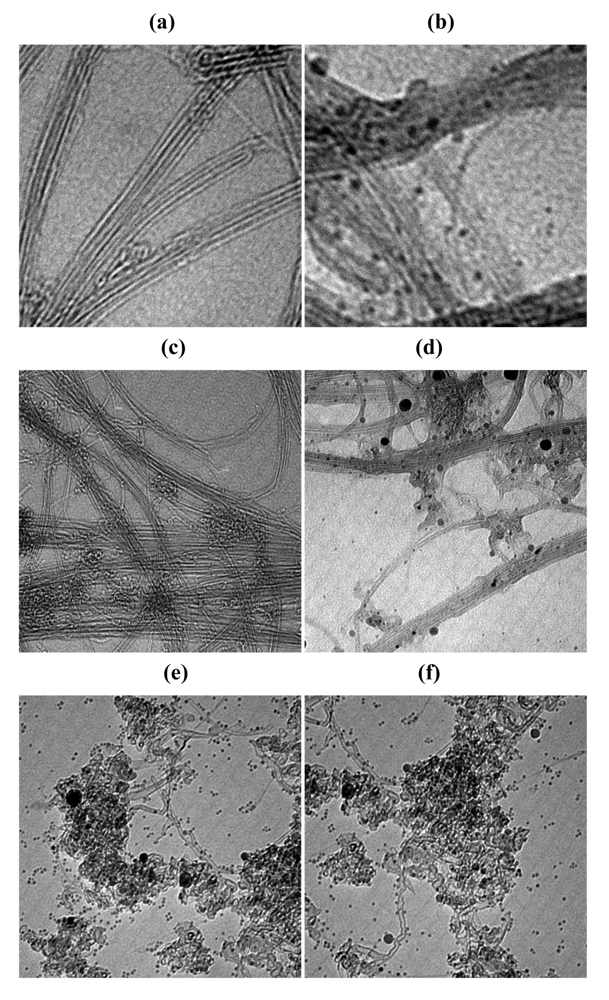
<p>As-purchased, purified SWNTs show two levels of agglomeration: (i) μm scale aggregates (shown by SEM in <xref ref-type="fig" rid="f3-polymers-03-00942">Figure 3</xref>) and (ii) nm-scale bundles (shown by TEM in <xref ref-type="fig" rid="f4-polymers-03-00942">Figure 4(a,b)</xref>). Even at the low magnification of 18 kX in SEM, SWNT bundles (see arrows) are seen to extend from the larger aggregates. High resolution TEM of aggregate regions (<xref ref-type="fig" rid="f4-polymers-03-00942">Figure 4(e,f)</xref>) shows the μm scale aggregates to be comprised of mechanically interlocked or “tangled” SWNTs whose morphology is unable to be altered with the chemical approaches used here. The binding between bundles comprised of straight parallel SWNTs is, however, chemically addressed by cations and the PSS anions in solution.</p>
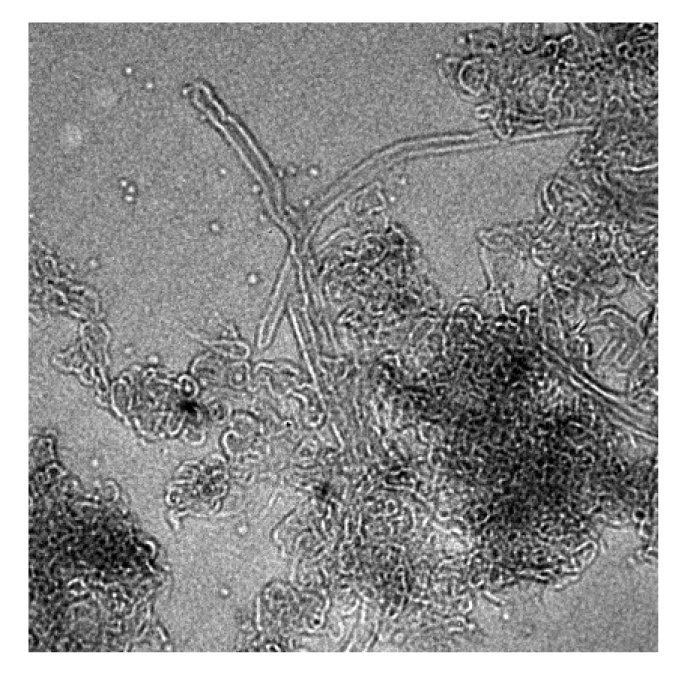
<p>TEM shows the PSS anion to adopt spherically collapsed conformations at the SWNT surfaces (<xref ref-type="fig" rid="f4-polymers-03-00942">Figure 4(b,d–f)</xref>). These spherically collapsed PSS morphologies are observed both in regions of aggregates and bundles. Samples prepared without ultrasonication show, on average, larger spherical PSS than those found in the sample ultrasonicated for 20 hours indicating that each sphere is comprised of multiple units of polyelectrolytes which then associate by weak Van der Waals interactions. The spherically collapsed conformation is known to occur as a result of counterion condensation onto monomer units of the PSS polyelectrolyte. Suspensions of PSS and SWNTs contain H<sup>+</sup> and Na<sup>+</sup> ions which may adsorb onto PSS. Typically, LbL films comprised of PSS and a polycation (such as polyallylaminehydrochloride, PAH) deposited at the working pH of 3 and with the same abundance of Na<sup>+</sup> counterions present in solution show a planar polyelectrolyte morphology with each layer having a thickness of 2 nm [<xref ref-type="bibr" rid="b14-polymers-03-00942">14</xref>-<xref ref-type="bibr" rid="b16-polymers-03-00942">16</xref>]. Spherically coiled polyelectrolyte diameters of 40 nm are predicted by continuum models for molecular chains of 250 nm length [<xref ref-type="bibr" rid="b17-polymers-03-00942">17</xref>]. Here, the observed PSS spherically coiled diameter varied between ∼2 nm (the order of the SWNT diameter) and ∼200 nm (for some of the largest PSS coils observed). The size variations in coiled diameter are, perhaps, related to ultrasonication which would inhibit the aggregation of multiple PSS polymeric units. After exposure of the sample to the 120 kV electron beam in TEM for periods of 1 hour, the spherically coiled PSS regions were removed by beam damage (<xref ref-type="fig" rid="f5-polymers-03-00942">Figure 5</xref>). Literature reports beam damage to CNTs at 100 kV [<xref ref-type="bibr" rid="b18-polymers-03-00942">18</xref>], but here the electron beam did little to further damage the SWNT wall structures. Due to prolonged ultrasonication, the SWNTs suffered some loss in structural order and the straight parallel walls are buckled in some areas shown in <xref ref-type="fig" rid="f4-polymers-03-00942">Figure 4(e,f)</xref>.</p></sec>
<sec>
<label>2.2.</label>
<title>Manning Theory of Counterion Condensation for Spherically Coiled PSS at SWNT Surfaces</title>
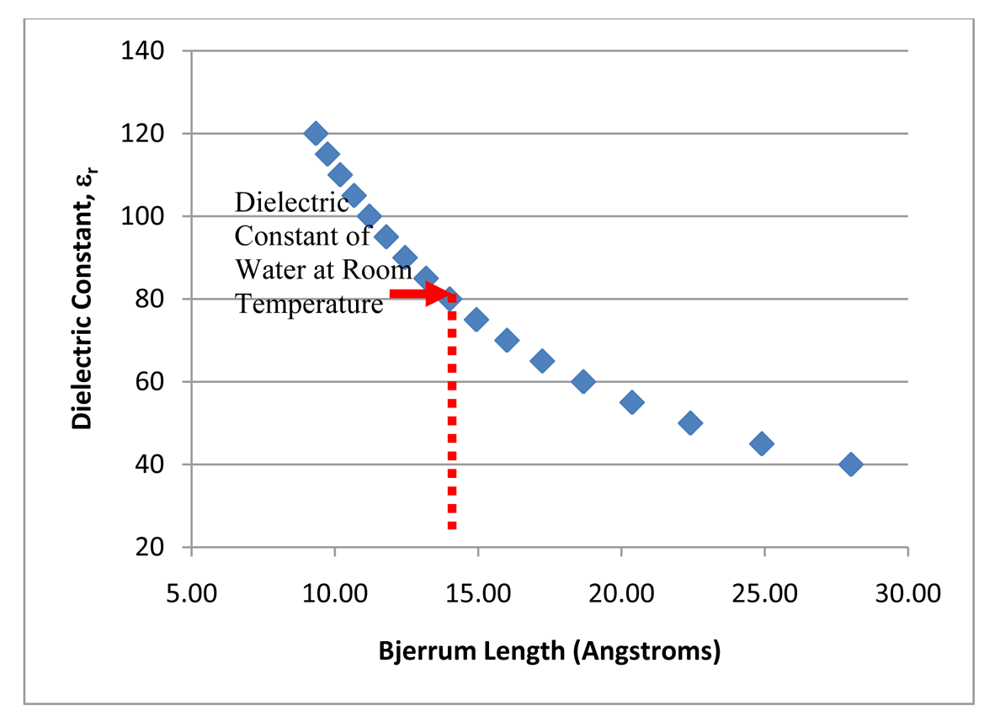
<p>The Manning theory of counterion condensation can be used to predict the spacing of counterions adsorbed onto PSS at the onset of spherical coiling by Equation (5). Alternatively, the theory can be used to explore the ranges of local dielectric constants which must exist near PSS in order to cause the onset of spherical coiling. <xref ref-type="fig" rid="f6-polymers-03-00942">Figure 6</xref> shows dielectric constant (ε<sub>r</sub>) as a function of Bjerrum length (ℓ<sub>B</sub>) and may be interpreted to yield the spacing, in this case less than 1.3 nm, between counter ions (e.g., Na<sup>+</sup> or H<sup>+</sup>) adsorbed onto PSS for spherical coiling of PSS to occur in pH neutral water at room temperature. In practice, spherical coiling of PSS is not observed in pH 3 aqueous solutions—and so, the condensation limit of 1.3 nm spacing is not reached by counterions in solutions comprised of Na<sup>+</sup> (in concentrations found in 2 mg/mL of PSS) and H<sup>+</sup> (in concentrations at pH 3). In other words, within the bulk solutions containing Na<sup>+</sup> and H<sup>+</sup> counter ions, inherent kinetic limitations which control the rate at which counterions enter the coulombic potential of the PSS monomer unit prohibits adsorption of counterions onto the PSS rod-like linear chain backbone with spacing equal to the theoretical Bjerrum length, ℓ<sub>B</sub> = 1.3 nm. Because spherically coiled PSS morphologies are observed at the surface of SWNTs, it can be speculated that the counterions attracted to the surface of SWNTs pre-concentrate the solution—giving local dielectric constants (ε<sub>r</sub>) greater than 80 and resulting in the condensation counterions at theoretical Bjerrum lengths of 1.3 nm or less. Thus, it may be concluded that dielectric constants, (and cationic concentrations) within the solution near the surface of SWNTs is much different from the bulk solution. Experimental work by Duque <italic>et al.</italic> [<xref ref-type="bibr" rid="b19-polymers-03-00942">19</xref>] report changes in SWNT “immediate environment” as a function of changing pH (toward acidic values) by measured fluorescence data. These changes are not attributable to protonation of the CNT (a covalent interaction)—and can be presumed as an increase in local concentration of H<sup>+</sup> surrounding the CNT in hydrogen ion rich environments [<xref ref-type="bibr" rid="b19-polymers-03-00942">19</xref>]. Furthermore, pH associated confirmation changes of the ionic polymer, PVP, used in that work shows spherically coiled morphologies occur at neutral and high pH while elongated rod-like morphologies occur at low pH. The PVP molecule contains hydrophobic and hydrophilic groups which dictate its conformational structure [<xref ref-type="bibr" rid="b19-polymers-03-00942">19</xref>]. Computational research which calculated dielectric constants for biomolecular polyelectrolytes, protein [<xref ref-type="bibr" rid="b20-polymers-03-00942">20</xref>] and DNA [<xref ref-type="bibr" rid="b18-polymers-03-00942">18</xref>] are useful to discuss here.</p>
<p>That work shows counterion distributions calculated by Poisson-Boltzmann finite-difference models might be more adequately accounted for by assuming a dielectric constant (ε<sub>r</sub>) near the surface of polyelectrolytes which is much different from that in the bulk media. Lamm <italic>et al.</italic> [<xref ref-type="bibr" rid="b21-polymers-03-00942">21</xref>]. use an ε<sub>r</sub> much lower than 80, a value of 10–30 near the polyelectrolyte surface, which increases to 78.5 in the bulk solution. Contour mapping of the near surface dielectric constant (ε<sub>r</sub>), and its associated potential gradient, adequately describes binding sites for ligands and counterions [<xref ref-type="bibr" rid="b21-polymers-03-00942">21</xref>]. Although, debate in the literature exists as to whether dielectric constant would adequately describe ligand binding [<xref ref-type="bibr" rid="b20-polymers-03-00942">20</xref>]—the argument that near surface dielectric constants may be much different than bulk is validated by the computational study.</p>
<p>Understanding the structure and morphology of polyelectrolytes at the surface of SWNTs is of key relevance because polyelectrolyte self-assembly approaches are currently being used to explore the fabrication of functional coatings containing carbon nanotubes [<xref ref-type="bibr" rid="b22-polymers-03-00942">22</xref>-<xref ref-type="bibr" rid="b24-polymers-03-00942">24</xref>]. Applications considered are as antimicrobial films [<xref ref-type="bibr" rid="b22-polymers-03-00942">22</xref>], electrodes [<xref ref-type="bibr" rid="b23-polymers-03-00942">23</xref>], biosensors [<xref ref-type="bibr" rid="b24-polymers-03-00942">24</xref>,<xref ref-type="bibr" rid="b25-polymers-03-00942">25</xref>], and in the formation of conductive paper [<xref ref-type="bibr" rid="b26-polymers-03-00942">26</xref>]. Polyelectrolyte self assembly is presently being used to coat a diverse set of nanomaterials, including biomolecules, proteins, clay platelets, nanorods and nanowires [<xref ref-type="bibr" rid="b1-polymers-03-00942">1</xref>,<xref ref-type="bibr" rid="b2-polymers-03-00942">2</xref>,<xref ref-type="bibr" rid="b26-polymers-03-00942">26</xref>,<xref ref-type="bibr" rid="b27-polymers-03-00942">27</xref>]. The surface chemistry of the starting material, in each case, will dictate the propensity for pre-concentration of ions from the working solvent—and hence control polyelectrolyte morphologies. Further studies might consider examining polyelectrolyte morphology and Bjerrum length (ℓ<sub>B</sub>) as a measure of ionic preconcentration at near surface regions for a wide set of nanomaterials chemistries.</p></sec>
<sec>
<label>2.3.</label>
<title>Behavior of PSS-Coated SWNTs in Aqueous Suspensions</title>
<p>The ability to form stable suspensions of SWNTs will prove to be key to their use in a variety of new applications. Non-covalent functionalization of SWNTs is an important strategy to generating stable SWNT suspensions because it leaves the intrinsic electronic properties of the SWNT undisturbed [<xref ref-type="bibr" rid="b28-polymers-03-00942">28</xref>]. Several non-covalent strategies for SWNT dispersion have included the use of surfactants [<xref ref-type="bibr" rid="b29-polymers-03-00942">29</xref>], DNA [<xref ref-type="bibr" rid="b30-polymers-03-00942">30</xref>], and peptides [<xref ref-type="bibr" rid="b31-polymers-03-00942">31</xref>]. In order to quantatively examine PSS-SWNT dispersion, supernatants of PSS-SWNT suspensions were examined using UV-Vis spectrophotometry.</p>
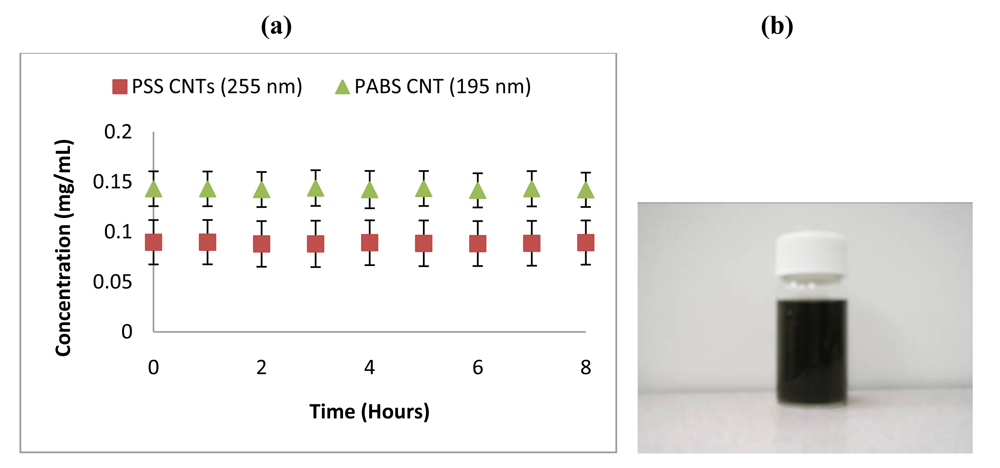
<p>These supernatants exclude SWNT aggregates which have settled out of suspension. The commercial PABS-CNT samples were measured for comparison. <xref ref-type="fig" rid="f7-polymers-03-00942">Figure 7(a)</xref> shows concentration <italic>vs.</italic> time profiles for PSS-SWNT and PABS-CNTs. Little change in supernatant concentration is observed over an 8 hour period indicating highly stable suspensions are attained via PSS-overlay. At inset, <xref ref-type="fig" rid="f7-polymers-03-00942">Figure 7(b)</xref> shows a photographic image of an PSS-SWNT dispersion in water after 5 hours of ultrasonication. The photographed dispersions contain 0.36 mg/mL of SWNTs with 2 mg/mL of PSS and the image shows the suspension 2 days after it was prepared.</p></sec></sec>
<sec>
<label>3.</label>
<title>Experimental Section</title>
<sec>
<label>3.1.</label>
<title>Preparation of PSS Films at Single Walled Carbon Nanotube (SWNT) Surfaces</title>
<p>For assembly of polystyrene sulfonate (PSS) over SWNT surfaces, mixtures comprised of PSS (Sigma-Aldrich) and commercial purified grade single walled carbon nanotubes (MicroTechNano Corp.) were prepared under pH 3 aqueous conditions. The starting materials were mixed in concentrations of 2 mg/mL of PSS and 0.4 mg/mL of SWNTs. Prior to adding PSS and SWNTs, the pH of deionized water was adjusted to 3 using HCl. One mixture was ultrasonicated for 20 hours with the temperature of the ultrasonic bath reaching up to 60 °C. A second mixture underwent no ultrasonication, but was contained in the pH 3 aqueous solution environment for 20 hours.</p></sec>
<sec>
<label>3.2.</label>
<title>Characterization of Suspensions by UV Visible Spectrophotometry</title>
<p>The absorbance of the solutions was measured using the DU<sup>®</sup> 530 UV-Vis spectrophotometer scan wavelength mode. To quantitatively determine SWNT suspension concentration <italic>vs.</italic> time using the Beer-Lambert law, standard suspensions containing known SWNTs concentrations were prepared at 0.1 mg/mL, 0.05 mg/mL, 0.025 mg/mL and 0.0125 mg/mL. For these standards, the suspensions were prepared using pH 3 deionized water with PSS added in the content of 2 mg/mL. The suspensions were ultrasonicated for 5 hours. A total of six absorption measurements were made at the wavelength of 255 nm and the mean of those measurements was fit to a linear regression curve used as a standard concentration line to evaluate sample suspensions. For comparison, suspensions of commercially available polyaminobenzenesulfonic acid (PABS) functionalized carbon nanotubes (CNTs) (Sigma-Aldrich) were prepared in concentrations of 0.2 mg/mL, 0.1 mg/mL, 0.05 mg/mL, and 0.025 mg/mL. The PABS molecule is covalently bound to the CNTs and these CNTs remain in suspension for long periods. The PABS-CNTs suspensions were ultrasonicated for 5 minutes. Two absorption measurements were made at the 195 nm wavelength and the mean of those measurements were fit to a regression curve.</p>
<p>The UV-Visible absorption from PSS-SWNT mixtures prepared at 2 mg/mL of PSS and 0.4 mg/mL of SWNTs was measured at 1 hour intervals for an 8 hour period using a 255 nm wavelength. The results reported comprise the mean and standard deviation (error bars) for six measurements collected within the first 1 minute of each interval. Similarly, the absorption of PABS-CNT suspensions prepared at 0.2 mg/mL was measured over an 8 hour window at 195 nm wavelength.</p></sec>
<sec>
<label>3.3.</label>
<title>Characterization of SWNTs by Electron Microscopy</title>
<p>Scanning electron microscopy (SEM, HITACHI, model S-4,800) was performed on the as-purchased SWNTs at 30 kV electron energy. Transmission electron microscopy (TEM) was performed using the Zeiss Libra instrument. For as-purchased CNT powders, sample preparation involved transfer of the dry powders to sample holders. For PSS-CNT mixtures, sample preparation involved dropwise addition of as-prepared mixtures, both with and without ultrasonication, to the sample holder grids. A drying period of one to several days was performed in an evacuated chamber.</p></sec>
<sec>
<label>3.4.</label>
<title>Surface Charge Measurement of As-Purchased SWNTs</title>
<p>Surface charge ζ-potential measurements were collected using the ZetaPlus Analyzer (Brookhaven Instruments, Holtsville, NY). ζ-potential measurements were taken for SWNTs at various pH values as a means of determining the counterion H<sup>+</sup> content around the SWNT surface. For sample preparation, SWNT were added to deionized water having fixed pH values between 3 and 8 at concentrations of 0.1 mg/mL, 0.5 mg/mL and 1 mg/mL. The surface charge was the same for all three SWNT concentrations measured.</p></sec></sec>
<sec sec-type="conclusions">
<label>4.</label>
<title>Conclusions</title>
<p>The polyelectrolyte Na<sup>+</sup>-PSS organizes over the surface of single walled carbon nanotubes (SWNTs) as spherically collapsed colloids as observed by TEM. The structural organization of polyelectrolytes at the surface of SWNTs is important to understand—because self-assembly approaches are commonly used to fabricate SWNT thin films for specific applications. The overall performance of those films may be enhanced or limited by the surface arrangement of the polyelectrolyte. An explanation for this morphology is that a cation concentration gradient near the SWNT surface would expose the PSS to environments where the Bjerrum length (<bold>ℓ</bold><sub>B</sub>) for condensation of counterions and spherical coiling would be achieved. The resulting PSS-SWNTs are stable in aqueous suspension.</p></sec></body>
<back>
<sec sec-type="display-objects">
<title>Figures</title>
<fig id="f1-polymers-03-00942" position="float">
<label>Figure 1.</label>
<caption>
<p>Monomer unit of Sodium Polystyrene Sulfonate (PSS).</p></caption>
<graphic xlink:href="polymers-03-00942f1.gif"/></fig>
<fig id="f2-polymers-03-00942" position="float">
<label>Figure 2.</label>
<caption>
<p>Zeta (<bold>ζ)</bold> Potential surface charge of as-purchased single-walled carbon nanotubes (SWNTs) at pH 1 to 9.</p></caption>
<graphic xlink:href="polymers-03-00942f2.gif"/></fig>
<fig id="f3-polymers-03-00942" position="float">
<label>Figure 3.</label>
<caption>
<p>SEM of Commercial MicroTechNano CNTs.</p></caption>
<graphic xlink:href="polymers-03-00942f3.gif"/></fig>
<fig id="f4-polymers-03-00942" position="float">
<label>Figure 4.</label>
<caption>
<p><bold>(a)</bold> 200 kX TEM of SWNTs in the as-purchased state; <bold>(b)</bold> 200 kX TEM of PSS-SWNTs (polystyrene sulfonate single-walled carbon nanotubes) without ultrasonication; <bold>(c)</bold> 63 kX TEM of SWNTs in the as-purchased state; <bold>(d)</bold> 63 kX TEM of PSS-SWNTs without ultrasonication; (<bold>e)</bold> 63 kX TEM of PSS-SWNTs after 20 hours of ultrasonication; (<bold>f)</bold> 63 kX TEM of PSS-SWNTs after 20 hours of ultrasonication.</p></caption>
<graphic xlink:href="polymers-03-00942f4.gif"/></fig>
<fig id="f5-polymers-03-00942" position="float">
<label>Figure 5.</label>
<caption>
<p>80 kX TEM images of PSS-SWNTs after e-beam damage which effectively removed the spherically collapsed polyelectrolyte beads.</p></caption>
<graphic xlink:href="polymers-03-00942f5.gif"/></fig>
<fig id="f6-polymers-03-00942" position="float">
<label>Figure 6.</label>
<caption>
<p>Manning Theory Bjerrum Length (ℓ<sub>B</sub>) <italic>vs.</italic> Dielectric Constant.</p></caption>
<graphic xlink:href="polymers-03-00942f6.gif"/></fig>
<fig id="f7-polymers-03-00942" position="float">
<label>Figure 7.</label>
<caption>
<p><bold>(a)</bold> Concentration <italic>vs.</italic> time profiles for PSS-SWNT and commercially available PABS-CNT suspensions over an 8 hour period; <bold>(b)</bold> at inset, PSS-SWNT suspensions 2 days after preparation using 0.36 mg/mL of SWNTs with 2 mg/mL of PSS.</p></caption>
<graphic xlink:href="polymers-03-00942f7.gif"/></fig></sec>
<ack>
<p>Funding for this project was provided by the Force Research Laboratory Materials and Manufacturing Directorate (contract FA8650-05-D-1912 A). Undergraduate summer student researcher support from the JFAP Summer Research Experience (Louisiana Tech University and Grambling State University) is gratefully acknowledged.</p></ack>
<ref-list>
<title>References</title>
<ref id="b1-polymers-03-00942"><label>1.</label><citation citation-type="journal"><person-group person-group-type="author"><name><surname>Ariga</surname><given-names>K.</given-names></name><name><surname>Hill</surname><given-names>J.P.</given-names></name><name><surname>Lee</surname><given-names>M.V.</given-names></name><name><surname>Vinu</surname><given-names>A.</given-names></name><name><surname>Charvet</surname><given-names>R.</given-names></name><name><surname>Acharya</surname><given-names>S.</given-names></name></person-group><article-title>Challenges and Breakthroughs in Recent Research on Self-Assembly</article-title><source>Sci. Technol. Adv. Mater.</source><year>2008</year><volume>9</volume><fpage>014109</fpage><pub-id pub-id-type="doi">10.1088/1468-6996/9/1/014109</pub-id></citation></ref>
<ref id="b2-polymers-03-00942"><label>2.</label><citation citation-type="journal"><person-group person-group-type="author"><name><surname>Ariga</surname><given-names>K.</given-names></name><name><surname>Hill</surname><given-names>J.P.</given-names></name><name><surname>Ji</surname><given-names>Q.</given-names></name></person-group><article-title>Layer-by-Layer Assembly as a Versatile Bottom-up Nanofabrication Technique for Exploratory Research and Realistic Application</article-title><source>Phys. Chem. Chem. Phys.</source><year>2007</year><volume>9</volume><fpage>2319</fpage><lpage>2340</lpage><pub-id pub-id-type="doi">10.1039/b700410a</pub-id><pub-id pub-id-type="pmid">17492095</pub-id></citation></ref>
<ref id="b3-polymers-03-00942"><label>3.</label><citation citation-type="journal"><person-group person-group-type="author"><name><surname>Muthukumar</surname><given-names>M.</given-names></name></person-group><article-title>Theory of Counter-Ion Condensation on Flexible Polyelectrolytes: Adsorption Mechanism</article-title><source>J. Chem. Phys.</source><year>2004</year><volume>120</volume><fpage>9343</fpage><lpage>9350</lpage><pub-id pub-id-type="doi">10.1063/1.1701839</pub-id><pub-id pub-id-type="pmid">15267872</pub-id></citation></ref>
<ref id="b4-polymers-03-00942"><label>4.</label><citation citation-type="journal"><person-group person-group-type="author"><name><surname>Linse</surname><given-names>P.</given-names></name></person-group><article-title>Adsorption of Weakly Charged Polyelectrolytes at Oppositely Charged Surfaces</article-title><source>Macromolecules</source><year>1996</year><volume>29</volume><fpage>326</fpage><lpage>336</lpage><pub-id pub-id-type="doi">10.1021/ma950539v</pub-id></citation></ref>
<ref id="b5-polymers-03-00942"><label>5.</label><citation citation-type="journal"><person-group person-group-type="author"><name><surname>Manning</surname><given-names>G.S.</given-names></name></person-group><article-title>A Limiting Law for the Conductance of the Rod Model of a Salt-Free Polyelectrolyte Solution</article-title><source>J. Chem. Phys.</source><year>1975</year><volume>79</volume><fpage>262</fpage><lpage>265</lpage><pub-id pub-id-type="doi">10.1021/j100570a013</pub-id></citation></ref>
<ref id="b6-polymers-03-00942"><label>6.</label><citation citation-type="journal"><person-group person-group-type="author"><name><surname>Solis</surname><given-names>F.J.</given-names></name><name><surname>de la Cruz</surname><given-names>M.</given-names></name></person-group><article-title>Collapse of Flexible Polyelectrolytes in Multivalent Salt Solutions</article-title><source>J. Chem. Phys.</source><year>2000</year><volume>112</volume><fpage>2030</fpage><lpage>2035</lpage><pub-id pub-id-type="doi">10.1063/1.480763</pub-id></citation></ref>
<ref id="b7-polymers-03-00942"><label>7.</label><citation citation-type="journal"><person-group person-group-type="author"><name><surname>Micka</surname><given-names>U.</given-names></name><name><surname>Kremer</surname><given-names>K.</given-names></name></person-group><article-title>Persistence Length of the Debye-Huckel Model of Weakly Charged Flexible Polyelectrolyte Chains</article-title><source>Phys. Rev. E</source><year>1996</year><volume>54</volume><fpage>2653</fpage><lpage>2662</lpage><pub-id pub-id-type="doi">10.1103/PhysRevE.54.2653</pub-id></citation></ref>
<ref id="b8-polymers-03-00942"><label>8.</label><citation citation-type="journal"><person-group person-group-type="author"><name><surname>Schafer</surname><given-names>H.</given-names></name><name><surname>Seidel</surname><given-names>C.</given-names></name></person-group><article-title>Structure of Polyelectrolytes in Solution: A Monte Carlo Study</article-title><source>Macromolecules</source><year>1997</year><volume>30</volume><fpage>6658</fpage><lpage>6661</lpage><pub-id pub-id-type="doi">10.1021/ma961906l</pub-id></citation></ref>
<ref id="b9-polymers-03-00942"><label>9.</label><citation citation-type="journal"><person-group person-group-type="author"><name><surname>Nagasawa</surname><given-names>M.</given-names></name><name><surname>Noda</surname><given-names>I.</given-names></name><name><surname>Takahashi</surname><given-names>T.</given-names></name><name><surname>Shimamoto</surname><given-names>N.</given-names></name></person-group><article-title>Transport Phenomena of Polyelectrolytes in Solution under Electric Field</article-title><source>J. Chem. Phys.</source><year>1972</year><volume>76</volume><fpage>2286</fpage><lpage>2294</lpage><pub-id pub-id-type="doi">10.1021/j100660a019</pub-id></citation></ref>
<ref id="b10-polymers-03-00942"><label>10.</label><citation citation-type="journal"><person-group person-group-type="author"><name><surname>Hoagland</surname><given-names>D.A.</given-names></name><name><surname>Arvanitidou</surname><given-names>E.</given-names></name><name><surname>Welch</surname><given-names>C.</given-names></name></person-group><article-title>Capillary Electrophoresis Measurements of the Free Solution Mobility for Several Model Polyelectrolyte Systems</article-title><source>Macromolecules</source><year>1999</year><volume>32</volume><fpage>6180</fpage><lpage>6190</lpage><pub-id pub-id-type="doi">10.1021/ma9903761</pub-id></citation></ref>
<ref id="b11-polymers-03-00942"><label>11.</label><citation citation-type="journal"><person-group person-group-type="author"><name><surname>Radovic</surname><given-names>L.R.</given-names></name><name><surname>Bockrath</surname><given-names>B.</given-names></name></person-group><article-title>On the Chemical Nature of Graphene Edges: Origin of Stability and Potential for Magnetism in Carbon Materials</article-title><source>J. Am. Chem. Soc.</source><year>2005</year><volume>127</volume><fpage>5917</fpage><lpage>5927</lpage><pub-id pub-id-type="doi">10.1021/ja050124h</pub-id><pub-id pub-id-type="pmid">15839691</pub-id></citation></ref>
<ref id="b12-polymers-03-00942"><label>12.</label><citation citation-type="journal"><person-group person-group-type="author"><name><surname>Kandah</surname><given-names>M.I.</given-names></name><name><surname>Meuner</surname><given-names>J.L.</given-names></name></person-group><article-title>Removal of Nickel Ions from Water by Milt-Walled Carbon Nanotubes</article-title><source>J. Hazard. Mater.</source><year>2007</year><volume>146</volume><fpage>283</fpage><lpage>288</lpage><pub-id pub-id-type="doi">10.1016/j.jhazmat.2006.12.019</pub-id><pub-id pub-id-type="pmid">17196328</pub-id></citation></ref>
<ref id="b13-polymers-03-00942"><label>13.</label><citation citation-type="journal"><person-group person-group-type="author"><name><surname>Mehta</surname><given-names>A.</given-names></name><name><surname>Nelson</surname><given-names>E.J.</given-names></name><name><surname>Webb</surname><given-names>S.M.</given-names></name><name><surname>Holt</surname><given-names>J.K.</given-names></name></person-group><article-title>The Interaction of Bromide Ions with Graphitic Materials</article-title><source>Adv. Mater.</source><year>2009</year><volume>21</volume><fpage>102</fpage><lpage>106</lpage><pub-id pub-id-type="doi">10.1002/adma.200801602</pub-id></citation></ref>
<ref id="b14-polymers-03-00942"><label>14.</label><citation citation-type="journal"><person-group person-group-type="author"><name><surname>Lvov</surname><given-names>Y</given-names></name><name><surname>Haas</surname><given-names>H.</given-names></name><name><surname>Decher</surname><given-names>G.</given-names></name><name><surname>Mohwald</surname><given-names>H.</given-names></name></person-group><article-title>Successive Deposition of Alternate Layers of Polyelectrolytes</article-title><source>Langmuir</source><year>1994</year><volume>10</volume><fpage>4232</fpage><lpage>4236</lpage><pub-id pub-id-type="doi">10.1021/la00023a052</pub-id></citation></ref>
<ref id="b15-polymers-03-00942"><label>15.</label><citation citation-type="journal"><person-group person-group-type="author"><name><surname>Park</surname><given-names>S.Y.</given-names></name><name><surname>Rubner</surname><given-names>M.F.</given-names></name><name><surname>Mayes</surname><given-names>A.M.</given-names></name></person-group><article-title>Free Energy Model for Layer-by-Layer Processing of Polyelectrolyte Multilayer Films</article-title><source>Langmuir</source><year>2002</year><volume>18</volume><fpage>9600</fpage><lpage>9604</lpage><pub-id pub-id-type="doi">10.1021/la026111o</pub-id></citation></ref>
<ref id="b16-polymers-03-00942"><label>16.</label><citation citation-type="journal"><person-group person-group-type="author"><name><surname>Kamineni</surname><given-names>V.K.</given-names></name><name><surname>Lvov</surname><given-names>Y.M.</given-names></name><name><surname>Dobbins</surname><given-names>T.A.</given-names></name></person-group><article-title>Layer-by-Layer Nanoassembly of Polyelectrolytes Using Formamide as the Working Medium</article-title><source>Langmuir</source><year>2007</year><volume>23</volume><fpage>7423</fpage><lpage>7427</lpage><pub-id pub-id-type="doi">10.1021/la700465n</pub-id><pub-id pub-id-type="pmid">17536845</pub-id></citation></ref>
<ref id="b17-polymers-03-00942"><label>17.</label><citation citation-type="journal"><person-group person-group-type="author"><name><surname>Drouot</surname><given-names>R.</given-names></name><name><surname>Maugin</surname><given-names>G.A.</given-names></name></person-group><article-title>Continuum Modelling of Polyelectrolytes in Solution</article-title><source>Rheol. Acta</source><year>1985</year><volume>24</volume><fpage>474</fpage><lpage>487</lpage><pub-id pub-id-type="doi">10.1007/BF01462494</pub-id></citation></ref>
<ref id="b18-polymers-03-00942"><label>18.</label><citation citation-type="journal"><person-group person-group-type="author"><name><surname>Kiang</surname><given-names>C.-H.</given-names></name><name><surname>Goddard</surname><given-names>W.A.</given-names></name><name><surname>Beyers</surname><given-names>R.</given-names></name><name><surname>Bethune</surname><given-names>D.S.</given-names></name></person-group><article-title>Structural Modification of Single-Layer Carbon Nanotubes with an Electron Beam</article-title><source>J. Phys. Chem.</source><year>1996</year><volume>100</volume><fpage>3749</fpage><lpage>3752</lpage><pub-id pub-id-type="doi">10.1021/jp952636w</pub-id></citation></ref>
<ref id="b19-polymers-03-00942"><label>19.</label><citation citation-type="journal"><person-group person-group-type="author"><name><surname>Duque</surname><given-names>J.G.</given-names></name><name><surname>Cognet</surname><given-names>L.</given-names></name><name><surname>Parra-Vasquez</surname><given-names>A.N.G.</given-names></name><name><surname>Nicholas</surname><given-names>N.</given-names></name><name><surname>Schmidt</surname><given-names>H.K.</given-names></name><name><surname>Pasquali</surname><given-names>M.J.</given-names></name></person-group><article-title>Stable Luminescence from Individual Carbon Nanotubes in Acidic, Basic, and Biological Environments</article-title><source>J. Am. Chem. Soc.</source><year>2008</year><volume>130</volume><fpage>2626</fpage><lpage>2633</lpage><pub-id pub-id-type="doi">10.1021/ja0777234</pub-id><pub-id pub-id-type="pmid">18237169</pub-id></citation></ref>
<ref id="b20-polymers-03-00942"><label>20.</label><citation citation-type="journal"><person-group person-group-type="author"><name><surname>Warshel</surname><given-names>A.</given-names></name><name><surname>Papazyan</surname><given-names>A.</given-names></name></person-group><article-title>Electrostatic Effects in Macromolecules: Fundamental Concepts and Practical Modeling</article-title><source>Curr. Opin. Struct. Biol.</source><year>1998</year><volume>8</volume><fpage>211</fpage><lpage>217</lpage><pub-id pub-id-type="doi">10.1016/S0959-440X(98)80041-9</pub-id><pub-id pub-id-type="pmid">9631295</pub-id></citation></ref>
<ref id="b21-polymers-03-00942"><label>21.</label><citation citation-type="journal"><person-group person-group-type="author"><name><surname>Lamm</surname><given-names>G.</given-names></name><name><surname>Pack</surname><given-names>G.R.</given-names></name></person-group><article-title>Calculation of Dielectric Constants near Polyelectrolytes in Solution</article-title><source>J. Phys. Chem. B</source><year>1997</year><volume>101</volume><fpage>959</fpage><lpage>965</lpage><pub-id pub-id-type="doi">10.1021/jp9623453</pub-id></citation></ref>
<ref id="b22-polymers-03-00942"><label>22.</label><citation citation-type="journal"><person-group person-group-type="author"><name><surname>Nepal</surname><given-names>D.</given-names></name><name><surname>Balasubramanian</surname><given-names>S.</given-names></name><name><surname>Simonian</surname><given-names>A.L.</given-names></name><name><surname>Davis</surname><given-names>V.A.</given-names></name></person-group><article-title>Strong Antimicrobial Coatings: Single-Walled Carbon Nanotube Armored with Biopolymers</article-title><source>Nanoletters</source><year>2008</year><volume>8</volume><fpage>1896</fpage><lpage>1901</lpage><pub-id pub-id-type="doi">10.1021/nl080522t</pub-id></citation></ref>
<ref id="b23-polymers-03-00942"><label>23.</label><citation citation-type="journal"><person-group person-group-type="author"><name><surname>Lee</surname><given-names>S.W.</given-names></name><name><surname>Kim</surname><given-names>B.S.</given-names></name><name><surname>Chen</surname><given-names>S.</given-names></name><name><surname>Horn</surname><given-names>S.Y.</given-names></name><name><surname>Hammond</surname><given-names>P.T.</given-names></name></person-group><article-title>Layer-by-Layer Assembly of All Carbon Nanotube Ultrathin Films for Electrochemical Applications</article-title><source>J. Am. Chem. Soc.</source><year>2009</year><volume>131</volume><fpage>671</fpage><lpage>679</lpage><pub-id pub-id-type="doi">10.1021/ja807059k</pub-id><pub-id pub-id-type="pmid">19105687</pub-id></citation></ref>
<ref id="b24-polymers-03-00942"><label>24.</label><citation citation-type="journal"><person-group person-group-type="author"><name><surname>Zhao</surname><given-names>H.</given-names></name><name><surname>Ju</surname><given-names>H.</given-names></name></person-group><article-title>Multilayer Membranes for Glucose Biosensing via Layer-by-Layer Assembly of Multiwall Carbon Nanotubes and Glucose Oxidase</article-title><source>Anal. Biochem.</source><year>2006</year><volume>350</volume><fpage>138</fpage><lpage>144</lpage><pub-id pub-id-type="doi">10.1016/j.ab.2005.11.034</pub-id><pub-id pub-id-type="pmid">16430853</pub-id></citation></ref>
<ref id="b25-polymers-03-00942"><label>25.</label><citation citation-type="journal"><person-group person-group-type="author"><name><surname>Zykwinska</surname><given-names>A.</given-names></name><name><surname>Radji-Taleb</surname><given-names>S.</given-names></name><name><surname>Cuenot</surname><given-names>S.</given-names></name></person-group><article-title>Layer-by-Layer Functionalization of Carbon Nanotubes with Synthetic and Natural Polyelectrolytes</article-title><source>Langmuir</source><year>2010</year><volume>26</volume><fpage>2779</fpage><lpage>2784</lpage><pub-id pub-id-type="doi">10.1021/la902818h</pub-id><pub-id pub-id-type="pmid">19817499</pub-id></citation></ref>
<ref id="b26-polymers-03-00942"><label>26.</label><citation citation-type="journal"><person-group person-group-type="author"><name><surname>Agarwal</surname><given-names>M.</given-names></name><name><surname>Xing</surname><given-names>Q.</given-names></name><name><surname>Shim</surname><given-names>B.S.</given-names></name><name><surname>Kotov</surname><given-names>N.</given-names></name><name><surname>Varahramyan</surname><given-names>K.</given-names></name><name><surname>Lvov</surname><given-names>Y.</given-names></name></person-group><article-title>Conductive Paper from Lignocellulose Wood Microfibers Coated with a Nanocomposite of Carbon Nanotubes and Conductive Polymers</article-title><source>Nanotechnology</source><year>2009</year><volume>20</volume><fpage>215602</fpage><pub-id pub-id-type="doi">10.1088/0957-4484/20/21/215602</pub-id><pub-id pub-id-type="pmid">19423933</pub-id></citation></ref>
<ref id="b27-polymers-03-00942"><label>27.</label><citation citation-type="journal"><person-group person-group-type="author"><name><surname>Shchukin</surname><given-names>D.G.</given-names></name><name><surname>Sukhorukov</surname><given-names>G.B.</given-names></name><name><surname>Price</surname><given-names>R.R.</given-names></name><name><surname>Lvov</surname><given-names>Y.M.</given-names></name></person-group><article-title>Halloysite Nanotubes as Biomimetic Nanoreactor</article-title><source>Small</source><year>2005</year><volume>1</volume><fpage>510</fpage><lpage>513</lpage><pub-id pub-id-type="doi">10.1002/smll.200400120</pub-id><pub-id pub-id-type="pmid">17193477</pub-id></citation></ref>
<ref id="b28-polymers-03-00942"><label>28.</label><citation citation-type="journal"><person-group person-group-type="author"><name><surname>Moreno</surname><given-names>M.S.</given-names></name><name><surname>Salavagione</surname><given-names>H.J.</given-names></name><name><surname>Hernandez</surname><given-names>J.C.</given-names></name><name><surname>Midgley</surname><given-names>P.A.</given-names></name><name><surname>Morallon</surname><given-names>E.</given-names></name><name><surname>Barbero</surname><given-names>C.</given-names></name><name><surname>Morales</surname><given-names>G.M.</given-names></name></person-group><article-title>Polyelectrolyte-Assisted Solubilization and Metal Decoration of Carbon Nanotubes. Dual Role of PEDOT-PSS</article-title><source>Acta Microsc.</source><year>2009</year><volume>18</volume><fpage>61</fpage><lpage>62</lpage></citation></ref>
<ref id="b29-polymers-03-00942"><label>29.</label><citation citation-type="journal"><person-group person-group-type="author"><name><surname>Strano</surname><given-names>M.S.</given-names></name><name><surname>Moore</surname><given-names>V.C.</given-names></name><name><surname>Miller</surname><given-names>M.K.</given-names></name><name><surname>Allen</surname><given-names>M.J.</given-names></name><name><surname>Haroz</surname><given-names>E.H.</given-names></name><name><surname>Kittrell</surname><given-names>C.</given-names></name><name><surname>Hauge</surname><given-names>R.H.</given-names></name><name><surname>Smalley</surname><given-names>R.E.</given-names></name></person-group><article-title>The Role of Surfactant Adsorption during Ultrasonication in the Dispersion of Single-Walled Carbon Nanotubes</article-title><source>J. Nanosci. Nanotech.</source><year>2003</year><volume>3</volume><fpage>81</fpage><lpage>86</lpage><pub-id pub-id-type="doi">10.1166/jnn.2003.194</pub-id></citation></ref>
<ref id="b30-polymers-03-00942"><label>30.</label><citation citation-type="journal"><person-group person-group-type="author"><name><surname>Zheng</surname><given-names>M.</given-names></name><name><surname>Jagota</surname><given-names>A.</given-names></name><name><surname>Semke</surname><given-names>E.D.</given-names></name><name><surname>Diner</surname><given-names>B.A.</given-names></name><name><surname>McLean</surname><given-names>R.S.</given-names></name><name><surname>Lustig</surname><given-names>S.R.</given-names></name><name><surname>Richardson</surname><given-names>R.E.</given-names></name><name><surname>Tassi</surname><given-names>N.G.</given-names></name></person-group><article-title>DNA-Assisted Dispersion and Separation of Carbon Nanotubes</article-title><source>Nat. Mater.</source><year>2003</year><volume>2</volume><fpage>338</fpage><lpage>342</lpage><pub-id pub-id-type="doi">10.1038/nmat877</pub-id><pub-id pub-id-type="pmid">12692536</pub-id></citation></ref>
<ref id="b31-polymers-03-00942"><label>31.</label><citation citation-type="journal"><person-group person-group-type="author"><name><surname>Dieckmann</surname><given-names>G.R.</given-names></name><name><surname>Dalton</surname><given-names>A.B.</given-names></name><name><surname>Johnson</surname><given-names>P.A.</given-names></name><name><surname>Razal</surname><given-names>J.</given-names></name><name><surname>Chen</surname><given-names>J.</given-names></name><name><surname>Giordano</surname><given-names>G.M.</given-names></name><name><surname>Munoz</surname><given-names>E.</given-names></name><name><surname>Musselman</surname><given-names>I.H.</given-names></name><name><surname>Baughman</surname><given-names>R.H.</given-names></name><name><surname>Draper</surname><given-names>R.K.</given-names></name></person-group><article-title>Controlled Assembly of Carbon Nanotubes by Designed Amphiphilic Peptide Helices</article-title><source>J. Am. Chem. Soc.</source><year>2003</year><volume>125</volume><fpage>1770</fpage><lpage>1777</lpage><pub-id pub-id-type="doi">10.1021/ja029084x</pub-id><pub-id pub-id-type="pmid">12580602</pub-id></citation></ref></ref-list></back></article>