<?xml version="1.0" encoding="UTF-8"?>
<!DOCTYPE article PUBLIC "-//NLM//DTD Journal Publishing DTD v2.3 20070202//EN" "journalpublishing.dtd">
<article xmlns:mml="http://www.w3.org/1998/Math/MathML" xmlns:xlink="http://www.w3.org/1999/xlink" xml:lang="en" article-type="research-article">
  <front>
    <journal-meta>
      <journal-id journal-id-type="publisher-id">crystals</journal-id>
      <journal-title>Crystals</journal-title>
      <abbrev-journal-title abbrev-type="publisher">Crystals</abbrev-journal-title>
      <abbrev-journal-title abbrev-type="pubmed">Crystals</abbrev-journal-title>
      <issn pub-type="epub">2073-4352</issn>
      <publisher>
        <publisher-name>MDPI</publisher-name>
      </publisher>
    </journal-meta>
    <article-meta>
      <article-id pub-id-type="doi">10.3390/cryst2010144</article-id>
      <article-id pub-id-type="publisher-id">crystals-02-00144</article-id>
      <article-categories>
        <subj-group>
          <subject>Article</subject>
        </subj-group>
      </article-categories>
      <title-group>
        <article-title>Theoretical and Experimental Study of LiBH<sub>4</sub>-LiCl Solid Solution</article-title>
      </title-group>
      <contrib-group>
        <contrib contrib-type="author">
          <name>
            <surname>Zavorotynska</surname>
            <given-names>Olena</given-names>
          </name>
          <xref rid="af1-crystals-02-00144" ref-type="aff">1</xref>
          <xref rid="c1-crystals-02-00144" ref-type="corresp">*</xref>
        </contrib>
        <contrib contrib-type="author">
          <name>
            <surname>Corno</surname>
            <given-names>Marta</given-names>
          </name>
          <xref rid="af1-crystals-02-00144" ref-type="aff">1</xref>
        </contrib>
        <contrib contrib-type="author">
          <name>
            <surname>Pinatel</surname>
            <given-names>Eugenio</given-names>
          </name>
          <xref rid="af1-crystals-02-00144" ref-type="aff">1</xref>
        </contrib>
        <contrib contrib-type="author">
          <name>
            <surname>Rude</surname>
            <given-names>Line H.</given-names>
          </name>
          <xref rid="af2-crystals-02-00144" ref-type="aff">2</xref>
        </contrib>
        <contrib contrib-type="author">
          <name>
            <surname>Ugliengo</surname>
            <given-names>Piero</given-names>
          </name>
          <xref rid="af1-crystals-02-00144" ref-type="aff">1</xref>
        </contrib>
        <contrib contrib-type="author">
          <name>
            <surname>Jensen</surname>
            <given-names>Torben R.</given-names>
          </name>
          <xref rid="af2-crystals-02-00144" ref-type="aff">2</xref>
        </contrib>
        <contrib contrib-type="author">
          <name>
            <surname>Baricco</surname>
            <given-names>Marcello</given-names>
          </name>
          <xref rid="af1-crystals-02-00144" ref-type="aff">1</xref>
        </contrib>
      </contrib-group>
      <aff id="af1-crystals-02-00144"><label>1 </label>Dipartimento di Chimica and NIS, Università degli Studi di Torino, Via P. Giuria 7/9, Torino 10125, Italy; Email: <email>marta.corno@unito.it</email> (M.C.); <email>eugenio.pinatel@unito.it</email> (E.P.); <email>piero.ugliengo@unito.it</email> (P.U.); <email>marcello.baricco@unito.it</email> (M.B.)</aff>
      <aff id="af2-crystals-02-00144"><label>2 </label>Center for Materials Crystallography (CMC), Interdisciplinary Nanoscience Center (iNANO) and Department of Chemistry, Aarhus University, Langelandsgade 140, DK-8000 Århus C, Denmark;Email: <email>line@inano.au.dk</email> (L.H.R.); <email>trj@chem.au.dk</email> (T.R.J.)</aff>
      <author-notes>
        <corresp id="c1-crystals-02-00144"><label>*</label> Author to whom correspondence should be addressed; Email: <email>olena.zavorotynska@unito.it</email>; Tel.: +39-011-670-7840; Fax: +39-011-236-4596.</corresp>
      </author-notes>
      <pub-date pub-type="epub">
        <day>21</day>
        <month>03</month>
        <year>2012</year>
      </pub-date>
      <pub-date pub-type="collection"><month>03</month>
        <year>2012</year>
      </pub-date>
      <volume>2</volume>
      <issue>1</issue>
      <fpage>144</fpage>
      <lpage>158</lpage>
      <history>
        <date date-type="received">
          <day>16</day>
          <month>02</month>
          <year>2012</year>
        </date>
        <date date-type="rev-recd">
          <day>07</day>
          <month>03</month>
          <year>2012</year>
        </date>
        <date date-type="accepted">
          <day>13</day>
          <month>03</month>
          <year>2012</year>
        </date>
      </history>
      <permissions>
        <copyright-statement>© 2012 by the authors; licensee MDPI, Basel, Switzerland.</copyright-statement>
        <copyright-year>2012</copyright-year>
        <license xmlns:xlink="http://www.w3.org/1999/xlink" license-type="open-access" xlink:href="http://creativecommons.org/licenses/by/3.0/">
          <p>This article is an open-access article distributed under the terms and conditions of the Creative Commons Attribution license (http://creativecommons.org/licenses/by/3.0/).</p>
        </license>
      </permissions>
      <abstract>
        <p> Anion substitution is at present one of the pathways to destabilize metal borohydrides for solid state hydrogen storage. In this work, a solid solution of LiBH<sub>4</sub> and LiCl is studied by density functional theory (DFT) calculations, thermodynamic modeling, X-ray diffraction, and infrared spectroscopy. It is shown that Cl substitution has minor effects on thermodynamic stability of either the orthorhombic or the hexagonal phase of LiBH<sub>4</sub>. The transformation into the orthorhombic phase in LiBH<sub>4</sub> shortly after annealing with LiCl is for the first time followed by infrared measurements. Our findings are in a good agreement with an experimental study of the LiBH<sub>4</sub>-LiCl solid solution structure and dynamics. This demonstrates the validity of the adopted combined theoretical (DFT calculations) and experimental (vibrational spectroscopy) approach, to investigate the solid solution formation of complex hydrides. </p>
      </abstract>
      <kwd-group>
        <kwd>lithium borohydride</kwd>
        <kwd>anion substitution</kwd>
        <kwd>CRYSTAL code</kwd>
        <kwd>infrared spectroscopy</kwd>
        <kwd>CALPHAD</kwd>
      </kwd-group>
    </article-meta>
  </front>
  <body>
    <sec sec-type="intro">
      <title>1. Introduction</title>
      <p>Mixtures of metal borohydrides with halides have recently evoked careful attention as candidates for hydrogen storage materials [<xref ref-type="bibr" rid="B1-crystals-02-00144">1</xref>,<xref ref-type="bibr" rid="B2-crystals-02-00144">2</xref>,<xref ref-type="bibr" rid="B3-crystals-02-00144">3</xref>,<xref ref-type="bibr" rid="B4-crystals-02-00144">4</xref>,<xref ref-type="bibr" rid="B5-crystals-02-00144">5</xref>,<xref ref-type="bibr" rid="B6-crystals-02-00144">6</xref>,<xref ref-type="bibr" rid="B7-crystals-02-00144">7</xref>] and novel solid-state lithium electrolytes [<xref ref-type="bibr" rid="B8-crystals-02-00144">8</xref>,<xref ref-type="bibr" rid="B9-crystals-02-00144">9</xref>,<xref ref-type="bibr" rid="B10-crystals-02-00144">10</xref>,<xref ref-type="bibr" rid="B11-crystals-02-00144">11</xref>]. Whereas the improvement in the hydrogen absorption and release kinetics and thermodynamics of these materials is still under investigation, their recently-discovered high ionic conductivity opens new horizons for applications. Metal borohydride mixtures with halides are proved to form solid solutions [<xref ref-type="bibr" rid="B7-crystals-02-00144">7</xref>,<xref ref-type="bibr" rid="B10-crystals-02-00144">10</xref>,<xref ref-type="bibr" rid="B11-crystals-02-00144">11</xref>,<xref ref-type="bibr" rid="B12-crystals-02-00144">12</xref>,<xref ref-type="bibr" rid="B13-crystals-02-00144">13</xref>]. Anion substitution changes the site symmetry of the BH<sub>4</sub><sup>-</sup> ions, which is immediately reflected in the vibrational spectra. For example, in the LiBH<sub>4</sub>-LiI and LiBH<sub>4</sub>-LiBr solid solutions [<xref ref-type="bibr" rid="B14-crystals-02-00144">14</xref>,<xref ref-type="bibr" rid="B15-crystals-02-00144">15</xref>], Br<sup>−</sup> and I<sup>−</sup> stabilize the high temperature hexagonal phase of LiBH<sub>4</sub> at room temperature. The phase transformation from <italic>o</italic>- to <italic>h</italic>-LiBH<sub>4</sub> caused by anion exchange is shown to modify substantially the profile of the BH<sub>4</sub><sup>−</sup> infrared vibrations. </p>
      <p>Periodic <italic>ab initio</italic> CRYSTAL code [<xref ref-type="bibr" rid="B16-crystals-02-00144">16</xref>] has already been successfully applied in a number of studies dealing with the computational prediction of solid solution formation, both for simple and complex hydrides [<xref ref-type="bibr" rid="B2-crystals-02-00144">2</xref>,<xref ref-type="bibr" rid="B17-crystals-02-00144">17</xref>]. The starting structures are taken from the experimental data collected in the Inorganic Crystal Structure Database [<xref ref-type="bibr" rid="B18-crystals-02-00144">18</xref>] and are fully optimized to get the minimum energy geometry. Accurate calculations of the vibrational frequencies on the optimized system geometry allowed us to simulate infrared/Raman spectra and to draw a punctual comparison with the experimental measurements [<xref ref-type="bibr" rid="B19-crystals-02-00144">19</xref>]. The comparison can be very useful in assigning complex spectral patterns of novel compounds and also in stating whether the solid solution has formed or not. Moreover, by computing vibrations and applying the equations of statistical mechanics, thermodynamic properties can be evaluated, such as solid solution formation enthalpy, entropy, free energy and heat capacity at the desired temperatures. In particular, in the case of lithium borohydride, some of us have performed DFT calculations on the orthorhombic phase, mixed with LiBF<sub>4</sub> [<xref ref-type="bibr" rid="B2-crystals-02-00144">2</xref>]. In that case, the major issue has regarded the calculation of a large number of possible configurations, because fluorine is substituting hydrogen atom(s) inside the borohydride tetrahedral units. Conversely, in the case of other halide ions, such as Cl<sup>−</sup>, the entire BH<sub>4</sub><sup>-</sup> group is substituted because of the correspondent ionic radii (<italic>r</italic> = 1.81 Å for Cl<sup>−</sup> and 2.05 Å for BH<sub>4</sub><sup>−</sup> [<xref ref-type="bibr" rid="B12-crystals-02-00144">12</xref>,<xref ref-type="bibr" rid="B20-crystals-02-00144">20</xref>]).</p>
      <p>In this work, we present the study on the LiBH<sub>4</sub>-LiCl system, utilizing attenuated total reflection infrared spectroscopy (IR-ATR), powder X-ray diffraction (PXRD), DFT calculations with CRYSTAL code and thermodynamic modeling.</p>
    </sec>
    <sec sec-type="results">
      <title>2. Results and Discussion</title>
      <sec>
        <title>2.1. Optimized Structures of <italic>o</italic>-LiBH<sub>4</sub>-Cl and <italic>h</italic>-LiBH<sub>4</sub>-Cl Solid Solutions</title>
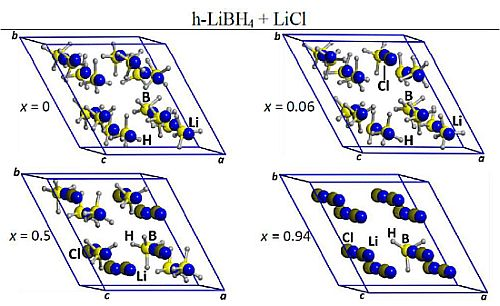
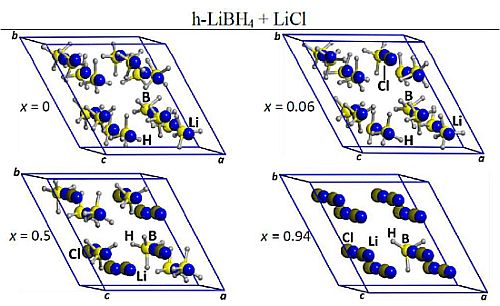
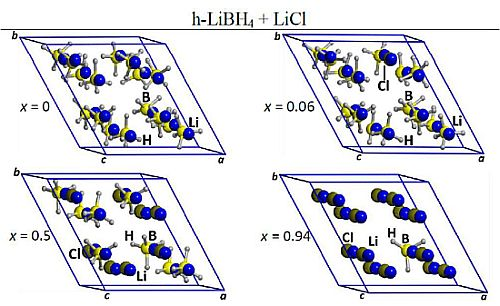
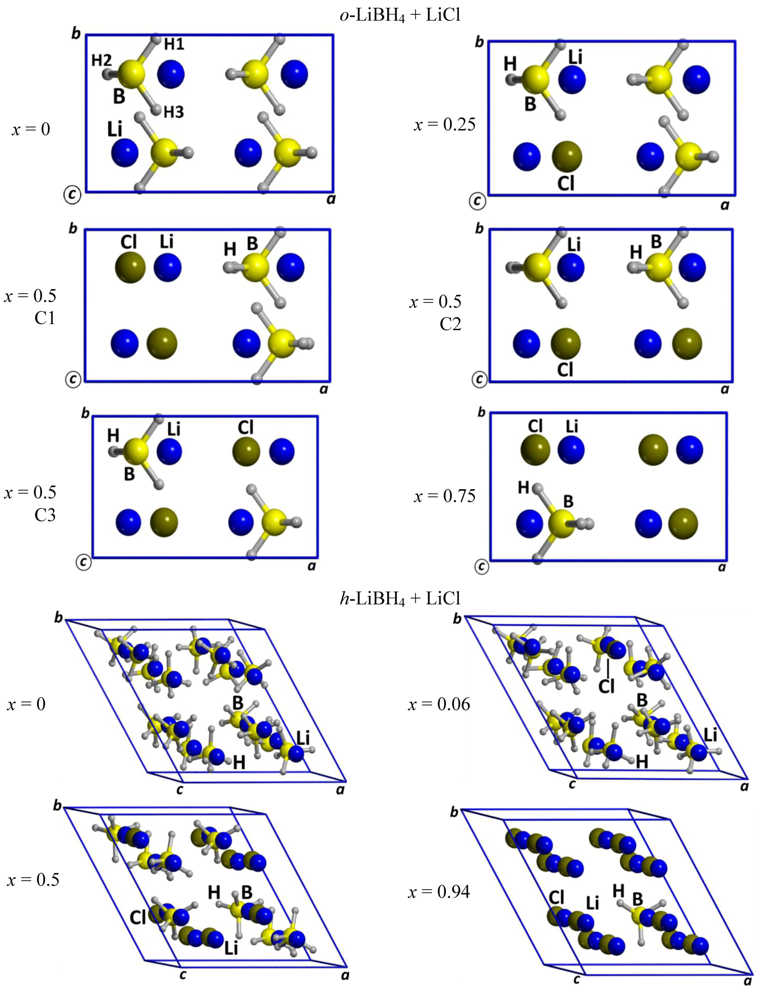
        <p>Pure orthorhombic (<italic>o</italic>-LiBH<sub>4</sub>, <italic>Pnma</italic> space group) and hexagonal (<italic>h</italic>-LiBH<sub>4</sub>, <italic>P</italic>6<sub>3</sub><italic>mc</italic> space group) structures of LiBH<sub>4</sub> were optimized at the DFT-Perdew-Burke-Ernzerhof (DFT-PBE) level of theory, starting from the experimental coordinates [<xref ref-type="bibr" rid="B21-crystals-02-00144">21</xref>].The optimized unit cell structures are shown in <xref ref-type="fig" rid="crystals-02-00144-f001">Figure 1</xref>, whereas the most important structural parameters are summarized in <xref ref-type="table" rid="crystals-02-00144-t001">Table 1</xref> in comparison with experimental data. </p>
         <fig id="crystals-02-00144-f001" position="anchor">
          <label>Figure 1</label>
          <caption>
            <p>Optimized crystal structures of pure and Cl-substituted unit cells of orthorhombic and hexagonal LiBH<sub>4</sub>. Positions of H1, H2, and H3 are shown for the <italic>x</italic> = 0.</p>
          </caption>
          <graphic xmlns:xlink="http://www.w3.org/1999/xlink" xlink:href="crystals-02-00144-g001.tif"/>
        </fig>
       <table-wrap id="crystals-02-00144-t001" position="float">
          <object-id pub-id-type="pii">crystals-02-00144-t001_Table 1</object-id>
          <label>Table 1</label>
          <caption>
            <p>Lattice parameters and most relevant bond lengths for optimized DFT models of pure and Cl-substituted orthorhombic and hexagonal phases of LiBH<sub>4</sub>, compared to the corresponding experimental values, if available. B-H distances and &lt;B-H&gt; average distances are expressed in Å, cell volume in Å<sup>3</sup>, the average bond angles &lt;HBH&gt; in degrees. Structures are displayed in <xref ref-type="fig" rid="crystals-02-00144-f001">Figure 1</xref>.</p>
          </caption>
          <table>
            <thead>
              <tr>
                <th align="center" valign="middle"><italic>o-</italic>LiBH<sub>4</sub> <italic>Pnma</italic> </th>
                <th align="center" valign="middle"><italic>a</italic></th>
                <th align="center" valign="middle"><italic>b</italic></th>
                <th align="center" valign="middle"><italic>c</italic></th>
                <th align="center" valign="middle">Volume</th>
                <th align="center" valign="middle">B-H1</th>
                <th align="center" valign="middle">B-H2</th>
                <th align="center" valign="middle">B-H3</th>
                <th align="center" valign="middle">&lt;B-H&gt;</th>
                <th align="center" valign="middle">&lt;HBH&gt;</th>
              </tr>
            </thead>
            <tbody>
              <tr style="border-top:solid thin">
                <td align="left" valign="middle">Exp.<sup>a</sup></td>
                <td align="center" valign="middle">7.121</td>
                <td align="center" valign="middle">4.406</td>
                <td align="center" valign="middle">6.674</td>
                <td align="center" valign="middle">209.4</td>
                <td align="center" valign="middle">1.213</td>
                <td align="center" valign="middle">1.224</td>
                <td align="center" valign="middle">1.208</td>
                <td align="center" valign="middle">1.215</td>
                <td align="center" valign="middle">109.3</td>
              </tr>
              <tr>
                <td align="left" valign="middle">DFT</td>
                <td align="center" valign="middle">7.328</td>
                <td align="center" valign="middle">4.379</td>
                <td align="center" valign="middle">6.494</td>
                <td align="center" valign="middle">208.4</td>
                <td align="center" valign="middle">1.230</td>
                <td align="center" valign="middle">1.233</td>
                <td align="center" valign="middle">1.229</td>
                <td align="center" valign="middle">1.231</td>
                <td align="center" valign="middle">109.3</td>
              </tr>
              <tr style="border-top:solid thin">
                <td colspan="10" align="center" valign="middle">
                  <bold>DFT <italic>-</italic>LiBH<sub>4</sub> + LiCl</bold>
                </td>
              </tr>
              <tr>
                <td align="left" valign="middle"><italic>o-</italic>Li(BH<sub>4</sub>)<sub>0.75</sub>Cl<sub>0.25</sub></td>
                <td align="center" valign="middle">7.255</td>
                <td align="center" valign="middle">4.314</td>
                <td align="center" valign="middle">6.472</td>
                <td align="center" valign="middle">202.6</td>
                <td align="center" valign="middle">1.232</td>
                <td align="center" valign="middle">1.235</td>
                <td align="center" valign="middle">1.228</td>
                <td align="center" valign="middle">1.232</td>
                <td align="center" valign="middle">108.8</td>
              </tr>
              <tr>
                <td align="left" valign="middle"><italic>o-</italic>Li(BH<sub>4</sub>)<sub>0.5</sub>Cl<sub>0.5</sub>/C<sub>1</sub></td>
                <td align="center" valign="middle">7.111</td>
                <td align="center" valign="middle">4.245</td>
                <td align="center" valign="middle">6.538</td>
                <td align="center" valign="middle">197.3</td>
                <td align="center" valign="middle">1.228</td>
                <td align="center" valign="middle">1.234</td>
                <td align="center" valign="middle">1.225</td>
                <td align="center" valign="middle">1.229</td>
                <td align="center" valign="middle">109.0</td>
              </tr>
              <tr>
                <td align="left" valign="middle"><italic>o-</italic>Li(BH<sub>4</sub>)<sub>0.5</sub>Cl<sub>0.5</sub>/C<sub>2</sub></td>
                <td align="center" valign="middle">7.207</td>
                <td align="center" valign="middle">4.250</td>
                <td align="center" valign="middle">6.425</td>
                <td align="center" valign="middle">196.8</td>
                <td align="center" valign="middle">1.228</td>
                <td align="center" valign="middle">1.235</td>
                <td align="center" valign="middle">1.228</td>
                <td align="center" valign="middle">1.230</td>
                <td align="center" valign="middle">109.0</td>
              </tr>
              <tr>
                <td align="left" valign="middle"><italic>o-</italic>Li(BH<sub>4</sub>)<sub>0.5</sub>Cl<sub>0.5</sub>/C<sub>3</sub></td>
                <td align="center" valign="middle">7.181</td>
                <td align="center" valign="middle">4.241</td>
                <td align="center" valign="middle">6.477</td>
                <td align="center" valign="middle">197.2</td>
                <td align="center" valign="middle">1.231</td>
                <td align="center" valign="middle">1.234</td>
                <td align="center" valign="middle">1.227</td>
                <td align="center" valign="middle">1.232</td>
                <td align="center" valign="middle">108.0</td>
              </tr>
              <tr>
                <td align="left" valign="middle"><italic>o-</italic>Li(BH<sub>4</sub>)<sub>0.25</sub>Cl<sub>0.75</sub></td>
                <td align="center" valign="middle">7.079</td>
                <td align="center" valign="middle">4.161</td>
                <td align="center" valign="middle">6.538</td>
                <td align="center" valign="middle">192.7</td>
                <td align="center" valign="middle">1.226</td>
                <td align="center" valign="middle">1.234</td>
                <td align="center" valign="middle">1.226</td>
                <td align="center" valign="middle">1.232</td>
                <td align="center" valign="middle">108.9</td>
              </tr>
              <tr style="border-top:solid thin">
                <td colspan="10" align="center" valign="middle">
                  <bold><italic>h-</italic>LiBH<sub>4</sub> <italic>P</italic>6<sub>3</sub><italic>mc</italic></bold></td>
              </tr>
              <tr style="border-top:solid thin">
                <td align="center" valign="middle">Exp.<sup>a</sup></td>
                <td align="center" valign="middle">4.267</td>
                <td align="center" valign="middle">4.267</td>
                <td align="center" valign="middle">6.922</td>
                <td align="center" valign="middle">109.1</td>
                <td align="center" valign="middle">0.962</td>
                <td align="center" valign="middle">1.024</td>
                <td align="center" valign="middle">1.024</td>
                <td align="center" valign="middle">1.003</td>
                <td align="center" valign="middle">108.4</td>
              </tr>
              <tr>
                <td align="center" valign="middle">DFT</td>
                <td align="center" valign="middle">4.216</td>
                <td align="center" valign="middle">4.216</td>
                <td align="center" valign="middle">6.291</td>
                <td align="center" valign="middle">96.8</td>
                <td align="center" valign="middle">1.220</td>
                <td align="center" valign="middle">1.223</td>
                <td align="center" valign="middle">1.223</td>
                <td align="center" valign="middle">1.222</td>
                <td align="center" valign="middle">109.4</td>
              </tr>
              <tr>
                <td align="center" valign="middle">DFT supercell</td>
                <td align="center" valign="middle">8.297</td>
                <td align="center" valign="middle">8.289</td>
                <td align="center" valign="middle">13.333</td>
                <td align="center" valign="middle">793.2</td>
                <td align="center" valign="middle">-</td>
                <td align="center" valign="middle">-</td>
                <td align="center" valign="middle">-</td>
                <td align="center" valign="middle">1.229</td>
                <td align="center" valign="middle">109.5</td>
              </tr>
              <tr style="border-top:solid thin">
                <td colspan="10" align="center" valign="middle">
                  <bold>DFT <italic>h-</italic>LiBH<sub>4</sub> + LiCl</bold>
                </td>
              </tr>
              <tr style="border-top:solid thin">
                <td align="left" valign="middle"><italic>h-</italic>Li(BH<sub>4</sub>)<sub>0.94</sub>Cl<sub>0.06</sub></td>
                <td align="center" valign="middle">8.256</td>
                <td align="center" valign="middle">8.274</td>
                <td align="center" valign="middle">13.238</td>
                <td align="center" valign="middle">782.8</td>
                <td align="center" valign="middle">-</td>
                <td align="center" valign="middle">-</td>
                <td align="center" valign="middle">-</td>
                <td align="center" valign="middle">1.229</td>
                <td align="center" valign="middle">109.5</td>
              </tr>
              <tr>
                <td align="left" valign="middle"><italic>h-</italic>Li(BH<sub>4</sub>)<sub>0.5</sub>Cl<sub>0.5</sub></td>
                <td align="center" valign="middle">8.016</td>
                <td align="center" valign="middle">8.067</td>
                <td align="center" valign="middle">12.740</td>
                <td align="center" valign="middle">718.1</td>
                <td align="center" valign="middle">-</td>
                <td align="center" valign="middle">-</td>
                <td align="center" valign="middle">-</td>
                <td align="center" valign="middle">1.228</td>
                <td align="center" valign="middle">109.5</td>
              </tr>
              <tr>
                <td align="left" valign="middle"><italic>h-</italic>Li(BH<sub>4</sub>)<sub>0.06</sub>Cl<sub>0.94</sub></td>
                <td align="center" valign="middle">7.886</td>
                <td align="center" valign="middle">7.888</td>
                <td align="center" valign="middle">12.493</td>
                <td align="center" valign="middle">672.9</td>
                <td align="center" valign="middle">1.220</td>
                <td align="center" valign="middle">1.223</td>
                <td align="center" valign="middle">-</td>
                <td align="center" valign="middle">1.222</td>
                <td align="center" valign="middle">109.5</td>
              </tr>
            </tbody>
  </table>
  <table-wrap-foot><fn><p><italic><sup>a</sup></italic> Ref. [<xref ref-type="bibr" rid="B21-crystals-02-00144">21</xref>].</p></fn></table-wrap-foot>
        </table-wrap>
        <p>For the orthorhombic crystal, a systematic overestimation of the B-H bond length is observed, as already pointed out in literature [<xref ref-type="bibr" rid="B2-crystals-02-00144">2</xref>,<xref ref-type="bibr" rid="B19-crystals-02-00144">19</xref>], which however does not significantly affect the unit cell volume.</p>
        <p>The hexagonal phase is stable at high temperature (<italic>T</italic> ≥ 381 K) [<xref ref-type="bibr" rid="B12-crystals-02-00144">12</xref>]. Therefore, without inclusion of temperature effects, full geometry optimization starting from the experimental structure dramatically distorts the internal geometry and the cell volume, as reported in <xref ref-type="table" rid="crystals-02-00144-t001">Table 1</xref>. Indeed, for the unit cell of <italic>h</italic>-LiBH<sub>4</sub>, frequency calculation at Gamma point on the optimized structure reveals six imaginary frequencies, showing the instability of this phase when temperature is not taken into account. Maintaining the cell parameters fixed at the experimental values does not remove the structural instability, as the internal atomic displacements are still very large, as shown also by Miwa <italic>et al.</italic> [<xref ref-type="bibr" rid="B22-crystals-02-00144">22</xref>],due to the dynamic disorder of BH<sub>4</sub><sup>−</sup> units [<xref ref-type="bibr" rid="B23-crystals-02-00144">23</xref>]. In order to overcome these difficulties and, moreover, to simulate solid solutions, a supercell approach was adopted in the case of <italic>h-</italic>LiBH<sub>4</sub>, considering a larger and more representative scenario (for the original cell <italic>Z</italic> = 2 → 12 atoms, while in the supercell <italic>Z</italic> = 16 → 96 atoms). In this operation of doubling each cell vector, symmetry is completely lost and borohydride tetrahedra are free to rotate, so removing the phonon instability found in the single unit cell. Indeed, when computing frequency values for the hexagonal supercell, only one imaginary mode is found at −20 cm<sup>−1</sup>. In the following, to avoid numerical problems due to the variable number of imaginary frequencies for the structures, we have used the whole set of frequencies by considering also the imaginary values (by using their absolute value in the statistical thermodynamic formulae) for the calculation of the zero point energy (ZPE) and enthalpy corrections, as described below.</p>
        <p>The relative energy stabilities calculated for the two phases favor the orthorhombic structure with respect to the hexagonal, as expected, but their enthalpy difference (<sup>ORTHO − HEX</sup>ΔH = 10 kJ∙mol<sup>−1</sup> per formula unit) overestimates experimental measurements [<xref ref-type="bibr" rid="B24-crystals-02-00144">24</xref>,<xref ref-type="bibr" rid="B25-crystals-02-00144">25</xref>], due to the instability of the hexagonal model.</p>
        <p>Even if the stable LiCl polymorph at room temperature is cubic, corresponding structures were obtained for both the orthorhombic and hexagonal phases as the full substitution of BH<sub>4</sub><sup>-</sup> with chlorine. The difference in enthalpy for the three phases of LiCl was calculated for the phase diagram calculation, giving <sup>CUBIC − ORTHO</sup>ΔH = 21.8 kJ∙mol<sup>−1</sup> and <sup>CUBIC − HEX</sup>ΔH = 15.1 kJ∙mol<sup>−1</sup>.</p>
        <p>The simulation of orthorhombic solid solution <italic>o</italic>-Li(BH<sub>4</sub>)<sub>1−<italic>x</italic></sub>Cl<italic><sub>x</sub></italic>, where four borohydride units are present in the <italic>o</italic>-LiBH<sub>4</sub> unary cell, was performed, considering three compositions with molar fraction of chlorine, <italic>x</italic>, equal to 0.25, 0.50 and 0.75. The corresponding unary cells are reported in <xref ref-type="fig" rid="crystals-02-00144-f001">Figure 1</xref>. For <italic>x</italic> = 0.5, three non-equivalent configurations were computed, namely C1, C2 and C3, as shown in <xref ref-type="fig" rid="crystals-02-00144-f001">Figure 1</xref>. Among them, C3 structure turned out to be the most stable, because of the largest Cl-Cl distance. Conversely, for the hexagonal solid solution <italic>h</italic>-Li(BH<sub>4</sub>)<sub>1−<italic>x</italic></sub>Cl<italic><sub>x</sub></italic>, due to the large size of the supercell, only three compositions have been considered, that are Li(BH<sub>4</sub>)<sub>0.94</sub>Cl<sub>0.06</sub>, Li(BH<sub>4</sub>)<sub>0.5</sub>Cl<sub>0.5</sub>, and Li(BH<sub>4</sub>)<sub>0.06</sub>Cl<sub>0.94</sub>.</p>
        <p>For the orthorhombic solid solutions, the unit cell volume decreases with the increase of Cl substitution, as expected, with a maximum variation of about 10% for the highest chlorine content (<italic>x</italic> = 0.75). For the hexagonal structures, the volume decreases as a function of Cl content, with a maximum variation of about 13% for <italic>x</italic> = 0.94. It can be mentioned here that the calculated cell volume reduction for the Cl-substituted <italic>o</italic>-LiBH<sub>4</sub> and <italic>h</italic>-LiBH<sub>4</sub> correlates well with the experimentally observed values [<xref ref-type="bibr" rid="B12-crystals-02-00144">12</xref>].</p>
        <p>Thermal entropy was calculated for each composition using classical statistical thermodynamic formulae. As it was computed using the harmonic set of frequencies, the hindered BH<sub>4</sub><sup>−</sup> rotation is included, as well as the frustrated translation of the substituting Cl. It turned out that the hindered BH<sub>4</sub><sup>−</sup> soft rotational motion is compensated by the frustrated translation of the substituting Cl ion, so that the thermal entropy contribution is very small, well below the contribution due to the ideal configurational entropy.</p>
      </sec>
      <sec>
        <title>2.2. Thermodynamics of the Solid Solution Formation</title>
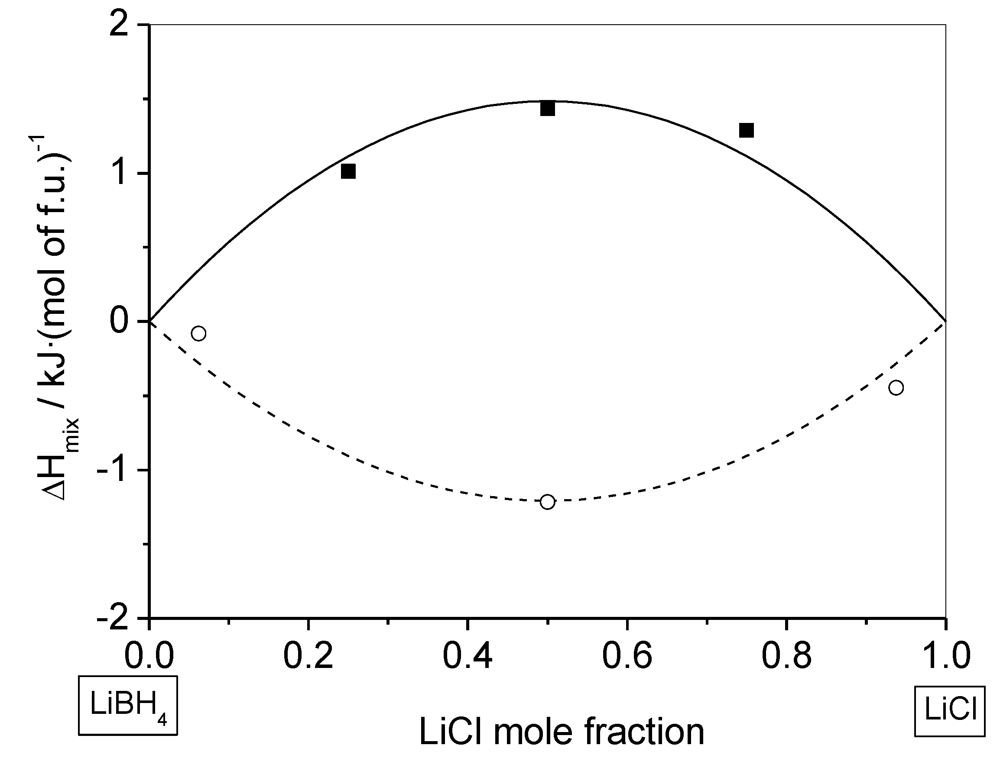
        <p>The enthalpy of mixing was computed at room temperature for the models shown in <xref ref-type="fig" rid="crystals-02-00144-f001">Figure 1</xref>. The obtained results are shown in <xref ref-type="fig" rid="crystals-02-00144-f002">Figure 2</xref> as a function of the increasing LiCl mole fraction. According to simulations, <italic>o</italic>-LiBH<sub>4</sub> is slightly destabilized by the substitution of chloride inside the lattice, since computed enthalpy of mixing (ΔH<sub>mix</sub>) values are positive and small (less than 2 kJ mol<sup>−1</sup> per formula unit). On the contrary, in the hexagonal phase, the enthalpy of mixing shows slightly negative values, less than −1 kJ mol<sup>−1</sup> per formula unit, so that the <italic>h</italic>-LiBH<sub>4</sub> is, to some extent, stabilized by LiCl. As stated above, the thermal entropy contribution is very small, so ideal entropy of mixing (ΔS<sub>mix</sub>) has been considered for free energy calculations. When ΔH<sub>mix</sub> and −<italic>T</italic>ΔS<sub>mix</sub> terms are summed up at room temperature, the free energy of mixing (ΔG<sub>mix</sub>) becomes close to zero for the orthorhombic phase and slightly negative for the hexagonal phase for all compositions.</p>
        <fig id="crystals-02-00144-f002" position="anchor">
          <label>Figure 2</label>
          <caption>
            <p>Enthalpy of mixing for the orthorhombic and hexagonal LiBH<sub>4</sub>-LiCl solid solutions as a function of LiCl mole fraction. <italic>Ab initio</italic> results are reported as squares (ortho) and circles (hexa). Results of CALPHAD modeling are represented by lines (continuous = ortho, dashed = hexa).</p>
          </caption>
          <graphic xmlns:xlink="http://www.w3.org/1999/xlink" xlink:href="crystals-02-00144-g002.tif"/>
        </fig>
        <p>In order to describe thermodynamic behavior of the LiBH<sub>4</sub>-LiCl system, the CALPHAD approach [<xref ref-type="bibr" rid="B26-crystals-02-00144">26</xref>] was used. Due to the lack of thermodynamic data for the LiBH<sub>4</sub>-LiCl liquid mixture, the phase diagram was evaluated, neglecting the liquid phase, and it is considered only below the melting temperature of LiBH<sub>4</sub>.The presence of an attractive interaction in the liquid state could induce a stabilization of the liquid phase below the melting temperatures of pure components, as found experimentally by <italic>in situ</italic> X-ray diffraction [<xref ref-type="bibr" rid="B12-crystals-02-00144">12</xref>]. </p>
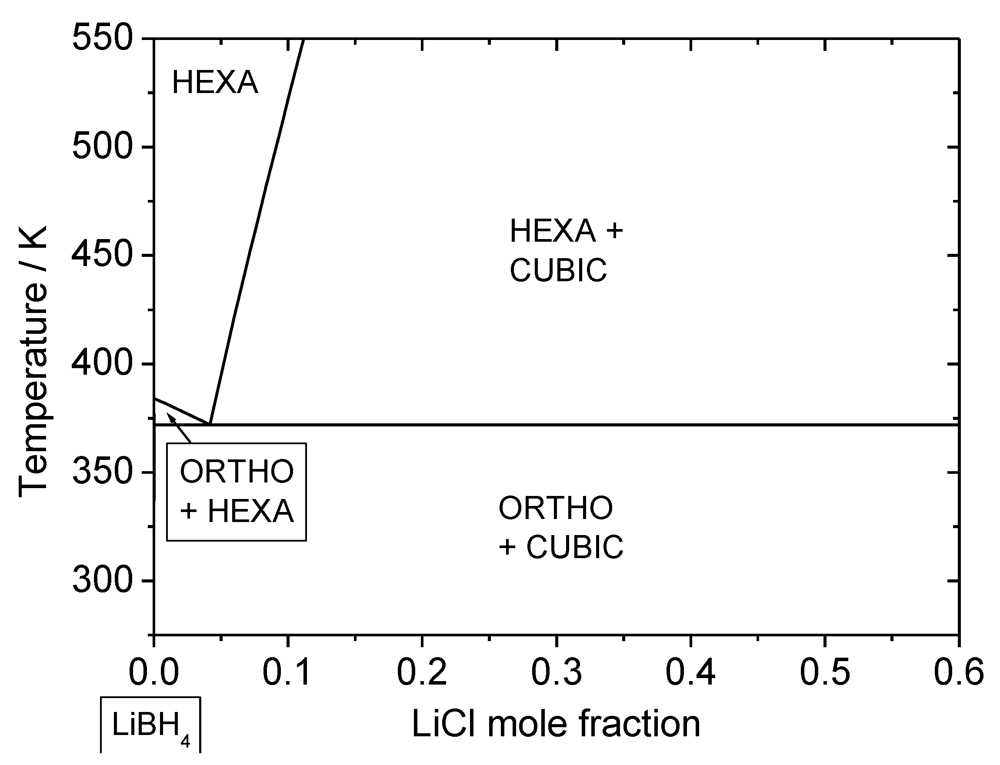
        <p>On the basis of the evaluated thermodynamic parameters, the pseudo binary phase diagram for the LiBH<sub>4</sub>-LiCl system has been calculated and the results shown in <xref ref-type="fig" rid="crystals-02-00144-f003">Figure 3</xref>. The calculated solubility of Cl into <italic>o</italic>-LiBH<sub>4</sub> is rather low and it reaches a value <italic>x</italic> = 0.1 at about 500 K for the <italic>h</italic>-LiBH<sub>4</sub> phase. A eutectoid phase transition is calculated at 372 K and <italic>x</italic> = 0.04. The phase diagram behavior is very sensitive to both lattice stabilities (<italic>i.e.</italic>, free energy difference between different phases of the pure components) as well as to the free energy of mixing. The very strong instability, predicted for the metastable <italic>o</italic>-LiCl (<sup>CUBIC − ORTHO</sup>ΔH = 21.8 kJ∙mol<sup>−1</sup>), and the calculated nearly zero ΔG<sub>mix</sub> , prevent any relevant solubility of Cl inside the orthorhombic phase. The negative ΔG<sub>mix</sub> for the hexagonal solid solution and a more stable <italic>h</italic>-LiCl, if compared to the orthorhombic one (<sup>HEX − ORTHO</sup>ΔH = 6.7 kJ∙mol<sup>−1</sup>), allow for the stabilization of the hexagonal phase with respect to the orthorhombic one when Cl is added. Of course, a lower value of <sup>HEX − ORTHO</sup>ΔH and a more negative enthalpy of mixing for the hexagonal phase would promote a higher solubility of Cl in <italic>h</italic>-LiBH<sub>4</sub> phase.</p>
        <fig id="crystals-02-00144-f003" position="anchor">
          <label>Figure 3</label>
          <caption>
            <p>Calculated LiBH<sub>4</sub>-LiCl pseudo binary phase diagram.</p>
          </caption>
          <graphic xmlns:xlink="http://www.w3.org/1999/xlink" xlink:href="crystals-02-00144-g003.tif"/>
        </fig>
      </sec>
      <sec>
        <title>2.3. Structural Properties of <italic>o</italic>-Li(BH<sub>4</sub>)<sub>1−x</sub>Cl<sub>x</sub> and <italic>h</italic>-Li(BH<sub>4</sub>)<sub>1−y</sub>Cl<sub>y</sub></title>
        <sec>
          <title>2.3.1. Computational Study of the <italic>o</italic>-Li(BH<sub>4</sub>)<sub>1−x</sub>Cl<sub>x</sub> and <italic>h</italic>-Li(BH<sub>4</sub>)<sub>1−y</sub>Cl<sub>y</sub> Vibrational Properties</title>
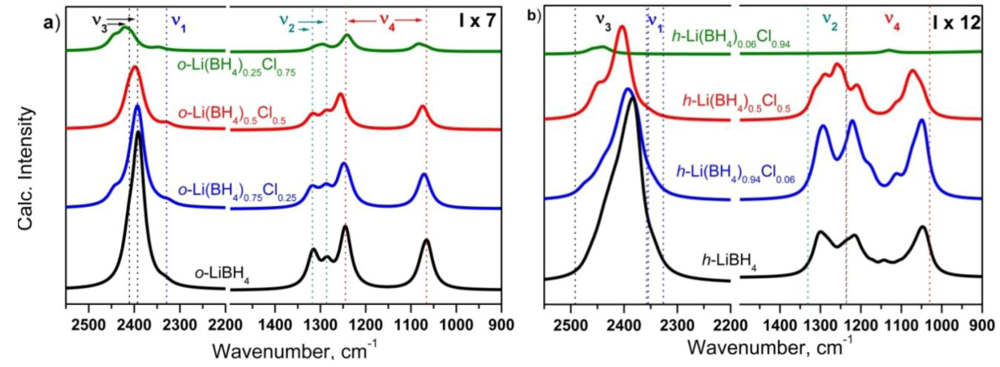
          <p>In the mid-infrared region the vibrational spectra of LiBH<sub>4</sub>, orthorhombic and hexagonal phases exhibit stretching (ν<sub>1</sub>, ν<sub>3</sub>), bending (ν<sub>2</sub>, ν<sub>4</sub>) and combinational (not accounted for in the computed spectra) modes of the BH<sub>4</sub><sup>−</sup> anions (<xref ref-type="fig" rid="crystals-02-00144-f004">Figure 4</xref>) [<xref ref-type="bibr" rid="B19-crystals-02-00144">19</xref>,<xref ref-type="bibr" rid="B27-crystals-02-00144">27</xref>,<xref ref-type="bibr" rid="B28-crystals-02-00144">28</xref>,<xref ref-type="bibr" rid="B29-crystals-02-00144">29</xref>,<xref ref-type="bibr" rid="B30-crystals-02-00144">30</xref>]. The modes ν<sub>3</sub> and ν<sub>4</sub> are triply degenerate in free tetrahedral BH<sub>4</sub><sup>−</sup> ions, and the ν<sub>2</sub> is doubly degenerate. Due to the different BH<sub>4</sub><sup>−</sup> site symmetry in the <italic>Pnma</italic> and <italic>P</italic>6<sub>3</sub><italic>mc</italic> space groups, C<sub>s</sub> and C<sub>3v</sub> respectively, vibrational spectra of <italic>h</italic>-LiBH<sub>4</sub> are expected to be simpler, since the ν<sub>2</sub> mode remains degenerate and both ν<sub>3</sub>, ν<sub>4</sub> split into only two components each. The computed IR spectrum of the <italic>h</italic>-LiBH<sub>4</sub> supercell, however, is much more complex, due to the absence of any symmetry at all and 32 BH<sub>4</sub><sup>−</sup> ions in the cell: see <xref ref-type="fig" rid="crystals-02-00144-f004">Figure 4</xref>b. Nevertheless, several observations can be made.</p>
         <p>Substitution of BH<sub>4</sub><sup>−</sup> with Cl<sup>−</sup> in the unit cell of <italic>o</italic>-LiBH<sub>4</sub> does not modify significantly its IR vibrations. Stretching ν<sub>3</sub> and bending ν<sub>4</sub> modes of BH<sub>4</sub><sup>−</sup> appear to be the most sensitive to the Cl<sup>−</sup> substitution, moving to higher frequencies by Δν = +10...+35 cm<sup>−1</sup> (<xref ref-type="fig" rid="crystals-02-00144-f004">Figure 4</xref>a). The ν<sub>1</sub> and ν<sub>2</sub> modes are the least affected by the presence of Cl<sup>−</sup>, being shifted only with the highest amount of Cl<sup>−</sup> in the unit cell (<italic>x</italic> = 0.75). These negligible modifications in the BH<sub>4</sub><sup>−</sup> vibrational profile can be explained by the BH<sub>4</sub><sup>−</sup> low site symmetry in pure and all the Cl-substituted unary cells of <italic>o</italic>-Li(BH<sub>4</sub>)<sub>1−<italic>x</italic></sub>Cl<italic><sub>x</sub></italic>, and that the substitution does not cause a significant change in the number of IR-active peaks. Since the symmetry in the supercell of the <italic>h</italic>-LiBH<sub>4</sub> and <italic>h</italic>-Li(BH<sub>4</sub>)<sub>1−<italic>y</italic></sub>Cl<italic><sub>y</sub></italic> is completely removed, the spectra of all compounds on the <xref ref-type="fig" rid="crystals-02-00144-f004">Figure 4</xref>b appear to be much more complex than are expected for the <italic>h</italic>-LiBH<sub>4</sub> unary cell. Stretching modes in the 2500–2300 cm<sup>−1</sup> region evidently shift to higher wavenumbers with increasing Cl<sup>−</sup> concentration. Apparently, it is difficult to distinguish between the spectra of pure and Cl-substituted <italic>o</italic>-LiBH<sub>4</sub> or <italic>h</italic>-LiBH<sub>4</sub> when the molar concentration of Cl<sup>−</sup> is small (compare black and blue curves in <xref ref-type="fig" rid="crystals-02-00144-f004">Figure 4</xref>).</p>
		   <fig id="crystals-02-00144-f004" position="anchor">
            <label>Figure 4</label>
            <caption>
              <p>Computed infrared spectra of Cl<sup>−</sup> substitution into the LiBH<sub>4</sub> (<bold>a</bold>) Orthorhombic, positions of the fundamental modes in pure <italic>o</italic>-LiBH<sub>4</sub> are shown by dotted lines; (<bold>b</bold>) Hexagonal, borders of the regions of the fundamental modes in pure <italic>h</italic>-LiBH<sub>4</sub> are shown by dotted lines (for clearness, the positions, since there are too many modes). Intensity in the bending regions 1500–900 cm<sup>−1</sup> borders of the regions are shown instead of the is expanded for clarity.</p>
            </caption>
            <graphic xmlns:xlink="http://www.w3.org/1999/xlink" xlink:href="crystals-02-00144-g004.tif"/>
          </fig>
          <p>Orimo <italic>et al</italic>. [<xref ref-type="bibr" rid="B29-crystals-02-00144">29</xref>] suggested a correlation between the position of the ν<sub>1</sub> and ν<sub>2</sub> modes and the stability in the Li, Na, K, Rb, Cs borohydrides: in the most stable, CsBH<sub>4</sub> ν<sub>2</sub> has the lowest energy of vibrations. In this way, the almost unaffected position of the ν<sub>1</sub> and ν<sub>2</sub> modes in the Cl-substituted LiBH<sub>4</sub> can be interpreted as evidence of a minor effect of the chlorine substitution on the stability of LiBH<sub>4</sub>.</p>
        </sec>
        <sec>
          <title>2.3.2. Experimental Study of LiBH<sub>4</sub>-LiCl Mixture and Solid Solution</title>
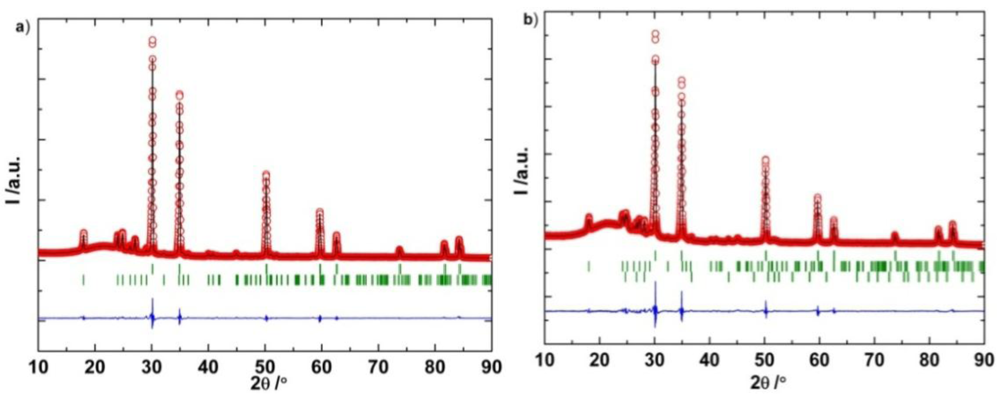
          <p>The structure and vibrations of LiBH<sub>4</sub>-LiCl mixture (1:1) were studied by powder X-ray diffraction and infrared spectroscopy. No chlorine substitution is found after hand mixing of the sample, as expected [<xref ref-type="bibr" rid="B12-crystals-02-00144">12</xref>], (<xref ref-type="fig" rid="crystals-02-00144-f005">Figure 5</xref>a), whereas after annealing, a small amount of chlorine is found both in the hexagonal and orthorhombic phases of LiBH<sub>4</sub> (<xref ref-type="fig" rid="crystals-02-00144-f005">Figure 5</xref>b, <xref ref-type="table" rid="crystals-02-00144-t002">Table 2</xref>).</p>
          <fig id="crystals-02-00144-f005" position="anchor">
            <label>Figure 5</label>
            <caption>
              <p>Rietveld refinement profiles of (<bold>a</bold>) LiBH<sub>4</sub>-LiCl (1:1) hand-mixed mixture, measured by powder X-ray diffraction (Cu Kα1 and Kα2) at <italic>T</italic> = 25 °C, top bars: LiCl, bottom bars: <italic>o</italic>-LiBH<sub>4</sub>; (<bold>b</bold>) LiBH<sub>4</sub>-LiCl (1:1) hand-mixed mixture after annealing, within 30 min after the infrared measurements, top bars: LiCl, middle bars: <italic>o</italic>-Li(BH<sub>4</sub>)<sub>0.90</sub>Cl<sub>0.10</sub>; bottom bars: <italic>h</italic>-Li(BH<sub>4</sub>)<sub>0.96</sub>Cl<sub>0.04</sub>.</p>
            </caption>
            <graphic xmlns:xlink="http://www.w3.org/1999/xlink" xlink:href="crystals-02-00144-g005.tif"/>
          </fig>
          
       <table-wrap id="crystals-02-00144-t002" position="float">
            <object-id pub-id-type="pii">crystals-02-00144-t002_Table 2</object-id>
            <label>Table 2</label>
            <caption>
              <p>Phase composition of the LiBH<sub>4</sub>-LiCl hand-milled mixture before and after annealing, as found by Rietveld refinement.</p>
            </caption>
            <table>
              <thead>
                <tr>
                  <th align="left" valign="middle"> </th>
                  <th align="left" valign="middle">Molar fraction, mol%</th>
                </tr>
              </thead>
              <tbody>
                <tr style="border-top:solid thin">
                  <td align="left" valign="middle">LiBH<sub>4</sub>-LiCl (1:1) S1 hm</td>
                  <td align="left" valign="middle"> </td>
                </tr>
                <tr>
                  <td align="left" valign="middle">LiCl<italic>o-</italic>LiBH<sub>4</sub></td>
                  <td align="left" valign="middle">4456</td>
                </tr>
                <tr>
                  <td align="left" valign="middle">LiBH<sub>4</sub>-LiCl (1:1) S1 hm, annealed</td>
                  <td align="left" valign="middle"> </td>
                </tr>
                <tr>
                  <td align="left" valign="middle">LiCl<italic>o-</italic>Li(BH<sub>4</sub>)<sub>0.90</sub>Cl<sub>0.10</sub><italic>h-</italic>Li(BH<sub>4</sub>)<sub>0.96</sub>Cl<sub>0.04</sub></td>
                  <td align="left" valign="middle">344323</td>
                </tr>
              </tbody>
            </table>
          </table-wrap>
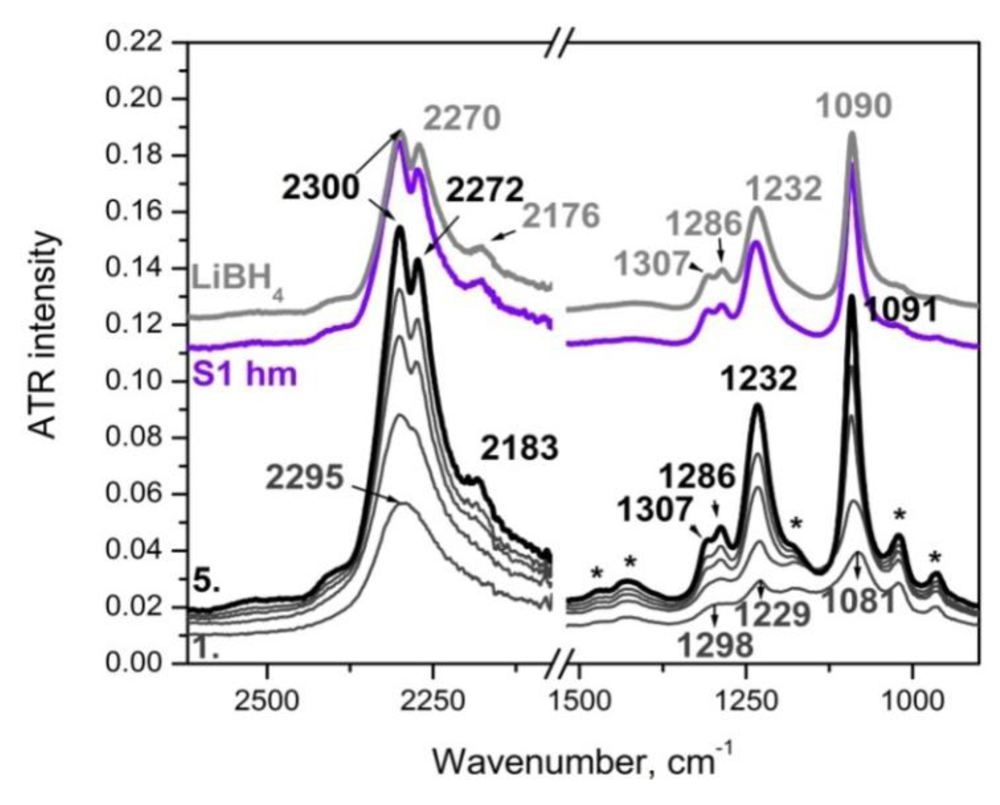
		  <p>The ATR spectrum of the hand-mixed mixture is shown in <xref ref-type="fig" rid="crystals-02-00144-f006">Figure 6</xref> (violet curve). It is very similar to that of pure LiBH<sub>4</sub> (grey curve). This is in agreement with the presence of pure <italic>o</italic>-LiBH<sub>4</sub> and LiCl in the sample.</p>
          <fig id="crystals-02-00144-f006" position="anchor">
            <label>Figure 6</label>
            <caption>
              <p>Experimental ATR spectra of pure LiBH<sub>4</sub> and LiBH<sub>4</sub>-LiCl mixtures, hand-mixed (S1 hm, violet curve) and annealed (S1, black curves 1–5). The spectra 1–5 were obtained at room temperature, within 40 min after annealing and at <italic>ca.</italic> 1 min time step. The curves S1 hm and LiBH<sub>4</sub> are translated vertically for clearness. Peaks marked with * are attributed to impurities.</p>
            </caption>
            <graphic xmlns:xlink="http://www.w3.org/1999/xlink" xlink:href="crystals-02-00144-g006.tif"/>
          </fig>
          <p>After annealing, however, the spectrum is strongly modified (<xref ref-type="fig" rid="crystals-02-00144-f006">Figure 6</xref>, black curve 1), but these modifications are not preserved with time. In particular, the spectrum 1 in <xref ref-type="fig" rid="crystals-02-00144-f006">Figure 6</xref> has one broad peak in the B-H, stretching at ca. 2400–2100 cm<sup>−1</sup>, which within a short time (<italic>ca</italic>. 20 min), splits into two (spectra 2–5), narrows, and gains intensity. HBH bending modes in the 1300–1000 cm<sup>−1</sup> region are also modified: the peak at 1298 cm<sup>−1</sup> splits into two components at 1310–1286 cm<sup>−1</sup>, and the peaks at 1229 and 1081 cm<sup>−1</sup> grow in intensity and shift upwards. The combinational modes at 2181 cm<sup>−1</sup> and in the 2300–2550 cm<sup>−1</sup> regions also gain intensity. These changes in the infrared spectra are similar to those observed [<xref ref-type="bibr" rid="B23-crystals-02-00144">23</xref>] in the <italic>in situ</italic> Raman measurements of the LiBH<sub>4</sub> upon heating in the 22–139 °C temperature range, and should be associated with C<sub>3ν</sub> → C<sub>s</sub> site symmetry lowering of the BH<sub>4</sub><sup>−</sup> tetrahedra upon <italic>P</italic>6<sub>3</sub><italic>mc</italic> → <italic>Pnma</italic> phase transformation in LiBH<sub>4</sub>. It is important to note that for the <italic>in situ</italic> Raman experiment, the phase transformation was observed during heating and cooling. For this study, all spectra were obtained at room temperature after the annealing of LiBH<sub>4</sub> with LiCl. This fact evidences the role of Cl in the short-term stabilization of the high temperature hexagonal phase of LiBH<sub>4</sub>. In fact, Arnbjerg <italic>et al</italic>. [<xref ref-type="bibr" rid="B12-crystals-02-00144">12</xref>] have demonstrated that the phase transition temperature in LiBH<sub>4</sub> (during cooling) can approach 20 °C, depending on the degree of Cl-substitution. They note that this change in the phase transition temperature indicates a stabilization of the hexagonal phase caused by the incorporation of Cl<sup>−</sup> in the LiBH<sub>4</sub> structure. </p>
          <p>According to the X-ray diffraction data, which were obtained shortly after the infrared experiment (and therefore better correspond to the curve 5, <xref ref-type="fig" rid="crystals-02-00144-f006">Figure 6</xref>), <italic>o-</italic>Li(BH<sub>4</sub>)<sub>0.90</sub>Cl<sub>0.10</sub> , phase prevails in this sample, which explains its similarity to the spectrum of pure <italic>o</italic>-LiBH<sub>4</sub>. Note that the computed spectra of <italic>o-</italic>LiBH<sub>4</sub> and the <italic>o-</italic>Li(BH<sub>4</sub>)<sub>0.75</sub>Cl<sub>0.25</sub> are very similar (<xref ref-type="fig" rid="crystals-02-00144-f004">Figure 4</xref>a). Present results are in good agreement with those reported by Arnbjerg <italic>et al</italic>. [<xref ref-type="bibr" rid="B12-crystals-02-00144">12</xref>]. In fact, after annealing during cooling, the hexagonal phase found at high temperature is quenched in the mixture. The ortho-to-hexa phase transition is promoted at R<italic>T</italic>, as evidenced by ATR measurements (<xref ref-type="fig" rid="crystals-02-00144-f006">Figure 6</xref>). During the phase transformation, the Cl<sup>−</sup> content in LiBH<sub>4</sub> is strongly reduced and LiCl is formed The Cl<sup>−</sup> content in the orthorhombic phase (<italic>x</italic> = 0.10), observed in PXRD measurements, is in agreement with previous experiments [<xref ref-type="bibr" rid="B12-crystals-02-00144">12</xref>], but it turns out higher than that predicted by combined <italic>ab initio</italic> and CALPHAD calculations (<xref ref-type="fig" rid="crystals-02-00144-f003">Figure 3</xref>). As described before, the estimated solubility range is very sensitive to the results of <italic>ab initio</italic> calculation, which would need a more accurate determination of lattice stability in order to fully describe the experimental findings.</p>
        </sec>
      </sec>
    </sec>
    <sec>
      <title>3. Calculations</title>
      <sec>
        <title>3.1. Ab Initio</title>
        <p><italic>Ab initio</italic> calculations based on DFT GGA Hamiltonian (PBE) were carried out with the periodic CRYSTAL09 code and localized basis set functions of polarized double-ζ quality. In detail: Li cation was described with a 5–11G(d) basis set (<italic>α</italic><sub>sp</sub> = 0.479 bohr<sup>−2</sup> for the most diffuse shell exponent and <italic>α</italic><sub>pol</sub> = 0.600 bohr<sup>−2</sup> for polarization), while for boron a 6–21G(d) was adopted (<italic>α</italic><sub>sp</sub> = 0.124 bohr<sup>−2</sup> for the most diffuse shell exponent and <italic>α</italic><sub>pol</sub> = 0.800 bohr<sup>−2</sup> for polarization). For hydrogen, a 31G(p) (<italic>α</italic><sub>sp</sub> = 0.1613 bohr<sup>−2</sup> for the most diffuse shell exponent and <italic>α</italic><sub>pol</sub> = 1.1 bohr<sup>−2</sup> for polarization) was considered; for chlorine, a 86–311G basis set was used (<italic>α</italic><sub>sp</sub> = 0.125 bohr<sup>−2</sup> for the most diffuse shell exponent).</p>
        <p>Phonons at Γ point in the harmonic approximation were computed to derive the thermodynamic functions by diagonalizing the associated mass-weighted Hessian matrix (for details on the computational procedure see references [<xref ref-type="bibr" rid="B31-crystals-02-00144">31</xref>,<xref ref-type="bibr" rid="B32-crystals-02-00144">32</xref>]). Grimme’s correction to the electronic energy was computed to take dispersion forces into account for all calculations, following the D* approach described in the literature [<xref ref-type="bibr" rid="B33-crystals-02-00144">33</xref>,<xref ref-type="bibr" rid="B34-crystals-02-00144">34</xref>]. The enthalpy data were obtained as the electronic energy, including the zero-point energy correction (ZPE), and the thermal factor at the desired temperature.</p>
      </sec>
      <sec>
        <title>3.2. CALPHAD</title>
        <p>Unary phases (<italic>i.e.</italic>, pure elements) have been described according to the SGTE database [<xref ref-type="bibr" rid="B35-crystals-02-00144">35</xref>]. The cubic phase was considered as stoichiometric LiCl, neglecting the possible solubility of LiBH<sub>4</sub> in this structure. The thermodynamic parameters for this compound (<sup>CUBIC</sup>G(LiCl)) were taken from the Substance SGTE database [<xref ref-type="bibr" rid="B36-crystals-02-00144">36</xref>].</p>
        <p>LiBH<sub>4</sub>-LiCl solid solutions with orthorhombic and hexagonal structures were modeled using two sublattices, the first occupied by Li<sup>+</sup> and the second occupied by Cl<sup>−</sup> or by a BH<sub>4</sub><sup>−</sup> unit.</p>
        <p>As usual, the Gibbs free energy of these solutions can be expressed as [<xref ref-type="bibr" rid="B26-crystals-02-00144">26</xref>]:
        <disp-formula id="crystals-02-00144-i001">
<inline-graphic xmlns:xlink="http://www.w3.org/1999/xlink" xlink:href="crystals-02-00144-i001.tif"/>
</disp-formula>
        <disp-formula id="crystals-02-00144-i002">
<inline-graphic xmlns:xlink="http://www.w3.org/1999/xlink" xlink:href="crystals-02-00144-i002.tif"/>
</disp-formula>
        <disp-formula id="crystals-02-00144-i003">
<inline-graphic xmlns:xlink="http://www.w3.org/1999/xlink" xlink:href="crystals-02-00144-i003.tif"/>
</disp-formula>
        where φ represents the phase (orthorhombic or hexagonal), <italic>x</italic> represents the mole fraction of LiCl, <italic>T</italic> is the temperature, and G<sup>ref</sup>, S<sup>id</sup>, G<sup>exc</sup> are the reference Gibbs energy, the ideal entropy contribution and the excess contribution to the free energy, respectively.</p>
        <p><sup>ORTHO</sup>G(LiBH<sub>4</sub>) was taken from the Substance database. On the basis of <italic>ab initio</italic> calculations, the free energy of orthorhombic LiCl was evaluated as <sup>ORTHO</sup>G(LiCl) = <sup>CUBIC</sup>G(LiCl) + A − BT, where <sup>CUBIC</sup>G(LiCl) was taken from the Substance database and A = 21.8 kJ·mol<sup>−1</sup> and B = 7.2 J·K<sup>−1</sup>·mol<sup>−1</sup>. As shown in <xref ref-type="fig" rid="crystals-02-00144-f002">Figure 2</xref>, since the <italic>ab initio</italic> calculated enthalpy of mixing is slightly positive and nearly symmetric, the excess Gibbs energy was modeled as a regular solution, giving <inline-graphic xmlns:xlink="http://www.w3.org/1999/xlink" xlink:href="crystals-02-00144-i004.tif"/> with Ω <italic>=</italic> 5.940 kJ·mol<sup>−1</sup>.</p>
        <p>Because the thermodynamic function for LiBH<sub>4</sub> reported in the Substance database does not take into account the phase transition [<xref ref-type="bibr" rid="B25-crystals-02-00144">25</xref>] from orthorhombic to hexagonal phases occurring at 383 °K, new thermodynamic parameters for the hexagonal LiBH<sub>4</sub> have been evaluated. According to the enthalpy and temperature of transition measured by Price <italic>et al</italic>. [<xref ref-type="bibr" rid="B25-crystals-02-00144">25</xref>], the Gibbs free energy of <italic>h</italic>-LiBH<sub>4</sub> has been described as <sup>HEX</sup>G(LiBH<sub>4</sub>) = <sup>ORTHO</sup>G(LiBH<sub>4</sub>) + A − BT, where A = 4.4 kJ·mol<sup>−1</sup> and B = 11.4 J·K<sup>−1</sup>·mol<sup>−1</sup>. Since no experimental data are available for the hexagonal LiCl, <sup>HEX</sup>G(LiCl) was evaluated on the basis of <italic>ab initio</italic> calculations as <sup>HEX</sup>G(LiCl) = <sup>CUBIC</sup>G(LiCl) + A − BT, where A = 15.1 kJ·mol<sup>−1</sup> and B = 2.3 J·K<sup>−1</sup>·mol<sup>−1</sup>. According to the results of <italic>ab initio</italic> calculations the excess Gibbs energy of the hexagonal solid solution was modeled as a regular solution, giving <inline-graphic xmlns:xlink="http://www.w3.org/1999/xlink" xlink:href="crystals-02-00144-i005.tif"/> with Ω <italic>=</italic> −4.827 kJ·mol<sup>−1</sup>kJ·mol<sup>−1</sup>.</p>
      </sec>
    </sec>
    <sec>
      <title>4. Experimental Section</title>
      <p>The samples used for the infrared experiments were handled in a nitrogen-filled glove box. As received anhydrous LiCl (Aldrich, purity 98.0%) was additionally dried in a dynamic vacuum at 120 °C and then transferred to the glove box. LiBH<sub>4</sub> (Aldrich, purity 95.0%) was stored in the glove box. The absence of water impurities was controlled by infrared analysis. The sample was thoroughly mixed in the agate mortar in 1:1 molar ratio (this sample is denoted as “S1 hm” in the text). The mixture was then closed in a quartz sample holder and annealed at 250 °C for 24 h in static vacuum. ATR spectra were recorded at room temperature within 40–60 min after annealing (denoted “S1 hm, annealed” in the text).</p>
      <p>Infrared spectra were recorded on the single-reflection ALPHA-Platinum ATR (attenuated total reflection) instrument (BRUKER) with diamond crystal accessory. All infrared measurements were held in the glove box, using samples as such, at room temperature. The spectra were obtained in a 4000–400 cm<sup>−1</sup> range at 2 cm<sup>−1</sup> resolution. 64 scans were averaged for each spectrum and for the background. </p>
      <p>To verify the phase composition of the mixtures after mixing and after annealing, the samples were sealed in 0.5 mm glass capillary and powder X-ray diffraction (PXRD) patterns were obtained in the 10–90° 2<italic>θ</italic>-region (within 1 h after treatment). PXRD patterns were collected with a X’Pert PRO MPD diffractometer (PANalytical), with a Cu <italic>K</italic><sub>α</sub> wavelength. Patterns were collected in Debye-Scherrer geometry at room temperature, placing the capillary with the sample on the rotating goniometer. PXRD data were analyzed by Rietveld refinement using FullProf Suite [<xref ref-type="bibr" rid="B37-crystals-02-00144">37</xref>]. The background was described by linear interpolation between selected points, while Gauss profile functions were used to fit the diffraction peaks. In the refinements, scale factors, unit cell parameters, profile parameters (<italic>U</italic>, <italic>V</italic>, <italic>W</italic>), the overall temperature factor and the background were refined. </p>
    </sec>
    <sec sec-type="conclusions">
      <title>5. Conclusions</title>
      <p>Dissolution of LiCl in the hexagonal and orthorhombic LiBH<sub>4</sub> were studied with <italic>ab initio</italic> calculations, thermodynamic modeling and infrared spectroscopy. According to our calculations, the enthalpy of mixing for the hexagonal phase is slightly negative, while that of the orthorhombic phase is positive. Overall, the thermodynamic effect of Cl substitution into the LiBH<sub>4</sub> is negligible. Although computed infrared spectra do not give the possibility of punctual comparison and assignment of LiBH<sub>4</sub>-Cl solid solution modes, they clearly show that Cl does not affect the positions of BH<sub>4</sub><sup>−</sup> fundamentals strongly. A minor effect is therefore expected for the stability of LiBH<sub>4</sub> if the correlation between these properties is believed to exist. To our knowledge, this is the first infrared study of the phase transition from <italic>h</italic>- to <italic>o</italic>-LiBH<sub>4</sub>. The phase transition is observed at room temperature, due to the fact that the presence of Cl either decreases phase transition temperature or slows downs phase transition kinetics. Infrared spectra of the solid solution, obtained at ambient temperature shortly after annealing, have a profile characteristic for the high temperature hexagonal phase of LiBH<sub>4</sub>, where BH<sub>4</sub><sup>−</sup> anions possess higher site symmetry. These spectra are also remarkably similar to those of LiBH<sub>4</sub>-LiBr and LiBH<sub>4</sub>-LiI solid solutions, where halides dissolve at high temperature in the hexagonal phase of LiBH<sub>4</sub> and preserve this structure for a long time (months) at ambient temperature. </p>
    </sec>
  </body>
  <back>
    <ack>
      <title>Acknowledgments</title>
      <p>The authors thank Giuseppe Spoto (University of Turin) for useful discussion and critical reading of the manuscript. European Commission (contract NMP-2008-261/FLYHY, grant Agreement number 226943) financial support is highly appreciated.</p>
    </ack>
    <ref-list>
      <title>References</title>
      <ref id="B1-crystals-02-00144">
        <label>1.</label>
        <citation citation-type="journal">
          <person-group person-group-type="author">
            <name>
              <surname>Yin</surname>
              <given-names>L.</given-names>
            </name>
            <name>
              <surname>Wang</surname>
              <given-names>P.</given-names>
            </name>
            <name>
              <surname>Fang</surname>
              <given-names>Z.</given-names>
            </name>
            <name>
              <surname>Huiming</surname>
              <given-names>C.</given-names>
            </name>
          </person-group>
          <article-title>Thermodynamically tuning LiBH<sub>4</sub> by fluorine anion doping for hydrogen storage: A density functional study</article-title>
          <source>Chem. Phys. Lett.</source>
          <year>2008</year>
          <volume>450</volume>
          <fpage>318</fpage>
          <lpage>321</lpage>
          <pub-id pub-id-type="doi">10.1016/j.cplett.2007.11.060</pub-id>
        </citation>
      </ref>
      <ref id="B2-crystals-02-00144">
        <label>2.</label>
        <citation citation-type="journal">
          <person-group person-group-type="author">
            <name>
              <surname>Corno</surname>
              <given-names>M.</given-names>
            </name>
            <name>
              <surname>Pinatel</surname>
              <given-names>E.</given-names>
            </name>
            <name>
              <surname>Ugliengo</surname>
              <given-names>P.</given-names>
            </name>
            <name>
              <surname>Baricco</surname>
              <given-names>M.</given-names>
            </name>
          </person-group>
          <article-title>A computational study on the effect of fluorine substitution in LiBH<sub>4</sub></article-title>
          <source>J. Alloys Compd.</source>
          <year>2011</year>
          <volume>509S</volume>
          <fpage>S679</fpage>
          <lpage>S683</lpage>
        </citation>
      </ref>
      <ref id="B3-crystals-02-00144">
        <label>3.</label>
        <citation citation-type="journal">
          <person-group person-group-type="author">
            <name>
              <surname>Brinks</surname>
              <given-names>H.W.</given-names>
            </name>
            <name>
              <surname>Fossdal</surname>
              <given-names>A.</given-names>
            </name>
            <name>
              <surname>Hauback</surname>
              <given-names>B.C.</given-names>
            </name>
          </person-group>
          <article-title>Adjustment of the stability of complex hydrides by anion substitution</article-title>
          <source>J. Phys. Chem. C</source>
          <year>2008</year>
          <volume>112</volume>
          <fpage>5658</fpage>
          <lpage>5661</lpage>
        </citation>
      </ref>
      <ref id="B4-crystals-02-00144">
        <label>4.</label>
        <citation citation-type="journal">
          <person-group person-group-type="author">
            <name>
              <surname>Au</surname>
              <given-names>M.</given-names>
            </name>
            <name>
              <surname>Spencer</surname>
              <given-names>W.</given-names>
            </name>
            <name>
              <surname>Jurgensen</surname>
              <given-names>A.</given-names>
            </name>
            <name>
              <surname>Zeigler</surname>
              <given-names>C.</given-names>
            </name>
          </person-group>
          <article-title>Hydrogen storage properties of modified lithium borohydrides</article-title>
          <source>J. Alloys Compd.</source>
          <year>2008</year>
          <volume>462</volume>
          <fpage>303</fpage>
          <lpage>309</lpage>
          <pub-id pub-id-type="doi">10.1016/j.jallcom.2007.08.044</pub-id>
        </citation>
      </ref>
      <ref id="B5-crystals-02-00144">
        <label>5.</label>
        <citation citation-type="journal">
          <person-group person-group-type="author">
            <name>
              <surname>Zhang</surname>
              <given-names>B.J.</given-names>
            </name>
            <name>
              <surname>Liu</surname>
              <given-names>B.H.</given-names>
            </name>
          </person-group>
          <article-title>Hydrogen desorption from LiBH<sub>4</sub> destabilized by chlorides of transition metal Fe, Co, and Ni</article-title>
          <source>Int. J. Hydrogen Energy</source>
          <year>2010</year>
          <volume>35</volume>
          <fpage>7288</fpage>
          <lpage>7294</lpage>
          <pub-id pub-id-type="doi">10.1016/j.ijhydene.2010.04.165</pub-id>
        </citation>
      </ref>
      <ref id="B6-crystals-02-00144">
        <label>6.</label>
        <citation citation-type="journal">
          <person-group person-group-type="author">
            <name>
              <surname>Lee</surname>
              <given-names>J.Y.</given-names>
            </name>
            <name>
              <surname>Lee</surname>
              <given-names>Y.-S.</given-names>
            </name>
            <name>
              <surname>Suh</surname>
              <given-names>J.Y.</given-names>
            </name>
            <name>
              <surname>Shim</surname>
              <given-names>J.H.</given-names>
            </name>
            <name>
              <surname>Cho</surname>
              <given-names>Y.W.</given-names>
            </name>
          </person-group>
          <article-title>Metal halide doped metal borohydrides for hydrogen storage: The case of Ca(BH4)2–CaX2 (X = F, Cl) mixture</article-title>
          <source>J. Alloys Compd.</source>
          <year>2010</year>
          <volume>506</volume>
          <fpage>721</fpage>
          <lpage>727</lpage>
          <pub-id pub-id-type="doi">10.1016/j.jallcom.2010.07.051</pub-id>
        </citation>
      </ref>
      <ref id="B7-crystals-02-00144">
        <label>7.</label>
        <citation citation-type="journal">
          <person-group person-group-type="author">
            <name>
              <surname>Rude</surname>
              <given-names>L.H.</given-names>
            </name>
            <name>
              <surname>Nielsen</surname>
              <given-names>T.K.</given-names>
            </name>
            <name>
              <surname>Ravnsbaek</surname>
              <given-names>D.B.</given-names>
            </name>
            <name>
              <surname>Boesenberg</surname>
              <given-names>U.</given-names>
            </name>
            <name>
              <surname>Ley</surname>
              <given-names>M.B.</given-names>
            </name>
            <name>
              <surname>Richter</surname>
              <given-names>B.</given-names>
            </name>
            <name>
              <surname> Arnbjerg</surname>
              <given-names>L.M.</given-names>
            </name>
            <name>
              <surname>Dornheim</surname>
              <given-names>M.</given-names>
            </name>
            <name>
              <surname>Filinchuk</surname>
              <given-names>Y.</given-names>
            </name>
            <name>
              <surname>Besenbacher</surname>
              <given-names>F.</given-names>
            </name>
            <etal/>
          </person-group>
          <article-title>Tailoring properties of borohydrides for hydrogen storage: A review</article-title>
          <source>Phys. Status Solidi (a) </source>
          <year>2011</year>
          <volume>208</volume>
          <fpage>1754</fpage>
          <lpage>1773</lpage>
        <pub-id pub-id-type="doi">10.1002/pssa.201001214</pub-id></citation>
      </ref>
      <ref id="B8-crystals-02-00144">
        <label>8.</label>
        <citation citation-type="journal">
          <person-group person-group-type="author">
            <name>
              <surname>Matsuo</surname>
              <given-names>M.</given-names>
            </name>
            <name>
              <surname>Remhof</surname>
              <given-names>A.</given-names>
            </name>
            <name>
              <surname>Martelli</surname>
              <given-names>P.</given-names>
            </name>
            <name>
              <surname>Caputo</surname>
              <given-names>R.</given-names>
            </name>
            <name>
              <surname>Ernst</surname>
              <given-names>M.</given-names>
            </name>
            <name>
              <surname>Miura</surname>
              <given-names>Y.</given-names>
            </name>
            <name>
              <surname>Sato</surname>
              <given-names>T.</given-names>
            </name>
            <name>
              <surname>Oguchi</surname>
              <given-names>H.</given-names>
            </name>
            <name>
              <surname>Maekawa</surname>
              <given-names>H.</given-names>
            </name>
            <name>
              <surname>Takamura</surname>
              <given-names>H.</given-names>
            </name>
            <etal/>
          </person-group>
          <article-title>Complex hydrides with (BH(4))(-) and (NH(2))(-) anions as new lithium fast-ion conductors</article-title>
          <source>J. Am. Chem. Soc.</source>
          <year>2009</year>
          <volume>131</volume>
          <fpage>16389</fpage>
          <lpage>16391</lpage>
        <pub-id pub-id-type="doi">10.1021/ja907249p</pub-id><pub-id pub-id-type="pmid">19856969</pub-id></citation>
      </ref>
      <ref id="B9-crystals-02-00144">
        <label>9.</label>
        <citation citation-type="journal">
          <person-group person-group-type="author">
            <name>
              <surname>Matsuo</surname>
              <given-names>M.</given-names>
            </name>
            <name>
              <surname>Nakamori</surname>
              <given-names>Y.</given-names>
            </name>
            <name>
              <surname>Orimo</surname>
              <given-names>S.</given-names>
            </name>
            <name>
              <surname>Maekawa</surname>
              <given-names>H.</given-names>
            </name>
            <name>
              <surname>Takamura</surname>
              <given-names>H.</given-names>
            </name>
          </person-group>
          <article-title>Lithium superionic conduction in lithium borohydride accompanied by structural transition</article-title>
          <source>Appl. Phys. Lett.</source>
          <year>2007</year>
          <volume>91</volume>
          <fpage>224103</fpage>
          <lpage>224105</lpage>
          <pub-id pub-id-type="doi">10.1063/1.2817934</pub-id>
        </citation>
      </ref>
      <ref id="B10-crystals-02-00144">
        <label>10.</label>
        <citation citation-type="journal">
          <person-group person-group-type="author">
            <name>
              <surname>Maekawa</surname>
              <given-names>H.</given-names>
            </name>
            <name>
              <surname>Matsuo</surname>
              <given-names>M.</given-names>
            </name>
            <name>
              <surname>Takamura</surname>
              <given-names>H.</given-names>
            </name>
            <name>
              <surname>Ando</surname>
              <given-names>M.</given-names>
            </name>
            <name>
              <surname>Noda</surname>
              <given-names>Y.</given-names>
            </name>
            <name>
              <surname>Karahashi</surname>
              <given-names>T.</given-names>
            </name>
            <name>
              <surname>Orimo</surname>
              <given-names>S.I.</given-names>
            </name>
          </person-group>
          <article-title>Halide-stabilized LiBH4, a room-temperature lithium fast-ion conductor</article-title>
          <source>J. Am. Chem. Soc.</source>
          <year>2009</year>
          <volume>131</volume>
          <fpage>894</fpage>
          <lpage>895</lpage>
        <pub-id pub-id-type="doi">10.1021/ja807392k</pub-id><pub-id pub-id-type="pmid">19119813</pub-id></citation>
      </ref>
      <ref id="B11-crystals-02-00144">
        <label>11.</label>
        <citation citation-type="journal">
          <person-group person-group-type="author">
            <name>
              <surname>Matsuo</surname>
              <given-names>M.</given-names>
            </name>
            <name>
              <surname>Takamura</surname>
              <given-names>H.</given-names>
            </name>
            <name>
              <surname>Maekawa</surname>
              <given-names>H.</given-names>
            </name>
            <name>
              <surname>Li</surname>
              <given-names>H.W.</given-names>
            </name>
            <name>
              <surname>Orimo</surname>
              <given-names>S.</given-names>
            </name>
          </person-group>
          <article-title>Stabilization of lithium superionic conduction phase and enhancement of conductivity of LiBH4 by LiCl addition</article-title>
          <source>Appl. Phys. Lett.</source>
          <year>2009</year>
          <volume>94</volume>
          <fpage>084103</fpage>
          <lpage>084105</lpage>
          <pub-id pub-id-type="doi">10.1063/1.3088857</pub-id>
        </citation>
      </ref>
      <ref id="B12-crystals-02-00144">
        <label>12.</label>
        <citation citation-type="journal">
          <person-group person-group-type="author">
            <name>
              <surname>Arnbjerg</surname>
              <given-names>L.M.</given-names>
            </name>
            <name>
              <surname>Ravnsbaek</surname>
              <given-names>D.B.</given-names>
            </name>
            <name>
              <surname>Filinchuk</surname>
              <given-names>Y.</given-names>
            </name>
            <name>
              <surname>Vang</surname>
              <given-names>R.T.</given-names>
            </name>
            <name>
              <surname>Cerenius</surname>
              <given-names>Y.</given-names>
            </name>
            <name>
              <surname>Besenbacher</surname>
              <given-names>F.</given-names>
            </name>
            <name>
              <surname>Jorgensen</surname>
              <given-names>J.E.</given-names>
            </name>
            <name>
              <surname>Jakobsen</surname>
              <given-names>H.J.</given-names>
            </name>
            <name>
              <surname>Jensen</surname>
              <given-names>T.R.</given-names>
            </name>
          </person-group>
          <article-title>Structure and dynamics for LiBH4-LiCl solid solutions</article-title>
          <source>Chem. Mater.</source>
          <year>2009</year>
          <volume>21</volume>
          <fpage>5772</fpage>
          <lpage>5782</lpage>
          <pub-id pub-id-type="doi">10.1021/cm902013k</pub-id>
        </citation>
      </ref>
      <ref id="B13-crystals-02-00144">
        <label>13.</label>
        <citation citation-type="journal">
          <person-group person-group-type="author">
            <name>
              <surname>Oguchi</surname>
              <given-names>H.</given-names>
            </name>
            <name>
              <surname>Matsuo</surname>
              <given-names>M.</given-names>
            </name>
            <name>
              <surname>Hummelshoj</surname>
              <given-names>J.S.</given-names>
            </name>
            <name>
              <surname>Vegge</surname>
              <given-names>T.</given-names>
            </name>
            <name>
              <surname>Norskov</surname>
              <given-names>J.K.</given-names>
            </name>
            <name>
              <surname>Sato</surname>
              <given-names>T.</given-names>
            </name>
            <name>
              <surname>Miura</surname>
              <given-names>Y.</given-names>
            </name>
            <name>
              <surname>Takamura</surname>
              <given-names>H.</given-names>
            </name>
            <name>
              <surname>Maekawa</surname>
              <given-names>H.</given-names>
            </name>
            <name>
              <surname>Orimo</surname>
              <given-names>S. </given-names>
            </name>
          </person-group>
          <article-title>Experimental and computational studies on structural transitions in the LiBH<sub>4</sub>-LiI pseudobinary system</article-title>
          <source>Appl. Phys. Lett. </source>
          <year>2009</year>
          <volume>94</volume>
          <fpage>141912/1</fpage>
          <lpage>141912/3</lpage>
        </citation>
      </ref>
      <ref id="B14-crystals-02-00144">
        <label>14.</label>
        <citation citation-type="journal">
          <person-group person-group-type="author">
            <name>
              <surname>Rude</surname>
              <given-names>L.H.</given-names>
            </name>
            <name>
              <surname>Groppo</surname>
              <given-names>E.</given-names>
            </name>
            <name>
              <surname>Arnbjerg</surname>
              <given-names>L.M.</given-names>
            </name>
            <name>
              <surname>Ravnsbaek</surname>
              <given-names>D.B.</given-names>
            </name>
            <name>
              <surname>Malmkjaer</surname>
              <given-names>R.A.</given-names>
            </name>
            <name>
              <surname>Filinchuk</surname>
              <given-names>Y.</given-names>
            </name>
            <name>
              <surname>Baricco</surname>
              <given-names>M.</given-names>
            </name>
            <name>
              <surname>Besenbacher</surname>
              <given-names>F.</given-names>
            </name>
            <name>
              <surname>Jensen</surname>
              <given-names>T.R.</given-names>
            </name>
          </person-group>
          <article-title>Iodide substitution in lithium borohydride, LiBH(4)-LiI</article-title>
          <source>J. Alloys Compd.</source>
          <year>2011</year>
          <volume>509</volume>
          <fpage>8299</fpage>
          <lpage>8305</lpage>
        <pub-id pub-id-type="doi">10.1016/j.jallcom.2011.05.031</pub-id></citation>
      </ref>
      <ref id="B15-crystals-02-00144">
        <label>15.</label>
        <citation citation-type="journal">
          <person-group person-group-type="author">
            <name>
              <surname>Rude</surname>
              <given-names>L.H.</given-names>
            </name>
            <name>
              <surname>Zavorotynska</surname>
              <given-names>O.</given-names>
            </name>
            <name>
              <surname>Arnbjerg</surname>
              <given-names>L.M.</given-names>
            </name>
            <name>
              <surname>Ravnsbaek</surname>
              <given-names>D.B.</given-names>
            </name>
            <name>
              <surname>Malmkjaer</surname>
              <given-names>R.A.</given-names>
            </name>
            <name>
              <surname>Grove</surname>
              <given-names>H.</given-names>
            </name>
            <name>
              <surname>Hauback</surname>
              <given-names>B.C.</given-names>
            </name>
            <name>
              <surname>Baricco</surname>
              <given-names>M.</given-names>
            </name>
            <name>
              <surname>Filinchuk</surname>
              <given-names>Y.</given-names>
            </name>
            <name>
              <surname>Besenbacher</surname>
              <given-names>F.</given-names>
            </name>
            <etal/>
          </person-group>
          <article-title>Bromide substitution in lithium borohydride, LiBH(4)-LiBr</article-title>
          <source>Int. J. Hydrogen Energy</source>
          <year>2011</year>
          <volume>36</volume>
          <fpage>15664</fpage>
          <lpage>15672</lpage>
        <pub-id pub-id-type="doi">10.1016/j.ijhydene.2011.08.087</pub-id></citation>
      </ref>
      <ref id="B16-crystals-02-00144">
        <label>16.</label>
        <citation citation-type="book">
          <person-group person-group-type="author">
            <name>
              <surname>Dovesi</surname>
              <given-names>R.</given-names>
            </name>
            <name>
              <surname>Saunders</surname>
              <given-names>V.R.</given-names>
            </name>
            <name>
              <surname>Roetti</surname>
              <given-names>C.</given-names>
            </name>
            <name>
              <surname>Zicovich-Wilson</surname>
              <given-names>C.M.</given-names>
            </name>
            <name>
              <surname>Pascale</surname>
              <given-names>F.</given-names>
            </name>
            <name>
              <surname>Civalleri</surname>
              <given-names>B.</given-names>
            </name>
            <name>
              <surname>Doll</surname>
              <given-names>K.</given-names>
            </name>
            <name>
              <surname>Harrison</surname>
              <given-names>N.M.</given-names>
            </name>
            <name>
              <surname>Bush</surname>
              <given-names>I.J.</given-names>
            </name>
            <name>
              <surname>D’Arco</surname>
              <given-names>P.</given-names>
            </name>
            <etal/>
          </person-group>
          <source>CRYSTAL2009 User’s Manual</source>
          <publisher-name>University of Torino</publisher-name>
          <publisher-loc>Torino, Italy</publisher-loc>
          <year>2009</year>
        </citation>
      </ref>
      <ref id="B17-crystals-02-00144">
        <label>17.</label>
        <citation citation-type="journal">
          <person-group person-group-type="author">
            <name>
              <surname>Fonneløp</surname>
              <given-names>J.E.</given-names>
            </name>
            <name>
              <surname>Corno</surname>
              <given-names>M.</given-names>
            </name>
            <name>
              <surname>Grove</surname>
              <given-names>H.</given-names>
            </name>
            <name>
              <surname>Pinatel</surname>
              <given-names>E.</given-names>
            </name>
            <name>
              <surname>Sorby</surname>
              <given-names>M.H.</given-names>
            </name>
            <name>
              <surname>Ugliengo</surname>
              <given-names>P.</given-names>
            </name>
            <name>
              <surname>Baricco</surname>
              <given-names>M.</given-names>
            </name>
            <name>
              <surname>Hauback</surname>
              <given-names>B.C.</given-names>
            </name>
          </person-group>
          <article-title>Experimental and computational investigations on the AlH(3)/AlF(3) system</article-title>
          <source>J. Alloys Compd.</source>
          <year>2011</year>
          <volume>509</volume>
          <fpage>10</fpage>
          <lpage>14</lpage>
        <pub-id pub-id-type="doi">10.1016/j.jallcom.2010.08.147</pub-id></citation>
      </ref>
      <ref id="B18-crystals-02-00144">
        <label>18.</label>
        <citation citation-type="book">
          <person-group person-group-type="author">
            <name>
              <surname>Bergerhoff</surname>
              <given-names>G.</given-names>
            </name>
            <name>
              <surname>Brown</surname>
              <given-names>I.D.</given-names>
            </name>
          </person-group>
          <source>Crystallographic Databases</source>
          <person-group person-group-type="editor">
            <name>
              <surname>Allen</surname>
              <given-names>F.H.</given-names>
            </name>
            <name>
              <surname>Bergerhoff</surname>
              <given-names>G.</given-names>
            </name>
            <name>
              <surname>Sievers</surname>
              <given-names>R.</given-names>
            </name>
          </person-group>
          <publisher-name>International Union of Crystallography</publisher-name>
          <publisher-loc>Chester, UK</publisher-loc>
          <year>1987</year>
        </citation>
      </ref>
      <ref id="B19-crystals-02-00144">
        <label>19.</label>
        <citation citation-type="journal">
          <person-group person-group-type="author">
            <name>
              <surname>Zavorotynska</surname>
              <given-names>O.</given-names>
            </name>
            <name>
              <surname>Corno</surname>
              <given-names>M.</given-names>
            </name>
            <name>
              <surname>Damin</surname>
              <given-names>A.</given-names>
            </name>
            <name>
              <surname>Spoto</surname>
              <given-names>G.</given-names>
            </name>
            <name>
              <surname>Ugliengo</surname>
              <given-names>P.</given-names>
            </name>
            <name>
              <surname>Baricco</surname>
              <given-names>M.</given-names>
            </name>
          </person-group>
          <article-title>Vibrational properties of MBH(4) and MBF(4) crystals (M = Li, Na, K): A combined DFT, infrared, and raman study</article-title>
          <source>J. Phys. Chem. C</source>
          <year>2011</year>
          <volume>115</volume>
          <fpage>18890</fpage>
          <lpage>18900</lpage>
        <pub-id pub-id-type="doi">10.1021/jp2058244</pub-id></citation>
      </ref>
      <ref id="B20-crystals-02-00144">
        <label>20.</label>
        <citation citation-type="book">
          <person-group person-group-type="author">
            <name>
              <surname>Lide</surname>
              <given-names>D.R.</given-names>
            </name>
          </person-group>
          <source>CRC Handbook of Chemistry and Physics</source>
          <edition>88th</edition>
          <publisher-name>CRC</publisher-name>
          <publisher-loc>Boca Raton, FL, USA</publisher-loc>
          <year>2007</year>
        </citation>
      </ref>
      <ref id="B21-crystals-02-00144">
        <label>21.</label>
        <citation citation-type="journal">
          <person-group person-group-type="author">
            <name>
              <surname>Hartman</surname>
              <given-names>M.R.</given-names>
            </name>
            <name>
              <surname>Rush</surname>
              <given-names>J.J.</given-names>
            </name>
            <name>
              <surname>Udovic</surname>
              <given-names>T.J.</given-names>
            </name>
            <name>
              <surname>Bowman</surname>
              <given-names>R.C.</given-names>
            </name>
            <name>
              <surname>Hwang</surname>
              <given-names>S.J.</given-names>
            </name>
          </person-group>
          <article-title>Structure and vibrational dynamics of isotopically labeled lithium borohydride using neutron diffraction and spectroscopy</article-title>
          <source>J. Solid State Chem.</source>
          <year>2007</year>
          <volume>180</volume>
          <fpage>1298</fpage>
          <lpage>1305</lpage>
          <pub-id pub-id-type="doi">10.1016/j.jssc.2007.01.031</pub-id>
        </citation>
      </ref>
      <ref id="B22-crystals-02-00144">
        <label>22.</label>
        <citation citation-type="journal">
          <person-group person-group-type="author">
            <name>
              <surname>Miwa</surname>
              <given-names>K.</given-names>
            </name>
            <name>
              <surname>Ohba</surname>
              <given-names>N.</given-names>
            </name>
            <name>
              <surname>Towata</surname>
              <given-names>S.</given-names>
            </name>
            <name>
              <surname>Nakamori</surname>
              <given-names>Y.</given-names>
            </name>
            <name>
              <surname>Orimo</surname>
              <given-names>S. </given-names>
            </name>
          </person-group>
          <article-title>First-principles study on lithium borohydride LiBH4</article-title>
          <source>Phys. Rev. B </source>
          <year>2004</year>
          <volume>69</volume>
          <fpage>245120/1</fpage>
          <lpage>245120/8</lpage>
        </citation>
      </ref>
      <ref id="B23-crystals-02-00144">
        <label>23.</label>
        <citation citation-type="journal">
          <person-group person-group-type="author">
            <name>
              <surname>Gomes</surname>
              <given-names>S.</given-names>
            </name>
            <name>
              <surname>Hagemann</surname>
              <given-names>H.</given-names>
            </name>
            <name>
              <surname>Yvon</surname>
              <given-names>K.</given-names>
            </name>
          </person-group>
          <article-title>Lithium boro-hydride LiBH4 II. Raman spectroscopy</article-title>
          <source>J. Alloys Compd.</source>
          <year>2002</year>
          <volume>346</volume>
          <fpage>206</fpage>
          <lpage>210</lpage>
        <pub-id pub-id-type="doi">10.1016/S0925-8388(02)00668-0</pub-id></citation>
      </ref>
      <ref id="B24-crystals-02-00144">
        <label>24.</label>
        <citation citation-type="journal">
          <person-group person-group-type="author">
            <name>
              <surname>El Kharbachi</surname>
              <given-names>A.</given-names>
            </name>
            <name>
              <surname>Nuta</surname>
              <given-names>I.</given-names>
            </name>
            <name>
              <surname>Hodaj</surname>
              <given-names>F.</given-names>
            </name>
            <name>
              <surname>Baricco</surname>
              <given-names>M.</given-names>
            </name>
          </person-group>
          <article-title>Above room temperature heat capacity and phase transition of lithium tetrahydroborate</article-title>
          <source>Thermochim. Acta</source>
          <year>2011</year>
          <volume>520</volume>
          <fpage>75</fpage>
          <lpage>79</lpage>
          <pub-id pub-id-type="doi">10.1016/j.tca.2011.02.043</pub-id>
        </citation>
      </ref>
      <ref id="B25-crystals-02-00144">
        <label>25.</label>
        <citation citation-type="journal">
          <person-group person-group-type="author">
            <name>
              <surname>Price</surname>
              <given-names>T.E.C.</given-names>
            </name>
            <name>
              <surname>Grant</surname>
              <given-names>D.M.</given-names>
            </name>
            <name>
              <surname>Telepeni</surname>
              <given-names>I.</given-names>
            </name>
            <name>
              <surname>Yu</surname>
              <given-names>X.B.</given-names>
            </name>
            <name>
              <surname>Walker</surname>
              <given-names>G.S.</given-names>
            </name>
          </person-group>
          <article-title>The decomposition pathways for LiBD4-MgD2 multicomponent systems investigated by in situ neutron diffraction</article-title>
          <source>J. Alloys Compd.</source>
          <year>2009</year>
          <volume>472</volume>
          <fpage>559</fpage>
          <lpage>564</lpage>
          <pub-id pub-id-type="doi">10.1016/j.jallcom.2008.05.030</pub-id>
        </citation>
      </ref>
      <ref id="B26-crystals-02-00144">
        <label>26.</label>
        <citation citation-type="book">
          <person-group person-group-type="author">
            <name>
              <surname>Lukas</surname>
              <given-names>H.L.</given-names>
            </name>
            <name>
              <surname>Fries</surname>
              <given-names>S.G.</given-names>
            </name>
            <name>
              <surname>Sundman</surname>
              <given-names>B.</given-names>
            </name>
          </person-group>
          <source>Computational Thermodynamics</source>
          <publisher-name>Cambridge University Press</publisher-name>
          <publisher-loc>Cambridge, UK</publisher-loc>
          <year>2007</year>
        </citation>
      </ref>
      <ref id="B27-crystals-02-00144">
        <label>27.</label>
        <citation citation-type="journal">
          <person-group person-group-type="author">
            <name>
              <surname>Andresen</surname>
              <given-names>E.R.</given-names>
            </name>
            <name>
              <surname>Gremaud</surname>
              <given-names>R.</given-names>
            </name>
            <name>
              <surname>Borgschulte</surname>
              <given-names>A.</given-names>
            </name>
            <name>
              <surname>Ramirez-Cuesta</surname>
              <given-names>A.J.</given-names>
            </name>
            <name>
              <surname>Zuttel</surname>
              <given-names>A.</given-names>
            </name>
            <name>
              <surname>Hamm</surname>
              <given-names>P.</given-names>
            </name>
          </person-group>
          <article-title>Vibrational Dynamics of LiBH4 by Infrared Pump-Probe and 2D Spectroscopy</article-title>
          <source>J. Phys. Chem. A</source>
          <year>2009</year>
          <volume>113</volume>
          <fpage>12838</fpage>
          <lpage>12846</lpage>
        <pub-id pub-id-type="doi">10.1021/jp907746z</pub-id><pub-id pub-id-type="pmid">19905014</pub-id></citation>
      </ref>
      <ref id="B28-crystals-02-00144">
        <label>28.</label>
        <citation citation-type="journal">
          <person-group person-group-type="author">
            <name>
              <surname>Harvey</surname>
              <given-names>K.B.</given-names>
            </name>
            <name>
              <surname>McQuaker</surname>
              <given-names>N.R.</given-names>
            </name>
          </person-group>
          <article-title>Low temperature infrared and raman spectra of lithium borohydride</article-title>
          <source>Can. J. Chem.</source>
          <year>1971</year>
          <volume>49</volume>
          <fpage>3282</fpage>
          <lpage>3286</lpage>
          <pub-id pub-id-type="doi">10.1139/v71-546</pub-id>
        </citation>
      </ref>
      <ref id="B29-crystals-02-00144">
        <label>29.</label>
        <citation citation-type="journal">
          <person-group person-group-type="author">
            <name>
              <surname>Orimo</surname>
              <given-names>S.</given-names>
            </name>
            <name>
              <surname>Nakamori</surname>
              <given-names>Y.</given-names>
            </name>
            <name>
              <surname>Zuttel</surname>
              <given-names>A.</given-names>
            </name>
          </person-group>
          <article-title>Material properties of MBH4 (M=Li, Na,and K)</article-title>
          <source>Mater. Sci. Eng. B</source>
          <year>2004</year>
          <volume>108</volume>
          <fpage>51</fpage>
          <lpage>53</lpage>
          <pub-id pub-id-type="doi">10.1016/j.mseb.2003.10.045</pub-id>
        </citation>
      </ref>
      <ref id="B30-crystals-02-00144">
        <label>30.</label>
        <citation citation-type="journal">
          <person-group person-group-type="author">
            <name>
              <surname>Hagemann</surname>
              <given-names>H.</given-names>
            </name>
            <name>
              <surname>Filinchuk</surname>
              <given-names>Y.</given-names>
            </name>
            <name>
              <surname>Chernyshov</surname>
              <given-names>D.</given-names>
            </name>
            <name>
              <surname>van Beek</surname>
              <given-names>W.</given-names>
            </name>
          </person-group>
          <article-title>Lattice anharmonicity and structural evolution of LiBH4: an insight from Raman and X-ray diffraction experiments</article-title>
          <source>Phase Transit.</source>
          <year>2009</year>
          <volume>82</volume>
          <fpage>344</fpage>
          <lpage>355</lpage>
          <pub-id pub-id-type="doi">10.1080/01411590802707688</pub-id>
        </citation>
      </ref>
      <ref id="B31-crystals-02-00144">
        <label>31.</label>
        <citation citation-type="journal">
          <person-group person-group-type="author">
            <name>
              <surname>Pascale</surname>
              <given-names>F.</given-names>
            </name>
            <name>
              <surname>Zicovich-Wilson</surname>
              <given-names>C.M.</given-names>
            </name>
            <name>
              <surname>Gejo</surname>
              <given-names>F.L.</given-names>
            </name>
            <name>
              <surname>Civalleri</surname>
              <given-names>B.</given-names>
            </name>
            <name>
              <surname>Orlando</surname>
              <given-names>R.</given-names>
            </name>
            <name>
              <surname>Dovesi</surname>
              <given-names>R.</given-names>
            </name>
          </person-group>
          <article-title>The calculation of the vibrational frequencies of crystalline compounds and its implementation in the CRYSTAL code</article-title>
          <source>J. Comput. Chem.</source>
          <year>2004</year>
          <volume>25</volume>
          <fpage>888</fpage>
          <lpage>897</lpage>
          <pub-id pub-id-type="doi">10.1002/jcc.20019</pub-id>
        </citation>
      </ref>
      <ref id="B32-crystals-02-00144">
        <label>32.</label>
        <citation citation-type="journal">
          <person-group person-group-type="author">
            <name>
              <surname>Zicovich-Wilson</surname>
              <given-names>C.M.</given-names>
            </name>
            <name>
              <surname>Torres</surname>
              <given-names>M.R.</given-names>
            </name>
            <name>
              <surname>Pascale</surname>
              <given-names>F.</given-names>
            </name>
            <name>
              <surname>Valenzano</surname>
              <given-names>L.</given-names>
            </name>
            <name>
              <surname>Orlando</surname>
              <given-names>R.</given-names>
            </name>
            <name>
              <surname>Dovesi</surname>
              <given-names>R.</given-names>
            </name>
          </person-group>
          <article-title><italic>Ab initio</italic> simulation of the IR spectra of pyrope, grossular, and andradit</article-title>
          <source>J. Comput. Chem.</source>
          <year>2008</year>
          <volume>29</volume>
          <fpage>2268</fpage>
          <lpage>2278</lpage>
          <pub-id pub-id-type="doi">10.1002/jcc.20993</pub-id>
        </citation>
      </ref>
      <ref id="B33-crystals-02-00144">
        <label>33.</label>
        <citation citation-type="journal">
          <person-group person-group-type="author">
            <name>
              <surname>Civalleri</surname>
              <given-names>B.</given-names>
            </name>
            <name>
              <surname>Zicovich-Wilson</surname>
              <given-names>C.M.</given-names>
            </name>
            <name>
              <surname>Valenzano</surname>
              <given-names>L.</given-names>
            </name>
            <name>
              <surname>Ugliengo</surname>
              <given-names>P.</given-names>
            </name>
          </person-group>
          <article-title>B3LYP augmented with an empirical dispersion term (B3LYP-D*) as applied to molecular crystals</article-title>
          <source>CrystEngComm</source>
          <year>2008</year>
          <volume>10</volume>
          <fpage>405</fpage>
          <lpage>410</lpage>
        </citation>
      </ref>
      <ref id="B34-crystals-02-00144">
        <label>34.</label>
        <citation citation-type="journal">
          <person-group person-group-type="author">
            <name>
              <surname>Grimme</surname>
              <given-names>S.</given-names>
            </name>
          </person-group>
          <article-title>Semiempirical GGA-type density functional constructed with a long-range dispersion correction</article-title>
          <source>J. Comput. Chem.</source>
          <year>2006</year>
          <volume>27</volume>
          <fpage>1787</fpage>
          <lpage>1799</lpage>
          <pub-id pub-id-type="doi">10.1002/jcc.20495</pub-id>
        </citation>
      </ref>
      <ref id="B35-crystals-02-00144">
        <label>35.</label>
        <citation citation-type="journal">
          <person-group person-group-type="author">
            <name>
              <surname>Dinsdale</surname>
              <given-names>A.</given-names>
            </name>
          </person-group>
          <article-title>SGTE data for pure elements</article-title>
          <source>Calphad</source>
          <year>1991</year>
          <volume>15</volume>
          <fpage>317</fpage>
          <lpage>425</lpage>
          <pub-id pub-id-type="doi">10.1016/0364-5916(91)90030-N</pub-id>
        </citation>
      </ref>
      <ref id="B36-crystals-02-00144">
        <label>36.</label>
        <citation citation-type="web">
          <article-title>SGTE substance database V 4.1</article-title>
          <access-date>(accessed on 2 February 2012)</access-date>
          <comment>Available online:<ext-link xmlns:xlink="http://www.w3.org/1999/xlink" xlink:href="http://www.crct.polymtl.ca/fact/documentation/sgps_list.htm" ext-link-type="uri">http://www.crct.polymtl.ca/fact/documentation/sgps_list.htm</ext-link></comment>
        </citation>
      </ref>
      <ref id="B37-crystals-02-00144">
        <label>37.</label>
        <citation citation-type="book">
          <person-group person-group-type="author">
            <name>
              <surname>Rodriguez-Carvajal</surname>
              <given-names>J.</given-names>
            </name>
          </person-group>
          <source>FULLPROF SUITE: LLB</source>
          <publisher-name>Sacley &amp; LCSIM</publisher-name>
          <publisher-loc>Rennes, France</publisher-loc>
          <year>2003</year>
        </citation>
      </ref>
    </ref-list>
  </back>
</article>