<?xml version="1.0" encoding="UTF-8"?>
<!DOCTYPE article PUBLIC "-//NLM//DTD Journal Publishing DTD v2.3 20070202//EN" "journalpublishing.dtd">
<article xmlns:mml="http://www.w3.org/1998/Math/MathML" xmlns:xlink="http://www.w3.org/1999/xlink" xml:lang="en" article-type="research-article">
  <front>
    <journal-meta>
      <journal-id journal-id-type="publisher-id">catalysts</journal-id>
      <journal-title>Catalysts</journal-title>
      <abbrev-journal-title abbrev-type="publisher">Catalysts</abbrev-journal-title>
      <abbrev-journal-title abbrev-type="pubmed">Catalysts</abbrev-journal-title>
      <issn pub-type="epub">2073-4344</issn>
      <publisher>
        <publisher-name>MDPI</publisher-name>
      </publisher>
    </journal-meta>
    <article-meta>
      <article-id pub-id-type="doi">10.3390/catal2030352</article-id>
      <article-id pub-id-type="publisher-id">catalysts-02-00352</article-id>
      <article-categories>
        <subj-group>
          <subject>Article</subject>
        </subj-group>
      </article-categories>
      <title-group>
        <article-title>Alumina-Supported Manganese Catalysts for Soot Combustion Prepared by Thermal Decomposition of KMnO<sub>4</sub></article-title>
      </title-group>
      
      <contrib-group>
        <contrib contrib-type="author">
          <name>
            <surname>Becerra</surname>
            <given-names>Maria-Eugenia</given-names>
          </name>
          <xref rid="af1-catalysts-02-00352" ref-type="aff">1</xref>
          <xref rid="af2-catalysts-02-00352" ref-type="aff">2</xref>
        </contrib>
        <contrib contrib-type="author">
          <name>
            <surname>Arias</surname>
            <given-names>Nayda-Patricia</given-names>
          </name>
          <xref rid="af2-catalysts-02-00352" ref-type="aff">2</xref>
          <xref rid="af3-catalysts-02-00352" ref-type="aff">3</xref>
        </contrib>
        <contrib contrib-type="author">
          <name>
            <surname>Giraldo</surname>
            <given-names>Oscar-Hernan</given-names>
          </name>
          <xref rid="af2-catalysts-02-00352" ref-type="aff">2</xref>
          <xref rid="af4-catalysts-02-00352" ref-type="aff">4</xref>
        </contrib>
        <contrib contrib-type="author">
          <name>
            <surname>López-Suárez</surname>
            <given-names>Franz-Edwin</given-names>
          </name>
          <xref rid="af5-catalysts-02-00352" ref-type="aff">5</xref>
        </contrib>
        <contrib contrib-type="author">
          <name>
            <surname>Illán-Gómez</surname>
            <given-names>Maria-Jose</given-names>
          </name>
          <xref rid="af5-catalysts-02-00352" ref-type="aff">5</xref>
        </contrib>
        <contrib contrib-type="author">
          <name>
            <surname>Bueno-López</surname>
            <given-names>Agustin</given-names>
          </name>
          <xref rid="af5-catalysts-02-00352" ref-type="aff">5</xref>
          <xref rid="c1-catalysts-02-00352" ref-type="corresp">*</xref>
        </contrib>
      </contrib-group>
     <aff id="af1-catalysts-02-00352"><label>1 </label>Department of Chemistry, Caldas University, Calle 65 N° 26-10, Manizales, Colombia; Email: <email>maria.becerra@ucaldas.edu.co</email></aff>
      <aff id="af2-catalysts-02-00352"><label>2 </label>Laboratory of nanostructured and functional materials, National University of Universidad in Manizales, Carrera 27 N° 64-60, Manizales, Colombia; Email: <email>npariasd@gmail.com</email> (N.-P.A.); <email>ohgiraldoo@unal.edu.co</email> (O.-H.G.) </aff>
      <aff id="af3-catalysts-02-00352"><label>3 </label>Department of electric, electronic and computation, Faculty of engineering, National University of Universidad in Manizales, Carrera 27 N° 64-60, Manizales, Colombia</aff>
      <aff id="af4-catalysts-02-00352"><label>4 </label>Department of Physics  and Chemistry, National University of Universidad in Manizales, Carrera 27 N° 64-60, Manizales, Colombia</aff>
      <aff id="af5-catalysts-02-00352"><label>5 </label>Department of Inorganic Chemistry, University of Alicante, Carretera San Vicente del Raspeig s/n-03690, Alicante 03080, Spain; Email: <email>franz.lopez@ua.es</email> (F.-E.L.-S.); <email>illan@ua.es</email> (M.-J.I.-G.)</aff>
      <author-notes>
        <corresp id="c1-catalysts-02-00352"><label>*</label> Author  to whom correspondence should be addressed; Email: <email>agus@ua.es</email>; Tel.: +34-600-948-665; Fax: +34-965-903-454.</corresp>
      </author-notes>
      <pub-date pub-type="epub">
        <day>11</day>
        <month>09</month>
        <year>2012</year>
      </pub-date>
      <pub-date pub-type="collection"><month>09</month>
        <year>2012</year>
      </pub-date>
      <volume>2</volume>
      <issue>3</issue>
      <fpage>352</fpage>
      <lpage>367</lpage>
      <history>
        <date date-type="received">
          <day>23</day>
          <month>07</month>
          <year>2012</year>
        </date>
        <date date-type="rev-recd">
          <day>13</day>
          <month>08</month>
          <year>2012</year>
        </date>
        <date date-type="accepted">
          <day>16</day>
          <month>08</month>
          <year>2012</year>
        </date>
      </history>
      <permissions>
        <copyright-statement>©  2012 by the authors; licensee MDPI, Basel, Switzerland.</copyright-statement>
        <copyright-year>2012</copyright-year>
        <license xmlns:xlink="http://www.w3.org/1999/xlink" license-type="open-access" xlink:href="http://creativecommons.org/licenses/by/3.0/">
          <p>This article is an open-access article distributed under the terms and conditions of the Creative Commons Attribution license (http://creativecommons.org/licenses/by/3.0/).</p>
        </license>
      </permissions>
      <abstract>
        <p>Alumina-supported manganese catalysts with cryptomelane and/or birnessite structure have been prepared using a simple method based on the thermal decomposition of potassium permanganate. The samples have been characterized by XRD, FTIR, TGA, DSC, N<sub>2</sub> adsorption at −196 °C, SEM, H<sub>2</sub>-TPR and XPS, and their catalytic activity for soot combustion has been tested and compared to that of a reference Pt/alumina catalyst. The thermal decomposition of alumina-supported KMnO<sub>4</sub> yields a mixture of supported birnessite and potassium manganate which is the most effective, among those prepared, to lower the soot combustion temperature. However, this material is not useful for soot combustion because the accelerating effect is not based on a catalytic process but on the oxidation of soot by potassium manganate. A suitable soot combustion catalyst is obtained after potassium manganate is removed by water washing, yielding only the birnessite phase on the γ-Al<sub>2</sub>O<sub>3</sub> support. This birnessite phase can be transformed into cryptomelane by calcination at 600 °C. These two samples, γ-Al<sub>2</sub>O<sub>3</sub>-supported birnessite and cryptomelane are suitable catalysts for soot combustion in NO<italic><sub>x</sub></italic>/O<sub>2</sub> mixtures, as their catalytic activity is based on the NO<sub>2</sub>-assited mechanism, that is, both catalysts accelerate the oxidation of NO to NO<sub>2</sub> and NO<sub>2</sub> promotes soot oxidation. The soot combustion temperatures obtained with these birnessite/cryptomelane alumina-supported catalysts are similar to that obtained with the reference Pt/alumina catalyst.</p>
      </abstract>
      <kwd-group>
        <kwd>soot</kwd>
        <kwd>manganese catalyst</kwd>
        <kwd>supported catalyst</kwd>
        <kwd>NO<italic>x</italic></kwd>
        <kwd>birnessite</kwd>
        <kwd>cryptomelane</kwd>
      </kwd-group>
    </article-meta>
  </front>
  <body>
    <sec sec-type="intro">
      <title>1. Introduction</title>
      <p>One of the main problems related with the development of the XXI century society is environmental pollution; the emission of nano/micro particles of carbon (soot) by diesel-engines being one of the unsolved issues to overcome.</p>
      <p>Diesel Particulate Filters (DPFs) are able to remove soot from exhaust gas, and these filters must be continuously or periodically regenerated by thermal or catalytic combustion of the soot collected [<xref ref-type="bibr" rid="B1-catalysts-02-00352">1</xref>]. Among the different catalysts proposed for this application alkali, alkali-earth, transition and rare-earth metals are the most useful [<xref ref-type="bibr" rid="B2-catalysts-02-00352">2</xref>,<xref ref-type="bibr" rid="B3-catalysts-02-00352">3</xref>,<xref ref-type="bibr" rid="B4-catalysts-02-00352">4</xref>,<xref ref-type="bibr" rid="B5-catalysts-02-00352">5</xref>,<xref ref-type="bibr" rid="B6-catalysts-02-00352">6</xref>,<xref ref-type="bibr" rid="B7-catalysts-02-00352">7</xref>,<xref ref-type="bibr" rid="B8-catalysts-02-00352">8</xref>,<xref ref-type="bibr" rid="B9-catalysts-02-00352">9</xref>,<xref ref-type="bibr" rid="B10-catalysts-02-00352">10</xref>,<xref ref-type="bibr" rid="B11-catalysts-02-00352">11</xref>,<xref ref-type="bibr" rid="B12-catalysts-02-00352">12</xref>,<xref ref-type="bibr" rid="B13-catalysts-02-00352">13</xref>]. The use of transition metal oxide-based catalysts is an alternative to noble metals, and among them, manganese oxides seem to be promising candidates [<xref ref-type="bibr" rid="B5-catalysts-02-00352">5</xref>,<xref ref-type="bibr" rid="B6-catalysts-02-00352">6</xref>].</p>
      <p>In a previous study [<xref ref-type="bibr" rid="B5-catalysts-02-00352">5</xref>], manganese catalysts with birnessite and cryptomelane structure were prepared, characterized, and tested as catalysts for soot combustion with NO<italic><sub>x</sub></italic>/O<sub>2</sub>. The activity of these catalysts was compared to that of some other commercially available pure manganese oxides (MnO, MnO<sub>2</sub>, Mn<sub>2</sub>O<sub>3</sub>, Mn<sub>3</sub>O<sub>4</sub>, and natural MnO<sub>2</sub>) and it was concluded that both birnessite and cryptomelane are more active for soot combustion than the pure oxides tested. In that study, cryptomelane was prepared by the reflux method [<xref ref-type="bibr" rid="B14-catalysts-02-00352">14</xref>,<xref ref-type="bibr" rid="B15-catalysts-02-00352">15</xref>] and birnessite was prepared following the method of <italic>Ching</italic> <italic>et al</italic>. [<xref ref-type="bibr" rid="B16-catalysts-02-00352">16</xref>]. In a further study [<xref ref-type="bibr" rid="B6-catalysts-02-00352">6</xref>], manganese oxides with cryptomelane and/or birnessite structure were successfully prepared by a simple method based on the thermal decomposition of potassium permanganate. Their catalytic activity to accelerate soot combustion was confirmed, and it was also concluded that the catalytic combustion of soot occurs by the NO<sub>2</sub>-assisted mechanism, which is the most convenient to operate under real conditions.</p>
      <p>For the practical use of soot combustion catalysts, the active phases have to be loaded in a proper substrate. A typical DOC (Diesel Oxidation Catalyst) used in a CRT (Continuously Regenerating Trap) system for CO and hydrocarbons oxidation, and also to oxidize NO to NO<sub>2</sub>, which promotes the combustion of soot collected in a filter placed downstream (NO<sub>2</sub>-assisted soot combustion), consists of an inert substrate coated with an alumina layer where different active components (typically containing noble metals) are loaded.</p>
      <p>The goal of the current study is to evaluate if alumina-supported manganese catalysts with cryptomelane and/or birnessite structure can be prepared by a simple method based on the thermal decomposition of potassium permanganate [<xref ref-type="bibr" rid="B6-catalysts-02-00352">6</xref>]. The soot combustion activity of alumina-supported manganese catalysts has been tested and compared with that of a reference Pt/alumina catalyst.</p>
    </sec>
    <sec sec-type="results">
      <title>2. Results and Discussion</title>
      <sec>
        <title>2.1. Characterization Results</title>
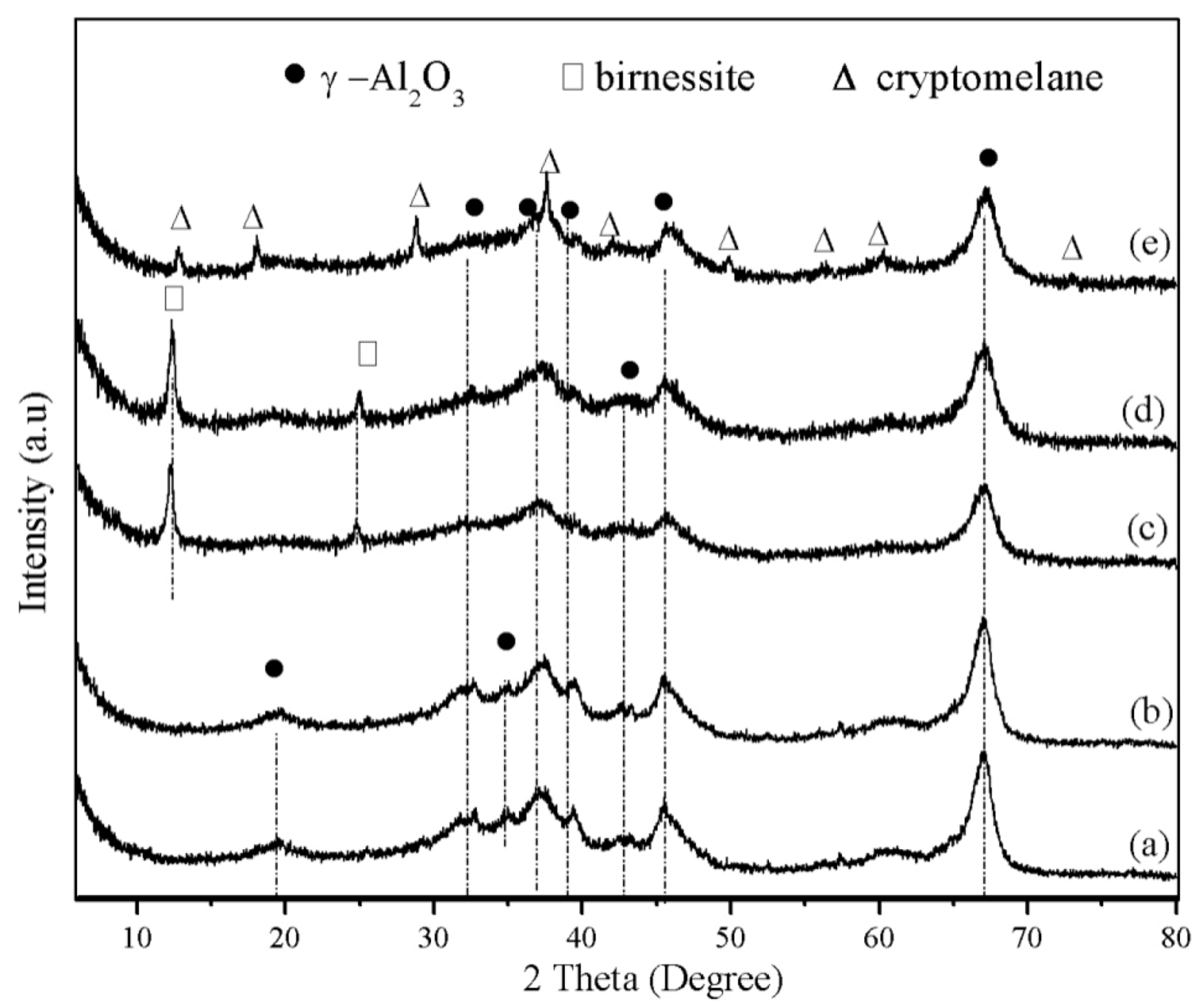
        <p>The X-ray diffraction patterns of the manganese-alumina samples prepared are included in <xref ref-type="fig" rid="catalysts-02-00352-f001">Figure 1</xref>. In addition, in order to analyze potential changes occurring on the alumina support during the preparation of the supported catalysts, the XRD patterns of the γ-Al<sub>2</sub>O<sub>3</sub> support calcined at 400 °C and 600 °C have also been included. </p>
        <fig id="catalysts-02-00352-f001" position="anchor">
          <label>Figure 1</label>
          <caption>
            <p>XRD patterns: <bold>(a)</bold> γ-Al<sub>2</sub>O<sub>3 </sub>calcined at 400°C; (<bold>b</bold>) γ-Al<sub>2</sub>O<sub>3</sub> calcined at 600 °C; (<bold>c</bold>) MnAlT400; (<bold>d</bold>) MnAlT400W and (<bold>e</bold>) MnAlW600.</p>
          </caption>
          <graphic xmlns:xlink="http://www.w3.org/1999/xlink" xlink:href="catalysts-02-00352-g001.tif"/>
        </fig>
        <p>The diffraction peaks of γ-Al<sub>2</sub>O<sub>3</sub> appear at 2θ = 19.51°, 32.7°, 37.5°, 39.24°, 45.5° and 67.1°, being consistent with the diffractograms reported for this material (JCPDS: 00-046-1215) [<xref ref-type="bibr" rid="B17-catalysts-02-00352">17</xref>,<xref ref-type="bibr" rid="B18-catalysts-02-00352">18</xref>]. The XRD patterns of γ-Al<sub>2</sub>O<sub>3</sub> are equal after calcinations at 400 °C and 600 °C, evidencing the thermal stability of this support in the range of temperatures analyzed.</p>
        <p>The diffraction patterns of MnAlT400 and MnAlT400W present peaks assigned to the γ-Al<sub>2</sub>O<sub>3</sub> support along with peaks at 2θ = 12.54° and 25.10°, which can be attributed to birnessite [<xref ref-type="bibr" rid="B19-catalysts-02-00352">19</xref>]. The expected peaks of potassium manganate were not detected by XRD in MnAlT400, probably due to its high dispersion on the support. However, the presence of potassium manganate was evidenced in a previous study performed with unsupported manganese samples (without alumina) after calcinations of potassium permanganate at 400 °C [<xref ref-type="bibr" rid="B6-catalysts-02-00352">6</xref>]. The XRD pattern changes significantly for MnAlW600, showing characteristics peaks of criptomelane (JCPDS 44-0141) [<xref ref-type="bibr" rid="B20-catalysts-02-00352">20</xref>].</p>
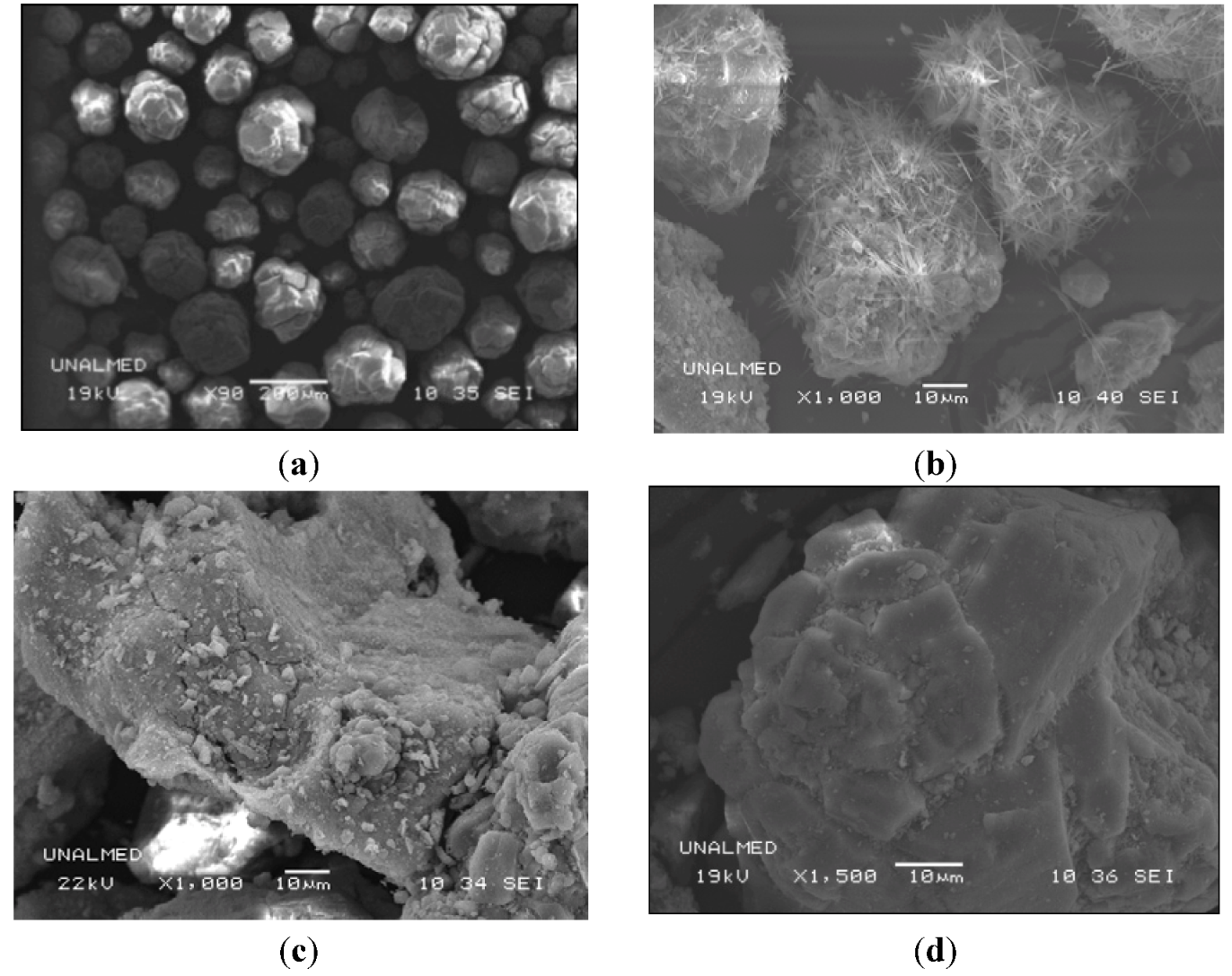
        <p>Evidence of the presence of potassium manganate in MnAlT400 are the greenish color of the water used in the washing step performed to MnAlT400 and the increase of the intensity of the birnessite peaks of MnAlT400W with regard to those of MnAlT400. In addition, the K/Mn molar ratio determined from Atomic Absorption Spectrometer (AAS) analysis values (data in <xref ref-type="table" rid="catalysts-02-00352-t001">Table 1</xref>), is higher in MnAlT400 than in MnAlT400W, that is, decreases after the washing step due to potassium manganate removal. The SEM images included in <xref ref-type="fig" rid="catalysts-02-00352-f002">Figure 2</xref> also support the formation of potassium manganates upon calcination of γ-Al<sub>2</sub>O<sub>3</sub>-supported KMnO<sub>4</sub>. γ-Al<sub>2</sub>O<sub>3</sub> (<xref ref-type="fig" rid="catalysts-02-00352-f002">Figure 2</xref>a) consists of quite spherical particles of 100–200 µm, the difference in contrast between the particles in this figure is assigned to “charging effect” on the surface of particles probably because this material is dielectric and the electrons are accumulated on it. These spherical particles are covered by potassium manganate needles of 15–40 µm length (<xref ref-type="fig" rid="catalysts-02-00352-f002">Figure 2</xref>b). These needles are removed by water washing, and therefore, are neither observed in MnAlT400W nor in MnAlW600.</p>
        <table-wrap id="catalysts-02-00352-t001" position="anchor">
          <object-id pub-id-type="pii">catalysts-02-00352-t001_Table 1</object-id>
          <label>Table 1</label>
          <caption>
            <p>Atomic Absorption Spectrometer (AAS) elemental analysis.</p>
          </caption>
          <table rules="all" style="border: solid thin">
            <thead>
              <tr>
                <th align="center" valign="middle">Sample</th>
                <th align="center" valign="middle">Al (wt%)</th>
                <th align="center" valign="middle">Mn (wt%)</th>
                <th align="center" valign="middle">K (wt%)</th>
                <th align="center" valign="middle">K/Mn (Molar ratio)</th>
              </tr>
            </thead>
            <tbody>
              <tr>
                <td align="center" valign="middle">MnAlT400</td>
                <td align="center" valign="middle">30.3</td>
                <td align="center" valign="middle">5.8</td>
                <td align="center" valign="middle">3.6</td>
                <td align="center" valign="middle">0.87</td>
              </tr>
              <tr>
                <td align="center" valign="middle">MnAlT400W</td>
                <td align="center" valign="middle">38.2</td>
                <td align="center" valign="middle">5.8</td>
                <td align="center" valign="middle">1.8</td>
                <td align="center" valign="middle">0.44</td>
              </tr>
            </tbody>
          </table>
        </table-wrap>
        <fig id="catalysts-02-00352-f002" position="anchor">
          <label>Figure 2</label>
          <caption>
            <p>SEM images: (<bold>a</bold>) γ-Al<sub>2</sub>O<sub>3</sub>; (<bold>b</bold>) MnAlT400; (<bold>c</bold>) MnAlT400W and (<bold>d</bold>) MnAlW600.</p>
          </caption>
          <graphic xmlns:xlink="http://www.w3.org/1999/xlink" xlink:href="catalysts-02-00352-g002.tif"/>
        </fig>
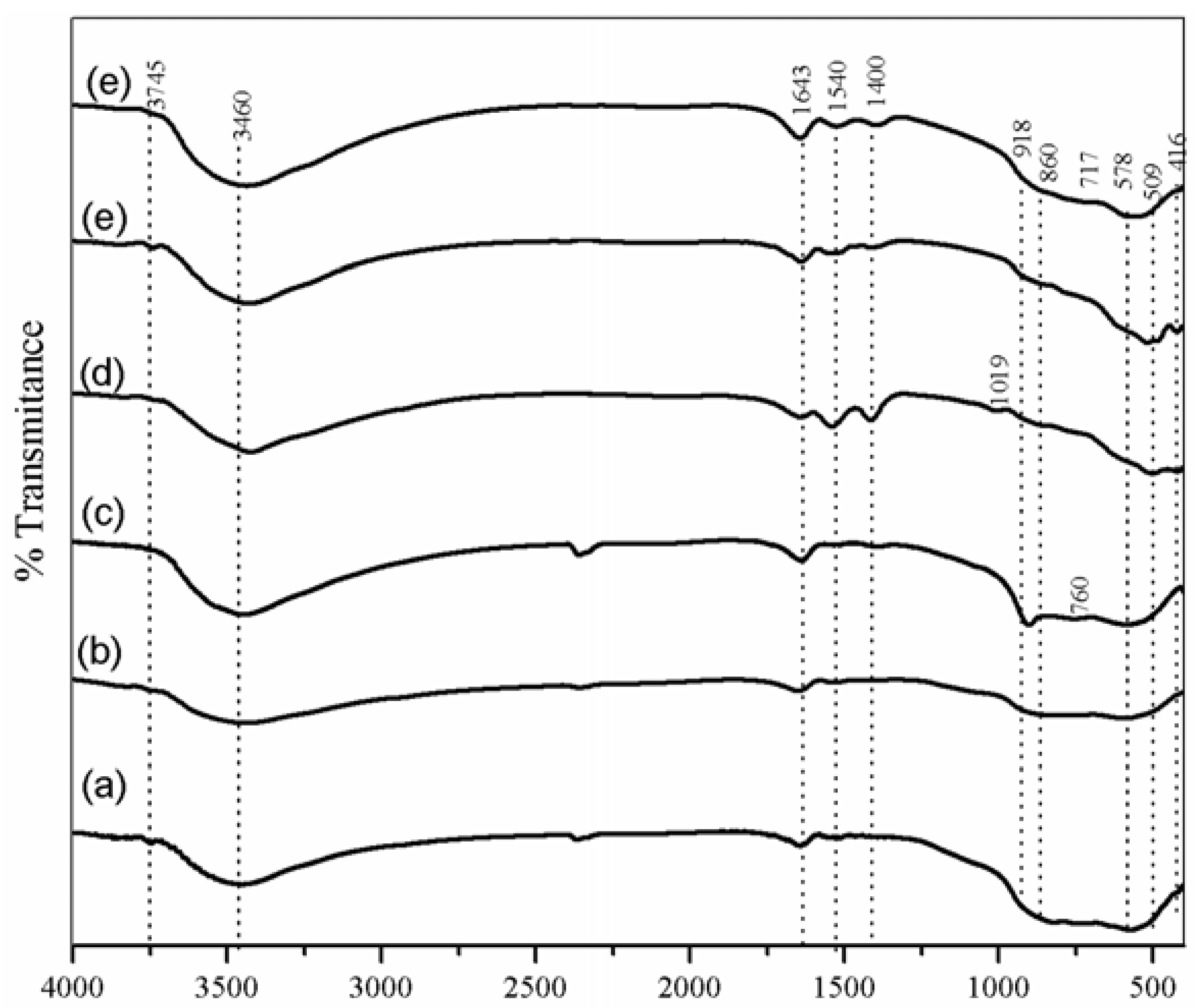
        <p><xref ref-type="fig" rid="catalysts-02-00352-f003">Figure 3</xref> shows the FTIR spectra of the manganese-alumina samples together with those of the γ-Al<sub>2</sub>O<sub>3</sub> support calcined at 400 °C and 600 °C. The bands between 3800–3680 cm<sup>−1</sup> and 2000–1500 cm<sup>−1</sup> are assigned to the O-H vibration of adsorbed water and/or to surface hydroxyl groups [<xref ref-type="bibr" rid="B21-catalysts-02-00352">21</xref>], and those between 980–550 cm<sup>−1</sup> are attributed to Al-O bond vibrations [<xref ref-type="bibr" rid="B22-catalysts-02-00352">22</xref>]. The spectra of γ-Al<sub>2</sub>O<sub>3</sub> after calcinations at 400 °C and 600 °C are quite similar to each other, supporting that the γ-Al<sub>2</sub>O<sub>3</sub> support is thermally stable in the range of temperatures studied, which is consistent with the XRD conclusions.</p>
        <fig id="catalysts-02-00352-f003" position="anchor">
          <label>Figure 3</label>
          <caption>
            <p>FTIR spectra: (<bold>a</bold>) γ-Al<sub>2</sub>O<sub>3</sub> calcined at 400°C; (<bold>b</bold>) γ-Al<sub>2</sub>O<sub>3</sub> calcined at 600°C; (<bold>c</bold>) KMnO<sub>4</sub> impregnated on γ-Al<sub>2</sub>O<sub>3</sub> (non-calcined); (<bold>d</bold>) MnAlT400; (<bold>e</bold>) MnAlT400W and (<bold>f</bold>) MnAlW600.</p>
          </caption>
          <graphic xmlns:xlink="http://www.w3.org/1999/xlink" xlink:href="catalysts-02-00352-g003.tif"/>
        </fig>
        <p>As can be observed in <xref ref-type="fig" rid="catalysts-02-00352-f003">Figure 3</xref>, the band at 3745 cm<sup>−1</sup>, assigned to adsorbed water and/or hydroxyl groups on γ-Al<sub>2</sub>O<sub>3</sub>, disappear upon KMnO<sub>4</sub> impregnation, and the position of those at 3460 and 1643 cm<sup>−1</sup> shift with respect to their position on bare alumina. The bands at 1400, 918 and 760 cm<sup>−1</sup> are attributed to KMnO<sub>4</sub>, and the shift in position of these bands with regard to the typical positions reported for pure KMnO<sub>4</sub> [<xref ref-type="bibr" rid="B6-catalysts-02-00352">6</xref>,<xref ref-type="bibr" rid="B23-catalysts-02-00352">23</xref>] evidences a certain interaction between KMnO<sub>4</sub> and γ-Al<sub>2</sub>O<sub>3</sub>.</p>
        <p>In sample MnAlT400, the IR bands below 700 cm<sup>−1</sup> are assigned to vibrational modes of Mn-O bonds [<xref ref-type="bibr" rid="B24-catalysts-02-00352">24</xref>] and the bands at 509 y 422 cm<sup>−1</sup> are characteristics of birnessite [<xref ref-type="bibr" rid="B25-catalysts-02-00352">25</xref>]. The band at around 1019 cm<sup>−1</sup>, which can be ascribed to Mn=O vibrations, suggests the presence of manganate-type oxides (Mn(VI)Ox) [<xref ref-type="bibr" rid="B26-catalysts-02-00352">26</xref>]. This band disappears after washing the MnAlT400 sample (see IR spectra of MnAlT400W) due to the removal of this soluble specie. After calcinations at 600 °C of the washed sample (see IR spectra of MnAlTW600) a new band appears at 1022 cm<sup>−1</sup>, which has been reported for the vibration mode of Mn<sup>3+</sup>–O [<xref ref-type="bibr" rid="B27-catalysts-02-00352">27</xref>], and finally some studies attribute the bands between 450 and 750 cm<sup>−1</sup> to the vibration of Mn–O bonds in cryptomelane [<xref ref-type="bibr" rid="B28-catalysts-02-00352">28</xref>].</p>
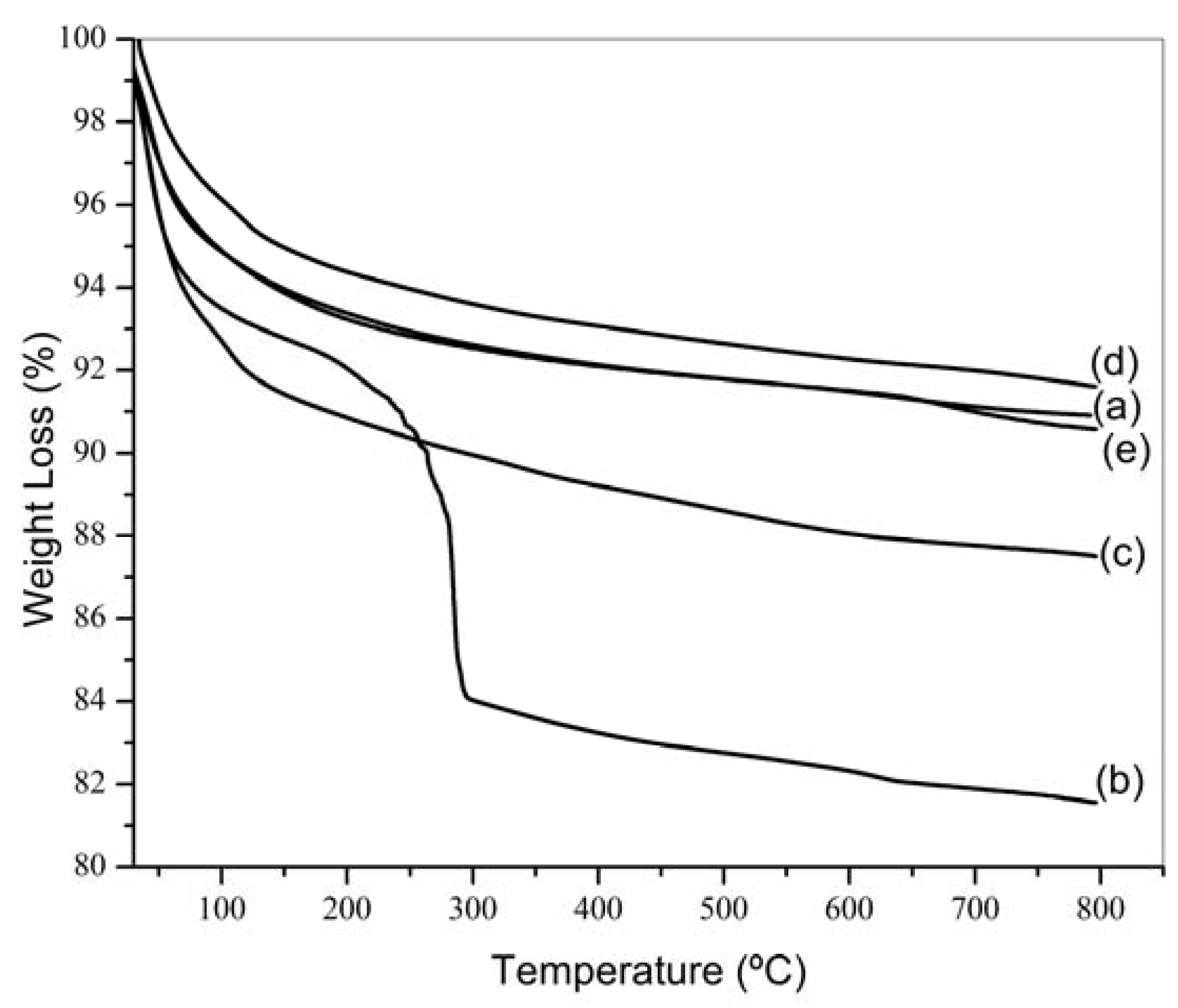
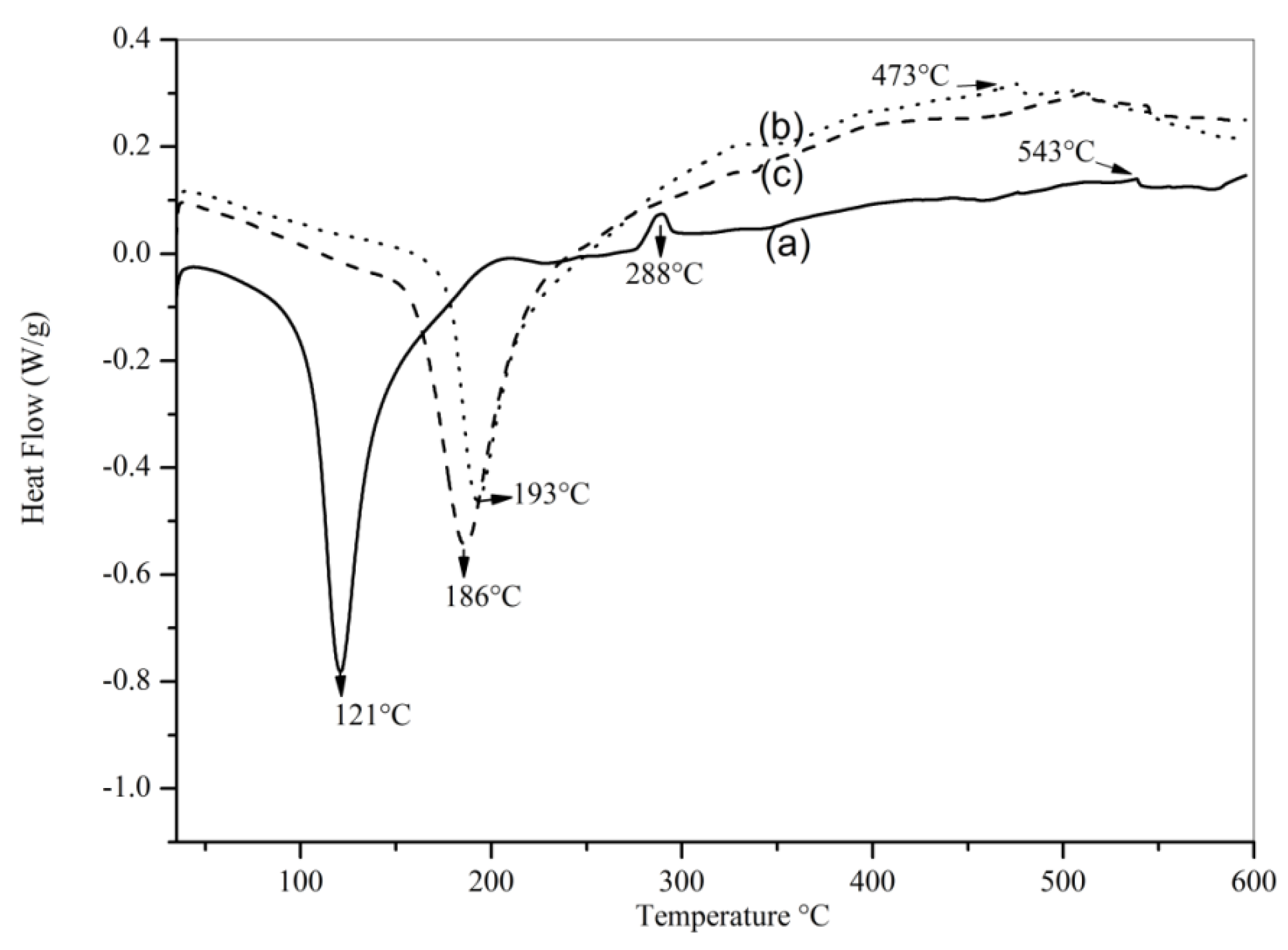
        <p><xref ref-type="fig" rid="catalysts-02-00352-f004">Figure 4</xref> and <xref ref-type="fig" rid="catalysts-02-00352-f005">Figure 5</xref> show the TGA and DSC results, respectively, and <xref ref-type="table" rid="catalysts-02-00352-t002">Table 2</xref> compiles the weight losses determined from TGA profiles for different temperature ranges. The weight losses observed below 250 °C can be partially attributed to water release and the weight losses occurring above 500 °C are associated with structural changes that imply O<sub>2</sub> delivery [<xref ref-type="bibr" rid="B6-catalysts-02-00352">6</xref>]. For instance, in γ-Al<sub>2</sub>O<sub>3</sub>-supported KMnO<sub>4</sub>, the endothermic DSC peaks at temperatures below 200 °C are due to the release of physisorbed water, and the exothermic peaks at 288 °C and 537 °C are associated to phase transitions occurring with oxygen release.</p>
        <fig id="catalysts-02-00352-f004" position="anchor">
          <label>Figure 4</label>
          <caption>
            <p>TGA profiles (obtained under nitrogen atmosphere): (<bold>a</bold>) γ-Al<sub>2</sub>O<sub>3</sub>; (<bold>b</bold>) KMnO<sub>4</sub> impregnated on γ-Al<sub>2</sub>O<sub>3</sub> (non-calcined); (<bold>c</bold>) MnAlT400; (<bold>d</bold>) MnAlT400W y; (<bold>e</bold>) MnAlW600.</p>
          </caption>
          <graphic xmlns:xlink="http://www.w3.org/1999/xlink" xlink:href="catalysts-02-00352-g004.tif"/>
        </fig>
        <fig id="catalysts-02-00352-f005" position="anchor">
          <label>Figure 5</label>
          <caption>
            <p>DSC profiles: (<bold>a</bold>) KMnO<sub>4</sub> impregnated on γ-Al<sub>2</sub>O<sub>3</sub> (non-calcined); (<bold>b</bold>) MnAlT400 and (<bold>c</bold>) MnAlT400W.</p>
          </caption>
          <graphic xmlns:xlink="http://www.w3.org/1999/xlink" xlink:href="catalysts-02-00352-g005.tif"/>
        </fig>
        <table-wrap id="catalysts-02-00352-t002" position="anchor">
          <object-id pub-id-type="pii">catalysts-02-00352-t002_Table 2</object-id>
          <label>Table 2</label>
          <caption>
            <p>Weight loss in TGA experiments in N<sub>2</sub> atmosphere.</p>
          </caption>
          <table rules="all" style="border: solid thin">
            <thead>
              <tr>
                <th align="center" valign="middle">Sample</th>
                <th align="center" valign="middle">Until 250 °C (wt%)</th>
                <th align="center" valign="middle">250 to 500 °C (wt%)</th>
                <th align="center" valign="middle">Above 500 °C (wt%)</th>
                <th align="center" valign="middle">Total (wt%)</th>
              </tr>
            </thead>
            <tbody>
              <tr>
                <td align="center" valign="middle">γ-Al<sub>2</sub>O<sub>3</sub></td>
                <td align="center" valign="middle">7.2</td>
                <td align="center" valign="middle">1.0</td>
                <td align="center" valign="middle">0.9</td>
                <td align="center" valign="middle">9.1</td>
              </tr>
              <tr>
                <td align="center" valign="middle">KMnO<sub>4</sub> impregnated on γ-Al<sub>2</sub>O<sub>3</sub> (non-calcined)</td>
                <td align="center" valign="middle">9.5</td>
                <td align="center" valign="middle">7.8</td>
                <td align="center" valign="middle">1.2</td>
                <td align="center" valign="middle">18.5</td>
              </tr>
              <tr>
                <td align="center" valign="middle">MnAlT400</td>
                <td align="center" valign="middle">9.7</td>
                <td align="center" valign="middle">1.7</td>
                <td align="center" valign="middle">1.1</td>
                <td align="center" valign="middle">12.5</td>
              </tr>
              <tr>
                <td align="center" valign="middle">MnAl T400W</td>
                <td align="center" valign="middle">6.5</td>
                <td align="center" valign="middle">0.9</td>
                <td align="center" valign="middle">1.0</td>
                <td align="center" valign="middle">8.4</td>
              </tr>
              <tr>
                <td align="center" valign="middle">MnAlW600</td>
                <td align="center" valign="middle">7.2</td>
                <td align="center" valign="middle">1.0</td>
                <td align="center" valign="middle">1.2</td>
                <td align="center" valign="middle">9.4</td>
              </tr>
            </tbody>
          </table>
        </table-wrap>
        
        
        <p>The weight loss suffered by γ-Al<sub>2</sub>O<sub>3</sub>-supported KMnO<sub>4</sub> between 250 and 500 °C is related to the decomposition of KMnO<sub>4</sub>, considering that the γ-Al<sub>2</sub>O<sub>3</sub> support is stable in the range of temperatures studied, as deduced from XRD and FTIR. This KMnO<sub>4</sub> decomposition is in accordance with previously reported DSC results [<xref ref-type="bibr" rid="B6-catalysts-02-00352">6</xref>].</p>
        <p>The quantitative weight loss values included in <xref ref-type="table" rid="catalysts-02-00352-t002">Table 2</xref> show that the weight loss suffered until 250 °C by the washed sample (MnAlT400W) is lower than that suffered by the counterpart non-washed sample (MnAlT400), which is attributed to the hygroscopic character of manganates, as it was reported by Kappenstein <italic>et al</italic>. [<xref ref-type="bibr" rid="B29-catalysts-02-00352">29</xref>]. The weight loss of MnAlW600 below 250 °C is due to the release of water adsorbed in the porous structure of cryptomelane. The structural changes related with the formation of manganese oxide phases, as determined by XRD and FTIR, are in accordance with the DSC profiles (<xref ref-type="fig" rid="catalysts-02-00352-f005">Figure 5</xref>).</p>
        <p>In conclusion, the TGA results discussed are consistent with those previously obtained with pure KMnO<sub>4</sub> (without alumina) [<xref ref-type="bibr" rid="B6-catalysts-02-00352">6</xref>]. Birnessite and potassium manganate are formed after KMnO<sub>4</sub> calcination at 400 °C, and transformation to cryptomelane occurs after potassium manganate removal by water washing and calcination at 600 °C.</p>
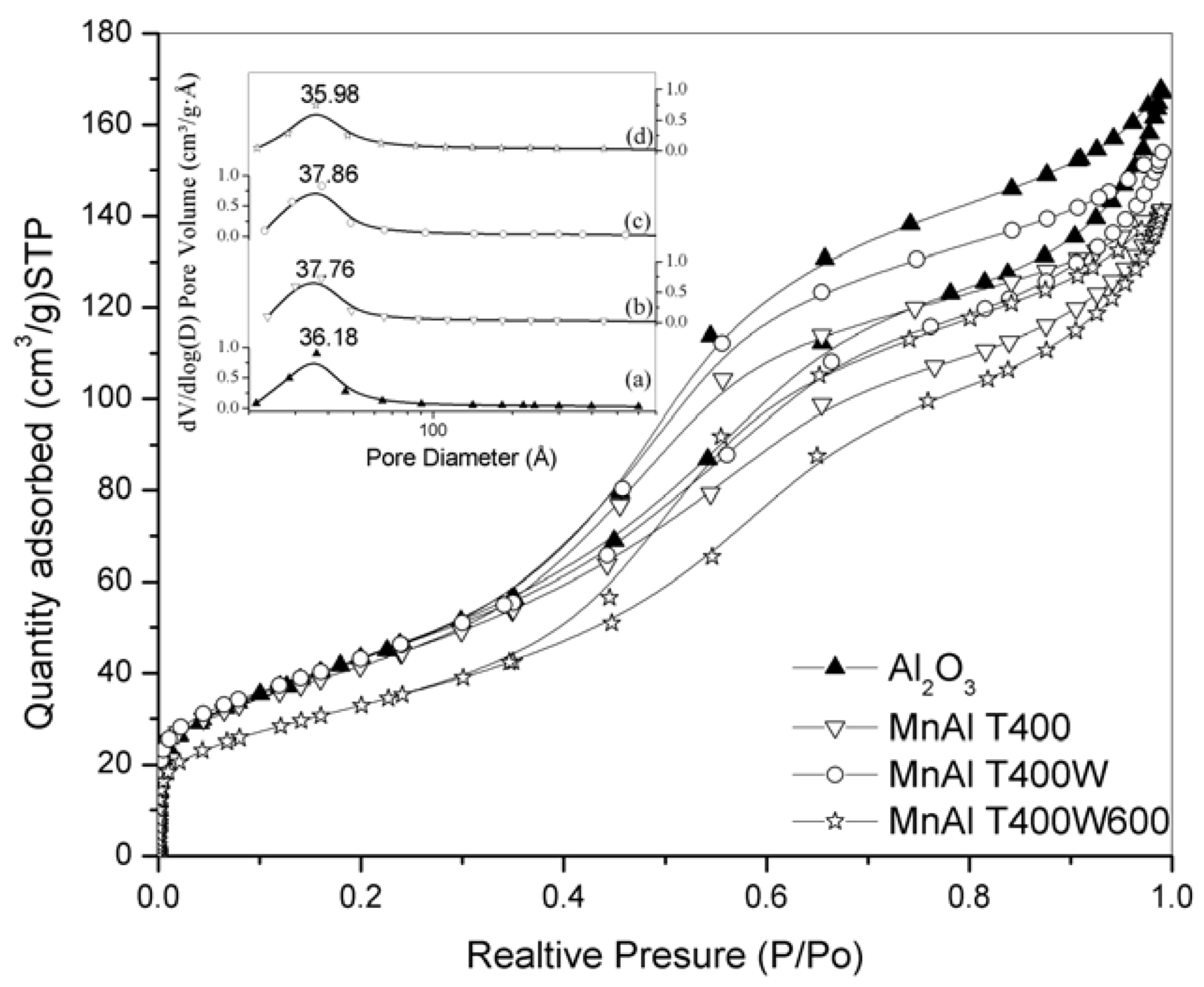
        <p>N<sub>2</sub> adsorption–desorption isotherms are shown in <xref ref-type="fig" rid="catalysts-02-00352-f006">Figure 6</xref>, and different parameters obtained from these isotherms are compiled in <xref ref-type="table" rid="catalysts-02-00352-t003">Table 3</xref>. All samples present type IV isotherms, according to IUPAC classification [<xref ref-type="bibr" rid="B30-catalysts-02-00352">30</xref>], with considerable N<sub>2</sub> adsorption at low relative pressures, which is indicative of microporosity [<xref ref-type="bibr" rid="B31-catalysts-02-00352">31</xref>], and hysteresis cycles. These profiles indicate that the materials present also a mesoporous structure and them shown capillary condensation above P/Po 0.3. According to the De Boer [<xref ref-type="bibr" rid="B30-catalysts-02-00352">30</xref>,<xref ref-type="bibr" rid="B31-catalysts-02-00352">31</xref>,<xref ref-type="bibr" rid="B32-catalysts-02-00352">32</xref>] classification, the hysteresis cycles present contributions of slit–shaped pores (B) and interconnected pores with bottleneck shape (E). The mesopores size distributions determined by the BJH method (inset in <xref ref-type="fig" rid="catalysts-02-00352-f006">Figure 6</xref>) show peaks centered between 35.98 Å and 37.86 Å, without significant change among samples. </p>
        <fig id="catalysts-02-00352-f006" position="anchor">
          <label>Figure 6</label>
          <caption>
            <p>N<sub>2</sub> adsorption–desorption isotherms: (<bold>a</bold>) γ-Al<sub>2</sub>O<sub>3</sub>; (<bold>b</bold>) MnAlT400; (<bold>c</bold>) MnAlT400W; (<bold>d</bold>) MnAlW600 (Inset, mesoporous size distribution obtained by BHJ method).</p>
          </caption>
          <graphic xmlns:xlink="http://www.w3.org/1999/xlink" xlink:href="catalysts-02-00352-g006.tif"/>
        </fig>
        <table-wrap id="catalysts-02-00352-t003" position="anchor">
          <object-id pub-id-type="pii">catalysts-02-00352-t003_Table 3</object-id>
          <label>Table 3</label>
          <caption>
            <p>Brunauer-Emmet-Teller (BET) area, pore volume (<italic>V</italic><sub>pore</sub>) and average pore diameter (<italic>D</italic><sub>BJH</sub>).</p>
          </caption>
          <table rules="all" style="border: solid thin">
            <thead>
              <tr>
                <th align="left" valign="middle">Material</th>
                <th align="left" valign="middle"><italic>S</italic><sub>BET</sub> (m<sup>2</sup>/g)</th>
                <th align="left" valign="middle"><italic>V</italic><sub>pore</sub> (cm<sup>3</sup>/g)</th>
                <th align="left" valign="middle"><italic>D</italic><sub>BJH</sub> (Å)</th>
              </tr>
            </thead>
            <tbody>
              <tr>
                <td align="left" valign="middle">γ-Al<sub>2</sub>O<sub>3</sub></td>
                <td align="left" valign="middle">165</td>
                <td align="left" valign="middle">0.26</td>
                <td align="left" valign="middle">41.2</td>
              </tr>
              <tr>
                <td align="left" valign="middle">KMnO<sub>4</sub> impregnated on γ-Al<sub>2</sub>O<sub>3</sub> (non-calcined)</td>
                <td align="left" valign="middle">148</td>
                <td align="left" valign="middle">0.20</td>
                <td align="left" valign="middle">36.8</td>
              </tr>
              <tr>
                <td align="left" valign="middle">MnAlT400</td>
                <td align="left" valign="middle">151</td>
                <td align="left" valign="middle">0.22</td>
                <td align="left" valign="middle">41.2</td>
              </tr>
              <tr>
                <td align="left" valign="middle">MnAlT400W</td>
                <td align="left" valign="middle">158</td>
                <td align="left" valign="middle">0.25</td>
                <td align="left" valign="middle">41.4</td>
              </tr>
              <tr>
                <td align="left" valign="middle">MnAlT400W600</td>
                <td align="left" valign="middle">121</td>
                <td align="left" valign="middle">0.22</td>
                <td align="left" valign="middle">44.7</td>
              </tr>
            </tbody>
          </table>
        </table-wrap>
        
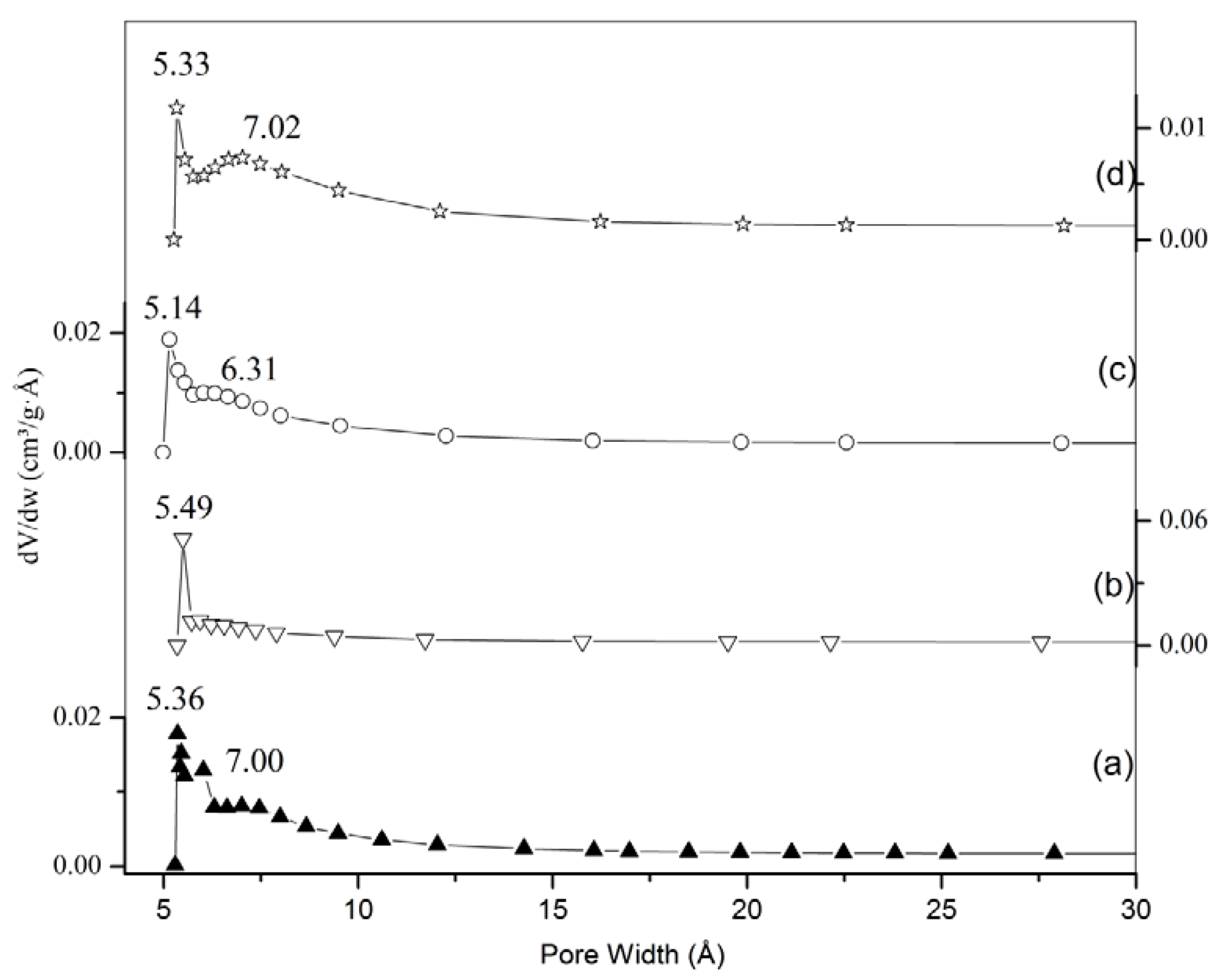
        <p>The micropore size distribution, obtained by the HK method, (<xref ref-type="fig" rid="catalysts-02-00352-f007">Figure 7</xref>) is monomodal for MnAlT400, while bimodal for bare γ-Al<sub>2</sub>O<sub>3</sub>, MnAlT400W and MnAlW600, suggesting the presence of primary and secondary micropores [<xref ref-type="bibr" rid="B33-catalysts-02-00352">33</xref>]. These results evidence that potassium manganate on MnAlT400 blocks part of the γ-Al<sub>2</sub>O<sub>3</sub> microporosity, in agreement with results reported by other authors [<xref ref-type="bibr" rid="B34-catalysts-02-00352">34</xref>], and the closed micropores becomes again open after removal of the soluble salts by water washing. The BET surface areas included in <xref ref-type="table" rid="catalysts-02-00352-t003">Table 3</xref> are consistent with this conclusion. The BET surface area of γ-Al<sub>2</sub>O<sub>3</sub> decreases after KMnO<sub>4</sub> impregnation, and increases again after the washing step (sample MnAlT400W).</p>
        <fig id="catalysts-02-00352-f007" position="anchor">
          <label>Figure 7</label>
          <caption>
            <p>Micropore size distribution (obtained by HK method): (<bold>a</bold>) γ-Al<sub>2</sub>O<sub>3</sub>; (<bold>b</bold>) MnAlT400; (<bold>c</bold>) MnAlT400W and (<bold>d</bold>) MnAlW600.</p>
          </caption>
          <graphic xmlns:xlink="http://www.w3.org/1999/xlink" xlink:href="catalysts-02-00352-g007.tif"/>
        </fig>
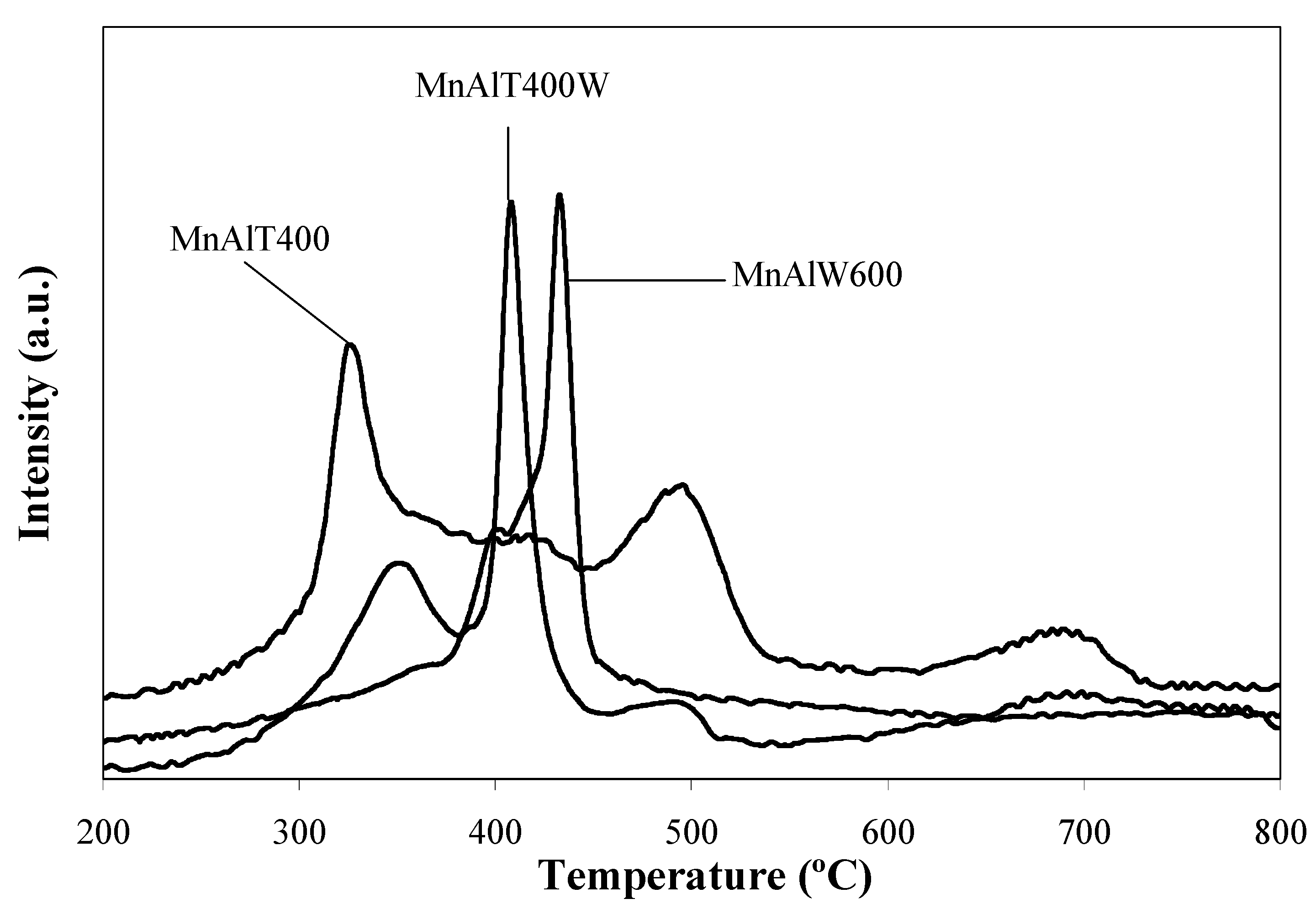
        <p>H<sub>2</sub> reduction profiles for all samples prepared are included in <xref ref-type="fig" rid="catalysts-02-00352-f008">Figure 8</xref>. According with the description of several authors [<xref ref-type="bibr" rid="B35-catalysts-02-00352">35</xref>,<xref ref-type="bibr" rid="B36-catalysts-02-00352">36</xref>,<xref ref-type="bibr" rid="B37-catalysts-02-00352">37</xref>], the reduction of supported manganese (IV) oxide occurs in several consecutive steps. The lower temperature peaks are attributed to the reduction of Mn<sup>4+</sup> to Mn<sub>3</sub>O<sub>4</sub> following the reactions sequence: MnO<sub>2</sub>→Mn<sub>2</sub>O<sub>3</sub>→Mn<sub>3</sub>O<sub>4</sub>. The reduction step taking place at higher temperatures is attributed to Mn<sub>3</sub>O<sub>4</sub> reduction to MnO.</p>
        <fig id="catalysts-02-00352-f008" position="anchor">
          <label>Figure 8</label>
          <caption>
            <p>Samples characterization by H<sub>2</sub>-TPR.</p>
          </caption>
          <graphic xmlns:xlink="http://www.w3.org/1999/xlink" xlink:href="catalysts-02-00352-g008.tif"/>
        </fig>
        <p>The H<sub>2</sub> reduction profile obtained with MnAlW600 shows two main reduction peaks at 400 °C and 434 °C, which could indicate that the reduction proceeds following the sequence of steps KMn<sub>8</sub>O<sub>16</sub> (cryptomelane)→Mn<sub>3</sub>O<sub>4</sub>→MnO. A similar H<sub>2</sub> reduction profile is obtained with MnAlT400W, but the temperatures of the main peaks are shifted to lower temperatures. The intensity of the second peak is always higher than that of the first one in both samples. On the contrary, the H<sub>2</sub> reduction profile of MnAlT400 (non-washed sample) differs from those of the washed samples (MnAlW600 and MnAlT400W) due to the presence of salts with manganese cations in oxidation states higher than +4. In conclusion, the H<sub>2</sub> reduction experiments suggest the presence of Mn cations with oxidation state near +4, as expected for birnessite and cryptomelane. </p>
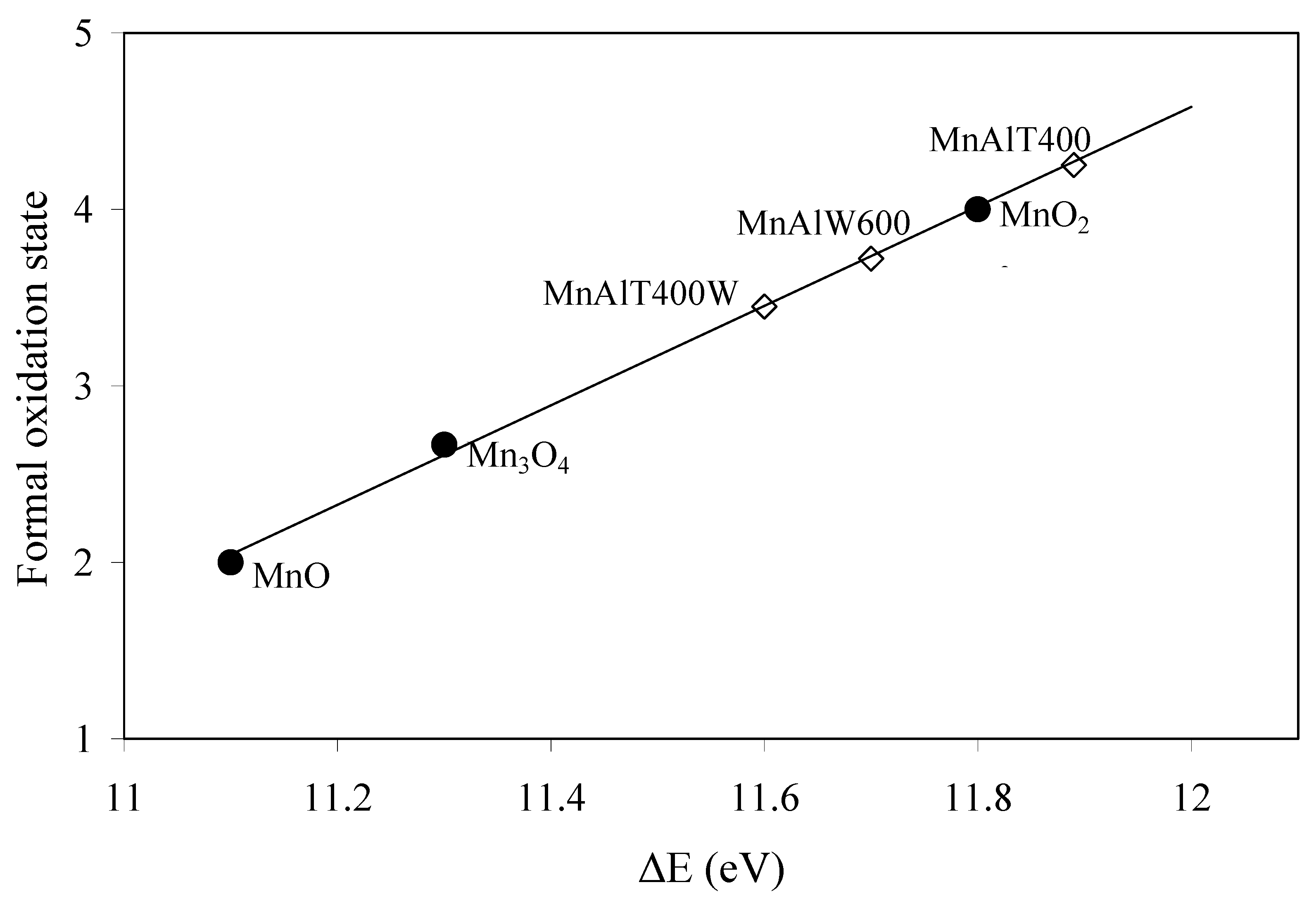
        <p>XPS characterization was used in order to obtain additional information about the oxidation state of manganese on the different samples by using a method reported elsewhere [<xref ref-type="bibr" rid="B6-catalysts-02-00352">6</xref>]. <xref ref-type="fig" rid="catalysts-02-00352-f009">Figure 9</xref> plots the formal oxidation state of manganese for three different commercial manganese oxides (MnO, Mn<sub>3</sub>O<sub>4</sub> and MnO<sub>2</sub>, by Aldrich) with regard to the difference between the binding energy of the Mn 2p<sup>3/2</sup> and Mn 2p<sup>1/2</sup> peaks measured experimentally by XPS with each oxide (+2, +2.7 and +4, respectively). These reference values allow us to drawn a calibration line, and thus, the formal oxidation state of manganese in MnAlT400, MnAlT400W and MnAlW600 can be estimated by introducing in this trend line the XPS values calculated by difference between the corresponding binding energies of the Mn 2p<sup>3/2</sup> and Mn 2p<sup>1/2</sup> transitions. The formal oxidation states estimated are +4.3, +3.5 and +3.7 for MnAlT400, MnAlT400W and MnAlW600, respectively. The value obtained with the unwashed sample (MnAlT400; +4.3) is slightly above +4, which is consistent with the presence of manganate salts (in addition to birnessite) where the oxidation state of manganese is +6. The values obtained with the washed samples are between +3 and +4 because the manganates have been removed and only the birnessite and/or cryptomelane phases remain on the samples. As expected, the formal oxidation state obtained with the sample calcined at 600 °C (MnAlW600; +3.7) is slightly higher to that obtained with the sample calcined at 400 °C (MnAlW600; +3.5). These XPS results are in agreement with the H<sub>2</sub>-TPR conclusions and confirm the presence of manganese cations with the oxidation states expected for birnessite and cryptomelane phases, which are the phases identified by XRD and FTIR.</p>
        <fig id="catalysts-02-00352-f009" position="anchor">
          <label>Figure 9</label>
          <caption>
            <p>Formal oxidation state of manganese as a function of the difference between the binding energy of the Mn 2p<sup>3/2</sup> and Mn 2p<sup>1/2</sup> XPS peaks.</p>
          </caption>
          <graphic xmlns:xlink="http://www.w3.org/1999/xlink" xlink:href="catalysts-02-00352-g009.tif"/>
        </fig>
      </sec>
      <sec>
        <title>2.2. Catalytic Tests</title>
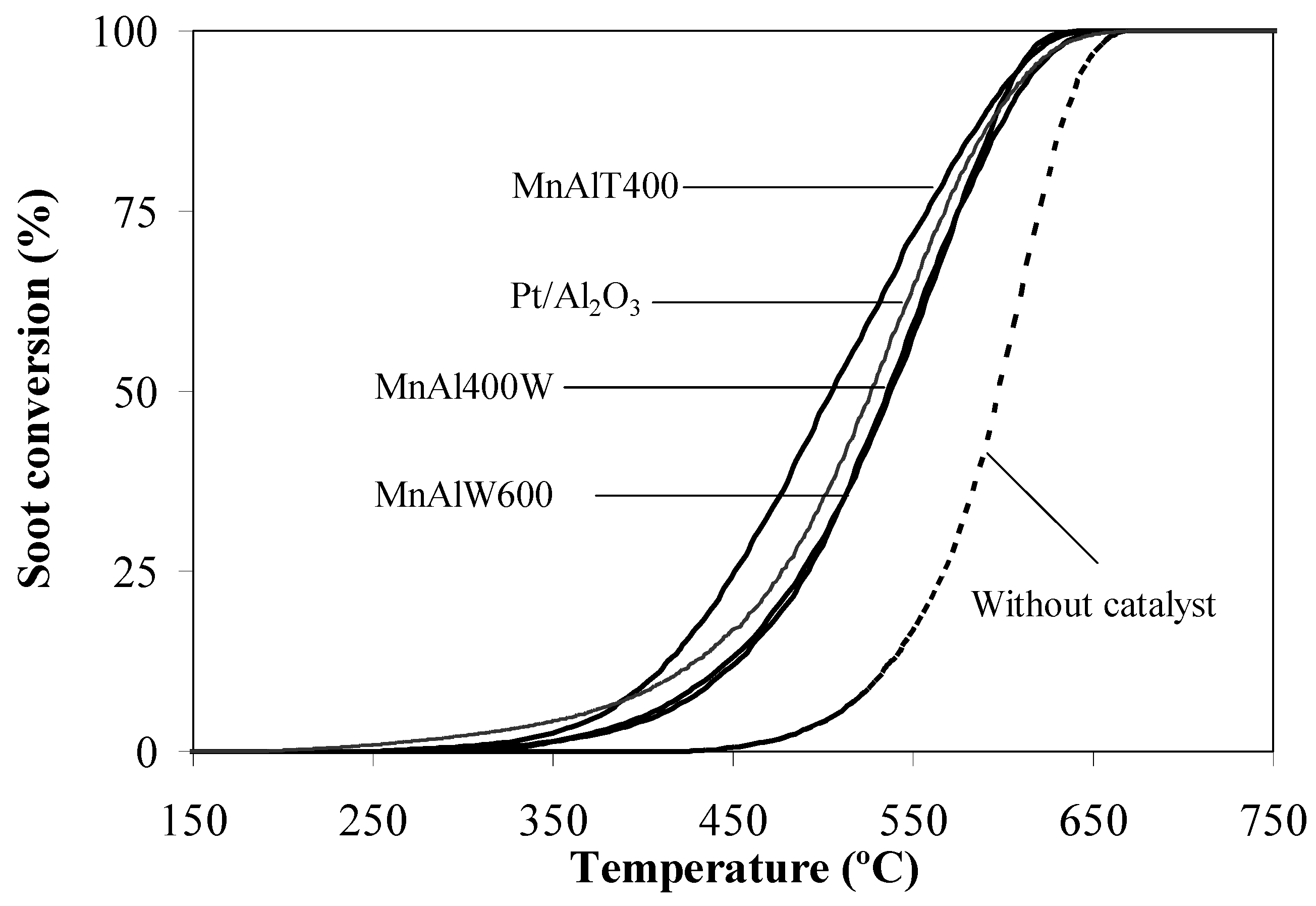
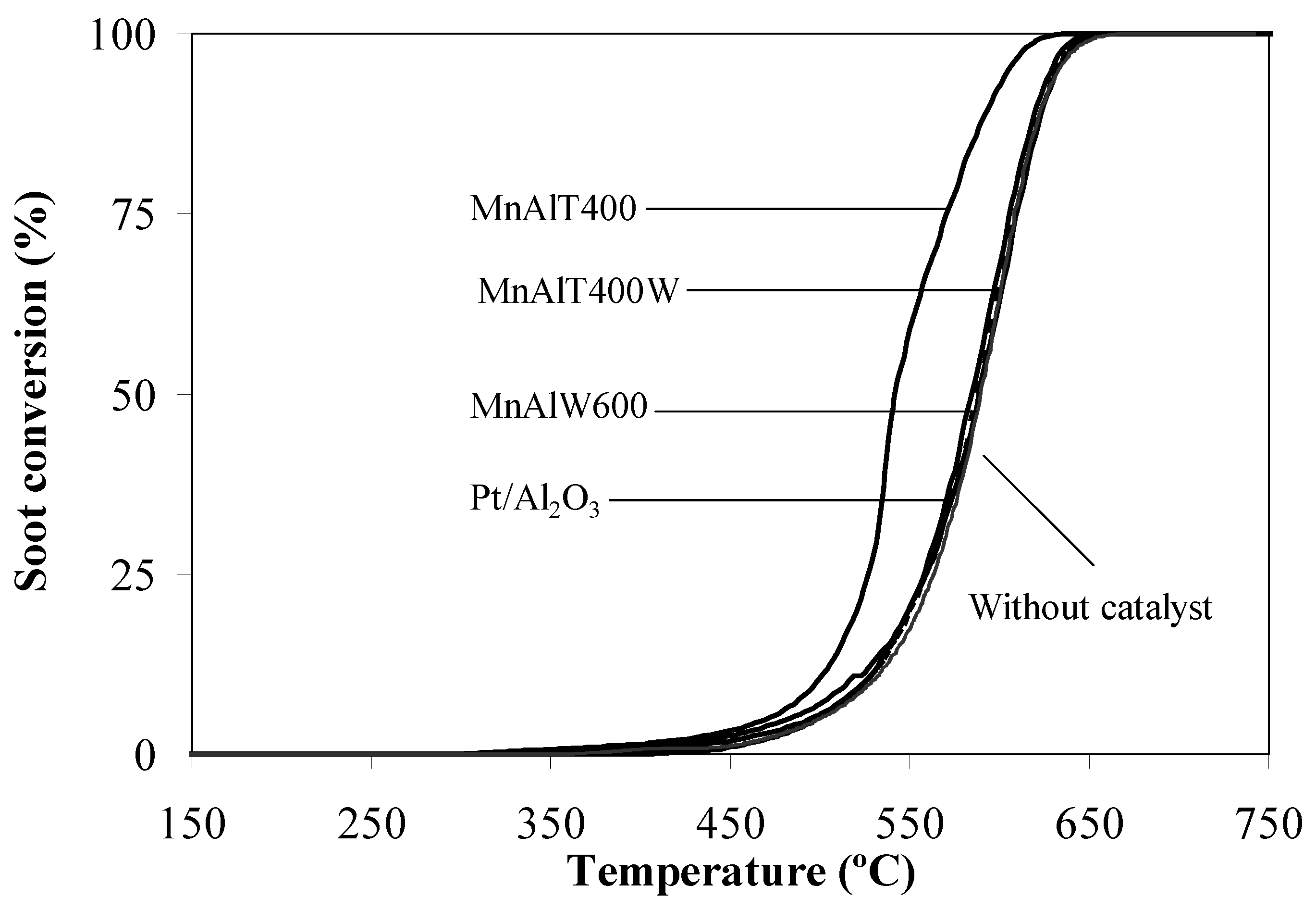
        <p>The catalytic combustion of soot was evaluated in O<sub>2</sub>/N<sub>2</sub> and NO<italic><sub>x</sub></italic>/O<sub>2</sub>/N<sub>2</sub>. The soot conversion profiles obtained in O<sub>2</sub>/N<sub>2</sub>, and included in <xref ref-type="fig" rid="catalysts-02-00352-f010">Figure 10</xref>, show that only the sample MnAlT400 is able to lower the soot combustion temperature with regard to the uncatalyzed reaction in these reactions conditions. This is attributed to the presence of potassium manganates, that is, this is not a catalytic effect but a redox reaction where potassium manganate oxidises soot.</p>
        
        <p>In experiments performed in NO<italic><sub>x</sub></italic>/O<sub>2</sub>/N<sub>2</sub> (<xref ref-type="fig" rid="catalysts-02-00352-f011">Figure 11</xref>), the lowest soot combustion temperature is also achieved with MnAlT400. However, in the presence of NO<italic><sub>x</sub></italic>, the washed samples (MnAlW600 and MnAlT400W) are also able to lower the soot combustion temperature with respect to the uncatalyzed reaction. These results are consistent with those previously obtained with unsupported manganese samples of similar composition. In the previous study [<xref ref-type="bibr" rid="B6-catalysts-02-00352">6</xref>], it was concluded that the combustion of soot assisted by birnessite and cryptomelane catalysts (once manganese salts have been removed) occurs by the NO<sub>2</sub> mechanism, that is, by acceleration of the NO oxidation to NO<sub>2</sub>, which is much more oxidizing than NO and O<sub>2</sub>. For comparison, the soot combustion profile obtained with a Pt/Al<sub>2</sub>O<sub>3</sub> reference catalyst has been included in <xref ref-type="fig" rid="catalysts-02-00352-f011">Figure 11</xref>. Note, that the onset of the soot combustion temperatures obtained with the manganese samples are not very different to that obtained with Pt. Therefore, these oxides are able to accelerate soot combustion and would be a valuable alternative for catalytic combustion of soot, since they are cheaper than Pt catalysts and easy to prepare.</p>
        <fig id="catalysts-02-00352-f010" position="anchor">
          <label>Figure 10</label>
          <caption>
            <p>Soot conversion profiles in catalytic tests performed in O<sub>2</sub>/N<sub>2</sub>.</p>
          </caption>
          <graphic xmlns:xlink="http://www.w3.org/1999/xlink" xlink:href="catalysts-02-00352-g010.tif"/>
        </fig>
        <fig id="catalysts-02-00352-f011" position="anchor">
          <label>Figure 11</label>
          <caption>
            <p>Soot conversion profiles in catalytic tests performed in NO<italic><sub>x</sub></italic>/O<sub>2</sub>.</p>
          </caption>
          <graphic xmlns:xlink="http://www.w3.org/1999/xlink" xlink:href="catalysts-02-00352-g011.tif"/>
        </fig>
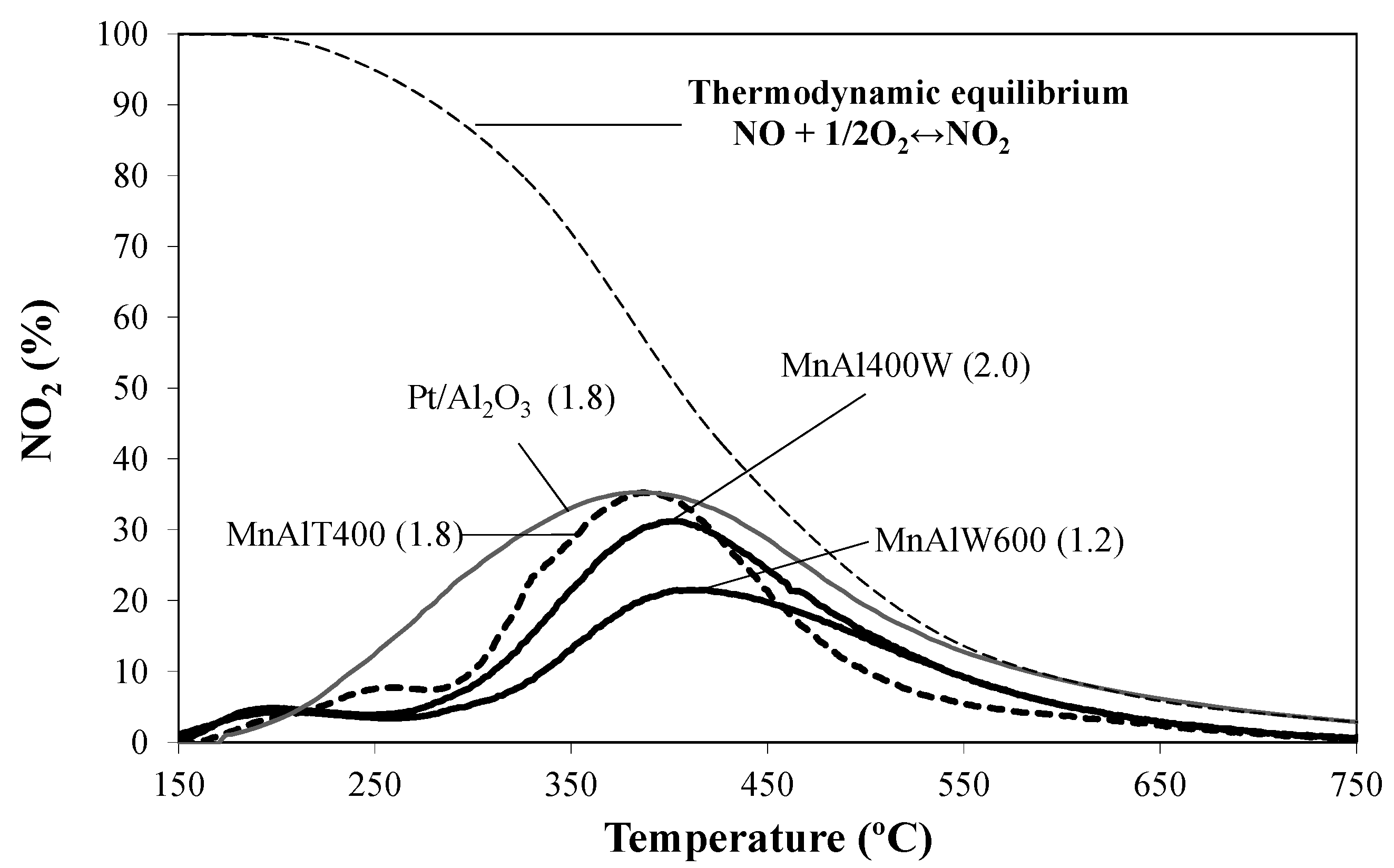
        <p>In order to analyze in more detail the reaction mechanism by which these alumina-supported manganese catalysts (MnAlW600 and MnAlT400W) accelerate soot combustion in a NO<italic><sub>x</sub></italic>/O<sub>2</sub> gas mixtures, blank experiments (only with the catalysts and without soot) have been performed with the NO<italic><sub>x</sub></italic>/O<sub>2</sub>/N<sub>2</sub> gas mixture. The NO<sub>2</sub> percentage (produced by NO oxidation) in total NO<italic><sub>x</sub></italic> basis is plotted in <xref ref-type="fig" rid="catalysts-02-00352-f012">Figure 12</xref> as a function of temperature. These results confirm that the manganese catalysts prepared in this study are able to oxidize NO to NO<sub>2</sub>, and the amount of NO<sub>2</sub> yielded is not very different to that produced by the Pt/Al<sub>2</sub>O<sub>3</sub> reference catalyst (the amounts of NO<sub>2</sub> evolved are reported in <xref ref-type="fig" rid="catalysts-02-00352-f012">Figure 12</xref> in mmol/gr). These blank experiments confirm that the catalyzed combustion of soot takes place with the participation of the NO<sub>2</sub>-assisted mechanism.</p>
        <fig id="catalysts-02-00352-f012" position="anchor">
          <label>Figure 12</label>
          <caption>
            <p>NO<sub>2</sub> percentage in blank experiments (without soot) performed in NO<italic><sub>x</sub></italic>/O<sub>2</sub>. The amounts of NO<sub>2</sub> evolved are reported between parentheses in mmol/gr).</p>
          </caption>
          <graphic xmlns:xlink="http://www.w3.org/1999/xlink" xlink:href="catalysts-02-00352-g012.tif"/>
        </fig>
      </sec>
    </sec>
    <sec>
      <title>3. Experimental Section</title>
      <sec>
        <title>3.1. Preparation of Sample</title>
        <p>Alumina-supported manganese samples were synthesized by means of the wet impregnation method [<xref ref-type="bibr" rid="B38-catalysts-02-00352">38</xref>]. γ-Al<sub>2</sub>O<sub>3</sub> (Carlo Erba) was impregnated with Commercial KMnO<sub>4</sub> (J.T. Baker, analytical grade) in solution and the solvent was removed at 90 °C. The nominal MnO<sub>4</sub><sup>−</sup> loading was 4.5 wt%.</p>
        <p>Three alumina-supported manganese samples, referred to as MnAlT400, MnAlT400W and MnAlW600, were prepared following different procedures:</p>
        <list>
          <list-item>
            <p>- MnAlT400: After KMnO<sub>4</sub> impregnation on γ-Al<sub>2</sub>O<sub>3</sub>, the sample is calcined in air at 400 °C for 6 h (heating rate 10°C/min).</p>
          </list-item>
          <list-item>
            <p>- MnAlT400W: The previously prepared sample MnAlT400 is washed with distilled and deionized water to remove soluble salts (potassium manganate), and after washing, the sample is dried at 60°C for 24 h.</p>
          </list-item>
          <list-item>
            <p>- MnAlW600: The previously prepared sample MnAlT400W is calcined at 600°C for 6 h (heating rate 10°C/min).</p>
          </list-item>
        </list>
        <p>In addition, a 1% Pt/γ-Al<sub>2</sub>O<sub>3</sub> catalyst was prepared by excess-volume impregnation of γ-Al<sub>2</sub>O<sub>3</sub> using Pt(NH<sub>3</sub>)<sub>4</sub>(NO<sub>3</sub>)<sub>2</sub> as precursor. After impregnation, the catalyst is heated in static air at 110 °C for 12 h and calcined at 700 °C for 5 h.</p>
      </sec>
      <sec>
        <title>3.2. Characterization of Samples</title>
        <p>The samples were characterised using the same techniques and the technical specifications reported by Becerra <italic>et al.</italic> [<xref ref-type="bibr" rid="B6-catalysts-02-00352">6</xref>] in brief: (i) Powder X-ray diffraction patterns were obtained in a Rigaku MiniFlex II diffractometer; (ii) infrared measurements were carried out using a NICOLET 380 spectrometer with a DTGS detector; (iii) thermogravimetric analysis (TGA) was performed in a thermo balance, by TA Instruments, model TGA Q500 and (iv) differential scanning calorimetric measurements were performed with a TA Instruments equipment, model DSC Q100.</p>
        <p>Elemental analysis was performed in an Atomic Absorption Spectrometer (AAS) Perkin Elmer, model 3110. For this purpose, the samples were dissolved (even the alumina support) by a fusion process with lithium metaborate [<xref ref-type="bibr" rid="B39-catalysts-02-00352">39</xref>]. 50 mg of sample are mixed with 300 mg of lithium metaborate and calcined at 1000 °C for 15 min. The mixture is cooled down to room temperature, and 20 mL of distilled and deionized water and 5 mL of 37% HCl are added. This solution is heated until boiling under continuous stirring, and once the solids are dissolved, 1 mL of 15% lanthanum chloride is added. Finally, the solution is diluted with water for elemental analysis. The Mn and K contents were determined at wavelengths of 279.5 nm and 766.5 nm, respectively.</p>
        <p>Scanning Electron Microscopy (SEM) images were recorded with a Jeol JSM 5910LV microscope, operated at 15 kV and 19 kV in high vacuum mode, with Back-Scattered Electrons (BES) and secondary electron imaging (SEI) for image generation.</p>
        <p>N<sub>2</sub> adsorption-desorption isotherms were measured at −196 °C in a volumetric set up (Micromeritics, model ASAP 2020). The specific surface area was calculated by the Brunauer-Emmet-Teller (BET) method and porous distribution by Joyner-Hallenda (BJH) and Hovarth-Kawazoe (HK) methods.</p>
        <p>XPS analysis was carried out in a VG-Microtech Multilab electron spectrometer using Mg-Kα (1253.6 eV) radiation source. H<sub>2</sub>-TPR experiments were performed in a Micromeritics device; model Pulse ChemiSorb 2705, with a TCD detector. </p>
      </sec>
      <sec>
        <title>3.3. Catalytic Tests</title>
        <p>Catalytic tests were performed in a fixed-bed reactor at atmospheric pressure under a gas flow (500 mL/min) containing 5% O<sub>2</sub> balanced with N<sub>2</sub> or 500 ppm NO<italic><sub>x</sub></italic> + 5% O<sub>2</sub> balanced with N<sub>2</sub>. The model soot used was a carbon black from Degussa S.A. (Printex-U). The experiments consisted of heating the soot-catalyst mixtures from 25 to 750 °C at 10 °C/min. The soot-catalyst mixtures contained 80 mg of catalyst + 20 mg of soot + 300 mg SiC, and were prepared with a spatula following the so-called “<italic>loose contact</italic>” procedure [<xref ref-type="bibr" rid="B40-catalysts-02-00352">40</xref>]. Blank experiments were performed only with the catalysts (without soot) under similar experimental conditions. The gas composition was monitored by specific NDIR-UV (Non Dispersive Infrared Ultra-Violet) gas analyzers for NO, NO<sub>2</sub>, CO, CO<sub>2</sub> and O<sub>2</sub> and the soot conversion was determined from CO and CO<sub>2</sub> evolved.</p>
      </sec>
    </sec>
    <sec sec-type="conclusions">
      <title>4. Conclusions</title>
      <p>From the results presented and discussed in this paper, it can be concluded that different alumina-supported manganese oxide catalysts have been obtained by impregnation of potassium permanganate on γ-Al<sub>2</sub>O<sub>3 </sub>and subsequent thermal decomposition. Some of the prepared materials can be considered for the regeneration of DPF filters since they are able to catalytically accelerate the soot combustion process.</p>
      <p>Thermal decomposition of alumina-supported potassium permanganate yields a mixture of supported birnessite and potassium manganate. This material is the most effective, among those prepared to lower the soot combustion temperature, but has no practical relevance for soot combustion because the accelerating effect is based on a redox process thus consuming the raw samples. A suitable soot combustion catalyst is obtained after potassium manganate removal by water washing, only leaving the birnessite phase on the γ-Al<sub>2</sub>O<sub>3</sub> support. The birnessite phase can then be transformed into cryptomelane by calcinations at 600 °C.</p>
      <p>The γ-Al<sub>2</sub>O<sub>3</sub>-supported birnessite and cryptomelane samples are suitable catalysts for soot combustion in NO<italic><sub>x</sub></italic>/O<sub>2</sub> mixtures, and their catalytic activity is based on the NO<sub>2</sub>-assisted mechanism, that is, both catalysts accelerate the oxidation of NO to NO<sub>2</sub> which promotes soot oxidation.</p>
    </sec>
    
  </body>
  <back>
  <ack>
      <title>Acknowledgments</title>
      <p>The authors thank to Spanish government (MICINN project CTQ2009-07475), DIMA (Dirección de Investigaciones) and Laboratorio de Magnetismo y Materiales Avanzados (Universidad Nacional de Colombia, Sede Manizales) and Vicerrectoría de Investigaciones de la Universidad de Caldas for the financial support.</p>
    </ack>
    <notes>
      <title>Conflict of Interest</title>
      <p>The authors declare no conflict of interest. </p>
    </notes>
    <ref-list>
      <title>References</title>
      <ref id="B1-catalysts-02-00352">
        <label>1.</label>
        <citation citation-type="journal">
          <person-group person-group-type="author">
            <name>
              <surname>Setten</surname>
              <given-names>B.A.A.L.</given-names>
            </name>
            <name>
              <surname>Makkee</surname>
              <given-names>M.</given-names>
            </name>
            <name>
              <surname>Moulijn</surname>
              <given-names>J.A.</given-names>
            </name>
          </person-group>
          <article-title>Science and technology of catalytic diesel particulate filters</article-title>
          <source>Catal. Rev.</source>
          <year>2001</year>
          <volume>43</volume>
          <fpage>489</fpage>
          <lpage>564</lpage>
          <pub-id pub-id-type="doi">10.1081/CR-120001810</pub-id>
        </citation>
      </ref>
      <ref id="B2-catalysts-02-00352">
        <label>2.</label>
        <citation citation-type="journal">
          <person-group person-group-type="author">
            <name>
              <surname>Bueno-López</surname>
              <given-names>A.</given-names>
            </name>
            <name>
              <surname>Soriano-Mora</surname>
              <given-names>J.M.</given-names>
            </name>
            <name>
              <surname>García-García</surname>
              <given-names>A.</given-names>
            </name>
          </person-group>
          <article-title>Study of the temperature window for the selective reduction of NO<sub>x</sub> in O<sub>2</sub>-rich gas mixtures by metal-loaded carbon</article-title>
          <source>Catal. Commun.</source>
          <year>2006</year>
          <volume>7</volume>
          <fpage>678</fpage>
          <lpage>684</lpage>
          <pub-id pub-id-type="doi">10.1016/j.catcom.2006.02.010</pub-id>
        </citation>
      </ref>
      <ref id="B3-catalysts-02-00352">
        <label>3.</label>
        <citation citation-type="journal">
          <person-group person-group-type="author">
            <name>
              <surname>López-Suárez</surname>
              <given-names>F.E.</given-names>
            </name>
            <name>
              <surname>Bueno-López</surname>
              <given-names>A.</given-names>
            </name>
            <name>
              <surname>Illán-Gómez</surname>
              <given-names>M.J.</given-names>
            </name>
          </person-group>
          <article-title>Cu/Al<sub>2</sub>O<sub>3</sub> catalysts for soot oxidation: Copper loading effect</article-title>
          <source>Appl. Catal.</source>
          <year>2008</year>
          <volume>84</volume>
          <fpage>651</fpage>
          <lpage>658</lpage>
          <pub-id pub-id-type="doi">10.1016/j.apcatb.2008.05.019</pub-id>
        </citation>
      </ref>
      <ref id="B4-catalysts-02-00352">
        <label>4.</label>
        <citation citation-type="journal">
          <person-group person-group-type="author">
            <name>
              <surname>López-Suárez</surname>
              <given-names>F.E.</given-names>
            </name>
            <name>
              <surname>Bueno-López</surname>
              <given-names>A.</given-names>
            </name>
            <name>
              <surname>Illán-Gómez</surname>
              <given-names>M.J.</given-names>
            </name>
            <name>
              <surname>Ura</surname>
              <given-names>B.</given-names>
            </name>
            <name>
              <surname>Trawczynski</surname>
              <given-names>J.</given-names>
            </name>
          </person-group>
          <article-title>Potassium stability in soot combustion perovskite catalysts</article-title>
          <source>Top. Catal.</source>
          <year>2009</year>
          <volume>55</volume>
          <fpage>2097</fpage>
          <lpage>2100</lpage>
        </citation>
      </ref>
      <ref id="B5-catalysts-02-00352">
        <label>5.</label>
        <citation citation-type="journal">
          <person-group person-group-type="author">
            <name>
              <surname>Atribak</surname>
              <given-names>I.</given-names>
            </name>
            <name>
              <surname>Bueno-Lopez</surname>
              <given-names>A.</given-names>
            </name>
            <name>
              <surname>García-García</surname>
              <given-names>A.</given-names>
            </name>
            <name>
              <surname>Navarro</surname>
              <given-names>P.</given-names>
            </name>
            <name>
              <surname>Frías</surname>
              <given-names>D.</given-names>
            </name>
            <name>
              <surname>Montes</surname>
              <given-names>M.</given-names>
            </name>
          </person-group>
          <article-title>Catalytic activity for soot combustion of birnessite and cryptomelane</article-title>
          <source>Appl. Catal.</source>
          <year>2010</year>
          <volume>93</volume>
          <fpage>267</fpage>
          <lpage>273</lpage>
          <pub-id pub-id-type="doi">10.1016/j.apcatb.2009.09.038</pub-id>
        </citation>
      </ref>
      <ref id="B6-catalysts-02-00352">
        <label>6.</label>
        <citation citation-type="journal">
          <person-group person-group-type="author">
            <name>
              <surname>Becerra</surname>
              <given-names>M.E.</given-names>
            </name>
            <name>
              <surname>Arias</surname>
              <given-names>N.P.</given-names>
            </name>
            <name>
              <surname>Giraldo</surname>
              <given-names>O.H.</given-names>
            </name>
            <name>
              <surname>López Suárez</surname>
              <given-names>F.E.</given-names>
            </name>
            <name>
              <surname>Illán Gómez</surname>
              <given-names>M.J.</given-names>
            </name>
            <name>
              <surname>Bueno López</surname>
              <given-names>A.</given-names>
            </name>
          </person-group>
          <article-title>Soot combustion manganese catalysts prepared by thermal decomposition of KMnO<sub>4</sub></article-title>
          <source>Appl. Catal.</source>
          <year>2011</year>
          <volume>102</volume>
          <fpage>260</fpage>
          <lpage>266</lpage>
          <pub-id pub-id-type="doi">10.1016/j.apcatb.2010.12.006</pub-id>
        </citation>
      </ref>
      <ref id="B7-catalysts-02-00352">
        <label>7.</label>
        <citation citation-type="journal">
          <person-group person-group-type="author">
            <name>
              <surname>Ciambelli</surname>
              <given-names>P.</given-names>
            </name>
            <name>
              <surname>Palma</surname>
              <given-names>V.</given-names>
            </name>
            <name>
              <surname>Russo</surname>
              <given-names>P.</given-names>
            </name>
            <name>
              <surname>Vaccaro</surname>
              <given-names>S.J.</given-names>
            </name>
          </person-group>
          <article-title>Redox properties of a TiO<sub>2</sub> supported Cu-V-K-Cl catalyst in low temperature soot oxidation</article-title>
          <source>J. Mol. Catal.</source>
          <year>2003</year>
          <volume>204–205</volume>
          <fpage>673</fpage>
          <lpage>681</lpage>
          <pub-id pub-id-type="doi">10.1016/S1381-1169(03)00351-0</pub-id>
        </citation>
      </ref>
      <ref id="B8-catalysts-02-00352">
        <label>8.</label>
        <citation citation-type="journal">
          <person-group person-group-type="author">
            <name>
              <surname>Harrison</surname>
              <given-names>P.G.</given-names>
            </name>
            <name>
              <surname>Ball</surname>
              <given-names>I.K.</given-names>
            </name>
            <name>
              <surname>Daniell</surname>
              <given-names>W.</given-names>
            </name>
            <name>
              <surname>Lukinskas</surname>
              <given-names>P.</given-names>
            </name>
            <name>
              <surname>Caspedes</surname>
              <given-names>M.E.</given-names>
            </name>
            <name>
              <surname>Mirò</surname>
              <given-names>E.</given-names>
            </name>
            <name>
              <surname>Ulla</surname>
              <given-names>M.A.</given-names>
            </name>
          </person-group>
          <article-title>Cobalt catalysts for the oxidation of diesel soot particulate</article-title>
          <source>Chem. Eng. J.</source>
          <year>2003</year>
          <volume>95</volume>
          <fpage>47</fpage>
          <lpage>55</lpage>
          <pub-id pub-id-type="doi">10.1016/S1385-8947(03)00077-9</pub-id>
        </citation>
      </ref>
      <ref id="B9-catalysts-02-00352">
        <label>9.</label>
        <citation citation-type="journal">
          <person-group person-group-type="author">
            <name>
              <surname>Russo</surname>
              <given-names>N.</given-names>
            </name>
            <name>
              <surname>Furfori</surname>
              <given-names>S.</given-names>
            </name>
            <name>
              <surname>Fino</surname>
              <given-names>D.</given-names>
            </name>
            <name>
              <surname>Saracco</surname>
              <given-names>G.</given-names>
            </name>
            <name>
              <surname>Specchia</surname>
              <given-names>V.</given-names>
            </name>
          </person-group>
          <article-title>Lanthanum cobaltite catalysts for diesel soot combustion</article-title>
          <source>Appl. Catal.</source>
          <year>2008</year>
          <volume>83</volume>
          <fpage>85</fpage>
          <lpage>95</lpage>
          <pub-id pub-id-type="doi">10.1016/j.apcatb.2008.02.006</pub-id>
        </citation>
      </ref>
      <ref id="B10-catalysts-02-00352">
        <label>10.</label>
        <citation citation-type="journal">
          <person-group person-group-type="author">
            <name>
              <surname>Peralta</surname>
              <given-names>M.A.</given-names>
            </name>
            <name>
              <surname>Gross</surname>
              <given-names>M.S.</given-names>
            </name>
            <name>
              <surname>Ulla</surname>
              <given-names>M.A.</given-names>
            </name>
            <name>
              <surname>Querini</surname>
              <given-names>C.A.</given-names>
            </name>
          </person-group>
          <article-title>Catalyst formulation to avoid reaction runaway during diesel soot combustion</article-title>
          <source>Appl. Catal.</source>
          <year>2009</year>
          <volume>367</volume>
          <fpage>59</fpage>
          <lpage>69</lpage>
          <pub-id pub-id-type="doi">10.1016/j.apcata.2009.07.027</pub-id>
        </citation>
      </ref>
      <ref id="B11-catalysts-02-00352">
        <label>11.</label>
        <citation citation-type="journal">
          <person-group person-group-type="author">
            <name>
              <surname>Aneggi</surname>
              <given-names>E.</given-names>
            </name>
            <name>
              <surname>Llorca</surname>
              <given-names>J.</given-names>
            </name>
            <name>
              <surname>de Leitenburg</surname>
              <given-names>C.</given-names>
            </name>
            <name>
              <surname>Dolcetti</surname>
              <given-names>G.</given-names>
            </name>
            <name>
              <surname>Trovarelli</surname>
              <given-names>A.</given-names>
            </name>
          </person-group>
          <article-title>Soot combustion over silver-supported catalysts</article-title>
          <source>Appl. Catal.</source>
          <year>2009</year>
          <volume>91</volume>
          <fpage>489</fpage>
          <lpage>498</lpage>
          <pub-id pub-id-type="doi">10.1016/j.apcatb.2009.06.019</pub-id>
        </citation>
      </ref>
      <ref id="B12-catalysts-02-00352">
        <label>12.</label>
        <citation citation-type="journal">
          <person-group person-group-type="author">
            <name>
              <surname>Wu</surname>
              <given-names>X.</given-names>
            </name>
            <name>
              <surname>Lin</surname>
              <given-names>F.</given-names>
            </name>
            <name>
              <surname>Xu</surname>
              <given-names>H.</given-names>
            </name>
            <name>
              <surname>Weng</surname>
              <given-names>D.</given-names>
            </name>
          </person-group>
          <article-title>Effects of adsorbed and gaseous NOx species on catalytic oxidation of diesel soot with MnO<sub>x</sub>-CeO<sub>2</sub> mixed oxides</article-title>
          <source>Appl. Catal.</source>
          <year>2010</year>
          <volume>96</volume>
          <fpage>101</fpage>
          <lpage>109</lpage>
          <pub-id pub-id-type="doi">10.1016/j.apcatb.2010.02.006</pub-id>
        </citation>
      </ref>
      <ref id="B13-catalysts-02-00352">
        <label>13.</label>
        <citation citation-type="journal">
          <person-group person-group-type="author">
            <name>
              <surname>Liu</surname>
              <given-names>J.</given-names>
            </name>
            <name>
              <surname>Zhao</surname>
              <given-names>Z.</given-names>
            </name>
            <name>
              <surname>Xu</surname>
              <given-names>C.</given-names>
            </name>
            <name>
              <surname>Duan</surname>
              <given-names>A.</given-names>
            </name>
            <name>
              <surname>Jiang</surname>
              <given-names>G.</given-names>
            </name>
          </person-group>
          <article-title>Simultaneous Removal of Soot and NO<sub>x</sub> over the (La<sub>1.7</sub>Rb<sub>0.3</sub>CuO<sub>4</sub>)<sub>x</sub>/nm CeO<sub>2</sub> Nanocomposite Catalysts</article-title>
          <source>Ind. Eng. Chem. Res.</source>
          <year>2010</year>
          <volume>49</volume>
          <fpage>3112</fpage>
          <lpage>3119</lpage>
          <pub-id pub-id-type="doi">10.1021/ie100004m</pub-id>
        </citation>
      </ref>
      <ref id="B14-catalysts-02-00352">
        <label>14.</label>
        <citation citation-type="journal">
          <person-group person-group-type="author">
            <name>
              <surname>Luo</surname>
              <given-names>J.</given-names>
            </name>
            <name>
              <surname>Zhang</surname>
              <given-names>Q.</given-names>
            </name>
            <name>
              <surname>Huang</surname>
              <given-names>A.</given-names>
            </name>
            <name>
              <surname>Suib</surname>
              <given-names>S.L.</given-names>
            </name>
          </person-group>
          <article-title>Total oxidation of volatile organic compounds with hydrophobic cryptomelane-type octahedral molecular sieves</article-title>
          <source>Microporous Mesoporous Mater.</source>
          <year>2000</year>
          <volume>35</volume>
          <fpage>209</fpage>
          <lpage>216</lpage>
          <pub-id pub-id-type="doi">10.1016/S1387-1811(99)00221-8</pub-id>
        </citation>
      </ref>
      <ref id="B15-catalysts-02-00352">
        <label>15.</label>
        <citation citation-type="journal">
          <person-group person-group-type="author">
            <name>
              <surname>Shen</surname>
              <given-names>Y.F.</given-names>
            </name>
            <name>
              <surname>Zerger</surname>
              <given-names>R.P.</given-names>
            </name>
            <name>
              <surname>DeGuzman</surname>
              <given-names>R.N.</given-names>
            </name>
            <name>
              <surname>Suib</surname>
              <given-names>S.L.</given-names>
            </name>
            <name>
              <surname>McCurdy</surname>
              <given-names>L.</given-names>
            </name>
            <name>
              <surname>Potter</surname>
              <given-names>D.I.</given-names>
            </name>
          </person-group>
          <article-title>Octahedral molecular sieves: Synthesis, characterization and applications</article-title>
          <source>Science</source>
          <year>1993</year>
          <volume>260</volume>
          <fpage>511</fpage>
          <lpage>515</lpage>
        <pub-id pub-id-type="doi">10.1126/science.260.5107.511</pub-id><pub-id pub-id-type="pmid">17830429</pub-id></citation>
      </ref>
      <ref id="B16-catalysts-02-00352">
        <label>16.</label>
        <citation citation-type="journal">
          <person-group person-group-type="author">
            <name>
              <surname>Ching</surname>
              <given-names>S.</given-names>
            </name>
            <name>
              <surname>Landrigan</surname>
              <given-names>J.A.</given-names>
            </name>
            <name>
              <surname>Jorgensen</surname>
              <given-names>M.L.</given-names>
            </name>
            <name>
              <surname>Duan</surname>
              <given-names>N.G.</given-names>
            </name>
            <name>
              <surname>Suib</surname>
              <given-names>S.L.</given-names>
            </name>
            <name>
              <surname>O’Young</surname>
              <given-names>C.L.</given-names>
            </name>
          </person-group>
          <article-title>Sol-Gel synthesis of birnessite from KMnO<sub>4</sub> and simple sugars</article-title>
          <source>Chem. Mater.</source>
          <year>1995</year>
          <volume>7</volume>
          <fpage>1604</fpage>
          <lpage>1606</lpage>
          <pub-id pub-id-type="doi">10.1021/cm00057a003</pub-id>
        </citation>
      </ref>
      <ref id="B17-catalysts-02-00352">
        <label>17.</label>
        <citation citation-type="book">
		  <collab>International Centre for Diffraction Data (ICDD)</collab>
           
          <source>Powder Diffraction Database PDF-2</source>
          <publisher-name>International Centre for Diffraction Data</publisher-name>
          <publisher-loc>Newton Square, PA</publisher-loc>
          <year>2003</year>
          <comment>Set 53.</comment>
        </citation>
      </ref>
      <ref id="B18-catalysts-02-00352">
        <label>18.</label>
        <citation citation-type="journal">
          <person-group person-group-type="author">
            <name>
              <surname>Klose</surname>
              <given-names>F.</given-names>
            </name>
            <name>
              <surname>Wolff</surname>
              <given-names>T.</given-names>
            </name>
            <name>
              <surname>Lorenz</surname>
              <given-names>H.</given-names>
            </name>
            <name>
              <surname>Seidel-Morgenstern</surname>
              <given-names>A.</given-names>
            </name>
            <name>
              <surname>Suchorski</surname>
              <given-names>Y.</given-names>
            </name>
            <name>
              <surname>Piórkowska</surname>
              <given-names>M.</given-names>
            </name>
            <name>
              <surname>Weiss</surname>
              <given-names>H.</given-names>
            </name>
          </person-group>
          <article-title>Active species on γ-alumina-supported vanadia catalysts: Nature and reducibility</article-title>
          <source>J. Catal.</source>
          <year>2007</year>
          <volume>247</volume>
          <fpage>176</fpage>
          <lpage>193</lpage>
          <pub-id pub-id-type="doi">10.1016/j.jcat.2007.01.013</pub-id>
        </citation>
      </ref>
      <ref id="B19-catalysts-02-00352">
        <label>19.</label>
        <citation citation-type="journal">
          <person-group person-group-type="author">
            <name>
              <surname>Drits</surname>
              <given-names>V.A.</given-names>
            </name>
            <name>
              <surname>Silvester</surname>
              <given-names>E.</given-names>
            </name>
            <name>
              <surname>Gorshkov</surname>
              <given-names>A.I.</given-names>
            </name>
            <name>
              <surname>Manceau</surname>
              <given-names>A.</given-names>
            </name>
          </person-group>
          <article-title>The structure of synthetic monoclinic Na-rich birnessite and hexagonal birnessite. I. Results from X-ray diffraction and selected area electron diffraction</article-title>
          <source>Am. Mineral.</source>
          <year>1997</year>
          <volume>82</volume>
          <fpage>946</fpage>
          <lpage>961</lpage>
        </citation>
      </ref>
      <ref id="B20-catalysts-02-00352">
        <label>20.</label>
        <citation citation-type="journal">
          <person-group person-group-type="author">
            <name>
              <surname>Tang</surname>
              <given-names>Q.</given-names>
            </name>
            <name>
              <surname>Huang</surname>
              <given-names>X.</given-names>
            </name>
            <name>
              <surname>Wu</surname>
              <given-names>C.</given-names>
            </name>
            <name>
              <surname>Zhao</surname>
              <given-names>P.</given-names>
            </name>
            <name>
              <surname>Chen</surname>
              <given-names>Y.</given-names>
            </name>
            <name>
              <surname>Yang</surname>
              <given-names>Y.</given-names>
            </name>
          </person-group>
          <article-title>Structure and catalytic properties of K-doped manganese oxide supported on alumina</article-title>
          <source>J. Mol. Catal. Chem.</source>
          <year>2009</year>
          <volume>306</volume>
          <fpage>48</fpage>
          <lpage>53</lpage>
          <pub-id pub-id-type="doi">10.1016/j.molcata.2009.02.020</pub-id>
        </citation>
      </ref>
      <ref id="B21-catalysts-02-00352">
        <label>21.</label>
        <citation citation-type="journal">
          <person-group person-group-type="author">
            <name>
              <surname>Stoilova</surname>
              <given-names>D.G.</given-names>
            </name>
            <name>
              <surname>Nickolov</surname>
              <given-names>R.N.</given-names>
            </name>
            <name>
              <surname>Cheshkova</surname>
              <given-names>K.T.</given-names>
            </name>
          </person-group>
          <article-title>Surface and texture characterization of alumina-supported copper and mixed copper–manganese oxide catalysts and their formate precursors</article-title>
          <source>J. Colloid. Interface Sci.</source>
          <year>2000</year>
          <volume>228</volume>
          <fpage>24</fpage>
          <lpage>31</lpage>
          <pub-id pub-id-type="doi">10.1006/jcis.2000.6905</pub-id>
        </citation>
      </ref>
      <ref id="B22-catalysts-02-00352">
        <label>22.</label>
        <citation citation-type="journal">
          <person-group person-group-type="author">
            <name>
              <surname>Tejedor-Tejedor</surname>
              <given-names>M.I.</given-names>
            </name>
            <name>
              <surname>Anderson</surname>
              <given-names>M.A.</given-names>
            </name>
          </person-group>
          <article-title>The protonation of phosphate on the surface of goethite as studied by CIR-FTIR and electrophoretic mobility</article-title>
          <source>Langmuir</source>
          <year>1990</year>
          <volume>6</volume>
          <fpage>602</fpage>
          <lpage>611</lpage>
          <pub-id pub-id-type="doi">10.1021/la00093a015</pub-id>
        </citation>
      </ref>
      <ref id="B23-catalysts-02-00352">
        <label>23.</label>
        <citation citation-type="book">
          <person-group person-group-type="author">
            <name>
              <surname>Nakamoto</surname>
              <given-names>K.</given-names>
            </name>
          </person-group>
          <source>Infrared and Raman Spectra of Inorganic and Coordination Compounds. Part A: Theory and Applications in Inorganic Chemistry</source>
          <edition>5th</edition>
          <publisher-name>John Wiley and Sons</publisher-name>
          <publisher-loc>New York, NY, USA</publisher-loc>
          <year>1997</year>
          <fpage>199</fpage>
        </citation>
      </ref>
      <ref id="B24-catalysts-02-00352">
        <label>24.</label>
        <citation citation-type="journal">
          <person-group person-group-type="author">
            <name>
              <surname>Julien</surname>
              <given-names>C.M.</given-names>
            </name>
            <name>
              <surname>Massot</surname>
              <given-names>M.</given-names>
            </name>
            <name>
              <surname>Poinsignon</surname>
              <given-names>C.</given-names>
            </name>
          </person-group>
          <article-title>Lattice vibrations of manganese oxides: Part I. Periodic structures</article-title>
          <source> Spectrochim. Acta Mol. Biomol. Spectrosc.</source>
          <year>2004</year>
          <volume>60</volume>
          <fpage>689</fpage>
          <lpage>700</lpage>
          <pub-id pub-id-type="doi">10.1016/S1386-1425(03)00279-8</pub-id>
        </citation>
      </ref>
      <ref id="B25-catalysts-02-00352">
        <label>25.</label>
        <citation citation-type="journal">
          <person-group person-group-type="author">
            <name>
              <surname>Luo</surname>
              <given-names>J.</given-names>
            </name>
            <name>
              <surname>Zhang</surname>
              <given-names>Q.</given-names>
            </name>
            <name>
              <surname>Suib</surname>
              <given-names>S.L.</given-names>
            </name>
          </person-group>
          <article-title>Mechanistic and kinetic studies of crystallization of birnessite</article-title>
          <source>Inorg. Chem.</source>
          <year>2000</year>
          <volume>39</volume>
          <fpage>741</fpage>
          <lpage>747</lpage>
          <pub-id pub-id-type="doi">10.1021/ic990456l</pub-id>
        </citation>
      </ref>
      <ref id="B26-catalysts-02-00352">
        <label>26.</label>
        <citation citation-type="journal">
          <person-group person-group-type="author">
            <name>
              <surname>Ali</surname>
              <given-names>A.A.</given-names>
            </name>
            <name>
              <surname>Al-Sagheer</surname>
              <given-names>F.A.</given-names>
            </name>
            <name>
              <surname>Zaki</surname>
              <given-names>M.I.</given-names>
            </name>
          </person-group>
          <article-title>Surface texture, morphology and chemical composition of hydrothermally synthesized tunnel-structured manganese (IV) oxide</article-title>
          <source>Int. J. Inorg. Mater.</source>
          <year>2001</year>
          <volume>3</volume>
          <fpage>427</fpage>
          <lpage>435</lpage>
          <pub-id pub-id-type="doi">10.1016/S1466-6049(01)00052-6</pub-id>
        </citation>
      </ref>
      <ref id="B27-catalysts-02-00352">
        <label>27.</label>
        <citation citation-type="journal">
          <person-group person-group-type="author">
            <name>
              <surname>Gao</surname>
              <given-names>T.</given-names>
            </name>
            <name>
              <surname>Glerup</surname>
              <given-names>M.</given-names>
            </name>
            <name>
              <surname>Krumeich</surname>
              <given-names>F.</given-names>
            </name>
            <name>
              <surname>Nesper</surname>
              <given-names>R.</given-names>
            </name>
            <name>
              <surname>Fjellvåg</surname>
              <given-names>H.</given-names>
            </name>
            <name>
              <surname>Norby</surname>
              <given-names>P.</given-names>
            </name>
          </person-group>
          <article-title>Microstructures and spectroscopic properties of cryptomelane-type manganese dioxide nanofibers</article-title>
          <source>J. Phys. Chem.</source>
          <year>2008</year>
          <volume>112</volume>
          <fpage>13134</fpage>
          <lpage>13140</lpage>
        </citation>
      </ref>
      <ref id="B28-catalysts-02-00352">
        <label>28.</label>
        <citation citation-type="journal">
          <person-group person-group-type="author">
            <name>
              <surname>Boxun</surname>
              <given-names>H.</given-names>
            </name>
            <name>
              <surname>Hu</surname>
              <given-names>Y.C.</given-names>
            </name>
            <name>
              <surname>Samuel</surname>
              <given-names>J.</given-names>
            </name>
            <name>
              <surname>Frueh</surname>
              <given-names>L.J.</given-names>
            </name>
            <name>
              <surname>Raymond</surname>
              <given-names>J.</given-names>
            </name>
            <name>
              <surname>Steven</surname>
              <given-names>L.S.</given-names>
            </name>
          </person-group>
          <article-title>Removal of aqueous phenol by adsorption and oxidation with doped hydrophobic cryptomelane-type manganese oxide (K-OMS-2) nanofibers</article-title>
          <source>J. Phys. Chem.</source>
          <year>2010</year>
          <volume>114</volume>
          <fpage>21</fpage>
        <pub-id pub-id-type="doi">10.1021/jp906131g</pub-id></citation>
      </ref>
      <ref id="B29-catalysts-02-00352">
        <label>29.</label>
        <citation citation-type="journal">
          <person-group person-group-type="author">
            <name>
              <surname>Kappenstein</surname>
              <given-names>C.</given-names>
            </name>
            <name>
              <surname>Pirault-Roy</surname>
              <given-names>L.</given-names>
            </name>
            <name>
              <surname>Guérin</surname>
              <given-names>M.</given-names>
            </name>
            <name>
              <surname>Wahdan</surname>
              <given-names>T.</given-names>
            </name>
            <name>
              <surname>Ali</surname>
              <given-names>A.A.</given-names>
            </name>
            <name>
              <surname>Al-Sagheer</surname>
              <given-names>F.A.</given-names>
            </name>
            <name>
              <surname>Zaki</surname>
              <given-names>M.I.</given-names>
            </name>
          </person-group>
          <article-title>Monopropellant decomposition catalysts: V. Thermal decomposition and reduction of permanganates as models for the preparation of supported MnO<sub><italic>x</italic></sub> catalysts</article-title>
          <source>Appl. Catal. Gen.</source>
          <year>2002</year>
          <volume>234</volume>
          <fpage>145</fpage>
          <lpage>153</lpage>
          <pub-id pub-id-type="doi">10.1016/S0926-860X(02)00220-X</pub-id>
        </citation>
      </ref>
      <ref id="B30-catalysts-02-00352">
        <label>30.</label>
        <citation citation-type="journal">
          <person-group person-group-type="author">
            <name>
              <surname>Sing</surname>
              <given-names>K.S.W.</given-names>
            </name>
            <name>
              <surname>Everett</surname>
              <given-names>D.H.</given-names>
            </name>
            <name>
              <surname>Haul</surname>
              <given-names>R.A.W.</given-names>
            </name>
            <name>
              <surname>Moscou</surname>
              <given-names>L.</given-names>
            </name>
            <name>
              <surname>Pierotti</surname>
              <given-names>R.A.</given-names>
            </name>
            <name>
              <surname>Rouquerol</surname>
              <given-names>J.</given-names>
            </name>
            <name>
              <surname>Siemieniewska</surname>
              <given-names>T.</given-names>
            </name>
          </person-group>
          <article-title>Reporting Physisorption data for gas/solid systems with special reference to the determination of surface area and porosity</article-title>
          <source>Pure Appl. Chem.</source>
          <year>1985</year>
          <volume>57</volume>
          <fpage>603</fpage>
          <lpage>619</lpage>
          <pub-id pub-id-type="doi">10.1351/pac198557040603</pub-id>
        </citation>
      </ref>
      <ref id="B31-catalysts-02-00352">
        <label>31.</label>
        <citation citation-type="journal">
          <person-group person-group-type="author">
            <name>
              <surname>Steven</surname>
              <given-names>L.</given-names>
            </name>
            <name>
              <surname>Suib</surname>
              <given-names>S.L.</given-names>
            </name>
          </person-group>
          <article-title>Porous manganese oxide octahedral molecular sieves and octahedral layered materials</article-title>
          <source>Acc. Chem. Res.</source>
          <year>2008</year>
          <volume>41</volume>
          <fpage>479</fpage>
          <lpage>487</lpage>
          <pub-id pub-id-type="doi">10.1021/ar7001667</pub-id>
        </citation>
      </ref>
      <ref id="B32-catalysts-02-00352">
        <label>32.</label>
        <citation citation-type="book">
          <person-group person-group-type="author">
            <name>
              <surname>De Boer</surname>
              <given-names>J.H.</given-names>
            </name>
          </person-group>
          <source>The Structure and Properties of Porous Materials</source>
          <person-group person-group-type="editor">
            <name>
              <surname>Everett</surname>
              <given-names>D.H.</given-names>
            </name>
            <name>
              <surname>Stone</surname>
              <given-names>F.S.</given-names>
            </name>
          </person-group>
          <publisher-name>Colston Papers</publisher-name>
          <publisher-loc>London, UK</publisher-loc>
          <year>1958</year>
          <fpage>10</fpage>
          <lpage>95</lpage>
        </citation>
      </ref>
      <ref id="B33-catalysts-02-00352">
        <label>33.</label>
        <citation citation-type="journal">
          <person-group person-group-type="author">
            <name>
              <surname>Gauden</surname>
              <given-names>P.A.</given-names>
            </name>
            <name>
              <surname>Terzyk</surname>
              <given-names>A.P.</given-names>
            </name>
            <name>
              <surname>Jaroniec</surname>
              <given-names>M.</given-names>
            </name>
            <name>
              <surname>Kowalczyk</surname>
              <given-names>P.</given-names>
            </name>
          </person-group>
          <article-title>Bimodal pore size distributions for carbons: Experimental results and computational studies</article-title>
          <source>Colloid. Interface Sci.</source>
          <year>2007</year>
          <volume>310</volume>
          <fpage>205</fpage>
          <lpage>216</lpage>
          <pub-id pub-id-type="doi">10.1016/j.jcis.2007.01.082</pub-id>
        </citation>
      </ref>
      <ref id="B34-catalysts-02-00352">
        <label>34.</label>
        <citation citation-type="journal">
          <person-group person-group-type="author">
            <name>
              <surname>Aguero</surname>
              <given-names>F.N.</given-names>
            </name>
            <name>
              <surname>Barbero</surname>
              <given-names>P.</given-names>
            </name>
            <name>
              <surname>Cadus</surname>
              <given-names>L.E.</given-names>
            </name>
          </person-group>
          <article-title>Combustion of volatile organic compounds over supported manganese oxide: Influence of the support, the precursor and the manganese loading</article-title>
          <source>Catal. Today</source>
          <year>2008</year>
          <volume>133</volume>
          <fpage>493</fpage>
          <lpage>501</lpage>
          <pub-id pub-id-type="doi">10.1016/j.cattod.2007.11.044</pub-id>
        </citation>
      </ref>
      <ref id="B35-catalysts-02-00352">
        <label>35.</label>
        <citation citation-type="journal">
          <person-group person-group-type="author">
            <name>
              <surname>Álvarez-Galván</surname>
              <given-names>M.C.</given-names>
            </name>
            <name>
              <surname>Pawelec</surname>
              <given-names>B.</given-names>
            </name>
            <name>
              <surname>de la Peña O’Shea</surname>
              <given-names>V.A.</given-names>
            </name>
            <name>
              <surname>Fierro</surname>
              <given-names>J.L.G.</given-names>
            </name>
            <name>
              <surname>Arias</surname>
              <given-names>P.L.</given-names>
            </name>
          </person-group>
          <article-title>Formaldehyde/methanol combustion on alumina-supported manganese-palladium oxide catalyst</article-title>
          <source>Appl. Catal.</source>
          <year>2004</year>
          <volume>51</volume>
          <fpage>83</fpage>
          <lpage>91</lpage>
          <pub-id pub-id-type="doi">10.1016/j.apcatb.2004.01.024</pub-id>
        </citation>
      </ref>
      <ref id="B36-catalysts-02-00352">
        <label>36.</label>
        <citation citation-type="journal">
          <person-group person-group-type="author">
            <name>
              <surname>Santos</surname>
              <given-names>V.P.</given-names>
            </name>
            <name>
              <surname>Pereira</surname>
              <given-names>M.F.R.</given-names>
            </name>
            <name>
              <surname>Órfão</surname>
              <given-names>J.J.M.</given-names>
            </name>
            <name>
              <surname>Figueiredo</surname>
              <given-names>J.L.</given-names>
            </name>
          </person-group>
          <article-title>The role of lattice oxygen on the activity of manganese oxides towards the oxidation of volatile organic compounds</article-title>
          <source>Appl. Catal.</source>
          <year>2010</year>
          <volume>99</volume>
          <fpage>353</fpage>
          <lpage>363</lpage>
          <pub-id pub-id-type="doi">10.1016/j.apcatb.2010.07.007</pub-id>
        </citation>
      </ref>
      <ref id="B37-catalysts-02-00352">
        <label>37.</label>
        <citation citation-type="journal">
          <person-group person-group-type="author">
            <name>
              <surname>Gandia</surname>
              <given-names>L.M.</given-names>
            </name>
            <name>
              <surname>Vicente</surname>
              <given-names>M.A.</given-names>
            </name>
            <name>
              <surname>Gil</surname>
              <given-names>A.</given-names>
            </name>
          </person-group>
          <article-title>Preparation and characterization of manganese oxide catalysts supported on alumina and zirconia-pillared clays</article-title>
          <source>Appl. Catal.</source>
          <year>2000</year>
          <volume>196</volume>
          <fpage>281</fpage>
          <lpage>292</lpage>
          <pub-id pub-id-type="doi">10.1016/S0926-860X(99)00479-2</pub-id>
        </citation>
      </ref>
      <ref id="B38-catalysts-02-00352">
        <label>38.</label>
        <citation citation-type="journal">
          <person-group person-group-type="author">
            <name>
              <surname>Perego</surname>
              <given-names>C.</given-names>
            </name>
            <name>
              <surname>Villa</surname>
              <given-names>P.</given-names>
            </name>
          </person-group>
          <article-title>Catalyst preparation methods</article-title>
          <source>Catal. Today</source>
          <year>1997</year>
          <volume>34</volume>
          <fpage>281</fpage>
          <lpage>305</lpage>
          <pub-id pub-id-type="doi">10.1016/S0920-5861(96)00055-7</pub-id>
        </citation>
      </ref>
      <ref id="B39-catalysts-02-00352">
        <label>39.</label>
        <citation citation-type="book">
          <source>Analytical Methods for Atomic Absorption Spectroscopy</source>
          <publisher-name>The Perkin Elmer Corporation</publisher-name>
          <publisher-loc>Norwalk, CT, USA</publisher-loc>
          <year>1994</year>
        </citation>
      </ref>
      <ref id="B40-catalysts-02-00352">
        <label>40.</label>
        <citation citation-type="journal">
          <person-group person-group-type="author">
            <name>
              <surname>Neeft</surname>
              <given-names>J.P.A.</given-names>
            </name>
            <name>
              <surname>van Pruissen</surname>
              <given-names>O.P.</given-names>
            </name>
            <name>
              <surname>Makkee</surname>
              <given-names>M.</given-names>
            </name>
            <name>
              <surname>Moulijn</surname>
              <given-names>J.A.</given-names>
            </name>
          </person-group>
          <article-title>Catalysts for the oxidation of soot from diesel exhaust gases II. Contact between soot and catalyst under practical conditions</article-title>
          <source>Appl. Catal.</source>
          <year>1997</year>
          <volume>12</volume>
          <fpage>21</fpage>
          <lpage>31</lpage>
          <pub-id pub-id-type="doi">10.1016/S0926-3373(96)00060-4</pub-id>
        </citation>
      </ref>
    </ref-list>
  </back>
</article>