
Article

A Hybrid Deep Learning Architecture for Apple Foliar Disease Detection
by
Adnane Ait Nasser
and
Moulay A. Akhloufi
*
Perception, Robotics and Intelligent Machines Research Group (PRIME), Department of Computer Science, Université de Moncton, Moncton, NB E1C 3E9, Canada
*
Author to whom correspondence should be addressed.
Computers 2024, 13(5), 116; https://doi.org/10.3390/computers13050116

Submission received: 28 March 2024 / Revised: 23 April 2024 / Accepted: 3 May 2024 / Published: 7 May 2024

Abstract

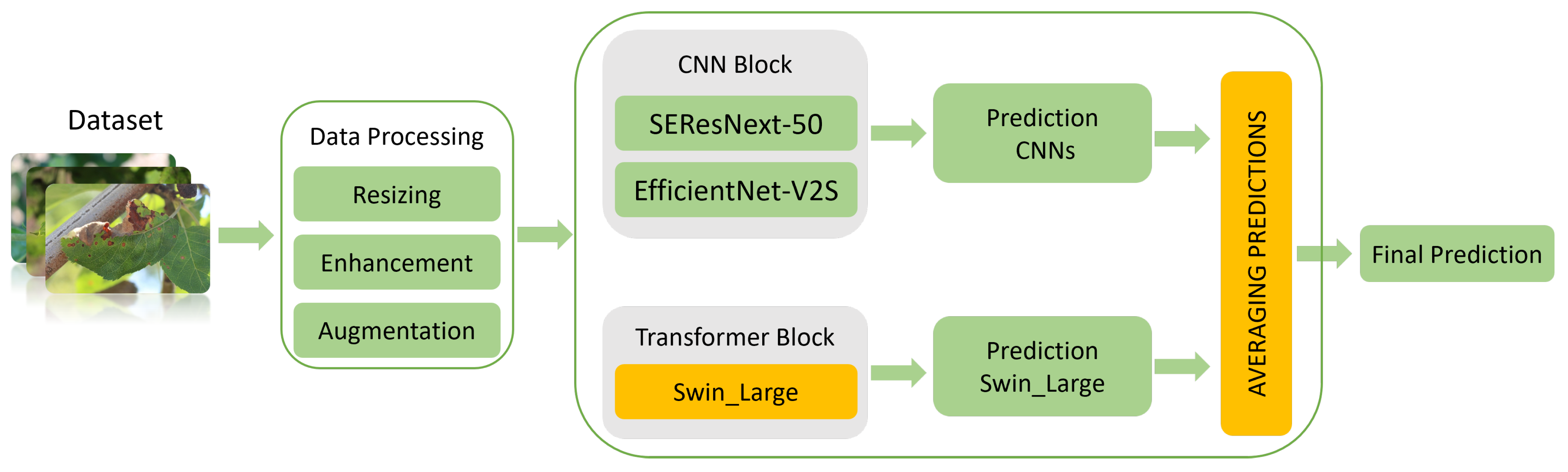
Incorrectly diagnosing plant diseases can lead to various undesirable outcomes. This includes the potential for the misuse of unsuitable herbicides, resulting in harm to both plants and the environment. Examining plant diseases visually is a complex and challenging procedure that demands considerable time and resources. Moreover, it necessitates keen observational skills from agronomists and plant pathologists. Precise identification of plant diseases is crucial to enhance crop yields, ultimately guaranteeing the quality and quantity of production. The latest progress in deep learning (DL) models has demonstrated encouraging outcomes in the identification and classification of plant diseases. In the context of this study, we introduce a novel hybrid deep learning architecture named “CTPlantNet”. This architecture employs convolutional neural network (CNN) models and a vision transformer model to efficiently classify plant foliar diseases, contributing to the advancement of disease classification methods in the field of plant pathology research. This study utilizes two open-access datasets. The first one is the Plant Pathology 2020-FGVC-7 dataset, comprising a total of 3526 images depicting apple leaves and divided into four distinct classes: healthy, scab, rust, and multiple. The second dataset is Plant Pathology 2021-FGVC-8, containing 18,632 images classified into six categories: healthy, scab, rust, powdery mildew, frog eye spot, and complex. The proposed architecture demonstrated remarkable performance across both datasets, outperforming state-of-the-art models with an accuracy (ACC) of 98.28% for Plant Pathology 2020-FGVC-7 and 95.96% for Plant Pathology 2021-FGVC-8.
Keywords: apple foliar disease; convolutional neural networks; vision transformers; deep learning; ensemble learning; computer-aided detection; multi-classification apple foliar disease; convolutional neural networks; vision transformers; deep learning; ensemble learning; computer-aided detection; multi-classification