<?xml version="1.0" encoding="UTF-8"?>
<!DOCTYPE article PUBLIC "-//NLM//DTD Journal Publishing DTD v2.3 20070202//EN" "journalpublishing.dtd">
<article xmlns:mml="http://www.w3.org/1998/Math/MathML" xmlns:xlink="http://www.w3.org/1999/xlink" xml:lang="en" article-type="research-article" dtd-version="2.3">
  <front>
    <journal-meta>
      <journal-id journal-id-type="publisher-id">remotesensing</journal-id>
      <journal-title>Remote Sensing</journal-title>
      <abbrev-journal-title abbrev-type="publisher">Remote Sens.</abbrev-journal-title>
      <abbrev-journal-title abbrev-type="pubmed">Remote Sensing</abbrev-journal-title>
      <issn pub-type="epub">2072-4292</issn>
      <publisher>
        <publisher-name>MDPI</publisher-name>
      </publisher>
    </journal-meta>
    <article-meta>
      <article-id pub-id-type="doi">10.3390/rs9010048</article-id>
      <article-id pub-id-type="publisher-id">remotesensing-09-00048</article-id>
      <article-categories>
        <subj-group>
          <subject>Article</subject>
        </subj-group>
      </article-categories>
      <title-group>
        <article-title>Progress in Remote Sensing of Photosynthetic Activity over the Amazon Basin</article-title>
      </title-group>
      <contrib-group>
        <contrib contrib-type="author">
          <name>
            <surname>de Sousa</surname>
            <given-names>Celio Helder Resende</given-names>
          </name>
          <xref rid="af1-remotesensing-09-00048" ref-type="aff">1</xref>
          <xref rid="c1-remotesensing-09-00048" ref-type="corresp">*</xref>
        </contrib>
        <contrib contrib-type="author">
          <name>
            <surname>Hilker</surname>
            <given-names>Thomas</given-names>
          </name>
          <xref rid="af2-remotesensing-09-00048" ref-type="aff">2</xref>
          <xref rid="fn1-remotesensing-09-00048" ref-type="fn">&#x2020;</xref>
        </contrib>
        <contrib contrib-type="author">
          <name>
            <surname>Waring</surname>
            <given-names>Richard</given-names>
          </name>
          <xref rid="af1-remotesensing-09-00048" ref-type="aff">1</xref>
        </contrib>
        <contrib contrib-type="author">
          <name>
            <surname>de Moura</surname>
            <given-names>Yhasmin Mendes</given-names>
          </name>
          <xref rid="af3-remotesensing-09-00048" ref-type="aff">3</xref>
        </contrib>
        <contrib contrib-type="author">
          <name>
            <surname>Lyapustin</surname>
            <given-names>Alexei</given-names>
          </name>
          <xref rid="af4-remotesensing-09-00048" ref-type="aff">4</xref>
        </contrib>
        <contrib contrib-type="editor">
          <name>
            <surname>Soares Galvao</surname>
            <given-names>Lenio</given-names>
          </name>
          <role>Academic Editor</role>
        </contrib>
        <contrib contrib-type="editor">
          <name>
            <surname>Thenkabail</surname>
            <given-names>Prasad S.</given-names>
          </name>
          <role>Academic Editor</role>
        </contrib>
      </contrib-group>
      <aff id="af1-remotesensing-09-00048"><label>1</label>Department of Forest Ecosystems and Society, Oregon State University, Corvallis, OR 97331, USA; <email>richard.waring@oregonstate.edu</email></aff>
      <aff id="af2-remotesensing-09-00048"><label>2</label>Department of Forest Engineering, Resources and Management, Oregon State University, Corvallis, OR 97331, USA; <email>thomas.hilker@oregonstate.edu</email></aff>
      <aff id="af3-remotesensing-09-00048"><label>3</label>Instituto Nacional de Pesquisas Espaciais (INPE), Divis&#xE3;o de Sensoriamento Remoto, S&#xE3;o Jos&#xE9; dos Campos, SP 12227-010, Brazil; <email>yhas.mendes@gmail.com</email></aff>
      <aff id="af4-remotesensing-09-00048"><label>4</label>NASA Goddard Space Flight Center, Greenbelt, MD 20771, USA; <email>alexei.i.lyapustin@nasa.gov</email></aff>
      <author-notes>
        <corresp id="c1-remotesensing-09-00048"><label>*</label>Correspondence: <email>celio.sousa@oregonstate.edu</email>; Tel.: +1-541-908-6483</corresp>
        <fn id="fn1-remotesensing-09-00048">
          <label>&#x2020;</label>
          <p>Deceased.</p>
        </fn>
      </author-notes>
      <pub-date pub-type="epub">
        <day>07</day>
        <month>01</month>
        <year>2017</year>
      </pub-date>
      <pub-date pub-type="collection"><month>01</month>
        <year>2017</year>
      </pub-date>
      <volume>9</volume>
      <issue>1</issue>
      <elocation-id>48</elocation-id>
      <history>
        <date date-type="received">
          <day>05</day>
          <month>11</month>
          <year>2016</year>
        </date>
        <date date-type="accepted">
          <day>01</day>
          <month>01</month>
          <year>2017</year>
        </date>
      </history>
      <permissions>
        <copyright-statement>&#xA9; 2017 by the authors; licensee MDPI, Basel, Switzerland.</copyright-statement>
        <copyright-year>2017</copyright-year>
        <license>
          <p>This article is an open access article distributed under the terms and conditions of the Creative Commons Attribution (CC-BY) license (http://creativecommons.org/licenses/by/4.0/).</p>
        </license>
      </permissions>
      <abstract>
        <p>Although quantifying the massive exchange of carbon that takes place over the Amazon Basin remains a challenge, progress is being made as the remote sensing community moves from using traditional, reflectance-based vegetation indices, such as the Normalized Difference Vegetation Index (NDVI), to the more functional Photochemical Reflectance Index (PRI). This new index, together with satellite-derived estimates of canopy light interception and Sun-Induced Fluorescence (SIF), provide improved estimates of Gross Primary Production (GPP). This paper traces the development of these new approaches, compares the results of their analyses from multiple years of data acquired across the Amazon Basin and suggests further improvements in instrument design, data acquisition and processing. We demonstrated that our estimates of PRI are in generally good agreement with eddy-flux tower measurements of photosynthetic light use efficiency (&#x3B5;) at four sites in the Amazon Basin: r<sup>2</sup> values ranged from 0.37 to 0.51 for northern flux sites and to 0.78 for southern flux sites. This is a significant advance over previous approaches seeking to establish a link between global-scale photosynthetic activity and remotely-sensed data. When combined with measurements of Sun-Induced Fluorescence (SIF), PRI provides realistic estimates of seasonal variation in photosynthesis over the Amazon that relate well to the wet and dry seasons. We anticipate that our findings will steer the development of improved approaches to estimate photosynthetic activity over the tropics.</p>
      </abstract>
      <kwd-group>
        <kwd>MAIAC</kwd>
        <kwd>MODIS</kwd>
        <kwd>Amazon</kwd>
        <kwd>tropical forest</kwd>
        <kwd>drought</kwd>
        <kwd>photosynthesis</kwd>
        <kwd>GPP</kwd>
        <kwd>light use efficiency</kwd>
        <kwd>Sun-induced fluorescence</kwd>
        <kwd>eddy-flux</kwd>
      </kwd-group>
    </article-meta>
  </front>
  <body>
    <sec id="sec1-remotesensing-09-00048" sec-type="intro">
      <title>1. Introduction</title>
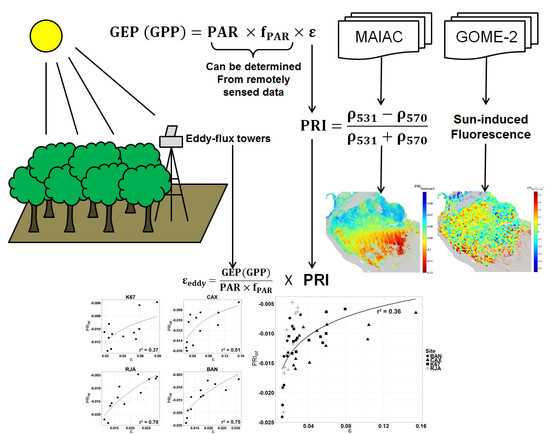
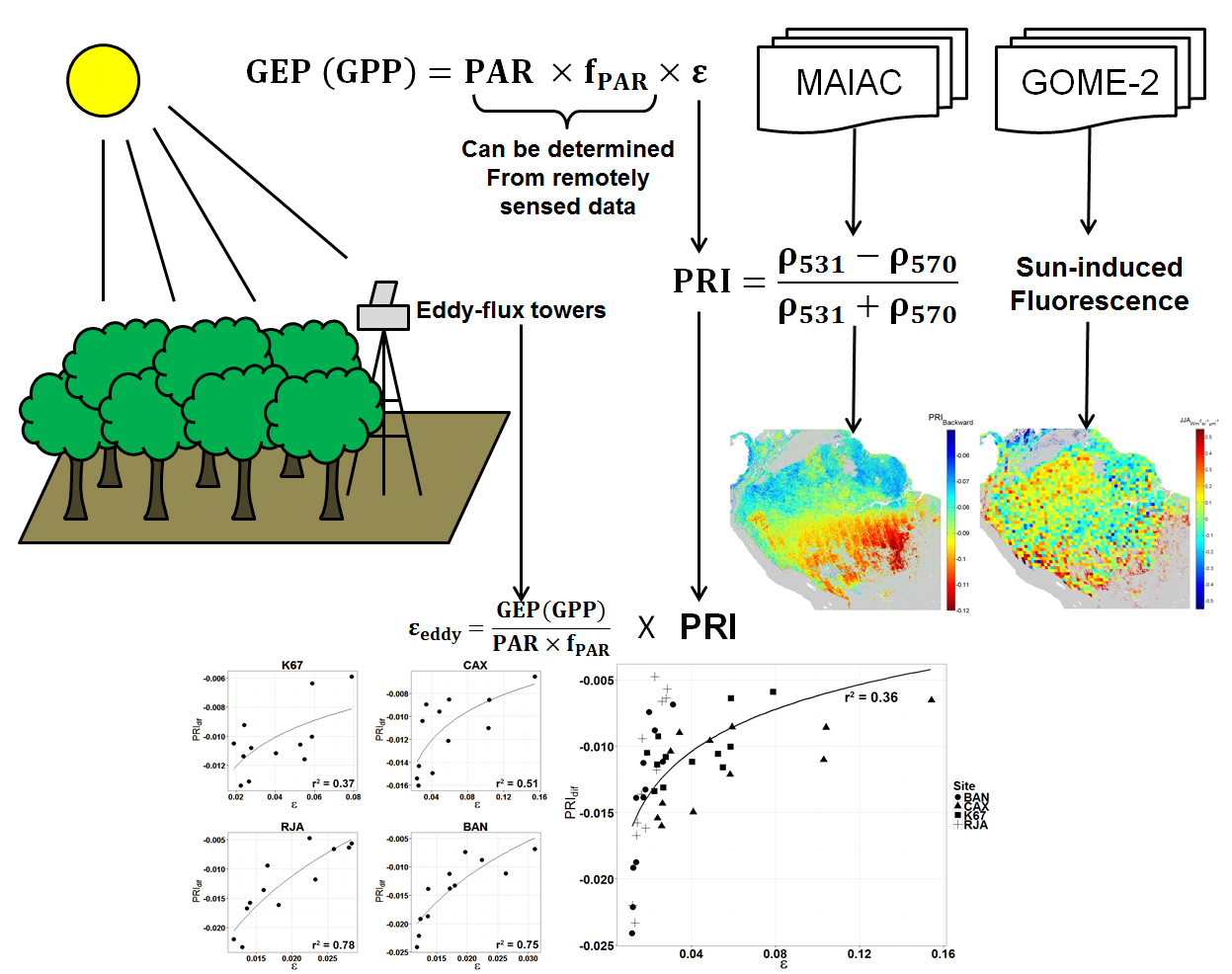
      <p>Tropical forests affect the global climate through their massive exchange of carbon, water and heat. Extensive cloud cover and variable atmospheric conditions, however, make it difficult to estimate these fluxes accurately. In recent decades, precipitation over the Amazon has decreased, along with the length of the wet season [<xref ref-type="bibr" rid="B1-remotesensing-09-00048">1</xref>,<xref ref-type="bibr" rid="B2-remotesensing-09-00048">2</xref>]. An extension of the dry season decreases photosynthesis while increasing carbon emissions from fires. In the drought of 2005, net ecosystem loss of above-ground growth recorded on intact forest plots was estimated as averaging 5.3 Mg&#xB7;C&#xB7;ha<sup>&#x2212;1</sup>, with a total loss of between 1.2 and 1.6 Pg for the Amazon Basin [<xref ref-type="bibr" rid="B3-remotesensing-09-00048">3</xref>]. Loss of carbon through ignition can be mapped moderately accurately, while Gross Primary Production (GPP) is more difficult to assess because the extent that sunlight is absorbed and utilized by photosynthetic tissues is not directly measured with conventional reflectance indices, such as the Normalized Difference Vegetation Index (NDVI) and Enhanced Vegetation Index (EVI). GPP can be modeled as a simple function of the products of incident solar radiation, which is about 50% photosynthetically active (PAR) [<xref ref-type="bibr" rid="B4-remotesensing-09-00048">4</xref>], the faction of that absorbed by photosynthetic tissue (f<sub>PAR</sub>) and the light-conversion efficiency of photosynthesis (&#x3B5;):
      <disp-formula>
	  GPP = PAR &#xD7; f<sub>PAR</sub> &#xD7; &#x3B5;,
	  <label>(1)</label>
	  </disp-formula>
	  </p>
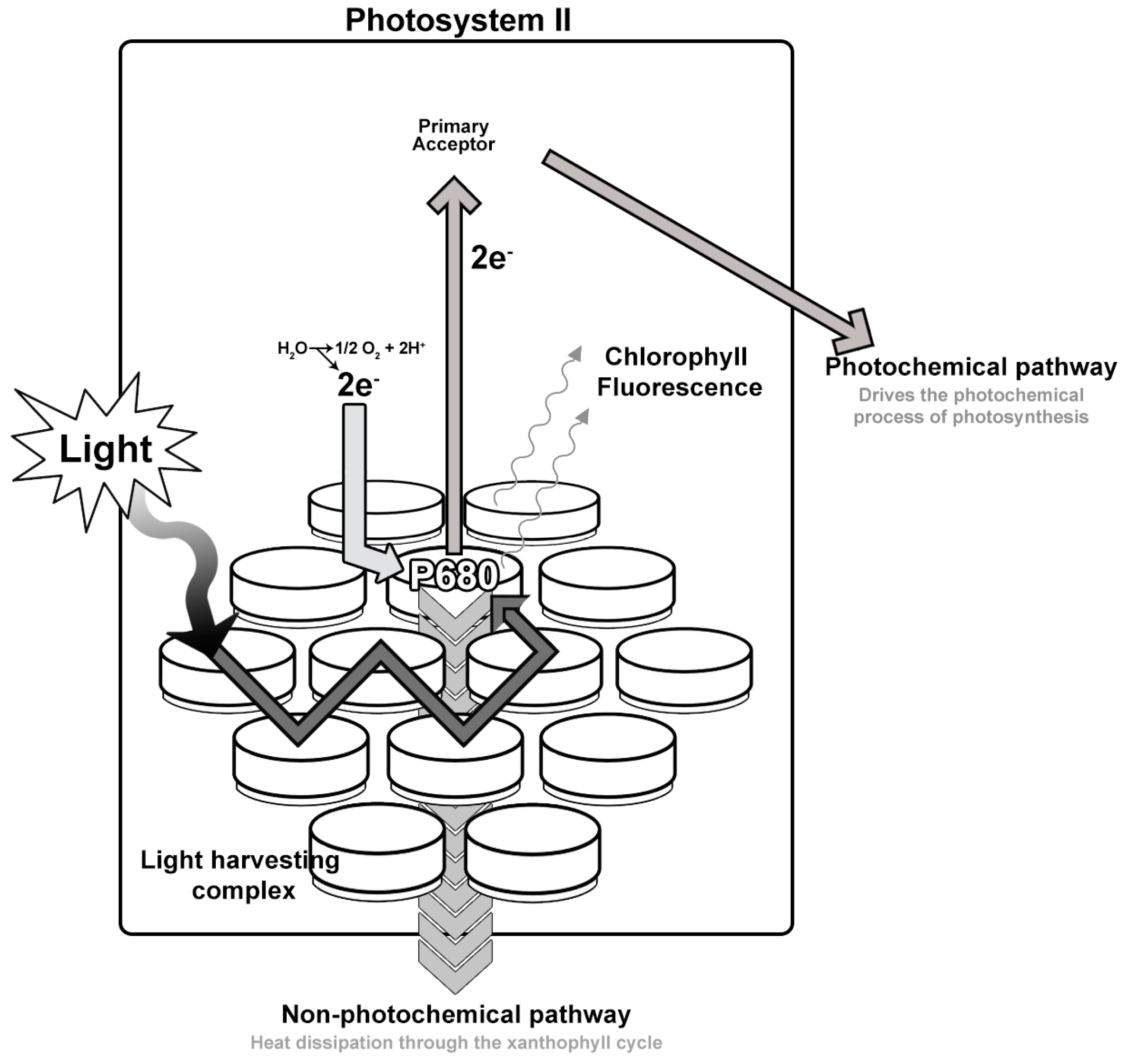
      <p>The main challenge in solving Equation (1) is in defining seasonal variation in light use efficiency. Under optimal conditions, absorbed radiation is utilized by the plant to split water (photochemical quenching) and provide electrons for the photosynthetic fixation of CO<sub>2</sub>. However, in situations where plants receive more sunlight than they can actually use (i.e., photosynthesis is limited by factors other than light), light use and absorption are adjusted to protect the plant from photo-oxidative damage [<xref ref-type="bibr" rid="B5-remotesensing-09-00048">5</xref>]. When the supply of radiation is in excess, the xanthophyll cycle pigment violaxanthin is converted rapidly via intermediate antheraxanthin to zeaxanthin, and this reaction is reversed when radiation is no longer in excess [<xref ref-type="bibr" rid="B5-remotesensing-09-00048">5</xref>]. This mechanism is called non-photochemical quenching. When heat dissipation increases through non-photochemical quenching, &#x3B5; decreases; consequently leading to a reduction in both chlorophyll fluorescence and fixation of CO<sub>2</sub>.</p>
      <p>The non-photochemical quenching can be quantified by monitoring specific spectral bands to yield a Photochemical Reflectance Index (PRI) [<xref ref-type="bibr" rid="B6-remotesensing-09-00048">6</xref>]:
      <disp-formula>
	  PRI = (&#x3C1;<sub>531</sub> &#x2212; &#x3C1;<sub>570</sub>)/(&#x3C1;<sub>531</sub> + &#x3C1;<sub>570</sub>),
	  <label>(2)</label>
	  </disp-formula>
      where &#x3C1;<sub>531</sub> is the reflectance at 531 nm, which increases as photosynthesis is downregulated, and &#x3C1;<sub>570</sub> is the reflectance at 570 nm, which is unresponsive to changes in incident PAR and serves as a reference. A diagram depicting the relevant biophysics is presented in <xref ref-type="fig" rid="remotesensing-09-00048-f001">Figure 1</xref>, which includes both dissipation of heat and light from chloroplasts. </p>
      <p>Complementary to PRI, Solar-Induced Fluorescence (SIF) may provide further opportunities to measure photosynthetic activity (discussed in <xref ref-type="sec" rid="sec3-remotesensing-09-00048">Section 3</xref>). Although both of these techniques are experimental, they have the potential of providing improved estimates of GPP at increasingly refined temporal and spatial resolutions, as seen in [<xref ref-type="bibr" rid="B7-remotesensing-09-00048">7</xref>,<xref ref-type="bibr" rid="B8-remotesensing-09-00048">8</xref>,<xref ref-type="bibr" rid="B9-remotesensing-09-00048">9</xref>]. In this paper, we review progress in the application of these approaches over the Amazon Basin and suggest opportunities for future improvements. </p>
    </sec>
    <sec id="sec2-remotesensing-09-00048">
      <title>2. Remote Sensing of Non-Photochemical Quenching from PRI</title>
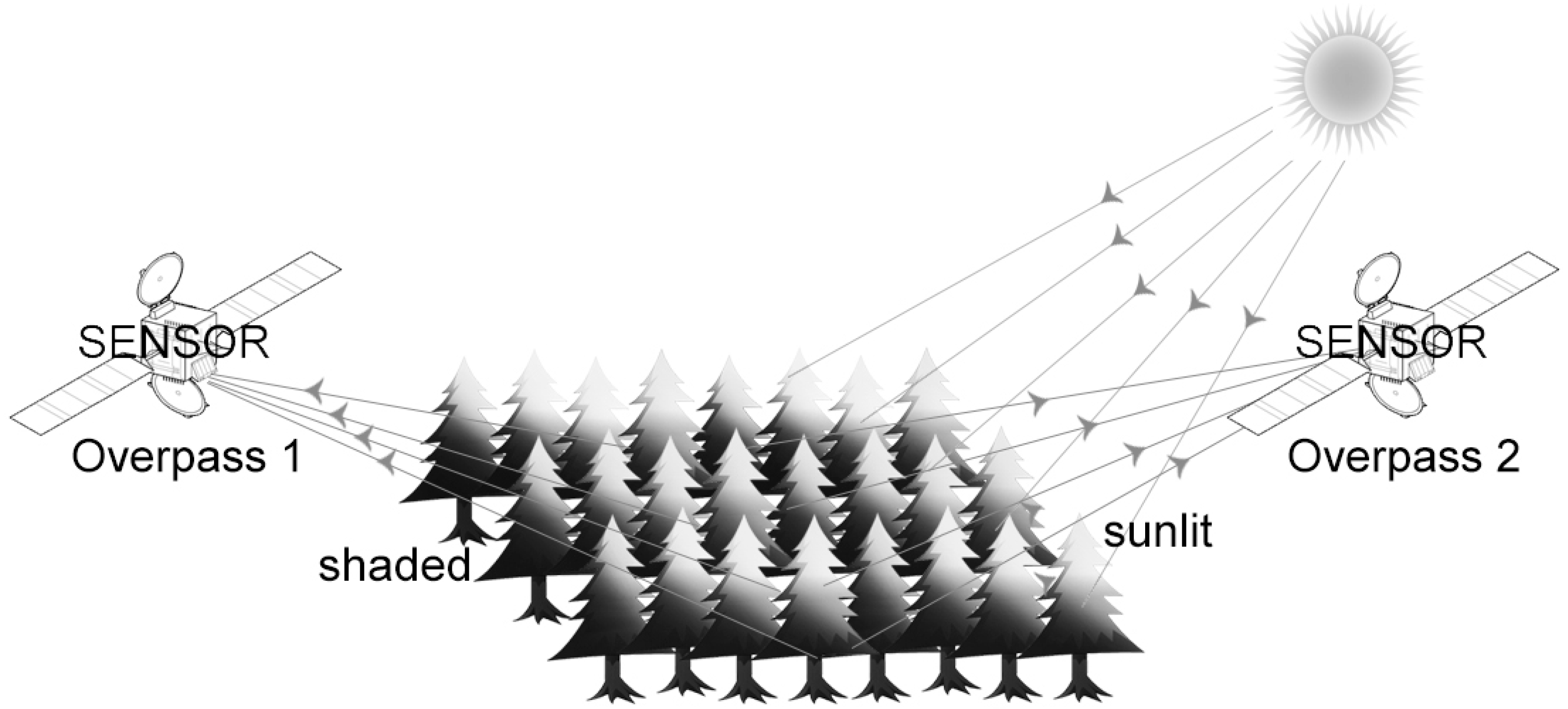
      <p>Numerous studies [<xref ref-type="bibr" rid="B6-remotesensing-09-00048">6</xref>,<xref ref-type="bibr" rid="B7-remotesensing-09-00048">7</xref>,<xref ref-type="bibr" rid="B9-remotesensing-09-00048">9</xref>,<xref ref-type="bibr" rid="B10-remotesensing-09-00048">10</xref>,<xref ref-type="bibr" rid="B11-remotesensing-09-00048">11</xref>,<xref ref-type="bibr" rid="B12-remotesensing-09-00048">12</xref>] have related &#x3B5; to the PRI where reflectance measurements were acquired close to the target. The dependency of this index on extraneous effects and atmospheric conditions, however, has hampered its use beyond the leaf and canopy scale [<xref ref-type="bibr" rid="B8-remotesensing-09-00048">8</xref>]. Recent work has shown that the status of the xanthophyll cycle may be inferred across vegetation types from multi-angle observations of sunlit and shaded leaves: In cases where GPP is limited by factors other than light (&#x3B5; &lt; &#x3B5;<sub>max</sub>), PRI is closely related to canopy shadow fractions (&#x3B1;<sub>s</sub>) [<xref ref-type="bibr" rid="B13-remotesensing-09-00048">13</xref>,<xref ref-type="bibr" rid="B14-remotesensing-09-00048">14</xref>], because sunlit leaves are more likely to be exposed to excess radiation levels than shaded leaves [<xref ref-type="bibr" rid="B15-remotesensing-09-00048">15</xref>]. However, this relationship disappears under conditions where light is limiting GPP. In this case, photosynthesis will not be downregulated in either sunlit or shaded leaves (&#x3B5;<sub>sunlit</sub> = &#x3B5;<sub>shaded</sub>). As a result, the slope of the relationship between PRI and &#x3B1;s is proportional to the light-use efficiency [<xref ref-type="bibr" rid="B14-remotesensing-09-00048">14</xref>,<xref ref-type="bibr" rid="B16-remotesensing-09-00048">16</xref>,<xref ref-type="bibr" rid="B17-remotesensing-09-00048">17</xref>]. This multi-angle retrieval is largely insensitive to changes in vegetation type because slope is derived from comparing the same area of the canopy [<xref ref-type="bibr" rid="B13-remotesensing-09-00048">13</xref>]. The sampling approach is theoretically sound [<xref ref-type="bibr" rid="B13-remotesensing-09-00048">13</xref>,<xref ref-type="bibr" rid="B14-remotesensing-09-00048">14</xref>] and has been validated from both tower-mounted [<xref ref-type="bibr" rid="B16-remotesensing-09-00048">16</xref>,<xref ref-type="bibr" rid="B18-remotesensing-09-00048">18</xref>] and satellite-borne sensors [<xref ref-type="bibr" rid="B16-remotesensing-09-00048">16</xref>,<xref ref-type="bibr" rid="B17-remotesensing-09-00048">17</xref>,<xref ref-type="bibr" rid="B19-remotesensing-09-00048">19</xref>]. In the latter, it proved critical to implement a sophisticated atmospheric correction algorithm (MAIAC) to preserve the anisotropy of surface reflectance at 531 nm [<xref ref-type="bibr" rid="B17-remotesensing-09-00048">17</xref>].</p>
      <p>One of the main sampling limitations for broad-scale application of the approach is the shortage of multi-angle observations acquired along a satellite&#x2019;s track at 531 nm. Such sampling is available with ESA&#x2019;s Compact High Resolution Imaging Spectrometer (CHRIS) [<xref ref-type="bibr" rid="B16-remotesensing-09-00048">16</xref>], but only for pre-determined sites. Alternatively, NASA&#x2019;s Moderate Resolution Imaging Spectroradiometer (MODIS) acquires spectral reflectance data at 531 nm (Band 11), but samples across rather than along the satellite track. As a result, repeated overpasses are required to obtain multi-angle assessments of individual pixels. The relatively large pixels sampled by MODIS (1 km) also make it difficult to assess PRI over heterogeneous landscapes. Nonetheless, over comparatively homogeneous types of vegetation, data acquired over a few days with MODIS instruments on Terra (morning) and Aqua (afternoon) satellites provide backscatter and forward-scattered reflectance data from multiple angles that permit the calculation of PRI (<xref ref-type="fig" rid="remotesensing-09-00048-f002">Figure 2</xref>).</p>
    </sec>
    <sec id="sec3-remotesensing-09-00048">
      <title>3. Remote Sensing of Sun-Induced Fluorescence</title>
      <p>A measure of Sun-Induced Fluorescence (SIF) provides an alternative to PRI to assess photosynthetic activity [<xref ref-type="bibr" rid="B20-remotesensing-09-00048">20</xref>,<xref ref-type="bibr" rid="B21-remotesensing-09-00048">21</xref>,<xref ref-type="bibr" rid="B22-remotesensing-09-00048">22</xref>,<xref ref-type="bibr" rid="B23-remotesensing-09-00048">23</xref>] by measuring the emittance of photons from leaf chlorophyll as fluorescence. The probability of an absorbed photon being re-emitted as fluorescence depends on both photochemical and non-photochemical quenching. Fluorescence is an indicator of the amount of energy present temporarily within the photosynthetic apparatus. In the past, the relatively weak fluorescence signal from chloroplasts has restricted the use of this approach. Recently, improvements in the detection of narrow absorption features (Fraunhofer lines) permit the determination of SIF from space through the comparison of fluorescing with non-fluorescing vegetation [<xref ref-type="bibr" rid="B20-remotesensing-09-00048">20</xref>,<xref ref-type="bibr" rid="B22-remotesensing-09-00048">22</xref>,<xref ref-type="bibr" rid="B24-remotesensing-09-00048">24</xref>,<xref ref-type="bibr" rid="B25-remotesensing-09-00048">25</xref>]. Parazoo and collaborators [<xref ref-type="bibr" rid="B26-remotesensing-09-00048">26</xref>] were among the first to investigate the link between solar-induced chlorophyll fluorescence with net carbon exchange across forested areas in southern Amazonia. They estimated seasonal changes in atmospheric CO<sub>2</sub> by acquiring measurements from the NASA Atmospheric CO<sub>2</sub> Observations from Space Build (ACOSb2.9) and compared these with solar-induced chlorophyll fluorescence data collected from the Greenhouse Gases Observing Satellite (GOSAT). The CO<sub>2</sub> content of the atmosphere decreased during the wet season and rose during the dry. Atmospheric concentrations of CO<sub>2</sub>, however, were only weakly and inversely correlated with their measurements of SIF (r = &#x2212;0.53).</p>
      <p>Lee and collaborators [<xref ref-type="bibr" rid="B27-remotesensing-09-00048">27</xref>] expanded sampling to include the entire Amazon Basin using SIF measurements from GOSAT. The results of their analysis corresponded with that expected, i.e., less stress and higher values of SIF during the wet season (December, January and February) and lower ones during the dry (June, July and August) with up to a 15% difference between years. A still more refined analysis by Guan et al. [<xref ref-type="bibr" rid="B28-remotesensing-09-00048">28</xref>] included acquiring the Enhanced Vegetation Index (EVI) from MODIS and SIF from Global Ozone Monitoring Experiment-2 (GOME-2), changes in total water storage from the Gravity Recovery and Climate Experiment (GRACE) and rainfall from the Tropical Rainfall Measuring Mission (TRMM). These authors established an annual threshold of 2000 mm per year, below which evergreen canopies were not maintained.</p>
    </sec>
    <sec id="sec4-remotesensing-09-00048">
      <title>4. Case Study of Seasonal Variation in Light-Use Efficiency and SIF across the Amazon Basin</title>
      <sec id="sec4dot1-remotesensing-09-00048">
        <title>4.1. Data Retrieval</title>
        <sec id="sec4dot1dot1-remotesensing-09-00048">
          <title>4.1.1. Photochemical Reflectance Index</title>
          <p>Satellite retrieval of PRI depends on Aerosol Optical Thickness (AOT), Surface Reflectance (SR) and bi-directional reflectance. Aerosols artificially enhance backscattering over vegetated (dark) surfaces and attenuate the surface directional reflectance depending on the path length. Conventional, pixel-based algorithms designed to correct for varying atmospheric properties produce a single measurement over both vegetated and non-vegetated landscapes with unknown AOT and SR; consequently, the surface reflectance is difficult to calculate without knowledge of the land cover. The standard MODIS surface reflectance algorithm (MOD09) [<xref ref-type="bibr" rid="B29-remotesensing-09-00048">29</xref>] uses a version of the dark target aerosol retrieval algorithm [<xref ref-type="bibr" rid="B30-remotesensing-09-00048">30</xref>,<xref ref-type="bibr" rid="B31-remotesensing-09-00048">31</xref>], relating surface reflectance in the visible (blue and red) spectral bands with MODIS Band 7 (2.1 &#xB5;m) reflectance with a prescribed Spectral Regression Coefficient (SRC). A Lambertian surface model is then used for aerosol retrievals and atmospheric correction. Although it simplifies processing, the Lambertian assumption reduces the anisotropy of derived surface reflectance introducing errors dependent on view geometry (e.g., [<xref ref-type="bibr" rid="B32-remotesensing-09-00048">32</xref>,<xref ref-type="bibr" rid="B33-remotesensing-09-00048">33</xref>]). The use of a Lambertian assumption is likely to reduce the accuracy in the PRI detection band, as the dependency of this band on shadow fractions is stronger than that of the reference band [<xref ref-type="bibr" rid="B19-remotesensing-09-00048">19</xref>].</p>
          <p>The MAIAC algorithm, in contrast, is based on a rigorous radiative transfer model [<xref ref-type="bibr" rid="B34-remotesensing-09-00048">34</xref>,<xref ref-type="bibr" rid="B35-remotesensing-09-00048">35</xref>] fully coupled with the Li-Sparse Ross-Thick (LSRT) model of surface BRDF [<xref ref-type="bibr" rid="B36-remotesensing-09-00048">36</xref>]. It simultaneously retrieves AOT, SRC and surface BRDF using three to 16 days of calibrated and geo-located Level 1B (L1B) MODIS data, gridded to a resolution of 1 km. These multi-day acquisitions provide the basis to derive spectral reflectance coefficients in the blue (0.466 &#xB5;m) and shortwave IR (2.13 &#xB5;m) required for aerosol corrections [<xref ref-type="bibr" rid="B37-remotesensing-09-00048">37</xref>] and to characterize the distribution of the surface Bi-Directional Reflectance Distribution Function (BRDF) for all of the MODIS reflective bands [<xref ref-type="bibr" rid="B38-remotesensing-09-00048">38</xref>].</p>
          <p>Based on time-series analysis, MAIAC has demonstrated the ability to distinguish stable surface features from those associated with random variation and changing fields of clouds [<xref ref-type="bibr" rid="B39-remotesensing-09-00048">39</xref>]. For this project, we used MODIS Collection 6 Level 1B (calibrated and geometrically corrected) data, which removed the effects of major errors in sensor calibration present in earlier collections. Detailed descriptions of MAIAC and quality testing are provided elsewhere [<xref ref-type="bibr" rid="B37-remotesensing-09-00048">37</xref>,<xref ref-type="bibr" rid="B38-remotesensing-09-00048">38</xref>,<xref ref-type="bibr" rid="B40-remotesensing-09-00048">40</xref>,<xref ref-type="bibr" rid="B41-remotesensing-09-00048">41</xref>]. MAIAC observations were used to obtain cloud-free, multi-angle surface reflectance in MODIS Bands 11 and 12 (526 to 536 nm and 546 to 536 nm, respectively) from the Terra and Aqua platforms to derive PRI across the Amazon Basin. The underlying assumption in this application of multi-angle MODIS data is that the xanthophyll status of the vegetation remains the same between Terra and Aqua overpasses. This assumption is reasonable considering that the equatorial location of the Amazon limits the time between overpasses to approximately 3 h.</p>
          <p>We modified the spectral definition of PRI (in Equation (1)) by substituting MODIS Band 12, centered at 551 nm rather than 570 nm, because MODIS lacks the latter band [<xref ref-type="bibr" rid="B42-remotesensing-09-00048">42</xref>,<xref ref-type="bibr" rid="B43-remotesensing-09-00048">43</xref>]. Thus, to calculate the Photochemical Reflectance Index:
          <disp-formula>
		  PRI = (&#x3C1;<sub>11</sub> &#x2212; &#x3C1;<sub>12</sub>)/(&#x3C1;<sub>11</sub> + &#x3C1;<sub>12</sub>),
		  <label>(3)</label>
		  </disp-formula>
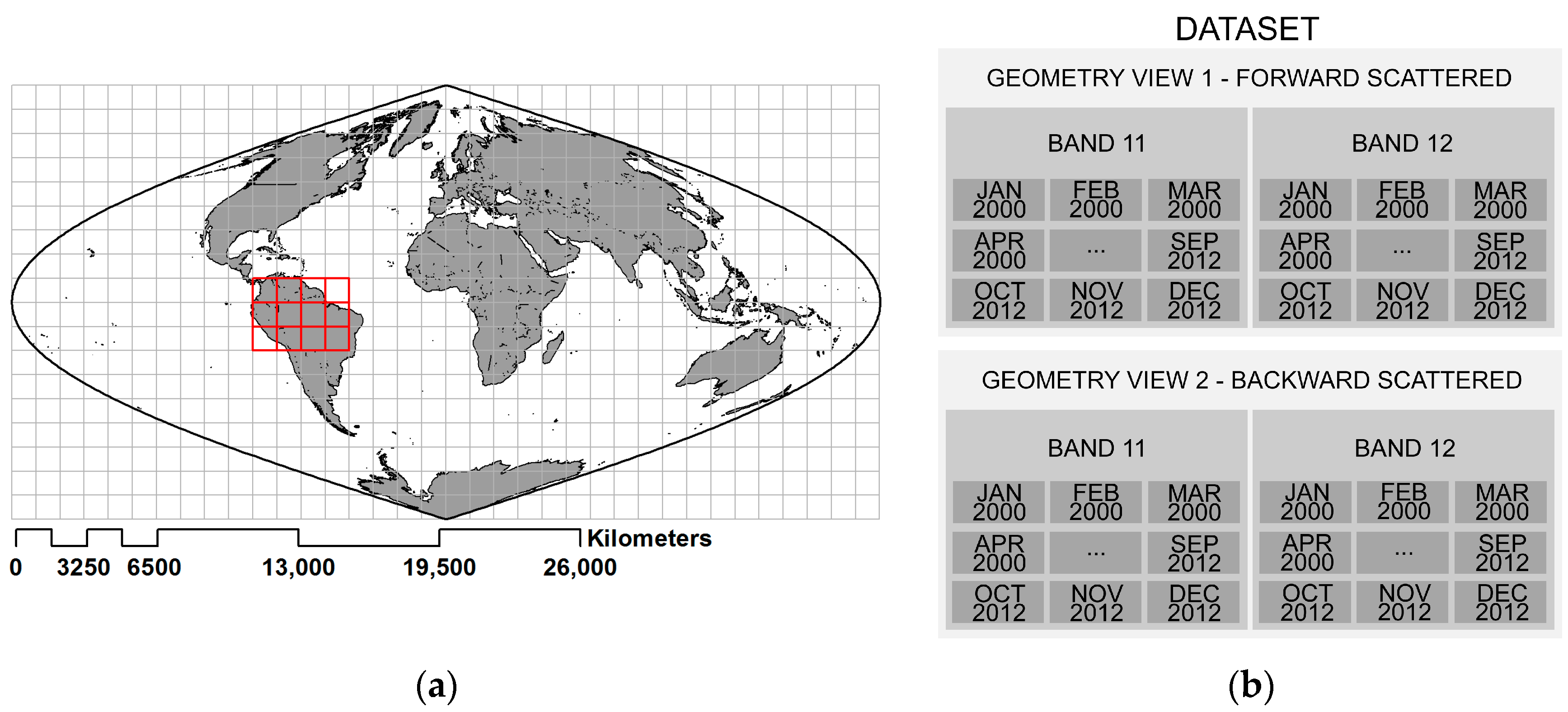
          where &#x3C1;<sub>11</sub> and &#x3C1;<sub>12</sub> are the reflectance at MODIS Bands 11 and 12, respectively. For our analysis, we focused on the MAIAC monthly composite of MODIS Terra and Aqua observations at different viewing geometries for the years 2000 to 2012. The general location of the study area and type of data analyzed are presented in <xref ref-type="fig" rid="remotesensing-09-00048-f003">Figure 3</xref>.</p>
          <p>Variation in the viewing geometry changes the fraction of sunlit and shaded canopy. We approximated shadow effects by computing the monthly average PRI (Equation (3)) for both geometry views: PRI<sub>forward</sub> (PRI<sub>f</sub>) and PRI<sub>backward</sub> (PRI<sub>b</sub>). By averaging the monthly difference (PRI<sub>dif</sub>) between the two geometry views, we reduced noise and obtained reasonable estimates of variation in photosynthetic efficiency between the wet and dry seasons between the years 2000 and 2012.</p>
        </sec>
        <sec id="sec4dot1dot2-remotesensing-09-00048">
          <title>4.1.2. Sun-Induced Fluorescence</title>
          <p>The SIF signal was measured from Fraunhofer lines as described in <xref ref-type="sec" rid="sec3-remotesensing-09-00048">Section 3</xref>. This signal was recorded by the Global Ozone Monitoring Experiment-2 (GOME-2) onboard the operational European Meteorological (MetOp) satellites launched in October 2006. Currently, GOME-2 provides daily fluorescence data with a nominal footprint of 40 &#xD7; 40 km. Monthly mean (Level 3) data are available, gridded to a spatial resolution of 0.5&#xB0; latitude by 0.5&#xB0; longitude, from 2007 to 2012 [<xref ref-type="bibr" rid="B44-remotesensing-09-00048">44</xref>]. Details of the retrieval of SIF from GOME-2 measurements are provided in [<xref ref-type="bibr" rid="B26-remotesensing-09-00048">26</xref>]. In this work, we used v. 26 data obtained between 2007 and 2012 [<xref ref-type="bibr" rid="B45-remotesensing-09-00048">45</xref>]. Fluorescence values were normalized by the cosine of the solar zenith angle to minimize variations in SIF associated with fluctuations in irradiance.</p>
          <p>Because of the high noise associated with GOME-2 measurements [<xref ref-type="bibr" rid="B25-remotesensing-09-00048">25</xref>], we aggregated monthly values of fluorescence into two periods: the months of June, July and August (JJA) and those of December, January and February (DJF). These two periods showed the largest differences in SIF. Following the approach of Lee et al. [<xref ref-type="bibr" rid="B27-remotesensing-09-00048">27</xref>], we subtracted the annual means from the respective seasonal means to enhance and to normalize the differences in fluorescence recorded across the Amazon.</p>
        </sec>
        <sec id="sec4dot1dot3-remotesensing-09-00048">
          <title>4.1.3. Eddy-Flux Measurements</title>
          <p>GPP derived from eddy covariance measurements of CO<sub>2</sub> exchange made at four forested Amazonian tower sites established during the &#x2018;Large-Scale Biosphere Atmosphere Experiment in Amazonia&#x2019; (LBA) [<xref ref-type="bibr" rid="B46-remotesensing-09-00048">46</xref>] provides an independent measure of photosynthetic activity to compare with values of PRI acquired from satellites. Five other tower sites established during the LBA campaign collected data from non-forest vegetation [<xref ref-type="bibr" rid="B47-remotesensing-09-00048">47</xref>].</p>
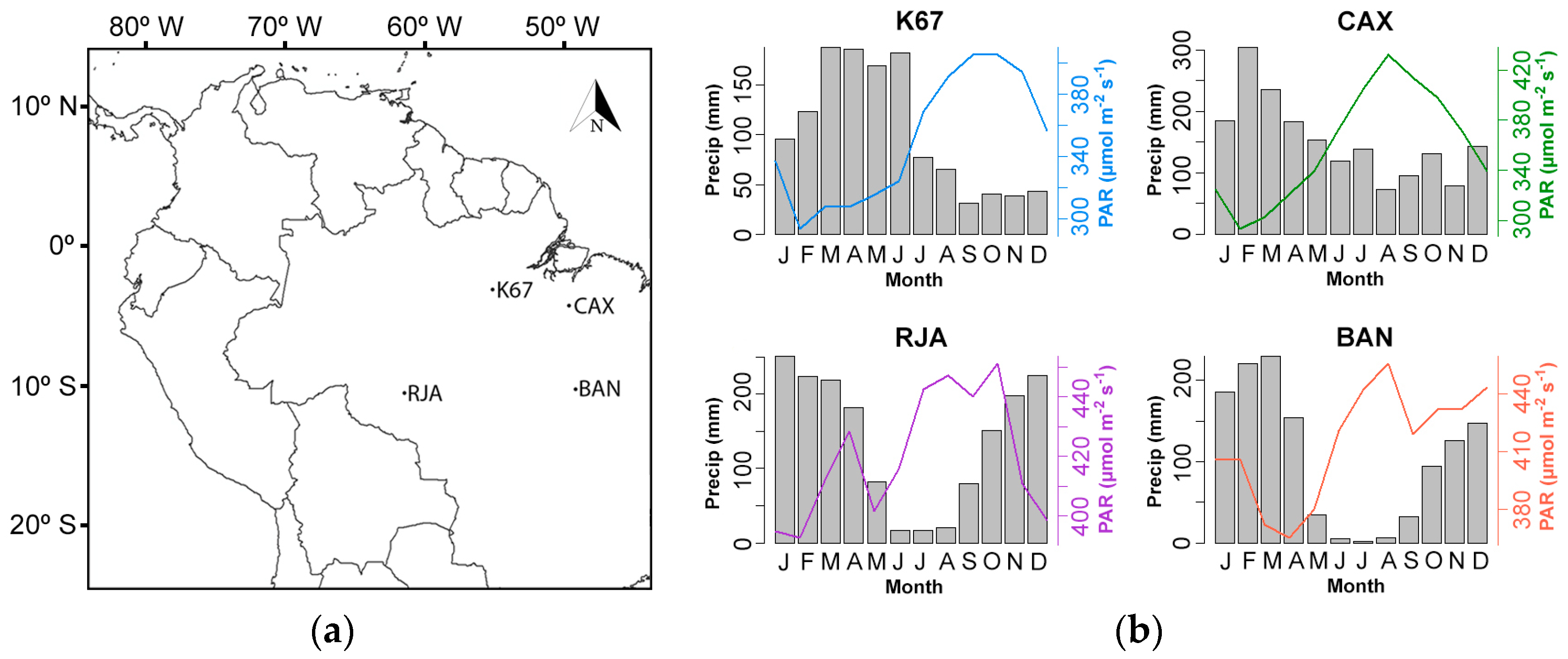
          <p>The Santar&#xE9;m K67 tower was the most northern of the four tropical rainforest sites (<xref ref-type="fig" rid="remotesensing-09-00048-f004">Figure 4</xref>); it was located near the confluence of the Tapaj&#xF3;s and Amazon rivers. The Caxiuan&#xE3; National Forest tower (CAX) was situated approximately 350 km to the west of the city of Belem in Par&#xE1; State, close to the Ba&#xED;a de Caxiuan&#xE3;. For more details, see [<xref ref-type="bibr" rid="B48-remotesensing-09-00048">48</xref>]. The Reserva Jar&#xFA; (RJA) site, located in the Rond&#xF4;nia State in Brazil, lies approximately 100 km north of Ji-Paran&#xE1;, while the Bananal Island (BAN) site was located about 260 km west of Palmas in the Tocantins State. The site is seasonally flooded and represents a type of vegetation somewhere between a tropical rainforest and savanna (Brazilian Cerrado).</p>
          <p>Detailed descriptions of the types of instrumentation, the procedures for processing eddy covariance data and averaging the results at hourly and monthly time-steps are provided from the references listed in <xref ref-type="table" rid="remotesensing-09-00048-t001">Table 1</xref>.</p>
          <p>Monthly averages of GPP and incident PAR were obtained for each of the forested site from the integrated Brazilian Flux LBA project CD-32 database. The fraction of visible light (PAR) absorbed by the vegetation (f<sub>PAR</sub>) was calculated from the simple Beer&#x2019;s law:
          <disp-formula>
		  f<sub>PAR</sub> = 1 &#x2212; exp(LAI(-k)),
		  <label>(4)</label>
		  </disp-formula>
          where LAI is the projected leaf area index (m<sup>2</sup>&#xB7;m<sup>&#x2212;2</sup>) and k is a light extinction coefficient of 0.5. Eight-day composites of MODIS Terra MOD15A2 LAI products (Collection 5) were the basis for calculating f<sub>PAR</sub> at each site.</p>
          <p>MODIS selects the maximum LAI value recorded over eight-day sampling intervals as a representative value for each pixel (<xref ref-type="table" rid="remotesensing-09-00048-t001">Table 1</xref>). The maximum values for the 3 &#xD7; 3 km grid around each tower site were then averaged for comparison with PRI and SIF. For each site, monthly values of &#x3B5; (Equation (1)) were calculated from eddy-flux-derived GPP to compare with monthly estimates of PRI. The requisite PRI observations were averaged from a 3 &#xD7; 3 MAIAC pixel cluster (9 km<sup>2</sup>) with the tower located in the central pixel. Each forested site was fairly homogeneous, minimizing the variance around the averaged PRI value. A similar averaging approach using a 3 &#xD7; 3 MODIS pixel window was also used by Xiao and collaborators [<xref ref-type="bibr" rid="B55-remotesensing-09-00048">55</xref>] to obtain NDVI and EVI values for tower sites in the Amazon.</p>
        </sec>
      </sec>
      <sec id="sec4dot2-remotesensing-09-00048">
        <title>4.2. Results</title>
        <sec id="sec4dot2dot1-remotesensing-09-00048">
          <title>4.2.1. Photochemical Reflectance Index and Sun-Induced Fluorescence</title>
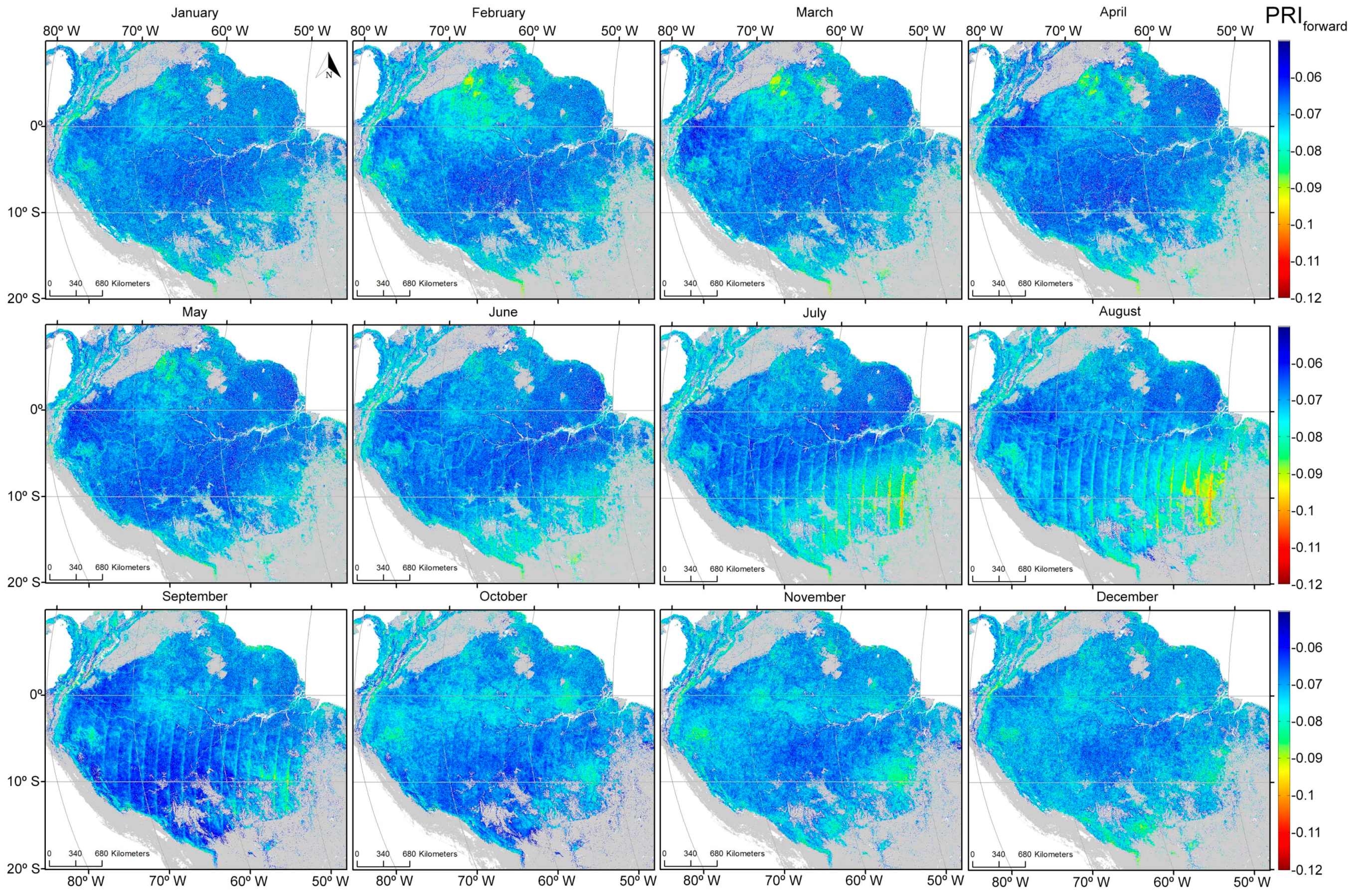
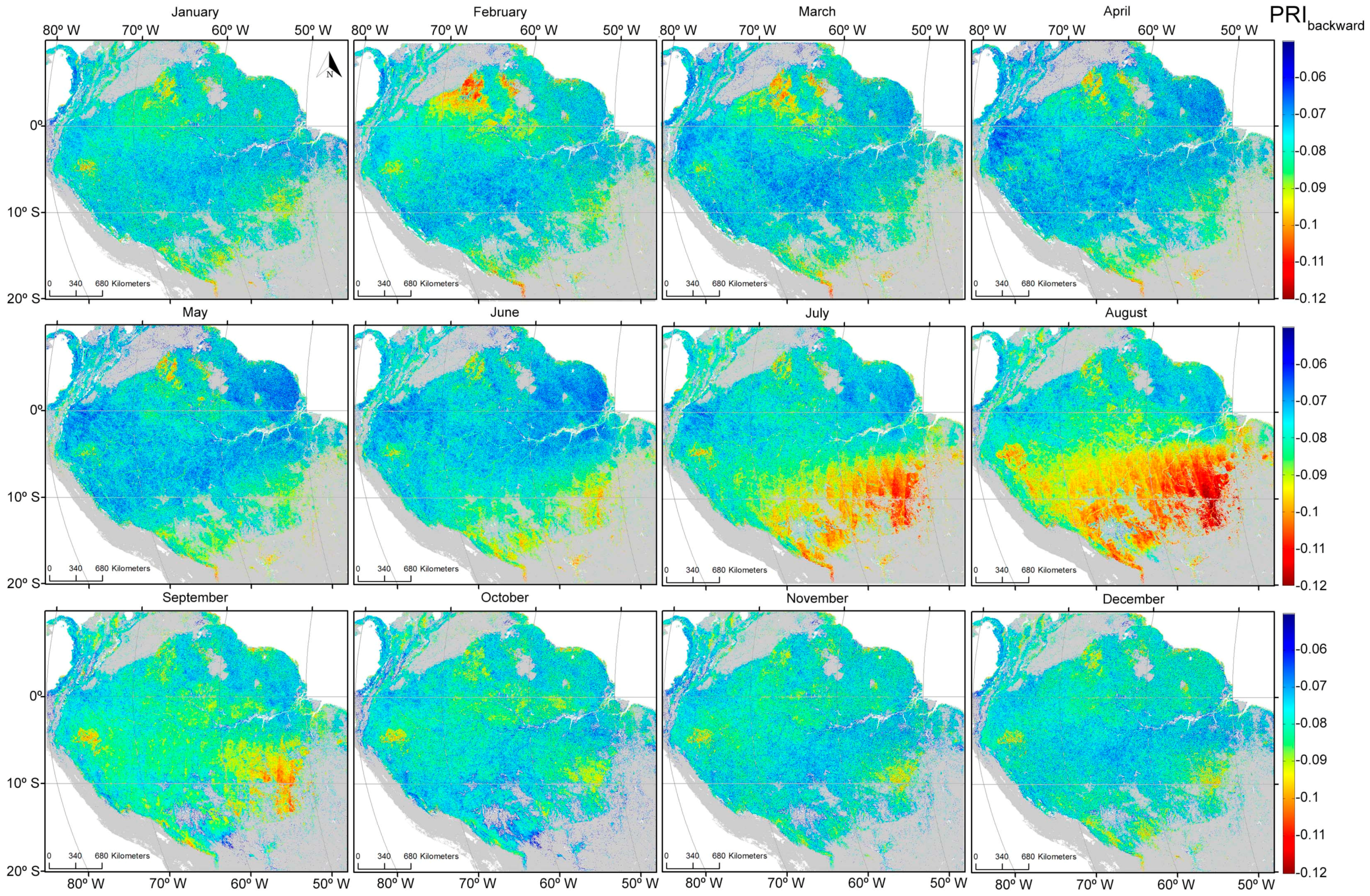
          <p>PRI values, averaged for the period 2000 to 2012, were generally higher when acquired in the forward direction (<xref ref-type="fig" rid="remotesensing-09-00048-f005">Figure 5</xref>) compared with those acquired from the backscatter direction (<xref ref-type="fig" rid="remotesensing-09-00048-f006">Figure 6</xref>). PRIf values were lowest in the northern Amazonia during the months of February, March and April and southern Amazonia during July and August; however, the seasonal variability was small. Seasonality was much more pronounced with backscattered observations than those obtained from the forward-scattered direction.</p>
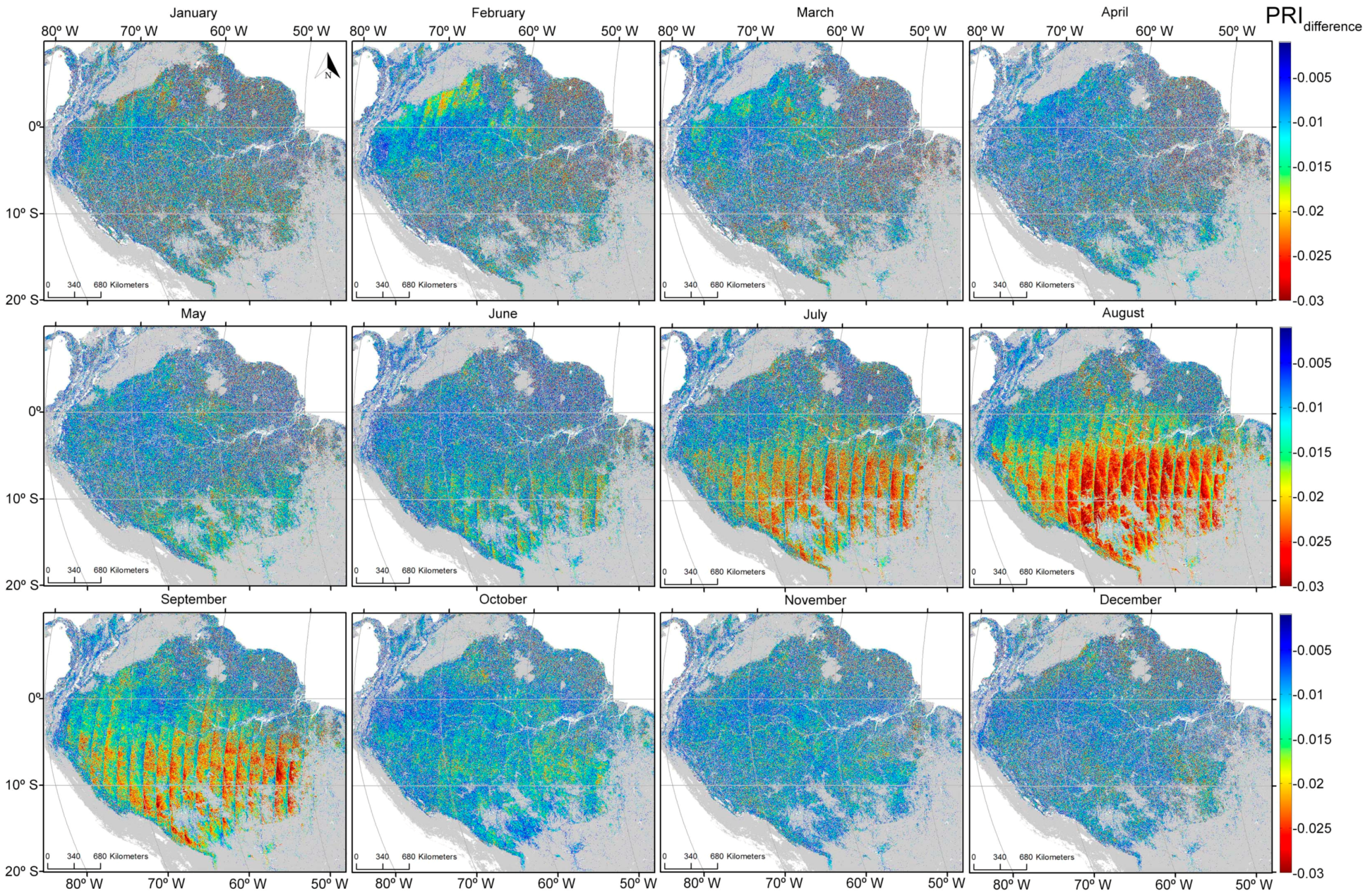
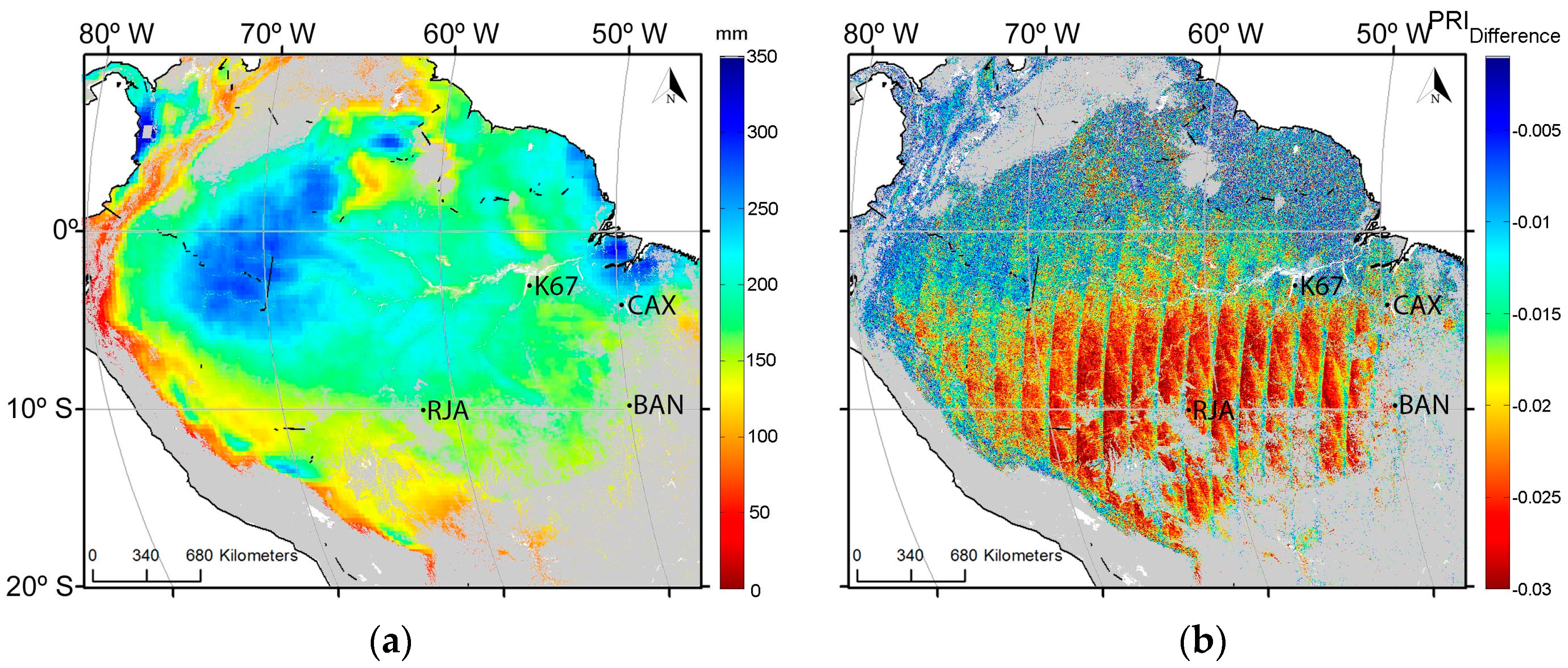
          <p>Areas with the lowest PRI<sub>b</sub> values were concentrated in the northern Amazonia from February to April (when the dry season peaks) and from July to September (driest months in the southern Amazonia). The differences between PRI<sub>b</sub> and PRI<sub>f</sub> illustrate this more clearly (<xref ref-type="fig" rid="remotesensing-09-00048-f007">Figure 7</xref>). The lowest values of PRI<sub>dif</sub> in the southern part of the study area occurred during the dry season, peaking in August. The smallest values of PRI<sub>dif</sub> were consistent with remotely-sensed estimates of precipitation averaging less than 100 mm per month [<xref ref-type="bibr" rid="B56-remotesensing-09-00048">56</xref>].</p>
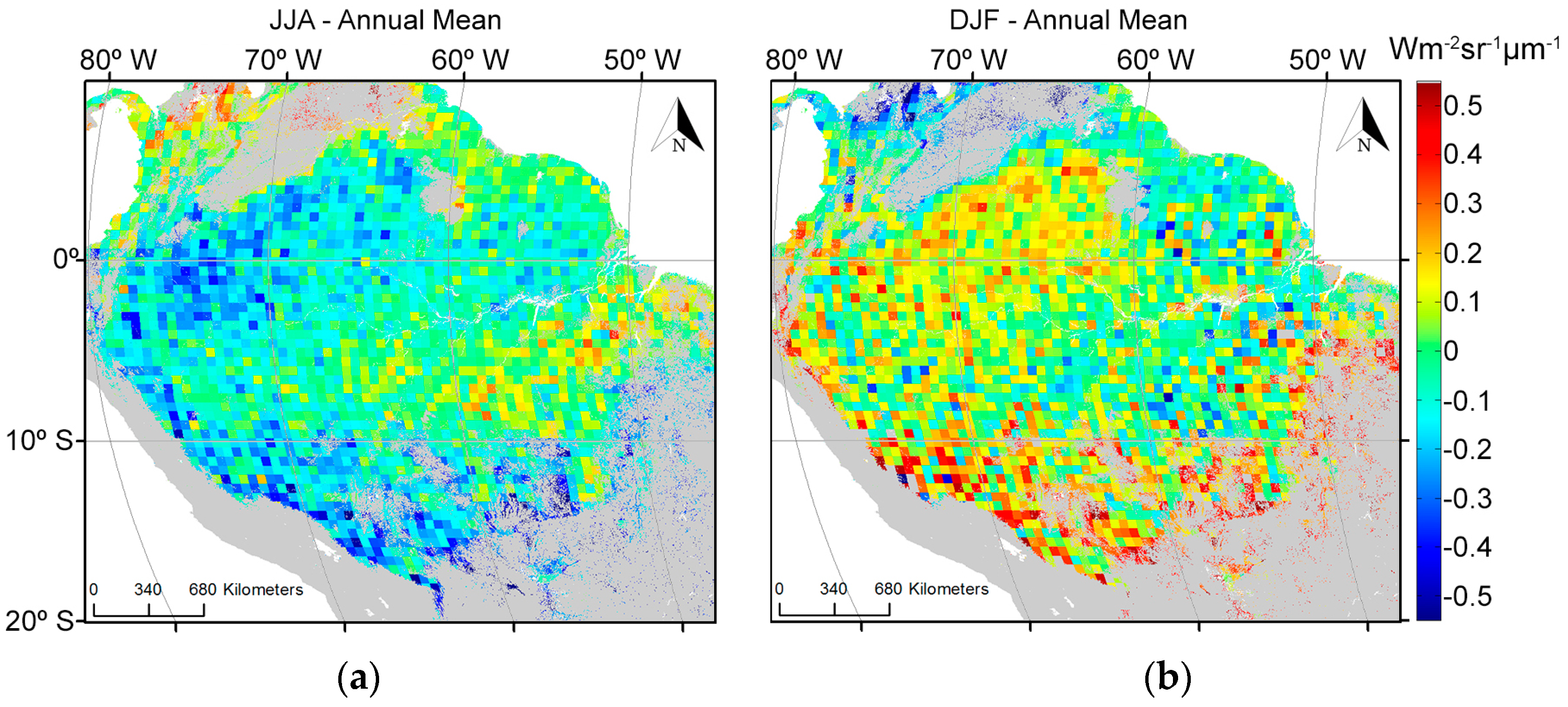
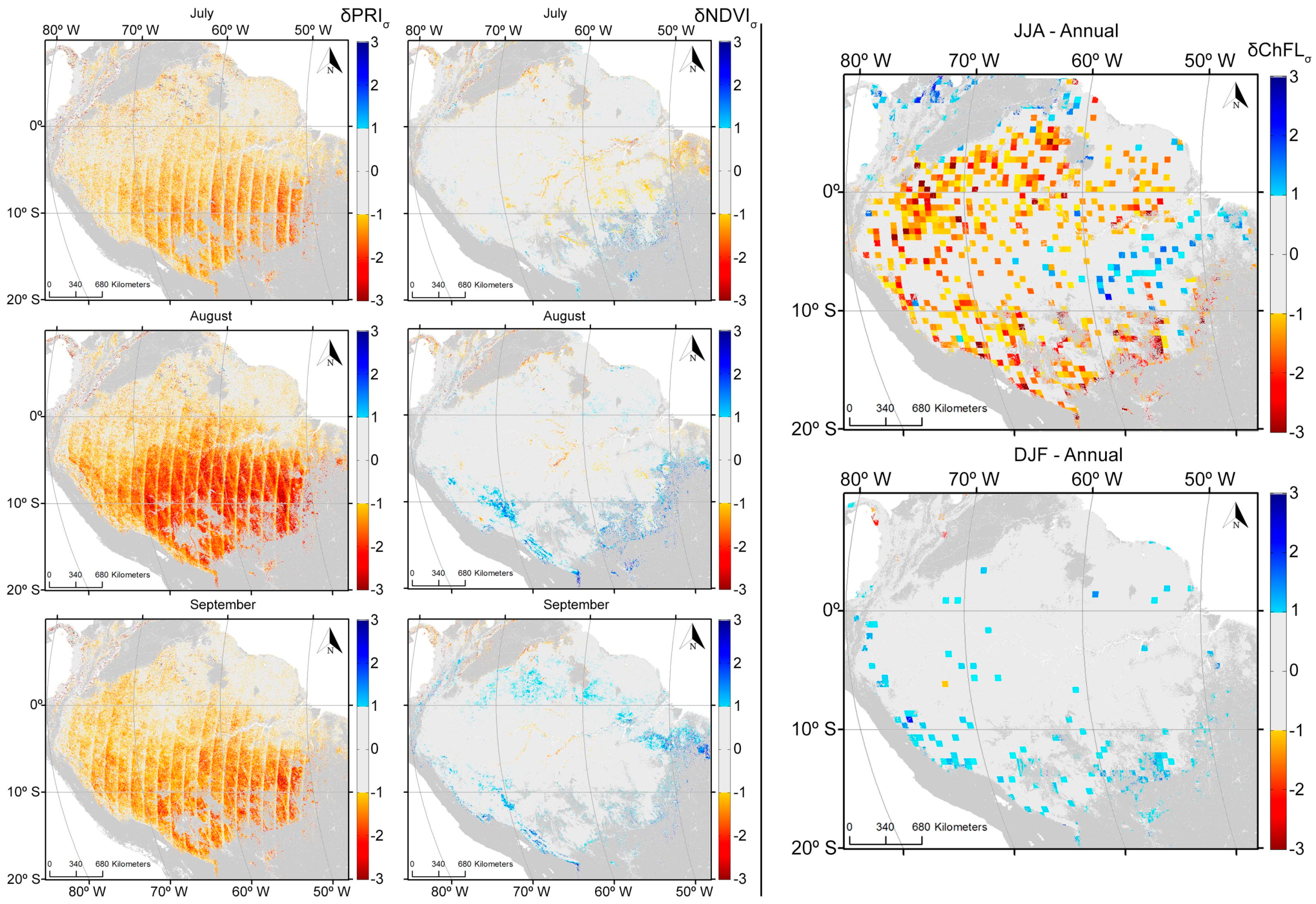
          <p><xref ref-type="fig" rid="remotesensing-09-00048-f008">Figure 8</xref> shows the seasonal departures of GOME-2 SIF estimates from the annual mean on a 0.5&#xB0; &#xD7; 0.5&#xB0; grid for the combined months of June, July and August (JJA). Extremely negative values, ranging from &#x2212;0.2 to &#x2212;0.5, characterized most of the JJA period. At the other extreme, December, January and February (DJF) were characterized by positive values (ranging from 0.2 to 0.5) for most of the area. In contrast to PRI, SIF exhibited a more spread out behavior, extending well into northern forests rather than being concentrated mostly in the southern region. Additionally, SIF showed patches of positive values for the dry season (from 0.3 to 0.45) in the northern most point of the basin (upper left corner of <xref ref-type="fig" rid="remotesensing-09-00048-f008">Figure 8</xref>) and negative values for the same area during the wet season (ranging from &#x2212;0.2 to &#x2212;0.5). These seasonal patterns of SIF are consistent with results report by [<xref ref-type="bibr" rid="B27-remotesensing-09-00048">27</xref>] using data retrieved from GOSAT.</p>
          <p>In contrast to PRI, the seasonality of NDVI derived from MAIAC reflectance measurements was muted across the Amazon Basin (<xref ref-type="fig" rid="remotesensing-09-00048-f009">Figure 9</xref>). NDVI is insensitive to subtle variation in canopy physiology and more responsive to structural variation in LAI.</p>
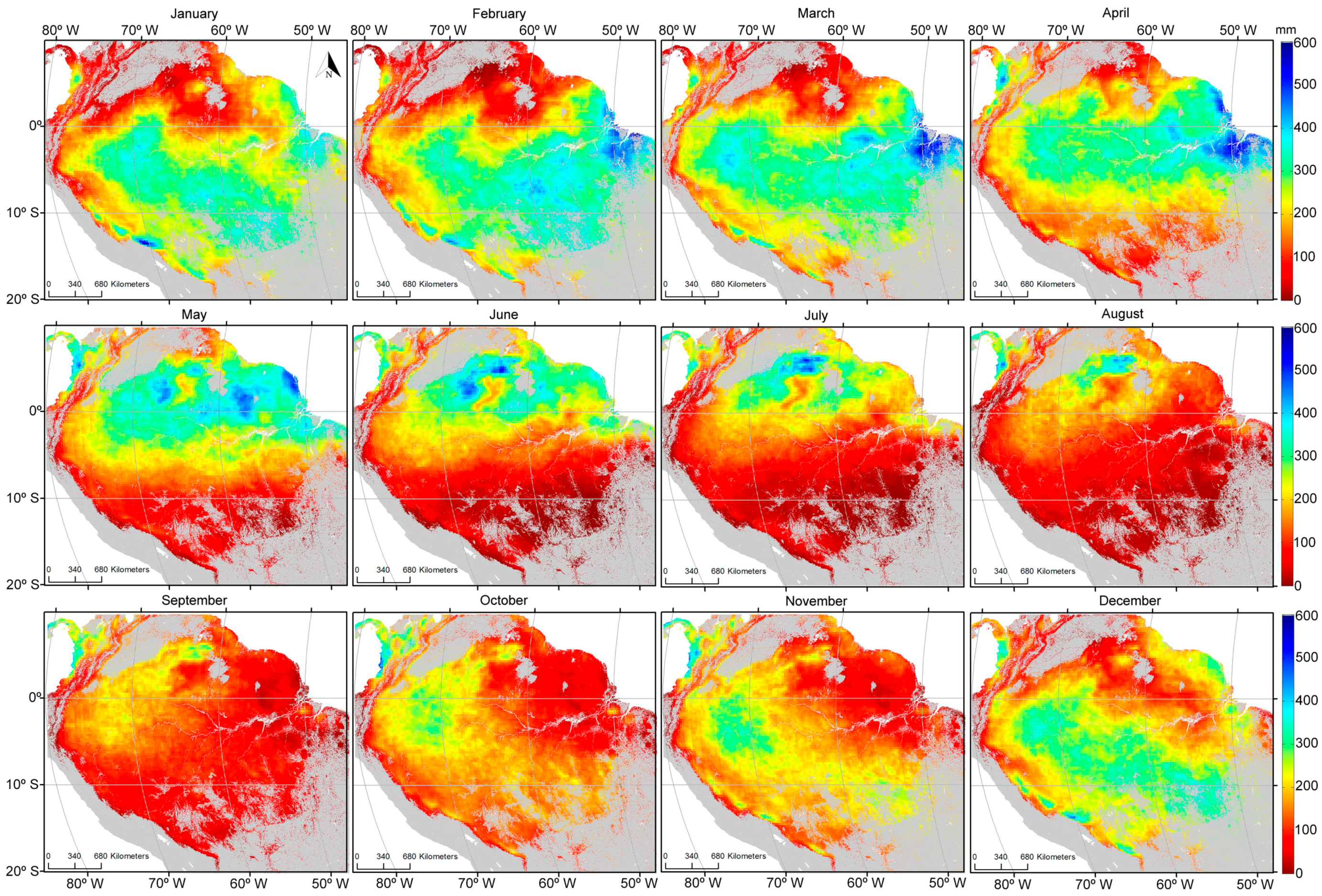
          <p>There is an ongoing debate over whether the productivity of evergreen forests in the Amazon is limited by radiation or by water. <xref ref-type="fig" rid="remotesensing-09-00048-f015">Figure A1</xref> and <xref ref-type="fig" rid="remotesensing-09-00048-f016">Figure A2</xref> in the <xref ref-type="app" rid="app2-remotesensing-09-00048">Appendix</xref> show seasonal changes in water storage measured from the Gravity Recovery and Climate Experiment (GRACE) along with rainfall estimates acquired from the Tropical Rainfall Measuring Mission (TRMM). Almost no rainfall was measured between June and August in the southern part of the basin, with moderate rainfall of up to 200 mm per month starting in October. The lowest water content was reached between July and September with an increase in storage beginning again in November, about a month behind the commencement of significant rainfall. Increases in water storage lagged about a month.</p>
          <p>We normalized estimates of PRI and SIF by dividing monthly values by the standard deviations of the entire dataset (total number of months). Pixels were plotted in which changes for a given month were within one standard deviation of the mean (refer to <xref ref-type="fig" rid="remotesensing-09-00048-f009">Figure 9</xref>). Those with variability in excess of with &gt;1 standard deviation are also designated. GOME-2 provides only one measurement at every 40 km, and the retrieval shows consistently a high variation, for seasonal means and when normalized for the year.</p>
        </sec>
        <sec id="sec4dot2dot2-remotesensing-09-00048">
          <title>4.2.2. Comparison of PRI with GPP at Eddy-Flux Tower Sites</title>
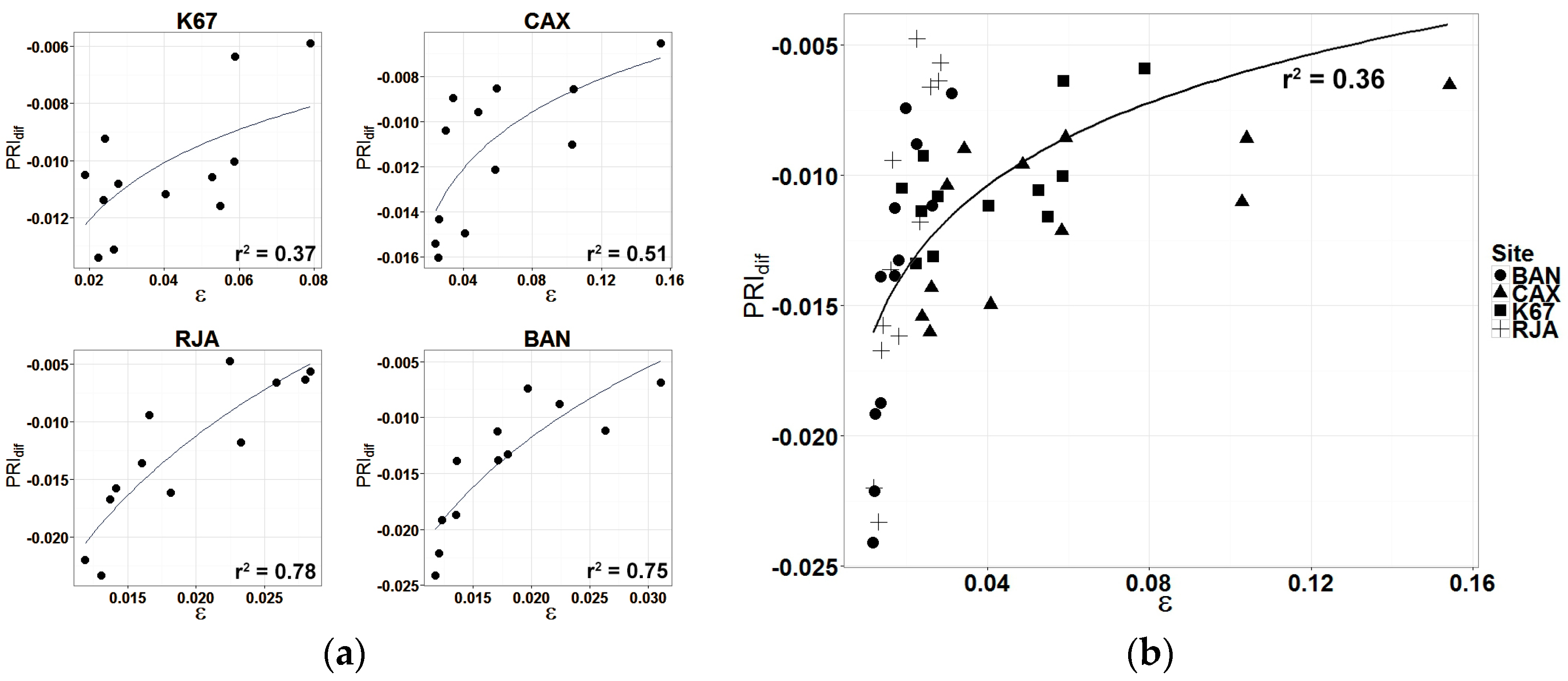
          <p>The relationships between PRI and &#x3B5; derived from eddy covariance measurements for the forested sites are presented in <xref ref-type="fig" rid="remotesensing-09-00048-f010">Figure 10</xref>. Each data point represents a monthly average of PRI and &#x3B5; values. Strong, logarithmic relationships are exhibited for BAN, CAX and RJA with coefficients of determination (r<sup>2</sup>) of 0.75 (<italic>p</italic> &lt; 0.01, <italic>n</italic> = 12), 0.51 (<italic>p</italic> &lt; 0.01, <italic>n</italic> = 12) and 0.78 (<italic>p</italic> &lt; 0.01, <italic>n</italic> = 12), respectively. The PRI values were highly variable for the evergreen rain forest K67 (r<sup>2</sup> = 0.37, <italic>p</italic> &lt; 0.01, <italic>n</italic> = 12) and generally higher during most seasons than observed at the BAN and RJA sites where rainfall is seasonally more variable (<xref ref-type="fig" rid="remotesensing-09-00048-f010">Figure 10</xref>). Strong logarithmic relationships between eddy-flux-derived &#x3B5; and PRI were also reported in [<xref ref-type="bibr" rid="B9-remotesensing-09-00048">9</xref>,<xref ref-type="bibr" rid="B14-remotesensing-09-00048">14</xref>,<xref ref-type="bibr" rid="B16-remotesensing-09-00048">16</xref>] where the relationship between PRI and (&#x3B5;) disappears (or saturates) for high values of &#x3B5;. This trend is confirmed by the results shown in <xref ref-type="fig" rid="remotesensing-09-00048-f010">Figure 10</xref>.</p>
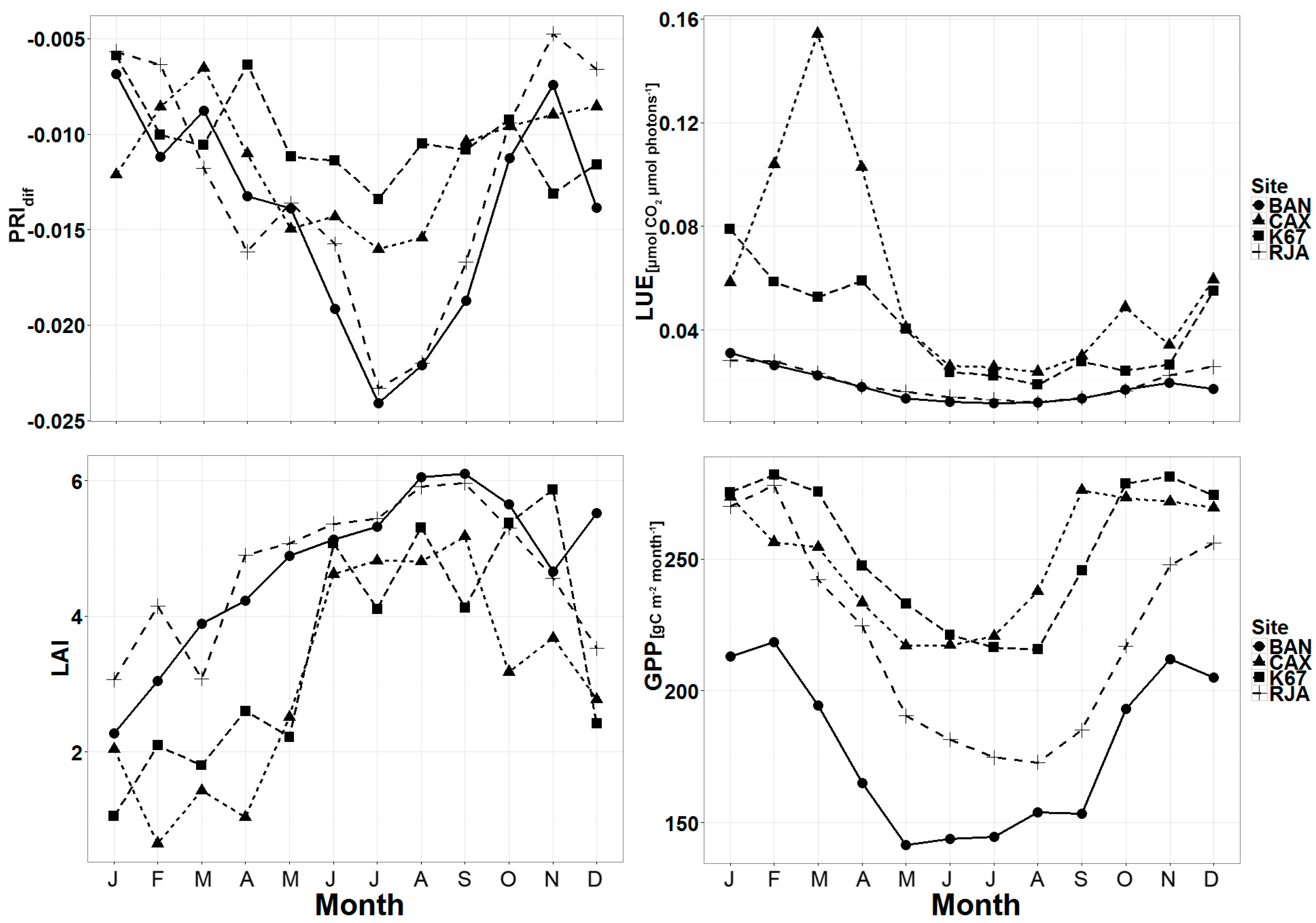
          <p><xref ref-type="fig" rid="remotesensing-09-00048-f011">Figure 11</xref> shows the monthly averages of PRI<sub>dif</sub>, light-use efficiency (&#x3B5;), LAI and GPP for each forested tower site. Overall, BAN and RJA sites showed the lower values compared to K67 and CAX for all months, with a pronounced decline starting in June and continuing until September. Low values of PRI<sub>dif</sub> are common during this season of low rainfall in southern Brazil (<xref ref-type="fig" rid="remotesensing-09-00048-f004">Figure 4</xref> and <xref ref-type="app" rid="app2-remotesensing-09-00048">Appendix</xref> <xref ref-type="fig" rid="remotesensing-09-00048-f016">Figure A2</xref>). BAN and RJA sites also showed the lower values of light use efficiency and GPP calculated from eddy-flux measurements. However, LAI showed an inverse seasonal variation with higher values concentrating during dry season&#x2019;s months with BAN and RJA showing higher values. Light-use efficiency for the CAX site showed a peak in March (<xref ref-type="fig" rid="remotesensing-09-00048-f011">Figure 11</xref>). Although it might seem an outlier, the low values of LAI at the same time agree. In general, seasonal trends in LAI are opposite those of PRI, Light Use Efficiency (LUE) and GPP. Similar trends were observed by Myneni and collaborators [<xref ref-type="bibr" rid="B57-remotesensing-09-00048">57</xref>] across the Amazon basin. This trend is in agreement with the seasonality of solar radiation (e.g., <xref ref-type="fig" rid="remotesensing-09-00048-f004">Figure 4</xref>), which might lead to a pattern of leaf flush during this radiation-rich season and leaf abscission during the wettest months due to cloud coverage. LAI estimates for February, March and April were the lowest for CAX compared to other sites, which agrees with the higher values of LUE recorded for those months. This is because LAI is used to calculate f<sub>PAR</sub> (Equation (4)), which is inversely proportional to LUE based on Beer&#x2019;s law.</p>
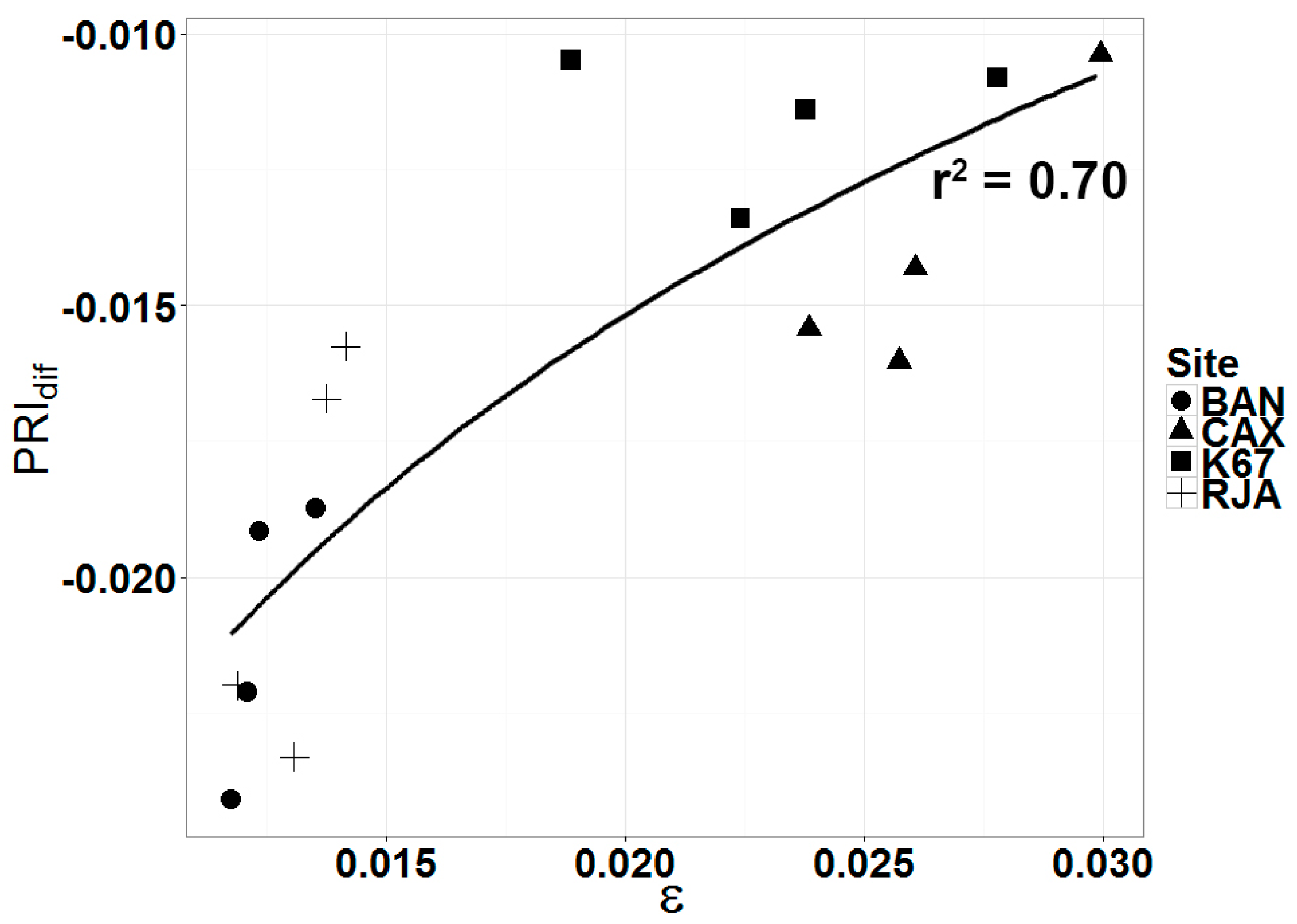
          <p><xref ref-type="fig" rid="remotesensing-09-00048-f012">Figure 12</xref> indicates a strong logarithmic relation between PRI<sub>dif</sub> and &#x3B5; derived from each site for the months of the dry season (r<sup>2</sup> = 0.70 (<italic>p</italic> &lt; 0.01)). Each data point represents a monthly average of PRI and &#x3B5; for the months of June, July, August and September.</p>
          <p>The way that the values of PRI<sub>dif</sub> and &#x3B5; are dispersed along the trend lines for each site in <xref ref-type="fig" rid="remotesensing-09-00048-f010">Figure 10</xref>b and <xref ref-type="fig" rid="remotesensing-09-00048-f012">Figure 12</xref> seems reasonable. Forests in the south are likely to experience more stress than forests lying further to the north. <xref ref-type="fig" rid="remotesensing-09-00048-f010">Figure 10</xref>, <xref ref-type="fig" rid="remotesensing-09-00048-f011">Figure 11</xref> and <xref ref-type="fig" rid="remotesensing-09-00048-f012">Figure 12</xref> show distinct separation of sites from one another: BAN and RJA register a larger seasonal range in PRI<sub>dif</sub> values with consistently low values of &#x3B5;. The northern area, typically with frequent cloud cover, experiences less downregulation in photosynthesis (<xref ref-type="fig" rid="remotesensing-09-00048-f013">Figure 13</xref>) and, as a result, produces much higher values of &#x3B5; than the forested area further to the south. The correlations between PRI<sub>dif</sub> and &#x3B5; are notably better where seasonal stress occurs than where it does not.</p>
          <p>We surmise that the relationship between PRI<sub>dif</sub> and &#x3B5; is considerably stronger when downregulation occurs (<xref ref-type="fig" rid="remotesensing-09-00048-f012">Figure 12</xref>), because at high values, the relationship saturates (<xref ref-type="fig" rid="remotesensing-09-00048-f010">Figure 10</xref>b). </p>
          <p>The relationships between GPP and PRI<sub>dif</sub> for the dry season (June through September) are defined by Equation (5) and for all months by Equation (6):
          <disp-formula>
		  GPP<sub>dry</sub> = 9588.1(PRI<sub>dif</sub>)<sup>2</sup> + 549.88(PRI<sub>dif</sub>) + 12.53 (r<sup>2</sup> = 0.72, <italic>p</italic> &lt; 0.001, <italic>n</italic> = 16),
		  <label>(5)</label>
		  </disp-formula>
          <disp-formula>
		  GPP<sub>all months</sub> = &#x2212;3091.1(PRI<sub>dif</sub>)<sup>2</sup> + 114.93(PRI<sub>dif</sub>) + 9.07 (r<sup>2</sup> = 0.51, <italic>p</italic> &lt; 0.001, <italic>n</italic> = 48),
		  <label>(6)</label>
		  </disp-formula></p>
          <p>During the wet season with extensive cloud cover, GPP is light-limited, and the relationship between PRI<sub>dif</sub> and &#x3B5; weakens because photosynthesis is not downregulated in either sunlit or shaded portions of the canopy (PRI<sub>f</sub> = PRI<sub>b</sub>). </p>
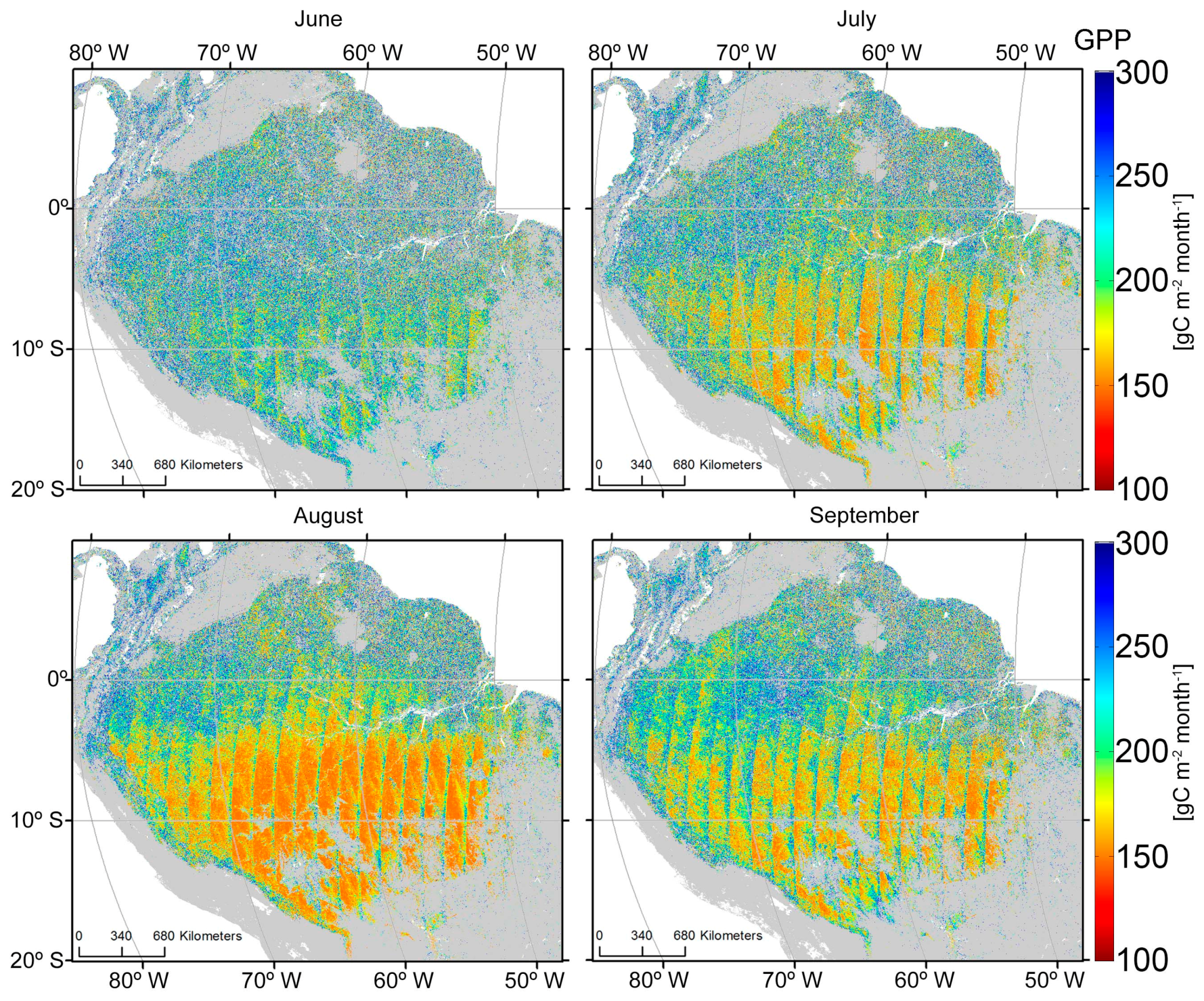
          <p><xref ref-type="fig" rid="remotesensing-09-00048-f014">Figure 14</xref> extends estimates of GPP across the Amazon basin during the dry season based on Equation (5).</p>
        </sec>
      </sec>
      <sec id="sec4dot3-remotesensing-09-00048">
        <title>4.3. Discussion</title>
        <sec id="sec4dot3dot1-remotesensing-09-00048">
          <title>4.3.1. Photochemical Reflectance Index and Sun-Induced Fluorescence</title>
          <p>This study presented the potential of satellite-based measurements of multi angle PRI and Sun-induced fluorescence as proxies for improving estimates of seasonality and primary productivity over tropical ecosystems. Results presented in <xref ref-type="fig" rid="remotesensing-09-00048-f005">Figure 5</xref>, <xref ref-type="fig" rid="remotesensing-09-00048-f006">Figure 6</xref> and <xref ref-type="fig" rid="remotesensing-09-00048-f007">Figure 7</xref> illustrate that seasonal variability provides strong support of previous studies demonstrating a period of depression in PRI values for an evergreen coniferous forest that peaked in July and August in association with the dry season [<xref ref-type="bibr" rid="B9-remotesensing-09-00048">9</xref>].</p>
          <p>The two physiological proxies were generally congruent. The most fluorescence and highest dissipation of energy from a shift in xanthophyll pigments occurred during the dry season and least during the wet (<xref ref-type="fig" rid="remotesensing-09-00048-f008">Figure 8</xref> and <xref ref-type="fig" rid="remotesensing-09-00048-f009">Figure 9</xref>). </p>
          <p>The inclusion of additional information obtained from the Gravity Recovery and Climate Experiment (GRACE) and Tropical Rainfall Measuring Mission (TRMM) proved valuable in explaining delayed seasonal responses in PRI. Abrupt decreases in precipitation do not immediately downregulate photosynthesis because considerable water remains stored within the soil accessible to tree roots [<xref ref-type="bibr" rid="B58-remotesensing-09-00048">58</xref>]. Consistent with this, the PRI estimates showed the lowest values indicative of stress between July and September, in concert with GRACE measurements.</p>
          <p>The fact that the lowest values of SIF and PRI were observed during the dry season when incident radiation is high suggests that other factors limit photosynthesis, an observation substantiated from eddy-flux analyses at both wet and dry tropical forest sites [<xref ref-type="bibr" rid="B47-remotesensing-09-00048">47</xref>]. On clear days, even with near saturated soils, the leaf-air water vapor deficit increases exponentially with temperature, restricting stomata opening and causing a decrease in photosynthesis [<xref ref-type="bibr" rid="B59-remotesensing-09-00048">59</xref>,<xref ref-type="bibr" rid="B60-remotesensing-09-00048">60</xref>]. Qian Zhang and collaborators [<xref ref-type="bibr" rid="B9-remotesensing-09-00048">9</xref>] observed that the relationship between PRI and &#x3B5; is the strongest under clear or partially-cloudy skies with moderate to high vapor pressure deficit (VPD) (&gt;20 h&#xB7;Pa) and high temperatures (&gt;31 &#xB0;C) for an evergreen coniferous forest.</p>
          <p>In temperate and boreal forests, subfreezing temperatures also cause stomata closure that may extend for days [<xref ref-type="bibr" rid="B61-remotesensing-09-00048">61</xref>]. These factors, together with soil water deficits, are included in most process-based growth models.</p>
          <p><xref ref-type="fig" rid="remotesensing-09-00048-f009">Figure 9</xref> illustrates that seasonal variabilities evident in both PRI and SIF, but particularly in PRI, enhance the extent the photosynthetic activity varies as implied by variation in the greenness index (<xref ref-type="fig" rid="remotesensing-09-00048-f005">Figure 5</xref>, <xref ref-type="fig" rid="remotesensing-09-00048-f006">Figure 6</xref>, <xref ref-type="fig" rid="remotesensing-09-00048-f007">Figure 7</xref> and <xref ref-type="fig" rid="remotesensing-09-00048-f008">Figure 8</xref>). While current sensors are less than ideal, we demonstrate that they have the capacity to monitor seasonal variation in two physiologically-important indices. While neither PRI nor SIF were obtained from instruments specifically designed for their measurement, we demonstrated that current platforms have the ability to monitor seasonal variation in these physiologically-important indices. This capability complements more static vegetation indices that monitor only structural changes (e.g., EVI and NDVI). GPP estimated with such indices showed an increase in the late dry seasons, consistent with an increase of radiation [<xref ref-type="bibr" rid="B55-remotesensing-09-00048">55</xref>]. Greening has been reported in the Amazon during the dry season using EVI and NDVI indices derived from MODIS data [<xref ref-type="bibr" rid="B62-remotesensing-09-00048">62</xref>]. This trend was later refuted by [<xref ref-type="bibr" rid="B63-remotesensing-09-00048">63</xref>] owing to atmosphere-corrupted data used in [<xref ref-type="bibr" rid="B62-remotesensing-09-00048">62</xref>].</p>
          <p>Our study, however, supports findings by [<xref ref-type="bibr" rid="B47-remotesensing-09-00048">47</xref>,<xref ref-type="bibr" rid="B63-remotesensing-09-00048">63</xref>] that GPP does not increase directly with an increase in radiation, nor does it necessarily plummet when rainfall decreases. Regional estimates of net changes in water storage from GRACE are valuable, but should be supplemented at selected places with more direct measurements of water stress on trees and the interactions of other variables on photosynthesis [<xref ref-type="bibr" rid="B64-remotesensing-09-00048">64</xref>].</p>
        </sec>
        <sec id="sec4dot3dot2-remotesensing-09-00048">
          <title>4.3.2. Improvements in Instrument Design, Data Acquisition and Processing</title>
          <p>Although we obtained evidence of seasonality for both PRI and SIF, current sensors on orbiting platforms limit the determination of SIF and PRI at higher temporal resolution (i.e., weekly or daily basis) due to inherent noise levels. Improvements in sensor design, data acquisition and processing may reduce the high variance reported. Even though the high noise from both MODIS and GOME-2 retrievals over the area does not appear to have a substantial impact on our monthly averages for both PRI<sub>dif</sub> and SIF (please refer to the figures), inferences drawn from the data and subsequent extrapolations must be done carefully. Additionally, it should be noted that we are looking at averages over multiple years. Extreme drought events, such as the 2005 and 2010 (addressed in detail in [<xref ref-type="bibr" rid="B63-remotesensing-09-00048">63</xref>,<xref ref-type="bibr" rid="B65-remotesensing-09-00048">65</xref>,<xref ref-type="bibr" rid="B66-remotesensing-09-00048">66</xref>,<xref ref-type="bibr" rid="B67-remotesensing-09-00048">67</xref>,<xref ref-type="bibr" rid="B68-remotesensing-09-00048">68</xref>]) might have more pronounced effects on both PRI<sub>dif</sub> and SIF estimates. One might consider using sophisticated BRDF models rather than collecting forward- and back-scattered observations as we did. As a result of our choice, vertical &#x201C;stripping&#x201D; occurred at the edges of the MODIS sampling swath (see <xref ref-type="fig" rid="remotesensing-09-00048-f005">Figure 5</xref>, <xref ref-type="fig" rid="remotesensing-09-00048-f006">Figure 6</xref> and <xref ref-type="fig" rid="remotesensing-09-00048-f007">Figure 7</xref>). This limitation will be addressed with the new MAIAC release that will provide BRDF kernels for Bands 11 and 12.</p>
          <p>We were restricted to sampling over monthly periods to obtain sufficient data and to integrate over large areas. There is progress in refining both deficiencies. Joiner and collaborators [<xref ref-type="bibr" rid="B44-remotesensing-09-00048">44</xref>] used GOME-2 data acquired at eight-day intervals over several years and plotted results on a 2&#xB0; &#xD7; 2&#xB0; grid with a four-fold improvement in spatial resolution compared with Level 3 GOME-2 data. </p>
        </sec>
        <sec id="sec4dot3dot3-remotesensing-09-00048">
          <title>4.3.3. PRI and Eddy-Flux Measurements of Light Use Efficiency</title>
          <p>The general standard for measurement of GPP is from the acquisition of eddy covariance data of CO<sub>2</sub> exchange. A basic assumption in the calculation of GPP is that the relation between temperature and ecosystem respiration derived from nighttime measurements applies to daytime conditions. This assumption has been questioned based on an analysis of the differential fractionation of stable carbon and oxygen isotopes collected seasonally above a temperate deciduous forest in Massachusetts [<xref ref-type="bibr" rid="B69-remotesensing-09-00048">69</xref>]. Even if accurate, GPP estimates derived from eddy-flux from towers are difficult to extrapolate across landscapes with a variety of topography and cover types. Multi-directional sensors borne on satellites can, we believe, aid considerably in the pursuit of better estimates of GPP and related ecosystem exchanges (water vapor, methane, etc.). The possibility of supplementing ground-based measurements with those obtained with multi-directional sensors borne on satellites is, we believe, an approach worth pursuing. Our results suggest that PRI is able to capture seasonal changes in &#x3B5; across large areas of tropical forests. However, we observed that the correlations of PRI and &#x3B5; varied greatly between flux sites: PRI<sub>dif</sub> was more sensitive to variations in &#x3B5; for southern sites than northern sites. This is in concert with reduced rainfall measured from GRACE for the southern flux sites. We surmise that PRI<sub>dif</sub> becomes more sensitive to variations in &#x3B5; under stressed conditions. We observed the strongest correlation (r<sup>2</sup> = 0.70, <italic>p</italic> &lt; 0.01) for the dry period between June and September (<xref ref-type="fig" rid="remotesensing-09-00048-f012">Figure 12</xref>). Our finding is corroborated by Zhang et al. [<xref ref-type="bibr" rid="B9-remotesensing-09-00048">9</xref>], where PRI was significantly correlated with &#x3B5; during most of the dry season for an evergreen coniferous forest in China.</p>
          <p>Our study also substantiates earlier work by [<xref ref-type="bibr" rid="B16-remotesensing-09-00048">16</xref>,<xref ref-type="bibr" rid="B17-remotesensing-09-00048">17</xref>] in temperate coniferous and deciduous forests that reported strong non-linear relationship between satellite-derived PRI and &#x3B5; obtained from eddy covariance measurements (although a different approach was used to account for shadow effects).</p>
        </sec>
      </sec>
    </sec>
    <sec id="sec5-remotesensing-09-00048" sec-type="conclusions">
      <title>5. Conclusions</title>
      <p>In this paper, we addressed the potentials and limitations of multi-angle MODIS PRI and SIF observations as proxies for productivity over the Amazon rainforests. While traditional greenness measurements, such as NDVI, will only provide information about chlorophyll content and leaf flush/leaf loss (and other factors potentially affecting NDVI, such as leaf movement, pigment pool size, leaf wilting and active heliotropism), PRI when combined with SIF offers a complementary more direct proxy for light-use efficiency over large areas of tropical forests. We conclude that:
	  <list list-type="order">
      <list-item><label>(1)</label><p>PRI is able to capture seasonal changes in &#x3B5; in large areas of tropical forests. These changes are linked to stress conditions related to water availability during the dry season.</p></list-item>
      <list-item><label>(2)</label><p>Statistically-significant logarithmic relationships were found between PRI<sub>dif</sub> and &#x3B5; determined from eddy-flux measurements for all sites; southern sites, however, showed stronger correlations (r<sup>2</sup> = 0.78, <italic>p</italic> &lt; 0.01 for RJA and r<sup>2</sup> = 0.75, <italic>p</italic> &lt; 0.01 for BAN). Thus, correlations between PRI<sub>dif</sub> and &#x3B5; are notably better where seasonal stress occurs than where it does not.</p></list-item>
      <list-item><label>(3)</label><p>MODIS and GOME-2 observations, while not optimal for measuring short-term changes in &#x3B5;, provide realistic estimates of seasonal variation in photosynthesis over the Amazon that relate well to wet and dry seasons.</p></list-item>
      <list-item><label>(4)</label><p>The development of new sensor designs with the capacity for frequent, moderate resolution, multi-angle PRI and SIF measurements should increase our understanding of ecosystem functioning in response to the climate in the tropics and elsewhere.</p></list-item>
	  </list>
	  </p>
    </sec>
  </body>
  <back>
    <app-group>
      <app id="app1-remotesensing-09-00048">
        <title>Supplementary Materials</title>
		<supplementary-material id="remotesensing-09-00048-s001" xmlns:xlink="http://www.w3.org/1999/xlink" xlink:href="remotesensing-09-00048-s001.pdf"/>
        <p>The following are available online at <uri>www.mdpi.com/2072-4292/9/1/48/s1</uri>. Figure S1: Monthly averages of MODIS MAIAC NDVI for the period of 2000 to 2012 for forested areas in the Amazon basin. The averages were calculated to show seasonality. Areas in grey represent different land covers and were not taken into consideration. </p>
      </app>
    </app-group>
    <ack>
      <title>Acknowledgments</title>
      <p>This research was supported in part by a scholarship from CAPES&#x2014;Brazil (Coordena&#xE7;&#xE3;o de Aperfei&#xE7;oamento de Pessoal de N&#xED;vel Superior, Grant Number BEX 1233-13-0) awarded to the author. Many thanks to the reviewers who provided insightful suggestions on an earlier draft of the manuscript.</p>
    </ack>
    <notes>
      <title>Author Contributions</title>
      <p>C.H.R.S. and T.H. conceived of and designed the experiments. C.H.R.S. analyzed the data. A.L. contributed the MAIAC V data. C.H.R.S. wrote the original paper, and R.H.W. made extensive revisions. Y.M.M. edited and made revisions of the figures. All authors read and approved the submitted draft of the manuscript.</p>
    </notes>
    <notes notes-type="COI-statement">
      <title>Conflicts of Interest</title>
      <p>The authors declare no conflict of interest.</p>
    </notes>
    <app-group>
      <app id="app2-remotesensing-09-00048">
        <title>Appendix A</title>
        <fig id="remotesensing-09-00048-f015" position="float">
          <label>Figure A1</label>
          <caption>
            <p>Monthly averages of change in table water content from GRACE for the period of 2001 to 2012. The resolution of the figure is coarse because the nominal footprint of the data is 2 km &#xD7; 2 km.</p>
          </caption>
          <graphic xmlns:xlink="http://www.w3.org/1999/xlink" xlink:href="remotesensing-09-00048-g015.tif"/>
        </fig>
        <fig id="remotesensing-09-00048-f016" position="float">
          <label>Figure A2</label>
          <caption>
            <p>Seasonal variation of rainfall from the Tropical Rainfall Measuring Mission (TRMM) for the period of 2000 to 2011. A monthly average approach was adopted to show rainfall seasonality over the Amazon basin.</p>
          </caption>
          <graphic xmlns:xlink="http://www.w3.org/1999/xlink" xlink:href="remotesensing-09-00048-g016.tif"/>
        </fig>
      </app>
    </app-group>
    <ref-list>
      <title>References</title>
      <ref id="B1-remotesensing-09-00048">
        <label>1.</label>
        <citation citation-type="journal">
          <person-group person-group-type="author">
            <name>
              <surname>Li</surname>
              <given-names>W.</given-names>
            </name>
            <name>
              <surname>Fu</surname>
              <given-names>R.</given-names>
            </name>
            <name>
              <surname>Ju&#xE1;rez</surname>
              <given-names>R.I.N.</given-names>
            </name>
            <name>
              <surname>Fernandes</surname>
              <given-names>K.</given-names>
            </name>
          </person-group>
          <article-title>Observed change of the standardized precipitation index, its potential cause and implications to future climate change in the Amazon region</article-title>
          <source>Philos. Trans. R. Soc. Lond. B Biol. Sci.</source>
          <year>2008</year>
          <volume>363</volume>
          <fpage>1767</fpage>
          <lpage>1772</lpage>
          <pub-id pub-id-type="doi">10.1098/rstb.2007.0022</pub-id>
          <pub-id pub-id-type="pmid">18267918</pub-id>
        </citation>
      </ref>
      <ref id="B2-remotesensing-09-00048">
        <label>2.</label>
        <citation citation-type="journal">
          <person-group person-group-type="author">
            <name>
              <surname>Li</surname>
              <given-names>W.</given-names>
            </name>
            <name>
              <surname>Fu</surname>
              <given-names>R.</given-names>
            </name>
            <name>
              <surname>Dickinson</surname>
              <given-names>R.E.</given-names>
            </name>
          </person-group>
          <article-title>Rainfall and its seasonality over the Amazon in the 21st century as assessed by the coupled models for the IPCC AR4</article-title>
          <source>J. Geophys. Res.</source>
          <year>2006</year>
          <volume>111</volume>
          <pub-id pub-id-type="doi">10.1029/2005JD006355</pub-id>
        </citation>
      </ref>
      <ref id="B3-remotesensing-09-00048">
        <label>3.</label>
        <citation citation-type="journal">
          <person-group person-group-type="author">
            <name>
              <surname>Phillips</surname>
              <given-names>O.L.</given-names>
            </name>
            <name>
              <surname>Arag&#xE3;o</surname>
              <given-names>L.E.O.C.</given-names>
            </name>
            <name>
              <surname>Lewis</surname>
              <given-names>S.L.</given-names>
            </name>
            <name>
              <surname>Fisher</surname>
              <given-names>J.B.</given-names>
            </name>
            <name>
              <surname>Lloyd</surname>
              <given-names>J.</given-names>
            </name>
            <name>
              <surname>L&#xF3;pez-Gonz&#xE1;lez</surname>
              <given-names>G.</given-names>
            </name>
            <name>
              <surname>Malhi</surname>
              <given-names>Y.</given-names>
            </name>
            <name>
              <surname>Monteagudo</surname>
              <given-names>A.</given-names>
            </name>
            <name>
              <surname>Peacock</surname>
              <given-names>J.</given-names>
            </name>
            <name>
              <surname>Quesada</surname>
              <given-names>C.A.</given-names>
            </name>
          </person-group>
          <article-title>Drought sensitivity of the Amazon rainforest</article-title>
          <source>Science</source>
          <year>2009</year>
          <volume>323</volume>
          <fpage>1344</fpage>
          <lpage>1347</lpage>
          <pub-id pub-id-type="doi">10.1126/science.1164033</pub-id>
          <pub-id pub-id-type="pmid">19265020</pub-id>
        </citation>
      </ref>
      <ref id="B4-remotesensing-09-00048">
        <label>4.</label>
        <citation citation-type="journal">
          <person-group person-group-type="author">
            <name>
              <surname>Stanhill</surname>
              <given-names>G.</given-names>
            </name>
            <name>
              <surname>Fuchs</surname>
              <given-names>M.</given-names>
            </name>
          </person-group>
          <article-title>The relative flux density of photosynthetically active radiation</article-title>
          <source>J. Appl. Ecol.</source>
          <year>1977</year>
          <volume>14</volume>
          <fpage>317</fpage>
          <lpage>322</lpage>
          <pub-id pub-id-type="doi">10.2307/2401848</pub-id>
        </citation>
      </ref>
      <ref id="B5-remotesensing-09-00048">
        <label>5.</label>
        <citation citation-type="journal">
          <person-group person-group-type="author">
            <name>
              <surname>Adams</surname>
              <given-names>B.D.</given-names>
            </name>
            <name>
              <surname>Adams</surname>
              <given-names>W.W.</given-names>
            </name>
          </person-group>
          <article-title>The role of xanthophyll cycle carotenoids in the protection of photosynthesis</article-title>
          <source>Trends Plant Sci.</source>
          <year>1996</year>
          <volume>1</volume>
          <fpage>21</fpage>
          <lpage>26</lpage>
          <pub-id pub-id-type="doi">10.1016/S1360-1385(96)80019-7</pub-id>
        </citation>
      </ref>
      <ref id="B6-remotesensing-09-00048">
        <label>6.</label>
        <citation citation-type="journal">
          <person-group person-group-type="author">
            <name>
              <surname>Gamon</surname>
              <given-names>J.A.</given-names>
            </name>
            <name>
              <surname>Pe&#xF1;uelas</surname>
              <given-names>J.</given-names>
            </name>
            <name>
              <surname>Field</surname>
              <given-names>C.B.</given-names>
            </name>
          </person-group>
          <article-title>A narrow-waveband spectral index that tracks diurnal changes in photosynthetic efficiency</article-title>
          <source>Remote Sens. Environ.</source>
          <year>1992</year>
          <volume>41</volume>
          <fpage>35</fpage>
          <lpage>44</lpage>
          <pub-id pub-id-type="doi">10.1016/0034-4257(92)90059-S</pub-id>
        </citation>
      </ref>
      <ref id="B7-remotesensing-09-00048">
        <label>7.</label>
        <citation citation-type="journal">
          <person-group person-group-type="author">
            <name>
              <surname>Schickling</surname>
              <given-names>A.</given-names>
            </name>
            <name>
              <surname>Matveeva</surname>
              <given-names>M.</given-names>
            </name>
            <name>
              <surname>Damm</surname>
              <given-names>A.</given-names>
            </name>
            <name>
              <surname>Schween</surname>
              <given-names>J.</given-names>
            </name>
            <name>
              <surname>Wahner</surname>
              <given-names>A.</given-names>
            </name>
            <name>
              <surname>Graf</surname>
              <given-names>A.</given-names>
            </name>
            <name>
              <surname>Crewell</surname>
              <given-names>S.</given-names>
            </name>
            <name>
              <surname>Rascher</surname>
              <given-names>U.</given-names>
            </name>
          </person-group>
          <article-title>Combining Sun-induced chlorophyll fluorescence and photochemical reflectance index improves diurnal modeling of gross primary productivity</article-title>
          <source>Remote Sens.</source>
          <year>2016</year>
          <volume>8</volume>
          <pub-id pub-id-type="doi">10.3390/rs8070574</pub-id>
        </citation>
      </ref>
      <ref id="B8-remotesensing-09-00048">
        <label>8.</label>
        <citation citation-type="journal">
          <person-group person-group-type="author">
            <name>
              <surname>Zhang</surname>
              <given-names>C.</given-names>
            </name>
            <name>
              <surname>Filella</surname>
              <given-names>I.</given-names>
            </name>
            <name>
              <surname>Garbulsky</surname>
              <given-names>M.</given-names>
            </name>
            <name>
              <surname>Pe&#xF1;uelas</surname>
              <given-names>J.</given-names>
            </name>
          </person-group>
          <article-title>Affecting factors and recent improvements of the photochemical reflectance index (PRI) for remotely sensing foliar, canopy and ecosystemic radiation-use efficiencies</article-title>
          <source>Remote Sens.</source>
          <year>2016</year>
          <volume>8</volume>
          <pub-id pub-id-type="doi">10.3390/rs8090677</pub-id>
        </citation>
      </ref>
      <ref id="B9-remotesensing-09-00048">
        <label>9.</label>
        <citation citation-type="journal">
          <person-group person-group-type="author">
            <name>
              <surname>Zhang</surname>
              <given-names>Q.</given-names>
            </name>
            <name>
              <surname>Ju</surname>
              <given-names>W.</given-names>
            </name>
            <name>
              <surname>Chen</surname>
              <given-names>J.M.</given-names>
            </name>
            <name>
              <surname>Wang</surname>
              <given-names>H.</given-names>
            </name>
            <name>
              <surname>Yang</surname>
              <given-names>F.</given-names>
            </name>
            <name>
              <surname>Fan</surname>
              <given-names>W.</given-names>
            </name>
            <name>
              <surname>Huang</surname>
              <given-names>Q.</given-names>
            </name>
            <name>
              <surname>Zheng</surname>
              <given-names>T.</given-names>
            </name>
            <name>
              <surname>Feng</surname>
              <given-names>Y.</given-names>
            </name>
            <name>
              <surname>Zhou</surname>
              <given-names>Y.</given-names>
            </name>
          </person-group>
          <article-title>Ability of the photochemical reflectance index to track light use efficiency for a sub-tropical planted coniferous forest</article-title>
          <source>Remote Sens.</source>
          <year>2015</year>
          <volume>7</volume>
          <fpage>16938</fpage>
          <lpage>16962</lpage>
          <pub-id pub-id-type="doi">10.3390/rs71215860</pub-id>
        </citation>
      </ref>
      <ref id="B10-remotesensing-09-00048">
        <label>10.</label>
        <citation citation-type="journal">
          <person-group person-group-type="author">
            <name>
              <surname>Gamon</surname>
              <given-names>J.A.</given-names>
            </name>
            <name>
              <surname>Bond</surname>
              <given-names>B.</given-names>
            </name>
          </person-group>
          <article-title>Effects of irradiance and photosynthetic downregulation on the photochemical reflectance index in Douglas-fir and ponderosa pine</article-title>
          <source>Remote Sens. Environ.</source>
          <year>2013</year>
          <volume>135</volume>
          <fpage>141</fpage>
          <lpage>149</lpage>
          <pub-id pub-id-type="doi">10.1016/j.rse.2013.03.032</pub-id>
        </citation>
      </ref>
      <ref id="B11-remotesensing-09-00048">
        <label>11.</label>
        <citation citation-type="journal">
          <person-group person-group-type="author">
            <name>
              <surname>Liu</surname>
              <given-names>L.</given-names>
            </name>
            <name>
              <surname>Zhang</surname>
              <given-names>Y.</given-names>
            </name>
            <name>
              <surname>Jiao</surname>
              <given-names>Q.</given-names>
            </name>
            <name>
              <surname>Peng</surname>
              <given-names>D.</given-names>
            </name>
          </person-group>
          <article-title>Assessing photosynthetic light-use efficiency using a solar-induced chlorophyll fluorescence and photochemical reflectance index</article-title>
          <source>Int. J. Remote Sens.</source>
          <year>2013</year>
          <volume>34</volume>
          <fpage>4264</fpage>
          <lpage>4280</lpage>
          <pub-id pub-id-type="doi">10.1080/01431161.2013.775533</pub-id>
        </citation>
      </ref>
      <ref id="B12-remotesensing-09-00048">
        <label>12.</label>
        <citation citation-type="journal">
          <person-group person-group-type="author">
            <name>
              <surname>Nichol</surname>
              <given-names>C.J.</given-names>
            </name>
            <name>
              <surname>Huemmrich</surname>
              <given-names>K.F.</given-names>
            </name>
            <name>
              <surname>Black</surname>
              <given-names>T.A.</given-names>
            </name>
            <name>
              <surname>Jarvis</surname>
              <given-names>P.G.</given-names>
            </name>
            <name>
              <surname>Walthall</surname>
              <given-names>C.L.</given-names>
            </name>
            <name>
              <surname>Grace</surname>
              <given-names>J.</given-names>
            </name>
            <name>
              <surname>Hall</surname>
              <given-names>F.G.</given-names>
            </name>
          </person-group>
          <article-title>Remote sensing of photosynthetic-light-use efficiency of boreal forest</article-title>
          <source>Agric. For. Meteorol.</source>
          <year>2000</year>
          <volume>101</volume>
          <fpage>131</fpage>
          <lpage>142</lpage>
          <pub-id pub-id-type="doi">10.1016/S0168-1923(99)00167-7</pub-id>
        </citation>
      </ref>
      <ref id="B13-remotesensing-09-00048">
        <label>13.</label>
        <citation citation-type="journal">
          <person-group person-group-type="author">
            <name>
              <surname>Hall</surname>
              <given-names>F.G.</given-names>
            </name>
            <name>
              <surname>Hilker</surname>
              <given-names>T.</given-names>
            </name>
            <name>
              <surname>Coops</surname>
              <given-names>N.C.</given-names>
            </name>
            <name>
              <surname>Lyapustin</surname>
              <given-names>A.</given-names>
            </name>
            <name>
              <surname>Huemmrich</surname>
              <given-names>K.F.</given-names>
            </name>
            <name>
              <surname>Middleton</surname>
              <given-names>E.</given-names>
            </name>
            <name>
              <surname>Margolis</surname>
              <given-names>H.</given-names>
            </name>
            <name>
              <surname>Drolet</surname>
              <given-names>G.</given-names>
            </name>
            <name>
              <surname>Black</surname>
              <given-names>T.A.</given-names>
            </name>
          </person-group>
          <article-title>Multi-angle remote sensing of forest light use efficiency by observing PRI variation with canopy shadow fraction</article-title>
          <source>Remote Sens. Environ.</source>
          <year>2008</year>
          <volume>112</volume>
          <fpage>3201</fpage>
          <lpage>3211</lpage>
          <pub-id pub-id-type="doi">10.1016/j.rse.2008.03.015</pub-id>
        </citation>
      </ref>
      <ref id="B14-remotesensing-09-00048">
        <label>14.</label>
        <citation citation-type="journal">
          <person-group person-group-type="author">
            <name>
              <surname>Hall</surname>
              <given-names>F.G.</given-names>
            </name>
            <name>
              <surname>Hilker</surname>
              <given-names>T.</given-names>
            </name>
            <name>
              <surname>Coops</surname>
              <given-names>N.C.</given-names>
            </name>
          </person-group>
          <article-title>PHOTOSYNSAT, photosynthesis from space: Theoretical foundations of a satellite concept and validation from tower and spaceborne data</article-title>
          <source>Remote Sens. Environ.</source>
          <year>2011</year>
          <volume>115</volume>
          <fpage>1918</fpage>
          <lpage>1925</lpage>
          <pub-id pub-id-type="doi">10.1016/j.rse.2011.03.014</pub-id>
        </citation>
      </ref>
      <ref id="B15-remotesensing-09-00048">
        <label>15.</label>
        <citation citation-type="journal">
          <person-group person-group-type="author">
            <name>
              <surname>Hilker</surname>
              <given-names>T.</given-names>
            </name>
            <name>
              <surname>Coops</surname>
              <given-names>N.C.</given-names>
            </name>
            <name>
              <surname>Schwalm</surname>
              <given-names>C.R.</given-names>
            </name>
            <name>
              <surname>Jassal</surname>
              <given-names>R.S.</given-names>
            </name>
            <name>
              <surname>Black</surname>
              <given-names>T.A.</given-names>
            </name>
            <name>
              <surname>Krishnan</surname>
              <given-names>P.</given-names>
            </name>
          </person-group>
          <article-title>Effects of mutual shading of tree crowns on prediction of photosynthetic light-use efficiency in a coastal Douglas-fir forest</article-title>
          <source>Tree Physiol.</source>
          <year>2008</year>
          <volume>28</volume>
          <fpage>825</fpage>
          <lpage>834</lpage>
          <pub-id pub-id-type="doi">10.1093/treephys/28.6.825</pub-id>
          <pub-id pub-id-type="pmid">18381263</pub-id>
        </citation>
      </ref>
      <ref id="B16-remotesensing-09-00048">
        <label>16.</label>
        <citation citation-type="journal">
          <person-group person-group-type="author">
            <name>
              <surname>Hilker</surname>
              <given-names>T.</given-names>
            </name>
            <name>
              <surname>Hall</surname>
              <given-names>F.G.</given-names>
            </name>
            <name>
              <surname>Coops</surname>
              <given-names>N.C.</given-names>
            </name>
            <name>
              <surname>Lyapustin</surname>
              <given-names>A.</given-names>
            </name>
            <name>
              <surname>Wang</surname>
              <given-names>Y.</given-names>
            </name>
            <name>
              <surname>Nesic</surname>
              <given-names>Z.</given-names>
            </name>
            <name>
              <surname>Grant</surname>
              <given-names>N.</given-names>
            </name>
            <name>
              <surname>Black</surname>
              <given-names>T.A.</given-names>
            </name>
            <name>
              <surname>Wulder</surname>
              <given-names>M.A.</given-names>
            </name>
            <name>
              <surname>Kljun</surname>
              <given-names>N.</given-names>
            </name>
          </person-group>
          <article-title>Remote sensing of photosynthetic light-use efficiency across two forested biomes: Spatial scaling</article-title>
          <source>Remote Sens. Environ.</source>
          <year>2010</year>
          <volume>114</volume>
          <fpage>2863</fpage>
          <lpage>2874</lpage>
          <pub-id pub-id-type="doi">10.1016/j.rse.2010.07.004</pub-id>
        </citation>
      </ref>
      <ref id="B17-remotesensing-09-00048">
        <label>17.</label>
        <citation citation-type="journal">
          <person-group person-group-type="author">
            <name>
              <surname>Hilker</surname>
              <given-names>T.</given-names>
            </name>
            <name>
              <surname>Coops</surname>
              <given-names>N.C.</given-names>
            </name>
            <name>
              <surname>Hall</surname>
              <given-names>F.G.</given-names>
            </name>
            <name>
              <surname>Nichol</surname>
              <given-names>C.J.</given-names>
            </name>
            <name>
              <surname>Lyapustin</surname>
              <given-names>A.</given-names>
            </name>
            <name>
              <surname>Black</surname>
              <given-names>T.A.</given-names>
            </name>
            <name>
              <surname>Wulder</surname>
              <given-names>M.A.</given-names>
            </name>
            <name>
              <surname>Leuning</surname>
              <given-names>R.</given-names>
            </name>
            <name>
              <surname>Barr</surname>
              <given-names>A.</given-names>
            </name>
            <name>
              <surname>Hollinger</surname>
              <given-names>D.Y.</given-names>
            </name>
          </person-group>
          <article-title>Inferring terrestrial photosynthetic light use efficiency of temperate ecosystems from space</article-title>
          <source>J. Geophys. Res.</source>
          <year>2011</year>
          <volume>116</volume>
          <pub-id pub-id-type="doi">10.1029/2011JG001692</pub-id>
        </citation>
      </ref>
      <ref id="B18-remotesensing-09-00048">
        <label>18.</label>
        <citation citation-type="journal">
          <person-group person-group-type="author">
            <name>
              <surname>Hilker</surname>
              <given-names>T.</given-names>
            </name>
            <name>
              <surname>Hall</surname>
              <given-names>F.G.</given-names>
            </name>
            <name>
              <surname>Coops</surname>
              <given-names>N.C.</given-names>
            </name>
            <name>
              <surname>Collatz</surname>
              <given-names>J.G.</given-names>
            </name>
            <name>
              <surname>Black</surname>
              <given-names>T.A.</given-names>
            </name>
            <name>
              <surname>Tucker</surname>
              <given-names>C.J.</given-names>
            </name>
            <name>
              <surname>Sellers</surname>
              <given-names>P.J.</given-names>
            </name>
            <name>
              <surname>Grant</surname>
              <given-names>N.</given-names>
            </name>
          </person-group>
          <article-title>Remote sensing of transpiration and heat fluxes using multi-angle observations</article-title>
          <source>Remote Sens. Environ.</source>
          <year>2013</year>
          <volume>137</volume>
          <fpage>31</fpage>
          <lpage>42</lpage>
          <pub-id pub-id-type="doi">10.1016/j.rse.2013.05.023</pub-id>
        </citation>
      </ref>
      <ref id="B19-remotesensing-09-00048">
        <label>19.</label>
        <citation citation-type="journal">
          <person-group person-group-type="author">
            <name>
              <surname>Hilker</surname>
              <given-names>T.</given-names>
            </name>
            <name>
              <surname>Lyapustin</surname>
              <given-names>A.</given-names>
            </name>
            <name>
              <surname>Hall</surname>
              <given-names>F.G.</given-names>
            </name>
            <name>
              <surname>Wang</surname>
              <given-names>Y.</given-names>
            </name>
            <name>
              <surname>Coops</surname>
              <given-names>N.C.</given-names>
            </name>
            <name>
              <surname>Drolet</surname>
              <given-names>G.</given-names>
            </name>
            <name>
              <surname>Black</surname>
              <given-names>T.A.</given-names>
            </name>
          </person-group>
          <article-title>An assessment of photosynthetic light use efficiency from space: Modeling the atmospheric and directional impacts on PRI reflectance</article-title>
          <source>Remote Sens. Environ.</source>
          <year>2009</year>
          <volume>113</volume>
          <fpage>2463</fpage>
          <lpage>2475</lpage>
          <pub-id pub-id-type="doi">10.1016/j.rse.2009.07.012</pub-id>
        </citation>
      </ref>
      <ref id="B20-remotesensing-09-00048">
        <label>20.</label>
        <citation citation-type="journal">
          <person-group person-group-type="author">
            <name>
              <surname>Frankenberg</surname>
              <given-names>C.</given-names>
            </name>
            <name>
              <surname>Butz</surname>
              <given-names>A.</given-names>
            </name>
            <name>
              <surname>Toon</surname>
              <given-names>G.C.</given-names>
            </name>
          </person-group>
          <article-title>Disentangling chlorophyll fluorescence from atmospheric scattering effects in O<sub>2</sub> A-band spectra of reflected sun-light</article-title>
          <source>Geophys. Res. Lett.</source>
          <year>2011</year>
          <volume>38</volume>
          <pub-id pub-id-type="doi">10.1029/2010GL045896</pub-id>
        </citation>
      </ref>
      <ref id="B21-remotesensing-09-00048">
        <label>21.</label>
        <citation citation-type="journal">
          <person-group person-group-type="author">
            <name>
              <surname>Guanter</surname>
              <given-names>L.</given-names>
            </name>
            <name>
              <surname>Frankenberg</surname>
              <given-names>C.</given-names>
            </name>
            <name>
              <surname>Dudhia</surname>
              <given-names>A.</given-names>
            </name>
            <name>
              <surname>Lewis</surname>
              <given-names>P.E.</given-names>
            </name>
            <name>
              <surname>Dans</surname>
              <given-names>J.G.</given-names>
            </name>
            <name>
              <surname>Kuze</surname>
              <given-names>A.</given-names>
            </name>
            <name>
              <surname>Suto</surname>
              <given-names>H.</given-names>
            </name>
            <name>
              <surname>Grainger</surname>
              <given-names>R.G.</given-names>
            </name>
          </person-group>
          <article-title>Retrieval and global assessment of terrestrial chlorophyll fluorescence from GOSAT space measurements</article-title>
          <source>Remote Sens. Environ.</source>
          <year>2012</year>
          <volume>121</volume>
          <fpage>236</fpage>
          <lpage>251</lpage>
          <pub-id pub-id-type="doi">10.1016/j.rse.2012.02.006</pub-id>
        </citation>
      </ref>
      <ref id="B22-remotesensing-09-00048">
        <label>22.</label>
        <citation citation-type="journal">
          <person-group person-group-type="author">
            <name>
              <surname>Joiner</surname>
              <given-names>J.</given-names>
            </name>
            <name>
              <surname>Yoshida</surname>
              <given-names>Y.</given-names>
            </name>
            <name>
              <surname>Vasilkov</surname>
              <given-names>A.P.</given-names>
            </name>
            <name>
              <surname>Middleton</surname>
              <given-names>E.M.</given-names>
            </name>
            <name>
              <surname>Campbell</surname>
              <given-names>P.K.E.</given-names>
            </name>
            <name>
              <surname>Yoshida</surname>
              <given-names>Y.</given-names>
            </name>
            <name>
              <surname>Kuze</surname>
              <given-names>A.</given-names>
            </name>
            <name>
              <surname>Corp</surname>
              <given-names>L.A.</given-names>
            </name>
          </person-group>
          <article-title>Filling-in of near-infrared solar lines by terrestrial fluorescence and other geophysical effects: Simulations and space-based observations from SCIAMACHY and GOSAT</article-title>
          <source>Atmos. Meas. Tech.</source>
          <year>2012</year>
          <volume>5</volume>
          <fpage>809</fpage>
          <lpage>829</lpage>
          <pub-id pub-id-type="doi">10.5194/amt-5-809-2012</pub-id>
        </citation>
      </ref>
      <ref id="B23-remotesensing-09-00048">
        <label>23.</label>
        <citation citation-type="journal">
          <person-group person-group-type="author">
            <name>
              <surname>Joiner</surname>
              <given-names>J.</given-names>
            </name>
            <name>
              <surname>Yoshida</surname>
              <given-names>Y.</given-names>
            </name>
            <name>
              <surname>Vasilkov</surname>
              <given-names>A.P.</given-names>
            </name>
            <name>
              <surname>Corp</surname>
              <given-names>L.A.</given-names>
            </name>
            <name>
              <surname>Middleton</surname>
              <given-names>E.M.</given-names>
            </name>
          </person-group>
          <article-title>First observations of global and seasonal terrestrial chlorophyll fluorescence from space</article-title>
          <source>Biogeosciences</source>
          <year>2011</year>
          <volume>8</volume>
          <fpage>637</fpage>
          <lpage>651</lpage>
          <pub-id pub-id-type="doi">10.5194/bg-8-637-2011</pub-id>
        </citation>
      </ref>
      <ref id="B24-remotesensing-09-00048">
        <label>24.</label>
        <citation citation-type="journal">
          <person-group person-group-type="author">
            <name>
              <surname>Frankenberg</surname>
              <given-names>C.</given-names>
            </name>
            <name>
              <surname>Fisher</surname>
              <given-names>J.B.</given-names>
            </name>
            <name>
              <surname>Worden</surname>
              <given-names>J.</given-names>
            </name>
            <name>
              <surname>Badgley</surname>
              <given-names>G.</given-names>
            </name>
            <name>
              <surname>Saatchi</surname>
              <given-names>S.S.</given-names>
            </name>
            <name>
              <surname>Lee</surname>
              <given-names>J.E.</given-names>
            </name>
            <name>
              <surname>Toon</surname>
              <given-names>G.C.</given-names>
            </name>
            <name>
              <surname>Butz</surname>
              <given-names>A.</given-names>
            </name>
            <name>
              <surname>Jung</surname>
              <given-names>M.</given-names>
            </name>
            <name>
              <surname>Kuze</surname>
              <given-names>A.</given-names>
            </name>
            <etal/>
          </person-group>
          <article-title>New global observations of the terrestrial carbon cycle from GOSAT: Patterns of plant fluorescence with gross primary productivity</article-title>
          <source>Geophys. Res. Lett.</source>
          <year>2011</year>
          <volume>38</volume>
          <pub-id pub-id-type="doi">10.1029/2011GL048738</pub-id>
        </citation>
      </ref>
      <ref id="B25-remotesensing-09-00048">
        <label>25.</label>
        <citation citation-type="journal">
          <person-group person-group-type="author">
            <name>
              <surname>Joiner</surname>
              <given-names>J.</given-names>
            </name>
            <name>
              <surname>Guanter</surname>
              <given-names>L.</given-names>
            </name>
            <name>
              <surname>Lindstrot</surname>
              <given-names>R.</given-names>
            </name>
            <name>
              <surname>Voigt</surname>
              <given-names>M.</given-names>
            </name>
            <name>
              <surname>Vasilkov</surname>
              <given-names>A.P.</given-names>
            </name>
            <name>
              <surname>Middleton</surname>
              <given-names>E.M.</given-names>
            </name>
            <name>
              <surname>Huemmrich</surname>
              <given-names>K.F.</given-names>
            </name>
            <name>
              <surname>Yoshida</surname>
              <given-names>Y.</given-names>
            </name>
            <name>
              <surname>Frankenberg</surname>
              <given-names>C.</given-names>
            </name>
          </person-group>
          <article-title>Global monitoring of terrestrial chlorophyll fluorescence from moderate spectral resolution near-infrared satellite measurements: Methodology, simulations, and application to GOME-2</article-title>
          <source>Atmos. Meas. Tech.</source>
          <year>2013</year>
          <volume>6</volume>
          <fpage>2803</fpage>
          <lpage>2823</lpage>
          <pub-id pub-id-type="doi">10.5194/amt-6-2803-2013</pub-id>
        </citation>
      </ref>
      <ref id="B26-remotesensing-09-00048">
        <label>26.</label>
        <citation citation-type="journal">
          <person-group person-group-type="author">
            <name>
              <surname>Parazoo</surname>
              <given-names>N.C.</given-names>
            </name>
            <name>
              <surname>Bowman</surname>
              <given-names>K.</given-names>
            </name>
            <name>
              <surname>Frankenberg</surname>
              <given-names>C.</given-names>
            </name>
            <name>
              <surname>Lee</surname>
              <given-names>J.E.</given-names>
            </name>
            <name>
              <surname>Fisher</surname>
              <given-names>J.B.</given-names>
            </name>
            <name>
              <surname>Worden</surname>
              <given-names>J.</given-names>
            </name>
            <name>
              <surname>Jones</surname>
              <given-names>D.B.A.</given-names>
            </name>
            <name>
              <surname>Berry</surname>
              <given-names>J.</given-names>
            </name>
            <name>
              <surname>Collatz</surname>
              <given-names>G.J.</given-names>
            </name>
            <name>
              <surname>Baker</surname>
              <given-names>I.T.</given-names>
            </name>
          </person-group>
          <article-title>Interpreting seasonal changes in the carbon balance of southern Amazonia using measurements of XCO<sub>2</sub> and chlorophyll fluorescence from GOSAT</article-title>
          <source>Geophys. Res. Lett.</source>
          <year>2013</year>
          <volume>40</volume>
          <fpage>2829</fpage>
          <lpage>2833</lpage>
          <pub-id pub-id-type="doi">10.1002/grl.50452</pub-id>
        </citation>
      </ref>
      <ref id="B27-remotesensing-09-00048">
        <label>27.</label>
        <citation citation-type="journal">
          <person-group person-group-type="author">
            <name>
              <surname>Lee</surname>
              <given-names>J.E.</given-names>
            </name>
            <name>
              <surname>Frankenberg</surname>
              <given-names>C.</given-names>
            </name>
            <name>
              <surname>van der Tol</surname>
              <given-names>C.</given-names>
            </name>
            <name>
              <surname>Berry</surname>
              <given-names>J.A.</given-names>
            </name>
            <name>
              <surname>Guanter</surname>
              <given-names>L.</given-names>
            </name>
            <name>
              <surname>Boyce</surname>
              <given-names>C.K.</given-names>
            </name>
            <name>
              <surname>Fisher</surname>
              <given-names>J.B.</given-names>
            </name>
            <name>
              <surname>Morrow</surname>
              <given-names>E.</given-names>
            </name>
            <name>
              <surname>Worden</surname>
              <given-names>J.R.</given-names>
            </name>
            <name>
              <surname>Asefi</surname>
              <given-names>S.</given-names>
            </name>
          </person-group>
          <article-title>Forest productivity and water stress in Amazonia: Observations from GOSAT chlorophyll fluorescence</article-title>
          <source>Proc. R. Soc. B Biol. Sci.</source>
          <year>2013</year>
          <volume>280</volume>
          <pub-id pub-id-type="doi">10.1098/rspb.2013.0171</pub-id>
          <pub-id pub-id-type="pmid">23760636</pub-id>
        </citation>
      </ref>
      <ref id="B28-remotesensing-09-00048">
        <label>28.</label>
        <citation citation-type="journal">
          <person-group person-group-type="author">
            <name>
              <surname>Guan</surname>
              <given-names>K.</given-names>
            </name>
            <name>
              <surname>Pan</surname>
              <given-names>M.</given-names>
            </name>
            <name>
              <surname>Li</surname>
              <given-names>H.</given-names>
            </name>
            <name>
              <surname>Wolf</surname>
              <given-names>A.</given-names>
            </name>
            <name>
              <surname>Wu</surname>
              <given-names>J.</given-names>
            </name>
            <name>
              <surname>Medvigy</surname>
              <given-names>D.</given-names>
            </name>
            <name>
              <surname>Caylor</surname>
              <given-names>K.K.</given-names>
            </name>
            <name>
              <surname>Sheffield</surname>
              <given-names>J.</given-names>
            </name>
            <name>
              <surname>Wood</surname>
              <given-names>E.F.</given-names>
            </name>
            <name>
              <surname>Malhi</surname>
              <given-names>Y.</given-names>
            </name>
          </person-group>
          <article-title>Photosynthetic seasonality of global tropical forests constrained by hydroclimate</article-title>
          <source>Nat. Geosci.</source>
          <year>2015</year>
          <volume>8</volume>
          <fpage>284</fpage>
          <lpage>289</lpage>
          <pub-id pub-id-type="doi">10.1038/ngeo2382</pub-id>
        </citation>
      </ref>
      <ref id="B29-remotesensing-09-00048">
        <label>29.</label>
        <citation citation-type="journal">
          <person-group person-group-type="author">
            <name>
              <surname>Vermote</surname>
              <given-names>E.F.</given-names>
            </name>
            <name>
              <surname>Kotchenova</surname>
              <given-names>S.</given-names>
            </name>
          </person-group>
          <article-title>Atmospheric correction for the monitoring of land surfaces</article-title>
          <source>J. Geophys. Res.</source>
          <year>2008</year>
          <volume>113</volume>
          <pub-id pub-id-type="doi">10.1029/2007JD009662</pub-id>
        </citation>
      </ref>
      <ref id="B30-remotesensing-09-00048">
        <label>30.</label>
        <citation citation-type="journal">
          <person-group person-group-type="author">
            <name>
              <surname>Kaufman</surname>
              <given-names>Y.J.</given-names>
            </name>
            <name>
              <surname>Tanr&#xE9;</surname>
              <given-names>D.</given-names>
            </name>
            <name>
              <surname>Remer</surname>
              <given-names>L.A.</given-names>
            </name>
            <name>
              <surname>Vermote</surname>
              <given-names>E.F.</given-names>
            </name>
            <name>
              <surname>Chu</surname>
              <given-names>A.</given-names>
            </name>
            <name>
              <surname>Holben</surname>
              <given-names>B.N.</given-names>
            </name>
          </person-group>
          <article-title>Operational remote sensing of tropospheric aerosol over land from EOS moderate resolution imaging spectroradiometer</article-title>
          <source>J. Geophys. Res.</source>
          <year>1997</year>
          <volume>102</volume>
          <fpage>17051</fpage>
          <lpage>17067</lpage>
          <pub-id pub-id-type="doi">10.1029/96JD03988</pub-id>
        </citation>
      </ref>
      <ref id="B31-remotesensing-09-00048">
        <label>31.</label>
        <citation citation-type="journal">
          <person-group person-group-type="author">
            <name>
              <surname>Levy</surname>
              <given-names>R.C.</given-names>
            </name>
            <name>
              <surname>Remer</surname>
              <given-names>L.A.</given-names>
            </name>
            <name>
              <surname>Mattoo</surname>
              <given-names>S.</given-names>
            </name>
            <name>
              <surname>Vermote</surname>
              <given-names>E.F.</given-names>
            </name>
            <name>
              <surname>Kaufman</surname>
              <given-names>Y.J.</given-names>
            </name>
          </person-group>
          <article-title>Second-generation operational algorithm: Retrieval of aerosol properties over land from inversion of Moderate Resolution Imaging Spectroradiometer spectral reflectance</article-title>
          <source>J. Geophys. Res. Atmos.</source>
          <year>2007</year>
          <volume>112</volume>
          <pub-id pub-id-type="doi">10.1029/2006JD007811</pub-id>
        </citation>
      </ref>
      <ref id="B32-remotesensing-09-00048">
        <label>32.</label>
        <citation citation-type="journal">
          <person-group person-group-type="author">
            <name>
              <surname>Lyapustin</surname>
              <given-names>A.I.</given-names>
            </name>
          </person-group>
          <article-title>Atmospheric and geometrical effects on land surface albedo</article-title>
          <source>J. Geophys. Res.</source>
          <year>1999</year>
          <volume>104</volume>
          <fpage>4127</fpage>
          <lpage>4143</lpage>
          <pub-id pub-id-type="doi">10.1029/1998JD200064</pub-id>
        </citation>
      </ref>
      <ref id="B33-remotesensing-09-00048">
        <label>33.</label>
        <citation citation-type="journal">
          <person-group person-group-type="author">
            <name>
              <surname>Wang</surname>
              <given-names>Y.</given-names>
            </name>
            <name>
              <surname>Lyapustin</surname>
              <given-names>A.I.</given-names>
            </name>
            <name>
              <surname>Privette</surname>
              <given-names>J.L.</given-names>
            </name>
            <name>
              <surname>Cook</surname>
              <given-names>R.B.</given-names>
            </name>
            <name>
              <surname>SanthanaVannan</surname>
              <given-names>S.K.</given-names>
            </name>
            <name>
              <surname>Vermote</surname>
              <given-names>E.F.</given-names>
            </name>
            <name>
              <surname>Schaaf</surname>
              <given-names>C.L.</given-names>
            </name>
          </person-group>
          <article-title>Assessment of biases in MODIS surface reflectance due to Lambertian approximation</article-title>
          <source>Remote Sens. Environ.</source>
          <year>2010</year>
          <volume>114</volume>
          <fpage>2791</fpage>
          <lpage>2801</lpage>
          <pub-id pub-id-type="doi">10.1016/j.rse.2010.06.013</pub-id>
        </citation>
      </ref>
      <ref id="B34-remotesensing-09-00048">
        <label>34.</label>
        <citation citation-type="journal">
          <person-group person-group-type="author">
            <name>
              <surname>Lyapustin</surname>
              <given-names>A.</given-names>
            </name>
            <name>
              <surname>Knyazikhin</surname>
              <given-names>Y.</given-names>
            </name>
          </person-group>
          <article-title>Green&#x2019;s function method for the radiative transfer problem. I. Homogeneous non-Lambertian surface</article-title>
          <source>Appl. Opt.</source>
          <year>2001</year>
          <volume>40</volume>
          <fpage>3495</fpage>
          <lpage>3501</lpage>
          <pub-id pub-id-type="doi">10.1364/AO.40.003495</pub-id>
          <pub-id pub-id-type="pmid">18360374</pub-id>
        </citation>
      </ref>
      <ref id="B35-remotesensing-09-00048">
        <label>35.</label>
        <citation citation-type="journal">
          <person-group person-group-type="author">
            <name>
              <surname>Lyapustin</surname>
              <given-names>A.</given-names>
            </name>
            <name>
              <surname>Wang</surname>
              <given-names>Y.</given-names>
            </name>
          </person-group>
          <article-title>Parameterized code SHARM-3D for radiative transfer over inhomogeneous surfaces</article-title>
          <source>Appl. Opt.</source>
          <year>2005</year>
          <volume>44</volume>
          <fpage>7602</fpage>
          <lpage>7610</lpage>
          <pub-id pub-id-type="doi">10.1364/AO.44.007602</pub-id>
          <pub-id pub-id-type="pmid">16363785</pub-id>
        </citation>
      </ref>
      <ref id="B36-remotesensing-09-00048">
        <label>36.</label>
        <citation citation-type="journal">
          <person-group person-group-type="author">
            <name>
              <surname>Wanner</surname>
              <given-names>W.</given-names>
            </name>
            <name>
              <surname>Li</surname>
              <given-names>X.</given-names>
            </name>
            <name>
              <surname>Strahler</surname>
              <given-names>A.H.</given-names>
            </name>
          </person-group>
          <article-title>On the derivation of kernels for kernel-driven models of bidirectional reflectance</article-title>
          <source>J. Geophys. Res.</source>
          <year>1995</year>
          <volume>100</volume>
          <fpage>21077</fpage>
          <lpage>21089</lpage>
          <pub-id pub-id-type="doi">10.1029/95JD02371</pub-id>
        </citation>
      </ref>
      <ref id="B37-remotesensing-09-00048">
        <label>37.</label>
        <citation citation-type="journal">
          <person-group person-group-type="author">
            <name>
              <surname>Lyapustin</surname>
              <given-names>A.</given-names>
            </name>
            <name>
              <surname>Wang</surname>
              <given-names>Y.</given-names>
            </name>
            <name>
              <surname>Laszlo</surname>
              <given-names>I.</given-names>
            </name>
            <name>
              <surname>Kahn</surname>
              <given-names>R.</given-names>
            </name>
            <name>
              <surname>Korkin</surname>
              <given-names>S.</given-names>
            </name>
            <name>
              <surname>Remer</surname>
              <given-names>L.</given-names>
            </name>
            <name>
              <surname>Levy</surname>
              <given-names>R.</given-names>
            </name>
            <name>
              <surname>Reid</surname>
              <given-names>J.S.</given-names>
            </name>
          </person-group>
          <article-title>Multiangle implementation of atmospheric correction (MAIAC): 2. Aerosol algorithm</article-title>
          <source>J. Geophys. Res.</source>
          <year>2011</year>
          <volume>116</volume>
          <pub-id pub-id-type="doi">10.1029/2010JD014986</pub-id>
        </citation>
      </ref>
      <ref id="B38-remotesensing-09-00048">
        <label>38.</label>
        <citation citation-type="journal">
          <person-group person-group-type="author">
            <name>
              <surname>Lyapustin</surname>
              <given-names>A.</given-names>
            </name>
            <name>
              <surname>Wang</surname>
              <given-names>Y.</given-names>
            </name>
            <name>
              <surname>Laszlo</surname>
              <given-names>I.</given-names>
            </name>
            <name>
              <surname>Hilker</surname>
              <given-names>T.</given-names>
            </name>
          </person-group>
          <article-title>Multi-angle implementation of atmospheric correction for MODIS (MAIAC). Part 3: Atmospheric correction</article-title>
          <source>Remote Sens. Environ.</source>
          <year>2012</year>
          <volume>127</volume>
          <fpage>385</fpage>
          <lpage>393</lpage>
          <pub-id pub-id-type="doi">10.1016/j.rse.2012.09.002</pub-id>
        </citation>
      </ref>
      <ref id="B39-remotesensing-09-00048">
        <label>39.</label>
        <citation citation-type="journal">
          <person-group person-group-type="author">
            <name>
              <surname>Lyapustin</surname>
              <given-names>A.</given-names>
            </name>
            <name>
              <surname>Wang</surname>
              <given-names>Y.</given-names>
            </name>
            <name>
              <surname>Frey</surname>
              <given-names>R.</given-names>
            </name>
          </person-group>
          <article-title>An automatic cloud mask algorithm based on time series of MODIS measurements</article-title>
          <source>J. Geophys. Res.</source>
          <year>2008</year>
          <volume>113</volume>
          <pub-id pub-id-type="doi">10.1029/2007JD009641</pub-id>
        </citation>
      </ref>
      <ref id="B40-remotesensing-09-00048">
        <label>40.</label>
        <citation citation-type="journal">
          <person-group person-group-type="author">
            <name>
              <surname>Lyapustin</surname>
              <given-names>A.</given-names>
            </name>
            <name>
              <surname>Martonchik</surname>
              <given-names>J.</given-names>
            </name>
            <name>
              <surname>Wang</surname>
              <given-names>Y.</given-names>
            </name>
            <name>
              <surname>Laszlo</surname>
              <given-names>I.</given-names>
            </name>
            <name>
              <surname>Korkin</surname>
              <given-names>S.</given-names>
            </name>
          </person-group>
          <article-title>Multiangle implementation of atmospheric correction (MAIAC): 1. Radiative transfer basis and look-up tables</article-title>
          <source>J. Geophys. Res.</source>
          <year>2011</year>
          <volume>116</volume>
          <pub-id pub-id-type="doi">10.1029/2010JD014985</pub-id>
        </citation>
      </ref>
      <ref id="B41-remotesensing-09-00048">
        <label>41.</label>
        <citation citation-type="journal">
          <person-group person-group-type="author">
            <name>
              <surname>Hilker</surname>
              <given-names>T.</given-names>
            </name>
            <name>
              <surname>Lyapustin</surname>
              <given-names>A.I.</given-names>
            </name>
            <name>
              <surname>Tucker</surname>
              <given-names>C.J.</given-names>
            </name>
            <name>
              <surname>Sellers</surname>
              <given-names>P.J.</given-names>
            </name>
            <name>
              <surname>Hall</surname>
              <given-names>F.G.</given-names>
            </name>
            <name>
              <surname>Wang</surname>
              <given-names>Y.</given-names>
            </name>
          </person-group>
          <article-title>Remote sensing of tropical ecosystems: Atmospheric correction and cloud masking matter</article-title>
          <source>Remote Sens. Environ.</source>
          <year>2012</year>
          <volume>127</volume>
          <fpage>370</fpage>
          <lpage>384</lpage>
          <pub-id pub-id-type="doi">10.1016/j.rse.2012.08.035</pub-id>
        </citation>
      </ref>
      <ref id="B42-remotesensing-09-00048">
        <label>42.</label>
        <citation citation-type="journal">
          <person-group person-group-type="author">
            <name>
              <surname>Middleton</surname>
              <given-names>E.M.</given-names>
            </name>
            <name>
              <surname>Cheng</surname>
              <given-names>Y.B.</given-names>
            </name>
            <name>
              <surname>Hilker</surname>
              <given-names>T.</given-names>
            </name>
            <name>
              <surname>Black</surname>
              <given-names>T.A.</given-names>
            </name>
            <name>
              <surname>Krishnan</surname>
              <given-names>P.</given-names>
            </name>
            <name>
              <surname>Coops</surname>
              <given-names>N.C.</given-names>
            </name>
            <name>
              <surname>Huemmrich</surname>
              <given-names>K.F.</given-names>
            </name>
          </person-group>
          <article-title>Linking foliage spectral responses to canopy-level ecosystem photosynthetic light-use efficiency at a Douglas-fir forest in Canada</article-title>
          <source>Can. J. Remote Sens.</source>
          <year>2009</year>
          <volume>35</volume>
          <fpage>166</fpage>
          <lpage>188</lpage>
          <pub-id pub-id-type="doi">10.5589/m09-008</pub-id>
        </citation>
      </ref>
      <ref id="B43-remotesensing-09-00048">
        <label>43.</label>
        <citation citation-type="journal">
          <person-group person-group-type="author">
            <name>
              <surname>Drolet</surname>
              <given-names>G.G.</given-names>
            </name>
            <name>
              <surname>Huemmrich</surname>
              <given-names>K.F.</given-names>
            </name>
            <name>
              <surname>Hall</surname>
              <given-names>F.G.</given-names>
            </name>
            <name>
              <surname>Middleton</surname>
              <given-names>E.M.</given-names>
            </name>
            <name>
              <surname>Black</surname>
              <given-names>T.A.</given-names>
            </name>
            <name>
              <surname>Barr</surname>
              <given-names>A.G.</given-names>
            </name>
            <name>
              <surname>Margolis</surname>
              <given-names>H.A.</given-names>
            </name>
          </person-group>
          <article-title>A MODIS-derived photochemical reflectance index to detect inter-annual variations in the photosynthetic light-use efficiency of a boreal deciduous forest</article-title>
          <source>Remote Sens. Environ.</source>
          <year>2005</year>
          <volume>98</volume>
          <fpage>212</fpage>
          <lpage>224</lpage>
          <pub-id pub-id-type="doi">10.1016/j.rse.2005.07.006</pub-id>
        </citation>
      </ref>
      <ref id="B44-remotesensing-09-00048">
        <label>44.</label>
        <citation citation-type="journal">
          <person-group person-group-type="author">
            <name>
              <surname>Joiner</surname>
              <given-names>J.</given-names>
            </name>
            <name>
              <surname>Yoshida</surname>
              <given-names>Y.</given-names>
            </name>
            <name>
              <surname>Vasilkov</surname>
              <given-names>A.P.</given-names>
            </name>
            <name>
              <surname>Schaefer</surname>
              <given-names>K.</given-names>
            </name>
            <name>
              <surname>Jung</surname>
              <given-names>M.</given-names>
            </name>
            <name>
              <surname>Guanter</surname>
              <given-names>L.</given-names>
            </name>
            <name>
              <surname>Zhang</surname>
              <given-names>Y.</given-names>
            </name>
            <name>
              <surname>Garrity</surname>
              <given-names>S.</given-names>
            </name>
            <name>
              <surname>Middleton</surname>
              <given-names>E.M.</given-names>
            </name>
            <name>
              <surname>Huemmrich</surname>
              <given-names>K.F.</given-names>
            </name>
          </person-group>
          <article-title>The seasonal cycle of satellite chlorophyll fluorescence observations and its relationship to vegetation phenology and ecosystem atmosphere carbon exchange</article-title>
          <source>Remote Sens. Environ.</source>
          <year>2014</year>
          <volume>152</volume>
          <fpage>375</fpage>
          <lpage>391</lpage>
          <pub-id pub-id-type="doi">10.1016/j.rse.2014.06.022</pub-id>
        </citation>
      </ref>
      <ref id="B45-remotesensing-09-00048">
        <label>45.</label>
        <citation citation-type="gov">
          <article-title>Aura Validation Data Center (AVDC) v. 26 Data</article-title>
          <comment>Available online: <ext-link xmlns:xlink="http://www.w3.org/1999/xlink" xlink:href="http://avdc.gsfc.nasa.gov/" ext-link-type="uri">http://avdc.gsfc.nasa.gov/</ext-link></comment>
          <access-date>(accessed on 5 January 2016)</access-date>
        </citation>
      </ref>
      <ref id="B46-remotesensing-09-00048">
        <label>46.</label>
        <citation citation-type="journal">
          <person-group person-group-type="author">
            <name>
              <surname>Keller</surname>
              <given-names>M.</given-names>
            </name>
            <name>
              <surname>Alencar</surname>
              <given-names>A.</given-names>
            </name>
            <name>
              <surname>Asner</surname>
              <given-names>G.P.</given-names>
            </name>
            <name>
              <surname>Braswell</surname>
              <given-names>B.</given-names>
            </name>
            <name>
              <surname>Bustamante</surname>
              <given-names>M.</given-names>
            </name>
            <name>
              <surname>Davidson</surname>
              <given-names>E.</given-names>
            </name>
            <name>
              <surname>Feldpausch</surname>
              <given-names>T.</given-names>
            </name>
            <name>
              <surname>Fernandes</surname>
              <given-names>E.</given-names>
            </name>
            <name>
              <surname>Goulden</surname>
              <given-names>M.</given-names>
            </name>
            <name>
              <surname>Kabat</surname>
              <given-names>P.</given-names>
            </name>
            <etal/>
          </person-group>
          <article-title>Ecological research in the large-scale biosphere&#x2014;Atmosphere experiment in amazonia: Early results</article-title>
          <source>Ecol. Appl.</source>
          <year>2004</year>
          <volume>14</volume>
          <fpage>3</fpage>
          <lpage>16</lpage>
          <pub-id pub-id-type="doi">10.1890/03-6003</pub-id>
        </citation>
      </ref>
      <ref id="B47-remotesensing-09-00048">
        <label>47.</label>
        <citation citation-type="journal">
          <person-group person-group-type="author">
            <name>
              <surname>Coupe</surname>
              <given-names>N.R.</given-names>
            </name>
            <name>
              <surname>da Rocha</surname>
              <given-names>H.R.</given-names>
            </name>
            <name>
              <surname>Hutyra</surname>
              <given-names>L.R.</given-names>
            </name>
            <name>
              <surname>da Araujo</surname>
              <given-names>A.C.</given-names>
            </name>
            <name>
              <surname>Borma</surname>
              <given-names>L.S.</given-names>
            </name>
            <name>
              <surname>Christoffersen</surname>
              <given-names>B.</given-names>
            </name>
            <name>
              <surname>Cabral</surname>
              <given-names>O.M.R.</given-names>
            </name>
            <name>
              <surname>de Camargo</surname>
              <given-names>P.B.</given-names>
            </name>
            <name>
              <surname>Cardoso</surname>
              <given-names>F.L.</given-names>
            </name>
            <name>
              <surname>da Costa</surname>
              <given-names>A.C.L.</given-names>
            </name>
            <etal/>
          </person-group>
          <article-title>What drives the seasonality of photosynthesis across the Amazon basin? A cross-site analysis of eddy flux tower measurements from the Brasil flux network</article-title>
          <source>Agric. For. Meteorol.</source>
          <year>2013</year>
          <volume>182</volume>
          <fpage>128</fpage>
          <lpage>144</lpage>
          <pub-id pub-id-type="doi">10.1016/j.agrformet.2013.04.031</pub-id>
        </citation>
      </ref>
      <ref id="B48-remotesensing-09-00048">
        <label>48.</label>
        <citation citation-type="journal">
          <person-group person-group-type="author">
            <name>
              <surname>Saleska</surname>
              <given-names>S.R.</given-names>
            </name>
          </person-group>
          <article-title>Carbon in Amazon forests: Unexpected seasonal fluxes and disturbance-induced losses</article-title>
          <source>Science</source>
          <year>2003</year>
          <volume>302</volume>
          <fpage>1554</fpage>
          <lpage>1557</lpage>
          <pub-id pub-id-type="doi">10.1126/science.1091165</pub-id>
          <pub-id pub-id-type="pmid">14645845</pub-id>
        </citation>
      </ref>
      <ref id="B49-remotesensing-09-00048">
        <label>49.</label>
        <citation citation-type="journal">
          <person-group person-group-type="author">
            <name>
              <surname>Hutyra</surname>
              <given-names>L.R.</given-names>
            </name>
            <name>
              <surname>Munger</surname>
              <given-names>J.W.</given-names>
            </name>
            <name>
              <surname>Saleska</surname>
              <given-names>S.R.</given-names>
            </name>
            <name>
              <surname>Gottlieb</surname>
              <given-names>E.</given-names>
            </name>
            <name>
              <surname>Daube</surname>
              <given-names>B.C.</given-names>
            </name>
            <name>
              <surname>Dunn</surname>
              <given-names>A.L.</given-names>
            </name>
            <name>
              <surname>Amaral</surname>
              <given-names>D.F.</given-names>
            </name>
            <name>
              <surname>de Camargo</surname>
              <given-names>P.B.</given-names>
            </name>
            <name>
              <surname>Wofsy</surname>
              <given-names>S.C.</given-names>
            </name>
          </person-group>
          <article-title>Seasonal controls on the exchange of carbon and water in an Amazonian rain forest</article-title>
          <source>J. Geophys. Res. Biogeosci.</source>
          <year>2007</year>
          <volume>112</volume>
          <pub-id pub-id-type="doi">10.1029/2006JG000365</pub-id>
        </citation>
      </ref>
      <ref id="B50-remotesensing-09-00048">
        <label>50.</label>
        <citation citation-type="journal">
          <person-group person-group-type="author">
            <name>
              <surname>Filho</surname>
              <given-names>J.D.C.S.</given-names>
            </name>
            <name>
              <surname>Ribeiro</surname>
              <given-names>A.</given-names>
            </name>
            <name>
              <surname>Costa</surname>
              <given-names>M.H.</given-names>
            </name>
            <name>
              <surname>Cohen</surname>
              <given-names>J.C.P.</given-names>
            </name>
          </person-group>
          <article-title>Mecanismos de controle da varia&#xE7;&#xE3;o sazonal da transpira&#xE7;&#xE3;o de uma floresta tropical no nordeste da amaz&#xF4;nia</article-title>
          <source>Acta Amazon.</source>
          <year>2005</year>
          <volume>35</volume>
          <fpage>223</fpage>
          <lpage>229</lpage>
          <pub-id pub-id-type="doi">10.1590/S0044-59672005000200012</pub-id>
        </citation>
      </ref>
      <ref id="B51-remotesensing-09-00048">
        <label>51.</label>
        <citation citation-type="journal">
          <person-group person-group-type="author">
            <name>
              <surname>Carswell</surname>
              <given-names>F.E.</given-names>
            </name>
            <name>
              <surname>Costa</surname>
              <given-names>A.L.</given-names>
            </name>
            <name>
              <surname>Palheta</surname>
              <given-names>M.</given-names>
            </name>
            <name>
              <surname>Malhi</surname>
              <given-names>Y.</given-names>
            </name>
            <name>
              <surname>Meir</surname>
              <given-names>P.</given-names>
            </name>
            <name>
              <surname>Costa</surname>
              <given-names>J.D.P.R.</given-names>
            </name>
            <name>
              <surname>Ruivo</surname>
              <given-names>M.D.L.</given-names>
            </name>
            <name>
              <surname>Leal</surname>
              <given-names>L.D.S.M.</given-names>
            </name>
            <name>
              <surname>Costa</surname>
              <given-names>J.M.N.</given-names>
            </name>
            <name>
              <surname>Clement</surname>
              <given-names>R.J.</given-names>
            </name>
          </person-group>
          <article-title>Seasonality in CO<sub>2</sub> and H<sub>2</sub>O flux at an eastern Amazonian rain forest</article-title>
          <source>J. Geophys. Res. D Atmos.</source>
          <year>2002</year>
          <volume>107</volume>
          <pub-id pub-id-type="doi">10.1029/2000JD000284</pub-id>
        </citation>
      </ref>
      <ref id="B52-remotesensing-09-00048">
        <label>52.</label>
        <citation citation-type="journal">
          <person-group person-group-type="author">
            <name>
              <surname>Kruijt</surname>
              <given-names>B.</given-names>
            </name>
            <name>
              <surname>Elbers</surname>
              <given-names>J.A.</given-names>
            </name>
            <name>
              <surname>von Randow</surname>
              <given-names>C.</given-names>
            </name>
            <name>
              <surname>Ara&#xFA;jo</surname>
              <given-names>A.C.</given-names>
            </name>
            <name>
              <surname>Oliveira</surname>
              <given-names>P.J.</given-names>
            </name>
            <name>
              <surname>Culf</surname>
              <given-names>A.</given-names>
            </name>
            <name>
              <surname>Manzi</surname>
              <given-names>A.O.</given-names>
            </name>
            <name>
              <surname>Nobre</surname>
              <given-names>A.D.</given-names>
            </name>
            <name>
              <surname>Kabat</surname>
              <given-names>P.</given-names>
            </name>
            <name>
              <surname>Moors</surname>
              <given-names>E.J.</given-names>
            </name>
          </person-group>
          <article-title>The robustness of eddy correlation fluxes for amazon rain forest conditions</article-title>
          <source>Ecol. Appl.</source>
          <year>2004</year>
          <volume>14</volume>
          <fpage>101</fpage>
          <lpage>113</lpage>
          <pub-id pub-id-type="doi">10.1890/02-6004</pub-id>
        </citation>
      </ref>
      <ref id="B53-remotesensing-09-00048">
        <label>53.</label>
        <citation citation-type="journal">
          <person-group person-group-type="author">
            <name>
              <surname>Von Randow</surname>
              <given-names>C.</given-names>
            </name>
            <name>
              <surname>Manzi</surname>
              <given-names>A.O.</given-names>
            </name>
            <name>
              <surname>Kruijt</surname>
              <given-names>B.</given-names>
            </name>
            <name>
              <surname>de Oliveira</surname>
              <given-names>P.J.</given-names>
            </name>
            <name>
              <surname>Zanchi</surname>
              <given-names>F.B.</given-names>
            </name>
            <name>
              <surname>Silva</surname>
              <given-names>R.L.</given-names>
            </name>
            <name>
              <surname>Hodnett</surname>
              <given-names>M.G.</given-names>
            </name>
            <name>
              <surname>Gash</surname>
              <given-names>J.H.C.</given-names>
            </name>
            <name>
              <surname>Elbers</surname>
              <given-names>J.A.</given-names>
            </name>
            <name>
              <surname>Waterloo</surname>
              <given-names>M.J.</given-names>
            </name>
            <etal/>
          </person-group>
          <article-title>Comparative measurements and seasonal variations in energy and carbon exchange over forest and pasture in South West Amazonia</article-title>
          <source>Theor. Appl. Climatol.</source>
          <year>2004</year>
          <volume>78</volume>
          <fpage>5</fpage>
          <lpage>26</lpage>
          <pub-id pub-id-type="doi">10.1007/s00704-004-0041-z</pub-id>
        </citation>
      </ref>
      <ref id="B54-remotesensing-09-00048">
        <label>54.</label>
        <citation citation-type="journal">
          <person-group person-group-type="author">
            <name>
              <surname>Borma</surname>
              <given-names>L.S.</given-names>
            </name>
            <name>
              <surname>da Rocha</surname>
              <given-names>H.R.</given-names>
            </name>
            <name>
              <surname>Cabral</surname>
              <given-names>O.M.</given-names>
            </name>
            <name>
              <surname>von Randow</surname>
              <given-names>C.</given-names>
            </name>
            <name>
              <surname>Collicchio</surname>
              <given-names>E.</given-names>
            </name>
            <name>
              <surname>Kurzatkowski</surname>
              <given-names>D.</given-names>
            </name>
            <name>
              <surname>Brugger</surname>
              <given-names>P.J.</given-names>
            </name>
            <name>
              <surname>Freitas</surname>
              <given-names>H.</given-names>
            </name>
            <name>
              <surname>Tannus</surname>
              <given-names>R.</given-names>
            </name>
            <name>
              <surname>Oliveira</surname>
              <given-names>L.</given-names>
            </name>
            <etal/>
          </person-group>
          <article-title>Atmosphere and hydrological controls of the evapotranspiration over a floodplain forest in the Bananal Island region, Amazonia</article-title>
          <source>J. Geophys. Res. Biogeosci.</source>
          <year>2009</year>
          <volume>114</volume>
          <fpage>1</fpage>
          <lpage>12</lpage>
          <pub-id pub-id-type="doi">10.1029/2007JG000641</pub-id>
        </citation>
      </ref>
      <ref id="B55-remotesensing-09-00048">
        <label>55.</label>
        <citation citation-type="journal">
          <person-group person-group-type="author">
            <name>
              <surname>Xiao</surname>
              <given-names>X.</given-names>
            </name>
            <name>
              <surname>Zhang</surname>
              <given-names>Q.</given-names>
            </name>
            <name>
              <surname>Saleska</surname>
              <given-names>S.</given-names>
            </name>
            <name>
              <surname>Hutyra</surname>
              <given-names>L.</given-names>
            </name>
            <name>
              <surname>de Camargo</surname>
              <given-names>P.</given-names>
            </name>
            <name>
              <surname>Wofsy</surname>
              <given-names>S.</given-names>
            </name>
            <name>
              <surname>Frolking</surname>
              <given-names>S.</given-names>
            </name>
            <name>
              <surname>Boles</surname>
              <given-names>S.</given-names>
            </name>
            <name>
              <surname>Keller</surname>
              <given-names>M.</given-names>
            </name>
            <name>
              <surname>Moore</surname>
              <given-names>B.</given-names>
            </name>
          </person-group>
          <article-title>Satellite-based modeling of gross primary production in a seasonally moist tropical evergreen forest</article-title>
          <source>Remote Sens. Environ.</source>
          <year>2005</year>
          <volume>94</volume>
          <fpage>105</fpage>
          <lpage>122</lpage>
          <pub-id pub-id-type="doi">10.1016/j.rse.2004.08.015</pub-id>
        </citation>
      </ref>
      <ref id="B56-remotesensing-09-00048">
        <label>56.</label>
        <citation citation-type="journal">
          <person-group person-group-type="author">
            <name>
              <surname>Asner</surname>
              <given-names>G.P.</given-names>
            </name>
            <name>
              <surname>Alencar</surname>
              <given-names>A.</given-names>
            </name>
          </person-group>
          <article-title>Drought impacts on the Amazon forest: The remote sensing perspective</article-title>
          <source>New Phytol.</source>
          <year>2010</year>
          <volume>187</volume>
          <fpage>569</fpage>
          <lpage>578</lpage>
          <pub-id pub-id-type="doi">10.1111/j.1469-8137.2010.03310.x</pub-id>
          <pub-id pub-id-type="pmid">20524994</pub-id>
        </citation>
      </ref>
      <ref id="B57-remotesensing-09-00048">
        <label>57.</label>
        <citation citation-type="journal">
          <person-group person-group-type="author">
            <name>
              <surname>Myneni</surname>
              <given-names>R.B.</given-names>
            </name>
            <name>
              <surname>Yang</surname>
              <given-names>W.</given-names>
            </name>
            <name>
              <surname>Nemani</surname>
              <given-names>R.R.</given-names>
            </name>
            <name>
              <surname>Huete</surname>
              <given-names>A.R.</given-names>
            </name>
            <name>
              <surname>Dickinson</surname>
              <given-names>R.E.</given-names>
            </name>
            <name>
              <surname>Knyazikhin</surname>
              <given-names>Y.</given-names>
            </name>
            <name>
              <surname>Didan</surname>
              <given-names>K.</given-names>
            </name>
            <name>
              <surname>Fu</surname>
              <given-names>R.</given-names>
            </name>
            <name>
              <surname>Juarez</surname>
              <given-names>R.I.N.</given-names>
            </name>
            <name>
              <surname>Saatchi</surname>
              <given-names>S.S.</given-names>
            </name>
            <etal/>
          </person-group>
          <article-title>Large seasonal swings in leaf area of Amazon rainforests</article-title>
          <source>Proc. Natl. Acad. Sci. USA</source>
          <year>2007</year>
          <volume>104</volume>
          <fpage>4820</fpage>
          <lpage>4823</lpage>
          <pub-id pub-id-type="doi">10.1073/pnas.0611338104</pub-id>
          <pub-id pub-id-type="pmid">17360360</pub-id>
        </citation>
      </ref>
      <ref id="B58-remotesensing-09-00048">
        <label>58.</label>
        <citation citation-type="journal">
          <person-group person-group-type="author">
            <name>
              <surname>Nepstad</surname>
              <given-names>D.</given-names>
            </name>
            <name>
              <surname>Lefebvre</surname>
              <given-names>P.</given-names>
            </name>
            <name>
              <surname>da Silva</surname>
              <given-names>U.L.</given-names>
            </name>
            <name>
              <surname>Tomasella</surname>
              <given-names>J.</given-names>
            </name>
            <name>
              <surname>Schlesinger</surname>
              <given-names>P.</given-names>
            </name>
            <name>
              <surname>Sol&#xF3;rzano</surname>
              <given-names>L.</given-names>
            </name>
            <name>
              <surname>Moutinho</surname>
              <given-names>P.</given-names>
            </name>
            <name>
              <surname>Ray</surname>
              <given-names>D.</given-names>
            </name>
            <name>
              <surname>Benito</surname>
              <given-names>J.G.</given-names>
            </name>
          </person-group>
          <article-title>Amazon drought and its implications for forest flammability and tree growth: A basin-wide analysis</article-title>
          <source>Glob. Chang. Biol.</source>
          <year>2004</year>
          <volume>10</volume>
          <fpage>704</fpage>
          <lpage>717</lpage>
          <pub-id pub-id-type="doi">10.1111/j.1529-8817.2003.00772.x</pub-id>
        </citation>
      </ref>
      <ref id="B59-remotesensing-09-00048">
        <label>59.</label>
        <citation citation-type="journal">
          <person-group person-group-type="author">
            <name>
              <surname>Lloyd</surname>
              <given-names>J.</given-names>
            </name>
            <name>
              <surname>Grace</surname>
              <given-names>J.</given-names>
            </name>
            <name>
              <surname>Miranda</surname>
              <given-names>A.C.</given-names>
            </name>
            <name>
              <surname>Meir</surname>
              <given-names>P.</given-names>
            </name>
            <name>
              <surname>Wong</surname>
              <given-names>S.C.</given-names>
            </name>
            <name>
              <surname>Miranda</surname>
              <given-names>H.S.</given-names>
            </name>
            <name>
              <surname>Wright</surname>
              <given-names>I.R.</given-names>
            </name>
            <name>
              <surname>Gash</surname>
              <given-names>J.H.C.</given-names>
            </name>
            <name>
              <surname>Mcintyre</surname>
              <given-names>J.</given-names>
            </name>
          </person-group>
          <article-title>A simple calibrated model of Amazon rainforest productivity based on leaf biochemical properties</article-title>
          <source>Plant Cell Environ.</source>
          <year>1995</year>
          <volume>18</volume>
          <fpage>1129</fpage>
          <lpage>1145</lpage>
          <pub-id pub-id-type="doi">10.1111/j.1365-3040.1995.tb00624.x</pub-id>
        </citation>
      </ref>
      <ref id="B60-remotesensing-09-00048">
        <label>60.</label>
        <citation citation-type="journal">
          <person-group person-group-type="author">
            <name>
              <surname>Wu</surname>
              <given-names>J.</given-names>
            </name>
            <name>
              <surname>Guan</surname>
              <given-names>K.</given-names>
            </name>
            <name>
              <surname>Hayek</surname>
              <given-names>M.</given-names>
            </name>
            <name>
              <surname>Coupe</surname>
              <given-names>N.R.</given-names>
            </name>
            <name>
              <surname>Wiedemann</surname>
              <given-names>K.T.</given-names>
            </name>
            <name>
              <surname>Xu</surname>
              <given-names>X.</given-names>
            </name>
            <name>
              <surname>Wehr</surname>
              <given-names>R.</given-names>
            </name>
            <name>
              <surname>Christoffersen</surname>
              <given-names>B.O.</given-names>
            </name>
            <name>
              <surname>Miao</surname>
              <given-names>G.</given-names>
            </name>
            <name>
              <surname>da Silva</surname>
              <given-names>R.</given-names>
            </name>
            <etal/>
          </person-group>
          <article-title>Partitioning controls on Amazon forest photosynthesis between environmental and biotic factors at hourly to inter-annual time scales</article-title>
          <source>Glob. Chang. Biol.</source>
          <year>2016</year>
          <pub-id pub-id-type="doi">10.1111/gcb.13509</pub-id>
          <pub-id pub-id-type="pmid">27644012</pub-id>
        </citation>
      </ref>
      <ref id="B61-remotesensing-09-00048">
        <label>61.</label>
        <citation citation-type="book">
          <person-group person-group-type="author">
            <name>
              <surname>Tranquillini</surname>
              <given-names>W.</given-names>
            </name>
          </person-group>
          <article-title>Summary for policymakers</article-title>
          <source>Climate Change 2013&#x2014;The Physical Science Basis</source>
          <person-group person-group-type="editor">
          <collab>Intergovernmental Panel on Climate Change</collab>
          </person-group>
          <publisher-name>Cambridge University Press</publisher-name>
          <publisher-loc>Cambridge, UK</publisher-loc>
          <year>1979</year>
          <volume>Volume 31</volume>
          <fpage>1</fpage>
          <lpage>30</lpage>
        </citation>
      </ref>
      <ref id="B62-remotesensing-09-00048">
        <label>62.</label>
        <citation citation-type="journal">
          <person-group person-group-type="author">
            <name>
              <surname>Huete</surname>
              <given-names>A.R.</given-names>
            </name>
            <name>
              <surname>Didan</surname>
              <given-names>K.</given-names>
            </name>
            <name>
              <surname>Shimabukuro</surname>
              <given-names>Y.E.</given-names>
            </name>
            <name>
              <surname>Ratana</surname>
              <given-names>P.</given-names>
            </name>
            <name>
              <surname>Saleska</surname>
              <given-names>S.R.</given-names>
            </name>
            <name>
              <surname>Hutyra</surname>
              <given-names>L.R.</given-names>
            </name>
            <name>
              <surname>Yang</surname>
              <given-names>W.</given-names>
            </name>
            <name>
              <surname>Nemani</surname>
              <given-names>R.R.</given-names>
            </name>
            <name>
              <surname>Myneni</surname>
              <given-names>R.</given-names>
            </name>
          </person-group>
          <article-title>Amazon rainforests green-up with sunlight in dry season</article-title>
          <source>Geophys. Res. Lett.</source>
          <year>2006</year>
          <volume>33</volume>
          <pub-id pub-id-type="doi">10.1029/2005GL025583</pub-id>
        </citation>
      </ref>
      <ref id="B63-remotesensing-09-00048">
        <label>63.</label>
        <citation citation-type="journal">
          <person-group person-group-type="author">
            <name>
              <surname>Samanta</surname>
              <given-names>A.</given-names>
            </name>
            <name>
              <surname>Ganguly</surname>
              <given-names>S.</given-names>
            </name>
            <name>
              <surname>Hashimoto</surname>
              <given-names>H.</given-names>
            </name>
            <name>
              <surname>Devadiga</surname>
              <given-names>S.</given-names>
            </name>
            <name>
              <surname>Vermote</surname>
              <given-names>E.</given-names>
            </name>
            <name>
              <surname>Knyazikhin</surname>
              <given-names>Y.</given-names>
            </name>
            <name>
              <surname>Nemani</surname>
              <given-names>R.R.</given-names>
            </name>
            <name>
              <surname>Myneni</surname>
              <given-names>R.B.</given-names>
            </name>
          </person-group>
          <article-title>Amazon forests did not green-up during the 2005 drought</article-title>
          <source>Geophys. Res. Lett.</source>
          <year>2010</year>
          <volume>37</volume>
          <pub-id pub-id-type="doi">10.1029/2009GL042154</pub-id>
        </citation>
      </ref>
      <ref id="B64-remotesensing-09-00048">
        <label>64.</label>
        <citation citation-type="journal">
          <person-group person-group-type="author">
            <name>
              <surname>Landsberg</surname>
              <given-names>J.J.</given-names>
            </name>
            <name>
              <surname>Waring</surname>
              <given-names>R.H.</given-names>
            </name>
          </person-group>
          <article-title>Water relations in tree physiology: Where to from here?</article-title>
          <source>Tree Physiol.</source>
          <year>2017</year>
          <volume>130</volume>
          <fpage>1</fpage>
          <lpage>15</lpage>
          <pub-id pub-id-type="doi">10.1093/treephys/tpw102</pub-id>
          <pub-id pub-id-type="pmid">27974654</pub-id>
        </citation>
      </ref>
      <ref id="B65-remotesensing-09-00048">
        <label>65.</label>
        <citation citation-type="journal">
          <person-group person-group-type="author">
            <name>
              <surname>Saleska</surname>
              <given-names>S.R.</given-names>
            </name>
            <name>
              <surname>Didan</surname>
              <given-names>K.</given-names>
            </name>
            <name>
              <surname>Huete</surname>
              <given-names>A.R.</given-names>
            </name>
            <name>
              <surname>da Rocha</surname>
              <given-names>H.R.</given-names>
            </name>
          </person-group>
          <article-title>Amazon forests green-up during 2005 drought</article-title>
          <source>Science</source>
          <year>2007</year>
          <volume>318</volume>
          <pub-id pub-id-type="doi">10.1126/science.1146663</pub-id>
          <pub-id pub-id-type="pmid">17885095</pub-id>
        </citation>
      </ref>
      <ref id="B66-remotesensing-09-00048">
        <label>66.</label>
        <citation citation-type="journal">
          <person-group person-group-type="author">
            <name>
              <surname>Samanta</surname>
              <given-names>A.</given-names>
            </name>
            <name>
              <surname>Costa</surname>
              <given-names>M.H.</given-names>
            </name>
            <name>
              <surname>Nunes</surname>
              <given-names>E.L.</given-names>
            </name>
            <name>
              <surname>Vieira</surname>
              <given-names>S.A.</given-names>
            </name>
            <name>
              <surname>Xu</surname>
              <given-names>L.</given-names>
            </name>
            <name>
              <surname>Myneni</surname>
              <given-names>R.B.</given-names>
            </name>
          </person-group>
          <article-title>Comment on &#x201C;Drought-induced reduction in global terrestrial net primary production from 2000 through 2009&#x201D;</article-title>
          <source>Science</source>
          <year>2011</year>
          <volume>333</volume>
          <pub-id pub-id-type="doi">10.1126/science.1199048</pub-id>
          <pub-id pub-id-type="pmid">21868655</pub-id>
        </citation>
      </ref>
      <ref id="B67-remotesensing-09-00048">
        <label>67.</label>
        <citation citation-type="journal">
          <person-group person-group-type="author">
            <name>
              <surname>Samanta</surname>
              <given-names>A.</given-names>
            </name>
            <name>
              <surname>Ganguly</surname>
              <given-names>S.</given-names>
            </name>
            <name>
              <surname>Myneni</surname>
              <given-names>R.B.</given-names>
            </name>
          </person-group>
          <article-title>MODIS Enhanced Vegetation Index data do not show greening of Amazon forests during the 2005 drought</article-title>
          <source>New Phytol.</source>
          <year>2011</year>
          <volume>189</volume>
          <fpage>11</fpage>
          <lpage>15</lpage>
          <pub-id pub-id-type="doi">10.1111/j.1469-8137.2010.03516.x</pub-id>
          <pub-id pub-id-type="pmid">21039569</pub-id>
        </citation>
      </ref>
      <ref id="B68-remotesensing-09-00048">
        <label>68.</label>
        <citation citation-type="journal">
          <person-group person-group-type="author">
            <name>
              <surname>Xu</surname>
              <given-names>L.</given-names>
            </name>
            <name>
              <surname>Samanta</surname>
              <given-names>A.</given-names>
            </name>
            <name>
              <surname>Costa</surname>
              <given-names>M.H.</given-names>
            </name>
            <name>
              <surname>Ganguly</surname>
              <given-names>S.</given-names>
            </name>
            <name>
              <surname>Nemani</surname>
              <given-names>R.R.</given-names>
            </name>
            <name>
              <surname>Myneni</surname>
              <given-names>R.B.</given-names>
            </name>
          </person-group>
          <article-title>Widespread decline in greenness of Amazonian vegetation due to the 2010 drought</article-title>
          <source>Geophys. Res. Lett.</source>
          <year>2011</year>
          <volume>38</volume>
          <pub-id pub-id-type="doi">10.1029/2011GL046824</pub-id>
        </citation>
      </ref>
      <ref id="B69-remotesensing-09-00048">
        <label>69.</label>
        <citation citation-type="journal">
          <person-group person-group-type="author">
            <name>
              <surname>Wehr</surname>
              <given-names>R.</given-names>
            </name>
            <name>
              <surname>Munger</surname>
              <given-names>J.W.</given-names>
            </name>
            <name>
              <surname>McManus</surname>
              <given-names>J.B.</given-names>
            </name>
            <name>
              <surname>Nelson</surname>
              <given-names>D.D.</given-names>
            </name>
            <name>
              <surname>Zahniser</surname>
              <given-names>M.S.</given-names>
            </name>
            <name>
              <surname>Davidson</surname>
              <given-names>E.A.</given-names>
            </name>
            <name>
              <surname>Wofsy</surname>
              <given-names>S.C.</given-names>
            </name>
            <name>
              <surname>Saleska</surname>
              <given-names>S.R.</given-names>
            </name>
          </person-group>
          <article-title>Seasonality of temperate forest photosynthesis and daytime respiration</article-title>
          <source>Nature</source>
          <year>2016</year>
          <volume>534</volume>
          <fpage>680</fpage>
          <lpage>683</lpage>
          <pub-id pub-id-type="doi">10.1038/nature17966</pub-id>
          <pub-id pub-id-type="pmid">27357794</pub-id>
        </citation>
      </ref>
    </ref-list>
    <sec sec-type="display-objects">
      <title>Figures and Table</title>
      <fig id="remotesensing-09-00048-f001" position="float">
        <label>Figure 1</label>
        <caption>
          <p>Depiction of the energy pathways within a leaf&#x2019;s light-harvesting complex. Light is absorbed by antenna pigments and the energy transferred to the reaction center (P680). Under optimal conditions, the energy is used in the dark reaction to fix CO<sub>2</sub> and produce photosynthate (photochemical quenching). When absorbed light exceeds the capacity of the photosynthetic reactions, the excess energy begins to accumulate in the reaction center, which can lead to photo-oxidative damage to cells. A shift in the type of xanthophyll pigments dissipates this energy as heat at 531 nm or fluorescence from the Fraunhofer lines.</p>
        </caption>
        <graphic xmlns:xlink="http://www.w3.org/1999/xlink" xlink:href="remotesensing-09-00048-g001.tif"/>
      </fig>
      <fig id="remotesensing-09-00048-f002" position="float">
        <label>Figure 2</label>
        <caption>
          <p>On the first overpass, when the sensor faces the Sun, forward-scattered reflectance data are retrieved; on the second overpass, with the sensor facing the opposite direction, back-scatter reflectance from shaded portions of the canopy is obtained.</p>
        </caption>
        <graphic xmlns:xlink="http://www.w3.org/1999/xlink" xlink:href="remotesensing-09-00048-g002.tif"/>
      </fig>
      <fig id="remotesensing-09-00048-f003" position="float">
        <label>Figure 3</label>
        <caption>
          <p>(<bold>a</bold>) The area, highlighted in red, was sampled with MODIS imagery; (<bold>b</bold>) MODIS datasets required to calculate monthly values of Photochemical Reflectance Index (PRI)consisted of 156 mosaics for Band 12 (546 to 556 nm) and Band 11 (526 to 536 nm) for each viewing angle for the years specified in the text.</p>
        </caption>
        <graphic xmlns:xlink="http://www.w3.org/1999/xlink" xlink:href="remotesensing-09-00048-g003.tif"/>
      </fig>
      <fig id="remotesensing-09-00048-f004" position="float">
        <label>Figure 4</label>
        <caption>
          <p>(<bold>a</bold>) Location of the four forested Brazilian flux tower sites used in this study: Santar&#xE9;m forest (K67), Caxiuan&#xE3; forest (CAX), Reserva Jar&#xFA; forest (RJA) and Bananal island (BAN); (<bold>b</bold>) Average monthly precipitation (bars) and photosynthetically-active radiation (line) measured at the flux towers for periods between two and four years (see <xref ref-type="table" rid="remotesensing-09-00048-t001">Table 1</xref>).</p>
        </caption>
        <graphic xmlns:xlink="http://www.w3.org/1999/xlink" xlink:href="remotesensing-09-00048-g004.tif"/>
      </fig>
      <fig id="remotesensing-09-00048-f005" position="float">
        <label>Figure 5</label>
        <caption>
          <p>Monthly averages of the Photochemical Reflectance Index (forward scattered) are indicative of seasonal variation for the years 2000 to 2012 over forested areas in the Amazon Basin. Areas in grey represent non-forest cover.</p>
        </caption>
        <graphic xmlns:xlink="http://www.w3.org/1999/xlink" xlink:href="remotesensing-09-00048-g005.tif"/>
      </fig>
      <fig id="remotesensing-09-00048-f006" position="float">
        <label>Figure 6</label>
        <caption>
          <p>Monthly averages of the Photochemical Reflectance Index (backward scatter) are indicative of seasonal variation for the years 2000 to 2012 over forested portions of the Amazon Basin.</p>
        </caption>
        <graphic xmlns:xlink="http://www.w3.org/1999/xlink" xlink:href="remotesensing-09-00048-g006.tif"/>
      </fig>
      <fig id="remotesensing-09-00048-f007" position="float">
        <label>Figure 7</label>
        <caption>
          <p>Monthly averages of the difference between forward- and back-scattered Photochemical Reflectance Indices for the years 2000 to 2012 for forested areas in the Amazon Basin.</p>
        </caption>
        <graphic xmlns:xlink="http://www.w3.org/1999/xlink" xlink:href="remotesensing-09-00048-g007.tif"/>
      </fig>
      <fig id="remotesensing-09-00048-f008" position="float">
        <label>Figure 8</label>
        <caption>
          <p>Seasonal variation of SIF from Global Ozone Monitoring Experiment-2 (GOME-2) from 2007 to 2012. The annual mean (average across all years) was subtracted from the seasonal mean (average of June, July and August (JJA) (<bold>a</bold>) and December, January and February (DJF) (<bold>b</bold>) for the 2007 to 2012 period) to show fluorescence seasonality. The resolution of this figure is coarse because GOME-2 has a relatively large footprint (approximately 40 km &#xD7; 80 km at nadir gridded to a spatial resolution of 0.5&#xB0; latitude by 0.5&#xB0; longitude). Areas in grey were not evaluated.</p>
        </caption>
        <graphic xmlns:xlink="http://www.w3.org/1999/xlink" xlink:href="remotesensing-09-00048-g008.tif"/>
      </fig>
      <fig id="remotesensing-09-00048-f009" position="float">
        <label>Figure 9</label>
        <caption>
          <p>Monthly mean dry season &#x3B4;PRI and NDVI for the period 2000 to 2012 expressed in colors denoting &#x2265;1 standard deviations from all monthly means over the collection. &#x3B4;SIF means (2007 to 2012) for the dry (JJA) and wet (DJF) seasons are similarly depicted (monthly averages available in the <xref ref-type="app" rid="app1-remotesensing-09-00048">Supplementary Material</xref>).</p>
        </caption>
        <graphic xmlns:xlink="http://www.w3.org/1999/xlink" xlink:href="remotesensing-09-00048-g009.tif"/>
      </fig>
      <fig id="remotesensing-09-00048-f010" position="float">
        <label>Figure 10</label>
        <caption>
          <p>Relationship between PRI derived from MAIAC observations (3 &#xD7; 3 km) and &#x3B5; derived from eddy covariance measurements for (<bold>a</bold>) Santar&#xE9;m forest (K67) (PRI = 0.0029ln(&#x3B5;) &#x2212; 0.0008), Reserva Jar&#xFA; (RJA) (PRI = 0.0179ln(&#x3B5;) + 0.0587), Caxiuan&#xE3; National Forest (CAX) (PRI = 0.0036ln(&#x3B5;) &#x2212; 0.0004) and Bananal Island (BAN) (PRI = 0.0154ln(&#x3B5;) + 0.0486) and (<bold>b</bold>) All sites together (right).</p>
        </caption>
        <graphic xmlns:xlink="http://www.w3.org/1999/xlink" xlink:href="remotesensing-09-00048-g010.tif"/>
      </fig>
      <fig id="remotesensing-09-00048-f011" position="float">
        <label>Figure 11</label>
        <caption>
          <p>Satellite-derived monthly averages of PRI<sub>dif</sub> and LAI compared with calculated values of measurements of light-use efficiency (&#x3B5;) and GPP derived from tower-based measurements at each site. A seasonal decline in PRI<sub>dif</sub> and GPP characterizes all sites during the dry season, particularly those in the south (BAN and RJA).</p>
        </caption>
        <graphic xmlns:xlink="http://www.w3.org/1999/xlink" xlink:href="remotesensing-09-00048-g011.tif"/>
      </fig>
      <fig id="remotesensing-09-00048-f012" position="float">
        <label>Figure 12</label>
        <caption>
          <p>Relationship (PRI = 0.011ln(&#x3B5;) + 0.0277) between PRI<sub>dif</sub> derived from MAIAC analyses and &#x3B5; derived from eddy covariance measurements for sites at Bananal Island (BAN), Caxiuan&#xE3; National Forest (CAX), Reserva Jar&#xFA; (RJA) and Santar&#xE9;m forest (K67) for the months of June through September.</p>
        </caption>
        <graphic xmlns:xlink="http://www.w3.org/1999/xlink" xlink:href="remotesensing-09-00048-g012.tif"/>
      </fig>
      <fig id="remotesensing-09-00048-f013" position="float">
        <label>Figure 13</label>
        <caption>
          <p>(<bold>a</bold>) Averaged August precipitation in the Amazon basin from 2000 to 2012 acquired from the Tropical Rainfall Measuring Mission (TRMM); (<bold>b</bold>) Average PRI<sub>dif</sub> values for the month of August from 2000 to 2012. The lowest values of PRI<sub>dif</sub> during August and other dry-season months occur in the southern region.</p>
        </caption>
        <graphic xmlns:xlink="http://www.w3.org/1999/xlink" xlink:href="remotesensing-09-00048-g013.tif"/>
      </fig>
      <fig id="remotesensing-09-00048-f014" position="float">
        <label>Figure 14</label>
        <caption>
          <p>Modeled spatial variation in GPP during the months of the dry season across the Amazon basin based on the relationship between PRI<sub>dif</sub> and eddy-flux measurements of GPP (Equation (5)). Consistently lower values of GPP are predicted in the southern part of the Amazon compared to the northern part throughout the dry season.</p>
        </caption>
        <graphic xmlns:xlink="http://www.w3.org/1999/xlink" xlink:href="remotesensing-09-00048-g014.tif"/>
      </fig>
      <table-wrap id="remotesensing-09-00048-t001" position="float">
        <object-id pub-id-type="pii">remotesensing-09-00048-t001_Table 1</object-id>
        <label>Table 1</label>
        <caption>
          <p>Information on the four Brazilian flux sites used in this study [<xref ref-type="bibr" rid="B47-remotesensing-09-00048">47</xref>].</p>
        </caption>
        <table>
          <thead>
            <tr>
              <th align="center" valign="middle" style="border-top:solid thin;border-bottom:solid thin">ID/Site Name</th>
              <th align="center" valign="middle" style="border-top:solid thin;border-bottom:solid thin">Nearest City</th>
              <th align="center" valign="middle" style="border-top:solid thin;border-bottom:solid thin">Lat./Long.</th>
              <th align="center" valign="middle" style="border-top:solid thin;border-bottom:solid thin">Biome Type</th>
              <th align="center" valign="middle" style="border-top:solid thin;border-bottom:solid thin">Measurement Period</th>
              <th align="center" valign="middle" style="border-top:solid thin;border-bottom:solid thin">Principle Investigators</th>
              <th align="center" valign="middle" style="border-top:solid thin;border-bottom:solid thin">Data Reference</th>
            </tr>
          </thead>
          <tbody>
            <tr>
              <td align="center" valign="middle" style="border-bottom:solid thin">K67/Tapajos</td>
              <td align="center" valign="middle" style="border-bottom:solid thin">Santar&#xE9;m/Belterra, Par&#xE1; State, Brazil</td>
              <td align="center" valign="middle" style="border-bottom:solid thin">2.85S/54.97W</td>
              <td align="center" valign="middle" style="border-bottom:solid thin">Tropical rainforest</td>
              <td align="center" valign="middle" style="border-bottom:solid thin">January 2002 to December 2004</td>
              <td align="center" valign="middle" style="border-bottom:solid thin">Wofsy, S., Saleska, S.</td>
              <td align="center" valign="middle" style="border-bottom:solid thin">[<xref ref-type="bibr" rid="B49-remotesensing-09-00048">49</xref>,<xref ref-type="bibr" rid="B50-remotesensing-09-00048">50</xref>]</td>
            </tr>
            <tr>
              <td align="center" valign="middle" style="border-bottom:solid thin">CAX/Caxiuana</td>
              <td align="center" valign="middle" style="border-bottom:solid thin">Bel&#xE9;m, Par&#xE1; State, Brazil</td>
              <td align="center" valign="middle" style="border-bottom:solid thin">1.72S/51.46W</td>
              <td align="center" valign="middle" style="border-bottom:solid thin">Tropical rainforest</td>
              <td align="center" valign="middle" style="border-bottom:solid thin">January 1999 to July 2003</td>
              <td align="center" valign="middle" style="border-bottom:solid thin">Sa, L., Miller, S., da Rocha, H.</td>
              <td align="center" valign="middle" style="border-bottom:solid thin">[<xref ref-type="bibr" rid="B48-remotesensing-09-00048">48</xref>,<xref ref-type="bibr" rid="B51-remotesensing-09-00048">51</xref>]</td>
            </tr>
            <tr>
              <td align="center" valign="middle" style="border-bottom:solid thin">RJA/Reserva Jaru</td>
              <td align="center" valign="middle" style="border-bottom:solid thin">Ji-Paran&#xE1;, Rond&#xF4;nia State, Brazil</td>
              <td align="center" valign="middle" style="border-bottom:solid thin">10.08S/61.93W</td>
              <td align="center" valign="middle" style="border-bottom:solid thin">Tropical dry forest</td>
              <td align="center" valign="middle" style="border-bottom:solid thin">October 2003 to December 2006</td>
              <td align="center" valign="middle" style="border-bottom:solid thin">Manzi, A., Cardoso, F.</td>
              <td align="center" valign="middle" style="border-bottom:solid thin">[<xref ref-type="bibr" rid="B52-remotesensing-09-00048">52</xref>,<xref ref-type="bibr" rid="B53-remotesensing-09-00048">53</xref>]</td>
            </tr>
            <tr>
              <td align="center" valign="middle" style="border-bottom:solid thin">BAN/Bananal Island</td>
              <td align="center" valign="middle" style="border-bottom:solid thin">Pium, Tocantins State, Brazil</td>
              <td align="center" valign="middle" style="border-bottom:solid thin">9.82S/50.13W</td>
              <td align="center" valign="middle" style="border-bottom:solid thin">Seasonally flooded forest-Savanna</td>
              <td align="center" valign="middle" style="border-bottom:solid thin">October 2003 to December 2006</td>
              <td align="center" valign="middle" style="border-bottom:solid thin">da Rocha, H.</td>
              <td align="center" valign="middle" style="border-bottom:solid thin">[<xref ref-type="bibr" rid="B54-remotesensing-09-00048">54</xref>]</td>
            </tr>
          </tbody>
        </table>
      </table-wrap>
    </sec>
  </back>
</article>