<?xml version="1.0" encoding="UTF-8"?>
<!DOCTYPE article PUBLIC "-//NLM//DTD Journal Publishing DTD v2.3 20070202//EN" "journalpublishing.dtd">
<article xmlns:xlink="http://www.w3.org/1999/xlink" xml:lang="en" article-type="research-article">
<front>
<journal-meta>
<journal-id journal-id-type="publisher-id">REMSE</journal-id>
<journal-title>Remote Sensing</journal-title>
<issn pub-type="epub">2072-4292</issn>
<publisher>
<publisher-name>Molecular Diversity Preservation International (MDPI)</publisher-name></publisher></journal-meta>
<article-meta>
<article-id pub-id-type="doi">10.3390/rs4092768</article-id>
<article-id pub-id-type="publisher-id">remotesensing-04-02768</article-id>
<article-categories>
<subj-group>
<subject>Article</subject></subj-group></article-categories>
<title-group>
<article-title>Operational Automatic Remote Sensing Image Understanding Systems: Beyond Geographic Object-Based and Object-Oriented Image Analysis (GEOBIA/GEOOIA). Part 2: Novel system Architecture, Information/Knowledge Representation, Algorithm Design and Implementation</article-title></title-group>
<contrib-group>
<contrib contrib-type="author">
<name><surname>Baraldi</surname><given-names>Andrea</given-names></name><xref ref-type="corresp" rid="c1-remotesensing-04-02768"/></contrib>
<contrib contrib-type="author">
<name><surname>Boschetti</surname><given-names>Luigi</given-names></name></contrib>
<aff id="af1-remotesensing-04-02768">Department of Geographical Sciences, University of Maryland, 4321 Hartwick Rd, Suite 209, College Park, MD 20740, USA; E-Mail: <email>luigi@hermes.geog.umd.edu</email></aff></contrib-group>
<author-notes>
<corresp id="c1-remotesensing-04-02768">
<label>*</label>Author to whom correspondence should be addressed; E-Mail: <email>andrea.baraldi@hermes.geog.umd.edu</email>; Tel.: +1-301-314-1467; Fax: +1-301-405-6806.</corresp></author-notes>
<pub-date pub-type="collection">
<year>2012</year></pub-date>
<pub-date pub-type="epub">
<day>20</day>
<month>09</month>
<year>2012</year></pub-date>
<volume>4</volume><issue>9</issue>
<fpage>2768</fpage>
<lpage>2817</lpage>
<history>
<date date-type="received">
<day>25</day>
<month>06</month>
<year>2012</year></date>
<date date-type="rev-recd">
<day>03</day>
<month>09</month>
<year>2012</year></date>
<date date-type="accepted">
<day>11</day>
<month>09</month>
<year>2012</year></date></history>
<copyright-statement>© 2012 by the authors; licensee MDPI, Basel, Switzerland.</copyright-statement>
<copyright-year>2012</copyright-year>
<license>
<p>This article is an open access article distributed under the terms and conditions of the Creative Commons Attribution license (<ext-link xlink:href="http://creativecommons.org/licenses/by/3.0/" ext-link-type="uri">http://creativecommons.org/licenses/by/3.0/</ext-link>).</p></license>
<abstract>
<p>According to literature and despite their commercial success, state-of-the-art two-stage non-iterative geographic object-based image analysis (GEOBIA) systems and three-stage iterative geographic object-oriented image analysis (GEOOIA) systems, where GEOOIA ⊃ GEOBIA, remain affected by a lack of productivity, general consensus and research. To outperform the Quality Indexes of Operativeness (OQIs) of existing GEOBIA/GEOOIA systems in compliance with the Quality Assurance Framework for Earth Observation (QA4EO) guidelines, this methodological work is split into two parts. Based on an original multi-disciplinary Strengths, Weaknesses, Opportunities and Threats (SWOT) analysis of the GEOBIA/GEOOIA approaches, the first part of this work promotes a shift of learning paradigm in the pre-attentive vision first stage of a remote sensing (RS) image understanding system (RS-IUS), from sub-symbolic statistical model-based (inductive) image segmentation to symbolic physical model-based (deductive) image preliminary classification capable of accomplishing image sub-symbolic segmentation and image symbolic pre-classification simultaneously. In the present second part of this work, a novel hybrid (combined deductive and inductive) RS-IUS architecture featuring a symbolic deductive pre-attentive vision first stage is proposed and discussed in terms of: (a) computational theory (system design), (b) information/knowledge representation, (c) algorithm design and (d) implementation. As proof-of-concept of symbolic physical model-based pre-attentive vision first stage, the spectral knowledge-based, operational, near real-time, multi-sensor, multi-resolution, application-independent Satellite Image Automatic Mapper™ (SIAM™) is selected from existing literature. To the best of these authors’ knowledge, this is the first time a symbolic syntactic inference system, like SIAM™, is made available to the RS community for operational use in a RS-IUS pre-attentive vision first stage, to accomplish multi-scale image segmentation and multi-granularity image pre-classification simultaneously, automatically and in near real-time.</p></abstract>
<kwd-group>
<kwd>categorical variable, computer vision</kwd>
<kwd>continuous variable</kwd>
<kwd>decision-tree classifier</kwd>
<kwd>deductive learning from rules</kwd>
<kwd>Geographic Object-Based Image Analysis (GEOBIA)</kwd>
<kwd>Geographic Object-Oriented Image Analysis (GEOOIA)</kwd>
<kwd>image classification</kwd>
<kwd>inductive learning from either labeled or unlabeled data</kwd>
<kwd>inference</kwd>
<kwd>machine learning</kwd>
<kwd>physical model</kwd>
<kwd>prior knowledge</kwd>
<kwd>radiometric calibration</kwd>
<kwd>remote sensing</kwd>
<kwd>Satellite Image Automatic Mapper™ (SIAM™)</kwd>
<kwd>syntactic inference system</kwd>
<kwd>statistical model</kwd>
<kwd>Strengths Weakness Opportunities and Threats (SWOT) analysis of a project</kwd></kwd-group></article-meta></front>
<body>
<sec sec-type="intro">
<label>1.</label>
<title>Introduction</title>
<p>This methodological work aims at one traditional, albeit visionary goal of the remote sensing (RS) community: the development of operational (good-to-go, press-and-go, turnkey) satellite-based information/knowledge processing systems (which include satellite-based measurement systems as a special case), capable of automating the quantitative analysis of large-scale spaceborne multi-source multi-resolution image databases ([<xref ref-type="bibr" rid="b1-remotesensing-04-02768">1</xref>]; p. 451), in compliance with the methodological guidelines of the Quality Assurance Framework for Earth Observation (QA4EO) delivered by the Working Group on Calibration and Validation (WGCV) of the Committee on Earth Observation Satellites (CEOS), the space arm of the Group on Earth Observations (GEO) [<xref ref-type="bibr" rid="b2-remotesensing-04-02768">2</xref>].</p>
<p>For publication purposes this theoretical contribution is split into two papers. The first paper [<xref ref-type="bibr" rid="b3-remotesensing-04-02768">3</xref>] provides an original multi-disciplinary Strengths, Weaknesses, Opportunities and Threats (SWOT) analysis of state-of-the-art two-stage non-iterative geographic (2-D) object-based image analysis (GEOBIA) systems [<xref ref-type="bibr" rid="b4-remotesensing-04-02768">4</xref>–<xref ref-type="bibr" rid="b9-remotesensing-04-02768">9</xref>] (refer to Section 6 in [<xref ref-type="bibr" rid="b3-remotesensing-04-02768">3</xref>]) and three-stage iterative geographic (2-D) object-oriented image analysis (GEOOIA) systems [<xref ref-type="bibr" rid="b4-remotesensing-04-02768">4</xref>], where GEOBIA is a special case of GEOOIA, <italic>i.e.</italic>, GEOOIA ⊃ GEOBIA (refer to Section 7 in [<xref ref-type="bibr" rid="b3-remotesensing-04-02768">3</xref>]). In this SWOT analysis, a set of quantifiable metrological/statistically-based quality indexes (QIs) of operativeness (OQIs), suitable for the assessment and comparison of RS image understanding systems (RS-IUSs), like GEOBIA and GEOOIA, is proposed to be community-agreed. The proposed set of OQIs includes: degree of automation, accuracy, efficiency, robustness to changes in the input data set, robustness to changes in the input parameters, scalability, timeliness and costs, refer to Section 2 in [<xref ref-type="bibr" rid="b3-remotesensing-04-02768">3</xref>]. To outperform OQIs featured by the GEOBIA/GEOOIA systems, in compliance with the GEO-CEOS QA4EO guidelines and with constraints stemming from human vision, the first part of this work promotes a shift of learning paradigm in the pre-attentive vision first stage of a remote sensing (RS) image understanding system (RS-IUS), from sub-symbolic statistical model-based image segmentation to symbolic physical model-based image preliminary classification (pre-classification). Hence, a symbolic deductive pre-attentive vision first stage accomplishes image sub-symbolic segmentation and image symbolic pre-classification simultaneously. In fact, it is well known that the generation of a segmentation map from a binary mask or multi-level image (e.g., a thematic map) is a well-posed segmentation problem (<italic>i.e.</italic>, the problem solution exists and is unique), typically solved by a computationally efficient two-pass connected-component image labeling algorithm [<xref ref-type="bibr" rid="b10-remotesensing-04-02768">10</xref>]. In practice, a unique (sub-symbolic) segmentation map can be generated from a (symbolic) thematic map, but the contrary does not hold, <italic>i.e.</italic>, various thematic maps can generate the same segmentation map.</p>
<p>About the terminology adopted in this work (refer to Section 3 in [<xref ref-type="bibr" rid="b3-remotesensing-04-02768">3</xref>]), it is worth mentioning that, in compliance with philosophical hermeneutics [<xref ref-type="bibr" rid="b11-remotesensing-04-02768">11</xref>,<xref ref-type="bibr" rid="b12-remotesensing-04-02768">12</xref>], it makes a clear distinction among concepts like:
<list list-type="bullet">
<list-item>
<p>(Numerical, sensory) ‘<italic>data</italic>’ (observables, true facts).</p></list-item>
<list-item>
<p>(Sub-symbolic, quantitative, unequivocal) ‘<italic>information-as-thing</italic>’ according to the Shannon theory of communication [<xref ref-type="bibr" rid="b13-remotesensing-04-02768">13</xref>].</p></list-item>
<list-item>
<p>(Symbolic, qualitative, equivocal) ‘<italic>information-as-(an intepretation)process</italic>’, <italic>i.e.</italic>, information as interpreted data.</p></list-item>
<list-item>
<p>‘<italic>Knowledge</italic>’. In the words of philosophical hermeneutics, “there is no knowledge without both an object of knowledge and a knowing subject. The claim that there is absolute knowledge, or knowledge in itself, above and beyond concrete knowing subjects, is fantastic” [<xref ref-type="bibr" rid="b11-remotesensing-04-02768">11</xref>,<xref ref-type="bibr" rid="b12-remotesensing-04-02768">12</xref>].</p></list-item></list></p>
<p>In this work (refer to Section 3 in [<xref ref-type="bibr" rid="b3-remotesensing-04-02768">3</xref>]):
<list list-type="simple">
<list-item>
<p>○ Terms sub-symbolic, sensory, numerical, non-semantic, quantitative, objective, unequivocal are considered synonyms.</p></list-item>
<list-item>
<p>○ Terms symbolic, semantic, cognitive, categorical, ordinal, nominal, qualitative, subjective, equivocal are considered synonyms.</p></list-item>
<list-item>
<p>○ Synonyms of (sub-symbolic or symbolic) deductive inference are: (sub-symbolic or symbolic) deductive learning, top-down inference, coarse-to-fine inference, driven-by-knowledge inference, learning-by-rules, physical model, prior knowledge-based decision system, rule-based system, expert system, syntactic inference, syntactic pattern recognition.</p></list-item>
<list-item>
<p>○ Synonyms of (sub-symbolic or symbolic) inductive inference are: (sub-symbolic or symbolic) inductive learning, bottom-up inference, fine-to-coarse inference, driven-without-knowledge (knowledge-free) inference, learning-from-examples, statistical model.</p></list-item></list></p>
<p>Hence, expressions like <italic>sub-symbolic/symbolic inductive/deductive/hybrid</italic> (combined deductive and inductive) <italic>inference</italic> are adopted in the rest of this paper, depending on whether the inference system deals with, respectively, sub-symbolic continuous/discrete variables or (symbolic and discrete) categorical variables, refer to Section 3 in [<xref ref-type="bibr" rid="b3-remotesensing-04-02768">3</xref>].</p>
<p>Stemming from conclusions of its first part (refer to Section 9 in [<xref ref-type="bibr" rid="b3-remotesensing-04-02768">3</xref>]), the present second part of this methodological work investigates a novel <italic>hybrid</italic> (combined deductive and inductive) RS-IUS architecture featuring a symbolic deductive pre-attentive vision first stage. This original RS-IUS analysis is conducted at the four levels of understanding of an information processing system, namely (refer to Section 1 in [<xref ref-type="bibr" rid="b3-remotesensing-04-02768">3</xref>]): (a) computational theory (system design), (b) information/knowledge representation, (c) algorithm design and (d) implementation. It is important to mention that, according to existing literature, “the linchpin of success (of an information processing system) is addressing the (computational) theory rather than algorithms or implementation” ([<xref ref-type="bibr" rid="b10-remotesensing-04-02768">10</xref>]; p. 376) (which is in line with holism—the whole is greater than the sum of its parts) [<xref ref-type="bibr" rid="b14-remotesensing-04-02768">14</xref>].</p>
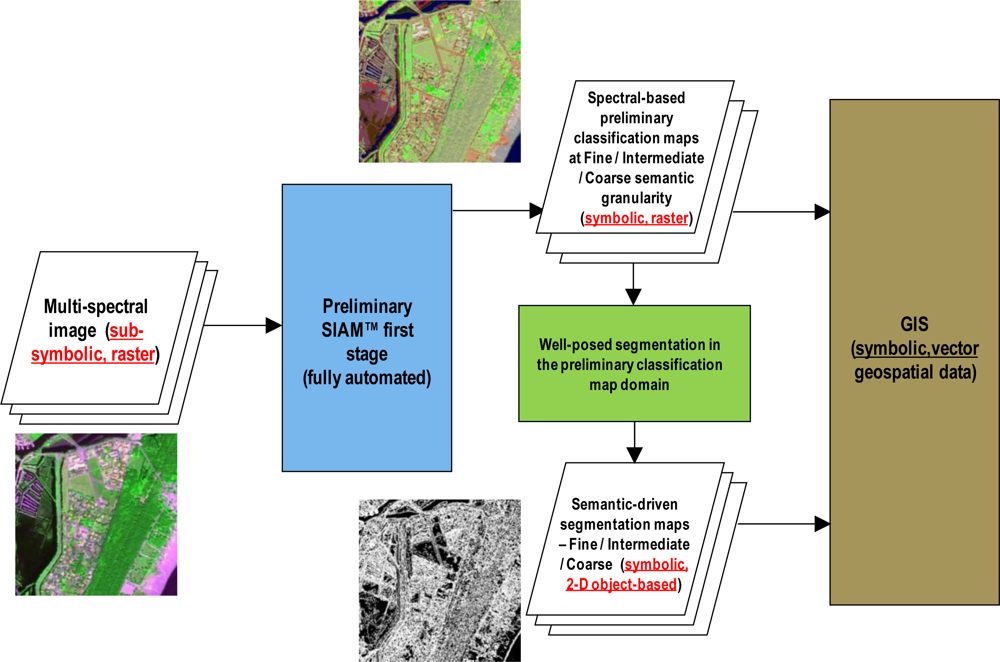
<p>As proof-of-concept of symbolic physical model-based pre-attentive vision first stage, the spectral knowledge-based, operational, near real-time, multi-sensor, multi-resolution, application-independent (general-purpose) Satellite Image Automatic Mapper™ (SIAM™) is selected from existing literature [<xref ref-type="bibr" rid="b15-remotesensing-04-02768">15</xref>–<xref ref-type="bibr" rid="b24-remotesensing-04-02768">24</xref>]. SIAM™ is termed “<italic>fully automatic</italic>” because it requires neither user-defined parameters nor training data samples to run. It is termed “<italic>operational</italic>” because, according to existing literature, all of its OQIs score high in real-world applications, including RS image classification at large (e.g., continental) spatial scale and fine semantic granularity (refer to Section 2 in [<xref ref-type="bibr" rid="b3-remotesensing-04-02768">3</xref>]). As output SIAM™ automatically generates RS image segmentation maps at multiple spatial scales together with RS image pre-classification maps at multiple semantic granularities.</p>
<p>In the RS literature, expert systems have been (almost) exclusively proposed in the attentive vision second-stage classification [<xref ref-type="bibr" rid="b25-remotesensing-04-02768">25</xref>–<xref ref-type="bibr" rid="b34-remotesensing-04-02768">34</xref>]. The sole exceptions these authors are aware of regard the physical model-based spectral decision-tree classifier (SPECL), implemented as a by-product in the Atmospheric/Topographic Correction (ATCOR-2/3/4) commercial software toolbox [<xref ref-type="bibr" rid="b35-remotesensing-04-02768">35</xref>,<xref ref-type="bibr" rid="b36-remotesensing-04-02768">36</xref>] for the estimation of biophysical variables from RS optical imagery [<xref ref-type="bibr" rid="b37-remotesensing-04-02768">37</xref>,<xref ref-type="bibr" rid="b38-remotesensing-04-02768">38</xref>] (for more details about SPECL, refer to Section 2 below). It means that, to the best of these authors’ knowledge, this is the first time a symbolic syntactic inference system, like SIAM™, is made available to the RS community for operational use in a RS-IUS pre-attentive vision first stage, to accomplish multi-scale image segmentation and multi-granularity image pre-classification simultaneously, automatically and in near real-time.</p>
<p>The rest of this paper is organized as follows. Section 2 reviews the conclusions of the first part of this work about weaknesses of the GEOBIA/GEOOIA systems and existing alternative solutions [<xref ref-type="bibr" rid="b3-remotesensing-04-02768">3</xref>]. Recently presented in literature [<xref ref-type="bibr" rid="b15-remotesensing-04-02768">15</xref>–<xref ref-type="bibr" rid="b23-remotesensing-04-02768">23</xref>], a novel hybrid RS-IUS architecture and instantiation employing the operational automatic near-real-time SIAM™ decision-tree preliminary classifier as its symbolic deductive pre-attentive vision first stage is introduced in Section 3. Section 4 selects from literature an application of the proposed hybrid RS-IUS implementation to provide a practical example of its degree of novelty [<xref ref-type="bibr" rid="b21-remotesensing-04-02768">21</xref>]. Section 5, which is the core of this work, investigates the degree of novelty of the proposed hybrid RS-IUS architecture and instantiation at the four levels of understanding of an information processing system (refer to this section above) [<xref ref-type="bibr" rid="b14-remotesensing-04-02768">14</xref>,<xref ref-type="bibr" rid="b21-remotesensing-04-02768">21</xref>]. New interdisciplinary research and market opportunities opened up by the proposed hybrid RS-IUS implementation are discussed in Section 6. Conclusions are reported in Section 7.</p></sec>
<sec>
<label>2.</label>
<title>Problem Recognition and Opportunity Identification</title>
<p>To better deal with different applications, users and target classes, <italic>i.e.</italic>, to increase its OQIs (refer to Section 2 in [<xref ref-type="bibr" rid="b3-remotesensing-04-02768">3</xref>]), a traditional two-stage non-iterative GEOBIA architecture (refer to Section 6 in [<xref ref-type="bibr" rid="b3-remotesensing-04-02768">3</xref>]) should rather be considered cyclic (iterative) [<xref ref-type="bibr" rid="b32-remotesensing-04-02768">32</xref>]. To reach this objective, a three-stage iterative GEOOIA architecture, where GEOBIA is a special case of GEOOIA, <italic>i.e.</italic>, GEOOIA ⊃ GEOBIA, was recently proposed to the RS community and implemented in a popular RS-IUS commercial software product [<xref ref-type="bibr" rid="b5-remotesensing-04-02768">5</xref>–<xref ref-type="bibr" rid="b9-remotesensing-04-02768">9</xref>] (refer to Section 7 in [<xref ref-type="bibr" rid="b3-remotesensing-04-02768">3</xref>]).</p>
<p>According to existing literature and despite its commercial success, the GEOBIA/GEOOIA systems remain affected by a lack of productivity, general consensus and research [<xref ref-type="bibr" rid="b4-remotesensing-04-02768">4</xref>,<xref ref-type="bibr" rid="b33-remotesensing-04-02768">33</xref>,<xref ref-type="bibr" rid="b34-remotesensing-04-02768">34</xref>] (refer to Section 2 in [<xref ref-type="bibr" rid="b3-remotesensing-04-02768">3</xref>]). To explain these lacks, the SWOT analysis of the GEOBIA/GEOOIA paradigm conducted in the first part of this methodological work has reached the following conclusions (see Section 9 in [<xref ref-type="bibr" rid="b3-remotesensing-04-02768">3</xref>]).</p>
<list list-type="order">
<list-item>
<p>Popular GEOBIA and GEOOIA commercial software products, like those listed in <xref ref-type="table" rid="t1-remotesensing-04-02768">Table 1</xref> of [<xref ref-type="bibr" rid="b3-remotesensing-04-02768">3</xref>], do not comply with the QA4EO requirements, where radiometric calibration of RS imagery is considered a pre-requisite to ensure the harmonization and interoperability of multi-source multi-temporal observational data and derived products. By definition, radiometric calibration is the transformation of dimensionless digital numbers (DNs) into a community-agreed physical unit of radiometric measure. The relaxation of the requirement of radiometric consistency of multi-source, multi-temporal and multi-spectral (MS) imagery brings, as an inevitable consequence, that these RS-IUS commercial software products are based on (inherently ill-posed) statistical rather than physical models. In the MAL and RS literature it is acknowledged that, due to their inherent ill-posedness, inductive inference systems: (i) are intrinsically semi-automatic and site-specific and (ii) require <italic>prior knowledge</italic> in addition to data to become better conditioned for numerical treatment (refer to Section 4.2 in [<xref ref-type="bibr" rid="b3-remotesensing-04-02768">3</xref>]). In practice, to become better posed for numerical treatment, any statistical system requires ignition of deductive inference which makes the resulting inference system <italic>hybrid</italic>.</p></list-item>
<list-item>
<p>In the CV literature, according to Marr “vision goes symbolic almost immediately, right at the level of zero-crossing (pre-attentive primal sketch) ... without loss of information” ([<xref ref-type="bibr" rid="b14-remotesensing-04-02768">14</xref>]; p. 343). If this conjecture holds true, then the symbolic hybrid human vision system comprises a symbolic hybrid pre-attentive vision sub-system subjected to the following constraints (refer to Section 5 in [<xref ref-type="bibr" rid="b3-remotesensing-04-02768">3</xref>]).</p>
<list list-type="roman-upper">
<list-item>
<p>Symbolic pre-attentive vision is general-purpose (application-independent), parallel and rapid (efficient). It generates as output a (symbolic) preliminary classification (pre-classification) map of the input image. Hence, the symbolic pre-attentive vision first stage accomplishes image feature extraction (image segmentation) and image pre-classification simultaneously.</p></list-item>
<list-item>
<p>Symbolic pre-attentive semantic labels belong to a discrete and finite set of semi-concepts whose degree of semantic information must be superior to zero and equal or inferior to that of concepts detected by the attentive vision second phase.</p></list-item>
<list-item>
<p>The inverse mapping of the pre-classification map back to the input image domain generates a piecewise constant approximation of the input image equivalent to an edge-preserving smoothing filter where image details featuring high spatial-frequency components are well preserved.</p></list-item></list></list-item></list>
<p>To be considered inspired to human vision, an artificial vision system should be implemented as a symbolic hybrid inference system comprising a symbolic hybrid pre-attentive vision sub-system capable of complying with the aforementioned requirements (I) to (III). On the contrary, both GEOBIA and GEOOIA are not biologically plausible, which is in contrast with their original goal of attempting to replicate human vision (refer to Section 6.1 in [<xref ref-type="bibr" rid="b3-remotesensing-04-02768">3</xref>]). In particular:
<list list-type="simple">
<list-item>
<p>✓ in place of a symbolic pre-attentive vision first stage capable of accomplishing the aforementioned requirements (I) to (III), both GEOBIA and GEOOIA adopt the same sub-symbolic (inherently ill-posed) statistical approach.</p></list-item>
<list-item>
<p>✓ At the attentive vision second stage, both GEOBIA and GEOOIA may or may not employ symbolic syntactic inference. If they do not, they are fully statistical systems.</p></list-item></list>To recapitulate, when compared to human vision GEOBIA and GEOOIA systems lack deductive inference mechanisms starting at their pre-attentive vision first stage.</p>
<p>To outperform existing GEOBIA and GEOOIA systems, the goal of the present second part of this methodological work (refer to Section 1) can be reformulated as follows: provide, at the four levels of understanding of an information processing system, a critical analysis of a novel hybrid RS-IUS design and implementation, selected from existing literature [<xref ref-type="bibr" rid="b15-remotesensing-04-02768">15</xref>–<xref ref-type="bibr" rid="b23-remotesensing-04-02768">23</xref>], where the spectral knowledge-based, operational, automatic, near real-time SIAM™ preliminary classifier is adopted as its symbolic, deductive pre-attentive vision first stage, to comply with:</p>
<list list-type="alpha-upper">
<list-item>
<p>the QA4EO guidelines (refer to Section 2 in [<xref ref-type="bibr" rid="b3-remotesensing-04-02768">3</xref>]),</p></list-item>
<list-item>
<p>the symbolic pre-attentive vision sub-system constraints (I) to (III) listed in this section above (refer to Section 5 in [<xref ref-type="bibr" rid="b3-remotesensing-04-02768">3</xref>]),</p></list-item>
<list-item>
<p>the requirements specification for an RS-IUS to be considered operational. In particular, all OQIs featured by an operational RS-IUS must score “high” (<italic>i.e.</italic>, be superior to community-agreed reference standards) in real-world applications, including RS image classification at large (e.g., continental, global) spatial scale and fine semantic granularity (refer to Section 2 in [<xref ref-type="bibr" rid="b3-remotesensing-04-02768">3</xref>]).</p></list-item></list>
<p>It is important to mention that, to the best of these authors’ knowledge, only one alternative to the deductive, operational, automatic SIAM™ preliminary classifier can be found in the RS-IUS commercial software products listed in <xref ref-type="table" rid="t1-remotesensing-04-02768">Table 1</xref> of [<xref ref-type="bibr" rid="b3-remotesensing-04-02768">3</xref>]. This exception is represented by the spectral knowledge-based decision-tree classifier (SPECL), implemented as a by-product in the Atmospheric Correction (ATCOR-2/3/4) commercial software toolbox [<xref ref-type="bibr" rid="b35-remotesensing-04-02768">35</xref>,<xref ref-type="bibr" rid="b37-remotesensing-04-02768">37</xref>,<xref ref-type="bibr" rid="b38-remotesensing-04-02768">38</xref>]. Although they belong to the same family of operational, pixel-based, syntactic inference systems, SIAM™ and SPECL are totally different in terms of both algorithm design and implementation. For example:
<list list-type="bullet">
<list-item>
<p>The SPECL class grammars consist of one single spectral rule per spectral category (surface type) [<xref ref-type="bibr" rid="b37-remotesensing-04-02768">37</xref>], while the SIAM™ class grammars consist of logical combinations of so-called spectral rules with spectral fuzzy sets [<xref ref-type="bibr" rid="b17-remotesensing-04-02768">17</xref>], where: (i) a so-called spectral rule defines a buffer zone of spectral tolerance, irrespective of the absolute intensity of spectral bands, by means of relational operators (&lt;, &gt;, ≤, ≥) between spectral bands, (ii) spectral fuzzy sets (e.g., low, medium, high) are extracted from spectral variables, namely, spectral bands or spectral indexes, and (iii) one class grammar is a combination of logical operators (AND, OR, NOT) with one or more spectral buffer zones and spectral fuzzy sets.</p></list-item>
<list-item>
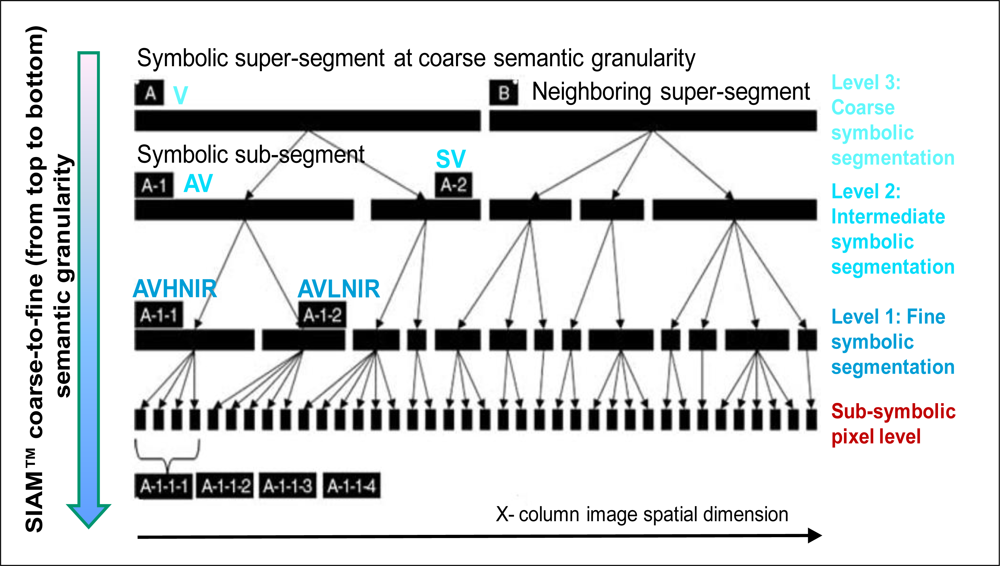
<p>The hierarchical (sorted) list of class grammars detected by SPECL includes: (1) snow/ice, (2) cloud, (3) bright bare soil/sand/soil/cloud, (4) dark bare soil, (5) average vegetation, (6) bright vegetation, (7) dark vegetation, (8) yellow vegetation, (9) mix of vegetation/soil, (10) asphalt/dark sand, (11) sand/bare soil/cloud, (12) bright sand/soil/cloud, (13) dry vegetation/soil, (14) sparse vegetation/soil, (15) turbid water, (16) clear water, (17) clear water over sand, (18) shadow, (19) not classified. The list of class grammars (<italic>structural knowledge</italic>, refer to Section 4.1 in [<xref ref-type="bibr" rid="b3-remotesensing-04-02768">3</xref>]) and their order of presentation (<italic>procedural knowledge</italic>, refer to Section 4.1 in [<xref ref-type="bibr" rid="b3-remotesensing-04-02768">3</xref>]) is completely different from SPECL to SIAM™, e.g., refer to [<xref ref-type="bibr" rid="b17-remotesensing-04-02768">17</xref>]. In terms of semantic granularity SPECL is quite coarser (simpler) than SIAM™. The latter generates as output three standard preliminary classification maps at fine, intermediate and coarse semantic granularities, where a symbolic parent-child relationship is enforced (refer to Section 5.4 below). Depending on the spectral resolution of the input image, SIAM™ detects up to 95 spectral categories at fine semantic granularity (see <xref ref-type="table" rid="t1-remotesensing-04-02768">Table 1</xref> below).</p></list-item></list></p>
<p>For more details about the SIAM™ input data requirements and data-derived product specifications, refer to Section 5.4 below.</p></sec>
<sec>
<label>3.</label>
<title>Proposed Hybrid RS-IUS Architecture Employing a Symbolic Deductive Context-Insensitive Pre-Attentive Vision First Stage</title>
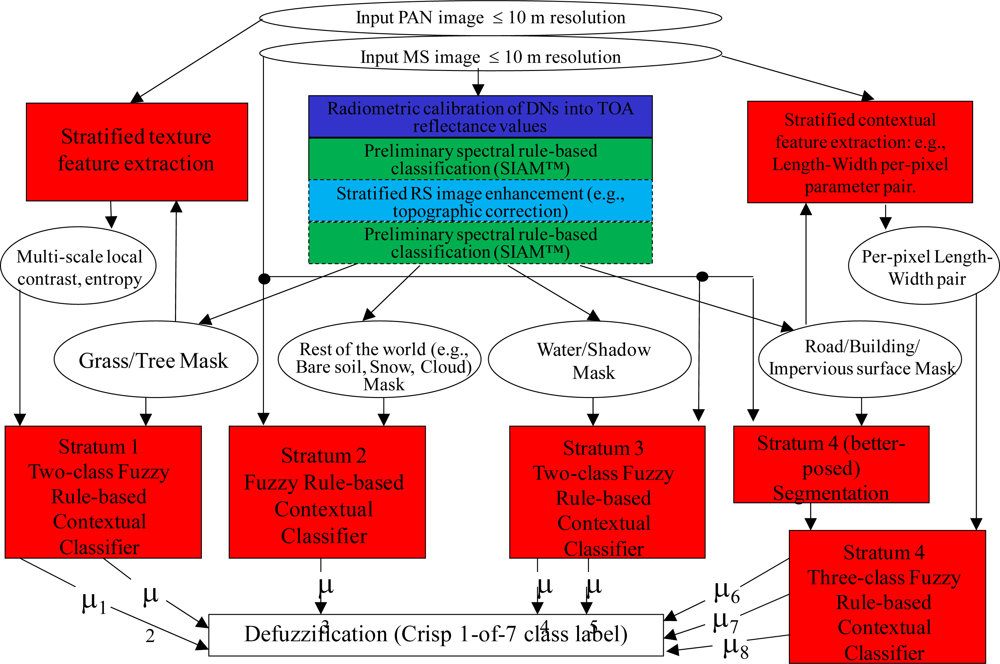
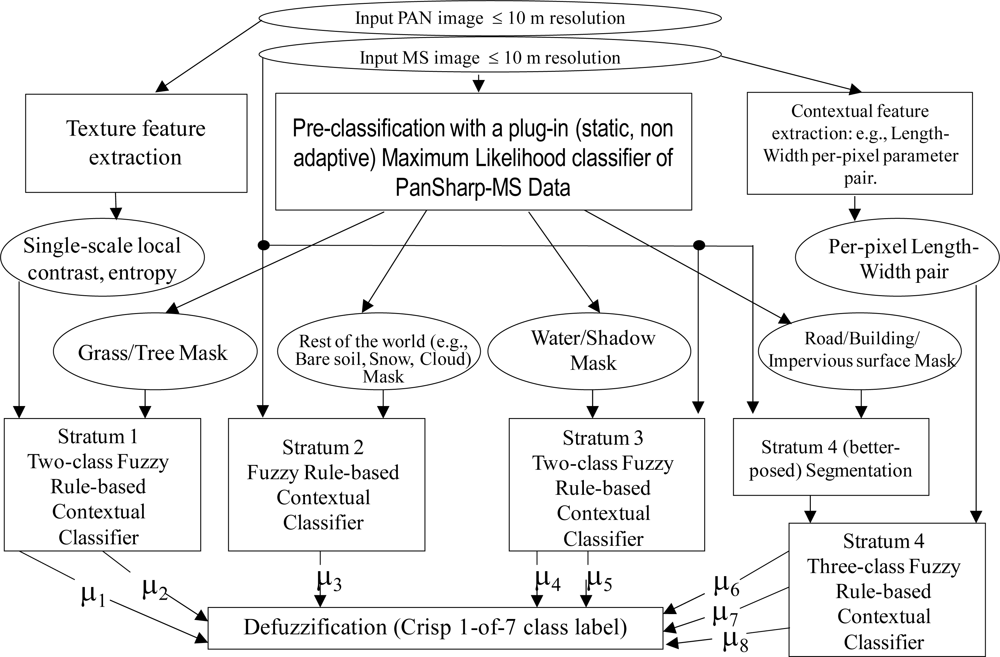
<p>Accounting for the customary distinction between a model and the algorithm used to identify it [<xref ref-type="bibr" rid="b14-remotesensing-04-02768">14</xref>,<xref ref-type="bibr" rid="b39-remotesensing-04-02768">39</xref>], an original hybrid RS-IUS architecture (model, scheme, design) was identified by one of the present authors starting from several RS-IUS implementations proposed by Shackelford and Davis in recent years [<xref ref-type="bibr" rid="b28-remotesensing-04-02768">28</xref>–<xref ref-type="bibr" rid="b30-remotesensing-04-02768">30</xref>], see <xref ref-type="fig" rid="f1-remotesensing-04-02768">Figure 1</xref>. In terms of <italic>induction</italic> (from true facts to generalizations) and <italic>deduction</italic> (from generalizations to true facts) rules of inference (refer to Section 4 in [<xref ref-type="bibr" rid="b3-remotesensing-04-02768">3</xref>]), the proposed novel class of hybrid RS-IUSs can be summarized as follows (see <xref ref-type="fig" rid="f2-remotesensing-04-02768">Figure 2</xref>).</p>
<list list-type="simple">
<list-item>
<p>A MS image enhancement phase (identified as Stage 0 (zero)), including: (a) a RS image radiometric calibration of DNs into top-of-atmosphere (TOA) reflectance (TOARF) or surface reflectance (SURF) values, where SURF is a special case of TOARF in very clear sky conditions, <italic>i.e.</italic>, TOARF ⊇ SURF, considered mandatory in compliance with the QA4EO guidelines, and (b) an optional battery of stratified (driven-by-knowledge, symbolic mask-conditioned) image enhancement algorithms, e.g., stratified topographic correction [<xref ref-type="bibr" rid="b20-remotesensing-04-02768">20</xref>],</p></list-item>
<list-item>
<p>+ (in series with)</p></list-item>
<list-item>
<p>Symbolic, physical model-based, application-independent, context-insensitive (per-pixel) pre-attentive vision first stage (preliminary classification, identified as Stage 1), provided with a feedback loop to feed the pre-attentive vision Stage 1 (categorical) output back to the pre-processing Stage 0 input for stratified MS image enhancement,</p></list-item>
<list-item>
<p>+ (in series with)</p></list-item>
<list-item>
<p>Attentive vision second phase (identified as stage 2) comprising a hierarchical battery of stratified application-, sensor- and class-specific, context-sensitive, statistical model-based and/or physical model-based algorithms for feature extraction and one-class classification.</p></list-item></list>
<p>It means that the proposed hybrid RS-IUS architecture is a three-stage, stratified, hierarchical, hybrid, feedback RS-IUS employing a symbolic, deductive, context-insensitive pre-attentive vision first stage. The three stages are described below [<xref ref-type="bibr" rid="b15-remotesensing-04-02768">15</xref>–<xref ref-type="bibr" rid="b23-remotesensing-04-02768">23</xref>] (see <xref ref-type="fig" rid="f2-remotesensing-04-02768">Figure 2</xref>).</p>
<list list-type="order">
<list-item>
<p>An RS image enhancement (pre-processing) block, identified as Stage 0 (zero) to account for its preliminary contribution to RS data classification, considered as the core of the proposed RS-IUS design. By definition, a data enhancement algorithm is input with numerical (sensory) data to generate as output numerical data of enhanced quality, e.g., geometric and/or radiometric quality. By definition, a data classification system is input with sub-symbolic numerical data, e.g., an RS image, to provide as output a semantic labeling of the input dataset, e.g., a classification (2-D) map. The proposed image enhancement Stage 0 consists of two parts, the first one compulsory and the second part optional as described below.</p>
<list list-type="bullet">
<list-item>
<p>A RS image radiometric calibration considered mandatory to accomplish the transformation of dimensionless DNs into a community-agreed physical unit of radiometric measure, in compliance with: (a) the QA4EO guidelines, where calibration and validation (Cal/Val) activities are considered critical to a GEO data quality assurance (QA) strategy and thus to data usability [<xref ref-type="bibr" rid="b2-remotesensing-04-02768">2</xref>] (refer to Section 2 in [<xref ref-type="bibr" rid="b3-remotesensing-04-02768">3</xref>]), (b) common knowledge in the RS community, where “the prerequisite for physically based, quantitative analysis of airborne and satellite sensor measurements in the optical domain is their calibration to spectral radiance” ([<xref ref-type="bibr" rid="b41-remotesensing-04-02768">41</xref>], p. 29) and (c) the thesis that radiometric calibration is a necessary not sufficient condition for automatic interpretation of input EO imagery [<xref ref-type="bibr" rid="b15-remotesensing-04-02768">15</xref>–<xref ref-type="bibr" rid="b23-remotesensing-04-02768">23</xref>]. In particular, the radiometric calibration at Stage 0 is required to transform DNs into TOARF or SURF values, with TOARF ⊇ SURF, the latter being an ideal case of the former in very clear sky conditions [<xref ref-type="bibr" rid="b42-remotesensing-04-02768">42</xref>]. The requirement for RS data to be calibrated into TOARF or SURF values means that solving the inherently difficult-to-solve (ill-posed) atmospheric correction problem is considered optional, rather than compulsory. It is noteworthy that, among popular RS-IUS commercial software products listed in <xref ref-type="table" rid="t1-remotesensing-04-02768">Table 1</xref> of [<xref ref-type="bibr" rid="b3-remotesensing-04-02768">3</xref>], only the physical model-based ATCOR-2/3/4 (where the syntactic pixel-based SPECL preliminary classifier alternative to SIAM™ is implemented as a by-product, refer to Section 2) considers radiometric calibration mandatory [<xref ref-type="bibr" rid="b35-remotesensing-04-02768">35</xref>,<xref ref-type="bibr" rid="b37-remotesensing-04-02768">37</xref>]. It means that the other RS-IUS commercial software products, including popular GEOBIA/GEOOIA systems (refer to Section 2), are based on inherently ill-posed, semi-automatic and site-specific statistical models, refer to Section 4.2 in [<xref ref-type="bibr" rid="b3-remotesensing-04-02768">3</xref>].</p></list-item>
<list-item>
<p>A feedback loop feeds the symbolic deductive pre-attentive vision Stage 1 (categorical) output back to the pre-processing Stage 0 input for stratified (driven-by-knowledge, symbolic mask-conditioned) RS image enhancement. Thus, depending on the Stage 1 output, the hybrid (numerical and categorical) input of Stage 0 is adjusted so as to reach a system steady-state. This means that the proposed hybrid RS-IUS is a feedback system. The <italic>principle of stratification</italic> is popular in statistics (e.g., refer to the well-known stratified random sampling design [<xref ref-type="bibr" rid="b43-remotesensing-04-02768">43</xref>]). Its advantage is that “stratification will always achieve greater precision provided that the strata have been chosen so that members of the same stratum are as similar as possible in respect of the characteristic of interest” [<xref ref-type="bibr" rid="b44-remotesensing-04-02768">44</xref>]. In other words, (inherently ill-posed) statistical models become better posed (conditioned, constrained) by incorporating the “stratified” or “layered” approach, which is typical of decision-trees [<xref ref-type="bibr" rid="b45-remotesensing-04-02768">45</xref>], to accomplish driven-by-knowledge regularization (simplification) of the solution space. In general, “to reduce the effect of multiple solutions, regularization is required, which involves the introduction of additional constraints or the introduction of some <italic>a priori</italic> information about the expected estimates of the statistical variables” [<xref ref-type="bibr" rid="b37-remotesensing-04-02768">37</xref>]. In common practice the statistical principle of stratification is equivalent to the well-known divide-and-conquer (<italic>dividi et impera</italic>) problem-solving approach [<xref ref-type="bibr" rid="b45-remotesensing-04-02768">45</xref>–<xref ref-type="bibr" rid="b47-remotesensing-04-02768">47</xref>]. The same stratification principle is exploited at the second stage of the RS-IUS instantiations presented by Shackelford and Davis in RS literature [<xref ref-type="bibr" rid="b28-remotesensing-04-02768">28</xref>–<xref ref-type="bibr" rid="b30-remotesensing-04-02768">30</xref>], see <xref ref-type="fig" rid="f1-remotesensing-04-02768">Figure 1</xref>. The “stratified” approach is also employed in the GEOOIA scheme (see <xref ref-type="fig" rid="f4-remotesensing-04-02768">Figure 4</xref> in [<xref ref-type="bibr" rid="b3-remotesensing-04-02768">3</xref>]) at the attentive vision second phase, where driven-by-knowledge class-specific image-object-based classification and segmentation algorithms can be iterated. For example, in the Definiens GEOOIA commercial software products, the stratification principle is called “class filter”, such that image objects will be part of the search domain, called “image object domain”, if they are classified with one of the classes selected in the class filter [<xref ref-type="bibr" rid="b5-remotesensing-04-02768">5</xref>–<xref ref-type="bibr" rid="b8-remotesensing-04-02768">8</xref>]. On the contrary, any “layered” approach is absent from the traditional two-stage non-iterative GEOBIA design shown in <xref ref-type="fig" rid="f2-remotesensing-04-02768">Figure 2</xref> in [<xref ref-type="bibr" rid="b3-remotesensing-04-02768">3</xref>], which is the reason why it is outperformed by the GEOOIA scheme [<xref ref-type="bibr" rid="b4-remotesensing-04-02768">4</xref>]. A possible disadvantage of stratification is that identification of appropriate strata may be difficult [<xref ref-type="bibr" rid="b44-remotesensing-04-02768">44</xref>]. To recapitulate, in agreement with a well-known divide-and-conquer problem-solving approach, Stage 0 is eligible for combining as input sub-symbolic sensory (numerical) data with semantic information to accomplish any of the following driven-by-knowledge RS image enhancement tasks.</p>
<list list-type="simple">
<list-item>
<p>✓ Stratified RS image topographic correction (TOC). It is well known in existing literature that TOC is an ill-posed circular dilemma (chicken-and-egg problem): while image classification benefits from preliminary TOC, the latter requires <italic>a priori</italic> knowledge of surface roughness which is land cover class specific. To overcome the TOC inherent ill-posedness, “more research regarding the use of better stratification methods” was strongly encouraged [<xref ref-type="bibr" rid="b48-remotesensing-04-02768">48</xref>,<xref ref-type="bibr" rid="b49-remotesensing-04-02768">49</xref>] and accomplished in practice via SIAM™ [<xref ref-type="bibr" rid="b20-remotesensing-04-02768">20</xref>].</p></list-item>
<list-item>
<p>✓ Stratified RS image co-registration between a geo-referenced master image and an input image, where a preliminary classification map is input to a stratified image feature extraction and a stratified image feature matching phase where semantic and iconic image features are combined according to a convergence-of-evidence approach [<xref ref-type="bibr" rid="b50-remotesensing-04-02768">50</xref>].</p></list-item>
<list-item>
<p>✓ Stratified image mosaicking, e.g., refer to [<xref ref-type="bibr" rid="b19-remotesensing-04-02768">19</xref>].</p></list-item>
<list-item>
<p>✓ Stratified bidirectional reflectance distribution function (BRDF) effect correction, e.g., refer to [<xref ref-type="bibr" rid="b35-remotesensing-04-02768">35</xref>,<xref ref-type="bibr" rid="b36-remotesensing-04-02768">36</xref>,<xref ref-type="bibr" rid="b38-remotesensing-04-02768">38</xref>].</p></list-item></list></list-item></list></list-item>
<list-item>
<p>A symbolic, syntactic, application-independent, per-pixel (non-contextual) pre-attentive vision first stage, identified as Stage 1 (refer to Section 5 in [<xref ref-type="bibr" rid="b3-remotesensing-04-02768">3</xref>]) [<xref ref-type="bibr" rid="b14-remotesensing-04-02768">14</xref>]. Since it is pixel-based, this preliminary classification (pre-classification) first stage investigates spectral information exclusively, <italic>i.e.</italic>, chromatic and achromatic (brightness) information that is the sole non-contextual level of information in a (2-D) image (unlike, say, texture, shape, spatial relationships between image-objects, <italic>etc</italic>.). For example, if a pixel’s color value is red (<italic>i.e.</italic>, if a pixel’s color value is [255, 0, 0] in a standard Red-Green-Blue color space), that color value depends not at all on the color values of neighboring pixels (although the way that pixel is perceived by a human observer may change with its context). To the best of these authors’ knowledge, in existing RS literature there are three examples of symbolic per-pixel pre-attentive vision first stage implementations, including one statistical and two syntactic models.
<list list-type="bullet">
<list-item>
<p>In their original works Shackelford and Davis implemented the non-contextual preliminary classification first stage as a pixel-based, statistical, parametric, plug-in (non-adaptive to input data) maximum-likelihood (MXLKL) classifier [<xref ref-type="bibr" rid="b28-remotesensing-04-02768">28</xref>–<xref ref-type="bibr" rid="b30-remotesensing-04-02768">30</xref>]. Unfortunately, OQIs (refer to Section 2 in [<xref ref-type="bibr" rid="b3-remotesensing-04-02768">3</xref>]) featured by an MXLKL classifier are well known to score low, in particular: (i) the MXLKL (Gaussian) parameters must be plugged-in (set) by a human operator based on class-specific (Gaussian) parameter estimation from a reference data distribution, thus timeliness together with costs can be high due to the collection of reference samples and (ii) MXLKL is typically affected by salt-and-pepper classification noise effects, which means its accuracy, robustness to changes in the input data set and scalability tend to be low (refer to Section 2 in [<xref ref-type="bibr" rid="b3-remotesensing-04-02768">3</xref>]) [<xref ref-type="bibr" rid="b28-remotesensing-04-02768">28</xref>–<xref ref-type="bibr" rid="b30-remotesensing-04-02768">30</xref>].</p></list-item>
<list-item>
<p>To improve the OQIs featured by a pre-attentive vision first-stage MXLKL classifier adopted by Shackelford and Davis, the syntactic, operational, automatic, near-real-time, multi-sensor, multi-resolution, application-independent, pixel-based SIAM™ preliminary classifier has been proposed at the symbolic pre-attentive vision first stage of an hybrid RS-IUS in recent years [<xref ref-type="bibr" rid="b15-remotesensing-04-02768">15</xref>–<xref ref-type="bibr" rid="b23-remotesensing-04-02768">23</xref>] (for more details about SIAM™, refer to Section 5 below).</p></list-item>
<list-item>
<p>The sole syntactic per-pixel MS image preliminary classifier alternative to SIAM™ found in commercial software toolboxes is SPECL, considered as a by-product in the ATCOR-2/3/4 [<xref ref-type="bibr" rid="b35-remotesensing-04-02768">35</xref>,<xref ref-type="bibr" rid="b37-remotesensing-04-02768">37</xref>], refer to Section 2.</p></list-item></list>It has been said that, according to the Marr conjecture [<xref ref-type="bibr" rid="b14-remotesensing-04-02768">14</xref>], a symbolic pre-attentive human vision first stage accomplishes image sub-symbolic segmentation and image symbolic pre-classification simultaneously (refer to Section 5 in [<xref ref-type="bibr" rid="b3-remotesensing-04-02768">3</xref>]). In the case of a RS-IUS symbolic per-pixel pre-attentive vision first stage, its output products, namely, semi-symbolic and sub-symbolic image-objects (refer to Section 1), are similar to those of a traditional two-stage non-iterative GEOBIA system, namely, sub-symbolic and symbolic image-objects. Their difference is twofold: (i) they are generated in reverse order (in GEOBIA, sub-symbolic image-object detection comes before symbolic image-object labeling) and (ii) the semantic level of information of semi-concepts is never superior to that of concepts because the latter comprise the former as a special case, <italic>i.e.</italic>, the relation concepts ⊇ semi-concepts always holds (refer to Section 5 in [<xref ref-type="bibr" rid="b3-remotesensing-04-02768">3</xref>]).</p></list-item>
<list-item>
<p>An attentive vision second stage battery of stratified, hierarchical, context-sensitive, application- and sensor-dependent modules for class-specific feature extraction and one-class classification, identified as stage 2. This attentive vision second-stage stratified classification: (i) provides a possible instantiation of a focus-of-visual-attention mechanism to mimic that adopted by attentive vision in mammals (refer to Section 5 in [<xref ref-type="bibr" rid="b3-remotesensing-04-02768">3</xref>]), which increases the overall degree of biological plausibility of the proposed hybrid RS-IUS, and (ii) allows second-stage inductive data learning algorithms, if any, to be better posed (conditioned) by symbolic prior knowledge (namely, semantic strata) stemming from the preliminary classification first stage (refer to Section 4.2 in [<xref ref-type="bibr" rid="b3-remotesensing-04-02768">3</xref>]). Context-dependent image information to be investigated at the attentive vision second stage on a stratified class-, sensor- and application-specific basis exclusively, encompasses:</p>
<list list-type="simple">
<list-item>
<p>♦ texture [<xref ref-type="bibr" rid="b51-remotesensing-04-02768">51</xref>],</p></list-item>
<list-item>
<p>♦ morphology [<xref ref-type="bibr" rid="b52-remotesensing-04-02768">52</xref>],</p></list-item>
<list-item>
<p>♦ shape attributes of image-objects [<xref ref-type="bibr" rid="b25-remotesensing-04-02768">25</xref>],</p></list-item>
<list-item>
<p>♦ inter-object non-spatial relations (e.g., subset-of, part-of) [<xref ref-type="bibr" rid="b25-remotesensing-04-02768">25</xref>–<xref ref-type="bibr" rid="b30-remotesensing-04-02768">30</xref>],</p></list-item>
<list-item>
<p>♦ inter-object spatial topological relations (e.g., adjacency, inclusion, <italic>etc</italic>.) [<xref ref-type="bibr" rid="b25-remotesensing-04-02768">25</xref>–<xref ref-type="bibr" rid="b30-remotesensing-04-02768">30</xref>],</p></list-item>
<list-item>
<p>♦ inter-object spatial non-topological relations (e.g., distance, angle) [<xref ref-type="bibr" rid="b25-remotesensing-04-02768">25</xref>–<xref ref-type="bibr" rid="b27-remotesensing-04-02768">27</xref>],</p></list-item>
<list-item>
<p>♦ inter-object temporal relations [<xref ref-type="bibr" rid="b25-remotesensing-04-02768">25</xref>–<xref ref-type="bibr" rid="b27-remotesensing-04-02768">27</xref>].</p></list-item></list></list-item></list>
<p>An instantiation of the proposed hybrid RS-IUS architecture is shown in <xref ref-type="fig" rid="f2-remotesensing-04-02768">Figure 2</xref>, where the operational, automatic, near-real-time SIAM™ preliminary classifier is adopted as its symbolic deductive, pixel-based pre-attentive vision first stage [<xref ref-type="bibr" rid="b15-remotesensing-04-02768">15</xref>–<xref ref-type="bibr" rid="b23-remotesensing-04-02768">23</xref>]. In this example, where a high spatial resolution (&lt;10 m) spaceborne image is selected as input, man-made objects in the 3-D imaged-scene (e.g., roads, buildings, impervious surfaces, agricultural fields, <italic>etc</italic>.) are expected to be visible in the (2-D) image. A panchromatic (PAN) image, generated as a linear combination of the input MS bands [<xref ref-type="bibr" rid="b31-remotesensing-04-02768">31</xref>], is employed as input by the SIAM™ pre-attentive vision first stage and, if required, by the attentive vision second stage. For example, in line with the works by Shackelford and Davis [<xref ref-type="bibr" rid="b28-remotesensing-04-02768">28</xref>–<xref ref-type="bibr" rid="b30-remotesensing-04-02768">30</xref>], the image local areas overlapping with the SIAM™ spectral category ‘<italic>vegetation</italic>’ are classified by the attentive vision second stage into the LC classes ‘<italic>forest</italic>’ and ‘<italic>grassland</italic>’ by means of a stratified class-specific texture detector run on the PAN image, which reduces computation time. In addition, <xref ref-type="fig" rid="f2-remotesensing-04-02768">Figure 2</xref> shows that an inductive piecewise-constant image segmentation algorithm (provided with no texture model) is run at the attentive vision second stage exclusively and selectively, to become better posed, upon the image local areas overlapping with the SIAM™ spectral category ‘<italic>bare soil or built-up</italic>’, where image-objects belonging to the target LC classes ‘<italic>roads</italic>’, ‘<italic>buildings</italic>’, and ‘<italic>impervious surfaces</italic>’ can be identified by peculiar combinations of geometric properties (e.g., compactness, rectangularity, elongatedness, number of vertices, <italic>etc</italic>.) and spatial relationships [<xref ref-type="bibr" rid="b25-remotesensing-04-02768">25</xref>,<xref ref-type="bibr" rid="b30-remotesensing-04-02768">30</xref>,<xref ref-type="bibr" rid="b31-remotesensing-04-02768">31</xref>].</p>
<p>To recapitulate, the main conceptual differences between the four aforementioned RS-IUS architectures and implementations, namely, GEOBIA (see <xref ref-type="fig" rid="f2-remotesensing-04-02768">Figure 2</xref> in [<xref ref-type="bibr" rid="b3-remotesensing-04-02768">3</xref>]), GEOOIA (see <xref ref-type="fig" rid="f4-remotesensing-04-02768">Figure 4</xref> in [<xref ref-type="bibr" rid="b3-remotesensing-04-02768">3</xref>]), Shackelford and Davis (see <xref ref-type="fig" rid="f1-remotesensing-04-02768">Figure 1</xref>) and the novel hybrid RS-IUS (see <xref ref-type="fig" rid="f2-remotesensing-04-02768">Figure 2</xref>), are summarized below.
<list list-type="bullet">
<list-item>
<p>Both the two-stage non-iterative GEOBIA scheme (see <xref ref-type="fig" rid="f2-remotesensing-04-02768">Figure 2</xref> in [<xref ref-type="bibr" rid="b3-remotesensing-04-02768">3</xref>]) and the three-stage iterative GEOOIA design (see <xref ref-type="fig" rid="f4-remotesensing-04-02768">Figure 4</xref> in [<xref ref-type="bibr" rid="b3-remotesensing-04-02768">3</xref>]) adopt a sub-symbolic statistical model-based pre-attentive vision first stage (refer to Section 8.2 in [<xref ref-type="bibr" rid="b3-remotesensing-04-02768">3</xref>] and Section 5.2 in this paper). Neither GEOBIA nor GEOOIA consider RS image radiometric calibration as compulsory, which disagrees with the QA4EO guidelines.</p></list-item>
<list-item>
<p>Both the Shackelford and Davis RS-IUS design, shown in <xref ref-type="fig" rid="f1-remotesensing-04-02768">Figure 1</xref>, and the proposed hybrid RS-IUS architecture, instantiated in <xref ref-type="fig" rid="f2-remotesensing-04-02768">Figure 2</xref>, employ a symbolic pre-attentive vision first stage [<xref ref-type="bibr" rid="b14-remotesensing-04-02768">14</xref>] (refer to Section 5 in [<xref ref-type="bibr" rid="b3-remotesensing-04-02768">3</xref>]). Hence, these two RS-IUS schemes are both alternative to the GEOBIA and GEOOIA architectures. However, their symbolic pre-attentive vision first stage differs in terms of both algorithm design and implementation.</p>
<list list-type="simple">
<list-item>
<p>○ The Shackelford and Davis pre-attentive vision first stage consists of a symbolic statistical model. It is implemented as a plug-in, parametric, pixel-based MXLKL classifier [<xref ref-type="bibr" rid="b28-remotesensing-04-02768">28</xref>–<xref ref-type="bibr" rid="b30-remotesensing-04-02768">30</xref>], which requires no radiometric calibration pre-processing Stage 0, in disagreement with the QA4EO guidelines, and whose OQIs are well known to score low [<xref ref-type="bibr" rid="b46-remotesensing-04-02768">46</xref>,<xref ref-type="bibr" rid="b53-remotesensing-04-02768">53</xref>].</p></list-item>
<list-item>
<p>○ The proposed hybrid RS-IUS pre-attentive vision first stage consists of a symbolic syntactic model. It is implemented as an operational, automatic, near-real-time, per-pixel SIAM™ preliminary classifier, which requires a radiometric calibration pre-processing Stage 0 (see <xref ref-type="fig" rid="f2-remotesensing-04-02768">Figure 2</xref>), in compliance with the QA4EO guidelines, and whose OQIs are claimed to score high by existing literature [<xref ref-type="bibr" rid="b15-remotesensing-04-02768">15</xref>–<xref ref-type="bibr" rid="b23-remotesensing-04-02768">23</xref>], refer to Section 5 below.</p></list-item></list></list-item></list></p></sec>
<sec>
<label>4.</label>
<title>Application Example of the Proposed Hybrid RS-IUS Implementation: Stratified Multi-Scale Texture Detection in the Preliminary Classification Map</title>
<p>The following application example is selected from existing literature to highlight the peculiar functional properties of the proposed hybrid RS-IUS architecture employing the operational automatic SIAM™ as its symbolic physical model-based pre-attentive vision first stage (refer to <xref ref-type="fig" rid="f2-remotesensing-04-02768">Figure 2</xref>).</p>
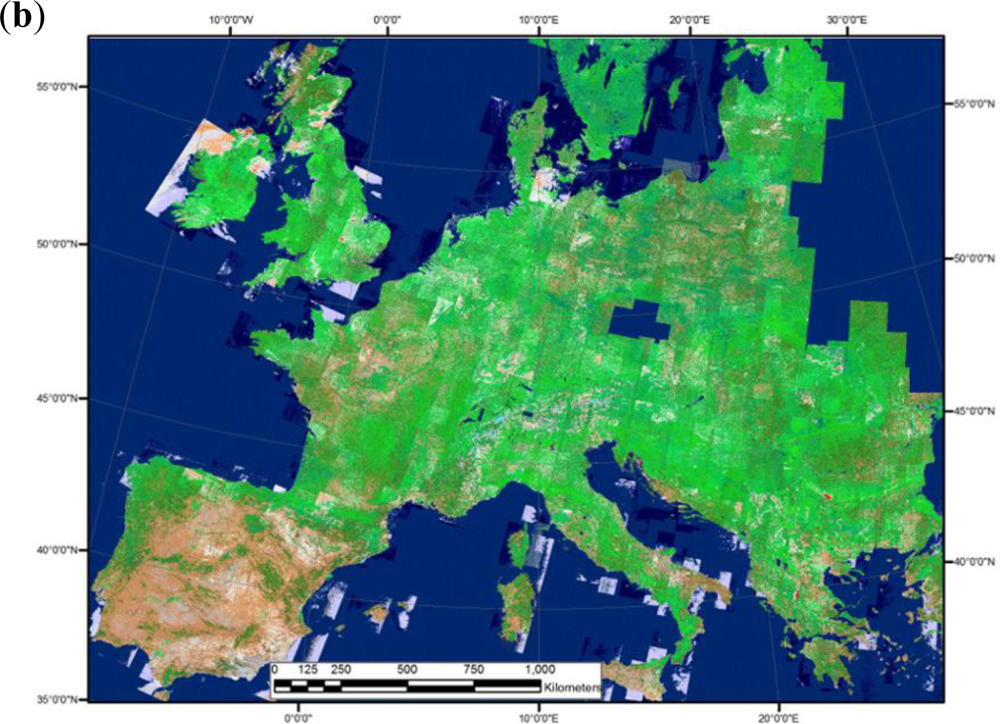
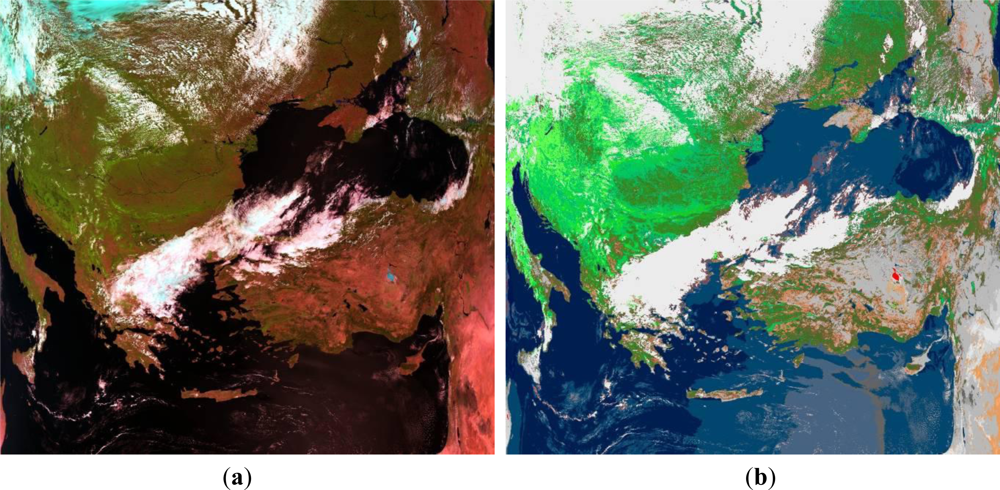
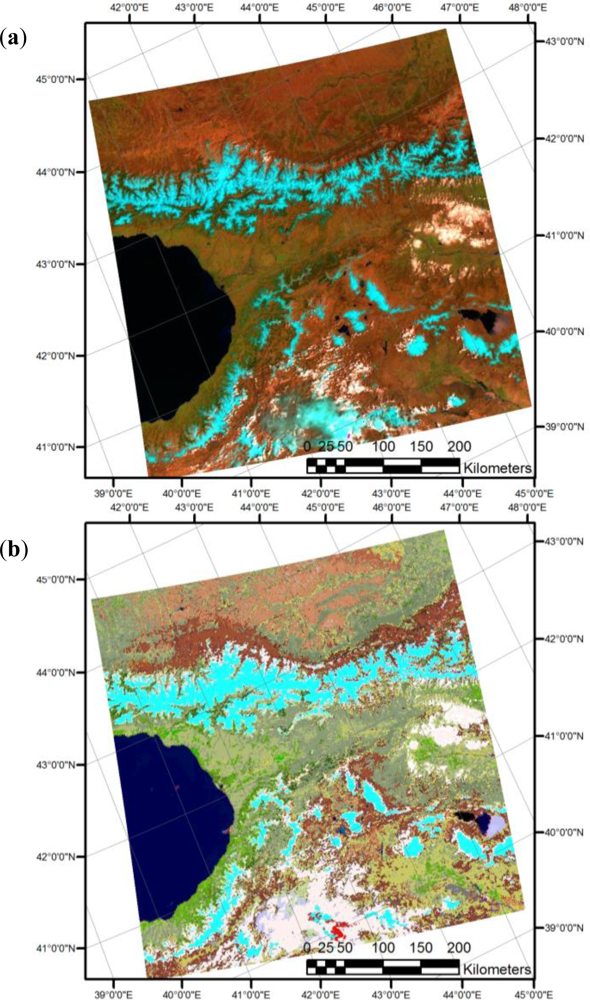
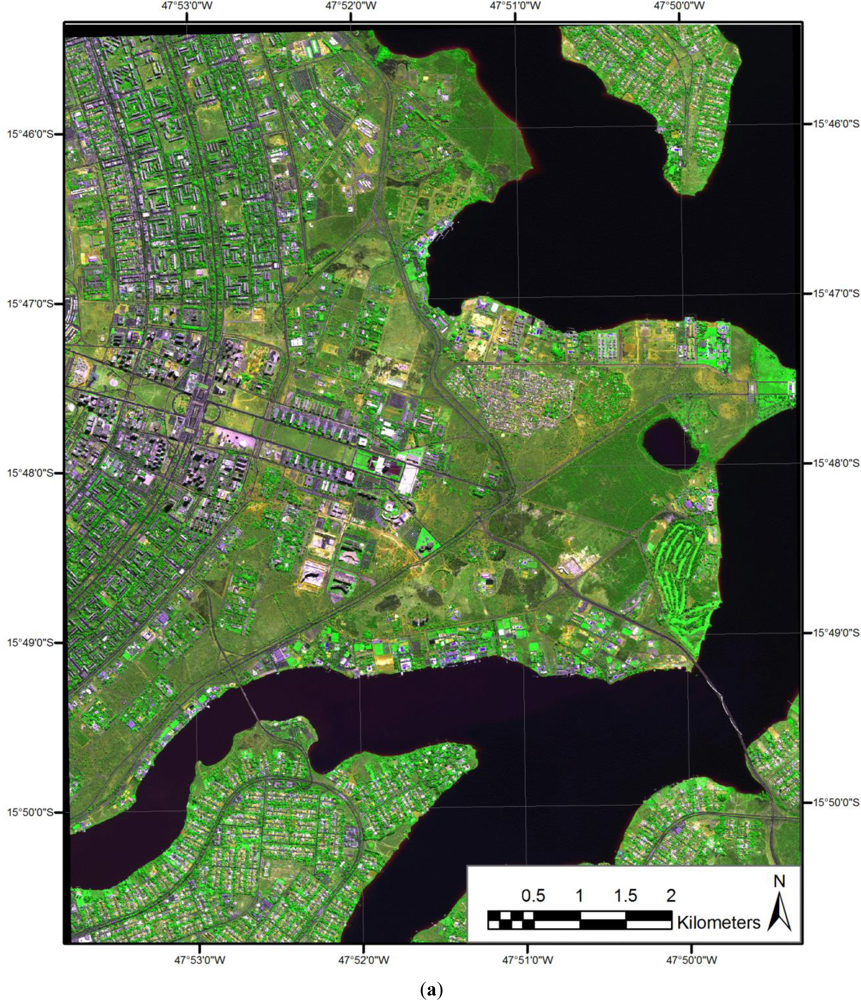
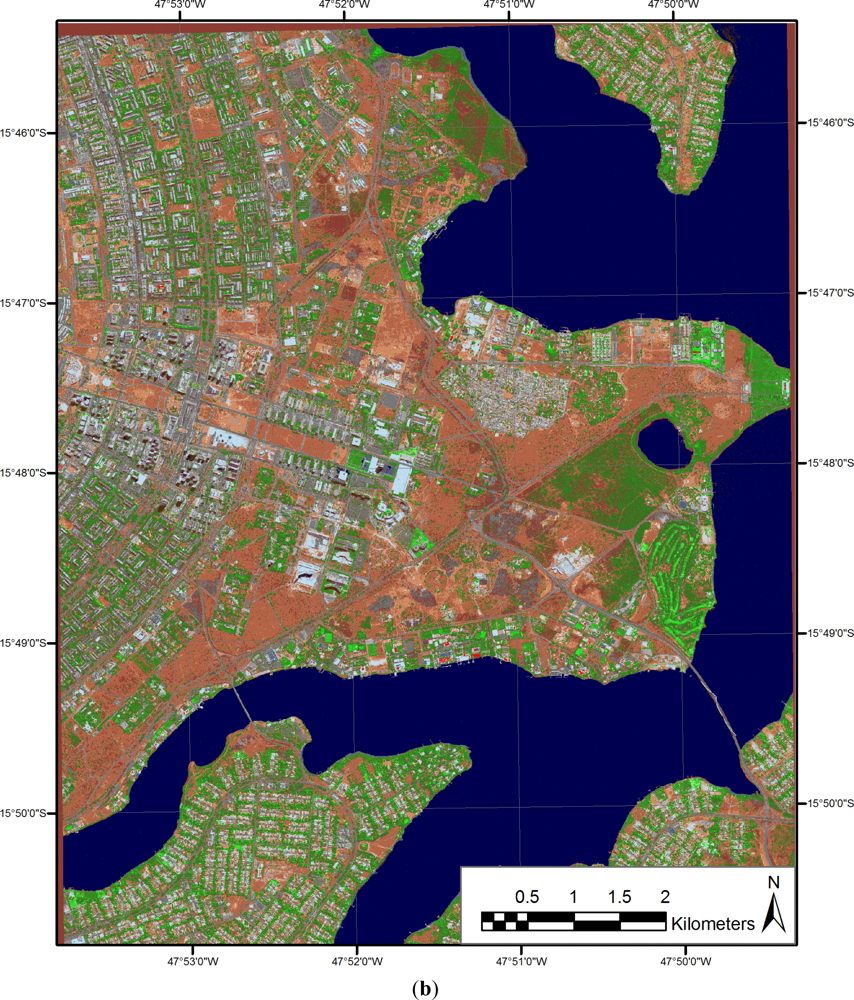
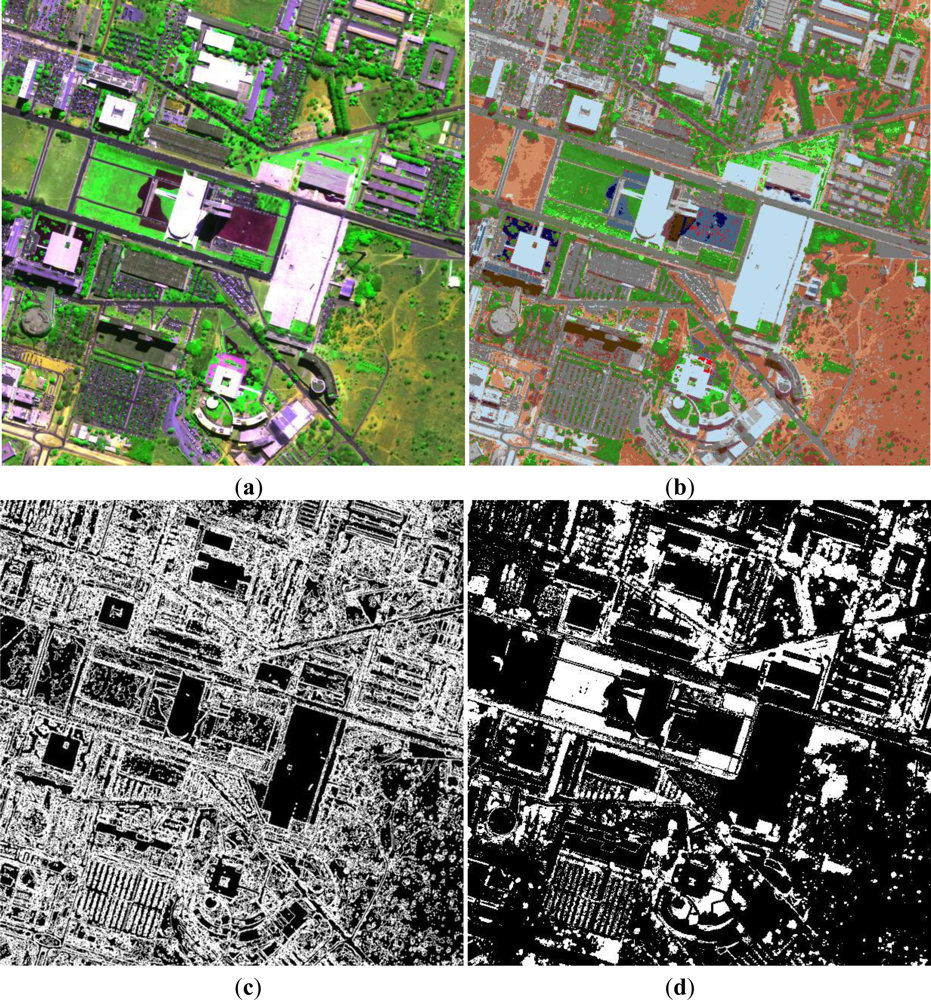
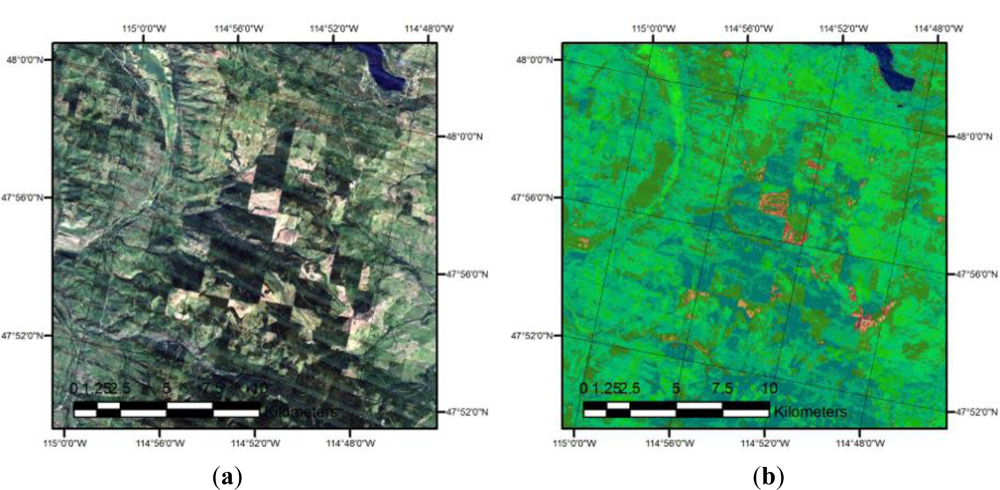
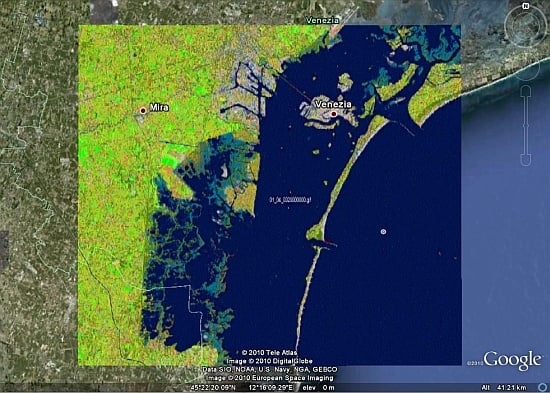
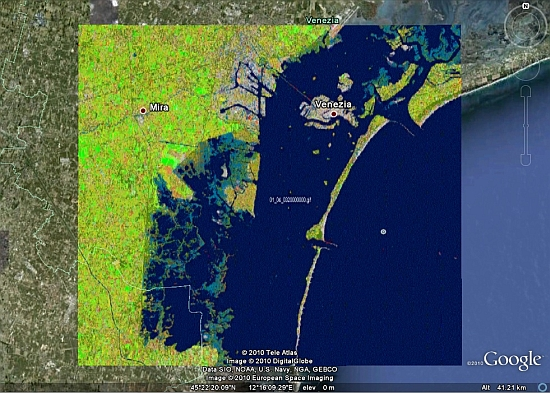
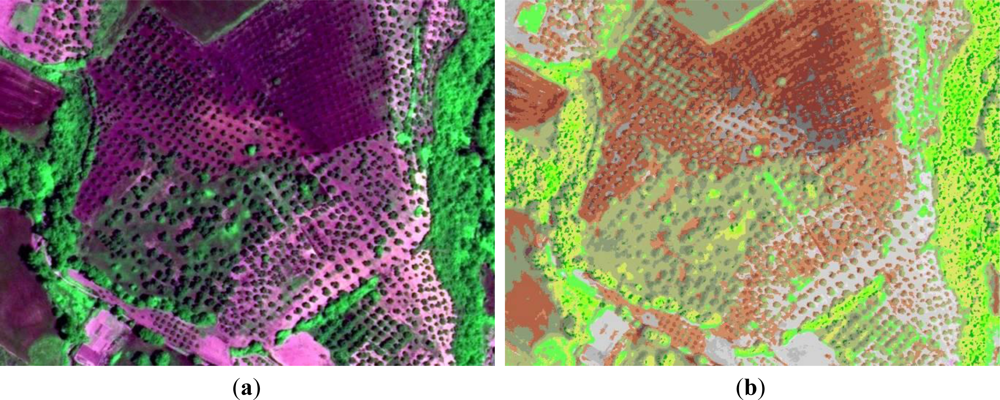
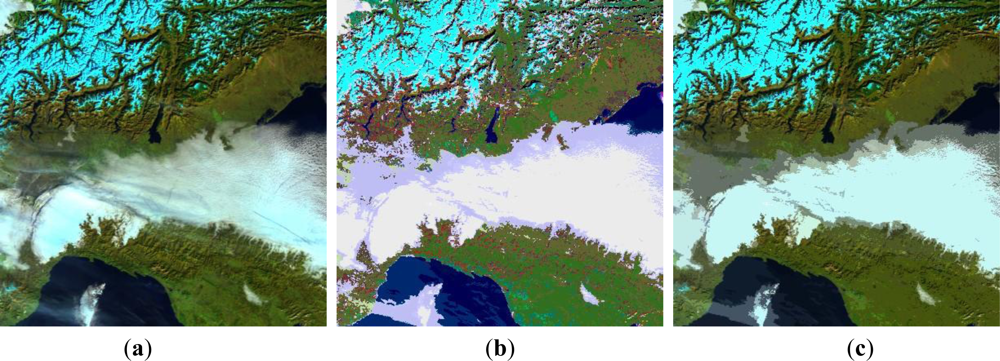
<p>In compliance with the Marr constraint (III) listed in Section 2, a SIAM™ preliminary classification map is expected to represent an abstract of the reality [<xref ref-type="bibr" rid="b54-remotesensing-04-02768">54</xref>]. This means that SIAM™ is expected to aggregate (simplify) the pictorial information of an input MS image, such as texture, image-contours, <italic>etc</italic>., without loss of genuine, but small image details (<italic>i.e.</italic>, without loss of high spatial-frequency image components). Based on a qualitative assessment, this appears to be the case, e.g., see <xref ref-type="fig" rid="f3-remotesensing-04-02768">Figures 3</xref>–<xref ref-type="fig" rid="f5-remotesensing-04-02768">5</xref>.</p>
<p>If SIAM™ performs a thematic mapping of an input VHR image without loss of pictorial information, then the proposed hybrid RS-IUS attentive vision second stage (see <xref ref-type="fig" rid="f2-remotesensing-04-02768">Figure 2</xref>) can be implemented as a stratified texture detector whose input is the SIAM™ preliminary classification map in place of the traditional input image, either MS (chromatic) or PAN (pan-chromatic). In [<xref ref-type="bibr" rid="b21-remotesensing-04-02768">21</xref>], to distinguish between low-texture ‘<italic>annual crop or herbaceous rangeland</italic>’ (AC/HR) from high-texture ‘forest <italic>or woodland</italic>’ (F/W) in very high resolution (VHR, &lt;5 m) spaceborne imagery [<xref ref-type="bibr" rid="b21-remotesensing-04-02768">21</xref>], an attentive vision second-stage stratified multi-scale texture detector is accomplished as follows.
<list list-type="order">
<list-item>
<p>Selection from the first-stage SIAM™ preliminary classification map of a target (F/W or AC/HR) class-specific semantic stratum (binary mask, focus of visual attention, refer to Section 5 in [<xref ref-type="bibr" rid="b3-remotesensing-04-02768">3</xref>]), capable of capturing (mapping) the colors of the target class-specific texture foregrounds and backgrounds. For example, the binary mask considered as a candidate area for the presence of classes (F/W or AC/HC) is selected as the logical-OR combination of the SIAM™ spectral categories ‘<italic>strong vegetation</italic>’ or ‘<italic>average vegetation</italic>’ or ‘<italic>dark vegetation</italic>’ or ‘<italic>shadow vegetation</italic>’, etc. (refer to Section 5.2 below).</p></list-item>
<list-item>
<p>A stratified two-scale (7 m, 15 m in size) texture detector is run upon the SIAM™ preliminary classification map. A simple single-scale texture feature is estimated as the number of different spectral categories (NSC) whose occurrence is &gt;0 in the local histogram collected from a semantic mask-conditioned moving window. Finally, a simple decision-tree separates low-texture AC/HR from high-texture F/W based on the multi-scale NSC values (e.g., if NSC_15m &lt; 4 then AC/HC else if NSC_15m &gt; 4 then F/W). The occurrence of specific spectral categories, e.g., ‘<italic>strong vegetation</italic>’, is checked in ambiguous texture cases (e.g., if NSC_15m == 4 AND ‘<italic>strong vegetation</italic>’ occurs in the local histogram then AC/HR). This simple attentive vision second-stage rule-set tested in 350 ground truth samples collected for each class F/W and AC/HR in ten VHR images collected across Europe provides omission and commission error between 4% and 6% in a computation time which is negligible.</p></list-item></list></p>
<p>When compared with RS-IUS academic or commercial solutions, the aforementioned attentive vision second-stage automatic, LC class-specific, stratified texture detection in the preliminary classification map appears quite unique. In literature, dozens of traditional texture detection approaches separate vegetation types based on a non-stratified (unconditional, driven-without-knowledge, image-wide) texture analysis in the MS or PAN image domain with varying degrees of success (e.g., [<xref ref-type="bibr" rid="b55-remotesensing-04-02768">55</xref>,<xref ref-type="bibr" rid="b56-remotesensing-04-02768">56</xref>]). With regard to GEOBIA (see <xref ref-type="fig" rid="f2-remotesensing-04-02768">Figure 2</xref> in [<xref ref-type="bibr" rid="b3-remotesensing-04-02768">3</xref>]) and GEOOIA systems (see <xref ref-type="fig" rid="f4-remotesensing-04-02768">Figure 4</xref> in [<xref ref-type="bibr" rid="b3-remotesensing-04-02768">3</xref>]), texture analysis is performed: (1) within sub-symbolic discrete 2-D objects generated at the pre-attentive vision first stage and (2) in the sensory image domain, either MS or PAN. As another example, the Shackelford and Davis RS-IUS, shown in <xref ref-type="fig" rid="f1-remotesensing-04-02768">Figure 1</xref>, computes second-stage texture: (I) within local areas selected as class-specific symbolic strata (image masks) generated from an input MS image and (II) in the sensory PAN image domain, which reduces computation time in comparison with the MS image domain [<xref ref-type="bibr" rid="b28-remotesensing-04-02768">28</xref>–<xref ref-type="bibr" rid="b30-remotesensing-04-02768">30</xref>]. None of these texture detection approaches is akin to that proposed in [<xref ref-type="bibr" rid="b21-remotesensing-04-02768">21</xref>].</p></sec>
<sec>
<label>5.</label>
<title>Degrees of Novelty of the Proposed Hybrid RS-IUS Architecture and Operational Implementation Employing SIAM™ as Its Symbolic Deductive Context-Insensitive Pre-Attentive Vision First Stage</title>
<p>This section objective is to verify whether the proposed hybrid RS-IUS architecture and its operational implementation, where SIAM™ is adopted as symbolic, deductive, context-insensitive pre-attentive vision first stage (refer to Section 3), meet the RS-IUS requirements specification (A) to (C) listed in Section 2.</p>
<p>In place of the SWOT analysis applied to the GEOBIA/GEOOIA paradigm [<xref ref-type="bibr" rid="b33-remotesensing-04-02768">33</xref>,<xref ref-type="bibr" rid="b34-remotesensing-04-02768">34</xref>] (refer to Section 8 in [<xref ref-type="bibr" rid="b3-remotesensing-04-02768">3</xref>]), the proposed hybrid RS-IUS is investigated at the four levels of understanding of an information processing system, namely [<xref ref-type="bibr" rid="b14-remotesensing-04-02768">14</xref>,<xref ref-type="bibr" rid="b21-remotesensing-04-02768">21</xref>] (see Section 1 in [<xref ref-type="bibr" rid="b3-remotesensing-04-02768">3</xref>]): (i) computational theory (system architecture, system design), (ii) information/knowledge representation, (iii) algorithm design and (iv) implementation.</p>
<p>About the level of analysis of system implementation, this non-experimental study must rely on existing literature to collect experimental evidence [<xref ref-type="bibr" rid="b15-remotesensing-04-02768">15</xref>–<xref ref-type="bibr" rid="b23-remotesensing-04-02768">23</xref>].</p>
<p>In practice, this section revises and extends previous investigations on the same subject proposed in related papers [<xref ref-type="bibr" rid="b18-remotesensing-04-02768">18</xref>,<xref ref-type="bibr" rid="b21-remotesensing-04-02768">21</xref>].</p>
<sec>
<label>5.1.</label>
<title>Computational Theory (System Architecture)</title>
<p>If the linchpin of success of a CV system or RS-IUS in tackling the inherently ill-posed vision problem (refer to Section 5 in [<xref ref-type="bibr" rid="b3-remotesensing-04-02768">3</xref>]) is addressing computational theory rather than algorithms or implementation [<xref ref-type="bibr" rid="b10-remotesensing-04-02768">10</xref>,<xref ref-type="bibr" rid="b14-remotesensing-04-02768">14</xref>] (refer to Section 1 in [<xref ref-type="bibr" rid="b3-remotesensing-04-02768">3</xref>]), then a deep understanding of the architectural differences between alternative RS-IUS schemes is of fundamental importance.</p>
<p>In this work, four alternative RS-IUS architectures have been considered for comparison purposes: GEOBIA (see <xref ref-type="fig" rid="f2-remotesensing-04-02768">Figure 2</xref> in [<xref ref-type="bibr" rid="b3-remotesensing-04-02768">3</xref>]), GEOOIA (see <xref ref-type="fig" rid="f4-remotesensing-04-02768">Figure 4</xref> in [<xref ref-type="bibr" rid="b3-remotesensing-04-02768">3</xref>]), Shackelford and Davis’ (see <xref ref-type="fig" rid="f1-remotesensing-04-02768">Figure 1</xref>) and the proposed hybrid RS-IUS design (see <xref ref-type="fig" rid="f2-remotesensing-04-02768">Figure 2</xref>). Among these four RS-IUS architectures, the latter is the only one to adopt a symbolic, syntactic, pixel-based pre-attentive vision first stage (refer to Section 3).</p>
<p>In this section, the proposed hybrid RS-IUS architecture is investigated irrespective of the implementation of its pre-attentive vision first stage (e.g., SIAM™ or SPECL, refer to Section 3). Pointers to the RS-IUS requirements specification (A) to (C) listed in Section 2 are made explicit wherever possible.</p>
<list list-type="roman-lower">
<list-item>
<p>RS-IUS requirements specification (A) and (C), OQI: ease of use. In compliance with the QA4EO guidelines, the proposed hybrid RS-IUS requires radiometric calibration of DNs into TOARF or SURF values, with TOARF ⊇ SURF. Hence, it considers the inherently ill-posed (difficult-to-solve) atmospheric correction an optional rather than compulsory pre-processing step (refer to Section 3), which increases its ease of use. Among the existing RS-IUS commercial software products listed in <xref ref-type="table" rid="t1-remotesensing-04-02768">Table 1</xref> of [<xref ref-type="bibr" rid="b3-remotesensing-04-02768">3</xref>], the physical model-based ATCOR-2/3/4 is the sole to require the radiometric calibration of the input MS imagery (refer to Section 3).</p></list-item>
<list-item>
<p>RS-IUS pre-attentive vision sub-system requirements specification (B)-(I) to (III). To develop a new generation of operational hybrid RS-IUSs whose pre-attentive and attentive vision stages are both symbolic and hybrid (refer to Section 2), a machine teaching (MAT)-by-rules paradigm, also called knowledge engineering in artificial intelligence (AI) and “fusion of horizons” in philosophical hermeneutics, must be adopted for the ignition of deductive inference capabilities. Unfortunately, syntactic pattern recognition requires significant human interaction, but once a physical model-based syntactic inference system is tuned and proved to be transferable, the effort pays off (refer to Section 4.1 in [<xref ref-type="bibr" rid="b3-remotesensing-04-02768">3</xref>]).</p></list-item>
<list-item>
<p>RS-IUS requirements specification (C), OQI: computation efficiency. A syntactic inference system driven from prior physical knowledge is static, <italic>i.e.</italic>, it is one-pass (non-iterative, non-adaptive to input data). In addition, the proposed symbolic syntactic pre-attentive vision first stage is pixel-based. Hence, it is eligible for being computationally efficient, its computation complexity increasing linearly with the number of pixels, the number of MS bands and the cardinality of the class taxonomy adopted by the pre-classification map products.</p></list-item>
<list-item>
<p>RS-IUS pre-attentive vision sub-system requirements specification (B)-(I), RS-IUS requirements specification (C), OQI: computation efficiency. It is well known that the generation of a segmentation map from a binary or multi-level image (e.g., a classification map) is a well-posed problem (in the Hadamard sense, <italic>i.e.</italic>, it admits a solution and this solution is unique, refer to Section 4.2 in [<xref ref-type="bibr" rid="b3-remotesensing-04-02768">3</xref>]) which can be solved efficiently by a two-pass connected-component image labeling algorithm ([<xref ref-type="bibr" rid="b10-remotesensing-04-02768">10</xref>]; p. 197). Hence, a syntactic pixel-based preliminary classifier can accomplish image symbolic pre-classification and image sub-symbolic segmentation in sequence and efficiently.</p></list-item>
<list-item>
<p>RS-IUS requirements specification (C), OQI: degree of automation. A syntactic image preliminary classifier is prior knowledge-based and non-adaptive to input data, thus it tends to have few system-free parameters to be user-defined, possibly none (like SIAM™ and SPECL, which are both “fully automatic”, refer to Section 5.4 below). Hence, its degree of automation (ease of use) tends to be high.</p></list-item>
<list-item>
<p>RS-IUS requirements specification (C), OQIs: mapping accuracy; robustness to changes in the input data set. Since it is pixel-based, the proposed symbolic syntactic pre-attentive vision first stage is not affected by the <italic>uncertainty principle</italic> according to which, for any contextual (neighborhood) property, we cannot simultaneously measure that property while obtaining accurate localization [<xref ref-type="bibr" rid="b57-remotesensing-04-02768">57</xref>,<xref ref-type="bibr" rid="b58-remotesensing-04-02768">58</xref>], refer to Section 8.2 in [<xref ref-type="bibr" rid="b3-remotesensing-04-02768">3</xref>]. On the other hand, traditional pixel-based statistical classifiers (e.g., MXLKL, support vector machines (SVMs), <italic>etc</italic>.) are typically affected by a salt-and-pepper classification noise effect [<xref ref-type="bibr" rid="b46-remotesensing-04-02768">46</xref>,<xref ref-type="bibr" rid="b53-remotesensing-04-02768">53</xref>]. This is not the case of existing per-pixel physical model-based preliminary classifiers, like SIAM™ (or SPECL), whose robustness to changes in the input data set is claimed to be high by existing literature [<xref ref-type="bibr" rid="b15-remotesensing-04-02768">15</xref>–<xref ref-type="bibr" rid="b23-remotesensing-04-02768">23</xref>] (this is possible because, to score high in accuracy and robustness, these preliminary classifiers score “low” in informative content of their output spectral categories, refer to Section 5.4 below).</p></list-item>
<list-item>
<p>RS-IUS requirements specification (C), OQIs: degree of automation; mapping accuracy; computation efficiency; robustness to changes in the input data set. The proposed hybrid RS-IUS scheme (see <xref ref-type="fig" rid="f2-remotesensing-04-02768">Figure 2</xref>) adopts (inherently ill-posed) statistical models in the attentive vision second stage if and only if they incorporate the “stratified” or “layered” approach, typical of decision-trees [<xref ref-type="bibr" rid="b45-remotesensing-04-02768">45</xref>], to become better posed for numerical treatment. A possible disadvantage of stratification is that identification of appropriate strata may be difficult [<xref ref-type="bibr" rid="b44-remotesensing-04-02768">44</xref>] (refer to Section 3). This is not the case with existing per-pixel physical model-based preliminary classifiers, like SIAM™ (or SPECL), whose output spectral categories (symbolic strata, symbolic masks) are detected automatically (where automation does not come on the expenses of accuracy or robustness to changes in the input data set, but on the expenses of the informative content of the output spectral categories, refer to Section 5.4 below). To summarize, in RS common practice, exploitation of a pixel-based, symbolic, syntactic pre-attentive vision first stage allows the attentive vision second-stage classification to benefit from driven-by-knowledge regularization of the multiple solution space while avoiding the typical disadvantage of stratification (where identification of informative strata may be difficult).</p></list-item>
<list-item>
<p>RS-IUS requirements specification (C), OQIs: mapping accuracy; robustness to changes in the input data set. In the proposed hybrid RS-IUS scheme (see <xref ref-type="fig" rid="f2-remotesensing-04-02768">Figure 2</xref>), a feedback loop feeds the symbolic deductive pre-attentive vision Stage 1 (categorical) output back to the pre-processing Stage 0 input for stratified RS image enhancement (e.g., stratified RS image TOC [<xref ref-type="bibr" rid="b20-remotesensing-04-02768">20</xref>], <italic>etc</italic>., refer to Section 3).</p></list-item>
<list-item>
<p>RS-IUS requirements specification (A). Availability of symbolic information right at the output of the pre-attentive vision first stage allows the introduction of OQIs suitable for parameterizing categorical variables (e.g., preliminary classification map accuracy in range [0, 1] ± δ1,) in addition to traditional OQIs suitable for parameterizing sub-symbolic variables (e.g., image sub-symbolic segmentation map accuracy in range [0, 1] ± δ2), in compliance with the international QA4EO guidelines [<xref ref-type="bibr" rid="b2-remotesensing-04-02768">2</xref>] (refer to Section 2 in [<xref ref-type="bibr" rid="b3-remotesensing-04-02768">3</xref>]). Examples of novel OQIs suitable for the parameterization of pre-attentive vision first-stage categorical variables can be found in [<xref ref-type="bibr" rid="b20-remotesensing-04-02768">20</xref>] and [<xref ref-type="bibr" rid="b22-remotesensing-04-02768">22</xref>].</p></list-item>
<list-item>
<p>RS-IUS requirements specification (C), OQIs: ease of use; mapping accuracy; efficiency; robustness to changes in the input data set. The proposed symbolic pre-attentive vision first stage generates as output symbolic information primitives featuring three spatial types (according to the nomenclature proposed by the Open Geospatial Consortium, OGC [<xref ref-type="bibr" rid="b59-remotesensing-04-02768">59</xref>]): <italic>symbolic pixels</italic> belong to <italic>symbolic polygons</italic> which belong to <italic>symbolic multi-part polygons</italic>, also called <italic>symbolic strata</italic>. In any symbolic map these three symbolic spatial types co-exist, <italic>i.e.</italic>, they are not alternative. Thus, they can be made simultaneously available to the attentive vision second phase as viable inputs to choose from on a target LC class-specific basis (see <xref ref-type="fig" rid="f2-remotesensing-04-02768">Figure 2</xref>). For example, the Shackelford and Davis RS-IUS adopts as input to the attentive vision second stage a combination of symbolic pixels and symbolic polygons, depending on the target LC class [<xref ref-type="bibr" rid="b28-remotesensing-04-02768">28</xref>–<xref ref-type="bibr" rid="b30-remotesensing-04-02768">30</xref>] (see <xref ref-type="fig" rid="f1-remotesensing-04-02768">Figure 1</xref>), The following considerations hold.</p>
<list list-type="bullet">
<list-item>
<p>Humans are naturally familiar with symbolic reasoning. Availability of semantic information right at the output of the symbolic pre-attentive vision first stage makes the proposed hybrid RS-IUS more powerful (in terms of symbolic reasoning) and more intuitive to use than traditional two-stage non-iterative GEOBIA systems (see Section 6 in [<xref ref-type="bibr" rid="b3-remotesensing-04-02768">3</xref>]) and three-stage iterative GEOOIA systems (see Section 7 in [<xref ref-type="bibr" rid="b3-remotesensing-04-02768">3</xref>]) whose pre-attentive vision first stage is sub-symbolic.</p></list-item>
<list-item>
<p><italic>Generated as output by the symbolic pre-attentive vision first stage, symbolic pixels, symbolic polygons and symbolic multi-part polygons co-exist as viable inputs to the attentive vision second stage. This would end the ill-fated antagonism between unlabeled sub-symbolic pixels versus labeled sub-symbolic image-objects which are used as alternative inputs to different attentive vision second-stage implementations</italic>, namely, traditional pixel-based classifiers, either inductive (e.g., artificial neural network, SVM, MXLKL, adaptive decision-tree [<xref ref-type="bibr" rid="b45-remotesensing-04-02768">45</xref>,<xref ref-type="bibr" rid="b46-remotesensing-04-02768">46</xref>,<xref ref-type="bibr" rid="b53-remotesensing-04-02768">53</xref>]) or deductive (symbolic syntactic rule set, expert system [<xref ref-type="bibr" rid="b45-remotesensing-04-02768">45</xref>,<xref ref-type="bibr" rid="b46-remotesensing-04-02768">46</xref>,<xref ref-type="bibr" rid="b53-remotesensing-04-02768">53</xref>]), or GEOBIA/GEOOIA classifiers, either inductive or deductive [<xref ref-type="bibr" rid="b47-remotesensing-04-02768">47</xref>,<xref ref-type="bibr" rid="b60-remotesensing-04-02768">60</xref>–<xref ref-type="bibr" rid="b63-remotesensing-04-02768">63</xref>], refer to <xref ref-type="table" rid="t1-remotesensing-04-02768">Table 1</xref> in [<xref ref-type="bibr" rid="b3-remotesensing-04-02768">3</xref>].</p></list-item></list></list-item></list></sec>
<sec>
<label>5.2.</label>
<title>Information/Knowledge Representation</title>
<p>According to Wang, “if knowledge representation is poor, even sophisticated algorithms can produce inferior outputs. On the contrary, improvement in representation might achieve twice the benefit with half the effort” [<xref ref-type="bibr" rid="b64-remotesensing-04-02768">64</xref>]. This subsection investigates to what degree this fundamental statement is taken into account by the symbolic syntactic SIAM™ pre-attentive vision first stage adopted by the novel hybrid RS-IUS proposed in Section 3. Pointers to the RS-IUS requirements specification (A) to (C) listed in Section 2 are made explicit wherever possible.</p>
<list list-type="roman-lower">
<list-item>
<p>RS-IUS requirements specification (A). SIAM™ (like SPECL) is a physical model-based preliminary classifier that requires input sensory data be provided with a community-agreed physical radiometric unit of measure, namely, TOARF or SURF values, in compliance with the QA4EO guidelines, refer to Section 3.</p></list-item>
<list-item>
<p>RS-IUS pre-attentive vision sub-system requirements specification (B)-(I) and (II). SIAM™ (like SPECL) is application domain-independent, <italic>i.e.</italic>, it is a unifying preliminary classification first stage. This holds true because, as output, SIAM™ (like SPECL) provides (semi-)symbolic image-objects (namely, symbolic pixels in symbolic polygons in symbolic multi-part polygons, refer to Section 5.1) whose symbolic labels belong to a discrete and finite set of spectral-based <italic>semi-concepts</italic>, also called symbolic <italic>spectral categories</italic>, e.g., ‘<italic>vegetation</italic>’, ‘<italic>either water or shadow</italic>’, ‘<italic>either bare soil or built-up</italic>’, <italic>etc</italic>. The semantic content of spectral-based semi-concepts is superior to zero and not superior (<italic>i.e.</italic>, equal or inferior) to that of target (4-D) LC classes-through-time (concepts, e.g., ‘<italic>deciduous forest</italic>’) to be detected by the attentive vision second stage (refer to Section 5 in [<xref ref-type="bibr" rid="b3-remotesensing-04-02768">3</xref>]). Symbolic spectral categories are equivalent to semantic conjectures based exclusively on non-contextual spectral properties, either chromatic or achromatic (since color is the sole pixel-based, context-insensitive level of information in an image, refer to Section 3) [<xref ref-type="bibr" rid="b18-remotesensing-04-02768">18</xref>]. Each spectral category is also equivalent to one LC <italic>class-set</italic> comprising either one or more LC classes [<xref ref-type="bibr" rid="b18-remotesensing-04-02768">18</xref>,<xref ref-type="bibr" rid="b29-remotesensing-04-02768">29</xref>]. In particular, a spectral category (e.g., ‘<italic>cloud</italic>’) is one-to-one related with a single LC class if this class is separable from the rest of the world in a hyper-dimensional spectral space. A spectral category (e.g., ‘<italic>either water or shadow</italic>’) is related to more than one LC class if these LC classes feature a statistically relevant spectral overlap in a hyper-dimensional spectral space. Thus, by definition [<xref ref-type="bibr" rid="b18-remotesensing-04-02768">18</xref>], different spectral categories do not overlap in the SIAM™ measurement space consisting of spectral bands together with spectral indexes [<xref ref-type="bibr" rid="b15-remotesensing-04-02768">15</xref>–<xref ref-type="bibr" rid="b23-remotesensing-04-02768">23</xref>]. In other words, spectral categories must be mutually exclusive by definition. As a consequence, spectral categories are eligible for splitting into their component LC classes in a context-sensitive attentive vision second stage, where additional sources of contextual evidence (e.g., texture, morphology, per-object geometric properties, inter-object spatial relations, <italic>etc</italic>.) are taken into consideration, see <xref ref-type="fig" rid="f2-remotesensing-04-02768">Figure 2</xref>. For example, the spectral-based semi-concept ‘<italic>vegetation</italic>’ identifies an image candidate area (semantic mask, semantic stratum or focus of visual attention, refer to Section 5 in [<xref ref-type="bibr" rid="b3-remotesensing-04-02768">3</xref>]) where image-objects belonging to a target LC class, say, ‘<italic>deciduous forest</italic>’, may be located, refer to Section 3. In SIAM™ there are six parent spectral categories (also called super-categories) or parent spectral-end-members. They are presented hereafter according to their order of detection (for comparison with the SPECL sorted set of class grammars, refer to Section 2):
<list list-type="roman-upper">
<list-item>
<p>‘clouds’,</p></list-item>
<list-item>
<p>‘either snow or ice’,</p></list-item>
<list-item>
<p>‘either water or shadow’,</p></list-item>
<list-item>
<p>‘vegetation’, equivalent to ‘either woody vegetation or cropland or grassland or (shrub and brush) rangeland’,</p></list-item>
<list-item>
<p>‘either bare soil or built-up’ and</p></list-item>
<list-item>
<p>‘outliers’ (for further comments about the presence of class ‘unknowns’ in compliance with the Congalton requirements of a classification scheme [<xref ref-type="bibr" rid="b65-remotesensing-04-02768">65</xref>], refer to this text below).</p></list-item></list>Intuitively, the symbolic meaning of the six parent spectral categories is inferred from the following list of natural colors (whose wavelengths range from the visible to the medium infra-red (MIR) portion of the electromagnetic spectrum) found in the (4-D) real world-through-time: (1) white of type 1 (featuring high reflectance in MIR), (2) white of type 2 (featuring low reflectance in MIR), (3) blue, (4) green, (5) brown or gray, (6) others.</p></list-item>
<list-item>
<p>RS-IUS pre-attentive vision sub-system requirements specification (B)-(II). Since the semantic content of spectral-based semi-concepts is (refer to this section above) superior to zero and equal or inferior to the semantic content of concepts (4-D object-models-through-time [<xref ref-type="bibr" rid="b25-remotesensing-04-02768">25</xref>], LC classes-through-time, e.g., ‘<italic>needle-leaf forest</italic>’) belonging to a (4-D) world model (refer to Section 5 in [<xref ref-type="bibr" rid="b3-remotesensing-04-02768">3</xref>]), then spectral-based semi-concepts are eligible for filling in the well-known <italic>information gap</italic> between sub-symbolic (2-D) image features (image-objects or, vice versa, image-contours) and symbolic concepts in the (3-D) imaged-scene, refer to Section 5 in [<xref ref-type="bibr" rid="b3-remotesensing-04-02768">3</xref>,<xref ref-type="bibr" rid="b14-remotesensing-04-02768">14</xref>,<xref ref-type="bibr" rid="b18-remotesensing-04-02768">18</xref>,<xref ref-type="bibr" rid="b25-remotesensing-04-02768">25</xref>,<xref ref-type="bibr" rid="b33-remotesensing-04-02768">33</xref>].</p></list-item>
<list-item>
<p>Due to the presence of the class ‘outliers’ (refer to this section above), SIAM™ provides a mutually exclusive and totally exhaustive mapping of the input MS image into a discrete and finite set of spectral categories. This is in line with the Congalton requirements of a classification scheme [<xref ref-type="bibr" rid="b65-remotesensing-04-02768">65</xref>]; although, the definition of a rejection rate is a well-known objective of any RS image classification system, e.g., refer to [<xref ref-type="bibr" rid="b66-remotesensing-04-02768">66</xref>], in RS common practice image classifiers are often applied without any outlier detection strategy.</p></list-item>
<list-item>
<p>Unlike the crisp SIAM™, the fuzzy SIAM™ is capable of modeling component cover classes of mixed pixels (class mixture) [<xref ref-type="bibr" rid="b22-remotesensing-04-02768">22</xref>]. This means that the information/knowledge representation of the fuzzy SIAM™ is superior to that of its crisp counterpart.</p></list-item></list></sec>
<sec sec-type="methods">
<label>5.3.</label>
<title>Algorithm Design</title>
<p>An algorithm design is the bridge between analysis and implementation. In practice, structured software system design is considered “everything but code” [<xref ref-type="bibr" rid="b40-remotesensing-04-02768">40</xref>]. This subsection investigates the algorithm design of the symbolic syntactic SIAM™ pre-attentive vision first stage adopted by the novel hybrid RS-IUS proposed in Section 3. Pointers to the RS-IUS requirements specification (A) to (C) listed in Section 2 are made explicit wherever possible.</p>
<list list-type="roman-lower">
<list-item>
<p>RS-IUS requirements specification (C), OQIs: mapping accuracy; robustness to changes in the input data set; scalability to cope with changes in input data specifications and user requirements. Due to its internal design and implementation strategies [<xref ref-type="bibr" rid="b17-remotesensing-04-02768">17</xref>], the physical model-based SIAM™ preliminary classifier inherits advantages of traditional static (non-adaptive to input data) syntactic classifiers, developed by symbolic AI [<xref ref-type="bibr" rid="b67-remotesensing-04-02768">67</xref>], while overcoming their well-known limitations, refer to Section 4.1 in [<xref ref-type="bibr" rid="b3-remotesensing-04-02768">3</xref>]. In particular:</p>
<list list-type="simple">
<list-item>
<p>▪ SIAM™ is more intuitive to debug than statistical models, refer to Section 4.1 in [<xref ref-type="bibr" rid="b3-remotesensing-04-02768">3</xref>].</p></list-item>
<list-item>
<p>▪ SIAM™ pursues convergence-of-evidence and information redundancy [<xref ref-type="bibr" rid="b25-remotesensing-04-02768">25</xref>]. This design strategy makes SIAM™:
<list list-type="simple">
<list-item>
<p>♦ scalable, to cope with changes in input data specifications and user requirements, refer to Section 5.4 below, and</p></list-item>
<list-item>
<p>♦ robust to changes in the input MS image acquired across time, space and sensors, e.g., SIAM™ is capable of mapping RS imagery acquired by all existing and future planned spaceborne optical imaging sensors provided with calibration metadata files, in agreement with the QA4EO guidelines and the visionary goal of a Global Earth Observation System of Systems (GEOSS) (refer to Section 1 in [<xref ref-type="bibr" rid="b3-remotesensing-04-02768">3</xref>]) [<xref ref-type="bibr" rid="b68-remotesensing-04-02768">68</xref>,<xref ref-type="bibr" rid="b69-remotesensing-04-02768">69</xref>]. This achievement is made possible because SIAM™ is implemented as an integrated system of six sub-systems, refer to <xref ref-type="table" rid="t1-remotesensing-04-02768">Table 1</xref> and Section 5.4 below [<xref ref-type="bibr" rid="b17-remotesensing-04-02768">17</xref>,<xref ref-type="bibr" rid="b18-remotesensing-04-02768">18</xref>].</p></list-item></list>Unfortunately, it is time-consuming for human experts to learn physical laws of the (4-D) world-through-time and tune physical models, comprising both structural and procedural knowledge (refer to Section 4.1 in [<xref ref-type="bibr" rid="b3-remotesensing-04-02768">3</xref>]), based on human intuition, domain expertise and evidence from data observations ([<xref ref-type="bibr" rid="b54-remotesensing-04-02768">54</xref>]; p. 2). The physical model-based SIAM™ preliminary classifier makes no exception to this rule. For example, the development of the SIAM™ software code dates back to the year 2002 [<xref ref-type="bibr" rid="b70-remotesensing-04-02768">70</xref>].</p></list-item></list></list-item>
<list-item>
<p>RS-IUS requirements specification (C), OQI: scalability to cope with changes in input data specifications and user requirements. Unlike the crisp SIAM™ implementation, the fuzzy SIAM™ version adopts an internal horizontal (flat) modular structure independent of hierarchy, which means that the latter requires no procedural knowledge and, therefore, benefits of a maintainability/ scalability/ reusability superior to that of the former [<xref ref-type="bibr" rid="b22-remotesensing-04-02768">22</xref>].</p></list-item>
<list-item>
<p>RS-IUS requirements specification (C), OQIs: mapping accuracy; scalability to cope with changes in input data specifications and user requirements. In [<xref ref-type="bibr" rid="b17-remotesensing-04-02768">17</xref>], to reduce the number of the physical model-based system free-parameters to be set by the human system developer based on his intuition, expertise and evidence from data observations, SIAM™ adopts crisp (hard), rather fuzzy (soft) membership functions to pursue an irregular, but complete grid partitioning of the measurement space (see <xref ref-type="fig" rid="f2-remotesensing-04-02768">Figures 2</xref>–<xref ref-type="fig" rid="f6-remotesensing-04-02768">6</xref> in [<xref ref-type="bibr" rid="b17-remotesensing-04-02768">17</xref>]). In [<xref ref-type="bibr" rid="b17-remotesensing-04-02768">17</xref>], <xref ref-type="table" rid="t3-remotesensing-04-02768">Table 3</xref> provides the hard thresholds employed to generate the crisp SIAM™ membership functions. In [<xref ref-type="bibr" rid="b22-remotesensing-04-02768">22</xref>], these crisp decision rules are fuzzified in line with the principles of fuzzy logic [<xref ref-type="bibr" rid="b71-remotesensing-04-02768">71</xref>,<xref ref-type="bibr" rid="b72-remotesensing-04-02768">72</xref>].</p></list-item></list></sec>
<sec>
<label>5.4.</label>
<title>Implementation</title>
<p>This subsection investigates the implementation of the symbolic syntactic SIAM™ pre-attentive vision first stage adopted by the novel hybrid RS-IUS proposed in Section 3. The SIAM™ implementation phase consists of computer programming exclusively (since no specific hardware is required). In practice, what was produced during structured system design (refer to Section 5.3) is now turned into software code [<xref ref-type="bibr" rid="b40-remotesensing-04-02768">40</xref>]. Hence, the objective of this subsection is to verify whether the SIAM™ computer program executable meets the RS-IUS requirements specification (A) to (C) listed in Section 2.</p>
<p>To the best of these authors’ knowledge, SIAM™ and SPECL are the only two pixel-based syntactic preliminary classifiers available among the RS-IUS software toolboxes listed in <xref ref-type="table" rid="t1-remotesensing-04-02768">Table 1</xref> of [<xref ref-type="bibr" rid="b3-remotesensing-04-02768">3</xref>] (refer to Section 2). It means that implementation, in combination with information/knowledge representation (refer to Section 5.2) and algorithm design (refer to Section 5.3), make SIAM™ different from SPECL and capable of accomplishing high-value OQIs (refer to Section 2 in [<xref ref-type="bibr" rid="b3-remotesensing-04-02768">3</xref>]) in compliance with the RS-IUS requirements specification proposed in Section 2.</p>
<p>About the SIAM™ implementation, the following considerations hold, where pointers to the RS-IUS requirements specification (A) to (C) listed in Section 2 are made explicit wherever possible.
<list list-type="roman-lower">
<list-item>
<p>RS-IUS requirements specification (C), OQI: degree of automation. To run, SIAM™ requires neither user-defined parameters nor reference samples, hence it is termed “fully automatic” [<xref ref-type="bibr" rid="b73-remotesensing-04-02768">73</xref>] (refer to Section 1). This definition implies that the SIAM™ degree of automation cannot be surpassed by any alternative approach. It is noteworthy that the proposed definition of automatic system is more restrictive than those commonly adopted in the RS literature where so-called automatic inductive data learning classifiers, e.g., artificial neural networks, do not satisfy either one or both of the two requirements listed above [<xref ref-type="bibr" rid="b73-remotesensing-04-02768">73</xref>–<xref ref-type="bibr" rid="b76-remotesensing-04-02768">76</xref>]. In general, it is assumed that automation can come on the expenses of accuracy, efficiency or robustness (refer to Section 2 in [<xref ref-type="bibr" rid="b3-remotesensing-04-02768">3</xref>]). This is not the case of SIAM™, which is considered operational because all of its OQIs score high according to existing literature [<xref ref-type="bibr" rid="b15-remotesensing-04-02768">15</xref>–<xref ref-type="bibr" rid="b23-remotesensing-04-02768">23</xref>] (refer to Section 1). <italic>In the case of SIAM™ (and SPECL</italic>, refer to Section 2<italic>)</italic>, <italic>automation comes on the expenses of the informative content of the output spectral categories, which is superior to zero, but equal or inferior to that of target LC classes to be detected by the attentive vision second stage</italic> (refer to Section 5 in [<xref ref-type="bibr" rid="b3-remotesensing-04-02768">3</xref>]).</p></list-item>
<list-item>
<p>RS-IUS requirements specification (C), OQI: scalability, to cope with changes in input data specifications and user requirements. To employ as input a radiometrically calibrated MS image acquired by almost any of the ongoing or future planned satellite optical missions, SIAM™ is implemented as an integrated system of systems, in line with the visionary goal of a GEOSS [<xref ref-type="bibr" rid="b68-remotesensing-04-02768">68</xref>,<xref ref-type="bibr" rid="b69-remotesensing-04-02768">69</xref>] (refer to Section 1 in [<xref ref-type="bibr" rid="b3-remotesensing-04-02768">3</xref>]). In particular, SIAM™ comprises a “master” 7-band Landsat-like SIAM™ (L-SIAM™) together with five down-scaled (“slave”, derived) versions of L-SIAM™ whose input is a MS image featuring a spectral resolution that overlaps with, but is inferior to, Landsat’s. It is important to observe that the high-degree of scalability of L-SIAM™ is made possible by the high-degree of redundancy of its class grammars implemented in compliance with a convergence-of-evidence approach (refer to Section 5.3). To summarize, SIAM™ combines the following six sub-systems (refer to <xref ref-type="table" rid="t1-remotesensing-04-02768">Table 1</xref>) [<xref ref-type="bibr" rid="b15-remotesensing-04-02768">15</xref>–<xref ref-type="bibr" rid="b23-remotesensing-04-02768">23</xref>].</p>
<list list-type="roman-upper">
<list-item>
<p>A “master” 7-band L-SIAM™ capable of detecting 95/47/18 mutually exclusive and totally exhaustive spectral categories at fine/ intermediate/ coarse semantic granularity (see <xref ref-type="fig" rid="f6-remotesensing-04-02768">Figure 6</xref>), where symbolic parent-child relationships can be leveraged to improve the RS image interpretation process (see <xref ref-type="fig" rid="f7-remotesensing-04-02768">Figure 7</xref>). The legend of the preliminary classification map generated by L-SIAM™ at fine semantic granularity and consisting of 95 spectral categories is shown in <xref ref-type="table" rid="t2-remotesensing-04-02768">Table 2</xref>.</p></list-item>
<list-item>
<p>A four-band Satellite Pour l’Observation de la Terre (SPOT)-like SIAM™ (S-SIAM™), which detects 68/40/15 mutually exclusive and totally exhaustive spectral categories at fine/intermediate/coarse semantic granularity (see <xref ref-type="fig" rid="f8-remotesensing-04-02768">Figure 8</xref>).</p></list-item>
<list-item>
<p>A four-band National Oceanic and Atmospheric Administration (NOAA) Advanced Very High Resolution Radiometer (AVHRR)-like SIAM™ (AV-SIAM™), which detects 82/42/16 mutually exclusive and totally exhaustive spectral categories at fine/intermediate/coarse semantic granularity (see <xref ref-type="fig" rid="f9-remotesensing-04-02768">Figure 9</xref>).</p></list-item>
<list-item>
<p>A five-band ENVISAT Advanced Along-Track Scanning Radiometer (AATSR)-like SIAM™ (AA-SIAM™), which detects 82/42/16 mutually exclusive and totally exhaustive spectral categories at fine/ intermediate/ coarse semantic granularity (see <xref ref-type="fig" rid="f10-remotesensing-04-02768">Figure 10</xref>).</p></list-item>
<list-item>
<p>A four-band QuickBird-like SIAM™ (Q-SIAM™), which detects 52/28/12 mutually exclusive and totally exhaustive spectral categories at fine/intermediate/coarse semantic granularity (see <xref ref-type="fig" rid="f11-remotesensing-04-02768">Figure 11</xref>). The legend of the preliminary classification map generated by Q-SIAM™ at fine semantic granularity and consisting of 52 spectral categories is shown in <xref ref-type="table" rid="t3-remotesensing-04-02768">Table 3</xref>. In <xref ref-type="fig" rid="f12-remotesensing-04-02768">Figure 12</xref> a zoom of <xref ref-type="fig" rid="f11-remotesensing-04-02768">Figure 11</xref> is shown together with two of the output products, such as a segment contour map and a binary semantic mask (e.g., a binary vegetation mask), automatically generated by SIAM™ from its preliminary classification maps.</p></list-item>
<list-item>
<p>A three-band Disaster Monitoring Constellation (DMC)-like SIAM™ (D-SIAM™), which detects 52/28/12 mutually exclusive and totally exhaustive spectral categories at fine/intermediate/coarse semantic granularity (see <xref ref-type="fig" rid="f13-remotesensing-04-02768">Figure 13</xref>).</p></list-item></list>
<p>The output spectral categories detected by the six SIAM™ sub-systems at fine, intermediate and coarse semantic granularities, described in <xref ref-type="table" rid="t1-remotesensing-04-02768">Table 1</xref> are summarized in <xref ref-type="table" rid="t4-remotesensing-04-02768">Table 4</xref>. It is noteworthy that since its 2006 release presented in [<xref ref-type="bibr" rid="b17-remotesensing-04-02768">17</xref>], L-SIAM™ has increased its number of output spectral categories from 46 to 95 (see <xref ref-type="table" rid="t4-remotesensing-04-02768">Table 4</xref>). This shows that, in line with theory [<xref ref-type="bibr" rid="b32-remotesensing-04-02768">32</xref>,<xref ref-type="bibr" rid="b54-remotesensing-04-02768">54</xref>], there is a slow “learning curve” in the development and fine-tuning of the SIAM™ physical model (refer to Section 4.1 in [<xref ref-type="bibr" rid="b3-remotesensing-04-02768">3</xref>]).</p></list-item>
<list-item>
<p>In [<xref ref-type="bibr" rid="b17-remotesensing-04-02768">17</xref>], enough information is provided for the crisp L-SIAM™ implementation to be reproduced. The down-scaled S-SIAM™, AV-SIAM™ and Q-SIAM™ versions generated from L-SIAM™ (refer to <xref ref-type="table" rid="t1-remotesensing-04-02768">Table 1</xref>) are described in [<xref ref-type="bibr" rid="b18-remotesensing-04-02768">18</xref>]. In [<xref ref-type="bibr" rid="b22-remotesensing-04-02768">22</xref>], the crisp-to-fuzzy SIAM™ transformation is explained in detail.</p></list-item>
<list-item>
<p>RS-IUS requirements specification (C), OQIs: mapping accuracy; robustness to changes in the input data set. Unlike traditional pixel-based statistical classifiers (e.g., plug-in MXLKL, SVMs, <italic>etc</italic>.), which are typically affected by a salt-and-pepper classification noise effect [<xref ref-type="bibr" rid="b46-remotesensing-04-02768">46</xref>,<xref ref-type="bibr" rid="b53-remotesensing-04-02768">53</xref>], the pixel-based syntactic SIAM™ preliminary classifier is, according to existing literature, effective (accurate) and robust to changes in the input data set acquired across time, space and sensors at local, regional and continental spatial scale [<xref ref-type="bibr" rid="b15-remotesensing-04-02768">15</xref>–<xref ref-type="bibr" rid="b23-remotesensing-04-02768">23</xref>,<xref ref-type="bibr" rid="b77-remotesensing-04-02768">77</xref>,<xref ref-type="bibr" rid="b78-remotesensing-04-02768">78</xref>]. For example, in a test area of approximately 2,000 km<sup>2</sup> located in central Italy, a vegetation/nonvegetation (V/NV) binary map generated by SIAM™ from a Landsat-7 ETM+ scene provided an overall accuracy of 98.2% ± 0.0% in comparison with a reference data set of 500 random samples validated with 1 m resolution orthophotos [<xref ref-type="bibr" rid="b17-remotesensing-04-02768">17</xref>]. At the University of Maryland, the validation of the SIAM™ preliminary map generated from the 2006 Web-Enabled Landsat Data (WELD) project mosaic at the US scale [<xref ref-type="bibr" rid="b79-remotesensing-04-02768">79</xref>] (e.g., see <xref ref-type="fig" rid="f6-remotesensing-04-02768">Figures 6</xref> and <xref ref-type="fig" rid="f14-remotesensing-04-02768">14(b)</xref>) has been recently accomplished in comparison with the reference National Land Cover Dataset (NLCD) 2006 provided by the US Environmental Protection Agency (EPA) [<xref ref-type="bibr" rid="b80-remotesensing-04-02768">80</xref>], see <xref ref-type="fig" rid="f14-remotesensing-04-02768">Figure 14(d)</xref> [<xref ref-type="bibr" rid="b77-remotesensing-04-02768">77</xref>,<xref ref-type="bibr" rid="b81-remotesensing-04-02768">81</xref>]. An additional quantitative assessment of SIAM™ at regional scale can be found in [<xref ref-type="bibr" rid="b78-remotesensing-04-02768">78</xref>]. Finally, a comparison between the syntactic SIAM™ and the ATCOR-2/3/4 SPECL preliminary classifier (refer to Section 2) is currently on-going based on a test data set consisting of both spaceborne and airborne images radiometrically calibrated into TOARF or SURF values [<xref ref-type="bibr" rid="b82-remotesensing-04-02768">82</xref>].</p></list-item>
<list-item>
<p>RS-IUS pre-attentive vision sub-system requirements specification (B)-(III), RS-IUS requirements specification (C), OQI: mapping accuracy. An intuitive proof of the SIAM™ mapping accuracy stems from the assessment of the SIAM™ capability of providing a lossy (almost lossless) compression of a sensory image onto a discrete and finite set of semi-concepts. This means that when an input image is reconstructed from the SIAM™ preliminary classification map, then the piecewise constant approximation of the input image must preserve small, but genuine image details (refer to Section 5 in [<xref ref-type="bibr" rid="b3-remotesensing-04-02768">3</xref>]). For example, a piecewise constant approximation of the input MS image, called 2-D object-based mean image, is generated by replacing each symbolic polygon detected in the SIAM™ preliminary classification map with its mean radiometric value extracted from the input image. Results, shown in <xref ref-type="fig" rid="f4-remotesensing-04-02768">Figures 4</xref> and <xref ref-type="fig" rid="f5-remotesensing-04-02768">5</xref>, reveal that SIAM™ is a MS image preliminary classifier provided with an edge-preserving smoothing capability [<xref ref-type="bibr" rid="b18-remotesensing-04-02768">18</xref>–<xref ref-type="bibr" rid="b20-remotesensing-04-02768">20</xref>] (refer to Section 5 in [<xref ref-type="bibr" rid="b3-remotesensing-04-02768">3</xref>]).</p></list-item>
<list-item>
<p>RS-IUS requirements specification (C), OQI: efficiency, namely, computation time and memory occupation. In 2010, to increase its computational efficiency and decrease its dynamic and central memory requirements, the integrated SIAM™ system of systems was submitted to a source-to-source code transformation from the Interactive Data Language (IDL) to the C programming language. In September 2010, the University of Maryland, College Park, Maryland, filed the Invention Disclosure No. IS-2010-103 entitled: Satellite Image Automatic Mapper™ (SIAM™) (patent pending, © Andrea Baraldi and University of Maryland). In 2012, a parallel implementation of the SIAM™ code has been released. On a standard laptop computer provided with an Intel Core i7 processor @ 2.67 GHz the SIAM™ implementation in the C programming language requires less than three minutes to map a 7-band Landsat scene of approximately 8,000 × 7,000 pixels in size at the three standard levels of semantic granularity (fine, intermediate and coarse). The SIAM™ computational complexity increases linearly with the number of pixels, bands and output spectral categories. The parallel implementation of the SIAM™ reduces computation time by 15% to 40%, depending on the image size. The well-posed two-pass connected-component image labeling algorithm [<xref ref-type="bibr" rid="b10-remotesensing-04-02768">10</xref>] takes approximately three more minutes to generate three sub-symbolic segmentation maps and contour maps from the three SIAM™ standard preliminary classification maps (at fine, intermediate and coarse semantic granularity, see <xref ref-type="table" rid="t4-remotesensing-04-02768">Table 4</xref>. In comparison with the crisp SIAM™ implementation, the fuzzy SIAM™ is affected by a computation time increased by 30% in a single-process single-thread implementation [<xref ref-type="bibr" rid="b22-remotesensing-04-02768">22</xref>]. This computation overload reduces to 15% in a single-process multi-thread implementation. Hence, both the crisp and the fuzzy SIAM™ implementations can be considered near-real-time. In fact, without considering stereo acquisitions in satellite sensors such as GeoEye-1 and WorldView-2, a time interval between two consecutive spaceborne image acquisitions may be as short as 15 min in a geostationary spaceborne platform such as the Meteosat Second Generation (MSG) [<xref ref-type="bibr" rid="b83-remotesensing-04-02768">83</xref>].</p></list-item>
<list-item>
<p>RS-IUS requirements specification (C), OQIs: all (refer to Section 2 in [<xref ref-type="bibr" rid="b3-remotesensing-04-02768">3</xref>]). <xref ref-type="table" rid="t5-remotesensing-04-02768">Table 5</xref> shows that, based on existing literature [<xref ref-type="bibr" rid="b15-remotesensing-04-02768">15</xref>–<xref ref-type="bibr" rid="b23-remotesensing-04-02768">23</xref>], the OQIs (to be maximized) featured by the syntactic automatic SIAM™ preliminary classifier are superior to those of existing commercial RS-IUS software products that employ a sub-symbolic statistical model-based pre-attentive vision first stage, refer to <xref ref-type="table" rid="t1-remotesensing-04-02768">Table 1</xref> in [<xref ref-type="bibr" rid="b3-remotesensing-04-02768">3</xref>]. This means that SIAM™ can be termed <italic>operational</italic> (refer to Section 2 in [<xref ref-type="bibr" rid="b3-remotesensing-04-02768">3</xref>]).</p></list-item>
<list-item>
<p>The operational automatic near real-time SIAM™ preliminary classifier is not useful exclusively for categorical variable estimation from MS imagery, but also for MS image pre-processing (enhancement), e.g., stratified topographic correction [<xref ref-type="bibr" rid="b20-remotesensing-04-02768">20</xref>], stratified image mosaic enhancement [<xref ref-type="bibr" rid="b17-remotesensing-04-02768">17</xref>], stratified image pair co-registration [<xref ref-type="bibr" rid="b50-remotesensing-04-02768">50</xref>], <italic>etc</italic>. (refer to Section 5.1).</p></list-item>
<list-item>
<p>A symbolic syntactic pre-attentive vision first stage, like SIAM™ (or SPECL), is preliminary to the exploitation of inherently ill-posed, semi-automatic and site-specific statistical models (refer to Section 4.2 in [<xref ref-type="bibr" rid="b3-remotesensing-04-02768">3</xref>]), to be run exclusively at the attentive vision second stage on a stratified basis to become better posed for numerical treatment, refer to Section 3. This is tantamount to saying that <italic>the syntactic SIAM™ preliminary classifier is by no means alternative, but complementary in nature to any (inherently ill-posed) inductive data learning system, either symbolic or sub-symbolic</italic> (refer to Section 4.2 in [<xref ref-type="bibr" rid="b3-remotesensing-04-02768">3</xref>]). For example, the automatic SIAM™ preliminary classifier is alternative to the Definiens semi-automatic multi-scale image segmentation algorithm proposed by Baatz <italic>et al.</italic> [<xref ref-type="bibr" rid="b5-remotesensing-04-02768">5</xref>–<xref ref-type="bibr" rid="b9-remotesensing-04-02768">9</xref>] if and only if the latter is employed as sub-symbolic pre-attentive vision first stage in a GEOBIA/GEOOIA approach. On the contrary, the stratified use of the Definiens image segmentation algorithm in series with the SIAM™ preliminary classifier is perfectly reasonable according to the hybrid RS-IUS architecture proposed in <xref ref-type="fig" rid="f2-remotesensing-04-02768">Figure 2</xref>. As another example of complementarity of the symbolic syntactic pre-attentive vision first stage with statistical models, consider the case of supervised data learning classifiers traditionally adopted in the attentive vision second stage (e.g., MXLKL, nearest neighbor, neural networks, SVMs, adaptive decision-trees, <italic>etc.</italic>) [<xref ref-type="bibr" rid="b6-remotesensing-04-02768">6</xref>,<xref ref-type="bibr" rid="b33-remotesensing-04-02768">33</xref>,<xref ref-type="bibr" rid="b34-remotesensing-04-02768">34</xref>,<xref ref-type="bibr" rid="b53-remotesensing-04-02768">53</xref>,<xref ref-type="bibr" rid="b54-remotesensing-04-02768">54</xref>,<xref ref-type="bibr" rid="b67-remotesensing-04-02768">67</xref>,<xref ref-type="bibr" rid="b84-remotesensing-04-02768">84</xref>–<xref ref-type="bibr" rid="b90-remotesensing-04-02768">90</xref>]. The output thematic maps of the former, consisting of spectral-based semi-concepts (e.g., ‘<italic>vegetation</italic>’), should never be compared with thematic maps of the latter, consisting of concepts (namely, LC classes-through-time, e.g., ‘<italic>deciduous forest</italic>’), unless the taxonomy of the former coincides as a special case with the taxonomy of the latter, since the relation concepts ⊇ semi-concepts always holds (refer to Section 5 in [<xref ref-type="bibr" rid="b3-remotesensing-04-02768">3</xref>]).</p></list-item>
<list-item>
<p>The symbolic, syntactic, pixel-based SIAM™ pre-attentive vision first stage generates as output, automatically and in near real-time, first, multi-granularity image pre-classification maps and, second, multi-scale image segmentation maps (refer to Section 1). The SIAM™ output products, namely, multi-granularity semi-symbolic and multi-scale sub-symbolic image-objects, are similar to those of a traditional two-stage non-iterative GEOBIA system, namely, multi-scale sub-symbolic and symbolic image-objects. Their difference is twofold: (i) they are generated in reverse order (in GEOBIA, sub-symbolic image-object detection comes before symbolic image-object labeling), (ii) the semantic level of information of semi-concepts is never superior to that of concepts because the relation concepts ⊇ semi-concepts always holds (refer to Section 5 in [<xref ref-type="bibr" rid="b3-remotesensing-04-02768">3</xref>]) and (iii) semi-concepts are provided at multiple granularities while concepts belong to a target LC class taxonomy, which must be unique.</p></list-item>
<list-item>
<p>It is worth mentioning that recent developments in the attentive vision second stage in series with the syntactic SIAM™ preliminary classification (refer to Section 3) encompass driven-by-knowledge, class-specific, multi-scale texture detection in the PAN image by means of a multi-scale, multi-orientation wavelet filter bank with mirror padding to remove boundary effects due to stratification [<xref ref-type="bibr" rid="b51-remotesensing-04-02768">51</xref>]. For example, <xref ref-type="fig" rid="f14-remotesensing-04-02768">Figure 14(a)</xref> shows a 30 m resolution MS Landsat-7 ETM+ image tile of the 2006 WELD mosaic [<xref ref-type="bibr" rid="b79-remotesensing-04-02768">79</xref>] where the PAN image local areas overlapping with the SIAM™ spectral category (symbolic stratum) ‘<italic>vegetation</italic>’, see <xref ref-type="fig" rid="f14-remotesensing-04-02768">Figure 14(b)</xref>, are classified into several vegetated LC classes (e.g., “<italic>broad-leaf forest</italic>”, “<italic>needle-leaf forest</italic>”, “<italic>grassland</italic>”, “<italic>rangeland</italic>”, <italic>etc</italic>.) by the attentive vision second stage employing: (i) a stratified multi-scale texture feature extraction from the 30 m resolution PAN image generated from the MS Landsat image and (ii) a decision rule-set whose inputs comprise: (a) continuous variables, namely, the stratified multi-scale texture features and (b) categorical variables, namely, the child spectral categories forming the parent-category ‘<italic>vegetation</italic>’ in the SIAM™ preliminary classification map (also refer to <xref ref-type="fig" rid="f7-remotesensing-04-02768">Figure 7</xref>). For validation purposes, the attentive vision second stage LC map, shown in <xref ref-type="fig" rid="f14-remotesensing-04-02768">Figure 14(c)</xref>, is compared with the NLCD 2006 reference map shown in <xref ref-type="fig" rid="f14-remotesensing-04-02768">Figure 14(d)</xref> [<xref ref-type="bibr" rid="b77-remotesensing-04-02768">77</xref>,<xref ref-type="bibr" rid="b80-remotesensing-04-02768">80</xref>].</p></list-item></list></p></sec></sec>
<sec>
<label>6.</label>
<title>New Inter-Disciplinary Research and Market Opportunities</title>
<p>According to [<xref ref-type="bibr" rid="b22-remotesensing-04-02768">22</xref>], OQIs (refer to Section 2 in [<xref ref-type="bibr" rid="b3-remotesensing-04-02768">3</xref>]) featured by the fuzzy and crisp SIAM™ implementations are different, but both SIAM™ versions are suitable for development of operational automatic near-real-time satellite-based information/knowledge processing systems. This would open up new inter-disciplinary research and market opportunities such as those listed below [<xref ref-type="bibr" rid="b18-remotesensing-04-02768">18</xref>,<xref ref-type="bibr" rid="b22-remotesensing-04-02768">22</xref>].</p>
<list list-type="order">
<list-item>
<p>The proposed hybrid RS-IUS employing SIAM™ as its symbolic, deductive, pixel-based pre-attentive vision first stage (see <xref ref-type="fig" rid="f2-remotesensing-04-02768">Figure 2</xref>) should be integrated with a graphic user interface (GUI) into a complete desktop RS-IUS software product. It would consist of: (i) an automatic, unifying (e.g., application- and sensor-independent) and standardized (e.g., based on RS data calibrated into physical radiometric units of measure) SIAM™ pre-attentive vision first stage and (ii) an automatic, but incremental (e.g., user-, application-, class- and sensor-dependent) battery of attentive vision second-stage feature extractors and one-class classification modules. Based on an original combination of physical knowledge-based syntactic inference with stratified statistical data analysis capabilities, this novel hybrid RS-IUS software product would make spaceborne MS image understanding automatic, more intuitive to understand (since the RS-IUS is physical model-based and goes symbolic right at the output of the pre-attentive vision first stage, refer to Section 5 in [<xref ref-type="bibr" rid="b3-remotesensing-04-02768">3</xref>]), accurate and robust to changes in the input data set. In line with the QA4EO guidelines [<xref ref-type="bibr" rid="b2-remotesensing-04-02768">2</xref>], the new hybrid RS-IUS software product would contain metrological/statistically-based OQIs provided with a degree of uncertainty in measurement, in addition to a novel set of OQIs suitable for the accuracy assessment of preliminary classification maps, to achieve a seamless quantitative intercomparison with alternative pertinent results [<xref ref-type="bibr" rid="b15-remotesensing-04-02768">15</xref>–<xref ref-type="bibr" rid="b23-remotesensing-04-02768">23</xref>].</p></list-item>
<list-item>
<p>Integration of internet-based satellite mapping on demand with virtual earth geo-browsers such as the hugely popular Google Earth, NASA’s World Wind and Microsoft Virtual Earth, see <xref ref-type="fig" rid="f15-remotesensing-04-02768">Figure 15</xref>.</p></list-item>
<list-item>
<p>Automatic transformation of sub-symbolic raster RS imagery into symbolic vector geospatial information in a Geographic Information System (GIS)-ready format, see <xref ref-type="fig" rid="f16-remotesensing-04-02768">Figure 16</xref>. In other words, SIAM™ provides seamless integration of RS imagery with Geographic Information science (GIScience).</p></list-item>
<list-item>
<p>Development of operational satellite-based information processing systems of systems, such as those envisaged under the ongoing international research programs GEOSS, Global Monitoring for the Environment and Security (GMES) [<xref ref-type="bibr" rid="b91-remotesensing-04-02768">91</xref>], WELD [<xref ref-type="bibr" rid="b79-remotesensing-04-02768">79</xref>] and Land Cover Land Use Change (LCLUC) [<xref ref-type="bibr" rid="b77-remotesensing-04-02768">77</xref>] (refer to Section 1 in [<xref ref-type="bibr" rid="b3-remotesensing-04-02768">3</xref>]).</p></list-item>
<list-item>
<p>Development of semantic querying systems of large-scale multi-source RS image databases, where SIAM™ can be exploited as an automatic source of reference classification maps. This would represent a dramatic improvement over non-semantic query modes currently available in image database retrieval systems based on text-driven query strategies and query by either an image, object or multi-object example [<xref ref-type="bibr" rid="b92-remotesensing-04-02768">92</xref>,<xref ref-type="bibr" rid="b93-remotesensing-04-02768">93</xref>].</p></list-item>
<list-item>
<p>Development of so-called fourth generation future intelligent earth observation satellites (FIEOSs, [<xref ref-type="bibr" rid="b94-remotesensing-04-02768">94</xref>]) where the operational automatic near-real time RS-IUS software proposed herein can be mounted on board. The same consideration holds for ground receiving stations which could be provided with an operational automatic “intelligent” data processing chain.</p></list-item>
<list-item>
<p>Dissemination of advanced EO expertise, science and technology in developing countries and emerging countries. EO researchers and institutions should perceive operational automatic EO image understanding technologies like SIAM™ as a novel technical opportunity to pursue ethical goals.</p></list-item></list></sec>
<sec sec-type="conclusions">
<label>7.</label>
<title>Conclusions and Summary</title>
<p>Split into two papers for publication purposes, this methodological work provides the remote sensing (RS), computer vision (CV), artificial intelligence (AI) and machine learning (MAL) communities with several multi-disciplinary conclusions of practical interest for developing operational RS image understanding systems (RS-IUSs) eligible for use in real-world applications, including RS image understanding at large (e.g., global) spatial scale and fine semantic granularity, in accordance with the Group on Earth Observations (GEO)-Committee on Earth Observation Satellites (CEOS) Quality Assurance Framework for Earth Observation (QA4EO) guidelines.</p>
<p>The degree of novelty of the proposed conclusions can be considered relevant because:
<list list-type="bullet">
<list-item>
<p>they encompass the four levels of understanding of an RS-IUS considered as an information processing system, namely: (a) computational theory (system architecture), (b) information/knowledge representation, (c) algorithm design and (d) implementation (refer to Section 1 in [<xref ref-type="bibr" rid="b3-remotesensing-04-02768">3</xref>]);</p></list-item>
<list-item>
<p>they are complementary to conclusions proposed by a large portion of existing literature where RS data mapping solutions are tested in toy problems at small (e.g., local) spatial scale and/or coarse semantic granularity. Unfortunately, scalability of these latter approaches to real-world RS applications at large (e.g., global) spatial scale and fine semantic granularity appears questionable or remains unknown (refer to Section 1 in [<xref ref-type="bibr" rid="b3-remotesensing-04-02768">3</xref>]).</p></list-item></list></p>
<p>This section provides a useful summary of the multi-disciplinary conclusions of both parts of this theoretical work together with links to the text.</p>
<p>According to existing literature and despite their commercial success, state-of-the-art two-stage non-iterative geographic (2-D) object-based image analysis (GEOBIA) systems [<xref ref-type="bibr" rid="b30-remotesensing-04-02768">30</xref>–<xref ref-type="bibr" rid="b34-remotesensing-04-02768">34</xref>] and three-stage iterative geographic (2-D) object-oriented image analysis (GEOOIA) systems [<xref ref-type="bibr" rid="b30-remotesensing-04-02768">30</xref>], where GEOBIA is a special case of GEOOIA, <italic>i.e.</italic>, GEOOIA ⊃ GEOBIA, remain affected by a lack of productivity, general consensus and research [<xref ref-type="bibr" rid="b4-remotesensing-04-02768">4</xref>,<xref ref-type="bibr" rid="b33-remotesensing-04-02768">33</xref>,<xref ref-type="bibr" rid="b34-remotesensing-04-02768">34</xref>], (refer to Section 2 in [<xref ref-type="bibr" rid="b3-remotesensing-04-02768">3</xref>]). To explain these lacks, the Strengths, Weaknesses, Opportunities and Threats (SWOT) analysis of the GEOBIA/GEOOIA systems conducted in the first part of this methodological approach has reached the following conclusions (refer to Section 9 in [<xref ref-type="bibr" rid="b3-remotesensing-04-02768">3</xref>]).</p>
<list list-type="order">
<list-item>
<p>Popular GEOBIA and GEOOIA commercial software products, like those listed in <xref ref-type="table" rid="t1-remotesensing-04-02768">Table 1</xref> of [<xref ref-type="bibr" rid="b3-remotesensing-04-02768">3</xref>], do not comply with the QA4EO requirements, where radiometric calibration of RS imagery is considered a pre-requisite (refer to Section 2 in [<xref ref-type="bibr" rid="b3-remotesensing-04-02768">3</xref>]). As a consequence, these RS-IUS commercial software products are based on statistical rather than physical models. In the MAL and RS literature it is well known that, due to their inherent ill-posedness, inductive inference systems are intrinsically semi-automatic and site-specific and require prior knowledge in addition to sensory data to become better posed (conditioned) for numerical treatment (refer to Section 4.2 in [<xref ref-type="bibr" rid="b3-remotesensing-04-02768">3</xref>]).</p></list-item>
<list-item>
<p>Both GEOBIA and GEOOIA systems are not biologically plausible, which is in contrast with their original goal of attempting to replicate human vision (refer to Section 6.1 in [<xref ref-type="bibr" rid="b3-remotesensing-04-02768">3</xref>]). A human vision system is a symbolic hybrid inference system where symbolic deductive inference is ignited in both the pre-attentive vision first stage (in compliance with a quote from Marr [<xref ref-type="bibr" rid="b14-remotesensing-04-02768">14</xref>]) and the attentive vision second stage to deal with the well-know <italic>information gap</italic> and the <italic>intrinsic insufficiency</italic> of image features (refer to Section 5 in [<xref ref-type="bibr" rid="b3-remotesensing-04-02768">3</xref>]). If vision goes symbolic at the pre-attentive vision first stage, then symbolic pre-attentive vision accomplishes image sub-symbolic segmentation (image feature extraction) and image symbolic pre-classification simultaneously (refer to Section 5 in [<xref ref-type="bibr" rid="b3-remotesensing-04-02768">3</xref>]). On the contrary, both GEOBIA and GEOOIA systems:
<list list-type="simple">
<list-item>
<p>✓ Employ the same sub-symbolic pre-attentive vision first stage implemented as a sub-symbolic (inherently ill-posed) statistical approach,</p></list-item>
<list-item>
<p>✓ May or may not employ symbolic syntactic inference at the attentive vision second stage. If they do not, they are fully statistical systems.</p></list-item></list></p></list-item></list>
<p>To recapitulate, when compared to human vision GEOBIA and GEOOIA systems lack deductive inference mechanisms starting at their pre-attentive vision first stage.</p>
<p>To outperform existing GEOBIA and GEOOIA systems, the present second part of this methodological work provides, at the four levels of understanding of an information processing system (refer to Section 1 in [<xref ref-type="bibr" rid="b3-remotesensing-04-02768">3</xref>]), a critical analysis of a novel hybrid RS-IUS design and implementation, selected from existing literature [<xref ref-type="bibr" rid="b15-remotesensing-04-02768">15</xref>–<xref ref-type="bibr" rid="b23-remotesensing-04-02768">23</xref>], where the operational, automatic, near real-time Satellite Image Automatic Mapper™ (SIAM™) is adopted as its symbolic, syntactic, pixel-based pre-attentive vision first stage, to comply with:
<list list-type="alpha-upper">
<list-item>
<p>the QA4EO guidelines (refer to Section 2 in [<xref ref-type="bibr" rid="b3-remotesensing-04-02768">3</xref>]).</p></list-item>
<list-item>
<p>The symbolic pre-attentive vision sub-system constraints driven from human vision (refer to Section 5 in [<xref ref-type="bibr" rid="b3-remotesensing-04-02768">3</xref>]). In the CV literature, according to Marr “vision goes symbolic almost immediately, right at the level of zero-crossing (pre-attentive primal sketch) ... without loss of information” [<xref ref-type="bibr" rid="b14-remotesensing-04-02768">14</xref>] (p. 343). If this conjecture holds true, then the symbolic hybrid (combined deductive and inductive) human vision system comprises a symbolic hybrid pre-attentive vision sub-system subjected to the following constraints (refer to Section 5 in [<xref ref-type="bibr" rid="b3-remotesensing-04-02768">3</xref>]).</p>
<list list-type="roman-upper">
<list-item>
<p>Symbolic pre-attentive vision is general-purpose (application-independent), parallel and rapid (efficient). It generates as output a (symbolic) preliminary classification (pre-classification) map of the input image. Hence, the symbolic pre-attentive vision first stage accomplishes image feature extraction (image segmentation) and image pre-classification simultaneously.</p></list-item>
<list-item>
<p>Symbolic pre-attentive semantic labels belong to a discrete and finite set of semi-concepts whose degree of semantic information must be superior to zero and equal or inferior to that of concepts detected by the attentive vision second phase.</p></list-item>
<list-item>
<p>The inverse mapping of the pre-classification map back to the input image domain generates a piecewise constant approximation of the input image equivalent to an edge-preserving smoothing filter where image details featuring high spatial-frequency components are well preserved.</p></list-item></list></list-item>
<list-item>
<p>The requirements specification for an RS-IUS to be considered operational. In particular, all Quality Indexes of Operativeness (OQIs) featured by an operational RS-IUS (e.g., degree of automation, accuracy, efficiency, robustness to changes in the input data set, robustness to changes in input parameters, scalability and timeliness) must score “high” (<italic>i.e.</italic>, be superior to community-agreed reference standards) in real-world applications, including RS image classification at large (e.g., continental, global) spatial scale and fine semantic granularity (refer to Section 2 in [<xref ref-type="bibr" rid="b3-remotesensing-04-02768">3</xref>]).</p></list-item></list></p>
<p>Based on theoretical considerations in combination with experimental evidence collected from existing literature [<xref ref-type="bibr" rid="b15-remotesensing-04-02768">15</xref>–<xref ref-type="bibr" rid="b23-remotesensing-04-02768">23</xref>], this methodological work concludes that, as proof-of-concept of symbolic, syntactic, pixel-based pre-attentive vision first stage, SIAM™ meets the aforementioned RS-IUS requirements specification (A) to (C).</p>
<p>To the best of these authors’ knowledge, this is the first time a symbolic syntactic inference system, like SIAM™, is made available to the RS community for operational use in a RS-IUS pre-attentive vision first stage, to accomplish multi-scale image segmentation and multi-granularity image pre-classification simultaneously, automatically and in near real-time.</p></sec>
<sec sec-type="supplementary-material">
<title/>
<supplementary-material id="SD1" content-type="local-data">
<media mimetype="image" mime-subtype="doc" xlink:href="remotesensing-04-02768-s001.doc"/></supplementary-material></sec></body>
<back>
<glossary>
<title>Acronyms and Abbreviations</title>
<def-list>
<def-item>
<term>AI:</term>
<def>
<p>Artificial Intelligence</p></def></def-item>
<def-item>
<term>ATCOR:</term>
<def>
<p>Atmospheric / Topographic Correction</p></def></def-item>
<def-item>
<term>B:</term>
<def>
<p>(visible) Blue</p></def></def-item>
<def-item>
<term>CEOS:</term>
<def>
<p>Committee on Earth Observation Satellites</p></def></def-item>
<def-item>
<term>CV:</term>
<def>
<p>Computer Vision</p></def></def-item>
<def-item>
<term>DN:</term>
<def>
<p>Digital Number</p></def></def-item>
<def-item>
<term>EO:</term>
<def>
<p>Earth Observation</p></def></def-item>
<def-item>
<term>FIEOS:</term>
<def>
<p>fourth-generation Future Intelligent Earth Observation Satellites</p></def></def-item>
<def-item>
<term>G:</term>
<def>
<p>(visible) Green</p></def></def-item>
<def-item>
<term>GEO:</term>
<def>
<p>Group on Earth Observations</p></def></def-item>
<def-item>
<term>GEOBIA:</term>
<def>
<p>Geographic Object-Based Image Analysis</p></def></def-item>
<def-item>
<term>GEOOIA:</term>
<def>
<p>Geographic Object-Observation Image Analysis</p></def></def-item>
<def-item>
<term>GEOSS:</term>
<def>
<p>Global EO System of Systems</p></def></def-item>
<def-item>
<term>GIS:</term>
<def>
<p>Geographic Information System</p></def></def-item>
<def-item>
<term>GIScience:</term>
<def>
<p>Geographic Information Science</p></def></def-item>
<def-item>
<term>GMES:</term>
<def>
<p>Global Monitoring for the Environment and Security</p></def></def-item>
<def-item>
<term>IR:</term>
<def>
<p>Infra-Red</p></def></def-item>
<def-item>
<term>LAI:</term>
<def>
<p>Leaf Area Index</p></def></def-item>
<def-item>
<term>LC:</term>
<def>
<p>Land Cover</p></def></def-item>
<def-item>
<term>LCLUC:</term>
<def>
<p>Land Cover and Land Use Change program</p></def></def-item>
<def-item>
<term>MAL:</term>
<def>
<p>Machine Learning</p></def></def-item>
<def-item>
<term>MAT:</term>
<def>
<p>Machine Teaching</p></def></def-item>
<def-item>
<term>MIR:</term>
<def>
<p>Medium-IR</p></def></def-item>
<def-item>
<term>MXLKL:</term>
<def>
<p>Maximum Likelihood</p></def></def-item>
<def-item>
<term>MS:</term>
<def>
<p>Multi-Spectral</p></def></def-item>
<def-item>
<term>NASA:</term>
<def>
<p>National Aeronautics and Space Administration</p></def></def-item>
<def-item>
<term>OO:</term>
<def>
<p>Object-Oriented</p></def></def-item>
<def-item>
<term>OQI:</term>
<def>
<p>Quality Index of Operativeness</p></def></def-item>
<def-item>
<term>QA:</term>
<def>
<p>Quality Assurance</p></def></def-item>
<def-item>
<term>QA4EO:</term>
<def>
<p>Quality Accuracy Framework for Earth Observation</p></def></def-item>
<def-item>
<term>QI:</term>
<def>
<p>Quality Index</p></def></def-item>
<def-item>
<term>R:</term>
<def>
<p>(Visible) Red</p></def></def-item>
<def-item>
<term>RS:</term>
<def>
<p>Remote Sensing</p></def></def-item>
<def-item>
<term>RS-IUS:</term>
<def>
<p>Remote Sensing Image Understanding System</p></def></def-item>
<def-item>
<term>SIAM™:</term>
<def>
<p>Satellite Image Automatic Mapper™</p></def></def-item>
<def-item>
<term>SURF:</term>
<def>
<p>Surface Reflectance</p></def></def-item>
<def-item>
<term>SVM:</term>
<def>
<p>Support Vector Machine</p></def></def-item>
<def-item>
<term>SWOT:</term>
<def>
<p>Strengths, Weaknesses, Opportunities and Threats analysis</p></def></def-item>
<def-item>
<term>TIR:</term>
<def>
<p>Thermal IR</p></def></def-item>
<def-item>
<term>TM:</term>
<def>
<p>Trademark</p></def></def-item>
<def-item>
<term>TOA:</term>
<def>
<p>Top-Of-Atmosphere</p></def></def-item>
<def-item>
<term>TOARF:</term>
<def>
<p>TOA Reflectance</p></def></def-item>
<def-item>
<term>TOC:</term>
<def>
<p>Topographic Correction</p></def></def-item>
<def-item>
<term>USGS:</term>
<def>
<p>US Geological Survey</p></def></def-item>
<def-item>
<term>VHR:</term>
<def>
<p>Very High Resolution</p></def></def-item>
<def-item>
<term>WELD:</term>
<def>
<p>Web-Enabled Landsat Data set project</p></def></def-item>
<def-item>
<term>WGCV:</term>
<def>
<p>Working Group on Calibration and Validation</p></def></def-item></def-list></glossary>
<ack>
<p>This material is partly based on work supported by the National Aeronautics and Space Administration under Grant/Contract/Agreement No. NNX07AV19G issued through the Earth Science Division of the Science Mission Directorate. The research leading to these results has also received funding from the European Union Seventh Framework Programme FP7/2007-2013 under grant agreement n° 263435 with the project title: BIOdiversity Multi-Source Monitoring System—from Space TO Species (BIO-SOS). The first author thanks R. Capurro for his hospitality, patience, politeness and openmindedness. These authors also wish to thank the Editor-in-Chief, Associate Editor and reviewers for their competence, patience and willingness to help.</p></ack>
<ref-list>
<title>References and Notes</title>
<ref id="b1-remotesensing-04-02768"><label>1</label><citation citation-type="book"><person-group person-group-type="author"><name><surname>Gutman</surname><given-names>G.</given-names></name><name><surname>Janetos</surname><given-names>A.C.</given-names></name><name><surname>Justice</surname><given-names>C.O.</given-names></name><name><surname>Moran</surname><given-names>E.F.</given-names></name><name><surname>Mustard</surname><given-names>J.F.</given-names></name><name><surname>Rindfuss</surname><given-names>R.R.</given-names></name><name><surname>Skole</surname><given-names>D.</given-names></name><name><surname>Turner</surname><given-names>B.L.</given-names></name><name><surname>Cochrane</surname><given-names>M.A.</given-names></name></person-group><source>Land Change Science: Observing, Monitoring and Understanding Trajectories of Change on the Earth’s Surface (Remote Sensing and Digital Image Processing)</source><publisher-name>Kluwer</publisher-name><publisher-loc>Dordrecht, The Netherlands</publisher-loc><year>2004</year></citation></ref>
<ref id="b2-remotesensing-04-02768"><label>2</label><citation citation-type="web"><collab>GEO/CEOSS</collab><source>A Quality Assurance Framework for Earth Observation</source><comment>Version 3.0</comment><month>July</month><year>2009</year><comment>Available online: <ext-link xlink:href="http://calvalportal.ceos.org/cvp/c/document_library/get_file?p_l_id=17516&amp;folderId=17835&amp;name=DLFE-304.pdf" ext-link-type="uri">http://calvalportal.ceos.org/cvp/c/document_library/get_file?p_l_id=17516&amp;folderId=17835&amp;name=DLFE-304.pdf</ext-link> (accessed on 10 January 2012)</comment></citation></ref>
<ref id="b3-remotesensing-04-02768"><label>3</label><citation citation-type="journal"><person-group person-group-type="author"><name><surname>Baraldi</surname><given-names>A.</given-names></name><name><surname>Boschetti</surname><given-names>L.</given-names></name></person-group><article-title>Operational automatic remote sensing image understanding systems: Beyond Geographic Object-Based and Object-Oriented Image Analysis (GEOBIA/GEOOIA). Part 1: Introduction</article-title><source>Remote Sens</source><year>2012</year><volume>4</volume><fpage>2694</fpage><lpage>2735</lpage><pub-id pub-id-type="doi">10.3390/rs4092694</pub-id></citation></ref>
<ref id="b4-remotesensing-04-02768"><label>4</label><citation citation-type="book"><person-group person-group-type="author"><name><surname>Baatz</surname><given-names>M.</given-names></name><name><surname>Hoffmann</surname><given-names>C.</given-names></name><name><surname>Willhauck</surname><given-names>G.</given-names></name></person-group><article-title>Progressing from Object-Based to Object-Oriented Image Analysis</article-title><source>Object-Based Image Analysis: Spatial Concepts for Knowledge-Driven Remote Sensing Applications</source><comment>Chapter 1.4</comment><person-group person-group-type="editor"><name><surname>Blaschke</surname><given-names>T.</given-names></name><name><surname>Lang</surname><given-names>S.</given-names></name><name><surname>Hay</surname><given-names>G.J.</given-names></name></person-group><publisher-name>Springer-Verlag</publisher-name><publisher-loc>New York, NY, USA</publisher-loc><year>2008</year><fpage>29</fpage><lpage>42</lpage></citation></ref>
<ref id="b5-remotesensing-04-02768"><label>5</label><citation citation-type="book"><collab>Definiens Imaging GmbH</collab><source>eCognition User Guide 4</source><publisher-name>Definiens Imaging GmbH</publisher-name><publisher-loc>Munich, Germany</publisher-loc><year>2004</year></citation></ref>
<ref id="b6-remotesensing-04-02768"><label>6</label><citation citation-type="book"><collab>Definiens Imaging GmbH</collab><source>Developer 8 Reference Book</source><publisher-name>Definiens Imaging GmbH</publisher-name><publisher-loc>Munich, Germany</publisher-loc><year>2011</year></citation></ref>
<ref id="b7-remotesensing-04-02768"><label>7</label><citation citation-type="journal"><person-group person-group-type="author"><name><surname>Esch</surname><given-names>T.</given-names></name><name><surname>Thiel</surname><given-names>M.</given-names></name><name><surname>Bock</surname><given-names>M.</given-names></name><name><surname>Roth</surname><given-names>A.</given-names></name><name><surname>Dech</surname><given-names>S.</given-names></name></person-group><article-title>Improvement of image segmentation accuracy based on multiscale optimization procedure</article-title><source>IEEE Geosci. Remote Sens. Lett</source><year>2008</year><volume>5</volume><fpage>463</fpage><lpage>467</lpage><pub-id pub-id-type="doi">10.1109/LGRS.2008.919622</pub-id></citation></ref>
<ref id="b8-remotesensing-04-02768"><label>8</label><citation citation-type="journal"><person-group person-group-type="author"><name><surname>Baatz</surname><given-names>M.</given-names></name><name><surname>Schäpe</surname><given-names>A.</given-names></name></person-group><article-title>Multiresolution segmentation: An optimization approach for high quality multi-scale image segmentation</article-title><source>ISPRS J. Photogramm</source><year>2000</year><volume>58</volume><fpage>12</fpage><lpage>23</lpage></citation></ref>
<ref id="b9-remotesensing-04-02768"><label>9</label><citation citation-type="book"><person-group person-group-type="author"><name><surname>Nuebert</surname><given-names>M.</given-names></name><name><surname>Herold</surname><given-names>H.</given-names></name><name><surname>Meinel</surname><given-names>G.</given-names></name></person-group><article-title>Assessing Image Segmentation Quality: Concepts, Methods and Application</article-title><source>Object-Based Image Analysis: Spatial Concepts for Knowledge-Driven Remote Sensing Applications</source><comment>Chapter 8.3</comment><person-group person-group-type="editor"><name><surname>Blaschke</surname><given-names>T.</given-names></name><name><surname>Lang</surname><given-names>S.</given-names></name><name><surname>Hay</surname><given-names>G.J.</given-names></name></person-group><publisher-name>Springer-Verlag</publisher-name><publisher-loc>New York, NY, USA</publisher-loc><year>2008</year><fpage>769</fpage><lpage>784</lpage></citation></ref>
<ref id="b10-remotesensing-04-02768"><label>10</label><citation citation-type="book"><person-group person-group-type="author"><name><surname>Sonka</surname><given-names>M.</given-names></name><name><surname>Hlavac</surname><given-names>V.</given-names></name><name><surname>Boyle</surname><given-names>R.</given-names></name></person-group><source>Image Processing, Analysis and Machine Vision</source><publisher-name>Chapman &amp; Hall</publisher-name><publisher-loc>London, UK</publisher-loc><year>1994</year></citation></ref>
<ref id="b11-remotesensing-04-02768"><label>11</label><citation citation-type="journal"><person-group person-group-type="author"><name><surname>Capurro</surname><given-names>R.</given-names></name><name><surname>Hjørland</surname><given-names>B.</given-names></name></person-group><article-title>The concept of information</article-title><source>Annu. Rev. Inform. Sci. Technol</source><year>2003</year><volume>37</volume><fpage>343</fpage><lpage>411</lpage></citation></ref>
<ref id="b12-remotesensing-04-02768"><label>12</label><citation citation-type="book"><person-group person-group-type="author"><name><surname>Capurro</surname><given-names>R.</given-names></name></person-group><article-title>Hermeneutics and the Phenomenon of Information</article-title><source>Metaphysics, Epistemology, and Technology: Research in Philosophy and Technology</source><publisher-name>JAI/Elsevier</publisher-name><publisher-loc>Amsterdam, The Netherlands</publisher-loc><year>2000</year><volume>19</volume><fpage>79</fpage><lpage>85</lpage></citation></ref>
<ref id="b13-remotesensing-04-02768"><label>13</label><citation citation-type="journal"><person-group person-group-type="author"><name><surname>Shannon</surname><given-names>C.</given-names></name></person-group><article-title>A mathematical theory of communication</article-title><source>Bell Syst. Tech. J.</source><year>1948</year><volume>27</volume><fpage>379</fpage><lpage>423</lpage><fpage>623</fpage><lpage>656</lpage></citation></ref>
<ref id="b14-remotesensing-04-02768"><label>14</label><citation citation-type="book"><person-group person-group-type="author"><name><surname>Marr</surname><given-names>D.</given-names></name></person-group><source>Vision</source><publisher-name>Freeman and C</publisher-name><publisher-loc>New York, NY, USA</publisher-loc><year>1982</year></citation></ref>
<ref id="b15-remotesensing-04-02768"><label>15</label><citation citation-type="book"><person-group person-group-type="author"><name><surname>Baraldi</surname><given-names>A.</given-names></name></person-group><article-title>Vision Goes Symbolic without Loss of Information within the Preattentive Vision Phase: The Need to Shift the Learning Paradigm from Machine-Learning (from Examples) to Machine-Teaching (by Rules) at the First Stage of a Three-Stage Hybrid Remote Sensing Image Understanding System—Part I and Part II</article-title><source>Earth Observation</source><publisher-name>InTech Open Access Publisher</publisher-name><publisher-loc>Rijeka, Croatia</publisher-loc><year>2012</year><fpage>63</fpage><lpage>136</lpage></citation></ref>
<ref id="b16-remotesensing-04-02768"><label>16</label><citation citation-type="journal"><person-group person-group-type="author"><name><surname>Baraldi</surname><given-names>A.</given-names></name></person-group><article-title>Impact of radiometric calibration and specifications of spaceborne optical imaging sensors on the development of operational automatic remote sensing image understanding systems</article-title><source>IEEE J. Sel. Top. Appl. Earth Obs. Remote Sens</source><year>2009</year><volume>2</volume><fpage>104</fpage><lpage>134</lpage><pub-id pub-id-type="doi">10.1109/JSTARS.2009.2023801</pub-id></citation></ref>
<ref id="b17-remotesensing-04-02768"><label>17</label><citation citation-type="journal"><person-group person-group-type="author"><name><surname>Baraldi</surname><given-names>A.</given-names></name><name><surname>Puzzolo</surname><given-names>V.</given-names></name><name><surname>Blonda</surname><given-names>P.</given-names></name><name><surname>Bruzzone</surname><given-names>L.</given-names></name><name><surname>Tarantino</surname><given-names>C.</given-names></name></person-group><article-title>Automatic spectral rule-based preliminary mapping of calibrated Landsat TM and ETM+ images</article-title><source>IEEE Trans. Geosci. Remote Sens</source><year>2006</year><volume>44</volume><fpage>2563</fpage><lpage>2586</lpage><pub-id pub-id-type="doi">10.1109/TGRS.2006.874140</pub-id></citation></ref>
<ref id="b18-remotesensing-04-02768"><label>18</label><citation citation-type="journal"><person-group person-group-type="author"><name><surname>Baraldi</surname><given-names>A.</given-names></name><name><surname>Durieux</surname><given-names>L.</given-names></name><name><surname>Simonetti</surname><given-names>D.</given-names></name><name><surname>Conchedda</surname><given-names>G.</given-names></name><name><surname>Holecz</surname><given-names>F.</given-names></name><name><surname>Blonda</surname><given-names>P.</given-names></name></person-group><article-title>Automatic spectral rule-based preliminary classification of radiometrically calibrated SPOT-4/-5/IRS, AVHRR/MSG, AATSR, IKONOS/QuickBird/OrbView/GeoEye and DMC/SPOT-1/-2 imagery—Part I: System design and implementation</article-title><source>IEEE Trans. Geosci. Remote Sens</source><year>2010</year><volume>48</volume><fpage>1299</fpage><lpage>1325</lpage><pub-id pub-id-type="doi">10.1109/TGRS.2009.2032457</pub-id></citation></ref>
<ref id="b19-remotesensing-04-02768"><label>19</label><citation citation-type="journal"><person-group person-group-type="author"><name><surname>Baraldi</surname><given-names>A.</given-names></name><name><surname>Durieux</surname><given-names>L.</given-names></name><name><surname>Simonetti</surname><given-names>D.</given-names></name><name><surname>Conchedda</surname><given-names>G.</given-names></name><name><surname>Holecz</surname><given-names>F.</given-names></name><name><surname>Blonda</surname><given-names>P.</given-names></name></person-group><article-title>Automatic spectral rule-based preliminary classification of radiometrically calibrated SPOT-4/-5/IRS, AVHRR/MSG, AATSR, IKONOS/QuickBird/OrbView/GeoEye and DMC/SPOT-1/-2 imagery—Part II: Classification accuracy assessment</article-title><source>IEEE Trans. Geosci. Remote Sens</source><year>2010</year><volume>48</volume><fpage>1326</fpage><lpage>1354</lpage><pub-id pub-id-type="doi">10.1109/TGRS.2009.2032064</pub-id></citation></ref>
<ref id="b20-remotesensing-04-02768"><label>20</label><citation citation-type="journal"><person-group person-group-type="author"><name><surname>Baraldi</surname><given-names>A.</given-names></name><name><surname>Gironda</surname><given-names>M.</given-names></name><name><surname>Simonetti</surname><given-names>D.</given-names></name></person-group><article-title>Operational two-stage stratified topographic correction of spaceborne multi-spectral imagery employing an automatic spectral rule-based decision-tree preliminary classifier</article-title><source>IEEE Trans. Geosci. Remote Sens</source><year>2010</year><volume>48</volume><fpage>112</fpage><lpage>146</lpage><pub-id pub-id-type="doi">10.1109/TGRS.2009.2028017</pub-id></citation></ref>
<ref id="b21-remotesensing-04-02768"><label>21</label><citation citation-type="journal"><person-group person-group-type="author"><name><surname>Baraldi</surname><given-names>A.</given-names></name><name><surname>Wassenaar</surname><given-names>T.</given-names></name><name><surname>Kay</surname><given-names>S.</given-names></name></person-group><article-title>Operational performance of an automatic preliminary spectral rule-based decision-tree classifier of spaceborne very high resolution optical images</article-title><source>IEEE Trans. Geosci. Remote Sens</source><year>2010</year><volume>48</volume><fpage>3482</fpage><lpage>3502</lpage><pub-id pub-id-type="doi">10.1109/TGRS.2010.2046741</pub-id></citation></ref>
<ref id="b22-remotesensing-04-02768"><label>22</label><citation citation-type="journal"><person-group person-group-type="author"><name><surname>Baraldi</surname><given-names>A.</given-names></name></person-group><article-title>Fuzzification of a crisp near-real-time operational automatic spectral-rule-based decision-tree preliminary classifier of multisource multispectral remotely sensed images</article-title><source>IEEE Trans. Geosci. Remote Sens</source><year>2011</year><volume>49</volume><fpage>2113</fpage><lpage>2134</lpage><pub-id pub-id-type="doi">10.1109/TGRS.2010.2091137</pub-id></citation></ref>
<ref id="b23-remotesensing-04-02768"><label>23</label><citation citation-type="journal"><person-group person-group-type="author"><name><surname>Baraldi</surname><given-names>A.</given-names></name></person-group><article-title>Satellite Image Automatic Mapper™ (SIAM™)—A turnkey software button for automatic near-real-time multi-sensor multi-resolution spectral rule-based preliminary classification of spaceborne multi-spectral images</article-title><source>Recent Patents Space Tech</source><year>2011</year><volume>1</volume><fpage>81</fpage><lpage>106</lpage><pub-id pub-id-type="doi">10.2174/1877611611101020081</pub-id></citation></ref>
<ref id="b24-remotesensing-04-02768"><label>24</label><citation citation-type="journal"><person-group person-group-type="author"><name><surname>Baraldi</surname><given-names>A.</given-names></name><name><surname>Bruzzone</surname><given-names>L.</given-names></name><name><surname>Blonda</surname><given-names>P.</given-names></name></person-group><article-title>Quality assessment of classification and cluster maps without ground truth knowledge</article-title><source>IEEE Trans. Geosci. Remote Sens</source><year>2005</year><volume>43</volume><fpage>857</fpage><lpage>873</lpage><pub-id pub-id-type="doi">10.1109/TGRS.2004.843074</pub-id></citation></ref>
<ref id="b25-remotesensing-04-02768"><label>25</label><citation citation-type="book"><person-group person-group-type="author"><name><surname>Matsuyama</surname><given-names>T.</given-names></name><name><surname>Hwang</surname><given-names>V.S.</given-names></name></person-group><source>SIGMA: A Knowledge-Based Aerial Image Understanding System</source><publisher-name>Plenum Press</publisher-name><publisher-loc>New York, NY, USA</publisher-loc><year>1990</year></citation></ref>
<ref id="b26-remotesensing-04-02768"><label>26</label><citation citation-type="web"><person-group person-group-type="author"><name><surname>Pakzad</surname><given-names>K.</given-names></name><name><surname>Bückner</surname><given-names>J.</given-names></name><name><surname>Growe</surname><given-names>S.</given-names></name></person-group><article-title>Knowledge Based Moorland Interpretation Using a Hybrid System for Image Analysis</article-title><conf-name>Proceedings of ISPRS WG III/ 2 &amp; 3 Workshop “Automatic Objects from Digital Imagery”</conf-name><conf-loc>Munich, Germany</conf-loc><conf-date>8–10 September 1999</conf-date><comment>Available online: <ext-link xlink:href="http://www.tnt.uni-hannover.de/papers/view.php?ind=1999&amp;ord=Authors&amp;mod=ASC" ext-link-type="uri">http://www.tnt.uni-hannover.de/papers/view.php?ind=1999&amp;ord=Authors&amp;mod=ASC</ext-link> (accessed on 10 January 2012)</comment></citation></ref>
<ref id="b27-remotesensing-04-02768"><label>27</label><citation citation-type="journal"><person-group person-group-type="author"><name><surname>Growe</surname><given-names>S.</given-names></name></person-group><article-title>Knowledge based interpretation of multisensor and multitemporal remote sensing images</article-title><source>Int. Arch. Photogramm. Remote Sens</source><year>1999</year><volume>32</volume><comment>Part 7-4-3 W6</comment><fpage>130</fpage><lpage>138</lpage></citation></ref>
<ref id="b28-remotesensing-04-02768"><label>28</label><citation citation-type="journal"><person-group person-group-type="author"><name><surname>Shackelford</surname><given-names>A.K.</given-names></name><name><surname>Davis</surname><given-names>C.H.</given-names></name></person-group><article-title>A hierarchical fuzzy classification approach for high-resolution multispectral data over urban areas</article-title><source>IEEE Trans. Geosci. Remote Sens</source><year>2003</year><volume>41</volume><fpage>1920</fpage><lpage>1932</lpage><pub-id pub-id-type="doi">10.1109/TGRS.2003.814627</pub-id></citation></ref>
<ref id="b29-remotesensing-04-02768"><label>29</label><citation citation-type="journal"><person-group person-group-type="author"><name><surname>Shackelford</surname><given-names>A.K.</given-names></name><name><surname>Davis</surname><given-names>C.H.</given-names></name></person-group><article-title>A combined fuzzy pixel-based and object-based approach for classification of high-resolution multispectral data over urban areas</article-title><source>IEEE Trans. Geosci. Remote Sens</source><year>2003</year><volume>41</volume><fpage>2354</fpage><lpage>2363</lpage><pub-id pub-id-type="doi">10.1109/TGRS.2003.815972</pub-id></citation></ref>
<ref id="b30-remotesensing-04-02768"><label>30</label><citation citation-type="other"><person-group person-group-type="author"><name><surname>Shackelford</surname><given-names>A.K.</given-names></name></person-group><article-title>Development of Urban Area Geospatial Information Products from High Resolution Satellite Imagery Using Advanced Image Analysis Techniques</article-title><comment>Ph.D. Dissertation, University of Missouri, Colombia, MO, USA</comment><year>2004</year></citation></ref>
<ref id="b31-remotesensing-04-02768"><label>31</label><citation citation-type="book"><person-group person-group-type="author"><name><surname>Nagao</surname><given-names>M.</given-names></name><name><surname>Matsuyama</surname><given-names>T.</given-names></name></person-group><source>A Structural Analysis of Complex Aerial Photographs</source><publisher-name>Plenum Press</publisher-name><publisher-loc>New York, NY, USA</publisher-loc><year>1980</year></citation></ref>
<ref id="b32-remotesensing-04-02768"><label>32</label><citation citation-type="book"><person-group person-group-type="author"><name><surname>Lang</surname><given-names>S.</given-names></name></person-group><article-title>Object-Based Image Analysis for Remote Sensing Applications: Modeling Reality: Dealing with Complexity</article-title><source>Object-Based Image Analysis: Spatial Concepts for Knowledge-Driven Remote Sensing Applications</source><comment>Chapter 1.1</comment><person-group person-group-type="editor"><name><surname>Blaschke</surname><given-names>T.</given-names></name><name><surname>Lang</surname><given-names>S.</given-names></name><name><surname>Hay</surname><given-names>G.J.</given-names></name></person-group><publisher-name>Springer-Verlag</publisher-name><publisher-loc>New York, NY, USA</publisher-loc><year>2008</year><fpage>3</fpage><lpage>27</lpage></citation></ref>
<ref id="b33-remotesensing-04-02768"><label>33</label><citation citation-type="confproc"><person-group person-group-type="author"><name><surname>Hay</surname><given-names>G.J.</given-names></name><name><surname>Castilla</surname><given-names>G.</given-names></name></person-group><article-title>Object-Based Image Analysis: Strengths, Weaknesses, Opportunities and Threats (SWOT)</article-title><conf-name>Proceedings of 1st International Conference on Object-Based Image Analysis (OBIA)</conf-name><conf-loc>Salzburg, Austria</conf-loc><conf-date>4–5 July 2006</conf-date><comment>Available online: <ext-link xlink:href="www.commission4.isprs.org/obia06/Papers/01_Opening%20Session/OBIA2006_Hay_Castilla.pdf" ext-link-type="uri">www.commission4.isprs.org/obia06/Papers/01_Opening%20Session/OBIA2006_Hay_Castilla.pdf</ext-link> (accessed on 10 January 2012)</comment></citation></ref>
<ref id="b34-remotesensing-04-02768"><label>34</label><citation citation-type="confproc"><person-group person-group-type="author"><name><surname>Hay</surname><given-names>G.J.</given-names></name><name><surname>Castilla</surname><given-names>G.</given-names></name></person-group><article-title>Geographic Object-Based Image Analysis (GEOBIA): A New Name for a New Discipline</article-title><conf-name>Object-Based Image Analysis: Spatial Concepts for Knowledge-Driven Remote Sensing Applications</conf-name><comment>Chapter 1.4</comment><person-group person-group-type="editor"><name><surname>Blaschke</surname><given-names>T.</given-names></name><name><surname>Lang</surname><given-names>S.</given-names></name><name><surname>Hay</surname><given-names>G.J.</given-names></name></person-group><publisher-name>Springer-Verlag</publisher-name><publisher-loc>New York, NY, USA</publisher-loc><year>2008</year><fpage>81</fpage><lpage>92</lpage></citation></ref>
<ref id="b35-remotesensing-04-02768"><label>35</label><citation citation-type="web"><person-group person-group-type="author"><name><surname>Richter</surname><given-names>R.</given-names></name><name><surname>Schlapfer</surname><given-names>D.</given-names></name></person-group><source>Atmospheric/Topographic Correction for Satellite Imagery: ATCOR-2/3 User Guide</source><comment>Version 8.0.2</comment><publisher-name>ReSe</publisher-name><publisher-loc>Wil, Switzerland</publisher-loc><month>August</month><year>2011</year><comment>Available online: <ext-link xlink:href="http://www.rese.ch/pdf/atcor3_manual.pdf" ext-link-type="uri">http://www.rese.ch/pdf/atcor3_manual.pdf</ext-link> (accessed on 10 January 2012)</comment></citation></ref>
<ref id="b36-remotesensing-04-02768"><label>36</label><citation citation-type="web"><person-group person-group-type="author"><name><surname>Richter</surname><given-names>R.</given-names></name><name><surname>Schlapfer</surname><given-names>D.</given-names></name></person-group><source>Atmospheric/Topographic Correction for Airborne Imagery: ATCOR-4 User Guide</source><comment>Version 6.2</comment><publisher-name>BETA, ReSe</publisher-name><publisher-loc>Wil, Switzerland</publisher-loc><month>February</month><year>2012</year><comment>Available online: <ext-link xlink:href="http://www.dlr.de/eoc/Portaldata/60/Resources/dokumente/5_tech_mod/atcor4_manual_2012.pdf" ext-link-type="uri">http://www.dlr.de/eoc/Portaldata/60/Resources/dokumente/5_tech_mod/atcor4_manual_2012.pdf</ext-link> (accessed on 10 January 2012)</comment></citation></ref>
<ref id="b37-remotesensing-04-02768"><label>37</label><citation citation-type="journal"><person-group person-group-type="author"><name><surname>Dorigo</surname><given-names>W.</given-names></name><name><surname>Richter</surname><given-names>R.</given-names></name><name><surname>Baret</surname><given-names>F.</given-names></name><name><surname>Bamler</surname><given-names>R.</given-names></name><name><surname>Wagner</surname><given-names>W.</given-names></name></person-group><article-title>Enhanced automated canopy characterization from hyperspectral data by a novel two step radiative transfer model inversion approach</article-title><source>Remote Sens</source><year>2009</year><volume>1</volume><fpage>1139</fpage><lpage>1170</lpage><pub-id pub-id-type="doi">10.3390/rs1041139</pub-id></citation></ref>
<ref id="b38-remotesensing-04-02768"><label>38</label><citation citation-type="web"><person-group person-group-type="author"><name><surname>Schlapfer</surname><given-names>D.</given-names></name><name><surname>Richter</surname><given-names>R.</given-names></name><name><surname>Hueni</surname><given-names>A.</given-names></name></person-group><article-title>Recent Developments in Operational Atmospheric and Radiometric Correction of Hyperspectral Imagery</article-title><conf-name>Proceedings of 6th EARSeL SIG IS</conf-name><conf-loc>Workshop, Tel Aviv, Israel</conf-loc><conf-date>16–19 March 2009</conf-date><comment>Available online: <ext-link xlink:href="http://www.earsel6th.tau.ac.il/~earsel6/CD/PDF/earsel-PROCEEDINGS/3054%20Schl%20pfer.pdf" ext-link-type="uri">http://www.earsel6th.tau.ac.il/~earsel6/CD/PDF/earsel-PROCEEDINGS/3054%20Schl%20pfer.pdf</ext-link> (accessed on 14 July 2012)</comment></citation></ref>
<ref id="b39-remotesensing-04-02768"><label>39</label><citation citation-type="journal"><person-group person-group-type="author"><name><surname>Kathryn</surname><given-names>M.</given-names></name><name><surname>Korenberg</surname><given-names>M.</given-names></name></person-group><article-title>On the use of separable Volterra networks to model discrete-time Volterra systems</article-title><source>IEEE Trans. Geosci. Remote Sens</source><year>2001</year><volume>12</volume><fpage>174</fpage><lpage>175</lpage></citation></ref>
<ref id="b40-remotesensing-04-02768"><label>40</label><citation citation-type="book"><person-group person-group-type="author"><name><surname>Page-Jones</surname><given-names>M.</given-names></name></person-group><source>The Practical Guide to Structured Systems Design</source><publisher-name>Prentice-Hall</publisher-name><publisher-loc>Englewood Cliffs, NJ, USA</publisher-loc><year>1988</year></citation></ref>
<ref id="b41-remotesensing-04-02768"><label>41</label><citation citation-type="journal"><person-group person-group-type="author"><name><surname>Schaepman-Strub</surname><given-names>G.</given-names></name><name><surname>Schaepman</surname><given-names>M.E.</given-names></name><name><surname>Painter</surname><given-names>T.H.</given-names></name><name><surname>Dangel</surname><given-names>S.</given-names></name><name><surname>Martonchik</surname><given-names>J.V.</given-names></name></person-group><article-title>Reflectance quantities in optical remote sensing—Definitions and case studies</article-title><source>Remote Sens. Environ</source><year>2006</year><volume>103</volume><fpage>27</fpage><lpage>42</lpage><pub-id pub-id-type="doi">10.1016/j.rse.2006.03.002</pub-id></citation></ref>
<ref id="b42-remotesensing-04-02768"><label>42</label><citation citation-type="journal"><person-group person-group-type="author"><name><surname>Chavez</surname><given-names>P.S.</given-names></name></person-group><article-title>An improved dark-object subtraction technique for atmospheric scattering correction of multispectral data</article-title><source>Remote Sens. Environ</source><year>1988</year><volume>24</volume><fpage>459</fpage><lpage>479</lpage><pub-id pub-id-type="doi">10.1016/0034-4257(88)90019-3</pub-id></citation></ref>
<ref id="b43-remotesensing-04-02768"><label>43</label><citation citation-type="journal"><person-group person-group-type="author"><name><surname>Stehman</surname><given-names>S.V.</given-names></name><name><surname>Czaplewski</surname><given-names>R.L.</given-names></name></person-group><article-title>Design and analysis for thematic map accuracy assessment: Fundamental principles</article-title><source>Remote Sens. Environ</source><year>1998</year><volume>64</volume><fpage>331</fpage><lpage>344</lpage><pub-id pub-id-type="doi">10.1016/S0034-4257(98)00010-8</pub-id></citation></ref>
<ref id="b44-remotesensing-04-02768"><label>44</label><citation citation-type="web"><collab>Stratified Sampling</collab><comment>Available online: <ext-link xlink:href="http://nestor.coventry.ac.uk/~nhunt/meths/strati.html" ext-link-type="uri">http://nestor.coventry.ac.uk/~nhunt/meths/strati.html</ext-link> (accessed on 11 September 2012)</comment></citation></ref>
<ref id="b45-remotesensing-04-02768"><label>45</label><citation citation-type="book"><person-group person-group-type="author"><name><surname>Mather</surname><given-names>P.</given-names></name></person-group><source>Computer Processing of Remotely-Sensed Images: An Introduction</source><publisher-name>John Wiley &amp; Sons</publisher-name><publisher-loc>Chichester, UK</publisher-loc><year>1994</year></citation></ref>
<ref id="b46-remotesensing-04-02768"><label>46</label><citation citation-type="book"><person-group person-group-type="author"><name><surname>Bishop</surname><given-names>C.M.</given-names></name></person-group><source>Neural Networks for Pattern Recognition</source><publisher-name>Clarendon Press</publisher-name><publisher-loc>Oxford, UK</publisher-loc><year>1995</year></citation></ref>
<ref id="b47-remotesensing-04-02768"><label>47</label><citation citation-type="journal"><person-group person-group-type="author"><name><surname>Crocetto</surname><given-names>N.</given-names></name><name><surname>Tarantino</surname><given-names>E.</given-names></name></person-group><article-title>A class-oriented strategy for features extraction from multidate ASTER imagery</article-title><source>Remote Sens</source><year>2009</year><volume>1</volume><fpage>1171</fpage><lpage>1189</lpage><pub-id pub-id-type="doi">10.3390/rs1041171</pub-id></citation></ref>
<ref id="b48-remotesensing-04-02768"><label>48</label><citation citation-type="journal"><person-group person-group-type="author"><name><surname>Bishop</surname><given-names>M.P.</given-names></name><name><surname>Colby</surname><given-names>J.D.</given-names></name></person-group><article-title>Anisotropic reflectance correction of SPOT-3 HRV imagery</article-title><source>Int. J. Remote Sens</source><year>2002</year><volume>23</volume><fpage>2125</fpage><lpage>2131</lpage><pub-id pub-id-type="doi">10.1080/01431160110097231</pub-id></citation></ref>
<ref id="b49-remotesensing-04-02768"><label>49</label><citation citation-type="journal"><person-group person-group-type="author"><name><surname>Bishop</surname><given-names>M.P.</given-names></name><name><surname>Shroder</surname><given-names>J.F.</given-names></name><name><surname>Colby</surname><given-names>J.D.</given-names></name></person-group><article-title>Remote sensing and geomorphometry for studying relief production in high mountains</article-title><source>Geomorphology</source><year>2003</year><volume>55</volume><fpage>345</fpage><lpage>361</lpage><pub-id pub-id-type="doi">10.1016/S0169-555X(03)00149-1</pub-id></citation></ref>
<ref id="b50-remotesensing-04-02768"><label>50</label><citation citation-type="journal"><person-group person-group-type="author"><name><surname>Netanyahu</surname><given-names>N.</given-names></name><name><surname>Le Moigne</surname><given-names>J.</given-names></name><name><surname>Masek</surname><given-names>J.G.</given-names></name></person-group><article-title>Georegistration of Landsat data via robust matching of multiresolution features</article-title><source>IEEE Trans. Geosci. Remote Sens</source><year>2004</year><volume>42</volume><fpage>1586</fpage><lpage>1600</lpage><pub-id pub-id-type="doi">10.1109/TGRS.2004.826822</pub-id></citation></ref>
<ref id="b51-remotesensing-04-02768"><label>51</label><citation citation-type="journal"><person-group person-group-type="author"><name><surname>Baraldi</surname><given-names>A.</given-names></name><name><surname>Parmiggiani</surname><given-names>F.</given-names></name></person-group><article-title>Combined detection of intensity and chromatic contours in color images</article-title><source>Opt. Eng</source><year>1996</year><volume>35</volume><fpage>1413</fpage><lpage>1439</lpage><pub-id pub-id-type="doi">10.1117/1.600699</pub-id></citation></ref>
<ref id="b52-remotesensing-04-02768"><label>52</label><citation citation-type="journal"><person-group person-group-type="author"><name><surname>Pesaresi</surname><given-names>M.</given-names></name><name><surname>Benediktsson</surname><given-names>J.A.</given-names></name></person-group><article-title>A new approach for the morphological segmentation of high-resolution satellite imagery</article-title><source>IEEE Trans. Geosci. Remote Sens</source><year>2001</year><volume>39</volume><fpage>309</fpage><lpage>320</lpage><pub-id pub-id-type="doi">10.1109/36.905239</pub-id></citation></ref>
<ref id="b53-remotesensing-04-02768"><label>53</label><citation citation-type="book"><person-group person-group-type="author"><name><surname>Cherkassky</surname><given-names>V.</given-names></name><name><surname>Mulier</surname><given-names>F.</given-names></name></person-group><source>Learning from Data: Concepts, Theory, and Methods</source><publisher-name>Wiley</publisher-name><publisher-loc>New York, NY, USA</publisher-loc><year>1998</year></citation></ref>
<ref id="b54-remotesensing-04-02768"><label>54</label><citation citation-type="book"><person-group person-group-type="author"><name><surname>Liang</surname><given-names>S.</given-names></name></person-group><source>Quantitative Remote Sensing of Land Surfaces</source><publisher-name>John Wiley and Sons</publisher-name><publisher-loc>Hoboken, NJ, USA</publisher-loc><fpage>2004</fpage></citation></ref>
<ref id="b55-remotesensing-04-02768"><label>55</label><citation citation-type="journal"><person-group person-group-type="author"><name><surname>Ruiz</surname><given-names>L.A.</given-names></name><name><surname>Recio</surname><given-names>J.A.</given-names></name><name><surname>Fernández-Sarría</surname><given-names>A.</given-names></name><name><surname>Hermosilla</surname><given-names>T.</given-names></name></person-group><article-title>A feature extraction software tool for agricultural object-based image analysis</article-title><source>Comput. Electron. Agr</source><year>2011</year><volume>76</volume><fpage>284</fpage><lpage>296</lpage><pub-id pub-id-type="doi">10.1016/j.compag.2011.02.007</pub-id></citation></ref>
<ref id="b56-remotesensing-04-02768"><label>56</label><citation citation-type="journal"><person-group person-group-type="author"><name><surname>Trias-Sanz</surname><given-names>R.</given-names></name></person-group><article-title>Texture orientation and period estimator for discriminating between forests, orchards, vineyards, and tilled fields</article-title><source>IEEE Trans. Geosci. Remote Sens</source><year>2006</year><volume>44</volume><fpage>2755</fpage><lpage>2760</lpage><pub-id pub-id-type="doi">10.1109/TGRS.2006.875784</pub-id></citation></ref>
<ref id="b57-remotesensing-04-02768"><label>57</label><citation citation-type="book"><person-group person-group-type="author"><name><surname>Corcoran</surname><given-names>P.</given-names></name><name><surname>Winstanley</surname><given-names>A.</given-names></name></person-group><article-title>Using Texture to Tackle the Problem of Scale in Landcover Classification</article-title><source>Object-Based Image Analysis: Spatial Concepts for Knowledge-Driven Remote Sensing Applications</source><person-group person-group-type="editor"><name><surname>Blaschke</surname><given-names>T.</given-names></name><name><surname>Lang</surname><given-names>S.</given-names></name><name><surname>Hay</surname><given-names>G.J.</given-names></name></person-group><publisher-name>Springer-Verlag</publisher-name><publisher-loc>New York, NY, USA</publisher-loc><year>2008</year><fpage>113</fpage><lpage>132</lpage></citation></ref>
<ref id="b58-remotesensing-04-02768"><label>58</label><citation citation-type="book"><person-group person-group-type="author"><name><surname>Petrou</surname><given-names>M.</given-names></name><name><surname>Sevilla</surname><given-names>P.</given-names></name></person-group><source>Image Processing: Dealing with Texture</source><publisher-name>John Wiley &amp; Sons</publisher-name><publisher-loc>Chichester, UK</publisher-loc><year>2006</year></citation></ref>
<ref id="b59-remotesensing-04-02768"><label>59</label><citation citation-type="journal"><person-group person-group-type="author"><name><surname>Goodchild</surname><given-names>M.F.</given-names></name><name><surname>Yuan</surname><given-names>M.</given-names></name><name><surname>Cova</surname><given-names>T.J.</given-names></name></person-group><article-title>Towards a general theory of geographic representation in GIS</article-title><source>Int. J. Geogr. Inf. Sci</source><year>2007</year><volume>21</volume><fpage>239</fpage><lpage>260</lpage><pub-id pub-id-type="doi">10.1080/13658810600965271</pub-id></citation></ref>
<ref id="b60-remotesensing-04-02768"><label>60</label><citation citation-type="journal"><person-group person-group-type="author"><name><surname>Conrad</surname><given-names>C.</given-names></name><name><surname>Fritsch</surname><given-names>S.</given-names></name><name><surname>Zeidler</surname><given-names>J.</given-names></name><name><surname>Rücker</surname><given-names>G.</given-names></name><name><surname>Dech</surname><given-names>S.</given-names></name></person-group><article-title>Per-field irrigated crop classification in arid Central Asia using SPOT and ASTER data</article-title><source>Remote Sens</source><year>2010</year><volume>2</volume><fpage>1035</fpage><lpage>1056</lpage><pub-id pub-id-type="doi">10.3390/rs2041035</pub-id></citation></ref>
<ref id="b61-remotesensing-04-02768"><label>61</label><citation citation-type="journal"><person-group person-group-type="author"><name><surname>Gibbes</surname><given-names>C.</given-names></name><name><surname>Adhikari</surname><given-names>S.</given-names></name><name><surname>Rostant</surname><given-names>L.</given-names></name><name><surname>Southworth</surname><given-names>J.</given-names></name><name><surname>Qiu</surname><given-names>Y.</given-names></name></person-group><article-title>Application of object based classification and high resolution satellite imagery for savanna ecosystem analysis</article-title><source>Remote Sens</source><year>2010</year><volume>2</volume><fpage>2748</fpage><lpage>2772</lpage><pub-id pub-id-type="doi">10.3390/rs2122748</pub-id></citation></ref>
<ref id="b62-remotesensing-04-02768"><label>62</label><citation citation-type="journal"><person-group person-group-type="author"><name><surname>Heumann</surname><given-names>B.W.</given-names></name></person-group><article-title>An object-based classification of mangroves using a hybrid decision tree—Support Vector Machine approach</article-title><source>Remote Sens</source><year>2011</year><volume>3</volume><fpage>2440</fpage><lpage>2460</lpage><pub-id pub-id-type="doi">10.3390/rs3112440</pub-id></citation></ref>
<ref id="b63-remotesensing-04-02768"><label>63</label><citation citation-type="journal"><person-group person-group-type="author"><name><surname>Kamal</surname><given-names>M.</given-names></name><name><surname>Phinn</surname><given-names>S.</given-names></name></person-group><article-title>Hyperspectral data for mangrove species mapping: A comparison of pixel-based and object-based approach</article-title><source>Remote Sens</source><year>2011</year><volume>3</volume><fpage>2222</fpage><lpage>2242</lpage><pub-id pub-id-type="doi">10.3390/rs3102222</pub-id></citation></ref>
<ref id="b64-remotesensing-04-02768"><label>64</label><citation citation-type="journal"><person-group person-group-type="author"><name><surname>Wang</surname><given-names>F.</given-names></name></person-group><article-title>Fuzzy supervised classification of remote sensing images</article-title><source>IEEE Trans. Geosci. Remote Sens</source><year>1990</year><volume>28</volume><fpage>194</fpage><lpage>201</lpage><pub-id pub-id-type="doi">10.1109/36.46698</pub-id></citation></ref>
<ref id="b65-remotesensing-04-02768"><label>65</label><citation citation-type="book"><person-group person-group-type="author"><name><surname>Congalton</surname><given-names>R.G.</given-names></name><name><surname>Green</surname><given-names>K.</given-names></name></person-group><source>Assessing the Accuracy of Remotely Sensed Data</source><publisher-name>Lewis Publishers</publisher-name><publisher-loc>Boca Raton, FL, USA</publisher-loc><fpage>1999</fpage></citation></ref>
<ref id="b66-remotesensing-04-02768"><label>66</label><citation citation-type="book"><person-group person-group-type="author"><name><surname>Swain</surname><given-names>P.H.</given-names></name><name><surname>Davis</surname><given-names>S.M.</given-names></name></person-group><source>Remote Sensing: The Quantitative Approach</source><publisher-name>McGraw Hill</publisher-name><publisher-loc>New York, NY, USA</publisher-loc><year>1978</year></citation></ref>
<ref id="b67-remotesensing-04-02768"><label>67</label><citation citation-type="book"><person-group person-group-type="author"><name><surname>Cootes</surname><given-names>T.F.</given-names></name><name><surname>Taylor</surname><given-names>C.J.</given-names></name></person-group><source>Statistical Models of Appearance for Computer Vision</source><comment>Imaging Science and Biomedical Engineering, University of Manchester, Manchester, UK</comment><year>2004</year><comment>Available online: <ext-link xlink:href="www.isbe.man.ac.uk/~bim/Models/app_model.ps.gz" ext-link-type="uri">www.isbe.man.ac.uk/~bim/Models/app_model.ps.gz</ext-link> (accessed on 10 January 2012)</comment></citation></ref>
<ref id="b68-remotesensing-04-02768"><label>68</label><citation citation-type="web"><collab>GEO</collab><source>GEO 2007–2009 Work Plan: Toward Convergence</source><year>2008</year><comment>Available online: <ext-link xlink:href="http://earthobservations.org" ext-link-type="uri">http://earthobservations.org</ext-link> (accessed on 10 January 2012)</comment></citation></ref>
<ref id="b69-remotesensing-04-02768"><label>69</label><citation citation-type="web"><collab>GEO</collab><source>The Global Earth Observation System of Systems (GEOSS) 10-Year Implementation Plan</source><year>2005</year><comment>Available online: <ext-link xlink:href="http://www.earthobservations.org/docs/10-Year%20Implementation%20Plan.pdf" ext-link-type="uri">http://www.earthobservations.org/docs/10-Year%20Implementation%20Plan.pdf</ext-link> (accessed on 10 January 2012)</comment></citation></ref>
<ref id="b70-remotesensing-04-02768"><label>70</label><citation citation-type="book"><article-title>EU Landslide Early Warning Integrated Project: LEWIS-EVG1-CT-2001-00055</article-title><source>Deliverable N. 20, Last Version</source><comment>Report on Software Package for Warning Map Production; 28 June 2005</comment></citation></ref>
<ref id="b71-remotesensing-04-02768"><label>71</label><citation citation-type="journal"><person-group person-group-type="author"><name><surname>Zadeh</surname><given-names>L.A.</given-names></name></person-group><article-title>Fuzzy sets</article-title><source>Inform. Control</source><year>1965</year><volume>8</volume><fpage>338</fpage><lpage>353</lpage><pub-id pub-id-type="doi">10.1016/S0019-9958(65)90241-X</pub-id></citation></ref>
<ref id="b72-remotesensing-04-02768"><label>72</label><citation citation-type="book"><person-group person-group-type="author"><name><surname>Kosko</surname><given-names>B.</given-names></name></person-group><source>Fuzzy Thinking</source><publisher-name>Flamingo</publisher-name><publisher-loc>London, UK</publisher-loc><year>1994</year></citation></ref>
<ref id="b73-remotesensing-04-02768"><label>73</label><citation citation-type="journal"><person-group person-group-type="author"><name><surname>Yuan</surname><given-names>H.</given-names></name><name><surname>Van Der Wiele</surname><given-names>C.F.</given-names></name><name><surname>Khorram</surname><given-names>S.</given-names></name></person-group><article-title>An automated artificial neural network system for land use/land cover classification from Landsat TM imagery</article-title><source>Remote Sens</source><year>2009</year><volume>1</volume><fpage>243</fpage><lpage>265</lpage><pub-id pub-id-type="doi">10.3390/rs1030243</pub-id></citation></ref>
<ref id="b74-remotesensing-04-02768"><label>74</label><citation citation-type="journal"><person-group person-group-type="author"><name><surname>Elmahboub</surname><given-names>W.</given-names></name><name><surname>Scarpace</surname><given-names>F.</given-names></name><name><surname>Smith</surname><given-names>B.</given-names></name></person-group><article-title>A highly accurate classification of TM data through correction of atmospheric effects</article-title><source>Remote Sens</source><year>2009</year><volume>1</volume><fpage>278</fpage><lpage>299</lpage><pub-id pub-id-type="doi">10.3390/rs1030278</pub-id></citation></ref>
<ref id="b75-remotesensing-04-02768"><label>75</label><citation citation-type="journal"><person-group person-group-type="author"><name><surname>Potter</surname><given-names>J.F.</given-names></name></person-group><article-title>Haze and sun effects on automatic classification of satellite data—Simulation and correction in scanners and imagery systems for Earth observation</article-title><source>Proc. SPIE</source><year>1974</year><volume>51</volume><fpage>73</fpage><lpage>83</lpage></citation></ref>
<ref id="b76-remotesensing-04-02768"><label>76</label><citation citation-type="journal"><person-group person-group-type="author"><name><surname>Shorter</surname><given-names>N.</given-names></name><name><surname>Kasparis</surname><given-names>T.</given-names></name></person-group><article-title>Automatic vegetation identification and building detection from a single nadir aerial image</article-title><source>Remote Sens</source><year>2009</year><volume>1</volume><fpage>731</fpage><lpage>757</lpage><pub-id pub-id-type="doi">10.3390/rs1040731</pub-id></citation></ref>
<ref id="b77-remotesensing-04-02768"><label>77</label><citation citation-type="confproc"><person-group person-group-type="author"><name><surname>Baraldi</surname><given-names>A.</given-names></name><name><surname>Boschetti</surname><given-names>L.</given-names></name></person-group><article-title>Fine Resolution Automated Mapping</article-title><conf-name>Proceedings of Land Cover and Land Use Change (LCLUC) Science Team Meeting</conf-name><conf-loc>Alexandria, VA, USA</conf-loc><conf-date>6 October 2011</conf-date></citation></ref>
<ref id="b78-remotesensing-04-02768"><label>78</label><citation citation-type="confproc"><person-group person-group-type="author"><name><surname>Kleyn</surname><given-names>L.</given-names></name><name><surname>Mangara</surname><given-names>P.</given-names></name><name><surname>Remas</surname><given-names>H.</given-names></name></person-group><article-title>Implementation of Automatic Spectral Rule-Based Preliminary Mapping for Enhanced Object-Based Classification of South African Land Cover Classes</article-title><conf-name>Proceedings of AfricaGEO Conference</conf-name><conf-loc>Cape Town, South Africa</conf-loc><conf-date>31 May–2 June 2011</conf-date><comment>Paper ID 57</comment></citation></ref>
<ref id="b79-remotesensing-04-02768"><label>79</label><citation citation-type="web"><collab>Web-Enabled Landsat data (WELD) Project</collab><comment>Available online: <ext-link xlink:href="http://landsat.usgs.gov/WELD.php" ext-link-type="uri">http://landsat.usgs.gov/WELD.php</ext-link> (accessed on 11 September 2012)</comment></citation></ref>
<ref id="b80-remotesensing-04-02768"><label>80</label><citation citation-type="web"><collab>National Land Cover Data (NLCD 2006)</collab><year>2006</year><comment>Available online: <ext-link xlink:href="http://www.epa.gov/mrlc/nlcd-2006.html" ext-link-type="uri">http://www.epa.gov/mrlc/nlcd-2006.html</ext-link> (accessed on 11 September 2012)</comment></citation></ref>
<ref id="b81-remotesensing-04-02768"><label>81</label><citation citation-type="book"><person-group person-group-type="author"><name><surname>Boschetti</surname><given-names>L.</given-names></name><name><surname>Baraldi</surname><given-names>A.</given-names></name><name><surname>Roy</surname><given-names>D.</given-names></name><name><surname>Justice</surname><given-names>C.</given-names></name></person-group><article-title>Validation of the preliminary classification map generated by the Satellite Image Automatic Mapper™ (SIAM™) from the Web-Enabled Landsat Data set (WELD) at the US scale</article-title><source>Remote Sens. Environ</source><year>2012</year><comment>in preparation</comment></citation></ref>
<ref id="b82-remotesensing-04-02768"><label>82</label><citation citation-type="book"><person-group person-group-type="author"><name><surname>Humber</surname><given-names>M.L.</given-names></name><name><surname>Baraldi</surname><given-names>A.</given-names></name><name><surname>Boschetti</surname><given-names>L.</given-names></name><name><surname>Schlaepfer</surname><given-names>D.</given-names></name></person-group><article-title>Quantitative comparison of the syntactic Satellite Image Automatic Mapper™ (SIAM™) and Spectral Classification (SPECL) software products</article-title><source>Remote Sens</source><year>2012</year><comment>in preparation</comment></citation></ref>
<ref id="b83-remotesensing-04-02768"><label>83</label><citation citation-type="web"><collab>Meteosat Second Generation</collab><comment>Available online: <ext-link xlink:href="http://www.eumetsat.int/Home/Main/Satellites/MeteosatSecondGeneration/index.htm" ext-link-type="uri">http://www.eumetsat.int/Home/Main/Satellites/MeteosatSecondGeneration/index.htm</ext-link> (accessed on 11 September 2012)</comment></citation></ref>
<ref id="b84-remotesensing-04-02768"><label>84</label><citation citation-type="book"><person-group person-group-type="author"><name><surname>Navulur</surname><given-names>K.</given-names></name></person-group><source>Multispectral Image Analysis Using the Object-Oriented Paradigm</source><publisher-name>CRC Press</publisher-name><publisher-loc>Boca Raton, FL, USA</publisher-loc><year>2007</year></citation></ref>
<ref id="b85-remotesensing-04-02768"><label>85</label><citation citation-type="book"><person-group person-group-type="author"><name><surname>Pao</surname><given-names>Y.</given-names></name></person-group><source>Adaptive Pattern Recognition and Neural Networks</source><publisher-name>Addison-Wesley</publisher-name><publisher-loc>Reading, MA, USA</publisher-loc><fpage>1989</fpage></citation></ref>
<ref id="b86-remotesensing-04-02768"><label>86</label><citation citation-type="journal"><person-group person-group-type="author"><name><surname>Jain</surname><given-names>A.</given-names></name><name><surname>Healey</surname><given-names>G.</given-names></name></person-group><article-title>A multiscale representation including opponent color features for texture recognition</article-title><source>IEEE Trans. Image Process</source><year>1998</year><volume>7</volume><fpage>124</fpage><lpage>128</lpage><pub-id pub-id-type="doi">10.1109/83.650858</pub-id><pub-id pub-id-type="pmid">18267387</pub-id></citation></ref>
<ref id="b87-remotesensing-04-02768"><label>87</label><citation citation-type="journal"><person-group person-group-type="author"><name><surname>Jain</surname><given-names>A.</given-names></name><name><surname>Farrokhnia</surname><given-names>F.</given-names></name></person-group><article-title>Unsupervised texture segmentation using Gabor filters</article-title><source>Pattern Recog</source><year>1991</year><volume>24</volume><fpage>1167</fpage><lpage>1186</lpage><pub-id pub-id-type="doi">10.1016/0031-3203(91)90143-S</pub-id></citation></ref>
<ref id="b88-remotesensing-04-02768"><label>88</label><citation citation-type="journal"><person-group person-group-type="author"><name><surname>Bandos</surname><given-names>T.V.</given-names></name><name><surname>Bruzzone</surname><given-names>L.</given-names></name><name><surname>Camps-Valls</surname><given-names>G.</given-names></name></person-group><article-title>Classification of hyperspectral images with regularized linear discriminant analysis</article-title><source>IEEE Trans. Geosci. Remote Sens</source><year>2009</year><volume>47</volume><fpage>862</fpage><lpage>873</lpage><pub-id pub-id-type="doi">10.1109/TGRS.2008.2005729</pub-id></citation></ref>
<ref id="b89-remotesensing-04-02768"><label>89</label><citation citation-type="journal"><person-group person-group-type="author"><name><surname>Huang</surname><given-names>C.</given-names></name><name><surname>Song</surname><given-names>K.</given-names></name><name><surname>Kim</surname><given-names>S.</given-names></name><name><surname>Townshend</surname><given-names>J.R.G.</given-names></name><name><surname>Davis</surname><given-names>P.</given-names></name><name><surname>Masek</surname><given-names>J.G.</given-names></name><name><surname>Goward</surname><given-names>S.N.</given-names></name></person-group><article-title>Use of a dark object concept and support vector machines to automate forest cover change analysis</article-title><source>Remote Sens. Environ</source><year>2008</year><volume>112</volume><fpage>970</fpage><lpage>985</lpage><pub-id pub-id-type="doi">10.1016/j.rse.2007.07.023</pub-id></citation></ref>
<ref id="b90-remotesensing-04-02768"><label>90</label><citation citation-type="journal"><person-group person-group-type="author"><name><surname>Hansen</surname><given-names>M.C.</given-names></name><name><surname>Roy</surname><given-names>D.P.</given-names></name><name><surname>Lindquist</surname><given-names>E.</given-names></name><name><surname>Adusei</surname><given-names>B.</given-names></name><name><surname>Justice</surname><given-names>C.O.</given-names></name><name><surname>Altstatt</surname><given-names>A.</given-names></name></person-group><article-title>A method for integrating MODIS and Landsat data for systematic monitoring of forest cover and change in the Congo Basin</article-title><source>Remote Sens. Environ</source><year>2008</year><volume>112</volume><fpage>2495</fpage><lpage>2513</lpage><pub-id pub-id-type="doi">10.1016/j.rse.2007.11.012</pub-id></citation></ref>
<ref id="b91-remotesensing-04-02768"><label>91</label><citation citation-type="web"><collab>GMES</collab><comment>Available online: <ext-link xlink:href="http://www.gmes.info" ext-link-type="uri">http://www.gmes.info</ext-link> (accessed on 10 January 2012)</comment></citation></ref>
<ref id="b92-remotesensing-04-02768"><label>92</label><citation citation-type="journal"><person-group person-group-type="author"><name><surname>Shyu</surname><given-names>C.-R.</given-names></name><name><surname>Klaric</surname><given-names>M.</given-names></name><name><surname>Scott</surname><given-names>G.J.</given-names></name><name><surname>Barb</surname><given-names>A.S.</given-names></name><name><surname>Davis</surname><given-names>C.H.</given-names></name><name><surname>Palaniappan</surname><given-names>K.</given-names></name></person-group><article-title>GeoIRIS: Geospatial Information Retrieval and Indexing System—Content mining, semantics modeling, and complex queries</article-title><source>IEEE Trans. Geosci. Remote Sens</source><year>2007</year><volume>45</volume><fpage>839</fpage><lpage>852</lpage><pub-id pub-id-type="doi">10.1109/TGRS.2006.890579</pub-id><pub-id pub-id-type="pmid">18270555</pub-id></citation></ref>
<ref id="b93-remotesensing-04-02768"><label>93</label><citation citation-type="book"><person-group person-group-type="author"><name><surname>Mantovani</surname><given-names>S.</given-names></name><name><surname>Natali</surname><given-names>S.</given-names></name><name><surname>Baraldi</surname><given-names>A.</given-names></name></person-group><article-title>Soil Mapper® Multi-Sensor and Multi-Temporal Applications for Semantic-Based Image Information Mining</article-title><source>Geoscience Visual Analytics, NATO Science for Peace and Security Series C: Environmental Security</source><publisher-name>Springer</publisher-name><publisher-loc>Dordrecht, The Netherlands</publisher-loc><year>2009</year><comment>Part 3</comment><fpage>167</fpage><lpage>176</lpage></citation></ref>
<ref id="b94-remotesensing-04-02768"><label>94</label><citation citation-type="confproc"><person-group person-group-type="author"><name><surname>Zhou</surname><given-names>G.</given-names></name><name><surname>Kafatos</surname><given-names>M.</given-names></name></person-group><article-title>Future Intelligent Earth Observing Satellites (FIEOS)</article-title><conf-name>Proceedings of ISPRS Comission I Mid-Term Symposium in Conjunction with Pecora 15/Land Satellite Information IV Conference</conf-name><conf-loc>Denver, CO, USA</conf-loc><conf-date>10–15 November 2002</conf-date><comment>Available online: <ext-link xlink:href="http://www.isprs.org/commission1/proceedings02/paper/00031.pdf" ext-link-type="uri">http://www.isprs.org/commission1/proceedings02/paper/00031.pdf</ext-link> (accessed on 10 January 2012)</comment></citation></ref></ref-list>
<sec sec-type="display-objects">
<title>Figures and Tables</title>
<fig id="f1-remotesensing-04-02768" position="float">
<label>Figure 1</label>
<caption>
<p>Data flow diagram (DFD) [<xref ref-type="bibr" rid="b40-remotesensing-04-02768">40</xref>], showing processing blocks as rectangles and data derived products as circles, of the Shackelford and Davis stratified hierarchical fuzzy classification approach for high-resolution MS images of urban areas [<xref ref-type="bibr" rid="b28-remotesensing-04-02768">28</xref>].</p></caption>
<graphic xlink:href="remotesensing-04-02768f1.gif"/></fig>
<fig id="f2-remotesensing-04-02768" position="float">
<label>Figure 2</label>
<caption>
<p>Data flow diagram (DFD) [<xref ref-type="bibr" rid="b40-remotesensing-04-02768">40</xref>], showing processing blocks as rectangles and data derived products as circles, of the novel hybrid three-stage stratified (driven-by-knowledge, symbolic mask-conditioned) hierarchical RS-IUS architecture consisting of [<xref ref-type="bibr" rid="b15-remotesensing-04-02768">15</xref>–<xref ref-type="bibr" rid="b23-remotesensing-04-02768">23</xref>]: (i) Stage 0 (zero, in dark and light blue) is a RS image pre-processing (image enhancement) block comprising: (a) a compulsory radiometric calibration module (in dark blue) and (b) an optional battery (in light blue) of driven-by-knowledge image enhancement algorithms, e.g., stratified topographic correction [<xref ref-type="bibr" rid="b20-remotesensing-04-02768">20</xref>], image mosaicking, image co-registration, <italic>etc</italic>.; (ii) Stage 1 (in green) is an application-independent, context-insensitive (per-pixel), spectral knowledge-based preliminary classifier (e.g., implemented as SIAM™ [<xref ref-type="bibr" rid="b15-remotesensing-04-02768">15</xref>–<xref ref-type="bibr" rid="b23-remotesensing-04-02768">23</xref>]); it provides the RS image pre-processing Stage 0 with a feedback loop to accomplish stratified RS image enhancement; (iii) stage 2 (in red) is a battery of stratified, context-sensitive, application-, sensor- and class-specific feature extractors and one-class classification modules. In this figure, as input, a multi-spectral (MS) image featuring a fine spatial resolution ≤ 10 m is adopted together with its panchromatic (PAN) image brightness, so that man-made structures (e.g., roads, buildings) are expected to be visible, which affects the composition of the second-stage battery of stratified class-specific classifiers.</p></caption>
<graphic xlink:href="remotesensing-04-02768f2.gif"/></fig>
<fig id="f3-remotesensing-04-02768" position="float">
<label>Figure 3</label>
<caption>
<p>(<bold>a</bold>) Zoomed image extracted from a QuickBird-2 image of Campania, Italy (acquisition date: 2004-13-06, 09:58 GMT), depicted in false colors (R: band CH3, G: band CH4, B: band CH1), 2.44 m resolution, calibrated into TOARF values, pan-sharpened at 0.61m resolution. (<bold>b</bold>) Preliminary classification map automatically generated by Q-SIAM™ from the image shown in (a). Output spectral categories are depicted in pseudo colors. Map legend: refer to <xref ref-type="table" rid="t3-remotesensing-04-02768">Table 3</xref>. The image texture information is well preserved in the preliminary classification map, e.g., the mapped forest area is high-texture while the mapped grassland is low-texture.</p></caption>
<graphic xlink:href="remotesensing-04-02768f3.gif"/></fig>
<fig id="f4-remotesensing-04-02768" position="float">
<label>Figure 4</label>
<caption>
<p><bold>(a)</bold> Subset of a 7-band Landsat-like image generated from a MODIS image, radiometrically calibrated into TOARF values, acquired on 5 January 2007 (depicted in false colors, with Red channel: MODIS band 6 (Medium Infra-Red, MIR), Green channel: MODIS band 2 (Near-IR, NIR), Blue channel: MODIS band 3 (visible Blue)). The image subset covers an area of approximately 500 km × 500 km in Northern Italy. Spatial resolution: 500 m. (<bold>b</bold>) Output map, consisting of 95 spectral categories, generated by L-SIAM™ from the radiometrically calibrated MODIS image shown in (a). Output spectral categories are depicted in pseudo colors. Map legend shown in <xref ref-type="table" rid="t2-remotesensing-04-02768">Table 2</xref>. (<bold>c</bold>) Piecewise constant approximation of (a) based on segments extracted from the preliminary classification map shown in (b), such that each segment is replaced with its mean reflectance value in the radiometrically calibrated input image. It is noteworthy that small, but genuine image details appear well preserved, <italic>i.e.</italic>, L-SIAM™ performs simultaneously as a preliminary classifier in the symbolic space and an edge-preserving smoothing filter in the sensory data domain.</p></caption>
<graphic xlink:href="remotesensing-04-02768f4.gif"/></fig>
<fig id="f5-remotesensing-04-02768" position="float">
<label>Figure 5</label>
<caption>
<p>(<bold>a</bold>) Transect extracted from the MODIS Band 2 (NIR) of <xref ref-type="fig" rid="f4-remotesensing-04-02768">Figure 4(a)</xref>. (<bold>b</bold>) Transect extracted from the L-SIAM™ preliminary classification map featuring 95 spectral categories, indexed from 1 to 95, and shown in <xref ref-type="fig" rid="f4-remotesensing-04-02768">Figure 4(b)</xref>. (<bold>c</bold>) Transect extracted from Band 2 (NIR) of the piecewise constant approximation of the 7-band MODIS input image shown in <xref ref-type="fig" rid="f4-remotesensing-04-02768">Figure 4(c)</xref>. In comparison with the original transect shown in (a), small but genuine image details appear well preserved. In practice, L-SIAM™ performs simultaneously as a preliminary classifier in the symbolic space and an edge-preserving smoothing filter in the sensory data domain.</p></caption>
<graphic xlink:href="remotesensing-04-02768f5.gif"/></fig>
<fig id="f6-remotesensing-04-02768" position="float">
<label>Figure 6</label>
<caption>
<p>Previously shown in [<xref ref-type="bibr" rid="b23-remotesensing-04-02768">23</xref>]. (<bold>a</bold>) Joint NASA and USGS Web-Enabled Landsat Data (WELD) Project (<ext-link xlink:href="http://landsat.usgs.gov/WELD.php" ext-link-type="uri">http://landsat.usgs.gov/WELD.php</ext-link>) [<xref ref-type="bibr" rid="b79-remotesensing-04-02768">79</xref>], providing seamless consistent mosaics of fused Landsat-7 Enhanced TM Plus (ETM+) and MODIS data radiometrically calibrated into top-of-atmosphere reflectance (TOARF) values. Weekly, monthly, seasonal and annual composites are freely available to the user community. Each consists of 663 fixed location tiles. Spatial resolution: 30 m. Area coverage: Continental USA and Alaska. Period coverage: 7-year. (<bold>b</bold>) and (<bold>c</bold>) Preliminary classification map of Alaska and continental USA automatically generated by L-SIAM™ from the 2006 annual WELD mosaic. L-SIAM™ was run overnight on a standard desktop computer. To the best of these authors’ knowledge, this is the first example of such a high-level product automatically generated at both the NASA and USGS. Map legend: refer to <xref ref-type="table" rid="t2-remotesensing-04-02768">Table 2</xref>.</p></caption>
<graphic xlink:href="remotesensing-04-02768f6.gif"/></fig>
<fig id="f7-remotesensing-04-02768" position="float">
<label>Figure 7</label>
<caption>
<p>Adapted from K. Navulur (2007). SIAM™ implementation at three different granularity levels of classification (fine, intermediate and coarse): symbolic 2-D object-based parent-child relationships across spatial scales. Legend of the SIAM™ symbols. V: Vegetation, AV: Average Vegetation, SV: Strong Vegetation, NIR: Near Infra-Red, AVHNIR: AV with High NIR, AVLNIR: AV with Low NIR. For example, starting from the fine granularity classification level, the OR-combination of the “children” spectral categories AVLNIR, AV with Medium NIR (AVMNIR) (not shown) and AVHNIR generates the “parent” spectral category AV at the intermediate semantic granularity level. Starting from the intermediate granularity classification level, the OR-combination of the “children” spectral categories SV, AV and Dark Vegetation (DV) (not shown) generates the “parent” spectral category V at the coarse semantic granularity level, <italic>etc</italic>. It is noteworthy that the SIAM™ symbolic 2-D object-based parent-child multi-scale relationships are detected automatically and provided with semantic labels, unlike the parent-child relationships detected by traditional semi-automatic sub-symbolic multi-scale image segmentation algorithms (e.g., Definien’s). In practice, SIAM™ accomplishes image sub-symbolic segmentation and image symbolic pre-classification simultaneously (refer to Section 3).</p></caption>
<graphic xlink:href="remotesensing-04-02768f7.gif"/></fig>
<fig id="f8-remotesensing-04-02768" position="float">
<label>Figure 8</label>
<caption>
<p>Previously shown in [<xref ref-type="bibr" rid="b23-remotesensing-04-02768">23</xref>]. (<bold>a</bold>) 4-band GMES-IMAGE 2006 Coverage 1 mosaic, consisting of approximately two thousand 4-band IRS-P6 LISS-III, SPOT-4, and SPOT-5 images, mostly acquired during the year 2006, depicted in false colors: Red: Band 4 (Short Wave InfraRed, SWIR), Green: Band 3 (Near IR, NIR), Blue: Band 1 (Visible Green). Down-scaled spatial resolution: 25 m. (<bold>b</bold>) Preliminary classification map automatically generated by S-SIAM™ from the mosaic shown in (a). To the best of these authors’ knowledge, this is the first example of such a high-level product automatically generated at the European Commission-Joint Research Center (EC-JRC). Output spectral categories are depicted in pseudo colors. Map legend: similar to <xref ref-type="table" rid="t2-remotesensing-04-02768">Table 2</xref>.</p></caption>
<graphic xlink:href="remotesensing-04-02768f8a.gif"/>
<graphic xlink:href="remotesensing-04-02768f8b.gif"/></fig>
<fig id="f9-remotesensing-04-02768" position="float">
<label>Figure 9</label>
<caption>
<p>(<bold>a</bold>) NOAA AVHRR (Sat. 17) image acquired on 2005-08-09 covering Turkey, the Balkans and part of Italy (R: band 3a, G: band 2, B: band 1), radiometrically calibrated into TOARF values. The image is in the original, highly non-linear swath projection with spatial resolution at nadir of 1.1 km. (<bold>b</bold>) Preliminary classification map automatically generated by AV-SIAM™ from the image shown in (a). Output spectral categories are depicted in pseudo colors. Map legend: similar to <xref ref-type="table" rid="t2-remotesensing-04-02768">Table 2</xref>.</p></caption>
<graphic xlink:href="remotesensing-04-02768f9.gif"/></fig>
<fig id="f10-remotesensing-04-02768" position="float">
<label>Figure 10</label>
<caption>
<p>Previously shown in [<xref ref-type="bibr" rid="b18-remotesensing-04-02768">18</xref>]. (<bold>a</bold>) ENVISAT AATSR image acquired on 2003-01-05, covering part of the Caucasus and the Black sea (R: band 7, G: band 6, B: band 4), radiometrically calibrated into TOARF values, spatial resolution: 1 km. (<bold>b</bold>) Preliminary classification map automatically generated by AA-SIAM™ from the image shown in (a). Output spectral categories are depicted in pseudo colors. Map legend: similar to <xref ref-type="table" rid="t2-remotesensing-04-02768">Table 2</xref>.</p></caption>
<graphic xlink:href="remotesensing-04-02768f10.gif"/></fig>
<fig id="f11-remotesensing-04-02768" position="float">
<label>Figure 11</label>
<caption>
<p>Previously shown in [<xref ref-type="bibr" rid="b27-remotesensing-04-02768">27</xref>]. (<bold>a</bold>) WorldView-2 T1 image, 2 m spatial resolution, acquisition date 2010-08-04, at 13:32 GMT, radiometrically calibrated into TOARF values, depicted in false colors (R: 5, G: 7, B: 2). A linear contrast stretch is automatically applied by the adopted image processing commercial software toolbox, which alters the spectral content of the image for visualization purposes (e.g., in this case greenness is augmented). An expert photointerpreter must be aware of this spectral distortion affecting the depicted image. (<bold>b</bold>) Q-SIAM™ preliminary map of the WorldView-2 image shown in (a). Output spectral categories are depicted in pseudo colors. Map legend: refer to <xref ref-type="table" rid="t3-remotesensing-04-02768">Table 3</xref>.</p></caption>
<graphic xlink:href="remotesensing-04-02768f11a.gif"/>
<graphic xlink:href="remotesensing-04-02768f11b.gif"/></fig>
<fig id="f12-remotesensing-04-02768" position="float">
<label>Figure 12</label>
<caption>
<p>(<bold>a</bold>). Zoom of the WV-2 image, 2 m spatial resolution, acquisition date 2010-08-04, radiometrically calibrated into TOARF values and shown in <xref ref-type="fig" rid="f11-remotesensing-04-02768">Figure 11(a)</xref>, depicted in false colors (R: 5, G: 7, B: 2). (<bold>b</bold>) Zoom of the Q-SIAM™ preliminary map, shown in <xref ref-type="fig" rid="f11-remotesensing-04-02768">Figure 11(b)</xref>, corresponding to the WV-2 sub-image shown in (a). Map legend: refer to <xref ref-type="table" rid="t3-remotesensing-04-02768">Table 3</xref>. (<bold>c</bold>) Segment contours depicted as a 4-adjacency cross-aura measure generated from the Q-SIAM™ preliminary map shown in (b). Cross-aura values range in {0, 4}. (<bold>d</bold>). Binary vegetation mask generated from the Q-SIAM™ preliminary map shown in Figure (b). This is an example of semantic stratum equivalent to a symbolic multi-part polygon defined accordingly to the OGC standards.</p></caption>
<graphic xlink:href="remotesensing-04-02768f12.gif"/></fig>
<fig id="f13-remotesensing-04-02768" position="float">
<label>Figure 13</label>
<caption>
<p>Previously shown in [<xref ref-type="bibr" rid="b18-remotesensing-04-02768">18</xref>]. (<bold>a</bold>) SPOT-2 HRV (High Resolution Visible) scene of Senegal (acquisition date: 2006-03-01), depicted in false colors (R: band 3, G: band 2, B: band 1), radiometrically calibrated into TOARF values, spatial resolution: 20 m. (<bold>b</bold>) Preliminary classification map automatically generated by D-SIAM™ from the image shown in (a). Output spectral categories are depicted in pseudo colors. Map legend: refer to <xref ref-type="table" rid="t3-remotesensing-04-02768">Table 3</xref>.</p></caption>
<graphic xlink:href="remotesensing-04-02768f13.gif"/></fig>
<fig id="f14-remotesensing-04-02768" position="float">
<label>Figure 14</label>
<caption>
<p>(<bold>a</bold>) WELD Tile h07v02, 2007 yearly composite, depicted in true colors (R: band ETM3, G: band ETM2, B: band ETM1), 30 m resolution, radiometrically calibrated into TOARF values. (<bold>b</bold>) Preliminary output map, generated from (a) by L-SIAM™, depicted in pseudo colors. Map legend: refer to <xref ref-type="table" rid="t2-remotesensing-04-02768">Table 2</xref>. (<bold>c</bold>) Attentive vision second stage context-sensitive classification in series with the context-insensitive SIAM™ pre-attentive vision first stage, see (b), generated from (a). This 2nd-stage map consists of 11 vegetated land cover classes (in black: non-vegetated pixels), depicted in pseudo-colors, including: cropland or grassland, broad-leaf forest, needle-leaf forest, mixed forest and shrubland. Inputs to the attentive vision second-stage classification are: SIAM™ spectral categories, brightness (PAN image) and multi-scale wavelet-based PAN image decomposition. Map legend: shown below. (<bold>d</bold>) Reference dataset: US Environmental Protection Agency (EPA) National Land Cover Dataset (NLCD) 2006. Map legend: shown below.</p></caption>
<graphic xlink:href="remotesensing-04-02768f14a.gif"/>
<graphic xlink:href="remotesensing-04-02768f14b.gif"/></fig>
<fig id="f15-remotesensing-04-02768" position="float">
<label>Figure 15</label>
<caption>
<p>Preliminary classification map, depicted in pseudo colors, generated by L-SIAM™ from a Landsat-7 ETM+ image of the Venice lagoon, Italy, radiometrically calibrated into TOARF values, spatial resolution: 30 m. The L-SIAM™ map is transformed into the kml data format and loaded as a thematic layer in a commercial 3-D earth viewer (e.g., Google Earth).</p></caption>
<graphic xlink:href="remotesensing-04-02768f15.gif"/></fig>
<fig id="f16-remotesensing-04-02768" position="float">
<label>Figure 16</label>
<caption>
<p>Automatic transformation of sub-symbolic raster RS imagery into symbolic vector geospatial information available in a Geographic Information System (GIS)-ready format through SIAM™.</p></caption>
<graphic xlink:href="remotesensing-04-02768f16.gif"/></fig>
<table-wrap id="t1-remotesensing-04-02768" position="float">
<label>Table 1</label>
<caption>
<p>Previously shown in [<xref ref-type="bibr" rid="b23-remotesensing-04-02768">23</xref>]. SIAM™ system of systems: list of spaceborne imaging sensors eligible for use.</p></caption>
<table frame="hsides" rules="groups">
<thead>
<tr>
<th align="left" valign="top"><bold>SIAM™ system of systems</bold></th>
<th align="left" valign="top"> </th>
<th align="left" valign="top" content-type="background-color:#05D5EB"><bold>B –(E)TM1, 0.45–0.52 (μm)</bold></th>
<th align="left" valign="top" content-type="background-color:#05D5EB"><bold>G –(E)TM2, 0.52–0.60 (μm)</bold></th>
<th align="left" valign="top" content-type="background-color:#05D5EB"><bold>R –(E)TM3, 0.63–0.69 (μm)</bold></th>
<th align="left" valign="top" content-type="background-color:#00CC00"><bold>NIR –(E)TM4, 0.76–0.90 (μm)</bold></th>
<th align="left" valign="top" content-type="background-color:#996600"><bold>MIR1 –(E)TM5, 1.55–1.75 (μm)</bold></th>
<th align="left" valign="top" content-type="background-color:#996600"><bold>MIR2 –(E)TM7, 2.08–2.35 (μm)</bold></th>
<th align="left" valign="top" content-type="background-color:#FF0000"><bold>TIR –(E)TM6, 10.4–12.5 (μm)</bold></th>
<th align="left" valign="top"><bold>SR (m)</bold></th>
<th align="left" valign="top"><bold>Rad. Cal. Y/N, C/I</bold></th>
<th align="left" valign="top"><bold>Pan SR (m)</bold></th>
<th align="left" valign="top"><bold>Notes</bold></th></tr></thead>
<tbody>
<tr>
<td align="left" valign="top" rowspan="6" content-type="background-color:#CCCCCC"><bold>L-SIAM™</bold> (46 Sp. Cat.)</td>
<td align="left" valign="top" content-type="background-color:#CCCCCC">Landsat-4/-5 TM</td>
<td align="left" valign="top" content-type="background-color:#05D5EB">×</td>
<td align="left" valign="top" content-type="background-color:#00CC00">×</td>
<td align="left" valign="top" content-type="background-color:#996600">×</td>
<td align="left" valign="top" content-type="background-color:#FF0000">×</td>
<td align="left" valign="top" content-type="background-color:#CCCCCC">30</td>
<td align="left" valign="top" content-type="background-color:#CCCCCC">Y-C</td>
<td align="left" valign="top" content-type="background-color:#CCCCCC"/>
<td align="left" valign="top" content-type="background-color:#CCCCCC">Refer to Table I in [<xref ref-type="bibr" rid="b18-remotesensing-04-02768">18</xref>].</td></tr>
<tr>
<td align="left" valign="top" content-type="background-color:#CCCCCC">Landsat-7 ETM+</td>
<td align="left" valign="top" content-type="background-color:#05D5EB">×</td>
<td align="left" valign="top" content-type="background-color:#00CC00">×</td>
<td align="left" valign="top" content-type="background-color:#996600">×</td>
<td align="left" valign="top" content-type="background-color:#FF0000">×</td>
<td align="left" valign="top" content-type="background-color:#CCCCCC">30</td>
<td align="left" valign="top" content-type="background-color:#CCCCCC">Y-C</td>
<td align="left" valign="top" content-type="background-color:#CCCCCC">15</td>
<td align="left" valign="top" content-type="background-color:#CCCCCC">Same as above.</td></tr>
<tr>
<td align="left" valign="top" content-type="background-color:#CCCCCC">MODIS</td>
<td align="left" valign="top" content-type="background-color:#05D5EB">×</td>
<td align="left" valign="top" content-type="background-color:#00CC00">×</td>
<td align="left" valign="top" content-type="background-color:#996600">×</td>
<td align="left" valign="top" content-type="background-color:#FF0000">×</td>
<td align="left" valign="top" content-type="background-color:#CCCCCC">250, 500, 1000</td>
<td align="left" valign="top" content-type="background-color:#CCCCCC">Y-C</td>
<td align="left" valign="top" content-type="background-color:#CCCCCC"> </td>
<td align="left" valign="top" content-type="background-color:#CCCCCC">Same as above.</td></tr>
<tr>
<td align="left" valign="top" content-type="background-color:#CCCCCC">ASTER</td>
<td align="left" valign="top" content-type="background-color:#05D5EB"> </td>
<td align="left" valign="top" content-type="background-color:#05D5EB">×</td>
<td align="left" valign="top" content-type="background-color:#00CC00">×</td>
<td align="left" valign="top" content-type="background-color:#996600">×</td>
<td align="left" valign="top" content-type="background-color:#FF0000">×</td>
<td align="left" valign="top" content-type="background-color:#CCCCCC">15–30</td>
<td align="left" valign="top" content-type="background-color:#CCCCCC">Y-C</td>
<td align="left" valign="top" content-type="background-color:#CCCCCC"> </td>
<td align="left" valign="top" content-type="background-color:#CCCCCC">Same as above.</td></tr>
<tr>
<td align="left" valign="top" content-type="background-color:#CCCCCC">CBERS-2B</td>
<td align="left" valign="top" content-type="background-color:#05D5EB">×</td>
<td align="left" valign="top" content-type="background-color:#00CC00">×</td>
<td align="left" valign="top" content-type="background-color:#996600">×</td>
<td align="left" valign="top" content-type="background-color:#FF0000">×</td>
<td align="left" valign="top" content-type="background-color:#CCCCCC"> </td>
<td align="left" valign="top" content-type="background-color:#CCCCCC">N</td>
<td align="left" valign="top" content-type="background-color:#CCCCCC"> </td>
<td align="left" valign="top" content-type="background-color:#CCCCCC"> </td></tr>
<tr>
<td align="left" valign="top" content-type="background-color:#CCCCCC">APEX</td>
<td align="left" valign="top" content-type="background-color:#05D5EB">×</td>
<td align="left" valign="top" content-type="background-color:#00CC00">×</td>
<td align="left" valign="top" content-type="background-color:#996600">×</td>
<td align="left" valign="top" content-type="background-color:#FF0000"> </td>
<td align="left" valign="top" content-type="background-color:#CCCCCC">1.8</td>
<td align="left" valign="top" content-type="background-color:#CCCCCC">Y</td>
<td align="left" valign="top" content-type="background-color:#CCCCCC"> </td>
<td align="left" valign="top" content-type="background-color:#CCCCCC">Airborne hyperspectral, 285 bands</td></tr>
<tr>
<td align="left" valign="top" rowspan="6"><bold>S-SIAM™</bold> (32 Sp. Cat.)</td>
<td align="left" valign="top">SPOT-4 HRVIR</td>
<td align="left" valign="top" content-type="background-color:#05D5EB"> </td>
<td align="left" valign="top" content-type="background-color:#05D5EB">×</td>
<td align="left" valign="top" content-type="background-color:#00CC00">×</td>
<td align="left" valign="top" content-type="background-color:#996600">×</td>
<td align="left" valign="top" content-type="background-color:#996600"> </td>
<td align="left" valign="top" content-type="background-color:#FF0000"> </td>
<td align="left" valign="top">20</td>
<td align="left" valign="top">Y-I</td>
<td align="left" valign="top">10</td>
<td align="left" valign="top">Refer to Table II in [<xref ref-type="bibr" rid="b18-remotesensing-04-02768">18</xref>].</td></tr>
<tr>
<td align="left" valign="top">SPOT-5 HRG</td>
<td align="left" valign="top" content-type="background-color:#05D5EB"> </td>
<td align="left" valign="top" content-type="background-color:#05D5EB">×</td>
<td align="left" valign="top" content-type="background-color:#00CC00">×</td>
<td align="left" valign="top" content-type="background-color:#996600">×</td>
<td align="left" valign="top" content-type="background-color:#996600"> </td>
<td align="left" valign="top" content-type="background-color:#FF0000"> </td>
<td align="left" valign="top">10</td>
<td align="left" valign="top">Y-I</td>
<td align="left" valign="top">2.5 - 5</td>
<td align="left" valign="top">Same as above.</td></tr>
<tr>
<td align="left" valign="top">SPOT-4/-5 VMI</td>
<td align="left" valign="top" content-type="background-color:#05D5EB"> </td>
<td align="left" valign="top" content-type="background-color:#05D5EB">×</td>
<td align="left" valign="top" content-type="background-color:#00CC00">×</td>
<td align="left" valign="top" content-type="background-color:#996600">×</td>
<td align="left" valign="top" content-type="background-color:#996600"> </td>
<td align="left" valign="top" content-type="background-color:#FF0000"> </td>
<td align="left" valign="top">1100</td>
<td align="left" valign="top">Y-I</td>
<td align="left" valign="top"> </td>
<td align="left" valign="top">Same as above.</td></tr>
<tr>
<td align="left" valign="top">IRS-1C/-1D LISS-III</td>
<td align="left" valign="top" content-type="background-color:#05D5EB"> </td>
<td align="left" valign="top" content-type="background-color:#05D5EB">×</td>
<td align="left" valign="top" content-type="background-color:#00CC00">×</td>
<td align="left" valign="top" content-type="background-color:#996600">×</td>
<td align="left" valign="top" content-type="background-color:#996600"> </td>
<td align="left" valign="top" content-type="background-color:#FF0000"> </td>
<td align="left" valign="top">23.5</td>
<td align="left" valign="top">Y-I</td>
<td align="left" valign="top"> </td>
<td align="left" valign="top"> </td></tr>
<tr>
<td align="left" valign="top">IRS-P6 LISS-III</td>
<td align="left" valign="top" content-type="background-color:#05D5EB"> </td>
<td align="left" valign="top" content-type="background-color:#05D5EB">×</td>
<td align="left" valign="top" content-type="background-color:#00CC00">×</td>
<td align="left" valign="top" content-type="background-color:#996600">×</td>
<td align="left" valign="top" content-type="background-color:#996600"> </td>
<td align="left" valign="top" content-type="background-color:#FF0000"> </td>
<td align="left" valign="top">23.5</td>
<td align="left" valign="top">Y-I</td>
<td align="left" valign="top"> </td>
<td align="left" valign="top"> </td></tr>
<tr>
<td align="left" valign="top">IRS-P6 AWiFS</td>
<td align="left" valign="top" content-type="background-color:#05D5EB"> </td>
<td align="left" valign="top" content-type="background-color:#05D5EB">×</td>
<td align="left" valign="top" content-type="background-color:#00CC00">×</td>
<td align="left" valign="top" content-type="background-color:#996600">×</td>
<td align="left" valign="top" content-type="background-color:#996600"> </td>
<td align="left" valign="top" content-type="background-color:#FF0000"> </td>
<td align="left" valign="top">56</td>
<td align="left" valign="top">Y-I</td>
<td align="left" valign="top"> </td>
<td align="left" valign="top"> </td></tr>
<tr>
<td align="left" valign="top" rowspan="2" content-type="background-color:#CCCCCC"><bold>AV-SIAM™</bold> (39 Sp. Cat.)</td>
<td align="left" valign="top" content-type="background-color:#CCCCCC">NOAA AVHRR</td>
<td align="left" valign="top" content-type="background-color:#05D5EB"> </td>
<td align="left" valign="top" content-type="background-color:#05D5EB">×</td>
<td align="left" valign="top" content-type="background-color:#00CC00">×</td>
<td align="left" valign="top" content-type="background-color:#996600">×</td>
<td align="left" valign="top" content-type="background-color:#996600"> </td>
<td align="left" valign="top" content-type="background-color:#FF0000">×</td>
<td align="left" valign="top" content-type="background-color:#CCCCCC">1100</td>
<td align="left" valign="top" content-type="background-color:#CCCCCC">Y</td>
<td align="left" valign="top" content-type="background-color:#CCCCCC"> </td>
<td align="left" valign="top" content-type="background-color:#CCCCCC">Refer to Table II in [<xref ref-type="bibr" rid="b18-remotesensing-04-02768">18</xref>].</td></tr>
<tr>
<td align="left" valign="top" content-type="background-color:#CCCCCC">MSG</td>
<td align="left" valign="top" content-type="background-color:#05D5EB"> </td>
<td align="left" valign="top" content-type="background-color:#05D5EB">×</td>
<td align="left" valign="top" content-type="background-color:#00CC00">×</td>
<td align="left" valign="top" content-type="background-color:#996600">×</td>
<td align="left" valign="top" content-type="background-color:#996600"> </td>
<td align="left" valign="top" content-type="background-color:#FF0000">×</td>
<td align="left" valign="top" content-type="background-color:#CCCCCC">3000</td>
<td align="left" valign="top" content-type="background-color:#CCCCCC">Y</td>
<td align="left" valign="top" content-type="background-color:#CCCCCC"> </td>
<td align="left" valign="top" content-type="background-color:#CCCCCC">Same as above.</td></tr>
<tr>
<td align="left" valign="top" rowspan="2"><bold>AA-SIAM™</bold> (39 Sp. Cat.)</td>
<td align="left" valign="top">ENVISAT AATSR</td>
<td align="left" valign="top" content-type="background-color:#05D5EB"> </td>
<td align="left" valign="top" content-type="background-color:#05D5EB">×</td>
<td align="left" valign="top" content-type="background-color:#00CC00">×</td>
<td align="left" valign="top" content-type="background-color:#996600">×</td>
<td align="left" valign="top" content-type="background-color:#996600"> </td>
<td align="left" valign="top" content-type="background-color:#FF0000">×</td>
<td align="left" valign="top">1000</td>
<td align="left" valign="top">Y</td>
<td align="left" valign="top"> </td>
<td align="left" valign="top">Same as above.</td></tr>
<tr>
<td align="left" valign="top">ERS-2 ATSR-2</td>
<td align="left" valign="top" content-type="background-color:#05D5EB"> </td>
<td align="left" valign="top" content-type="background-color:#05D5EB">×</td>
<td align="left" valign="top" content-type="background-color:#00CC00">×</td>
<td align="left" valign="top" content-type="background-color:#996600">×</td>
<td align="left" valign="top" content-type="background-color:#996600"> </td>
<td align="left" valign="top" content-type="background-color:#FF0000">×</td>
<td align="left" valign="top">1000</td>
<td align="left" valign="top">Y</td>
<td align="left" valign="top"> </td>
<td align="left" valign="top"> </td></tr>
<tr>
<td align="left" valign="top" rowspan="11" content-type="background-color:#CCCCCC"><bold>Q-SIAM™</bold> (25 Sp. Cat.)</td>
<td align="left" valign="top" content-type="background-color:#CCCCCC">IKONOS-2</td>
<td align="left" valign="top" content-type="background-color:#05D5EB">×</td>
<td align="left" valign="top" content-type="background-color:#00CC00">×</td>
<td align="left" valign="top" content-type="background-color:#996600"> </td>
<td align="left" valign="top" content-type="background-color:#FF0000"> </td>
<td align="left" valign="top" content-type="background-color:#CCCCCC">4</td>
<td align="left" valign="top" content-type="background-color:#CCCCCC">Y</td>
<td align="left" valign="top" content-type="background-color:#CCCCCC">1</td>
<td align="left" valign="top" content-type="background-color:#CCCCCC"> </td></tr>
<tr>
<td align="left" valign="top" content-type="background-color:#CCCCCC">QuickBird-2</td>
<td align="left" valign="top" content-type="background-color:#05D5EB">×</td>
<td align="left" valign="top" content-type="background-color:#00CC00">×</td>
<td align="left" valign="top" content-type="background-color:#996600"> </td>
<td align="left" valign="top" content-type="background-color:#FF0000"> </td>
<td align="left" valign="top" content-type="background-color:#CCCCCC">2.4</td>
<td align="left" valign="top" content-type="background-color:#CCCCCC">Y</td>
<td align="left" valign="top" content-type="background-color:#CCCCCC">0.61</td>
<td align="left" valign="top" content-type="background-color:#CCCCCC"> </td></tr>
<tr>
<td align="left" valign="top" content-type="background-color:#CCCCCC">GeoEye-1</td>
<td align="left" valign="top" content-type="background-color:#05D5EB">×</td>
<td align="left" valign="top" content-type="background-color:#00CC00">×</td>
<td align="left" valign="top" content-type="background-color:#996600"> </td>
<td align="left" valign="top" content-type="background-color:#FF0000"> </td>
<td align="left" valign="top" content-type="background-color:#CCCCCC">1.64</td>
<td align="left" valign="top" content-type="background-color:#CCCCCC">Y</td>
<td align="left" valign="top" content-type="background-color:#CCCCCC">0.41</td>
<td align="left" valign="top" content-type="background-color:#CCCCCC"> </td></tr>
<tr>
<td align="left" valign="top" content-type="background-color:#CCCCCC">OrbView-3</td>
<td align="left" valign="top" content-type="background-color:#05D5EB">×</td>
<td align="left" valign="top" content-type="background-color:#00CC00">×</td>
<td align="left" valign="top" content-type="background-color:#996600"> </td>
<td align="left" valign="top" content-type="background-color:#FF0000"> </td>
<td align="left" valign="top" content-type="background-color:#CCCCCC">4</td>
<td align="left" valign="top" content-type="background-color:#CCCCCC">N</td>
<td align="left" valign="top" content-type="background-color:#CCCCCC">1</td>
<td align="left" valign="top" content-type="background-color:#CCCCCC"> </td></tr>
<tr>
<td align="left" valign="top" content-type="background-color:#CCCCCC">RapidEye-1 to -5</td>
<td align="left" valign="top" content-type="background-color:#05D5EB">×</td>
<td align="left" valign="top" content-type="background-color:#00CC00">×</td>
<td align="left" valign="top" content-type="background-color:#996600"> </td>
<td align="left" valign="top" content-type="background-color:#FF0000"> </td>
<td align="left" valign="top" content-type="background-color:#CCCCCC">6.5</td>
<td align="left" valign="top" content-type="background-color:#CCCCCC">Y-I</td>
<td align="left" valign="top" content-type="background-color:#CCCCCC"> </td>
<td align="left" valign="top" content-type="background-color:#CCCCCC"> </td></tr>
<tr>
<td align="left" valign="top" content-type="background-color:#CCCCCC">ALOS AVNIR-2</td>
<td align="left" valign="top" content-type="background-color:#05D5EB">×</td>
<td align="left" valign="top" content-type="background-color:#00CC00">×</td>
<td align="left" valign="top" content-type="background-color:#996600"> </td>
<td align="left" valign="top" content-type="background-color:#FF0000"> </td>
<td align="left" valign="top" content-type="background-color:#CCCCCC">10</td>
<td align="left" valign="top" content-type="background-color:#CCCCCC">Y</td>
<td align="left" valign="top" content-type="background-color:#CCCCCC"> </td>
<td align="left" valign="top" content-type="background-color:#CCCCCC"> </td></tr>
<tr>
<td align="left" valign="top" content-type="background-color:#CCCCCC">KOMPSAT-2</td>
<td align="left" valign="top" content-type="background-color:#05D5EB">×</td>
<td align="left" valign="top" content-type="background-color:#00CC00">×</td>
<td align="left" valign="top" content-type="background-color:#996600"> </td>
<td align="left" valign="top" content-type="background-color:#FF0000"> </td>
<td align="left" valign="top" content-type="background-color:#CCCCCC">4</td>
<td align="left" valign="top" content-type="background-color:#CCCCCC">N</td>
<td align="left" valign="top" content-type="background-color:#CCCCCC">1</td>
<td align="left" valign="top" content-type="background-color:#CCCCCC"> </td></tr>
<tr>
<td align="left" valign="top" content-type="background-color:#CCCCCC">TopSat</td>
<td align="left" valign="top" content-type="background-color:#05D5EB">×</td>
<td align="left" valign="top" content-type="background-color:#00CC00">×</td>
<td align="left" valign="top" content-type="background-color:#996600"> </td>
<td align="left" valign="top" content-type="background-color:#FF0000"> </td>
<td align="left" valign="top" content-type="background-color:#CCCCCC">5</td>
<td align="left" valign="top" content-type="background-color:#CCCCCC">N</td>
<td align="left" valign="top" content-type="background-color:#CCCCCC">2.5</td>
<td align="left" valign="top" content-type="background-color:#CCCCCC"> </td></tr>
<tr>
<td align="left" valign="top" content-type="background-color:#CCCCCC">FORMOSAT-2</td>
<td align="left" valign="top" content-type="background-color:#05D5EB">×</td>
<td align="left" valign="top" content-type="background-color:#00CC00">×</td>
<td align="left" valign="top" content-type="background-color:#996600"> </td>
<td align="left" valign="top" content-type="background-color:#FF0000"> </td>
<td align="left" valign="top" content-type="background-color:#CCCCCC">8</td>
<td align="left" valign="top" content-type="background-color:#CCCCCC">Y</td>
<td align="left" valign="top" content-type="background-color:#CCCCCC">2</td>
<td align="left" valign="top" content-type="background-color:#CCCCCC"> </td></tr>
<tr>
<td align="left" valign="top" content-type="background-color:#CCCCCC">ENVISAT MERIS</td>
<td align="left" valign="top" content-type="background-color:#05D5EB">×</td>
<td align="left" valign="top" content-type="background-color:#00CC00">×</td>
<td align="left" valign="top" content-type="background-color:#996600"> </td>
<td align="left" valign="top" content-type="background-color:#FF0000"> </td>
<td align="left" valign="top" content-type="background-color:#CCCCCC">300</td>
<td align="left" valign="top" content-type="background-color:#CCCCCC">Y</td>
<td align="left" valign="top" content-type="background-color:#CCCCCC"> </td>
<td align="left" valign="top" content-type="background-color:#CCCCCC">Super-spectral, 15 bands</td></tr>
<tr>
<td align="left" valign="top" content-type="background-color:#CCCCCC">Leica ADS40/80</td>
<td align="left" valign="top" content-type="background-color:#05D5EB">×</td>
<td align="left" valign="top" content-type="background-color:#00CC00">×</td>
<td align="left" valign="top" content-type="background-color:#996600"> </td>
<td align="left" valign="top" content-type="background-color:#FF0000"> </td>
<td align="left" valign="top" content-type="background-color:#CCCCCC">0.25</td>
<td align="left" valign="top" content-type="background-color:#CCCCCC">Y</td>
<td align="left" valign="top" content-type="background-color:#CCCCCC">0.25</td>
<td align="left" valign="top" content-type="background-color:#CCCCCC">Airborne, 4 bands + PAN</td></tr>
<tr>
<td align="left" valign="top" rowspan="4"><bold>D-SIAM™</bold> (25 Sp. Cat.)</td>
<td align="left" valign="top">Landsat-1/-2/-3/-4/-5 MSS</td>
<td align="left" valign="top" content-type="background-color:#05D5EB"> </td>
<td align="left" valign="top" content-type="background-color:#05D5EB">×</td>
<td align="left" valign="top" content-type="background-color:#00CC00">×</td>
<td align="left" valign="top" content-type="background-color:#996600"> </td>
<td align="left" valign="top" content-type="background-color:#FF0000"> </td>
<td align="left" valign="top">79</td>
<td align="left" valign="top">Y</td>
<td align="left" valign="top"> </td>
<td align="left" valign="top"> </td></tr>
<tr>
<td align="left" valign="top">IRS-P6 LISS-IV</td>
<td align="left" valign="top" content-type="background-color:#05D5EB"> </td>
<td align="left" valign="top" content-type="background-color:#05D5EB">×</td>
<td align="left" valign="top" content-type="background-color:#00CC00">×</td>
<td align="left" valign="top" content-type="background-color:#996600"> </td>
<td align="left" valign="top" content-type="background-color:#FF0000"> </td>
<td align="left" valign="top">5.8</td>
<td align="left" valign="top">Y-I</td>
<td align="left" valign="top"> </td>
<td align="left" valign="top"> </td></tr>
<tr>
<td align="left" valign="top">SPOT-1/-2/-3 HRV</td>
<td align="left" valign="top" content-type="background-color:#05D5EB"> </td>
<td align="left" valign="top" content-type="background-color:#05D5EB">×</td>
<td align="left" valign="top" content-type="background-color:#00CC00">×</td>
<td align="left" valign="top" content-type="background-color:#996600"> </td>
<td align="left" valign="top" content-type="background-color:#FF0000"> </td>
<td align="left" valign="top">20</td>
<td align="left" valign="top">Y-I</td>
<td align="left" valign="top">10</td>
<td align="left" valign="top"> </td></tr>
<tr>
<td align="left" valign="top">DMC</td>
<td align="left" valign="top" content-type="background-color:#05D5EB"> </td>
<td align="left" valign="top" content-type="background-color:#05D5EB">×</td>
<td align="left" valign="top" content-type="background-color:#00CC00">×</td>
<td align="left" valign="top" content-type="background-color:#996600"> </td>
<td align="left" valign="top" content-type="background-color:#FF0000"> </td>
<td align="left" valign="top">22–32</td>
<td align="left" valign="top">N</td>
<td align="left" valign="top"> </td>
<td align="left" valign="top"> </td></tr></tbody></table>
<table-wrap-foot><fn id="tfn1-remotesensing-04-02768">
<p><bold>Legend.</bold> Y: Yes, N: No, C: Complete, I: Incomplete (radiometric calibration offset parameters are set to zero), (E)TM: (Enhanced) Thematic Mapper, B: Blue, G: Green, R: Red, NIR: Near Infra-Red, MIR: Medium IR, TIR: Thermal IR, SR: Spatial Resolution, Pan: Panchromatic. Blue columns: visible channels typical of water and haze. Green column: NIR band typical of vegetation. Brown columns: MIR channels characteristics of bare soils. Red column: TIR channel.</p></fn></table-wrap-foot></table-wrap>
<table-wrap id="t2-remotesensing-04-02768" position="float">
<label>Table 2</label>
<caption>
<p>Previously shown in [<xref ref-type="bibr" rid="b23-remotesensing-04-02768">23</xref>]. Preliminary classification map legend adopted by L-SIAM™ at fine semantic granularity consisting of 95 spectral categories (refer to <xref ref-type="table" rid="t1-remotesensing-04-02768">Table 1</xref>). Pseudo-colors of the spectral categories are grouped on the basis of their spectral end member (e.g., ‘<italic>bare soil or built-up</italic>’) or parent spectral category (e.g., “high” leaf area index (LAI) vegetation types). The pseudo-color of a spectral category is chosen so as to mimic natural colors of pixels belonging to that spectral category. This legend gives a clue about the semantic “parent-child” relationship supported by L-SIAM™ at different semantic granularity levels (refer to <xref ref-type="fig" rid="f7-remotesensing-04-02768">Figure 7</xref> below). For example, a line-specific OR-combination of the 95 “child” spectral categories detected at the fine semantic granularity level across the 12 lines of <xref ref-type="table" rid="t2-remotesensing-04-02768">Table 2</xref> would provide 12 “parent” spectral categories at a coarser level of semantic granularity. Since it deals with symbolic reasoning, then this semantic aggregation is inherently subjective (equivocal, arbitrary, fuzzy) in nature, refer to Section 3 in [<xref ref-type="bibr" rid="b3-remotesensing-04-02768">3</xref>].</p></caption>
<table frame="box" rules="all">
<tbody>
<tr>
<td colspan="8" align="left" valign="top">“High” leaf area index (LAI) vegetation types (LAI values decreasing left to right)</td>
<td align="left" valign="top"> </td>
<td align="left" valign="top" content-type="background-color:#1EFA1E"> </td>
<td align="left" valign="top" content-type="background-color:#1EEB1E"> </td>
<td align="left" valign="top" content-type="background-color:#1ED71E"> </td>
<td align="left" valign="top" content-type="background-color:#1EC81E"> </td>
<td align="left" valign="top" content-type="background-color:#14BE14"> </td>
<td align="left" valign="top" content-type="background-color:#14AF14"> </td>
<td align="left" valign="top" content-type="background-color:#14A014"> </td>
<td align="left" valign="top"> </td>
<td align="left" valign="top"> </td></tr>
<tr>
<td colspan="7" align="left" valign="top">“Medium” LAI vegetation types (LAI values decreasing left to right)</td>
<td align="left" valign="top"> </td>
<td align="left" valign="top" content-type="background-color:#00F05A"> </td>
<td align="left" valign="top" content-type="background-color:#3CDC96"> </td>
<td align="left" valign="top" content-type="background-color:#3CD296"> </td>
<td align="left" valign="top" content-type="background-color:#3CBE96"> </td>
<td align="left" valign="top" content-type="background-color:#00AA6E"> </td>
<td align="left" valign="top" content-type="background-color:#00786E"> </td>
<td align="left" valign="top"> </td>
<td align="left" valign="top"> </td></tr>
<tr>
<td colspan="4" align="left" valign="top">Shrub or herbaceous rangeland</td>
<td align="left" valign="top"> </td>
<td align="left" valign="top" content-type="background-color:#50AA3C"> </td>
<td align="left" valign="top" content-type="background-color:#46A032"> </td>
<td align="left" valign="top" content-type="background-color:#3C9628"> </td>
<td align="left" valign="top" content-type="background-color:#328C1E"> </td>
<td align="left" valign="top" content-type="background-color:#327D1E"> </td>
<td align="left" valign="top" content-type="background-color:#326E1E"> </td>
<td align="left" valign="top" content-type="background-color:#B4FF32"> </td>
<td align="left" valign="top" content-type="background-color:#E1FA32"> </td>
<td align="left" valign="top" content-type="background-color:#C8A032"> </td>
<td align="left" valign="top"> </td>
<td align="left" valign="top"> </td></tr>
<tr>
<td colspan="8" align="left" valign="top">Other types of vegetation (e.g., vegetation in shadow, dark vegetation, wetland)</td>
<td align="left" valign="top"> </td>
<td align="left" valign="top" content-type="background-color:#AFFA8C"> </td>
<td align="left" valign="top" content-type="background-color:#649646"> </td>
<td align="left" valign="top" content-type="background-color:#784155"> </td>
<td align="left" valign="top" content-type="background-color:#647850"> </td>
<td align="left" valign="top" content-type="background-color:#C8C864"> </td>
<td align="left" valign="top" content-type="background-color:#646432"> </td>
<td align="left" valign="top" content-type="background-color:#144B46"> </td>
<td align="left" valign="top" content-type="background-color:#64FF50"> </td>
<td align="left" valign="top" content-type="background-color:#AFFFFF"> </td>
<td align="left" valign="top"> </td>
<td align="left" valign="top"> </td></tr>
<tr>
<td colspan="2" align="left" valign="top">Bare soil or built-up</td>
<td align="left" valign="top"> </td>
<td align="left" valign="top" content-type="background-color:#E6E6E6"> </td>
<td align="left" valign="top" content-type="background-color:#FFAA6E"> </td>
<td align="left" valign="top" content-type="background-color:#D2C8C8"> </td>
<td align="left" valign="top" content-type="background-color:#F09664"> </td>
<td align="left" valign="top" content-type="background-color:#D2D2D2"> </td>
<td align="left" valign="top" content-type="background-color:#E69B5F"> </td>
<td align="left" valign="top" content-type="background-color:#BEB4B4"> </td>
<td align="left" valign="top" content-type="background-color:#C87D4B"> </td>
<td align="left" valign="top" content-type="background-color:#C3C3C3"> </td>
<td align="left" valign="top" content-type="background-color:#B9B9B9"> </td>
<td align="left" valign="top" content-type="background-color:#D28C64"> </td>
<td align="left" valign="top" content-type="background-color:#A0785A"> </td>
<td align="left" valign="top" content-type="background-color:#A06446"> </td>
<td align="left" valign="top" content-type="background-color:#A05032"> </td>
<td align="left" valign="top" content-type="background-color:#AAAAAA"> </td>
<td align="left" valign="top" content-type="background-color:#9B9B9B"> </td>
<td align="left" valign="top" content-type="background-color:#B46446"> </td>
<td align="left" valign="top" content-type="background-color:#825A50"> </td>
<td align="left" valign="top" content-type="background-color:#824646"> </td>
<td align="left" valign="top" content-type="background-color:#823C32"> </td>
<td align="left" valign="top" content-type="background-color:#787878"> </td>
<td align="left" valign="top" content-type="background-color:#646464"> </td>
<td align="left" valign="top" content-type="background-color:#8C3C32"> </td>
<td align="left" valign="top" content-type="background-color:#5A5A50"> </td>
<td align="left" valign="top" content-type="background-color:#505046"> </td>
<td align="left" valign="top" content-type="background-color:#503228"> </td>
<td align="left" valign="top" content-type="background-color:#E6823C"> </td>
<td align="left" valign="top" content-type="background-color:#BEBEDC"> </td>
<td align="left" valign="top" content-type="background-color:#50DCFA"> </td>
<td align="left" valign="top" content-type="background-color:#503200"> </td>
<td align="left" valign="top" content-type="background-color:#78325A"> </td>
<td align="left" valign="top" content-type="background-color:#5A2850"> </td>
<td align="left" valign="top" content-type="background-color:#823250"> </td></tr>
<tr>
<td colspan="5" align="left" valign="top">Deep water, shallow water, turbid water or shadow</td>
<td align="left" valign="top"> </td>
<td align="left" valign="top" content-type="background-color:#000050"> </td>
<td align="left" valign="top" content-type="background-color:#000A50"> </td>
<td align="left" valign="top" content-type="background-color:#001450"> </td>
<td align="left" valign="top" content-type="background-color:#001E50"> </td>
<td align="left" valign="top" content-type="background-color:#00286E"> </td>
<td align="left" valign="top" content-type="background-color:#00326E"> </td>
<td align="left" valign="top" content-type="background-color:#003C6E"> </td>
<td align="left" valign="top" content-type="background-color:#00466E"> </td>
<td align="left" valign="top" content-type="background-color:#466482"> </td>
<td align="left" valign="top" content-type="background-color:#6E0096"> </td>
<td align="left" valign="top" content-type="background-color:#001496"> </td>
<td align="left" valign="top" content-type="background-color:#326E96"> </td>
<td align="left" valign="top"> </td>
<td align="left" valign="top"> </td></tr>
<tr>
<td colspan="7" align="left" valign="top">Thick cloud and thin cloud over vegetation, or water, or bare soil</td>
<td align="left" valign="top"> </td>
<td align="left" valign="top" content-type="background-color:#F5F5F5"> </td>
<td align="left" valign="top" content-type="background-color:#EAEAEA"> </td>
<td align="left" valign="top" content-type="background-color:#C8E1AF"> </td>
<td align="left" valign="top" content-type="background-color:#BED7A5"> </td>
<td align="left" valign="top" content-type="background-color:#C8C8FF"> </td>
<td align="left" valign="top" content-type="background-color:#BEBEF5"> </td>
<td align="left" valign="top" content-type="background-color:#643CFA"> </td>
<td align="left" valign="top"> </td>
<td align="left" valign="top"> </td></tr>
<tr>
<td colspan="8" align="left" valign="top">Thick smoke plume and thin smoke plume over vegetation, or water, or bare soil</td>
<td align="left" valign="top"> </td>
<td align="left" valign="top" content-type="background-color:#1E3C96"> </td>
<td align="left" valign="top" content-type="background-color:#14328C"> </td>
<td align="left" valign="top" content-type="background-color:#465A6E"> </td>
<td align="left" valign="top" content-type="background-color:#5A466E"> </td>
<td align="left" valign="top"> </td>
<td align="left" valign="top"> </td></tr>
<tr>
<td align="left" colspan="3" valign="top">Snow and shadow snow</td>
<td align="left" valign="top"> </td>
<td align="left" valign="top" content-type="background-color:#1EFFFF"> </td>
<td align="left" valign="top" content-type="background-color:#00648C"> </td>
<td align="left" valign="top"> </td>
<td align="left" valign="top"> </td></tr>
<tr>
<td align="left" valign="top">Shadow</td>
<td align="left" valign="top"> </td>
<td align="left" valign="top" content-type="background-color:#000000"> </td>
<td align="left" valign="top"> </td>
<td align="left" valign="top"> </td></tr>
<tr>
<td align="left" valign="top">Flame</td>
<td align="left" valign="top"> </td>
<td align="left" valign="top" content-type="background-color:#FF1446"> </td>
<td align="left" valign="top"> </td>
<td align="left" valign="top"> </td></tr>
<tr>
<td align="left" colspan="2" valign="top">Unknows</td>
<td align="left" valign="top"> </td>
<td align="left" valign="top" content-type="background-color:#FF0000"> </td>
<td align="left" valign="top"> </td>
<td align="left" valign="top"> </td></tr></tbody></table></table-wrap>
<table-wrap id="t3-remotesensing-04-02768" position="float">
<label>Table 3</label>
<caption>
<p>Previously shown in [<xref ref-type="bibr" rid="b23-remotesensing-04-02768">23</xref>]. Preliminary classification map legend adopted by Q-SIAM™ at fine semantic granularity consisting of 52 spectral categories (refer to <xref ref-type="table" rid="t1-remotesensing-04-02768">Table 1</xref>). Pseudo-colors of the spectral categories are grouped on the basis of their spectral end member (e.g., ‘<italic>bare soil or built-up</italic>’) or parent spectral category (e.g., “high” leaf area index (LAI) vegetation types). The pseudo-color of a spectral category is chosen so as to mimic natural colors of pixels belonging to that spectral category. This legend gives a clue about the semantic “parent-child” relationship supported by Q-SIAM™ at different semantic granularity levels (refer to <xref ref-type="fig" rid="f7-remotesensing-04-02768">Figure 7</xref> below). For example, a line-specific OR-combination of the 52 “child” spectral categories detected at the fine semantic granularity level across the 9 lines of <xref ref-type="table" rid="t3-remotesensing-04-02768">Table 3</xref> would provide 9 “parent” spectral categories at a coarser level of semantic granularity. Since it deals with symbolic reasoning, then this semantic aggregation is inherently subjective (equivocal, arbitrary, fuzzy) in nature, refer to Section 3 in [<xref ref-type="bibr" rid="b3-remotesensing-04-02768">3</xref>].</p></caption>
<table frame="box" rules="all">
<tbody>
<tr>
<td colspan="9" align="left" valign="top">“High” leaf area index (LAI) vegetation types (LAI values decreasing left to right)</td>
<td align="left" valign="top"> </td>
<td align="left" valign="top" content-type="background-color:#1EFA1E"> </td>
<td align="left" valign="top" content-type="background-color:#1EEB1E"> </td>
<td align="left" valign="top" content-type="background-color:#1ED71E"> </td>
<td align="left" valign="top" content-type="background-color:#1EC81E"> </td>
<td align="left" valign="top" content-type="background-color:#14BE14"> </td>
<td align="left" valign="top" content-type="background-color:#14AF14"> </td>
<td align="left" valign="top" content-type="background-color:#14A014"> </td>
<td align="left" valign="top"> </td>
<td align="left" valign="top"> </td></tr>
<tr>
<td colspan="6" align="left" valign="top">“Medium” LAI vegetation types (LAI values decreasing left to right)</td>
<td align="left" valign="top"> </td>
<td align="left" valign="top" content-type="background-color:#3CE632"> </td>
<td align="left" valign="top" content-type="background-color:#3CDC32"> </td>
<td align="left" valign="top" content-type="background-color:#3CD232"> </td>
<td align="left" valign="top" content-type="background-color:#3CBE32"> </td>
<td align="left" valign="top" content-type="background-color:#32AA28"> </td>
<td align="left" valign="top" content-type="background-color:#28961E"> </td>
<td align="left" valign="top"> </td>
<td align="left" valign="top"> </td></tr>
<tr>
<td colspan="3" align="left" valign="top">Shrub or herbaceous rangeland</td>
<td align="left" valign="top"> </td>
<td align="left" valign="top" content-type="background-color:#50AA3C"> </td>
<td align="left" valign="top" content-type="background-color:#46A032"> </td>
<td align="left" valign="top" content-type="background-color:#3C9628"> </td>
<td align="left" valign="top" content-type="background-color:#328C1E"> </td>
<td align="left" valign="top" content-type="background-color:#327D1E"> </td>
<td align="left" valign="top" content-type="background-color:#326E1E"> </td>
<td align="left" valign="top" content-type="background-color:#C8A032"> </td>
<td align="left" valign="top" content-type="background-color:#B4FF32"> </td>
<td align="left" valign="top"> </td>
<td align="left" valign="top"> </td></tr>
<tr>
<td colspan="10" align="left" valign="top">Other types of vegetation (e.g., vegetation in shadow, dark vegetation, wetland)</td>
<td align="left" valign="top"> </td>
<td align="left" valign="top" content-type="background-color:#784155"> </td>
<td align="left" valign="top" content-type="background-color:#647850"> </td>
<td align="left" valign="top" content-type="background-color:#64FF50"> </td>
<td align="left" valign="top" content-type="background-color:#AFFFFF"> </td>
<td align="left" valign="top"> </td>
<td align="left" valign="top"> </td></tr>
<tr>
<td align="left" valign="top">Bare soil or built-up</td>
<td align="left" valign="top"> </td>
<td align="left" valign="top" content-type="background-color:#E6E6E6"> </td>
<td align="left" valign="top" content-type="background-color:#D2D2D2"> </td>
<td align="left" valign="top" content-type="background-color:#C3C3C3"> </td>
<td align="left" valign="top" content-type="background-color:#B9B9B9"> </td>
<td align="left" valign="top" content-type="background-color:#D28C64"> </td>
<td align="left" valign="top" content-type="background-color:#AAAAAA"> </td>
<td align="left" valign="top" content-type="background-color:#9B9B9B"> </td>
<td align="left" valign="top" content-type="background-color:#B46446"> </td>
<td align="left" valign="top" content-type="background-color:#787878"> </td>
<td align="left" valign="top" content-type="background-color:#646464"> </td>
<td align="left" valign="top" content-type="background-color:#8C3C32"> </td>
<td align="left" valign="top" content-type="background-color:#E6823C"> </td>
<td align="left" valign="top" content-type="background-color:#BEBEDC"> </td>
<td align="left" valign="top" content-type="background-color:#50DCFA"> </td>
<td align="left" valign="top" content-type="background-color:#503200"> </td>
<td align="left" valign="top" content-type="background-color:#78325A"> </td>
<td align="left" valign="top" content-type="background-color:#5A2850"> </td>
<td align="left" valign="top" content-type="background-color:#823250"> </td>
<td align="left" valign="top" content-type="background-color:#BE3C78"> </td></tr>
<tr>
<td colspan="3" align="left" valign="top">Deep water or turbid water or shadow</td>
<td align="left" valign="top"> </td>
<td align="left" valign="top" content-type="background-color:#000050"> </td>
<td align="left" valign="top" content-type="background-color:#466482"> </td>
<td align="left" valign="top"> </td>
<td align="left" valign="top"> </td></tr>
<tr>
<td colspan="5" align="left" valign="top">Smoke plume over water, over vegetation or over bare soil</td>
<td align="left" valign="top"> </td>
<td align="left" valign="top" content-type="background-color:#1E3C96"> </td>
<td align="left" valign="top" content-type="background-color:#14328C"> </td>
<td align="left" valign="top" content-type="background-color:#465A6E"> </td>
<td align="left" valign="top" content-type="background-color:#5A466E"> </td>
<td align="left" valign="top"> </td>
<td align="left" valign="top"> </td></tr>
<tr>
<td colspan="4" align="left" valign="top">Snow or cloud or bright bare soil or bright built-up</td>
<td align="left" valign="top"> </td>
<td align="left" valign="top" content-type="background-color:#BEDCF0"> </td>
<td align="left" valign="top"> </td>
<td align="left" valign="top"> </td></tr>
<tr>
<td align="left" valign="top">Unknowns</td>
<td align="left" valign="top"> </td>
<td align="left" valign="top" content-type="background-color:#FF0000"> </td>
<td align="left" valign="top"> </td>
<td align="left" valign="top"> </td></tr></tbody></table></table-wrap>
<table-wrap id="t4-remotesensing-04-02768" position="float">
<label>Table 4</label>
<caption>
<p>SIAM™ system of systems. Summary of input bands and output spectral categories reported in <xref ref-type="table" rid="t1-remotesensing-04-02768">Table 1</xref>. (*) Employed in sensor-independent bi-temporal land cover change detection.</p></caption>
<table frame="hsides" rules="none">
<thead>
<tr>
<th align="left" valign="middle" rowspan="2"><bold>SIAM™</bold></th>
<th align="center" valign="middle" rowspan="2"><bold>Input Bands (B: Blue, G: Green, R: Red, NIR: Near Infra-Red, MIR: Medium IR, TIR: Thermal IR)</bold></th>
<th colspan="4" align="center" valign="middle"><bold>Preliminary Classification Map Output Products: Number of Output Spectral Categories.</bold>
<hr/></th></tr>
<tr>
<th align="center" valign="middle"><bold>Fine Semantic Granularity</bold></th>
<th align="center" valign="middle"><bold>Intermediate Semantic Granularity</bold></th>
<th align="center" valign="middle"><bold>Coarse Semantic Granularity</bold></th>
<th align="center" valign="middle"><bold>Inter-Sensor Semantic Granularity (*)</bold></th></tr>
<tr>
<th align="center" valign="middle" colspan="5">
<hr/></th>
<th align="center" valign="middle"/></tr></thead>
<tbody>
<tr>
<td align="center" valign="middle">L-SIAM<sup>™</sup></td>
<td align="center" valign="middle">7 – B, G, R, NIR, MIR1, MIR2, TIR</td>
<td align="center" valign="middle">95</td>
<td align="center" valign="middle">47</td>
<td align="center" valign="middle">18</td>
<td align="center" valign="middle" rowspan="11">33</td></tr>
<tr>
<td align="center" valign="middle" colspan="5">
<hr/></td></tr>
<tr>
<td align="center" valign="middle">S-SIAM<sup>™</sup></td>
<td align="center" valign="middle">4 – G, R, NIR, MIR1</td>
<td align="center" valign="middle">68</td>
<td align="center" valign="middle">40</td>
<td align="center" valign="middle">15</td></tr>
<tr>
<td align="center" valign="middle" colspan="5">
<hr/></td></tr>
<tr>
<td align="center" valign="middle">AV-SIAM<sup>™</sup></td>
<td align="center" valign="middle">4 – R, NIR, MIR1, TIR</td>
<td align="center" valign="middle">82</td>
<td align="center" valign="middle">42</td>
<td align="center" valign="middle">16</td></tr>
<tr>
<td align="center" valign="middle" colspan="5">
<hr/></td></tr>
<tr>
<td align="center" valign="middle">AA-SIAM<sup>™</sup></td>
<td align="center" valign="middle">5 – G, R, NIR, MIR1, TIR</td>
<td align="center" valign="middle">82</td>
<td align="center" valign="middle">42</td>
<td align="center" valign="middle">16</td></tr>
<tr>
<td align="center" valign="middle" colspan="5">
<hr/></td></tr>
<tr>
<td align="center" valign="middle">Q-SIAM<sup>™</sup></td>
<td align="center" valign="middle">4 – B, G, R, NIR</td>
<td align="center" valign="middle">52</td>
<td align="center" valign="middle">28</td>
<td align="center" valign="middle">12</td></tr>
<tr>
<td align="center" valign="middle" colspan="5">
<hr/></td></tr>
<tr>
<td align="center" valign="middle">D-SIAM<sup>™</sup></td>
<td align="center" valign="middle">3 – G, R, NIR</td>
<td align="center" valign="middle">52</td>
<td align="center" valign="middle">28</td>
<td align="center" valign="middle">12</td></tr></tbody></table></table-wrap>
<table-wrap id="t5-remotesensing-04-02768" position="float">
<label>Table 5</label>
<caption>
<p>Previously shown in [<xref ref-type="bibr" rid="b23-remotesensing-04-02768">23</xref>]. OQIs of SIAM™ in comparison with those of state-of-the-art RS-IUSs. Legend of fuzzy sets: Very Low (VL), Low (L), Medium (M), High (H) and Very High (VH). Legend of color highlights: Red: L, VL; Blue: M; Green: H, VH.</p></caption>
<table frame="hsides" rules="rows">
<thead>
<tr>
<th align="center" valign="bottom" content-type="background-color:#BFBFBF"><bold>Quality Indicators of Operativeness (OQIs)</bold></th>
<th align="center" valign="bottom" content-type="background-color:#BFBFBF"><bold>Existing RS-IUS Software Products</bold></th>
<th align="center" valign="bottom" content-type="background-color:#BFBFBF"><bold>SIAM™ Software Product</bold></th></tr></thead>
<tbody>
<tr>
<td align="left" valign="top" content-type="background-color:#E5DFEC"><bold>Degree of automation</bold>: (a) number, physical meaning and range of variation of user-defined parameters, (b)collection of the required training data set, if any.</td>
<td align="center" valign="top" content-type="background-color:#FF0000"><bold>VL, L</bold></td>
<td align="center" valign="top" content-type="background-color:#00B050"><bold>VH (fully automatic, it cannot be surpassed)</bold></td></tr>
<tr>
<td align="left" valign="top" content-type="background-color:#FDE9D9"><bold>Effectiveness</bold> : (a) semantic accuracy and (b) spatial accuracy.</td>
<td align="center" valign="top" content-type="background-color:#0000FF;color:#FFFFFF"><bold>M, H, VH</bold></td>
<td align="center" valign="top" content-type="background-color:#00B050"><bold>VH</bold></td></tr>
<tr>
<td align="left" valign="top" content-type="background-color:#E5DFEC"><bold>Semantic information level.</bold></td>
<td align="center" valign="top" content-type="background-color:#00B050"><bold>Land cover class (e.g., deciduous forest)</bold></td>
<td align="center" valign="top" content-type="background-color:#0000FF;color:#FFFFFF"><bold>Spectral semi-concept (e.g., vegetation)</bold></td></tr>
<tr>
<td align="left" valign="top" content-type="background-color:#FDE9D9"><bold>Efficiency</bold>: (a) computation time and (b) memory occupation.</td>
<td align="center" valign="top" content-type="background-color:#FF0000"><bold>VL, L in training (hours per images)</bold></td>
<td align="center" valign="top" content-type="background-color:#00B050"><bold>VH (5 m to 30 s per Landsat image in a laptop)</bold></td></tr>
<tr>
<td align="left" valign="top" content-type="background-color:#E5DFEC"><bold>Robustness to changes in the input image.</bold></td>
<td align="center" valign="top" content-type="background-color:#FF0000"><bold>VL (site-specific)</bold></td>
<td align="center" valign="top" content-type="background-color:#00B050"><bold>VH</bold></td></tr>
<tr>
<td align="left" valign="top" content-type="background-color:#FDE9D9"><bold>Robustness to changes in input parameters.</bold></td>
<td align="center" valign="top" content-type="background-color:#FF0000"><bold>VL</bold></td>
<td align="center" valign="top" content-type="background-color:#00B050"><bold>VH (it cannot be surpassed)</bold></td></tr>
<tr>
<td align="left" valign="top" content-type="background-color:#E5DFEC"><bold>Scalability to changes in the sensor’s specifications or user’s needs.</bold></td>
<td align="center" valign="top" content-type="background-color:#FF0000"><bold>VL</bold></td>
<td align="center" valign="top" content-type="background-color:#00B050"><bold>VH (it works with any existing spaceborne sensor)</bold></td></tr>
<tr>
<td align="left" valign="top" content-type="background-color:#FDE9D9"><bold>Timeliness</bold> (from data acquisition to high-level product generation, increases with manpower and computing power).</td>
<td align="center" valign="top" content-type="background-color:#FF0000"><bold>VH (e.g., the collection of reference samples is a difficult and expensive task)</bold></td>
<td align="center" valign="top" content-type="background-color:#00B050"><bold>VL,</bold> <bold><italic>i.e.</italic>, timeliness is reduced to almost zero</bold></td></tr>
<tr>
<td align="left" valign="top" content-type="background-color:#E5DFEC"><bold>Costs</bold> (increasing with manpower and computing power).</td>
<td align="center" valign="top" content-type="background-color:#FF0000"><bold>VL, L, high costs in manpower and also computing power</bold></td>
<td align="center" valign="top" content-type="background-color:#00B050"><bold>VH,</bold> <bold><italic>i.e.</italic>, costs in manpower and computing power are reduced to almost zero</bold></td></tr></tbody></table></table-wrap></sec></back></article>