<?xml version="1.0" encoding="UTF-8"?>
<!DOCTYPE article PUBLIC "-//NLM//DTD Journal Publishing DTD v2.3 20070202//EN" "journalpublishing.dtd">
<article xmlns:mml="http://www.w3.org/1998/Math/MathML" xmlns:xlink="http://www.w3.org/1999/xlink" xml:lang="en" article-type="research-article">
  <front>
    <journal-meta>
      <journal-id journal-id-type="publisher-id">forests</journal-id>
      <journal-title>Forests</journal-title>
      <abbrev-journal-title abbrev-type="publisher">Forests</abbrev-journal-title>
      <abbrev-journal-title abbrev-type="pubmed">Forests</abbrev-journal-title>
      <issn pub-type="epub">1999-4907</issn>
      <publisher>
        <publisher-name>MDPI</publisher-name>
      </publisher>
    </journal-meta>
    <article-meta>
      <article-id pub-id-type="doi">10.3390/f3020190</article-id>
      <article-id pub-id-type="publisher-id">forests-03-00190</article-id>
      <article-categories>
        <subj-group>
          <subject>Article</subject>
        </subj-group>
      </article-categories>
      <title-group>
        <article-title>A Comparison of Invasive <italic>Acer platanoides</italic> and Native <italic>A. saccharum</italic> First-Year Seedlings: Growth, Biomass Distribution and the Influence of Ecological Factors in a Forest Understory</article-title>
      </title-group>
      
      <contrib-group>
        <contrib contrib-type="author">
          <name>
            <surname>Lapointe</surname>
            <given-names>Marie</given-names>
          </name>
        </contrib>
        <contrib contrib-type="author">
          <name>
            <surname>Brisson</surname>
            <given-names>Jacques</given-names>
          </name>
          <xref rid="c1-forests-03-00190" ref-type="corresp">*</xref>
        </contrib>
      </contrib-group>
      <aff id="af1-forests-03-00190">Institut de Recherche en Biologie Végétale, Département de Sciences Biologiques, Université de Montréal, 4101 Sherbrooke East, Montreal, QC H1X 2B2, Canada; Email: <email>marie.lapointe@umontreal.ca</email></aff>
      <author-notes>
        <corresp id="c1-forests-03-00190"><label>*</label> Author to whom correspondence should be addressed; Email: <email>jacques.brisson@umontreal.ca</email>; Tel.: +1-514-343-2116; Fax: +1-514-343-2288.</corresp>
      </author-notes>
      <pub-date pub-type="epub">
        <day>03</day>
        <month>05</month>
        <year>2012</year>
      </pub-date>
      <pub-date pub-type="collection"><month>06</month>
        <year>2012</year>
      </pub-date>
      <volume>3</volume>
      <issue>2</issue>
      <fpage>190</fpage>
      <lpage>206</lpage>
      <history>
        <date date-type="received">
          <day>19</day>
          <month>03</month>
          <year>2012</year>
        </date>
        <date date-type="rev-recd">
          <day>09</day>
          <month>04</month>
          <year>2012</year>
        </date>
        <date date-type="accepted">
          <day>24</day>
          <month>04</month>
          <year>2012</year>
        </date>
      </history>
      <permissions>
        <copyright-statement>©  2012 by the authors; licensee MDPI, Basel, Switzerland.</copyright-statement>
        <copyright-year>2012</copyright-year>
        <license xmlns:xlink="http://www.w3.org/1999/xlink" license-type="open-access" xlink:href="http://creativecommons.org/licenses/by/3.0/">
          <p>This article is an open-access article distributed under the terms and conditions of the Creative Commons Attribution license (http://creativecommons.org/licenses/by/3.0/).</p>
        </license>
      </permissions>
      <abstract>
        <p>Invasive shade tolerant species can have profound and long-lasting detrimental effects even on previously undisturbed forests. In North American forests, the invasive <italic>Acer platanoides</italic> is capable of dominating the understory where it could displace the native <italic>Acer saccharum</italic>. To understand the relative importance of various ecological factors in a forest understory on their establishment, we transplanted <italic>A. platanoides </italic>and <italic>A. saccharum</italic> seedlings in an urban sugar maple forest understory and their growth and survival were compared over a growing season. Seedlings did not differ in height, but biomass growth and assimilation rates were twice as high for the invasive species. Ecological variables accounted for only 23–24% of variation in growth. Seedlings of <italic>A. platanoides</italic> appeared to capture light more efficiently, with over 150% greater foliage biomass and surface area. <italic>A. saccharum</italic> seedlings were more negatively affected by herbivory. The more robust <italic>A. platanoides </italic>seedlings presented characteristics that could allow them to better grow and survive in shaded understories than their native congeners.</p>
      </abstract>
      <kwd-group>
        <kwd>biological invasion</kwd>
        <kwd>
          <italic>Acer platanoides</italic>
        </kwd>
        <kwd>
          <italic>Acer saccharum</italic>
        </kwd>
        <kwd>urban forest</kwd>
        <kwd>herbivory</kwd>
        <kwd>light</kwd>
      </kwd-group>
    </article-meta>
  </front>
  <body>
    <sec sec-type="intro">
      <title>1. Introduction</title>
      <p>Invasive plant species can generate profound changes in the composition of native plant communities and ecosystem processes [<xref ref-type="bibr" rid="B1-forests-03-00190">1</xref>,<xref ref-type="bibr" rid="B2-forests-03-00190">2</xref>]. Although a minority of invasive species are woody plants, a small proportion of these are tolerant to shade, which allows them to invade undisturbed, closed-canopy forests [<xref ref-type="bibr" rid="B3-forests-03-00190">3</xref>,<xref ref-type="bibr" rid="B4-forests-03-00190">4</xref>]. Shade-tolerant trees can endure periods of suppressed growth before reaching the canopy when gaps are created [<xref ref-type="bibr" rid="B5-forests-03-00190">5</xref>]. This low growth rate, in combination with the long generation time of trees, results in lag phases that slow the invasion process, making it difficult to perceive as it unfolds, and hence, difficult to manage in its early stages [<xref ref-type="bibr" rid="B4-forests-03-00190">4</xref>,<xref ref-type="bibr" rid="B6-forests-03-00190">6</xref>,<xref ref-type="bibr" rid="B7-forests-03-00190">7</xref>,<xref ref-type="bibr" rid="B8-forests-03-00190">8</xref>]. However, these long-lived, competitive species, which may become dominant over time through succession, have the potential to deeply modify forest ecosystems and cause severe and pervasive impacts on plant communities [<xref ref-type="bibr" rid="B4-forests-03-00190">4</xref>,<xref ref-type="bibr" rid="B6-forests-03-00190">6</xref>,<xref ref-type="bibr" rid="B7-forests-03-00190">7</xref>].</p>
      <p>A well-studied example is the invasion of North American forests by <italic>Acer platanoides</italic> L. (Norway maple), the most widespread species of maple in its native Europe [<xref ref-type="bibr" rid="B9-forests-03-00190">9</xref>]. Its attractive shape, vigorous growth, tolerance of harsh urban conditions, and ease of propagation make <italic>A. platanoides</italic> a prized landscape tree [<xref ref-type="bibr" rid="B10-forests-03-00190">10</xref>]. It has been widely planted, in part, to replace <italic>Ulmus americana</italic> L. (American elm) decimated by Dutch elm disease [<xref ref-type="bibr" rid="B10-forests-03-00190">10</xref>]. While perturbations, such as the creation of edges, roads or disturbed soils, may favour <italic>A. platanoides</italic> establishment [<xref ref-type="bibr" rid="B11-forests-03-00190">11</xref>,<xref ref-type="bibr" rid="B12-forests-03-00190">12</xref>,<xref ref-type="bibr" rid="B13-forests-03-00190">13</xref>,<xref ref-type="bibr" rid="B14-forests-03-00190">14</xref>,<xref ref-type="bibr" rid="B15-forests-03-00190">15</xref>,<xref ref-type="bibr" rid="B16-forests-03-00190">16</xref>], its shade tolerance, abundant production of wind-dispersed seeds, and ability to establish very dense seedling banks allow this species to invade even relatively undisturbed, closed-canopy forests [<xref ref-type="bibr" rid="B15-forests-03-00190">15</xref>,<xref ref-type="bibr" rid="B17-forests-03-00190">17</xref>,<xref ref-type="bibr" rid="B18-forests-03-00190">18</xref>,<xref ref-type="bibr" rid="B19-forests-03-00190">19</xref>,<xref ref-type="bibr" rid="B20-forests-03-00190">20</xref>,<xref ref-type="bibr" rid="B21-forests-03-00190">21</xref>]. </p>
      <p><italic>Acer platanoides</italic> trees have deleterious effects on species richness and tree regeneration in the understory [<xref ref-type="bibr" rid="B17-forests-03-00190">17</xref>,<xref ref-type="bibr" rid="B18-forests-03-00190">18</xref>,<xref ref-type="bibr" rid="B22-forests-03-00190">22</xref>,<xref ref-type="bibr" rid="B23-forests-03-00190">23</xref>,<xref ref-type="bibr" rid="B24-forests-03-00190">24</xref>]. Moreover, <italic>A. platanoides</italic> densities in the regeneration layer are much greater than those of seedlings and saplings of its congener <italic>Acer saccharum</italic> Marsh. (sugar maple), in some cases, even under <italic>A. saccharum</italic> canopies [<xref ref-type="bibr" rid="B22-forests-03-00190">22</xref>,<xref ref-type="bibr" rid="B23-forests-03-00190">23</xref>,<xref ref-type="bibr" rid="B25-forests-03-00190">25</xref>]. <italic>Acer saccharum</italic> is the dominant native tree at the end of successional processes in cool mesic forests of eastern North America; it is shade-tolerant and forms seedling banks [<xref ref-type="bibr" rid="B5-forests-03-00190">5</xref>,<xref ref-type="bibr" rid="B26-forests-03-00190">26</xref>,<xref ref-type="bibr" rid="B27-forests-03-00190">27</xref>]. Thus, <italic>A. saccharum</italic> is ecologically very similar to <italic>A. platanoides</italic>. Because <italic>A. platanoides</italic> can not only dominate the understory, but also reaches the canopy at least a decade before <italic>A. saccharum</italic> [<xref ref-type="bibr" rid="B14-forests-03-00190">14</xref>], there are concerns that the invader may be displacing its native congener [<xref ref-type="bibr" rid="B14-forests-03-00190">14</xref>,<xref ref-type="bibr" rid="B17-forests-03-00190">17</xref>,<xref ref-type="bibr" rid="B19-forests-03-00190">19</xref>,<xref ref-type="bibr" rid="B23-forests-03-00190">23</xref>]. </p>
      <p>Understanding seedling dynamics is crucial in predicting succession and, in this case, <italic>A. platanoides</italic> invasion in <italic>A. saccharum</italic> forests [<xref ref-type="bibr" rid="B28-forests-03-00190">28</xref>]. A key phase in forest succession is the establishment of seedlings (see [<xref ref-type="bibr" rid="B29-forests-03-00190">29</xref>] and [<xref ref-type="bibr" rid="B20-forests-03-00190">20</xref>]). Moreover, closely related species are more likely to compete against each other because of their shared characteristics. Thus, comparing very similar native and exotic congeners <italic>in situ</italic> is recommended for identifying which traits promote invasiveness [<xref ref-type="bibr" rid="B30-forests-03-00190">30</xref>]. In consequence, our goal was to compare the performance of <italic>A. platanoides</italic> and <italic>A. saccharum</italic> first-year seedlings in the understory and determine the relative influence and possible interactions of several ecological factors. Specifically, in this experimental field comparison, we addressed the following questions: (1) How do <italic>A. platanoides</italic> and <italic>A. saccharum</italic> differ in terms of growth, biomass distribution and survival? (2) How is the growth of the two species affected by the following ecological factors: leaf herbivory levels, light availability, soil pH and moisture, and canopy species? To answer these questions, we planted first-year seedlings under exotic and native canopies in an urban maple forest. We compared the species before transplantation and after a growing season. </p>
    </sec>
    <sec sec-type="methods">
      <title>2. Methods</title>
      <sec>
        <title>2.1. Field-Site Description</title>
        <p>Mount Royal (45°30’N, 73°35’W) is a 190 ha urban forest that forms part of the Mont-Royal Natural and Historical Borough in the City of Montreal, Quebec, Canada [<xref ref-type="bibr" rid="B31-forests-03-00190">31</xref>]. The mountain itself (elevation 232 m) is one of the Monteregian Hills, a linear chain of isolated hills that extends eastward across the St. Lawrence River valley from Montreal into the Monteregie region of southern Quebec [<xref ref-type="bibr" rid="B32-forests-03-00190">32</xref>]. Average annual temperature is 6.2 °C, average annual precipitation is 978.9 mm (22.2% as snow), and the growing season lasts for about 195 days, from mid-April to mid-September (Environment Canada, climate normals 1971–2000).</p>
        <p>Mount Royal is part of the sugar maple-bitternut hickory domain [<xref ref-type="bibr" rid="B33-forests-03-00190">33</xref>]. The mountain is home to mature forests with various signs of human and natural disturbances. The main native canopy tree species are <italic>A. saccharum</italic>, <italic>Fraxinus americana</italic> L. (white ash), <italic>Quercus rubra</italic> L. (red oak) and <italic>Betula papyrifera</italic> Marsh. (paper birch). From 1960 to 1975, <italic>A. platanoides</italic> was planted for restoration purposes in some parts of the park, as its invasive status was little known at the time. However, <italic>A. platanoides</italic> also invaded the park via samaras that were wind-dispersed from nearby streets. Consequently, <italic>A. platanoides</italic> is now one of the major canopy species in the forest and is widely distributed. While <italic>A. saccharum</italic> is still the canopy dominant, with three times as many overstory trees as the invasive species, the reverse is true in the understory, where <italic>A. platanoides</italic> represents three times more juveniles [<xref ref-type="bibr" rid="B16-forests-03-00190">16</xref>].</p>
      </sec>
      <sec>
        <title>2.2. Experimental Setting</title>
        <p>Samaras of <italic>A. platanoides</italic> were collected in mid-September of 2006 in city parks and along streets next to Mount Royal. Samaras of <italic>A. saccharum</italic> were collected at the beginning of September of 2006 from two sites in the Monteregie region close to Montreal: Mont-Saint-Hilaire and Saint-Hyacinthe. The samaras were stratified for four months in sand and peat moss in a refrigerator maintained between 0 °C and 3 °C. In mid-February 2007, 300 emergent seedlings of each species were sown into 250 ml pots containing Pro-Mix (Premier Horticulture, Dorval, QC, Canada) and sand (50 kg of sand to 30 kg of Pro-Mix). The seedlings were maintained in a greenhouse at the Montreal Botanical Garden at a temperature of 12.0 ± 5.8 °C (mean ± SD). They were watered and fertilized (with 20:20:20 NPK) as needed. </p>
        <p>In mid-May 2007, the seedlings were moved outside prior to transplantation. In mid-June 120 seedlings of each species were randomly selected and transplanted on Mount Royal. At the same time, we randomly selected an additional 24 <italic>A. platanoides</italic> and 27 <italic>A. saccharum</italic> seedlings to construct allometric equations for estimating the initial biomass of the transplanted seedlings. The roots were carefully cleaned before air-drying for over six months the seedlings and separately weighing the roots, shoots and leaves. </p>
        <p>In the field, we randomly selected a total of 30 canopy trees ranging in diameter at breast height from 22 to 44 cm: 12 <italic>A. platanoides</italic> (31.6 ± 4.2 cm in diameter), 10 <italic>A. saccharum</italic> (32.2 ± 7.6 cm in diameter) and eight trees from four other locally abundant species (two <italic>F. americana</italic>, two <italic>Picea glauca </italic>(Moench) Voss, two <italic>Pinus strobus</italic> L., two <italic>Q. rubra</italic>; 31.8 ± 7.2 cm in diameter). The trees were located in mesic sectors, representative of the dominant forest type found in the park, uncut in the past several decades, had a closed canopy, and comprised both <italic>A. saccharum</italic> and <italic>A. platanoides</italic> as canopy trees. The 240 seedlings were planted in groups of eight (four seedlings/species) around the adult trees without removing the understory vegetation. The seedlings were positioned 1.3 m from the trunk centre of each tree and at 45° to one another so that they were 1 m apart. The species were alternated so that one species would occupy the positions to the North, East, South and West of the tree, while the other species was in North-East, South-East, South-West and North-West positions. The positions occupied by each species were switched from one tree to the next. </p>
        <p>In mid-September 2007, exactly three months after transplantation, we harvested half of the seedlings for biomass measurements (two of each species per tree, alternating cardinal directions, for a total of 55 <italic>A. platanoides</italic> and 56 <italic>A. saccharum</italic> because of losses incurred). Leaves were pressed flat for leaf area measurements (MK2 Area Meter, Delta-T Devices, Cambridge, UK). Both shoots and roots, the latter carefully cleaned of mineral soil, were air-dried for over six months prior to being weighed together with the leaves. The remaining seedlings were left in place until May 2008 to evaluate winter survival.</p>
      </sec>
      <sec>
        <title>2.3. Descriptive Variables</title>
        <p>Before transplantation and at harvest, we measured the diameter at the base of the stem, the height and number of leaves of all 240 seedlings. Before transplantation, we made the same measurements on the 24 <italic>A. platanoides</italic> and 27 <italic>A. saccharum</italic> seedlings that had been harvested to construct allometric equations. We subsequently predicted initial biomass of the transplanted seedlings from these allometric relationships (<italic>r</italic><sup>2</sup> for leaves, stem, roots and total biomass, respectively; <italic>A. platanoides</italic>: 0.755, 0.798, 0.758, 0.861; <italic>A. saccharum</italic>: 0.626, 0.870, 0.747, 0.784). Total dry biomass (g), leaf dry mass (g), stem dry mass (g), root dry mass (g), foliar area (cm<sup>2</sup>) of the 55 <italic>A. platanoides</italic> and 56 <italic>A. saccharum</italic> seedlings harvested in autumn were used to calculate the parameters shown in <xref ref-type="table" rid="forests-03-00190-t001">Table 1</xref>. Survival was recorded at several times during the 2007 growing season and in the spring of 2008.</p>
        <table-wrap id="forests-03-00190-t001" position="anchor">
          <object-id pub-id-type="pii">forests-03-00190-t001_Table 1</object-id>
          <label>Table 1</label>
          <caption>
            <p><italic>Acer platanoides </italic>and <italic>A. saccharum</italic> seedling growth and morphological parameters.</p>
          </caption>
          <table>
            <thead>
              <tr>
                <th align="left" valign="middle">Parameter</th>
                <th align="left" valign="middle">Calculation</th>
              </tr>
            </thead>
            <tbody>
              <tr>
                <td align="left" valign="middle"><bold>RMF</bold> (Root Mass Fraction)</td>
                <td align="left" valign="middle">Root mass/plant mass</td>
              </tr>
              <tr>
                <td align="left" valign="middle"><bold>SMF</bold> (Stem Mass Fraction)</td>
                <td align="left" valign="middle">Stem mass/plant mass</td>
              </tr>
              <tr>
                <td align="left" valign="middle"><bold>LMF</bold> (Leaf Mass Fraction)</td>
                <td align="left" valign="middle">Foliage mass/plant mass</td>
              </tr>
              <tr>
                <td align="left" valign="middle"><bold>SLA</bold> (Specific Leaf Area)</td>
                <td align="left" valign="middle">Foliage area/foliage mass (cm<sup>2</sup>/g)</td>
              </tr>
              <tr>
                <td align="left" valign="middle"><bold>LAR</bold> (Leaf Area Ratio)</td>
                <td align="left" valign="middle">Foliage area/total plant mass (cm<sup>2</sup> leaf/g plant)</td>
              </tr>
              <tr>
                <td align="left" valign="middle"><bold>RGR</bold> (Relative Growth Rate)</td>
                <td align="left" valign="middle">(ln y<sub>2</sub> – ln y<sub>1</sub>)/(t<sub>2</sub> – t<sub>1</sub>), where <italic>y</italic> = diameter (<bold>RGR-D</bold>), length (<bold>RGR-H</bold>) or total biomass (<bold>RGR-B</bold>), <italic>t</italic> is in days</td>
              </tr>
              <tr>
                <td align="left" valign="middle"><bold>NAR</bold> (Net Assimilation Rate per foliar area)</td>
                <td align="left" valign="middle">RGR-B/LAR (g/cm<sup>2 </sup>× day)</td>
              </tr>
            </tbody>
          </table>
        </table-wrap>
      </sec>
      <sec>
        <title>2.4. Ecological Factors</title>
        <sec>
          <title>2.4.1. Leaf Herbivory and Pathogens</title>
          <p>After pressing the leaves, we evaluated the proportion of the surface area of each leaf that was affected by herbivory (%), as described in Adams <italic>et al.</italic> [<xref ref-type="bibr" rid="B34-forests-03-00190">34</xref>]. These values were then averaged per seedling. We used three categories of damage: chewing, skeletonization and leaf miner damage (including all internal leaf damage that did not pierce the leaf). We found no signs of browsing by vertebrates, nor were any galls present. </p>
          <p>A fungus that originated from Europe, <italic>Rhytisma acerinum</italic> (Pers.) Fries., and which affects <italic>A. platanoides</italic>, was first spotted in Montreal in 2004. This observation was made two years before the first epidemic having significant negative consequences on the growth of <italic>A. platanoides</italic> saplings and trees [<xref ref-type="bibr" rid="B35-forests-03-00190">35</xref>]. <italic>Rhytisma</italic> spp. are host-specific pathogens; hence, the other maple species on the site (<italic>A. saccharum</italic>, <italic>A. rubrum</italic> and <italic>A. saccharinum</italic>) were not infected by <italic>R. acerinum</italic>. Apart from tar spot disease on <italic>A. platanoides</italic> seedlings, we did not note the presence of bacterial or viral diseases and other fungal infections, but evidence of these appeared to be negligible.</p>
        </sec>
        <sec>
          <title>2.4.2. Light</title>
          <p>The hemispherical sensor (BF2, Delta-T devices, Cambridge, UK) technique was used to measure available light in the forest understory [<xref ref-type="bibr" rid="B36-forests-03-00190">36</xref>]. On 30–31 July and 1 August 2007, one sensor was placed just above the crown of each seedling and another in a nearby open field. Simultaneous measurements were taken at the two locations to obtain the proportion of available light reaching the understory (% PAR). </p>
        </sec>
        <sec>
          <title>2.4.3. Soil pH</title>
          <p>On 7–8 May 2008, mineral soil samples (0–15 cm) were taken, as close as possible to the seedlings, after removing the ground litter. Samples were air-dried and sieved (&lt;2 mm dia.), after which 10 g of soil were mixed with 20 mL distilled water. Soil pH was measured electrometrically on these suspensions.</p>
        </sec>
        <sec>
          <title>2.4.4. Soil Moisture</title>
          <p>Volumetric soil water content was measured on 25 July and 8 September 2007, using an impedance-based sensor (ThetaProbe, Delta-T Devices, Cambridge, UK). Three measurements were taken (to 6 cm depth) about 5 cm from each seedling, and were averaged for the analysis. Prior to the first date, 39.2 mm of rain had fallen on 19–20 July, for a total of 48.5 mm of precipitation over two weeks. For the second date, 3.2 mm of rain had fallen two days before the measurements were taken, with additional rainfall a week later, for a total of 24.4 mm over two weeks. The measurements taken on the two dates were averaged in the analysis. </p>
        </sec>
      </sec>
      <sec>
        <title>2.5. Data Analysis</title>
        <p>(1) We used analyses of variance (ANOVA) to compare seedlings of <italic>A. platanoides</italic> and <italic>A. saccharum</italic> (Species) for all of the aforementioned descriptive variables (<italic>y</italic>). For the randomized complete block design, the model was <italic>y</italic> = Tree + Species + Tree × Species, where Tree represents the 30 canopy trees as the blocks, which were a random factor, together with the interaction term. When the conditions of normality and homogeneity of variance were not met, <italic>y</italic> were rank-transformed before performing ANOVA. In some cases we needed to use a non parametric Friedman test. These analyses were carried out using JMP 7 [<xref ref-type="bibr" rid="B37-forests-03-00190">37</xref>].</p>
        <p>(2) Effects of the ecological variables (matrix <italic>X</italic>) on the descriptive variables (matrix <italic>Y</italic>) were analyzed using redundancy-based analysis (RDA). Both matrices were centred and standardized per variable prior to ordination since the variables in each matrix were not in the same units [<xref ref-type="bibr" rid="B38-forests-03-00190">38</xref>,<xref ref-type="bibr" rid="B39-forests-03-00190">39</xref>]. Separate analyses were conducted on <italic>A. platanoides</italic> and <italic>A. saccharum</italic>, and performed only on the harvested seedlings so that herbivory measurements could be included. We used the following descriptive variables: RGR-D, RGR-H, RGR-B and NAR. There were five explanatory variables: herbivory, canopy species (<italic>A. platanoides</italic>, <italic>A. saccharum</italic>, or “other native species”), light, soil moisture and pH. Results were presented as correlation biplots with the descriptors and explanatory variables. The forward selection method [<xref ref-type="bibr" rid="B39-forests-03-00190">39</xref>] was used to evaluate the relative importance of explanatory variables in the RDA model. Monte Carlo permutation tests (based on 999 permutations) were used to determine the level of significance of each explanatory variable. Analyses were carried on Canoco 4.5 for Windows and plotted with CanocoDraw for Windows 4.0 [<xref ref-type="bibr" rid="B39-forests-03-00190">39</xref>]. </p>
        <p>(3) Finally, we evaluated the influence of canopy species on the other ecological variables—Light, soil moisture, soil pH and herbivory. We used ANOVA to compare canopies of <italic>A. platanoides</italic> with <italic>A. saccharum</italic>, or with all native species. The model was: <italic>y</italic> = Tree[Canopy](random) + Canopy, where Tree represents each of the 30 canopy trees and Canopy, the category of canopy type. In cases where normality and homogeneity of variance were rejected, <italic>y</italic> were rank-transformed before performing ANOVA. In some cases we needed to use a non-parametric test, the Wilcoxon (Mann-Whitney) test. We used a Chi-square test to compare the frequency of tar spot disease on <italic>A. platanoides</italic> seedlings, according to canopy type. These analyses were carried out using JMP 7 [<xref ref-type="bibr" rid="B37-forests-03-00190">37</xref>]. All results were considered statistically significant at <italic>p</italic> &lt; 0.05.</p>
      </sec>
    </sec>
    <sec sec-type="results">
      <title>3. Results</title>
      <sec>
        <title>3.1. Comparison of <italic>A. Platanoides</italic> and <italic>A. Saccharum</italic> Seedlings</title>
        <p>Survival was high for both <italic>A. platanoides</italic> and <italic>A. saccharum</italic> seedlings: of the 120 seedlings transplanted per species, each maple lost seven seedlings during the summer and <italic>A. saccharum</italic> lost three more seedlings over the winter (data not shown). </p>
        <p>All other descriptive variables measured, including herbivory, together with results of ANOVAs which compared the two species, are presented in <xref ref-type="table" rid="forests-03-00190-t002">Table 2</xref>. Height did not differ between species, either prior to transplantation or at the end of the experiment. However, <italic>A. platanoides</italic> had greater total biomass than <italic>A. saccharum</italic>, both before transplantation and at harvest; this result was also consistent for all biomass components (<italic>i.e.</italic>, leaves, stem and roots) considered separately. For example, <italic>A. platanoides</italic> was initially 19% heavier than <italic>A. saccharum</italic>, and this difference increased to 34% at harvest. Consequently, RGR-B was nearly twice as large for <italic>A. platanoides</italic> as for <italic>A. saccharum</italic>. <italic>Acer platanoides</italic> had a greater number of leaves than <italic>A. saccharum</italic>. Moreover, LAR and SLA estimates indicated, respectively, that <italic>A. platanoides</italic> had more foliage area per plant mass and more leaf surface per leaf mass than <italic>A. saccharum</italic>.</p>
        <table-wrap id="forests-03-00190-t002" position="anchor">
          <object-id pub-id-type="pii">forests-03-00190-t002_Table 2</object-id>
          <label>Table 2</label>
          <caption>
            <p><italic>Acer platanoides</italic> and <italic>A. saccharum</italic> seedling descriptive parameters before transplantation and at harvest. Mean values (± SD) are given for each variable, together with test-statistics (<italic>P</italic>-values) for the species comparisons. Values in bold are significantly higher for a given species. </p>
          </caption>
          <table>
            <tbody>
              <tr>
                <td rowspan="2" align="left" valign="middle">
                  <bold>Parameters</bold>
                </td>
                <td colspan="3" align="center" valign="middle">
                  <bold>Before transplantation</bold>
                </td>
                <td colspan="3" align="center" valign="middle">
                  <bold>At harvest</bold>
                </td>
              </tr>
              <tr style="border-top: solid thin">
                <td align="left" valign="middle">
                  <bold>
                    <italic>A. platanoides</italic>
                  </bold>
                </td>
                <td align="left" valign="middle">
                  <bold>
                    <italic>A. saccharum</italic>
                  </bold>
                </td>
                <td align="left" valign="middle">F- or Q-test </td>
                <td align="left" valign="middle">
                  <bold>
                    <italic>A. platanoides</italic>
                  </bold>
                </td>
                <td align="left" valign="middle">
                  <bold>
                    <italic>A. saccharum</italic>
                  </bold>
                </td>
                <td align="left" valign="middle">F- or Q-test </td>
              </tr>
              <tr>
                <td align="left" valign="middle"> </td>
                <td align="left" valign="middle"><italic>n</italic> = 120</td>
                <td align="left" valign="middle"><italic>n</italic> = 120</td>
                <td align="left" valign="middle"><italic>n</italic> = 240</td>
                <td align="left" valign="middle"><italic>n</italic> = 120</td>
                <td align="left" valign="middle"><italic>n</italic> = 117</td>
                <td align="left" valign="middle"><italic>n</italic> = 237</td>
              </tr>
              <tr>
                <td align="left" valign="middle">Diameter (mm)</td>
                <td align="left" valign="middle">
                  <bold>3.60 (0.41)</bold>
                </td>
                <td align="left" valign="middle">3.40 (0.44)</td>
                <td align="left" valign="middle">11.15**</td>
                <td align="left" valign="middle">
                  <bold>5.02 (0.78)</bold>
                </td>
                <td align="left" valign="middle">4.26 (0.57)</td>
                <td align="left" valign="middle">48.73***</td>
              </tr>
              <tr>
                <td align="left" valign="middle">Height (cm)</td>
                <td align="left" valign="middle">19.2 (5.5)</td>
                <td align="left" valign="middle">20.0 (5.1)</td>
                <td align="left" valign="middle">1.52 <sup>1</sup></td>
                <td align="left" valign="middle">22.1 (6.4)</td>
                <td align="left" valign="middle">21.9 (5.2)</td>
                <td align="left" valign="middle">0.02 <sup>2</sup></td>
              </tr>
              <tr>
                <td align="left" valign="middle">Number of leaves</td>
                <td align="left" valign="middle">
                  <bold>13.7 (4.0)</bold>
                </td>
                <td align="left" valign="middle">11.5 (2.3)</td>
                <td align="left" valign="middle">23.91***</td>
                <td align="left" valign="middle">
                  <bold>11.1 (4.6)</bold>
                </td>
                <td align="left" valign="middle">9.6 (3.8)</td>
                <td align="left" valign="middle">11.23**</td>
              </tr>
              <tr>
                <td align="left" valign="middle">RGR-D <break/>(×10<sup>−3 </sup>mm/mm×day)</td>
                <td align="left" valign="middle">–</td>
                <td align="left" valign="middle">–</td>
                <td align="left" valign="middle">–</td>
                <td align="left" valign="middle">
                  <bold>3.5 (1.6)</bold>
                </td>
                <td align="left" valign="middle">2.4 (1.3)</td>
                <td align="left" valign="middle">31.74***</td>
              </tr>
              <tr>
                <td align="left" valign="middle">RGR-H <break/>(×10<sup>−3 </sup>cm/cm×day)</td>
                <td align="left" valign="middle">–</td>
                <td align="left" valign="middle">–</td>
                <td align="left" valign="middle">–</td>
                <td align="left" valign="middle">1.4 (1.5)</td>
                <td align="left" valign="middle">1.0 (0.8)</td>
                <td align="left" valign="middle">2.25 <sup>1</sup></td>
              </tr>
              <tr>
                <td align="left" valign="middle">Biomass </td>
                <td align="left" valign="middle"><italic>n</italic> = 55</td>
                <td align="left" valign="middle"><italic>n</italic> = 56</td>
                <td align="left" valign="middle"><italic>n</italic> = 111</td>
                <td align="left" valign="middle"><italic>n</italic> = 55</td>
                <td align="left" valign="middle"><italic>n</italic> = 56</td>
                <td align="left" valign="middle"><italic>n</italic> = 111</td>
              </tr>
              <tr>
                <td align="left" valign="middle">Total (g)</td>
                <td align="left" valign="middle">
                  <bold>1.93 (0.44)</bold>
                </td>
                <td align="left" valign="middle">1.56 (0.34)</td>
                <td align="left" valign="middle">19.95***</td>
                <td align="left" valign="middle">
                  <bold>3.22 (1.12)</bold>
                </td>
                <td align="left" valign="middle">2.12 (0.76)</td>
                <td align="left" valign="middle">45.16***</td>
              </tr>
              <tr>
                <td align="left" valign="middle">Roots (g)</td>
                <td align="left" valign="middle">
                  <bold>0.44 (0.14)</bold>
                </td>
                <td align="left" valign="middle">0.28 (0.08)</td>
                <td align="left" valign="middle">40.36***</td>
                <td align="left" valign="middle">
                  <bold>1.04 (0.42)</bold>
                </td>
                <td align="left" valign="middle">0.74 (0.29)</td>
                <td align="left" valign="middle">22.30***</td>
              </tr>
              <tr>
                <td align="left" valign="middle">Shoot (g)</td>
                <td align="left" valign="middle">
                  <bold>0.44 (0.12)</bold>
                </td>
                <td align="left" valign="middle">0.35 (0.10)</td>
                <td align="left" valign="middle">13.13***</td>
                <td align="left" valign="middle">
                  <bold>0.99 (0.38)</bold>
                </td>
                <td align="left" valign="middle">0.66 (0.22)</td>
                <td align="left" valign="middle">33.05***</td>
              </tr>
              <tr>
                <td align="left" valign="middle">Leaves (g)</td>
                <td align="left" valign="middle">
                  <bold>1.06 (0.22)</bold>
                </td>
                <td align="left" valign="middle">0.93 (0.17)</td>
                <td align="left" valign="middle">10.50**</td>
                <td align="left" valign="middle">
                  <bold>1.19 (0.46)</bold>
                </td>
                <td align="left" valign="middle">0.72 (0.33)</td>
                <td align="left" valign="middle">62.02*** <sup>1</sup></td>
              </tr>
              <tr>
                <td align="left" valign="middle">Foliar area (cm<sup>2</sup>)</td>
                <td align="left" valign="middle">–</td>
                <td align="left" valign="middle">–</td>
                <td align="left" valign="middle">–</td>
                <td align="left" valign="middle">
                  <bold>298.9 (108.1)</bold>
                </td>
                <td align="left" valign="middle">172.6 (77.6)</td>
                <td align="left" valign="middle">89.45*** <sup>1</sup></td>
              </tr>
              <tr>
                <td align="left" valign="middle">Biomass fractions</td>
                <td align="left" valign="middle">–</td>
                <td align="left" valign="middle">–</td>
                <td align="left" valign="middle">–</td>
                <td align="left" valign="middle">–</td>
                <td align="left" valign="middle">–</td>
                <td align="left" valign="middle">–</td>
              </tr>
              <tr>
                <td align="left" valign="middle">RMF </td>
                <td align="left" valign="middle">
                  <bold>0.22 (0.04)</bold>
                </td>
                <td align="left" valign="middle">0.178 (0.03)</td>
                <td align="left" valign="middle">37.10***</td>
                <td align="left" valign="middle">0.32 (0.07)</td>
                <td align="left" valign="middle">
                  <bold>0.36 (0.05)</bold>
                </td>
                <td align="left" valign="middle">7.75**</td>
              </tr>
              <tr>
                <td align="left" valign="middle">SMF</td>
                <td align="left" valign="middle">0.22 (0.01)</td>
                <td align="left" valign="middle">0.221 (0.03)</td>
                <td align="left" valign="middle">0.09 <sup>2</sup></td>
                <td align="left" valign="middle">0.31 (0.05)</td>
                <td align="left" valign="middle">0.32 (0.07)</td>
                <td align="left" valign="middle">0.53</td>
              </tr>
              <tr>
                <td align="left" valign="middle">LMF</td>
                <td align="left" valign="middle">0.55 (0.05)</td>
                <td align="left" valign="middle">
                  <bold>0.602 (0.04)</bold>
                </td>
                <td align="left" valign="middle">39.23*** <sup>2</sup></td>
                <td align="left" valign="middle">
                  <bold>0.37 (0.07)</bold>
                </td>
                <td align="left" valign="middle">0.33 (0.08)</td>
                <td align="left" valign="middle">9.27** <sup>1</sup></td>
              </tr>
              <tr>
                <td align="left" valign="middle">SLA (cm<sup>2</sup>/g)</td>
                <td align="left" valign="middle">–</td>
                <td align="left" valign="middle">–</td>
                <td align="left" valign="middle">–</td>
                <td align="left" valign="middle">
                  <bold>259 (46)</bold>
                </td>
                <td align="left" valign="middle">243 (33)</td>
                <td align="left" valign="middle">14.14*** <sup>1</sup></td>
              </tr>
              <tr>
                <td align="left" valign="middle">LAR (cm<sup>2</sup>/g)</td>
                <td align="left" valign="middle">–</td>
                <td align="left" valign="middle">–</td>
                <td align="left" valign="middle">–</td>
                <td align="left" valign="middle">
                  <bold>94.7 (22.2)</bold>
                </td>
                <td align="left" valign="middle">78.9 (21.0)</td>
                <td align="left" valign="middle">14.82***</td>
              </tr>
              <tr>
                <td align="left" valign="middle">RGR-B <break/>(×10<sup>−3</sup> g/g×day)</td>
                <td align="left" valign="middle">–</td>
                <td align="left" valign="middle">–</td>
                <td align="left" valign="middle">–</td>
                <td align="left" valign="middle">
                  <bold>5.1 (2.8)</bold>
                </td>
                <td align="left" valign="middle">2.8 (3.1)</td>
                <td align="left" valign="middle">22.22***</td>
              </tr>
              <tr>
                <td align="left" valign="middle">NAR <break/>(×10<sup>−1</sup> g/m<sup>2</sup>×day)</td>
                <td align="left" valign="middle">–</td>
                <td align="left" valign="middle">–-</td>
                <td align="left" valign="middle">–</td>
                <td align="left" valign="middle">
                  <bold>5.65 (3.95)</bold>
                </td>
                <td align="left" valign="middle">2.81 (7.05)</td>
                <td align="left" valign="middle">14.38*** <sup>1</sup></td>
              </tr>
              <tr>
                <td align="left" valign="middle">Herbivory (%)</td>
                <td align="left" valign="middle">–</td>
                <td align="left" valign="middle">–</td>
                <td align="left" valign="middle">–</td>
                <td align="left" valign="middle">11.2 (10.2)</td>
                <td align="left" valign="middle">13.9 (14.0)</td>
                <td align="left" valign="middle">0.85<sup>1</sup></td>
              </tr>
            </tbody>
          </table>
          <table-wrap-foot>
          <fn>
          <p><bold><sup>1</sup></bold> Rank transformation, <bold><sup>2</sup></bold> Friedman test, * <italic>p</italic> &lt; 0.05, ** <italic>p</italic> &lt; 0.01, *** <italic>p</italic> &lt; 0.001.</p>
          </fn>
          </table-wrap-foot>
        </table-wrap>
        
        <p>Before transplantation, both species invested more in leaves than in other biomass components. At that time, although the LMF showed that <italic>A. saccharum</italic> invested a significantly higher proportion of its biomass in leaves, the leaves of <italic>A. platanoides</italic> were heavier. At harvest, biomass was more equally distributed among components for both species, but <italic>A. saccharum</italic> invested a slightly higher fraction of its biomass in roots, whereas <italic>A. platanoides</italic> invested in leaves. Thus, after their transplantation to the understory, both species shifted investment from leaves to roots and stem, although in the stem this was in diameter rather than in height. Finally, the NAR of <italic>A. platanoides</italic> was twice as high as that of its congener.</p>
        <p>Herbivory, measured as relative leaf area damage, did not differ significantly between species. With regard to the presence of tar spots on <italic>A. platanoides</italic> (data not shown), 45.5% of seedlings were infected and had, on average, 2.3 of their leaves presenting symptoms of the disease. Tar spots covered, on average, 8.6% of the surface of infected leaves. The inclusion of the disease increased total foliar damage by 6.4% (11.88 ± 10.14%). </p>
      </sec>
      <sec>
        <title>3.2. The Influence of Ecological Factors on Seedling Growth Parameters</title>
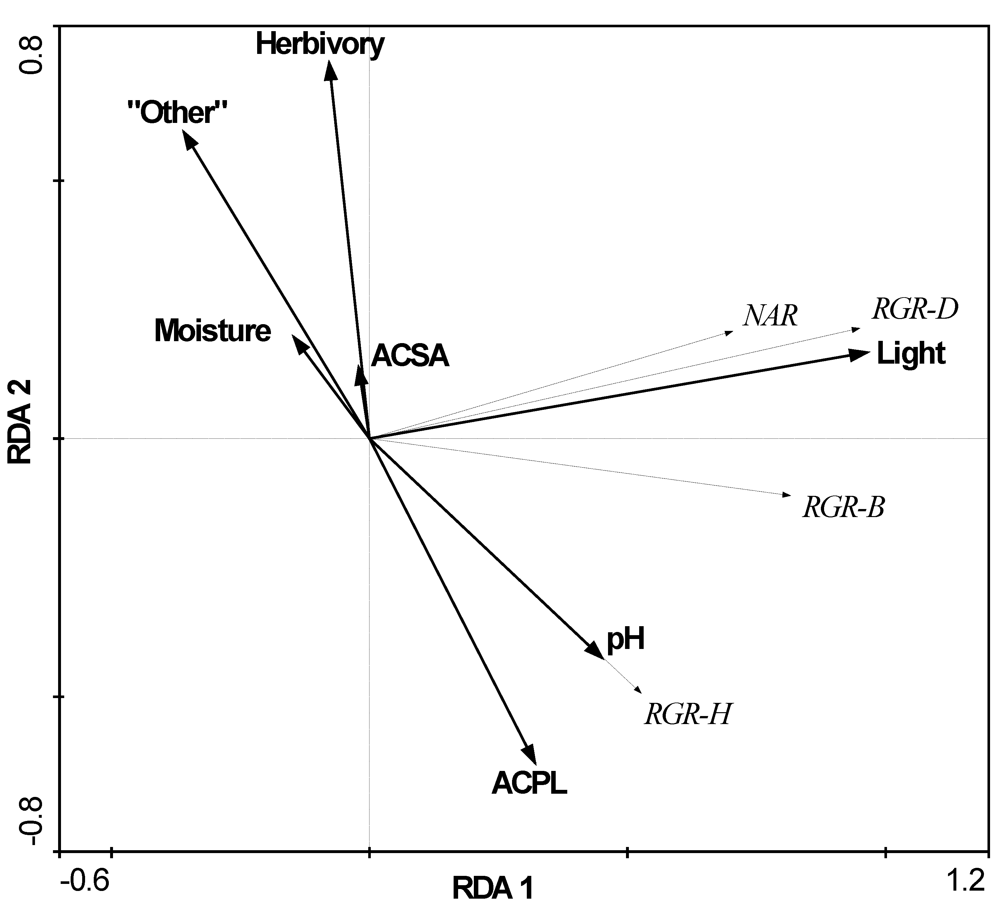
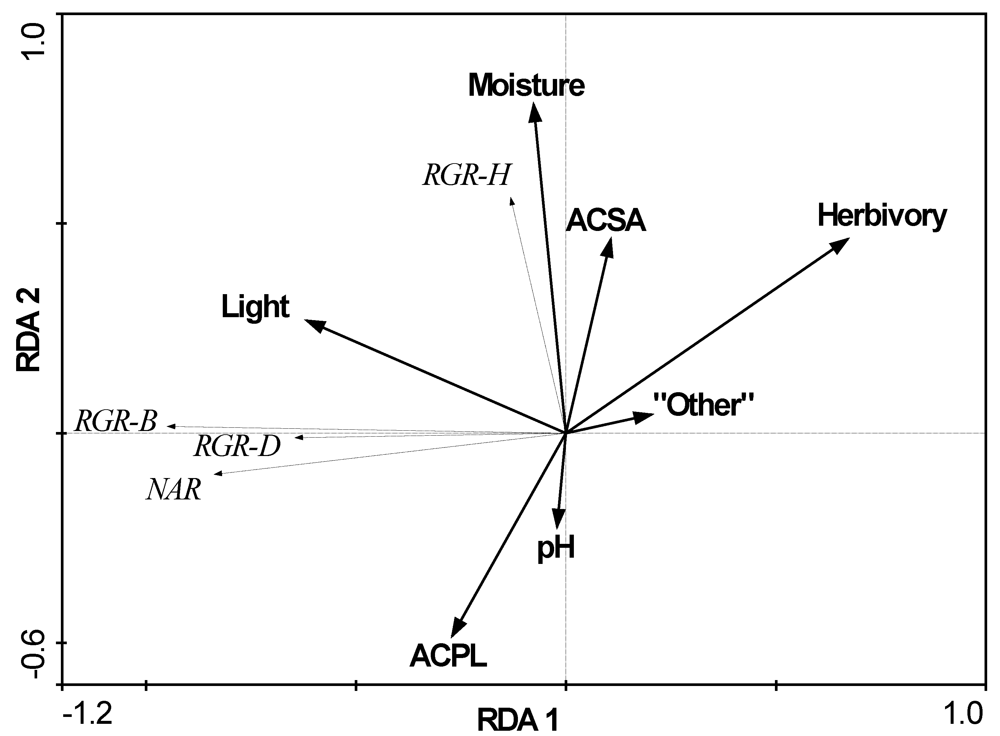
        <p><xref ref-type="fig" rid="forests-03-00190-f001">Figure 1</xref> and <xref ref-type="fig" rid="forests-03-00190-f002">Figure 2</xref> illustrate the results of redundancy analyses for <italic>A. platanoides</italic> and <italic>A. saccharum</italic> seedlings, respectively. Ecological factors explained 23.2% of the variation in <italic>A. platanoides</italic> seedling responses (<xref ref-type="fig" rid="forests-03-00190-f001">Figure 1</xref>). Light was the only significant explanatory variable, contributing 18% of explained variance to the model. Light was positively correlated to all RGR estimates and NAR, more so for <italic>A. platanoides</italic> than for <italic>A. saccharum</italic> (<xref ref-type="fig" rid="forests-03-00190-f002">Figure 2</xref>). </p>
        <fig id="forests-03-00190-f001" position="anchor">
          <label>Figure 1</label>
          <caption>
            <p>Redundancy-based analysis (RDA) correlation biplot representing growth parameters (dashed vectors) and ecological factors (solid vectors) of <italic>A. platanoides</italic> seedlings (<italic>n</italic> = 55). The first and second canonical axes explain respectively 19.6% and 2.9% of variation in the data. ACPL: <italic>A. platanoides</italic> canopy; ACSA: <italic>A. saccharum</italic> canopy; “Other”: other native canopy species.</p>
          </caption>
          <graphic xmlns:xlink="http://www.w3.org/1999/xlink" xlink:href="forests-03-00190-g001.tif"/>
        </fig>
        <p>Ecological variables explained 24% of the variation in seedling growth parameters for <italic>A. saccharum</italic>; herbivory explained 16%, mostly along the first axis, while light explained 7% along the second axis (<xref ref-type="fig" rid="forests-03-00190-f002">Figure 2</xref>). Only herbivory and light contributed significantly to the model. Herbivory was negatively correlated with RGR-B, RGR-D and NAR, while light was positively correlated. </p>
        <fig id="forests-03-00190-f002" position="anchor">
          <label>Figure 2</label>
          <caption>
            <p>RDA correlation biplot representing growth parameters (dashed vectors) and ecological factors (solid vectors) of <italic>A. saccharum</italic> seedlings (<italic>n</italic> = 56). The first and second canonical axes explain respectively 19.4% and 3.1% of variation in the data. ACPL: <italic>A. platanoides</italic> canopy; ACSA: <italic>A. saccharum</italic> canopy; “Other”: other native canopy species.</p>
          </caption>
          <graphic xmlns:xlink="http://www.w3.org/1999/xlink" xlink:href="forests-03-00190-g002.tif"/>
        </fig>
        
        <p>When all 240 seedlings were analyzed together to compare the influence of canopy species on the other ecological variables (herbivory, light, soil moisture and pH), only light levels differed significantly between <italic>A. platanoides</italic> and <italic>A. saccharum</italic> canopies, and between <italic>A. platanoides</italic> and native species canopies (<xref ref-type="table" rid="forests-03-00190-t003">Table 3</xref>). Missing leaves were not considered to be the result of herbivory; however, this might well have been the case and consequently, herbivory values were almost certainly underestimated. Finally, there was no difference in the frequency of tar spot disease on <italic>A. platanoides</italic> seedlings in relation to canopy type (<italic>x</italic><sup>2</sup> = 0.87, <italic>p</italic> = 0.648, <italic>n</italic> = 25).</p>
        <table-wrap id="forests-03-00190-t003" position="anchor">
          <object-id pub-id-type="pii">forests-03-00190-t003_Table 3</object-id>
          <label>Table 3</label>
          <caption>
            <p>Ecological factors measured under <italic>A. platanoides</italic>, <italic>A. saccharum</italic> and other native species canopies. Mean values (± SD) are given for each variable, together with test-statistics (<italic>p</italic>-values) for the canopy comparisons. Herbivory was tested on non-harvested seedlings only (<italic>n</italic> &lt; <italic>n</italic> total).</p>
          </caption>
          <table>
            <thead>
              <tr>
                <th align="left" valign="middle">Factors</th>
                <th align="left" valign="middle"><italic>A. platanoides </italic><break/>canopy</th>
                <th align="left" valign="middle"><italic>A. saccharum </italic><break/>canopy</th>
                <th align="left" valign="middle">Other native <break/>spp. canopy</th>
                <th align="left" valign="middle">ACPL <italic>vs.</italic> ACSA<break/>F- or U-test</th>
                <th align="left" valign="middle">ACPL <italic>vs.</italic> all native <break/>spp. F or U-test</th>
              </tr>
            </thead>
            <tbody>
              <tr>
                <td align="left" valign="middle"> </td>
                <td align="left" valign="middle"><italic>n</italic> = 96</td>
                <td align="left" valign="middle"><italic>n</italic> = 80</td>
                <td align="left" valign="middle"><italic>n</italic> = 64</td>
                <td align="left" valign="middle"><italic>n</italic> = 176</td>
                <td align="left" valign="middle"><italic>n</italic> = 240</td>
              </tr>
              <tr>
                <td align="left" valign="middle">
                  <bold>Light (%)</bold>
                </td>
                <td align="left" valign="middle">2.53 (1.34)</td>
                <td align="left" valign="middle">1.69 (0.87)</td>
                <td align="left" valign="middle">1.43 (0.64)</td>
                <td align="left" valign="middle">22.36*** <sup>2</sup></td>
                <td align="left" valign="middle">38.67*** <sup>2</sup></td>
              </tr>
              <tr>
                <td align="left" valign="middle">
                  <bold>Soil moisture (%)</bold>
                </td>
                <td align="left" valign="middle">12.4 (3.2)</td>
                <td align="left" valign="middle">13.7 (4.8)</td>
                <td align="left" valign="middle">13.4 (2.8)</td>
                <td align="left" valign="middle">0.69 <sup>1</sup></td>
                <td align="left" valign="middle">1.41 <sup>1</sup></td>
              </tr>
              <tr>
                <td align="left" valign="middle">
                  <bold>Soil pH</bold>
                </td>
                <td align="left" valign="middle">5.98 (0.55)</td>
                <td align="left" valign="middle">5.67 (0.40)</td>
                <td align="left" valign="middle">5.45 (0.62)</td>
                <td align="left" valign="middle">3.58</td>
                <td align="left" valign="middle">5.79* <sup>1</sup></td>
              </tr>
              <tr>
                <td align="left" valign="middle">
                  <bold>Herbivory (%)</bold>
                </td>
                <td align="left" valign="middle">9.5 (8.8), <break/><italic>n</italic> = 48</td>
                <td align="left" valign="middle">15.2 (15.7), <break/><italic>n</italic> = 39</td>
                <td align="left" valign="middle">14.4 (11.1), <break/><italic>n</italic> = 24</td>
                <td align="left" valign="middle">2.44 <sup>1</sup>, <break/><italic>n</italic> = 87</td>
                <td align="left" valign="middle">3.71<sup>1</sup>, <break/><italic>n</italic> = 111</td>
              </tr>
            </tbody>
          </table>
          <table-wrap-foot>
        <fn>
        <p><bold><sup>1</sup></bold> Rank transformation; <bold><sup>2</sup></bold> Wilcoxon Test, * <italic>p</italic> &lt; 0.05, ** <italic>p</italic> &lt; 0.01, *** <italic>p</italic> &lt; 0.001.</p>
        </fn>  
          </table-wrap-foot>
        </table-wrap>
        
      </sec>
    </sec>
    <sec sec-type="discussion">
      <title>4. Discussion</title>
      <sec>
        <title>4.1. Growth, Biomass Distribution and Survival of <italic>A. Platanoides</italic> and <italic>A. Saccharum</italic> Seedlings</title>
        <p>First-year <italic>A. platanoides</italic> seedlings transplanted in a low light forest environment were found to be superior to <italic>A. saccharum</italic> for all descriptive variables measured except height. For example, values of relative growth in biomass (RGR-B) and assimilation rate (NAR indicating biomass produced on a leaf area basis) were twice as large for the invasive as for the native species. Consequently, not only is <italic>A. platanoides</italic> initially bigger, possibly because of its bigger seed [<xref ref-type="bibr" rid="B40-forests-03-00190">40</xref>], but its growth during the course of our experiment was also greatly superior to that of <italic>A. saccharum</italic>. As saplings, <italic>A. platanoides</italic> also showed better carbon assimilation rates than <italic>A. saccharum</italic>, as derived from higher field photosynthetic net rates [<xref ref-type="bibr" rid="B41-forests-03-00190">41</xref>]. </p>
        <p>A superior height growth rate is a definite competitive advantage for faster canopy recruitment. However, we found no difference in height between <italic>A. platanoides</italic> and <italic>A. saccharum</italic>. It is possible that differences in height growth rates (RGR-H) could appear later in their development or after an episode of release, with <italic>A. platanoides</italic> being a more efficient colonizer of gap openings [<xref ref-type="bibr" rid="B19-forests-03-00190">19</xref>,<xref ref-type="bibr" rid="B42-forests-03-00190">42</xref>]. Indeed, as saplings, <italic>A. platanoides </italic>have higher height growth rates, in addition to higher high-light radial growths, than <italic>A. saccharum</italic> [<xref ref-type="bibr" rid="B21-forests-03-00190">21</xref>,<xref ref-type="bibr" rid="B35-forests-03-00190">35</xref>,<xref ref-type="bibr" rid="B41-forests-03-00190">41</xref>]. Also, the species exhibited similar patterns of biomass distribution, both in the greenhouse and at the end of the growing season in the forest. This pattern was also observed in seedlings of a previous study [<xref ref-type="bibr" rid="B43-forests-03-00190">43</xref>] and could indicate similar adaptations to the environment. </p>
        <p>There were important differences in the leaves of the two congeners that may drive the difference in biomass growth (RGR-B). Leaves were more numerous for <italic>A. platanoides </italic>compared to<italic> A. saccharum</italic>; foliage biomass was 1.6 times higher, with a 1.7 times greater surface area. Our results agree with previous studies in that <italic>A. platanoides</italic> yearlings had more leaves than their congeners [<xref ref-type="bibr" rid="B29-forests-03-00190">29</xref>]. Both higher Specific leaf area (SLA, which indicates thinner leaves), and higher Leaf area ratio (LAR) for <italic>A. platanoides</italic> imply that biomass investment in leaves yielded greater light interception potential and carbon gain than for <italic>A. saccharum</italic> [<xref ref-type="bibr" rid="B44-forests-03-00190">44</xref>]. Superior LAR is also related to higher growth in high and low light environments [<xref ref-type="bibr" rid="B45-forests-03-00190">45</xref>]. Furthermore, Kloeppel and Abrams [<xref ref-type="bibr" rid="B41-forests-03-00190">41</xref>] suggested that the thinner but denser (<italic>i.e.</italic>, more mass per unit area) leaves of <italic>A. platanoides</italic> could explain its higher photosynthetic rate compared to <italic>A. saccharum</italic>. Leaf phenology could be a further advantage to <italic>A. platanoides</italic> because it bears leaves for a few days more in the Fall than <italic>A. saccharum</italic> [<xref ref-type="bibr" rid="B29-forests-03-00190">29</xref>,<xref ref-type="bibr" rid="B41-forests-03-00190">41</xref>,<xref ref-type="bibr" rid="B42-forests-03-00190">42</xref>]. Finally, <italic>A. platanoides</italic> has a root system with 1.4 times more biomass than <italic>A. saccharum</italic>, which could balance its resource-demanding foliage.</p>
        <p>Survival in the low light conditions (less than 2% PAR, on average) of this experiment was high for both species, perhaps because seedlings emerged in a favourable environment or because the winter was warmer than usual and seedlings were insulated under a thick layer of snow for almost the entire cold season. Survival was similar for the two species during the growing season (94%). Over the winter, which is often the critical period for yearlings, <italic>A. saccharum</italic> incurred mortality (5%) while <italic>A. platanoides</italic> did not. Other studies also have found that survival after seedling transplantation in the understory did not differ between the two species in the first growing season, but that differences favouring <italic>A. platanoides</italic> emerged later on [<xref ref-type="bibr" rid="B29-forests-03-00190">29</xref>,<xref ref-type="bibr" rid="B43-forests-03-00190">43</xref>]. Also, a higher biomass growth rate (RGR-B) in field conditions can constitute an important advantage since it may be positively correlated with broadleaf seedling survival in deep shade [<xref ref-type="bibr" rid="B45-forests-03-00190">45</xref>]. Even small differences in growth can lead to large differences in survival rates since these differences in performance accumulate over time in long-lived species. </p>
      </sec>
      <sec>
        <title>4.2. The Influence of Ecological Factors</title>
        <p>The proportion of variation in growth parameters that was explained in the RDA by all ecological factors was somewhat low for the two species (23% for <italic>A. platanoides</italic> and 24% for <italic>A. saccharum</italic>). The most likely reason is that the study site did not present large gradients of either light or soil conditions because the seedlings were transplanted under closed canopies into sites where the species co-occurred in the canopy. However, the significance of two factors, light and herbivory levels, emerged from the analyses. </p>
        <p>The present study did not find any significant effect of the canopy species on yearlings. Previous studies showed that <italic>A. platanoides</italic> canopy trees could hinder the regeneration of <italic>A. saccharum</italic> in some way while favouring their conspecifics [<xref ref-type="bibr" rid="B18-forests-03-00190">18</xref>,<xref ref-type="bibr" rid="B22-forests-03-00190">22</xref>,<xref ref-type="bibr" rid="B23-forests-03-00190">23</xref>,<xref ref-type="bibr" rid="B24-forests-03-00190">24</xref>]. Yet another study observed a strong positive effect of <italic>A. platanoides</italic>, even at low densities, on the growth of native seedlings, including <italic>A. saccharum</italic>; this positive effect was even more pronounced for conspecifics, with the exception of yearlings [<xref ref-type="bibr" rid="B46-forests-03-00190">46</xref>]. We also expected to find differences in soil pH between native and exotic canopies, as reported in the literature [<xref ref-type="bibr" rid="B47-forests-03-00190">47</xref>]. Considering the trees in the neighbourhood of seedlings in the present study, as did Gómez-Aparicio <italic>et al</italic>. [<xref ref-type="bibr" rid="B46-forests-03-00190">46</xref>], might have increased the explanatory power of the canopy species variable and its influence on the other ecological variables, especially in terms of herbivory and light levels. These authors showed that individual trees could influence the properties of the soil around them, but the effects decreased within a few meters away from the trunks. </p>
        <sec>
          <title>4.2.1. Growth and Understory Light Levels</title>
          <p>Higher light intensities favoured the growth of both species. It was the most influential factor for <italic>A. platanoides</italic> seedlings, explaining 18% of the variation in growth, compared to 7% for <italic>A. saccharum</italic> seedlings. The most likely explanation is that <italic>A. platanoides</italic> could respond better to even small increments in light intensity because, as we have shown, its foliage characteristics allow more efficient light capture. In consequence, when compared to <italic>A. saccharum</italic>, <italic>A. platanoides</italic> did not seem to face a trade-off between maintaining higher growth (e.g., through high LAR) and survival in low light. This finding was confirmed by an experimental study using simulated light regimes to compare yearlings of the two <italic>Acer</italic> species [<xref ref-type="bibr" rid="B42-forests-03-00190">42</xref>].</p>
          <p>Interestingly, higher light levels in the understory were associated in this study with the presence of <italic>A. platanoides</italic> in the canopy. Previous studies had suggested that, on the contrary, <italic>A. platanoides</italic> casts deeper shade than native species [<xref ref-type="bibr" rid="B13-forests-03-00190">13</xref>,<xref ref-type="bibr" rid="B22-forests-03-00190">22</xref>,<xref ref-type="bibr" rid="B23-forests-03-00190">23</xref>,<xref ref-type="bibr" rid="B25-forests-03-00190">25</xref>]. Laboratory and field experiments in Montana have shown that the deleterious effects observed in the understory could be explained by lower light levels under <italic>A. platanoides</italic> canopies compared to native canopies [<xref ref-type="bibr" rid="B48-forests-03-00190">48</xref>,<xref ref-type="bibr" rid="B49-forests-03-00190">49</xref>]. However, unlike northeastern hardwood forests, no species with shade tolerance comparable to that of <italic>A. platanoides</italic> (e.g., <italic>A. saccharum</italic> and <italic>Fagus grandifolia</italic> Ehrh.) were found at the Montana site. </p>
          <p>At any rate, the tar spot epidemic of the previous year, which affected only <italic>A. platanoides</italic>, might be a confounding factor in that crown damage was still apparent a year later [<xref ref-type="bibr" rid="B50-forests-03-00190">50</xref>]. In consequence, longer term studies are needed to clarify the relationship between <italic>A. platanoides</italic> and understory light levels to verify whether our observations represent simply a transient state resulting from the tar spot epidemic. </p>
        </sec>
        <sec>
          <title>4.2.2. The influence of Leaf Herbivory on Seedling Growth</title>
          <p>When we compared the herbivory levels observed in <italic>A. platanoides</italic> and <italic>A. saccharum</italic> seedlings (11% and 14%, respectively), the proportion of affected leaves did not significantly differ between species. Our results are comparable to those of Morrison and Mauck [<xref ref-type="bibr" rid="B29-forests-03-00190">29</xref>], who examined leaf herbivory in <italic>A. platanoides</italic> and <italic>A. saccharum</italic> yearlings (about 10% for insects or slugs in August), also without finding a significant difference between the two species. Findings of the present study and that of Morrison and Mauck [<xref ref-type="bibr" rid="B29-forests-03-00190">29</xref>] contrast strongly with the results of another study on leaf herbivory in older plants [<xref ref-type="bibr" rid="B51-forests-03-00190">51</xref>], which found greater herbivory for <italic>A. saccharum </italic>than for <italic>A. platanoides</italic>, although absolute herbivory levels of both species were lower in the latter study. This apparent contradiction illustrates that ontogenic stage must be considered when assessing herbivore damage to a plant because its development can affect its defences and tolerance, as well as herbivore preference (for a review, see [<xref ref-type="bibr" rid="B52-forests-03-00190">52</xref>]). </p>
          <p>While herbivore damage on <italic>A. platanoides</italic> and <italic>A. saccharum</italic> was compared in previous studies, the resulting impacts on plant growth were not investigated [<xref ref-type="bibr" rid="B29-forests-03-00190">29</xref>,<xref ref-type="bibr" rid="B51-forests-03-00190">51</xref>]. Our results from RDA indicate that herbivory was more important for the growth of <italic>A. saccharum</italic> than that of <italic>A. platanoides</italic> seedlings, more so than light, and explained as much as 16% of the variation in <italic>A. saccharum</italic> growth. For <italic>A. saccharum</italic>, herbivory decreased RGR-B and NAR, and might explain the large variation measured in these parameters. It is possible that <italic>A. platanoides</italic> seedlings were less affected by similar herbivory levels because they had more leaves, with a greater surface area, and hence, the same proportion of herbivory still left a higher leaf surface for photosynthesis. </p>
          <p>Future studies could consider other types of interactions with natural enemies. For example, the soil biota has been shown to facilitate invasions by <italic>A. platanoides</italic> [<xref ref-type="bibr" rid="B53-forests-03-00190">53</xref>] and other plants [<xref ref-type="bibr" rid="B54-forests-03-00190">54</xref>,<xref ref-type="bibr" rid="B55-forests-03-00190">55</xref>,<xref ref-type="bibr" rid="B56-forests-03-00190">56</xref>]. In addition, it is necessary to monitor the influence of tar spot disease over the coming years, especially its effects on the regeneration of<italic> A. platanoides</italic>. We have shown previously that the disease can severely impact the growth of saplings and trees as well as sapling survival, but we did not measure its impact on seedlings [<xref ref-type="bibr" rid="B35-forests-03-00190">35</xref>]. In the current study, fungus damage was not important compared to that caused by invertebrate herbivores. However, the seedlings had been transplanted late in the spring, probably past the peak inoculation period for the fungus [<xref ref-type="bibr" rid="B57-forests-03-00190">57</xref>]. </p>
        </sec>
      </sec>
    </sec>
    <sec sec-type="conclusions">
      <title>5. Conclusions</title>
      <p>The present experimental study contributes to the body of knowledge on the invasive species <italic>A. platanoides</italic> by comparing a variety of growth and biomass distribution parameters with that of the native dominant, <italic>A. saccharum</italic>, in a forest understory during the crucial seedling establishment phase. Overall, environmental factors had only a slight influence on the two maple species. At any rate, the robust <italic>A. platanoides</italic> first-year seedlings demonstrated certain advantages over the native dominant <italic>A. saccharum</italic>. The higher growth estimated over the course of the experiment for <italic>A. platanoides</italic> in the shaded forest understory could result in a higher survival rate if this advantage were maintained in the future. On the other hand, <italic>A. platanoides</italic> seedlings could also benefit more readily from canopy openings in sugar maple forests than their native congener because of their advantageous foliar characteristics.</p>
    </sec>
    
  </body>
  <back>
  <ack>
      <title>Acknowledgments</title>
      <p>Many thanks to our very competent field assistants: M. Anagrius, C. Brosseau, J. Lapointe, M. Painchaud and Y. Tendland. We would also like to thank the following: for advice, logistic support and technical assistance, P. Boivin, J. Brodeur, A. Cogliastro, S. Comtois, S. Daigle, J.-F. Denis, B. Fontaine, M. Lapointe, W.F.J. Parsons and G. Teodorescu. We are grateful to the City of Montréal for providing all authorizations for working in Mount-Royal Park. We are especially grateful to W.F.J. Parsons, M. Painchaud, K. Grislis and R. Lapointe for their critical review of the manuscript. This work was supported by funding from the Natural Sciences and Engineering Research Council of Canada (NSERC).</p>
    </ack>
    <notes>
      <title>Conflict of Interest</title>
      <p>The authors declare no conflict of interest. </p>
    </notes>
    <ref-list>
      <title>References</title>
      <ref id="B1-forests-03-00190">
        <label>1.</label>
        <citation citation-type="journal">
          <person-group person-group-type="author">
            <name>
              <surname>Vitousek</surname>
              <given-names>P.M.</given-names>
            </name>
            <name>
              <surname>D’Antonio</surname>
              <given-names>C.M.</given-names>
            </name>
            <name>
              <surname>Loope</surname>
              <given-names>L.L.</given-names>
            </name>
            <name>
              <surname>Westbrooks</surname>
              <given-names>R.</given-names>
            </name>
          </person-group>
          <article-title>Biological invasions as global environmental change</article-title>
          <source>Am. Sci.</source>
          <year>1996</year>
          <volume>84</volume>
          <fpage>468</fpage>
          <lpage>478</lpage>
        </citation>
      </ref>
      <ref id="B2-forests-03-00190">
        <label>2.</label>
        <citation citation-type="journal">
          <person-group person-group-type="author">
            <name>
              <surname>Mack</surname>
              <given-names>R.N.</given-names>
            </name>
            <name>
              <surname>Simberloff</surname>
              <given-names>D.</given-names>
            </name>
            <name>
              <surname>Lonsdale</surname>
              <given-names>W.M.</given-names>
            </name>
            <name>
              <surname>Evans</surname>
              <given-names>H.</given-names>
            </name>
            <name>
              <surname>Clout</surname>
              <given-names>M.</given-names>
            </name>
            <name>
              <surname>Bazzaz</surname>
              <given-names>F.A.</given-names>
            </name>
          </person-group>
          <article-title>Biotic invasions: Causes, epidemiology, global consequences, and control</article-title>
          <source>Eco. Appl.</source>
          <year>2000</year>
          <volume>10</volume>
          <fpage>689</fpage>
          <lpage>710</lpage>
          <pub-id pub-id-type="doi">10.1890/1051-0761(2000)010[0689:BICEGC]2.0.CO;2</pub-id>
        </citation>
      </ref>
      <ref id="B3-forests-03-00190">
        <label>3.</label>
        <citation citation-type="journal">
          <person-group person-group-type="author">
            <name>
              <surname>Reichard</surname>
              <given-names>S.H.</given-names>
            </name>
            <name>
              <surname>Hamilton</surname>
              <given-names>C.W.</given-names>
            </name>
          </person-group>
          <article-title>Predicting invasions of woody plants introduced into North America</article-title>
          <source>Conserv. Bio.</source>
          <year>1997</year>
          <volume>11</volume>
          <fpage>193</fpage>
          <lpage>203</lpage>
        <pub-id pub-id-type="doi">10.1046/j.1523-1739.1997.95473.x</pub-id></citation>
      </ref>
      <ref id="B4-forests-03-00190">
        <label>4.</label>
        <citation citation-type="journal">
          <person-group person-group-type="author">
            <name>
              <surname>Martin</surname>
              <given-names>P.H.</given-names>
            </name>
            <name>
              <surname>Canham</surname>
              <given-names>C.D.</given-names>
            </name>
            <name>
              <surname>Marks</surname>
              <given-names>P.L.</given-names>
            </name>
          </person-group>
          <article-title>Why forests appear resistant to exotic plant invasions: Intentional introductions, stand dynamics, and the role of shade tolerance</article-title>
          <source>Front. Ecol. Environ.</source>
          <year>2008</year>
          <volume>6</volume>
          <fpage>142</fpage>
          <lpage>149</lpage>
        </citation>
      </ref>
      <ref id="B5-forests-03-00190">
        <label>5.</label>
        <citation citation-type="journal">
          <person-group person-group-type="author">
            <name>
              <surname>Canham</surname>
              <given-names>C.D.</given-names>
            </name>
          </person-group>
          <article-title>Suppression and release during canopy recruitment in <italic>Acer saccharum</italic></article-title>
          <source>Bull. Torrey Bot. Club</source>
          <year>1985</year>
          <volume>112</volume>
          <fpage>134</fpage>
          <lpage>145</lpage>
          <pub-id pub-id-type="doi">10.2307/2996410</pub-id>
        </citation>
      </ref>
      <ref id="B6-forests-03-00190">
        <label>6.</label>
        <citation citation-type="journal">
          <person-group person-group-type="author">
            <name>
              <surname>Wangen</surname>
              <given-names>S.R.</given-names>
            </name>
            <name>
              <surname>Webster</surname>
              <given-names>C.R.</given-names>
            </name>
          </person-group>
          <article-title>Potential for multiple lag phases during biotic invasions: Reconstructing an invasion of the exotic tree <italic>Acer platanoides</italic></article-title>
          <source>J. Appl. Ecol.</source>
          <year>2006</year>
          <volume>43</volume>
          <fpage>258</fpage>
          <lpage>268</lpage>
          <pub-id pub-id-type="doi">10.1111/j.1365-2664.2006.01138.x</pub-id>
        </citation>
      </ref>
      <ref id="B7-forests-03-00190">
        <label>7.</label>
        <citation citation-type="journal">
          <person-group person-group-type="author">
            <name>
              <surname>Webster</surname>
              <given-names>C.R.</given-names>
            </name>
            <name>
              <surname>Jenkins</surname>
              <given-names>M.A.</given-names>
            </name>
            <name>
              <surname>Jose</surname>
              <given-names>S.</given-names>
            </name>
          </person-group>
          <article-title>Woody invaders and the challenges they pose to forest ecosystems in the eastern United States</article-title>
          <source>J. For.</source>
          <year>2006</year>
          <volume>104</volume>
          <fpage>366</fpage>
          <lpage>374</lpage>
        </citation>
      </ref>
      <ref id="B8-forests-03-00190">
        <label>8.</label>
        <citation citation-type="journal">
          <person-group person-group-type="author">
            <name>
              <surname>Herron</surname>
              <given-names>P.M.</given-names>
            </name>
            <name>
              <surname>Martine</surname>
              <given-names>C.T.</given-names>
            </name>
            <name>
              <surname>Latimer</surname>
              <given-names>A.M.</given-names>
            </name>
            <name>
              <surname>Leicht-Young</surname>
              <given-names>S.A.</given-names>
            </name>
          </person-group>
          <article-title>Invasive plants and their ecological strategies: Prediction and explanation of woody plant invasion in New England</article-title>
          <source>Divers. Distrib.</source>
          <year>2007</year>
          <volume>13</volume>
          <fpage>633</fpage>
          <lpage>644</lpage>
        <pub-id pub-id-type="doi">10.1111/j.1472-4642.2007.00381.x</pub-id></citation>
      </ref>
      <ref id="B9-forests-03-00190">
        <label>9.</label>
        <citation citation-type="journal">
          <person-group person-group-type="author">
            <name>
              <surname>Santamour</surname>
              <given-names>F.S.</given-names>
            </name>
            <name>
              <surname>McArdle</surname>
              <given-names>A.J.</given-names>
            </name>
          </person-group>
          <article-title>Checklist of cultivated maples. III. <italic>Acer platanoides</italic> L</article-title>
          <source>J. Arboric.</source>
          <year>1982</year>
          <volume>8</volume>
          <fpage>241</fpage>
          <lpage>246</lpage>
        </citation>
      </ref>
      <ref id="B10-forests-03-00190">
        <label>10.</label>
        <citation citation-type="journal">
          <person-group person-group-type="author">
            <name>
              <surname>Nowak</surname>
              <given-names>D.J.</given-names>
            </name>
            <name>
              <surname>Rowntree</surname>
              <given-names>R.A.</given-names>
            </name>
          </person-group>
          <article-title>History and range of Norway maple</article-title>
          <source>J. Arboric.</source>
          <year>1990</year>
          <volume>16</volume>
          <fpage>291</fpage>
          <lpage>296</lpage>
        </citation>
      </ref>
      <ref id="B11-forests-03-00190">
        <label>11.</label>
        <citation citation-type="journal">
          <person-group person-group-type="author">
            <name>
              <surname>Anderson</surname>
              <given-names>R.</given-names>
            </name>
          </person-group>
          <article-title>Disturbance as a factor in the distribution of sugar maple and the invasion of Norway maple into a modified woodland</article-title>
          <source>Rhodora</source>
          <year>1999</year>
          <volume>101</volume>
          <fpage>264</fpage>
          <lpage>273</lpage>
        </citation>
      </ref>
      <ref id="B12-forests-03-00190">
        <label>12.</label>
        <citation citation-type="journal">
          <person-group person-group-type="author">
            <name>
              <surname>Webb</surname>
              <given-names>S.L.</given-names>
            </name>
            <name>
              <surname>Pendergast</surname>
              <given-names>T.H.</given-names>
            </name>
            <name>
              <surname>Dwyer</surname>
              <given-names>M.E.</given-names>
            </name>
          </person-group>
          <article-title>Response of native and exotic maple seedling banks to removal of the exotic, invasive Norway maple (<italic>Acer platanoides</italic>)</article-title>
          <source>J. Torrey Bot. Soc.</source>
          <year>2001</year>
          <volume>128</volume>
          <fpage>141</fpage>
          <lpage>149</lpage>
          <pub-id pub-id-type="doi">10.2307/3088736</pub-id>
        </citation>
      </ref>
      <ref id="B13-forests-03-00190">
        <label>13.</label>
        <citation citation-type="journal">
          <person-group person-group-type="author">
            <name>
              <surname>Bertin</surname>
              <given-names>R.I.</given-names>
            </name>
            <name>
              <surname>Manner</surname>
              <given-names>M.E.</given-names>
            </name>
            <name>
              <surname>Larrow</surname>
              <given-names>B.F.</given-names>
            </name>
            <name>
              <surname>Cantwell</surname>
              <given-names>T.W.</given-names>
            </name>
            <name>
              <surname>Berstene</surname>
              <given-names>E.M.</given-names>
            </name>
          </person-group>
          <article-title>Norway maple (<italic>Acer platanoides</italic>) and other non-native trees in urban woodlands of central Massachusetts</article-title>
          <source>J. Torrey Bot. Soc.</source>
          <year>2005</year>
          <volume>132</volume>
          <fpage>225</fpage>
          <lpage>235</lpage>
          <pub-id pub-id-type="doi">10.3159/1095-5674(2005)132[225:NMAPAO]2.0.CO;2</pub-id>
        </citation>
      </ref>
      <ref id="B14-forests-03-00190">
        <label>14.</label>
        <citation citation-type="journal">
          <person-group person-group-type="author">
            <name>
              <surname>Webster</surname>
              <given-names>C.R.</given-names>
            </name>
            <name>
              <surname>Nelson</surname>
              <given-names>K.</given-names>
            </name>
            <name>
              <surname>Wangen</surname>
              <given-names>S.R.</given-names>
            </name>
          </person-group>
          <article-title>Stand dynamics of an insular population of an invasive tree, <italic>Acer platanoides</italic></article-title>
          <source>For. Ecol. Manag.</source>
          <year>2005</year>
          <volume>208</volume>
          <fpage>85</fpage>
          <lpage>99</lpage>
          <pub-id pub-id-type="doi">10.1016/j.foreco.2004.11.017</pub-id>
        </citation>
      </ref>
      <ref id="B15-forests-03-00190">
        <label>15.</label>
        <citation citation-type="journal">
          <person-group person-group-type="author">
            <name>
              <surname>Wangen</surname>
              <given-names>S.R.</given-names>
            </name>
            <name>
              <surname>Webster</surname>
              <given-names>C.R.</given-names>
            </name>
            <name>
              <surname>Griggs</surname>
              <given-names>J.A.</given-names>
            </name>
          </person-group>
          <article-title>Spatial characteristics of the invasion of <italic>Acer platanoides</italic> on a temperate forested island</article-title>
          <source>Biol. Invasions</source>
          <year>2006</year>
          <volume>8</volume>
          <fpage>1001</fpage>
          <lpage>1012</lpage>
          <pub-id pub-id-type="doi">10.1007/s10530-005-2060-9</pub-id>
        </citation>
      </ref>
      <ref id="B16-forests-03-00190">
        <label>16.</label>
        <citation citation-type="book">
          <person-group person-group-type="author">
            <name>
              <surname>Midy</surname>
              <given-names>J.</given-names>
            </name>
            <name>
              <surname>Brisson</surname>
              <given-names>J.</given-names>
            </name>
            <name>
              <surname>Boivin</surname>
              <given-names>P.</given-names>
            </name>
          </person-group>
          <source>Invasion du Parc du Mont-Royal par l'érable de Norvège: Evaluation de la Situation, Causes, Conséquences. Rapport d'Activités Final Présenté à la Direction des Sports, des Parcs et des Espaces Verts, Ville de Montréal</source>
          <publisher-name>Institut de Recherche en Biologie Végétale</publisher-name>
          <publisher-loc>Montreal, QC, Canada</publisher-loc>
          <year>2007</year>
        </citation>
      </ref>
      <ref id="B17-forests-03-00190">
        <label>17.</label>
        <citation citation-type="journal">
          <person-group person-group-type="author">
            <name>
              <surname>Webb</surname>
              <given-names>S.L.</given-names>
            </name>
            <name>
              <surname>Dwyer</surname>
              <given-names>M.</given-names>
            </name>
            <name>
              <surname>Kaunzinger</surname>
              <given-names>C.K.</given-names>
            </name>
            <name>
              <surname>Wyckoff</surname>
              <given-names>P.H.</given-names>
            </name>
          </person-group>
          <article-title>The myth of the resilient forest: Case study of the invasive Norway maple (<italic>Acer platanoides</italic>)</article-title>
          <source>Rhodora</source>
          <year>2000</year>
          <volume>102</volume>
          <fpage>332</fpage>
          <lpage>354</lpage>
        </citation>
      </ref>
      <ref id="B18-forests-03-00190">
        <label>18.</label>
        <citation citation-type="journal">
          <person-group person-group-type="author">
            <name>
              <surname>Fang</surname>
              <given-names>W.</given-names>
            </name>
          </person-group>
          <article-title>Spatial analysis of an invasion front of <italic>Acer platanoides</italic>: dynamic inferences from static data</article-title>
          <source>Ecography</source>
          <year>2005</year>
          <volume>28</volume>
          <fpage>283</fpage>
          <lpage>294</lpage>
          <pub-id pub-id-type="doi">10.1111/j.0906-7590.2005.04052.x</pub-id>
        </citation>
      </ref>
      <ref id="B19-forests-03-00190">
        <label>19.</label>
        <citation citation-type="journal">
          <person-group person-group-type="author">
            <name>
              <surname>Martin</surname>
              <given-names>P.H.</given-names>
            </name>
            <name>
              <surname>Marks</surname>
              <given-names>P.L.</given-names>
            </name>
          </person-group>
          <article-title>Intact forests provide only weak resistance to a shade-tolerant invasive Norway maple (<italic>Acer platanoides</italic> L)</article-title>
          <source>J. Ecol.</source>
          <year>2006</year>
          <volume>94</volume>
          <fpage>1070</fpage>
          <lpage>1079</lpage>
          <pub-id pub-id-type="doi">10.1111/j.1365-2745.2006.01159.x</pub-id>
        </citation>
      </ref>
      <ref id="B20-forests-03-00190">
        <label>20.</label>
        <citation citation-type="journal">
          <person-group person-group-type="author">
            <name>
              <surname>Martin</surname>
              <given-names>P.H.</given-names>
            </name>
            <name>
              <surname>Canham</surname>
              <given-names>C.D.</given-names>
            </name>
          </person-group>
          <article-title>Dispersal and recruitment limitation in native versus exotic tree species: Life-history strategies and Janzen-Connell effects</article-title>
          <source>Oikos</source>
          <year>2010</year>
          <volume>119</volume>
          <fpage>807</fpage>
          <lpage>824</lpage>
        <pub-id pub-id-type="doi">10.1111/j.1600-0706.2009.17941.x</pub-id></citation>
      </ref>
      <ref id="B21-forests-03-00190">
        <label>21.</label>
        <citation citation-type="journal">
          <person-group person-group-type="author">
            <name>
              <surname>Martin</surname>
              <given-names>P.H.</given-names>
            </name>
            <name>
              <surname>Canham</surname>
              <given-names>C.D.</given-names>
            </name>
            <name>
              <surname>Kobe</surname>
              <given-names>R.K.</given-names>
            </name>
          </person-group>
          <article-title>Divergence from the growth–survival trade-off and extreme high growth rates drive patterns of exotic tree invasions in closed-canopy forests</article-title>
          <source>J. Ecol.</source>
          <year>2010</year>
          <volume>98</volume>
          <fpage>778</fpage>
          <lpage>789</lpage>
        <pub-id pub-id-type="doi">10.1111/j.1365-2745.2010.01666.x</pub-id></citation>
      </ref>
      <ref id="B22-forests-03-00190">
        <label>22.</label>
        <citation citation-type="journal">
          <person-group person-group-type="author">
            <name>
              <surname>Wyckoff</surname>
              <given-names>P.H.</given-names>
            </name>
            <name>
              <surname>Webb</surname>
              <given-names>S.L.</given-names>
            </name>
          </person-group>
          <article-title>Understory influence of the invasive Norway maple (<italic>Acer platanoides</italic>)</article-title>
          <source>Bull. Torrey Bot. Club</source>
          <year>1996</year>
          <volume>123</volume>
          <fpage>197</fpage>
          <lpage>205</lpage>
          <pub-id pub-id-type="doi">10.2307/2996795</pub-id>
        </citation>
      </ref>
      <ref id="B23-forests-03-00190">
        <label>23.</label>
        <citation citation-type="journal">
          <person-group person-group-type="author">
            <name>
              <surname>Martin</surname>
              <given-names>P.H.</given-names>
            </name>
          </person-group>
          <article-title>Norway maple (<italic>Acer platanoides</italic>) invasion of a natural forest stand: Understory consequence and regeneration pattern</article-title>
          <source>Biol. Invasions</source>
          <year>1999</year>
          <volume>1</volume>
          <fpage>215</fpage>
          <lpage>222</lpage>
          <pub-id pub-id-type="doi">10.1023/A:1010084421858</pub-id>
        </citation>
      </ref>
      <ref id="B24-forests-03-00190">
        <label>24.</label>
        <citation citation-type="journal">
          <person-group person-group-type="author">
            <name>
              <surname>Galbraith-Kent</surname>
              <given-names>S.L.</given-names>
            </name>
            <name>
              <surname>Handel</surname>
              <given-names>S.N.</given-names>
            </name>
          </person-group>
          <article-title>Invasive <italic>Acer platanoides</italic> inhibits native sapling growth in forest understorey communities</article-title>
          <source>J. Ecol.</source>
          <year>2008</year>
          <volume>96</volume>
          <fpage>293</fpage>
          <lpage>302</lpage>
          <pub-id pub-id-type="doi">10.1111/j.1365-2745.2007.01337.x</pub-id>
        </citation>
      </ref>
      <ref id="B25-forests-03-00190">
        <label>25.</label>
        <citation citation-type="journal">
          <person-group person-group-type="author">
            <name>
              <surname>Webb</surname>
              <given-names>S.L.</given-names>
            </name>
            <name>
              <surname>Kaunzinger</surname>
              <given-names>C.K.</given-names>
            </name>
          </person-group>
          <article-title>Biological invasion of the Drew University (New Jersey) forest preserve by Norway maple (<italic>Acer platanoides</italic> L.)</article-title>
          <source>Bull. Torrey Bot. Club</source>
          <year>1993</year>
          <volume>120</volume>
          <fpage>343</fpage>
          <lpage>349</lpage>
          <pub-id pub-id-type="doi">10.2307/2996999</pub-id>
        </citation>
      </ref>
      <ref id="B26-forests-03-00190">
        <label>26.</label>
        <citation citation-type="book">
          <person-group person-group-type="author">
            <name>
              <surname>Godman</surname>
              <given-names>R.M.</given-names>
            </name>
            <name>
              <surname>Yawney</surname>
              <given-names>H.W.</given-names>
            </name>
            <name>
              <surname>Tubbs</surname>
              <given-names>C.H.</given-names>
            </name>
          </person-group>
          <article-title>Sugar maple (<italic>Acer saccharum</italic> Marsh)</article-title>
          <source>Sylvics of North America</source>
          <person-group person-group-type="editor">
            <name>
              <surname>Burns</surname>
              <given-names>R.M.</given-names>
            </name>
            <name>
              <surname>Honkala</surname>
              <given-names>B.H.</given-names>
            </name>
          </person-group>
          <publisher-name>USDA Forest Service</publisher-name>
          <publisher-loc>Washington, DC, USA</publisher-loc>
          <year>1990</year>
          <volume>2</volume>
          <fpage>78</fpage>
          <lpage>91</lpage>
        </citation>
      </ref>
      <ref id="B27-forests-03-00190">
        <label>27.</label>
        <citation citation-type="journal">
          <person-group person-group-type="author">
            <name>
              <surname>Marks</surname>
              <given-names>P.L.</given-names>
            </name>
            <name>
              <surname>Gardescu</surname>
              <given-names>S.</given-names>
            </name>
          </person-group>
          <article-title>A case study of sugar maple (<italic>Acer saccharum</italic>) as a forest seedling bank species</article-title>
          <source>J. Torrey Bot. Soc.</source>
          <year>1998</year>
          <volume>125</volume>
          <fpage>287</fpage>
          <lpage>296</lpage>
          <pub-id pub-id-type="doi">10.2307/2997242</pub-id>
        </citation>
      </ref>
      <ref id="B28-forests-03-00190">
        <label>28.</label>
        <citation citation-type="journal">
          <person-group person-group-type="author">
            <name>
              <surname>Pacala</surname>
              <given-names>S.W.</given-names>
            </name>
            <name>
              <surname>Canham</surname>
              <given-names>C.D.</given-names>
            </name>
            <name>
              <surname>Saponara</surname>
              <given-names>J.</given-names>
            </name>
            <name>
              <surname>Silander</surname>
              <given-names>J.A.</given-names>
              <suffix>Jr.</suffix>
            </name>
            <name>
              <surname>Kobe</surname>
              <given-names>R.K.</given-names>
            </name>
            <name>
              <surname>Ribbens</surname>
              <given-names>E.</given-names>
            </name>
          </person-group>
          <article-title>Forest models defined by field measurements: Estimation, error analysis and dynamics</article-title>
          <source>Ecol. Monogr.</source>
          <year>1996</year>
          <volume>66</volume>
          <fpage>1</fpage>
          <lpage>43</lpage>
          <pub-id pub-id-type="doi">10.2307/2963479</pub-id>
        </citation>
      </ref>
      <ref id="B29-forests-03-00190">
        <label>29.</label>
        <citation citation-type="journal">
          <person-group person-group-type="author">
            <name>
              <surname>Morrison</surname>
              <given-names>J.A.</given-names>
            </name>
            <name>
              <surname>Mauck</surname>
              <given-names>K.</given-names>
            </name>
          </person-group>
          <article-title>Experimental field comparison of native and non-native maple seedlings: Natural enemies, ecophysiology, growth and survival</article-title>
          <source>J. Ecol.</source>
          <year>2007</year>
          <volume>95</volume>
          <fpage>1036</fpage>
          <lpage>1049</lpage>
          <pub-id pub-id-type="doi">10.1111/j.1365-2745.2007.01270.x</pub-id>
        </citation>
      </ref>
      <ref id="B30-forests-03-00190">
        <label>30.</label>
        <citation citation-type="journal">
          <person-group person-group-type="author">
            <name>
              <surname>Mack</surname>
              <given-names>R.N.</given-names>
            </name>
          </person-group>
          <article-title>Predicting the identity and fate of plant invaders: emergent and emerging approaches</article-title>
          <source>Biol. Conserv.</source>
          <year>1996</year>
          <volume>78</volume>
          <fpage>107</fpage>
          <lpage>121</lpage>
        <pub-id pub-id-type="doi">10.1016/0006-3207(96)00021-3</pub-id></citation>
      </ref>
      <ref id="B31-forests-03-00190">
        <label>31.</label>
        <citation citation-type="book">
          <person-group person-group-type="author">
            <name>
              <surname>Thiffault</surname>
              <given-names>C.</given-names>
            </name>
          </person-group>
          <source>État de situation sur les bois de l’arrondissement historique et naturel du mont Royal</source>
          <publisher-name>Direction régionale de Montréal, Ministère de l’Environnement du Québec</publisher-name>
          <publisher-loc>Montreal, QC, Canada</publisher-loc>
          <year>2003</year>
        </citation>
      </ref>
      <ref id="B32-forests-03-00190">
        <label>32.</label>
        <citation citation-type="book">
          <person-group person-group-type="author">
            <name>
              <surname>Boivin</surname>
              <given-names>R.</given-names>
            </name>
          </person-group>
          <source>La végétation forestière du Mont-Royal (Montréal, Québec); Département de sciences biologiques</source>
          <publisher-name>Université de Montréal</publisher-name>
          <publisher-loc>Montreal, QC, Canada</publisher-loc>
          <year>1989</year>
        </citation>
      </ref>
      <ref id="B33-forests-03-00190">
        <label>33.</label>
        <citation citation-type="book">
          <person-group person-group-type="author">
            <name>
              <surname>Brisson</surname>
              <given-names>J.</given-names>
            </name>
            <name>
              <surname>Bouchard</surname>
              <given-names>A.</given-names>
            </name>
          </person-group>
          <article-title>Érablière à caryer</article-title>
          <source>Manuel de Foresterie</source>
          <publisher-name>MultiMondes</publisher-name>
          <publisher-loc>Sainte-Foy, QC, Canada</publisher-loc>
          <year>2009</year>
          <fpage>206</fpage>
          <lpage>215</lpage>
        </citation>
      </ref>
      <ref id="B34-forests-03-00190">
        <label>34.</label>
        <citation citation-type="journal">
          <person-group person-group-type="author">
            <name>
              <surname>Adams</surname>
              <given-names>J.M.</given-names>
            </name>
            <name>
              <surname>Fang</surname>
              <given-names>W.</given-names>
            </name>
            <name>
              <surname>Callaway</surname>
              <given-names>R.M.</given-names>
            </name>
            <name>
              <surname>Cipollini</surname>
              <given-names>D.</given-names>
            </name>
            <name>
              <surname>Newell</surname>
              <given-names>E.</given-names>
            </name>

          </person-group>
		  <collab>Transatlantic <italic>Acer platanoides</italic> Invasion Network (TRAIN)</collab>
          <article-title>A cross-continental test of the Enemy Release Hypothesis: Leaf herbivory on <italic>Acer platanoides</italic> (L.) is three times lower in North America than in its native Europe</article-title>
          <source>Biol. Invasions</source>
          <year>2009</year>
          <volume>11</volume>
          <fpage>1005</fpage>
          <lpage>1016</lpage>
          <pub-id pub-id-type="doi">10.1007/s10530-008-9312-4</pub-id>
        </citation>
      </ref>
      <ref id="B35-forests-03-00190">
        <label>35.</label>
        <citation citation-type="journal">
          <person-group person-group-type="author">
            <name>
              <surname>Lapointe</surname>
              <given-names>M.</given-names>
            </name>
            <name>
              <surname>Brisson</surname>
              <given-names>J.</given-names>
            </name>
          </person-group>
          <article-title>Tar spot disease on Norway maple in North America: Quantifying the impacts of a reunion between an invasive tree species and its adventive natural enemy</article-title>
          <source>Ecoscience</source>
          <year>2011</year>
          <volume>18</volume>
          <fpage>63</fpage>
          <lpage>69</lpage>
        <pub-id pub-id-type="doi">10.2980/18-1-3378</pub-id></citation>
      </ref>
      <ref id="B36-forests-03-00190">
        <label>36.</label>
        <citation citation-type="journal">
          <person-group person-group-type="author">
            <name>
              <surname>Paquette</surname>
              <given-names>A.</given-names>
            </name>
            <name>
              <surname>Bouchard</surname>
              <given-names>A.</given-names>
            </name>
            <name>
              <surname>Cogliastro</surname>
              <given-names>A.</given-names>
            </name>
          </person-group>
          <article-title>A less restrictive technique for the estimation of understory light under variable weather conditions</article-title>
          <source>For. Ecol. Manag.</source>
          <year>2007</year>
          <volume>242</volume>
          <fpage>800</fpage>
          <lpage>804</lpage>
        <pub-id pub-id-type="doi">10.1016/j.foreco.2007.01.067</pub-id></citation>
      </ref>
      <ref id="B37-forests-03-00190">
        <label>37.</label>
        <citation citation-type="other">
          <source>JMP Statistical Discovery Software, version 7.0.1</source>
          <publisher-name>SAS Institute Inc.</publisher-name>
          <publisher-loc>Cary, NC, USA</publisher-loc>
          <year>2007</year>
        </citation>
      </ref>
      <ref id="B38-forests-03-00190">
        <label>38.</label>
        <citation citation-type="book">
          <person-group person-group-type="author">
            <name>
              <surname>Legendre</surname>
              <given-names>P.</given-names>
            </name>
            <name>
              <surname>Legendre</surname>
              <given-names>L.</given-names>
            </name>
          </person-group>
          <source>Numerical Ecology</source>
          <edition>2nd</edition>
          <publisher-name>Elsevier Science</publisher-name>
          <publisher-loc>Amsterdam, The Netherlands</publisher-loc>
          <year>1998</year>
        </citation>
      </ref>
      <ref id="B39-forests-03-00190">
        <label>39.</label>
        <citation citation-type="book">
          <person-group person-group-type="author">
            <name>
              <surname>Ter Braak</surname>
              <given-names>C.J.F.</given-names>
            </name>
            <name>
              <surname>Šmilauer</surname>
              <given-names>P.</given-names>
            </name>
          </person-group>
          <source>CANOCO Reference Manual and CanoDraw for Windows User’s Guide: Software for Canonical Community Ordination, version 4.5</source>
          <publisher-name>Microcomputer Power</publisher-name>
          <publisher-loc>Ithaca, NY, USA</publisher-loc>
          <year>2002</year>
        </citation>
      </ref>
      <ref id="B40-forests-03-00190">
        <label>40.</label>
        <citation citation-type="journal">
          <person-group person-group-type="author">
            <name>
              <surname>Meiners</surname>
              <given-names>S.J.</given-names>
            </name>
          </person-group>
          <article-title>Seed and seedling ecology of <italic>Acer saccharum</italic> and <italic>Acer platanoides</italic>: A contrast between native and exotic congeners</article-title>
          <source>Northeast. Naturalist</source>
          <year>2005</year>
          <volume>12</volume>
          <fpage>23</fpage>
          <lpage>32</lpage>
          <pub-id pub-id-type="doi">10.1656/1092-6194(2005)012[0023:SASEOA]2.0.CO;2</pub-id>
        </citation>
      </ref>
      <ref id="B41-forests-03-00190">
        <label>41.</label>
        <citation citation-type="journal">
          <person-group person-group-type="author">
            <name>
              <surname>Kloeppel</surname>
              <given-names>B.D.</given-names>
            </name>
            <name>
              <surname>Abrams</surname>
              <given-names>M.D.</given-names>
            </name>
          </person-group>
          <article-title>Ecophysiological attributes of the native <italic>Acer saccharum</italic> and the exotic <italic>Acer platanoides</italic> in urban oak forests in Pennsylvania, USA</article-title>
          <source>Tree Physiol.</source>
          <year>1995</year>
          <volume>15</volume>
          <fpage>739</fpage>
          <lpage>746</lpage>
        <pub-id pub-id-type="doi">10.1093/treephys/15.11.739</pub-id><pub-id pub-id-type="pmid">14965992</pub-id></citation>
      </ref>
      <ref id="B42-forests-03-00190">
        <label>42.</label>
        <citation citation-type="journal">
          <person-group person-group-type="author">
            <name>
              <surname>Paquette</surname>
              <given-names>A.</given-names>
            </name>
            <name>
              <surname>Fontaine</surname>
              <given-names>B.</given-names>
            </name>
            <name>
              <surname>Berninger</surname>
              <given-names>F.</given-names>
            </name>
            <name>
              <surname>Dubois</surname>
              <given-names>K.</given-names>
            </name>
            <name>
              <surname>Lechowicz</surname>
              <given-names>M.J.</given-names>
            </name>
            <name>
              <surname>Messier</surname>
              <given-names>C.</given-names>
            </name>
            <name>
              <surname>Posada</surname>
              <given-names>J.M.</given-names>
            </name>
            <name>
              <surname>Valladares</surname>
              <given-names>F.</given-names>
            </name>
            <name>
              <surname>Brisson</surname>
              <given-names>J.</given-names>
            </name>
          </person-group>
          <article-title>Seedlings of the exotic norway maple have greater plasticity and late season height growth than native sugar maple in canopy gaps</article-title>
          <year>2012</year>
          <comment>submitted</comment>
        </citation>
      </ref>
      <ref id="B43-forests-03-00190">
        <label>43.</label>
        <citation citation-type="journal">
          <person-group person-group-type="author">
            <name>
              <surname>Sanford</surname>
              <given-names>N.L.</given-names>
            </name>
            <name>
              <surname>Harrington</surname>
              <given-names>R.A.</given-names>
            </name>
            <name>
              <surname>Fownes</surname>
              <given-names>J.H.</given-names>
            </name>
          </person-group>
          <article-title>Survival and growth of native and alien woody seedlings in open and understory environments</article-title>
          <source>For. Ecol. Manag.</source>
          <year>2003</year>
          <volume>183</volume>
          <fpage>377</fpage>
          <lpage>385</lpage>
        <pub-id pub-id-type="doi">10.1016/S0378-1127(03)00141-5</pub-id></citation>
      </ref>
      <ref id="B44-forests-03-00190">
        <label>44.</label>
        <citation citation-type="journal">
          <person-group person-group-type="author">
            <name>
              <surname>Walters</surname>
              <given-names>M.B.</given-names>
            </name>
            <name>
              <surname>Reich</surname>
              <given-names>P.B.</given-names>
            </name>
          </person-group>
          <article-title>Seed size, nitrogen supply, and growth rate affect tree seedling survival in deep shade</article-title>
          <source>Ecology</source>
          <year>2000</year>
          <volume>81</volume>
          <fpage>1887</fpage>
          <lpage>1901</lpage>
          <pub-id pub-id-type="doi">10.1890/0012-9658(2000)081[1887:SSNSAG]2.0.CO;2</pub-id>
        </citation>
      </ref>
      <ref id="B45-forests-03-00190">
        <label>45.</label>
        <citation citation-type="journal">
          <person-group person-group-type="author">
            <name>
              <surname>Walters</surname>
              <given-names>M.B.</given-names>
            </name>
            <name>
              <surname>Reich</surname>
              <given-names>P.B.</given-names>
            </name>
          </person-group>
          <article-title>Are shade tolerance, survival, and growth linked? Low light and, nitrogen effects on hardwood seedlings</article-title>
          <source>Ecology</source>
          <year>1996</year>
          <volume>77</volume>
          <fpage>841</fpage>
          <lpage>853</lpage>
          <pub-id pub-id-type="doi">10.2307/2265505</pub-id>
        </citation>
      </ref>
      <ref id="B46-forests-03-00190">
        <label>46.</label>
        <citation citation-type="journal">
          <person-group person-group-type="author">
            <name>
              <surname>Gómez-Aparicio</surname>
              <given-names>L.</given-names>
            </name>
            <name>
              <surname>Canham</surname>
              <given-names>C.D.</given-names>
            </name>
            <name>
              <surname>Martin</surname>
              <given-names>P.H.</given-names>
            </name>
          </person-group>
          <article-title>Neighbourhood models of the effects of the invasive <italic>Acer platanoides</italic> on tree seedling dynamics: Linking impacts on communities and ecosystems</article-title>
          <source>J. Ecol.</source>
          <year>2008</year>
          <volume>96</volume>
          <fpage>78</fpage>
          <lpage>90</lpage>
        </citation>
      </ref>
      <ref id="B47-forests-03-00190">
        <label>47.</label>
        <citation citation-type="journal">
          <person-group person-group-type="author">
            <name>
              <surname>Gómez-Aparicio</surname>
              <given-names>L.</given-names>
            </name>
            <name>
              <surname>Canham</surname>
              <given-names>C.D.</given-names>
            </name>
          </person-group>
          <article-title>Neighborhood models of the effects of invasive tree species on ecosystem processes</article-title>
          <source>Ecol. Monogr.</source>
          <year>2008</year>
          <volume>78</volume>
          <fpage>69</fpage>
          <lpage>86</lpage>
        <pub-id pub-id-type="doi">10.1890/06-2036.1</pub-id></citation>
      </ref>
      <ref id="B48-forests-03-00190">
        <label>48.</label>
        <citation citation-type="journal">
          <person-group person-group-type="author">
            <name>
              <surname>Reinhart</surname>
              <given-names>K.O.</given-names>
            </name>
            <name>
              <surname>Greene</surname>
              <given-names>E.</given-names>
            </name>
            <name>
              <surname>Callaway</surname>
              <given-names>R.M.</given-names>
            </name>
          </person-group>
          <article-title>Effects of <italic>Acer platanoides</italic> invasion on understory plant communities and tree regeneration in the northern Rocky Mountains</article-title>
          <source>Ecography</source>
          <year>2005</year>
          <volume>28</volume>
          <fpage>573</fpage>
          <lpage>582</lpage>
          <pub-id pub-id-type="doi">10.1111/j.2005.0906-7590.04166.x</pub-id>
        </citation>
      </ref>
      <ref id="B49-forests-03-00190">
        <label>49.</label>
        <citation citation-type="journal">
          <person-group person-group-type="author">
            <name>
              <surname>Reinhart</surname>
              <given-names>K.O.</given-names>
            </name>
            <name>
              <surname>Gurnee</surname>
              <given-names>J.</given-names>
            </name>
            <name>
              <surname>Tirado</surname>
              <given-names>R.</given-names>
            </name>
            <name>
              <surname>Callaway</surname>
              <given-names>R.M.</given-names>
            </name>
          </person-group>
          <article-title>Invasion through quantitative effects: Intense shade drives native decline and invasive success</article-title>
          <source>Ecol. Appl.</source>
          <year>2006</year>
          <volume>16</volume>
          <fpage>1821</fpage>
          <lpage>1831</lpage>
        <pub-id pub-id-type="doi">10.1890/1051-0761(2006)016[1821:ITQEIS]2.0.CO;2</pub-id><pub-id pub-id-type="pmid">17069374</pub-id></citation>
      </ref>
      <ref id="B50-forests-03-00190">
        <label>50.</label>
        <citation citation-type="other">
          <person-group person-group-type="author">
            <name>
              <surname>Lapointe</surname>
              <given-names>M.</given-names>
            </name>
          </person-group>
          <article-title>Université de Montréal, Montreal, QC, Canada. Presence of crown damage by the tar spot disease on <italic>A. platanoides</italic>, one year after the study took place</article-title>
          <year>2008</year>
          <comment>Personal observation</comment>
        </citation>
      </ref>
      <ref id="B51-forests-03-00190">
        <label>51.</label>
        <citation citation-type="journal">
          <person-group person-group-type="author">
            <name>
              <surname>Cincotta</surname>
              <given-names>C.L.</given-names>
            </name>
            <name>
              <surname>Adams</surname>
              <given-names>J.M.</given-names>
            </name>
            <name>
              <surname>Holzapfel</surname>
              <given-names>C.</given-names>
            </name>
          </person-group>
          <article-title>Testing the enemy release hypothesis: A comparison of foliar insect herbivory of the exotic Norway maple (<italic>Acer platanoides</italic> L.) and the native sugar maple (<italic>A. saccharum</italic> L.)</article-title>
          <source>Biol. Invasions</source>
          <year>2009</year>
          <volume>11</volume>
          <fpage>379</fpage>
          <lpage>388</lpage>
          <pub-id pub-id-type="doi">10.1007/s10530-008-9255-9</pub-id>
        </citation>
      </ref>
      <ref id="B52-forests-03-00190">
        <label>52.</label>
        <citation citation-type="journal">
          <person-group person-group-type="author">
            <name>
              <surname>Boege</surname>
              <given-names>K.</given-names>
            </name>
            <name>
              <surname>Marquis</surname>
              <given-names>R.J.</given-names>
            </name>
          </person-group>
          <article-title>Facing herbivory as you grow up: The ontogeny of resistance in plants</article-title>
          <source>Trend Ecol. Evol.</source>
          <year>2005</year>
          <volume>20</volume>
          <fpage>441</fpage>
          <lpage>448</lpage>
        <pub-id pub-id-type="doi">10.1016/j.tree.2005.05.001</pub-id></citation>
      </ref>
      <ref id="B53-forests-03-00190">
        <label>53.</label>
        <citation citation-type="journal">
          <person-group person-group-type="author">
            <name>
              <surname>Reinhart</surname>
              <given-names>K.O.</given-names>
            </name>
            <name>
              <surname>Callaway</surname>
              <given-names>R.M.</given-names>
            </name>
          </person-group>
          <article-title>Soil biota facilitate exotic <italic>Acer</italic> invasions in Europe and North America</article-title>
          <source>Ecol. Appl.</source>
          <year>2004</year>
          <volume>14</volume>
          <fpage>1737</fpage>
          <lpage>1745</lpage>
          <pub-id pub-id-type="doi">10.1890/03-5204</pub-id>
        </citation>
      </ref>
      <ref id="B54-forests-03-00190">
        <label>54.</label>
        <citation citation-type="journal">
          <person-group person-group-type="author">
            <name>
              <surname>Richardson</surname>
              <given-names>D.M.</given-names>
            </name>
            <name>
              <surname>Allsopp</surname>
              <given-names>N.</given-names>
            </name>
            <name>
              <surname>D’Antonio</surname>
              <given-names>C.M.</given-names>
            </name>
            <name>
              <surname>Milton</surname>
              <given-names>S.J.</given-names>
            </name>
            <name>
              <surname>Rejmanek</surname>
              <given-names>M.</given-names>
            </name>
          </person-group>
          <article-title>Plant invasions—The role of mutualisms</article-title>
          <source>Biol. Rev. Cambridge Phil. Soc.</source>
          <year>2000</year>
          <volume>75</volume>
          <fpage>65</fpage>
          <lpage>93</lpage>
        <pub-id pub-id-type="doi">10.1017/S0006323199005435</pub-id></citation>
      </ref>
      <ref id="B55-forests-03-00190">
        <label>55.</label>
        <citation citation-type="journal">
          <person-group person-group-type="author">
            <name>
              <surname>Callaway</surname>
              <given-names>R.M.</given-names>
            </name>
            <name>
              <surname>Thelen</surname>
              <given-names>G.C.</given-names>
            </name>
            <name>
              <surname>Rodriguez</surname>
              <given-names>A.</given-names>
            </name>
            <name>
              <surname>Holben</surname>
              <given-names>W.E.</given-names>
            </name>
          </person-group>
          <article-title>Soil biota and exotic plant invasion</article-title>
          <source>Nature</source>
          <year>2004</year>
          <volume>427</volume>
          <fpage>731</fpage>
          <lpage>733</lpage>
        <pub-id pub-id-type="doi">10.1038/nature02322</pub-id><pub-id pub-id-type="pmid">14973484</pub-id></citation>
      </ref>
      <ref id="B56-forests-03-00190">
        <label>56.</label>
        <citation citation-type="journal">
          <person-group person-group-type="author">
            <name>
              <surname>Agrawal</surname>
              <given-names>A.A.</given-names>
            </name>
            <name>
              <surname>Kotanen</surname>
              <given-names>P.M.</given-names>
            </name>
            <name>
              <surname>Mitchell</surname>
              <given-names>C.E.</given-names>
            </name>
            <name>
              <surname>Power</surname>
              <given-names>A.G.</given-names>
            </name>
            <name>
              <surname>Godsoe</surname>
              <given-names>W.</given-names>
            </name>
            <name>
              <surname>Klironomos</surname>
              <given-names>J.</given-names>
            </name>
          </person-group>
          <article-title>Enemy release? An experiment with congeneric plant pairs and diverse above- and belowground enemies</article-title>
          <source>Ecology</source>
          <year>2005</year>
          <volume>86</volume>
          <fpage>2979</fpage>
          <lpage>2989</lpage>
        <pub-id pub-id-type="doi">10.1890/05-0219</pub-id></citation>
      </ref>
      <ref id="B57-forests-03-00190">
        <label>57.</label>
        <citation citation-type="journal">
          <person-group person-group-type="author">
            <name>
              <surname>Hudler</surname>
              <given-names>G.W.</given-names>
            </name>
            <name>
              <surname>Jensen-Tracy</surname>
              <given-names>S.</given-names>
            </name>
            <name>
              <surname>Banik</surname>
              <given-names>M.T.</given-names>
            </name>
          </person-group>
          <article-title><italic>Rhytisma americanum</italic> sp. nov.: A previously undescribed species of <italic>Rhytisma</italic> on Maples (<italic>Acer</italic> spp.)</article-title>
          <source>Mycotaxon</source>
          <year>1998</year>
          <volume>68</volume>
          <fpage>405</fpage>
          <lpage>416</lpage>
        </citation>
      </ref>
    </ref-list>
  </back>
</article>