<?xml version="1.0" encoding="UTF-8"?>
<!DOCTYPE article PUBLIC "-//NLM//DTD Journal Publishing DTD v2.3 20070202//EN" "journalpublishing.dtd">
<article xmlns:xlink="http://www.w3.org/1999/xlink" xml:lang="en" article-type="research-article">
<front>
<journal-meta>
<journal-id journal-id-type="publisher-id">ijms</journal-id>
<journal-title>International Journal of Molecular Sciences</journal-title>
<abbrev-journal-title>Int. J. Mol. Sci.</abbrev-journal-title>
<issn pub-type="epub">1422-0067</issn>
<publisher>
<publisher-name>Molecular Diversity Preservation International (MDPI)</publisher-name></publisher></journal-meta>
<article-meta>
<article-id pub-id-type="doi">10.3390/ijms13044982</article-id>
<article-id pub-id-type="publisher-id">ijms-13-04982</article-id>
<article-categories>
<subj-group>
<subject>Article</subject></subj-group></article-categories>
<title-group>
<article-title>Synthesis, Spectral and Antibacterial Studies of Copper(II) Tetraaza Macrocyclic Complexes</article-title></title-group>
<contrib-group>
<contrib contrib-type="author">
<name><surname>Reddy</surname><given-names>Puchakayala Muralidhar</given-names></name><xref ref-type="aff" rid="af1-ijms-13-04982">1</xref><xref ref-type="aff" rid="af2-ijms-13-04982">2</xref></contrib>
<contrib contrib-type="author">
<name><surname>Rohini</surname><given-names>Rondla</given-names></name><xref ref-type="aff" rid="af1-ijms-13-04982">1</xref><xref ref-type="aff" rid="af2-ijms-13-04982">2</xref></contrib>
<contrib contrib-type="author">
<name><surname>Krishna</surname><given-names>Edulla Ravi</given-names></name><xref ref-type="aff" rid="af1-ijms-13-04982">1</xref></contrib>
<contrib contrib-type="author">
<name><surname>Hu</surname><given-names>Anren</given-names></name><xref ref-type="aff" rid="af3-ijms-13-04982">3</xref><xref ref-type="corresp" rid="c1-ijms-13-04982">*</xref></contrib>
<contrib contrib-type="author">
<name><surname>Ravinder</surname><given-names>Vadde</given-names></name><xref ref-type="aff" rid="af1-ijms-13-04982">1</xref><xref ref-type="corresp" rid="c1-ijms-13-04982">*</xref></contrib></contrib-group>
<aff id="af1-ijms-13-04982">
<label>1</label>Department of Chemistry, Kakatiya University, Warangal 506 009, A.P, India; E-Mails: <email>pmdreddy@gmail.com</email> (P.M.R.); <email>prmnreddy@gmail.com</email> (R.R.); <email>edulla2008@gmail.com</email> (E.R.K.)</aff>
<aff id="af2-ijms-13-04982">
<label>2</label>Department of Chemistry, National Dong Hwa University, Hualien 974, Taiwan</aff>
<aff id="af3-ijms-13-04982">
<label>3</label>Department of Laboratory Medicine and Biotechnology, Tzu Chi University, Hualien 97004, Taiwan</aff>
<author-notes>
<corresp id="c1-ijms-13-04982">
<label>*</label>Authors to whom correspondence should be addressed; E-Mails: <email>anren@mail.tcu.edu.tw</email> (A.H.); <email>ravichemku@rediffmail.com</email> (V.R.); Tel.: +886-3-8565301 (ext. 2334 or 2335) (A.H.); +91-9390100594 (V.R.); Fax: +886-3-8571917 (A.H.).</corresp></author-notes>
<pub-date pub-type="collection">
<year>2012</year></pub-date>
<pub-date pub-type="epub">
<day>19</day>
<month>4</month>
<year>2012</year></pub-date>
<volume>13</volume>
<issue>4</issue>
<fpage>4982</fpage>
<lpage>4992</lpage>
<history>
<date date-type="received">
<day>08</day>
<month>3</month>
<year>2012</year></date>
<date date-type="rev-recd">
<day>11</day>
<month>4</month>
<year>2012</year></date>
<date date-type="accepted">
<day>12</day>
<month>4</month>
<year>2012</year></date></history>
<permissions>
<copyright-statement>© 2012 by the authors; licensee Molecular Diversity Preservation International, Basel, Switzerland.</copyright-statement>
<copyright-year>2012</copyright-year>
<license license-type="open-access" xlink:href="http://creativecommons.org/licenses/by/3.0">
<p>This article is an open-access article distributed under the terms and conditions of the Creative Commons Attribution license (http://creativecommons.org/licenses/by/3.0/).</p></license></permissions>
<abstract>
<p>A novel family of tetraaza macrocyclic Cu(II) complexes [CuLX<sub>2</sub>] (where L = N<sub>4</sub> donor macrocyclic ligands) and (X = Cl<sup>−</sup>, NO<sub>3</sub> <sup>−</sup>) have been synthesized and characterized by elemental analysis, magnetic moments, IR, EPR, mass, electronic spectra and thermal studies. The magnetic moments and electronic spectral studies suggest square planar geometry for [Cu(DBACDT)]Cl<sub>2</sub> and [Cu(DBACDT)](NO<sub>3</sub>)<sub>2</sub> complexes and distorted octahedral geometry to the rest of the ten complexes. The biological activity of all these complexes against gram-positive and gram-negative bacteria was compared with the activity of existing commercial antibacterial compounds like Linezolid and Cefaclor. Six complexes out of twelve were found to be most potent against both gram-positive as well as gram-negative bacteria due to the presence of thio group in the coordinated ligands.</p></abstract>
<kwd-group>
<kwd>synthesis</kwd>
<kwd>antibacterial studies</kwd>
<kwd>tetraaza macrocycles</kwd>
<kwd>copper(II) complexes</kwd></kwd-group></article-meta></front>
<body>
<sec sec-type="intro">
<title>1. Introduction</title>
<p>Macrocyclic ligands are considerably attractive in the quest for new chemistry, because they offer a wide variety of donor atoms, ionic charges, coordination numbers and geometry of the resultant complexes [<xref ref-type="bibr" rid="b1-ijms-13-04982">1</xref>–<xref ref-type="bibr" rid="b5-ijms-13-04982">5</xref>]. The understanding of the metal ion chemistry of macrocyclic ligands has important implications for a range of chemical and biochemical applications [<xref ref-type="bibr" rid="b6-ijms-13-04982">6</xref>,<xref ref-type="bibr" rid="b7-ijms-13-04982">7</xref>]. Many metal complexes of naturally occurring porphyrins, corrins and phthalocyanines have been investigated because of their potential as dyestuffs or pigments [<xref ref-type="bibr" rid="b8-ijms-13-04982">8</xref>–<xref ref-type="bibr" rid="b11-ijms-13-04982">11</xref>]. Macrocyclic ligand complexes are of great importance in enhancing various industrial applications and in a number of biological processes such as photosynthesis and dioxygen transport [<xref ref-type="bibr" rid="b12-ijms-13-04982">12</xref>] catalytic properties, potential applications as metal extractants, radiotherapeutic and medical imaging agents and to potency towards DNA binders [<xref ref-type="bibr" rid="b13-ijms-13-04982">13</xref>] with a high potential in anti-tumor therapy, has provided a motivation for investigation of the metal ion chemistry of these systems, as well as of cyclic ligand systems [<xref ref-type="bibr" rid="b8-ijms-13-04982">8</xref>,<xref ref-type="bibr" rid="b9-ijms-13-04982">9</xref>,<xref ref-type="bibr" rid="b14-ijms-13-04982">14</xref>,<xref ref-type="bibr" rid="b15-ijms-13-04982">15</xref>]. Cu(II) is the most studied metal ion among all the transition metal ions [<xref ref-type="bibr" rid="b16-ijms-13-04982">16</xref>,<xref ref-type="bibr" rid="b17-ijms-13-04982">17</xref>]. Cu(II) complexes are known to play a significant role either in naturally occurring biological systems or as pharmacological agents [<xref ref-type="bibr" rid="b18-ijms-13-04982">18</xref>,<xref ref-type="bibr" rid="b19-ijms-13-04982">19</xref>]. In connection with previous investigations [<xref ref-type="bibr" rid="b1-ijms-13-04982">1</xref>,<xref ref-type="bibr" rid="b2-ijms-13-04982">2</xref>,<xref ref-type="bibr" rid="b20-ijms-13-04982">20</xref>], on the coordinating properties of tetraaza macrocycles, and in order to isolate new transition metal complexes with potential antimicrobial properties, we have studied the synthesis, spectroscopic and biochemical aspects of tetraaza macrocyclic complexes of copper(II) derived from <italic>o</italic>-phthalaldehyde with various diamines.</p></sec>
<sec sec-type="results|discussion">
<title>2. Results and Discussion</title>
<p>A series of twelve tetraaza macrocyclic Cu(II) complexes were synthesized by treating CuCl<sub>2</sub>·2H<sub>2</sub>O and Cu(NO<sub>3</sub>)<sub>2</sub>·3H<sub>2</sub>O with the six macrocyclic Schiff base ligands. All the complexes are stable to the atmosphere. The complexes are soluble in chloroform, DMSO, DMF and aqueous methanol. The elemental analyses (<xref ref-type="table" rid="t1-ijms-13-04982">Table 1</xref>) are consistent with the proposed structure of the complexes. The molar conductance values of the complexes <bold>1.5</bold> and <bold>2.5</bold> in DMF at room temperature (65.0 and 68.3 ohm<sup>−1</sup>·cm<sup>2</sup>·mol<sup>−1</sup>) confirm their 1:2 electrolytic natures and the low molar conductance values of other complexes indicate non-electrolytic nature.</p>
<sec sec-type="methods">
<title>2.1. Infrared Spectral Data</title>
<p>The main bands and their assignments are listed in <xref ref-type="table" rid="t2-ijms-13-04982">Table 2</xref>. In the IR spectra of macrocyclic Cu(II) complexes, a medium intensity band due to υ<sub>(C=N)</sub> was shifted towards lower side about 20–33 cm<sup>−1</sup> compared to the ligand spectra and was appeared in the range of 1598–1573 cm<sup>−1</sup> [<xref ref-type="bibr" rid="b21-ijms-13-04982">21</xref>]. The appearance of a lower intensity band in the region of 524–505 cm<sup>−1</sup> corresponds to the υ<sub>(M–N)</sub> vibration supports the fact that the ligands coordinate to the metal ions through the nitrogen of C=N group in all the complexes [<xref ref-type="bibr" rid="b22-ijms-13-04982">22</xref>–<xref ref-type="bibr" rid="b24-ijms-13-04982">24</xref>]. A band present in the range of 318–302 cm<sup>−1</sup> in the spectra of <bold>1.1</bold>, <bold>1.2</bold>, <bold>1.3</bold>, <bold>1.4</bold> and <bold>1.6</bold> complexes indicating the presence of two chlorides in trans position around copper center [<xref ref-type="bibr" rid="b17-ijms-13-04982">17</xref>,<xref ref-type="bibr" rid="b25-ijms-13-04982">25</xref>]. The presence of chloride ions in <bold>1.1</bold>, <bold>1.2</bold>, <bold>1.3</bold>, <bold>1.4</bold> and <bold>1.6</bold> complexes are detected by the addition of silver nitrate reagent leading to the formation of white precipitate. However, in the case of complex <bold>1.5,</bold> this band is not observed indicating chloride ions are not in the coordination sphere. The coordination of the nitrate groups have been confirmed in the complexes <bold>2.1</bold>, <bold>2.2</bold>, <bold>2.3</bold>, <bold>2.4</bold> and <bold>2.6</bold> by the band in the region of 230–240 cm<sup>−1</sup> may be assigned [<xref ref-type="bibr" rid="b9-ijms-13-04982">9</xref>] to υ<sub>(M–O)</sub> of the ONO<sub>2</sub> group [<xref ref-type="bibr" rid="b26-ijms-13-04982">26</xref>]. The additional bands observed around ~1410, 1300 and 1020 cm<sup>−1</sup> [<xref ref-type="bibr" rid="b25-ijms-13-04982">25</xref>] were obtained in the spectra of the nitrato complexes, which consistent [<xref ref-type="bibr" rid="b26-ijms-13-04982">26</xref>] with the monodentate nature of the nitrato group [<xref ref-type="bibr" rid="b25-ijms-13-04982">25</xref>,<xref ref-type="bibr" rid="b27-ijms-13-04982">27</xref>,<xref ref-type="bibr" rid="b28-ijms-13-04982">28</xref>]. The absence of these bands was observed in case of complex <bold>2.5</bold> indicating nitrate groups are not in the coordination sphere. The macrocyclic Cu(II) compounds (<bold>1.2</bold> and <bold>1.6</bold>) contain a broad band in the region 3505– 3374 cm<sup>−1</sup> due to the presence of lattice water molecules[<xref ref-type="bibr" rid="b18-ijms-13-04982">18</xref>,<xref ref-type="bibr" rid="b22-ijms-13-04982">22</xref>].</p></sec>
<sec sec-type="methods">
<title>2.2. EPR Spectral Data</title>
<p>The EPR spectra of the Cu(II) complexes have been recorded at room temperature as well as at liquid nitrogen temperature and their g<sub>ll</sub> and g<sub>⊥</sub> values have been calculated. The observed data show that g<sub>ll</sub> = 2.085–2.219 and g<sub>⊥</sub> = 2.018–2.046 (<xref ref-type="table" rid="t3-ijms-13-04982">Table 3</xref>). The values of g<sub>ll</sub> and g<sub>⊥</sub> are closer to 2 and g<sub>ll</sub> &gt; g<sub>⊥</sub>. This suggests that the unpaired electron is in the d<sub>x2-y2</sub> orbital and hence, <sup>2</sup>B<sub>1</sub> is the ground state. It should be noted that for an ionic environment g<sub>ll</sub> &gt; 2.3, while for a covalent environment g<sub>ll</sub> &lt; 2.3. The copper complexes show g<sub>ll</sub> &lt; 2.3 indicating their considerable covalent character [<xref ref-type="bibr" rid="b9-ijms-13-04982">9</xref>,<xref ref-type="bibr" rid="b29-ijms-13-04982">29</xref>]. The g values are related by the expression G = (g<sub>ll</sub> − 2)/(g<sub>⊥</sub> − 2) which suggests an exchange interaction between copper centers in the polycrystalline solid. According to Hathway [<xref ref-type="bibr" rid="b30-ijms-13-04982">30</xref>] if G &gt; 4, the exchange interaction is negligible. In the present case, the axial symmetry parameter, G, lies in the range 4.025–5.896, which indicates no considerable exchange interaction in these solid complexes.</p></sec>
<sec sec-type="methods">
<title>2.3. Electronic Spectra and Magnetic Data</title>
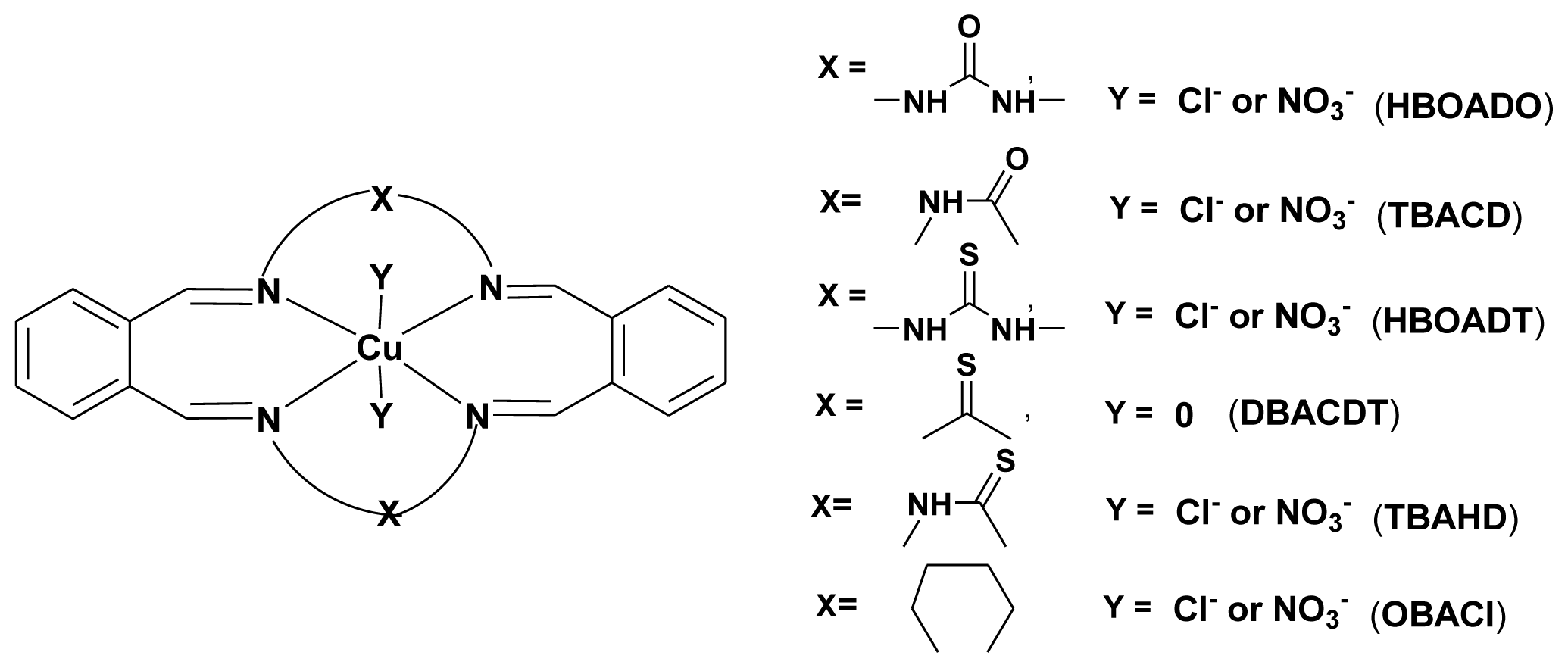
<p>The magnetic moment of all the Cu(II) complexes at room temperature lie in the range of 1.86–1.98 B.M. given in <xref ref-type="table" rid="t1-ijms-13-04982">Table 1</xref>, corresponding to one unpaired electron. This indicates that these complexes are monomeric in nature and the absence of metal-metal interaction [<xref ref-type="bibr" rid="b17-ijms-13-04982">17</xref>]. The electronic spectra of the complexes [Cu(L)X<sub>2</sub>](X = Cl<sup>−</sup>, NO<sub>3</sub> <sup>−</sup>) display two characteristic bands in the region 21226–22801 cm<sup>−1</sup> and 16008–18348 cm<sup>−1</sup> these may be assigned to <sup>2</sup>B<sub>1g</sub>→<sup>2</sup>E<sub>g</sub> and <sup>2</sup>B<sub>1g</sub>→<sup>2</sup>A<sub>1g</sub> transitions respectively. The third band assigned to <sup>2</sup>B<sub>1g</sub>→<sup>2</sup>B<sub>2g</sub> transition band is usually not observed as a separate band in the tetragonal field. Therefore, it may be concluded that all the [Cu(L)X<sub>2</sub>] complexes show distorted octahedral structure (<xref ref-type="fig" rid="f2-ijms-13-04982">Scheme</xref>) [<xref ref-type="bibr" rid="b31-ijms-13-04982">31</xref>]. The complexes [Cu(L)]X<sub>2</sub> display broad band in the region 18181–18457 cm<sup>−1</sup> and 13065–13524 cm<sup>−1</sup> corresponding to transitions <sup>2</sup>B<sub>1g</sub>→<sup>2</sup>E<sub>g</sub> and <sup>2</sup>B<sub>1g</sub>→<sup>2</sup>A<sub>1g</sub> which suggests the square planar geometry [<xref ref-type="bibr" rid="b19-ijms-13-04982">19</xref>].</p></sec>
<sec sec-type="methods">
<title>2.4. Thermal Analysis</title>
<p>Thermograms of TGA and DTA of macrocyclic Cu(II) compounds were recorded in nitrogen atmosphere at a heating rate of 10 °C/min. In the thermogram of complexes [Cu(TBACD)Cl<sub>2</sub>]·2H<sub>2</sub>O (<bold>1.2</bold>) and [Cu(TBAHD)Cl<sub>2</sub>]·2H<sub>2</sub>O (<bold>1.5</bold>), the initial weight loss of 15.36% (Calcd 15.28%) and 14.45% (Calcd 14.37%) at 70–110 °C corresponding to loss of two lattice held water molecules [<xref ref-type="bibr" rid="b18-ijms-13-04982">18</xref>,<xref ref-type="bibr" rid="b22-ijms-13-04982">22</xref>]. This fact was further supported by their DTA curves, which contain endothermic peaks in the temperature range 90–125 °C. The TGA decomposition curve, a peak corresponding to the loss of organic moiety in the temperature range of 238–252 °C was observed. On the other hand, the thermograms of other macrocyclic Cu(II) compounds showed only a single decomposition curve in the region 220–260 °C corresponding to the loss of organic moiety. Above 455 °C, organic moieties in macrocyclic Cu(II) compounds were decomposed leading to the formation of copper oxide.</p></sec>
<sec sec-type="methods">
<title>2.5. Mass Spectral Analysis</title>
<p>In the mass spectra of respective macrocyclic Cu(II) complexes, molecular ion peaks, were observed at different <italic>m</italic>/<italic>z</italic> (M<sup>+</sup>/[M + Na]<sup>+</sup>) values. The molecular ion peaks and isotopic pattern of Cu(II) complexes shows different <italic>m</italic>/<italic>z</italic> values with different intensities. The mass spectra contain molecular ion peaks at <italic>m</italic>/<italic>z</italic> 511 (M<sup>+</sup>, complex <bold>1.1</bold>), 517 (M<sup>+</sup>, complex <bold>1.2</bold>), 507 (M<sup>+</sup>, complex <bold>1.3</bold>), 543 (M<sup>+</sup>, complex <bold>1.4</bold>), 483 (M<sup>+</sup>, complex <bold>1.5</bold>), 517 (M<sup>+</sup>, complex <bold>1.6</bold>), 563 (M<sup>+</sup>, complex <bold>2.1</bold>), 586 ([M + Na]<sup>+</sup>, complex <bold>2.1</bold>), 533 (M<sup>+</sup>, complex <bold>2.2</bold>), 560 (M<sup>+</sup>, complex <bold>2.3</bold>), 583 ([M + Na]<sup>+</sup>, complex <bold>2.3</bold>), 595 (M<sup>+</sup>, complex <bold>2.4</bold>), 535 (M<sup>+</sup>, complex <bold>2.5</bold>), and 565 (M<sup>+</sup>, complex <bold>2.6</bold>). This data is in good agreement with the respective molecular formulae.</p>
<p>Based on the physicochemical and the spectral studies the tentative structures proposed for the complexes are shown in <xref ref-type="fig" rid="f2-ijms-13-04982">Scheme 1</xref>.</p></sec>
<sec sec-type="results|discussion">
<title>2.6. Biological Results and Discussion</title>
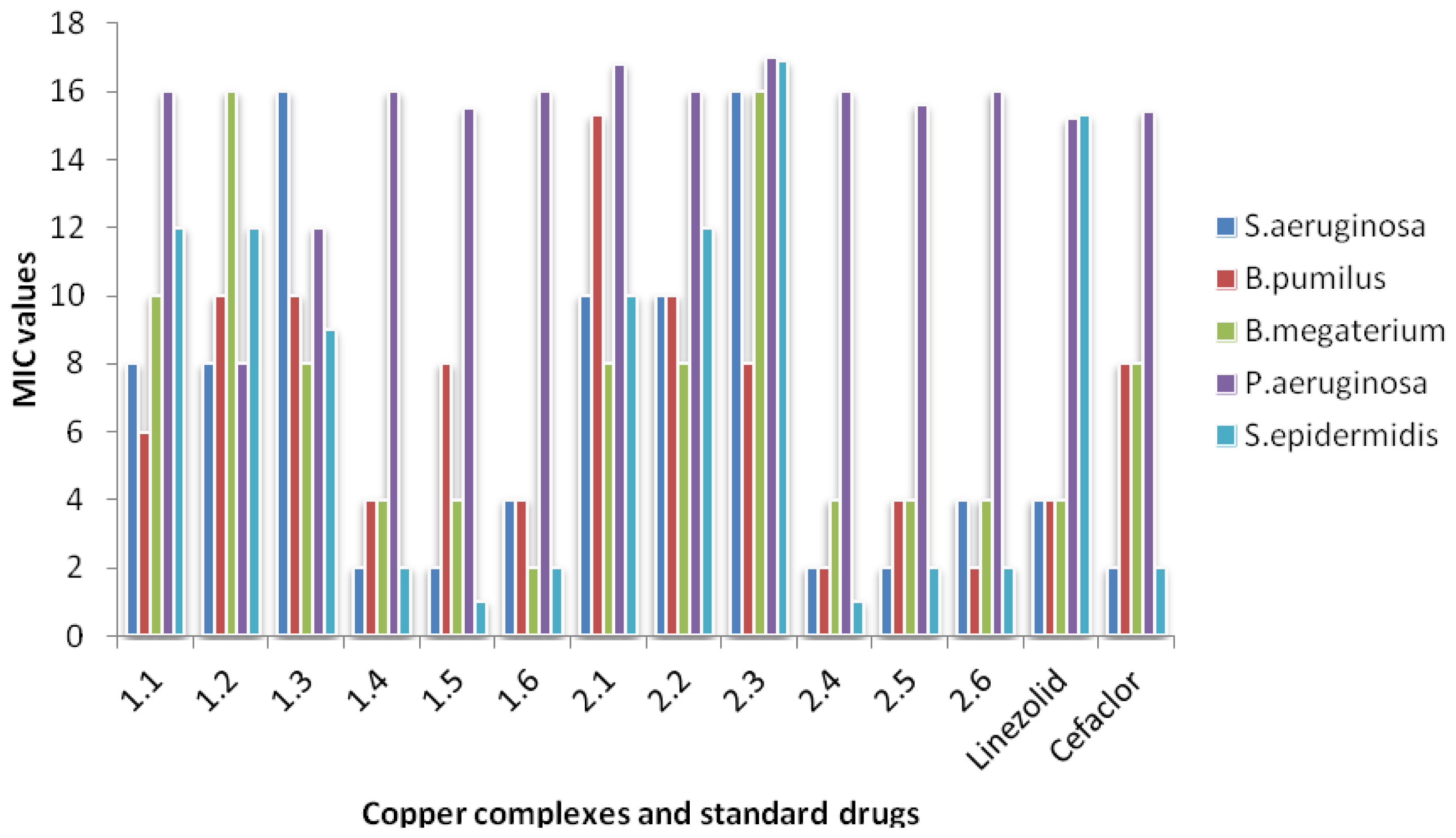
<p>Twelve chemically synthesized Cu(II) macrocyclic complexes were tested <italic>in vitro</italic> for their antibacterial activity against five test bacteria namely <italic>S. aeruginosa</italic>, <italic>S. epidermidis</italic>, <italic>B. pumilus</italic>, <italic>B. megaterium</italic> and <italic>P. aeruginosa.</italic> The minimum inhibitory concentrations of complexes were determined by liquid dilution method. The minimum inhibitory concentration at which no growth was observed was taken as the MIC values. All the complexes of the tested series possessed good antibacterial activity against both gram-positive bacteria and gram-negative bacteria. The higher antibacterial activity of the copper complexes is may be due to the change in structure due to coordination and chelating tends to make metal complexes act as more powerful and potent bactereostatic agents, thus inhibiting the growth of the bacteria. Six complexes out of twelve (<bold>1.4</bold>, <bold>1.5</bold>, <bold>1.6</bold>, <bold>2.4</bold>, <bold>2.5</bold> &amp; <bold>2.6</bold>) were most potent against both gram-positive as well as gram-negative bacteria. However, complexes <bold>1.1</bold>, <bold>1.2</bold>, <bold>1.3</bold>, <bold>2.1</bold>, <bold>2.2</bold> &amp; <bold>2.3</bold> were also showed noticeable MIC ranging from 1–16 μg/mL against <italic>S. aeruginosa</italic>, <italic>B. pumilus</italic> and <italic>B. megaterium</italic> (<xref ref-type="table" rid="t4-ijms-13-04982">Table 5</xref>). The gram positive were much more susceptible to the series as compared to gram-negative bacteria. The twelve Cu (II) complexes were also compared with two commercial antibiotics namely Linezoid and Cefaclor. The six complexes <bold>1.4</bold>, <bold>1.5</bold>, <bold>1.6</bold>, <bold>2.4</bold>, <bold>2.5</bold> &amp; <bold>2.6</bold> registered better antibacterial in comparison with commercial antibiotics. The activity of these complexes is due to the presence of thio group in the coordinated ligands. Comparison of MIC values (in μg/mL) of Cu(II) macrocyclic complexes and standard drugs against different bacteria are given in <xref ref-type="fig" rid="f1-ijms-13-04982">Figure 1</xref>.</p></sec></sec>
<sec>
<title>3. Experimental Section</title>
<sec sec-type="materials|methods">
<title>3.1. Materials and Methods</title>
<p>The metal salts CuCl<sub>2</sub>·2H<sub>2</sub>O and Cu(NO<sub>3</sub>)<sub>2</sub>·3H<sub>2</sub>O were purchased from E. Merck. All the chemicals used were of AR grade and were procured from Aldrich. All solvents used were of AR grade. Six macrocyclic ligands viz. 7,8,9,18,19,20-hexahydrodibenzo[<italic>g</italic>,<italic>p</italic>] [<xref ref-type="bibr" rid="b1-ijms-13-04982">1</xref>,<xref ref-type="bibr" rid="b2-ijms-13-04982">2</xref>,<xref ref-type="bibr" rid="b4-ijms-13-04982">4</xref>,<xref ref-type="bibr" rid="b5-ijms-13-04982">5</xref>,<xref ref-type="bibr" rid="b10-ijms-13-04982">10</xref>,<xref ref-type="bibr" rid="b11-ijms-13-04982">11</xref>,<xref ref-type="bibr" rid="b13-ijms-13-04982">13</xref>,<xref ref-type="bibr" rid="b14-ijms-13-04982">14</xref>]- octaazacyclooctadecine-8,19-dione [HBOADO], 7,8,17,18-tetrahydrodibenzo[<italic>f</italic>,<italic>n</italic>] [<xref ref-type="bibr" rid="b1-ijms-13-04982">1</xref>,<xref ref-type="bibr" rid="b2-ijms-13-04982">2</xref>,<xref ref-type="bibr" rid="b4-ijms-13-04982">4</xref>,<xref ref-type="bibr" rid="b9-ijms-13-04982">9</xref>,<xref ref-type="bibr" rid="b11-ijms-13-04982">11</xref>,<xref ref-type="bibr" rid="b12-ijms-13-04982">12</xref>]- hexaazacyclohexadecine-8,17-dione [TBACD], 7,8,9,10,19,20,21,22-octahydrodibenzo[<italic>c</italic>,<italic>m</italic>] [<xref ref-type="bibr" rid="b1-ijms-13-04982">1</xref>,<xref ref-type="bibr" rid="b6-ijms-13-04982">6</xref>,<xref ref-type="bibr" rid="b11-ijms-13-04982">11</xref>,<xref ref-type="bibr" rid="b16-ijms-13-04982">16</xref>]-tetraazacycloicosine [OBACI], 7,8,9,18,19,20-hexahydrodibenzo[<italic>g</italic>,<italic>p</italic>] [<xref ref-type="bibr" rid="b1-ijms-13-04982">1</xref>,<xref ref-type="bibr" rid="b2-ijms-13-04982">2</xref>,<xref ref-type="bibr" rid="b4-ijms-13-04982">4</xref>,<xref ref-type="bibr" rid="b5-ijms-13-04982">5</xref>,<xref ref-type="bibr" rid="b10-ijms-13-04982">10</xref>,<xref ref-type="bibr" rid="b11-ijms-13-04982">11</xref>,<xref ref-type="bibr" rid="b13-ijms-13-04982">13</xref>,<xref ref-type="bibr" rid="b14-ijms-13-04982">14</xref>]-octaazacyclooctadecine-8,19-dithione [HBOADT], 7,16-dihydrodibenzo[<italic>e</italic>,<italic>l</italic>] [<xref ref-type="bibr" rid="b1-ijms-13-04982">1</xref>,<xref ref-type="bibr" rid="b3-ijms-13-04982">3</xref>,<xref ref-type="bibr" rid="b8-ijms-13-04982">8</xref>,<xref ref-type="bibr" rid="b10-ijms-13-04982">10</xref>]-tetraazacyclo tetradecine-7,16-dithione [DBACDT] and 7,8,17,18-tetrahydrodibenzo[<italic>f</italic>,<italic>n</italic>] [<xref ref-type="bibr" rid="b1-ijms-13-04982">1</xref>,<xref ref-type="bibr" rid="b2-ijms-13-04982">2</xref>,<xref ref-type="bibr" rid="b4-ijms-13-04982">4</xref>,<xref ref-type="bibr" rid="b9-ijms-13-04982">9</xref>,<xref ref-type="bibr" rid="b11-ijms-13-04982">11</xref>,<xref ref-type="bibr" rid="b12-ijms-13-04982">12</xref>]-hexaazacyclohexadecine-8,17-dithione [TBAHD] were synthesized according to the procedure reported by shanker <italic>et al.</italic> [<xref ref-type="bibr" rid="b32-ijms-13-04982">32</xref>]. Gram positive microorganisms like <italic>Staphylococcus aeruginosa</italic> (ATCC-29213), <italic>Staphylococcus epidermidis</italic> (MTCC-2639), <italic>Bacillus pumilus</italic> (MTCC-1456), <italic>Bacillus megaterium</italic> (MTCC-428) and gram negative microorganism like <italic>Pseudomonas aeruginosa</italic> (ATCC-27853) from IMTECH, Chandigarh were used for antibacterial studies.</p></sec>
<sec>
<title>3.2. Measurements</title>
<p>The elemental analyses were obtained by using a Perkin-Elmer-2400 CHN elemental analyzer. The complexes were analyzed for Cu(II) content gravimetrically by literature procedures (Vogel AI (1989) Vogel’s text book of quantitative chemical analysis, 5th edition Longman, Amsterdam) after decomposing the organic matter with a mixture of HNO<sub>3</sub> and HCl and evaporating the residue to dryness with concentrated H<sub>2</sub>SO<sub>4</sub>. UV-Vis spectra were recorded on Shimadzu UV-160A spectrophotometer, EPR spectra were recorded on Varian E-112X-Q band EPR Spectrometer. IR spectra in KBr pellets on Perkin-Elmer-283 spectrophotometer. LC-ESI MS was used to obtain mass spectra. Gouy balance calibrated with Hg[Co(NCS)<sub>4</sub>] was used for the determination of magnetic susceptibilities of complexes in solid state at room temperature. Thermograms were recorded on mettler-TA-2000C model. TG-DSC equilibrated at 25 ± 0.05 °C. The electrical conductivities of 10<sup>−3</sup> M solutions in dichloromethane were performed using Digisun Digital conductivity meter model DL-909.</p></sec>
<sec>
<title>3.3. Synthesis of Dichloro/Nitrato Cu(II) Complexes [CuLX<sub>2</sub>]</title>
<p>To a stirred solution of the respective copper salts (0.519 g, 0.003 mol) dissolved in methanol (~20 mL) in a round-bottomed flask, methanolic solution (~25 mL) of ligand (0.003 mol., viz. 1.17 g of HBOADO, 1.038 g of TBACD, 1.116 g of OBACI, 1.26 g of HBOADT, 1.044 g of DBACDT, 1.134 g of TBAHD respectively) were added with the help of a dropping funnel. The reaction mixture was stirred magnetically. The resulting solution was concentrated to 5 mL under reduced pressure and a few mL of diethyl ether was added to initiate the crystallization. The resulting precipitate was separated by suction filtration, washed several times with diethyl ether, dried <italic>in vacuo</italic> and was recrystallized using dichloromethane and diethyl ether solvent mixture.</p></sec></sec>
<sec sec-type="conclusions">
<title>4. Conclusions</title>
<p>In the present communication, we have synthesized and characterized twelve copper (II) complexes containing tetraaza macrocyclic ligands. Based on the analytical and spectral data, we assume that the complexes (<bold>1.5</bold> &amp; <bold>2.5</bold>) are square planar and the rest of the complexes show distorted octahedral geometry. All the complexes of the tested series were found to have good antibacterial activity. Complexes <bold>1.4</bold>, <bold>1.5</bold>, <bold>1.6</bold>, <bold>2.4</bold>, <bold>2.5</bold> &amp; <bold>2.6</bold> were most potent against both gram-positive as well as gram-negative bacteria due to the presence of thio group in the coordinated ligands.</p></sec></body>
<back>
<ack>
<title>Acknowledgments</title>
<p>The authors thank the University Grant Commission (UGC, F. No. 34-363/2008(SR)), New Delhi, India for financially supporting this research. We also thank the National Science Council and Tzu Chi University of Taiwan for supporting this research financially.</p></ack>
<ref-list>
<title>References</title>
<ref id="b1-ijms-13-04982"><label>1</label><citation citation-type="journal"><person-group person-group-type="author"><name><surname>Reddy</surname><given-names>P.M.</given-names></name><name><surname>Prasad</surname><given-names>A.V.S.S.</given-names></name><name><surname>Rohini</surname><given-names>R.</given-names></name><name><surname>Ravinder</surname><given-names>V.</given-names></name></person-group><article-title>Catalytic reduction of pralidoxime in pharmaceuticals by macrocyclic Ni(II) compounds derived from orthophthalaldehyde</article-title><source>Spectrochim. Acta A</source><year>2008</year><volume>70</volume><fpage>704</fpage><lpage>712</lpage><pub-id pub-id-type="doi">10.1016/j.saa.2007.10.014</pub-id></citation></ref>
<ref id="b2-ijms-13-04982"><label>2</label><citation citation-type="journal"><person-group person-group-type="author"><name><surname>Reddy</surname><given-names>P.M.</given-names></name><name><surname>Prasad</surname><given-names>A.V.S.S.</given-names></name><name><surname>Shanker</surname><given-names>K.</given-names></name><name><surname>Ravinder</surname><given-names>V.</given-names></name></person-group><article-title>Synthesis, spectral studies and antibacterial activity of novel macrocyclic Co(II) compounds</article-title><source>Spectrochim. Acta A</source><year>2007</year><volume>68</volume><fpage>1000</fpage><lpage>1006</lpage><pub-id pub-id-type="doi">10.1016/j.saa.2007.03.002</pub-id></citation></ref>
<ref id="b3-ijms-13-04982"><label>3</label><citation citation-type="journal"><person-group person-group-type="author"><name><surname>Lim</surname><given-names>I.-T.</given-names></name><name><surname>Choi</surname><given-names>K.-Y.</given-names></name></person-group><article-title>One-dimensional hydrogen-bonded infinite chain from nickel(II) tetraaza macrocyclic complex and 1,2-cyclopentanedicarboxylate ligand</article-title><source>Int. J. Mol. Sci</source><year>2011</year><volume>12</volume><fpage>2232</fpage><lpage>2241</lpage><pub-id pub-id-type="doi">10.3390/ijms12042232</pub-id><pub-id pub-id-type="pmid">21731438</pub-id></citation></ref>
<ref id="b4-ijms-13-04982"><label>4</label><citation citation-type="journal"><person-group person-group-type="author"><name><surname>Reddy</surname><given-names>P.M.</given-names></name><name><surname>Ho</surname><given-names>Y.-P.</given-names></name><name><surname>Shanker</surname><given-names>K.</given-names></name><name><surname>Rohini</surname><given-names>R.</given-names></name><name><surname>Ravinder</surname><given-names>V.</given-names></name></person-group><article-title>Physicochemical and biological characterization of novel macrocycles derived from <italic>o</italic>-phthalaldehyde</article-title><source>Eur. J. Med. Chem</source><year>2009</year><volume>44</volume><fpage>2621</fpage><lpage>2625</lpage><pub-id pub-id-type="doi">10.1016/j.ejmech.2008.09.035</pub-id><pub-id pub-id-type="pmid">18996622</pub-id></citation></ref>
<ref id="b5-ijms-13-04982"><label>5</label><citation citation-type="journal"><person-group person-group-type="author"><name><surname>Borisova</surname><given-names>N.E.</given-names></name><name><surname>Reshetova</surname><given-names>M.D.</given-names></name><name><surname>Ustynyuk</surname><given-names>Y.A.</given-names></name></person-group><article-title>Metal-free methods in the synthesis of macrocyclic Schiff bases</article-title><source>Chem. Rev</source><year>2006</year><volume>107</volume><fpage>46</fpage><lpage>79</lpage></citation></ref>
<ref id="b6-ijms-13-04982"><label>6</label><citation citation-type="journal"><person-group person-group-type="author"><name><surname>Ma</surname><given-names>W.</given-names></name><name><surname>Tian</surname><given-names>Y.-P.</given-names></name><name><surname>Zhang</surname><given-names>S.-Y.</given-names></name><name><surname>Wu</surname><given-names>J.-Y.</given-names></name><name><surname>Fun</surname><given-names>H.-K.</given-names></name><name><surname>Chantrapromma</surname><given-names>S.</given-names></name></person-group><article-title>Synthesis and characterization of 1,8-bis(ferrocenylmethyl)-5,5,12,12,14-hexamethyl-1,4,8,11- tetraazacyclotetradecane, a macrocyclic ligand and its complexes</article-title><source>Transition Met. Chem</source><year>2006</year><volume>31</volume><fpage>97</fpage><lpage>102</lpage><pub-id pub-id-type="doi">10.1007/s11243-005-6336-9</pub-id></citation></ref>
<ref id="b7-ijms-13-04982"><label>7</label><citation citation-type="journal"><person-group person-group-type="author"><name><surname>Martin</surname><given-names>E.M.</given-names></name><name><surname>Bereman</surname><given-names>R.D.</given-names></name><name><surname>Singh</surname><given-names>P.</given-names></name></person-group><article-title>X-ray crystallographic studies of nickel(II) complexes of tetradentate [N2S2]2-ligands. 3. A stepwise distortion from square-planar to pseudotetrahedral geometries</article-title><source>Inorg. Chem</source><year>1991</year><volume>30</volume><fpage>957</fpage><lpage>962</lpage><pub-id pub-id-type="doi">10.1021/ic00005a016</pub-id></citation></ref>
<ref id="b8-ijms-13-04982"><label>8</label><citation citation-type="journal"><person-group person-group-type="author"><name><surname>Verma</surname><given-names>S.</given-names></name><name><surname>Chandra</surname><given-names>S.</given-names></name><name><surname>Dev</surname><given-names>U.</given-names></name><name><surname>Joshi</surname><given-names>N.</given-names></name></person-group><article-title>Synthesis, spectral and biological studies of nitrogen-sulphur donor macrocyclic ligands and their transition metals complexes</article-title><source>Spectrochim. Acta A</source><year>2009</year><volume>74</volume><fpage>370</fpage><lpage>374</lpage><pub-id pub-id-type="doi">10.1016/j.saa.2009.06.029</pub-id></citation></ref>
<ref id="b9-ijms-13-04982"><label>9</label><citation citation-type="journal"><person-group person-group-type="author"><name><surname>Khan</surname><given-names>T.A.</given-names></name><name><surname>Tabassum</surname><given-names>S.</given-names></name><name><surname>Azim</surname><given-names>Y.</given-names></name><name><surname>Shakir</surname><given-names>M.</given-names></name></person-group><article-title>Synthesis and physico-chemical studies on 18-membered octaazamacrocyclic complexes of Mn(II), Co(II), Ni(II), Cu(II), and Zn(II) ions</article-title><source>Synth. React. Inorg. Met. Org. Chem</source><year>2004</year><volume>34</volume><fpage>1305</fpage><lpage>1318</lpage><pub-id pub-id-type="doi">10.1081/SIM-200026200</pub-id></citation></ref>
<ref id="b10-ijms-13-04982"><label>10</label><citation citation-type="journal"><person-group person-group-type="author"><name><surname>Gupta</surname><given-names>S.K.</given-names></name><name><surname>Kushwah</surname><given-names>Y.S.</given-names></name></person-group><article-title>Mononuclear iron(III)macrocyclic complexes derived from 4-methyl-2,6-di(formyl/benzoyl)phenol and diamines: Synthesis, spectral speciation and electrochemical behaviour</article-title><source>Polyhedron</source><year>2001</year><volume>20</volume><fpage>2019</fpage><lpage>2025</lpage><pub-id pub-id-type="doi">10.1016/S0277-5387(01)00786-0</pub-id></citation></ref>
<ref id="b11-ijms-13-04982"><label>11</label><citation citation-type="journal"><person-group person-group-type="author"><name><surname>Qian</surname><given-names>M.</given-names></name><name><surname>Gou</surname><given-names>S.-H.</given-names></name><name><surname>Ju</surname><given-names>H.-X.</given-names></name><name><surname>Huang</surname><given-names>W.</given-names></name><name><surname>Duan</surname><given-names>C.-Y.</given-names></name><name><surname>You</surname><given-names>X.-Z.</given-names></name></person-group><article-title>A mononuclear manganese(III) complex of an asymmetric macrocyclic ligand with a ring contraction [MnHL2(ClO<sub>4</sub>)](ClO<sub>4</sub>)·2.5H<sub>2</sub>O</article-title><source>Transit. Met. Chem</source><year>2000</year><volume>25</volume><fpage>584</fpage><lpage>588</lpage><pub-id pub-id-type="doi">10.1023/A:1007050902958</pub-id></citation></ref>
<ref id="b12-ijms-13-04982"><label>12</label><citation citation-type="journal"><person-group person-group-type="author"><name><surname>Chandra</surname><given-names>S.</given-names></name><name><surname>Gupta</surname><given-names>K.</given-names></name></person-group><article-title>Chromium(III), manganese(II), iron(III), cobalt(II), nickel(II) and copper(II) complexes with a pentadentate, 15-membered new macrocyclic ligand</article-title><source>Transit. Met. Chem</source><year>2002</year><volume>27</volume><fpage>196</fpage><lpage>199</lpage><pub-id pub-id-type="doi">10.1023/A:1013935602736</pub-id></citation></ref>
<ref id="b13-ijms-13-04982"><label>13</label><citation citation-type="journal"><person-group person-group-type="author"><name><surname>Liu</surname><given-names>J.</given-names></name><name><surname>Lu</surname><given-names>T.-B.</given-names></name><name><surname>Deng</surname><given-names>H.</given-names></name><name><surname>Ji</surname><given-names>L.-N.</given-names></name><name><surname>Qu</surname><given-names>L.-H.</given-names></name><name><surname>Zhou</surname><given-names>H.</given-names></name></person-group><article-title>Synthesis, DNA-binding and cleavage studies of macrocyclic copper(II) complexes</article-title><source>Transit. Met. Chem</source><year>2003</year><volume>28</volume><fpage>116</fpage><lpage>121</lpage><pub-id pub-id-type="doi">10.1023/A:1022543601034</pub-id></citation></ref>
<ref id="b14-ijms-13-04982"><label>14</label><citation citation-type="journal"><person-group person-group-type="author"><name><surname>Jubert</surname><given-names>C.</given-names></name><name><surname>Mohamadou</surname><given-names>A.</given-names></name><name><surname>Guillon</surname><given-names>E.</given-names></name><name><surname>Barbier</surname><given-names>J.-P.</given-names></name></person-group><article-title>Molecular structure and spectroscopic characterization of cobalt and copper complexes with a hexadentate nitrogen ligand, 1,10-bis(2-pyridylmethyl)-1,4,7,10-tetraazadecane</article-title><source>Polyhedron</source><year>2000</year><volume>19</volume><fpage>1447</fpage><lpage>1453</lpage><pub-id pub-id-type="doi">10.1016/S0277-5387(00)00398-3</pub-id></citation></ref>
<ref id="b15-ijms-13-04982"><label>15</label><citation citation-type="journal"><person-group person-group-type="author"><name><surname>Grguric</surname><given-names>S.R.</given-names></name><name><surname>Sabo</surname><given-names>T.J.</given-names></name></person-group><article-title>Synthesis and characterization of <italic>sym</italic>-<italic>cis</italic>- and <italic>unsym</italic>-<italic>cis</italic>-(ethylenediamine-<italic>N</italic>,<italic>N</italic><sup>1</sup>-Di-3-Propionato)cobalt(III) complexes with symmetrical <italic>N</italic>,<italic>N</italic><sup>1</sup>-substituted diamines</article-title><source>Synth. React. Inorg. Met. Org. Chem</source><year>1999</year><volume>29</volume><fpage>1567</fpage><lpage>1578</lpage><pub-id pub-id-type="doi">10.1080/00945719909351719</pub-id></citation></ref>
<ref id="b16-ijms-13-04982"><label>16</label><citation citation-type="journal"><person-group person-group-type="author"><name><surname>Ajibade</surname><given-names>P.A.</given-names></name><name><surname>Zulu</surname><given-names>N.H.</given-names></name></person-group><article-title>Metal complexes of diisopropylthiourea: Synthesis, characterization and antibacterial studies</article-title><source>Int. J. Mol. Sci</source><year>2011</year><volume>12</volume><fpage>7186</fpage><lpage>7198</lpage><pub-id pub-id-type="doi">10.3390/ijms12107186</pub-id><pub-id pub-id-type="pmid">22072941</pub-id></citation></ref>
<ref id="b17-ijms-13-04982"><label>17</label><citation citation-type="journal"><person-group person-group-type="author"><name><surname>Reddy</surname><given-names>P.M.</given-names></name><name><surname>Prasad</surname><given-names>A.V.S.S.</given-names></name><name><surname>Ravinder</surname><given-names>V.</given-names></name></person-group><article-title>Synthesis, spectral characterization, catalytic and antibacterial activity of macrocyclic CuII compounds</article-title><source>Transit. Met. Chem</source><year>2007</year><volume>32</volume><fpage>507</fpage><lpage>513</lpage><pub-id pub-id-type="doi">10.1007/s11243-007-0205-7</pub-id></citation></ref>
<ref id="b18-ijms-13-04982"><label>18</label><citation citation-type="journal"><person-group person-group-type="author"><name><surname>Budige</surname><given-names>G.</given-names></name><name><surname>Puchakayala</surname><given-names>M.R.</given-names></name><name><surname>Kongara</surname><given-names>S.R.</given-names></name><name><surname>Hu</surname><given-names>A.</given-names></name><name><surname>Vadde</surname><given-names>R.</given-names></name></person-group><article-title>Synthesis, characterization and biological evaluation of mononuclear Co(II), Ni(II), Cu(II) and Pd(II) complexes with new N<sub>2</sub>O<sub>2</sub> Schiff base ligands</article-title><source>Chem. Pharm. Bull</source><year>2011</year><volume>59</volume><fpage>166</fpage><lpage>171</lpage><pub-id pub-id-type="doi">10.1248/cpb.59.166</pub-id><pub-id pub-id-type="pmid">21297294</pub-id></citation></ref>
<ref id="b19-ijms-13-04982"><label>19</label><citation citation-type="journal"><person-group person-group-type="author"><name><surname>Chandra</surname><given-names>S.</given-names></name><name><surname>Jain</surname><given-names>D.</given-names></name><name><surname>Sharma</surname><given-names>A.K.</given-names></name><name><surname>Sharma</surname><given-names>P.</given-names></name></person-group><article-title>Coordination modes of a Schiff base pentadentate derivative of 4-aminoantipyrine with cobalt(II), nickel(II) and copper(II) metal ions: Synthesis, spectroscopic and antimicrobial studies</article-title><source>Molecules</source><year>2009</year><volume>14</volume><fpage>174</fpage><lpage>190</lpage><pub-id pub-id-type="doi">10.3390/molecules14010174</pub-id><pub-id pub-id-type="pmid">19127246</pub-id></citation></ref>
<ref id="b20-ijms-13-04982"><label>20</label><citation citation-type="journal"><person-group person-group-type="author"><name><surname>Reddy</surname><given-names>P.M.</given-names></name><name><surname>Prasad</surname><given-names>A.V.S.S.</given-names></name><name><surname>Reddy</surname><given-names>C.K.</given-names></name><name><surname>Ravinder</surname><given-names>V.</given-names></name></person-group><article-title>Synthesis of new macrocyclic rhodium(III) compounds and their utility as catalysts for the oxidation of ascorbic acid</article-title><source>Transit. Met. Chem</source><year>2008</year><volume>33</volume><fpage>251</fpage><lpage>258</lpage><pub-id pub-id-type="doi">10.1007/s11243-007-9037-8</pub-id></citation></ref>
<ref id="b21-ijms-13-04982"><label>21</label><citation citation-type="journal"><person-group person-group-type="author"><name><surname>Shanker</surname><given-names>K.</given-names></name><name><surname>Rohini</surname><given-names>R.</given-names></name><name><surname>Ravinder</surname><given-names>V.</given-names></name><name><surname>Reddy</surname><given-names>P.M.</given-names></name><name><surname>Ho</surname><given-names>Y.-P.</given-names></name></person-group><article-title>Ru(II) complexes of N<sub>4</sub> and N<sub>2</sub>O<sub>2</sub> macrocyclic Schiff base ligands: Their antibacterial and antifungal studies</article-title><source>Spectrochim. Acta A</source><year>2009</year><volume>73</volume><fpage>205</fpage><lpage>211</lpage><pub-id pub-id-type="doi">10.1016/j.saa.2009.01.021</pub-id></citation></ref>
<ref id="b22-ijms-13-04982"><label>22</label><citation citation-type="journal"><person-group person-group-type="author"><name><surname>Geeta</surname><given-names>B.</given-names></name><name><surname>Shravankumar</surname><given-names>K.</given-names></name><name><surname>Reddy</surname><given-names>P.M.</given-names></name><name><surname>Ravikrishna</surname><given-names>E.</given-names></name><name><surname>Sarangapani</surname><given-names>M.</given-names></name><name><surname>Reddy</surname><given-names>K.K.</given-names></name><name><surname>Ravinder</surname><given-names>V.</given-names></name></person-group><article-title>Binuclear cobalt(II), nickel(II), copper(II) and palladium(II) complexes of a new Schiff-base as ligand: Synthesis, structural characterization, and antibacterial activity</article-title><source>Spectrochim. Acta A</source><year>2010</year><volume>77</volume><fpage>911</fpage><lpage>915</lpage><pub-id pub-id-type="doi">10.1016/j.saa.2010.08.004</pub-id></citation></ref>
<ref id="b23-ijms-13-04982"><label>23</label><citation citation-type="journal"><person-group person-group-type="author"><name><surname>Shakir</surname><given-names>M.</given-names></name><name><surname>Varkey</surname><given-names>S.P.</given-names></name><name><surname>Kumar</surname><given-names>D.</given-names></name></person-group><article-title>Binuclear transition metal complexes of Schiff base macrocycles containing the furanyl moiety</article-title><source>Synth. React. Inorg. Met. Org. Chem</source><year>1994</year><volume>24</volume><fpage>941</fpage><lpage>952</lpage><pub-id pub-id-type="doi">10.1080/00945719408001313</pub-id></citation></ref>
<ref id="b24-ijms-13-04982"><label>24</label><citation citation-type="journal"><person-group person-group-type="author"><name><surname>Chandra</surname><given-names>S.</given-names></name><name><surname>Gupta</surname><given-names>N.</given-names></name><name><surname>Gupta</surname><given-names>R.</given-names></name></person-group><article-title>Novel copper(II) homobinuclear macrocyclic complexes: Cyclic voltammetry, biological properties and spectral studies</article-title><source>Spectrochim. Acta A</source><year>2006</year><volume>63</volume><fpage>587</fpage><lpage>593</lpage><pub-id pub-id-type="doi">10.1016/j.saa.2005.06.005</pub-id></citation></ref>
<ref id="b25-ijms-13-04982"><label>25</label><citation citation-type="journal"><person-group person-group-type="author"><name><surname>Reddy</surname><given-names>M.B.</given-names></name><name><surname>Shanker</surname><given-names>K.</given-names></name><name><surname>Rani</surname><given-names>P.U.</given-names></name><name><surname>Rohini</surname><given-names>R.</given-names></name><name><surname>Reddy</surname><given-names>C.K.</given-names></name><name><surname>Ravinder</surname><given-names>V.</given-names></name></person-group><article-title>New cobalt(II) tetraaza macrocyclic complexes: Synthesis, spectral and antimicrobial studies</article-title><source>Int. J. ChemTech. Res</source><year>2007</year><volume>84</volume><fpage>971</fpage><lpage>977</lpage></citation></ref>
<ref id="b26-ijms-13-04982"><label>26</label><citation citation-type="journal"><person-group person-group-type="author"><name><surname>Shakir</surname><given-names>M.</given-names></name><name><surname>Chishti</surname><given-names>H.</given-names></name><name><surname>Azim</surname><given-names>Y.</given-names></name><name><surname>Begum</surname><given-names>N.</given-names></name></person-group><article-title>Synthesis and characterization of hexaazamacrocyclic complexes with Co(II), Ni(II), Cu(II), and Zn(II) derived from phthalaldehyde and 2,6-diaminopyridine</article-title><source>Synth. React. Inorg. Met. Org. Chem</source><year>2004</year><volume>34</volume><fpage>809</fpage><lpage>818</lpage><pub-id pub-id-type="doi">10.1081/SIM-120035959</pub-id></citation></ref>
<ref id="b27-ijms-13-04982"><label>27</label><citation citation-type="journal"><person-group person-group-type="author"><name><surname>Chandra</surname><given-names>S.</given-names></name><name><surname>Sangeetika</surname><given-names>X.</given-names></name></person-group><article-title>EPR, magnetic and spectral studies of copper(II) and nickel(II) complexes of Schiff base macrocyclic ligand derived from thiosemicarbazide and glyoxal</article-title><source>Spectrochim. Acta A</source><year>2004</year><volume>60</volume><fpage>147</fpage><lpage>153</lpage><pub-id pub-id-type="doi">10.1016/S1386-1425(03)00220-8</pub-id></citation></ref>
<ref id="b28-ijms-13-04982"><label>28</label><citation citation-type="journal"><person-group person-group-type="author"><name><surname>Shakir</surname><given-names>M.</given-names></name><name><surname>Chishti</surname><given-names>H.-T.-N.</given-names></name><name><surname>Chingsubam</surname><given-names>P.</given-names></name></person-group><article-title>Metal ion-directed synthesis of 16-membered tetraazamacrocyclic complexes and their physico-chemical studies</article-title><source>Spectrochim. Acta A</source><year>2006</year><volume>64</volume><fpage>512</fpage><lpage>517</lpage><pub-id pub-id-type="doi">10.1016/j.saa.2005.07.050</pub-id></citation></ref>
<ref id="b29-ijms-13-04982"><label>29</label><citation citation-type="journal"><person-group person-group-type="author"><name><surname>Bazzicalupi</surname><given-names>C.</given-names></name><name><surname>Bencini</surname><given-names>A.</given-names></name><name><surname>Berni</surname><given-names>E.</given-names></name><name><surname>Bianchi</surname><given-names>A.</given-names></name><name><surname>Borsari</surname><given-names>L.</given-names></name><name><surname>Giorgi</surname><given-names>C.</given-names></name><name><surname>Valtancoli</surname><given-names>B.</given-names></name><name><surname>Lodeiro</surname><given-names>C.</given-names></name><name><surname>Lima</surname><given-names>J.C.</given-names></name><name><surname>Parola</surname><given-names>A.J.</given-names></name><etal/></person-group><article-title>Protonation and coordination properties towards Zn(II), Cd(II) and Hg(II) of a phenanthroline-containing macrocycle with an ethylamino pendant arm</article-title><source>Dalton Trans</source><year>2004</year><fpage>591</fpage><lpage>597</lpage></citation></ref>
<ref id="b30-ijms-13-04982"><label>30</label><citation citation-type="journal"><person-group person-group-type="author"><name><surname>Hathaway</surname><given-names>B.J.</given-names></name><name><surname>Tomlinson</surname><given-names>A.A.G.</given-names></name></person-group><article-title>Copper(II) ammonia complexes</article-title><source>Coord. Chem. Rev</source><year>1970</year><volume>5</volume><fpage>1</fpage><lpage>43</lpage><pub-id pub-id-type="doi">10.1016/S0010-8545(00)80073-9</pub-id></citation></ref>
<ref id="b31-ijms-13-04982"><label>31</label><citation citation-type="journal"><person-group person-group-type="author"><name><surname>Singh</surname><given-names>D.</given-names></name><name><surname>Kumar</surname><given-names>R.</given-names></name><name><surname>Tyagi</surname><given-names>P.</given-names></name></person-group><article-title>Template synthesis, spectroscopic studies and biological screening of macrocyclic complexes derived from thiocarbohydrazide and benzil</article-title><source>Transit. Met. Chem</source><year>2006</year><volume>31</volume><fpage>970</fpage><lpage>973</lpage><pub-id pub-id-type="doi">10.1007/s11243-006-0096-z</pub-id></citation></ref>
<ref id="b32-ijms-13-04982"><label>32</label><citation citation-type="journal"><person-group person-group-type="author"><name><surname>Shanker</surname><given-names>K.</given-names></name><name><surname>Reddy</surname><given-names>P.M.</given-names></name><name><surname>Rohini</surname><given-names>R.</given-names></name><name><surname>Ravinder</surname><given-names>V.</given-names></name></person-group><article-title>Synthesis and spectral studies of novel biologically active macrocycles derived from <italic>O</italic>-phthalaldehyde</article-title><source>Pharm. Lett</source><year>2009</year><volume>1</volume><fpage>97</fpage><lpage>107</lpage></citation></ref></ref-list>
<sec sec-type="display-objects">
<title>Figures and Tables</title>
<fig id="f1-ijms-13-04982" position="float">
<label>Figure 1</label>
<caption>
<p>Comparison of MIC values (in μg/mL) of Cu(II) macrocyclic complexes and standard drugs against different bacteria.</p></caption>
<graphic xlink:href="ijms-13-04982f1.gif"/></fig>
<fig id="f2-ijms-13-04982" position="float">
<label>Scheme 1</label>
<caption>
<p>Representative structures of copper complex.</p></caption>
<graphic xlink:href="ijms-13-04982f2.gif"/></fig>
<table-wrap id="t1-ijms-13-04982" position="float">
<label>Table 1</label>
<caption>
<p>Physical, analytical and electronic spectral data of macrocyclic Cu(II) complexes.</p></caption>
<table frame="hsides" rules="groups">
<thead>
<tr>
<th align="center" valign="middle" rowspan="3">Comp. No.</th>
<th align="left" valign="middle" rowspan="3">Cu(II) Compound/Molecular Formula</th>
<th align="center" valign="middle" rowspan="3">Λ<sub>M</sub></th>
<th align="center" valign="middle" rowspan="3">μeff (B.M.)</th>
<th align="center" valign="middle" rowspan="3">λ<sub>max</sub> (cm<sup>−1</sup>)</th>
<th colspan="4" align="center" valign="middle">Analyses (%) Found (Calculated)</th></tr>
<tr>
<th colspan="4" align="left" valign="middle">
<hr/></th></tr>
<tr>
<th align="center" valign="middle">C</th>
<th align="center" valign="middle">H</th>
<th align="center" valign="middle">N</th>
<th align="center" valign="middle">Cu</th></tr></thead>
<tbody>
<tr>
<td align="center" valign="top">1.1.</td>
<td align="left" valign="top">[Cu(HBOADO)Cl<sub>2</sub>]<break/>C<sub>18</sub>H<sub>16</sub>Cl<sub>2</sub>N<sub>8</sub>O<sub>2</sub>Cu</td>
<td align="center" valign="top">16.2</td>
<td align="center" valign="top">1.96</td>
<td align="center" valign="top">16008, 21226</td>
<td align="center" valign="top">42.38 (42.32)</td>
<td align="center" valign="top">3.18 (3.16)</td>
<td align="center" valign="top">22.04 (21.94)</td>
<td align="center" valign="top">12.36 (12.44)</td></tr>
<tr>
<td align="center" valign="top">1.2.</td>
<td align="left" valign="top">[Cu(TBACD)Cl<sub>2</sub>]·2H<sub>2</sub>O<break/>C<sub>18</sub>H<sub>18</sub>Cl<sub>2</sub>N<sub>6</sub>O<sub>4</sub>Cu</td>
<td align="center" valign="top">14.0</td>
<td align="center" valign="top">1.98</td>
<td align="center" valign="top">17348, 22801</td>
<td align="center" valign="top">41.33 (41.83)</td>
<td align="center" valign="top">3.52 (3.51)</td>
<td align="center" valign="top">16.23 (16.26)</td>
<td align="center" valign="top">12.25 (12.30)</td></tr>
<tr>
<td align="center" valign="top">1.3.</td>
<td align="left" valign="top">[Cu(OBACI)Cl<sub>2</sub>]<break/>C<sub>24</sub>H<sub>28</sub>Cl<sub>2</sub>N<sub>4</sub>Cu</td>
<td align="center" valign="top">13.5</td>
<td align="center" valign="top">1.96</td>
<td align="center" valign="top">17857, 21988</td>
<td align="center" valign="top">56.88 (56.86)</td>
<td align="center" valign="top">5.57 (5.57)</td>
<td align="center" valign="top">11.02 (11.05)</td>
<td align="center" valign="top">12.56 (12.53)</td></tr>
<tr>
<td align="center" valign="top">1.4.</td>
<td align="left" valign="top">[Cu(HBOADT)Cl<sub>2</sub>]<break/>C<sub>18</sub>H<sub>16</sub>Cl<sub>2</sub>N<sub>8</sub>S<sub>2</sub>Cu</td>
<td align="center" valign="top">12.4</td>
<td align="center" valign="top">1.94</td>
<td align="center" valign="top">17847, 21255</td>
<td align="center" valign="top">40.01 (39.82)</td>
<td align="center" valign="top">2.84 (2.97)</td>
<td align="center" valign="top">20.72 (20.64)</td>
<td align="center" valign="top">11.55 (11.70)</td></tr>
<tr>
<td align="center" valign="top">1.5.</td>
<td align="left" valign="top">[Cu(DBACDT)]Cl<sub>2</sub><break/>C<sub>18</sub>H<sub>12</sub>Cl<sub>2</sub>N<sub>4</sub>S<sub>2</sub>Cu</td>
<td align="center" valign="top">65.0</td>
<td align="center" valign="top">1.91</td>
<td align="center" valign="top">13065, 18181</td>
<td align="center" valign="top">44.42 (44.77)</td>
<td align="center" valign="top">2.68 (2.50)</td>
<td align="center" valign="top">11.72 (11.60)</td>
<td align="center" valign="top">13.07 (13.16)</td></tr>
<tr>
<td align="center" valign="top">1.6.</td>
<td align="left" valign="top">[Cu(TBAHD)Cl<sub>2</sub>]·2H<sub>2</sub>O<break/>C<sub>18</sub>H<sub>18</sub>Cl<sub>2</sub>N<sub>6</sub>S<sub>2</sub>Cu</td>
<td align="center" valign="top">16.5</td>
<td align="center" valign="top">1.92</td>
<td align="center" valign="top">17699, 22527</td>
<td align="center" valign="top">41.95 (41.82)</td>
<td align="center" valign="top">3.50 (3.51)</td>
<td align="center" valign="top">16.22 (16.26)</td>
<td align="center" valign="top">12.24 (12.29)</td></tr>
<tr>
<td align="center" valign="top">2.1.</td>
<td align="left" valign="top">[Cu(HBOADO)(NO<sub>3</sub>)<sub>2</sub>]<break/>C<sub>18</sub>H<sub>16</sub>N<sub>10</sub>O<sub>8</sub>Cu</td>
<td align="center" valign="top">15.3</td>
<td align="center" valign="top">1.93</td>
<td align="center" valign="top">16422, 21712</td>
<td align="center" valign="top">38.23 (38.34)</td>
<td align="center" valign="top">3.02 (2.86)</td>
<td align="center" valign="top">24.81 (24.84)</td>
<td align="center" valign="top">11.34 (11.27)</td></tr>
<tr>
<td align="center" valign="top">2.2.</td>
<td align="left" valign="top">[Cu(TBACD)(NO<sub>3</sub>)<sub>2</sub>]<break/>C<sub>18</sub>H<sub>14</sub>N<sub>8</sub>O<sub>8</sub>Cu</td>
<td align="center" valign="top">16.1</td>
<td align="center" valign="top">1.89</td>
<td align="center" valign="top">17758, 22954</td>
<td align="center" valign="top">40.42 (40.49)</td>
<td align="center" valign="top">2.84 (2.64)</td>
<td align="center" valign="top">21.10 (20.99)</td>
<td align="center" valign="top">11.87 (11.90)</td></tr>
<tr>
<td align="center" valign="top">2.3.</td>
<td align="left" valign="top">[Cu(OBACI)(NO<sub>3</sub>)<sub>2</sub>]<break/>C<sub>24</sub>H<sub>28</sub>N<sub>6</sub>O<sub>6</sub>Cu</td>
<td align="center" valign="top">14.8</td>
<td align="center" valign="top">1.94</td>
<td align="center" valign="top">18201, 22147</td>
<td align="center" valign="top">51.48 (51.47)</td>
<td align="center" valign="top">5.05 (5.04)</td>
<td align="center" valign="top">15.06 (15.01)</td>
<td align="center" valign="top">11.38 (11.35)</td></tr>
<tr>
<td align="center" valign="top">2.4.</td>
<td align="left" valign="top">[Cu(HBOADT)(NO<sub>3</sub>)<sub>2</sub>]<break/>C<sub>18</sub>H<sub>16</sub>N<sub>10</sub>S<sub>2</sub>O<sub>6</sub>Cu</td>
<td align="center" valign="top">12.9</td>
<td align="center" valign="top">1.86</td>
<td align="center" valign="top">18348, 21875</td>
<td align="center" valign="top">36.24 (36.27)</td>
<td align="center" valign="top">2.68 (2.71)</td>
<td align="center" valign="top">23.42 (23.50)</td>
<td align="center" valign="top">10.72 (10.66)</td></tr>
<tr>
<td align="center" valign="top">2.5.</td>
<td align="left" valign="top">[Cu(DBACDT)](NO<sub>3</sub>)<sub>2</sub><break/>C<sub>18</sub>H<sub>12</sub>N<sub>6</sub>S<sub>2</sub>O<sub>6</sub>Cu</td>
<td align="center" valign="top">68.3</td>
<td align="center" valign="top">1.89</td>
<td align="center" valign="top">13524, 18457</td>
<td align="center" valign="top">40.31 (40.34)</td>
<td align="center" valign="top">2.16 (2.26)</td>
<td align="center" valign="top">15.74 (15.68)</td>
<td align="center" valign="top">11.91 (11.86)</td></tr>
<tr>
<td align="center" valign="top">2.6.</td>
<td align="left" valign="top">[Cu(TBAHD)(NO<sub>3</sub>)<sub>2</sub>]<break/>C<sub>18</sub>H<sub>14</sub>N<sub>8</sub>S<sub>2</sub>O<sub>6</sub>Cu</td>
<td align="center" valign="top">15.4</td>
<td align="center" valign="top">1.93</td>
<td align="center" valign="top">17700, 22756</td>
<td align="center" valign="top">38.12 (38.20)</td>
<td align="center" valign="top">2.54 (2.49)</td>
<td align="center" valign="top">19.82 (19.80)</td>
<td align="center" valign="top">11.34 (11.23)</td></tr></tbody></table></table-wrap>
<table-wrap id="t2-ijms-13-04982" position="float">
<label>Table 2</label>
<caption>
<p>Infrared spectral data of macrocyclic Cu(II) complexes.</p></caption>
<table frame="hsides" rules="groups">
<thead>
<tr>
<th align="right" valign="top" rowspan="3">Comp. No.</th>
<th align="center" valign="top" rowspan="3">Cu(II) Compound</th>
<th colspan="4" align="center" valign="top">Selected IR Bands (cm<sup>−1</sup>)</th></tr>
<tr>
<th colspan="4" align="left" valign="top">
<hr/></th></tr>
<tr>
<th align="center" valign="top">υ<sub>C=N</sub></th>
<th align="center" valign="top">υ<sub>NH</sub></th>
<th align="center" valign="top">υ<sub>Cu–N</sub></th>
<th align="center" valign="top">Anion Peaks</th></tr></thead>
<tbody>
<tr>
<td align="center" valign="top">1.1.</td>
<td align="left" valign="top">[Cu(HBOADO)Cl<sub>2</sub>]</td>
<td align="center" valign="top">1578</td>
<td align="center" valign="top">3320</td>
<td align="center" valign="top">516</td>
<td align="center" valign="top">307</td></tr>
<tr>
<td align="center" valign="top">1.2.</td>
<td align="left" valign="top">[Cu(TBACD)Cl<sub>2</sub>]<sub>2</sub>·H<sub>2</sub>O</td>
<td align="center" valign="top">1575</td>
<td align="center" valign="top">3326</td>
<td align="center" valign="top">518</td>
<td align="center" valign="top">304</td></tr>
<tr>
<td align="center" valign="top">1.3.</td>
<td align="left" valign="top">[Cu(OBACI)Cl<sub>2</sub>]</td>
<td align="center" valign="top">1596</td>
<td align="center" valign="top">-</td>
<td align="center" valign="top">520</td>
<td align="center" valign="top">318</td></tr>
<tr>
<td align="center" valign="top">1.4.</td>
<td align="left" valign="top">[Cu(HBOADT)Cl<sub>2</sub>]</td>
<td align="center" valign="top">1590</td>
<td align="center" valign="top">3324</td>
<td align="center" valign="top">524</td>
<td align="center" valign="top">302</td></tr>
<tr>
<td align="center" valign="top">1.5.</td>
<td align="left" valign="top">[Cu(DBACDT)]Cl<sub>2</sub></td>
<td align="center" valign="top">1598</td>
<td align="center" valign="top">-</td>
<td align="center" valign="top">506</td>
<td align="center" valign="top">-</td></tr>
<tr>
<td align="center" valign="top">1.6.</td>
<td align="left" valign="top">[Cu(TBAHD)Cl<sub>2</sub>]<sub>2</sub>·H<sub>2</sub>O</td>
<td align="center" valign="top">1585</td>
<td align="center" valign="top">3383</td>
<td align="center" valign="top">520</td>
<td align="center" valign="top">314</td></tr>
<tr>
<td align="center" valign="top">2.1.</td>
<td align="left" valign="top">[Cu(HBOADO)(NO<sub>3</sub>)<sub>2</sub>]</td>
<td align="center" valign="top">1580</td>
<td align="center" valign="top">3318</td>
<td align="center" valign="top">510</td>
<td align="center" valign="top">235</td></tr>
<tr>
<td align="center" valign="top">2.2.</td>
<td align="left" valign="top">[Cu(TBACD)(NO<sub>3</sub>)<sub>2</sub>]</td>
<td align="center" valign="top">1573</td>
<td align="center" valign="top">3325</td>
<td align="center" valign="top">515</td>
<td align="center" valign="top">230</td></tr>
<tr>
<td align="center" valign="top">2.3.</td>
<td align="left" valign="top">[Cu(OBACI)(NO<sub>3</sub>)<sub>2</sub>]</td>
<td align="center" valign="top">1595</td>
<td align="center" valign="top">-</td>
<td align="center" valign="top">518</td>
<td align="center" valign="top">240</td></tr>
<tr>
<td align="center" valign="top">2.4.</td>
<td align="left" valign="top">[Cu(HBOADT)(NO<sub>3</sub>)<sub>2</sub>]</td>
<td align="center" valign="top">1587</td>
<td align="center" valign="top">3326</td>
<td align="center" valign="top">520</td>
<td align="center" valign="top">230</td></tr>
<tr>
<td align="center" valign="top">2.5.</td>
<td align="left" valign="top">[Cu(DBACDT)](NO<sub>3</sub>)<sub>2</sub></td>
<td align="center" valign="top">1595</td>
<td align="center" valign="top">-</td>
<td align="center" valign="top">505</td>
<td align="center" valign="top">-</td></tr>
<tr>
<td align="center" valign="top">2.6.</td>
<td align="left" valign="top">[Cu(TBAHD)(NO<sub>3</sub>)<sub>2</sub>]</td>
<td align="center" valign="top">1580</td>
<td align="center" valign="top">3379</td>
<td align="center" valign="top">518</td>
<td align="center" valign="top">235</td></tr></tbody></table></table-wrap>
<table-wrap id="t3-ijms-13-04982" position="float">
<label>Table 3</label>
<caption>
<p>EPR spectral data of macrocyclic Cu(II) compounds.</p></caption>
<table frame="hsides" rules="groups">
<thead>
<tr>
<th align="center" valign="middle">Comp. No.</th>
<th align="center" valign="middle">Cu(II) Compound</th>
<th align="center" valign="middle">g<sub>11</sub></th>
<th align="center" valign="middle">g⊥</th>
<th align="center" valign="middle">|g|<sub>avg</sub></th>
<th align="center" valign="middle">G</th></tr></thead>
<tbody>
<tr>
<td align="center" valign="top">1.1.</td>
<td align="left" valign="top">[Cu(HBOADO)Cl<sub>2</sub>]</td>
<td align="center" valign="top">2.119</td>
<td align="center" valign="top">2.024</td>
<td align="center" valign="top">2.055</td>
<td align="center" valign="top">4.958</td></tr>
<tr>
<td align="center" valign="top">1.2.</td>
<td align="left" valign="top">[Cu(TBACD)Cl<sub>2</sub>]·2H<sub>2</sub>O</td>
<td align="center" valign="top">2.212</td>
<td align="center" valign="top">2.043</td>
<td align="center" valign="top">2.099</td>
<td align="center" valign="top">4.930</td></tr>
<tr>
<td align="center" valign="top">1.3.</td>
<td align="left" valign="top">[Cu(OBACI)Cl<sub>2</sub>]</td>
<td align="center" valign="top">2.118</td>
<td align="center" valign="top">2.021</td>
<td align="center" valign="top">2.053</td>
<td align="center" valign="top">5.619</td></tr>
<tr>
<td align="center" valign="top">1.4.</td>
<td align="left" valign="top">[Cu(HBOADT)Cl<sub>2</sub>]</td>
<td align="center" valign="top">2.219</td>
<td align="center" valign="top">2.039</td>
<td align="center" valign="top">2.099</td>
<td align="center" valign="top">5.615</td></tr>
<tr>
<td align="center" valign="top">1.5.</td>
<td align="left" valign="top">[Cu(DBACDT)]Cl<sub>2</sub></td>
<td align="center" valign="top">2.220</td>
<td align="center" valign="top">2.046</td>
<td align="center" valign="top">2.104</td>
<td align="center" valign="top">4.782</td></tr>
<tr>
<td align="center" valign="top">1.6.</td>
<td align="left" valign="top">[Cu(TBAHD)Cl<sub>2</sub>]·2H<sub>2</sub>O</td>
<td align="center" valign="top">2.171</td>
<td align="center" valign="top">2.029</td>
<td align="center" valign="top">2.076</td>
<td align="center" valign="top">5.896</td></tr>
<tr>
<td align="center" valign="top">2.1.</td>
<td align="left" valign="top">[Cu(HBOADO)(NO<sub>3</sub>)<sub>2</sub>]</td>
<td align="center" valign="top">2.108</td>
<td align="center" valign="top">2.022</td>
<td align="center" valign="top">2.050</td>
<td align="center" valign="top">4.909</td></tr>
<tr>
<td align="center" valign="top">2.2.</td>
<td align="left" valign="top">[Cu(TBACD)(NO<sub>3</sub>)<sub>2</sub>]</td>
<td align="center" valign="top">2.177</td>
<td align="center" valign="top">2.040</td>
<td align="center" valign="top">2.085</td>
<td align="center" valign="top">4.425</td></tr>
<tr>
<td align="center" valign="top">2.3.</td>
<td align="left" valign="top">[Cu(OBACI)(NO<sub>3</sub>)<sub>2</sub>]</td>
<td align="center" valign="top">2.085</td>
<td align="center" valign="top">2.018</td>
<td align="center" valign="top">2.040</td>
<td align="center" valign="top">4.722</td></tr>
<tr>
<td align="center" valign="top">2.4.</td>
<td align="left" valign="top">[Cu(HBOADT)(NO<sub>3</sub>)<sub>2</sub>]</td>
<td align="center" valign="top">2.165</td>
<td align="center" valign="top">2.030</td>
<td align="center" valign="top">2.075</td>
<td align="center" valign="top">5.500</td></tr>
<tr>
<td align="center" valign="top">2.5.</td>
<td align="left" valign="top">[Cu(DBACDT)](NO<sub>3</sub>)<sub>2</sub></td>
<td align="center" valign="top">2.161</td>
<td align="center" valign="top">2.040</td>
<td align="center" valign="top">2.080</td>
<td align="center" valign="top">4.025</td></tr>
<tr>
<td align="center" valign="top">2.6.</td>
<td align="left" valign="top">[Cu(TBAHD)(NO<sub>3</sub>)<sub>2</sub>]</td>
<td align="center" valign="top">2.110</td>
<td align="center" valign="top">2.019</td>
<td align="center" valign="top">2.049</td>
<td align="center" valign="top">5.789</td></tr></tbody></table></table-wrap>
<table-wrap id="t4-ijms-13-04982" position="float">
<label>Table 5</label>
<caption>
<p>Minimum inhibitory concentration (MIC) of Cu(II) macrocyclic complexes against test bacteria.</p></caption>
<table frame="hsides" rules="groups">
<thead>
<tr>
<th align="center" valign="middle" rowspan="3">Comp. No.</th>
<th align="center" valign="middle" rowspan="3">Macrocyclic Cu(II) Complexes</th>
<th colspan="5" align="center" valign="middle">MIC (μg/mL)</th></tr>
<tr>
<th colspan="5" align="left" valign="middle">
<hr/></th></tr>
<tr>
<th align="center" valign="middle">Sa</th>
<th align="center" valign="middle">Bp</th>
<th align="center" valign="middle">Bm</th>
<th align="center" valign="middle">Pa</th>
<th align="center" valign="middle">Se</th></tr></thead>
<tbody>
<tr>
<td align="center" valign="top">1.1.</td>
<td align="left" valign="top">[Cu(HBOADO)Cl<sub>2</sub>]</td>
<td align="center" valign="top">8</td>
<td align="center" valign="top">6</td>
<td align="center" valign="top">10</td>
<td align="center" valign="top">16</td>
<td align="center" valign="top">12</td></tr>
<tr>
<td align="center" valign="top">1.2.</td>
<td align="left" valign="top">[Cu(TBACD)Cl<sub>2</sub>]·2H<sub>2</sub>O</td>
<td align="center" valign="top">8</td>
<td align="center" valign="top">10</td>
<td align="center" valign="top">16</td>
<td align="center" valign="top">8</td>
<td align="center" valign="top">12</td></tr>
<tr>
<td align="center" valign="top">1.3.</td>
<td align="left" valign="top">[Cu(OBACI)Cl<sub>2</sub>]</td>
<td align="center" valign="top">16</td>
<td align="center" valign="top">10</td>
<td align="center" valign="top">8</td>
<td align="center" valign="top">12</td>
<td align="center" valign="top">9</td></tr>
<tr>
<td align="center" valign="top">1.4.</td>
<td align="left" valign="top">[Cu(HBOADT)Cl<sub>2</sub>]</td>
<td align="center" valign="top">2</td>
<td align="center" valign="top">4</td>
<td align="center" valign="top">16</td>
<td align="center" valign="top">2</td></tr>
<tr>
<td align="center" valign="top">1.5.</td>
<td align="left" valign="top">[Cu(DBACDT)]Cl<sub>2</sub></td>
<td align="center" valign="top">2</td>
<td align="center" valign="top">8</td>
<td align="center" valign="top">4</td>
<td align="center" valign="top">&lt;16</td>
<td align="center" valign="top">1</td></tr>
<tr>
<td align="center" valign="top">1.6.</td>
<td align="left" valign="top">[Cu(TBAHD)Cl<sub>2</sub>]·2H<sub>2</sub>O</td>
<td align="center" valign="top">4</td>
<td align="center" valign="top">2</td>
<td align="center" valign="top">16</td>
<td align="center" valign="top">2</td></tr>
<tr>
<td align="center" valign="top">2.1.</td>
<td align="left" valign="top">[Cu(HBOADO)(NO<sub>3</sub>)<sub>2</sub>]</td>
<td align="center" valign="top">10</td>
<td align="center" valign="top">&lt;16</td>
<td align="center" valign="top">8</td>
<td align="center" valign="top">&gt;16</td>
<td align="center" valign="top">10</td></tr>
<tr>
<td align="center" valign="top">2.2.</td>
<td align="left" valign="top">[Cu(TBACD)(NO<sub>3</sub>)<sub>2</sub>]</td>
<td align="center" valign="top">10</td>
<td align="center" valign="top">8</td>
<td align="center" valign="top">16</td>
<td align="center" valign="top">12</td></tr>
<tr>
<td align="center" valign="top">2.3.</td>
<td align="left" valign="top">[Cu(OBACI)(NO<sub>3</sub>)<sub>2</sub>]</td>
<td align="center" valign="top">16</td>
<td align="center" valign="top">8</td>
<td align="center" valign="top">16</td>
<td align="center" valign="top">&gt;16</td>
<td align="center" valign="top">&gt;16</td></tr>
<tr>
<td align="center" valign="top">2.4.</td>
<td align="left" valign="top">[Cu(HBOADT)(NO<sub>3</sub>)<sub>2</sub>]</td>
<td align="center" valign="top">2</td>
<td align="center" valign="top">4</td>
<td align="center" valign="top">16</td>
<td align="center" valign="top">1</td></tr>
<tr>
<td align="center" valign="top">2.5.</td>
<td align="left" valign="top">[Cu(DBACDT)](NO<sub>3</sub>)<sub>2</sub></td>
<td align="center" valign="top">2</td>
<td align="center" valign="top">4</td>
<td align="center" valign="top">&lt;16</td>
<td align="center" valign="top">2</td></tr>
<tr>
<td align="center" valign="top">2.6.</td>
<td align="left" valign="top">[Cu(TBAHD)(NO<sub>3</sub>)<sub>2</sub>]</td>
<td align="center" valign="top">4</td>
<td align="center" valign="top">2</td>
<td align="center" valign="top">4</td>
<td align="center" valign="top">16</td>
<td align="center" valign="top">2</td></tr>
<tr>
<td align="center" valign="top"/>
<td align="left" valign="top">Linezolid</td>
<td align="center" valign="top">4</td>
<td align="center" valign="top">&lt;16</td>
<td align="center" valign="top">&lt;16</td></tr>
<tr>
<td align="center" valign="top"/>
<td align="left" valign="top">Cefaclor</td>
<td align="center" valign="top">2</td>
<td align="center" valign="top">8</td>
<td align="center" valign="top">&lt;16</td>
<td align="center" valign="top">2</td></tr></tbody></table>
<table-wrap-foot><fn id="tfn1-ijms-13-04982">
<p>Sa: <italic>S. aeruginosa</italic> (ATCC-29213); Bp: <italic>B. pumilus</italic> (MTCC-1456); Bm: <italic>B. megaterium</italic> (MTCC-428); Pa: <italic>P. aeruginosa</italic> (ATCC-27853); Se: <italic>S. epidermidis</italic> (MTCC-2639).</p></fn></table-wrap-foot></table-wrap></sec></back></article>