<?xml version="1.0" encoding="UTF-8"?>
<!DOCTYPE article PUBLIC "-//NLM//DTD Journal Publishing DTD v2.3 20070202//EN" "journalpublishing.dtd">
<article xmlns:xlink="http://www.w3.org/1999/xlink" xml:lang="en" article-type="review-article">
<front>
<journal-meta>
<journal-id journal-id-type="publisher-id">ijms</journal-id>
<journal-title>International Journal of Molecular Sciences</journal-title>
<abbrev-journal-title>Int. J. Mol. Sci.</abbrev-journal-title>
<issn pub-type="epub">1422-0067</issn>
<publisher>
<publisher-name>Molecular Diversity Preservation International (MDPI)</publisher-name></publisher></journal-meta>
<article-meta>
<article-id pub-id-type="doi">10.3390/ijms13044564</article-id>
<article-id pub-id-type="publisher-id">ijms-13-04564</article-id>
<article-categories>
<subj-group>
<subject>Review</subject></subj-group></article-categories>
<title-group>
<article-title>Cell Adhesion and Its Endocytic Regulation in Cell Migration during Neural Development and Cancer Metastasis</article-title></title-group>
<contrib-group>
<contrib contrib-type="author">
<name><surname>Kawauchi</surname><given-names>Takeshi</given-names></name><xref ref-type="aff" rid="af1-ijms-13-04564">1</xref><xref ref-type="aff" rid="af2-ijms-13-04564">2</xref></contrib></contrib-group>
<aff id="af1-ijms-13-04564">
<label>1</label>Precursory Research for Embryonic Science and Technology (PRESTO), Japan Science and Technology Agency (JST), Saitama 332-0012, Japan; E-Mail: <email>takeshi-kawauchi@umin.ac.jp</email>; Tel.: +81-3-5363-3743; Fax: +81-3-5379-1977</aff>
<aff id="af2-ijms-13-04564">
<label>2</label>Department of Anatomy, Keio University School of Medicine, 35 Shinanomachi, Shinjuku-ku, Tokyo 160-8582, Japan</aff>
<pub-date pub-type="collection">
<year>2012</year></pub-date>
<pub-date pub-type="epub">
<day>11</day>
<month>4</month>
<year>2012</year></pub-date>
<volume>13</volume>
<issue>4</issue>
<fpage>4564</fpage>
<lpage>4590</lpage>
<history>
<date date-type="received">
<day>07</day>
<month>2</month>
<year>2012</year></date>
<date date-type="rev-recd">
<day>23</day>
<month>3</month>
<year>2012</year></date>
<date date-type="accepted">
<day>26</day>
<month>3</month>
<year>2012</year></date></history>
<permissions>
<copyright-statement>© 2012 by the authors; licensee Molecular Diversity Preservation International, Basel, Switzerland.</copyright-statement>
<copyright-year>2012</copyright-year>
<license license-type="open-access" xlink:href="http://creativecommons.org/licenses/by/3.0">
<p>This article is an open-access article distributed under the terms and conditions of the Creative Commons Attribution license (http://creativecommons.org/licenses/by/3.0/).</p></license></permissions>
<abstract>
<p>Cell migration is a crucial event for tissue organization during development, and its dysregulation leads to several diseases, including cancer. Cells exhibit various types of migration, such as single mesenchymal or amoeboid migration, collective migration and scaffold cell-dependent migration. The migration properties are partly dictated by cell adhesion and its endocytic regulation. While an epithelial-mesenchymal transition (EMT)-mediated mesenchymal cell migration requires the endocytic recycling of integrin-mediated adhesions after the disruption of cell-cell adhesions, an amoeboid migration is not dependent on any adhesions to extracellular matrix (ECM) or neighboring cells. In contrast, a collective migration is mediated by both cell-cell and cell-ECM adhesions, and a scaffold cell-dependent migration is regulated by the endocytosis and recycling of cell-cell adhesion molecules. Although some invasive carcinoma cells exhibit an EMT-mediated mesenchymal or amoeboid migration, other cancer cells are known to maintain cadherin-based cell-cell adhesions and epithelial morphology during metastasis. On the other hand, a scaffold cell-dependent migration is mainly utilized by migrating neurons in normal developing brains. This review will summarize the structures of cell adhesions, including adherens junctions and focal adhesions, and discuss the regulatory mechanisms for the dynamic behavior of cell adhesions by endocytic pathways in cell migration in physiological and pathological conditions, focusing particularly on neural development and cancer metastasis.</p></abstract>
<kwd-group>
<kwd>membrane trafficking</kwd>
<kwd>invasion</kwd>
<kwd>neuronal migration</kwd>
<kwd>Cdk5</kwd>
<kwd>Rab5</kwd>
<kwd>Rab11</kwd></kwd-group></article-meta></front>
<body>
<sec sec-type="intro">
<title>1. Introduction</title>
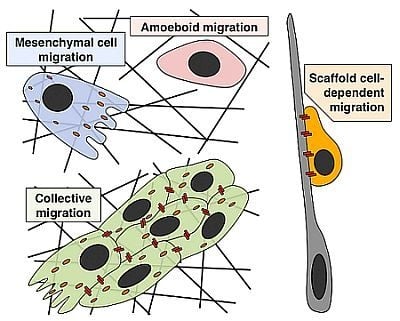
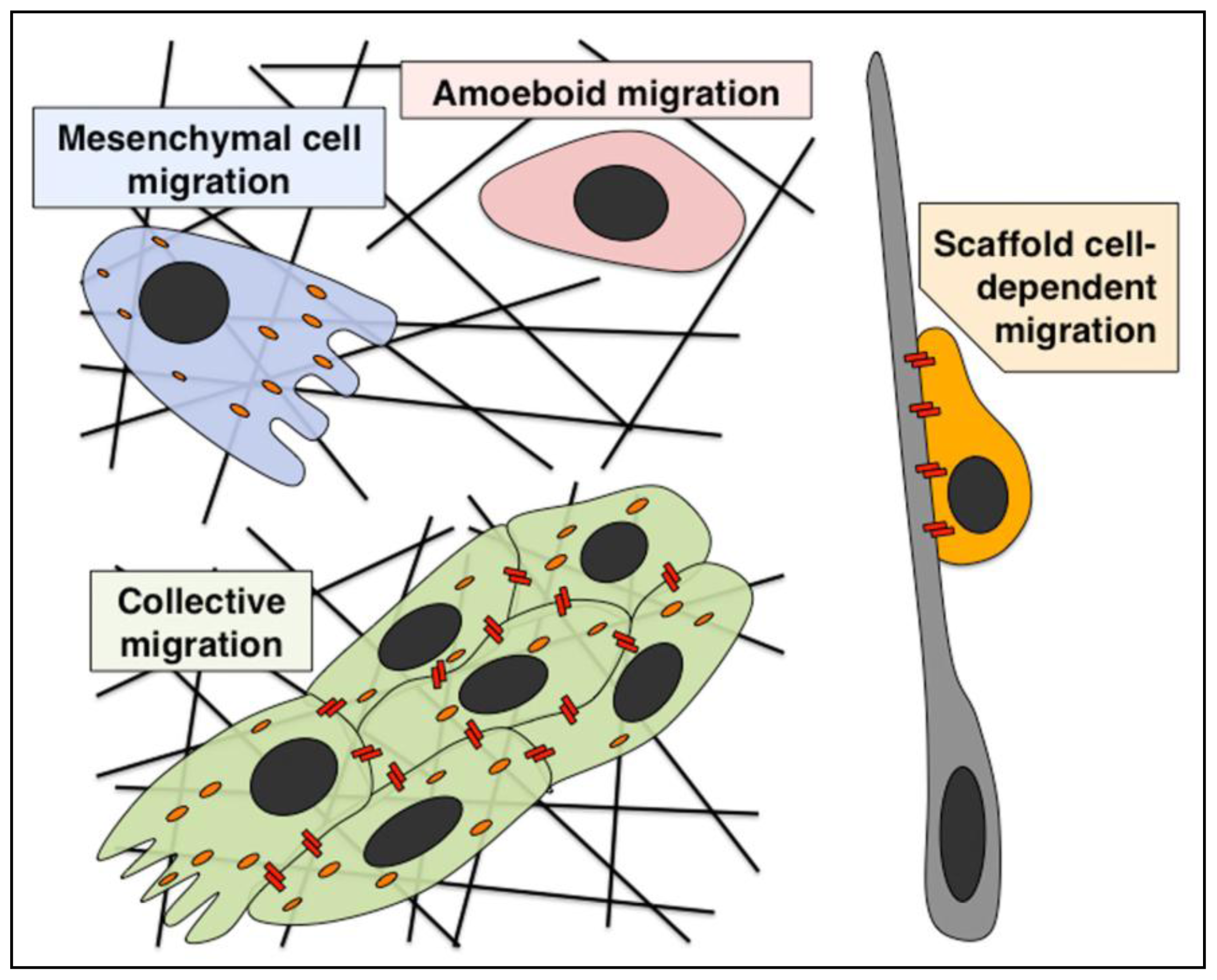
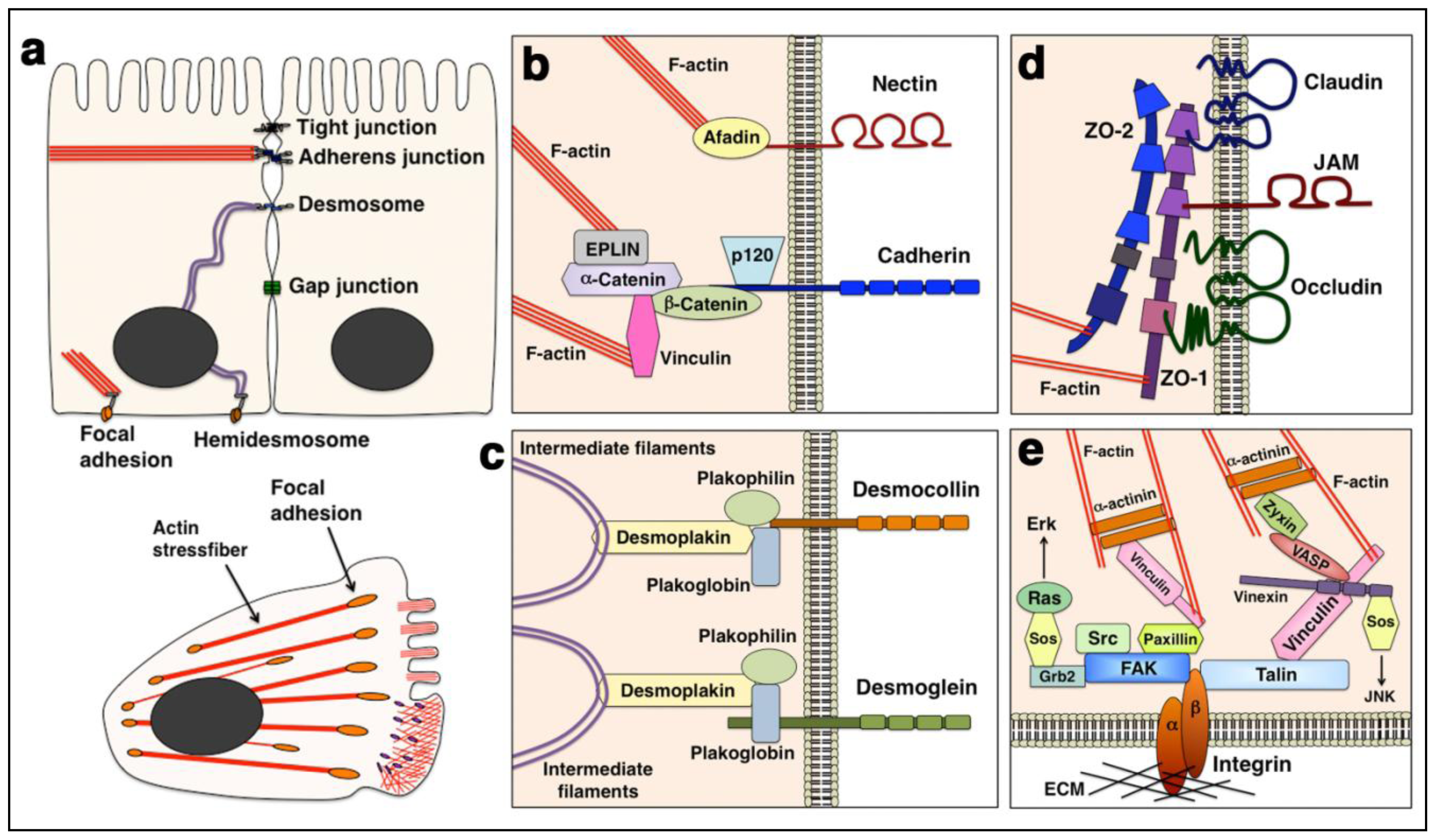
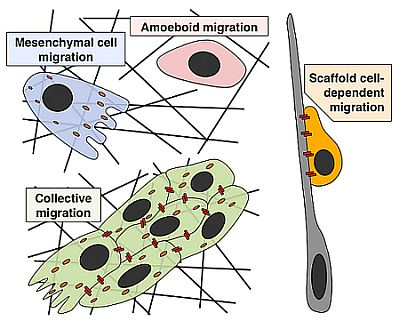
<p>Cell adhesion is essential for the organization and various biological functions of multicellular organisms. There are two major types of cell adhesions; cell-to-cell and cell-to-extracellular matrix (ECM), both of which consist of transmembrane cell adhesion molecules, intracellular scaffold or signaling proteins and cytoskeletons (<xref ref-type="fig" rid="f1-ijms-13-04564">Figure 1</xref>). Cadherin family cell adhesion molecules and their associated scaffold proteins, catenins, play important roles in the formation and functions of cell-cell adhesions, adherens junctions and desmosomes [<xref ref-type="bibr" rid="b1-ijms-13-04564">1</xref>]. In contrast, the major transmembrane proteins at cell-ECM adhesions are integrin heterodimers [<xref ref-type="bibr" rid="b2-ijms-13-04564">2</xref>]. These cell-cell and cell-ECM adhesion complexes are stabilized by actin cytoskeleton or intermediate filaments, but dynamically rearranged under some circumstances, such as cell migration and cancer metastasis [<xref ref-type="bibr" rid="b3-ijms-13-04564">3</xref>,<xref ref-type="bibr" rid="b4-ijms-13-04564">4</xref>]. In the initial step of cancer metastasis, tumor cells sometimes undergo epithelial-mesenchymal transition (EMT), which requires the disruption of cell-cell adhesions. Subsequently, the mesenchymal cancer cells begin migration and invade into the basement membranes and surrounding stromal tissues. The migrating mesenchymal cells constantly form new adhesions to ECM at the cell front, whereas a portion of the cell-ECM adhesions are disrupted by endocytosis at the rear. In contrast, recent reports indicate that some cancer cells maintain cell-cell adhesions and epithelial morphology during metastasis. This type of migration, called a collective cell migration, requires both cell-cell and cell-ECM adhesions. Furthermore, other cancer cells migrate in the absence of formation of any adhesions to neighboring cells or ECMs (an amoeboid migration). Thus, cancer cells exhibit various types of migration, which can be classified according to the cell adhesion properties [<xref ref-type="bibr" rid="b5-ijms-13-04564">5</xref>] (<xref ref-type="fig" rid="f1-ijms-13-04564">Figure 1</xref>).</p>
<p>In addition to the various migration patterns of cancer cells, there is another type of migration, a scaffold cell-dependent migration, which only depends on cell-cell adhesions (<xref ref-type="fig" rid="f1-ijms-13-04564">Figure 1</xref>). This type of migration is rarely observed in cancer metastasis but occurs mainly in normal brain development. During the development of the cerebral cortex, immature neurons exhibit multi-step migration to form a functional brain [<xref ref-type="bibr" rid="b6-ijms-13-04564">6</xref>]. The major migration mode of neurons is a radial glial cell-dependent migration, which is mediated by the endocytic recycling of cadherins, rather than integrins [<xref ref-type="bibr" rid="b7-ijms-13-04564">7</xref>]. In this review, I summarize the structures of cell adhesions and their dynamic regulation by endocytosis and membrane trafficking. I also introduce the physiological and pathological roles of the regulation of cell adhesions in various types of cell migration in neural development and cancer metastasis.</p></sec>
<sec>
<title>2. Structures and Functions of Cell Adhesion Complexes</title>
<sec>
<title>2.1. Adherens Junctions</title>
<p>Adherens junctions are observed in many cell types, including epithelial cells and fibroblasts (<xref ref-type="fig" rid="f2-ijms-13-04564">Figure 2a</xref>). The adherens junctions are required for the formation and maintenance of physical association of cells in a calcium-dependent manner [<xref ref-type="bibr" rid="b1-ijms-13-04564">1</xref>]. Cadherin is a key molecule in calcium-dependent cell adhesion, whereas nectins and nectin-like proteins, which are calcium-independent cell adhesion molecules, also have important roles in adherens junctions; nectin and its associated intracellular molecule, afadin, initiate the formation of adherens junctions by the recruitment of a cadherin-catenin complex to the adherens junctions [<xref ref-type="bibr" rid="b8-ijms-13-04564">8</xref>,<xref ref-type="bibr" rid="b9-ijms-13-04564">9</xref>] (<xref ref-type="fig" rid="f2-ijms-13-04564">Figure 2b</xref>). While a cadherin superfamily consists of more than a hundred members, classic cadherins, including E-cadherin (cdh1) and N-cadherin (cdh2), comprise about 20 molecules. The extracellular domains of classic cadherins provide trans-homophilic binding to other cadherins on neighboring cells, and their intracellular domains directly interact with β-catenin and p120-catenin (p120<sup>ctn</sup>) [<xref ref-type="bibr" rid="b1-ijms-13-04564">1</xref>,<xref ref-type="bibr" rid="b10-ijms-13-04564">10</xref>]. α-catenin binds both β-catenin and actin filaments (F-actin), suggesting that β- and α-catenins link cadherin with actin cytoskeleton. However, it has been reported that the α-catenin, complexed with β-catenin and cadherin, rarely interacts with F-actin [<xref ref-type="bibr" rid="b11-ijms-13-04564">11</xref>,<xref ref-type="bibr" rid="b12-ijms-13-04564">12</xref>]. α-catenin binds to several actin-binding proteins, such as vinculin and EPLIN, and EPLIN concurrently forms a complex with cadherin, α-catenin, β-catenin and F-actin, suggesting that EPLIN and some other actin-binding proteins regulate the interaction between cadherins and F-actin cooperatively with α- and β-catenins [<xref ref-type="bibr" rid="b13-ijms-13-04564">13</xref>,<xref ref-type="bibr" rid="b14-ijms-13-04564">14</xref>] (<xref ref-type="fig" rid="f2-ijms-13-04564">Figure 2b</xref>).</p></sec>
<sec>
<title>2.2. Desmosomes</title>
<p>Desmosomes are patch-like intercellular junctions, and abundantly observed in skin and myocardium, both of which bear mechanical stress (<xref ref-type="fig" rid="f2-ijms-13-04564">Figure 2a</xref>). The desmosomes are composed of non-classic cadherins, desmogleins and desmocollins, and provide a strong intercellular connection [<xref ref-type="bibr" rid="b15-ijms-13-04564">15</xref>,<xref ref-type="bibr" rid="b16-ijms-13-04564">16</xref>]. Desmoglein and desmocollin are directly or indirectly associated with plakoglobin, plakophilin, desmoplakin and intermediate filaments (<xref ref-type="fig" rid="f2-ijms-13-04564">Figure 2c</xref>). Four and three isoforms of desmogleins and desmocollins have been identified in humans, respectively. Mutations or abnormal expression of desmosomal proteins are associated with several diseases, including arrhythmogenic right ventricular cardiomyopathy (ARVC), skin diseases and cancer [<xref ref-type="bibr" rid="b17-ijms-13-04564">17</xref>–<xref ref-type="bibr" rid="b19-ijms-13-04564">19</xref>]. Mutations in desmoglein-2, desmocollin-2, desmoplakin and plakoglobin have been identified in ARVC patients, whereas <italic>N</italic>-terminal deletion in desmoglein-1 leads to striate palmoplantar keratoderma [<xref ref-type="bibr" rid="b20-ijms-13-04564">20</xref>,<xref ref-type="bibr" rid="b21-ijms-13-04564">21</xref>]. In addition, desmogleins are targets of autoimmune diseases, pemphigus foliaceus and pemphigus vulgaris [<xref ref-type="bibr" rid="b17-ijms-13-04564">17</xref>,<xref ref-type="bibr" rid="b19-ijms-13-04564">19</xref>,<xref ref-type="bibr" rid="b22-ijms-13-04564">22</xref>].</p></sec>
<sec>
<title>2.3. Tight Junctions and Gap Junctions</title>
<p>Tight junctions and gap junctions are cadherin-independent adhesions, although some crosstalk has been reported between cadherins and the components of tight junctions or gap junctions. Tight junctions are located at the most apical part of the lateral membranes in epithelial and endothelial cells (<xref ref-type="fig" rid="f2-ijms-13-04564">Figure 2a</xref>). Two major roles of tight junctions are “barrier” and “fence” functions [<xref ref-type="bibr" rid="b23-ijms-13-04564">23</xref>,<xref ref-type="bibr" rid="b24-ijms-13-04564">24</xref>]. At the tight junction strands, composed of claudin family and occludin, the intercellular distance between two neighboring cells is nearly zero, so that the tight junction restricts paracellular diffusion of substances and ions. In addition to the selective paracellular barrier function, tight junctions separate the plasma membrane into apical and basolateral domains to confine the diffusion of transmembrane proteins and lipids to the specific membrane domain as a fence. Both claudins and occludin bind to intracellular PDZ domain-containing proteins, ZO-1 (<xref ref-type="fig" rid="f2-ijms-13-04564">Figure 2d</xref>). Junctional adhesion molecule (JAM) family proteins are also associated with ZO-1 and localized at tight junctions [<xref ref-type="bibr" rid="b25-ijms-13-04564">25</xref>].</p>
<p>Gap junctions consist of homo- or hetero-hexamers of connexin (Cx) proteins, such as Cx43, Cx26 and Cx32. Connexin hexamers, called connexons, form intercellular channels, which allow the diffusion of small molecules and electrical signals [<xref ref-type="bibr" rid="b26-ijms-13-04564">26</xref>]. Some connexins are reported to interact with ZO-1, and Cx43 can be co-immunoprecipitated with N-cadherin and its associated catenins, suggesting that there is crosstalk between gap junctions and other junctional complexes [<xref ref-type="bibr" rid="b26-ijms-13-04564">26</xref>,<xref ref-type="bibr" rid="b27-ijms-13-04564">27</xref>]. Furthermore, components of gap junctions and tight junctions as well as cadherin-based adhesions have been associated with cancer [<xref ref-type="bibr" rid="b28-ijms-13-04564">28</xref>–<xref ref-type="bibr" rid="b31-ijms-13-04564">31</xref>].</p></sec>
<sec>
<title>2.4. Focal Adhesions</title>
<p>In addition to these cell-cell adhesions, cells also attach to ECMs, such as fibronectin, laminin, collagen and vitronectin. A major receptor for ECM is integrins. In humans, 18 α and 8 β subunits form at least 24 α–β heterodimers of integrins [<xref ref-type="bibr" rid="b2-ijms-13-04564">2</xref>,<xref ref-type="bibr" rid="b32-ijms-13-04564">32</xref>–<xref ref-type="bibr" rid="b36-ijms-13-04564">36</xref>] (<xref ref-type="table" rid="t1-ijms-13-04564">Table 1</xref>). Integrin heterodimers are localized at focal adhesions or hemidesmosomes, which are F-actin- or intermediate filament-based cell-ECM adhesion sites, respectively (<xref ref-type="fig" rid="f2-ijms-13-04564">Figure 2a</xref>), although some integrins serve cell-cell adhesion (<xref ref-type="table" rid="t1-ijms-13-04564">Table 1</xref>). It has been reported that many scaffold or signaling proteins, including talin, vinculin, zyxin, focal adhesion kinase (FAK), Src, paxillin and p130<sup>cas</sup>, are localized at focal adhesions [<xref ref-type="bibr" rid="b37-ijms-13-04564">37</xref>–<xref ref-type="bibr" rid="b39-ijms-13-04564">39</xref>] (<xref ref-type="fig" rid="f2-ijms-13-04564">Figure 2e</xref>). Talin directly binds to β1-integrin and an actin-binding protein, vinculin. In addition to the role linking integrins and F-actin, talin is also required for integrin activation [<xref ref-type="bibr" rid="b40-ijms-13-04564">40</xref>,<xref ref-type="bibr" rid="b41-ijms-13-04564">41</xref>]. The binding of talin induces the switching of integrins from inactive to active conformations. Therefore, talin plays important roles in both an inside-out activation of integrin and outside-in signal for the maturation of focal adhesion. A recent report shows that SHARPIN perturbs the recruitment of talin to integrins and thereby inhibits the integrin activation [<xref ref-type="bibr" rid="b42-ijms-13-04564">42</xref>]. Vinculin exhibits an intra-molecular interaction, which inactivates the scaffold function. In contrast, an active open form of vinculin interacts with many molecules, such as α-actinin, paxillin, vinexin and vasodilator-stimulated phosphoprotein (VASP) [<xref ref-type="bibr" rid="b43-ijms-13-04564">43</xref>,<xref ref-type="bibr" rid="b44-ijms-13-04564">44</xref>] (<xref ref-type="fig" rid="f2-ijms-13-04564">Figure 2e</xref>). While α-actinin, as well as vinculin, directly binds to F-actin, paxillin and vinexin interact with FAK and Sos, an activator for Ras, respectively [<xref ref-type="bibr" rid="b37-ijms-13-04564">37</xref>,<xref ref-type="bibr" rid="b45-ijms-13-04564">45</xref>,<xref ref-type="bibr" rid="b46-ijms-13-04564">46</xref>]. FAK forms a complex with a Src kinase and Grb2, an adaptor protein that activates the Ras-MAP kinase pathway. Vinexin is reported to promote the activation of c-jun <italic>N</italic>-terminal kinase (JNK) [<xref ref-type="bibr" rid="b47-ijms-13-04564">47</xref>]. Thus, focal adhesions function as not only a cell-ECM adhesion but also a signaling center to regulate cell migration, morphological changes, survival and proliferation.</p></sec></sec>
<sec>
<title>3. Intracellular Trafficking Pathways</title>
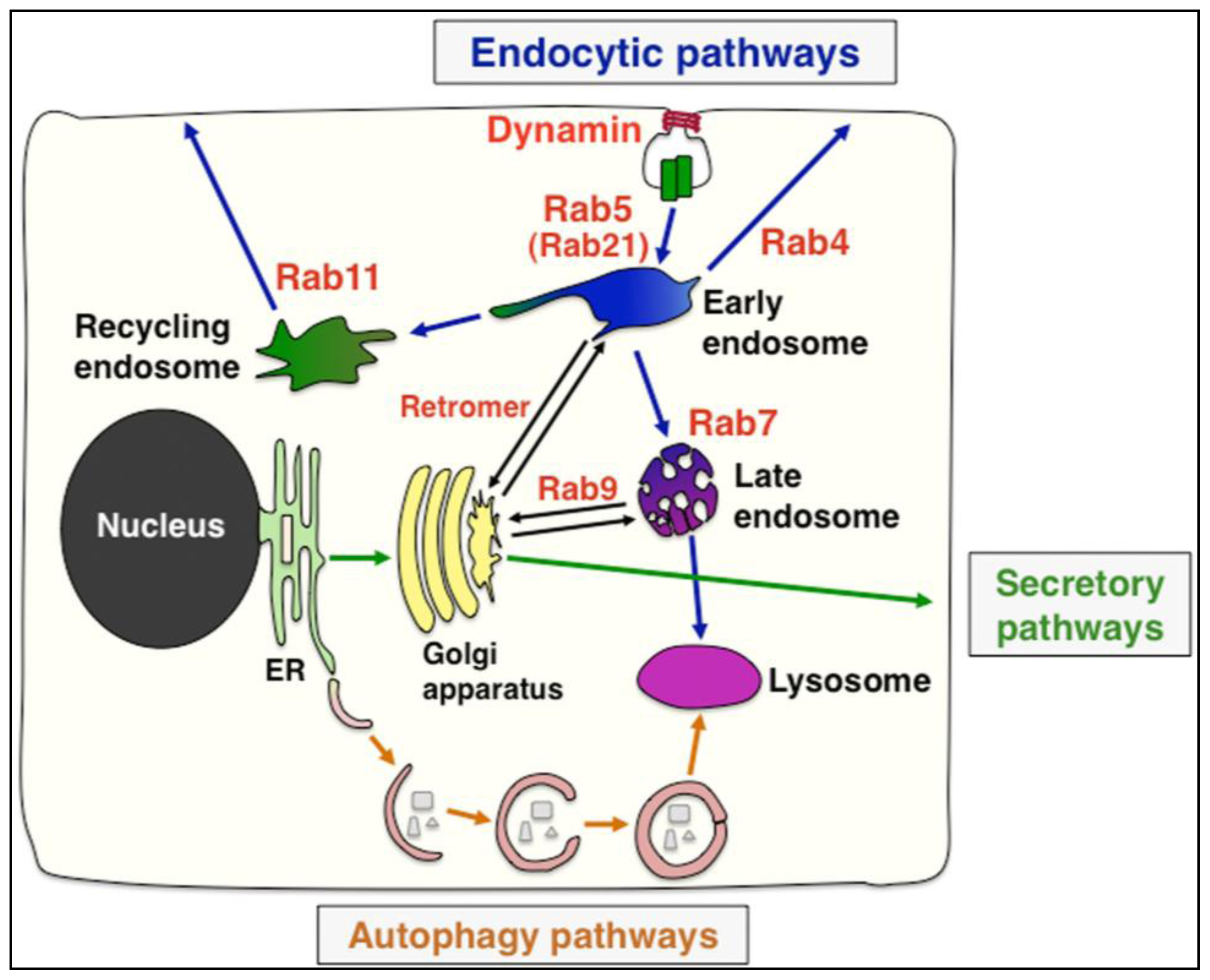
<p>Membrane trafficking pathways are roughly classified according to their origins; secretory pathways originated from ER-Golgi, endocytic pathways from plasma membranes and autophagy pathways from cytoplasm [<xref ref-type="bibr" rid="b48-ijms-13-04564">48</xref>–<xref ref-type="bibr" rid="b52-ijms-13-04564">52</xref>] (<xref ref-type="fig" rid="f3-ijms-13-04564">Figure 3</xref>). Newly synthesized cell adhesion molecules are transported into the plasma membrane via secretory pathways. A recent report shows that two desmosomal cadherins, desmoglein-2 and desmocollin-2, are transported by the use of different plus-end motor proteins, kinesin-1 and kinesin-2, respectively [<xref ref-type="bibr" rid="b53-ijms-13-04564">53</xref>]. Furthermore, the endocytic recycling and tight junction targeting of claudin and occludin are dependent on Rab13, whereas the transport of E-cadherin to the adherens junctions requires Rab8 in epithelial cell lines [<xref ref-type="bibr" rid="b54-ijms-13-04564">54</xref>,<xref ref-type="bibr" rid="b55-ijms-13-04564">55</xref>]. Therefore, the trafficking of cell adhesion molecules in distinct adhesion complex utilizes different transport machinery.</p>
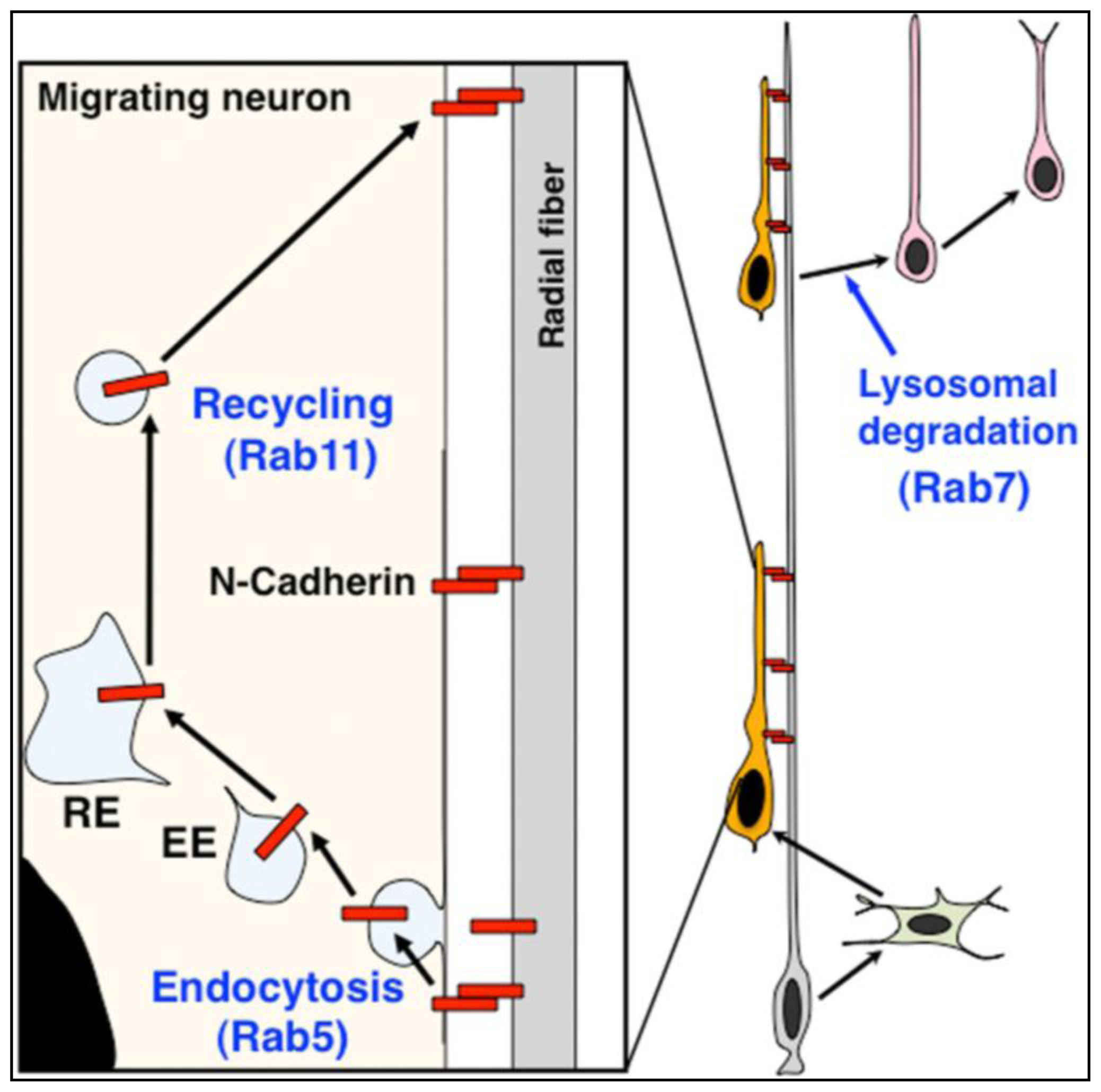
<p>Cell adhesion molecules, engaged in adhesion complexes, are relatively stable, but they also undergo constant or stimuli-mediated remodeling by endocytosis and the recycling system. Endocytosis can be classified into several types, including clathrin-mediated endocytosis, caveolin-mediated endocytosis and macropinocytosis [<xref ref-type="bibr" rid="b56-ijms-13-04564">56</xref>]. Endocytosis and its downstream endocytic pathways are mainly regulated by Rab family small GTPases [<xref ref-type="bibr" rid="b52-ijms-13-04564">52</xref>,<xref ref-type="bibr" rid="b57-ijms-13-04564">57</xref>–<xref ref-type="bibr" rid="b59-ijms-13-04564">59</xref>] (<xref ref-type="fig" rid="f3-ijms-13-04564">Figure 3</xref>). Many types of endocytosis are mediated by the activities of dynamin, an atypical GTPase, and Rab5. Rab5 and its subfamily proteins, such as Rab21, Rab22 and Rab31, promote the internalization of transmembrane proteins and their transport into early endosomes. As early endosomes are also called “sorting endosomes”, there are many trafficking pathways from early endosomes; recycling pathway to plasma membrane, degradation pathway to lysosomes and retrograde transport to trans-Golgi network (TGN) (<xref ref-type="fig" rid="f3-ijms-13-04564">Figure 3</xref>). Whereas direct and indirect recycling pathways require Rab4 and Rab11, respectively, the lysosomal degradation pathway is dependent on Rab7. In contrast, the retrograde transports from early and late endosomes are regulated by the retromer complex and Rab9, respectively.</p></sec>
<sec>
<title>4. Cadherin Endocytosis and Epithelial-to-Mesenchymal Transition</title>
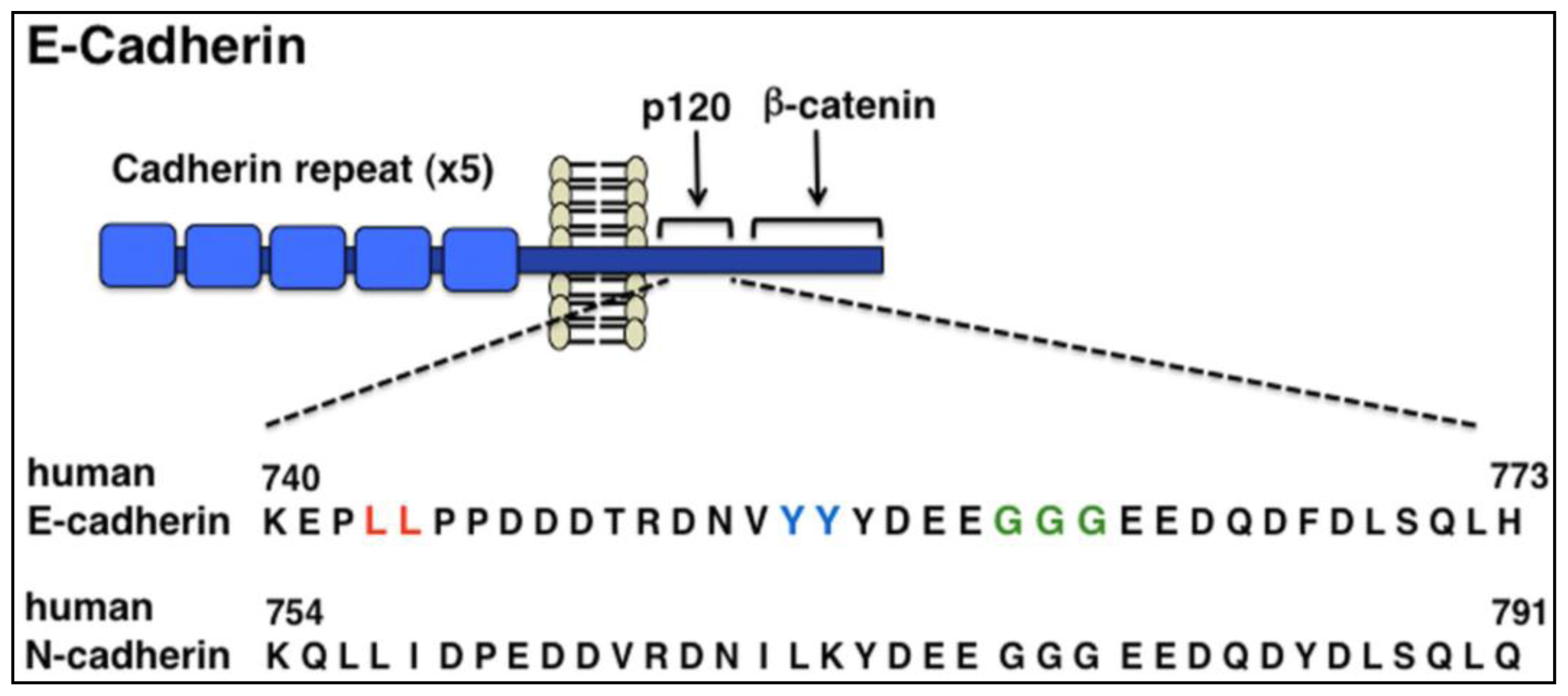
<p>The cytoplasmic domain of E-cadherin contains a dileucine motif followed by a NVYYY motif at the membrane-proximal region and a β-catenin-binding site at the membrane-distal region (<xref ref-type="fig" rid="f4-ijms-13-04564">Figure 4</xref>). A dileucine motif is a binding site for clathrin adaptor complexes, such as AP-2, [<xref ref-type="bibr" rid="b60-ijms-13-04564">60</xref>] and mutation in the dileucine motif in E-cadherin inhibits its endocytosis [<xref ref-type="bibr" rid="b61-ijms-13-04564">61</xref>]. The dileucine motif in E-cadherin also binds to p120<sup>ctn</sup>, which masks the dileucine motif to prevent the endocytosis of E-cadherin [<xref ref-type="bibr" rid="b62-ijms-13-04564">62</xref>–<xref ref-type="bibr" rid="b64-ijms-13-04564">64</xref>]. Knockdown of p120<sup>ctn</sup> results in the internalization of cadherins and loss of cell-cell contacts. However, the binding of Numb, a cytoplasmic adaptor, to p120<sup>ctn</sup> cancels the p120<sup>ctn</sup>-mediated suppression of E-cadherin endocytosis, because Numb recruits an AP-2 clathrin adaptor complex [<xref ref-type="bibr" rid="b65-ijms-13-04564">65</xref>]. Numb also interacts with the NVYYY motif on E-cadherin, which may prevent the binding of p120<sup>ctn</sup> to Ecadherin [<xref ref-type="bibr" rid="b66-ijms-13-04564">66</xref>]. Thus, Numb promotes E-cadherin endocytosis through two different mechanisms.</p>
<p>A recent structural and NMR study shows that the dileucine motif in E-cadherin serves a moderate and dynamic interaction with p120<sup>ctn</sup>, whereas the NVYYY motif, including the tyrosine phosphorylation site by a Src kinase, are required for a strong and static binding to p120<sup>ctn</sup> [<xref ref-type="bibr" rid="b67-ijms-13-04564">67</xref>]. Src-mediated phosphorylation of the NVYYY motif on E-cadherin induces the dissociation of p120<sup>ctn</sup> and recruits a c-Cbl-related E3 ubiquitin ligase, Hakai. Hakai induces the ubiquitination of E-cadherin and subsequently its endocytosis and degradation [<xref ref-type="bibr" rid="b68-ijms-13-04564">68</xref>]. In addition, Src and receptor tyrosine kinases, such as epidermal growth factor (EGF) receptor and brain-derived neurotrophic factor (BDNF) receptor, phosphorylate Tyr654 on β-catenin, resulting in the disruption of the cadherin β-catenin complex. In contrast, a cytoplasmic kinase, Fer, and hepatocyte growth factor (HGF) receptor phosphorylate Tyr142 on β-catenin, leading to the perturbation of the interaction between β-catenin and α-catenin [<xref ref-type="bibr" rid="b69-ijms-13-04564">69</xref>,<xref ref-type="bibr" rid="b70-ijms-13-04564">70</xref>].</p>
<p>Increased tyrosine phosphorylation occurs in growth factor-treated cells or oncogenic environments. Various growth factors, such as transforming growth factor β(TGFβ), HGF, fibroblast growth factor (FGF) and EGF, and oncogenic v-Src are known to induce an epithelial-mesenchymal transition (EMT) [<xref ref-type="bibr" rid="b71-ijms-13-04564">71</xref>–<xref ref-type="bibr" rid="b73-ijms-13-04564">73</xref>]. EMT progression involves the reduction in cell-cell adhesion, apico-basal polarity and epithelial markers, including E-cadherin, and the upregulation of mesenchymal markers, including N-cadherin, vimentin and α-smooth muscle actin. Although transcriptional regulation has crucial roles in the induction of EMT [<xref ref-type="bibr" rid="b74-ijms-13-04564">74</xref>], the tyrosine phosphorylation of E-cadherin and catenins are also important events for EMT [<xref ref-type="bibr" rid="b75-ijms-13-04564">75</xref>]. HGF treatment or v-Src expression activates Arf6, an Arf family small GTPase, which enhances E-cadherin endocytosis partly through the recruitment of Nm23-H1, an activator for dynamin [<xref ref-type="bibr" rid="b76-ijms-13-04564">76</xref>,<xref ref-type="bibr" rid="b77-ijms-13-04564">77</xref>]. HGF also induces Ras-mediated activation of RIN2, an activator for Rab5, increasing Rab5-dependent endocytosis of E-cadherin [<xref ref-type="bibr" rid="b78-ijms-13-04564">78</xref>].</p>
<p>In addition to the clathrin-mediated endocytosis, caveolin-mediated endocytosis and macropinocytosis are involved in E-cadherin internalization [<xref ref-type="bibr" rid="b79-ijms-13-04564">79</xref>,<xref ref-type="bibr" rid="b80-ijms-13-04564">80</xref>]. EGF treatment promotes E-cadherin macropinocytosis into endosomes, in which E-cadherin still colocalizes with p120<sup>ctn</sup>, in MCF-7 cells [<xref ref-type="bibr" rid="b81-ijms-13-04564">81</xref>]. Interestingly, E-cadherin and N-cadherin enhance macropinocytosis [<xref ref-type="bibr" rid="b82-ijms-13-04564">82</xref>], implicating the positive feedback loop.</p></sec>
<sec>
<title>5. Integrin Endocytosis and Cell Migration</title>
<p>Integrin endocytosis and recycling are known to regulate the migration of many cell types, including neutrophils, fibroblasts and several cancer cell lines [<xref ref-type="bibr" rid="b83-ijms-13-04564">83</xref>–<xref ref-type="bibr" rid="b85-ijms-13-04564">85</xref>]. The endocytosis of integrins promotes the disassembly of focal adhesion and detachment from ECM at the rear of the cell, and thereby directs cell migration [<xref ref-type="bibr" rid="b86-ijms-13-04564">86</xref>].</p>
<p>β5-integrin, which forms a heterodimer only with αv-integrin as a vitronectin receptor (<xref ref-type="table" rid="t1-ijms-13-04564">Table 1</xref>), is observed at clathrin-coated membrane domains in cultured myotubes [<xref ref-type="bibr" rid="b87-ijms-13-04564">87</xref>]. Furthermore, Numb, an endocytic adaptor for clathrin-mediated endocytosis, binds to β1-integrin, but not intracellular focal adhesion components, such as talin, vinculin, paxillin and FAK, and enhances integrin endocytosis and cell migration on fibrocentin or collagen [<xref ref-type="bibr" rid="b88-ijms-13-04564">88</xref>]. Dab2 and autosomal recessive hypercholesteremia (ARH), another endocytic adaptor proteins, are also involved in integrin endocytosis and cell migration [<xref ref-type="bibr" rid="b89-ijms-13-04564">89</xref>,<xref ref-type="bibr" rid="b90-ijms-13-04564">90</xref>]. Suppression of Dab2 increases the cell surface levels of β1-, α1-, α2-, α3-, but not α5- or αv-integrins. Considering the binding specificity of integrins to ECM proteins (<xref ref-type="table" rid="t1-ijms-13-04564">Table 1</xref>), Dab2 prefers to control the endocytosis of receptors for collagen and laminin, rather than fibronectin and vitronectin. Interestingly, Dab2-mediated endocytosis occurs evenly over the cell surface, suggesting that Dab2 increases the intracellular integrin pool that is recycled to create new focal adhesions [<xref ref-type="bibr" rid="b89-ijms-13-04564">89</xref>].</p>
<p>Rab family small GTPases and Arf6 are known to regulate integrin endocytosis and intracellular trafficking [<xref ref-type="bibr" rid="b85-ijms-13-04564">85</xref>,<xref ref-type="bibr" rid="b91-ijms-13-04564">91</xref>]. Rab21 and Rab5 are co-immunoprecipitated with β1-integrin and control its endosomal trafficking in MDA-MB-231 breast cancer cells [<xref ref-type="bibr" rid="b92-ijms-13-04564">92</xref>]. Internalized integrins are recycled back to the plasma membrane through Rab4-dependent direct recycling pathway or Rab11-dependent indirect recycling pathway via recycling endosomes (<xref ref-type="fig" rid="f3-ijms-13-04564">Figure 3</xref>). While phosphatidylinositol 3-kinase (PI3K) and Akt regulate the trafficking of αvβ3- and α5β1-integrins from Rab11-positive recycling endosomes to the plasma membranes, platelet-derived growth factor (PDGF) treatment promotes the Rab4-dependent fast recycling of αvβ3-integrin from early endosomes without the involvement of Rab11 [<xref ref-type="bibr" rid="b93-ijms-13-04564">93</xref>,<xref ref-type="bibr" rid="b94-ijms-13-04564">94</xref>]. Interestingly, β1-integrin also enhances PDGF receptor trafficking and directed cell migration [<xref ref-type="bibr" rid="b95-ijms-13-04564">95</xref>].</p>
<p>Whereas a major fibronectin receptor is α5β1-integrin (<xref ref-type="table" rid="t1-ijms-13-04564">Table 1</xref>), syndecan-4, a membrane-intercalated heparan sulfate proteoglycan, acts as a co-receptor for fibronectin [<xref ref-type="bibr" rid="b96-ijms-13-04564">96</xref>]. A recent study shows that the binding of fibronectin to syndecan-4 induces α5β1-integrin endocytosis in a dynamin- and caveolin-dependent manner [<xref ref-type="bibr" rid="b97-ijms-13-04564">97</xref>]. Syndecan-4 is associated with protein kinase Cα (PKCα), and this interaction is required for RhoG-regulated α5β1-integrin endocytosis and cell migration during wound healing. PKCα is also reported to interact with β1-integrin and to promote its endocytosis [<xref ref-type="bibr" rid="b98-ijms-13-04564">98</xref>]. A portion of the internalized β1-integrin is recycled to the plasma membrane via PKCε activity, which promotes cell migration [<xref ref-type="bibr" rid="b99-ijms-13-04564">99</xref>,<xref ref-type="bibr" rid="b100-ijms-13-04564">100</xref>]. Thus, integrin trafficking, regulated by Rab family small GTPases and several kinases, has important roles in cell migration.</p>
<p>Integrin endocytosis is also required for the internalization of ECM proteins, such as vitronectin and fibronectin. In human skin fibroblasts, β5-integrin and vitronectin are co-localized at intracellular vesicles and transported into lysosomes [<xref ref-type="bibr" rid="b101-ijms-13-04564">101</xref>]. Another report shows that caveolin-mediated endocytosis of β1-integrin is involved in the turnover of fibronectin [<xref ref-type="bibr" rid="b102-ijms-13-04564">102</xref>]. The engagement of fibronectin causes the ubiquitination of α5-integrin, which is transported into lysosomes via the ESCRT pathway [<xref ref-type="bibr" rid="b103-ijms-13-04564">103</xref>]. Interestingly, this selective sorting and degradation of fibronectin-bound α5β1-integrin is required for fibroblast migration [<xref ref-type="bibr" rid="b103-ijms-13-04564">103</xref>].</p>
<p>Many reports have indicated that integrin trafficking is associated with cancer metastasis [<xref ref-type="bibr" rid="b91-ijms-13-04564">91</xref>,<xref ref-type="bibr" rid="b104-ijms-13-04564">104</xref>]. Increased expression of αvβ6-integrin is found in many cancers, including oral carcinoma. HS1-associated protein X-1 (HAX-1) directly binds to the cytoplasmic domain of β6-integrin and this interaction enhances the migration and invasion of oral squamous cell carcinoma cell lines through promotion of the clathrin-mediated endocytosis of αvβ6-integrin [<xref ref-type="bibr" rid="b105-ijms-13-04564">105</xref>]. In addition, enhanced expression of Arf6 is observed in breast cancer cells, and GEP100 (also known as BRAG2), an activator for Arf6, is responsible for the invasive activity of MDA-MB-231 breast cancer cells [<xref ref-type="bibr" rid="b106-ijms-13-04564">106</xref>]. Since it is known that GEP100 regulates the endocytosis of β1-integrin [<xref ref-type="bibr" rid="b107-ijms-13-04564">107</xref>], Arf6-mediated trafficking of β1-integrin may contribute to the acquisition of invasive phenotypes in breast cancer cells. Furthermore, recent reports have revealed that oncogenic mutant forms of p53, a major tumor suppressor, enhance Rab11-dependent recycling of α5β1-integrin to promote invasive migration [<xref ref-type="bibr" rid="b108-ijms-13-04564">108</xref>,<xref ref-type="bibr" rid="b109-ijms-13-04564">109</xref>]. These observations strongly suggest that integrin trafficking is closely associated with cancer cell invasion and metastasis.</p></sec>
<sec>
<title>6. Roles of Cell Adhesion Dynamics in Cancer</title>
<sec>
<title>6.1. Cancer Metastasis</title>
<p>Precise regulation of cell adhesion is important for various physiological events, such as normal development, immune system and wound healing, and its dysregulation is associated with many pathological states, including cancer metastasis.</p>
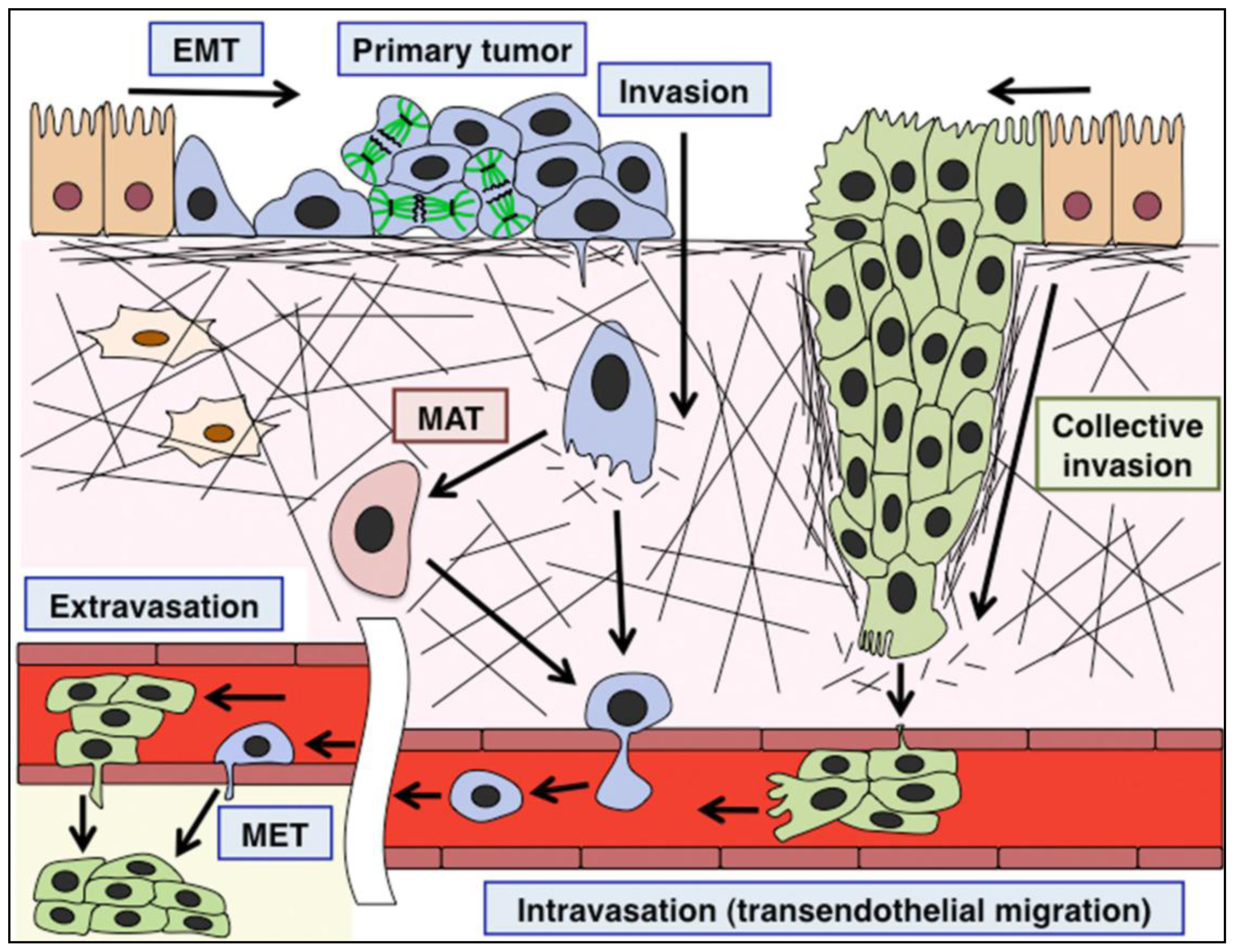
<p>The metastasis of carcinomas consists of several steps [<xref ref-type="bibr" rid="b73-ijms-13-04564">73</xref>,<xref ref-type="bibr" rid="b110-ijms-13-04564">110</xref>] (<xref ref-type="fig" rid="f5-ijms-13-04564">Figure 5</xref>). (i) Following the formation of a primary tumor, some tumor cells detach from the primary tumor; (ii) These tumor cells invade the basement membranes and local mesenchymal tissues; (iii) They undergo transendothelial migration into blood or lymphatic vessels (intravasation); (iv) Escaping from the immune system, they survive in the circulation; (v) The cancer cells attach to the vessel wall in the distant organ and migrate out of the vessel (extravasation); (vi) They proliferate to establish colonies at the secondary sites. These complicated processes require the dynamic regulation of cell adhesions through endocytic machinery as well as transcriptional regulation.</p></sec>
<sec>
<title>6.2. EMT in Cancer</title>
<p>Several studies pointed out the significance of EMT in cancer invasion [<xref ref-type="bibr" rid="b73-ijms-13-04564">73</xref>,<xref ref-type="bibr" rid="b111-ijms-13-04564">111</xref>,<xref ref-type="bibr" rid="b112-ijms-13-04564">112</xref>], although it remains controversial because many metastatic tumors still retain epithelial properties and histopathological similarities to the primary tumors [<xref ref-type="bibr" rid="b113-ijms-13-04564">113</xref>,<xref ref-type="bibr" rid="b114-ijms-13-04564">114</xref>]. Furthermore, it is also unclear when metastasis comes into existence during tumor progression. A classical belief is that the invasion and subsequent dissemination of cancer cells occur after primary tumors have considerably expanded and have acquired high-motility properties through EMT. However, recent accumulating evidence indicates that the metastatic spread of tumor cells is an early step of cancer progression [<xref ref-type="bibr" rid="b115-ijms-13-04564">115</xref>,<xref ref-type="bibr" rid="b116-ijms-13-04564">116</xref>]. The disseminated tumor cells from HER-2 transgenic mammary glands are observed in lymph nodes or bone marrow at the premalignant phase, and early-disseminated cancer cells have the competency to induce lethal carcinosis [<xref ref-type="bibr" rid="b117-ijms-13-04564">117</xref>]. Furthermore, there is no association between the tumor stage of human breast cancer and the number of disseminated cells in the bone marrow.</p>
<p>Regardless of whether it is an early or late event in cancer progression, the invasive migration of tumor cells is an initial important step for cancer metastasis. Although EMT has a limited role in cancer metastasis, many reports indicate that complete or incomplete EMT is associated with the metastasis of tumors, including breast cancer, hepatocellular carcinoma, colorectal cancer, pancreatic cancer and prostate cancer [<xref ref-type="bibr" rid="b118-ijms-13-04564">118</xref>–<xref ref-type="bibr" rid="b124-ijms-13-04564">124</xref>] (<xref ref-type="fig" rid="f5-ijms-13-04564">Figure 5</xref>). As described above, EMT is accompanied with downregulation of E-cadherin and upregulation of N-cadherin, the so-called “cadherin switch”. Transcriptional repression of E-cadherin is mediated by transcriptional repressors, snail family zinc finger proteins, Snail (SNAI1) and Slug (SNAI2), ZEB family transcriptional factors, ZEB1 and ZEB2 (also known SIP1), and basic helix-loop-helix proteins, Twist1 and Twist2. Snail and Slug also suppress the transcription of occludin and claudin-1, whereas ZEB2 targets Cx26 and plakophilin-2 [<xref ref-type="bibr" rid="b74-ijms-13-04564">74</xref>].</p>
<p>TGFβ, a major EMT inducer, upregulates Snail and ZEB2 [<xref ref-type="bibr" rid="b125-ijms-13-04564">125</xref>–<xref ref-type="bibr" rid="b127-ijms-13-04564">127</xref>]. Furthermore, p12 (also known Cdk2ap), a downstream effector of TGFβ, induces EMT through Twist2 upregulation [<xref ref-type="bibr" rid="b128-ijms-13-04564">128</xref>]. In addition to transcriptional regulators, the type II receptor of TGFβ phosphorylates Par6, a polarity protein, and the phosphorylated Par6 recruits an E3 ubiquitin ligase, Smurf1, leading to the degradation of RhoA [<xref ref-type="bibr" rid="b129-ijms-13-04564">129</xref>]. Also, cooperatively with Raf-1, TGFβ promotes the endocytosis and lysosomal degradation of E-cadherin [<xref ref-type="bibr" rid="b130-ijms-13-04564">130</xref>]. Therefore, TGFβ signaling is integral in EMT through the regulation of transcription, RhoA-dependent cytoskeletal remodeling and endocytosis, even though the downstream effect of TGFβ is cell type-specific [<xref ref-type="bibr" rid="b114-ijms-13-04564">114</xref>].</p>
<p>It has been reported that microRNAs and alternative splicing regulators, ESRP1 and ESRP2, are involved in tumor cell migration and EMT [<xref ref-type="bibr" rid="b122-ijms-13-04564">122</xref>,<xref ref-type="bibr" rid="b131-ijms-13-04564">131</xref>–<xref ref-type="bibr" rid="b135-ijms-13-04564">135</xref>]. A microRNA, miR-9 directly targets E-cadherin mRNA, resulting in an increase of cell migration and invasiveness [<xref ref-type="bibr" rid="b131-ijms-13-04564">131</xref>,<xref ref-type="bibr" rid="b136-ijms-13-04564">136</xref>]. Consistently, miR-9 is upregulated in breast cancer cells. In contrast, miR-200 and its related microRNAs, repress ZEB1, leading to the inhibition of EMT [<xref ref-type="bibr" rid="b122-ijms-13-04564">122</xref>,<xref ref-type="bibr" rid="b132-ijms-13-04564">132</xref>,<xref ref-type="bibr" rid="b133-ijms-13-04564">133</xref>]. Interestingly, recent studies indicate that EMT is associated with the maintenance of stem cell properties, and the miR-200 family suppresses the “stemness” through the repression of Bmi1, KLF4 as well as ZEB1, suggesting that EMT may induce cancer stem cells [<xref ref-type="bibr" rid="b122-ijms-13-04564">122</xref>,<xref ref-type="bibr" rid="b137-ijms-13-04564">137</xref>–<xref ref-type="bibr" rid="b139-ijms-13-04564">139</xref>].</p></sec>
<sec>
<title>6.3. Collective Invasion</title>
<p>In several cancers, including melanoma, breast cancer and colorectal cancer, cancer cells collectively migrate and invade other tissues without incurring EMT [<xref ref-type="bibr" rid="b113-ijms-13-04564">113</xref>,<xref ref-type="bibr" rid="b140-ijms-13-04564">140</xref>–<xref ref-type="bibr" rid="b143-ijms-13-04564">143</xref>] (<xref ref-type="fig" rid="f5-ijms-13-04564">Figure 5</xref>). Collective migrating cells form multicellular strands (epithelial sheets) or coherent clusters detached from the primary tumors [<xref ref-type="bibr" rid="b5-ijms-13-04564">5</xref>]. In either case, their cell-cell and cell-ECM adhesions are maintained, so that they can interact with neighboring cells and ECM during migration (<xref ref-type="fig" rid="f1-ijms-13-04564">Figure 1</xref>). In the collective migration of L-10 human rectal adenocarcinoma cells, HT-1080 fibroblastoma cells and MDA-MB-231 breast cancer cells, a leading cell (or a tip cell) in the front expresses MT1-MMP, a membrane-type matrix metalloproteinase, while the following cells at the back do not [<xref ref-type="bibr" rid="b142-ijms-13-04564">142</xref>,<xref ref-type="bibr" rid="b144-ijms-13-04564">144</xref>]. The activity of MT1-MMP is required for the transition from individual to collective cell invasion. Furthermore, in the co-cultures of carcinoma cells and stromal fibroblasts, the leading fibroblasts invade in an MMP-dependent manner and form tracks through α5-integrin-mediated RhoA activation and subsequent activation of myosin light chain (MLC), whereas carcinoma cells follow the tracks generated by the leading fibroblasts via Cdc42-mediated regulation of MLC [<xref ref-type="bibr" rid="b145-ijms-13-04564">145</xref>]. These findings suggest that during collective cell migration, the leading and the following cells exhibit different properties and that the multicellular coordination of cell polarity and cytoskeletal regulation has important roles.</p>
<p>At the cell-cell adhesions in collective migrating cells, actomyosin contractility is kept at low levels to maintain cell-cell cohesion [<xref ref-type="bibr" rid="b146-ijms-13-04564">146</xref>,<xref ref-type="bibr" rid="b147-ijms-13-04564">147</xref>]. Discoidin domain receptor 1 (DDR1) interacts with polarity proteins, Par3 and Par6, which suppress Rho kinase/ROCK-mediated actomyosin contractility through the recruitment of RhoE [<xref ref-type="bibr" rid="b146-ijms-13-04564">146</xref>]. Furthermore, DDR1 induces the upregulation of N-cadherin [<xref ref-type="bibr" rid="b148-ijms-13-04564">148</xref>], and in collective migrating neural crest cells, N-cadherin inhibits membrane protrusion and Rac1 activity at cell-cell contacts [<xref ref-type="bibr" rid="b149-ijms-13-04564">149</xref>,<xref ref-type="bibr" rid="b150-ijms-13-04564">150</xref>]. Thus, cell adhesion molecules not only maintain cell-cell and cell-ECM contacts but also regulate intracellular signals to control collective cell migration.</p>
<p>Interestingly, a recent report has indicated the cooperative roles of EMT-mediated mesenchymal cells (EMT-cancer cells) and collective invading cells (non-EMT-cancer cells) [<xref ref-type="bibr" rid="b151-ijms-13-04564">151</xref>,<xref ref-type="bibr" rid="b152-ijms-13-04564">152</xref>]. EMT-cancer cells, but not non-EMT cancer cells, can invade and intravasate into the blood vessels, although they cannot establish metastasis in the distal organs. On the other hand, non-EMT-cancer cells can survive in the circulation and form the secondary tumors only if they are injected into the blood vessels, but not below the skin. When both EMT- and non-EMT cancer cells are inoculated subcutaneously, EMT cancer cells are located at the invasive front and the following non-EMT cancer cells can intravasate into the blood circulation. Furthermore, non-EMT cells extravasate and establish metastasis, suggesting that completing the entire metastatic process requires the cooperation between EMT- and non-EMT-cancer cells.</p></sec>
<sec>
<title>6.4. Amoeboid Migration</title>
<p>While TGFβ regulates the switch from collective to individual migration of breast cancer cells in a Smad-dependent manner [<xref ref-type="bibr" rid="b143-ijms-13-04564">143</xref>], suppression of integrin causes the transition from collective to amoeboid migration. Amoeboid cell migration is independent of ECM attachment and protease activity; it requires actin cytoskeletal regulation to move forward [<xref ref-type="bibr" rid="b153-ijms-13-04564">153</xref>] (<xref ref-type="fig" rid="f1-ijms-13-04564">Figures 1</xref>,<xref ref-type="fig" rid="f5-ijms-13-04564">5</xref>). It has been reported that the suppression of cofilin, an actin-binding protein, leads to the transition from amoeboid tumor cells to mesenchyme-like cells [<xref ref-type="bibr" rid="b154-ijms-13-04564">154</xref>]. p27<sup>kip1</sup>, a cyclin-dependent kinase inhibitor protein that negatively regulates cell cycle progression, has also been reported to control mesenchymal-amoeboid transition (MAT) [<xref ref-type="bibr" rid="b155-ijms-13-04564">155</xref>]. Interestingly, p27<sup>kip1</sup> promotes cofilin-mediated actin reorganization as a downstream pathway of cyclin-dependent kinase 5 (Cdk5) in neurons [<xref ref-type="bibr" rid="b156-ijms-13-04564">156</xref>]. Since Cdk5-mediated regulation of p27<sup>kip1</sup> is associated with several cancers [<xref ref-type="bibr" rid="b157-ijms-13-04564">157</xref>,<xref ref-type="bibr" rid="b158-ijms-13-04564">158</xref>], a Cdk5-p27<sup>kip1</sup> pathway might determine an amoeboid morphology through the regulation of cofilin in cancer.</p></sec></sec>
<sec>
<title>7. Endocytic Regulation of Cell Adhesion in Neural Development</title>
<sec>
<title>7.1. Cell Adhesion and Cerebral Cortical Development</title>
<p>Neural tissues, including cerebral cortex, are constructed from an epithelium-derived neural tube [<xref ref-type="bibr" rid="b159-ijms-13-04564">159</xref>]. In the developing cerebral cortex, neural progenitors comprise a pseudostratified neuroepithelium (or ventricular zone), in which E- and N-cadherin-mediated adherens junctions and gap junctions, but not desmosomes, are observed [<xref ref-type="bibr" rid="b160-ijms-13-04564">160</xref>–<xref ref-type="bibr" rid="b162-ijms-13-04564">162</xref>]. ZO-1 is also localized at the apical parts of neuroepithelium, but tight junction structures are not observed after neural tube closure [<xref ref-type="bibr" rid="b161-ijms-13-04564">161</xref>]. In the neuroepithelium, N-cadherin is transported by KIF3-mediated microtubule plus-end-directed motor complexes, composed of KIF3A, KIF3B and KAP3 [<xref ref-type="bibr" rid="b163-ijms-13-04564">163</xref>], and knockout of N-cadherin or KAP3 results in the disruption of neuroepithelial structures [<xref ref-type="bibr" rid="b163-ijms-13-04564">163</xref>,<xref ref-type="bibr" rid="b164-ijms-13-04564">164</xref>]. Furthermore, N-cadherin-mediated adherens junctions may play an important role in proper neuronal differentiation because suppression of N-cadherin causes premature neuronal differentiation [<xref ref-type="bibr" rid="b165-ijms-13-04564">165</xref>].</p>
<p>Differentiated immature neurons, generated from neural progenitors, migrate out of the neuroepithelium. These migrating immature neurons exhibit various morphological changes, and subsequently attach to radial glial fibers, pia-directed long processes derived from neural progenitors, in the developing cerebral cortex [<xref ref-type="bibr" rid="b6-ijms-13-04564">6</xref>] (<xref ref-type="fig" rid="f6-ijms-13-04564">Figure 6</xref>). The morphological changes at the early phase of migration require the proper regulation of microtubule dynamics and actin cytoskeletal reorganization, mediated by Rac1-JNK-MAP1B and Cdk5-p27<sup>kip1</sup>-cofilin pathways, respectively [<xref ref-type="bibr" rid="b156-ijms-13-04564">156</xref>,<xref ref-type="bibr" rid="b166-ijms-13-04564">166</xref>–<xref ref-type="bibr" rid="b168-ijms-13-04564">168</xref>]. Since p27<sup>kip1</sup> controls the G1 length of neural progenitors and cell cycle exit through the inhibition of CDK activities [<xref ref-type="bibr" rid="b169-ijms-13-04564">169</xref>,<xref ref-type="bibr" rid="b170-ijms-13-04564">170</xref>], p27<sup>kip1</sup> has dual functions in neural progenitors and migrating neurons, and therefore provides a molecular link between the cell cycle exit and migration start. Interestingly, mutations in ArfGEF2/Big2 cause periventricular heterotopia (caused by the migration defect in neurons) and microcephaly (caused by the proliferation defect in neural progenitors) in humans, suggesting that ArfGEF2/Big2 and its downstream Arf family small GTPases are also involved in both neural progenitor proliferation and migration start, likely through the regulation of membrane trafficking [<xref ref-type="bibr" rid="b171-ijms-13-04564">171</xref>].</p></sec>
<sec>
<title>7.2. Scaffold Cell-Dependent Migration in Neural Development</title>
<p>After complex morphological changes, immature neurons begin a long-distance migration along radial glial fibers, called the locomotion mode of neuronal migration [<xref ref-type="bibr" rid="b172-ijms-13-04564">172</xref>], which covers most of the neuronal migration route and is therefore a main contributor to neuronal migration and cortical layer formation [<xref ref-type="bibr" rid="b173-ijms-13-04564">173</xref>]. This migration is a typical example of a scaffold cell-dependent migration (<xref ref-type="fig" rid="f1-ijms-13-04564">Figure 1</xref>). N-cadherin is required for the attachment of the locomoting neurons to the radial glial fibers [<xref ref-type="bibr" rid="b7-ijms-13-04564">7</xref>,<xref ref-type="bibr" rid="b174-ijms-13-04564">174</xref>] (<xref ref-type="fig" rid="f6-ijms-13-04564">Figure 6</xref>). A portion of this N-cadherin is internalized by a Rab5-dependent endocytosis and recycled to the plasma membrane via a Rab11-dependent indirect recycling pathway, suggesting that the intracellular trafficking of N-cadherin is essential for neuronal migration along radial glial fibers [<xref ref-type="bibr" rid="b7-ijms-13-04564">7</xref>,<xref ref-type="bibr" rid="b52-ijms-13-04564">52</xref>]. Although Rab5 is involved in not only clathrin-mediated endocytosis but also some caveolin-mediated endocytosis, it is known that at least clathrin function is required for cortical neuronal migration [<xref ref-type="bibr" rid="b175-ijms-13-04564">175</xref>]. Recent reports reveal that a small GTPase, Rap1, regulates N-cadherin in migrating neurons as a downstream pathway of Reelin, whose mutation in mice results in the disruption of cortical layer structures, probably due to the neuronal migration defect [<xref ref-type="bibr" rid="b176-ijms-13-04564">176</xref>,<xref ref-type="bibr" rid="b177-ijms-13-04564">177</xref>]. In addition, Cx43 and Cx26, gap junction components are reported to regulate neuronal adhesion to radial glial fibers [<xref ref-type="bibr" rid="b178-ijms-13-04564">178</xref>–<xref ref-type="bibr" rid="b180-ijms-13-04564">180</xref>]. On the other hand, several reports indicate that β1-integrin is less important for the locomotion mode of migration [<xref ref-type="bibr" rid="b181-ijms-13-04564">181</xref>,<xref ref-type="bibr" rid="b182-ijms-13-04564">182</xref>], suggesting that a scaffold cell-dependent migration largely depends on cell-cell adhesions, but not cell-ECM adhesions (<xref ref-type="fig" rid="f1-ijms-13-04564">Figure 1</xref>).</p>
<p>Similar to the developing cerebral cortex in mice, N-cadherin is required for the migration of cerebellar granule neurons in zebrafish. This, however, is not a scaffold cell-dependent migration but a chain migration, an atypical mode of collective migration, which forms cell-cell contacts between migrating neurons [<xref ref-type="bibr" rid="b183-ijms-13-04564">183</xref>]. In mice, cerebellar granule neurons exhibit a scaffold cell-dependent migration at the late phase of neuronal migration, and forms “interstitial junctions” and desmosome-like adhesions with Bergmann glial fibers [<xref ref-type="bibr" rid="b184-ijms-13-04564">184</xref>]. A major component of interstitial junctions is astrotactin (ASTN1) [<xref ref-type="bibr" rid="b185-ijms-13-04564">185</xref>]. Astrotactin is transported during neuronal migration and the trafficking is regulated by ASTN2 [<xref ref-type="bibr" rid="b186-ijms-13-04564">186</xref>]. Thus, a scaffold cell-dependent migration requires the intracellular trafficking of cell-cell adhesion molecules, such as astrotactin and N-cadherin.</p></sec></sec>
<sec>
<title>8. Conclusion Remarks</title>
<p>In physiological and pathological conditions, cell migration plays various important roles. Cell migration patterns are classified according to the cell adhesion properties (<xref ref-type="fig" rid="f1-ijms-13-04564">Figure 1</xref>). EMT-mediated single cell migration, amoeboid migration, collective migration and scaffold cell-dependent migration are differentially used during normal development and regeneration, suggesting that proper regulation of cell adhesion in migration is essential for tissue organization and maintenance. It is consistent with the fact that abnormal EMT and/or collective migration are closely associated with cancer metastasis. As described above, recent studies have uncovered the fact that endocytic trafficking is essentially required for several types of cell migration. However, research into the <italic>in vivo</italic> roles of endocytosis and intracellular membrane trafficking is just beginning. Better understanding of the regulatory mechanisms of membrane trafficking may uncover yet unknown critical roles in various biological fields, including developmental biology, neuroscience and cancer therapy.</p></sec></body>
<back>
<ack>
<title>Acknowledgments</title>
<p>The author thanks Ruth T. Yu for critical reading of the manuscript. This work was supported by Grants-in-Aid from the Ministry of Education, Culture, Sports, and Science and Technology, Japan and by grants from the JST PRESTO program and GCOE.</p></ack>
<ref-list>
<title>References</title>
<ref id="b1-ijms-13-04564"><label>1</label><citation citation-type="journal"><person-group person-group-type="author"><name><surname>Meng</surname><given-names>W.</given-names></name><name><surname>Takeichi</surname><given-names>M</given-names></name></person-group><article-title>Adherens junction: Molecular architecture and regulation</article-title><source>Cold Spring Harb. Perspect. Biol</source><year>2009</year><volume>1</volume><pub-id pub-id-type="doi">10.1101/cshperspect.a002899</pub-id></citation></ref>
<ref id="b2-ijms-13-04564"><label>2</label><citation citation-type="journal"><person-group person-group-type="author"><name><surname>Hynes</surname><given-names>R.O.</given-names></name></person-group><article-title>Integrins: Bidirectional, allosteric signaling machines</article-title><source>Cell</source><year>2002</year><volume>110</volume><fpage>673</fpage><lpage>687</lpage><pub-id pub-id-type="doi">10.1016/S0092-8674(02)00971-6</pub-id><pub-id pub-id-type="pmid">12297042</pub-id></citation></ref>
<ref id="b3-ijms-13-04564"><label>3</label><citation citation-type="journal"><person-group person-group-type="author"><name><surname>Green</surname><given-names>K.J.</given-names></name><name><surname>Getsios</surname><given-names>S.</given-names></name><name><surname>Troyanovsky</surname><given-names>S.</given-names></name><name><surname>Godsel</surname><given-names>L.M.</given-names></name></person-group><article-title>Intercellular junction assembly, dynamics, and homeostasis</article-title><source>Cold Spring Harb. Perspect. Biol</source><year>2010</year><volume>2</volume><pub-id pub-id-type="doi">10.1101/cshperspect.a000125</pub-id></citation></ref>
<ref id="b4-ijms-13-04564"><label>4</label><citation citation-type="journal"><person-group person-group-type="author"><name><surname>Cavey</surname><given-names>M.</given-names></name><name><surname>Lecuit</surname><given-names>T</given-names></name></person-group><article-title>Molecular bases of cell-cell junctions stability and dynamics</article-title><source>Cold Spring Harb. Perspect. Biol</source><year>2009</year><volume>1</volume><pub-id pub-id-type="doi">10.1101/cshperspect.a002998</pub-id></citation></ref>
<ref id="b5-ijms-13-04564"><label>5</label><citation citation-type="journal"><person-group person-group-type="author"><name><surname>Friedl</surname><given-names>P.</given-names></name><name><surname>Wolf</surname><given-names>K.</given-names></name></person-group><article-title>Tumour-cell invasion and migration: Diversity and escape mechanisms</article-title><source>Nat. Rev. Cancer</source><year>2003</year><volume>3</volume><fpage>362</fpage><lpage>374</lpage><pub-id pub-id-type="doi">10.1038/nrc1075</pub-id><pub-id pub-id-type="pmid">12724734</pub-id></citation></ref>
<ref id="b6-ijms-13-04564"><label>6</label><citation citation-type="journal"><person-group person-group-type="author"><name><surname>Kawauchi</surname><given-names>T.</given-names></name><name><surname>Hoshino</surname><given-names>M.</given-names></name></person-group><article-title>Molecular pathways regulating cytoskeletal organization and morphological changes in migrating neurons</article-title><source>Dev. Neurosci</source><year>2008</year><volume>30</volume><fpage>36</fpage><lpage>46</lpage><pub-id pub-id-type="doi">10.1159/000109850</pub-id><pub-id pub-id-type="pmid">18075253</pub-id></citation></ref>
<ref id="b7-ijms-13-04564"><label>7</label><citation citation-type="journal"><person-group person-group-type="author"><name><surname>Kawauchi</surname><given-names>T.</given-names></name><name><surname>Sekine</surname><given-names>K.</given-names></name><name><surname>Shikanai</surname><given-names>M.</given-names></name><name><surname>Chihama</surname><given-names>K.</given-names></name><name><surname>Tomita</surname><given-names>K.</given-names></name><name><surname>Kubo</surname><given-names>K.</given-names></name><name><surname>Nakajima</surname><given-names>K.</given-names></name><name><surname>Nabeshima</surname><given-names>Y.</given-names></name><name><surname>Hoshino</surname><given-names>M.</given-names></name></person-group><article-title>Rab GTPases-dependent endocytic pathways regulate neuronal migration and maturation through N-cadherin trafficking</article-title><source>Neuron</source><year>2010</year><volume>67</volume><fpage>588</fpage><lpage>602</lpage><pub-id pub-id-type="doi">10.1016/j.neuron.2010.07.007</pub-id><pub-id pub-id-type="pmid">20797536</pub-id></citation></ref>
<ref id="b8-ijms-13-04564"><label>8</label><citation citation-type="journal"><person-group person-group-type="author"><name><surname>Takai</surname><given-names>Y.</given-names></name><name><surname>Miyoshi</surname><given-names>J.</given-names></name><name><surname>Ikeda</surname><given-names>W.</given-names></name><name><surname>Ogita</surname><given-names>H.</given-names></name></person-group><article-title>Nectins and nectin-like molecules: Roles in contact inhibition of cell movement and proliferation</article-title><source>Nat. Rev. Mol. Cell Biol</source><year>2008</year><volume>9</volume><fpage>603</fpage><lpage>615</lpage><pub-id pub-id-type="doi">10.1038/nrm2457</pub-id><pub-id pub-id-type="pmid">18648374</pub-id></citation></ref>
<ref id="b9-ijms-13-04564"><label>9</label><citation citation-type="journal"><person-group person-group-type="author"><name><surname>Sakisaka</surname><given-names>T.</given-names></name><name><surname>Ikeda</surname><given-names>W.</given-names></name><name><surname>Ogita</surname><given-names>H.</given-names></name><name><surname>Fujita</surname><given-names>N.</given-names></name><name><surname>Takai</surname><given-names>Y.</given-names></name></person-group><article-title>The roles of nectins in cell adhesions: Cooperation with other cell adhesion molecules and growth factor receptors</article-title><source>Curr. Opin. Cell Biol</source><year>2007</year><volume>19</volume><fpage>593</fpage><lpage>602</lpage><pub-id pub-id-type="doi">10.1016/j.ceb.2007.09.007</pub-id><pub-id pub-id-type="pmid">17942295</pub-id></citation></ref>
<ref id="b10-ijms-13-04564"><label>10</label><citation citation-type="journal"><person-group person-group-type="author"><name><surname>Kemler</surname><given-names>R.</given-names></name></person-group><article-title>From cadherins to catenins: Cytoplasmic protein interactions and regulation of cell adhesion</article-title><source>Trends Genet</source><year>1993</year><volume>9</volume><fpage>317</fpage><lpage>321</lpage><pub-id pub-id-type="doi">10.1016/0168-9525(93)90250-L</pub-id><pub-id pub-id-type="pmid">8236461</pub-id></citation></ref>
<ref id="b11-ijms-13-04564"><label>11</label><citation citation-type="journal"><person-group person-group-type="author"><name><surname>Drees</surname><given-names>F.</given-names></name><name><surname>Pokutta</surname><given-names>S.</given-names></name><name><surname>Yamada</surname><given-names>S.</given-names></name><name><surname>Nelson</surname><given-names>W.J.</given-names></name><name><surname>Weis</surname><given-names>W.I.</given-names></name></person-group><article-title>α-catenin is a molecular switch that binds E-cadherin-β-catenin and regulates actin-filament assembly</article-title><source>Cell</source><year>2005</year><volume>123</volume><fpage>903</fpage><lpage>915</lpage><pub-id pub-id-type="doi">10.1016/j.cell.2005.09.021</pub-id><pub-id pub-id-type="pmid">16325583</pub-id></citation></ref>
<ref id="b12-ijms-13-04564"><label>12</label><citation citation-type="journal"><person-group person-group-type="author"><name><surname>Yamada</surname><given-names>S.</given-names></name><name><surname>Pokutta</surname><given-names>S.</given-names></name><name><surname>Drees</surname><given-names>F.</given-names></name><name><surname>Weis</surname><given-names>W.I.</given-names></name><name><surname>Nelson</surname><given-names>W.J.</given-names></name></person-group><article-title>Deconstructing the cadherin-catenin-actin complex</article-title><source>Cell</source><year>2005</year><volume>123</volume><fpage>889</fpage><lpage>901</lpage><pub-id pub-id-type="doi">10.1016/j.cell.2005.09.020</pub-id><pub-id pub-id-type="pmid">16325582</pub-id></citation></ref>
<ref id="b13-ijms-13-04564"><label>13</label><citation citation-type="journal"><person-group person-group-type="author"><name><surname>Abe</surname><given-names>K.</given-names></name><name><surname>Takeichi</surname><given-names>M.</given-names></name></person-group><article-title>EPLIN mediates linkage of the cadherin catenin complex to F-actin and stabilizes the circumferential actin belt</article-title><source>Proc. Natl. Acad. Sci. USA</source><year>2008</year><volume>105</volume><fpage>13</fpage><lpage>19</lpage><pub-id pub-id-type="doi">10.1073/pnas.0710504105</pub-id><pub-id pub-id-type="pmid">18093941</pub-id></citation></ref>
<ref id="b14-ijms-13-04564"><label>14</label><citation citation-type="journal"><person-group person-group-type="author"><name><surname>Taguchi</surname><given-names>K.</given-names></name><name><surname>Ishiuchi</surname><given-names>T.</given-names></name><name><surname>Takeichi</surname><given-names>M.</given-names></name></person-group><article-title>Mechanosensitive EPLIN-dependent remodeling of adherens junctions regulates epithelial reshaping</article-title><source>J. Cell Biol</source><year>2011</year><volume>194</volume><fpage>643</fpage><lpage>656</lpage><pub-id pub-id-type="doi">10.1083/jcb.201104124</pub-id><pub-id pub-id-type="pmid">21844208</pub-id></citation></ref>
<ref id="b15-ijms-13-04564"><label>15</label><citation citation-type="journal"><person-group person-group-type="author"><name><surname>Delva</surname><given-names>E.</given-names></name><name><surname>Tucker</surname><given-names>D.K.</given-names></name><name><surname>Kowalczyk</surname><given-names>A.P.</given-names></name></person-group><article-title>The desmosome</article-title><source>Cold Spring Harb. Perspect. Biol</source><year>2009</year><volume>1</volume><pub-id pub-id-type="doi">10.1101/cshperspect.a002543</pub-id></citation></ref>
<ref id="b16-ijms-13-04564"><label>16</label><citation citation-type="journal"><person-group person-group-type="author"><name><surname>Simpson</surname><given-names>C.L.</given-names></name><name><surname>Patel</surname><given-names>D.M.</given-names></name><name><surname>Green</surname><given-names>K.J.</given-names></name></person-group><article-title>Deconstructing the skin: Cytoarchitectural determinants of epidermal morphogenesis</article-title><source>Nat. Rev. Mol. Cell Biol</source><year>2011</year><volume>12</volume><fpage>565</fpage><lpage>580</lpage><pub-id pub-id-type="pmid">21860392</pub-id></citation></ref>
<ref id="b17-ijms-13-04564"><label>17</label><citation citation-type="journal"><person-group person-group-type="author"><name><surname>Brooke</surname><given-names>M.A.</given-names></name><name><surname>Nitoiu</surname><given-names>D.</given-names></name><name><surname>Kelsell</surname><given-names>D.P.</given-names></name></person-group><article-title>Cell-cell connectivity: Desmosomes and disease</article-title><source>J. Pathol</source><year>2012</year><volume>226</volume><fpage>158</fpage><lpage>171</lpage><pub-id pub-id-type="doi">10.1002/path.3027</pub-id><pub-id pub-id-type="pmid">21989576</pub-id></citation></ref>
<ref id="b18-ijms-13-04564"><label>18</label><citation citation-type="journal"><person-group person-group-type="author"><name><surname>Dusek</surname><given-names>R.L.</given-names></name><name><surname>Attardi</surname><given-names>L.D.</given-names></name></person-group><article-title>Desmosomes: New perpetrators in tumour suppression</article-title><source>Nat. Rev. Cancer</source><year>2011</year><volume>11</volume><fpage>317</fpage><lpage>323</lpage><pub-id pub-id-type="doi">10.1038/nrc3051</pub-id><pub-id pub-id-type="pmid">21508970</pub-id></citation></ref>
<ref id="b19-ijms-13-04564"><label>19</label><citation citation-type="journal"><person-group person-group-type="author"><name><surname>Stanley</surname><given-names>J.R.</given-names></name><name><surname>Amagai</surname><given-names>M.</given-names></name></person-group><article-title>Autoimmune bullous diseases: Historical perspectives</article-title><source>J. Invest. Dermatol</source><year>2008</year><volume>128</volume><fpage>E16</fpage><lpage>E18</lpage><pub-id pub-id-type="pmid">21233823</pub-id></citation></ref>
<ref id="b20-ijms-13-04564"><label>20</label><citation citation-type="journal"><person-group person-group-type="author"><name><surname>Rickman</surname><given-names>L.</given-names></name><name><surname>Simrak</surname><given-names>D.</given-names></name><name><surname>Stevens</surname><given-names>H.P.</given-names></name><name><surname>Hunt</surname><given-names>D.M.</given-names></name><name><surname>King</surname><given-names>I.A.</given-names></name><name><surname>Bryant</surname><given-names>S.P.</given-names></name><name><surname>Eady</surname><given-names>R.A.</given-names></name><name><surname>Leigh</surname><given-names>I.M.</given-names></name><name><surname>Arnemann</surname><given-names>J.</given-names></name><name><surname>Magee</surname><given-names>A.I.</given-names></name><etal/></person-group><article-title><italic>N</italic>-terminal deletion in a desmosomal cadherin causes the autosomal dominant skin disease striate palmoplantar keratoderma</article-title><source>Hum. Mol. Genet</source><year>1999</year><volume>8</volume><fpage>971</fpage><lpage>976</lpage><pub-id pub-id-type="doi">10.1093/hmg/8.6.971</pub-id><pub-id pub-id-type="pmid">10332028</pub-id></citation></ref>
<ref id="b21-ijms-13-04564"><label>21</label><citation citation-type="journal"><person-group person-group-type="author"><name><surname>Li</surname><given-names>D.</given-names></name><name><surname>Liu</surname><given-names>Y.</given-names></name><name><surname>Maruyama</surname><given-names>M.</given-names></name><name><surname>Zhu</surname><given-names>W.</given-names></name><name><surname>Chen</surname><given-names>H.</given-names></name><name><surname>Zhang</surname><given-names>W.</given-names></name><name><surname>Reuter</surname><given-names>S.</given-names></name><name><surname>Lin</surname><given-names>S.F.</given-names></name><name><surname>Haneline</surname><given-names>L.S.</given-names></name><name><surname>Field</surname><given-names>L.J.</given-names></name><etal/></person-group><article-title>Restrictive loss of plakoglobin in cardiomyocytes leads to arrhythmogenic cardiomyopathy</article-title><source>Hum. Mol. Genet</source><year>2011</year><volume>20</volume><fpage>4582</fpage><lpage>4596</lpage><pub-id pub-id-type="doi">10.1093/hmg/ddr392</pub-id><pub-id pub-id-type="pmid">21880664</pub-id></citation></ref>
<ref id="b22-ijms-13-04564"><label>22</label><citation citation-type="journal"><person-group person-group-type="author"><name><surname>Amagai</surname><given-names>M.</given-names></name><name><surname>Klaus-Kovtun</surname><given-names>V.</given-names></name><name><surname>Stanley</surname><given-names>J.R.</given-names></name></person-group><article-title>Autoantibodies against a novel epithelial cadherin in pemphigus vulgaris, a disease of cell adhesion</article-title><source>Cell</source><year>1991</year><volume>67</volume><fpage>869</fpage><lpage>877</lpage><pub-id pub-id-type="doi">10.1016/0092-8674(91)90360-B</pub-id><pub-id pub-id-type="pmid">1720352</pub-id></citation></ref>
<ref id="b23-ijms-13-04564"><label>23</label><citation citation-type="journal"><person-group person-group-type="author"><name><surname>Tsukita</surname><given-names>S.</given-names></name><name><surname>Furuse</surname><given-names>M.</given-names></name><name><surname>Itoh</surname><given-names>M.</given-names></name></person-group><article-title>Multifunctional strands in tight junctions</article-title><source>Nat. Rev. Mol. Cell Biol</source><year>2001</year><volume>2</volume><fpage>285</fpage><lpage>293</lpage><pub-id pub-id-type="doi">10.1038/35067088</pub-id><pub-id pub-id-type="pmid">11283726</pub-id></citation></ref>
<ref id="b24-ijms-13-04564"><label>24</label><citation citation-type="journal"><person-group person-group-type="author"><name><surname>Tsukita</surname><given-names>S.</given-names></name><name><surname>Yamazaki</surname><given-names>Y.</given-names></name><name><surname>Katsuno</surname><given-names>T.</given-names></name><name><surname>Tamura</surname><given-names>A.</given-names></name></person-group><article-title>Tight junction-based epithelial microenvironment and cell proliferation</article-title><source>Oncogene</source><year>2008</year><volume>27</volume><fpage>6930</fpage><lpage>6938</lpage><pub-id pub-id-type="doi">10.1038/onc.2008.344</pub-id><pub-id pub-id-type="pmid">19029935</pub-id></citation></ref>
<ref id="b25-ijms-13-04564"><label>25</label><citation citation-type="journal"><person-group person-group-type="author"><name><surname>Ebnet</surname><given-names>K.</given-names></name><name><surname>Suzuki</surname><given-names>A.</given-names></name><name><surname>Ohno</surname><given-names>S.</given-names></name><name><surname>Vestweber</surname><given-names>D.</given-names></name></person-group><article-title>Junctional adhesion molecules (JAMs): More molecules with dual functions?</article-title><source>J. Cell. Sci</source><year>2004</year><volume>117</volume><fpage>19</fpage><lpage>29</lpage><pub-id pub-id-type="doi">10.1242/jcs.00930</pub-id><pub-id pub-id-type="pmid">14657270</pub-id></citation></ref>
<ref id="b26-ijms-13-04564"><label>26</label><citation citation-type="journal"><person-group person-group-type="author"><name><surname>Laird</surname><given-names>D.W.</given-names></name></person-group><article-title>The gap junction proteome and its relationship to disease</article-title><source>Trends Cell Biol</source><year>2010</year><volume>20</volume><fpage>92</fpage><lpage>101</lpage><pub-id pub-id-type="doi">10.1016/j.tcb.2009.11.001</pub-id><pub-id pub-id-type="pmid">19944606</pub-id></citation></ref>
<ref id="b27-ijms-13-04564"><label>27</label><citation citation-type="journal"><person-group person-group-type="author"><name><surname>Wei</surname><given-names>C.J.</given-names></name><name><surname>Francis</surname><given-names>R.</given-names></name><name><surname>Xu</surname><given-names>X.</given-names></name><name><surname>Lo</surname><given-names>C.W.</given-names></name></person-group><article-title>Connexin43 associated with an N-cadherin-containing multiprotein complex is required for gap junction formation in NIH3T3 cells</article-title><source>J. Biol. Chem</source><year>2005</year><volume>280</volume><fpage>19925</fpage><lpage>19936</lpage><pub-id pub-id-type="doi">10.1074/jbc.M412921200</pub-id><pub-id pub-id-type="pmid">15741167</pub-id></citation></ref>
<ref id="b28-ijms-13-04564"><label>28</label><citation citation-type="journal"><person-group person-group-type="author"><name><surname>Naus</surname><given-names>C.C.</given-names></name><name><surname>Laird</surname><given-names>D.W.</given-names></name></person-group><article-title>Implications and challenges of connexin connections to cancer</article-title><source>Nat. Rev. Cancer</source><year>2010</year><volume>10</volume><fpage>435</fpage><lpage>441</lpage><pub-id pub-id-type="doi">10.1038/nrc2841</pub-id><pub-id pub-id-type="pmid">20495577</pub-id></citation></ref>
<ref id="b29-ijms-13-04564"><label>29</label><citation citation-type="journal"><person-group person-group-type="author"><name><surname>Schmalhofer</surname><given-names>O.</given-names></name><name><surname>Brabletz</surname><given-names>S.</given-names></name><name><surname>Brabletz</surname><given-names>T.</given-names></name></person-group><article-title>E-cadherin, β-catenin, and ZEB1 in malignant progression of cancer</article-title><source>Cancer Metastasis Rev</source><year>2009</year><volume>28</volume><fpage>151</fpage><lpage>166</lpage><pub-id pub-id-type="doi">10.1007/s10555-008-9179-y</pub-id><pub-id pub-id-type="pmid">19153669</pub-id></citation></ref>
<ref id="b30-ijms-13-04564"><label>30</label><citation citation-type="journal"><person-group person-group-type="author"><name><surname>Jeanes</surname><given-names>A.</given-names></name><name><surname>Gottardi</surname><given-names>C.J.</given-names></name><name><surname>Yap</surname><given-names>A.S.</given-names></name></person-group><article-title>Cadherins and cancer: How does cadherin dysfunction promote tumor progression?</article-title><source>Oncogene</source><year>2008</year><volume>27</volume><fpage>6920</fpage><lpage>6929</lpage><pub-id pub-id-type="doi">10.1038/onc.2008.343</pub-id><pub-id pub-id-type="pmid">19029934</pub-id></citation></ref>
<ref id="b31-ijms-13-04564"><label>31</label><citation citation-type="journal"><person-group person-group-type="author"><name><surname>Kokura</surname><given-names>K.</given-names></name><name><surname>Sun</surname><given-names>L.</given-names></name><name><surname>Bedford</surname><given-names>M.T.</given-names></name><name><surname>Fang</surname><given-names>J.</given-names></name></person-group><article-title>Methyl-H3K9-binding protein MPP8 mediates E-cadherin gene silencing and promotes tumour cell motility and invasion</article-title><source>EMBO J</source><year>2010</year><volume>29</volume><fpage>3673</fpage><lpage>3687</lpage><pub-id pub-id-type="doi">10.1038/emboj.2010.239</pub-id><pub-id pub-id-type="pmid">20871592</pub-id></citation></ref>
<ref id="b32-ijms-13-04564"><label>32</label><citation citation-type="journal"><person-group person-group-type="author"><name><surname>Ivaska</surname><given-names>J.</given-names></name><name><surname>Heino</surname><given-names>J.</given-names></name></person-group><article-title>Adhesion receptors and cell invasion: Mechanisms of integrin-guided degradation of extracellular matrix</article-title><source>Cell Mol. Life Sci</source><year>2000</year><volume>57</volume><fpage>16</fpage><lpage>24</lpage><pub-id pub-id-type="doi">10.1007/s000180050496</pub-id><pub-id pub-id-type="pmid">10949578</pub-id></citation></ref>
<ref id="b33-ijms-13-04564"><label>33</label><citation citation-type="journal"><person-group person-group-type="author"><name><surname>Alam</surname><given-names>N.</given-names></name><name><surname>Goel</surname><given-names>H.L.</given-names></name><name><surname>Zarif</surname><given-names>M.J.</given-names></name><name><surname>Butterfield</surname><given-names>J.E.</given-names></name><name><surname>Perkins</surname><given-names>H.M.</given-names></name><name><surname>Sansoucy</surname><given-names>B.G.</given-names></name><name><surname>Sawyer</surname><given-names>T.K.</given-names></name><name><surname>Languino</surname><given-names>L.R.</given-names></name></person-group><article-title>The integrin-growth factor receptor duet</article-title><source>J. Cell Physiol</source><year>2007</year><volume>213</volume><fpage>649</fpage><lpage>653</lpage><pub-id pub-id-type="doi">10.1002/jcp.21278</pub-id><pub-id pub-id-type="pmid">17886260</pub-id></citation></ref>
<ref id="b34-ijms-13-04564"><label>34</label><citation citation-type="journal"><person-group person-group-type="author"><name><surname>Berman</surname><given-names>A.E.</given-names></name><name><surname>Kozlova</surname><given-names>N.I.</given-names></name><name><surname>Morozevich</surname><given-names>G.E.</given-names></name></person-group><article-title>Integrins: Structure and signaling</article-title><source>Biochemistry</source><year>2003</year><volume>68</volume><fpage>1284</fpage><lpage>1299</lpage><pub-id pub-id-type="pmid">14756624</pub-id></citation></ref>
<ref id="b35-ijms-13-04564"><label>35</label><citation citation-type="journal"><person-group person-group-type="author"><name><surname>D’Abaco</surname><given-names>G.M.</given-names></name><name><surname>Kaye</surname><given-names>A.H.</given-names></name></person-group><article-title>Integrins: Molecular determinants of glioma invasion</article-title><source>J. Clin. Neurosci</source><year>2007</year><volume>14</volume><fpage>1041</fpage><lpage>1048</lpage><pub-id pub-id-type="doi">10.1016/j.jocn.2007.06.019</pub-id><pub-id pub-id-type="pmid">17954373</pub-id></citation></ref>
<ref id="b36-ijms-13-04564"><label>36</label><citation citation-type="journal"><person-group person-group-type="author"><name><surname>Luo</surname><given-names>B.H.</given-names></name><name><surname>Carman</surname><given-names>C.V.</given-names></name><name><surname>Springer</surname><given-names>T.A.</given-names></name></person-group><article-title>Structural basis of integrin regulation and signaling</article-title><source>Annu. Rev. Immunol</source><year>2007</year><volume>25</volume><fpage>619</fpage><lpage>647</lpage><pub-id pub-id-type="doi">10.1146/annurev.immunol.25.022106.141618</pub-id><pub-id pub-id-type="pmid">17201681</pub-id></citation></ref>
<ref id="b37-ijms-13-04564"><label>37</label><citation citation-type="journal"><person-group person-group-type="author"><name><surname>Berrier</surname><given-names>A.L.</given-names></name><name><surname>Yamada</surname><given-names>K.M.</given-names></name></person-group><article-title>Cell-matrix adhesion</article-title><source>J. Cell. Physiol</source><year>2007</year><volume>213</volume><fpage>565</fpage><lpage>573</lpage><pub-id pub-id-type="doi">10.1002/jcp.21237</pub-id><pub-id pub-id-type="pmid">17680633</pub-id></citation></ref>
<ref id="b38-ijms-13-04564"><label>38</label><citation citation-type="journal"><person-group person-group-type="author"><name><surname>Kanchanawong</surname><given-names>P.</given-names></name><name><surname>Shtengel</surname><given-names>G.</given-names></name><name><surname>Pasapera</surname><given-names>A.M.</given-names></name><name><surname>Ramko</surname><given-names>E.B.</given-names></name><name><surname>Davidson</surname><given-names>M.W.</given-names></name><name><surname>Hess</surname><given-names>H.F.</given-names></name><name><surname>Waterman</surname><given-names>C.M.</given-names></name></person-group><article-title>Nanoscale architecture of integrin-based cell adhesions</article-title><source>Nature</source><year>2010</year><volume>468</volume><fpage>580</fpage><lpage>584</lpage><pub-id pub-id-type="doi">10.1038/nature09621</pub-id><pub-id pub-id-type="pmid">21107430</pub-id></citation></ref>
<ref id="b39-ijms-13-04564"><label>39</label><citation citation-type="journal"><person-group person-group-type="author"><name><surname>Kuo</surname><given-names>J.C.</given-names></name><name><surname>Han</surname><given-names>X.</given-names></name><name><surname>Hsiao</surname><given-names>C.T.</given-names></name><name><surname>Yates</surname><given-names>J.R.</given-names><suffix>3rd</suffix></name><name><surname>Waterman</surname><given-names>C.M.</given-names></name></person-group><article-title>Analysis of the myosin-II-responsive focal adhesion proteome reveals a role for β-Pix in negative regulation of focal adhesion maturation</article-title><source>Nat. Cell Biol</source><year>2011</year><volume>13</volume><fpage>383</fpage><lpage>393</lpage><pub-id pub-id-type="doi">10.1038/ncb2216</pub-id><pub-id pub-id-type="pmid">21423176</pub-id></citation></ref>
<ref id="b40-ijms-13-04564"><label>40</label><citation citation-type="journal"><person-group person-group-type="author"><name><surname>Ginsberg</surname><given-names>M.H.</given-names></name><name><surname>Partridge</surname><given-names>A.</given-names></name><name><surname>Shattil</surname><given-names>S.J.</given-names></name></person-group><article-title>Integrin regulation</article-title><source>Curr. Opin. Cell Biol</source><year>2005</year><volume>17</volume><fpage>509</fpage><lpage>516</lpage><pub-id pub-id-type="doi">10.1016/j.ceb.2005.08.010</pub-id><pub-id pub-id-type="pmid">16099636</pub-id></citation></ref>
<ref id="b41-ijms-13-04564"><label>41</label><citation citation-type="journal"><person-group person-group-type="author"><name><surname>Shattil</surname><given-names>S.J.</given-names></name><name><surname>Kim</surname><given-names>C.</given-names></name><name><surname>Ginsberg</surname><given-names>M.H.</given-names></name></person-group><article-title>The final steps of integrin activation: The end game</article-title><source>Nat. Rev. Mol. Cell Biol</source><year>2010</year><volume>11</volume><fpage>288</fpage><lpage>300</lpage><pub-id pub-id-type="doi">10.1038/nrm2871</pub-id><pub-id pub-id-type="pmid">20308986</pub-id></citation></ref>
<ref id="b42-ijms-13-04564"><label>42</label><citation citation-type="journal"><person-group person-group-type="author"><name><surname>Rantala</surname><given-names>J.K.</given-names></name><name><surname>Pouwels</surname><given-names>J.</given-names></name><name><surname>Pellinen</surname><given-names>T.</given-names></name><name><surname>Veltel</surname><given-names>S.</given-names></name><name><surname>Laasola</surname><given-names>P.</given-names></name><name><surname>Mattila</surname><given-names>E.</given-names></name><name><surname>Potter</surname><given-names>C.S.</given-names></name><name><surname>Duffy</surname><given-names>T.</given-names></name><name><surname>Sundberg</surname><given-names>J.P.</given-names></name><name><surname>Kallioniemi</surname><given-names>O.</given-names></name><etal/></person-group><article-title>SHARPIN is an endogenous inhibitor of β1-integrin activation</article-title><source>Nat. Cell Biol</source><year>2011</year><volume>13</volume><fpage>1315</fpage><lpage>1324</lpage><pub-id pub-id-type="doi">10.1038/ncb2340</pub-id><pub-id pub-id-type="pmid">21947080</pub-id></citation></ref>
<ref id="b43-ijms-13-04564"><label>43</label><citation citation-type="journal"><person-group person-group-type="author"><name><surname>Ziegler</surname><given-names>W.H.</given-names></name><name><surname>Liddington</surname><given-names>R.C.</given-names></name><name><surname>Critchley</surname><given-names>D.R.</given-names></name></person-group><article-title>The structure and regulation of vinculin</article-title><source>Trends Cell Biol</source><year>2006</year><volume>16</volume><fpage>453</fpage><lpage>460</lpage><pub-id pub-id-type="doi">10.1016/j.tcb.2006.07.004</pub-id><pub-id pub-id-type="pmid">16893648</pub-id></citation></ref>
<ref id="b44-ijms-13-04564"><label>44</label><citation citation-type="journal"><person-group person-group-type="author"><name><surname>Peng</surname><given-names>X.</given-names></name><name><surname>Nelson</surname><given-names>E.S.</given-names></name><name><surname>Maiers</surname><given-names>J.L.</given-names></name><name><surname>DeMali</surname><given-names>K.A.</given-names></name></person-group><article-title>New insights into vinculin function and regulation</article-title><source>Int. Rev. Cell Mol. Biol</source><year>2011</year><volume>287</volume><fpage>191</fpage><lpage>231</lpage><pub-id pub-id-type="pmid">21414589</pub-id></citation></ref>
<ref id="b45-ijms-13-04564"><label>45</label><citation citation-type="journal"><person-group person-group-type="author"><name><surname>Kioka</surname><given-names>N.</given-names></name><name><surname>Sakata</surname><given-names>S.</given-names></name><name><surname>Kawauchi</surname><given-names>T.</given-names></name><name><surname>Amachi</surname><given-names>T.</given-names></name><name><surname>Akiyama</surname><given-names>S.K.</given-names></name><name><surname>Okazaki</surname><given-names>K.</given-names></name><name><surname>Yaen</surname><given-names>C.</given-names></name><name><surname>Yamada</surname><given-names>K.M.</given-names></name><name><surname>Aota</surname><given-names>S.</given-names></name></person-group><article-title>Vinexin: A novel vinculin-binding protein with multiple SH3 domains enhances actin cytoskeletal organization</article-title><source>J. Cell Biol</source><year>1999</year><volume>144</volume><fpage>59</fpage><lpage>69</lpage><pub-id pub-id-type="doi">10.1083/jcb.144.1.59</pub-id><pub-id pub-id-type="pmid">9885244</pub-id></citation></ref>
<ref id="b46-ijms-13-04564"><label>46</label><citation citation-type="journal"><person-group person-group-type="author"><name><surname>Kawauchi</surname><given-names>T.</given-names></name><name><surname>Ikeya</surname><given-names>M.</given-names></name><name><surname>Takada</surname><given-names>S.</given-names></name><name><surname>Ueda</surname><given-names>K.</given-names></name><name><surname>Shirai</surname><given-names>M.</given-names></name><name><surname>Takihara</surname><given-names>Y.</given-names></name><name><surname>Kioka</surname><given-names>N.</given-names></name><name><surname>Amachi</surname><given-names>T.</given-names></name></person-group><article-title>Expression of vinexin [α] in the dorsal half of the eye and in the cardiac outflow tract and atrioventricular canal</article-title><source>Mech. Dev</source><year>2001</year><volume>106</volume><fpage>147</fpage><lpage>150</lpage><pub-id pub-id-type="doi">10.1016/S0925-4773(01)00421-X</pub-id><pub-id pub-id-type="pmid">11472845</pub-id></citation></ref>
<ref id="b47-ijms-13-04564"><label>47</label><citation citation-type="journal"><person-group person-group-type="author"><name><surname>Akamatsu</surname><given-names>M.</given-names></name><name><surname>Aota</surname><given-names>S.</given-names></name><name><surname>Suwa</surname><given-names>A.</given-names></name><name><surname>Ueda</surname><given-names>K.</given-names></name><name><surname>Amachi</surname><given-names>T.</given-names></name><name><surname>Yamada</surname><given-names>K.M.</given-names></name><name><surname>Akiyama</surname><given-names>S.K.</given-names></name><name><surname>Kioka</surname><given-names>N.</given-names></name></person-group><article-title>Vinexin forms a signaling complex with Sos and modulates epidermal growth factor-induced c-Jun <italic>N</italic>-terminal kinase/stress-activated protein kinase activities</article-title><source>J. Biol. Chem</source><year>1999</year><volume>274</volume><fpage>35933</fpage><lpage>35937</lpage><pub-id pub-id-type="doi">10.1074/jbc.274.50.35933</pub-id><pub-id pub-id-type="pmid">10585480</pub-id></citation></ref>
<ref id="b48-ijms-13-04564"><label>48</label><citation citation-type="journal"><person-group person-group-type="author"><name><surname>Stenmark</surname><given-names>H.</given-names></name><name><surname>Olkkonen</surname><given-names>V.M.</given-names></name></person-group><article-title>The Rab GTPase family</article-title><source>Genome Biol</source><year>2001</year><volume>2</volume><fpage>reviews3007:1</fpage><lpage>reviews3007:7</lpage></citation></ref>
<ref id="b49-ijms-13-04564"><label>49</label><citation citation-type="journal"><person-group person-group-type="author"><name><surname>Orsi</surname><given-names>A.</given-names></name><name><surname>Polson</surname><given-names>H.E.</given-names></name><name><surname>Tooze</surname><given-names>S.A.</given-names></name></person-group><article-title>Membrane trafficking events that partake in autophagy</article-title><source>Curr. Opin. Cell Biol</source><year>2010</year><volume>22</volume><fpage>150</fpage><lpage>156</lpage><pub-id pub-id-type="doi">10.1016/j.ceb.2009.11.013</pub-id><pub-id pub-id-type="pmid">20036114</pub-id></citation></ref>
<ref id="b50-ijms-13-04564"><label>50</label><citation citation-type="journal"><person-group person-group-type="author"><name><surname>Huotari</surname><given-names>J.</given-names></name><name><surname>Helenius</surname><given-names>A.</given-names></name></person-group><article-title>Endosome maturation</article-title><source>EMBO J</source><year>2011</year><volume>30</volume><fpage>3481</fpage><lpage>3500</lpage><pub-id pub-id-type="doi">10.1038/emboj.2011.286</pub-id><pub-id pub-id-type="pmid">21878991</pub-id></citation></ref>
<ref id="b51-ijms-13-04564"><label>51</label><citation citation-type="journal"><person-group person-group-type="author"><name><surname>Yoshimori</surname><given-names>T.</given-names></name><name><surname>Noda</surname><given-names>T.</given-names></name></person-group><article-title>Toward unraveling membrane biogenesis in mammalian autophagy</article-title><source>Curr. Opin. Cell Biol</source><year>2008</year><volume>20</volume><fpage>401</fpage><lpage>407</lpage><pub-id pub-id-type="doi">10.1016/j.ceb.2008.03.010</pub-id><pub-id pub-id-type="pmid">18472412</pub-id></citation></ref>
<ref id="b52-ijms-13-04564"><label>52</label><citation citation-type="journal"><person-group person-group-type="author"><name><surname>Kawauchi</surname><given-names>T.</given-names></name></person-group><article-title>Regulation of cell adhesion and migration in cortical neurons: Not only Rho but also Rab family small GTPases</article-title><source>Small Gtpases</source><year>2011</year><volume>2</volume><fpage>36</fpage><lpage>40</lpage><pub-id pub-id-type="doi">10.4161/sgtp.2.1.15001</pub-id><pub-id pub-id-type="pmid">21686280</pub-id></citation></ref>
<ref id="b53-ijms-13-04564"><label>53</label><citation citation-type="journal"><person-group person-group-type="author"><name><surname>Nekrasova</surname><given-names>O.E.</given-names></name><name><surname>Amargo</surname><given-names>E.V.</given-names></name><name><surname>Smith</surname><given-names>W.O.</given-names></name><name><surname>Chen</surname><given-names>J.</given-names></name><name><surname>Kreitzer</surname><given-names>G.E.</given-names></name><name><surname>Green</surname><given-names>K.J.</given-names></name></person-group><article-title>Desmosomal cadherins utilize distinct kinesins for assembly into desmosomes</article-title><source>J. Cell Biol</source><year>2011</year><volume>195</volume><fpage>1185</fpage><lpage>1203</lpage><pub-id pub-id-type="doi">10.1083/jcb.201106057</pub-id><pub-id pub-id-type="pmid">22184201</pub-id></citation></ref>
<ref id="b54-ijms-13-04564"><label>54</label><citation citation-type="journal"><person-group person-group-type="author"><name><surname>Morimoto</surname><given-names>S.</given-names></name><name><surname>Nishimura</surname><given-names>N.</given-names></name><name><surname>Terai</surname><given-names>T.</given-names></name><name><surname>Manabe</surname><given-names>S.</given-names></name><name><surname>Yamamoto</surname><given-names>Y.</given-names></name><name><surname>Shinahara</surname><given-names>W.</given-names></name><name><surname>Miyake</surname><given-names>H.</given-names></name><name><surname>Tashiro</surname><given-names>S.</given-names></name><name><surname>Shimada</surname><given-names>M.</given-names></name><name><surname>Sasaki</surname><given-names>T.</given-names></name></person-group><article-title>Rab13 mediates the continuous endocytic recycling of occludin to the cell surface</article-title><source>J. Biol. Chem</source><year>2005</year><volume>280</volume><fpage>2220</fpage><lpage>2228</lpage><pub-id pub-id-type="pmid">15528189</pub-id></citation></ref>
<ref id="b55-ijms-13-04564"><label>55</label><citation citation-type="journal"><person-group person-group-type="author"><name><surname>Yamamura</surname><given-names>R.</given-names></name><name><surname>Nishimura</surname><given-names>N.</given-names></name><name><surname>Nakatsuji</surname><given-names>H.</given-names></name><name><surname>Arase</surname><given-names>S.</given-names></name><name><surname>Sasaki</surname><given-names>T.</given-names></name></person-group><article-title>The interaction of JRAB/MICAL-L2 with Rab8 and Rab13 coordinates the assembly of tight junctions and adherens junctions</article-title><source>Mol. Biol. Cell</source><year>2008</year><volume>19</volume><fpage>971</fpage><lpage>983</lpage><pub-id pub-id-type="pmid">18094055</pub-id></citation></ref>
<ref id="b56-ijms-13-04564"><label>56</label><citation citation-type="journal"><person-group person-group-type="author"><name><surname>Doherty</surname><given-names>G.J.</given-names></name><name><surname>McMahon</surname><given-names>H.T.</given-names></name></person-group><article-title>Mechanisms of endocytosis</article-title><source>Annu. Rev. Biochem</source><year>2009</year><volume>78</volume><fpage>857</fpage><lpage>902</lpage><pub-id pub-id-type="doi">10.1146/annurev.biochem.78.081307.110540</pub-id><pub-id pub-id-type="pmid">19317650</pub-id></citation></ref>
<ref id="b57-ijms-13-04564"><label>57</label><citation citation-type="journal"><person-group person-group-type="author"><name><surname>Stenmark</surname><given-names>H.</given-names></name></person-group><article-title>Rab GTPases as coordinators of vesicle traffic</article-title><source>Nat. Rev. Mol. Cell Biol</source><year>2009</year><volume>10</volume><fpage>513</fpage><lpage>525</lpage><pub-id pub-id-type="pmid">19603039</pub-id></citation></ref>
<ref id="b58-ijms-13-04564"><label>58</label><citation citation-type="journal"><person-group person-group-type="author"><name><surname>Zerial</surname><given-names>M.</given-names></name><name><surname>McBride</surname><given-names>H.</given-names></name></person-group><article-title>Rab proteins as membrane organizers</article-title><source>Nat. Rev. Mol. Cell Biol</source><year>2001</year><volume>2</volume><fpage>107</fpage><lpage>117</lpage><pub-id pub-id-type="doi">10.1038/35052055</pub-id><pub-id pub-id-type="pmid">11252952</pub-id></citation></ref>
<ref id="b59-ijms-13-04564"><label>59</label><citation citation-type="journal"><person-group person-group-type="author"><name><surname>Pfeffer</surname><given-names>S.R.</given-names></name></person-group><article-title>Rab GTPases: Specifying and deciphering organelle identity and function</article-title><source>Trends Cell Biol</source><year>2001</year><volume>11</volume><fpage>487</fpage><lpage>491</lpage><pub-id pub-id-type="doi">10.1016/S0962-8924(01)02147-X</pub-id><pub-id pub-id-type="pmid">11719054</pub-id></citation></ref>
<ref id="b60-ijms-13-04564"><label>60</label><citation citation-type="journal"><person-group person-group-type="author"><name><surname>Bonifacino</surname><given-names>J.S.</given-names></name><name><surname>Traub</surname><given-names>L.M.</given-names></name></person-group><article-title>Signals for sorting of transmembrane proteins to endosomes and lysosomes</article-title><source>Annu. Rev. Biochem</source><year>2003</year><volume>72</volume><fpage>395</fpage><lpage>447</lpage><pub-id pub-id-type="doi">10.1146/annurev.biochem.72.121801.161800</pub-id><pub-id pub-id-type="pmid">12651740</pub-id></citation></ref>
<ref id="b61-ijms-13-04564"><label>61</label><citation citation-type="journal"><person-group person-group-type="author"><name><surname>Miyashita</surname><given-names>Y.</given-names></name><name><surname>Ozawa</surname><given-names>M.</given-names></name></person-group><article-title>Increased internalization of p120-uncoupled E-cadherin and a requirement for a dileucine motif in the cytoplasmic domain for endocytosis of the protein</article-title><source>J. Biol. Chem</source><year>2007</year><volume>282</volume><fpage>11540</fpage><lpage>11548</lpage><pub-id pub-id-type="doi">10.1074/jbc.M608351200</pub-id><pub-id pub-id-type="pmid">17298950</pub-id></citation></ref>
<ref id="b62-ijms-13-04564"><label>62</label><citation citation-type="journal"><person-group person-group-type="author"><name><surname>Davis</surname><given-names>M.A.</given-names></name><name><surname>Ireton</surname><given-names>R.C.</given-names></name><name><surname>Reynolds</surname><given-names>A.B.</given-names></name></person-group><article-title>A core function for p120-catenin in cadherin turnover</article-title><source>J. Cell Biol</source><year>2003</year><volume>163</volume><fpage>525</fpage><lpage>534</lpage><pub-id pub-id-type="doi">10.1083/jcb.200307111</pub-id><pub-id pub-id-type="pmid">14610055</pub-id></citation></ref>
<ref id="b63-ijms-13-04564"><label>63</label><citation citation-type="journal"><person-group person-group-type="author"><name><surname>Xiao</surname><given-names>K.</given-names></name><name><surname>Allison</surname><given-names>D.F.</given-names></name><name><surname>Buckley</surname><given-names>K.M.</given-names></name><name><surname>Kottke</surname><given-names>M.D.</given-names></name><name><surname>Vincent</surname><given-names>P.A.</given-names></name><name><surname>Faundez</surname><given-names>V.</given-names></name><name><surname>Kowalczyk</surname><given-names>A.P.</given-names></name></person-group><article-title>Cellular levels of p120 catenin function as a set point for cadherin expression levels in microvascular endothelial cells</article-title><source>J. Cell Biol</source><year>2003</year><volume>163</volume><fpage>535</fpage><lpage>545</lpage><pub-id pub-id-type="doi">10.1083/jcb.200306001</pub-id><pub-id pub-id-type="pmid">14610056</pub-id></citation></ref>
<ref id="b64-ijms-13-04564"><label>64</label><citation citation-type="journal"><person-group person-group-type="author"><name><surname>Chen</surname><given-names>X.</given-names></name><name><surname>Kojima</surname><given-names>S.</given-names></name><name><surname>Borisy</surname><given-names>G.G.</given-names></name><name><surname>Green</surname><given-names>K.J.</given-names></name></person-group><article-title>p120 catenin associates with kinesin and facilitates the transport of cadherin-catenin complexes to intercellular junctions</article-title><source>J. Cell Biol</source><year>2003</year><volume>163</volume><fpage>547</fpage><lpage>557</lpage><pub-id pub-id-type="doi">10.1083/jcb.200305137</pub-id><pub-id pub-id-type="pmid">14610057</pub-id></citation></ref>
<ref id="b65-ijms-13-04564"><label>65</label><citation citation-type="journal"><person-group person-group-type="author"><name><surname>Sato</surname><given-names>K.</given-names></name><name><surname>Watanabe</surname><given-names>T.</given-names></name><name><surname>Wang</surname><given-names>S.</given-names></name><name><surname>Kakeno</surname><given-names>M.</given-names></name><name><surname>Matsuzawa</surname><given-names>K.</given-names></name><name><surname>Matsui</surname><given-names>T.</given-names></name><name><surname>Yokoi</surname><given-names>K.</given-names></name><name><surname>Murase</surname><given-names>K.</given-names></name><name><surname>Sugiyama</surname><given-names>I.</given-names></name><name><surname>Ozawa</surname><given-names>M.</given-names></name><etal/></person-group><article-title>Numb controls E-cadherin endocytosis through p120 catenin with aPKC</article-title><source>Mol. Biol. Cell</source><year>2011</year><volume>22</volume><fpage>3103</fpage><lpage>3119</lpage><pub-id pub-id-type="doi">10.1091/mbc.E11-03-0274</pub-id><pub-id pub-id-type="pmid">21775625</pub-id></citation></ref>
<ref id="b66-ijms-13-04564"><label>66</label><citation citation-type="journal"><person-group person-group-type="author"><name><surname>Wang</surname><given-names>Z.</given-names></name><name><surname>Sandiford</surname><given-names>S.</given-names></name><name><surname>Wu</surname><given-names>C.</given-names></name><name><surname>Li</surname><given-names>S.S.</given-names></name></person-group><article-title>Numb regulates cell-cell adhesion and polarity in response to tyrosine kinase signalling</article-title><source>EMBO J</source><year>2009</year><volume>28</volume><fpage>2360</fpage><lpage>2373</lpage><pub-id pub-id-type="doi">10.1038/emboj.2009.190</pub-id><pub-id pub-id-type="pmid">19609305</pub-id></citation></ref>
<ref id="b67-ijms-13-04564"><label>67</label><citation citation-type="journal"><person-group person-group-type="author"><name><surname>Ishiyama</surname><given-names>N.</given-names></name><name><surname>Lee</surname><given-names>S.H.</given-names></name><name><surname>Liu</surname><given-names>S.</given-names></name><name><surname>Li</surname><given-names>G.Y.</given-names></name><name><surname>Smith</surname><given-names>M.J.</given-names></name><name><surname>Reichardt</surname><given-names>L.F.</given-names></name><name><surname>Ikura</surname><given-names>M.</given-names></name></person-group><article-title>Dynamic and static interactions between p120 catenin and E-cadherin regulate the stability of cell-cell adhesion</article-title><source>Cell</source><year>2010</year><volume>141</volume><fpage>117</fpage><lpage>128</lpage><pub-id pub-id-type="doi">10.1016/j.cell.2010.01.017</pub-id><pub-id pub-id-type="pmid">20371349</pub-id></citation></ref>
<ref id="b68-ijms-13-04564"><label>68</label><citation citation-type="journal"><person-group person-group-type="author"><name><surname>Fujita</surname><given-names>Y.</given-names></name><name><surname>Krause</surname><given-names>G.</given-names></name><name><surname>Scheffner</surname><given-names>M.</given-names></name><name><surname>Zechner</surname><given-names>D.</given-names></name><name><surname>Leddy</surname><given-names>H.E.</given-names></name><name><surname>Behrens</surname><given-names>J.</given-names></name><name><surname>Sommer</surname><given-names>T.</given-names></name><name><surname>Birchmeier</surname><given-names>W.</given-names></name></person-group><article-title>Hakai, a c-Cbl-like protein, ubiquitinates and induces endocytosis of the E-cadherin complex</article-title><source>Nat. Cell Biol</source><year>2002</year><volume>4</volume><fpage>222</fpage><lpage>231</lpage><pub-id pub-id-type="doi">10.1038/ncb758</pub-id><pub-id pub-id-type="pmid">11836526</pub-id></citation></ref>
<ref id="b69-ijms-13-04564"><label>69</label><citation citation-type="journal"><person-group person-group-type="author"><name><surname>Nelson</surname><given-names>W.J.</given-names></name><name><surname>Nusse</surname><given-names>R.</given-names></name></person-group><article-title>Convergence of Wnt, β-catenin, and cadherin pathways</article-title><source>Science</source><year>2004</year><volume>303</volume><fpage>1483</fpage><lpage>1487</lpage><pub-id pub-id-type="doi">10.1126/science.1094291</pub-id><pub-id pub-id-type="pmid">15001769</pub-id></citation></ref>
<ref id="b70-ijms-13-04564"><label>70</label><citation citation-type="journal"><person-group person-group-type="author"><name><surname>David</surname><given-names>M.D.</given-names></name><name><surname>Yeramian</surname><given-names>A.</given-names></name><name><surname>Dunach</surname><given-names>M.</given-names></name><name><surname>Llovera</surname><given-names>M.</given-names></name><name><surname>Canti</surname><given-names>C.</given-names></name><name><surname>de Herreros</surname><given-names>A.G.</given-names></name><name><surname>Comella</surname><given-names>J.X.</given-names></name><name><surname>Herreros</surname><given-names>J.</given-names></name></person-group><article-title>Signalling by neurotrophins and hepatocyte growth factor regulates axon morphogenesis by differential β-catenin phosphorylation</article-title><source>J. Cell Sci</source><year>2008</year><volume>121</volume><fpage>2718</fpage><lpage>2730</lpage><pub-id pub-id-type="doi">10.1242/jcs.029660</pub-id><pub-id pub-id-type="pmid">18664491</pub-id></citation></ref>
<ref id="b71-ijms-13-04564"><label>71</label><citation citation-type="journal"><person-group person-group-type="author"><name><surname>Kalluri</surname><given-names>R.</given-names></name><name><surname>Weinberg</surname><given-names>R.A.</given-names></name></person-group><article-title>The basics of epithelial-mesenchymal transition</article-title><source>J. Clin. Invest</source><year>2009</year><volume>119</volume><fpage>1420</fpage><lpage>1428</lpage><pub-id pub-id-type="doi">10.1172/JCI39104</pub-id><pub-id pub-id-type="pmid">19487818</pub-id></citation></ref>
<ref id="b72-ijms-13-04564"><label>72</label><citation citation-type="journal"><person-group person-group-type="author"><name><surname>Thiery</surname><given-names>J.P.</given-names></name><name><surname>Acloque</surname><given-names>H.</given-names></name><name><surname>Huang</surname><given-names>R.Y.</given-names></name><name><surname>Nieto</surname><given-names>M.A.</given-names></name></person-group><article-title>Epithelial-mesenchymal transitions in development and disease</article-title><source>Cell</source><year>2009</year><volume>139</volume><fpage>871</fpage><lpage>890</lpage><pub-id pub-id-type="doi">10.1016/j.cell.2009.11.007</pub-id><pub-id pub-id-type="pmid">19945376</pub-id></citation></ref>
<ref id="b73-ijms-13-04564"><label>73</label><citation citation-type="journal"><person-group person-group-type="author"><name><surname>Yilmaz</surname><given-names>M.</given-names></name><name><surname>Christofori</surname><given-names>G.</given-names></name></person-group><article-title>EMT, the cytoskeleton, and cancer cell invasion</article-title><source>Cancer Metastasis Rev</source><year>2009</year><volume>28</volume><fpage>15</fpage><lpage>33</lpage><pub-id pub-id-type="doi">10.1007/s10555-008-9169-0</pub-id><pub-id pub-id-type="pmid">19169796</pub-id></citation></ref>
<ref id="b74-ijms-13-04564"><label>74</label><citation citation-type="journal"><person-group person-group-type="author"><name><surname>Peinado</surname><given-names>H.</given-names></name><name><surname>Olmeda</surname><given-names>D.</given-names></name><name><surname>Cano</surname><given-names>A.</given-names></name></person-group><article-title>Snail, Zeb and bHLH factors in tumour progression: An alliance against the epithelial phenotype?</article-title><source>Nat. Rev. Cancer</source><year>2007</year><volume>7</volume><fpage>415</fpage><lpage>428</lpage><pub-id pub-id-type="pmid">17508028</pub-id></citation></ref>
<ref id="b75-ijms-13-04564"><label>75</label><citation citation-type="journal"><person-group person-group-type="author"><name><surname>Palacios</surname><given-names>F.</given-names></name><name><surname>Tushir</surname><given-names>J.S.</given-names></name><name><surname>Fujita</surname><given-names>Y.</given-names></name><name><surname>D’Souza-Schorey</surname><given-names>C.</given-names></name></person-group><article-title>Lysosomal targeting of E-cadherin: A unique mechanism for the down-regulation of cell-cell adhesion during epithelial to mesenchymal transitions</article-title><source>Mol. Cell Biol</source><year>2005</year><volume>25</volume><fpage>389</fpage><lpage>402</lpage><pub-id pub-id-type="doi">10.1128/MCB.25.1.389-402.2005</pub-id><pub-id pub-id-type="pmid">15601859</pub-id></citation></ref>
<ref id="b76-ijms-13-04564"><label>76</label><citation citation-type="journal"><person-group person-group-type="author"><name><surname>Palacios</surname><given-names>F.</given-names></name><name><surname>Price</surname><given-names>L.</given-names></name><name><surname>Schweitzer</surname><given-names>J.</given-names></name><name><surname>Collard</surname><given-names>J.G.</given-names></name><name><surname>D’Souza-Schorey</surname><given-names>C.</given-names></name></person-group><article-title>An essential role for ARF6-regulated membrane traffic in adherens junction turnover and epithelial cell migration</article-title><source>EMBO J</source><year>2001</year><volume>20</volume><fpage>4973</fpage><lpage>4986</lpage><pub-id pub-id-type="doi">10.1093/emboj/20.17.4973</pub-id><pub-id pub-id-type="pmid">11532961</pub-id></citation></ref>
<ref id="b77-ijms-13-04564"><label>77</label><citation citation-type="journal"><person-group person-group-type="author"><name><surname>Palacios</surname><given-names>F.</given-names></name><name><surname>Schweitzer</surname><given-names>J.K.</given-names></name><name><surname>Boshans</surname><given-names>R.L.</given-names></name><name><surname>D’Souza-Schorey</surname><given-names>C.</given-names></name></person-group><article-title>ARF6-GTP recruits Nm23-H1 to facilitate dynamin-mediated endocytosis during adherens junctions disassembly</article-title><source>Nat. Cell Biol</source><year>2002</year><volume>4</volume><fpage>929</fpage><lpage>936</lpage><pub-id pub-id-type="doi">10.1038/ncb881</pub-id><pub-id pub-id-type="pmid">12447393</pub-id></citation></ref>
<ref id="b78-ijms-13-04564"><label>78</label><citation citation-type="journal"><person-group person-group-type="author"><name><surname>Kimura</surname><given-names>T.</given-names></name><name><surname>Sakisaka</surname><given-names>T.</given-names></name><name><surname>Baba</surname><given-names>T.</given-names></name><name><surname>Yamada</surname><given-names>T.</given-names></name><name><surname>Takai</surname><given-names>Y.</given-names></name></person-group><article-title>Involvement of the Ras-Ras-activated Rab5 guanine nucleotide exchange factor RIN2-Rab5 pathway in the hepatocyte growth factor-induced endocytosis of E-cadherin</article-title><source>J. Biol. Chem</source><year>2006</year><volume>281</volume><fpage>10598</fpage><lpage>10609</lpage><pub-id pub-id-type="doi">10.1074/jbc.M510531200</pub-id><pub-id pub-id-type="pmid">16423831</pub-id></citation></ref>
<ref id="b79-ijms-13-04564"><label>79</label><citation citation-type="journal"><person-group person-group-type="author"><name><surname>Akhtar</surname><given-names>N.</given-names></name><name><surname>Hotchin</surname><given-names>N.A.</given-names></name></person-group><article-title>RAC1 regulates adherens junctions through endocytosis of E-cadherin</article-title><source>Mol. Biol. Cell</source><year>2001</year><volume>12</volume><fpage>847</fpage><lpage>862</lpage><pub-id pub-id-type="pmid">11294891</pub-id></citation></ref>
<ref id="b80-ijms-13-04564"><label>80</label><citation citation-type="journal"><person-group person-group-type="author"><name><surname>Lu</surname><given-names>Z.</given-names></name><name><surname>Ghosh</surname><given-names>S.</given-names></name><name><surname>Wang</surname><given-names>Z.</given-names></name><name><surname>Hunter</surname><given-names>T.</given-names></name></person-group><article-title>Downregulation of caveolin-1 function by EGF leads to the loss of E-cadherin, increased transcriptional activity of β-catenin, and enhanced tumor cell invasion</article-title><source>Cancer Cell</source><year>2003</year><volume>4</volume><fpage>499</fpage><lpage>515</lpage><pub-id pub-id-type="doi">10.1016/S1535-6108(03)00304-0</pub-id><pub-id pub-id-type="pmid">14706341</pub-id></citation></ref>
<ref id="b81-ijms-13-04564"><label>81</label><citation citation-type="journal"><person-group person-group-type="author"><name><surname>Bryant</surname><given-names>D.M.</given-names></name><name><surname>Kerr</surname><given-names>M.C.</given-names></name><name><surname>Hammond</surname><given-names>L.A.</given-names></name><name><surname>Joseph</surname><given-names>S.R.</given-names></name><name><surname>Mostov</surname><given-names>K.E.</given-names></name><name><surname>Teasdale</surname><given-names>R.D.</given-names></name><name><surname>Stow</surname><given-names>J.L.</given-names></name></person-group><article-title>EGF induces macropinocytosis and SNX1-modulated recycling of E-cadherin</article-title><source>J. Cell Sci</source><year>2007</year><volume>120</volume><fpage>1818</fpage><lpage>1828</lpage><pub-id pub-id-type="doi">10.1242/jcs.000653</pub-id><pub-id pub-id-type="pmid">17502486</pub-id></citation></ref>
<ref id="b82-ijms-13-04564"><label>82</label><citation citation-type="journal"><person-group person-group-type="author"><name><surname>Sabatini</surname><given-names>P.J.</given-names></name><name><surname>Zhang</surname><given-names>M.</given-names></name><name><surname>Silverman-Gavrila</surname><given-names>R.V.</given-names></name><name><surname>Bendeck</surname><given-names>M.P.</given-names></name></person-group><article-title>Cadherins at cell-autonomous membrane contacts control macropinocytosis</article-title><source>J. Cell Sci</source><year>2011</year><volume>124</volume><fpage>2013</fpage><lpage>2020</lpage><pub-id pub-id-type="doi">10.1242/jcs.076901</pub-id><pub-id pub-id-type="pmid">21610088</pub-id></citation></ref>
<ref id="b83-ijms-13-04564"><label>83</label><citation citation-type="journal"><person-group person-group-type="author"><name><surname>Lawson</surname><given-names>M.A.</given-names></name><name><surname>Maxfield</surname><given-names>F.R.</given-names></name></person-group><article-title>Ca(2+)- and calcineurin-dependent recycling of an integrin to the front of migrating neutrophils</article-title><source>Nature</source><year>1995</year><volume>377</volume><fpage>75</fpage><lpage>79</lpage><pub-id pub-id-type="doi">10.1038/377075a0</pub-id><pub-id pub-id-type="pmid">7544874</pub-id></citation></ref>
<ref id="b84-ijms-13-04564"><label>84</label><citation citation-type="journal"><person-group person-group-type="author"><name><surname>Sabe</surname><given-names>H.</given-names></name></person-group><article-title>Requirement for Arf6 in cell adhesion, migration, and cancer cell invasion</article-title><source>J. Biochem</source><year>2003</year><volume>134</volume><fpage>485</fpage><lpage>489</lpage><pub-id pub-id-type="doi">10.1093/jb/mvg181</pub-id><pub-id pub-id-type="pmid">14607973</pub-id></citation></ref>
<ref id="b85-ijms-13-04564"><label>85</label><citation citation-type="journal"><person-group person-group-type="author"><name><surname>Caswell</surname><given-names>P.T.</given-names></name><name><surname>Vadrevu</surname><given-names>S.</given-names></name><name><surname>Norman</surname><given-names>J.C.</given-names></name></person-group><article-title>Integrins: Masters and slaves of endocytic transport</article-title><source>Nat. Rev. Mol. Cell Biol</source><year>2009</year><volume>10</volume><fpage>843</fpage><lpage>853</lpage><pub-id pub-id-type="doi">10.1038/nrm2799</pub-id><pub-id pub-id-type="pmid">19904298</pub-id></citation></ref>
<ref id="b86-ijms-13-04564"><label>86</label><citation citation-type="journal"><person-group person-group-type="author"><name><surname>Ezratty</surname><given-names>E.J.</given-names></name><name><surname>Partridge</surname><given-names>M.A.</given-names></name><name><surname>Gundersen</surname><given-names>G.G.</given-names></name></person-group><article-title>Microtubule-induced focal adhesion disassembly is mediated by dynamin and focal adhesion kinase</article-title><source>Nat. Cell Biol</source><year>2005</year><volume>7</volume><fpage>581</fpage><lpage>590</lpage><pub-id pub-id-type="doi">10.1038/ncb1262</pub-id><pub-id pub-id-type="pmid">15895076</pub-id></citation></ref>
<ref id="b87-ijms-13-04564"><label>87</label><citation citation-type="journal"><person-group person-group-type="author"><name><surname>De Deyne</surname><given-names>P.G.</given-names></name><name><surname>O’Neill</surname><given-names>A.</given-names></name><name><surname>Resneck</surname><given-names>W.G.</given-names></name><name><surname>Dmytrenko</surname><given-names>G.M.</given-names></name><name><surname>Pumplin</surname><given-names>D.W.</given-names></name><name><surname>Bloch</surname><given-names>R.J.</given-names></name></person-group><article-title>The vitronectin receptor associates with clathrin-coated membrane domains via the cytoplasmic domain of its β5 subunit</article-title><source>J. Cell Sci</source><year>1998</year><volume>111</volume><issue>Pt 18</issue><fpage>2729</fpage><lpage>2740</lpage><pub-id pub-id-type="pmid">9718366</pub-id></citation></ref>
<ref id="b88-ijms-13-04564"><label>88</label><citation citation-type="journal"><person-group person-group-type="author"><name><surname>Nishimura</surname><given-names>T.</given-names></name><name><surname>Kaibuchi</surname><given-names>K.</given-names></name></person-group><article-title>Numb controls integrin endocytosis for directional cell migration with aPKC and PAR-3</article-title><source>Dev. Cell</source><year>2007</year><volume>13</volume><fpage>15</fpage><lpage>28</lpage><pub-id pub-id-type="pmid">17609107</pub-id></citation></ref>
<ref id="b89-ijms-13-04564"><label>89</label><citation citation-type="journal"><person-group person-group-type="author"><name><surname>Teckchandani</surname><given-names>A.</given-names></name><name><surname>Toida</surname><given-names>N.</given-names></name><name><surname>Goodchild</surname><given-names>J.</given-names></name><name><surname>Henderson</surname><given-names>C.</given-names></name><name><surname>Watts</surname><given-names>J.</given-names></name><name><surname>Wollscheid</surname><given-names>B.</given-names></name><name><surname>Cooper</surname><given-names>J.A.</given-names></name></person-group><article-title>Quantitative proteomics identifies a Dab2/integrin module regulating cell migration</article-title><source>J. Cell Biol</source><year>2009</year><volume>186</volume><fpage>99</fpage><lpage>111</lpage><pub-id pub-id-type="pmid">19581412</pub-id></citation></ref>
<ref id="b90-ijms-13-04564"><label>90</label><citation citation-type="journal"><person-group person-group-type="author"><name><surname>Ezratty</surname><given-names>E.J.</given-names></name><name><surname>Bertaux</surname><given-names>C.</given-names></name><name><surname>Marcantonio</surname><given-names>E.E.</given-names></name><name><surname>Gundersen</surname><given-names>G.G.</given-names></name></person-group><article-title>Clathrin mediates integrin endocytosis for focal adhesion disassembly in migrating cells</article-title><source>J. Cell Biol</source><year>2009</year><volume>187</volume><fpage>733</fpage><lpage>747</lpage><pub-id pub-id-type="pmid">19951918</pub-id></citation></ref>
<ref id="b91-ijms-13-04564"><label>91</label><citation citation-type="journal"><person-group person-group-type="author"><name><surname>Caswell</surname><given-names>P.</given-names></name><name><surname>Norman</surname><given-names>J.</given-names></name></person-group><article-title>Endocytic transport of integrins during cell migration and invasion</article-title><source>Trends Cell Biol</source><year>2008</year><volume>18</volume><fpage>257</fpage><lpage>263</lpage><pub-id pub-id-type="pmid">18456497</pub-id></citation></ref>
<ref id="b92-ijms-13-04564"><label>92</label><citation citation-type="journal"><person-group person-group-type="author"><name><surname>Pellinen</surname><given-names>T.</given-names></name><name><surname>Arjonen</surname><given-names>A.</given-names></name><name><surname>Vuoriluoto</surname><given-names>K.</given-names></name><name><surname>Kallio</surname><given-names>K.</given-names></name><name><surname>Fransen</surname><given-names>J.A.</given-names></name><name><surname>Ivaska</surname><given-names>J.</given-names></name></person-group><article-title>Small GTPase Rab21 regulates cell adhesion and controls endosomal traffic of β1-integrins</article-title><source>J. Cell Biol</source><year>2006</year><volume>173</volume><fpage>767</fpage><lpage>780</lpage><pub-id pub-id-type="pmid">16754960</pub-id></citation></ref>
<ref id="b93-ijms-13-04564"><label>93</label><citation citation-type="journal"><person-group person-group-type="author"><name><surname>Roberts</surname><given-names>M.</given-names></name><name><surname>Barry</surname><given-names>S.</given-names></name><name><surname>Woods</surname><given-names>A.</given-names></name><name><surname>van der Sluijs</surname><given-names>P.</given-names></name><name><surname>Norman</surname><given-names>J.</given-names></name></person-group><article-title>PDGF-regulated rab4-dependent recycling of αvβ3 integrin from early endosomes is necessary for cell adhesion and spreading</article-title><source>Curr. Biol</source><year>2001</year><volume>11</volume><fpage>1392</fpage><lpage>1402</lpage><pub-id pub-id-type="pmid">11566097</pub-id></citation></ref>
<ref id="b94-ijms-13-04564"><label>94</label><citation citation-type="journal"><person-group person-group-type="author"><name><surname>Roberts</surname><given-names>M.S.</given-names></name><name><surname>Woods</surname><given-names>A.J.</given-names></name><name><surname>Dale</surname><given-names>T.C.</given-names></name><name><surname>van der Sluijs</surname><given-names>P.</given-names></name><name><surname>Norman</surname><given-names>J.C.</given-names></name></person-group><article-title>Protein kinase B/Akt acts via glycogen synthase kinase 3 to regulate recycling of αvβ3 and α5β1 integrins</article-title><source>Mol. Cell Biol</source><year>2004</year><volume>24</volume><fpage>1505</fpage><lpage>1515</lpage><pub-id pub-id-type="pmid">14749368</pub-id></citation></ref>
<ref id="b95-ijms-13-04564"><label>95</label><citation citation-type="journal"><person-group person-group-type="author"><name><surname>King</surname><given-names>S.J.</given-names></name><name><surname>Worth</surname><given-names>D.C.</given-names></name><name><surname>Scales</surname><given-names>T.M.</given-names></name><name><surname>Monypenny</surname><given-names>J.</given-names></name><name><surname>Jones</surname><given-names>G.E.</given-names></name><name><surname>Parsons</surname><given-names>M.</given-names></name></person-group><article-title>β1 integrins regulate fibroblast chemotaxis through control of N-WASP stability</article-title><source>EMBO J</source><year>2011</year><volume>30</volume><fpage>1705</fpage><lpage>1718</lpage><pub-id pub-id-type="pmid">21427700</pub-id></citation></ref>
<ref id="b96-ijms-13-04564"><label>96</label><citation citation-type="journal"><person-group person-group-type="author"><name><surname>Morgan</surname><given-names>M.R.</given-names></name><name><surname>Humphries</surname><given-names>M.J.</given-names></name><name><surname>Bass</surname><given-names>M.D.</given-names></name></person-group><article-title>Synergistic control of cell adhesion by integrins and syndecans</article-title><source>Nat. Rev. Mol. Cell Biol</source><year>2007</year><volume>8</volume><fpage>957</fpage><lpage>969</lpage><pub-id pub-id-type="pmid">17971838</pub-id></citation></ref>
<ref id="b97-ijms-13-04564"><label>97</label><citation citation-type="journal"><person-group person-group-type="author"><name><surname>Bass</surname><given-names>M.D.</given-names></name><name><surname>Williamson</surname><given-names>R.C.</given-names></name><name><surname>Nunan</surname><given-names>R.D.</given-names></name><name><surname>Humphries</surname><given-names>J.D.</given-names></name><name><surname>Byron</surname><given-names>A.</given-names></name><name><surname>Morgan</surname><given-names>M.R.</given-names></name><name><surname>Martin</surname><given-names>P.</given-names></name><name><surname>Humphries</surname><given-names>M.J.</given-names></name></person-group><article-title>A syndecan-4 hair trigger initiates wound healing through caveolin- and RhoG-regulated integrin endocytosis</article-title><source>Dev. Cell</source><year>2011</year><volume>21</volume><fpage>681</fpage><lpage>693</lpage><pub-id pub-id-type="pmid">21982645</pub-id></citation></ref>
<ref id="b98-ijms-13-04564"><label>98</label><citation citation-type="journal"><person-group person-group-type="author"><name><surname>Ng</surname><given-names>T.</given-names></name><name><surname>Shima</surname><given-names>D.</given-names></name><name><surname>Squire</surname><given-names>A.</given-names></name><name><surname>Bastiaens</surname><given-names>P.I.</given-names></name><name><surname>Gschmeissner</surname><given-names>S.</given-names></name><name><surname>Humphries</surname><given-names>M.J.</given-names></name><name><surname>Parker</surname><given-names>P.J.</given-names></name></person-group><article-title>PKCα regulates β1 integrin-dependent cell motility through association and control of integrin traffic</article-title><source>EMBO J</source><year>1999</year><volume>18</volume><fpage>3909</fpage><lpage>3923</lpage><pub-id pub-id-type="pmid">10406796</pub-id></citation></ref>
<ref id="b99-ijms-13-04564"><label>99</label><citation citation-type="journal"><person-group person-group-type="author"><name><surname>Ivaska</surname><given-names>J.</given-names></name><name><surname>Whelan</surname><given-names>R.D.</given-names></name><name><surname>Watson</surname><given-names>R.</given-names></name><name><surname>Parker</surname><given-names>P.J.</given-names></name></person-group><article-title>PKC epsilon controls the traffic of β1 integrins in motile cells</article-title><source>EMBO J</source><year>2002</year><volume>21</volume><fpage>3608</fpage><lpage>3619</lpage><pub-id pub-id-type="pmid">12110574</pub-id></citation></ref>
<ref id="b100-ijms-13-04564"><label>100</label><citation citation-type="journal"><person-group person-group-type="author"><name><surname>Ivaska</surname><given-names>J.</given-names></name><name><surname>Vuoriluoto</surname><given-names>K.</given-names></name><name><surname>Huovinen</surname><given-names>T.</given-names></name><name><surname>Izawa</surname><given-names>I.</given-names></name><name><surname>Inagaki</surname><given-names>M.</given-names></name><name><surname>Parker</surname><given-names>P.J.</given-names></name></person-group><article-title>PKCepsilon-mediated phosphorylation of vimentin controls integrin recycling and motility</article-title><source>EMBO J</source><year>2005</year><volume>24</volume><fpage>3834</fpage><lpage>3845</lpage><pub-id pub-id-type="pmid">16270034</pub-id></citation></ref>
<ref id="b101-ijms-13-04564"><label>101</label><citation citation-type="journal"><person-group person-group-type="author"><name><surname>Memmo</surname><given-names>L.M.</given-names></name><name><surname>McKeown-Longo</surname><given-names>P.</given-names></name></person-group><article-title>The αvβ5 integrin functions as an endocytic receptor for vitronectin</article-title><source>J. Cell Sci</source><year>1998</year><volume>111</volume><issue>Pt 4</issue><fpage>425</fpage><lpage>433</lpage><pub-id pub-id-type="pmid">9443892</pub-id></citation></ref>
<ref id="b102-ijms-13-04564"><label>102</label><citation citation-type="journal"><person-group person-group-type="author"><name><surname>Shi</surname><given-names>F.</given-names></name><name><surname>Sottile</surname><given-names>J.</given-names></name></person-group><article-title>Caveolin-1-dependent β1 integrin endocytosis is a critical regulator of fibronectin turnover</article-title><source>J. Cell Sci</source><year>2008</year><volume>121</volume><fpage>2360</fpage><lpage>2371</lpage><pub-id pub-id-type="pmid">18577581</pub-id></citation></ref>
<ref id="b103-ijms-13-04564"><label>103</label><citation citation-type="journal"><person-group person-group-type="author"><name><surname>Lobert</surname><given-names>V.H.</given-names></name><name><surname>Brech</surname><given-names>A.</given-names></name><name><surname>Pedersen</surname><given-names>N.M.</given-names></name><name><surname>Wesche</surname><given-names>J.</given-names></name><name><surname>Oppelt</surname><given-names>A.</given-names></name><name><surname>Malerod</surname><given-names>L.</given-names></name><name><surname>Stenmark</surname><given-names>H.</given-names></name></person-group><article-title>Ubiquitination of α5β1 integrin controls fibroblast migration through lysosomal degradation of fibronectin-integrin complexes</article-title><source>Dev. Cell</source><year>2010</year><volume>19</volume><fpage>148</fpage><lpage>159</lpage><pub-id pub-id-type="pmid">20643357</pub-id></citation></ref>
<ref id="b104-ijms-13-04564"><label>104</label><citation citation-type="journal"><person-group person-group-type="author"><name><surname>Ramsay</surname><given-names>A.G.</given-names></name><name><surname>Marshall</surname><given-names>J.F.</given-names></name><name><surname>Hart</surname><given-names>I.R.</given-names></name></person-group><article-title>Integrin trafficking and its role in cancer metastasis</article-title><source>Cancer Metastasis Rev</source><year>2007</year><volume>26</volume><fpage>567</fpage><lpage>578</lpage><pub-id pub-id-type="pmid">17786537</pub-id></citation></ref>
<ref id="b105-ijms-13-04564"><label>105</label><citation citation-type="journal"><person-group person-group-type="author"><name><surname>Ramsay</surname><given-names>A.G.</given-names></name><name><surname>Keppler</surname><given-names>M.D.</given-names></name><name><surname>Jazayeri</surname><given-names>M.</given-names></name><name><surname>Thomas</surname><given-names>G.J.</given-names></name><name><surname>Parsons</surname><given-names>M.</given-names></name><name><surname>Violette</surname><given-names>S.</given-names></name><name><surname>Weinreb</surname><given-names>P.</given-names></name><name><surname>Hart</surname><given-names>I.R.</given-names></name><name><surname>Marshall</surname><given-names>J.F.</given-names></name></person-group><article-title>HS1-associated protein X-1 regulates carcinoma cell migration and invasion via clathrin-mediated endocytosis of integrin αvβ6</article-title><source>Cancer Res</source><year>2007</year><volume>67</volume><fpage>5275</fpage><lpage>5284</lpage><pub-id pub-id-type="pmid">17545607</pub-id></citation></ref>
<ref id="b106-ijms-13-04564"><label>106</label><citation citation-type="journal"><person-group person-group-type="author"><name><surname>Morishige</surname><given-names>M.</given-names></name><name><surname>Hashimoto</surname><given-names>S.</given-names></name><name><surname>Ogawa</surname><given-names>E.</given-names></name><name><surname>Toda</surname><given-names>Y.</given-names></name><name><surname>Kotani</surname><given-names>H.</given-names></name><name><surname>Hirose</surname><given-names>M.</given-names></name><name><surname>Wei</surname><given-names>S.</given-names></name><name><surname>Hashimoto</surname><given-names>A.</given-names></name><name><surname>Yamada</surname><given-names>A.</given-names></name><name><surname>Yano</surname><given-names>H.</given-names></name><etal/></person-group><article-title>GEP100 links epidermal growth factor receptor signalling to Arf6 activation to induce breast cancer invasion</article-title><source>Nat. Cell Biol</source><year>2008</year><volume>10</volume><fpage>85</fpage><lpage>92</lpage><pub-id pub-id-type="pmid">18084281</pub-id></citation></ref>
<ref id="b107-ijms-13-04564"><label>107</label><citation citation-type="journal"><person-group person-group-type="author"><name><surname>Dunphy</surname><given-names>J.L.</given-names></name><name><surname>Moravec</surname><given-names>R.</given-names></name><name><surname>Ly</surname><given-names>K.</given-names></name><name><surname>Lasell</surname><given-names>T.K.</given-names></name><name><surname>Melancon</surname><given-names>P.</given-names></name><name><surname>Casanova</surname><given-names>J.E.</given-names></name></person-group><article-title>The Arf6 GEF GEP100/BRAG2 regulates cell adhesion by controlling endocytosis of β1 integrins</article-title><source>Curr. Biol</source><year>2006</year><volume>16</volume><fpage>315</fpage><lpage>320</lpage><pub-id pub-id-type="pmid">16461286</pub-id></citation></ref>
<ref id="b108-ijms-13-04564"><label>108</label><citation citation-type="journal"><person-group person-group-type="author"><name><surname>Muller</surname><given-names>P.A.</given-names></name><name><surname>Caswell</surname><given-names>P.T.</given-names></name><name><surname>Doyle</surname><given-names>B.</given-names></name><name><surname>Iwanicki</surname><given-names>M.P.</given-names></name><name><surname>Tan</surname><given-names>E.H.</given-names></name><name><surname>Karim</surname><given-names>S.</given-names></name><name><surname>Lukashchuk</surname><given-names>N.</given-names></name><name><surname>Gillespie</surname><given-names>D.A.</given-names></name><name><surname>Ludwig</surname><given-names>R.L.</given-names></name><name><surname>Gosselin</surname><given-names>P.</given-names></name><etal/></person-group><article-title>Mutant p53 drives invasion by promoting integrin recycling</article-title><source>Cell</source><year>2009</year><volume>139</volume><fpage>1327</fpage><lpage>1341</lpage><pub-id pub-id-type="pmid">20064378</pub-id></citation></ref>
<ref id="b109-ijms-13-04564"><label>109</label><citation citation-type="journal"><person-group person-group-type="author"><name><surname>Rainero</surname><given-names>E.</given-names></name><name><surname>Caswell</surname><given-names>P.T.</given-names></name><name><surname>Muller</surname><given-names>P.A.</given-names></name><name><surname>Grindlay</surname><given-names>J.</given-names></name><name><surname>McCaffrey</surname><given-names>M.W.</given-names></name><name><surname>Zhang</surname><given-names>Q.</given-names></name><name><surname>Wakelam</surname><given-names>M.J.</given-names></name><name><surname>Vousden</surname><given-names>K.H.</given-names></name><name><surname>Graziani</surname><given-names>A.</given-names></name><name><surname>Norman</surname><given-names>J.C.</given-names></name></person-group><article-title>Diacylglycerol kinase α controls RCP-dependent integrin trafficking to promote invasive migration</article-title><source>J. Cell Biol</source><year>2012</year><volume>196</volume><fpage>277</fpage><lpage>295</lpage><pub-id pub-id-type="pmid">22270919</pub-id></citation></ref>
<ref id="b110-ijms-13-04564"><label>110</label><citation citation-type="journal"><person-group person-group-type="author"><name><surname>Van Zijl</surname><given-names>F.</given-names></name><name><surname>Krupitza</surname><given-names>G.</given-names></name><name><surname>Mikulits</surname><given-names>W.</given-names></name></person-group><article-title>Initial steps of metastasis: Cell invasion and endothelial transmigration</article-title><source>Mutat. Res</source><year>2011</year><volume>728</volume><fpage>23</fpage><lpage>34</lpage><pub-id pub-id-type="pmid">21605699</pub-id></citation></ref>
<ref id="b111-ijms-13-04564"><label>111</label><citation citation-type="journal"><person-group person-group-type="author"><name><surname>Micalizzi</surname><given-names>D.S.</given-names></name><name><surname>Farabaugh</surname><given-names>S.M.</given-names></name><name><surname>Ford</surname><given-names>H.L.</given-names></name></person-group><article-title>Epithelial-mesenchymal transition in cancer: Parallels between normal development and tumor progression</article-title><source>J. Mammary Gland Biol. Neoplasia</source><year>2010</year><volume>15</volume><fpage>117</fpage><lpage>134</lpage><pub-id pub-id-type="pmid">20490631</pub-id></citation></ref>
<ref id="b112-ijms-13-04564"><label>112</label><citation citation-type="journal"><person-group person-group-type="author"><name><surname>Mosesson</surname><given-names>Y.</given-names></name><name><surname>Mills</surname><given-names>G.B.</given-names></name><name><surname>Yarden</surname><given-names>Y.</given-names></name></person-group><article-title>Derailed endocytosis: An emerging feature of cancer</article-title><source>Nat. Rev. Cancer</source><year>2008</year><volume>8</volume><fpage>835</fpage><lpage>850</lpage><pub-id pub-id-type="pmid">18948996</pub-id></citation></ref>
<ref id="b113-ijms-13-04564"><label>113</label><citation citation-type="journal"><person-group person-group-type="author"><name><surname>Wicki</surname><given-names>A.</given-names></name><name><surname>Lehembre</surname><given-names>F.</given-names></name><name><surname>Wick</surname><given-names>N.</given-names></name><name><surname>Hantusch</surname><given-names>B.</given-names></name><name><surname>Kerjaschki</surname><given-names>D.</given-names></name><name><surname>Christofori</surname><given-names>G.</given-names></name></person-group><article-title>Tumor invasion in the absence of epithelial-mesenchymal transition: Podoplanin-mediated remodeling of the actin cytoskeleton</article-title><source>Cancer Cell</source><year>2006</year><volume>9</volume><fpage>261</fpage><lpage>272</lpage><pub-id pub-id-type="pmid">16616332</pub-id></citation></ref>
<ref id="b114-ijms-13-04564"><label>114</label><citation citation-type="journal"><person-group person-group-type="author"><name><surname>Christiansen</surname><given-names>J.J.</given-names></name><name><surname>Rajasekaran</surname><given-names>A.K.</given-names></name></person-group><article-title>Reassessing epithelial to mesenchymal transition as a prerequisite for carcinoma invasion and metastasis</article-title><source>Cancer Res</source><year>2006</year><volume>66</volume><fpage>8319</fpage><lpage>8326</lpage><pub-id pub-id-type="pmid">16951136</pub-id></citation></ref>
<ref id="b115-ijms-13-04564"><label>115</label><citation citation-type="journal"><person-group person-group-type="author"><name><surname>Schmidt-Kittler</surname><given-names>O.</given-names></name><name><surname>Ragg</surname><given-names>T.</given-names></name><name><surname>Daskalakis</surname><given-names>A.</given-names></name><name><surname>Granzow</surname><given-names>M.</given-names></name><name><surname>Ahr</surname><given-names>A.</given-names></name><name><surname>Blankenstein</surname><given-names>T.J.</given-names></name><name><surname>Kaufmann</surname><given-names>M.</given-names></name><name><surname>Diebold</surname><given-names>J.</given-names></name><name><surname>Arnholdt</surname><given-names>H.</given-names></name><name><surname>Muller</surname><given-names>P.</given-names></name><etal/></person-group><article-title>From latent disseminated cells to overt metastasis: Genetic analysis of systemic breast cancer progression</article-title><source>Proc. Natl. Acad. Sci. USA</source><year>2003</year><volume>100</volume><fpage>7737</fpage><lpage>7742</lpage><pub-id pub-id-type="pmid">12808139</pub-id></citation></ref>
<ref id="b116-ijms-13-04564"><label>116</label><citation citation-type="journal"><person-group person-group-type="author"><name><surname>Klein</surname><given-names>C.A.</given-names></name></person-group><article-title>Parallel progression of primary tumours and metastases</article-title><source>Nat. Rev. Cancer</source><year>2009</year><volume>9</volume><fpage>302</fpage><lpage>312</lpage><pub-id pub-id-type="pmid">19308069</pub-id></citation></ref>
<ref id="b117-ijms-13-04564"><label>117</label><citation citation-type="journal"><person-group person-group-type="author"><name><surname>Husemann</surname><given-names>Y.</given-names></name><name><surname>Geigl</surname><given-names>J.B.</given-names></name><name><surname>Schubert</surname><given-names>F.</given-names></name><name><surname>Musiani</surname><given-names>P.</given-names></name><name><surname>Meyer</surname><given-names>M.</given-names></name><name><surname>Burghart</surname><given-names>E.</given-names></name><name><surname>Forni</surname><given-names>G.</given-names></name><name><surname>Eils</surname><given-names>R.</given-names></name><name><surname>Fehm</surname><given-names>T.</given-names></name><name><surname>Riethmuller</surname><given-names>G.</given-names></name><etal/></person-group><article-title>Systemic spread is an early step in breast cancer</article-title><source>Cancer Cell</source><year>2008</year><volume>13</volume><fpage>58</fpage><lpage>68</lpage><pub-id pub-id-type="pmid">18167340</pub-id></citation></ref>
<ref id="b118-ijms-13-04564"><label>118</label><citation citation-type="journal"><person-group person-group-type="author"><name><surname>Yang</surname><given-names>F.</given-names></name><name><surname>Sun</surname><given-names>L.</given-names></name><name><surname>Li</surname><given-names>Q.</given-names></name><name><surname>Han</surname><given-names>X.</given-names></name><name><surname>Lei</surname><given-names>L.</given-names></name><name><surname>Zhang</surname><given-names>H.</given-names></name><name><surname>Shang</surname><given-names>Y.</given-names></name></person-group><article-title>SET8 promotes epithelial-mesenchymal transition and confers TWIST dual transcriptional activities</article-title><source>EMBO J</source><year>2011</year><volume>31</volume><fpage>110</fpage><lpage>123</lpage><pub-id pub-id-type="pmid">21983900</pub-id></citation></ref>
<ref id="b119-ijms-13-04564"><label>119</label><citation citation-type="journal"><person-group person-group-type="author"><name><surname>Vincent-Salomon</surname><given-names>A.</given-names></name><name><surname>Thiery</surname><given-names>J.P.</given-names></name></person-group><article-title>Host microenvironment in breast cancer development: Epithelial-mesenchymal transition in breast cancer development</article-title><source>Breast Cancer Res</source><year>2003</year><volume>5</volume><fpage>101</fpage><lpage>106</lpage><pub-id pub-id-type="pmid">12631389</pub-id></citation></ref>
<ref id="b120-ijms-13-04564"><label>120</label><citation citation-type="journal"><person-group person-group-type="author"><name><surname>Giannelli</surname><given-names>G.</given-names></name><name><surname>Bergamini</surname><given-names>C.</given-names></name><name><surname>Fransvea</surname><given-names>E.</given-names></name><name><surname>Sgarra</surname><given-names>C.</given-names></name><name><surname>Antonaci</surname><given-names>S.</given-names></name></person-group><article-title>Laminin-5 with transforming growth factor-β1 induces epithelial to mesenchymal transition in hepatocellular carcinoma</article-title><source>Gastroenterology</source><year>2005</year><volume>129</volume><fpage>1375</fpage><lpage>1383</lpage><pub-id pub-id-type="pmid">16285938</pub-id></citation></ref>
<ref id="b121-ijms-13-04564"><label>121</label><citation citation-type="journal"><person-group person-group-type="author"><name><surname>van Zijl</surname><given-names>F.</given-names></name><name><surname>Mair</surname><given-names>M.</given-names></name><name><surname>Csiszar</surname><given-names>A.</given-names></name><name><surname>Schneller</surname><given-names>D.</given-names></name><name><surname>Zulehner</surname><given-names>G.</given-names></name><name><surname>Huber</surname><given-names>H.</given-names></name><name><surname>Eferl</surname><given-names>R.</given-names></name><name><surname>Beug</surname><given-names>H.</given-names></name><name><surname>Dolznig</surname><given-names>H.</given-names></name><name><surname>Mikulits</surname><given-names>W.</given-names></name></person-group><article-title>Hepatic tumor-stroma crosstalk guides epithelial to mesenchymal transition at the tumor edge</article-title><source>Oncogene</source><year>2009</year><volume>28</volume><fpage>4022</fpage><lpage>4033</lpage><pub-id pub-id-type="pmid">19718050</pub-id></citation></ref>
<ref id="b122-ijms-13-04564"><label>122</label><citation citation-type="journal"><person-group person-group-type="author"><name><surname>Wellner</surname><given-names>U.</given-names></name><name><surname>Schubert</surname><given-names>J.</given-names></name><name><surname>Burk</surname><given-names>U.C.</given-names></name><name><surname>Schmalhofer</surname><given-names>O.</given-names></name><name><surname>Zhu</surname><given-names>F.</given-names></name><name><surname>Sonntag</surname><given-names>A.</given-names></name><name><surname>Waldvogel</surname><given-names>B.</given-names></name><name><surname>Vannier</surname><given-names>C.</given-names></name><name><surname>Darling</surname><given-names>D.</given-names></name><name><surname>zur Hausen</surname><given-names>A.</given-names></name><etal/></person-group><article-title>The EMT-activator ZEB1 promotes tumorigenicity by repressing stemness-inhibiting microRNAs</article-title><source>Nat. Cell Biol</source><year>2009</year><volume>11</volume><fpage>1487</fpage><lpage>1495</lpage><pub-id pub-id-type="pmid">19935649</pub-id></citation></ref>
<ref id="b123-ijms-13-04564"><label>123</label><citation citation-type="journal"><person-group person-group-type="author"><name><surname>Fernando</surname><given-names>R.I.</given-names></name><name><surname>Litzinger</surname><given-names>M.</given-names></name><name><surname>Trono</surname><given-names>P.</given-names></name><name><surname>Hamilton</surname><given-names>D.H.</given-names></name><name><surname>Schlom</surname><given-names>J.</given-names></name><name><surname>Palena</surname><given-names>C.</given-names></name></person-group><article-title>The T-box transcription factor Brachyury promotes epithelial-mesenchymal transition in human tumor cells</article-title><source>J. Clin. Invest</source><year>2010</year><volume>120</volume><fpage>533</fpage><lpage>544</lpage><pub-id pub-id-type="pmid">20071775</pub-id></citation></ref>
<ref id="b124-ijms-13-04564"><label>124</label><citation citation-type="journal"><person-group person-group-type="author"><name><surname>Gupta</surname><given-names>S.</given-names></name><name><surname>Iljin</surname><given-names>K.</given-names></name><name><surname>Sara</surname><given-names>H.</given-names></name><name><surname>Mpindi</surname><given-names>J.P.</given-names></name><name><surname>Mirtti</surname><given-names>T.</given-names></name><name><surname>Vainio</surname><given-names>P.</given-names></name><name><surname>Rantala</surname><given-names>J.</given-names></name><name><surname>Alanen</surname><given-names>K.</given-names></name><name><surname>Nees</surname><given-names>M.</given-names></name><name><surname>Kallioniemi</surname><given-names>O.</given-names></name></person-group><article-title>FZD4 as a mediator of ERG oncogene-induced WNT signaling and epithelial-to-mesenchymal transition in human prostate cancer cells</article-title><source>Cancer Res</source><year>2010</year><volume>70</volume><fpage>6735</fpage><lpage>6745</lpage><pub-id pub-id-type="pmid">20713528</pub-id></citation></ref>
<ref id="b125-ijms-13-04564"><label>125</label><citation citation-type="journal"><person-group person-group-type="author"><name><surname>Peinado</surname><given-names>H.</given-names></name><name><surname>Quintanilla</surname><given-names>M.</given-names></name><name><surname>Cano</surname><given-names>A.</given-names></name></person-group><article-title>Transforming growth factor β-1 induces snail transcription factor in epithelial cell lines: Mechanisms for epithelial mesenchymal transitions</article-title><source>J. Biol. Chem</source><year>2003</year><volume>278</volume><fpage>21113</fpage><lpage>21123</lpage><pub-id pub-id-type="pmid">12665527</pub-id></citation></ref>
<ref id="b126-ijms-13-04564"><label>126</label><citation citation-type="journal"><person-group person-group-type="author"><name><surname>Verschueren</surname><given-names>K.</given-names></name><name><surname>Remacle</surname><given-names>J.E.</given-names></name><name><surname>Collart</surname><given-names>C.</given-names></name><name><surname>Kraft</surname><given-names>H.</given-names></name><name><surname>Baker</surname><given-names>B.S.</given-names></name><name><surname>Tylzanowski</surname><given-names>P.</given-names></name><name><surname>Nelles</surname><given-names>L.</given-names></name><name><surname>Wuytens</surname><given-names>G.</given-names></name><name><surname>Su</surname><given-names>M.T.</given-names></name><name><surname>Bodmer</surname><given-names>R.</given-names></name><etal/></person-group><article-title>SIP1, a novel zinc finger/homeodomain repressor, interacts with Smad proteins and binds to 5′-CACCT sequences in candidate target genes</article-title><source>J. Biol. Chem</source><year>1999</year><volume>274</volume><fpage>20489</fpage><lpage>20498</lpage><pub-id pub-id-type="pmid">10400677</pub-id></citation></ref>
<ref id="b127-ijms-13-04564"><label>127</label><citation citation-type="journal"><person-group person-group-type="author"><name><surname>Comijn</surname><given-names>J.</given-names></name><name><surname>Berx</surname><given-names>G.</given-names></name><name><surname>Vermassen</surname><given-names>P.</given-names></name><name><surname>Verschueren</surname><given-names>K.</given-names></name><name><surname>van Grunsven</surname><given-names>L.</given-names></name><name><surname>Bruyneel</surname><given-names>E.</given-names></name><name><surname>Mareel</surname><given-names>M.</given-names></name><name><surname>Huylebroeck</surname><given-names>D.</given-names></name><name><surname>van Roy</surname><given-names>F.</given-names></name></person-group><article-title>The two-handed E box binding zinc finger protein SIP1 downregulates E-cadherin and induces invasion</article-title><source>Mol. Cell</source><year>2001</year><volume>7</volume><fpage>1267</fpage><lpage>1278</lpage><pub-id pub-id-type="pmid">11430829</pub-id></citation></ref>
<ref id="b128-ijms-13-04564"><label>128</label><citation citation-type="journal"><person-group person-group-type="author"><name><surname>Hu</surname><given-names>M.G.</given-names></name><name><surname>Hu</surname><given-names>G.F.</given-names></name><name><surname>Kim</surname><given-names>Y.</given-names></name><name><surname>Tsuji</surname><given-names>T.</given-names></name><name><surname>McBride</surname><given-names>J.</given-names></name><name><surname>Hinds</surname><given-names>P.</given-names></name><name><surname>Wong</surname><given-names>D.T.</given-names></name></person-group><article-title>Role of p12(CDK2-AP1) in transforming growth factor-β1-mediated growth suppression</article-title><source>Cancer Res</source><year>2004</year><volume>64</volume><fpage>490</fpage><lpage>499</lpage><pub-id pub-id-type="pmid">14744761</pub-id></citation></ref>
<ref id="b129-ijms-13-04564"><label>129</label><citation citation-type="journal"><person-group person-group-type="author"><name><surname>Ozdamar</surname><given-names>B.</given-names></name><name><surname>Bose</surname><given-names>R.</given-names></name><name><surname>Barrios-Rodiles</surname><given-names>M.</given-names></name><name><surname>Wang</surname><given-names>H.R.</given-names></name><name><surname>Zhang</surname><given-names>Y.</given-names></name><name><surname>Wrana</surname><given-names>J.L.</given-names></name></person-group><article-title>Regulation of the polarity protein Par6 by TGFβ receptors controls epithelial cell plasticity</article-title><source>Science</source><year>2005</year><volume>307</volume><fpage>1603</fpage><lpage>1609</lpage><pub-id pub-id-type="pmid">15761148</pub-id></citation></ref>
<ref id="b130-ijms-13-04564"><label>130</label><citation citation-type="journal"><person-group person-group-type="author"><name><surname>Janda</surname><given-names>E.</given-names></name><name><surname>Nevolo</surname><given-names>M.</given-names></name><name><surname>Lehmann</surname><given-names>K.</given-names></name><name><surname>Downward</surname><given-names>J.</given-names></name><name><surname>Beug</surname><given-names>H.</given-names></name><name><surname>Grieco</surname><given-names>M.</given-names></name></person-group><article-title>Raf plus TGFβ-dependent EMT is initiated by endocytosis and lysosomal degradation of E-cadherin</article-title><source>Oncogene</source><year>2006</year><volume>25</volume><fpage>7117</fpage><lpage>7130</lpage><pub-id pub-id-type="pmid">16751808</pub-id></citation></ref>
<ref id="b131-ijms-13-04564"><label>131</label><citation citation-type="journal"><person-group person-group-type="author"><name><surname>Ma</surname><given-names>L.</given-names></name><name><surname>Young</surname><given-names>J.</given-names></name><name><surname>Prabhala</surname><given-names>H.</given-names></name><name><surname>Pan</surname><given-names>E.</given-names></name><name><surname>Mestdagh</surname><given-names>P.</given-names></name><name><surname>Muth</surname><given-names>D.</given-names></name><name><surname>Teruya-Feldstein</surname><given-names>J.</given-names></name><name><surname>Reinhardt</surname><given-names>F.</given-names></name><name><surname>Onder</surname><given-names>T.T.</given-names></name><name><surname>Valastyan</surname><given-names>S.</given-names></name><etal/></person-group><article-title>miR-9, a MYC/MYCN-activated microRNA, regulates E-cadherin and cancer metastasis</article-title><source>Nat. Cell Biol</source><year>2010</year><volume>12</volume><fpage>247</fpage><lpage>256</lpage><pub-id pub-id-type="pmid">20173740</pub-id></citation></ref>
<ref id="b132-ijms-13-04564"><label>132</label><citation citation-type="journal"><person-group person-group-type="author"><name><surname>Rabletz</surname><given-names>S.</given-names></name><name><surname>Brabletz</surname><given-names>T.</given-names></name></person-group><article-title>The ZEB/miR-200 feedback loop—A motor of cellular plasticity in development and cancer?</article-title><source>EMBO Rep</source><year>2010</year><volume>11</volume><fpage>670</fpage><lpage>677</lpage><pub-id pub-id-type="pmid">20706219</pub-id></citation></ref>
<ref id="b133-ijms-13-04564"><label>133</label><citation citation-type="journal"><person-group person-group-type="author"><name><surname>Brabletz</surname><given-names>S.</given-names></name><name><surname>Bajdak</surname><given-names>K.</given-names></name><name><surname>Meidhof</surname><given-names>S.</given-names></name><name><surname>Burk</surname><given-names>U.</given-names></name><name><surname>Niedermann</surname><given-names>G.</given-names></name><name><surname>Firat</surname><given-names>E.</given-names></name><name><surname>Wellner</surname><given-names>U.</given-names></name><name><surname>Dimmler</surname><given-names>A.</given-names></name><name><surname>Faller</surname><given-names>G.</given-names></name><name><surname>Schubert</surname><given-names>J.</given-names></name><etal/></person-group><article-title>The ZEB1/miR-200 feedback loop controls Notch signalling in cancer cells</article-title><source>EMBO J</source><year>2011</year><volume>30</volume><fpage>770</fpage><lpage>782</lpage><pub-id pub-id-type="pmid">21224848</pub-id></citation></ref>
<ref id="b134-ijms-13-04564"><label>134</label><citation citation-type="journal"><person-group person-group-type="author"><name><surname>Ding</surname><given-names>J.</given-names></name><name><surname>Huang</surname><given-names>S.</given-names></name><name><surname>Wu</surname><given-names>S.</given-names></name><name><surname>Zhao</surname><given-names>Y.</given-names></name><name><surname>Liang</surname><given-names>L.</given-names></name><name><surname>Yan</surname><given-names>M.</given-names></name><name><surname>Ge</surname><given-names>C.</given-names></name><name><surname>Yao</surname><given-names>J.</given-names></name><name><surname>Chen</surname><given-names>T.</given-names></name><name><surname>Wan</surname><given-names>D.</given-names></name><etal/></person-group><article-title>Gain of miR-151 on chromosome 8q24.3 facilitates tumour cell migration and spreading through downregulating RhoGDIA</article-title><source>Nat. Cell Biol</source><year>2010</year><volume>12</volume><fpage>390</fpage><lpage>399</lpage><pub-id pub-id-type="pmid">20305651</pub-id></citation></ref>
<ref id="b135-ijms-13-04564"><label>135</label><citation citation-type="journal"><person-group person-group-type="author"><name><surname>Warzecha</surname><given-names>C.C.</given-names></name><name><surname>Jiang</surname><given-names>P.</given-names></name><name><surname>Amirikian</surname><given-names>K.</given-names></name><name><surname>Dittmar</surname><given-names>K.A.</given-names></name><name><surname>Lu</surname><given-names>H.</given-names></name><name><surname>Shen</surname><given-names>S.</given-names></name><name><surname>Guo</surname><given-names>W.</given-names></name><name><surname>Xing</surname><given-names>Y.</given-names></name><name><surname>Carstens</surname><given-names>R.P.</given-names></name></person-group><article-title>An ESRP-regulated splicing programme is abrogated during the epithelial-mesenchymal transition</article-title><source>EMBO J</source><year>2010</year><volume>29</volume><fpage>3286</fpage><lpage>3300</lpage><pub-id pub-id-type="pmid">20711167</pub-id></citation></ref>
<ref id="b136-ijms-13-04564"><label>136</label><citation citation-type="journal"><person-group person-group-type="author"><name><surname>Khew-Goodall</surname><given-names>Y.</given-names></name><name><surname>Goodall</surname><given-names>G.J.</given-names></name></person-group><article-title>Myc-modulated miR-9 makes more metastases</article-title><source>Nat. Cell Biol</source><year>2010</year><volume>12</volume><fpage>209</fpage><lpage>211</lpage><pub-id pub-id-type="pmid">20173743</pub-id></citation></ref>
<ref id="b137-ijms-13-04564"><label>137</label><citation citation-type="journal"><person-group person-group-type="author"><name><surname>Martin-Belmonte</surname><given-names>F.</given-names></name><name><surname>Perez-Moreno</surname><given-names>M.</given-names></name></person-group><article-title>Epithelial cell polarity, stem cells and cancer</article-title><source>Nat. Rev. Cancer</source><year>2012</year><volume>12</volume><fpage>23</fpage><lpage>38</lpage></citation></ref>
<ref id="b138-ijms-13-04564"><label>138</label><citation citation-type="journal"><person-group person-group-type="author"><name><surname>Yang</surname><given-names>M.H.</given-names></name><name><surname>Hsu</surname><given-names>D.S.</given-names></name><name><surname>Wang</surname><given-names>H.W.</given-names></name><name><surname>Wang</surname><given-names>H.J.</given-names></name><name><surname>Lan</surname><given-names>H.Y.</given-names></name><name><surname>Yang</surname><given-names>W.H.</given-names></name><name><surname>Huang</surname><given-names>C.H.</given-names></name><name><surname>Kao</surname><given-names>S.Y.</given-names></name><name><surname>Tzeng</surname><given-names>C.H.</given-names></name><name><surname>Tai</surname><given-names>S.K.</given-names></name><etal/></person-group><article-title>Bmi1 is essential in Twist1-induced epithelial-mesenchymal transition</article-title><source>Nat. Cell Biol</source><year>2010</year><volume>12</volume><fpage>982</fpage><lpage>992</lpage><pub-id pub-id-type="pmid">20818389</pub-id></citation></ref>
<ref id="b139-ijms-13-04564"><label>139</label><citation citation-type="journal"><person-group person-group-type="author"><name><surname>Martin</surname><given-names>A.</given-names></name><name><surname>Cano</surname><given-names>A.</given-names></name></person-group><article-title>Tumorigenesis: Twist1 links EMT to self-renewal</article-title><source>Nat. Cell Biol</source><year>2010</year><volume>12</volume><fpage>924</fpage><lpage>925</lpage><pub-id pub-id-type="pmid">20885418</pub-id></citation></ref>
<ref id="b140-ijms-13-04564"><label>140</label><citation citation-type="journal"><person-group person-group-type="author"><name><surname>Hegerfeldt</surname><given-names>Y.</given-names></name><name><surname>Tusch</surname><given-names>M.</given-names></name><name><surname>Brocker</surname><given-names>E.B.</given-names></name><name><surname>Friedl</surname><given-names>P.</given-names></name></person-group><article-title>Collective cell movement in primary melanoma explants: Plasticity of cell-cell interaction, β1-integrin function, and migration strategies</article-title><source>Cancer Res</source><year>2002</year><volume>62</volume><fpage>2125</fpage><lpage>2130</lpage><pub-id pub-id-type="pmid">11929834</pub-id></citation></ref>
<ref id="b141-ijms-13-04564"><label>141</label><citation citation-type="journal"><person-group person-group-type="author"><name><surname>Kitamura</surname><given-names>T.</given-names></name><name><surname>Kometani</surname><given-names>K.</given-names></name><name><surname>Hashida</surname><given-names>H.</given-names></name><name><surname>Matsunaga</surname><given-names>A.</given-names></name><name><surname>Miyoshi</surname><given-names>H.</given-names></name><name><surname>Hosogi</surname><given-names>H.</given-names></name><name><surname>Aoki</surname><given-names>M.</given-names></name><name><surname>Oshima</surname><given-names>M.</given-names></name><name><surname>Hattori</surname><given-names>M.</given-names></name><name><surname>Takabayashi</surname><given-names>A.</given-names></name><etal/></person-group><article-title>SMAD4-deficient intestinal tumors recruit CCR1+ myeloid cells that promote invasion</article-title><source>Nat. Genet</source><year>2007</year><volume>39</volume><fpage>467</fpage><lpage>475</lpage><pub-id pub-id-type="pmid">17369830</pub-id></citation></ref>
<ref id="b142-ijms-13-04564"><label>142</label><citation citation-type="journal"><person-group person-group-type="author"><name><surname>Wolf</surname><given-names>K.</given-names></name><name><surname>Wu</surname><given-names>Y.I.</given-names></name><name><surname>Liu</surname><given-names>Y.</given-names></name><name><surname>Geiger</surname><given-names>J.</given-names></name><name><surname>Tam</surname><given-names>E.</given-names></name><name><surname>Overall</surname><given-names>C.</given-names></name><name><surname>Stack</surname><given-names>M.S.</given-names></name><name><surname>Friedl</surname><given-names>P.</given-names></name></person-group><article-title>Multi-step pericellular proteolysis controls the transition from individual to collective cancer cell invasion</article-title><source>Nat. Cell Biol</source><year>2007</year><volume>9</volume><fpage>893</fpage><lpage>904</lpage><pub-id pub-id-type="pmid">17618273</pub-id></citation></ref>
<ref id="b143-ijms-13-04564"><label>143</label><citation citation-type="journal"><person-group person-group-type="author"><name><surname>Giampieri</surname><given-names>S.</given-names></name><name><surname>Manning</surname><given-names>C.</given-names></name><name><surname>Hooper</surname><given-names>S.</given-names></name><name><surname>Jones</surname><given-names>L.</given-names></name><name><surname>Hill</surname><given-names>C.S.</given-names></name><name><surname>Sahai</surname><given-names>E.</given-names></name></person-group><article-title>Localized and reversible TGFβ signalling switches breast cancer cells from cohesive to single cell motility</article-title><source>Nat. Cell Biol</source><year>2009</year><volume>11</volume><fpage>1287</fpage><lpage>1296</lpage><pub-id pub-id-type="pmid">19838175</pub-id></citation></ref>
<ref id="b144-ijms-13-04564"><label>144</label><citation citation-type="journal"><person-group person-group-type="author"><name><surname>Nabeshima</surname><given-names>K.</given-names></name><name><surname>Inoue</surname><given-names>T.</given-names></name><name><surname>Shimao</surname><given-names>Y.</given-names></name><name><surname>Okada</surname><given-names>Y.</given-names></name><name><surname>Itoh</surname><given-names>Y.</given-names></name><name><surname>Seiki</surname><given-names>M.</given-names></name><name><surname>Koono</surname><given-names>M.</given-names></name></person-group><article-title>Front-cell-specific expression of membrane-type 1 matrix metalloproteinase and gelatinase a during cohort migration of colon carcinoma cells induced by hepatocyte growth factor/scatter factor</article-title><source>Cancer Res</source><year>2000</year><volume>60</volume><fpage>3364</fpage><lpage>3369</lpage><pub-id pub-id-type="pmid">10910039</pub-id></citation></ref>
<ref id="b145-ijms-13-04564"><label>145</label><citation citation-type="journal"><person-group person-group-type="author"><name><surname>Gaggioli</surname><given-names>C.</given-names></name><name><surname>Hooper</surname><given-names>S.</given-names></name><name><surname>Hidalgo-Carcedo</surname><given-names>C.</given-names></name><name><surname>Grosse</surname><given-names>R.</given-names></name><name><surname>Marshall</surname><given-names>J.F.</given-names></name><name><surname>Harrington</surname><given-names>K.</given-names></name><name><surname>Sahai</surname><given-names>E.</given-names></name></person-group><article-title>Fibroblast-led collective invasion of carcinoma cells with differing roles for RhoGTPases in leading and following cells</article-title><source>Nat. Cell Biol</source><year>2007</year><volume>9</volume><fpage>1392</fpage><lpage>1400</lpage><pub-id pub-id-type="pmid">18037882</pub-id></citation></ref>
<ref id="b146-ijms-13-04564"><label>146</label><citation citation-type="journal"><person-group person-group-type="author"><name><surname>Hidalgo-Carcedo</surname><given-names>C.</given-names></name><name><surname>Hooper</surname><given-names>S.</given-names></name><name><surname>Chaudhry</surname><given-names>S.I.</given-names></name><name><surname>Williamson</surname><given-names>P.</given-names></name><name><surname>Harrington</surname><given-names>K.</given-names></name><name><surname>Leitinger</surname><given-names>B.</given-names></name><name><surname>Sahai</surname><given-names>E.</given-names></name></person-group><article-title>Collective cell migration requires suppression of actomyosin at cell-cell contacts mediated by DDR1 and the cell polarity regulators Par3 and Par6</article-title><source>Nat. Cell Biol</source><year>2011</year><volume>13</volume><fpage>49</fpage><lpage>58</lpage><pub-id pub-id-type="pmid">21170030</pub-id></citation></ref>
<ref id="b147-ijms-13-04564"><label>147</label><citation citation-type="journal"><person-group person-group-type="author"><name><surname>Levayer</surname><given-names>R.</given-names></name><name><surname>Pelissier-Monier</surname><given-names>A.</given-names></name><name><surname>Lecuit</surname><given-names>T.</given-names></name></person-group><article-title>Spatial regulation of Dia and Myosin-II by RhoGEF2 controls initiation of E-cadherin endocytosis during epithelial morphogenesis</article-title><source>Nat. Cell Biol</source><year>2011</year><volume>13</volume><fpage>529</fpage><lpage>540</lpage><pub-id pub-id-type="pmid">21516109</pub-id></citation></ref>
<ref id="b148-ijms-13-04564"><label>148</label><citation citation-type="journal"><person-group person-group-type="author"><name><surname>Shintani</surname><given-names>Y.</given-names></name><name><surname>Fukumoto</surname><given-names>Y.</given-names></name><name><surname>Chaika</surname><given-names>N.</given-names></name><name><surname>Svoboda</surname><given-names>R.</given-names></name><name><surname>Wheelock</surname><given-names>M.J.</given-names></name><name><surname>Johnson</surname><given-names>K.R.</given-names></name></person-group><article-title>Collagen I-mediated up-regulation of N-cadherin requires cooperative signals from integrins and discoidin domain receptor 1</article-title><source>J. Cell Biol</source><year>2008</year><volume>180</volume><fpage>1277</fpage><lpage>1289</lpage><pub-id pub-id-type="pmid">18362184</pub-id></citation></ref>
<ref id="b149-ijms-13-04564"><label>149</label><citation citation-type="journal"><person-group person-group-type="author"><name><surname>Theveneau</surname><given-names>E.</given-names></name><name><surname>Marchant</surname><given-names>L.</given-names></name><name><surname>Kuriyama</surname><given-names>S.</given-names></name><name><surname>Gull</surname><given-names>M.</given-names></name><name><surname>Moepps</surname><given-names>B.</given-names></name><name><surname>Parsons</surname><given-names>M.</given-names></name><name><surname>Mayor</surname><given-names>R.</given-names></name></person-group><article-title>Collective chemotaxis requires contact-dependent cell polarity</article-title><source>Dev. Cell</source><year>2010</year><volume>19</volume><fpage>39</fpage><lpage>53</lpage><pub-id pub-id-type="pmid">20643349</pub-id></citation></ref>
<ref id="b150-ijms-13-04564"><label>150</label><citation citation-type="journal"><person-group person-group-type="author"><name><surname>Theveneau</surname><given-names>E.</given-names></name><name><surname>Mayor</surname><given-names>R.</given-names></name></person-group><article-title>Integrating chemotaxis and contact-inhibition during collective cell migration: Small GTPases at work</article-title><source>Small Gtpases</source><year>2010</year><volume>1</volume><fpage>113</fpage><lpage>117</lpage><pub-id pub-id-type="pmid">21686264</pub-id></citation></ref>
<ref id="b151-ijms-13-04564"><label>151</label><citation citation-type="journal"><person-group person-group-type="author"><name><surname>Tsuji</surname><given-names>T.</given-names></name><name><surname>Ibaragi</surname><given-names>S.</given-names></name><name><surname>Shima</surname><given-names>K.</given-names></name><name><surname>Hu</surname><given-names>M.G.</given-names></name><name><surname>Katsurano</surname><given-names>M.</given-names></name><name><surname>Sasaki</surname><given-names>A.</given-names></name><name><surname>Hu</surname><given-names>G.F.</given-names></name></person-group><article-title>Epithelial-mesenchymal transition induced by growth suppressor p12CDK2-AP1 promotes tumor cell local invasion but suppresses distant colony growth</article-title><source>Cancer Res</source><year>2008</year><volume>68</volume><fpage>10377</fpage><lpage>10386</lpage><pub-id pub-id-type="pmid">19074907</pub-id></citation></ref>
<ref id="b152-ijms-13-04564"><label>152</label><citation citation-type="journal"><person-group person-group-type="author"><name><surname>Tsuji</surname><given-names>T.</given-names></name><name><surname>Ibaragi</surname><given-names>S.</given-names></name><name><surname>Hu</surname><given-names>G.F.</given-names></name></person-group><article-title>Epithelial-mesenchymal transition and cell cooperativity in metastasis</article-title><source>Cancer Res</source><year>2009</year><volume>69</volume><fpage>7135</fpage><lpage>7139</lpage><pub-id pub-id-type="pmid">19738043</pub-id></citation></ref>
<ref id="b153-ijms-13-04564"><label>153</label><citation citation-type="journal"><person-group person-group-type="author"><name><surname>Sabeh</surname><given-names>F.</given-names></name><name><surname>Shimizu-Hirota</surname><given-names>R.</given-names></name><name><surname>Weiss</surname><given-names>S.J.</given-names></name></person-group><article-title>Protease-dependent <italic>versus</italic> -independent cancer cell invasion programs: Three-dimensional amoeboid movement revisited</article-title><source>J. Cell Biol</source><year>2009</year><volume>185</volume><fpage>11</fpage><lpage>19</lpage><pub-id pub-id-type="pmid">19332889</pub-id></citation></ref>
<ref id="b154-ijms-13-04564"><label>154</label><citation citation-type="journal"><person-group person-group-type="author"><name><surname>Sidani</surname><given-names>M.</given-names></name><name><surname>Wessels</surname><given-names>D.</given-names></name><name><surname>Mouneimne</surname><given-names>G.</given-names></name><name><surname>Ghosh</surname><given-names>M.</given-names></name><name><surname>Goswami</surname><given-names>S.</given-names></name><name><surname>Sarmiento</surname><given-names>C.</given-names></name><name><surname>Wang</surname><given-names>W.</given-names></name><name><surname>Kuhl</surname><given-names>S.</given-names></name><name><surname>El-Sibai</surname><given-names>M.</given-names></name><name><surname>Backer</surname><given-names>J.M.</given-names></name><etal/></person-group><article-title>Cofilin determines the migration behavior and turning frequency of metastatic cancer cells</article-title><source>J. Cell Biol</source><year>2007</year><volume>179</volume><fpage>777</fpage><lpage>791</lpage><pub-id pub-id-type="pmid">18025308</pub-id></citation></ref>
<ref id="b155-ijms-13-04564"><label>155</label><citation citation-type="journal"><person-group person-group-type="author"><name><surname>Berton</surname><given-names>S.</given-names></name><name><surname>Belletti</surname><given-names>B.</given-names></name><name><surname>Wolf</surname><given-names>K.</given-names></name><name><surname>Canzonieri</surname><given-names>V.</given-names></name><name><surname>Lovat</surname><given-names>F.</given-names></name><name><surname>Vecchione</surname><given-names>A.</given-names></name><name><surname>Colombatti</surname><given-names>A.</given-names></name><name><surname>Friedl</surname><given-names>P.</given-names></name><name><surname>Baldassarre</surname><given-names>G.</given-names></name></person-group><article-title>The tumor suppressor functions of p27(kip1) include control of the mesenchymal/amoeboid transition</article-title><source>Mol. Cell Biol</source><year>2009</year><volume>29</volume><fpage>5031</fpage><lpage>5045</lpage><pub-id pub-id-type="pmid">19596789</pub-id></citation></ref>
<ref id="b156-ijms-13-04564"><label>156</label><citation citation-type="journal"><person-group person-group-type="author"><name><surname>Kawauchi</surname><given-names>T.</given-names></name><name><surname>Chihama</surname><given-names>K.</given-names></name><name><surname>Nabeshima</surname><given-names>Y.</given-names></name><name><surname>Hoshino</surname><given-names>M.</given-names></name></person-group><article-title>Cdk5 phosphorylates and stabilizes p27kip1 contributing to actin organization and cortical neuronal migration</article-title><source>Nat. Cell Biol</source><year>2006</year><volume>8</volume><fpage>17</fpage><lpage>26</lpage><pub-id pub-id-type="pmid">16341208</pub-id></citation></ref>
<ref id="b157-ijms-13-04564"><label>157</label><citation citation-type="journal"><person-group person-group-type="author"><name><surname>Li</surname><given-names>Z.</given-names></name><name><surname>Jiao</surname><given-names>X.</given-names></name><name><surname>Wang</surname><given-names>C.</given-names></name><name><surname>Ju</surname><given-names>X.</given-names></name><name><surname>Lu</surname><given-names>Y.</given-names></name><name><surname>Yuan</surname><given-names>L.</given-names></name><name><surname>Lisanti</surname><given-names>M.P.</given-names></name><name><surname>Katiyar</surname><given-names>S.</given-names></name><name><surname>Pestell</surname><given-names>R.G.</given-names></name></person-group><article-title>Cyclin D1 induction of cellular migration requires p27(KIP1)</article-title><source>Cancer Res</source><year>2006</year><volume>66</volume><fpage>9986</fpage><lpage>9994</lpage><pub-id pub-id-type="pmid">17047061</pub-id></citation></ref>
<ref id="b158-ijms-13-04564"><label>158</label><citation citation-type="journal"><person-group person-group-type="author"><name><surname>Strock</surname><given-names>C.J.</given-names></name><name><surname>Park</surname><given-names>J.I.</given-names></name><name><surname>Nakakura</surname><given-names>E.K.</given-names></name><name><surname>Bova</surname><given-names>G.S.</given-names></name><name><surname>Isaacs</surname><given-names>J.T.</given-names></name><name><surname>Ball</surname><given-names>D.W.</given-names></name><name><surname>Nelkin</surname><given-names>B.D.</given-names></name></person-group><article-title>Cyclin-dependent kinase 5 activity controls cell motility and metastatic potential of prostate cancer cells</article-title><source>Cancer Res</source><year>2006</year><volume>66</volume><fpage>7509</fpage><lpage>7515</lpage><pub-id pub-id-type="pmid">16885348</pub-id></citation></ref>
<ref id="b159-ijms-13-04564"><label>159</label><citation citation-type="journal"><person-group person-group-type="author"><name><surname>Fujita</surname><given-names>S.</given-names></name></person-group><article-title>The discovery of the matrix cell, the identification of the multipotent neural stem cell and the development of the central nervous system</article-title><source>Cell Struct. Funct</source><year>2003</year><volume>28</volume><fpage>205</fpage><lpage>228</lpage><pub-id pub-id-type="pmid">14586132</pub-id></citation></ref>
<ref id="b160-ijms-13-04564"><label>160</label><citation citation-type="journal"><person-group person-group-type="author"><name><surname>Shoukimas</surname><given-names>G.M.</given-names></name><name><surname>Hinds</surname><given-names>J.W.</given-names></name></person-group><article-title>The development of the cerebral cortex in the embryonic mouse: An electron microscopic serial section analysis</article-title><source>J. Comp. Neurol</source><year>1978</year><volume>179</volume><fpage>795</fpage><lpage>830</lpage><pub-id pub-id-type="pmid">641236</pub-id></citation></ref>
<ref id="b161-ijms-13-04564"><label>161</label><citation citation-type="journal"><person-group person-group-type="author"><name><surname>Aaku-Saraste</surname><given-names>E.</given-names></name><name><surname>Hellwig</surname><given-names>A.</given-names></name><name><surname>Huttner</surname><given-names>W.B.</given-names></name></person-group><article-title>Loss of occludin and functional tight junctions, but not ZO-1, during neural tube closure—Remodeling of the neuroepithelium prior to neurogenesis</article-title><source>Dev. Biol</source><year>1996</year><volume>180</volume><fpage>664</fpage><lpage>679</lpage><pub-id pub-id-type="pmid">8954735</pub-id></citation></ref>
<ref id="b162-ijms-13-04564"><label>162</label><citation citation-type="journal"><person-group person-group-type="author"><name><surname>Chenn</surname><given-names>A.</given-names></name><name><surname>Zhang</surname><given-names>Y.A.</given-names></name><name><surname>Chang</surname><given-names>B.T.</given-names></name><name><surname>McConnell</surname><given-names>S.K.</given-names></name></person-group><article-title>Intrinsic polarity of mammalian neuroepithelial cells</article-title><source>Mol. Cell Neurosci</source><year>1998</year><volume>11</volume><fpage>183</fpage><lpage>193</lpage><pub-id pub-id-type="pmid">9675050</pub-id></citation></ref>
<ref id="b163-ijms-13-04564"><label>163</label><citation citation-type="journal"><person-group person-group-type="author"><name><surname>Teng</surname><given-names>J.</given-names></name><name><surname>Rai</surname><given-names>T.</given-names></name><name><surname>Tanaka</surname><given-names>Y.</given-names></name><name><surname>Takei</surname><given-names>Y.</given-names></name><name><surname>Nakata</surname><given-names>T.</given-names></name><name><surname>Hirasawa</surname><given-names>M.</given-names></name><name><surname>Kulkarni</surname><given-names>A.B.</given-names></name><name><surname>Hirokawa</surname><given-names>N.</given-names></name></person-group><article-title>The KIF3 motor transports N-cadherin and organizes the developing neuroepithelium</article-title><source>Nat. Cell Biol</source><year>2005</year><volume>7</volume><fpage>474</fpage><lpage>482</lpage><pub-id pub-id-type="pmid">15834408</pub-id></citation></ref>
<ref id="b164-ijms-13-04564"><label>164</label><citation citation-type="journal"><person-group person-group-type="author"><name><surname>Kadowaki</surname><given-names>M.</given-names></name><name><surname>Nakamura</surname><given-names>S.</given-names></name><name><surname>Machon</surname><given-names>O.</given-names></name><name><surname>Krauss</surname><given-names>S.</given-names></name><name><surname>Radice</surname><given-names>G.L.</given-names></name><name><surname>Takeichi</surname><given-names>M.</given-names></name></person-group><article-title>N-cadherin mediates cortical organization in the mouse brain</article-title><source>Dev. Biol</source><year>2007</year><volume>304</volume><fpage>22</fpage><lpage>33</lpage><pub-id pub-id-type="pmid">17222817</pub-id></citation></ref>
<ref id="b165-ijms-13-04564"><label>165</label><citation citation-type="journal"><person-group person-group-type="author"><name><surname>Zhang</surname><given-names>J.</given-names></name><name><surname>Woodhead</surname><given-names>G.J.</given-names></name><name><surname>Swaminathan</surname><given-names>S.K.</given-names></name><name><surname>Noles</surname><given-names>S.R.</given-names></name><name><surname>McQuinn</surname><given-names>E.R.</given-names></name><name><surname>Pisarek</surname><given-names>A.J.</given-names></name><name><surname>Stocker</surname><given-names>A.M.</given-names></name><name><surname>Mutch</surname><given-names>C.A.</given-names></name><name><surname>Funatsu</surname><given-names>N.</given-names></name><name><surname>Chenn</surname><given-names>A.</given-names></name></person-group><article-title>Cortical neural precursors inhibit their own differentiation via N-cadherin maintenance of β-catenin signaling</article-title><source>Dev. Cell</source><year>2010</year><volume>18</volume><fpage>472</fpage><lpage>479</lpage><pub-id pub-id-type="pmid">20230753</pub-id></citation></ref>
<ref id="b166-ijms-13-04564"><label>166</label><citation citation-type="journal"><person-group person-group-type="author"><name><surname>Kawauchi</surname><given-names>T.</given-names></name><name><surname>Chihama</surname><given-names>K.</given-names></name><name><surname>Nabeshima</surname><given-names>Y.</given-names></name><name><surname>Hoshino</surname><given-names>M.</given-names></name></person-group><article-title>The <italic>in vivo</italic> roles of STEF/Tiam1, Rac1 and JNK in cortical neuronal migration</article-title><source>EMBO J</source><year>2003</year><volume>22</volume><fpage>4190</fpage><lpage>4201</lpage><pub-id pub-id-type="pmid">12912917</pub-id></citation></ref>
<ref id="b167-ijms-13-04564"><label>167</label><citation citation-type="journal"><person-group person-group-type="author"><name><surname>Yoshizawa</surname><given-names>M.</given-names></name><name><surname>Kawauchi</surname><given-names>T.</given-names></name><name><surname>Sone</surname><given-names>M.</given-names></name><name><surname>Nishimura</surname><given-names>Y.V.</given-names></name><name><surname>Terao</surname><given-names>M.</given-names></name><name><surname>Chihama</surname><given-names>K.</given-names></name><name><surname>Nabeshima</surname><given-names>Y.</given-names></name><name><surname>Hoshino</surname><given-names>M.</given-names></name></person-group><article-title>Involvement of a Rac activator, P-Rex1, in neurotrophin-derived signaling and neuronal migration</article-title><source>J. Neurosci</source><year>2005</year><volume>25</volume><fpage>4406</fpage><lpage>4419</lpage><pub-id pub-id-type="pmid">15858067</pub-id></citation></ref>
<ref id="b168-ijms-13-04564"><label>168</label><citation citation-type="journal"><person-group person-group-type="author"><name><surname>Kawauchi</surname><given-names>T.</given-names></name><name><surname>Chihama</surname><given-names>K.</given-names></name><name><surname>Nishimura</surname><given-names>Y.V.</given-names></name><name><surname>Nabeshima</surname><given-names>Y.</given-names></name><name><surname>Hoshino</surname><given-names>M.</given-names></name></person-group><article-title>MAP1B phosphorylation is differentially regulated by Cdk5/p35, Cdk5/p25, and JNK</article-title><source>Biochem. Biophys. Res. Commun</source><year>2005</year><volume>331</volume><fpage>50</fpage><lpage>55</lpage><pub-id pub-id-type="pmid">15845356</pub-id></citation></ref>
<ref id="b169-ijms-13-04564"><label>169</label><citation citation-type="journal"><person-group person-group-type="author"><name><surname>Mitsuhashi</surname><given-names>T.</given-names></name><name><surname>Aoki</surname><given-names>Y.</given-names></name><name><surname>Eksioglu</surname><given-names>Y.Z.</given-names></name><name><surname>Takahashi</surname><given-names>T.</given-names></name><name><surname>Bhide</surname><given-names>P.G.</given-names></name><name><surname>Reeves</surname><given-names>S.A.</given-names></name><name><surname>Caviness</surname><given-names>V.S.</given-names><suffix>Jr</suffix></name></person-group><article-title>Overexpression of p27Kip1 lengthens the G1 phase in a mouse model that targets inducible gene expression to central nervous system progenitor cells</article-title><source>Proc. Natl. Acad. Sci. USA</source><year>2001</year><volume>98</volume><fpage>6435</fpage><lpage>6440</lpage><pub-id pub-id-type="pmid">11371649</pub-id></citation></ref>
<ref id="b170-ijms-13-04564"><label>170</label><citation citation-type="journal"><person-group person-group-type="author"><name><surname>Tarui</surname><given-names>T.</given-names></name><name><surname>Takahashi</surname><given-names>T.</given-names></name><name><surname>Nowakowski</surname><given-names>R.S.</given-names></name><name><surname>Hayes</surname><given-names>N.L.</given-names></name><name><surname>Bhide</surname><given-names>P.G.</given-names></name><name><surname>Caviness</surname><given-names>V.S.</given-names></name></person-group><article-title>Overexpression of p27 Kip 1, probability of cell cycle exit, and laminar destination of neocortical neurons</article-title><source>Cereb. Cortex</source><year>2005</year><volume>15</volume><fpage>1343</fpage><lpage>1355</lpage><pub-id pub-id-type="pmid">15647527</pub-id></citation></ref>
<ref id="b171-ijms-13-04564"><label>171</label><citation citation-type="journal"><person-group person-group-type="author"><name><surname>Sheen</surname><given-names>V.L.</given-names></name><name><surname>Ganesh</surname><given-names>V.S.</given-names></name><name><surname>Topcu</surname><given-names>M.</given-names></name><name><surname>Sebire</surname><given-names>G.</given-names></name><name><surname>Bodell</surname><given-names>A.</given-names></name><name><surname>Hill</surname><given-names>R.S.</given-names></name><name><surname>Grant</surname><given-names>P.E.</given-names></name><name><surname>Shugart</surname><given-names>Y.Y.</given-names></name><name><surname>Imitola</surname><given-names>J.</given-names></name><name><surname>Khoury</surname><given-names>S.J.</given-names></name><etal/></person-group><article-title>Mutations in ARFGEF2 implicate vesicle trafficking in neural progenitor proliferation and migration in the human cerebral cortex</article-title><source>Nat. Genet</source><year>2004</year><volume>36</volume><fpage>69</fpage><lpage>76</lpage><pub-id pub-id-type="pmid">14647276</pub-id></citation></ref>
<ref id="b172-ijms-13-04564"><label>172</label><citation citation-type="journal"><person-group person-group-type="author"><name><surname>Rakic</surname><given-names>P.</given-names></name></person-group><article-title>Mode of cell migration to the superficial layers of fetal monkey neocortex</article-title><source>J. Comp. Neurol</source><year>1972</year><volume>145</volume><fpage>61</fpage><lpage>83</lpage><pub-id pub-id-type="pmid">4624784</pub-id></citation></ref>
<ref id="b173-ijms-13-04564"><label>173</label><citation citation-type="journal"><person-group person-group-type="author"><name><surname>Nishimura</surname><given-names>Y.V.</given-names></name><name><surname>Sekine</surname><given-names>K.</given-names></name><name><surname>Chihama</surname><given-names>K.</given-names></name><name><surname>Nakajima</surname><given-names>K.</given-names></name><name><surname>Hoshino</surname><given-names>M.</given-names></name><name><surname>Nabeshima</surname><given-names>Y.</given-names></name><name><surname>Kawauchi</surname><given-names>T.</given-names></name></person-group><article-title>Dissecting the factors involved in the locomotion mode of neuronal migration in the developing cerebral cortex</article-title><source>J. Biol. Chem</source><year>2010</year><volume>285</volume><fpage>5878</fpage><lpage>5887</lpage><pub-id pub-id-type="pmid">20022952</pub-id></citation></ref>
<ref id="b174-ijms-13-04564"><label>174</label><citation citation-type="journal"><person-group person-group-type="author"><name><surname>Shikanai</surname><given-names>M.</given-names></name><name><surname>Nakajima</surname><given-names>K.</given-names></name><name><surname>Kawauchi</surname><given-names>T.</given-names></name></person-group><article-title>N-cadherin regulates radial glial fiber-dependent migration of cortical locomoting neurons</article-title><source>Commun. Integr. Biol</source><year>2011</year><volume>4</volume><fpage>326</fpage><lpage>330</lpage><pub-id pub-id-type="pmid">21980571</pub-id></citation></ref>
<ref id="b175-ijms-13-04564"><label>175</label><citation citation-type="journal"><person-group person-group-type="author"><name><surname>Shieh</surname><given-names>J.C.</given-names></name><name><surname>Schaar</surname><given-names>B.T.</given-names></name><name><surname>Srinivasan</surname><given-names>K.</given-names></name><name><surname>Brodsky</surname><given-names>F.M.</given-names></name><name><surname>McConnell,</surname><given-names>S.K.</given-names></name></person-group><article-title>Endocytosis regulates cell soma translocation and the distribution of adhesion proteins in migrating neurons</article-title><source>PLoS One</source><year>2011</year><volume>6</volume><pub-id pub-id-type="doi">10.1371/journal.pone.0017802</pub-id></citation></ref>
<ref id="b176-ijms-13-04564"><label>176</label><citation citation-type="journal"><person-group person-group-type="author"><name><surname>Franco</surname><given-names>S.J.</given-names></name><name><surname>Martinez-Garay</surname><given-names>I.</given-names></name><name><surname>Gil-Sanz</surname><given-names>C.</given-names></name><name><surname>Harkins-Perry</surname><given-names>S.R.</given-names></name><name><surname>Muller</surname><given-names>U.</given-names></name></person-group><article-title>Reelin regulates cadherin function via Dab1/Rap1 to control neuronal migration and lamination in the neocortex</article-title><source>Neuron</source><year>2011</year><volume>69</volume><fpage>482</fpage><lpage>497</lpage><pub-id pub-id-type="pmid">21315259</pub-id></citation></ref>
<ref id="b177-ijms-13-04564"><label>177</label><citation citation-type="journal"><person-group person-group-type="author"><name><surname>Jossin</surname><given-names>Y.</given-names></name><name><surname>Cooper</surname><given-names>J.A.</given-names></name></person-group><article-title>Reelin, Rap1 and N-cadherin orient the migration of multipolar neurons in the developing neocortex</article-title><source>Nat. Neurosci</source><year>2011</year><volume>14</volume><fpage>697</fpage><lpage>703</lpage><pub-id pub-id-type="pmid">21516100</pub-id></citation></ref>
<ref id="b178-ijms-13-04564"><label>178</label><citation citation-type="journal"><person-group person-group-type="author"><name><surname>Elias</surname><given-names>L.A.</given-names></name><name><surname>Wang</surname><given-names>D.D.</given-names></name><name><surname>Kriegstein</surname><given-names>A.R.</given-names></name></person-group><article-title>Gap junction adhesion is necessary for radial migration in the neocortex</article-title><source>Nature</source><year>2007</year><volume>448</volume><fpage>901</fpage><lpage>907</lpage><pub-id pub-id-type="pmid">17713529</pub-id></citation></ref>
<ref id="b179-ijms-13-04564"><label>179</label><citation citation-type="journal"><person-group person-group-type="author"><name><surname>Cina</surname><given-names>C.</given-names></name><name><surname>Maass</surname><given-names>K.</given-names></name><name><surname>Theis</surname><given-names>M.</given-names></name><name><surname>Willecke</surname><given-names>K.</given-names></name><name><surname>Bechberger</surname><given-names>J.F.</given-names></name><name><surname>Naus</surname><given-names>C.C.</given-names></name></person-group><article-title>Involvement of the cytoplasmic <italic>C</italic>-terminal domain of connexin43 in neuronal migration</article-title><source>J. Neurosci</source><year>2009</year><volume>29</volume><fpage>2009</fpage><lpage>2021</lpage><pub-id pub-id-type="pmid">19228955</pub-id></citation></ref>
<ref id="b180-ijms-13-04564"><label>180</label><citation citation-type="journal"><person-group person-group-type="author"><name><surname>Valiente</surname><given-names>M.</given-names></name><name><surname>Ciceri</surname><given-names>G.</given-names></name><name><surname>Rico</surname><given-names>B.</given-names></name><name><surname>Marin</surname><given-names>O.</given-names></name></person-group><article-title>Focal adhesion kinase modulates radial glia-dependent neuronal migration through connexin-26</article-title><source>J. Neurosci</source><year>2011</year><volume>31</volume><fpage>11678</fpage><lpage>11691</lpage><pub-id pub-id-type="pmid">21832197</pub-id></citation></ref>
<ref id="b181-ijms-13-04564"><label>181</label><citation citation-type="journal"><person-group person-group-type="author"><name><surname>Graus-Porta</surname><given-names>D.</given-names></name><name><surname>Blaess</surname><given-names>S.</given-names></name><name><surname>Senften</surname><given-names>M.</given-names></name><name><surname>Littlewood-Evans</surname><given-names>A.</given-names></name><name><surname>Damsky</surname><given-names>C.</given-names></name><name><surname>Huang</surname><given-names>Z.</given-names></name><name><surname>Orban</surname><given-names>P.</given-names></name><name><surname>Klein</surname><given-names>R.</given-names></name><name><surname>Schittny</surname><given-names>J.C.</given-names></name><name><surname>Muller</surname><given-names>U.</given-names></name></person-group><article-title>β1-class integrins regulate the development of laminae and folia in the cerebral and cerebellar cortex</article-title><source>Neuron</source><year>2001</year><volume>31</volume><fpage>367</fpage><lpage>379</lpage><pub-id pub-id-type="pmid">11516395</pub-id></citation></ref>
<ref id="b182-ijms-13-04564"><label>182</label><citation citation-type="journal"><person-group person-group-type="author"><name><surname>Belvindrah</surname><given-names>R.</given-names></name><name><surname>Graus-Porta</surname><given-names>D.</given-names></name><name><surname>Goebbels</surname><given-names>S.</given-names></name><name><surname>Nave</surname><given-names>K.A.</given-names></name><name><surname>Muller</surname><given-names>U.</given-names></name></person-group><article-title>β1 integrins in radial glia but not in migrating neurons are essential for the formation of cell layers in the cerebral cortex</article-title><source>J. Neurosci</source><year>2007</year><volume>27</volume><fpage>13854</fpage><lpage>13865</lpage><pub-id pub-id-type="pmid">18077697</pub-id></citation></ref>
<ref id="b183-ijms-13-04564"><label>183</label><citation citation-type="journal"><person-group person-group-type="author"><name><surname>Rieger</surname><given-names>S.</given-names></name><name><surname>Senghaas</surname><given-names>N.</given-names></name><name><surname>Walch</surname><given-names>A.</given-names></name><name><surname>Koster</surname><given-names>R.W.</given-names></name></person-group><article-title>Cadherin-2 controls directional chain migration of cerebellar granule neurons</article-title><source>PLoS Biol</source><year>2009</year><volume>7</volume><pub-id pub-id-type="doi">10.1371/journal.pbio.1000240</pub-id></citation></ref>
<ref id="b184-ijms-13-04564"><label>184</label><citation citation-type="journal"><person-group person-group-type="author"><name><surname>Gregory</surname><given-names>W.A.</given-names></name><name><surname>Edmondson</surname><given-names>J.C.</given-names></name><name><surname>Hatten</surname><given-names>M.E.</given-names></name><name><surname>Mason</surname><given-names>C.A.</given-names></name></person-group><article-title>Cytology and neuron-glial apposition of migrating cerebellar granule cells <italic>in vitro</italic></article-title><source>J. Neurosci</source><year>1988</year><volume>8</volume><fpage>1728</fpage><lpage>1738</lpage><pub-id pub-id-type="pmid">3367219</pub-id></citation></ref>
<ref id="b185-ijms-13-04564"><label>185</label><citation citation-type="journal"><person-group person-group-type="author"><name><surname>Edmondson</surname><given-names>J.C.</given-names></name><name><surname>Liem</surname><given-names>R.K.</given-names></name><name><surname>Kuster</surname><given-names>J.E.</given-names></name><name><surname>Hatten</surname><given-names>M.E.</given-names></name></person-group><article-title>Astrotactin: A novel neuronal cell surface antigen that mediates neuron-astroglial interactions in cerebellar microcultures</article-title><source>J. Cell Biol</source><year>1988</year><volume>106</volume><fpage>505</fpage><lpage>517</lpage><pub-id pub-id-type="pmid">3276720</pub-id></citation></ref>
<ref id="b186-ijms-13-04564"><label>186</label><citation citation-type="journal"><person-group person-group-type="author"><name><surname>Wilson</surname><given-names>P.M.</given-names></name><name><surname>Fryer</surname><given-names>R.H.</given-names></name><name><surname>Fang</surname><given-names>Y.</given-names></name><name><surname>Hatten</surname><given-names>M.E.</given-names></name></person-group><article-title>Astn2, a novel member of the astrotactin gene family, regulates the trafficking of ASTN1 during glial-guided neuronal migration</article-title><source>J. Neurosci</source><year>2010</year><volume>30</volume><fpage>8529</fpage><lpage>8540</lpage><pub-id pub-id-type="pmid">20573900</pub-id></citation></ref></ref-list>
<sec sec-type="display-objects">
<title>Figures and Table</title>
<fig id="f1-ijms-13-04564" position="float">
<label>Figure 1</label>
<caption>
<p>Classification of cell migration types. Orange dots: cell-ECM adhesions, Red rectangles: cell-cell adhesions, Black bars: ECMs. See Introduction.</p></caption>
<graphic xlink:href="ijms-13-04564f1a.gif"/>
<graphic xlink:href="ijms-13-04564f1b.gif"/></fig>
<fig id="f2-ijms-13-04564" position="float">
<label>Figure 2</label>
<caption>
<p>Molecular structures of cell-cell and cell-ECM junctions. (<bold>a</bold>) Epithelial cells contain both cell-cell junctions (Tight junctions, Adherens junctions, Desmosomes and Gap junctions) and cell-ECM junctions (Focal adhesions and Hemidesmosomes). While fibroblasts form cadherin-based cell-cell junctions, a major adhesion in fibroblasts is integrin-based focal adhesions. Red bars: actin filaments, Purple lines: intermediate filaments, Orange dots in the lower panel: focal adhesions, Purple dots in the lower panel; focal complex (immature focal adhesion); (<bold>b–e</bold>) Molecular components of adherens junctions (<bold>b</bold>), desmosomes (<bold>c</bold>), tight junctions (<bold>d</bold>) and focal adhesions (<bold>e</bold>).</p></caption>
<graphic xlink:href="ijms-13-04564f2.gif"/></fig>
<fig id="f3-ijms-13-04564" position="float">
<label>Figure 3</label>
<caption>
<p>Intracellular trafficking pathways. Three major trafficking pathways are endocytic pathways (blue arrows), secretory pathways (green arrows) and autophagy pathways (orange arrows). Some cargo molecules are transported from endosomes to trans-Golgi network via retrograde pathways.</p></caption>
<graphic xlink:href="ijms-13-04564f3.gif"/></fig>
<fig id="f4-ijms-13-04564" position="float">
<label>Figure 4</label>
<caption>
<p>Dileucine and NVYYY motifs in E-cadherin intracellular region. A dileucine motif (shown in red characters) binds to endocytic adaptor proteins, such as AP-2, whereas a NVYYY motif (shown in blue characters), including the tyrosine phosphorylation site by a Src kinase, are required for a strong binding to p120<sup>ctn</sup>. A triple glycine (GGG) motif is also involved in the strong and static binding to p120<sup>ctn</sup>.</p></caption>
<graphic xlink:href="ijms-13-04564f4.gif"/></fig>
<fig id="f5-ijms-13-04564" position="float">
<label>Figure 5</label>
<caption>
<p>EMT-mediated invasion and collective invasion in cancer metastasis. Normal epithelial cells (orange cells) undergo EMT and form a primary tumor (blue cells). Some primary tumor cells invade and migrate into blood circulation as a multicellular strand (green cells). EMT: epithelial-mesenchymal transition, MAT: mesenchymal-amoeboid transition, MET: mesenchymal-epithelial transition.</p></caption>
<graphic xlink:href="ijms-13-04564f5.gif"/></fig>
<fig id="f6-ijms-13-04564" position="float">
<label>Figure 6</label>
<caption>
<p>A scaffold cell-dependent migration in neural development. The migrating neurons in the developing cerebral cortex show radial glial fiber-dependent migration, which requires the endocytic trafficking of N-cadherin. EE: early endosomes, RE: recycling endosomes.</p></caption>
<graphic xlink:href="ijms-13-04564f6.gif"/></fig>
<table-wrap id="t1-ijms-13-04564" position="float">
<label>Table 1</label>
<caption>
<p>Integrin subunits and their ligands.</p></caption>
<table frame="hsides" rules="groups">
<thead>
<tr>
<th colspan="2" align="center" valign="bottom">Integrin subunits</th>
<th align="center" valign="bottom">Major Ligands</th></tr></thead>
<tbody>
<tr>
<td align="center" valign="top">α1</td>
<td align="center" valign="top">β1</td>
<td align="center" valign="top">Collagen, Laminin</td></tr>
<tr>
<td align="center" valign="top">α2</td>
<td align="center" valign="top">β1</td>
<td align="center" valign="top">Collagen, Laminin, Tenascin,</td></tr>
<tr>
<td align="center" valign="top">α3</td>
<td align="center" valign="top">β1</td>
<td align="center" valign="top">Laminin, Collagen</td></tr>
<tr>
<td align="center" valign="top">α4</td>
<td align="center" valign="top">β1</td>
<td align="center" valign="top">Fibronectin, VCAM-1</td></tr>
<tr>
<td align="center" valign="top"/>
<td align="center" valign="top">β7</td>
<td align="center" valign="top">MAdCAM-1, Fibronectin</td></tr>
<tr>
<td align="center" valign="top">α5</td>
<td align="center" valign="top">β1</td>
<td align="center" valign="top">Fibronectin</td></tr>
<tr>
<td align="center" valign="top">α6</td>
<td align="center" valign="top">β1</td>
<td align="center" valign="top">Laminin</td></tr>
<tr>
<td align="center" valign="top"/>
<td align="center" valign="top">β4</td>
<td align="center" valign="top">Laminin</td></tr>
<tr>
<td align="center" valign="top">α7</td>
<td align="center" valign="top">β1</td>
<td align="center" valign="top">Laminin</td></tr>
<tr>
<td align="center" valign="top">α8</td>
<td align="center" valign="top">β1</td>
<td align="center" valign="top">Fibronectin, Tenascin</td></tr>
<tr>
<td align="center" valign="top">α9</td>
<td align="center" valign="top">β1</td>
<td align="center" valign="top">Tenascin</td></tr>
<tr>
<td align="center" valign="top">α10</td>
<td align="center" valign="top">β1</td>
<td align="center" valign="top">Collagen</td></tr>
<tr>
<td align="center" valign="top">α11</td>
<td align="center" valign="top">β1</td>
<td align="center" valign="top">Collagen</td></tr>
<tr>
<td align="center" valign="top">αIIb</td>
<td align="center" valign="top">β3</td>
<td align="center" valign="top">Fibronectin, Vitronectin, Fibrinogen</td></tr>
<tr>
<td align="center" valign="top">αv</td>
<td align="center" valign="top">β1</td>
<td align="center" valign="top">Vitronectin, Fibronectin</td></tr>
<tr>
<td align="center" valign="top"/>
<td align="center" valign="top">β3</td>
<td align="center" valign="top">Vitronectin, Fibronectin, Fibrinogen</td></tr>
<tr>
<td align="center" valign="top"/>
<td align="center" valign="top">β5</td>
<td align="center" valign="top">Vitronectin</td></tr>
<tr>
<td align="center" valign="top"/>
<td align="center" valign="top">β6</td>
<td align="center" valign="top">Fibronectin, Tenascin</td></tr>
<tr>
<td align="center" valign="top"/>
<td align="center" valign="top">β8</td>
<td align="center" valign="top">Vitronectin</td></tr>
<tr>
<td align="center" valign="top">αL</td>
<td align="center" valign="top">β2</td>
<td align="center" valign="top">ICAM-1, −2, −3</td></tr>
<tr>
<td align="center" valign="top">αM</td>
<td align="center" valign="top">β2</td>
<td align="center" valign="top">Fibrinogen, iC3b</td></tr>
<tr>
<td align="center" valign="top">αX</td>
<td align="center" valign="top">β2</td>
<td align="center" valign="top">Fibrinogen, iC3b</td></tr>
<tr>
<td align="center" valign="top">αD</td>
<td align="center" valign="top">β2</td>
<td align="center" valign="top">ICAM-3, VCAM-1</td></tr>
<tr>
<td align="center" valign="top">αE</td>
<td align="center" valign="top">β7</td>
<td align="center" valign="top">E-cadherin</td></tr></tbody></table></table-wrap></sec></back></article>