Skip to Content

Veterinary Sciences

Veterinary Sciences is an international, peer-reviewed, open access journal on veterinary sciences, published monthly online by MDPI.
The College of Veterinary Medicine, Yangzhou University is affiliated with Veterinary Sciences and its members receive a discount on the article processing charges.
Indexed in PubMed | Quartile Ranking JCR - Q1 (Veterinary Sciences)

Get Alerted

Add your email address to receive forthcoming issues of this journal.

All Articles (4,456)

Culture and Metagenomic Insights into the Ear Microbiota in Dogs with Healthy Ears and Otitis Externa

  • Emre Karakaya,
  • İzzet Burçin Satıcıoğlu and
  • Fuat Aydın
  • + 6 authors

The canine ear microbiota plays an important role in ear health, and dysbiosis is associated with otitis externa (OE) and antimicrobial resistance (AMR). This study aims to investigate the ear microbiota of dogs with healthy ears and OE using bacterial culture-based methods and shotgun metagenomic sequencing, and to screen for AMR and virulence-associated genetic signatures. Ear swab specimens from 100 healthy and 100 OE-affected dogs were analyzed. The isolates obtained via bacterial culture were identified by MALDI-TOF MS and 16S rRNA sequencing. Metagenomic analysis was performed via Illumina shotgun sequencing. The most commonly defined species in healthy dogs in culture were Staphylococcus pseudintermedius (24.5%) and Staphylococcus epidermidis (5.7%); in dogs with OE, the most commonly defined species were S. pseudintermedius (30.5%), and Clostridium perfringens (4.5%). In healthy samples, metagenomic analysis revealed higher relative abundances of Bacteroides fragilis (15.8%) and Ezakiella coagulans (8.2%), while S. pseudintermedius (38.7%) dominated in OE. AMR profiling demonstrated diverse resistance determinants, including efflux pump systems and methicillin resistance-associated genes. In conclusion, the present study shows that S. pseudintermedius is a predominant member of canine ear microbiota, with higher presence in OE highlighting microbial shifts, and demonstrates that combining culture and metagenomic analyses provides a concise view of microbial communities and clinical relevance.

6 March 2026
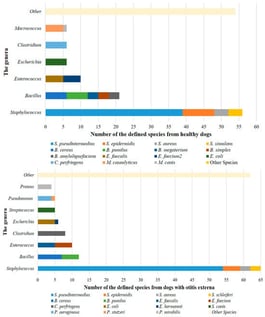
The most commonly identified bacteria in dogs with healthy and otitis externa.

Porcine epidemic diarrhea virus (PEDV), a coronavirus responsible for severe watery diarrhea in neonatal piglets, leads to significant economic losses globally. Effective prevention and treatment of PEDV infection is critical to the swine industry. Currently, there are no available therapeutic drugs for PEDV. Porcine interferons (poIFNs) have been identified as promising molecules against a series of swine viruses due to their broad-spectrum antiviral and immunomodulatory properties. In this study, we demonstrated that type I interferon-α (IFN-α) offered both prophylactic and therapeutic benefits against PEDV infection. Recombinant poIFN-α produced by a prokaryotic expression system was purified through affinity chromatography, and its prophylactic and therapeutic effects against PEDV infection were evaluated in vitro and in vivo through RT-qPCR, clinical symptom monitoring, and pathological examination. In vitro studies revealed a strong antiviral activity of poIFN-α against PEDV in Vero E6 cells, with a more pronounced prophylactic effect compared to therapeutic outcomes. In vivo studies showed that poIFN-α significantly alleviated clinical diarrhea in PEDV-infected piglets and reduced intestinal viral loads. These findings suggest that poIFN-α holds considerable promise as an antiviral agent for PEDV and provides a foundation for the development of therapeutic strategies targeting this virus.

6 March 2026

Sonographic Characteristics of the Thymus in Healthy Canine Neonates

  • Emilia Diel,
  • Carsten Staszyk and
  • Axel Wehrend
  • + 1 author

The thymus is important for neonatal immune development; however, information on its ultrasonographic appearance in newborn puppies is limited. Because the thymus occupies a substantial portion of the cranial mediastinum in neonates, it may be confused with pathological mediastinal masses during thoracic imaging. Defining its normal ultrasonographic appearance is therefore crucial for accurate clinical interpretation. This study aimed to describe the topographic anatomy and ultrasonographic features of the thymus in neonatal dogs. Ten puppy cadavers were examined. Under ultrasound guidance, the thymus was injected with methylene blue, and its location confirmed by dissection. Subsequently, transcutaneous ultrasonographic examinations were performed in 40 clinically normal puppies aged 1–5 days. In all puppies, the thymus was consistently visualized from the left side of the thorax within the precardiac mediastinum. In the transverse imaging plane, the thoracic portion of the thymus typically appeared triangular, with variations related to respiratory movements and cardiac and vascular pulsations. The thymic parenchyma was predominantly homogeneous and hypoechoic with scattered hyperechoic areas and fine lines. In some cases, the echotexture was more heterogenous, showing fusiform hypo- and hyperechoic linear structures. The thymus was easily differentiated from adjacent thoracic structures due to its distinctive echotexture. The thymus in newborn puppies demonstrates a consistent and recognizable ultrasonographic pattern, allowing reliable identification using transcutaneous ultrasonography. These findings provide a useful reference for clinical and diagnostic evaluation of the neonatal canine thymus.

6 March 2026

Quaternary Ammonium Biocide Resistance in Non-Typhoidal Salmonella from Pig Carcasses

  • Lorina Lourenço,
  • Vanessa Ferreira da Silva and
  • João B. Cota
  • + 2 authors

Non-typhoidal Salmonella (NTS) are one of the most common foodborne pathogens worldwide, and pork is a major food vehicle together with eggs and poultry meat. Contamination of pork within food processing facilities, such as slaughterhouses, can be associated with persistence of Salmonella in the environment due to biocide resistance. In this study, we assessed the susceptibility of NTS isolates from pig carcasses to a QAC-based commercial formulation according to the EN 1656/2009 standard and the presence of QAC resistance genes through PCR. The qacEΔ1 and qacF genes were found in 31.8% and 29.5% of the isolates respectively, while qacE was absent. All isolates were found to be susceptible at a tested concentration 10 times lower (0.1%) than the minimum in-use recommended concentration, with MIC values below 0.1% (≈70 mg/L of Benzalkonium Chloride). Our findings point towards the importance of correct cleaning and disinfection protocols and the role of good hygiene practices as corrective and/or preventive measures to avoid cross-contamination.

5 March 2026

News & Conferences

Issues

Open for Submission

Editor's Choice

Reprints of Collections

Advanced Therapy in Companion Animals
Reprint

Advanced Therapy in Companion Animals

2nd Edition
Editors: Zhijun Zhong, Ziyao Zhou
Viral Crossroads
Reprint

Viral Crossroads

The Interface Between Wildlife and Domestic Animal Health
Editors: Vesna Milicevic, Teufik Goletić
XFacebookLinkedIn
Vet. Sci. - ISSN 2306-7381