Skip to Content
You are currently on the new version of our website. Access the old version .

Tropical Medicine and Infectious Disease

Tropical Medicine and Infectious Disease (TropicalMed) is an international, peer-reviewed, open access journal of tropical medicine and infectious disease, and is published monthly online.
The Australasian College of Tropical Medicine (ACTM) and its joint Faculties of Travel Medicine and Expedition and Wilderness Medicine are affiliated with the journal, serving as their official journal. College members receive discounts on the article processing charges.
Indexed in PubMed | Quartile Ranking JCR - Q1 (Tropical Medicine)

All Articles (2,435)

With population aging, the burden of tuberculosis (TB) among the elderly is rising. Older adults are at high risk of TB but susceptible to poor TB care. In this study, we enrolled TB patients aged over 60 years registered in Shanghai during 2019–2021. A seven-step care cascade from estimated TB burden in the community to treatment outcomes was constructed to quantify retention and attrition at each step of TB health service. Patient pathway analysis was carried out in two districts of Shanghai to describe patients’ care-seeking behaviors, service coverage, and diagnosis delays. Across the care cascade, the largest gaps occurred from symptom onset to care seeking (11.3%) and from treatment initiation to completion (10.7%). Male sex, older age, and mycobacterium tuberculosis positivity were associated with treatment discontinuation and unfavorable outcomes. The patient pathway analysis revealed that first contact at lower-level or non-TB-designated hospitals was associated with more complex pathways and may contribute to diagnostic delays. These findings highlight the need to promote proactive care seeking upon symptoms, strengthen targeted adherence support for older people, and improve diagnostic capacity and referral efficiency at lower-level health facilities.

12 February 2026
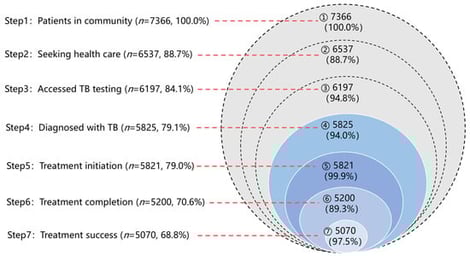
Care cascade for elderly patients diagnosed with tuberculosis in Shanghai, 2019–2021. The left panel shows the number of individuals and cumulative percentage at each step, using the estimated incident TB cases (n = 7366) as the denominator. Numbers inside the circles indicate the count at each step, and the percentages indicate stepwise retention relative to the previous step.

Immunoendocrine Profiles in Neurocysticercosis Patients: A Case-Control Study in Honduras

  • Nicholas Zugno-Gadea,
  • Lázaro Molina and
  • Ana Sanchez
  • + 4 authors

Emerging evidence suggests that certain cestodes, including Taenia solium, may actively modulate the host’s hormonal and immune environment to facilitate their survival. This study aimed to determine whether patients diagnosed with neurocysticercosis (NCC) exhibit immunoendocrine alterations associated with infection. A clinical study was conducted in Honduras, enrolling 11 adult NCC patients (9 female, 2 male) and 11 age- and sex-matched healthy controls. Serum concentrations of seven hormones and two cytokines were evaluated. Compared to controls, NCC patients showed significantly elevated levels of 17β-Estradiol (E2), Progesterone (P4), Androstenedione (A4), Luteinizing Hormone (LH), Follicle-Stimulating Hormone (FSH), Interleukin-6 (IL-6), and Interleukin-10 (IL-10). Conversely, Free testosterone (FT) and Dihydrotestosterone (DHT) levels were significantly reduced. These findings support the hypothesis that T. solium may manipulate host immunoendocrine pathways to promote its establishment and persistence within the central nervous system.

12 February 2026

Factors Associated with the Prevalence of Dengue–Leptospirosis Coinfection in Patients Hospitalized for Febrile Syndrome

  • Dina I. Bance-Anicama,
  • María M. Diaz-Orihuela and
  • Wilter C. Morales-García
  • + 1 author

Background: In tropical regions, dengue and leptospirosis coexist and share a nonspecific clinical onset that hinders timely diagnosis. Coinfection may worsen the clinical course and increase mortality. Objective: To estimate the prevalence of dengue, leptospirosis, and coinfection among patients with febrile syndrome in Madre de Dios (Peru) and to identify associated clinical factors. Methods: Observational, analytical, cross-sectional, retrospective study conducted at a primary-level health facility. Clinical and laboratory records of patients with febrile syndrome seen in 2024 were analyzed. Categorical variables were summarized as frequencies (%) and numeric variables as mean ± SD or median [IQR]. Comparisons used chi-square or Fisher’s exact test, Student’s t test, or the Mann–Whitney U test, as appropriate. Associations were estimated using Poisson regression models with robust variance, adjusted for sex, reporting prevalence ratios (PRs) and 95% CIs. Analyses were performed in R 4.0.2. Results: A total of 226 patients were included. Positivity was 19.0% for dengue (43/226), 66.8% for leptospirosis (151/226), and 5.8% for coinfection (13/226). In the bivariate analysis, dengue was associated with higher temperature (p < 0.001), lower mean arterial pressure (p = 0.007), mucosal bleeding/ecchymosis (p = 0.049), and lower fluid intake (p = 0.021); temperature was also higher in coinfection (p = 0.021). In Poisson models, dengue was associated with tachycardia (PR = 5.69; 95% CI: 1.95–13.07; p < 0.001), temperature (PR = 1.61 per °C; 1.23–2.12; p = 0.001), bilateral polyarthralgia (PR = 2.55; 1.14–5.04; p = 0.012), and mucosal bleeding/ecchymosis (PR = 3.31; 0.94–8.37; p = 0.027). Leptospirosis was associated with male sex (PR = 0.78 vs. female; 0.65–0.94; p = 0.010) and fever (PR = 2.38; 1.17–6.03; p = 0.035). Leptospira–dengue coinfection was related to higher temperature (PR = 1.75 per °C; 1.05–3.01; p = 0.036). Conclusions: Simple clinical signs such as fever/elevated temperature, tachycardia, bilateral polyarthralgia, and mucosal bleeding can help prioritize suspicion of dengue, leptospirosis, or coinfection; guide requests for dual testing (dengue–Leptospira), early hydration in dengue, and timely initiation of antibiotic therapy in leptospirosis. These findings support the development of integrated triage algorithms and strengthening access to molecular diagnostics in high-burden febrile syndrome settings.

12 February 2026

Prognostic Value of Charlson Comorbidity Index in Patients with COVID-19

  • Iliyan Todorov,
  • Margarita Gospodinova and
  • Kalina Stoyanova

COVID-19, caused by SARS-CoV-2, is a highly contagious disease with variable clinical presentation. Severe forms are more common in patients with pre-existing chronic conditions. The objective of this study is to evaluate the prognostic value of the Charlson Comorbidity Index (CCI) in relation to disease severity and outcome in hospitalized COVID-19 patients with comorbidities. A retrospective analysis was conducted on 558 patients, hospitalized at the Infectious Diseases Clinic of “St. Marina” University Hospital, Varna, Bulgaria, between March 2020 and March 2021. CCI score was calculated to estimate 10-year survival probabilities. Prevalent comorbidities were arterial hypertension (78.55%), type 2 diabetes (16.09%), and ischemic heart disease (5.82%). A higher number of comorbidities was associated with increased rates of bilateral pulmonary consolidation (χ2 = 6.63, p = 0.010), oxygen therapy needs (χ2 = 5.41, p = 0.020), and mortality (χ2 = 7.88, p = 0.005). Patients with higher CCI scores had worse outcomes. A CCI score above 5 was common among non-survivors and those with pulmonary consolidation and respiratory failure. The findings confirm that advanced age and multiple comorbidities are strong predictors of poor COVID-19 prognosis. Early CCI calculation at hospital admission would help identify high-risk patients and support timely, targeted medical interventions.

10 February 2026

News & Conferences

Issues

Open for Submission

Editor's Choice

Reprints of Collections

Beyond Borders
Reprint

Beyond Borders

Tackling Neglected Tropical Viral Diseases
Editors: Jelena Prpić
An Update on Syndemics
Reprint

An Update on Syndemics

Editors: Nicola Bulled, Merrill Singer

Get Alerted

Add your email address to receive forthcoming issues of this journal.

XFacebookLinkedIn
Trop. Med. Infect. Dis. - ISSN 2414-6366