

Skip to Content
  • Tracked for
    Impact Factor
  • 1.2
    CiteScore
  • 22 days
    Submission to First Decision
  • 7 days
    Acceptance to Publication

Transplantology

Transplantology is an international, peer-reviewed, open access journal on all areas of experimental and clinical transplantation, published quarterly online by MDPI.

Get Alerted

Add your email address to receive forthcoming issues of this journal.

All Articles (202)

  • Case Report
  • Open Access

Nocardia is an opportunistic pathogen associated with life-threatening infections, particularly in solid organ transplant recipients. In this population, combination therapy with two or more antibiotics and prolonged treatment duration are generally recommended to minimize the risk of relapse, although tolerability issues may adversely affect clinical outcomes. Herein, we present two cases of Nocardia infection in heart transplant recipients treated with short-term treatment (<180 days), including tedizolid. This treatment was effective in treating pulmonary nocardiosis in a heart transplant recipient, while remodulation of the immunosuppressive regimen to restore immune function with a longer course of antimicrobial therapy (7 months) contributed to successful treatment in the second case. These two cases are anecdotal, and there are currently only a few case series reported in the literature to support recommending a short course of treatment for Nocardia infection in SOT recipients. Nevertheless, the occurrence of adverse effects or tolerability issues during prolonged treatment may make a shorter treatment approach an interesting option to explore.

Transplantology

29 October 2026
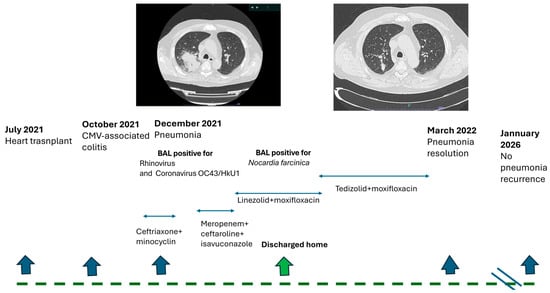
Clinical course of patient 1.
  • Brief Report
  • Open Access

Background/objectives: Transplant-related pulmonary fibrosis (TPF) occurs after allogeneic hematopoietic cell transplant and after lung transplantation. Effective therapies that prevent or reverse established transplant-related airway fibrosis remain limited. Human cell-based models are valuable for initial drug screening, but complementary in vivo models are needed to evaluate treatment responses in the presence of an allogeneic graft, an intact recipient immune system, systemic drug exposure, and multicellular tissue remodeling. This study evaluated murine orthotopic tracheal transplantation (OTT) as a practical in vivo platform for antifibrotic drug testing, using pirfenidone as a benchmark antifibrotic intervention. Methods: C57BL/6J mice underwent syngeneic or allogeneic OTT and received vehicle or pirfenidone (250 mg/kg daily) from day 21 to 30 posttransplant. Explanted grafts were analyzed for the expression of alpha-smooth muscle actin (α-SMA), fibronectin 1 (Fn1), collagen type I alpha 1 chain (Col1a1), and tenascin C (Tnc) by quantitative reverse-transcription polymerase chain reaction (qRT-PCR). Total collagen content was assessed by measuring hydroxyproline levels using a colorimetric hydroxyproline assay. Results: Pirfenidone normalized the expression of α-SMA, Fn1, Col1a1 and Tnc to levels comparable to those of syngeneic controls and significantly reduced hydroxyproline (p < 0.0001). Conclusions: Using pirfenidone as a benchmark antifibrotic, the murine OTT model detected concordant treatment-associated reductions in profibrotic gene expression and collagen content. These findings support the feasibility and pharmacodynamic responsiveness of OTT as an in vivo platform for secondary-stage antifibrotic drug testing. Additional investigational therapies will be required to establish the broader generalizability and predictive performance of the platform.

Transplantology

21 October 2026

  • Review
  • Open Access

The MELD-based scoring system is the most important tool to date for liver transplant allocation. It is useful as an index of the severity of the disease, but not a true measure of functional capacity, physiologic reserve or of the wider implications of end-stage liver disease. Frailty and sarcopenia have gained attention as important prognostic markers that provide information beyond traditional laboratory tests. This narrative review examines current evidence on the role of frailty and sarcopenia in liver transplant candidates. Focus is placed on waitlist mortality, post-transplant outcomes, and potential implications for decision-making. Studies evaluating the Liver Frailty Index (LFI), radiologic measures of sarcopenia and associated outcomes in patients with cirrhosis were reviewed. The LFI is a commonly used measurement of frailty. It is linked with increased risk of waitlist mortality even after adjusting for current MELD-based allocation models, ascites and hepatic encephalopathy. Frailty has been demonstrated not to be fixed and even modest gains are associated with reductions in mortality. Liver transplantation should not be precluded only based on frailty, as liver transplant recipients experience a survival benefit across the full spectrum of frailty severity. There is also a strong correlation between sarcopenia, myosteatosis and poor outcomes such as increased waitlist and post-transplant mortality; complications and prolonged hospital stay. Frailty and sarcopenia are closely related and when taken together, they give a better overall picture than either measure alone. Frailty and sarcopenia are complementary predictors of outcomes in liver transplant candidates, addressing important gaps in MELD-based allocation models. Incorporating performance and body composition measures into pre-transplant evaluation may improve prognostic accuracy, help identify patients for prehabilitation and support a better approach to patient assessment and management.

Transplantology

28 September 2026

  • Review
  • Open Access

Background/Objectives: Hepatocellular carcinoma (HCC) frequently develops in the set-ting of chronic liver disease, and liver transplantation (LT) represents the most effective curative option for selected patients. Despite advances in patient selection and surveillance, HCC recurrence after LT remains a major cause of post-transplant mortality and is associated with limited therapeutic options. Immune checkpoint inhibitors (ICIs) have transformed the management of advanced HCC in non-transplant populations; however, their role after liver transplantation remains controversial due to safety concerns and the risk of allograft rejection. This narrative review aims to critically evaluate the current evidence on immunotherapy for recurrent HCC after liver transplantation. Methods: A structured narrative review of PubMed/MEDLINE was conducted through 31 May 2026. Primary clinical reports describing ICI treatment for recurrent HCC after LT were selected using predefined eligibility criteria. Results: Twenty-one primary publications were included, consisting predominantly of case reports and small case series, supplemented by three retrospective cohorts. The reports described heterogeneous oncological outcomes, including occasional durable responses, but progressive disease remained common. Allograft rejection was an important safety concern and was sometimes associated with graft failure and death. More favourable outcomes were observed among some recipients treated at longer intervals after LT; however, this pattern remains hypothesis-generating and may reflect selection and survivor bias, tumour biology, graft stability, and differences in maintenance immunosuppression. Conclusions: ICI treatment for recurrent HCC after LT is associated with uncertain oncological benefit and a clinically important risk of allograft rejection. Its use should be restricted to highly selected recipients following multidisciplinary assessment and, whenever possible, within prospective studies or structured registries.

Transplantology

18 September 2026

Highly Accessed Articles

News & Conferences

Latest Issues

Open for Submission

Journal Sections

XFacebookLinkedIn
Transplantology - ISSN 2673-3943