Skip Content
You are currently on the new version of our website. Access the old version .
  • 1.2
    Impact Factor
  • 43 days
    Time to First Decision

Thalassemia Reports

Thalassemia Reports is an international, peer-reviewed, open access journal on the study, diagnosis, and treatment of thalassemia, published quarterly online by MDPI (from Volume 12, Issue 1 - 2022).

All Articles (276)

  • Case Report
  • Open Access

β-thalassemia patients often experience ocular abnormalities such as angioid streaks (ASs), retinal pigmented epithelium degradation, visual field defects, and in rare instances choroidal neovascularization (CNV). Although ASs are common in individuals with hemoglobinopathies, the occurrence of choroidal neovascularization without preceding ASs is exceptionally rare. In this report, we describe a β-thalassemia patient who had developed CNV at the age of 27 years and also had experience of renal stones at the age of 19 years. He had undergone splenectomy and was under conservative therapy of iron supplementation. We conducted whole-exome sequencing (WES) in search of CNV-associated variants. Through variant filtering and Phenolyzer analysis, we have identified a rare heterozygous missense variant in the ABCC6 gene, ABCC6:NM_001171:exon25:c.3524T>C (rs376062004). In silico analysis revealed that this variant is present in the highly conserved region and is likely to decrease the stability of the protein. Mutation in the ABCC6 gene leads to pseudoxanthoma elasticum (PXE). Previously, it was believed that ASs and subsequent CNV-like ocular complication may develop due to the pathophysiological condition of thalassemia. However, our study provides compelling evidence that rare mutations in the ABCC6 gene, in combination with oxygen insufficiency, may contribute to the development of CNV in β-thalassemia patients. This finding highlights the potential genetic basis of PXE-mediated CNV development in β-thalassemia.

29 January 2026
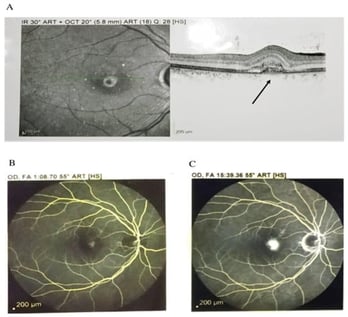
The OCT and fluorescein angiogram of the right eye of the studied subject. (A) OCT of the right eye at presentation showed fibrovascular pigment epithelial detachment with subretinal fluid and hyperreflective material nasal to fovea with outer retinal layer damage in the right eye (central retinal thickness, CRT 327 μm), black arrow indicates the CNV (B) The fluorescein angiogram showing early phase, an active lesion adjacent to fovea in the right eye. (C) Increase in size and intensity in the late phase indicative of active leakage.
  • Case Report
  • Open Access

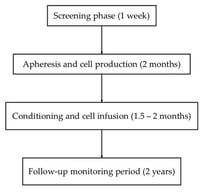
Background/Objectives: Thalassemia is highly prevalent in Indonesia, and its treatment imposes a significant financial burden. To date, thalassemia management in Indonesia remains largely limited to supportive therapies. This report aims to present the monitoring of the first Indonesian pediatric thalassemia patient to undergo gene therapy. Methods: Medical summaries were gathered across multiple time points. The gene therapy process consisted of several phases: screening, apheresis and cell manufacturing, conditioning, cell infusion, and post-treatment follow-up. The therapy utilized autologous CD34+ hematopoietic stem and progenitor cells (HSPCs), which were genetically modified using a lentiviral vector carrying the beta-globin gene. The primary outcome of this study was transfusion independence, determined through serial assessments of hematological parameters over a six-month period following gene therapy. Results: A 15-year-old female had been diagnosed with thalassemia major at the age of five. DNA analysis revealed compound heterozygous mutations Hb Malay (codon 19, AACAsn > AGCSer) and IVS1-nt5 (G > C). She had been receiving regular blood transfusions every 3–4 weeks, and hemosiderosis was detected in the liver and pancreas. Given the patient’s age—over 10 years—hematopoietic stem cell transplantation carries increased risks, making gene therapy the most suitable curative option. During the six-month follow-up period after gene therapy, the patient remained transfusion-independent and experienced no complications. Conclusions: In selecting an appropriate curative therapy for thalassemia patients, several factors must be considered. The successful implementation of the first gene therapy in an Indonesian pediatric thalassemia patient should serve as a catalyst for the continued development and expansion of curative treatment options for thalassemia patients across the country.

19 December 2025

The gene therapy procedure.

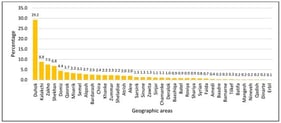
Background/Objectives: Thalassemia is among the most common hereditary disorders globally, characterized by impaired hemoglobin synthesis and ineffective erythropoiesis. This study analyzed data on hemoglobinopathies, with a particular focus on thalassemia, to support the development of a comprehensive national database and to improve understanding of the disease burden in the Kurdistan Region of Iraq. Methods: In this retrospective cross-sectional study, a total of 910 patients admitted to the region’s sole blood disorder center since its establishment were included. Results: The study analyzed 46.7% male and 53.3% female thalassemia patients in Duhok, with 58.46% reporting parental consanguinity. Hepatitis C virus (HCV) prevalence was 11.87%, while 8.90% underwent bone marrow transplantation (BMT) and 30.11% had splenectomies. Blood group distribution was O+ (36.26%), A+ (30.99%), and B+ (18.46%). Common medications included Deferasirox (34.62%), Hydroxyurea (26.70%), and Deferoxamine (5.82%), with 8.24% and 4.40% discontinuing Deferasirox and Hydroxyurea, respectively. Geographically, 29% of the patients originated from Duhok City, which exhibited a consanguinity rate of 18.65% (p = 0.020). The most prevalent conditions were β-thalassemia major (32.53%) and sickle cell anemia (24.73%). HCV-positive patients were predominantly diagnosed with β-thalassemia major (43.40%) and sickle cell anemia (33.96%). BMT recipients were mostly β-thalassemia major patients (80.25%), while splenectomy was common in β-thalassemia major (43.40%) and sickle cell β-thalassemia (22.64%). Vaccination rates included Pneumococcal (50.78%), Influenza (47.76%), and Hepatitis (39.08%, first dose). Six patients (0.66%) died, with 30.18% diagnosed before age 1 and 43.89% between 1 and 2 years. In conclusion, this study underscores the high prevalence of β-thalassemia major and sickle cell anemia in Duhok, with strong associations to parental consanguinity and low socioeconomic status. Gaps in early diagnosis and vaccination coverage remain significant challenges.

28 November 2025

Geographic Distribution of Thalassemia Cases Visiting the Zheen Center at Duhok City (no., Percentage).

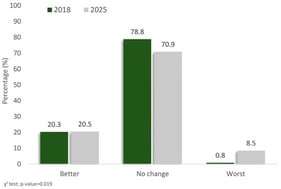
Background/Objectives: Thalassemia significantly affects the mental well-being and lifestyle of patients and their families. This study evaluated the temporal changes in quality of life (QoL) and psychological burden among thalassemia patients in 2025 and in relation to 2018. Methods: Two cross-sectional samples of patients (n = 236) were recruited during 2025 (n1 = 117) and 2018 (n2 = 119) at the Thalassemia Units on Crete/Greece. The EQ-5D-3L Quality of Life Scale, the EQ VAS Index, and the Hospital Anxiety and Depression Scale (HADS) were used through multiple logistic regression analysis to assess relative parameters. Results: High mean Health Status (EQ VAS Index) and QoL scores remained consistent from 2018 to 2025, anxiety mean levels were low and remained consistent from 2018 to 2025, depression levels were low but higher in 2025 in relation to 2018 (p = 0.041), anxiety significantly exceeded depression in both 2018 and 2025, better QoL was associated with improved health status and reduced anxiety and depression, and individuals with children exhibited significantly lower odds of experiencing low or moderate QoL. Conversely, each unit increase in the Anxiety score significantly increased the odds of low or moderate QoL (OR = 1.26, p = 0.002). Similarly, each unit improvement in health status significantly reduced the odds of low or moderate QoL (OR = 0.97, p = 0.009). Conclusions: Health status and QoL remained consistent from 2018 to 2025, while depression levels increased. Anxiety significantly exceeded depression, and better QoL was associated with improved health status and reduced anxiety and depression.

6 November 2025

Comparison of frequency distributions for the question “Compared to my health status over the past 12 months, my current status is:” of the EQ-5D-3L Quality of Life scale of 236 patients with thalassemia between the years 2018 and 2025.

News & Conferences

Issues

Open for Submission

Editor's Choice

Get Alerted

Add your email address to receive forthcoming issues of this journal.

XFacebookLinkedIn
Thalass. Rep. - ISSN 2039-4365