Skip Content
You are currently on the new version of our website. Access the old version .
  • 4.9
    Impact Factor
  • Indexed in
    Scopus
  • 26 days
    Time to First Decision

Textiles

Textiles is an international, peer-reviewed, open access journal on textile science and engineering published quarterly online by MDPI.

Quartile Ranking JCR - Q1 (Materials Science, Textiles)

All Articles (217)

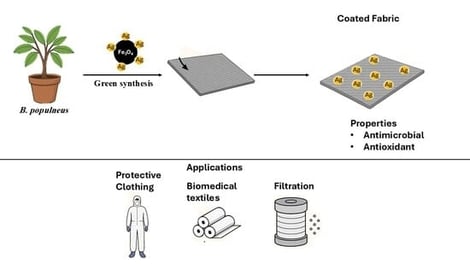
This manuscript reports a green approach for producing multifunctional acrylic fabrics co-decorated with Fe3O4 and Ag nanoparticles using Brachychiton populneus extract. Acrylic fabric was first amidoxime-functionalized to enable strong anchoring of Fe3O4 nanoparticles, followed by in situ deposition of AgNPs, during which the extract’s phytochemicals acted as reducing and stabilizing agents. FTIR, SEM/EDX, and VSM analyses confirmed successful surface modification and nanoparticle incorporation. The sequential treatments produced measurable add-on values (16.7% after amidoximation, followed by 10.9% and 8.5% after Fe3O4 and AgNP deposition, respectively). The Ag/Fe3O4-coated fabrics exhibited enhanced hydrophobicity and strong antimicrobial activity, with inhibition zones up to 14 mm against bacteria (including MRSA) and 26.9 mm against fungi at the highest Ag loading. Antioxidant activity was also markedly improved, showing up to a 78-fold increase in reducing power. Overall, this sustainable plant-mediated route provides an effective strategy for developing antimicrobial and antioxidant acrylic textiles for technical and protective applications.

2 February 2026
Visual appearance of different acrylic fabric modifications (a) Pristine Acrylic (AC), (b) amidoximated acrylic (TAC), (c) magnetite Fe3O4-coated amidoximated acrylic (Fe3O4-TAC), (d) silver nanoparticles loaded on magnetite Fe3O4-coated amidoximated acrylic (Ag/Fe3O4-TAC).

Respirometry and X-Ray Microtomography for a Comprehensive Assessment of Textile Biodegradation in Soil

  • Ainhoa Sánchez-Martínez,
  • Marilés Bonet-Aracil and
  • Jaime Gisbert-Payá
  • + 1 author

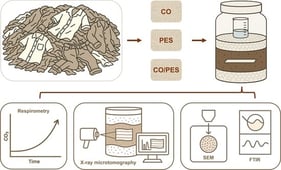
The textile industry generates significant volumes of waste, making the development of reliable methods to evaluate biodegradability a pressing need. While standardised protocols exist for plastics, no specific methodologies have been established for textiles, and the quantification of non-degraded residues is commonly based on mass loss: a measurement that is prone to recovery errors. This study investigated the biodegradation of cotton, polyester, and cotton/polyester blend fabrics in soil under thermophilic conditions using a combined methodological approach. Carbon mineralisation was quantified through a respirometric assay that was specifically adapted for textile substrates, while residual solid fractions were assessed in situ by X-ray microtomography (micro-CT), thus avoiding artefacts associated with sample recovery. Complementary analyses were performed using SEM and FTIR to characterise morphological and chemical changes. Results showed substantial biodegradation of cotton, negligible degradation of polyester, and intermediate behaviour for the cotton/polyester blend. Micro-CT enabled the visualisation of fibre fragmentation and the quantification of the residual. The integration of respirometric, imaging, and spectroscopic techniques provided a comprehensive assessment of textile biodegradability. This study highlights the potential of micro-CT as a non-destructive tool to improve the accuracy and robustness of textile biodegradability assessment by enabling direct quantification of the residual solid fraction that can support future LCA studies and the development of standardised protocols for textile biodegradability.

26 January 2026

Schematic diagram of the experimental setup for the respirometric biodegradation test.

Waste textiles may contain heavy metals, which can originate from dyes, mordants, or other chemical treatments used during manufacturing. To explore the impact of heavy metals on the adsorption properties of activated carbon derived from discarded textiles through pyrolysis and to mitigate heavy metal migration, this study investigated the adsorption behavior of copper-impregnated pyrolytic carbon toward typical pollutants—methylene blue and lead—in simulated dyeing wastewater. Aqueous copper nitrate was used to impregnate the waste pure cotton textiles (WPCTs) to introduce copper species as precursors for creating additional active sites. The study systematically examined adsorption mechanisms, single and binary adsorption systems, adsorption kinetics, adsorption isotherms, adsorption thermodynamics, and the influence of pH. Key findings and conclusions are as follows: Under optimal conditions, the copper-containing biochar (Cu-BC) demonstrated maximum adsorption capacities of 36.70 ± 1.54 mg/g for Pb(II) and 104.93 ± 8.71 mg/g for methylene blue. In a binary adsorption system, when the contaminant concentration reached 80 mg/L, the adsorption capacity of Cu-BC for Pb(II) was significantly enhanced, with the adsorption amount increasing by over 26%. However, when the Pb(II) concentration reached 40 mg/L, it inhibited the adsorption of contaminants, reducing the adsorption amount by 20%. SEM, XRD, Cu LMM, FTIR and XPS result analysis proves that the adsorption mechanism of methylene blue involves π–π interactions, hydrogen bonding, electrostatic interactions, and pore filling. For Pb(II) ions, the adsorption likely occurs via electrostatic interactions, complexation with functional groups, and pore filling. This study supplements the research content on the copper adsorption mechanism supported by biochar for heavy metal adsorption research and broadens the application scope of biochar in the field of heavy metal adsorption.

19 January 2026

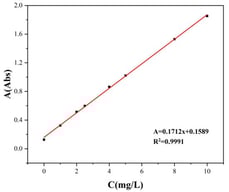
Standard curve of methylene blue solution.

High-performance nylon 6,6 webbings used in critical applications degrade under solar exposure, necessitating reliable methods to assess their residual strength non-destructively. This study investigates the feasibility of using instrumental color change as a predictive indicator for the loss of breaking strength. Four colors of nylon 6,6 webbings were subjected to accelerated xenon-arc solar weathering for up to 15 days. The resulting color change was quantified using both the CIELab and CIEDE2000 formulas, and residual breaking strength was measured following ASTM D6775. A regression analysis was performed to correlate these properties. The results demonstrate that a strong predictive relationship exists, but its efficacy is highly color-dependent. Webbing with high initial chroma, namely tan (R2 = 0.889) and navy (R2 = 0.817), showed a strong correlation between color change and strength loss. In contrast, the models for low-chroma black and white webbings were weak and unreliable. Furthermore, the simpler CIELab (ΔE*ab) formula provided slightly more accurate predictions than the more complex CIEDE2000 (ΔE*00) metric. It is concluded that colorimetry can be a viable non-destructive tool for predicting mechanical degradation, but its application is limited to specific high-chroma materials, precluding a universal model based entirely on colorimetry.

18 January 2026

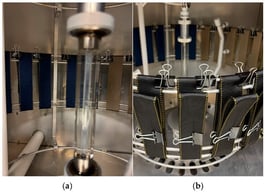
(a) Face of the webbings exposed to the xenon-arc lamp; (b) Back of the webbings showing placement of the clips to secure the samples on the turning rack.

News & Conferences

Issues

Open for Submission

Editor's Choice

Get Alerted

Add your email address to receive forthcoming issues of this journal.

XFacebookLinkedIn
Textiles - ISSN 2673-7248