Skip to Content
You are currently on the new version of our website. Access the old version .

Taxonomy

Taxonomy is an international, peer-reviewed, open access journal published quarterly online by MDPI.
It covers the conception, naming, and classification of groups of organisms, including but not limited to animals, plants, viruses, and microorganisms.
Quartile Ranking JCR - Q2 (Zoology)

All Articles (229)

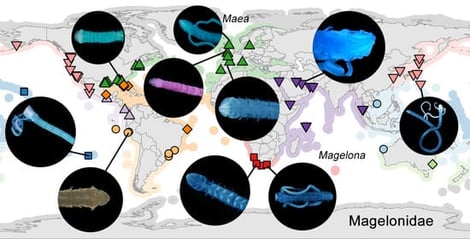
Shovel head worms (Annelida: Magelonidae) have long presented challenges to polychaete systematists due to their unique morphology and relative uniformity. This has been compounded by a lack of taxonomic work across key biogeographic regions. However, over the past few decades, a series of studies has progressively addressed these issues, refining our understanding of magelonid taxonomy and making taxonomic revisions of several regions. Whilst a standardised framework for morphological characters across the family has been produced, a worldwide review of taxonomic knowledge has been warranted. The information is herein presented alongside the first worldwide identification key in over 50 years. The much-needed key is presented in two formats: a dichotomous key divided by marine realms, and a pictorial key based on putative morphological groups. The key is additionally supplemented by the provision of an interactive map providing type locality data and links to taxonomic works. The pictorial key provides additional support for the unique terminology historically applied to the group. The genus Maea Johnston, 1865 is herein re-established for fifteen species possessing long rounded prostomia without horns, but possessing mucronate chaetae of the ninth chaetiger, and lateral abdominal pouches.

14 February 2026
Magelonid morphology (see Table 1): (A) anterior end (thorax and first few abdominal chaetigers) of Magelona capensis (dorsal view); (B) anterior end (thorax and anterior abdomen) of an undescribed species of Magelona with eight thoracic chaetigers (dorsal view); (C) anterior fragment of Magelona cincta, both palps attached, prostomium tip curled upwards (dorsal view); (D) head region and first few thoracic chaetigers of Maea johnstoni showing partially everted burrowing organ and ventral attachment of the palps (ventral view); (E) whole specimen of Maea brachypalpata, both palps attached and showing abdominal lateral pouches (dorsal view); (F) posterior end of Maea johnstoni showing pygidium (posterior view, ventral side up); (G) anterior of Magelona guineensis showing pigment band of posterior thorax (ventral view); (H) anterior of Magelona fasciata showing stripy pigmentation along body (dorsal view); and (I) anterior end of Maea johnstoni, both palps attached (dorso-lateral view). (A–C,I), stained with methyl green; (E), stained with rose Bengal; (D,F), (SEM).
  • Correction
  • Open Access

In the original publication [...]

14 February 2026

The family Grapsidae is composed of 39 species belonging to seven genera. Currently, larval data are known for 24 out of the 39 species, but the megalopa stage remains unknown for the genera Goniopsis, Grapsus, Leptograpsus, and Planes, although megalopae collected in the plankton have been tentatively attributed to Grapsus and Planes. Thanks to the MALASPINA and MAF research projects, a significant number of megalopae were collected from open-ocean plankton worldwide, and, using DNA barcoding (16S and/or COI genes), a high percentage of them were identified. At the molecular level, Grapsidae have been widely studied, so the availability of barcode sequences in public databases has allowed us to identify the megalopa of Goniopsis pulchra, Grapsus grapsus, Leptograpsus aff. variegatus, Pachygrapsus socius, P. transversus, and Planes minutus. In the present work, these megalopae are described in detail and compared with those previously known. Consequently, for the first time, the morphology of the megalopa stage can be compared across all grapsid genera, and a set of characteristics is defined to identify the grapsid megalopa from the rest of the brachyuran megalopae.

5 February 2026

Plant species established on the basis of early garden cultivation may have lacked the original information about their native geographical origin. Crambe suecica was originally described from its 18th-century cultivation in the Chelsea Physic Garden in London, raised from seeds without provenance that were sent from Saint Petersburg. This species has been misunderstood as native to the Baltic Sea coasts and, consequently, misinterpreted as a taxonomic synonym of C. maritima. We infer from plant morphology and the history of Russian botany that seeds of C. suecica were originally collected by Johann Christian Buxbaum in 1726 when he travelled across the Ottoman Empire and then-Russian Transcaucasia, most likely in the Gilan or Mazandaran provinces of present-day Iran. According to the morphology of its type specimen, this taxon represents a glabrous variant of C. orientalis and is hereby reduced to a synonym of the latter species. The name C. pinnatifida has been misapplied to a species native to south-eastern Europe and the north-western Caucasus. This species name is nomenclaturally superfluous and illegitimate because its protologue includes a reference to C. suecica, which is to be treated as its type-bearing synonym. This case underlines the importance of historical research in nomenclatural studies, which may be required to reach a correct taxonomic decision.

2 February 2026

News & Conferences

Issues

Open for Submission

Editor's Choice

Get Alerted

Add your email address to receive forthcoming issues of this journal.

XFacebookLinkedIn
Taxonomy - ISSN 2673-6500