Skip Content
You are currently on the new version of our website. Access the old version .

Taxonomy

Taxonomy is an international, peer-reviewed, open access journal published quarterly online by MDPI.
It covers the conception, naming, and classification of groups of organisms, including but not limited to animals, plants, viruses, and microorganisms.
Quartile Ranking JCR - Q2 (Zoology)

All Articles (228)

The family Grapsidae is composed of 39 species belonging to seven genera. Currently, larval data are known for 24 out of the 39 species, but the megalopa stage remains unknown for the genera Goniopsis, Grapsus, Leptograpsus, and Planes, although megalopae collected in the plankton have been tentatively attributed to Grapsus and Planes. Thanks to the MALASPINA and MAF research projects, a significant number of megalopae were collected from open-ocean plankton worldwide, and, using DNA barcoding (16S and/or COI genes), a high percentage of them were identified. At the molecular level, Grapsidae have been widely studied, so the availability of barcode sequences in public databases has allowed us to identify the megalopa of Goniopsis pulchra, Grapsus grapsus, Leptograpsus aff. variegatus, Pachygrapsus socius, P. transversus, and Planes minutus. In the present work, these megalopae are described in detail and compared with those previously known. Consequently, for the first time, the morphology of the megalopa stage can be compared across all grapsid genera, and a set of characteristics is defined to identify the grapsid megalopa from the rest of the brachyuran megalopae.

5 February 2026
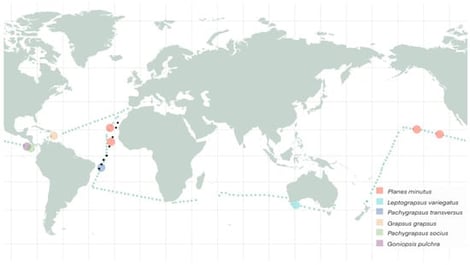
Map showing the sampling locations and cruise tracks during the MALASPINA (2010) (small green dots) and MAF (2015) (small black dots) expeditions. The bigger colored dots indicate the megalopae sampling locations. The map was generated using ProCreate version 5.4.8 (Savage Interective Pty Ltd., Hobart, Tasmania).

Plant species established on the basis of early garden cultivation may have lacked the original information about their native geographical origin. Crambe suecica was originally described from its 18th-century cultivation in the Chelsea Physic Garden in London, raised from seeds without provenance that were sent from Saint Petersburg. This species has been misunderstood as native to the Baltic Sea coasts and, consequently, misinterpreted as a taxonomic synonym of C. maritima. We infer from plant morphology and the history of Russian botany that seeds of C. suecica were originally collected by Johann Christian Buxbaum in 1726 when he travelled across the Ottoman Empire and then-Russian Transcaucasia, most likely in the Gilan or Mazandaran provinces of present-day Iran. According to the morphology of its type specimen, this taxon represents a glabrous variant of C. orientalis and is hereby reduced to a synonym of the latter species. The name C. pinnatifida has been misapplied to a species native to south-eastern Europe and the north-western Caucasus. This species name is nomenclaturally superfluous and illegitimate because its protologue includes a reference to C. suecica, which is to be treated as its type-bearing synonym. This case underlines the importance of historical research in nomenclatural studies, which may be required to reach a correct taxonomic decision.

2 February 2026

In an age of gene editing and artificial intelligence, taxonomy—the science of naming, describing, and classifying living organisms—can seem old-fashioned, even quaint [...]

19 January 2026

Ten new species of Lonchaeidae in the genera Lonchaea Fallen and Silba Macquart are described, nine from the Australasia–Oceania realm—Papua New Guinea (7 species), Solomon Islands (1 species), and Sulawesi (1 species)—and one from Sumatra in the Indo-Malayan realm. The new species are Lonchaea bacchusi sp. nov., Lonchaea herzogi sp. nov., Lonchaea morobe sp. nov., Lonchaea spenceri sp. nov., Lonchaea sulawesi sp. nov., Silba guineai sp. nov., Silba honiara sp. nov., Silba ismayi sp. nov., Silba kokoda sp. nov., and Silba papua sp. nov. The male genitalia are illustrated, and the diagnostic features that distinguish these species are presented. The male genitalia of Lonchaea uniseta Malloch, 1930, from Samoa are described and illustrated for the first time, and the male genitalia of two species from Micronesia, Lonchaea belua McAlpine, 1964, and Lonchaea sabroski McAlpine, 1964, are illustrated for the first time. A checklist of the Lonchaeidae of Papua New Guinea is provided.

16 January 2026

News & Conferences

Issues

Open for Submission

Editor's Choice

Get Alerted

Add your email address to receive forthcoming issues of this journal.

XFacebookLinkedIn
Taxonomy - ISSN 2673-6500