Skip Content
You are currently on the new version of our website. Access the old version .

Systems

Systems is an international, peer-reviewed, open access journal on systems theory in practice, including fields such as systems engineering management, systems based project planning in urban settings, health systems, environmental management and complex social systems, published monthly online by MDPI.
The International Society for the Systems Sciences (ISSS) is affiliated with Systems and its members receive a discount on the article processing charges.
Quartile Ranking JCR - Q1 (Social Sciences, Interdisciplinary)

All Articles (3,144)

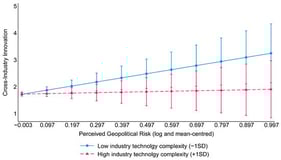
Rising geopolitical risks have become a defining feature of the global business environment, yet how firms—particularly those from latecomer economies—adjust their innovation strategies under such conditions remains insufficiently understood. Integrating resource dependence theory with the innovation ecosystem perspective, we propose that geopolitical risk induce firms to engage in cross-industry innovation as a strategic response to mitigate their reliance on international technological ecosystems, which traditionally provide cross-industry complementarities but are increasingly subject to disruption. Analyzing a panel of 12,354 Chinese listed manufacturing firms from 2012 to 2022, and employing fixed-effects negative binomial regression models implemented in Stata 18, we find that firms exposed to higher levels of perceived geopolitical risk are more likely to pursue innovations beyond their industry’s technological boundaries in subsequent years. This effect is weakened by industry technological complexity but strengthened by the firm’s nationalism, reflecting both reactive responses to external uncertainty and proactive efforts toward technological self-reliance. Our study contributes to innovation research by revealing how geopolitical forces reshape firms’ innovation trajectories and by extending resource dependence theory to the context of ecosystem-based interdependence. From a policy perspective, governments can promote rational and constructive nationalist narratives that encourage firms to commit to innovation in strategically vulnerable technologies.

8 February 2026

The weakening effect of industry technological complexity on the positive association between geopolitical risk and cross-industry innovation. Note: The plots are based on Model 2 Table 4 with 95% confidence intervals.

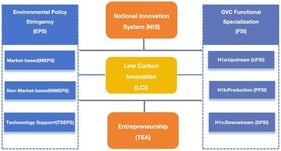
This study investigates the impact of Environmental Policy Stringency (EPS) on GVC functional specialization. We find that EPS promotes high value-added, low-carbon upstream and downstream specialization—supporting the “Porter Hypothesis (PH)”—while simultaneously driving carbon-intensive production to regions with lax regulations, validating the “Pollution Haven Hypothesis (PHH)”. These findings demonstrate that both effects coexist across distinct GVC stages. Heterogeneity analysis reveal that policy impacts vary different instruments: market-based instruments drive upstream functional specialization, whereas non-market measures drive downstream functional specialization. In terms of temporal dynamics, the Paris Agreement intensified the PHH in production activities while catalyzing medium-to-long-term incentives for upstream and downstream specialization. The influence of EPS on GVC structural adjustments has strengthened notably since the Paris Agreement, reflecting a significant temporal lag and long-term efficacy. Mechanistically, low-carbon innovation serves as the primary channel for functional upgrading, an effect significantly amplified by robust national innovation systems (NIS) and entrepreneurship. Meanwhile, NIS and entrepreneurship partly amplify the positive effect of EPS on high-end functional specialization. From a GVC functional perspective, this study offers new evidence reconciling the PH and the PHH.

5 February 2026

Research framework model.

Literature reviews are a cornerstone of doctoral research in general, and of economic and business research, in particular. However, the exponential growth of scientific publications has made comprehensive and transparent reviews increasingly difficult. Conventional approaches, largely based on manual searches across a small number of databases, tend to be slow, error-prone, and incomplete. As a result, they constrain the scope of inquiry and, consequently, the robustness of theory development and empirical validation. This paper proposes and analyses an information system architecture driven by research questions and keyword taxonomies to automate core tasks of the literature search phase across multiple academic databases. Focusing on the domain of corporate and municipal financial distress, the authors employ a two-stage research design. First, the theoretical analysis integrates the literature on systematic reviews, automation, and financial distress prediction to derive a set of functional and non-functional requirements. Second, the experimental analysis documents a prototype front-end application designed to accelerate the literature review. The prototype is conceptualised as a socio-technical artefact that enhances IT competences and scientific resilience by enabling more efficient, reproducible, and extensible reviews. The authors conclude by discussing the scientific, technical, professional, and societal implications of the prototype, including opportunities for intellectual-property protection and avenues for future research.

5 February 2026

Conceptual framework linking literature review challenges, systematic review methodologies, and automation to the two-stage research design. Source: own elaboration.

In the dynamic and service-intensive context of the tourism and hospitality industry, organizational innovation performance (OIP) is a critical determinant of competitiveness. This study investigates the systemic role of knowledge management capability (KMC) in driving OIP, with a focus on the mediating effects of intellectual capital (IC) and knowledge utilization (KU). Drawing on Dynamic Capabilities Theory and the Knowledge-Based View, KMC is conceptualized as a higher-order capability that facilitates the accumulation, coordination, and application of knowledge resources, thereby shaping both organizational knowledge assets and their practical enactment. Data were collected from senior managers across five-star hotels in Greater Cairo, Egypt, and analyzed using Partial Least Squares Structural Equation Modeling (PLS-SEM). Results indicate that KMC positively influences OIP directly and indirectly through the development of IC and the effective utilization of knowledge. Both IC and KU are found to mediate the relationship between KMC and innovation performance, highlighting the importance of transforming knowledge resources into actionable and value-creating organizational capabilities. The study advances theoretical understanding by elucidating the systemic mechanisms linking knowledge management, intellectual capital, and knowledge utilization to innovation outcomes, and provides practical insights for hospitality managers seeking to leverage knowledge-driven strategies to enhance competitiveness and service excellence.

5 February 2026

Research Conceptual Model.

News & Conferences

Issues

Open for Submission

Editor's Choice

Reprints of Collections

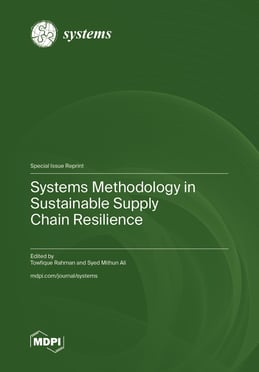
Systems Methodology in Sustainable Supply Chain Resilience
Reprint

Systems Methodology in Sustainable Supply Chain Resilience

Editors: Towfique Rahman, Syed Mithun Ali
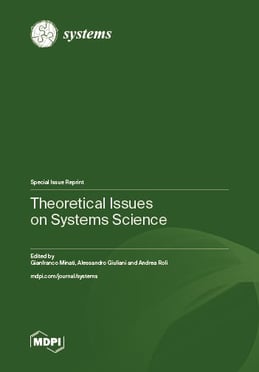
Theoretical Issues on Systems Science
Reprint

Theoretical Issues on Systems Science

Editors: Gianfranco Minati, Alessandro Giuliani, Andrea Roli

Get Alerted

Add your email address to receive forthcoming issues of this journal.

XFacebookLinkedIn
Systems - ISSN 2079-8954