Skip to Content
You are currently on the new version of our website. Access the old version .

Surgeries

Surgeries is an international, peer-reviewed, open access journal on findings and developments in surgery published quarterly online by MDPI.
The Academy of Surgical Research (ASR) and the Italian Society of Hand Surgery (SICM) are affiliated with Surgeries and their members receive discounts on the article processing charges.

All Articles (381)

The 50 Highest Cited Papers on Patellofemoral Instability

  • Federica Denami,
  • David H. Dejour and
  • Michele Mercurio
  • + 6 authors

The aim of this research was to identify the 50 articles most frequently referenced concerning patellofemoral instability (PFI) and to analyze their features. A search was performed in the Thomson ISI Web of Science using keywords such as “patellofemoral instability,” “patellar instability,” “patellar dislocation,” and “patella luxation.” This research included all publications related to PFI, covering aspects such as diagnostic and both nonoperative and operative treatment. The citation counts for the 50 articles ranged from 165 to 1024 citations. Notably, the top ten articles received a minimum of 348 citations each. In total, 84% (n = 42) of the studies were clinical, while the remainder consisted of basic science investigations (including three anatomical and five biomechanical studies). The predominant level of evidence was IV, accounting for 32%. The American Journal of Sport Medicine was responsible for publishing 34% of these articles. Most of the research took place in the United States and twelve additional countries. The years when the most-referenced papers were published spanned from 1985 to 2020, with the 2000s representing the highest share of articles (74%), and the years between 2006 and 2010 showing the peak quantity of articles (n = 15). This article provides a building block in the PFI management. The selection of these articles is useful for learning more about current trends on PFI and anticipating future developments.

10 February 2026
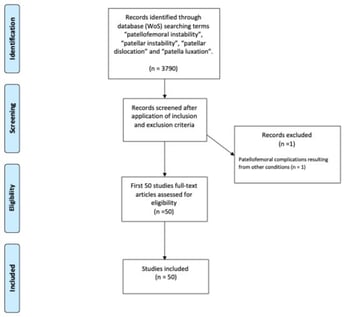
Flowchart PRISMA-S.

Background/Objectives: While hip arthroscopy outcomes for femoroacetabular impingement syndrome (FAIS) are well-documented, there is limited research comparing revision hip arthroscopy for FAIS to primary procedures. This study aimed to compare clinical outcome scores, revision hip arthroscopy, and conversion to total hip arthroplasty (THA) between patients undergoing revision hip arthroscopy for residual FAIS and those undergoing primary hip arthroscopy. Methods: This retrospective study matched 47 patients who underwent revision hip arthroscopy 1:2 by age, sex, body mass index, and smoking status to 94 patients who underwent primary surgery. Patient-reported outcomes (PROs) were assessed using the modified Harris Hip Score (mHHS) and Non-Arthritic Hip Score (NAHS) preoperatively and at 1-year follow-up. Long-term follow-up was performed to determine repeat surgical interventions at a minimum 5-year follow-up. Differences in postoperative outcomes were assessed using Mann–Whitney U tests and rate of subsequent surgery were compared using chi-squared analyses. Results: Both cohorts showed significant improvement in PROs at 1 year (p < 0.001). However, the revision cohort had lower preoperative scores (mHHS, p < 0.001; NAHS, p = 0.003) and lower postoperative scores (mHHS, p = 0.037; NAHS, p = 0.032) compared to the primary cohort. Despite these differences, the magnitude of improvement was similar between groups for the mHHS and NAHS (p > 0.05). Long-term follow-up revealed a significantly higher conversion rate to THA in the revision cohort compared to the primary group (p < 0.001). Conclusions: Patients undergoing revision hip arthroscopy start with lower baseline function but achieve similar improvements to those undergoing primary surgery. However, revision patients had a significantly higher rate of conversion to THA.

10 February 2026

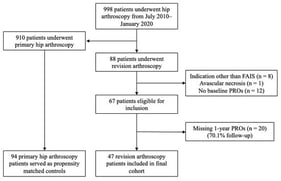
Patient flow diagram demonstrating study inclusion.

Anaesthesia in Microsurgical Flap Reconstruction: A Review

  • Arturi Federica,
  • Serra Letizia and
  • Barbieri Alberto
  • + 5 authors

Background: In head and neck reconstructive surgery, flap loss remains a major complication and continues to represent a significant challenge in perioperative management. Although free tissue transfer is widely used, unsatisfactory outcomes are still reported across different flap procedures. Anaesthetic management plays an important role in influencing flap perfusion through its effects on systemic haemodynamics, regional blood flow, and microcirculation. However, there is currently no consensus on universally acceptable haemodynamic targets, and the impact of intraoperative strategies appears to be highly application-specific. Materials and Methods: This narrative review was conducted in accordance with the 2019 SANRA guidelines. PubMed® was used as the primary database for literature selection. Relevant studies addressing anaesthetic management in head and neck free flap surgery were reviewed, with a particular focus on intraoperative haemodynamic control, ischemia–reperfusion injury, fluid and transfusion management, vasoactive agents, and advanced monitoring techniques. Results: Ischemia–reperfusion injury represents a major mechanism of vascular compromise in free flap surgery and has a significant impact on microcirculatory perfusion. The literature suggests that several anaesthetic strategies—including goal-directed fluid therapy, cautious use of vasopressors, and advanced haemodynamic monitoring—may support intraoperative haemodynamic stability and improve flap perfusion. Nevertheless, the magnitude of haemodynamic improvement achievable with these strategies and their effect on graft survival vary according to patient characteristics, surgical factors, and flap type. Conclusions: Current evidence indicates that anaesthetic management has the potential to contribute to improved intraoperative haemodynamic control in head and neck free flap reconstruction, thereby supporting graft viability. However, haemodynamic targets and management strategies cannot be generalised and should be interpreted within specific clinical contexts. Rather than aiming for optimisation, future research should focus on defining acceptable clinical outcomes for individual applications and on evaluating whether achievable haemodynamic improvements are sufficient to reduce flap-related complications to clinically acceptable levels.

9 February 2026

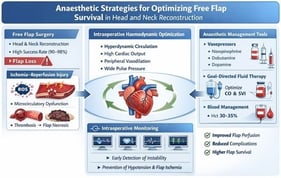
A schematic overview of the strategies for perioperative haemodynamic management in flap surgery discussed throughout this article.
  • Systematic Review
  • Open Access

Background/Objectives: Titanium fixation remains the gold standard for stabilizing mandibular fractures; however, associated complications often necessitate a second surgery for hardware removal. Consequently, biodegradable systems were introduced, though questions persist regarding their mechanical reliability and potential for tissue reactions. This systematic review and meta-analysis was conducted to compare the efficacy and morbidity of biodegradable versus titanium osteosynthesis systems for the treatment of mandibular fractures. Methods: Following PRISMA guidelines, a systematic literature search was conducted in MEDLINE, Embase, and CENTRAL. Comparative studies, such as randomized controlled trials (RCTs) and non-randomized studies, were included. The primary outcome was the rate of hardware removal; therefore, a random-effects meta-analysis was performed to calculate a pooled Odds Ratio (OR), while the risk of bias was assessed using the Cochrane RoB 2 and ROBINS-I tools. Results: Eight studies, including four RCTs, comprising a total of 369 patients, were included, with most studies judged to be at a high or serious risk of bias due to inadequate randomization, lack of blinding, and confounding co-interventions. The meta-analysis of four RCTs on hardware removal revealed no statistically significant difference between the biodegradable and titanium groups (pooled OR 0.28, 95% CI 0.04 to 1.90), with substantial and statistically significant heterogeneity observed (I2 = 66.1%). Qualitative synthesis indicated that biodegradable systems were associated with higher rates of intraoperative screw breakage and longer operative times, while rates of successful bone union were comparable between the two groups. Conclusions: Biodegradable osteosynthesis systems represent a viable alternative to titanium for mandibular fracture fixation, demonstrating similar efficacy in achieving bone union, which is counterbalanced by higher rates of screw breakage and longer operative times. The decision to use a biodegradable system involves a critical trade-off that should be designed for the specific clinical scenario. The high risk of bias and significant heterogeneity limit the certainty of these findings, underscoring the imperative for future high-quality, long-term RCTs.

28 January 2026

PRISMA flow diagram illustrating the study selection process [16]. * Databases searched include MEDLINE (via PubMed), Embase, and the Cochrane Central Register of Controlled Trials (CENTRAL). ** Records were excluded by human reviewers during the title and abstract screening phase based on the predefined eligibility criteria; no automation tools were utilized for this process.

News & Conferences

Issues

Open for Submission

Editor's Choice

Get Alerted

Add your email address to receive forthcoming issues of this journal.

XFacebookLinkedIn
Surgeries - ISSN 2673-4095