Skip Content
You are currently on the new version of our website. Access the old version .

Stresses

Stresses is an international, peer-reviewed, open access journal on abiotic and biotic stresses research published quarterly online by MDPI. 
The Italian Society of Environmental Medicine (SIMA) is affiliated with Stresses and its members receive a discount on the article processing charges.

All Articles (256)

A genome-wide identification and expression analysis was performed to examine the response of the amino acid permease (AAP) gene family to drought stress in tomato (Solanum lycopersicum L.). Ten AAP genes were identified across seven of the twelve chromosomes and classified into four subfamilies (I–IV) based on phylogenetic relationships. Expansion of the SlAAP family appears to have been driven mainly by segmental and tandem duplication events. Members within the same subfamily displayed high similarity in exon–intron organization and conserved motif architecture. Promoter analysis revealed the presence of multiple cis-acting elements associated with stress and defence regulation. Under drought stress, all putative genes exhibited significant transcriptional induction, with SlAAP8, SlAAP9 and SlAAP10 showing the strongest upregulation, suggesting their potential involvement in drought adaptation. Drought treatment also led to a marked decline in nitrate (NO3) and total nitrogen (N) contents, while simultaneously increasing the accumulation of total amino acids, ammonium (NH4+), and proline in both leaf and root tissues of tomato. The expression profiles of the ten putative SlAAP genes showed strong positive correlations with total amino acid levels in both organs, suggesting their involvement in amino acid redistribution under stress. Collectively, these results underscore the functional complexity of the SlAAP gene family and provide a robust foundation for future investigations into their molecular roles and potential applications in enhancing drought tolerance in tomato and other crop species.

2 February 2026
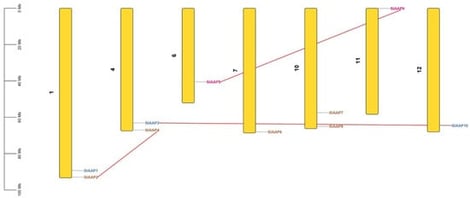
Chromosome mapping of SlAAP genes. SlAAPs are unevenly distributed across tomato chromosomes, with red lines marking duplicated gene pairs.

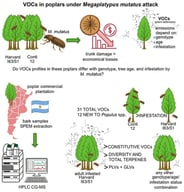
Megaplatypus mutatus, a major poplar pest in South America, tunnels into the xylem, weakening trunks and reducing wood quality. Volatile organic compounds (VOCs) are key mediators of plant–insect interactions and may reflect genotype-specific defence strategies. This study analysed VOC profiles of young and adult Populus deltoides cv. Harvard and P. × canadensis cv. Conti 12 under natural M. mutatus infestation. Gas chromatography–mass spectrometry putatively annotated 31 VOCs, including green leaf volatiles (GLVs), pentyl leaf volatiles (PLVs), terpenes, alcohols, aromatics and phenolics, 12 of which, to our knowledge, have not been previously reported in Populus VOC profiles. Harvard trees showed ~14.5-fold higher total VOC abundance than Conti trees. In Conti, constitutive VOC emissions remained stable regardless of infestation status or age. In contrast, under infestation, Harvard trees emitted10-fold higher constitutive VOCs than non-infested Harvard trees and ~52-fold higher than Conti, a pattern consistent with increased defensive activity. GLVs and PLVs relatively dominated both genotypes, although Harvard showed higher emissions. Terpenes were not detected in young Conti trees under our analytical conditions but were abundant and diverse in infested Harvard trees, which may indicate a stronger terpene-associated response in this clone. Several compounds were detected only under specific genotype–condition combinations in our dataset and therefore represent candidate volatiles for future behavioural and functional studies. These results are consistent with differences in VOC emission patterns between genotypes and age classes, improve our understanding of putative chemical cues in the interaction between Populus and M. mutatus, and provide a basis for future work towards sustainable pest management strategies.

31 January 2026

Putatively annotated VOCs detected in Populus cultivars, their assignment to chemical groups, and retention times (min). Coloured cells indicate that a given VOC was detected under our analytical conditions in the corresponding genotype × age × infestation class; white cells indicate no detection. Asterisks (*) denote putatively annotated compounds that, to our knowledge, have not been previously reported in Populus VOC profiles. GLV = green leaf volatile, and PLV = pentyl leaf volatile.

A Protein Hydrolysate Mitigates the Adverse Effect of Chilling Stress on Cucumber Plants

  • Dobrinka Balabanova,
  • Adelina Harizanova and
  • Andon Vassilev
  • + 2 authors

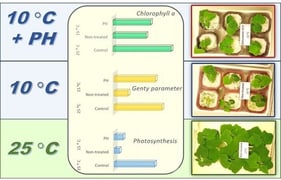
Chilling has been recognized as a stress factor adversely impacting plant growth and productivity. Even a slight decrease in temperature may significantly reduce crop yield. Recently, biostimulants have emerged as a new tool for enhancing the chilling tolerance of cold-sensitive plants. The early stages of cucumber growth often occur under suboptimal temperatures, which motivated the aim of the current study to assess the effect of a protein hydrolysate (PH) on the physiological performance of young cucumber plants subjected to chilling stress. The results showed that low temperatures caused severe chilling stress by inducing changes in growth, photosynthesis, and nitrogen assimilation. These adverse effects were mitigated when the PH was supplied. The ameliorating effect could be due to a remedial influence on photosynthetic pigment content, facilitating light harvesting and energy utilization. The potential impact of the PH treatment on the redox balance was demonstrated by the activation of the G6PD gene. The possible effect of the biostimulant on nitrate assimilation was tested by measuring nitrate reductase activity, which improved after application of the biostimulant. Moreover, the activity of phenylalanine ammonia-lyase (PAL) in PH-supplied plants was also increased, further confirming the enhanced protective capacity of the plants. All obtained results indicate the beneficial effect of PH application on cucumber plants and their chilling resilience.

30 January 2026

Cucumber plants grown under the following conditions (from left to right): 1—control plants grown at 25 °C, without supplementation with the PH (25 °C); 2—plants cultivated at 25 °C, with addition of Naturamin WSP (25 °C + PH); 3—stressed plants at 10 °C, without PH treatment (10 °C); 4—plants grown at 10 °C and supplemented with the biostimulant (10 °C + PH).

Diabetic Kidney Disease Associated with Chronic Exposure to Low Doses of Environmental Cadmium

  • Soisungwan Satarug,
  • Tanaporn Khamphaya and
  • Supabhorn Yimthiang
  • + 2 authors

Accumulating evidence suggests that exposure to pollution from environmental cadmium (Cd) contributes to diabetic kidney disease as indicated by albuminuria and a progressive decrease in the estimated glomerular filtration rate (eGFR). This study examined the effects of Cd exposure on eGFR and the excretion rates of albumin (Ealb) and β2-microglobulin (Eβ2M) in 65 diabetics and 72 controls. Excretion of Cd (ECd) was a measure of exposure, while excretion of N-acetylglucosaminidase (ENAG) reflected the extent of kidney tubular cell injury. In participants with an elevated excretion of Eβ2M, the prevalence odds ratios (POR) for a reduced eGFR rose 6.4-fold, whereas the POR for albuminuria rose 4.3-fold, 4.1-fold, and 2.8-fold in those with a reduced eGFR, diabetes, and hypertension, respectively. Using covariance analysis, which adjusted for the interactions, 43% of the variation in Ealb among diabetics could be explained by female gender (η2 = 0.176), ENAG2 = 0.162), hypertension (η2 = 0.146), smoking (η2 = 0.107), and body mass index (η2 = 0.097), while the direct contribution of ECd to Ealb variability was minimal (η2 = 0.005). Results from a mediating-effect analysis imply that Cd could contribute to albuminuria and a falling eGFR through inducing tubular cell injury, leading to reduced reabsorption of albumin and β2M.

16 January 2026

Urinary Cd excretion rates and levels of eGFR, FPG, and serum β2M in controls and diabetics. Boxplots of data on ECd/Ccr (A), eGFR (B), [Glc]p (C), and serum levels of β2M (D) in controls and subjects with diabetes for <10 and ≥10 years, respectively. Each box represents the 25th and 75th percentile values of the variable indicated on the x-axis. A horizontal line inside each box represents the median. Circles and asterisks represent outliers.

News & Conferences

Issues

Open for Submission

Editor's Choice

Get Alerted

Add your email address to receive forthcoming issues of this journal.

XFacebookLinkedIn
Stresses - ISSN 2673-7140