Skip Content
You are currently on the new version of our website. Access the old version .

Solids

Solids is an international, peer-reviewed, open access journal on all areas of solid-state sciences published bimonthly online by MDPI.

All Articles (221)

The VDA 238-100 tight radius bend test has gained widespread acceptance for plane strain fracture characterization of sheet metals in proportional loading without necking. The VDA test features a 60 × 60 mm2 square blank with a 0.2 mm or 0.4 mm radius punch to provide plane strain bending where the fracture limit of the material is lowest. However, the through-thickness gradients that suppress necking and promote fracture on the convex surface in tension can be exploited to efficiently characterize the fracture strain from uniaxial to plane strain tension by varying the sample width. In this study, V-bend tests were conducted for various sample widths for four advanced high-strength steels: 980GEN3, DP1180, MP800-V1, and MP800-V2 with the local fracture strains measured using digital image correlation. Reducing the width-to-thickness ratio below five altered the stress state at the failure location, with an aspect ratio of one providing edge fractures under uniaxial tension. This aspect ratio was then applied to 980GEN3 and MP800 steel samples with punched edges as it provides an efficient method for sheared edge fracture characterization that is not susceptible to necking as with common sheared edge tensile tests. To mitigate strain averaging inherent in DIC near surfaces, a geometric-based arc length methodology was proposed. The sheared edge fracture limits from the V-bend tests were then compared with the results from conical hole expansion and in-plane bend tests. The sheared edge formability was observed to have a material-dependent sensitivity to the test method. MP800-V2, with centerline segregation, exhibited a pronounced sensitivity to the applied deformation mode with absolute differences in fracture strains of 0.13 while the MP800-V1 and 980GEN3 did not.

5 February 2026
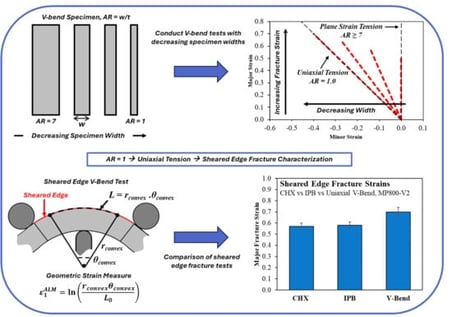
Schematic highlighting how V-bends with decreased widths can calibrate fracture models from PST to UT in (a) strain space and (b) equivalent plastic strain—stress triaxiality space.

This study developed a sonoseeding strategy for controlling the crystal size of acetaminophen during cooling crystallization by introducing sonication into a supersaturated solution, thereby inducing nucleation. Based on the synthetic route of acetaminophen, crystallization behavior in both water and acetic acid aqueous solutions was investigated, along with the influence of a structurally related additive, p-aminophenol, on nucleation. To establish the sonoseeding approach, the solubility of acetaminophen in water and an aqueous solution of acetic acid, with and without the additive, was measured over a temperature range of 10–70 °C using a titration method. In parallel, the nucleation temperatures and metastable zone widths of acetaminophen were systematically determined during cooling crystallization under varying operating conditions. Results demonstrate that sonication effectively induces nucleation and significantly narrows the metastable zone width, particularly in aqueous solutions of acetic acid. Guided by the determined solubility and nucleation behavior, sonoseeding crystallization experiments were conducted at various supersaturation levels, allowing for the efficient control of acetaminophen crystal size, which ranged from 27 μm to 95 μm, with narrower particle size distributions compared to spontaneous nucleation. Furthermore, the recrystallized acetaminophen was confirmed as Form I using PXRD, DSC, and FTIR analysis. This study demonstrates that the sonoseeding approach is an efficient method for controlling crystal size during the crystallization of active pharmaceutical ingredients.

2 February 2026

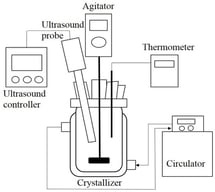
Experimental apparatus for the sonocrystallization experiment.

Ceramic Matrix Composites (CMCs) have emerged as a structural material alternative to nickel superalloys for high-pressure turbines (HPT) components operating at high temperature, like shrouds. Despite the outstanding thermal stability of the CMCs, limited cooling is still necessary due to the extreme thermal operating conditions necessary to maximize engine performance and minimize fuel consumption. The design of CMC components, indeed, must consider a maximum service temperature that should not be exceeded to avoid damage and accelerated oxidation. The cooling, on the other hand, may induce the formation of thermal gradients and thermal stresses. In this work, different design options for the cooling system are investigated to minimize the thermal stresses of an HPT shroud-like geometry subjected to maximum temperature constraints on the material. Cooling is obtained via colder air jet streams (air taken from the compressor), whose impact position (the surface where the cold air impacts the component) has a different effect on the temperature field and on the induced stress field. Besides stress evaluation with different cooling systems, an ONERA damage model is investigated at a key location to potentially take into account stress components acting simultaneously and potential stiffness degradation of the CMC. Finally, the design evaluation of potential discrete crack propagation is discussed. A standard cohesive elements approach has been compared with a brittle element death approach. The results showed that the cohesive element approach resulted in shorter crack propagation, underestimating the actual crack behavior due to the embedded stiffness degradation method, while the element death returned encouraging results as a quicker, less complex, but still accurate design evaluation.

2 February 2026

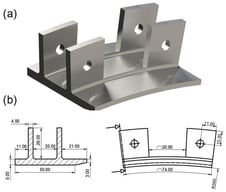
(a) Overview of the seal-segment-like structure; (b) sketch with the main dimensions (the dimensions are in mm).

Magnesium–sulfur (Mg-S) batteries represent a novel category of multivalent energy storage systems, characterised by enhanced theoretical energy density, material availability, and ecological compatibility. Notwithstanding these benefits, the practical implementation of this approach continues to be hindered by ongoing issues, such as polysulfide shuttle effects, slow Mg2+ transport, and significant interfacial instability. This study emphasises recent progress in utilising transition metal chalcogenides (TMCs) as cathode materials and modifiers to overcome these challenges. We assess the structural, electrical, and catalytic characteristics of TMCs such as MoS2, CoSe2, WS2, and TiS2, highlighting their contributions to improving redox kinetics, retaining polysulfides, and enabling reversible Mg2+ intercalation. The review synthesises results from experimental and theoretical studies to offer a thorough comprehension of structure–function interactions. Particular emphasis is placed on morphological engineering, modulation of electronic conductivity, and techniques for surface functionalisation. Furthermore, we examine insights from density functional theory (DFT) simulations that corroborate the observed enhancements in electrochemical performance and offer predictive direction for material optimisation. This paper delineates nascent opportunities in Artificial Intelligence (AI)-enhanced materials discovery and hybrid system design, proposing future trajectories to realise the potential of TMC-based Mg-S battery systems fully.

8 January 2026

Evaluation of safety, estimated cell potential, cost, abundance, volumetric expansion rate, practical gravimetric energy densities at the cell level, gravimetric energy density, and volumetric energy density for Mg-S, Ca-S, Na-S, K-S, Al-S, and Li-S batteries. Reproduced with permission from [37].

News & Conferences

Issues

Open for Submission

Editor's Choice

Get Alerted

Add your email address to receive forthcoming issues of this journal.

XFacebookLinkedIn
Solids - ISSN 2673-6497